3.1. Gaussian Process Modeling and Sampling Algorithm Verification
We present a test problem to illustrate and verify our Gaussian process modeling with the variability-based sampling and bisection algorithm. Equation (7) is the mathematical form of the given mean function
q and is expressed as follows:
The linear slope between the starting and ending points of the function is removed since locally varying spatial variation is the main focus. We decide to use Equation (7) that has a higher spatial variation frequency in the region
when compared to that in region
to test whether our algorithm captures the correct behavior of spatial roughness variation when its characteristics are not uniform over the entire domain. A Matérn covariance function with the parameters:
ν = 2,
ϕ = 2,
θ = 0.4 is used to generate the spatial variation. We generate realizations of the random process and sample these realizations at a total of 61 measurement locations. The sampled data is used as the input for estimation, wherein we try to reconstruct the parameters of the actual stochastic process from which the data originated. We assign the following prior PDFs for the unknown parameters:
The prior PDFs can be specifically selected to incorporate any knowledge regarding the values of the unknown parameters. Otherwise, they can be set as uniform distribution in the absence of the aforementioned information. We use 500 realizations of the given random process that are sampled at the given locations to generate the joint posterior distribution of the parameters and select 1000 samples from it using the Markov chain Monte Carlo method with a burn-in of 30,000 and a thinning factor of 10 [
17].
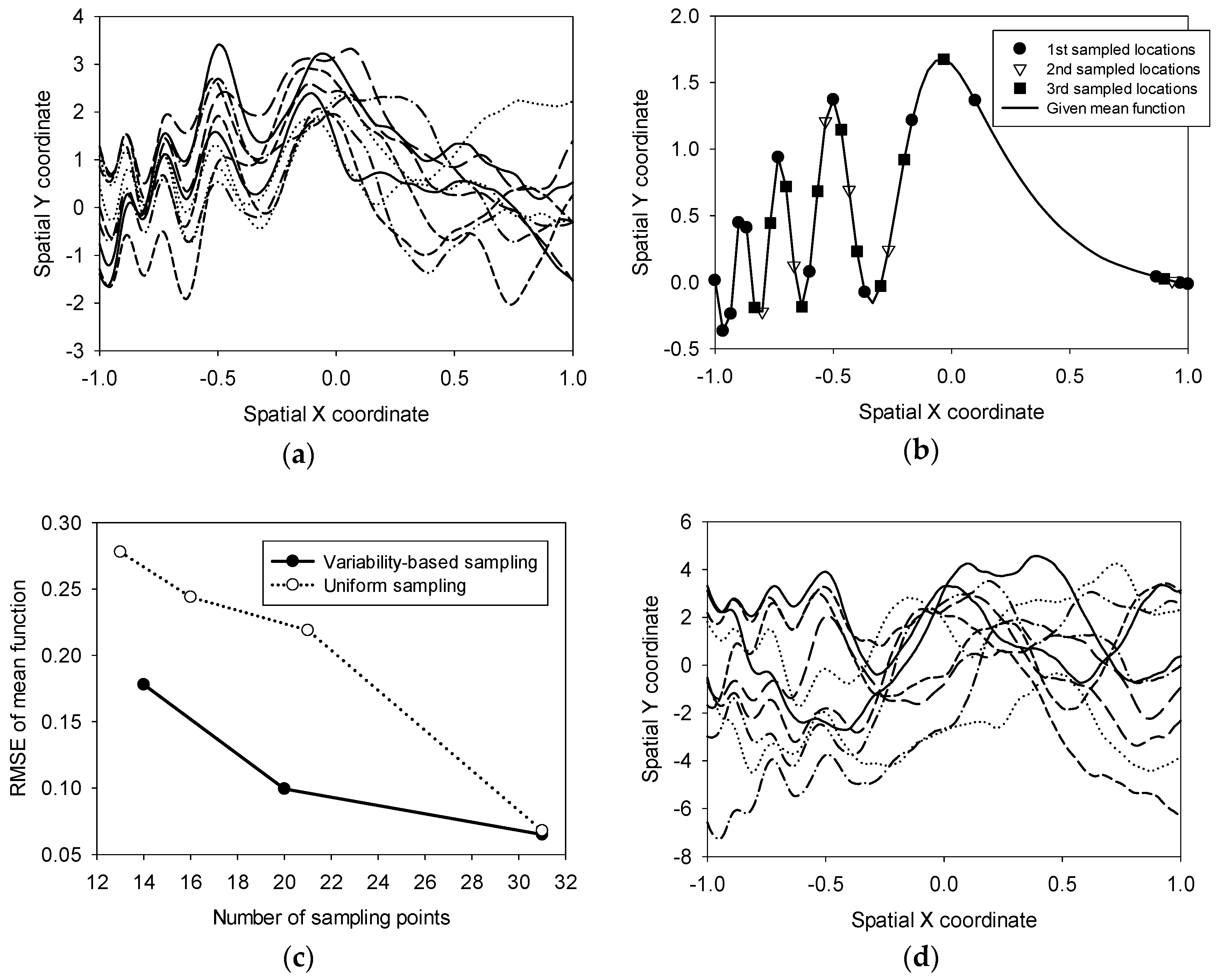
Figure 2a shows 10 realizations from the given stochastic process. The sampled points in the 1st (circles), 2nd (triangles), and 3rd (rectangles) runs of non-uniform sampling are also shown in
Figure 2b. Fourteen points from the 1st sampling based on the local variability effectively capture the high frequency spatial variation near the left sidewall. However, they miss a few details near the left sidewall as well as near the right sidewall. The lack of sampling points is compensated in the 2nd and 3rd bisection steps by placing additional sampling points and reducing the deviation between the mean function calculated from all realizations and the estimated mean function. Total sampled points in the 2nd and 3rd sampling from the bisection method are 20 and 31, respectively.
To visualize the effectiveness of variability-based sampling and the bisection algorithm, the root-mean-square error (RMSE) between the estimated mean and the mean from realizations is calculated and compared in two different sampling cases: proposed variability-based sampling and uniform sampling. The result is shown in
Figure 2c. The x-axis denotes the number of sampling points and the y-axis denotes the RMSE value. Given the efficient placement of measurement locations, the RMSE in non-uniform sampling is considerably lower than that in the uniform sampling result with an equal number of sampling points. Additionally, while the RMSE is reduced with increases in the sampling locations, the RMSE decreases significantly faster in the variability-based method. The RMSEs in both methods are identical when the sampling locations correspond to almost half of the total measurement locations. Therefore, we conclude that variability-based sampling and the bisection algorithm is a more attractive option for the effective allocation of computing power and resources.
Figure 2d shows 10 sampled realizations from the estimated Gaussian process model.
In addition to the comparison of the mean function, the estimated parameters in the Matérn covariance function with respect to the number of sampling points are shown in
Table 2. There are three parameters in the Matérn covariance function, and the given values are denoted in the parentheses. In contrast to the deviations in the mean function, the estimated parameters do not significantly depend (within a 5% error) on the number of sampling points. It can be speculated that the sampled points from the variability-based sampling gives enough information to accurately estimate the hyperparameters in the covariance function even though it missed a few local variabilities in the mean function.
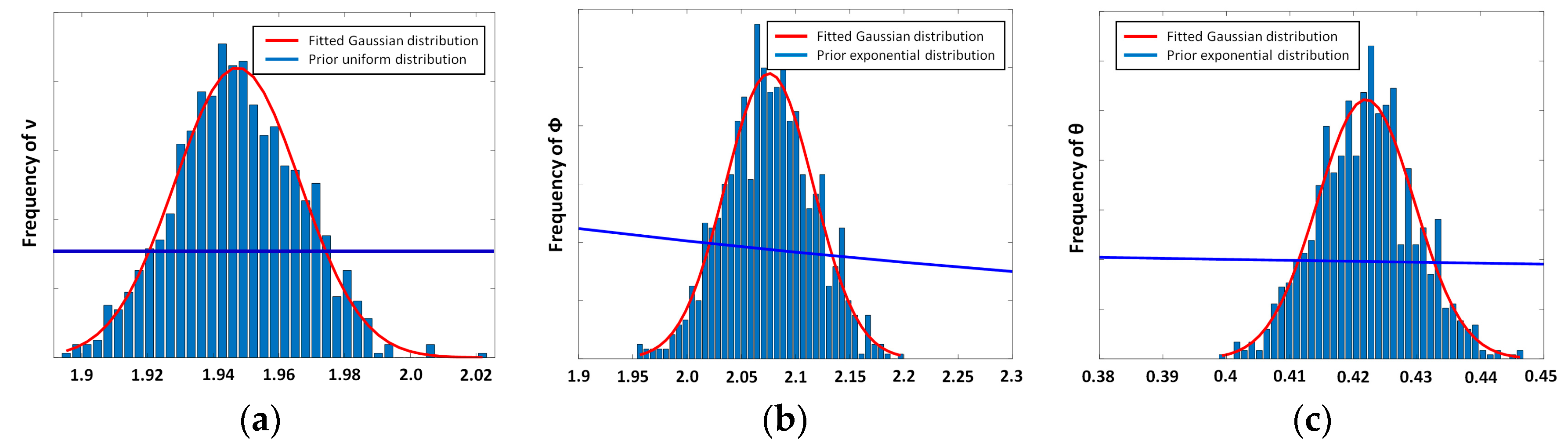
Figure 3 shows the prior and the posterior PDFs of three unknown parameters in the Matérn covariance function. The prior PDF from Equation (8) is displayed with a blue line at the displayed region and the blue histogram is from the posterior PDF obtained by histogram of the trace values from MCMC sampling. The red line is a fitted normal distribution to the histogram.
Figure 3 clearly visualizes the updating process of Bayesian inference by incorporating the observed data. It is important to emphasize that since the estimated parameters are obtained as PDFs instead of single values, the Gaussian process described by the estimated parameters is a set of multiple Gaussian processes defined by hyperparameters realized from the posterior PDFs. This helps us to model a wide range of uncertainties in the observed data while keeping the practical advantages of Gaussian process.
3.2. Extracting Profiles from the Images of Additively Manufactured Struts.
Gaussian process modeling with the non-uniform sampling algorithm is applied to the sidewall profiles of AM fabricated struts.
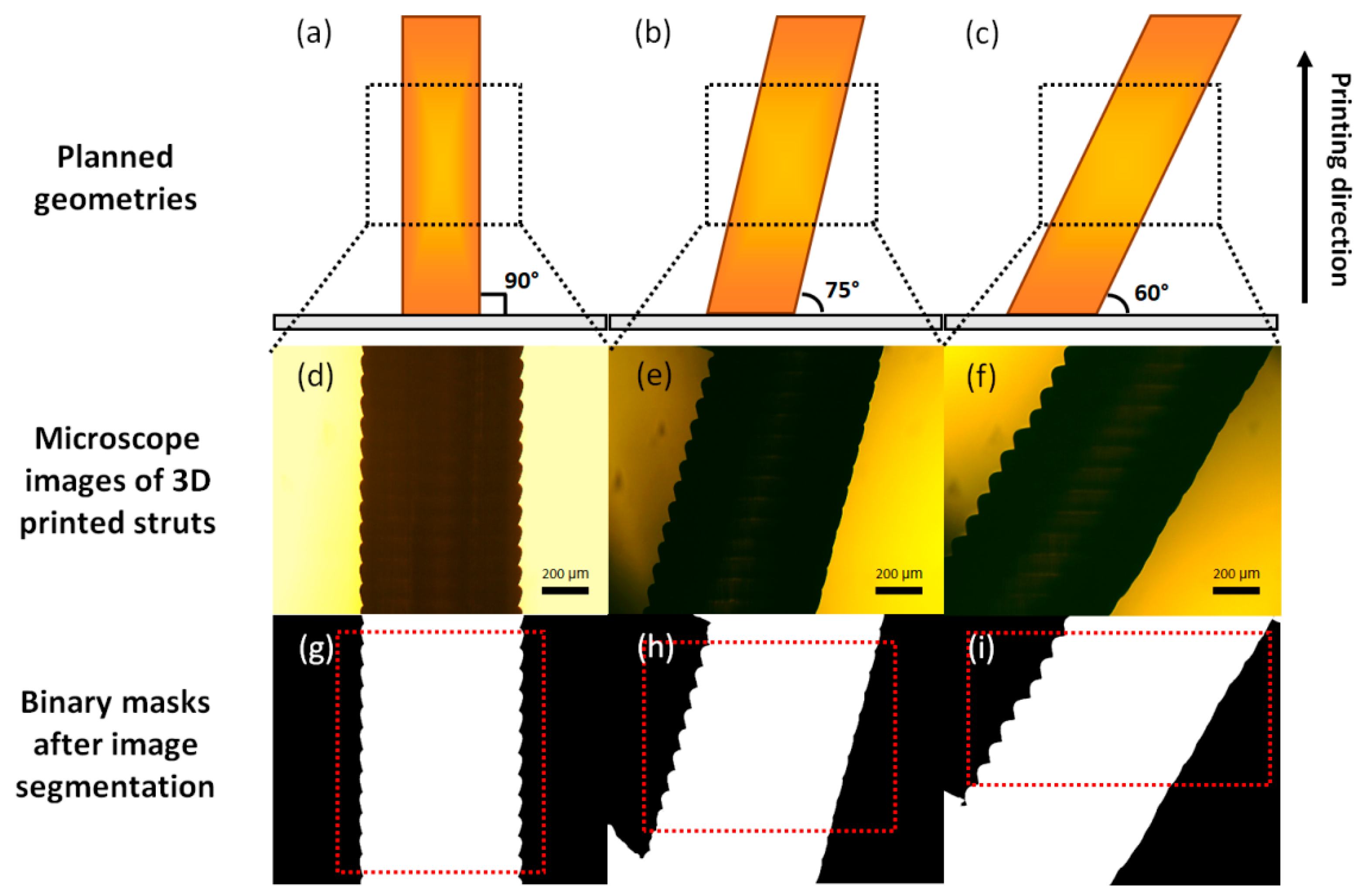
Figure 4a–c shows the CAD geometries of struts in 3 different printing angles (90°, 75°, and 60°) and printing directions. The layer thickness corresponds to 80 pixel units. The sidewall profiles of multiple AM fabricated struts with different angles (90°, 75°, and 60°) are shown in
Figure 4d–f. The sidewall profile consists of multiple layers printed repeatedly layer-by-layer, and we assume that the spatial uncertainty in each printed layer is generated from an independent event, so that is not related to the neighboring layers. There are three parameters in Equation (1) that are reduced by considering the two ratios,
and
. We manually segmented one printed layer in the image and varied the two ratios to determine the optimized parameter values to obtain the optimal match with respect to the manually segmented edge. After calibrating two ratios in the level set method, the same algorithm is applied to the remaining layers to extract the edge information from the image.
Figure 4g–i shows the binary masks of the images after segmentation in which the white pixels represent the segmented region of the strut and the black pixels denote the background region. Given the smooth intensity gradient from the center to the edge of the image, the segmentation at the edges of the images is inaccurate in the 75° and 60° cases in
Figure 4h,i. The artifact from the background inhomogeneity can be easily removed by measuring and compensating the intensity gradient in the background. The compensation is not applied in the study to minimize the manual intervention. A more systematic approach to reduce the effect from the local inhomogeneity is given in [
33].
The edge profile is extracted by collecting the outermost pixels in the left and right sidewalls of binary masks.
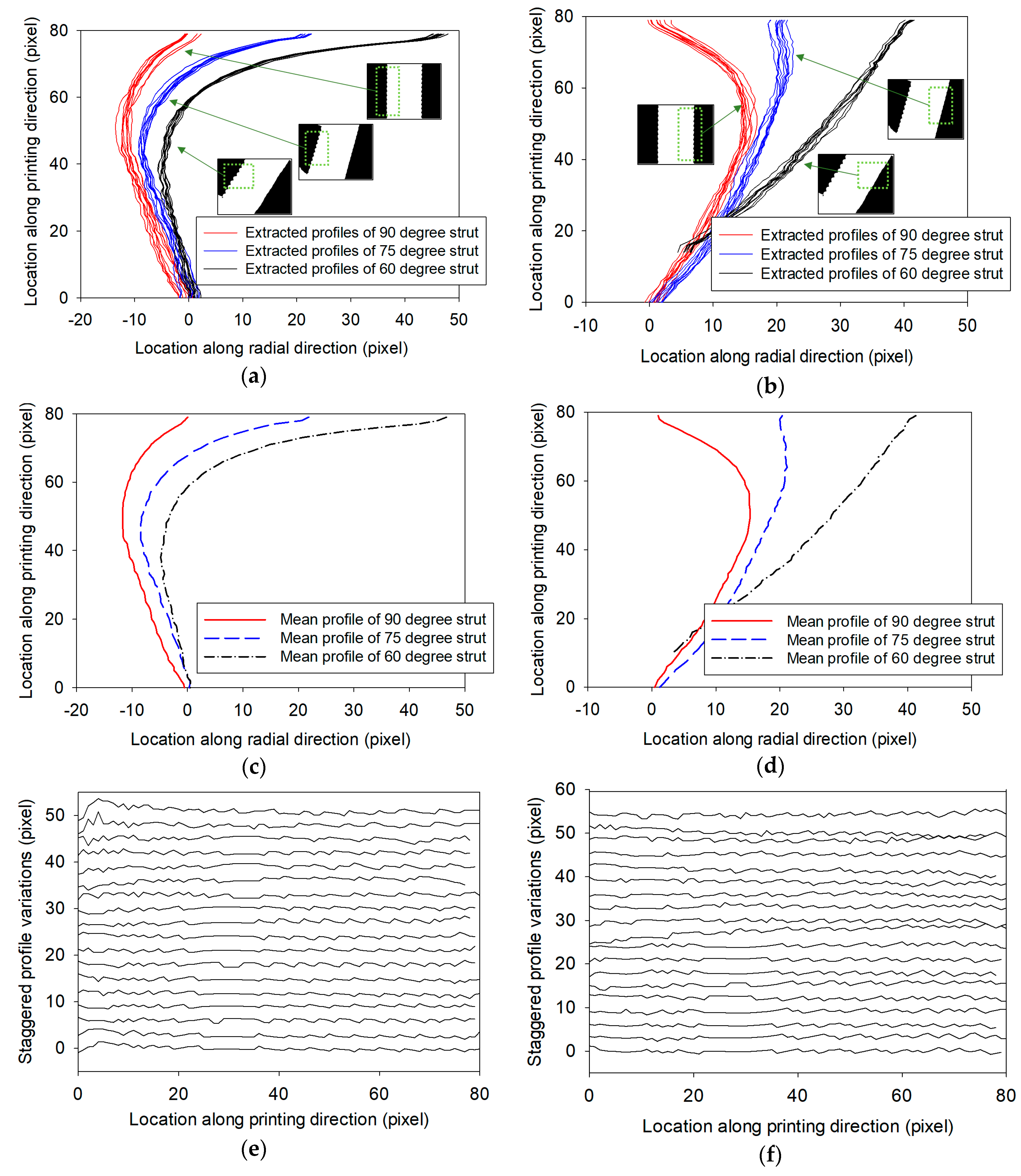
Figure 5a,b shows the extracted edge profiles in the left and right sidewalls of each printed layer, respectively. It is clear that the side profile of all layers show consistent trend depending on the printing angle. This characteristic staircase profile is caused by the light absorption and scattering in the resin vat and light penetration during the curing of upper layer. In a manner similar to the test case, the mean of all observations, which represents the staircase profile, is subtracted from the sidewall profile; thus, the roughness spatial uncertainty is independent of the printed angle. The mean profile is obtained by simple summation of all side profiles in each printing angles. The summation averages out the local roughness from the mean profile. The mean trends extracted from all observations and the roughness extracted spatial uncertainties are shown in
Figure 5c–f, respectively. In total, 37 roughness profiles are collected and the roughness is independent of printing angle as well as direction of side profile as shown in the Figure. This will be used for estimating hyperparameters in the Gaussian process model.
In contrast to the test case, we possess prior information on the distribution of the amplitude and scaling parameters of covariance function from the geometrical constraints of the printed struts. Based on the roughness spatial variation amplitude from observations, the upper limit on the prior distribution of the amplitude parameter in the covariance function is 5. Additionally, the maximum correlation length is limited up to the height of a printed layer. Equation (9) describes the prior information of the hyperparameters.
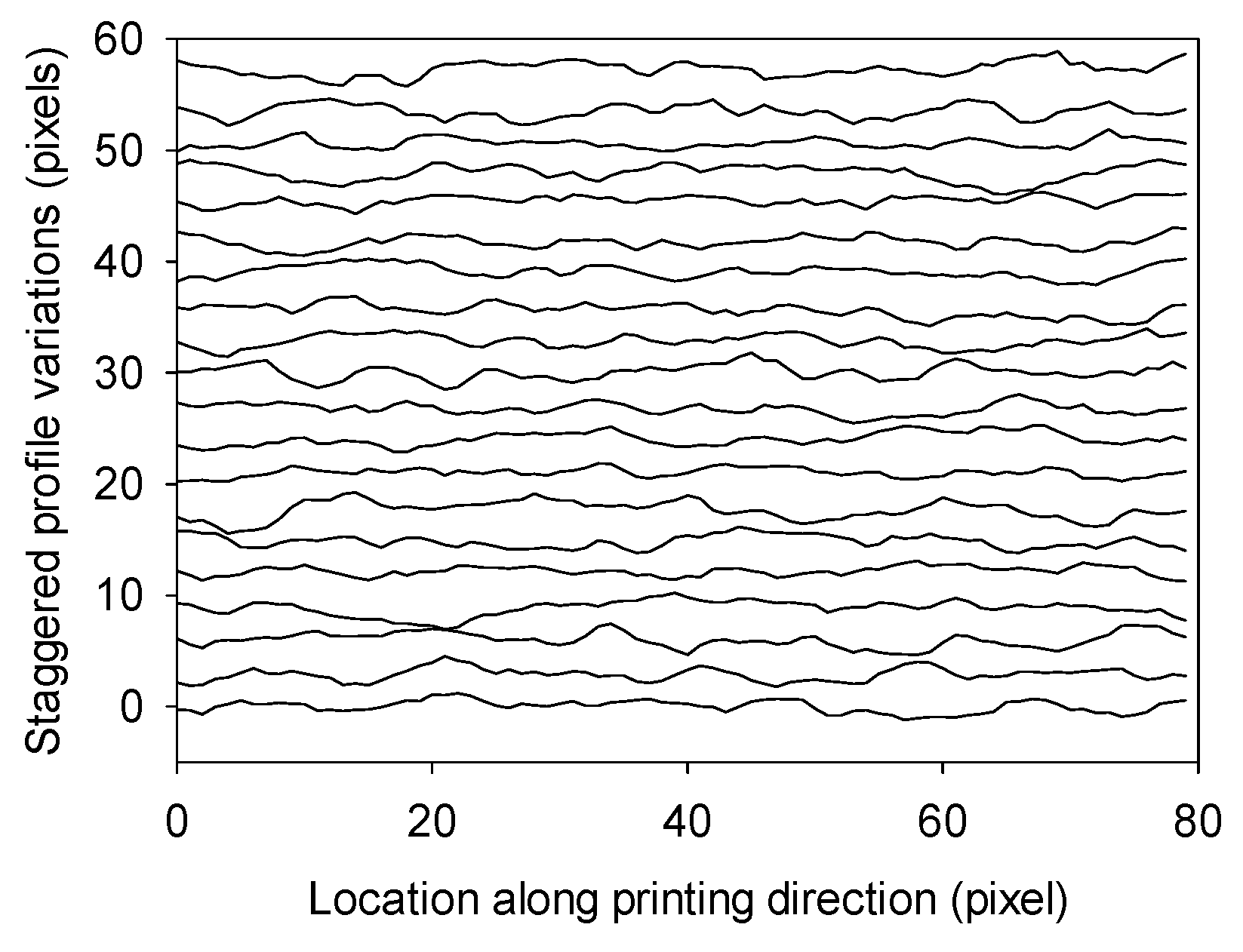
Twenty realizations from the estimated stochastic model are shown in
Figure 6. In a manner similar to the observations from the extracted profiles of actual struts, the fluctuations are distributed uniformly over the domain, and this indicates the characteristics of the stationary Gaussian process. This reproduced roughness will be superimposed in the CAD geometry with the mean profile to quantify the effect of side profile on the mechanical behavior of AM parts.
3.3. Effect of Spatial Uncertainty on the Mechanical Behavior of Additively Manufactured Struts
In the study, we consider simple struts with three different printing angles (90°, 75°, and 60°). In order to clearly visualize the effect from the spatial uncertainty, the struts in FE analysis are simplified as 2D struts. To investigate the effect of spatial uncertainty on the mechanical properties of additively manufactured struts, three computational models with different strut geometries are first prepared as follows: (1) nominal strut: desired CAD geometry with a smooth side surface (planned geometry without any staircase profile as well as spatial uncertainty), (2) predicted AM strut: geometry with predicted roughness in which the staircase profile and the spatial uncertainty are reproduced from our estimated Gaussian process model, and (3) volume-matched strut: strut also with a smooth side surface, having a thickness adjusted by smoothing the ridges and valleys of the rough side profile such that the volume is matched with the predicted AM strut. The analysis of (3) is necessary for fair comparison because the thickness of the manufactured struts is slightly lower than that of the planned geometry. By including (3), the difference in the mechanical properties that are caused by the volume change can be investigated. The thickness of the strut in the CAD model is 800 μm, and the thicknesses of struts in the volume-matched geometries extracted from the sample images are approximately 754 μm, 754 μm, and 760 μm for 90°, 75°, and 60°, respectively. For the computational efficiency, one third of the height of printed strut (2000 μm) is modeled in the simulation. The three different aforementioned geometries are created for each printing angle, namely 90°, 75°, and 60°.
A linear static structural analysis was performed to calculate the mechanical property of struts in three different printing angles (90°, 75°, and 60°) under compressional loading conditions. A commercial FE software package, COMSOL Multiphysics
TM, running on the personal computer (Windows 10 64 bit, Intel i7-4790 CPU, 16 GB RAM), was used for all numerical simulations. The governing equation for the struts is as follows [
34]:
where F is the deformation gradient, S is the second Piola–Kirchhoff stress, v is the left stretch tensor. The Cauchy stress tensor,
, is the multiplication of F, S, the transpose of F, and the volume ratio, J, which is the determinant of F. The Lagragian–Green strain,
, is a function of F and the identity tensor, I. The second Piola–Kirchhoff stress, S, is the gradient of the strain energy-density function, W
s with respect to
.
is the scalar invariant of the left Cauchy–Green deformation tensor. The struts are made of a photo-polymerizable poly(ethylene glycol) diacrylate (PEGDA) (molecular weight 250). PEGDA is assumed to be a hyperelastic, incompressible, and isotropic material and modeled by using neo-Hookean model [
34]. The uniaxial compression test is performed to obtain the material property of PEGDA. The stress–strain curve obtained from the experiment is fitted to the neo-Hookean model to determine the shear modulus, µ. The fitted value of µ is approximately 36.1 MPa for the PEGDA.
The interfacial boundaries of each layer were merged together with its neighboring layers using “union assembly” feature in COMSOL software, assuming the perfect binding condition between layers. Zero-displacement was imposed on the bottom of the strut, and the controlled displacement was applied on the top surface of the strut in the vertical direction as described in Equation (11).
where u is the displacement vector in the computational domain and
is the displacement vector of elements at the bottom of strut.
is the vertical displacement of elements at the top of the strut and
is the controlled displacement that was applied as a boundary condition.
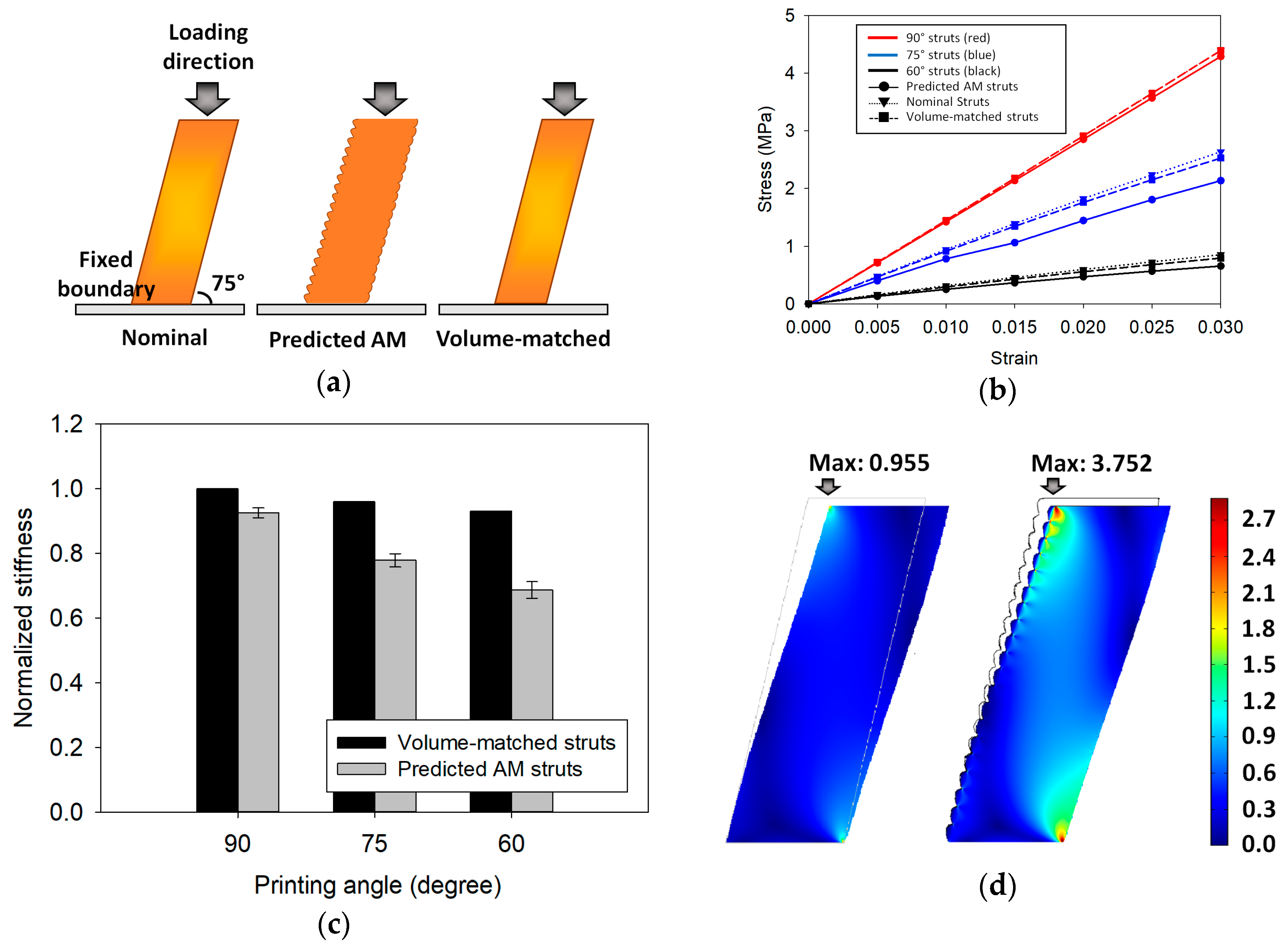
Figure 7a shows the loading direction and the boundary condition in the three struts: nominal, predicted AM, and volume matched struts. The applied strain was limited up to 0.03 to avoid the nonlinear deformation of the strut. Since the strut is considered as the building block of unit cell structure, the strain is defined as the actual deformation of the strut divided by the height of the strut. With respect to the deformation of the strut, the resulting stress was calculated as the average of total pressure over the bottom surface of the strut. Triangular elements as well as the adaptive mesh size control were adopted to make sure that it captures all details of spatial uncertainties at the edge of struts. The mesh size convergence test was performed to ensure that the simulation result is not sensible to the mesh size. The number of elements in three different geometries, giving the consistent simulation results, are 10,040, 831,944, and 9474 for the nominal strut, predicted AM strut, and volume-matched strut, respectively. The number of elements for predicted AM strut is significantly higher than the others because of the geometrical details of spatial uncertainty at the edge of strut.
Figure 7b shows the stress–strain curves of 9 different examples obtained from the FE simulation. The slope of the stress–strain curve denotes the stiffness of the strut. The slopes of all stress–strain curves are grouped into three categories based on its printing angle, and a slope deviation exists given the existence of the spatial deviation. The decrease in slope is qualitatively observed in the predicted AM strut and volume-matched strut. To quantitatively understand the effect of spatial deviation on the stiffness of the struts, the stiffness of the volume-matched and predicted AM struts are normalized with the stiffness of the nominal struts as shown in
Figure 7c. The change in the effective stiffness of the volume-matched geometry is not significant (less than 7% of the stiffness of the nominal) when the printing angle changes from 90° to 60°. However, when the geometry exhibits roughness including the staircase profile as well as the spatial uncertainty, the stiffness is reduced to 70% of the nominal geometry when the printing angle is 60°. The reduction in stiffness is expected since the roughness decreases the cross-sectional area of each strut and decreases the stiffness of the strut. However, it is observed that the roughness effect is more pronounced when compared the reduction in volume-matched case to the predicted AM case. This result indicates that the necessity of details of surface roughness becomes more important as the printing angle reduces. Specifically, the angled strut is frequently used in the lattice structures, which is the assembly of multiple unit cells, consisting of angled struts. Therefore, modeling the surface roughness including spatial uncertainty is important for the accurate estimation of mechanical properties of the lattice structure.
Additionally, we compare the maximum value of von Mises stress in the three cases.
Table 3 shows the maximum von Mises stresses of the volume-matched geometry strut and the predicted AM strut normalized with respect to the maximum von Mises stress of the nominal strut. The von Mises stress distribution and the location of the maximum value is displayed in
Figure 7d. The stress distribution in
Figure 7d shows distinctive difference from the stress distribution in the vertical strut because of two major factors: (1) bending and shear stresses and (2) surface roughness. When a strut is loaded axially, it only develops compressive normal stress. When a strut is loaded with an angle, bending and shear stresses begin to arise, and it becomes more likely that the strut undergoes a large deformation and becomes more susceptible to developing a large stress as shown in
Figure 7d. In addition to the effect from bending and shear stresses, local stress concentrations are observed near the side profiles in the predicted AM, which is not observed in the volume-matched strut or the nominal strut in which the sidewall profiles are smooth. The geometric discontinuities caused by the spatial uncertainties change the stress distribution in the strut, and the amount of stress concentration is thrice that in the smooth cases. Thus, it is anticipated that the total stiffness of the additively manufactured strut is affected by the change in stress distribution. Therefore, considering spatial uncertainties in the geometry to accurately predict the mechanical behavior of struts using FE analysis is essential.
The proposed modeling framework is also applicable to complex AM parts with inner structures. The spatial uncertainties can be estimated by the proposed modeling framework if the inner structure of the complex AM parts is expected to exhibit spatial uncertainties that are statistically similar to the outer structure. Even if the inner structures of the complex AM parts are expected to exhibit statistically different spatial uncertainties, the proposed modeling framework can be still applied to the complex AM parts with the exception of the image segmentation sub-step. As opposed to the use of optical images, there are multiple techniques to measure the inner structure profile of the complex parts, such as X-ray computed tomography and profilometry. Following the extraction of the inner structure profile, it is possible to apply the remaining sub-steps of the proposed modeling framework, namely variability-based sampling and Gaussian process modeling, to the problem.