Article

LSTM DSS Automatism and Dataset Optimization for Diabetes Prediction †

Dyrecta Lab srl, Via Vescovo Simplicio 45, 70014 Conversano, Italy
*
Author to whom correspondence should be addressed.
This work is an extended version of our research published in 2018 at the conference “AEIT 2018 International Annual Conference” held in Bari, Italy, 3–5 October 2018.
Appl. Sci. 2019, 9(17), 3532; https://doi.org/10.3390/app9173532
Submission received: 28 June 2019 / Revised: 19 August 2019 / Accepted: 21 August 2019 / Published: 28 August 2019

Abstract

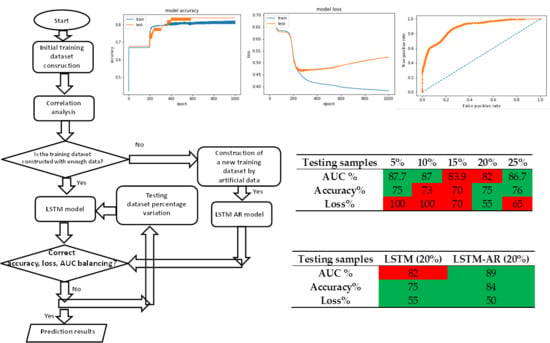
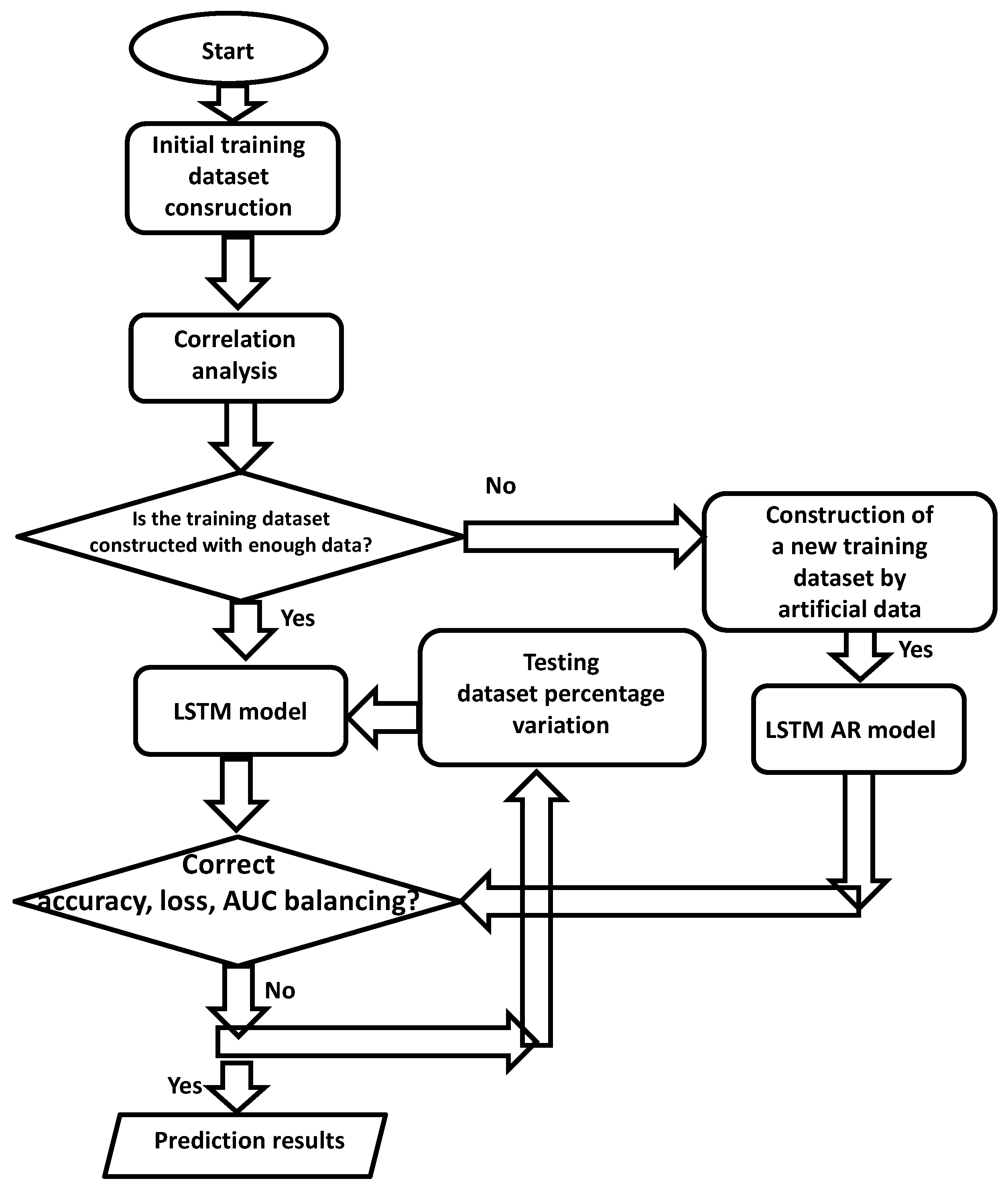
The paper is focused on the application of Long Short-Term Memory (LSTM) neural network enabling patient health status prediction focusing the attention on diabetes. The proposed topic is an upgrade of a Multi-Layer Perceptron (MLP) algorithm that can be fully embedded into an Enterprise Resource Planning (ERP) platform. The LSTM approach is applied for multi-attribute data processing and it is integrated into an information system based on patient management. To validate the proposed model, we have adopted a typical dataset used in the literature for data mining model testing. The study is focused on the procedure to follow for a correct LSTM data analysis by using artificial records (LSTM-AR-), improving the training dataset stability and test accuracy if compared with traditional MLP and LSTM approaches. The increase of the artificial data is important for all cases where only a few data of the training dataset are available, as for more practical cases. The paper represents a practical application about the LSTM approach into the decision support systems (DSSs) suitable for homecare assistance and for de-hospitalization processes. The paper goal is mainly to provide guidelines for the application of LSTM neural network in type I and II diabetes prediction adopting automatic procedures. A percentage improvement of test set accuracy of 6.5% has been observed by applying the LSTM-AR- approach, comparing results with up-to-date MLP works. The LSTM-AR- neural network can be applied as an alternative approach for all homecare platforms where not enough training sequential dataset is available.
Keywords: LSTM; DSS; diabetes prediction; homecare assistance information system; muti-attribute analysis; artificial training dataset LSTM; DSS; diabetes prediction; homecare assistance information system; muti-attribute analysis; artificial training dataset
Graphical Abstract