Article

The Design and Building of a Hexapod Robot with Biomimetic Legs


School of Electrical Engineering and Automation, Jiangxi University of Science and Technology, Ganzhou 341000, China
*
Author to whom correspondence should be addressed.
Appl. Sci. 2019, 9(14), 2792; https://doi.org/10.3390/app9142792
Submission received: 1 June 2019 / Revised: 3 July 2019 / Accepted: 9 July 2019 / Published: 11 July 2019
(This article belongs to the Special Issue Selected Papers from IEEE ICASI 2019)

Abstract

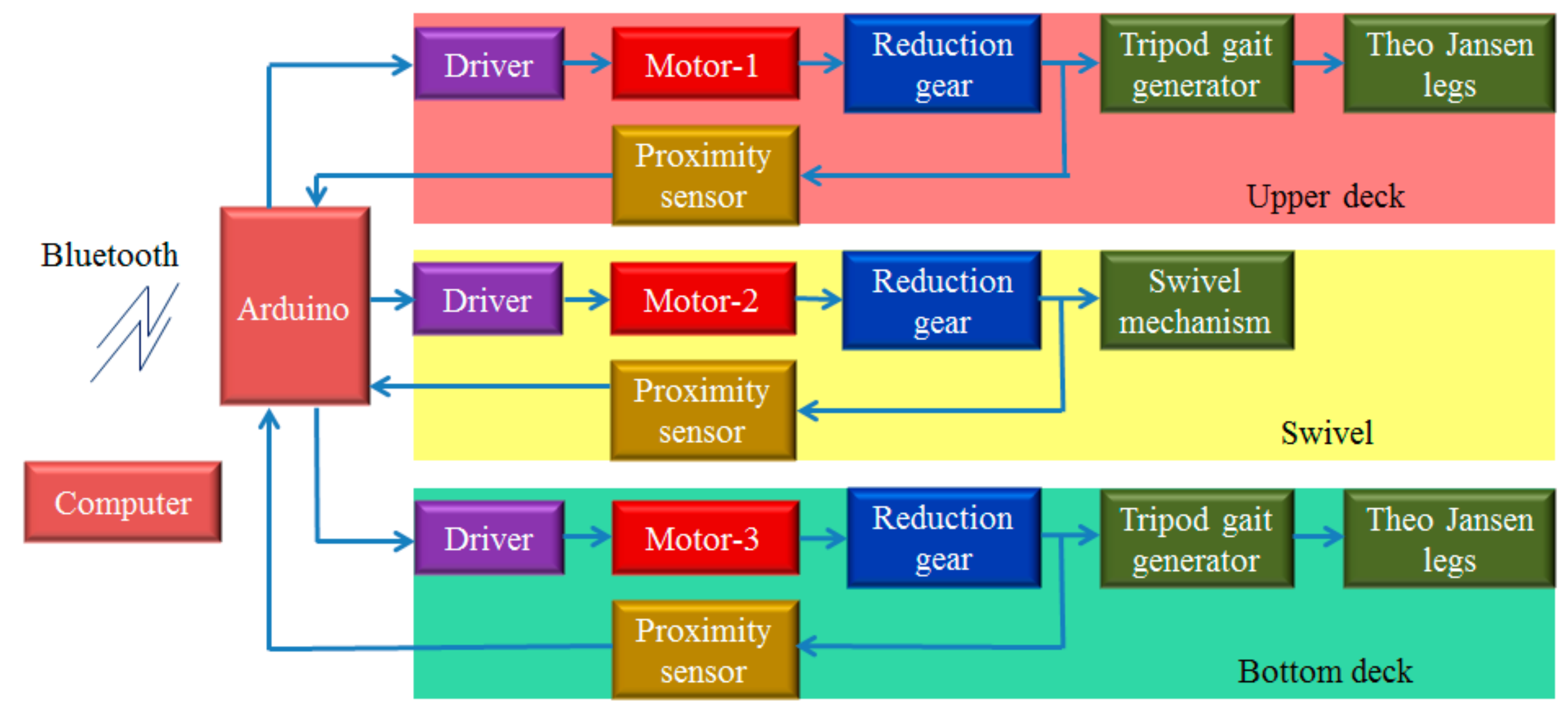
A hexapod robot with biomimetic legs was built to implement a distributed control system, where a mechanism is proposed to serve as the central pattern generator and a computer to act as the brain-stem, cooperating with the central pattern generator through wireless communication. The proposed mechanism is composed of two modules, i.e., the tripod gait generator and the Theo Jansen Linkage. The tripod gait generator is a device that uses a single motor to generate a tripod gait, while the Theo Jansen Linkage rhythmically executes the legged motion. In a sense, we are trying to implement the locomotion of a robot by means of a hybrid computational system, including the mechanism part and the electronic processors part. The complex mathematical function of the foot movement is realized by the ensemble of links of the Theo Jansen Linkage, so as to alleviate the computational burden. Besides, the proposed design, based on non-collocated actuators, is intended to minimize the number of actuators while reducing the building cost of the robot.
Keywords: central pattern generator; Theo Jansen Linkage; non-collocated actuators central pattern generator; Theo Jansen Linkage; non-collocated actuators