Article

Hybrid Genetic Simulated Annealing Algorithm for Improved Flow Shop Scheduling with Makespan Criterion


1
Key Laboratory of Advanced Manufacturing Technology of the Ministry of Education, Guizhou University, Guiyang 550025, China
2
School of Mechanical Engineering, Guizhou Institute of Technology, Guiyang 550003, China
3
School of Mechanical Engineering, Guizhou University, Guiyang 550025, China
4
Guizhou Provincial Key Laboratory of Public Big Data (Guizhou University), Guiyang 550025, China
5
College of Computer Science and Technology, Guizhou University, Guiyang 550025, China
6
College of Big Data Statistics, GuiZhou University of Finance and Economics, Guiyang 550025, China
7
Department of Computer Science and Engineering, University of South Carolina, Columbia, SC 29208, USA
*
Authors to whom correspondence should be addressed.
Appl. Sci. 2018, 8(12), 2621; https://doi.org/10.3390/app8122621
Submission received: 11 October 2018 / Revised: 1 December 2018 / Accepted: 5 December 2018 / Published: 14 December 2018
(This article belongs to the Section Mechanical Engineering)

Abstract

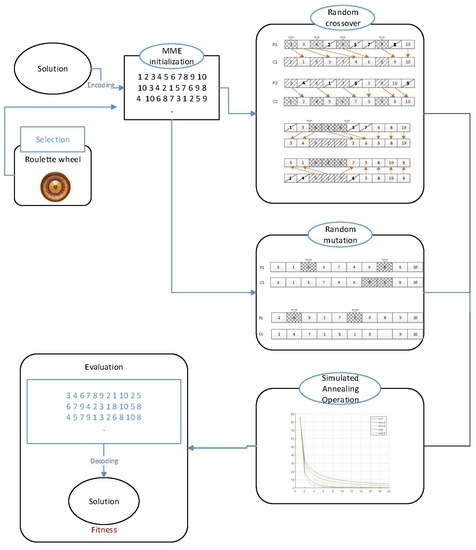
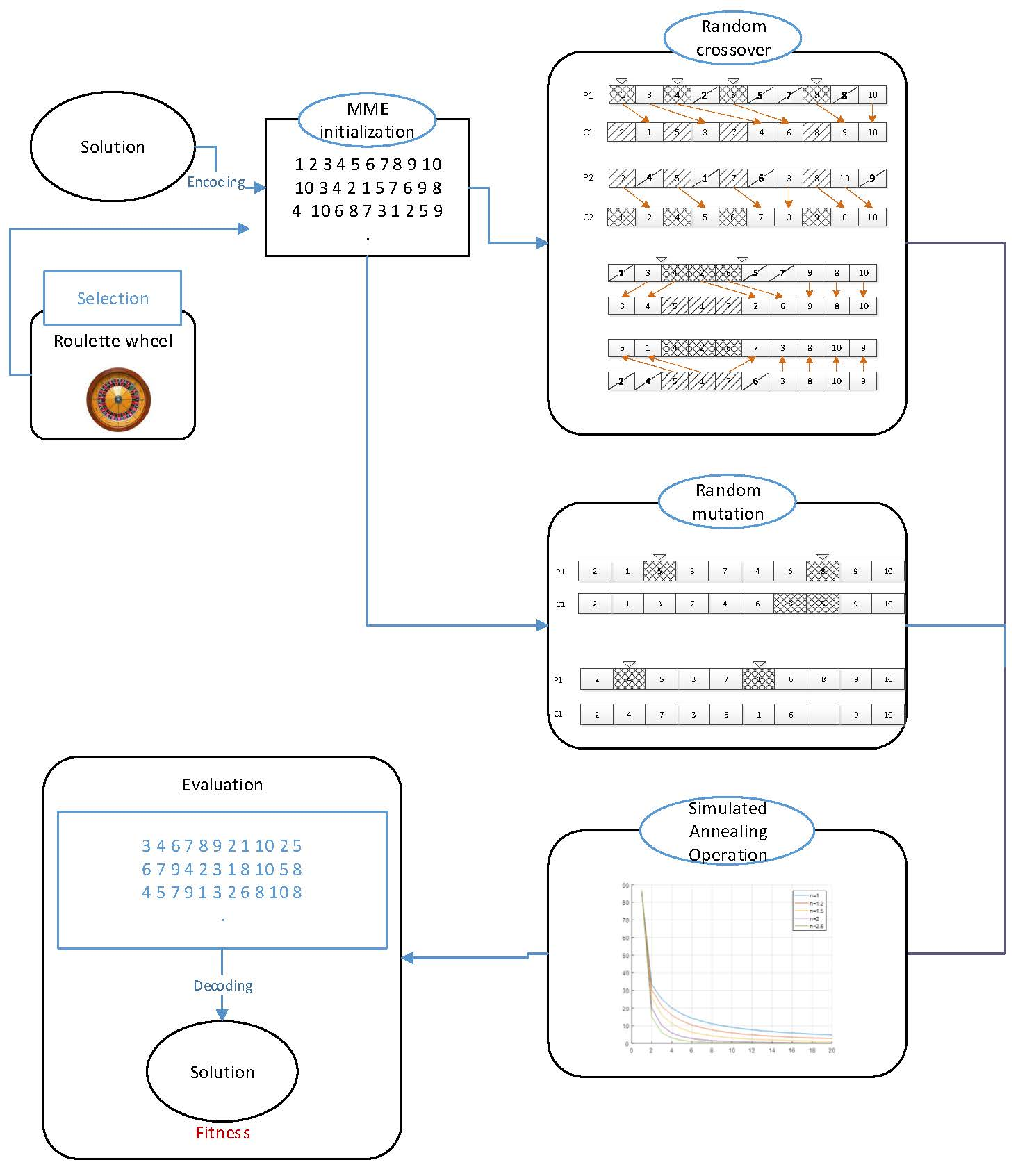
Flow shop scheduling problems have a wide range of real-world applications in intelligent manufacturing. Since they are known to be NP-hard for more than two machines, we propose a hybrid genetic simulated annealing (HGSA) algorithm for flow shop scheduling problems. In the HGSA algorithm, in order to obtain high-quality initial solutions, an MME algorithm, combined with the MinMax (MM) and Nawaz–Enscore–Ham (NEH) algorithms, was used to generate the initial population. Meanwhile, a hormone regulation mechanism for a simulated annealing (SA) schedule was introduced as a cooling scheme. Using MME initialization, random crossover and mutation, and the cooling scheme, we improved the algorithm’s quality and performance. Extensive experiments have been carried out to verify the effectiveness of the combination approach of MME initialization, random crossover and mutation, and the cooling scheme for SA. The result on the Taillard benchmark showed that our HGSA algorithm achieved better performance relative to the best-known upper bounds on the makespan compared with five state-of-the-art algorithms in the literature. Ultimately, 109 out of 120 problem instances were further improved on makespan criterion.
Keywords: flow shop scheduling; makespan; hybrid algorithm; genetic algorithms; simulated annealing flow shop scheduling; makespan; hybrid algorithm; genetic algorithms; simulated annealing
Graphical Abstract