Abstract
In this work, after investigating three typical magneto-electric (ME) composites, Permendur/Pb(Zr0.52Ti0.48)O3(PZT), Metglas/PZT, and Tefenol-D/PZT, with the same dimensions and different saturation magnetostriction and magnetic permeability, the most excellent ME performance is observed in the Permendur/PZT laminates, which agrees well with the predicted results from the figure of merit. The low-frequency and resonance ME coefficients of Permendur/PZT composite are ~23.1 V/Oe.cm and ~309 V/Oe.cm at the optimal dc bias magnetic field of ~250 Oe, respectively. The strong ME effect of Permendur/PZT composite gives it potential in practical magnetic sensitive device applications.
1. Introduction
The magnetoelectric (ME) effect is a polarization response P to an external magnetic field H [1]. In recent years, the magnetostrictive/piezoelectric ME laminates have attracted considerable attention because the composites have better ME properties than single-phase materials owing to their high product effect of the piezoelectric and magnetostrictive effects [2,3,4,5,6]. Most previous investigations have focused on the Tb0.3Dy0.7Fe1.92/Pb(Zr0.52Ti0.48)O3 (Terfenol-D/PZT) composites due to their high magnetostriction ( = 2000 ppm) in Terfenol-D [7,8,9]. The selection of appropriate magnetostrictive and piezoelectric materials is the primary step toward the goal of high ME coupling. On the basis of the expression of the upper bound (, where is the relative magnetic permeability and is the relative dielectric permittivity) given by Brown et al. to estimate the ME coupling of a magnetostrictive-piezoelectric composite [10], the low permeability ( = 10) of Terfenol-D may result in few magnetic flux lines concentrated on the Terfenol-D surface, which is unfavorable to the ME effect [11,12,13]. Recently, Metglas/PZT composites, with high relative permeability ( = 5000) and the piezomagnetic coefficient ( = 4.71 × 10⁻⁷ Wb/N), have attracted considerable attention and have been reported to possess the most excellent ME properties [14]. The ME electric field coefficient of Metglas/PZT composites (, where V, tP, and H are the induced ME voltage output, the thickness of the piezoelectric layer, and the applied external magnetic field, respectively) reaches ~220 V/Oe.cm [14,15,16,17], which agrees well with the theoretical prediction in Ref. [10].
It should be noted that, in practical application, the ME voltage coefficient () is more important in the estimate for the properties of ME materials than because the ME output voltage can be easily and directly measured. The production of Metglas materials usually uses melt spinning to give the high cooling rates required to avoid crystallization during quenching (105–106 K/s), and the alloy takes the form of a ribbon that is typically 10~100 thick [18], which makes it difficult to fabricate Metglas with thicker sizes. The optimized thickness ratio for fabricating high performance piezoelectric/magnetostrictive ME composites is approximately 1:1. Thus, the thickness of the piezoelectric layer in the Metglas/PZT composites is generally limited to decades of micrometer, leading to a low . Despite possessing high , the Metglas/PZT composites are difficult to use in practical devices due to their low . Furthermore, the saturation magnetostriction of Metglas is so low ( = 20 ppm) that it limits the strain of the piezoelectric layer to 0.002%, which is also unfavorable to the .
On the other hand, the optimal dc bias magnetic field () for Metglas is only about 6~10 Oe (about 10 times of the Earth’s magnetic field), which leads to a low signal/noise ratio (SNR) and a narrow ac magnetic field () detective range with a maximum detectable magnetic field of ~0.1 Oe (the maximum detectable should be lower than the percentage of ) [14,15,16,17,18,19].
Thus, it is crucial to define a figure of merit to characterize the magnetic performance of a piezoelectric-magnetostrictive composite with high ME coupling. Here, a figure of merit (, dimensionless) for the selection of magnetostrictive materials for a large ME coefficient was suggested. We have fabricated three typical ME composites, Permendur/PZT, Metglas/PZT, and Tefenol-D/PZT, with the same dimensions and different saturation magnetostriction and magnetic permeability. The strongest ME performance is observed in the Permendur/PZT laminates, which agrees well with the predicted result.
2. Experimental Section
The Permendur/PZT, Metglas/PZT, and Tefenol-D/PZT ME laminated composites were all fabricated from one PZT ceramic plate sandwiched between two magnetostrictive plates along the thickness direction. The dimensions of the magnetostrictive plates and the PZT plates are all 10 × 2 × 0.1 mm3. The relative dielectric constant () of the PZT sample is ~1200. The magnetostrictive plates magnetized along the length direction and the piezoelectric plates polarized along the thickness direction were stacked through using a silver epoxy (E-Solder No. 3021, ACME Division of Allied Products Co., CONN, New Haven, CT, USA) and cured at 60 °C under a pressure of 10 MPa for 6 h to achieve good mechanical coupling and strong bonding.
The set-up for measuring ME properties of as-fabricated composites consisted of an electromagnet (Myltem PEM-5005, China) for providing in the 0~1 kOe (1 Oe = 79.58 A/m) range and a pair of Helmholtz coils together with a linear power amplifier (AE Techron 7560) for providing in the 0~1 Oe range. The induced ME voltage was displayed by a digital oscilloscope (Agilent 54622A). and were monitored in situ by a pick-up coil connected to a digital Flux Meter (Myltem PF-900-2, China) and a Hall-effect probe connected to a Gaussmeter (Myltem PF-045B, China), respectively. Both and were in the length direction of the sample.
3. Results and Discussion
Table 1 lists the comparison in the parameters of permeability, saturation magnetostriction, piezomagnetic coefficient, and the optimal dc magnetic field between Permendur, Metglas, and Terfenol-D. Here, is the piezomagnetic constant of the magnetostrictive phase. From Table 1, Permendur, commonly composed of 50% Fe, 49% Co, and 1% V, and Metglas are more suitable for the ME structure than Terfenol-D due to their high permeabilities. Furthermore, compared to Metglas ( = 20 ppm; the optimal is 6~10 Oe; the maximum detectable is ~0.1 Oe), Permendur alloy possesses a higher saturation magnetostriction ( = 100 ppm), which contributes to a larger , and a medium optimal bias magnetic field (~250 Oe), which is beneficial to obtaining a high SNR and a wide detective range (~2.5 Oe), and has potential for practical applications of ME magnetic sensitive devices [20,21].
Table 1.
Magnetic and magnetostrictive parameters of Terfenol-D, Metglas, and Permendur alloy *.
| Title | (ppm) | (Oe) | (T−1) | |||
|---|---|---|---|---|---|---|
| Terfenol-D | 2000 (+) | 10 (−) | 400 (Medium) | 9.5 × 10⁻⁴ | 110 | 2 × 10⁴ |
| Metglas | 20 (−) | 5000 (+) | 10 (−) | 7.5 × 10⁻⁵ | 2450 | 1 × 10⁵ |
| Permendur | 100 (+) | 5000 (+) | 250 (Medium) | 7.8 × 10⁻⁵ | 2450 | 5 × 10⁵ |
* Here “Medium”, “+” and “−” denote the moderate, favorable, and unfavorable terms for ME laminates, respectively.
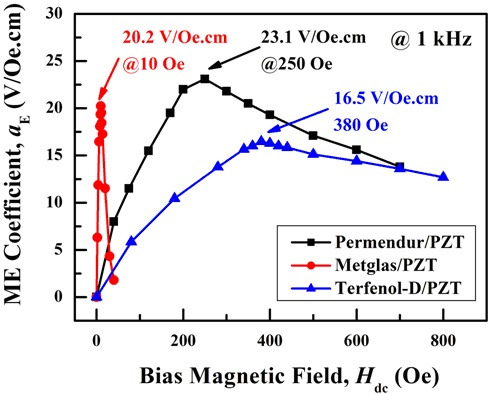
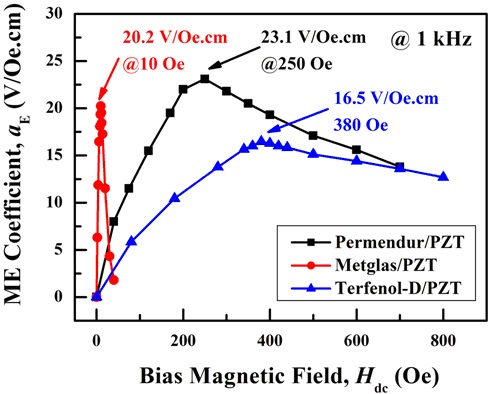
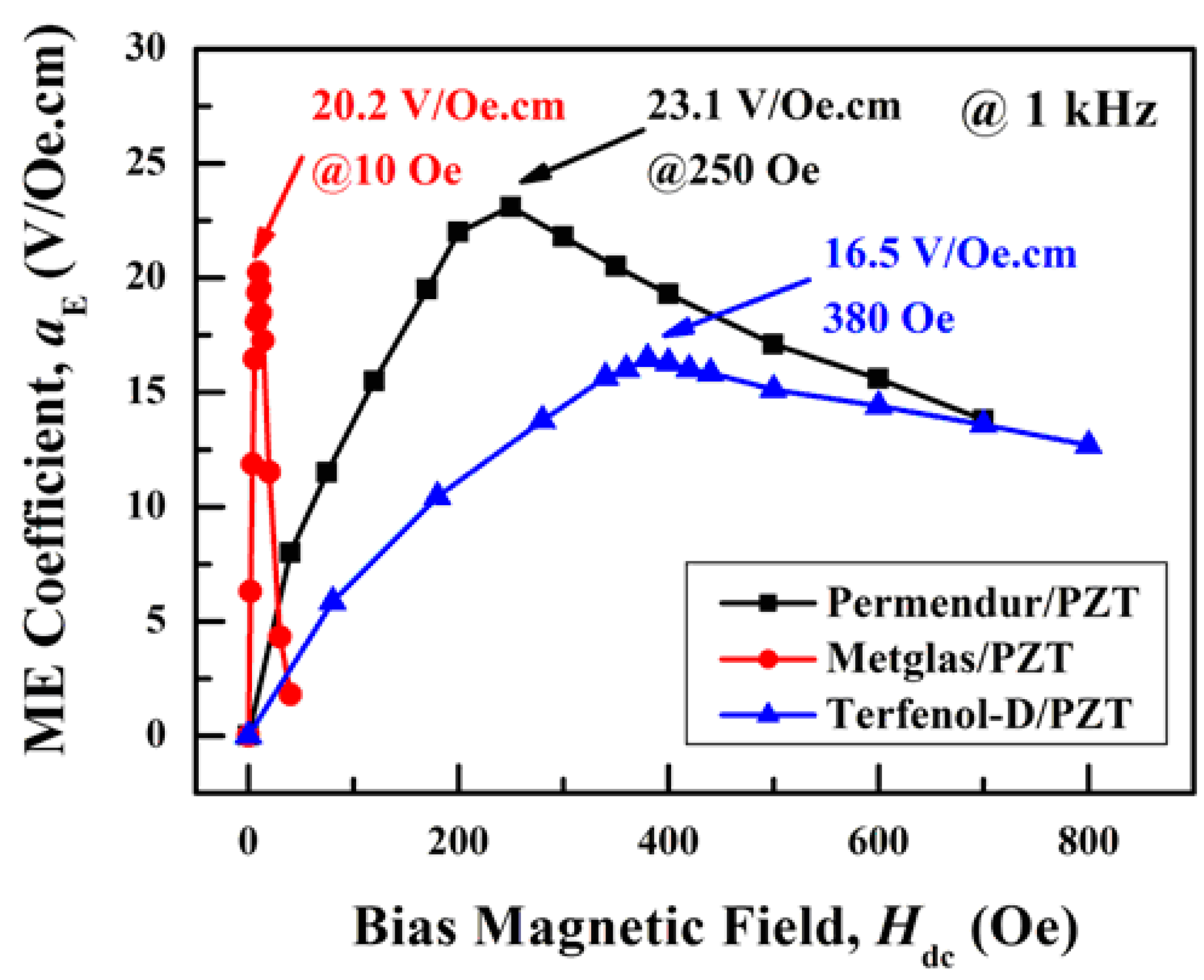
Figure 1 shows the ME coefficient () versus the bias dc magnetic field () for the Permendur/PZT, Metglas/PZT, and Terfenol-D/PZT laminated composites (with the same dimension and structure) at the frequency of ~1 kHz, respectively. Here increases initially, reaching the maximum value, and then decreases with the increasing . The dependence of essentially follows the trend of the dependence of of magnetostrictive materials [22]. The maximum ME coefficients for Permendur/PZT, Metglas/PZT, and Terfenol-D/PZT composites are ~23.1 V/Oe.cm, ~20.2 V/Oe.cm, and ~16.5 V/Oe.cm, respectively. The most excellent ME performance is observed in the Permendur/PZT laminates, which agrees well with the predicted results from the new figure of merit ().
Figure 1.
Magneto-electric (ME) coefficient versus bias magnetic field for the Permendur/PZT, Metglas/PZT, and Terfenol-D/PZT laminated composites (with the same dimension and structure) at a frequency of ~1 kHz, respectively.
It should be noted that, unlike the single-phase magnetoelectric materials, the magnetoelectric performance of bi-phase magnetostrictive/piezoelectric laminated magnetoelectric composites is dependent on many factors, such as the interface of the adherence layer, the shape demagnetization, the thickness ratio, and so on. Therefore, it is not easy to prepare many more kinds of samples to test and verify the definition of the new figure of merit. It is necessary to optimize the current definition of the figure of merit in the future on theoretical/thermodynamic means, since only three kinds of samples were used to serve as a firm basis for the new definition of the figure of merit in this work.
The dielectric constants, piezoelectric coefficients, and the ferroelectric polarization strength of the piezoelectric phase can greatly affect the ME coefficient. In this work, all of the selected piezoelectric phase materials for the three types of samples are PZT. Since 1950, the commercial piezoelectric market is mainly dominated by PZT ceramic, which has a market share of >90% today. Therefore, the new figure of merit in our work does not contain information about the piezoelectric material behavior. The application of the new figure of merit is mainly used to select suitable magnetic-phase material to obtain high ME performance.
Compared with Metglas (the optimal is 6~10 Oe; the maximum detectable is ~0.1 Oe), Permendur alloy possesses a medium optimal bias magnetic field (~250 Oe), which is beneficial to obtaining a high SNR and a wide detective range (the maximum detectable is ~2.5 Oe).
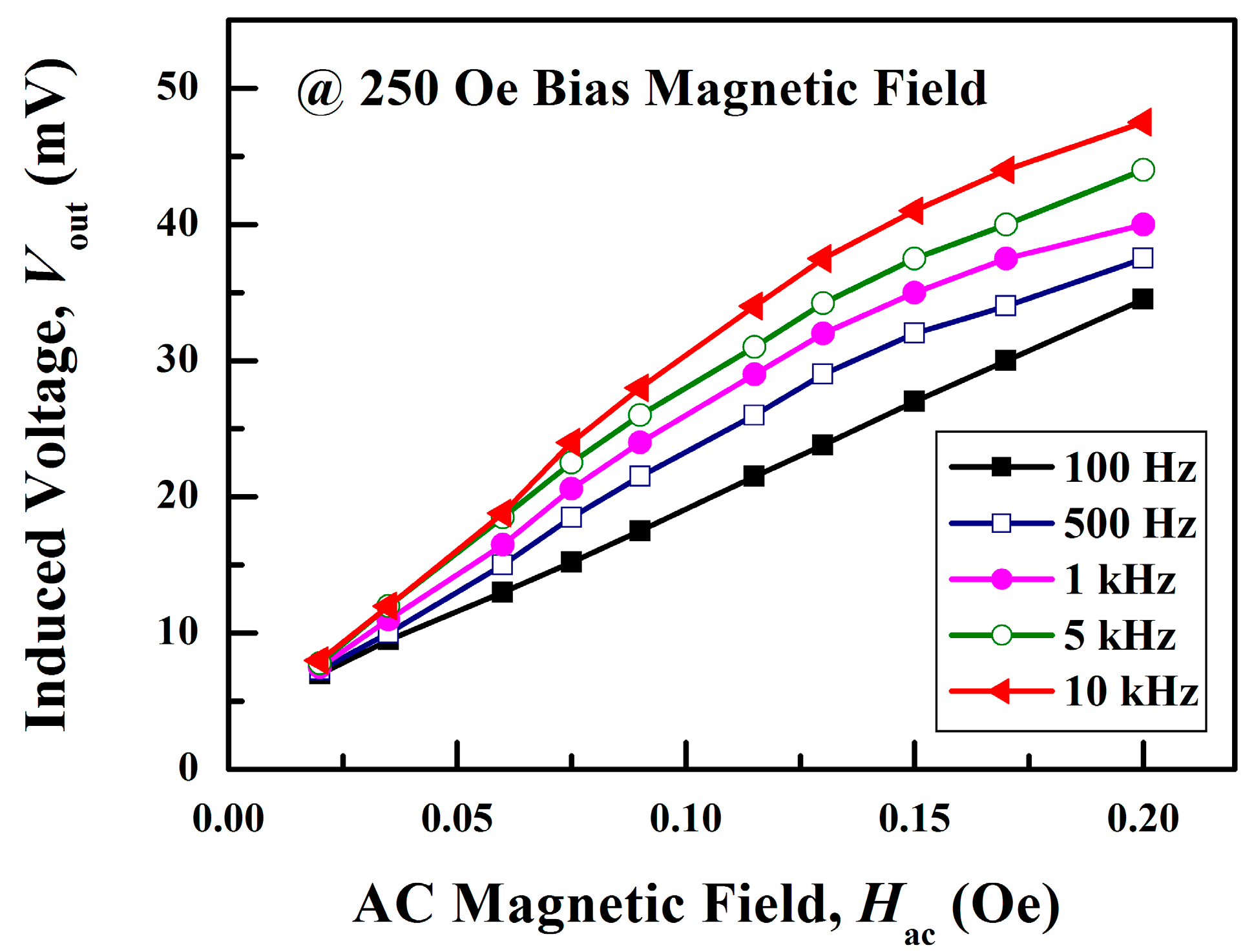
Figure 2 plots the induced voltage () from the Permendur/PZT laminated composite as a function of the ac magnetic field () under various frequencies at the dc bias magnetic field of ~250 Oe. It is seen that has good linear responses to in the entire range of 0~0.2 Oe under measured frequencies. From the slope of the - plot, the ME coefficient is determined to be ~23.5 V/Oe.cm (the thickness of the PZT plate is ~0.1 mm).
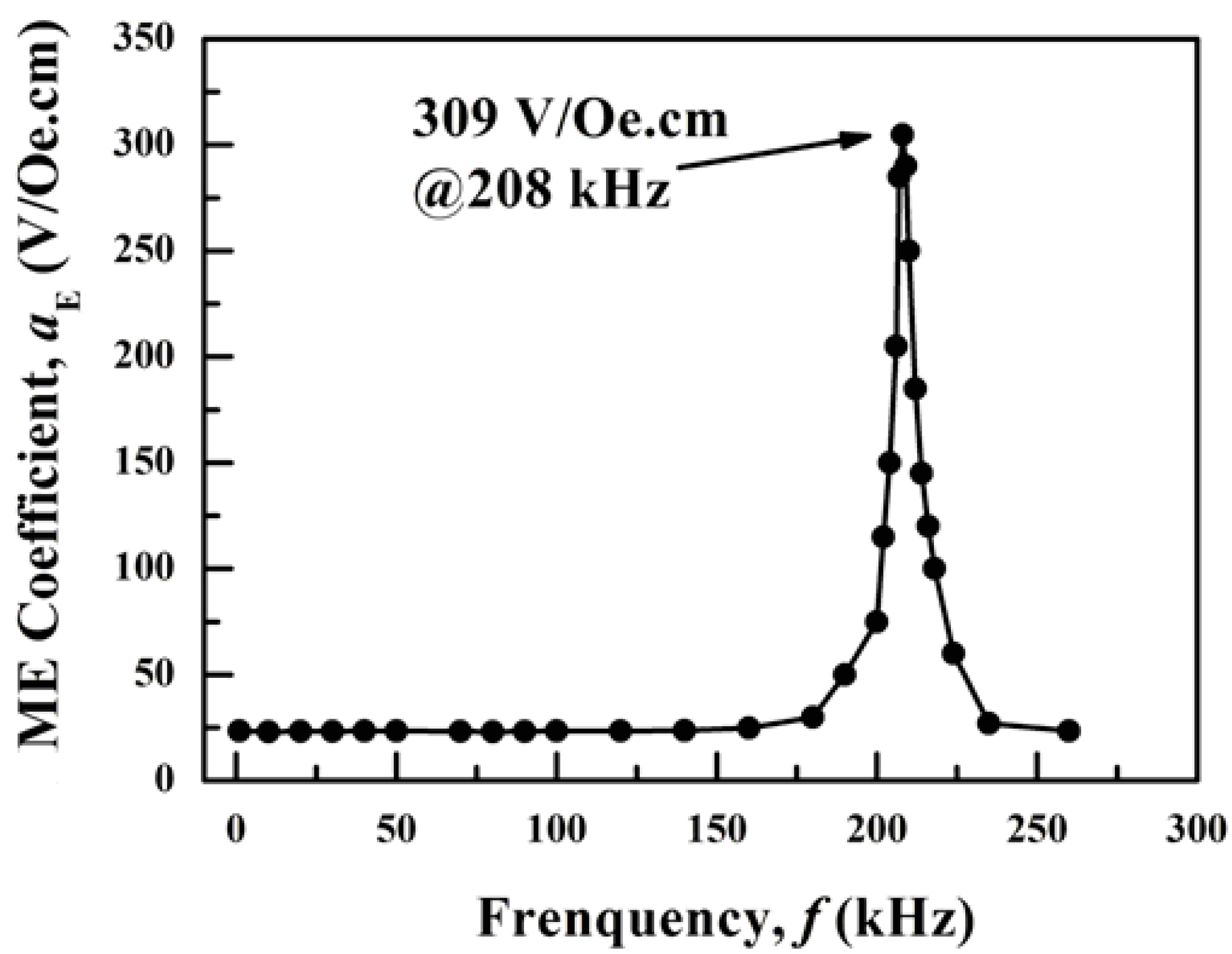
Figure 3 shows the dependence of frequency () on the ME coefficient for the Permendur/PZT composite at the dc bias magnetic field of ~250 Oe. No remarkable frequency dispersion is observed except for the resonance ranges, indicating an excellent frequency stability of ME properties in the frequency range of 0~150 kHz. The remarkable resonance frequency is ~208 kHz, while the largest peaks at ~309 V/Oe.cm.
Figure 2.
Induced voltage from the Permendur/PZT laminated composite as a function of ac magnetic field under various frequencies at the dc bias magnetic field of ~250 Oe.
Figure 3.
Dependence of frequency on the ME coefficient for the Permendur/PZT laminate at the dc bias magnetic field of ~250 Oe.
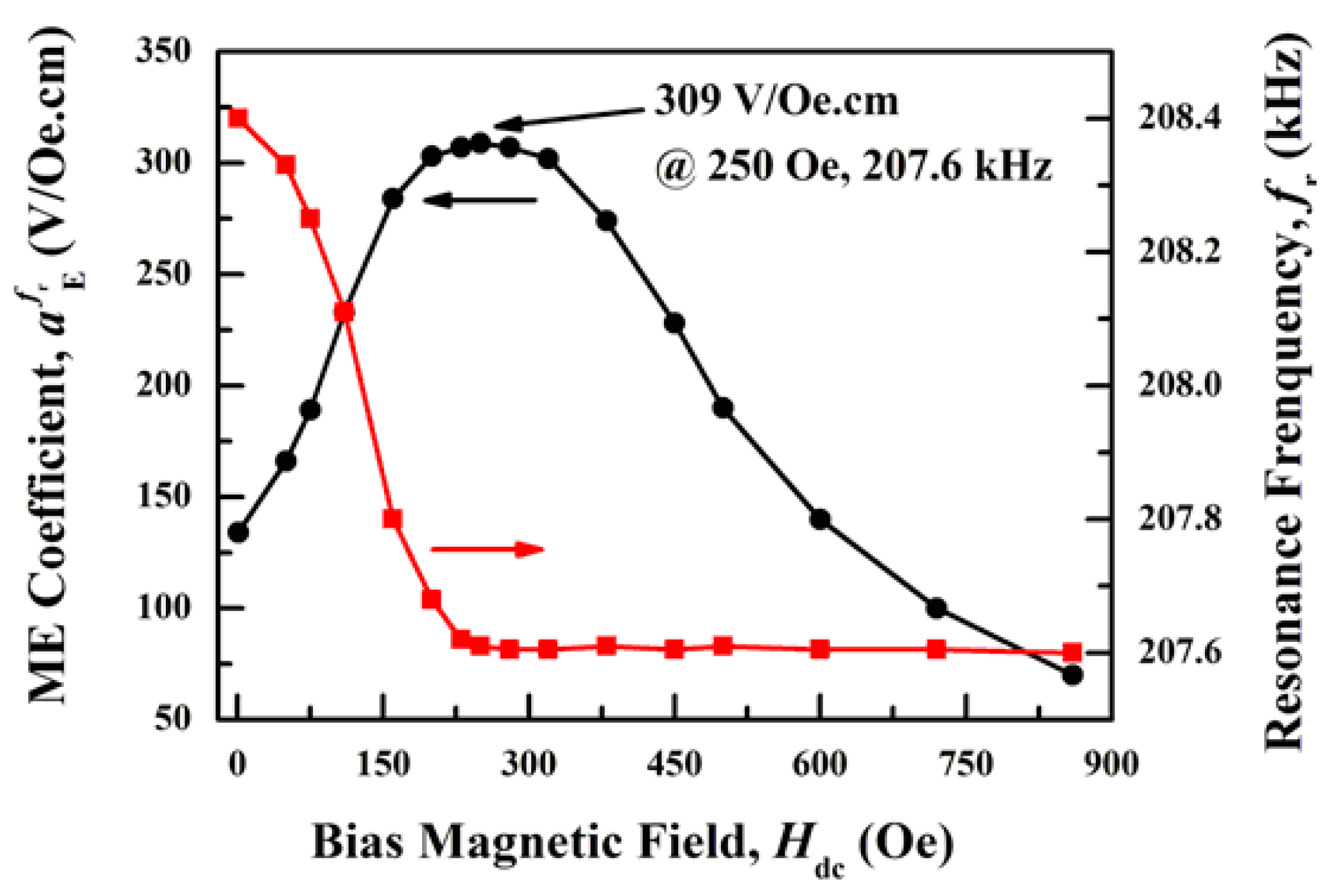
Figure 4 plots the resonance ME coefficient () and the corresponding frequency () as functions of the dc bias magnetic field () for Permendur/PZT laminates. Interestingly, is maximized up to ~309 V/Oe.cm at of ~250 Oe, where the associated is minimized at ~207.6 kHz. Physically, the change in both and with increasing can be explained by the -induced motion of the available non-180° domain walls in the magnetostrictive layer of the laminated composite [23]. As is increased near ~250 Oe, the compliance associated with the increased deformation contribution from the non-180° domain wall motion is maximized, resulting in a maximum in strain (and, hence, and ) and a minimum in stiffness (and, hence, ). Beyond the optimal level, constraining of non-180° domain wall motion due to interaction with gives rise to a decrease in strain (and, hence, and ) and an increase in stiffness (and, hence, ).
Figure 4.
Resonance ME coefficient and the corresponding frequency as functions of the dc bias magnetic field for Permendur/PZT laminates.
The ME properties of the Permendur/PZT composite may be further enhanced by increasing the interface coupling coefficient [23], the number (n) of magnetostrictive/piezoelectric layers (piezoelectric layers are electrically connected in series, ) [24], and/or adopting a piezoelectric material with a higher piezoelectric coefficient such as (1-x)Pb(Mg1/3Nb2/3)O3-xPbTiO3 (PMN-PT) [25].
4. Conclusions
In summary, the high permeability and high saturation magnetostriction of the magnetic materials are two key factors for high ME coupling performance. After investigating three typical ME composites, Permendur/PZT, Metglas/PZT, and Tefenol-D/PZT, with the same dimensions and different saturation magnetostriction and magnetic permeability, the most excellent ME performance was observed in the Permendur/PZT laminates, which agrees well with the predicted results from the figure of merit. The low-frequency and resonance ME coefficients of the Permendur/PZT composite are ~23.1 V/Oe.cm and ~309 V/Oe.cm at the optimal dc bias magnetic field of ~250 Oe, respectively. The Permendur/PZT composite has potential in practical magnetic sensitive device applications.
Acknowledgments
This work was supported by Shanghai Pujiang Program (No.13PJ 1431100), “Shu Guang” project of Shanghai Municipal Education Commission and Shanghai Education Development Foundation (No. 13SG52) and the Science and Technology Commission of Shanghai Municipality (Nos. 12JC1404400, 14520501000).
Author Contributions
Y.J. finished the paper writing. W.Z. finished the sample preparation. K.M. finished the measurement and Y.L. finished the theoretical analysis.
Conflicts of Interest
The authors declare no conflict of interest.
References
- Wu, Z.; Xiang, Z.H.; Jia, Y.M.; Zhang, Y.H.; Luo, H.S. Electrical impedance dependence on the direct and converse magnetoelectric resonances in magnetostrictive/piezoelectric laminated composites. J. Appl. Phys. 2012, 112, 106102. [Google Scholar] [CrossRef]
- Wang, Y.J.; Zhao, X.Y.; Jiao, J.; Liu, L.H.; Di, W.N.; Luo, H.S.; Or, S.W. Electrical resistance load effect on magnetoelectric coupling of magnetostrictive/piezoelectric laminated composite. J. Alloys Compd. 2010, 500, 224–226. [Google Scholar] [CrossRef]
- Jia, Y.M.; Luo, H.S.; Or, S.W.; Wang, Y.J.; Chan, H.L.W. Magnetoelectric and converse magnetoelectric responses in TbxDy1−xFe2−y alloy & Pb(Mg1/3Nb2/3)(1−x)TixO3 crystal laminated composites. Chin. Sci. Bull. 2008, 53, 2129. [Google Scholar] [CrossRef]
- Wang, Y.J.; Leung, C.M.; Or, S.W.; Zhao, X.Y.; Luo, H.S. Resonance converse magnetoelectric effect in a dual-mode bilayered composite of Pb(Mg1/3Nb2/3)O3–PbTiO3 and Tb0.3Dy0.7Fe1.92. J. Alloys Compd. 2009, 487, 450–452. [Google Scholar] [CrossRef]
- Jia, Y.M.; Or, S.W.; Chan, H.L.W.; Jiao, J.; Luo, H.S.; Zwaag, S. Bidirectional current-voltage converters based on magnetostrictive/piezoelectric composites. Appl. Phys. Lett. 2009, 94, 263504. [Google Scholar] [CrossRef]
- Wang, Y.J.; Wang, F.F.; Or, S.W.; Chan, H.L.W.; Zhao, X.Y.; Luo, H.S. Giant magnetoelectric effect in mechanically clamped heterostructures of magnetostrictive alloy and piezoelectric crystal-alloy cymbal. Appl. Phys. Lett. 2008, 93, 213504. [Google Scholar] [CrossRef]
- Wang, Y.J.; Or, S.W.; Chan, H.L.W.; Zhao, X.Y.; Luo, H.S. Enhanced magnetoelectric effect in longitudinal-transverse mode Terfenol-D/Pb(Mg1/3Nb2/3)O3-PbTiO3 laminate composites with optimal crystal cut. J. Appl. Phys. 2008, 103, 124511. [Google Scholar] [CrossRef]
- Jia, Y.M.; Zhao, X.Y.; Luo, H.S.; Or, S.W.; Chan, H.L.W. Magnetoelectric effect in laminate composite of magnets/0.7Pb(Mg1/3Nb2/3)O3-0.3PbTiO3 single crystal. Appl. Phys. Lett. 2006, 88, 1–3. [Google Scholar]
- Jia, Y.M.; Luo, H.S.; Zhao, X.Y.; Wang, F.F. Giant magnetoelectric response from the combination of piezoelectric/magnetostrictive laminated composite with a piezoelectric transformer. Adv. Mater. 2008, 20, 4776–4779. [Google Scholar]
- Brown, W.F.; Hornreich, R.M.; Shtrikman, S. Upper bound on the magnetoelectric susceptibility. Phys. Rev. 1968, 168, 574–577. [Google Scholar] [CrossRef]
- Wang, Y.J.; Wang, F.F.; Or, S.W.; Chan, H.L.W.; Zhao, X.Y.; Luo, H.S. Giant sharp converse magnetoelectric effect from the combination of a piezoelectric transformer with a piezoelectric/magnetostrictive laminated composite. Appl. Phys. Lett. 2008, 93, 113503. [Google Scholar] [CrossRef]
- Wu, Z.; Zhang, J.; Ma, K.; Cao, Y.; Jia, Y.M.; Luo, H.S.; Zhang, Y.H. A magnetoelectric laminate based passive micro-displacement sensor. Phys. Status Solidi R 2012, 6, 469–471. [Google Scholar] [CrossRef]
- Guo, Y.P.; Liu, Y.; Wang, J.L.; Withers, L.R.; Chen, H.; Jin, L.; Smith, P. Giant magnetodielectric effect in 0–3 Ni0.5Zn0.5Fe2O4-Poly(vinylidene-fluoride) nanocomposite films. J. Phys. Chem. C 2010, 114, 13861–13866. [Google Scholar] [CrossRef]
- Wang, Y.J.; Gray, D.; Berry, D.; Li, M.H.; Gao, J.Q.; Li, J.F.; Viehland, D. Influence of interfacial bonding condition on magnetoelectric properties in piezofiber/Metglas heterostructures. J. Alloys Compd. 2012, 513, 242–244. [Google Scholar] [CrossRef]
- Wang, Y.J.; Gray, D.; Berry, D.; Gao, J.Q.; Li, M.H.; Li, J.F.; Viehland, D. An extremely low equivalent magnetic noise magnetoelectric sensor. Adv. Mater. 2011, 23, 4111–4114. [Google Scholar] [CrossRef] [PubMed]
- Wang, Y.J.; Hasanyan, D.; Li, M.H.; Gao, J.Q.; Viswan, R.; Li, J.F.; Viehland, D. Electric-field tuning of magnetoelectric properties in Metglas/piezofiber composites. Phys. Status Solidi R 2012, 6, 265–267. [Google Scholar] [CrossRef]
- Wang, Y.J.; Shen, Y.; Gao, J.Q.; Li, M.H.; Li, J.F.; Viehland, D. Nonlinear magnetoelectric response of a Metglas/piezofiber laminate to a high-frequency bipolar AC magnetic field. Appl. Phys. Lett. 2013, 102, 102905. [Google Scholar] [CrossRef]
- Rees, D.W.; Gibbs, M.R.J.; Pace, N.G. The use of metallic glass scroll as an acoustic transducer element. IEEE Trans. Ultrason. Ferroelect. Freq. Control 1989, 36, 332–336. [Google Scholar] [CrossRef] [PubMed]
- Jia, Y.M.; Or, S.W.; Wang, J.; Chan, H.L.W.; Zhao, X.Y.; Luo, H.S. High magnetoelectric effect in laminated composites of magnetostrictive alloy and lead-free piezoelectric ceramic. J. Appl. Phys. 2007, 101, 1–5. [Google Scholar] [CrossRef]
- Sourmail, T. Near equiatomic FeCo alloys: Constitution, mechanical and magnetic properties. Prog. Mater. Sci. 2005, 50, 816–880. [Google Scholar] [CrossRef]
- Matsumoto, M.; Kubota, T.; Yokoyama, M.; Okazak, T.; Furuya, Y.; Makino, A.; Shimada, M. Magnetic properties of rapidly solidified ribbon of Fe49Co49V2 and spark-plasma-sintered pellet of its powder. Mater. Trans. 2010, 51, 1883–1886. [Google Scholar] [CrossRef]
- Wang, Y.J.; Or, S.W.; Chan, H.L.W.; Zhao, X.Y.; Luo, H.S.; Lv, X.K.; Zhang, Z.D. Magnetoelectric effect in laminates of polymer-based pseudo-1–3 (Tb0.3Dy0.7)0.5Pr0.5Fe1.55 composite and 0.3Pb(Mg1/3Nb2/3)O3-0.7PbTiO3 single crystal. Appl. Phys. A 2009, 97, 201–204. [Google Scholar] [CrossRef]
- Or, S.W.; Cai, N. Dielectric, magnetic and magnetoelectric prop erties of a laminated composite with 1-3 connection. Solid State Phenom. 2006, 111, 147–150. [Google Scholar] [CrossRef]
- Wu, Z.; Tian, X.L.; Jia, Y.M.; Tian, X.J.; Xie, A.X.; Zhang, Y.H.; Luo, H.S. Giant magneto-light output in three-phase magnetostrictive, piezoelectric and electroluminescent composites. Appl. Phys. Lett. 2011, 99, 212503. [Google Scholar] [CrossRef]
- Wu, Z.; Ma, K.; Cao, Y.; Jia, Y.M.; Xie, A.X.; Chen, J.R.; Zhang, Y.H.; Li, H.M.; Zheng, R.K.; Luo, H.S. Strong secondary piezoelectric effect in ferroelectric 0.7Pb(Mg1/3Nb2/3)O3-0.3PbTiO3 crystal. Appl. Phys. Lett. 2013, 103, 112904. [Google Scholar] [CrossRef]
© 2015 by the authors; licensee MDPI, Basel, Switzerland. This article is an open access article distributed under the terms and conditions of the Creative Commons Attribution license (http://creativecommons.org/licenses/by/4.0/).