Article

Data-Driven Spatial Analysis of Airborne Particle Contamination in Industrial Environments Using RSM


by
Renáta Turisová
1,
Róbert Jánošík
2,
Hana Pačaiová
3,*,
Michal Hovanec
3 and
Michaela Balážiková
2
1
Department of Business Management and Economics, Institute of Industrial Engineering, Management and Applied Mathematics, Faculty of Mechanical Engineering, Technical University of Kosice, Letna 1/9, 042 00 Košice, Slovakia
2
Department of Quality, Safety and Environment, Institute of Special Engineering Processologies, Faculty of Mechanical Engineering, Technical University of Kosice, Park Komenskeho 5, 042 00 Košice, Slovakia
3
Department of Aviation Engineering, Faculty of Aeronautics, Technical University of Košice, Rampová 7, 041 21 Košice, Slovakia
*
Author to whom correspondence should be addressed.
Appl. Sci. 2026, 16(9), 4480; https://doi.org/10.3390/app16094480
Submission received: 30 March 2026 / Revised: 26 April 2026 / Accepted: 28 April 2026 / Published: 2 May 2026
(This article belongs to the Special Issue Air Quality Monitoring, Analysis and Modeling)

Abstract

This study focuses on modelling the spatial dependence of airborne particle contamination using Response Surface Methodology (RSM), with consideration of its implications for technical cleanliness and employee health. The analysis is based on two measurement campaigns conducted in an industrial production hall, where particle concentrations were recorded across multiple size fractions using a TROTEC PC220 device. The results demonstrate that RSM effectively captures nonlinear relationships and spatial gradients, enabling the identification of local extrema and contamination hotspots. Statistical analysis confirmed a significant influence of spatial coordinates on particle concentration across all fractions, with finer particles exhibiting stronger spatial dependence, consistent with aerosol behaviour in indoor environments. Quadratic model terms revealed stable hotspot regions persisting even after corrective measures, indicating persistent contamination sources or structural factors. Residual analysis suggested additional unmodeled local sources or transport mechanisms. Based on the integration of RSM and multi-fraction analysis, a mechanistic contamination model (source–transport–receptor framework with deposition processes) is proposed, linking particle behaviour with surface contamination and potential human exposure. The approach enables data-driven, localised contamination control and supports optimisation of technical cleanliness and occupational health conditions.

1. Introduction

Airborne particle contamination represents a critical challenge in modern industrial production because it directly affects product quality, process stability, operational efficiency, and the reliability of final products. The continuous advancement of manufacturing technologies, increasing product complexity, and the miniaturisation of components make industrial systems increasingly sensitive even to micro- and submicron particles. In high-precision sectors such as automotive, electrical engineering, and mechanical engineering, such particles may cause functional failures, assembly defects, surface damage, or long-term component degradation [1,2,3]. At the same time, Industry 4.0 has transformed production environments through cyber-physical systems, real-time data acquisition, intelligent automation, and interconnected manufacturing processes. These developments enable higher precision and process control, but they also impose stricter requirements on environmental quality. Within this context, contamination is not only an occupational or environmental issue [4], but also a factor directly affecting process performance, yield, and defect rates [5,6]. The emerging Industry 5.0 perspective further reinforces the need for contamination control strategies that are human-centric, sustainable, and resilient.
Traditional contamination control in industrial environments is usually based on general cleaning strategies, mechanical cleaning, filtration, and dust extraction, with effectiveness evaluated against standardised limit values such as ISO 14644-1:2015/A1:2022 [7]. Although these standards provide an essential framework for classifying and monitoring air cleanliness, conventional approaches often assume a relatively homogeneous distribution of particles. Real industrial systems, however, are spatially heterogeneous: contamination is generated, transported, and accumulated in patterns shaped by technological processes, equipment configuration, airflow dynamics, material handling, and human activity [8]. Consequently, uniform control strategies may waste resources in low-risk areas while leaving critical zones insufficiently treated. A further limitation is their reactive character, since monitoring commonly verifies compliance with predefined limits rather than explaining the mechanisms of contamination generation and propagation; corrective measures may therefore be implemented without sufficient understanding of spatial relationships and process interactions [9].
To overcome these limitations, advanced analytical approaches are required to reveal hidden spatial structures in industrial monitoring data. Statistical and spatial methods, including regression analysis [10], cluster analysis [11], and spatial autocorrelation techniques such as Moran’s I and Local Indicators of Spatial Association (LISA) [12], can identify patterns, relationships, and local anomalies that remain undetected by conventional monitoring [13,14]. From a practical perspective, multi-fraction analysis is particularly important because it differentiates between transport-driven and source-driven processes [15]. Particle distributions in enclosed industrial environments are strongly influenced by airflow direction and velocity, ventilation configuration, spatial geometry, and personnel or material movement. Indoor air quality and Computational Fluid Dynamics studies show that even under relatively stable conditions, local hotspots, transport corridors, and residual zones with limited air exchange may occur [16]. Because particle transport is often anisotropic, fine particles may behave as passive tracers of airflow and their spatial distribution may provide indirect information about airflow regimes [2,16].
This study demonstrates how Response Surface Methodology (RSM) can be applied to quantify spatial contamination patterns, identify local sources and hotspots, analyse differences between particle size fractions, and derive mechanism-based insights for targeted contamination control. By integrating spatial statistics, response surface modelling, and deposition-oriented interpretation, the study extends existing work [1,2,17] and proposes a source–transport–receptor framework with deposition processes for mechanism-driven contamination control in industrial environments. Although RSM is traditionally used in designed experiments, its application to spatial data in this study is exploratory and intended to capture global nonlinear spatial trends rather than replace geostatistical models such as kriging. The results are directly interpretable within international standards and guidance documents, including ISO 14644-1:2015/A1:2022 for air cleanliness by particle concentration [7,18], VDA 19.2 for technical cleanliness and particle deposition [19], and ISO 14698:2022 for contamination control and source-oriented monitoring in controlled environments [20,21].
The study addresses the following research questions: (i) How does particle contamination vary spatially across the production hall? (ii) Can RSM effectively capture nonlinear spatial patterns? (iii) Can spatial hotspots be consistently identified across particle size fractions?

2. Materials and Methods

2.1. Study Design

The study was conducted in a real industrial production environment focused on the manufacturing of battery cooling systems for electric vehicles. The production hall represents a complex system in which manufacturing and logistics processes are closely interconnected, creating a dynamic environment. The production hall is divided into functional zones, including high-traffic areas, processing zones, and storage areas, which may influence particle distribution and contribute to spatial variability in contamination levels. Such environments are typically characterised by pronounced spatial heterogeneity, where contamination is not uniformly distributed but rather accumulates in localised areas depending on process conditions and airflow dynamics [1,8,17,18].
To capture this complexity, a spatially structured measurement framework was developed. A network of predefined sampling locations (n = 54) was distributed across the production area to ensure representative spatial coverage and enable the identification of localised contamination patterns. Spatial coordinates were recorded in meters relative to the production layout to ensure consistency across all measurement points. The placement of sampling locations reflected the actual configuration of the production system, including key technological nodes, material entry points, and areas with increased personnel movement. Due to the industrial sensitivity of the production layout, exact spatial coordinates of sampling locations are not publicly disclosed. However, the coordinate system, measurement methodology, and relative spatial structure are fully described, ensuring reproducibility of the analytical approach. Data may be available from the corresponding author upon reasonable request. This approach aligns with contemporary contamination monitoring strategies, where spatial representativeness is critical for accurate environmental assessment [7].
To assess temporal changes and evaluate the effectiveness of implemented measures, two measurement campaigns were conducted. The first campaign, carried out in 2023, indicated a poor initial condition and represents the baseline state of the production environment prior to the implementation of targeted interventions. Subsequently, a set of corrective measures was introduced, including regulation of personnel and material flow, implementation of controlled entry points (e.g., doors, gates, air curtains, and double-gate systems), and cleaning of packaging and materials prior to entry. These measures were relatively costly and were expected to result in substantial improvements. The second campaign, conducted in 2024, reflects the state after the implementation of contamination control measures. Although an improvement was observed, the expected level of performance enhancement was not fully achieved. This two-phase approach enables a quasi-experimental evaluation of intervention effectiveness under real operational conditions, which is increasingly adopted in contemporary studies on technical cleanliness. However, this design has inherent limitations for causal inference, as uncontrolled factors such as operational variability, production intensity, or environmental conditions may also contribute to the observed changes [22].

2.2. Data Sources

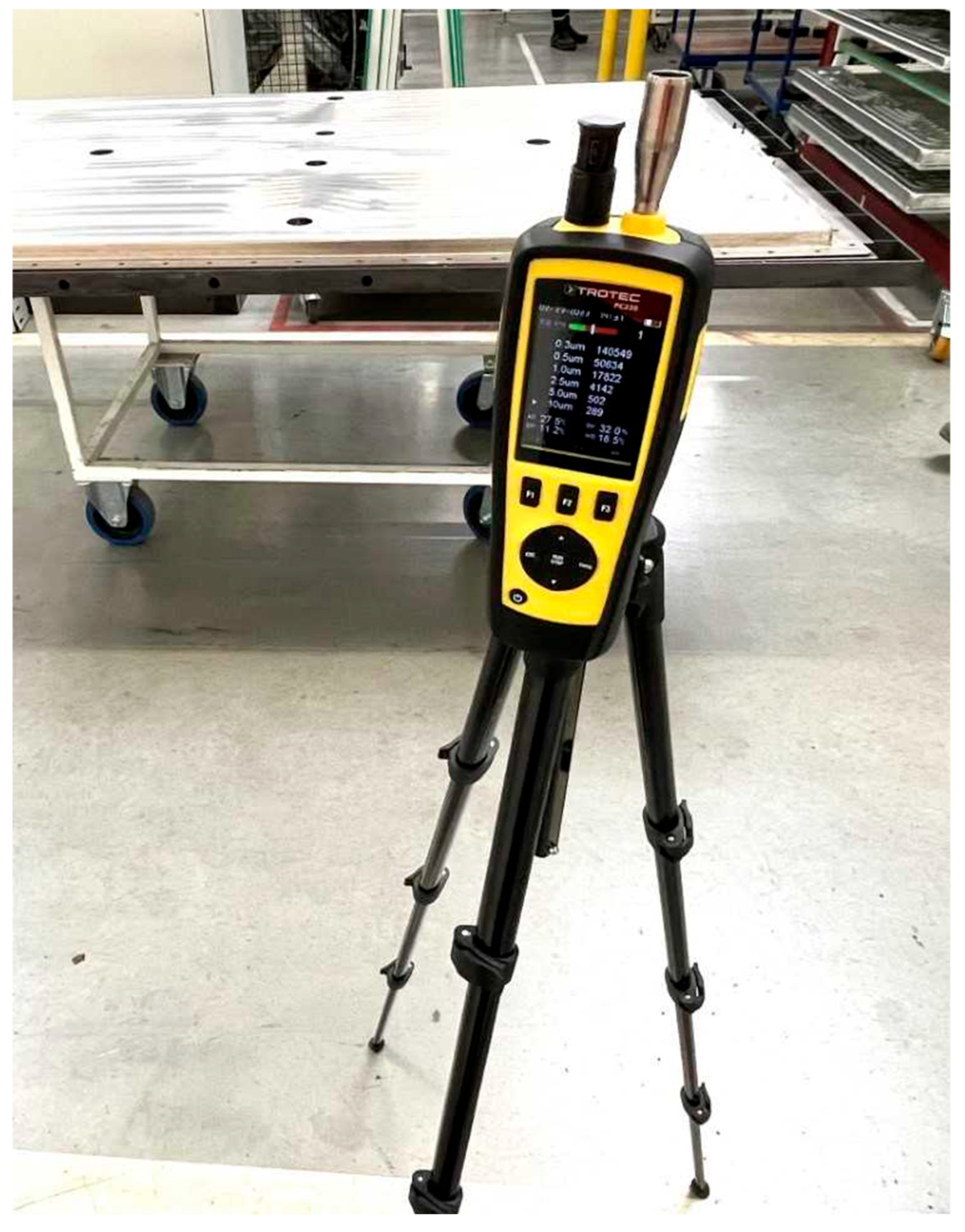
For both measurement campaigns, a TROTEC PC220 device (see Figure 1) was used to determine particle concentrations across the following size fractions: z1 = 0.3 µm, z2 = 0.5 µm, z3 = 1.0 µm, z4 = 2.5 µm, z5 = 5.0 µm and z6 = 10.0 µm. These fractions are relevant for cleanroom classification and contamination risk assessment in accordance with ISO 14644-1:2022 and established contamination control principles [1,7].
Each measurement was conducted under stable operating conditions to minimize the influence of transient disturbances. The device sampled a defined volume of air, and the results were expressed as particle concentration per cubic meter. This approach is consistent with current aerosol measurement practices and industrial monitoring standards [9,10].
Measurements were conducted in the same month and on the same day in both 2023 and 2024 to ensure methodological consistency and enable reliable comparison of airborne particle concentration and size distribution across two time horizons. The measurements were performed using an identical sampling methodology, allowing for a consistent assessment of contamination levels.
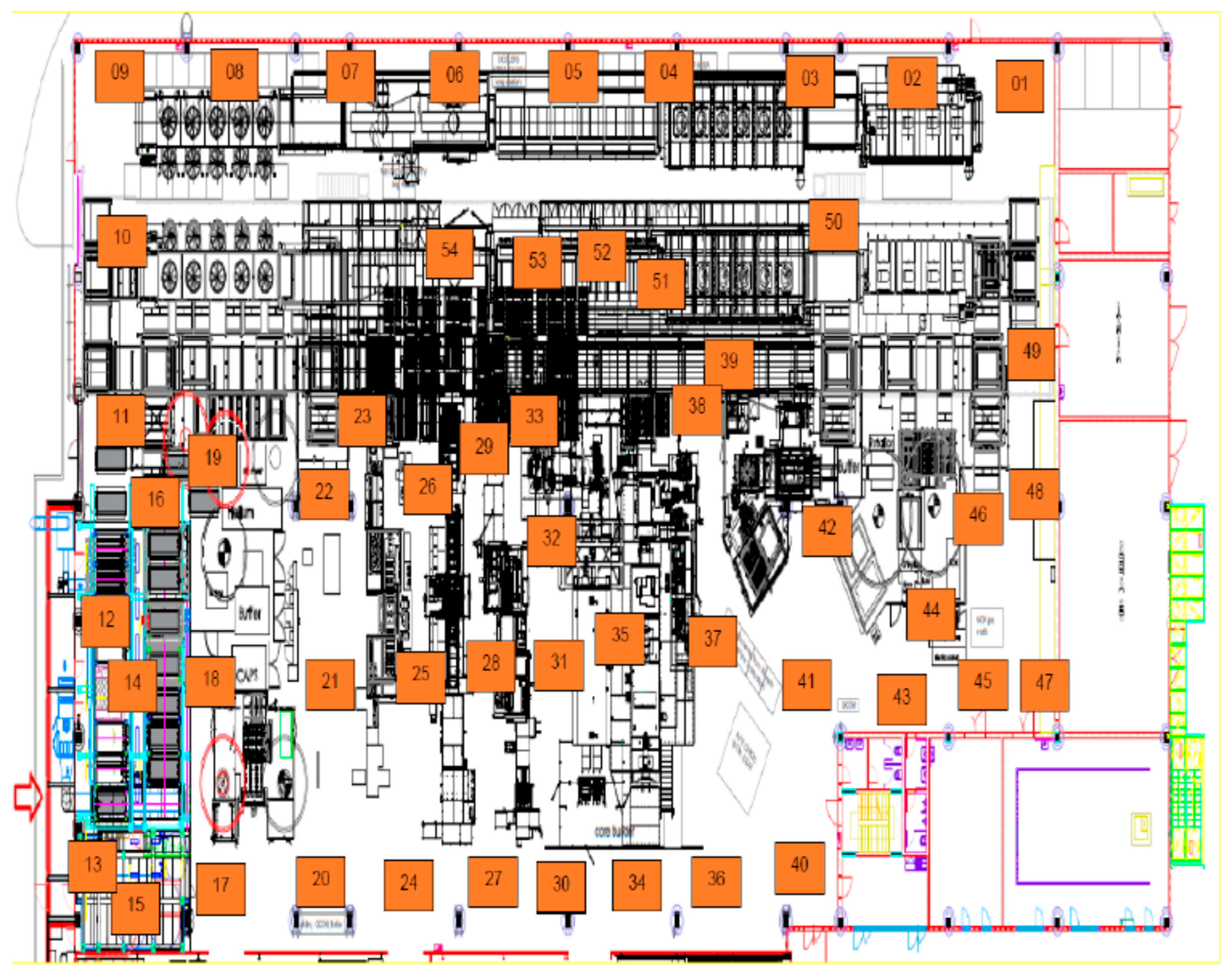
The obtained data were subsequently analysed using RSM. Figure 2 presents the layout of the production hall, including the spatial distribution of measurement locations, where airborne particle contamination was monitored using a TROTEC PC220 device operating on the principle of particle counting.

2.3. Response Surface Model

A key analytical tool employed in this study is Response Surface Methodology (RSM), which enables the modelling of spatial contamination patterns, including the identification of gradients, curvature, and localised extrema (hotspots) [17]. In parallel, spatial statistical methods, such as Moran’s I and Local Indicators of Spatial Association (LISA), were used to assess spatial autocorrelation and identify clusters of high and low contamination values [23,24,25]. These methods provide evidence of non-random spatial structures in the observed contamination patterns.
The integration of spatial statistics and RSM allows for a comprehensive interpretation of contamination behaviour. While Moran’s I and LISA detect the presence and structure of spatial dependence, RSM characterises the underlying spatial trends and nonlinear relationships across the study area. An additional analytical layer is provided by residual analysis, which enables the identification of unmodelled or nonlinear contamination sources not captured by the base RSM model [26]. This approach supports the transition from descriptive spatial monitoring toward a more mechanism-oriented understanding of contamination propagation within the working environment.
Spatial statistical concepts support the interpretation of non-random contamination patterns [22,26].
For each particle size fraction i = 1, …, 6, the following quadratic model was applied:
z i = β 0 i + β 1 i x + β 2 i y + β 3 i x 2 + β 4 i y 2 + β 5 i x y + ε i ,
where zi denotes the log-transformed particle concentration, x and y represent the spatial coordinates, β 0 i , …, β 5 i are the coefficients of the quadratic model and ε i is the random error term. Although potential bias associated with logarithmic back-transformation is acknowledged, no correction factor (e.g., Duan’s smearing estimator) was applied in this study, as the results are intended for relative spatial interpretation rather than absolute concentration estimation. The models were estimated using Ordinary Least Squares (OLS). Given the spatial nature of the data, the assumption of residual independence may be affected by spatial autocorrelation and should therefore be considered when interpreting statistical significance. For comparative purposes between measurement campaigns, the quadratic coefficients ( β 3 , β 4 , β 5 ) were constrained to be identical across both years in order to ensure consistent curvature of the response surface. The observed similarity of quadratic coefficients across years therefore reflects this imposed constraint rather than independent estimation. This modelling choice assumes that the spatial structure of contamination remains stable while the overall intensity varies.

3. Results

Based on the RSM analysis of the measured data, all coefficients of the quadratic model were estimated separately for each particle size fraction and for each measurement year (see Table 1). The similarity of model structures across measurement years suggests a stable underlying spatial distribution of contamination. This similarity is consistent with the modelling constraint applied to quadratic terms.
The estimated models enable the characterisation of spatial contamination patterns and reveal consistent relationships between spatial coordinates and particle concentrations across size fractions. The presence of significant quadratic terms indicates nonlinear spatial behaviour, with identifiable regions of elevated concentrations (hotspots) and areas of reduced contamination levels.

3.1. Model Evaluation and Diagnostics

The quality of the Response Surface Model was evaluated using a combination of diagnostic criteria, including the significance of regression coefficients, model explanatory power, functional adequacy, and residual analysis. The significance of regression coefficients was assessed using t-tests, with both linear and quadratic terms being statistically significant (p < 0.05) for most particle size fractions. This confirms the presence of a nonlinear spatial structure of contamination characterised by local extrema.
The coefficient of determination (R2) ranged approximately from 0.46 to 0.61, with higher values observed for finer particle fractions. These values correspond to individual models estimated for each particle size fraction and measurement year, reflecting variability in model performance across conditions. These moderate values should not be interpreted as a limitation of the model, but rather as a reflection of the inherent complexity of industrial environments, where multiple interacting physical and operational factors influence contamination behaviour. Similar levels of explanatory power are commonly reported in environmental and spatial modelling studies due to system heterogeneity and nonlinear dynamics [25,26].
Residual analysis revealed systematic deviations in specific spatial locations. These deviations are not random but likely represent localised contamination sources or specific operational conditions. Multicollinearity among explanatory variables was low (VIF ≈ 1), confirming the stability of parameter estimates.
Overall, the model reliably captures the global spatial structure of contamination, while local deviations identified through residual analysis provide additional insight into specific contamination mechanisms.

3.2. Spatial Dependence of Contamination

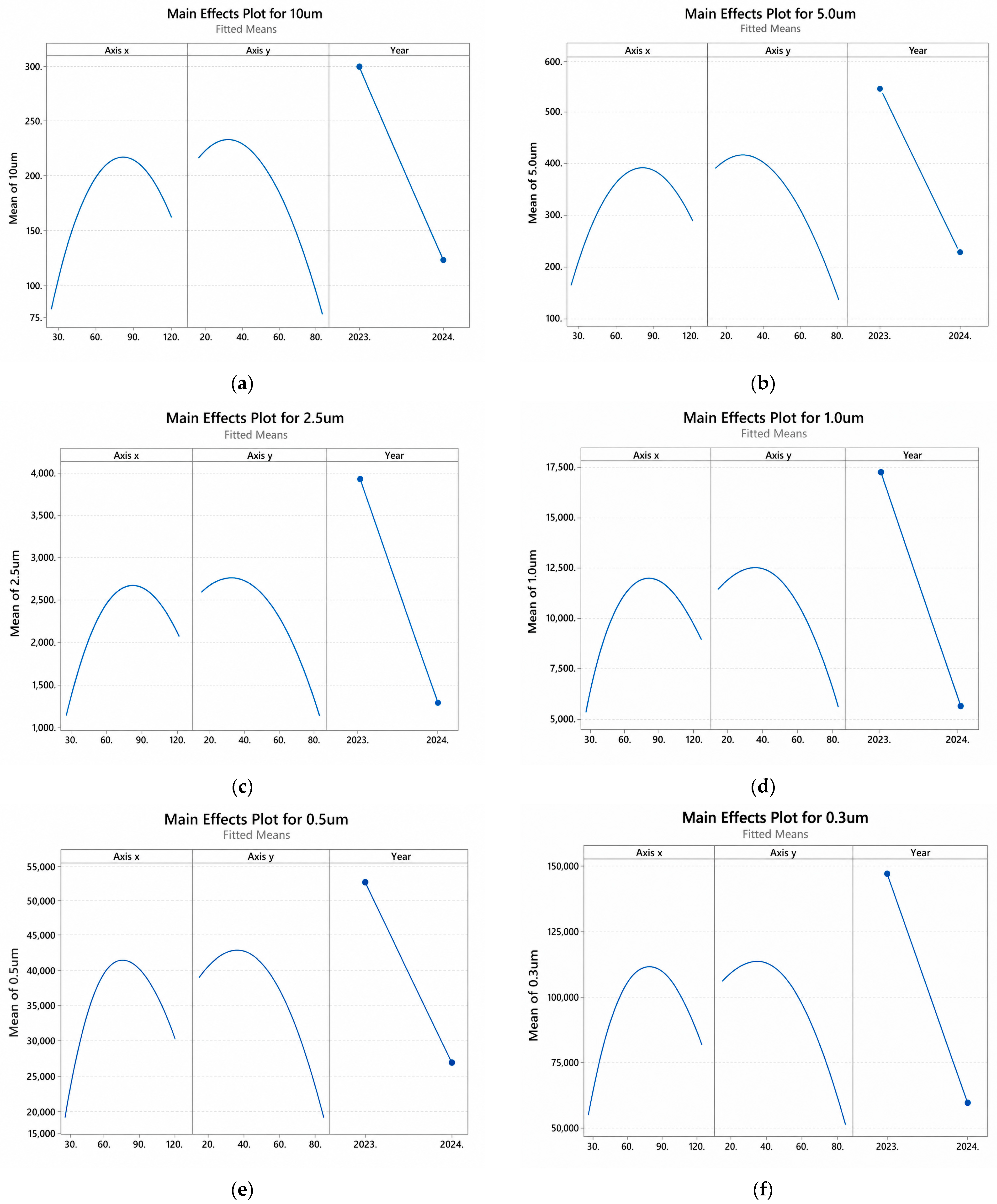
The analysis of RSM for all investigated particle size fractions demonstrated a statistically significant influence of spatial coordinates x and y on particle concentration (Figure 3).
While larger particles tend to exhibit more stable and less variable spatial patterns, smaller particles demonstrate stronger spatial dependence, likely due to their ability to follow airflow trajectories and remain suspended for longer periods.
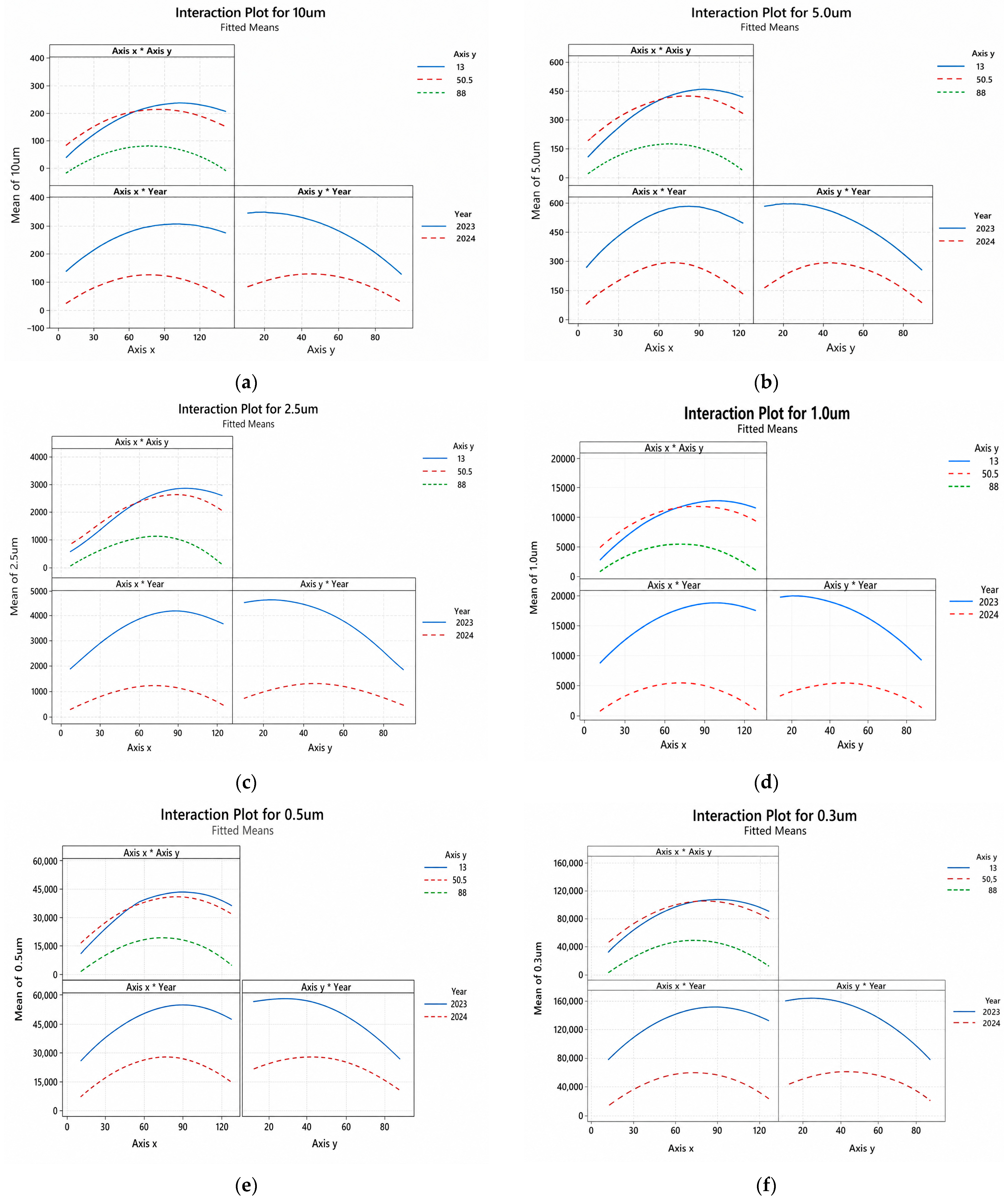
In all models, a positive coefficient was identified for the spatial coordinate x (β1 > 0) and a negative coefficient for the spatial coordinate y (β2 < 0), with both effects being statistically significant (p < 0.01), as reflected in the interaction plots (Figure 4). This result indicates the presence of a systematic spatial gradient in contamination, where particle concentration increases along the x -axis and decreases along the y -axis. Such a gradient is typically consistent with the presence of a dominant airflow direction or the spatial arrangement of technological sources within the production hall.
The highest values were observed for the smallest particles (0.3 µm), while lower values were obtained for larger fractions. This trend suggests that finer particles are more strongly influenced by global spatial factors, whereas larger particles are more affected by local processes.
The results confirm that the spatial dependence of contamination is significant, and its intensity varies with particle size. In all analysed models, the quadratic terms x2 and y2 were statistically significant (p < 0.05), indicating that the spatial distribution of contamination is not linear but exhibits curvature of the response surface.
The predominantly negative values of the quadratic coefficients suggest the presence of local maxima in particle concentration, corresponding to contamination hotspots.
Based on the RSM models, localised areas of increased contamination (hotspots) were identified. The hotspot identification was based on a multi-fraction approach, integrating information across all analysed particle size fractions. When interpreting results on the original scale, potential bias due to back-transformation of log-transformed values should be considered. These regions are characterised by high predicted concentration values, consistent spatial positioning across all particle size fractions, and relative stability between the years 2023 and 2024. A comparison of models across both years indicates that while the intensity of contamination changes, the spatial location of hotspots remains largely unchanged. This stability suggests that hotspots are not random phenomena but represent persistent structural features of the system. Consequently, hotspots can be interpreted as local emission sources, effects of technological operations, or zones with unfavourable aerodynamic conditions.

3.3. Residual Analysis

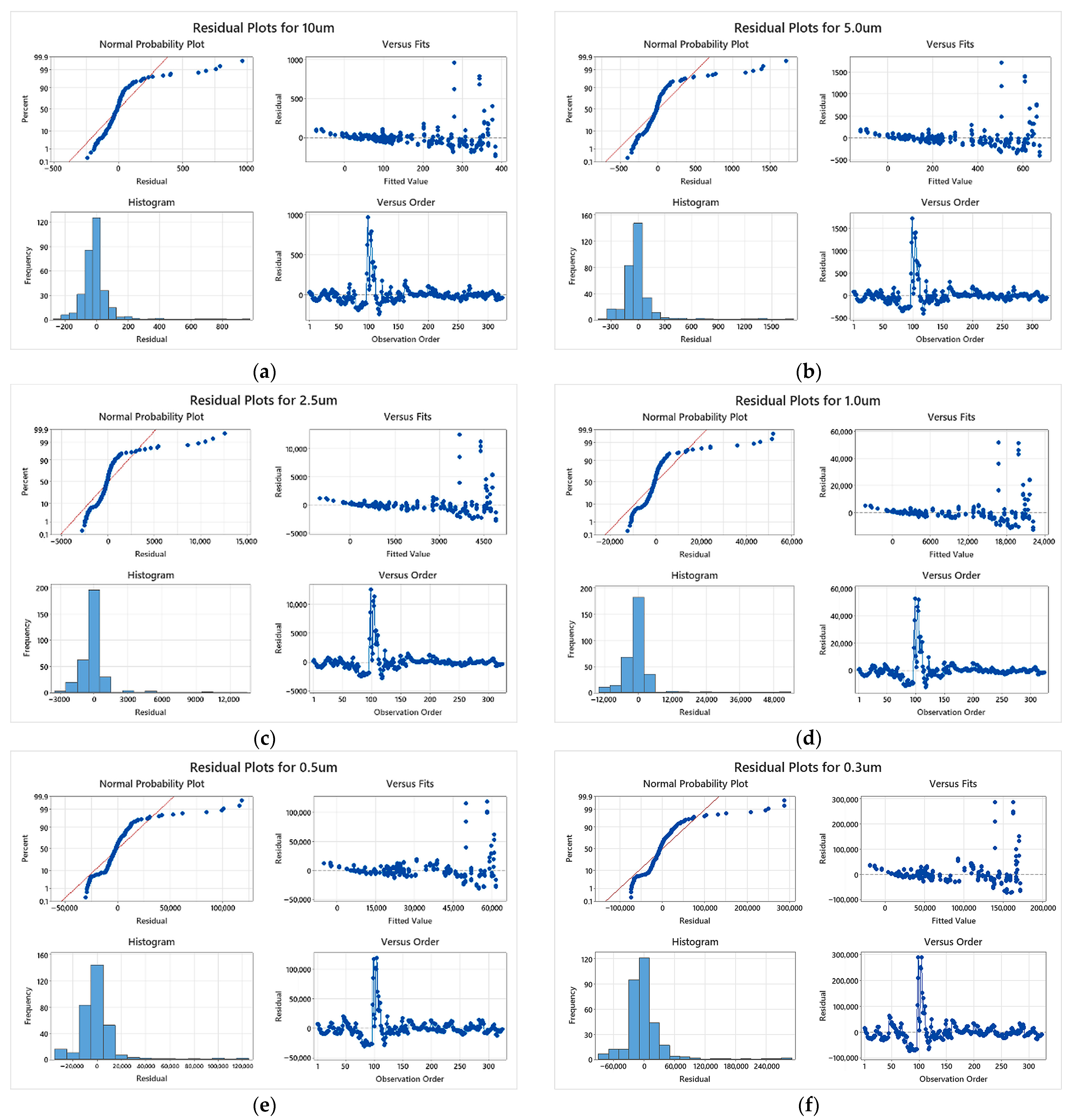
Residual analysis revealed significant deviations between observed and predicted values. Figure 5 provides a visual assessment of residual distributions and supports the evaluation of key model assumptions, particularly normality and the presence of deviations such as asymmetry or heavy tails. The residuals exhibited departures from normality, indicating underlying heterogeneity and localised effects not fully captured by the model. Recurrent extreme residuals were consistently observed at the same spatial locations across multiple particle size fractions, suggesting the presence of persistent local influences.
Importantly, the residuals were not randomly distributed but displayed a clear spatial structure, indicating a violation of the independence assumption. This spatial dependence may affect the estimation of standard errors; therefore, the statistical significance of model coefficients should be interpreted with caution. To further assess this spatial structure, residuals were analysed using Moran’s I (Section 3.5), which confirmed statistically significant spatial autocorrelation. Pronounced residuals indicate the presence of unmodelled factors, such as localised particle sources, technological processes, or specific operational conditions. In this context, residuals provide additional insight into local anomalies and hidden contamination drivers beyond the fitted model structure.
The factor “year” was statistically significant in all models (p < 0.001), confirming that the implemented measures had a measurable effect. A reduction in overall contamination levels and decreased variability in certain areas were observed. However, the spatial gradient remained preserved, and hotspot regions persisted.
These findings suggest that while the implemented measures reduced contamination intensity, they did not eliminate the underlying spatial drivers of contamination. The comparison of models across different particle size fractions revealed substantial differences in contamination behaviour. Fine particles (0.3–1.0 µm) exhibited higher R2 values, indicating strong spatial dependence and smoother response surfaces. These particles are easily transported by airflow and are therefore highly sensitive to global flow patterns. In contrast, larger particles (2.5–10.0 µm) showed lower R2 values, suggesting a stronger influence of local factors and higher variability. These particles are less mobile and are more affected by sedimentation and localised emission sources. Overall, the results indicate that contamination is fraction-dependent and governed by different physical mechanisms. It was further confirmed that airborne particle contamination in industrial environments is spatially structured, nonlinear, and fraction-dependent, with its distribution determined by a combination of local sources, transport processes, and deposition.
Figure 5 presents the residuals for all investigated particle size fractions. Their analysis enables the evaluation of model performance and the identification of potential deviations between measured and modelled values.
Residual spatial structure was further evaluated using Moran’s I applied to model residuals. The results confirmed the presence of statistically significant spatial autocorrelation in residuals, indicating that part of the spatial structure remains unexplained by the base RSM model.

3.4. Spatial Linking of Hotspots to Measurement Points

Hotspots were defined as measurement points satisfying at least two out of the following three criteria:
  • RSM criterion (local maximum). The point is in the vicinity of a local maximum of the response surface max ( z ^ (x, y)) or belongs to the upper quantile (e.g., top 10–15%) of predicted values.
  • Multi-fraction criterion (consistency). The point exhibits above-average values across multiple particle size fractions (particularly 0.3–1.0 µm) and does not represent an isolated extreme in a single fraction.
  • Residual criterion (local anomaly). The point is characterised by repeatedly high standardised residuals (∣e∣ > 2) or strong influence (Cook’s D), indicating the presence of an unmodeled local contamination source.
The hotspot classification represents an analytical interpretation supported by model outputs and should not be considered a formal statistical classification. Points satisfying all three criteria were classified as primary hotspots (H1). Based on the hotspot map and RSM results, the hotspot zone is located approximately in the following region:
  • x ≈ 100–130.
  • y ≈ 15–50.
Specifically, the following measurement points are located within this region:
  • Primary hotspots (H1)—measurement points with IDs: 42, 43, 44, 45, 46, 47, 48.
  • Secondary hotspots (H2)—measurement points with IDs: 40, 41, 49, 39, 38.
  • Transition points—measurement points with IDs: 01, 50, 51, 33, 32, 35, 36.
This classification enables a clear differentiation between critical contamination zones, secondary influence areas, and transitional regions within the production environment. Transition points form the boundary of this region. They are characterised by pronounced gradients (i.e., rapid changes over short distances) and may indicate transport corridors or shifts in airflow patterns.
The link to multi-fraction analysis is reflected in the behaviour of different particle size fractions. Fine particles (0.3–1.0 µm), which dominate in H1 hotspots, exhibit the highest concentration values and the highest R2, suggesting an airflow-dominated mechanism. In contrast, larger particles (2.5–10.0 µm), characteristic of H2 hotspots, show less spatial continuity but higher localised extremes, indicating the influence of local emission sources and sedimentation processes. A natural interpretation is that H1 represents primary emission sources, while H2 hotspots and transition points correspond to transport and redistribution zones within the production environment.
From the perspective of proposed mitigation measures, the source zone (H1) requires the implementation of Local Exhaust Ventilation (LEV) directly at the identified locations, or alternatively, process enclosure/isolation and targeted audits of technological operations in the immediate vicinity. Primary hotspot zones (H1) require targeted interventions such as local exhaust ventilation (LEV) or process enclosure, while secondary zones (H2) are associated with transport processes and require airflow optimization. Deposition zones require targeted cleaning strategies and elimination of stagnation areas. The transport zone (H2 and transition points) requires optimisation of airflow patterns, including airflow redesign, pressure differentials, and the elimination of recirculation zones or vortices. Deposition zones, identified based on particle traps or low-gradient regions, require targeted surface cleaning and the removal of stagnation areas.
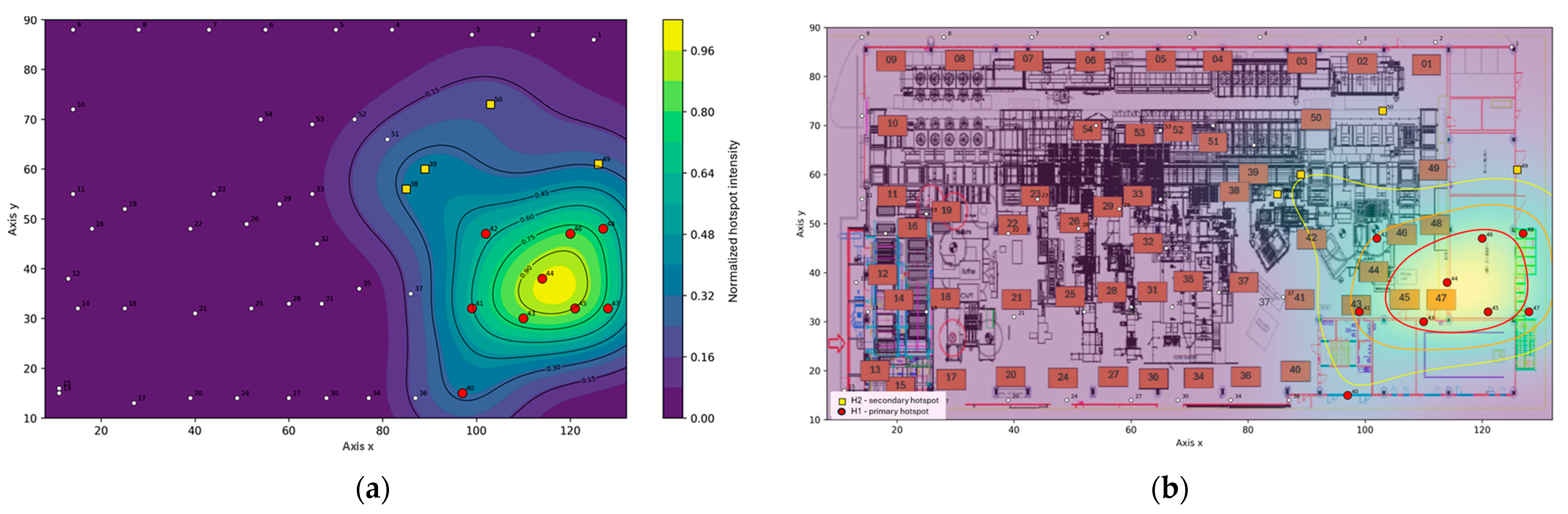
The linkage between the response surface and specific measurement points demonstrates that contamination is not randomly dispersed but concentrated in compact spatial clusters representing local sources and subsequent transport pathways. The hotspot zone is compact and localised in the upstream section of the production hall, clearly indicating the presence of a local contamination source rather than random variability. The contour hotspot map (see Figure 6a) and the overlay of hotspots on the production layout (see Figure 6b) are derived from the classification of hotspot points (H1/H2) based on RSM and residual analysis. Deposition zones require targeted surface cleaning and removal of stagnation areas.
Figure 6 illustrates the spatial distribution of hotspots using an RSM-based visualisation approach, intended as an interpretative, publication-oriented representation designed to support understanding of contamination patterns rather than a direct model output. Figure 6a presents a contour map of the response surface, revealing a compact cluster of primary hotspots accompanied by a connected secondary zone associated with particle transport. The contour-based visualisation highlights the spatial structure of contamination, with gradients indicating the direction and intensity of particle dispersion. Figure 6b presents an overlay of hotspots on the layout of the production hall, providing a precise spatial mapping of the hotspot field onto the facility layout based on coordinate alignment. The visualisation shows that primary hotspots are spatially concentrated in the right-hand section of the production area, while secondary hotspots form a transition zone indicating the direction of particle transport.
The overall spatial pattern confirms that contamination is not randomly distributed but forms a compact cluster of primary hotspots in the upstream section of the production hall. The contour structure further indicates the presence of a secondary zone, which can be interpreted as an area of particle redistribution or transport.
The overlay with the production layout supports the conclusion that contamination is governed by a localised mechanism, likely associated with a specific technological operation or unfavourable airflow conditions.
The contour map represents an isoline visualisation of the response surface z = f(x, y), where each contour line corresponds to an equal level of particle concentration within the spatial domain. The map exhibits compact, closed contours in the hotspot region, with progressively expanding contours outward and an asymmetric gradient along the x- and y-axes. Such a pattern is characteristic of a localized contamination source followed by spatial dispersion.
Within the contour map, a region with the highest density of contour lines and closed isolines is clearly identifiable, corresponding to a local maximum of the response surface (RSM). The hotspot is characterised by a stable spatial position with elevated particle concentrations and corresponds to the H1 measurement points (IDs 40–48). From a physical perspective, this hotspot represents either a localised emission source or an area of particle accumulation driven by airflow dynamics.
The contour density is highest in the vicinity of the hotspot and gradually decreases with distance, indicating a strong concentration gradient and directional particle spread. The gradient is not radially symmetric but exhibits an elongated shape, suggesting that particle transport is not diffusion-dominated but rather airflow-driven.
Specifically, the contours are elongated along the x-axis and steeper along the y-axis, indicating different dynamics in each direction. The x-axis reflects a slower decay of concentration associated with transport processes, whereas the y-axis indicates a more rapid decrease, likely due to physical constraints or barriers. This asymmetry suggests a dominant airflow direction, the presence of obstacles, or specific technological configurations within the production environment.
The region surrounding the hotspot is characterised by a moderate density of contour lines, representing a transport zone associated with particle redistribution. In this area, particles are primarily in motion and have not yet undergone significant deposition.
At the outer boundaries of the map, contour lines become sparse and concentration levels decrease, indicating clean or deposition-dominated zones characterised by weak transport. In these regions, particle settling is more likely to occur.
The contour map thus reflects a combined effect of transport and deposition mechanisms. For fine particles, the contours are smooth and extend over larger areas, indicating a transport-dominated regime. In contrast, for larger particles, the contours exhibit local distortions and sharper transitions, suggesting that sedimentation processes are dominant.
Closed contours with maximum concentration in the region of the identified hotspots (IDs 43–48) represent a local maximum of the response function z = f(x, y), which can be interpreted as a primary contamination source. This interpretation is further supported by residual analysis, as the same locations exhibit systematic deviations, indicating the presence of unobserved local factors influencing contamination. These findings confirm that particle transport is anisotropic and that the system is governed by a dominant airflow direction. Given the spatial structure of the data, future research may incorporate advanced spatial methods, such as Kriging or Conley’s standard errors, to better account for spatial dependence.

3.5. Spatial Structure and Statistical Validation

To quantitatively evaluate the spatial structure of contamination patterns, spatial autocorrelation was assessed using Global Moran’s I and Local Indicators of Spatial Association (LISA). The results confirmed statistically significant positive spatial autocorrelation across all particle size fractions in both measurement campaigns. All of Moran’s I values were statistically significant based on permutation testing (see Table 2).
In 2023, Moran’s I values ranged from 0.150 to 0.231 (p < 0.05), indicating weak to moderate spatial dependence. In contrast, substantially stronger spatial autocorrelation was observed in 2024, with Moran’s I values ranging from 0.547 to 0.623 (p = 0.001), suggesting a more pronounced spatial organization of contamination.
LISA results further showed an increase in the number of significant clusters (from 2–6 to 13–15), confirming stronger spatial structuring of contamination patterns. The increased number of significant clusters observed in 2024 compared to 2023 indicates that contamination patterns became more spatially structured following the intervention. These findings support the interpretation of hotspots as persistent spatial features rather than random fluctuations.
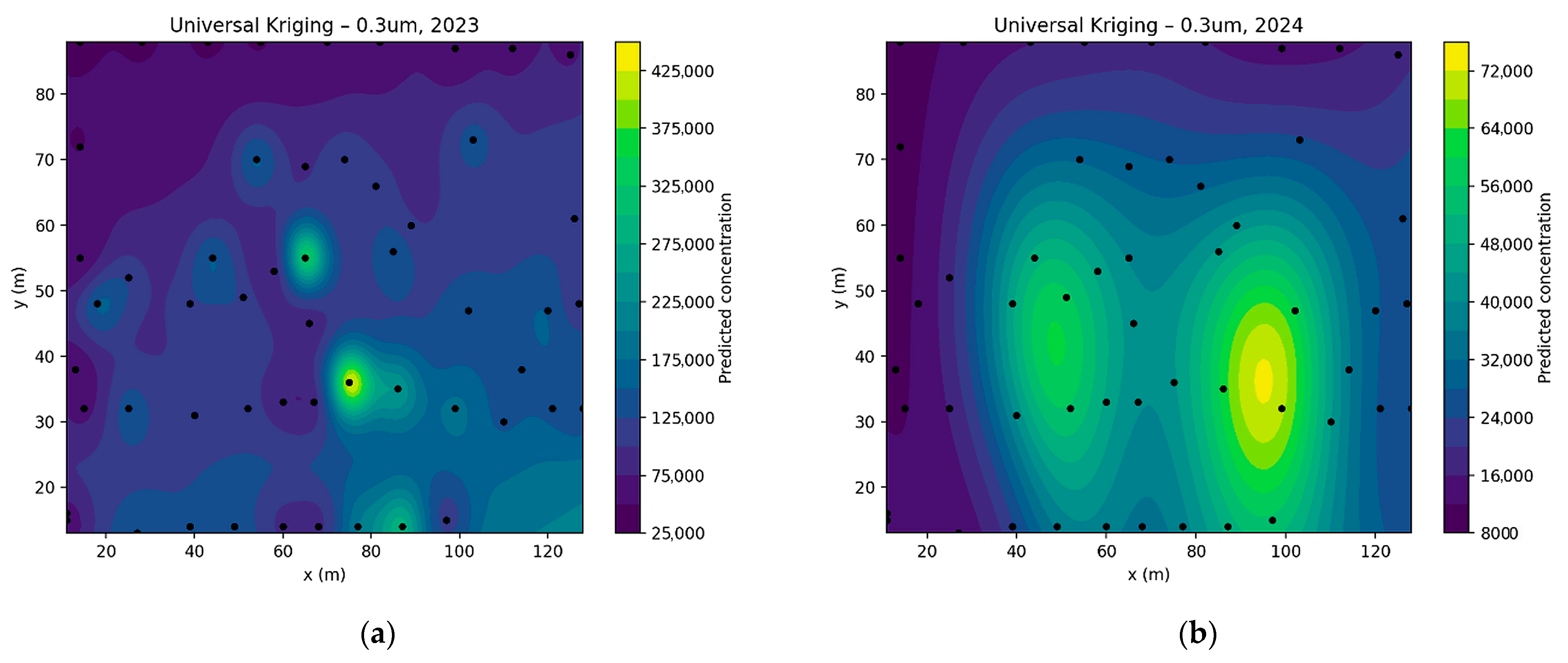
Kriging interpolation further confirmed the presence of spatially structured contamination patterns and supported the hotspot regions identified by the RSM models. The consistency between RSM and kriging results (see Figure 7) indicates that the identified spatial patterns are robust and not method dependent. While RSM captures global spatial trends, kriging explicitly incorporates spatial autocorrelation, providing additional support for the validity of the results.
While kriging provides spatial interpolation based on observed data, it does not explicitly define the functional relationships governing contamination patterns. In contrast, RSM captures underlying spatial trends and enables the identification of areas where targeted mitigation measures can be most effectively implemented.
In particular, the kriging surfaces revealed consistent spatial gradients and localised maxima, indicating that the observed patterns are not artifacts of polynomial fitting but reflect underlying spatial processes.

4. Discussion

The results based on the contour map and response surface models clearly demonstrate that particle contamination in the analysed environment is not random but exhibits a deterministic spatial organization. This finding is consistent with contemporary studies on aerosol dynamics, where particle distribution is governed by the interaction of emission sources, airflow patterns, and deposition mechanisms rather than stochastic dispersion [2,15].
Within this context, deposition should not be interpreted solely as a terminal process but rather as an integral component of the source–transport–receptor system, occurring dynamically at or within the receptor. The proposed source–transport–receptor–deposition framework therefore provides a mechanistic linkage between airborne particle transport and surface contamination, enabling the identification of critical zones affecting technical cleanliness and system performance [26].
The moderate values of the coefficient of determination (R2 ≈ 0.46–0.61) reflect the inherent complexity and variability of the system, which is influenced by multiple uncontrolled factors typical of industrial environments. Industrial environments represent highly dynamic systems influenced by multiple interacting physical and operational factors. This interpretation is consistent with spatial and environmental modelling studies, where moderate explanatory power is common due to system heterogeneity [27].
This interpretation is further supported by the structured nature of residuals, which were found to exhibit spatial patterns rather than random distribution. In this study, residuals are therefore not treated merely as statistical error but also as indicators of unmodelled physical processes, such as localised emission sources, airflow disturbances, or operational variability. This perspective extends conventional regression-based approaches and aligns with advanced statistical modelling principles [10,23,24].
Although alternative modelling approaches such as kriging, computational fluid dynamics (CFD), or machine learning-based spatial models could be applied, the RSM approach provides a robust balance between interpretability, computational efficiency, and practical applicability in industrial environments with limited data availability. RSM enables the direct identification of gradients, curvature, and local extrema, which are essential for the localisation of contamination hotspots and the design of targeted mitigation measures [17,28].
The observed asymmetry of contour lines provides strong evidence of directional, airflow-driven transport. In contrast to diffusion-dominated systems, where radial symmetry would be expected, the elongated contour structure along the x-axis and steeper gradients along the y-axis indicate anisotropic transport conditions. This confirms that contamination propagation is primarily governed by convective mechanisms, which are typical in mechanically ventilated industrial environments [2,16].
From a practical perspective, these findings suggest that effective contamination control may require a shift from uniform, reactive strategies to targeted, mechanism-based interventions. The proposed framework should be interpreted as an analytical approximation rather than a full physical model. The model is limited to spatial coordinates and does not include physical variables such as airflow, ventilation, or temperature, which may influence particle transport and distribution.
Despite these limitations, the approach provides a practical and interpretable framework for identifying spatial contamination patterns and critical zones under real industrial conditions. Model validation was limited due to dataset constraints; therefore, cross-validation was not performed. Future studies should incorporate predictive validation using independent datasets or resampling techniques.
Within this context, the persistent spatial location of hotspots, even after the implementation of corrective measures, indicates that contamination is driven by structural system characteristics rather than temporary fluctuations. The observed structural similarity is partly driven by the modelling assumption of fixed curvature, allowing clearer interpretation of intensity changes. Consequently, mitigation strategies must focus on eliminating root causes rather than merely reducing overall particle concentrations, which is consistent with modern contamination control standards and practices [7,19].
In a broader context, while the present study focuses on airborne particulate matter, the proposed analytical framework can be extended to other environmental contaminants such as POPs (e.g., PCBs). A direct comparison with geostatistical interpolation techniques (e.g., kriging, IDW) and CFD-based approaches was not included in the present analysis; however, such a comparison represents an important direction for future research aimed at assessing the relative performance of the proposed modelling framework.

5. Conclusions

This study integrates spatial modelling, RSM, and deposition measurements to analyse temporal changes in contamination, identify underlying contamination and support the interpretation of underlying contamination mechanisms (source–transport–receptor–deposition), and enable the design of targeted mitigation measures. Its main contribution lies in supporting the transition from monitoring-based approaches toward a more mechanism-oriented understanding of contamination behaviour. While traditional approaches focus primarily on measurement and reporting, the proposed framework aims to identify the underlying mechanisms governing contamination. Conventional approaches typically address questions such as “Where is the problem?” and “What general mitigation measures should be applied?”, whereas the proposed approach aims to support the interpretation of “why the problem may occur” and how targeted interventions can be more effectively designed, based on a dynamic interpretation of spatial data.
Although the study was conducted in a specific industrial environment, the results are potentially applicable not only to production halls but also to cleanrooms, logistics centres, and environmental systems [22]. The source–transport–receptor–deposition concept can be used as a general interpretative framework for aerosol-based systems. The analysis indicates that contamination is not randomly distributed but tends to form compact spatial clusters (hotspots), accompanied by secondary zones associated with transport and redistribution processes. The overlay with the production layout suggests that contamination may be influenced by localised factors, likely associated with specific technological operations or unfavourable airflow conditions.
Importantly, the proposed framework is transferable to the assessment of environmental contamination, including persistent organic pollutants (POPs) such as polychlorinated biphenyls (PCBs), which are frequently associated with particulate matter and sediment-bound transport processes. In such systems, the identification of spatial hotspots, transport pathways, and deposition zones is essential for understanding pollutant fate, long-term accumulation, and remobilisation mechanisms [4,28].
From a health perspective, the integration of spatial analysis with a source–transport–receptor framework enables improved identification of exposure pathways and supports more accurate assessment of occupational and environmental risks [29,30]. This is particularly relevant for fine particles acting as carriers of toxic substances, where inhalation exposure represents a critical pathway. Therefore, the proposed approach contributes not only to the optimisation of technical cleanliness but also to risk-informed decision-making in the context of environmental protection and human health. The identified spatial patterns may support targeted cleaning strategies and optimisation of airflow management in industrial environments. However, the results should be interpreted in the context of the study design and modelling assumptions, including limitations related to data availability and the absence of direct physical measurements (e.g., airflow parameters), which may influence contamination dynamics.

Author Contributions

Conceptualization, R.T. and R.J.; methodology, R.J.; validation, R.T., M.B. and H.P.; formal analysis, H.P.; resources, R.T. and H.P.; data curation, R.J.; writing—original draft preparation, R.T. and R.J.; writing—review and editing, H.P. and M.H.; visualization, M.B. and M.H.; supervision, R.T.; project administration, R.T. and R.J. All authors have read and agreed to the published version of the manuscript.

Funding

This research received no external funding.

Institutional Review Board Statement

Not applicable.

Informed Consent Statement

Not applicable.

Data Availability Statement

The original contributions presented in this study are included in the article. Further inquiries can be directed to the corresponding author.

Acknowledgments

This contribution is the result of the project “Management of POPs related risks towards the transformation to a sustainable bioeconomy” (Acronym: POP_RISKMAN base), No. I09I04-03-V02-00050.

Conflicts of Interest

The authors declare no conflicts of interest.

Abbreviations

The following abbreviations are used in this manuscript:
CFDComputational Fluid Dynamics
LEVLocal Exhaust Ventilation
PCBspolychlorinated biphenyls
POPspersistent organic pollutants
RSMResponse Surface Methodology
TCTechnical cleanliness
VIFVariance Inflation Factor

References

  1. Whyte, W. Cleanroom Technology: Fundamentals of Design, Testing and Operation, 2nd ed.; John Wiley & Sons: Hoboken, NJ, USA, 2010; p. 384. [Google Scholar]
  2. Hinds, W.C.; Zhu, Y. Aerosol Technology: Properties, Behavior, and Measurement of Airborne Particles, 3rd ed.; John Wiley & Sons: Hoboken, NJ, USA, 2022; p. 448. [Google Scholar]
  3. Chen, Y.; Zhu, Y.; Lin, C.J.; Arunachalam, S.; Wang, S.; Xing, J.; Jiang, A. Response surface model based emission source contribution and meteorological pattern analysis in ozone polluted days. Environ. Pollut. 2022, 307, 119459. [Google Scholar] [CrossRef] [PubMed]
  4. Wimmerová, S.; Watson, A.; Drobná, B.; Šovčíková, E.; Weber, R.; Lancz, K.; Patayová, H.; Richterová, D.; Koštiaková, V.; Jurečková, D.; et al. The spatial distribution of human exposure to PCBs around a former production site in Slovakia. Environ. Sci. Pollut. Res. 2015, 22, 14405–14415. [Google Scholar] [CrossRef] [PubMed]
  5. Lasi, H.; Fettke, P.; Kemper, H.G.; Feld, T.; Hoffmann, M. Industry 4.0. Bus. Inf. Syst. Eng. 2014, 6, 239–242. [Google Scholar] [CrossRef]
  6. Häring, K.; Pimentel, C.; Teixeira, L. Industry 4.0 Implementation in Small- and Medium-Sized Enterprises: Recommendations Extracted from a Systematic Literature Review with a Focus on Maturity Models. Logistics 2023, 7, 99. [Google Scholar] [CrossRef]
  7. ISO 14644-1:2015/A1:2022; Cleanrooms and Associated Controlled Environments—Part 1: Classification of Air Cleanliness by Particle Concentration. ISO: Geneva, Switzerland, 2022.
  8. Küllmar, H.; Schöler, M.; Brügmann, J.; Leopold, C.S. Investigations on the Spatial Dust Distribution for Emission Site Localization in Containment. AAPS PharmSciTech 2025, 26, 239. [Google Scholar] [CrossRef] [PubMed]
  9. Vasilatou, K.; Iida, K.; Kazemimanesh, M.; Olfert, J.; Sakurai, H.; Sipkens, T.A.; Smallwood, G.J. Aerosol physical characterization: A review on the current state of aerosol documentary standards and calibration strategies. J. Aerosol Sci. 2025, 183, 106483. [Google Scholar] [CrossRef]
  10. Montgomery, D.C.; Peck, E.A.; Vining, G.G. Introduction to Linear Regression Analysis, 6th ed.; John Wiley & Sons: Hoboken, NJ, USA, 2021; p. 704. [Google Scholar]
  11. Lee, J.; Li, S. Extending Moran’s index for measuring spatiotemporal clustering of geographic events. Geogr. Anal. 2017, 49, 36–57. [Google Scholar] [CrossRef]
  12. Wu, Q.; Li, Y.; Wu, Y.; Li, F.; Zhong, S. The spatial spillover effect of environmental regulation on the total factor productivity of pharmaceutical manufacturing industry in China. Sci. Rep. 2022, 12, 11642. [Google Scholar] [CrossRef]
  13. Harper, M. Recent advances in occupational exposure assessment of aerosols. Int. J. Environ. Res. Public Health 2020, 17, 6820. [Google Scholar] [CrossRef] [PubMed]
  14. Sinha, K.; Yadav, M.S.; Verma, U.; Murallidharan, J.S.; Kumar, V. Effect of recirculation zones on the ventilation of a public washroom. Phys. Fluids 2021, 33, 117101. [Google Scholar] [CrossRef] [PubMed]
  15. Morawska, L.; Cao, J. Airborne transmission of SARS-CoV-2: The world should face the reality. Environ. Int. 2020, 139, 105730. [Google Scholar] [CrossRef] [PubMed]
  16. Jacob, P.; Agrawal, A.; Bhardwaj, R. Evaluating the role of air conditioners in classroom airflow patterns and indoor ventilation improvements. Sādhanā 2026, 51, 55. [Google Scholar] [CrossRef]
  17. Myers, R.H.; Montgomery, D.C.; Anderson-Cook, C.M. Response Surface Methodology: Process and Product Optimization Using Designed Experiments, 4th ed.; John Wiley & Sons: Hoboken, NJ, USA, 2016; p. 856. [Google Scholar]
  18. Yarahmadi, R.; Damiri, Z.; Darvishi, M.M.; Alipoor, A.; Pourbabaki, R.; Moridi, P.; Borhani Jebeli, M. Evaluating clean room performance in the pharmaceutical industry: A numerical and experimental investigation based on ISO 14644–3 standards. Aerosol Air Qual. Res. 2026, 26, 25. [Google Scholar] [CrossRef]
  19. Verband der Automobilindustrie (VDA). VDA 19.2:2015—Technical Cleanliness in Assembly—Environment, Logistics, Personnel and Assembly Equipment; VDA: Berlin, Germany, 2015. [Google Scholar]
  20. ISO 14698:2022; Cleanrooms and Associated Controlled Environments—Biocontamination Control. ISO: Geneva, Switzerland, 2022.
  21. Rapiejko, A.; Sosnowski, T.R.; Sosnowski, K.; Jurkiewicz, D. Deposition of occupational aerosol particles in a three-dimensional adult nasal cavity model: An experimental study. Bioengineering 2026, 13, 132. [Google Scholar] [CrossRef] [PubMed]
  22. Mathanlal, T.; Zorzano, M.P.; Martin-Torres, J. Design, development, and operation of an ISO class 5 cleanroom for planetary instrumentation and planetary protection protocols. Heliyon 2024, 10, 17. [Google Scholar] [CrossRef] [PubMed]
  23. Fallahzadeh, R.A.; Ghaneian, M.T.; Miri, M.; Dashti, M.M. Spatial analysis and health risk assessment of heavy metals concentration in drinking water resources. Environ. Sci. Pollut. Res. 2017, 24, 24790–24802. [Google Scholar] [CrossRef] [PubMed]
  24. Anselin, L.; Gallo, J.L.; Jayet, H. Spatial panel econometrics. In The Econometrics of Panel Data: Fundamentals and Recent Developments in Theory and Practice; Mátyás, L., Sevestre, P., Eds.; Springer: Berlin, Germany, 2008; pp. 625–660. [Google Scholar]
  25. Cressie, N. Statistics for Spatial Data; John Wiley & Sons: Hoboken, NJ, USA, 2015; p. 928. [Google Scholar]
  26. Montgomery, D.C. Design and Analysis of Experiments, 9th ed.; John Wiley & Sons: Hoboken, NJ, USA, 2017; p. 640. [Google Scholar]
  27. Zvijáková, L.; Zeleňáková, M.; Purcz, P. Evaluation of environmental impact assessment effectiveness in Slovakia. Impact Assess. Proj. Apprais. 2014, 32, 150–161. [Google Scholar] [CrossRef]
  28. Latif, M.; Nasim, I.; Ahmad, M.; Nawaz, R.; Tahir, A.; Irshad, M.A.; Al-Mutairi, A.A.; Irfan, A.; Al-Hussain, S.A.; Zaki, M.E.A. Human health risk assessment of drinking water using heavy metal pollution index: A GIS-based investigation in mega city. Appl. Water Sci. 2025, 15, 12. [Google Scholar] [CrossRef]
  29. Landrigan, P.J.; Fuller, R.; Acosta, N.J.R.; Adeyi, O.; Arnold, R.; Basu, N.; Baldé, A.B.; Bertollini, R.; Bose-O’Reilly, S.; Boufford, J.I.; et al. The Lancet Commission on Pollution and Health. Lancet 2018, 391, 462–512. [Google Scholar] [CrossRef] [PubMed]
  30. Bezerra, M.A.; Santelli, R.E.; Oliveira, E.P.; Villar, L.S.; Escaleira, L.A. Response surface methodology (RSM) as a tool for optimization in analytical chemistry. Talanta 2008, 76, 965–977. [Google Scholar] [CrossRef] [PubMed]
Figure 1. Airborne particle measurement using a TROTEC PC220 at predefined sampling locations.
Applsci 16 04480 g001
Figure 2. Layout of the production hall with spatial distribution of sampling locations for particle measurements.
Applsci 16 04480 g002
Figure 3. Main effects plots of RSM models for all particle size fractions: (a) 10.0 µm; (b) 5.0 µm; (c) 2.5 µm; (d) 1.0 µm; (e) 0.5 µm; (f) 0.3 µm.
Applsci 16 04480 g003
Figure 4. Interaction effects plots of RSM models for all particle size fractions: (a) 10.0 µm; (b) 5.0 µm; (c) 2.5 µm; (d) 1.0 µm; (e) 0.5 µm; (f) 0.3 µm.
Applsci 16 04480 g004
Figure 5. Residual plots of RSM models for all particle size fractions: (a) 10.0 µm; (b) 5.0 µm; (c) 2.5 µm; (d) 1.0 µm; (e) 0.5 µm; (f) 0.3 µm.
Applsci 16 04480 g005
Figure 6. RSM-based hotspot visualisation of particle contamination: (a) contour map of predicted particle concentration; (b) overlay map combining hotspot regions with spatial layout.
Applsci 16 04480 g006
Figure 7. The results of universal kriging interpolation of airborne particle concentration (0.3 µm, (a) 2023 and (b) 2024), illustrating spatial variability and confirming hotspot regions identified by the RSM model.
Applsci 16 04480 g007
Table 1. Estimated quadratic RSM models for particle size fractions across measurement years.
Year Size FractionRSM Models
20230.3 µm z 1 = 43,232 + 2428   x + 1265 y 12.08 x 2 20.06 y 2 5.41 x y
0.5 µm z 2 = 7884 + 992 x + 562 y 4.828 x 2 7.80 y 2 2.57 x y
1.0 µm z 3 = 3921 + 316.7 x + 151.3 y 1.359 x 2 2.238 y 2 1.016 x y
2.5 µm z 4 = 745 + 72.8 x + 36.0 y 0.3183 x 2 0.530 y 2 0.234 x y
5.0 µm z 5 = 65.1 + 11.01 x + 5.69 y 0.0503 x 2 0.0830 y 2 0.0350 x y
10 µm z 6 = 46.8 + 6.070 x + 3.09 y 0.02743 x 2 0.0475 y 2 0.01998 x y
20240.3 µm z 1 = 60,105 + 2043 x + 2103 y 12.08 x 2 20.06 y 2 5.41 x y
0.5 µm z 2 = 21,491 + 857 x + 816 y 4828 x 2 7.80 y 2 2.57 x y
1.0 µm z 3 = 9348 + 242.7 x + 271.9 y 1359 x 2 2.238 y 2 1.016 x y
2.5 µm z 4 = 2178 + 56.8 x + 63.7 y 0.3183 x 2 0.530 y 2 0.234 x y
5.0 µm z 5 = 307.2 + 9.14 x + 9.54 y 0.0503 x 2 0.0830 y 2 0.0350 x y
10 µm z 6 = 177.7 + 5.045 x + 5.47 y 0.02743 x 2 0.0475 y 2 0.01998 x y
Note: z i represents the log-transformed particle concentration; x, y denote spatial coordinates expressed in meters and referenced to a defined origin point within the production layout; quadratic terms represent second-order effects of the RSM model; models were estimated separately for each particle size fraction and measurement year.
Table 2. Moran’s I and LISA results for particle size fractions.
Particle SizeMoran’s I (2023)p-ValueMoran’s I (2024)p-ValueLISA Clusters (2023)LISA Clusters (2024)
0.3 µm0.1830.0190.6060.001614
0.5 µm0.1640.0330.6140.001515
1.0 µm0.1500.0430.6230.001314
2.5 µm0.1590.0290.5880.001313
5.0 µm0.1980.0130.5920.001214
10.0 µm0.2310.0050.5470.001313
Disclaimer/Publisher’s Note: The statements, opinions and data contained in all publications are solely those of the individual author(s) and contributor(s) and not of MDPI and/or the editor(s). MDPI and/or the editor(s) disclaim responsibility for any injury to people or property resulting from any ideas, methods, instructions or products referred to in the content.