Article

Study on the Characteristics and Sealing Capacity of Major Controlling Faults in the Mesozoic of the Chengdao-Zhuanghai Area, Jiyang Depression: A Proposed Method for Sealing Capacity Identification

1
School of Geosciences, China University of Petroleum (East China), Qingdao 266580, China
2
Offshore Production Plant, Shengli Oilfield of Sinopec, Dongying 257237, China
*
Author to whom correspondence should be addressed.
Appl. Sci. 2026, 16(9), 4479; https://doi.org/10.3390/app16094479
Submission received: 19 March 2026 / Revised: 29 April 2026 / Accepted: 30 April 2026 / Published: 2 May 2026

Abstract

Since the Mesozoic, the Chengdao-Zhuanghai area of the Jiyang Depression in eastern China has undergone multiple tectonic movements, leading to extensive fault development in Mesozoic strata. This study analyzes fault features and evolution using seismic, well logging, and mud logging data to clarify the major characteristics of Mesozoic faults and the impact of their sealing capacity on hydrocarbon migration and accumulation. It quantitatively evaluates sealing capacity using a fuzzy evaluation method based on fault plane effective normal stress, shale gouge ratio, and tightness factor, and discusses hydrocarbon-related impacts using well testing and production data. The results showed that the major faults are secondary and tertiary normal faults, predominantly ramp-flat or listric in cross section, with NW, NNW, NNE (NE), and nearly EW strikes and dips of 50–70°; the Chengbei Fault has the largest throw (2–3.2 km) and the longest extension (45.94 km). These faults transition from reverse to normal during Fangzi Formation deposition. The Chengbei 30 North and 304 Faults exhibit poor sealing capacity (hydrocarbon migration), whereas the Chengbei, Chengbei 20, Chengbei 30 South, and Zhuanghai 104 South Faults exhibit good sealing capacity (trap formation and hydrocarbon entrapment). This study provides guidance for the exploration of hydrocarbon-enriched fault block reservoirs near major faults.

1. Introduction

The Chengdao-Zhuanghai area represents a typical composite hydrocarbon accumulation zone in the Jiyang Depression, with the Mesozoic serves as a key exploration target. The Mesozoic predominantly develops fault reservoirs, stratigraphic reservoirs, and fault-stratigraphic reservoirs, among which fault reservoirs are dominate. Faults exert a significant influence on the differential hydrocarbon enrichment in the Mesozoic of the Chengdao-Zhuanghai area. Currently, many scholars consider that the Chengdao-Zhuanghai area mainly develops NW-, NNE-, and near-EW-trending faults, exhibiting a pattern of “divergence in the north and convergence in the south” in plan view [1,2,3,4]. Among these, NW-trending faults mainly include the Chengbei Fault and Chengbei 20 Fault, NNE-trending faults mainly include the Chengbei 30 North Fault and Chengbei 30 South Fault, and near-EW-trending faults mainly include the Zhuanghai 104 South Fault and Chengbei 304 Fault. NW-trending faults formed as thrust faults during the Indosinian period due to regional compressional forces. During the middle Yanshanian period, under regional extensional stress, these faults transitioned from thrust to normal faults, controlling the formation of the Mesozoic to Cenozoic basin [2]. Most NNE-trending faults are strike-slip extensional faults formed under the influence of the left-lateral strike-slip motion of the Tanlu Fault Zone to the east [2,3,4,5,6,7]. In cross-section, these faults exhibit dipping surfaces with variations in stratigraphic thickness between the two sides, showing a distinct dolphin effect. Most near-EW-trending faults are structural adjustment faults distributed between strike-slip faults are characterized by gentle dips and smooth fault surfaces in cross-section [2,3,4,5,6,7]. Since the Mesozoic, thrusting, strike-slip extension, and multiple episodes of inversion in the Chengdao-Zhuanghai area have resulted in multiphase superimposed local structures [8,9]. Based on the regional tectonic setting and stress patterns, the structural styles in the Chengdao-Zhuanghai area can be classified into compressional, extensional, strike-slip, inversion, and gravitational detachment types [8,9]. Previous studies on the characteristics of major Mesozoic faults remain relatively limited. With ongoing research, well-developed traps and favorable reservoirs near major faults can form promising hydrocarbon accumulations, in which the sealing capacity of these faults represents a key controlling factor [10,11,12,13]. Fault sealing capacity can be categorized into lateral sealing capacity and vertical sealing capacity in space [14,15,16,17]. The lateral sealing capacity of faults mainly affects the horizontal distribution of hydrocarbons, whereas the vertical sealing capacity primarily influences the vertical migration distance of hydrocarbons. Currently, quantitative fault seal analysis has been advanced through various approaches. Lindsay et al. [18] observed that shale smear thickness decreases with increasing fault throw and proposed the Shale Smear Factor (SSF) to describe smear continuity from a single shale layer along a fault plane. Yielding et al. [19] found that faulting introduces shale into the fault zone, and that fault seal capacity is proportional to shale content; they proposed the Shale Gouge Ratio (SGR), with higher SGR values favoring fault sealing. Knipe et al. [20] demonstrated that fault seal capacity can be assessed by examining stratal juxtaposition across a fault: sandstone-shale juxtaposition results in lateral sealing, whereas sandstone-sandstone juxtaposition results in lateral openness. Færseth [21] established a critical threshold (SSF ≤ 4) for fault seal capacity, showing that continuous clay smear and effective sealing occur when the ratio of fault throw to shale source layer thickness is ≤4. More recently, Kettermann et al. [22] used sandbox models and numerical simulations to reveal the dynamic evolution of clay smear structure and permeability in normal faults, showing that early breaching can increase cross-fault flow, while multiple clay layers increase flow path tortuosity and reduce permeability. In addition, previous researchers have also proposed the fault plane normal stress (F) method [23,24] and the index of fault tightness (IFT) method [25] for fault seal evaluation. However, fault sealing capacity is jointly influenced by multiple factors such as lithology configuration, stress state, and diagenesis. Relying solely on individual parameters, such as lithology juxtaposition, clay content, or normal stress, for evaluation can overlook other key controlling factors and lead to potential biases in the assessment results. Consequently, existing methods are insufficient for systematically guiding the exploration and development of fault-controlled hydrocarbon reservoirs in complex faulted basins, as they rarely provide integrated quantitative evaluation schemes suitable for the complex structural styles of Mesozoic buried hills.
To address these limitations, this study introduces a new scientific issue: establishing a multi-parameter fuzzy comprehensive evaluation method for fault sealing capacity that integrates multiple controlling factors. Specifically, this study focuses on the major controlling faults of the Mesozoic strata in the Chengdao-Zhuanghai area. It conducts a systematic analysis of the characteristics and structural evolution of the major Mesozoic faults utilizing 3D seismic data, cutting logging data, well logging data, and regional stress field information. In addition, this research employs a fuzzy comprehensive evaluation method-incorporating fault plane effective normal stress, shale gouge ratio (SGR), and index of fault tightness (IFT) as parameters-to assess the sealing capacity of these major faults. It investigates the influence of fault sealing capacity on hydrocarbon migration and accumulation by integrating well testing and production data. This study provides a certain reference value for the exploration and development of fault-controlled hydrocarbon reservoirs.

2. Geological Background

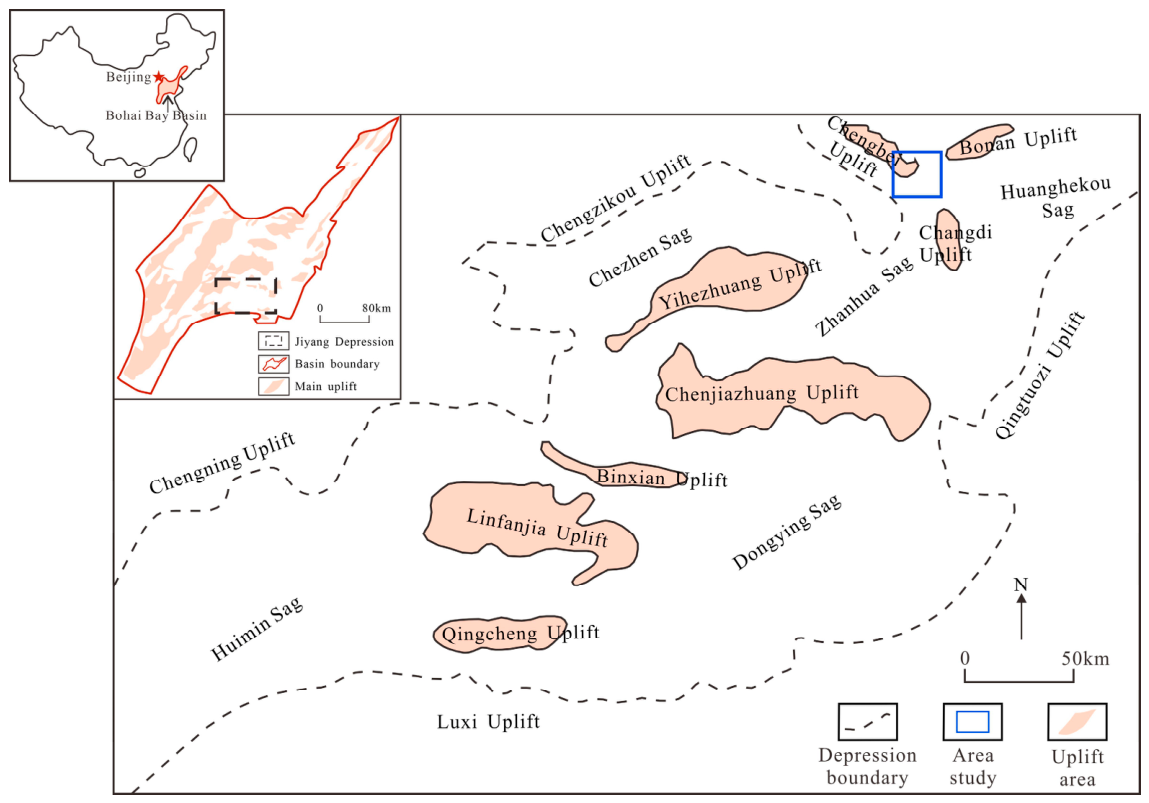
The Jiyang Depression is located in the Bohai Bay Basin in eastern China. It is surrounded by the Chengzikou Uplift to the north, the Chengning Uplift to the west, the Qingtuozi Uplift to the east, and the Luxi Uplift to the south, covering an area of approximately 2.5 × 10⁴ km2. The Jiyang Depression mainly includes the Qingcheng Uplift, Linfanjia Uplift, Binxian Uplift, Chenjiazhuang Uplift, Yihezhuang Uplift, Changdi Uplift, Bonan Uplift, and Chengbei Uplift. These uplifts are separated by the Huimin Sag, Dongying Sag, Zhanhua Sag, Chezhen Sag, Huanghekou Sag, and Chengbei Sag (Figure 1).
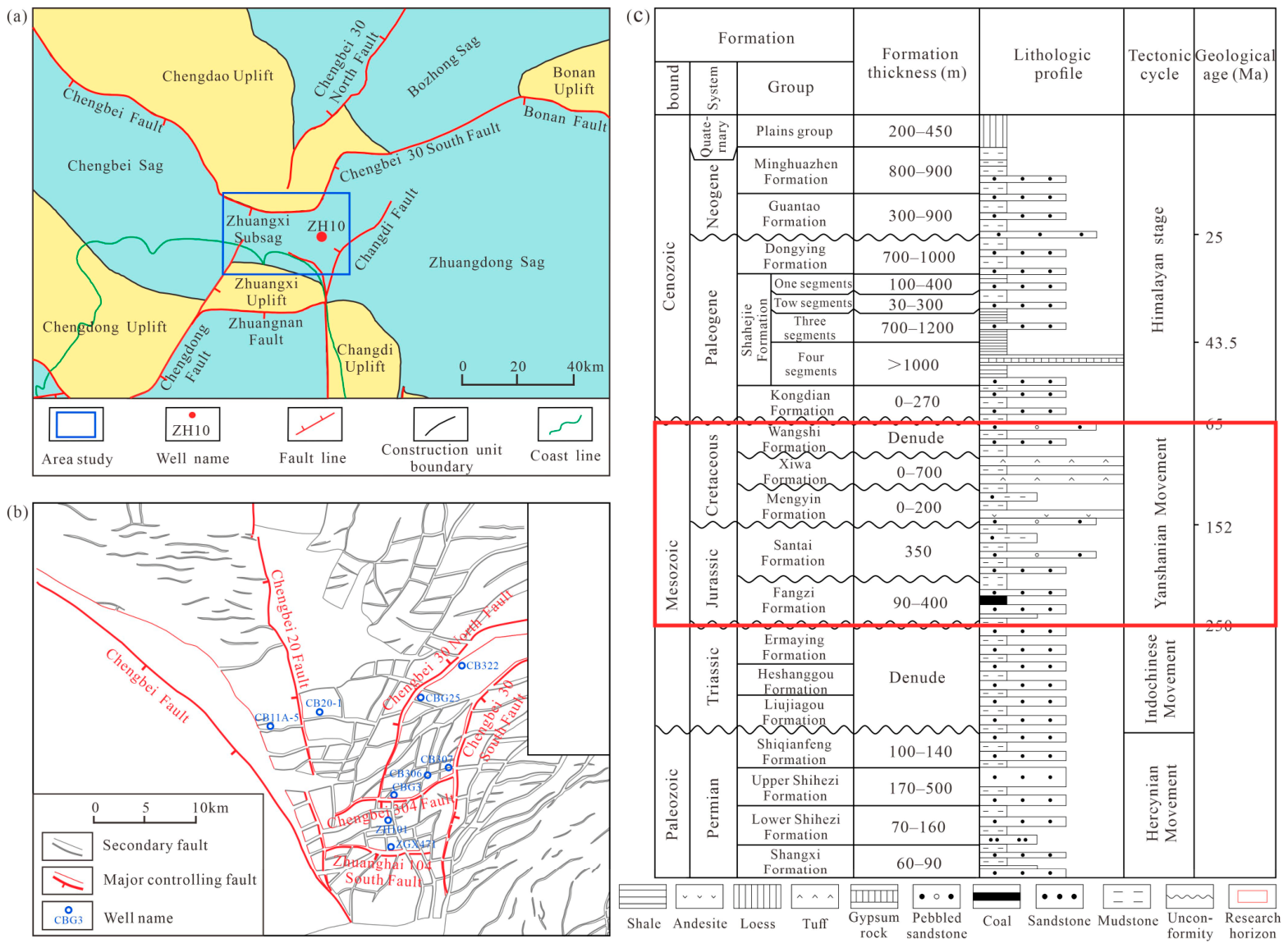
The Chengdao-Zhuanghai area is located in the offshore region of the northeastern Jiyang Depression. Structurally, it is situated between the Chengdao Uplift, Chengdong Uplift, and the Changdi Uplift. To the west, it is connected to the Chengdong Uplift through the nearly north–northeast-trending Chengdong Fault. To the north, it is bounded by the Chengbei Uplift along the Chengbei Fault. To the east, it adjoins the Changdi Uplift via the nearly north–south-trending Changdi Fault. To the south, it is connected to the Gudao Uplift through the nearly east–west-trending Gubei Fault (Figure 2a). Since the Mesozoic, the Chengdao-Zhuanghai area has experienced intense tectonic activity, resulting in extensive fault development. Faults of various orientations and properties intersect and overprint one another, forming a structural framework characterized by a north-divergent, south-convergent, and networked fault distribution (Figure 2b). The Mesozoic strata in this area consist of residual Cretaceous and Jurassic systems from top to bottom. The Cretaceous system includes the Xiwa Formation (K1x) and the Mengyin Formation (K1m), whereas the Jurassic system comprises the Santai Formation (J3s) and the Fangzi Formation (J1–2f) (Figure 2c). The Xiwa Formation (K1x) is dominated by volcanic rocks (Figure 2c). The upper part of the Mengyin Formation (K1m) is characterized by relatively fewer sandstones and more mudstones, with minor development of volcanic rock, whereas the lower part mainly consists of thick-bedded conglomeratic sandstone (Figure 2c). The Santai Formation (J3s) is dominated by medium- to fine-grained sandstone and tuffaceous sandstone in the upper section, interbedded with mudstone and siltstone of similar color, while the lower section primarily comprises conglomeratic sandstone intercalated with thin mudstone layers (Figure 2c). The Fangzi Formation (J1–2f) consists of an interbedded sequence of variable thickness, mainly composed of conglomeratic sandstone, medium-grained sandstone, argillaceous siltstone, and thin mudstone layers. Coal seams represent a typical lithological feature of the Fangzi Formation (Figure 2c).
Based on previous studies on the differential characteristics of hydrocarbon enrichment and source-reservoir relationships in the Chengdao-Zhuanghai area, the region can be divided into four hydrocarbon accumulation systems, determined by the Chengbei Fault, the Chengbei 20 Fault, and the Chengbei 30 North Fault [5]. Hydrocarbons in the Chengbei Fault Belt and the drape anticlinal belt are sourced from the Es3 and Es1 source rocks within the Chengbei Sag, forming an accumulation system supplied by these source rocks [26,27]. In this system, Mesozoic hydrocarbons are primarily enriched at the top of the Mesozoic strata, with the Es3 source rocks playing a dominant role [26,27]. Hydrocarbons in the Zhuanghai Fault Belt originate from the Es3 and Es1 source rocks within the Zhuangdong Sag, forming an accumulation system supplied by these source rocks [26,27]. In this system, Mesozoic hydrocarbons are mainly enriched within the Santai Formation, with the Es3 source rocks again serving as the primary contributor [26,27]. The Chengdao Eastern Slope Belt represents an accumulation system supplied by the source rocks of the Bozhong Sag, with hydrocarbons derived from the southern sub-sag of the Bozhong Sag [26,27]. In this system, the degree of hydrocarbon enrichment within the Mesozoic strata is relatively low [5].

3. Database and Methods

The datasets employed in this work consist of 3D seismic surveys, well test and production data, cutting logs, and wireline logs. For fault seal assessment, a fuzzy comprehensive evaluation scheme was adopted following [28,29,30,31,32,33], which incorporates three parameters: the effective normal stress acting on the fault plane (σNeff), the shale gouge ratio (SGR), and the fault sealing index (IFT).
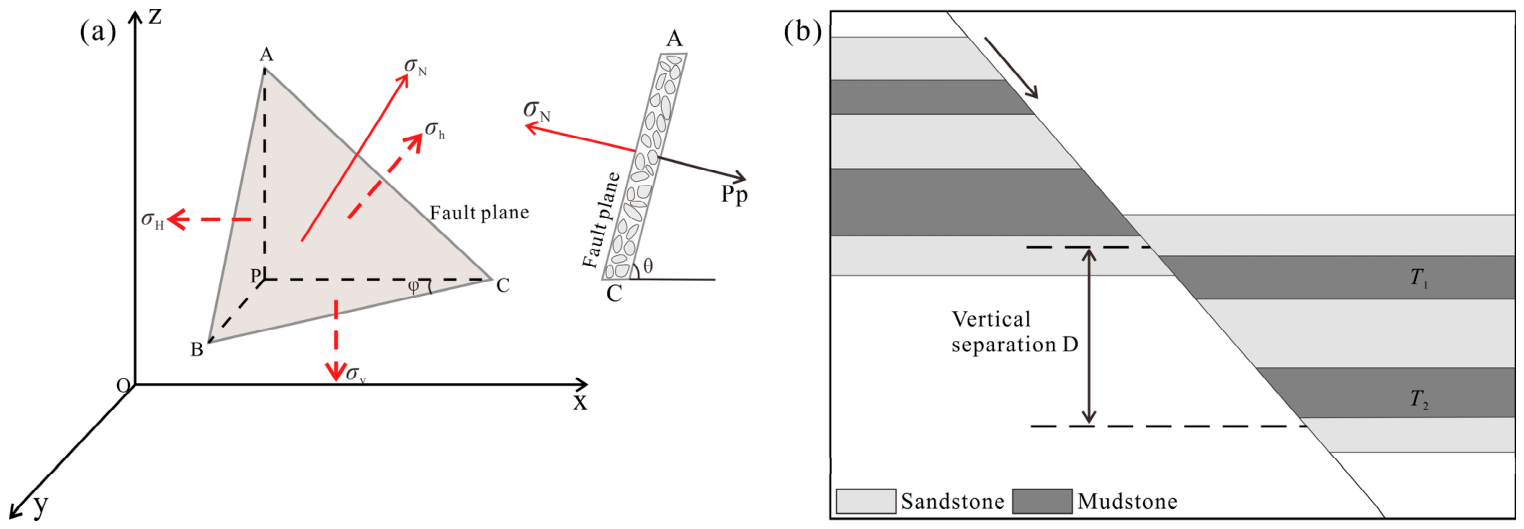
The effective normal stress σNeff is derived from the total normal stress σN acting on a fault surface [28]. As illustrated in Figure 3a, take an arbitrary point P on a fault plane ABC. Three auxiliary planes-PAB, PBC, and PAC-are constructed parallel to the yz, xy, and xz coordinate planes, respectively. When the fault plane ABC approaches point P infinitely, the normal stress on ABC tends to the local normal stress at that point. For simplicity, the x-, y-, and z-axes are set parallel to the maximum horizontal principal stress (σH), the minimum horizontal principal stress (σh), and the vertical principal stress (σv), respectively [28,29,30,31,32,33]. The normal stress σN on plane ABC makes angles α, β, and γ with the x-, y-, and z-axes.
Because pore fluid is present within the fault zone, the pore pressure Pp reduces the effective stress [28]. Consequently, the effective normal stress on plane ABC is given by:
σ Neff   =   σ N P p   =   σ H cos α 2   +   σ h cos β 2   +   σ v cos γ 2 P p
The definitions of the standard parameters follow previous studies [28], where σNeff represents the effective normal stress acting on the fault plane (MPa); Pp denotes the formation pore pressure (MPa); and σH, σh, and σv are the maximum horizontal, minimum horizontal, and vertical principal stresses (MPa), respectively.
The directional cosines in Equation (1) are linked to the fault dip angle θ and the angle φ between the fault strike and the σH direction [28]:
cos α 2   =   sin θ 2 · sin φ 2     cos β 2   =   sin θ 2 · cos φ 2     cos γ 2   =   sin θ 2 cos α 2
where φ and θ are both expressed in degrees (°).
Inserting Equation (2) into Equation (1) yields [28]:
σ Neff   =   ( sin φ   ×   sin θ ) 2 σ H   +   ( cos φ   ×   sin θ ) 2 σ h   +   cos θ 2 σ v P p
The vertical stress σv in Equation (3) depends primarily on burial depth [28,29,30,31,32,33]:
σ v   =   ρ gdh
The definitions of the standard parameters follow previous studies [28,29,30,31,32,33], where ρ is the density of the overlying sedimentary column (kg/m3), g is the gravitational acceleration constant (N/kg), and h is depth (m).
The horizontal principal stresses σH and σh can be calculated from σv, Pp, and Biot’s coefficient B [28]:
σ H   =   μ s 1     μ s   +   k 1   ×   σ v     B P p   +   B P p
σ h = μ s 1     μ s + k 2   ×   σ v B P p + B P p
where μs is Poisson’s ratio, and k1 and k2 are tectonic stress coefficients. Poisson’s ratio is obtained from sonic logs [28]:
μ s   =   0.5 t s 2     t c 2 t s 2     t c 2
The definitions of the standard parameters follow previous studies [28]. Here, Δtc and Δts are the compressional-wave and shear-wave slowness (inverse velocity) readings from well logs, respectively.
The SGR provides a straightforward and practical means of evaluating the lateral sealing capacity of faults in sandstone-shale sequences [29,30,31,32,33]. As shown in Figure 3b, the SGR is defined as the cumulative thickness of shale layers within the faulted interval divided by the fault throw. In mixed sandstone-shale successions, a larger total shale thickness yields a higher SGR value, which indicates better lateral sealing [29,30,31,32,33]. The expression is:
SGR   =   [ T i / D ]   ×   100 %
The definitions of the standard parameters follow previous studies [29,30,31,32,33], where Ti is the thickness (m) of an individual shale bed within the throw range below a specified point, and D is the vertical fault throw (m).
The degree of fault tightness is influenced by the normal stress state on the fault plane and the compressive strength of the fillings within the fault zone [25]. This study proposes a new evaluation parameter for fault tightness—the index of fault tightness (IFT) based on the effective normal stress on the fault plane and the shale gouge ratio; the calculation formula is as follows:
I FT   =   σ Neff / σ c
σ c = SGR   ×   σ CM + ( 1 SGR ) σ CS
The definitions of the standard parameters follow previous studies [29,30,31,32,33]. In these equations, IFT denotes the index of fault tightness; the term σNeff represents the effective normal stress acting on the fault plane (MPa); σc refers to the compressive strength of the fault zone filling material (MPa); σCM and σCS are the compressive strengths of mudstone and sandstone, respectively (both in MPa).
This study employs the “Fuzzy Comprehensive Evaluation Method” to quantitatively characterize the fault sealing capacity based on the obtained fault sealing evaluation parameters, including the shale gouge ratio (SGR), effective normal stress on the fault plane (σNeff), and the index of fault tightness (IFT). The weight assigned to each evaluation parameter in the comprehensive assessment is determined based on the number of influencing factors involved. The formula utilized to determine the weight coefficients is presented in Equation (12), and the corresponding weight coefficients for each evaluation parameter are listed in Table 1 [34,35]. Following the common practice of fuzzy comprehensive evaluation and calibrated against the production test data from the Chengdao-Zhuanghai area, the comprehensive evaluation result greater than 0.75 is classified as “favorable,” results between 0.43 and 0.75 are classified as “relatively favorable,” and results below 0.43 are classified as “unfavorable.”
N i = 1 0.5 n i
M i = N i / N i
where Ni is the weight factor for the i-th evaluation parameter; ni is the number of influencing factors included in the i-th evaluation parameter; Mi is the ratio of the weight factor of the i-th parameter to the sum of all weight factors.

4. Characteristics of Major Mesozoic Faults

4.1. Fault Order

The first-order tectonic units of the Mesozoic in the study area include uplifts, depressions, and their associated slopes. The sub-first-order tectonic units comprise protrusions, sags, and their corresponding slopes. The second-order tectonic units consist of structural belts and subsidence belts, while the third-order tectonic units are primarily composed of anticlines, nose structures, and fault blocks [9]. Based on this classification framework, the major controlling faults in the Chengdao-Zhuanghai area can be categorized into two types, namely second-order and third-order, based on their scale and their influence on the regional structure (Table 2). Specifically, the Chengbei Fault, Chengbei 20 Fault, Chengbei 30 North Fault, and Chengbei 30 South Fault are classified as second-order faults, whereas the Chengbei 304 Fault and Zhuanghai 104 South Fault are identified as third-order faults. The second-order faults were formed during the Indosinian period. The Chengbei 20 Fault ceased activity during the early Paleogene, whereas the Chengbei Fault, Chengbei 30 North Fault, and Chengbei 30 South Fault remained active until the Quaternary. The third-order faults originated during the Yanshanian period and terminated during the Quaternary [4]. These major controlling faults regulate the tectonic and sedimentary evolution of the Mesozoic strata in the study area.

4.2. Fault Profile Characteristics

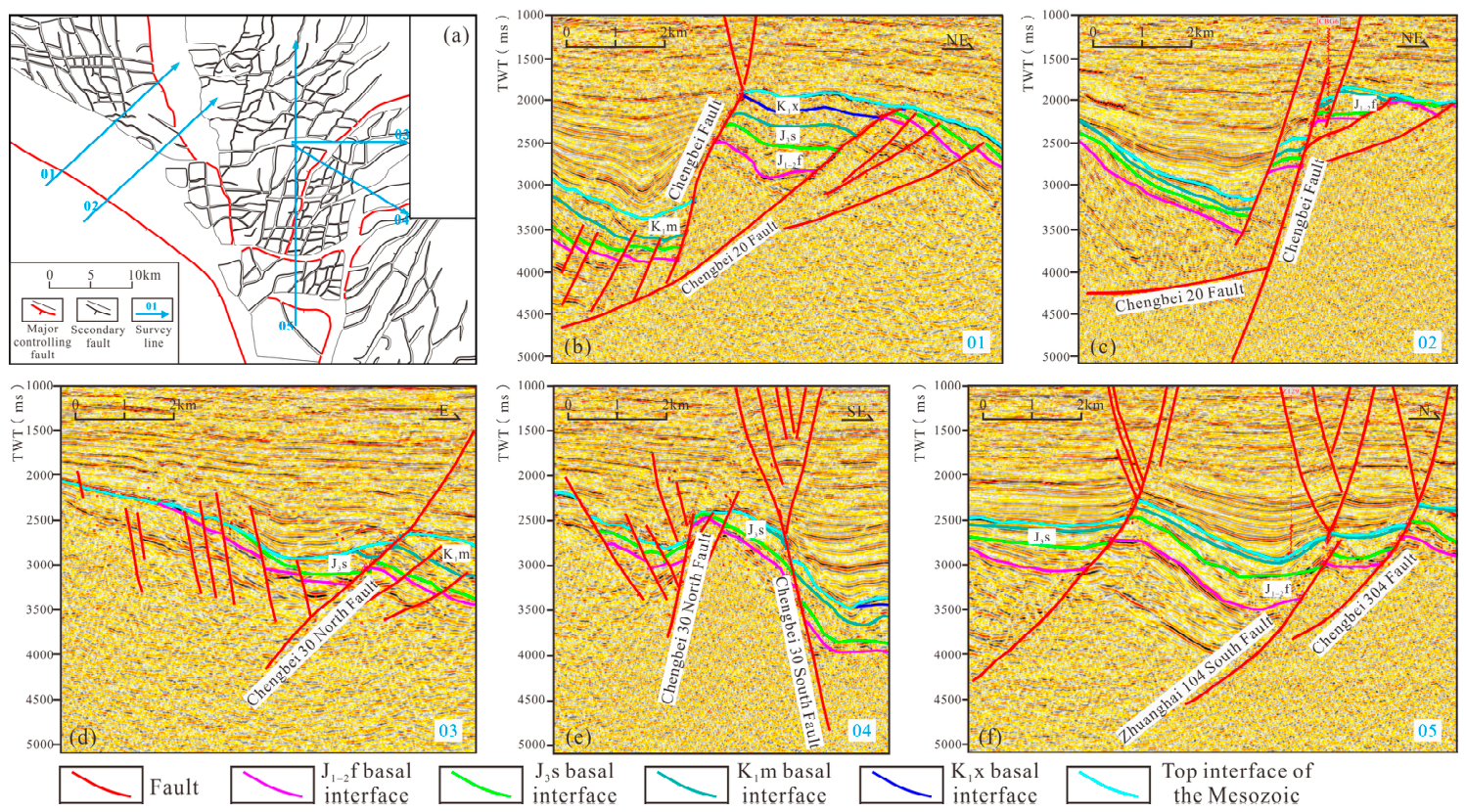
Based on previous studies, this study focuses on the major faults that controlled the Mesozoic evolution in the Chengdao-Zhuanghai area. Seismic profiles perpendicular to the fault strikes were selected (Figure 4a) to analyze the cross-sectional characteristics of these major faults during the Mesozoic. Previous studies have shown that the Chengdao-Zhuanghai area experienced compressional tectonics during the Late Triassic, which led to the formation of the NW-striking Chengbei Fault [4,9]. It is also known from previous work that during the Late Jurassic to Early Cretaceous, the region underwent a widespread negative inversion process from compression to extension, resulting in the development of two superimposed reverse wedges within the Paleogene strata in the hanging wall of the Chengbei Fault, together with the Mesozoic and Paleozoic strata [4,9]. The Mesozoic and Paleozoic sequences were significantly eroded and thinned toward the fault, producing a “thin-bottom” phenomenon in the footwall [4,9]. In cross-section, the Chengbei Fault exhibits a typical listric normal fault geometry with a steep upper section and gentle lower section (Figure 4b,c). The steeper segment has a dip angle of up to 70°, and the fault throw ranges from 2.0 to 3.2 km. The Chengbei 20 Fault displays a ramp flat geometry or a low-angle listric form in cross-section, with a relatively gentle dip angle of up to 50° and a throw ranging from 0.3 to 2.6 km. This fault cuts more deeply into the strata than the Chengbei Fault (Figure 4b,c). The Paleozoic and Mesozoic strata in the Chengdao-Zhuanghai area were eroded and thinned, whereas the Cenozoic strata form a reverse wedge overlapping the Mesozoic sequence, further indicating a clear “thin-bottom” phenomenon. This observation indicates that the Chengbei 20 Fault, similar to the Chengbei Fault, also experienced tectonic inversion (Figure 4b,c). In addition, the Chengbei 20 Fault is intersected by the Chengbei Fault, indicating that it was dominant during the early thrusting stage and formed earlier than the Chengbei Fault. During the later inversion stage, the Chengbei Fault was reactivated with greater intensity, cutting through the Chengbei 20 Fault, which had ceased activity by the end of the Mesozoic. The Chengbei 30 North Fault and Chengbei 30 South Fault exhibit continuous and linear fault planes in their lower sections, while their middle and upper sections consist of a series of discontinuous secondary faults arranged in an en echelon pattern. These faults develop in opposite directions, with relatively steep dip angles ranging from 60° to 70° and throws between 0.3 and 0.5 km. Together with the overlying secondary faults, they form a flower-like structures (Figure 4d,e). The Zhuanghai 104 South Fault dips southward, and its main fault plane exhibiting a listric geometry. It has a dip angle of up to 50°, cuts deeply into the strata, and has a throw ranging from 0.1 to 0.2 km. Influenced by the strike-slip motion of the Tanlu Fault Zone, the Zhuanghai 104 South Fault developed a transtensional character. Its upper section, together with secondary faults, forms structural patterns such as “Y”-shaped and flower-like configurations. In some areas, the Zhuanghai 104 South Fault terminates within the Mesozoic strata (Figure 4f). The main fault plane of the Chengbei 304 Fault is also a listric normal fault dipping southward, with a dip angle of up to 50°. In certain areas, the Chengbei 304 Fault and associated secondary faults in the shallow strata form “Y”-shaped patterns. The Chengbei 304 Fault extends upward into the Paleogene and downward into the basement (Figure 4f), with a throw ranging from 0.1 to 0.2 km.

4.3. Characteristics of Fault Planar Distribution

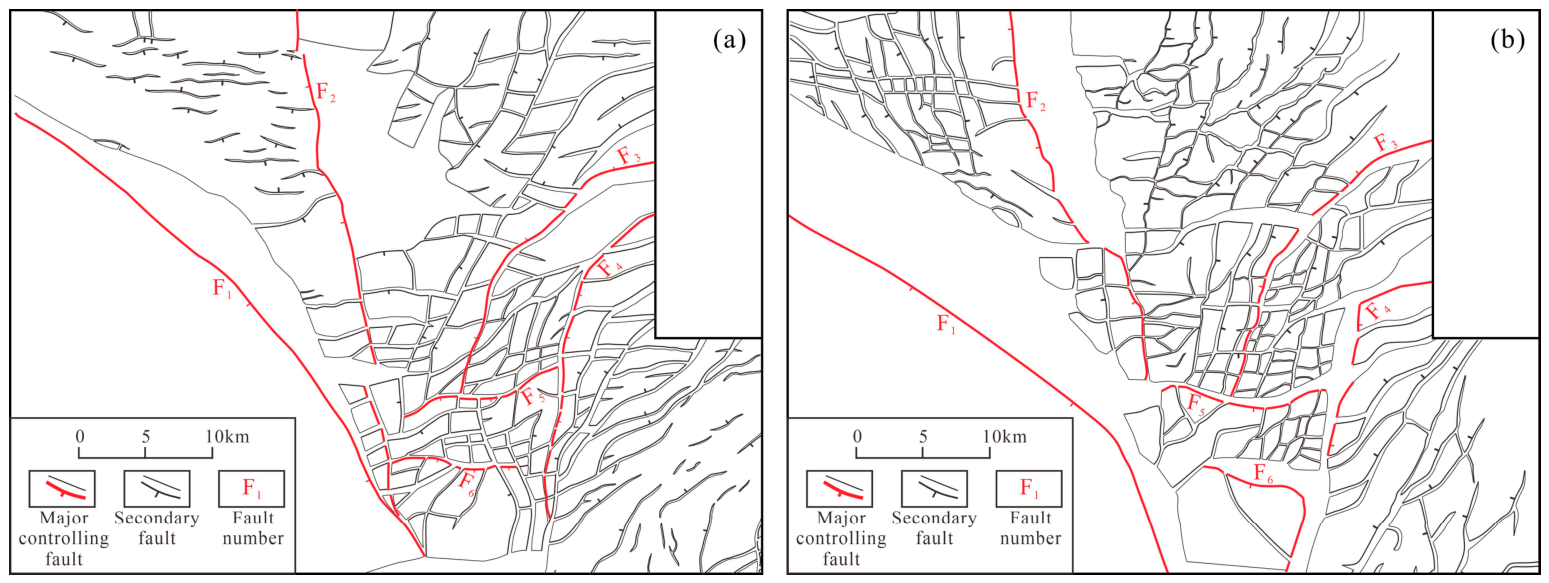
From the base to the top interface of the Mesozoic strata in the Chengdao-Zhuanghai area, the number of faults gradually decreases, and the fault strikes tend toward NW, NNW, NNE (NE), and near EW directions (Figure 5). Among these, the NW-trending fault zone primarily includes the Chengbei Fault, the NNW-trending fault zone mainly includes the Chengbei 20 Fault, the NNE (NE) trending fault zone comprises the Chengbei 30 North Fault and Chengbei 30 South Fault, and the near-EW-trending fault zone consists of the Chengbei 304 Fault and the Zhuanghai 104 South Fault (Figure 5). The Chengbei Fault serves as the northern boundary fault of the Chengbei Sag, with an extension length of 45.94 km. It controls the structural configuration, sedimentation, and evolution of the Chengbei Sag and also acts as the boundary between the Chengbei Fault Zone and the Drape Anticline Zone. From the base to the top interface of the Mesozoic strata, the width of this fault gradually increases (Figure 5). The Chengbei 20 Fault is located east of the Chengbei Fault, with an extension length of 37.87 km. It functions as the boundary fault between the Drape Anticline Zone and the Chengdao Eastern Slope Zone. Its extension length is shorter than that of the Chengbei Fault, and its width gradually increases from the base to the top interface of the Mesozoic strata (Figure 5). The Chengbei 30 North Fault serves as the boundary between the Chengdao Eastern Slope Zone and the Zhuanghai Fault Zone, with an extension length of 24.60 km (Figure 5). The Chengbei 30 South Fault, together with the Chengbei 30 North Fault, controls the Chengbei 30 High, with an extension length of 25.71 km (Figure 5). The Zhuanghai 104 South Fault is the mountain controlling fault in the Zhuanghai area, with an extension length of 12.65 km (Figure 5). The Chengbei 304 Fault acts as the boundary fault between the Chengdao Eastern Slope Zone and the Zhuanghai Fault Zone, with an extension length of 10.46 km (Figure 5).

4.4. Fault Evolution

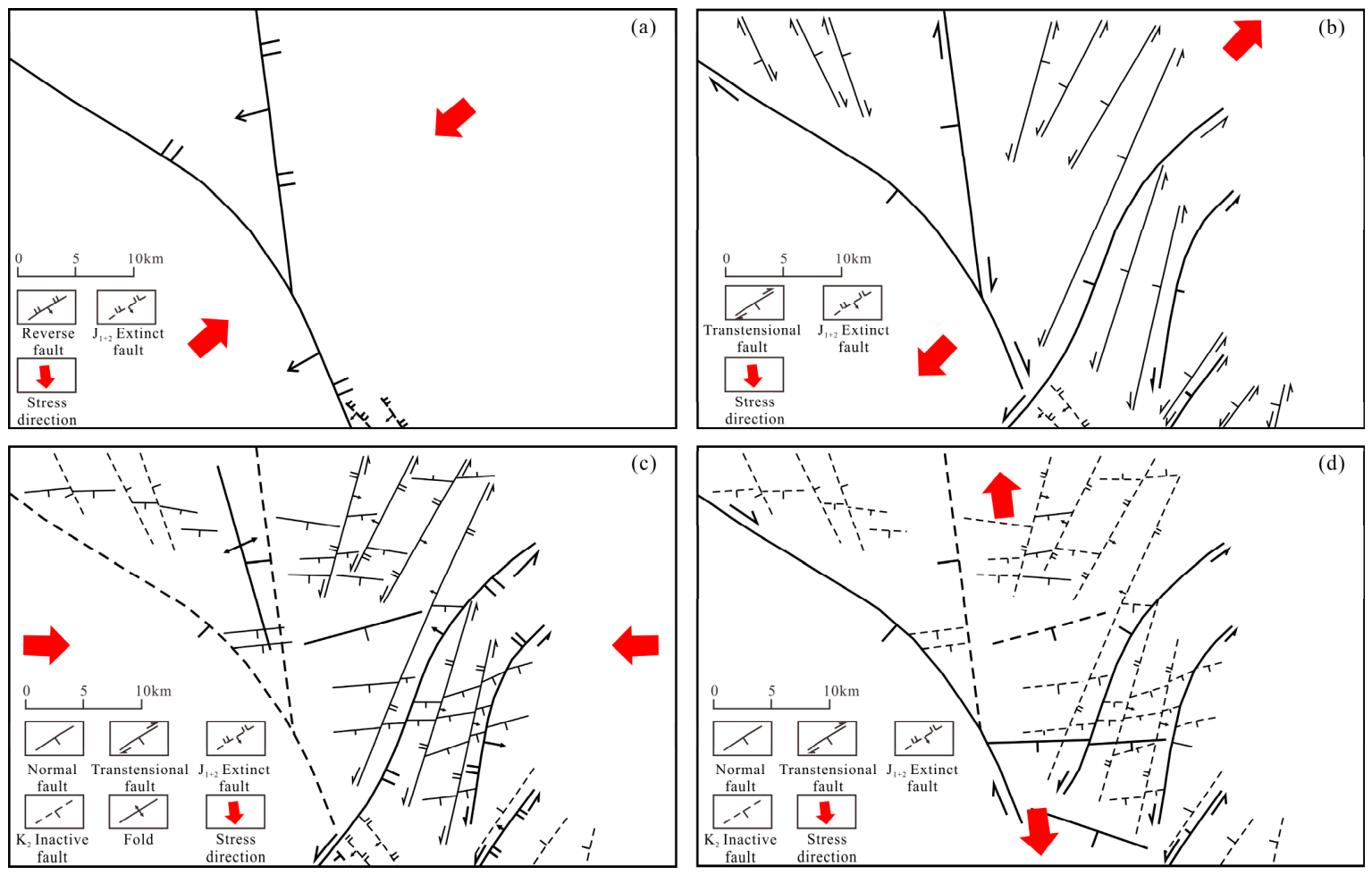
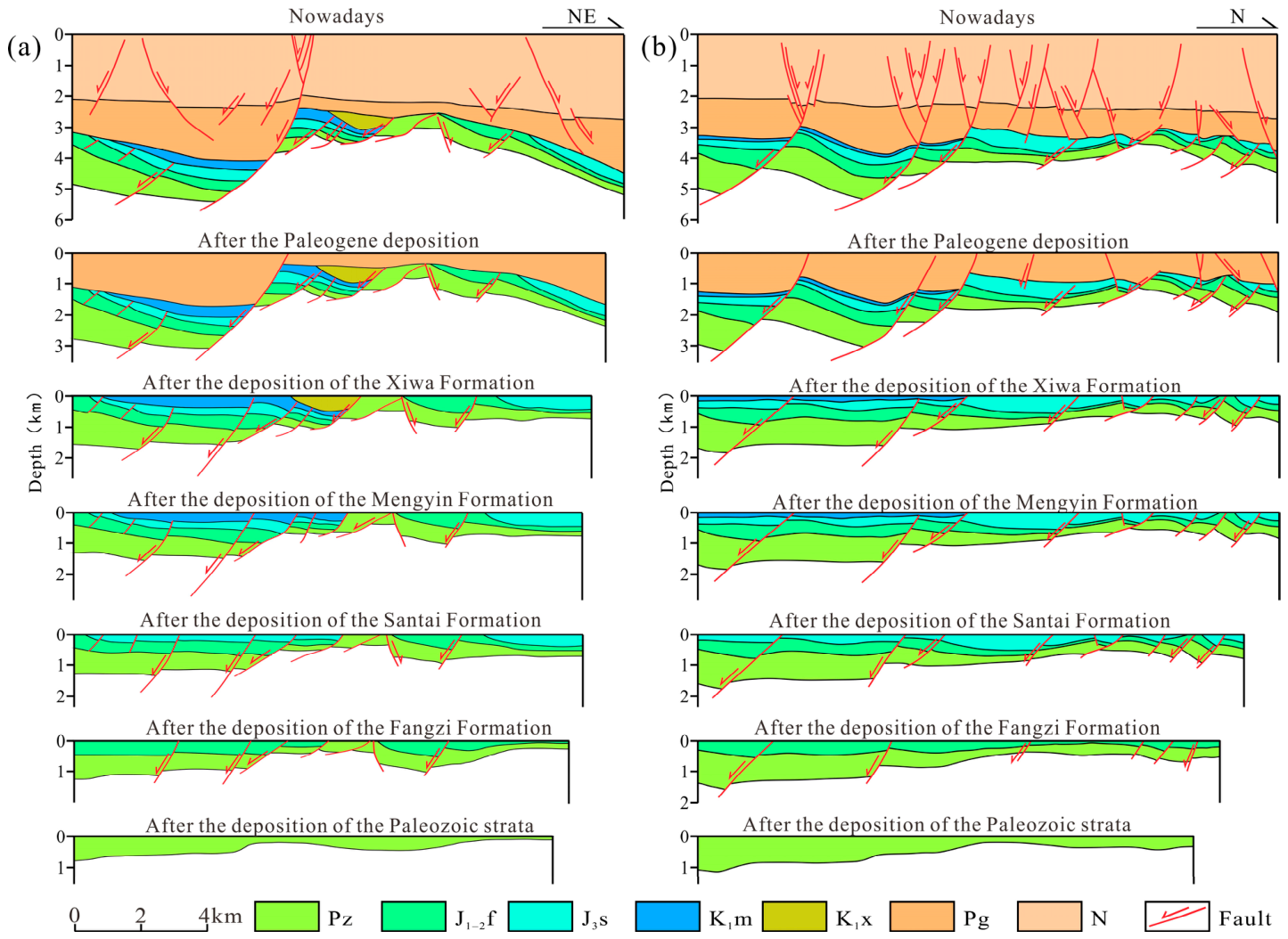
The Chengdao-Zhuanghai area has undergone Yanshanian and Himalayan tectonic movements since the Mesozoic. During the early Yanshanian movement, eastern China entered a tectonic transition phase from the Paleo-Asian domain to the marginal Pacific tectonic domain [36,37]. The Jiyang Depression experienced a prolonged intracontinental subsidence process during this period. The Chengdao-Zhuanghai area inherited the tectonic framework established in the Late Triassic and remained influenced by NE-SW-oriented compressional stress, although the intensity of compression weakened during this stage (Figure 6a). During this period, the Chengdao area underwent initial fault-related subsidence, leveling denudation, and overall draping sedimentation. Areas with higher topography received less sediment deposition, whereas lower-lying areas accumulated thicker sedimentary sequences. Negative fault inversion began during the depositional stage of the Fangzi Formation (Figure 7). In the Zhuanghai area, near-EW-trending faults controlled the development of depressions and uplifts (Figure 7). During the middle Yanshanian movement, eastern China was subjected to a left-lateral shear stress field, which led to the development of a series of NNE-trending faults. The Tanlu Fault Zone experienced significant left-lateral strike-slip displacement from the Late Jurassic to Early Cretaceous, generating NW-oriented compressional forces and NE-oriented extensional forces. This process resulted in an NNE-trending left-lateral strike-slip stress field across eastern China, including the Jiyang Depression [38]. Simultaneously, the lithosphere in eastern China underwent significant thinning, accompanied by mantle plume activity and asthenospheric uplift. Under these combined mechanisms, eastern China entered a phase of large-scale rift development, during which thick sedimentary sequences were deposited alongside intense volcanic activity [39,40]. Within this regional stress regime, the Chengdao-Zhuanghai area was primarily influenced by a NE-SW-oriented extensional stress field (Figure 6b). During this stage, NW-trending faults such as the Chengbei Fault, Chengbei 20 Fault, and Chengbei 30 North Fault were inverted into normal faults with high activity intensity. In addition, a series of NNE-trending faults parallel to the Tanlu Fault Zone developed (Figure 6b). This phase was characterized by intense fault-controlled subsidence in the Chengdao area, with tilting and uplift forming mountains structures at the ends of NW-trending faults during the late stage (Figure 7). In the Zhuanghai area, EW-trending extensional faults controlled further subsidence (Figure 7). During the late Yanshanian movement, a near-EW-oriented compressional stress field was superimposed on the earlier extensional rift basins [41]. Some NNE-trending strike-slip faults formed during the Late Jurassic to Early Cretaceous underwent transpressional reactivation, while a series of near-EW-trending secondary faults were generated (Figure 6c). During this stage, the Chengdao-Zhuanghai area experienced overall uplift and denudation (Figure 7), with only the Chengbei 30 North Fault remaining active among the major controlling faults, and at a relatively low activity rate. During the Himalayan period, under a near-SN-oriented extensional regime, near-EW-trending faults developed (Figure 6d). Among these, the NW-trending Chengbei Fault experienced inherited reactivation with sustained high activity, whereas the NW-trending Chengbei 20 Fault became inactive. The NNE-trending Chengbei 30 South Fault began to reactivate, the Chengbei 30 North Fault continued its activity, and the near EW-trending Chengbei 304 Fault and Zhuanghai 104 South Fault initiated activity. During this period, the Chengdao-Zhuanghai area experienced intense fault-controlled subsidence during the Paleogene, followed by overall depression and draping sedimentation during the Neogene (Figure 7).

5. Sealing Capacity of Major Faults

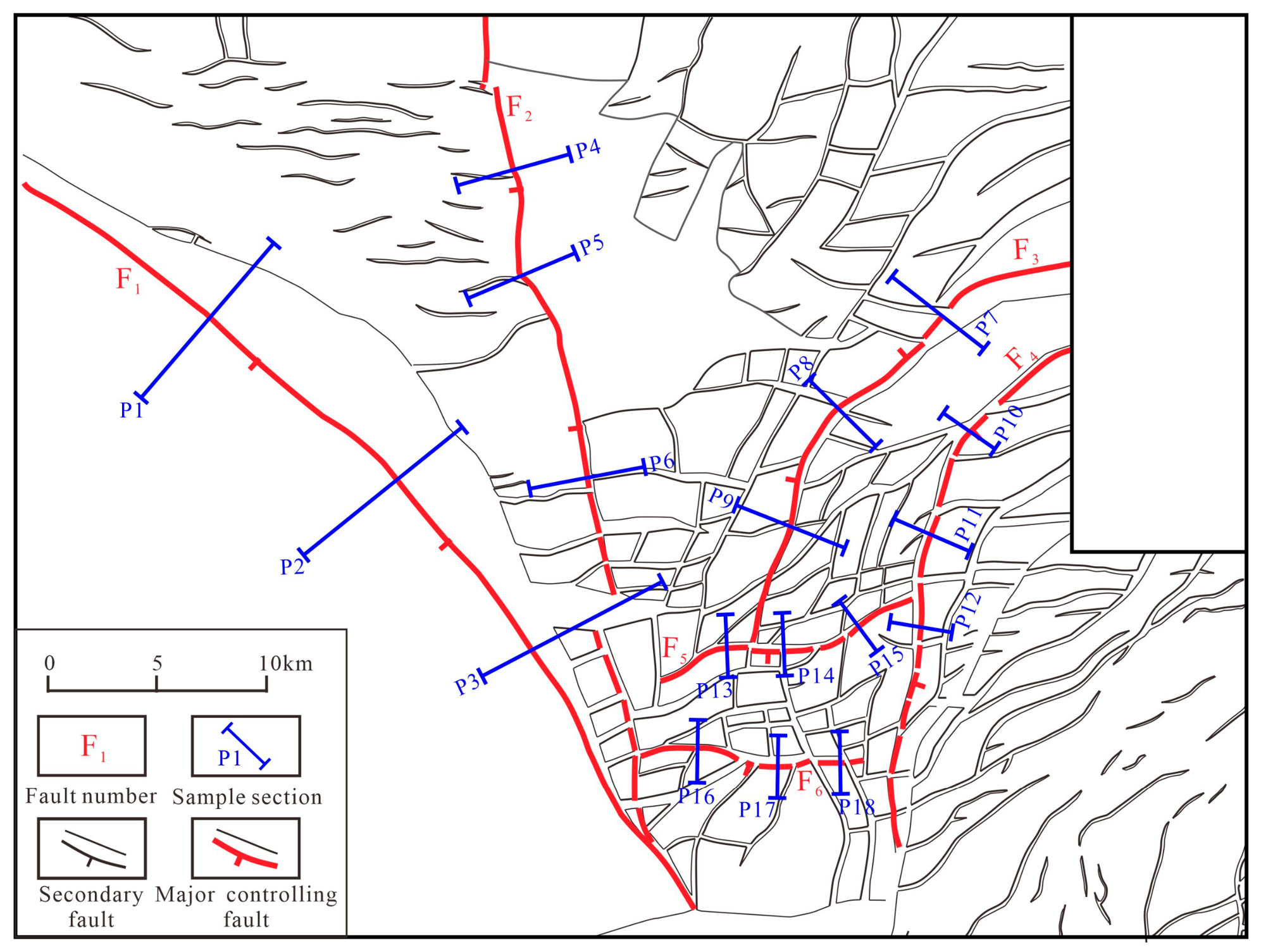
Based on the clarified characteristics of the six major Mesozoic faults in the Chengdao-Zhuanghai area, three measurement points were selected for each major fault (Figure 8).
Conventional well logging data and cuttings logging data were utilized to obtain fault dip angles, throws, sand body thicknesses, and shale thicknesses through seismic profile measurements. This approach enabled the calculation of sealing capacity evaluation parameters for each Mesozoic layer. Through weighted analysis, a comprehensive evaluation of the sealing capacity of the major Mesozoic faults in the Chengdao-Zhuanghai area was derived (Table 3).
Table 3 indicates that the sealing capacity of the major Mesozoic faults exhibits significant differences depending on location and stratigraphic position. Laterally, in the hanging wall of the Chengbei Fault, the Xiwa Formation is severely eroded and only persists at location P2. The sealing capacity of the Mengyin Formation is generally poor from north to south. The sealing capacity of the Santai Formation shows a trend from poor to relatively good from north to south, while that of the Fangzi Formation varies from relatively good to poor and then back to relatively good from north to south. The Xiwa Formation is severely eroded and only remains at location P5 in the hanging wall of the Chengbei 20 Fault. The sealing capacity of the Mengyin Formation is generally good from north to south. The Santai Formation shows a trend from relatively good to poor and then back to relatively good from north to south, while the Fangzi Formation is generally good from north to south. The Xiwa Formation is absent in the hanging wall of the Chengbei 30 North Fault. The sealing capacities of the Mengyin, Santai, and Fangzi Formations all exhibit a trend from poor to relatively good and then back to poor from north to south. The Xiwa Formation is absent in the hanging wall of the Chengbei 30 South Fault. The sealing capacities of the Mengyin, Santai, and Fangzi Formation are all good from north to south. Both the Xiwa and Mengyin Formations are absent in the hanging wall of the Chengbei 304 Fault. The sealing capacities of the Santai and Fangzi Formations are poor. The Xiwa Formation is absent, and the Mengyin Formation only persists at location P18 in the hanging wall of the Zhuanghai 104 South Fault. The sealing capacity of the Santai Formation shows a trend from poor to relatively good from west to east, while that of the Fangzi Formation is generally relatively good from west to east. Vertically, the sealing capacity of the Chengbei Fault shows a trend from good to poor, with poor sealing at location P2 from the base to the top of the Mesozoic strata. The sealing capacity of the Chengbei 20 Fault is generally consistent and good, except for poor sealing in the Santai Formation at locations P2 and P5. The sealing capacity of the Chengbei 30 North Fault is consistent throughout. The sealing capacity of the Chengbei 30 South Fault is consistently good overall. The sealing capacity of the Chengbei 304 Fault is consistently poor overall. The sealing capacity of the Zhuanghai 104 South Fault is generally consistent and good, except for poor sealing in the Santai Formation at location P16. Accordingly, the sealing capacity of the major faults in the Chengdao-Zhuanghai area exhibits significant spatial variability. The Chengbei 30 North Fault and Chengbei 304 Fault have relatively poor sealing capacity, whereas the Chengbei Fault, Chengbei 20 Fault, Chengbei 30 South Fault, and Zhuanghai 104 South Fault exhibit relatively good sealing capacity. Among all major faults, the sealing capacity in the Fangzi Formation is generally better.
The spatial heterogeneity in fault sealing capacity observed above can be attributed to three geological controls. First, fault throw plays a primary role: faults with larger throws (e.g., Chengbei Fault, 2–3.2 km; Chengbei 20 Fault, 0.3–2.6 km) tend to exhibit better sealing capacity because greater displacement promotes the smearing of shale along the fault plane, increasing the SGR. In contrast, the Chengbei 30 North Fault and Chengbei 304 Fault, both with smaller throws (<0.5 km and <0.2 km, respectively), lack sufficient shale smearing, resulting in poor sealing. Second, the lithological composition of the faulted strata exerts a strong influence. The Fangzi Formation consistently shows better sealing than the Mengyin and Santai Formations, likely due to its higher shale-to-sand ratio, which facilitates the development of a continuous gouge zone. Third, burial depth affects sealing capacity through its control on effective normal stress. Shallower burial (e.g., at location P2 along the Chengbei Fault) reduces effective normal stress, weakening fault plane closure and leading to poorer sealing. These controls collectively explain why the Chengbei 30 North Fault and Chengbei 304 Fault serve as hydrocarbon conduits, whereas the Chengbei Fault, Chengbei 20 Fault, Chengbei 30 South Fault, and Zhuanghai 104 South Fault function as effective structural traps.

6. Discussion

The Mesozoic reservoirs in the Chengdao-Zhuanghai area exhibit favorable physical properties. Hydrocarbons in the Mesozoic strata are primarily sourced from the Es3 source rocks, with the hydrocarbon accumulation period extending from the deposition of the Minghuazhen Formation to the present [42,43]. The Mesozoic hydrocarbon accumulations represent typical examples of “older reservoirs sourced by younger strata and formed by external sources.” As the bridge connecting the source rocks to the traps, the major faults play varying roles in the processes of hydrocarbon migration and accumulation.
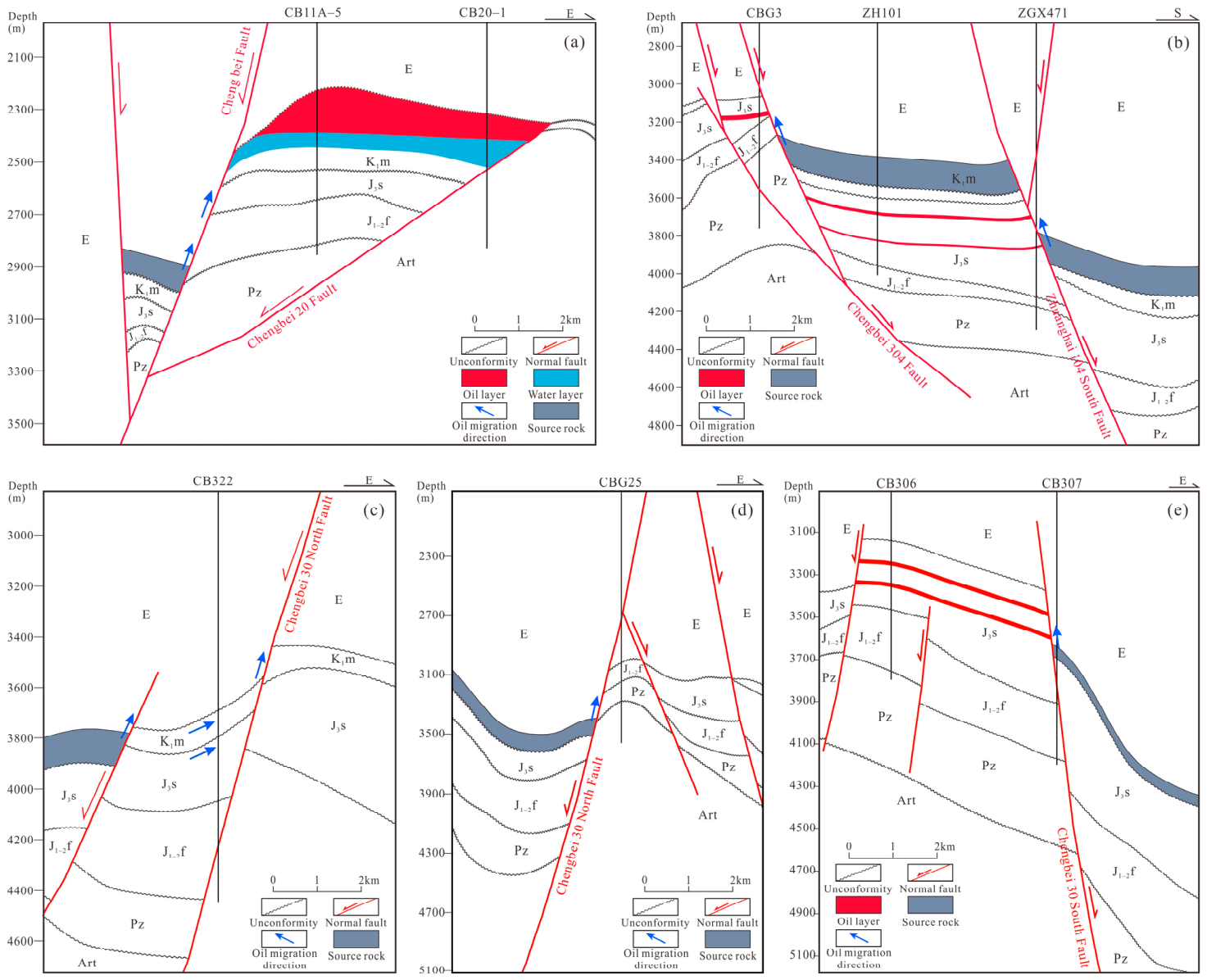
This study selects well-crossing profiles perpendicular to the major faults and integrates well testing and production data to analyze the effect of fault sealing capacity on hydrocarbon migration and accumulation (Figure 9). The hydrocarbon generation center is located in the upper part of the Mesozoic in the footwall of the Chengbei Fault, where no hydrocarbon accumulation exists in the Mesozoic strata (Figure 9a). Near the CB11A-5 well in the hanging wall of the Chengbei Fault, the sealing capacity of the Fangzi and Santai Formations is poor, allowing them to function only as hydrocarbon conduits. In contrast, the sealing capacity of the Mengyin Formation is good. When hydrocarbons migrate from the generation center along the Chengbei Fault, they are effectively sealed within the Mengyin Formation (Figure 9a). The Chengbei 20 Fault ceased activity during the Neogene and primarily acts as a barrier to hydrocarbon migration (Figure 9a). The Chengbei 304 Fault and Zhuanghai 104 South Fault form a step-like configuration. A hydrocarbon generation center exists in the footwall of the Chengbei 304 Fault. Near the ZH101 well in its hanging wall, the Fangzi and Santai Formations show good sealing capacity, while the Mengyin Formation shows poor sealing capacity. Since the Fangzi Formation is not in contact with the source rocks, no accumulation occurs in this formation; However, a hydrocarbon accumulation is developed in the Santai Formation (Figure 9b). Due to the presence of source rocks near the Zhuanghai 101 well, in the hanging wall of the Chengbei Gu 3 Fault, the Fangzi and Santai Formations in the CBG3 well exhibit relatively good sealing capacity and host fault-block hydrocarbon accumulations. No hydrocarbon accumulation occurs in the hanging wall of the Chengbei 304 Fault due to the poor sealing capacity of the Fangzi and Santai Formations (Figure 9b). Near the CB322 well in the footwall of the Chengbei 30 North Fault, source rocks are absent due to erosion. However, source rocks are developed in the footwall of the fault to the left of the CB322 well. Because the sealing capacity of this fault is poor, hydrocarbons migrate along the fault toward the CB322 well area. Due to the sealing characteristics of the Chengbei 30 North Fault within the Mesozoic, no hydrocarbon accumulation occurs near this fault (Figure 9c). Similarly, although source rocks exist in the footwall of the Chengbei 30 North Fault near the CBG25 well, the poor sealing capacity of the fault prevents hydrocarbon accumulation in the hanging wall near the CBG25 well (Figure 9d). Source rocks are developed near the CB307 well in the footwall of the Chengbei 30 South Fault. The Chengbei 30 South Fault exhibits good sealing capacity, and when hydrocarbons migrate from the source rocks along this fault, they are effectively sealed within the Santai Formation of the CB306 well (Figure 9e). The role of major faults in hydrocarbon migration and accumulation is primarily influenced by whether the fault connects to source rocks and by the sealing capacity of the fault. If a fault connects to source rocks and has good sealing capacity, hydrocarbon accumulations are likely to form. In contrast, if a fault does not connect to source rocks, even if it has good sealing capacity, hydrocarbon accumulations are less likely to form, and the size of any accumulation is mainly controlled by the lateral sealing capacity of the fault. In addition, Mesozoic hydrocarbon accumulations are not solely formed by fault sealing but result from the combined effects of faults, unconformities, and lithological sealing.
In this study, seismic data, logging data, and mud logging data were used to systematically analyze the characteristics, formation, and evolution of major Mesozoic fault controls. On this basis, the effective normal stress on fault surfaces, shale gouge ratio (SGR), and index of fault tightness (IFT) were taken as parameters to quantitatively evaluate the sealing capacity of major faults using a fuzzy evaluation method. Combined with production test data, the influence of fault sealing capacity on hydrocarbon migration and accumulation was discussed. It should be noted that this study has not yet analyzed the correlation between IFT and oil column height, nor has it systematically compared the advantages and differences between IFT and established fault sealing indicators (e.g., SGR). The above issues will be given focused attention in subsequent research.

7. Conclusions

To address the limitations of existing single-parameter methods for fault seal evaluation in complex faulted basins, this study, based on an analysis of the characteristics of the major Mesozoic faults in the Chengdao-Zhuanghai area, adopted a multi-parameter fuzzy comprehensive evaluation method. Three parameters—fault plane effective normal stress, shale gouge ratio (SGR), and index of fault tightness (IFT)—were selected as evaluation indicators to quantitatively characterize fault sealing capacity. Based on the application of this method, the following conclusions are drawn:
(1) The major Mesozoic faults in the Chengdao-Zhuanghai area exhibit systematic geometric and kinematic characteristics that control their structural styles. Specifically, the Chengbei Fault, Chengbei 20 Fault, Chengbei 30 North Fault, and Chengbei 30 South Fault are second-order ramp-flat or listric normal faults with throws exceeding 0.3 km, whereas the Chengbei 304 Fault and Zhuanghai 104 South Fault are third-order faults with smaller displacements (<0.2 km). A consistent decrease in fault abundance from the base to the top of the Mesozoic strata indicates progressive tectonic quiescence. Notably, the Chengbei Fault, Chengbei 20 Fault, and Chengbei 30 North Fault experienced negative inversion during Fangzi Formation deposition, revealing a critical period of extensional reactivation that modified the preexisting compressional structures.
(2) The multi-parameter fuzzy comprehensive evaluation method, integrating effective normal stress, shale gouge ratio (SGR), and index of fault tightness (IFT), provides a robust quantitative tool for assessing fault seal capacity in complex faulted basins. Application of this method reveals strong lateral and vertical heterogeneity in fault sealing. While the Chengbei 30 North Fault and Chengbei 304 Fault exhibit poor sealing capacity, the Chengbei Fault, Chengbei 20 Fault, Chengbei 30 South Fault, and Zhuanghai 104 South Fault show relatively strong sealing capacity. Within the Mesozoic succession, the Fangzi Formation stands out as a favorable sealing unit, suggesting its potential as a regional cap rock.
(3) The contrasting roles of major faults in hydrocarbon migration and accumulation are governed by two factors: connectivity to source rocks and sealing capacity. Faults with poor sealing (Chengbei 30 North and Chengbei 304) serve as effective hydrocarbon conduits, whereas those with strong sealing (Chengbei, Chengbei 20, Chengbei 30 South, and Zhuanghai 104 South) act as structural traps that retain hydrocarbons. This dual control implies that exploration targets should prioritize strongly sealed faults with access to mature source rocks, while leaky faults may be secondary migration pathways rather than accumulation sites.

Author Contributions

Conceptualization, S.M. and S.Y.; methodology, S.M.; validation, S.M.; formal analysis, S.M.; investigation, S.M., Q.W., Y.W., D.H. and Y.Z.; resources, Q.W. and Y.W.; data curation, S.M.; writing—original draft preparation, S.M.; writing—review and editing, S.M., S.Y., Q.W., Y.W., D.H. and Y.Z.; visualization, S.M.; supervision, S.Y., Q.W. and Y.W.; project administration, S.Y.; funding acquisition, S.Y. All authors have read and agreed to the published version of the manuscript.

Funding

This research was funded by the China National Science and Technology Major Project (Grant No. 2017ZX05009001), and the Innovation Fund of the China University of Petroleum (East China) supported by the Fundamental Research Funds for the Central Universities (Grant No. 27RA2301006).

Institutional Review Board Statement

Not applicable.

Informed Consent Statement

Not applicable.

Data Availability Statement

The original contributions presented in the study are included in the article; further inquiries can be directed to the corresponding author.

Conflicts of Interest

Authors Qunhu Wu and Yanjia Wu were employed by the company SINOPEC. The remaining authors declare that the research was conducted in the absence of any commercial or financial relationships that could be construed as a potential conflict of interest. The SINOPEC had no role in the design of the study; in the collection, analyses, or interpretation of data; in the writing of the manuscript, or in the decision to publish the results.

Abbreviations

The following abbreviations are used in this manuscript:
σNeffEffective normal stress
SGRShale Smear Factor
IFTIndex of Fault Tightness
σHMaximum horizontal principal stress
σhMinimum horizontal principal stress
σvVertical stress
PpPore pressure
σNNormal stress
μsPoisson’s ratio
k1Tectonic stress coefficients
k2Tectonic stress coefficients
BBiot’s coefficient
ΔtsShear wave slowness log data
ΔtcCompressional wave slowness log data
σCSCompressive strength of sandstone
σCMCompressive strength of mudstone
σcCompressive strength of the fault zone material
gGravitational acceleration constant
DVertical throw of the fault
ρDensity
NiThe weight factor for the i-th evaluation parameter
niThe number of influencing factors included in the i-th evaluation parameter
MiThe ratio of the weight factor of the i-th parameter to the sum of all weight factors

References

  1. Dai, J.S. Paleozoic structures and the IR evolution in Chengdao oilfield. China Offshore Oil Gas 2000, 14, 31–34. [Google Scholar]
  2. Li, W.; Wu, Z.P.; Zhang, M.H.; Zheng, D.S.; Zhou, Y.Q. Development characteristics of Mesozoic and Cenozoic faults and its control over deposition in Chengdao area. J. China Univ. Pet. 2006, 30, 1–6+11. [Google Scholar]
  3. Gao, X.L. Tectonic characteristics and reservoir properties of the Precambrian basement in the Chengdao oilfield, Bohai Bay Basin. J. Oil GasTechnol. 2012, 34, 45–49+165–166. [Google Scholar] [CrossRef]
  4. Zhang, Z.Z.; Zhang, W.P.; Li, Z.Y.; Lu, Y.M.; Shi, M.H.; Wang, Y.Z. Characteristics and control of faults on hydrocarbon accumulation in buried hill reservoirs in Chengbei arch, Bohai Bay Basin. Mar. Orig. Pet. Geol. 2014, 19, 8–14. [Google Scholar] [CrossRef]
  5. Zhao, M.S. Analysis of Hydrocarbon accumulation controlling factors of Mesozoic buried hills in the Chengdao area, Bohai Bay Basin. Inn. Mong. Petrochem. Ind. 2015, 41, 55–59. [Google Scholar] [CrossRef]
  6. Zhang, K.X.; Qi, J.F.; Ma, B.J.; Yang, Q. Study on the tectonic evolution of Zhuanghai area in Jiyang Depression. J. Xi’an Shiyou Univ. (Nat. Sci. Ed.) 2005, 20, 40–43+90. [Google Scholar] [CrossRef]
  7. Jin, C. Structural Pattern Evolution and Dynamic Mechanism of the Mesozoic Strata in the Huanghua Depression and Jiyang Depression. Master’s Thesis, Ocean University of China, Qingdao, China, 2007. [Google Scholar] [CrossRef]
  8. Zhang, X. Tectonic styles of pre-Teriary buried hills in the Zhuanghai area, Jiyang Depression. Pet. Geol. Recovery Eff. 2006, 13, 12–14+105–106. [Google Scholar] [CrossRef]
  9. Guo, T.T. Development Characteristics and Evolution Process of Buried Hills in Chengdao-Zhuanghai Area. Master’s Thesis, China University of Petroleum (East China), Qingdao, China, 2020. [Google Scholar] [CrossRef]
  10. Sun, Y.H.; Qi, J.F.; Lv, Y.F.; Han, H.J. Characteristics of fault structure and its control to Hydrocarbon in Bozhong Depression. Acta Pet. Sin. 2008, 29, 669–675. [Google Scholar] [CrossRef]
  11. Lv, Y.F.; Fu, G.; Fu, X.F.; Sun, Y.H. The Transporting and Sealing Effects of Faults on Hydrocarbons, 1st ed.; Petroleum Industry Press: Beijing, China, 2013; pp. 100–132. [Google Scholar]
  12. Lyu, Y.F.; Wang, W.; Hu, X.L.; Fu, G.; Shi, J.J.; Wang, C.; Liu, Z.; Jiang, W.Y. Quantitative evaluation method of fault lateral sealing. Pet. Explor. Dev. 2016, 43, 340–347. [Google Scholar] [CrossRef]
  13. Liu, Z.; Fu, G.; Lv, Y.F.; Hu, M.; Sun, T.W.; Wang, C. Quantitative evaluation for control of faults on hydrocarbon accumulation in Nanpu sag. J. China Univ. Pet. 2013, 37, 27–34. [Google Scholar] [CrossRef]
  14. Tong, H.M. Quantitative analysis of fault opening and sealing. Oil Gas Geol. 1998, 19, 45–50. [Google Scholar]
  15. Lv, Y.F.; Fu, G.; Zhang, Y.F. Fault Sealing Analysis, 1st ed.; Petroleum Industry Press: Beijing, China, 2002; pp. 138–142. [Google Scholar]
  16. Fu, X.F.; Lv, Y.F.; Fu, G.; Wen, H.J. Quantitative simulation experiment and evaluation method for vertical seal of overthrust. Chin. J. Geol. 2004, 39, 223–233. [Google Scholar] [CrossRef]
  17. Fu, G.; Shi, J.J.; Lv, Y.F. Improvement of quantitative research methods for fault lateral sealing. Acta Pet. Sin. 2012, 33, 414–418. [Google Scholar]
  18. Lindsay, N.G.; Murphy, F.C.; Walsh, J.J.; Watterson, J. Outcrop studies of shale smear on fault surfaces. Geol. Model. Hydrocarb. Reserv. Outcrop Analog. 1993, 15, 113–123. [Google Scholar] [CrossRef]
  19. Yielding, G.; Freeman, B.; Needham, D.T. Quantitative fault seal prediction. AAPG Bull. 1997, 8, 897–917. [Google Scholar] [CrossRef]
  20. Knipe, R.; Jones, G.; Fisher, Q. Faulting, fault sealing, and fluid flow in hydrocarbon reservoirs: An introduction. Geol. Soc. Lond. Spec. Publ. 1998, 25, vii–xxi. [Google Scholar] [CrossRef]
  21. Færseth, R.B. Shale smear along large faults: Continuity of smear and the fault seal capacity. Geol. Soc. Lond. Spec. Publ. 2006, 163, 741–751. [Google Scholar] [CrossRef]
  22. Kettermann, M.; Urai, J.L.; Vrolijk, P.J. Evolution of structure and permeability of normal faults with clay smear: Insights from water-saturated sandbox models and numerical simulations. J. Geophys. Res. Solid Earth 2017, 122, 1697–1725. [Google Scholar] [CrossRef]
  23. Wang, K.; Dai, J.S. A quantitative relationship between the crustal stress and fault sealing ability. Acta Pet. Sin. 2012, 33, 74–81. [Google Scholar]
  24. Lv, Y.F.; Sha, Z.X.; Fu, X.F.; Fu, G. Quantitative evaluation method for fault vertical sealing ability and its application. Acta Pet. Sin. 2007, 28, 34–38. [Google Scholar] [CrossRef]
  25. Tian, H.; Cha, M.; Shi, X.P.; Hu, P. Calculation of fault tightness Index and its significance for fault sealing. Xinjiang Pet. Geol. 2003, 24, 530–532. [Google Scholar] [CrossRef]
  26. Guo, Z.Y.; Liu, H.; Cheng, B.; Yang, G.L.; Xu, H.Q.; Zhang, Q. Characteristics and source of oils and Gass in Chengdao-Zhuanghai buried-hill, Jiyang Depression, Bohai Bay basin. Nat. Gas Geosci. 2020, 31, 1437–1452. [Google Scholar]
  27. Liu, H.X.; Xiong, W.; Wang, Y.; Qin, F.; Jing, A.Y.; Wang, X.H.; Zhang, M.H.; Feng, Y.L.; Liu, J. Hydrocarbon accumulation in Chengdao buried hill of Jiyang Depression. Pet. Geol. Recovery Eff. 2021, 28, 1–9. [Google Scholar] [CrossRef]
  28. Song, X.Q.; Fu, X.F.; Li, H.Y.; Wang, H.X.; Liu, Z.D.; Xu, P.; Jiang, F.; Xie, Z.H. Improved method for quantitative fault sealing evaluation in sand-clay sequences: A case study from the west subsag of Bozhong Sag in the Bohai Bay Basin, China. Mar. Pet. Geol. 2024, 169, 107062. [Google Scholar] [CrossRef]
  29. Dong, D.W.; Li, L.; Liu, J.; Zhao, L.; Liu, H.J. Sealing ability of faults in northeastern Chepaizi uplift at western margin of Junggar Basin. Oil Gas Geol. 2014, 35, 639–645. [Google Scholar] [CrossRef]
  30. Sun, G.Q.; Zhang, G.C.; Wang, Q.; He, Y.P.; Su, L. Prediction of fault sealing using fuzzy comprehensive evaluation method. Fault-Block Oil Gas Field 2011, 18, 281–284. [Google Scholar]
  31. Xiao, F. A Study on Fault Characteristics and Controlling Reservoirs in Linbei Area of Huimin Depression. Master’s Thesis, China University of Petroleum (East China), Qingdao, China, 2019. [Google Scholar]
  32. Liang, S.Y. The Fault Characteristic and Hydrocarbon Accumulation of the Pen-1 Well West Sag and Surrounding Areas. Master’s Thesis, China University of Petroleum (East China), Qingdao, China, 2020. [Google Scholar]
  33. Liu, Y.L. Characteristics and Sealing Capacity of Faults in the Wushi Depression, Beibuwan Basin. Master’s Thesis, China University of Petroleum (East China), Qingdao, China, 2021. [Google Scholar]
  34. Wang, X.J. Research on Faults Sealing in Majiazui District, Gaoyou Sag. Master’s Thesis, China University of Petroleum (East China), Qingdao, China, 2016. [Google Scholar]
  35. Zhang, G.J. The Characteristics and Hydrocarbon Controlling Effects of the Faults in and Around the Yanan Depression. Master’s Thesis, China University of Petroleum (East China), Qingdao, China, 2022. [Google Scholar]
  36. Wang, Y.; Zhou, L.Y.; Luo, Z.H. Kinematics and timing of continental block deformation from margins to interiors. Terra Nova 2017, 29, 253–263. [Google Scholar] [CrossRef]
  37. Wang, Y.; Sun, L.X.; Zhou, L.Y.; Xie, Y.T. Discussion on the relationship between the Yanshanian movement and cratonic destruction in north China. Sci. China Earth Sci. 2018, 48, 521–535. [Google Scholar] [CrossRef]
  38. Li, W. Mesozoic Basin Evolution and the Exploration of the Pre-Tertiary Petroleum in the Area of Bohai Bay Basin. Master’s Thesis, China University of Petroleum (East China), Qingdao, China, 2007. [Google Scholar]
  39. Zhu, R.X.; Chen, L.; Wu, F.Y.; Liu, J.L. Timing, scale and mechanism of the destruction of the North China craton. Sci. Sin. (Terrae) 2011, 41, 583–592. [Google Scholar] [CrossRef]
  40. Liu, P.; Wang, Y.S.; Zhang, B.; Meng, T.; Shi, Q.Q.; Huang, Z.; Zhang, S. Tectonic characteristics and its evolution of buried hill of Jiyang Depression in Bohai Bay Basin. Geol. Rev. 2023, 69, 331–332. [Google Scholar] [CrossRef]
  41. Wang, Y.S.; Luo, X.; Hu, Y.; Shi, X.G.; Zhang, B. Formation, evolution, and distribution law of Mesozoic-Paleozoic buried hills in Jiang Depression. Pet. Geol. Recov. Eff. 2025, 32, 1–13. [Google Scholar] [CrossRef]
  42. Mi, L.J.; Xu, J.Y.; Li, W. Shale oil resource potential in the Bohai Sea area. Oil Gas Geol. 2023, 44, 1366–1377. [Google Scholar] [CrossRef]
  43. Xie, F.; Zhu, C.Q.; Li, K.F.; Ma, L.C.; Jing, A.Y.; Sun, C. “Source-fault-accumulation” coupled accumulation model of the Chengbei 30 Mesozoic buried hill in the Jiyang Depression. Geol. China 2026, 53, 1–18. Available online: https://link.cnki.net/urlid/11.1167.P.20260323.1627.004 (accessed on 24 March 2026).
Figure 1. Tectonic map of the Jiyang Depression in the Bohai Bay Basin in eastern China.
Applsci 16 04479 g001
Figure 2. (a) Tectonic location map of Chengdao-Zhuanghai area; (b) Tectonic unit division of Chengdao-Zhuanghai area; (c) Lithologic columnar section of Chengdao-Zhuanghai area.
Applsci 16 04479 g002
Figure 3. (a) Stress model of the fault plane; (b) Schematic diagram of SGR calculation method.
Applsci 16 04479 g003
Figure 4. Section map of Mesozoic faults in the Chengdao–Zhuanghai area: (a) Location of the survey line on the plan view; (b) Profile of survey line 01; (c) Profile of survey line 02; (d) Profile of survey line 03; (e) Profile of survey line 04; (f) Profile of survey line 05.
Applsci 16 04479 g004
Figure 5. Planar map of Mesozoic faults in the Chengdao-Zhuanghai area: (a) The top interface of the Mesozoic Group; (b) The base interface of the Mesozoic Group. F1 represents the Chengbei Fault, F2 represents the Chengbei 20 Fault, F3 represents the Chengbei 30 North Fault, F4 represents the Chengbei 30 South Fault, F5 represents the Chengbei 304 Fault, F6 represents the Zhuanghai 104 South Fault.
Applsci 16 04479 g005
Figure 6. Planar characteristics of fault evolution: (a) Planar characteristics of main active faults in Early-Middle Jurassic; (b) Planar characteristics of main active faults in Late Jurassic-Early Cretaceous; (c) Planar characteristics of main active faults in Late Cretaceous; (d) Planar characteristics of the main active faults during the Kongdian Formation-Shasi Formation sedimentary period.
Applsci 16 04479 g006
Figure 7. Cross-sectional characteristics of fault evolution: (a) Chengdao area; (b) Zhuanghai area.
Applsci 16 04479 g007
Figure 8. Location map of measurement points on the major controlling faults: F1 represents the Chengbei Fault, F2 represents the Chengbei 20 Fault, F3 represents the Chengbei 30 North Fault, F4 represents the Chengbei 30 South Fault, F5 represents the Chengbei 304 Fault, F6 represents the Zhuanghai 104 South Fault.
Applsci 16 04479 g008
Figure 9. Profile of typical reservoirs: (a) Reservoir profile through wells CB11A–5 and CB20–1; (b) Reservoir profile through wells CBG3, ZH101, and ZGX471; (c) Reservoir profile through well CB322; (d) Reservoir profile through well CBG25; (e) Reservoir profile through wells CB306 and CB307.
Applsci 16 04479 g009
Table 1. Fuzzy evaluation value weight factor and weight coefficient value.
Fault Evaluation Parameters Number of Influencing Factors nWeight Factor NWeight Coefficient M
SGR20.75000.2745
σNeff60.98440.3603
IFT90.99800.3652
Table 2. Statistical table of major Mesozoic fault parameters in the Chengdao-Zhuanghai area.
Fault NameThrow (km)StrikeDip (°)Extension Length (km)Fault Order
Chengbei Fault2.0–3.2NW7045.94Second-order
Chengbei 20 Fault0.3–2.6NNW5037.87Second-order
Chengbei 30 North Fault0.3–0.5NNE6024.60Second-order
Chengbei 30 South Fault0.3–0.5NE7025.71Second-order
Chengbei 304 Fault0.1–0.2EW5012.65Third-order
Zhuanghai 104 South Fault0.1–0.2EW5010.46Third-order
Table 3. Comprehensive evaluation results of the sealing capacity of major Mesozoic faults in the Chengdao-Zhuanghai area.
Fault NameMeasuring
Point
Stratigraphic
Horizon
Depth
(m)
SGRσNeff
(Mpa)
IFTComprehensive
Evaluation Value
Evaluation
Result
Chengbei FaultP1J3s2886.250.5620.120.560.21Unfavorable
P1J1–2f3340.000.7525.940.900.60Relatively favorable
P2K1x2414.000.4713.590.410.17Unfavorable
P2K1m2891.000.3820.700.600.14Unfavorable
P2J3s3486.000.3624.960.720.16Unfavorable
P2J1–2f3194.000.3328.030.800.29Unfavorable
P3K1m3838.500.6026.240.850.39Unfavorable
P3J3s4241.000.7628.991.010.65Relatively favorable
P3J1–2f4376.000.6829.911.000.61Relatively favorable
Chengbei 20 FaultP3J3s3344.000.8134.901.250.41Unfavorable
P3J1–2f3527.000.8632.631.210.63Relatively favorable
P4K1m2700.000.6127.980.910.64Relatively favorable
P4J3s2905.000.7030.111.020.59Relatively favorable
P4J1–2f3131.000.6732.451.090.67Relatively favorable
P5K1x2430.000.7525.360.880.84Favorable
P5K1m2870.000.7829.951.060.86Favorable
P5J3s3361.500.7335.081.210.15Unfavorable
P5J1–2f3768.000.6939.321.320.54Relatively favorable
P6K1m2355.000.4524.480.740.63Relatively favorable
P6J3s2620.000.6727.230.910.83Favorable
P6J1–2f2984.000.6731.011.030.81Favorable
Chengbei 30 North FaultP7K1m3837.000.4835.140.840.39Unfavorable
P7J3s4354.500.3839.880.810.35Unfavorable
P7J1–2f4942.000.4445.260.920.41Unfavorable
P8K1m3158.000.8329.731.080.65Relatively favorable
P8J3s3274.000.6630.821.020.61Relatively favorable
P8J1–2f3296.250.7431.031.080.63Relatively favorable
P9K1m3019.400.4828.161.000.40Unfavorable
P9J3s3195.450.4029.800.880.30Unfavorable
P9J1–2f3434.000.6032.021.030.62Relatively favorable
Chengbei 30 South FaultP10K1m3158.400.7332.471.120.71Relatively favorable
P10J3s3605.200.6737.061.240.86Favorable
P10J1–2f4245.200.5043.641.340.90Favorable
P11K1m3625.000.8238.301.380.89Favorable
P11J3s4012.500.7242.391.450.91Favorable
P11J1–2f4440.000.6746.911.560.93Favorable
P12K1m3650.000.6338.461.260.87Favorable
P12J3s3726.250.4439.271.170.57Relatively favorable
P12J1–2f3862.500.7540.701.420.90Favorable
Chengbei 304 FaultP13J3s3450.500.3827.930.820.27Unfavorable
P13J1–2f3930.500.3331.820.910.36Unfavorable
P14J3s3069.500.6824.850.840.38Unfavorable
P14J1–2f3218.520.5126.060.800.25Unfavorable
P15J3s3237.500.5027.660.850.33Unfavorable
P15J1–2f3452.500.5029.490.910.38Unfavorable
Zhuanghai 104 South FaultP16J3s3938.040.5429.080.910.39Unfavorable
P16J1–2f4144.000.7530.601.060.63Relatively favorable
P17J3s3674.500.7127.140.930.53Relatively favorable
P17J1–2f4047.000.8229.891.080.65Relatively favorable
P18K1m3273.000.8024.170.860.57Relatively favorable
P18J3s3475.500.6425.670.850.50Relatively favorable
P18J1–2f3638.000.8426.870.980.65Relatively favorable
Disclaimer/Publisher’s Note: The statements, opinions and data contained in all publications are solely those of the individual author(s) and contributor(s) and not of MDPI and/or the editor(s). MDPI and/or the editor(s) disclaim responsibility for any injury to people or property resulting from any ideas, methods, instructions or products referred to in the content.