Review

Research Progress on High-Efficiency and Low-Loss Harvesting Technologies and Equipment for Lodged Grain: A Review


1
School of Agricultural Engineering, Jiangsu University, Zhenjiang 212013, China
2
School of Mechanical Engineering, Jiangsu University, Zhenjiang 212013, China
3
Suzhou Agricultural Machinery Technology Promotion Station, Suzhou 215128, China
*
Author to whom correspondence should be addressed.
Appl. Sci. 2026, 16(9), 4431; https://doi.org/10.3390/app16094431
Submission received: 26 March 2026 / Revised: 18 April 2026 / Accepted: 29 April 2026 / Published: 1 May 2026
(This article belongs to the Section Agricultural Science and Technology)

Abstract

Due to topographic and climatic constraints, a large proportion of grain is cultivated in relatively flat areas, where it is highly susceptible to lodging caused by natural disasters or improper field management. However, research on the full-process intelligent harvesting of lodged grain remains limited. This paper aims to examine the current state of the grain industry and its level of mechanization, with a focus on the challenges in mechanized harvesting of lodged grain, including the lack of suitable equipment, high harvest losses, and low operational efficiency. The article provides a comprehensive review of the key technologies critical to achieving fully automated intelligent harvesting, including the acquisition of lodging information, combine harvester operations, and the development of intelligent modular systems. It also summarizes recent advancements in cutting-edge mechanized grain harvesting equipment. Additionally, the article presents recommendations for the future development and research of mechanized grain harvesting technologies, focusing on grain lodging feature recognition, equipment modularization, and the integration of intelligent technologies. The aim is to offer valuable insights for advancing progress in this field.

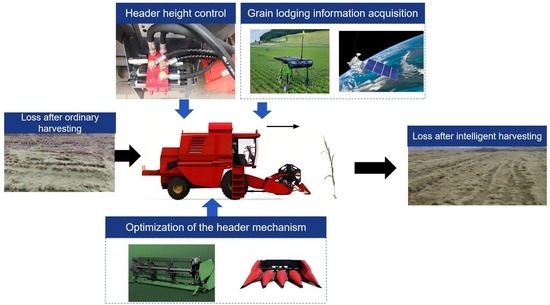
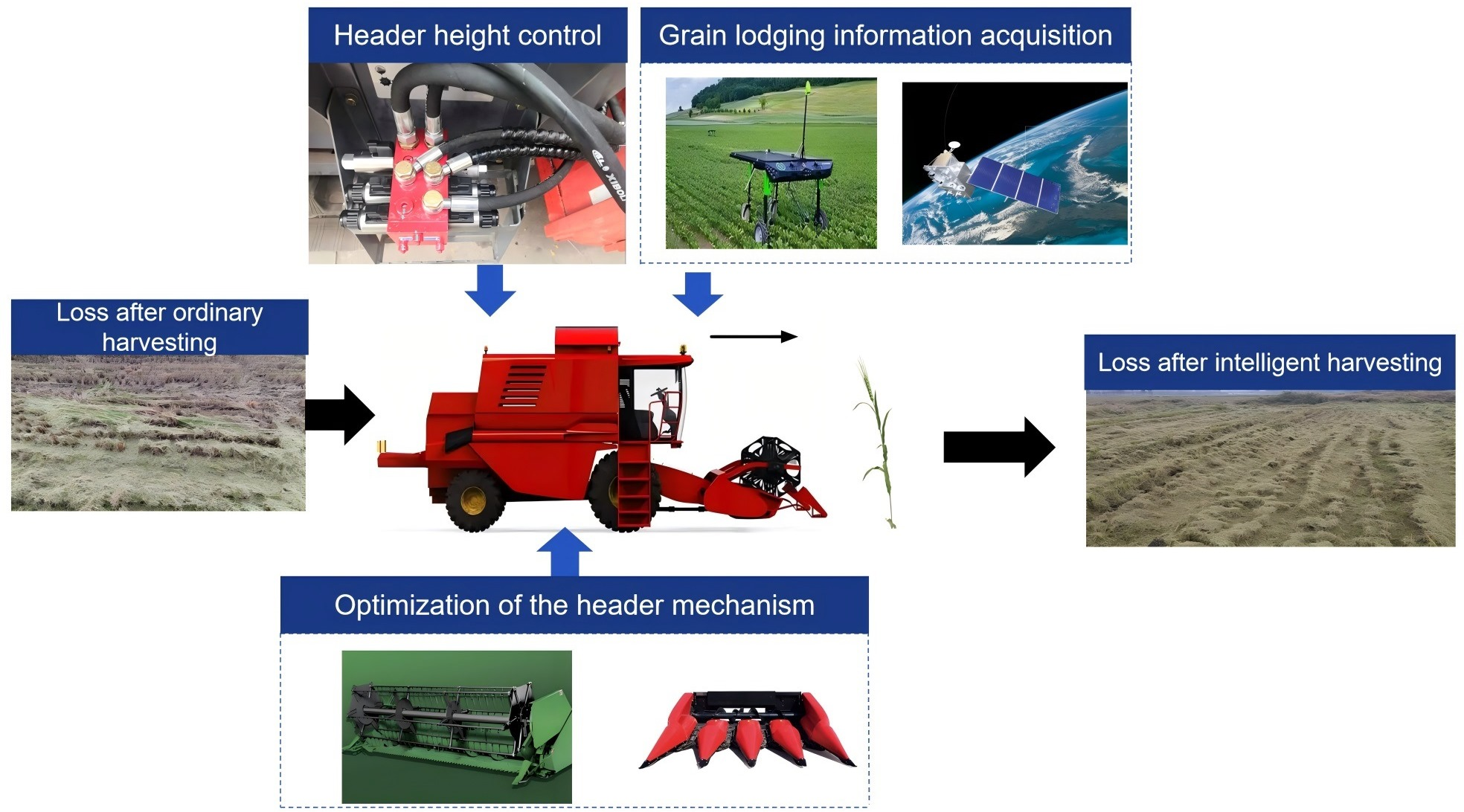
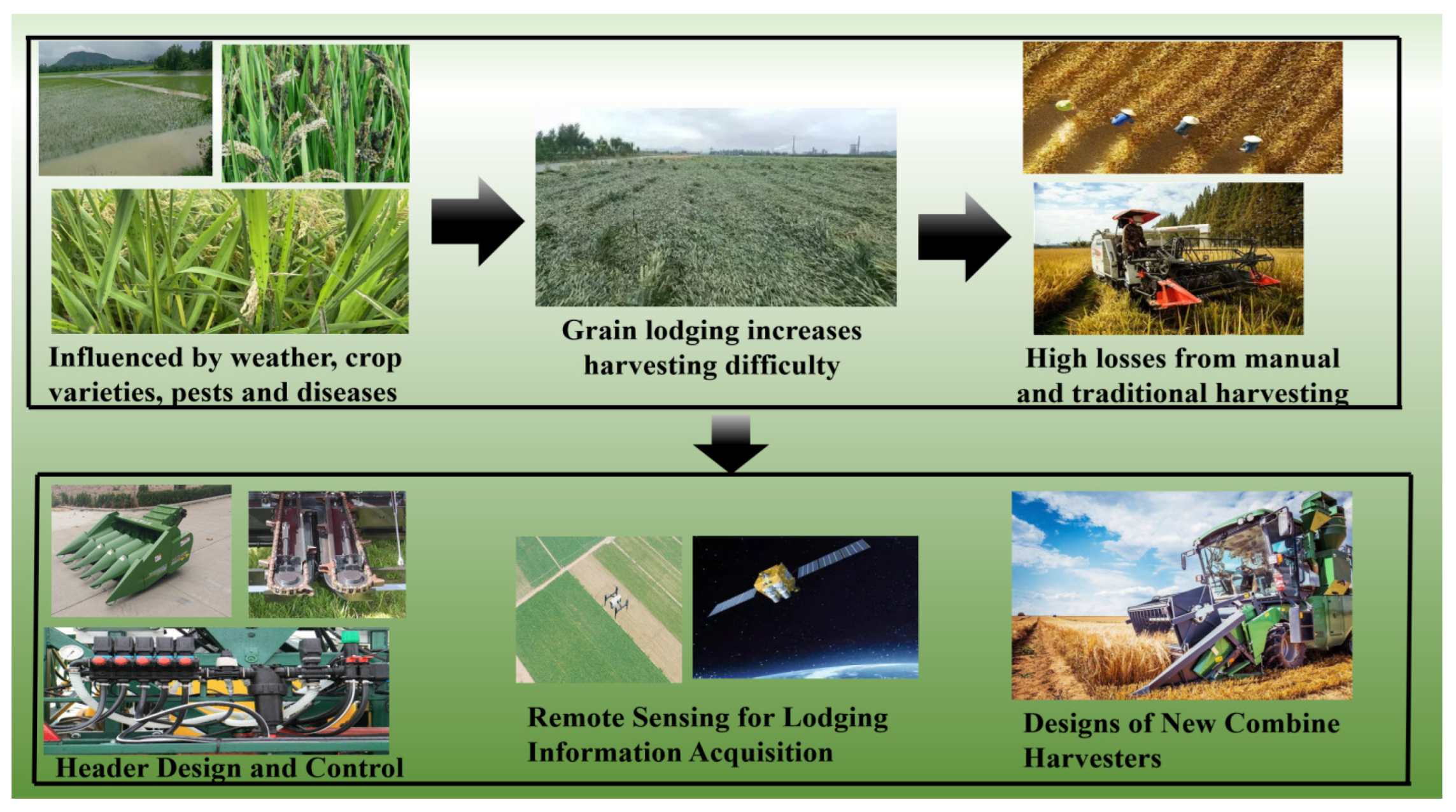
Graphical Abstract

1. Introduction

Rice is one of the world’s major staple crops and plays a crucial role in ensuring national food security. In recent years, factors adversely affecting global food security have increased [1,2]. Among these, lodging is a disaster phenomenon that occurs during the growth period of most crops, caused by unscientific seed selection, adverse weather, or improper management, and is characterized by plants tilting or even lying completely flat on the ground [3,4]. Lodging in grain crops leads to significant economic losses, manifested as reduced yield, lower quality, and decreased harvesting efficiency [5]. Therefore, monitoring areas affected by grain lodging is of great importance for improving the efficiency of agricultural machinery harvesting and reducing economic losses for farmers. Lodging is a key constraint in the production of high-quality rice, severely limiting yield potential. It also compromises grain quality and reduces the efficiency of mechanized harvesting [6,7,8,9]. Accordingly, timely and accurate acquisition of grain lodging information is essential for disaster assessment and timely prevention and control. It is of great significance for crop yield estimation, the formulation of post-disaster production management measures, and insurance claims [10].
In recent years, grain lodging detection and intelligent harvesting technologies have advanced rapidly. Research focus has gradually shifted from traditional image classification to multi-source remote sensing, lightweight deep learning models, and multi-feature fusion analysis [11,12,13,14]. UAV platforms present clear advantages in grain lodging monitoring, including high spatial resolution, good timeliness, and flexible deployment. Fusing multispectral images, texture features, and structural information can further enhance the accuracy of lodging identification and severity classification [15,16]. Meanwhile, lodging detection methods have evolved from early traditional machine learning to deep learning frameworks dedicated to fine-grained segmentation and multi-task representation [12,17,18]. Furthermore, amid the ongoing intelligent upgrading of agricultural machinery, deep reinforcement learning and similar techniques have gained growing attention for their potential in complex environment perception, autonomous decision-making, and control optimization, offering new technical support for the intelligent harvesting of lodged grain [19].
In addition to the deep learning models commonly used for lodging identification, various neural network architectures have also shown distinct application value in the intelligent harvesting of lodged grain crops. Based on field images acquired by UAV aerial imaging and onboard machine vision systems, convolutional networks and image segmentation algorithms can rapidly identify lodged areas and delineate crop boundaries, thereby effectively enhancing the field-environment perception capability of harvesting machinery. Field operating conditions are generally complex and highly dynamic, involving nonlinear interference and time-varying disturbances. Temporal neural networks can integrate real-time data such as crop growth posture, machinery driving status, and changes in field terrain, thereby providing a basis for operation regulation and intelligent decision-making [20,21]. In addition, spiking neural networks, as a type of brain-inspired intelligent algorithm, process information through spike timing and are characterized by event-driven computation and temporal coding. They show good adaptability in farmland environment perception and coordinated control of machine motion, and also provide a new and feasible technical solution for predictive regulation and dynamic regulation in agricultural machinery [22,23].
There are two primary methods of grain harvesting: mechanical harvesting and manual harvesting [24]. The choice of method depends on factors such as cultivation scale and geographical conditions, with manual harvesting remaining the predominant approach. This traditional method is characterized by high labor intensity, high costs, and long cycles, which severely constrain the development of the grain industry. Mechanized grain harvesting technology is an integrated system that combines cutting, threshing, cleaning and separation, collection, and transportation [25]. Achieving full mechanization across the entire grain harvesting chain can significantly reduce economic costs and promote the development of the agricultural system [26]. With technological advancements, the feeding capacity of grain combine harvesters has increased substantially, accompanied by a notable expansion in their overall size. Breakthroughs in hydraulic transmission and electronic monitoring technologies have enabled their successful integration into combine harvesters, allowing large self-propelled harvesters to evolve in an intelligent direction while significantly reducing labor intensity. Due to a relatively weak technical foundation, small- and medium-sized grain combine harvesters struggle to fully meet market demand [27]. To address this, the industry has adopted a range of strategies, including improving the header structure of combine harvesters, adjusting equipment parameters, and developing specialized grain harvester models. Meanwhile, intelligent harvester control has also evolved toward adaptive, high-precision profiling systems. Recent studies have shown that both adaptive header control and fuzzy PID-based methods can effectively improve header adjustment accuracy and operational stability [28,29]. These advances indicate that the latest developments in this field are moving toward the integration of sensing accuracy, field robustness, and real-time controllability.
Existing studies and review articles have mostly discussed grain lodging monitoring, header structural design, or corresponding control strategies separately. Comprehensive reviews that integrate lodging perception, adaptive header regulation, control algorithms, and practical engineering application into a complete framework remain relatively limited. Based on the above analysis, the present review establishes a complete analytical framework with the following logical sequence: causes of lodging and crop characteristics (nature of the problem) → lodging information sensing and identification (perception basis) → harvesting process and key header components (execution objects) → perception–control–actuation coupling mechanism (working mechanism) → low-loss and high-efficiency intelligent harvesting strategies (optimization direction). On this basis, a full-chain research perspective of “information perception–decision-making and planning–equipment execution” is formed.
Based on this framework, this paper systematically reviews relevant studies over the past two decades, with a particular focus on the following three aspects:
Firstly, the review systematically summarizes the application progress of multi-source sensing techniques—including satellite, UAV, and ground-based platforms—in grain lodging monitoring, and compares the performance of different lodging detection methods with respect to identification accuracy, applicable scenarios, and engineering practicability. Secondly, the research reviews the current state of key header components, header control strategies, and environment-adaptive machinery used in the mechanized harvesting of lodged grain, and identifies the main technical factors and development trends that influence low-loss, high-efficiency harvesting. Thirdly, the review analyzes the synergistic relationships among lodging perception, adaptive header regulation, and intelligent harvesting equipment, and outlines key technical routes for achieving low-loss, high-efficiency, and intelligent harvesting. This review focuses on core technologies and supporting equipment for mechanized grain harvesting. In response to the challenges of harvesting lodged grain, it further discusses the development trends of combine-harvesting technologies targeting low loss and high cleanliness, providing theoretical support for future research and engineering development in this field.

2. Materials and Methods

This study adopts a literature review method that combines systematic retrieval with thematic analysis. The literature was mainly sourced from the Web of Science Core Collection and the China National Knowledge Infrastructure (CNKI) database. The search scope was limited to publications from 2000 to 2026, with a focus on research related to lodged-grain information acquisition, mechanized harvesting, and intelligent control.

2.1. Retrieval Strategy

The keyword groups were combined using both AND and OR to maximize the systematicity and coverage of the literature retrieval. Within each group, synonymous terms were connected using OR, while different thematic groups were connected using AND. English databases were searched using English keywords, whereas CNKI was searched using the corresponding Chinese keywords.
  • Group One (research objects): rice, wheat, maize, and similar grain crops under lodging conditions;
  • Group Two (lodging monitoring and information acquisition): satellite remote sensing, UAV, multispectral imaging, LiDAR, point cloud, image recognition, semantic segmentation, and lodging monitoring;
  • Group Three (harvesting equipment and control technologies): combine harvesters, headers, low-loss harvesting, adaptive control, PID, fuzzy control, and intelligent harvesting.

2.2. Inclusion Criteria

Research subjects: Rice, wheat, maize, and other similar grain crops under lodging conditions.
Research content: Focus on grain lodging detection, lodging information acquisition, optimization of key header components, header height control, environment-adaptive harvesting equipment, and related intelligent harvesting technologies.
Literature type: peer-reviewed journal articles, high-quality international conference papers, or doctoral dissertations.

2.3. Exclusion Criteria

Non-academic publications: including patent specifications, news reports, product manuals, technical white papers, and online resources that have not undergone peer review.
Irrelevant studies: studies mainly focusing on agronomy, economics, general crop physiology, or disaster statistics, without addressing the core technologies of lodging detection, mechanized harvesting, or equipment control.
Duplicate publications: when the same study appeared in both conference and journal versions, only the most complete and informative version was retained.
Insufficient-information literature: studies lacking full-text availability, providing unclear descriptions of key technologies, or failing to support qualitative or quantitative analysis.

2.4. Literature Screening Procedure

The literature search was conducted in the Web of Science Core Collection and CNKI, and all retrieved records were exported to EndNote for management. After merging the search results from the two databases, duplicate records were identified and removed using a combination of EndNote automatic deduplication and manual verification before subsequent screening was carried out.
A total of 1376 records were initially retrieved, including 1133 from the Web of Science Core Collection and 243 from CNKI. After duplicate removal, title-and-abstract screening covered 1162 records and eliminated 788 studies unrelated to the topic. Full-text assessment then retained 374 articles. Subsequent full-text review excluded 171 articles because of insufficient technical information, lack of full-text access, duplicate research findings, or failure to focus on core technologies. The final qualitative review included 203 studies. Figure 1 presents the screening flowchart.

2.5. Data Extraction and Thematic Analysis

For the finally included studies, information such as publication year, grain type, sensing platform or operating machinery type, core technical method, main performance indicators, application scenarios, and research limitations was extracted. On this basis, the literature was classified and organized according to research themes, thereby supporting the comparative analysis conducted in this review.
Based on the research objectives and the technical logic of intelligent harvesting of lodged grain, the selected literature was classified into four major themes: factors affecting grain lodging and lodging characteristics; grain lodging information acquisition; adaptive header harvesting methods for lodged grain; and intelligent grain harvesting equipment. This thematic classification constitutes the analytical framework of Section 3, Section 4, Section 5 and Section 6 of this review.

3. Factors Affecting Grain Lodging and Lodging Characteristics

3.1. Grain Types

Minor grain crops are widely cultivated around the world and are particularly prevalent in certain plateau regions, ecologically fragile areas, and economically underdeveloped regions, where they make significant contributions to food security and economic stability [30]. In China, the main cultivation areas for minor grain crops are concentrated in the plateau and hilly regions north of the Yangtze River [31]. These regions are especially suitable for their production. Due to inherent soil limitations and the influence of arid climates, these crops are characterized by a short growing period, strong drought tolerance, adaptability to poor soils, and cold hardiness [32,33,34].
Barley is one of the world’s most important cereal crops, ranking second only to wheat, rice, and corn. It is also one of the oldest cereal crops and a vital component of many traditional diets [35,36,37]. Barley is cultivated across a wide range of environmental conditions and latitudes, with Europe accounting for approximately 60% of global production [38].
Buckwheat is an important grain crop, with the top five producing countries being Russia, China, Ukraine, France, and Poland [39,40]. Most wild Fagopyrum species have a narrow distribution range and are found mainly along the southeastern edge of the Qinghai–Tibet Plateau. Whereas common buckwheat is widely distributed worldwide, with marked regional variation. Many buckwheat varieties have adapted to high-altitude regions characterized by harsh climatic and soil conditions [41,42,43,44].
In contrast, proso millet is a minor grain crop with excellent nutritional value and strong tolerance to drought and poor soil conditions. It is widely cultivated in arid and semi-arid regions of Asia, Australia, and Europe [45,46].

3.2. Factors Affecting Grain Lodging

Grain lodging is primarily divided into two types: root lodging and stem lodging. The lodging resistance varies among different grain crops, and even among different varieties of the same crop. Differences in plant architecture among varieties result in variations in plant height, center of gravity, and branching characteristics.
In terms of weather conditions, extreme weather events such as high temperatures, strong winds, heavy rainfall, and prolonged waterlogging increase soil moisture and destabilize crop root systems, thereby raising the risk of lodging [47]. Under diurnal temperature stress, the vascular bundle content in the mature stems of rice changes, resulting in an alteration of the elastic modulus. This change in elastic modulus reduces the bending resistance of the stems, ultimately leading to lodging in rice [48]. The lodging resistance of crops is closely related to plant height, plant architecture, stem bending characteristics, and root traits. Some crop varieties exhibit poor lodging resistance, characterized by tall stems, high ear positions, and underdeveloped root systems that fail to provide sufficient support, making them prone to lodging during growth [49]. Excessive irrigation during the jointing stage at an inappropriate time leads to excessive vegetative growth, thereby reducing grain lodging resistance. Meanwhile, overly high planting density intensifies competition among crops for nutrients and water, resulting in slender stems that are susceptible to lodging. In terms of fertilization, failure to implement formulated fertilization—such as applying large amounts of nitrogen fertilizer while neglecting the combined use of phosphorus, potassium, and micronutrients—results in crop stems that are slender and lack toughness, making them prone to lodging [50,51]. With regard to pest and disease damage, pests and diseases can destroy the stem tissues and root systems of crops, affecting normal plant growth and support capacity, thereby leading to lodging [52]. In addition, soil conditions and groundwater levels can influence grain lodging. Under conditions of a shallow plow layer and a high groundwater table, root systems are underdeveloped and shallowly distributed. When irrigation or heavy rainfall occurs, the upper soil layer becomes extremely loose and turns to mud, making root lodging likely to occur when strong winds blow [53].

3.3. Challenges in Harvesting Lodged Grain

Combine harvesting uses a rice combine harvester to perform multiple operations—including cutting, threshing, cleaning, and bagging—in a single pass. This method offers a high degree of automation, produces relatively clean grain, saves time and labor, and achieves high harvesting efficiency with low loss rates. However, it is highly susceptible to climatic conditions, and the optimal harvesting window is relatively short. Harvesting too early or too late can lead to high loss rates [54,55]. Segmented harvesting involves using a rice swather to cut the rice and lay it flat in the field. Threshing is then carried out either in the field or after transportation to another location using a thresher, while cleaning and bagging are performed manually. This method enables earlier harvesting and natural drying for threshing, reducing drying and threshing workloads and extending the harvest window. However, it requires more machines, takes longer, relies on manual labor, has high labor intensity, and is less efficient [56].
Due to uneven plant height and inconsistent lodging directions, grain lodging greatly increases harvesting difficulty. Under lodging conditions, crops are shorter and often intertwined, which makes feeding and cutting more difficult. Therefore, operators must lower the header and reel height and reduce the operating speed. Otherwise, grain loss and header clogging are likely to occur. In addition, severe lodging may cause the navigation system to misidentify lodged areas as boundary points, resulting in fitting errors and increased harvest losses. Therefore, real-time monitoring of lodging conditions is essential for adjusting header height, reel height, and forward speed, thereby improving the harvesting performance of lodged grain. Navigation line extraction provides an adjustment strategy for the forward direction of the combine harvester to assist navigation and ensure full-width harvesting of the crop [57,58]. However, when lodging is severe, the recognition process during navigation may mistakenly identify lodged grain as boundary points, leading to fitting errors. This not only results in failure to harvest the lodged grain but also causes deviations in navigation line fitting, ultimately leading to harvest losses [59]. Therefore, during actual harvesting, real-time monitoring of grain lodging conditions is carried out to provide adjustment strategies for the header and reel height as well as the forward speed of the combine harvester, thereby ensuring effective harvesting of lodged grain and improving operational efficiency. To address the challenges of harvesting lodged grain, recent research has increasingly focused on adaptive sensing, header control, and environment-adaptive harvesting equipment, as shown in Figure 2.
Traditional research on lodged-grain harvesting has primarily focused on single-aspect improvements. Yet the harvesting of lodged grain constitutes a complex system engineering problem, encompassing lodged-grain identification and header adaptive control. Relying exclusively on a single technical approach can hardly fundamentally resolve the issues of high harvesting losses and intensive labor input.
The above analysis of grain types, lodging causes, and harvesting challenges clarifies the physical mechanisms and operational background of lodged-grain harvesting. On this basis, the accurate and real-time acquisition of grain lodging information becomes a prerequisite for subsequent adaptive harvesting and intelligent control.

4. Acquisition of Grain Lodging Information

Considering that lodging severity, spatial distribution, and plant morphology directly affect harvesting performance, accurately and timely obtaining lodging information is a prerequisite for realizing adaptive header control and intelligent harvesting. Currently, methods for acquiring grain lodging information mainly include field survey methods and remote sensing measurement methods [60]. The field survey method requires investigators to visit the plots where lodging has occurred and obtain information such as the specific location and area affected by grain lodging through field measurements using measuring instruments. When using the field survey method to monitor grain lodging information, a large investment of human and material resources is required, and its low work efficiency often fails to meet the demands of agricultural production and management [61,62].
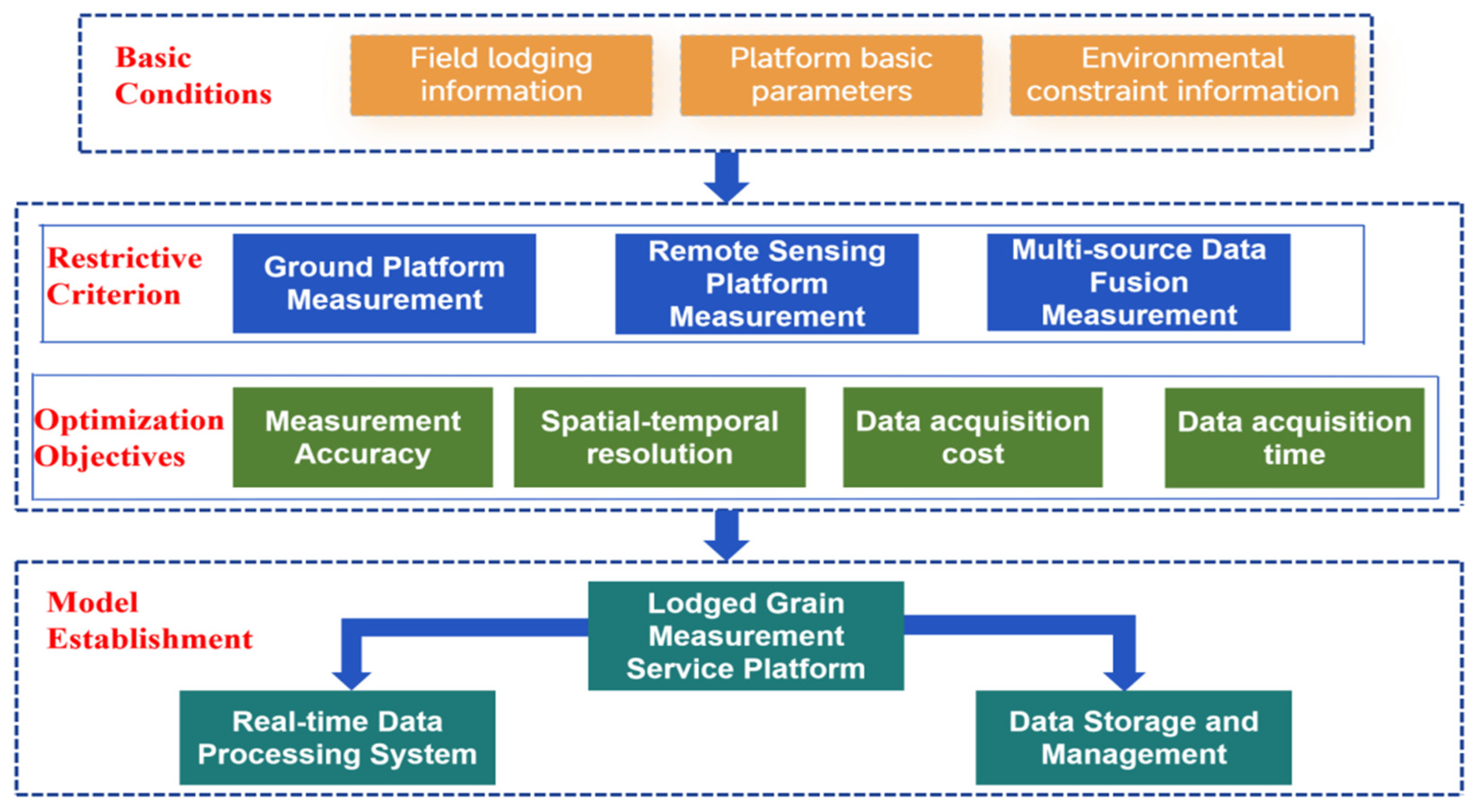
With the continuous improvement of remote sensing capabilities, it has become possible to use data acquired from various remote sensing platforms for grain lodging investigation, and research on remote sensing-based identification and classification of grain lodging has gradually emerged. Remote sensing measurement refers to the use of remote sensing platforms, such as satellites and unmanned aerial vehicles (UAVs), to acquire images of farmland through onboard sensors. Based on differences in spectral, tonal, textural, and structural features between lodged and non-lodged grain, these data can be used to identify lodging and extract relevant lodging information. The general workflow of grain lodging information acquisition is shown in Figure 3.
Remote sensing data provides a rich source of information and is valuable for precision agriculture tasks such as soil quality assessment, plant disease analysis, crop stress evaluation, and improved management practices [63,64]. For instance, in modeling the working environment and coverage path planning for combine harvesters, satellite imagery combined with sophisticated algorithms can be used to extract the boundaries of the farmland to be harvested. Based on the point structure data obtained through an improved scan line algorithm, coverage path planning for the combine harvester can be achieved [65]. Additionally, the multispectral satellite Sentinel-2B MSI enables accurate estimation and mapping of wheat straw cover (WSC) percentage [66].
Compared with remote sensing measurement methods based on spaceborne platforms, UAV-based remote sensing offers the advantages of high resolution, strong timeliness, low cost, and flexible image acquisition [67,68,69,70]. In recent years, the rapid development of the UAV industry has accelerated the widespread application of low-altitude UAV-based agricultural remote sensing monitoring. Consequently, the automated identification of grain lodging using UAV data has received increasing attention [71]. Research on corn lodging monitoring using UAV multispectral imagery shows that, compared with using multispectral images alone, the combination of texture features and vegetation indices improves classification accuracy to varying degrees [72]. In corn lodging monitoring, models constructed based on multi-feature fusion achieve significantly higher classification accuracy than those based on single features. Meanwhile, it has also been found that regardless of the type of satellite imagery used, object-oriented classification methods consistently outperform traditional pixel-based classification methods in terms of accuracy [73].

4.1. Identification and Analysis of Grain Lodging Characteristics

Image feature classification involves the process of identifying individual pixels or objects in an image and categorizing them into corresponding ground cover types based on specific rules or algorithms. This is achieved using spectral reflectance across various bands, spatial structure, and other relevant data. To improve classification accuracy, techniques such as multi-band data, new variables derived from band operations, image texture features, and polarization features are commonly used. Classification methods include maximum likelihood, decision trees, random forests, support vector machines, and deep learning, with each method exhibiting varying performance in grain lodging identification. By comparing the impact of different classification features, units, and methods on the results, the accuracy of remote sensing image classification can be continually enhanced.

4.1.1. Classification Features for Grain Lodging Detection

In terms of classification features, relevant research based on Sentinel-2 multispectral imagery shows that, compared with normally growing rice, the reflectance of lodged rice in the shortwave infrared, red, and red edge 1 bands, along with the corresponding average texture values, all increase significantly [74,75]. After screening all feature sets using the AIC method, binary logistic regression classification (BLRC), maximum likelihood classification (MLC), and random forest classification (RFC) were employed to distinguish between lodged and non-lodged corn based on the selected features [76]. Using maximum likelihood classification to extract lodged corn, the performance of different RGB color features and texture features in distinguishing lodged from non-lodged corn was compared and analyzed, with the mean texture of the red, green, and blue bands achieving the best recognition performance [77,78]. Another study analyzed the spectral reflectance of corn before and after lodging and calculated the principal components of the four-band spectral reflectance, as well as vegetation indices such as NDVI, RVI, EVI, and DVI. The results show that the binomial logistic regression model constructed using the principal components of the four-band spectral reflectance performs best in identifying corn lodging [79].

4.1.2. Classification Methods for Grain Lodging Detection

In the field of grain lodging identification, classification methods have gradually evolved from traditional machine learning approaches, such as maximum likelihood estimation, decision trees, random forests, and support vector machines, to deep learning-based models. Existing studies have shown that deep learning methods achieve superior performance under complex field conditions, and that the integration of multi-feature fusion strategies can further improve identification accuracy [80,81]. In addition, object-oriented classification generally outperforms traditional pixel-based methods because it incorporates both spectral features and spatial contextual information [73]. Nevertheless, in scenarios with limited sample sizes and a strong demand for model interpretability, traditional methods still retain practical value, although their performance is more susceptible to variations in crop type, lodging severity, and image quality.
Overall, as data dimensionality and problem complexity continue to increase, the limitations of traditional methods in handling nonlinear relationships and achieving strong generalization have become increasingly evident. Future deep learning research for agricultural field scenarios should not only improve identification accuracy, but also enhance model robustness under complex conditions such as illumination variation, crop occlusion, and seasonal differences. Grain lodging detection can be realized through a variety of classification strategies, each with distinct advantages and limitations. However, in practical applications, detection performance is heavily dependent on the sensing platform adopted. Accordingly, tailored application schemes for lodged grain detection should be developed to guarantee the overall reliability of the system.

4.2. Grain Lodging Monitoring Based on Remote Sensing Platforms

Based on the sensing platform used, current lodging monitoring approaches can be broadly divided into satellite-based, UAV-based, and ground-based methods.

4.2.1. Recognition Methods Based on Satellite Platforms

In satellite remote sensing, various indicators are extracted from different types of imagery to discriminate and grade the degree of grain lodging. During the data exploration phase, researchers conducted a correlation analysis between image-derived indicators and lodging severity (LS), and used satellite data acquired from multiple incidence angles along with field-measured crop height to accurately classify different levels of grain lodging using the partial least squares method [82]. Using an ASD spectrometer for data acquisition, the canopy spectral reflectance of lodged corn was found to be significantly higher in the visible light band compared to normal corn, while it mostly showed a decreasing trend in the near-infrared band [83].
In addition to optical remote sensing imagery, remote sensing images acquired from radar satellite platforms have also made certain progress in monitoring and identifying grain lodging. For instance, Zhao et al. used Radarsat-2 polarization data to analyze the lodging conditions of wheat and oilseed rape crops. They believed that polarization parameters performed well in reflecting changes in the vertical structure of wheat, demonstrating that the reflection asymmetry described by the circular correlation coefficient can serve as an effective indicator for monitoring wheat lodging [84]. Furthermore, Yang et al. conducted a comparative analysis of Radarsat-2 fully polarimetric image data from lodged and normal wheat, and found that radar polarization features are effective in identifying and monitoring wheat lodging [85].

4.2.2. Recognition Methods Based on UAV Platforms

Satellite imagery covers large areas and is well suited to regional lodging monitoring. However, when lodging occurs at a specific time and place, satellites may not provide timely data because of fixed overpass paths and long revisit intervals. In addition, most satellite images have relatively low spatial resolution and are strongly affected by cloud cover and other weather conditions. As a result, they are mainly suitable for large and concentrated lodging events, while small lodged areas remain difficult to detect and monitor accurately [86,87,88].
In contrast, UAVs are less affected by weather and terrain during takeoff, can acquire high-resolution images even under cloudy conditions, and offer low operating costs and timely data transmission [89,90,91,92,93]. UAV remote sensing features convenient data acquisition, high resolution, and cost-effectiveness, and has developed rapidly in recent years. Grain lodging assessment based on UAV systems represents one of its important application areas.
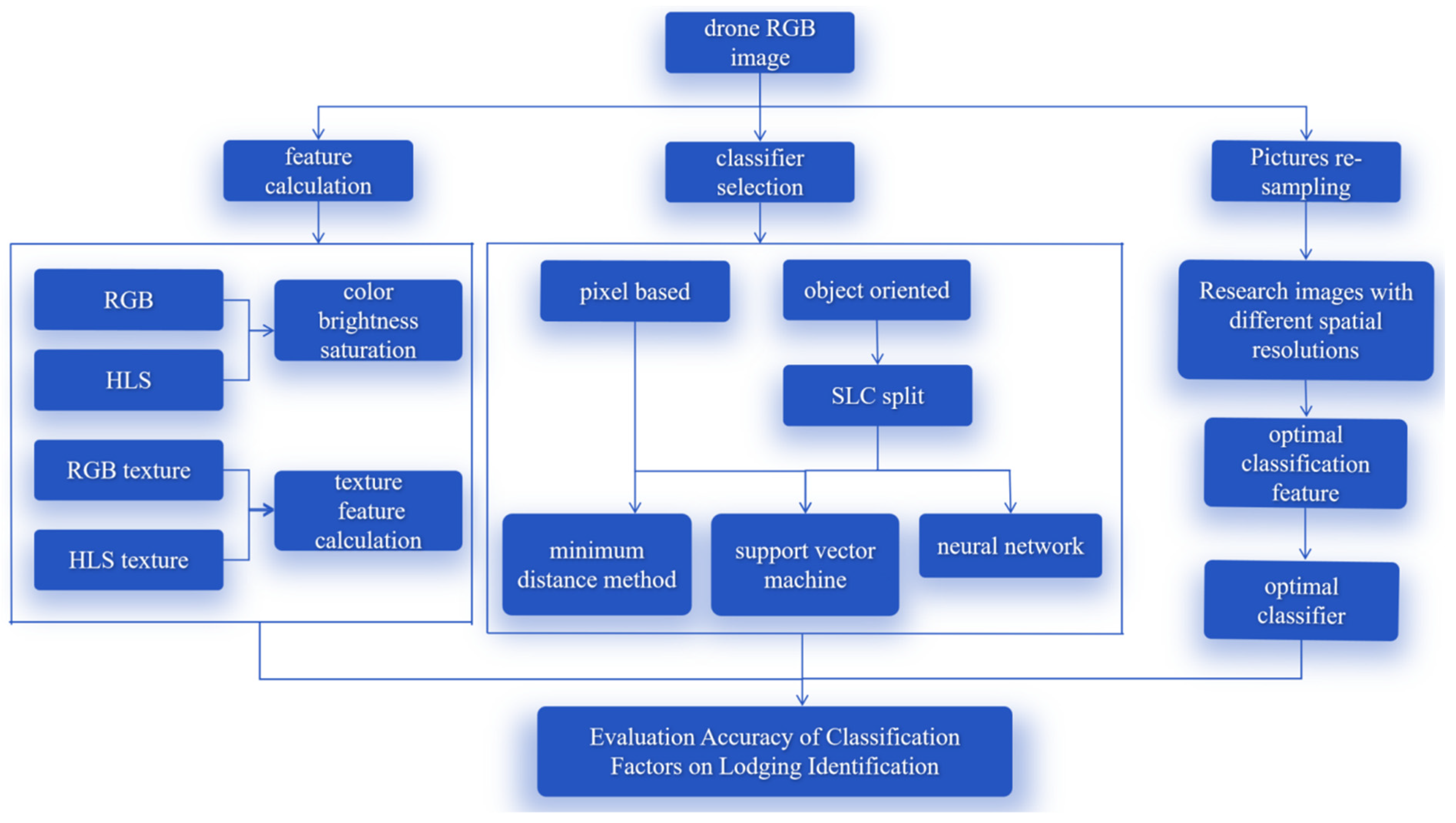
In terms of RGB image applications, related studies have mainly focused on lodging area identification, plant height estimation, and the development of lightweight models. For example, lightweight models such as Lodging-U2NetP have shown good robustness in wheat lodging extraction [94]. For RGB-based UAV lodging detection, lightweight deep-learning models have shown promising performance. For example, the L-U2NetP model achieved an accuracy, F1 score, and IoU of 95.45%, 93.11%, and 89.15%, respectively, on the simple subset of the crop-annotation dataset, while still maintaining 89.72%, 79.95%, and 70.24% on the difficult subset, indicating relatively strong robustness under complex field conditions [94]. In addition, the combination of texture features and vegetation indices achieved an overall accuracy of 86.61% with a Kappa coefficient of 0.8327 in maize lodging-grade monitoring, whereas the spectral–texture–DSM combination in wheat lodging monitoring reached an overall accuracy of 92.82% with a Kappa coefficient of 0.86 [95,96,97]. Meanwhile, studies based on UAV RGB imagery have also revealed the effects of vegetation coverage, imaging angle, and spatial resolution on digital terrain model construction and plant height estimation [98,99]. Methods based on RGB imagery are low-cost and flexible in deployment, but are significantly affected by variations in lighting and texture. The UAV-RGB-based grain lodging recognition strategy is shown in Figure 4.
As shown in Figure 4, the core workflow for lodging identification using UAV and RGB imagery includes feature extraction, classifier selection, and image resampling analysis at different spatial resolutions. In the feature extraction stage, features from the RGB and HLS color spaces, together with their corresponding texture features, were extracted to characterize the spectral, color, and texture information related to grain lodging. In the classifier selection stage, both pixel-based and object-oriented classification strategies were adopted, and common classifiers, such as the minimum distance method, support vector machines, and neural networks, were used to evaluate recognition performance. Finally, in the spatial resolution analysis stage, images were resampled to different resolutions to determine the most suitable combination of classification features and classifier methods. However, most existing studies only select the optimal model combinations on specific datasets, and discussion of model generalization across different grain crops, lodging severities, and complex field conditions remains insufficient.
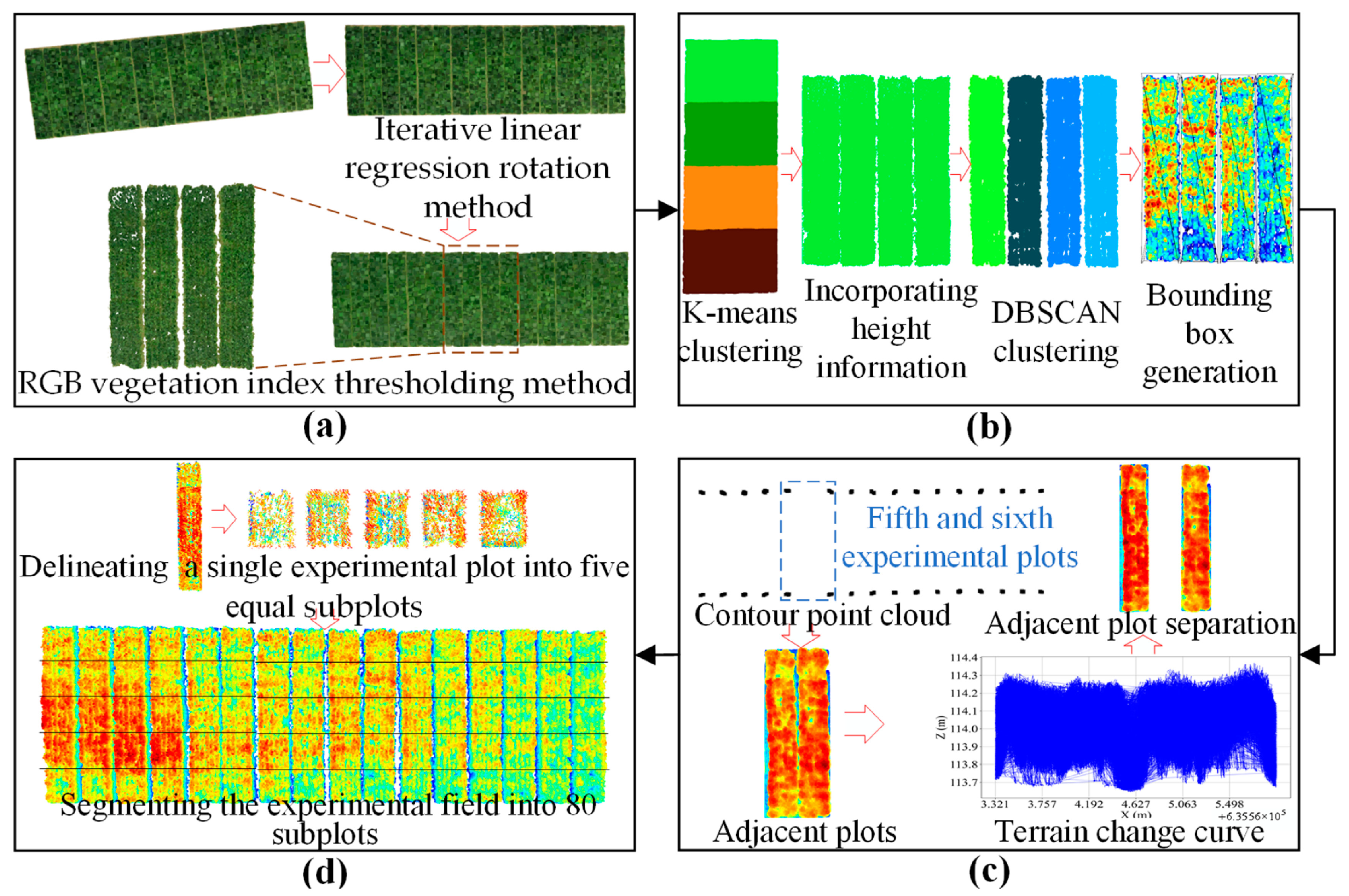
Beyond RGB imagery, multispectral data further expand the application scope of UAV-based lodging monitoring. Related studies have used vegetation indices and machine learning methods for regional crop monitoring, and have established quantitative inversion models by incorporating physiological indicators such as moisture content, thousand-grain weight, and grain-to-panicle ratio, thereby providing a basis for determining the optimum harvesting period [95,96]. Compared with RGB imagery, multispectral data can provide richer spectral information, but the equipment cost and processing complexity are higher. In addition to spectral information, grain structural information derived from point-cloud data can also provide important support for lodged-grain monitoring and plot-scale quantitative analysis. As shown in Figure 5, the point-cloud data undergo angle correction, ground-point filtering, clustering-based segmentation, and fine boundary extraction in sequence to achieve the automatic extraction of field and experimental-plot boundaries and reduce depth errors caused by sensor interference and terrain undulations in remote-sensing point-cloud images.
Figure 5 presents an automated technical pipeline for extracting field and experimental-plot boundaries based on point-cloud data. The workflow starts with geometric correction of the point cloud and removal of ground points, followed by canopy-structure segmentation using height-constrained clustering. Next, boundary lines of adjacent plots are constructed based on spatial topological relationships, and fine extraction of field boundaries is achieved using a polygon-smoothing algorithm. By integrating spectral-index-based segmentation, point-cloud clustering, and terrain-feature analysis, this workflow enables highly robust plot-boundary identification under complex field conditions, thus providing an algorithmic foundation for the extraction of structural parameters of lodged grain and precision agricultural monitoring. Such point-cloud-based preprocessing methods can effectively improve the spatial accuracy of lodged-grain monitoring and plot-scale quantitative analysis, and are well suited for complex field environments characterized by pronounced terrain undulations and sensor noise.
In addition, based on digital surface model (DSM) data acquired by UAVs, the heights of normal wheat and wheat with varying lodging severities were determined through field surveys, and rules were subsequently established to identify wheat at different lodging levels [101]. For seed yield prediction, models that integrated LiDAR data with multispectral imagery (MSI) outperformed those relying on a single data source, with the gradient boosting regression tree achieving the highest accuracy [102]. DSM- and LiDAR-based methods are more advantageous for capturing variations in plant height and are therefore better suited for grading lodging severity. However, these methods impose higher requirements on data quality and modeling conditions, which limits their widespread application in real-time operational scenarios.
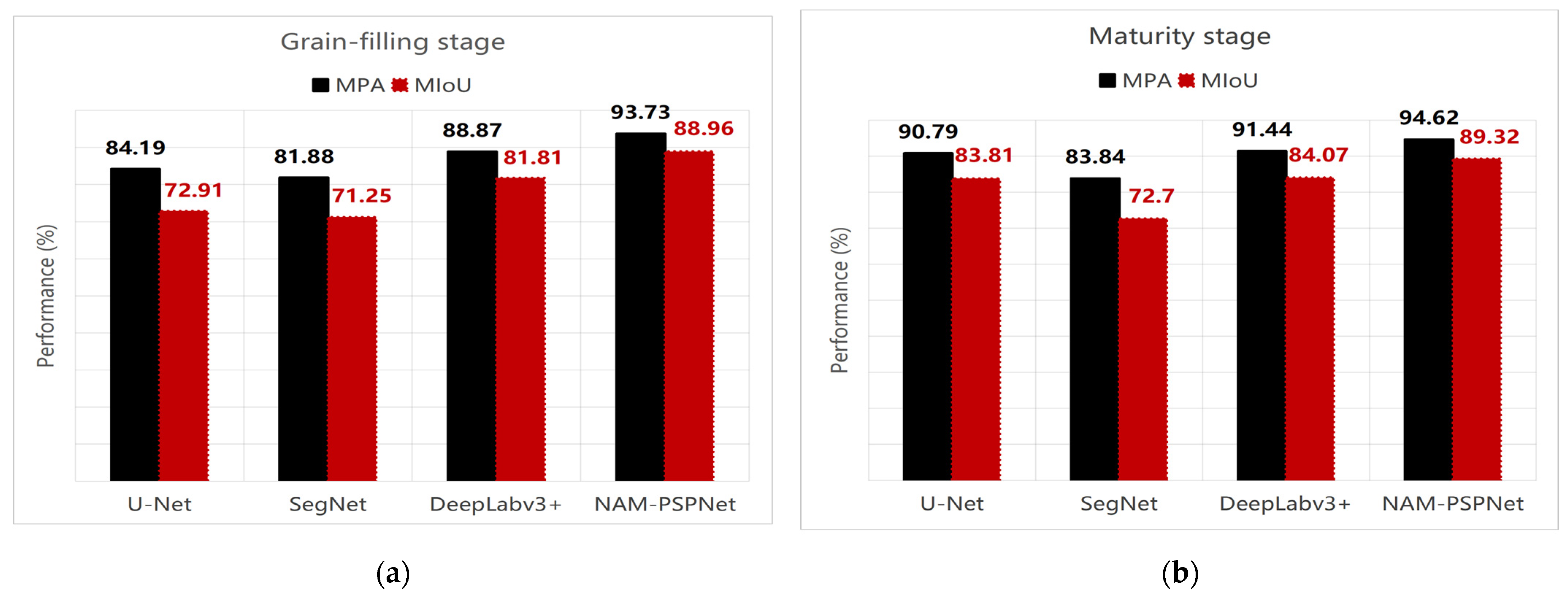
Deep learning algorithms have demonstrated substantial practical value in UAV-based lodged-grain perception and extraction. At the environmental perception level, existing studies have confirmed that deep learning models can substantially improve the extraction accuracy of crop lodging areas from UAV imagery. For example, Yang et al. combined RGB and DSM data to develop a lightweight Mobile U-Net model, achieving an overall identification accuracy of 88.99%, which was 11.8% higher than that of a single-RGB model and 6.2% higher than that of an RGB + ExG scheme. The model contained only 9.49 million parameters, far fewer than the 17.08 million of a fully convolutional network and the 30.95 million of the traditional U-Net [103]. On the CPU side, it required only 0.53 s to process a single 256 × 256 four-channel image, thereby achieving a better balance between recognition accuracy and practical deployability on agricultural machinery. In another study, a research team developed the NAM-PSPNet model, whose mean pixel accuracy and mean intersection over union during the grain filling and maturity stages are shown in Figure 6.
The NAM-PSPNet model achieved mean pixel accuracies and mean intersection-over-union values of 93.73%/88.96% and 94.62%/89.32% during the grain filling and maturity stages, respectively, demonstrating better overall performance than mainstream segmentation networks such as U-Net, SegNet, and DeepLabv3+ [80]. Under field conditions at a flight altitude of 20 m during the maturity stage, the model improved mean pixel accuracy and mean intersection over union by 2.47 and 3.99 percentage points, respectively, compared with the original PSPNet.
The above UAV-based remote sensing methods for lodging monitoring each have their own strengths and limitations. RGB imagery is flexible and low-cost, multispectral imagery can provide richer spectral information, and DSM/LiDAR data show significant advantages in representing structural features. In addition, lightweight and deployable deep learning models have shown considerable engineering value for lodged-grain recognition under complex field conditions. These complementary characteristics have promoted the development of multi-source data fusion technologies to achieve more robust monitoring of grain lodging.

4.3. Ground-Based Platform Monitoring of Lodged Areas

In addition to the commonly used approach of employing remote sensing platforms for lodging measurement, installing sensors on ground-based platforms such as combine harvesters for crop data collection is also a widely adopted method for lodging detection. A crop height acquisition system based on LiDAR and inclination sensors has been developed to facilitate efficient harvesting operations [104]. In another approach, a binocular camera mounted on a combine harvester captures images of the rice ahead, and the images are segmented using both a PSO-optimized support vector machine and an improved DeepLabv3+ model to identify lodged areas during harvesting [105]. A representative example is RL-DeepLabv3+, which achieved an mIoU of 90.52% and an mPA of 94.73%. Its detection speed reached 50 frames/s at 640 × 480 resolution and 21 frames/s at 1280 × 720, indicating a good balance between accuracy and real-time deployment capability [106].
For wheat with dense growth, overlapping plant organs, and irregular lodging morphology, it is challenging to rapidly and accurately detect the lodging direction using onboard vision systems on harvesters. A harvesting boundary line recognition model based on the MV3_DeepLabV3+ network framework is capable of completing recognition tasks quickly and accurately in complex environments [107]. By constructing a bag-of-visual-words model using an improved k-means algorithm and a directional dataset, combined with scale-invariant feature transform (SIFT), pyramid term frequency, histogram intersection kernel, and support vector machine (SVM), the detection of wheat lodging direction within a grid is achieved [108].
Research on the Assessment of Spring Wheat Plant Height and Lodging Condition Based on LiDAR. A comparison was made among four methods: plant height distribution vector, top-view projection, orthogonal projection, and voxelized spatial grid. In the lodging identification task, the top-view projection method achieved the best performance [109].

4.4. Multi-Source Data Fusion for Lodging Area Monitoring

Because each sensing modality has its own advantages and limitations in terms of spatial resolution, timeliness, and robustness, recent studies have increasingly focused on multi-source data fusion to improve lodging detection performance. In addition to model improvement, multi-source feature fusion has also become an important strategy for enhancing lodging identification performance. Existing studies have shown that, compared with a single feature or data source, the integration of texture features, vegetation indices, and spectral information can generally improve classification accuracy to varying degrees [72]. For example, to enable dynamic monitoring of wheat lodging areas, one study proposed a network model integrating the lightweight neural network MobileNetV2, a multidimensional feature-fusion pyramid pooling structure, and the NAM attention mechanism. This model, namely the Normalization-based Attention Module Pyramid Scene Parsing Network (NAM-PSPNet), demonstrated high accuracy in the extraction of wheat lodging areas [73].
In the area of multi-source data fusion, existing research has primarily focused on the combined use of RGB imagery, DSM, multispectral data, and structural information. Previous studies have shown that, for maize and rice lodging identification, incorporating DSM or texture features can significantly improve recognition accuracy and enhance discrimination among different lodging levels [110]. In addition, deep learning methods based on UAV RGB and multispectral imagery have been applied to rice lodging extraction, with results indicating that recognition performance varies across data sources and that RGB imagery may outperform other sources in certain scenarios [111]. Meanwhile, CNN–LSTM models that integrate multimodal information, including canopy color, spectral features, and spatial structure, have also demonstrated potential for predicting grain harvesting attributes [112]. Overall, compared with the use of multispectral imagery alone, the fusion of vegetation indices and texture features can generally further improve lodging recognition accuracy [97,113,114].
In terms of classification methods for grain lodging detection, an improved DeepLabV3+ deep learning model is used to identify rice lodging areas in UAV imagery, demonstrating faster recognition speed compared to other methods [115]. The fusion of DSM and RGB features has shown high recognition accuracy in extracting wheat lodging areas, while a bilinear interpolation upsampling feature fusion (BIFF) module combined with a global attention mechanism can also significantly enhance a model’s segmentation capability for lodging regions [116,117].
At present, a variety of techniques have been developed for grain lodging detection; however, their performance varies considerably with the data source, field conditions, and application scenario. Table 1 compares the representative algorithms currently used for grain lodging detection and analyzes their applicability and limitations.
Among them, traditional machine learning algorithms such as random forests and support vector machines can perform stably with small training samples, but they require the selection of appropriate spectral and textural features. Among deep learning methods, DeepLabV3+ can achieve higher detection accuracy. However, its reliance on large datasets and substantial computational resources limits the feasibility of real-time onboard deployment on harvesters. For post-disaster regional assessment, satellite or UAV multispectral imagery combined with random forest or maximum likelihood classification is generally sufficient. For real-time dynamic detection during harvesting, lightweight deep learning models should be prioritized.
Overall, the selection of lodging-detection methods should be closely aligned with the practical characteristics of harvesting operations. Satellite remote sensing, UAV-based monitoring, and ground-based sensing systems exhibit significant differences in performance under different operating conditions. In regional-scale post-disaster assessment, satellite remote sensing offers clear advantages for large-scale application because of its wide-area coverage and relatively low monitoring cost per unit area. However, its response timeliness and fine-grained recognition capability remain constrained by factors such as satellite revisit intervals, sensor spatial resolution, and the frequent failure of image acquisition under rainy or cloudy conditions. By contrast, UAV systems are more suitable for field-scale lodging monitoring, as they can achieve a better balance among imaging accuracy, operational flexibility, and adaptability to complex field environments. Nevertheless, their large-scale deployment is still restricted by factors such as flight-route planning and the substantial workload required for post-processing large volumes of aerial data. For real-time field operation and closed-loop control scenarios, vehicle-mounted sensing schemes equipped with vision systems and LiDAR have distinct real-time advantages, since the sensed data can be directly integrated into the harvester’s mobility and operation-control process. However, due to the limited sensing range of onboard sensors and the constraints imposed by machine travel paths, ground-based single-machine systems alone are not sufficient for large-area monitoring of lodged grain.
Advances in multi-source sensing and information fusion have steadily enhanced the precision and dependability of grain lodging monitoring. Building on this foundation, translating detection outputs into adaptive header regulation and operational control emerges as a critical factor for realizing low-loss and high-efficiency harvesting.

5. Adaptive Method for Header Harvesting of Lodged Grain

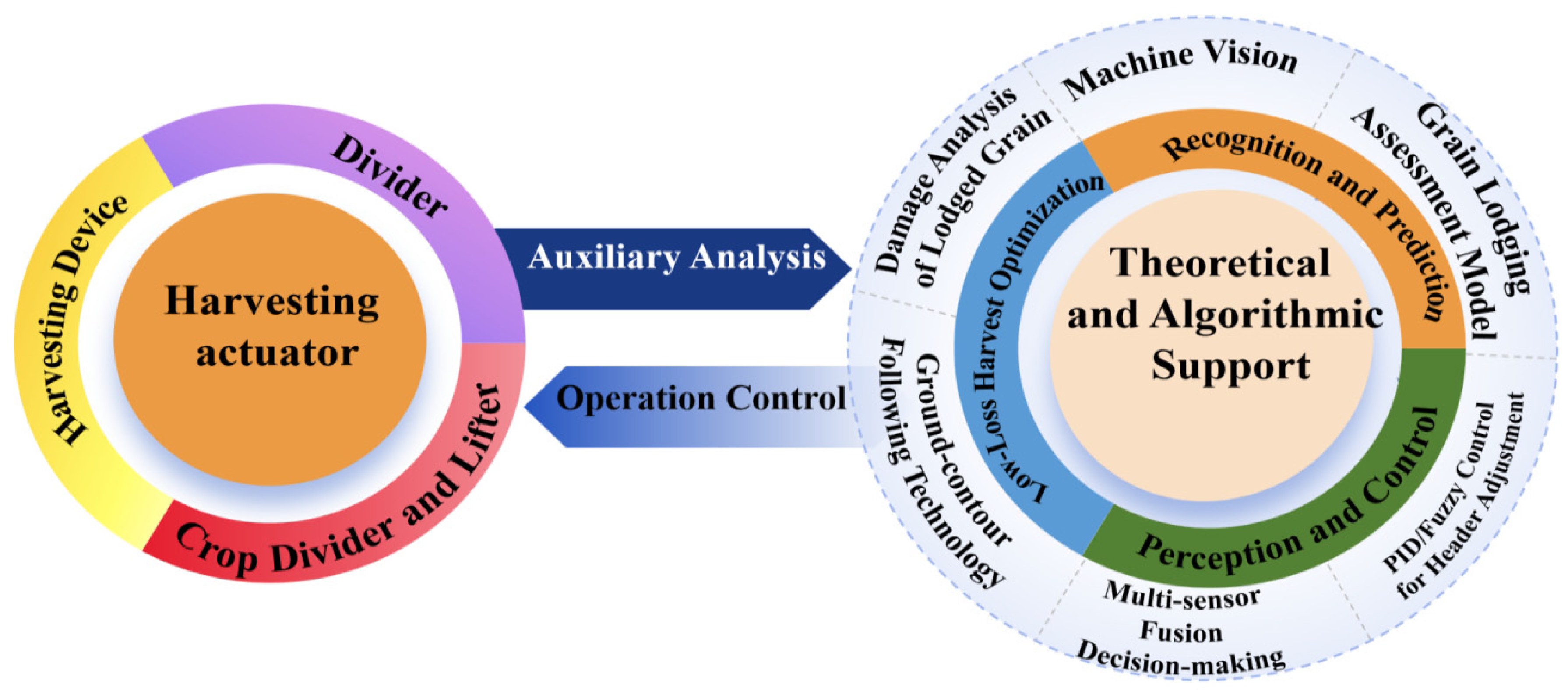
The header is the main working component of a combine harvester, used for harvesting crops such as wheat, rice, and corn. Based on its structure, it can be categorized into vertical cutting headers and horizontal cutting headers, among others. As combine harvesters evolve toward high speed and intelligence, automated control of the header has become a key focus of research to achieve efficient, low-damage mechanized harvesting [118]. During operation, the reel rotates to guide the crop into the cutting area while supporting the stalks to keep them upright. The cutter bar cuts the crop stalks at high speed, and the auger (screw conveyor) delivers the cut crop to the threshing mechanism. As shown in Figure 7, the harvesting execution and control mechanisms work in coordination.
First, the lodged grain is separated from the upright grain, lifted, and guided into the header, thereby completing the lifting, dividing, and cutting operations. Simultaneously, data such as grain loss, grain posture, and header parameters are collected during operation to enhance the harvester’s ability to handle lodged grain under varying environmental conditions.

5.1. Closed-Loop Circuit from Lodged Grain Sensing to Header Control

Once lodging information has been acquired and interpreted, the next key issue is how to translate this information into adaptive control strategies for the header and its key components. To achieve low-loss and high-efficiency harvesting of lodged grain, the output of the perception system must be converted in real time into control commands for the header actuators. In practical intelligent harvesting systems, perception and actuation are tightly coupled through a closed-loop feedback mechanism.
At the perception layer, lodging information is acquired through remote sensing platforms and onboard vision systems. UAV imagery can be used to plan harvesting paths in advance and set initial operating parameters, while onboard sensors dynamically update field information during the harvesting process. At the decision-making layer, the onboard machine vision system captures real-time data on grain lodging and terrain conditions and extracts key parameters. These parameters are then converted into analog or digital control signals for the header hydraulic actuators, enabling closed-loop height adjustment with millisecond-level response. In addition, UAV-based remote sensing can provide a pre-harvest map of grain lodging distribution, which can be uploaded to the harvester’s onboard controller to generate a global operation path. Subsequently, the onboard stereo vision system adjusts the operation path and header height in real time according to local crop conditions. At the feedback layer, sensors such as inclination and pressure sensors monitor header posture and harvesting loss in real time, thereby forming a closed-loop feedback system through which the controller can further optimize control parameters. However, delays in the perception-to-control pipeline, the reliability of sensor coordination, and system robustness under complex field conditions remain major challenges for engineering applications. The control performance ultimately depends on the structural performance and functional coordination of the key header components. Therefore, it is necessary to design and optimize the main header components used for lodged-grain harvesting.

5.2. Neural-Network-Based Perception–Decision–Control Integration for Lodged Grain Harvesting

In addition to model-based control methods such as model predictive control and adaptive control, neural-network-based control strategies have also become an important research direction in the field of agricultural machinery control. Owing to their strong nonlinear mapping capability, such networks can perform temporal decision analysis and adaptive parameter adjustment under dynamically changing field conditions. In practical applications, neural networks are more often used for operation-strategy generation, path-tracking control, and auxiliary control optimization, rather than serving as a complete replacement for traditional feedback controllers [119].
Although most existing neural-network-based control studies have been conducted in mobile robots or agricultural navigation rather than lodged-grain harvesters, their underlying ideas are highly relevant to the transition from reactive regulation to predictive and adaptive control in lodged-grain harvesting. Compared with conventional deep neural networks, spiking neural networks are more consistent with the future development needs of intelligent harvesting equipment. Centered on temporal coding and event-driven computation, such networks can achieve low-latency coordinated regulation of perception and motion, giving them clear advantages in real-time operational scenarios. Deep reinforcement learning has also shown considerable potential for agricultural machinery decision-making, planning, and path-tracking tasks under nonlinear and dynamically changing field conditions. Li et al. reported that, in an environment with static obstacles, the improved DQN controller achieved a 90% task success rate after approximately 300 training episodes, whereas the conventional baseline DQN model required 450 episodes to reach the same level. In more complex scenarios involving dynamic obstacles, the improved algorithm reached a 90% success rate after only 400 training episodes [120]. For practical farmland navigation, test results of a path-tracking controller based on Double-DQN showed that, when the machine traveled at 0.36 m/s and 0.75 m/s, the maximum lateral deviations were 0.233 m and 0.266 m, respectively, while the mean lateral deviations were only 0.071 m and 0.076 m [121]. These results clearly demonstrate that reinforcement learning can effectively improve the path-tracking accuracy and field operational stability of agricultural machinery.
At the machinery-control level, quantitative experimental studies on spiking neural networks remain relatively limited. Most existing work has been conducted in the field of robotics, and dedicated exploration for lodged-grain harvesting scenarios is still scarce. Nevertheless, the available findings provide valuable references. Arena and co-workers developed an SNN model with spike-timing-dependent plasticity and carried out three progressive experiments—obstacle avoidance, target approaching, and visual-cue-guided navigation. The model successfully acquired anticipatory control capability, demonstrating that spiking computation can efficiently couple temporal environmental perception with motion response [22]. Jiang et al. proposed a brain-inspired reinforcement learning planner, which improved navigation success rates by 4.3% and 5.3%, respectively, over the original DDPG algorithm in two test environments [122]. These results suggest that spiking neural networks are potentially suitable for lodged-grain harvesting. Owing to their lower power consumption and stronger real-time capability, they show promising application prospects and practical value in lightweight onboard control tasks such as dynamic header-height adjustment and adaptive correction of driving paths.

5.3. Design of Key Components of the Header System

Based on existing research on grain headers and the current state of header loss reduction technology, studies have been conducted on the structural optimization, simulation, and experimental analysis of the reel to minimize harvesting losses. To reduce cutting losses caused by the cutter during header operation, research has focused on cutting angle, cutting speed, cutting height, header forward speed, cutter vibration characteristics, and blade optimization. For crops that are difficult to harvest mechanically and prone to causing header losses, investigations have been carried out into crop physical properties, growing seasons, and related agronomic practices, along with the development of crop-adaptive header components to mitigate header losses.

5.3.1. Cutting Device

Existing research on cutting devices has mainly focused on reducing cutting resistance, minimizing header vibration, and improving adaptability to lodged grain.
Through bionic technology, cutting resistance can be reduced. It was determined that the primary and secondary factors affecting the performance of the bionic cutter, in descending order, are blade type, conveying speed, the interaction between cutting speed and conveying speed, and cutting speed. Comparative tests conducted under the same operating conditions confirmed that the bionic blade exhibits superior cutting performance [123,124,125,126,127,128]. An impact cutting mechanism was employed to conduct blade power consumption tests. The cutting power consumption is closely related to stem diameter and stem cross-sectional area. Optimizing cutting speed and blade inclination angle can significantly reduce cutting power consumption while improving cutting quality and reducing cutting losses [129,130]. These studies indicate that improvements in cutting performance depend not only on blade structure, but are also closely related to cutting speed, conveying speed, and the physical properties of the stalks.
By reducing header vibration, a significant positive effect on loss reduction has been achieved [131,132]. When a chain-driven vertical-axis cutter driver is used, the header exhibits the lowest vibration, offering high reliability, thereby reducing grain loss caused by cutter vibration during harvesting. Meanwhile, the feeder conveyor and header can be quickly attached, facilitating convenient assembly and disassembly of the header [133,134,135]. Research on vibration reduction shows that optimizing the drive mechanism has a direct effect on reducing grain loss and improving operational stability.
To reduce cutting losses caused by the cutter bar, researchers have conducted studies on cutting angle, cutting speed, cutting height, forward speed of the header, cutter bar vibration characteristics, and blade optimization. Mowers employing a double-cutter structure and optimized blade geometry can reduce stubble height and improve cutting quality [136]. The cutter adopts a disc-type design, which is specially equipped with spaced teeth to cut the stalks into multiple segments. A mounting plate is designed beneath the cutter, which is capable of lifting prostrate crop stalks during harvesting and feeding them into the cutting zone, thereby reducing cutting losses [137,138]. At present, cutting devices are evolving from a single cutting function toward an integrated “cutting–crop lifting–feeding” system.
For lodged grain harvesting, the semi-feed vertical header performs well in terms of harvesting adaptability and operational efficiency, while a matching high-mobility traveling mechanism can further improve turning efficiency in paddy fields [139,140,141]. A relatively rare approach is the use of a stripper header mounted on a combine harvester for grain harvesting, which strips only the ears of wheat [142]. When used for rapeseed, the stripper header strips the branches and pods, discharging the plant stalks outside, thereby preventing conveying blockages caused by the stalks. It also reduces the straw-to-grain ratio of the fed material, lowering the power consumption of the threshing and cleaning units. Additionally, the airflow generated by the rotation of the stripper rotor helps recover some of the grains lost due to pod shattering back into the header, further reducing grain loss [143,144]. The requirements for cutting structures vary significantly among different crops and lodging conditions, and universal designs remain limited. Future research should focus on improving the adaptability of cutting devices.

5.3.2. Crop Divider

As a core component of the header, the crop divider is positioned at the forefront and directly affects harvesting quality, efficiency, and crop loss rate. Loss reduction through the crop divider has become a research hotspot for grain harvesters in recent years.
For crops with a relatively low degree of lodging, a crop divider is installed at the front end of the header, which can lift the slightly lodged grain and guide it onto the crop-lifting chain, thereby facilitating subsequent crop lifting and cutting operations [145]. After this initial lifting, the rice stalks are transferred to the lifting mechanism, where the lifting chain and fingers rotate and raise the stalks to the required cutting angle before they are cut by the cutter beneath the header [146]. To address partial lodging in mature highland barley plants, a double-layer header is designed with a small crop divider installed below the disc cutter to establish an auxiliary row-dividing and lifting mechanism. During grain harvesting, this header effectively divides the crops, prevents stalk entanglement, and lifts and separates lodged highland barley plants [147]. In terms of anti-entanglement optimization, Bai et al. investigated the effect of traditional spiral blades on crop-lifting performance and designed a variable-helix comb-tooth crop divider. For sugarcane under different lodging conditions, they studied the contact–separation behavior between the sugarcane and the comb teeth, and obtained the action time and action angle of the comb teeth acting on the sugarcane [148].
Current research on crop dividers mainly focuses on improving their performance in lifting, dividing, and guiding lodged grain, while reducing stalk entanglement and feeding blockage. However, most existing structures are designed for specific crops, and their adaptability under different lodging angles, crop moisture contents, and plant architectures still requires further verification.

5.3.3. Reel Device

Research on reel devices has mainly focused on improving crop feeding stability, reducing impact losses, and enhancing their adaptability to different crop types and lodging conditions.
The header is equipped with a three-plate reel, which effectively prevents sunflower heads from being carried backward during reeling. Additionally, a key component known as the inner crop divider is installed on the header to address issues such as lodging, pushing, and blockage of oilseed sunflower plants during feeding. It serves to separate the plants and facilitate header feeding, while also catching the cut sunflower heads to prevent them from falling outside the header, thereby effectively reducing head loss [149]. Based on the growth height and center of gravity height of millet, the reel was appropriately designed to better guide lodged millet plants while minimizing losses caused by impact and ear shattering [150].
To meet the requirements for multi-crop harvesting while reducing losses and improving harvesting quality, the parameters of the reel and header are adjusted to ensure that the speed ratio λ for the harvested crop falls within the appropriate range for that specific crop, provided that matching and control requirements are satisfied. The reel speed designed based on speed matching can effectively reduce the loss rate [151]. Additionally, the angle of the spring tines can be continuously optimized to adapt to the plant structure, ensuring that the reel performs effectively during the stages of gathering crops, feeding plants to the auger, and retracting from the plants [152].
Although reel optimization can effectively reduce feeding losses, its operating performance is highly dependent on crop morphology and the degree of coordination with other header components, indicating that parameter coordination and structural redesign are equally important.

5.4. Intelligent Detection Technology for Header Height

The optimization of key header components contributes to improved crop lifting, crop guiding, and cutting–feeding performance for lodged grain. However, under variable field conditions, low-loss harvesting cannot be achieved through structural improvement alone. Real-time perception of header posture and terrain variation is equally critical for adaptive harvesting. Currently, the methods used for measuring header height mainly include non-contact measurement and height measurement combined with profiling using multiple sensors. Non-contact detection typically employs various sensors such as ultrasonic, infrared, and pressure sensors. Among these, ultrasonic distance measurement has been studied and applied for a relatively long time, fully leveraging the advantage that ultrasonic waves are unaffected by factors such as smoke. Ultrasonic sensors are capable of distance measurement in harsh harvesting environments, making them well suited for harvesting operations.
For example, an ultrasonic sensor with adaptive signal filtering is used to measure ground clearance, enabling differentiation between ground signals and crop signals. Ground pressure is controlled based on the measured pressure from the hydraulic lift cylinder, while a high-resolution pressure sensor continuously monitors the residual weight of the header [153].
With the continuous development and increasing maturity of sensor technology, in addition to ultrasonic sensors, various other types of sensors—such as angle sensors, displacement sensors, and pressure sensors—have also been applied in header height control. Multi-sensor distance measurement is currently a method characterized by wide applicability and high real-time performance, effectively addressing the instability issues associated with non-contact detection [154].
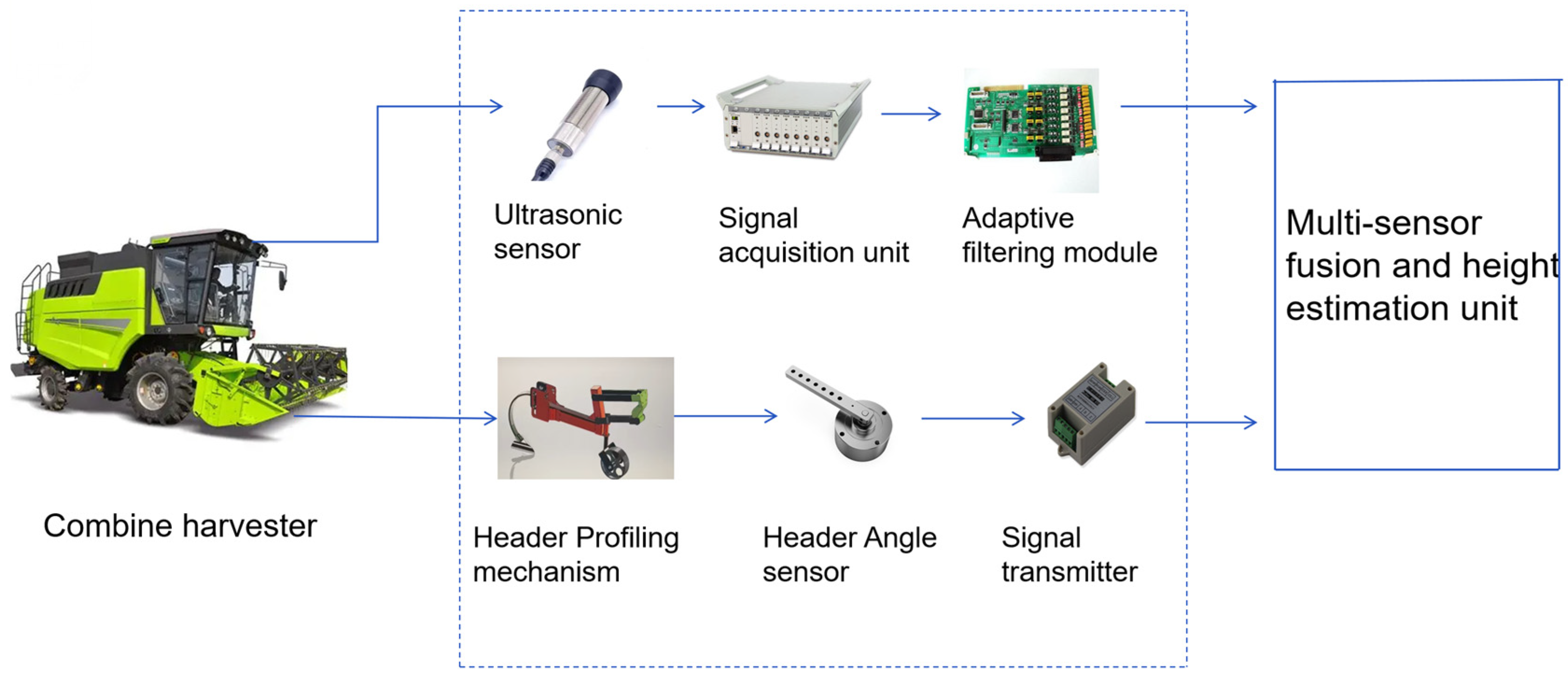
By using inclination sensors to detect the chassis inclination angle and the header inclination angle, an indirect method for measuring header height has been proposed. This method establishes a mathematical model incorporating the chassis inclination angle, header inclination angle, and header height [155,156]. A height detection and compensation method based on dual inclination sensors was developed, in which a correlation model between the inclination angle and header height was established using least squares fitting, significantly improving measurement accuracy [157]. In addition, synchronized acquisition of combine position data and feeder-house angle can be used to calculate header ground clearance in real time [158]. The overall architecture of the harvester header height measurement system is generally shown in Figure 8.
The system integrates two measurement chains: a non-contact measurement chain based on an ultrasonic sensor, a signal acquisition unit, and an adaptive filtering algorithm, and a profiling-based sensing chain composed of the header profiling mechanism and the header angle sensor. The measured signals are transmitted to the fusion-processing unit, where multi-sensor information fusion is used for header height calculation, enabling real-time and accurate estimation of header height under complex field conditions.
The above methods are mostly based on single-point measurements and lack large-area coverage. To better capture the undulating characteristics of farmland terrain and simulate terrain unevenness, the header is enabled to perceive ground undulation in real time through angle sensors integrated into the profiling device. A cutter ground clearance detection device is installed on both sides of the harvester; as the profiling wheel contacts the ground, the rotation of the angle sensor provides real-time feedback on the distance from the cutter to the ground [159,160,161]. For automatic control of row header height in soybean harvesters, an area array LiDAR is employed to detect header height. Based on the surface undulation characteristics of soybean fields, linear, quadratic, and cubic nonlinear terrain fitting models are established. The automatic control mode significantly improves the uniformity of cutting width [162]. These sensing and detection methods provide the essential real-time information required for header height adjustment. On this basis, efficient control strategies should be developed to use such measurement information for stable, accurate, and robust header height control under complex harvesting conditions.

5.5. Header Height Control System

5.5.1. Traditional PID and Its Improved Algorithms

For an efficient, stable, and reliable header height control system, smooth and responsive profiling equipment serves as the hardware foundation, while the control algorithm is equally critical, as it determines system performance and helps reduce systematic errors. Currently, the algorithms used for header height control are mainly traditional PID control algorithms or their improved variants.
For instance, Chen et al. determined the control parameters and methods for each module through mechanical design analysis. They proposed an adaptive B-PID controller that integrates the backstepping method with PID for trajectory tracking control and derived a control model that accounts for motion damping and error compensation [163]. A multi-parameter joint control method for combine harvesters converts the electrical signals generated by the threshing loss sensor into digital signals via the PLC’s AD conversion channel. The PID algorithm calculates the difference between the actual loss and the desired loss to obtain target values for concave clearance and threshing drum speed. Based on these target values, the PLC controls the hydraulic cylinder for concave clearance adjustment and the motor for threshing drum speed adjustment, thereby achieving regulation of both parameters [164].
Relevant studies have shown that improved PID algorithms can enhance trajectory-tracking accuracy and coordinated parameter control to a certain extent, while offering the advantages of simple structure and ease of implementation. However, their adaptability remains limited under coupled disturbances such as terrain undulation, grain lodging, and multiple simultaneous perturbations.

5.5.2. Intelligent Control Algorithm

Traditional control algorithms have low computational complexity and are highly mature in industrial applications; however, they are generally only applicable to linear time-invariant systems and are not well suited for scenarios involving constraints. Consequently, researchers have begun exploring intelligent algorithms such as model predictive control, neural networks, and adaptive control. These control algorithms are capable of handling multiple-input multiple-output (MIMO), nonlinear, time-varying, and strongly coupled systems.
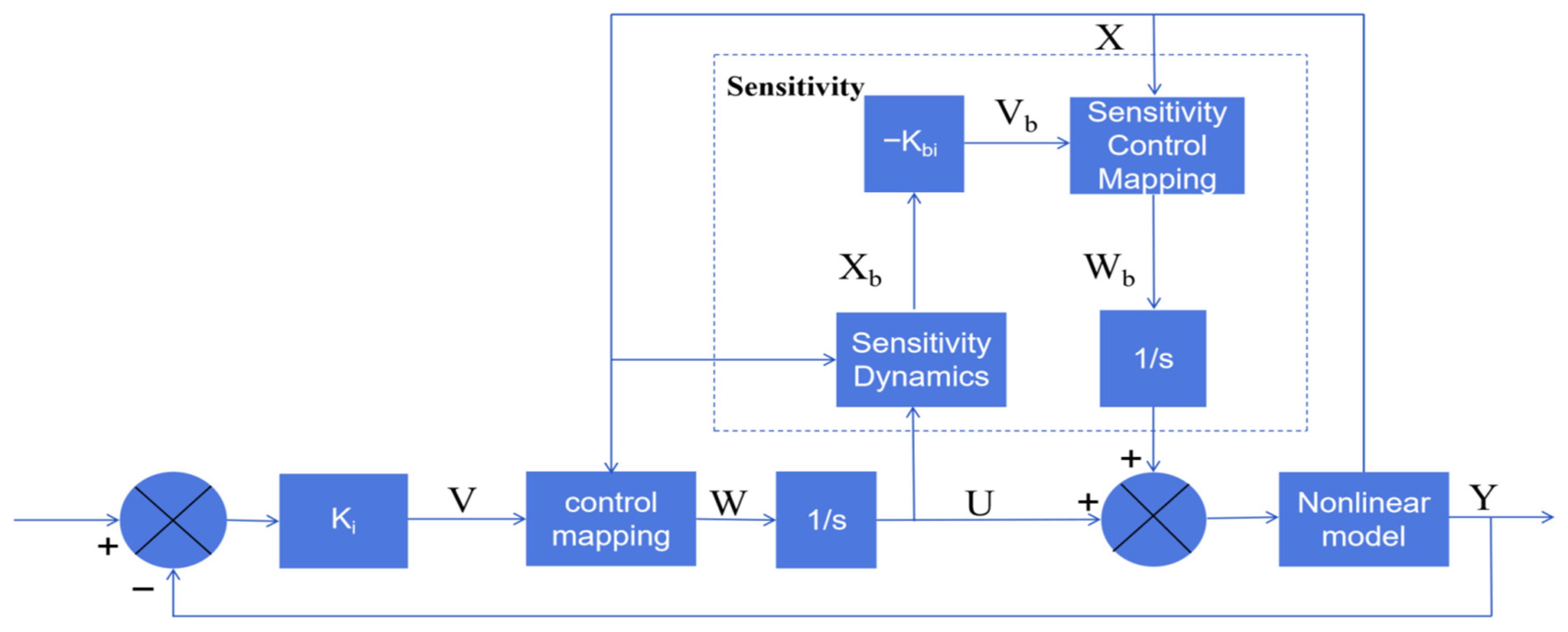
As is the case with a nominal system, higher gain theoretically yields better tracking performance; however, excessive gain may induce high-frequency oscillations or chattering, particularly in higher-order derivatives. The block diagram of the robust feedback linearization control system is shown in Figure 9.
As shown in Figure 9, the coordinated operation of the main feedback control loop and the sensitivity compensation branch is used to address system nonlinearity, uncertainty, and parameter sensitivity.
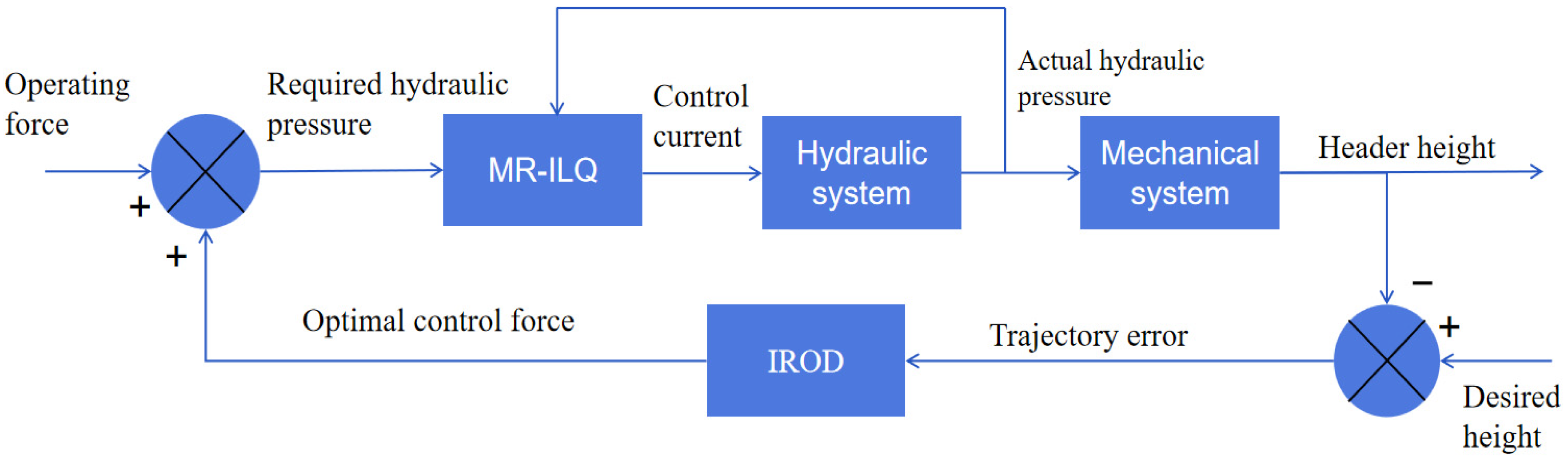
Zhuang et al. proposed a robust feedback linearization (RFL) control strategy based on the integrated robust optimal design (IROD) controller, achieving stable system control by constructing sensitivity equations and selecting appropriate gains [165]. As shown in Figure 10, the automatic header height control controller for a combine harvester is designed based on the Model Reference Inverse Linear Quadratic (MR-ILQ) method. Its objective is to enhance the header’s terrain tracking performance as the combine harvester moves forward, while optimizing control inputs to ensure robustness against uncertain parameters.
Compared with traditional PID control, the robust feedback linearization controller offers higher steady-state accuracy and improves the uniformity of straw. Lu et al. constructed a dual closed-loop control structure, employing model predictive control (MPC) at the pose control layer and sliding mode control (SMC) at the dynamics control layer. A nonlinear disturbance observer (NDO) was designed to estimate various system disturbances and provide compensation for the trajectory tracking control system, thereby enhancing system robustness [166]. Ni et al. developed a header height adjustment system for a soybean harvester, designing a profiling mechanism and a hydraulic drive system. The profiling mechanism adjusts the header height in response to ground terrain undulations, establishing the relationship between soil compaction force and compacted soil depth. Different levels of header height adjustment are achieved through the header height adjustment algorithm in the IPC [167].
These methods are more effective at improving control accuracy, enhancing disturbance rejection, and optimizing tracking performance under complex operating conditions. The above studies also indicate that header height control is evolving from traditional single-loop feedback control toward multi-level, highly robust composite control architectures. However, such methods typically require highly accurate system models, involve substantial computational complexity and challenging parameter tuning, and place greater demands on hardware platforms and real-time control performance.

5.5.3. Fuzzy Control Algorithm

In addition to model-driven and computationally intensive control strategies, fuzzy control has also attracted considerable attention as an important branch. Compared with approaches that rely heavily on accurate system modeling, fuzzy control places greater emphasis on rule-based reasoning and adaptability to practical operating conditions, making it a representative non-model-based control method for header height regulation. Fuzzy control is mainly used for nonlinear systems. It relies on empirical knowledge and experience, can process multiple inputs and outputs, and is therefore well suited to combine-harvester parameter control, which involves variables such as loss rate, impurity rate, and grain breakage rate. However, fuzzy control requires relatively high computational power and places greater demands on the processor.
Quantitative results from profiling-header experiments further illustrate the practical effectiveness of these control strategies. For instance, when fuzzy PID control was used for header-height adjustment, the average height-adjustment error was 6.75 mm, the average leveling error was 0.64°, and the maximum height error was 11.63 mm, indicating relatively high positioning accuracy and fast adjustment response under field conditions [28]. Wang et al. developed a fuzzy control system for an intelligent combine harvester that can detect header height accurately, stably, and in real time. Their algorithm first estimates the initial header height from the motion trajectory and then determines the precise header height through fuzzy decision-making [168]. A fuzzy-PID-based adaptive height-control model has also been established, showing high control accuracy and maintaining uniform, stable stubble height [169,170].
Header height control is a key component in the harvesting of lodged grain, and the performance of the control system directly affects harvest loss and operational efficiency. Current control algorithms include traditional PID, fuzzy PID, robust feedback linearization, and robust trajectory tracking control that combines model predictive control with sliding mode control. Table 2 summarizes the basic principles, advantages, limitations, and applicable scenarios of these representative control methods.
As shown in Table 2, traditional PID control features a simple structure, low computational cost, and ease of implementation, making it suitable for harvesting operations on flat terrain with low disturbances and stable working conditions. It therefore exhibits clear advantages in cost-effectiveness and scalability. However, its control accuracy and robustness are relatively limited under complex field conditions such as significant terrain changes, grain lodging, or coupled multi-source disturbances. Fuzzy PID can adjust control parameters online using fuzzy rules, which improves adaptability in common nonlinear systems. Yet its performance relies heavily on the design of fuzzy rules and remains insufficient in the presence of intense sudden disturbances. By comparison, advanced approaches such as robust feedback linearization (RFL) and model predictive control (MPC) generally achieve higher precision and stronger disturbance rejection in complex scenarios. In particular, the robust trajectory-tracking scheme based on MPC–SMC–NDO uses a dual closed-loop structure and a nonlinear disturbance observer, allowing more effective compensation for parameter variations and field disturbances, thus providing better overall control performance. Nevertheless, these methods typically require more accurate system models, involve more difficult parameter tuning, and demand greater computational resources and higher-performance hardware, which somewhat restricts their large-scale onboard deployment. In summary, PID-based algorithms are more appropriate for low-cost, engineering-oriented applications, while MPC and RFL methods show greater potential in intelligent harvesting systems requiring high precision and strong robustness.
Future research should further balance control accuracy, disturbance rejection capability, algorithm complexity, and engineering feasibility while ensuring real-time performance, so as to meet the comprehensive requirements for low-loss, efficient, and stable operation during the harvesting of lodged grain. The above studies indicate that adaptive header design, height sensing, and control algorithms constitute the technical foundation for improving the harvesting performance of lodged grain. The actual effectiveness of these methods ultimately depends on their integrated application in practical harvesting equipment.

6. Intelligent Grain Harvesting Equipment

The grain breakage rate is one of the most important indicators for evaluating the harvesting performance of a combine harvester [171]. In addition, the mechanical shear strength of wheat kernels is a key concern for researchers and engineers involved in the design of machinery for field crop threshing, conveying, and processing. The mechanical properties of the grain directly influence the structural dimensions and operating parameters of the equipment [172]. Therefore, the development of suitable intelligent grain harvesting equipment is crucial for improving harvesting efficiency and reducing loss rates in lodged grain. Intelligent harvesting equipment serves as the engineering carrier through which sensing, decision-making, and control technologies are applied in the field. Among the various engineering carriers of intelligent harvesting, the combine harvester remains the most representative and widely used type of equipment.

6.1. Grain Combine Harvester

The main development trend of grain combine harvesters is to reduce loss and improve efficiency, and large-scale machines are one important path toward this goal [173]. Harvesting efficiency can be increased by widening the cutting width, improving feed rate, and enhancing header-control accuracy [174]. Based on the characteristics of lodged grain, Table 3 summarizes the structural and functional features of several current large-scale grain combine harvesters.
The harvesting efficiency of grain combine harvesters is improved by increasing the cutting width, increasing the feed rate, and improving the precision of header control. To achieve the required feed rate, the structure of the large harvester has been optimized in several aspects. The harvester adopts a wider cutting width, allowing it to harvest more rows simultaneously. Large harvesters are equipped with larger sieves, higher-power blowers, and higher efficiency; large models may also adopt a wider feeder conveyor design to improve feeding stability and efficiency.
In developing countries, the research, development, and production of combine harvesters are mainly focused on small- and medium-sized models. These machines offer good harvesting quality, relatively simple structures, compact overall dimensions, convenient operation, and high maneuverability, making them well suited to the economic conditions and land management patterns of rural areas. Their simple structure, small size, and strong mobility enable them to adapt well to the economic level and farm scale of rural regions in many developing countries, while still ensuring reliable harvesting performance. For example, Paul et al. developed a medium-sized combine harvester suitable for small and fragmented fields. The machine was manufactured using locally available materials, with priority given to affordability, ease of manufacture, large capacity, and minimal maintenance requirements [175]. Jera et al. designed a reasonably priced and cost-effective small combine harvester for grain harvesting on small plots of land [176].
In addition, Xu et al. investigated the low-frequency vibration characteristics and ride comfort of the driver’s seat in the CFFL-850 crawler full-feed combine harvester with the aim of reducing grain harvester vibration. Following the installation of an X-shaped damping mechanism, the dynamic comfort of the improved seat was enhanced [177]. Singh et al. designed an ergonomically optimized seat and employed piezoelectric material isolators to mitigate seat vibration levels under various engine speeds, resulting in a significant improvement in dynamic comfort [178]. Existing grain combine harvesters have developed along multiple technical routes according to field scale, grain type, and regional differences. However, improvements in harvesting performance depend not only on the overall machine configuration and structural optimization, but also, more importantly, on the actual adaptability of the equipment under complex and harsh operating conditions.

6.2. Environmentally Adaptable Grain Combine Harvesting Equipment

6.2.1. Research on Harvesting Technology in Hilly and Mountainous Areas

Most small cereal grains are still produced in hilly and mountainous areas, where fields are small, fragmented, and often steep. Production is still dominated by small family farms, and these conditions make mechanization difficult. The complex terrain also limits the use of satellite navigation because machinery operating along field ridges cannot rely on the system to identify ridge contours accurately [179]. To improve mechanized grain harvesting in these areas, reduce production costs, and cope with short harvest windows and labor shortages, manufacturers of small- and medium-sized harvesters worldwide have continued to develop specialized machines for mountain operations [180,181,182,183,184].
In terms of navigation and path recognition, existing studies have mostly focused on harvest boundary detection, path tracking, and visual navigation. Research has shown that measuring the distance between the crop divider and harvest boundary can improve the precision and real-time performance of lateral deviation detection, thus enhancing the machine’s overall navigation performance [185]. Navigation systems combining visual SLAM with inertial guidance can also use binocular cameras to collect field images and extract cutting boundaries as navigation references, which strengthens path-following performance in complex field environments [186]. Deep learning methods for path recognition have also demonstrated good potential; for instance, modified semantic segmentation networks can achieve higher path recognition accuracy in low-light conditions [187]. Moreover, adjusting the travel direction of harvesters dynamically based on actual crop boundaries helps reduce overcutting and missed harvesting, further decreasing header losses [188].
Tracked combine harvesters are prone to high rollover risks and poor operational safety when working on steep slopes in hilly and mountainous areas, which has greatly restricted their application in mechanized harvesting. To solve this problem, researchers have carried out relevant studies on chassis structure optimization, leveling system design, and terrain adaptability modeling. For instance, the design integrating a three-layer chassis structure and a hydraulically interconnected omnidirectional leveling system can enhance platform safety by keeping the center point stable during the leveling process [189]. Similarly, the omnidirectional leveling system based on a dual-layer frame tracked agricultural chassis can further boost the machine’s adaptive leveling performance on sloped terrain [190]. Additionally, Chai et al. used a DEM–FMBD bidirectional coupling simulation method to build a multi-body dynamics model of a tracked combine harvester, significantly improving its adaptability to complex terrain [191].

6.2.2. Chassis and Navigation Technologies for Complex Field Environments

In addition to their application in harvesting equipment for hilly and mountainous areas, chassis and navigation technologies provide fundamental support for the intelligent operation of grain harvesting equipment in complex field environments. Erratic rainfall during the rainy season, combined with surface soil compaction caused by ground contact pressure from combine harvesters, can damage soil structure and reduce its water retention capacity [192]. The chassis configuration serves as the foundation for the mobility of agricultural robots, directly determining their trafficability, stability, and ability to perform intelligent operations in complex field environments. Crawler-type chassis enhance operational performance on soft and sloping terrains through technologies such as profiling tracks, albeit at the cost of increased energy consumption [193,194]. Zhao et al. established a relationship model between compaction force and soil compactness under varying forward speeds and compaction depths. To control soil compaction by adjusting the compaction depth, they used a fuzzy algorithm that takes compaction force as an input parameter to calculate the required compaction depth adjustment range [195]. Fu et al. used the goat spine as a bionic prototype and designed a bionic structure with a single bionic curve across the entire contact surface of the track shoe, achieving optimal adhesion performance [196].
Steering wheel angle is a crucial and essential parameter in the navigation control of autonomous wheeled vehicles. Currently, the combination of a rotary angle sensor with a four-bar linkage is the primary method for ensuring steering wheel angle measurement accuracy and has been widely adopted in autonomous agricultural vehicles. However, in complex and challenging field environments, a series of significant issues still exist. Li et al. proposed a dynamic measurement method for steering wheel angle based on vehicle attitude information and a non-contact attitude sensor. This method does not rely on the vehicle’s kinematic model and also avoids sensor damage caused by mud blockage or broken wires [197].
The full-time drive system of the combine harvester ensures smooth and reliable steering during turns while reducing steering load. The automatic leveling system, through its balance control mechanism, can adjust the clearance between the harvesting platform and the ground while maintaining a level working posture. This adaptability enables the equipment to cope with varying degrees of grain lodging, thereby effectively reducing the missed cutting rate [198,199]. In terms of path control, the three-stage guidance method proposed by Zhang et al. further improved path-tracking accuracy and reduced crop damage during headland turning [200]. Meanwhile, the tracked electric tractor designed by Liu et al. can adapt to small plots and narrow operating spaces, and has demonstrated good economic performance in traction, transportation, lifting, and power output [201]. Overall, research on chassis and navigation systems for hilly and mountainous regions as well as complex field environments is shifting from single-function optimization toward an integrated technical route that combines chassis structure, steering control, leveling systems, and path planning.

6.3. Characteristics of Grain Harvesting Equipment

Through a comparative analysis of the characteristics of grain harvesting equipment and technologies, the global development of such equipment exhibits the following trends:
(1)
Currently, most grain combine harvesters still rely on conventional agricultural technologies and basic mechanical structures. Advanced technologies such as sensors, big data, AI algorithms, and satellite positioning have not yet been integrated on a large scale. As a result, it remains difficult to achieve digital sensing, intelligent decision-making, precise operation, and refined management throughout the harvesting process.
(2)
The equipment utilization rate is low. Grain morphology varies considerably, and harvesting conditions differ markedly across regions, making it difficult for a single model to perform multifunctional operations for different grain types. Currently, grain harvesters available on the market are generally designed to harvest only one type of grain and lack the capability for multi-purpose use.
(3)
Harvesting equipment still has poor adaptability. In current grain-harvesting operations, combine harvesters are often run with fixed parameter settings across an entire field. However, harvesting environments are complex and highly variable. Ignoring these changes makes it difficult to control impurity rate, grain breakage, and harvesting loss effectively. As a result, grain quality declines and energy is wasted.
In addition, the practical adoption and large-scale application of the aforementioned technologies and equipment remain significantly constrained by cost, scalability, and differences in farming systems. In smallholder farming systems, the adoption of precision agriculture technologies is primarily hindered by five factors: limited landholding size, high adoption costs, technical difficulties, insufficient professional support, and inadequate policy support. Moreover, because lodging disasters do not occur every year, the annual utilization rate of specialized equipment is often very low, and maintenance costs may even exceed agricultural income. As a result, the economic payback period of intelligent harvesting technology may be relatively long for smallholder farmers, especially in regions with fragmented landholdings and low annual machine utilization rates. Therefore, for smallholder farmers, priority should be given to low-cost technologies, shared agricultural machinery services, government subsidies, and supportive regulatory policies [202]. In large-scale farming systems, the main challenges lie in system integration and compatibility. For example, data interfaces and communication protocols often differ among harvesters and sensors produced by different manufacturers. In addition, system integration and coordinated operation requires supporting data centers and communication base stations, leading to high initial investment, while real-time detection systems also face endurance constraints during continuous operation. In such scenarios, standards such as ISO 11783 (ISOBUS) make seamless communication between tractors possible. Interfaces and middleware can further improve data flow and enhance the connectivity, compatibility, and interoperability of digital agricultural products [203]. Furthermore, the development of low-power AI-based collaborative detection architectures would support scalable deployment in power-constrained agricultural environments.
In summary, the promotion of intelligent harvesting technologies for lodged grain requires differentiated strategies. For smallholder farmers, emphasis should be placed on low-cost and easy-to-use solutions, whereas for large-scale farms, greater attention should be directed toward system integration and standardization.

7. Conclusions and Outlook

High-efficiency, low-loss harvesting technology and equipment for lodged grain hold broad application prospects in agriculture and represent a key technology for promoting the large-scale and intelligent development of modern farming. This paper systematically reviews the current research progress in areas such as grain lodging information acquisition, combine harvester harvesting, and intelligent modular systems, and summarizes their practical applications in typical agricultural scenarios. Taken together, intelligent harvesting of lodged grain is gradually evolving from single-link optimization toward the integrated development of perception, control, and equipment execution, so as to better adapt to complex and variable field operating conditions and serve modern agricultural production. Despite significant progress, several key gaps remain. To provide clearer guidance for future research, the following core research priorities are proposed:
(1) Most current systems still operate in an open-loop manner, and lodging information recognition is not directly coupled with the real-time actuators of the header. Future research should focus on closed-loop architectures and achieve online parameter adjustment based on feedback from inclination sensors and loss sensors.
(2) Currently, high-accuracy deep learning models often require substantial computational resources, which makes their deployment on the onboard systems of harvesting machinery difficult. Future research should therefore focus, on the one hand, on model compression and adaptation to edge computing, and on the other hand, on the development of neural network architectures with stronger temporal processing capabilities. Among these, spiking neural networks and brain-inspired algorithms enable low-latency and low-power computation, making them better suited to complex farmland environments and thus promising for upgrading integrated perception–control intelligent operations in lodged grain harvesting scenarios.
(3) The performance of existing header components, such as reels, crop dividers, and cutters, remains unsatisfactory under severe lodging conditions characterized by mixed lodging directions and plant entanglement. Future research should focus on the development of bionic or actively reconfigurable header mechanisms that can automatically adjust according to lodging angle, plant height, and crop density.
(4) Future research should also strengthen the evaluation of engineering deployment, with particular attention to the adoption cost for smallholder farmers, the energy requirements of intelligent systems, compatibility with existing agricultural machinery, and the economic payback period under different application scenarios.

Author Contributions

Conceptualization, Y.Q. and Y.D.; methodology, Q.H.; literature search and data curation, Z.Z. and T.Y.; writing—original draft preparation, Y.Q.; writing—review and editing, Z.T.; supervision, X.L.; funding acquisition, W.Z. All authors have read and agreed to the published version of the manuscript.

Funding

This research was funded by the national college student innovation training program (project number: 202510299059), the Modern Agricultural Machinery Equipment and Technology Promotion Project of Jiangsu Province (NJ2025-16), and the 24th batch of college student scientific research project funding project of Jiangsu University (project number: 24B064).

Data Availability Statement

No new datasets were generated in this study. All information analyzed in this review was derived from publicly available literature indexed in the Web of Science Core Collection and CNKI.

Acknowledgments

The authors express their sincere gratitude for the valuable technical support and resources that contributed to this research.

Conflicts of Interest

The authors declare no conflicts of interest.

References

  1. Chen, G.; Hou, J.; Liu, C. A Scientometric Review of Grain Storage Technology in the Past 15 Years (2007–2022) Based on Knowledge Graph and Visualization. Foods 2022, 11, 3832. [Google Scholar] [CrossRef] [Scilit]
  2. Cheema, M.J.M.; Nauman, M.H.; Ghafoor, A.; Farooque, A.A.; Haydar, Z.; Ashraf, M.U.; Awais, M. Direct Seeding of Basmati Rice Through Improved Drills: Potential and Constraints in Pakistani Farm Settings. Appl. Eng. Agric. 2021, 37, 53–63. [Google Scholar] [CrossRef] [Scilit]
  3. Wang, J.; Li, K.; Shao, Y.; Zhang, F.; Wang, Z.; Guo, X.; Liu, X. Analysis of Combining SAR and Optical Optimal Parameters to Classify Typhoon-Invasion Lodged Rice: A Case Study Using the Random Forest Method. Sensors 2020, 20, 7229. [Google Scholar] [CrossRef] [Scilit]
  4. Li, S.; Li, Y.; Zhang, G.; Wang, L.; Song, M.; Fan, Y.; Siddique, K.H. Compound dry/wet and hot extremes decreased wheat/maize yield revealed by SHAP-RF and R-Vine Copula. Field Crops Res. 2025, 334, 110161. [Google Scholar] [CrossRef] [Scilit]
  5. Kong, E.; Liu, D.; Guo, X.; Yang, W.; Sun, J.; Li, X.; Zhang, A. Anatomical and chemical characteristics associated with lodging resistance in wheat. Crop J. 2013, 1, 43–49. [Google Scholar] [CrossRef] [Scilit]
  6. Guo, L.; Lv, R.; Zhang, Y.; Fang, Y.; Yi, S.; Pan, X.; Shang, Q. Elevated Nitrogen Fertilization Compromises Lodging Resistance in High-Quality, Late-Season Indica Rice Grown in Southern China. Agronomy 2025, 15, 2451. [Google Scholar] [CrossRef] [Scilit]
  7. Liu, Z.D.; Xiao, J.F.; Nan, J.Q.; Feng, Y.H. Effect of different levels lodging on leaf area index, yield and its components of summer maize. Chin. Agric. Sci. Bull. 2010, 26, 107–110. [Google Scholar]
  8. Lang, Y.Z.; Yang, X.D.; Wang, M.E.; Zhu, Q.S. Effects of lodging at different filling stages on rice yield and grain quality. Rice Sci. 2012, 19, 315–319. [Google Scholar] [CrossRef] [Scilit]
  9. Briggs, K.G. Studies of recovery from artificially induced lodging in several six-row barley cultivars. Can. J. Plant Sci. 1990, 70, 173–181. [Google Scholar] [CrossRef] [Scilit]
  10. Cai, C.; Zhao, H.; Zhang, H.; Wang, C.; Wang, Z.; Liu, M.; Zhang, H. Timely assessment of maize lodging severity with limited samples using multi-temporal Sentinel-1 and Sentinel-2 data across large spatial extents. Comput. Electron. Agric. 2025, 237, 110671. [Google Scholar] [CrossRef] [Scilit]
  11. Varela, S.; Pederson, T.L.; Leakey, A.D. Implementing spatio-temporal 3D-convolution neural networks and UAV time series imagery to better predict lodging damage in sorghum. Remote Sens. 2022, 14, 733. [Google Scholar] [CrossRef] [Scilit]
  12. Zhang, Z.; Flores, P.; Igathinathane, C.; Naik, D.L.; Kiran, R.; Ransom, J.K. Wheat lodging detection from UAS imagery using machine learning algorithms. Remote Sens. 2020, 12, 1838. [Google Scholar] [CrossRef] [Scilit]
  13. Wang, J.J.; Ge, H.; Dai, Q.; Ahmad, I.; Dai, Q.; Zhou, G.; Gu, C. Unsupervised discrimination between lodged and non-lodged winter wheat: A case study using a low-cost unmanned aerial vehicle. Int. J. Remote Sens. 2018, 39, 2079–2088. [Google Scholar] [CrossRef] [Scilit]
  14. Zhu, W.; Feng, Z.; Dai, S.; Zhang, P.; Ji, W.; Wang, A.; Wei, X. Multi-feature fusion detection of wheat lodging information based on UAV multispectral images. Spectrosc. Spectr. Anal. 2024, 44, 197–206. [Google Scholar]
  15. Zhao, M.; Wang, D.; Yan, Q.; Li, Z.; Liu, X. UAV-Multispectral Based Maize Lodging Stress Assessment with Machine and Deep Learning Methods. Agriculture 2024, 15, 36. [Google Scholar] [CrossRef] [Scilit]
  16. Sun, Q.; Sun, L.; Shu, M.; Gu, X.; Yang, G.; Zhou, L. Monitoring maize lodging grades via unmanned aerial vehicle multispectral image. Plant Phenomics 2019, 2019, 5704154. [Google Scholar] [CrossRef] [Scilit] [PubMed]
  17. Yang, M.D.; Tseng, H.H. Rule-Based Multi-Task Deep Learning for Highly Efficient Rice Lodging Segmentation. Remote Sens. 2025, 17, 1505. [Google Scholar] [CrossRef] [Scilit]
  18. Zheng, E.; Tian, Y.; Xu, Z.; Chen, T. The extraction of maize lodging regions in UAV images using deep fully convolutional neural network. IOP Conf. Ser. Earth Environ. Sci. 2020, 474, 032004. [Google Scholar] [CrossRef] [Scilit]
  19. Zhao, J.; Fan, S.; Zhang, B.; Wang, A.; Zhang, L.; Zhu, Q. Research status and development trends of deep reinforcement learning in the intelligent transformation of agricultural machinery. Agriculture 2025, 15, 1223. [Google Scholar] [CrossRef] [Scilit]
  20. Wang, T.; Chen, B.; Zhang, Z.; Li, H.; Zhang, M. Applications of machine vision in agricultural robot navigation: A review. Comput. Electron. Agric. 2022, 198, 107085. [Google Scholar] [CrossRef] [Scilit]
  21. Bai, Y.; Zhang, B.; Xu, N.; Zhou, J.; Shi, J.; Diao, Z. Vision-based navigation and guidance for agricultural autonomous vehicles and robots: A review. Comput. Electron. Agric. 2023, 205, 107584. [Google Scholar] [CrossRef] [Scilit]
  22. Arena, P.; Fortuna, L.; Frasca, M.; Patané, L. Learning anticipation via spiking networks: Application to navigation control. IEEE Trans. Neural Netw. 2009, 20, 202–216. [Google Scholar] [CrossRef] [Scilit]
  23. Liu, J.; Lu, H.; Luo, Y.; Yang, S. Spiking neural network-based multi-task autonomous learning for mobile robots. Eng. Appl. Artif. Intell. 2021, 104, 104362. [Google Scholar] [CrossRef] [Scilit]
  24. Pargi Sanjay, J.; Gupta, P.; Balas, P.R.; Bambhaniya, V.U. Comparison between manual harvesting and mechanical harvesting. J. Sci. Res. Rep. 2024, 30, 917–934. [Google Scholar] [CrossRef] [Scilit]
  25. Tian, Y.; Leis, K.; Zeng, Z. Retrofitting and Testing of a Pull-Type Small-Grain Combine Harvester. Agronomy 2023, 13, 1057. [Google Scholar] [CrossRef] [Scilit]
  26. Aboelasaad, G.; Pari, L.; Brambilla, M.; Bergonzoli, S.; Cozzolino, L.; Ceglie, F.G.; Morgan, H. Evaluation of Different Mechanized Wheat Harvesting Systems in Egypt: Case Study Within the EU KAFI Programme. AgriEngineering 2026, 8, 87. [Google Scholar] [CrossRef] [Scilit]
  27. Chen, Q.W.; Han, Z.D.; Cui, J.W.; Wang, G.X.; Qiao, X.D.; Zhang, Z. Development status and trend current situation of self-propelled combine harvester. J. Agric. Sci. Technol. 2015, 17, 109. [Google Scholar]
  28. Liu, W.; Zeng, S.; Chen, X. Design and experiment of adaptive profiling header based on multi-body dynamics–discrete element method coupling. Agriculture 2024, 14, 105. [Google Scholar] [CrossRef] [Scilit]
  29. Niu, Y.; Li, R.; Liu, W.; Rong, K.; Hong, H.; Zhang, G. Development and Testing of the Adaptive Control System for Profiling Grain Header. Agriculture 2025, 15, 473. [Google Scholar] [CrossRef] [Scilit]
  30. Gazza, L.; Nocente, F. The contribution of minor cereals to sustainable diets and Agro-food biodiversity. Foods 2023, 12, 3500. [Google Scholar] [CrossRef] [Scilit]
  31. Ren, X.; Dai, F.; Zhao, W.; Shi, R.; Chen, J.; Chang, L. Progress in mechanized harvesting technologies and equipment for minor cereals: A review. Agriculture 2025, 15, 1576. [Google Scholar] [CrossRef] [Scilit]
  32. Reinman, T.; Braden, J.; Miller, N.D.; Murphy, K.M. Mineral, seed morphology, and agronomic characteristics of proso millet grown in the inland Pacific Northwest. Front. Nutr. 2024, 11, 1394136. [Google Scholar] [CrossRef] [Scilit]
  33. Rodríguez, J.P.; Rahman, H.; Thushar, S.; Singh, R.K. Healthy and resilient cereals and pseudo-cereals for marginal agriculture: Molecular advances for improving nutrient bioavailability. Front. Genet. 2020, 11, 49. [Google Scholar] [CrossRef] [Scilit] [PubMed]
  34. El Haddoury, J.; Rajae, K.; Fatima, B. Triticale, a resilient crop adapted to climate change in Moroccan conditions. Afr. Mediterr. Agric. J. Al Awamia 2024, 143, 295–304. [Google Scholar]
  35. Farag, M.A.; Xiao, J.; Abdallah, H.M. Nutritional value of barley cereal and better opportunities for its processing as a value-added food: A comprehensive review. Crit. Rev. Food Sci. Nutr. 2022, 62, 1092–1104. [Google Scholar] [CrossRef] [Scilit] [PubMed]
  36. Wang, J.; Chen, Y.; Zhang, Y.; Zhang, Y.; Ai, Y.; Feng, Y.; Rengel, Z. Phenotyping and validation of root morphological traits in barley (Hordeum vulgare L.). Agronomy 2021, 11, 1583. [Google Scholar] [CrossRef] [Scilit]
  37. Zhang, J.; Deng, H.; Bai, J.; Zhou, X.; Zhao, Y.; Zhu, Y.; Sun, Q. Health-promoting properties of barley: A review of nutrient and nutraceutical composition, functionality, bioprocessing, and health benefits. Crit. Rev. Food Sci. Nutr. 2023, 63, 1155–1169. [Google Scholar] [CrossRef] [Scilit]
  38. Köster, M.; Appiah, M.; Hoffmann, M.P.; Abdulai, I.; Schulman, A.H.; Maurer, A.; Rötter, R.P. Projected shifts in climate and spring barley yields under future (CMIP6) scenarios across eight environmental zones in Europe. Agric. For. Meteorol. 2026, 378, 111024. [Google Scholar] [CrossRef] [Scilit]
  39. Kim, S.J.; Sohn, H.B.; Suh, J.T. Domestic and overseas status of buckwheat production and future trends. J. Korean Soc. Int. Agric. 2017, 29, 226–233. [Google Scholar] [CrossRef] [Scilit]
  40. Hussain, S.; Jianjun, H.; Yong, C.; Ali, A.; Song, H.; Zheng, D.; Ahmed, M. CFD study of self-cleaning system of multi-stage tangential roller threshing unit for precise buckwheat breeding. Heliyon 2024, 10, e26835. [Google Scholar] [CrossRef] [Scilit]
  41. Ohsako, T.; Li, C. Classification and systematics of the Fagopyrum species. Breed. Sci. 2020, 70, 93–100. [Google Scholar] [CrossRef] [Scilit]
  42. Wang, Z.; Chu, X.; Li, W. Geographic Distribution and Ecological Adaptability of Fagopyrum Species in Yunnan Province. J. Resour. Ecol. 2023, 14, 1252–1259. [Google Scholar] [CrossRef] [Scilit]
  43. Basharat, Z.; Tufail, T.; Shao, F.; Virk, M.S.; Duan, Y.; Cai, M.; Zhang, H. Sustainable and contemporary approaches to explore the nutritional and processing perspectives of buckwheat: Current evidence and prospects. Food Biosci. 2025, 67, 106312. [Google Scholar] [CrossRef] [Scilit]
  44. Suvorova, G.; Zhou, M. Distribution of Cultivated Buckwheat Resources in the World. In Buckwheat Germplasm in the World; Zhou, M., Kreft, I., Suvorova, G., Tang, Y., Woo, S.H., Eds.; Academic Press: Cambridge, MA, USA, 2018; pp. 21–35. [Google Scholar]
  45. Hou, S.; Sun, Z.; Li, Y.; Wang, Y.; Ling, H.; Xing, G.; Li, H. Transcriptomic analysis, genic SSR development, and genetic diversity of proso millet (Panicum miliaceum; Poaceae). Appl. Plant Sci. 2017, 5, 1600137. [Google Scholar] [CrossRef] [Scilit] [PubMed]
  46. Li, W.; Wen, L.; Chen, Z.; Zhang, Z.; Pang, X.; Deng, Z.; Guo, Y. Study on Metabolic Variation in Whole Grains of Four Proso Millet Varieties Reveals Metabolites Important for Antioxidant Properties and Quality Traits. Food Chem. 2021, 357, 129791. [Google Scholar] [CrossRef] [Scilit]
  47. Bai, Y.; Zhao, X.; Yao, X.; Yao, Y.; Li, X.; Hou, L.; Wang, Z. Comparative transcriptome analysis of major lodging resistant factors in hulless barley. Front. Plant Sci. 2023, 14, 1230792. [Google Scholar] [CrossRef] [Scilit]
  48. Li, G.H.; Zhong, X.H.; Tian, K.; Huang, N.R.; Pan, J.F.; He, T.H. Effect of nitrogen application on stem lodging resistance of rice and its morphological and mechanical mechanisms. Sci. Agric. Sin. 2013, 46, 1323–1334. [Google Scholar]
  49. Li, Y.; Zhou, L.; Zhu, F.; Tang, Y.; Ni, Q.; Ren, J.; Peng, Y. Decoding Lodging Resistance in Elite Chinese Conventional Rice Varieties: A Phenotypic and Biomechanical Perspective. Plants 2025, 14, 2878. [Google Scholar] [CrossRef] [Scilit] [PubMed]
  50. Khan, A.; Liu, H.H.; Ahmad, A.; Xiang, L.; Ali, W.; Khan, A.; Li, J.C. Impact of nitrogen regimes and planting densities on stem physiology, lignin biosynthesis and grain yield in relation to lodging resistance in winter wheat (Triticum aestivum L.). Cereal Res. Commun. 2019, 47, 566–579. [Google Scholar] [CrossRef] [Scilit]
  51. Yue, H.; Olivoto, T.; Bu, J.; Wei, J.; Liu, P.; Wu, W.; Jiang, X. Assessing the role of genotype by environment interaction as determinants of maize grain yield and lodging resistance. BMC Plant Biol. 2025, 25, 120. [Google Scholar] [CrossRef] [Scilit]
  52. Zhang, M.; Li, L.; Tang, M. Morphological characteristics and occurrence of an important stem-boring Pest, Nassophasis sp. (coleoptera: Rhynchophorinae). Horticulturae 2023, 9, 1089. [Google Scholar] [CrossRef] [Scilit]
  53. Watanabe, K.; Nishiuchi, S.; Kulichikhin, K.; Nakazono, M. Does suberin accumulation in plant roots contribute to waterlogging tolerance? Front. Plant Sci. 2013, 4, 178. [Google Scholar]
  54. Matakena, S.; Sairdama, S.S.; Roy, M.; Inggesi, J. Increasing the Effective and Efficient Harvest of Rice (Oryza sativa. L) in Nabire Barat District. J. Penelit. Pendidik. IPA 2025, 11, 35–42. [Google Scholar] [CrossRef] [Scilit]
  55. Wang, J.; Sun, X.; Xu, Y.; Zhou, W.; Tang, H.; Wang, Q. Timeliness harvesting loss of rice in cold region under different mechanical harvesting methods. Sustainability 2021, 13, 6345. [Google Scholar] [CrossRef] [Scilit]
  56. Nadykto, V.; Golub, G.; Kukharets, S.; Kyurchev, V.; Skliar, O.; Hutsol, T.; Yakovenko, A. Determination of operation performance indicators of unit for mowing crops with the simultaneous incorporation of their stubble into the soil. Sci. Rep. 2024, 14, 15373. [Google Scholar] [CrossRef] [Scilit] [PubMed]
  57. Zeng, H.; Lei, J.; Tao, J.; Zhang, W.; Liu, C. Navigation line extraction method for combine harvester under low contrast conditions. Trans. CSAE 2020, 36, 18–25. [Google Scholar]
  58. Zhang, Z.; Cao, R.; Peng, C.; Liu, R.; Sun, Y.; Zhang, M.; Li, H. Cut-Edge Detection Method for Rice Harvesting Based on Machine Vision. Agronomy 2020, 10, 590. [Google Scholar] [CrossRef] [Scilit]
  59. Liu, P.; Cui, Z.; Hu, J.; Zhang, Q.; Sun, J.; Chai, X.; Xu, L. Lodge-Unet: A dual-frequency feature fusion network with boundary-aware optimization for wheat lodging detection via autonomous harvesters. Comput. Electron. Agric. 2025, 238, 110769. [Google Scholar] [CrossRef] [Scilit]
  60. Chauhan, S.; Darvishzadeh, R.; Boschetti, M.; Pepe, M.; Nelson, A. Remote sensing-based crop lodging assessment: Current status and perspectives. ISPRS J. Photogramm. Remote Sens. 2019, 151, 124–140. [Google Scholar] [CrossRef] [Scilit]
  61. Wang, Y.; Yang, F.; Ji, L. UAV LiDAR-Based Automated Detection of Maize Lodging in Complex Agroecosystems. Drones 2025, 9, 876. [Google Scholar] [CrossRef] [Scilit]
  62. Wilke, N.; Siegmann, B.; Klingbeil, L.; Burkart, A.; Kraska, T.; Muller, O.; Rascher, U. Quantifying lodging percentage and lodging severity using a UAV-based canopy height model combined with an objective threshold approach. Remote Sens. 2019, 11, 515. [Google Scholar] [CrossRef] [Scilit]
  63. Awais, M.; Li, W.; Hussain, S.; Cheema, M.J.M.; Li, W.; Song, R.; Liu, C. Comparative evaluation of land surface temperature images from unmanned aerial vehicle and satellite observation for agricultural areas using in situ data. Agriculture 2022, 12, 184. [Google Scholar] [CrossRef] [Scilit]
  64. Cui, X.; Han, W.; Zhang, H.; Dong, Y.; Ma, W.; Zhai, X.; Li, G. Estimating and mapping the dynamics of soil salinity under different crop types using Sentinel-2 satellite imagery. Geoderma 2023, 440, 116738. [Google Scholar] [CrossRef] [Scilit]
  65. Lu, E.; Xu, L.; Li, Y.; Tang, Z.; Ma, Z. Modeling of working environment and coverage path planning method of combine harvesters. Int. J. Agric. Biol. Eng. 2020, 13, 132–137. [Google Scholar] [CrossRef] [Scilit]
  66. Memon, M.S.; Chen, S.; Niu, Y.; Zhou, W.; Elsherbiny, O.; Liang, R.; Guo, X. Evaluating the efficacy of Sentinel-2B and Landsat-8 for estimating and mapping wheat straw cover in rice–wheat fields. Agronomy 2023, 13, 2691. [Google Scholar] [CrossRef] [Scilit]
  67. Guan, H.; Huang, J.; Li, X.; Zeng, Y.; Su, W.; Ma, Y.; Wang, W. An improved approach to estimating crop lodging percentage with Sentinel-2 imagery using machine learning. Int. J. Appl. Earth Obs. Geoinf. 2022, 113, 102992. [Google Scholar] [CrossRef] [Scilit]
  68. Sun, Q.; Chen, L.; Zhang, B.; Qu, X.; Cui, Y.; Shu, M.; Gu, X. Evaluation of growth recovery grade in lodging maize via UAV-based hyperspectral images. J. Remote Sens. 2024, 4, 0253. [Google Scholar] [CrossRef] [Scilit]
  69. Klemas, V.V. Coastal and environmental remote sensing from unmanned aerial vehicles: An overview. J. Coast. Res. 2015, 31, 1260–1267. [Google Scholar] [CrossRef] [Scilit]
  70. Bansod, B.; Singh, R.; Thakur, R.; Singhal, G. A comparision between satellite based and drone based remote sensing technology to achieve sustainable development: A review. J. Agric. Environ. Int. Dev. 2017, 111, 383–407. [Google Scholar]
  71. Zhang, B.; Shu, M.; Bao, X.; Dai, M.; Sun, Q.; Sun, X.; Zhang, M.; Ren, Y.; Li, Z.; Tian, Y.; et al. Large-scale wheat lodging monitoring by band transformation of UAV and Sentinel-2A multispectral imagery. Inf. Process. Agric. 2026, 13, 15–25. [Google Scholar] [CrossRef] [Scilit]
  72. Chen, M.; Fu, B. Synergistic Fusion of Vegetation Indices and Texture for Enhanced Cropland Mapping: A Spatio-Temporal Machine Learning Perspective. In Proceedings of the 2025 6th International Conference on Computer Vision, Image and Deep Learning (CVIDL); IEEE: Piscataway, NJ, USA, 2025; pp. 857–860. [Google Scholar]
  73. Guo, H.; Ming, B.; Nie, C.; Zhang, G.; Yang, H.; Gao, S.; Li, S. Generalizability of a Random Forest-based model of maize lodging built with satellite image data and its application to monitoring and evaluating maize lodging risks. Preprints 2023, 2023060123. [Google Scholar]
  74. Han, L.; Yang, G.; Feng, H.; Zhou, C.; Yang, H.; Xu, B.; Yang, X. Quantitative identification of maize lodging-causing feature factors using unmanned aerial vehicle images and a nomogram computation. Remote Sens. 2018, 10, 1528. [Google Scholar] [CrossRef] [Scilit]
  75. Lu, Z.; Xu, F.; Luo, M.; Liang, S.; Zhao, C.; Feng, X. Characteristic analysis of lodging rice and study of the multi-spectral remote sensing extraction method. Chin. J. Eco-Agric. 2021, 29, 751–761. [Google Scholar]
  76. Guan, H.; Liu, H.; Meng, X.; Luo, C.; Bao, Y.; Ma, Y.; Zhang, X. A quantitative monitoring method for determining maize lodging in different growth stages. Remote Sens. 2020, 12, 3149. [Google Scholar] [CrossRef] [Scilit]
  77. Wang, Z.; Nie, C.; Wang, H.; Ao, Y.; Jin, X.; Yu, X.; Tuohuti, N. Detection and analysis of degree of maize lodging using UAV-RGB image multi-feature factors and various classification methods. ISPRS Int. J. Geo-Inf. 2021, 10, 309. [Google Scholar] [CrossRef] [Scilit]
  78. Shu, M.; Bai, K.; Meng, L.; Yang, X.; Li, B.; Ma, Y. Assessing maize lodging severity using multitemporal UAV-based digital images. Eur. J. Agron. 2023, 144, 126754. [Google Scholar] [CrossRef] [Scilit]
  79. Wang, J.; Liu, S.; Lan, Y.; Chen, L.; Guo, Y.; Wang, Y. Method of maize lodging recognition based on HJ-1A/B CCD data. Chin. J. Agrometeorol. 2020, 41, 121. [Google Scholar]
  80. Zhao, J.; Li, Z.; Lei, Y.; Huang, L. Application of UAV RGB images and improved PSPNet network to the identification of wheat lodging areas. Agronomy 2023, 13, 1309. [Google Scholar] [CrossRef] [Scilit]
  81. Yang, M.D.; Tseng, H.H.; Hsu, Y.C.; Tsai, H.P. Semantic segmentation using deep learning with vegetation indices for rice lodging identification in multi-date UAV visible images. Remote Sens. 2020, 12, 633. [Google Scholar] [CrossRef] [Scilit]
  82. Chauhan, S.; Darvishzadeh, R.; Boschetti, M.; Nelson, A. Estimation of crop angle of inclination for lodged wheat using multi-sensor SAR data. Remote Sens. Environ. 2020, 236, 111488. [Google Scholar] [CrossRef] [Scilit]
  83. Li, Z.; Chen, Z.; Ren, G.; Li, Z.; Wang, X. Estimation of maize lodging area based on Worldview-2 image. Trans. Chin. Soc. Agric. Eng. 2016, 32, 1–5. [Google Scholar]
  84. Zhao, L.; Yang, J.; Li, P.; Shi, L.; Zhang, L. Characterizing lodging damage in wheat and canola using Radarsat-2 polarimetric SAR data. Remote Sens. Lett. 2017, 8, 667–675. [Google Scholar] [CrossRef] [Scilit]
  85. Yang, H.; Chen, E.; Li, Z.; Zhao, C.; Yang, G.; Pignatti, S.; Zhao, L. Wheat lodging monitoring using polarimetric index from RADARSAT-2 data. Int. J. Appl. Earth Obs. Geoinf. 2015, 34, 157–166. [Google Scholar] [CrossRef] [Scilit]
  86. Whitcraft, A.K.; Becker-Reshef, I.; Vermote, E.; Killough, B.; Justice, C.O. Earth Observations Requirements for Global Agricultural Monitoring: Evaluating the Revisit Capabilities of Current & Planned Moderate Resolution Optical & Thermal Infrared Earth Observing Missions. In AGU Fall Meeting Abstracts; American Geophysical Union: Washington, DC, USA, 2014; Volume 2014, Abstract B33C-0178. [Google Scholar]
  87. Pipia, L.; Belda, S.; Franch, B.; Verrelst, J. Trends in satellite sensors and image time series processing methods for crop phenology monitoring. In Information and Communication Technologies for Agriculture—Theme I: Sensors; Springer: Cham, Switzerland, 2022; pp. 199–231. [Google Scholar]
  88. Whitcraft, A.K.; Becker-Reshef, I.; Killough, B.D.; Justice, C.O. Meeting earth observation requirements for global agricultural monitoring: An evaluation of the revisit capabilities of current and planned moderate resolution optical earth observing missions. Remote Sens. 2015, 7, 1482–1503. [Google Scholar] [CrossRef] [Scilit]
  89. Hunt, D.; Luo, S.; Khazraei, A.; Zhang, X.; Hallyburton, S.; Chen, T.; Pajic, M. Radcloud: Real-time high-resolution point cloud generation using low-cost radars for aerial and ground vehicles. In Proceedings of the 2024 IEEE International Conference on Robotics and Automation (ICRA), Yokohama, Japan, 13–17 May 2024; IEEE: Piscataway, NJ, USA, 2024; pp. 12269–12275. [Google Scholar]
  90. Lim, J.; Hafner, E.; Achermann, F.; Girod, R.; Rohr, D.; Lawrance, N.R.; Siegwart, R. Autonomous and efficient large-scale snow avalanche monitoring with an Unmanned Aerial System (UAS). EGUsphere 2024, 2024, 1–29. [Google Scholar] [CrossRef] [Scilit]
  91. Ghansah, B.; Scott, J.L.L.; Zhao, L.; Starek, M.J.; Foster, J.; Landivar, J.; Bhandari, M. Satellite vs uncrewed aircraft systems (UAS): Combining high-resolution SkySat and UAS images for cotton yield estimation. Comput. Electron. Agric. 2025, 234, 110280. [Google Scholar] [CrossRef] [Scilit]
  92. Wang, Z.; Meng, H.; Cao, Y.; Cui, D.; Chang, Z. Cost minimization of integrated sensing, communication, and computing in UAV-enabled systems. In Proceedings of the 2024 2nd International Conference on Mobile Internet, Cloud Computing and Information Security (MICCIS), Changsha, China, 19–21 April 2024; IEEE: Piscataway, NJ, USA, 2024; pp. 13–18. [Google Scholar]
  93. Bakr, A.; Al-Shrafany, D.S. High-Resolution NDVI Mapping for Urban Vegetation Analysis in Erbil City: A Comparative Study of UAV and Satellite Data. Iraqi Geol. J. 2025, 58, 53–67. [Google Scholar] [CrossRef] [Scilit]
  94. Feng, G.; Wang, C.; Wang, A.; Gao, Y.; Zhou, Y.; Huang, S.; Luo, B. Segmentation of wheat lodging areas from UAV imagery using an ultra-lightweight network. Agriculture 2024, 14, 244. [Google Scholar] [CrossRef] [Scilit]
  95. Zhang, L.; Wang, X.; Zhang, H.; Zhang, B.; Zhang, J.; Hu, X.; Wu, C. UAV-based multispectral winter wheat growth monitoring with adaptive weight allocation. Agriculture 2024, 14, 1900. [Google Scholar] [CrossRef] [Scilit]
  96. Cong, C.; Chen, G.; Li, Y.; Liu, D.; Ma, B.; Zhang, J.; Hu, J. Research on monitoring methods for the appropriate rice harvest period based on multispectral remote sensing. Discret. Dyn. Nat. Soc. 2022, 2022, 1519667. [Google Scholar] [CrossRef] [Scilit]
  97. Kumar, M.; Bhattacharya, B.K.; Pandya, M.R.; Handique, B.K. Machine learning based plot level rice lodging assessment using multi-spectral UAV remote sensing. Comput. Electron. Agric. 2024, 219, 108754. [Google Scholar] [CrossRef] [Scilit]
  98. Niu, Y.; Han, W.; Zhang, H.; Zhang, L.; Chen, H. Estimating maize plant height using a crop surface model constructed from UAV RGB images. Biosyst. Eng. 2024, 241, 56–67. [Google Scholar] [CrossRef] [Scilit]
  99. Zhang, S.; Xue, X.; Chen, C.; Sun, Z.; Sun, T. Development of a low-cost quadrotor UAV based on ADRC for agricultural remote sensing. Int. J. Agric. Biol. Eng. 2019, 12, 82–87. [Google Scholar] [CrossRef] [Scilit]
  100. Ma, H.; Liu, Y.; Jiang, S.; Zhao, Y.; Yang, C.; An, X.; Zhang, K.; Cui, H. Winter Wheat Canopy Height Estimation Based on the Fusion of LiDAR and Multispectral Data. Agronomy 2025, 15, 1094. [Google Scholar] [CrossRef] [Scilit]
  101. Lindsey, A.J.; Allred, B.; Martinez, L.R.; Rouse, G.; Thomison, P.R. Quantification of root lodging damage in corn using uncrewed aerial vehicle imagery. Crop Forage Turfgrass Manag. 2023, 9, e20241. [Google Scholar] [CrossRef] [Scilit]
  102. Panigrahi, S.S.; Singh, K.D.; Balasubramanian, P.; Wang, H.; Natarajan, M.; Ravichandran, P. UAV-based liDAR and multispectral imaging for estimating dry bean plant height, lodging and seed yield. Sensors 2025, 25, 3535. [Google Scholar] [CrossRef] [Scilit] [PubMed]
  103. Yang, B.; Zhu, Y.; Zhou, S. Accurate wheat lodging extraction from multi-channel UAV images using a lightweight network model. Sensors 2021, 21, 6826. [Google Scholar] [CrossRef] [Scilit]
  104. Yang, Y.; Liu, Y.; Zhou, H.; Li, G.; Zhang, F.; Wei, L. LiDAR-based real-time detection method for lodged rice and wheat regions. Trans. Chin. Soc. Agric. Eng. 2025, 41, 125–133. [Google Scholar]
  105. Yao, C.; Lv, D.; Li, H.; Fu, J.; Li, C.; Gao, X.; Hong, D. A real-time crop lodging recognition method for combine harvesters based on machine vision and modified DeepLab V3+. Smart Agric. Technol. 2025, 11, 100926. [Google Scholar] [CrossRef] [Scilit]
  106. Sun, J.; Zhou, J.; He, Y.; Jia, H.; Liang, Z. RL-DeepLabv3+: A lightweight rice lodging semantic segmentation model for unmanned rice harvester. Comput. Electron. Agric. 2023, 209, 107823. [Google Scholar] [CrossRef] [Scilit]
  107. Wang, Q.; Qin, W.; Liu, M.; Zhao, J.; Zhu, Q.; Yin, Y. Semantic segmentation model-based boundary line recognition method for wheat harvesting. Agriculture 2024, 14, 1846. [Google Scholar] [CrossRef] [Scilit]
  108. Zhang, Q.; Chen, Q.; Xu, L.; Xu, X.; Liang, Z. Wheat lodging direction detection for combine harvesters based on improved K-means and bag of visual words. Agronomy 2023, 13, 2227. [Google Scholar] [CrossRef] [Scilit]
  109. Ravichandran, P.; Singh, K.D.; Noble, S.D.; Soolanayakanahally, R.; Sangha, J.S.; Brauer, E.K.; Pahari, S. Precision phenotyping in wheat: LiDAR-based plant height estimation and lodging classification using uncrewed ground vehicles. Can. J. Remote Sens. 2025, 51, 2516742. [Google Scholar] [CrossRef] [Scilit]
  110. Yang, M.D.; Huang, K.S.; Kuo, Y.H.; Tsai, H.P.; Lin, L.M. Spatial and spectral hybrid image classification for rice lodging assessment through UAV imagery. Remote Sens. 2017, 9, 583. [Google Scholar] [CrossRef] [Scilit]
  111. Zhao, X.; Yuan, Y.; Song, M.; Ding, Y.; Lin, F.; Liang, D.; Zhang, D. Use of unmanned aerial vehicle imagery and deep learning unet to extract rice lodging. Sensors 2019, 19, 3859. [Google Scholar] [CrossRef] [Scilit]
  112. Wei, L.; Yang, H.; Niu, Y.; Zhang, Y.; Xu, L.; Chai, X. Wheat biomass, yield, and straw-grain ratio estimation from multi-temporal UAV-based RGB and multispectral images. Biosyst. Eng. 2023, 234, 187–205. [Google Scholar] [CrossRef] [Scilit]
  113. Xu, X.; Fang, Y.; Sun, G.; Zhang, Y.; Wang, L.; Chen, C.; Ma, Y. Soybean Lodging Classification and Yield Prediction Using Multimodal UAV Data Fusion and Deep Learning. Remote Sens. 2025, 17, 1490. [Google Scholar] [CrossRef] [Scilit]
  114. Qu, X.; Zhou, J.; Gu, X.; Wang, Y.; Sun, Q.; Pan, Y. Monitoring maize lodging severity based on multi-temporal Sentinel-1 images using Time-weighted Dynamic time Warping. Comput. Electron. Agric. 2023, 215, 108365. [Google Scholar] [CrossRef] [Scilit]
  115. Zhang, J.; Zhu, W.; Zhi, P. A deep learning method based on Deeplab network for rice lodging identification. In Proceedings of the 2024 43rd Chinese Control Conference (CCC); IEEE: Piscataway, NJ, USA, 2024; pp. 8351–8356. [Google Scholar]
  116. Wei, Y.K.; Yang, T.C.; Zang, S.L.; He, L.; Duan, J.Z.; Xie, Y.X.; Wang, C.Y.; Feng, W. Monitoring Wheat Lodging Based on UAV Multi-Spectral Image Feature Fusion. Sci. Agric. Sin. 2023, 56, 1670–1685. [Google Scholar]
  117. Zhuang, X.; Li, Y. Segmentation and angle calculation of rice lodging during harvesting by a combine harvester. Agriculture 2023, 13, 1425. [Google Scholar] [CrossRef] [Scilit]
  118. Yu, J.; Chu, J.; Zhang, M.; Ran, Y.; Dong, X.; Gao, H.; Song, Z. Design and testing of a bionic flexible low-damage tobacco-leaf harvesting mechanism. Rev. Bras. Eng. Agríc. Ambient. 2025, 29, e292952. [Google Scholar] [CrossRef] [Scilit]
  119. Bing, Z.; Meschede, C.; Röhrbein, F.; Huang, K.; Knoll, A.C. A survey of robotics control based on learning-inspired spiking neural networks. Front. Neurorobot. 2018, 12, 35. [Google Scholar] [CrossRef] [Scilit] [PubMed]
  120. Li, H.; Gao, F.; Zuo, G. Research on the agricultural machinery path tracking method based on deep reinforcement learning. Sci. Program. 2022, 2022, 6385972. [Google Scholar] [CrossRef] [Scilit]
  121. Ren, Z.; Liu, Z.; Yuan, M.; Liu, H.; Wang, W.; Qin, J.; Yang, F. Double-DQN-based path-tracking control algorithm for orchard traction spraying robot. Agronomy 2022, 12, 2803. [Google Scholar] [CrossRef] [Scilit]
  122. Jiang, J.; Kong, D.; Hou, K.; Huang, X.; Zhuang, H.; Zheng, F. Neuro-Planner: A 3D visual navigation method for MAV with depth camera based on neuromorphic reinforcement learning. arXiv 2022, arXiv:2210.02305. [Google Scholar] [CrossRef] [Scilit]
  123. Tian, K.; Zhang, B.; Ji, A.; Huang, J.; Liu, H.; Shen, C. Design and experiment of the bionic disc cutter for kenaf harvesters. Int. J. Agric. Biol. Eng. 2023, 16, 116–123. [Google Scholar] [CrossRef] [Scilit]
  124. Guan, C.; Fu, J.; Xu, L.; Jiang, X.; Wang, S.; Cui, Z. Study on the reduction of soil adhesion and tillage force of bionic cutter teeth in secondary soil crushing. Biosyst. Eng. 2022, 213, 133–147. [Google Scholar] [CrossRef] [Scilit]
  125. Hu, J.; Xu, L.; Yu, Y.; Lu, J.; Han, D.; Chai, X.; Zhu, L. Design and experiment of bionic straw-cutting blades based on locusta migratoria manilensis. Agriculture 2023, 13, 2231. [Google Scholar] [CrossRef] [Scilit]
  126. Chen, X.; Xu, G.; Zhang, X.; Tan, W.; Ding, Q.; Tagar, A.A. Performance evaluation of biomimetic-designed rotary blades for straw incorporation in an intensive tillage system. Agriculture 2024, 14, 1426. [Google Scholar] [CrossRef] [Scilit]
  127. Wang, H.; Li, Y.; Wu, Y.; Ji, K.; Liu, Y. Design and experimental study of bionic digging shovel based on vole’s front middle toe. J. Agric. Eng. 2025, 56, 1831. [Google Scholar] [CrossRef] [Scilit]
  128. Han, D.; Zhang, H.; Li, G.; Wang, G.; Wang, X.; Chen, Y.; Chen, X.; Wen, X.; Yang, Q.; Zhao, R. Development of a Bionic Picking Device for High Harvest and Low Loss Rate Pod Pepper Harvesting and Related Working Parameter Optimization Details. Agriculture 2024, 14, 859. [Google Scholar] [CrossRef] [Scilit]
  129. Johnson, P.C.; Clementson, C.L.; Mathanker, S.K.; Grift, T.E.; Hansen, A.C. Cutting energy characteristics of Miscanthus x giganteus stems with varying oblique angle and cutting speed. Biosyst. Eng. 2012, 112, 42–48. [Google Scholar] [CrossRef] [Scilit]
  130. Mathanker, S.K.; Grift, T.E.; Hansen, A.C. Effect of blade oblique angle and cutting speed on cutting energy for energycane stems. Biosyst. Eng. 2015, 133, 64–70. [Google Scholar] [CrossRef] [Scilit]
  131. Pang, J.; Li, Y.; Ji, J.; Xu, L. Vibration excitation identification and control of the cutter of a combine harvester using triaxial accelerometers and partial coherence sorting. Biosyst. Eng. 2019, 185, 25–34. [Google Scholar] [CrossRef] [Scilit]
  132. Li, Y.; Xu, L.; Gao, Z.; Lu, E.; Li, Y. Effect of vibration on rapeseed header loss and optimization of header frame. Trans. ASABE 2021, 64, 1247–1258. [Google Scholar] [CrossRef] [Scilit]
  133. Chuan-Udom, S.; Srison, W. Effect of types of cutter bar drivers of a Thai combine harvester on vibration and header loss. Agric. Biol. Eng. 2024, 1, 19–23. [Google Scholar]
  134. Prasertkan, K.; Usaborisut, P.; Jindawong, K.; Suwannakij, K.; Iamrurksiri, A. Study on parameters affecting vibration in height adjustment of a combine harvester header model. Res. Agric. Eng. 2024, 70, 92–103. [Google Scholar] [CrossRef] [Scilit]
  135. He, Q.; Wang, Q.; Geng, D.; Li, D.; Niu, L.; Ma, J.; Ni, L. Design and experiment of grain lifter for sorghum harvester. Appl. Sci. 2023, 13, 13168. [Google Scholar] [CrossRef] [Scilit]
  136. Chen, Z.; Qian, Z.; Jin, C.; Yang, T. Research progress on control algorithms for grain combine harvesters. Appl. Sci. 2025, 15, 9176. [Google Scholar] [CrossRef] [Scilit]
  137. Zhu, L.; Wang, D.; You, Y.; Zhang, X. Design and optimization of king grass silage harvesting cutting blade. In 2021 ASABE Annual International Virtual Meeting; American Society of Agricultural and Biological Engineers: St. Joseph, MI, USA, 2021; p. 1. [Google Scholar]
  138. Ran, J.H.; Mu, S.L.; Li, H.T.; Guan, Z.H.; Tang, Q.; Wu, C.Y. Design and test of planet gear driver of reciprocating double-acting cutter for rapeseed combine harvester. Trans. CSAE 2020, 36, 17–25. [Google Scholar]
  139. Ahmad, T.; Ali, Z.; Mahmood, H.S. Factors causing low head rice recovery in combine-harvested paddy. Sci. Technol. Dev. 2017, 36, 84–90. [Google Scholar]
  140. He, S.; Shen, Y.; Zhang, Y.; Liu, H. Development and evaluation of 4WSS electric-driven chassis for high-clearance sprayer. Front. Plant Sci. 2023, 14, 1258744. [Google Scholar] [CrossRef] [Scilit]
  141. Li, Y.; Chen, J.; Li, Z.; Ma, X.; Jiang, X. Design and Experiment of Differential Steering Mechanism for Track Combine Harvester. Trans. Chin. Soc. Agric. Mach. 2016, 47, 127–134. [Google Scholar]
  142. Jotautiene, E.; Juostas, A.; Atilgan, A. Investigation on environmentally friendly wheat harvest technology. In Proceedings of the 23rd International Scientific Conference Engineering for Rural Development, Jelgava, Latvia, 22–24 May 2024; Latvia University of Life Sciences and Technologies: Jelgava, Latvia, 2024; Volume 23, pp. 245–250. [Google Scholar]
  143. Bhanage, G.B.; Shahare, P.U.; Aware, V.; Dekhale, J.S. Development of paddy stripper header mechanism. Int. J. Agric. Eng. 2017, 10, 179–185. [Google Scholar] [CrossRef] [Scilit]
  144. Tang, H.; Xu, C.; Zhao, J.; Wang, J. Stripping mechanism and loss characteristics of a stripping-prior-to-cutting header for rice harvesting based on CFD-DEM simulations and bench experiments. Biosyst. Eng. 2023, 229, 116–136. [Google Scholar] [CrossRef] [Scilit]
  145. He, Q.; Geng, D.; Yin, J.; Yue, D.; Ni, L. Design and experimental study of sorghum cutting tables based on a push and division integrated outer divider. Eng. Agríc. 2025, 45, e20230167. [Google Scholar] [CrossRef] [Scilit]
  146. Chen, X.; Liang, X.; Liu, M.; Yu, J.; Li, H.; Liu, Z. Design and Experiment of Finger-Chain Grain Lifter for Ratoon Rice Stubble Rolled by Mechanical Harvesting. INMATEH Agric. Eng. 2022, 66, 361–372. [Google Scholar] [CrossRef] [Scilit]
  147. Li, Y.; Li, C.; Liu, L.; Zhou, K.; Hou, J. Design and test of the plant-correcting reel for harvesting lodging garlic plants. Int. J. Agric. Biol. Eng. 2024, 17, 59–68. [Google Scholar] [CrossRef] [Scilit]
  148. Bai, J.; Ma, S.; Cheng, C. The Lifting Performance and Experimental Study of a Variable Spiral Spike-Toothed Crop Divider. Agriculture 2024, 14, 916. [Google Scholar] [CrossRef] [Scilit]
  149. Liu, W.; Huang, X.; Ma, L.; Zong, W.; Zhu, Y. Design and experiment of special header of oil sunflower combine harvester. Trans. Chin. Soc. Agric. Mach. 2020, 51, 83–88. [Google Scholar]
  150. Liang, Z.; Liu, J.; Yang, D.; Ouyang, K. Modeling and simulation of reel motion in a foxtail millet combine harvester. Agriculture 2024, 15, 19. [Google Scholar] [CrossRef] [Scilit]
  151. Ji, K.; Li, Y.; Liang, Z.; Liu, Y.; Cheng, J.; Wang, H.; Zheng, G. Device and method suitable for matching and adjusting reel speed and forward speed of multi-crop harvesting. Agriculture 2022, 12, 213. [Google Scholar] [CrossRef] [Scilit]
  152. Qing, Y.; Li, Y.; Yang, Y.; Xu, L.; Ma, Z. Development and experiments on reel with improved tine trajectory for harvesting oilseed rape. Biosyst. Eng. 2021, 206, 19–31. [Google Scholar] [CrossRef] [Scilit]
  153. Romes, R. Electro-Hydraulic Header Control for Combine Harvesters; SAE Technical Paper 941799; SAE International: Warrendale, PA, USA, 1994. [Google Scholar]
  154. Jia, W.; Tai, K.; Dong, X.; Ou, M.; Wang, X. Design of and experimentation on an intelligent intra-row obstacle avoidance and weeding machine for orchards. Agriculture 2025, 15, 947. [Google Scholar] [CrossRef] [Scilit]
  155. Wang, Z.; Yang, R.; Chen, D.; Wang, J.; Li, X. Design of Header Profiling Height Control System Based on PID Regulation. J. Agric. Mech. Res. 2024, 46, 97–102. [Google Scholar]
  156. Long, Z.; Xiang, Y.; Li, Y.; Hu, Z.; Liu, A.; Dai, X. Adaptive adjustment system of header height based on inclination sensor. J. China Agric. Univ. 2021, 26, 200–208. [Google Scholar]
  157. Zhang, F.; Yuan, Y.; Liu, Y.; Wang, Y.; Yang, Y. Cutting table control system of combine harvester based on IDBO-PID. Agric. Eng. 2024, 14, 21–28. [Google Scholar]
  158. Cong, C.; Chen, G.; Zhang, J.; Hu, J. Dynamic monitoring of harvester working progress based on traveling trajectory and header status. Eng. Agríc. 2023, 43, e20220196. [Google Scholar] [CrossRef] [Scilit]
  159. Zhang, C.; Li, Q.; Ye, S.; Zhang, J.; Zheng, D. Header Height Detection and Terrain-Adaptive Control Strategy Using Area Array LiDAR. Agriculture 2024, 14, 1293. [Google Scholar] [CrossRef] [Scilit]
  160. Luo, Y.; Liao, Z.; Shi, S.; Dai, J.; Yuan, K.; Zhao, J.; Zhao, Z. Design and testing of a 2-DOF adaptive profiling header for forage harvesters. Agronomy 2024, 14, 1909. [Google Scholar] [CrossRef] [Scilit]
  161. Zhao, X.; Zhai, C.; Wang, S.; Dou, H.; Yang, S.; Wang, X.; Chen, L. Sprayer boom height measurement in wheat field using ultrasonic sensor: An exploratory study. Front. Plant Sci. 2022, 13, 1008122. [Google Scholar] [CrossRef] [Scilit]
  162. Li, Q.; Zhang, C.; Ye, S.; Zheng, D. Research on Advanced Compensation Control Strategy for Soybean Combine Harvester Header Height Based on Area Array LiDAR. INMATEH Agric. Eng. 2025, 76, 237–245. [Google Scholar] [CrossRef] [Scilit]
  163. Chen, S.; Qi, J.; Gao, J.; Chen, W.; Fei, J.; Meng, H.; Ma, Z. Research on the Control System for the Conveying and Separation Experimental Platform of Tiger Nut Harvester Based on Sensing Technology and Control Algorithms. Agriculture 2025, 15, 115. [Google Scholar] [CrossRef] [Scilit]
  164. Liu, Y.; Li, Y.; Ji, K.; Yu, Z.; Ma, Z.; Xu, L.; Niu, C. Development of a hydraulic variable-diameter threshing drum control system for combine harvester part II: Controller design and field performance. Biosyst. Eng. 2025, 254, 104160. [Google Scholar] [CrossRef] [Scilit]
  165. Zhuang, X.; Li, L. Header Height Control Strategy of Harvester Based on Robust Feedback Linearization. Trans. Chin. Soc. Agric. Mach. 2020, 51, 123–130. [Google Scholar]
  166. Lu, E.; Xue, J.; Chen, T.; Jiang, S. Robust trajectory tracking control of an autonomous tractor-trailer considering model parameter uncertainties and disturbances. Agriculture 2023, 13, 869. [Google Scholar] [CrossRef] [Scilit]
  167. Ni, Y.; Jin, C.; Chen, M.; Yuan, W.; Qian, Z.; Yang, T.; Cai, Z. Computational model and adjustment system of header height of soybean harvesters based on soil-machine system. Comput. Electron. Agric. 2021, 183, 105907. [Google Scholar] [CrossRef] [Scilit]
  168. Wang, Q.; Zhao, J.J.; Meng, Z.J.; Qin, W.C.; Wang, F.; Zhao, C.J.; Yin, Y.X. A fuzzy decision-making algorithm-based header height measurement system for combine harvester. Measurement 2025, 249, 116918. [Google Scholar] [CrossRef] [Scilit]
  169. He, X.; Yang, Z.; Shang, S.; Wang, R.; Li, M.; Wang, D.; Zhu, Z. Design and experiment of an adaptive height adjustment system for soybean harvester header. Rev. Bras. Eng. Agríc. Ambient. 2025, 29, e292755. [Google Scholar]
  170. Yang, Y.; Li, Z.; Hu, J.; Xing, S.; Wu, Q.; Xu, L. Design and experiment of automatic control system for stubble height of ratoon rice harvester. J. South China Agric. Univ. 2025, 47, 315–325. [Google Scholar]
  171. Chen, J.; Lian, Y.; Zou, R.; Zhang, S.; Ning, X.; Han, M. Real-time grain breakage sensing for rice combine harvesters using machine vision technology. Int. J. Agric. Biol. Eng. 2020, 13, 194–199. [Google Scholar] [CrossRef] [Scilit]
  172. Li, Y.; Chandio, F.A.; Ma, Z.; Lakhiar, I.A.; Sahito, A.R.; Ahmed, F.; Suleman, M. Mechanical strength of wheat grain varieties influenced by moisture content and loading rate. Int. J. Agric. Biol. Eng. 2018, 11, 52–57. [Google Scholar] [CrossRef]
  173. Li, H.; Wu, H.; Han, K.; Liu, S.; Hao, F.; Wang, Z.; Zhao, M. Current status and future prospects of intelligent control technology for grain combine harvesters. Agric. Eng. 2025, 15, 1–9. [Google Scholar]
  174. Taylor, R.K.; Hobby, H.M.; Schrock, M.D. Evaluation of an automatic feedrate control system for a grain combine. In Proceedings of the 2005 ASAE Annual Meeting, Tampa, FL, USA, 17–20 July 2005; American Society of Agricultural and Biological Engineers: St. Joseph, MI, USA, 2005; Paper No. 051134. [Google Scholar]
  175. Paul, S.; Huda, M.D.; Nath, B.C.; Bhuiyan, M.G.K.; Paul, H.; Rahman, M.M. Enhancing Rice Harvesting Efficiency: A Whole Feed Combine Harvester Design, Development, and Fabrication in Bangladesh. Trans. Chin. Soc. Agric. Mach. 2024, 55, 20–40. [Google Scholar] [CrossRef] [Scilit]
  176. Jera, R.P.; Mushiri, T.; Mbohwa, C. Design for manufacture and assembly of a mini combine wheat harvester: Case of a developing nation—Zimbabwe. In Proceedings of the International Conference on Industrial Engineering and Operations Management, Paris, France, 26–27 July 2018; IEOM Society International: Southfield, MI, USA, 2018; pp. 202–210. [Google Scholar]
  177. Xu, L.; Chai, X.; Gao, Z.; Li, Y.; Wang, Y. Experimental study on driver seat vibration characteristics of crawler-type combine harvester. Int. J. Agric. Biol. Eng. 2019, 12, 90–97. [Google Scholar] [CrossRef] [Scilit]
  178. Singh, G.; Tewari, V.K.; Ambuj; Choudhary, V. Biomechanical analysis of real-time vibration exposure during mini combine harvester operation: A hybrid ANN–GA approach. J. Field Robot. 2024, 41, 2441–2454. [Google Scholar] [CrossRef] [Scilit]
  179. Liu, W.; Hu, J.; Liu, J.; Yue, R.; Zhang, T.; Yao, M.; Li, J. Method for the navigation line recognition of the ridge without crops via machine vision. Int. J. Agric. Biol. Eng. 2024, 17, 230–239. [Google Scholar] [CrossRef] [Scilit]
  180. Ye, S.; Wang, X.; Zhang, C.; Zhang, J.; Wang, J.; Zheng, D. Design and experiments of a roll-knife pickup for a buckwheat pickup harvester. Agronomy 2024, 14, 1944. [Google Scholar] [CrossRef] [Scilit]
  181. Liu, Y.; Xin, P.; Sun, J.; Zheng, D. Oat Threshing Damage and Its Effect on Nutritional Components. Agriculture 2024, 14, 842. [Google Scholar] [CrossRef] [Scilit]
  182. Jiang, Y.; Wang, R.; Ding, R.; Sun, Z.; Jiang, Y.; Liu, W. Research review of agricultural machinery power chassis in hilly and mountainous areas. Agriculture 2025, 15, 1158. [Google Scholar] [CrossRef] [Scilit]
  183. Fang, H.; Li, J.; Zhang, Q.; Cheng, G.; Lu, J.; Zhang, J. Design and Experiment for a Crawler Self-Propelled Potato Combine Harvester for Hilly and Mountainous Areas. Agriculture 2025, 15, 1748. [Google Scholar] [CrossRef] [Scilit]
  184. Li, H.; Chen, L.; Zhang, Z. A study on the utilization rate and influencing factors of small agricultural machinery: Evidence from 10 hilly and mountainous Provinces in China. Agriculture 2022, 13, 51. [Google Scholar] [CrossRef] [Scilit]
  185. Chen, J.; Song, J.; Guan, Z.; Lian, Y. Measurement of the distance from grain divider to harvesting boundary based on dynamic regions of interest. Int. J. Agric. Biol. Eng. 2021, 14, 226–232. [Google Scholar] [CrossRef] [Scilit]
  186. Zhu, F.; Chen, J.; Guan, Z.; Zhu, Y.; Shi, H.; Cheng, K. Development of a combined harvester navigation control system based on visual simultaneous localization and mapping-inertial guidance fusion. J. Agric. Eng. 2024, 55, 1583. [Google Scholar] [CrossRef] [Scilit]
  187. Zhong, W.; Yang, W.; Zhu, J.; Jia, W.; Dong, X.; Ou, M. An improved UNet-Based path recognition method in low-light environments. Agriculture 2024, 14, 1987. [Google Scholar] [CrossRef] [Scilit]
  188. Li, Y.; Guo, Y.; Gong, L.; Liu, C. Harvesting Route Detection and Crop Height Estimation Methods for Lodged Farmland Based on AdaBoost. Agriculture 2023, 13, 1700. [Google Scholar] [CrossRef] [Scilit]
  189. Wang, R.; Zhang, K.; Ding, R.; Jiang, Y.; Jiang, Y. A novel hydraulic interconnection design and sliding mode synchronization control of leveling system for crawler work machine. Agriculture 2025, 15, 137. [Google Scholar] [CrossRef] [Scilit]
  190. Ding, R.; Qi, X.; Chen, X.; Mei, Y.; Li, A.; Wang, R.; Guo, Z. Research on the Design of an Omnidirectional Leveling System and Adaptive Sliding Mode Control for Tracked Agricultural Chassis in Hilly and Mountainous Terrain. Agriculture 2025, 15, 1920. [Google Scholar] [CrossRef] [Scilit]
  191. Chai, X.; Hu, J.; Ma, T.; Liu, P.; Shi, M.; Zhu, L.; Xu, L. Construction and characteristic analysis of dynamic stress coupling simulation models for the attitude-adjustable chassis of a combine harvester. Agronomy 2024, 14, 1874. [Google Scholar] [CrossRef] [Scilit]
  192. Kasirajan, S.; Parthipan, T.; Elamathy, S.; Kumar, G.S.; Rajavel, M.; Veeramani, P. Dynamics of soil penetration resistance, moisture depletion pattern and crop productivity determined by mechanized cultivation and lifesaving irrigation in zero till blackgram. Heliyon 2024, 10, e28567. [Google Scholar] [CrossRef] [Scilit]
  193. Ding, R.; Qi, X.; Meng, X.; Chen, X.; Zhang, L.; Mei, Y.; Ye, Q. A Review on the Chassis Configurations and Key Technologies of Agricultural Robots. Agriculture 2025, 15, 2379. [Google Scholar] [CrossRef] [Scilit]
  194. Ponorac, L.; Blagojević, I.; Grkić, A. Analysis of powertrain’s workload during the turning process of a high-speed tracked vehicle. IOP Conf. Ser. Mater. Sci. Eng. 2022, 1271, 012003. [Google Scholar] [CrossRef] [Scilit]
  195. Zhao, Z.; Li, H.; Liu, J.; Yang, S.X. Control method of seedbed compactness based on fragment soil compaction dynamic characteristics. Soil Tillage Res. 2020, 198, 104551. [Google Scholar] [CrossRef] [Scilit]
  196. Fu, S.; Cui, X.; Yang, L.; Wang, X.; Guo, Z.; Zhang, F. Research on Adhesion Performance of Track Monomer with Bionic Structure. Biomimetics 2025, 10, 250. [Google Scholar] [CrossRef] [Scilit]
  197. Li, J.; Wu, Z.; Li, M.; Shang, Z. Dynamic measurement method for steering wheel angle of autonomous agricultural vehicles. Agriculture 2024, 14, 1602. [Google Scholar] [CrossRef] [Scilit]
  198. Hu, J.; Pan, J.; Dai, B.; Chai, X.; Sun, Y.; Xu, L. Development of an attitude adjustment crawler chassis for combine harvester and experiment of adaptive leveling system. Agronomy 2022, 12, 717. [Google Scholar] [CrossRef] [Scilit]
  199. Juostas, A.; Jotautienė, E. Evaluation of combine harvester parameters using manual and auto-steering modes. In Proceedings of the Engineering for Rural Development: 20th International Scientific Conference, Jelgava, Latvia, 26–28 May 2021; Latvia University of Life Sciences and Technologies: Jelgava, Latvia, 2021; pp. 26–28. [Google Scholar]
  200. Zhang, S.; Liu, Q.; Xu, H.; Yang, Z.; Hu, X.; Song, Q.; Wei, X. Path tracking control of a large rear-wheel–steered combine harvester using feedforward PID and look-ahead Ackermann algorithms. Agriculture 2025, 15, 676. [Google Scholar] [CrossRef] [Scilit]
  201. Liu, J.; Xia, C.; Jiang, D.; Sun, Y. Development and testing of the power transmission system of a crawler electric tractor for greenhouses. Appl. Eng. Agric. 2020, 36, 797–805. [Google Scholar] [CrossRef] [Scilit]
  202. Mizik, T. How Can Precision Farming Work on a Small Scale? A Systematic Literature Review. Precis. Agric. 2023, 24, 384–406. [Google Scholar] [CrossRef] [Scilit]
  203. Treiber, M.; Bernhardt, H. NEVONEX—The Importance of Middleware and Interfaces for the Digital Transformation of Agriculture. Eng. Proc. 2021, 9, 3. [Google Scholar]
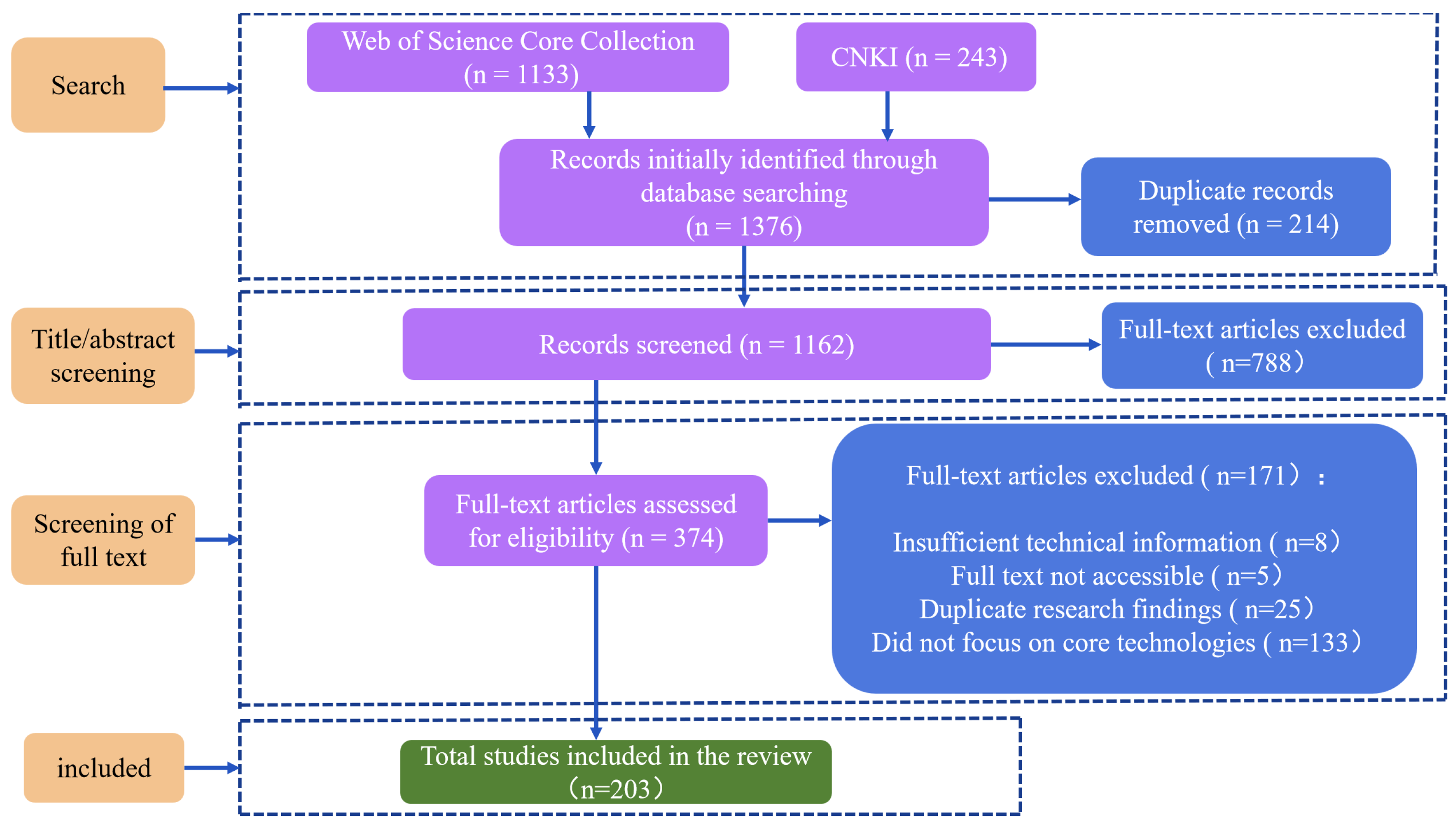
Figure 1. Literature screening flowchart.
Applsci 16 04431 g001
Figure 2. Schematic diagram of grain lodging, harvest loss, and intelligent development of lodged grain harvesting.
Applsci 16 04431 g002
Figure 3. Workflow for grain lodging information acquisition.
Applsci 16 04431 g003
Figure 4. Grain lodging recognition strategy based on UAV RGB imagery.
Applsci 16 04431 g004
Figure 5. Field and plot delineation process based on point cloud data. (a) Angle correction and ground point filtering. (b) Height-Kmeans-DBSCAN clustering segmentation. (c) Boundary delineation of adjacent plots. (d) Fine boundary delineation of the field. Note: (a) Green color represents the true color of the point cloud. (b) Different colors represent the process of experimental plot segmentation. The experimental field is divided first into four sections, and then each section is finely delineated into four experimental plots respectively. (c,d) Red represents the height value of wheat, with closer to red representing higher values. The dark blue line in the terrain change curve represents the distribution of the point cloud in the xz-plane. Reprinted from reference [100] with permission from the copyright holder.
Applsci 16 04431 g005
Figure 6. Performance comparison of representative deep learning models for wheat lodging area extraction at different growth stages. (a) Model performance during the grain-filling stage. (b) Model performance during the maturity stage.
Applsci 16 04431 g006
Figure 7. Coordinated operation of harvesting actuating and control mechanisms.
Applsci 16 04431 g007
Figure 8. Overall architecture of the header height measurement system.
Applsci 16 04431 g008
Figure 9. Robust feedback linearization control structure for general non-affine systems.
Applsci 16 04431 g009
Figure 10. Block diagram of the harvester header height control simulation system.
Applsci 16 04431 g010
Table 1. Comparison of Typical Algorithms for Grain Lodging Detection.
Specific AlgorithmInput DataApplicabilityLimitations
Random ForestMultispectral images; vegetation indicesSuitable for multi-feature fusion (spectrum, texture, elevation) and small-to-medium fields with limited labeled dataTraining can be time-consuming and computationally demanding
Support Vector MachineSpectral and texture featuresHandles non-linear classification problems; suitable for small samples and high-dimensional dataSensitive to parameter selection; slow training on large-scale datasets
Maximum Likelihood ClassificationRGB images; multispectral imagesFast computation and easy deployment; high accuracy when spectral data follow a normal distribution; suitable for real-time monitoring in simple field environmentsWeak noise resistance; field shadows, bare soil, and crop overlap significantly reduce accuracy
DeepLabV3+RGB images; multispectral imagesSuitable for fields requiring precise lodging boundary extraction; Ideal for high-accuracy lodging mapping and large-scale field monitoringLarge model size; slow inference speed
Table 2. Comparison of Control Methods in Terms of Performance and Applicability.
Control MethodControl AccuracyRobustnessCost-
Effectiveness
AdvantagesLimitationsApplicability
Traditional PIDMediumLowHighSimple structure, high reliability, easy deploymentPoor robustness, sensitive to parameter variations and external disturbancesLinear, low-disturbance, and stable operating conditions
Fuzzy PIDMedium–HighMediumMediumStrong adaptability to nonlinearity; no requirement for an accurate mathematical modelLimited ability to suppress sudden strong disturbances; relies on empirical rules; no strict stability proofSuitable for nonlinear, time-varying systems where accurate mathematical modeling is difficult
Robust Feedback LinearizationHighMediumMediumHigh control precision, capable of handling strong nonlinearityRelies on accurate system modeling; weak disturbance rejection abilityNonlinear systems with known models and small disturbances
Robust Trajectory Tracking ControlHighHigh LowStrong robustness, suppresses parameter uncertainties and external disturbances, high tracking accuracyHigh computational cost; complex parameter tuningComplex field environments with disturbances, uneven terrain, grain lodging, etc.
Table 3. Structure and Characteristics of Typical Large-Scale Grain Combine Harvesters.
Name/ModelStructural FeaturesTechnical Characteristics
Case 4088 axial-flow combine harvesterEquipped with a six-bar wide reel; the header is fitted with an electro-hydraulic adjustment system that enables changes in cutting angle and height.Provides effective crop gathering and conveying performance; the electro-hydraulic adjustment of cutting angle and height improves adaptability to different lodging conditions.
DR7130 combine harvesterThe front end is equipped with six crop dividers and a semi-feed vertical header, together with crop-lifting chains and lifting tines.Shows good crop-lifting and guiding performance for lodged rice, with high field harvesting efficiency.
4LZT-6.0ZD rice harvesterAdopts a five-bar eccentric reel; the feeder section is newly designed, and the cutter area is optimized.The spring tines can closely follow the ground to pick up lodged stalks, reducing missed cutting; feeding is smooth, and residual stalks around the cutter are minimal.
John Deere C230 combine harvesterThe cutter adopts a closed wobble-box mechanism, and the feeder house and header can be connected and detached quickly.Features low cutter vibration and high reliability, reducing grain loss caused by vibration; convenient for installation and removal.
Disclaimer/Publisher’s Note: The statements, opinions and data contained in all publications are solely those of the individual author(s) and contributor(s) and not of MDPI and/or the editor(s). MDPI and/or the editor(s) disclaim responsibility for any injury to people or property resulting from any ideas, methods, instructions or products referred to in the content.