Article

Orbital-Driven Stability and Multifunctional Response in XYO3 (X = Nb, Ta; Y = Ag, Au) Cubic Perovskites: A First-Principles Study

by
Łukasz Szeleszczuk
1,*,
Katarzyna Mądra-Gackowska
2 and
Marcin Gackowski
3
1
Department of Organic and Physical Chemistry, Medical University of Warsaw, 1 Banacha Str., 02-097 Warsaw, Poland
2
Department of Geriatrics, L. Rydygier Collegium Medicum in Bydgoszcz, Nicolaus Copernicus University in Torun, 9 Skłodowskiej Curie Str., 85-094 Bydgoszcz, Poland
3
Department of Toxicology and Bromatology, L. Rydygier Collegium Medicum in Bydgoszcz, Nicolaus Copernicus University in Torun, 2 Jurasza Str., 85-089 Bydgoszcz, Poland
*
Author to whom correspondence should be addressed.
Appl. Sci. 2026, 16(9), 4429; https://doi.org/10.3390/app16094429
Submission received: 9 April 2026 / Revised: 27 April 2026 / Accepted: 29 April 2026 / Published: 1 May 2026

Featured Application

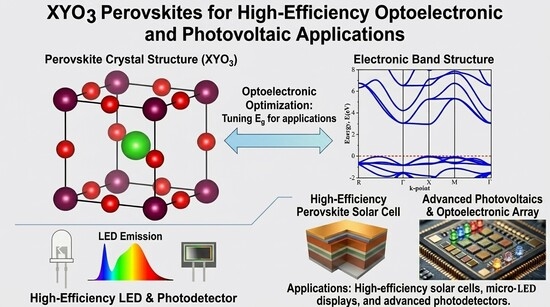
The proposed XYO3 perovskites are promising candidates for photovoltaic and optoelectronic applications, particularly as light-absorbing layers in solar cells and as functional materials in ultraviolet devices, due to their favorable band gaps and strong optical response.

Abstract

Designing stable and multifunctional perovskite materials with tunable electronic and optical properties is crucial for advancing next-generation optoelectronic and high-temperature applications. In this study, the structural, electronic, optical, mechanical, and thermal properties of XYO3 (X = Nb, Ta; Y = Ag, Au) cubic perovskites were systematically investigated using density functional theory (DFT). Each compound crystallized into a cubic perovskite structure and was found to be both thermodynamically and dynamically stable. Hybrid functional (HSE06) calculations indicate semiconducting behavior with band gaps of 1.885 eV (NbAgO3), 1.298 eV (NbAuO3), 3.074 eV (TaAgO3), and 1.801 eV (TaAuO3). The density-of-state analysis reveals strong hybridization between the O-2p and Nb/Ta-d orbitals, which hints at mixed ionic/covalent bonding. Optical properties exhibit large absorption coefficients (about 106 cm−1) in the ultraviolet range and at lower reflectivity, especially of NbAgO3 and TaAgO3, indicating efficient light absorption. NbAgO3 and NbAuO3 possess moderate direct band gaps, making them suitable for optoelectronic and photovoltaic applications, whereas the wide bandgap of TaAgO3 is beneficial in ultraviolet optoelectronic devices. Mechanical analysis confirms the ductile nature of all compounds, with TaAuO3 exhibiting the highest ductility. Thermal analysis indicates that NbAgO3 and TaAgO3 exhibit higher lattice rigidity and thermal conductivity, but NbAuO3 and TaAuO3 are more anharmonic and have higher thermal expansion. Overall, these results demonstrate the multifunctional potential of XYO3 perovskites for applications in optoelectronics, photovoltaics, ultraviolet devices, flexible electronics, and high-temperature environments.

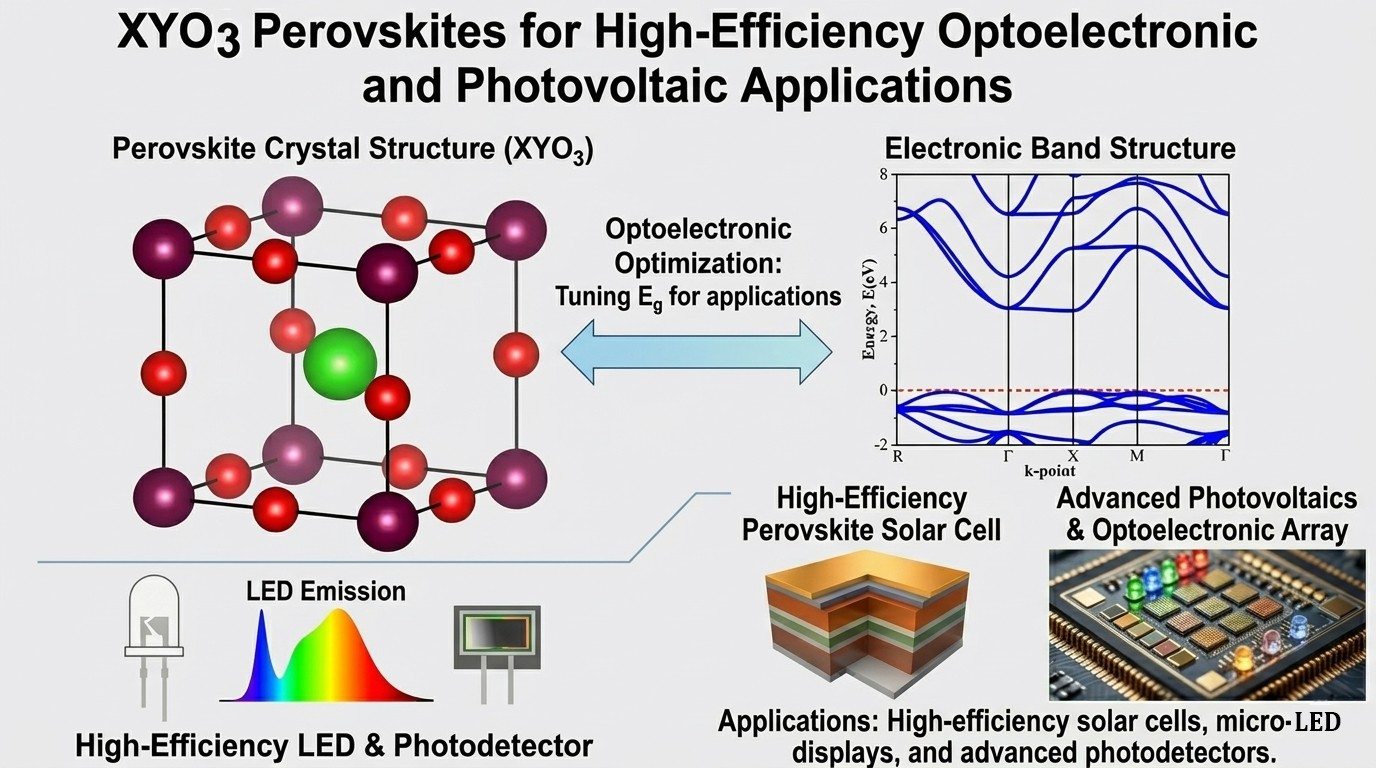
Graphical Abstract

1. Introduction

Transition-metal-based materials have attracted significant interest due to their tunable structural, electronic, and optical properties. Among them, one of the most researched groups of functional materials is cubic perovskite oxides, with the general formula ABO3. They have a high structural stability and multifunctional physical properties which make them a potential target for numerous technological applications. ABO3-type perovskite crystals have been extensively studied with respect to their structural, optical, mechanical, and electronic properties [1]. Solar energy is considered one of the most important environmentally friendly renewable energy sources [2,3]. In recent years, perovskite materials have demonstrated outstanding performance in photovoltaic applications. Perovskite solar cells have shown a rapid increase in power conversion efficiency, rising from 3.8% to 22.1% within a short period [4], highlighting their technological potential. In addition to solar cells, perovskites also have applications in capacitors, ferroelectric thin-film memory applications, sensor applications, piezoelectric actuators and piezoelectric motors [5,6]. Their high carrier mobility, excellent optical absorption, tunable band gap and broad absorption region make them particularly useful in optical devices [7,8]. Although they perform excellently, issues like stability in the long run and reliability under fluctuating temperatures and humidity are of great concern for their practical use. Several substitution methods, such as cation engineering, have been investigated in order to increase stability and optimize optical, electronic, and thermal characteristics. It is believed that due to their ferroelectricity, piezoelectricity, magnetic behavior, and high-temperature conductivity, oxide perovskites are suitable for a wide variety of industrial and scientific applications [9,10].
Perovskite is named after the mineral calcium titanate (CaTiO3), which was first found in the Ural Mountains in 1839 and was named after Gustav Perovski [11]. The perfect perovskite structure is cubic with the general formula ABO3, with an A-site usually occupied by rare-earth or alkaline-earth elements, and a B-site comprising transition-metal cations. Such oxide perovskites exhibit remarkable properties, including ferromagnetism, electrical conductivity, piezoelectricity, and even superconductivity; thus, they are applicable to solar cells, memory storage devices, UV and infrared detectors, optoelectronic modulators, and sensors [10,12,13].
A good number of theoretical and experimental studies have been conducted on several ABO3 systems. K. B. Bhojanaa et al. [14] examined the structural and photovoltaic properties of oxide perovskites for solar cell applications. W. Ullah et al. [15] studied the structural, elastic, electrical, and optical properties of XSrO3 (X = Rb, Cs), while N. Moulay et al. [16] investigated XFeO3 (X = Ag, Zr, Ru). First-principles studies have also been reported for BaCeO3 [17], NdMnO3 [18], NaXO3 (X = Co, Be, Ba) [19], NaXF3 (X = Ni, Co, Be, Ba) [20], NaXO3 (X = Ge, Si) [21], SrTiO3 [22], LaAlO3 [23], CsXO3 (X = Ge, Sn, Pb) [24], NaXF3 (X = Mg, Zn) [25], CeMO3 (M = Co, Cu) [26], BaSnO3 [27], and other ABO3 systems [28,29]. These papers emphasize that the effective use of band gap engineering, especially in the UV-visible regime, is the key to perovskite optimization towards optoelectronics and energy-related use.
Density functional theory (DFT) is a robust and effective method widely used to investigate the fundamental properties of perovskite materials. It allows the correct prediction of structural stability, electronic band structures, optical responses, and mechanical behavior, thus offering key information to experimental implementation and design of devices.
In this study, we conduct a first-principles structural, electronic, optical, and mechanical study of XYO3 (X = Nb, Ta; Y = Ag, Au) perovskite compounds as calculated by the density functional theory (DFT) in the Quantum ESPRESSO package. The systematic study of these compounds through a theoretical study of their physical properties is new to the best of our knowledge. The key aim of this paper is to determine their appropriateness in solar cells and optical electronic devices by examining their structural stability, electronic band structure, optical absorption behavior, dielectric behavior, and mechanical properties. This study provides fundamental insights into their potential as efficient and reliable materials for next-generation photovoltaic and optoelectronic devices.

2. Materials and Methods

All first-principles calculations were carried out using the Quantum ESPRESSO version 7.4.1 simulation package, which employs density functional theory (DFT) within the plane-wave pseudopotential framework [30,31]. The ultrasoft pseudopotentials were adopted from the standard Quantum ESPRESSO library, and the explicitly treated valence electron configurations were as follows: Nb (4p64d45s1), Ta (5p65d36s2), Ag (4d105s1), Au (5d106s1), and O (2s22p4). The mechanical, thermal, structural, electronic and optical properties of XYO3 (X = Nb, Ta; Y = Ag, Au) compounds were studied systematically. The electronic interactions were modeled by their ultrasoft pseudopotentials, which allowed the treatment of the valence electrons with accuracy and decreased the size of the plane-wave basis and computational cost. Exchange-correlation energy was calculated in the generalized gradient approximation (GGA) of the Perdew–Burke–Ernzerhof (PBE) functional. A plane-wave kinetic energy cutoff of 60 Ry was used after rigorous convergence tests in terms of total energy, stress and force had been conducted. A Monkhorst–Pack k-point mesh of 10 × 10 × 10 was used to perform Brillouin zone integrations, which enabled the convergence of total energy and electronic properties to be reliable. The complete structural optimization was performed by keeping down the Hellmann–Feynman forces and the total stress on the unit cell. The convergence thresholds for total energy and forces were carefully chosen to ensure high numerical accuracy. To obtain a more accurate description of the electronic band structures and optical properties, in particular, the band gap, the computations were further reduced to the screened hybrid functional Heyd–Scuseria–Ernzerhof (HSE06) [32], which adds a portion of short-range Hartree–Fock exchange to the traditional GGA in order to better represent the exchange interactions. The HSE06 calculations were performed using the standard 25% Hartree–Fock mixing parameter. Due to the higher computational cost of hybrid functional calculations, a reduced but well-converged k-point mesh (6 × 6 × 6) was used, while maintaining the same plane-wave cutoff energy (60 Ry) to ensure accuracy of the electronic properties. The energy-strain method that is available in the thermo-pw package version 2.1.1 was used to compute the elastic constants [33,34]. Small finite strains were applied to the optimized structure, and the resulting stress–strain relationships were used to derive the independent elastic constants. Mechanical stability was tested on the Born criteria of stability that are relevant to the crystal symmetry. Supercell calculations were also carried out with PHONOPY code version 1.3 [35] and the finite-displacement method in order to further establish dynamical stability and get detailed phonon spectra. A supercell of size 2 × 2 × 2 was created, and the displacement of atoms by 0.01 Å along various crystallographic orientations was introduced to calculate interatomic force constants.

3. Results and Discussion

3.1. Structural Properties

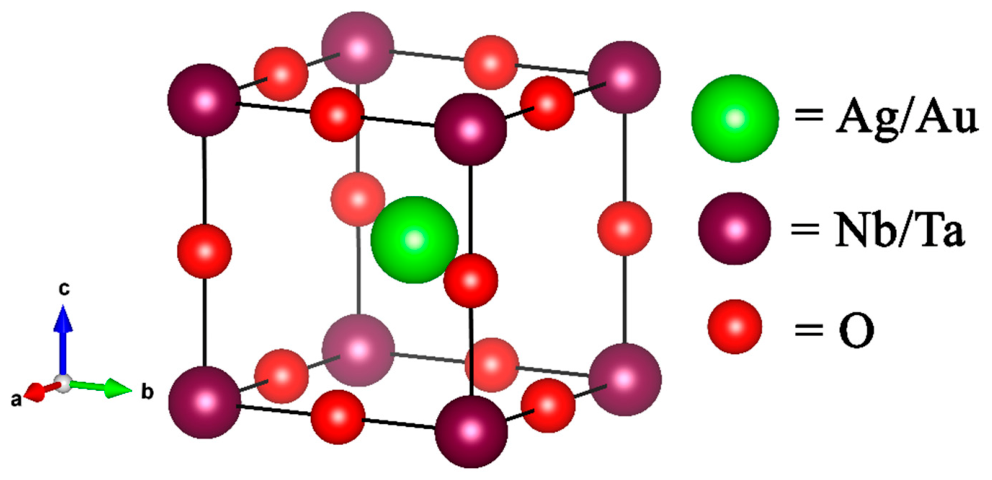
The crystal structures of XYO3 (X = Nb, Ta; Y = Ag, Au) compounds were optimized completely in the framework of density functional theory (DFT) with the minimization of the total energy (Figure 1). Both atomic positions and lattice parameters were fully relaxed to get the ground-state structure. High structural symmetry was maintained by finding all the compounds that crystallize in the desired cubic perovskite structure (space group Pm-3m, No. 221). The X atom (Nb or Ta) is on the Wyckoff position 1a (0, 0, 0), the Y atom (Ag or Au) is on 1b (0.5, 0.5, 0.5) and the oxygen atoms are on the 3d (0.5, 0, 0) positions, which constitutes a common ABO3 structure. This atomic arrangement is consistent with the standard cubic perovskite configuration.
Table 1 contains the calculated lattice constants (a), the volumes of the unit cell (V), the percentage deviations and the formation energies (Ef). The optimized values of the lattice parameters suggest that the structural dimensions of all the analyzed compounds are very similar. The small changes in the lattice constants are caused by changes in the radii of the ions and electronic configurations, Nb/Ta and Ag/Au cations. The highest level of deviation in the lattice parameter from the available reference value is about 0.39%, which indicates the reliability and accuracy of the current method of calculation.
The thermodynamic stability of the XYO3 compounds was determined by computing the formation energy using the following formula [37]:
E f X Y O 3 = E T o t a L X Y O 3 ( A E s o l i d X + B E s o l i d Y + C E s o l i d O ) A + B + C
where A, B, and C represent the number of X (Nb, Ta), Y (Ag, Au), and O atoms in the unit cell, respectively. E T o t a L X Y O 3 denotes the total energy of the compound, while E s o l i d X ,   E s o l i d Y and E s o l i d O correspond to the energies of the constituent elements in their stable bulk phases. The calculated formation energies for all studied compounds are negative, indicating that these materials are thermodynamically stable and energetically favorable for formation.
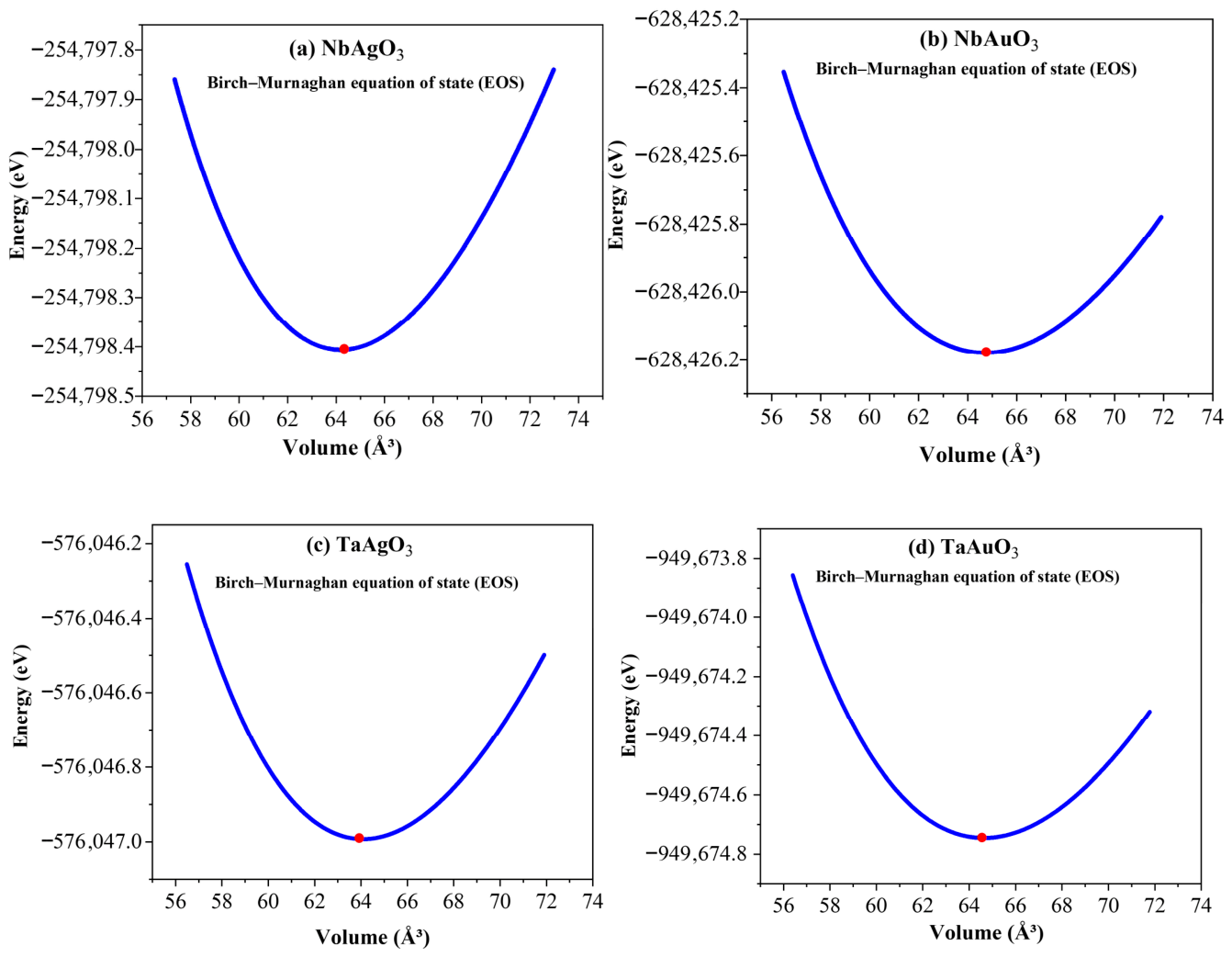
Moreover, the optimization of volume was done to identify the equilibrium volume at the lowest total energy. The data on energy and volume was fitted with the third-order Birch–Murnaghan equation of state [38,39,40]. The resulting E-V curves are parabolic with a single well-developed minimum of each compound, which shows that a stable equilibrium configuration exists. The fact that there are no secondary minima indicates that there is no structural phase transition within the investigated volume range. These findings also support the structural stability of the cubic phase, which is indispensable in the accurate prediction of their electronic and optical behavior (Figure 2.).

3.2. Dynamical Stability

Dynamical stability is the capacity of a crystal to resist small atomic movements due to thermal vibrations or external disruption. The dispersion phonon curves in this property can be studied by computing phonon dispersion curves either with density functional perturbation theory (DFPT) or the finite displacement method [41,42]. In the current work, the calculation of phonons was done with the finite displacement method, implemented in the PHONOPY package [35]. We determined the interatomic force constants by use of a (2 × 2 × 2) supercell and atomic displacements of 0.01 Å in each of the lattice directions.
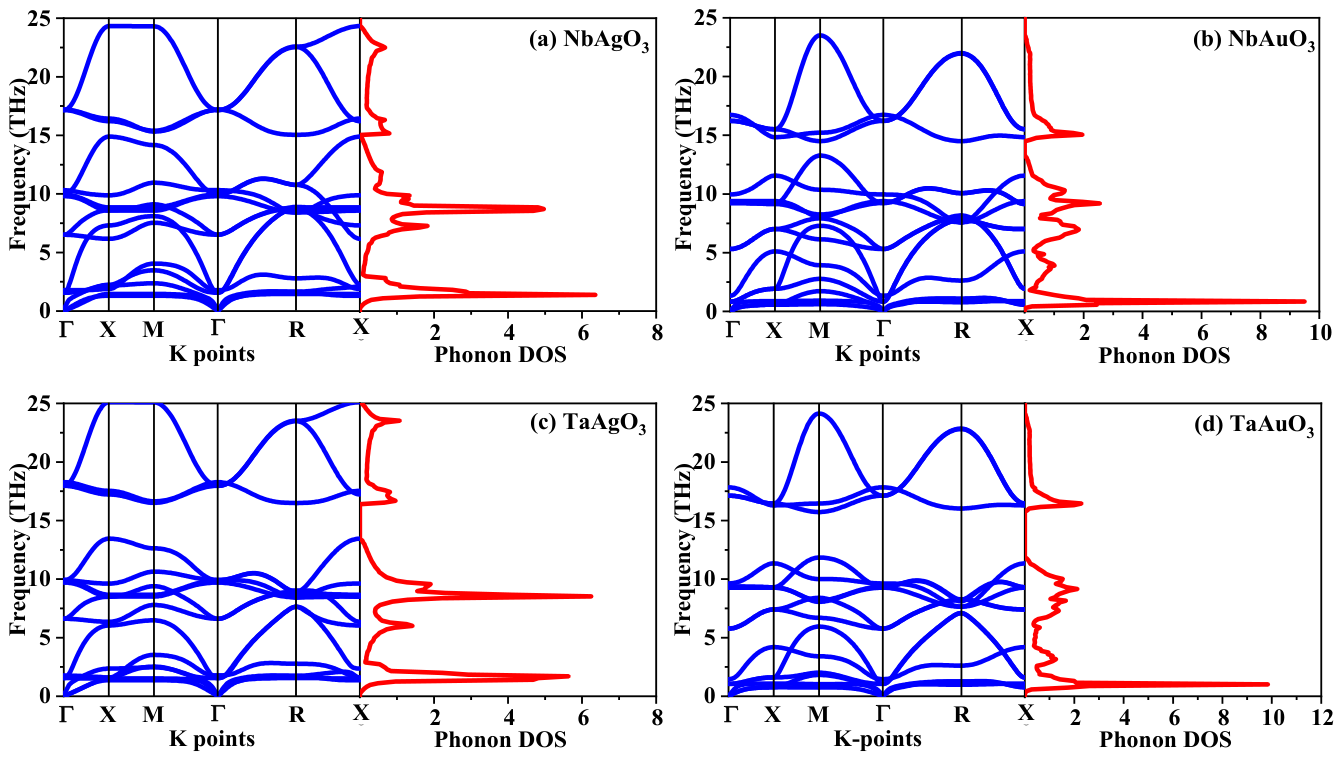
Phonon frequencies were studied throughout the Brillouin zone. Positive phonon frequency is dynamical stability and negative (imaginary) phonon frequency is structural instability. In Figure 3a–d, none of the imaginary frequencies are presented on phonon dispersion curves of XYO3 (X = Nb, Ta; Y = Ag, Au) compounds. This proves the claim that all of the materials studied are, in the cubic state, dynamically stable. The dynamical properties of these compounds have not yet been experimentally reported and therefore this theoretical study is especially significant. The phonon dispersion curves (PDCs) also give more information on the lattice vibrational behavior. The primitive unit cell has five atoms; thus, it is evident that it exhibits a total of 15 vibrational modes that comprise three acoustic and twelve optical modes. At the Γ-point, the three acoustic branches are developed starting with a frequency of zero and a linear dispersion relation (ω = vk) at small wave vectors, which are the lattice sound waves. The other 12 modes are optical modes that can be generated as a result of the out-of-phase atomic vibrations in the unit cell. The phonon branches being smoothly and well-spaced also helps to confirm the stability of the lattice and the existence of strong interatomic bonding between the perovskite structures.

3.3. Electronic Properties

3.3.1. Band Structure and Density of States

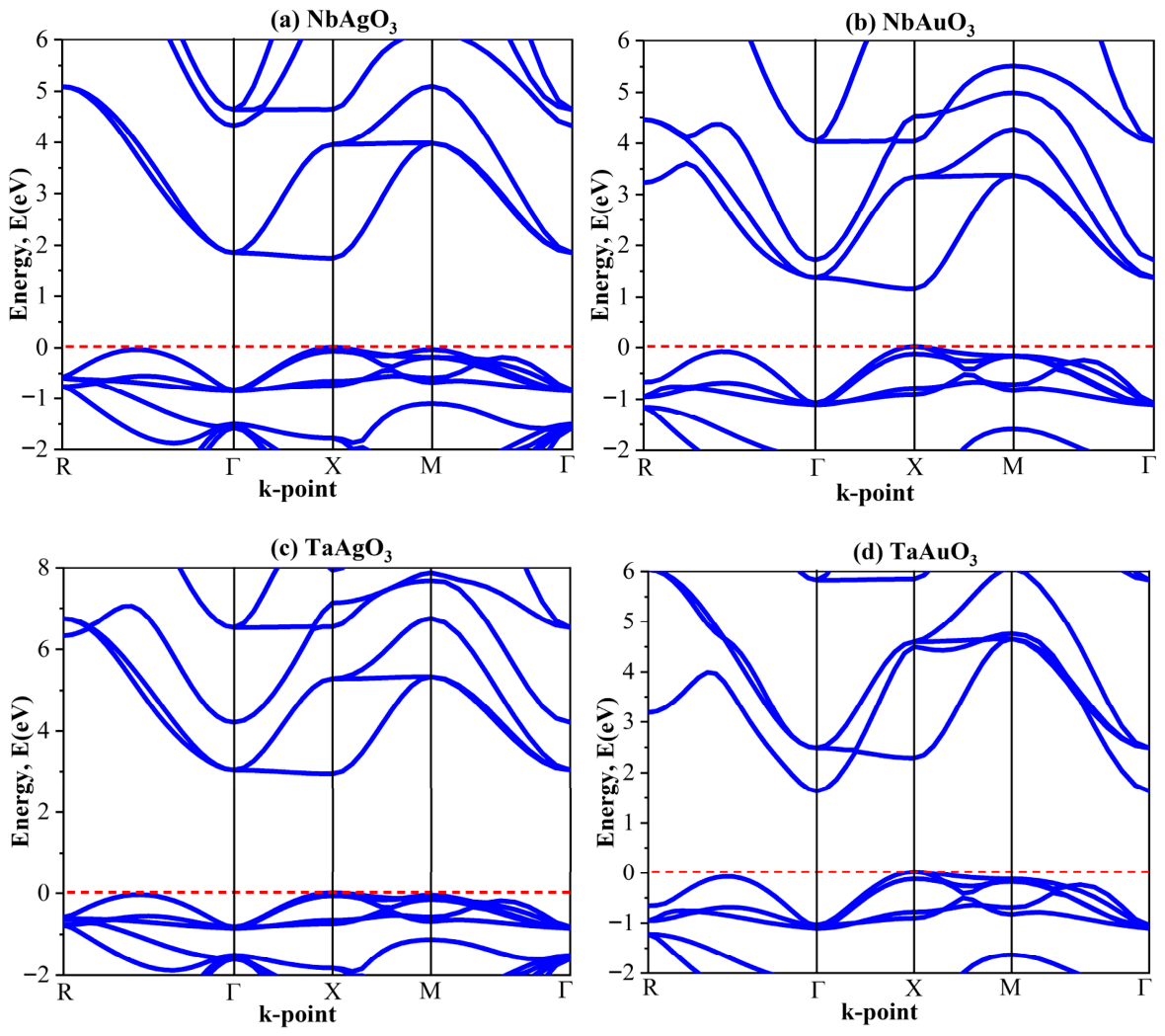
The electronic properties of XYO3 (X = Nb, Ta; Y = Ag, Au) were examined with the help of the calculated band structures, total density of states (TDOS), and partial density of states (PDOS), which give more information on the bonding properties and the electronic behavior of these cubic perovskites. Figure 4 illustrates the band structures along the high-symmetry directions in the Brillouin zone, in which the horizontal dashed line marks the Fermi level (EF). Examination of the band dispersion shows that NbAgO3, NbAuO3 and TaAgO3 all have a direct band gap transition because both their valence band maximum (VBM) and their conduction band minimum (CBM) occur at the same k-point. Conversely, TaAuO3 behaves as an indirect bandgap, with VBM and CBM at distinct k-points in reciprocal space.
The computed values of the band gaps with GGA-PBE and HSE06 exchange-correlation functionals are shown in Table 2. In the GGA-PBE approximation, the band gaps are 1.602 eV (NbAgO3), 0.180 eV (NbAuO3), 1.934 eV (TaAgO3), and 0.145 eV (TaAuO3). The values of the extremely small gap are projected on NbAuO3 and TaAuO3, which points to an almost metallic behavior in PBE, which can be explained by the fact that semi-local functionalities tend to underestimate band gaps. More credible outcomes were obtained using the screened hybrid Heyd–Scuseria–Ernzerhof functional (HSE06). HSE06 band gaps are calculated and found to increase significantly to 1.885 eV (NbAgO3), 1.298 eV (NbAuO3), 3.074 eV (TaAgO3), and 1.801 eV (TaAuO3), which clearly shows that all the compounds studied are semiconducting. Among the studied compounds, only NbAgO3 has been experimentally synthesized (with limited available data), while NbAuO3, TaAgO3, and TaAuO3 are newly predicted in this work, which restricts direct experimental benchmarking and motivates the use of well-established hybrid functionals such as HSE06 for reliable electronic structure predictions. Application-wise, when compared to the Shockley–Queisser limit (1.34 eV in single-junction solar cells) [42,43]. Thus, NbAuO3 could be a potential solution to solar energy conversion. TaAuO3, with a moderately larger band gap (1.8012 eV), may be appropriate in tandem solar cell designs or as a wide-band-gap absorber layer. In the meantime, TaAgO3 (3.074 eV) has a large band gap, which qualifies it as a good material in ultraviolet optoelectronic applications instead of traditional photovoltaic systems.
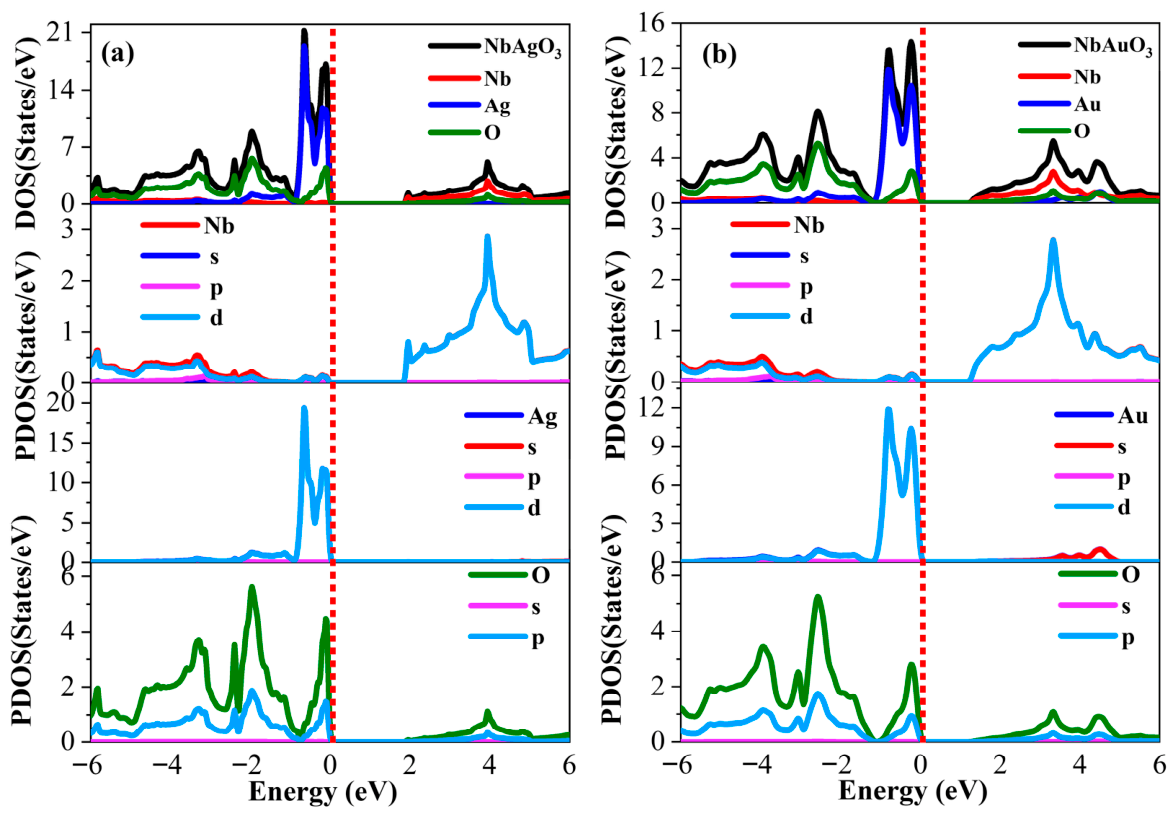
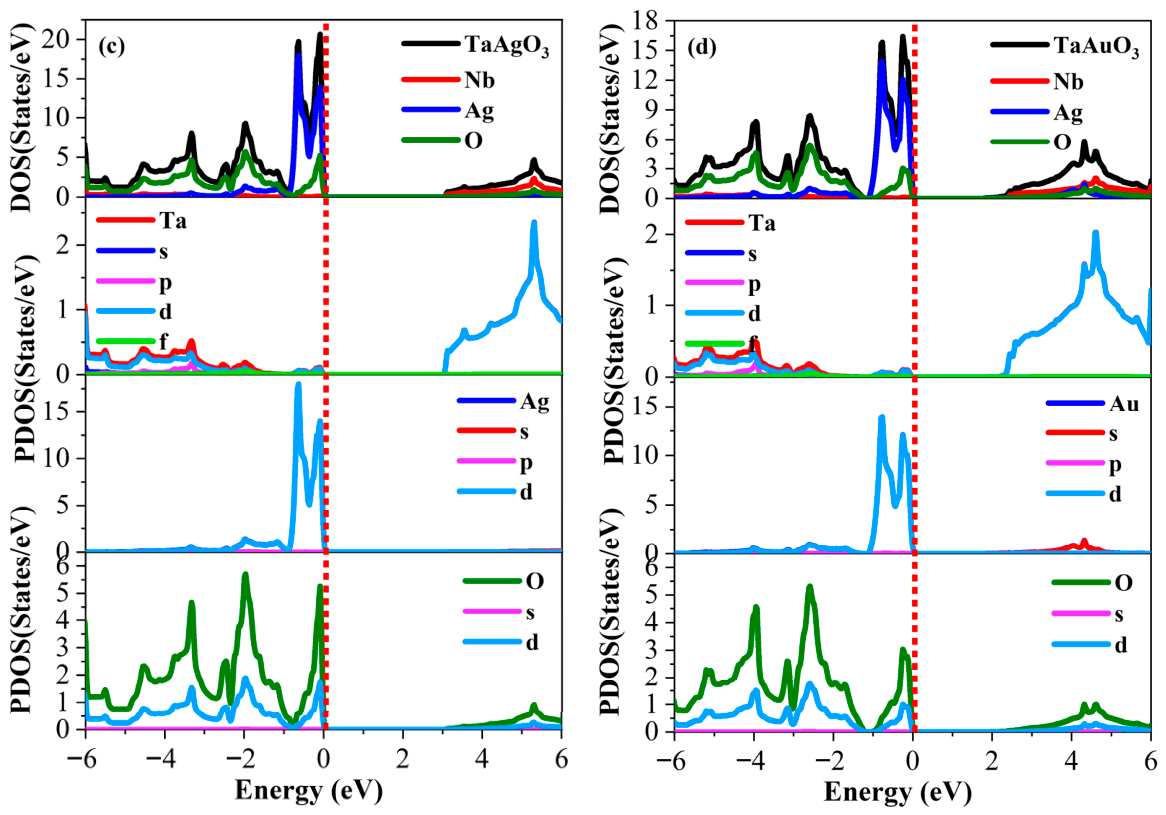
In order to further explain the contributions of orbitals in forming the bands, the TDOS and PDOS were calculated, as shown in Figure 5. The Fermi level was set to 0 eV (vertical dashed line). It appears that a band gap around EF exists in all compounds, in line with the results of the band structure, and is indicative of how the compounds behave as semiconductors. The electronic states in the valence band region (below 0 eV) are dominated by O-2p orbitals, with Nb-4d or Ta-5d states playing a major role as the hybrid between the two. Such a high level of p-d hybridization suggests that the oxygen and the transition-metal atoms are covalently interacting to a great extent and this is an important factor in determining the nature of the bonding. There are also contributions to the deeper valence bands (around −5–3 eV) which are caused by Ag-4d or Au-5d states and O-2p orbitals, indicating the further effects of hybridization. In the conduction band region (above 0 eV), the states are primarily governed by Nb–4d or Ta–5d orbitals, indicating that the CBM mainly originates from transition-metal d states. The Ag and Au atoms contribute less near the conduction band edge but show noticeable peaks at higher energies. The general results of the DOS analysis show that the VBM is mainly O-p in nature, and CBM consists of transition-metal d states. Therefore, the electronic structure is dominated by p-d orbital interactions and to a large extent defines the optoelectronic properties of the XYO3 compounds.

3.3.2. Electronic Charge Density

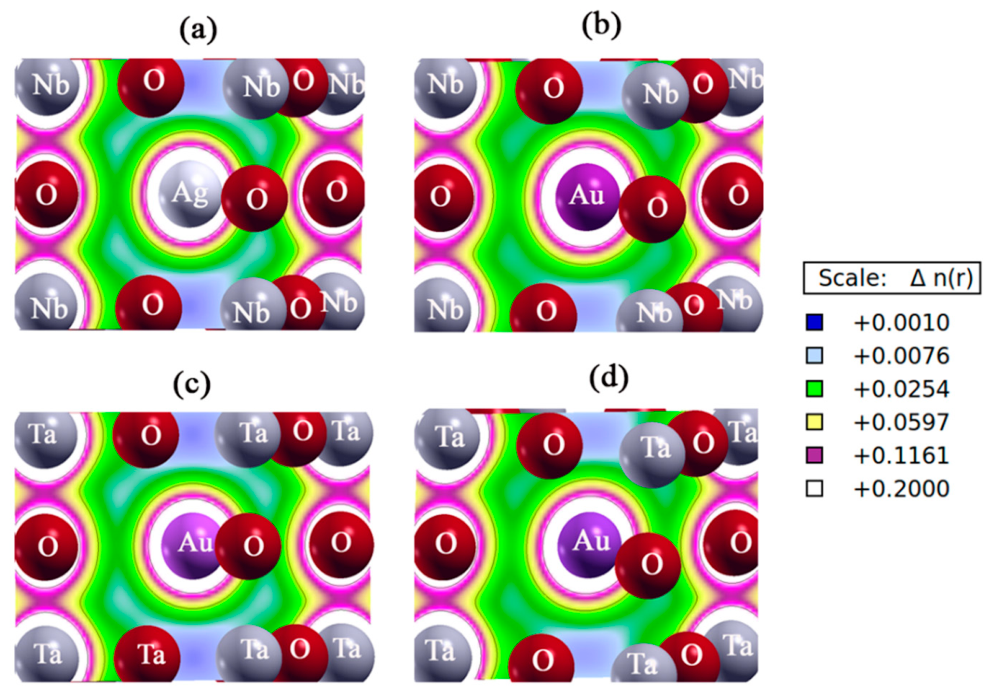
The electronic charge density contour plots of XYO3 (X = Nb, Ta; Y = Ag, Au) are presented in Figure 6a–d to examine the bonding characteristics and charge distribution within the cubic perovskite framework. The accumulation of the charge is seen to be strong around the oxygen atoms, which are highly electronegative; therefore, the charge transfer between the metal cations and oxygen is significant. This action proves the prevailing ionic contribution towards the bonding network. A significant overlap of charges can be seen between the X-site cations (Nb/Ta) and oxygen atoms, indicating that there is a lot of hybridization between the Nb-4d/Ta-5d and O-2p orbitals. This d-p hybridization provides a partial covalent character to the X-O bonds as well as enhancing the BO6 octahedron structure in the perovskite structure. Conversely, the density of charges around Ag and Au atoms is more localized and almost spherical and has a less strong overlap with oxygen atoms. This implies that ionic interaction is observed more often in the Y-O interaction rather than X-O bonding. Replacement of Nb with Ta produces a minor increase in charge localization as the 5d orbitals of Ta have been found to be more spatially extended. Equally, the substitution of Ag with Au alters the distribution of electrons due to relativistic variations in electron number. In general, the charge density analysis indicates that XYO3 compounds have a mixed ionic–covalent bonding nature. Powerful X-O covalent bonds and relatively ionic Y-O bonding are known to help provide stability to structures and highly affect their electronic and optical characteristics. It is noted that spin–orbit coupling (SOC) effects were not included in this work; however, they may have a noticeable influence on the electronic and optical properties of compounds containing heavy elements such as Ta and Au, and will be considered in future studies.

3.4. Optical Properties

The response of a material to incident electromagnetic radiation is directly related to its optical properties. The response to visible light is particularly important for optoelectronic applications. The energy-dependent parameters that define the response to incident radiation include dielectric function, refractive index, loss function, conductivity, reflectivity and absorption coefficient.
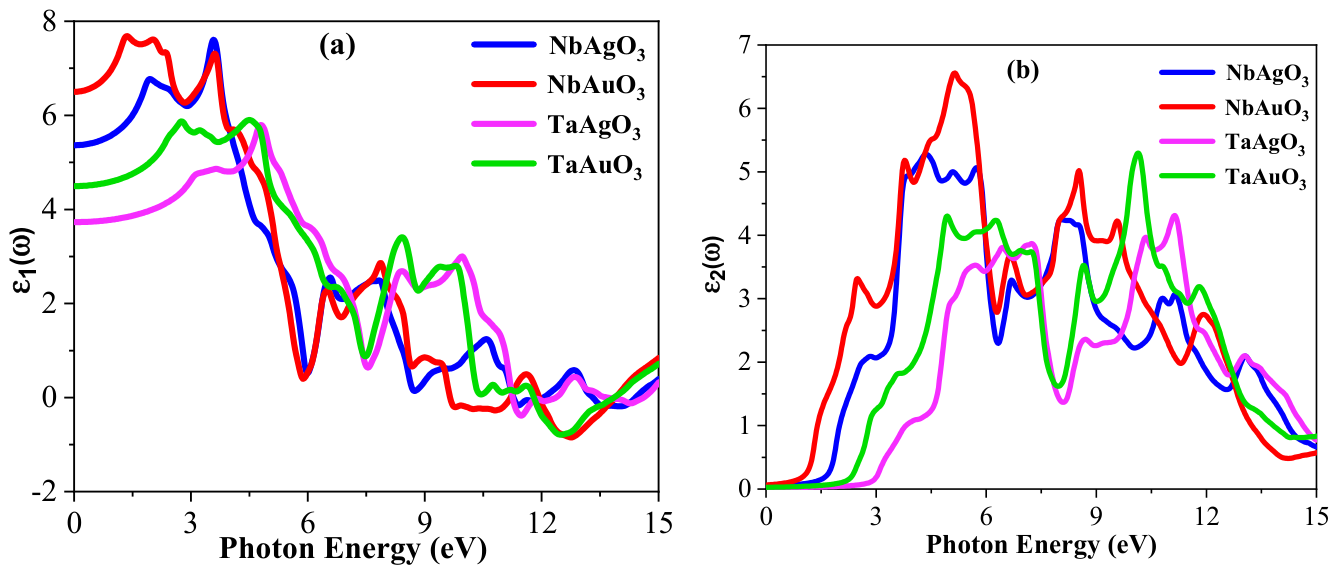
Figure 7a,b give the real (ε1) and imaginary (ε2) components of the XYO3 materials’ dielectric function. As shown in Figure 7a, for ε1(ω) at low photon energies, all the compounds have positive values which constitute normal dielectric behavior, with NbAgO3 and NbAuO3 having large initial values when compared to Ta-based compounds. With increased photon energy, the ε1(ω) values of all materials acquire multiple peaks and valleys, which represent interband electronic transitions. It is noteworthy that NbAuO3 exhibits a sharp peak of around 2–3 eV and the oscillation gradually decreases, whereas TaAuO3 and TaAgO3 exhibit a gradual decrease with small oscillations. At higher photon energies (>10 eV), ε1(ω) tends to take on a value of zero or a small negative value, which implies the appearance of a metallic-like response or plasma resonance.
In Figure 7b, representing ε2(ω), every material begins at zero at very low photon energies, as is required, since no optical absorption occurs at frequencies below the band gap. The highest absorption peak is at 5.13 at 6.59 eV, which corresponds to strong interband transitions, but the values of the peaks are slightly lower in NbAgO3 and Ta-based compounds. All compounds exhibit several peaks of up to 12 eV, arising from complex electronic transitions with various energy bands. At higher photon energies (above 12 eV), ε2(ω) declines slowly to 1, which implies that optical absorption is reduced in the high-energy regime. Overall, the dielectric response indicates that NbAuO3 possesses the highest optical activity, whereas TaAgO3 and TaAuO3 have relatively smooth and moderate dielectric responses in the energy range under investigation.
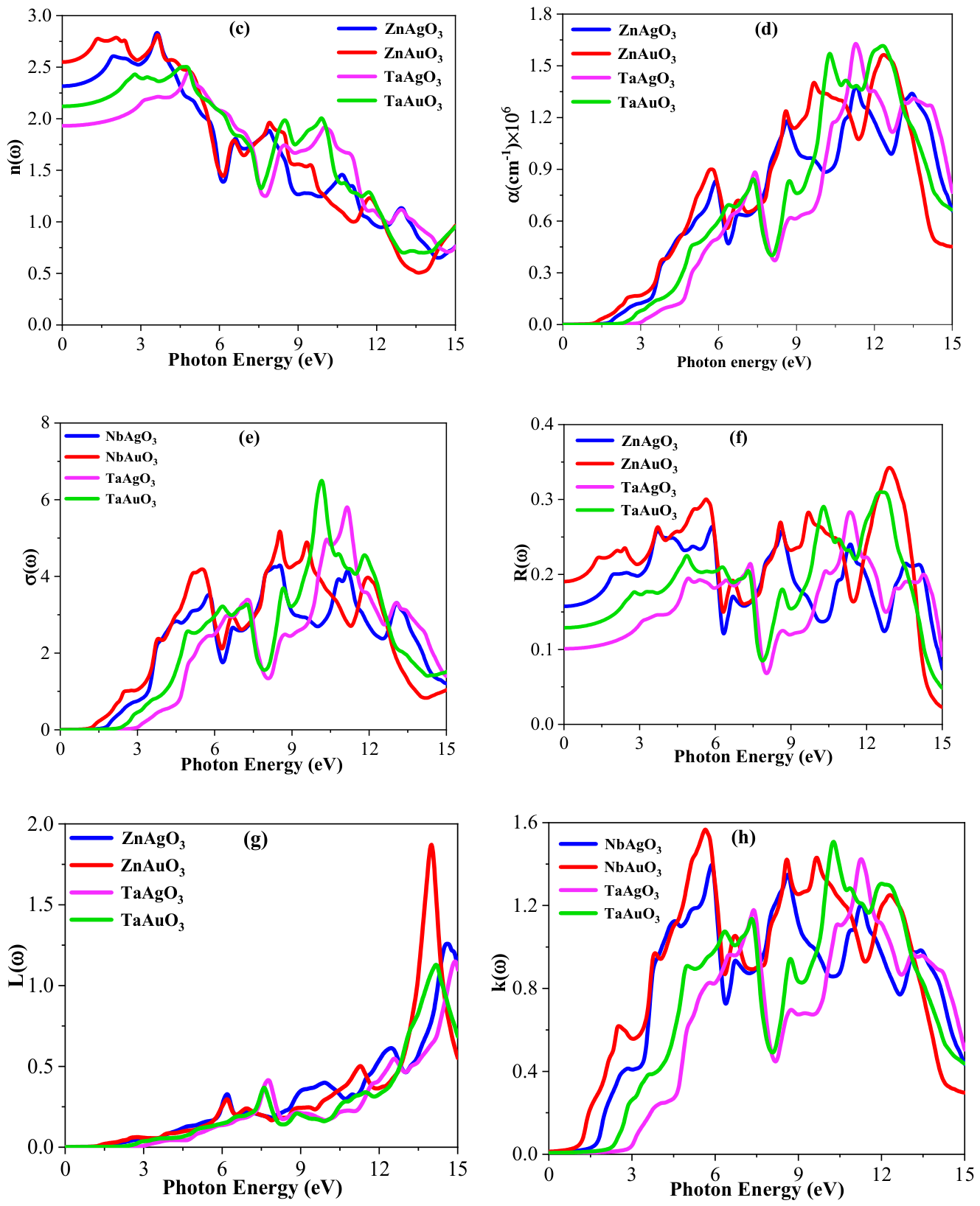
The refractive index n(ω) determines the phase velocity of electromagnetic radiation traveling across the material, and this is shown in Figure 7c. The obtained values of the static refractive indices n(0) are 2.31, 2.55, 1.92, and 2.12 in NbAgO3, NbAuO3, TaAgO3, and TaAuO3, respectively. n(ω) at low and intermediate energies, as well as at high energies, has a number of dispersive characteristics because of interband electronic transitions as the photon energy increases. At high energies, the refractive index tends to decrease progressively, which means that the refractive index has a weaker polarization response at higher photon energies.
The absorption coefficient α(ω) is a critical parameter of the potential of a material in the conversion of solar energy, since it is used to determine the depth of incident photons when fully absorbed [44]. As Figure 7d shows, absorption spectra of NbAgO3, NbAuO3, TaAgO3 and TaAuO3 begin at 1.72 eV, 1.29 eV, 2.97 eV and 2.29 eV, corresponding to the optical band gap energies of the materials, respectively. These onset energies are generally consistent with the HSE06-calculated band gaps; however, slight deviations are observed in some cases. For example, TaAgO3 exhibits a band gap of 3.074 eV, while the absorption onset appears at approximately 2.97 eV. This small redshift can be attributed to the finite energy resolution used in the optical spectra calculation, the smearing parameter employed in the dielectric function evaluation, and the presence of weak tail states arising from band-edge transitions. Such effects are commonly reported in first-principles optical studies and do not significantly affect the overall agreement between electronic and optical band gaps.
The absorption in the lower energy region below these threshold energies is almost zero, which represents no allowed interband electronic transition. As the photon energy increases, the absorption coefficient rises extremely fast, and peaks in the high energy region (around 10–13 eV), primarily because strong interband transitions between the valence and conduction bands occur. NbAgO3, NbAuO3, TaAgO3 and TaAuO3 have maximum absorption coefficients of about 1.38 × 106 cm−1 at 11.25 eV, 1.56 × 106 cm−1 at 12.36 eV, 1.62 × 106 cm−1 at 11.27 eV and 1.61 × 106 cm−1 at 12.36 eV, respectively. It should be noted that the optical band gap values reported here are estimated from the absorption onset of the calculated spectra, and no Tauc plot analysis has been performed. The absorption of all compounds reduces gradually at increased photon energy. Intraband transitions dominate the infrared region, whereas the observed peaks at higher photon energies arise from interband electronic transitions. Moreover, it can be observed that the optical conductivity obeys the same tendency as the absorption coefficient, as can be seen in Figure 7d,e. This similarity implies that the photoconductivity increases with increasing photon energy, which states that the generation of charge carriers is directly related to interband electronic transitions [45].
The real part of the photoconductivity spectrum, σ(ω), of XYO3 (X = Nb, Ta; Y = Ag, Au) compounds, as demonstrated in Figure 7e, remains at zero up to a certain photon energy and then increases with further increases in photon energy. This is in line with the band structure calculations for the electrons that are found in Figure 4. NbAgO3, NbAuO3, TaAgO3, and TaAuO3 have maximum values of 4.27, 5.17, 5.79, and 6.49 respectively, at 8.55 eV, 8.53 eV, 11.11 eV, and 10.16 eV respectively. Of these compounds, TaAuO3 shows the largest peak intensity, indicating that interband electronic transitions are stronger in the ultraviolet region than for the other materials that were studied.
Figure 7f illustrates the reflectivity spectra, R(ω), of XYO3 (X = Nb, Ta; Y = Ag, Au) compounds. In the low-energy range (infrared to visible range), all compounds are moderately reflective with a value in the order of 10–20%. Of these, NbAuO3 displays a relatively greater reflectivity in the low-energy region, and then NbAgO3, TaAuO3 and TaAgO3. A number of strong peaks can be observed in the intermediate- and high-energy photons, which are a result of interband transitions. It is found that the maximum values of reflectivity are approximately 0.26, 0.34, 0.28, and 0.30 for NbAgO3, NbAuO3, TaAgO3, and TaAuO3 in the near-ultraviolet region (~10–13 eV). NbAuO3 has the greatest reflectivity peak among these compounds. The relatively high reflectivity in the low-energy region indicates an enhanced carrier response and the sharp peaks in the high-energy region are a result of the electronic transition between the valence and the conduction bands. The average total reflectivity indicates that they are not highly reflective metals but could be useful in optoelectronic applications and UV applications.
Figure 7g displays the photon energy loss spectra, L(ω). The energy loss function is a characterization of the energy dissipation of a fast electron passing through a material. The peaks at 14–15 eV, with the highest intensities being 1.26, 1.88, 1.15, and 1.13 for NbAgO3, NbAuO3, TaAgO3, and TaAuO3, respectively, can be explained by the plasma resonance behavior [46]. These peak energies are followed by a reduction in loss intensity, indicating that the energy dissipation at very high photon energies is also lower.
Lastly, the extinction coefficient k(ω) rises with photon energy and has multiple peaks as a result of interband transitions. The peak of NbAuO3 is at 5.86 eV, whereas the peaks of NbAgO3 and TaAuO3 are at similar magnitudes but with a small difference in their energies. The extinction values are relatively lower for TaAgO3. k(ω)’s behavior is quite similar to that of ε2(ω), which is expected to confirm that interband electronic transitions are the main driving force of optical attenuation.

3.5. Mechanical Properties

The basic parameters of mechanical stability, stiffness, ductility/brittleness, and anisotropy in crystalline solids depend on elastic constants. The elastic constants, Cij, of XYO3 (X = Nb, Ta; Y = Ag, Au) were determined in the current work by the use of the linear finite stress–strain method. Under Hooke’s law, a plot of stress and strain is represented as follows:
σ i = j = 1 6 C i j ϵ j
in which σ and ε are the stress and strain, respectively. In a cubic crystal system, there are only three independent elastic constants, namely C11, C12 and C44 [47]. Born stability criteria are one of the methods to check the mechanical stability of a cubic system [48,49]:
C11 − C12 > 0, C11 + 2C12 > 0, C11 > 0, C44 > 0
These conditions can be associated with shear and spinodal stability conditions, where C11 + 2C12 > 0, and a positive bulk modulus is guaranteed [50]. All the calculated elastic constants meet these requirements as presented in Table 3, and it is clear that the XYO3 compounds are mechanically stable. TaAgO3 has the largest C11 value (428.43 Gpa); this means that it will resist uniaxial deformation along the {100} direction better than the others evaluated in the study. Under any circumstance, C11 > C12, and then in all cases, there is greater incompressibility in the principal crystallographic axis relative to shear-related directions of deformation.
The parameter named Kleinman (ζ) is the relative displacement of the cation and anion sublattices under volume-conserving strain distortions [51,52,53]. It is defined as follows:
ζ = C 11 + 8 C 12 7 C 11 + 2 C 12
where 0 ≤ ζ ≤ 1. ζ → 1 indicates bond-bending dominance and ζ → 0 indicates bond-stretching dominance. The calculated ζ values (0.373–0.471) indicate mixed bonding characteristics for all compounds, with a slight dominance of bond-stretching behavior. Notably, Au-based compounds (NbAuO3 and TaAuO3) are relatively more active with high zeta values implying that they have a higher bond-bending contribution and stronger directional bonding than other Ag-based systems.
The Cauchy pressure (CP) is defined as
CP = C12 − C44.
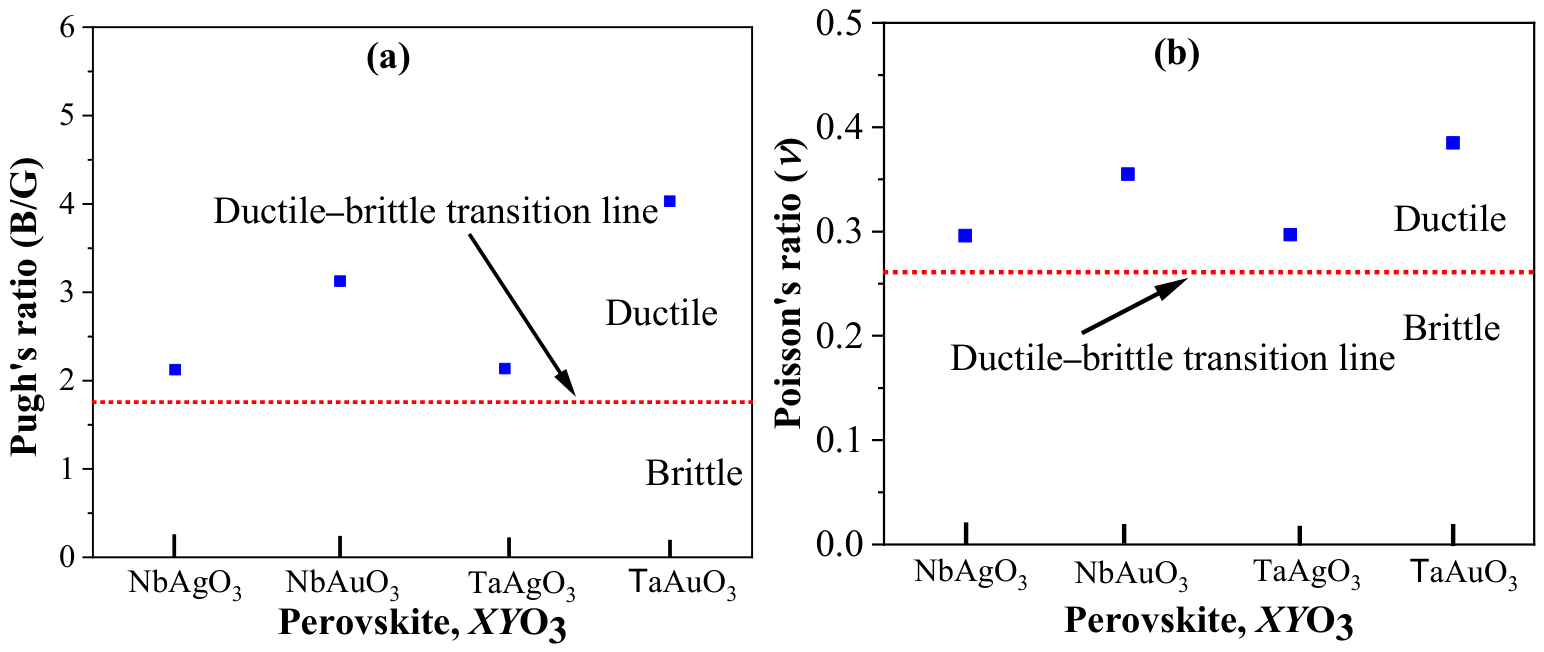
It is a sign of the bonding nature [54]. Positive values of CP are usually related to a ductile nature and metallic/ionic bonding, but negative values mean a brittle nature and covalent nature. All the calculated values of CP are positive (Table 3); thus, the XYO3 compounds are predicted to be ductile (Figure 8).
The Voigt–Reuss–Hill averaging scheme was used to get the bulk modulus (B) and shear modulus (G) [55,56]. The values of Young’s modulus of elasticity (Y) and Poisson’s ratio (ν) were determined using standard formulae [57]. Bulk modulus is a measure of the resistance to change in volume and the mean strength of bonds [58]. Table 4 summarizes all these calculated elastic parameters. The Poisson ratio (ν) and Pugh ratio (B/G) are universal numbers that are used to test the ductile or brittle character of materials. Based on the known criterion [59], brittle materials have a ν of less than 0.26, and materials with 0.26 and above are ductile. On the same note, according to the criterion developed by Pugh, materials with a B/G above 1.75 are ductile, whereas those with a B/G below 1.75 are considered brittle. Based on Table 4, all the studied XYO3 compounds have a Poisson’s ratio exceeding 0.26 and a B/G ratio that is more than 1.75, which is a clear indication of ductile properties. Of these, TaAuO3 has the highest B/G ratio (4.030) and Poisson’s ratio (0.385) and exhibits a relatively higher ductility in comparison with the rest of the compounds.
According to the machinability index (B/C44) [60], materials with a lower shear resistance (less C44) are more machinable. TaAuO3 is the material with the best B/C44 (8.247), which means improved machinability. The Zener anisotropy factor is used to determine elastic anisotropy:
A = 2 C 44 / ( C 11 C 12 )
For isotropic materials, A = 1. All the compounds show a deviation of the calculated A values, indicating that they are anisotropic in elasticity, and this could affect crack propagation and the behavior of microstructures [61].
The hardness was determined based on models by Chen and Miao [62,63]:
H M i a o = ( 1 2 ν ) Y 6 ( 1 + ν )   a n d ,     H C h e n = 2 [ G B 2 G ] 0.585 3
Chen’s model defines superhard materials as those that are hard, with a hardness of more than 40 GPa [63]. All the XYO3 compounds that were studied did not reach this threshold. Nevertheless, TaAgO3 had the greatest values of hardness, which is in line with the highest possible values of C44 and the shear modulus. The estimated elasticity values affirm that all XYO3 compounds are mechanically stable, ductile, anisotropic, and moderately hard substances, with TaAgO3 being the stiffest and hardest and TaAuO3 the most ductile and machinable.

3.6. Thermal Properties

This part explores some of the key thermodynamic parameters of XYO3 compounds such as the Debye temperature, minimum thermal conductivity, lattice thermal conductivity, Grüneisen parameter, melting temperature, thermal expansion coefficient, and specific heat capacities. The thermal properties were also computed in the same manner as the electronic, optical and mechanical properties of the ordered structures of the structures studied.
The Debye temperature (θD) is a significant parameter that is used to indicate the temperature of the highest normal mode of vibration of a crystal. The average sound velocity (Vm) can be calculated based on the bulk and shear moduli of the material, that is, on based on the elastic constants. The Debye temperature can be determined based on the following expression [64,65]:
θ D = h k B [ ( 3 n 4 π ) N A ρ / M ] V m
where h, kB, n, NA, ρ, and M represent Planck’s constant, Boltzmann’s constant, the number of atoms per formula unit, Avogadro’s number, mass density, and molar mass, respectively.
The average sound velocity in polycrystalline materials can be approximated as follows:
V m = [ 1 3 ( 1 v l 3 + 2 v t 3 ) ] 1 3
where vl and vt denote the longitudinal and transverse sound velocities. These velocities are related to the elastic moduli and density of the material and can be calculated using Navier’s equations:
V l = [ ( 3 B + 4 G ) / 3 ρ ] 1 2   a n d   V t = [ G / ρ ] 1 2
Usually, the longitudinal sound velocity is greater than the transverse sound velocity since the propagation of longitudinal sound waves does not need a lot of resistance compared to transverse sound waves, which require stronger interactions of atoms.
The computed values of transverse (vt), longitudinal (vl) and average (vm) sound velocities indicate some observable differences between the compounds examined (Table 5). The largest sound velocities are achieved with NbAgO3, which has stronger interatomic bonding and more lattice rigidity. Conversely, TaAuO3 has the lowest sound velocities, indicative of relatively weak bonding strength and weaker lattice behavior.
The Debye temperature (θD), which is directly related to lattice vibrations and thermal characteristics, has a similar pattern to the sound velocities. The Debye temperatures follow the order NbAgO3 (521.25 K) > TaAgO3 (473.33 K) > NbAuO3 (389.68 K) > TaAuO3 (306.68 K), indicating that Ag-based compounds have stronger interatomic bonding and stiffer lattice dynamics compared to Au-based ones. The larger the Debye temperature, the more intense the interatomic interactions and the more rigid the lattice dynamics, and the lower the Debye temperature, the softer the lattice dynamics. On the whole, the findings indicate that Ag-based compounds have higher sound velocities and Debye temperatures compared to Au-based ones, which implies relatively stronger bonding and stiffness of the lattice.
The lattice thermal conductivity (Kph) of XYO3 compounds was estimated using Slack’s empirical model [66], which describes heat conduction due to lattice vibrations:
K p h = A ( γ ) M a v Θ D 3 γ 2 n 2 / 3 T
where Mav is the average atomic mass, n the number of atoms in the unit cell, T is the temperature and γ is the Grüneisen parameter, representing lattice anharmonicity. The Grüneisen parameter can be obtained through the following expression:
γ = 3 ( 1 + υ ) 2 ( 2 3 υ )
The measured values of the Grüneisen parameter are 1.748 to 2.458, with the largest of them achieved in TaAuO3, which suggests that it has greater lattice anharmonicity than the other compounds. The coefficient A(γ) is calculated as follows:
A ( γ ) = 4.85628 × 10 7 2 ( 1 0.514 γ + 0.228 γ 2 )
Based on Clarke’s modified model, the theoretical minimum thermal conductivity was estimated [67]:
K m i n = K B V m M n ρ N A   2 3
Table 6 indicates the values of the minimum thermal conductivity (Kmin), lattice thermal conductivity (Kph) at 300 K, and the Gruneisen parameter of the XYO3 compounds, which are calculated. The calculated Kmin of NbAgO3 is 0.352 W.m−1K−1, which is higher than that of TaAuO3 (0.207 W.m−1K−1), which means the thermal conductivity of TaAuO3 has the lowest theoretically possible limit of values.
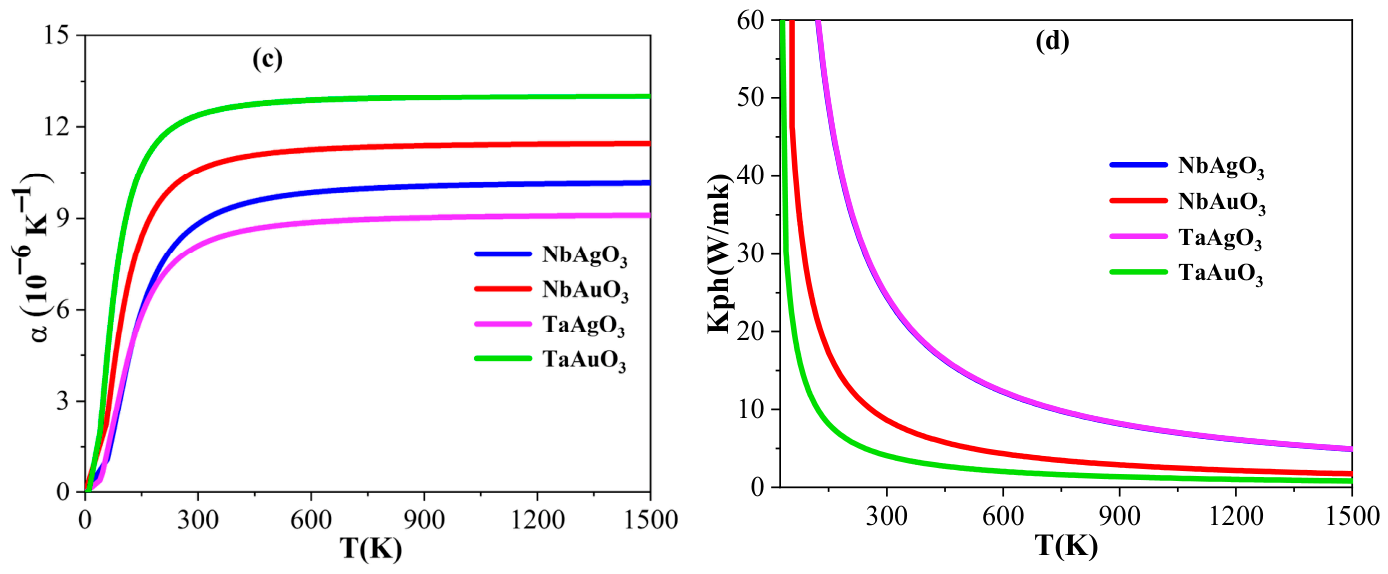
The dependence of the lattice thermal conductivity on temperature is depicted in Figure 9d. As can be seen, Kph has a negative slope when plotted with the temperature of all the compounds, a characteristic of crystalline solids. Low temperatures mean that the values of thermal conductivity are quite high since phonon–phonon scattering is low. The data demonstrates that Kph does not increase gradually with temperature, but rather drops significantly near 0–300 K, then slowly decreases with an increase in temperature, and finally, it tends to assume an almost constant value at the high-temperature level. In NbAgO3 and TaAgO3, the fall in Kph is slow in the 600–1200 K temperature range, but in NbAuO3 and TaAuO3, a slow decrease occurs in the 300–900 K temperature range followed by a constant value at higher temperatures.
The relatively higher-thermal-conductivity lattice compounds are TaAgO3 and NbAgO3, whose values are approximately 24.57 W.m−1K−1 and 24.44 W.m−1K−1 respectively. In comparison, NbAuO3 and TaAuO3 have a relatively intermediate thermal conductivity of 8.63 W.m−1K−1 and the lowest thermal conductivity of 4.06 W.m−1K−1 respectively. Reduced thermal conductivity in the Au-based compounds can be attributed to the increased lattice anharmonicity, as indicated by their larger Grüneisen parameters and higher thermal expansion coefficients, which enhance phonon scattering and reduce heat transport. This behavior can be further understood in terms of both the larger atomic mass of Au, which lowers phonon group velocities, and the relatively softer Au–O bonding, which increases lattice anharmonicity.
The melting temperature (Tm) of the XYO3 compounds was also estimated using an empirical relation based on the elastic constant C11 [68]:
T m K = 553 + ( 5.911 ) C 11
The calculated melting temperatures are given in Table 6. TaAgO3 has the highest melting point of 3085.03 K, which means that it has a stronger interatomic bond and more thermal stability. On the contrary, TaAuO3 has the lowest value (2714.25 K), indicating the presence of less bonding strength. NbAgO3 (2793.23 K) and NbAuO3 (2723.87 K) are in between these extremes.
The linear thermal expansion coefficient (α) was calculated using the following relation [69]:
α = γ C v 3 B T v m
BT and Vm are the isothermal bulk modulus and molar volume respectively. Figure 9c indicates how the thermal expansion coefficient (α) varies with the temperature of the compounds that were investigated. The results indicate that α increases rapidly with temperature at low temperatures for all materials. There is a steep rise from 0 K to about a range of 300–400 K, which shows a great deal of lattice expansion. In higher temperatures than this temperature range, the growth of α is slow but finally tends towards almost a constant value at high temperatures up to 1500 K. TaAuO3 has the greatest thermal expansion coefficient, then NbAuO3, NbAgO3, and TaAgO3. The relatively greater observed thermal expansion of the Au-based compounds can be explained by their higher lattice anharmonicity, which makes the atomic vibrations and lattice expansion increase with temperature.
At temperatures above 300 K, the quasi-harmonic Debye model is a good description of the specific heat at constant volume (Cv), including lattice vibrations and anharmonic effects. The specific heat Cv can be calculated using the following:
C v = 9 n N A K B T θ D 0 θ D d x x 4 e x 1 2
The specific heat at constant pressure (Cp) is obtained from the following:
C p = C v 1 + α γ T
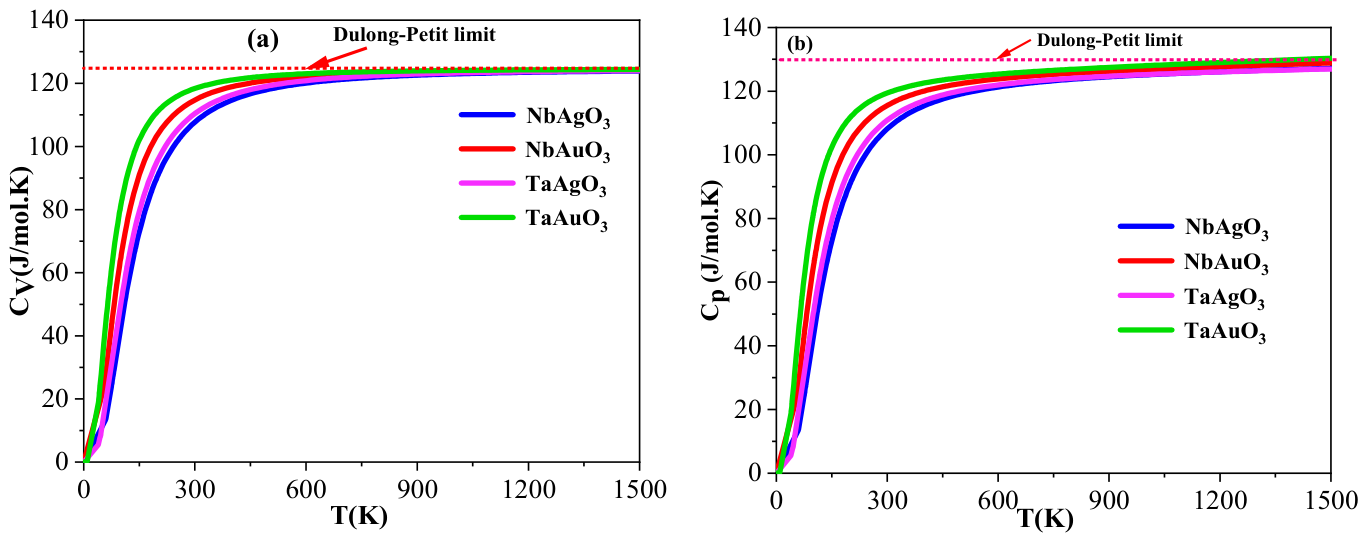
Figure 9a,b are the temperature dependence of Cv and Cp in XYO3 compounds between the temperature range of 0 and 1500 K. The temperature dependence of both Cv and Cp increases rapidly with the temperatures of all the compounds due to thermal softening and vibrations, which increase the number of phonons in the crystal lattice. Both Cv and Cp obey the Debye T3 law at low temperatures (below about 300 K), as is the case with crystalline solids. The rate of increase gradually decreases and the heat capacities tend to attain constant values as the temperature increases. When the temperatures are large (more than about 1000 K), the calculated values trend towards the classical Dulong–Petit limit [70], which is when the lattice vibrations become classical.

4. Conclusions

In this paper, structural, electronic, optical, mechanical, and thermal properties of XYO3 (X = Nb, Ta; Y = Ag, Au) cubic perovskite oxides were systematically studied and applied to the density functional theory. The optimized lattice parameters confirmed that all compounds are crystallized in a stable cubic Pm-3m structure; the negative values of the formation energies and also the non-existence of the imaginary phonon frequencies strongly demonstrate their thermodynamic and dynamical stability. Electronic structure calculations suggest that all XYO3 compounds are semiconducting. GGA-PBE and HSE06 functions were used to calculate the band gaps, with HSE06 providing more precise values as far as band gaps are concerned. NbAgO3, NbAuO3 and TaAgO3 are the compounds investigated that display the properties of a direct band gap, whereas TaAuO3 displays an indirect band gap. The density of states and charge density analyses reveal intense p-d hybridization between the O-2p and Nb/Ta-d orbitals, confirming a robust mixture of ionic and covalent bonding. Optical analysis shows significant activity with strong interband electronic transitions. The high absorption coefficients (~106 cm−1) in the ultraviolet region, together with a moderate reflectivity and high optical conductivity, highlight their potential for advanced optoelectronic and UV device applications. Mechanical calculations verify that the examined compounds meet the Born stability criteria, which indicates mechanical stability. The values of a positive Cauchy pressure, a high Pugh ratio, and the Poisson ratio indicate that these materials are ductile in nature. Elastic anisotropy is observed, with TaAgO3 exhibiting the highest stiffness and hardness, while TaAuO3 shows exceptional ductility and machinability. Thermal analysis indicates that NbAgO3 has the highest Debye temperature and sound velocities, reflecting strong interatomic bonding, whereas TaAuO3 shows softer lattice dynamics and lower thermal conductivity. Ag-based compounds generally display higher lattice thermal conductivity and melting points compared to Au-based compounds. It should be noted that this work is based on ideal cubic structures at 0 K, and the effects of defects, grain boundaries, and finite temperature are beyond the scope of this study.
Overall, the combination of structural integrity, semiconducting behavior, excellent optical properties, ductile mechanical nature, and tunable thermal characteristics makes XYO3 perovskites highly promising candidates for cutting-edge applications in optoelectronics, photovoltaics, and high-temperature functional devices.

Author Contributions

Conceptualization, Ł.S. and M.G.; methodology, Ł.S. and M.G.; software, Ł.S.; validation, Ł.S. and M.G.; formal analysis, Ł.S. and M.G.; investigation, Ł.S., M.G. and K.M.-G.; resources, Ł.S.; data curation, Ł.S.; writing—original draft preparation, Ł.S. and M.G.; writing—review and editing, Ł.S. and K.M.-G.; visualization, Ł.S.; supervision, Ł.S.; project administration, Ł.S.; funding acquisition, Ł.S. All authors have read and agreed to the published version of the manuscript.

Funding

This research received no external funding.

Institutional Review Board Statement

Not applicable.

Informed Consent Statement

Not applicable.

Data Availability Statement

The original contributions presented in this study are included in the article. Further inquiries can be directed to the corresponding author.

Conflicts of Interest

The authors declare no conflicts of interest.

References

  1. Behera, D.; Dixit, A.; Nahak, B.; Srivastava, A.; Dubey, S.; Sharma, R.; Mishra, A.K.; Mukherjee, S.K. Structural, electronic, elastic, vibrational and thermodynamic properties of antiperovskites Mg3NX (X = Ge, Sn): A DFT study. Phys. Lett. A 2022, 453, 128478. [Google Scholar] [CrossRef] [Scilit]
  2. Ahmad, N.; Yuan, J.; Zou, Y. One more step towards better stability of non-fullerene organic solar cells: Advances, challenges, future perspectives, and the Era of artificial intelligence. Energy Environ. Sci. 2025, 18, 5093–5158. [Google Scholar] [CrossRef] [Scilit]
  3. Wu, G.; Yang, T.; Li, X.; Ahmad, N.; Zhang, X.; Yue, S.; Zhou, J.; Li, Y.; Wang, H.; Shi, X.; et al. Molecular Engineering for Two-Dimensional Perovskites with Photovoltaic Efficiency Exceeding 18%. Matter 2021, 4, 582–599. [Google Scholar] [CrossRef] [Scilit]
  4. Agresti, A.; Pescetelli, S.; Palma, A.L.; Del Rio Castillo, A.E.; Konios, D.; Kakavelakis, G.; Razza, S.; Cinà, L.; Kymakis, E.; Bonaccorso, F.; et al. Graphene Interface Engineering for Perovskite Solar Modules: 12.6% Power Conversion Efficiency over 50 cm2 Active Area. ACS Energy Lett. 2017, 2, 279–287. [Google Scholar] [CrossRef] [Scilit]
  5. Zhang, G.; Lin, F.R.; Qi, F.; Heumüller, T.; Distler, A.; Egelhaaf, H.-J.; Li, N.; Chow, P.C.Y.; Brabec, C.J.; Jen, A.K.-Y.; et al. Renewed Prospects for Organic Photovoltaics. Chem. Rev. 2022, 122, 14180–14274. [Google Scholar] [CrossRef] [Scilit]
  6. Inamuddin; Khan, M.; Mazumder, M.A.J. Perovskite Based Materials for Energy Storage Devices; Materials Research Forum LLC: Millersville, PA, USA, 2023. [Google Scholar]
  7. Wang, F.; Zou, X.; Xu, M.; Wang, H.; Wang, H.; Guo, H.; Guo, J.; Wang, P.; Peng, M.; Wang, Z.; et al. Recent Progress on Electrical and Optical Manipulations of Perovskite Photodetectors. Adv. Sci. 2021, 8, 2100569. [Google Scholar] [CrossRef] [Scilit] [PubMed]
  8. Cysne, T.P.; Canonico, L.M.; Costa, M.; Muniz, R.B.; Rappoport, T.G. Orbitronics in two-dimensional materials. npj Spintron. 2025, 3, 39. [Google Scholar] [CrossRef] [Scilit]
  9. Jaya Prakash, N.; Kandasubramanian, B. Nanocomposites of MXene for industrial applications. J. Alloys Compd. 2021, 862, 158547. [Google Scholar] [CrossRef] [Scilit]
  10. Asiri, A.M.; Shahzad, M.K.; Hussain, S.; Zhu, K.; Khan, S.B.; Alamry, K.A.; Alfifi, S.Y.; Marwani, H.M. Analysis of XGaO3 (X = Ba and Cs) cubic based perovskite materials for photocatalytic water splitting applications: A DFT study. Heliyon 2023, 9, e14112. [Google Scholar] [CrossRef] [Scilit]
  11. Hazen, R.M. Perovskites. Sci. Am. 1988, 258, 74–81. [Google Scholar] [CrossRef] [Scilit]
  12. Shooshtari, M.; Kim, S.-Y.; Pahlavan, S.; Serrano-Gotarredona, T.; Bisquert, J.; Linares-Barranco, B. Bio-Inspired Spike-Timing-Dependent Plasticity Learning with Metal Halide Perovskites: Toward Artificial Synaptic Functionality. ACS Appl. Mater. Interfaces 2026, 18, 7103–7114. [Google Scholar] [CrossRef] [Scilit] [PubMed]
  13. Khatamunnaby, G.M.; Hasan Khan, M.S.; Hasan, M.T.; Islam, M.R.; Rahman, M.Z. Strain tuned structural, mechanical, electronic, and optical properties of lead-free oxy-nitride SrTaO2N perovskite using first-principles study. AIP Adv. 2024, 14, 025147. [Google Scholar] [CrossRef] [Scilit]
  14. Bhojanaa, K.B.; Soundarya Mary, A.; Shalini Devi, K.S.; Pavithra, N.; Pandikumar, A. Account of Structural, Theoretical, and Photovoltaic Properties of ABO3 Oxide Perovskites Photoanode-Based Dye-Sensitized Solar Cells. Sol. RRL 2022, 6, 2100792. [Google Scholar] [CrossRef] [Scilit]
  15. Ullah, W.; Husain, M.; Rahman, N.; Sfina, N.; Elhadi, M.; Tirth, V.; Azzouz-Rached, A.; Humayun, Q.; Uzair, M.; Khan, A. Tailoring structural, electronic, elastic and optical properties of Strontium-based XSrO3 (X = Rb, Cs) oxide perovskites employing density functional theory. Phys. Scr. 2024, 99, 035939. [Google Scholar] [CrossRef] [Scilit]
  16. Moulay, N.; Ameri, M.; Azaz, Y.; Zenati, A.; Al-Douri, Y.; Ameri, I. Predictive study of structural, electronic, magnetic and thermodynamic properties of XFeO3 (X = Ag, Zr and Ru) multiferroic materials in cubic perovskite structure: First-principles calculations. Mater. Sci.-Pol. 2015, 33, 402–413. [Google Scholar] [CrossRef] [Scilit]
  17. Solayman, M.; Sarker, M.A.; Muntasir, M.; Sharme, R.K.; Islam, M.R. Pressure-induced investigation of structural, electronic, optical, and mechanical properties of BaCeO3. Opt. Mater. 2024, 148, 114699. [Google Scholar] [CrossRef] [Scilit]
  18. Magoussi, H.; Amraoui, S.; Feraoun, A.; Kerouad, M. Electronic, Magnetic, and Magnetocaloric Properties of NdMnO3 Simple Perovskite. J. Electron. Mater. 2021, 50, 1370–1379. [Google Scholar] [CrossRef] [Scilit]
  19. Ruyhan; Usman, M.; Bibi, N.; Noreen, S.; Alqarni, A.S.; Aziz, A.; Rahman, S.; Aziz, Z.; Abbasi, R.A. Evaluation of Structural, Electronic, Optical and Mechanical Properties of Na-based Oxide-Perovskites NaXO3 (X = Co, Be, Ba): A DFT study. Mater. Today Commun. 2024, 39, 108908. [Google Scholar] [CrossRef] [Scilit]
  20. Bibi, N.; Hussain, A.; Noreen, S.; Rahman, S.; Arshad, S.; Bilal Tahir, M.; Rehman, J.U. First-principles investigation of structural, electronic, optical, and mechanical properties of Na-based fluoro-perovskites NaXF3: (X = Ni, Co, Be, Ba). Optik 2022, 269, 169897. [Google Scholar] [CrossRef] [Scilit]
  21. Bibi, N.; Usman, M.; Ruyhan. Exploration of Na-based NaXO3 (X = Ge, Si) oxide-perovskites: A density functional theory study. Comput. Theor. Chem. 2024, 1240, 114842. [Google Scholar] [CrossRef] [Scilit]
  22. Sikam, P.; Moontragoon, P.; Sararat, C.; Karaphun, A.; Swatsitang, E.; Pinitsoontorn, S.; Thongbai, P. DFT calculation and experimental study on structural, optical and magnetic properties of Co-doped SrTiO3. Appl. Surf. Sci. 2018, 446, 92–113. [Google Scholar] [CrossRef] [Scilit]
  23. Rizwan, M.; Gul, S.; Mahmood, T.; Shakil, M.; Majid, A.; Rafique, M.; Zafar, A.A.; Jin, H.B.; Cao, C.B. Tailoring electronic and optical properties of LaAlO3 by Cu inclusion: A DFT study. Can. J. Phys. 2021, 99, 38–43. [Google Scholar] [CrossRef] [Scilit]
  24. Ilyas, A.; Khan, S.A.; Liaqat, K.; Usman, T. Investigation of the structural, electronic, magnetic, and optical properties of CsXO3 (X = Ge, Sn, Pb) perovskites: A first-principles calculations. Optik 2021, 244, 167536. [Google Scholar] [CrossRef] [Scilit]
  25. Arar, R.; Ouahrani, T.; Varshney, D.; Khenata, R.; Murtaza, G.; Rached, D.; Bouhemadou, A.; Al-Douri, Y.; Bin Omran, S.; Reshak, A. Structural, mechanical and electronic properties of sodium based fluoroperovskites NaXF3 (X = Mg, Zn) from first-principle calculations. Mater. Sci. Semicond. Process 2015, 33, 127–135. [Google Scholar] [CrossRef] [Scilit]
  26. Ahmed, T.; Roknuzzaman, M.; Sultana, A.; Biswas, A.; Alam, M.S.; Saiduzzaman, M.; Hossain, K.M. Physical properties of rare earth perovskites CeMO3 (M = Co, Cu) in the context of density functional theory. Mater. Today Commun. 2021, 29, 102973. [Google Scholar] [CrossRef] [Scilit]
  27. Wang, Y.; Zhang, Z.; Wang, Y.; Doan, E.; Yuan, L.; Tang, W.; Yang, K. First-principles investigation of structural, electronic, and energetic properties of BaSnO3 (001) surfaces. Vacuum 2023, 212, 111977. [Google Scholar] [CrossRef] [Scilit]
  28. Bibi, N.; Usman, M.; Noreen, S. Predictions on new Cu-based ABO3 (A = Cu and B = Lu, Y) oxide-perovskite for energy storage and optoelectronic applications: A DFT study. Mater. Sci. Semicond. Process 2025, 185, 109001. [Google Scholar] [CrossRef] [Scilit]
  29. Rahman, S.; Hussain, A.; Noreen, S.; Bibi, N.; Arshad, S.; Rehman, J.U.; Tahir, M.B. Structural, electronic, optical and mechanical properties of oxide-based perovskite ABO3 (A = Cu, Nd and B = Sn, Sc): A DFT study. J. Solid State Chem. 2023, 317, 123650. [Google Scholar] [CrossRef] [Scilit]
  30. Giannozzi, P.; Andreussi, O.; Brumme, T.; Bunau, O.; Nardelli, M.B.; Calandra, M.; Car, R.; Cavazzoni, C.; Ceresoli, D.; Cococcioni, M.; et al. Advanced capabilities for materials modelling with Quantum ESPRESSO. J. Phys. Condens. Matter 2017, 29, 465901. [Google Scholar] [CrossRef] [Scilit]
  31. Giannozzi, P.; Baroni, S.; Bonini, N.; Calandra, M.; Car, R.; Cavazzoni, C.; Ceresoli, D.; Chiarotti, G.L.; Cococcioni, M.; Dabo, I.; et al. QUANTUM ESPRESSO: A modular and open-source software project for quantum simulations of materials. J. Phys. Condens. Matter 2009, 21, 395502. [Google Scholar] [CrossRef] [Scilit]
  32. Heyd, J.; Scuseria, G.E.; Ernzerhof, M. Hybrid functionals based on a screened Coulomb potential. J. Chem. Phys. 2003, 118, 8207–8215. [Google Scholar] [CrossRef] [Scilit]
  33. Corso, A.D. Thermo pw Driver v.1.7.0 (2023). Welcome Thermopw. Available online: https://dalcorso.github.io/thermo_pw/ (accessed on 23 February 2024).
  34. Nielsen, O.H.; Martin, R.M. First-Principles Calculation of Stress. Phys. Rev. Lett. 1983, 50, 697–700. [Google Scholar] [CrossRef] [Scilit]
  35. Togo, A.; Tanaka, I. First principles phonon calculations in materials science. Scr. Mater. 2015, 108, 1–5. [Google Scholar] [CrossRef] [Scilit]
  36. Sciau, P.; Kania, A.; Dkhil, B.; Suard, E.; Ratuszna, A. Structural investigation of AgNbO3 phases using x-ray and neutron diffraction. J. Phys. Condens. Matter 2004, 16, 2795. [Google Scholar] [CrossRef] [Scilit]
  37. Qureshi, M.W.; Ma, X.; Tang, G.; Paudel, R. Ab initio predictions of structure and physical properties of the Zr2GaC and Hf2GaC MAX phases under pressure. Sci. Rep. 2021, 11, 3260. [Google Scholar] [CrossRef] [Scilit]
  38. Birch, F. Finite Elastic Strain of Cubic Crystals. Phys. Rev. 1947, 71, 809–824. [Google Scholar] [CrossRef] [Scilit]
  39. Murnaghan, F.D. The Compressibility of Media under Extreme Pressures. Proc. Natl. Acad. Sci. USA 1944, 30, 244–247. [Google Scholar] [CrossRef] [Scilit] [PubMed]
  40. Hossain, A.; Ali, M.A.; Uddin, M.M.; Naqib, S.H.; Hossain, M.M. Theoretical studies on phase stability, electronic, optical, mechanical and thermal properties of chalcopyrite semiconductors HgXN2 (X = Si, Ge and Sn): A comprehensive DFT analysis. Mater. Sci. Semicond. Process 2024, 172, 108092. [Google Scholar] [CrossRef] [Scilit]
  41. Baroni, S.; de Gironcoli, S.; Dal Corso, A.; Giannozzi, P. Phonons and related crystal properties from density-functional perturbation theory. Rev. Mod. Phys. 2001, 73, 515–562. [Google Scholar] [CrossRef] [Scilit]
  42. Hossain, A.; Akhtaruzzaman, M.; Uddin, M.M. DFT-based design of X3BiY3 (X = Mg, Sr, Ba; Y = F, Cl) perovskites: From wide-gap insulators to promising semiconductors for solar cell applications. J. Phys. Chem. Solids 2026, 208, 113094. [Google Scholar] [CrossRef] [Scilit]
  43. Ehrler, B.; Alarcón-Lladó, E.; Tabernig, S.W.; Veeken, T.; Garnett, E.C.; Polman, A. Photovoltaics Reaching for the Shockley–Queisser Limit. ACS Energy Lett. 2020, 5, 3029–3033. [Google Scholar] [CrossRef] [Scilit]
  44. Li, S.; Ahuja, R.; Barsoum, M.W.; Jena, P.; Johansson, B. Optical properties of Ti3SiC2 and Ti4AlN3. Appl. Phys. Lett. 2008, 92, 221907. [Google Scholar] [CrossRef] [Scilit]
  45. Sun, J.; Zhou, X.-F.; Fan, Y.-X.; Chen, J.; Wang, H.-T.; Guo, X.; He, J.; Tian, Y. First-principles study of electronic structure and optical properties of heterodiamond BC2N. Phys. Rev. B 2006, 73, 045108. [Google Scholar] [CrossRef] [Scilit]
  46. Sólyom, J. Optical Properties of Solids. In Fundamentals of the Physics of Solids; Sólyom, J., Ed.; Electronic Properties; Springer: Berlin/Heidelberg, Germany, 2009; Volume 2, pp. 411–447. [Google Scholar] [CrossRef] [Scilit]
  47. Rabiei, M.; Palevicius, A.; Dashti, A.; Nasiri, S.; Monshi, A.; Vilkauskas, A.; Janusas, G. Measurement Modulus of Elasticity Related to the Atomic Density of Planes in Unit Cell of Crystal Lattices. Materials 2020, 13, 4380. [Google Scholar] [CrossRef] [Scilit]
  48. Liu, S.-Y.; Zhang, S.; Liu, S.; Li, D.-J.; Li, Y.; Wang, S. Phase stability, mechanical properties and melting points of high-entropy quaternary metal carbides from first-principles. J. Eur. Ceram. Soc. 2021, 41, 6267–6274. [Google Scholar] [CrossRef] [Scilit]
  49. Hossain, A.; AlMohamadi, H.; Wang, B.; Akhtaruzzaman, M.; Uddin, M.M. Structural, electronic, optical, mechanical, and thermal properties of A3MCl3 (A = Mg, Ca; M = N, Bi) halide perovskites: A first-principles study. Comput. Condens. Matter 2025, 45, e01116. [Google Scholar] [CrossRef] [Scilit]
  50. Wallace, D.C.; Callen, H. Thermodynamics of Crystals. Am. J. Phys. 1972, 40, 1718–1719. [Google Scholar] [CrossRef] [Scilit]
  51. Han, Y.; Wu, Y.; Li, T.; Khenata, R.; Yang, T.; Wang, X. Electronic, Magnetic, Half-Metallic, and Mechanical Properties of a New Equiatomic Quaternary Heusler Compound YRhTiGe: A First-Principles Study. Materials 2018, 11, 797. [Google Scholar] [CrossRef] [Scilit]
  52. Kleinman, L. Deformation Potentials in Silicon. I. Uniaxial Strain. Phys. Rev. 1962, 28, 2614. [Google Scholar] [CrossRef] [Scilit]
  53. Harrison, W.A. Electronic Structure and the Properties of Solids: The Physics of the Chemical Bond; Courier Corporation: North Chelmsford, MA, USA, 1989. [Google Scholar]
  54. Feng, W.; Cui, S. Mechanical and electronic properties of Ti2AlN and Ti4AlN3: A first-principles study. Can. J. Phys. 2014, 92, 1652–1657. [Google Scholar] [CrossRef] [Scilit]
  55. Hill, R. The Elastic Behaviour of a Crystalline Aggregate. Proc. Phys. Soc. Sect. A 1952, 65, 349. [Google Scholar] [CrossRef] [Scilit]
  56. Voigt, W. Ueber die Beziehung zwischen den beiden Elasticitätsconstanten isotroper Körper. Ann. Phys. 1889, 274, 573–587. [Google Scholar] [CrossRef] [Scilit]
  57. Bouhemadou, A. First-principles study of structural, electronic and elastic properties of Nb4AlC3. Braz. J. Phys. 2010, 40, 52–57. [Google Scholar] [CrossRef] [Scilit]
  58. Maradudin, A.A. Theory of Lattice Dynamics in the Harmonic Approximation. Solid State Phys. Suppl. 1971, 3, 213–227. [Google Scholar]
  59. Butt, M.K.; Yaseen, M.; Bhatti, I.A.; Iqbal, J.; Misbah; Murtaza, A.; Iqbal, M.; Al-Anazy, M.M.; Alhossainy, M.; Laref, A. A DFT study of structural, magnetic, elastic and optoelectronic properties of lanthanide based XAlO3 (X = Nd, Gd) compounds. J. Mater. Res. Technol. 2020, 9, 16488–16496. [Google Scholar] [CrossRef] [Scilit]
  60. Music, D.; Sun, Z.; Ahuja, R.; Schneider, J.M. Electronic structure of M2AlC(0001) surfaces (M = Ti,V,Cr). J. Phys. Condens. Matter 2006, 18, 8877. [Google Scholar] [CrossRef] [Scilit]
  61. Tvergaard, V.; Hutchinson, J.W. Microcracking in Ceramics Induced by Thermal Expansion or Elastic Anisotropy. J. Am. Ceram. Soc. 1988, 71, 157–166. [Google Scholar] [CrossRef] [Scilit]
  62. Miao, N.; Sa, B.; Zhou, J.; Sun, Z. Theoretical investigation on the transition-metal borides with Ta3B4-type structure: A class of hard and refractory materials. Comput. Mater. Sci. 2011, 50, 1559–1566. [Google Scholar] [CrossRef] [Scilit]
  63. Chen, X.-Q.; Niu, H.; Li, D.; Li, Y. Modeling hardness of polycrystalline materials and bulk metallic glasses. Intermetallics 2011, 19, 1275–1281. [Google Scholar] [CrossRef] [Scilit]
  64. Anderson, O.L. A simplified method for calculating the debye temperature from elastic constants. J. Phys. Chem. Solids 1963, 24, 909–917. [Google Scholar] [CrossRef] [Scilit]
  65. Hossain, A.; Hossain, M.M.; Akter, H.; Uddin, M.M.; Ali, M.A.; Naqib, S.H. Ultralow Lattice Thermal Conductivity with an Outstanding Figure of Merit of Predicted Zintl Phases: XIn2C2 (X = Sr, Ba). ACS Appl. Energy Mater. 2025, 8, 5092–5109. [Google Scholar] [CrossRef] [Scilit]
  66. Slack, G.A. The Thermal Conductivity of Nonmetallic Crystals. In Solid State Physics; Ehrenreich, H., Seitz, F., Turnbull, D., Eds.; Academic Press: Cambridge, MA, USA, 1979; Volume 34, pp. 1–71. [Google Scholar] [CrossRef] [Scilit]
  67. Clarke, D.R. Materials selection guidelines for low thermal conductivity thermal barrier coatings. Surf. Coat. Technol. 2003, 163–164, 67–74. [Google Scholar] [CrossRef] [Scilit]
  68. Fine, M.E.; Brown, L.D.; Marcus, H.L. Elastic constants versus melting temperature in metals. Scr. Metall. 1984, 18, 951–956. [Google Scholar] [CrossRef] [Scilit]
  69. Blanco, M.A.; Francisco, E.; Luaña, V. GIBBS: Isothermal-isobaric thermodynamics of solids from energy curves using a quasi-harmonic Debye model. Comput. Phys. Commun. 2004, 158, 57–72. [Google Scholar] [CrossRef] [Scilit]
  70. Fitzgerel, R.K.; Verhoek, F.H. The law of Dulong and Petit. J. Chem. Educ. 1960, 37, 545. [Google Scholar] [CrossRef] [Scilit]
Figure 1. Crystal structure of XYO3 (X = Nb, Ta; Y = Ag, Au) compounds.
Applsci 16 04429 g001
Figure 2. Volume vs. total energy curves for XYO3 (X = Nb, Ta; Y = Ag, Au) materials.
Applsci 16 04429 g002
Figure 3. Phonon dispersion curve and phonon DOS of XYO3 (X = Nb, Ta; Y = Ag, Au) compounds.
Applsci 16 04429 g003
Figure 4. The calculated band structures of XYO3 (X = Nb, Ta; Y = Ag, Au) compounds along the high symmetry directions in the Brillouin zone.
Applsci 16 04429 g004
Figure 5. Total and partial electron energy density of states of XYO3 (X = Nb, Ta; Y = Ag, Au) compounds. (a) NbAgO3; (b) NbAuO3; (c) TaAgO3; (d) NbAgO3.
Applsci 16 04429 g005aApplsci 16 04429 g005b
Figure 6. Electronic charge density of (a) NbAgO3, (b) NbAuO3, (c) TaAgO3 and (d) TaAuO3 compounds.
Applsci 16 04429 g006
Figure 7. Calculated optical parameters: (a) real dielectric part ε1(ω), (b) imaginary dielectric part ε2(ω), (c) refractive index n(ω), (d) absorption coefficient α(ω), (e) conductivity σ(ω), (f) reflectivity R(ω), (g) loss function L(ω) and (h) extinction coefficient k(ω) of XYO3 (X = Nb, Ta; Y = Ag, Au) compounds.
Applsci 16 04429 g007aApplsci 16 04429 g007b
Figure 8. The calculated (a) Pugh’s ratio (B/G) and (b) Poisson’s ratio (ν) for XYO3 (X = Nb, Ta; Y = Ag, Au) compounds.
Applsci 16 04429 g008
Figure 9. The temperature-dependent (a) specific heat at constant volume (Cv), (b) specific heat at constant pressure (Cp), (c) linear thermal expansion coefficient (α), and (d) lattice thermal conductivity (Kph) for XYO3 (X = Nb, Ta; Y = Ag, Au) compounds.
Applsci 16 04429 g009aApplsci 16 04429 g009b
Table 1. Calculated structural parameters of XYO3 (X = Nb, Ta; Y = Ag, Au) materials.
Compoundsa (Å)% of DeviationV (Å3)EfRef.
NbAgO34.020-65.16 −2.148[36]
4.0040.39964.19−2.246This Study
NbAuO34.014-64.70−1.860This Study
TaAgO34.001-64.08−2.356This Study
TaAuO34.013-64.62−1.989This Study
Table 2. Calculated band gaps values of XYO3 (X = Nb, Ta; Y = Ag, Au) compounds in GGA-PBE and HSE06 functionals.
CompoundsNbAgO3NbAuO3TaAgO3TaAuO3
GGA-PBE1.6020.1801.9340.145
HSE061.8851.2983.0741.801
NatureDirectDirectDirectIndirect
Table 3. Calculated single-crystal elastic constants (in GPa) of XYO3 (X = Nb, Ta; Y = Ag, Au) compounds.
CompoundsC11C12C44C11 + 2C12C11− C12CPζ
NbAgO3379.0586.3460.04551.73292.7126.30.378
NbAuO3367.32118.6140.16604.54248.7178.450.468
TaAgO3428.4395.4866.10619.39332.9529.380.373
TaAuO3365.69119.1124.41603.91246.5894.70.471
Table 4. The calculated bulk modulus (B), shear modulus (G), Cauchy pressure (CP), Young’s modulus (Y), Pugh’s ratio (B/G), Poisson’s ratio (υ), machinability index (B/C44), universal anisotropic factor and hardness parameters (Hmicro and Hmacro) for XYO3 (X = Nb, Ta; Y = Ag, Au) compounds.
CompoundsB (GPa)G (GPa)Y (GPa)B/GνB/C44AHmicro (GPa)Hmacro (GPa)
NbAgO3183.9286.57224.492.1240.2963.0630.41011.778.25
NbAuO3201.5164.46174.753.1260.3555.0170.3236.233.02
TaAgO3206.4696.68250.882.1350.2973.1230.39713.088.93
TaAuO3201.3149.95138.414.0300.3858.2470.1973.830.85
Table 5. Calculated density (ρ), sound velocities (vt, vm, vl), and Debye temperature (θD) for XYO3 (X= Nb, Ta; Y = Ag, Au) compounds.
Compounds ρ (kg/m3)vt (m/s)vm (m/s)vl (m/s)θD (K)
NbAgO36434.623667.944095.236820.64521.25
NbAuO38660.082728.253069.675761.36389.68
TaAgO38726.873328.423716.596199.12473.33
TaAuO310,932.942137.462414.814950.23306.68
Table 6. Calculated melting temperature (Tm), Grüneisen parameter (γ), specific heat (Cv, Cp), thermal expansion coefficient (α), minimum thermal conductivity (Kmin) and lattice thermal conductivity (Kph) of XYO3 (X = Nb, Ta; Y = Ag, Au) compounds.
CompoundsTmγCPCvα (10−5) K−1Kmin
(W/mK)
K*ph
(W/mK)
NbAgO32793.231.748108.21107.718.820.35224.44
NbAuO32723.872.173115.56114.7710.580.2628.63
TaAgO33085.031.754110.91110.438.100.32024.57
TaAuO32714.252.458119.46118.3812.370.2074.06
Disclaimer/Publisher’s Note: The statements, opinions and data contained in all publications are solely those of the individual author(s) and contributor(s) and not of MDPI and/or the editor(s). MDPI and/or the editor(s) disclaim responsibility for any injury to people or property resulting from any ideas, methods, instructions or products referred to in the content.