Article

Distributed Task Allocation and Path Planning Strategies for Cooperative UAV Swarms


by
Jiaxiang Xu
1,2,
Xinru Li
1,
Yunsheng Xu
2,
Feng Zhou
1,
Xingchen Xiang
2,
Chen Li
2 and
Tianping Deng
1,*
1
Hubei Key Laboratory of Internet of Intelligence, School of Electronic Information and Communications, Huazhong University of Science and Technology, Wuhan 430074, China
2
Three Gorges Hi-Tech Information Technology Co., Ltd., Yichang 443000, China
*
Author to whom correspondence should be addressed.
Appl. Sci. 2026, 16(9), 4428; https://doi.org/10.3390/app16094428
Submission received: 27 March 2026 / Revised: 28 April 2026 / Accepted: 29 April 2026 / Published: 1 May 2026

Abstract

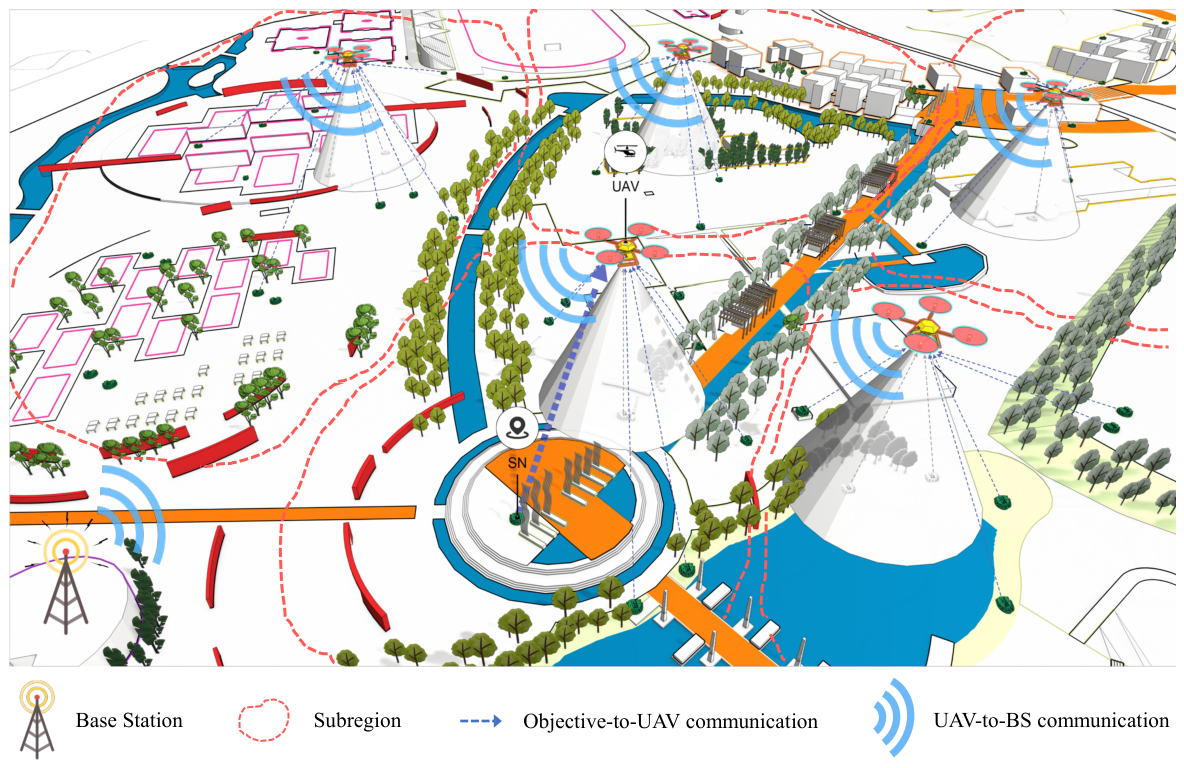
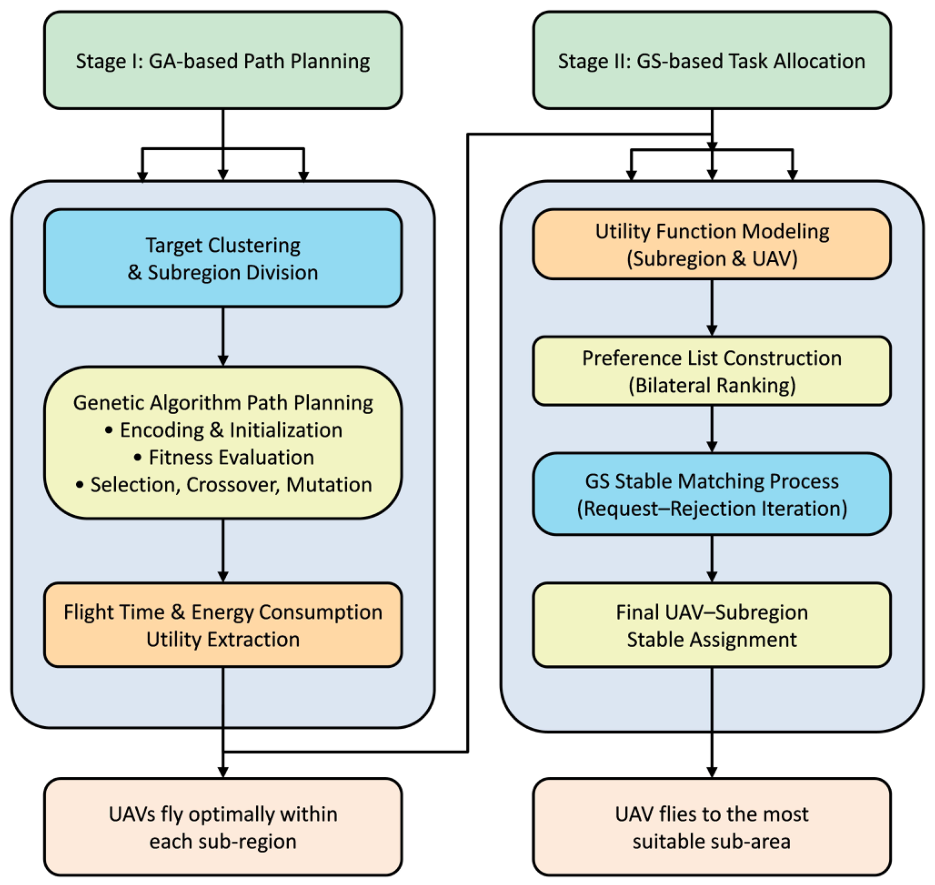
The rapid advancement of unmanned aerial vehicle (UAV) technology has led to its widespread adoption in military reconnaissance, disaster monitoring, environmental inspection, and related fields. However, a single UAV often faces limitations when executing large-scale and complex missions. UAV swarm technology, which employs multi-agent collaboration, can significantly improve task execution efficiency and overall system performance, representing an area of considerable research importance. Current studies on task allocation and path planning for UAV swarms exhibit certain shortcomings, particularly the high computational complexity and insufficient real-time performance of existing path planning methods when applied to highly dynamic, multi-objective, and large-scale complex scenarios. To address the above challenge, this paper proposes a Gale-Shapley-based Genetic Algorithm (GSGA) for UAV swarm task allocation and path planning. First, a multi-UAV data inspection system model is formulated based on an energy consumption model, analyzing the influence of factors including geographical fairness, data utility, and energy consumption. The proposed GSGA integrates the Gale-Shapley stable matching algorithm for one-to-one task assignment between UAVs and sub-regions with a genetic algorithm optimized for intra-region path planning. Dynamic programming is further employed to refine the flight paths. The results show that the GSGA strategy can effectively improve the balance of task allocation, optimize path length and inspection quality. The proposed method demonstrated robust performance in complex scenarios characterized by numerous task targets and intricate regional partitions, consistently enabling UAVs to complete inspection tasks with high collaborative efficiency.
Keywords: unmanned aerial vehicle; task allocation; path planning; genetic algorithm; Gale-Shapley matching algorithm unmanned aerial vehicle; task allocation; path planning; genetic algorithm; Gale-Shapley matching algorithm