Article

Evaluation of Wettability, Surface Free Energy, and Janka Hardness of Steamed Beech Wood

by
Barbora Slováčková
,
Michal Dudiak
* and
Jarmila Schmidtová
Faculty of Wood Sciences and Technology, Technical University in Zvolen, T.G. Masaryka 24, 960 01 Zvolen, Slovakia
*
Author to whom correspondence should be addressed.
Appl. Sci. 2026, 16(9), 4346; https://doi.org/10.3390/app16094346
Submission received: 31 March 2026 / Revised: 23 April 2026 / Accepted: 23 April 2026 / Published: 29 April 2026
(This article belongs to the Special Issue Advances in Wood Processing and Wood Mechanical Properties)

Abstract

The steaming of wood changes its physical, mechanical and chemical properties in a complex way. The information about the wettability, surface free energy, and Janka hardness of steamed beech false heartwood and sapwood is not sufficient; these properties were therefore the main focus of this article. Wettability was determined by contact angle measurement with standard testing liquids. The steaming regime was a significant factor for wetting with redistilled water, and it had a mutual interaction during wetting with diiodomethane along with the factor wood zone. The steaming regimes also significantly influenced the surface free energy of the beech wood. According to the contact angles and surface free energy values, the Mode I steaming regime showed a better wettability than the Mode II regime. Analysis of the Janka hardness values showed that wood zone, steaming regime and anatomical direction significantly influenced the hardness in a mutual interaction. Beech wood steamed with the Mode I steaming regime showed a significantly lower Janka hardness in all anatomical directions; the Mode II steaming regime showed a significantly lower hardness only in the cross directions. The statistical difference between false heartwood and sapwood hardness was not significant only in the tangential direction for both steaming regimes and untreated wood.

1. Introduction

Beech wood (Fagus sylvatica L.) is categorized as a diffuse-porous wood species that naturally lacks color-differentiated heartwood. However, as the tree reaches maturity, it frequently develops what is known as false heartwood. This zone is characterized by a distinct brown-to-red coloration, a higher concentration of lignin, and specific groups of extractive substances. These differences manifest not only in visual texture but also in modified physical and chemical properties compared to the sapwood, even in cases where the quantitative concentration of these compounds is relatively low [1].
The formation of false heartwood is primarily determined by ecological factors and the specific growth environment of the tree. The fundamental trigger for this process is the penetration of air into the trunk through mechanical wounds in the bark or broken branches. This influx of oxygen initiates the oxidation of carbohydrates and starches within living or senescing parenchyma cells, leading to the synthesis of polyphenolic compounds. The subsequent diffusion of these substances into the surrounding tissues results in the characteristic reddish-brown discoloration. The significant heterogeneity between the sapwood and the false heartwood represents a critical technological challenge, as it directly impacts wood processing efficiency—most notably in hydrothermal treatment and steaming technologies [2,3,4,5,6,7,8,9,10].
Wood steaming is a hydrothermal technological process where timber is treated with saturated water steam within specialized high-temperature pressure vessels, such as autoclaves. The primary objectives are to enhance specific technological properties, including improved plasticity, relief of internal growth stresses, and achievement of color uniformity. When wood is exposed to temperatures ranging from 100 to 140 °C, key cell wall polymers—specifically hemicelluloses and lignin—undergo partial hydrolysis, leading to significant structural modifications. In the initial stages of thermal treatment, the deacetylation of hemicelluloses occurs, resulting in the release of water-soluble substances. This chemical transformation is highly dependent on both temperature and process duration, leading to the progressive degradation of polysaccharides. Under the catalytic influence of organic acids (primarily acetic and formic acids), the oxidation of carbohydrates and pectins takes place. This process facilitates the dehydration of pentoses, subsequently forming 2-furaldehyde [11,12,13,14].
Simultaneously, structural alterations occur within the lignin–saccharide matrix. The formation of free radicals and phenolic hydroxyl groups leads to the development of new chromophoric structures. These chemical shifts manifest as a visible darkening of the wood tissue, affecting not only the esthetic appearance but also the underlying physical and mechanical properties of the material [11,12,15,16]. Color remains one of the most critical physical and esthetic attributes of wood, significantly influencing its market value in the furniture, flooring, and decorative industries. The natural color profile is determined by the presence of lignin, tannins, and various extractive substances within the cellular structure. The steaming process triggers complex chemical reactions that modify these components. In the specific case of beech wood (Fagus sylvatica L.), these changes are particularly pronounced: while the light sapwood typically shifts toward darker tones, the false heartwood may either darken or lighten, depending on the specific steaming parameters such as temperature, pressure, and exposure time [17,18].
Wood and wood products in general are easily susceptible to atmospheric influences (sunlight, rain, oxidation, moisture content changes, air flow and others) [19]. In general, to preserve the visual characteristics of wood, reduce weathering effects, enhance the stability of wood surfaces and maintain its natural aspects such as color and texture for a long time, coatings need to be applied on wood surfaces [20,21,22]. To ensure the best possible results of such technological processes, and to improve the stability of solid films and glued joints, wood surface properties need to be studied [23,24]. Surface wettability is an important factor when wood is glued or coated [25]. Assessing the wettability of wood surfaces by contact angle measurement and calculation of surface free energy and its components is important for understanding interactions at the interface between wood and coating materials, wood and gluing materials and similar interfaces [23,25,26,27,28,29,30].
Wood surface wetting by standard liquids is a complex process controlled by many factors such as chemical composition of the liquids used, properties of the substrate, interactions among unsaturated force fields across the phase boundary between the wood and liquid, and even energy supplied to the wood surface in various forms. There are also secondary effects of a range of factors implied by specific properties of the wood and the liquids used [31,32,33]. The morphology of the wood surface and its chemistry can be considered as prominent factors influencing wood wetting with liquids [32,34,35,36]. The machining of the wood surface also influences its wettability, with sanded surfaces having better wettability than planed or sawn ones [37]. The thermodynamic characteristics can also differ when different mathematical tools are used to calculate them. Methods for contact angle measurements also vary in the number of testing liquids necessary for the experimental work [24,27,35,38,39,40].
Another important aspect of wood furniture and products is the hardness of wood. Hardness is defined as the resistance of a material against penetration of a harder body into the material and its structure. More than any other mechanical property, hardness is influenced by complex surface properties of the tested material and the method of testing. Hardness is most often tested by methods of indenting a precisely defined object (a steel ball) into the material [41,42]. It was found that hardness is influenced by the anatomical direction of the wood. The highest values are found in longitudinal hardness; radial and tangential hardness do not show a significant difference [41,42,43]. Information about wood hardness is useful for woodworking (sawing, milling, cutting veneers, etc.) and in applications of wood where abrasion or rubbing occurs (floors, wooden bridges, etc.) [43].
The research on wettability, surface free energy and hardness of steamed beech wood with false heartwood is scarce and needs to be studied further. These properties are crucial for manufacturing high-quality wood products. Therefore, the aim of this study was to determine the wettability of steamed beech false heartwood and sapwood with standard testing liquids and Janka hardness in all anatomical directions. The contact angles determined by wettability measurement were used to calculate the surface free energy and its components of the steamed beech false heartwood and sapwood.

2. Materials and Methods

2.1. Materials and Methods of Steaming Beech Wood with False Heartwood

The input material for the experiment was beech lumber (Fagus sylvatica L.) with false heartwood (hereafter referred to as FHW). The average initial moisture content of the wood before the treatment process reached w = 57.9 ± 4.1%. The lumber was prepared in dimensions of 40 × 200 × 900 mm (thickness × width × length) so that each test specimen contained a clearly defined zone of both light sapwood and darker FHW. This approach was chosen for the subsequent objective evaluation of the degree of color homogenization of both zones within one specimen.
Wood steaming was performed in an industrial pressure autoclave APDZ 240 (manufactured by Sundermann s.r.o., Banská Štiavnica, Slovakia). The process was based on the action of saturated water steam on the wood structure in order to initiate the hydrolysis of carbohydrates and the subsequent transformation of chromophoric groups of lignin. The experiment was carried out in two different technological regimes, which differed in the intensity of heat and pressure (Table 1).
The principle of the procedure and the detailed physical conditions under which steam diffusion into the interior of the wood mass occurs are specified in more detail in the methodology [44].
After the steaming process was completed, the blanks were dried in convection hot-air dryer KAD 1x6 (KATRES s.r.o., Jihlava, Czech Republic). In order to eliminate the risk of undesirable additional oxidation and changes in the acquired shade, a special two-stage low-temperature regime was applied according to [45]. The aim was to achieve an equilibrium wood moisture content of w = 10 ± 0.5%, which is the standard for furniture semi-finished products.
The dried lumber was then leveled and processed on a JET JPT-410HH milling machine (supplier STROJE Slovensko, Banská Bystrica, Slovakia), achieving a smooth and clean surface suitable for further processing and production of test specimens.

2.2. Wettability Measurement and Surface Free Energy Calculation

The beech planks were sawn into samples with dimensions of 100 × 50 × 10.5 mm (L × R × T). The samples were then divided into samples containing only FHW and only sapwood (hereafter referred to as SW). Wettability measurements were performed on the radial surfaces of the samples; the surfaces were milled. The samples were conditioned in desiccators with a saturated kitchen salt (sodium chloride) solution until they reached equilibrium moisture content. The solution created a relative air humidity of 60 ± 5%. Desiccators with the samples were stored at a room temperature of 22 ± 2 °C. The average moisture content of the untreated samples was 11.8%, 11.4% in the samples steamed in the Mode I regime and 8.53% in the samples treated in the Mode II regime.
Wettability was measured with a goniometer Krüss DSA30 Standard drop shape analyzer (A. Krüss Optronic GmbH, Hamburg, Germany). Following the calculation method by [46], two testing liquids were used in the measurement—redistilled water, which is a polar–apolar liquid, and diiodomethane which is a disperse liquid. The polar surface free energy component (γLp) of redistilled water is higher than that of wood, and the disperse surface free energy component (γLd) of diiodomethane is higher than that of wood [33]. The parameters of both testing liquids are presented in Table 2.
Syringes were used to apply drops of the testing liquids on the sample surfaces; a separate syringe was used for each testing liquid. The drop volume for both testing liquids was set to 1.8 μL. Spreading of the testing liquids on the sample surfaces was recorded with the high-speed camera of the drop shape analyzer. Recording of the testing liquid spreading was started at the moment of testing liquid drop application onto the beech wood surface (substrate) and it was manually stopped after the testing liquid drops fully soaked into the sample surfaces. The scanning frequency of the recording (frames per second rate of video recording) was set and adjusted according to the wetting intervals for each treatment regime. Measurement of the contact angles was performed in the DSA4 software. The circle method was used to calculate contact angles. Contact angles at the beginning of the measurement (θ0) were measured at time t = 0 s right after testing liquid drop application on the wood surface. Then, equilibrium contact angles (θe) were determined according to [31,47] at the moment when the advancing contact angle of the testing liquid spreading changed to a receding contact angle. This moment was determined by the drop base diameter parameter of the measurement; the drop base diameter increases when the contact angle advances and when the testing liquid drop reaches equilibrium with the wood surface, the drop base diameter starts decreasing and the contact angle changes to a receding angle [23].
The contact angle corresponding to an ideally smooth wood surface θw was calculated using the θ0 and θe contact angle values. It was calculated according to Equations (1)–(3) proposed by [47]:
cos θ 0 = f 1 · cos θ w f 2
cos θ e = f 1 · cos θ w + f 2
f 1 + f 2 = 1
where θ0 is the contact angle at the beginning of the wetting process; θe is the equilibrium contact angle; θw is the equilibrium contact angle corresponding to a wood substance with a surface characterized by roughness of molecular dimensions; f1 is the proportion of the substance at the spot occupied by the testing liquid; and f2 is the proportion of void pores and cell capillaries and of cell walls under the drop [31].
The surface free energy of the wood surfaces (substrate) γS was calculated according to the modified Equation (4) by [48]:
cos θ = 0.0137 · γ S 2.00 γ s · γ L + γ L γ L · 0.0137 · γ S · γ L 1
where γL is the surface free energy of the testing liquid. Disperse (γSd) and polar (γSp) components of surface free energy of the steamed beech wood were calculated according to Equations (5) and (6) by [49]:
γ S d = γ L d · 1 + cos θ 2 ± γ L p · γ S γ L 1 + cos θ 2 2
γ S p = γ L p · 1 + cos θ 2 γ L d · γ S γ L 1 + cos θ 2 2
Further, the total surface free energy of the steamed beech wood was calculated by the addition of γSp calculated from the measurement with redistilled water and γSp calculated from the measurement with diiodomethane, according to [32]. Fifty measurements per steaming regime per wood zone were performed. The places where the testing liquids were applied did not overlap.

2.3. Hardness Measurement According to Janka

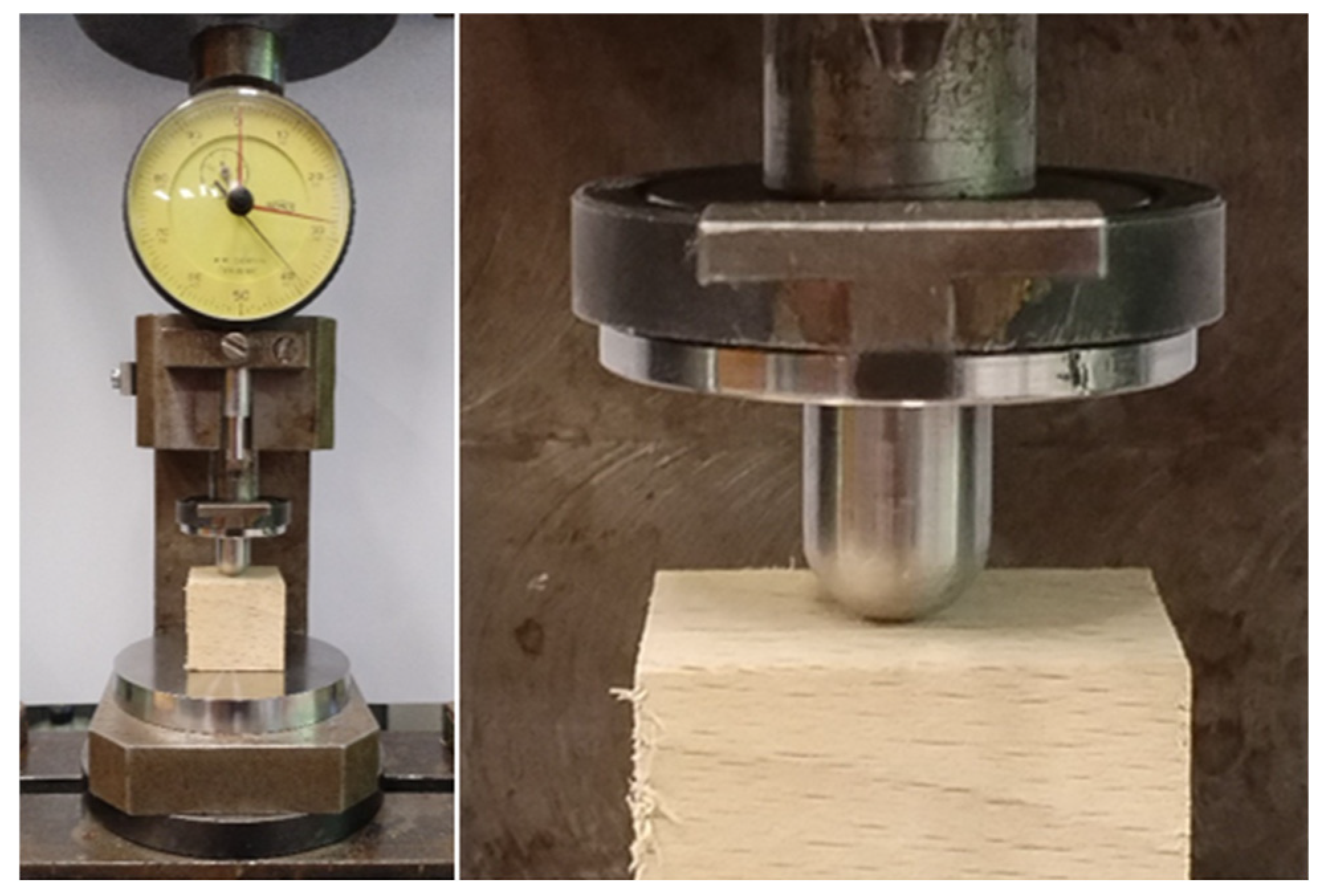
All beech beams (untreated and steamed with both regimes) were cut into samples with dimensions of 6 × 3 × 3 cm (L × R × T, hardness measurements in the radial direction) and 3 × 6 × 3 cm (L × R × T, hardness measurements in longitudinal and tangential directions). Sixteen samples for each anatomical direction were produced. The samples were oven-dried at a temperature of 103 ± 2 °C. Hardness according to Janka was tested on oven-dried samples. The samples were placed under a fixture with a punch. The end of the punch was half-circle-shaped (Figure 1), with a diameter of 11.28 mm. The fixture had a micrometer for measuring the indentation depth attached (Figure 1). Samples were placed under the punch and the fixture was placed into the testing machine. Fifty measurements were performed in each anatomical direction; three or four measurements were performed on each sample.
The depth for indenting the half-circle punch into the samples was determined to 3 mm. Preliminary tests showed that the second steaming regime samples were not able to withstand a full indentation of 5.64 mm; the samples cracked after reaching a 4 mm indentation depth. The force needed to press the punch into the samples was recorded. Hardness according to Janka (HJ) was calculated according to (7):
H J = F π · 2 · R · h h 2
where F is the force (N) applied on the fixture with the half-circle punch; R is the radius of the punch (mm) and h is the depth of the indentation (mm). The hardness was then adjusted to a wood moisture content of 12% (H12) through (8):
H 12 = H w · 1 + α · w 12
where Hw is the hardness according to Janka measured on oven-dried samples (MPa), α is a corrective coefficient (0.04 for longitudinal direction and 0.025 for radial and tangential directions) and w is the wood moisture content at which the hardness was measured.

2.4. Statistical Processing of Measured Data

Two types of inferential statistical tests were applied to analyze the obtained data: the two-sample Student t-test and the two-factor analysis of variance (ANOVA).
The two-sample Student t-test was used to compare differences between two independent groups.
The null hypothesis tested the equality of two population means:
H 0 :   μ 1 = μ 2
The results of the t-test were interpreted based on the calculated test statistic and the corresponding p-value.
The two-way ANOVA was employed to evaluate the effects of two independent factors and their interaction on a single dependent variable. The null hypothesis assumed equality of k group means:
H 0 :   μ 1 = μ 2 = =   μ k   ,   k 3
The F-statistic was used to determine whether the main effects of the individual factors or their interaction exerted a statistically significant influence on the dependent variable. When a significant main or interaction effect was detected, post hoc comparisons were conducted to identify pairwise differences between levels of the examined factors.
To visualize the 95% confidence intervals for the mean values of the evaluated technical properties, box plots were used.
The level of statistical significance was set at α = 0.05 for all analyses. All statistical evaluations were performed using the STATISTICA 14 software package (TIBCO Software Inc., Palo Alto, CA, USA).

3. Results and Discussion

3.1. Wettability

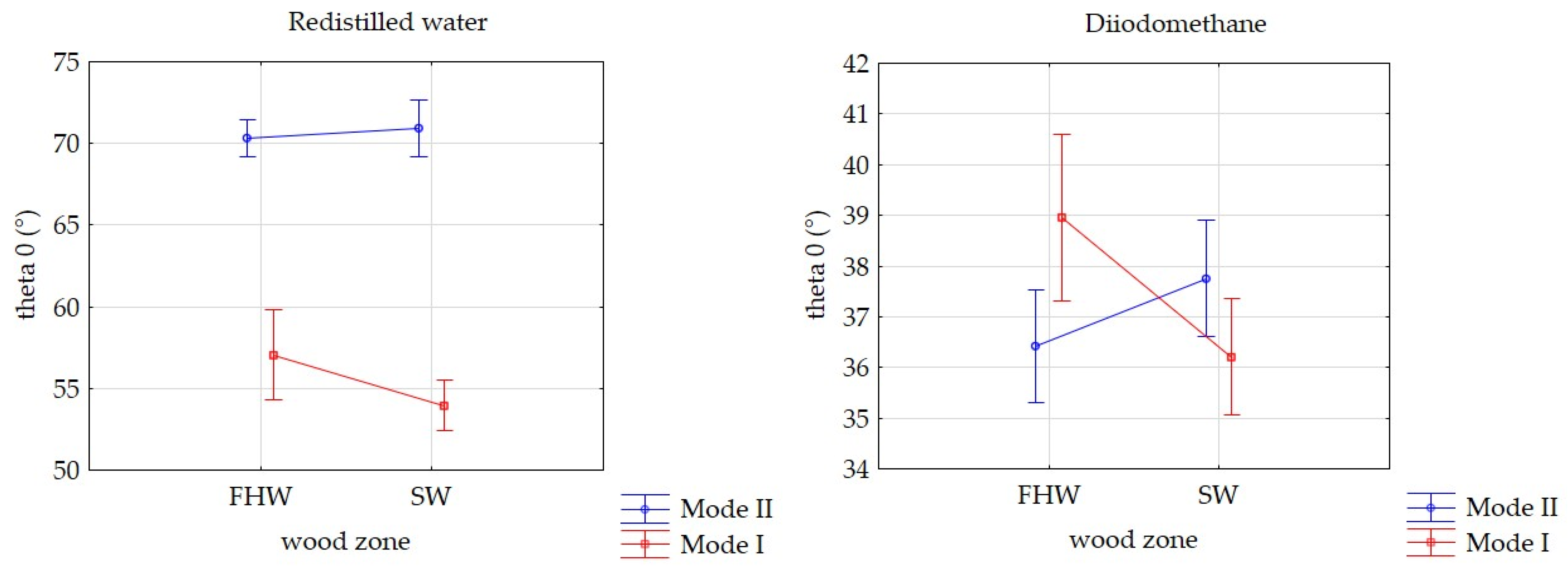
Based on the analysis of variance (Table 3), it can be stated that for redistilled water, the contact angle θ0 is significantly influenced only by the steaming regime (p = 0.000), while its interaction with the wood zone lies close to the selected decision rule for testing (p = 0.051). In contrast, for diiodomethane, both factors exhibit a significant effect through their mutual interaction (0.002).
Figure 2 presents the mean contact angles θ0 for the two wood zones and two steaming regimes, including their associated 95% confidence intervals for experimental measurement with redistilled water and diiodomethane. For the Mode II regime (depicted in blue), θ0 remain high in both wood zones, with a non-significant difference (p = 0.187) between FHW and SW. In contrast, the Mode I regime (depicted in red) shows consistently lower θ0 values. The difference between FHW and SW is not significant (p = 0.271). The contact angle results experimentally measured with diiodomethane show a crossing response to the investigated factors. The crossing of the response lines provides a visual indication consistent with the outcomes of the statistical testing that the two investigated factors do not act independently but they affect the contact angle θ0 in a significant mutual interaction.
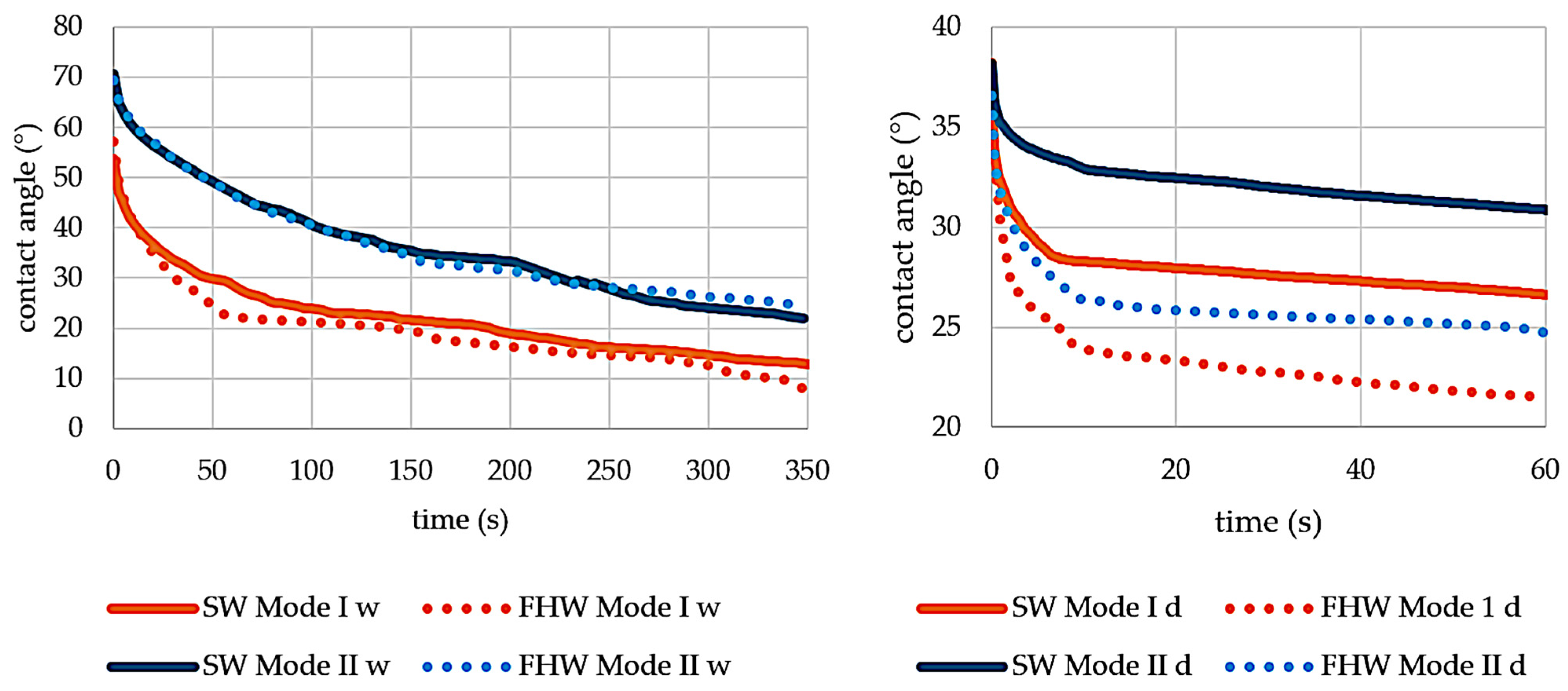
The soaking of testing liquids into the substrates over time is presented in Figure 3. The average θ0 contact angles were higher in the measurement with redistilled water than in the measurement with diiodomethane. The θ0 contact angles were lower than 90° in all measurements; steamed beech SW and FHW can therefore be considered incompletely wettable.
In the measurement with redistilled water, the Mode I steaming regime samples showed lower average contact angles for both FHW and SW than the Mode II steaming regime samples during the soaking of the testing liquid droplets over time. Figure 3 also shows that the change in contact angles during the experiment with redistilled water was not significantly different for FHW and SW in the respective steaming regimes, which is supported by the statistical analysis (Table 3). This is emphasized by the average values of θ0 and θe contact angles. The average θe contact angles were also similar values—28.2° for SW and 28.1° for FHW for the Mode I steaming regime, and 42.4° for SW and 41.2° for FHW in the Mode II steaming regime. The equilibrium time from θ0 until θe was reached ranged from 46.2 to 106 s; the lower equilibrium times were determined for the Mode I steaming regime. There was very high variability (over 50%) in the equilibrium times for both wood zones and regimes. This variability is caused by the structure of beech wood.
As for the experiment with diiodomethane, the average contact angles θ0 ranged between 36.2 and 38.2° for both steaming regimes and wood zones. Despite the similar θ0 values, the change in the contact angles differed with time for both wood zones and steaming regimes. SW presented higher average contact angle values in both steaming regimes than FHW. The θe contact angle values were 34.0° for SW and 32.3° for FHW for the Mode I steaming regime, and 33.2° for SW and 36.3° for FHW for the Mode II steaming regime. This is represented by the statistical analysis (Figure 2) which shows that the factors affect the contact angles θ0 in a significant mutual interaction. The equilibrium time from θ0 until θe was reached ranged from 0.38 to 6.50 s; it was therefore faster than in the measurement with redistilled water.
Contact angle θ0 values measured with redistilled water and diiodomethane for untreated beech FHW and SW were researched by [50]. The beech wood samples in the cited research had a milled surface and several weeks had passed from the milling of the surface until measurements were performed; the results are therefore comparable with the results obtained in this research. The research by [50] showed that the difference between θ0 values for FHW and SW was statistically significant for measurements with both testing liquids. The average θ0 values measured with redistilled water for untreated beech FHW and SW were higher than for steamed beech wood—over 25° higher than the θ0 values measured on the samples steamed with the Mode I regime and 10° higher than the θ0 values measured on the samples treated with the Mode II regime. As for the measurement with diiodomethane, the average θ0 values of untreated beech FHW and SW were slightly higher (41.15° and 38.40° respectively) than the average θ0 values measured on steamed beech FHW and SW. The difference between the θ0 of FHW and SW was significant.
These findings are in contrast with other studies on steamed or hydrothermally treated wood. Refs. [51,52,53] found that beech, poplar and maple wood showed higher contact angles after steam or hydrothermal treatment. However, these works did not specify the machining of the sample’s surfaces. This can influence the contact angle values [32]. The research by [51] reported contact angles higher than 90° for hydrothermally treated poplar at 160 °C and the research by [53] did not specify whether the experimental measurements were performed on false heartwood or sapwood. The steaming regime in the experiment by [53] prepared the samples at 135 °C for 9 h and in the research by [52], the samples were steamed at 125 °C for 8 h and a pressure of 0.18 MPa. This only further emphasizes the point that the wetting of wood surfaces is a highly complex process and it depends on a variety of factors. For steamed wood in general, wettability seems to depend on the specific changes in the chemical composition of the steamed wood.
Based on the results of contact angle measurements with redistilled water, the Mode I steaming regime provides a substrate with better wettability for polar–apolar coatings and glues than untreated beech FHW and SW and beech FHW and SW treated with the Mode II steaming regime. The wettability measurement with diiodomethane does not show a major change for beech FHW and SW after steaming treatment. In comparison to untreated beech FHW and SW, the contact angle changes between FHW and SW are not significant in measurement with redistilled water after the steaming treatments.

3.2. Surface Free Energy

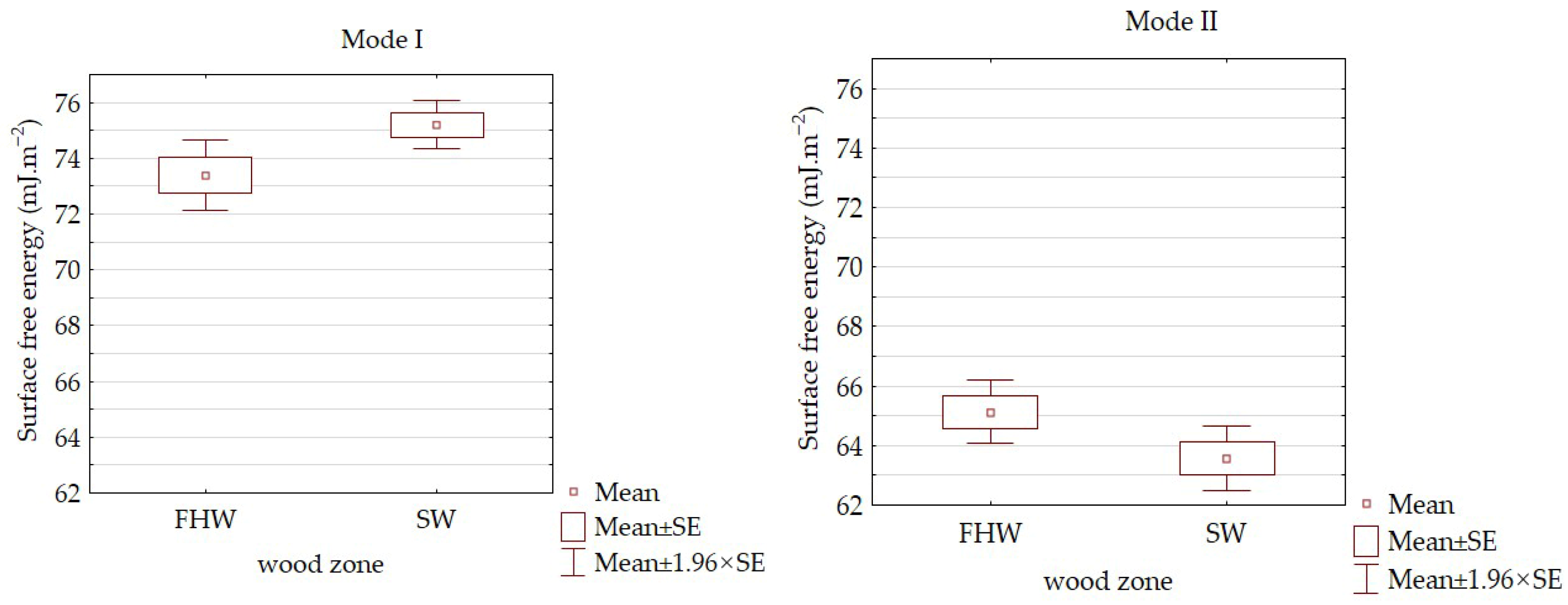
The results of the two-sample Student t-test (Table 4) in the case of the Mode I steaming regime indicated that the total surface free energy between the two wood zones exhibited a significant difference (p = 0.022). The same result was obtained in testing of the Mode II steaming regime, with a p-value of 0.046. This value is close to the testing decision rule of α = 0.05.
In the Mode I steaming regime, the mean surface free energy values were higher in SW than in FHW (Figure 4 and Table 4). The Mode II steaming regime showed the opposite effect. Overall, the mean values of total surface free energy (Table 4) of the samples treated with the Mode I steaming regime presented higher total surface free energy values than samples treated with the Mode II steaming regime in both wood zones. This difference was significant (Figure 4).
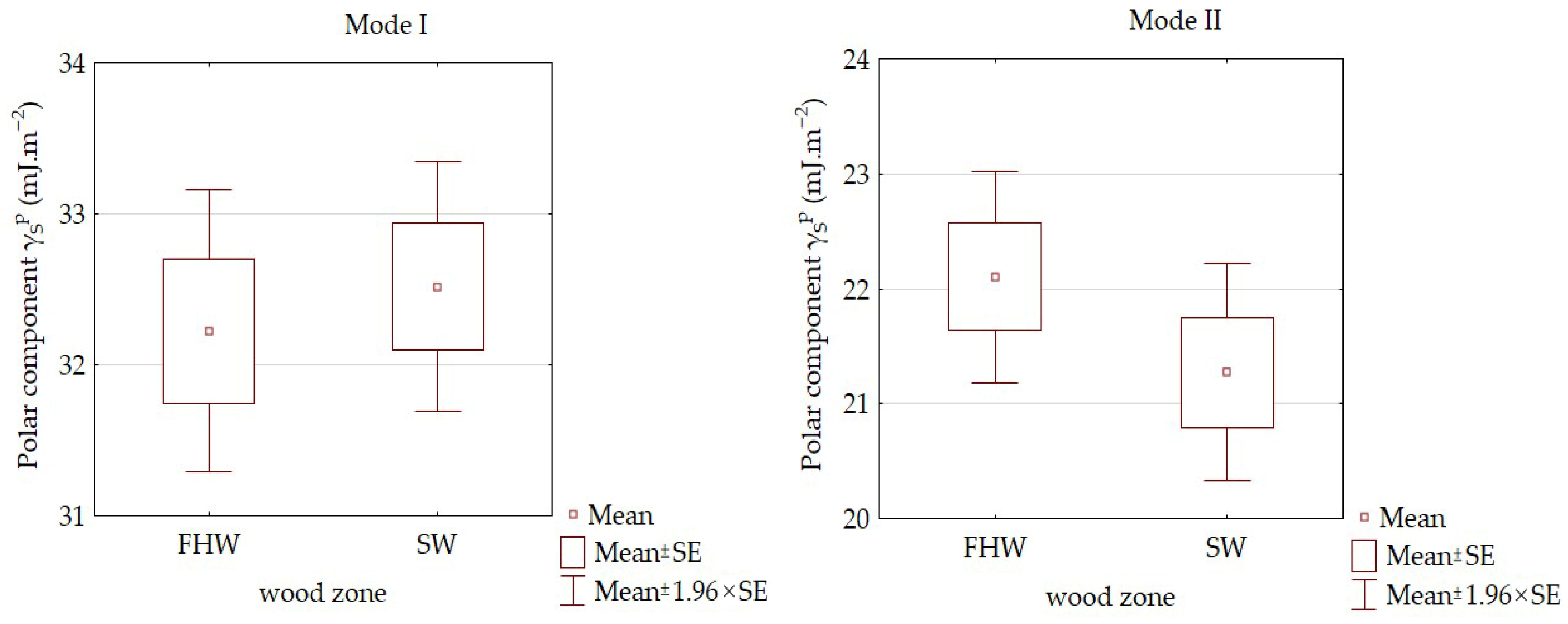
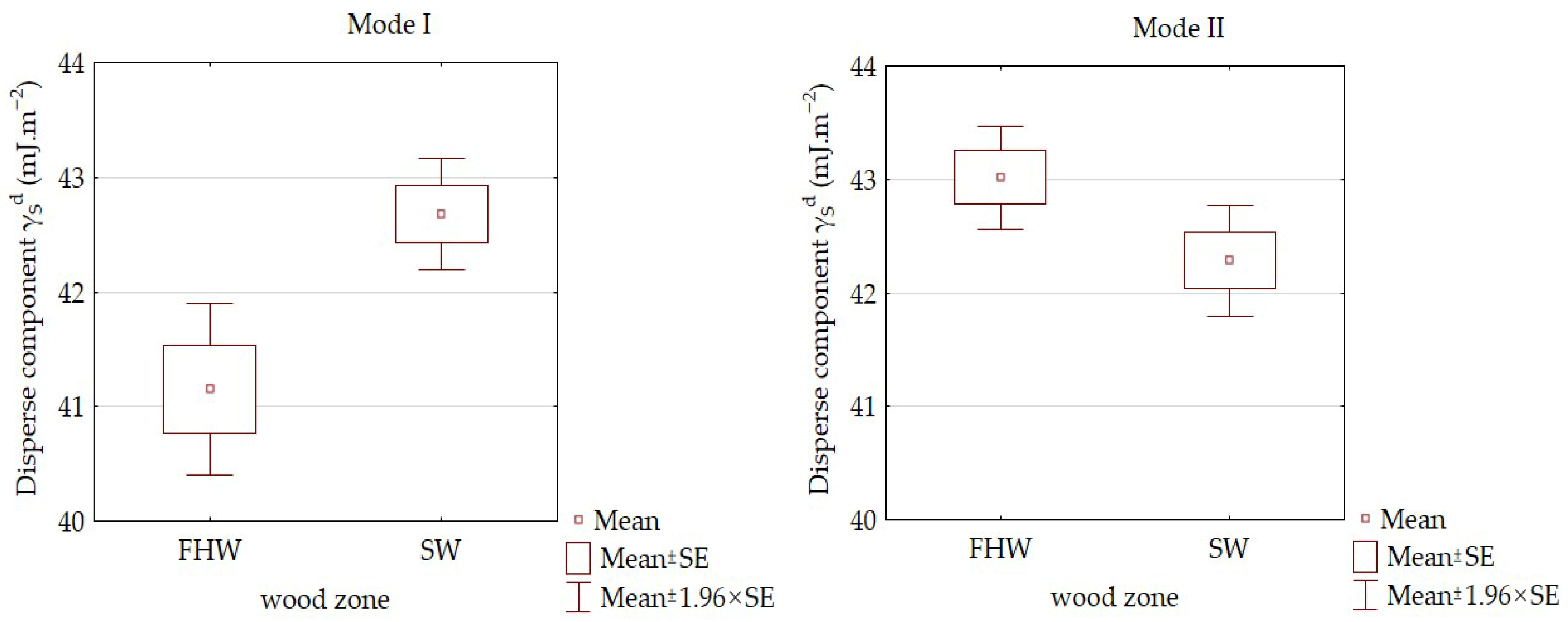
The analysis of polar and disperse components of the total surface free energy is presented in Figure 5. The polar components of the surface free energy were calculated from the measurement with redistilled water, and the disperse components were calculated from the measurement with diiodomethane. The polar components did not show a significant difference between SW and FHW in both steaming regimes (p values were 0.646 and 0.218, for Mode I and Mode II respectively). In contrast to this, the disperse components showed a significant difference between SW and FHW in both steaming regimes (p values were 0.001 and 0.034, for Mode I and Mode II respectively). Both components reflect the trend of differences in total surface free energy in SW and FHW for both regimes.
The drop in the total surface free energy of the samples treated with the Mode II steaming regime was caused by the drop in the polar component of the surface free energy. The polar component in the Mode I steaming regime was higher than the polar component in the Mode II steaming regime by 10 mJ·m−2. This drop can be explained by the chemical changes in wood during the steaming regime. The steaming of wood influences its physical and chemical properties [52,54,55].
According to [49] the total surface free energy value of untreated beech FHW was almost the same as the total surface free energy of steam-treated FHW with the Mode I regime. The total surface free energy of untreated SW was lower than for SW treated with the Mode I steaming regime. The polar and disperse components values of surface free energy for untreated beech FHW and SW were also similar to the values calculated for the samples treated with the Mode I steaming regime. Also, considering the lower θ0 values of the Mode I steam-treated samples, it can be stated that this regime created a surface with high surface free energy and better wettability than the Mode II steaming regime and untreated beech wood. Based on the contact angle and surface free energy results, both polar and disperse coatings can be used for both steaming regimes, but the surface of Mode II regime-treated samples should be sanded prior to coating application, as sanding improves wettability [32].

3.3. Janka Hardness

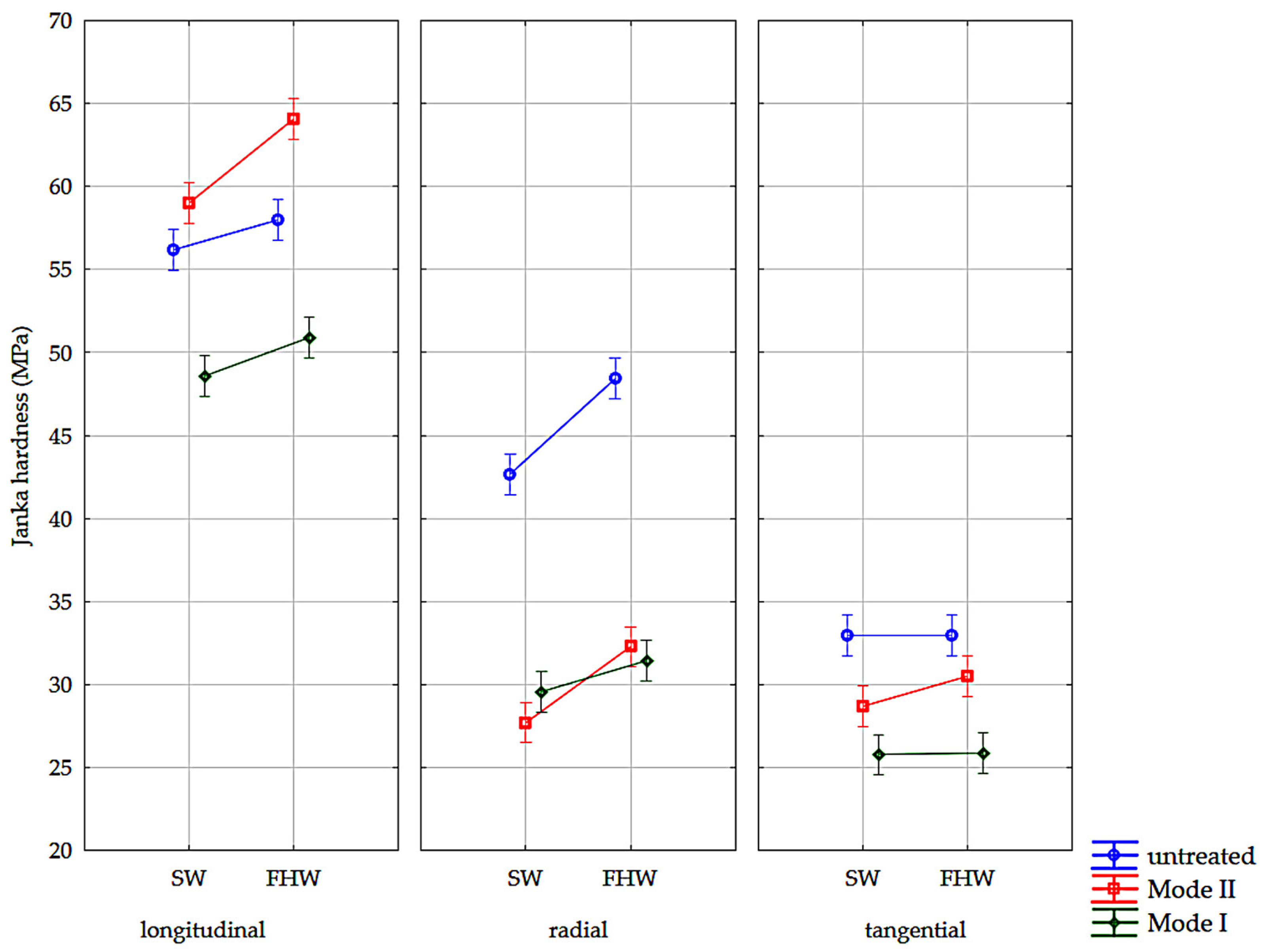
Janka hardness varies strongly across anatomical directions—with the most pronounced portion of the total variation, followed by regime and wood zone. The research by [56] also showed a strong influence of anatomical directions on the Brinell hardness of various wood species. The three-factor ANOVA (Table 5) revealed that all three main effects—wood zone, regime, and anatomical direction—significantly influenced (p = 0.044) Janka hardness in a mutual interaction.
The 95% confidence intervals illustrated in Figure 6 also demonstrate that the mean values of Janka hardness are the result of a complex interaction among anatomical structure, native wood and steaming regime, and wood zone. Since it is a very complex interaction, important non-significant pairs from Duncan’s pairwise comparison are stated. The difference between wood zones in the tangential direction was not significant for any treatment regime or untreated wood. Janka hardness results in the radial and tangential directions in both wood zones in the samples treated with the Mode II steaming regime showed non-significant difference. Hardness in both SW and FHW showed non-significant differences between the Mode I steaming regime in the radial direction and Mode II steaming regime in the tangential direction. Figure 6 also shows that in the longitudinal direction, the Mode I steaming regime hardness values reached significantly lower values for both wood zones than untreated beech wood and samples treated with the Mode II regime. In the radial direction, the hardness of untreated beech wood in both wood zones was significantly higher than the radial hardness in both wood zones for both steaming regimes.
The authors of [57] found no significant difference between sapwood and heartwood hardness for Red Pine. According to the authors, sapwood hardness was lower than heartwood hardness. According to [58], steaming adversely influenced Janka hardness of eastern redcedar. The authors of [59] stated that no major changes were found in the Brinell hardness of Scots pine sapwood and heartwood steamed at three temperatures. The authors presented similar average Brinell hardness values for steamed Scots pine sapwood and heartwood. It is also important to state that the wood species in the cited research are coniferous and beech is a deciduous tree species with false heartwood, whereas coniferous species create heartwood naturally. The beech FHW and SW Janka hardness was significantly different in the longitudinal and radial directions of the untreated beech wood.
The authors of [60] found that steaming time and temperature influence the hardness of hydrothermally treated samples. The higher the steaming temperature and/or the longer the treatment time, the lower the hardness [58]. Both steaming regimes performed in this current research influenced Janka hardness; the hardness was significantly lower in the radial direction and tangential direction. As for the longitudinal direction, the samples steamed with the Mode I steaming regime showed significantly lower values than untreated beech wood in both wood zones. The samples treated with the Mode II steaming regime also showed significantly different Janka hardness values for both wood zones. However, these values were higher than the hardness values of untreated beech wood in the longitudinal direction, and they were lower than the hardness of untreated beech FHW and SW in the radial and tangential directions.

4. Conclusions

The aim of this paper was to determine the wettability, surface free energy and its components, and Janka hardness of beech false heartwood and sapwood steamed with two regimes.
The contact angles θ0 did not show a statistically significant difference between false heartwood and sapwood for both testing liquids. The steaming regime was a significant factor for wetting with redistilled water. For wetting with diiodomethane, the factors wood zone and steaming regime showed a significant mutual interaction.
The total surface free energy values as well as their disperse components were significantly different for both steaming regimes and wood zones. The surface free energy calculated for samples treated with the Mode II steaming regime was lower than the surface free energy of the samples treated by the Mode I regime. The lower value was caused by a drop in the polar surface free energy component. Therefore, oil-based coatings are more suitable for beech wood steamed with this regime. The contact angle and surface free energy results showed that the samples treated by the Mode I steaming regime gained improved wettability of beech false heartwood and sapwood. Owing to high polar and disperse components of the surface free energy calculated for this steaming mode, both water- and oil-based coatings are suitable for beech wood steamed with this mode.
The Janka hardness analysis showed that wood zone, steaming regime and anatomical direction significantly influence Janka hardness in a mutual interaction. The statistical difference between wood zones in the tangential direction was not significant for any treatment regime or untreated wood. Steaming with the Mode I regime significantly decreased the hardness of both false heartwood and sapwood. Samples treated with the Mode II regime showed higher longitudinal Janka hardness than untreated beech false heartwood and sapwood, but this hardness was significantly lower in both cross directions.

Author Contributions

Conceptualization, B.S. and M.D.; methodology, B.S., M.D. and J.S.; validation, B.S., M.D. and J.S.; formal analysis, B.S., M.D. and J.S.; investigation, B.S. and M.D.; resources, B.S. and M.D.; data curation, B.S., M.D. and J.S.; writing—original draft preparation, B.S., M.D. and J.S.; writing—review and editing, B.S., M.D. and J.S.; visualization, B.S. and M.D.; supervision, B.S.; project administration, M.D.; funding acquisition, M.D. All authors have read and agreed to the published version of the manuscript.

Funding

This work was supported by the Slovak Research and Development Agency under the contract no. APVV-21-0051 “Research of false heartwood and sapwood of Fagus sylvatica L. wood in order to eliminate color differences by the process of thermal treatment with saturated water steam”.

Institutional Review Board Statement

Not applicable.

Data Availability Statement

The data presented in this study are available on request from the corresponding author.

Conflicts of Interest

The authors declare no conflicts of interest.

References

  1. Dzurenda, L.; Dudiak, M.; Kučerová, V. Differences in Some Physical and Chemical Properties of Beechwood with False Heartwood, Mature Wood and Sapwood. Forests 2023, 14, 1123. [Google Scholar] [CrossRef] [Scilit]
  2. Bauch, J.; Koch, G. Biologische und Chemische Untersuchungen über Holzverfārbungen der Rotbuche (Fagus sylvatica L.) und Möglichkeiten Vorbeugender Maßnahmen; Abschlussbericht; Bundesforschungsanstalt für Forst- und Holzwirtschaft, Universität Hamburg: Hamburg, Germany, 2001. [Google Scholar]
  3. Račko, V.; Čunderlík, I. Qualitative and quantitative evaluation of false heartwood in beech logs of various age and qualitative structure. Wood Res. 2006, 51, 1–10. Available online: https://www.woodresearch.sk/wr/200603/01.pdf (accessed on 31 January 2026).
  4. Molnár, S.; Németh, R.; Fehér, S.; Tolvaj, L.; Papp, G.; Varga, F. Technical and technological properties of Hungarian beech wood consider the red heart. Wood Res. 2001, 46, 21–30. [Google Scholar]
  5. Račko, V.; Čunderlík, I. Mature wood as a limiting factor in the formation of a false heartwood beech (Fagus sylvatica L.). Acta Fac. Xylologiae Zvolen 2010, 52, 15–24. [Google Scholar]
  6. Molnár, S.; Tolvaj, L. Colour homogenisation of different wood species by steaming. In Interaction of Wood with Various Forms of Energy; Technical University in Zvolen: Zvolen, Slovakia, 2002; pp. 119–122. [Google Scholar]
  7. Dzurenda, L.; Dudiak, M. Cross-correlation of color and acidity of wet beech wood in the process of thermal treatment with saturated steam. Wood Res. 2021, 66, 105–116. [Google Scholar] [CrossRef] [Scilit]
  8. Barański, J.; Klement, I.; Vilkovská, T.; Konopka, A. High temperature drying process of beech wood (Fagus sylvatica L.) with different zones of sapwood and red false heartwood. BioResources 2017, 12, 1861–1870. [Google Scholar] [CrossRef] [Scilit]
  9. Kollmann, F.P. Technologie des Holzwerkstoffes: Holzarten, Eigenschaften und Anwendungen; Springer: Berlin/Heidelberg, Germany, 2009; ISBN 978-3-642-61940-3. [Google Scholar]
  10. Kutnar, A.; Sernek, M.; Kamke, F.A.; Feist, W.C. Characterization and properties of false heartwood in beech trees. Wood Sci. Technol. 2017, 51, 453–467. [Google Scholar]
  11. Fengel, D.; Wegener, G. Wood: Chemistry, Ultrastructure, Reactions; Walter de Gruyter: Berlin, Germany, 1989; p. 613. ISBN 978-3-11-008481-8. [Google Scholar]
  12. Sundqvist, B.; Karlsson, O.; Westermark, U. Determination of formic-acid and acetic acid concentrations formed during hydrothermal treatment of birch wood and its relation to color, strength and hardness. Wood Sci. Technol. 2006, 40, 549–561. [Google Scholar] [CrossRef] [Scilit]
  13. Dzurenda, L. Colouring of Beech Wood during Thermal Treatment using Saturated Water Steams. Acta Fac. Xylologiae Zvolen 2014, 56, 13–22. [Google Scholar]
  14. Klement, I.; Vilkovská, T.; Vilkovský, P.; Uhrín, M. Comparison of Pressure and Atmospheric Steaming Processes and Their Effects on Selected Properties of Beech Wood (Fagus sylvatica L.). Appl. Sci. 2025, 15, 13066. [Google Scholar] [CrossRef] [Scilit]
  15. Hon, N.S.D.; Shiraishi, N. Wood and Cellulosic Chemistry; CRC Press: Boca Raton, FL, USA, 2001; p. 928. ISBN 978-0-8247-0024-9. [Google Scholar]
  16. Geffert, A.; Výbohová, E.; Geffertová, J. Characterization of the changes of colour and some wood components on the surface of steamed beech wood. Acta Fac. Xylologiae Zvolen 2017, 59, 49–57. [Google Scholar] [CrossRef] [Scilit]
  17. Lichtenegger, H.; Müller, U. Wood and Wood Products: A Guide for Architects and Builders; Springer: Berlin/Heidelberg, Germany, 2010; ISBN 978-3-211-79260-5. [Google Scholar]
  18. Tiemann, L.K.; Müller, U.; Schneider, P. The influence of steaming on color change in beech wood. Eur. J. Wood Wood Prod. 2013, 71, 597–603. [Google Scholar]
  19. Reinprecht, L.; Šomšák, M. Effect of plasma and UV-additives in transparent coatings on the colour stability of spruce (Picea abies) wood at its weathering in Xenotest. Acta Fac. Xylologiae Zvolen 2015, 57, 49–59. [Google Scholar] [CrossRef] [Scilit]
  20. De Meijer, M. Review on the durability of exterior wood coatings with reduced VOC-content. Prog. Org. Coat. 2001, 43, 217–225. [Google Scholar] [CrossRef] [Scilit]
  21. Davis, K.; Leavengood, S.; Morrell, J.J. Performance of Exterior Wood Coatings in Temperate Climates. Coatings 2021, 11, 325. [Google Scholar] [CrossRef] [Scilit]
  22. Slabejová, G.; Vidholdová, Z.; Šmidriaková, M. Change in the colour of transparent surface finish on hydrothermally treated wood. Acta Fac. Xylologiae Zvolen 2023, 65, 45–56. [Google Scholar] [CrossRef]
  23. Kúdela, J.; Wesserle, F.; Bakša, J. Influence of Moisture Content of Beech Wood on Wetting and Surface Free Energy. Acta Fac. Xylologiae Zvolen 2015, 57, 25–35. [Google Scholar]
  24. Hubbe, M.A.; Gardner, D.J.; Shen, W. Contact Angles and Wettability of Cellulosic Surfaces: A Review of Proposed Mechanisms and Test Strategies. BioResources 2015, 10, 8657–8749. [Google Scholar] [CrossRef] [Scilit]
  25. Sin, G.; Sandak, J.; Ramananantoandro, T. Properties of wood surfaces—Characterization and meaurement. A review. Holzforschung 2009, 63, 196–203. [Google Scholar] [CrossRef] [Scilit]
  26. Scheikl, M.; Wålinder, M.; Pichelin, F.; Dunky, M. Bonding process. In Wood Adhesion and Glued Products, COST Action E13; State of the Art Report; COST Association: Brussels, Belgium, 2001; p. 172. [Google Scholar]
  27. Piao, C.; Winandy, J.E.; Shupe, T.F. From hydrophilicity to hydrophobicity: A critical review. Part I: Wettability and surface behavior. Wood Fiber Sci. 2010, 42, 490–510. Available online: https://wfs.swst.org/index.php/wfs/article/view/2144 (accessed on 31 January 2026).
  28. Qin, Z.; Chen, H.; Gao, Q.; Zhang, S.; Li, J. Wettability of sanded and aged fast-growing poplar wood sur faces: I. surface free energy. BioResources 2015, 10, 1008–1023. [Google Scholar] [CrossRef] [Scilit]
  29. Petrič, M.; Oven, P. Determination of wettability of wood and its significance in wood science and technology: A critical review. Rev. Adhes. Adhes. 2015, 3, 121–187. [Google Scholar] [CrossRef] [Scilit]
  30. Jankowska, A.; Boruszewski, P.; Drożdžek, M.; Rębkowski, K.; Kaczmarczyk, A.; Skowrońska, A. The Role of Extractives and Wood Anatomy in the Wettability and Free Surface Energy of Hardwoods. BioResources 2018, 13, 3082–3097. [Google Scholar] [CrossRef] [Scilit]
  31. Kúdela, J. Wetting of wood surface by liquids of a different polarity. Wood Res. 2014, 59, 11–24. [Google Scholar]
  32. Kúdela, J.; Javorek, Ľ.; Mrenica, L. Influence of milling and sanding on beech wood surface properties. Part II. Wetting and thermo-dynamical characteristics of wood surface. Ann. Wars. Univ. Life Sci. SGGW For. Wood Technol. 2016, 95, 154–158. [Google Scholar] [CrossRef] [Scilit]
  33. Kúdela, J.; Reinprecht, L.; Vidholdová, Z.; Andrejko, M. Surface properties of beech wood modified by CO2 laser. Acta Fac. Xylologiae Zvolen 2019, 61, 5–18. [Google Scholar] [CrossRef] [Scilit]
  34. Liu, F.P.; Gardner, J.D.; Wolcott, M.P. A model for the description of polymer surface dynamic behaviour. Langmuir 1995, 11, 2674–2681. [Google Scholar] [CrossRef] [Scilit]
  35. Gardner, D.J. Application of the Lifshitz–van der Waals acid–base approach to determine wood surface tension components. Wood Fiber Sci. 1996, 28, 422–428. Available online: https://wfs.swst.org/index.php/wfs/article/download/2146/2146/0 (accessed on 31 January 2026).
  36. Mantanis, G.I.; Young, R.A. Wetting of wood. Wood Sci. Technol. 1997, 31, 339–353. [Google Scholar] [CrossRef] [Scilit]
  37. Santoni, I.; Pizzo, B. Effect of surface conditions related to machining and air exposure on wettability of different Mediterranean wood species. Int. J. Adhes. Adhes. 2011, 31, 741–748. [Google Scholar] [CrossRef] [Scilit]
  38. Gindl, M.; Tschegg, S. Significance of the acidity of wood to the surface free energy components of different wood species. Langmuir 2002, 18, 3209–3212. [Google Scholar] [CrossRef] [Scilit]
  39. Wålinder, M.E.P. Wetting Phenomena on Wood—Factors Influencing Measurements of Wood Wettability; KTH—Royal Institute of Technology: Stockholm, Sweden, 2002; 61p. [Google Scholar]
  40. Blanchard, V.; Blanchet, P.; Riedl, B. Surface energy modification by radiofrequency inductive and capacitive plasmas at low pressures on sugar maple: An exploratory study. Wood Fiber Sci. 2009, 41, 245–254. Available online: https://wfs.swst.org/index.php/wfs/article/view/1182 (accessed on 15 January 2026).
  41. Kúdela, J.; Čunderlík, I. Beech Wood—Structure, Properties and Use; Technical University in Zvolen: Zvolen, Slovakia, 2012; 152p, ISBN 978-80-228-2350-0. [Google Scholar]
  42. Niemz, P.; Sonderegger, W.; Gustafson, P.J.; Kasal, B.; Polocoşer, T. Strength Properties of Wood and Wood Based Materials. In Springer Handbook of Wood Science and Technology; Niemz, P., Teischinger, A., Sandberg, D., Eds.; Springer: Cham, Switzerland, 2023. [Google Scholar] [CrossRef] [Scilit]
  43. Požgaj, A.; Chovanec, D.; Kurjatko, S.; Babiak, M. Structure and Properties of Wood; Príroda: Bratislava, Slovakia, 1997; 485p, ISBN 80-07-00960-4. [Google Scholar]
  44. Dzurenda, L.; Dudiak, M. Homogenization of the Color of Beech Sapwood and False Heartwood by the Steaming Process. Forests 2024, 15, 1009. [Google Scholar] [CrossRef] [Scilit]
  45. Dzurenda, L. Mode for hot air drying of steamed beech blanks while keeping the colors ac-quired in the steaming process. Acta Fac. Xylologiae Zvolen 2022, 64, 81–88. [Google Scholar] [CrossRef]
  46. van Oss, C.J.; Good, R.J.; Chaudhury, M.K. Additive and nonadditive surface tension components and the interpretation of contact angles. Langmuir 1998, 4, 884–891. [Google Scholar] [CrossRef] [Scilit]
  47. Liptáková, E.; Kúdela, J. Analysis of the wood–wetting process. Holzforschung 1994, 48, 139–144. [Google Scholar] [CrossRef] [Scilit]
  48. Neumann, A.W.; Good, R.J.; Hope, C.J.; Sejpal, M. An equation of state approach to determine surface tensions of low-energy solids from contact angles. J. Colloid Interface Sci. 1974, 49, 291–303. [Google Scholar] [CrossRef] [Scilit]
  49. Kloubek, J. Calculation of Surface Free Energy Components of ice according to its wettability by water, chlorbenzene and carbon disulfide. J. Colloid Interface Sci. 1974, 46, 185–190. [Google Scholar] [CrossRef] [Scilit]
  50. Slováčková, B.; Mišíková, O.; Schmidtová, J. Comparing Wettability and Surface Free Energy of False Heartwood, Ripe Wood and Sapwood in Beech (Fagus sylvatica L.). Drv. Ind. 2024, 75, 297–309. [Google Scholar] [CrossRef] [Scilit]
  51. Mirzaei, G.; Mohebby, B.; Ebrahimi, G. Technological properties of glulam beams made from hydrothermally treated poplar wood. Wood Mater. Sci. Eng. 2016, 13, 36–44. [Google Scholar] [CrossRef] [Scilit]
  52. Novák, I.; Kleinová, A.; Janigová, I.; Mičušík, M.; Sedliačik, J.; Šlouf, M.; Bekhta, P.; Matyšovský, J.; Jurkovič, P. Properties of Water Steam-Treated Maple Wood (Acer pseudoplatanus L.). Wood Res. 2020, 65, 865–876. [Google Scholar] [CrossRef] [Scilit]
  53. Sedliačik, J.; Bekhta, P.; Novák, I.; Kleinová, A.; Mičušík, M.; Matyšovský, J.; Jurkovič, P. Surface Properties of Hydro-hermally Modified Beech Wood After Radio-Frequency Discharge Plasma Treatment. Wood Res. 2025, 70, 299–309. [Google Scholar] [CrossRef] [Scilit]
  54. Yin, Y.; Berglund, L.; Salmén, L. Effect of Steam Treatment on the Properties of Wood Cell Walls. Biomacromolecules 2011, 12, 194–202. [Google Scholar] [CrossRef] [Scilit]
  55. Altgen, M.; Hofmann, T.; Militz, H. Wood moisture content during the thermal modification process affects the improvement in hygroscopicity of Scots pine sapwood. Wood Sci. Technol. 2016, 50, 1181–1195. [Google Scholar] [CrossRef] [Scilit]
  56. Sydor, M.; Pinkowski, G.; Kučerka, M.; Kminiek, R.; Antov, P.; Rogoziński, T. Indentation Hardness and Elastic Recovery of Some Hardwood Species. Appl. Sci. 2022, 12, 5049. [Google Scholar] [CrossRef] [Scilit]
  57. Bektaş, I.; Tutuş, T.; Gültekin, G. The Effect of Sapwood and Heartwood Differences on Mechanical Properties of Fast-Growing Tree Species. Drv. Ind. 2020, 71, 261–269. [Google Scholar] [CrossRef] [Scilit]
  58. Kaygin, B.; Koc, K.H.; Hiziroglu, S. Surface quality and hardness of eastern redcedar as function of steaming. J. Wood Sci. 2014, 60, 243–248. [Google Scholar] [CrossRef] [Scilit]
  59. Rautkari, L.; Honkanen, J.; Hill, C.A.S.; Ridley-Ellis, D.; Hughes, M. Mechanical and physical properties of thermally modified Scots pine wood in high pressure reactor under saturated steam at 120, 150 and 180 °C. Eur. J. Wood Wood Prod. 2014, 72, 33–41. [Google Scholar] [CrossRef] [Scilit]
  60. Varga, D.; van der Zee, M.E. Influence of steaming on selected wood properties of four hardwood species. Holz Roh-Werkst. 2008, 66, 11–18. [Google Scholar] [CrossRef] [Scilit]
Figure 1. Measuring fixture for Janka hardness is on the left, with a micrometer for measuring the depth of indentation. A detailed view of the punch with a half-circle is on the right.
Applsci 16 04346 g001
Figure 2. The 95% confidence intervals of the mean contact angle θ0 for the individual combinations of the two investigated factors—wood zone and regime.
Applsci 16 04346 g002
Figure 3. Average contact angle values during measurements. The figure on the left shows the measurement with redistilled water (w) and the figure on the right shows the measurement with diiodomethane (d).
Applsci 16 04346 g003
Figure 4. Box plot—95% confidence intervals of the mean surface free energy for the two regimes.
Applsci 16 04346 g004
Figure 5. Box plot—95% confidence intervals of the mean disperse and polar components for the two regimes.
Applsci 16 04346 g005aApplsci 16 04346 g005b
Figure 6. The 95% confidence intervals of the mean Janka hardness for the individual combinations of the three investigated factors—anatomical direction, regime, and wood zone.
Applsci 16 04346 g006
Table 1. Technological conditions for the homogenization of the color of beech wood in a pressure autoclave.
Steaming RegimesConditions for Steaming Beech Wood
Temperature
[°C]
Pressure
[MPa]
Time
[h]
Mode I105 ± 2.50.122 ± 0.0118
Mode II120 ± 2.50.199 ± 0.019
Table 2. Surface free energy and polar and disperse components of the used testing liquids.
Testing LiquidγLγLdγLpγ+γηReference
mJ·m−2Pa·s
Redistilled water72.8021.8051.0025.5025.500.010[35]
Diiodomethane50.8050.800.0000.0000.0000.028[45]
Table 3. ANOVA results—effects of the two investigated factors (wood zone and regime) on the contact angle θ0.
Contact AngleSSdfMSF-Testp-Level
Redist. WaterMI Redist. WaterMIRedist. WaterMIRedist. WaterMI
Wood zone77.524.9177.524.91.751.220.1870.271
Regime11,389.912.7111,389.912.7257.300.620.0000.432
Wood zone * regime170.6209.51170.6209.53.8510.280.0510.002
Error8676.33994.119644.320.4
Total20,314.34241.1199
* MI is diiodomethane (methylene iodide).
Table 4. Two-sample Student t-test results—surface free energy of two wood zones.
Surface Free Energy (mJ·m−2)Std.Dev. FHWStd.Dev. SWt-Valuedfp-Value
Mean FHWMean SW
Mode I73.3875.204.553.14−2.33980.022
Mode II65.1263.563.833.922.02980.046
Table 5. ANOVA results—effects of the three investigated factors (wood zone, regime, and anatomical direction) on the Janka hardness. “*” describes interaction among anatomical structure, native wood and steaming regime, and wood zone.
Janka Hardness (MPa)SSdfMSF-Testp-Level
Wood zone15091150977.900.000
Regime14,55427277375.580.000
Anatomical direction117,817258,9083040.420.000
Wood zone * regime21221065.470.004
Wood zone * anatomical direction466223312.030.000
Regime * anatomical direction10,73642684138.520.000
Wood zone * regime * anatomical direction1904482.450.044
Error17,08988219
Total162,573899
Disclaimer/Publisher’s Note: The statements, opinions and data contained in all publications are solely those of the individual author(s) and contributor(s) and not of MDPI and/or the editor(s). MDPI and/or the editor(s) disclaim responsibility for any injury to people or property resulting from any ideas, methods, instructions or products referred to in the content.