1. Introduction
Several studies have shown that people interact with robots in ways similar to how they interact with other humans [
1,
2] and that even the prejudices they hold toward other individuals can be extended to robots [
3]. This occurs because people tend to spontaneously attribute social traits, including trustworthiness, to artificial intelligence (AI) agents such as voice assistants [
4], humanoid robots [
5], and virtual agents [
6]. This tendency to anthropomorphize technology is explained by the uncanny valley theory [
7]. According to this framework, people attribute human-like characteristics to machines and construct impressions based on cues such as the robot’s voice [
8,
9].
In human interaction, voice plays a fundamental role in social communication, as it enables listeners to rapidly form judgments about others and assess their trustworthiness [
10,
11]. Similarly, a robot’s vocal characteristics, as well as the content it conveys, contribute to shaping its perceived social identity and can influence the quality of interaction [
1].
Furthermore, a robot’s voice constitutes a powerful social signal, the design of which can affect users’ affective evaluations and acceptance of robotic systems [
12]. Of particular relevance to this study is the fact that voice also serves as an indicator of ethnic identity. Specifically, vocal accent can signal a speaker’s country of origin and may be associated with a particular ethnic identity [
1].
Since language functions as a salient social marker, conveying information about social background, individuals often exhibit a bias in favor of speakers with familiar accents [
13].
Within the field of human–robot interaction (HRI), this similarity-attraction effect has been observed across different populations [
14,
15,
16], as well as in cross-cultural comparisons between Western and Eastern cultures [
17].
These studies have examined the influence of a robot’s vocal accent on user preferences; however, only a limited number of studies—yielding mixed results—have investigated how this preference affects users’ trust in the robot [
18,
19].
This study aims to investigate whether the similarity-attraction effect is also present in human–robot interaction contexts, whether it influences users’ trust in the robot, and whether factors such as users’ gender and age act as moderating variables.
In doing so, it contributes to the literature on vocal characteristics in human–robot interaction by specifically examining the role of accent in shaping trust toward humanoid robots. To this end, an experiment was conducted with two participant groups—one Italian and one Arabic—in which participants interacted with two robots: one speaking with a native accent and the other with a foreign accent.
The results showed a clear preference for the robot with a native accent, supporting the similarity-attraction effect [
9,
20,
21,
22]. The findings are particularly relevant for real-world applications, as social robots are increasingly deployed in service, healthcare, education, and public-facing environments where users are required to rely on and delegate tasks to robotic systems. In such contexts, trust is not merely an attitudinal variable but a functional precondition for effective interaction.
By investigating how accent similarity influences trust-based delegation across Italian and Arab samples, this study contributes both to the theoretical understanding of similarity-attraction mechanisms in HRI and to the development of socially informed design strategies for practical robotic deployment.
The rest of this paper is structured as follows. The next section reviews the relevant literature, focusing on trust in HRI, the role of vocal perception, and the influence of accent. The subsequent section describes the experimental design, including research questions, participant sample, experimental setting, materials, and procedure. Finally, the results are presented and directions of future research are discussed.
2. Related Works
Trust in robots served as the starting point for the literature review. The first section focuses on studies that examined the role of trust in HRI contexts. Starting from the assumption that vocal characteristics are among the factors influencing trust, the role of vocal perception in shaping trust in robots is then explored, and an overview of existing findings in the field of HRI is provided. The section concludes with a review that narrows the focus to linguistic variations, specifically accent and dialect.
2.1. Trust in Robots
It is important to investigate the conditions under which robots are accepted into human environments. Among the factors influencing robot acceptance, trust plays a central role [
23,
24]. Indeed, trust has been shown to affect the adoption, perceived usefulness, and ease of use of technologies [
25,
26]. Although often used interchangeably, trust and trustworthiness are conceptually distinct [
27,
28].
Trust is a multidimensional and relational construct shaped by a trustor’s cognitive and affective beliefs about a trustee’s competence and intentions within a specific context and task. Trustworthiness, in contrast, is a characteristic attributed to the trustee, whereas trust itself remains a psychological state of the trustor. This attitude leads to the intention—and subsequent behavior—of delegating a task in order to achieve specific goals. Such decisions are context-dependent and influenced by perceived risk and uncertainty.
Conversely, perceived trustworthiness refers to the traits of others—such as honesty, friendliness, and competence—that influences the choice to trust them [
28,
29,
30]. In other words, trustworthiness represents the foundation upon which trust is built: when an agent is perceived as trustworthy, individuals are more likely to rely on it.
It can therefore be argued that human trust in social robots is grounded in both cognitive and affective evaluations, as well as in observable behaviors such as task delegation. For example, Cantucci et al. [
31] examined the interaction between competence, autonomy, and robot personality traits and their impact on trusting attitudes (cognitive and affective trust) and trusting behavior (task delegation) in task-oriented HRI [
31].
While it is reasonable to argue that trust plays an important role in enabling effective and genuinely cooperative interaction between human and various forms of artificial intelligence systems [
32], it is also true that there is currently a wide diversity of AI systems available, differing in their characteristics, types, application domains. This variability makes it difficult to identify generalizable constructs and universally valid measure of trust [
33].
Despite these challenges, within the field of HRI, research continues to explore the factors influencing the development of trust toward robots, and their vocal characteristics represent a broad area of investigation.
2.2. Vocal Perception of Trust in Robots
Humans are skilled at assessing others’ trustworthiness based on language cues, a capacity that has likely played an important role in human survival. However, in today’s highly technological era, where daily life is shared not only with other people but also with increasingly advanced technological systems such as voice assistants, social robots, and driving assistants, trust has become a key factor in the acceptance of these technologies [
34,
35,
36].
As a result, a growing body of research has begun to investigate the vocal acoustics of robots and the factors that may influence the development of trust in users.
The existing literature suggests that vocal acoustics shape first impressions of speakers’ perceived trustworthiness [
21,
29,
37,
38]. In particular, people tend to prefer certain types of voices and to associate them with specific stereotypes [
39]. For instance, both men and women tend to rate relatively low-frequency voices as more attractive and dominant, whereas high-frequency voices as often perceived as more emotional and immature [
40].
Anthropomorphism (i.e., the degree of similarity to human characteristics) in voice also plays a key role. For example, in a study by Kühne et al. [
41], human-like voices were perceived as less disturbing and rated more positively in terms of likability, credibility, and trustworthiness. Such voices are also considered more efficient and are more easily remembered [
42].
Across several studies, artificial agents with human-like voice have been perceived as more competent and credible [
43,
44,
45]. Moreover, both anthropomorphic features and the perceived gender (i.e., male/female) of robot voices influence users’ judgments. For instance, Neuenswander et al. [
46] found that natural voices were rated as warmer and more competent and elicited less discomfort than machine-like voices.
The same study further examined the relationship between gender stereotypes and task-related expectations, highlighting an interaction between these variables.
Beyond gender and stereotypes, additional voice-related aspects such as tone and contextual appropriateness have also been investigated. In particular, the perceived suitability of a robot’s voice appears to depend on the application domain and the task it is designed to perform [
47]. For example, in hospitality settings, reception robots using a task-oriented communication style and a low-pitched voice tend to foster greater interaction compared to those using a social-oriented communication style paired with a high-pitched, “ringing” voice [
48]. In shopping contexts, the most acceptable voice types appear to be adult male and childlike voices. For home companion robots, both adult male and childlike voices are generally preferred, whereas in educational settings, adult male and female voices are considered most acceptable [
12].
Maltezou-Papastylianou et al. [
11] conducted a systematic review on the influence of vocal acoustics on perceived trustworthiness, identifying several key findings: a link between vocal tone and trustworthiness [
49]; a preference for more natural, human-like AI voices [
36]; and the influence of the similarity-attraction effect. This effect refers to individuals’ tendency to prefer speakers perceived as more similar to themselves [
9,
20,
21,
22]. The presence of this effect will be further discussed in the following paragraph and empirically investigated in this study. In light of this theory, a robot’s accent may provide users with information about its membership in a given geographical or national group and, consequently, influence users’ perceptions and judgments.
2.3. Influence of Accent on Trust
When we hear the voice of a stranger, we tend to form an impression of their identity, including gender, age, accent, and personality traits [
9,
10]. Voice therefore represents an important vehicle of language, allowing us to infer human characteristics from auditory signals produced during speech. In human interactions, there is a reciprocal relationship between trust and vocal communication. Vocal cues enable individuals both to signal their own trustworthiness and to infer the trustworthiness of others. In this context, perceived group membership based on accent or dialect appears to have a stronger influence than factors such as gender or ethnicity [
50].
As defined by Kühne et al. [
51], a dialect or accent refers to the way individuals from different regional or social groups articulate words and sentences, resulting in systematic differences in speech patterns, and accents are not equivalent. Dialects encompass a broader set of linguistic features, including vocabulary, grammar, and sentence structure, whereas accents primarily concern differences in pronunciation [
52].
While numerous studies have examined the role of dialect in HRI, comparatively fewer studies have focused specifically on accent. Regarding accent, Torre et al. [
13] found that speaking with a standard, non-regional accent increases perceived trust. Moreover, this effect persists over time, even in the presence of clear behavioral evidence indicating untrustworthiness in a negotiated interaction. In the same study, positively evaluated accents remained favorably rated despite contradictory behavioral cues.
Similarly, Dahlbäck et al. [
20] conducted a study on American or Swedish voices, produced with native or foreign accents. The results showed a clear preference for native-like accents. The similarity-attraction effect proved particularly strong, as speakers with matching accents were rated as more competent even when they provided less information than speakers with a foreign accent [
20].
Furthermore, native accents are generally perceived as more trustworthy than non-native accents [
53]. For example, in the British Isles, Standard Southern British English (SSBE) is rated as more pleasant and prestigious than regional accents [
54], while rural accents are often perceived as more friendly and trustworthy than urban accents such as those London or Birmingham [
54].
Other studies, however, have reported contradictory findings, showing that robots using regional language varieties are perceived as more friendly and likable but less competent [
16,
55].
The application context of the robot also appears to play an important role. It has been shown that, in elderly care settings, robots speaking local dialects rather than the standard national language are preferred [
56].
To our knowledge, no studies have investigated the influence of accent on human–robot interaction in Italian- or Arabic-speaking context. Therefore, the present study builds on the work of Andrist et al. [
17] by examining this phenomenon in an HRI setting with an Italian and an Arabic participant sample.
2.4. Influence of Intergroup Biases in HRI
Group bias is a well-documented phenomenon in human social contexts; however, it is increasingly important to understand whether such mechanisms generalize to human–robot interaction (HRI).
Eyssel and Kuchenbrandt [
57] demonstrated that social categorization based on nationality (German vs. Turkish) significantly influenced participants’ evaluations of a robot: when the robot was framed as belonging to an ingroup, it was evaluated more positively than when it was associated with an outgroup. The authors interpreted these findings as evidence of intergroup bias in HRI.
This line of research was further examined by Abrams et al. [
58], who questioned whether such preferences were truly driven by intergroup bias or rather by a “made-in” effect [
59], whereby products are evaluated differently depending on the perceived reputation of their country of origin. Specifically, they investigated whether attitudes toward a country and its people could serve as informational cues in evaluating robots, independently of their actual quality or ingroup/outgroup categorization. In other words, they explored whether evaluations were influenced more by national stereotypes than by the robot’s perceived group membership.
Their results did not reveal significant differences in robot evaluations, failing to replicate the intergroup bias effect reported by Eyssel and Kuchenbrandt [
57].
Moreover, they did not find evidence supporting the influence of country-related attitudes or stereotypes. Nevertheless, their findings provide important directions for future research. In particular, the authors suggest that allowing the robot to self-identify—for example, by presenting its nationality as a self-attributed characteristic—could reduce its perception as a mere product and enhance its role as a social interaction partner, thereby strengthening users’ identification with the robot.
3. Materials and Methods
3.1. Overview of the Study
This study aims to investigate, in an HRI context, the influence of the similarity-attraction effect on user’s trust investment in a robot. The experiment was conducted with two distinct samples, Italian and Arab, using the robot’s native versus foreign accent as the experimental manipulation.
Each participant individually listened to two robots introducing themselves. Both robots spoke the participant’s language; however, one used a native accent, while the other used a foreign accent. Subsequently, based on the theory of trust proposed by Castelfranchi and Falcone [
27], participants were asked to indicate which of the two robots they would prefer to delegate the task described in the experiment and were selected through a preliminary study, which is described in the dedicated section.
3.2. Research Questions
Based on what has been said, we asked ourselves the following questions:
RQ1: Can the similarity-attraction effect be confirmed in HRI contexts?
RQ2: Do age and gender influence the similarity-attraction effect in human–robot interaction?
RQ3: Does the similarity-attraction effect lead to trust?
3.3. Sample
The sample consisted of 97 participants, of whom 44 identified as male (45.4%) and 53 identified as female (54.6%). Participants ranged in age from 16 to 72 (M = 28.4, SD = 15.357).
The Italian sample was recruited from staff at second-level reception centers, a community center, and a high school in the province of Catania. The Arab sample was recruited from residents of second-level reception centers for migrants and the Mosque.
3.4. Experimental Setting
This study was conducted in four different locations:
- -
Reception centers of the SAI network coordinated by the Central Service of the Italian Ministry of the Interior.
- -
A youth center.
- -
A high school.
- -
A Mosque.
All experiments were conducted in a dedicated room to ensure confidentiality. The room was well-lit and quiet. The experimenter, an assistant, and, for the Arab sample, an intercultural mediator, were present during the sessions. The mediator and assistant were seated at a table with computers to one side of the participant.
Although data collection was conducted in different locations, all experimental sessions were carried out in dedicated rooms that were arranged to be as uniform as possible in terms of lighting, noise levels, and spatial configuration in order to minimize environmental variability across settings.
Before the experiment began, the participants were asked to sign an informed consent form. For minors, consent was provided by parents or legal guardians.
Ethics approval for the study was obtained from the Internal Ethics Review Board (IERB) of the Department of Humanities of the University of Catania.
3.5. Stimulus Material
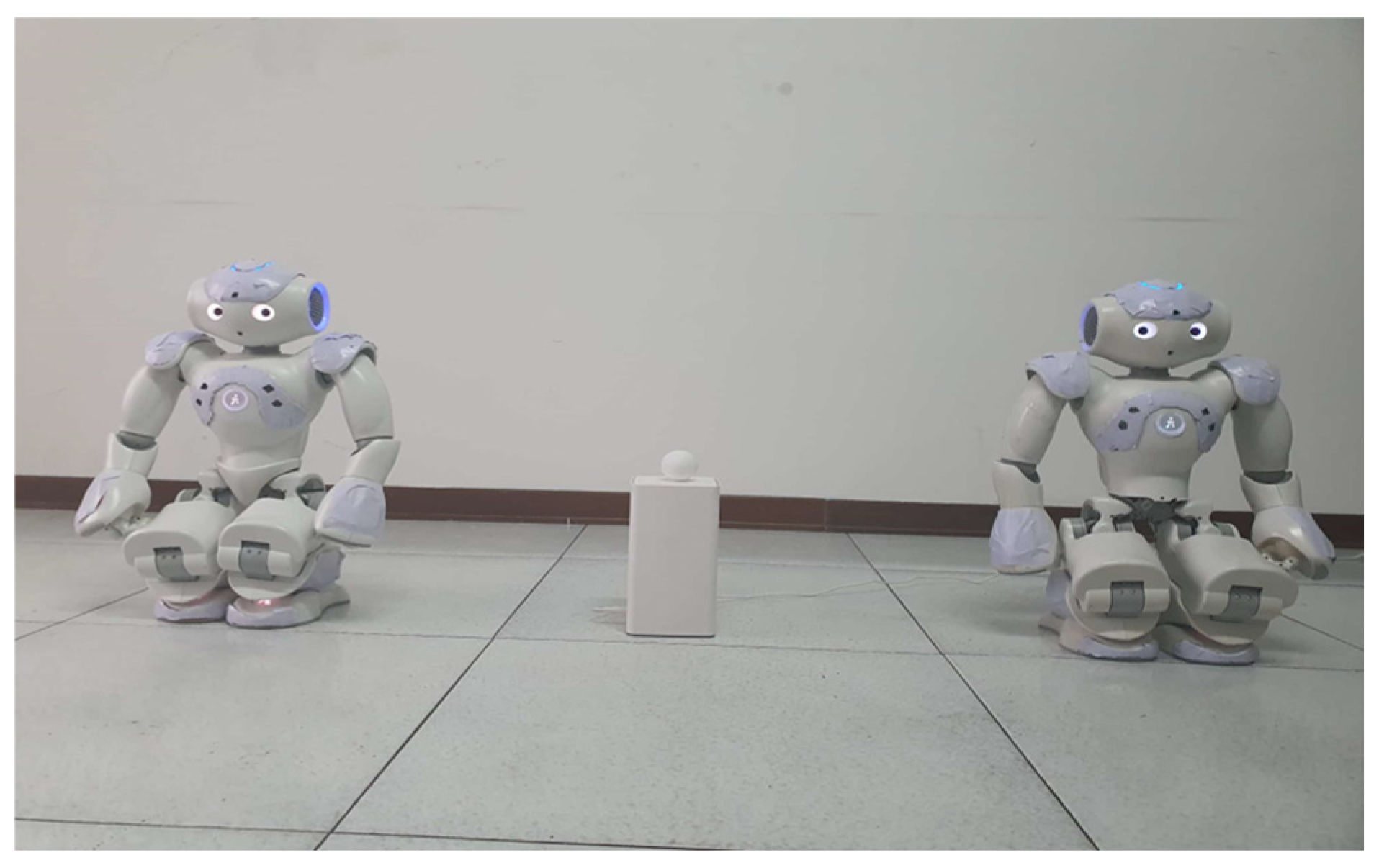
Two NAO robots, produced by Aldebaran Robotics and programmed using Choregraphe 2.1.4 software, were used for the experiment. To ensure visual identity, both robots were covered with white adhesive material on their colored parts. In addition, a white stand and a white ball were used in order to minimize the potential influences of shape and color.
All forms and informed consent documents used for the Arabic sample were translated from Italian into Classical Arabic by an intercultural mediator from the Italian Red Cross.
Four voices stimuli for the NAO robots (Italian with an Italian accent, Italian with an Arabic accent, Arabic with an Arabic accent, Arabic with an Italian accent) were selected through a pre-test, which is described in the following section.
3.6. Preliminary Study
A preliminary study was conducted with a sample of 40 subjects (20 Italians and 20 Arabs).
A preliminary study was conducted to select the auditory stimuli used in the main experiment and to ensure a controlled perceptual profile across cultural conditions. The pre-test involved 40 participants (20 Italian and 20 Arabic speakers), who evaluated candidate voices within their respective linguistic groups (
Table 1).
Italian participants listened to two Italian voices, while Arabic participants evaluated two Arabic voices. Each participant assessed the voices along four perceptual dimensions, authoritativeness, empathy, credibility, and determination, using a 5-point Likert scale.
To control for potential order effects, stimulus presentation was fully counterbalanced within each group. Half of the participants were exposed to the voices in one order, while the remaining half received the reverse order.
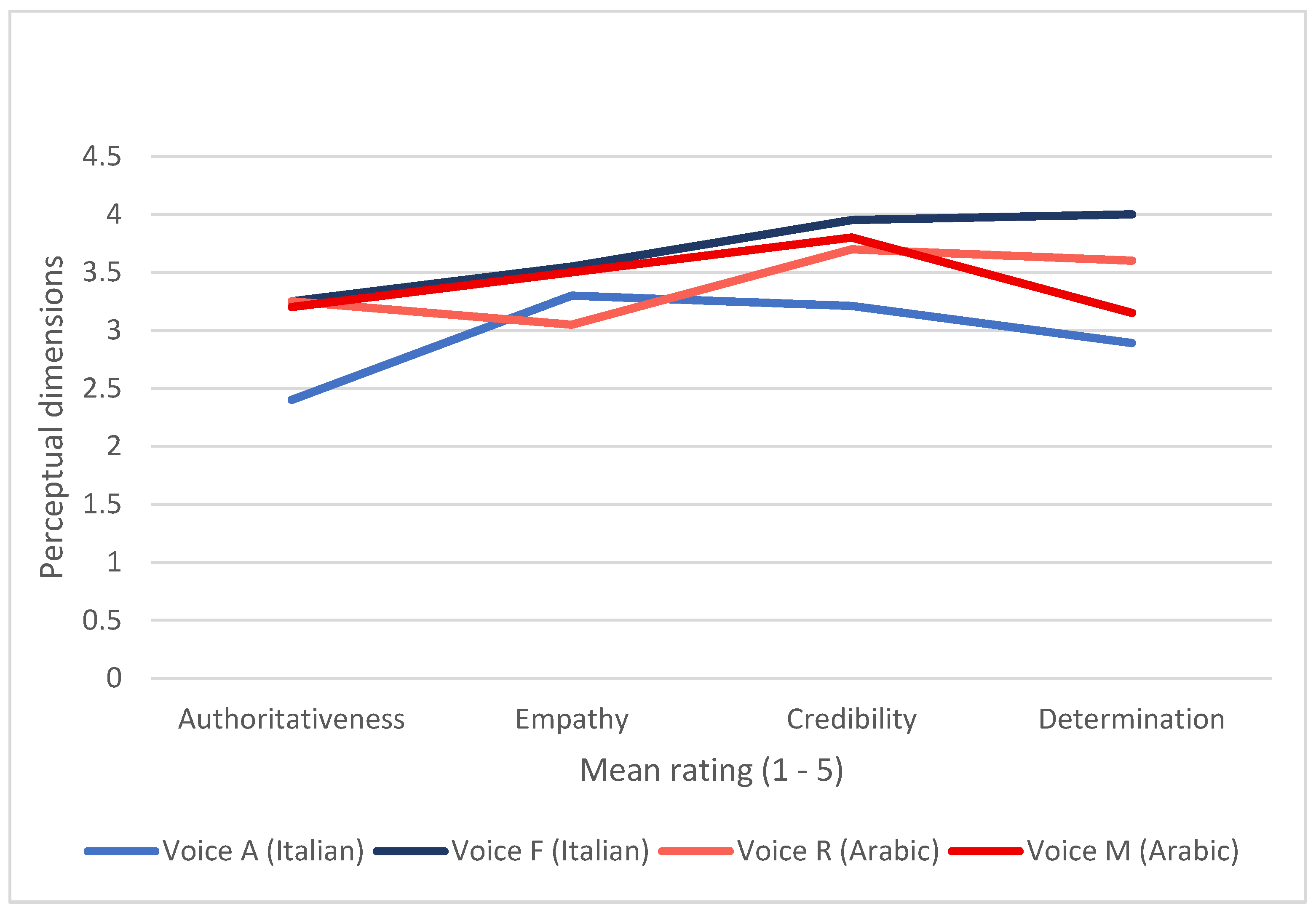
Data were analyzed using IBM SPSS (version 30). Within each cultural group, repeated-measures analyses were conducted to compare the two candidate voices across the four perceptual dimensions. Results indicated systematic differences between the Italian voices on most dimensions, with one voice (Voice F) being consistently rated higher on authoritativeness, credibility, and determination, while no significant difference was found for empathy (
Table 2). In contrast, the Arabic voices showed a more stable perceptual profile, with minimal differences across dimensions (
Table 3).
Based on these results, stimulus selection was guided by the criterion of perceptual balance within each cultural set rather than maximal differentiation.
Accordingly, Voice A (Italian) and Voice R (Arabic) were selected as experimental stimuli, as they represented the most neutral and least extreme profiles within their respective groups, ensuring greater comparability across conditions in terms of perceived social attributes (see
Figure 1).
This procedure ensured that the final stimuli were comparable in terms of their overall perceptual neutrality, while still preserving their cultural distinctiveness, thus supporting the internal validity of the main experimental design.
3.7. Experimental Procedure
First, participants completed the informed consent forms and provided basic demographic information. They were then seated facing the two robots. As shown in
Figure 2, the two NAO robots were positioned equidistantly from the participant, both at rest, with a pedestal placed centrally between them holding a small white ball.
Participants were instructed as follows: “Now you will listen to the two robots. Please listen carefully, as you will be asked a question afterward”. The two robots then introduced themselves in a randomized order.
After the presentation, the experimenter asked: “Which robot would you choose to pick up the object on the pedestal?”. Once the participants made their choice, they were asked: “Why?”. After their response, the selected robot stood up, turned 90 degrees, and walked toward the pedestal to pick up the object.
4. Results
Using IBM SPSS version 31, descriptive statistics were computed, including means, standard deviations, variance, skewness, and kurtosis.
Table 4 presents the age distribution of Italian and Arab samples.
Table 5 reports the gender distribution across the two samples.
Regarding RQ1, a similarity-attraction pattern emerged in the human–robot interaction context. As shown in
Table 6, participants showed a higher tendency to trust the robot with a native accent (77.3%). This pattern was consistent across both subsamples: Italian participants selected the native-accent robot in 75% of cases, whereas Arabic participants did so in 81.1% of cases.
Table 7 provides a detailed breakdown of choices for the two samples.
Open-ended responses further suggest that accent influenced perceived comprehensibility and affinity (e.g., “Because I understand it better”, “Because it speaks more clearly”). These qualitative responses are consistent with the presence of a similarity-attraction pattern, suggesting that participants tended to prefer the robot perceived as more similar to themselves in terms of linguistic accent.
Regarding RQ2 as shown in
Table 8, the multivariable logistic regression model indicated that age was significantly negatively associated with the likelihood of choosing a robot with a native accent (OR = 0.96, 95% CI 0.93–0.99,
p = 0.008), such that higher age was associated with lower odds of selecting the native-accent robot. Sex was also a significant predictor, with males showing higher odds of selecting the native-accent robot compared to females (OR = 4.96, 95% CI 1.51–16.29,
p = 0.008). Cultural group was not significantly associated with preference after adjustment (OR = 2.50, 95% CI 0.75–8.36,
p = 0.137).
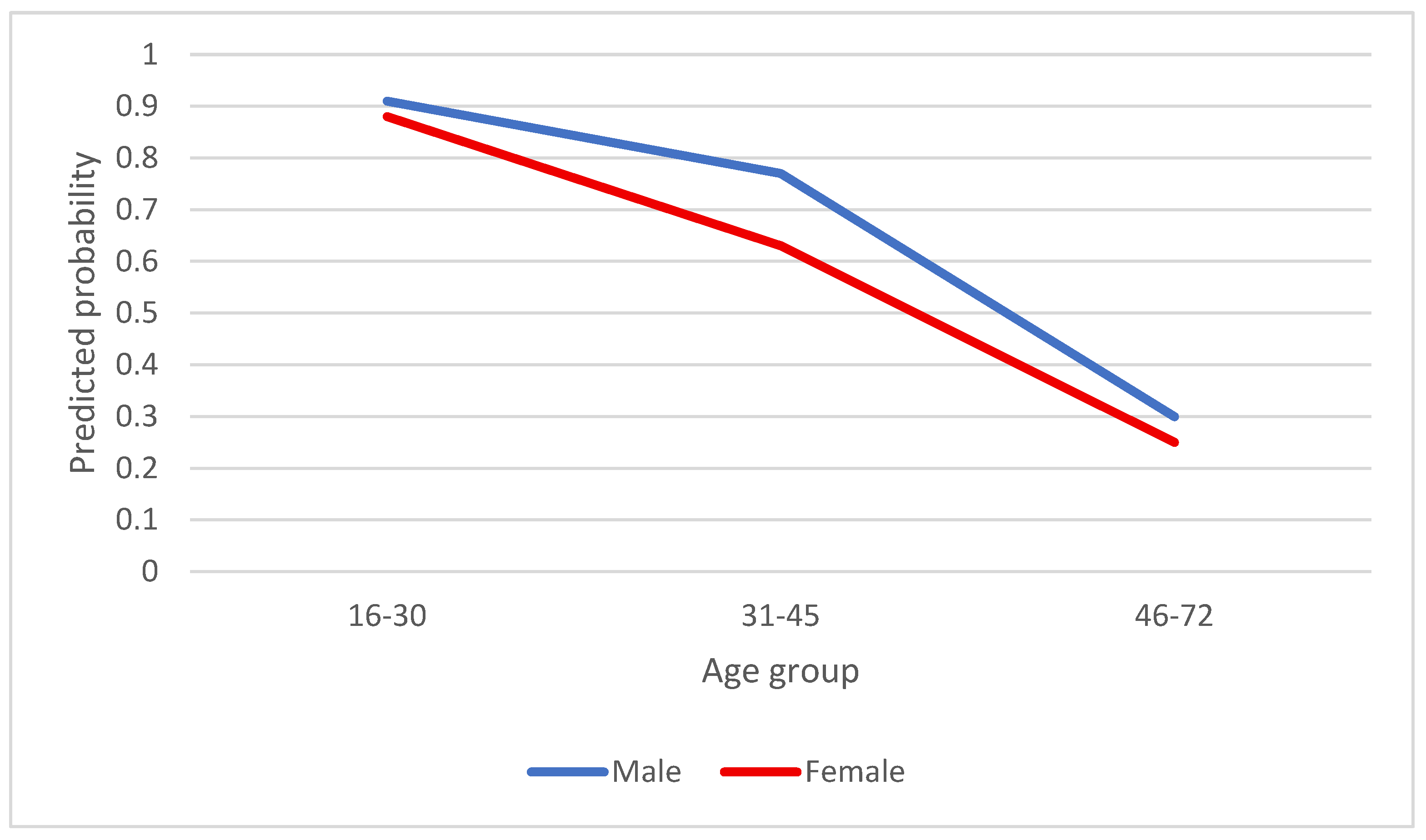
Figure 3 illustrates the adjusted predicted probabilities of choosing a robot with a native accent across three age groups (16–30, 31–45, and 46–72 years), stratified by sex, based on the multivariable logistic regression model.
Overall, the probability of selecting the robot with a native accent decreased progressively with age, consistent with the significant negative effect of age observed in the regression model (B = −0.043, p = 0.008). Participants in the youngest age group (16–30 years) showed the highest predicted probabilities, ranging approximately from 0.87 to 0.91, depending on sex. Intermediate values were observed in the 31–45 age group, with predicted probabilities around 0.63–0.77, while the lowest probabilities were found in the oldest group (46–72 years), where values declined to approximately 0.16–0.30.
Across all age categories, males consistently exhibited slightly higher predicted probabilities than females, in line with the significant effect of sex in the regression model (OR = 4.96,
p = 0.008). However, the magnitude of sex differences varied across age groups, appearing more pronounced in older participants (see
Table 9 and
Figure 3).
Regarding RQ3, results indicate that both Italian and Arabic participants predominantly chose to trust the robot with a native accent, with similar proportions across groups (75% of Italian participants and 81.1% of Arabic participants). This pattern suggests a general preference for the robot perceived as linguistically similar to the participant, consistent with the similarity-attraction effect and with the broader tendency to delegate trust to more familiar interaction partners.
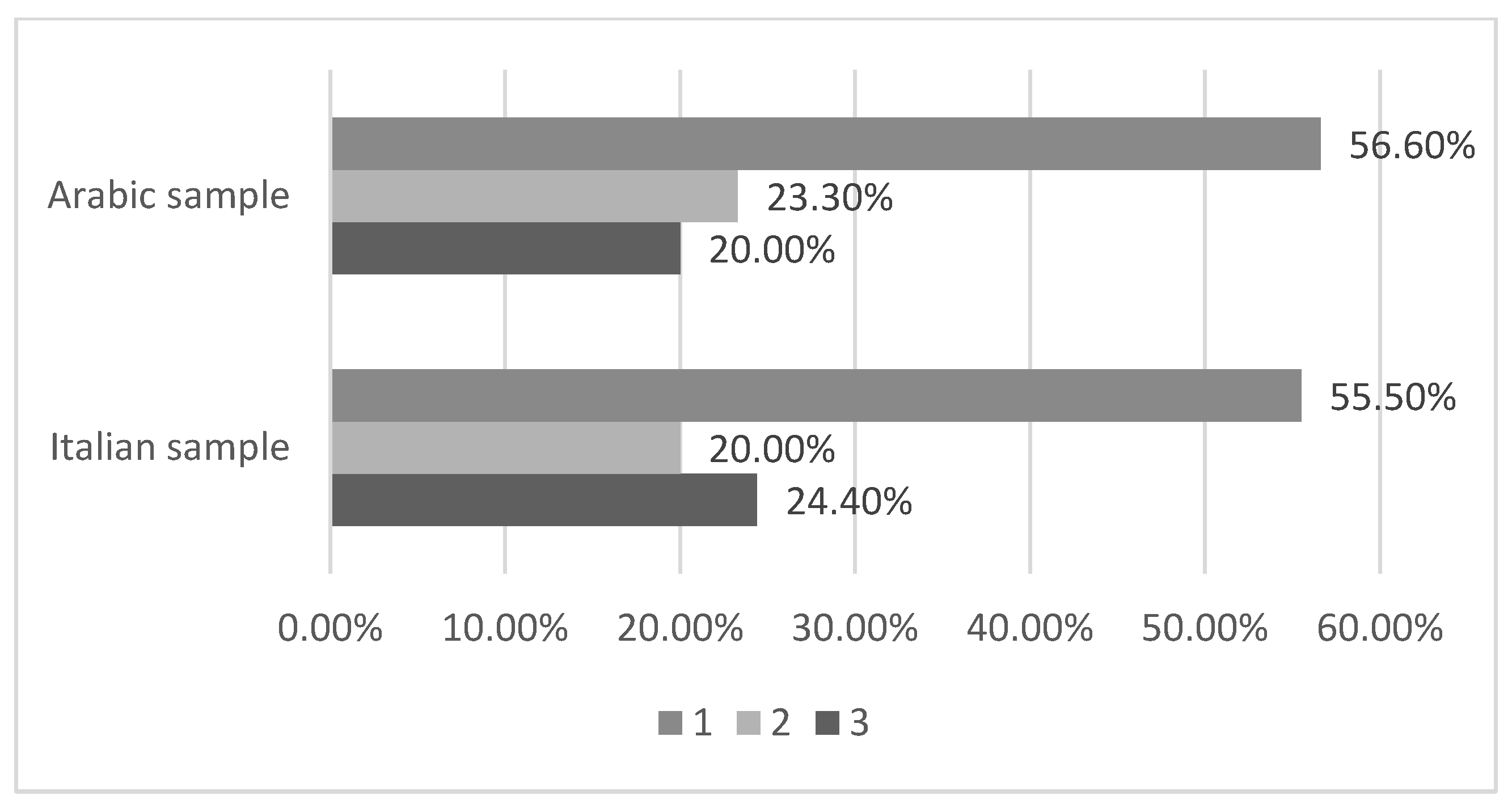
The qualitative analysis of open-ended responses further supports this interpretation. Participants’ explanations were grouped into three categories (see
Figure 4):
- (1)
Robot-related qualities (e.g., perceived fluency and clarity of speech);
- (2)
Recognition of accent and self-referential similarity (e.g., “because it speaks Italian/Arabic,” “I understood it better,” “I feel closer to it”);
- (3)
Non-specific or neutral responses (e.g., “I don’t know,” “no particular reason”). No statistically significant differences were observed between the two cultural groups in the distribution of these categories.
Figure 4.
The results of the analysis of the answers given by the two samples to the question “Why did you choose it?”.
Figure 4.
The results of the analysis of the answers given by the two samples to the question “Why did you choose it?”.
An additional qualitative pattern emerged within the Italian subsample when participants selected the robot with a foreign accent. In these cases, responses often reflected explicit comparison between the two robots and an awareness of linguistic difference (e.g., perceiving the accent as “less fluent” or “different but intriguing”). This suggests that deviation from linguistic similarity may increase cognitive salience and evaluative processing of the agent.
Moreover, a small subset of participants explicitly associated the native-accented robot with increased trust and perceived competence (e.g., “it makes me feel more confident,” “it seems more trustworthy”). These responses were consistent with the quantitative findings and were therefore coded within the first thematic category during data processing.
Overall, these findings provide converging evidence that trust in human–robot interaction is influenced by perceived linguistic similarity, supporting the similarity-attraction framework. Rather than demonstrating a causal effect of similarity on trust, the results indicate that similarity acts as a salient heuristic factor guiding trust-related judgments during interaction with artificial agents.
5. Discussion and Conclusions
The present study investigated the role of vocal accent in shaping trust in human–robot interaction, with particular attention to the similarity-attraction effect across two cultural groups. The findings provide consistent evidence that accent significantly influences users’ trust-related decisions, with a clear preference for robots speaking with a native accent.
First, the results support the presence of the similarity-attraction effect in HRI contexts (RQ1). Participants overwhelmingly preferred the robot that spoke with a native accent, suggesting that linguistic similarity acts as a salient cue in shaping social evaluations of artificial agents. This finding is consistent with prior research in human–human interaction, where individuals tend to favor speakers who are perceived as belonging to their own social or cultural group.
Second, the findings indicate that age and gender influence this effect (RQ2). Specifically, younger participants were more likely to select the native-accented robot, as also reflected in the negative association between age and the likelihood of choosing the native-accented robot observed in the multivariable logistic regression model. In addition, male participants showed a significantly higher likelihood of preferring the native-accented robot compared to female participants. While the gender effect should be interpreted with caution, it suggests that demographic variables may moderate the impact of vocal cues on trust-related decisions. The predicted probability analysis further illustrates these patterns, showing a progressive decrease in preference for the native-accented robot with increasing age and consistently higher probabilities among male participants across age groups.
Third, the results provide evidence that the similarity-attraction effect is associated with trust-related behavior (RQ3). Participants were asked to delegate a task to one of the two robots, and their choices consistently favored the robot perceived as more similar. This supports the idea that perceived similarity functions as a heuristic guiding trust-based delegation, particularly in situations characterized by uncertainty or limited information.
An important contribution of this study lies in its cross-cultural design. The similarity of results across Italian and Arabic participants suggests that the effect of accent on trust may be robust across linguistically and culturally distinct groups. This finding strengthens the generalizability of the similarity-attraction framework in HRI and indicates that accent functions as a broadly relevant social marker in shaping user perceptions. At the same time, the absence of significant differences between the two cultural groups in the regression model suggests that the effect operates in a comparable way across contexts. This does not exclude the possibility that cultural factors may play a role under different conditions, but it indicates that accent-based similarity is a strong and consistent predictor of trust across the examined samples.
From a theoretical perspective, these findings contribute to the literature on trust in HRI by highlighting the role of socio-perceptual cues, particularly vocal characteristics, in shaping trust-related decisions. While previous studies have focused primarily on technical performance or general voice properties (e.g., pitch, tone, gender), the present study demonstrates that accent—an often overlooked feature—plays a crucial role in signaling group membership and influencing trust. The results also extend the similarity-attraction framework to interactions with artificial agents, supporting the idea that social cognitive mechanisms typically applied to human interaction are also activated in HRI contexts.
From an applied perspective, the findings suggest that accent calibration may represent a simple yet effective strategy to enhance trust in human–robot interaction. In contexts where users are required to rely on robots—such as healthcare, education, customer service, or assistive technologies—aligning the robot’s accent with that of the user may facilitate acceptance and improve interaction outcomes. Importantly, this design intervention is relatively low-cost compared to other forms of personalization, making it particularly attractive for real-world applications.
Despite its contributions, this study has several limitations. First, the experimental design did not include a blind audio-only condition, making it difficult to fully disentangle the effects of vocal perception from those related to robot embodiment. Future studies could address this limitation by comparing embodied and disembodied interaction conditions.
Second, this study did not include measures of participants’ prior attitudes toward out-groups or foreigners, which may have influenced responses to foreign-accented robots. In addition, this study adopted a fully quantitative design aimed at testing pre-defined hypotheses and identifying statistically robust patterns in participants’ responses. While this approach enhances comparability and replicability, it does not capture participants’ subjective interpretations or underlying motivations. Including attitudinal measures or qualitative data (e.g., interviews or open-ended responses) would provide a more comprehensive understanding of the mechanisms driving these effects.
Third, the sample size—particularly in the preliminary study—was relatively limited, which may affect the stability of some estimates. Additionally, this study focused on only two linguistic groups. Future research should extend the analysis to a wider range of accents and cultural contexts to improve generalizability. Finally, although the use of controlled experimental settings ensured internal validity, it may limit ecological validity. Further studies in more naturalistic environments would help to confirm the robustness of these findings.
Overall, the present study demonstrates that vocal accent is a key factor in shaping trust in human–robot interaction. By showing that users consistently prefer robots with a native accent across different cultural groups, the findings highlight the importance of linguistic similarity as a driver of trust-based decisions. These results contribute to both theoretical and applied research, emphasizing the need to consider socio-linguistic factors in the design of socially interactive robots.
Author Contributions
Conceptualization, C.C., A.S., F.C., D.C. and R.F.; methodology, A.S., F.C. and R.F.; validation, C.C., A.S. and F.C.; investigation, C.C.; resources, R.F.; data curation, C.C., A.S. and F.C.; writing—original draft preparation, C.C., A.S. and F.C.; writing—review and editing, C.C., A.S., F.C., D.C. and R.F.; visualization, C.C.; supervision, D.C. and R.F.; project administration, R.F.; funding acquisition, D.C. All authors have read and agreed to the published version of the manuscript.
Funding
This research was funded by the University of Catania through the PIACERI 2024–2026 Line 1 projects: BENTEC (A8722222554).
Institutional Review Board Statement
This study was approved by the Ethics Committee of the Department of Humanities, University of Catania (approval no. 2/25).
Informed Consent Statement
Informed consent was obtained from all subjects involved in the study.
Data Availability Statement
Materials are available from the corresponding author upon request.
Acknowledgments
The authors thank Helene Høgsdal, Cristina La Rosa, Samira Raji, Filippo Gravina, Andrea Rabuazzo, Maran Omari, Abdallah Rami Gabra Said, Giulio Cavallaro for their contribution during the preparation of this study.
Conflicts of Interest
The authors declare no conflicts of interest.
References
- Barfield, J.K. The role of name, origin, and voice accent in a robot’s ethnic identity. Sensors 2024, 24, 6421. [Google Scholar] [CrossRef]
- Bartneck, C.; Nomura, T.; Kanda, T.; Suzuki, T.; Kato, K. Cultural Differences in Attitudes Towards Robots. In Proceedings of the AISB Symposium on Robot Companions: Hard Problems and Open Challenges in Human-Robot Interaction, Hatfield, UK, 12–15 April 2005; pp. 1–4. [Google Scholar]
- Bartneck, C.; Yogeeswaran, K.; Ser, Q.M.; Woodward, G.; Sparrow, R.; Wang, S.; Eyssel, F. Robots and racism. In Proceedings of the 2018 ACM/IEEE International Conference on Human-Robot Interaction; Association for Computing Machinery: New York, NY, USA, 2018; pp. 196–204. [Google Scholar]
- Kepuska, V.; Bohouta, G. Next-generation of virtual personal assistants (microsoft cortana, apple siri, amazon alexa and google home). In 2018 IEEE 8th Annual Computing and Communication Workshop and Conference (CCWC); IEEE: Piscataway, NJ, USA, 2018; pp. 99–103. [Google Scholar]
- Kouravanas, N.; Pavlopoulos, A. Social robots: The case of robot sophia. Homo Virtualis 2022, 5, 136–165. [Google Scholar] [CrossRef]
- Yuan, L.; Dennis, A.; Riemer, K. Crossing the uncanny valley? Understanding affinity, trustworthiness, and preference for more realistic virtual humans in immersive environments. In Proceedings of the 52nd Hawaii International Conference on System Sciences, Maui, HI, USA, 8–11 January 2019. [Google Scholar]
- Masahiro, M.; MacDorman, K.F.; Kageki, N. The uncanny valley. IEEE Robot. Autom. Mag. 2012, 19, 98–100. [Google Scholar] [CrossRef]
- Aylett, M.P.; Vinciarelli, A.; Wester, M. Speech synthesis for the generation of artificial personality. IEEE Trans. Affect. Comput. 2017, 11, 361–372. [Google Scholar] [CrossRef]
- Nass, C.I.; Brave, S. Wired for Speech: How Voice Activates and Advances the Human-Computer Relationship; MIT Press: Cambridge, MA, USA, 2005; p. 9. [Google Scholar]
- Kreiman, J.; Sidtis, D. Foundations of Voice Studies: An Interdisciplinary Approach to Voice Production and Perception; John Wiley & Sons: Hoboken, NJ, USA, 2011. [Google Scholar]
- Maltezou-Papastylianou, C.; Scherer, R.; Paulmann, S. How do voice acoustics affect the perceived trustworthiness of a speaker? A systematic review. Front. Psychol. 2025, 16, 1495456. [Google Scholar] [CrossRef]
- Dou, X.; Wu, C.F.; Lin, K.C.; Gan, S.; Tseng, T.M. Effects of different types of social robot voices on affective evaluations in different application fields. Int. J. Soc. Robot. 2021, 13, 615–628. [Google Scholar] [CrossRef]
- Bestelmeyer, P.E.; Maurage, P.; Rouger, J.; Latinus, M.; Belin, P. Adaptation to vocal expressions reveals multistep perception of auditory emotion. J. Neurosci. 2014, 34, 8098–8105. [Google Scholar] [CrossRef]
- Salem, M.; Ziadee, M.; Sakr, M. Marhaba how may I help you? Effects of politeness and culture on robot acceptance and anthropomorphization. In Proceedings of the 2014 ACM/IEEE International Conference on Human-Robot Interaction; Association for Computing Machinery: New York, NY, USA, 2014; pp. 74–81. [Google Scholar]
- Trovato, G.; Zecca, M.; Sessa, S.; Jamone, L.; Ham, J.R.C.; Hashimoto, K.; Takanishi, A. Cross-cultural study on human-robot greeting interaction: Acceptance and discomfort by Egyptians and Japanese. Paladyn J. Behav. Robot. 2013, 4, 83–93. [Google Scholar] [CrossRef]
- Lugrin, B.; Ströle, E.; Obremski, D.; Schwab, F.; Lange, B. What If It Speaks Like It was From the Village? Effects of a Robot Speaking in Regional Language Variations on Users’ Evaluations. In 29th IEEE International Conference on Robot and Human Interactive Communication (RO-MAN); IEEE: Piscataway, NJ, USA, 2020; pp. 1315–1320. [Google Scholar]
- Andrist, S.; Ziadee, M.; Boukaram, H.; Mutlu, B.; Sakr, M. Effects of culture on the credibility of robot speech: A comparison between english and arabic. In Proceedings of the Tenth Annual ACM/IEEE International Conference on Human-Robot Interaction; Association for Computing Machinery: New York, NY, USA, 2015; pp. 157–164. [Google Scholar]
- Torre, I.; White, L.; Goslin, J.; Knight, S. The irrepressible influence of vocal stereotypes on trust. Q. J. Exp. Psychol. 2024, 77, 1957–1966. [Google Scholar] [CrossRef]
- Tamagawa, R.; Watson, C.I.; Kuo, I.H.; MacDonald, B.A.; Broadbent, E. The effects of synthesized voice accents on user perceptions of robots. Int. J. Soc. Robot. 2011, 3, 253–262. [Google Scholar] [CrossRef]
- Dahlbäck, N.; Wang, Q.; Nass, C.; Alwin, J. Similarity is more important than expertise: Accent effects in speech interfaces. In Proceedings of the SIGCHI Conference on Human Factors in Computing Systems; Association for Computing Machinery: New York, NY, USA, 2007; pp. 1553–1556. [Google Scholar]
- Nass, C.; Lee, K.M. Does computer-generated speech manifest personality? An experimental test of similarity-attraction. In Proceedings of the SIGCHI Conference on Human Factors in Computing Systems; Association for Computing Machinery: New York, NY, USA, 2000; pp. 329–336. [Google Scholar]
- Clark, L.; Doyle, P.; Garaialde, D.; Gilmartin, E.; Schlögl, S.; Edlund, J. The state of speech in HCI: Trends, themes and challenges. Interact. Comput. 2019, 31, 349–371. [Google Scholar] [CrossRef]
- Choung, H.; David, P.; Ross, A. Trust in AI and its role in the acceptance of AI technologies. Int. J. Hum.–Comput. Int. 2023, 39, 1727–1739. [Google Scholar] [CrossRef]
- Nikou, S.A.; Economides, A.A. Mobile-based assessment: Investigating the factors that influence behavioral intention to use. Comput. Educ. 2017, 109, 56–73. [Google Scholar] [CrossRef]
- Shin, J.; Bulut, O.; Gierl, M.J. Development Practices of Trusted AI Systems among Canadian Data Scientists. Int. Rev. Inf. Ethics 2020, 28, 1–10. [Google Scholar] [CrossRef]
- Shin, D. The effects of explainability and causability on perception, trust, and acceptance: Implications for explainable AI. Int. J. Hum. Comput. Stud. 2021, 146, 102551. [Google Scholar] [CrossRef]
- Castelfranchi, C.; Falcone, R. Trust Theory: A Socio-Cognitive and Computational Model; John Wiley & Sons: Hoboken, NJ, USA, 2010. [Google Scholar]
- Hardin, R. Trust and Trustworthiness; Russell Sage Foundation: New York, NY, USA, 2002. [Google Scholar]
- Oleszkiewicz, A.; Pisanski, K.; Lachowicz-Tabaczek, K.; Sorokowska, A. Voice-based assessments of trustworthiness, competence, and warmth in blind and sighted adults. Psychon. Bull. Rev. 2017, 24, 856–862. [Google Scholar] [CrossRef] [PubMed]
- Tanis, M.; Postmes, T. A social identity approach to trust: Interpersonal perception, group membership and trusting behaviour. Eur. J. Soc. Psychol. 2005, 35, 413–424. [Google Scholar] [CrossRef]
- Cantucci, F.; Marini, M.; Falcone, R. The Role of Robot Competence, Autonomy, and Personality on Trust Formation in Human-Robot Interaction. arXiv 2025, arXiv:2503.04296. [Google Scholar] [CrossRef]
- Falcone, R.; Sapienza, A.; Cantucci, F.; Castelfranchi, C. To be trustworthy and to trust: The new frontier of intelligent systems. In Handbook of Human-Machine Systems; John Wiley & Sons: Hoboken, NJ, USA, 2023; pp. 213–223. [Google Scholar]
- Aquilino, L.; Di Dio, C.; Manzi, F.; Massaro, D.; Bisconti, P.; Marchetti, A. Decoding Trust in Artificial Intelligence: A Systematic Review of Quantitative Measures and Related Variables. Informatics 2025, 12, 70. [Google Scholar] [CrossRef]
- Bryant, D.; Borenstein, J.; Howard, A. Why should we gender? The effect of robot gendering and occupational stereotypes on human trust and perceived competency. In Proceedings of the 2020 ACM/IEEE International Conference on Human-Robot Interaction; Association for Computing Machinery: New York, NY, USA, 2020; pp. 13–21. [Google Scholar]
- Large, D.R.; Harrington, K.; Burnett, G.; Luton, J.; Thomas, P.; Bennett, P. To please in a pod: Employing an anthropomorphic agent-interlocutor to enhance trust and user experience in an autonomous, self-driving vehicle. In Proceedings of the 11th International Conference on Automotive User Interfaces and Interactive Vehicular Applications; Association for Computing Machinery: New York, NY, USA, 2019; pp. 49–59. [Google Scholar]
- Seaborn, K.; Miyake, N.P.; Pennefather, P.; Otake-Matsuura, M. Voice in human–agent interaction: A survey. ACM Comput. Surv. (CSUR) 2022, 54, 81. [Google Scholar] [CrossRef]
- Tsantani, M.S.; Belin, P.; Mcaleer, P.M. Low vocal pitch preference drives first impressions of trustworthiness and dominance in non-contextual scenarios. Perception 2016, 45, 946–963. [Google Scholar] [CrossRef]
- Stewart, M.A.; Ryan, E.B. Attitudes toward younger and older adult speakers: Effects of varying speech rates. J. Lang. Soc. Psychol. 1982, 1, 91–109. [Google Scholar] [CrossRef]
- Berry, D.; Bell, M.P. Inequality in organizations: Stereotyping, discrimination, and labor law exclusions. Equal. Divers. Incl. 2012, 31, 236–248. [Google Scholar] [CrossRef]
- Tigue, C.C.; Borak, D.J.; O’Connor, J.J.; Schandl, C.; Feinberg, D.R. Voice pitch influences voting behavior. Evol. Hum. Behav. 2012, 33, 210–216. [Google Scholar] [CrossRef]
- Kühne, K.; Fischer, M.H.; Zhou, Y. The human takes it all: Humanlike synthesized voices are perceived as less eerie and more likable. evidence from a subjective ratings study. Front. Neurorobot. 2020, 14, 593732. [Google Scholar] [CrossRef] [PubMed]
- Rodero, E. Effectiveness, attention, and recall of human and artificial voices in an advertising story. Prosody influence and functions of voices. Comput. Hum. Behav. 2017, 77, 336–346. [Google Scholar] [CrossRef]
- Sims, V.K.; Chin, M.G.; Lum, H.C.; Upham-Ellis, L.; Ballion, T.; Lagattuta, N.C. Robots’ auditory cues are subject to anthropomorphism. Proc. Hum. Factors Ergon. Soc. Annu. Meet. 2009, 53, 1418–1421. [Google Scholar] [CrossRef]
- Fischer, K. Geräusche, Stimmen und natürliche Sprache: Kommunikation mit sozialen Robotern. In Soziale Roboter; Bendel, O., Ed.; Springer: Wiesbaden, Germany, 2021; pp. 279–292. [Google Scholar]
- Kim, L.H.; Domova, V.; Yao, Y.; Huang, C.-M.; Follmer, S.; Paredes, P.E. Robotic presence: The effects of anthropomorphism and robot state on task performance and emotion. IEEE Robot. Autom. Lett. 2022, 7, 7399–7406. [Google Scholar] [CrossRef]
- Neuenswander, K.L.; Bryant, G.A.; Stroessner, S.J. Gendered and Machine-like Features in Voices Affect Social Judgments. In 2024 33rd IEEE International Conference on Robot and Human Interactive Communication (ROMAN); IEEE: Piscataway, NJ, USA, 2024; pp. 1408–1415. [Google Scholar]
- Becker, D.; Braach, L.; Clasmeier, L.; Kaufmann, T.; Ong, O.; Ahrens, K.; Wermter, S. Influence of robots’ voice naturalness on trust and compliance. ACM Trans. Hum.-Robot Interact. 2025, 14, 29. [Google Scholar] [CrossRef]
- Liu, X.X.; Yin, C.Y.; Li, M.R. The power of voice! The impact of robot receptionists’ voice pitch and communication style on customer value cocreation intention. Int. J. Hosp. Manag. 2024, 122, 103819. [Google Scholar] [CrossRef]
- Elkins, A.C.; Derrick, D.C. The sound of trust: Voice as a measurement of trust during interactions with embodied conversational agents. Group Decis. Negot. 2013, 22, 897–913. [Google Scholar] [CrossRef]
- Kinzler, K.D.; Corriveau, K.H.; Harris, P.L. Children’s selective trust in native-accented speakers. Dev. Sci. 2011, 14, 106–111. [Google Scholar] [CrossRef] [PubMed]
- Kühne, K.; Herbold, E.; Bendel, O.; Zhou, Y.; Fischer, M.H. “Ick bin een Berlina”: Dialect proficiency impacts a robot’s trustworthiness and competence evaluation. Front. Robot. AI 2024, 10, 1241519. [Google Scholar] [CrossRef]
- Planchenault, G.; Poljak, L. The Pragmatics of Accents; John Benjamins Publishing Company: Amsterdam, The Netherlands, 2021; Volume 327, p. 1. [Google Scholar]
- Lev-Ari, S.; Keysar, B. Why don’t we believe non-native speakers? The influence of accent on credibility. J. Exp. Soc. Psychol. 2010, 46, 1093–1096. [Google Scholar] [CrossRef]
- Bishop, H.; Coupland, N.; Garrett, P. Conceptual accent evaluation: Thirty years of accent prejudice in the UK. Acta Linguist. Hafn. 2005, 37, 131–154. [Google Scholar] [CrossRef]
- Sievers, T.; Russwinkel, N. Talking like one of us: Effects of using regional language in a humanoid social robot. In International Conference on Social Robotics; Springer Nature: Singapore, 2023; pp. 71–80. [Google Scholar]
- van Doorn, J.; Telussa, G. Speaking Like Home: How Regional Language Adaptations in Robots Enhance Trust and Willingness to Pay. J. Serv. Res. 2026. [Google Scholar] [CrossRef]
- Eyssel, F.; Kuchenbrandt, D. Social categorization of social robots: Anthropomorphism as a function of robot group membership. Br. J. Soc. Psychol. 2012, 51, 724–731. [Google Scholar] [CrossRef]
- Abrams, A.M.; Schenk, A.S.L.; Pütten, A.M.R.V.D. Intergroup Bias Towards Robots? Investigating the Effects of Social Categorisation, Ingroup Identification and the Country of Origin of Robots. Int. J. Soc. Robot. 2026, 18, 38. [Google Scholar] [CrossRef]
- Spatola, N.; Anier, N.; Redersdorff, S.; Ferrand, L.; Belletier, C.; Normand, A.; Huguet, P. National stereotypes and robots’ perception: The “made in” effect. Front. Robot. AI 2019, 6, 21. [Google Scholar] [CrossRef]
Figure 1.
Perceptual ratings of Italian and Arabic voices across four evaluative dimensions.
Figure 1.
Perceptual ratings of Italian and Arabic voices across four evaluative dimensions.
Figure 2.
Experimental setting.
Figure 2.
Experimental setting.
Figure 3.
Adjusted predicted probabilities of choosing a robot with a native accent across three age groups (16–30, 31–45, and 46–72 years), stratified by sex. Estimates are derived from the multivariable logistic regression model including age, sex, and cultural group as predictors. Error bars represent 95% confidence intervals. The probability of selecting the robot with a native accent decreases with age, with consistently higher probabilities observed among males compared to females.
Figure 3.
Adjusted predicted probabilities of choosing a robot with a native accent across three age groups (16–30, 31–45, and 46–72 years), stratified by sex. Estimates are derived from the multivariable logistic regression model including age, sex, and cultural group as predictors. Error bars represent 95% confidence intervals. The probability of selecting the robot with a native accent decreases with age, with consistently higher probabilities observed among males compared to females.
Table 1.
Statistical description of the sample’s gender.
Table 1.
Statistical description of the sample’s gender.
| Group | Gender | N | Age (M ± SD) |
|---|
| Italian | Male | 10 | 43.30 ± 12.35 |
| Italian | Female | 10 | 36.90 ± 7.36 |
| Arabic | Male | 10 | 41.70 ± 12.37 |
| Arabic | Female | 10 | 34.35 ± 13.01 |
| Total | | 40 | |
Table 2.
Descriptive statistics and repeated-measures comparisons for Italian voices.
Table 2.
Descriptive statistics and repeated-measures comparisons for Italian voices.
| Dimension | Voice A
Mean (SD) | Voice F
Means (SD) | F | p | η2 |
|---|
| Authoritativeness | 2.40 ± 0.99 | 3.25 ± 1.12 | 16.589 | <0.001 | 0.466 |
| Empathy | 3.30 ± 0.92 | 3.55 ± 1.15 | 0.798 | 0.383 | 0.040 |
| Credibility | 3.21 ± 1.13 | 3.95 ± 0.71 | 7.840 | 0.012 | 0.303 |
| Determination | 2.89 ± 0.88 | 4.00 ± 0.88 | 21.112 | <0.001 | 0.540 |
Table 3.
Descriptive statistics and repeated-measures comparisons for Arabic voices.
Table 3.
Descriptive statistics and repeated-measures comparisons for Arabic voices.
| Dimension | Voice R
Mean (SD) | Voice M
Means (SD) | F | p | η2 |
|---|
| Authoritativeness | 3.25 ± 1.59 | 3.20 ± 1.40 | 0.031 | 0.863 | 0.002 |
| Empathy | 3.05 ± 1.54 | 3.50 ± 1.36 | 3.673 | 0.070 | 0.162 |
| Credibility | 3.70 ± 1.46 | 3.80 ± 1.24 | 0.160 * | 0.694 * | 0.008 * |
| Determination | 3.60 ± 1.39 | 3.15 ± 1.57 | 3.353 | 0.083 | 0.150 |
Table 4.
Age distribution of participants by cultural group.
Table 4.
Age distribution of participants by cultural group.
| Group | N | Age (Mean ± SD) | Min | Max |
|---|
| Italian sample | 60 | 28.93 ± 17.03 | 16 | 72 |
| Arabic sample | 37 | 27.54 ± 12.35 | 16 | 58 |
Table 5.
Gender distribution of participants by cultural group.
Table 5.
Gender distribution of participants by cultural group.
| Group | Gender | N | Percentage (%) |
|---|
| Italian sample | Male | 18 | 30.0 |
| Italian sample | Female | 42 | 70.0 |
| Italian sample | Total | 60 | 100.0 |
| Arabic sample | Male | 26 | 70.3 |
| Arabic sample | Female | 11 | 29.7 |
| Arabic sample | Total | 37 | 100.0 |
Table 6.
Distribution of robot choice in the total sample (Robot 1: native accent = 77.3%; Robot 2: foreign accent = 22.7%). Bold values indicate the option selected by the majority of participants.
Table 6.
Distribution of robot choice in the total sample (Robot 1: native accent = 77.3%; Robot 2: foreign accent = 22.7%). Bold values indicate the option selected by the majority of participants.
| | Frequency | Percent | Valid Percent | Cumulative
Percent |
|---|
| (1) Native accent | 75 | 77.3 | 77.3 | 77.3 |
| (2) Foreign accent | 22 | 22.7 | 22.7 | 100.0 |
| Total | 97 | 100.0 | 100.0 | |
Table 7.
Distribution of robot choice in the Italian and Arabic sample (Robot 1: native accent; Robot 2: foreign accent).
Table 7.
Distribution of robot choice in the Italian and Arabic sample (Robot 1: native accent; Robot 2: foreign accent).
Choice Italian
Sample | Frequency | Percent | Valid Percent | Cumulative
Percent |
|---|
| (1) Native accent | 45 | 75.0 | 75.0 | 75.0 |
| (2) Foreign accent | 15 | 25.0 | 25.0 | 100.0 |
| Total | 60 | 100.0 | 100.0 | |
Choice Arabic
Sample | Frequency | Percent | Valid Percent | Cumulative
Percent |
| (1) Native accent | 30 | 81.1 | 81.1 | 81.1 |
| (2) Foreign accent | 7 | 18.9 | 18.9 | 100.0 |
| Total | 37 | 100.0 | 100.0 | |
Table 8.
The multivariable binary logistic regression model included age, sex, and group as predictors. The dependent variable was choice (0 = foreign accent, 1 = native accent). Model fit: N = 97; Hosmer–Lemeshow p = 0.640; Nagelkerke R2 = 0.242; Cox & Snell R2 = 0.159; -2 Long Likelihood = 87.069.
Table 8.
The multivariable binary logistic regression model included age, sex, and group as predictors. The dependent variable was choice (0 = foreign accent, 1 = native accent). Model fit: N = 97; Hosmer–Lemeshow p = 0.640; Nagelkerke R2 = 0.242; Cox & Snell R2 = 0.159; -2 Long Likelihood = 87.069.
| Predictor | B | S.E. | p-Value | Adjusted OR | 95% CI |
|---|
| Age (years) | −0.043 | 0.016 | 0.008 | 0.958 | 0.927–0.989 |
| Sex (Male vs. Female) | 1.601 | 0.607 | 0.008 | 4.957 | 1.509–16.286 |
Group
(1 vs. reference) | 0.916 | 0.616 | 0.137 | 0.400 | 0.120–1.338 |
| Constant | 2.386 | 0.668 | <0.001 | 10.871 | - - |
Table 9.
Adjusted predicted probabilities of choosing a robot with a native accent across three age groups (16–30, 31–45, and 46–72 years), stratified by sex. Estimates are derived from the multivariable logistic regression model including age, sex, and cultural group as predictors.
Table 9.
Adjusted predicted probabilities of choosing a robot with a native accent across three age groups (16–30, 31–45, and 46–72 years), stratified by sex. Estimates are derived from the multivariable logistic regression model including age, sex, and cultural group as predictors.
| Age Group | Female | Male |
|---|
| 16–30 | 0.88 | 0.91 |
| 31–45 | 0.63 | 0.77 |
| 46–72 | 0.25 | 0.30 |
| Disclaimer/Publisher’s Note: The statements, opinions and data contained in all publications are solely those of the individual author(s) and contributor(s) and not of MDPI and/or the editor(s). MDPI and/or the editor(s) disclaim responsibility for any injury to people or property resulting from any ideas, methods, instructions or products referred to in the content. |