Article

Enrichment Mechanism of Organic Matter in Source Rocks of Mesoproterozoic Changcheng System: A Case Study of Jinshan Rift Trough in Ordos Basin, China

1
State Key Laboratory of Continental Evolution and Early Life, Department of Geology, Northwest University, Xi’an 710069, China
2
School of Geoscience, China University of Petroleum, Qingdao 266580, China
*
Author to whom correspondence should be addressed.
Appl. Sci. 2026, 16(9), 4341; https://doi.org/10.3390/app16094341
Submission received: 1 April 2026 / Revised: 18 April 2026 / Accepted: 22 April 2026 / Published: 29 April 2026

Abstract

The development of effective source rocks is key to hydrocarbon accumulation. The Jinshan Rift Trough, located in the Ordos Basin, is generally considered to be a favorable zone for the formation of source rocks in the Mesoproterozoic Changcheng System. This study investigates mudstones of the Cuizhuang Formation (Changcheng System) from Well PT1 using petrological and geochemical methods to evaluate source rock potential and organic matter enrichment mechanisms. The results show that the original total organic carbon (TOC) and original S1 + S2 of the mudstone in the Cuizhuang Formation are 0.06–1.97% and 0.61–10.34 mg/g, respectively, and “good source rock” with a cumulative thickness of 6.7 m is developed in the lower part of the Cuizhuang Formation. The main hydrocarbon-forming organisms of the source rock are planktonic and benthic algae, among which planktonic algae account for a relatively high proportion. Equivalent vitrinite reflectance (Ro) exceeds 2%, indicating an over-mature stage. The TOC of the mudstone of the Cuizhuang Formation shows a weak relationship with the salinity and redox conditions of sedimentary water but has a significant correlation with the paleoproductivity and paleoclimate. Rather than anoxia or salinity, high productivity is the main controlling factor for the enrichment of organic matter in the Changcheng System. Under a warm–humid climate, increased surface runoff and terrestrial nutrient input promote the proliferation of bacteria and algae, leading to the formation and preservation of abundant sedimentary organic matter that forms “good source rocks”. This study provides a theoretical basis for the study of the petroleum system and oil and gas exploration in the Mesoproterozoic Changcheng System in the Ordos Basin.

1. Introduction

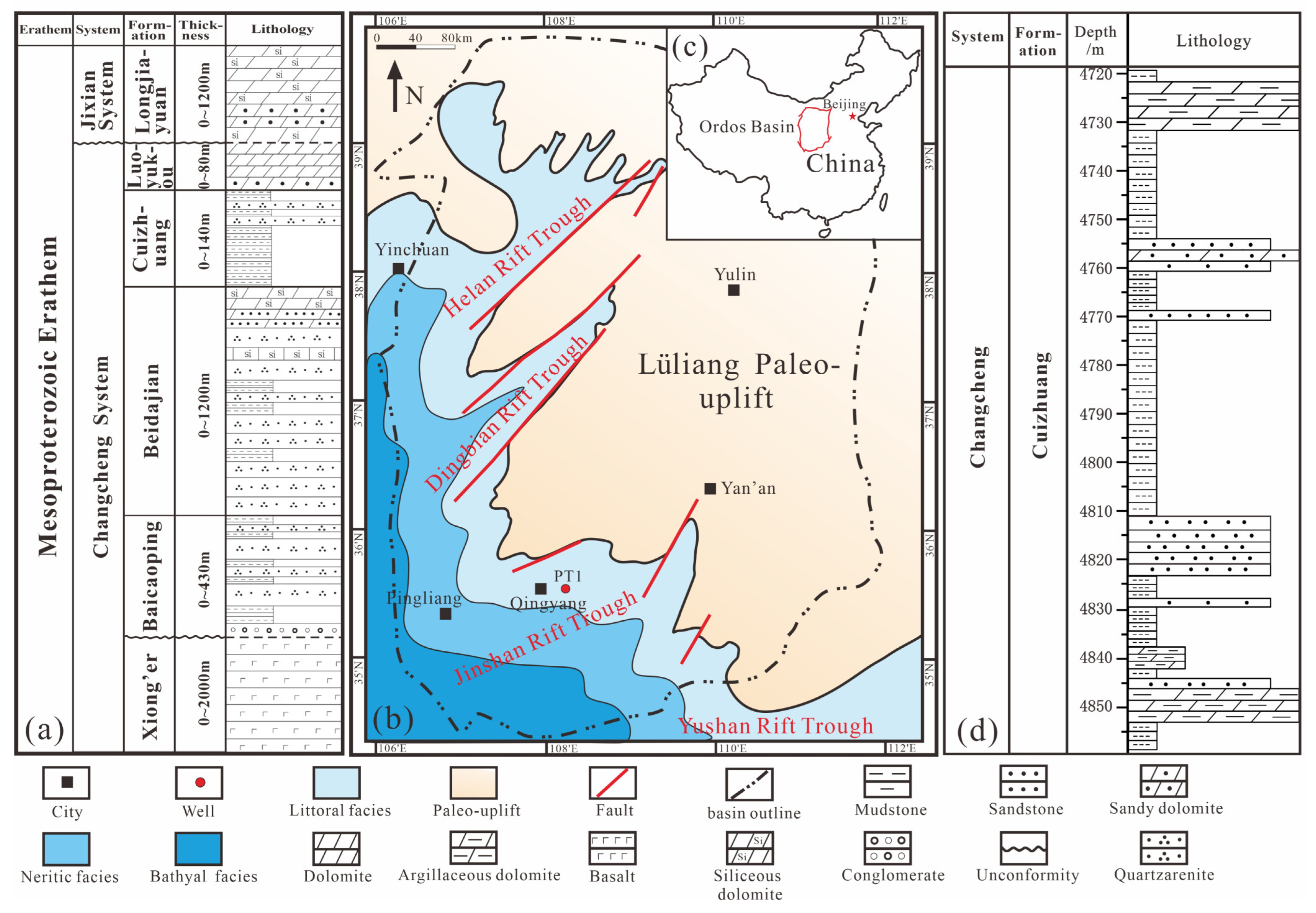
The Ordos Basin (Figure 1b) is one of the important petroliferous basins in China (Figure 1c). Currently, oil and gas exploration and development in the Ordos Basin are primarily focused on the Mesozoic and Paleozoic systems, and the exploration and research of the deep layers of the basin is relatively low [1]. To date, a number of Meso-Neoproterozoic primary oil and gas fields have been discovered worldwide, such as the Anyue and Weiyuan gas fields in the western Yangtze Craton, the Oman Basin in the eastern Arabian Craton, and the Bakrwarara oil field in the Indian Craton [1,2,3,4]. Specifically in Oman and Siberia, the provided oil and gas reserves have reached the equivalent scale of 100 million to 1 billion tons of oil, showing that the Meso-Neoproterozoic field in the craton basin has good exploration potential [5,6]. Therefore, petroleum geologists began to pay attention to the exploration potential of the Meso-Neoproterozoic oil and gas resources in the Ordos Basin, and the question of whether effective source rocks are developed in the Changcheng System of the Mesoproterozoic has long been a subject of concern [7]. Previous studieshave revealed that Changcheng source rocks are exposed along the margins of the Ordos Basin. Notably, black slates from localities such as Guyangbei and Shujigou in the northern margin exhibit total organic carbon (TOC) contents reaching up to 17% [8,9,10]. Although several wells within the basin have penetrated the Changcheng System, reports on the development of its source rocks remain scarce. The Changcheng Rift Trough, located in the southwestern Ordos Basin (Figure 1a), has developed extremely thick littoral clastic deposits of the Changcheng System, which possess favorable geological conditions for the formation of large-scale hydrocarbon source rocks [8,10]. Moreover, these aulacogens are highly conducive to the enrichment and preservation of organic matter and are thus regarded as ideal areas for the development of Changcheng source rocks [10,11,12,13]. However, two key scientific questions remain unanswered regarding the Changcheng System source rocks in the Jinshan Rift Trough: (1) What are the original geochemical characteristics and source potential of the Cuizhuang Formation mudstones? (2) What primary factor controls organic matter enrichment—paleoproductivity, redox conditions, or salinity? In 2023, Well PT1, drilled within this Jinshan Rift Trough in the southwestern basin, encountered multiple intervals of grayish-black to black mudstones of the Changcheng System, with a core recovery of approximately 72 m. This provides valuable geological materials for investigating the intracratonic source rocks of this system.
Evaluating Proterozoic source rocks presents unique challenges compared to Phanerozoic basins. First, thermal overmaturity (equivalent Ro > 2%) often degrades conventional biomarkers, limiting the use of routine oil-source correlation tools [14]. Second, syn-depositional volcanism—common in rift settings—can both enhance nutrient supply (positive) and thermally alter organic matter (negative). Third, the absence of land plants prior to the Devonian makes traditional maceral-based maturity indicators (e.g., vitrinite reflectance) inapplicable [15]. Therefore, Proterozoic source rock studies must rely more on inorganic geochemical proxies (trace elements, stable isotopes) and less on conventional organic petrology.
To explicitly highlight the distinct characteristics of Proterozoic source rocks and to justify the methodological approach adopted in this study, a systematic comparison between typical Proterozoic (old) basins and Phanerozoic (young) basins is presented in Table 1. The comparison covers key aspects including thermal maturity, organic matter sources, primary controls on organic matter enrichment, redox conditions, salinity effects, biomarker preservation, analytical tools, and global examples. As shown in the table, Proterozoic basins are generally over-mature, dominated by algal organic matter, and require inorganic geochemical proxies for evaluation, whereas Phanerozoic basins benefit from well-preserved biomarkers and conventional organic petrology. This contrast reinforces the need for a tailored research strategy when investigating ancient hydrocarbon systems.
This study investigates the mudstones and shales of the Cuizhuang Formation (Changcheng System) encountered in Well PT1. The specific objectives of this study are (i) to restore the original organic matter abundance (TOC and S1 + S2) of the Cuizhuang Formation mudstones using maturity-based recovery coefficients; (ii) to reconstruct paleoenvironmental conditions (paleoproductivity, redox, salinity, paleoclimate) using trace element proxies (Mo, Ni, V/(V + Ni), Sr/Ba, Sr/Cu); and (iii) to explore the organic matter enrichment mechanism of the Cuizhuang Formation mudstones in this Proterozoic rift trough. This study provides a theoretical basis for the understanding of Mesoproterozoic petroleum systems and future hydrocarbon exploration in the Ordos Basin.

2. Geological Background

The Ordos Basin, located in the western part of the North China Craton, is a multicycle superimposed basin (i.e., a basin formed by the superposition of multiple tectonic-sedimentary cycles) developed upon an Archean to Paleoproterozoic crystalline basement [27]. Within the basin, sedimentary successions ranging from Proterozoic, Paleozoic, Mesozoic, to Cenozoic are preserved [28]. During the Paleoarchean era (ca. 3.6–3.2 Ga) to the Paleoproterozoic era (ca. 2.5–1.6 Ga), the Fuping Movement resulted in widespread folding and uplift of the continental crust, leading to the formation of the ancient continental nucleus of the Ordos Basin [16]. Subsequently, the Lüliang Movement caused the amalgamation and stabilization of the discrete ancient continental blocks within the basin, ultimately forming a unified crystalline basement [29,30,31]. Entering the Mesoproterozoic era, contemporaneous with the breakup of the supercontinent, an intracontinental rift, wedging into the North China Paleocontinent, developed in the southwestern Ordos Basin. The abortive development of this rift resulted in the formation of several secondary aulacogens. From north to south, these are the Helan Aulacogen, Dingbian Aulacogen, Jinshan Rift Trough, and Yu-Shaan Aulacogen [8,10,32] (Figure 1a). Among these, the Jinshan Rift Trough is relatively large in scale, with a width of up to 200 km and an extension distance of approximately 150 km, deepening progressively towards the southwest [10].
On the basement of the basin, the Mesoproterozoic volcanic rock–clastic rock–carbonate rock assemblage accumulated, which was divided into the Changcheng System and the Jixian system (Figure 1a) [9]. The distribution range and thickness of the Jixian System are significantly smaller than those of the Changcheng System and are mainly distributed in the southwestern and southern margins of the basin [28]. During the Neoproterozoic Qingbaikou–Nanhua period, the basin was uplifted and eroded as a whole and began to demonstrate sedimentation in the Sinian period.
Well PT1 is located within the Jinshan Rift Trough (Figure 1b), and a relatively complete Mesoproterozoic area was drilled. From bottom to top, the Middle Proterozoic areas are Xiong’er Group, Changcheng System (including Baicaoping Formation, Beidajian Formation, Cuizhuang Formation and Luoyukou Formation) and Jixian System (including Longjiayuan Formation, Xunjiansi Formation, Duguan Formation and Fengjiawan Formation). The lithology of the Cuizhuang Formation in Well PT1 is a combination of mudstone, siltstone and dolomite (Figure 1d). The upper part is argillaceous dolomite and gray–black mudstone with thin siltstone; the middle is dominated by variegated mudstone; and the lower part develops siltstone with thin mudstone, black mudstone, a mud–sand thin interbed and thin dolomite (Figure 1d).
The mudstone of the Cuizhuang Formation is developed, but the colors are diverse, including black, gray–black, gray–green, reddish-brown and so on. The dark mudstone is mainly located in the upper 4732–4754 m section and the lower 4826–4836 m section (Figure 1d). It is produced in the form of medium-thick mudstone with thin siltstone, thin dolomite and sand–mud thin interbeds. In the lower dark mudstone, the sandy content is relatively high (Figure 1d). The argillaceous content in siltstone is high, often containing glauconite, and the clastic particles are mainly quartz. Dolomite lithology is dominated by mud, powder dolomite, and sand, gravel dolomite. Sedimentary structures such as lenticular bedding, wavy bedding and vein bedding are developed in the thin sand–mud interbeds.

3. Samples and Methods

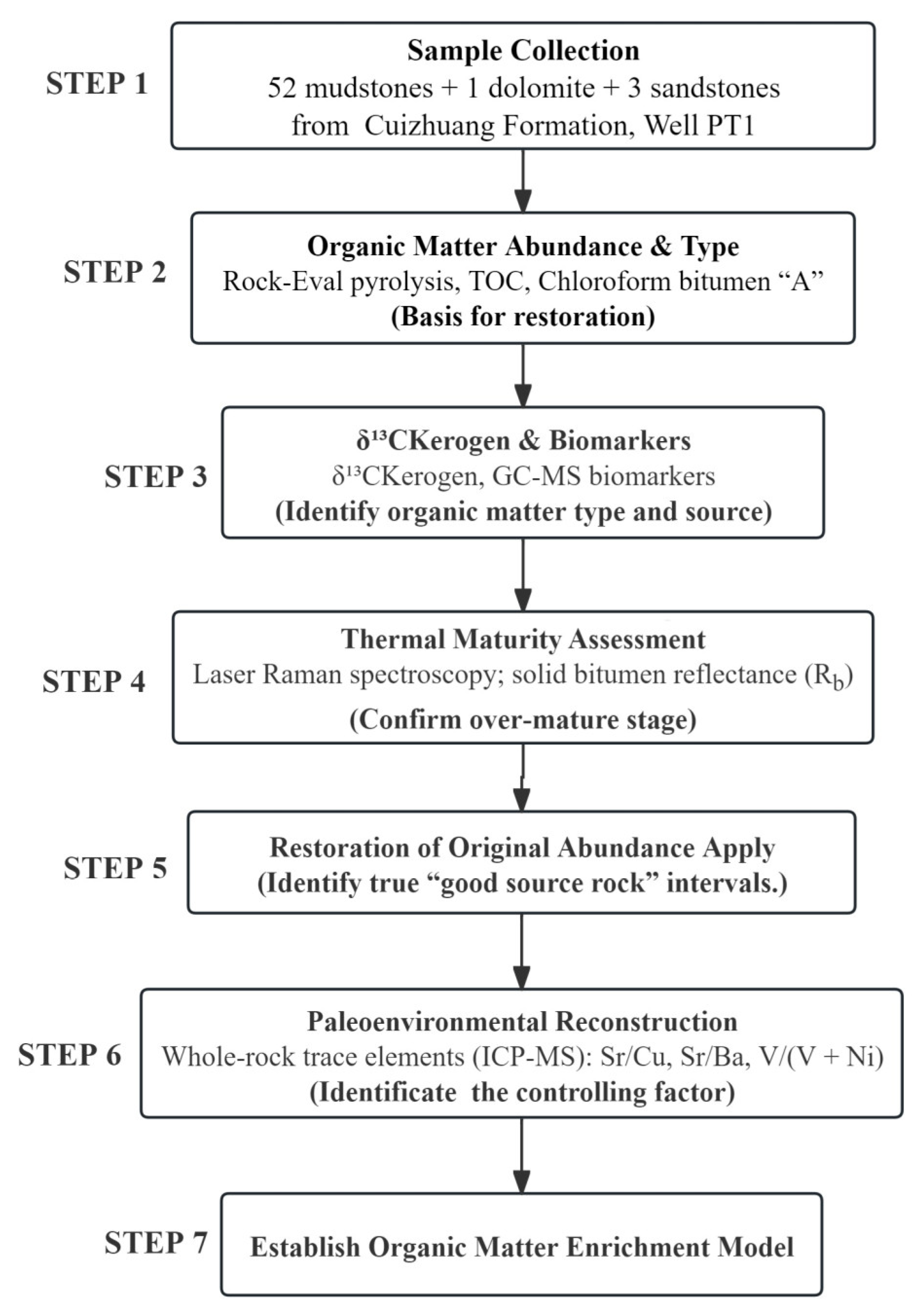
In this study, 52 mudstone samples, 1 dolomite sample and 3 sandstone samples were collected from the core of the Cuizhuang Formation in Well PT1. Sampling focused on the upper dark mudstone section (4735–4754 m) and the lower dark mudstone section (4825–4836 m), where gray–black to black mudstones are present. No samples were taken from the interval between 4770 m and 4820 m because this interval consists predominantly of variegated mudstones (reddish-brown and gray–green) with very low organic matter content, which are not suitable for source rock evaluation. The three sandstone samples and one dolomite sample were collected for lithological comparison but were not used for source rock analysis. The total number of mudstone samples is moderate, and it is sufficient to capture the vertical variability of organic matter abundance and geochemical composition within the organic-rich intervals. Tests and analyses were carried out on these core samples. These included total organic carbon content (TOC) determination, chloroform bitumen “A”, rock pyrolysis analysis, gas chromatography-mass spectrometry, analysismicroscopic hydrocarbon-generating biological identification, kerogen carbon isotope determination, laser Raman spectroscopy, bitumen reflectivity test and trace element test. All the above tests were completed in the State Key Laboratory of Continental Evolution and Early Life, Northwest University (Xi’an, China). The overall workflow of this study, including sample collection, analytical methods, data processing, and interpretation, is summarized in Figure 2.

3.1. TOC, Chloroform Bitumen “A”, Rock Pyrolysis and Kerogen Carbon Isotop

A total of 52 mudstone samples were mechanically ground to 200 mesh, according to the Chinese national industry standard “Determination of Total Organic Carbon in Sedimentary Rocks” (GB/T 19145-2022 [33]); the TOC of mudstone powder was determined by ELTRA CS800 carbon-sulfur analyzer. Based on the TOC test results, 20 mudstone powder samples were selected. According to the industry standard “Determination of Chloroform Bitumen in Rocks” (SY/T 5118-2005 [34]), the soluble organic matter (chloroform bitumen “A”) in the powder samples was extracted by Brucker FOSS automatic Soxhlet extractor. According to the industry standard “Rock Pyrolysis Analysis” (GB/T 18602-2012 [35]), the pyrolysis analysis of 28 mudstone powder samples was carried out by using Rock-Eval 6 pyrolysis analyzer. The purpose of this analysis is to evaluate the organic matter abundance, hydrocarbon generation potential, and organic matter type of the Cuizhuang Formation mudstones. In addition, according to the industry standard “carbon and oxygen isotope analysis method of organic matter and carbonate rock” (SY/T 5238-2019 [36]), Mat253 stable isotope mass spectrometer was used to test the kerogen carbon isotope (δ13C kerogen) of 43 mudstone powder samples, and the test error was less than 0.1%. These kerogen carbon isotope data are expected to identify the types of hydrocarbon-generating organisms (e.g., planktonic or benthic algae) and the kerogen type (I, II, or III). The results of the above tests are shown in Table 2.

3.2. Microscopic Hydrocarbon-Forming Organisms

Five mudstone samples were selected from the mudstone samples of the Cuizhuang Formation in Well PT1 to prepare light slides. Then, according to the industry standard “Whole rock light slide maceral identification and statistical method” (SY/T 6414-2014 [37]), the microscopic hydrocarbon generation biological identification was carried out by Leica4500 P fluorescence/polarized light microscope (Leica Microsystems GmbH, Wetzlar, Germany). This analysis aims to directly observe the organic macerals and determine the biological precursors of the organic matter (e.g., algae, bacteria) preserved in the mudstones. The test results are shown in Table 3.

3.3. GC-MS Analysis

Group component separation of soluble organic matter (chloroform bitumen “A”) from 16 high-TOC mudstone samples was performed according to the industry standard (SY/T 5119-2016 [38]). The soluble organic matter were separated into saturated, aromatic, nonhydrocarbon and asphaltene fractions by silica gel and alumina column chromatography. Then, GC-MS analysis for saturated hydrocarbon was carried out using a Thermo TRACE 1300-ISQ QD 300 instrument (Thermo Fisher Scientific Inc., Waltham, MA, USA) equipped with a HP-5MS capillary column (60 m × 0.25 mm × 0.25 mm). The objective of GC-MS analysis is to characterize the molecular composition of saturated hydrocarbons, including biomarkers such as tricyclic terpanes, pristane, and phytane, which provide information on organic matter source, depositional environment, and thermal maturity. The test results are shown in Table 4.

3.4. Laser Raman and Bitumen Reflectivity Test

Vitrinite reflectance (Ro) is a commonly used quantitative indicator of organic matter maturity [16]. However, the Cuizhuang Formation of the Changcheng System does not contain vitrinite and cannot be directly measured for Ro. Therefore, in this study, the solid bitumen in the Cuizhuang Formation was used to quantitatively characterize the thermal evolution degree of the Cuizhuang Formation. Specifically, the collected rock samples were polished and placed under a microscope to find solid bitumen. Laser Raman and bitumen reflectance (Rb) tests were carried out on the solid bitumen in polished thin sections with the help of Renishaw invia laser Raman instrument and Leica DM2500P microscope equipped with MPM600 microphotometer (Precise Instrument Co., Ltd., Beijing, China). The Rb test was carried out according to the industry standard “determination method of vitrinite reflectance in sedimentary rocks” (SY/T 5124-2012 [39]).
The two characteristic peaks (D peak and G peak) of the Raman spectrum of solid bitumen can characterize the thermal evolution of solid bitumen [40,41]. Based on this, Wilkins proposed a formula for calculating the equivalent vitrinite reflectance (Ro,e) [40]. It should be noted that Rb can also be converted to Ro,e [41]. Accordingly, in this study, Ro,e of the Cuizhuang Formation were calculated by laser Raman and Rb, which were designated as R1o,e and R2o,e, respectively, for cross-validation (Table 2).

3.5. Whole-Rock Trace Element Analysis

In this study, 17 mudstone samples were tested for whole-rock trace elements. The whole-rock trace element analyses were performed with Agilent7900 quadrupole inductively coupled plasma mass spectrometry (ICP-MS) (Agilent Technologies, Inc., Santa Clara, CA, USA). The detailed test method is shown in Liu Ye et al. [42]. The objective of this analysis was to reconstruct paleoenvironmental conditions using trace element geochemical proxies, including paleoproductivity (Mo, Ni, Cu/Ti), paleoclimate (Sr/Cu), redox conditions (V/(V + Ni)), and salinity (Sr/Ba), which are essential for understanding the controlling factors in organic matter enrichment. The analysis results are shown in Table 5.

4. Mudstone Geochemical Characteristics of the Cuizhuang Formation

4.1. Thermal Evolution Degree

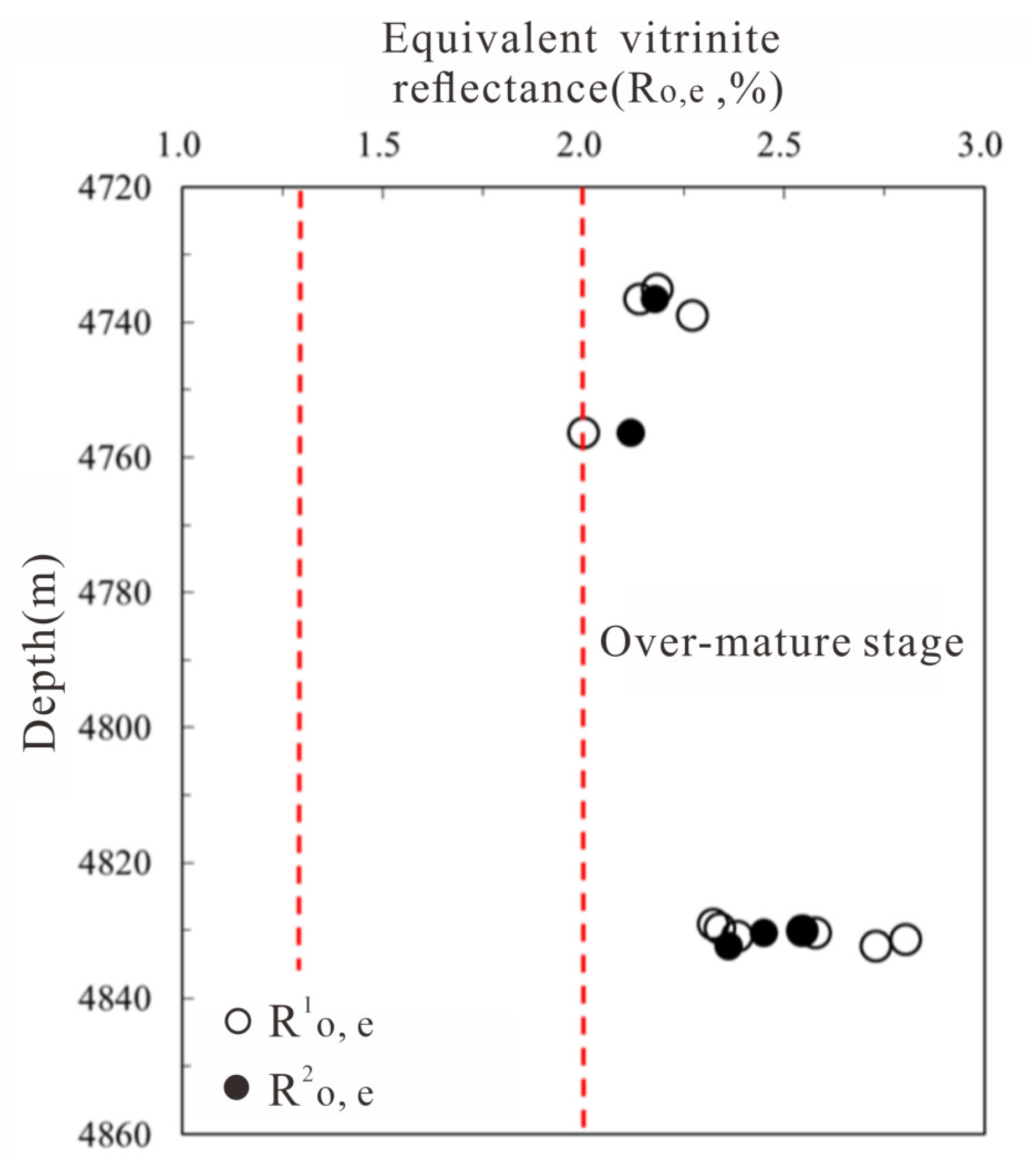
The calculation results of R1o,e based on Raman spectroscopy of solid bitumen (Figure 3) show that the R1o,e values in the 4735~4756.50 m section of the Cuizhuang Formation range from 2.10% to 2.27%, with an average of 2.18%. The R1o,e values in the 4829~4833 m section ranged from 2.23% to 2.84%, with an average of 2.57%. The calculation results of R2o,e based on the reflectivity of solid bitumen show that (Figure 3) the R2o,e value of 4735~4757 m is 2.13~2.19%, with an average of 2.16%. The R2o,e value of 4830~4833 m is 2.42~2.61%, with an average of 2.49%.
It can be seen that the equivalent Ro values obtained by the two calculation methods are very close and are both greater than 2.0% (Figure 3), indicating that the mudstone of the Cuizhuang Formation of Well PT1 has entered the over-mature stage.

4.2. Hydrocarbon-Generating Parent Material and Organic Matter Type

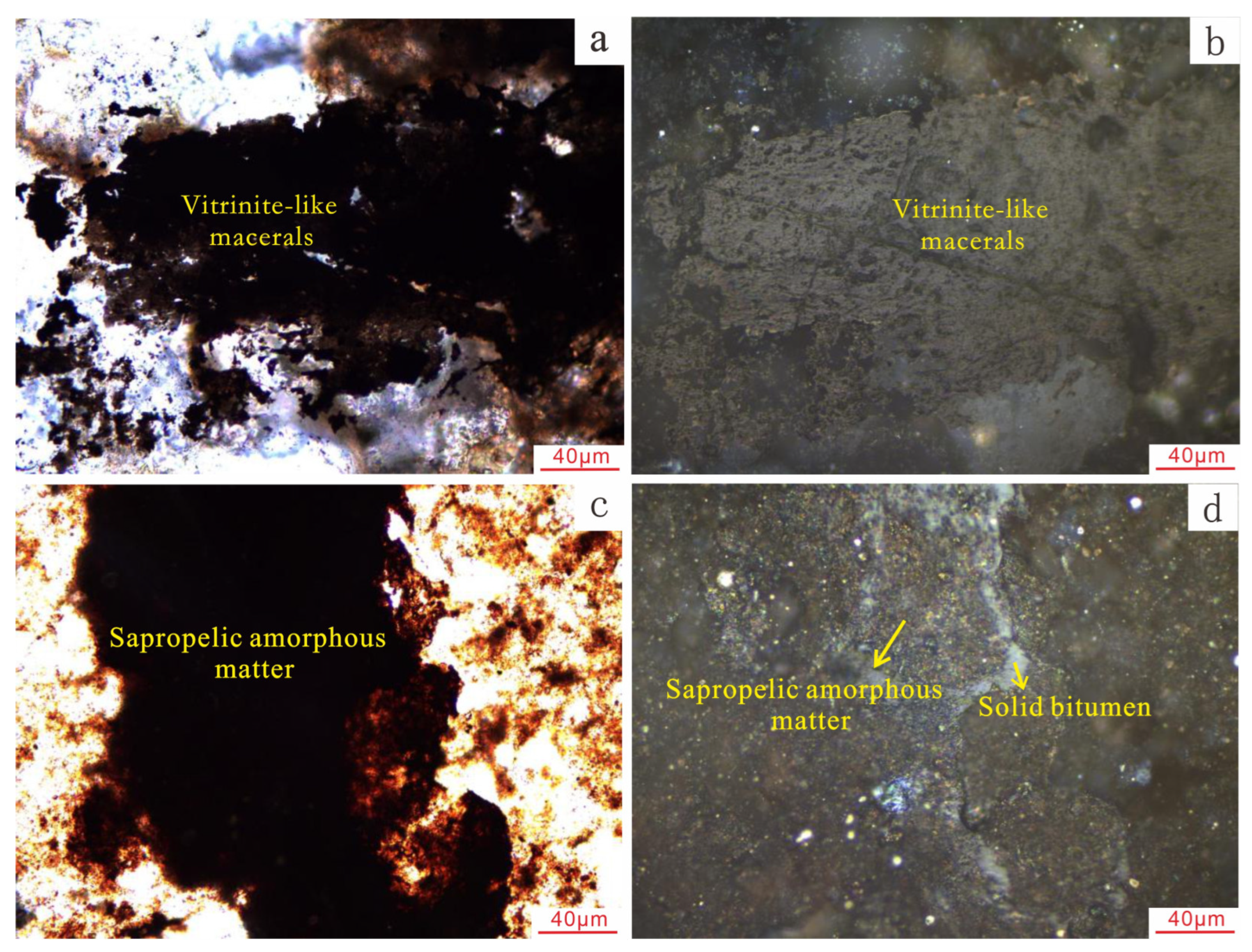
Microscopic observation showed that the morphology of the original hydrocarbon-forming organisms in the mudstone of the Cuizhuang Formation of Well PT1 no longer existed. The organic macerals were mainly composed of sapropelic amorphous matter and secondary solid bitumen, and occasionally vitrinite-like macerals (Figure 4, Table 3). Sapropelic amorphous matter is usually considered to be the product of planktonic algae and lower aquatic organisms through sapropelization under reducing conditions [43]. Vitrinite-like macerals are derived from bacteria and algae or some lower marine organisms, which form during thermal evolution and are similar to the chemical properties of vitrinite [44]. Solid bitumen is the product of thermal evolution of organic matter. These characteristics indicate that the source of organic matter in the mudstone of the Cuizhuang Formation is mainly algae.
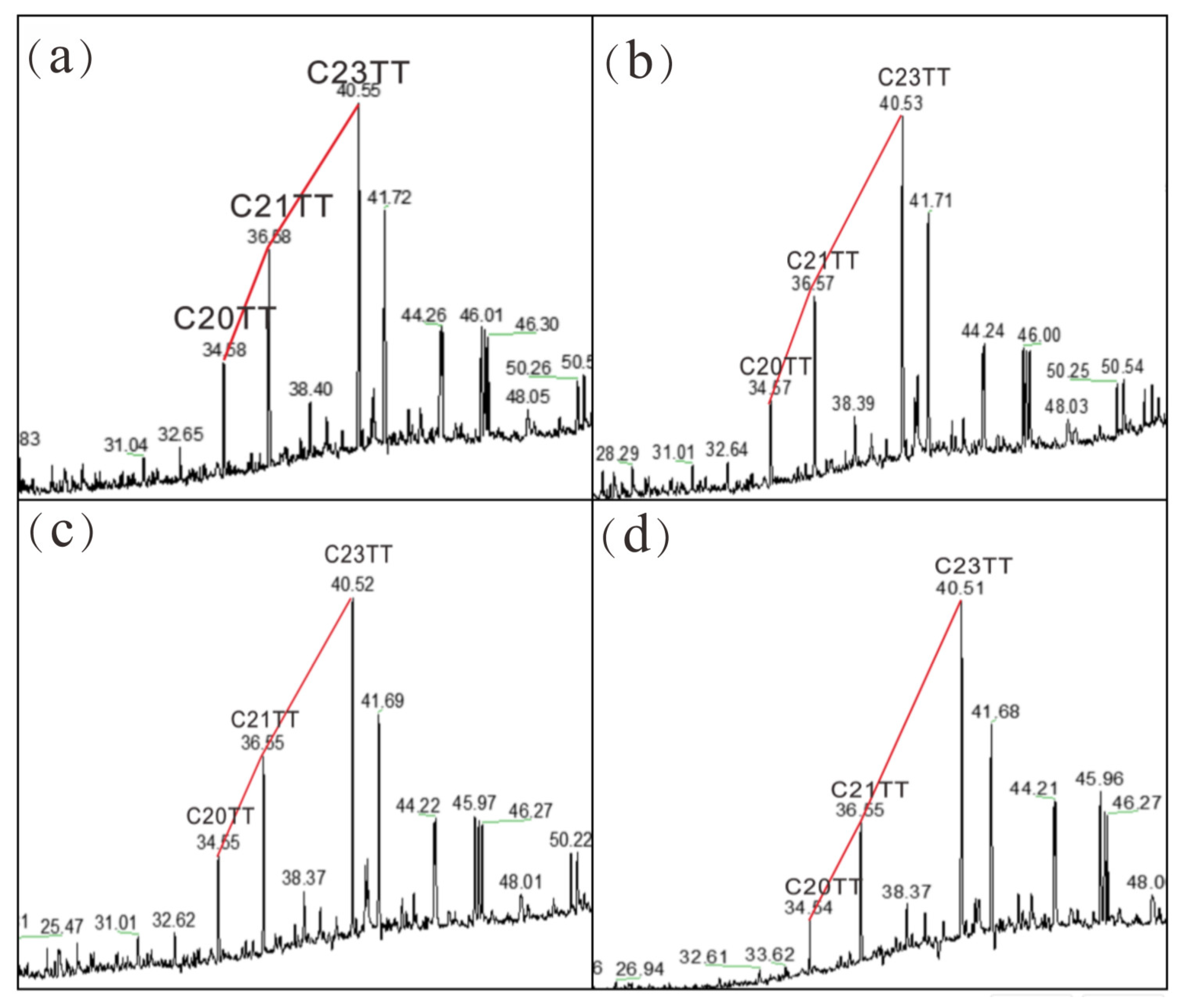
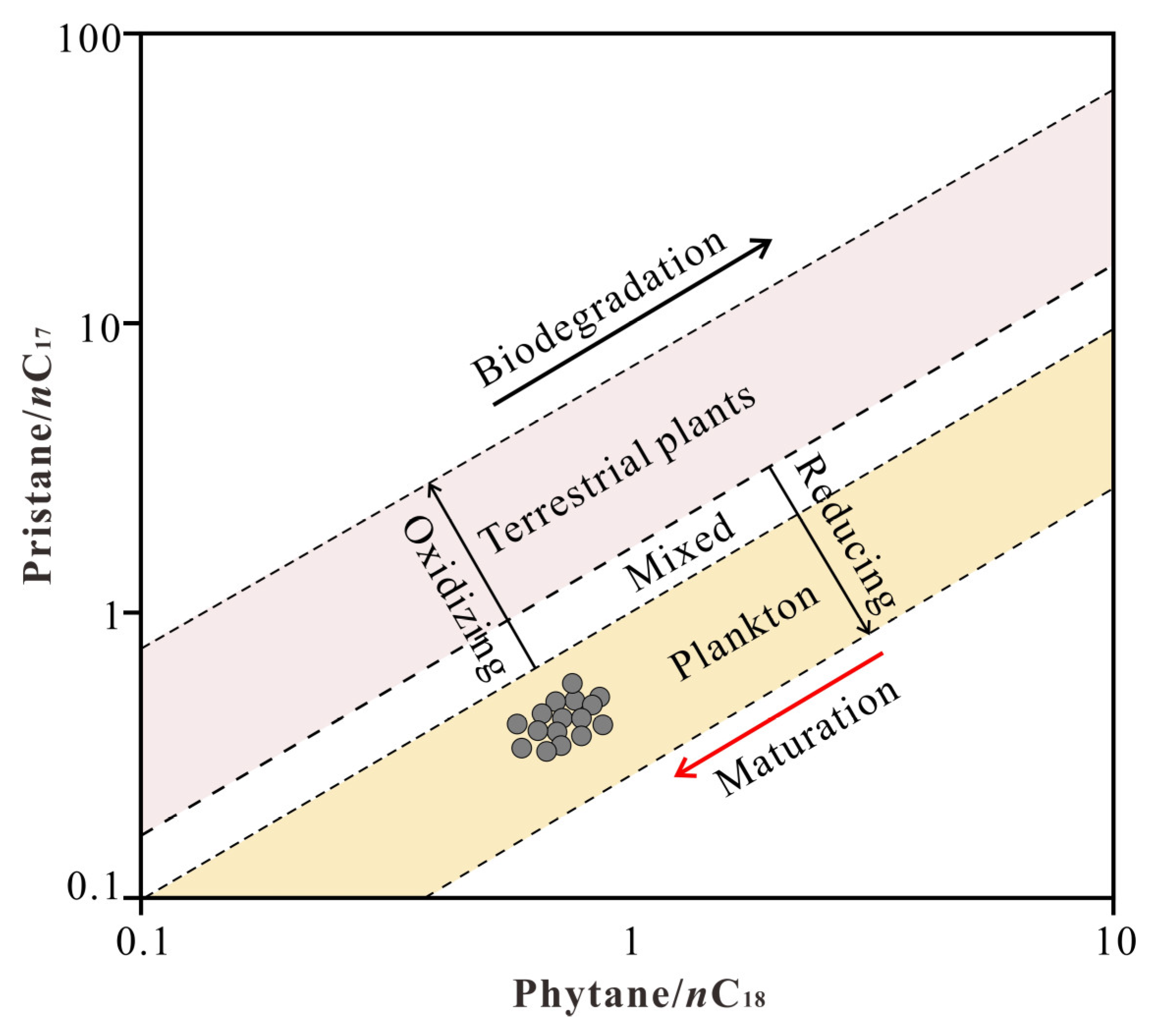
Tricyclic terpanes have high thermal stability and strong resistance to biodegradation, and their abundance distribution patterns are closely related to sedimentary environment and source of organic matter [44,45]. The sedimentary organic matter in marine or saline lakes mainly originates from planktonic algae, which are typically enriched in C23 TT. Consequently, the tricyclic terpane distribution pattern exhibits a dominant C20 < C21 < C23 (ascending type) [44]. The tricyclic terpane abundance distribution pattern of the mudstones from the Cuizhuang Formation exhibits a distribution of C20 < C21 < C23 (ascending type) (Figure 5). This indicates that the source of organic matter in the mudstone of the Cuizhuang Formation is mainly planktonic algae. In addition, the crossplot of Pr/nC17 and Ph/nC18 was also used to identify organic matter source, as well as its sedimentary environment. As shown in Figure 6 and Table 4, the organic matter in the mudstone from the Cuizhuang Formation is mainly sourced from plankton. This result is consistent with the results indicated by the abundance distribution characteristics of tricyclic terpanes.
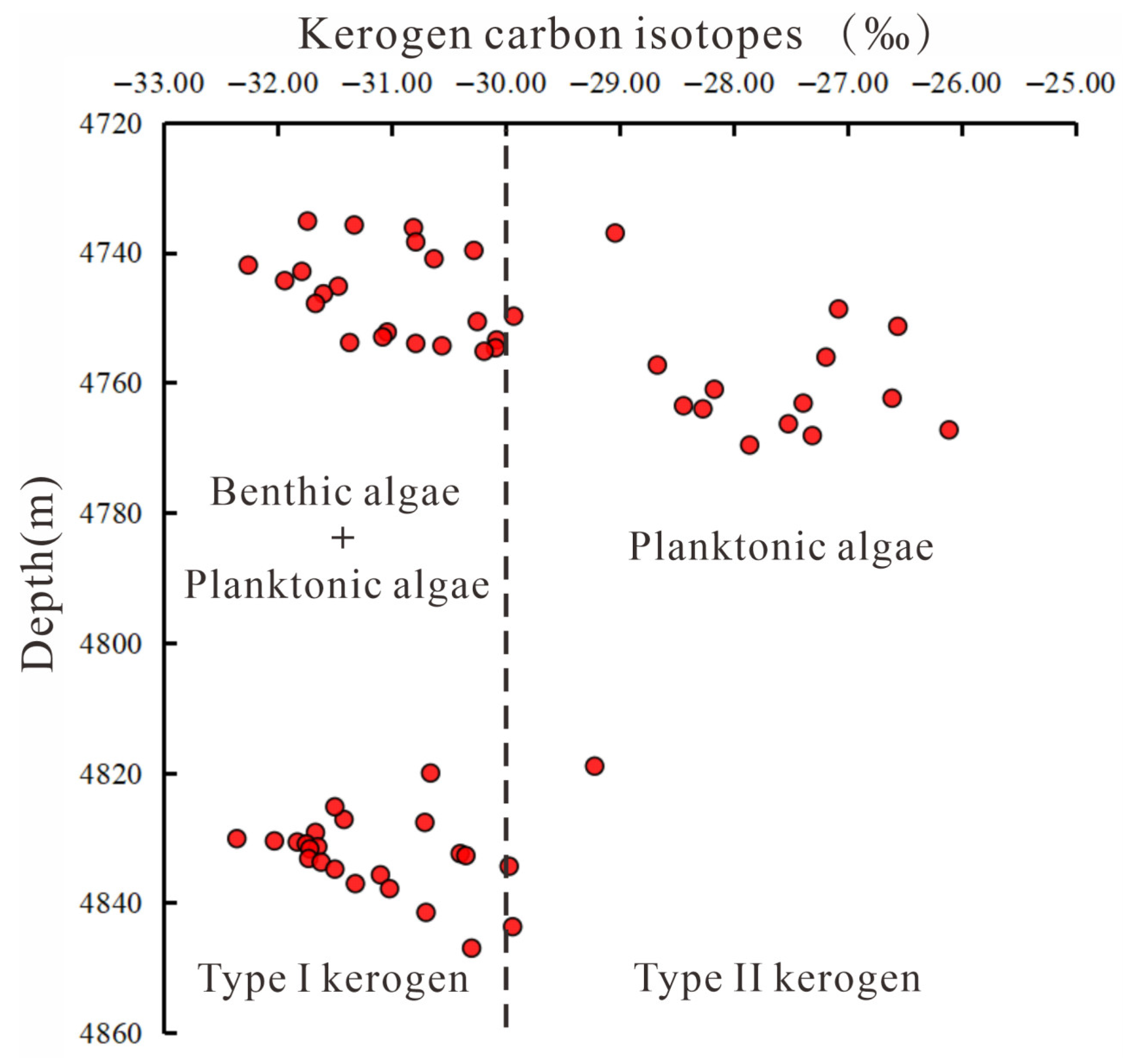
For highly thermally evolved source rocks with severely damaged primary morphology, kerogen carbon isotopes can effectively identify hydrocarbon-generating parent materials and organic matter types [46]. As shown in Table 1, the δ13C kerogen values of the mudstone samples from the Cuizhuang Formation in Well PT1 are between −26.31‰ and −32.45‰. According to the corresponding relationship between kerogen carbon isotope and organic matter type and hydrocarbon-forming organisms established by previous studies [46,47], the hydrocarbon-forming organisms of the Cuizhuang Formation mudstone in Well PT1 include both planktonic algae and benthic algae, and the organic matter type can be divided into Type I and Type II (Figure 7).
Therefore, we integrated the results of kerogen carbon isotope and biomarker identification. The hydrocarbon-generating organism types of the Cuizhuang Formation mudstones are mixed algae (planktonic algae + benthic algae) dominated by planktonic algae. Due to the relatively high proportion of planktonic algae, the tricyclic terpane distribution exhibits an ascending pattern (C20 < C21 < C23). It should be noted that there is a good correspondence between hydrocarbon-forming organisms and organic matter types: the mudstone mainly derived from phytoplankton is Type II, while the mudstone jointly derived from phytoplankton and benthic algae is Type I (Figure 7).

4.3. Organic Matter Abundance

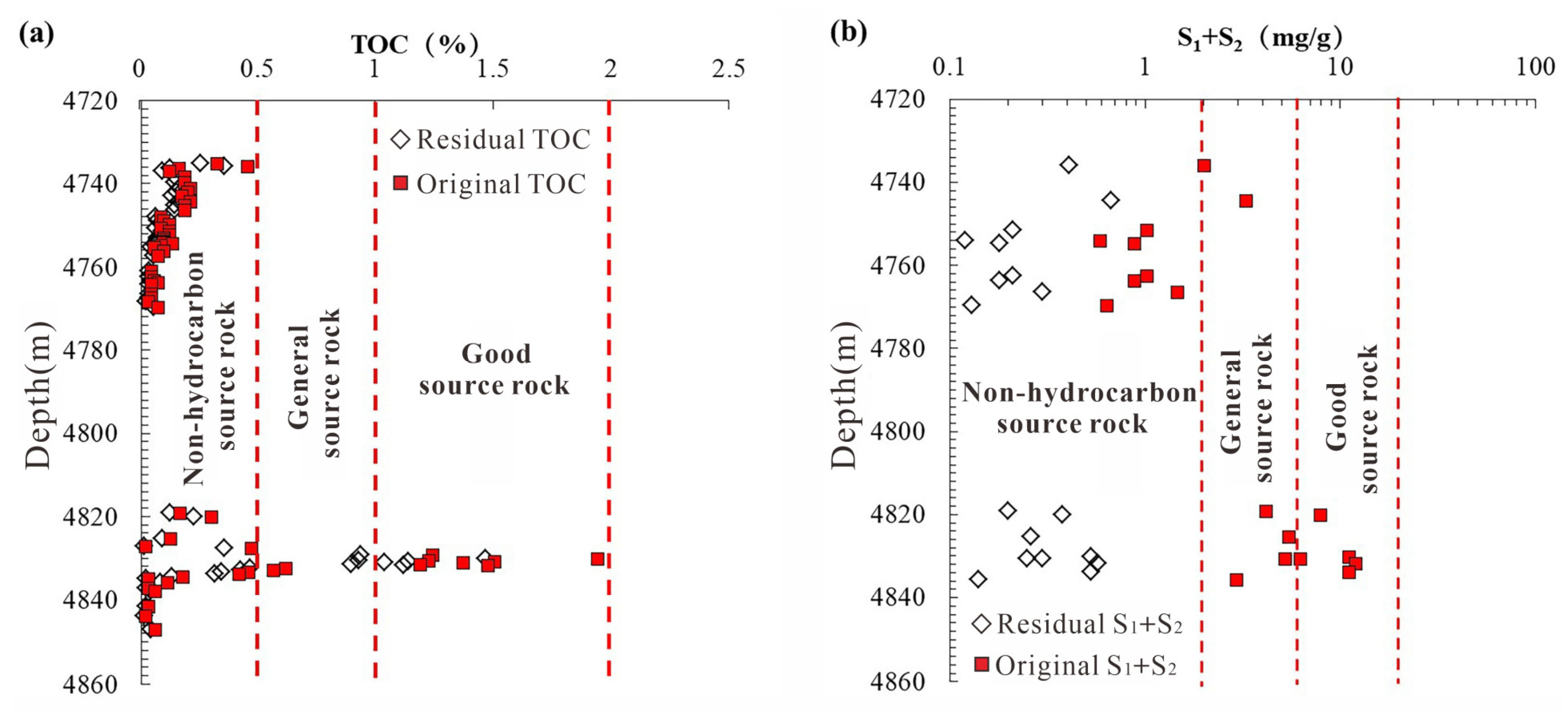
The abundance of organic matter is the key to the identification of source rocks. Commonly used organic matter abundance evaluation indicators include TOC and hydrocarbon generation potential (S1 + S2) [45,48]. According to the Chinese industry standard (SY/T 5735-2019 [49]) for mudstone and carbonate source rocks, the threshold values for a “good source rock” are TOC > 1.0% and S1 + S2 > 6 mg/g for normal maturity levels. As shown in Figure 8, most of the mudstones in the Cuizhuang Formation of Well PT1 are classified as non-hydrocarbon source rocks. Only in the 4829.2~4831.0 m section, some mudstones have TOC values greater than 1%, reaching the “good source rock” level (Figure 8a). However, the S1 + S2 values of mudstone in this depth section is less than 2 mg/g, which classifies them as “non-hydrocarbon source rock” (Figure 8b).
It can be seen that the evaluation results of the two organic matter abundance indexes are not consistent. The reason is that this situation should be caused by the hydrocarbon generation and expulsion of organic matter under the background of high evolution. The current measured TOC and S1 + S2 characterize the current abundance of organic matter, which is the residual abundance of organic matter after hydrocarbon expulsion. For highly mature–over-mature source rocks, the evaluation of residual organic matter abundance may lead to distortion of the evaluation results, especially in the case of low organic matter abundance. Accurate evaluation should be based on the original organic matter abundance.
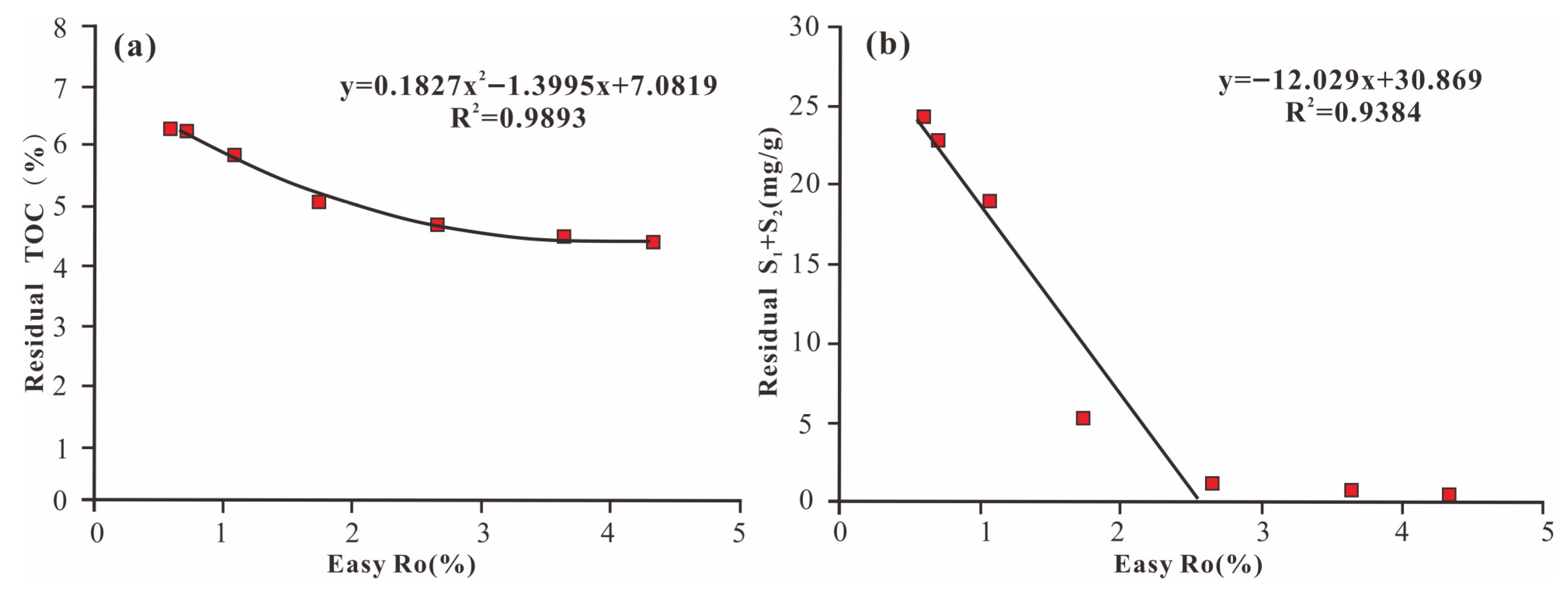
In order to restore the original organic matter abundance of the Cuizhuang Formation mudstone, this paper refers to the results of the hydrocarbon generation thermal simulation experiment of the Middle Proterozoic Xiamaling Formation shale (about 1400 Ma) [50]. In this experiment, the residual TOC and residual S1 + S2 values of the samples decreased regularly with the increase in thermal evolution degree (Easy Ro) (Figure 9). Based on this, we calculated the recovery coefficients of TOC and S1 + S2 under the maturity conditions (equivalent Ro = 2.13, 2.52) of the mudstone in the Cuizhuang Formation of Well PT1 (Table 6). The results show that the TOC recovery coefficient of the Cuizhuang Formation mudstone is 1.25~1.33, while the recovery of S1 + S2 is significantly larger, reaching 4.78~20.85 (Table 6). It can be seen that the effect of high maturity on S1 + S2 is much greater than that on TOC.
Based on the coefficient of restitution, this paper calculated the original TOC value and the original S1 + S2 value of the Cuizhuang Formation mudstone and re-evaluated its organic matter abundance level. As shown in Figure 8, compared with the residual TOC, the organic matter abundance evaluation results based on the original TOC do not change much (Figure 8a). However, after using the original S1 + S2 evaluation, a considerable number of mudstones that were originally evaluated as “non-hydrocarbon source rocks” were re-evaluated as “good source rock” (Figure 8b). It should be noted that the apparent contradiction between the residual TOC and residual S1 + S2 evaluations (Figure 8) is resolved after applying maturity-based restoration. The original TOC and original S1 + S2 values (Figure 8) yield consistent results, both identifying the mudstone interval from 4825.4 to 4834.4 m in the Cuizhuang Formation as “good source rock”. This consistency demonstrates that, for over-mature source rocks, restoration of original organic matter abundance is necessary to avoid underestimation and the restored values provide a reliable basis for evaluation.

5. Organic Matter Enrichment Mechanism of Source Rocks

Previous studies have shown that organic matter enrichment is the result of a combination of factors (such as productivity, sedimentary environment, climate, etc.). There are productivity schools and preservation schools for its main controlling factors [51,52,53]. The former believes that the enrichment of organic matter is mainly controlled by primary productivity [51,52,54], while the latter believes that the anoxic environment of bottom water is the main controlling factor of organic matter enrichment [21,53]. Of course, some scholars believe that the two are equally important for organic matter enrichment [20].
Based on the trace elements of the Cuizhuang Formation mudstone in Well PT1 (Table 5), this paper discusses the influence of paleoproductivity, paleoclimate and paleoenvironment on the abundance of organic matter in Cuizhuang Formation mudstone and analyzes its main controlling factors.

5.1. Paleoproductivity

Marine primary productivity refers to the amount of organic carbon produced by plankton through photosynthesis per unit time and volume. High primary productivity often means more input of original organic matter [55]. Therefore, paleoproductivity is an important factor affecting the abundance of organic matter in sediments. Previous studies have found that elements that reflect the nutritional level of water bodies (such as Cu, Ni, Zn) and elements that reflect the organic carbon flux of water bodies (such as Ba, Mo) can be used to characterize the level of paleoproductivity [56,57,58,59].
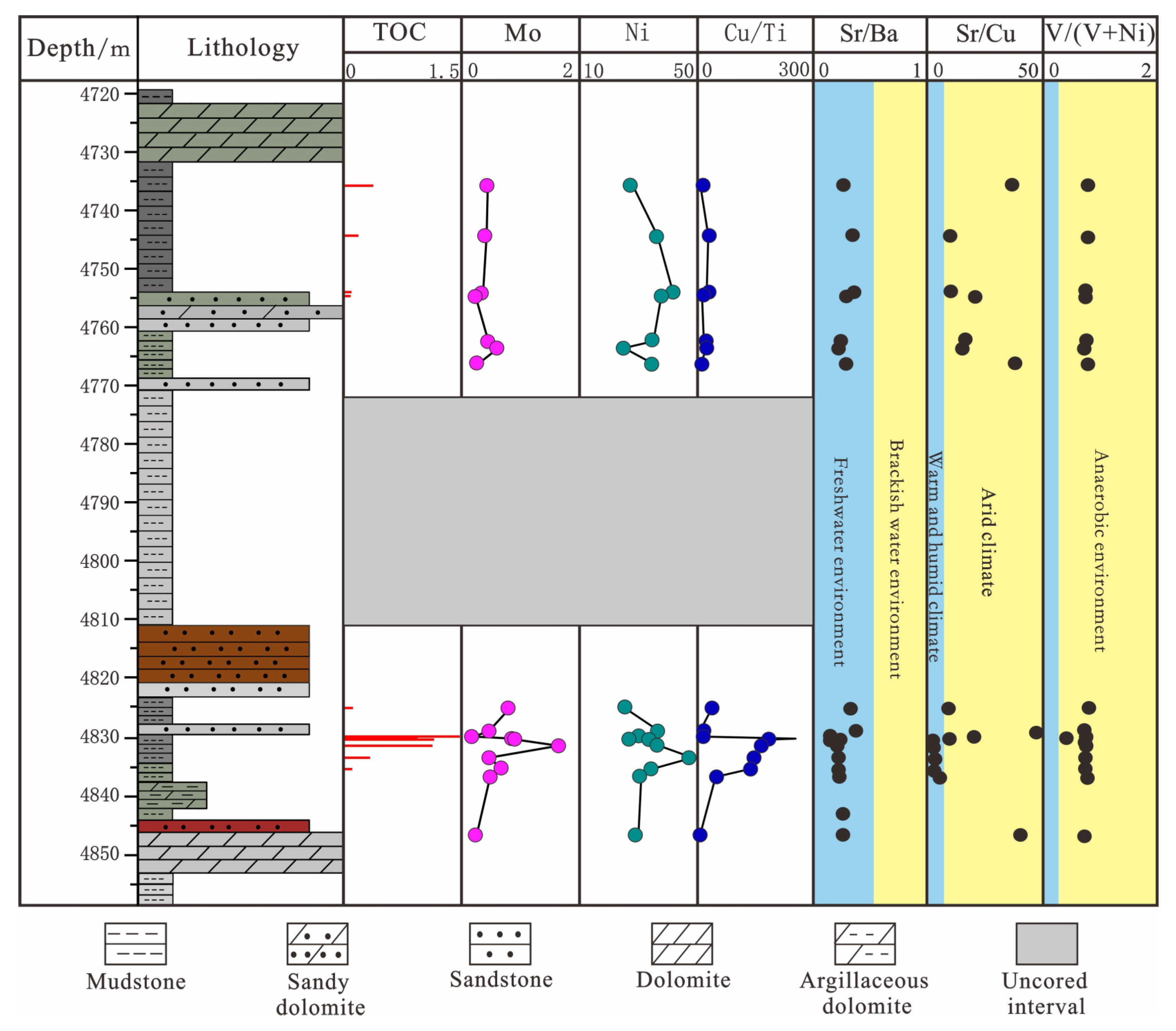
By observing the relationship between the paleoproductivity index and TOC of the mudstone of the Cuizhuang Formation in Well PT1, a significant positive correlation exists between the two, and the high TOC intervals correspond well to areas of high paleoproductivity (Figure 10). This indicates that the marine paleoproductivity does have an important influence on the organic matter abundance of Cuizhuang Formation mudstone.

5.2. Palaeosalinity

The element index Sr/Ba is an important index to characterize the salinity of sedimentary water. With the increase in water salinity, Sr/Ba increases gradually. The values of Sr/Ba are less than 0.5, equal to 0.5~1.0 and greater than 1.0, indicating brackish water phase, brackish water phase and salt water deposition, respectively [60,61]. As shown in Figure 10, the Sr/Ba values of the Cuizhuang Formation mudstone samples from Well PT1 range from 0.18 to 0.35, indicating that these mudstones were deposited in a brackish water environment, presumably in a lagoon environment.

5.3. Palaeoclimate

Influenced by the geochemical differentiation of a sedimentary environment, there are significant differences in the occurrence state of elements in different sedimentary environments. Sr is a dry-type element, which is more likely to remain in the sediment in a dry climate, while Cu is a wet-type element, which is easily adsorbed and preserved in a humid climate. Therefore, the element index Sr/Cu is often used to identify the paleoclimate and reflect the wetting degree of the sedimentary environment [59,61]. When the Sr/Cu value is between 1.3 and 5, it reflects a warm and humid climate, and when it is greater than 5, it is an arid climate [62].
The Sr/Cu value of the Cuizhuang Formation mudstone in Well PT1 is between 1.12 and 48.68, which is in an arid climate as a whole, but in the source rock section of 4825–4833 m, the climate becomes warm and humid (Figure 10). It should be noted that the lithology of the Cuizhuang Formation in Well PT1 also has a clear correspondence with the paleoclimate; dolomite and sandstone dominate under arid climate, whereas mudstone deposition occurs under warm–humid conditions.

5.4. Paleo-Redox Conditions

Under anoxic conditions, V is often reduced and combined with organic matter or sulfides to enrich sediments, while Ni forms NiS2 precipitate due to sulfurization. In contrast, in oxygen-rich water, V is easily adsorbed by iron oxide minerals while Ni is often dissolved or adsorbed on clay minerals. Therefore, the element index V/(V + Ni) is often used to determine the redox state of sedimentary water [59,63]. When V/(V + Ni) is less than 0.46, it indicates an oxygen-rich environment, 0.46–0.54 is an oxygen-poor environment, and greater than 0.54 is an anaerobic environment [63]. As shown in Figure 10, the V/(V + Ni) values of the Cuizhuang Formation mudstone in Well PT1 are all greater than 0.54. The Pr/Ph ratio is also used to indicate the redox properties of sedimentary environments. It has been widely accepted that a Pr/Ph ratio greater than 1 indicates an oxidizing environment, whereas a Pr/Ph ratio less than 1 indicates a reducing environment [64,65]. The Pr/Ph values of the Cuizhuang Formation mudstone are all less than 1, indicating that they were deposited in reducing environments. This may be related to the low atmospheric oxygen content throughout the Proterozoic era [66].

5.5. Organic Matter Enrichment Mechanism

Based on the results of paleoproductivity and sedimentary environment analysis, this study finds that the “good source rock” section with high TOC content in the mudstone of the Cuizhuang Formation in Well PT1 often corresponds to the sedimentary conditions of a warm–humid climate, sufficient nutrient supply and high paleoproductivity (Figure 10). The V/(V + Ni) values of different-colored (black and gray) mudstones in the Cuizhuang Formation show little differece, indicating similar redox conditions, that is, the mudstones of the Cuizhuang Formation are in an anoxic environment as a whole (Figure 10). This indicates that the enrichment of organic matter is mainly controlled by high paleoproductivity levels and warm and humid climatic conditions and has little to do with the salinity of sedimentary waters and redox conditions.
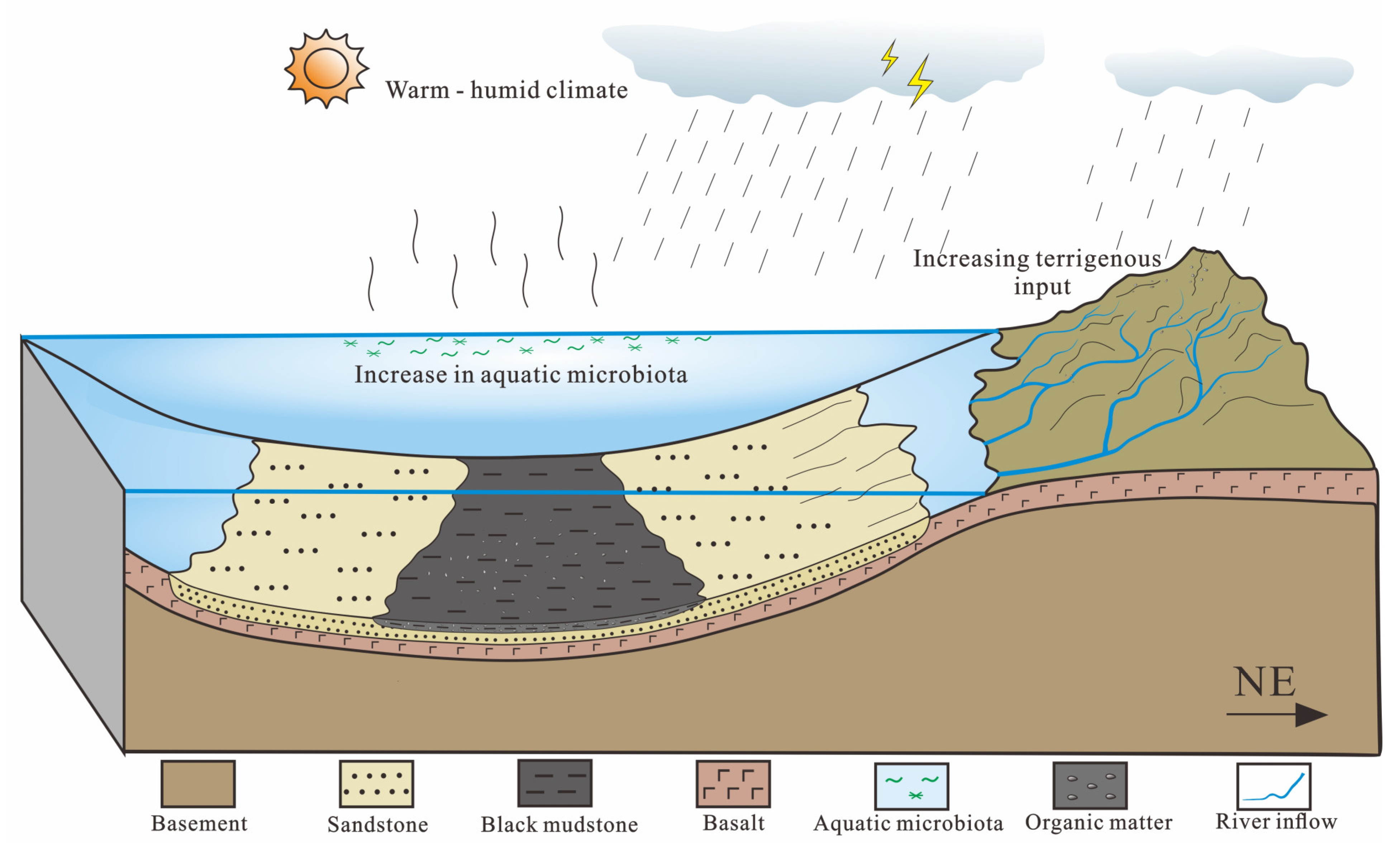
Under a warm and humid climate, the surface weathering and runoff are enhanced, and the input of terrestrial nutrients is increased, which provides favorable conditions for the prosperity of aquatic organisms (especially phytoplankton). The rapid reproduction of lower aquatic organisms such as algae brought a large amount of original organic matter, which can be effectively preserved in the reducing depositional environment, thus forming high-quality source rocks with high TOC.
In summary, high productivity is the dominant factor for the enrichment of organic matter in the mudstone of the Cuizhuang Formation in Well PT1, and the warm and humid climate and the input of terrestrial nutrients jointly trigger the biological blooming event, which lays a foundation for the efficient production and enrichment of organic matter. This study established the following organic matter enrichment model of the Cuizhuang Formation source rocks (Figure 11).

6. Conclusions

(1)
The main hydrocarbon-forming organisms of the Cuizhuang Formation mudstone from the Mesoproterozoic Changcheng System in the Jinshan Rift Trough are planktonic algae and benthic algae, among which planktonic algae account for a relatively high proportion. The type of organic matter is mainly Type I, and the equivalent Ro is greater than 2%, which is in the over-mature stage.
(2)
The present TOC and S1 + S2 of the Cuizhuang Formation mudstone are 0.03~1.52% and 0.14~0.68 mg/g, respectively. The original TOC and S1 + S2 are 0.06~1.97% and 0.61~10.34 mg/g, respectively. Based on the evaluation of original organic matter abundance, “good source rock” with a cumulative thickness of 6.7 m was developed in the Cuizhuang Formation of Well PT1.
(3)
The TOC of the mudstone in the Cuizhuang Formation shows a weak relationship with the salinity and redox conditions of the sedimentary water but has a significant correlation with the paleoproductivity and paleoclimate. The high value of TOC corresponds to the high value of paleoproductivity and the warm and humid climate.
(4)
High productivity is the main controlling factor for the enrichment of mudstone organic matter in the Cuizhuang Formation of the Mesoproterozoic Changcheng System in the Jinshan Rift Trough. The enrichment mechanism of organic matter is as follows: under the warm and humid climate, the increase in surface runoff and terrestrial nutrient input promote the proliferation of bacteria and algae in seawater, and a large amount of sedimentary organic matter is formed and preserved to form “good source rock”.

Author Contributions

Conceptualization, J.W. (Jinxiang Wei) and A.W.; methodology, J.W. (Jinxiang Wei) and A.W.; software, J.W. (Jinxiang Wei) and Y.R.; validation, Y.C. and Y.R.; formal analysis, J.W. (Jinxiang Wei) and Y.R.; investigation, J.W. (Jie Wang); resources, A.W.; data curation, J.W. (Jinxiang Wei); writing—original draft preparation, J.W. (Jinxiang Wei); writing—review and editing, J.W. (Jinxiang Wei) and A.W.; visualization, Y.R. and J.W. (Jie Wang); supervision, Y.R. and Y.C.; project administration, A.W.; funding acquisition, A.W. All authors have read and agreed to the published version of the manuscript.

Funding

This study comes from the scientific research project “Comprehensive Evaluation of Single Well Geology in Well PT-1 of Changqing Oilfield Company’s Risk Exploration” and was supported and funded by the Exploration and Development Research Institute of PetroChina Changqing Oilfield Company.

Institutional Review Board Statement

Not applicable.

Informed Consent Statement

Not applicable.

Data Availability Statement

The original contributions presented in this study are included in the article. Further inquiries can be directed to the corresponding author.

Acknowledgments

We appreciate the help of State Key Laboratory of Continental Evolution and Early Life, Department of Geology, Northwest University.

Conflicts of Interest

The authors declare no conflicts of interest.

References

  1. Zhao, W.Z.; Wang, X.M.; Hu, S.Y.; Zhang, S.C.; Wang, H.J.; Guan, S.W.; Ye, Y.T.; Ren, R.; Wang, T.S. Hydrocarbon-generating characteristics and exploration prospects of Proterozoic source rocks in China. Sci. China Earth Sci. 2019, 49, 939–964. [Google Scholar]
  2. Fabio, L.; Jonathan, C.; Bindra, T. Neoproterozoic-Early Cambrian (Infracambrian) hydrocarbon prospectivity of North Africa: A synthesis. Geol. Soc. Lond. Spec. Publ. 2009, 326, 137–156. [Google Scholar]
  3. Jonathan, C.; Juergen, T.; Bindra, T.; Andy, W.; Yousef, A. Global Neoproterozoic petroleum systems: The emerging potential in North Africa. Geol. Soc. Lond. Spec. Publ. 2009, 326, 1–25. [Google Scholar]
  4. Volk, H.; Dutkiewicz, A.; George, S.; Ridley, J. Oil migration in the Middle Proterozoic Roper Superbasin, Australia: Evidence from oil inclusions and their geochemistries. J. Geochem. Explor. 2003, 78, 437–441. [Google Scholar] [CrossRef]
  5. Grosjean, E.; Love, G.D.; Stalvies, C.; Fike, D.A.; Summons, R.E. Origin of petroleum in the Neoproterozoic–Cambrian South Oman Salt Basin. Org. Geochem. 2009, 40, 87–110. [Google Scholar] [CrossRef]
  6. Sohail, G.M.; Aadil, N. Infra-Cambrian play in Punjab Platform, Pakistan, with reference to Bikaner-Nagaur Basin, India. Arab. J. Geosci. 2015, 8, 6137–6143. [Google Scholar] [CrossRef]
  7. Wang, T.G.; Han, K.Y. On meso-neoproterozoic primary petroleum resources. Acta Pet. Sin. 2011, 32, 1–7. [Google Scholar]
  8. Bai, H.F.; Bao, H.P.; Li, Z.M.; Hao, S.L.; Wu, C.Y.; Jing, X.H. Sedimentary Characteristics and Natural Gas Accumulation Potential of the Proterozoic Changcheng System in the Ordos Basin. Geol. Sci. 2020, 55, 672–691. [Google Scholar]
  9. Feng, J.P.; Li, W.H.; Ou, Y.Z.J. Tectonic and depositional evolution of meso-neo proterozoic in ordos area. J. Northwest Univ. (Nat. Sci. Ed.) 2020, 50, 634–643. [Google Scholar]
  10. Liu, G.; Yang, W.J.; Jing, X.H.; Bai, H.F.; Shi, B.H.; Sun, Y.P.; Ren, J.F.; Pan, X.; Zhang, J.W.; Wei, J.Y. Geological Characteristics and Exploration Prospects of the Mesoproterozoic Changcheng System in the Ordos Basin. China Pet. Explor. 2024, 29, 44–60. [Google Scholar]
  11. Chen, S.Q.; Zhou, Y.J.; Guo, Q.; Ruan, Z.Z.; Yu, X.L.; Wang, L.L. Characteristics and Exploration Potential of the Meso-Neoproterozoic Aulacogen in the Ordos Basin. Geol. Sci. 2020, 55, 692–702. [Google Scholar]
  12. Feng, J.P.; Ou, Y.Z.J.; Zhou, Y.J.; Bao, H.P.; Yan, T. Re-delimitation of the Mesoproterozoic “aulacogen” in the Ordos area. J. Northwest Univ. (Nat. Sci. Ed.) 2018, 48, 587–592. [Google Scholar]
  13. Lu, Q.Q.; Luo, S.S.; Wang, Z.C.; Wang, T.S.; Zhang, Y.; Guan, Y.L. Sedimentary Systems and Paleogeographic Evolution of the Meso-Neoproterozoic in Typical Aulacogens of the North China Craton. Acta Geol. Sin. 2022, 96, 349–367. [Google Scholar]
  14. Li, T.T.; Zhu, G.Y.; Zhao, K.; Wang, P.J. Nitrogen cycle and nitrogen isotope application in paleoenvironmentreconstruction of ancient hydrocarbon source rocks and oil-source correlations. Nat. Gas Geosci. 2020, 31, 721–734. [Google Scholar]
  15. Zhu, G.Y.; Chen, F.R.; Chen, Z.Y.; Zhang, Y.; Xing, X.; Tao, X.W.; Ma, D.B. Discovery and basiccharacteristics of the high-quality source rocks of the CambrianYuertusi Formation in Tarim Basin. Nat. Gas Geosci. 2016, 27, 8–21. [Google Scholar]
  16. Zhao, Q.; Liu, B.; Wei, L.B.; Bai, H.F.; Lu, F.F.; Wu, C.; Shi, K.B. Occurrence Characteristics and Genetic Mechanism of Siliceous Minerals in the Mesoproterozoic Jixian System Dolomites of the Ordos Basin. Acta Geol. Sin. 2024, 98, 3117–3133. [Google Scholar]
  17. Tissot, B.P.; Welte, D.H. Petroleum Formation and Occurrence, 2nd ed.; Springer: Berlin/Heidelberg, Germany, 1984; pp. 74–92. [Google Scholar]
  18. Peters, K.E.; Walters, C.C.; Moldowan, J.M. The Biomarker Guide, 2nd ed.; Cambridge University Press: Cambridge, UK, 2005; pp. 248–254. [Google Scholar]
  19. Tribovillard, N.; Algeo, T.J.; Lyons, T.; Riboulleau, A. Trace metals as paleoredox and paleoproductivity proxies: An update. Chem. Geol. 2006, 232, 12–32. [Google Scholar] [CrossRef]
  20. Algeo, T.J.; Tribovillard, N. Environmental analysis of paleoceanographic systems based on molybdenum–uranium covariation. Chem. Geol. 2009, 268, 211–225. [Google Scholar] [CrossRef]
  21. Demaison, G.J.; Moore, G.T. Anoxic environments and oil source bed genesis. Org. Geochem. 1980, 2, 9–31. [Google Scholar] [CrossRef]
  22. Wilkins, R.W.T.; Boudou, R.; Sherwood, N.; Xiao, X. Thermal maturity evaluation from inertinites by Raman spectroscopy: The ‘RaMM’ technique. Int. J. Coal Geol. 2014, 128–129, 143–152. [Google Scholar] [CrossRef]
  23. Peters, K.E. Guidelines for Evaluating Petroleum Source Rock Using Programmed Pyrolysis. AAPG Bull. 1986, 70, 318–329. [Google Scholar] [CrossRef]
  24. Hao, F.; Zhou, X.; Zhu, Y.; Yang, Y. Lacustrine source rock deposition in response to co-evolution of environments and organisms controlled by tectonic subsidence and climate, Bohai Bay Basin, China. Org. Geochem. 2011, 42, 323–339. [Google Scholar] [CrossRef]
  25. Weimer, P.; Bouroullec, R.; Adson, J.; Cossey, S.P.J. An overview of the petroleum systems of the northern deep-water Gulf of Mexico. AAPG Bull. 2017, 101, 941–993. [Google Scholar] [CrossRef]
  26. Cornford, C. Source Rocks and Hydrocarbons of the North Sea, 4th ed.; Blackwell Science: Oxford, UK, 1998; pp. 376–462. [Google Scholar]
  27. Dang, B. Study on the Relationship Between Tectono-Sedimentary Evolution and Lower Paleozoic Natural Gas Accumulation in the Ordos Basin. Ph.D. Thesis, Northwest University, Xi’an, China, 2003. [Google Scholar]
  28. Bao, H.P.; Shao, D.B.; Hao, S.L.; Zhang, G.S.; Ruan, Z.Z.; Liu, G.; Ou, Y.Z.J. Basement Structure and Evolution of Early Sedimentary Caprocks in the Ordos Basin. Earth Sci. Front. 2019, 26, 33–43. [Google Scholar]
  29. Guan, S.W.; Wu, L.; Ren, R.; Zhu, G.Y.; Peng, C.Q.; Zhao, W.T.; Li, J. Distribution and petroleum prospect of precambrian rifts in the main cratons, china. Acta Pet. Sin. 2017, 38, 9–22. [Google Scholar]
  30. Wang, K.; Wang, T.; Wang, Z.; Luo, P.; Li, Q.; Fang, J.; Ma, K. Characteristics of Changchengian rifts in southern margin of North China Craton and its hydrocarbon geological conditions. Pet. Res. 2018, 3, 269–282. [Google Scholar] [CrossRef]
  31. Zhao, G.C. Palaeoproterozoic assembly of the North China Craton. Geol. Mag. 2001, 138, 87–91. [Google Scholar] [CrossRef]
  32. Xi, S.L.; Liu, X.S.; Ren, J.F.; Liu, G.; Zhang, C.L.; Hui, X.; Zhao, W.B.; Wang, H.W.; Jing, X.H.; Dong, G.D.; et al. New Progress in Understanding Hydrocarbon Accumulation and Exploration Potential in Risk Exploration Areas of the Ordos Basin. China Pet. Explor. 2023, 28, 34–48. [Google Scholar]
  33. GB/T 19145-2022; Determination of Total Organic Carbon in Sedimentary Rocks. China Standards Press: Beijing, China, 2022.
  34. SY/T 5118-2005; Determination of Chloroform Bitumen in Rocks. Petroleum Industry Press: Beijing, China, 2005.
  35. GB/T 18602-2012; Rock Pyrolysis Analysis. China Standards Press: Beijing, China, 2012.
  36. SY/T 5238-2019; Analysis Method for Carbon and Oxygen Isotopes of Organic Matter and Carbonate Rocks. Petroleum Industry Press: Beijing, China, 2019.
  37. SY/T 6414-2014; Identification and Counting Method of Macerals on Whole Rock Polished Sections. Petroleum Industry Press: Beijing, China, 2014.
  38. SY/T 5119-2016; Analytical Method for Group Components of Rock Extract and Crude Oil by Column Chromatography. Petroleum Industry Press: Beijing, China, 2016.
  39. SY/T 5124-2012; Method of Determining Vitrinite Reflectance in Sedimentary Rocks. Petroleum Industry Press: Beijing, China, 2012.
  40. Mastalerz, M.; Drobniak, A.; Stankiewicz, A.B. Origin, properties, and implications of solid bitumen in source-rock reservoirs: A review. Int. J. Coal Geol. 2018, 195, 14–36. [Google Scholar] [CrossRef]
  41. Visser, R.; John, T.; Menneken, M.; Patzek, M.; Bischoff, A. Temperature constraints by Raman spectroscopy of organic matter in volatile-rich clasts and carbonaceous chondrites. Geochim. Cosmochim. Acta 2018, 241, 38–55. [Google Scholar] [CrossRef]
  42. Liu, Y.; Di, W.C.R.; Liu, X.M.; Yuan, H.L. Determination of 36 Trace Elements in 56 National Geological Reference Materials by Closed Vessel High-Temperature and High-Pressure Sample Digestion Combined with ICP-MS: A Discussion on the Revision and Certification of Reference Values for Some Elements. Rock Miner. Anal. 2013, 32, 221–228. [Google Scholar]
  43. Tu, J.Q.; Chen, J.P.; Zhang, D.J.; Cheng, K.M.; Chen, J.J.; Yang, Z.M. Classification of Organic Macerals and Their Petrological Characteristics of Lacustrine Carbonate Source Rocks: A Case Study of the Jiuxi Basin. Acta Pet. Sin. 2012, 28, 917–926. [Google Scholar]
  44. Zhao, Y.M.; Gao, P.; Xiao, X.M.; Zhou, Q. Organic petrological characteristics and comprehensive maturity evaluation of the Lower Cambrian shales in the Middle-Upper Yangtze Region. Geochimica 2024, 53, 386–398. [Google Scholar]
  45. He, S.; Ma, A.L.; Yun, L.; Cao, Z.C.; Li, X.Q.; Huang, C.; Zhang, G.S.; Hu, S.; Wang, T.Y.; Peng, W.L.; et al. Organic Geochemical Characteristics and Exploration Significance of Source Rocks in the Upper Ordovician Qiaerbake Formation in the Shunbei Area of the Tarim Basin. Oil Gas Geol. 2025, 46, 246–260. [Google Scholar]
  46. Hu, G.; Liu, W.H.; Luo, H.Y.; Wang, J.; Chen, Q.L.; Teng, G.; Lu, L.F. Influence of Hydrocarbon-Generating Biological Assemblages on the Carbon Isotope Composition of Kerogen in Source Rocks: A Case Study of Lower Paleozoic Source Rocks in the Tarim Basin. Bull. Mineral. Petrol. Geochem. 2019, 38, 902–913+869. [Google Scholar]
  47. Cao, Q.Y. Identification and type classification of kerogen macerals under transmitted light. Pet. Explor. Dev. 1985, 5, 14–23+81–88. [Google Scholar]
  48. Qin, J.Z. Distribution of Organic Facies and Hydrocarbon Generation Model in the Qiangtang Basin, Qinghai-Tibet Plateau. Pet. Geol. Exp. 2006, 3, 264–270+275. [Google Scholar]
  49. SY/T 5735–2019; Geochemical Method for Source Rock Evaluation. Petroleum Industry Press: Beijing, China, 2019.
  50. Xie, L.J.; Sun, Y.G.; Yang, Z.W.; Chen, J.P.; Jiang, A.Z.; Zhang, Y.D.; Deng, C.P. Hydrocarbon generation and evolution characteristics of the Mesoproterozoic Xiamaling Formation shale in Zhangjiakou area, North China and their petroleum geological significance. Sci. China Earth Sci. 2013, 43, 1436–1444. [Google Scholar]
  51. Chen, G.; Chang, X.C.; Guo, X.W.; Pang, Y.M.; Zhang, P.F.; Zhu, X.Q. Geochemical characteristics and organic matter enrichment mechanism of Permian black mudstone in the South Yellow Sea Basin, China. J. Pet. Sci. Eng. 2022, 208, 108–248. [Google Scholar] [CrossRef]
  52. Deng, T.; Li, Y.; Wang, Z.; Yu, Q.; Dong, S.; Yan, L.; Hu, W.; Chen, B. Geochemical characteristics and organic matter enrichment mechanism of black shale in the Upper Triassic Xujiahe Formation in the Sichuan basin: Implications for paleoweathering, provenance and tectonic setting. Mar. Pet. Geol. 2019, 109, 698–716. [Google Scholar] [CrossRef]
  53. Wang, P.W.; Zhang, L.; Li, C.; Li, X.J.; Zou, C.; Zhang, C.; Li, J.J.; Li, Q.F. Redox conditions and organic matter enrichment mechanism of black shales: A case study of the Wufeng Formation-Longmaxi Formation lower member in Well A of the Zhaotong shale gas demonstration area. Oil Gas Geol. 2017, 38, 933–943. [Google Scholar]
  54. Pedersen, T.F.; Calvert, S.E. Anoxia vs. Productivity: What Controls the Formation of Organic-Carbon-Rich Sediments and Sedimentary Rocks? AAPG Bull. 1990, 74, 454–466. [Google Scholar] [CrossRef]
  55. Wei, H.Y. Paleo-oceanic productivity and redox indices: A review of elemental geochemistry. Sediment. Geol. Tethyan Geol. 2012, 32, 76–88. [Google Scholar]
  56. Liang, F.; Cao, Z. Reservoir Characteristics, Formation Environment and Enrichment Model of Triassic Chang 7 Shale Oil in Huachi Area, Ordos Basin. Lithol. Reserv. 2025, 37, 24–40. [Google Scholar]
  57. Pan, X. Source-Forming Environment and Organic Matter Enrichment Mechanism of the Meso-Neoproterozoic at the Southern Margin of the Ordos Basin. Ph.D. Thesis, Northwest University, Xi’an, China, 2021. [Google Scholar]
  58. Wang, Y.; Zhang, H.Y.; Zhu, Y.M.; Qin, Y.; Chen, S.B.; Wang, Z.X.; Cao, W. Sedimentary environment and organic matter enrichment of marine-continental transitional mud shales in the Shanxi Formation-Taiyuan Formation in the western part of the Linqing Depression, Bohai Bay Basin. J. Palaeogeogr. 2024, 26, 1090–1107. [Google Scholar]
  59. Zhang, Y.X.; Chen, J.W.; Zhou, J.Y. Geochemical Characteristics and Organic Matter Enrichment Model of Early Cambrian Black Shales in the Subei Area. Oil Gas Geol. 2020, 41, 838–851. [Google Scholar]
  60. Ni, C.H.; Zhou, X.J.; Wang, G.S.; Liu, Y.L.; Yang, F. Sedimentary Environment and Geochemical Characteristics of Source Rocks in the Pingliang Formation at the Southern Margin of the Ordos Basin. Oil Gas Geol. 2011, 32, 38–46. [Google Scholar]
  61. Pattan, J.J.; Pearce, N.J.G.; Mislankar, P.G. Constraints in using Cerium-anomaly of bulk sediments as an indicator of paleo bottom water redox environment: A case study from the Central Indian Ocean Basin. Chem. Geol. 2005, 221, 260–278. [Google Scholar] [CrossRef]
  62. Tang, W.X.; Jiang, Z.X.; Liu, R.H.; Wang, X.Y. Geochemical Characteristics and Sedimentary Background of Mudstones in the Yogou Formation of the Termit Basin, Niger. Oil Gas Geol. 2017, 38, 592–601+632. [Google Scholar]
  63. Cheng, J.; Zheng, L.J. Sedimentary Geochemical Characteristics of Early Cambrian Source Rocks in Well Jinye-1, Southern Sichuan Area. Oil Gas Geol. 2020, 41, 800–810. [Google Scholar]
  64. Holba, A.G.; Dzou, L.I.; Wood, G.D.; Ellis, L.; Adam, P.; Schaeffer, P.; Albrecht, P.; Greene, T.; Hughes, W.B. Application of tetracyclic polyprenoids as indicators of input from fresh-brackish water environments. Org. Geochem. 2003, 34, 441–469. [Google Scholar] [CrossRef]
  65. Si, W.; Hou, D.; Wu, P.; Zhao, Z.; Ma, X.; Zhou, H.; Cao, L. Geochemical characteristics of lower cretaceous lacustrine organic matter in the southern sag of the Wuliyasitai depression, Erlian Basin, China. Mar. Pet. Geol. 2020, 118, 104404. [Google Scholar] [CrossRef]
  66. Zhang, S.C.; Wang, H.J.; Wang, X.M.; Ye, Y.T. Mesoproterozoic oxygenation event. Sci. China Earth Sci. 2022, 52, 26–52. [Google Scholar] [CrossRef]
Figure 1. (a) Stratigraphic column of the Mesoproterozoic Changcheng System and Jixian System in the Ordos Basin. The column shows the vertical succession from the Xiong’er Group to the Jixian System, and visualizes the volcanic–clastic–carbonate rock assemblage and its division into the two systems. (b) Mesoproterozoic rift troughs in the Ordos Basin and location of Well PT1 (modified from Liu Gang et al., 2024 [10]). Well PT1 is located within the Jinshan Rift Trough on the southwestern margin of the basin. (c) The location of the Ordos Basin in China. (d) Cuizhuang Formation stratigraphic column of Well PT1. Dark mudstone intervals are the main targets of this study.
Applsci 16 04341 g001
Figure 2. Workflow diagram of the analytical procedures and data integration in this study. The diagram outlines eight sequential steps from sample collection to the establishment of the organic matter enrichment model. Each step specifies the key methods and the expected outcomes. This logic diagram clarifies the methodology and demonstrates how each analysis contributes to the final conclusions.
Applsci 16 04341 g002
Figure 3. Equivalent vitrinite reflectance (Ro,e) values of the Cuizhuang Formation mudstones at different depths, calculated from Raman spectroscopy (R1o,e) and solid bitumen reflectance (R2o,e). The two methods yield consistent results: Ro,e ranges from 2.10% to 2.84% (average > 2.0%), indicating that the Cuizhuang Formation has entered the over-mature stage of thermal evolution.
Applsci 16 04341 g003
Figure 4. Microscopic organic components in the mudstones from the Cuizhuang Formation in Well PT1: (a,c) Mono-polarization photomicrographs; (b,d) oil-immersed reflection photomicrographs. Organic macerals consist predominantly of sapropelic amorphous matter and secondary solid bitumen, with rare vitrinite-like particles. This assemblage indicates an algal origin for the organic matter.
Applsci 16 04341 g004
Figure 5. Abundance distribution characteristics of tricyclic terpane in soluble organic matter of mudstone in Cuizhuang Formation. (a) At a depth of 4735.78 m in Well PT1; (b) at a depth of 4754.68 m in Well PT1; (c) at a depth of 4827.6 m in Well PT1; (d) at a depth of 4834.4 m in Well PT1. Representative samples from different depths all show a consistent pattern of C20 TT < C21 TT < C23 TT (ascending type). This distribution is characteristic of organic matter derived primarily from planktonic algae, as marine planktonic algae are typically enriched in C23 TT. The consistency across samples indicates a stable biological source input throughout the Cuizhuang Formation deposition.
Applsci 16 04341 g005
Figure 6. The crossplot of Pr/nC17 and Ph/nC18 of the mudstone in the Cuizhuang Formation. The diagram is divided into fields representing different organic matter sources (plankton, mixed, terrestrial plants) and depositional environments (oxidizing, Reducing). All samples from the Cuizhuang Formation plot are within the “Plankton” field, and their Pr/Ph ratios are all below 1. This indicates that the organic matter is predominantly derived from marine planktonic algae and was deposited under reducing conditions.
Applsci 16 04341 g006
Figure 7. Correspondence between kerogen carbon isotope values and organic matter types and hydrocarbon generating organisms in the mudstones from the Cuizhuang Formation in Well PT1. The δ13C kerogen values range from −26.31‰ to −32.45‰. Samples with δ13C kerogen lighter than −30‰ are classified as Type I organic matter derived from mixed algae (planktonic + benthic); samples between −30‰ and −26‰ are Type II derived mainly from planktonic algae. In terms of depth distribution, mixed-algae samples (Type I) are mainly located in intervals shallower than 4760 m or deeper than 4820 m, whereas planktonic-algae samples (Type II) are mainly concentrated in the narrow interval of 4760–4765 m.
Applsci 16 04341 g007
Figure 8. Evaluation results based on residual and original organic matter abundance for the mudstones from the Cuizhuang Formation in Well PT1, (a) evaluation results based on TOC; (b) evaluation results based on S1 + S2. Residual TOC and S1 + S2 classify most samples as non-source rocks. After restoration using maturity-based recovery coefficients, original TOC and S1 + S2 reveal a 6.7 m thick interval of “good source rock” in the lower part of the Cuizhuang Formation (4825–4834 m). The discrepancy arises because high thermal maturity significantly reduces residual S1 + S2.
Applsci 16 04341 g008
Figure 9. Evolution of (a) residual TOC and (b) residual S1 + S2 with maturity during hydrocarbon generation simulation of Mesoproterozoic Xiamaling Formation shale (Data from [50]). The decrease of (a) residual TOC and (b) residual S1 + S2 with increasing thermal maturity (Easy Ro). These trends were used to calculate recovery coefficients for TOC (1.25–1.33) and S1 + S2 (4.78–20.85) applied to the Cuizhuang Formation mudstone at equivalent Ro values of 2.13% and 2.52%.
Applsci 16 04341 g009
Figure 10. Correspondence between TOC values of mudstones from the Cuizhuang Formation in Well PT1 and paleoproductivity, sedimentary environment, and paleoclimate, respectively. 1. TOC shows elevated values (>0.5%) in the interval 4825–4834 m. 2. Paleoproductivity proxies (Mo, Ni and Cu/Ti) peak precisely within these high-TOC intervals. 3. Salinity proxy Sr/Ba is consistently <0.5, reflecting brackish water. 4. Paleoclimate proxy (Sr/Cu) indicates arid conditions (Sr/Cu > 5) for most of the section but shifts to warm–humid (Sr/Cu < 5) within the high-TOC intervals. 5. Redox proxy (V/(V + Ni)) remains >0.54 throughout, indicating anoxic conditions regardless of TOC variations. Key message: High TOC occurs only when paleoproductivity is high and climate is warm–humid; anoxic conditions persist throughout, demonstrating that high paleoproductivity—not anoxia or salinity—is the primary driver of organic matter enrichment.
Applsci 16 04341 g010
Figure 11. Organic matter enrichment model for the mudstones of the Cuizhuang Formation, Changcheng System, Jinshan Rift Trough. In the warm and humid climate, there is more precipitation, larger surface runoff, and larger terrestrial nutrient input, which promote the rapid reproduction and growth of marine planktonic and benthic algae and produce abundant organic matter. These organic matter are preserved to form source rocks after deposition.
Applsci 16 04341 g011
Table 1. Comparison of source rock characteristics, controlling factors, and analytical approaches between typical Proterozoic (old) and Phanerozoic (young) basins.
FeatureProterozoic Basins (This Study)Phanerozoic BasinsSupporting References
Thermal maturityOver-mature (equivalent Ro > 2.0%)Immature to mature (Ro < 1.2%)[16]
Organic matter sourcePlanktonic + benthic algaeMixed algae and higher plants[17,18]
Primary OM enrichment controlHigh paleoproductivityAnoxia/preservation[19,20]
Redox conditionAnoxic but not TOC-correlatedOften euxinic, TOC-correlated[21]
Biomarker preservationPoor to moderate (thermally degraded)Good to excellent[18]
Key analytical methodsCarbon isotopes, trace elements, Raman, solid bitumen reflectanceBiomarkers, Rock-Eval, Raman, vitrinite reflectance[18,22,23]
Example basinsOrdos (Changcheng System), Sichuan (Sinian System), Siberian Craton,North Sea, Gulf of Mexico, Bohai Bay[7,24,25,26]
Table 2. Test data of core samples from the Cuizhuang Formation in Well PT1.
SampleDepthLithologyTOC“A”S1 + S2δ13CkerogenR1o,e(%)R2o,e(%)
(m)(%)(%)(mg/g)(PDB, ‰)
PT1-014735.18mudstone0.24///2.18/
PT1-024735.78mudstone0.370.00370.45−31.13//
PT1-034736.2mudstone0.12//−30.51//
PT1-044736.62sandstone////2.142.19
PT1-054737.02mudstone0.2//−29.24//
PT1-064738.38mudstone0.16//−30.74//
PT1-074739.02sandstone////2.27/
PT1-084739.69mudstone0.12//−30.38//
PT1-094740.98mudstone0.18//−30.67//
PT1-104741.95mudstone0.14//−32.32//
PT1-114742.92mudstone0.13/////
PT1-124744.34mudstone0.180.02210.68−31.64//
PT1-134745.2mudstone0.14//−31.44//
PT1-144746.36mudstone0.18//−31.43//
PT1-154747.85mudstone0.05/////
PT1-164749.8mudstone0.15//−29.83//
PT1-174750.63mudstone0.06//−30.34//
PT1-184752.25mudstone0.13//−31.27//
PT1-194753mudstone0.10//−31.11//
PT1-204753.46mudstone0.09//−30.24//
PT1-214753.86mudstone0.07//−31.57//
PT1-224754mudstone0.110.00260.12−30.79//
PT1-234754.36mudstone0.14//−30.66//
PT1-244754.68mudstone0.050.01470.18−30.12//
PT1-254756.1mudstone0.04//−27.19//
PT1-264756.5dolomite////2.102.13
PT1-274761.05mudstone0.05//−28.17//
PT1-284762.42mudstone0.080.00060.21−26.31//
PT1-304763.58mudstone0.070.00120.18−28.21//
PT1-314764.06mudstone0.03//−28.88//
PT1-324766.36mudstone0.060.00070.3−27.56//
PT1-334767.29mudstone0.05/////
PT1-344768.17mudstone0.07//−27.54//
PT1-354769.62mudstone0.06//−27.96//
PT1-364825.26mudstone0.140.00040.38−31.57//
PT1-374827.66mudstone0.380.0237/−31.62//
PT1-384829.2mudstone0.990.0003/−31.272.23/
PT1-394829.9sandstone////2.34/
PT1-404830.15mudstone1.520.06640.26−32.452.552.61
PT1-414830.5mudstone0.910.07170.53−31.852.582.45
PT1-424830.67mudstone1.240.02870.3−31.83//
PT1-434830.96mudstone1.14//−31.752.38/
PT1-444831.4mudstone0.95///2.84/
PT1-454831.73mudstone1.170.05720.57−31.72//
PT1-464832.45mudstone0.490.0492//2.732.42
PT1-474832.76mudstone0.630.0012/−30.37//
PT1-484833.21mudstone0.15/////
PT1-494833.77mudstone0.420.48750.53−31.62//
PT1-504834.4mudstone0.240.0303/−29.97//
PT1-514834.84mudstone0.13/////
PT1-524835.72mudstone0.090.00220.14−31.11//
PT1-534837.07mudstone0.07/0.15−31.38//
PT1-544837.85mudstone0.06//−31.02//
PT1-554843.7mudstone0.04//−29.84//
PT1-564847mudstone0.030.03750.24−30.42//
Note: R1o,e is the equivalent Ro calculated according to the Raman spectral parameters of solid bitumen; R2o,e is the equivalent Ro calculated according to the measured reflectance of solid bitumen; “/” means not tested.
Table 3. Organic components in the mudstones from the Cuizhuang Formation in Well PT1.
SampleDepth/mSapropelinite %Secondary Macerals %
Amorphous MatterVitrinite-like MaceralsOily BitumenCarbonaceous Bitumen
PT-024735.7868.82.5/27.5
PT-294763.1874.6//24.6
PT-324766.3671.3/12.215.3
PT-404830.1573.2//24.7
PT-434830.9663.2//35.8
PT-464832.4549.0 7.8/42.1
Table 4. Biomarkers in the soluble organic matter of the mudstone from the Cuizhuang Formation in Well PT1.
SampleDepth/mLithologyBiomarker
Pr/PhPr/nC17Ph/nC18C21/C20TTC23/C21TT
PT1-024735.78mudstone0.520.470.721.471.21
PT1-124744.34mudstone0.680.520.681.521.16
PT1-224754mudstone0.440.380.851.381.34
PT1-244754.68mudstone0.710.610.631.611.28
PT1-304763.58mudstone0.590.440.791.441.13
PT1-374827.66mudstone0.630.550.741.551.38
PT1-404830.15mudstone0.470.330.881.331.25
PT1-414830.5mudstone0.550.580.611.581.19
PT1-424830.67mudstone0.740.410.811.411.31
PT1-454831.73mudstone0.410.490.771.491.22
PT1-464832.45mudstone0.660.630.691.631.14
PT1-474832.76mudstone0.50.360.841.361.27
PT1-494833.77mudstone0.720.510.731.511.35
PT1-504834.4mudstone0.580.430.661.431.18
PT1-524835.72mudstone0.620.590.821.591.24
PT1-564847mudstone0.490.460.761.461.29
Table 5. Trace element abundance of mudstones from the Cuizhuang Formation in Well PT1.
Sample Depth/mContent of Trace-Element/ppmSr/BaSr/CuCu/TiV/
(V + Ni)
TiVNiCuSrMoBa
PT1-024735.780.71105.5928.064.18152.700.44601.220.2536.535.890.79
PT1-124744.340.74119.4936.4719.27172.050.42528.260.338.9326.040.77
PT1-2247540.75105.7241.7816.50150.780.36437.860.349.1422.140.72
PT1-244754.680.76101.0037.787.63153.020.23543.230.2820.0610.040.73
PT1-284762.420.6298.5235.119.06141.160.45607.860.2315.5814.610.74
PT1-304763.580.4262.3425.069.20137.690.62643.860.2114.9721.900.71
PT1-324766.360.64115.4235.263.87147.280.27541.170.2738.066.050.77
PT1-374825.260.4393.0730.772.32108.440.20333.120.3346.745.400.75
PT1-384829.20.0546.9027.2012.5044.900.88869.350.053.59250.120.62
PT1-404830.150.3990.0534.5970.3878.580.92375.910.211.12180.460.72
PT1-414830.50.39101.9637.1062.5181.861.65412.260.201.31160.260.73
PT1-424830.670.41121.7548.4858.6984.220.46421.880.201.43143.150.72
PT1-454831.730.5699.1334.4973.89108.030.69530.240.201.46131.950.74
PT1-494833.770.5298.5230.9322.3794.580.48456.510.214.2344.740.76
PT1-524835.720.5376.5529.972.68108.360.25448.720.2440.435.060.72
PT1-534837.070.5160.8130.364.59106.470.22427.810.2523.209.100.67
PT1-5648470.49105.5927.242.3188.120.19373.470.2438.154.710.81
Table 6. Residual organic matter abundance and restoration coefficients for the mudstones from the Cuizhuang Formation in Well PT1.
Equivalent Ro/%Residual Organic Matter AbundanceRestoration Coefficients
TOCS1 + S2TOCS1 + S2
0.606.2724.29//
2.134.935.031.254.78
2.524.741.211.3320.85
Disclaimer/Publisher’s Note: The statements, opinions and data contained in all publications are solely those of the individual author(s) and contributor(s) and not of MDPI and/or the editor(s). MDPI and/or the editor(s) disclaim responsibility for any injury to people or property resulting from any ideas, methods, instructions or products referred to in the content.