Article

The Use of an Improved Lightweight Scalable Attention-Guided Super-Resolution Method for Remote Sensing Image Enhancement


by
Boyu Pang
1,2 and
Yinnian Liu
3,4,*
1
Changxing Ocean Laboratory, Shanghai Jiao Tong University, Shanghai 200240, China
2
Shanghai Changxing Ocean Laboratory, Shanghai 201913, China
3
State Key Laboratory of Infrared Physics, Shanghai Institute of Technical Physics, Chinese Academy of Sciences, Shanghai 200083, China
4
University of Chinese Academy of Sciences, Beijing 100049, China
*
Author to whom correspondence should be addressed.
Appl. Sci. 2026, 16(9), 4298; https://doi.org/10.3390/app16094298
Submission received: 7 April 2026 / Revised: 22 April 2026 / Accepted: 24 April 2026 / Published: 28 April 2026
(This article belongs to the Section Computing and Artificial Intelligence)

Abstract

To address the urgent demand for real-time reconstruction in remote sensing satellite imaging, as well as the difficulty of extracting sparse target features from dark backgrounds under low-illumination conditions, this paper proposes a lightweight, scalable attention-guided super-resolution reconstruction framework (SASR). The framework adopts an efficient, scalable visual backbone with staged feature extraction to capture discriminative information at three hierarchical scales. A refined multi-scale channel attention module, improved from the classic MS-CAM structure, is further introduced to fuse high-level semantic features and low-level texture details comprehensively. Finally, stacked sub-pixel convolution operations are employed to achieve high-precision image super-resolution enhancement. The proposed method maintains superior lightweight characteristics and fast inference efficiency while embedding effective channel attention optimisation for accurate feature representation. Experimental validations are conducted on the GF-5 satellite datasets: at 2× magnification, the proposed model achieves 32.2346 dB PSNR and 0.8791 SSIM; at 3× magnification, 31.6040 dB PSNR and 0.8376 SSIM; at 4× magnification, PSNR remains above 30 dB, and SSIM exceeds 0.8. The framework also exhibits robust generalization performance on marine remote sensing image datasets. Comparative experiments with recent super-resolution methods on multiple public datasets further verify the effectiveness and practical superiority of the proposed approach.

1. Introduction

In remote sensing image processing, lightweight and fast inference models are increasingly critical for practical scenarios requiring real-time enhancement and high-quality output. For in-orbit remote sensing super-resolution tasks, it is necessary to restore fine details while maintaining low computational complexity, so that the algorithm can be deployed on devices with limited resources.
In recent computer vision research, lightweight single-stage feature extraction architectures and attention mechanisms, originally developed for visual understanding tasks, have shown strong applicability in image reconstruction. Introducing their mature designs can effectively improve both inference efficiency and reconstruction accuracy, reflecting good cross-task generalization of modern deep learning strategies.
Typical lightweight single-stage networks excel in fast end-to-end feature parsing and low-latency visual analysis. Their compact backbone design and one-pass prediction mechanism provide valuable references for constructing efficient super-resolution pipelines, which are especially suitable for resource-constrained real-time enhancement applications.
Meanwhile, attention mechanisms enable networks to adaptively emphasize informative regions and suppress redundant features. When embedded into super-resolution modules, they guide the model to focus on texture-rich areas that need delicate restoration, thereby improving objective evaluation metrics and visual realism. Such adaptive weighting also optimizes computational allocation and further enhances overall efficiency.
However, recent CNN-Transformer hybrid SR methods achieve performance improvement via the Transformer’s global modelling capability, but they inevitably introduce massive parameters, high inference latency, and complex deployment difficulty, which are unsuitable for lightweight application scenarios. Also, common attention modules in current SR works are mostly migrated from general computer vision tasks; how to customise them to adaptively highlight high-frequency texture features and suppress redundant background interference, realising detail-aware feature enhancement remains a challenge in remote sensing image SR tasks.
Accordingly, this paper proposes a scalable attention-guided super-resolution framework (SASR). The main improvements are summarised as follows:
(1)
An optimised lightweight hierarchical backbone is constructed to strengthen multi-scale feature extraction, supporting efficient information encoding for real-time reconstruction.
(2)
A refined multi-scale channel attention module is embedded to enhance prior feature modelling, enabling the network to adaptively focus on key regions requiring detail compensation.
(3)
Low-light remote sensing data are adopted for training and validation to improve restoration robustness in challenging imaging conditions. The proposed method achieves a favourable balance between reconstruction quality and model complexity.
The primary contribution is the architectural design of a lightweight, deployable SR pipeline that effectively bridges the gap between high-efficiency object detection backbones and low-level remote sensing enhancement. This paper provides a blueprint for how to tailor detection backbones for pixel-level SR tasks with minimal performance drop and maximal hardware compatibility. Our core task-specific adaptation innovation lies in that we optimise the attention activation range and feature fusion according to the feature distribution characteristics of SR degraded images, enabling the network to dynamically focus on key reconstruction areas such as texture edges and complex structures, and effectively suppress the over-smoothing artifacts that are common in lightweight SR methods.
The rest of this paper is organized as follows. Section 2 reviews application demands and recent advances in remote sensing image super-resolution. Section 3 elaborates on the proposed methodology. Experimental settings are described in Section 4. Results and comparisons are presented and discussed in Section 5. Finally, Section 6 concludes the work and outlines future research directions.

2. Related Work

This section describes the development and highlights of related work and recent methods.

2.1. Lightweight Single-Stage Visual Feature Extraction Frameworks

Single-stage lightweight convolutional architectures are classic deep-learning frameworks originally designed for efficient visual feature localization tasks. They are well-recognised for achieving rapid and accurate feature parsing in real-time image and video analysis. Early visual understanding methods mostly adopted a two-stage paradigm: first, extracting candidate regional features, and then performing category discrimination on these selected regions [1]. In contrast, single-stage frameworks reformulate visual feature localization as an end-to-end regression optimisation problem [2].
Over recent years, such lightweight single-stage networks have formed a mature technical system and become the industry benchmark for efficient visual analysis. They can be deployed stably on diverse hardware platforms and applied in complex scenarios, presenting remarkable advantages in inference speed and lightweight deployment.
The technical evolution of typical single-stage lightweight networks, such as YOLO, reflects the continuous optimisation of efficiency and precision for real-time visual feature extraction [3] (refer to Table 1).
The YOLO series architectures summarised in Table 1 provide critical insights for the design of our remote sensing image super-resolution network. While YOLO is a representative object detection framework, its core design philosophy is highly aligned with remote sensing image super-resolution requirements: throughout its iterative upgrades, YOLO has consistently addressed key visual task challenges, including fine-grained perception of small dense targets, precise feature localisation, and balanced optimisation of inference speed and accuracy [4], with each structural upgrade further strengthening the compatibility between efficiency and precision. Its core design ideas—including lightweight feature extraction, multi-scale feature fusion, efficient long-range dependency modelling, and receptive field enhancement—also address the inherent demands of remote sensing image super-resolution, namely efficient inference on large-scale imagery, multi-scale scene perception, and robust preservation of fine-grained textural and structural details in remote sensing images.
In remote sensing research, image super-resolution reconstruction is a core technology to compensate for the limitation of sensor spatial resolution and improve the availability of satellite imagery. Although single-stage lightweight architectures are originally famous for efficient real-time feature localization, introducing their structural advantages and core design concepts into remote sensing image super-resolution has gradually become a valuable research direction.
Integrating the efficient structural ideas of classic lightweight single-stage networks into remote sensing image super-resolution can provide innovative solutions to current technical bottlenecks in this field [5]. Low-light remote sensing imaging supports numerous practical scenarios such as environmental monitoring, urban planning, and security early warning, which require both high spatial resolution and stable feature extraction capability for complex ground objects. The inherent advantages of such networks—lightweight design, fast inference, stable feature expression, and high precision—are highly compatible with the above practical demands, offering a new optimisation path for low-light remote sensing super-resolution technology.
(1)
High spatial resolution and precise feature preservation: Accurate interpretation of ground object details in low-light remote sensing scenarios relies on high-resolution reconstruction and reliable feature recognition for typical targets such as buildings, roads, and vegetation. Benefiting from outstanding multi-target feature parsing capability, the optimised lightweight network structure can cooperate with super-resolution reconstruction: it not only improves image spatial resolution, but also retains and enhances critical texture features in reconstructed images, effectively improving the practicability and analytical reliability of subsequent remote sensing interpretation.
(2)
Efficient processing for large-area coverage: Remote sensing data usually covers wide geographical areas, requiring algorithms to support large-scale dataset processing while ensuring complete detail retention. The end-to-end single-pass processing mechanism of classic lightweight networks significantly improves the computational efficiency of large-area remote sensing data and adapts to the characteristics of massive satellite image resources.
(3)
Real-time and low-latency inference: Many emergency scenarios, such as disaster early warning and dynamic security monitoring, require near real-time image enhancement and analysis. The lightweight attribute and fast inference advantage of single-stage architectures would match such demands. The combination of such network ideas and super-resolution technology can realise rapid, high-quality reconstruction of remote sensing images and support timely decision-making in emergency tasks.
(4)
Strong generalisation across complex scenes: Remote sensing images contain diverse terrain and landform types, which require algorithms with stable generalisation for different ground object features. The multi-category adaptive feature extraction ability of mature lightweight networks ensures stable reconstruction performance in diverse scenarios, further optimising the overall quality of super-resolution results for urban planning, agricultural classification, and natural resource investigation.
In conclusion, embedding the mature design concepts of lightweight single-stage end-to-end frameworks into low-light remote sensing image super-resolution can better exert their advantages in fast inference, lightweight deployment, and stable feature expression. This integration not only improves the spatial reconstruction accuracy of remote sensing imagery but also guarantees efficient operation and robust scene generalisation, which can effectively optimise the data quality of low-light remote sensing and meet the practical demands of fine-grained and efficient remote sensing image analysis.

2.2. Other Recent Lightweight SR Methods

Remote sensing images differ essentially from natural scene images, and their unique data characteristics pose specific and complex challenges for SR technology, which also determine the development direction of lightweight remote sensing SR methods. Remote sensing images cover diverse land surface types, including urban, marine, vegetation, and desert, and often contain sparse targets such as marine vessels, small buildings, and ground facilities against large-area featureless backgrounds, which requires SR models to have the ability to enhance target feature to avoid the loss of key target information. Meanwhile, critical geographic information such as road edges, crop boundaries, and river systems is distributed across multiple scales in the image, and high-frequency noise from atmospheric interference and sensor hardware is often mixed in, which puts forward higher requirements for the model’s ability to extract multi-scale details and suppress noise.
Against the above challenges, lightweight remote sensing SR methods have formed a set of mature and systematic core design principles over the years, and these principles are cross-integrated in mainstream models to achieve the balance between efficiency and accuracy [6,7], as well as oriented to task-specific optimisation of remote sensing images, such as sparse target enhancement modules for marine and urban remote sensing scenes, and spectral consistency preservation constraints for hyperspectral image SR, making the model more adaptable to the actual application needs of remote sensing [8].
Over the recent years, the research of lightweight remote sensing SR has achieved rich cutting-edge advancements, and mainstream methods are mainly divided into CNN-based pure lightweight models, hybrid CNN-Transformer models, frequency-domain optimised models, and dynamic scale SR models [9], each with its own technical characteristics and application scenarios, and all of them focus on the core goal of lightweight design. CNN-based models remain the main force of lightweight remote sensing SR due to their excellent hardware compatibility and low computational complexity [10]. On the basis of residual network and dense network, they integrate efficient convolutional blocks, attention optimisation, and feature distillation to further compress the model volume while improving reconstruction performance. Representative models such as MSSR have been published in top journals, which adopt a multi-level supervision structure and lightweight basic super-resolution components to flexibly adjust the super-resolution scale factor, achieving superior performance on UCMerced and AID datasets compared to traditional methods such as VDSR and RCAN [11]. These models have achieved competitive PSNR and SSIM indicators on standard remote sensing datasets such as GF-5, Sentinel-2, and NWPU-RESISC45, and the inference latency is significantly reduced, which is suitable for real-time processing of large-area remote sensing images [12].
Hybrid CNN-Transformer models are an important development direction of lightweight remote sensing SR in recent years, which take advantage of CNN’s efficient local feature extraction ability and Transformer’s long-range feature dependency modelling ability, as well as avoid the high computational cost of full-scale Transformer models through lightweight improvement of Transformer modules. Representative methods such as the CNN-Transformer aggregation model adopt optimised Transformer structures and construct dual-branch or multi-branch network architectures with CNN branches. The CNN-Transformer aggregation model uses CNN to identify high-frequency information and Transformer to extract global information, and fuses the two through an attention-based aggregation module, improving PSNR by an average of 1.61 dB compared to the MM-realSR model on the AID dataset [13]. Such models have achieved significant improvements in the reconstruction of large-scale and heterogeneous remote sensing scenes, and the parameter scale and computational complexity are far lower than pure Transformer models, maintaining the characteristics of lightweight design [14].
For the low-light remote sensing image SR scenario, which is widely used in high-latitude imaging and night surveillance, lightweight models with noise robustness have also been continuously innovated. Representative methods such as Lighten-MST adopt a dual-branch network architecture, in which one branch is responsible for illumination enhancement and low-light noise suppression, and the other branch is responsible for high-frequency detail restoration. Lighten-MST is tailored for low-light spectral reconstruction, achieving a PSNR exceeding 33 dB on the LOL-HSI dataset with only 2.06 M parameters, enhancing the robustness of spectral imaging systems in complex low-light conditions [15]. These models are designed with lightweight blocks such as depth-wise separable convolutions and compact attention modules, which ensure the processing efficiency while improving the robustness to low-light and noise [16].
In terms of experimental verification and application, the performance evaluation of lightweight remote sensing SR methods is mainly based on standard public remote sensing datasets such as GF-5, Sentinel-2, NWPU-RESISC45 and UC Merced, with reconstruction accuracy indicators such as PSNR and SSIM as the core, and supplemented by efficiency indicators such as the number of parameters, FLOPs and inference time, forming a complete evaluation system [17]. Mainstream lightweight models can maintain PSNR above 31 dB and SSIM above 0.86 on GF-5 low-light remote sensing datasets under 2× magnification, and the inference time of a single image is mostly controlled within 1 s on mainstream GPU hardware, and after quantisation compression, it can realise sub-second inference on low-power edge devices such as NVIDIA Jetson Nano [18]. In practical applications, these lightweight methods have been gradually applied to satellite-borne data preprocessing, marine vessel monitoring, urban land use classification, and other fields, and have shown excellent real-time performance and reconstruction effect in resource-constrained environments, verifying the practical value of lightweight design [19].
In summary, lightweight super-resolution has become the core development direction of remote sensing image SR technology in recent years, and its research and innovation are highly targeted to the unique challenges of remote sensing images and the actual deployment requirements of engineering applications. Through the cross-integration of efficient convolutional blocks, optimised attention mechanisms, feature distillation, frequency-domain decoupling and other core design principles, lightweight remote sensing SR methods have formed a variety of technical routes such as CNN-based pure lightweight models, hybrid CNN-Transformer models and dynamic scale models, which have achieved a good balance between reconstruction accuracy and computational efficiency [20], and promoted the practical application of remote sensing SR technology [21]. With the continuous advancement of satellite imaging technology and the increasing demand for edge computing of remote sensing data, the future research of lightweight remote sensing SR will focus on solving the key problems such as spectral-spatial balance in hyperspectral image SR, reconstruction of extreme-scale remote sensing images, blind SR for unknown degradations, and multimodal remote sensing data fusion [17], and will further combine hardware-aware neural architecture search, self-supervised learning and other technologies to continuously optimise the model’s deployment efficiency and generalisation ability, and provide more powerful technical support for the wide application of remote sensing technology in environmental protection, national security, smart agriculture and other fields.

2.3. Attention Mechanism

The attention mechanism [22] in neural networks is a groundbreaking approach, inspired by human cognitive attention. It dynamically shifts focus to different parts of the input based on the task at hand, mimicking the human visual attention system [23,24]. In the context of image processing, this means that the model’s learning and reasoning can selectively concentrate on specific regions of an image, allowing for more precise analysis rather than treating the image as a whole in every scenario [25]. This mechanism has significantly enhanced the performance of various image processing tasks, such as image classification, object detection, and image generation [26].
The attention mechanism can be understood as a way for computer vision systems to emulate the human visual system’s ability to swiftly and efficiently focus on key areas [27,28]. For human vision, this means quickly locating important regions within a complex scene and devoting more attention to these areas. This process, in the brain’s visual system, can be abstractly simplified into the following expression:
Attention = f(g(x), x)
where g(x) represents the process of receiving input features and generating the attention distribution function, and f(g(x), x) signifies the process of selectively processing input features based on the attention distribution. Therefore, the attention mechanism can also be understood as weighted feature learning.
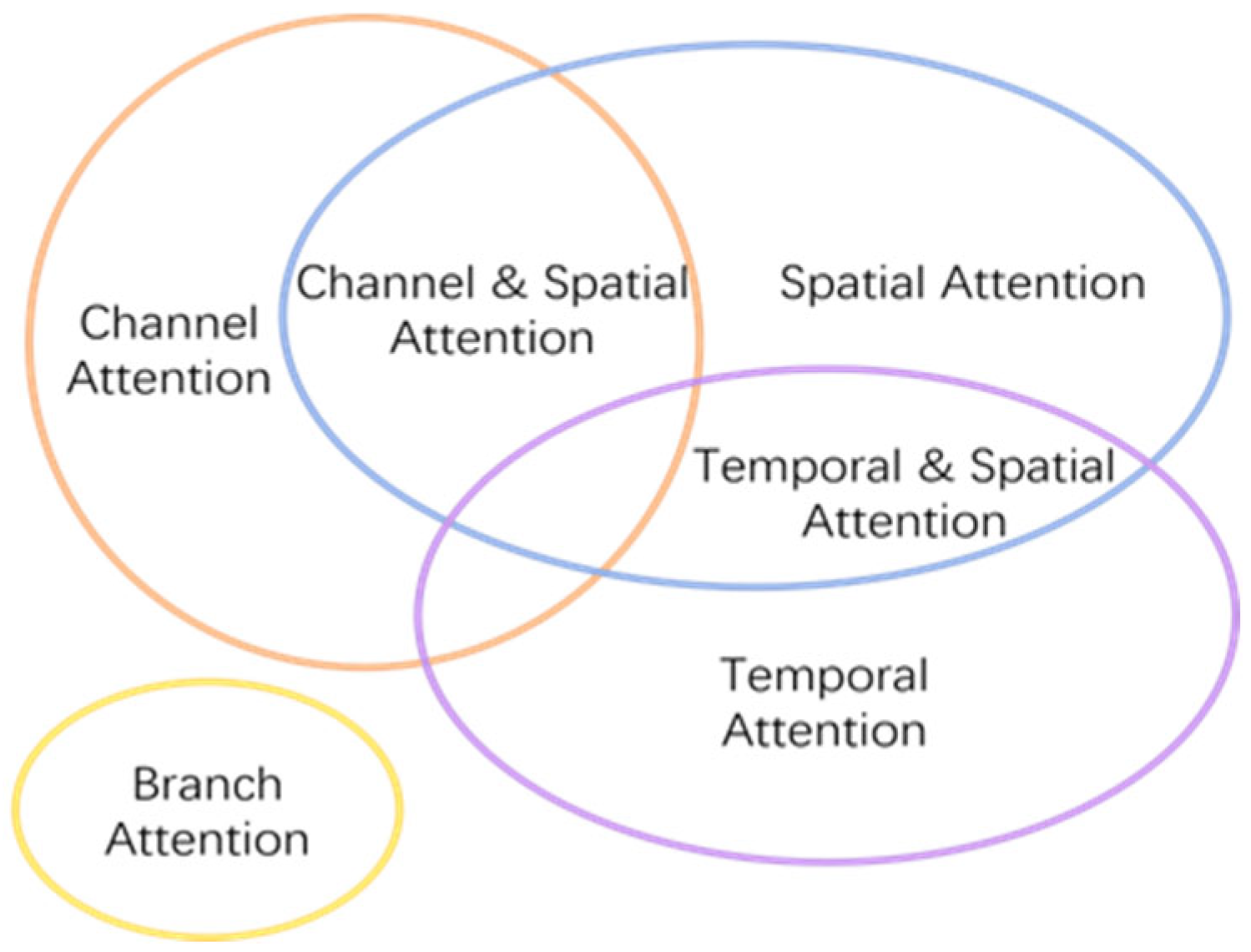
Attention mechanisms can be classified in a variety of ways, depending on the criteria used for categorisation. Table 2 lists some common classification standards and their corresponding results. Figure 1 shows the classification of attention mechanisms based on the form of data input [29], which includes four basic categories and two hybrid categories: channel attention, spatial attention, temporal attention, and branch attention, along with channel-spatial combined attention and spatial-temporal combined attention; ∅ indicates that such a combination (currently) does not exist.
Spatial attention mechanisms analyse the importance of each position in the input feature map and use convolution operations to generate a spatial attention map. This attention map is then used to weight the original feature map, determining which regions of the image the model should focus on, highlighting important spatial areas while suppressing relatively less important ones. However, this approach overlooks the interaction between channels. Channel attention is typically achieved through operations such as global average pooling [30], which extracts global information from each channel. This is followed by structures like fully connected layers to learn the dependencies between different channels, generating channel attention weights. However, this global processing method tends to ignore spatial information interactions. Hybrid attention combines forms of attention from both the channel and spatial domains to create a more comprehensive feature attention method [31]. Combined examples are listed in Table 3.
These different classification methods reflect the diversity of attention mechanisms and their broad application in various deep learning tasks. By selecting attention mechanisms suited to specific tasks and data types, researchers and developers can build more powerful and flexible models.
In the field of remote sensing image super-resolution, attention mechanisms can be employed to guide the enhancement of the feature learning performance of super-resolution models [32,33], enabling them to generate more accurate and detailed high-resolution images from low-resolution inputs [34]. The core idea is to direct neural networks to focus on the key features crucial for reconstructing high-quality images, avoiding bias or errors during the upscaling process [8,32,35,36]. For example, in low-light environments, relatively sparse features such as edges, textures, and patterns are more important than the dark background, so they require more attention weights for prioritised learning.
The advantages of attention mechanisms in low-illumination remote sensing image super-resolution [37,38] are mainly as follows:
Enhancing key features: Remote sensing images contain a large amount of complex geographical and anthropogenic features. Attention mechanisms can help the model focus on key areas of these features, such as night lights, urban buildings, rivers, and roads, ensuring that these details are fully enhanced during the super-resolution process.
Improving image quality: By weighting key information, attention mechanisms can enhance the model’s ability to represent objects and textures in remote sensing images, thereby improving resolution while maintaining the authenticity of the image content.
Enhancing model adaptability: Through dynamic adjustment, attention mechanisms allow the model to adaptively process remote sensing images under different scenes and conditions, improving the model’s generalisation ability and application range.
In the application of remote sensing image super-resolution, attention mechanisms are typically embedded into frameworks of convolutional neural networks (CNNs) [18] or architectures of generative adversarial networks (GANs) [16]. Typical examples are listed as follows:
Spatial attention: This can focus on specific spatial regions of the image, emphasising key visual elements such as terrain features and objects, ensuring enhanced recovery of these regions during the super-resolution process. For instance, in urban areas, spatial attention can help the model concentrate on the edges and structures of buildings, thereby restoring these details more accurately in the super-resolution images. The research by He et al. demonstrates how spatial attention can be used to enhance the visual quality of urban layouts in remote sensing images [39].
Channel attention: Remote sensing images often contain multiple spectral channels, each providing unique information about surface features. The channel attention mechanism analyses the importance of different channels in remote sensing images (such as RGB channels or different spectral bands), optimising the model’s processing of information from each channel, thereby enhancing the super-resolution image’s colour, contrast, and clarity. The work of Tang et al. shows the effectiveness of channel attention in improving the super-resolution of multispectral remote sensing images [40].
Self-attention: The self-attention mechanism can capture long-range dependencies within an image, which is particularly useful for identifying and reconstructing widely distributed geographical features and objects in remote sensing images. Zhang et al. utilised self-attention in their research to significantly enhance the performance of remote sensing image reconstruction in large-scale natural environments [14].

3. Methodology

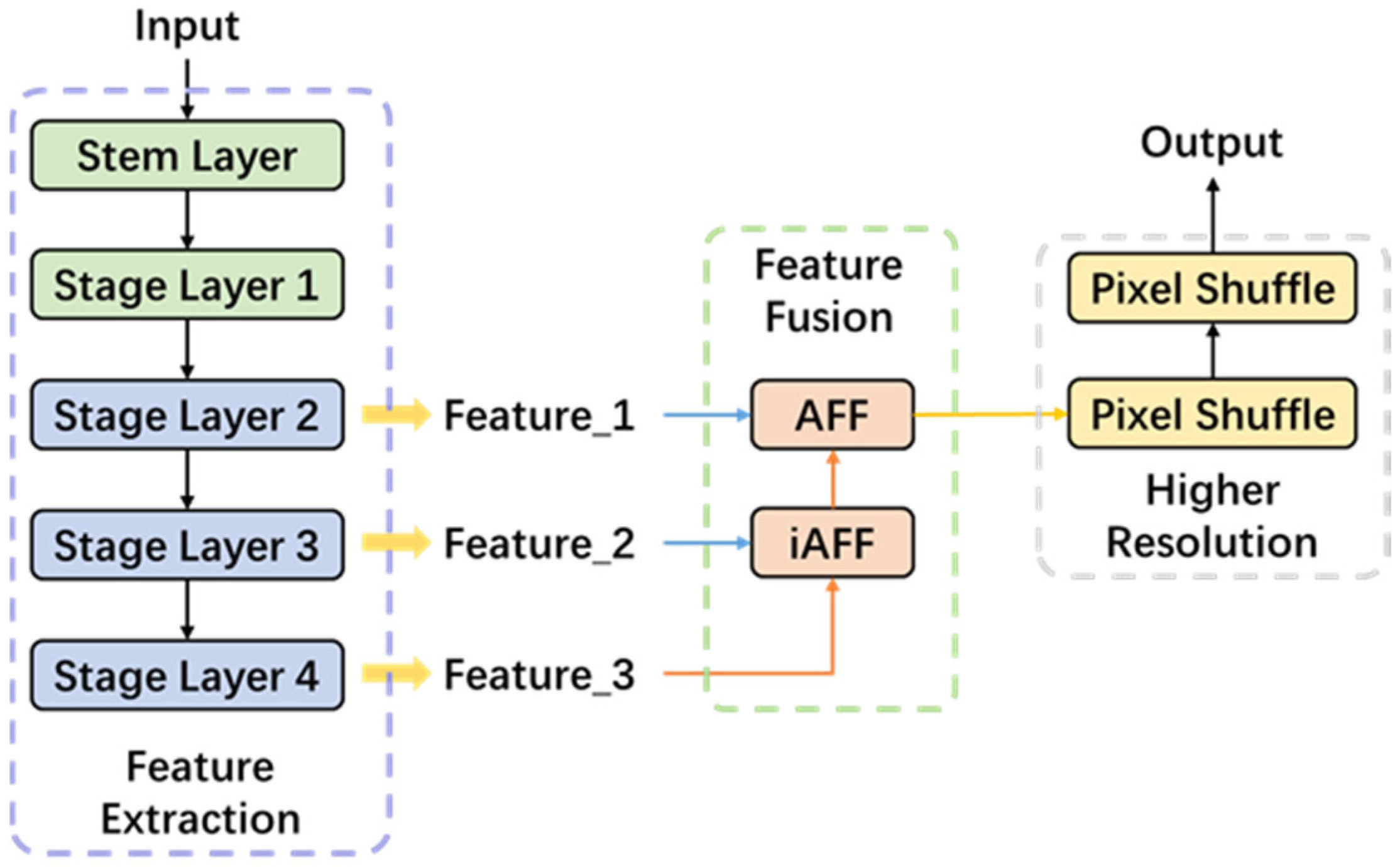
In this section, a lightweight super-resolution network is proposed. This network adopts an optimised compact feature extraction backbone and integrates an enhanced Attentional Feature Fusion (AFF) module for multi-scale feature fusion [19], followed by a pixel cleansing layer to enhance resolution.

3.1. Optimised Lightweight Feature Extraction Backbone

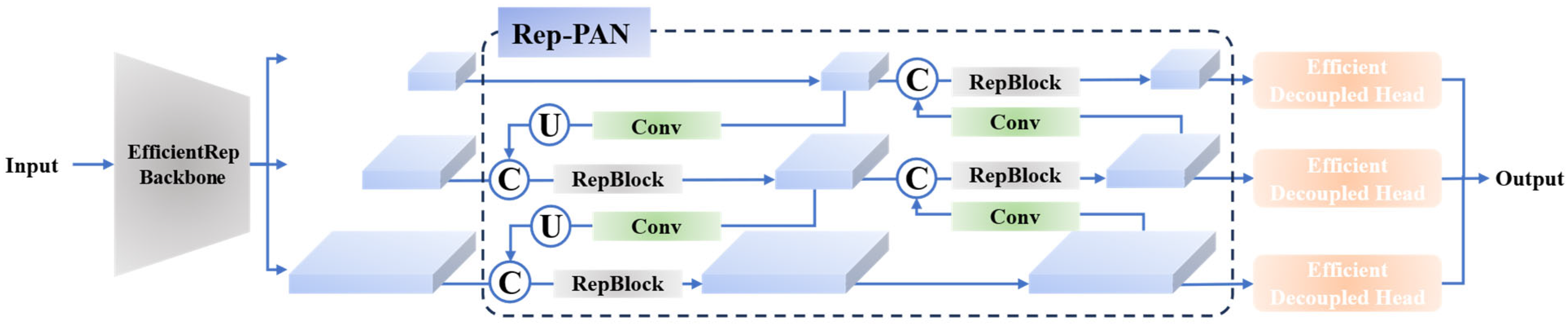
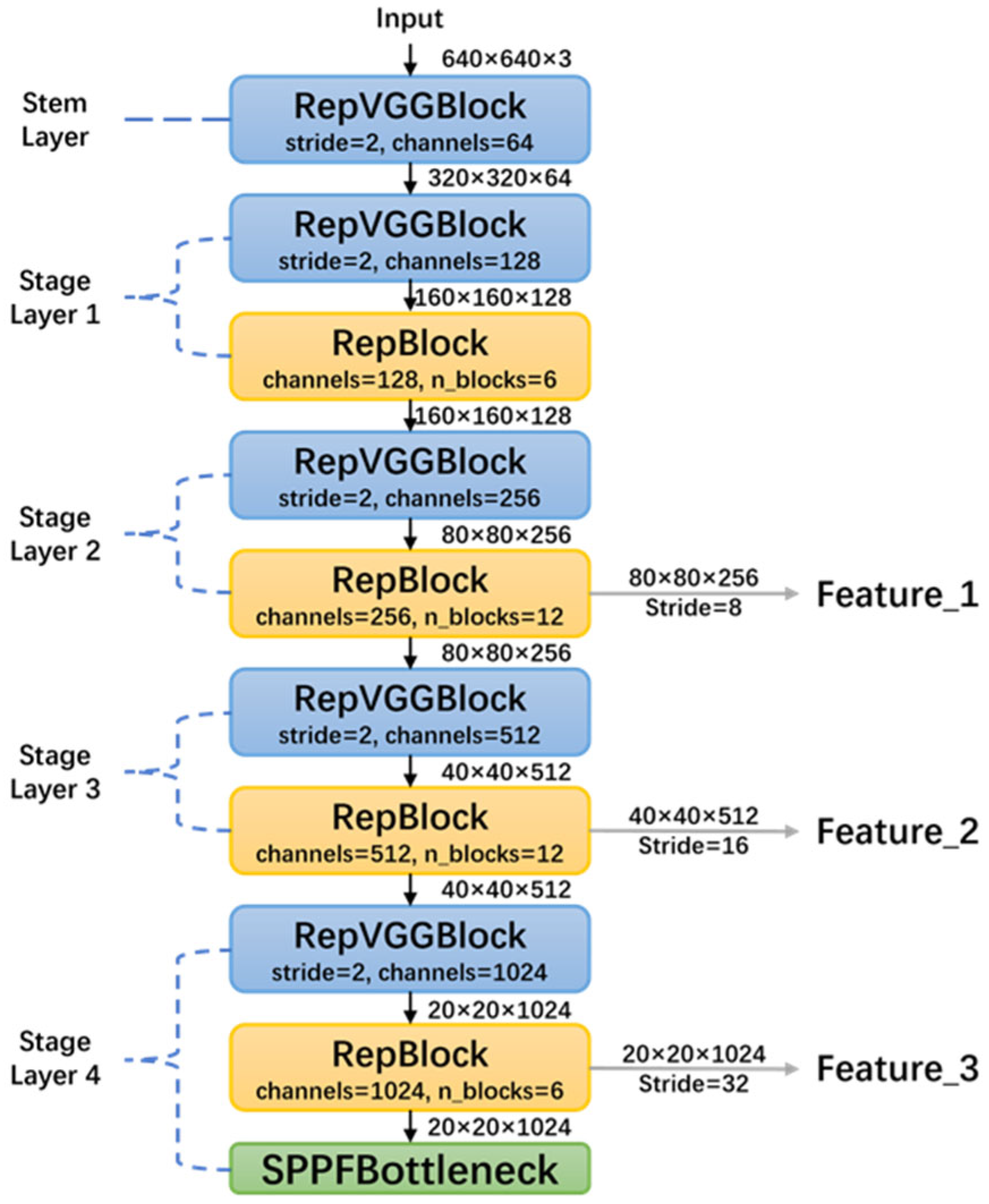
This work adopts an efficient lightweight hierarchical backbone for feature extraction, constructed with stacked modular convolution blocks including RepVGG-style modules and improved cross-stage partial stacked structures (see Figure 2).
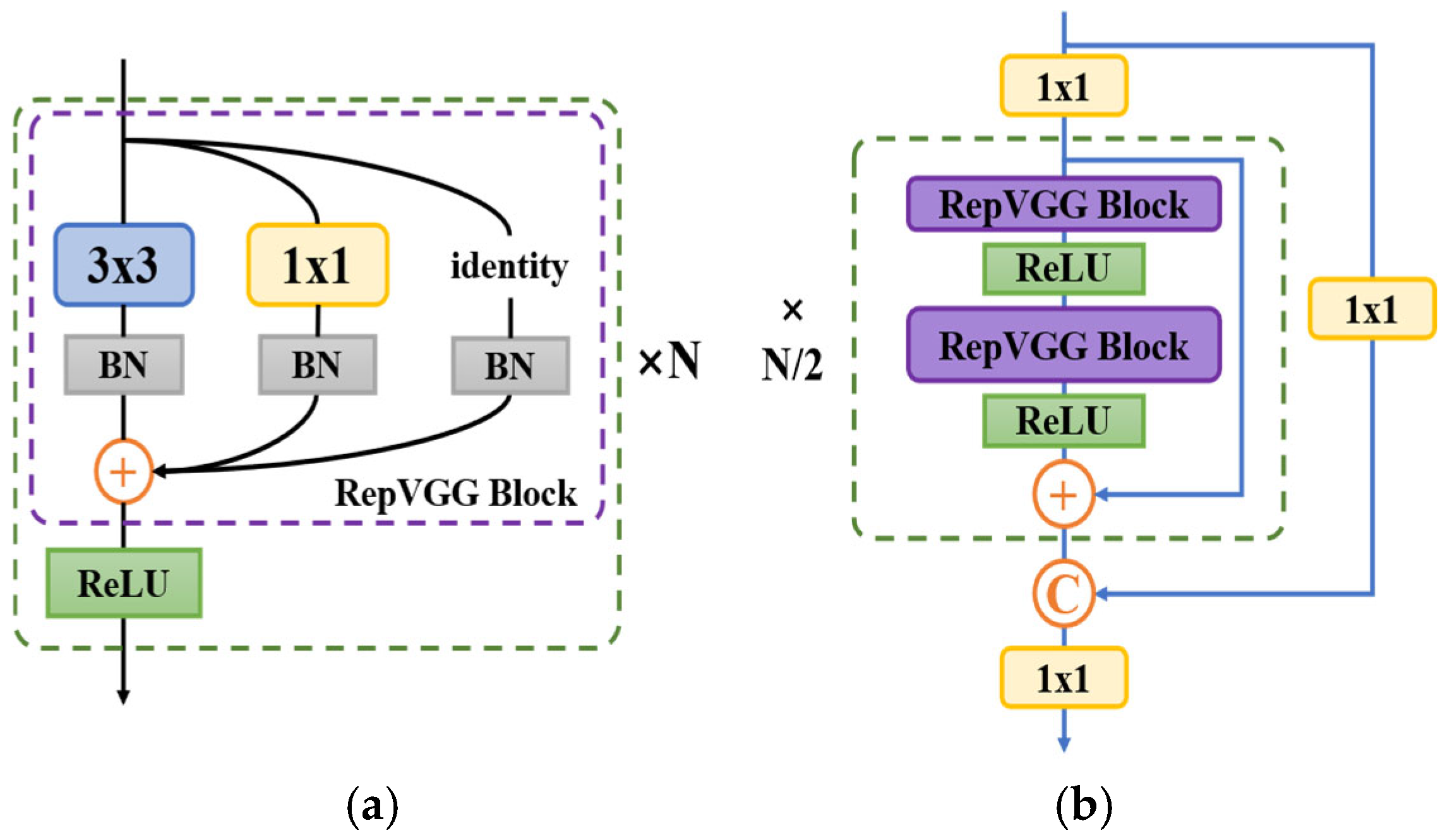
Modern computing hardware, such as mainstream GPUs and CPUs, is highly optimised for standard 3 × 3 convolutional kernels, offering superior computational density compared with other kernel sizes. On GPU platforms, 3 × 3 convolutions can achieve up to four times the computational efficiency of 1 × 1 or 5 × 5 convolutions. To fully exploit hardware acceleration and reduce inference latency, lightweight RepVGG-based blocks are deployed to build the basic backbone for compact and medium-sized models, while advanced cross-stage partial stacked modules are adopted for large-scale network configurations (as shown in Figure 3). For lightweight settings, the basic module consists of multiple stacked RepVGG blocks with a stride of 1; for deeper networks, half the number of improved cross-stage partial stacked blocks are used to balance complexity.
The basic RepVGG module for lightweight models is illustrated in Figure 4a. However, simply expanding network depth will exponentially increase computational complexity and parameter volume, easily leading to performance saturation. This issue is particularly prominent in remote sensing image tasks, which involve complex textures and massive data volumes. To balance computational cost, parameter scale, and feature representation capability, this work introduces cross-stage partial connection mechanisms and optimises stacked convolution modules for medium and large backbone designs. As shown in Figure 4b, the improved stacked structure integrates multiple 1 × 1 convolutional layers, dual-branch RepVGG/RepConv sub-blocks (for training and inference, respectively), and residual skip connections, enhancing feature extraction performance without additional computational burden.
At this stage of the network, three different scales of features can be extracted, which will be further processed in the feature fusion module presented in the next part.

3.2. Feature Fusion Design Based on Multi-Scale Channel Attention Mechanism

In the realm of super-resolution technology, fusing features of different scales is a crucial method for enhancing the quality of reconstructed images. Feature fusion involves combining features from various sources, levels, or modalities in a way that enhances the model’s ability to extract relevant information, thereby improving performance in tasks such as classification, detection, segmentation, and super-resolution. Low-level features refer to basic characteristics directly extracted from the image, such as colours, edges, textures, and corners. These features reflect the image’s straightforward physical properties, offering higher resolution and containing more positional and detailed information. However, with fewer convolutional layers, they capture less semantic content and are more prone to noise. High-level features, on the other hand, are extracted through complex algorithms or deep learning models, further abstracting and combining low-level features to capture semantic information about objects, scenes, and events within the image, though they may lack fine detail sensitivity.
Low-level features form the foundation for constructing high-level features, with the extraction of high-level features depending on the synthesis and abstraction of low-level ones. Efficiently fusing these two types of features is crucial for improving the performance of segmentation models. In this part, an attention mechanism is introduced to fuse features of different scales.
Global channel attention can be introduced as follows. Given an intermediate feature X     R C × H × W with C channels and a feature map of size H × W, the channel attention weight w R C can be computed as:
w = σ ( g ( X ) ) = σ B W 2 δ B W 1 ( g ( X ) )
where g ( X ) R C represents the global feature, defined as g X = 1 H × W i = 1 H j = 1 W X [ : , i , j ] . This is known as global average pooling. Here, δ denotes the ReLU function, B is the batch normalization function, and σ is the sigmoid activation function. The computation is achieved through a bottleneck structure consisting of two fully connected layers, where W 1 R C r × C serves as the dimensionality reduction layer, W 2 R C × C r acts as the dimensionality expansion layer, and r is the channel reduction ratio.
It can be observed that global channel attention compresses each feature map of size H × W into a scalar. However, this approach primarily focuses on global, larger targets and may overlook signals of smaller targets. Therefore, global channel attention may not be the optimal choice for remote sensing images, which typically contain a wealth of information and fine details. Consequently, this section aims to aggregate multi-scale features within the channel attention module to alleviate issues arising from scale variations and small targets.
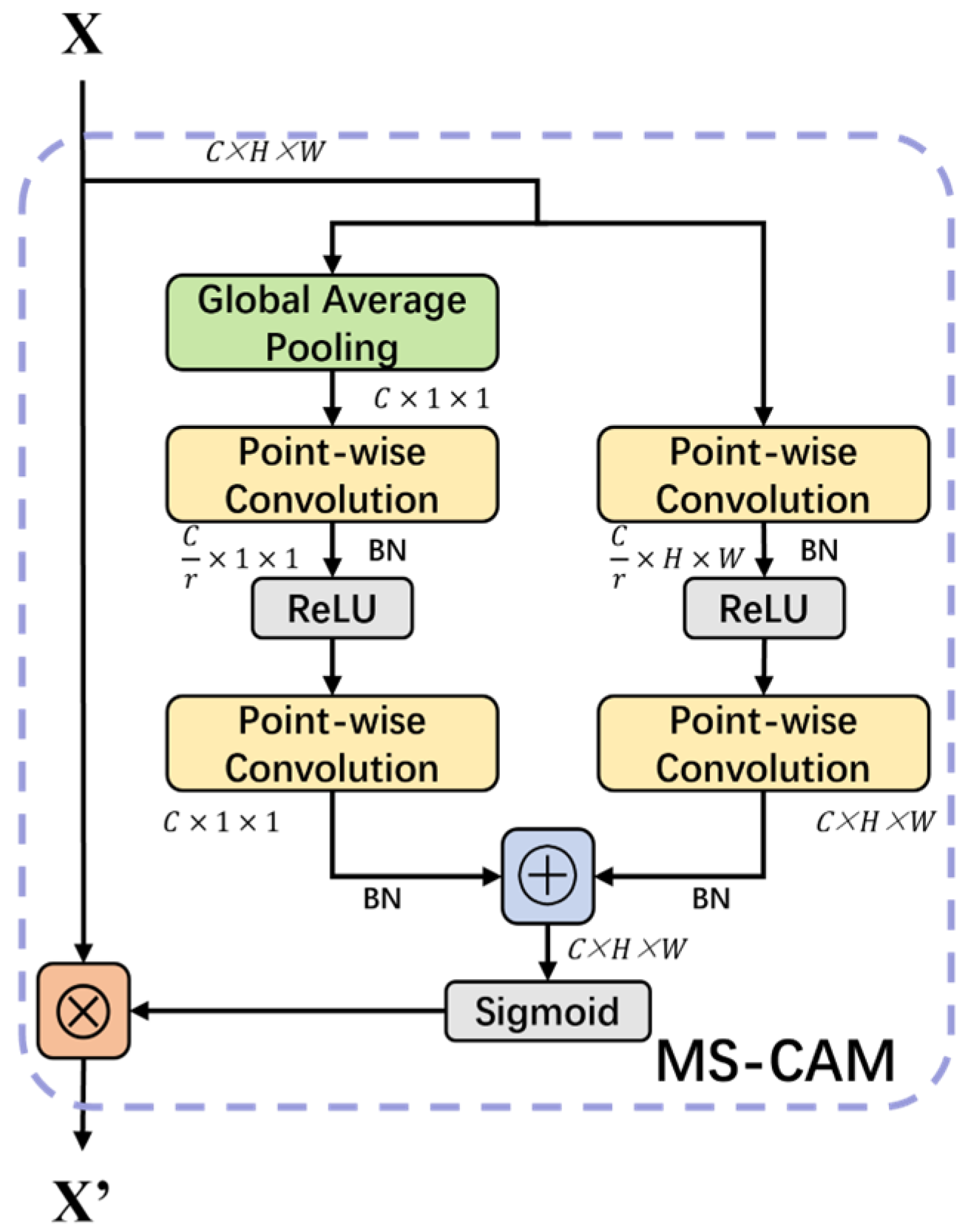
This section is based on the multi-scale channel attention module (MS-CAM), which is designed to extract channel global information and dependencies at different scales by employing spatial pooling layers of varying sizes. To keep it as lightweight as possible, this section opts for pixel-wise convolution (PWConv) for local channel calculations. To reduce the computational burden, the local channel attention L ( X ) R C × H × W is realised through a bottleneck module consisting of two PWConv layers, with the following computation expression:
L ( X ) = B P W C o n v 2 δ B P W C o n v 1 ( X )
Here, the kernel sizes for P W C o n v 1 and P W C o n v 2 are C r × C × 1 × 1 and C × C r × 1 × 1 respectively. L ( X ) maintains the same dimensions as the input features, maximally preserving and highlighting the subtle details extracted by the shallow network (refer to Figure 5).
According to the listed equations, the multi-scale channel attention module MS-CAM can produce the following refined features:
X = X M ( X ) = X σ ( L ( X ) g ( X ) )
where M ( X ) R C × H × W represents the attention weights determined by MS-CAM. Here, ⊕ denotes broadcasting addition, and ⊗ signifies element-wise multiplication.
Different from single-scale global attention, this multi-scale modelling paradigm captures feature responses at diverse receptive fields, and dynamically activates discriminative local features for complex land covers, dense small targets, and heterogeneous texture regions in remote sensing images.
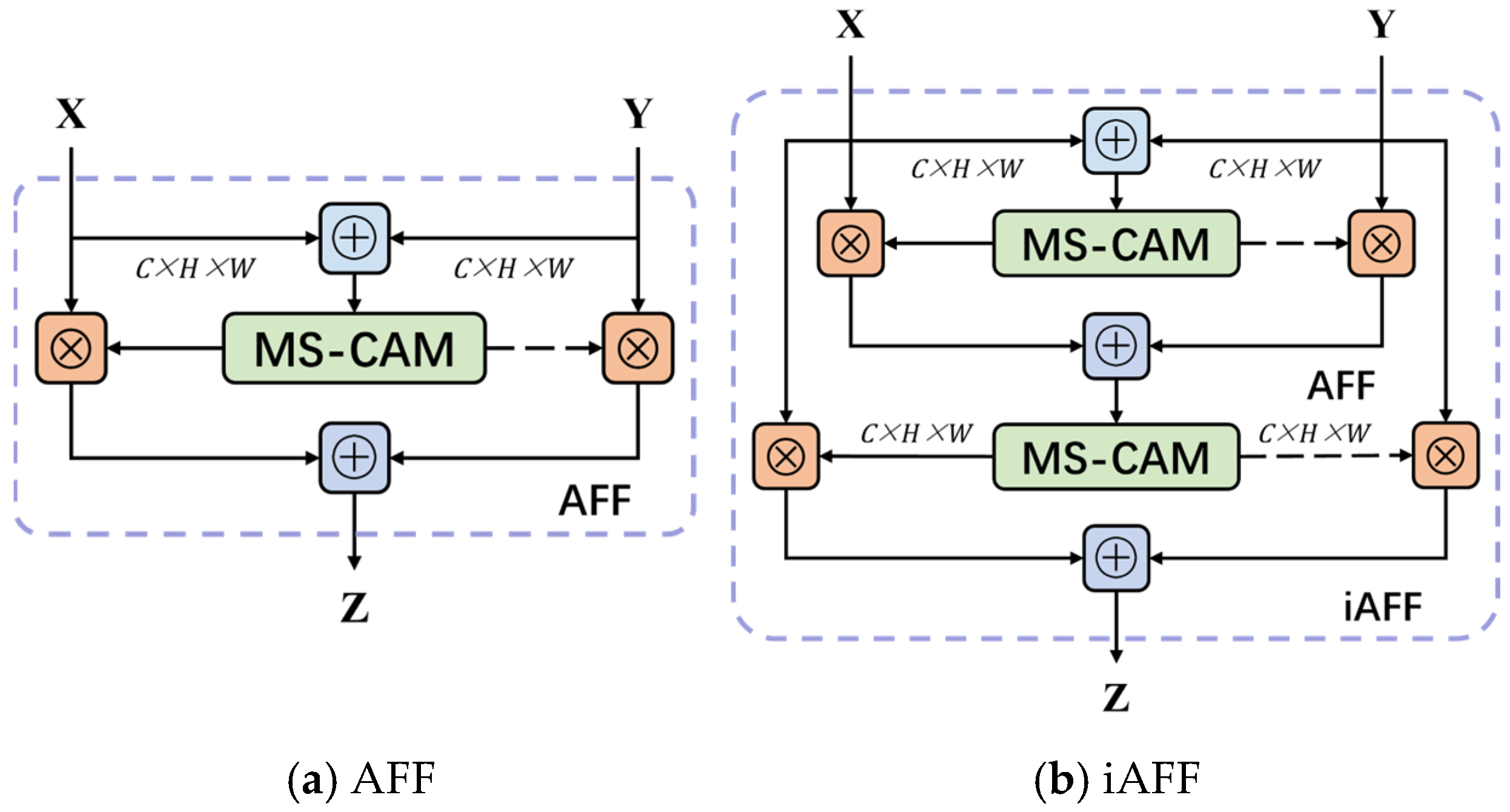
Based on MS-CAM, attentional feature fusion (AFF) can be obtained (see Figure 6a). Denoting the channel attention module in MS-CAM as M, the process of AFF can be expressed as follows:
Z = M ( X Y ) X + ( 1 M ( X Y ) ) Y
In this context, Z R C × H × W represents the fused features, and ⊎ denotes the integration method for the initial features X and Y. It is important to note that the fusion weight M ( X Y ) is a real number between 0 and 1, which is denoted in dashed line in Figure 6a. Similarly, 1 M ( X Y ) is also a real number between 0 and 1. This enables the network to perform soft selection or weighted averaging between features X and Y.
The feature integration method from the previous layer serves as the input for the attention module in the next layer, which directly influences the fusion weight of the subsequent layer. Since this is fundamentally still a feature fusion problem, this section opts for a more intuitive approach: iteratively using multiple channel attention modules to fuse the input features, referred to as iterative Attentional Feature Fusion (iAFF), as shown in Figure 6b.
Thus, the mathematical expression for the initial feature distribution X Y in (5) is presented in (6).
X Y = M ( X + Y ) X + ( 1 M ( X + Y ) ) Y
Such two-stage approach enables weighted adaptive interaction between shallow spatial details and deep features, thus to effectively adapt to complex imaging degradation, diverse land-cover distributions, and small-size geospatial targets in satellite imagery. Compared with mainstream generic attention and fusion methods, this combined mechanism enhances the retention of high-frequency textures, suppresses blurring artifacts in remote sensing reconstruction, and better balances global contextual modelling and local detail perception.
In summary, the three different scale features from the previous stage are fused in a multi-scale manner through iAFF and AFF, which is straightforward to apply AFF/iAFF by replacing the original addition or concatenation, followed by resolution enhancement (see Figure 7).

4. Experiment Settings

4.1. Datasets

The training dataset comprised exclusively images from the GF-5 dataset, whereas the test dataset encompassed four distinct datasets: GF-5, UC Merced, Sentinel-2, and HRSC2016. For all non-GF-5 datasets, evaluation was conducted without fine-tuning or retraining.

4.1.1. Training Dataset

The data obtained from the hyperspectral camera of China’s Gaofen-5 (Gaofen-5, GF-5) satellite were employed as the source material for the dataset in this project.
Unlike most existing super-resolution (SR) studies that adopt simulated degraded natural images (e.g., DIV2K) or aerial remote sensing images as training data, the GF-5 satellite images retain the authentic degradation characteristics of spaceborne remote sensing imaging, including atmospheric interference, sensor noise, and radiation distortion. This enables the dataset to provide a training data source that is more consistent with the actual on-orbit remote sensing imaging process and ensures the practical applicability of the trained model in real SR tasks. Furthermore, the constructed GF-5 dataset has sufficient scene diversity to support the stable and effective training of lightweight SR models. The image data adopted in this work cover multiple geographical regions in China and contain various typical land cover categories. In addition, the dataset includes images acquired under different imaging seasons, illumination conditions, and atmospheric visibility, which guarantees the richness and diversity of feature distribution in the training data, and helps the model learn generalisable feature representation rather than overfitting to specific scene types.
In this context, the remote sensing imagery based on the GF-5 satellite AHSI was selected as the dataset source. The satellite captures 330 spectral channels, spanning the visible to the short-wave infrared (400–2500 nm), with an amplitude of 60 km and a spatial resolution of 30 m. Its spectral resolution in the visible near-infrared band is 5 nm [12,41].
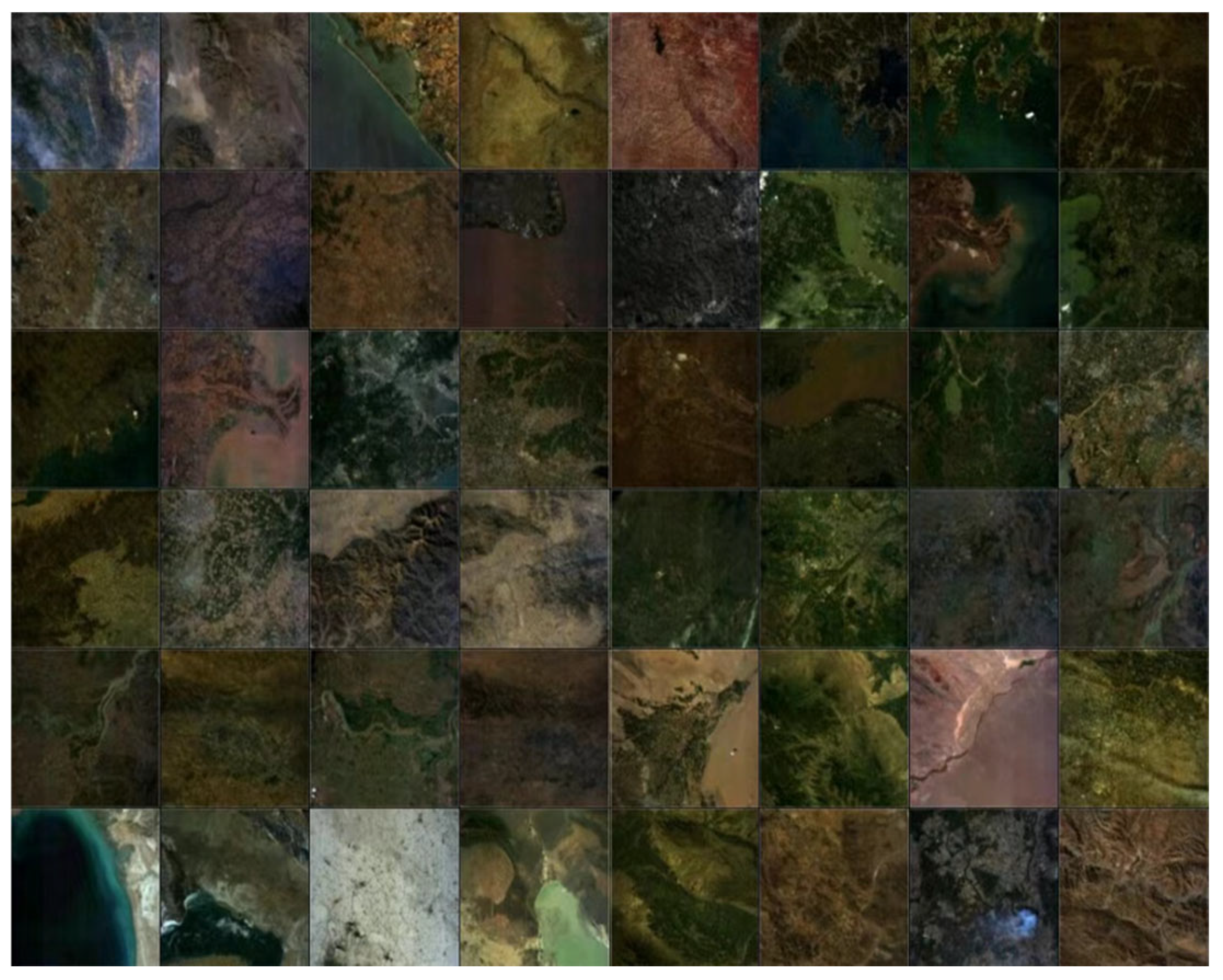
A total of 176 60 km × 60 km remote sensing data views, selected from the vast data set provided by GF-5 AHSI, were used as the data source [12,41]. These images were captured at high latitudes in solar synchronous regression orbits to achieve low-light conditions and cover multiple regions and scenes. The 176 low-light images constitute a unique dataset, the preview of which is presented in Figure 8.
The source images from the GF-5 AHSI are all hyperspectral in nature. The 700 nm/545 nm/435 nm channels (RGB) were selected with the objective of enhancing visualisation during the training process. The raw images obtained from the GF-5 satellite with a pixel resolution of 2008 × 2083 were randomly cropped into more than 72,000 96 × 96-pixel regions, which were then used as the training and validation datasets.
To construct the low-resolution and high-resolution (LR-HR) image pairs required for end-to-end model training, the original GF-5 hyperspectral images were first down-sampled by a factor of four, followed by the addition of a small amount of Gaussian noise consistent with the on-orbit imaging characteristics of the GF-5 satellite to complete the image degradation process, generating the corresponding low-resolution image set. Each degraded low-resolution image was paired with its original high-resolution counterpart to form the formal LR-HR training pairs.
To further enrich the feature diversity of the training dataset, alleviate the risk of model overfitting, and enhance the generalisation capability of the model across different scenes and data sources, this work performed a series of data augmentation operations during the model training phase, including random horizontal and vertical flipping, multi-angle random rotation, misalignment adjustment, and brightness and contrast perturbation.

4.1.2. Test Datasets

To comprehensively evaluate the reconstruction performance, scene adaptability, and cross-domain generalisation ability of the proposed SASR, multiple publicly available remote sensing datasets with distinct imaging characteristics and land-cover attributes are adopted for comprehensive testing. All experimental tests are conducted under a zero-shot setting. Specifically, the model is exclusively trained on the GF-5 training set without additional fine-tuning or parameter adaptation on any test dataset, which can objectively reflect the practical generalisation capability of the constructed lightweight super-resolution framework.
As the in-domain test benchmark, the independent test subset of GF-5 is utilised to quantitatively and qualitatively validate the reconstruction performance under consistent satellite imaging conditions. Furthermore, three representative public remote sensing datasets are introduced for cross-domain evaluation. The UC Merced Land Use Dataset covers diverse artificial and natural landscape categories with abundant spatial texture details, which is conducive to verifying the model’s capacity in recovering complex ground object features. The Sentinel-2 dataset, acquired by different satellite sensors with unique spectral and radiation properties, is employed to evaluate the cross-sensor generalisation of the proposed method. In addition, the HRSC2016 dataset, containing dense small targets and coastal complex scenes, is used to further examine the fine-detail restoration ability for challenging remote sensing scenarios.
Combining the above multi-source test datasets with different imaging platforms, geographic scenes, and degradation distributions, the experimental results can better demonstrate the robustness and applicability of the proposed method in various remote sensing super-resolution tasks.

4.2. Evaluation Criteria

4.2.1. Standard Metrics

For the evaluation of image quality, this section employs two core metrics: PSNR (Peak Signal-to-Noise Ratio) and SSIM (Structural Similarity Index Measure). These metrics are widely recognized and reliable in assessing algorithm performance, playing a critical role in the in-depth analysis of super-resolution results to ensure comprehensive evaluation.
In assessing the reconstruction speed of super-resolution, this section primarily relies on the algorithm’s average execution time, reflecting the time required for the algorithm to convert a single low-resolution image into a high-resolution one, thereby indicating its processing speed.

4.2.2. Perceptual Metrics

To comprehensively evaluate the perceptual quality of the proposed super-resolution (SR) model, this study adopts two representative image quality assessment (IQA) metrics, namely Learned Perceptual Image Patch Similarity (LPIPS) [42] and Natural Image Quality Evaluator (NIQE) [43]. As a full-reference (FR) perceptual metric, LPIPS addresses the limitations of pixel-wise metrics (e.g., PSNR, SSIM)—which prioritize low-level pixel discrepancies but often deviate from human visual judgment—by leveraging pre-trained deep convolutional neural networks (e.g., VGG16) to extract high-level semantic features (e.g., edge continuity, texture consistency, structural integrity) from both the reconstructed image and its corresponding ground truth. It quantifies perceptual similarity by computing the distance between these feature representations, with a lower LPIPS value indicating fewer visual distortions (e.g., blurring, artificial artifacts) and higher consistency with the ground truth. Complementarily, NIQE serves as a no-reference (NR) metric, eliminating the dependency on high-quality ground truth—a critical advantage for practical scenarios like low-light remote sensing (the target application of this study), where reference images are often unavailable. It operates by establishing a “natural image prior” database based on the statistical properties (e.g., luminance distribution, spatial correlation) of high-quality natural images, then calculating the Mahalanobis distance between the statistical features of the test image and the pre-established priors; a smaller NIQE score signifies that the test image exhibits fewer distortions (e.g., noise, structural degradation) and more natural visual characteristics. By combining LPIPS and NIQE, this study achieves a comprehensive, multi-dimensional assessment of perceptual quality, ensuring the proposed model’s performance aligns with both objective feature consistency and human subjective experience.

4.3. Training Process

The experimental platform’s hardware environment consists of an Ultra 9 275HX CPU and an NVIDIA GeForce RTX 5080 Laptop GPU. The software environment includes CUDA 13.0, Python 3.12, and the PyTorch 2.9.0 framework.
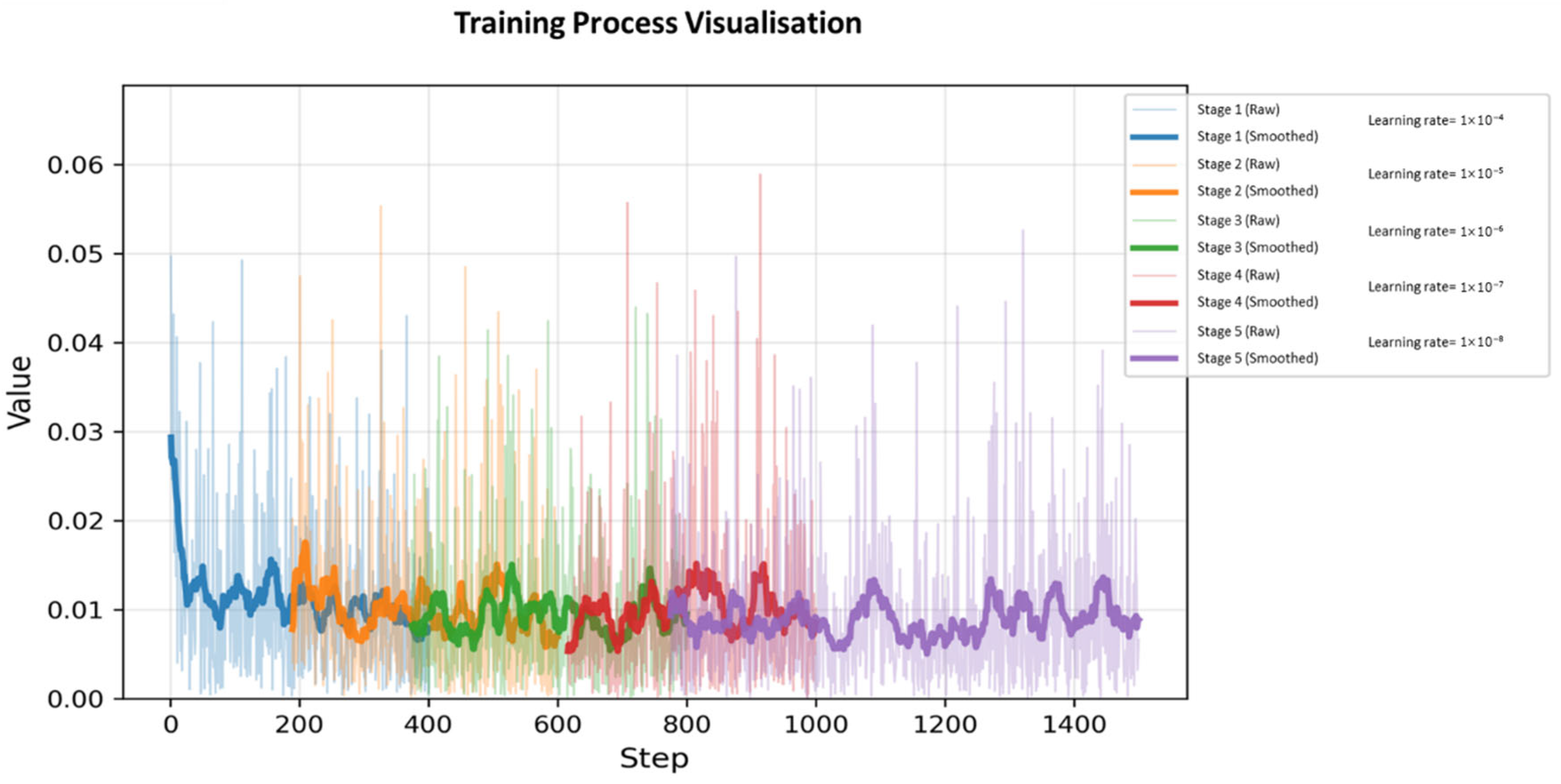
The training (visualised in Figure 9) is performed with an alternative learning rate ranging from 1 × 10⁻⁴ to 1 × 10⁻⁶, with a batch size of 16, and 15,000 training epochs for maximum. The initial learning rate was set to 0.001, with a batch size of 16, and 500 training epochs. The loss threshold was set at 0.001. At the end of each training epoch, the loss is continuously monitored, and the model with the lowest loss is saved as a checkpoint for subsequent comparison. This approach ensures that the saved model achieves optimal performance throughout the training process. The objective of the training is to automatically stop once the loss function falls below 0.001, thereby ensuring the efficiency and effectiveness of the training process.

5. Results and Discussion

5.1. Ablation Study

In this section, the super-resolution reconstruction results of SASR are compared with two representative schemes: a lightweight re-parameterised backbone-based SR model without attention embedding, and the classic RCAN (Residual Channel Attention Networks), a super-resolution method with an attention mechanism. The results of the ablation study are presented in Table 4.
This subsection explores the effectiveness of applying the optimised lightweight re-parameterised backbone as the core feature extraction module for super-resolution reconstruction. Experimental results indicate that its highly efficient feature extraction capability provides rich feature information for the reconstruction of low-light super-resolution images, achieving a good balance between speed and image quality. At a 4× magnification, the network maintains a PSNR over 30.3 dB and an SSIM above 0.80 while still achieving a sub-second response time.
Table 5 lists several formulas used for feature fusion in deep learning networks.
It can be seen that, in traditional deep learning models, feature fusion typically relies on simple operations, such as weighted sums or concatenation. These methods often overlook the complex interactions between features and the varying importance of different features. In contrast, the multi-scale channel attention mechanism used in this work introduces a dynamic weight allocation approach. This method automatically adjusts the importance of different features based on the content and context of the features, enabling more effective fusion of high-level and low-level features. This not only enhances the model’s ability to capture crucial information but also improves its flexibility and accuracy when handling complex data, allowing the model to adapt better to different tasks and data types.
Thus, by adding a multi-scale channel attention mechanism to the efficient lightweight backbone, the resulting SASR model strengthens the network’s focus on key image features and optimises the feature fusion process, enabling the model to reconstruct high-quality images more accurately. Although the introduction of the attention mechanism causes a slight impact on processing speed, this sacrifice is almost negligible considering the significant improvement in overall performance.

5.2. General Comparisons with Lightweight Single-Stage Backbone-Based Methods Without Attention

In this section, the super-resolution reconstruction results of SASR are compared with those of models adapted from existing typical lightweight backbones. Experimental results demonstrate that SASR achieves more satisfactory outcomes.
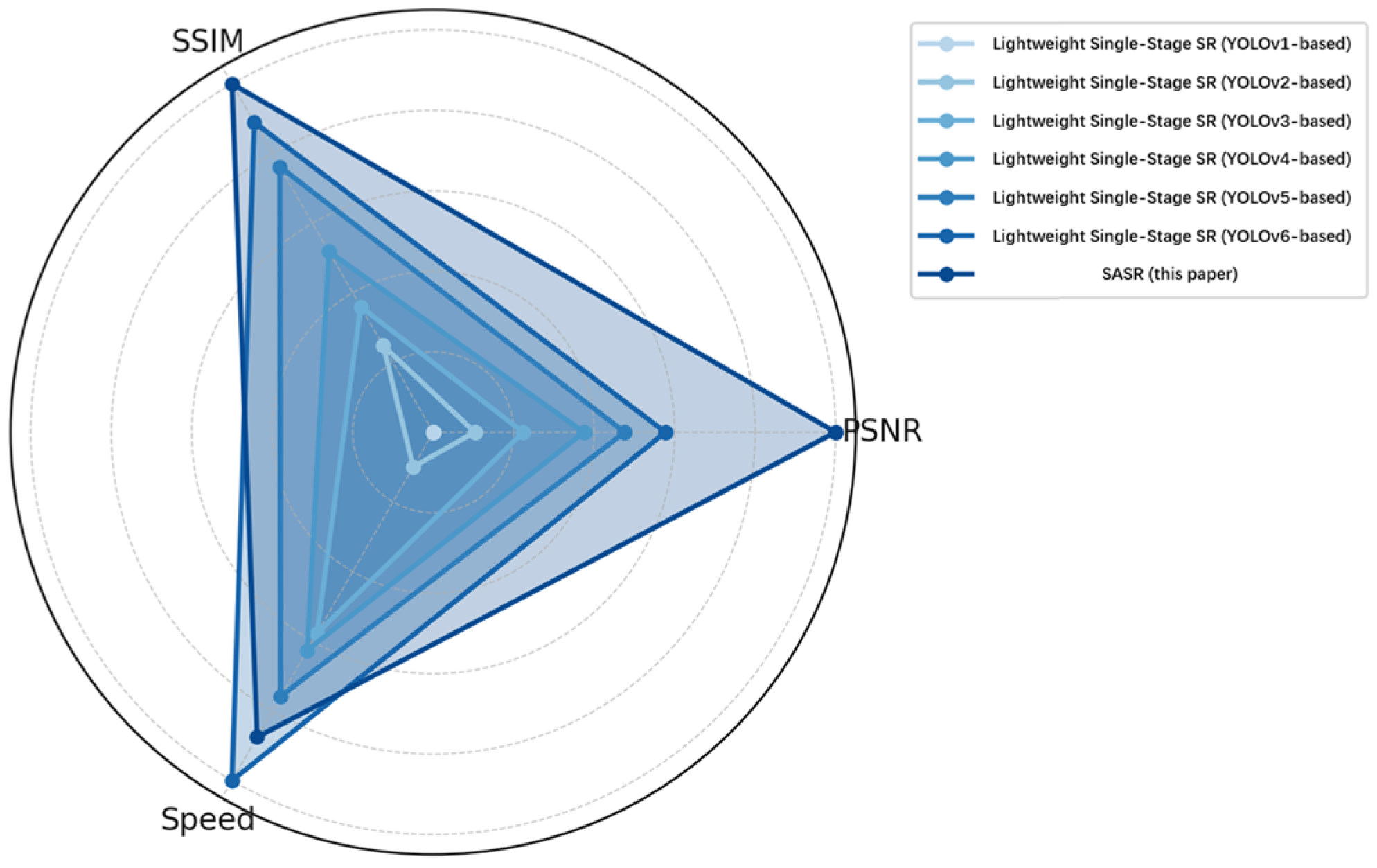
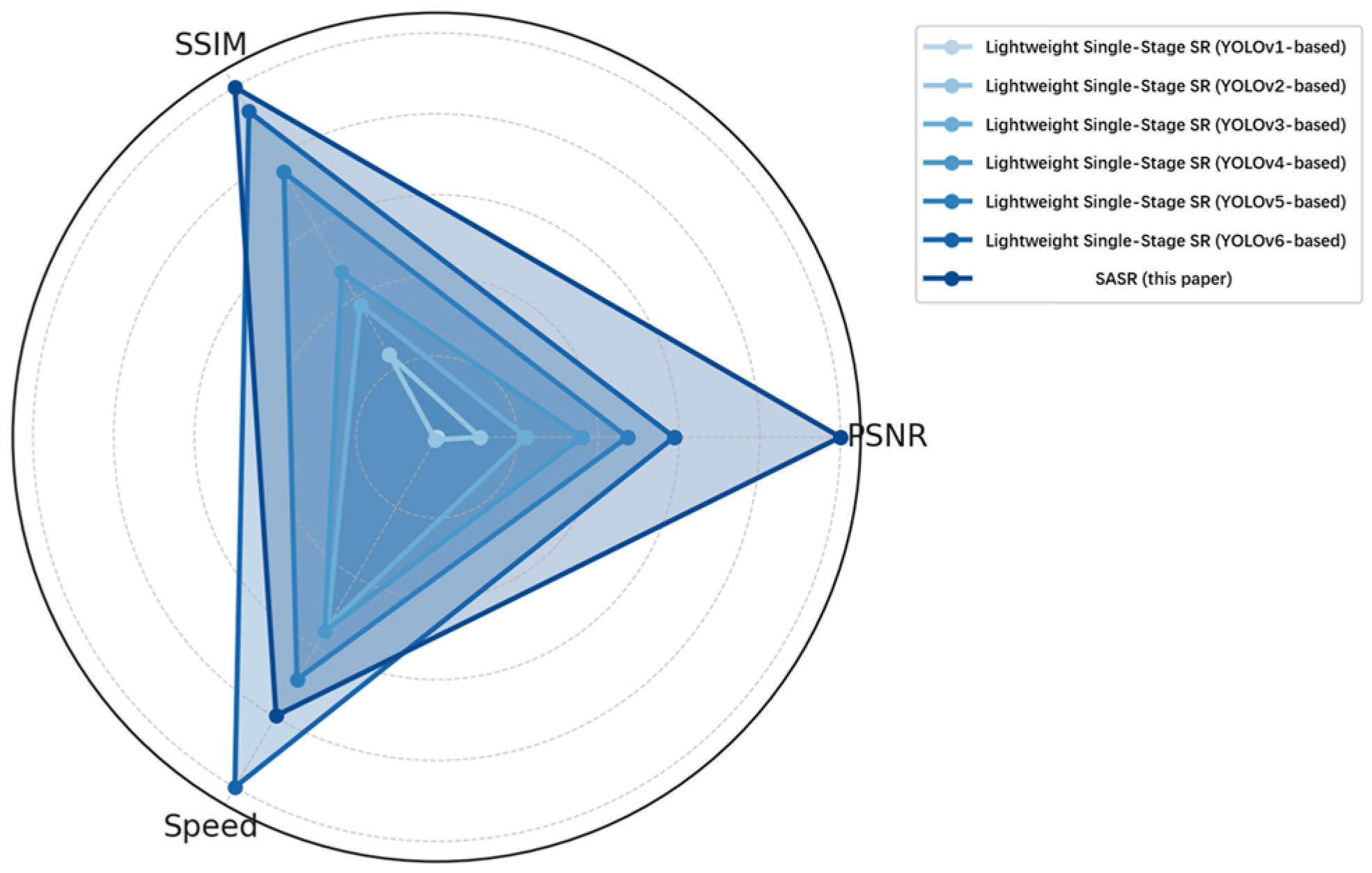
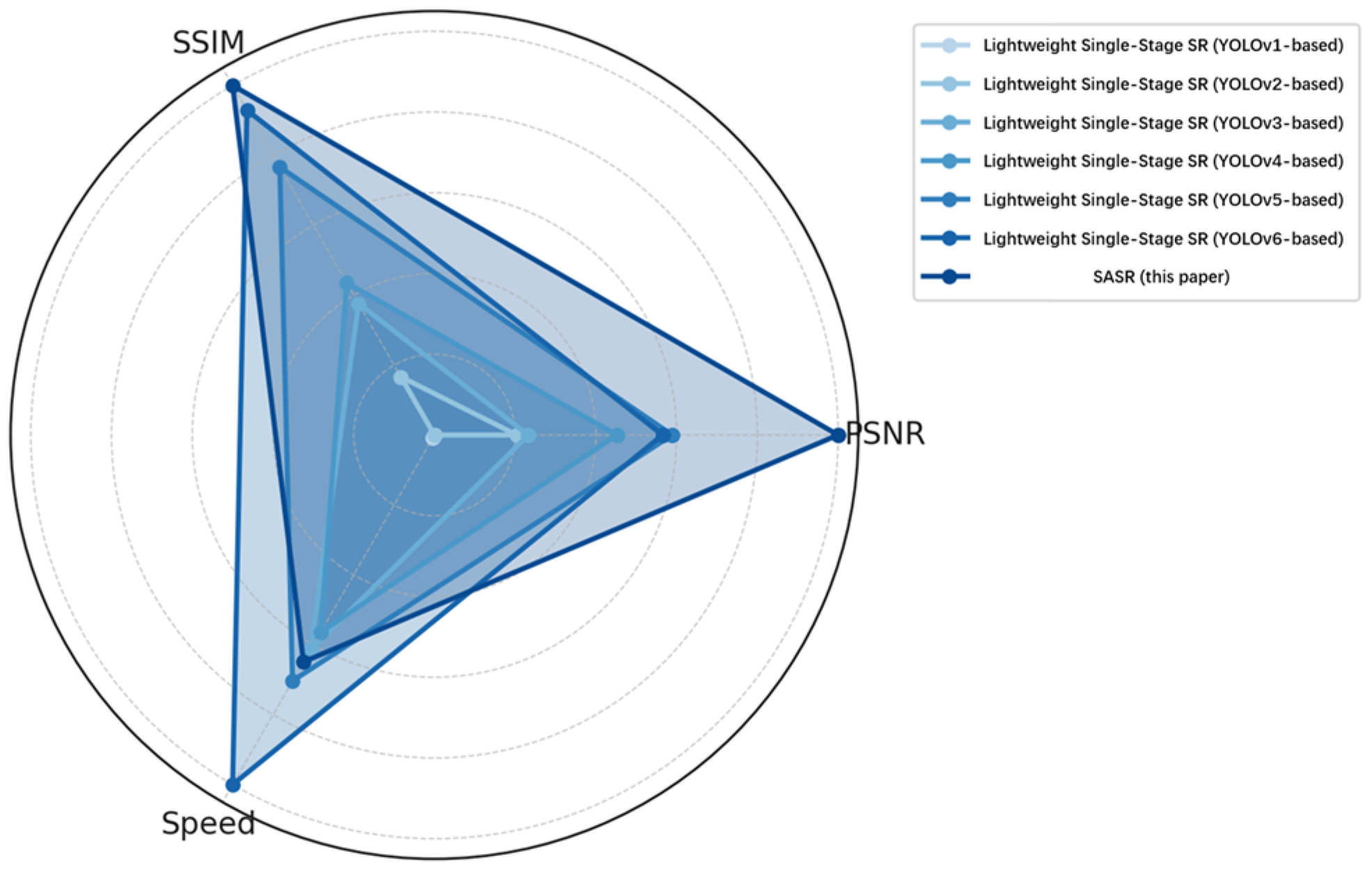
The quantitative experimental results are presented in Table 6, Table 7 and Table 8, with visual comparisons of performance displayed in Figure 10, Figure 11 and Figure 12.
It is noteworthy that, in this section, the reciprocal of the model’s average processing time is taken as its speed metric, with performance comparisons illustrated using radar charts. To achieve effective comparisons on the radar chart and better performance visualization, data is normalised so that each metric carries equal importance.
By combining the efficient feature extraction capability with the feature fusion optimisations of the multi-scale channel attention mechanism, SASR achieves higher PSNR and SSIM metrics in the image super-resolution task, significantly enhancing the quality of the reconstructed images. Additionally, despite the integration of the attention mechanism, the impact on processing speed is minimal due to the inherently efficient design, offering potential for real-time or near-real-time image processing applications.

5.3. General Comparison with Other Recent Methods

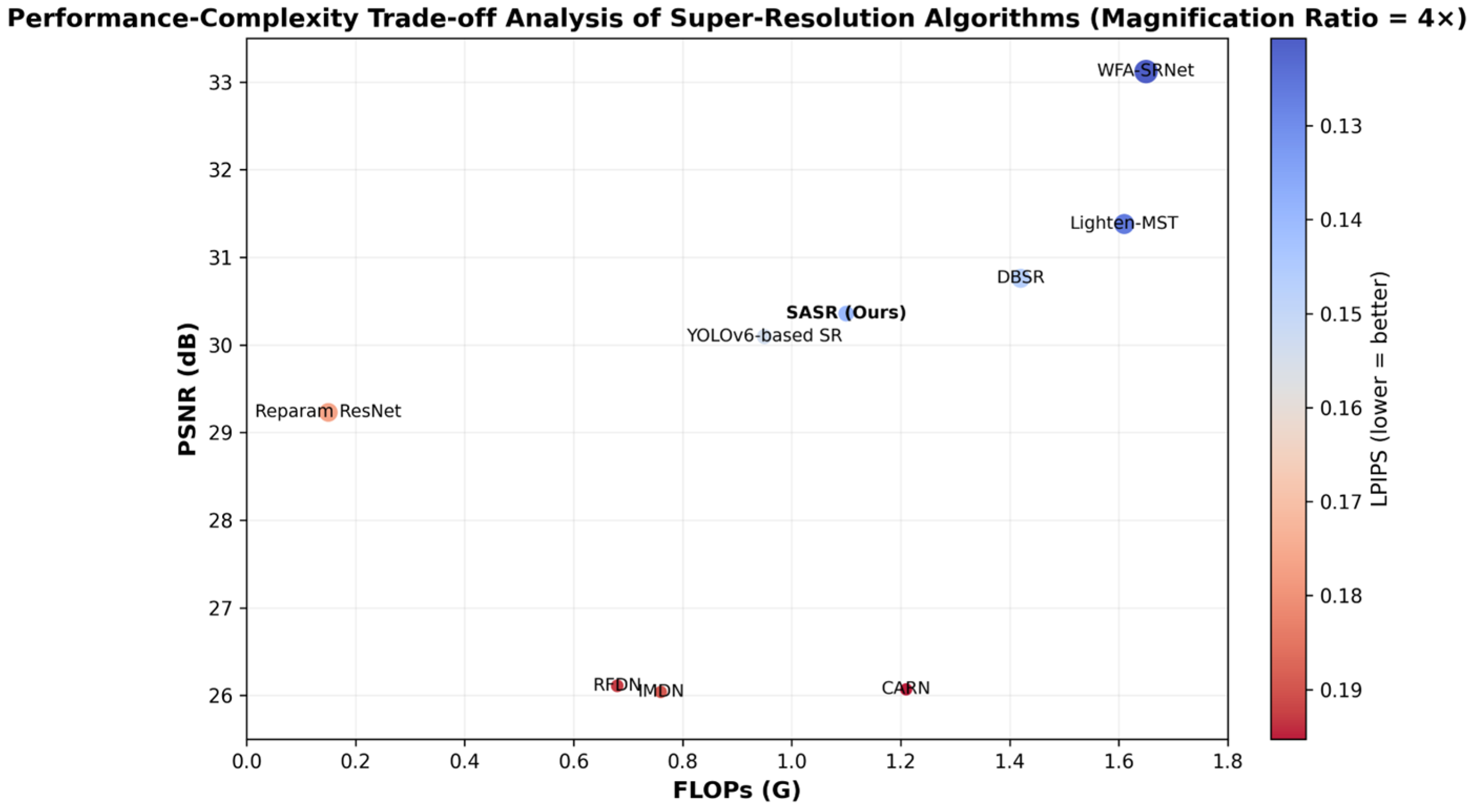
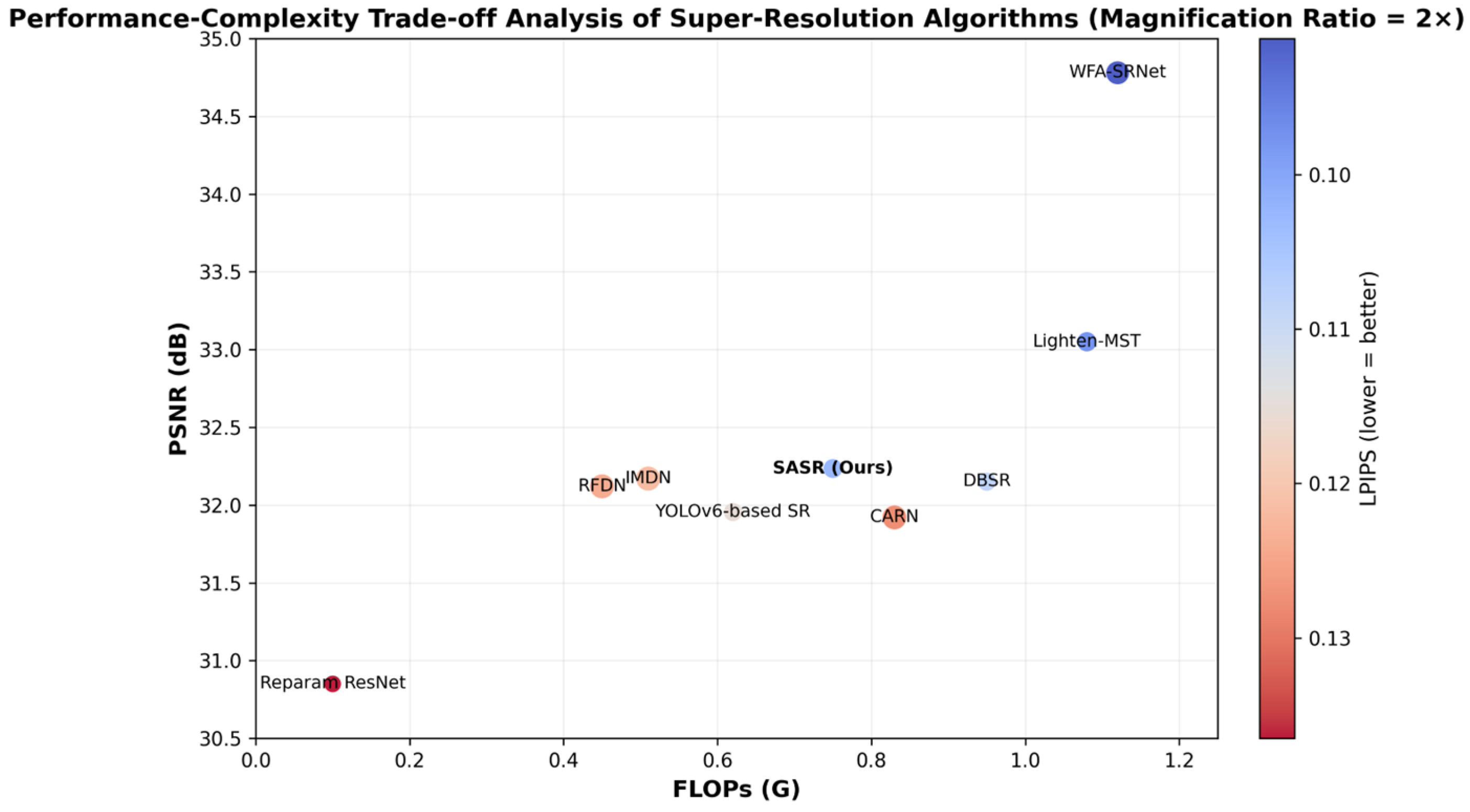
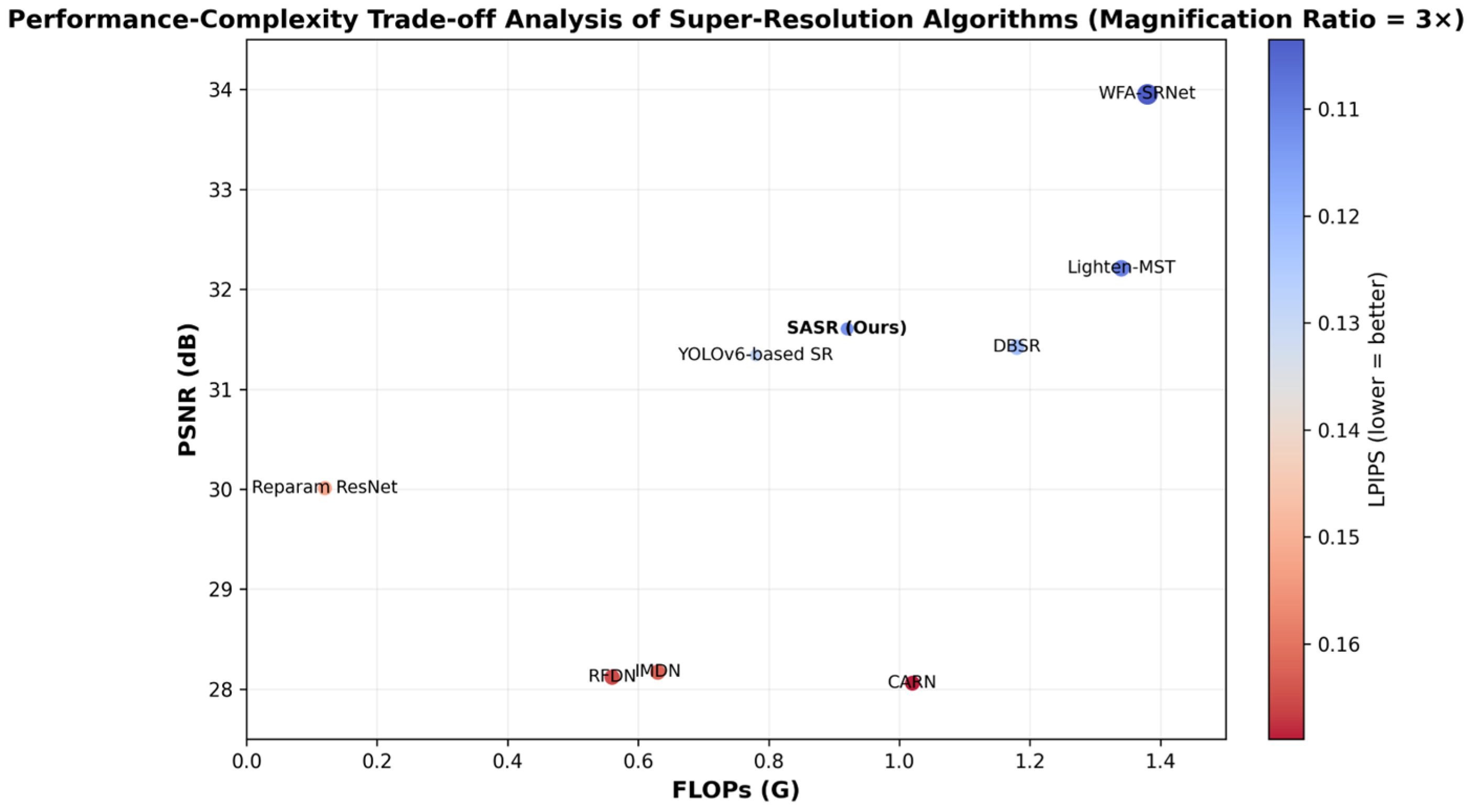
This section evaluates the performance-complexity trade-off of SASR against recent lightweight remote sensing image super-resolution methods on multiple different datasets, namely UCMerced and Sentinel-2, revealing its advantages, inherent limitations, and practical value in applications. Comparisons are shown in Table 9 and Figure 13, Figure 14 and Figure 15.
Overall, SASR strikes a satisfactory balance between reconstruction performance and computational complexity, standing out in the lightweight model landscape by outperforming most pure CNN-based lightweight models in PSNR and SSIM metrics while maintaining far lower computational complexity than hybrid CNN-Transformer architectures and traditional attention-based models like RCAN. Modern lightweight SR networks such as IMDN [44], RFDN [45], and CARN [46] show better balance between performance and computing complexity at a 2× upscaling ratio, but witness a rapid regression when the upscaling ratio rises to 4×.
With only 980 K parameters, it delivers competitive, even superior, super-resolution performance compared to DBSR (about 1200 K), and Lighten-MST (about 2060 K), showcasing exceptional parameter efficiency under resource-constrained conditions, and its inference time remains under 0.8 s across 2×, 3×, and 4× magnification scales, fully meeting the real-time processing demands of remote sensing applications and edge device deployment. Additionally, SASR’s integrated design of re-parameterised EfficientRep backbone and lightweight multi-scale channel attention mechanism effectively enhances sparse target and detail reconstruction without introducing excessive computational costs, realising a combination of lightweight architecture and feature learning ability.
Despite its prominent strengths, SASR has certain limitations: its performance is slightly inferior to specialised models like WFA-SRNet, which adopt targeted designs such as large separable kernel attention and wavelet-guided frequency-domain decoupling for complex texture restoration; meanwhile, its FLOPs are higher than ultra-lightweight pure CNN models such as the re-parameterised lightweight residual feature network, resulting in relatively slower inference speed in extreme edge computing scenarios with strictest resource limits.
Nevertheless, SASR holds practical merit for remote sensing super-resolution tasks: it provides an optimised performance-complexity trade-off solution for real-time on-board processing and edge deployment scenarios where both reconstruction quality and inference efficiency are required, achieves high-quality super-resolution reconstruction of low-light remote sensing images with extremely low parameters and sub-second latency, and pioneers a promising design paradigm by adapting detection-oriented lightweight backbones to super-resolution tasks, which offers insights for the subsequent development of efficient remote sensing image processing models.

5.4. Comparison in Detail

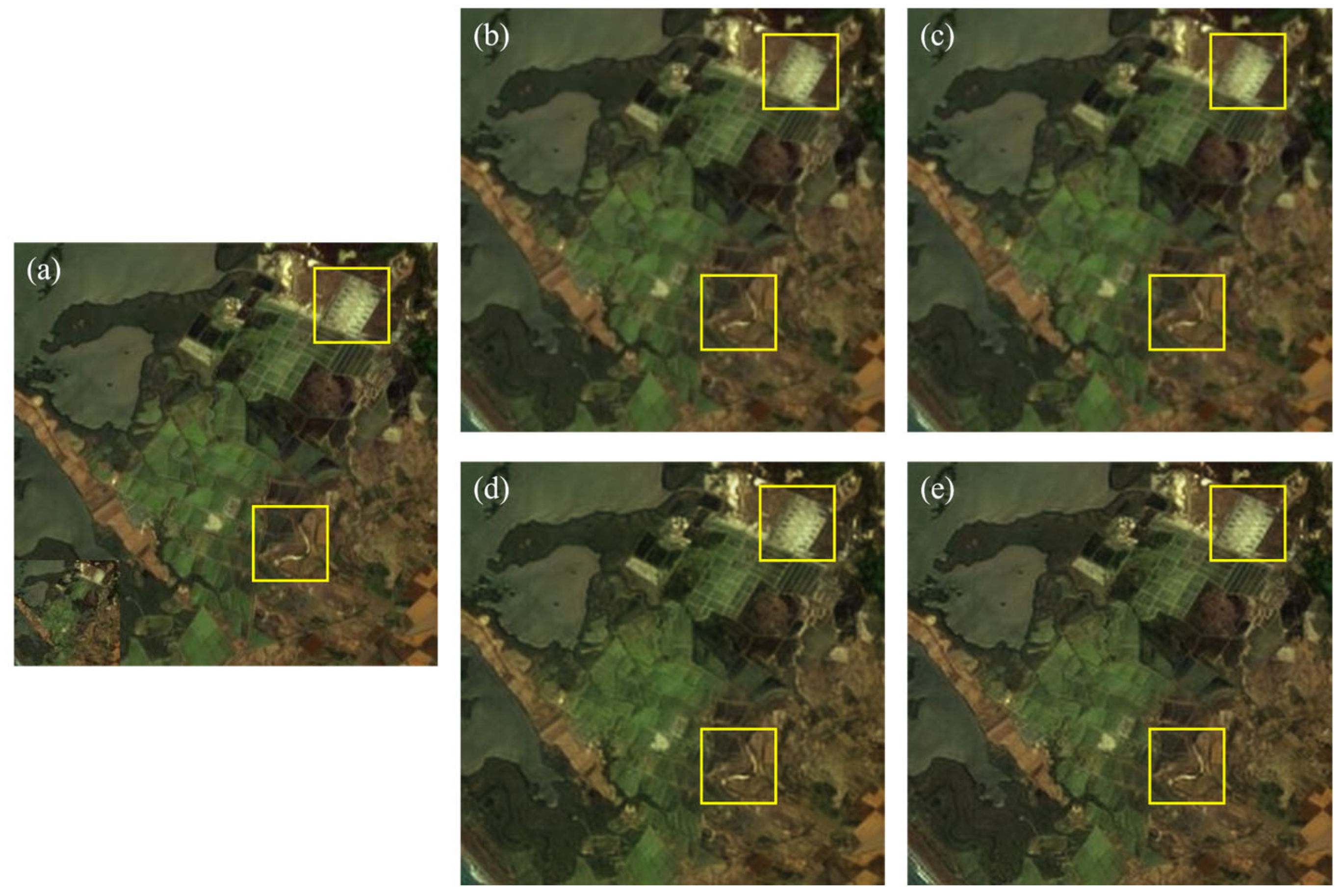
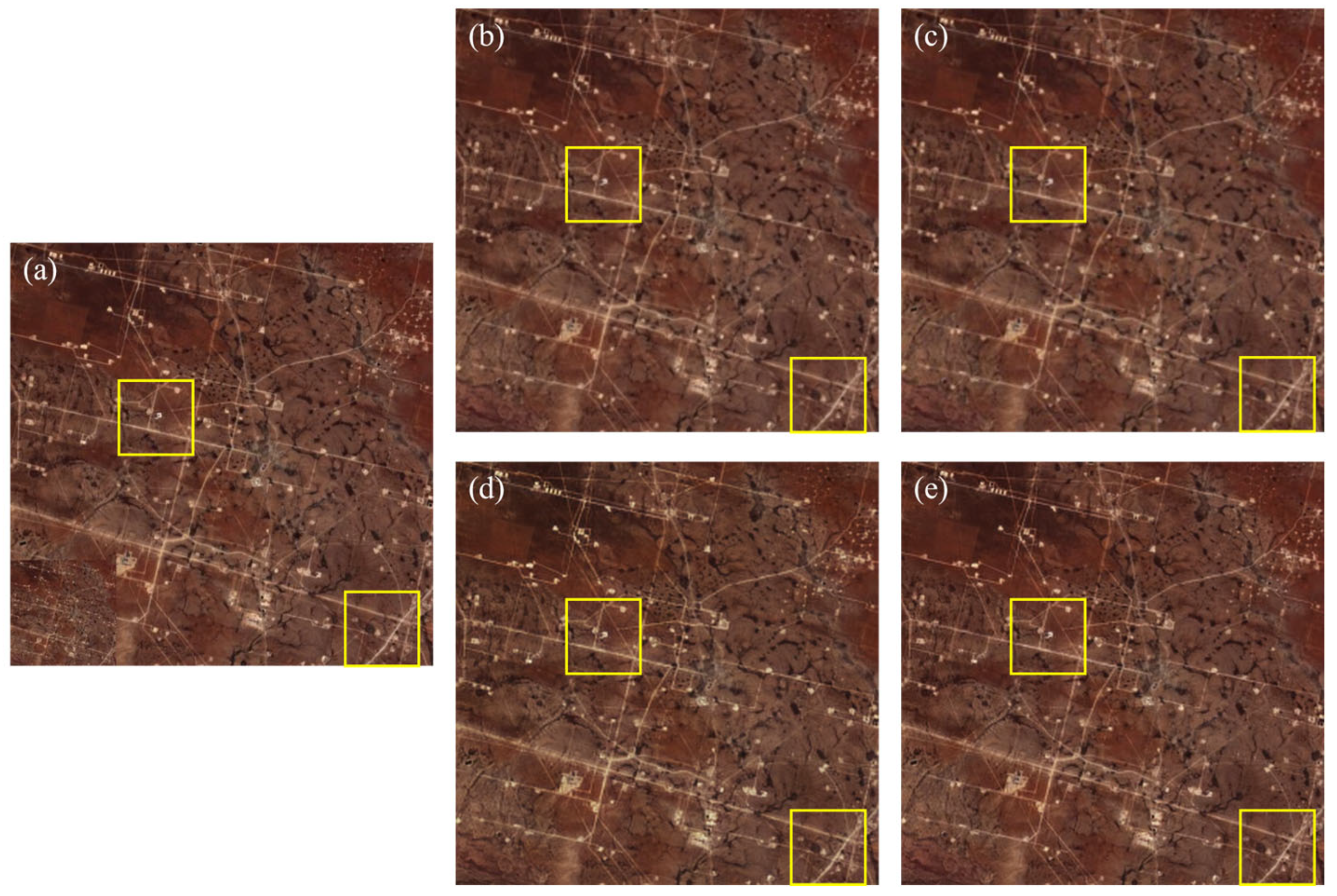
Two typical low-light remote sensing images were selected for super-resolution reconstruction using SASR, and the results were compared with the super-resolution outputs of three typical lightweight backbone-based methods without attention mechanisms (see Figure 16 and Figure 17).
Note that in Figure 16 and Figure 17: (a) is the real image, with the degraded image shown in the bottom-left corner; (b) represents the super-resolution reconstruction result from Lightweight Single-Stage SR (YOLOv2-based); (c) represents the super-resolution reconstruction result from Lightweight Single-Stage SR (YOLOv4-based); (d) represents the super-resolution reconstruction result from Lightweight Single-Stage SR (YOLOv6-based); and (e) represents the super-resolution reconstruction result from SASR.
As observed in Figure 16 and Figure 17, certain edge details are enhanced. In Figure 17, especially, small point-like targets appear more clearly; these small targets are blurred or even lost in the super-resolution reconstructions of Lightweight Single-Stage SR methods without attention mechanisms, but are restored and even highlighted in SASR’s reconstruction results. This outcome is likely due to the introduction of channel attention, which shifts the network’s computational focus to these sparse targets, thereby emphasising these features effectively.
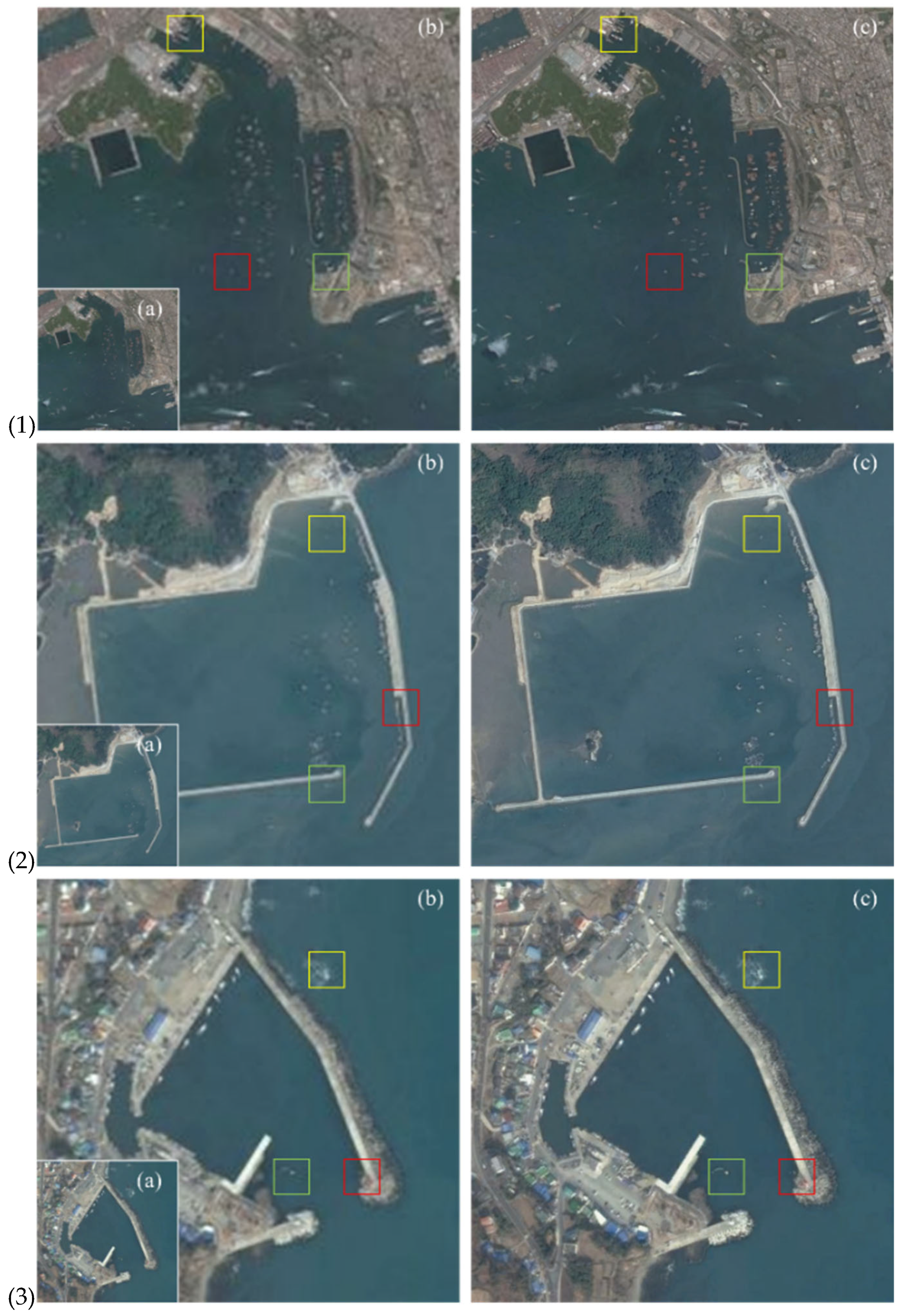
To test whether SASR is well-suited for super-resolution processing of remote sensing images containing marine vessels, several images were selected from the HRSC2016 dataset for validation. HRSC2016, collected by Northwestern Polytechnical University, is a dataset designed for ship detection, with all images sourced from six renowned ports. These include ships navigating at sea as well as those near the coastline. The results, shown in Figure 18, demonstrate the super-resolution performance.
Overall, in scenarios mentioned above, the reconstructed images exhibit significant noise and introduce some artefacts and distortions, particularly when the images being processed contain abundant texture details. However, it can be observed that the SASR model, which incorporates a multi-channel attention mechanism, consistently delivers clear and sharp reconstruction results with reduced noise for the vast majority of scenarios. Compared to super-resolution methods without the multi-channel attention mechanism, SASR achieves superior reconstruction performance for sparse targets, successfully separating neighbouring small targets. This provides a better foundation for subsequent tasks such as target detection and other image processing applications.

6. Conclusions and Prospects

This paper provides an analysis and summary of the development and characteristics of lightweight single-stage feature extraction frameworks, alongside an explanation of attention mechanisms and their application advantages. Considering the high demand for real-time processing in remote sensing satellite imaging and the sparse nature of target features relative to a dark background under low-light imaging conditions, this paper introduces a super-resolution image model, SASR, based on an optimised lightweight backbone and multi-scale channel attention mechanisms.
The model utilises an improved compact re-parameterised backbone to perform staged feature extraction, producing features at three different scales. By employing a multi-scale channel attention mechanism based on the MS-CAM module, high- and low-level features are effectively fused, followed by the use of sub-pixel convolution layers to achieve image super-resolution. The algorithm combines the lightweight, high-speed characteristics of the optimised backbone with the accuracy and efficiency of channel attention mechanisms. Tests show that SASR achieved the following results: at a 2× magnification, it achieved a PSNR of 32.2346 dB and an SSIM of 0.8791; at 3× magnification, the PSNR was 31.6040 dB with an SSIM of 0.8376; and even at 4× magnification, the PSNR remained stable above 30 dB, with an SSIM over 0.8. These results consistently outperformed lightweight backbone-based super-resolution methods without multi-scale channel attention, confirming their robust reconstruction capabilities. Additionally, SASR is a highly practical and deployable lightweight super-resolution method, whose performance-complexity balance well aligns with the actual application demands of remote sensing satellite imaging, making it a competitive choice for real-time remote sensing image enhancement under resource-constrained circumstances.
For marine image processing, SASR’s ability to handle low-light, high-contrast imagery is particularly advantageous. Underwater and maritime imaging, which often involves challenging visibility conditions and sparse or faint targets, benefits greatly from a model that prioritises essential features while filtering out background noise. SASR’s attention-based mechanism allows it to isolate and enhance significant target characteristics in such conditions, aiding tasks like vessel detection, marine pollution monitoring, and marine habitat assessments.
Future work could explore combining SASR with other deep learning approaches, such as GANs or variational autoencoders, to further enhance the quality and efficiency of super-resolution reconstruction for marine and other niche environments. Incorporating recent advancements in deep learning, such as Transformer architectures and self-attention mechanisms, could also improve the model’s accuracy and performance, offering more precise and efficient solutions for marine image reconstruction and analysis in real-time applications.

Author Contributions

Conceptualization, B.P. and Y.L.; methodology, B.P.; software, B.P.; validation, B.P.; formal analysis, B.P.; investigation, B.P.; resources, B.P.; data curation, B.P.; writing—original draft preparation, B.P.; writing—review and editing, B.P.; visualization, B.P.; supervision, Y.L.; project administration, Y.L.; funding acquisition, Y.L. All authors have read and agreed to the published version of the manuscript.

Funding

This project was supported by the Major Programme of the National Natural Science Foundation of China (Grant No. 42192582) and the National Key R&D Programme of China (Grant No. 2022YFB3902000).

Institutional Review Board Statement

Not applicable.

Informed Consent Statement

Not applicable.

Data Availability Statement

The data presented in this study are available on request from the corresponding author.

Acknowledgments

During the preparation of this manuscript/study, the authors used Deepseek-V3 for the purposes of language polishing and grammar checking. The authors have reviewed and edited the output and take full responsibility for the content of this publication.

Conflicts of Interest

The authors declare no conflicts of interest.

References

  1. Ren, S.; He, K.; Girshick, R.; Sun, J. Faster r-cnn: Towards real-time object detection with region proposal networks. Adv. Neural Inf. Process. Syst. 2015, 28, 91–99. [Google Scholar] [CrossRef] [Scilit]
  2. Cong, X.; Li, S.; Chen, F.; Liu, C.; Meng, Y. A review of YOLO object detection algorithms based on deep learning. Front. Comput. Intell. Syst. 2023, 4, 17–20. [Google Scholar] [CrossRef] [Scilit]
  3. Terven, J.; Córdova-Esparza, D.-M.; Romero-González, J.-A. A comprehensive review of yolo architectures in computer vision: From yolov1 to yolov8 and yolo-nas. Mach. Learn. Knowl. Extr. 2023, 5, 1680–1716. [Google Scholar] [CrossRef] [Scilit]
  4. Jiang, P.; Ergu, D.; Liu, F.; Cai, Y.; Ma, B. A Review of Yolo algorithm developments. Procedia Comput. Sci. 2022, 199, 1066–1073. [Google Scholar] [CrossRef] [Scilit]
  5. Wan, C.; Pang, Y.; Lan, S. Overview of yolo object detection algorithm. Int. J. Comput. Inf. Technol. 2022, 2, 11–17. [Google Scholar] [CrossRef] [Scilit]
  6. Wang, Y.; Shao, Z.; Lu, T.; Liu, L.; Huang, X.; Wang, J.; Jiang, K.; Zeng, K. A lightweight distillation CNN-transformer architecture for remote sensing image super-resolution. Int. J. Digit. Earth 2023, 16, 3560–3579. [Google Scholar] [CrossRef] [Scilit]
  7. Xiao, L.; Liao, X.; Ren, C. Lightweight Single Image Super-Resolution via Efficient Mixture of Transformers and Convolutional Networks. Sensors 2024, 24, 5098. [Google Scholar] [CrossRef] [Scilit]
  8. Zhou, Y.; Li, Z.; Guo, C.-L.; Liu, L.; Cheng, M.-M.; Hou, Q. SRFormerV2: Taking a closer look at permuted self-attention for image super-resolution. arXiv 2023, arXiv:2303.09735. [Google Scholar] [CrossRef] [Scilit] [PubMed]
  9. Zhou, J.; Sun, W.; Meng, X.; Yang, G.; Chen, B.; Ren, K. Combined subspace low rank learning and nonlocal low rank estimation for spectral super-resolution of multispectral remote sensing images. Int. J. Digit. Earth 2025, 18, 2556237. [Google Scholar] [CrossRef] [Scilit]
  10. Xiao, Y.; Yuan, Q.; Jiang, K.; Huang, W.; Zhang, Q.; Zheng, T.; Lin, C.-W.; Zhang, L. Spiking meets attention: Efficient remote sensing image super-resolution with attention spiking neural networks. arXiv 2025, arXiv:2503.04223. [Google Scholar] [CrossRef] [Scilit]
  11. Li, M.; Xu, Q. Remote sensing image super-resolution guided by multi-level supervision paradigm. J. Remote Sens. 2024, 28, 1746–1759. [Google Scholar] [CrossRef] [Scilit]
  12. Pang, B.; Liu, Y.-N. PRO-SSRGAN: Stable super-resolution generative adversarial network based on parameter reconstructive optimization on Gaofen-5 remote-sensing images. Int. J. Remote Sens. 2024, 45, 3022–3053. [Google Scholar] [CrossRef] [Scilit]
  13. Hu, M.; Sun, J.; Yang, B.; Chang, K.; Yang, J. Super-resolution reconstruction of remote sensing image based on CNN and Transformer aggregation. J. ZheJiang Univ. (Eng. Sci.) 2025, 59, 938–946. [Google Scholar] [CrossRef]
  14. Zhang, D.; Shao, J.; Li, X.; Shen, H.T. Remote sensing image super-resolution via mixed high-order attention network. IEEE Trans. Geosci. Remote Sens. 2020, 59, 5183–5196. [Google Scholar] [CrossRef] [Scilit]
  15. Hu, Y.; Wang, X.; He, Z.; Yuan, X. Lighten-MST: Low-light Spectral Reconstruction via Illumination-guided Spectral-aware Transformer. In Proceedings of the IEEE/CVF International Conference on Computer Vision, Honolulu, HI, USA, 19–20 October 2025; pp. 7383–7389. [Google Scholar]
  16. Liu, B.; Chen, J. A super resolution algorithm based on attention mechanism and srgan network. IEEE Access 2021, 9, 139138–139145. [Google Scholar] [CrossRef] [Scilit]
  17. Qi, Y.; Lou, M.; Liu, Y.; Li, L.; Yang, Z.; Nie, W. Advancing image super-resolution techniques in remote sensing: A comprehensive survey. ISPRS J. Photogramm. Remote Sens. 2026, 231, 68–100. [Google Scholar] [CrossRef] [Scilit]
  18. Zhu, X.; Guo, K.; Ren, S.; Hu, B.; Hu, M.; Fang, H. Lightweight image super-resolution with expectation-maximization attention mechanism. IEEE Trans. Circuits Syst. Video Technol. 2021, 32, 1273–1284. [Google Scholar] [CrossRef] [Scilit]
  19. Dai, Y.; Gieseke, F.; Oehmcke, S.; Wu, Y.; Barnard, K. Attentional feature fusion. In Proceedings of the IEEE/CVF Winter Conference on Applications of Computer Vision, Waikoloa, HI, USA, 5–9 January 2021; pp. 3560–3569. [Google Scholar]
  20. Lu, R.; Miao, H.; Hai, X. Efficient remote sensing image super-resolution with residual-enhanced wavelet and key-value adaptation. Front. Remote Sens. 2025, 6, 1718058. [Google Scholar] [CrossRef] [Scilit]
  21. Tang, T.; Ren, Y.; Feng, S. Dual-Branch Super-Resolution (DBSR): Lightweight DBSR Network for Enhancing Remote Sensing Images. Eur. J. Artif. Intell. 2025, 38, 217–237. [Google Scholar] [CrossRef] [Scilit]
  22. Anderson, P.; He, X.; Buehler, C.; Teney, D.; Johnson, M.; Gould, S.; Zhang, L. Bottom-up and top-down attention for image captioning and visual question answering. In Proceedings of the IEEE Conference on Computer Vision and Pattern Recognition, Salt Lake City, UT, USA, 18–22 June 2018; pp. 6077–6086. [Google Scholar]
  23. Niu, Z.; Zhong, G.; Yu, H. A review on the attention mechanism of deep learning. Neurocomputing 2021, 452, 48–62. [Google Scholar] [CrossRef] [Scilit]
  24. Luong, M.-T.; Pham, H.; Manning, C.D. Effective approaches to attention-based neural machine translation. In Proceedings of the 2015 Conference on Empirical Methods in Natural Language Processing, Lisbon, Portugal, 17–21 September 2015; pp. 1412–1421. [Google Scholar]
  25. Xu, K.; Ba, J.; Kiros, R.; Cho, K.; Courville, A.; Salakhudinov, R.; Zemel, R.; Bengio, Y. Show, attend and tell: Neural image caption generation with visual attention. In Proceedings of International Conference on Machine Learning, Lille, France, 7–9 July 2015; PMLR: New York, NY, USA, 2015; pp. 2048–2057. [Google Scholar]
  26. Liang, J.; Cao, J.; Sun, G.; Zhang, K.; Van Gool, L.; Timofte, R. Swinir: Image restoration using swin transformer. In Proceedings of the IEEE/CVF International Conference on Computer Vision, Montreal, QC, Canada, 10–17 October 2021; pp. 1833–1844. [Google Scholar]
  27. Mnih, V.; Heess, N.; Graves, A.; Kavukcuoglu, K. Recurrent models of visual attention. Adv. Neural Inf. Process. Syst. 2014, 27, 2204–2212. [Google Scholar]
  28. Xuanhao, Q.; Min, Z. A review of attention mechanisms in computer vision. In Proceedings of 2023 8th International Conference on Image, Vision and Computing (ICIVC), Dalian, China, 27–29 July 2023; IEEE: Piscataway, NJ, USA, 2023; pp. 577–583. [Google Scholar]
  29. Guo, M.-H.; Xu, T.-X.; Liu, J.-J.; Liu, Z.-N.; Jiang, P.-T.; Mu, T.-J.; Zhang, S.-H.; Martin, R.R.; Cheng, M.-M.; Hu, S.-M. Attention mechanisms in computer vision: A survey. Comput. Vis. Media 2022, 8, 331–368. [Google Scholar] [CrossRef] [Scilit]
  30. Hu, J.; Shen, L.; Sun, G. Squeeze-and-excitation networks. In Proceedings of the IEEE Conference on Computer Vision and Pattern Recognition, Salt Lake City, UT, USA, 18–22 June 2018; pp. 7132–7141. [Google Scholar]
  31. Woo, S.; Park, J.; Lee, J.-Y.; Kweon, I.S. Cbam: Convolutional block attention module. In Proceedings of the European Conference on Computer Vision (ECCV), Munich, Germany, 8–14 September 2018; pp. 3–19. [Google Scholar]
  32. Zhu, H.; Xie, C.; Fei, Y.; Tao, H. Attention mechanisms in CNN-based single image super-resolution: A brief review and a new perspective. Electronics 2021, 10, 1187. [Google Scholar] [CrossRef] [Scilit]
  33. Chen, Y.; Liu, L.; Phonevilay, V.; Gu, K.; Xia, R.; Xie, J.; Zhang, Q.; Yang, K. Image super-resolution reconstruction based on feature map attention mechanism: Y. Chen et al. Appl. Intell. 2021, 51, 4367–4380. [Google Scholar] [CrossRef] [Scilit]
  34. Chen, X.; Wu, Y.; Lu, T.; Kong, Q.; Wang, J.; Wang, Y. Remote sensing image super-resolution with residual split attention mechanism. IEEE J. Sel. Top. Appl. Earth Obs. Remote Sens. 2023, 16, 1–13. [Google Scholar] [CrossRef] [Scilit]
  35. Yang, X.; Li, X.; Li, Z.; Zhou, D. Image super-resolution based on deep neural network of multiple attention mechanism. J. Vis. Commun. Image Represent. 2021, 75, 103019. [Google Scholar] [CrossRef] [Scilit]
  36. Zadeh, A.; Chen, M.; Poria, S.; Cambria, E.; Morency, L.P. Tensor fusion network for multimodal sentiment analysis. In Proceedings of the 2017 Conference on Empirical Methods in Natural Language Processing, Copenhagen, Denmark, 9–11 September 2017. [Google Scholar]
  37. Zhang, Z.; Sun, Q.; Ye, Z.; Liu, C.; Wang, M. Adaptive multi-scale feature aggregation transformer network for single remote sensing image super-resolution. Geo-Spat. Inf. Sci. 2025, 1–22. [Google Scholar] [CrossRef] [Scilit]
  38. Han, Y.; Chi, H.; Huang, J.; Shi, X.; Qiu, J.; Shao, Q.; Li, Y.; Cheng, C.; Ling, F. Long-term wetland mapping at 10 m resolution using super-resolution and hierarchical classification—A case study in Jianghan Plain, China. Int. J. Digit. Earth 2025, 18, 2498605. [Google Scholar] [CrossRef] [Scilit]
  39. He, W.; Zhang, H.; Zhang, L.; Shen, H. Hyperspectral image denoising via noise-adjusted iterative low-rank matrix approximation. IEEE J. Sel. Top. Appl. Earth Obs. Remote Sens. 2015, 8, 3050–3061. [Google Scholar] [CrossRef] [Scilit]
  40. Tang, H.; Xu, D.; Sebe, N.; Wang, Y.; Corso, J.J.; Yan, Y. Multi-channel attention selection gan with cascaded semantic guidance for cross-view image translation. In Proceedings of the IEEE/CVF Conference on Computer Vision and Pattern Recognition, Long Beach, CA, USA, 15–20 June 2019; pp. 2417–2426. [Google Scholar]
  41. Pang, B.; Zhao, S.; Liu, Y. The use of a stable super-resolution generative adversarial network (SSRGAN) on Remote Sensing Images. Remote Sens. 2023, 15, 5064. [Google Scholar] [CrossRef] [Scilit]
  42. Zhang, R.; Isola, P.; Efros, A.A.; Shechtman, E.; Wang, O. The unreasonable effectiveness of deep features as a perceptual metric. In Proceedings of the IEEE Conference on Computer Vision and Pattern Recognition, Salt Lake City, UT, USA, 18–22 June 2018; pp. 586–595. [Google Scholar]
  43. Mittal, A.; Soundararajan, R.; Bovik, A.C. Making a “completely blind” image quality analyzer. IEEE Signal Process. Lett. 2012, 20, 209–212. [Google Scholar] [CrossRef] [Scilit]
  44. Hui, Z.; Gao, X.; Yang, Y.; Wang, X. Lightweight image super-resolution with information multi-distillation network. In Proceedings of the 27th ACM International Conference on Multimedia, Nice, France, 21–25 October 2019; pp. 2024–2032. [Google Scholar]
  45. Liu, J.; Tang, J.; Wu, G. Residual feature distillation network for lightweight image super-resolution. In European Conference on Computer Vision; Springer: Cham, Switzerland, 2020. [Google Scholar]
  46. Li, Y.; Agustsson, E.; Gu, S.; Timofte, R.; Van Gool, L. Carn: Convolutional anchored regression network for fast and accurate single image super-resolution. In Proceedings of the European Conference on Computer Vision (ECCV) Workshops, Munich, Germany, 8–14 September 2018. [Google Scholar]
Figure 1. Attention mechanism categorized according to data domain.
Applsci 16 04298 g001
Figure 2. Overall framework of the adapted lightweight feature extraction network. Note that the circled U stands for up-sampling and the circled C stands for concatenation over the channel dimension. When applied in SR tasks, the output is regenerated images in higher resolution based on extracted features.
Applsci 16 04298 g002
Figure 3. Architecture of the optimised lightweight feature extraction backbone.
Applsci 16 04298 g003
Figure 4. Architectures of RepBlock under different training circumstances: (a) RepBlock for small or medium models, (b) RepBlock for large models. Note that, during inference time, all RepVGG blocks are converted to RepConv.
Applsci 16 04298 g004
Figure 5. Illustration of the proposed MS-CAM (multi-scale channel attention module).
Applsci 16 04298 g005
Figure 6. Illustration of the adapted AFF and iAFF.
Applsci 16 04298 g006
Figure 7. The multi-scale feature fusion-based SR design based on an attention mechanism.
Applsci 16 04298 g007
Figure 8. Gaofen-5 satellite dataset under low light.
Applsci 16 04298 g008
Figure 9. Training process visualisation.
Applsci 16 04298 g009
Figure 10. Comparison between super resolution based on basic lightweight single-stage SR series and the proposed SASR (magnification ratio = 2×).
Applsci 16 04298 g010
Figure 11. Comparison between super resolution based on basic lightweight single-stage SR series and the proposed SASR (magnification ratio = 3×).
Applsci 16 04298 g011
Figure 12. Comparison between super resolution based on basic lightweight single-stage SR series and the proposed SASR (magnification ratio = 4×).
Applsci 16 04298 g012
Figure 13. Performance-complexity trade-off analysis of SR algorithms, upscaling ratio = 2×.
Applsci 16 04298 g013
Figure 14. Performance-complexity trade-off analysis of SR algorithms, upscaling ratio = 3×.
Applsci 16 04298 g014
Figure 15. Performance-complexity trade-off analysis of SR algorithms, upscaling ratio = 4×.
Applsci 16 04298 g015
Figure 16. The comparison between the basic single-stage series and the proposed lightweight super resolution network (magnification ratio = 4×). Note that: (a) is the real image, with the degraded image shown in the bottom-left corner; (b) represents the super-resolution reconstruction result from Lightweight Single-Stage SR (YOLOv2-based); (c) represents the super-resolution reconstruction result from Lightweight Single-Stage SR (YOLOv4-based); (d) represents the super-resolution reconstruction result from Lightweight Single-Stage SR (YOLOv6-based); and (e) represents the super-resolution reconstruction result from SASR.
Applsci 16 04298 g016
Figure 17. The comparison between the basic single-stage series and the proposed lightweight super-resolution network (magnification ratio = 4×). Note that: (a) is the real image, with the degraded image shown in the bottom-left corner; (b) represents the super-resolution reconstruction result from Lightweight Single-Stage SR (YOLOv2-based); (c) represents the super-resolution reconstruction result from Lightweight Single-Stage SR (YOLOv4-based); (d) represents the super-resolution reconstruction result from Lightweight Single-Stage SR (YOLOv6-based); and (e) represents the super-resolution reconstruction result from SASR.
Applsci 16 04298 g017
Figure 18. The super-resolution results of the proposed lightweight super-resolution network (magnification ratio = 4×). (Note: for set (1) to set (3), (a) is the degraded image; (b) represents the super-resolution reconstruction result from the basic single-stage SR method; and (c) represents the super-resolution reconstruction result from SASR).
Applsci 16 04298 g018
Table 1. Summary of representative YOLO architecture and development.
VersionYearTraining FrameworkBackbone
YOLO2015DarknetDarknet24
YOLOv22016DarknetDarknet24
YOLOv32018DarknetDarknet53
YOLOv42020DarknetCSPDarknet53
YOLOv52020PyTorchYOLOv5CSPDarknet
PP-YOLO2020PaddlePaddleResNet50-vd
Scaled-YOLOv42021PyTorchCSPDarknet
PP-YOLOv22021PaddlePaddleResNet101-vd
YOLOR2021PyTorchCSPDarknet
YOLOX2021PyTorchYOLOXCSPDarknet
PP-YOLOE2022PaddlePaddleCSPRepResNet
YOLOv62022PyTorchEfficientRep
YOLOv72022PyTorchYOLOv7Backbone
DAMO-YOLO2022PyTorchMAE-NAS
YOLOv82023PyTorchYOLOv8CSPDarknet
YOLO-NAS2023PyTorchNAS
YOLOv92024PyTorchGELAN + RepNCSPELAN
YOLOv102024PyTorchC2f + Lightweight C2f
YOLOv112025PyTorchC3 + C2f + SPPF
Table 2. Categories of attention mechanisms by different categorizing criteria.
Classification CriteriaClassification Details
Focus MethodSoft attention, Hard attention
Focus RangeGlobal attention, Local attention
Feature FormItem-based attention, Region-based attention
Construction MethodSequential attention, Graph attention
Input RepresentationSpatial attention, Channel attention, Temporal attention, Hybrid attention
Output RepresentationSingle-output attention, Multi-head attention, Multi-dimensional attention
Table 3. Examples of combinations between different categories.
Attention MechanismRepresentative MethodsAdvantagesLimitationsApplications
Spatial AttentionRAM, STN, CCNetExpandable scalability
Focus on important regions
Adaptive spatial transformation
Build long-range dependencies
Rely on high-quality data
High computational cost
High training complexity
Image classification
Image segmentation
Image generation
Channel AttentionSE-Net, FCA-Net, ECA-Net, GCTIncrease important channels
Capture global information
Low computational cost
Plug-and-play features
High model complexity
Lack long-range dependence
Complex image effect difference
Potential misalignment
Image classification
Image segmentation
Target monitoring
Image generation
Spatial-Channel Combined AttentionCBAM, BAM, SA-Net, EPSAFocus on important regions
Adaptive input size
Build long-range dependencies
Rich feature information
High model complexity
Potential misalignment
Image classification
Image segmentation
Target monitoring
Image generation
Table 4. Ablation study of the proposed lightweight super-resolution network with multi-scale channel attention mechanism.
Magnification RatioEvaluation CriteriaMethods
Lightweight Backbone-SRAttention (RCAN)-Based SRSASR
PSNR/dB31.954732.204532.2346
SSIM0.87260.88560.8791
Time/s0.43611.28020.4583
PSNR/dB31.340131.451931.6040
SSIM0.83370.83450.8376
Time/s0.56601.57840.6044
PSNR/dB30.095230.127730.3574
SSIM0.80110.80280.8049
Time/s0.69751.85210.7690
Table 5. A brief view of different feature fusion strategies in deep networks.
Context-AwarenessTypeFormulationScenario & ReferencesExamples
NoneAddition X + Y Short Skip, Long SkipResNet
Concatenation W A X : , i , j + W B Y : , i , j Same Layer, Long SkipU-Net
PartiallyRefinement X + G ( Y ) Y Short SkipSENet
Modulation G ( Y ) X + Y Long SkipGAU
Soft Selection G ( X ) X + ( 1 G ( X ) ) Y Short SkipHighN
FullyModulation G ( X , Y ) X + Y Long SkipSA
Soft Selection G ( X + Y ) X + ( 1 G ( X + Y ) ) Y Same LayerSKNet
M ( X Y ) X + ( 1 M ( X Y ) ) Y Same Layer, Short Skip, Long Skipours
Table 6. Comparison between super resolution based on basic lightweight single-stage SR series and the proposed SAR (magnification ratio = 2×).
MethodsPSNR/dBSSIMTime/s
Lightweight Single-Stage SR (YOLOv1-based)31.57260.82030.7125
Lightweight Single-Stage SR (YOLOv2-based)31.64110.83490.6704
Lightweight Single-Stage SR (YOLOv3-based)31.72050.84150.5218
Lightweight Single-Stage SR (YOLOv4-based)31.82040.85080.5101
Lightweight Single-Stage SR (YOLOv5-based)31.88760.86510.4812
Lightweight Single-Stage SR (YOLOv6-based)31.95470.87260.4361
SASR32.23460.87910.4583
Table 7. Comparison between super resolution based on basic lightweight single-stage SR series and the proposed SASR (magnification ratio = 3×).
MethodsPSNR/dBSSIMTime/s
Lightweight Single-Stage SR (YOLOv1-based)30.96350.78160.8217
Lightweight Single-Stage SR (YOLOv2-based)31.03190.79480.8189
Lightweight Single-Stage SR (YOLOv3-based)31.10530.80280.6606
Lightweight Single-Stage SR (YOLOv4-based)31.19420.80800.6571
Lightweight Single-Stage SR (YOLOv5-based)31.26600.82400.6259
Lightweight Single-Stage SR (YOLOv6-based)31.34010.83370.5660
SASR31.60400.83760.6044
Table 8. Comparison between super resolution based on basic lightweight single-stage SR series and the proposed SASR (magnification ratio = 4×).
MethodsPSNR/dBSSIMTime/s
Lightweight Single-Stage SR (YOLOv1-based)29.75430.75140.9464
Lightweight Single-Stage SR (YOLOv2-based)29.87730.76030.9488
Lightweight Single-Stage SR (YOLOv3-based)29.89450.77150.7770
Lightweight Single-Stage SR (YOLOv4-based)30.02710.77470.7888
Lightweight Single-Stage SR (YOLOv5-based)30.10950.79240.7570
Lightweight Single-Stage SR (YOLOv6-based)30.09520.80110.6975
SASR30.35740.80490.7690
Table 9. Performance-complexity analysis of SR algorithms, upscaling ratio = 2×/3×/4×.
MethodPublication YearMagnificationPSNR (dB)SSIMParameters (K)FLOPs (G)LIPIPSNIQETime (s)
SASR (Ours)202632.23460.87919800.750.10284.86250.4583
31.60400.83760.920.11265.12470.6044
30.35740.80491.100.13995.48630.7690
Lightweight YOLOv6-based SR/31.95470.87267000.620.11535.21740.4361
31.34010.83370.780.12875.53920.5660
30.09520.80110.950.15425.91360.6975
Re-parameterised Lightweight Residual Feature Network202530.850.86125390.100.13655.74280.008
30.010.84490.120.15186.05710.010
29.230.82750.150.17646.42590.013
Dual-Branch Super-Resolution (DBSR)202532.150.873212000.950.10855.01360.48
31.420.85181.180.12145.34820.62
30.760.83051.420.14685.69450.75
WFA-SRNet202534.780.916514501.120.09124.53170.65
33.950.89421.380.10354.78620.81
33.120.87181.650.12075.04930.98
Lighten-MST202533.050.882120601.080.09764.68250.58
32.210.86071.340.10934.93710.73
31.380.83921.610.12655.27480.89
RFDN202032.120.92785410.450.12415.36940.21
28.120.85250.560.16536.14820.27
26.110.78580.680.19276.79350.33
IMDN201932.170.92837040.510.12185.29730.25
28.170.85190.630.16246.08410.31
26.040.78380.760.18966.72580.38
CARN201831.920.925615920.830.12755.43620.32
28.060.84931.020.16896.21750.39
26.070.78371.210.19536.86490.46
Disclaimer/Publisher’s Note: The statements, opinions and data contained in all publications are solely those of the individual author(s) and contributor(s) and not of MDPI and/or the editor(s). MDPI and/or the editor(s) disclaim responsibility for any injury to people or property resulting from any ideas, methods, instructions or products referred to in the content.