1. Introduction
Impacted third molars are teeth whose eruption is prevented by surrounding bone, soft tissue, or adjacent teeth [
1]. Tooth impaction is defined as the failure of a tooth to erupt into the dental arch within the expected physiological eruption period [
2]. The etiology of third molar impaction is multifactorial and includes insufficient space in the dental arch, mandibular growth patterns, as well as various local or systemic factors that may interfere with the eruption pathway [
2]. Impacted third molars represent a common clinical finding worldwide. Recent meta-analytic data indicate that the global prevalence of impacted third molars is approximately 36.9% at the individual level and 46.4% at the tooth level [
3]. Other epidemiological studies have reported that the prevalence of impacted third molars ranges from approximately 18% to 68% in different populations [
1]. Mandibular third molars are the most frequently impacted teeth in the human dentition, and their surgical removal represents one of the most commonly performed procedures in oral and maxillofacial surgery [
2]. Third molar extraction is frequently used as a clinical model for investigating postoperative healing and evaluating regenerative approaches [
4]. Extracted third molars may also represent a valuable biological source of dental pulp–derived stem cells with potential applications in regenerative medicine and tissue engineering [
5]. In addition to their high prevalence, impacted third molars may be associated with several pathological conditions, including pericoronitis, periodontal disease, dental caries, and cystic or tumorous lesions affecting adjacent structures [
1].
Recent evidence also indicates that impacted mandibular third molars may be associated with pathological changes in the tooth itself and adjacent tissues, further supporting the clinical importance of careful preoperative assessment [
6]. Accurate preoperative assessment of impacted mandibular third molars is essential for predicting surgical complexity, planning the operative approach, and estimating potential postoperative complications [
7]. Radiographic evaluation plays a fundamental role in this process and enables clinicians to assess the position of the impacted tooth in relation to surrounding anatomical structures. Several radiological classification systems have been developed to assess the position and expected surgical difficulty of impacted mandibular third molars [
8]. Among the most widely used are the classical systems proposed by Winter (1926) [
9] and Pell and Gregory (1933) [
10], which remain commonly used in clinical practice for describing the position of impacted third molars. The Winter classification describes the angulation of the impacted tooth relative to the long axis of the adjacent second molar, whereas the Pell and Gregory classification evaluates the relationship of the impacted tooth to the anterior border of the mandibular ramus and the occlusal plane [
11]. Although these systems give clinicians valuable anatomical information regarding the position of the impacted tooth, they do not directly quantify the overall surgical difficulty of the extraction procedure.
To address this limitation, several indices have been proposed to combine radiographic parameters into a simplified measure of surgical difficulty. One of the most widely used systems is the Pederson difficulty index [
12], which integrates parameters from the Winter and Pell–Gregory classifications to estimate the expected surgical difficulty of mandibular third molar extraction [
8]. The index incorporates three radiographic variables—angulation of the tooth, its relationship to the mandibular ramus, and the depth of impaction relative to the occlusal plane. Based on the combined score, cases may be categorized as minimal, moderate, or high surgical difficulty, which may facilitate preoperative planning and clinical decision-making. However, despite its widespread clinical use, the Pederson index relies exclusively on radiographic variables and does not include several clinical factors that may influence surgical difficulty, such as bone density, root morphology, or patient-related variables [
8,
13].
Surgical difficulty during mandibular third molar extraction is closely related to operative time and the extent of surgical trauma. Previous studies have demonstrated that deeper impaction and more complex anatomical relationships are associated with more demanding surgical procedures [
14]. Increased operative time may reflect greater surgical difficulty and has been associated with increased postoperative morbidity, including pain, swelling, and trismus following third molar surgery [
15]. Despite the widespread use of radiological classifications for assessing impaction patterns, their relationship with surgical duration and postoperative morbidity remains unclear.
While previous studies have linked radiological classifications to surgical difficulty and operative time, their relationship with patient-centered outcomes, particularly postoperative pain, remains unclear. In this context, postoperative pain represents a clinically meaningful patient-centered outcome that directly reflects the patient’s postoperative experience and recovery.
From a theoretical mechanistic perspective, greater radiological complexity may increase surgical difficulty, leading to prolonged operative time, greater tissue trauma, and a more pronounced inflammatory response, which may contribute to increased postoperative pain.
Therefore, this secondary exploratory analysis addressed the following research questions: (1) are radiological classifications associated with operative time, and (2) are these classifications independently associated with postoperative pain, or is this relationship attenuated after adjustment for operative time?
We hypothesized that more complex radiological impactions and longer surgical duration are associated with increased postoperative morbidity.
2. Materials and Methods
2.1. Study Design
The original study was designed as a prospective randomized clinical trial investigating the effects of regenerative approaches on postoperative healing following mandibular third molar extraction. The primary outcomes of the trial have been previously reported by Selahi et al. [
16]. Additional published analyses based on the same patient cohort have evaluated the influence of vitamin D3 levels on postoperative outcomes [
17]. Previous analyses based on this cohort addressed distinct research questions and focused on different outcome measures, and should be considered complementary to his study. The study was conducted at the clinical facilities of a University Dental Clinic of Wroclaw Medical University.
Ethical approval for the original study was obtained from the Bioethics Committee of the Medical University (approval no. KB-705/2019). The study was conducted in accordance with the principles of the Declaration of Helsinki and Good Clinical Practice guidelines. The trial was registered at ClinicalTrials.gov (Identifier: NCT07324213). All participants provided written informed consent prior to enrollment.
The present study represents a secondary exploratory analysis of data obtained from that randomized clinical trial and did not involve additional patient recruitment, new interventions, or modifications to the original study protocol. This analysis was not pre-specified in the original trial protocol and should be considered post hoc in nature. The original randomized trial included photobiomodulation (PBM) as an intervention; therefore, PBM was included as a covariate in the present analysis to control for its potential effect on postoperative pain.
The aim of this secondary exploratory analysis was to evaluate whether preoperative radiological classification of impacted mandibular third molars and surgical duration are associated with early postoperative morbidity following surgical extraction. Postoperative morbidity was assessed using clinical parameters, with particular focus on postoperative pain intensity.
2.2. Participants
Participants included generally healthy adult patients aged 18–40 years who required surgical extraction of an impacted mandibular third molar. Eligibility for surgery was determined based on clinical and radiological examination.
Patients were recruited at the clinical facilities of MCIW—Medical Centre for Innovation in Wroclaw—University Dental Clinic of Wroclaw Medical University. All surgical procedures were performed under standardized clinical conditions by experienced oral surgeons.
Detailed inclusion and exclusion criteria, as well as the recruitment process, have been described previously in the original randomized clinical trial and related publications [
16].
Briefly, patients with systemic diseases, metabolic disorders, pregnancy, smoking habits, recent antibiotic therapy, poor oral hygiene, or exceptionally difficult impactions were excluded from the study. Exceptionally difficult impactions were defined based on clinical and radiological assessment by the operating surgeon, taking into account factors such as unfavorable tooth position or anticipated surgical complexity.
Only one mandibular third molar per patient was included in the analysis.
A total of 135 patients were initially enrolled in the randomized clinical trial. Of these, 122 participants completed the follow-up period and were included in the final RCT analysis.
2.3. Radiological Assessment
Preoperative radiological evaluation of impacted mandibular third molars was performed using panoramic radiographs obtained prior to surgery as part of routine diagnostic assessment.
The position and angulation of impacted third molars were classified using two commonly applied radiological classification systems. The Winter classification was used to determine the angulation of the impacted third molar relative to the long axis of the adjacent second molar. Based on this system, impactions were categorized as mesioangular, distoangular, vertical, or horizontal.
Radiological assessment was performed by a single experienced operator; however, formal intra- or inter-observer reliability testing was not conducted. Panoramic radiographs were used as the primary imaging modality to ensure consistency across all cases, as three-dimensional imaging (CBCT) was available only for a subset of patients.
Additionally, the Pell and Gregory classification was used to assess the relationship of the impacted tooth to the anterior border of the mandibular ramus and to the occlusal plane of the adjacent second molar. This classification describes impactions according to the available space between the second molar and the mandibular ramus (Class I–III) and the depth of impaction relative to the occlusal plane (Position A–C). These classifications were determined preoperatively by the operating surgeon based on the panoramic radiograph as part of routine surgical planning.
For the purposes of the present study, the Pederson difficulty index was additionally calculated for each impacted mandibular third molar to estimate the expected surgical difficulty. The Pederson index combines three radiological parameters: angulation of impaction according to the Winter classification, the relationship to the mandibular ramus according to the Pell and Gregory classification (Class I–III), and the depth of impaction relative to the occlusal plane (Position A–C).
Each parameter was assigned a numerical score as originally described by Pederson: mesioangular = 1 point, horizontal = 2 points, vertical = 3 points, distoangular = 4 points; ramus relationship Class I = 1 point, Class II = 2 points, Class III = 3 points; depth of impaction Position A = 1 point, Position B = 2 points, Position C = 3 points. The total Pederson difficulty score was calculated as the sum of these three components. Based on the total score, impactions were categorized as minimal difficulty (3–4 points), moderate difficulty (5–6 points), or high difficulty (7–10 points).
In the present analysis, the Pederson index was used as an additional radiological indicator of surgical complexity and was further evaluated in relation to surgical duration and postoperative pain.
2.4. Surgical Procedure
All surgical procedures were performed at the clinical University Dental Clinic. The procedures were carried out according to a standardized surgical protocol.
All surgeries were performed by a single operator (D.S.), a dentist with more than five years of clinical training in oral surgery, in order to minimize operator-related variability and potential bias associated with surgical skills and procedure duration. The procedures were conducted under the supervision of an experienced oral surgeon (J.H.).
Immediately before the surgical procedure, patients were instructed to rinse the oral cavity with an antiseptic mouthwash containing chlorhexidine (Eludril®, Pierre Fabre Oral Care, Castres, France) for approximately 30 s as part of the standard preoperative infection control protocol.
Local anesthesia was achieved using 4% articaine with epinephrine 1:200,000, administered as inferior alveolar nerve block and buccal infiltration (two cartridges, 2 × 1.7 mL). When necessary, additional anesthetic cartridges were administered, and all doses exceeding the standard two cartridges were recorded.
A mucoperiosteal envelope flap without vertical releasing incision was elevated to expose the impacted mandibular third molar. When required, osteotomy of the surrounding bone was performed using a straight handpiece with a round bur. Tooth sectioning was carried out using a high-speed handpiece with a Lindemann (side-cutting) bur under continuous sterile saline irrigation. Osteotomy and tooth sectioning were performed when required according to clinical indications, but were not analyzed as independent predictors in the present study.
Following extraction, the surgical site was irrigated with sterile saline and any residual follicular or inflammatory tissue was removed when present. The wound was closed with non-resorbable 5-0 sutures to achieve primary closure.
The duration of surgery was recorded for each procedure and defined as the time from the initial incision to completion of wound closure. Surgical duration was used in the present analysis as a potential predictor of early postoperative morbidity.
Postoperative pharmacological management was standardized for all participants. Patients received nimesulide (Aulin®, 100 mg (Angelini Pharma, Rome, Italy)) administered twice daily for three days following surgery, unless contraindicated. No additional routine analgesic or anti-inflammatory medications were prescribed; however, the use of additional postoperative analgesics beyond the standardized regimen was not systematically recorded. Routine antibiotic prophylaxis was not included in the study protocol. However, in clinically justified situations such as postoperative inflammatory complications, antibiotic therapy could be introduced at the discretion of the treating clinician. The recommended regimen included amoxicillin with clavulanic acid (Augmentin® GlaxoSmithKline, Brentford, UK, 1 g every 12 h), while clindamycin was prescribed for patients with documented allergy to penicillin.
Postoperative pain intensity was evaluated using a numeric rating scale (NRS) ranging from 0 (no pain) to 10 (worst imaginable pain). Pain scores were recorded by the clinician during scheduled follow-up visits using a standardized clinical data collection form. All patients attended mandatory follow-up visits on postoperative days 1, 3, and 7, during which pain assessment was performed.
2.5. Postoperative Outcome Assessment
Early postoperative morbidity was assessed using clinical parameters including pain intensity, facial swelling, trismus, and soft tissue healing.
Postoperative pain intensity was evaluated using a numeric rating scale (NRS) ranging from 0 (no pain) to 10 (worst imaginable pain). Patients were asked to report their pain intensity on postoperative days 1, 3, and 7. Pain intensity on postoperative day 3 was considered the primary outcome of the present analysis. Secondary outcomes included operative time and postoperative pain at other time points. Although swelling, trismus, and soft tissue healing were recorded in the original trial, the present secondary analysis focused primarily on postoperative pain intensity.
All postoperative assessments were performed during scheduled follow-up visits in the early postoperative period.
2.6. Statistical Analysis
Statistical analysis was performed using IBM SPSS Statistics version 29 (IBM Corp., Armonk, NY, USA). No formal a priori sample size calculation was performed for the present secondary analysis, as the study was based on an existing randomized clinical trial dataset. Effect sizes and strength of associations were interpreted in the context of contemporary, data-driven benchmarks proposed for dental research [
18]. Descriptive statistics were calculated for all variables, including means, medians, standard deviations, and ranges for quantitative variables, as well as frequencies and percentages for categorical variables. Data are presented as median and interquartile range (Q1–Q3) for non-normally distributed variables.
The normality of data distribution was assessed using the Shapiro–Wilk test. As most variables did not follow a normal distribution, non-parametric statistical methods were applied.
The Pederson difficulty index was analyzed both as a categorical variable (minimal, moderate, and high difficulty) and as a continuous score. Differences between groups were analyzed using the Mann–Whitney U test.
Spearman rank correlation coefficients were calculated to evaluate the association bewteen Pederson difficulty score, surgical duration, and postoperative pain intensity.
Additionally, multivariable linear regression analyses were performed to evaluate (1) the association between radiological parameters and surgical duration, and (2) the independent effects of surgical duration and radiological classification on postoperative pain intensity on postoperative day 3. Model assumptions were checked and no major violations were observed. PBM was included in the model predicting postoperative pain as a potential modifier of pain perception.
Radiological variables (Winter and Pell–Gregory classifications), age, and sex were included in the model predicting surgical duration. In the model predicting postoperative pain, surgical duration, radiological variables, age, sex, and photobiomodulation (PBM) were included as covariates. All variables were included simultaneously in the regression models.
A p-value of <0.05 was considered statistically significant. Given the exploratory nature of the analysis, p-values were not adjusted for multiple comparisons and should be interpreted with caution.
3. Results
3.1. Study Population
Of the total of 135 patients initially enrolled in the randomized clinical trial 122 participants completed the follow-up period and were included in this analysis.
All included patients underwent surgical extraction of an impacted mandibular third molar and completed the scheduled postoperative assessments.
The study population consisted of 26 males and 96 females, aged 19–37 years. The mean surgical duration was 32.21 ± 15.22 min (median 30 min), ranging from 8 to 105 min.
3.2. Radiological Classifications
3.2.1. Pell and Gregory and Winter Classification
Preoperative radiological assessment allowed classification of impacted mandibular third molars according to the Winter and Pell and Gregory systems. According to the Winter classification, the most frequently observed angulation was vertical impaction (
n = 48), followed by mesioangular (
n = 35) and horizontal impactions (
n = 22). Distoangular impactions (
n = 17) were observed less frequently. According to the Pell and Gregory classification, the majority of cases were classified as Class II (
n = 95), followed by Class I (
n = 22) and Class III (
n = 5). Regarding the depth of impaction, Position B was the most frequently observed (
n = 84), followed by Position A (
n = 33) and Position C (
n = 5). Detailed distributions of radiological classifications are presented in
Table 1.
3.2.2. Pederson Difficulty Index
Based on the combination of Winter and Pell–Gregory classifications, the Pederson difficulty index was calculated for all impacted mandibular third molars included in the study. The majority of cases were classified as moderately difficult (Pederson score 5–6), representing 56.6% of the sample. High-difficulty impactions (Pederson score ≥ 7) accounted for 38.5% of cases, whereas minimally difficult impactions (Pederson score 3–4) were relatively rare (4.9%). The distribution of Pederson difficulty scores in the study population is presented in
Table 2.
3.3. Surgical Duration
The mean duration of surgery in the study population was 32.21 ± 15.22 min, with a median duration of 30 min and a range from 8 to 105 min. For further analyses, surgical procedures were categorized according to surgical duration into procedures lasting less than 30 min and procedures lasting 30 min or longer. The 30 min threshold was selected based on the median surgical duration in the study population. A total of 55 procedures (45.1%) lasted less than 30 min, whereas 67 procedures (54.9%) lasted 30 min or longer.
3.4. Radiological Predictors of Surgical Duration
3.4.1. Pell and Gregory and Winter as Predictors of Surgical Duration
Analysis of surgical duration in relation to radiological classification showed a significant differences in operative time depending on the type of impaction.
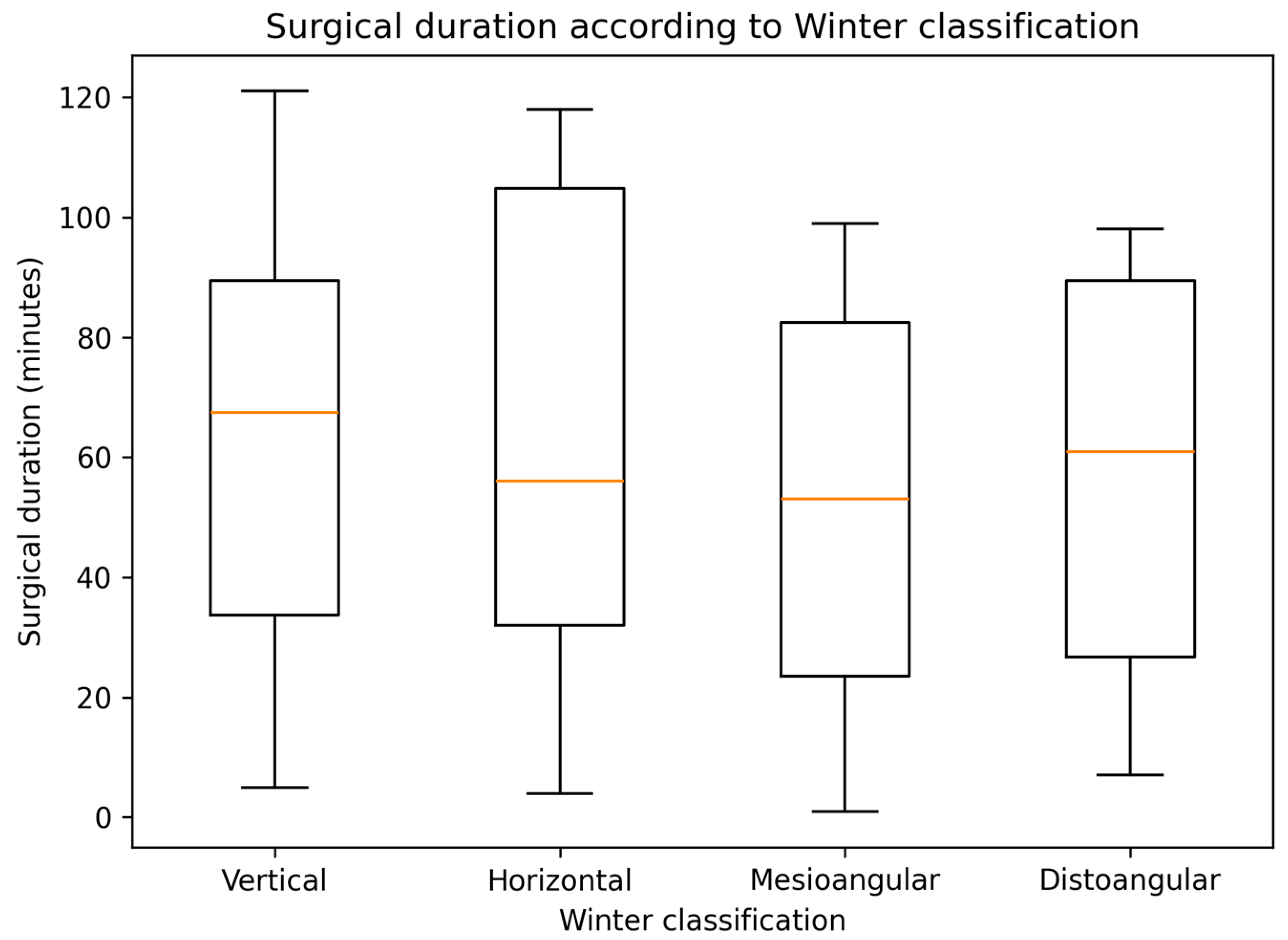
According to the Winter classification, the longest surgical duration was observed for horizontal impactions (mean 41.14 min), followed by mesioangular (34.89 min) and distoangular impactions (34.24 min), whereas vertical impactions required the shortest operative time (25.46 min).
Similarly, analysis based on the Pell and Gregory classification revealed longer surgical procedures for more complex impaction patterns according to both radiological classification systems. The longest mean operative time was observed for Class IIIB impactions (43.29 min), while shorter procedures were associated with Class I impactions.
Detailed comparisons of surgical duration according to radiological classification are presented in
Table 3. The distribution of surgical duration according to Winter classification is illustrated in
Figure 1.
Boxplots illustrate the distribution of surgical duration for each impaction type. The horizontal line within each box represents the median, the box indicates the interquartile range (Q1–Q3), and the whiskers represent the minimum and maximum values. Horizontal impactions were associated with the longest operative times, whereas vertical impactions required the shortest surgical procedures
3.4.2. Pederson Index as Predictor of Surgical Duration
Analysis of surgical duration in relation to the Pederson difficulty index showed variability in operative times across different score categories. Procedures classified as minimally difficult were generally associated with shorter surgical duration, whereas moderately and highly difficult impactions were associated with longer operative times, although this pattern was not entirely consistent across all categories. Detailed comparisons of surgical duration according to Pederson difficulty score are presented in
Table 4.
3.4.3. Multivariable Analysis of Surgical Duration
Multivariable linear regression analysis was performed to assess the independent association between radiological parameters and surgical duration.
The model was statistically significant (R2 = 0.21, p < 0.001). Among the radiological variables, tooth angulation according to the Winter classification was the most strongly associated variable of operative time. Horizontal impactions were associated with significantly longer surgical duration compared with vertical impactions (β = 12.7 min, p < 0.001), followed by mesioangular impactions (β = 9.5 min, p = 0.004).
In contrast, Pell–Gregory classification parameters did not retain statistical significance after adjustment for angulation. Age showed a borderline association with surgical duration, whereas sex was not a significant predictor.
3.5. Surgical Duration and Postoperative Morbidity
To evaluate the potential predictive value of surgical duration for early postoperative morbidity, patients were divided into two groups according to the duration of the surgical procedure: less than 30 min and 30 min or longer.
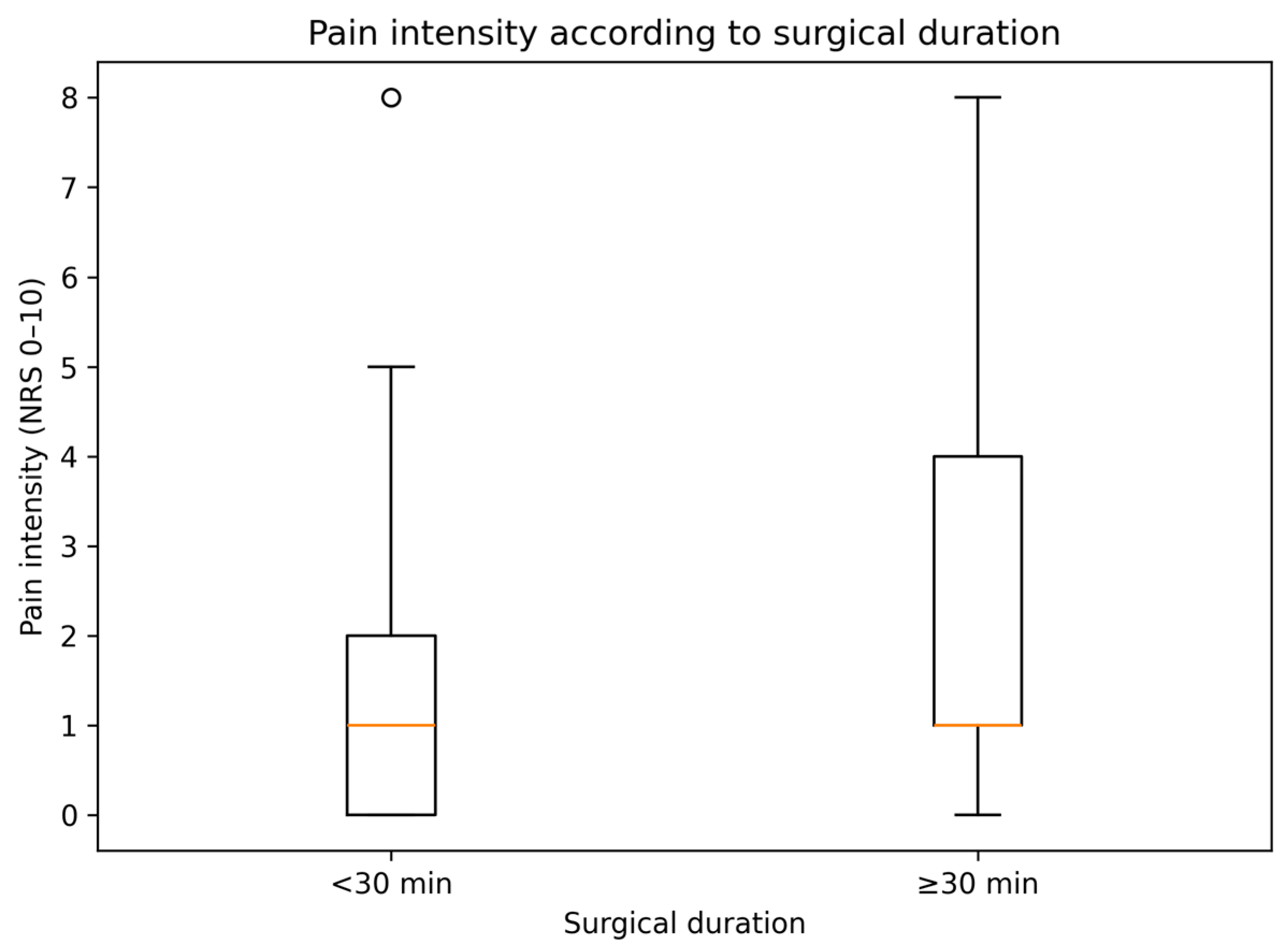
Patients who underwent procedures lasting 30 min or longer reported significantly higher pain intensity during surgery compared with patients treated with shorter procedures (p = 0.039).
In the postoperative period, significantly higher pain levels in the longer surgery group were observed on postoperative day 3 (p = 0.038) and postoperative day 7 (p = 0.048). No statistically significant difference between the groups was found for pain intensity on postoperative day 1 (p = 0.429).
Detailed comparisons of postoperative pain intensity according to surgical duration are presented in
Table 5. The distribution of intraoperative pain intensity according to surgical duration is illustrated in
Figure 2.
Boxplots illustrate the distribution of intraoperative pain intensity (Numeric Rating Scale, 0–10) in relation to surgical duration. The horizontal line within each box represents the median value, the box indicates the interquartile range (Q1–Q3), and the whiskers represent the minimum and maximum values. Procedures lasting ≥30 min were associated with higher pain intensity compared with procedures lasting <30 min.
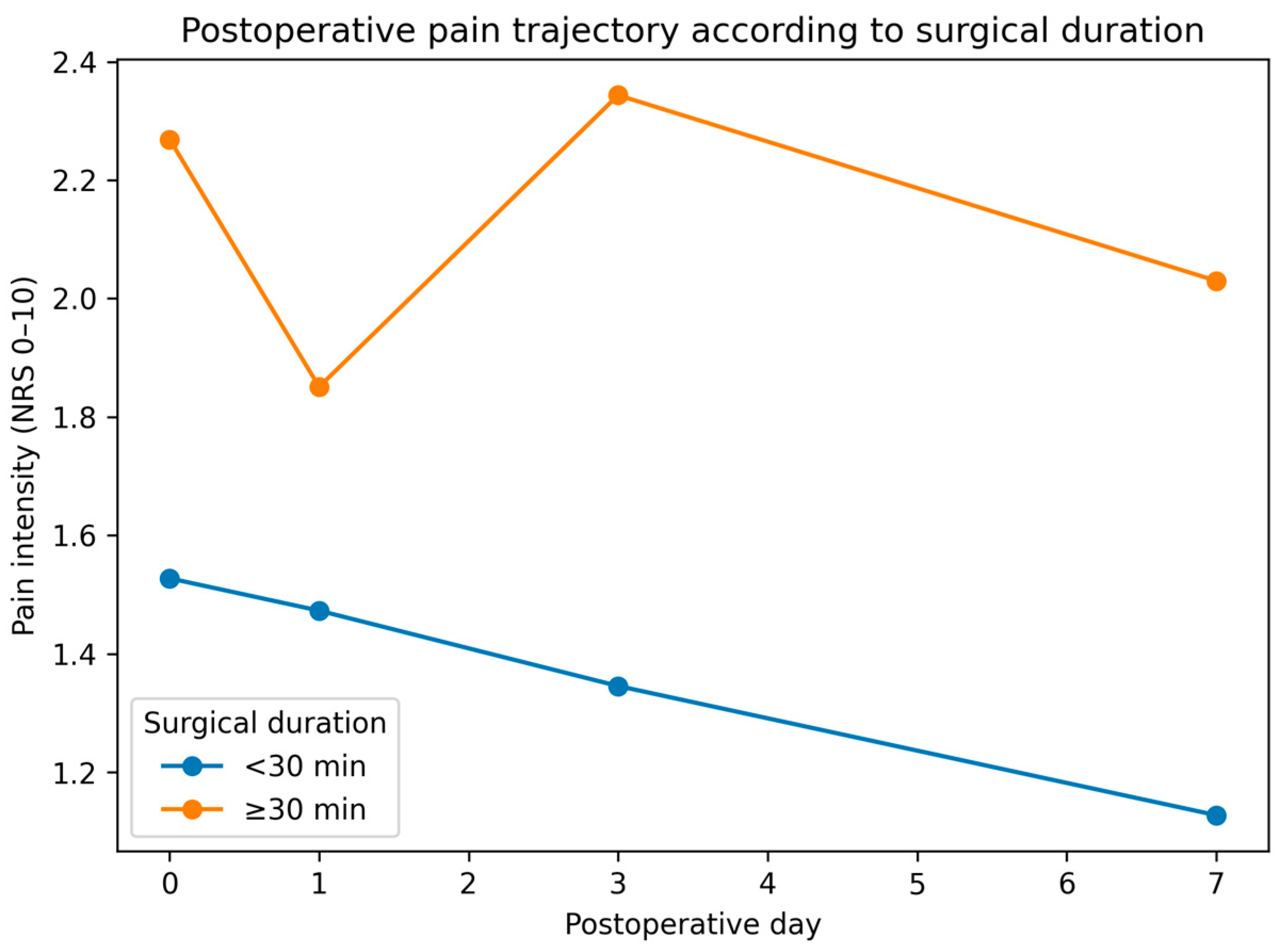
Mean pain intensity (Numeric Rating Scale, 0–10) measured during surgery (day 0) and on postoperative days 1, 3, and 7 for procedures lasting <30 min and ≥30 min. Patients undergoing longer surgical procedures reported higher pain intensity during surgery and in the early postoperative period, particularly on postoperative days 3 and 7. The trajectory of postoperative pain according to Pederson difficulty index is illustrated in
Figure 3.
Multivariable Analysis of Postoperative Pain
Multivariable linear regression analysis was performed to evaluate the association between surgical duration and early postoperative morbidity and radiological parameters on postoperative pain intensity on postoperative day 3, results are presented in the
Table 6.
The model was statistically significant (R2 = 0.22, p = 0.018). Surgical duration remained independently associated with postoperative pain (β = 0.03 increase in NRS score per additional minute, p = 0.032). After adjustment for surgical duration, radiological variables, including Winter and Pell–Gregory classifications, were no longer significantly associated with postoperative pain.
Photobiomodulation was associated with lower pain intensity, although this effect did not reach statistical significance. Male sex was associated with lower postoperative pain intensity, while age was not a significant predictor.
3.6. Pederson Difficulty Index and Postoperative Pain
Postoperative pain intensity was additionally analyzed in relation to the Pederson difficulty index.
Patients with higher Pederson scores reported higher postoperative pain intensity during the early healing period. Higher pain levels were observed particularly on postoperative day 3.
Detailed comparisons of postoperative pain intensity according to Pederson difficulty categories are presented in
Table 7.
3.7. Correlation Analysis
Spearman correlation analysis showed a weak but statistically significant positive association between the Pederson difficulty score and surgical duration (ρ = 0.21, p = 0.021).
A positive association was also observed between the Pederson index and postoperative pain intensity, with the strongest correlation noted on postoperative day 3 (ρ = 0.24, p = 0.012).
Correlations with pain intensity on postoperative day 1 and day 7 were weaker and did not consistently reach statistical significance. Detailed results of the correlation analysis are presented in
Table 8.
3.8. Postoperative Complications
Postoperative complications requiring antibiotic therapy occurred in four patients (3.3%). In these cases, antibiotic treatment with amoxicillin–clavulanic acid (Augmentin®, GlaxoSmithKline, Brentford, UK, 1 g every 12 h) was introduced due to postoperative inflammatory symptoms or increased postoperative discomfort. No other major postoperative complications were recorded.
4. Discussion
The main finding of the present study is that radiological indicators of impaction complexity were associated with longer operative times, and longer procedures were associated with increased early postoperative pain. More complex radiological impaction patterns were associated with longer surgical procedures, and prolonged surgical duration was accompanied by higher pain reported during the procedure as well as increased postoperative pain during the early healing period, particularly on postoperative days 3 and 7. Importantly, the multivariable analysis showed that the association between radiological complexity and postoperative pain was no longer significant after adjustment for surgical duration, suggesting that this relationship may be partly related to operative time rather than a direct effect. This analysis suggests that operative time may reflect aspects of surgical trauma in third molar surgery.
Previous studies have demonstrated that tooh impaction, root morphology, and tooth angulation may significantly influence the complexity of mandibular third molar surgery [
14]. Consequently, radiographic evaluation plays a important role in preoperative planning, as it allows clinicians to assess the spatial position of the impacted tooth and its relationship to surrounding anatomical structures [
19,
20,
21]. In this context, accurate radiological assessment may provide clinically relevant information regarding the expected surgical difficulty and may help clinicians anticipate operative difficulties and potential postoperative discomfort [
22].
The Pederson difficulty index, which integrates angulation, ramus relationship, and depth of impaction, was evaluated as a composite radiological indicator of surgical complexity. In the present study, most cases were classified as moderately or highly difficult according to the Pederson index. Higher Pederson scores were associated with longer operative times and were related to greater postoperative pain intensity. Our analysis support the concept that radiological indicators of surgical difficulty were associated with longer operative times and higher postoperative morbidity; however, no conclusions regarding underlying mechanisms can be drawn. However, despite its widespread clinical use, several studies have reported limited predictive accuracy of the Pederson index, primarily because it relies exclusively on radiographic parameters and does not incorporate important clinical variables that may influence surgical difficulty [
8]. Consequently, radiological classifications should be interpreted together with clinical factors when estimating the expected complexity of third molar surgery. Higher Pederson scores were associated with longer operative times in univariate analyses; however, in multivariable models, this index did not provide more additional predictive value than individual radiological parameters such as tooth angulation.
Operative time is widely regarded as a practical indicator of surgical difficulty during impacted mandibular third molar extraction. In a multicenter prospective study, Stacchi et al. demonstrated that increasing difficulty scores were associated with significantly longer operative times, with mean surgical durations of 15.4 min for low-difficulty cases, 33.4 min for moderate cases, and 40.8 min for high-difficulty extractions [
15]. In the present study, the mean surgical duration was 32.21 ± 15.22 min, which is comparable to operative times reported in previous clinical investigations. Moreover, a statistically significant positive correlation between the Pederson difficulty score and surgical duration was observed (Spearman ρ = 0.21,
p = 0.021), indicating that increased radiological difficulty is associated with longer surgical procedures. Although the strength of this correlation was relatively modest, the observed relationship supports the concept that radiological indicators of surgical complexity may contribute to predicting the operative course during mandibular third molar extraction.
Recent studies have also investigated the clinical relevance of radiographic classification systems in treatment planning. Simons et al. reported that the Pell and Gregory classification was significantly associated with the surgeon’s decision to perform coronectomy or surgical removal, whereas the Winter classification showed no significant association [
23]. These findings show the practical importance of radiological classification systems in guiding surgical decision-making and selecting appropriate treatment strategies.
Postoperative pain following third molar surgery is primarily related to the inflammatory response induced by surgical trauma and soft tissue manipulation; however, pain perception is multifactorial and may also be influenced by patient-related factors such as anxiety and individual sensitivity [
24]. From a biological perspective, surgical trauma initiates a cascade of processes including inflammation and tissue remodeling, which contribute to postoperative symptoms without necessarily indicating impaired or pathological healing [
25]. Pain, swelling, and trismus represent the most common postoperative sequelae after mandibular third molar extraction and are generally considered expected consequences of the surgical procedure [
26,
27,
28]. Similarly, Gaballah et al. reported that postoperative pain typically reaches its peak during the early postoperative period as a consequence of tissue inflammation associated with the surgical intervention [
29]. These observations are consistent with the present findings, in which higher pain intensity was observed during the early postoperative period, particularly in procedures associated with longer operative time.
In the present study, the observed pain trajectory differed between procedures of shorter and longer duration. While patients undergoing shorter procedures demonstrated a gradual reduction in pain intensity over time, those undergoing procedures lasting ≥30 min exhibited a transient increase in pain on postoperative day 3. This pattern likely reflects the peak of the postoperative inflammatory response, which typically occurs between the second and third postoperative day and may be more pronounced following longer and more traumatic surgical procedures.
Postoperative infections following mandibular third molar extraction have been reported to occur in approximately 0.8–4.2% of cases in the literature [
30]. In the present study, postoperative infections requiring antibiotic therapy were observed in 3.3% of patients, which falls within this previously reported range. Recent evidence supports a cautious approach to routine antibiotic prophylaxis [
31]. A network meta-analysis by Camps-Font et al. demonstrated that systemic antibiotics may reduce the risk of dry socket and surgical site infection following mandibular third molar extraction; however, the clinical benefit appears limited, with numbers needed to treat of 25 and 18, respectively [
32]. Similarly, the Cochrane systematic review by Lodi et al. reported a reduction in postoperative infection of approximately 66%, but with an estimated number needed to treat of 19 to prevent one infection [
33]. In addition, Milic et al. described third molar extraction as a clean-contaminated procedure mainly associated with surgical site infection and alveolar osteitis [
34]. Although antibiotics may reduce the relative risk of infection by approximately 60–70%, the baseline incidence of infection after third molar surgery remains relatively low, while antibiotic-related adverse events may occur in up to 6–7% of patients [
34]. Taken together, these findings suggest that routine antibiotic prophylaxis in healthy patients undergoing third molar surgery should be considered selectively rather than routinely.
The present study has several limitations that should be acknowledged. First, the analysis was based on a secondary evaluation of previously collected clinical data, which may limit the ability to control for all potential confounding variables and should be interpreted as exploratory in nature. Second, the assessment of surgical difficulty relied primarily on radiological parameters and operative time, whereas additional clinical factors such as bone density, surgeon experience, or patient-related characteristics may also influence surgical complexity and postoperative outcomes. Furthermore, the use of panoramic radiographs without routine CBCT imaging may limit the accuracy of the radiological assessment. In addition, the exclusion of exceptionally difficult impactions may have reduced the representation of more complex cases and may limit the generalizability of the findings. Additionally, the lack of systematic recording of additional postoperative analgesic use represents a limitation, as it may have introduced variability in patient-reported pain intensity. Nevertheless, the study also has important strengths, including the use of a standardized surgical protocol and the systematic evaluation of both radiological variables and postoperative clinical outcomes.
Overall, these findings suggest that preoperative radiological assessment reflects surgical complexity rather than directly predicting postoperative morbidity. More complex impaction patterns were associated with longer operative times, which in turn was associated with higher postoperative pain. In this context radiological classification should be interpreted as a factor associated with surgical complexity, with its relationship to postoperative outcomes being dependent on model specification and not supporting causal or mediational interpretation.