Article

Analytical Methodology for Gear Tooth Number Synthesis in a Ravigneaux Planetary Gear with Seven Kinematic Links and Two Degrees of Freedom


Faculty of Engineering, University of Kragujevac, Sestre Janjic 6, 34000 Kragujevac, Serbia
*
Author to whom correspondence should be addressed.
Appl. Sci. 2026, 16(9), 4231; https://doi.org/10.3390/app16094231
Submission received: 30 March 2026 / Revised: 20 April 2026 / Accepted: 24 April 2026 / Published: 26 April 2026

Abstract

Existing methods for selecting the number of teeth in complex planetary gear systems are often methodologically demanding. They do not always ensure all conditions required for proper operation and assembly. This paper presents an analytical methodology for determining gear tooth numbers. The method is demonstrated on a Ravigneaux planetary gear set with seven kinematic links and two degrees of freedom. It ensures the simultaneous satisfaction of all meshing and assembly conditions. Starting from the known transmission ratios, the number of teeth of one central gear, and the selected angular displacement of the outer planet gear, analytical relationships are derived. These allow the determination of the tooth numbers of all remaining gear elements. The procedure is implemented in Python 3.13. This enables a systematic evaluation of predefined input ranges and an automatic verification of geometric constraints, including interference and undercutting conditions. The proposed method yields six feasible configurations. Compared with the Borg-Warner M85 automatic transmission, deviations in individual gear ratios reach up to 10%. Significantly lower tooth numbers are achieved for several gears. These results suggest that the proposed methodology can achieve comparable kinematic performance while offering more compact gear designs and a potential weight reduction. The developed model also provides a basis for extension to more complex configurations and integration with optimisation and dynamic criteria in planetary gear synthesis.

1. Introduction

Automatic transmissions are key elements of modern systems for transmitting power and motion from the engine to the drive wheels of a car. Their main function is to ensure optimal adaptation of speed and torque to different driving conditions. In order to achieve automatic gear ratio changes, planetary or epicyclic gear transmissions are most often used in the design of automatic transmissions. Controlling the process of engaging and disengaging the appropriate clutches, it is possible to connect and fix individual transmission elements, thereby realising several different gear ratios within a single compact design [1,2].
Gears constitute the fundamental components of every automatic transmission, and their mechanical strength, reliability, and manufacturing methods have a decisive influence on the performance, durability, and efficiency of the entire transmission system. Contemporary research in the field of gear transmissions is primarily focused on enhancing load-carrying capacity, improving manufacturing technologies, and reducing system mass. Particular emphasis is placed on the development and application of high-strength gears to improve durability and operational reliability under severe service conditions [3]. At the same time, advanced gear manufacturing strategies are being developed to enhance productivity, dimensional accuracy, and process flexibility [4]. Furthermore, lightweight “multi-metal” gear concepts are increasingly investigated as a promising approach to reducing the mass of transmission systems [5]. In parallel, significant attention is devoted to the bending fatigue strength and dynamic performance of small-modulus gears, driven by the growing demand for highly compact and heavily loaded transmission systems [6].
In the first half of the 20th century, several types of complex planetary gear transmissions were developed for three-speed and four-speed automatic transmissions. Among them, the Ravigneaux planetary gear transmission (RPGT), patented in 1940 by the French engineer Paul Ravigneaux, stood out for its functionality. Its design includes seven or eight kinematic members with two degrees of freedom. The use of a common satellite carrier allows for the entire assembly to be exceptionally compact [7,8]. The RPGT variant with seven kinematic links was used primarily in three-speed automatic transmissions, such as the Ford-O-Matic, ZF 3HP12, and Borg-Warner M35. It was also used in four-speed transmissions, such as the Ford AOD, Borg-Warner M85, ZF 4HP14, Toyota U440E, and many others [9,10,11,12]. To increase the number of gear ratios, one or two simple planetary gears were often added to the basic design of the RPGT. This increased the degrees of freedom and allowed for the expansion of the range of gear ratios in modern transmission systems [13,14].
A number of methods for the analysis and synthesis of gear ratios of planetary gears have been proposed in the literature. Benford and Leising [15] presented a graphical method for determining gear ratios using the lever analogy. The speed ratios of the planetary gear elements were defined via the nodes on the lever. Tsai and Hsieh [1] developed a methodology for synthesising clutch engagement sequences. Talpasanu et al. [16] applied a matrix approach based on graph theory to determine gear ratios via the equation of absolute angular velocities. Mathis and Remond [17] proposed a methodology for solving the kinematics and dynamics of a complex planetary gear. They used the Ravigneaux model as an example. The goal was to obtain an analytical parametric form of the kinematics and dynamics of any planetary gear by using Boolean parameters and classifying the links using a special law [17]. Esmail and Hussen [18] used nomograms to determine gear ratios and torques, while later papers [19] and [20] by Esmail extended this approach to a methodology for determining possible combinations of clutch and brake engagement and disengagement for eight-, nine-, and ten-speed automatic transmissions. A comprehensive analysis of possible clutch and brake engagement and disengagement sequences for eight- and nine-speed automatic transmissions with RPGT was provided by Yu et al. in [21]. By combining matrix-based modelling with Monte Carlo simulations, the authors developed an approach for designing various configurations of automatic transmissions, for which the gear ratios at each gear stage (speed) were determined. Seven-speed transmissions were also presented by Yang et al. [22], using tree graphs and a combinatorial matrix methodology. This synthesis included seven-speed automatic transmissions with three degrees of freedom, providing a systematic framework for the design of complex topological configurations. Novaković et al. [23] proposed an analytical method for determining gear ratios for a seven-link, two-degree-of-freedom automatic transmission. For each possible combination of input, output, and fixed element, the overall gear ratio was determined by applying the general equation of motion. Based on the aforementioned methodology, Stanojević et al. developed a physical model of the RPGT, and in [24] presented a procedure for determining the efficiency for all six gear ratios. The determination of the energy efficiency of planetary gear systems has also been addressed in [25], where it was demonstrated that the use of graphene oxide (GO)-based additives enhances lubrication performance and reduces energy losses in wind turbine gear applications. Ciobotaru et al. [26] proposed an analytical methodology for determining gear ratios, torque distribution, and power flow in seven-speed transmissions with an RPGT and two degrees of freedom. Using Willis’ equation and nodal diagrams, the seven-speed transmission W7A 700 was analysed in this study, for which the values of the gear ratios and torques were determined, as well as the deviations compared to data from engineering practice.
Although the above methods have significantly contributed to the analysis and synthesis of RPGTs, they generally did not take into account all the conditions necessary for the correct meshing and assembly of gears. As early as 1959, Kelley expressed the equations of the assembly conditions of RPGTs by separating them into two simple planetary gears [27]. Simionescu [28] analytically determined the equations of the assembly conditions of RPGTs with three satellites, two of which are located on the same carrier axis, while a few years later, in paper [29], an optimisation method for estimating the distribution of the number of teeth of all gears was proposed. The method incorporates proximity and assembly conditions, as well as two additional constraints related to gear tooth pitch and the maximum diameter of the largest gear, and was applied to various gear modules of a Ravigneaux planetary gear set with seven kinematic links. The fulfilment of the required clearances during the rotation of the outer planet gear is governed by four nonlinear equations, as defined in [29]. Hwang and Huang [30] proposed an exhaustive optimisation method for determining the gear tooth numbers of a Ravigneaux planetary gear set with eight kinematic links. However, their approach does not consider the rotation angle of the planet gears nor does it take into account the conditions required for proper gear meshing and assembly, relying solely on geometric constraints between the gear elements. A few years later, Hsu and Huang [31] also took into account the angle of rotation of the outer satellite and, instead of the optimisation method, proposed an analytical method for determining the tooth numbers for the same model of RPGT. The method implied knowing the values of at least three gear ratios of a six-speed automatic transmission. The neighbour condition was defined in terms of the angle between the tangents to the kinematic diameters of the satellites, while the condition for proper assembly of the satellites on the central gears was not considered [31]. A similar problem was considered by Esmail [32], who, unlike the previous analytical approach, applied an optimisation method based on partial gear ratios. The procedure includes constraints based on the same angular condition as in [31], as well as constraints on the differences between corresponding gear diameters. However, the assembly condition was also not considered [32]. The investigations of Kwon et al. [33] and Zou et al. [34] defined the conditions for the correct meshing and assembly of a double planetary gear with a rotated satellite. They concluded that the behaviour of the planetary gear with a rotated satellite is much more favourable than in the case without rotation.
A literature review shows that existing methods for selecting the number of teeth of a planetary gear train are complex, often based on optimisation procedures, and do not cover all the conditions of proper meshing, assembly, and geometric constraints in a unified manner. Consequently, the goal of this paper is to develop a simple and concise analytical methodology for determining the number of teeth of all elements of a Ravigneaux planetary gear train with seven kinematic links and two degrees of freedom, while simultaneously satisfying all the necessary conditions of proper meshing and assembly. This enables a simple synthesis of the number of teeth in automatic transmissions with RPGT, while satisfying all relevant constraints. In addition, the approach allows for the flexible modification of existing practical solutions, such as increasing individual gear ratios while keeping other design parameters unchanged, as well as potentially reducing the system mass by decreasing the number of teeth of individual gears.

2. Ravigneaux Planetary Gear Set

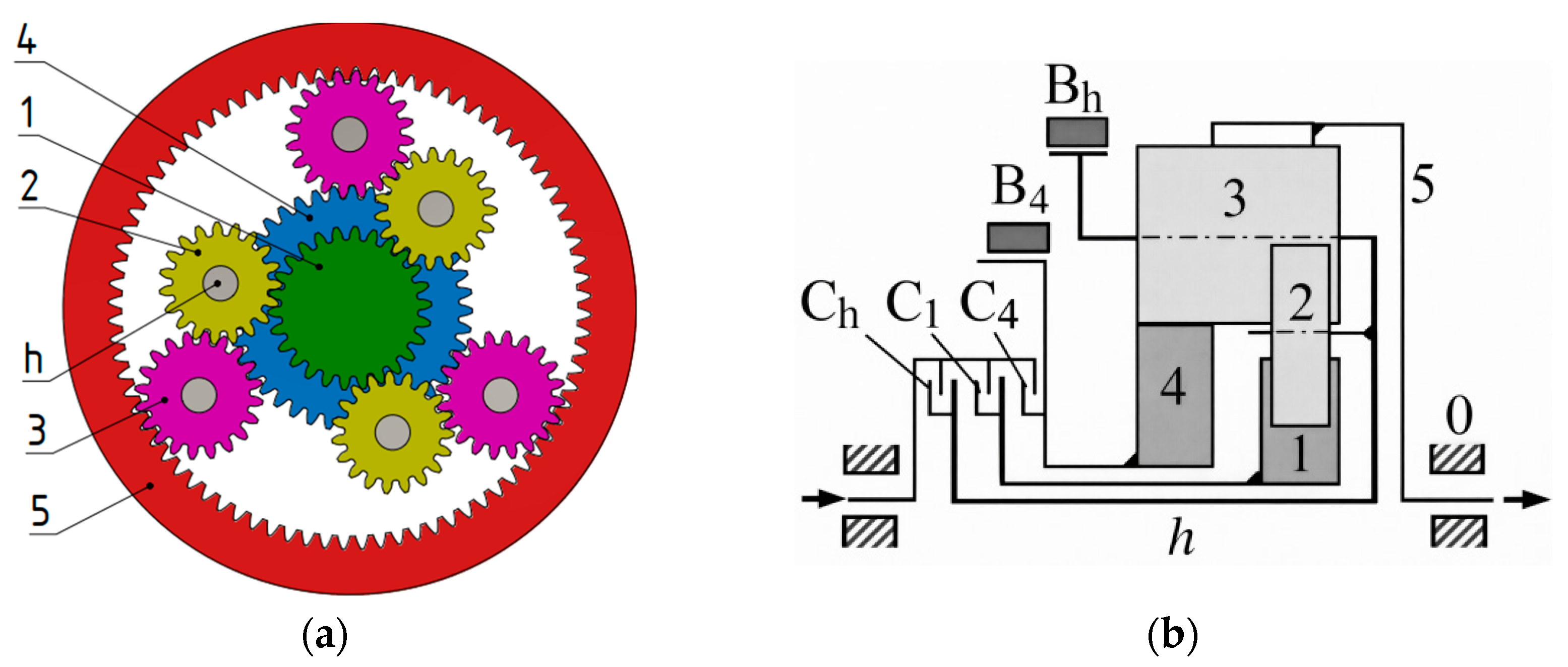
Figure 1a shows the most commonly used variant of the Ravigneaux planetary gear, defined by patent US2195783 [8]. The sun gear (1) is coupled to the satellite (2), which further transmits motion to the satellite (3). The satellite (3) is simultaneously coupled to the sun gear (4) and to the gear ring (5), as a result of which it is exposed to the greatest loads during the transmission of power and motion. In order to reduce the overall dimensions of the gear, the satellite (3) is often placed at a certain angle to the vertical plane in practice, which further complicates the kinematics and dynamics of the system.
The principle of operation of the RPGT will be explained on the Borg-Warner M85 automatic transmission, shown in Figure 1b. In addition to the transmission mechanism, the transmission consists of three clutches (S1, S2, and S3) and two band brakes (V1 and V2). The gear ring (2) is taken as the output element of the transmission. By engaging the appropriate clutch Ci and brake Bj, one of the central components of the RPGT is connected to the input shaft, while the other is fixed to the housing. In this way, four speeds for forward movement and one for reverse movement are obtained. Table 1 shows the possible combinations of connecting the central elements of the RPGT with clutches and brakes, where the “×” symbol indicates that the appropriate clutch or brake is active. The gear ratio for a specific speed is defined as R i , j k , where (i) is the input, (j) is the output, and (k) is the fixed component of the RPGT [11].
The gear ratios for all possible combinations of an RPGT with seven kinematic links and two degrees of freedom were given by Novaković et al. in [23]. The resulting expressions, shown in Table 2, depend solely on the number of teeth of the central gears.
Based on the known values of the gear ratios of the first and fourth gears, as well as the known number of teeth of the central gear (1) and the angle of rotation of the satellites (3), the number of teeth of the remaining gears will be determined analytically, while satisfying all geometric conditions for proper meshing and assembly.

3. Conditions for Proper Assembly and Meshing

For proper operation and correct assembly of all components of a planetary gear, the following conditions must be met [34]:
  • The concentric condition;
  • The neighbour condition;
  • The assembly condition;
  • Additional conditions, such as the condition of the difference in gear ratios or the condition of avoiding interference during meshing.

3.1. Concentric Condition

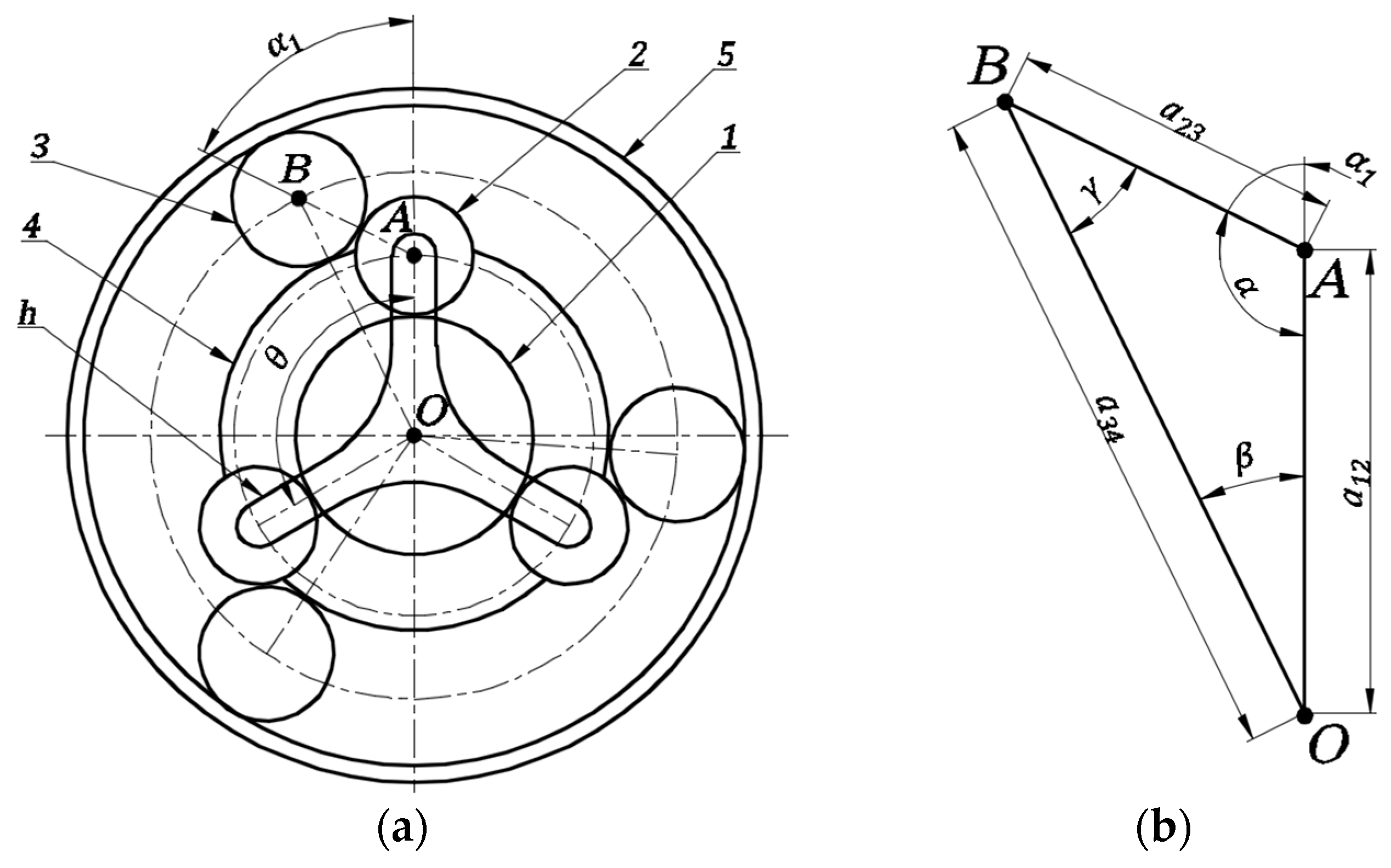
The concentricity of the elements of the Ravigneaux planetary gear is shown in Figure 2, where the labels of the individual elements are identical to those in Figure 1a. The angle θ represents the angle between neighbour satellites, while α 1 is the angle of rotation of the satellite (3) relative to the vertical plane of the gear.
By knowing the values of the gear ratio i 1 , 5 h and i h , 5 4 , as well as the number of teeth of the sun gear z 1 , based on Table 2, expressions for the number of teeth z 4 and z 5 were obtained, which are presented by Equations (1) and (2). The INT function in the equations indicates that the calculated values must be integers.
z 5 = I N T i 1 , 5 h × z 1
z 4 = I N T 1 i h , 5 4 i h , 5 4 × z 5
In Figure 2a, there is a triangle OAB, whose sides correspond to the axial distances between the meshed gears. This triangle is isolated and shown in Figure 2b. The following applies to it:
O B ¯ = a 34 = a 35 m 2 × z 3 + z 4 = m 2 × z 5 z 3 .
Equation (3) is valid for the case of zero and v–zero gear pairs, provided that all gears have the same module. From Equation (3), the number of teeth of the satellite (3) can be expressed:
z 3 = z 5 z 4 2 ,
where the obtained value must be a whole number. If this is not the case, it is necessary to correct the number of teeth of gear (4) and/or (5).
It remains to determine the number of teeth of the satellite (2). Its expression is more complex due to the presence of the angle of rotation α 1 , which further complicates the geometric relationships between the meshing gears. By applying the cosine theorem to the triangle OAB from Figure 2b, the length of the side O B ¯ can be expressed in the following form:
O B ¯ 2 = O A ¯ 2 + A B ¯ 2 2 × O A ¯ × A B ¯ × cos α ,
where α is the interior angle of triangle OAB. Arranging expression (5), the following expression is formed:
z 3 + z 4 2 = z 1 + z 2 2 + z 2 + z 3 2 2 × z 1 + z 2 × z 2 + z 3 × cos α .
According to the trigonometric circle:
cos α = cos 180 ° α 1 = cos α 1 .
By substituting expression (7) into Equation (6) and rearranging it, the final expression for the number of teeth of the satellite (2) is obtained:
z 2 = I N T 1 2 × z 1 z 3 2 + 2 × z 3 + z 4 2 z 1 z 3 2 1 + cos α 1 z 1 + z 3 ,
where the INT function indicates that the obtained value is rounded to an integer. To determine the number of teeth, z 2 , it is necessary to adopt the angle α 1 as an input parameter.

3.2. Neighbour Condition

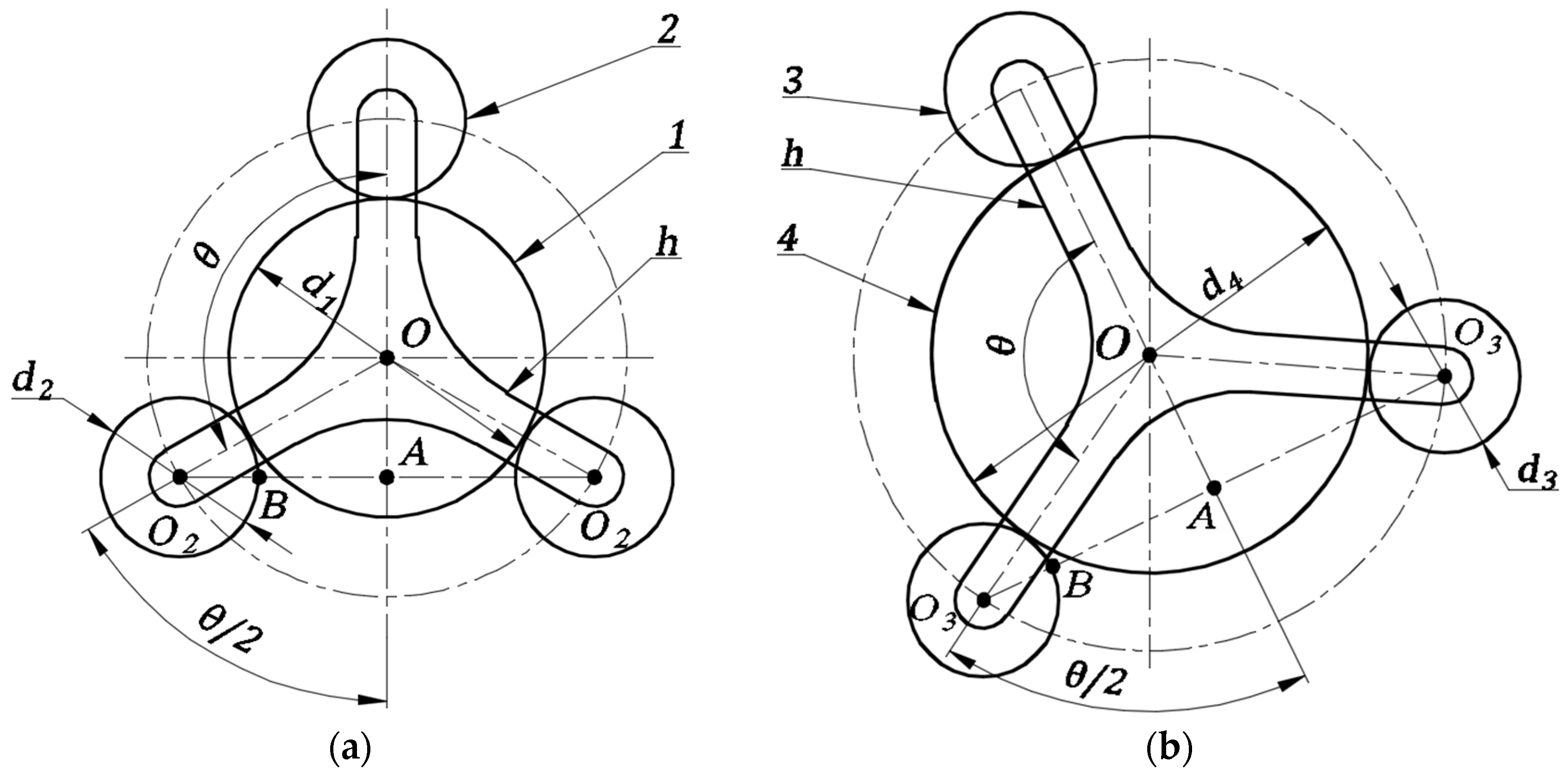
When analysing the neighbour conditions of the Ravigneaux planetary gear, the coupling of the satellites with the central gears is considered. In this way, the gear can be reduced to three gear pairs: (1)–(2), (3)–(4), and (3)–(5). Since the axial distances a 34 and a 35 are equal, it is sufficient to analyse the pair (3)–(4). Figure 3 shows the proximity conditions for gear pairs (1)–(2) and (3)–(4).
To achieve the required gap between neighbour satellites shown in Figure 3a, the following condition must be met:
O 2 A ¯ > B O 2 ¯ ,
where
A O 2 ¯ = O O 2 ¯ × sin θ 2 = m 2 × z 1 + z 2 × sin π N ,
B O 2 ¯ = d a 2 2 = m 2 × z 2 + 2 × m .
After replacement and arrangement, the limit for the number of satellites is obtained:
N < π arcsin z 2 + 2 z 1 + z 2 .
Similarly, for gear pair (3)–(4), the following applies:
N < π arcsin z 3 + 2 z 3 + z 4 .
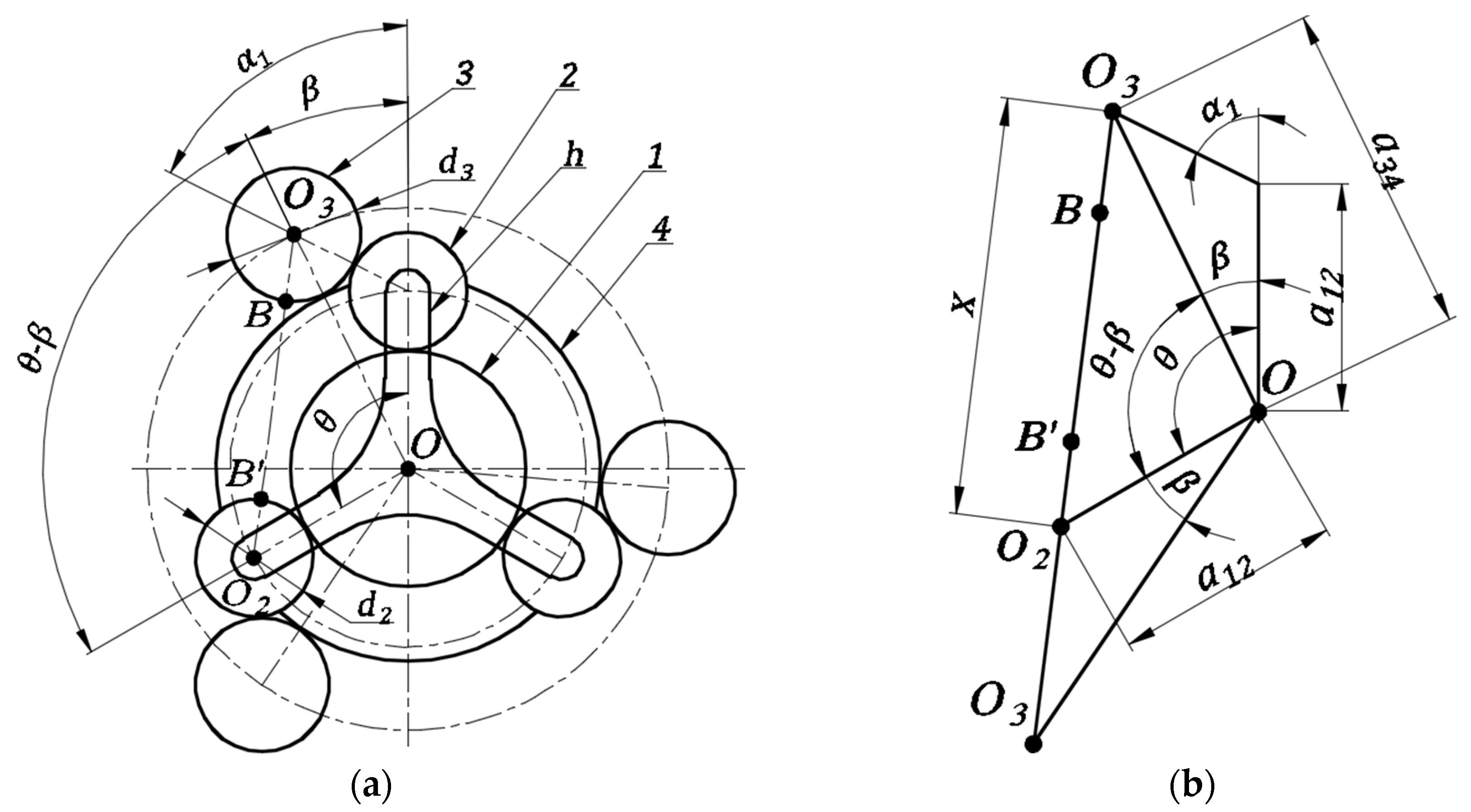
At higher values of the rotation angle, α 1 , interference between satellites (2) and (3) may occur (Figure 4a). Observing the triangle O O 3 O 2 from Figure 4b, the condition for achieving the required clearances between satellites (2) and (3) is:
O 3 O 2 ¯ > O 3 B ¯ + B O 2 ¯ x > d a 3 2 + d a 2 2 .
Applying the cosine theorem to the distance x and substituting the expressions for the vertex diameters d a 2 and d a 3 , we obtain:
N < 2 π arc cos z 1 + z 2 2 + z 3 + z 4 2 z 2 + z 3 + 4 2 2 × z 1 + z 2 × z 3 + z 4 + β ,
where β is the interior angle of the triangle ΔOAB (Figure 2b) defined by the expression:
β = a r c t a n z 2 + z 3 × sin α 1 z 1 + z 2 + z 2 + z 3 × cos α 1 .
In addition, at higher values of z 2 and z 3 , as well as the angle α 1 , interference may occur between the satellite (3) and the sun gear (1). The condition for avoiding this phenomenon is:
O O 3 ¯ = a 34 > d a 1 2 + d a 3 2 ,
namely:
z 4 > z 1 + 4 .
By satisfying inequalities (12), (13) and (15), the maximum number of satellites that can be arranged in both rows of the Ravigneaux planetary gear transmission is determined, with the mandatory verification of condition (18).

3.3. Assembly Condition

The assembly condition of the Ravigneaux planetary gear transmission is considered based on its division into two simple planetary gears. In both cases, the output element is a gear ring (5), while in one gear, the input element is a gear (1), and in the other gear (4), with the satellite carrier (h) being stationary. This arrangement of input and output elements was adopted, taking into account the application of the RPGT in automatic transmissions.
Based on the analysed works [27,28,33,34], the following expressions for the assembly condition of the RPGT were obtained:
z 5 z 1 N = C ,
z 4 + z 5 N = C ,
where C denotes an integer value. From Equations (19) and (20), it follows that if the quotient of the difference or sum of the numbers of teeth of the sun gears and the number of satellites N is an integer value, it is possible to properly assemble the satellites and achieve correct meshing with the sun gears.

4. Analysis of Results and Discussion

In order to analyse the developed analytical procedure, its implementation in the Python 3.13 programming language was performed. The input parameters i 1 , 5 h = i 1 ,   i h , 5 4 = i 4 ,   z 1 and α 1 were defined in the form of given value ranges of the type y x 1 , x 2 , which enabled a systematic search for valid solutions. By applying the proposed analytical procedure, the maximum number of possible combinations of tooth numbers that simultaneously satisfy the conditions of concentricity, neighbour, and assembly was generated. Within the programme code, a check for the occurrence of interference during engagement was additionally implemented, i.e., the condition of avoiding gear tooth meshing at the minimum value of the gear module m = 1. For the analysis, a minimum number of satellites N = 3 was adopted, in accordance with the design requirements of planetary gears.
Table 3 shows the results obtained for the following ranges of input parameters: i 1 = 3 ÷ 3.5 , i 4 = 0.6 ÷ 0.7 , z 1 = 14 ÷ 30 and α 1 = 90 ÷ 120 ° . The total number of initially generated valid combinations was 28. However, it was observed that certain combinations differed exclusively in the values of the number of teeth z 2 and the angle α 1 , while the other parameters and gear ratios were identical. For this reason, additional filtering of the results was performed, whereby only those configurations that give mutually different values of gear ratios were retained. After this reduction, six characteristic combinations were obtained that represent constructively different solutions.
By comparing the obtained values of the gear ratios with the values shown in Table 1, which are valid for the Borg-Warner M85 automatic transmission, it can be seen that the differences are, in most cases, minimal. The largest deviation occurs in the first gear, which is a consequence of the purposeful choice of the range of values of the gear ratio i 1 . In this way, the stability of the proposed analytical procedure in relation to the real design is confirmed.
Gear ratios i 5 and i 6 refer to the concepts R h , 5 1 and R 4 , 5 1 , which in this specific case cannot be realised due to design limitations. These ratios are shown solely for the sake of completeness of the analysis and visualisation of all theoretically possible combinations of gear ratios of a given mechanism.
By comparing the obtained results with the works [19,31], which consider the RPGT with eight kinematic links, it can be seen that the values of the transmission ratios from Table 3 are comparable with the values presented in the cited literature. The values of the rotation angle of the outer satellite α 1 presented in Table 3 are somewhat smaller than the values presented in the work [31]. However, significantly smaller values of the number of teeth of all gears were also obtained. For example, in [31] the number of teeth, z 2 , for similar values of gear ratios was 108, while in [19] this value reached 132. In contrast, in this work, the values of z 2 vary in the range from 65 to 80, with the gear ratios kept within similar limits. These results indicate that the proposed analytical procedure allows for achieving comparable kinematic characteristics with significantly smaller numbers of teeth, which directly contributes to the reduction in overall dimensions and potential mass savings of the planetary gear.
A more meaningful comparison of the results can be made with [29], which refers to the synthesis of the number of teeth of a seven-linkage RPGT, i.e., a configuration identical to the model analysed in this paper. Although work [29] considered different gear modules and introduced a limitation on the maximum outer diameter of the gear ring, the obtained values of the gear ratios are comparable, and in some cases, they are slightly larger than the results shown in Table 3. In addition, in this comparison, smaller values of the number of teeth of the gear ring were obtained compared to the values given in [29], which further confirms the possibility of achieving a more compact design by applying the proposed analytical procedure.
The differences in the obtained values of the number of teeth can be partly attributed to variations in the input parameters, such as the range of gear ratios and the selected module values. However, the applied method itself also has a significant influence, as the proposed analytical approach incorporates all geometric and kinematic constraints. This enables a more direct exploration of the solution space, including configurations that are not necessarily identified by optimisation-based approaches.

5. Conclusions

In this paper, a unique and comprehensive analytical methodology has been developed for selecting the number of teeth of a Ravigneaux planetary gear with seven kinematic links and two degrees of freedom, while simultaneously satisfying all relevant conditions of proper meshing, concentricity, neighbour, and assembly. Starting from the given values of the characteristic gear ratios, the known number of teeth of one central gear, and the adopted angle of rotation of the outer satellite, analytical relations have been derived for determining the number of teeth of all remaining gears and gear ratios for each possible combination of connecting elements of the RPGT.
Unlike procedures based on complex optimisation methods, the proposed methodology allows for the direct generation of structurally feasible solutions, while simultaneously satisfying the conditions of concentricity, neighbour, and assembly, as well as the conditions of avoiding interference and tooth undercutting. In this way, it is ensured that all obtained solutions are not only kinematically correct but also practically applicable.
The implementation of the analytical procedure in the programming environment enabled a systematic search for possible solutions within the given ranges of input parameters. From the initially obtained combinations, additional filtering separated different configurations with mutually different gear ratios. The values of the number of teeth in the resulting configurations were in the ranges: z 1 = 20 ÷ 26 ,   z 2 = 14 ÷ 19 ,   z 3 = 20 ,   z 4 = 25 ÷ 40   a n d   z 5 = 65 ÷ 80 . The gear ratios for the first four gears varied in the ranges i 1 = 3.08 ÷ 3.54 ,   i 2 = 1.63 ÷ 1.76 ,   i 3 = 1 ,   i 4 = 0.67 ÷ 0.72   a n d   i R = 2 ÷ 2.6 . Comparing the obtained gear ratios with real data for the Borg-Warner M85 automatic transmission, a high level of agreement was established, with minimal deviations.
By comparing the results available in the literature, especially with papers related to RPGT with seven and eight kinematic links, it was shown that the proposed method allows the achievement of comparable transmission ratios with significantly lower tooth numbers of individual gears, especially the gear ring. This directly contributes to the reduction in overall dimensions and potential mass savings of the planetary gear, which is of particular importance in modern power transmission systems.
The developed procedure shows that the synthesis of the number of teeth of a seven-link planetary gear train can be reduced to a single analytical model, which simultaneously includes all relevant geometric and assembly constraints. This formulation represents a significant contribution to the improvement of methods for the synthesis of complex planetary gears.
As a direction for future research, the extension of the methodology to the Ravigneaux planetary gear train with eight kinematic links, with the integration of dynamic and energy criteria, as well as the connection of the analytical procedure with multi-criteria optimisation in order to further improve the design characteristics of planetary gears, is suggested.

Author Contributions

Conceptualisation, B.S. and L.I.; methodology, S.Č. and F.M.; software, S.Č. and F.M.; validation, S.Č., B.S. and L.I.; formal analysis, S.Č.; investigation, S.M. and S.G.; data curation, F.M.; writing—original draft preparation, S.Č. and S.G.; writing—review and editing, S.M., B.S. and L.I.; visualisation, S.M.; supervision, S.G.; All authors have read and agreed to the published version of the manuscript.

Funding

This research received no external funding.

Data Availability Statement

The original contributions presented in this study are included in the article material. Further inquiries can be directed to the corresponding author.

Acknowledgments

This work has been performed as a part of activities within the projects 451-03-33/2026-03/200107 and 451-03-34/2026-03/200107 supported by the Republic of Serbia, Ministry of Science, Technological Development and Innovation.

Conflicts of Interest

The authors declare no conflicts of interest.

References

  1. Hsieh, H.-I.; Tsai, L.-W. A Methodology for Enumeration of Clutching Sequences Associated with Epicyclic-Type Automatic Transmission Mechanisms. In Proceedings of the International Congress & Exposition, Detroit, MI, USA, 26 February 1996; SAE International: Warrendale, PA, USA, 1996; p. 960719. [Google Scholar] [CrossRef]
  2. Pennestri, E.; Valentini, P.P. A Review of Formulas for the Mechanical Efficiency Analysis of Two Degrees-of-Freedom Epicyclic Gear Trains. J. Mech. Des. 2003, 125, 602–608. [Google Scholar] [CrossRef]
  3. Wu, J.; Wei, P.; Zhu, C.; Zhang, P.; Liu, H. Development and Application of High Strength Gears. Int. J. Adv. Manuf. Technol. 2024, 132, 3123–3148. [Google Scholar] [CrossRef]
  4. Hyatt, G.; Piber, M.; Chaphalkar, N.; Kleinhenz, O.; Mori, M. A Review of New Strategies for Gear Production. Procedia CIRP 2014, 14, 72–76. [Google Scholar] [CrossRef]
  5. Politis, D.J.; Politis, N.J.; Lin, J. Review of Recent Developments in Manufacturing Lightweight Multi-Metal Gears. Prod. Eng. 2021, 15, 235–262. [Google Scholar] [CrossRef]
  6. Concli, F. Tooth Root Bending Strength of Gears: Dimensional Effect for Small Gears Having a Module below 5 Mm. Appl. Sci. 2021, 11, 2416. [Google Scholar] [CrossRef]
  7. Ravigneaux, P. Speed Changing Device. U.S. Patent 2,220,174, 5 November 1940. [Google Scholar]
  8. Ravigneaux, P. Gear Box with Free Wheeling Gear. U.S. Patent 2,195,783, 2 April 1940. [Google Scholar]
  9. Lechner, G.; Naunheimer, H. Automotive Transmissions: Fundamentals, Selection, Design and Application; Springer Science & Business Media: Berlin/Heidelberg, Germany, 1999. [Google Scholar]
  10. Tsai, L.-W.; Maki, E.; Liu, T.; Kapil, N. The Categorization of Planetary Gear Trains for Automatic Transmissions According to Kinematic Topology. In Proceedings of the 22nd FISITA Congress, PA, USA, 21 July 2002; SAE International: Warrendale, PA, USA, 1988; p. 885062. [Google Scholar] [CrossRef]
  11. Wilfinger, E.; Thompson, J. Borg-Warner Australia Model 85 Automatic Transmission. In Proceedings of the SAE International Congress and Exposition, Detroit, MI, USA, 29 February 1988; SAE International: Warrendale, PA, USA, 1988; pp. 526–535. [Google Scholar] [CrossRef]
  12. Morise, M.; Kinosita, M.; Tanaka, M.; Kouno, K. Toyota’s U340E Four-Speed Automatic Transaxle. In Proceedings of the SAE 2000 World Congress, Detroit, MI, USA, 6 March 2000; 2000-01–1147; SAE International: Warrendale, PA, USA, 2000. [Google Scholar] [CrossRef]
  13. Scherer, H. ZF 6-Speed Automatic Transmission for Passenger Cars. In Proceedings of the SAE 2003 World Congress & Exhibition, Detroit, MI, USA, 3 March 2003; 2003-01–0596; SAE International: Warrendale, PA, USA, 2003. [Google Scholar] [CrossRef]
  14. Greiner, J.; Doerr, C.; Nauerz, H.; Graeve, M. The New “7G-TRONIC” of Mercedes-Benz: Innovative Transmission Technology for Better Driving Performance, Comfort and Fuel Economy. In Proceedings of the SAE 2004 World Congress & Exhibition, Detroit, MI, USA, 8 March 2004; 2004-01–0649; SAE International: Warrendale, PA, USA, 2004. [Google Scholar] [CrossRef]
  15. Benford, H.L.; Leising, M.B. The Lever Analogy: A New Tool in Transmission Analysis. In Proceedings of the SAE International Congress and Exposition, Detroit, MI, USA, 23 February 1981; SAE International: Warrendale, PA, USA, 1981; p. 810102. [Google Scholar] [CrossRef]
  16. Talpasanu, I.; Yih, T.; Simionescu, P. Application of Matroid Method in Kinematic Analysis of Parallel Axes Epicyclic Gear Trains. J. Mech. Des. 2006, 128, 1307–1314. [Google Scholar] [CrossRef]
  17. Mathis, R.; Remond, Y. Kinematic and Dynamic Simulation of Epicyclic Gear Trains. Mech. Mach. Theory 2009, 44, 412–424. [Google Scholar] [CrossRef]
  18. Esmail, E.L.; Hussen, H.A. Nomographs for Kinematics, Statics and Power Flow Analysis of Epicyclic Gear Train. In Proceedings of the ASME 2009 International Mechanical Engineering Congress and Exposition; ASME: Lake Buena Vista, FL, USA, 2009; pp. 631–640. [Google Scholar]
  19. Esmail, E.L. Nomographs and Feasibility Graphs for Enumeration of Ravigneaux-Type Automatic Transmissions. Adv. Mech. Eng. 2013, 2013, 120324. [Google Scholar] [CrossRef]
  20. Esmail, E.L. Configuration Design of Ten-Speed Automatic Transmissions with Twelve-Link Three-DOF Lepelletier Gear Mechanism. J. Mech. Sci. Technol. 2016, 30, 211–220. [Google Scholar] [CrossRef]
  21. Yu, R.; Zhao, W.; Li, Y. Rules and Optimization-Based Topology and Parameter Synthesis of Multi-Speed Ravigneaux Automatic Transmissions. J. Braz. Soc. Mech. Sci. Eng. 2022, 44, 334. [Google Scholar] [CrossRef]
  22. Yang, W.; Li, Y.; Ding, H. Configuration Design of Planetary Gear Mechanisms of Automatic Transmissions Based on the Tree Graph and Structure Constraints. Mech. Mach. Theory 2024, 197, 105644. [Google Scholar] [CrossRef]
  23. Novakovic, M.; Stojanovic, B.; Milisavljević, M.; Miladinovic, S. The Kinematic Analysis of Ravigneaux Planetary Gear Set. Tech. Diagn. 2016, 15, 7–12. [Google Scholar]
  24. Stanojević, M.; Milojević, S.; Marić, D.; Stojanović, B. Influence of Gears and Oil Levels Upon Efficiency of Ravigneaux Gearset. Teh. Vjesn.-Tech. Gaz. 2025, 32, 2048–2055. [Google Scholar] [CrossRef]
  25. Su, J.; Ouyang, Y.; Yin, L.; Shi, Z.; Zhou, C.; Wang, H.; Hu, B. Advancing Wind Turbine Gearbox Durability with Eco-Friendly GO Nanolubricants: CFD Simulation–Experiment Synergy for Understanding Flow Dynamics, Wear Suppression and Surface Restoration Mechanisms. Tribol. Int. 2026, 213, 111034. [Google Scholar] [CrossRef]
  26. Ciobotaru, T.; Alexa, O.; Vînturiș, V. Generalized Method for Analysis of Compound Epicyclic Gear Trains. Rom. J. Phys. 2025, 70, 903. [Google Scholar] [CrossRef]
  27. Kelley, O.K. The Design of Planetary Gear Trains. In Proceedings of the Pre-1964 SAE Technical Papers, Warrendale, PA, USA, 1 January 1906; SAE International: Warrendale, PA, USA, 1959; p. 590059. [Google Scholar] [CrossRef]
  28. Simionescu, P. A Unified Approach to the Assembly Condition of Epicyclic Gears. J. Mech. Des. 1998, 120, 448–452. [Google Scholar] [CrossRef]
  29. Simionescu, P.; Beale, D.; Dozier, G.V. Teeth-Number Synthesis of a Multispeed Planetary Transmission Using an Estimation of Distribution Algorithm. J. Mech. Des. 2005, 128, 108–115. [Google Scholar] [CrossRef]
  30. Hwang, W.-M.; Huang, Y.-L. Configuration Design of Six-Speed Automatic Transmissions with Two-Degree-of-Freedom Planetary Gear Trains. Trans. Can. Soc. Mech. Eng. 2005, 29, 41–55. [Google Scholar] [CrossRef]
  31. Hsu, C.-H.; Huang, R.-H. Systematic Design of Six-Speed Automatic Transmissions with an Eight-Link Two-DOF Ravigneaux Gear Mechanism. J. Mech. Des. 2008, 131, 011004. [Google Scholar] [CrossRef]
  32. Esmail, E.L. Nomographs for Synthesis of Epicyclic-Type Automatic Transmissions. Meccanica 2013, 48, 2037–2049. [Google Scholar] [CrossRef]
  33. Kwon, H.; Kahraman, A.; Lee, H.; Suh, H. An Automated Design Search for Single and Double-Planet Planetary Gear Sets. J. Mech. Des. 2014, 136, 061004. [Google Scholar] [CrossRef]
  34. Zou, N.; Wei, Y.; Chang, S.; Zhou, D. Single Planetary Mechanism Teeth Matching Conditions. In Proceedings of the 2015 International Conference on Advanced Manufacturing and Industrial Application; Atlantis Press: Dordrecht, The Netherlands, 2015; pp. 42–45. [Google Scholar]
  35. Esmail, E.L.; Ali, T.N.; Hussen, H.A.; Juber, A.H. Kinematic Analysis of Automatic Transmissions with Planetary Gear Trains. Int. J. Mech. Eng. Technol. 2018, 9, 2213–2225. [Google Scholar]
Figure 1. (a) Ravigneaux planetary gear; (b) Borg-Warner M85 [35].
Applsci 16 04231 g001
Figure 2. (a) The coaxiality of the RPGT elements and (b) the coaxiality triangle.
Applsci 16 04231 g002
Figure 3. (a) Gear pair 1–2; (b) Gear pair 3–4.
Applsci 16 04231 g003
Figure 4. (a) The neighbour condition between satellites (2) and (3). (b) The neighbour condition triangle O O 3 O 2 .
Applsci 16 04231 g004
Table 1. The gear ratios of the BMW85 automatic transmission [35].
SpeedC1C4ChB4BhGear Ratio
I× × i 1,5 h = 2.393
II× × i 1,5 4 = 1.45
III× × 1
IV ×× i h , 5 4 = 0.677
R × × i 4,5 h = 2.094
Table 2. The expressions for transmission ratios of different RPGT concepts [19].
Conception R 1 , 5 h R 1 , 5 4 R h , 5 4 R 4 , 5 h R h , 5 1 R 4 , 5 1
ipp z 5 z 1 z 1 + z 4 × z 5 z 4 + z 5 × z 1 z 5 z 4 + z 5 z 5 z 4 z 5 z 5 z 1 z 5 × z 4 + z 1 z 4 × z 5 z 1
Table 3. Results of analytical synthesis of the numbers of teeth and gear ratios of the RPGT.
No.z1z2z3z4z5α1i1i2i3i4iRi5i6
1.2619204080903.0771.69210.667−22.4441.482
2.231520317191.53.0871.63410.696−2.2902.5771.479
3.2317203474913.2171.69810.685−2.1772.4331.451
4.201420256597.13.251.62510.722−2.62.61.444
5.231920377790.63.3481.76210.675−2.0812.3121.426
6.201420286890.23.41.710.708−2.4292.4291.417
Disclaimer/Publisher’s Note: The statements, opinions and data contained in all publications are solely those of the individual author(s) and contributor(s) and not of MDPI and/or the editor(s). MDPI and/or the editor(s) disclaim responsibility for any injury to people or property resulting from any ideas, methods, instructions or products referred to in the content.