Article

Nitrogen Biostimulation of Petroleum-Contaminated Sandy Podzolic Soil Under Boreal Conditions: Effects of Temperature, Nitrogen Form, and Contamination Level

by
Artur V. Duryagin
1,
Ruslan Ya. Bajbulatov
1 and
Oleg S. Sutormin
1,2,*
1
Scientific and Educational Center, Institute of Nature and Technical Sciences, Surgut State University, Surgut 628412, Russia
2
Department of Biophysics, School of Fundamental Biology and Biotechnology, Siberian Federal University, Krasnoyarsk 660041, Russia
*
Author to whom correspondence should be addressed.
Appl. Sci. 2026, 16(9), 4190; https://doi.org/10.3390/app16094190
Submission received: 28 March 2026 / Revised: 18 April 2026 / Accepted: 22 April 2026 / Published: 24 April 2026

Featured Application

This study provides a factorial experimental assessment of nitrogen-assisted biostimulation in petroleum-contaminated sandy podzolic soil under boreal conditions and identifies the temperature regime, nitrogen form, and contamination level as key variables influencing remediation efficiency. The findings may support the selection of nitrogen amendments for laboratory-scale optimization and future pilot-scale remediation design in cold regions.

Abstract

Petroleum contamination of soils remains a significant environmental problem in boreal regions, where low temperatures constrain natural attenuation processes and complicate bioremediation. Nitrogen biostimulation is widely used to enhance petroleum hydrocarbon degradation; however, the combined effects of temperature regime, nitrogen form, contamination level, and nitrogen dosage remain insufficiently resolved for sandy podzolic soils of northern regions. This study investigated nitrogen-assisted biostimulation of petroleum-contaminated sandy podzolic soil collected in the Khanty–Mansi Autonomous Okrug (Western Siberia, Russia) using a factorial experimental design. Soil samples were artificially contaminated with crude oil at concentrations of 25, 50, and 100 g kg−1 and incubated under warm and cold temperature regimes. Two nitrogen sources, urea and ammonium nitrate, were applied at several dosages. Changes in residual petroleum hydrocarbon content were monitored together with the abundance of culturable microorganisms under the applied cultivation conditions at the intermediate contamination level on day 60. Nitrogen supplementation enhanced petroleum hydrocarbon removal relative to the untreated control, but the magnitude of the effect depended substantially on temperature, nitrogen form, and contamination level. Under the tested conditions, ammonium nitrate was generally associated with stronger hydrocarbon removal than urea, particularly at the intermediate contamination level (50 g kg−1). The results indicate that the response to nitrogen biostimulation in sandy boreal soils is controlled by interacting experimental factors rather than by nitrogen addition alone. These findings improve the positioning of nutrient-assisted remediation in cold-region soils and provide a basis for future mechanistic and field-scale studies.

1. Introduction

Petroleum contamination of soil remains a major environmental problem in regions with intensive oil extraction, transport, and storage. Once introduced into soil, petroleum hydrocarbons can alter soil physical properties, impair gas exchange and water relations, suppress biological activity, disrupt nutrient cycling, and create long-term ecological risks for terrestrial ecosystems and adjacent water resources [1,2,3,4]. These risks are especially significant in northern oil-producing regions, where adverse climatic conditions slow natural attenuation processes and prolong the persistence of contaminants in soil [3,4,5,6]. Therefore, the development of effective and environmentally compatible remediation strategies remains a priority in contaminated-land management [1,2,3,4].
Among the available remediation options, bioremediation is widely regarded as one of the most promising approaches for petroleum-contaminated soils because it relies on the metabolic potential of microorganisms and can often be implemented with lower disturbance and lower resource demand than intensive physicochemical treatments [1,2,3,4,5]. In particular, biostimulation aims to enhance the activity of indigenous hydrocarbon-degrading microorganisms by correcting the main environmental constraints that limit biodegradation, including nutrient imbalance, insufficient aeration, and suboptimal moisture conditions [3,4,5]. Nitrogen availability becomes a key limiting factor after oil spills because hydrocarbon inputs sharply increase the C/N ratio and can restrict microbial growth and enzyme synthesis even when an active degradative microbial community is present [3,5,7,8,9].
This limitation becomes more pronounced in boreal and other cold-climate soils. Low temperatures reduce the rates of enzymatic reactions, microbial metabolism, contaminant diffusion, and mass transfer processes, while also influencing oil viscosity and hydrocarbon bioavailability [5,6]. As a result, petroleum hydrocarbons may persist for long periods in cold regions, making the optimization of bioremediation under low-temperature conditions particularly important [5,6]. At the same time, recent studies have shown that microorganisms from hydrocarbon-contaminated Arctic soils can remain metabolically active even at temperatures below the freezing point, indicating that the key challenge is not the impossibility of biodegradation itself, but rather the identification of site-adapted environmental conditions that allow this process to proceed efficiently [6].
Although nitrogen amendment is widely used in biostimulation, there is still no consensus regarding the optimal nitrogen dose or the most suitable nitrogen form for petroleum-contaminated soils. Recent studies have shown that the remediation response depends on both the amount and the chemical form of added nitrogen, as well as on soil properties and the level of hydrocarbon contamination [7,8,9,10]. Moderate nitrogen supplementation may enhance petroleum hydrocarbon removal and improve ecological recovery, whereas excessive nitrogen inputs do not necessarily produce better remediation outcomes and may even redirect microbial metabolism toward nitrogen cycling rather than hydrocarbon degradation [8,9]. In addition, the chemical form of nitrogen also plays an important role: urea requires hydrolysis before mineral nitrogen becomes readily available to microorganisms, whereas ammonium- and nitrate-containing fertilizers can provide more immediately accessible nitrogen sources, although their effectiveness may still depend on site conditions and temperature regime [9,10]. These findings indicate that nutrient-assisted bioremediation should be considered a site-specific optimization problem rather than a universal remediation measure.
This issue is particularly relevant for nutrient-poor sandy podzolic soils of boreal regions, where low organic matter content, acidic reactions, and limited mineral nutrient reserves may further constrain microbial degradation of petroleum hydrocarbons. Most previous studies have examined individual components of nitrogen-assisted bioremediation, such as temperature effects, nitrogen dose, or nitrogen form, in separate experimental settings. By contrast, studies that evaluate temperature regime, initial contamination level, nitrogen form, and nitrogen dosage simultaneously within a unified factorial design remain limited, especially for sandy podzolic soils of boreal regions. As a result, the relative importance of these factors and their combined influence on petroleum hydrocarbon degradation are still insufficiently resolved for nutrient-poor northern soils. Addressing this knowledge gap is important from both mechanistic and applied perspectives, because remediation decisions in northern oil-producing regions often rely on simple, scalable, and cost-effective nutrient amendments that can be implemented under field conditions.
Therefore, the aim of this study was to assess the effect of nitrogen biostimulation on the degradation of petroleum hydrocarbons in sandy podzolic soil representative of Western Siberia (Khanty–Mansi Autonomous Okrug–Yugra, Russia), with particular attention to the influence of temperature regime, nitrogen form, and initial contamination level. Crude oil contamination was modeled at three levels (25, 50, and 100 g·kg−1), and two nitrogen sources—urea and ammonium nitrate—were applied at several dosages under warm and cold incubation regimes. Unlike studies focused on single-factor optimization, the present work applies a factorial experimental design to compare the combined effects of these variables within one soil system. The response of the soil system was evaluated using changes in residual petroleum hydrocarbon content and the abundance of culturable microorganisms under the applied cultivation conditions. In this way, this study was designed not only to confirm the general stimulatory role of nitrogen addition but also to clarify how temperature, nitrogen form, contamination level, and dosage jointly shape hydrocarbon degradation in sandy boreal soils.

2. Materials and Methods

2.1. Soil Sampling and Characterization

This study was conducted using sandy podzolic soil collected in the city of Surgut (Khanty–Mansi Autonomous Okrug–Yugra, Western Siberia, Russia; 61°18′45.29″ N, 73°24′10.74″ E). The sampling site was characterized by moderate anthropogenic influence, including proximity to urban infrastructure and periodic exposure to low-intensity anthropogenic disturbances typical for peri-urban areas of Surgut, without direct recent petroleum contamination.
Soil samples were collected from the upper soil horizon (0–20 cm) using the envelope sampling method to obtain a representative composite sample [11,12]. Five individual subsamples of approximately 1 kg each were collected and combined into a composite sample of approximately 5 kg. After transportation to the laboratory, the soil was air-dried at room temperature (20–22 °C) under natural ventilation for 48 h to remove excess moisture while minimizing thermal alteration of microbial and physicochemical properties, and then homogenized. Typical soil parameters measured before contamination included granulometric composition, pH, exchangeable bases, hydrolytic acidity, humus content, mineral nitrogen forms, and available phosphorus [13,14].
Granulometric analysis of the soil was performed using the sieve method with mesh sizes of 5, 2, 1, 0.5, and 0.1 mm [13]. According to the particle-size analysis, the soil consisted predominantly of sandy fractions (approximately 97%), with a dominant proportion of fine sand particles (91.91%). According to the classification of Kachinsky, the soil corresponds to loose sandy soil [15].
The physicochemical properties of the soil were determined prior to the experiment. Soil pH (water extract) was 5.36 ± 0.30 [14]. The sum of exchangeable bases was 13.41 ± 0.82 mg eq per 100 g of soil, and hydrolytic acidity was 8.66 ± 0.77 mg eq per 100 g of soil. The organic matter (humus) content was 1.62 ± 0.07%. The soil was characterized by low concentrations of mineral nutrients, including ammonium nitrogen (0.63 ± 0.03 mg kg−1), nitrate nitrogen (1.10 ± 0.07 mg kg−1), and available phosphorus (1.17 ± 0.09 mg kg−1).

2.2. Experimental Design

A laboratory experiment was conducted to investigate the influence of nitrogen amendments and temperature on the degradation of petroleum hydrocarbons in soil.
Crude oil from the Fedorovskoye oil field (Khanty–Mansi Autonomous Okrug–Yugra, Russia), classified as light oil with a density of 0.818 g cm−3, was used to artificially contaminate the soil. Three contamination levels were established: 25, 50, and 100 g kg−1 relative to the dry soil mass. These contamination levels were selected to represent a wide experimental range, including heavily contaminated scenarios typical for accidental spills and legacy pollution sites, and to evaluate system response under conditions where physicochemical and biological limitations may become pronounced. After contamination, the soil samples were thoroughly mixed manually using a stainless-steel spatula in glass containers until visually homogeneous distribution of oil was achieved.
For each contamination level, the soil was divided into seven treatment groups, including one control without nitrogen amendment and six treatments with nitrogen-containing fertilizers. Two nitrogen sources were used: urea applied at 10, 25, and 50 g kg−1 of soil; ammonium nitrate applied at 5, 15, and 30 g kg−1 of soil. Urea (pure for analysis; Khimreaktivsnab, Ufa, Russia) and ammonium nitrate (pure for analysis; Khimreaktivsnab, Ufa, Russia) were used. The selected dosages were designed to cover a broad experimental range exceeding typical agronomic application rates in order to identify dose-dependent effects under controlled laboratory conditions.
After preparation of the experimental variants, the samples were divided into two groups and incubated under two temperature regimes: warm conditions: 20–25 °C; cold conditions: 6–8 °C. These temperature regimes were selected to simulate warm and cold seasonal conditions typical of the study region. Samples were incubated in loosely covered glass containers to allow gas exchange under aerobic conditions. Soil moisture was maintained at approximately 60% of water holding capacity by periodic addition of distilled water. All samples were incubated in temperature-controlled chambers without forced aeration. The soil was not sterilized prior to incubation, and all experiments were conducted under natural microbial conditions.
In total, the experimental design included 42 experimental variants (3 contamination levels × 7 nitrogen treatments × 2 temperature regimes). The structure of the experimental design is summarized in Table 1.
The selected nitrogen dosages were intended to cover a broad experimental range in order to detect treatment-dependent responses across different contamination levels under controlled laboratory conditions. These dosages should therefore be interpreted as experimental levels for comparative evaluation rather than as direct recommendations for field-scale application.

2.3. Characterization of Crude Oil

The crude oil used for artificial contamination was characterized using Fourier-transform infrared spectroscopy (FTIR) (Shimadzu IRAffinity-1S, Kyoto, Japan) with attenuated total reflectance (ATR). Spectra were recorded in the range of 400–4000 cm−1 with 16 scans.
Based on the obtained spectra, aromaticity, oxidation, sulfurization, and paraffinicity coefficients were calculated from the ratios of optical density values in characteristic absorption regions [16]. These parameters were used to characterize the structural composition of the hydrocarbon mixture.
The analyzed oil had a density of approximately 0.818 g cm−3 and corresponded to light crude oil.

2.4. Determination of Petroleum Hydrocarbon Content

The concentration of petroleum hydrocarbons in soil samples was determined using a fluorometric method with a Fluorat-02-5M fluorometric analyzer (Lumex Instruments, Sankt-Peterburg, Russia) [17].
Prior to analysis, soil samples were air-dried, homogenized, and sieved through a 1 mm mesh. A weighed portion of 1.00 ± 0.01 g (dry weight) of soil was extracted with 10 mL of hexane in a glass conical flask using mechanical shaking at 200 rpm for 15 min. All extraction and handling procedures were performed using glassware to minimize potential adsorption of hydrocarbons onto plastic materials. The extract was filtered through filter paper and transferred into a 25 mL volumetric flask. The extraction vessel and filter were rinsed with additional hexane, and the combined extract was adjusted to the final volume.
Fluorescence intensity was measured using the fluorometric analyzer, and the concentration of petroleum hydrocarbons was calculated based on calibration data.
The mass concentration of petroleum hydrocarbons in soil (X) was calculated according to the following equation: X = (Cmeas × V × K) / m, where Cmeas is the hydrocarbon concentration in the extract (mg dm−3), V is the extract volume (dm3), K is the dilution coefficient, and m is the soil sample mass (g) [17].

2.5. Determination of Culturable Microorganisms

The abundance of culturable microorganisms was determined using the plate count method [18].
For microbiological analysis, soil suspensions were prepared by adding 1 g of soil to 9 mL of sterile distilled water to obtain the initial dilution (10−1). A series of decimal dilutions was then prepared.
Aliquots from appropriate dilutions were inoculated onto a solid synthetic nutrient medium containing (g L−1): Na2HPO4—4.5; KH2PO4—3.0; (NH4)2SO4—1.0; MgSO4—0.25. After incubation, colonies were counted and expressed as colony-forming units (CFU) per gram of soil. It should be noted that this method provides an estimate of culturable heterotrophic microorganisms capable of growth under the given conditions and does not allow strict selective quantification of hydrocarbon-degrading populations.
The number of microorganisms was calculated using the following equation: N = c/((n1 + 0.1n2) × d), where c is the total number of colonies counted, n1 and n2 are the numbers of plates at the first and second dilutions, and d is the dilution factor [19].

2.6. Statistical Analysis

Statistical analysis of the experimental data was performed using Microsoft Excel 2010 (Microsoft Corp., Redmond, WA, USA). Arithmetic mean values and standard deviations were calculated based on three independent replicates (n = 3) for each experimental variant. Differences between selected treatments were evaluated using Student’s t-test (p < 0.05). Because the study included multiple experimental factors, the statistical analysis was used primarily to support pairwise comparisons and trend identification rather than to provide a full factorial decomposition of main and interaction effects.

3. Results

3.1. Characterization of the Crude Oil Used for Soil Contamination

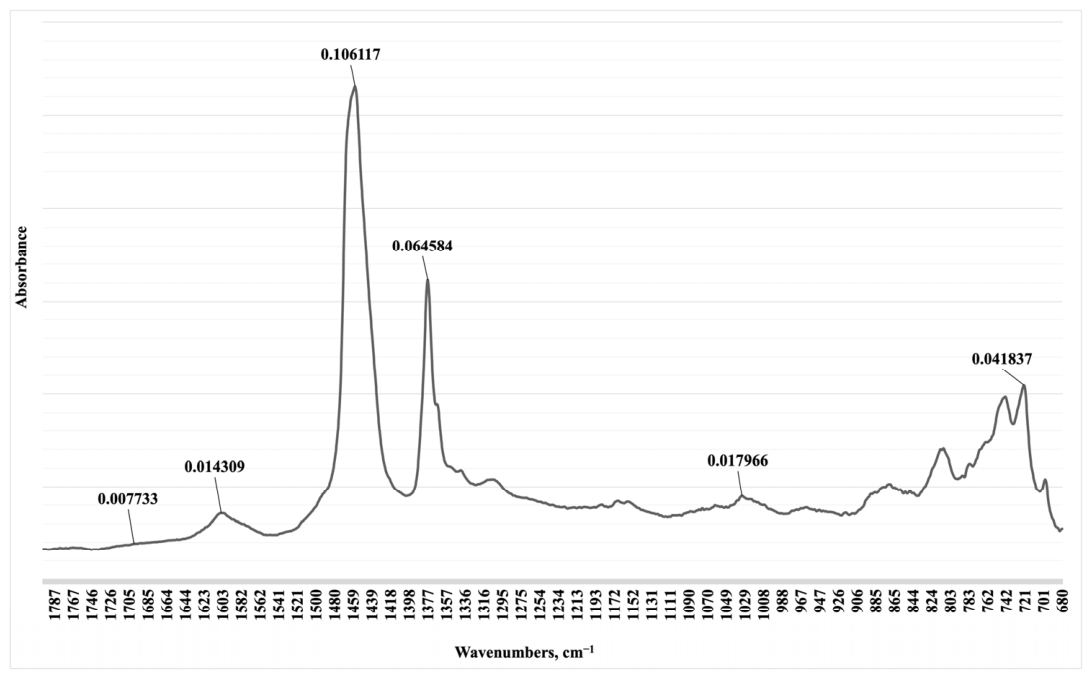
The crude oil used for artificial contamination was characterized by FTIR. The infrared spectrum of the oil is presented in Figure 1. The spectrum exhibits characteristic absorption bands typical of petroleum hydrocarbons.
Based on the FTIR spectrum, several structural coefficients describing the group composition of the oil were calculated (Table 2). The aromaticity coefficient (D1600/D720) was 0.342, indicating the presence of aromatic hydrocarbons in the oil composition. The oxidation coefficient (D1710/D1465) was 0.073, while the sulfurization coefficient (D1030/D1465) was 0.169. The paraffinicity coefficient ((D720 + D1380)/D1600) reached 7.437, suggesting a relatively high contribution of paraffinic hydrocarbons.
The analyzed oil had a density of 0.818 g cm−3, corresponding to light crude oil. Overall, the hydrocarbon mixture was characterized by the predominance of aliphatic hydrocarbons with moderate aromatic content and relatively low sulfur levels. These properties were considered when interpreting the degradation dynamics observed during the soil incubation experiments.

3.2. Natural Dynamics of Petroleum Hydrocarbon Concentration in Soil

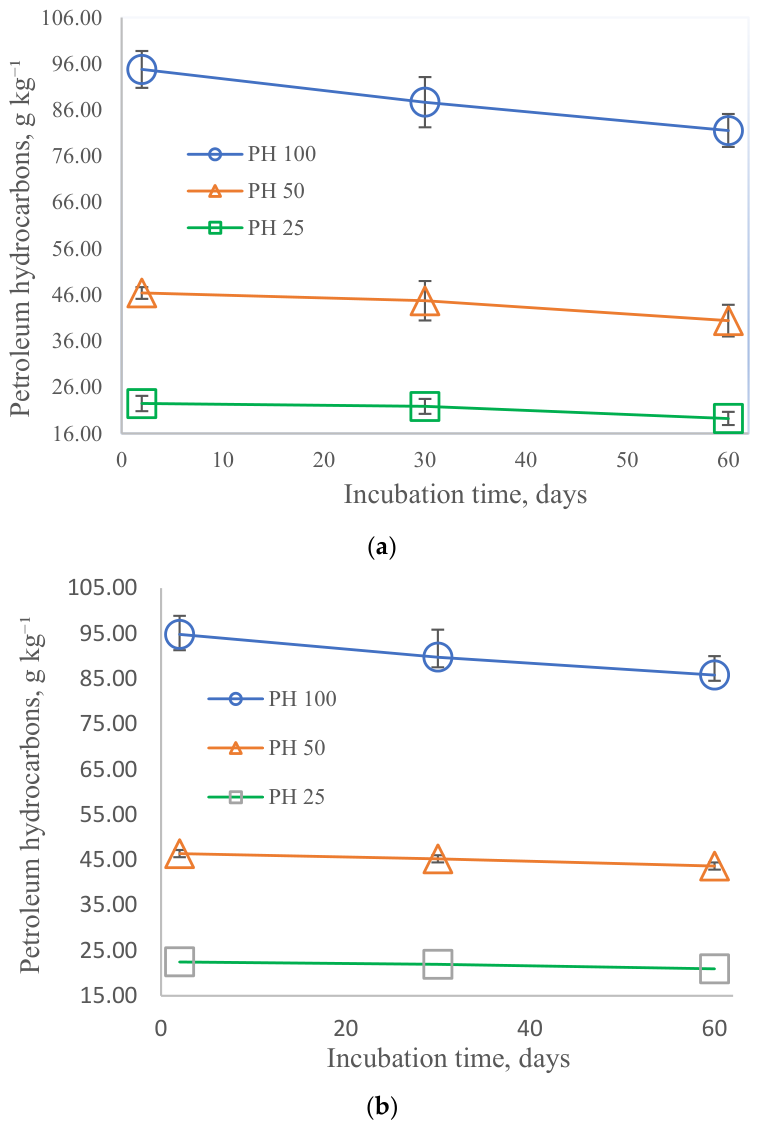
The natural dynamics of petroleum hydrocarbon concentration were first evaluated in control variants without nitrogen amendments. The first experimentally measured petroleum hydrocarbon concentrations were obtained on day 2 after contamination and homogenization and were used as the initial reference values in the study.
Under warm incubation conditions (20–25 °C), a gradual decrease in hydrocarbon concentration was observed for all contamination levels (Figure 2a). During the initial stage, the relative decrease in hydrocarbon content followed the sequence: 25 g kg−1 > 50 g kg−1 > 100 g kg−1.
However, after 30 days of incubation, the trend temporarily changed, with the largest relative decrease recorded at the highest contamination level (100 g kg−1). By the end of the 60-day observation period, the original pattern was restored, and the greatest relative reduction was again observed for the lowest contamination level.
Under cold incubation conditions (6–8 °C), the reduction in petroleum hydrocarbon concentration was substantially slower (Figure 2b). In most cases, the decrease did not exceed 3–4% during the observation period. The influence of the initial contamination level on degradation dynamics was also less pronounced than under warm conditions.
These results demonstrate that temperature was a key factor controlling the natural attenuation of petroleum hydrocarbons in sandy podzolic soil.

3.3. Effect of Urea on Petroleum Hydrocarbon Degradation

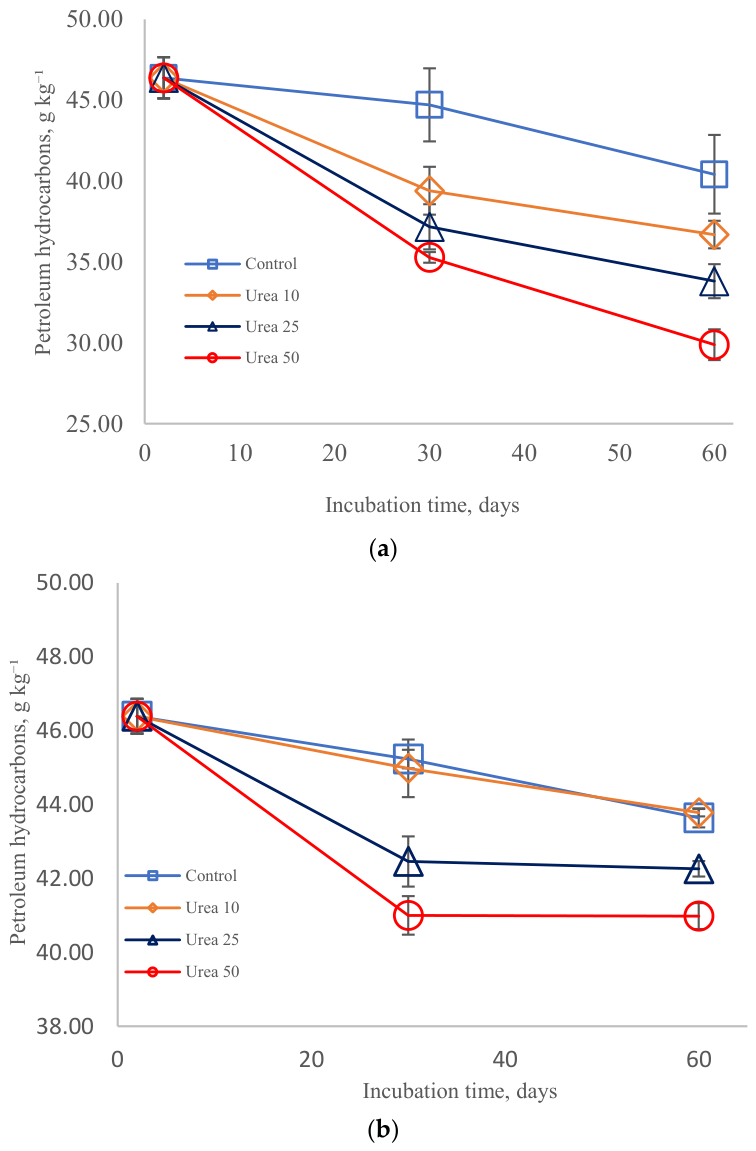
The addition of urea stimulated petroleum hydrocarbon degradation. Figure 3 summarizes the kinetics of the residual petroleum hydrocarbon concentration at the 50 g kg−1 contamination level for the control and all tested urea dosages under warm and cold incubation conditions.
At a dosage of 10 g kg−1, a moderate decrease in hydrocarbon concentration was observed during incubation. Under warm conditions, the reduction was most noticeable for the intermediate contamination level (50 g kg−1). Under cold conditions, the degradation dynamics were considerably weaker.
During the 60-day incubation period, increasing the urea dosage to 25 g kg−1 further enhanced hydrocarbon degradation across most experimental variants.
The highest tested dosage of 50 g kg−1 urea resulted in the most pronounced reduction in hydrocarbon concentration among the urea treatments. At the 50 g kg−1 contamination level under warm conditions, the residual petroleum hydrocarbon concentration decreased by approximately 20–35% relative to day 2 in the 10, 25, and 50 g kg−1 urea treatments, respectively. Under cold conditions, the corresponding reductions were limited to 6.8%, 10.1%, and 8.6%. In the highest-dose treatment under warm conditions, the hydrocarbon concentration decreased from 46.39 g kg−1 on day 2 to 29.88 ± 1.46 g kg−1 after 60 days.
Under cold incubation conditions, the effect of urea remained weaker across all contamination levels, with most of the reduction occurring during the first month of incubation.
These results indicate that the observed effectiveness of urea-based biostimulation depended substantially on the temperature and initial contamination level under the tested laboratory conditions.

3.4. Effect of Ammonium Nitrate on Petroleum Hydrocarbon Degradation

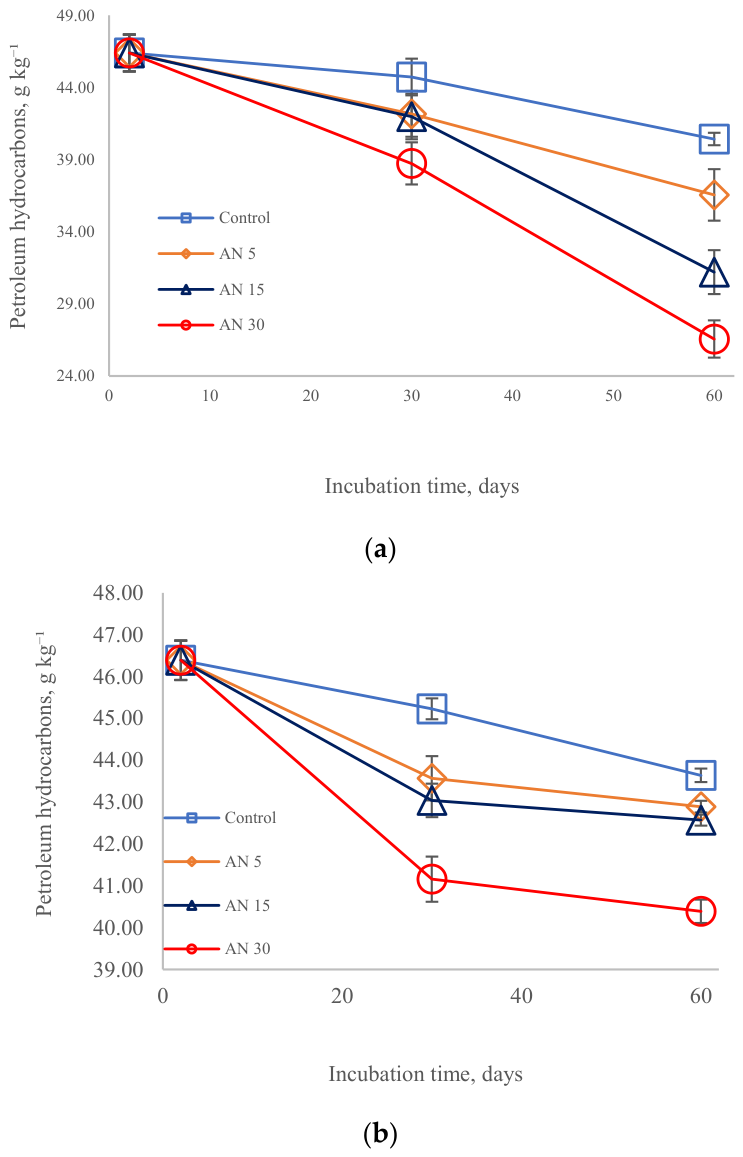
Ammonium nitrate also stimulated petroleum hydrocarbon degradation. Figure 4 summarizes the kinetics of residual petroleum hydrocarbon concentration at the 50 g kg−1 contamination level for the control and all tested ammonium nitrate dosages under warm and cold incubation conditions. At a dosage of 5 g kg−1, hydrocarbon degradation was already enhanced relative to the control, particularly under warm incubation conditions. Increasing the dosage to 15 g kg−1 resulted in a further reduction in hydrocarbon concentration.
The most pronounced degradation was observed at the highest dosage of 30 g kg−1 ammonium nitrate. At the 50 g kg−1 contamination level under warm conditions, the residual petroleum hydrocarbon concentration decreased by approximately 20–43% relative to day 2 in the 5, 15, and 30 g kg−1 ammonium nitrate treatments, respectively. Under cold conditions, the corresponding reductions were 7.3%, 7.6%, and 10.9%. In the highest-dose ammonium nitrate treatment under warm conditions, the residual petroleum hydrocarbon concentration reached 26.56 ± 1.29 g kg−1 on day 60.
Even under cold incubation conditions, ammonium nitrate showed a detectable stimulatory effect, although the magnitude of hydrocarbon degradation remained lower than that under warm conditions.
Overall, the data indicate that treatments with ammonium nitrate were generally associated with stronger reductions in petroleum hydrocarbon concentration than treatments with urea across the tested experimental variants.

3.5. Abundance of Culturable Microorganisms

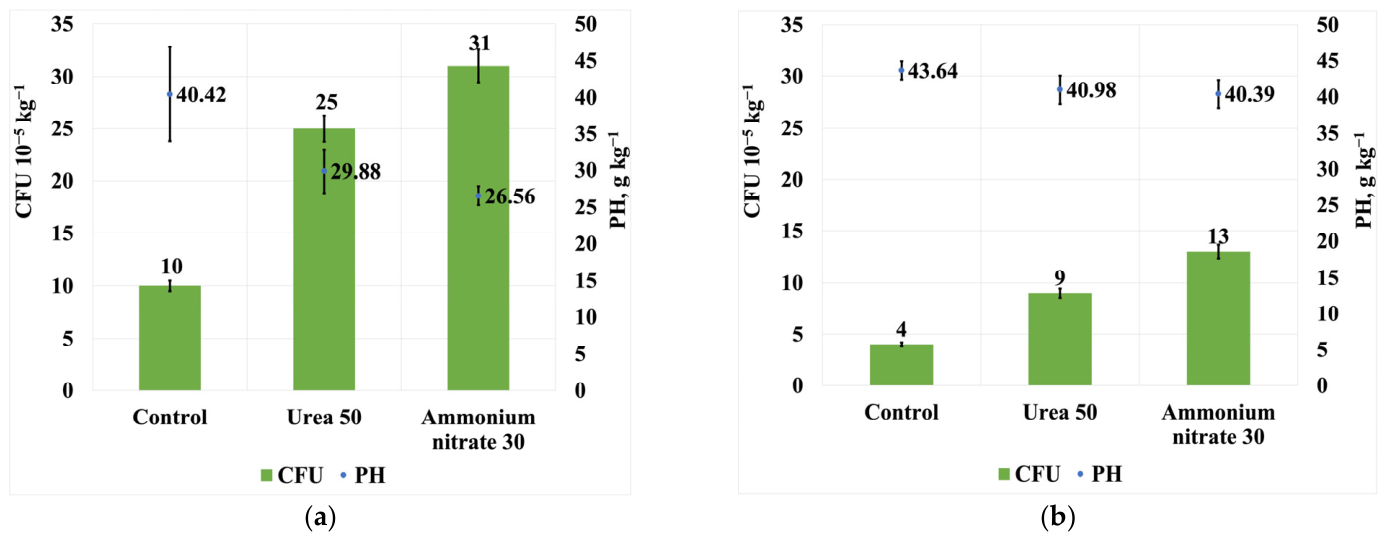
To provide supporting microbiological context for the observed hydrocarbon degradation patterns, the abundance of culturable microorganisms was determined for the contamination level 50 g kg−1, which showed the strongest degradation effects in the experiment. No microbial abundance data were obtained for the 25 or 100 g kg−1 contamination levels. Microbial counts were determined on day 60 of the experiment. Differences in microbial abundance were observed between nitrogen-amended treatments and between temperature regimes. Therefore, these data should be interpreted as indicative rather than definitive evidence of microbial processes associated with the observed treatment response.
Under warm incubation conditions, nitrogen amendments were associated with higher numbers of culturable microorganisms compared with the control (Figure 5a).
Under cold conditions, microbial abundance was generally lower, although the same trend of increased microbial counts in nitrogen-amended variants was observed (Figure 5b).
The observed patterns in microbial abundance were qualitatively aligned with the degradation dynamics of petroleum hydrocarbons but do not establish a direct causal relationship. Because microbial counts were determined only on day 60 and only for the intermediate contamination level, these data should be interpreted as limited supportive evidence rather than as a comprehensive characterization of microbial mechanisms across the entire experimental design.
When the results obtained for all treatments were considered together, three main factors controlling petroleum hydrocarbon degradation were identified: incubation temperature, nitrogen form, and initial contamination level. Among these factors, temperature appeared to exert the strongest influence on degradation dynamics, whereas the form and dosage of nitrogen amendment determined the magnitude of the stimulatory effect. The most pronounced hydrocarbon removal was consistently observed at the intermediate contamination level (50 g kg−1), suggesting that both insufficient and excessive hydrocarbon loads may limit microbial degradation efficiency in sandy podzolic soils. Overall, the experimental results consistently indicated the following qualitative hierarchy of controlling factors under the tested conditions: temperature > nitrogen form and dosage > contamination level.

4. Discussion

The present study examined nitrogen-assisted biostimulation of petroleum-contaminated sandy podzolic soil under boreal conditions using a factorial design that simultaneously considered temperature regime, nitrogen form, contamination level, and nitrogen dosage. This design distinguishes the study from many previous investigations that addressed these factors separately and therefore allows more integrated interpretation of how they jointly shape remediation performance in nutrient-poor northern soils.

4.1. Temperature-Driven Constraints on Natural Attenuation

The control treatments clearly showed that petroleum hydrocarbon attenuation proceeded more rapidly under warm incubation conditions than under the cold regime. These results suggest that temperature was a major controlling factor in hydrocarbon degradation in the studied sandy podzolic soil. Such patterns are widely reported for cold-region soils, where reduced enzymatic activity, slower microbial metabolism, lower contaminant diffusion rates, and lower hydrocarbon mobility strongly constrain biodegradation processes [5,6,20]. The FTIR analysis further showed that the crude oil used in the experiment contained a pronounced paraffinic component. This feature may have intensified the temperature effect, because paraffinic hydrocarbons are generally less mobile and less bioavailable under colder conditions. In the control variants, the limited decrease in petroleum hydrocarbon concentration under the cold regime suggests that natural attenuation alone is unlikely to provide sufficiently rapid remediation in northern soils over short management periods [20,21].
At the same time, the persistence of some degree of hydrocarbon loss even under the cold regime indicates that the indigenous microbial community retained degradative potential. This observation agrees with recent findings showing that microorganisms from hydrocarbon-contaminated Arctic soils can remain metabolically active at low temperatures, although the rate and extent of degradation remain markedly constrained compared with warmer conditions [6]. Thus, in the present soil system, low temperature appeared to reduce the efficiency of biodegradation rather than to prevent it entirely.

4.2. Effects of Nitrogen Form and Dosage

Both nitrogen amendments enhanced petroleum hydrocarbon removal relative to the untreated control, supporting the hypothesis that nutrient limitation restricted degradation in this nutrient-poor sandy podzolic soil. Given the low initial concentrations of mineral nitrogen and available phosphorus, the response to nitrogen addition is consistent with the widely recognized concept that oil contamination sharply increases the C/N ratio and suppresses microbial growth unless nutrient balance is restored [7,8,9]. However, the present study also indicates that the response to nitrogen addition cannot be explained by nutrient supply alone, because remediation efficiency depended on the interaction among nitrogen form, contamination level, and temperature regime.
Within the tested range, ammonium nitrate generally produced a stronger stimulatory effect than urea, especially under warm conditions and at the intermediate contamination level. For the 50 g kg−1 contamination level under warm conditions, residual petroleum hydrocarbon concentration on day 60 was 26.56 ± 1.29 g kg−1 in the 30 g kg−1 ammonium nitrate treatment compared with 29.88 ± 1.46 g kg−1 in the 50 g kg−1 urea treatment, indicating consistently higher relative hydrocarbon removal in the ammonium nitrate treatment compared with the urea treatment under the same experimental conditions. Differences at lower dosages and under cold conditions were less pronounced. This difference is mechanistically plausible because ammonium nitrate provides nitrogen in mineral forms that are immediately available to the microbial community, whereas urea must first undergo hydrolysis before becoming fully accessible [9,10]. Under low-temperature conditions, this additional step may become particularly limiting because enzymatic conversion of urea is also temperature dependent [10]. Recent mechanistic studies have likewise shown that ammonium-based nitrogen sources can accelerate petroleum hydrocarbon degradation and influence nitrogen-assimilation pathways more directly than non-ammonium amendments [22].
From a broader microbiological perspective, the observed difference between urea and ammonium nitrate may also reflect differences in microbial metabolic allocation. Nitrogen supplied as mineral N may be used more rapidly for biomass production and enzyme synthesis, thereby supporting hydrocarbon oxidation more efficiently [22]. In contrast, urea-based fertilization may shift the timing of nitrogen availability and alter the balance between hydrocarbon degradation and other nitrogen-transforming processes [10,22]. Under oxygen-limited microzones, nitrate may additionally participate indirectly in redox-coupled microbial processes, whereas ammonium and urea may be linked more strongly to assimilation-driven responses [22,23]. Although these mechanisms were not directly measured in the present study, they provide a plausible explanation for the more pronounced effect of ammonium nitrate under the tested conditions.
However, the present results should not be interpreted as evidence that ammonium nitrate is always superior under all conditions. Previous work has shown that the response to nitrogen form is highly site-specific and depends on soil properties, microbial community structure, oxygen availability, and competing nitrogen transformation processes [21,23]. In some contaminated soils, nitrate-containing fertilizers stimulate hydrocarbon mineralization more effectively, whereas in others the response is weaker or may be complicated by denitrification and nitrogen losses [23]. Thus, the stronger performance of ammonium nitrate in the present study should be understood as the best outcome under the tested laboratory conditions rather than as a universal recommendation for all petroleum-contaminated soils.

4.3. Role of Contamination Level and Microbiological Evidence

One of the most important outcomes of the factorial design was the consistent identification of the intermediate contamination level (50 g kg−1) as the condition under which nitrogen biostimulation was most effective. This suggests that remediation efficiency was controlled not only by nutrient supply and temperature, but also by the balance between substrate availability and physicochemical constraints. At the lowest contamination level, the hydrocarbon load may have been insufficient to produce a comparably strong measurable stimulatory response, whereas at the highest level the excess oil likely impaired oxygen transfer, increased toxicity, and reduced hydrocarbon accessibility to microorganisms. Recent dose-effect studies similarly indicate that the response to nitrogen biostimulation depends on the interaction between nutrient supply and contamination intensity rather than on nutrient dosage alone [7,8,21]. The present experiment therefore highlights the importance of considering contamination level as an active factor in biostimulation design rather than treating it as a background condition.
The microbiological results were directionally consistent with this interpretation, but only within clear limitations. At the 50 g kg−1 contamination level, nitrogen-amended variants showed higher numbers of culturable microorganisms than the control, and this microbial response corresponded to the treatments that also produced the strongest reduction in petroleum hydrocarbon concentration. This pattern is consistent with stimulation of the indigenous degradative microbiota rather than with purely physicochemical hydrocarbon losses [24]. However, microbial counts were determined only on day 60, only for the intermediate contamination level, and only for selected treatments. No temporal dynamics, functional profiling, or taxonomic characterization were performed. Therefore, the microbiological dataset should be interpreted as limited supportive evidence rather than as a mechanistic demonstration of the entire biodegradation process across the factorial design.

4.4. Practical Implications and Study Limitations

Another important issue concerns the selected nitrogen dosages. The applied rates, particularly the highest doses of urea and ammonium nitrate, were intentionally chosen to cover a broad experimental range and to reveal treatment-dependent responses under controlled laboratory conditions. In this sense, the study was designed for comparative assessment rather than direct field-rate recommendation. At the same time, these dosages are relatively high from the perspective of practical field remediation and may not be environmentally neutral. Excessive nitrogen application can increase the risk of nutrient leaching, secondary pollution, altered nitrogen cycling, and imbalances in soil biochemical processes [8,10,21]. Therefore, the present findings identify the upper range of effective stimulation in this laboratory system but should not be interpreted as direct prescriptions for field-scale fertilizer application.
Several additional environmental variables that are known to influence petroleum hydrocarbon degradation were not explicitly controlled or monitored in this experiment. These include soil moisture during incubation, oxygen availability within the soil matrix, changes in pH over time, and changes in C/N ratio during the remediation process. Each of these factors can affect hydrocarbon bioavailability, microbial growth, and the efficiency of biodegradation [3,5,9,23]. Although experimental conditions were kept consistent among treatments, the absence of direct measurements of these variables limits the extent to which the observed treatment effects can be mechanistically resolved. Their influence should therefore be considered when interpreting the present results.
It should also be noted that the statistical analysis was based on pairwise comparisons and did not include a full factorial analysis of variance. Because the dataset was structured around predefined factorial treatment contrasts and a limited number of measured response variables, multivariate ordination approaches such as principal component analysis were not applied in the present study. Instead, interpretation was restricted to treatment-wise comparisons within the factorial framework. Consequently, the relative importance of individual factors and their interaction effects should be interpreted primarily from the observed experimental trends rather than as a formally quantified partitioning of variance. Even so, the factorial design clearly revealed that temperature regime, nitrogen form, and contamination level acted jointly rather than independently in shaping remediation outcomes.
From a practical perspective, the results are relevant for the remediation of nutrient-poor sandy podzolic soils in boreal oil-producing regions. They indicate that the timing of remediation is critical, with the warm season providing the most favorable period for nutrient-assisted stimulation [5,6,20]. They also suggest that mineral nitrogen may provide faster stimulation than urea under some conditions [9,10,22]. However, because the study was conducted under controlled laboratory conditions using one soil type, one oil source, and a limited microbiological dataset, direct extrapolation to field-scale remediation should be made with caution.
Future research should focus on field validation of the best-performing treatments, together with monitoring of nitrogen dynamics, moisture, oxygen availability, pH, and C/N balance. Application of multi-factor statistical analysis and molecular methods to characterize hydrocarbon-degrading communities would further strengthen mechanistic interpretation [21,22,24]. Overall, the present results support the general hypothesis that nitrogen amendment can accelerate petroleum hydrocarbon removal in sandy boreal soils, but they also show that the response depends on the interaction of temperature, nitrogen form, contamination level, and dosage rather than on nitrogen addition alone.

5. Conclusions

This laboratory factorial study showed that petroleum hydrocarbon degradation in sandy podzolic soil from Western Siberia was jointly influenced by temperature regime, nitrogen form, contamination level, and nitrogen dosage. Among these variables, temperature appeared to exert the strongest control on remediation efficiency, with substantially slower attenuation under cold conditions.
Both nitrogen amendments enhanced petroleum hydrocarbon removal relative to the untreated control, indicating that nutrient limitation constrained biodegradation in the studied soil. Within the tested laboratory range, ammonium nitrate was generally associated with stronger hydrocarbon removal than urea, particularly at the intermediate contamination level of 50 g kg−1. The accompanying increase in culturable microorganisms on day 60 was consistent with stimulation of the biological component of remediation, although the microbiological evidence remained limited in scope.
This study contributes new insight by comparing multiple controlling variables within one factorial experimental design for a sandy boreal soil system. At the same time, the results should be interpreted within the limitations of controlled laboratory conditions, simplified microbiological assessments, and pairwise statistical analysis. Therefore, further mechanistic studies and field-scale validation are needed before the tested treatment levels can be translated into practical remediation recommendations.


Author Contributions

Conceptualization, O.S.S.; methodology, O.S.S.; validation, O.S.S. and R.Y.B.; formal analysis, O.S.S. and R.Y.B.; investigation, A.V.D.; resources, O.S.S.; data curation, R.Y.B.; writing—original draft preparation, O.S.S.; writing—review and editing, A.V.D. and R.Y.B.; visualization, A.V.D.; supervision, O.S.S.; project administration, O.S.S.; funding acquisition, O.S.S. All authors have read and agreed to the published version of the manuscript.

Funding

This research was funded by Russian Science Foundation, grant number 24-14-20030, https://rscf.ru/en/project/24-14-20030/ (accessed on 14 March 2026).

Institutional Review Board Statement

Not applicable.

Informed Consent Statement

Not applicable.

Data Availability Statement

The raw data supporting the conclusions of this article will be made available by the authors on request.

Conflicts of Interest

The authors declare no conflicts of interest.

Abbreviations

The following abbreviations are used in this manuscript:
ATRAttenuated Total Reflectance
CFUColony-Forming Unit
FTIRFourier Transform Infrared Spectroscopy

References

  1. Michael-Igolima, U.; Abbey, S.J.; Ifelebuegu, A.O. A systematic review on the effectiveness of remediation methods for oil contaminated soils. Environ. Adv. 2022, 9, 100319. [Google Scholar] [CrossRef]
  2. Ambaye, T.G.; Chebbi, A.; Formicola, F.; Prasad, S.; Gomez, F.H.; Franzetti, A.; Vaccari, M. Remediation of soil polluted with petroleum hydrocarbons and its reuse for agriculture: Recent progress, challenges, and perspectives. Chemosphere 2022, 293, 133572. [Google Scholar] [CrossRef] [PubMed]
  3. Mekonnen, B.A.; Aragaw, T.A.; Genet, M.B. Bioremediation of petroleum hydrocarbon contaminated soil: A review on principles, degradation mechanisms, and advancements. Front. Environ. Sci. 2024, 12, 1354422. [Google Scholar] [CrossRef]
  4. Wu, M.; Feng, S.; Liu, Z.; Tang, S. Bioremediation of petroleum-contaminated soil based on both toxicity risk control and hydrocarbon removal—Progress and prospect. Environ. Sci. Pollut. Res. 2024, 31, 59795–59818. [Google Scholar] [CrossRef] [PubMed]
  5. Yap, H.S.; Zakaria, N.N.; Zulkharnain, A.; Sabri, S.; Gomez-Fuentes, C.; Ahmad, S.A. Bibliometric Analysis of Hydrocarbon Bioremediation in Cold Regions and a Review on Enhanced Soil Bioremediation. Biology 2021, 10, 354. [Google Scholar] [CrossRef] [PubMed]
  6. Semenova, E.M.; Tourova, T.P.; Babich, T.L.; Logvinova, E.Y.; Sokolova, D.S.; Loiko, N.G.; Myazin, V.A.; Korneykova, M.V.; Mardanov, A.V.; Nazina, T.N. Crude Oil Degradation in Temperatures Below the Freezing Point by Bacteria from Hydrocarbon-Contaminated Arctic Soils and the Genome Analysis of Sphingomonas sp. AR_OL41. Microorganisms 2024, 12, 79. [Google Scholar] [CrossRef] [PubMed]
  7. Wang, W.; Gao, Y.; Du, J.; Zheng, L.; Kong, X.; Wang, H.; Yang, X.; Duan, L.; Zhao, Q.; Liu, Y.; et al. Dose–effect of nitrogen regulation on the bioremediation of diesel contaminated soil. Environ. Technol. Innov. 2023, 32, 103245. [Google Scholar] [CrossRef]
  8. Yu, Y.; Ou, Y.; Wu, M.; Zhang, X.; Liu, Z. A comprehensive evaluation of bioremediation effects of oil-contaminated soils using various dosages of exogenous nitrogen supplementation: TPH removal, ecological toxicity, and microecological response. J. Environ. Chem. Eng. 2024, 12, 114835. [Google Scholar] [CrossRef]
  9. Ou, Y.; Wu, M.; Yu, Y.; Liu, Z.; Kang, H.; Hu, M.; Zhang, C.; Chen, X. Influence mechanisms underlying the degradation of petroleum hydrocarbons in response to various nitrogen dosages supplementation through metatranscriptomics analysis. J. Hazard. Mater. 2025, 487, 137074. [Google Scholar] [CrossRef] [PubMed]
  10. Zhang, E.; Wilkins, D.; Crane, S.; Chelliah, D.S.; van Dorst, J.; Abdullah, K.; Tribbia, D.Z.; Hince, G.; Spedding, T.; Ferrari, B. Urea amendment decouples nitrification in hydrocarbon contaminated Antarctic soil. Chemosphere 2024, 354, 141665. [Google Scholar] [CrossRef]
  11. GOST 17.4.3.01-83; Nature Protection. Soils. General Requirements for Sampling. USSR State Committee for Standards: Moscow, USSR, 1983. Available online: https://www.russiangost.com/p-15740-gost-174301-83.aspx (accessed on 28 March 2026).
  12. GOST 17.4.4.02-2017; Nature Protection. Soils. Methods for Sampling and Preparation of Soil for Chemical, Bacteriological, Helmintological Analysis. Federal Agency for Technical Regulation and Metrology: Moscow, Russia, 2017. Available online: https://www.russiangost.com/p-353446-gost-174402-2017.aspx (accessed on 28 March 2026).
  13. GOST 12536-2014; Soils. Methods of Laboratory Granulometric (Grain-Size) and Microaggregate Distribution. Federal Agency for Technical Regulation and Metrology: Moscow, Russia, 2014. Available online: https://www.russiangost.com/p-138335-gost-12536-2014.aspx (accessed on 28 March 2026).
  14. GOST 26423-85; Soils. Methods for Determination of Specific Electric Conductivity, pH and Solid Residue of Water Extract. Gosstandart of the USSR: Moscow, Russia, 1985. Available online: https://www.russiangost.com/p-16105-gost-26423-85.aspx (accessed on 28 March 2026).
  15. Meng, C.; Yang, W.; Ren, X.; Wang, D.; Li, M. In-Situ Soil Texture Classification and Physical Clay Content Measurement Based on Multi-Source Information Fusion. Int. J. Agric. Biol. Eng. 2023, 16, 203–211. [Google Scholar] [CrossRef]
  16. DIN 51451:2004-09; Testing of Petroleum Products and Related Products—Analysis by Infrared Spectrometry—General Working Principles. Beuth Verlag GmbH: Berlin, Germany, 2004. [CrossRef]
  17. PND F 16.1:2.21-98; Quantitative Chemical Analysis of Soil. Methods for Measuring the Mass Fraction of Oil Products in Soil and Soil Samples by the Fluorimetric Method Using the Fluorat-02 Liquid Analyzer. Federal State Institution Center for Environmental Control and Analysis: Moscow, Russia, 2003. Available online: https://www.russiangost.com/p-162458-pnd-f-161221-98.aspx (accessed on 14 March 2026).
  18. MUK 4.2.3695-21; Microbiological Soil Control Methods. Chief State Sanitary Doctor of the Russian Federation: Moscow, Russia, 2021. Available online: https://www.russiangost.com/p-385250-muk-423695-21.aspx (accessed on 14 March 2026).
  19. Babak, V.A.; Zhakupov, E.Z.; Puntus, I.A.; Fomina, A.N. Lab Tests on Efficiency of a Biological Fertilizer Based on Nitrogen-Fixing and Phosphate-Mobilizing Bacteria. Agric. Biol. 2024, 59, 142–155. [Google Scholar] [CrossRef]
  20. Margesin, R.; Schinner, F. Bioremediation (natural attenuation and biostimulation) of diesel-oil-contaminated soil in an alpine glacier skiing area. Appl. Environ. Microbiol. 2001, 67, 3127–3133. [Google Scholar] [CrossRef] [PubMed]
  21. Kundu, A.; Harrisson, O.; Ghoshal, S. Evaluating the Impact of Nutrient Doses on Biostimulation of Petroleum Hydrocarbon Biodegradation in Cold Region Soils. ACS EST Eng. 2022, 2, 2287–2300. [Google Scholar] [CrossRef]
  22. Gao, Y.; Du, J.; Bahar, M.M.; Wang, H.; Subashchandrabose, S.; Duan, L.; Yang, X.; Megharaj, M.; Zhao, Q.; Zhang, W.; et al. Metagenomics analysis identifies nitrogen metabolic pathway in bioremediation of diesel contaminated soil. Chemosphere 2021, 271, 129566. [Google Scholar] [CrossRef]
  23. Roy, R.; Greer, C.W. Hexadecane mineralization and denitrification in two diesel fuel-contaminated soils. FEMS Microbiol. Ecol. 2000, 32, 17–23. [Google Scholar] [CrossRef]
  24. Sozina, I.D.; Danilov, A.S. Microbiological remediation of oil-contaminated soils. J. Min. Inst. 2023, 260, 297–312. [Google Scholar] [CrossRef]
Figure 1. FTIR spectrum of crude oil.
Applsci 16 04190 g001
Figure 2. Natural degradation dynamics of petroleum hydrocarbons (PH) in soil under (a) warm (20–25 °C) and (b) cold (6–8 °C) incubation conditions. Day 2 values represent the first experimentally measured petroleum hydrocarbon concentrations after contamination and homogenization. Values are means ± SD (n = 3).
Applsci 16 04190 g002
Figure 3. Residual petroleum hydrocarbon concentration at the 50 g kg−1 contamination level under (a) warm (20–25 °C) and (b) cold (6–8 °C) incubation conditions for the control and the urea treatments (10, 25, and 50 g kg−1). Day 2 values represent the first experimentally measured petroleum hydrocarbon concentrations after contamination and homogenization. Values are means ± SD (n = 3).
Applsci 16 04190 g003
Figure 4. Residual petroleum hydrocarbon concentration at the 50 g kg−1 contamination level under (a) warm (20–25 °C) and (b) cold (6–8 °C) incubation conditions for the control and the ammonium nitrate (AN) treatments (5, 15, and 30 g kg−1). Day 2 values represent the first experimentally measured petroleum hydrocarbon concentrations after contamination and homogenization. Values are means ± SD (n = 3).
Applsci 16 04190 g004
Figure 5. Abundance of culturable microorganisms at contamination level 50 g kg−1 in the control and selected nitrogen-amended treatments under (a) warm and (b) cold incubation conditions on day 60 of the experiment. Values are means ± SD (n = 3).
Applsci 16 04190 g005
Table 1. Experimental design structure.
FactorLevels
Contamination level25, 50, 100 g kg−1
Nitrogen sourceUrea, Ammonium nitrate
Nitrogen dosageUrea: 10, 25, 50 g kg−1; NH4NO3: 5, 15, 30 g kg−1
Temperature20–25 °C; 6–8 °C
Replicatesn = 3
Table 2. FTIR structural coefficients of the crude oil.
SampleAromaticity (D1600/D720)Oxidation (D1710/D1465)Sulfurization (D1030/D1465)Paraffinicity ((D720 + D1380)/D1600)
Crude oil0.3420.0730.1697.437
Disclaimer/Publisher’s Note: The statements, opinions and data contained in all publications are solely those of the individual author(s) and contributor(s) and not of MDPI and/or the editor(s). MDPI and/or the editor(s) disclaim responsibility for any injury to people or property resulting from any ideas, methods, instructions or products referred to in the content.