Article

Estimating Material Parameters for a One-Dimensional Heat Equation with a Physics-Informed Neural Network

1
711th Human Performance Wing, Human Effectiveness Directorate, Bioeffects Division JBSA, Fort Sam Houston, TX 78234, USA
2
Department of Mathematics and Statistics, University of North Carolina at Charlotte, Charlotte, NC 28223, USA
3
Center for Trustworthy Artificial Intelligence Through Model Risk Management (TAIMing AI), University of North Carolina at Charlotte, Charlotte, NC 28223, USA
*
Authors to whom correspondence should be addressed.
Appl. Sci. 2026, 16(9), 4172; https://doi.org/10.3390/app16094172
Submission received: 17 March 2026 / Revised: 18 April 2026 / Accepted: 21 April 2026 / Published: 24 April 2026

Abstract

A physics-informed neural network (PINN) is developed to estimate the spatially varying parameters of the time-dependent heat equation in one dimension. The proposed model incorporates both the forward and inverse problems to estimate the temperature and thermal properties of a laser-induced interaction with biological tissue. The network can detect the presence and location of a second layer of tissue, if it exists, and estimate the thermal coefficients of each substance. This ability to model nonhomogeneous properties in tissue subjected to laser irradiation has many important applications in medical procedures. An ensemble method is used to quantify the epistemic uncertainty of all estimates to identify weaknesses in the model. Aleotoric uncertainty is simulated through noise perturbations, demonstrating robust estimates in the presence of measurement error. The uncertainty associated with parameter estimation provides insight into the ill-posedness of the inverse problem.

1. Introduction

The interaction of light with biological tissues is a complex and dynamic process with implications in medical diagnostics, therapeutics, and foundational research in biology [1,2]. Continued advancement in light sources, detectors, and microscopy techniques are driving a more precise understanding of optical and mechanical tissue properties required to leverage computational modeling of laser-tissue interaction [3,4]. This is especially needed in surgical applications where carefully controlling the extent of tissue denaturation or ablation is critical for treatment efficacy [5,6]. Characterization of optical and mechanical properties have been performed by many groups; however, a wide range of variability in measurements exist driven by complex heterogeneity and biological diversity across tissues by region [7,8], further altered by storage and measurement procedures for excised tissue [9,10,11]. The model for the laser heating of tissue is a parabolic partial differential equation known as Pennes bioheat equation [12,13]. The forward model for Pennes bioheat equation has coefficients that represent tissue parameters such as thermal conductivity, density, and specific heat.
In this paper, we develop a machine learning model to solve this heat equation for the laser-tissue interaction with human skin. This model simultaneously solves the forward problem to estimate the temperature and the inverse problem to estimate the thermal properties of the skin tissue. The approach incorporates a physics-informed neural network (PINN) to solve the heat equation subject to initial and boundary conditions. The remainder of this paper is organized as follows. The heat equation and associated thermal parameters are described in Section 2.1, followed by a brief background of inverse problems and their application towards estimating these parameters in Section 2.2. This is followed by the formalization of PINNs for solving inverse problems in Section 2.3. Section 3 describes the customized PINN designed to solve the forward and inverse problems using three parallel neural networks. Results for this method are reported and discussed for a variety of skin models composed of single and multiple layers in Section 4. Limitations of the model for future work are discussed in Section 5, and concluding remarks are summarized in Section 6.

2. Background

2.1. The Forward Problem for Heat Diffusion

The general form of the PDE representing the diffusion of heat through a conductor can be expressed as a spatial and temporal function of temperature, u, for a source term, Q, in one dimension as
f ( x , t ) = u ( x , t ) t κ ρ C p 2 u ( x , t ) x 2 Q = 0 .
The constants κ , ρ , and C p represent thermal conductivity, density, and specific heat, respectively, and are specific to the properties of the conducting material. A numerical solver based on the finite difference method, Python Ablation Code (PAC1D) version 4.1, is an in-house numerical method for the forward problem solution to Equation (1) to simulate laser interactions with skin and eye tissue in one dimension. PAC1D employs the Crank–Nicolson implicit solver for the diffusion equation and the Beer–Lambert Law for computing the laser source term.
In our work, PAC1D generates training data modeling heat diffusion propagating through various layers of human skin (epidermis, dermis, fat), resulting from a laser source at the surface. The source function, Q = I ρ C p , is defined by irradiance, I, controlling the dosage produced by the laser aimed at the surface of the skin for a period of time t. Thus, Equation (1) becomes,
u ( x , t ) t κ ( x ) ρ ( x ) C p ( x ) 2 u ( x , t ) x 2 I ( x , t ) 1 ρ ( x ) C p ( x ) = 0 ,
which is a simplified expression of the Pennes bioheat equation without the perfusion term. By defining the volumetric heat capacity, ν = 1 ρ C p , Equation (2) can then be rewritten as follows:
u ( x , t ) t = κ ( x ) ν ( x ) 2 u ( x , t ) x 2 + ν ( x ) I ( x , t ) ,
where we assume the variables κ and ν are spatially variable and time independent. If we denote the model parameters as q = κ , ν , then the forward problem is given as: knowing the model parameter, q, and source, I, find the solution of the PDE for the temperature profile, u ( x , t ) . According to Hadamard’s definition [14], a problem is well posed if the solution (i) exists, (ii) is unique, and (iii) is stable and continuous with respect to the data, such as initial and boundary conditions. For an appropriate set of parameters q, it is well known that the forward problem is well posed in the sense of Hadamard.

2.2. The Inverse Problem

The inverse problem is formally described as: given the measured temperature, u ( x , t ) , on the boundary of the domain or on part of the domain for a given source I ( x , t ) , find the parameter q. The existence of the inverse problem is reasonable to expect; however, uniqueness is not guaranteed unless we impose constraints. Furthermore, the parameter reconstruction may be unstable due to measurement errors. In general, these difficulties render inverse problems ill-posed in the sense of Hadamard, causing this to be far more challenging than the forward problem. For precise mathematical details of ill-posedness and theoretical stability analysis, we refer the reader to the following [14,15,16,17]. Estimating the parameters of the heat equation is an example of an ill-posed inverse problem leading to instability in the reconstruction of thermal properties and has been well studied analytically [18,19,20,21,22,23]. In particular, the ill-posedness of κ is especially difficult to estimate, as it is found only in the second-order derivative term. Second-derivative coefficient estimates are ill conditioned and, therefore, have been shown to be more difficult to estimate in computational methods due to numerical instability in the differentiation, as small errors in the predicted temperature field are amplified when second derivatives are taken. This has been shown to negatively affect accuracy, uncertainty, and the rate of convergence [24,25,26].
Traditional numerical methods for solving PDEs have been developed and implemented for many decades, including finite difference methods (FDM) and finite element methods (FEM) [27,28,29], which discretize the space in a fine mesh grid. Variations of these finite methods have demonstrated success in producing highly accurate solutions for both forward and inverse problems [30,31,32,33,34,35]. Numerical solutions for solving inverse problems with such a discretized approach involve solving the forward problem repeatedly to determine the parameters that produce the best fit to temperature data and, therefore, are very costly. Some recent examples of finite methods for solving thermal properties in the heat equation include gradient-based methods, such as gradient descent or conjugate gradient [33,36,37,38,39] and Levenberg-Marquardt [40,41], stochastic methods such as Bayesian inference [42], and heuristic methods including genetic algorithms, simulated annealing, and particle swarm optimization [43,44,45,46,47].
In recent years, machine learning techniques with neural networks have been gaining popularity in solving PDE forward problems using techniques such as DeepONET, Physics Informed Neural Network (PINN), and Physics Informed Kernel Neural Operator (PIKNO) [48,49,50,51,52]. A key advantage of these surrogate methods is that they calculate a general mesh-free solution independent of the grids constructed for traditional methods based on FEM and FDR, thus allowing for highly complicated geometries. This becomes increasingly crucial, as problems are scaled up to include higher dimensionality. Neural networks are very computationally efficient as forward solvers and inherently suitable as surrogates for solving inverse problems. Once a neural network has been trained, the network can predict any point in the domain almost instantly, which is extremely efficient for use in practice when immediate decisions must be made without awaiting results from a numerical method [53].
Since they were first formally introduced in 2019, PINNs have demonstrated encouraging results for predicting known PDEs with analytical solutions for both forward and inverse problems [51,54,55,56]. As the field matures, PINNs are increasingly applied towards a diverse range of practical problems in science and engineering, including heat transfer and conduction [48,52,57], fluid flow [58], subsurface transport [59], and medical diagnoses [60,61].
Regardless of the method used, inverse numerical methods for the heat equation are designed to solve for a variety of unknowns, depending on the nature of the experimental setup. Thermal diffusivity and thermal conductivity are both common quantities of interest for estimation [26,62,63], but there are many variations on these and other quantities represented in the recent literature. Thakur et al. [25] estimated a spatially varying diffusion coefficient from image data. Gorchakov et al. [35] recently demonstrated the simultaneous estimation of thermal conductivity and volumetric heat capacity as a function of temperature based on heat flux at the boundaries. And Khatoon et al. [42] solved for boundary heat flux with examples in many engineering problems. Zhang et al. [64] investigated multi-layer materials for the steady state heat equation solving for temperature and incomplete boundary information. Problems involving multiple discrete materials are generally more difficult for neural networks to solve than continuous spatially varying materials [65].
In this work, we formulate a neural network approach, focusing on the PINN method to reconstruct spatially varying thermal conductivity and volumetric heat capacity simultaneously for a one-dimensional time-dependent heat equation with a space and time-varying source term. The model allows for the automatic detection of a second material at an arbitrary depth. The proposed approach also uses implicit regularization to stabilize the inversion to overcome the ill-posedness of the inverse problem. Furthermore, epistemic and aleatoric uncertainty quantification studies are performed to develop an understanding of the robustness of solving inverse problems with neural networks.

2.3. Physics-Informed Neural Networks (PINNs)

Consider the following general PDE with the boundary conditions for the solution u ( x ) with x : = ( x 1 , x 2 , . . . , x d 1 , x d ) Ω R d parameterized by the parameters q :
F x , u x 1 , , u x d ; 2 u x 1 x 2 , 2 u x 1 x d ; ; q = 0 ,
B x , u = f , x Ω Ω .
Solving the PDE via PINNs involves building a neural network N ( x ; θ ) with the trainable parameters θ to approximate the neural network approximated solution, u ^ θ ( x ) u ( x ) . Then, the network is trained imposing the constraints of the PDE and boundary conditions as mean squared error loss functions. Let N f Ω denote the collocation points and N b Ω denote the boundary points. Given the weights w f and w b , the loss function is defined as:
L ( θ ) = w f L f ( θ ) + w b L b ( θ )
where
L f ( θ ) = 1 | N f | x N f F u ^ θ ( x ) ; θ 2
L b ( θ ) = 1 | N b | x N b B ( u ^ θ ( x ) ; θ ) 2
In the above equation, for x N b , u ^ θ ( x ) are known initial and boundary values of the solution and | · | indicates the total number of points belonging to the respective set. Also, L f represents physics loss and L b represents boundary loss. The former guarantees the network to obey the underlying physics of the model, whereas the latter ensures that the network gives a unique solution.
If the PINNs are solely used to solve the forward problem i.e “Given q , find u ( x ) ”, the network can be trained to find the best parameter θ , such that the loss function in Equation (6) is minimized.
θ = arg min θ w f L f ( θ ) + w b L b ( θ )
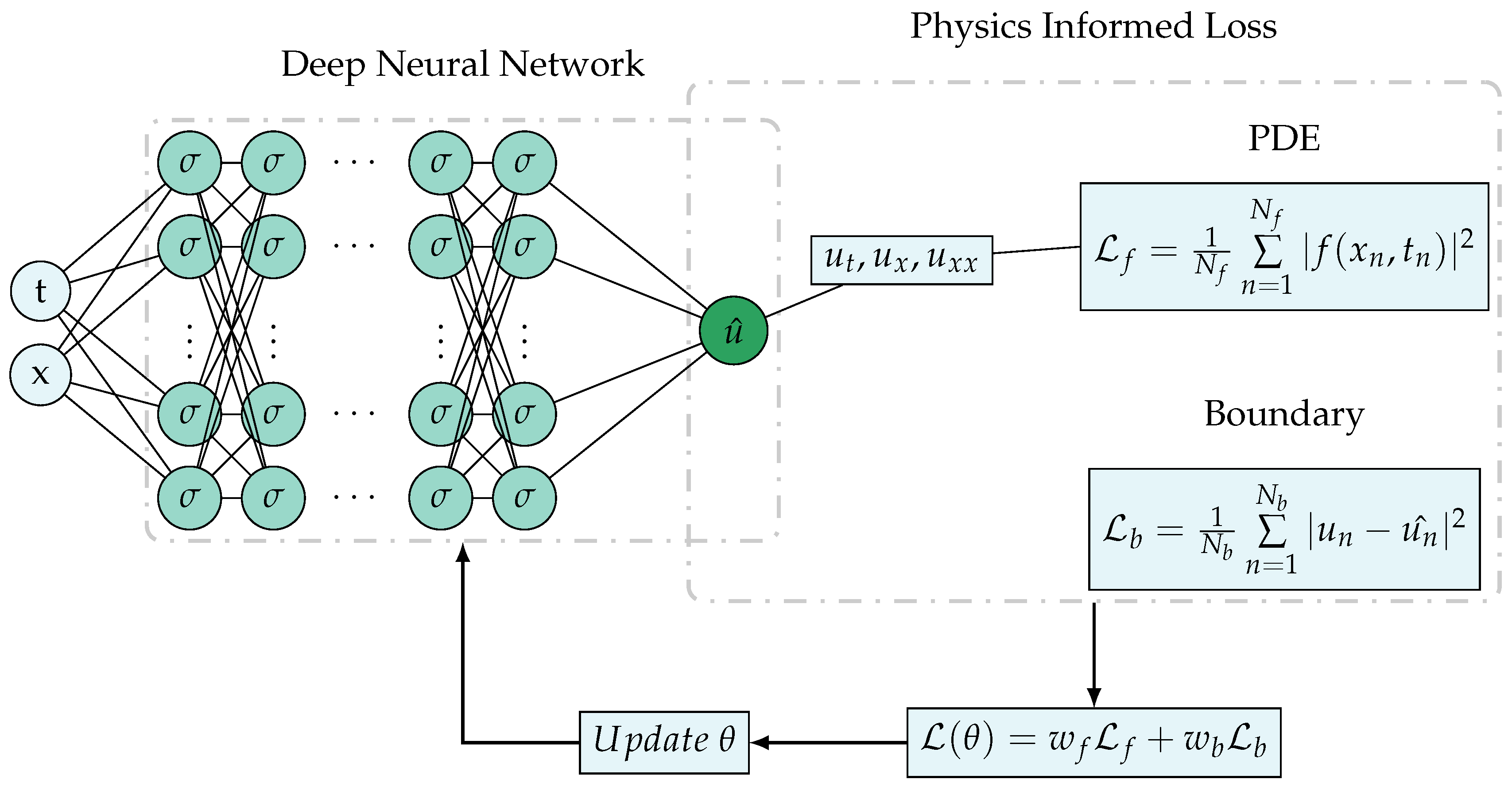
See Figure 1 for a depiction of the training process.
However, since PINNs can be utilized to solve both the forward and inverse problems simultaneously, we will use θ to represent both the unknown parameters of the neural network of the surrogate model and the unknown parameters q of the inverse problem. In this case, the loss function includes an additional term for the known data loss, L d a t a . Let N d Ω represent measurement data points with corresponding noisy data u ( x ) . Subsequently, the loss function becomes:
L ( θ ) = w f L f ( θ ; q ) + w b L b ( θ ; q ) + w d L d a t a ( θ ; q )
L d a t a = 1 | N d | x N d u ^ θ ( x ) u ( x ) 2 .
To solve the inverse problem along with the forward problem, the network is trained to find the best parameter, θ ,
θ = arg min θ w f L f + w b L b + w d L d a t a ,
such that the loss function of Equation (8) is minimized. The coefficients for each term in the loss function minimization are weighting terms, often empirically determined, to encourage computationally effective minimization.

3. Network Design

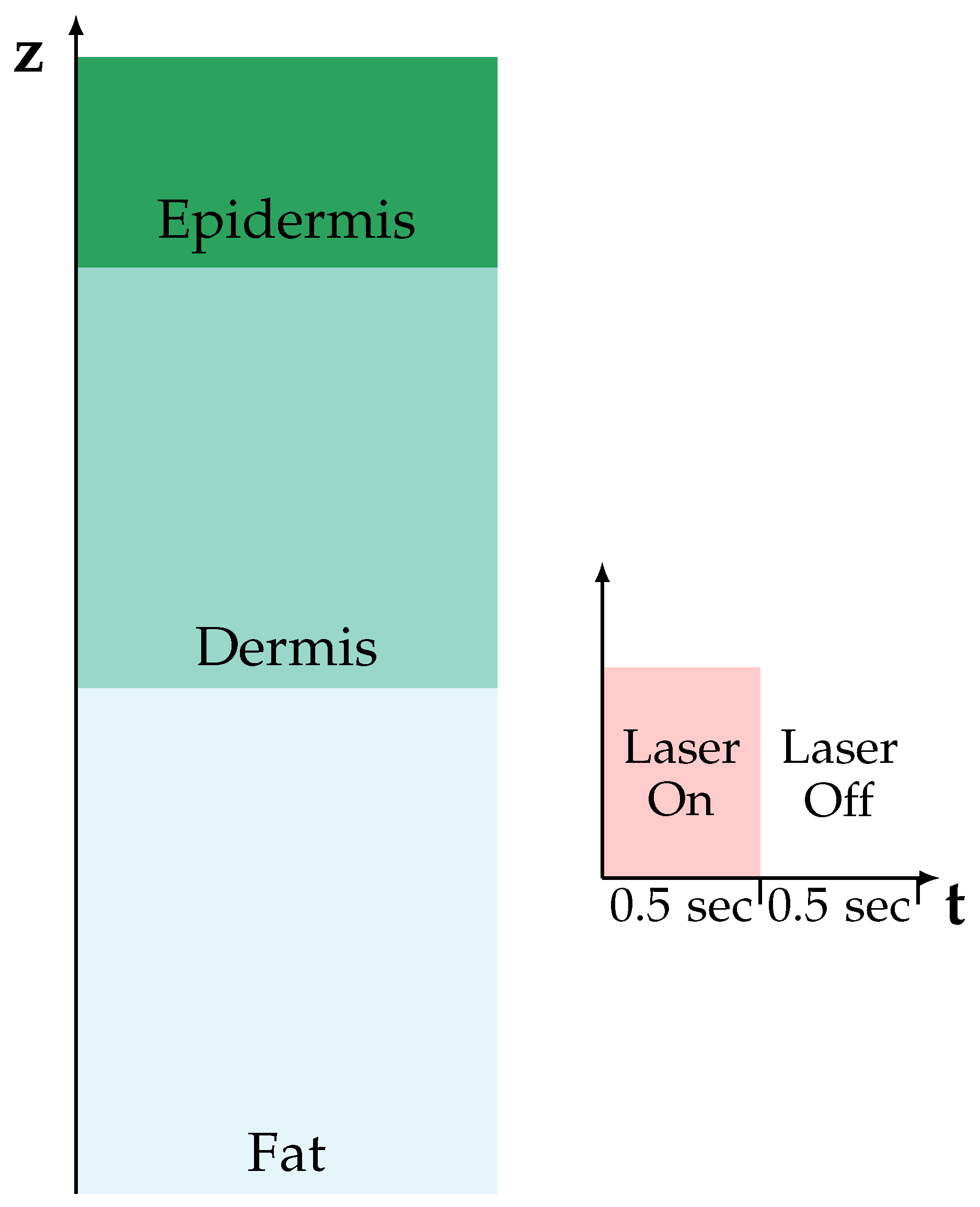
A PINN was developed to model heat diffusion through the layers of human skin subjected to laser irradiation at the surface, as shown in Figure 2. The material properties are dependent on the depth x but held constant throughout time for a 1 s experiment. The simulated laser heat source is turned off at t = 0.5   s and the tissue is allowed to cool until t = 1 s . The total depth of the unknown material is 12 m m , and the initial irradiance aimed perpendicular to the surface is 5 × 10 6 W m 3 . To obtain a highly accurate numerical approximation of the ground truth for training data and testing, the experiments are modeled with the finite difference method in PAC1D to calculate temperature for various known skin tissue properties. PAC1D temperature data is generated with a resolution of 2000 equal time steps from zero to 1 s, and 2000 points from 0 to 12 m m . The depths into the skin layer are not equally spaced but, rather, are more densely concentrated near the surface layers of the skin. Of these temperature calculations, 100,000 are withheld from the training data for testing.
The forward problem consists of solving Equation (2) for temperature, u ( x , t ) , for given irradiance and known materials. In prior work, a network was trained according to the loss function of Equation (7) for given thicknesses and properties of each of the three skin layers. Temperatures were predicted, constrained by the functional PDE for the heat equation and boundary temperatures obtained from a PAC1D simulation, and shown to be in very good agreement with the finite difference method of PAC1D for a variety of skin models [49]. We extend this work here, simultaneously solving the forward and inverse problems described in Equation (8). We predict two sets of parameters, q = ( κ , ν ) , for the heat equation: thermal conductivity, κ , and the volumetric heat capacity ν = 1 ρ C p , where ρ and C p are density and heat capacity, respectively. Additionally, the boundary between two potentially different materials can be detected by the network.
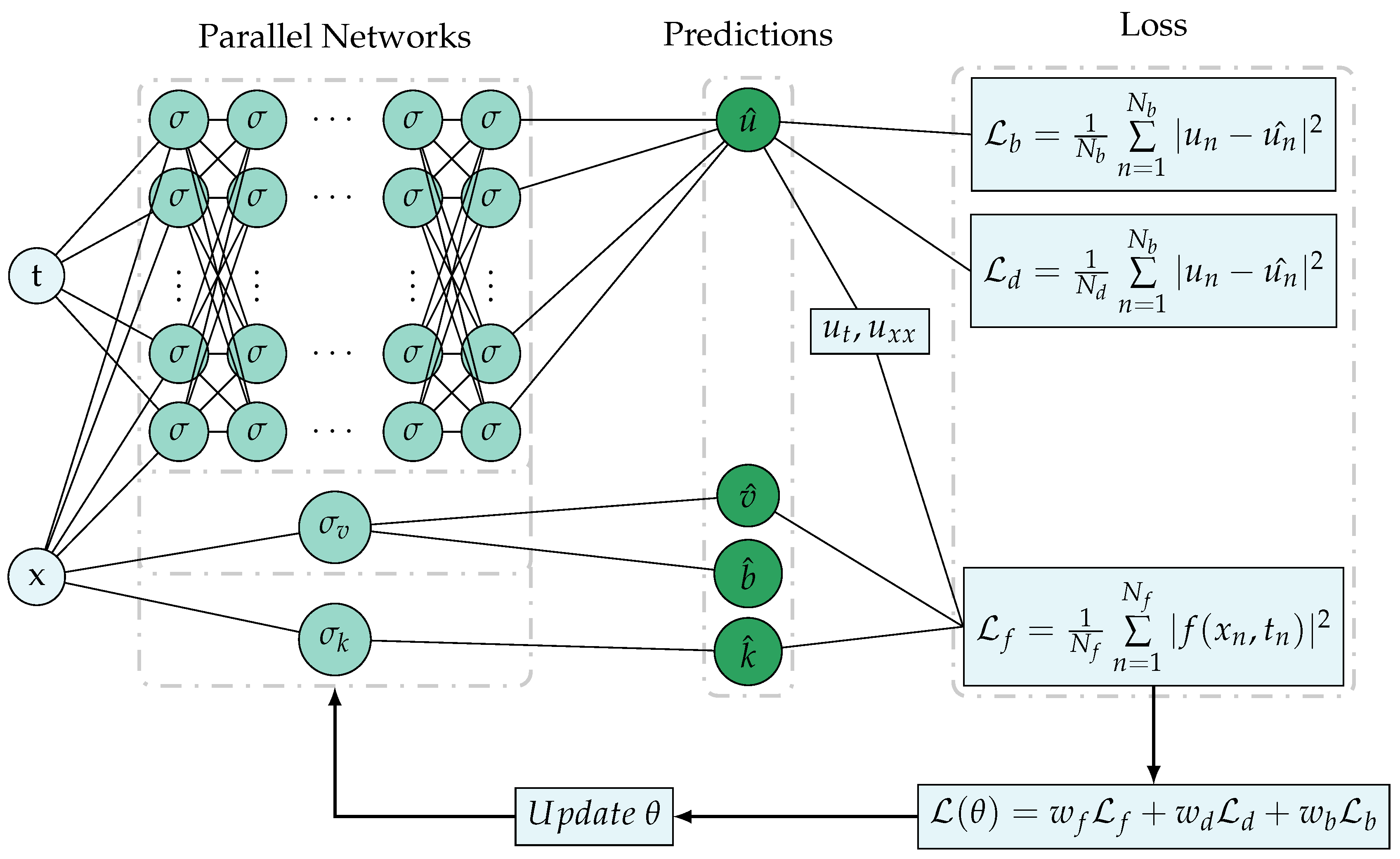
To solve the inverse problem, the PINN design is extended to include two additional networks for the material properties, as shown in Figure 3. In the absence of damage to the skin from the source, it is assumed that the material parameters remain constant over time and thus are functions only of the depth through the material. Each of these additional networks contains only one neuron in a single layer with a custom activation function, to allow for either one or two different materials as follows,
q = s h i f t + s c a l e s i g m o i d ( w e i g h t ( x b o u n d a r y ) )
where s h i f t and s c a l e are the customized variables updated by each of these networks, and w e i g h t is a tuned hyperparameter designed to maximize the separation between distinct material parameters. Weight values of 10 5 and 10 10 for the ν and κ networks were determined to produce optimal results. The b o u n d a r y variable is an updatable value for the ν network that is shared with the κ network at each iteration, thus forcing the two networks to adhere to the same separation of materials. The network design in Figure 3 is capable of detecting where a boundary exists between two materials, as well as estimating the physical properties for each material. No restrictions on the values of the s c a l e , s h i f t , or b o u n d a r y parameters are enforced, allowing them to converge to negative values. Therefore, no assumptions are made concerning the increase or decrease in each parameter from one material to the next. In practice, either a s c a l e value of zero or a b o u n d a r y value outside the range of [0, 12] mm will predict a single homogeneous layer.
Extensive experimentation yielded an optimal size for the temperature network of 10 layers with 32 nodes per layer. A two-phase optimization method is used for the three parallel networks, each employing the ADAM [66] method in Pytorch 2.7.1 (CUDA 11.8) [67]. Phase one includes 25,000 epochs with a learning rate of 0.001 for the temperature network and 0.0001 for both parameter networks. The second phase includes additional ADAM training epochs with reduced learning rates for temperature (0.0001) and ν (0.00001) networks, while adopting an adaptive learning rate for the κ network from 0.1 to 0.00001, decaying by 0.1 at intervals of 25,000 epochs each. Training continues until convergence is reached for both κ and ν . Convergence is defined by a loss of less than 1 × 10⁻¹ for each parameter over 10,000 epochs. Phase one achieves very accurate predictions for temperature, ν , and for the boundary, but κ estimates are not reliably accurate. Phase two fine-tunes the estimates while considering a large sweep over possible κ predictions.
If a boundary within the range of the experimental depth is detected by the network during the first phase, the training data is split into two sets according to this boundary. In this case, phase 2 is performed on each of these subsets of training data sequentially, each of them taking advantage of the predictions from the initial training by retaining the weights and biases from the temperature network. For the ν and κ networks, the boundary and scale values are initialized to zero, and the shift parameters are initialized with existing predictions. Although outside the scope of this work, the test data can be further split if additional boundaries are detected when more than two materials are present.
Prior to the training of each model, training data are created from the PAC1D forward solution. For the collocation points, |Nf| = 100,000 random ( x , t ) pairs are generated on the range of the experiment, and associated dosage values are interpolated from the PAC1D data. Temperatures from the training data are not needed for collocation points, instead relying on the residual of the heat equation. Although prior work demonstrated accurate temperature predictions for the 1D problem with only PDE and boundary loss terms, as shown in Figure 1, the inverse problem benefits from additional training data for interior temperature measurements from PAC1D as in Equation (8). For training data, associated dosage and temperatures are interpolated for randomly ( x , t ) pairs. We have 3.9 million temperature values from PAC1D available in the training data set, but only an extremely small random sampling of this data is required for highly accurate results. We have found that |Nb| = 750 for the boundaries and |Nd| = 1000 for interior measurements is sufficient for highly accurate temperature predictions. Increasing the number of training data samples does not result in significant improvements on average.
Temperature and ν values are scaled to improve overall performance and convergence. All temperatures in the training data set are linearly scaled between approximately 0 and 1, based on the maximum and minimum values along the boundaries. The parameter ν for each skin layer is on the order of magnitude of 10 7 , which was difficult for the network to predict. Thus, the training data is scaled by 10 7 , resulting in target values of 2.334, 2.728, and 3.814 for the epidermis, dermis, and fat layers. The values for κ remain unscaled. Each predicted value was rescaled to the original values prior to evaluating the residual PDE for each iteration.
The final loss function includes weighting coefficients for each term to equalize magnitude differences and improve the convergence of each term concurrently. Determining appropriate weighting for multiple components of the loss function is a significant challenge for a PINN. A heuristic calculation for the coefficients was developed [49] and is described as
λ i = 1 n 1 1 m i i = 1 n m i ,
where m i are the magnitudes of each components, and are estimated from the PAC1D training data by
m i = 1 | N i | n = 1 | N i | u ( x i n , t i n ) 2
for all loss terms except the PDE residual loss, which is estimated from the source term as
m f = 1 | N f | n = 1 | N f | Q ( x f n , t f n ) 2 .
The coefficients are automatically calculated prior to the simulation based on the temperatures and source term for the selected training data, and as such, the method is generalized for any set of training data. The magnitudes represent an estimation of the initial expected loss for each component, assuming u = 0 . Neural networks in general typically start with predictions close to zero, so this serves as an appropriate estimate of initial loss. As each loss term converges towards zero, however, the coefficients are held constant throughout the entire training process. This provides robust stability of the convergence, unlike adaptive methods that can tend to introduce excessive noise in the loss function.

4. Results and Discussion

All results were generated for 30 independently trained networks with the training data set, each initialized with randomized selections of interior data, boundary data, and collocation points. Additionally, the network parameters (weights and biases) for the temperature network were randomized for each run. Initial values of the scale and boundary parameters for the ν and κ networks were initialized to 0.0, unless otherwise noted, for all 30 trained networks. The shift parameter was initialized to 0.5 for the ν network and 0.0 for the κ network. The difference in shift parameter initialization allows ν to have a slightly greater impact on the PDE loss in the very early stages of the training and mitigates the tendency for κ to exceed values that are physically realistic.
Predictions are generated for each network for all the data in the test set. Results are evaluated for accuracy by calculating the average mean relative error,
M R E = 1 | N | n = 1 | N | | u ( x n , t n ) u ^ ( x n , t n ) | | u ( x n , t n ) | ,
across the 30 independently trained networks for predicted temperature, boundary, and material properties ν and κ for each or the N ( x , t ) pairs from the test data set. The epistemic uncertainty for each prediction is assessed by observing the distributions and calculating the standard deviation over the trained networks. This ensemble approach for measuring uncertainty has shown to be an effective method for sampling the solution space.

4.1. Single Material Predictions

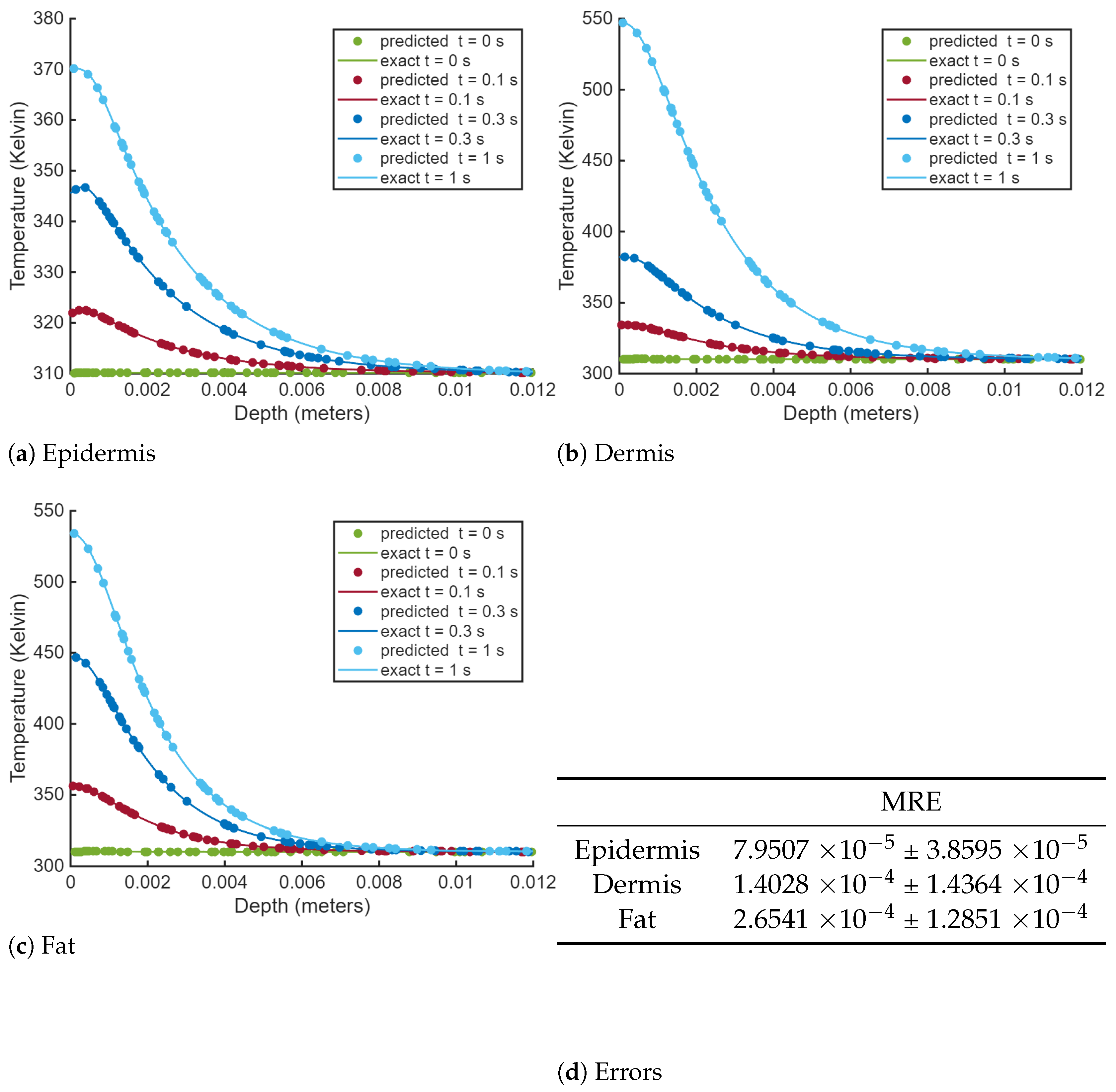
The PINN in Figure 3 was first applied to each of the three types of tissue found in human skin, one at a time, to test performance on a single material. In all cases, it was correctly determined that there was no boundary and, therefore, the tissue consisted of one homogeneous material. Temperatures were estimated with high accuracy across time and depth, as shown in Figure 4. The data points in these plots show a sample of predictions as a function of depth for time slices t = 0 s, 0.1 s, 0.3 s, and 1 s compared to the temperatures calculated by PAC1D, plotted in solid lines. The errors reported in the table for Figure 4d are averaged across all 100,000 points in the test data set and across all 30 independently trained networks.
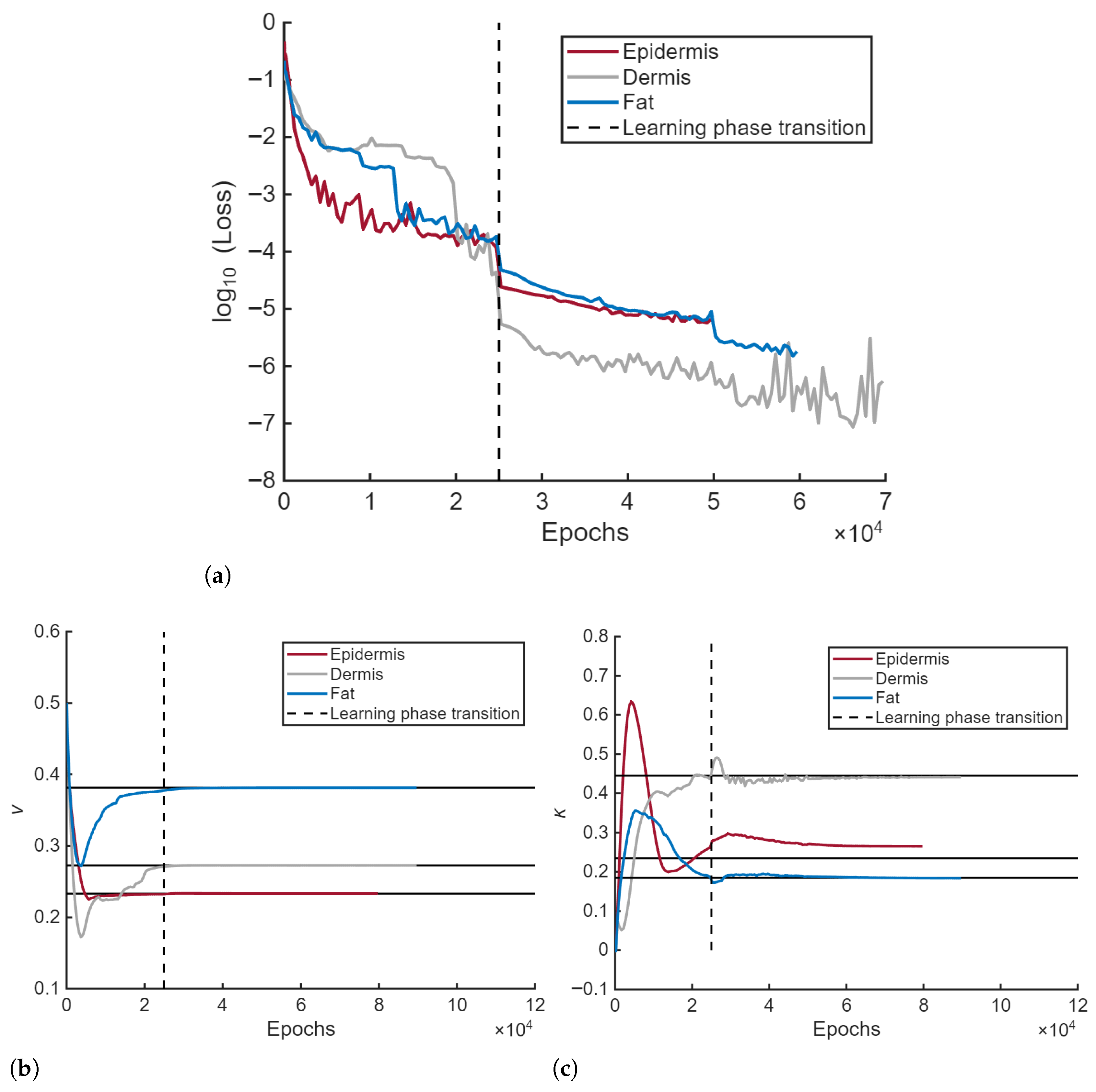
The total loss function described by Equation (8) for the three single material test cases is shown in Figure 5a. The losses plotted for each skin type are averaged over the 30 networks by the number of epochs for both phases of training. The initial 25,000 epochs in phase 1 show converging losses for all three skin types. In the second phase, to the right of the vertical dashed line, there is an abrupt initial decrease in the loss as the learning rate for the κ network is significantly increased and a better approximation is found quickly as κ becomes the primary focus of the learning. Subsequent decreases in the learning rate at intervals of 10,000 epochs steadily improve the overall loss until the final drop in learning rate becomes noisy and unproductive. Extending the learning beyond this point does not produce additional loss convergence or improved results.
Figure 5b,c depict the analogous convergence of the values for each of the material parameters themselves during the training process. The value of ν converges very quickly for each network to the correct value within the first phase, whereas κ converges more slowly. This demonstrates the value of the two-phase approach of decreasing the learning for the temperature and ν networks to focus on improving κ . Final accuracy results of parameter predictions for each type of layer in the skin are shown in Table 1 and compared to values set for the simulations in PAC1D. The average errors and standard deviations for κ are slightly greater than that of the temperature or ν predictions, particularly for the epidermis layer, but are in close agreement for the dermis and fat layers. The reason for the higher average error in the epidermis is unknown, but extensive experimentation suggests these discrepancies are at least partially the result of network design choices, such as initialization and convergence schemes. The higher errors and increased uncertainty for κ estimates, in general, is expected, since it is only found in the second derivative of the PDE. Small errors in the predicted temperature field are amplified when taking second derivatives, thus increasing numerical instability. The parameter ν , however, also appears in the source term and thus converges very quickly in all experiments.

4.2. Predictions for Multiple Materials

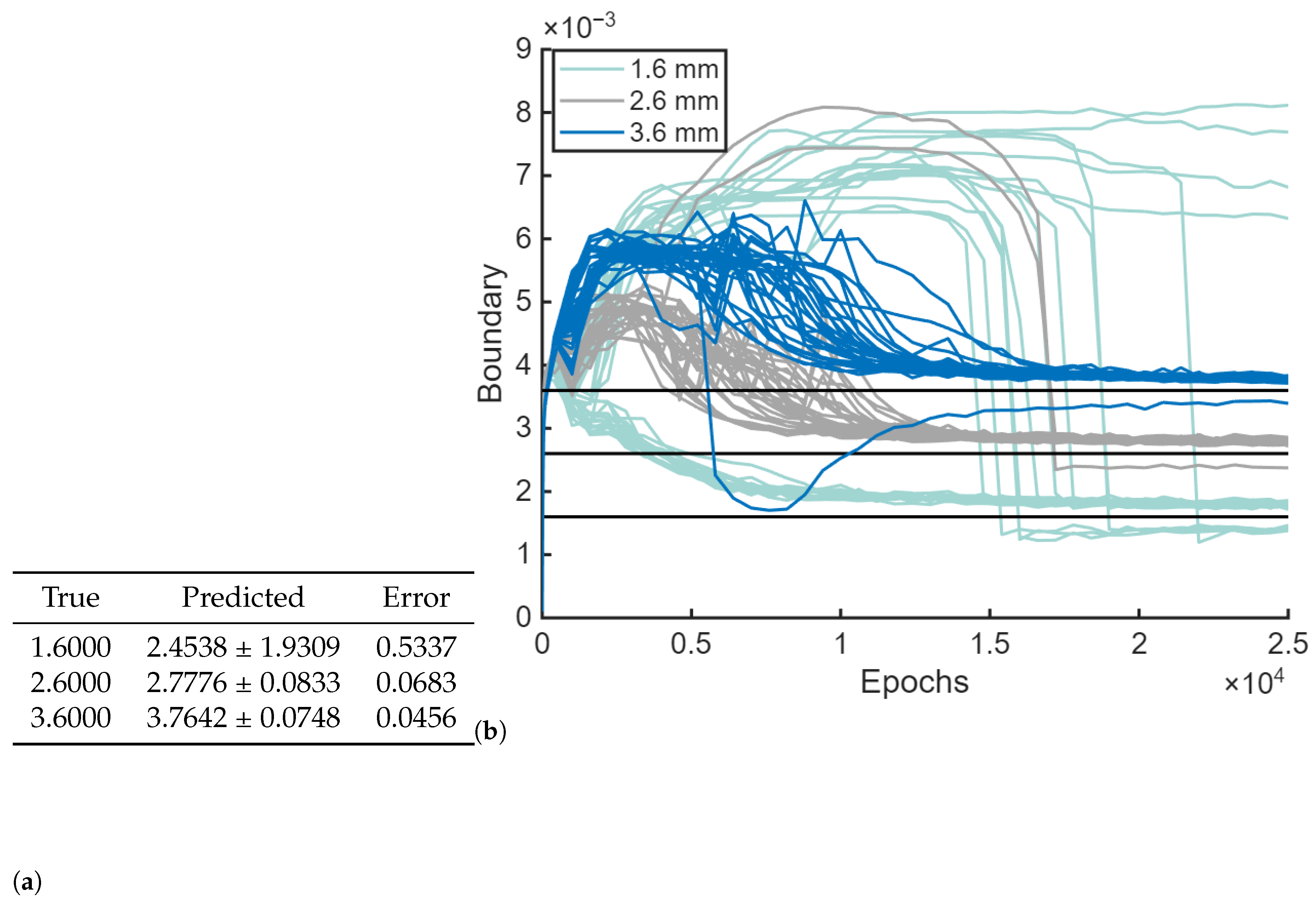
For testing performance with multiple materials, two-layer skin models are constructed consisting of dermis and fat layers. The dermis was simulated in PAC1D for thicknesses of 1.6 mm, 2.6 mm, and 3.6 mm on the surface, followed by a fat layer of thicknesses 9.4 mm, 8.4 mm, and 7.4 mm, for a total depth of 12 mm in all cases. The 30 networks were trained for each of these three boundary depths, and all of the resulting 90 networks detected a boundary indicating multiple materials. For each of the two-layer experiments, the scale for the ν and κ networks was initialized to 0.1. The convergence of the boundary values during phase 1 of the training is shown in Figure 6b. Although convergence paths vary slightly, good approximations of the true boundaries were established within 20,000 epochs or less in all cases with the exception of 4 outliers for a first-layer depth of 1.6 mm with poor boundary estimates, visible in the top right of Figure 6b. Accuracies are reported in Figure 6a.
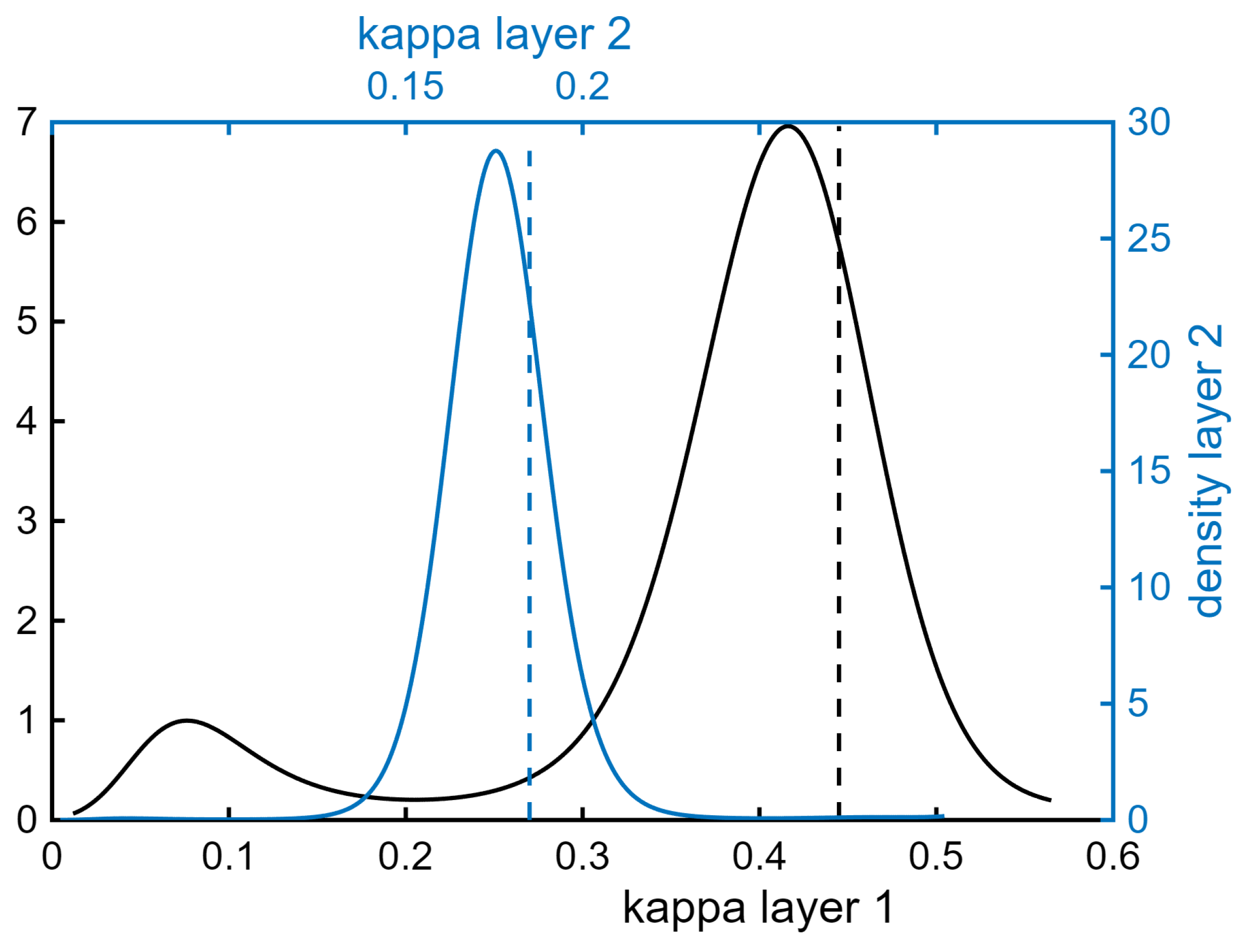
Phase 2 of the training for the two-layer models is performed for each of the two detected materials in turn and numerical results are reported in Table 2. The predictions for both layers of κ prediction are slightly underestimated on average, whereas ν is extremely accurate in all cases for all boundary depths tested. Figure 7 shows the distribution for κ predictions, with first-layer predictions shown in black and second-layer predictions shown in blue. The dotted lines indicate the true values. The distribution of the parameter predictions is quite close to the true values in most of the 30 simulations, but the distribution for κ predictions of the first layer has a slight bimodal trait showing a small density of estimates much lower than the true value. This often occurs when the boundary location is not predicted well.
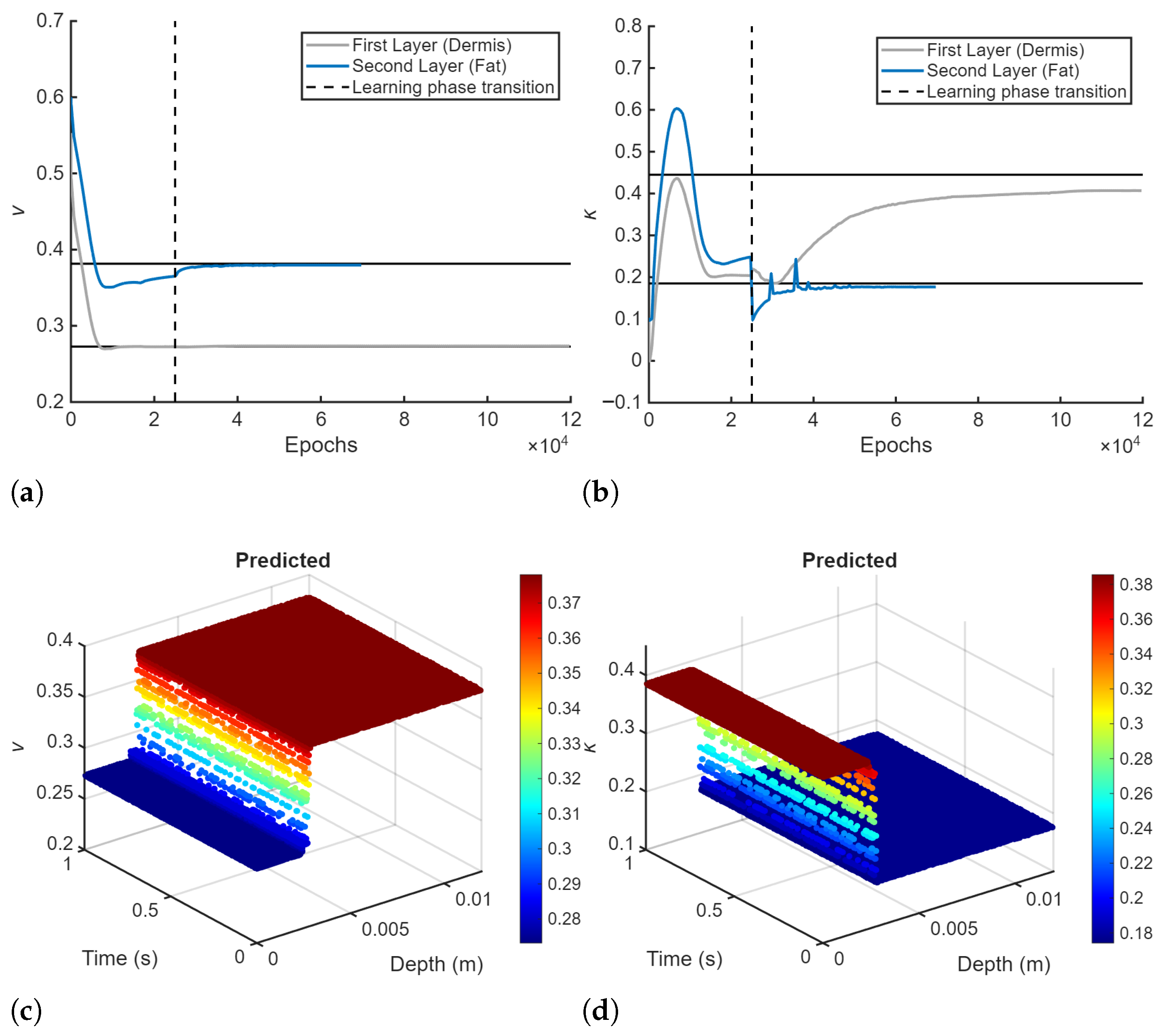
Figure 8 contains visual examples of results for a dermis layer of depth 2.6 mm. The average parameter convergence for the 30 simulations, shown in Figure 8a,b, includes both phases of the training. The first phase happens for both layers concurrently, whereas the second phase is performed twice, once for each skin layer. As with the single-layer models, ν is well approximated during phase 1, but κ improves significantly for both layers during the refinement in phase 2. In particular, the thinner first layer converges very slowly, requiring over 100,000 epochs in total on average. Average predictions for ν and κ are shown as a function of depth and time in Figure 8c,d, highlighting the uncertainty surrounding the boundary between layers caused by slight differences in boundaries detected between the 30 networks.

4.3. Predictions with Noisy Data

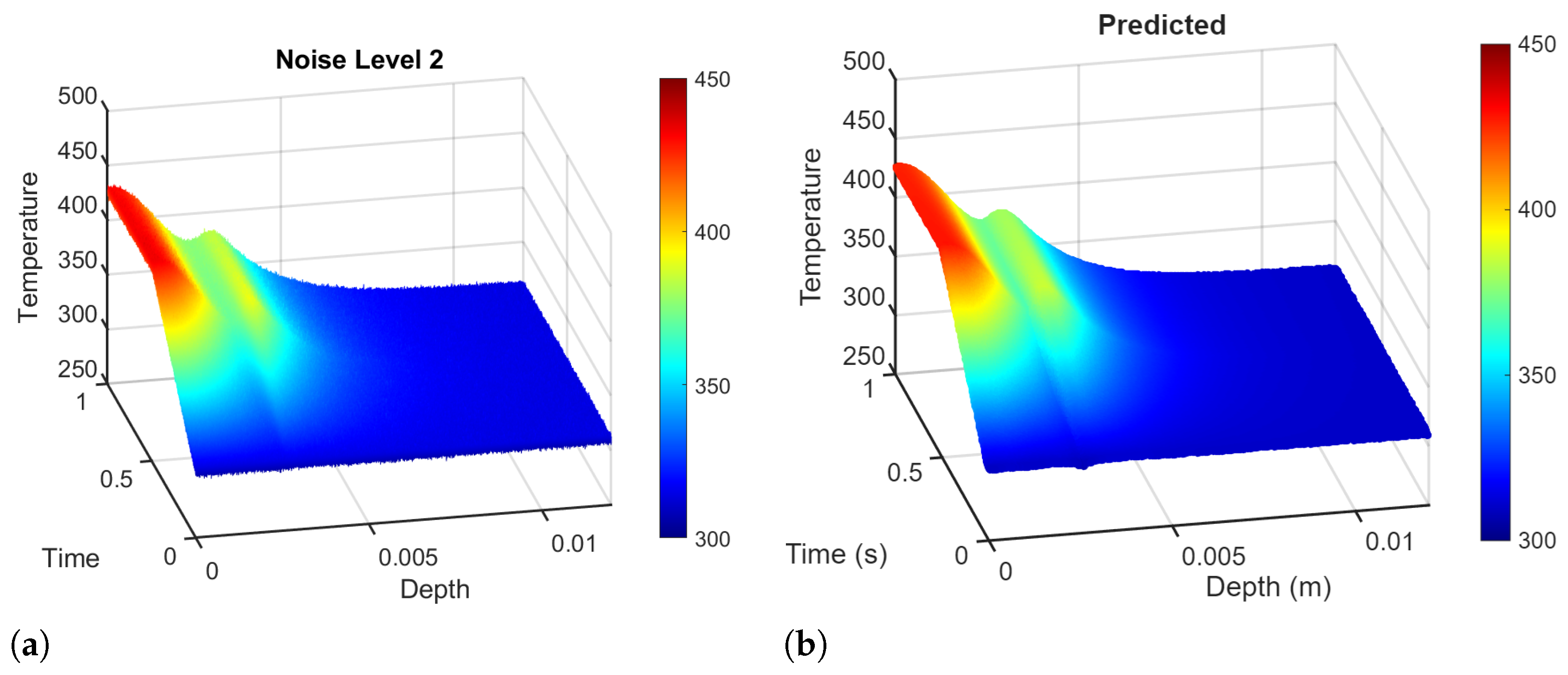
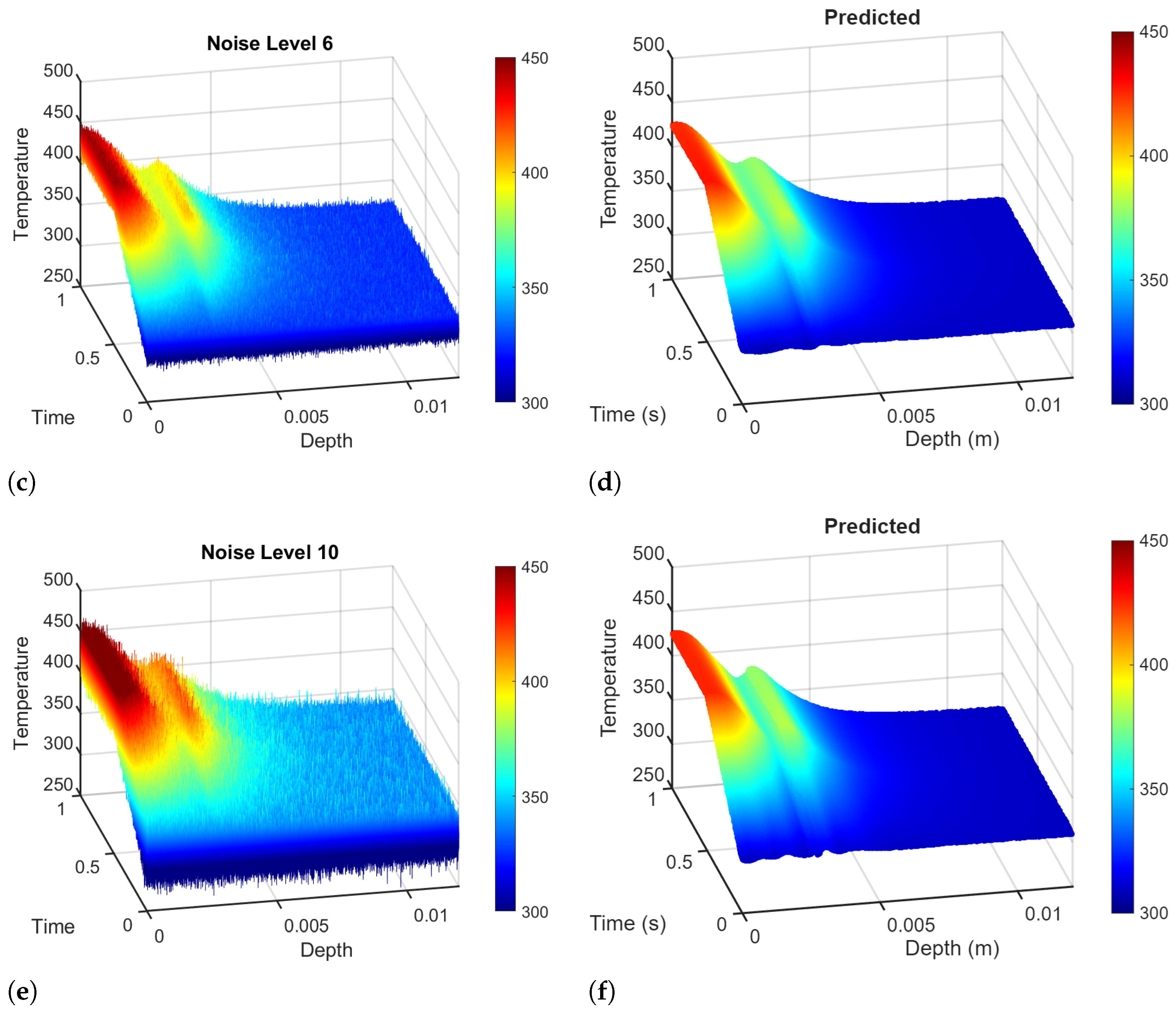
To simulate aleatoric uncertainty and demonstrate robustness in the presence of noisy measurement data, each of the temperatures in the training data was perturbed by a Gaussian distribution for standard deviations ranging from 1 to 10, for a two-layer dermis/fat model with a boundary at 2.6 mm. The first column of plots in Figure 9 demonstrate the true temperature calculations as a function of time and depth for a two-layer skin model with a boundary of 2.6 mm and increasing levels of noise. The second column of Figure 9 shows the associated temperature predictions for each noise level. Visually, there is very little degradation of the accuracy in the predictions due to noise, as the PINN smooths the perturbations even for the highest noise level. This is perhaps unsurprising since the network model relies very little on the training data and much more heavily on the PDE of the heat equation.
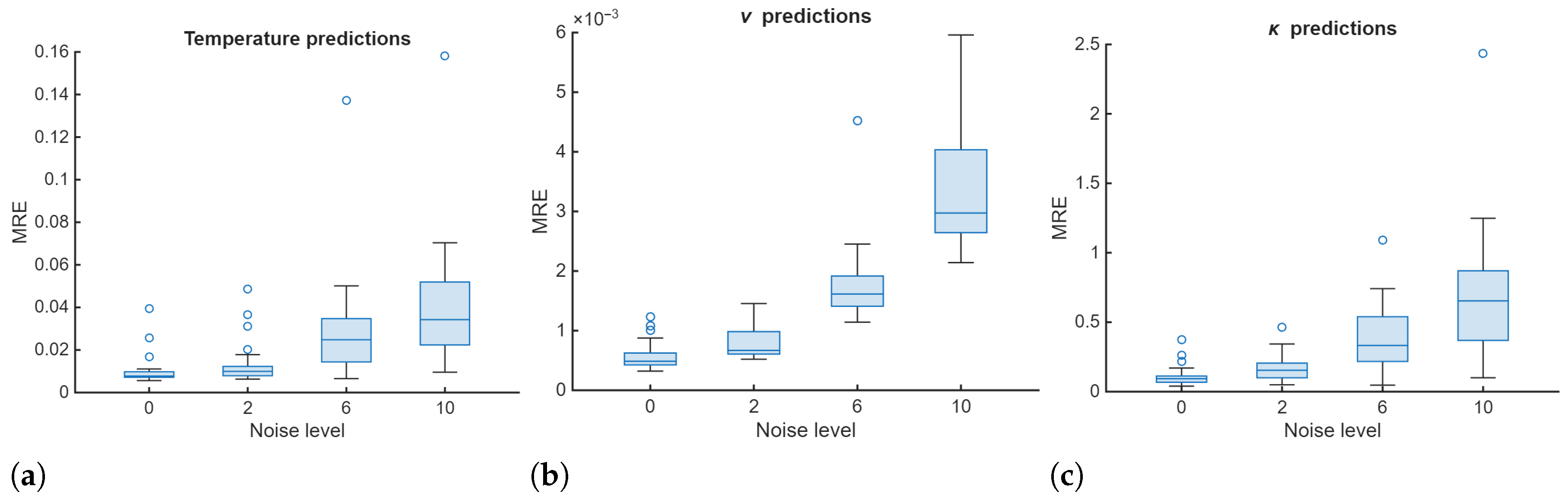
Figure 10a shows the distribution of errors for temperature predictions. These box plots represent distributions across the 30 trained networks as a function of the level of noise. Although errors remain quite low in all cases, there is a measurable decrease in accuracy precision with added noise. Similar trends hold for the parameter predictions shown in Figure 10a,c. In terms of the scale of the error itself, ν , maintains the highest level of accuracy of the three measurements. The κ parameter, however, is more significantly impacted by noise perturbations. There seems to be little or no correlation between the accuracy of κ and temperature predictions, however, across the 30 networks. Temperature estimates remain remarkably stable even when κ has a high error.

4.4. Model Performance

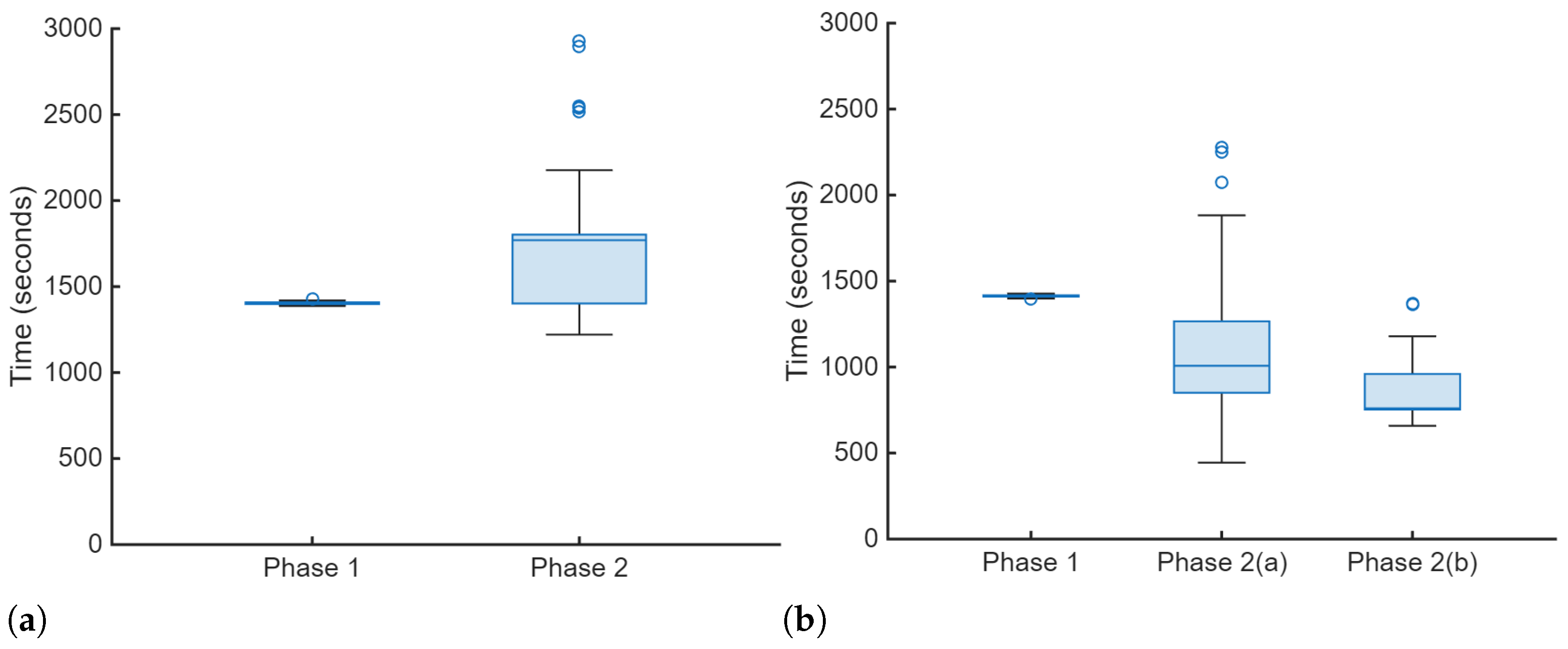
All models were trained using a single NVIDIA H200 GPU with 80 GB memory. In general, a single simulation is completed in under one hour, although there is some variation, depending on the number of skin layers and length of convergence. Figure 11 shows the range of simulation times for each phase of training for one-layer (Figure 11a) and two-layer (Figure 11b) models. Phase 1 is always fixed at 25,000 epochs and consistently runs in around 20 min for all models. Phase 2 training has a variable number of epochs, depending on convergence.

5. Limitations and Future Work

While the present study demonstrates the feasibility of using PINNs for simultaneous temperature and parameter estimation in layered skin models, several limitations should be acknowledged:
  • Dimensionality: The model is limited to a one-dimensional approximation of heat transfer. This simplification neglects lateral thermal gradients and is justified here by the assumption that the laser beam diameter is sufficiently large, such that radial thermal gradients at the point of interest are negligible for short time durations [68,69]. Extension to higher-dimensional geometries is important for clinical translation and is being considered in future work.
  • Material properties: Thermophysical properties (thermal conductivity and volumetric heat capacity) are assumed to be constant. In reality, tissue properties can vary with temperature due to processes such as protein denaturation. Incorporating temperature-dependent properties would increase model complexity and is a natural direction for future development.
  • Blood perfusion: Perfusion is neglected in this model, focusing solely on conductive heat transfer. While appropriate for controlled or short-duration heating, perfusion is an important factor in vivo and should be included in future extensions for realistic clinical simulations.
  • Number of layers and parameter identifiability: The method has been demonstrated on one- and two-layer systems. The accurate recovery of multiple interfaces becomes increasingly challenging as the number of layers increases, particularly when layer thickness approaches the resolution of the available training data. Extension to more complex multi-layer configurations may require improved parameter initialization or some prior knowledge of layer structure.
  • Synthetic data: Validation is performed using synthetic data generated with the PAC1D code (a one-dimensional finite-difference solver). While this allows rigorous assessment against a known ground truth, further validation using experimental measurements will be necessary to evaluate real-world applicability.
Despite these limitations, the current study establishes a controlled framework for evaluating PINNs in bioheat transfer, and the method demonstrates robust performance across a range of configurations and tissue types. Future work will focus on extending the framework to higher dimensions, temperature-dependent properties, perfusion effects, and more complex multi-layer geometries. Realistic data generation based on these and other additional complexities is being generated and modeled in PINN studies based on a sophisticated three-dimensional numerical method called Scalable Effects Simulation Environment (SESE) [70], and will be the subject of future work.

6. Conclusions

In conclusion, this work has established a robust methodology for the simultaneous solving of laser-induced temperature distribution through the tissue (the forward problem) while reconstructing unknown tissue thermal properties with a high degree of accuracy (the inverse problem). A dual approach was shown to be more efficient and flexible than traditional numerical methods without sacrificing model accuracy or fidelity. In addition to being a robust method, the proposed approach directly addresses epistemic uncertainty quantification by providing a statistical distribution of material property predictions around a point of interest, offering deep insight into network model performance. Aleotoric uncertainty quantification is studied through noise perturbation, an important metric for the material parameter distributions of biological systems where measurements can be highly variable or scarce.
One novel contribution in this work is the development of a PINN architecture capable of automatically detecting the location of subsurface material boundaries and characterizing the thermal tissue properties of each layer bordering the interface. Applications of models often assume known layer thicknesses and thermo-mechanical properties, yet this framework successfully estimates the spatially varying thermal conductivity, κ ( x ) , and volumetric heat capacity, ν ( x ) , with a high degree of accuracy within the expected biological variance inherently present in tissue. The uncertainty quantification of the predicted material parameters with a robust PINN inversion is more useful than traditional methods in practice, underscoring the long-understood challenge of estimating second-order derivative terms κ , which are inherently ill-posed, while highlighting the model’s ability to predict ν with higher accuracy and lower variance.
This research takes a critical step towards addressing more complex scenarios where tissue structure and material properties are heterogeneous and dynamic during laser exposure. A standout feature of the model is the ability to produce accurate and smooth predictions of temperature and material properties even when trained on data with significant noise. This demonstrates the PINN’s inherent regularization properties, making it advantageous for applications with noisy measurements. Additionally, the detection of multiple boundaries between materials should be possible with refinements to the network to represent even more complex biological structures. In summary, this paper introduces a strategic two-phase training process specifically designed to overcome the challenges of the inverse problem. It was found that this approach, first converging on temperature and the ν parameter before refining the more elusive κ parameter, proves to be a highly effective optimization strategy.

Author Contributions

J.F.: methodology, software, writing—original draft, investigation, and Figure 4, Figure 5, Figure 6, Figure 7, Figure 8, Figure 9 and Figure 10. C.O.: data curation, resources, funding acquisition, and Figure 1, Figure 2 and Figure 3. T.K.: formal analysis and supervision. All authors: conceptualization and writing—review and editing. All authors have read and agreed to the published version of the manuscript.

Funding

The funding for this project was supported in part by an appointment to the NRC Research Associateship Program at the 711th Human Performance Wings Tri-Service Research Laboratory, administered by the Fellowships Office of the National Academies of Sciences, Engineering, and Medicine, contract FA9550-18-D002.

Institutional Review Board Statement

Not applicable.

Informed Consent Statement

Not applicable.

Data Availability Statement

The code and data associated with this text can be found in the following repositories: https://github.com/jennyfarmer/PINNResults1 (accessed on 28 July 2025), https://github.com/jennyfarmer/PINNResults2 (accessed on 28 July 2025), and https://github.com/jennyfarmer/PINNTrain (accessed on 28 July 2025).

Acknowledgments

Support from the Air Force Research Labs Science and Technology Fellowship Program and The Center for Trustworthy Artificial Intelligence through Model Risk Management (TAIMing AI) at the University of North Carolina in Charlotte is gratefully acknowledged.

Conflicts of Interest

The authors declare no conflicts of interest.

References

  1. Yun, S.H.; Kwok, S.J.J. Light in diagnosis, therapy and surgery. Nat. Biomed. Eng. 2017, 1, 0008. [Google Scholar] [CrossRef]
  2. Jacques, S.L. Optical properties of biological tissues: A review. Phys. Med. Biol. 2013, 58, R37–R61. [Google Scholar] [CrossRef]
  3. Kim, B.M.; Jacques, S.; Rastegar, S.; Thomsen, S.; Motamedi, M. Nonlinear finite-element analysis of the role of dynamic changes in blood perfusion and optical properties in laser coagulation of tissue. IEEE J. Sel. Top. Quantum Electron. 1996, 2, 922–933. [Google Scholar] [CrossRef]
  4. Palmer, G.M.; Ramanujam, N. Monte Carlo-based inverse model for calculating tissue optical properties. Part I: Theory and validation on synthetic phantoms. Appl. Opt. 2006, 45, 1062–1071. [Google Scholar] [CrossRef]
  5. Fuentes, D.; Oden, J.T.; Diller, K.R.; Hazle, J.D.; Elliott, A.; Shetty, A.; Stafford, R.J. Computational Modeling and Real-Time Control of Patient-Specific Laser Treatment of Cancer. Ann. Biomed. Eng. 2009, 37, 763–782. [Google Scholar] [CrossRef] [PubMed]
  6. Bakas, S.; Reyes, M.; Jakab, A.; Bauer, S.; Rempfler, M.; Crimi, A.; Shinohara, R.T.; Berger, C.; Ha, S.M.; Rozycki, M.; et al. Identifying the Best Machine Learning Algorithms for Brain Tumor Segmentation, Progression Assessment, and Overall Survival Prediction in the BRATS Challenge. arXiv 2019. [Google Scholar] [CrossRef]
  7. Mignon, C.; Tobin, D.J.; Zeitouny, M.; Uzunbajakava, N.E. Shedding light on the variability of optical skin properties: Finding a path towards more accurate prediction of light propagation in human cutaneous compartments. Biomed. Opt. Express 2018, 9, 852–872. [Google Scholar] [CrossRef]
  8. Setchfield, K.; Gorman, A.; Simpson, A.; Somekh, M.G.; Wright, A.J. Relevance and utility of the in-vivo and ex-vivo optical properties of the skin reported in the literature: A review [Invited]. Biomed. Opt. Express 2023, 14, 3555–3583. [Google Scholar] [CrossRef]
  9. Hoffman, M.A.T.; Keppler, M.A.; Smith, A.L.; Fasci, A.; Macasadia, M.E.; Tijerina, A.J.; Hood, R.L.; DeLisi, M.P.; Bixler, J.N. Effects of cold storage on double integrating sphere optical property measurements of porcine dermis and subcutaneous fat from 400 to 1100 nm. J. Biomed. Opt. 2025, 30, 015001. [Google Scholar] [CrossRef]
  10. Roggan, A.; Schädel, D.; Netz, U.; Ritz, J.P.; Germer, C.T.; Müller, G. The effect of preparation technique on the optical parameters of biological tissue. Appl. Phys. B 1999, 69, 445–453. [Google Scholar] [CrossRef]
  11. DeLisi, M.P.; Peterson, A.M.; Tijerina, A.J.; Macasadia, M.E.; Coker, Z.N.; Hood, R.L.; Bixler, J.N. Optical properties of porcine skin and subcutaneous tissue following various methods of cold storage. In Proceedings of the Optical Interactions with Tissue and Cells XXXIII, and Advanced Photonics in Urology, San Francisco, CA, USA, 22 January–28 February 2022; Ibey, B.L., Linz, N., Eds.; International Society for Optics and Photonics, SPIE: Cergy-Pontoise, France, 2022; Volume 11958. [Google Scholar] [CrossRef]
  12. Trucu, D.; Ingham, D.B.; Lesnic, D. An inverse coefficient identification problem for the bio-heat equation. Inverse Probl. Sci. Eng. 2009, 17, 65–83. [Google Scholar] [CrossRef]
  13. Pennes, H.H. Analysis of tissue and arterial blood temperatures in the resting human forearm. J. Appl. Physiol. 1948, 1, 93–122. [Google Scholar] [CrossRef]
  14. Engl, H.W.; Groetsch, C.W. Inverse and Ill-Posed Problems; Elsevier: Boston, MA, USA, 2014. [Google Scholar]
  15. Klibanov, M.V.; Li, J.; Zhang, W. Convexification for an inverse parabolic problem. Inverse Probl. 2020, 36, 085008. [Google Scholar] [CrossRef]
  16. Isakov, V. Inverse Problems for Partial Differential Equations; Springer: Cham, Switzerland, 2006; Volume 127. [Google Scholar]
  17. Beck, J.V.; Blackwell, B.; Clair, C.R.S. Inverse Heat Conduction: Ill-Posed Problems; James Beck: New York, NY, USA, 1985. [Google Scholar]
  18. Cannon, J.; Douglas, J., Jr. The Cauchy problem for the heat equation. Siam J. Numer. Anal. 1967, 4, 317–336. [Google Scholar] [CrossRef] [PubMed]
  19. Colaço, M.J.; Orlande, H.R.; Dulikravich, G.S. Inverse and optimization problems in heat transfer. J. Braz. Soc. Mech. Sci. Eng. 2006, 28, 1–24. [Google Scholar] [CrossRef]
  20. Lesnic, D.; Elliott, L.; Ingham, D. An iterative boundary element method for solving the backward heat conduction problem using an elliptic approximation. Inverse Probl. Eng. 1998, 6, 255–279. [Google Scholar] [CrossRef]
  21. Benabdallah, A.; Dermenjian, Y.; Le Rousseau, J. Carleman estimates for the one-dimensional heat equation with non-smooth coefficients and applications. J. Physics Conf. Ser. 2007, 73, 012004. [Google Scholar] [CrossRef]
  22. Hao, D.N.; Thanh, P.X.; Lesnic, D. Determination of the heat transfer coefficients in transient heat conduction. Inverse Probl. 2013, 29, 095020. [Google Scholar] [CrossRef]
  23. Alifanov, O.M. Inverse Heat Transfer Problems; Springer Science & Business Media: Berlin/Heidelberg, Germany, 2012. [Google Scholar]
  24. Cao, W.; Zhang, W. An analysis and solution of ill-conditioning in physics-informed neural networks. J. Comput. Phys. 2025, 520, 113494. [Google Scholar] [CrossRef]
  25. Thakur, S.; Esmaili, E.; Libring, S.; Solorio, L.; Ardekani, A.M. Inverse resolution of spatially varying diffusion coefficient using physics-informed neural networks. Phys. Fluids 2024, 36, 081915. [Google Scholar] [CrossRef]
  26. Wang, G.; Mao, Z.; Yu, H.; Chen, H.; Sun, S. Fuzzy estimation for transient distribution of internal thermal excitation in composite overwrapped pressure vessel. Appl. Therm. Eng. 2022, 203, 117866. [Google Scholar] [CrossRef]
  27. LeVeque, R.J. Finite Difference Methods for Ordinary and Partial Differential Equations: Steady-State and Time-Dependent Problems; SIAM: Philadelphia, PA, USA, 2007. [Google Scholar]
  28. Rao, S.S. The Finite Element Method in Engineering; Butterworth-Heinemann: Paris, France, 2017. [Google Scholar]
  29. Tezuka, A. Finite Element and Finite Difference Methods. In Springer Handbook of Metrology and Testing; Czichos, H., Saito, T., Smith, L., Eds.; Springer: Berlin/Heidelberg, Germany, 2011; pp. 1033–1060. [Google Scholar]
  30. Cao, K.; Lesnic, D.; Liu, J. Simultaneous reconstruction of space-dependent heat transfer coefficients and initial temperature. J. Comput. Appl. Math. 2020, 375, 112800. [Google Scholar] [CrossRef]
  31. Sun, S. Simultaneous reconstruction of thermal boundary condition and physical properties of participating medium. Int. J. Therm. Sci. 2021, 163, 106853. [Google Scholar] [CrossRef]
  32. Sun, S.; Ji, Y.; Chang, Z.; Wang, G.; Chen, H. Reconstruction of surface laser power and internal temperature of biological tissue during laser-induced thermal therapy. Numer. Heat Transf. Part A Appl. 2023, 83, 558–571. [Google Scholar] [CrossRef]
  33. Cao, K.; Lesnic, D. Reconstruction of the perfusion coefficient from temperature measurements using the conjugate gradient method. Int. J. Comput. Math. 2018, 95, 797–814. [Google Scholar] [CrossRef]
  34. Chang, Z.; Sun, S.; Li, L.; Wei, L. Reconstruction of infrared absorption and scattering coefficient distributions of semitransparent medium using Adam algorithm combined with adjoint model. Infrared Phys. Technol. 2024, 141, 105481. [Google Scholar] [CrossRef]
  35. Gorchakov, A.Y.; Zubov, V.I. Determination of the Thermal Conductivity and Volumetric Heat Capacity of Substance from Heat Flux. Comput. Math. Math. Phys. 2024, 64, 833–847. [Google Scholar] [CrossRef]
  36. Vasil’ev, V.I.; Kardashevsky, A.M.; Popov, V.V. Iterative Solution of a Retrospective Inverse Heat Conduction Problem with Inhomogeneous Dirichlet Boundary Conditions. J. Appl. Ind. Math. 2022, 16, 841–852. [Google Scholar] [CrossRef]
  37. Wen, J.; Liu, Z.X.; Wang, S.S. Conjugate gradient method for simultaneous identification of the source term and initial data in a time-fractional diffusion equation. Appl. Math. Sci. Eng. 2022, 30, 324–338. [Google Scholar] [CrossRef]
  38. Colaço, M.; Bozzoli, F.; Cattani, L.; Pagliarini, L. Local heat flux estimation inside tubes through conjugate gradient method with adjoint operator: Application to the pulsating heat pipes case. Int. J. Numer. Methods Heat Fluid Flow 2023, 33, 1754–1774. [Google Scholar] [CrossRef]
  39. Huang, C.H.; Jan-Yuan, Y. An inverse problem in simultaneously measuring temperature-dependent thermal conductivity and heat capacity. Int. J. Heat Mass Transf. 1995, 38, 3433–3441. [Google Scholar] [CrossRef]
  40. Tao, M.; Chen, X.; Sun, Y.; Huang, Q. A Numerical Approach to Solving an Inverse Heat Conduction Problem Using the Levenberg-Marquardt Algorithm. Math. Probl. Eng. 2014, 2014, 626037. [Google Scholar]
  41. Montazeri, M.; Mohammadiun, H.; Mohammadiun, M.; Bonab, M.H.D.; Vahedi, M. Inverse estimation of the time-dependent wall temperature in stagnation region of an annular jet on a cylinder rod using Levenberg-Marquardt method. J. Therm. Anal. Calorim. 2022, 147, 2729. [Google Scholar] [CrossRef]
  42. Khatoon, S.; Phirani, J.; Bahga, S.S. Fast Bayesian inference for inverse heat conduction problem using polynomial chaos and Karhunen–Loeve expansions. Appl. Therm. Eng. 2023, 219, 119616. [Google Scholar] [CrossRef]
  43. Czél, B.; Gróf, G. Simultaneous Identification of Temperature-Dependent Thermal Properties via Enhanced Genetic Algorithm. Int. J. Thermophys. 2012, 33, 1023–1041. [Google Scholar] [CrossRef]
  44. Allard, D.; Najafi, H. Genetic Algorithm as the Solution of Non-Linear Inverse Heat Conduction Problems: A Novel Sequential Approach. ASME J. Heat Mass Transf. 2024, 146, 091404. [Google Scholar] [CrossRef]
  45. Imani, A.; Ranjbar, A.A.; Esmkhani, M. Simultaneous estimation of temperature-dependent thermal conductivity and heat capacity based on modified genetic algorithm. Inverse Probl. Sci. Eng. 2006, 14, 767–783. [Google Scholar] [CrossRef]
  46. Brociek, R.; Goik, M.; Miarka, J.; Pleszczyński, M.; Napoli, C. Solution of Inverse Problem for Diffusion Equation with Fractional Derivatives Using Metaheuristic Optimization Algorithm. Informatica 2024, 35, 453–481. [Google Scholar] [CrossRef]
  47. Pan, H.; Gong, J. Application of Particle Swarm Optimization (PSO) Algorithm in Determining Thermodynamics of Solid Combustibles. Energies 2023, 16, 5302. [Google Scholar] [CrossRef]
  48. Bowman, B.; Oian, C.; Kurz, J.; Khan, T.; Gil, E.; Gamez, N. Physics-Informed Neural Networks for the Heat Equation with Source Term under Various Boundary Conditions. Algorithms 2023, 16, 428. [Google Scholar] [CrossRef]
  49. Farmer, J.; Oian, C.A.; Bowman, B.A.; Khan, T. Empirical loss weight optimization for PINN modeling laser bio-effects on human skin for the 1D heat equation. Mach. Learn. Appl. 2024, 16, 100563. [Google Scholar] [CrossRef]
  50. Kurz, J.; Bowman, B.; Seman, M.; Oian, C.; Khan, T. A physics-informed kernel approach to learning the operator for parametric PDEs. Neural Comput. Appl. 2024, 36, 22773–22787. [Google Scholar] [CrossRef]
  51. Raissi, M.; Perdikaris, P.; Karniadakis, G.E. Physics-informed neural networks: A deep learning framework for solving forward and inverse problems involving nonlinear partial differential equations. J. Comput. Phys. 2019, 378, 686–707. [Google Scholar] [CrossRef]
  52. Cai, S.; Wang, Z.; Wang, S.; Perdikaris, P.; Karniadakis, G.E. Physics-Informed Neural Networks for Heat Transfer Problems. J. Heat Transf. 2021, 143, 060801. [Google Scholar] [CrossRef]
  53. Berg, J.; Nyström, K. A unified deep artificial neural network approach to partial differential equations in complex geometries. Neurocomputing 2018, 317, 28–41. [Google Scholar] [CrossRef]
  54. Guo, Y.; Cao, X.; Liu, B.; Gao, M. Solving Partial Differential Equations Using Deep Learning and Physical Constraints. Appl. Sci. 2020, 10, 5917. [Google Scholar] [CrossRef]
  55. Berrone, S.; Canuto, C.; Pintore, M.; Sukumar, N. Enforcing Dirichlet boundary conditions in physics-informed neural networks and variational physics-informed neural networks. Heliyon 2023, 9, e18820. [Google Scholar] [CrossRef]
  56. Jagtap, A.D.; Karniadakis, G.E. Extended Physics-Informed Neural Networks (XPINNs): A Generalized Space-Time Domain Decomposition Based Deep Learning Framework for Nonlinear Partial Differential Equations. Commun. Comput. Phys. 2020, 28, 2002–2041. [Google Scholar] [CrossRef]
  57. Zobeiry, N.; Humfeld, K.D. A physics-informed machine learning approach for solving heat transfer equation in advanced manufacturing and engineering applications. Eng. Appl. Artif. Intell. 2021, 101, 104232. [Google Scholar] [CrossRef]
  58. Aliakbari, M.; Mahmoudi, M.; Vadasz, P.; Arzani, A. Predicting high-fidelity multiphysics data from low-fidelity fluid flow and transport solvers using physics-informed neural networks. Int. J. Heat Fluid Flow 2022, 96, 109002. [Google Scholar] [CrossRef]
  59. He, Q.; Barajas-Solano, D.; Tartakovsky, G.; Tartakovsky, A.M. Physics-informed neural networks for multiphysics data assimilation with application to subsurface transport. Adv. Water Resour. 2020, 141, 103610. [Google Scholar] [CrossRef]
  60. Sarabian, M.; Babaee, H.; Laksari, K. Physics-Informed Neural Networks for Brain Hemodynamic Predictions Using Medical Imaging. IEEE Trans. Med. Imaging 2022, 41, 2285–2303. [Google Scholar] [CrossRef]
  61. van Herten, R.L.; Chiribiri, A.; Breeuwer, M.; Veta, M.; Scannell, C.M. Physics-informed neural networks for myocardial perfusion MRI quantification. Med. Image Anal. 2022, 78, 102399. [Google Scholar] [CrossRef]
  62. Billah, M.M.; Khan, A.I.; Liu, J.; Dutta, P. Physics-informed deep neural network for inverse heat transfer problems in materials. Mater. Today Commun. 2023, 35, 106336. [Google Scholar] [CrossRef]
  63. Jo, J.; Jeong, Y.; Kim, J.; Yoo, J. Thermal conductivity estimation using Physics-Informed Neural Networks with limited data. Eng. Appl. Artif. Intell. 2024, 137, 109079. [Google Scholar] [CrossRef]
  64. Zhang, B.; Wu, G.; Gu, Y.; Wang, X.; Wang, F. Multi-domain physics-informed neural network for solving forward and inverse problems of steady-state heat conduction in multilayer media. Phys. Fluids 2022, 34, 116116. [Google Scholar] [CrossRef]
  65. Wang, T.; Wang, Z.; Huang, Z.; Xi, G. Multi-domain physics-informed neural network for solving heat conduction and conjugate natural convection with discontinuity of temperature gradient on interface. Sci. China Technol. Sci. 2022, 65, 2442–2461. [Google Scholar] [CrossRef]
  66. Kingma, D.P.; Ba, J. Adam: A Method for Stochastic Optimization. arXiv 2017. [Google Scholar] [CrossRef]
  67. Ansel, J.; Yang, E.; He, H.; Gimelshein, N.; Jain, A.; Voznesensky, M.; Bao, B.; Bell, P.; Berard, D.; Burovski, E.; et al. PyTorch 2: Faster Machine Learning Through Dynamic Python Bytecode Transformation and Graph Compilation. In Proceedings of the 29th ACM International Conference on Architectural Support for Programming Languages and Operating Systems, ASPLOS ’24, La Jolla, CA, USA, 27 April–1 May 2024; Association for Computing Machinery: New York, NY, USA, 2024; Volume 2, pp. 929–947. [Google Scholar] [CrossRef]
  68. Seyedpour, S.M.; Azhdari, M.; Lambers, L.; Ricken, T.; Rezazadeh, G. One-dimensional thermomechanical bio-heating analysis of viscoelastic tissue to laser radiation shapes. Int. J. Heat Mass Transf. 2024, 218, 124747. [Google Scholar] [CrossRef]
  69. Lukac, M.; Kukovic, J.; Lukac, N.; Bajd, F. Influence of Different Absorption in Desiccated Tissue on Soft-Tissue Surgery with Er:YAG and CO2 Lasers. J. Laser Health Acad. 2020, 2020, 1–12. [Google Scholar]
  70. Zollars, B.G.; Early, E.A.; Thomas, R.J.; Elpers, G.J.; Goodwin, A.L.; Gamez, N.J. Scalable Effects Simulation Environment (SESE) Version 2.5.0.; Final Technical Report; Air Force Research Laboratory: Fort Sam Houston, TX, USA, 2019. [Google Scholar]
Figure 1. Overview of the framework for a physics-informed neural network to solve the time-dependent heat equation in one dimension.
Applsci 16 04172 g001
Figure 2. Schematic for the simulated laser experiment for multiple layers of human skin. The laser source is aimed perpendicular to the surface of the skin for 0.5 s and then allowed to cool. Layer thicknesses not to scale.
Applsci 16 04172 g002
Figure 3. Overview of the framework for a physics-informed neural network to solve the time-dependent heat equation in one dimension for the inverse problem. The network on the top left predicts a time-dependent temperature, while the two networks below it predict the time-independent material parameters ν and κ .
Applsci 16 04172 g003
Figure 4. Temperature predictions for the forward problem for the three different layers of human skin. Plots (ac) show predictions for three time slices at t = 0 s, 0.1 s, 0.3 s, and 1 s. The table in (d) reports mean relative error and standard deviation for each type of skin, averaged over 30 independently trained networks for 100,000 test points each.
Applsci 16 04172 g004
Figure 5. Convergence by epoch for single-material test cases of (a) total loss, (b) ν , and (c) κ .
Applsci 16 04172 g005
Figure 6. Predicted boundaries between two distinct materials. (a) Predictions and errors compared to the true values. (b) Convergence of boundary values during the initial phase of training. Horizontal black lines indicate location of the true boundaries.
Applsci 16 04172 g006
Figure 7. Distributions of κ predictions for all two-layer models. Dashed lines represent the location of the true values for each layer.
Applsci 16 04172 g007
Figure 8. Predictions of (a,c) ν and (b,d) κ for a dermis skin layer of depth 2.6 mm, followed by a fat layer of 9.4 mm.
Applsci 16 04172 g008
Figure 9. Temperature predictions for noisy training data. The plots (a,c,e) in the first column show the perturbed training data for increasing levels of noise. The plots (b,d,f) in the second column show the resulting predictions, demonstrating the ability of the PINN model to smooth the perturbations for accurate predictions.
Applsci 16 04172 g009aApplsci 16 04172 g009b
Figure 10. Error distribution as a function of noise for (a) temperature, (b) ν , and (c) κ .
Applsci 16 04172 g010
Figure 11. Performance for each phase of (a) one- and (b) two-layer skin models.
Applsci 16 04172 g011
Table 1. Experimental and predicted values for ν and κ parameters for each of the three layers of human skin averaged over 30 simulations.
ν MeasuredPredictedAverage Error
Epidermis2.3343 × 10−72.3350 × 10⁻⁷ ± 1.9036 × 10−106.0604 × 10⁻⁴
Dermis2.7276 × 10−72.7289 × 10⁻⁷± 1.4494 × 10−105.0192 × 10⁻⁴
Fat3.8143 × 10−73.8126 × 10⁻⁷ ± 5.2549 × 10−107.0585 × 10⁻⁴
κ
Epidermis0.23500.2645 ± 0.01770.1255
Dermis0.44500.4419 ± 0.02070.0295
Fat0.18500.1856 ± 0.01130.0442
Table 2. Experimental and predicted values for ν and κ parameters for a two-layer model averaged over 30 simulations.
ν DepthMeasuredPredictedAverage Error
Dermis1.62.7276 × 10−72.7849 × 10⁻⁷ ± 1.2617 × 10−82.2008 × 10−2
Fat 3.8143 × 10−73.7853 × 10−7 ± 3.9266 × 10−97.6778 × 10−3
Dermis2.62.7276 × 10−72.7351 × 10⁻⁷ ± 7.6263 × 10−33.3989 × 10−3
Fat 3.8143 × 10−73.7965 × 10−7 ± 3.9904 × 10−94.6610 × 10−3
Dermis3.62.7276 × 10−72.7250 × 10⁻⁷ ± 3.7683 × 10−101.3972 × 10⁻³
Fat 3.8143 × 10−73.7947 × 10−7 ± 4.9176 × 10−95.1333 × 10−3
κ
Dermis1.60.44500.3693 ± 1.1209 × 10−10.2008
Fat 0.18500.2171 ± 6.5592 × 10−20.2148
Dermis2.60.44500.4075 ± 8.6407 × 10−20.1160
Fat 0.18500.1767 ± 1.1867 × 10−20.0652
Dermis3.60.44500.3421 ± 1.2981 × 10−10.2488
Fat 0.18500.1669 ± 1.9808 × 10−20.1021
Disclaimer/Publisher’s Note: The statements, opinions and data contained in all publications are solely those of the individual author(s) and contributor(s) and not of MDPI and/or the editor(s). MDPI and/or the editor(s) disclaim responsibility for any injury to people or property resulting from any ideas, methods, instructions or products referred to in the content.