Estimating Material Parameters for a One-Dimensional Heat Equation with a Physics-Informed Neural Network

Abstract
1. Introduction
2. Background
2.1. The Forward Problem for Heat Diffusion
2.2. The Inverse Problem
2.3. Physics-Informed Neural Networks (PINNs)
3. Network Design
4. Results and Discussion
4.1. Single Material Predictions
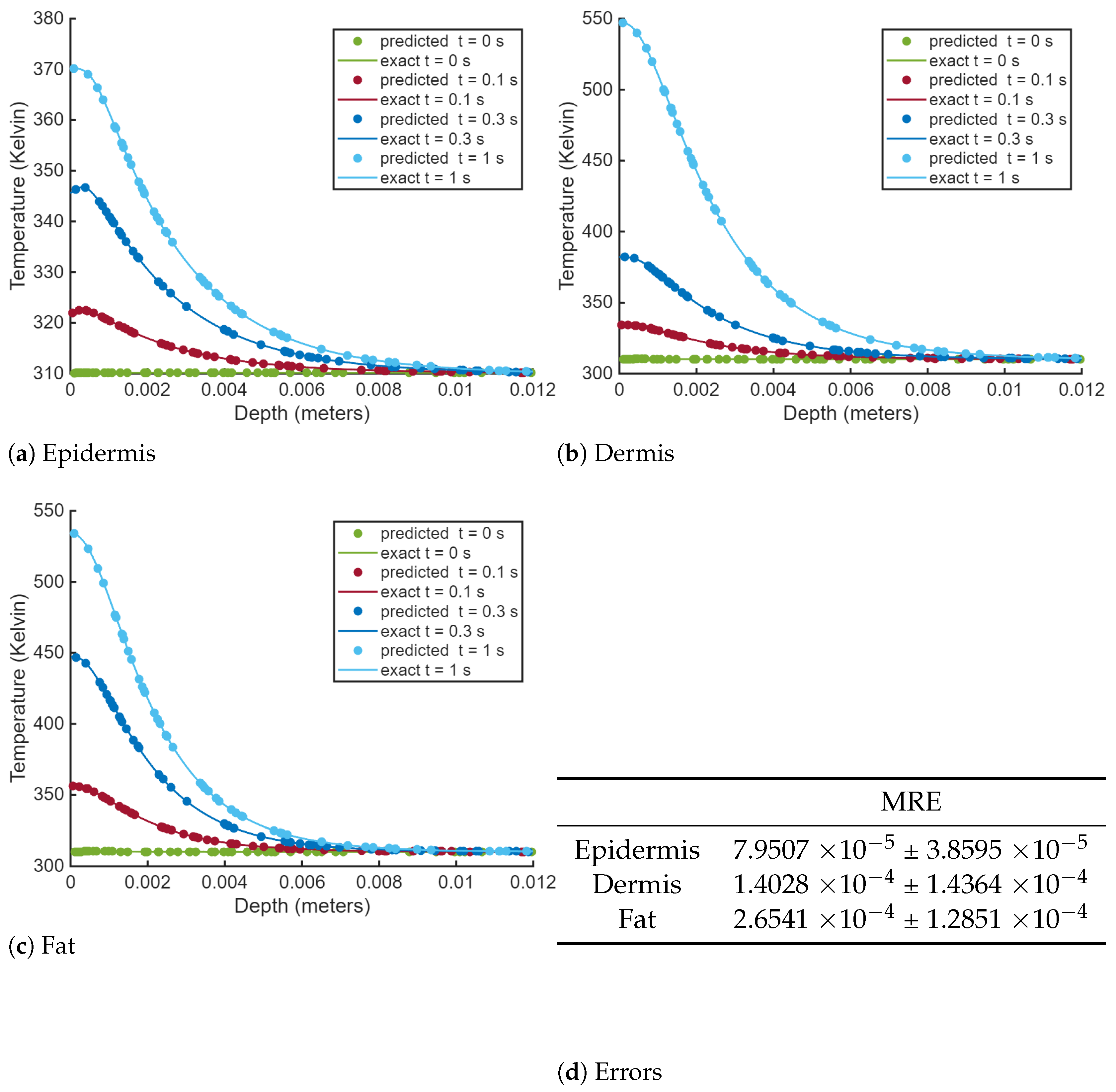
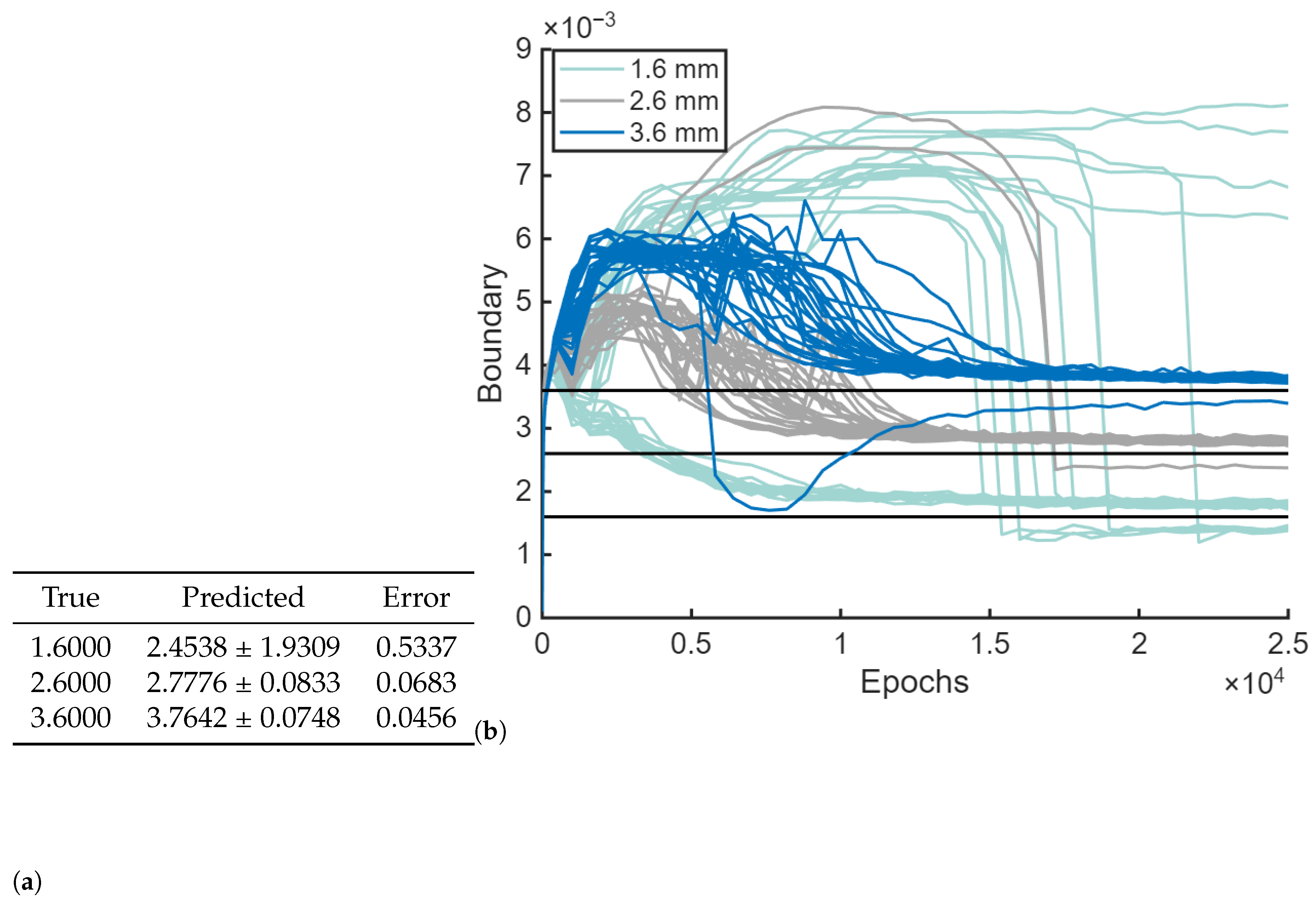
4.2. Predictions for Multiple Materials
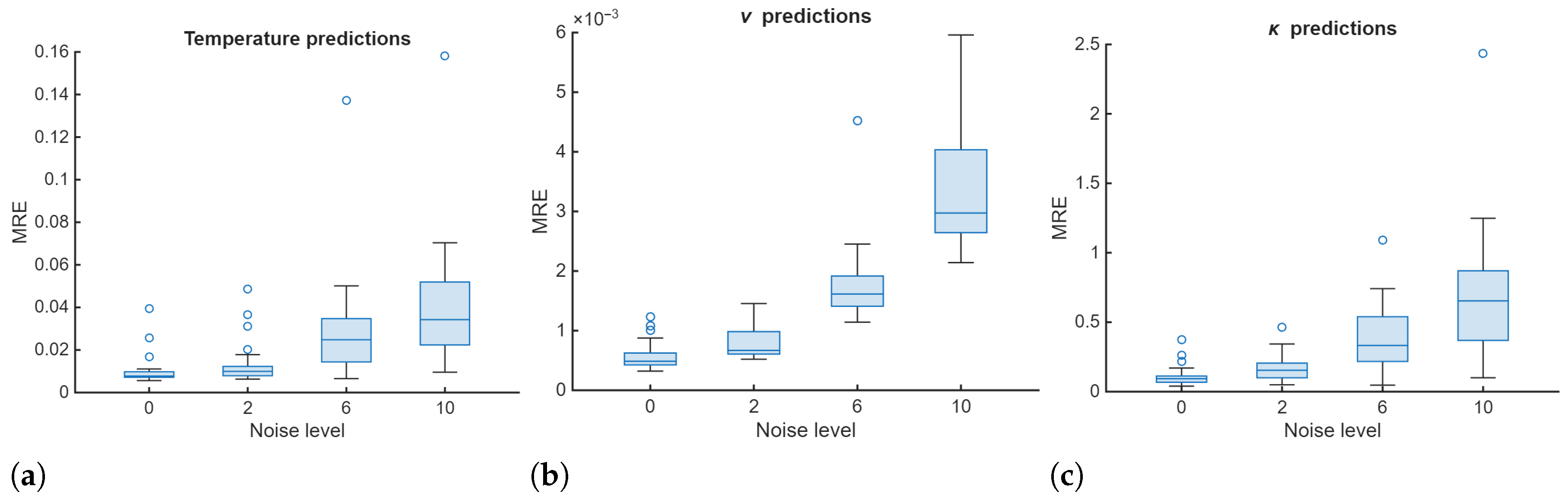
4.3. Predictions with Noisy Data
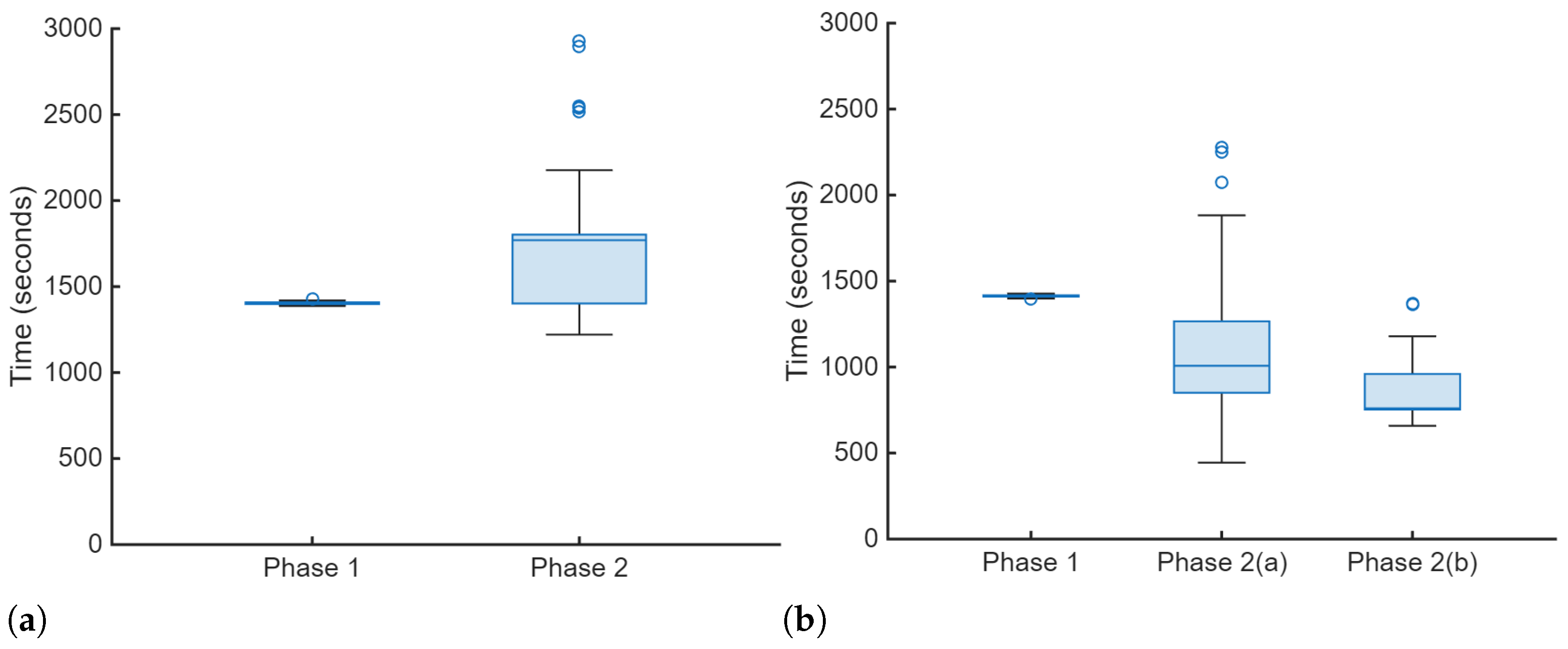
4.4. Model Performance
5. Limitations and Future Work
- Dimensionality: The model is limited to a one-dimensional approximation of heat transfer. This simplification neglects lateral thermal gradients and is justified here by the assumption that the laser beam diameter is sufficiently large, such that radial thermal gradients at the point of interest are negligible for short time durations [68,69]. Extension to higher-dimensional geometries is important for clinical translation and is being considered in future work.
- Material properties: Thermophysical properties (thermal conductivity and volumetric heat capacity) are assumed to be constant. In reality, tissue properties can vary with temperature due to processes such as protein denaturation. Incorporating temperature-dependent properties would increase model complexity and is a natural direction for future development.
- Blood perfusion: Perfusion is neglected in this model, focusing solely on conductive heat transfer. While appropriate for controlled or short-duration heating, perfusion is an important factor in vivo and should be included in future extensions for realistic clinical simulations.
- Number of layers and parameter identifiability: The method has been demonstrated on one- and two-layer systems. The accurate recovery of multiple interfaces becomes increasingly challenging as the number of layers increases, particularly when layer thickness approaches the resolution of the available training data. Extension to more complex multi-layer configurations may require improved parameter initialization or some prior knowledge of layer structure.
- Synthetic data: Validation is performed using synthetic data generated with the PAC1D code (a one-dimensional finite-difference solver). While this allows rigorous assessment against a known ground truth, further validation using experimental measurements will be necessary to evaluate real-world applicability.
6. Conclusions
Author Contributions
Funding
Institutional Review Board Statement
Informed Consent Statement
Data Availability Statement
Acknowledgments
Conflicts of Interest
References
- Yun, S.H.; Kwok, S.J.J. Light in diagnosis, therapy and surgery. Nat. Biomed. Eng. 2017, 1, 0008. [Google Scholar] [CrossRef]
- Jacques, S.L. Optical properties of biological tissues: A review. Phys. Med. Biol. 2013, 58, R37–R61. [Google Scholar] [CrossRef]
- Kim, B.M.; Jacques, S.; Rastegar, S.; Thomsen, S.; Motamedi, M. Nonlinear finite-element analysis of the role of dynamic changes in blood perfusion and optical properties in laser coagulation of tissue. IEEE J. Sel. Top. Quantum Electron. 1996, 2, 922–933. [Google Scholar] [CrossRef]
- Palmer, G.M.; Ramanujam, N. Monte Carlo-based inverse model for calculating tissue optical properties. Part I: Theory and validation on synthetic phantoms. Appl. Opt. 2006, 45, 1062–1071. [Google Scholar] [CrossRef]
- Fuentes, D.; Oden, J.T.; Diller, K.R.; Hazle, J.D.; Elliott, A.; Shetty, A.; Stafford, R.J. Computational Modeling and Real-Time Control of Patient-Specific Laser Treatment of Cancer. Ann. Biomed. Eng. 2009, 37, 763–782. [Google Scholar] [CrossRef] [PubMed]
- Bakas, S.; Reyes, M.; Jakab, A.; Bauer, S.; Rempfler, M.; Crimi, A.; Shinohara, R.T.; Berger, C.; Ha, S.M.; Rozycki, M.; et al. Identifying the Best Machine Learning Algorithms for Brain Tumor Segmentation, Progression Assessment, and Overall Survival Prediction in the BRATS Challenge. arXiv 2019. [Google Scholar] [CrossRef]
- Mignon, C.; Tobin, D.J.; Zeitouny, M.; Uzunbajakava, N.E. Shedding light on the variability of optical skin properties: Finding a path towards more accurate prediction of light propagation in human cutaneous compartments. Biomed. Opt. Express 2018, 9, 852–872. [Google Scholar] [CrossRef]
- Setchfield, K.; Gorman, A.; Simpson, A.; Somekh, M.G.; Wright, A.J. Relevance and utility of the in-vivo and ex-vivo optical properties of the skin reported in the literature: A review [Invited]. Biomed. Opt. Express 2023, 14, 3555–3583. [Google Scholar] [CrossRef]
- Hoffman, M.A.T.; Keppler, M.A.; Smith, A.L.; Fasci, A.; Macasadia, M.E.; Tijerina, A.J.; Hood, R.L.; DeLisi, M.P.; Bixler, J.N. Effects of cold storage on double integrating sphere optical property measurements of porcine dermis and subcutaneous fat from 400 to 1100 nm. J. Biomed. Opt. 2025, 30, 015001. [Google Scholar] [CrossRef]
- Roggan, A.; Schädel, D.; Netz, U.; Ritz, J.P.; Germer, C.T.; Müller, G. The effect of preparation technique on the optical parameters of biological tissue. Appl. Phys. B 1999, 69, 445–453. [Google Scholar] [CrossRef]
- DeLisi, M.P.; Peterson, A.M.; Tijerina, A.J.; Macasadia, M.E.; Coker, Z.N.; Hood, R.L.; Bixler, J.N. Optical properties of porcine skin and subcutaneous tissue following various methods of cold storage. In Proceedings of the Optical Interactions with Tissue and Cells XXXIII, and Advanced Photonics in Urology, San Francisco, CA, USA, 22 January–28 February 2022; Ibey, B.L., Linz, N., Eds.; International Society for Optics and Photonics, SPIE: Cergy-Pontoise, France, 2022; Volume 11958. [Google Scholar] [CrossRef]
- Trucu, D.; Ingham, D.B.; Lesnic, D. An inverse coefficient identification problem for the bio-heat equation. Inverse Probl. Sci. Eng. 2009, 17, 65–83. [Google Scholar] [CrossRef]
- Pennes, H.H. Analysis of tissue and arterial blood temperatures in the resting human forearm. J. Appl. Physiol. 1948, 1, 93–122. [Google Scholar] [CrossRef]
- Engl, H.W.; Groetsch, C.W. Inverse and Ill-Posed Problems; Elsevier: Boston, MA, USA, 2014. [Google Scholar]
- Klibanov, M.V.; Li, J.; Zhang, W. Convexification for an inverse parabolic problem. Inverse Probl. 2020, 36, 085008. [Google Scholar] [CrossRef]
- Isakov, V. Inverse Problems for Partial Differential Equations; Springer: Cham, Switzerland, 2006; Volume 127. [Google Scholar]
- Beck, J.V.; Blackwell, B.; Clair, C.R.S. Inverse Heat Conduction: Ill-Posed Problems; James Beck: New York, NY, USA, 1985. [Google Scholar]
- Cannon, J.; Douglas, J., Jr. The Cauchy problem for the heat equation. Siam J. Numer. Anal. 1967, 4, 317–336. [Google Scholar] [CrossRef] [PubMed]
- Colaço, M.J.; Orlande, H.R.; Dulikravich, G.S. Inverse and optimization problems in heat transfer. J. Braz. Soc. Mech. Sci. Eng. 2006, 28, 1–24. [Google Scholar] [CrossRef]
- Lesnic, D.; Elliott, L.; Ingham, D. An iterative boundary element method for solving the backward heat conduction problem using an elliptic approximation. Inverse Probl. Eng. 1998, 6, 255–279. [Google Scholar] [CrossRef]
- Benabdallah, A.; Dermenjian, Y.; Le Rousseau, J. Carleman estimates for the one-dimensional heat equation with non-smooth coefficients and applications. J. Physics Conf. Ser. 2007, 73, 012004. [Google Scholar] [CrossRef]
- Hao, D.N.; Thanh, P.X.; Lesnic, D. Determination of the heat transfer coefficients in transient heat conduction. Inverse Probl. 2013, 29, 095020. [Google Scholar] [CrossRef]
- Alifanov, O.M. Inverse Heat Transfer Problems; Springer Science & Business Media: Berlin/Heidelberg, Germany, 2012. [Google Scholar]
- Cao, W.; Zhang, W. An analysis and solution of ill-conditioning in physics-informed neural networks. J. Comput. Phys. 2025, 520, 113494. [Google Scholar] [CrossRef]
- Thakur, S.; Esmaili, E.; Libring, S.; Solorio, L.; Ardekani, A.M. Inverse resolution of spatially varying diffusion coefficient using physics-informed neural networks. Phys. Fluids 2024, 36, 081915. [Google Scholar] [CrossRef]
- Wang, G.; Mao, Z.; Yu, H.; Chen, H.; Sun, S. Fuzzy estimation for transient distribution of internal thermal excitation in composite overwrapped pressure vessel. Appl. Therm. Eng. 2022, 203, 117866. [Google Scholar] [CrossRef]
- LeVeque, R.J. Finite Difference Methods for Ordinary and Partial Differential Equations: Steady-State and Time-Dependent Problems; SIAM: Philadelphia, PA, USA, 2007. [Google Scholar]
- Rao, S.S. The Finite Element Method in Engineering; Butterworth-Heinemann: Paris, France, 2017. [Google Scholar]
- Tezuka, A. Finite Element and Finite Difference Methods. In Springer Handbook of Metrology and Testing; Czichos, H., Saito, T., Smith, L., Eds.; Springer: Berlin/Heidelberg, Germany, 2011; pp. 1033–1060. [Google Scholar]
- Cao, K.; Lesnic, D.; Liu, J. Simultaneous reconstruction of space-dependent heat transfer coefficients and initial temperature. J. Comput. Appl. Math. 2020, 375, 112800. [Google Scholar] [CrossRef]
- Sun, S. Simultaneous reconstruction of thermal boundary condition and physical properties of participating medium. Int. J. Therm. Sci. 2021, 163, 106853. [Google Scholar] [CrossRef]
- Sun, S.; Ji, Y.; Chang, Z.; Wang, G.; Chen, H. Reconstruction of surface laser power and internal temperature of biological tissue during laser-induced thermal therapy. Numer. Heat Transf. Part A Appl. 2023, 83, 558–571. [Google Scholar] [CrossRef]
- Cao, K.; Lesnic, D. Reconstruction of the perfusion coefficient from temperature measurements using the conjugate gradient method. Int. J. Comput. Math. 2018, 95, 797–814. [Google Scholar] [CrossRef]
- Chang, Z.; Sun, S.; Li, L.; Wei, L. Reconstruction of infrared absorption and scattering coefficient distributions of semitransparent medium using Adam algorithm combined with adjoint model. Infrared Phys. Technol. 2024, 141, 105481. [Google Scholar] [CrossRef]
- Gorchakov, A.Y.; Zubov, V.I. Determination of the Thermal Conductivity and Volumetric Heat Capacity of Substance from Heat Flux. Comput. Math. Math. Phys. 2024, 64, 833–847. [Google Scholar] [CrossRef]
- Vasil’ev, V.I.; Kardashevsky, A.M.; Popov, V.V. Iterative Solution of a Retrospective Inverse Heat Conduction Problem with Inhomogeneous Dirichlet Boundary Conditions. J. Appl. Ind. Math. 2022, 16, 841–852. [Google Scholar] [CrossRef]
- Wen, J.; Liu, Z.X.; Wang, S.S. Conjugate gradient method for simultaneous identification of the source term and initial data in a time-fractional diffusion equation. Appl. Math. Sci. Eng. 2022, 30, 324–338. [Google Scholar] [CrossRef]
- Colaço, M.; Bozzoli, F.; Cattani, L.; Pagliarini, L. Local heat flux estimation inside tubes through conjugate gradient method with adjoint operator: Application to the pulsating heat pipes case. Int. J. Numer. Methods Heat Fluid Flow 2023, 33, 1754–1774. [Google Scholar] [CrossRef]
- Huang, C.H.; Jan-Yuan, Y. An inverse problem in simultaneously measuring temperature-dependent thermal conductivity and heat capacity. Int. J. Heat Mass Transf. 1995, 38, 3433–3441. [Google Scholar] [CrossRef]
- Tao, M.; Chen, X.; Sun, Y.; Huang, Q. A Numerical Approach to Solving an Inverse Heat Conduction Problem Using the Levenberg-Marquardt Algorithm. Math. Probl. Eng. 2014, 2014, 626037. [Google Scholar]
- Montazeri, M.; Mohammadiun, H.; Mohammadiun, M.; Bonab, M.H.D.; Vahedi, M. Inverse estimation of the time-dependent wall temperature in stagnation region of an annular jet on a cylinder rod using Levenberg-Marquardt method. J. Therm. Anal. Calorim. 2022, 147, 2729. [Google Scholar] [CrossRef]
- Khatoon, S.; Phirani, J.; Bahga, S.S. Fast Bayesian inference for inverse heat conduction problem using polynomial chaos and Karhunen–Loeve expansions. Appl. Therm. Eng. 2023, 219, 119616. [Google Scholar] [CrossRef]
- Czél, B.; Gróf, G. Simultaneous Identification of Temperature-Dependent Thermal Properties via Enhanced Genetic Algorithm. Int. J. Thermophys. 2012, 33, 1023–1041. [Google Scholar] [CrossRef]
- Allard, D.; Najafi, H. Genetic Algorithm as the Solution of Non-Linear Inverse Heat Conduction Problems: A Novel Sequential Approach. ASME J. Heat Mass Transf. 2024, 146, 091404. [Google Scholar] [CrossRef]
- Imani, A.; Ranjbar, A.A.; Esmkhani, M. Simultaneous estimation of temperature-dependent thermal conductivity and heat capacity based on modified genetic algorithm. Inverse Probl. Sci. Eng. 2006, 14, 767–783. [Google Scholar] [CrossRef]
- Brociek, R.; Goik, M.; Miarka, J.; Pleszczyński, M.; Napoli, C. Solution of Inverse Problem for Diffusion Equation with Fractional Derivatives Using Metaheuristic Optimization Algorithm. Informatica 2024, 35, 453–481. [Google Scholar] [CrossRef]
- Pan, H.; Gong, J. Application of Particle Swarm Optimization (PSO) Algorithm in Determining Thermodynamics of Solid Combustibles. Energies 2023, 16, 5302. [Google Scholar] [CrossRef]
- Bowman, B.; Oian, C.; Kurz, J.; Khan, T.; Gil, E.; Gamez, N. Physics-Informed Neural Networks for the Heat Equation with Source Term under Various Boundary Conditions. Algorithms 2023, 16, 428. [Google Scholar] [CrossRef]
- Farmer, J.; Oian, C.A.; Bowman, B.A.; Khan, T. Empirical loss weight optimization for PINN modeling laser bio-effects on human skin for the 1D heat equation. Mach. Learn. Appl. 2024, 16, 100563. [Google Scholar] [CrossRef]
- Kurz, J.; Bowman, B.; Seman, M.; Oian, C.; Khan, T. A physics-informed kernel approach to learning the operator for parametric PDEs. Neural Comput. Appl. 2024, 36, 22773–22787. [Google Scholar] [CrossRef]
- Raissi, M.; Perdikaris, P.; Karniadakis, G.E. Physics-informed neural networks: A deep learning framework for solving forward and inverse problems involving nonlinear partial differential equations. J. Comput. Phys. 2019, 378, 686–707. [Google Scholar] [CrossRef]
- Cai, S.; Wang, Z.; Wang, S.; Perdikaris, P.; Karniadakis, G.E. Physics-Informed Neural Networks for Heat Transfer Problems. J. Heat Transf. 2021, 143, 060801. [Google Scholar] [CrossRef]
- Berg, J.; Nyström, K. A unified deep artificial neural network approach to partial differential equations in complex geometries. Neurocomputing 2018, 317, 28–41. [Google Scholar] [CrossRef]
- Guo, Y.; Cao, X.; Liu, B.; Gao, M. Solving Partial Differential Equations Using Deep Learning and Physical Constraints. Appl. Sci. 2020, 10, 5917. [Google Scholar] [CrossRef]
- Berrone, S.; Canuto, C.; Pintore, M.; Sukumar, N. Enforcing Dirichlet boundary conditions in physics-informed neural networks and variational physics-informed neural networks. Heliyon 2023, 9, e18820. [Google Scholar] [CrossRef]
- Jagtap, A.D.; Karniadakis, G.E. Extended Physics-Informed Neural Networks (XPINNs): A Generalized Space-Time Domain Decomposition Based Deep Learning Framework for Nonlinear Partial Differential Equations. Commun. Comput. Phys. 2020, 28, 2002–2041. [Google Scholar] [CrossRef]
- Zobeiry, N.; Humfeld, K.D. A physics-informed machine learning approach for solving heat transfer equation in advanced manufacturing and engineering applications. Eng. Appl. Artif. Intell. 2021, 101, 104232. [Google Scholar] [CrossRef]
- Aliakbari, M.; Mahmoudi, M.; Vadasz, P.; Arzani, A. Predicting high-fidelity multiphysics data from low-fidelity fluid flow and transport solvers using physics-informed neural networks. Int. J. Heat Fluid Flow 2022, 96, 109002. [Google Scholar] [CrossRef]
- He, Q.; Barajas-Solano, D.; Tartakovsky, G.; Tartakovsky, A.M. Physics-informed neural networks for multiphysics data assimilation with application to subsurface transport. Adv. Water Resour. 2020, 141, 103610. [Google Scholar] [CrossRef]
- Sarabian, M.; Babaee, H.; Laksari, K. Physics-Informed Neural Networks for Brain Hemodynamic Predictions Using Medical Imaging. IEEE Trans. Med. Imaging 2022, 41, 2285–2303. [Google Scholar] [CrossRef]
- van Herten, R.L.; Chiribiri, A.; Breeuwer, M.; Veta, M.; Scannell, C.M. Physics-informed neural networks for myocardial perfusion MRI quantification. Med. Image Anal. 2022, 78, 102399. [Google Scholar] [CrossRef]
- Billah, M.M.; Khan, A.I.; Liu, J.; Dutta, P. Physics-informed deep neural network for inverse heat transfer problems in materials. Mater. Today Commun. 2023, 35, 106336. [Google Scholar] [CrossRef]
- Jo, J.; Jeong, Y.; Kim, J.; Yoo, J. Thermal conductivity estimation using Physics-Informed Neural Networks with limited data. Eng. Appl. Artif. Intell. 2024, 137, 109079. [Google Scholar] [CrossRef]
- Zhang, B.; Wu, G.; Gu, Y.; Wang, X.; Wang, F. Multi-domain physics-informed neural network for solving forward and inverse problems of steady-state heat conduction in multilayer media. Phys. Fluids 2022, 34, 116116. [Google Scholar] [CrossRef]
- Wang, T.; Wang, Z.; Huang, Z.; Xi, G. Multi-domain physics-informed neural network for solving heat conduction and conjugate natural convection with discontinuity of temperature gradient on interface. Sci. China Technol. Sci. 2022, 65, 2442–2461. [Google Scholar] [CrossRef]
- Kingma, D.P.; Ba, J. Adam: A Method for Stochastic Optimization. arXiv 2017. [Google Scholar] [CrossRef]
- Ansel, J.; Yang, E.; He, H.; Gimelshein, N.; Jain, A.; Voznesensky, M.; Bao, B.; Bell, P.; Berard, D.; Burovski, E.; et al. PyTorch 2: Faster Machine Learning Through Dynamic Python Bytecode Transformation and Graph Compilation. In Proceedings of the 29th ACM International Conference on Architectural Support for Programming Languages and Operating Systems, ASPLOS ’24, La Jolla, CA, USA, 27 April–1 May 2024; Association for Computing Machinery: New York, NY, USA, 2024; Volume 2, pp. 929–947. [Google Scholar] [CrossRef]
- Seyedpour, S.M.; Azhdari, M.; Lambers, L.; Ricken, T.; Rezazadeh, G. One-dimensional thermomechanical bio-heating analysis of viscoelastic tissue to laser radiation shapes. Int. J. Heat Mass Transf. 2024, 218, 124747. [Google Scholar] [CrossRef]
- Lukac, M.; Kukovic, J.; Lukac, N.; Bajd, F. Influence of Different Absorption in Desiccated Tissue on Soft-Tissue Surgery with Er:YAG and CO2 Lasers. J. Laser Health Acad. 2020, 2020, 1–12. [Google Scholar]
- Zollars, B.G.; Early, E.A.; Thomas, R.J.; Elpers, G.J.; Goodwin, A.L.; Gamez, N.J. Scalable Effects Simulation Environment (SESE) Version 2.5.0.; Final Technical Report; Air Force Research Laboratory: Fort Sam Houston, TX, USA, 2019. [Google Scholar]







| Measured | Predicted | Average Error | |
|---|---|---|---|
| Epidermis | 2.3343 × 10⁻⁷ | 2.3350 × 10⁻⁷ ± 1.9036 × 10⁻¹⁰ | 6.0604 × 10⁻⁴ |
| Dermis | 2.7276 × 10⁻⁷ | 2.7289 × 10⁻⁷± 1.4494 × 10⁻¹⁰ | 5.0192 × 10⁻⁴ |
| Fat | 3.8143 × 10⁻⁷ | 3.8126 × 10⁻⁷ ± 5.2549 × 10⁻¹⁰ | 7.0585 × 10⁻⁴ |
| Epidermis | 0.2350 | 0.2645 ± 0.0177 | 0.1255 |
| Dermis | 0.4450 | 0.4419 ± 0.0207 | 0.0295 |
| Fat | 0.1850 | 0.1856 ± 0.0113 | 0.0442 |
| Depth | Measured | Predicted | Average Error | |
|---|---|---|---|---|
| Dermis | 1.6 | 2.7276 × 10⁻⁷ | 2.7849 × 10⁻⁷ ± 1.2617 × 10⁻⁸ | 2.2008 × 10⁻² |
| Fat | 3.8143 × 10⁻⁷ | 3.7853 × 10⁻⁷ ± 3.9266 × 10⁻⁹ | 7.6778 × 10⁻³ | |
| Dermis | 2.6 | 2.7276 × 10⁻⁷ | 2.7351 × 10⁻⁷ ± 7.6263 × 10⁻³ | 3.3989 × 10⁻³ |
| Fat | 3.8143 × 10⁻⁷ | 3.7965 × 10⁻⁷ ± 3.9904 × 10⁻⁹ | 4.6610 × 10⁻³ | |
| Dermis | 3.6 | 2.7276 × 10⁻⁷ | 2.7250 × 10⁻⁷ ± 3.7683 × 10⁻¹⁰ | 1.3972 × 10⁻³ |
| Fat | 3.8143 × 10⁻⁷ | 3.7947 × 10⁻⁷ ± 4.9176 × 10⁻⁹ | 5.1333 × 10⁻³ | |
| Dermis | 1.6 | 0.4450 | 0.3693 ± 1.1209 × 10⁻¹ | 0.2008 |
| Fat | 0.1850 | 0.2171 ± 6.5592 × 10⁻² | 0.2148 | |
| Dermis | 2.6 | 0.4450 | 0.4075 ± 8.6407 × 10⁻² | 0.1160 |
| Fat | 0.1850 | 0.1767 ± 1.1867 × 10⁻² | 0.0652 | |
| Dermis | 3.6 | 0.4450 | 0.3421 ± 1.2981 × 10⁻¹ | 0.2488 |
| Fat | 0.1850 | 0.1669 ± 1.9808 × 10⁻² | 0.1021 |
Disclaimer/Publisher’s Note: The statements, opinions and data contained in all publications are solely those of the individual author(s) and contributor(s) and not of MDPI and/or the editor(s). MDPI and/or the editor(s) disclaim responsibility for any injury to people or property resulting from any ideas, methods, instructions or products referred to in the content. |
© 2026 by the authors. Licensee MDPI, Basel, Switzerland. This article is an open access article distributed under the terms and conditions of the Creative Commons Attribution (CC BY) license.
Share and Cite
Farmer, J.; Oian, C.; Khan, T. Estimating Material Parameters for a One-Dimensional Heat Equation with a Physics-Informed Neural Network. Appl. Sci. 2026, 16, 4172. https://doi.org/10.3390/app16094172
Farmer J, Oian C, Khan T. Estimating Material Parameters for a One-Dimensional Heat Equation with a Physics-Informed Neural Network. Applied Sciences. 2026; 16(9):4172. https://doi.org/10.3390/app16094172
Chicago/Turabian StyleFarmer, Jenny, Chad Oian, and Taufiquar Khan. 2026. "Estimating Material Parameters for a One-Dimensional Heat Equation with a Physics-Informed Neural Network" Applied Sciences 16, no. 9: 4172. https://doi.org/10.3390/app16094172
APA StyleFarmer, J., Oian, C., & Khan, T. (2026). Estimating Material Parameters for a One-Dimensional Heat Equation with a Physics-Informed Neural Network. Applied Sciences, 16(9), 4172. https://doi.org/10.3390/app16094172