Article

Sintering Evolution, Mechanical Performance and Heavy-Metal Environmental Safety of Coal Gasification Slag-Based Ceramsite

1
School of Energy and Environmental Engineering, University of Science & Technology Beijing, Beijing 100083, China
2
School of Environmental Science and Engineering, Hebei University of Science and Technology, Shijiazhuang 050018, China
*
Author to whom correspondence should be addressed.
Appl. Sci. 2026, 16(9), 4147; https://doi.org/10.3390/app16094147
Submission received: 7 March 2026 / Revised: 2 April 2026 / Accepted: 8 April 2026 / Published: 23 April 2026
(This article belongs to the Special Issue Advancements in Sustainable Silicate Materials and Their Applications)

Abstract

Coal gasification slag (CGS) is rich in Si-Al-Ca components and thus has potential for ceramic utilization, but associated heavy metals may pose environmental risks. In this study, CGS from Yili (Xinjiang, China) was used as the major raw material (80 wt%), with clay and waste glass as additives, to prepare ceramsite by firing green pellets (8–12 mm) at 1000–1200 °C. The phase evolution, microstructure, and heavy-metal migration were characterized, and the leaching safety was evaluated. Increasing temperature leads to progressive quartz consumption, enrichment of feldspar-type crystalline phases, and liquid-phase sintering, which together enhance densification. The apparent density and single-particle compressive strength exhibit an “increase-then-decrease” trend with temperature and reach maxima at 1150 °C, where the compressive strength is 15.38 MPa. Heavy-metal behavior is element-specific: As and Zn show stronger volatilization, whereas Mn, Ba, Ni, and Cu are largely retained in the solid phase; Cr shows intermediate, temperature-dependent volatilization. After firing at ≥1150 °C, the leached concentrations of Cr, Mn, Ni, Cu, Zn, As, and Ba under the sulfuric acid–nitric acid test (HJ/T 299-2007) are below the Class III limits of the Chinese Groundwater Quality Standard (GB/T 14848-2017). Considering phase/structure evolution, mechanical performance, and short-term heavy-metal leaching, 1150 °C is identified as the preferred firing temperature in this work.

1. Introduction

With the rapid expansion of the coal chemical industry, coal gasification has been widely implemented worldwide as a key step for syngas production and the manufacture of coal-based chemicals [1,2,3]. In China, this development has been further driven by the country’s primary-energy endowment (abundant coal, limited oil and natural gas), which has led to sustained reliance on coal for energy and chemical feedstocks; consequently, coal-to-liquid, coal-to-gas, and coal-based chemical routes have been continuously promoted [1,2,3]. However, coal gasification generates large amounts of coal gasification slag (CGS). Stockpiling and disposal of CGS not only occupy land and waste resources but may also cause potential environmental risks. It has been reported that the annual production of CGS in China has exceeded 60 million tons and continues to increase [4]. CGS contains residual carbon and Si-Al-Ca inorganic components with potential for materials utilization, yet heavy metals enriched in the slag may leach into water and soil during long-term storage, posing potential ecological risks [5]. Therefore, developing a materials-based pathway that enables high-loading utilization while simultaneously controlling the environmental activity of heavy metals is of great significance.
Previous studies have explored CGS utilization in residual-carbon recovery [6,7], construction materials [8,9], and soil amendment [10,11]. Residual-carbon recovery (e.g., ultrasonic-assisted separation, flotation, and gravity separation) can enrich the carbon fraction [6], but often faces long process chains, high cost/energy consumption, and insufficient attention to the co-migration of heavy metals and secondary risks during separation [7]. In the construction-materials direction, CGS has been validated for producing lightweight aggregates (ceramsite), glass–ceramics, and related products. For example, Muhammad et al. [8] prepared non-sintered ceramsite with a certain strength and low leaching; however, evidence remains limited regarding how high-temperature stabilization and phase reconstruction contribute to long-term immobilization of heavy metals. Li et al. [9] optimized phase assemblages of CGS-derived glass–ceramics by adjusting firing temperature, providing insights for high-value utilization. Notably, for ceramsite as a lightweight porous aggregate, the core engineering indicators are typically “low bulk/apparent density–moderate strength–controllable water absorption/pore structure”, which are also linked to thermal insulation, durability, and environmental compatibility. It has been shown that firing temperature and liquid-phase formation markedly affect densification and the ratio of closed to connected pores, thereby determining single-particle strength, water absorption, and density [12]. Moreover, the synergy between porous architecture and the co-existence of crystalline and glassy phases is considered an important mechanism for improving the comprehensive performance of lightweight aggregates [13]. In the soil-amendment field, Zhang et al. [10] added coarse CGS at 5–20% to waste dump soils in arid regions of Northwest China and found improved pore structure and water/nutrient retention without obvious environmental risk; however, long-term heavy-metal transfer in the soil–plant system was not addressed, and improvements for saline–alkaline soils were limited [14].
Overall, although previous studies have demonstrated the feasibility of converting coal gasification slag into value-added materials, a systematic understanding is still lacking for high-loading CGS-based ceramsite systems. Ceramsite is essentially a granular porous material whose service-related properties are governed not only by density and mechanical strength, but also by pore size, pore-wall integrity, pore connectivity, and the balance between the crystalline and glassy phases [12]. In the present work, we mainly focus on how these microstructural features relate to mechanical performance and short-term environmental safety, while transport-, thermal- and acoustic-related functions are noted as important topics for future studies rather than being analyzed in detail here. For ash-/slag-based porous materials, another key issue is whether heavy metals are stabilized mainly through chemical incorporation into newly formed crystalline phases, physical encapsulation within the glassy or glass–ceramic matrix, or the combined action of both mechanisms. Recent reviews on glass–ceramics have highlighted that the structural role of the glassy phase and crystallization behavior are critical in governing the solidification of toxic elements and long-term durability [15]. These coupled relationships remain insufficiently clarified for CGS-rich systems [16]. In particular, the long-term environmental compatibility of CGS-based ceramsite is expected to depend on both phase assemblage and pore architecture, but the present study evaluates only short-term leaching behavior under standardized testing conditions.
From an engineering perspective, CGS-based ceramsite has potential for use as a lightweight aggregate or porous granular material in lightweight mortars, lightweight concrete, backfilling, and insulation-related filling applications. In practical terms, the material developed in this work is mainly envisaged for use in non-structural or semi-structural components, such as lightweight wall materials, insulating filling layers, and other applications where moderate particle strength, relatively low density, and acceptable environmental safety are required rather than structural-grade strength. However, practical utilization also requires a balance among high raw-material utilization, controllable pore structure, adequate particle strength, and acceptable environmental safety. In addition, properties such as water absorption, durability, and long-term service performance are critical for engineering design and should be systematically evaluated in future work.
Accordingly, this study uses CGS from the Yili region (Xinjiang, China) as the major raw material, with clay and waste glass as additives, to prepare ceramsite by firing at 1000–1200 °C. The main goal is to identify a firing window that can simultaneously support high-volume CGS utilization, favorable mechanical performance, and reduced heavy-metal leaching risk. Specifically, this work aims to: (1) elucidate the temperature-dependent phase evolution and pore-structure development of the CGS-based ceramsite system; (2) reveal the migration, volatilization, and retention behaviors of Cr, Mn, Ni, Cu, Zn, As, and Ba during firing; and (3) evaluate the combined effects of phase composition and microstructure on single-particle compressive strength and short-term leaching safety. The results are expected to provide both mechanistic insight and practical guidance for the safe ceramic utilization of coal gasification slag.

2. Materials and Methods

2.1. Raw Materials

CGS was collected from an entrained-flow coal gasification unit of a coal chemical plant in the Yili region, Xinjiang, China. Clay was obtained from a clay deposit in Shanxi, China. Waste glass was sourced from recycled post-consumer glass. The waste glass was further characterized by XRF for major oxides. It was mainly composed of SiO2 (69.84%), Na2O (15.82%), CaO (8.63%), MgO (3.76%), and minor Al2O3 (1.05%), indicating a typical soda-lime silicate glass composition. Minor amounts of SO3, K2O, Fe2O3, Cl, TiO2, ZrO2, and SrO were also detected, while B2O3 was not detected in the present analysis.

2.2. Pretreatment, Mix Design, Granulation, and High-Temperature Firing

2.2.1. Pretreatment and Mix Design

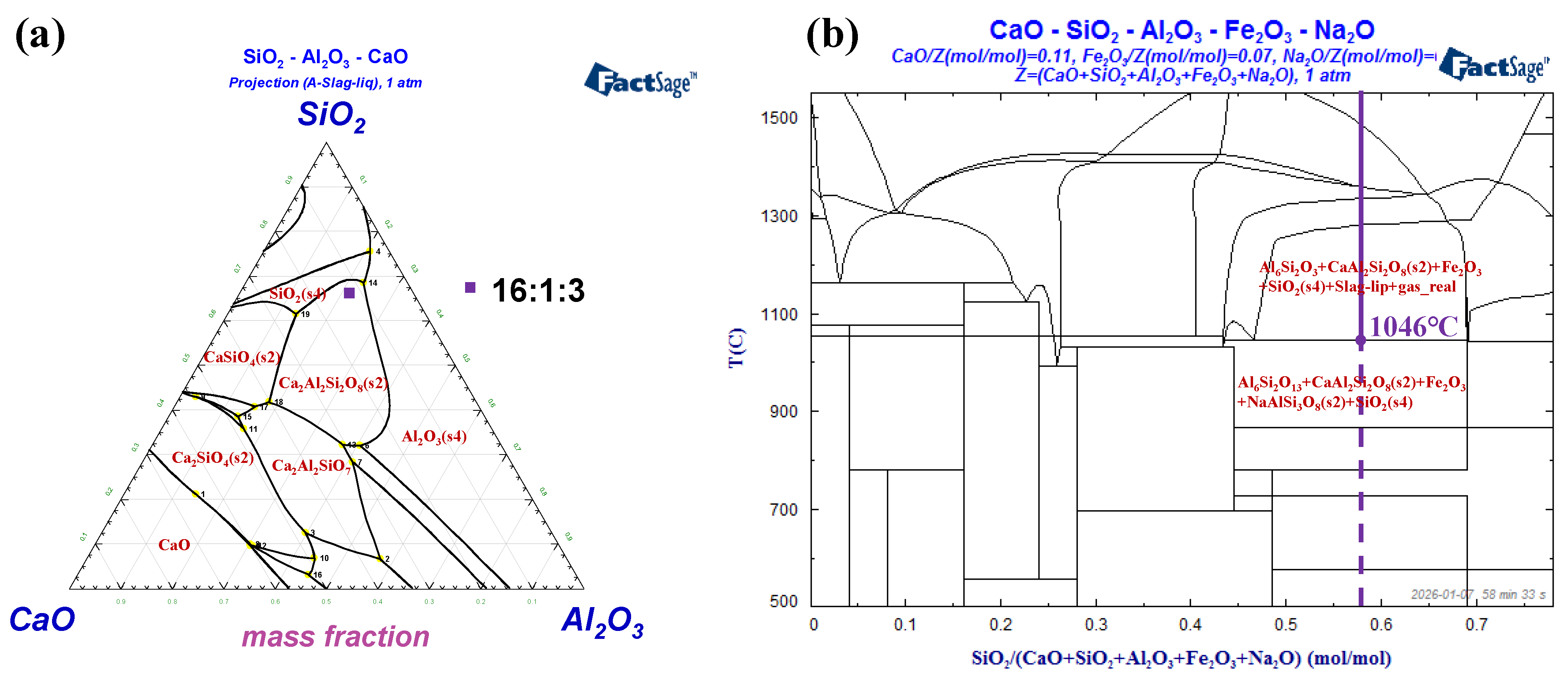
CGS, clay, and waste glass were preliminarily crushed and dried in a forced-air oven at 105 °C for 4–6 h until constant mass, after which they were milled and sieved through a 100-mesh standard sieve. Based on X-ray fluorescence (XRF) analysis of the major-oxide composition of CGS (SiO2 52.92%, Al2O3 20.91%, CaO 11.66%) and FactSage thermodynamic simulations, the mass ratio of CGS:clay:waste glass was set to 16:1:3. A ternary phase diagram was used to evaluate the phase-field distribution in the CaO-Al2O3-SiO2 system (Figure 1a), and a pseudo-binary diagram of the designed composition was used to assess the liquid-phase formation (Figure 1b), trend and phase-transition path within the target temperature window. Simulations indicate that a liquid phase begins to appear at 1046 °C for this composition and increases with temperature; within 1000–1200 °C, thermodynamic conditions favor the co-existence of feldspar-related crystalline phases and a glassy phase, providing a theoretical basis for subsequent densification and structural stability.

2.2.2. Mixing, Hand Granulation, Drying, and Firing

The raw materials were weighed according to the above mass ratio and mixed using a planetary ball mill at 300 r/min for 3 h (zirconia milling jar; ball-to-powder ratio and media configuration followed the equipment standard). The mixed powder was then granulated in a coating pan by continuously spraying water while feeding powder until green pellets with intact surfaces, near-spherical shape, and low adhesion were obtained. Pellets were sieved, and those with a size of 8–12 mm were selected and dried at 100 °C for 2 h to constant mass.
Dried pellets were placed in a single layer in a 50 mL alumina crucible (minimizing inter-pellet contact to reduce sticking) and fired in a programmable muffle furnace. The heating rate was 10 °C/min to the target temperatures (1000, 1050, 1100, 1150, and 1200 °C), followed by a dwell of 2 h. After firing, samples were furnace-cooled to room temperature and collected for characterization and performance testing.

2.3. Characterization and Analytical Methods

1.
Particle-size distribution: The particle-size distribution of CGS was measured using a laser particle-size analyzer (Bettersize 3000, Dandong Bettersize Instruments Ltd., Dandong, China).
2.
Thermal analysis: TG-DSC was conducted in air at 10 °C/min from 30 to 1200 °C.
3.
Phase analysis: XRD (PANalytical X-Pert3 Powder, Almelo, The Netherlands) was used for qualitative and quantitative analysis [17]. Scan range: 5–90°; step size: 0.02°; scan speed: 4°/min.
4.
Major-oxide composition: XRF (Bruker S4-Explorer, Karlsruhe, Germany) was used to determine the major oxide contents.
5.
Elemental analysis: ICP-OES (Agilent 5110, Agilent Technologies, Santa Clara, CA, USA) was used to quantify elements after microwave digestion using HNO3-HCl-HF-H2O2 [18]. The heavy-metal volatilization ratio (v) was calculated as:
v = 1 C t C 0
where C0 and Ct are the total elemental contents before and after calcination, respectively.
6.
Microstructure: SEM (Hitachi S4800, Tokyo, Japan) was used to observe the sintered microstructures (10 kV, 10 μA).
Representative SEM micrographs were further analyzed using Fiji/ImageJ (version 1.54r, upgrade released 25 September 2025) to obtain semi-quantitative, image-based estimates of equivalent pore diameter and local pore-wall thickness for selected samples fired at different temperatures.
7.
Leaching test [19]: Leaching was performed according to HJ/T 299-2007 (sulfuric acid–nitric acid method). The extraction solution (pH = 3.20 ± 0.05) was added at a solid-to-liquid ratio of 1:10 (g/mL). After 18 h of end-over-end agitation, the leachate was filtered and analyzed by ICP-MS (Agilent 7800, Agilent Technologies, Santa Clara, CA, USA) for Cr, Mn, Ni, Cu, Zn, As, and Ba.
8.
Apparent density: Pellets (8–12 mm) were dried at 105 °C to constant mass and cooled to room temperature. The apparent volume was measured by water displacement; apparent density was calculated as ρ = m/V. Four replicates were tested per group; results are reported as mean ± standard deviation.
ρ = m V
9.
Single-particle compressive strength was measured by a compression test. Intact ceramsite pellets with a particle size of 8–12 mm were placed between two parallel platens and loaded in compression. The crosshead displacement rate was set to 200 mm/min, and the force loading rate was controlled at 10 N/s. The maximum load at failure, Fmax, was recorded. The single-particle compressive strength was calculated as follows:
σ = F m a x A ,   A = π d 2 4 ,
where σ is the compressive strength (MPa) and A is the equivalent loaded area in the loading direction. To ensure reproducibility, the equivalent diameter d (mm) of each pellet in the loading direction was measured using a vernier caliper and approximated by its circular projection. Four parallel specimens were tested for each group, and the results are reported as mean ± standard deviation.
Because the pellets were prepared by granulation and were only approximately spherical, the loaded area was estimated using the circular projection corresponding to the equivalent diameter measured in the loading direction. A similar approach, in which an equivalent circular area is used to define the stress for irregular particles, has been shown to be appropriate in single-particle crushing tests on granular materials [20]. This type of geometric simplification is commonly adopted in single-particle crushing/compression evaluation of ceramsite and other lightweight aggregates. To reduce uncertainty associated with shape deviation, only intact pellets within a narrow size range (8–12 mm) were selected, and the loading-direction diameter of each pellet was measured individually prior to testing.

3. Results and Discussion

3.1. Chemical Characteristics and Thermal Behavior of Raw Materials

3.1.1. Phase Composition

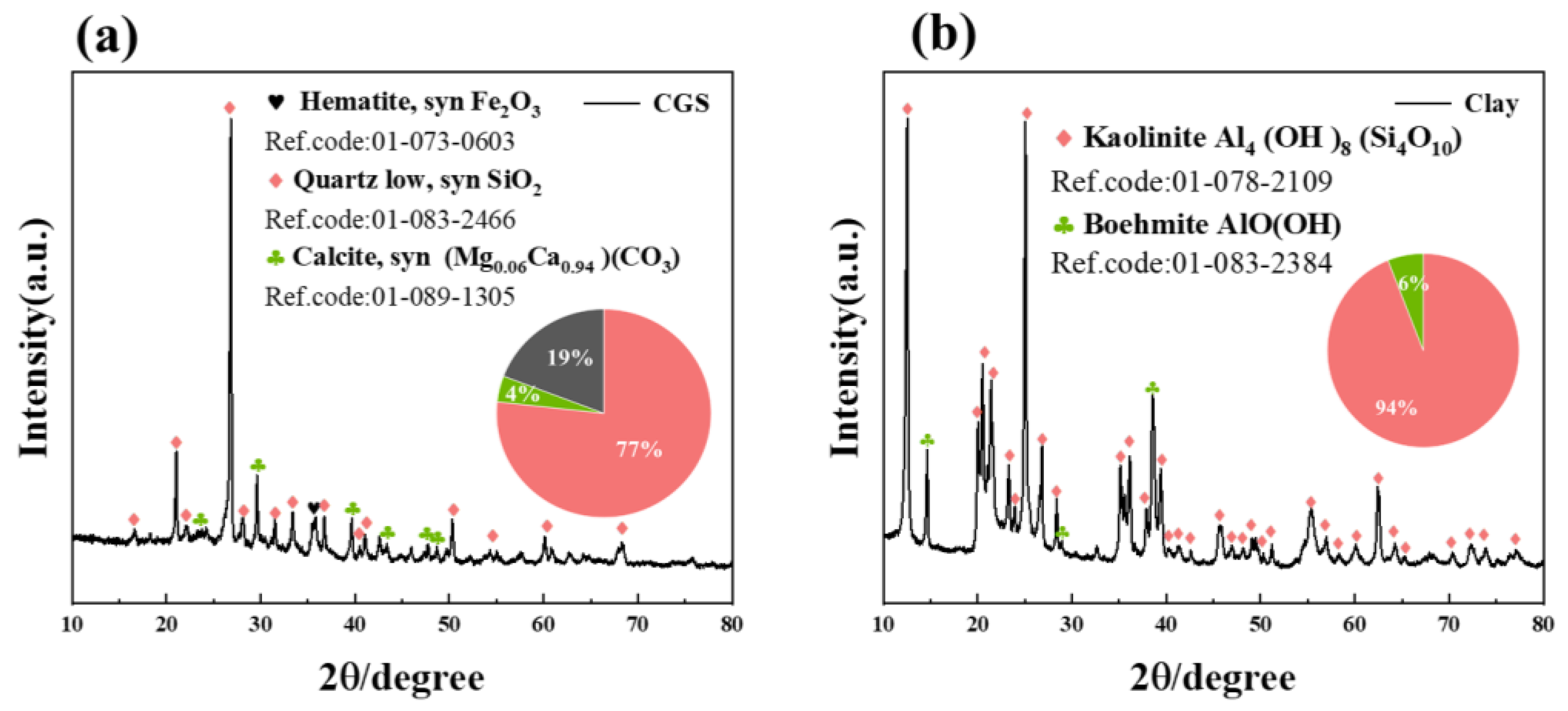
The XRD results (Figure 2) show that the major crystalline phases in CGS are quartz (SiO2), hematite (Fe2O3), and minor calcite-type carbonate (Mg0.06Ca0.94(CO3)), consistent with literature reports [21,22]. The clay mainly contains kaolinite (Al4(OH)8(Si4O10)) and boehmite (AlO(OH)).

3.1.2. Major-Oxide Composition and Baseline Heavy Metals

XRF results show that CGS consists primarily of SiO2 (52.92%), Al2O3 (20.91%), CaO (11.66%), and Fe2O3 (8.33%), consistent with the mineral phases revealed by XRD. Minor oxide components related to Ba, Cu, Mn, Ni, and Zn were also detected at low levels.
ICP-OES provided quantitative concentrations of heavy metals in the raw materials (Table 1). Notably, Mn and Ba in CGS are relatively high and were selected as key elements for subsequent migration and environmental-risk evaluation.

3.1.3. Thermal Behavior of CGS (TG-DSC)

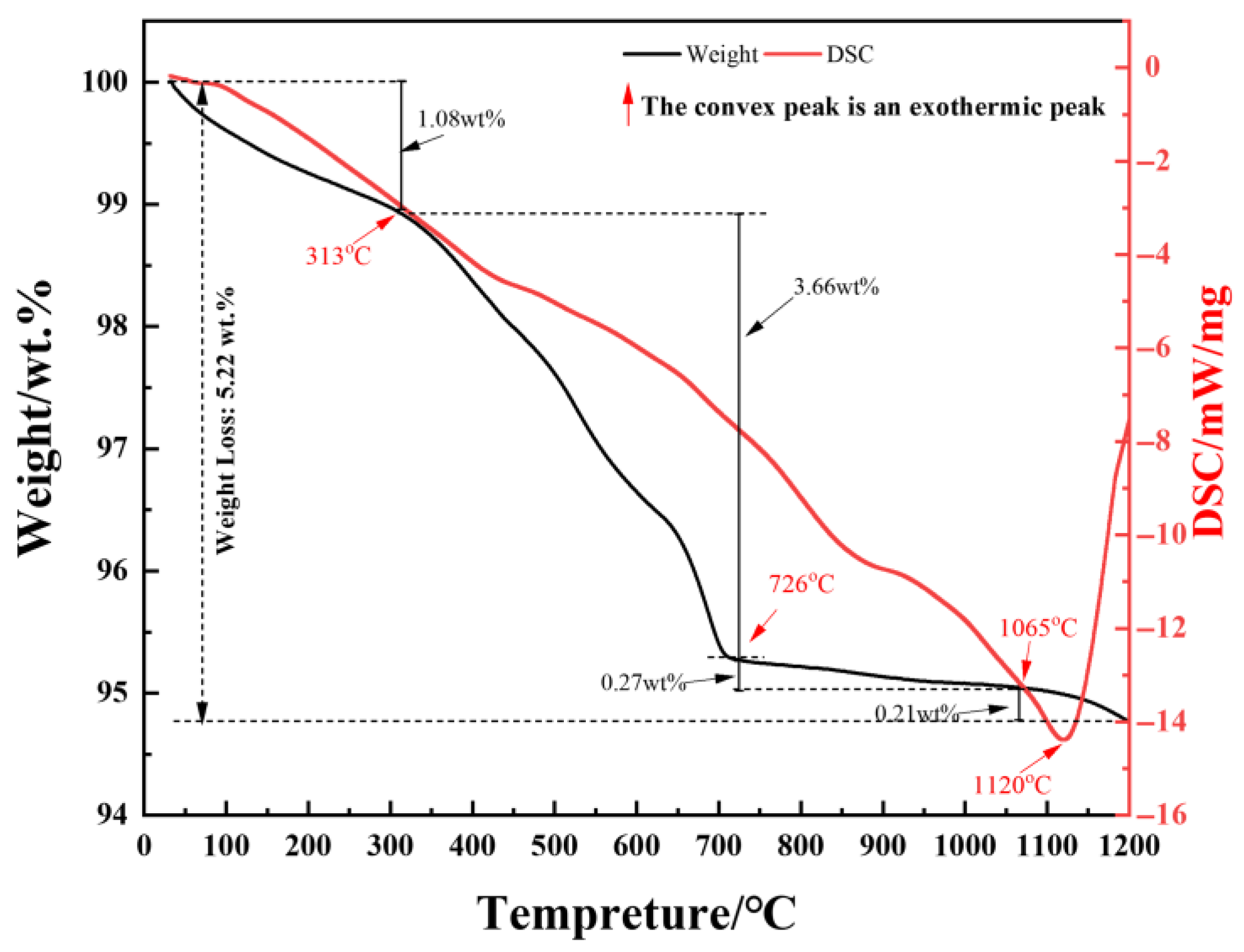
TG-DSC (Figure 3) was used to characterize the thermal behavior of CGS from 30 to 1200 °C. The total mass loss was 5.22%. Based on the TG-DSC features, the mass-loss process can be divided into four stages (stage losses are approximate and may slightly deviate from the total due to baseline/integration differences):
(1)
0–313 °C (desorption of water; weak endotherm): mass loss ~1.08%, attributed to evaporation of physically adsorbed water and pore water.
(2)
313–726 °C (residual-carbon oxidation/carbonate decomposition): mass loss ~3.66%, corresponding to a weak exotherm (oxidation of residual carbon) and a weak endotherm (carbonate decomposition). This stage is mainly related to oxidation-driven gas release and minor carbonate decomposition [19].
CaCO3 → CaO + CO2(g)
(3)
726–1065 °C: a weak and broad mass-loss region (~0.27%) is observed. Considering the limited phase evidence available for this interval, this feature is more conservatively attributed to the tailing oxidation of residual carbon.
(4)
1065–1200 °C: a small additional mass loss (~0.48%) accompanied by an endothermic signal is observed at high temperature. This behavior may be related to the release of minor volatile species and continued structural reorganization associated with liquid-phase formation.

3.2. Effects of Temperature on Properties, Microstructure, and Phases of Ceramsite

3.2.1. Property Evolution

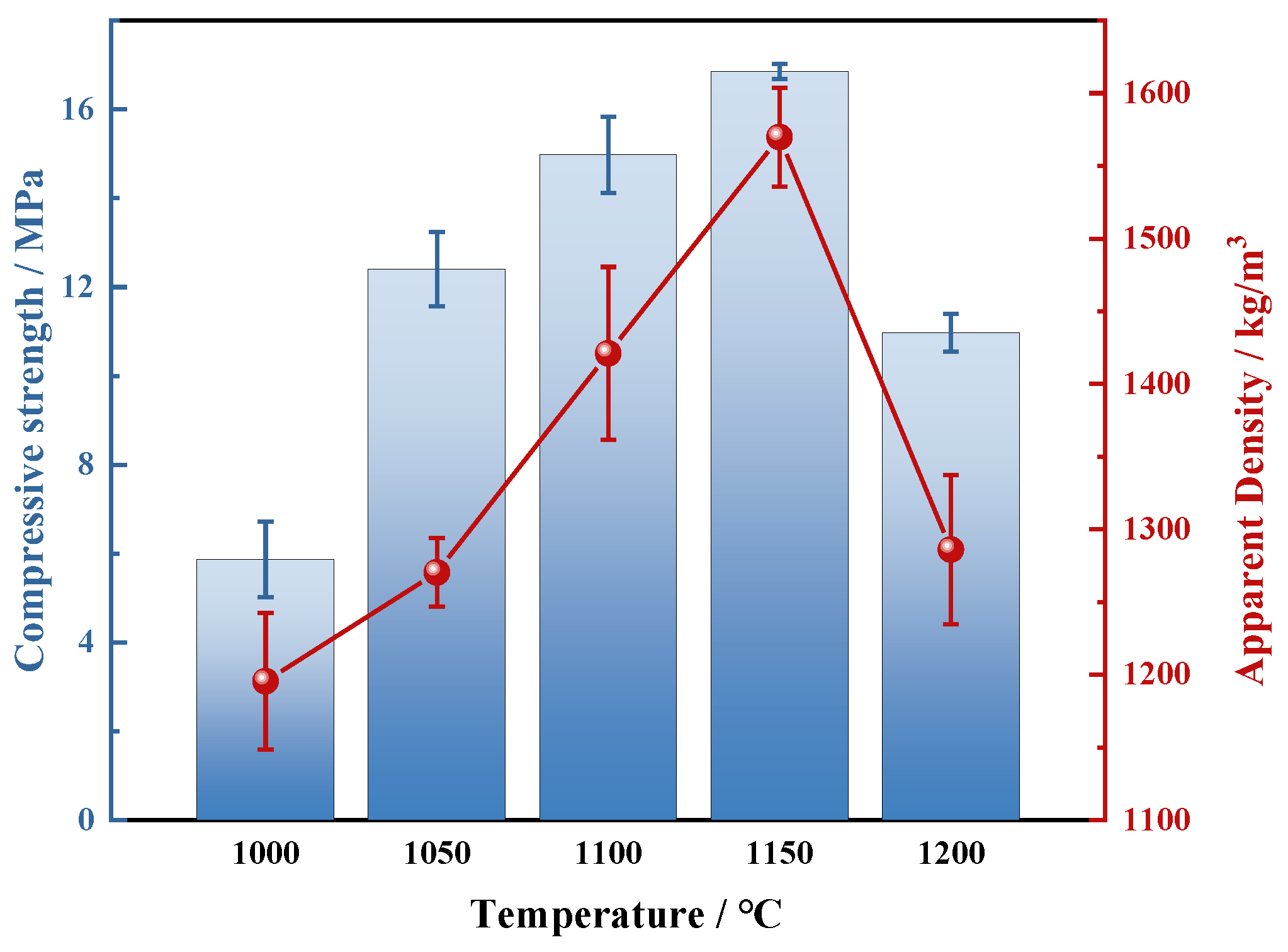
The apparent density and single-particle compressive strength of ceramsite prepared at different firing temperatures are shown in Figure 4. Both indicators exhibit a consistent “increase-then-decrease” trend with increasing temperature and reach their maxima at 1150 °C. Specifically, apparent density increases from 1279.33 kg·m−3 at 1000 °C to 1615.00 kg·m−3 at 1150 °C and then decreases to 1435.33 kg·m−3 at 1200 °C. The single-particle compressive strength increases from 3.13 MPa at 1000 °C to 15.38 MPa at 1150 °C, but drops markedly to 6.09 MPa at 1200 °C. Notably, in the 1000–1150 °C range the strength increment is much larger than the density increment, indicating that temperature affects mechanical performance not only through bulk densification but also through changes in pore stability, pore-wall continuity, and defect level.

3.2.2. Microstructural Evolution

The pore-forming role of residual carbon was inferred from the TG-DSC mass-loss behavior, the measured loss on ignition of the raw CGS, and the observed development of internal pores during firing. However, direct total-carbon measurements for the raw slag and fired products were not conducted in the present work. Therefore, the contribution of residual carbon to gas generation is interpreted qualitatively rather than quantitatively.
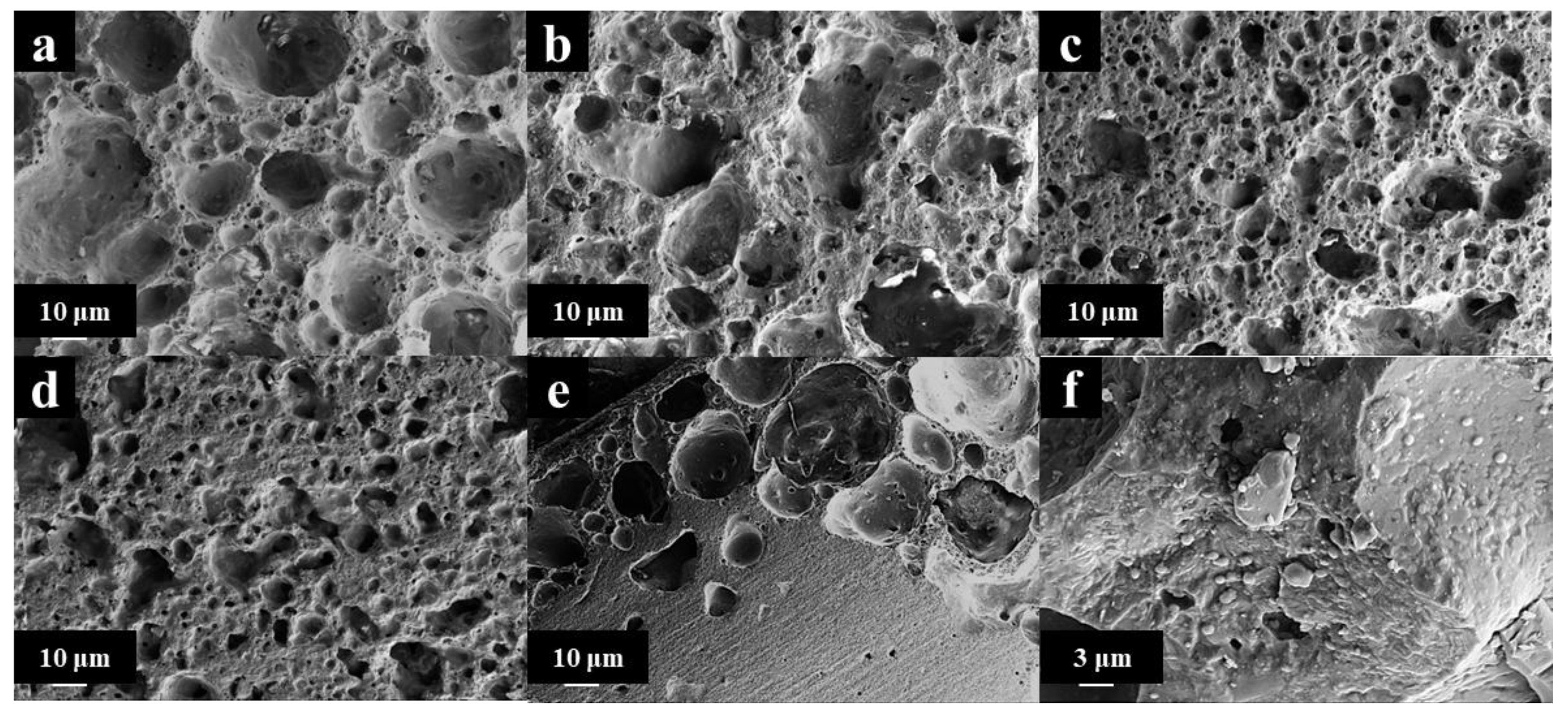
SEM micrographs of ceramsite fired at different temperatures are shown in Figure 5. At 1000 °C (Figure 5a), pores are unevenly distributed, pore-wall continuity is weak, and overall densification is insufficient. In the 1050–1150 °C range (Figure 5b–d), increasing temperature leads to increased liquid phase (consistent with the FactSage trend in Figure 1b). Interparticle neck growth and microstructural rearrangement are promoted; pores become more uniform, and pore walls remain continuous and intact, typical of pore-structure stabilization during liquid-phase sintering [23]. At 1200 °C (Figure 5e), excessive melting combined with internal gas release/expansion leads to pronounced pore coarsening and a higher fraction of oversized pores. The image-based SEM analysis (Table 2) shows that the equivalent pore diameter reaches its highest value at 1200 °C, indicating significant pore enlargement and coalescence under over-firing conditions. Although local pore-wall thickness remains at a moderate level in two-dimensional sections, the pore structure becomes more heterogeneous and local wall rupture is still observed. Such structural coarsening and heterogeneity weaken the efficiency of the load-bearing skeleton and contribute to the decrease in both strength and apparent density.
Based on liquid-phase formation, interparticle bonding/neck development, and pore-structure evolution (pore size, pore-wall thickness, and connectivity), the property trend can be summarized in two stages.
(1)
1000–1150 °C: property-enhancement stage (liquid phase promotes bonding and densification).
At 1000 °C, limited liquid phase leads to insufficient bonding and neck growth; pore walls are discontinuous and the microstructure is relatively loose, resulting in low density and strength. At 1050 °C, the emerging liquid phase promotes particle rearrangement and interfacial bonding; strength increases to 5.58 MPa and density rises to 1479.00 kg·m−3, reflecting contributions from initial neck growth and pore-wall thickening/continuity. At 1100 °C, neck growth continues and defects decrease; strength increases to 10.51 MPa and density to 1557.67 kg·m−3. At 1150 °C, more continuous pore walls and better structural coherence are achieved; strength reaches the maximum (15.38 MPa), and density also reaches the maximum (1615.00 kg·m−3). SEM confirms that pores become more uniform and pore walls remain continuous in 1050–1150 °C, indicating that an appropriate amount of liquid phase promotes densification and skeleton strengthening while helping “fix” the pore architecture during firing, leading to synchronous improvements in density and strength.
In this system, pore formation is closely related to residual carbon in CGS. Residual carbon oxidizes upon heating and releases gas, acting as an internal pore former. In the 1000–1150 °C range, as the liquid phase forms with sufficient viscosity, newly generated pores can be supported and stabilized by the pore walls; the pore architecture and load-bearing skeleton are optimized synergistically, explaining the rapid strength enhancement.
(2)
1200 °C: property-degradation stage (over-melting causes pore-structure deterioration).
At 1200 °C, the increased liquid-phase fraction promotes strong viscous flow and local over-melting, which reduces the stability of the original pore architecture. Under continued gas evolution, pores more readily expand and coalesce, resulting in pronounced pore coarsening and a higher degree of structural heterogeneity. The image-based SEM analysis (Table 2) confirms that the equivalent pore diameter is highest at 1200 °C. Although the measured local pore-wall thickness is not the lowest at this temperature, oversized pores, local wall rupture, and reduced structural uniformity still lower the effective load-bearing cross section, causing the single-particle compressive strength to decrease markedly.
Overall, firing at 1050–1100 °C is more favorable for producing relatively low-density porous ceramsite, whereas 1150 °C provides a better balance among pore-wall integrity, density, and strength and is thus selected as the key temperature window for subsequent discussion of heavy-metal migration and leaching control. Firing at 1200 °C is not recommended due to over-firing-induced structural deterioration and strength loss.
Beyond mechanical performance, pore architecture is also expected to influence how fluids penetrate into the ceramsite, which may affect transport-related service behavior. These aspects were not the main focus of the present work and were not directly measured and thus will be addressed in future studies. In general, pore size, pore connectivity, and pore-wall continuity affect liquid penetration pathways and transport resistance in porous granular systems [12,13]. From this perspective, the relatively balanced pore-size/wall-thickness combination developed at 1150 °C may be more favorable for maintaining both structural integrity and transport stability, whereas the pronounced pore coarsening at 1200 °C may increase structural heterogeneity and fluid accessibility. However, the influence of pore architecture on fluid penetration and transport was not directly measured in the present work and should be examined in future water-absorption and permeability studies.

3.2.3. Phase Transformation

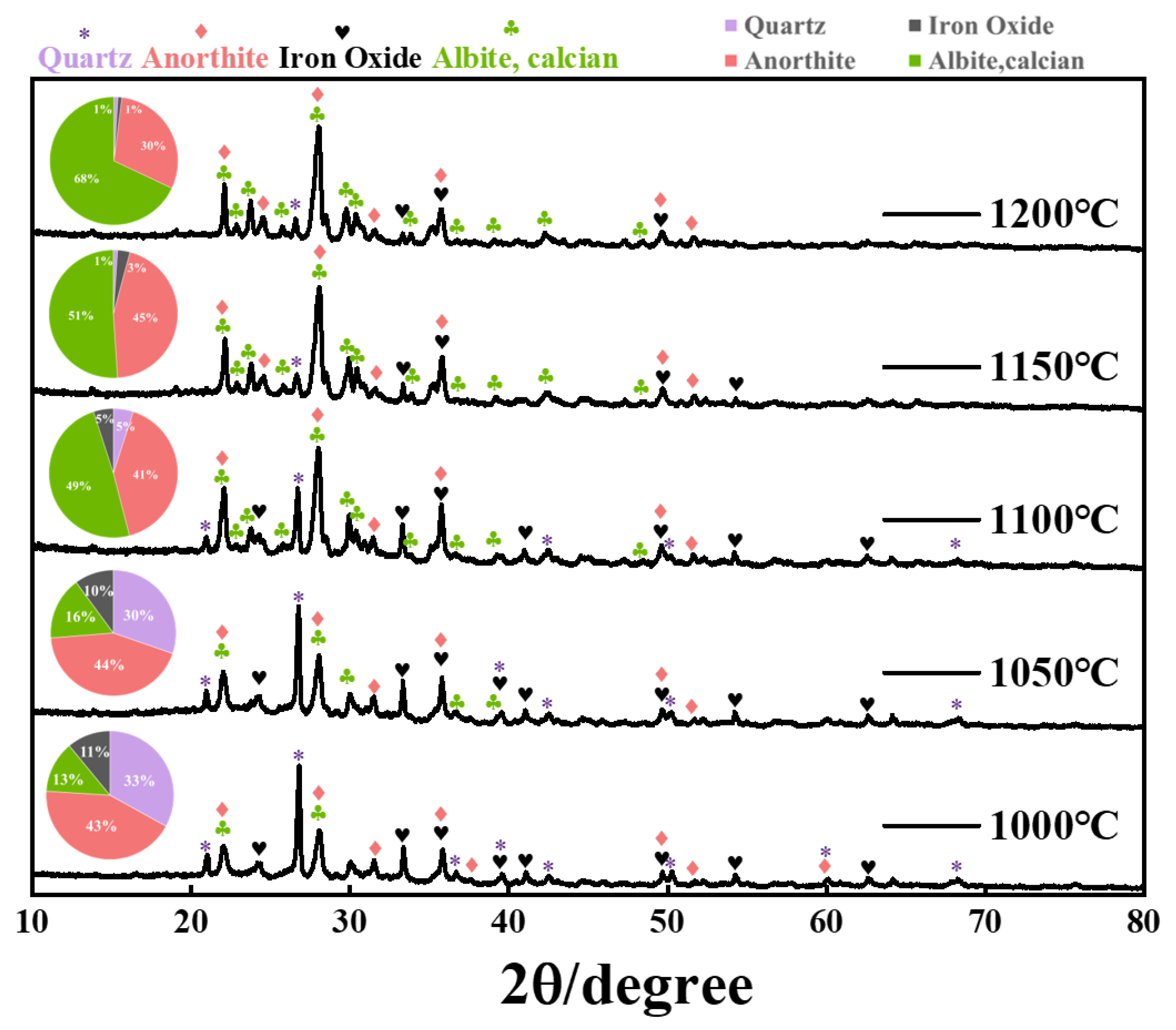
XRD patterns of ceramsite fired at different temperatures are shown in Figure 6. Firing substantially changes the mineralogical composition of the mixed raw materials. The products are mainly composed of quartz, iron oxides, and feldspar-type minerals, with anorthite and albite as dominant feldspars. Semi-quantitative results show an overall trend of “rapid quartz consumption–pronounced feldspar enrichment–gradual decrease of iron-oxide phases” with increasing temperature.
Quartz decreases rapidly with temperature: from 33% at 1000 °C and 30% at 1050 °C to 5% at 1100 °C, and to 1% at 1150–1200 °C. This indicates that free SiO2 continuously participates in solid-state reactions and further melts into the glassy phase at higher temperatures, leading to the rapid disappearance of detectable quartz crystals [9]. In parallel, feldspar phases increase substantially. Albite increases from 13% (1000 °C) and 16% (1050 °C) to 49% (1100 °C), reaches 51% at 1150 °C, and further increases to 68% at 1200 °C, suggesting that increasing temperature strongly promotes reactions and crystallization in the alkali-containing aluminosilicate system and that the system gradually transforms from being controlled by residual quartz to being dominated by feldspar/glass phases [24]. This behavior is consistent with the general structural evolution of silicate glasses and melts, in which increasing temperature and network modifier content promote liquid-phase formation and restructuring of the aluminosilicate network [25]. Anorthite remains within 41–45% in the 1000–1150 °C range, indicating it is a relatively stable major crystalline phase in this window; however, it decreases to 30% at 1200 °C, implying that higher liquid-phase fractions may dissolve part of anorthite or convert it into the glassy phase, thus reducing its crystalline proportion. Iron oxides decrease from 11% (1000 °C) and 10% (1050 °C) to 5% (1100 °C), 3% (1150 °C), and 1% (1200 °C), indicating that Fe increasingly participates in reactions and redistributes into glassy or aluminosilicate phases, resulting in a reduced proportion of independent iron-oxide crystals.
A similar temperature-driven phase transition has been reported for CGS-based ceramsite systems with different fluxing strategies. Li et al. [26] used CGS with coal gangue and additional CaO to prepare sintered ceramsite for phosphorus removal. In their work, anorthite and hematite dominated at lower firing temperatures, whereas increasing both the CaO content and the firing temperature to 1130–1160 °C promoted the formation of Ca-rich silicate phases such as gehlenite and wollastonite, accompanied by significant changes in porosity and strength. Although the present CGS-clay–waste-glass system does not form gehlenite or wollastonite due to its lower CaO loading and different flux composition, the overall trend-progressive consumption of quartz and enrichment of feldspar-type aluminosilicate phases with increasing temperature is consistent with the general behavior observed in CGS-derived ceramsite systems.
Combined with mechanical and microstructural results, the 1000–1150 °C range involves substantial quartz consumption and feldspar enrichment, reflecting sustained solid-state reaction and crystallization in the CaO-Al2O3-SiO2 system. Meanwhile, liquid-phase sintering promotes neck growth and improves pore-wall continuity. The synergy of crystalline skeleton formation and pore-wall strengthening increases single-particle strength, reaching a maximum at 1150 °C. At 1200 °C, although albite continues to increase, excessive liquid phase induces pore coarsening and pore-wall weakening; the negative impact of pore deterioration on load-bearing capacity becomes dominant, leading to strength reduction.

3.3. Heavy-Metal Migration/Transformation and Leaching Toxicity

At 1150 °C, ceramsite exhibits both high single-particle strength and relatively dense pore walls. Such structural features favor mechanical load bearing and may also provide conditions for heavy-metal incorporation into crystalline phases and encapsulation by the glassy phase. Therefore, this section focuses on heavy-metal migration/transformation in the 1000–1200 °C range and evaluates environmental risks using leaching tests.

3.3.1. Migration and Transformation of Heavy Metals in the Solid Phase

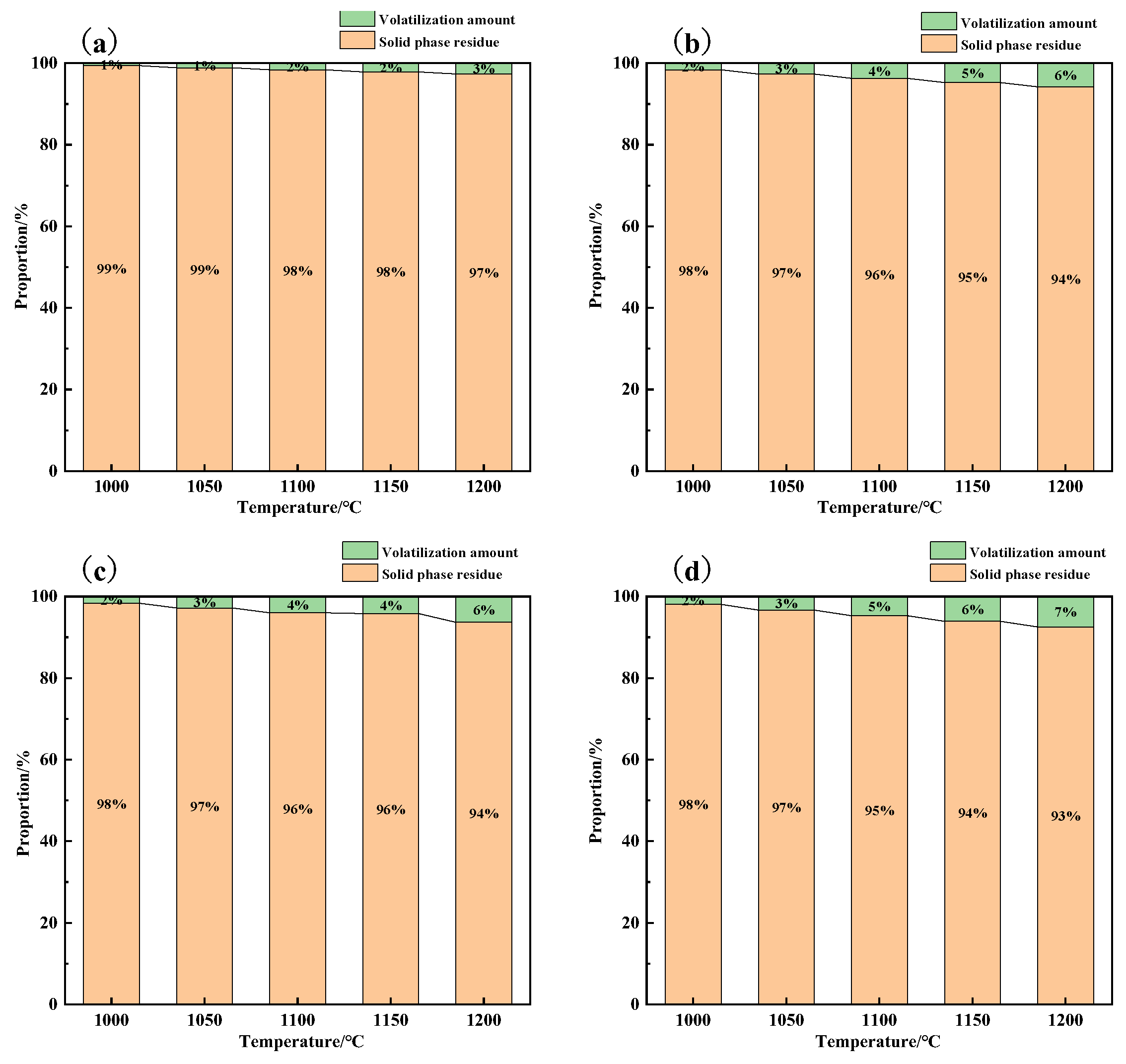
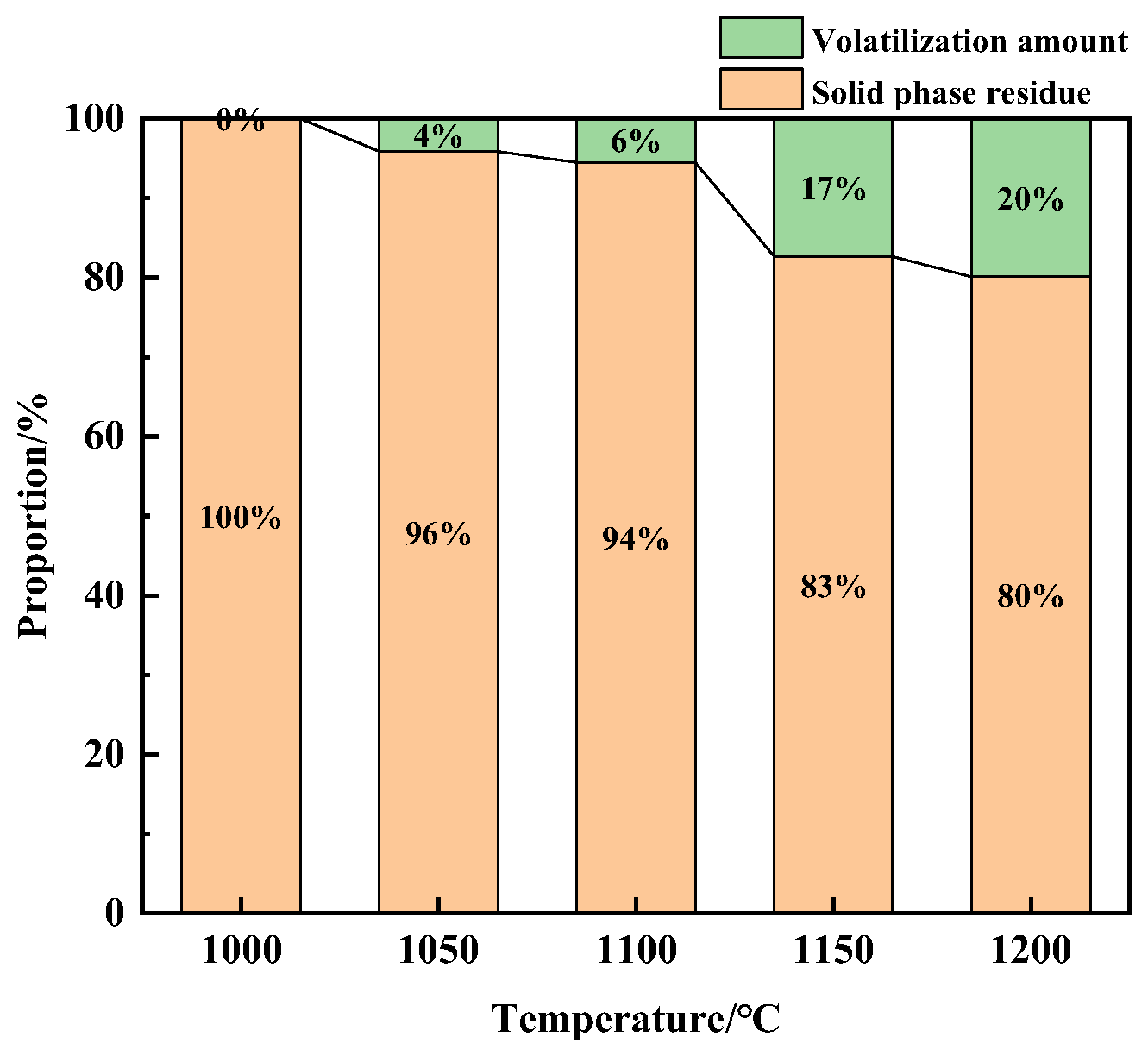
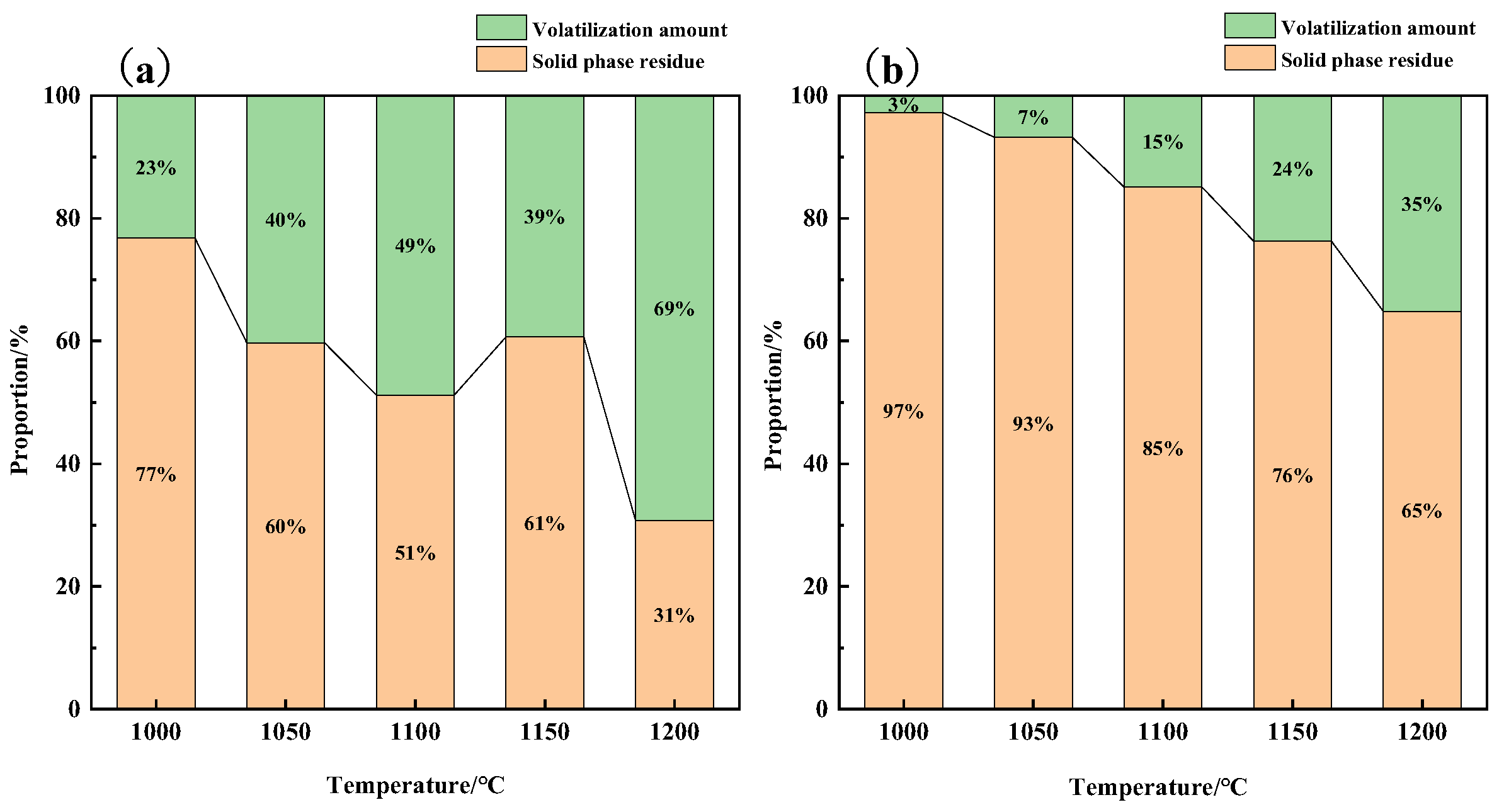
During firing, phase evolution directly affects the retention and migration of Cr, Mn, Ni, Cu, Zn, As, and Ba in the solid products. To provide a clearer picture of heavy-metal distribution during firing, the total concentrations of these elements in the fired ceramsite products are summarized in Table 2. These values represent the elemental concentrations retained in the residual solid phase after firing. In parallel, the volatilization ratios were calculated based on the elemental contents before and after firing with correction for sample mass loss, as described in Section 2.3. Therefore, the total concentrations in the fired products and the corrected volatilization ratios should be interpreted together when evaluating heavy-metal migration behavior.
Overall, the migration/transformation behavior of the investigated heavy metals shows strong element specificity and temperature dependence [25,27]. Based on the combined evidence of residual solid concentrations and corrected volatilization ratios, the elements can be grouped into three categories: low-volatility elements (Mn, Ba, Ni, and Cu), a moderate-volatility element (Cr), and relatively high-volatility elements (As and Zn).
(1)
Low-volatility elements (Mn, Ba, Ni, Cu).
As shown in Table 3 and Figure 7, Mn, Ba, Ni, and Cu exhibit strong solid-phase retention over the investigated temperature range. Their total concentrations in the fired products decrease only slightly with increasing temperature, indicating limited net loss from the system during firing. After correction for sample mass loss, the volatilization ratios of these elements remain low, confirming that they are predominantly retained in the ceramsite matrix. This behavior is consistent with the relatively high thermal stability of their oxide or mineral-associated forms under the oxidizing firing conditions used in this study. The evolving glassy-crystalline matrix may further contribute to their retention by reducing elemental mobility and promoting physical encapsulation and/or mineral association [28].
(2)
Moderate-volatility element (Cr).
Cr shows intermediate, temperature-dependent behavior (Figure 8). The total Cr concentration in the fired products decreases from 46.17 mg/kg at 1000 °C to 37.18 mg/kg at 1200 °C (Table 3), indicating partial loss from the system as temperature increases. Correspondingly, the corrected volatilization ratio increases at higher temperatures, suggesting that Cr becomes more susceptible to release under stronger thermal conditions. At the same time, a substantial fraction of Cr remains in the fired solids even at 1200 °C, implying that volatilization is counterbalanced by solid-phase retention [29]. This retention may be related to the incorporation of Cr into newly formed aluminosilicate phases and/or encapsulation by the glassy phase, although direct speciation evidence was not obtained in the present work.
(3)
High-volatility elements (As, Zn).
As and Zn show the strongest tendency toward volatilization among the investigated elements (Figure 9). Their total concentrations in the fired products decrease markedly with increasing temperature. For example, As decreases from 40.91 mg/kg at 1000 °C to 16.46 mg/kg at 1200 °C, while Zn decreases from 109.46 to 73.39 mg/kg over the same temperature range (Table 3). These results indicate progressive elemental loss from the system during firing. The corrected volatilization ratios further confirm that As is the most volatile element in this study, followed by Zn. This behavior is consistent with the higher tendency of As- and Zn-bearing species to form volatile compounds under high-temperature oxidizing conditions [18,25,29]. Nevertheless, measurable amounts of both elements remain in the fired products, suggesting that volatilization and solid-phase immobilization occur simultaneously, with intermediate-temperature glass formation likely contributing to partial retention [18,29].
In summary, heavy-metal migration and immobilization during firing are controlled by the intrinsic stability of oxide species, the tendency to form volatile compounds, and their incorporation or encapsulation within the evolving glassy and crystalline aluminosilicate matrix [18,19,28]. The structural flexibility of silicate glass networks, as described in glass chemistry studies [25], provides a basis for accommodating different cations and thereby contributes to the immobilization of metal-bearing species in the glassy phase. Low-volatility elements are mainly retained as stable oxides; Cr behavior reflects competition between volatilization and phase immobilization; and As/Zn are dominated by volatilization, with glass encapsulation providing only partial suppression at intermediate temperatures. These coupled mechanisms of volatilization, phase incorporation, and glass-phase encapsulation also provide the background for understanding the leaching behavior of the fired products, as discussed in the next section.

3.3.2. Leaching-Toxicity Evaluation

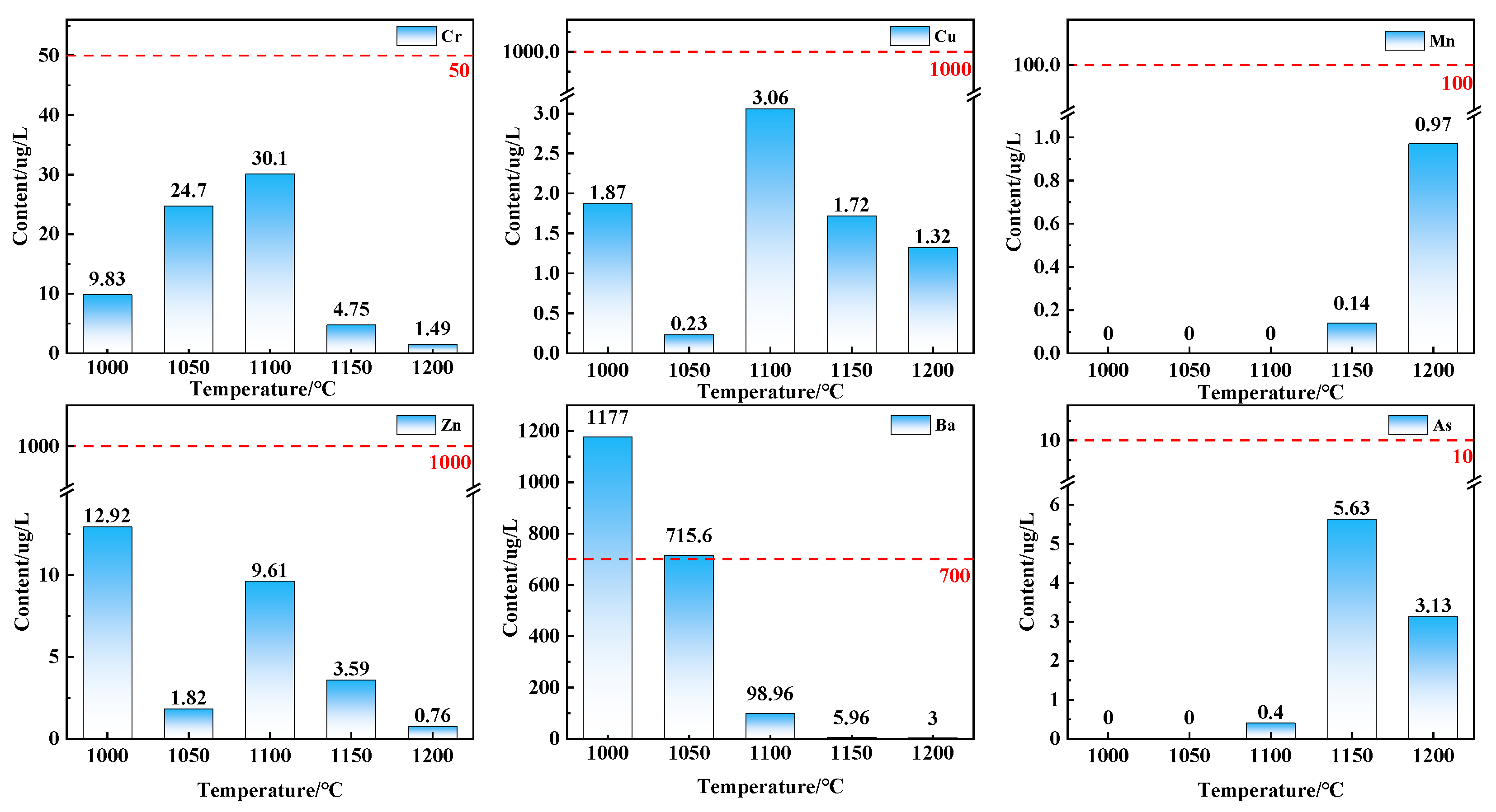
Leaching results (Figure 10) indicate that firing temperature strongly influences heavy-metal leachability. For conservative risk screening, leached concentrations were compared with the Class III limits of the Chinese Groundwater Quality Standard (GB/T 14848-2017). As shown in Figure 10, firing at 1150 °C and 1200 °C is most effective in reducing leaching risk. At these temperatures, the leached concentrations of Cr, Mn, Ni, Cu, Zn, As, and Ba all meet the Class III limits, indicating good environmental safety of the products. Figure 10 presents the leaching results of Ba, Cr, As, Mn, Cu, and Zn; Ni data are not shown in the figure because they are below the detection limit.
Among the investigated elements, Ba and Cr show the most significant immobilization. Ba in the raw-material leachate is 776.6 µg/L, slightly higher than the Class III limit (700 µg/L); after firing at 1150 °C and 1200 °C, it decreases to 5.96 and 3.00 µg/L, respectively. Cr in the 1100 °C sample reaches 106.4 µg/L, exceeding the Class IV limit (100 µg/L); after firing at 1150 °C and 1200 °C, it decreases to 4.75 and 1.49 µg/L, respectively, far below the Class III limit. These results suggest that feldspar formation and glass-phase encapsulation at high temperature jointly promote Ba and Cr stabilization. Related studies also indicate that feldspar/anorthite structures can immobilize multivalent ions through solid solution and structural bonding, supporting long-term fixation [25].
Other elements (As, Cu, Zn, Mn, and Ni) exhibit generally low leached concentrations and low environmental risk. It should be noted that As leaching shows a slight increase for the 1150 °C sample (5.63 µg/L) but remains far below the 10 µg/L limit. This may be related to kinetic effects associated with the formation and transformation of As-bearing phases at intermediate temperatures [30].
Considering both mechanical performance and leaching safety, 1150 °C is the preferred firing temperature in this study. At this temperature, ceramsite retains good structural coherence and single-particle load-bearing capacity while maintaining low heavy-metal leachability. Although 1200 °C further reduces the leaching of some elements, over-firing increases the risk of pore-structure deterioration and strength loss; thus, it is not selected as the optimum from an overall-performance perspective.
The reduced leachability observed at higher firing temperatures is likely governed by a combination of chemical and physical immobilization mechanisms. On the one hand, heavy metals can be partially incorporated into newly formed aluminosilicate and feldspar-related crystalline phases, which reduces their mobility through solid solution and structural bonding. On the other hand, the formation of a viscous liquid phase and subsequent vitrification physically encapsulate metal-bearing domains within a less accessible glassy matrix. In addition, pore-wall continuity and pore accessibility may influence how easily the extraction solution can penetrate into the interior of the ceramsite and contact heavy-metal-bearing phases. Thus, the low leached concentrations at and above 1150 °C probably reflect the joint action of chemical stabilization, glass-phase encapsulation, and a more stable pore-wall framework that limits solution access.
It should be emphasized, however, that the environmental assessment in this work is based on a standard short-term sulfuric acid–nitric acid leaching test (HJ/T 299-2007), which is widely used as a conservative screening method for waste and construction materials [19]. Such tests are suitable for evaluating short-term leaching potential under aggressive conditions, but they cannot fully represent long-term behavior under realistic service conditions involving continuous water exposure, pore-network evolution, or surface damage. Related studies on ash-based binders, vitrified materials, and glass–ceramics have shown that when ash particles or metal-bearing species are densely embedded in a bonded or glassy matrix with limited pore connectivity, long-term leaching can be significantly reduced [15]. While our results are consistent with this general trend, dedicated long-term immersion or percolation tests, as well as aging and damage-simulation experiments, are still needed to fully verify the long-term leaching stability of CGS-based ceramsite.
From a practical standpoint, the CGS-based ceramsite developed in this study is mainly intended for use as a lightweight porous aggregate or insulating granular material in non-structural and semi-structural applications, such as lightweight wall materials, lightweight mortars, insulation-related filling layers, and backfilling. In these applications, a combination of moderate particle strength, relatively low density, and low short-term leaching potential is more critical than very high structural-grade strength. Compared with commercially available lightweight aggregates, the single-particle compressive strength and apparent density achieved at the optimal firing temperature (1150 °C) fall within the functional range reported for porous lightweight aggregates used in building materials, suggesting that the CGS-based products are promising from a mechanical and density perspective. However, direct quantitative comparison with specific commercial products is limited, because standardized aggregate tests such as water absorption, bulk density, freeze–thaw resistance, and long-term durability were not carried out in the present work. These properties should be systematically evaluated in future studies before large-scale engineering application is considered.
In addition to technical performance and environmental safety, the preparation cost is also an important factor for the practical application of CGS-based ceramsite. From a processing and operating-cost perspective, the preparation route adopted in this work (powder pretreatment–fine grinding–granulation–drying–firing) is broadly compatible with existing ceramsite or lightweight aggregate production lines. For the present CGS-based system, the main energy-intensive steps in the preparation process are fine grinding to about 100 mesh, homogenization/mixing, and high-temperature firing. Industrial experience for grinding slag-like solid wastes to a fineness of approximately 100 mesh indicates that the combined electricity and operating cost for fine grinding and mixing typically falls in the range of roughly 20–50 CNY per ton of product under current Chinese industrial conditions, depending on equipment efficiency, electricity price, and plant scale. For the firing stage, the belt-type induration machine used in our collaborating unit has a measured specific heat consumption of about 828 kJ/kg of fired product (≈0.83 GJ/t), when operated with natural gas as the auxiliary fuel. At the same time, calorific value measurements show that the green pellets prepared from coal gasification slag have a lower heating value of approximately 600–1000 kcal/kg, whereas the theoretical sensible heat required to heat the pellets to around 1000 °C is on the order of 300 kcal/kg. This implies that, in principle, the residual carbon and combustible components in the pellets can provide a substantial fraction of the required heat, with the remaining heat being released and partially recovered through exhaust-gas heat recovery during firing.
In practice, furnace heat losses and system inefficiencies mean that external fuel input is still needed. However, when the contribution of residual carbon is taken into account, engineering estimates based on industrial operation suggest that the net external fuel cost for firing can be maintained at a moderate level, typically on the order of 20–50 CNY per ton of ceramsite. Combining the costs of fine grinding/mixing and net firing energy, the direct operating cost of preparing CGS-based ceramsite—excluding equipment depreciation, labor, and overheads—is therefore estimated to be on the order of 40-100 CNY per ton of product. This order-of-magnitude estimate indicates that, at the process level, CGS-based ceramsite can be produced with a relatively low preparation cost, especially when the internal calorific value of the pellets and waste-heat recovery are effectively utilized.
These considerations suggest that, if combined with appropriate static firing technology and waste-heat utilization, the CGS-based ceramsite process has the potential to achieve acceptable energy consumption and preparation cost for industrial-scale production. At the same time, the large-volume utilization of CGS can reduce the need for natural aggregates, avoid the energy and environmental costs associated with sand and gravel mining, and take advantage of existing policy incentives for solid-waste utilization and carbon reduction in many regions. It should be noted that the present study was conducted at a laboratory scale and did not include a detailed techno-economic analysis or pilot-scale validation. Therefore, future work should focus on optimizing grinding and firing conditions, evaluating energy use and cost at the pilot-plant level, and assessing the economic competitiveness of CGS-based ceramsite under specific regional subsidy and market conditions.

4. Conclusions

Ceramsite pellets were prepared from CGS from Yili (Xinjiang, China) as the main raw material by firing at 1000–1200 °C. The effects of temperature on the microstructure and phase evolution were systematically investigated, and the migration/transformation and leaching behaviors of Cr, Mn, Ni, Cu, Zn, As, and Ba were elucidated. The main conclusions are:
  • Firing temperature strongly regulates microstructure and phase evolution, thereby defining the mechanical-performance window. With increasing temperature, quartz is progressively consumed and participates in solid-state reactions and/or enters the glassy phase, while stable aluminosilicate crystalline phases dominated by feldspars (anorthite/albite) form at high temperatures. The sample fired at 1150 °C exhibits good pore-wall continuity and structural coherence, with a maximum single-particle compressive strength of 15.38 MPa.
  • The combined formation of a molten glassy phase and feldspar-type aluminosilicate crystalline phases promotes the solid-phase retention and immobilization of heavy metals, particularly low-volatility elements such as Mn, Ba, Ni, and Cu and part of Cr. This mechanism is inferred from the coupled evidence of temperature-driven phase evolution, residual solid concentrations, and reduced leached concentrations, although direct heavy-metal speciation was not determined in this work.
  • High-temperature treatment markedly reduces the short-term leaching potential of the investigated heavy metals under the applied sulfuric acid–nitric acid leaching test (HJ/T 299-2007). When the firing temperature reaches 1150 °C or higher, the leached concentrations of Cr, Mn, Ni, Cu, Zn, As, and Ba all meet the Class III limits of GB/T 14848-2017, indicating favorable short-term environmental safety of the CGS-based ceramsite. Long-term leaching behavior under realistic service conditions still requires further investigation.
  • Considering single-particle compressive strength, pore-wall integrity, and heavy-metal stabilization, 1150 °C is identified as the overall optimal firing temperature under the conditions of this study. Increasing the temperature to 1200 °C can further lower the leached concentrations of some elements, but leads to over-firing, pore coarsening, and strength loss, which is unfavorable for practical application.

Author Contributions

X.Z.: Conceptualization, Investigation, Methodology, Data curation, Formal analysis, Visualization, Writing—original draft. W.Z.: Data curation, Formal analysis, Writing, review and editing. Y.X.: Resources. H.W.: Data curation, Formal analysis, Writing—review and editing. C.H.: Resources. All authors have read and agreed to the published version of the manuscript.

Funding

This research was funded by the Key R&D Program Projects in Xinjiang Autonomous Region (2023B01014), the National Natural Science Foundation of China (52304418) and the Fundamental Research Funds for the Central Universities (FRF-TP-25-019), awarded to Wang Hao.

Institutional Review Board Statement

Not applicable as this study did not involve human or animal subjects.

Data Availability Statement

The raw data supporting the conclusions of this article will be made available by the authors on request.

Acknowledgments

This research was funded by the Key R&D Program Projects in Xinjiang Autonomous Region (2023B01014), the National Natural Science Foundation of China (52304418) and the Fundamental Research Funds for the Central Universities (FRF-TP-25-019). Declaration of generative AI and AI-assisted technologies in the manuscript preparation process: During the preparation of this work, the author(s) used ChatGPT (OpenAI, version GPT-5.3) in order to assist with translating parts of the manuscript from Chinese to English and improving language clarity. After using this tool, the author(s) reviewed and edited the content as needed and take(s) full responsibility for the content of the published article. We sincerely thank Yusheng Jiang for his guidance and assistance in the writing process of this paper.

Conflicts of Interest

The authors declare no competing interests.

References

  1. Liu, Z.; Guan, D.; Wei, W.; Davis, S.J.; Ciais, P.; Bai, J.; Peng, S.; Zhang, Q.; Hubacek, K.; Marland, G.; et al. Reduced carbon emission estimates from fossil fuel combustion and cement production in China. Nature 2015, 524, 335–338. [Google Scholar] [CrossRef] [PubMed]
  2. Li, J.; Liang, Q.M. The role of coal in China’s energy transition: A review. Renew. Sustain. Energy Rev. 2022, 155, 111924. [Google Scholar]
  3. Higman, C.; van der Burgt, M. Gasification, 2nd ed.; Gulf Professional Publishing: Houston, TX, USA, 2008. [Google Scholar]
  4. Feng, X.G.; Wang, H.Y.; Ge, F.F.; Zhang, Y.M.; Zhang, Y.F. Research progress and application prospect of high-value utilization of coal gasification slag. Clean Coal Technol. 2023, 29, 122–132. [Google Scholar]
  5. Zhao, S.; Duan, Y.; Chen, L.; Li, Y.; Yao, T.; Liu, S.; Liu, M.; Lu, J. Study on the emission of hazardous trace elements in a 350 MW coal-fired power plant. Part 1: Mercury. Environ. Sci. Technol. 2017, 229, 863–870. [Google Scholar] [CrossRef]
  6. Sun, M.; Gu, S.; Liu, D.; Xu, Z.; Wang, W.; Tu, Y.; Wang, L.; Liu, H.; Lu, S. Enrichment of Residual Carbon in Coal Gasification Fine Slag via Wet Sieving Separation with Ultrasonic Pretreatment. ACS Omega 2022, 7, 40306–40315. [Google Scholar] [CrossRef]
  7. National Energy Technology Laboratory. Assessment of Gasifier By-Product Utilization; U.S. Department of Energy: Pittsburgh, PA, USA, 2021.
  8. Zhao, S.; Yao, L.; He, H.; Zou, Y.; Hu, L.; Zhai, Y.; Yu, Y.; Jia, J. Preparation and environmental toxicity of non-sintered ceramsite using coal gasification coarse slag. Arch. Environ. Prot. 2019, 45, 84–90. [Google Scholar] [CrossRef]
  9. Li, X.; Wang, Y.; Zhang, Y. Preparation and characterization of glass-ceramics from coal gasification slag. Ceram. Int. 2019, 45, 7866–7874. [Google Scholar]
  10. Zhang, K.; Li, X.N.; Chang, B.; Song, S.; Liu, C.Y. Use of coal gasification coarse slag to amend the soil water, nutrient and salt of waste dump in the northwest arid region: Feasibility and potential. Environ. Dev. Sustain. 2025, 27, 10523–10547. [Google Scholar] [CrossRef]
  11. Shaheen, S.M.; Hooda, P.S.; Tsadilas, C.D. Opportunities and challenges in the use of coal fly ash for soil improvement—A review. J. Environ. Manag. 2014, 145, 249–267. [Google Scholar] [CrossRef]
  12. Li, X.; He, C.; Lv, Y.; Jian, S.; Jiang, W.; Jiang, D.; Wu, K.; Dan, J. Effect of sintering temperature and dwelling time on the characteristics of lightweight aggregate produced from sewage sludge and waste glass powder. Ceram. Int. 2021, 47, 33435–33443. [Google Scholar] [CrossRef]
  13. Molinari, C.; Zanelli, C.; Guarini, G.; Dondi, M. Bloating mechanism in lightweight aggregates: Effect of processing variables and properties of the vitreous phase. Constr. Build. Mater. 2020, 261, 119980. [Google Scholar] [CrossRef]
  14. Xiang, Y.; Xiang, Y.; Jiao, Y.; Wang, L. Effect of sludge amino acid-modified magnetic coal gasification slag on plant growth, metal availability, and soil enzyme activity. J. Soil Water Conserv. 2020, 75, 515–526. [Google Scholar] [CrossRef]
  15. Li, Q.; Liu, B.; Liu, J.; Zhang, Q.; An, C.; Sun, Z.; Pulatov, B.; Wei, S.; Fan, J. Review of glass-ceramics: Solidification of toxic elements and durability. Waste Manag. 2025, 200, 114764. [Google Scholar] [CrossRef]
  16. Yao, Z.T.; Ji, X.S.; Sarker, P.K.; Tang, J.H.; Ge, L.Q.; Xia, M.S.; Xi, Y.Q. A comprehensive review on the applications of coal fly ash. Earth Sci. Rev. 2015, 141, 105–121. [Google Scholar] [CrossRef]
  17. Cullity, B.D.; Stock, S.R. Elements of X-Ray Diffraction, 3rd ed.; Prentice Hall: Upper Saddle River, NJ, USA, 2001. [Google Scholar]
  18. Jiao, F.; Zhang, L.; Dong, Z.; Namioka, T.; Yamada, N.; Ninomiya, Y. Study on the species of heavy metals in MSW incineration fly ash and their leaching behavior. Fuel Process. Technol. 2016, 152, 108–115. [Google Scholar] [CrossRef]
  19. van der Sloot, H.A.; Comans, R.N.J.; Hjelmar, O. Similarities in the leaching behaviour of trace contaminants from waste, stabilized waste, construction materials and soils. Sci. Total Environ. 1996, 178, 111–126. [Google Scholar] [CrossRef]
  20. Liu, X.; Li, S.; Yao, T. Laboratory investigation on the single particle crushing strength of carbonate gravel incorporating size and shape effects. Géotechnique 2025, 75, 94–110. [Google Scholar] [CrossRef]
  21. Guo, Y.; Zhang, Y.; Zhao, X.; Xu, J.; Qiu, G.; Jia, W.; Wu, J.; Guo, F. Multifaceted evaluation of distribution, occurrence, and leaching features of typical heavy metals in different-sized coal gasification fine slag from Ningdong region, China: A case study. Sci. Total Environ. 2022, 830, 154726. [Google Scholar] [CrossRef] [PubMed]
  22. Yang, P.; Suo, Y.; Liu, L.; Qu, H.; Xie, G.; Zhang, C.; Deng, S. Study on the curing mechanism of cemented backfill materials prepared from sodium sulfate modified coal gasification slag. J. Build. Eng. 2022, 62, 105318. [Google Scholar] [CrossRef]
  23. Fernandes, H.R.; Tulyaganov, D.U.; Ferreira, J.M.F. Preparation and characterization of CaO-Al2O3-SiO2 glass-ceramics. Mater. Chem. Phys. 2009, 115, 744–750. [Google Scholar]
  24. Jakob, A.; Stucki, S.; Kuhn, P. Evaporation of heavy metals during the heat treatment of municipal solid waste incinerator fly ash. Environ. Sci. Technol. 1995, 29, 2429–2436. [Google Scholar] [CrossRef]
  25. Mysen, B.O.; Richet, P. Silicate Glasses and Melts: Properties and Structure; Elsevier: Amsterdam, The Netherlands, 2005. [Google Scholar]
  26. Yu, L.; Shen, K.; Yang, Y.; Liu, H.; Yang, Z.; Wang, R.; An, S. Preparation and phosphorus removal performance of ceramsite from coal gasification slag. Nanomaterials 2025, 15, 1822. [Google Scholar]
  27. Tian, S.; Li, Y.; Wang, X. Immobilization mechanism of heavy metals in fly ash-based geopolymers: A review. Sci. Total Environ. 2021, 765, 142829. [Google Scholar]
  28. Nowak, B.; Pessl, A.; Aschenbrenner, P.; Szentannai, P.; Mattenberger, H.; Rechberger, H.; Hermann, L.; Winter, F. Heavy metal removal from municipal solid waste fly ash by chlorination and thermal treatment. J. Hazard. Mater. 2010, 179, 323–331. [Google Scholar] [CrossRef]
  29. Shih, K.; Tang, Y. Immobilization of heavy metals in ceramite produced from sewage sludge ash. Environ. Sci. Technol. 2011, 45, 7449–7455. [Google Scholar]
  30. Cheng, J.; Li, Y.; Zhou, J. Vitrification of municipal solid waste incineration fly ash for simultaneous recycling and heavy metal stabilization. J. Mater. Cycles Waste Manag. 2019, 21, 168–178. [Google Scholar]
Figure 1. (a) Al2O3-SiO2-CaO ternary phase diagram; (b) pseudo-binary diagram for the designed composition.
Applsci 16 04147 g001
Figure 2. XRD patterns of (a) coal gasification slag and (b) clay.
Applsci 16 04147 g002
Figure 3. TG-DSC curves of coal gasification slag.
Applsci 16 04147 g003
Figure 4. Comparison of apparent density and single-particle compressive strength of products fired at different temperatures.
Applsci 16 04147 g004
Figure 5. SEM images of ceramsite fired at different temperatures: (a) 1000 °C; (b) 1050 °C; (c) 1100 °C; (d) 1150 °C; (e) 1200 °C; (f) high magnification at 1200 °C.
Applsci 16 04147 g005
Figure 6. XRD patterns of products fired at different temperatures.
Applsci 16 04147 g006
Figure 7. Solid concentrations and volatilization ratios of low-volatility elements as a function of temperature: (a) Mn; (b) Ba; (c) Ni; (d) Cu.
Applsci 16 04147 g007
Figure 8. Solid concentration and volatilization ratio of Cr as a function of temperature.
Applsci 16 04147 g008
Figure 9. Solid concentrations and volatilization ratios of high-volatility elements (As and Zn) as a function of temperature: (a) As; (b) Zn.
Applsci 16 04147 g009
Figure 10. Leached concentrations of key heavy metals (Ba, Cr, As, Mn, Cu, and Zn) as a function of firing temperature, compared with the Class III limits of GB/T 14848-2017. Data are mean values of 3 replicate tests.
Applsci 16 04147 g010
Table 1. Element concentrations in raw materials determined by ICP-OES (mg/kg).
ElementCoal Gasification SlagClayWaste Glass
As43.1645.7024.65
Ba809.67ND91.47
Cr40.5844.142.95
Cu60.6925.170.98
Mn1683.5222.6468.76
Ni71.8718.344.97
Zn100.5152.0517.34
Note: ND indicates below the detection limit of the analytical method.
Table 2. Image-based estimation of pore characteristics from representative SEM micrographs.
Temperature (°C)Equivalent Pore Diameter (µm)Local Pore-Wall Thickness (µm)
10007.492.66
10509.115.85
11004.663.02
11505.524.04
120012.614.49
Note: Values were estimated from representative SEM micrographs using Fiji/ImageJ and should be regarded as semi-quantitative, image-based descriptors rather than full porosimetry results. The pore-wall thickness refers to local wall thickness measured on two-dimensional SEM sections.
Table 3. Total concentrations of heavy metals in fired ceramsite products at different temperatures (mg/kg, mean values, n = 3).
Element1000 °C1050 °C1100 °C1150 °C1200 °C
As40.9131.8427.3232.4616.46
Ba855.60847.03838.72831.71823.87
Cr46.1744.2843.6838.3137.18
Cu64.4163.5462.6961.9461.13
Mn1774.961766.971759.531754.851748.48
Ni76.5075.6474.8074.8373.27
Zn109.46104.9795.9386.1973.39
Note: Values are mean concentrations of heavy metals remaining in the fired solid products, determined by ICP-OES (n = 3). These values represent the elemental levels in the residual solids after firing. Because volatilization ratios were calculated with correction for sample mass loss during firing, the concentration trend in the fired products does not necessarily correspond one-to-one to the corrected volatilization ratios.
Disclaimer/Publisher’s Note: The statements, opinions and data contained in all publications are solely those of the individual author(s) and contributor(s) and not of MDPI and/or the editor(s). MDPI and/or the editor(s) disclaim responsibility for any injury to people or property resulting from any ideas, methods, instructions or products referred to in the content.