Article

Bioactive Glasses Based on SiO2-CaO-Na2O-P2O5-ZrO2 System: Effects of ZrO2 on the Glass Structure, Solubility and Mineral Precipitation in Simulated Body Fluid

Kazuo Inamori School of Engineering, Alfred University, Alfred, NY 14802, USA
*
Author to whom correspondence should be addressed.
Appl. Sci. 2026, 16(3), 1642; https://doi.org/10.3390/app16031642
Submission received: 21 November 2025 / Revised: 5 January 2026 / Accepted: 3 February 2026 / Published: 6 February 2026
(This article belongs to the Special Issue Advancements in Sustainable Silicate Materials and Their Applications)

Featured Application

Bioactive glasses are employed to stimulate bone regeneration in vivo, and their suitability in accomplishing their therapeutic effect is complemented by their ability to promote mineralization. This study looks at the effect of ZrO2 influence on the glass structure and the subsequent mineral-forming ability in Simulated Body Fluid.

Abstract

Zirconia (ZrO2) containing bioactive glasses (BG’s) have been synthesized to determine their influence on the structure of a 0.56SiO2–0.15Na2O-0.25CaO-0.04P2O5 glass and the resulting solubility within a hydrated environment. In this study, the SiO2 content was directly substituted with 0.04 ZrO4 (Mol. Fr.) and structural analysis of the Control and Zr-Glasses was conducted using X-ray Photoelectron Spectroscopy (XPS) and Magic Angle Spinning-Nuclear Magnetic Resonance (MAS-NMR). These techniques indicate that the overall network connectivity (NC) of the glass increases with ZrO2/SiO2 substitution, suggesting that ZrO2 acts predominantly as a network former in the glass structure. The ion release profiles of the glasses incubated in de-ionized water from 1 to 1000 h showed decreased dissolution rates for the Zr-containing glasses. The in vitro bioactivity of glasses tested in Simulated Body Fluid (SBF) showed calcium phosphate (CaP) formation on the surface of all glasses after 100–1000 h incubation; however, the Zr-glass experienced delayed CaP precipitation compared to the Zr-free Control.

1. Introduction

Bioactive glasses (BG’s) have gained increased visibility in the fields of tissue engineering and regenerative medicine due to their diversity and therapeutic potential [1,2]. Tissue engineering favors resorbable biomaterials and their associated physicochemical factors to actively regenerate damaged biological tissue [1]. Numerous types of natural and synthetic biomaterials have been designed for this purpose, and among these are the BGs, as they are known to stimulate responses that favor bone remodeling, which includes stimulating surface reactions to initiate mineralization in vivo [3,4]. BGs used for bone tissue engineering are mainly based on soluble silicate-based glass compositions that facilitate biodegradation within a hydrated physiological environment [5]. BGs’ solubility and their ability to release therapeutic cations in an aqueous physiological environment provide them with the potential for chemical bonding to bone and can stimulate cell differentiation/proliferation. The release of these ions from the BGs in vivo can also be used for targeted therapeutic applications [6,7]. However, there are a number of concerns associated with highly soluble BGs that experience rapid degradation. If the BG’s dissolution rate is more rapid than that of the host tissue’s regeneration rate, this imbalance can disrupt the repair process [8]. Rapid BG degradation rates can negatively influence cell metabolism and can also increase the risk of the released ions exceeding toxicity limits [9]. Additionally, the structural integrity and mechanical stability of the glass are often compromised when highly soluble BGs degrade prior to adequate bond formation [10,11]. Therefore, it is critical to design BG glass compositions specifically to modulate the degradation rate in aqueous environments, whilst preserving the mechanical integrity to allow tissue formation and ingrowth to occur [12,13,14].
The most widely and commercially used BG is 45S5 Bioglass® (46%SiO2–24.5%Na2O-24.5%CaO-6%P2O5) developed by Prof. Larry Hench in the late 1960s [6,15]. It is known that the degradation of BGs in physiological media is dependent on several factors, such as the chemical composition, glass particle size, porosity, and the presence of crystallinity [16]. The most important compositional features of these materials are their low SiO2 content and the high concentration of network modifiers [16]. When low SiO2 is present in the glass, glasses typically exhibit a high concentration of Non-Bridging Oxygens (NBO-). As a result of the high NBO concentration in the glass, this imparts a low network connectivity (NC). This structural feature facilitates rapid hydrolysis in an aqueous physiological environment and permits BGs to encourage the formation of an amorphous calcium phosphate (CaP) layer, which will crystallize into a carbonated hydroxyapatite (HAp) layer given sufficient time [17]. This progression is analogous to natural bone growth in vivo and is generally considered a marker of bone formation [18]. The precipitation of CaP on the BG’s surface is one of the key design characteristics for bone repair therapy [19,20,21]. Due to the commercial success of 45S5 Bioglass®, many novel BG’s compositions have been studied to determine their unique physiological capabilities [22]. Structural modifications can easily be introduced by the addition of non-traditional cations (e.g., Sr2+, Cu2+, Ti4+, Zn2+) into the glass network. This method has been widely used to investigate the unique properties and biological effects of non-traditional BGs [13,23,24].
This study aims to investigate the chemical durability and the solubility of a silicate-based glass series by the addition of zirconia (ZrO2) within the composition, thereby tailoring the glass structure with the replacement of SiO2 with ZrO2. Over the past two decades, ZrO2 has been extensively used in dental implants and other restorative practices, such as total hip and knee replacements [25]. Superior mechanical properties, low corrosion rate, low cytotoxicity, and minimal bacterial adhesion make ZrO2 a promising candidate for a wide range of biomedical and dental applications [26,27,28,29]. Previous biocompatibility studies on ZrO2-based materials strongly indicate its biological safety when implanted in vivo [25]. In vitro studies on ZrO2 suggest excellent biocompatibility, no cytotoxicity when tested on fibroblast cell lines, minimal toxicity on osteoblast cells, and enhanced cell proliferation and osseointegration [25]. ZrO2-doped glasses and glass ceramics are known for enhanced properties such as chemical stability, mechanical strength, and fracture toughness [30,31]. The addition of ZrO2 can significantly alter the chemical and physical properties of a glass [32], where it increases the density, chemical durability, and glass transition temperature while decreasing the coefficient of thermal expansion [32,33,34]. Montazerian et al. showed that the incorporation of 10 mol% ZrO2 within bioactive glass-ceramics increases the chemical durability, while maintaining the ability to form HAp after incubation in Simulated Body Fluid (SBF). Cell proliferation studies also indicate that glass–ceramics containing ZrO2 show significantly higher osteoblast propagation in comparison with that of control samples [31,35]. The objective of this study is to determine the effect that ZrO2 addition has on the structure and dissolution of SiO2-CaO-Na2O-P2O5 glasses. It is expected that the incorporation of ZrO2 will alter the glass’s chemical stability, which will lead to changes in the structure, chemical durability, and in vitro biological behavior.

2. Materials and Methods

2.1. Glass Synthesis

Four glasses were formulated for this study: three zirconia (ZrO2) containing glasses (ZG-4, ZG-8, ZG-12). A zirconia-free SiO2-CaO-Na2O-P2O5 glass was used at each stage of testing as a Control. The zirconia-containing glasses substituted ZrO2 in place of silica (SiO2) (Table 1). To synthesize the glasses, analytical grade reagents of SiO2, ZrO2, CaCO3, Na2CO3, and NH4H2PO4 (Fisher Scientific, Pittsburgh, PA, USA) were mixed for 1 h and melted (1500 °C, 3 h) in platinum crucibles and quenched in water. The resulting glass frit was dried in an oven at 75 °C (3 h), then ground using a gyromill, and sieved to achieve powdered glass particles with a size <45 μm.

2.2. Structural Characterization

2.2.1. X-Ray Diffraction (XRD)

Diffraction patterns were obtained using a Phaser D2 X-ray Diffraction Unit (Bruker AXS Inc., Madison, WI, USA). Powdered glass samples (n = 1) were packed into zero-background sample holders. A generator voltage of 40 kV and a tube current of 30 mA were employed. Diffractograms were collected in the range 10° < 2θ < 80°, at a scan step size of 0.02° and a step time of 10 s.

2.2.2. Differential Thermal Analysis (DTA)

A SDT Q600 Simultaneous Thermal Gravimetric Analyser-Differential Scanning Calorimetry (TGA-DSC) (TA Instruments, New Castle, DW, USA) was used to obtain a thermal profile of each glass (n = 2), specifically the glass transition temperature (Tg) and crystallization temperatures. A heating rate of 10 °C/min was used with an air atmosphere, and an alumina reference material was also used in a matched platinum crucible. Sample measurements were carried out every 0.5 s between 30 °C and 1300 °C.

2.2.3. Scanning Electron Microscopy and Energy Dispersive X-Ray Analysis (SEM/EDS)

SEM imaging was conducted using an FEI Co. Quanta 200F Environmental Scanning Electron Microscope (Hillsboro, OR, USA). Compositional analysis was undertaken with an EDAX Genesis Energy-Dispersive Spectrometer (EDX) (Hillsboro, OR, USA). All EDX spectra were obtained at 20 kV using a beam current of 26 nA. Quantitative EDX spectra were converted into relative concentration data.

2.2.4. Advanced Surface Area and Porosity (ASAP)

Advanced Surface Area and Porosimetry, Micromeritics ASAP 2020 (Micrometrics Instrument Corporation, Norcross, GA, USA) was employed to determine the surface area of each glass. Approximately 60 mg of each powdered glass composition (n = 3) was analyzed, and the specific surface area (Table 2) is calculated using the Brunauer–Emmett–Teller (BET) method.

2.2.5. X-Ray Photoelectron Spectroscopy (XPS)

Glass powders were incubated in a vacuum oven at 90 °C for 30 min, allowing drying without moisture/air exposure. Prior to analysis, samples were stored in a vacuum desiccator. The chemical bonding environment of each glass was characterized using X-ray photoelectron spectroscopy, PHI (Physical Electronics, Chanhassen, MN, USA) Quantera Scanning X-ray Microprobe, using a monochromatic Al kα radiation (hv = 1486.6 eV) at an output of 25.5 watts. Survey scans were conducted for elemental identification as well as to adjust the acquisition width, lower acquisition energy, and beam dwell time. All survey spectra were recorded at a constant pass energy of 140 eV and a step size of 0.5 eV. Na1s, O1s, Ca2p, C1s, and Si2p high-resolution scans were collected with a pass energy of 26 eV, step size of 0.05 eV, and beam dwell time of ~300 ms to yield a signal-to-noise ratio > 100:1. Analysis area for each sample is ~2 to 3 mm in diameter using a 100 μm beam. Spectra analysis was performed on Casa XPS Version 2.3. 16 PR 1.6 (Casa Software Ltd., Teignmouth, UK). Peak positions were calibrated through normalization of the C1s peak to 284.6 eV. The detection limit of the XPS is <0.1 at %.

2.2.6. Magic Angle Spinning-Nuclear Magnetic Resonance (MAS-NMR)

Glass powdered specimens were analyzed using a MAS-NMR Bruker Avance III 600 Billerica, MA, USA) with an Ultrasheild Plus solid state NMR magnet with a 4 mm diameter probe. The 29Si and proton channels had a frequency of 600.20 MHz and 119.29 MHz, respectively. Tetrakis (trimethylsiyl)-silane was used for reference with the chemical shift at −9.843 ppm. Each sample underwent low-power decoupling and was spun at 5.0 kHz for 300 scans. The relaxation time was 15 s, and the pulse length was 75°. Additionally, the spectrum reference frequency was 498.23 Hz.

2.3. Solubility and Bioactivity Analysis

2.3.1. Ion Release Profile

Each glass composition was soaked in sterile de-ionized water for 1, 10, 100, and 1000 h. Approximately 1.0 m2 surface area of glass powder (n = 3) was submerged in 10 mL of de-ionized water and rotated on an oscillating platform at 37 °C. The ion release profile of each glass was measured using Inductively Coupled Plasma—Optical Emission Spectroscopy (ICP–OES) on a Perkin-Elmer Optima 5300UV (Perkin-Elmer, Hopkinton, MA, USA). ICP–OES calibration standards for Ca2+, Si4+, Na+, and Zr2+ ions were prepared from a stock solution on a gravimetric basis. Three target calibration standards were prepared for each ion, and de-ionized water was used as a control.

2.3.2. Simulated Body Fluid (SBF) Trials

Simulated Body Fluid (SBF) was prepared in accordance with the procedure published by Kokubo et al. [36]. Each composition was made into a glass disk (2 × 6 ømm, where n = 3) and was subsequently soaked in a fixed volume of SBF according to Equation (1), where vs. is the volume of SBF used (mL), and Sa is the exposed surface area of the glass disk (mm2). Samples were stored in plastic containers for 1, 10, 100, and 1000 h. After the specified incubation time expired, the specimens were removed from the SBF, rinsed using de-ionized water, and oven dried (37 °C, 24 h). Changes in the surface morphology of the incubated disks were characterized using scanning electron microscopy (SEM/EDX).
Vs = Sa/10

3. Results

This study was conducted in order to elucidate the effects that zirconia (ZrO2) incorporation has on the structure, solubility, and mineral response of a 0.56SiO2-0.15Na2O-0.25CaO-0.04P2O5 bioactive glass (BG) composition. The BGs designed for this study were formulated with 4, 8, and 12 mol % ZrO2 substituting for SiO2.

3.1. Glass Structure and Characterization

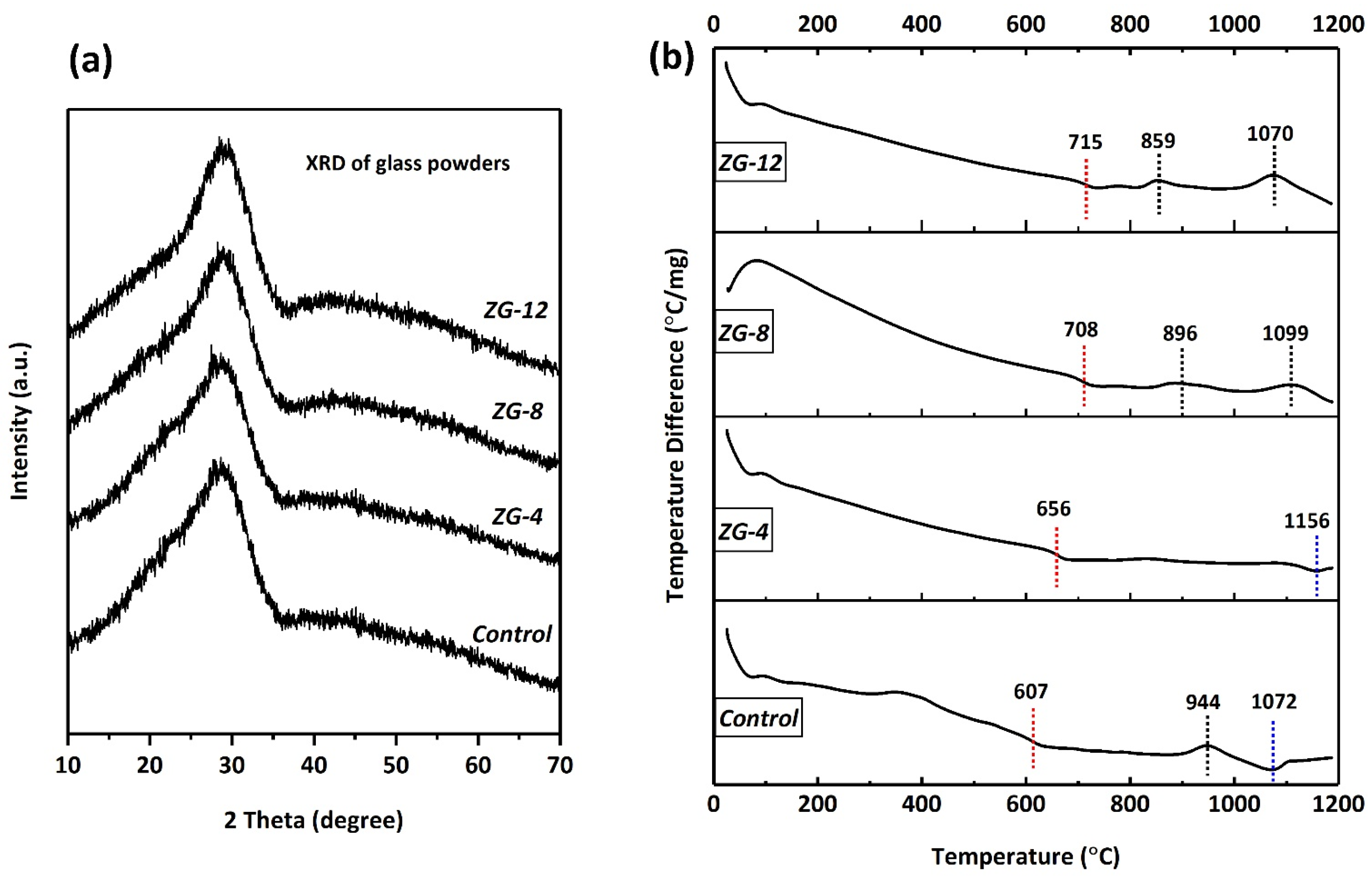
X-ray diffraction (XRD) patterns for each of the synthesized glass powders are presented in Figure 1a. XRD was performed on each glass composition to verify that a fully amorphous microstructure was obtained after glass synthesis. The characteristic amorphous hump is present for each diffractogram. No crystalline phases were detected for any of the glass compositions (Control, ZG-4, ZG-8, ZG-12), confirming that an amorphous microstructure was obtained. It has previously been reported that zirconia acts as a nucleating agent in the silicate glass systems and has a high tendency to crystallize as ZrSiO4 upon heat treatment of the glass [31]. The presence of the crystalline phases within a BG can have a significant impact on the underlying structure and chemical durability, and can reduce the material’s bioactivity. Regarding this study, retaining an amorphous microstructure is preferential as the structural changes resulting from ZrO2 addition to the properties of the BGs can be more clearly elucidated. Differential thermal analysis (DTA) was conducted to investigate any changes in the thermal profiles of the BGs as a function of ZrO2 addition, and is shown in Figure 1b.
The glass transition temperature (Tg), crystallization temperatures (Tc), and melting temperatures (Tm) are highlighted on each BG’s thermogram. The Control composition exhibited the lowest glass transition temperature (Tg) at 607 °C. The addition of the ZrO2 increased the Tg of the glass series to 656 °C, 708 °C, and 715 °C for ZG-4, ZG-8, and ZG-12, respectively. The DTA profile of Control glass shows that the crystallization occurs at 944 °C; however, ZG-4 glass did not show any pronounced exothermic crystallization peak. Increasing the ZrO2 content in ZG-8 and ZG-12 presented initial crystallization regions at temperatures of 896 °C and 859 °C for ZG-8 and ZG-12, respectively. A summary of the glass’s thermal properties is presented in Table 3.
The results from the DTA profiles of the BG series indicate that the thermal properties (Tg and Tc) are heavily influenced by the ZrO2 content within the glasses. The increase in Tg as a function of ZrO2 suggests that the network connectivity (NC) within the glass is increasing. The increased Tg for the Zr-containing glasses compared to the Control glass suggests an increase in the network connectivity and stability of the glasses occurs with the substitution of ZrO2 for SiO2 within the glass. The glass particle morphology and the composition of the glass powders were analyzed using Scanning Electron Microscopy (SEM) and Energy Dispersive X-ray Analysis (EDX), and the results are presented in Figure 2.
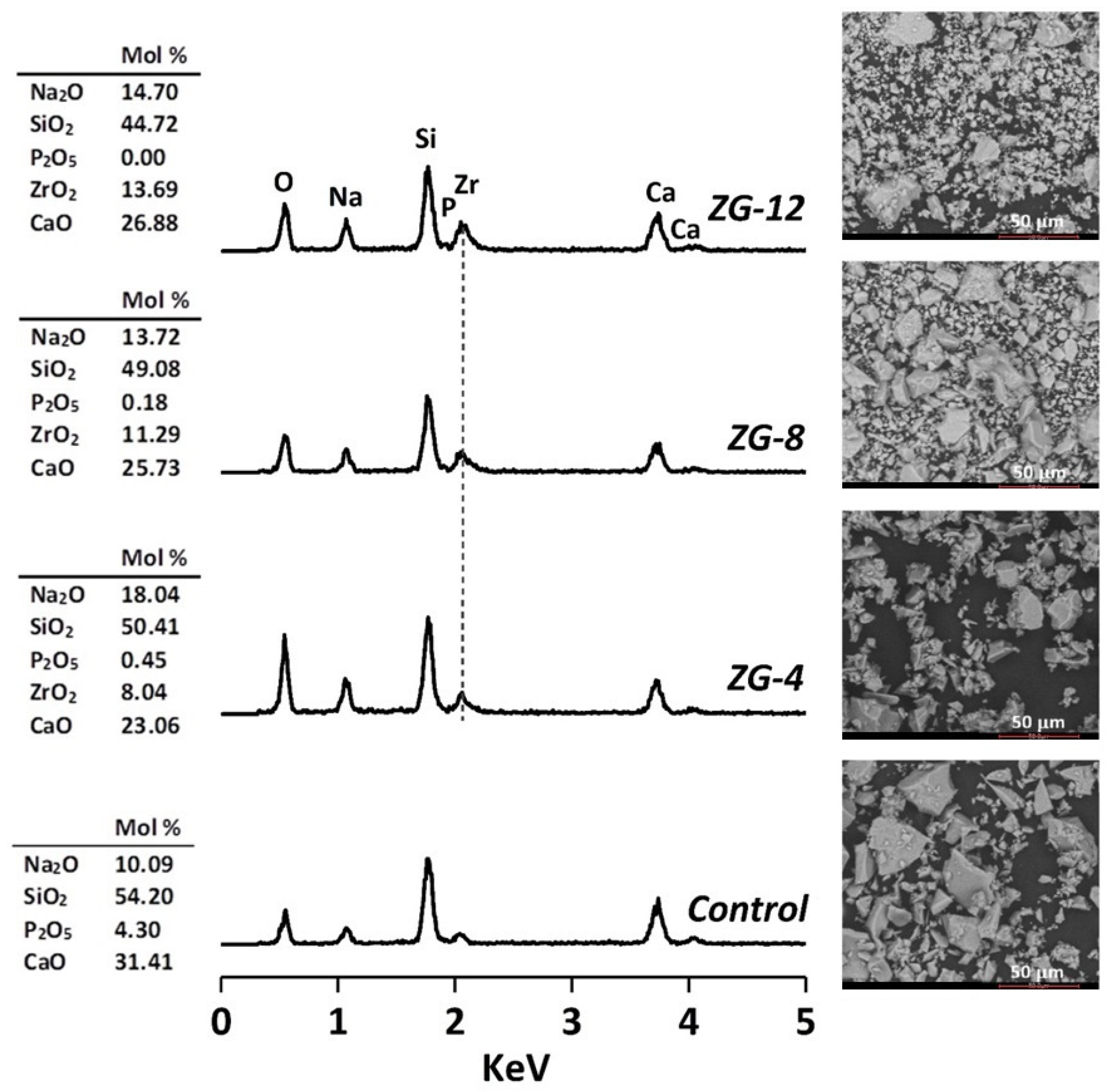
SEM images of the glass powders present a similar particle size distribution for the glass series, consisting of glass particulates ranging approximately ≤45 µm in diameter. EDX analysis presented in Figure 2 for Control, ZG-4, ZG-8, and ZG-12 confirms the elemental composition of glasses in which Si4+, Ca2+, PO43−, and Na+ are present in the Control glass, and the same elements, in addition to Zr4+, are present in the modified glass series. A comparison of the batched and EDX compositions is presented in Table 4. The batch compositions for Si4+, Ca2+, and Na+ were similar to the levels detected by EDX. However, higher concentrations of Zr4+ were detected and lower concentrations of PO43− were found using EDX.
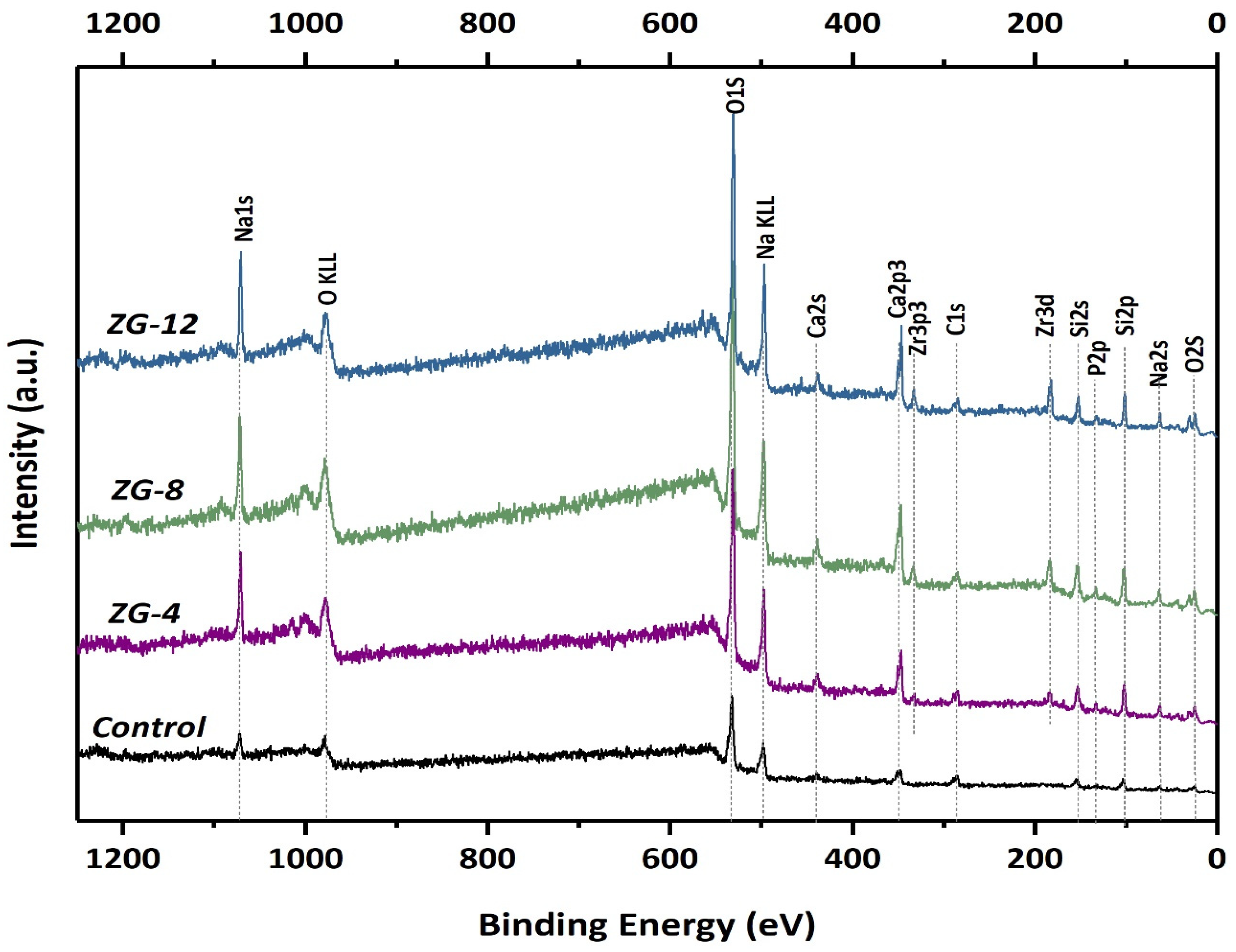
X-ray photoelectron spectroscopy (XPS) measurements were carried out to further confirm the glass composition and analyze the effect of ZrO2 on the glass structure. The survey scan of each glass composition with its constituent elements is shown in Figure 3. All the glass compositions contain Si4+, Ca2+, PO43−, and Na+ with minor traces of C, where the addition of Zr4+ resulted in the addition of Zr 3d and Zr 3p3 peaks for Zr-containing glasses. Elements detected in the XPS survey scans correspond to the initial glass batch composition, eliminating the concerns of contamination.
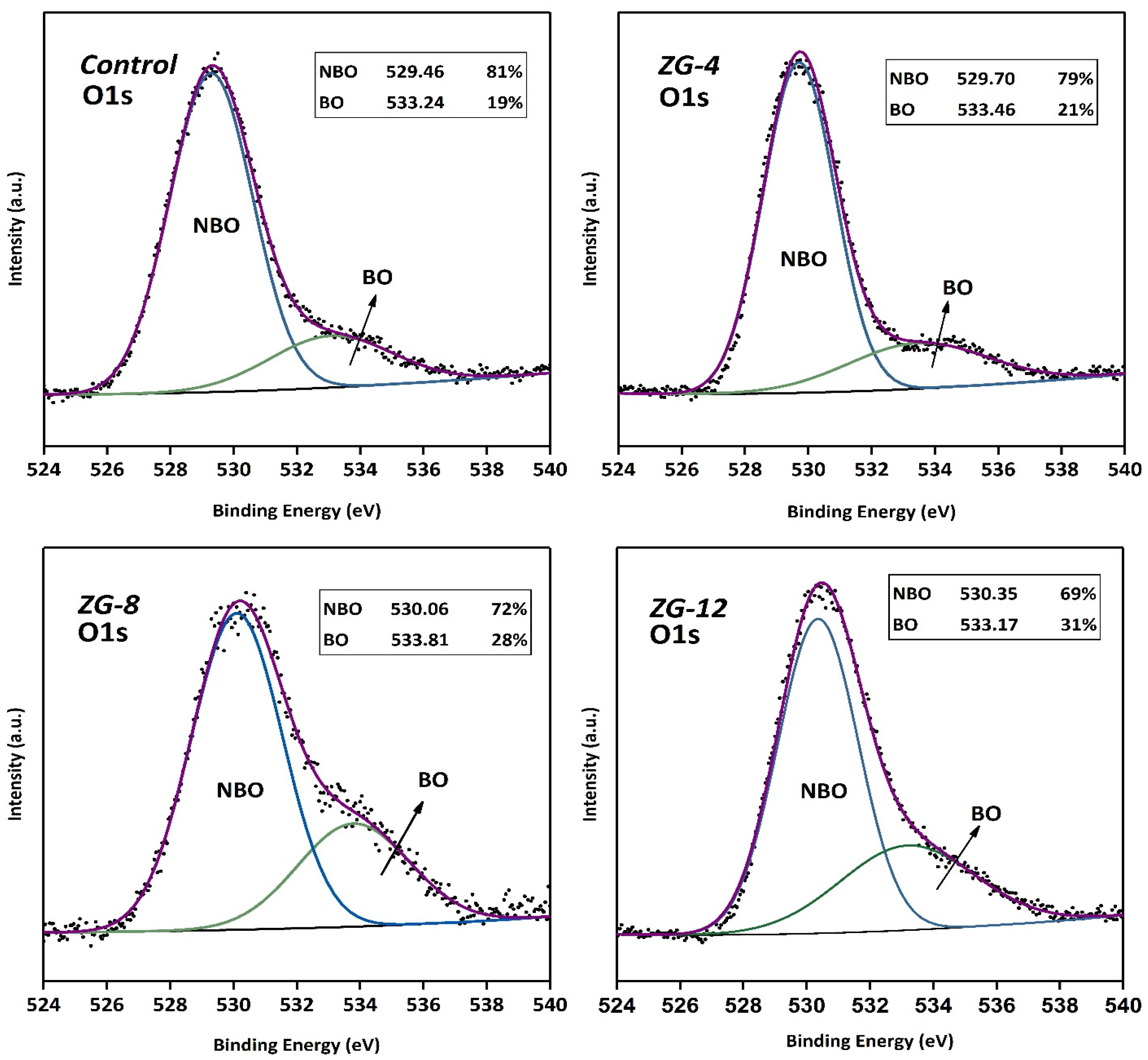
In order to determine the structural effects of ZrO2 on the bonding environment of oxygen, high-resolution O 1s scans were performed, and the results are presented in Figure 4.
Within the spectral region of 532–536 eV, a high degree of asymmetry exists. This indicates that there is a contribution of overlying peaks associated with different oxygen sites. Each peak is fitted to two Gaussian components. The lower binding energy peak (~530 eV) is attributed to non-bridging oxygens (NBO), while the higher binding energy peak y peak at (~533 eV) corresponds to the contribution of bridging oxygens (BO). Based on Figure 4 scans, it is evident that a compositional dependence exists within the O1s spectra of the glasses with chemical shifts to higher binding energies when ZrO2 is substituted with SiO2. For the Control glass, the lower binding energy peak (NBO) is centered at 529.4 eV, while in ZG-12 glass, a shift in the NBO peak occurs to higher energies at 530.3 eV. Additionally, peak fitting of different components of the O1s spectra revealed that the fraction of BO to NBO varies within different compositions. The percentile of the BO component of the spectra becomes more prominent with the addition of ZrO2, with 19% of BO for the Control glass and 21%, 28%, and 31% for ZG-4, ZG-8, and ZG-12, respectively. The XPS O1s spectra resolve the bonding configuration of oxygen atoms within the glass network. Chemical shifts probed from the O1s signal are due to changes in the electron density of the oxygen atoms associated with the bonding configurations of oxygen to its nearest neighbors. The chemical shift to higher binding energies in the glass network when SiO2 is substituted by ZrO2 is due to the contribution arising from the Si-O-Zr signal. The increase in the BO component suggests that the signal from the oxygen atoms in Si-O-Zr corresponds to those from Si-O-Si within the network that are all contributing to the component of BO atoms. The contribution of Zr4+ atoms associated with the increase in the BO region implies that the Zr4+ is acting as a network former within the glass structure [37]. To further investigate this hypothesis and the structural impact of the Zr4+ in the glass network, 29Si MAS-NMR was conducted.
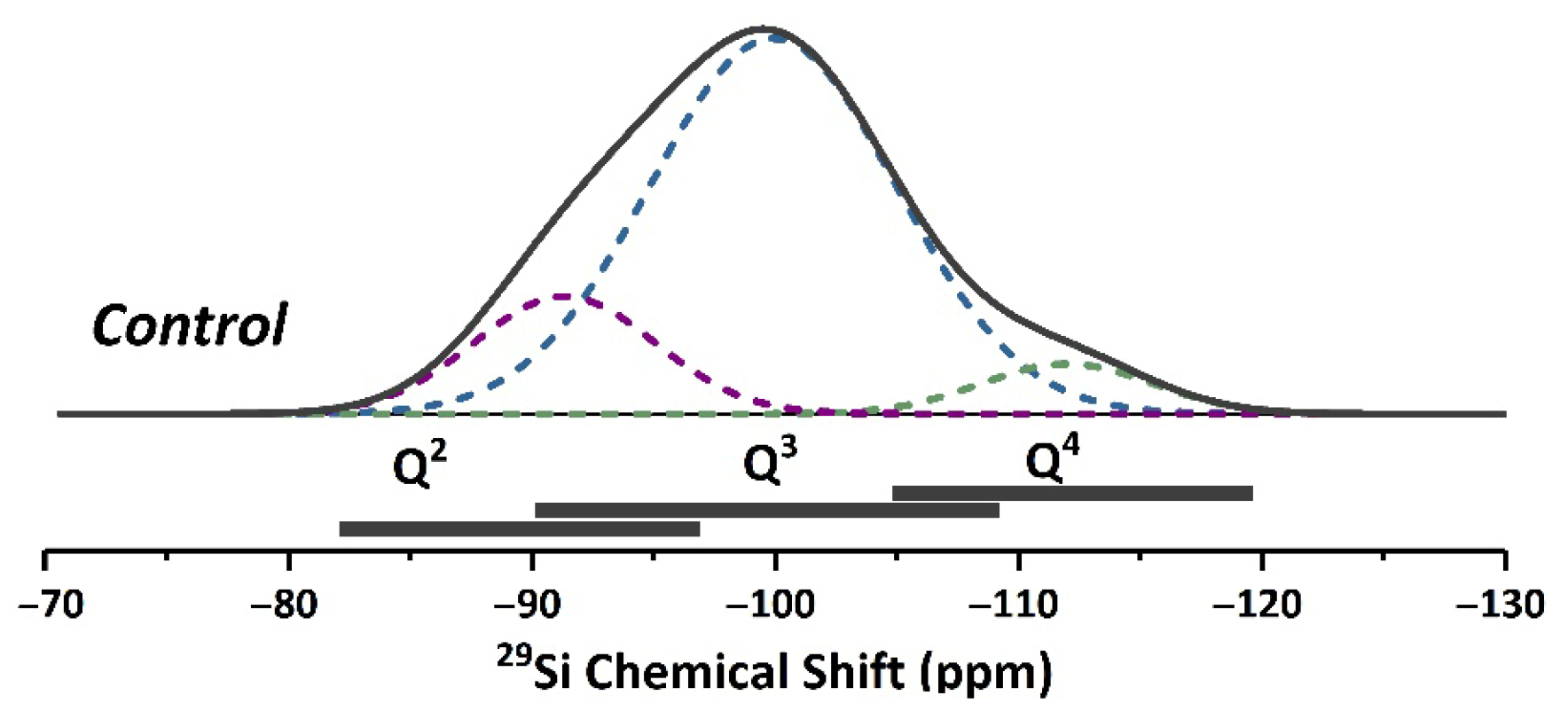
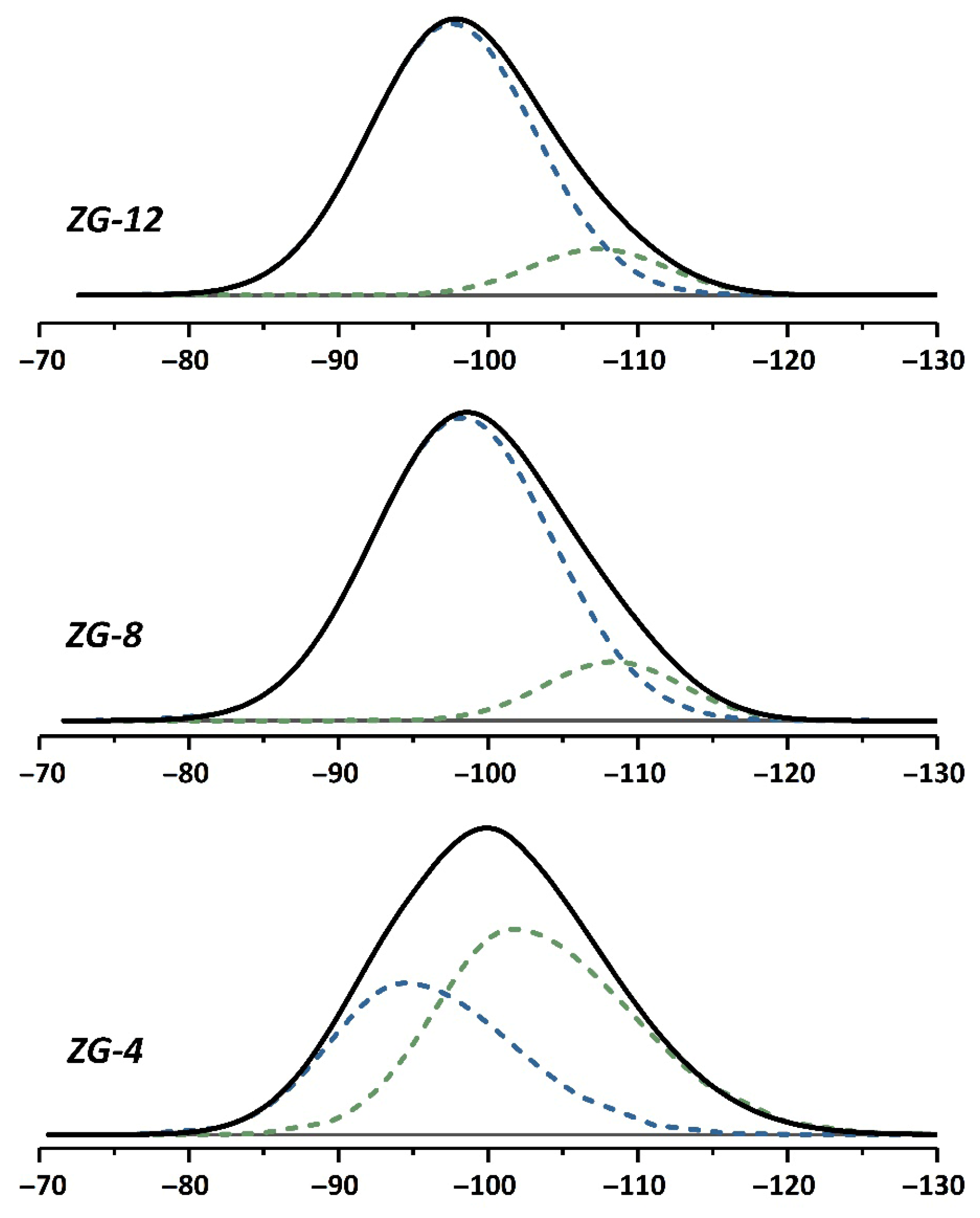
29Si MAS-NMR provided information relating to the Q-species within the glass structure. 29Si MAS-NMR (Figure 5) is conducted to analyze the effect that ZrO2 has on the glass network connectivity, specifically the bonding of Si to O. The results from Figure 5 present a broad peak for all four glass compositions, which indicates the presence of numerous Qn structures. The relative fraction of Q-speciation was determined within the region of −70 to −130 ppm. Specific Q-species are centered at −65 to −72 ppm for Q0, −78 to −82 ppm for Q1, −86 to −92 ppm for Q2, −95 to −103 ppm for Q3, and −108 to −115 ppm for Q4. The widening of the spectra can be explained by the presence of numerous kinds of bonds detected around the silicon atom, such as Si-O-Si, Si-O-Zr, and Si-O-P. The chemical shift in Qn units is largely dependent on the amount of NBOs and on the nature of their second neighbors. It can be observed that the increased addition of ZrO2 resulted in a reduced concentration of the lower Qn units, i.e., Q2, and favors Q3 and Q4 species, which is indicative of greater BO concentrations within the glass compared to the Control. The structure of the Zr-containing silicate glasses has been investigated by molecular dynamics (MD) simulations, where ZrO2/SiO2 substitutions were found to increase the glass network connectivity due to the formation of 6-fold coordination [ZrO6], which was also consistent with a corresponding increase in the glass transition temperatures [38,39]. Redistribution of Na+ and Ca2+ ions in the neighborhood of these Qn units, the preferential charge compensation of (ZrO6)2− can reduce the availability of modifiers such as Ca2+ and Na+ for NBO as was observed with the XPS O 1s data. Additionally, the charge-compensating role associated with Ca2+ and Na+ can also limit their availability to be involved in ion-exchange processes compared to modifiers that can create NBO sites [38]. Therefore, fewer ion-exchange and hydrolysis sites are available during the glass dissolution process as a result of ZrO2/SiO2 substitutions, a feature that was observed when conducting the glass solubility and ion release studies on the ZG glass series [39]. While XPS and MAS-NMR are useful complementary tools to characterize the structure of vitreous materials, it is worthwhile to note that direct experimental evidence of Zr coordination would be highly beneficial (Zr K-edge XANES/EXAFS) and may be considered in future studies.

3.2. Glass Solubility and Ion Release

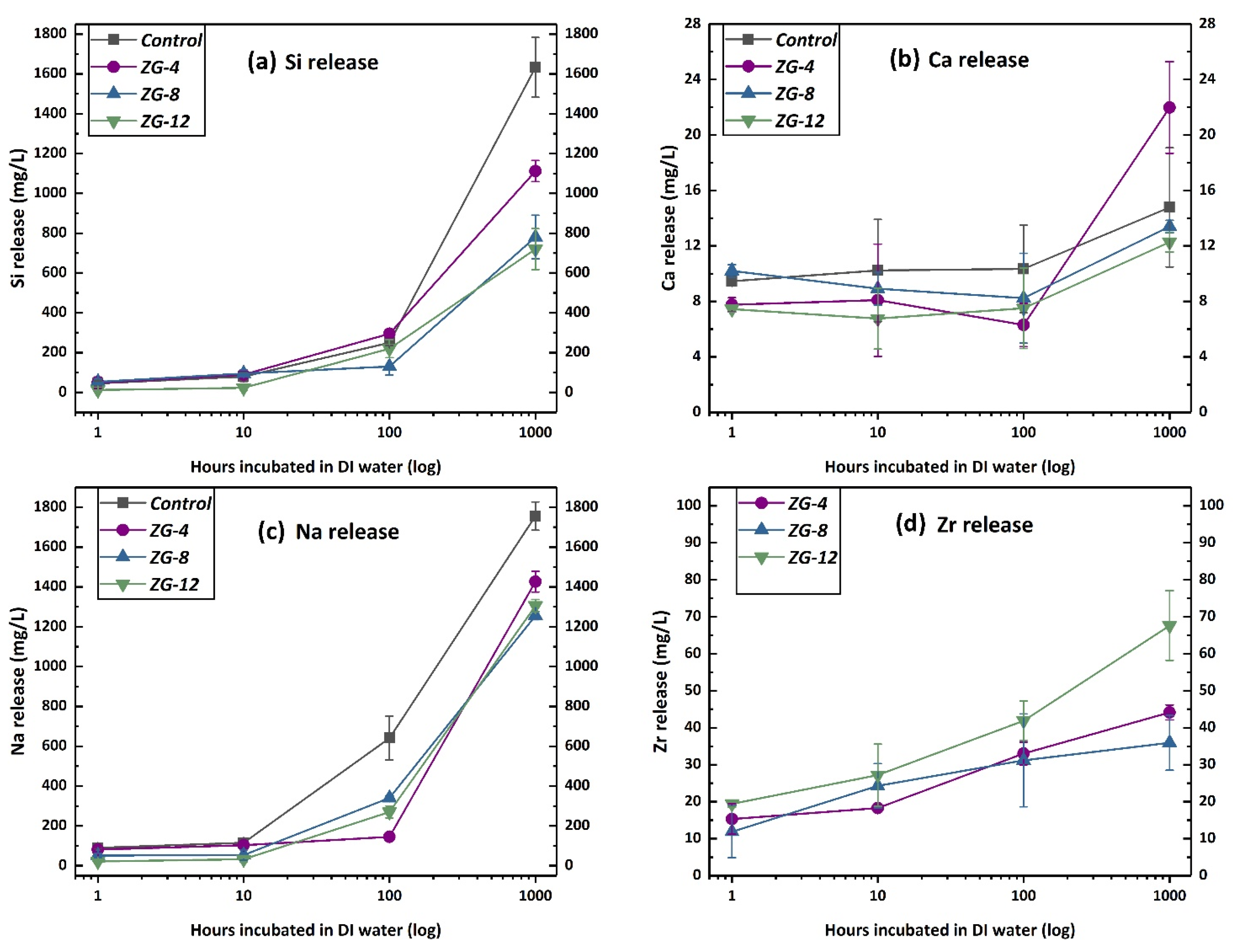
To study the solubility of the glasses in aqueous media, Inductively Coupled Plasma–Optical Emission Spectroscopy (ICP-OES) was used to determine the release of Si, Ca, Na, and Zr, and the resulting data are presented in Figure 6.
Approximately 1.0 m2 surface area (Table 3) of each glass powder was submerged in 10 mL of de-ionized water for 1, 10, 100, and 1000 h. After the incubation times expired, the aqueous solutions were removed and analyzed for each component of the glass composition, including Si4+, Zr4+, Ca2+, and Na+. The Si-release profiles for each glass composition are seen in Figure 6a. Glasses leached a constant level of Si4+ over the first 100 h, after which a significant increase in Si4+ release was observed for all the samples at 1000 h. The Si-release from the Control was determined to be the highest at 1632 mg/L compared to other samples after 1000 h incubation. ZG-4, ZG-8, and ZG-12 presented lower levels of Si-release after 1000 h, which ranged to approximately 1112, 781, and 720 mg/L, respectively. Glasses showed similar Ca-release profiles (Figure 6b) representing linear release within the first 100 h, and were then observed to increase after 1000 h. Ca2+ release rates were found to be below 22 mg/L for each glass composition tested and at each time period, with no significant changes in Ca2+ release being attributed to the differences in glass composition. With respect to Na-release (Figure 6c), glasses displayed relatively constant Na+ release within the first 10 h of incubation, and then an increase in release occurred for all sample types after 10 h, reaching the maximum at 1000 h. Na+ release from the Control glass increased to 1755 mg/L over the period 1–1000 h. ZG glass series achieved slightly lower final Na+ levels after 1000 h incubation, which peaked at approximately 1500 mg/L. Zr4+ release for ZG-4, ZG-8, and ZG-12 glass series is presented in Figure 6d. Glasses show linear behavior with respect to Zr4+ release, with ZG-12 glass exhibiting an increase in Zr4+ release with respect to incubation time. For ZG-4 glass, Zr4+ release ranged from 30 to 70 mg/L, with the ZG-8 glass, Zr4+ ranged from 44 to 85 mg/L, and with ZG-12, Zr4+ ranged from 30 to 75 mg/L. In each case, the maximum Zr4+ concentrations were achieved after 1000 h incubation.
The ion release profiles of the ZG glass series display relatively similar trends of ion release over the incremental time periods that were used for testing. The ZG glass series showed lower levels of ion release compared to the Control glass at each time period. The effect of Zr4+ replacement for Si4+ resulted in lower levels of Si4+ release (720–1112 mg/L) compared to the Control (1632 mg/L). This is likely related to the interactions between Si-O-Zr within the glass structure. However, Si4+ release levels in this range are known to be favorable in vivo as they increase osteoblast cell proliferation rates, which is known to stimulate genes in osteoblasts that play a critical role in bone metabolism [14]. Although Ca2+ release was found to be comparatively low (<22 mg/L), its release is essential for processes such as surface mineralization and apatite formation, and from a physiological viewpoint, Ca2+ has been attributed to increasing osteoblast proliferation, differentiation, and extracellular matrix mineralization [14]. With respect to Zr4+, toxicity limits are cited to be approximately 160 mg/L for cytotoxic effects. At lower levels (100 mg/L), there have been reports of oxidative stress in human osteoblasts. However, Zr4+ < 100 mg/L serves important roles in bone formation and protein synthesis [25,31]. The levels of Zr4+ release from the ZG series did not surpass the cited toxicity limits at any incubation time period. Another factor to recognize is the differences in surface area of the powders used for the incubation studies. The surface area of the glass particles increased from 0.62 to 2.19 m2/g (Table 2) from the Control to ZG-12. A difference in the glass particle size can lead to changes in their dissolution characteristics, which will occur independently of any difference in the glass structure.

3.3. Bioactivity Potential in Simulated Body Fluid (SBF)

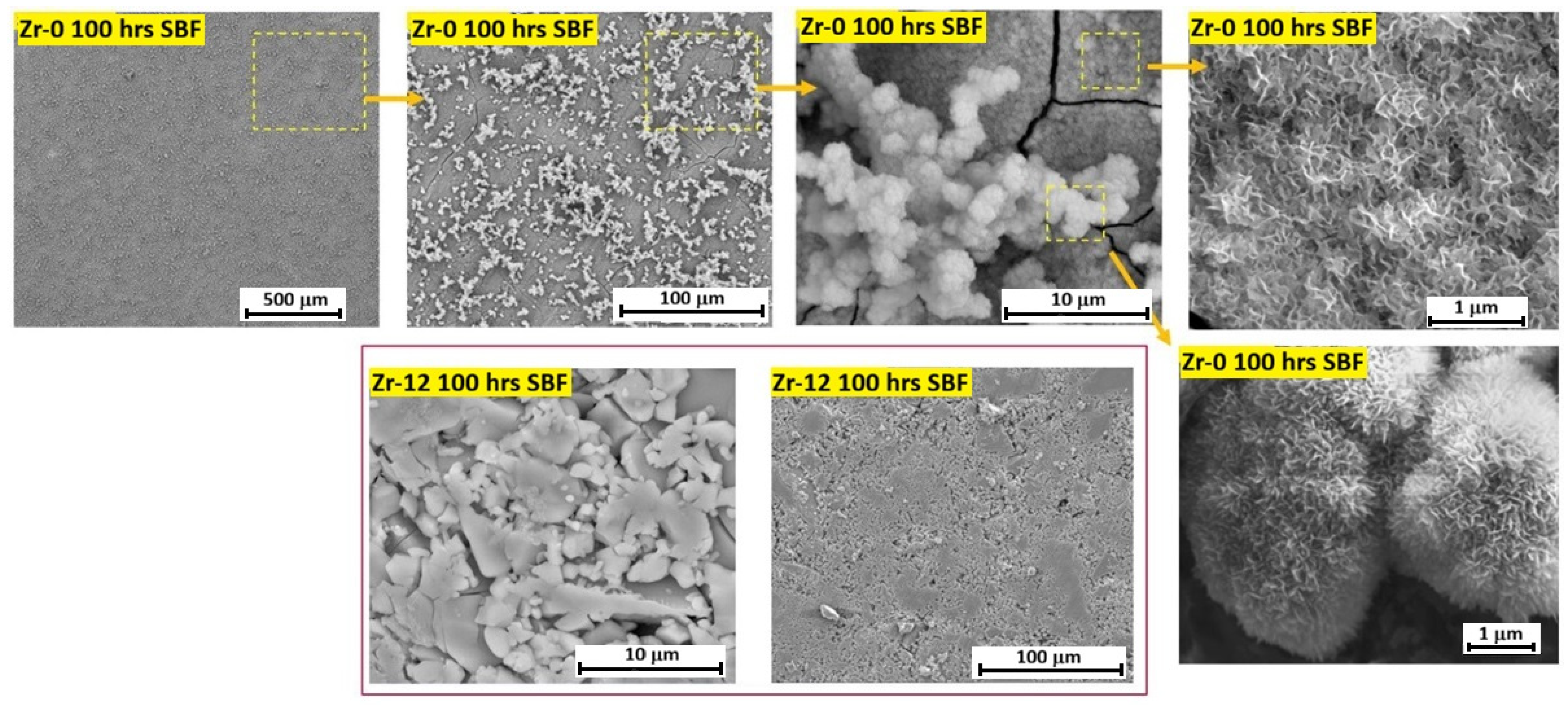
Simulated Body Fluid (SBF) trials were conducted assess their in vitro bioactivity. SBF trials were performed from 1 to 1000 h of immersion, and the SEM images of the surfaces of Control, ZG-4, ZG-8, and ZG-12 after 100 h incubation in SBF are presented in Figure 7.
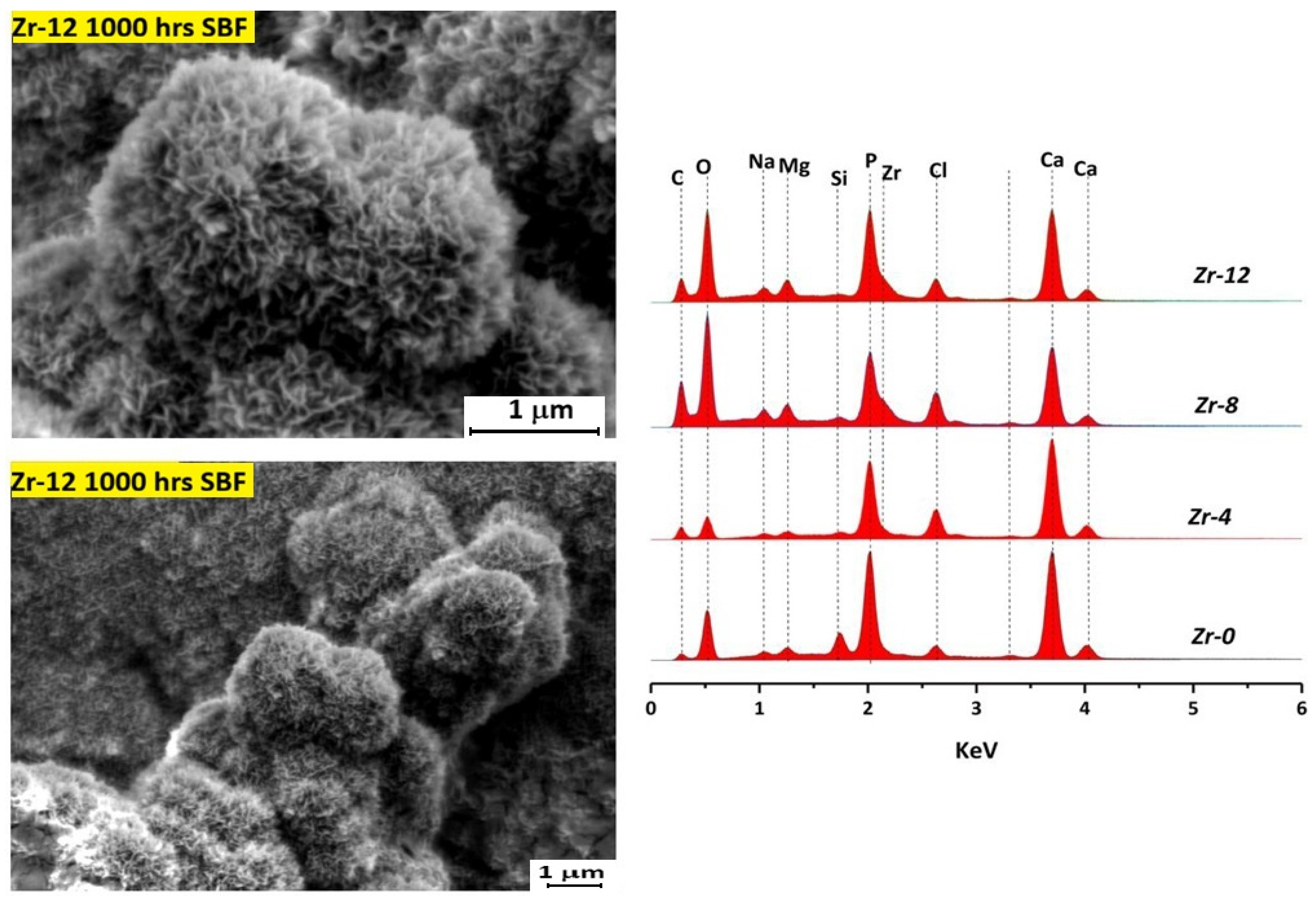
As highlighted in Figure 7, all glasses presented mineral deposition on their surface after 1000 h soaking in SBF. Clusters of spherical-shaped clusters are credited to calcium phosphate (CaP) formation and were present on the surface of the Control sample after 100 h incubation. By analyzing morphological changes on material surfaces incubated in SBF, determinations can be made relating to the material’s capacity for bone bonding. Precipitation of CaP on a bioceramic surface is viewed as a precursor to bone bonding in vivo, and also provides the driving force for the formation of bone-like apatite. Analysis of SEM images along with the corresponding EDX spectra of the Control and ZG glasses after 100- and 1000 h incubation in SBF is presented in Figure 7 and Figure 8. These results indicate the presence of Ca2+ and PO43− containing precipitates on the material’s surface. Large spherical clusters of CaP precipitants can be observed on the Control and ZG glass surfaces, while even higher magnification reveals plate-like CaP deposits. Figure 8 shows surface images of ZG-12 when incubated in SBF for 1000 h, and corresponding EDX spectra. EDX results confirm high concentration of Ca2+ and PO43− accumulate on the surfaces after SBF soaking, acquiring up to 18 and 26 wt% of Ca2+ and PO43− for the ZG glasses, respectively.
EDX of the spherical clusters after immersion in SBF shows reasonably low levels of Si4+ on the surface with 12, 1, 5, and 2 wt% for Control and Zr glasses, respectively. This is due to the Ca2+ and PO43− mineral masking the underlying Si4+ from the glassy substrate. High concentrations of Ca2+ and PO43− are present when compared to initial glass composition, with 12, 17, and 18 wt% of Ca2+, and 18, 26, and 26 wt% of PO43−, ZG-4, ZG-8, and ZG-12, respectively.
It was also found that the ZrO2-containing glasses presented delayed CaP precipitation compared to the Control. SEM imaging determined that ZG-12 incubated at 100 h showed minimal calcium phosphate (CaP) clusters on the surface, while after 1000 h incubation, significantly more surface coverage was evident. The delay in mineralization is likely a result of the lower concentration of Si4+ in the Control glass and the stabilizing effect of ZrO2 within the glass network. The addition of ZrO2 alters the concentration of non-bridging oxygens (NBO) to bridging oxygen (BO) species in the glass network to favor glass dissolution. This characteristic is important as it is known to be a critical component of designing soluble bioactive glasses, as the ratio of BO: NBO is directly linked to ion release in an aqueous environment [17]. However, regardless of the stabilizing effect that ZrO2 has on the glass network, the Zr glasses’ dissolution properties are favorable for the mineralization process. This feature of BG design is critical to retain as the direct bonding of a BG to living bone tissue occurs in several sequential steps on the BG surface. When a BG is soaked within an aqueous environment, alkali ions leach out and are substituted into the glass structure by H+ or H3O+ cations from the fluid. This elevates the local pH, which ruptures Si–O–NBO bonds. This ultimately results in the release of soluble Si4+ in the form of silanol (Si-OH) groups [4,14]. If the local pH remains lower than 9.5, the Si-OH groups polymerize on the glass surface, forming a silica gel layer. The open structure of silica gel allows the continuity of ion exchange. Ca2+, Na+ ions, and PO43− groups migrate through the silica gel layer and form an amorphous calcium phosphate layer over the silica gel layer. After the growth of both silica gel and calcium phosphate layers, the latter incorporates OH and CO32− groups, thereby giving rise to the crystallization of HCA [6,36].
Another characteristic that significantly influences ion release in bioactive glasses is the solubility mechanism, i.e., surface-controlled vs. dissolution-controlled. This can partially be explained by the ion release data (Figure 6) and the SBF results. It is evident in Figure 6a,c, specifically, that the ion release rates significantly increase after 100 h incubation in aqueous media. This is indicative of diffusion-controlled reactions, as a silica gel layer can restrict ion transport. Surface-controlled dissolution of Zr (Figure 6d) presents a more linear ion release profile, which suggests that a surface-controlled release mechanism is occurring. This reaction mechanism is heavily influenced by the glass composition and is independent of a boundary layer. Anecdotal evidence for this effect can be observed with the SBF testing. The Control glass observed mineralization after 100 h incubation in SBF, which is typically associated with the early formation of a Si-gel layer. Si and Na release significantly increase after 100 h incubation, which may suggest the breakdown of the gel layer and more rapid diffusion dissolution. However, in Zr-12, mineralization is not observed until 1000 h in SBF (Figure 8). This is likely the effect of surface-controlled dissolution, where the underlying glass structure limits the rate of a Si-gel layer and subsequently CaP formation. However, further testing would be required to validate this theory. It is also important to recognize the limitations in SBF testing. SBF is generally considered a positive screening tool for materials’ bioactivity; however, a number of important limitations include the lack of organics and cellular interactions, and the test is typically performed in a static environment, while the human physiological environment is dynamic. While precipitation of CaP is regarded as a prerequisite to bone bonding in vivo, it is not a guarantee of clinical success, as its success is dependent on parameters such as pH, temperature, immersion time, and material characteristics such as surface-to-volume ratio.

4. Conclusions

A series of ZrO2-doped bioactive glasses was synthesized by melt-quench processing and was investigated for any structural and solubility effects of ZrO2 substitution for SiO2. The addition of ZrO2 did not induce crystallinity in any of the glasses formed. There was an evident increase in the Tg throughout the ZG series (4, 8, 12 mol %), which was attributed to greater network connectivity (NC) within the glass. This effect was further investigated by high-resolution O 1s XPS, where an increase in the number of Bridging oxygens (BO) was observed with ZrO2, in addition to a shift to higher Q-speciation as determined by MAS-NMR. This change in NC in the glass is accompanied by a reduction in glass solubility; however, this lower rate of ion release (Si4+, Na+) did not hinder the bioactive response. SBF studies of the ZG glasses resulted in complete coverage of the material’s surface in CaP after 1000 h incubation. Future studies will investigate the effect of these ZG glasses as a function of pH and the corresponding cytocompatibility in MC 3T3 Osteoblasts.

Author Contributions

Conceptualization: A.W.W. and S.M.; methodology: A.W.W. and S.M.; formal analysis: S.M.; data curation: S.M. and C.A.R.; writing—original draft preparation: S.M.; writing—review and editing: A.W.W.; supervision: A.W.W. All authors have read and agreed to the published version of the manuscript.

Funding

This research received no external funding.

Institutional Review Board Statement

Not applicable.

Informed Consent Statement

Not applicable.

Data Availability Statement

The original contributions presented in this study are included in the article. Further inquiries can be directed to the corresponding author.

Conflicts of Interest

The authors declare no conflicts of interest.

Abbreviations

The following abbreviations are used in this manuscript:
XRDX-ray Diffraction
XPSX-ray Photoelectron Spectroscopy
MAS-NMRMagic Angle Spinning Nuclear Magnetic Resonance
DTADifferential Thermal Analysis
SEMScanning Electron Microscopy
EDXEnergy Dispersive Spectroscopy
CaPCalcium Phosphate
SBFSimulated Body Fluid
ICP-OESInductively Coupled Plasma Optical Emission Spectroscopy

References

  1. Roseti, L.; Parisi, V.; Petretta, M.; Cavallo, C.; Desando, G.; Bartolotti, I.; Grigolo, B. Scaffolds for Bone Tissue Engineering: State of the art and new perspectives. Mater. Sci. Eng. C 2017, 78, 1246–1262. [Google Scholar] [CrossRef]
  2. Rahaman, M.N.; Day, D.E.; Bal, B.S.; Fu, Q.; Jung, S.B.; Bonewald, L.F.; Tomsia, A.P. Bioactive glass in tissue engineering. Acta Biomater. 2011, 7, 2355–2373. [Google Scholar] [CrossRef]
  3. Mokhtari, S.; Wren, A.W. Bioactive glasses 2: Composite bone void fillers. In Bioactive Glasses, 2nd ed.; Ylänen, H., Ed.; Woodhead Publishing: Sawston, UK, 2018; pp. 365–380. [Google Scholar]
  4. Yilmaz, B.; Pazarceviren, A.E.; Tezcaner, A.; Evis, Z. Historical development of simulated body fluids used in biomedical applications: A review. Microchem. J. 2020, 155, 104713. [Google Scholar] [CrossRef]
  5. Chon, S.S.; Piraino, L.; Mokhtari, S.; Krull, E.A.; Coughlan, A.; Gong, Y.; Mellott, N.P.; Keenan, T.J.; Wren, A.W. Synthesis, characterization and solubility analysis of amorphous SiO2-CaO-Na2O-P2O5 scaffolds for hard tissue repair. J. Non-Cryst. Solids 2018, 490, 1–12. [Google Scholar] [CrossRef]
  6. Jones, J.R. Review of bioactive glass: From Hench to hybrids. Acta Biomater. 2013, 9, 4457–4486. [Google Scholar] [CrossRef] [PubMed]
  7. Rabiee, S.M.; Nazparvar, N.; Azizian, M.; Vashaee, D.; Tayebi, L. Effect of ion substitution on properties of bioactive glasses: A review. Ceram. Int. 2015, 41, 7241–7251. [Google Scholar] [CrossRef]
  8. Fiume, E.; Barberi, J.; Verne, E.; Baino, F. Bioactive Glasses: From Parent 45S5 Composition to Scaffold-Assisted Tissue-Healing Therapies. J. Funct. Biomater. 2018, 9, 24. [Google Scholar] [CrossRef] [PubMed]
  9. Sanz-Herrera, J.A.; Boccaccini, A.R. Modelling bioactivity and degradation of bioactive glass based tissue engineering scaffolds. Int. J. Solids Struct. 2011, 48, 257–268. [Google Scholar] [CrossRef]
  10. Izquierdo-Barba, I.; Vallet-Regí, M. Mesoporous bioactive glasses: Relevance of their porous structure compared to that of classical bioglasses. Biomed. Glass 2015, 1, 140–149. [Google Scholar] [CrossRef]
  11. Vallet-Regi, M.; Izquierdo-Barba, I.; Colilla, M. Structure and functionalization of mesoporous bioceramics for bone tissue regeneration and local drug delivery. Philos. Trans. R. Soc. A Math Phys. Eng. Sci. 2012, 370, 1400–1421. [Google Scholar] [CrossRef]
  12. López-Noriega, A.; Arcos, D.; Izquierdo-Barba, I.; Sakamoto, Y.; Terasaki, O.; Vallet-Regí, M. Ordered mesoporous bioactive glasses for bone tissue regeneration. Chem. Mater. 2006, 18, 3137–3144. [Google Scholar] [CrossRef]
  13. Hoppe, A.; Guldal, N.S.; Boccaccini, A.R. A review of the biological response to ionic dissolution products from bioactive glasses and glass-ceramics. Biomaterials 2011, 32, 2757–2774. [Google Scholar] [CrossRef] [PubMed]
  14. Aguiar, H.; González, P.; Serra, J. Bioactive glass structure and solubility. In Bioactive Glasses, 2nd ed.; Woodhead Publishing: Sawston, UK, 2018; pp. 37–61. [Google Scholar]
  15. Hench, L.L. The story of Bioglass. J. Mater. Sci. Mat. Med. 2006, 17, 967–978. [Google Scholar] [CrossRef] [PubMed]
  16. Baino, F.; Hamzehlou, S.; Kargozar, S. Bioactive Glasses: Where are we and where are we going? J. Funct. Biomater. 2018, 9, 25. [Google Scholar] [CrossRef]
  17. Akunna, C.; Cerruti, M. Structural connectivity and bioactivity in solgel silicate glass design. Acta Biomater. 2024, 188, 374–392. [Google Scholar] [CrossRef]
  18. Kaur, G.; Pandey, O.P.; Singh, K.; Homa, D.; Scott, B.; Pickrell, G. A review of bioactive glasses: Their structure, properties, fabrication and apatite formation. J. Biomed. Mater. Res. A 2014, 102, 254–274. [Google Scholar] [CrossRef]
  19. Baino, F.; Novajra, G.; Miguez-Pacheco Boccaccini, A.R.; Vitale-Brovarone, C. Bioactive glasses: Special applications outside the skeletal system. J. Non-Cryst. Solids 2016, 432, 15–30. [Google Scholar] [CrossRef]
  20. Jones, J.R.; Brauer, D.S.; Hupa, L.; Greenspan, D. Bioglass and bioactive glasses and their impact on healthcare. Int. J. Appl. Glass Sci. 2016, 7, 423–434. [Google Scholar] [CrossRef]
  21. Farooq, I.; Imran, Z.; Farooq, U.; Leghari, A.; Ali, H. Bioactive glass: A material for the future. World J. Dent. 2012, 3, 199–201. [Google Scholar] [CrossRef]
  22. Li, H.C.; Wang, D.G.; Meng, X.G.; Chen, C.Z. Effect of ZrO(2) additions on the crystallization, mechanical and biological properties of MgO-CaO-SiO(2)-P(2)O(5)-CaF(2) bioactive glass-ceramics. Colloids Surf. B Biointerfaces 2014, 118, 226–233. [Google Scholar] [CrossRef]
  23. Mokhtari, S.; Skelly, K.D.; Krull, E.A.; Coughlan, A.; Mellott, N.P.; Gong, Y.; Borges, R.; Wren, A.W. Copper-containing glass polyalkenoate cements based on SiO2–ZnO–CaO–SrO–P2O5 glasses: Glass characterization physical antibacterial properties. J. Mater. Sci. 2017, 52, 8886–8903. [Google Scholar] [CrossRef]
  24. Mokhtari, S.; Krull, E.A.; Sanders, L.M.; Coughlan, A.; Mellott, N.P.; Gong, Y.; Borges, R.; Wren, A.W. Investigating the effect of germanium on the structure of SiO2-ZnO-CaO-SrO-P2O5 glasses and the subsequent influence on glass polyalkenoate cement formation, solubility and bioactivity. Mater. Sci. Eng. C 2019, 103, 109843. [Google Scholar] [CrossRef] [PubMed]
  25. Chen, Y.W.; Moussi, J.; Drury, J.L.; Wataha, J.C. Zirconia in biomedical applications. Expert Rev. Med. Dev. 2016, 13, 945–963. [Google Scholar] [CrossRef] [PubMed]
  26. Cristache, C.; Burlibasa, M.; Cristache, G.; Drafta, S.; Alexandru Popovici, I.; Andrei Iliescu, A.; Zisi, S.; Burlibasa, L. Zirconia and its biomedical applications. Metal. Int. 2011, 16, 18–23. [Google Scholar]
  27. Lee, D.B.; Roberts, M.; Bluchel, C.G.; Odell, R.A. Zirconium: Biomedical and nephrological applications. ASAIO J. 2010, 56, 550–556. [Google Scholar]
  28. Sung, Y.; Shin, Y.; Ryu, J. Preparation of hydroxyapatite/zirconia bioceramic nanocomposites for orthopaedic and dental prosthesis applications. Nanotech 2007, 18, 065602. [Google Scholar] [CrossRef]
  29. Brook, I.; Freeman, C.; Grubb, S.; Cummins, N.; Curran, D.; Reidy, C.; Hampshire, S.; Towler, M.R. Biological evaluation of nano-hydroxyapatite-zirconia (HA-ZrO2) composites and strontium-hydroxyapatite (Sr-HA) for load-bearing applications. J. Biomater. Appl. 2012, 27, 291–298. [Google Scholar]
  30. Abo-Mosallam, H.A.; Kim, D.-A.; Kim, H.-W.; Lee, H.-H. Influence of ZrO2 oxide on the properties and crystallization of calcium fluoro-alumino-silicate glasses. Ceram. Int. 2016, 42, 5107–5112. [Google Scholar] [CrossRef]
  31. Montazerian, M.; Yekta, B.E.; Marghussian, V.K.; Bellani, C.F.; Siqueira, R.L.; Zanotto, E.D. Bioactivity and cell proliferation in radiopaque gel-derived CaO-P2O5-SiO2-ZrO2 glass and glass-ceramic powders. Mater. Sci. Eng. C Mater. Biol. Appl. 2015, 55, 436–447. [Google Scholar]
  32. Lu, X.; Deng, L.; Du, J. Effect of ZrO2 on the structure and properties of soda-lime silicate glasses from molecular dynamics simulations. J. Non-Cryst. Solids 2018, 491, 141–150. [Google Scholar]
  33. Apel, E.; van’t Hoen, C.; Rheinberger, V.; Höland, W. Influence of ZrO2 on the crystallization and properties of lithium disilicate glass-ceramics derived from a multi-component system. J. Eur. Ceram. Soc. 2007, 27, 1571–1577. [Google Scholar] [CrossRef]
  34. Zhu, Y.; Li, X.; Yang, J.; Wang, S.; Gao, H.; Hanagata, N. Composition–structure–property relationships of the CaO–MxOy–SiO2–P2O5 (M = Zr, Mg, Sr) mesoporous bioactive glass (MBG) scaffolds. J. Mater. Chem. 2011, 21, 9208–9218. [Google Scholar] [CrossRef]
  35. Montazerian, M.; Schneider, J.F.; Yekta, B.E.; Marghussian, V.; Rodrigues, A.; Zanotto, E.D. Sol–gel synthesis, structure, sintering and properties of bioactive and inert nano-apatite–zirconia glass–ceramics. Ceram. Int. 2015, 41, 11024–11045. [Google Scholar] [CrossRef]
  36. Kokubo, T.; Takadama, H. How useful is SBF in predicting in vivo bone bioactivity? Biomaterials 2006, 27, 2907–2915. [Google Scholar] [CrossRef]
  37. Shearer, A.; Montazerian, M.; Deng, B.; Sly, J.J.; Mauro, J.C. Zirconia-containing glass-ceramics: From nucleating agent to primary crystalline phase. Int. J. Ceram. Eng. Sci. 2024, 6, e10200. [Google Scholar] [CrossRef]
  38. Lu, X.; Deng, L.; Kerisit, S.; Du, J. Structural role of ZrO2 and its impact on properties of boroaluminosilicate nuclear waste glasses. NPJ Mater. Degrad. 2018, 2, 19. [Google Scholar] [CrossRef]
  39. Ficheux, M.; Burov, E.; Aquilanti, G.; Trcera, N.; Montouillout, V.; Cormier, L. Structural evolution of high zirconia aluminosilicate glasses. J. Non-Cryst. Solids 2020, 539, 120050. [Google Scholar] [CrossRef]
Figure 1. (a) XRD patterns, and (b) DTA profiles of each glass powder. The Tg, Tc, and Tm are marked on each thermogram.
Applsci 16 01642 g001
Figure 2. Energy Dispersive X-ray (EDX) and Scanning Electron Microscopy (SEM) of Control, ZG-4, ZG-8, and ZG-12 powdered glass samples.
Applsci 16 01642 g002
Figure 3. XPS survey scans of Control, ZG-4, ZG-8, and ZG-12 powdered glass samples.
Applsci 16 01642 g003
Figure 4. High-resolution O1s scans of Control, ZG-4, ZG-8, and ZG-12 powdered glass samples.
Applsci 16 01642 g004
Figure 5. 29Si MAS-NMR of Control, ZG-4, ZG-8, and ZG-12 glass powders and corresponding Q species.
Applsci 16 01642 g005aApplsci 16 01642 g005b
Figure 6. Ion release profiles of glass powders, investigating (a) Si release, (b) Ca release, (c) Na release, and (d) Zr release after 1, 10, 100, and 1000 h incubation in DI water.
Applsci 16 01642 g006
Figure 7. SEM micrographs of the surface of Control (Zr-0) and ZG-12 glasses after 100 h incubation in SBF.
Applsci 16 01642 g007
Figure 8. SEM micrographs of the surface of ZG-12 and corresponding EDX of the surfaces of glasses after 1000 h incubation in SBF.
Applsci 16 01642 g008
Table 1. Glass compositions (Mol. Fr) where SiO2 is substituted with ZrO2.
SiO2ZrO2CaONa2OP2O5
Control0.560.000.250.150.04
ZG-40.520.040.250.150.04
ZG-80.480.080.250.150.04
ZG-120.440.120.250.150.04
Table 2. BET Surface area (m2/g) for each glass composition, including standard deviations.
BETSD
Control0.62480.0034
ZG-40.90260.0041
ZG-81.04230.0047
ZG-122.18540.0120
Table 3. Tg, crystallization, and melting temperature for each glass composition.
ControlZG-4ZG-8ZG-12
Tg607656708715
Crystallization 1944-896859
Crystallization 2--10991070
Melting10721156nana
Table 4. Batch glass compositions and compositions as determined by EDX analysis for each of the glass samples in mol%.
ControlZr-4Zr-8Zr-12
BatchEDXBatchEDXBatchEDXBatchEDX
SiO256.054.252.050.448.049.144.044.7
Na2O15.010.115.018.015.013.715.014.7
P2O54.04.34.00.54.00.24.00.0
CaO25.031.425.023.125.025.725.026.9
ZrO20.00.04.08.08.011.312.013.7
Disclaimer/Publisher’s Note: The statements, opinions and data contained in all publications are solely those of the individual author(s) and contributor(s) and not of MDPI and/or the editor(s). MDPI and/or the editor(s) disclaim responsibility for any injury to people or property resulting from any ideas, methods, instructions or products referred to in the content.