Article

Theoretical Analysis of Axial Compressive Load Transfer Mechanism of Anti-Toppling Helical Piles Embedded in Strain-Hardening Soils


1
Faculty of Engineering, China University of Geosciences, Wuhan 430074, China
2
College of Civil Engineering and Architecture, Zhejiang University, Hangzhou 310030, China
*
Author to whom correspondence should be addressed.
Appl. Sci. 2026, 16(8), 4056; https://doi.org/10.3390/app16084056
Submission received: 26 March 2026 / Revised: 16 April 2026 / Accepted: 19 April 2026 / Published: 21 April 2026
(This article belongs to the Special Issue Recent Advances in Pile Foundation Engineering)

Abstract

Anti-toppling helical piles exhibit superior load-bearing performance due to enhanced interaction between the helices and the underlying soil; however, rigorous theoretical frameworks for their compressive analysis remain scarce. To address this limitation, this study proposes a computationally efficient analytical model utilizing the Modified Cam-Clay (MCC) constitutive framework to calibrate plane strain elements for pile–soil interaction simulations. Wedge-shaped and bulb-shaped fictitious soil pile models are introduced to accurately capture vertical capacity mobilization beneath the helix and pile tip, respectively. After successfully validating the framework against 3D finite element simulations and field test data, extensive parametric analyses were conducted. The key findings reveal that (1) unlike conventional piles, skin friction for anti-toppling helical piles increases monotonically with depth; (2) an optimal helix-to-pile diameter ratio of approximately 1.5 maximizes coordinated bearing capacity; (3) increasing pile length below a fixed helix depth provides negligible additional capacity; and (4) the critical state parameter M strictly controls the ultimate bearing threshold.

1. Introduction

Helical piles have been widely applied in transmission line foundations, photovoltaic supports, temporary structures, and ground improvement projects due to their convenient installation, high load-carrying efficiency, and environmentally friendly reusable characteristics [1,2]. As an efficient, sustainable, and reusable deep foundation, helical piles significantly enhance pile–soil interaction through the installation of helical plates along the shaft, thereby exhibiting favorable mechanical performance under tensile, compressive, lateral, and overturning loads [3,4,5]. With the increasing demand for green, low-carbon construction and rapid installation in infrastructure development, the application prospects of helical piles continue to expand, and their load-bearing mechanisms and design methods have become a growing focus [6,7].
Compared to widely used bored piles and precast piles, helical piles are distinguished primarily by their unique load-transfer mechanism. The two most apparent differences from conventional piles are the presence of helical plates along the shaft and a significantly smaller pile diameter [8,9,10]. These features result in a distinct bearing behavior: the helical plates dominate the pile capacity, while the shaft skin friction contribution is considerably smaller than that in conventional piles [11,12,13]. Hence, lots of studies place their focus on the bearing mode of helices [14,15,16]. Regarding axial compressive responses, existing research suggests that soil capacity mobilization modes are generally classified into two typical conditions: the individual bearing mode and the cylindrical bearing mode [17,18]. The bearing modes of the helical piles are highly related to the configuration of the helices and the soil properties. For instance, with the helices placed closer to each other or increased soil stiffness or strength, the cylindrical bearing mode is more likely to happen [19,20,21]. Furthermore, experimental studies demonstrate that soil type significantly influences the load-transfer mechanisms of helical piles. In soft clays and sand, the ultimate shear strength increases substantially with embedment depth; consequently, deeply embedded helices exert a dominant influence on the pile’s overall capacity and performance [22,23]. However, in over-consolidated clays, the shallow soil layers exhibit higher strength; consequently, piles with shallowly embedded helices demonstrate reduced settlement under the same loading conditions [11,24,25,26]. The installation torque and the ultimate compressive capacity of the helical pile exhibit strong connections [27]. Hence, many researchers attempt to figure out a relationship between the installation torque and the compressive capacity in cohesive clay [28] and sand [29,30]. While employing a larger helix can enhance the end-bearing resistance, it also introduces significant installation challenges for helical piles [31]. It is well-established that soil strength increases significantly with burial depth. Consequently, as a helical pile is driven deeper, the required installation torque rises substantially [32]. To mitigate this effect, the anti-toppling helical pile has been proposed [13,33]. This design features a large-diameter helix embedded at a shallow depth and a smaller helix located at the pile tip specifically to facilitate the screw-in process. In this configuration, the axial compressive capacity is primarily derived from the end-bearing resistance of the soil beneath the large shallow helix, whereas the contribution of the bottom helix to the overall capacity is negligible.
So far, the most prevalent method to predict the compressive capacity of the helical pile is through FEM analysis [34,35]. A significant body of the existing literature simplifies helices as flat plates, thereby streamlining model construction and numerical meshing [36,37]. Furthermore, with advancements in numerical methods within commercial FEA software—such as the inclusion of the SPH (Smoothed Particle Hydrodynamics) module in Abaqus v.2025—simulation workflows spanning from installation to bearing have become increasingly mature and robust [38,39]. Such workflows allow the consideration of soil disturbance, which is a critical influential factor for soil capacity mobilization around helical piles [40,41]. However, these approaches have inherent limitations, as the evolution of pore water pressure is difficult to accurately incorporate into such large-deformation analysis frameworks. Furthermore, the complexities of numerical setup, meshing strategies, and achieving calculation convergence make these methods highly computationally expensive [42,43].
The primary goal of this study is to develop a highly computationally efficient and theoretically rigorous method for the axial compressive analysis of anti-toppling helical piles. To overcome the computational expense and convergence issues inherent in traditional large-deformation FEM frameworks, the novelty of this work lies in the integration of the MCC constitutive framework with wedge-shape and bulb-shape fictitious soil pile models. This novel approach allows for the precise simulation of pile–soil interaction and vertical soil capacity mobilization without the heavy computational burden of 3D numerical meshing, ultimately providing valuable insights for practical engineering design.

2. Methodology and Basic Assumptions

The research is organized into four distinct stages:
Stage 1: Theoretical Formulation. Development of the MCC based element and the fictitious soil pile models.
Stage 2: Computational Framework Assembly. Integration of the individual theoretical models into a unified numerical system.
Stage 3: Comprehensive Validation. Verification of the framework through comparison with Finite Element Method (FEM) simulations and physical field test data.
Stage 4: Parametric Analysis and Design Recommendations. Evaluation of key variables to establish practical guidelines for engineering design.

2.1. Plane Strain Pile–Soil Interaction Element Based on the MCC Model

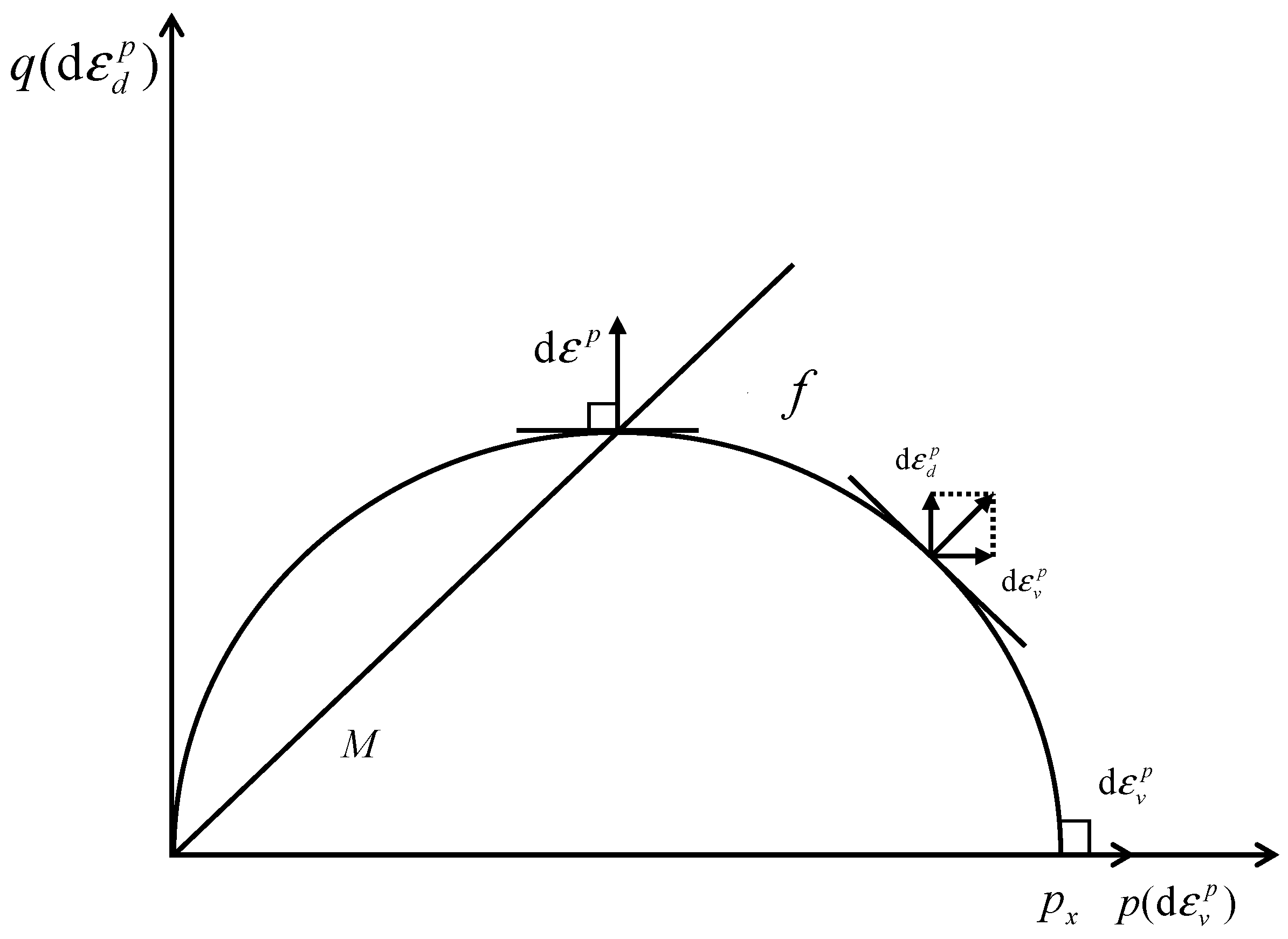
Similar to conventional cast-in-place piles and solid piles, the load-bearing capacity of the pile segment without helices is primarily provided by skin frictions along the pile–soil interface. In this section, a nonlinear relationship between the skin friction and the pile displacement is established, based on the MCC model. Subsequently, the pile–soil system is longitudinally dispersed into numerous segments, within which the soil part is modelled by a plane strain element pre-informed with τ r z u z (skin friction versus vertical settlement of pile shaft) knowledge. The MCC constitutive model is adopted herein for two main reasons. First, the installation of an anti-toppling helical pile causes significant cutting and disturbance of the surrounding soil, resulting in severe degradation of the soil structure and rendering its mechanical behavior close to that of remolded soil. Second, this research aims to establish a general framework for the anti-toppling helical pile–soil interaction in normally consolidated or lightly over-consolidated soils, which typically exhibit pronounced strain-hardening characteristics; under such conditions, the MCC model provides an appropriate constitutive description. The yielding surface of the MCC model is shown in Figure 1, in which ε p , ε v p , ε d p , f , and M represents the plastic strain, plastic volumetric strain, plastic deviatoric strain, yield function, and slope of the critical state line, repectively. In fact, extensive theoretical studies have been conducted on pile–soil interaction based on the MCC constitutive framework. For instance, Potts and Martins [44] developed a finite element analysis framework for studying pile–soil interactions, and Chen et al. [45] established a semi-analytical solution for pile–soil interaction based on MCC thin-layer elements. In this study, the approach proposed by Chen [45] is extended to the analysis of anti-toppling helical pile–soil interaction, and several justifications in their derivation are correspondingly addressed. The helices are modelled as flat plates. Although refined finite element simulations can capture the detailed helix–soil interplay, experimental evidence—such as the laboratory tests by Al-Rawabdeh et al. [46]—suggests that the influence of helix geometry on bearing capacity remains limited, provided the helix retains a circular shape and its radius is held constant.
Based on the principle of effective stress and elastoplasticity theory, the equilibrium equation for saturated soil can be expressed as:
d σ r d r + d u d r + 1 r   d τ r θ d θ + d τ r z d z + σ r σ θ r = 0
  d τ r θ   d r + 1 r d σ θ d θ + 1 r d u d θ + d τ θ z d z + 2 τ r θ r = 0
  d τ r z   d r + 1 r   d τ θ z d θ + d σ z d z + d u d z + τ r z r = 0
Here, the stress variables with a superscript prime ′ represent effective stresses. The effective stress represents the intergranular stress transmitted directly between the physical contact points of soil particles, which is the stress that actually governs the soil’s deformation and shear strength. Based on a given total normal stress state, the effective stress is obtained by subtracting the pore water pressure. The vertical loading problem of a single pile is inherently axisymmetric. To reduce the complexity of the governing equations, the problem can be simplified by introducing the plane strain assumption, under which circumstances the tangential variations of τ r θ , τ θ z , and σ θ are neglected. The plane strain model balances the accuracy and computational efforts [47], and the rationality of this assumption would be validated afterwards. Accordingly, the above equations can be simplified as follows:
τ r z = τ r z , s h a f t r s r
where r s denotes the pile radius.
It can be readily seen that substituting the constitutive and geometric relationships of the soil into Equation (4) yields the relationship between the pile-side displacement u z , s h a f t and the pile-side shear stress τ r z , s h a f t . We first consider the elastic component of the MCC model. Under the plane strain assumption, the corresponding constitutive and geometric equations can be written as:
u z = r m r s tan ( r s r τ r z , s h a f t G ) d r
where G = 3 ( 1 2 μ ) 1 + e p 2 ( 1 + μ ) κ denotes the soil shear modulus; p denotes the effective stress; κ is the mean slope of the swelling line of the soil in v ln p space; μ is Poisson’s ratio, and e is the soil void ratio. r m denotes a point at a certain radial distance outside the pile shaft, whose contribution to the skin friction resistance can be neglected. This position can be determined through an iterative procedure by specifying an initial value and a convergence criterion. Based on Equation (5), the elastic relationship between the skin friction resistance at the pile–soil interface and the pile displacement can be established within the MCC framework. Since the MCC model is formulated in terms of effective stress, all stress variables used in the subsequent derivations are effective stresses.
The plastic response is considered next. In elastoplastic analysis, the yield surface directly governs the transition of deformation from a purely elastic state to an elastoplastic state. Therefore, the yield condition should first be established from the yield surface equation. For the Modified Cam-Clay model, the yield surface can be expressed as:
f = q 2 + M 2 p 2 M 2 p x p
where p denotes the mean effective normal stress;  q denotes the generalized shear stress; M denotes the slope of the critical state line; and p x denotes the hardening parameter characterizing the size of the yield surface and the pre-consolidation pressure. By setting Equation (6) equal to zero, the relationship between p and q at the instant when the soil just reaches yielding can be obtained:
J 2 = O C R 2 p 0 2 M 2 ( O C R 1 ) 3
where O C R denotes the over-consolidation ratio of the soil; and p 0 denotes the initial mean normal stress. Since the initial mean normal stress remains unchanged during the elastic stage, it follows that p = O C R p 0 at the instant when the stress state first enters the plastic stage. Rearranging further yields:
τ r z , plastic = O C R p 0 M 2 ( O C R 1 ) η 0 2 3
where η 0 = q 0 p 0 denotes the initial stress ratio. Equation (8) defines the critical point separating elastic and elastoplastic deformation. Prior to the pile-side shear stress τ r z reaching τ r z , plastic , curve τ r z u z varies linearly, which can be described by Equation (8). Once τ r z exceeds τ r z , plastic , the plastic displacement associated with plastic strain must be considered. According to elastoplastic theory D ε r z = D ε r z , e + D ε r z , p , the plastic strain can be evaluated independently. For the MCC model, the following consistency condition must first be satisfied:
d f = f q d q + f p d p + f p x d p x = 0
Under the associated flow rule, the following relationship can be obtained:
d ε v p = f p Λ = M 2 ( 2 p p x ) Λ
d ε s p = f q Λ = 2 q Λ
where d ε v p denotes the increment of plastic volumetric strain; d ε s p denotes the increment of plastic shear strain; and Λ denotes the plastic multiplier tensor. The hardening parameter p x satisfies the following relationship:
d p x = 1 + e p x λ κ d ε v p
where λ denotes the slope of the normal consolidation line; κ denotes the slope of the swelling (recompression) line; and e denotes the void ratio. Substituting Equation (11) into Equation (9) yields:
d ε v p = λ κ 2 q d q + M 2 ( 2 p p x ) d p M 2 p 1 + e p x
Equation (12) gives the relationship among the plastic strain increment, d q , and d p . For mathematical convenience, it is further transformed into the p q coordinate system. Accordingly, Equation (9) can be rewritten as:
d f = f σ i j d σ i j + f p x d p x = 0
where f σ i j = f p p σ i j + f q q σ i j , p σ i j = 1 3 δ i j , q σ i j = 3 2 q s i j , s i j = σ i j p δ i j . Combining Equation (10) yields:
f σ i j = M 2 3 ( 2 p p x ) δ i j + 3 s i j
By substituting Equations (10), (11) and (14) into Equation (13), one obtains:
Λ = M 2 3 ( 2 p p x ) δ i j + 3 s i j M 4 p 1 + e p x ( 2 p p x ) λ κ d σ i j
From the yield function, one obtains:
p x = p 1 + η 2 M 2
Accordingly, Equation (15) can be rewritten as:
Λ = 1 3 p M 2 η 2 δ i j + 3 s i j 1 + e λ κ p 3 M 4 η 4 d σ i j
According to the associated flow rule:
d ε i j p = f σ i j Λ = ψ Ω i j ( 6 × 6 ) Ω i j ( 6 × 6 ) d σ i j
where ψ = 1 + e λ κ p 3 M 4 η 4 and Ω i j = 1 3 p ( M 2 η 2 ) δ i j + 3 s i j . For an axisymmetric problem, matrix Ω i j can be reduced to a 4 × 4 form, and Equation (18) may therefore be expressed in matrix form as:
d ε r r p d ε θ θ p d ε z z p d γ r z p = 1 ψ Ω r r Ω r r Ω r r Ω θ θ Ω r r Ω z z Ω r r Ω r z Ω θ θ Ω r r Ω θ θ Ω θ θ Ω θ θ Ω z z Ω θ θ Ω r z Ω z z Ω r r Ω z z Ω θ θ Ω z z Ω z z Ω z z Ω r z Ω r z Ω r r Ω r z Ω θ θ Ω r z Ω z z Ω r z Ω r z d σ r r d σ θ θ d σ z z d τ r z
For the elastic deformation part, the incremental matrix relationship can be written as follows:
d ε r r e d ε θ θ e d ε z z e d γ r z e = 1 2 G ( 1 + μ ) 1 μ μ 0 μ 1 μ 0 μ μ 1 0 0 0 0 2 ( 1 + μ ) d σ r r d σ θ θ d σ z z d τ r z
By combining Equations (19) and (20), one obtains:
d ε r r d ε θ θ d ε z z d γ r z = d ε r r e d ε θ θ e d ε z z e d γ r z e + d ε r r p d ε θ θ p d ε z z p d γ r z p = C e + C p d σ r r d σ θ θ d σ z z d τ r z
where C e and C p represent the elastic and plastic compliance matrices, respectively.
Based on the Sherman–Morrison formula, the inverse of C e + C p can be expressed as follows:
C e + C p 1 = C e 1 C e 1 Ω i j Ω i j T C e 1 ψ + Ω i j T C e 1 Ω i j
where C e 1 denotes the elastic stiffness matrix D e , which can be expressed as:
C e 1 = D e = λ + 2 G λ λ 0 λ λ + 2 G λ 0 λ λ λ + 2 G 0 0 0 0 G
where λ = 2 G μ 1 2 μ . It is readily seen that C e 1 is a symmetric matrix, and thus its transpose is identical to itself. Accordingly, Equation (22) can be rewritten as follows:
C e + C p 1 = D ep = 1 T T 11 T 12 T 13 T 14 T 21 T 22 T 23 T 24 T 31 T 32 T 33 T 34 T 41 T 42 T 43 T 44
The components of the elastoplastic stiffness matrix are given as follows:
T = 1 2 μ ψ + G Ω r z 2 + 2 G 1 μ Ω r r 2 + Ω θ θ 2 + Ω z z 2 + 4 G μ Ω r r Ω θ θ + Ω r r Ω z z + Ω θ θ Ω z z
T 11 = 2 G 1 μ ψ + G Ω r z 2 + 4 G 2 Ω θ θ 2 + Ω z z 2 + 2 μ Ω θ θ Ω z z
T 12 = T 21 = 2 G μ ψ + G Ω r z 2 + 2 G μ Ω z z 2 μ Ω z z Ω θ θ μ Ω r r Ω z z Ω r r Ω θ θ
T 13 = T 31 = 2 G μ ψ + G Ω r z 2 + 2 G μ Ω θ θ 2 μ Ω θ θ Ω z z μ Ω θ θ Ω r r Ω r r Ω z z
T 14 = T 41 = 2 G 2 Ω r z μ Ω θ θ + Ω z z + 1 μ Ω r r
T 22 = 2 G 1 μ ψ + G Ω r z 2 + 4 G 2 Ω r r 2 + Ω z z 2 + 2 μ Ω r r Ω z z
T 23 = T 32 = 2 G μ ψ + G Ω r z 2 + 2 G μ Ω r r 2 μ Ω θ θ Ω r r μ Ω z z Ω r r Ω θ θ Ω z z
T 24 = T 42 = 2 G 2 Ω r z μ Ω r r + Ω z z + 1 μ Ω θ θ
T 34 = T 43 = 2 G 2 Ω r z μ Ω r r + Ω θ θ + 1 μ Ω z z
T 33 = 2 G 1 μ ψ + G Ω r z 2 + 4 G 2 Ω r r 2 + Ω θ θ 2 + 2 μ Ω r r Ω θ θ
T 44 = G 1 2 μ ψ + 2 G 1 μ Ω r r 2 + Ω θ θ 2 + Ω z z 2 + 4 G μ Ω r r Ω z z + Ω r r Ω θ θ + Ω θ θ Ω z z
Based on the relationship between shear strain and vertical displacement, it follows that:
U z ( r ) = r plastic r tan γ r z , plastic + τ r z , plastic r s r τ r z , s h a f t T T 44 d τ r z d r
where γ r z , plastic = τ r z , plastic G denotes the critical shear strain corresponding to the onset of plastic deformation; r plastic denotes the radial distance from the soil element to the pile center when the soil at the pile side has just entered the plastic stage. According to Equation (26), for a given pile-side shear resistance τ r z , s h a f t , the corresponding displacement U z ( r s ) of the surrounding soil at the pile side can be obtained. Consequently, the τ r z u z relationship based on the MCC model can be established.
It should be noted that the current MCC-based framework does not capture the strong dilative behavior (volumetric expansion) typical of dense sands, which could lead to inaccurate predictions of interface normal stresses and ultimate capacity. In addition, the model assumes a strain-hardening response that asymptotes to a critical state. Applying this to sensitive, strain-softening clays could result in an unsafe overestimation of the post-peak residual capacity, as the model cannot simulate brittle degradation.

2.2. Incorporation of Fictitious Soil Pile Model

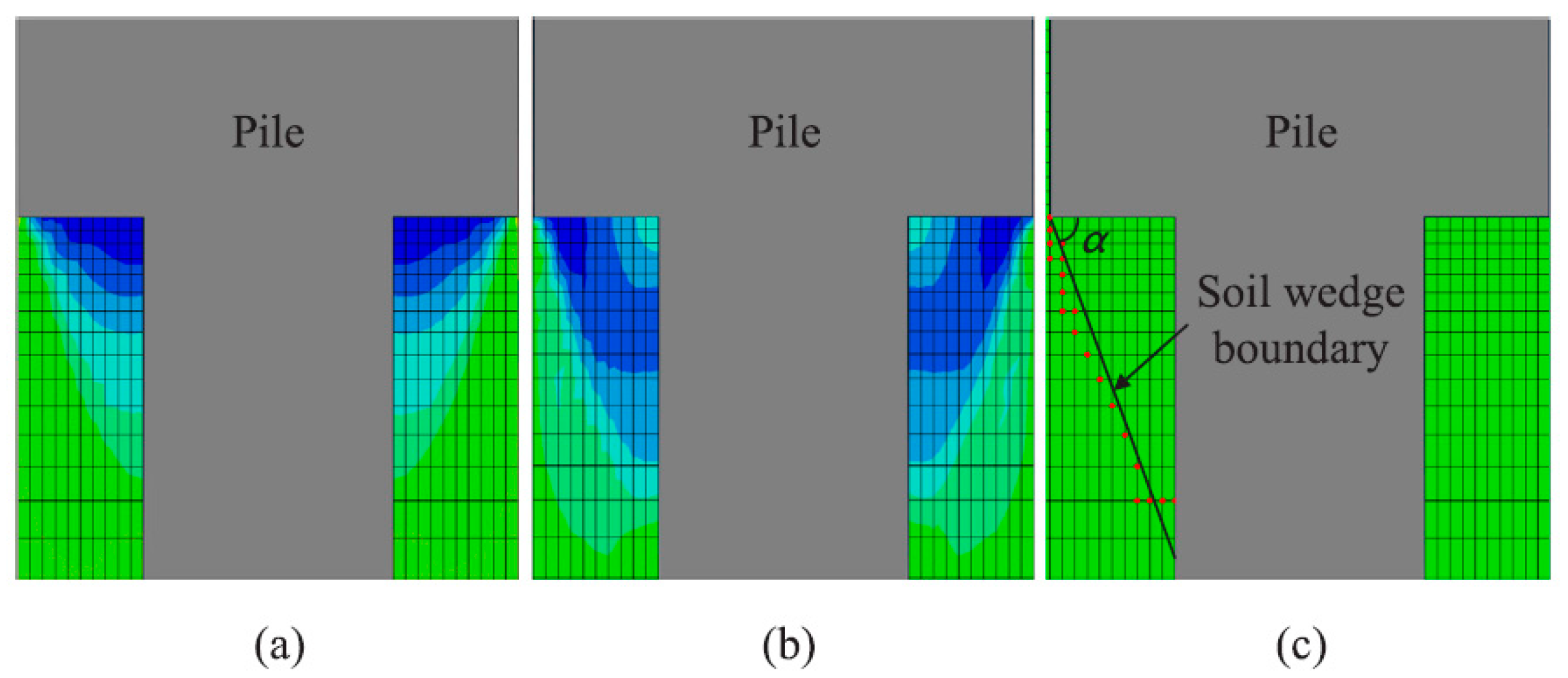
Compared with the widely used cast-in-place bored piles and precast pipe piles, the key factor enabling the greater vertical bearing capacity of anti-toppling helical piles lies in the soil resistance beneath the helices. Accurately and efficiently simulating the subgrade reaction beneath the helices has long been a critical issue in the theoretical analysis of the vertical bearing capacity of anti-toppling helical piles. A major limitation of existing theories is the difficulty in achieving a balance between accuracy and computational efficiency [48,49]. To address this issue, this research proposes a wedge-shaped fictitious soil pile model to simulate the stress diffusion and the mobilization of subgrade resistance beneath the helices. The principle of the model is described as follows. Based on numerous previous numerical simulation studies, the stress diffusion pattern beneath enlarged-base piles exhibits a wedge-shaped distribution (as shown in Figure 2).
Therefore, the soil beneath the helix that provides the subgrade reaction can be idealized as a fictitious soil pile. The wedge angle of this wedge-shaped fictitious soil pile can be approximately taken as the angle between the major principal stress direction and the sliding surface.
α = 45 + φ 2
where φ denotes the friction angle of the soil beneath the helix. The helix at the pile tip is a small-diameter plate used primarily to facilitate installation, and its contribution to the bearing capacity can be neglected. The stress diffusion beneath the pile tip can therefore be represented by a bulb-shaped fictitious soil pile, and the boundary of the stress bulb can be determined from the following equation [50]:
σ _ = 3 z 3 2 π 0 2 π 0 r s r d θ d r ( z 2 + r 2 + R 2 2 R r cos θ ) 5 2
where σ _ denotes the ratio of the vertical additional stress at a given point to the pressure at the pile base. Different bulb-shaped boundaries with different levels of accuracy can be obtained by taking σ _ = 0.1 , 0.01 , 0.001 , and so on. In practical applications, σ _ maybe gradually reduced until the calculated stress boundary converges. z , r , and θ are the cylindrical coordinates defined with the pile base as the origin, and R denotes the radial position of the bulb-shaped boundary at a given depth.
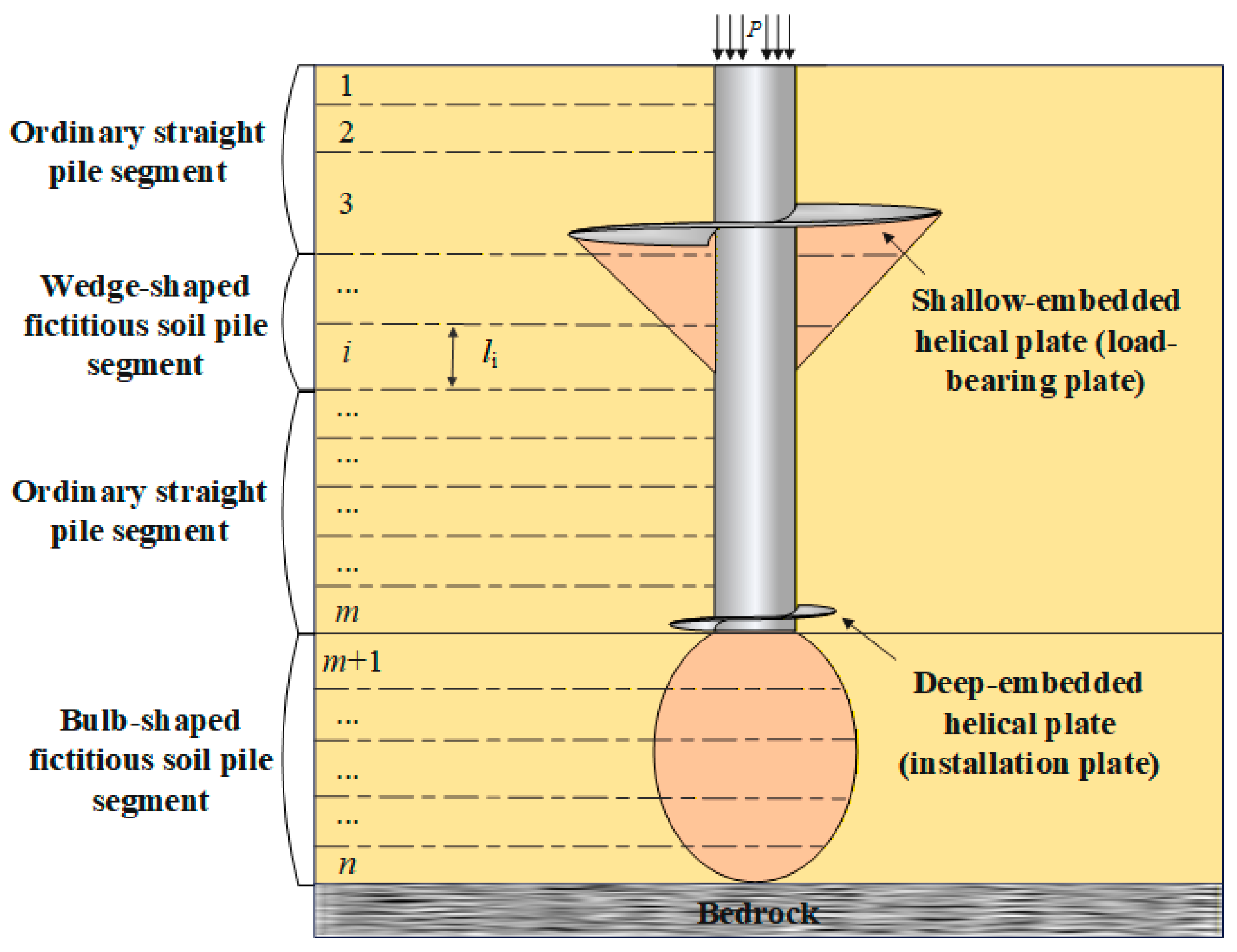
The overall geometry of the fictitious soil pile can be determined using Equations (27) and (28), as illustrated in Figure 3.
For the bulb-shaped fictitious soil pile beneath the pile tip, it is only necessary to extend the fictitious soil pile below the real pile segment, and the radius of the fictitious soil pile at any embedment depth can be calculated using Equation (28). In contrast, for the wedge-shaped fictitious soil pile, the elastic modulus of the fictitious soil pile must be replaced using the equivalent stiffness method, and the vertical resistance corresponding to the projected vertical area must also be incorporated. The equivalent modulus of each layer of the wedge-shaped fictitious soil pile can be calculated using the following equation:
E i , equivalent = ( E i p A i p + E i s A i s ) / A i p + A i s
In this formulation, E i p , E i s , A i p , and A i s denote the elastic modulus of the actual pile shaft, the elastic modulus of the surrounding soil, the cross-sectional area of the pile, and the cross-sectional area of the wedge-shaped fictitious soil pile, respectively. The interaction between the wedge-shaped fictitious soil pile and the surrounding soil can be decomposed into two components for simulation. The vertical shear stress component can be modeled using the τ r z u z curve derived from the MCC-based formulation presented previously, whereas the vertical normal stress component can be calculated using the vertical stiffness of the soil [51]. The vertical stiffness per unit area is expressed as:
K = 4 G s i r s A i s ( 1 μ i )
where G s i denotes the secant modulus of the soil, which is determined from the τ r z u z curve.

2.3. Governing Equation and Its Solution for the Pile

Since the helix and the resistance of the underlying soil are equivalently represented by a fictitious soil pile, the pile response can be described using the elastic deformable rod theory. Based on the one-dimensional rod theory, the governing equation for a straight pile segment can be written as follows:
E i A i d 2 u p z i d z 2 f s i ( u p z i ) = 0
where u p z i , E i , and A i = π r s 2 represent the vertical displacement, elastic modulus, and cross-sectional area of the pile shaft, respectively, whereas f s i ( u p z i ) = 2 π r s τ r z denotes the skin friction. The value of τ r z can be determined from the τ r z u z curve obtained in Section 2.1 using the MCC model. Due to the strong nonlinearity of f s i ( u p z i ) , an analytical solution to Equation (31) is difficult to derive. Therefore, the equation is solved iteratively by discretizing the pile shaft.
First, as shown in Figure 2, the pile shaft is discretized into n segments along the longitudinal direction. Segments 1 ~ m correspond to the actual anti-toppling helical pile section, whereas segments m + 1 ~ n represent the bulb-type fictitious soil pile section. The iterative calculation proceeds from the bottom upward. According to the definition of the stress bulb, the vertical displacement at the base of the bulb-type fictitious soil pile is assumed to be zero. Let the axial compression of the nth fictitious soil pile segment be S n . Assuming that τ r z is uniformly distributed within each pile segment, the axial strain can be expressed, according to elasticity theory, as:
S i = N ¯ i l i E π r s i 2
By rearranging the above equation, the axial force at the base of the nth fictitious soil pile segment can be expressed as:
N ¯ n = E n π r s n 2 S n l n
Furthermore, the axial force in the (n−1)th pile segment is obtained as:
N ¯ n 1 = N ¯ n + π r s n l n f s n ( S n ) + π r s , n 1 l n 1 f s , n 1 ( i = n 1 n S i )
According to Equation (32),
π r s n l n f s n ( S n ) + π r s , n 1 l n 1 f s , n 1 ( S n + S n 1 ) = E π r s , n 1 2 S n 1 l n 1 E π r s n 2 S n l n
It can be seen that, when S n is given, S n 1 can be determined by solving Equation (35). Similarly, the relationship in Equation (35) can be extended to a general pile segment. For an arbitrary pile segment indexed by i , the average axial force can be calculated using the following expression:
N ¯ i 1 = N ¯ i + π r s , i l i f s , i ( x = i n S x ) + π r s , i 1 l i 1 f s , i 1 ( x = i 1 n S x )
By substituting Equation (36) into Equation (32), the axial compression of the ith pile segment can be obtained as:
E π r s i 2 S i 1 l i 1 = N ¯ i + π r s , i l i f s , i ( x = i n S x ) + π r s , i 1 l i 1 f s , i 1 ( x = i 1 n S x )
According to Equation (36), it can be readily observed that once S i S n is known, S i 1 can be numerically obtained using Equation (37). By repeating this procedure upward along the pile, the deformation at the pile head S 1 can be determined. The corresponding pile head load Q can then be calculated using the following equation:
Q = E π r s 1 2 S 1 l 1 + π r s 1 l 1 f s 1 ( S 1 )
It can be seen that for each assumed compression deformation S n of the fictitious soil pile at the pile base, a corresponding pile head settlement S p = x = 1 n S x and a pile head load Q can be calculated. By assuming different values of S n , the complete pile shaft Q S p curve can thus be obtained.
When the recursive process passes through the wedge-shaped fictitious soil pile segment, the recursive equation should be modified as follows:
E π r s i 2 S i 1 l i 1 = N ¯ i + π r s , i l i f s , i ( x = i n S x ) + π r s , i 1 l i 1 f s , i 1 ( x = i 1 n S x ) + K A i s x = i 1 n S x

3. Computational Framework and Model Validation

3.1. Computational Framework

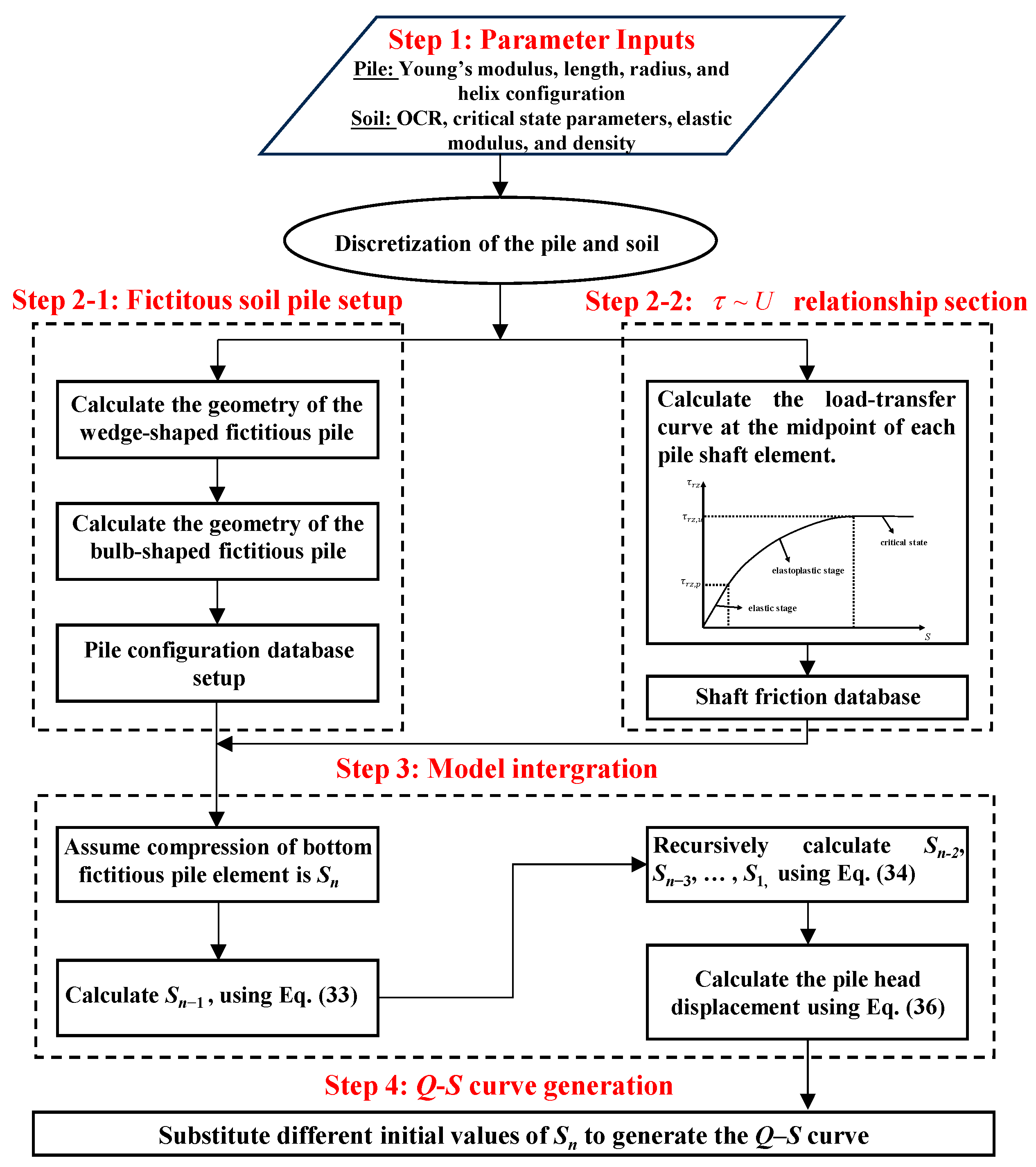
The computational framework developed in this research mainly consists of three components: the τ r z u z relationship calculation module based on the MCC model, the fictitious soil pile parameter substitution module, and the axial force transfer analysis module. The τ r z u z relationship calculation module is used to generate the information of the relationship between the pile shaft settlement and the skin frictions, which would be subsequently submitted into the plane strain pile–soil interaction element as the pre-informed knowledge. The fictitious soil pile parameter substitution module is employed to determine the size of the fictitious soil pile beneath the helix and to generate the corresponding model parameters. The axial force transfer analysis module utilizes the results obtained from the previous two modules to perform axial force transfer analysis, thereby predicting the Q S p relationship under vertical loading. The detailed computational framework is illustrated in Figure 4. The input parameters include the physical parameters of the pile and soil.

3.2. Model Validation

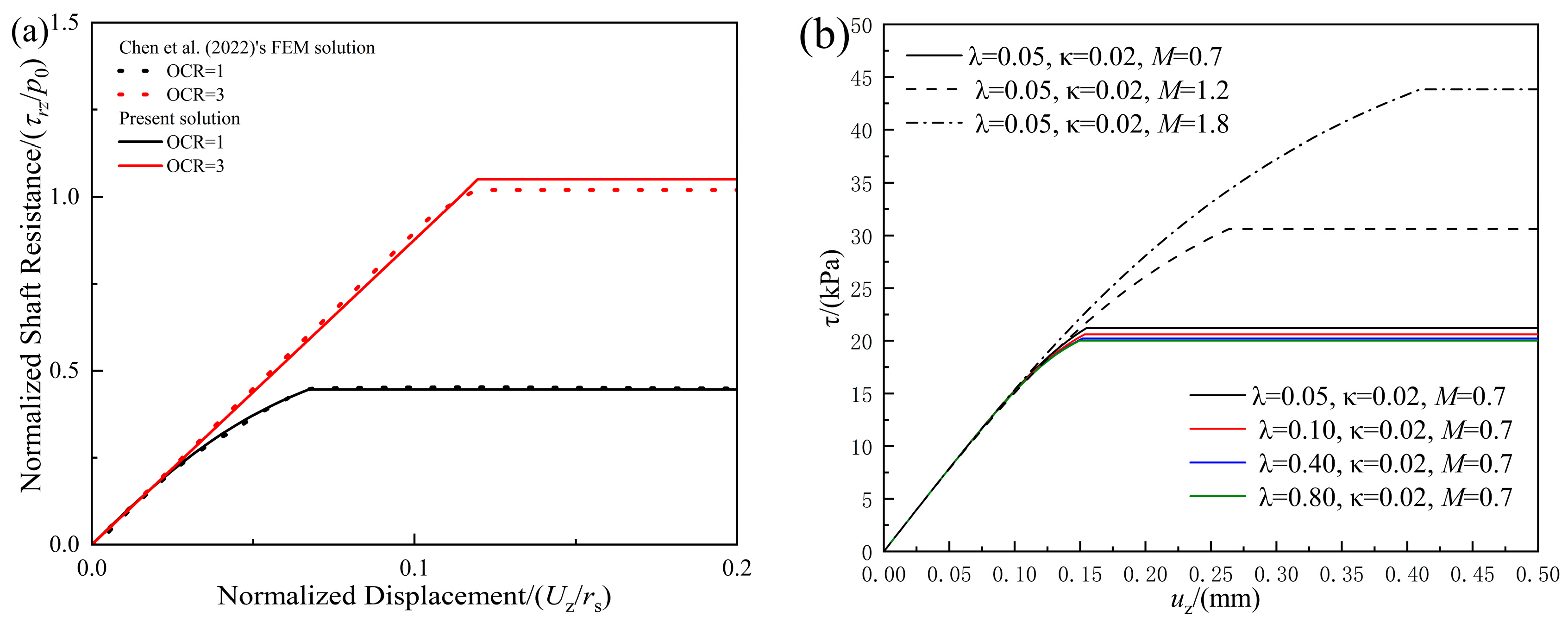
The core of the proposed vertical bearing capacity analysis framework for anti-toppling helical piles in strain-hardening soils lies in the plane strain soil element that is pre-informed with the settlement-skin friction relationship knowledge based on the MCC model. For each soil element, a complete τ r z u z relationship is pre-computed and then pre-informed according to its embedment depth. The pile–soil interaction is then simulated by implementing Python 3.14’s dictionaries and lookup functions within the elements. Before validating the overall vertical loading response of the anti-toppling helical pile, the τ r z u z relationship at the pile–soil interface derived in this study is first compared with the finite element results reported by Chen et al. [45]. The model parameters used in the analysis are summarized in Table 1.
As shown in Figure 5, the solution obtained in this study exhibits a high level of agreement with the finite element solution under identical soil parameters, with the curves predicted by the two methods being nearly identical. Among the key parameters of the MCC model, the critical state parameter M exerts the most significant influence on the τ r z u z curve. With increasing M , the maximum skin friction that the soil at the pile–soil interface can mobilize increases markedly. In contrast, the slopes of the virgin compression line and the swelling line, denoted by λ and κ , have a relatively limited effect on the ultimate skin friction; instead, they mainly control the slope and degree of nonlinearity of the τ r z u z curve. As the difference between λ and κ increases, the slope of the τ r z u z curve becomes gentler. In addition to λ and κ , the over-consolidation ratio (OCR) is also a key parameter affecting the nonlinearity of the τ r z u z curve. For normally consolidated soils, the τ r z u z curve exhibits pronounced nonlinear behavior, whereas for over-consolidated soils, the τ r z u z curve tends to display a more linear response.
To further validate the accuracy and reliability of the proposed method, the numerical results obtained herein are compared with the in situ field test results reported by Guo [52] and the field test data reported by Nazmi and Eslami [53]. To quantify the robustness of the proposed model, Normalized Root Mean Square Error (NRMSE) is introduced. When conducting the validation, several external loads Q j ( j = 1 , 2 , N ) subjected at the pile head are obtained. And, a given external load Q j subjected at the pile head corresponds to a calculated settlement S c a l , j and a observed settlement S o b s , j . Hence, RMSE is defined as:
NRMSE = 1 n j = 1 n S c a l , j S o b s , j 2 S max S min
where S max and S min denote the maximum and minimum settlement observed. For common cases, NRMSE 5 % represents the error is extremely small. In geotechnical engineering, particularly regarding soil-structure interaction, theoretical models rarely achieve a perfect match with observed results due to the inherent heterogeneity of soil and the disturbance of samples during collection, which can cause laboratory-derived parameters to deviate from in situ properties. Usually, NRMSE 20 % indicates a good match.
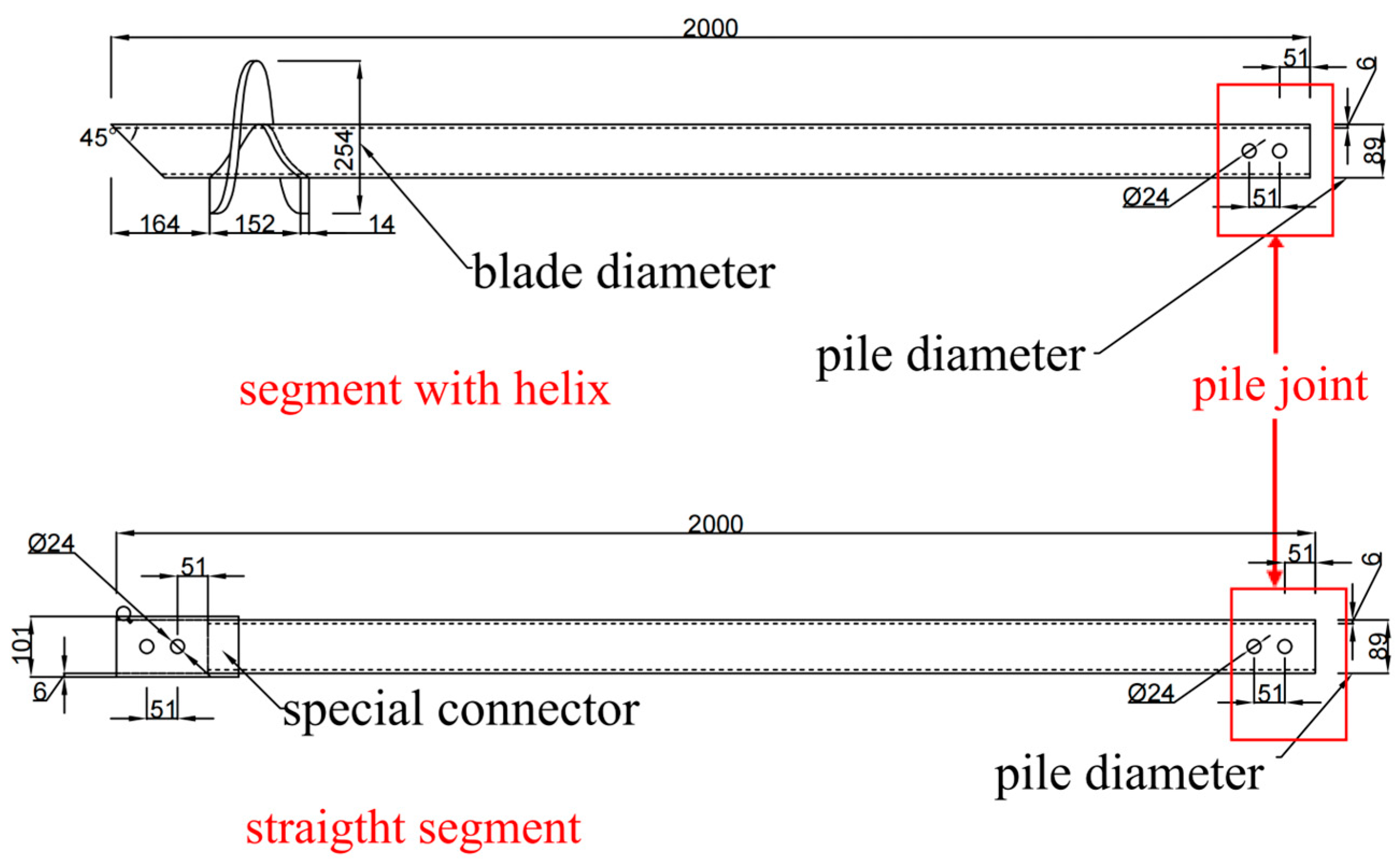
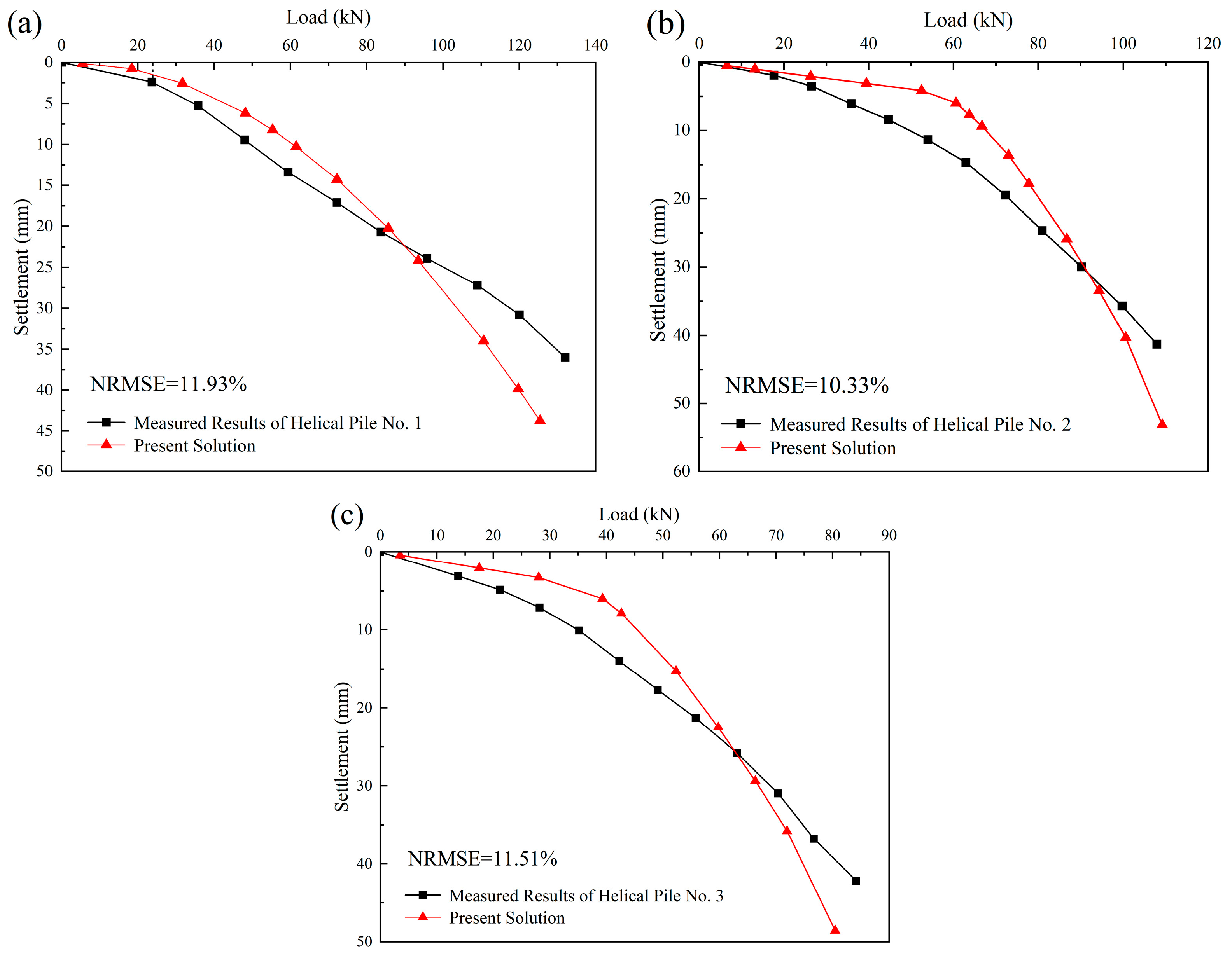
First, a comparison is conducted with the field tests performed by Guo [52]. The soil parameters used in the tests are summarized in Table 2. Piles No. 1, No. 2, and No. 3 from Guo’s tests are selected for comparison. All three piles have a shaft diameter of 89 mm and are equipped with a single helix with a diameter of 254 mm. The pile lengths are 10 m, 8 m, and 6 m, respectively, with the helix installed near the pile tip. As illustrated in Figure 6, the 10 m-long pile (Pile No. 1) consists of one segment with a helix and four straight pile segments. Correspondingly, a reduction of 2 m in pile length results in the removal of one 2 m-long straight pile segment. Bolted joints are reserved between the segments to facilitate pile assembly.
The comparison results are presented in Figure 7. The pile-head Q-S curves predicted by the proposed method show good agreement with the measured results, with an average NRMSE value of 11.26%. However, in the small-strain range, the predicted settlements are smaller than the measured values. In contrast, at larger deformation levels, the predicted settlements become larger than the measured results, which mainly contribute to the increase in NRMSEs. This discrepancy mainly arises because the pre-consolidation pressure of the field soil is unknown. In the present analysis, the soil is assumed to be normally consolidated. If the field soil were strongly over-consolidated, the pile settlement response would be more linear. This also explains why the predicted curve exhibits stronger nonlinearity, whereas the measured curve tends to be closer to linear.
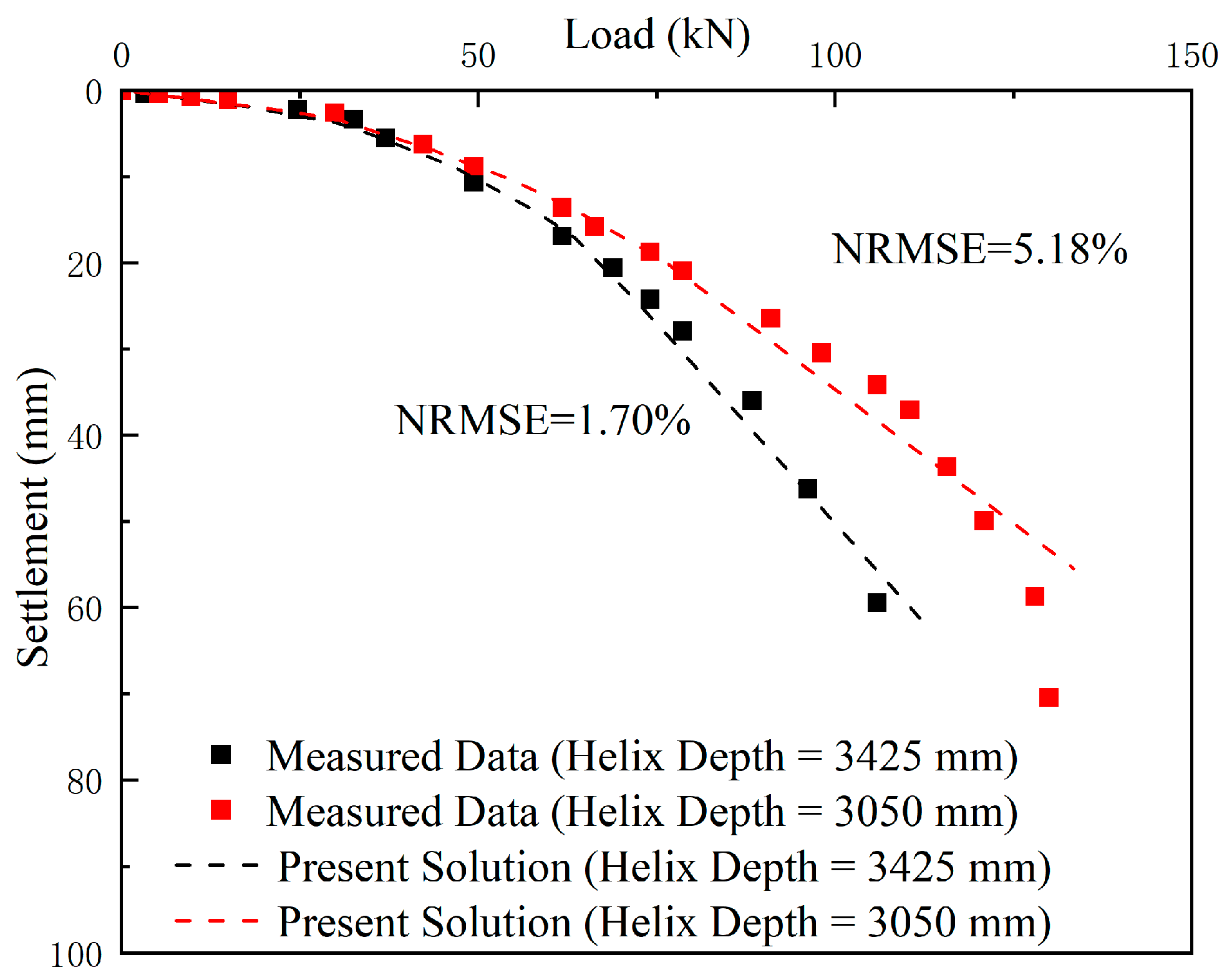
Nazmi and Eslami [53] also conducted field tests to investigate the vertical loading response of helical piles. In their experiments, besides a helix installed at the pile tip, an additional load-bearing helix was placed in the lower–middle portion of the pile shaft. The pile had a diameter of 101.6 mm, while the load-bearing helix plate had a diameter of 350 mm. The soil profile can be found in Table 3. The total pile length was 4 m, and the pile was made of ST37 steel. Two loading cases were considered: Case 1, with a helix plate embedment depth of 3050 mm, and Case 2, with a depth of 3425 mm. As illustrated in Figure 8, the theoretical predictions from the present study demonstrate excellent agreement with the two sets of field test data reported by Nazmi and Eslami [53]. The NRMSEs are 1.70% and 5.18% for the respective cases, representing a remarkably high level of predictive accuracy for geotechnical field applications. In particular, for the embedment depth of 3425 mm, the predicted load-settlement curve shows near-perfect alignment with the experimental data. Similarly, for the 3050 mm embedment case, the predicted and measured results exhibit a highly consistent load-settlement response. In this test site, the Standard Penetration Test (SPT) blow counts (Nspt) measured in the shallow soil layer (0–2 m depth) exceeded those recorded in the deeper soil layers that surround the lower portion of the pile. Consequently, when the helical plate was installed within the shallower, stronger layer, the bearing capacity of the pile was significantly enhanced. However, it is noted that the numerical predictions begin to diverge from the experimental data at loads approaching the ultimate bearing capacity (approx. >90 kN and >120 kN for the respective cases), representing states close to failure. This can be contributed to the model’s constitutive asymptote and stress diffusion assumptions. To be specific, the proposed framework relies on the MCC model, which dictates that shear stress gradually and smoothly asymptotes to the critical state. In physical field tests, once the ultimate geotechnical capacity is breached, the pile typically exhibits an abrupt ‘plunging’ failure (rapid settlement with minimal load increase). The MCC’s smooth asymptotic formulation cannot perfectly capture this sudden physical plunging, leading to a slight over-prediction of load at massive settlements. In addition, the wedge and bulb fictitious soil pile models are formulated based on steady stress diffusion boundaries. While highly accurate for the elastic and contained elastoplastic stages, at states immediately prior to ultimate failure, the soil undergoes uncontained, massive plastic flow. At this extremity, the predefined stress bulb geometry becomes an approximation of the actual chaotic failure kinematics.

4. Parametric Analysis

In this section, the vertical bearing capacity analysis model for anti-toppling helical piles developed in this paper is employed to conduct a parametric sensitivity analysis of both pile design parameters and soil properties, with the aim of providing theoretical guidance for the optimal design of anti-toppling helical piles. The analysis assumes homogeneous soil conditions, with shear strength increasing with depth. Skin friction mobilization is governed by pile displacement and the constitutive parameters of the MCC model. The pile shaft is assumed to be made of Q235 steel, with an elastic modulus of 210 GPa, a radius of 150 mm, and a length of 10 m. The helix plate radius is taken as 300 mm, installed at a depth of 5 m, with a thickness of 1 mm. The basic soil parameters used in the analysis are presented in Figure 9a.

4.1. Influence of Helix Embedment Depth

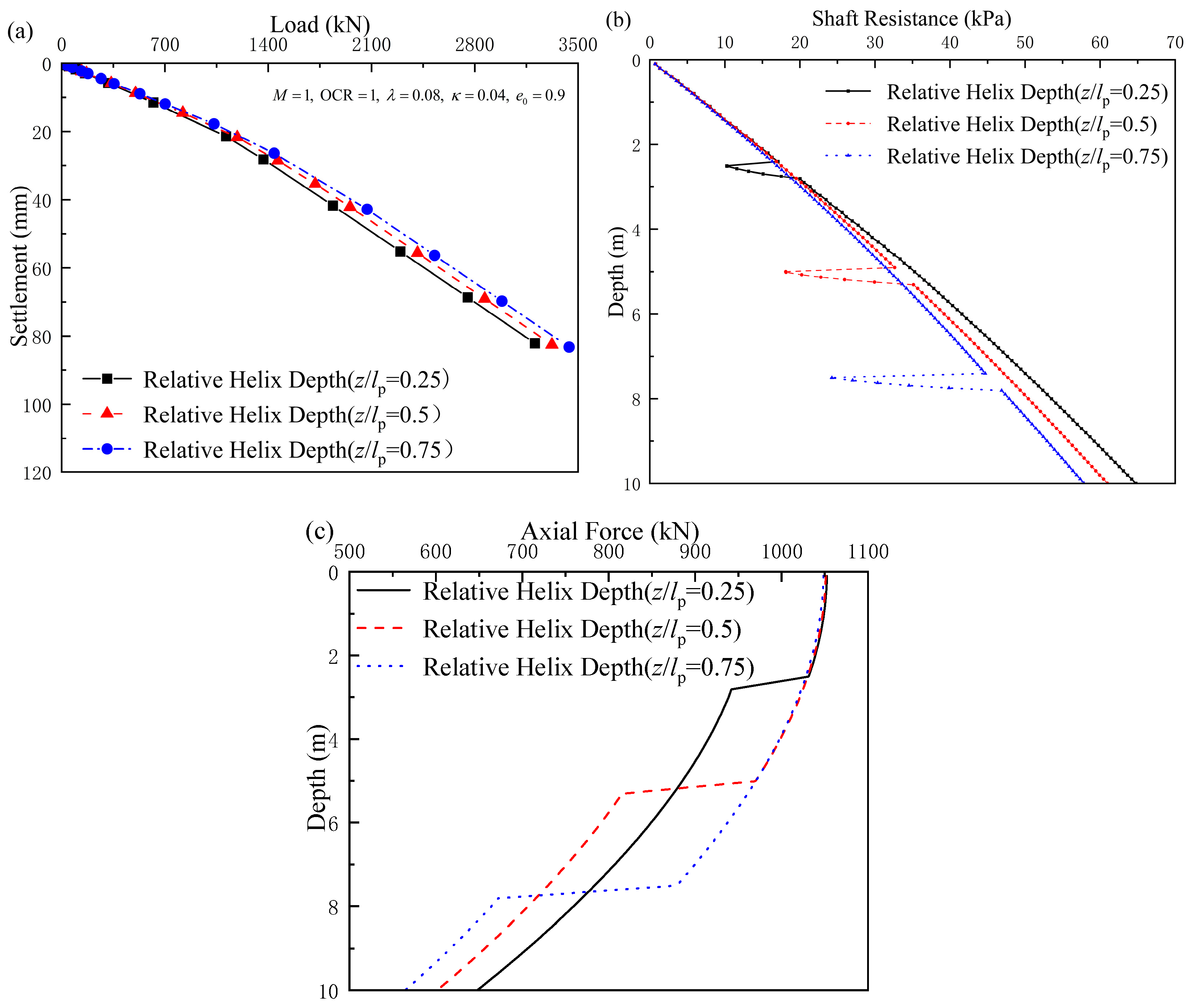
Figure 9 reveals the fundamental influence mechanism of the helix embedment depth on the vertical bearing performance of the pile foundation. The load–settlement curves clearly show that increasing the relative embedment depth of the helix significantly enhances the bearing capacity of the pile while effectively controlling settlement. For the same settlement level, the pile with the shallowest helix plate embedment (z/lp = 0.25) exhibits the lowest load-bearing capacity, whereas the pile with the deepest embedment (z/lp = 0.75) shows the highest bearing capacity. This indicates that placing the helix in deeper soil layers allows the pile to utilize the higher strength of the deep soil, thereby improving the overall performance of the pile foundation. This behavior is closely related to the strain-hardening characteristics of the soil. For normally consolidated soils, the soil strength near the ground surface is relatively small, whereas deeper soil layers can provide significantly greater skin friction or end-bearing resistance under the same deformation conditions. Meanwhile, anti-toppling helical piles are typically made of steel, resulting in a very high elastic modulus and therefore negligible compressive deformation of the pile shaft. Consequently, the displacement difference between the pile head and pile base is very small. Under vertical loading, the skin friction therefore increases monotonically from the pile head to the pile base, which is fundamentally different from the load-transfer behavior of conventional bored piles or pipe piles. This macroscopic performance difference originates from a fundamental change in the load transfer path along the pile shaft. The skin friction distribution shows that, although the skin friction decreases with depth under all conditions, when the helix is installed at the shallowest depth, the skin friction in the shallow soil layers is mobilized most fully, resulting in the fastest decay of the friction curve. Correspondingly, the axial force transfer diagram indicates that the axial force along the pile shaft also decays most rapidly with depth under this condition. This jointly demonstrates that when the helix embedment depth is shallow, the pile-head load is mainly resisted by skin friction, particularly by the friction mobilized in the shallow to intermediate soil layers, while the end-bearing contribution remains relatively small.
In contrast, when the helix is embedded at a greater depth, the load-transfer mechanism undergoes a fundamental shift. The deeply positioned helix mobilizes substantial end-bearing resistance, which supports a significant portion of the applied load. As shown in the axial force distribution, the axial force along the pile shaft decreases most gradually with depth when the helix is installed at the greatest depth, meaning that only a relatively small proportion of the load is transferred to the upper section of the pile. Correspondingly, the skin friction distribution remains relatively low along the entire pile length, indicating reduced reliance on skin friction and a transition to a predominantly end-bearing controlled load-transfer system. Overall, increasing the helix embedment depth effectively optimizes the load-sharing mechanism, shifting the bearing behavior from dependence on the relatively weaker shallow skin friction to mobilization of the stronger end-bearing capacity of deeper soil layers. This explains the significant improvement in the overall bearing capacity of the pile. The observed trend provides an important theoretical basis for rationally determining the helix embedment depth in engineering practice, considering soil conditions and bearing capacity requirements.

4.2. Influence of Helix Radius

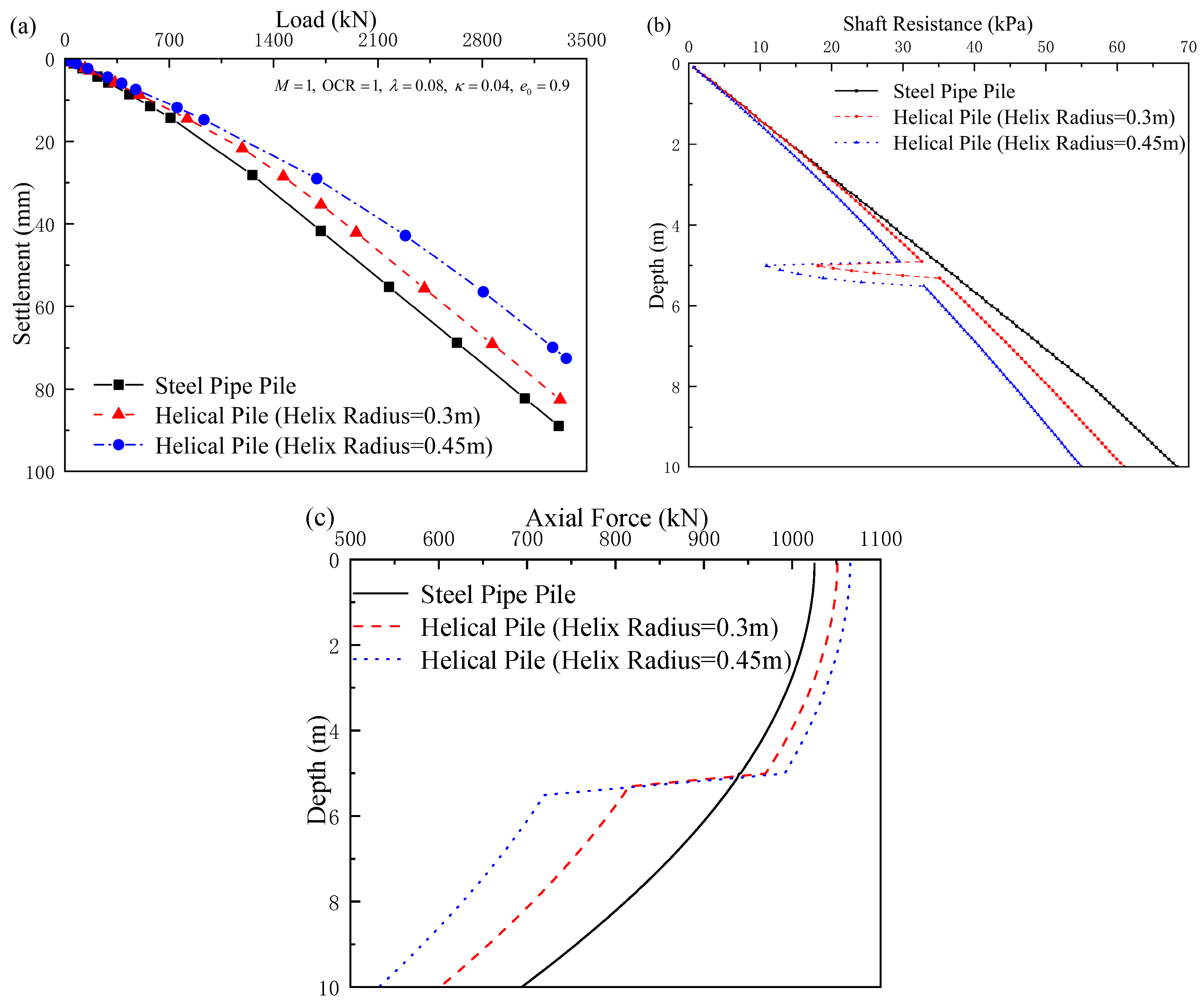
The load–settlement curves in Figure 10a indicate that anti-toppling helical piles exhibit significantly better bearing performance than ordinary steel pipe piles, with the advantage becoming more pronounced as the helix radius increases. At a given settlement level, the pile with a helix radius of 0.45 m carries the highest load, followed by the pile with a 0.30 m radius, while the ordinary steel pipe pile shows the lowest capacity. For example, at a settlement of approximately 60 mm, the ordinary steel pipe pile supports about 2000 kN, whereas the anti-toppling helical piles with helix radii of 0.30 m and 0.45 m sustain roughly 2500 kN and over 3000 kN, respectively. This demonstrates that increasing the helix radius effectively enhances the vertical bearing capacity of the pile. Furthermore, under the same load level, the anti-toppling helical pile undergoes smaller settlement, reflecting an increase in system stiffness. This improvement is attributed mainly to the additional end-bearing area provided by the helix, which strengthens the supporting effect of the soil beneath the pile base.
Figure 10b further illustrates the influence of helix radius on the mobilization of skin friction. For the ordinary steel pipe pile, the skin friction increases approximately linearly with depth, which is typical of shaft resistance development in homogeneous soils. In contrast, for anti-toppling helical piles, the skin friction increases rapidly in the upper layers and then tends to stabilize beyond a certain depth. Moreover, the larger the helix plate radius, the lower the skin friction mobilized at a given depth. This behavior can be attributed to the change in the stress state of the surrounding soil due to the presence of the helix plate. Acting as an enlarged base element, the helix plate derives its load-bearing capacity primarily from the compressive resistance of the soil beneath it. The mobilization of this end-bearing resistance naturally reduces the contribution of local skin friction. The axial force distribution shown in Figure 10c further explains this mechanism from the perspective of load transfer along the pile. The figure indicates that while the axial force generally increases with depth, the curve for the anti-toppling helical pile is steeper than that of the ordinary steel pipe pile, meaning the axial force decays more gradually with depth. This implies that anti-toppling helical piles transfer a greater portion of the applied load to deeper soil strata, largely through the end-bearing resistance mobilized by the helix plate. More specifically, near the pile tip, the axial force in the anti-toppling helical pile has already decreased to a relatively low level, whereas the ordinary steel pipe pile still sustains a comparatively high axial force. Additionally, a larger helix radius results in a smaller residual axial force at the pile base. This confirms that larger helix plates can more effectively share the applied load, thereby reducing reliance on skin friction in shallow soil layers.
In summary, when the helix is installed in the central portion of the pile, increasing the helix radius can significantly enhance the vertical bearing performance of the pile. This improvement results not only from the increased end-bearing area, which directly raises the bearing capacity, but also from the improved soil displacement effect. The latter optimizes the distribution of shaft resistance and refines the load-transfer mechanism, enabling a greater proportion of the applied load to be carried by the soil beneath the helix. Therefore, in engineering practice, selecting an appropriate helix size based on soil conditions and design load requirements is a crucial step toward optimizing the performance of anti-toppling helical piles.

4.3. Influence of Pile Shaft Radius

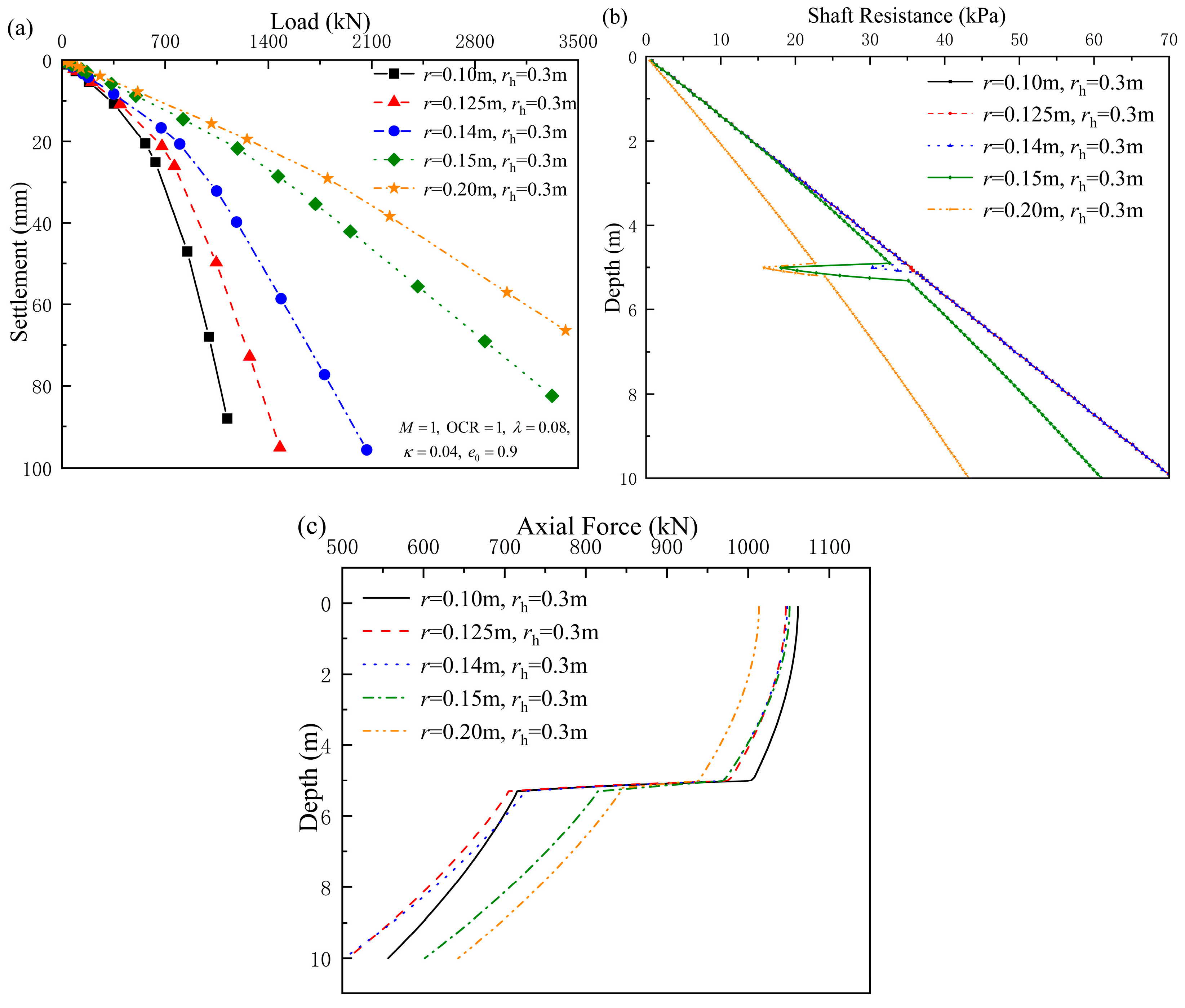
As shown in Figure 11, increasing the pile shaft radius significantly improves the bearing performance of anti-toppling helical piles. Under the same load level, a larger pile radius leads to smaller pile-head settlement. Conversely, to achieve the same settlement, piles with larger radii can sustain higher loads. This indicates that increasing the pile radius effectively enhances the overall stiffness and load-bearing capacity of the pile.
It is noteworthy that when the pile radius increases from 0.10 m to 0.20 m, the improvement in settlement control is considerable; however, the relationship is not strictly linear, suggesting the existence of an optimal range. For example, the gain from 0.15 m to 0.20 m may be less pronounced than that from 0.10 m to 0.15 m. The underlying mechanism can be explained through the skin friction distribution and axial force transfer diagrams. The skin friction distribution reveals an important trend: at the same depth, larger pile radii correspond to lower unit skin friction along the pile surface. This occurs because, under the same helix configuration and soil conditions, a pile with a larger diameter possesses greater structural stiffness. As a result, the relative displacement (shear deformation) between the pile and the surrounding soil is altered, which can reduce stress concentration in the soil and thus lower the average skin friction. Specifically, when the helix radius is much larger than the pile radius, the load-bearing behavior of the helix plate resembles that of an embedded circular footing. However, when the ratio of helix diameter to pile diameter falls below about 1.5, the helix plate and the underlying soil begin to interact with the pile shaft as a combined load-transfer system. The analysis indicates that when the helix-to-pile diameter ratio is approximately 1.5, the bearing performance of the anti-toppling helical pile reaches an optimum.
From the axial force transfer diagram, it can be observed that the curves corresponding to larger pile radii exhibit a more rapid decay of axial force with depth. For instance, under similar initial axial force conditions at the pile head, the axial force in the pile with a radius of 0.20 m decreases substantially before reaching the helix, while that in the pile with a 0.10 m radius decays much more gradually. This indicates that although larger-diameter piles mobilize lower unit skin friction per unit area, they possess a significantly greater shaft surface area. Consequently, the total skin friction developed in the larger-diameter pile remains considerably higher than that in the smaller-diameter pile and becomes the dominant component in load sharing. The steeper decline in the axial force curve directly confirms that larger-diameter piles transfer a greater portion of the applied load to the surrounding soil through substantial skin friction.
In summary, increasing the pile shaft radius enhances the bearing capacity through two primary mechanisms. First, the larger pile diameter directly provides a greater shaft surface area, resulting in a substantial increase in the total skin friction, which becomes the principal contributor to load-bearing. Second, it modifies the helix plate–soil interaction mechanism and improves the load transfer path, thereby enhancing the overall stiffness and stability of the pile–soil system.

4.4. Influence of Pile Length

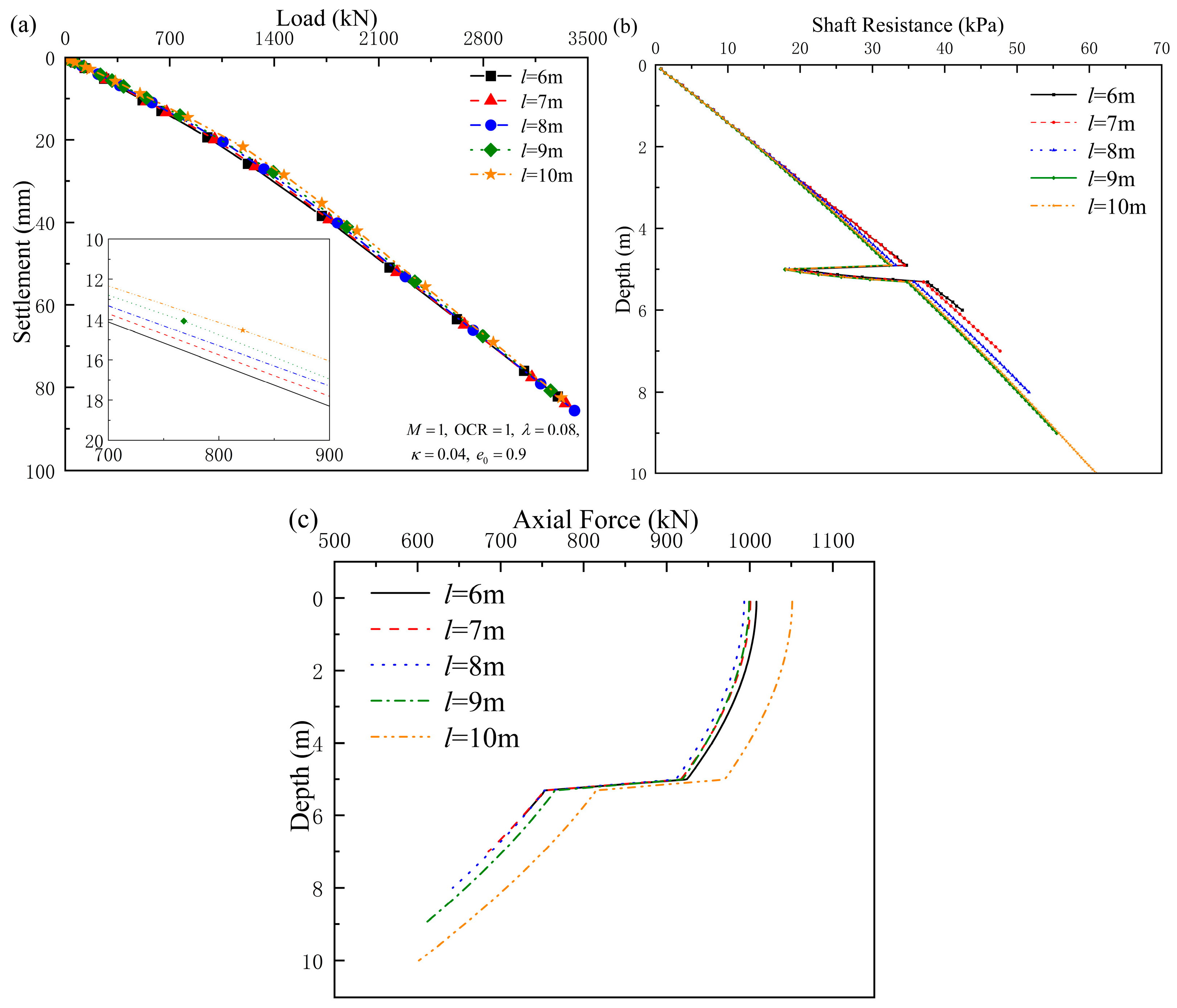
As illustrated in Figure 12, when the helix is installed at a fixed depth of 5 m, increasing the total pile length from 6 m to 10 m does not significantly enhance the vertical load-bearing performance of the pile. This observation can be clearly interpreted through the load transfer mechanism and the characteristics of pile–soil interaction.
From the load–settlement curves, it can be seen that the curves corresponding to different pile lengths nearly coincide. This indicates that, under the same applied load, the pile-head settlement remains almost identical, and varying the pile length does not lead to a substantial difference in bearing capacity. The underlying reason for this behavior is that the primary source of bearing capacity is the helix installed at a depth of 5 m. The applied load is transmitted along the pile shaft and is resisted mainly by the skin friction developed above the helix and the end-bearing resistance of the helix itself. The additional pile length lies entirely below the helix. Because this portion of the pile is located at the end of the load-transfer path, the compressive stress in the surrounding soil is very small; consequently, skin friction cannot be effectively mobilized. As a result, this added pile segment contributes negligibly to the overall bearing capacity.
Because the pile diameter is relatively small, the total skin friction that can be mobilized remains limited, even though the unit skin friction increases with depth. More importantly, the axial force transfer diagram shows that, regardless of the total pile length, the axial force in the pile shaft decreases sharply to a very low level by the time it reaches the helix at a depth of 5 m. This indicates that most of the pile-head load has already been resisted by the skin friction above the helix, and the remaining load is ultimately balanced by the end-bearing resistance of the helix itself. Therefore, increasing the pile length below the helix (e.g., from 6 m to 10 m) does not substantially improve the load-bearing performance. Although the skin friction along the added pile segment also increases monotonically with depth, the residual axial force reaching that depth is already extremely small. As a result, the total skin friction that can be mobilized along the extended portion is negligible and has no observable effect on the overall load–settlement response. In other words, the pile–soil system above the primary bearing layer (i.e., the helix) essentially governs the load-bearing behavior of the pile. The pile segment below the helix plate operates in a low-efficiency state due to the very low stresses acting upon it.
In summary, when the helix serves as the primary bearing layer and its position remains fixed, the load-bearing performance of the pile is controlled mainly by the pile–soil system above the helix. Extending the pile length below the helix does not meaningfully improve the bearing capacity or reduce settlement. This finding offers important guidance for the optimal design of anti-toppling helical piles. Once the bearing stratum (i.e., the helix location) is determined, increasing the pile length beyond the effective load-transfer depth does not provide additional engineering benefit and may instead lead to unnecessary material use.

4.5. Effect of the Critical State Parameter M

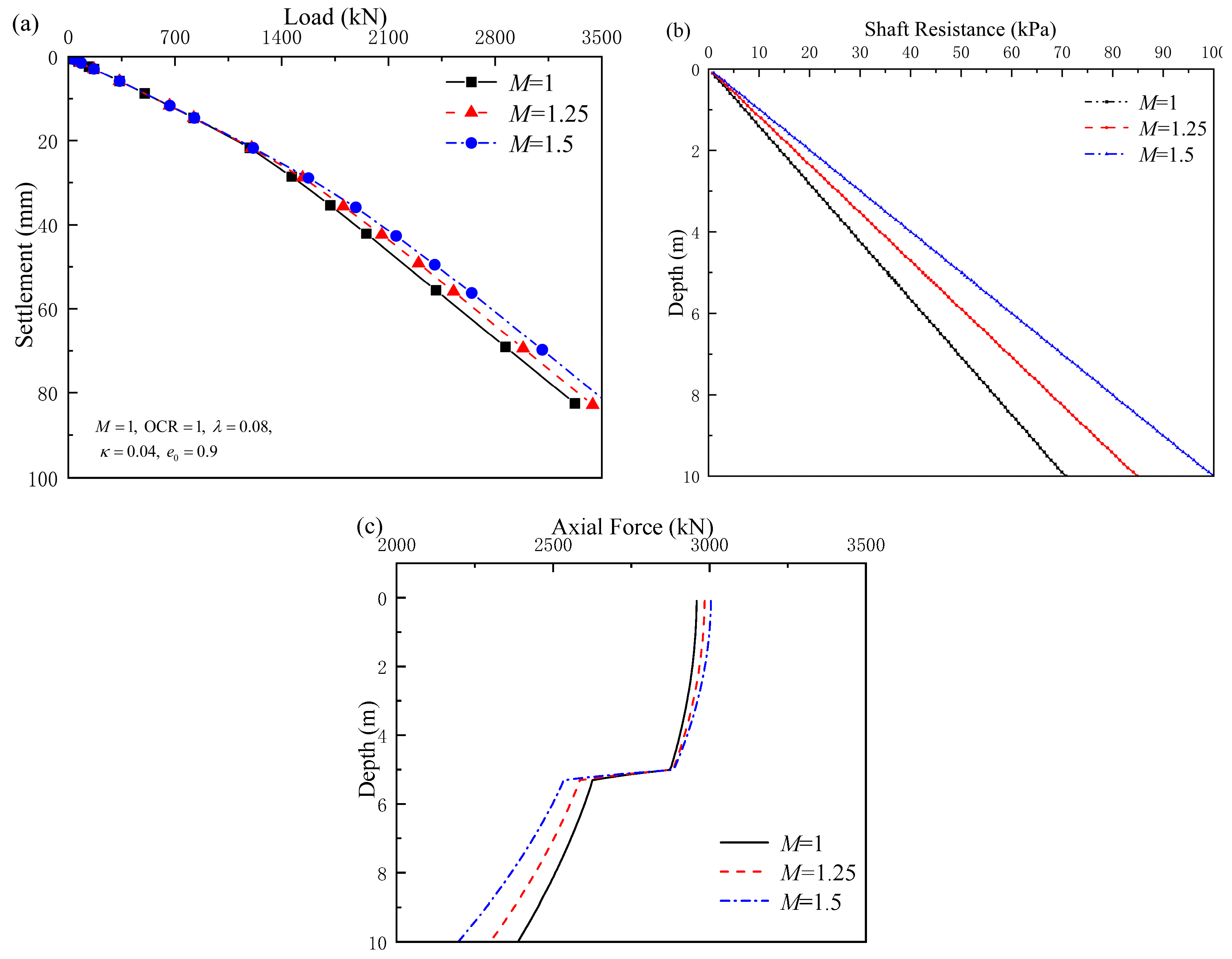
The critical-state parameter M exerts a significant influence on the load-bearing behavior of anti-toppling helical piles. With all other model parameters held constant, three cases with M = 1.0, 1.25, and 1.5 were compared. As shown in Figure 13a, the load–settlement curves all exhibit typical nonlinearity, where the rate of load increase gradually decreases with settlement. An increase in M substantially enhances the vertical bearing capacity of the pile. At a given settlement level, the load corresponding to M = 1.5 is the highest, while that for M = 1.0 is the lowest. This indicates that a higher M value, representing greater critical-state strength of the soil, allows the pile–soil system to mobilize higher resistance under load, while also slightly increasing the initial stiffness. This trend is consistent with the theoretical framework of the MCC model, in which M governs the stress–strain and strength characteristics of the soil by defining the critical state line and the shape of the yield surface.
Figure 13b reveals the underlying local load-transfer mechanism of pile–soil interaction. The results show that skin friction is not uniformly distributed but increases monotonically with depth from the pile head to the base. This pattern is likely associated with the assumed initial stress state (K0 condition) of the soil and the displacement field induced by pile loading. More importantly, the figure clearly demonstrates that at a given depth, larger M values correspond to higher mobilized skin friction. This confirms that increasing M not only raises the overall shear strength of the soil but also enhances the frictional resistance that can be developed at the pile–soil interface. The underlying reason is that the mobilization of skin friction is fundamentally controlled by the shear strength of the soil at the interface, which is directly related to the critical-state parameter M.
This relationship is further reflected in the axial-force transfer diagram. Under the same pile-head load, the rate of axial-force decay along the pile decreases as M increases. For M = 1.5, a larger proportion of the applied load is transferred to the helix. This occurs because increasing M also improves the end-bearing resistance of the soil beneath the helix. Under deformation compatibility, the displacement of the upper pile segment is reduced, resulting in lower mobilization of skin friction in the upper portion of the pile.

5. Conclusions

Based on the MCC model, a macro-element-like plane strain pile–soil interaction element combined with the fictitious soil pile model is established and subsequently utilized to build up an axial compressive analysis framework for the anti-toppling helical pile foundation. Compared to the existing literature, the newly established model achieves a balance between the rigor of model and computational efficiency. Also, the proposed method does not involve any empirical parameters or any other parameters without clear physical meanings. The correctness of the proposed method is verified through comparisons with FEM and field test results. The proposed model can be directly adopted in the anti-toppling design as long as the layered deposits are normally consolidated or slightly over consolidated clay.
The main findings include: Apart from the added helix, an anti-toppling helical pile itself is essentially a small-diameter prefabricated pile, which differs significantly from bored or precast pipe piles in two aspects. First, the axial compression of the pile shaft is relatively small. Second, under small-diameter conditions, the ultimate shear stress of soil in the r-z direction that can be mobilized by the surrounding soil is relatively limited. These differences lead to a distinct skin friction distribution compared with bored or precast pipe piles. For bored or precast pipe piles, the skin friction typically increases first and then decreases with depth, whereas for anti-toppling helical piles, the skin friction increases monotonically with depth. For normally consolidated soils, placing the helix at a greater embedment depth facilitates better mobilization of the end-bearing resistance beneath the helix, thereby significantly enhancing the bearing capacity of the pile. There exists an optimal design ratio between the helix diameter and the pile diameter. When the ratio of helix diameter to pile diameter is approximately 1.5, the end-bearing resistance beneath the helix and the skin friction along the pile tend to develop in a more coordinated manner. Also, the pile length of an anti-toppling helical pile is meaningful only when the embedment depth of the helix changes accordingly. When the helix embedment depth remains fixed, increasing the total pile length has little effect on the overall bearing performance.
While the proposed model provides a robust framework for predicting the behavior of anti-toppling helical piles, the following limitations and directions for future research are noted:
Dimensionality and Loading Complexity: To prioritize computational efficiency, a one-dimensional (1D) rod model was adopted in lieu of a full three-dimensional (3D) continuum approach. While effective for axial analysis, this simplification may constrain the model’s applicability in scenarios involving highly non-uniform loading or complex soil-structure interaction effects that require multidimensional analysis.
Soil Type Constraints: The current solution is optimized for remolded normally consolidated (NC) or slightly over-consolidated (OC) clays. To broaden the model’s scope, future iterations could integrate the Structured Modified Cam-Clay (S-MCC) model to account for high soil thixotropy.
Advanced Hardening Laws: For soils with higher over-consolidation ratios, incorporating a Unified Hardening (UH) model is recommended. This would allow the framework to more accurately capture the stress–strain relationships and softening behaviors characteristic of heavily over-consolidated deposits.

Author Contributions

Conceptualization, Y.Z.; methodology, K.Y.; software, K.Y.; validation, Z.W.; formal analysis, X.W.; data curation, K.Y.; writing—original draft preparation, K.Y. and X.W.; writing—review and editing, S.Z. and X.L.; visualization, S.Z.; supervision, Y.Z. and X.L.; project administration, Z.W.; funding acquisition, Y.Z. All authors have read and agreed to the published version of the manuscript.

Funding

This research is supported by the National Natural Science Foundation of China (Project No. 52408407), the Youth Project from the Hubei Research Center for Basic Disciplines of Earth Sciences (NO. HRCES-202519), the Open Research Projects of the State Key Laboratory of Safety and Resilience of Civil Engineering in Mountainous Areas (NO. SQQZ2025140), and the Guangdong Basic and Applied Basic Research Foundation (Grant Nos. 2023A1515240012).

Institutional Review Board Statement

Not applicable.

Informed Consent Statement

Not applicable.

Data Availability Statement

Data supporting this study is available from the corresponding author upon reasonable request.

Conflicts of Interest

The authors declare no conflicts of interest.

References

  1. Zhang, Y.; Zhang, F.; El Naggar, M.H.; Wu, W. Seismic response of pile group embedded in unsaturated soil considering the coupling of kinematic and inertia pile-pile interactions. Comput. Geotech. 2025, 178, 106937. [Google Scholar] [CrossRef]
  2. Zhang, Y.; Ji, H.; Zhang, L.; El Naggar, M.H.; Wu, W. Identification of bored pile defects utilizing torsional low strain integrity test: Theoretical basis and numerical analysis. J. Rock Mech. Geotech. Eng. 2025, 17, 3035–3053. [Google Scholar] [CrossRef]
  3. El Naggar, M.H.; Youssef, M.A.; Ahmed, M. Monotonic and cyclic lateral behaviour of helical pile specialized connectors. Eng. Struct. 2007, 29, 2635–2640. [Google Scholar] [CrossRef]
  4. Fahmy, A.; El Naggar, M.H. Axial Performance of Helical Tapered Piles in Sand. Geotech. Geol. Eng. 2017, 35, 1549–1576. [Google Scholar] [CrossRef]
  5. Livneh, B.; El Naggar, M.H. Axial testing and numerical modeling of square shaft helical piles under compressive and tensile loading. Can. Geotech. J. 2008, 45, 1142–1155. [Google Scholar] [CrossRef]
  6. Spagnoli, G.; Gavin, K. Helical Piles as a Novel Foundation System for Offshore Piled Facilities. In Proceedings of the Abu Dhabi International Petroleum; SPE: Abu Dhabi, United Arab Emirates, 2015. [Google Scholar] [CrossRef]
  7. Byrne, B.W.; Houlsby, G.T. Helical piles: An innovative foundation design option for offshore wind turbines. Philos. Trans. R. Soc. A Math. Phys. Eng. Sci. 2015, 373, 20140081. [Google Scholar] [CrossRef]
  8. Fateh, A.M.A.; Eslami, A.; Fahimifar, A. Direct CPT and CPTu methods for determining bearing capacity of helical piles. Mar. Georesources Geotechnol. 2017, 35, 193–207. [Google Scholar] [CrossRef]
  9. Elkasabgy, M.; El Naggar, M.H. Lateral Vibration of Helical and Driven Steel Piles Installed in Clayey Soil. J. Geotech. Geoenviron. Eng. 2018, 144, 6018009. [Google Scholar] [CrossRef]
  10. Kim, H.J.; Kim, H.S.; Dinoy, P.R.; Reyes, J.; Jeong, Y.S.; Park, J.Y. Estimating the lateral profile of helical piles using modified p-y springs. Geomech. Eng. 2023, 35, 1–11. [Google Scholar] [CrossRef]
  11. Elsherbiny, Z.H.; El Naggar, M.H. Axial compressive capacity of helical piles from field tests and numerical study. Can. Geotech. J. 2013, 50, 1191–1203. [Google Scholar] [CrossRef]
  12. Alwalan, M.F.; Hesham, E.N.M. Load-Transfer Mechanism of Helical Piles Under Compressive and Impact Loading. Int. J. Geomech. 2021, 21, 04021082. [Google Scholar] [CrossRef]
  13. Zhang, Y.; Ji, H.; Liu, H.; El Naggar, M.H.; Jiang, G.; Wu, W. Initial horizontal dynamic impedance of single anti-toppling helical pile for offshore wind turbines. Ocean Eng. 2024, 306, 118048. [Google Scholar] [CrossRef]
  14. Yang, X.; Wang, C.; Cao, S.; Wang, F.; Wu, W. Lateral Dynamic Response of Helical Pile in Viscoelastic Foundation Considering Shear Deformation. Appl. Sci. 2023, 13, 12220. [Google Scholar] [CrossRef]
  15. Ding, H.; Wang, L.; Zhang, P.; Liang, Y.; Tian, Y.; Qi, X. The Recycling Torque of a Single-Plate Helical Pile for Offshore Wind Turbines in Dense Sand. Appl. Sci. 2019, 9, 4105. [Google Scholar] [CrossRef]
  16. Zhang, Y.; Li, W.; Penner, L.; Deng, L. SPT-based empirical method for estimating axial capacities of single-helix piles in sand. Acta Geotech. 2024, 19, 1581–1595. [Google Scholar] [CrossRef]
  17. Zhiwen, S.; Gangqiang, K. Load Transfer Behavior of Multiangle Helical Piles Embedded in Silty Clay under Vertical and Oblique Loads. J. Geotech. Geoenviron. Eng. 2025, 151, 04025062. [Google Scholar] [CrossRef]
  18. Feng, B.; Sun, Z.; LÜ, Q.; Zhu, M.; LÜ, J.; Huang, J.; Ma, W. Effect of Lateral Load on Vertical Bearing Capacity of Helical Piles—Part I. Numerical Simulation. In Structural Safety and Ground Improvement on Bridge; Yuan, B., Bilgin, H., Luo, Q., Han, Z., Yang, X., Eds.; Springer Nature: Cham, Switzerland, 2024. [Google Scholar]
  19. Lin, Y.; Xiao, J.; Le, C.; Zhang, P.; Chen, Q.; Ding, H. Bearing Characteristics of Helical Pile Foundations for Offshore Wind Turbines in Sandy Soil. J. Mar. Sci. Eng. 2022, 10, 889. [Google Scholar] [CrossRef]
  20. Elkasabgy, M.; El Naggar, M.H. Dynamic response of vertically loaded helical and driven steel piles. Can. Geotech. J. 2013, 50, 521–535. [Google Scholar] [CrossRef]
  21. Shao, X.; Wu, W.; Gao, X.; Xu, M.; Zhang, Y.; El Naggar, M.H.; Liu, H. A theoretical approach for axial compressive analysis of helical piles supporting offshore jacket structures. Ocean Eng. 2026, 353, 124602. [Google Scholar] [CrossRef]
  22. da Silva, D.M.; Tsuha, C.d.H.C. Experimental investigation on the installation and loading performance of model-scale deep helical piles in very dense sand. Can. Geotech. J. 2020, 58, 1379–1395. [Google Scholar] [CrossRef]
  23. Karami, M.; Basack, S.; Das, G.; Bhadra, D.; Karakouzian, M. Experimental and numerical evaluations of load settlement response of helical piles in soft clay. Mar. Georesour. Geotechnol. 2024, 42, 1146–1163. [Google Scholar] [CrossRef]
  24. Nowkandeh, M.J.; Choobbasti, A.J. Numerical study of single helical piles and helical pile groups under compressive loading in cohesive and cohesionless soils. Bull. Eng. Geol. Environ. 2021, 80, 4001–4023. [Google Scholar] [CrossRef]
  25. Asgari, A.; Arjomand, M.A.; Bagheri, M.; Ebadi-Jamkhaneh, M.; Mostafaei, Y. Assessment of Experimental Data and Analytical Method of Helical Pile Capacity Under Tension and Compressive Loading in Dense Sand. Buildings 2025, 15, 2683. [Google Scholar] [CrossRef]
  26. Mousavi, S.S.; Ashtiani, M. Compressive Behavior of Helical Versus Pipe Pile Groups in Sandy Soil. Geotech. Geol. Eng. 2024, 43, 3. [Google Scholar] [CrossRef]
  27. Khan, U.; Siddiqua, S. Study of compressive loading capacities of helical piles using torque method and induced settlements. Environ. Earth Sci. 2018, 77, 22. [Google Scholar] [CrossRef]
  28. Sakr, M. Comparison between high strain dynamic and static load tests of helical piles in cohesive soils. Soil Dyn. Earthq. Eng. 2013, 54, 20–30. [Google Scholar] [CrossRef]
  29. Annicchini, M.M.; Schiavon, J.A.; Tsuha, C.d.H.C. Effects of installation advancement rate on helical pile helix behavior in very dense sand. Acta Geotech. 2023, 18, 2795–2811. [Google Scholar] [CrossRef]
  30. Andreasen, D.K.; Ibsen, L.B. Full-scale laboratory investigation of installation effects and advancement rate for tapered continuous helical and helical piles in saturated sand. Can. Geotech. J. 2025, 62, 1–18. [Google Scholar] [CrossRef]
  31. Sahil, A.W.; Uchimura, T.; Malik, A.A.; Kabir, M.R. A Comparative Study on the End-Bearing Capacity of Toe-Wing & Spiral Screw Piles in Cohesionless Soil. Buildings 2025, 15, 525. [Google Scholar] [CrossRef]
  32. Spagnoli, G.; Jalilvand, S.; Gavin, K. Installation Torque Measurements of Helical Piles in Dry Sand for Offshore Foundation Systems. In Proceedings of the Geo-Chicago 2016: Geotechnics for Sustainable Energy, Chicago, IL, USA, 14–18 August 2016. [Google Scholar] [CrossRef]
  33. Wu, W.; Liu, C.; El Naggar, M.H.; Liu, H.; Zhang, Z.; Liu, X. Theoretical analysis for dynamic response of helical pipe pile based on helix-modified impedance transfer method. Comput. Geotech. 2025, 188, 107557. [Google Scholar] [CrossRef]
  34. Polishchuk, A.I.; Maksimov, F.A. Numerical Analysis of Helical Pile–Soil Interaction under Compressive Loads. IOP Conf. Ser. Mater. Sci. Eng. 2017, 262, 12099. [Google Scholar] [CrossRef]
  35. Arun Kumar, Y.M.; Shetty, K.K.; Krishnamoorthy, A. Numerical investigation on reinforced cement concrete helical piles subjected to combined axial and lateral loading. Innov. Infrastruct. Solut. 2024, 9, 70. [Google Scholar] [CrossRef]
  36. Akbari, G.A.; Armin, S.K. Ultimate Bearing Capacity of Helical Piles as Electric Transmission Tower Foundations in Unsaturated Soils: Analytical, Numerical, and Experimental Investigations. Int. J. Geomech. 2022, 22, 04022194. [Google Scholar] [CrossRef]
  37. Gil-Hernandez, J.A.; Ibarra-Penagos, G.; Triviño-Oviedo, C.A. Parametric Study of Helical Piles Subjected to Compression and Tension Loading Through Finite Element Analysis: A Case Study. Indian Geotech. J. 2025, 55, 443–454. [Google Scholar] [CrossRef]
  38. Li, Y.; Lei, Z.; Zheng, H. A coupled SPH–FEM model for evaluating bearing behavior of helical pile groups. Eng. Anal. Bound. Elem. 2026, 183, 106598. [Google Scholar] [CrossRef]
  39. Zhao, Q.; Wang, Y.; Tang, Y.; Ren, G.; Qiu, Z.; Luo, W.; Ye, Z. Numerical Analysis of the Installation Process of Screw Piles Based on the FEM-SPH Coupling Method. Appl. Sci. 2022, 12, 8508. [Google Scholar] [CrossRef]
  40. Zhang, Y.; Liu, H.; Wu, W.; Wang, S.; Wu, T.; Wen, M.; Jiang, G.; Mei, G. Interaction Model for Torsional Dynamic Response of Thin-Wall Pipe Piles Embedded in Both Vertically and Radially Inhomogeneous Soil. Int. J. Geomech. 2021, 21, 04021185. [Google Scholar] [CrossRef]
  41. Wu, W.; Wang, Z.; Zhang, Y.; El Naggar, M.H.; Wu, T.; Wen, M. Semi-analytical solution for negative skin friction development on deep foundations in coastal reclamation areas. Int. J. Mech. Sci. 2023, 241, 107981. [Google Scholar] [CrossRef]
  42. Yu, H.; Zhou, H.; Sheil, B.; Liu, H. Finite element modelling of helical pile installation and its influence on uplift capacity in strain softening clay. Can. Geotech. J. 2022, 59, 2050–2066. [Google Scholar] [CrossRef]
  43. Kwon, O.; Lee, J.; Kim, G.; Kim, I.; Lee, J. Investigation of pullout load capacity for helical anchors subjected to inclined loading conditions using coupled Eulerian-Lagrangian analyses. Comput. Geotech. 2019, 111, 66–75. [Google Scholar] [CrossRef]
  44. Potts, D.M.; Martins, J.P. The shaft resistance of axially loaded piles in clay. Géotechnique 1982, 32, 369–386. [Google Scholar] [CrossRef]
  45. Chen, H.; Li, L.; Li, J.; Sun, D. A rigorous elastoplastic load-transfer model for axially loaded pile installed in saturated modified Cam-clay soils. Acta Geotech. 2022, 17, 635–651. [Google Scholar] [CrossRef]
  46. Al-Rawabdeh, A.M.A.; Vinod, J.S.; Liu, M.D.; McCarthy, T.J.; Redwood, S. Large-Scale Laboratory Testing of Helical Piles: Effect of the Shape. Geotech. Geol. Eng. 2024, 42, 1675–1692. [Google Scholar] [CrossRef]
  47. Militano, G.; Rajapakse, R.K.N.D. Dynamic response of a pile in a multi-layered soil to transient torsional and axial loading. Géotechnique 1999, 49, 91–109. [Google Scholar] [CrossRef]
  48. Zhang, Y.; Wu, W.; Jiang, G.; Wen, M.; Wang, K.; El Naggar, M.H.; Ni, P.; Mei, G. A new approach for estimating the vertical elastic settlement of a single pile based on the fictitious soil pile model. Comput. Geotech. 2021, 134, 104100. [Google Scholar] [CrossRef]
  49. Zhang, Y.; Wu, W.; Zhang, H.; Naggar, M.H.E.; Wang, K.; Jiang, G.; Mei, G. A novel soil-pile interaction model for vertical pile settlement prediction. Appl. Math. Model. 2021, 99, 478–496. [Google Scholar] [CrossRef]
  50. Wang, L.; Wu, W.; Zhang, Y.; Li, L.; Liu, H.; Naggar, M.H.E. Nonlinear analysis of single pile settlement based on stress bubble fictitious soil pile model. Int. J. Numer. Anal. Methods Geomech. 2022, 46, 1187–1204. [Google Scholar] [CrossRef]
  51. Lysmer, J.; Richart, F.E. Dynamic response of footings to vertical loading. Geotech. Spec. Publ. 2002, 92, 1091–1117. [Google Scholar] [CrossRef]
  52. Guo, G. Study on the Vertical Bearing Capacity Test and Numerical Model of Steel Pipe Spiral Piles. Ph.D. Thesis, Beijing University of Civil Engineering and Architecture, Beijing, China, June 2025. [Google Scholar]
  53. Nazmi, M.; Eslami, A. Conical Helical Piles Behavior Assessment Through Physical Modeling and Field Testing. Transp. Infrastruct. Geotechnol. 2025, 12, 201. [Google Scholar] [CrossRef]
Figure 1. Yield surface of the Modified Cam-Clay model in the p q plane.
Applsci 16 04056 g001
Figure 2. Stress diffusion pattern beneath an enlarged-base pile (Adapted from Wang et al. [50] to illustrate the physical basis for the proposed wedge-shaped model; Green color represents nil to none stress value, and blue color represents larger stress color): (a) stress diffusion under small strain condition, (b) stress diffusion under large strain condition, and (c) simplified stress diffusion boundaries.
Applsci 16 04056 g002
Figure 3. Mathematical model for calculating the vertical bearing capacity of an anti-toppling helical pile.
Applsci 16 04056 g003
Figure 4. Calculation workflow for the proposed numerical framework.
Applsci 16 04056 g004
Figure 5. Comparisons of the τ U curves between the proposed method and the FEM results: (a) model comparisons and (b) influence of the critical state parameters in MCC model [45].
Applsci 16 04056 g005
Figure 6. Design of the model helical pile for the field test of 89–254 mm diameter helical piles.
Applsci 16 04056 g006
Figure 7. Comparison with the field test results reported by Guo [44]: (a) Pile 1 case, (b) Pile 2 case, and (c) Pile 3 case.
Applsci 16 04056 g007
Figure 8. Comparisons with the field test results reported by Nazmi and Eslami [53].
Applsci 16 04056 g008
Figure 9. Influence of helix embedment depth on the vertical bearing capacity of the anti-toppling helical pile: (a) load-settlement relationship, (b) Shaft resistance along depth, and (c) axial forces along depth.
Applsci 16 04056 g009
Figure 10. Influence of helix radius on the vertical bearing capacity of the anti-toppling helical pile: (a) load-settlement relationship, (b) Shaft resistance along depth, and (c) axial forces along depth.
Applsci 16 04056 g010
Figure 11. Influence of pile shaft radius on the vertical bearing capacity of the anti-toppling helical pile: (a) load-settlement relationship, (b) Shaft resistance along depth, and (c) axial forces along depth.
Applsci 16 04056 g011
Figure 12. Influence of pile length on the vertical bearing capacity of the anti-toppling helical pile: (a) load-settlement relationship, (b) Shaft resistance along depth, and (c) axial forces along depth.
Applsci 16 04056 g012
Figure 13. Influence of the critical state parameter M on the vertical bearing capacity of the anti-toppling helical pile: (a) load-settlement relationship, (b) Shaft resistance along depth, and (c) axial forces along depth.
Applsci 16 04056 g013
Table 1. Soil parameters used for the τ U curve comparisons.
OCR σ vo (kPa) u 0 (kPa) K 0 p 0 q 0 e
11601000.625120600.92
3120100112000.78
Table 2. Soil profile at the field test site of 89–254 mm diameter helical piles.
Pile Embedment DepthSoil TypeDensityModulus M λ κ e
0~3.2 mSandy silt2140 kg/m313.93 MPa10.080.040.492
3.2~12.2 mSilty clay2000 kg/m35.9 MPa10.040.020.697
Table 3. Soil profile for the field test of 101.6–350 mm diameter helical piles.
Pile Embedment DepthSoil TypeDensity M λ κ e Nspt
0~2.0 mSandy silt2000 kg/m31.20.050.020.49220
2.0~4.0 mSilty clay2000 kg/m310.070.040.69715
Disclaimer/Publisher’s Note: The statements, opinions and data contained in all publications are solely those of the individual author(s) and contributor(s) and not of MDPI and/or the editor(s). MDPI and/or the editor(s) disclaim responsibility for any injury to people or property resulting from any ideas, methods, instructions or products referred to in the content.