Geochemical Characteristics and Paleoenvironmental Reconstruction of the Cretaceous Qingshankou Formation Shales in the Southeastern Uplift of the Songliao Basin: A Case Study from the Niaohexiang Section of Binxian, China

 ,
,
Abstract
1. Introduction
2. Geological Overview
3. Materials and Methods
4. Results
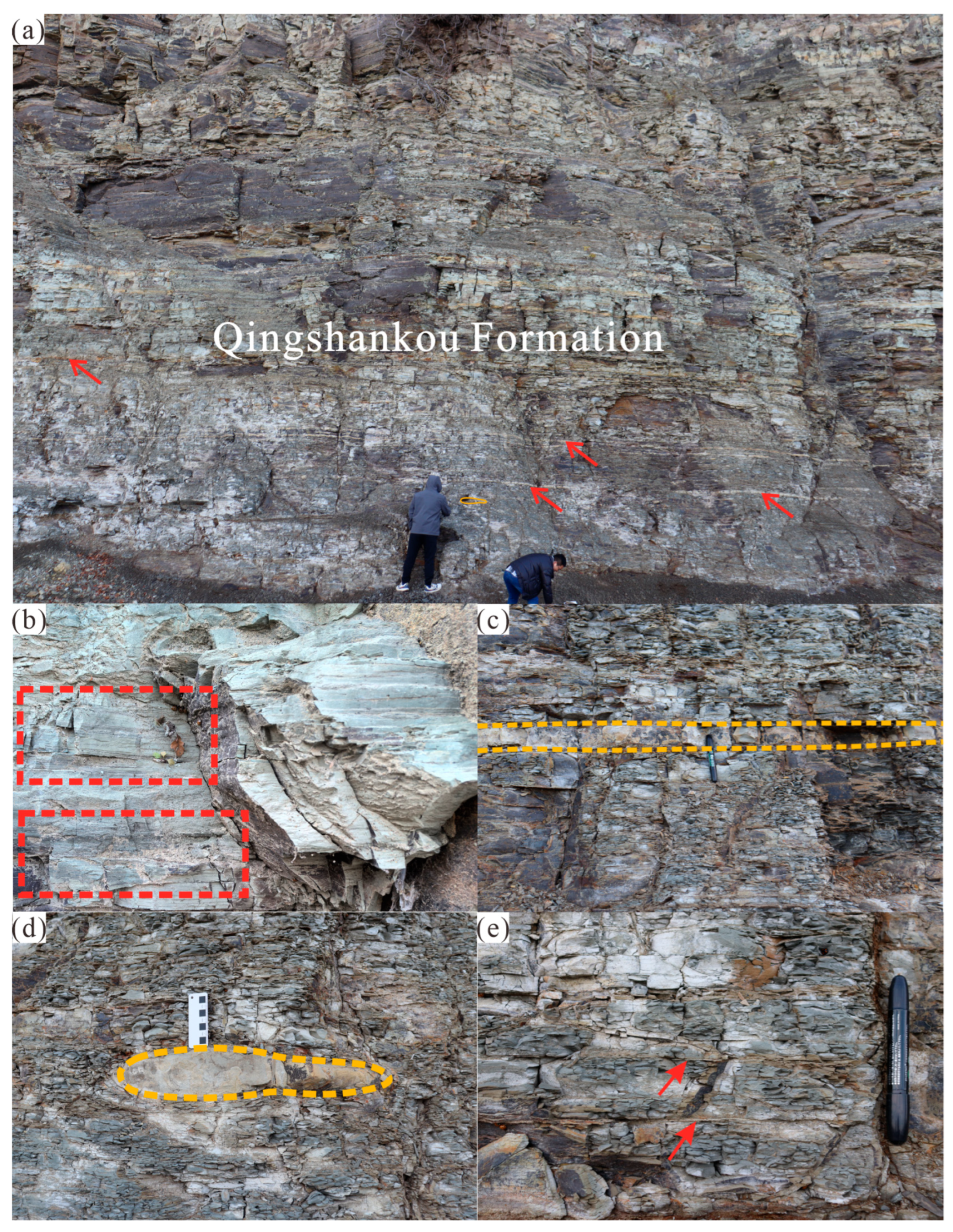
4.1. Petrological Characteristics
4.2. Mineralogical Characteristics
4.3. Geochemical Characteristics
4.3.1. Biomarker Characteristics
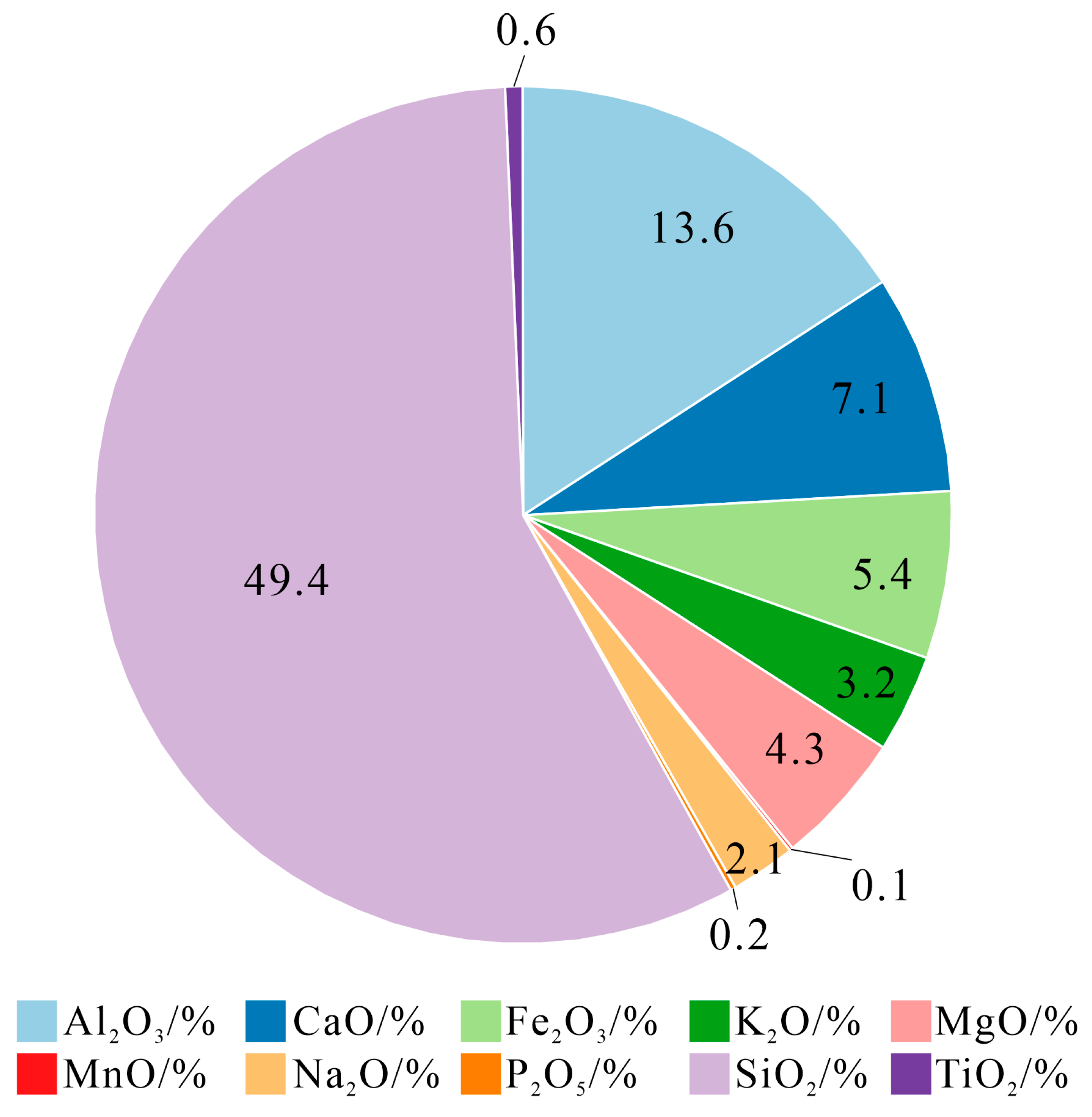
4.3.2. Major Element Characteristics
4.3.3. Trace Element Characteristics
4.3.4. Rare Earth Element Distribution Pattern
5. Discussion
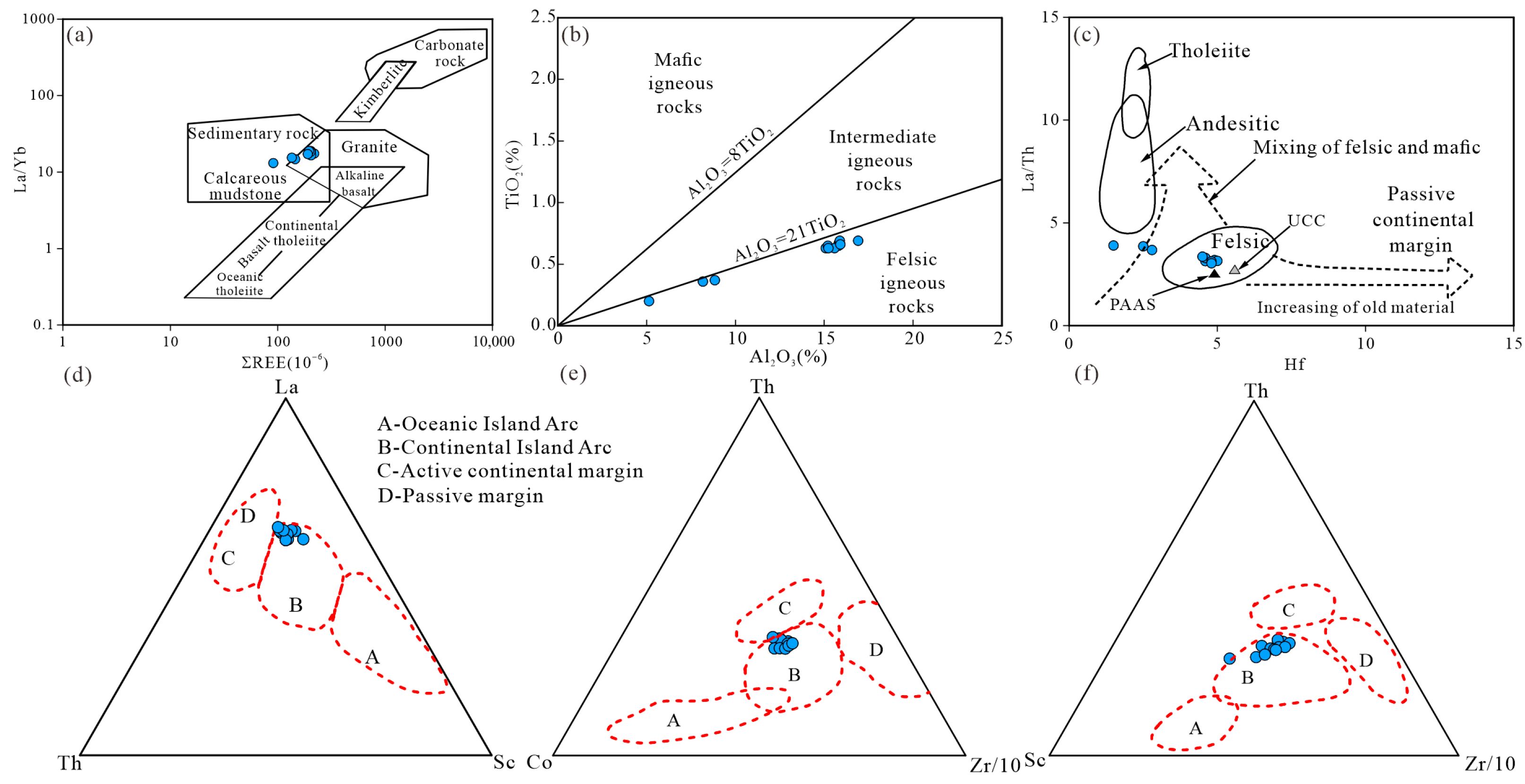
5.1. Provenance and Tectonic Setting
5.2. Sedimentary Environment Analysis
5.2.1. Paleosalinity
5.2.2. Paleoclimate
5.2.3. Paleo-Redox Conditions
5.2.4. Paleowater Depth
5.2.5. Paleoproductivity
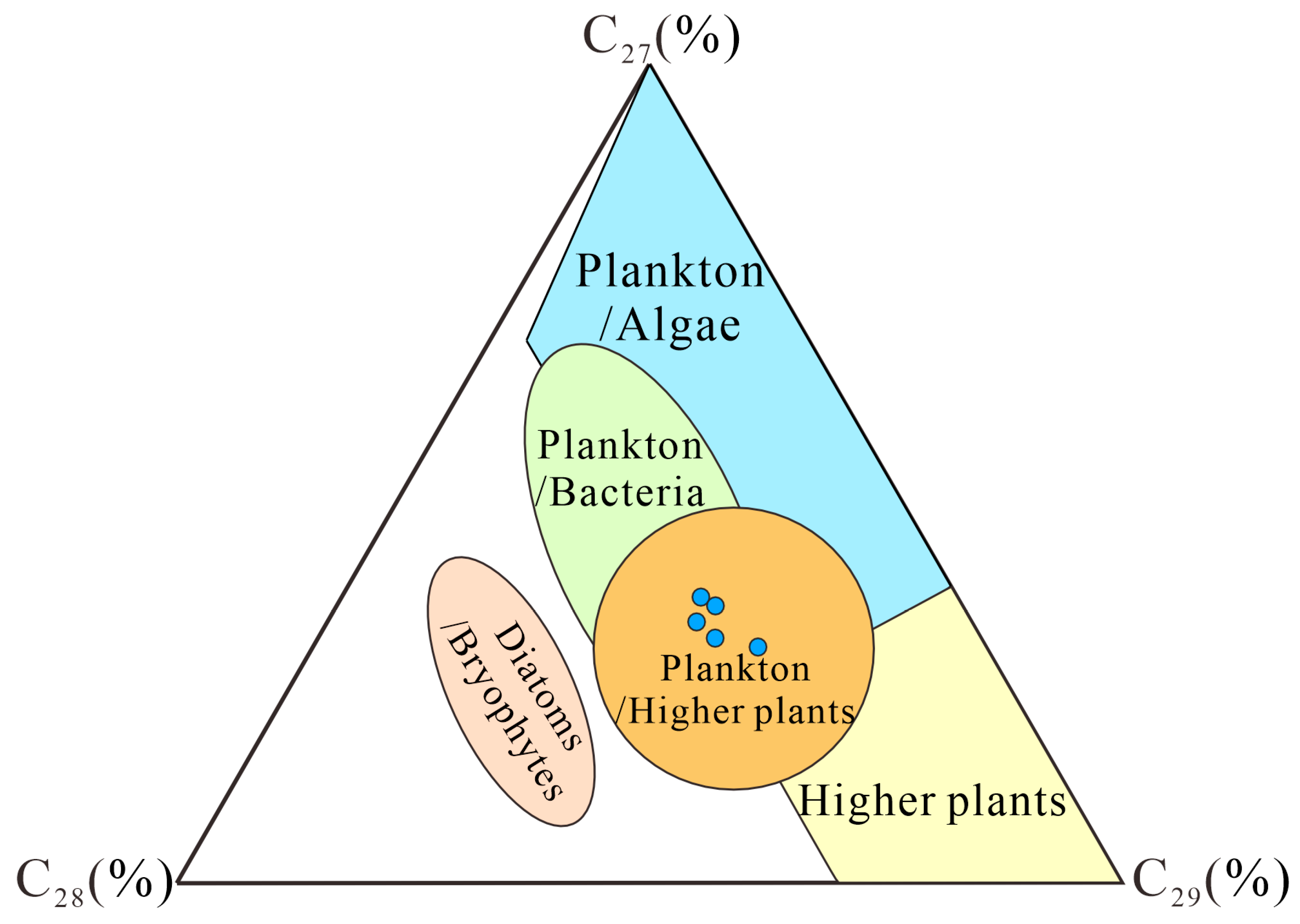
5.3. Sources of Organic Matter
5.4. Depositional Model of Shale Organic Matter
6. Conclusions
- (1)
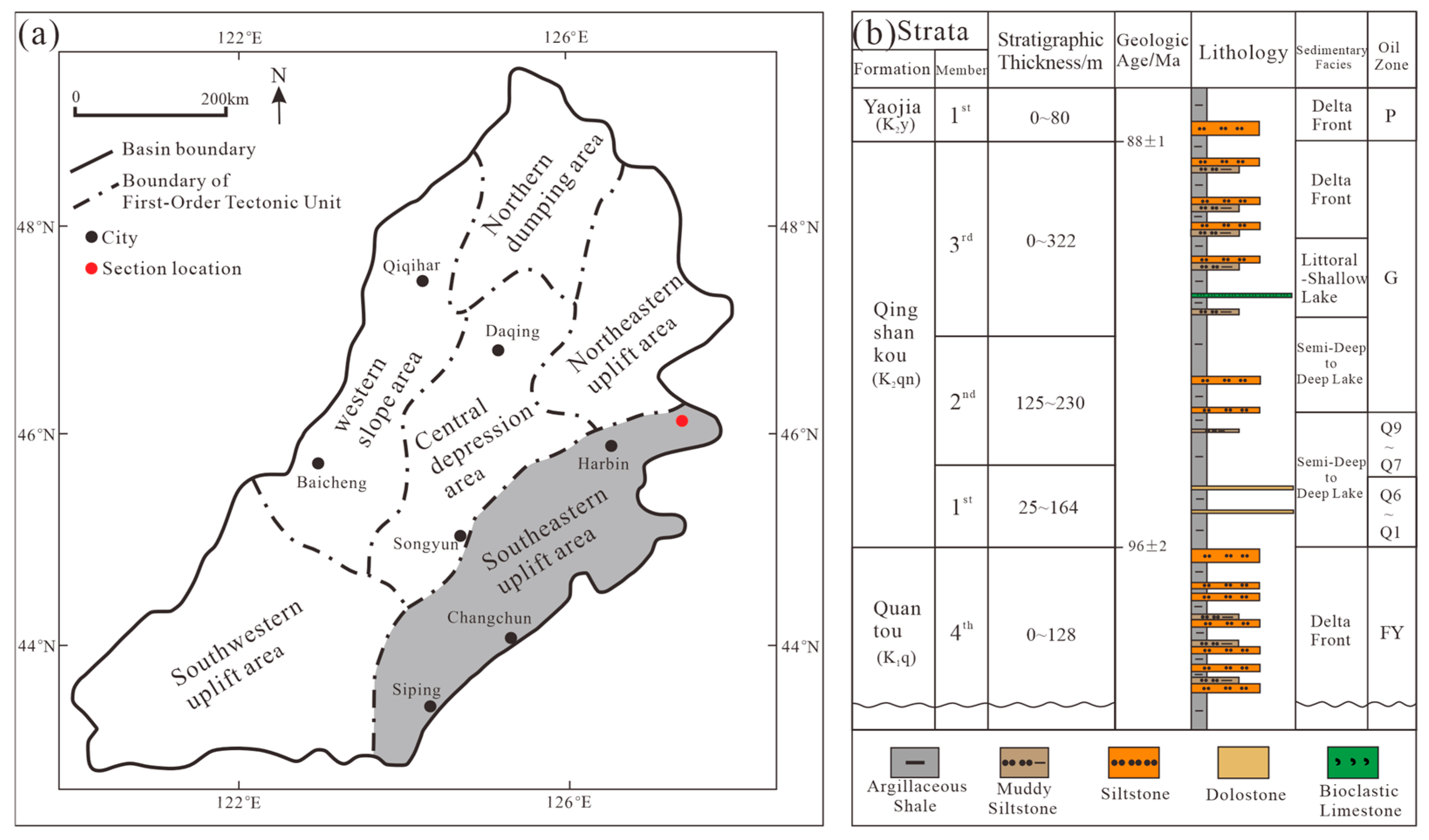
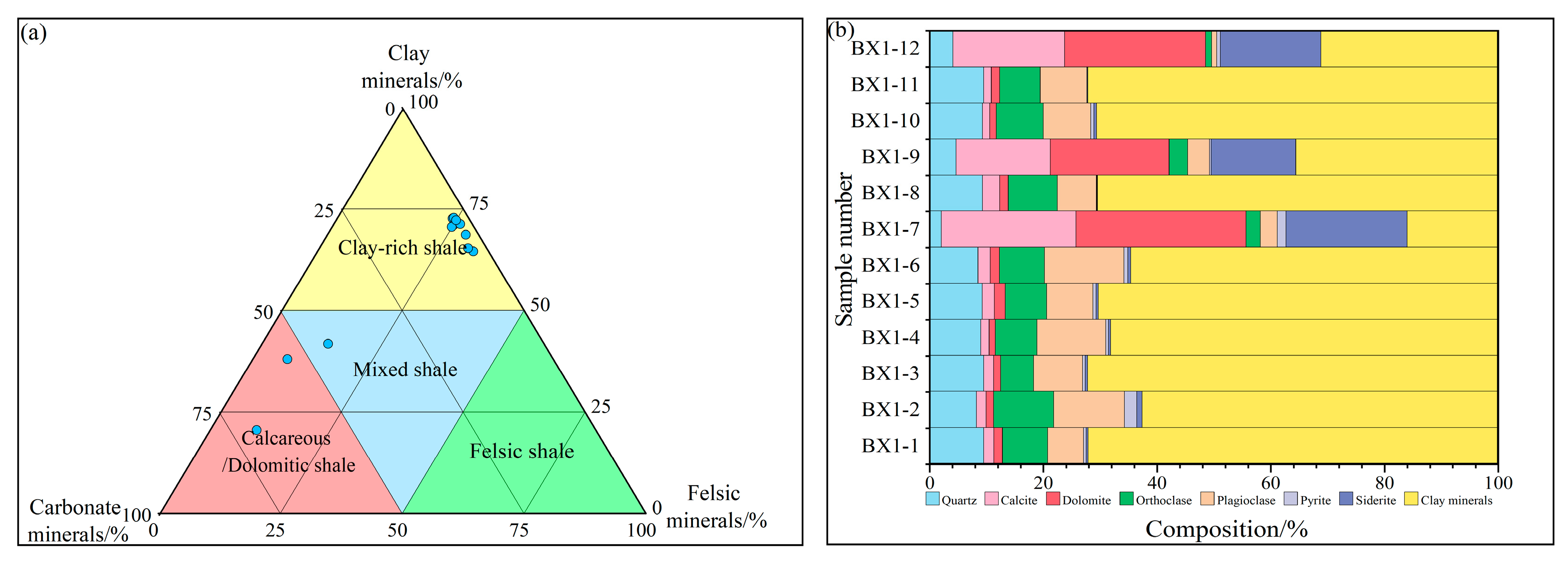
- The outcrop profile in Niaohexiang Section of Binxian, located in the southeastern uplift of the Songliao Basin, is dominated by black shale and gray to dark-gray mudstone, interbedded with multiple dolostone layers and dolomite nodules. The rocks are characterized by high clay mineral contents and can be classified into clay-rich shale, calcareous/dolomitic shale, and mixed shale. Among these, clay-rich shale accounts for more than 60% of the succession and represents the most favorable lithology for shale oil generation and accumulation.
- (2)
- Integrated geochemical data from Qingshankou Formation outcrop samples in the southeastern uplift indicate that the shales in the study area were primarily sourced from felsic upper-crustal rocks and that the tectonic setting reflects a continental island arc tectonic setting.
- (3)
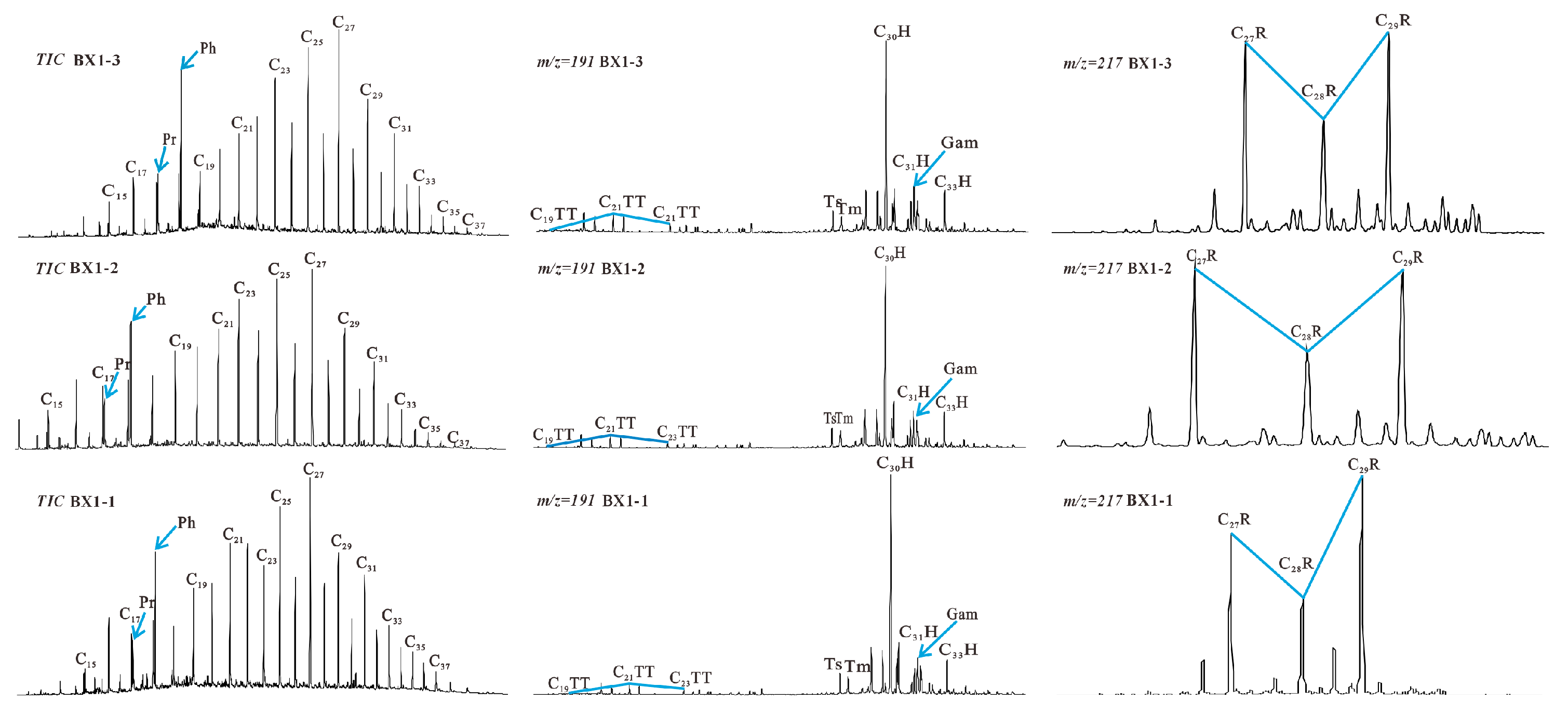
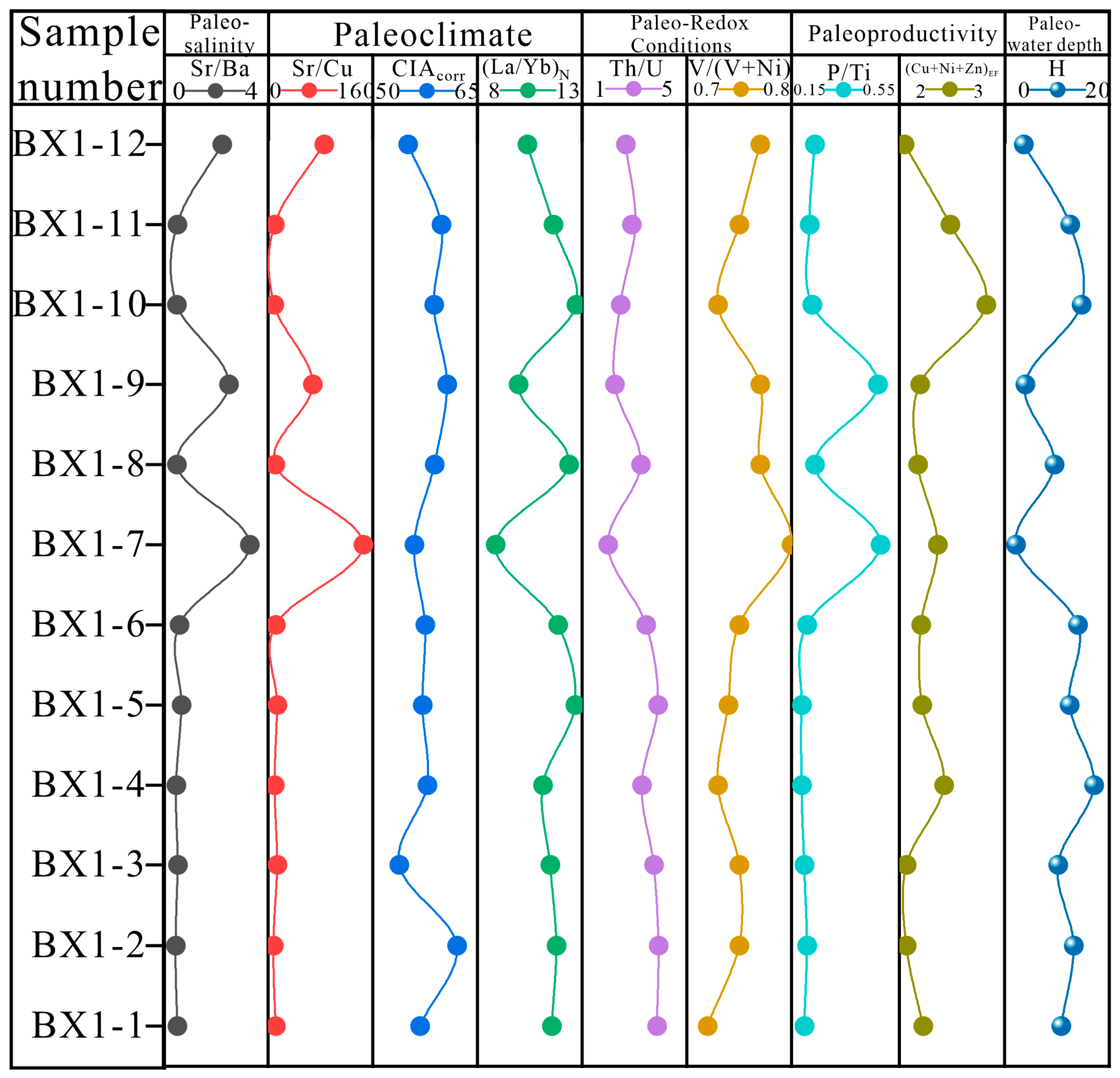
- The organic matter is of mixed origin, dominated by terrestrial higher plants with a subordinate contribution from aquatic lower organisms. During deposition, the shales were formed mainly in freshwater to slightly brackish, oxygen-deficient to anoxic, semi-humid to semi-arid shallow-lacustrine environments, whereas the dolostone layers were deposited in saline to hypersaline, arid, locally reducing shallow-lacustrine settings. Overall, the shales record relatively low paleoproductivity, but paleoproductivity increased during periods of dolostone deposition. This evolutionary pattern suggests that, during Qingshankou Formation time in the Songliao Basin, the lake underwent an anoxic event accompanied by increasing salinity and progressive climatic aridification.
- (4)
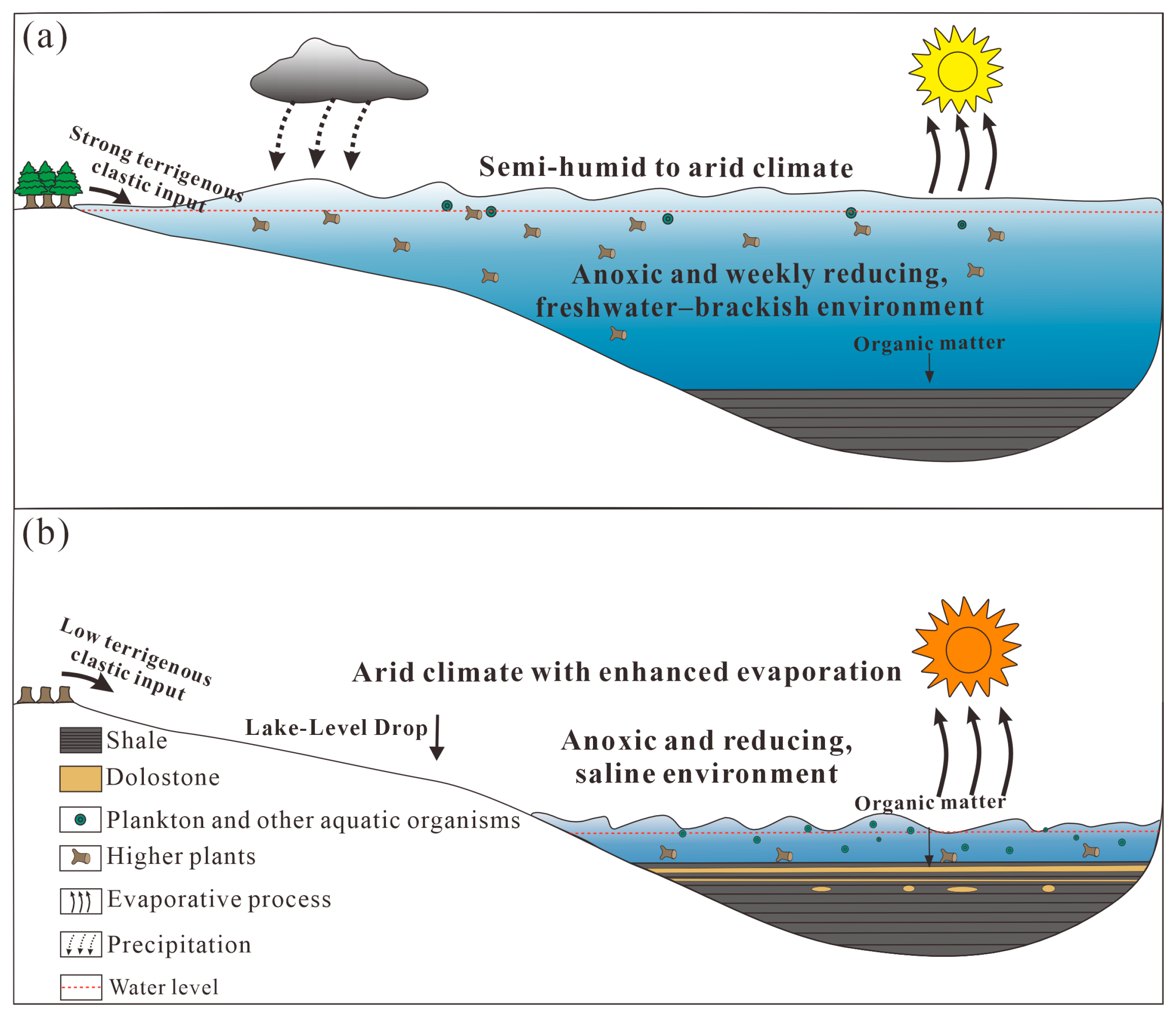
- The enrichment of organic matter in the Qingshankou Formation shales in the study area is primarily governed by the combined influences of paleoclimate, water salinity, water-depth variations, and redox conditions. During the early stage of deposition, the study area was characterized by a relatively humid climate and a low-salinity lacustrine environment. Terrigenous clastic input was relatively strong, primary productivity was low, and a certain degree of clastic dilution occurred, resulting in limited organic matter enrichment. In the late stage of deposition, the climate gradually shifted toward arid conditions, lake-water evaporation intensified, water depth decreased, and salinity increased. Nutrient enrichment promoted the proliferation of plankton, thereby enhancing lacustrine paleoproductivity, while the bottom water progressively evolved toward a more reducing environment, which favored the preservation of organic matter. Overall, the depositional environment of the Qingshankou Formation records an evolutionary process of progressive lake shallowing and intensified evaporation, accompanied by a transition of sedimentary facies from low–organic matter shale to carbonate deposits, with dolostone layers forming during stages of particularly strong evaporative conditions.
- (5)
- The development of dolomite-rich intervals correlates with periods of enhanced organic matter preservation. These dolomitic layers, formed during arid climate transitions and elevated paleosalinity. Therefore, it is recommended to prioritize horizontal drilling and hydraulic fracturing targets near these lithofacies to optimize hydrocarbon recovery in the southeastern uplift area. Future research should focus on high-resolution carbon δ13C and sulfur δ34S isotopic analyses to further refine the global-to-regional carbon cycle correlations and microbial sulfate reduction processes. Additionally, integrated subsurface core-based 3D basin modeling is warranted to quantitatively simulate the thermal maturation and migration pathways of shale oil in this region, providing a more robust spatial framework for sweet-spot prediction.
Author Contributions
Funding
Data Availability Statement
Conflicts of Interest
Abbreviations
| XRD | X-ray diffraction |
| XRF | X-ray fluorescence |
| ICP-MS | Inductively coupled plasma mass spectrometry |
| GC-MS | Gas chromatography–mass spectrometry |
| TOC | Total Organic Carbon |
| TIC | Total ion current chromatogram |
| CIA | Chemical Index of Alteration |
| CPI | Carbon Preference Index |
| OEP | Odd–Even Predominance |
| GI | Gammacerane Index |
| Pr | Pristane |
| Ph | Phytane |
| REE | Rare Earth Element |
| LREE | Light Rare Earth Element |
| HREE | Heavy Rare Earth Element |
| ∑REE | Total Rare Earth Element |
| PAAS | Post-Archaean Australian Shale |
| EF | Enrichment factor |
References
- Guo, H.; Shi, J.Y.; Fu, S.P.; Liu, Z.T.; Cai, L.H.; Yin, S.Y. Lithofacies Characteristics of Continental Lacustrine Fine-Grained Sedimentary Rocks and Their Coupling Relationship with Sedimentary Environments: Insights from the Shahejie Formation, Dongying Sag. Minerals 2024, 14, 479. [Google Scholar] [CrossRef]
- Guo, X.S.; Wang, R.Y.; Shen, B.J.; Wang, G.P.; Wan, C.X.; Wang, Q.R. Geological characteristics, resource potential, and development direction of shale gas in China. Pet. Explor. Dev. 2025, 52, 17–32. [Google Scholar] [CrossRef]
- He, W.Y.; Zhu, R.K.; Cui, B.W.; Zhang, S.C.; Meng, Q.; Bai, B.; Feng, Z.H.; Lei, Z.D.; Wu, S.T.; He, K.; et al. The Geoscience Frontier of Gulong Shale Oil: Revealing the Role of Continental Shale from Oil Generation to Production. Engineering 2023, 28, 79–92. [Google Scholar] [CrossRef]
- Wu, W.; Liao, Z.W.; Chen, H.H.; Li, S.H.; Su, A.; Hussain, I.; Zhao, N.B. Jurassic Terrestrial Shale Gas Potential of the Northern Kashi Sag in the Tarim Basin, Northwestern China. Geofluids 2021, 2021, 5542447. [Google Scholar] [CrossRef]
- Jin, Z.J.; Liang, X.P.; Bai, Z.R. Exploration breakthrough and its significance of Gulong lacustrine sha le oil in the Songliao Basin, Northeastern China. Energy Geosci. 2022, 3, 120–125. [Google Scholar] [CrossRef]
- Liu, Y.L.; Li, W.; Huang, B.T.; Li, P.; Ge, X.T.; Ge, X.; Yuan, J.P.; Liu, P.F.; Yu, X.T.; Wu, H.G. Depositional Environment Conditions and Organic Matter Enrichment Mechanism of the First Member of Upper Cretaceous Qingshankou Formation in the Heiyupao Depression, Northern Songliao Basin. Minerals 2025, 15, 55. [Google Scholar] [CrossRef]
- Sun, L.D.; Zhu, R.K.; Zhang, T.S.; Cai, Y.; Feng, Z.H.; Bai, B.; Jiang, H.; Wang, B. Advances and trends of non-marine shale sedimentology: A case study from Gulong Shale of Daqing Oilfield, Songliao Basin, NE China. Pet. Explor. Dev. 2024, 51, 1367–1385. [Google Scholar] [CrossRef]
- Wang, M.; Wu, Y.; Bai, X.F.; Li, M.; Li, J.H.; Wang, X.; Zhang, J.Y.; Li, J.; Yu, C.Q.; Bennani, R. Geological characteristics and in-situ retention mechanisms of clay-rich lacustrine shale oil in the Songliao Basin. Mar. Pet. Geol. 2025, 182, 107593. [Google Scholar] [CrossRef]
- Liu, B.; Wang, H.L.; Fu, X.F.; Bai, Y.F.; Bai, L.H.; Jia, M.C.; He, B. Lithofacies and depositional setting of a highly prospective lacustrine shale oil succession from the Upper Cretaceous Qingshankou Formation in the Gulong sag, northern Songliao Basin, northeast China. AAPG Bull. 2019, 103, 405–432. [Google Scholar] [CrossRef]
- Wang, H.J.; Wan, Y.Y.; Liu, Y.K.; Zhang, J.Y.; Zhang, S.C. Proven and Potential Microbial Contributions to the Gulong Shale Oil. J. Earth Sci. 2024, 35, 2149–2153. [Google Scholar] [CrossRef]
- Zhang, Y.C.; Bai, X.F.; Wang, M.; Li, J.H.; Zhang, J.Y.; Fu, L.; Huo, Q.L.; Li, J.B.; Yan, Y.; Xu, L.; et al. Formation mechanism of Gulong shale oil: Insights from semiclosed hydrous pyrolysis. J. Anal. Appl. Pyrolysis 2024, 181, 106632. [Google Scholar] [CrossRef]
- Zhang, S.C.; Zhang, B.; Wang, X.M.; Feng, Z.H.; He, K.; Wang, H.; Fu, X.L.; Liu, Y.K.; Yang, C.L. Gulong shale oil enrichment mechanism and orderly distribution of conventional- unconventional oils in the Cretaceous Qingshankou Formation, Songliao Basin, NE China. Pet. Explor. Dev. 2023, 50, 1045–1059. [Google Scholar] [CrossRef]
- Zhang, J.Y.; Zhu, R.K.; Wu, S.T.; Jiang, X.H.; Liu, C.; Cai, Y.; Zhang, S.R.; Zhang, T.S. Microscopic oil occurrence in high-maturity lacustrine shales: Qingshankou Formation, Gulong Sag, Songliao Basin. Pet. Sci. 2023, 20, 2726–2746. [Google Scholar] [CrossRef]
- Sun, L.D.; Liu, H.; He, W.Y.; Li, G.X.; Zhang, S.C.; Zhu, R.K.; Jin, X.; Meng, S.W.; Jiang, H. An analysis of major scientific problems and research paths of Gulong shale oil in Daqing Oilfield, NE China. Pet. Explor. Dev. 2021, 48, 527–540. [Google Scholar] [CrossRef]
- Zhu, R.K.; Zhang, J.Y.; Li, M.Y.; Cai, Y.; Wu, S.T.; Liu, C.; Zhang, S.R.; Kang, Y. Advances and key issues in the basic research of non-marine shale oil enrichment. Acta Geol. Sin. (Engl. Ed.) 2023, 97, 2874–2895. [Google Scholar]
- Han, Z.Y.; Wang, G.W.; Wu, H.L.; Feng, Z.; Tian, H.; Xie, Y.Y.; Wu, H. Lithofacies Characteristics of Gulong Shale and Its Influence on Reservoir Physical Properties. Energies 2024, 17, 779. [Google Scholar] [CrossRef]
- He, W.Y.; Zhong, J.H.; Sun, N.L. Discovery and significance of tempestites and storm deposits in the Qingshankou Formation of the Gulong Sag, northeastern China. Front. Earth Sci. 2023, 10, 999135. [Google Scholar] [CrossRef]
- Sun, G.Q.; Dong, W.B.; Zhang, X.G.; Zhong, J.H.; Sun, N.L. Study on Dolomite Thin Layers and Nodules in the Qingshankou Formation Shale Oil Reservoir of Gulong Sag. Energies 2023, 16, 3981. [Google Scholar] [CrossRef]
- Liu, R.; Liu, Z.J.; Sun, P.C.; Yang, X.H.; Zhang, C. Shale gas accumulation potential of the Upper Cretaceous Qingshankou Formation in the southeast Songliao Basin, NE China. Mar. Pet. Geol. 2017, 86, 547–562. [Google Scholar] [CrossRef]
- Xie, Q.; Xu, H.; Yu, S. Characterization of the Lower Cretaceous Shale in Lishu Fault Depression, Southeastern Songliao Basin: Implications for Shale Gas Resources Potential. Energies 2022, 15, 5156. [Google Scholar] [CrossRef]
- Liu, C.Y.; Shan, X.L.; Yi, J.; Shi, Y.Q.; Ventura, G. Volcanism at the end of continental rifting: The Cretaceous syn-rift to post-rift transition in the Songliao Basin (NE China). Gondwana Res. 2022, 111, 174–188. [Google Scholar] [CrossRef]
- Liu, Z.H.; Song, J.; Liu, X.W.; Wu, X.M.; Gao, X. Discovery of the Cretaceous-Paleogene compressional structure and basin properties of the southern Songliao Basin. Acta Pet. Sin. 2020, 36, 2383–2393. [Google Scholar] [CrossRef]
- Wang, P.J.; Mattern, F.; Didenko, N.A.; Zhu, D.F.; Singer, B.; Sun, X.M. Tectonics and cycle system of the Cretaceous Songliao Basin: An inverted active continental margin basin. Earth-Sci. Rev. 2016, 159, 82–102. [Google Scholar] [CrossRef]
- Li, Z.Q.; Kusky, T.; Ying, D.L.; Guo, X.; Li, H.K. Successor Characteristics of the Mesozoic and Cenozoic Songliao Basins. Acta Geol. Sin. (Engl. Ed.) 2010, 82, 622–628. [Google Scholar] [CrossRef]
- Song, Y.; Stepashko, A.; Liu, K.Y.; He, Q.K.; Shen, C.B.; Shi, B.J.; Ren, J.Y. Post-rift Tectonic History of the Songliao Basin, NE China: Cooling Events and Post-rift Unconformities Driven by Orogenic Pulses From Plate Boundaries. J. Geophys. Res. Solid Earth 2018, 123, 2363–2395. [Google Scholar] [CrossRef]
- Sun, L.D.; Cui, B.W.; Zhu, R.K.; Wang, R.; Feng, Z.H.; Li, B.H.; Zhang, J.Y.; Gao, B.; Wang, Q.Z.; Zeng, H.S.; et al. Shale oil enrichment evaluation and production law in Gulong Sag, Songliao Basin, NE China. Pet. Explor. Dev. 2023, 50, 505–519. [Google Scholar] [CrossRef]
- Xu, J.J.; Liu, Z.J.; Bechtel, A.; Meng, Q.T.; Sun, P.C.; Jia, J.L.; Cheng, L.J.; Song, Y. Basin evolution and oil shale deposition during Upper Cretaceous in the Songliao Basin (NE China): Implications from sequence stratigraphy and geochemistry. Int. J. Coal Geol. 2015, 149, 9–23. [Google Scholar] [CrossRef]
- Fu, X.L.; Meng, Q.; Wen, Z.; Bai, Y.; Gao, B.; Su, Y.X. Sedimentary Environment and Genetic Mechanism of Dolomites in the Qingshankou Formation, Songliao Basin. Acta Sedimentol. Sin. 2024, 42, 113. [Google Scholar] [CrossRef]
- Wang, C.S.; Scott, R.W.; Wan, X.Q.; Graham, S.A.; Huang, Y.J.; Wang, P.J.; Wu, H.C.; Dean, W.E.; Zhang, L.M. Late Cretaceous climate changes recorded in Eastern Asian lacustrine deposits and North American Epieric sea strata. Earth-Sci. Rev. 2013, 126, 275–299. [Google Scholar] [CrossRef]
- Peters, K.E.; Walters, C.C.; Moldowan, J.M. Biomarkers and isotopes in the environment and human history. In The Biomarker Guide; Cambridge University Press: Cambridge, UK, 2004; Volume 1. [Google Scholar]
- Philp, R.P.; Fan, P.; Lewis, C.A.; Li, J.; Zhu, H.; Wang, H. Geochemical Characteristics of Oils from the Chaidamu, Shanganning and Jianghan Basins, China. In Proceedings of the 2nd Conference on Petroleum Geochemistry and Exploration in the Afro-Asian Region, Beijing, China, 28–31 August 1988; pp. 351–358. [Google Scholar]
- Zhu, Y.L.; Tan, W.M.; Hai, L.F.; Mu, C.X.; Wang, K.; Li, M.Y. Organic geochemical characteristics of Jurassic Yan’an Formation source rock in Pengyang area of southwestern Ordos basin. Front. Earth Sci. 2025, 13, 1536268. [Google Scholar] [CrossRef]
- Li, Q.W.; Liu, Z.B.; Chen, F.R.; Liu, G.X.; Zhang, D.W.; Li, P.; Wang, P.W. Geochemical Characteristics and Organic Matter Provenance of Shale in the Jurassic Da’anzhai Member, Northeastern Sichuan Basin. Front. Earth Sci. 2022, 10, 860477. [Google Scholar] [CrossRef]
- Algeo, T.J.; Maynard, J.B. Trace-element behavior and redox facies in core shales of Upper Pennsylvanian Kansas-type cyclothems. Chem. Geol. 2004, 206, 289–318. [Google Scholar] [CrossRef]
- Tribovillard, N.; Algeo, T.J.; Lyons, T.; Riboulleau, A. Trace metals as paleoredox and paleoproductivity proxies: An update. Chem. Geol. 2006, 232, 12–32. [Google Scholar] [CrossRef]
- Peng, B.; Song, Z.L.; Tu, X.L.; Xiao, M.L.; Wu, F.C.; Lv, H.Z. Release of heavy metals during weathering of the Lower Cambrian Black Shales in western Hunan, China. Environ. Geol. 2004, 45, 1137–1147. [Google Scholar] [CrossRef]
- Wu, S.C.; Peng, B.; Wu, N.Q.; Xie, S.R.; Yang, X.; Fang, X.H.; Song, Z.L. Mobility and environmental impact of cadmium (Cd) during weathering of carbonaceous black shales in western Hunan, China. J. Hazard. Mater. 2024, 470, 134267. [Google Scholar] [CrossRef] [PubMed]
- Taylor, S.R.; Mclennan, S.M. An Examination of the Geochemical Record Preserved in Sedimentary Rocks. In The Continental Crust: Its Composition and Evolution; Blackwell Scientific Publications: Oxford, UK, 1985. [Google Scholar]
- Yan, C.N.; Jin, Z.J.; Zhao, J.H.; Du, W.; Liu, Q.Y. Influence of sedimentary environment on organic matter enrichment in shale: A case study of the Wufeng and Longmaxi Formations of the Sichuan Basin, China. Mar. Pet. Geol. 2018, 92, 880–894. [Google Scholar] [CrossRef]
- Sun, S.S.; McDonough, W.F. Chemical and Isotopic Systematics of Oceanic Basalts: Implications for Mantle Composition and Processes; Geological Society London Special Publications: London, UK, 1989; Volume 42, pp. 313–345. [Google Scholar] [CrossRef]
- Wang, W.Z.; Huang, X.; Chen, S.; Li, L.W.; Wang, Y.H.; Kang, Y.R.; Nie, Y.H. Geochemical characteristics of sediments in the southern Mid-Atlantic Ridge indicate hydrothermal activity: Evidence from rare earth elements. Mar. Pet. Geol. 2024, 168, 107041. [Google Scholar] [CrossRef]
- Hai, L.F.; Xu, Q.H.; Mu, C.X.; Tao, R.; Wang, L.; Bai, J.H.; Song, Y. Geochemical characteristics and geologic significance of rare earth elements in oil shale of the Yan’an Formation in the Tanshan area, in the Liupanshan Basin, China. Interpretation 2021, 9, T843–T854. [Google Scholar] [CrossRef]
- Chen, W.Z.; Tian, J.C.; Lin, X.B.; Liang, Q.S.; Wang, X.; Yi, D.X.; Li, Y.Y. Climate fluctuations during the Ordovician-Silurian transition period in South China: Implications for paleoenvironmental evolution and organic matter enrichment. Palaeogeogr. Palaeoclimatol. Palaeoecol. 2023, 613, 111411. [Google Scholar] [CrossRef]
- He, B.; Xu, Y.G.; Zhong, Y.T.; Guan, J.P. The Guadalupian-Lopingian boundary mudstones at Chaotian (SW China) are clastic rocks rather than acidic tuffs: Implication for a temporal coincidence between the end-Guadalupian mass extinction and the Emeishan volcanism. Lithos 2010, 119, 10–19. [Google Scholar] [CrossRef]
- Tobia, F.H.; Mustafa, B.H. Geochemistry and mineralogy of the Al-rich shale from Baluti formation, Iraqi Kurdistan region: Implications for weathering and provenance. Arab. J. Geosci. 2016, 9, 757. [Google Scholar] [CrossRef]
- Bhatia, M.R. Plate-Tectonics and Geochemical Composition of Sandstones. J. Geol. 1983, 91, 611–627. [Google Scholar] [CrossRef]
- Bhatia, M.R.; Crook, K.A.W. Trace element characteristics of graywackes and tectonic setting discrimination of sedimentary basins. Contrib. Mineral. Petrol. 1986, 92, 181–193. [Google Scholar] [CrossRef]
- Liang, H.R.; Xu, G.S.; Yu, Q.; Xu, F.H.; Wang, D.Y.; Chen, Z.Y. Paleosalinity and Its Association with Organic Matter: A Case Study from the Eocene Shahejie Formation, Laizhou Bay Sag, Bohai Bay Basin (China). J. Ocean Univ. China 2021, 20, 741–754. [Google Scholar] [CrossRef]
- Jia, J.L.; Bechtel, A.; Liu, Z.J.; Strobl, S.A.I.; Sun, P.C.; Sachsenhofer, R.F. Oil shale formation in the Upper Cretaceous Nenjiang Formation of the Songliao Basin (NE China): Implications from organic and inorganic geochemical analyses. Int. J. Coal Geol. 2013, 113, 11–26. [Google Scholar] [CrossRef]
- Vahrenkamp, V.C.; Swart, P.K. New Distribution Coefficient for the Incorporation of Strontium into Dolomite and Its Implications for the Formation of Ancient Dolomites. Geology 1990, 18, 387–391. [Google Scholar] [CrossRef]
- Wei, W.; Algeo, T.J. Elemental proxies for paleosalinity analysis of ancient shales and mudrocks. Geochim. Cosmochim. Acta 2020, 287, 341–366. [Google Scholar] [CrossRef]
- Li, C.; Chen, S.J.; Liao, J.B.; Hou, Y.T.; Yu, J.; Liu, G.L.; Xu, K.; Wu, X.T. Geochemical characteristics of the Chang 7 Member in the southwestern Ordos Basin, China: The influence of sedimentary environment on the organic matter enrichment. Palaeoworld 2023, 32, 429–441. [Google Scholar] [CrossRef]
- Ma, L.; Zhang, Z.H.; Meng, W.Q. Climate-Provenance Effect on the Organic Matter Enrichment of the Chang 9 Source Rocks in the Central Ordos Basin, China. Geofluids 2021, 2021, 10. [Google Scholar] [CrossRef]
- Dong, C.Y.; Li, D.J.; Zhang, Y.; Li, D.H.; Liu, M.C.; Han, Z.X. Geochemistry and mineralogy of the Upper Ordovician Wufeng formation, Southwestern China: Implications for Paleoclimate construction. Energy Explor. Exploit. 2023, 41, 1983–2006. [Google Scholar] [CrossRef]
- Nesbitt, H.W.; Young, G.M. Early Proterozoic climates and plate motions inferred from major eleme nt chemistry of lutites. Nature 1982, 299, 715–717. [Google Scholar] [CrossRef]
- Nesbitt, H.W.; Young, G.M. Formation and Diagenesis of Weathering Profiles. J. Geol. 1989, 97, 129–147. [Google Scholar] [CrossRef]
- Bock, B.; McLennan, S.M.; Hanson, G.N. Geochemistry and provenance of the Middle Ordovician Austin Glen Membe r (Normanskill Formation) and the Taconian Orogeny in New England. Sedimentology 1998, 45, 635–655. [Google Scholar] [CrossRef]
- Panahi, A.; Young, G.M.; Rainbird, R.H. Behavior of major and trace elements (including REE) during Paleoproterozoic pedogenesis and diagenetic alteration of an Archean granite near Ville Marie, Quebec, Canada. Geochim. Cosmochim. Acta 2000, 64, 2199–2220. [Google Scholar] [CrossRef]
- Li, Z.H.; Wei, H.W.; Yang, P.; He, L.; Shi, M.F.; Wang, Z.H.; Du, B.W. Geochronology and geochemistry of deep-time volcanic ash and its geological implications from the Lakharpata Group in Nepal Lesser Himalaya. Acta Geol. Sin.-Engl. 2025, 99, 3333–3356. [Google Scholar] [CrossRef]
- Young, G.M.; Nesbitt, H.W. Paleoclimatology and provenance of the glaciogenic Gowganda Formation (Paleoproterozoic), Ontario, Canada: A chemostratigraphic approach. Geol. Soc. Am. Bull. 1999, 111, 264–274. [Google Scholar] [CrossRef]
- Chen, X.L.; Zhang, B.; Huang, H.P.; Mao, Z.G. Controls on Organic Matter Accumulation of the Triassic Yanchang Formation Lacustrine Shales in the Ordos Basin, North China. ACS Omega 2021, 6, 26048–26064. [Google Scholar] [CrossRef] [PubMed]
- Wang, Z.M.; Cheng, H.F.; Wang, Y. Differential Geochemical Features of Lacustrine Shale and Mudstone from Triassic Yanchang Formation, Ordos Basin, China: Insights into Their Sedimentary Environments and Organic Matter Enrichment. Minerals 2025, 15, 656. [Google Scholar] [CrossRef]
- Xu, C.; Shan, X.L.; He, W.T.; Zhang, K.; Rexiti, Y.; Su, S.Y.; Liang, C.; Zou, X.T. The influence of paleoclimate and a marine transgression event on organic matter accumulation in lacustrine black shales from the Late Cretaceous, southern Songliao Basin, Northeast China. Int. J. Coal Geol. 2021, 246, 19. [Google Scholar] [CrossRef]
- Tanaka, K.; Akagawa, F.; Koshi, Y.; Tani, Y.; Kawabe, I.; Kawai, T. Rare earth element geochemistry of Lake Baikal sediment: Its implication for geochemical response to climate change during the Last Glacial/Interglacial transition. Quat. Sci. Rev. 2007, 26, 1362–1368. [Google Scholar] [CrossRef]
- Mazumdar, P.; Mukhopadhyay, A.; Thorie, A.; Banerjee, T.; Rai, S.K. Geochemistry of Neoproterozoic Chhaosa shales, Simla Group, Lesser Himalaya: Its implications on provenance and tectonics. J. Earth Syst. Sci. 2021, 130, 175. [Google Scholar] [CrossRef]
- Werne, J.P. An integrated assessment of a “type euxinic” deposit: Evidence for mul tiple controls on black shale deposition in the middle Devonian Oatka Creek formation. Am. J. Sci. 2002, 302, 110–143. [Google Scholar] [CrossRef]
- Wignall, P.B.; Twitchett, R.J. Oceanic Anoxia and the End Permian Mass Extinction. Science 1996, 272, 1155–1158. [Google Scholar] [CrossRef]
- Hatch, J.R.; Leventhal, J.S. Relationship between Inferred Redox Potential of the Depositional Environment and Geochemistry of the Upper Pennsylvanian (Missourian) Stark Shale Member of the Dennis Limestone, Wabaunsee Country, Kansas, USA. Chem. Geol. 1992, 99, 65–82. [Google Scholar] [CrossRef]
- Guo, Q.J.; Deng, Y.N.; Hippler, D.; Franz, G.; Zhang, J.M. REE and trace element patterns from organic-rich rocks of the Ediacaran-Cambrian transitional interval. Gondwana Res. 2016, 36, 94–106. [Google Scholar] [CrossRef]
- Wei, H.; Tao, S.; Hai, L.F.; Rui, T.; Wei, X.C.; Lei, W. Geochemistry of the Tanshan Oil Shale in Jurassic Coal Measures, Western Ordos Basin: Implications for Sedimentary Environment and Organic Matter Accumulation. Energies 2022, 15, 8535. [Google Scholar] [CrossRef]
- Wang, X.L.; Zhu, X.M.; Lai, J.; Lin, X.Y.; Wang, X.; Du, Y.S.; Huang, C.; Zhu, Y.R. Paleoenvironmental reconstruction and organic matter accumulation of the paleogene shahejie oil shale in the Zhanhua Sag, Bohai Bay Basin, Eastern China. Pet. Sci. 2024, 21, 1552–1568. [Google Scholar] [CrossRef]
- Xie, M.; Guo, S.B. Study on the relationship between shale organic matter development and paleowater depth-A new understanding of the condensed section. Mar. Pet. Geol. 2024, 169, 14. [Google Scholar] [CrossRef]
- Xu, L.F.; Cheng, Y.S.; Zhang, J.C.; Liu, Y.; Yang, Y.Y. Controls on the Organic Matter Accumulation of the Marine- Continental Transitional Shanxi Formation Shale in the Southeastern Ordos Basin. ACS Omega 2022, 7, 4317–4332. [Google Scholar] [CrossRef]
- Murray, R.W.; Tenbrink, M.R.B.; Gerlach, D.C.; Russ, G.P.; Jones, D.L. Rare-Earth, Major, and Trace-Elements in Chert from the Franciscan Complex and Monterey Group, California—Assessing Ree Sources to Fine-Grained Marine-Sediments. Geochim. Cosmochim. Acta 1991, 55, 1875–1895. [Google Scholar] [CrossRef]
- Zhang, T.; Wang, L.L.; Liao, H.H. Methods and research progress of paleo-water depth reconstruction in sedimentary basins. Sediment. Geol. Tethyan Geol. 2024, 44, 582−599. [Google Scholar] [CrossRef]
- Li, X.F.; Gang, W.Z.; Yao, J.L.; Gao, G.; Wang, C.C.; Li, J.Y.; Liu, Y.; Guo, Y.; Yang, S.R. Major and trace elements as indicators for organic matter enrichment of marine carbonate rocks: A case study of Ordovician subsalt marine formations in the central-eastern Ordos Basin, North China. Mar. Pet. Geol. 2020, 111, 461–475. [Google Scholar] [CrossRef]
- Wu, Y.W.; Tian, H.; Gong, D.J.; Li, T.F.; Zhou, Q. Paleo-environmental variation and its control on organic matter enrichment of black shales from shallow shelf to slope regions on the Upper Yangtze Platform during Cambrian Stage 3. Palaeogeogr. Palaeoclimatol. Palaeoecol. 2020, 545, 20. [Google Scholar] [CrossRef]
- Volkman, J.K. Sterols and other triterpenoids: Source specificity and evolution of biosynthetic pathways. Org. Geochem. 2005, 36, 139–159. [Google Scholar] [CrossRef]
- Huang, W.Y.; Meinschein, W.G. Sterols as ecological indicators. Geochim. Cosmochim. Acta 1979, 43, 739–745. [Google Scholar] [CrossRef]
- Xie, H.Y.; Jiang, Z.X.; Wang, L.; Xue, X.Y. Organic matter enrichment model of fine-grained rocks in volcanic rift lacustrine basin: A case study of lower submember of second member of Lower Cretaceous Shahezi Formation in Lishu rift depression of Songliao Basin, NE China. Pet. Explor. Dev. 2024, 51, 1067–1079+1091. [Google Scholar] [CrossRef]
- Tian, H.Y.; Zhu, S.F.; Cui, H.; Zhang, Q.; Si, Z.Y.; Jiang, Z.X. Upwelling-Induced Organic Matter Enrichment in Wuchiapingian Shales of the Northeastern Sichuan Basin, China. J. Mar. Sci. Eng. 2026, 14, 440. [Google Scholar] [CrossRef]






| Sample | Main Mineral Content/% | |||||||
|---|---|---|---|---|---|---|---|---|
| Quartz | Calcite | Dolomite | Orthoclase | Plagioclase | Pyrite | Clay | Siderite | |
| BX1-1 | 9.11 | 1.73 | 1.43 | 7.6 | 6.01 | 0.44 | 68.76 | 0.35 |
| BX1-2 | 7.74 | 1.57 | 1.25 | 9.89 | 11.62 | 2.04 | 58.42 | 0.89 |
| BX1-3 | 8.9 | 1.62 | 1.15 | 5.41 | 8 | 0.47 | 67.16 | 0.37 |
| BX1-4 | 8.3 | 1.37 | 1.01 | 6.75 | 11.15 | 0.43 | 62.64 | 0.34 |
| BX1-5 | 8.58 | 1.95 | 1.77 | 6.74 | 7.52 | 0.49 | 64.79 | 0.38 |
| BX1-6 | 7.87 | 1.99 | 1.47 | 7.32 | 12.86 | 0.63 | 59.4 | 0.5 |
| BX1-7 | 1.73 | 19.5 | 24.63 | 2.08 | 2.45 | 1.27 | 13.05 | 17.54 |
| BX1-8 | 8.59 | 2.81 | 1.38 | 7.97 | 6.31 | 0.1 | 64.85 | 0.08 |
| BX1-9 | 4.08 | 14.4 | 18.18 | 2.83 | 3.33 | 0.26 | 30.79 | 12.95 |
| BX1-10 | 8.58 | 1.15 | 1.08 | 7.59 | 7.69 | 0.52 | 64.82 | 0.41 |
| BX1-11 | 9.19 | 1.3 | 1.42 | 6.87 | 7.92 | 0 | 69.41 | 0.12 |
| BX1-12 | 3.51 | 16.77 | 21.17 | 0.93 | 0.75 | 0.55 | 26.49 | 15.08 |
| Sample | TOC/% | Pr/Ph | CPI | OEP | C27/% | C28/% | C29/% | Ga/C30Hopane |
|---|---|---|---|---|---|---|---|---|
| BX1-1 | 0.72 | 0.40 | 1.73 | 1.92 | 0.29 | 0.24 | 0.47 | 0.18 |
| BX1-2 | 0.99 | 0.36 | 1.96 | 2.23 | 0.34 | 0.26 | 0.40 | 0.20 |
| BX1-3 | 0.92 | 0.33 | 2.03 | 2.25 | 0.32 | 0.29 | 0.39 | 0.26 |
| BX1-4 | 1.09 | 0.27 | 2.17 | 2.37 | 0.32 | 0.29 | 0.39 | 0.25 |
| BX1-5 | 1.16 | 0.25 | 2.36 | 2.60 | 0.35 | 0.27 | 0.38 | 0.26 |
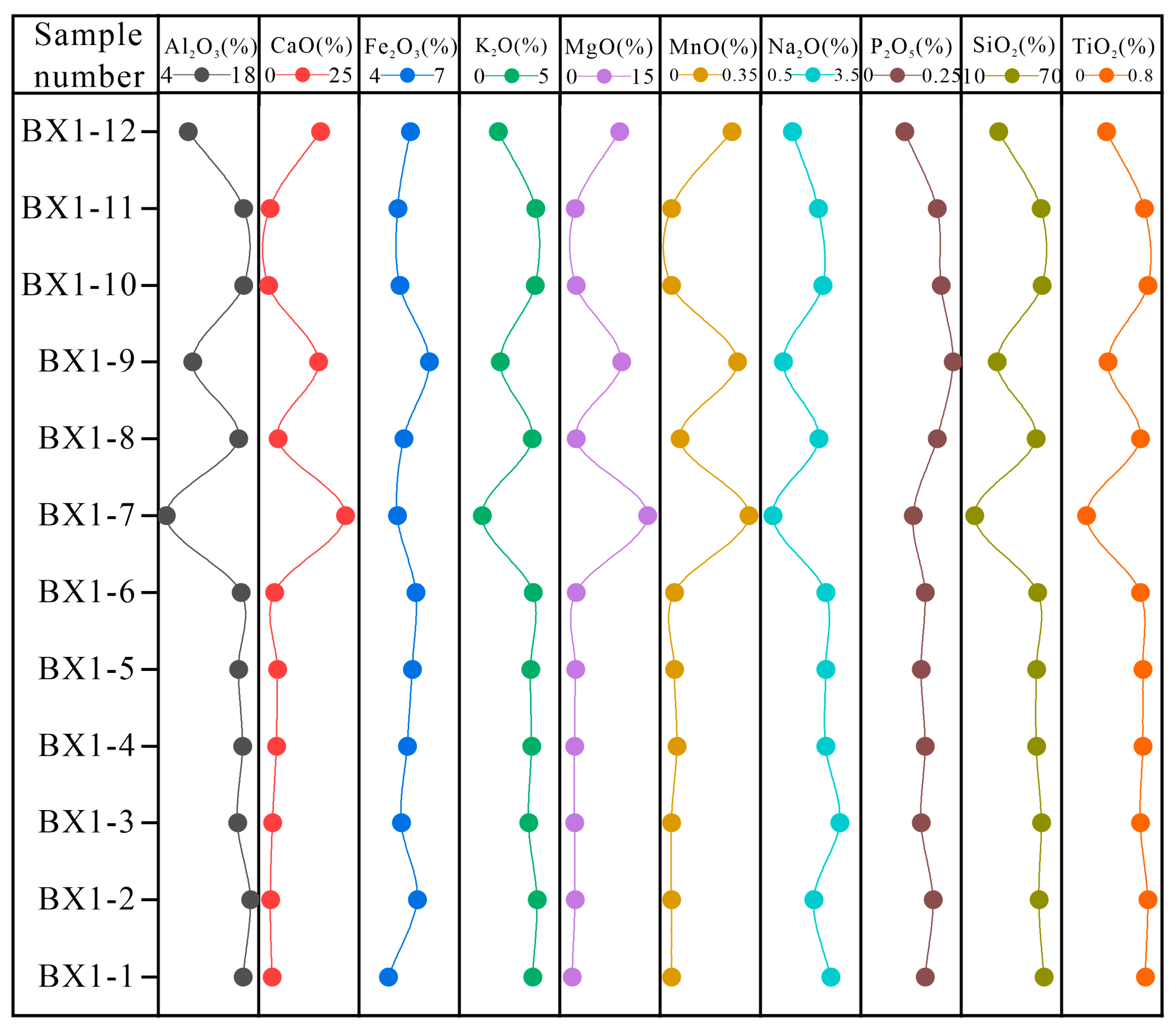
| Sample | Major Element Content/% | |||||||||
|---|---|---|---|---|---|---|---|---|---|---|
| Al2O3 | CaO | Fe2O3 | K2O | MgO | MnO | Na2O | P2O5 | SiO2 | TiO2 | |
| BX1-1 | 15.81 | 3.39 | 4.88 | 3.65 | 1.88 | 0.04 | 2.60 | 0.16 | 59.59 | 0.67 |
| BX1-2 | 16.91 | 2.95 | 5.75 | 3.87 | 2.34 | 0.04 | 2.10 | 0.18 | 56.56 | 0.69 |
| BX1-3 | 15.09 | 3.49 | 5.27 | 3.46 | 2.21 | 0.04 | 2.87 | 0.15 | 58.12 | 0.63 |
| BX1-4 | 15.80 | 4.50 | 5.45 | 3.61 | 2.27 | 0.06 | 2.46 | 0.16 | 55.07 | 0.65 |
| BX1-5 | 15.20 | 4.77 | 5.60 | 3.55 | 2.40 | 0.05 | 2.45 | 0.15 | 54.97 | 0.65 |
| BX1-6 | 15.57 | 4.02 | 5.70 | 3.67 | 2.46 | 0.05 | 2.46 | 0.16 | 55.58 | 0.63 |
| BX1-7 | 5.14 | 21.70 | 5.15 | 1.15 | 13.15 | 0.31 | 0.88 | 0.13 | 18.07 | 0.20 |
| BX1-8 | 15.24 | 4.82 | 5.35 | 3.63 | 2.43 | 0.07 | 2.25 | 0.19 | 54.68 | 0.63 |
| BX1-9 | 8.84 | 14.90 | 6.10 | 2.04 | 9.24 | 0.27 | 1.19 | 0.23 | 31.53 | 0.37 |
| BX1-10 | 15.88 | 2.49 | 5.22 | 3.78 | 2.43 | 0.04 | 2.36 | 0.20 | 58.25 | 0.69 |
| BX1-11 | 15.90 | 2.87 | 5.16 | 3.80 | 2.31 | 0.04 | 2.23 | 0.19 | 57.73 | 0.66 |
| BX1-12 | 8.17 | 15.40 | 5.53 | 1.94 | 8.96 | 0.25 | 1.46 | 0.11 | 32.32 | 0.36 |
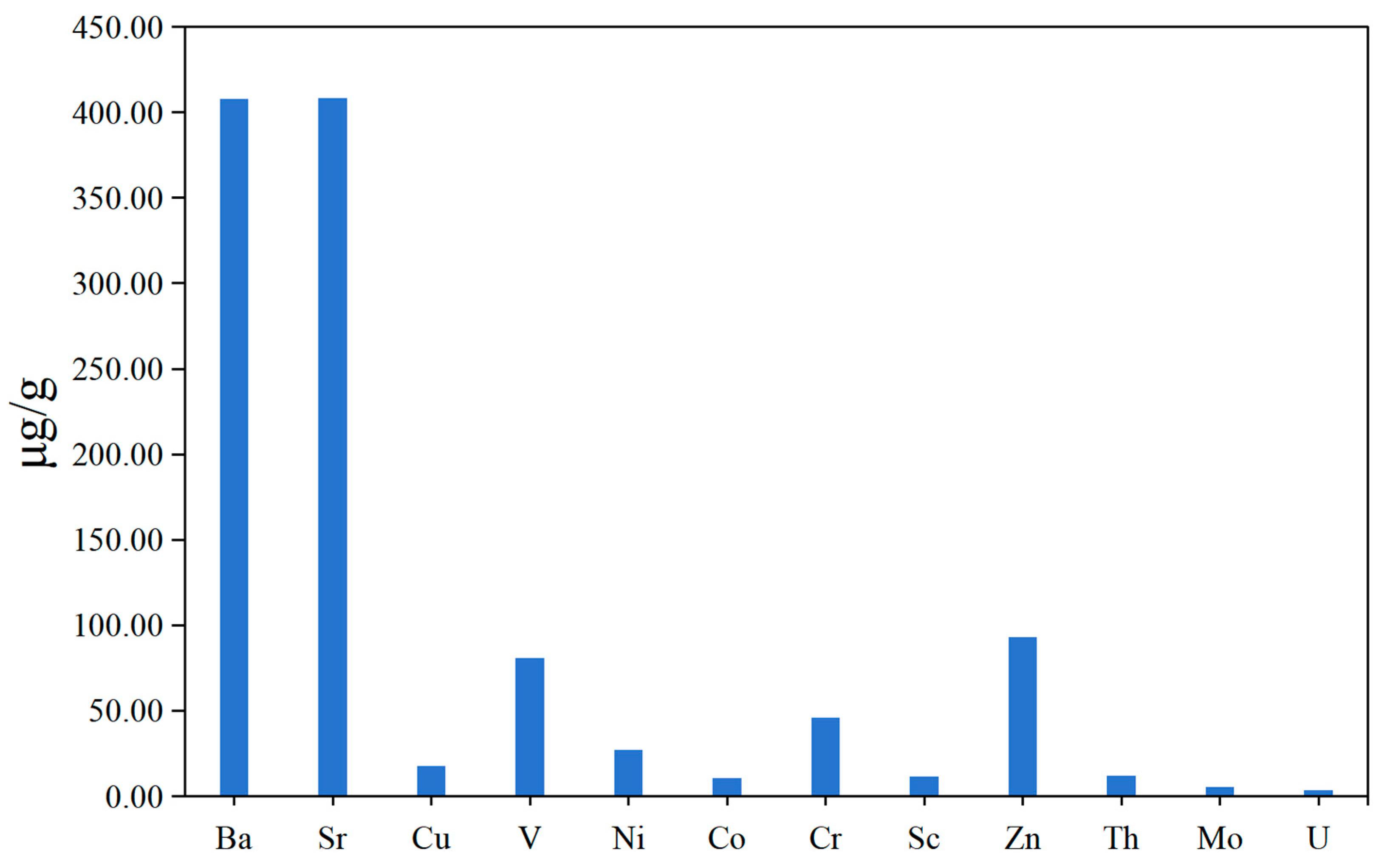
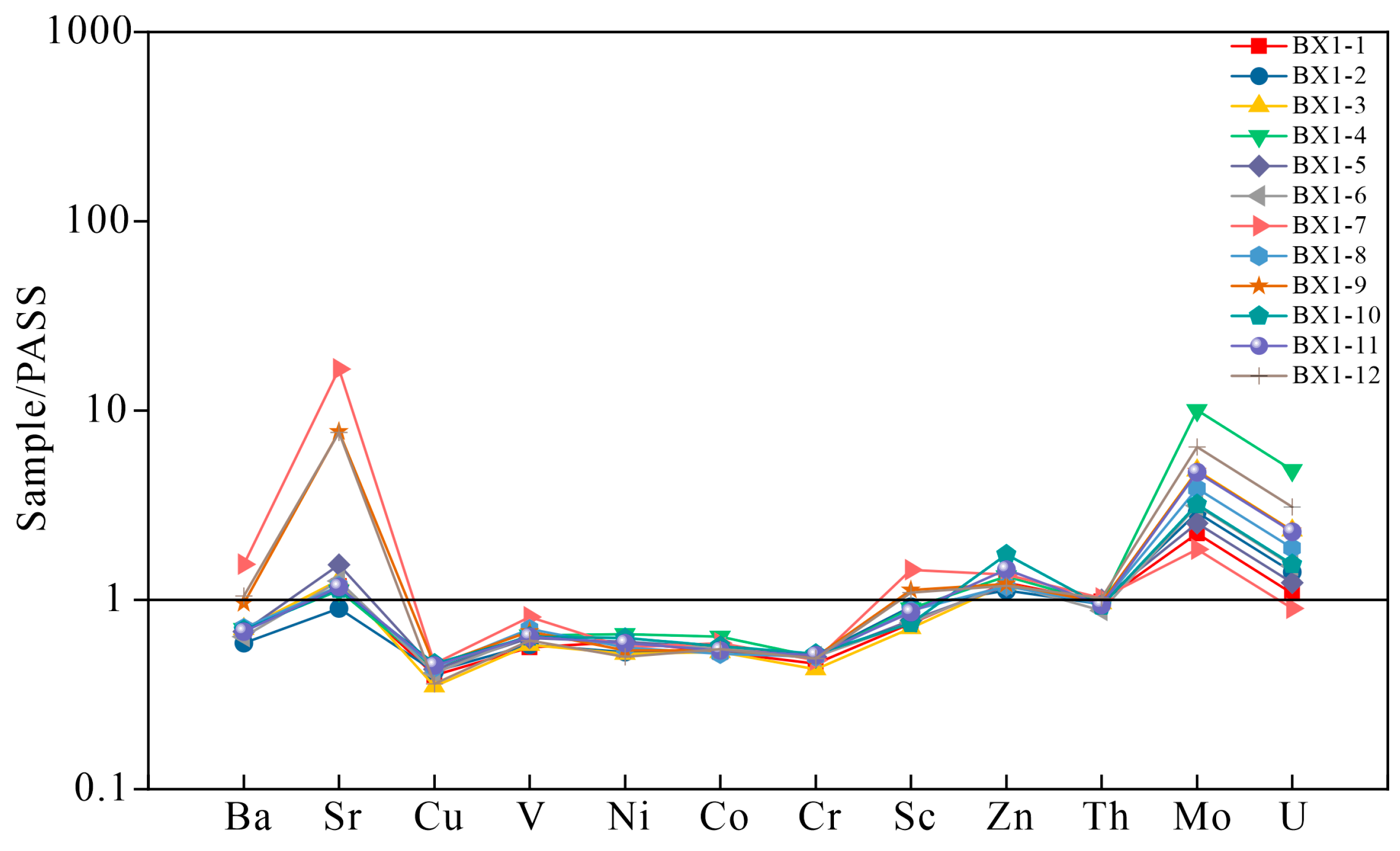
| Sample | Trace Element Content/µg/g | ||||||||||||||
|---|---|---|---|---|---|---|---|---|---|---|---|---|---|---|---|
| Ba | Sr | Cu | V | Ni | Be | Co | Cr | Ga | Li | Sc | Zn | Th | Mo | U | |
| BX1-1 | 438 | 231 | 19.4 | 82 | 32.4 | 2.72 | 11.8 | 49 | 22.0 | 67.4 | 11.7 | 102 | 13.90 | 3.27 | 3.60 |
| BX1-2 | 404 | 192 | 22.3 | 93 | 31.1 | 3.13 | 13.0 | 60 | 24.1 | 82.6 | 15.7 | 101 | 14.80 | 4.60 | 3.77 |
| BX1-3 | 426 | 238 | 16.2 | 82 | 26.7 | 2.40 | 11.3 | 44 | 19.70 | 75.1 | 10.6 | 96 | 13.15 | 6.74 | 3.51 |
| BX1-4 | 436 | 215 | 20.8 | 94 | 34.9 | 2.73 | 14.1 | 53 | 22.0 | 83.0 | 13.8 | 109 | 13.45 | 14.50 | 4.09 |
| BX1-5 | 420 | 292 | 20.6 | 91 | 31.7 | 2.63 | 12.4 | 53 | 20.8 | 84.1 | 12.0 | 97 | 14.00 | 3.65 | 3.58 |
| BX1-6 | 407 | 247 | 20.2 | 95 | 31.4 | 2.70 | 12.7 | 54 | 20.8 | 87.4 | 11.9 | 101 | 12.65 | 4.63 | 3.67 |
| BX1-7 | 339 | 1120 | 7.7 | 41 | 10.4 | 1.17 | 4.6 | 18 | 7.59 | 33.9 | 7.8 | 39 | 5.03 | 0.94 | 2.51 |
| BX1-8 | 433 | 221 | 20.5 | 98 | 28.7 | 2.61 | 11.2 | 51 | 21.1 | 83.3 | 13.1 | 94 | 13.00 | 5.43 | 4.00 |
| BX1-9 | 349 | 871 | 12.7 | 57 | 16.6 | 1.75 | 7.0 | 31 | 12.90 | 53.3 | 10.2 | 58 | 7.93 | 4.03 | 3.52 |
| BX1-10 | 449 | 227 | 23.0 | 95 | 34.5 | 2.70 | 13.0 | 57 | 21.2 | 86.7 | 12.0 | 147 | 13.50 | 4.76 | 5.46 |
| BX1-11 | 430 | 228 | 21.8 | 94 | 31.8 | 2.74 | 12.0 | 55 | 21.3 | 88.1 | 13.4 | 120 | 13.35 | 6.91 | 4.37 |
| BX1-12 | 364 | 817 | 9.5 | 49 | 14.6 | 1.57 | 6.7 | 29 | 11.70 | 48.0 | 9.3 | 54 | 7.98 | 5.13 | 2.99 |
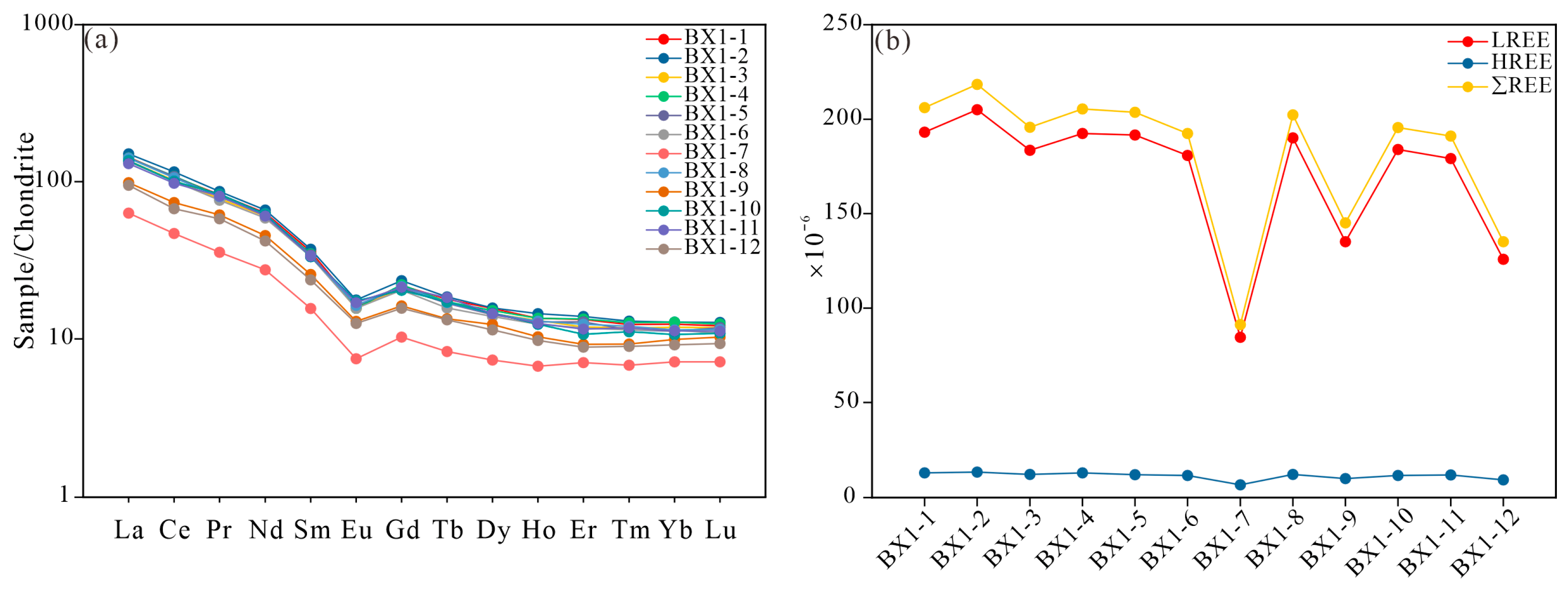
| Sample | Rare Earth Element Content/µg/g | |||||||||||||
|---|---|---|---|---|---|---|---|---|---|---|---|---|---|---|
| La | Ce | Pr | Nd | Sm | Eu | Gd | Tb | Dy | Ho | Er | Tm | Yb | Lu | |
| BX1-1 | 143.23 | 107.30 | 82.79 | 63.33 | 35.95 | 16.05 | 21.81 | 17.87 | 15.62 | 13.51 | 13.24 | 12.35 | 12.39 | 12.11 |
| BX1-2 | 150.32 | 115.72 | 86.89 | 66.17 | 37.18 | 17.69 | 23.44 | 18.51 | 15.71 | 14.48 | 13.90 | 12.96 | 12.78 | 12.73 |
| BX1-3 | 135.81 | 102.10 | 78.03 | 60.33 | 34.41 | 15.65 | 20.85 | 17.02 | 14.47 | 13.09 | 11.90 | 11.73 | 11.82 | 11.80 |
| BX1-4 | 142.26 | 108.29 | 81.72 | 62.00 | 34.72 | 15.65 | 22.05 | 17.23 | 15.16 | 13.51 | 13.38 | 12.65 | 12.78 | 12.42 |
| BX1-5 | 141.94 | 108.04 | 80.25 | 62.00 | 34.26 | 16.33 | 21.00 | 16.81 | 14.22 | 12.81 | 12.81 | 11.42 | 11.20 | 11.80 |
| BX1-6 | 134.52 | 100.99 | 76.39 | 58.67 | 33.28 | 15.65 | 20.42 | 15.74 | 13.88 | 12.40 | 11.71 | 11.42 | 11.34 | 10.87 |
| BX1-7 | 63.23 | 46.91 | 35.49 | 27.50 | 15.59 | 7.48 | 10.27 | 8.30 | 7.33 | 6.69 | 7.05 | 6.79 | 7.13 | 7.14 |
| BX1-8 | 140.97 | 106.06 | 80.49 | 62.67 | 33.64 | 16.33 | 21.47 | 17.02 | 14.47 | 12.95 | 12.38 | 12.04 | 11.39 | 11.49 |
| BX1-9 | 98.71 | 73.76 | 61.56 | 45.50 | 25.69 | 12.93 | 16.22 | 13.40 | 12.33 | 10.31 | 9.24 | 9.26 | 9.90 | 10.25 |
| BX1-10 | 135.81 | 100.37 | 83.61 | 62.50 | 33.28 | 17.41 | 20.42 | 17.23 | 14.60 | 12.40 | 10.71 | 11.11 | 10.67 | 10.87 |
| BX1-11 | 130.65 | 97.90 | 81.15 | 60.50 | 33.64 | 17.01 | 21.24 | 18.30 | 14.47 | 12.53 | 11.52 | 11.73 | 11.24 | 11.18 |
| BX1-12 | 94.84 | 67.45 | 58.03 | 42.00 | 23.69 | 12.52 | 15.68 | 13.19 | 11.40 | 9.75 | 8.86 | 8.95 | 9.14 | 9.32 |
Disclaimer/Publisher’s Note: The statements, opinions and data contained in all publications are solely those of the individual author(s) and contributor(s) and not of MDPI and/or the editor(s). MDPI and/or the editor(s) disclaim responsibility for any injury to people or property resulting from any ideas, methods, instructions or products referred to in the content. |
© 2026 by the authors. Licensee MDPI, Basel, Switzerland. This article is an open access article distributed under the terms and conditions of the Creative Commons Attribution (CC BY) license.
Share and Cite
Su, Y.; Fu, X.; Shao, H.; Xu, Q.; Wang, K.; Zheng, Q. Geochemical Characteristics and Paleoenvironmental Reconstruction of the Cretaceous Qingshankou Formation Shales in the Southeastern Uplift of the Songliao Basin: A Case Study from the Niaohexiang Section of Binxian, China. Appl. Sci. 2026, 16, 4052. https://doi.org/10.3390/app16084052
Su Y, Fu X, Shao H, Xu Q, Wang K, Zheng Q. Geochemical Characteristics and Paleoenvironmental Reconstruction of the Cretaceous Qingshankou Formation Shales in the Southeastern Uplift of the Songliao Basin: A Case Study from the Niaohexiang Section of Binxian, China. Applied Sciences. 2026; 16(8):4052. https://doi.org/10.3390/app16084052
Chicago/Turabian StyleSu, Yangxin, Xiuli Fu, Hongjun Shao, Qinghai Xu, Kun Wang, and Qiang Zheng. 2026. "Geochemical Characteristics and Paleoenvironmental Reconstruction of the Cretaceous Qingshankou Formation Shales in the Southeastern Uplift of the Songliao Basin: A Case Study from the Niaohexiang Section of Binxian, China" Applied Sciences 16, no. 8: 4052. https://doi.org/10.3390/app16084052
APA StyleSu, Y., Fu, X., Shao, H., Xu, Q., Wang, K., & Zheng, Q. (2026). Geochemical Characteristics and Paleoenvironmental Reconstruction of the Cretaceous Qingshankou Formation Shales in the Southeastern Uplift of the Songliao Basin: A Case Study from the Niaohexiang Section of Binxian, China. Applied Sciences, 16(8), 4052. https://doi.org/10.3390/app16084052