Article

Geochemical Characteristics and Paleoenvironmental Reconstruction of the Cretaceous Qingshankou Formation Shales in the Southeastern Uplift of the Songliao Basin: A Case Study from the Niaohexiang Section of Binxian, China


1
State Key Laboratory of Continental Shale Oil, Daqing 163412, China
2
Exploration and Development Research Institute of Daqing Oilfield Company Limited, Daqing 163412, China
3
Heilongjiang Provincial Key Laboratory of Continental Shale Oil, Daqing 163412, China
4
School of Geosciences, Yangtze University, Wuhan 430100, China
*
Author to whom correspondence should be addressed.
Appl. Sci. 2026, 16(8), 4052; https://doi.org/10.3390/app16084052
Submission received: 30 March 2026 / Revised: 14 April 2026 / Accepted: 17 April 2026 / Published: 21 April 2026

Abstract

The Qingshankou Formation shales in the southeastern uplift of the Songliao Basin provide an ideal archive for constraining the controls of paleoenvironment on organic matter enrichment. Taking the shale succession at the Niaohexiang section of Binxian as the study object, we combined field sampling with TOC measurements, whole-rock X-ray diffraction, and major, trace, and rare earth element analyses. The strata are dominated by black shale and dark gray mudstone, with mineral assemblages composed mainly of clay, felsic, and carbonate minerals; argillaceous shale exceeds 60%. Normal alkanes display a post-peak distribution with C27 as the dominant peak, low Pr/Ph ratios, and gammacerane index values of 0.18–0.26. Regular steranes are generally V-shaped, whereas some samples show high C29 sterane contents and a reversed L-shaped pattern. Major elements are dominated by SiO2 and Al2O3, trace elements such as Sr and Ba are relatively enriched, and rare earth elements show light REE enrichment with a pronounced negative Eu anomaly. These signatures indicate an upper-crustal felsic provenance and a continental island arc tectonic setting. Organic matter contents are low and derived mainly from terrestrial higher plants with minor aquatic input. Paleoenvironmental reconstruction suggests deposition in a freshwater to slightly brackish, semi-arid, anoxic-reducing shallow lacustrine setting with relatively low productivity, whereas dolostone formed under more saline, arid, and more productive conditions. Climatic fluctuations, salinity variations, and alternating redox states jointly controlled organic matter enrichment, and late-stage lacustrine salinization and anoxia associated with dolostone horizons enhanced organic matter preservation.

1. Introduction

Continental lacustrine systems represent one of the most favorable depositional settings for organic-rich, fine-grained sedimentary rocks and constitute the primary host environments for shale oil accumulation in China. Significant shale oil resources are widely distributed across several major sedimentary basins in China [1,2,3,4]. Among these, the Songliao Basin in Northeast China plays an irreplaceable strategic role in national energy exploration and development owing to its abundant hydrocarbon reserves [5]. The extensive Cretaceous strata within the basin not only record the evolution of its sedimentary environments during basin development but also host substantial unconventional hydrocarbon resources, including shale oil and oil shale [6]. Particularly noteworthy are the Qingshankou and Nenjiang formations, whose shale intervals are characterized by high clay contents and are collectively referred to as the “Gulong Shale” [7,8]. The Gulong Shale was deposited in a lacustrine setting characterized by a warm, humid climate and abundant algal productivity, and it exhibits high organic matter abundance (TOC ≥ 1.0%) and moderate thermal maturity (Ro ≥ 0.75%) [9,10,11,12], and the predicted geological reserves of oil shale in the Qingshankou Formation are estimated at 1.268 × 10⁹ tonnes [13]. Vertically, the resources are mainly concentrated in the first member and the lower part of the second member of the Qingshankou Formation, whereas horizontally, they are primarily enriched in the Qijia–Gulong Depression, the southern part of the Daqing Changyuan, and the Sanzhao Depression [14]. Notably, pioneering advances in the exploration and development of lacustrine shale in the Songliao Basin have brought shale oil to the forefront of energy research and policy discussions in response to rapidly growing global energy demand [15].
Most previous studies on shale in the Songliao Basin have focused on the Gulong Depression [16,17,18]. In contrast, the southeastern uplift area lacks systematic geochemical and sedimentological data from field outcrops. With ongoing exploration, it has been recognized that the Qingshankou Formation shales in the southeastern uplift also possess favorable hydrocarbon generation potential [19,20]. Recent advances in fine-grained sedimentology and shale sedimentology indicate that elucidating the mechanisms of organic matter accumulation and preservation under different depositional environments, the genetic types of lithofacies and sedimentary structures, as well as the associated sedimentary dynamics and depositional models, constitutes a set of core scientific issues [7]. In this study, detailed analyses were conducted on shale samples collected from field outcrops in the Niaohexiang area of Binxian, located in the southeastern uplift of the Songliao Basin. Notably, this work represents the first systematic outcrop-based investigation in this region. Major and trace elements, rare earth elements, and whole-rock XRD data were obtained to comprehensively characterize the petrological, mineralogical, and geochemical features of the shales. By integrating these results with previous studies, we systematically constrained the provenance and tectonic setting, and reconstructed key sedimentary environmental parameters, including paleosalinity, paleoclimate, redox conditions, paleowater depth, and lacustrine paleoproductivity. The results reveal a distinct arid lacustrine transitional system, characterized by the development of dolomite layers. On this basis, we further elucidate the controlling mechanisms of paleoenvironmental conditions on the formation of organic-rich shales, thereby providing an important theoretical foundation for predicting shale oil enrichment and “sweet spots”.

2. Geological Overview

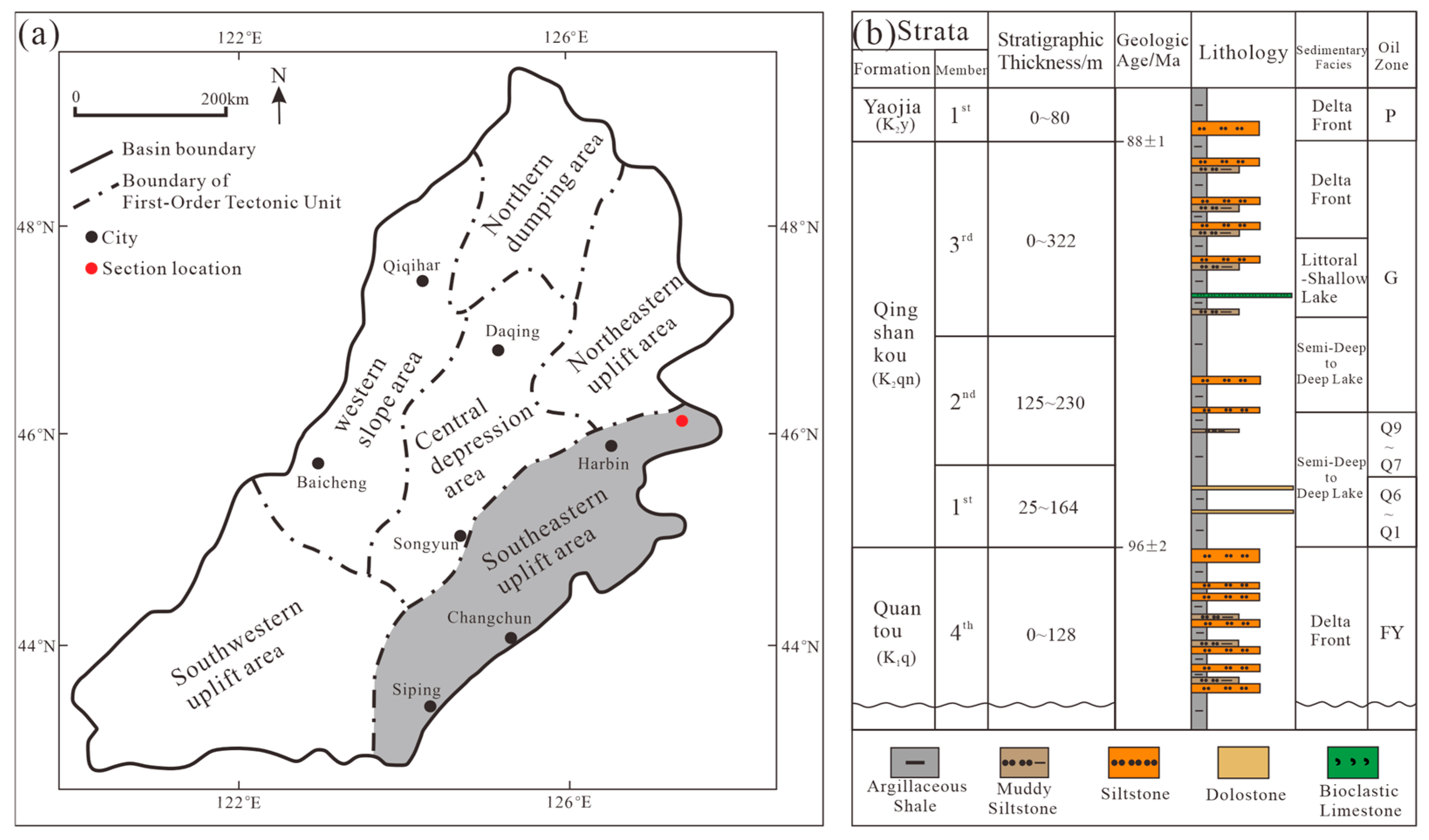
As a major Meso–Cenozoic hydrocarbon-bearing basin in Northeast China, the Songliao Basin has experienced multistage tectonic evolution, comprising a pre-rift stage (Late Jurassic), a syn-rift subsidence stage (Early Cretaceous), a post-rift thermal subsidence stage (Middle Cretaceous), and a superimposed basin inversion stage from the Late Cretaceous to the Quaternary [21,22,23,24]. The basin is divided into six structural units: northern submergence area, central depression area, northeastern uplift area, southeastern uplift area, southwestern uplift area, and western slope area. It constitutes one of the most significant oil and gas producing regions in China, as shown in Figure 1a [25,26]. The study area is located in the southeastern uplift area at the margin of the Songliao Basin, which represents the principal shale development area. From bottom to top, the Cretaceous stratigraphic succession can be divided into the Shahezi, Yingcheng, Denglouku, Quantou, Qingshankou, Yaojia, Nenjiang, Sifangtai, and Mingshui formations [6,27]. Among these units, the Qingshankou Formation, which was deposited during the late Early Cretaceous depression stage, has a thickness of 260–500 m and is subdivided into three members from bottom to top, as shown in Figure 1b. The first member consists of gray-black mudstone (deep-lacustrine to semi-deep-lacustrine facies) interbedded with siltstone, is rich in organic matter and ostracod fossils, and represents the main source rock. The second member is composed of deep-lacustrine to semi-deep-lacustrine gray-green mudstone interbedded with siltstone, containing calcareous nodules and wave ripples. The third member comprises delta-front gray-green mudstone interbedded with sand bodies and is well developed with cross-bedding, reflecting lake-basin shrinkage and water-level retreat. Overall, the Qingshankou Formation records a complete cycle of lake-basin expansion, stability, and contraction [28,29].

3. Materials and Methods

Based on detailed field observation and description of outcrops in the Songliao Basin, outcrop samples were collected from the upper part of the first member and the lower part of the second member of the Qingshankou Formation in the Niaohexiang section of Binxian, located in the southeastern uplift area. A total of 12 samples were obtained and sequentially labeled BX1-1 to BX1-12. These samples were subjected to a series of analytical tests, including X-ray diffraction (XRD), whole-rock mineralogical analysis, major and trace element analysis, and rare earth element (REE) determination, in order to investigate the geochemical characteristics and sedimentary environment of the Qingshankou Formation shale.
Mineral compositions were quantitatively analyzed using a Rigaku D/max-2500 X-ray diffractometer (XRD) (Rigaku Corp., Tokyo, Japan) with Cu-Kα radiation at 40 kV and 30 mA. Major element concentrations were determined by X-ray fluorescence (XRF) spectroscopy on fused glass beads using a Panalytical Axios mAX spectrometer (PANalytical B.V., Almelo, Overijssel, The Netherlands). Trace elements were analyzed by inductively coupled plasma mass spectrometry (ICP-MS) using an Agilent 7900 system (Agilent Technologies, Singapore) after four-acid digestion (HF-HNO3-HClO4-HCl) in high-pressure Teflon bombs. Rare earth element (REE) concentrations were measured by ICP-MS following alkali fusion (Li2B4O7) digestion to ensure complete dissolution of refractory minerals. To ensure the accuracy of Total Organic Carbon (TOC) measurements, powdered samples were pre-treated with 10% hydrochloric acid (HCl) at 60 °C for 24 h to completely remove carbonate minerals (inorganic carbon). The residues were then washed with deionized water until neutral and dried at 65 °C. TOC contents were subsequently determined using a LECO CS230 analyzer (LECO Corp., St. Joseph, MI, USA) in accordance with the GB/T 19145–2022 standard. Saturated hydrocarbons were separated from the total bitumen extracts (extracted via Soxhlet for 72 h with dichloromethane/methanol 9:1 v/v) using column chromatography. The fractions were analyzed by gas chromatography–mass spectrometry (GC-MS) using an Agilent 7890B GC coupled with a 5977A MSD (Agilent Technologies, Santa Clara, CA, USA), equipped with an HP-5MS fused silica capillary column (30 m × 0.25 mm × 0.25 µm). The oven temperature was programmed to hold at 50 °C for 1 min, then ramp to 310 °C at 3 °C/min, and hold for 20 min.

4. Results

4.1. Petrological Characteristics

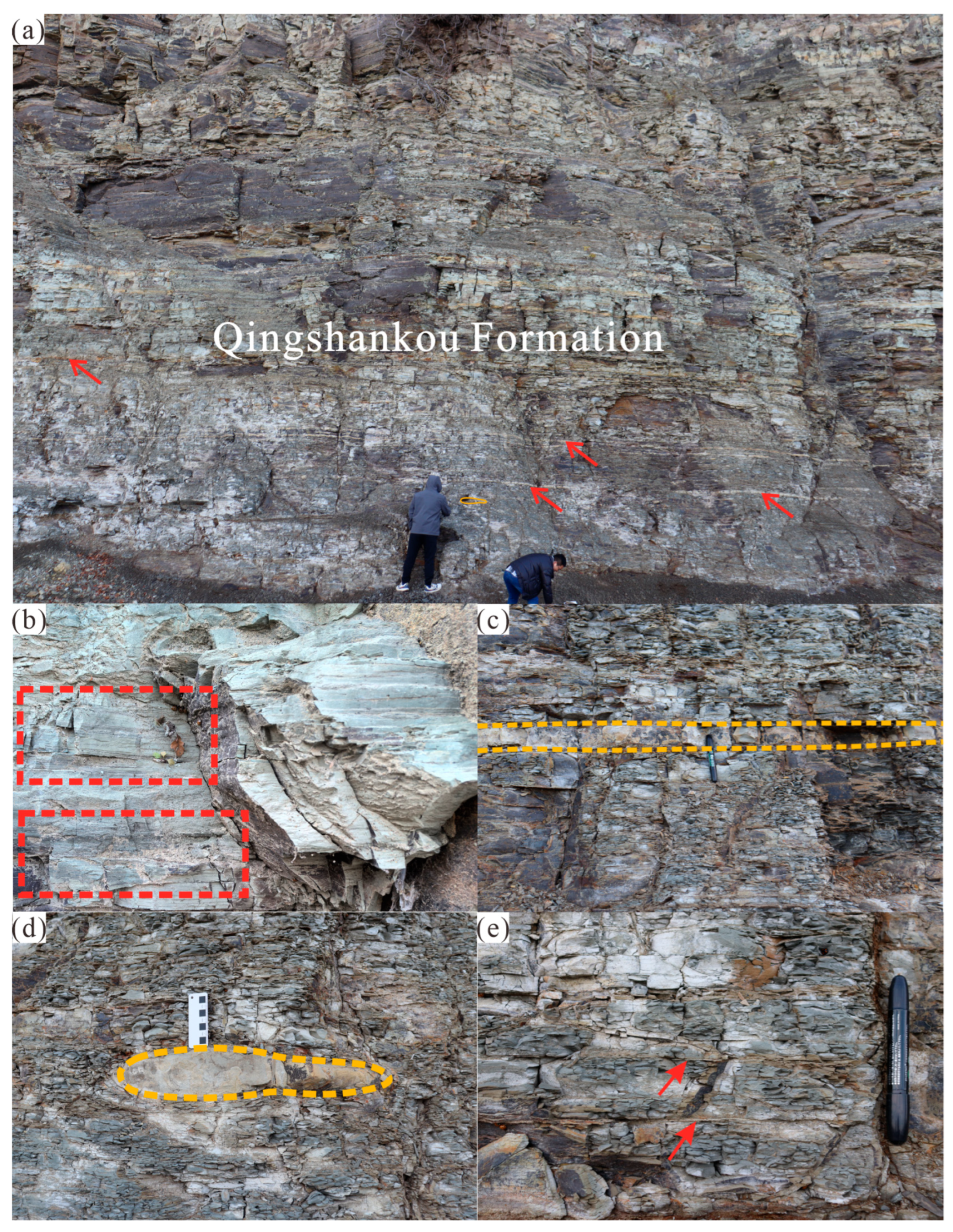
The Niaohexiang section in Binxian is primarily composed of black shale and grayish-black mudstone belonging to the Qingshankou Formation. This formation records shallow nearshore lacustrine depositional environments. The shale facies are highly heterogeneous, with marked variations in bedding characteristics and textural development. The profile clearly reveals multiple dolomite layers within the Qingshankou Formation, with thicknesses ranging from a few centimeters to several tens of centimeters. These layers exhibit stable lateral continuity, and cross-sectional views display dolomite nodules of variable size. The long axes of most nodules are oriented parallel to bedding planes, as illustrated in Figure 2.

4.2. Mineralogical Characteristics

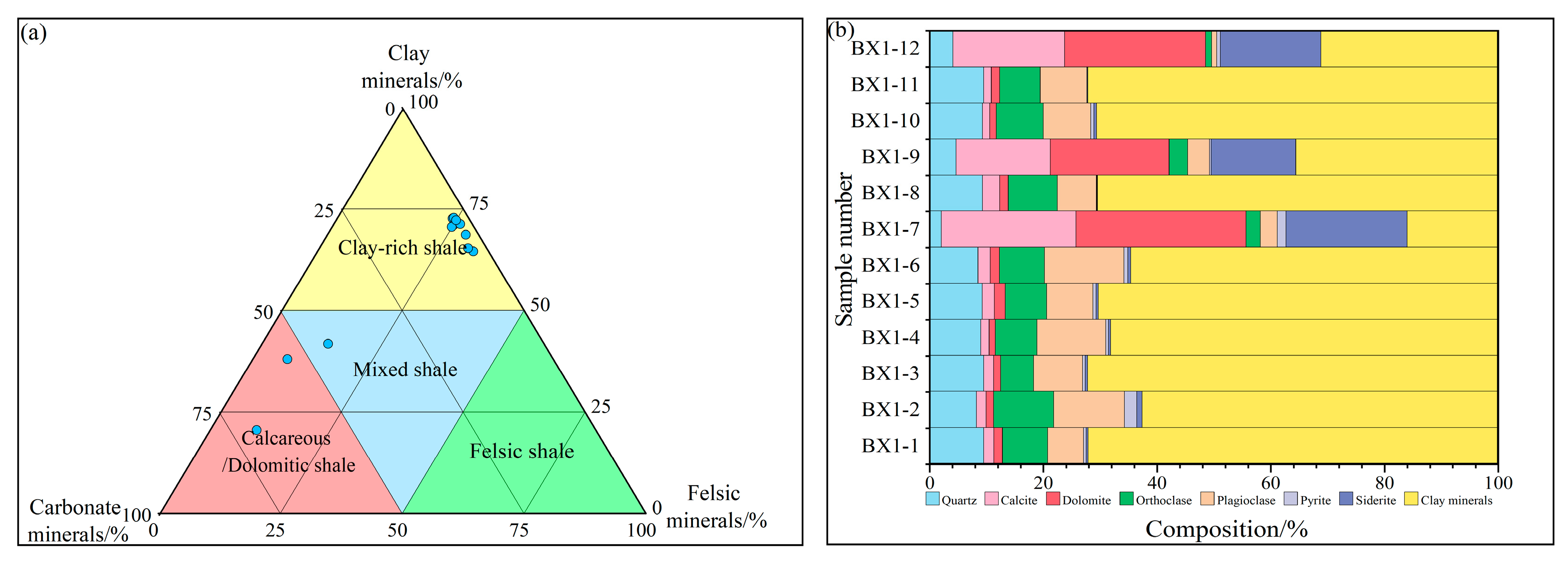
Based on X-ray diffraction analyses, whole-rock and quantitative clay mineral analyses were conducted on shale samples from the Qingshankou Formation in the southeastern uplift of the Songliao Basin. The results show that the shale mineral assemblage is dominated by clay minerals, felsic minerals, and carbonate minerals, with minor amounts of other phases such as pyrite and siderite (Figure 3 and Table 1).
The clay mineral content ranges from 13.05% to 69.41%, with an average of 54.22%. Felsic minerals are dominated by quartz, plagioclase, and orthoclase, with total contents ranging from 7.45% to 32.32% and an average of 22.70%. Specifically, quartz contents range from 1.73% to 9.19% (average 7.18%), plagioclase from 0.75% to 12.86% (average 7.13%), and orthoclase from 0.93% to 9.89% (average 6.00%). Carbonate minerals are mainly calcite and dolomite, with total contents ranging from 2.45% to 69.56% and an average of 16.54%. Among them, dolomite contents range from 1.01% to 24.63% (average 6.33%), and calcite from 1.15% to 16.77% (average 5.51%). The study area is characterized by relatively high clay mineral and feldspar contents and relatively low carbonate contents. The lithology classification ternary diagram indicates that the samples from the study area are predominantly clay-rich shale, calcareous/dolomitic shale, and mixed shale. Calcareous/dolomitic shale and mixed shale commonly occur as interbeds, whereas clay-rich shale accounts for more than 60% of the samples.

4.3. Geochemical Characteristics

4.3.1. Biomarker Characteristics

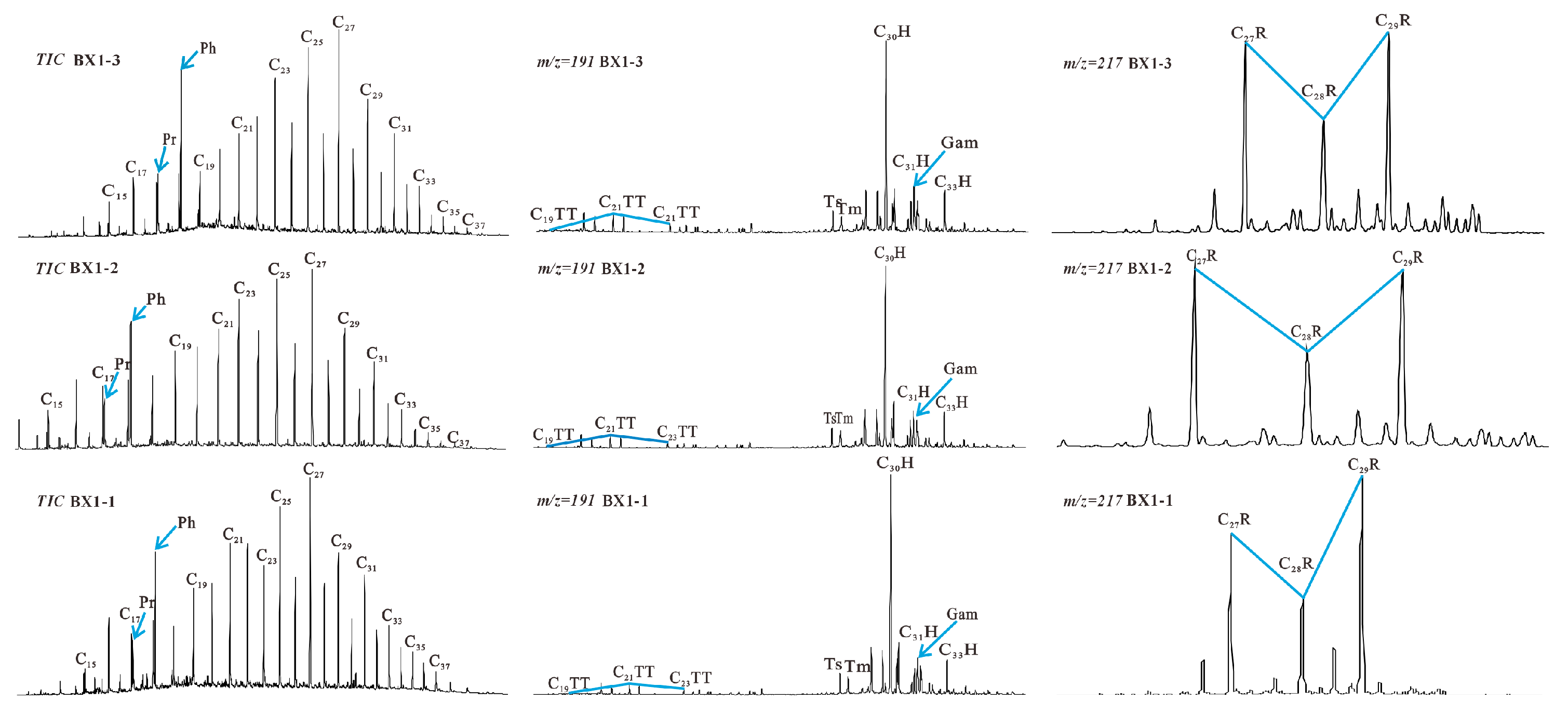
In the study area, the n-alkanes of the Qingshankou Formation shale samples exhibit a post-normal-alkane maximum distribution, with C27 as the predominant peak carbon, indicating that the organic matter is mainly derived from terrestrial higher plants. The n-alkane distribution also shows a pronounced odd-over-even carbon number predominance, with CPI values ranging from 1.73 to 2.36 (average 2.05) and OEP values ranging from 1.92 to 2.60 (average 2.27), the latter providing a more distinct indication [30]. In addition, isoprenoids such as pristane (Pr) and phytane (Ph) are readily detected in the Qingshankou Formation shale samples. The Pr/Ph ratios are relatively low, ranging from 0.25 to 0.40 with an average of 0.32, and the gammacerane index GI (gammacerane/C30 hopane) ranges from 0.18 to 0.26 with an average of 0.23 (Table 2). These parameters collectively suggest deposition under mildly anoxic–reducing conditions and brackish to moderately brackish water [31,32]. The C27–C28–C29 regular sterane distribution is generally characterized by a “V-shaped” pattern, whereas sample BX1-1 shows relatively higher C29 sterane abundance, forming an inverted “L-shaped” pattern, which further indicates a significant contribution from terrestrial higher plants [33] (Figure 4).

4.3.2. Major Element Characteristics

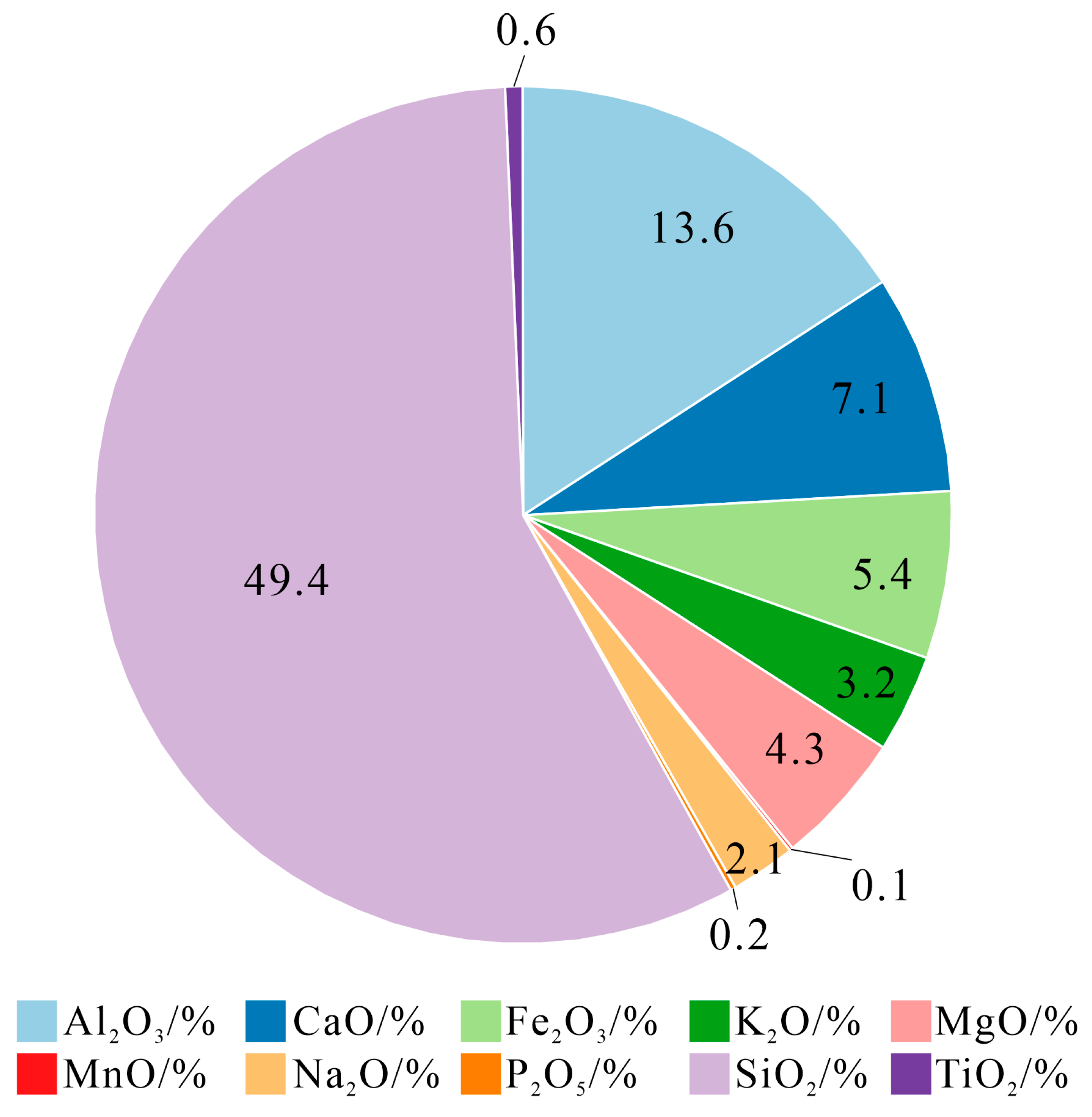
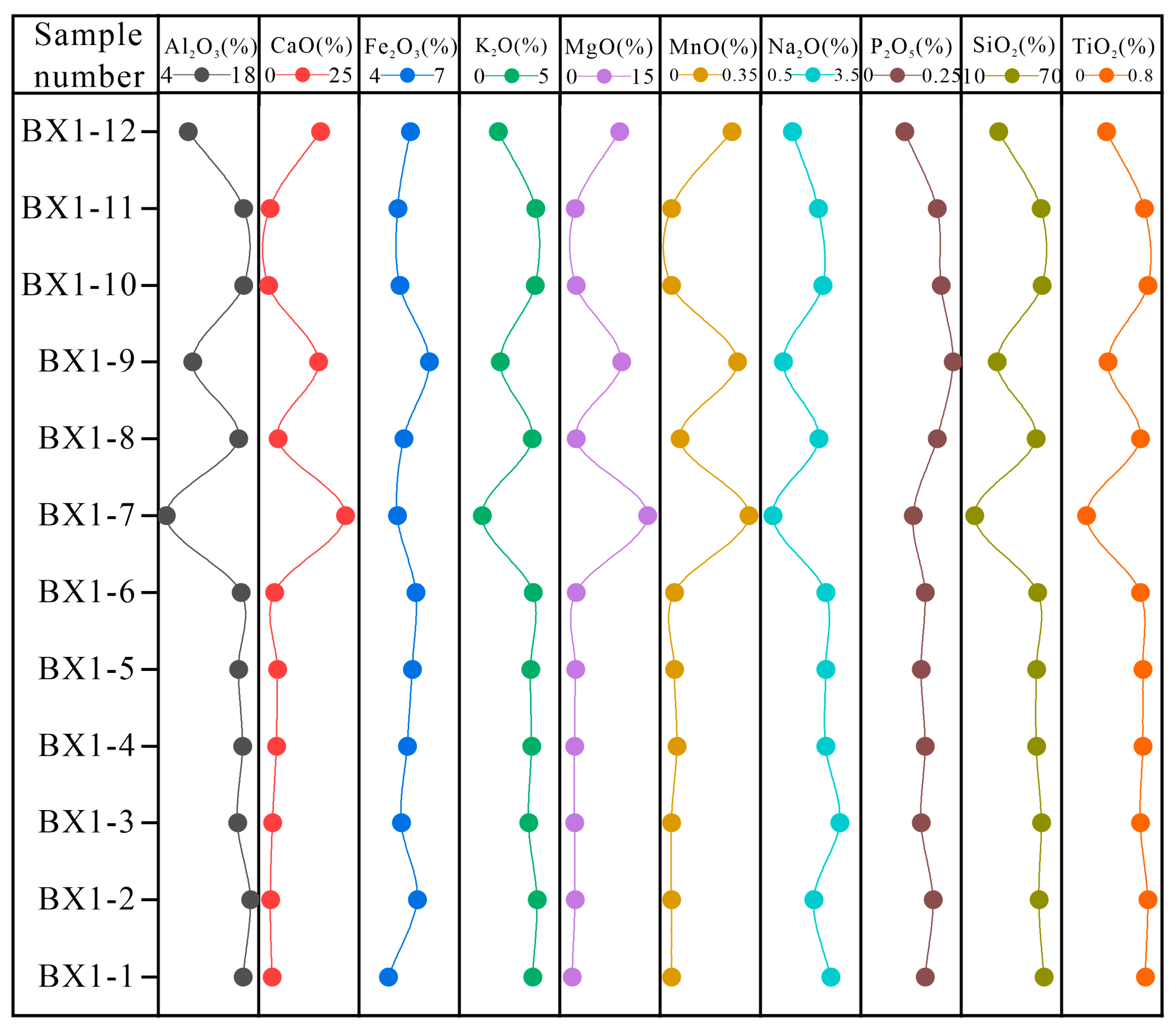
The major element composition of the shale in the Binxian section is presented in Table 3. The major elements are dominated by SiO2 and Al2O3, followed by CaO, Fe2O3, MgO, and K2O (Figure 5). Among the major oxides, SiO2 contents range from 18.07% to 59.59%, with an average of 49.37%; Al2O3 ranges from 5.14% to 16.91% (average 13.63%); CaO from 2.49% to 21.70% (average 7.11%); Fe2O3 from 4.88% to 6.10% (average 5.43%); MgO from 1.88% to 13.15% (average 4.34%); and K2O from 1.15% to 3.87% (average 3.18%). In addition, minor amounts of P2O5, Na2O, MnO, and other major elements are also present. The dolomitic samples exhibit notably higher CaO and MgO contents: in sample BX1-7 (dolomite nodule), CaO and MgO contents are 21.70% and 13.15%, respectively; in sample BX1-9 (dolomite), CaO is 14.90% and MgO is 9.24%; and in sample BX1-12 (dolomite), CaO is 15.40% and MgO is 8.96% (Figure 6).

4.3.3. Trace Element Characteristics

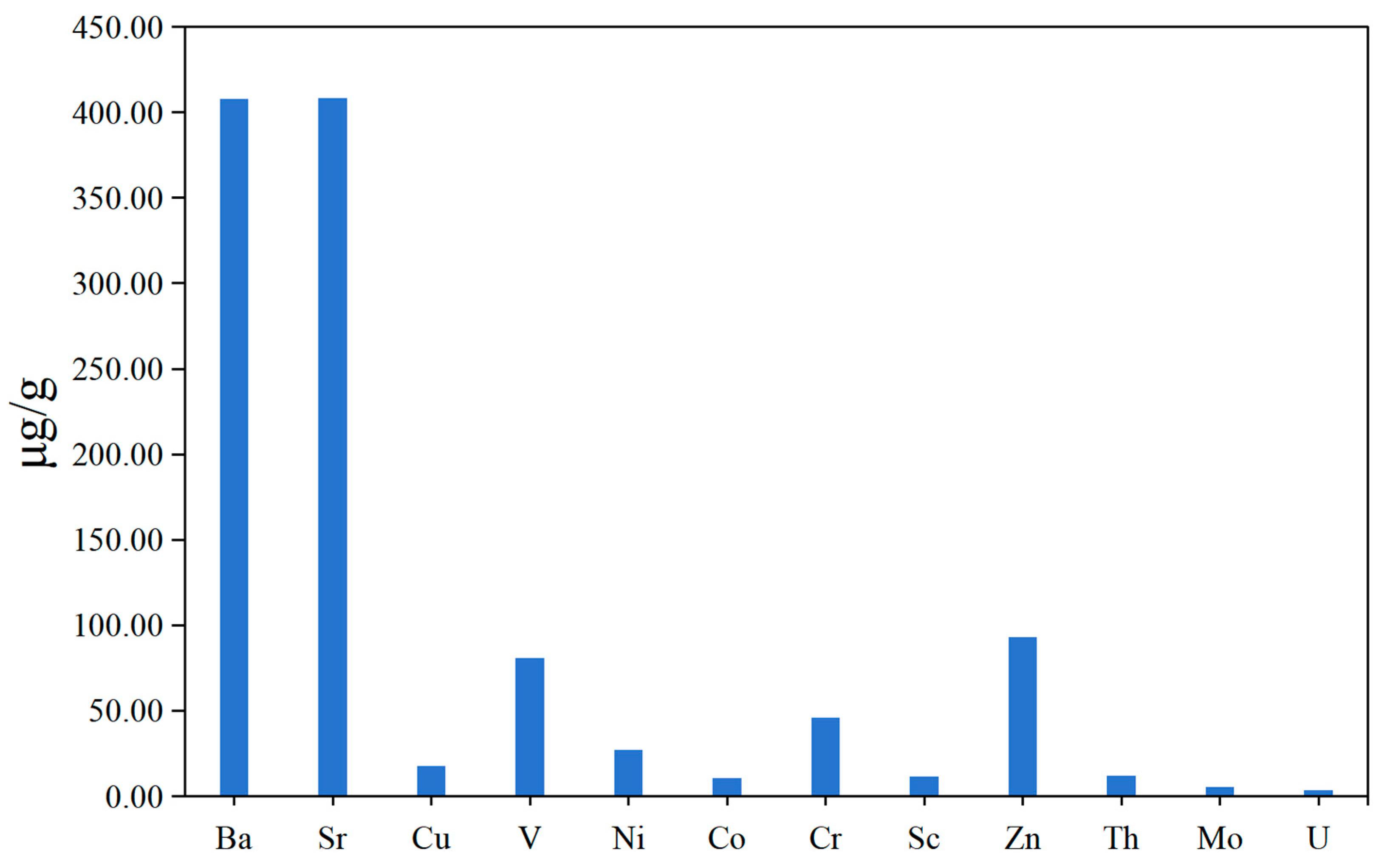
Because trace elements are highly sensitive to variations in depositional environments, they are commonly employed as geochemical proxies for reconstructing depositional conditions [34,35]. In the samples from the study area, the principal trace elements are Sr, Ba, Zn, V, Li, and Cr, followed by Ni, Cu, Ga, Co, Be, and other minor elements (Table 4). Specifically, Sr contents range from 192 to 1120 μg/g, with an average of 408.25 μg/g; Ba ranges from 339 to 449 μg/g (average 407.92 μg/g); Zn from 39 to 147 μg/g (average 93.17 μg/g); V from 41 to 98 μg/g (average 80.92 μg/g); and Li from 33.9 to 88.1 μg/g (average 72.74 μg/g) (Figure 7). In addition, the Sr/Cu ratios range from 8.61 to 145.45 (average 33.59), Sr/Ba ratios from 0.48 to 3.30 (average 1.08), and V/(V + Ni) from 0.72 to 0.80 (average 0.75).
To reduce the influence of terrigenous detritus, carbonates, and other sedimentary components on authigenic trace elements, the enrichment factor (EF) method was applied for geochemical normalization. The EF is a key parameter for assessing the degree of element enrichment in the samples [36,37]. Its calculation is given by:
EFX = (X/Al)sample/(X/Al)PAAS,
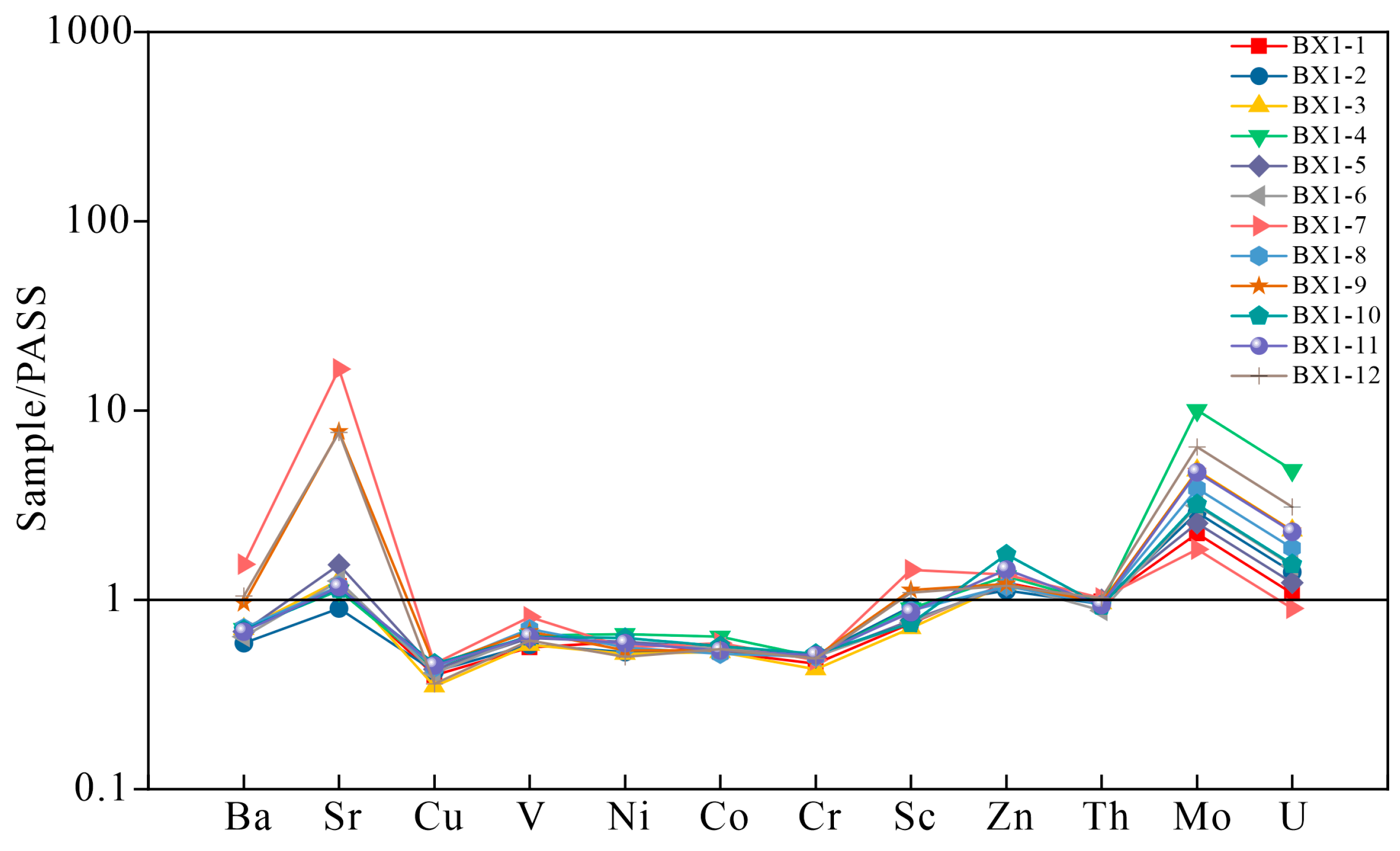
where (X/Al)PAAS denotes the average X/Al ratio of Post-Archean Australian Shale (PAAS) [38,39]. An EFX value greater than 1 indicates the relative enrichment of element X in the sample, while an EFX value less than 1 indicates the relative depletion of element X. The analysis of trace element enrichment factors (Figure 8) reveals a clear differentiation between element suites. Redox-sensitive elements (RSEs), specifically Mo and U, exhibit moderate to significant enrichment, indicating the prevalence of oxygen-depleted (suboxic to anoxic) bottom-water conditions. The nutrient-related element Zn also shows varying degrees of enrichment, likely reflecting a certain level of organic matter accumulation and biological productivity. In contrast, other transition metals and lithogenic elements, including Cu, V, Ni, Co, and Cr, display particularly strong depletion. This contrast suggests a potential decoupling between productivity-driven accumulation and redox-controlled enrichment in this lacustrine system, where Sc primarily reflects the background of terrestrial clastic input.

4.3.4. Rare Earth Element Distribution Pattern

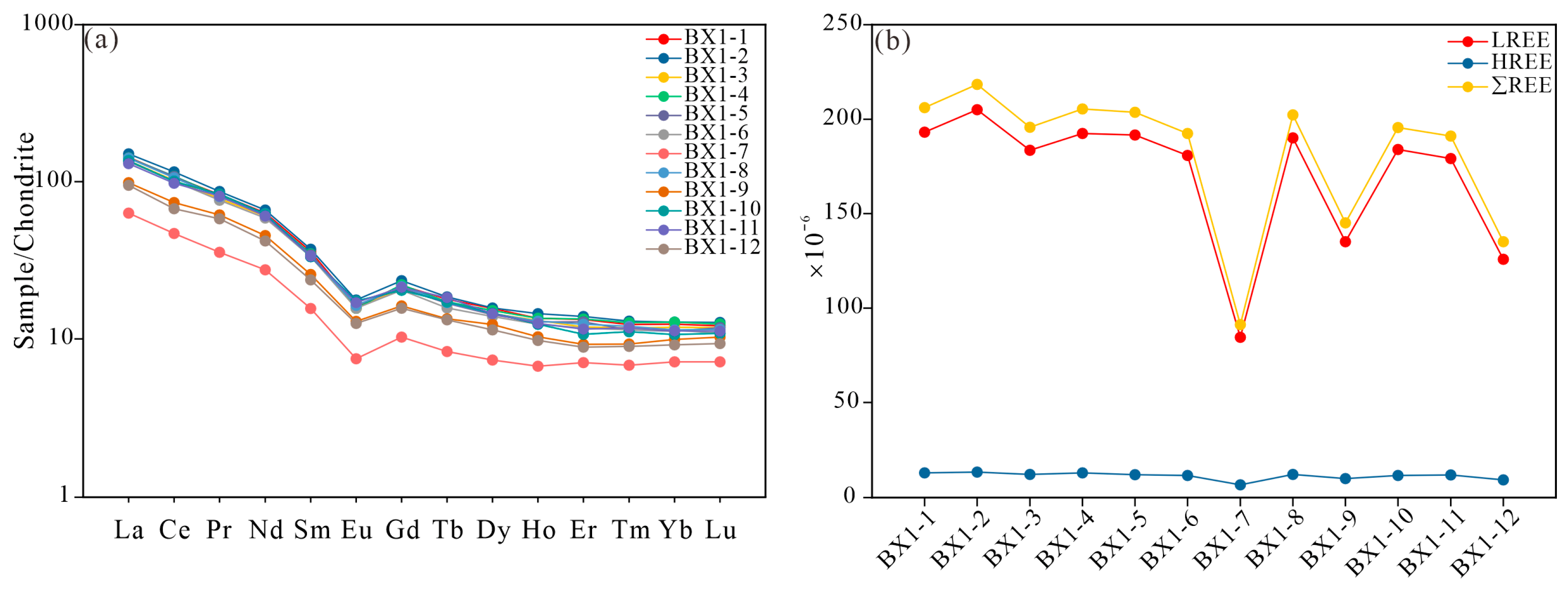
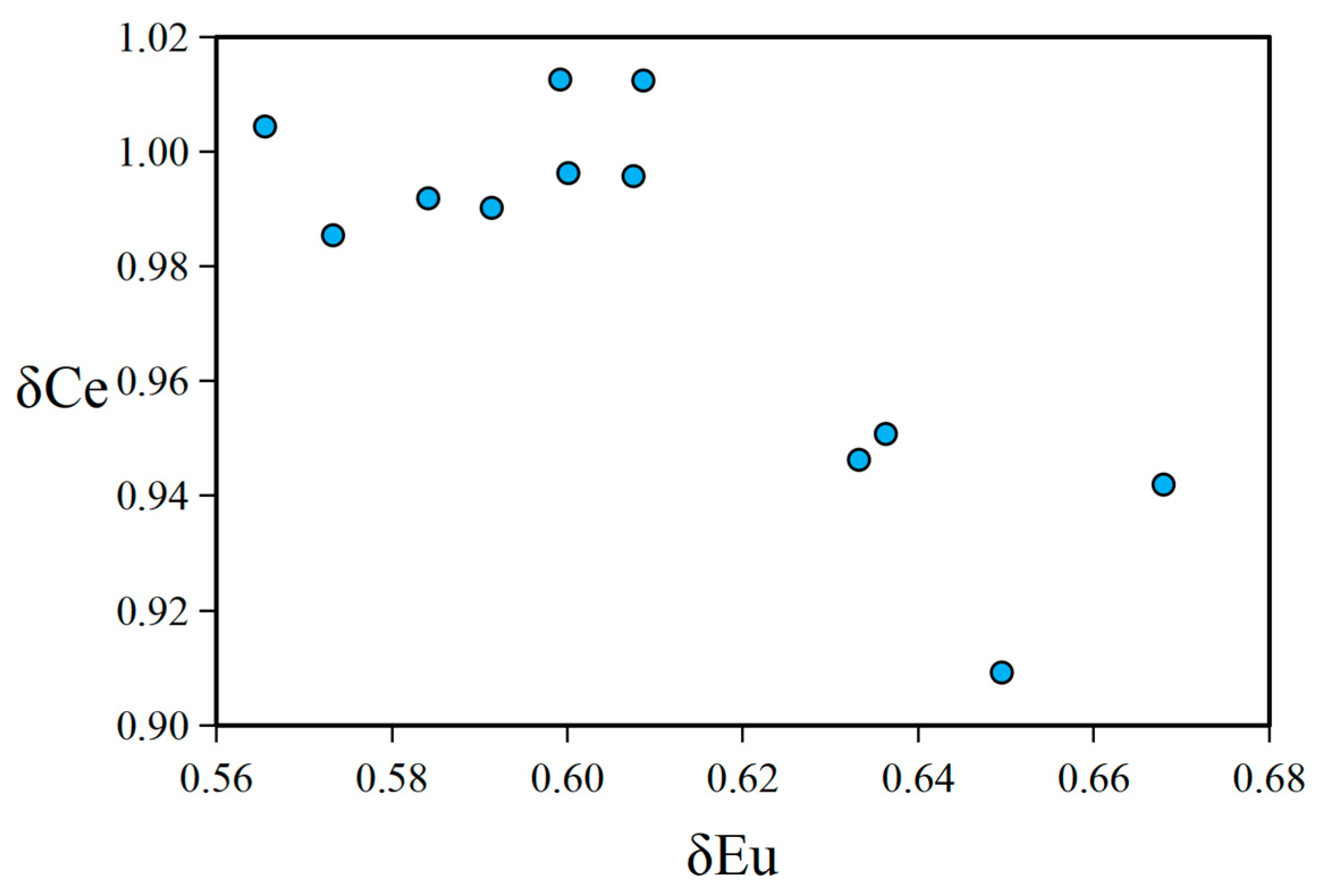
The rare earth element (REE) distribution patterns were constructed by normalizing REE abundances and ratios (Table 5) to chondritic values [40,41]. REE analytical data show that ΣREE values in the samples range from (91.23–218. 41) × 10−6, with an average of 181.83 × 10⁻⁶. The relatively wide range and overall high ΣREE values indicate strong input of terrigenous clastic material during the depositional period. Light rare earth element (LREE) contents range from (84.58–205.02) × 10−6, with an average of 170.43 × 10⁻⁶, whereas heavy rare earth element (HREE) contents range from (6.65–13.39) × 10−6, with an average of 11.40 × 10⁻⁶ (Figure 9). The δEu values vary between 0.55 and 0.65, with an average of 0.59, indicating a pronounced negative Eu anomaly. The δCe values range from 0.88 to 0.98, with an average of 0.94, reflecting a weak negative Ce anomaly (Figure 10). The ratios LREE/HREE, (La/Yb)N, (La/Sm)N, and (Gd/Yb)N have average values of 14.82, 11.37, 4.03, and 1.77, respectively, suggesting strong fractionation between light and heavy rare earth elements. Overall, the LREEs are significantly enriched, whereas the HREEs are relatively depleted, defining a distribution pattern characterized by relative enrichment of light rare earth elements. In contrast, the ΣREE values of the dolomite samples BX1-7, BX1-9, and BX1-12 are markedly lower, indicating reduced terrigenous clastic input, which may be related to climatic and environmental changes.

5. Discussion

5.1. Provenance and Tectonic Setting
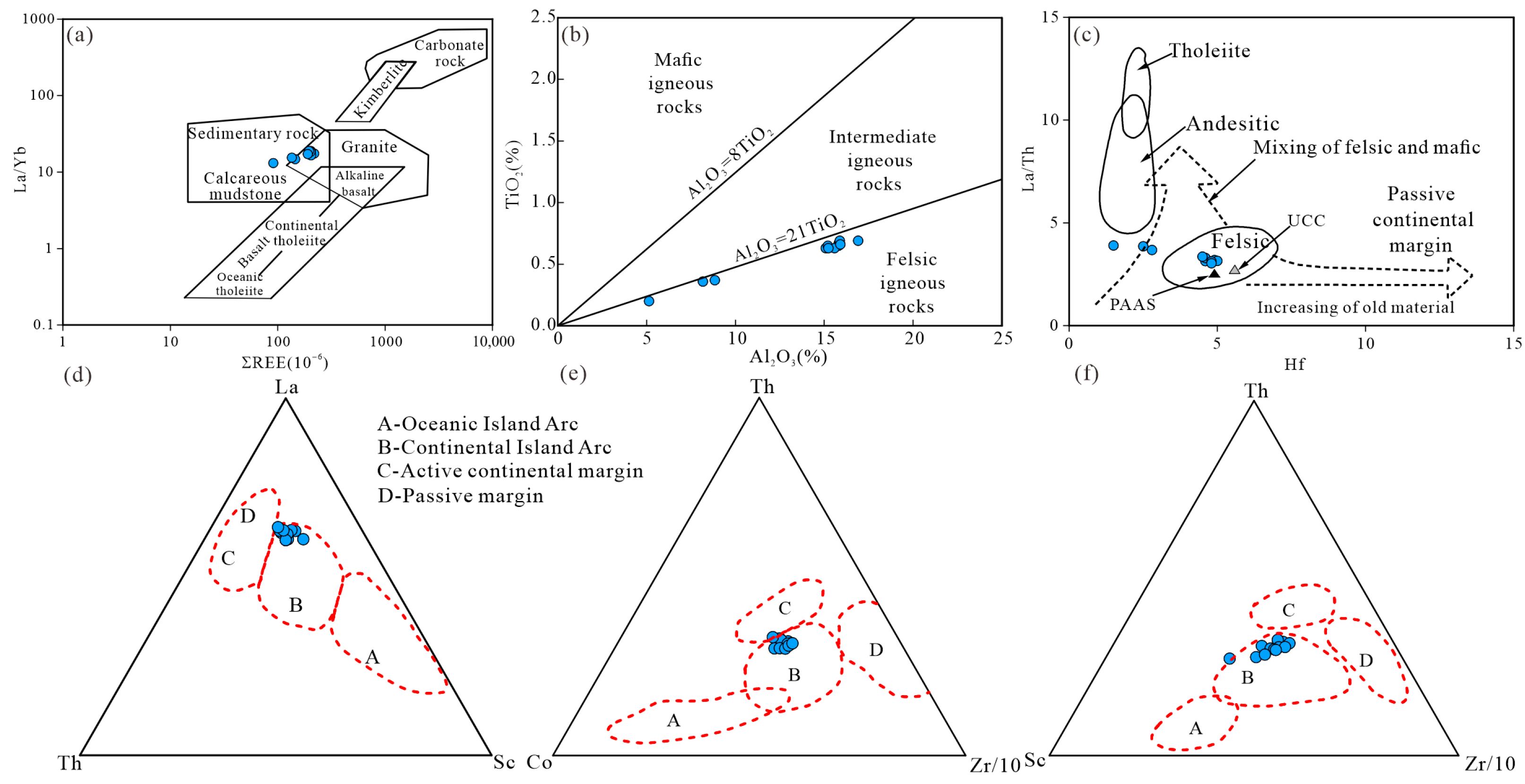
The geochemical characteristics of the shales in the study area clearly reveal the provenance attributes and tectonic setting through multiple discrimination diagrams. In the La/Yb versus ∑REE plot (Figure 11a), most sample points fall within the granite field, with a minor number located in the overlap field of alkaline basalt and granite, indicating that the predominant source rocks are granitic [42]. This conclusion is further supported by the Al2O3/TiO2 versus Al2O3 discrimination diagram in which all samples plot in the felsic igneous rock field (Figure 11b), excluding mafic or intermediate igneous rocks as major provenance components [43,44]. In the La/Th versus Hf provenance discrimination diagram (Figure 11c), the samples mainly plot within the felsic source field, again suggesting that the sediments were derived from felsic igneous rocks [45].
Results from the La–Th–Sc, Th–Sc–Zr/10, and Th–Co–Zr/10 ternary tectonic discrimination diagrams show that the sample points are predominantly concentrated in the continental island arc field (Figure 11d–f) [46,47]. This indicates that the protoliths of the Qingshankou Formation shales were formed in a continental island arc tectonic setting. The relatively high total rare earth element (REE) contents, the enrichment of light rare earth elements (LREEs), and the pronounced negative Eu anomalies provide additional evidence for a continental island arc environment. Taken together, these geochemical lines of evidence suggest that the shale in the study area was mainly sourced from upper continental crust felsic rocks (granite-dominated), and that its parent rocks were primarily formed in a continental island arc tectonic setting.
Figure 11. Discriminant diagrams of shale source-rock properties and tectonic setting in the study area. (a) La/Yb-REE plot [42]; (b) Al2O3/TiO2–Al2O3 plot [44]; (c) La/Th–Hf plot [45]; (d) La–Th–Sc ternary diagram; (e) Th–Sc–Zr/10 ternary diagram; (f) Th–Co–Zr/10 ternary diagram [47].
Applsci 16 04052 g011

5.2. Sedimentary Environment Analysis

5.2.1. Paleosalinity

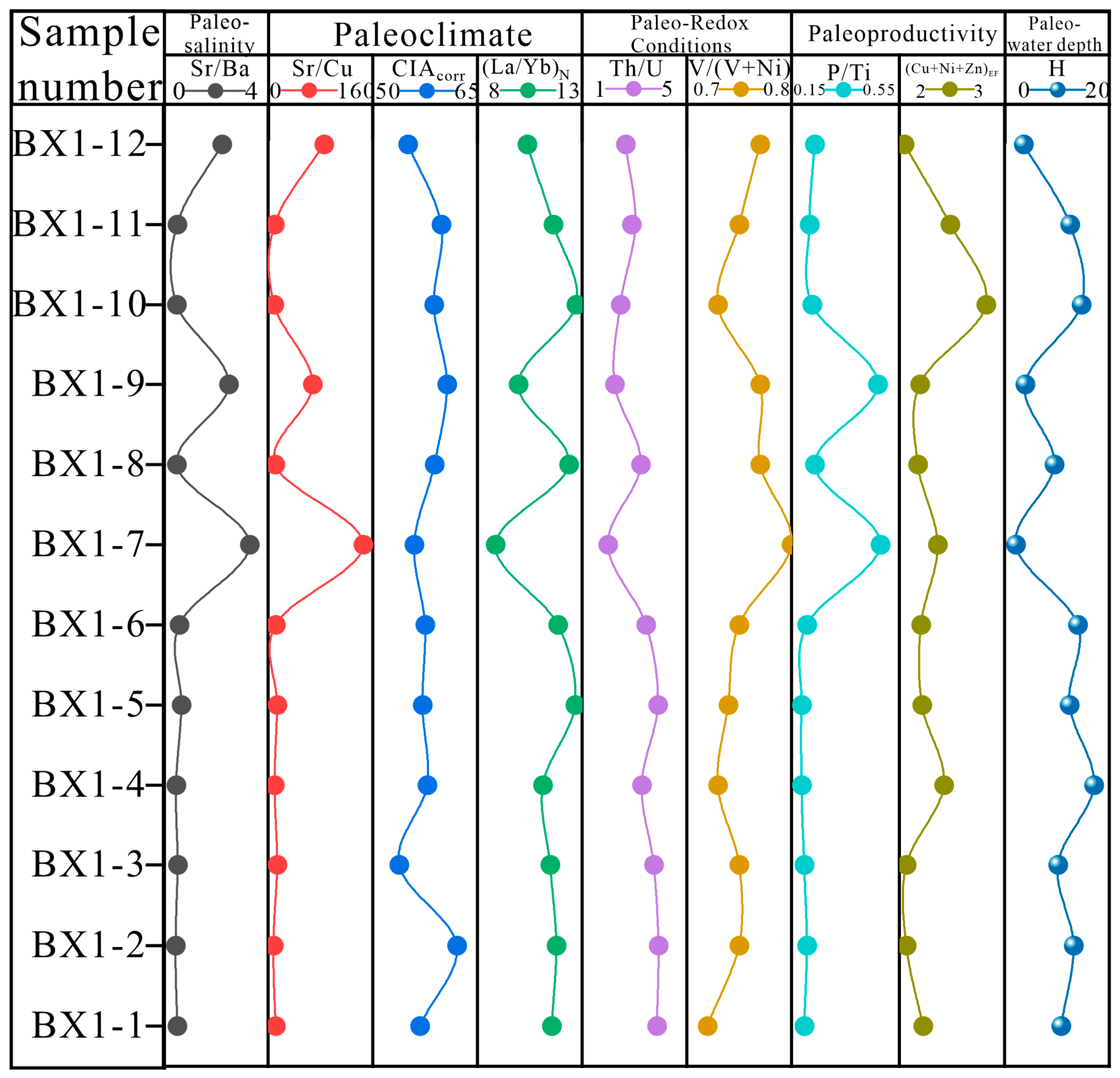
Paleosalinity exerts a critical influence on the enrichment and preservation of organic matter by controlling the types of organisms and their reproduction and development, as well as modulating the relationship between paleoproductivity and paleowater depth [48]. Sr and Ba are widely used as proxies for paleosalinity. Owing to their contrasting geochemical behaviors, Sr2+, which is highly soluble in water and does not readily combine with sulfate, tends to be enriched in high-salinity environments. In contrast, Ba2+ readily forms barite (BaSO4) precipitates in the presence of sulfate, leading to its depletion in the water column; however, in freshwater settings where sulfate is scarce, its solubility increases markedly. Paleosalinity can therefore be effectively reconstructed using the Sr/Ba ratio in sediments: high Sr/Ba values (e.g., >1) generally indicate saline conditions, whereas low Sr/Ba values (e.g., <1) are characteristic of freshwater to slightly brackish environments [49,50,51]. Trace element data from the study area show that Sr/Ba ratios mainly range from 0.48 to 3.30, suggesting that the Qingshankou Formation shales were deposited in a freshwater to slightly brackish (microsaline) environment. Previous studies have documented a variety of fossils in the Qingshankou Formation of the Songliao Basin, including fish, algae, conchostracans, ostracods, foraminifera, and calcareous nannofossils, as well as biomarker compounds derived from dinoflagellates, marine chrysophytes, and sponges. Among these, organisms such as fish, conchostracans, ostracods, and algae typically inhabit brackish-water settings, further supporting the interpretation that the ancient lake was predominantly freshwater to slightly brackish. In addition, the Sr/Ba ratios of the three dolomite samples BX1-7, BX1-9, and BX1-12 are all greater than 1, indicating elevated water salinity and suggesting deposition under more saline conditions (Figure 12).

5.2.2. Paleoclimate

Paleoclimate exerts a crucial influence on the enrichment of organic matter, as it is directly linked to biological productivity and redox conditions, thereby controlling both the preservation state and geochemical characteristics of organic matter [52,53]. The Sr/Cu ratio, the Chemical Index of Alteration (CIA), and the (La/Yb)N ratio (chondrite-normalized La/Yb) are widely employed as paleoclimate proxies because of their sensitivity to chemical weathering intensity and redox conditions. The CIA [54,55,56] is calculated as follows:
CIA = [Al2O3/(CaO + Na2O + K2O + A12O3)] × 100,
CaO* = CaO − P2O5 × 10/3,
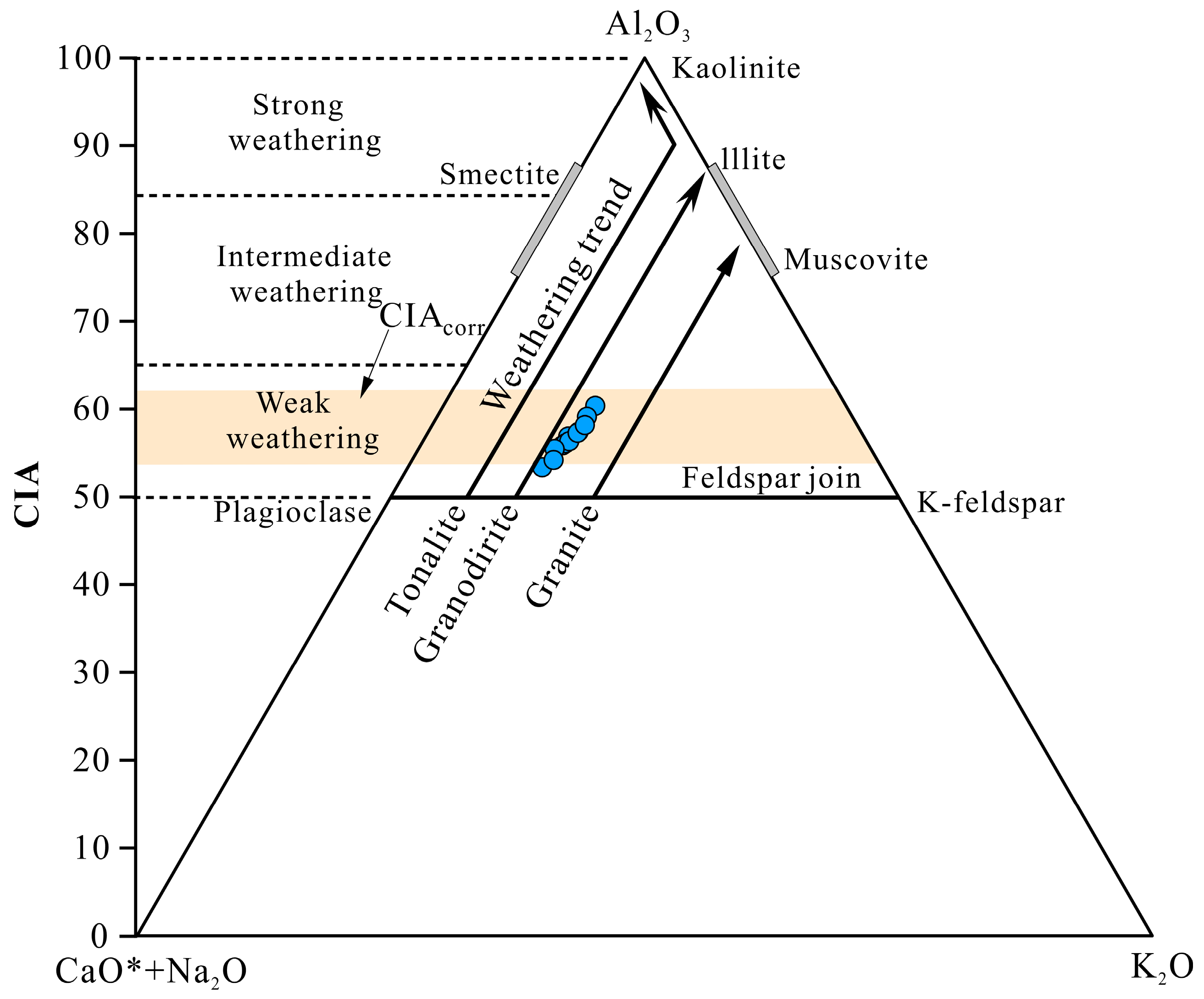
All terms in the formula are expressed as molar fractions. For the determination of CaO* content in shale, this study adopts the method proposed by Bock: after correcting for P2O5, if the molar amount of CaO* is greater than that of Na2O, the molar amount of CaO* is taken as the molar amount of Na2O; if the molar amount of CaO* is less than or equal to that of Na2O, the molar amount of CaO* is used directly [57]. The CIA value reflects the intensity of chemical weathering through the ratio of Al2O3 to easily soluble cations (CaO*, Na2O, K2O). Potassic metasomatism during diagenesis can modify the composition of fine-grained sediments and thus affect the inferred composition of the source rocks. Therefore, it is necessary to correct the CIA values for K-metasomatism in order to obtain a more realistic estimate of the original weathering intensity of the source area. In this study, the correction for K-metasomatism was performed using the equation proposed by Panahi to calculate CIAcorr [58].
K2Ocorr = [m × Al2O3 + m × (CaO* + Na2O)]/1 − m,
m = [K2O/(Al2O3 + CaO* + Na2O + K2O),
CIAcorr = [Al2O3/(CaO + Na2O + K2Ocorr + A12O3)] × 100,
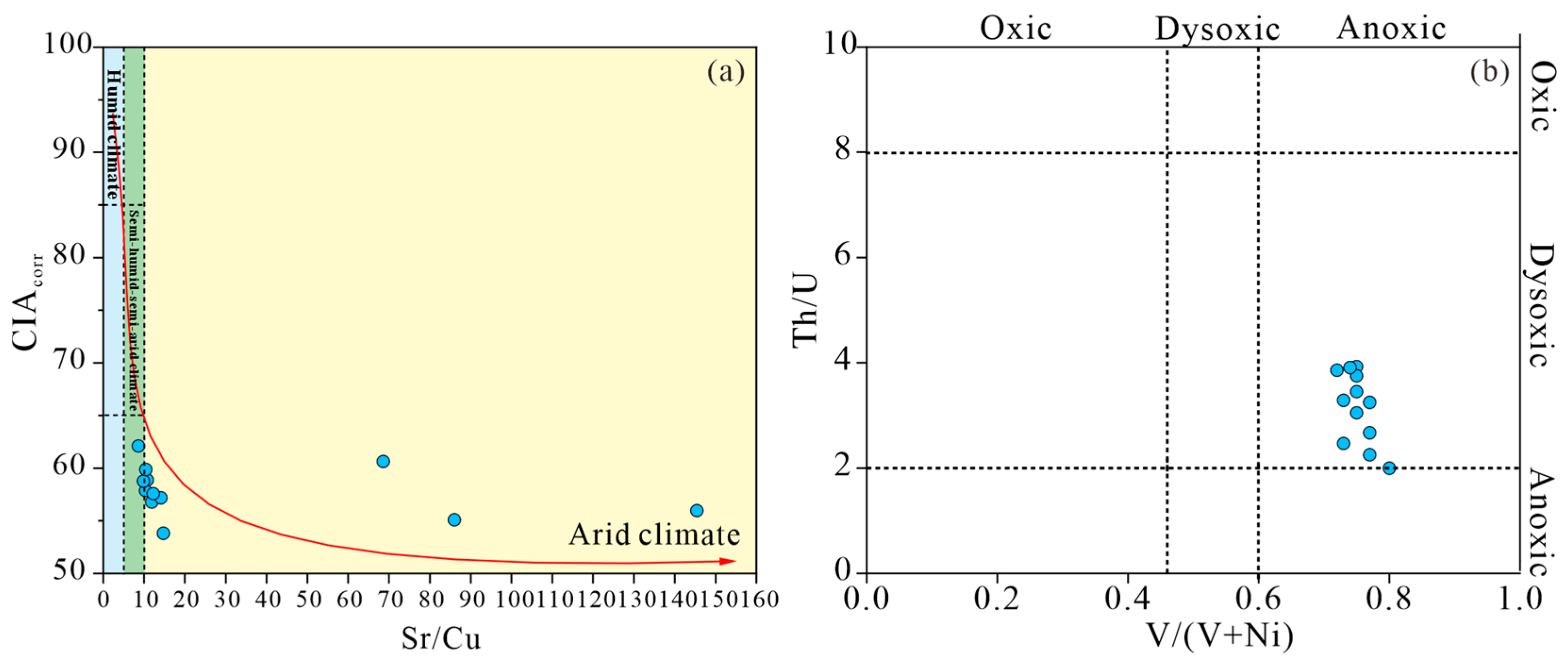
A high CIA value (>80) reflects a hot, humid climate characterized by intense chemical weathering, whereas a moderate CIA value (65–80) indicates a warm, humid climate associated with intermediate degrees of weathering. In contrast, a low CIA value (50–65) is indicative of a cold, relatively arid environment [59,60]; Sr is a typical oxyphile element whose abundance declines rapidly under warm, humid conditions associated with intense chemical weathering. Because the Sr/Cu ratio is highly sensitive to paleoclimatic fluctuations, it is widely employed as a proxy for reconstructing and distinguishing past climate conditions [61]. Low Sr/Cu values are generally indicative of humid climatic conditions, whereas high Sr/Cu values reflect relatively arid climates [62,63]; In warm and humid environments, under the combined influence of weathering and biological processes, heavy rare earth elements are preferentially dissolved and mobilized relative to light rare earth elements, resulting in the relative enrichment of light rare earth elements in weathering residues. Consequently, high (La/Yb)N values indicate warm and humid climatic conditions, whereas low (La/Yb)N values are characteristic of dry and hot climates [64]. The combined use of these three proxies allows for a more robust reconstruction of paleoclimatic conditions. Based on elemental analyses of the outcrop samples (Figure 12), the results show that the Sr/Cu ratio ranges from 8.61 to 145.45, with an average value of 33.59, whereas the CIAcorr values range from 53.82 to 62.12, with an average of 57.88 (Figure 13), and shows an overall trend that is opposite to that of the Sr/Cu ratio. The (La/Yb)N values range from 8.87 to 12.73, with an average of 11.37, which is higher than that of the average upper continental crust (9.19). An integrated analysis of these three proxies, in conjunction with CIAcorr–Sr/Cu cross-plot diagrams (Figure 14a). These results indicate that the Qingshankou Formation in the study area experienced a semi-humid to arid climate during its depositional period. In particular, the Sr/Cu ratios of the BX1-7, BX1-9, and BX1-12 dolomite samples are relatively high (145.45, 68.58, and 86.00, respectively), whereas their CIAcorr values are comparatively low (55.97, 60.64, and 55.10, respectively), and the corresponding (La/Yb)N values are also relatively low. Collectively, these geochemical characteristics reflect a progressive intensification of arid climatic conditions during deposition.

5.2.3. Paleo-Redox Conditions

Trace elements such as Mo, U, Ni, V, and Cu can be used to infer paleoenvironmental redox conditions based on their redox-sensitive behavior [66,67]. For example, Th/U and V/(V + Ni) ratios are commonly employed as redox proxies. In dysoxic to anoxic aquatic environments, V/(V + Ni) ratios are typically greater than 0.60, whereas in well-oxidized settings they are generally less than 0.46 [68]. Th/U values greater than 8 are indicative of well-oxygenated conditions, values between 2 and 8 reflect dysoxic conditions, and values lower than 2 are characteristic of anoxic environments [69,70,71]. In the Qingshankou Formation shales of the Binxian Niaohexiang Township section, V/(V + Ni) ratios range from 0.72 to 0.80, with an average of 0.75, whereas Th/U values range from 2.00 to 3.93, with an average of 3.16. In the dolomite samples BX1-7, BX1-9, and BX1-12, V/(V + Ni) ratios increase, and Th/U values decrease, indicating a progressive enhancement of reducing conditions in the water column (Figure 12 and Figure 14b).

5.2.4. Paleowater Depth

The evolution of paleowater depth promotes water-column stratification, which plays a crucial role in the enrichment and preservation of organic matter [72,73]. Based on cobalt (Co) contents, previous studies have proposed a method for quantitatively inferring the paleowater depth (H) during sediment deposition [74,75], which can be expressed by the following equation:
H = 3.05 × 10⁵/{[V0 × NCo/(SCo − t × TCo)]3/2},
In this equation, V0 denotes the normal sedimentation rate of ancient lakes, typically ranging from 150 to 300 m/Ma; a value of 300 m/Ma is adopted in this study. NCo represents the cobalt (Co) content in normal lacustrine sediments and is taken as 20 μg/g. SCo is the cobalt (Co) content in the sample (μg/g). The term t represents the contribution of provenance-derived cobalt to the sample and is calculated as t = SLa/NLa, where SLa is the abundance of lanthanum (La) in the sample, and NLa is the average abundance of lanthanum (La) in terrigenous clastic rocks, taken as 38.99 μg/g. TCo denotes the cobalt (Co) content of terrigenous clastic rocks, with a value of 4.68 μg/g. H represents the maximum paleowater depth of the lake basin.
Based on the above paleowater-depth calculation method, the vertical evolution of paleowater depth in the study area is shown in Figure 14. The upper part of the Qingshankou Formation is characterized predominantly by a shallow lacustrine facies, with water depths mostly ranging from 2.20 to 17.12 m and an average of 10.35 m. During the depositional periods represented by dolomite samples BX1-7, BX1-9, and BX1-12, arid climatic conditions led to significantly shallower water depths of 2.20 m, 3.97 m, and 3.69 m.

5.2.5. Paleoproductivity

Paleoproductivity is an effective indicator of organic matter enrichment and refers to the rate at which energy is fixed by organisms during the energy cycle, that is, the amount of organic matter produced per unit area per unit time [35]. Previous studies have shown that phosphorus (P) in sedimentary rocks, as an important nutrient element, is mainly derived from biogenic skeletal material and metabolic products, and can therefore be used to characterize paleoproductivity. Because titanium (Ti) is generally sourced from terrigenous clastic input, the P/Ti ratio is employed in this study to minimize the diluting effect of detrital material on phosphorus in the sediments. A P/Ti value of <0.34 indicates low productivity, >0.79 indicates high productivity, and values between 0.34 and 0.79 reflect moderate productivity [76,77].
The contents of trace elements such as Cu, Ni, Zn, and Mo are positively correlated with organic matter content and can likewise be used as proxies for organic matter flux and paleoproductivity [35]. In nutrient-rich surface waters, plankton assimilate these elements, which are subsequently transported downward and buried together with organic matter, resulting in markedly elevated concentrations of Mo, Zn, Cu, and Ni in the sediments and thus indicating a high-productivity setting. By contrast, in nutrient-depleted environments, the concentrations of these elements are relatively low and point to low productivity. The abundances of these trace elements (Cu, Ni, Zn, Mo) are commonly affected by terrigenous detrital input (e.g., clay minerals). To remove the influence of the terrigenous background, enrichment factors (EFs) are employed. Summing the EFs of Cu, Ni, and Zn (CuEF + NiEF + ZnEF) can effectively offset the random errors that may arise from diagenetic overprinting on individual elements (e.g., late-stage hydrothermal or fluid disturbance), and thus provides a more integrated signal of productivity intensity that more accurately reflects paleoproductivity.
In the study area, shale samples exhibit P/Ti ratios ranging from 0.19 to 0.49, with an average of 0.26, and CuEF + NiEF + ZnEF values between 2.07 and 2.83, with an average of 2.28. These results suggest that the Qingshankou Formation in the study area was deposited under conditions of relatively low paleoproductivity. In contrast, the BX1-7 and BX1-9 dolomite samples show higher P/Ti ratios of 0.49 and 0.48, respectively, indicating moderate paleoproductivity during their deposition (Figure 12).

5.3. Sources of Organic Matter

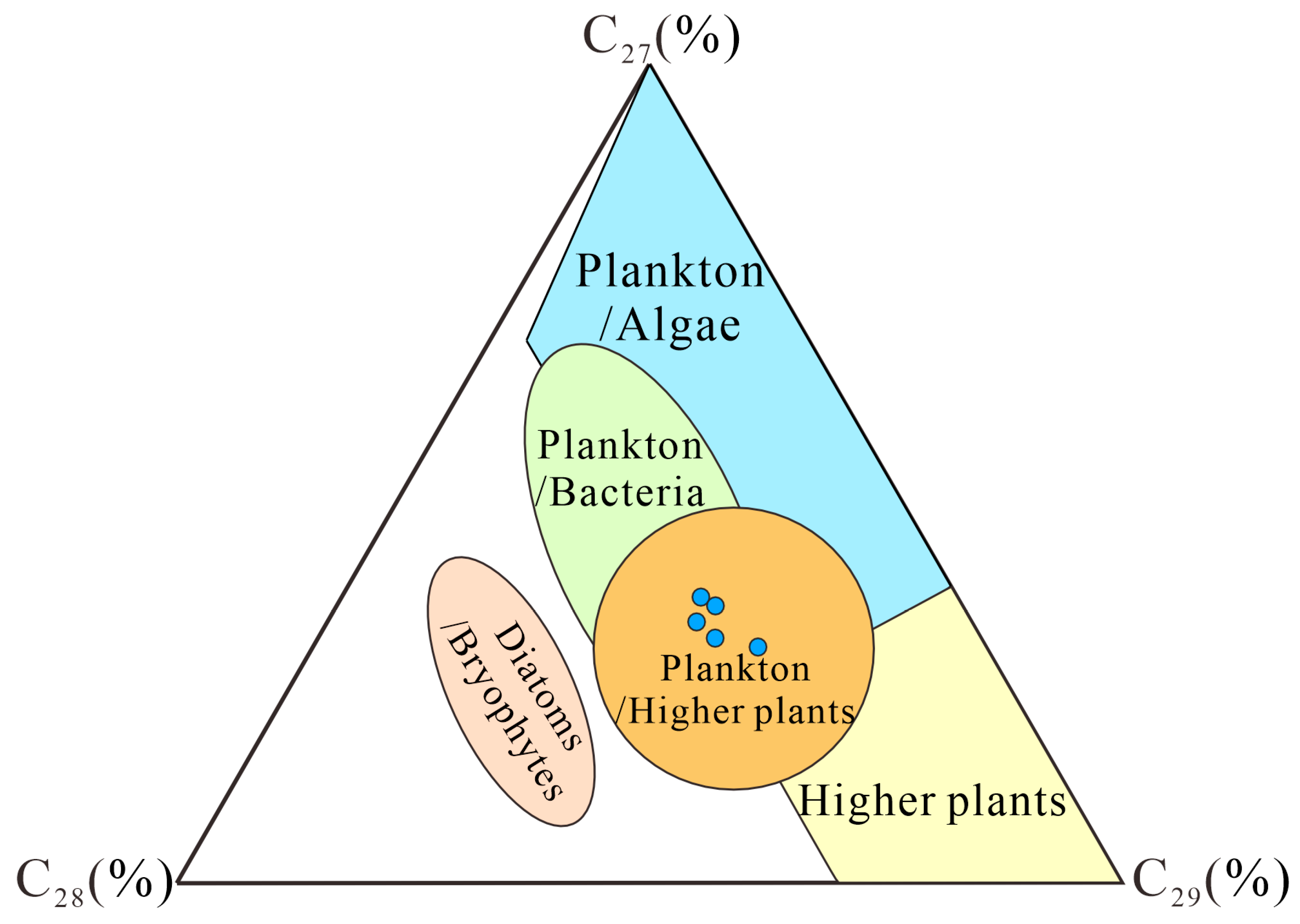
The organic matter abundance of shales in the study area was evaluated based on TOC measurements. The organic carbon content of the BX1-1~BX1-5 shale interval ranges from 0.72% to 1.16%, with an average of 0.98%, indicating that it represents organic-poor shale. Previous studies have suggested that, among C27–C29 regular steranes, C27 is mainly derived from algae and lower aquatic organisms, C28 from diatoms, and C29 from terrestrial higher plants [78]; therefore, the C27–C28–C29 regular sterane ternary diagram can be used to identify the sources of organic matter [79]. In the study area, the mass fraction of C27 ranges from 29.49% to 34.64%, with an average of 31.92%; C28 ranges from 23.57% to 29.06%, with an average of 27.18%; and C29 ranges from 38.02% to 46.93%, with an average of 40.09% (Table 2). The data points plot mainly within the planktonic/terrestrial higher plant field (Figure 15), indicating that the organic matter in the study area is predominantly of mixed origin. Combined with the biomarker characteristics of n-alkanes and sterane isomer distributions, the organic matter in the Qingshankou Formation shales of the study area is interpreted as a mixed source dominated by terrestrial higher plants, with a subordinate contribution from aquatic lower organisms.

5.4. Depositional Model of Shale Organic Matter

Although surface weathering of outcrop samples may lead to a systematic underestimation of the absolute TOC content, the stratigraphic trends and relative variations in organic enrichment remain indicative of paleoenvironmental changes. Based on the reconstructed paleoenvironmental conditions during shale deposition in the study area, including paleosalinity, paleoclimate, redox conditions, paleo-lake productivity, and paleowater depth, the depositional setting of organic-rich shales has been clarified. Combined with the mixed organic matter source dominated by terrestrial higher plants with a subordinate contribution from aquatic lower organisms, the enrichment mechanism of organic matter in the Qingshankou Formation shales of the study area is further discussed.
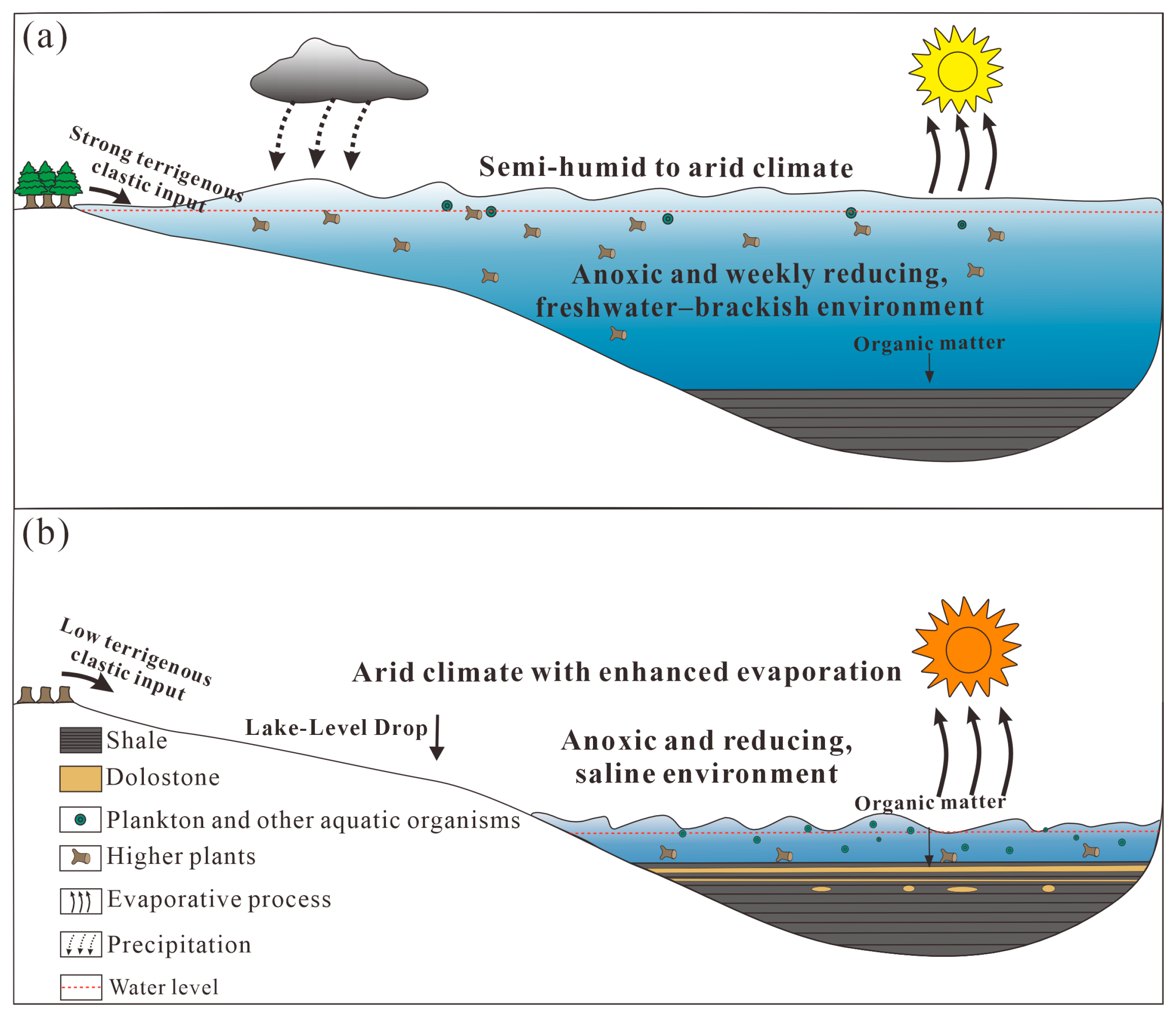
During the early depositional stage of the Qingshankou Formation shales in the southeastern uplift of the Songliao Basin (Figure 16a), the study area was characterized by a relatively humid climate and low-salinity water conditions. Significant terrigenous clastic input introduced terrestrial plant debris and nutrients into the basin. Although plankton and other lower-trophic aquatic organisms began to develop, their limited abundance resulted in low primary productivity. The dissolved oxygen content remained low, indicating a weakly reducing environment. Furthermore, the high influx of terrigenous clastic material likely exerted a dilution effect on the organic matter, leading to the relatively low organic matter enrichment observed during this period.
In the later stage of sedimentation (Figure 16b), terrigenous input decreased. Driven by global climate change, the climate of the Qingshankou Formation in the southeastern uplift of the Songliao Basin began to shift toward more arid conditions, accompanied by rising temperatures. Intensified evaporation of the lake water led to a reduction in water depth and an overall increase in salinity, and dolostone layers started to develop. At the same time, evaporative concentration of the water column and nutrient enrichment promoted planktonic blooms, resulting in a marked increase in paleo-productivity indices (P/Ti). Large amounts of biogenic organic matter settled to the sediments, and its decomposition consumed dissolved oxygen in the water column, causing the depositional environment to progressively evolve toward more strongly reducing conditions (decreasing Th/U and increasing V/(V + Ni)). An anoxic layer formed at the lake bottom, and the reducing bottom-water conditions effectively inhibited the oxidative degradation of organic matter, thereby favoring its preservation.

6. Conclusions

(1)
The outcrop profile in Niaohexiang Section of Binxian, located in the southeastern uplift of the Songliao Basin, is dominated by black shale and gray to dark-gray mudstone, interbedded with multiple dolostone layers and dolomite nodules. The rocks are characterized by high clay mineral contents and can be classified into clay-rich shale, calcareous/dolomitic shale, and mixed shale. Among these, clay-rich shale accounts for more than 60% of the succession and represents the most favorable lithology for shale oil generation and accumulation.
(2)
Integrated geochemical data from Qingshankou Formation outcrop samples in the southeastern uplift indicate that the shales in the study area were primarily sourced from felsic upper-crustal rocks and that the tectonic setting reflects a continental island arc tectonic setting.
(3)
The organic matter is of mixed origin, dominated by terrestrial higher plants with a subordinate contribution from aquatic lower organisms. During deposition, the shales were formed mainly in freshwater to slightly brackish, oxygen-deficient to anoxic, semi-humid to semi-arid shallow-lacustrine environments, whereas the dolostone layers were deposited in saline to hypersaline, arid, locally reducing shallow-lacustrine settings. Overall, the shales record relatively low paleoproductivity, but paleoproductivity increased during periods of dolostone deposition. This evolutionary pattern suggests that, during Qingshankou Formation time in the Songliao Basin, the lake underwent an anoxic event accompanied by increasing salinity and progressive climatic aridification.
(4)
The enrichment of organic matter in the Qingshankou Formation shales in the study area is primarily governed by the combined influences of paleoclimate, water salinity, water-depth variations, and redox conditions. During the early stage of deposition, the study area was characterized by a relatively humid climate and a low-salinity lacustrine environment. Terrigenous clastic input was relatively strong, primary productivity was low, and a certain degree of clastic dilution occurred, resulting in limited organic matter enrichment. In the late stage of deposition, the climate gradually shifted toward arid conditions, lake-water evaporation intensified, water depth decreased, and salinity increased. Nutrient enrichment promoted the proliferation of plankton, thereby enhancing lacustrine paleoproductivity, while the bottom water progressively evolved toward a more reducing environment, which favored the preservation of organic matter. Overall, the depositional environment of the Qingshankou Formation records an evolutionary process of progressive lake shallowing and intensified evaporation, accompanied by a transition of sedimentary facies from low–organic matter shale to carbonate deposits, with dolostone layers forming during stages of particularly strong evaporative conditions.
(5)
The development of dolomite-rich intervals correlates with periods of enhanced organic matter preservation. These dolomitic layers, formed during arid climate transitions and elevated paleosalinity. Therefore, it is recommended to prioritize horizontal drilling and hydraulic fracturing targets near these lithofacies to optimize hydrocarbon recovery in the southeastern uplift area. Future research should focus on high-resolution carbon δ13C and sulfur δ34S isotopic analyses to further refine the global-to-regional carbon cycle correlations and microbial sulfate reduction processes. Additionally, integrated subsurface core-based 3D basin modeling is warranted to quantitatively simulate the thermal maturation and migration pathways of shale oil in this region, providing a more robust spatial framework for sweet-spot prediction.

Author Contributions

Y.S.: conceptualization, validation, Writing—Original Daft Preparation, Supervision. X.F.: Methodology, Software, Formal Analysis, Resources, Supervision, Project Administration, Funding Acquisition. H.S.: Conceptualization, Methodology, Validation, Resources, Visualization, Project Administration. Q.X.: Conceptualization. Investigation, Writing—Original Draft Preparation, Writing—Review & Editing, Project Administration, Funding Acquisition. K.W.: Software, Formal Analysis, Data Curation, Visualization. Q.Z.: Methodology, Software, Formal Analysis, Validation, Investigation, Writing—Review & Editing, Funding Acquisition. All authors have read and agreed to the published version of the manuscript.

Funding

This research was funded by the National Natural Science Foundation of China, grant number 42202150.

Data Availability Statement

The data presented in this study are available within the article.

Conflicts of Interest

Authors Yangxin Su, Xiuli Fu, Hongjun Shao, and Qiang Zheng were employed by State Key Laboratory of Continental Shale Oil, Daqing, China; Exploration and Development Research Institute of Daqing Oilfield Company Limited, Daqing, China and Heilongjiang Provincial Key Laboratory of Continental Shale Oil, Daqing, China. The remaining authors declare that the research was conducted in the absence of any commercial or financial relationships that could be construed as a potential conflict of interest.

Abbreviations

The following abbreviations are used in this manuscript:
XRDX-ray diffraction
XRFX-ray fluorescence
ICP-MSInductively coupled plasma mass spectrometry
GC-MSGas chromatography–mass spectrometry
TOCTotal Organic Carbon
TICTotal ion current chromatogram
CIAChemical Index of Alteration
CPICarbon Preference Index
OEPOdd–Even Predominance
GIGammacerane Index
PrPristane
PhPhytane
REERare Earth Element
LREELight Rare Earth Element
HREEHeavy Rare Earth Element
∑REETotal Rare Earth Element
PAASPost-Archaean Australian Shale
EFEnrichment factor

References

  1. Guo, H.; Shi, J.Y.; Fu, S.P.; Liu, Z.T.; Cai, L.H.; Yin, S.Y. Lithofacies Characteristics of Continental Lacustrine Fine-Grained Sedimentary Rocks and Their Coupling Relationship with Sedimentary Environments: Insights from the Shahejie Formation, Dongying Sag. Minerals 2024, 14, 479. [Google Scholar] [CrossRef]
  2. Guo, X.S.; Wang, R.Y.; Shen, B.J.; Wang, G.P.; Wan, C.X.; Wang, Q.R. Geological characteristics, resource potential, and development direction of shale gas in China. Pet. Explor. Dev. 2025, 52, 17–32. [Google Scholar] [CrossRef]
  3. He, W.Y.; Zhu, R.K.; Cui, B.W.; Zhang, S.C.; Meng, Q.; Bai, B.; Feng, Z.H.; Lei, Z.D.; Wu, S.T.; He, K.; et al. The Geoscience Frontier of Gulong Shale Oil: Revealing the Role of Continental Shale from Oil Generation to Production. Engineering 2023, 28, 79–92. [Google Scholar] [CrossRef]
  4. Wu, W.; Liao, Z.W.; Chen, H.H.; Li, S.H.; Su, A.; Hussain, I.; Zhao, N.B. Jurassic Terrestrial Shale Gas Potential of the Northern Kashi Sag in the Tarim Basin, Northwestern China. Geofluids 2021, 2021, 5542447. [Google Scholar] [CrossRef]
  5. Jin, Z.J.; Liang, X.P.; Bai, Z.R. Exploration breakthrough and its significance of Gulong lacustrine sha le oil in the Songliao Basin, Northeastern China. Energy Geosci. 2022, 3, 120–125. [Google Scholar] [CrossRef]
  6. Liu, Y.L.; Li, W.; Huang, B.T.; Li, P.; Ge, X.T.; Ge, X.; Yuan, J.P.; Liu, P.F.; Yu, X.T.; Wu, H.G. Depositional Environment Conditions and Organic Matter Enrichment Mechanism of the First Member of Upper Cretaceous Qingshankou Formation in the Heiyupao Depression, Northern Songliao Basin. Minerals 2025, 15, 55. [Google Scholar] [CrossRef]
  7. Sun, L.D.; Zhu, R.K.; Zhang, T.S.; Cai, Y.; Feng, Z.H.; Bai, B.; Jiang, H.; Wang, B. Advances and trends of non-marine shale sedimentology: A case study from Gulong Shale of Daqing Oilfield, Songliao Basin, NE China. Pet. Explor. Dev. 2024, 51, 1367–1385. [Google Scholar] [CrossRef]
  8. Wang, M.; Wu, Y.; Bai, X.F.; Li, M.; Li, J.H.; Wang, X.; Zhang, J.Y.; Li, J.; Yu, C.Q.; Bennani, R. Geological characteristics and in-situ retention mechanisms of clay-rich lacustrine shale oil in the Songliao Basin. Mar. Pet. Geol. 2025, 182, 107593. [Google Scholar] [CrossRef]
  9. Liu, B.; Wang, H.L.; Fu, X.F.; Bai, Y.F.; Bai, L.H.; Jia, M.C.; He, B. Lithofacies and depositional setting of a highly prospective lacustrine shale oil succession from the Upper Cretaceous Qingshankou Formation in the Gulong sag, northern Songliao Basin, northeast China. AAPG Bull. 2019, 103, 405–432. [Google Scholar] [CrossRef]
  10. Wang, H.J.; Wan, Y.Y.; Liu, Y.K.; Zhang, J.Y.; Zhang, S.C. Proven and Potential Microbial Contributions to the Gulong Shale Oil. J. Earth Sci. 2024, 35, 2149–2153. [Google Scholar] [CrossRef]
  11. Zhang, Y.C.; Bai, X.F.; Wang, M.; Li, J.H.; Zhang, J.Y.; Fu, L.; Huo, Q.L.; Li, J.B.; Yan, Y.; Xu, L.; et al. Formation mechanism of Gulong shale oil: Insights from semiclosed hydrous pyrolysis. J. Anal. Appl. Pyrolysis 2024, 181, 106632. [Google Scholar] [CrossRef]
  12. Zhang, S.C.; Zhang, B.; Wang, X.M.; Feng, Z.H.; He, K.; Wang, H.; Fu, X.L.; Liu, Y.K.; Yang, C.L. Gulong shale oil enrichment mechanism and orderly distribution of conventional- unconventional oils in the Cretaceous Qingshankou Formation, Songliao Basin, NE China. Pet. Explor. Dev. 2023, 50, 1045–1059. [Google Scholar] [CrossRef]
  13. Zhang, J.Y.; Zhu, R.K.; Wu, S.T.; Jiang, X.H.; Liu, C.; Cai, Y.; Zhang, S.R.; Zhang, T.S. Microscopic oil occurrence in high-maturity lacustrine shales: Qingshankou Formation, Gulong Sag, Songliao Basin. Pet. Sci. 2023, 20, 2726–2746. [Google Scholar] [CrossRef]
  14. Sun, L.D.; Liu, H.; He, W.Y.; Li, G.X.; Zhang, S.C.; Zhu, R.K.; Jin, X.; Meng, S.W.; Jiang, H. An analysis of major scientific problems and research paths of Gulong shale oil in Daqing Oilfield, NE China. Pet. Explor. Dev. 2021, 48, 527–540. [Google Scholar] [CrossRef]
  15. Zhu, R.K.; Zhang, J.Y.; Li, M.Y.; Cai, Y.; Wu, S.T.; Liu, C.; Zhang, S.R.; Kang, Y. Advances and key issues in the basic research of non-marine shale oil enrichment. Acta Geol. Sin. (Engl. Ed.) 2023, 97, 2874–2895. [Google Scholar]
  16. Han, Z.Y.; Wang, G.W.; Wu, H.L.; Feng, Z.; Tian, H.; Xie, Y.Y.; Wu, H. Lithofacies Characteristics of Gulong Shale and Its Influence on Reservoir Physical Properties. Energies 2024, 17, 779. [Google Scholar] [CrossRef]
  17. He, W.Y.; Zhong, J.H.; Sun, N.L. Discovery and significance of tempestites and storm deposits in the Qingshankou Formation of the Gulong Sag, northeastern China. Front. Earth Sci. 2023, 10, 999135. [Google Scholar] [CrossRef]
  18. Sun, G.Q.; Dong, W.B.; Zhang, X.G.; Zhong, J.H.; Sun, N.L. Study on Dolomite Thin Layers and Nodules in the Qingshankou Formation Shale Oil Reservoir of Gulong Sag. Energies 2023, 16, 3981. [Google Scholar] [CrossRef]
  19. Liu, R.; Liu, Z.J.; Sun, P.C.; Yang, X.H.; Zhang, C. Shale gas accumulation potential of the Upper Cretaceous Qingshankou Formation in the southeast Songliao Basin, NE China. Mar. Pet. Geol. 2017, 86, 547–562. [Google Scholar] [CrossRef]
  20. Xie, Q.; Xu, H.; Yu, S. Characterization of the Lower Cretaceous Shale in Lishu Fault Depression, Southeastern Songliao Basin: Implications for Shale Gas Resources Potential. Energies 2022, 15, 5156. [Google Scholar] [CrossRef]
  21. Liu, C.Y.; Shan, X.L.; Yi, J.; Shi, Y.Q.; Ventura, G. Volcanism at the end of continental rifting: The Cretaceous syn-rift to post-rift transition in the Songliao Basin (NE China). Gondwana Res. 2022, 111, 174–188. [Google Scholar] [CrossRef]
  22. Liu, Z.H.; Song, J.; Liu, X.W.; Wu, X.M.; Gao, X. Discovery of the Cretaceous-Paleogene compressional structure and basin properties of the southern Songliao Basin. Acta Pet. Sin. 2020, 36, 2383–2393. [Google Scholar] [CrossRef]
  23. Wang, P.J.; Mattern, F.; Didenko, N.A.; Zhu, D.F.; Singer, B.; Sun, X.M. Tectonics and cycle system of the Cretaceous Songliao Basin: An inverted active continental margin basin. Earth-Sci. Rev. 2016, 159, 82–102. [Google Scholar] [CrossRef]
  24. Li, Z.Q.; Kusky, T.; Ying, D.L.; Guo, X.; Li, H.K. Successor Characteristics of the Mesozoic and Cenozoic Songliao Basins. Acta Geol. Sin. (Engl. Ed.) 2010, 82, 622–628. [Google Scholar] [CrossRef]
  25. Song, Y.; Stepashko, A.; Liu, K.Y.; He, Q.K.; Shen, C.B.; Shi, B.J.; Ren, J.Y. Post-rift Tectonic History of the Songliao Basin, NE China: Cooling Events and Post-rift Unconformities Driven by Orogenic Pulses From Plate Boundaries. J. Geophys. Res. Solid Earth 2018, 123, 2363–2395. [Google Scholar] [CrossRef]
  26. Sun, L.D.; Cui, B.W.; Zhu, R.K.; Wang, R.; Feng, Z.H.; Li, B.H.; Zhang, J.Y.; Gao, B.; Wang, Q.Z.; Zeng, H.S.; et al. Shale oil enrichment evaluation and production law in Gulong Sag, Songliao Basin, NE China. Pet. Explor. Dev. 2023, 50, 505–519. [Google Scholar] [CrossRef]
  27. Xu, J.J.; Liu, Z.J.; Bechtel, A.; Meng, Q.T.; Sun, P.C.; Jia, J.L.; Cheng, L.J.; Song, Y. Basin evolution and oil shale deposition during Upper Cretaceous in the Songliao Basin (NE China): Implications from sequence stratigraphy and geochemistry. Int. J. Coal Geol. 2015, 149, 9–23. [Google Scholar] [CrossRef]
  28. Fu, X.L.; Meng, Q.; Wen, Z.; Bai, Y.; Gao, B.; Su, Y.X. Sedimentary Environment and Genetic Mechanism of Dolomites in the Qingshankou Formation, Songliao Basin. Acta Sedimentol. Sin. 2024, 42, 113. [Google Scholar] [CrossRef]
  29. Wang, C.S.; Scott, R.W.; Wan, X.Q.; Graham, S.A.; Huang, Y.J.; Wang, P.J.; Wu, H.C.; Dean, W.E.; Zhang, L.M. Late Cretaceous climate changes recorded in Eastern Asian lacustrine deposits and North American Epieric sea strata. Earth-Sci. Rev. 2013, 126, 275–299. [Google Scholar] [CrossRef]
  30. Peters, K.E.; Walters, C.C.; Moldowan, J.M. Biomarkers and isotopes in the environment and human history. In The Biomarker Guide; Cambridge University Press: Cambridge, UK, 2004; Volume 1. [Google Scholar]
  31. Philp, R.P.; Fan, P.; Lewis, C.A.; Li, J.; Zhu, H.; Wang, H. Geochemical Characteristics of Oils from the Chaidamu, Shanganning and Jianghan Basins, China. In Proceedings of the 2nd Conference on Petroleum Geochemistry and Exploration in the Afro-Asian Region, Beijing, China, 28–31 August 1988; pp. 351–358. [Google Scholar]
  32. Zhu, Y.L.; Tan, W.M.; Hai, L.F.; Mu, C.X.; Wang, K.; Li, M.Y. Organic geochemical characteristics of Jurassic Yan’an Formation source rock in Pengyang area of southwestern Ordos basin. Front. Earth Sci. 2025, 13, 1536268. [Google Scholar] [CrossRef]
  33. Li, Q.W.; Liu, Z.B.; Chen, F.R.; Liu, G.X.; Zhang, D.W.; Li, P.; Wang, P.W. Geochemical Characteristics and Organic Matter Provenance of Shale in the Jurassic Da’anzhai Member, Northeastern Sichuan Basin. Front. Earth Sci. 2022, 10, 860477. [Google Scholar] [CrossRef]
  34. Algeo, T.J.; Maynard, J.B. Trace-element behavior and redox facies in core shales of Upper Pennsylvanian Kansas-type cyclothems. Chem. Geol. 2004, 206, 289–318. [Google Scholar] [CrossRef]
  35. Tribovillard, N.; Algeo, T.J.; Lyons, T.; Riboulleau, A. Trace metals as paleoredox and paleoproductivity proxies: An update. Chem. Geol. 2006, 232, 12–32. [Google Scholar] [CrossRef]
  36. Peng, B.; Song, Z.L.; Tu, X.L.; Xiao, M.L.; Wu, F.C.; Lv, H.Z. Release of heavy metals during weathering of the Lower Cambrian Black Shales in western Hunan, China. Environ. Geol. 2004, 45, 1137–1147. [Google Scholar] [CrossRef]
  37. Wu, S.C.; Peng, B.; Wu, N.Q.; Xie, S.R.; Yang, X.; Fang, X.H.; Song, Z.L. Mobility and environmental impact of cadmium (Cd) during weathering of carbonaceous black shales in western Hunan, China. J. Hazard. Mater. 2024, 470, 134267. [Google Scholar] [CrossRef] [PubMed]
  38. Taylor, S.R.; Mclennan, S.M. An Examination of the Geochemical Record Preserved in Sedimentary Rocks. In The Continental Crust: Its Composition and Evolution; Blackwell Scientific Publications: Oxford, UK, 1985. [Google Scholar]
  39. Yan, C.N.; Jin, Z.J.; Zhao, J.H.; Du, W.; Liu, Q.Y. Influence of sedimentary environment on organic matter enrichment in shale: A case study of the Wufeng and Longmaxi Formations of the Sichuan Basin, China. Mar. Pet. Geol. 2018, 92, 880–894. [Google Scholar] [CrossRef]
  40. Sun, S.S.; McDonough, W.F. Chemical and Isotopic Systematics of Oceanic Basalts: Implications for Mantle Composition and Processes; Geological Society London Special Publications: London, UK, 1989; Volume 42, pp. 313–345. [Google Scholar] [CrossRef]
  41. Wang, W.Z.; Huang, X.; Chen, S.; Li, L.W.; Wang, Y.H.; Kang, Y.R.; Nie, Y.H. Geochemical characteristics of sediments in the southern Mid-Atlantic Ridge indicate hydrothermal activity: Evidence from rare earth elements. Mar. Pet. Geol. 2024, 168, 107041. [Google Scholar] [CrossRef]
  42. Hai, L.F.; Xu, Q.H.; Mu, C.X.; Tao, R.; Wang, L.; Bai, J.H.; Song, Y. Geochemical characteristics and geologic significance of rare earth elements in oil shale of the Yan’an Formation in the Tanshan area, in the Liupanshan Basin, China. Interpretation 2021, 9, T843–T854. [Google Scholar] [CrossRef]
  43. Chen, W.Z.; Tian, J.C.; Lin, X.B.; Liang, Q.S.; Wang, X.; Yi, D.X.; Li, Y.Y. Climate fluctuations during the Ordovician-Silurian transition period in South China: Implications for paleoenvironmental evolution and organic matter enrichment. Palaeogeogr. Palaeoclimatol. Palaeoecol. 2023, 613, 111411. [Google Scholar] [CrossRef]
  44. He, B.; Xu, Y.G.; Zhong, Y.T.; Guan, J.P. The Guadalupian-Lopingian boundary mudstones at Chaotian (SW China) are clastic rocks rather than acidic tuffs: Implication for a temporal coincidence between the end-Guadalupian mass extinction and the Emeishan volcanism. Lithos 2010, 119, 10–19. [Google Scholar] [CrossRef]
  45. Tobia, F.H.; Mustafa, B.H. Geochemistry and mineralogy of the Al-rich shale from Baluti formation, Iraqi Kurdistan region: Implications for weathering and provenance. Arab. J. Geosci. 2016, 9, 757. [Google Scholar] [CrossRef]
  46. Bhatia, M.R. Plate-Tectonics and Geochemical Composition of Sandstones. J. Geol. 1983, 91, 611–627. [Google Scholar] [CrossRef]
  47. Bhatia, M.R.; Crook, K.A.W. Trace element characteristics of graywackes and tectonic setting discrimination of sedimentary basins. Contrib. Mineral. Petrol. 1986, 92, 181–193. [Google Scholar] [CrossRef]
  48. Liang, H.R.; Xu, G.S.; Yu, Q.; Xu, F.H.; Wang, D.Y.; Chen, Z.Y. Paleosalinity and Its Association with Organic Matter: A Case Study from the Eocene Shahejie Formation, Laizhou Bay Sag, Bohai Bay Basin (China). J. Ocean Univ. China 2021, 20, 741–754. [Google Scholar] [CrossRef]
  49. Jia, J.L.; Bechtel, A.; Liu, Z.J.; Strobl, S.A.I.; Sun, P.C.; Sachsenhofer, R.F. Oil shale formation in the Upper Cretaceous Nenjiang Formation of the Songliao Basin (NE China): Implications from organic and inorganic geochemical analyses. Int. J. Coal Geol. 2013, 113, 11–26. [Google Scholar] [CrossRef]
  50. Vahrenkamp, V.C.; Swart, P.K. New Distribution Coefficient for the Incorporation of Strontium into Dolomite and Its Implications for the Formation of Ancient Dolomites. Geology 1990, 18, 387–391. [Google Scholar] [CrossRef]
  51. Wei, W.; Algeo, T.J. Elemental proxies for paleosalinity analysis of ancient shales and mudrocks. Geochim. Cosmochim. Acta 2020, 287, 341–366. [Google Scholar] [CrossRef]
  52. Li, C.; Chen, S.J.; Liao, J.B.; Hou, Y.T.; Yu, J.; Liu, G.L.; Xu, K.; Wu, X.T. Geochemical characteristics of the Chang 7 Member in the southwestern Ordos Basin, China: The influence of sedimentary environment on the organic matter enrichment. Palaeoworld 2023, 32, 429–441. [Google Scholar] [CrossRef]
  53. Ma, L.; Zhang, Z.H.; Meng, W.Q. Climate-Provenance Effect on the Organic Matter Enrichment of the Chang 9 Source Rocks in the Central Ordos Basin, China. Geofluids 2021, 2021, 10. [Google Scholar] [CrossRef]
  54. Dong, C.Y.; Li, D.J.; Zhang, Y.; Li, D.H.; Liu, M.C.; Han, Z.X. Geochemistry and mineralogy of the Upper Ordovician Wufeng formation, Southwestern China: Implications for Paleoclimate construction. Energy Explor. Exploit. 2023, 41, 1983–2006. [Google Scholar] [CrossRef]
  55. Nesbitt, H.W.; Young, G.M. Early Proterozoic climates and plate motions inferred from major eleme nt chemistry of lutites. Nature 1982, 299, 715–717. [Google Scholar] [CrossRef]
  56. Nesbitt, H.W.; Young, G.M. Formation and Diagenesis of Weathering Profiles. J. Geol. 1989, 97, 129–147. [Google Scholar] [CrossRef]
  57. Bock, B.; McLennan, S.M.; Hanson, G.N. Geochemistry and provenance of the Middle Ordovician Austin Glen Membe r (Normanskill Formation) and the Taconian Orogeny in New England. Sedimentology 1998, 45, 635–655. [Google Scholar] [CrossRef]
  58. Panahi, A.; Young, G.M.; Rainbird, R.H. Behavior of major and trace elements (including REE) during Paleoproterozoic pedogenesis and diagenetic alteration of an Archean granite near Ville Marie, Quebec, Canada. Geochim. Cosmochim. Acta 2000, 64, 2199–2220. [Google Scholar] [CrossRef]
  59. Li, Z.H.; Wei, H.W.; Yang, P.; He, L.; Shi, M.F.; Wang, Z.H.; Du, B.W. Geochronology and geochemistry of deep-time volcanic ash and its geological implications from the Lakharpata Group in Nepal Lesser Himalaya. Acta Geol. Sin.-Engl. 2025, 99, 3333–3356. [Google Scholar] [CrossRef]
  60. Young, G.M.; Nesbitt, H.W. Paleoclimatology and provenance of the glaciogenic Gowganda Formation (Paleoproterozoic), Ontario, Canada: A chemostratigraphic approach. Geol. Soc. Am. Bull. 1999, 111, 264–274. [Google Scholar] [CrossRef]
  61. Chen, X.L.; Zhang, B.; Huang, H.P.; Mao, Z.G. Controls on Organic Matter Accumulation of the Triassic Yanchang Formation Lacustrine Shales in the Ordos Basin, North China. ACS Omega 2021, 6, 26048–26064. [Google Scholar] [CrossRef] [PubMed]
  62. Wang, Z.M.; Cheng, H.F.; Wang, Y. Differential Geochemical Features of Lacustrine Shale and Mudstone from Triassic Yanchang Formation, Ordos Basin, China: Insights into Their Sedimentary Environments and Organic Matter Enrichment. Minerals 2025, 15, 656. [Google Scholar] [CrossRef]
  63. Xu, C.; Shan, X.L.; He, W.T.; Zhang, K.; Rexiti, Y.; Su, S.Y.; Liang, C.; Zou, X.T. The influence of paleoclimate and a marine transgression event on organic matter accumulation in lacustrine black shales from the Late Cretaceous, southern Songliao Basin, Northeast China. Int. J. Coal Geol. 2021, 246, 19. [Google Scholar] [CrossRef]
  64. Tanaka, K.; Akagawa, F.; Koshi, Y.; Tani, Y.; Kawabe, I.; Kawai, T. Rare earth element geochemistry of Lake Baikal sediment: Its implication for geochemical response to climate change during the Last Glacial/Interglacial transition. Quat. Sci. Rev. 2007, 26, 1362–1368. [Google Scholar] [CrossRef]
  65. Mazumdar, P.; Mukhopadhyay, A.; Thorie, A.; Banerjee, T.; Rai, S.K. Geochemistry of Neoproterozoic Chhaosa shales, Simla Group, Lesser Himalaya: Its implications on provenance and tectonics. J. Earth Syst. Sci. 2021, 130, 175. [Google Scholar] [CrossRef]
  66. Werne, J.P. An integrated assessment of a “type euxinic” deposit: Evidence for mul tiple controls on black shale deposition in the middle Devonian Oatka Creek formation. Am. J. Sci. 2002, 302, 110–143. [Google Scholar] [CrossRef]
  67. Wignall, P.B.; Twitchett, R.J. Oceanic Anoxia and the End Permian Mass Extinction. Science 1996, 272, 1155–1158. [Google Scholar] [CrossRef]
  68. Hatch, J.R.; Leventhal, J.S. Relationship between Inferred Redox Potential of the Depositional Environment and Geochemistry of the Upper Pennsylvanian (Missourian) Stark Shale Member of the Dennis Limestone, Wabaunsee Country, Kansas, USA. Chem. Geol. 1992, 99, 65–82. [Google Scholar] [CrossRef]
  69. Guo, Q.J.; Deng, Y.N.; Hippler, D.; Franz, G.; Zhang, J.M. REE and trace element patterns from organic-rich rocks of the Ediacaran-Cambrian transitional interval. Gondwana Res. 2016, 36, 94–106. [Google Scholar] [CrossRef]
  70. Wei, H.; Tao, S.; Hai, L.F.; Rui, T.; Wei, X.C.; Lei, W. Geochemistry of the Tanshan Oil Shale in Jurassic Coal Measures, Western Ordos Basin: Implications for Sedimentary Environment and Organic Matter Accumulation. Energies 2022, 15, 8535. [Google Scholar] [CrossRef]
  71. Wang, X.L.; Zhu, X.M.; Lai, J.; Lin, X.Y.; Wang, X.; Du, Y.S.; Huang, C.; Zhu, Y.R. Paleoenvironmental reconstruction and organic matter accumulation of the paleogene shahejie oil shale in the Zhanhua Sag, Bohai Bay Basin, Eastern China. Pet. Sci. 2024, 21, 1552–1568. [Google Scholar] [CrossRef]
  72. Xie, M.; Guo, S.B. Study on the relationship between shale organic matter development and paleowater depth-A new understanding of the condensed section. Mar. Pet. Geol. 2024, 169, 14. [Google Scholar] [CrossRef]
  73. Xu, L.F.; Cheng, Y.S.; Zhang, J.C.; Liu, Y.; Yang, Y.Y. Controls on the Organic Matter Accumulation of the Marine- Continental Transitional Shanxi Formation Shale in the Southeastern Ordos Basin. ACS Omega 2022, 7, 4317–4332. [Google Scholar] [CrossRef]
  74. Murray, R.W.; Tenbrink, M.R.B.; Gerlach, D.C.; Russ, G.P.; Jones, D.L. Rare-Earth, Major, and Trace-Elements in Chert from the Franciscan Complex and Monterey Group, California—Assessing Ree Sources to Fine-Grained Marine-Sediments. Geochim. Cosmochim. Acta 1991, 55, 1875–1895. [Google Scholar] [CrossRef]
  75. Zhang, T.; Wang, L.L.; Liao, H.H. Methods and research progress of paleo-water depth reconstruction in sedimentary basins. Sediment. Geol. Tethyan Geol. 2024, 44, 582−599. [Google Scholar] [CrossRef]
  76. Li, X.F.; Gang, W.Z.; Yao, J.L.; Gao, G.; Wang, C.C.; Li, J.Y.; Liu, Y.; Guo, Y.; Yang, S.R. Major and trace elements as indicators for organic matter enrichment of marine carbonate rocks: A case study of Ordovician subsalt marine formations in the central-eastern Ordos Basin, North China. Mar. Pet. Geol. 2020, 111, 461–475. [Google Scholar] [CrossRef]
  77. Wu, Y.W.; Tian, H.; Gong, D.J.; Li, T.F.; Zhou, Q. Paleo-environmental variation and its control on organic matter enrichment of black shales from shallow shelf to slope regions on the Upper Yangtze Platform during Cambrian Stage 3. Palaeogeogr. Palaeoclimatol. Palaeoecol. 2020, 545, 20. [Google Scholar] [CrossRef]
  78. Volkman, J.K. Sterols and other triterpenoids: Source specificity and evolution of biosynthetic pathways. Org. Geochem. 2005, 36, 139–159. [Google Scholar] [CrossRef]
  79. Huang, W.Y.; Meinschein, W.G. Sterols as ecological indicators. Geochim. Cosmochim. Acta 1979, 43, 739–745. [Google Scholar] [CrossRef]
  80. Xie, H.Y.; Jiang, Z.X.; Wang, L.; Xue, X.Y. Organic matter enrichment model of fine-grained rocks in volcanic rift lacustrine basin: A case study of lower submember of second member of Lower Cretaceous Shahezi Formation in Lishu rift depression of Songliao Basin, NE China. Pet. Explor. Dev. 2024, 51, 1067–1079+1091. [Google Scholar] [CrossRef]
  81. Tian, H.Y.; Zhu, S.F.; Cui, H.; Zhang, Q.; Si, Z.Y.; Jiang, Z.X. Upwelling-Induced Organic Matter Enrichment in Wuchiapingian Shales of the Northeastern Sichuan Basin, China. J. Mar. Sci. Eng. 2026, 14, 440. [Google Scholar] [CrossRef]
Figure 1. (a) Structural location map of the Songliao Basin and the position of the study area profile; (b) Comprehensive stratigraphic column of the Qingshankou Formation in the Songliao Basin (modified from FU [28]).
Applsci 16 04052 g001
Figure 2. Photo of the exposed profile in the field of Qingshankou Formation, Songliao Basin. (a) Partial outcrops of the Qingshankou Formation, where red arrows indicate dolomite layers and the orange circle highlights a dolomite nodule; (b) Development of shale laminae, with the red dashed boxes indicating prominent laminar structures; (c) A dolomite layer delineated by the orange dashed lines; (d) A dolomite nodules marked by the orange dashed line; (e) Thin-bedded dolomite indicated by red arrows.
Applsci 16 04052 g002
Figure 3. Lithology ternary diagram (a) and mineral composition (b) of shale of Qingshankou Formation, Songliao Basin.
Applsci 16 04052 g003
Figure 4. The TIC, m/z 191 and m/z 217 chromatograms for the representative shale samples. Blue arrows and lines are used to highlight specific biomarker distributions and peak patterns.
Applsci 16 04052 g004
Figure 5. Pie chart indicateing the average concentrations of major elements in shale of Qingshankou Formation, Songliao Basin.
Applsci 16 04052 g005
Figure 6. Vertical variation in major elements of the shale of Qingshankou Formation, Songliao Basin.
Applsci 16 04052 g006
Figure 7. Average trace element contents in shale of Qingshankou Formation, Songliao Basin.
Applsci 16 04052 g007
Figure 8. PAAS-normalized trace element spider diagram of shales from Qingshankou Formation, Songliao Basin.
Applsci 16 04052 g008
Figure 9. Chondrite-normalized REE distribution patterns and characteristics of shale of Qingshankou Formation, Songliao Basin. (a) Chondrite-normalized REE distribution patterns of shale of Qingshankou Formation. (b) Characteristics of REE of shale samples.
Applsci 16 04052 g009
Figure 10. REE patterns of shale samples of the Qingshankou Formation, Songliao Basin.
Applsci 16 04052 g010
Figure 12. Depositional environment features of the shale of the Qingshankou Formation, Songliao Basin.
Applsci 16 04052 g012
Figure 13. A–CN–K (Al2O3–(CaO* + Na2O)–K2O) ternary diagram of shale of Qingshankou Formation, Songliao Basin [56,65].
Applsci 16 04052 g013
Figure 14. Cross-plot of Sedimentary Environment Indicators for the Shale of Qingshankou Formation, Songliao Basin. (a) CIAcorr–Sr/Ba cross-plot; (b) V/(V+Ni)–Th/U cross-plot.
Applsci 16 04052 g014
Figure 15. Ternary diagram of C27, C28, and C29 regular sterane compositions for the source rock sample extracts based on high-resolution biomarker [80,81].
Applsci 16 04052 g015
Figure 16. Model of Sedimentary Evolution of shale of Qingshankou Formation, Songliao Basin. (a) Early depositional stage: Humid climate with high terrigenous influx and low salinity; organic matter was diluted with weakly reducing conditions. (b) Later depositional stage: Arid climate with elevated salinity and paleo-productivity; anoxic bottom waters promoted organic matter preservation and enrichment.
Applsci 16 04052 g016
Table 1. Mineral Composition (%) of the Qingshankou Shale, Songliao Basin.
SampleMain Mineral Content/%
QuartzCalciteDolomiteOrthoclasePlagioclasePyriteClaySiderite
BX1-19.111.731.437.66.010.4468.760.35
BX1-27.741.571.259.8911.622.0458.420.89
BX1-38.91.621.155.4180.4767.160.37
BX1-48.31.371.016.7511.150.4362.640.34
BX1-58.581.951.776.747.520.4964.790.38
BX1-67.871.991.477.3212.860.6359.40.5
BX1-71.7319.524.632.082.451.2713.0517.54
BX1-88.592.811.387.976.310.164.850.08
BX1-94.0814.418.182.833.330.2630.7912.95
BX1-108.581.151.087.597.690.5264.820.41
BX1-119.191.31.426.877.92069.410.12
BX1-123.5116.7721.170.930.750.5526.4915.08
Table 2. Biomarker parameters of the Qingshankou Shale, Songliao Basin.
SampleTOC/%Pr/PhCPIOEPC27/%C28/%C29/%Ga/C30Hopane
BX1-10.72 0.40 1.73 1.92 0.29 0.24 0.47 0.18
BX1-20.99 0.36 1.96 2.23 0.34 0.26 0.40 0.20
BX1-30.92 0.33 2.03 2.25 0.32 0.29 0.39 0.26
BX1-41.09 0.27 2.17 2.37 0.32 0.29 0.39 0.25
BX1-51.16 0.25 2.36 2.60 0.35 0.27 0.38 0.26
Table 3. Major element concentrations of the Qingshankou Shale, Songliao Basin.
SampleMajor Element Content/%
Al2O3CaOFe2O3K2OMgOMnONa2OP2O5SiO2TiO2
BX1-115.813.394.883.651.880.042.600.1659.590.67
BX1-216.912.955.753.872.340.042.100.1856.560.69
BX1-315.093.495.273.462.210.042.870.1558.120.63
BX1-415.804.505.453.612.270.062.460.1655.070.65
BX1-515.204.775.603.552.400.052.450.1554.970.65
BX1-615.574.025.703.672.460.052.460.1655.580.63
BX1-75.1421.705.151.1513.150.310.880.1318.070.20
BX1-815.244.825.353.632.430.072.250.1954.680.63
BX1-98.8414.906.102.049.240.271.190.2331.530.37
BX1-1015.882.495.223.782.430.042.360.2058.250.69
BX1-1115.902.875.163.802.310.042.230.1957.730.66
BX1-128.1715.405.531.948.960.251.460.1132.320.36
Table 4. Trace element abundances of the Qingshankou Shale, Songliao Basin.
SampleTrace Element Content/µg/g
BaSrCuVNiBeCoCrGaLiScZnThMoU
BX1-143823119.48232.42.7211.84922.067.411.710213.903.273.60
BX1-240419222.39331.13.1313.06024.182.615.710114.804.603.77
BX1-342623816.28226.72.4011.34419.7075.110.69613.156.743.51
BX1-443621520.89434.92.7314.15322.083.013.810913.4514.504.09
BX1-542029220.69131.72.6312.45320.884.112.09714.003.653.58
BX1-640724720.29531.42.7012.75420.887.411.910112.654.633.67
BX1-733911207.74110.41.174.6187.5933.97.8395.030.942.51
BX1-843322120.59828.72.6111.25121.183.313.19413.005.434.00
BX1-934987112.75716.61.757.03112.9053.310.2587.934.033.52
BX1-1044922723.09534.52.7013.05721.286.712.014713.504.765.46
BX1-1143022821.89431.82.7412.05521.388.113.412013.356.914.37
BX1-123648179.54914.61.576.72911.7048.09.3547.985.132.99
Table 5. REE contents of the Qingshankou Shale, Songliao Basin.
SampleRare Earth Element Content/µg/g
LaCePrNdSmEuGdTbDyHoErTmYbLu
BX1-1143.23107.3082.7963.3335.9516.0521.8117.8715.6213.5113.2412.3512.3912.11
BX1-2150.32115.7286.8966.1737.1817.6923.4418.5115.7114.4813.9012.9612.7812.73
BX1-3135.81102.1078.0360.3334.4115.6520.8517.0214.4713.0911.9011.7311.8211.80
BX1-4142.26108.2981.7262.0034.7215.6522.0517.2315.1613.5113.3812.6512.7812.42
BX1-5141.94108.0480.2562.0034.2616.3321.0016.8114.2212.8112.8111.4211.2011.80
BX1-6134.52100.9976.3958.6733.2815.6520.4215.7413.8812.4011.7111.4211.3410.87
BX1-763.2346.9135.4927.5015.597.4810.278.307.336.697.056.797.137.14
BX1-8140.97106.0680.4962.6733.6416.3321.4717.0214.4712.9512.3812.0411.3911.49
BX1-998.7173.7661.5645.5025.6912.9316.2213.4012.3310.319.249.269.9010.25
BX1-10135.81100.3783.6162.5033.2817.4120.4217.2314.6012.4010.7111.1110.6710.87
BX1-11130.6597.9081.1560.5033.6417.0121.2418.3014.4712.5311.5211.7311.2411.18
BX1-1294.8467.4558.0342.0023.6912.5215.6813.1911.409.758.868.959.149.32
Disclaimer/Publisher’s Note: The statements, opinions and data contained in all publications are solely those of the individual author(s) and contributor(s) and not of MDPI and/or the editor(s). MDPI and/or the editor(s) disclaim responsibility for any injury to people or property resulting from any ideas, methods, instructions or products referred to in the content.