Article

Thermal Influence Zone Evolution Under THM Coupling in High-Geothermal Tunnels

1
Department of Mining Engineering, Taiyuan University of Technology, Taiyuan 030024, China
2
Laboratory of In-Situ Property-Improving Mining of Ministry of Education, Taiyuan 030024, China
3
Transportation Industry Key Laboratory of Highway Construction and Maintenance Technology in Loess Areas, Shanxi Provincial Transportation Technology Research and Development Co., Ltd., Taiyuan 030024, China
*
Author to whom correspondence should be addressed.
Appl. Sci. 2026, 16(8), 3952; https://doi.org/10.3390/app16083952
Submission received: 19 March 2026 / Revised: 6 April 2026 / Accepted: 14 April 2026 / Published: 18 April 2026
(This article belongs to the Special Issue Effects of Temperature on Geotechnical Engineering)

Abstract

High-geothermal tunnels are subjected to complex thermo–hydro–mechanical (THM) coupling effects, where the interaction of temperature, seepage, and stress significantly influences the stability of surrounding rock. To address the limitations of conventional models assuming uniform initial temperature, a THM-coupled numerical model incorporating an in situ temperature gradient is established based on the Sangzhuling Tunnel. The concept of the thermal influence zone is quantitatively defined by an equivalent-radius method, and its spatiotemporal evolution is systematically investigated. In addition, the distinct roles of temperature and pore water pressure in controlling deformation and plastic-zone evolution are comparatively clarified. The results show that the thermal influence zone expands nonlinearly with increasing initial rock temperature and gradually stabilizes over time. Temperature and pore water pressure both promote the development of the plastic zone, which predominantly propagates along directions approximately 45° to the horizontal. Under the geological and boundary conditions considered in this study, temperature plays a dominant role by inducing thermal stress and degrading mechanical properties, leading to significant expansion of the plastic zone and increased vault deformation. In contrast, pore water pressure mainly reduces effective stress, thereby influencing deformation distribution, especially at the tunnel invert. Overall, THM coupling significantly amplifies surrounding rock failure compared with single-field conditions. The findings provide quantitative insights into the evolution of the thermal influence zone and its coupled control on deformation and plasticity, offering a theoretical basis for support design and stability control in high-geothermal tunnels.

1. Introduction

With the continuous advancement of the Western Development Strategy in China, a large number of infrastructure projects have been launched, and numerous deep tunnels are confronted with severe high ground temperature challenges [1]. Such a high-temperature environment has become one of the key factors restricting the construction and long-term operational safety of deep tunnels. The complex interaction between the high-temperature characteristics of deep rock masses, the surrounding rock stress field, and the groundwater seepage field (i.e., the thermal–hydraulical–mechanical (THM) coupling problem) fundamentally changes the mechanical properties and stability of surrounding rock [2], bringing numerous problems and challenges to engineering construction.
To investigate the physical and mechanical properties of rocks under multi-physics coupling, extensive studies have been conducted by scholars worldwide. Studies by Dwivedi and Xi et al. [3,4] show that high temperature causes non-uniform expansion of mineral grains in hard rocks such as granite, reducing the elastic modulus and increasing the Poisson’s ratio. The combination of high ground temperature and high stress significantly increases the risk of rockburst in brittle surrounding rock. Jia et al. [5] found that with the increase in the initial high temperature of granite, the energy dissipated during natural cooling increases while its uniaxial compressive strength decreases. Through triaxial compression tests, Long [6] discovered that within the temperature range of 25 °C to 90 °C, the peak strength and residual strength of sandstone first increase and then decrease with rising temperature. In the water pressure range of 2 to 8 MPa, the peak strength and residual strength of sandstone generally show a downward trend with increasing water pressure, while strength enhancement occurs under high confining pressure and high temperature. Tan et al. [7] described the deformation and failure of deep tunnel surrounding rock under thermal–mechanical coupling. Liu, Shu et al. [8,9] investigated the response law of thermal insulation layers in high-temperature tunnel linings and the deformation and failure of lining segment joints in fire tunnels based on thermal–mechanical coupling. Based on thermal–hydraulical coupling, Zhang et al. [10] revealed that fracture water flow exerts a considerable influence on the temperature field distribution of rock masses. Zhao et al. [11] found that the damage area induced by the hydraulical–mechanical coupling model during tunnel excavation in fractured rock masses is significantly larger than that of the solid model. Recent studies in underground coal gasification (UCG) have also highlighted the importance of coupled thermo–mechanical effects on rock stability. For example, numerical simulation results reported by Sakhno et al. [12] indicate that the thermo–mechanically affected zone around the UCG reactor is spatially limited, while thermal stresses mainly influence the local stability of the cavity roof and safety pillar. The findings confirm that thermal disturbance can play an important role in underground rock stability problems, although its extent and engineering significance depend strongly on the specific geological setting and engineering scenario.
The above review indicates that most existing studies focus on the mechanism of single or dual physical fields acting on rocks. Although some scholars have considered the THM coupling effect, current research still has limitations. First, most existing numerical simulation studies assume a uniform initial temperature inside the surrounding rock equal to the original rock temperature [13,14,15], which is inconsistent with the natural temperature gradient of surrounding rock in practical engineering. Such simplification may lead to deviations between analytical results and engineering practice, resulting in a lack of quantitative characterization for the spatial scope of surrounding rock disturbed by temperature (i.e., the thermal influence zone) in high-temperature tunnels under actual geological conditions, which is critical for determining the support scope and thermal damage control. Second, the independent and coupled influences of temperature and pore water pressure on plastic zone evolution and deformation field distribution, as well as their internal mechanisms and contribution rates, have not been systematically and thoroughly revealed. Clarifying these issues is a theoretical prerequisite for realizing the transition from empirical design to precise regulation in high-temperature tunnels.
In summary, the contribution of this study is not the development of a new THM governing framework itself, but the extension of THM analysis to a more realistic high-geothermal tunnel condition by incorporating an in situ geothermal gradient, proposing a quantitative definition of the thermal influence zone (TIZ), and systematically clarifying the respective roles of temperature and pore water pressure in surrounding-rock deformation and plastic-zone evolution. Using the Sangzhuling Tunnel of the Lhasa–Nyingchi Railway as the engineering background, a THM-coupled numerical model is established and validated against in situ stress measurements. On this basis, the spatiotemporal evolution of the TIZ is quantified, and its engineering significance for support design and stability control is discussed.

2. Methodology

2.1. Problem Description and Conceptual Framework

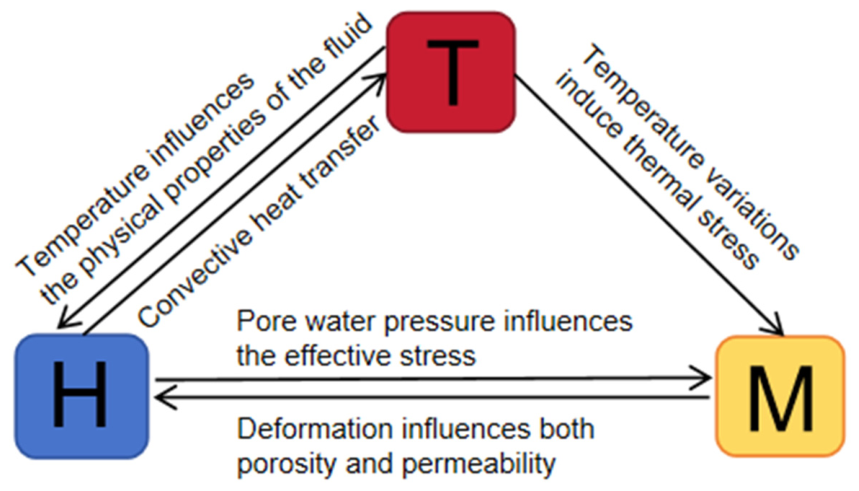
High-geothermal tunnels are characterized by the coupled interaction of temperature, seepage, and stress fields, which jointly control the deformation and failure of surrounding rock. After tunnel excavation, ventilation induces a significant thermal disturbance, forming a thermal influence zone within the surrounding rock. In this study, this region is defined as the thermal influence zone, referring to the area where the rock temperature decreases relative to the initial geothermal state. Unlike conventional studies that assume a uniform initial temperature field, the present work incorporates an in situ temperature gradient to better represent realistic geological conditions. The coupling processes among the thermal, hydraulic, and mechanical fields include: (1) temperature-dependent variation in rock mechanical properties, (2) pore pressure-induced effective stress changes, and (3) thermal stress generated by temperature gradients (Figure 1). Based on these considerations, a fully coupled THM framework is established to investigate the evolution of the thermal influence zone and the associated mechanical response of surrounding rock.

2.2. Governing Equations of THM Coupling

2.2.1. Heat Transfer Equation

Heat transfer in the surrounding rock is governed by conduction and convection induced by pore water flow, while thermal radiation is neglected. Based on Fourier’s law and energy conservation, the governing equation can be expressed as:
( ρ C ) eq T t + C F ρ F μ F T = · ( k eq T )
where ( ρ C ) eq is the equivalent volumetric heat capacity of the porous medium at constant pressure, T is the temperature of the porous medium, t is time, C F is the specific heat capacity, ρ F is the fluid density, μ F is the seepage velocity, is the divergence operator, and k e q is the equivalent thermal conductivity of the porous medium. The temperature dependence of water density and dynamic viscosity is incorporated to capture the influence of thermal conditions on seepage behavior [16,17], as shown in the following equation:
ρ F = 972.757815 + 0.2084 × T 4.0 × 10 4 × T 2                                                                                           , 273.15 T < 283.0 345.28 + 5.749816 × T 1.57244 × 10 2 × T 2 + 1.264375 × 10 5 × T 3 , 283.0 T < 373.16
μ F = e 1.47297892 × 10 11 T 4 1.56916127 × 10 9 T 3 + 6.52798499 × 10 6 T 2 1.10421451 × 10 4 T 2.86320560

2.2.2. Seepage Equation

Fluid flow in the porous rock mass follows Darcy’s law:
ρ F μ F = K · h
where K is the hydraulic conductivity and h is the hydraulic head.
The continuity equation considering fluid compressibility and rock deformation is given as [18]:
S h t = · ( K · h ) + α B ε t
S = ρ F g ( β S + η β F )
ε t V t 1 V t V t 1 1 t
where S is the storage coefficient, α B is the Biot coefficient, ε t represents the volumetric change in the porous medium, ε is the volumetric strain, β S and β F are the compressibility of the solid matrix and that of the fluid, η is the porosity of the porous medium, V t 1 is the element volume at the previous time step ( t 1 ) , V t is the element volume at the current time step ( t ) after displacement, and Δ t is the time step.

2.2.3. Mechanical Equilibrium Equation

The mechanical behavior of surrounding rock is governed by the equilibrium equation incorporating thermal stress and pore pressure [18]:
G 2 d i x i y j + ( G + λ ) 2 d j x i y j α B p x i β K S T x i + F = 0
λ = E ν ( 1 + ν ) ( 1 2 ν )
K S = E 3 ( 1 2 ν )
where G is the shear modulus of the rock mass, d i and d j are the displacements along the x-axis and y-axis respectively, λ is the Lamé constant, p is the liquid pressure, β is the thermal expansion coefficient of the solid matrix, K S is the bulk modulus of the solid matrix, F is the body force, E is Young’s modulus, and ν is Poisson’s ratio.

2.3. Temperature-Dependent Material Properties

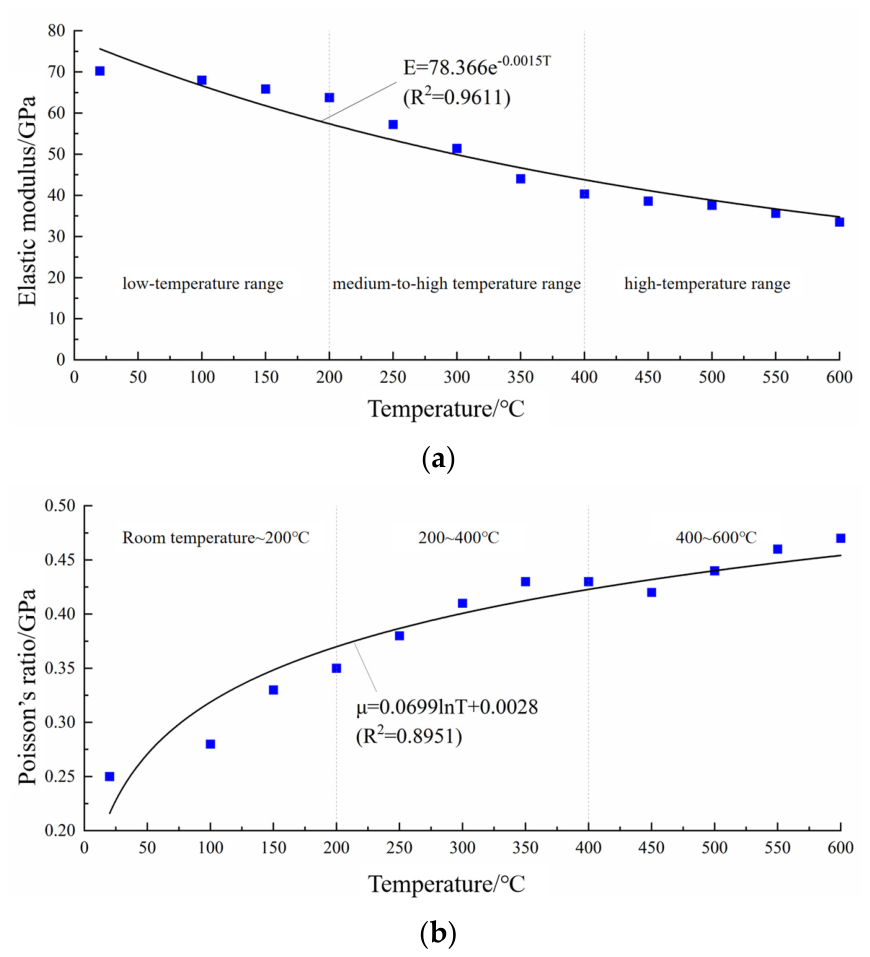
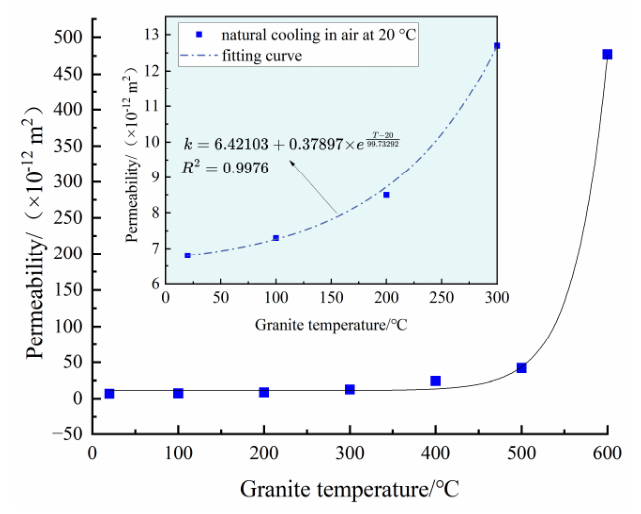
The mechanical and hydraulic properties of rock are strongly influenced by temperature. In this study, temperature-dependent relationships for the elastic modulus, Poisson’s ratio, and permeability are incorporated based on previous laboratory experimental data [4,19]. Specifically, the elastic modulus decreases with increasing temperature due to thermal damage, while permeability increases as microcracks develop under thermal stress. These relationships are introduced into the THM coupling model through fitted empirical functions, enabling a more realistic representation of rock behavior under high-temperature conditions, as shown in Figure 2 and Figure 3.
E = 78.366 e 0.0015 T
μ = 0.0699 ln T + 0.0028
k = 6.42103 + 0.37897 e T 20 90.73292

2.4. Numerical Model and Boundary Conditions

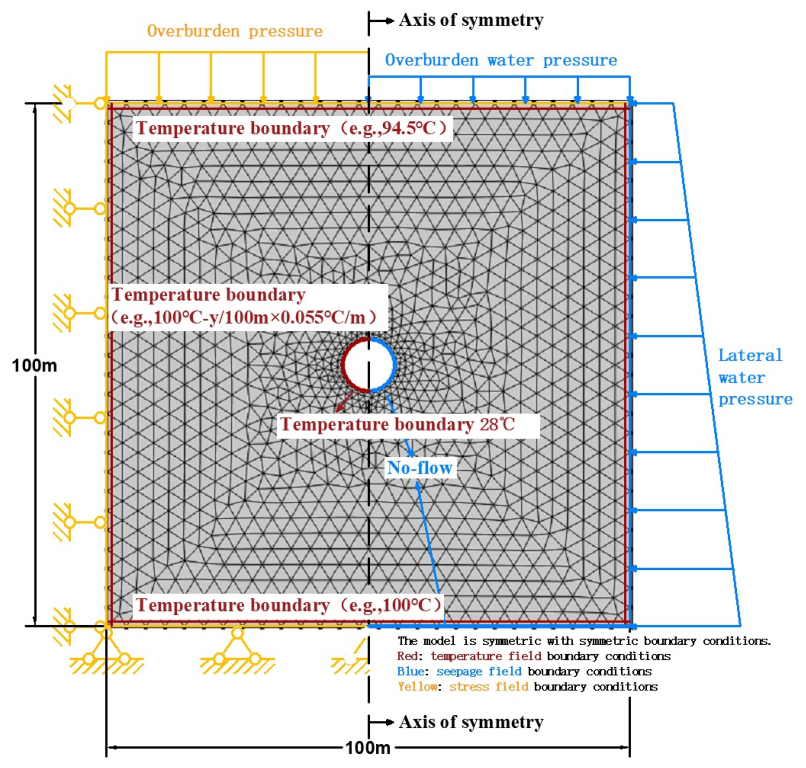
A two-dimensional plane strain model is established, with the tunnel simplified as a circular opening of radius 5 m. To minimize boundary effects, the model size is set to 100 m × 100 m, corresponding to five times the tunnel diameter. The boundary conditions are defined as follows:
(1)
Thermal boundary: A geothermal gradient is applied to represent in situ temperature distribution, while the tunnel boundary is set to a constant temperature (28 °C) to simulate ventilation cooling.
(2)
Hydraulic boundary: The model is assumed to be fully saturated. Lateral boundaries are defined as hydraulic boundaries, and pore water pressure is applied at the top boundary.
(3)
Mechanical boundary: The bottom boundary is fixed, and the lateral boundaries are constrained with roller supports. Vertical stress is applied at the top boundary to simulate overburden load.
The above thermal, hydraulic and mechanical boundary settings and overall meshing of the numerical model are illustrated schematically in Figure 4. The present model is geometrically static after excavation, but the coupled THM response is solved in a transient manner. The numerical analysis was carried out sequentially. First, the initial geostress field, pore-pressure field, and in situ temperature gradient were established. Second, tunnel excavation was simulated by deactivating the tunnel elements (or equivalently removing the excavation domain) and converting the tunnel boundary into a free mechanical boundary and a no-flow hydraulic boundary. It represents a sealed condition similar to grouting in practice. Third, a constant tunnel-wall temperature of 28 °C was imposed to represent ventilation cooling, and the transient THM response was solved for different ventilation durations.
In addition, in the present model, the lining system was not explicitly considered. The tunnel boundary was simplified as an exposed excavation surface subjected to ventilation cooling. This treatment is suitable for investigating the intrinsic response of the surrounding rock, but it does not capture the thermal insulation and load-sharing effects of the lining. The influence of lining thickness, stiffness, and contact condition should therefore be addressed in future work.

2.5. Model Validation

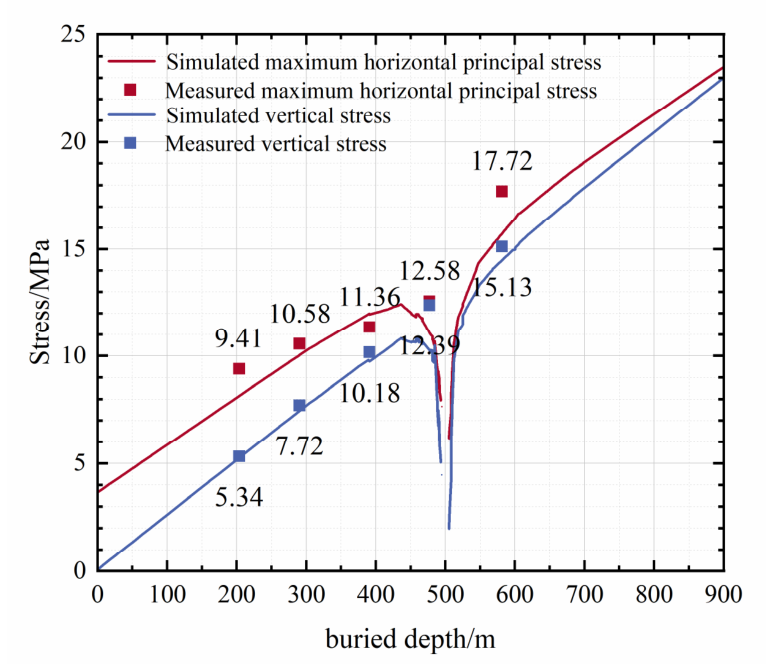
To verify the reliability of the proposed THM model, numerical results are compared with in situ stress measurements from the Sangzhuling Tunnel. The maximum buried depth of the tunnel is 1500 m. The in situ stress data used for model validation were taken from hydraulic fracturing measurements reported for borehole D1K-SZLSD-2 near mileage D1K186+327 of the Sangzhuling Tunnel. The borehole had a designed depth of 475 m, an actual drilling depth of 604.45 m, and a static water level of about 65 m. Stress measurements were conducted at five depths, i.e., 205.6, 297.4, 391.8, 476.9, and 582.6 m, and the measured principal stresses were used for model validation [20]. According to the borehole location, the model is established based on the geological conditions at a buried depth of approximately 900 m, with a ground temperature of 56.6 °C and a geothermal gradient of 5.5 °C per 100 m. According to the cited geological investigation, the rock mass near borehole D1K-SZLSD-2 and the studied tunnel section is mainly granite or granodiorite, and the rock mass is relatively intact, with an RQD of about 95%. Relevant parameter values are listed in Table 1 [21].
An independently established large-scale regional geostress field model within the depth range of 0–900 m shown was built to verify the rationality of the initial stress field and boundary condition settings of the numerical model. The comparison between simulated and measured in situ stress shows good agreement, as shown in Figure 5, indicating that the model can effectively capture the stress distribution characteristics of the surrounding rock under THM coupling conditions. Therefore, the developed model is considered reliable for subsequent analysis. It should be noted that the field comparison with measured in situ stress is used in this study mainly to verify the reasonableness of the initial stress field and boundary-condition setting of the numerical model. Due to the lack of long-term in situ monitoring data for temperature, pore water pressure, and deformation, the present model cannot be regarded as fully validated for all coupled THM responses over time. Rather, the subsequent analyses should be understood as predictions based on a mechanically validated and physically based THM framework under the geological and thermal conditions of the Sangzhuling Tunnel.

3. Evolution of the Thermal Influence Zone Under THM Coupling

3.1. Definition of the Thermal Influence Zone

After tunnel excavation, ventilation induces heat exchange between the tunnel air and the surrounding rock, leading to a gradual decrease in rock temperature near the tunnel boundary. As heat conduction continues, the temperature disturbance propagates outward into the surrounding rock, forming a thermal influence zone. In this study, the thermal influence zone (TIZ) is defined as the region where the rock temperature decreases relative to the initial geothermal state due to ventilation cooling [22]. Under coupled THM conditions, the evolution of the thermal influence zone is controlled by the combined effects of conductive and convective heat transfer under coupled THM conditions. When the permeability of the surrounding rock is relatively low, heat conduction plays the dominant role in thermal disturbance propagation. However, with tunnel excavation and the associated increase in rock permeability and seepage velocity, convective heat transfer becomes more significant and can further promote the outward expansion of the thermal influence zone. It should also be noted that, in the coupled process, conduction and seepage-enhanced convection are closely interconnected, and their individual contributions are difficult to distinguish strictly. Therefore, the TIZ evolution should be understood as the result of their joint action rather than two completely separable mechanisms. In addition, under THM coupling conditions, temperature variation further induces thermal stress and changes in rock mechanical properties, which may affect the deformation and permeability of the surrounding rock [3,4].
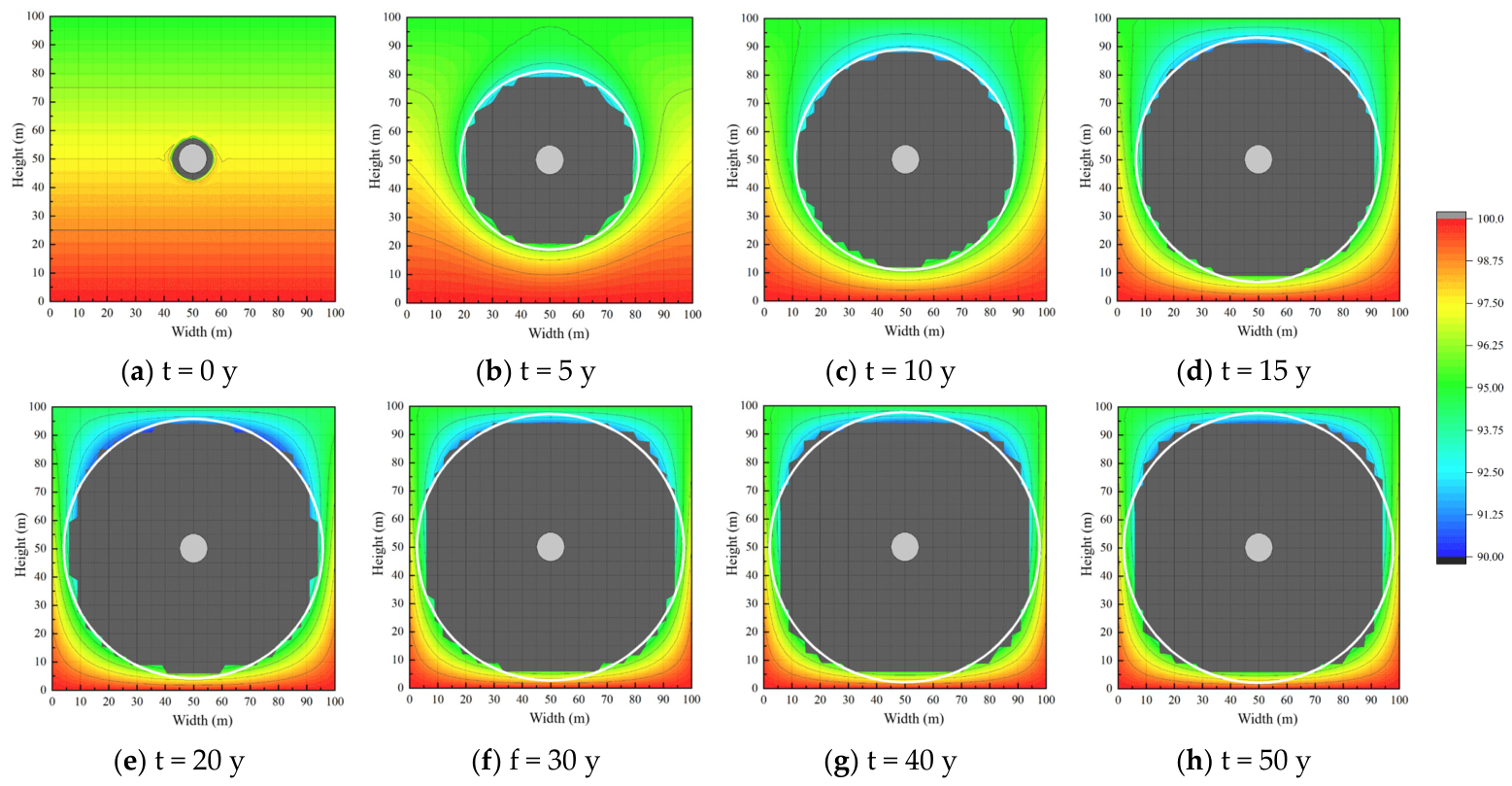
The spatial extent of the TIZ is determined by comparing the initial temperature field prior to excavation with the transient temperature field after excavation and ventilation. Based on the two-dimensional model, the coordinates and temperature values of all grid nodes are extracted to identify regions where the rock temperature is lower than the initial state. These regions, shown as gray areas in Figure 6, represent the actual distribution of the thermal influence zone. For quantitative characterization, an equivalent area method is adopted. The equivalent radius is defined by equating the area of a circle to the actual area of the thermal influence zone. It is introduced as a scalar descriptor of the disturbed thermal domain. It does not represent the actual geometric shape of the TIZ; instead, it converts the irregular influenced area into an equivalent circle with the same area, thereby facilitating comparison among different times and initial temperature conditions. The white solid line in Figure 6 indicates the corresponding equivalent circular boundary, and the equivalent radius is calculated as follows:
r eq = A π
where r eq is the equivalent radius of the thermal influence zone, and A is the actual area of the zone in which the rock temperature is lower than the initial geothermal state.

3.2. Temporal Evolution of the Thermal Influence Zone

The temporal evolution of the thermal influence zone under THM coupling is illustrated in Figure 6, which presents the temperature distribution around the tunnel at different ventilation times. The results show that the temperature near the tunnel boundary decreases rapidly during the early stage of ventilation. As time progresses, the temperature disturbance gradually propagates into the surrounding rock, resulting in a continuous expansion of the thermal influence zone. However, the expansion rate of the TIZ decreases with time. In the early stage, from 0 to 5 y, the TIZ expands rapidly. As the temperature field gradually approaches equilibrium, the temperature gradient decreases, and the growth rate of the TIZ becomes progressively slower. After a sufficiently long ventilation period, from 1 year to 30 years, the temperature field tends to stabilize, and the expansion of the thermal influence zone becomes negligible.
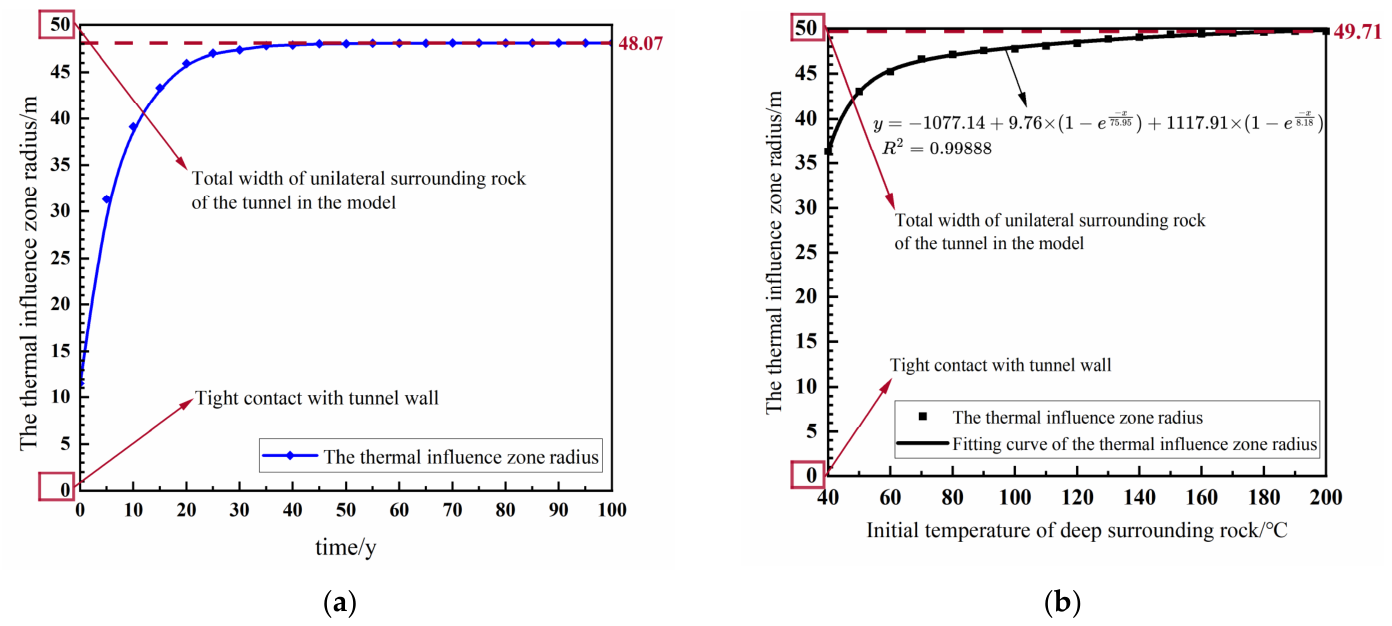
As shown in Figure 7a, the TIZ radius expands rapidly during the initial cooling stage due to the large temperature difference between the surrounding rock and the tunnel wall. After 15 years, its radius reaches 43.33 m. As the temperature gradient decreases, the heat flux density declines, leading to a reduced expansion rate. After 35 years, the radius increases to 47.78 m, and eventually stabilizes at approximately 48.07 m as the surrounding rock approaches thermal equilibrium. This trend is consistent with previously reported temperature field evolution patterns [15].
The initial rock temperature is one of the key factors controlling the development of the thermal influence zone. Figure 7b presents the TIZ range under different initial geothermal conditions. The results indicate that the extent of the TIZ increases nonlinearly with increasing initial rock temperature. When the initial temperature is relatively low, the temperature disturbance is mainly confined to the near-field region around the tunnel. In contrast, under high geothermal conditions, the temperature disturbance propagates further into the surrounding rock, resulting in a significantly larger TIZ. This finding highlights the importance of considering realistic geothermal gradients in the analysis of high-geothermal tunnels. This finding differs from results obtained under the assumption of a uniform initial temperature field [13,14,15].

4. Mechanical Response of Surrounding Rock Under THM Coupling

4.1. Influence of Temperature on Mechanical Response

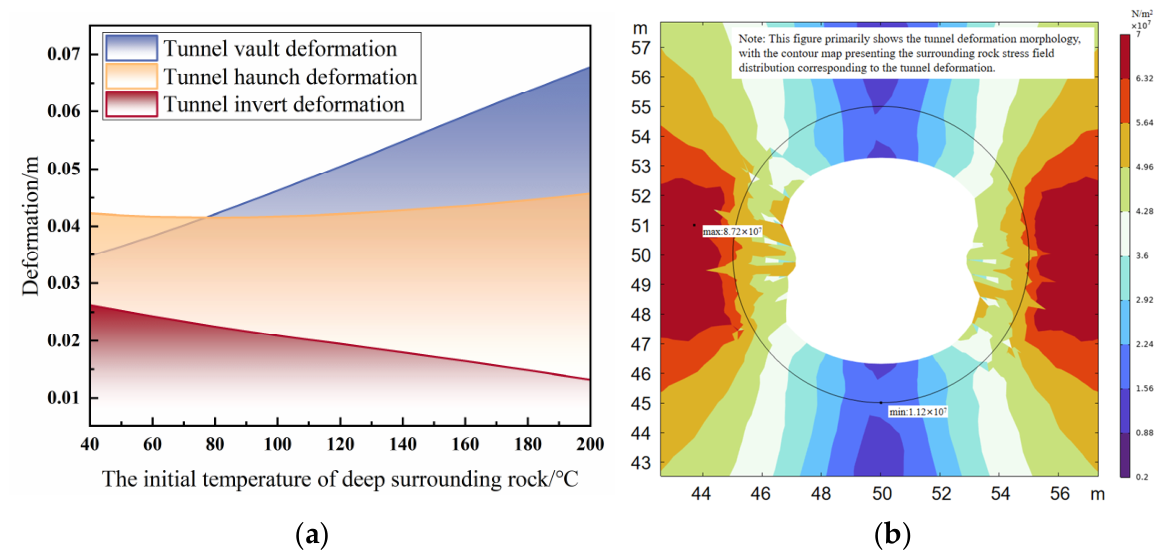
Temperature plays a dominant role in controlling the mechanical response of surrounding rock, including the tunnel deformation and plastic zone evolution. As shown in Figure 8a, the deformation response of different tunnel positions varies significantly with increasing initial temperature of the deep surrounding rock. The vault displacement increases continuously and exhibits the largest variation, indicating the highest sensitivity to temperature. In contrast, the haunch displacement first decreases slightly and then increases, while the invert displacement gradually decreases, with a smaller variation amplitude than that of the vault. At the same temperature, the deformation pattern also differs among tunnel positions. In the low-temperature range (40–80 °C), the displacement follows the order of invert < vault < haunch, with the maximum deformation occurring at the haunch and averaging 0.0418 m. In the high-temperature range (80–200 °C), the order changes to invert < haunch < vault, and the maximum deformation shifts to the vault, reaching 0.0678 m at 200 °C. As illustrated in Figure 8b, the overall tunnel deformation presents a gourd-shaped pattern with inward contraction in the middle. With increasing temperature, this deformation pattern gradually becomes flatter. These results indicate that the tunnel crown is the most temperature-sensitive region under high-temperature conditions, while deformation at the haunch remains significant and should be closely monitored in engineering practice.
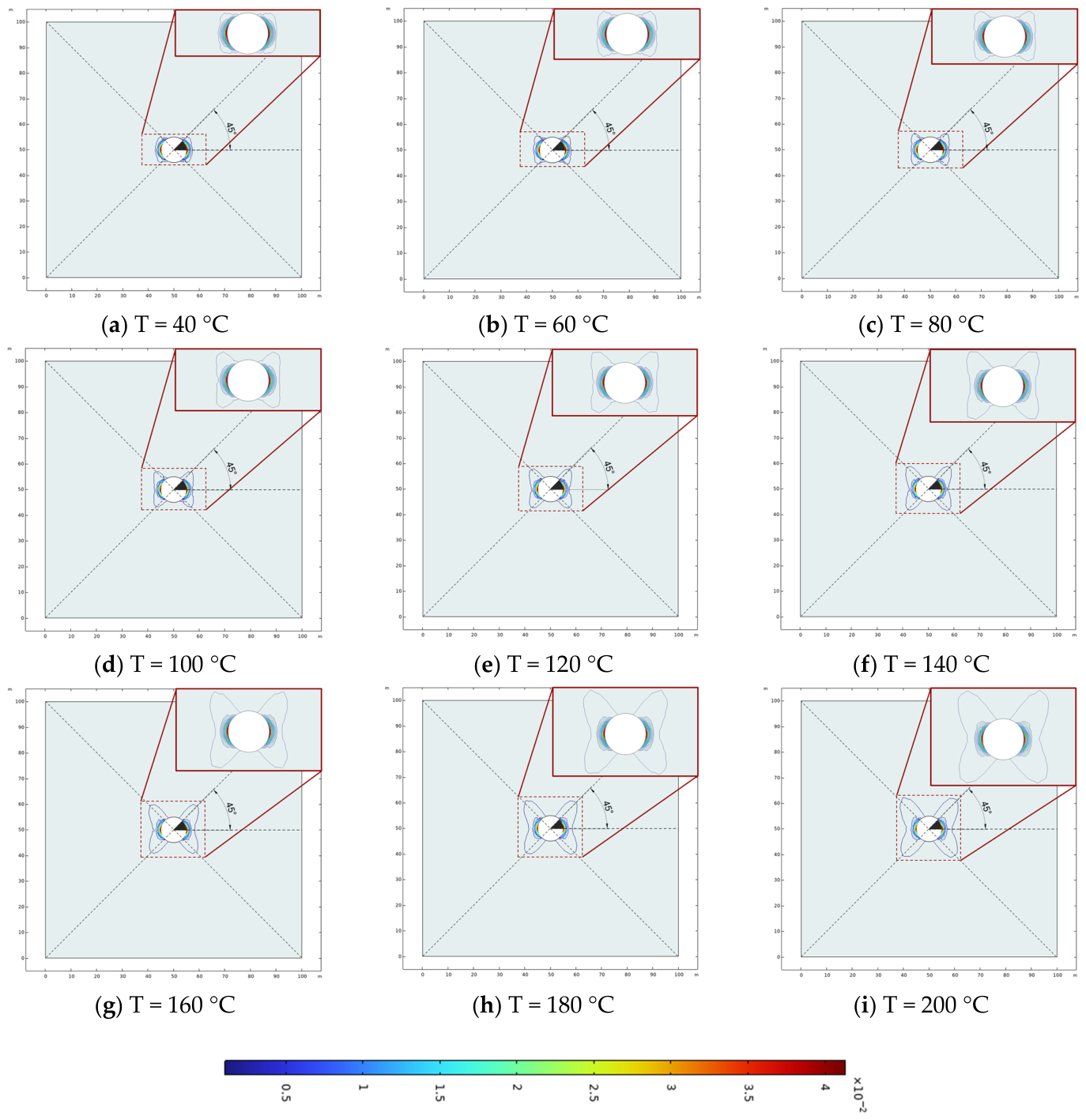
Figure 9 shows the distribution of plastic strain around the tunnel. The color scale represents the magnitude of plastic strain, where red indicates a larger value and blue indicates a smaller value. As shown in the figure, the plastic strain is concentrated near the excavation boundary, where the surrounding rock appears mainly red, while the plastic strain decreases gradually away from the tunnel, as indicated by the transition from red to blue. It shows that the plastic zone expands predominantly along directions approximately 45° to the horizontal as the initial temperature of the deep surrounding rock increases, which is generally consistent with the failure pattern reported by Liu et al. [23]. At low temperatures (40–60 °C), the plastic zone is localized around the tunnel and exhibits a relatively regular shape, with an area of 159.92–219.62 m2 and an equivalent radius of 7.67–8.82 m. When the temperature exceeds 80 °C, the plastic zone expands rapidly and gradually evolves into a butterfly-shaped pattern. At 200 °C, the plastic zone area reaches 1856.8 m2, corresponding to an equivalent radius of 24.47 m. This transition from localized concentration to outward expansion indicates that elevated temperature significantly aggravates the plastic deterioration of surrounding rock. This is mainly due to two mechanisms. First, elevated temperature induces additional thermal stress, which alters the stress distribution around the tunnel. Second, temperature-dependent degradation of mechanical properties, such as the elastic modulus and strength, weakens the rock mass. As a result, high-temperature conditions significantly reduce the stability of the surrounding rock and increase the risk of large deformation and failure.
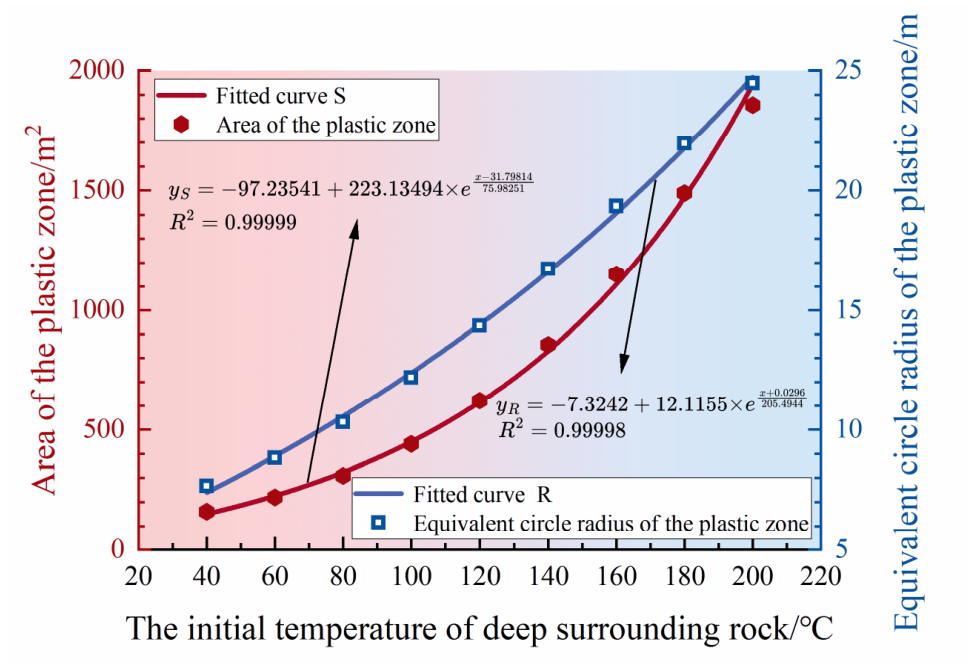
As shown in Figure 10, both the plastic zone area and its equivalent radius increase with the initial temperature of the deep surrounding rock, indicating that elevated temperature promotes plastic zone expansion and aggravates surrounding rock failure. Within the temperature range of 40–100 °C, the growth of the plastic zone is relatively gradual. Above 120 °C, however, the expansion rate increases markedly. On average, the plastic zone area increases by 10.6055 m2 and the equivalent radius by 0.1050 m for every 1 °C rise in temperature. The synchronous increase in these two parameters reflects the continuous outward propagation of the plastic zone and the increasing depth of thermal damage around the tunnel. This trend suggests that high temperature may weaken the radial confinement provided by the support system, and the fitted relationship of the equivalent radius can therefore serve as a useful reference for determining bolt support depth.

4.2. Influence of Pore Water Pressure on Mechanical Response

Here, the different pore water pressure was considered. The pore water pressure is applied at the top boundary with an increment of 2.5 MPa, ranging from 0 to 15 MPa. This range was selected because a detailed measured distribution of groundwater pressure was not available for the tunnel section considered. Therefore, the upper bound was taken with reference to the maximum hydrostatic pressure corresponding to the deepest tunnel section (approximately 1500 m burial depth). This range was selected to cover a representative interval from dry/undrained local conditions to high-pressure groundwater environments that may occur in deep tunnel sections. The applied hydraulic boundary conditions should thus be understood as a simplified engineering representation for comparative analysis of pore-pressure effects under THM coupling, rather than a direct one-to-one reconstruction of the full in situ groundwater system.
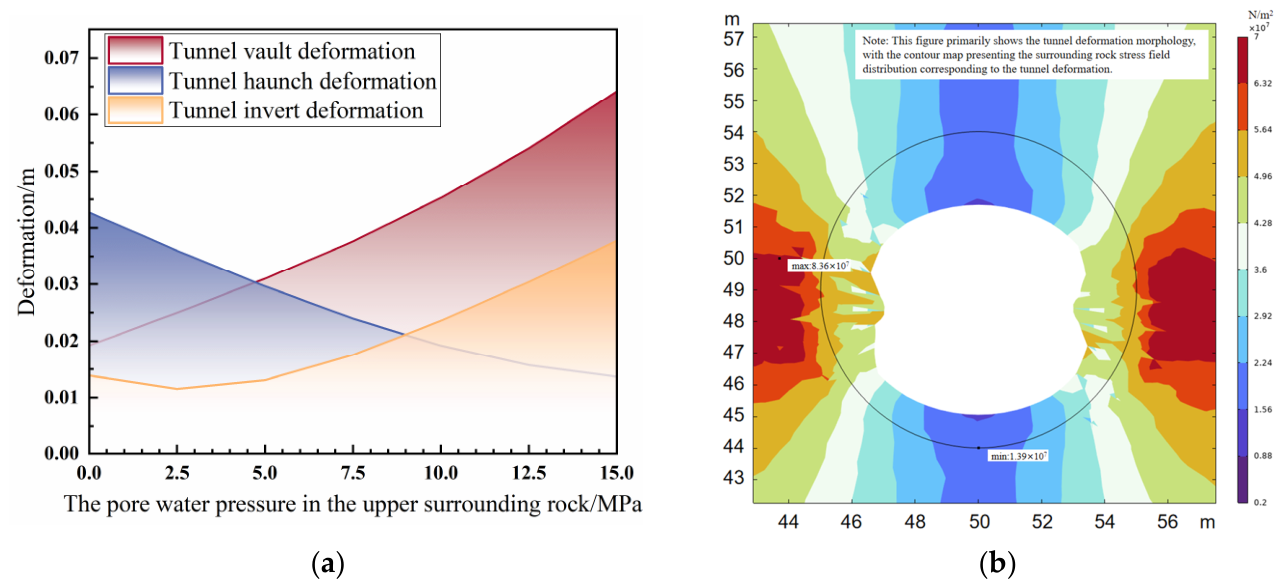
As shown in Figure 11a, the deformation of different tunnel positions exhibits distinct responses to increasing pore water pressure. The vault displacement decreases continuously, reaching a maximum of 0.04271 m at 0 MPa. In contrast, the invert displacement increases significantly with pressure, reaching 0.06413 m at 15 MPa, indicating the highest sensitivity to pore pressure. The haunch displacement shows a slight decrease at low pressure and then increases gradually beyond 2.5 MPa. Overall, pore water pressure significantly affects the deformation distribution, with the invert being the most sensitive region.
As illustrated in Figure 11b, the tunnel deformation exhibits a gourd-shaped pattern, which gradually transitions from inward contraction to outward bulging with increasing pore pressure. These results suggest that deformation at the tunnel invert should be carefully monitored under high pore pressure conditions, while haunch stability remains critical at lower pressures.
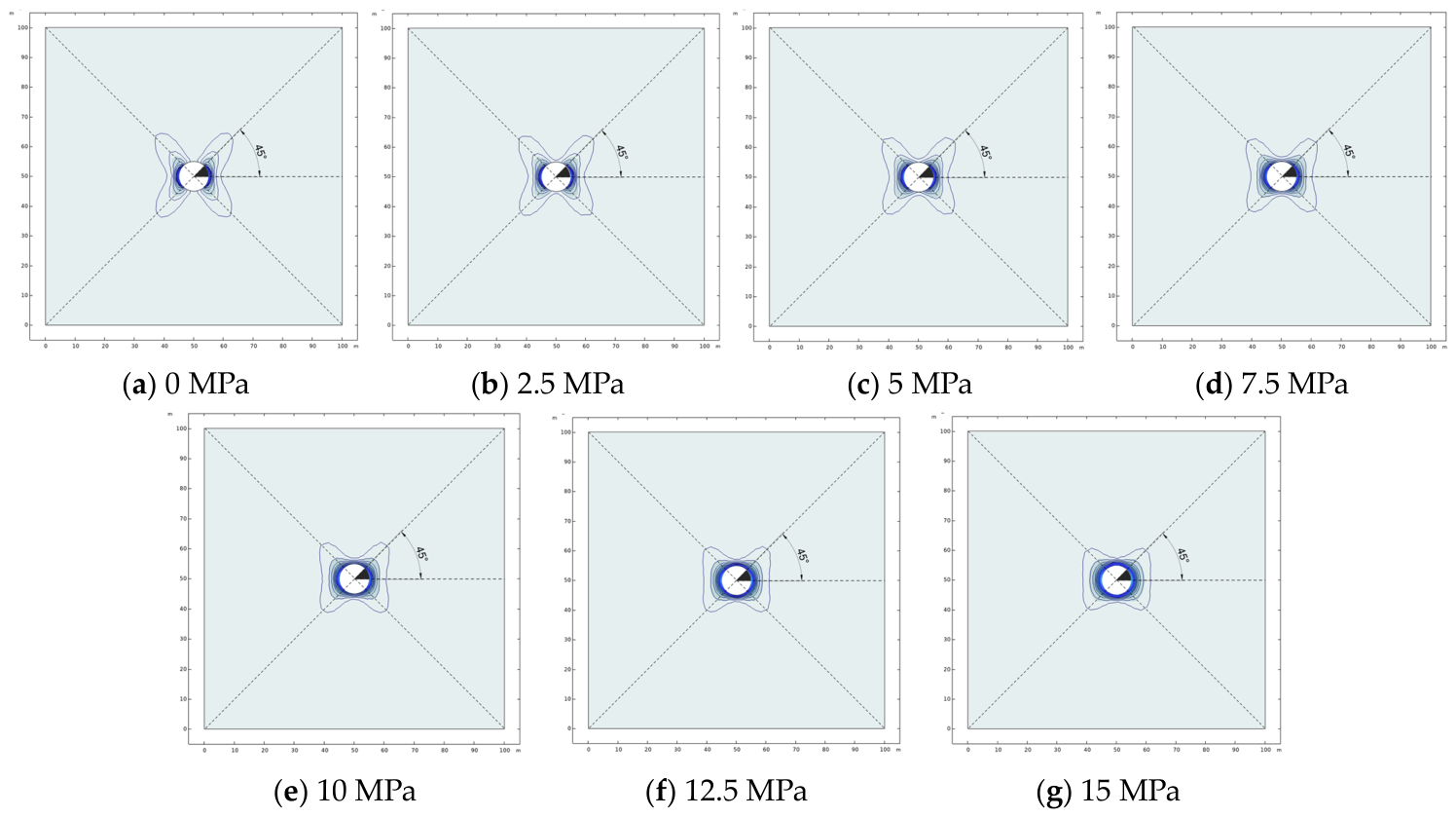
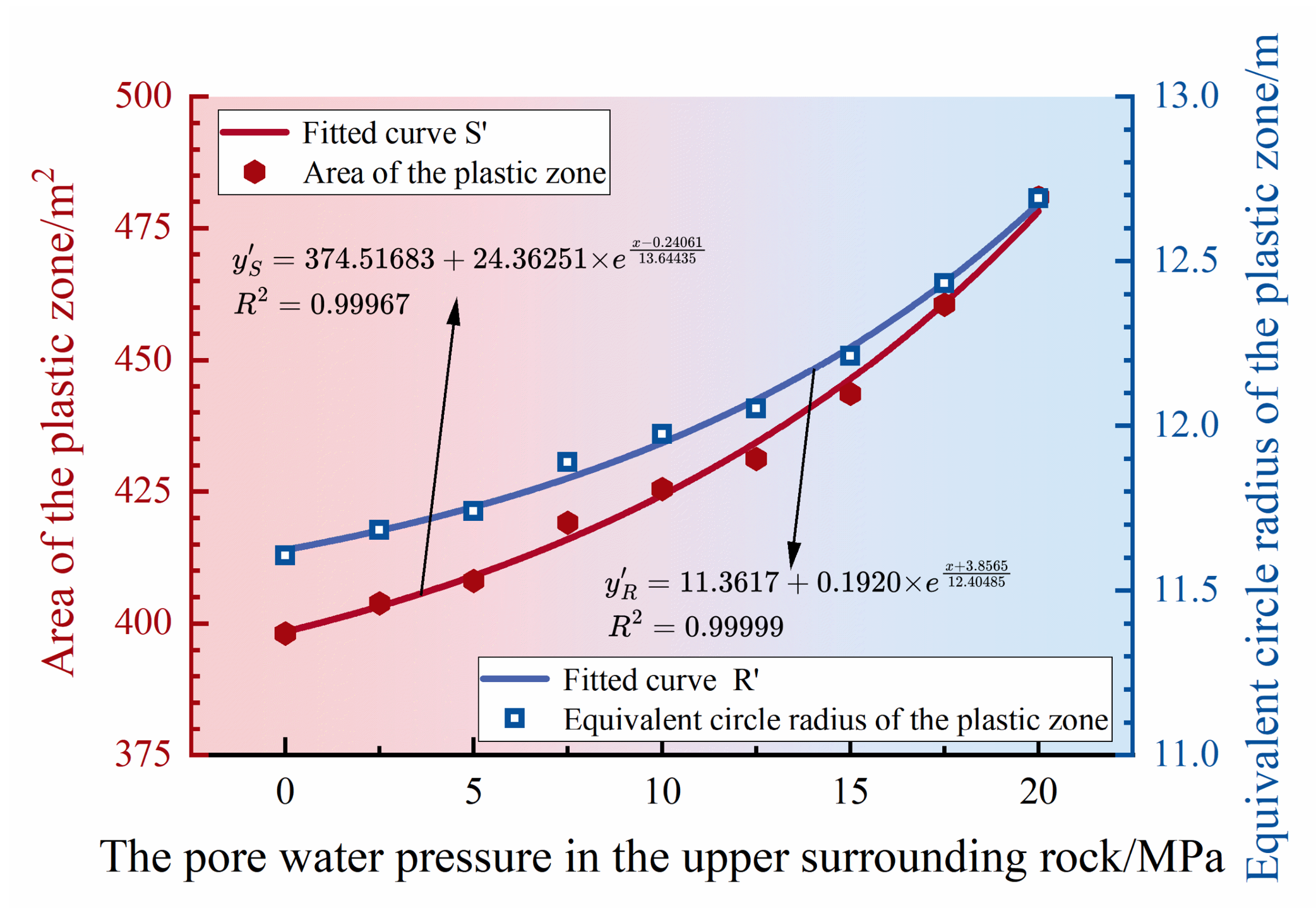
Figure 12 shows that the plastic zone is initially concentrated on both sides of the tunnel and attenuates outward, indicating that excavation-induced stress concentration dominates its initial distribution. With increasing pore water pressure, the plastic zone becomes more pronounced near the tunnel floor and tends to penetrate downward, increasing the risk of instability. As shown in Figure 13, both the plastic zone area and its equivalent radius increase with pore water pressure. On average, the plastic zone area increases by 3.0307 m2 and the equivalent radius by 0.0405 m for every 1 MPa rise in pressure. This behavior is primarily controlled by effective stress reduction. According to the Mohr–Coulomb criterion:
τ = σ tan ψ + c
where τ is the shear strength, σ is the normal effective stress, ψ is the internal friction angle, and c is the cohesion. Increasing pore pressure reduces effective stress, thereby lowering shear strength and promoting plastic deformation. However, the expansion of the plastic zone induced by pore pressure is significantly smaller than that caused by temperature, indicating its secondary role in controlling overall rock failure.

5. Discussion

5.1. Mechanism of Thermal Influence Zone Evolution Under THM Coupling

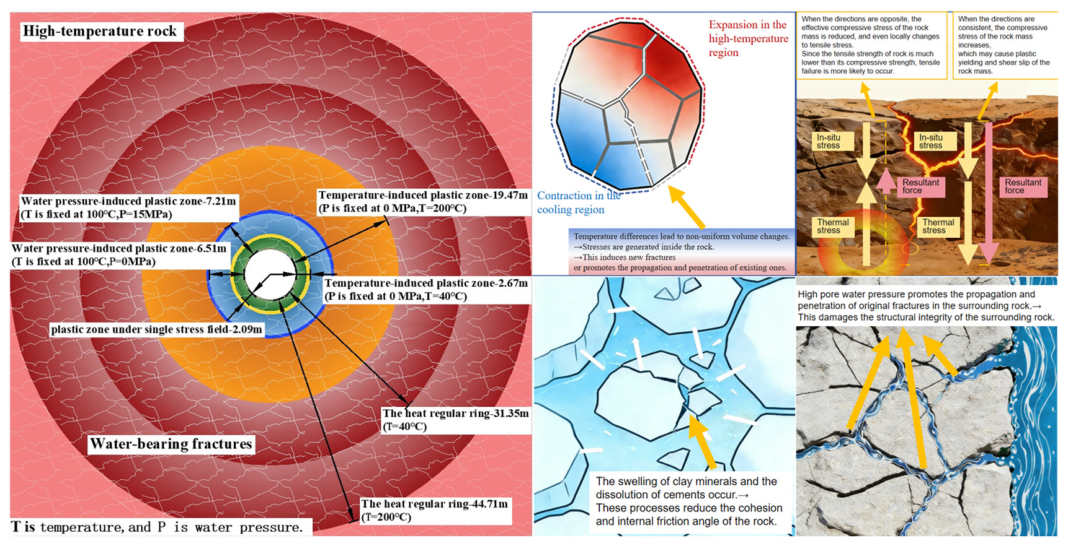
The evolution of the thermal influence zone (TIZ) is governed by the coupled processes of heat transfer, fluid flow, and mechanical response, as shown in Figure 14. Unlike conventional analyses that consider heat conduction alone, the present results demonstrate that the coupled THM model indicates that seepage within the saturated surrounding rock can modify the temperature field through advective–convective transport. However, because the tunnel boundary is treated as a no-flow boundary in the present model, seepage does not enter the tunnel but may redistribute heat transfer within the surrounding rock mass under coupled THM conditions. More importantly, temperature variation induces thermal stress due to differential thermal expansion, which modifies the stress field around the tunnel. This thermally induced stress redistribution not only contributes directly to deformation but also promotes the initiation and propagation of microcracks, leading to permeability enhancement. The increased permeability, in turn, facilitates fluid flow and further intensifies convective heat transfer. This feedback loop among temperature, permeability, and seepage represents a typical THM coupling mechanism. As a result, the evolution of the TIZ is not a purely thermal diffusion process but a nonlinear, multi-field coupled process characterized by mutual reinforcement among the involved physical fields.
It should be noted that the relative contributions of temperature and pore water pressure depend on the geological, hydraulic, and boundary conditions, and therefore should not be generalized as a universal rule. Under the conditions considered in this study, the temperature plays a dominant role in controlling the mechanical behavior of surrounding rock under high-geothermal conditions. Compared with pore water pressure, temperature affects both the stress state and the intrinsic mechanical properties of the rock. On the one hand, temperature gradients generate thermal stress, which alters the original stress distribution around the tunnel. On the other hand, elevated temperature leads to the degradation of mechanical properties, such as the elastic modulus and strength, due to thermally induced microstructural damage. In contrast, pore water pressure mainly influences the effective stress without directly altering the material properties. Therefore, although pore pressure contributes to deformation and plastic zone development, its effect is secondary compared with that of temperature. This distinction highlights the necessity of explicitly considering temperature-dependent material behavior in the analysis of high-geothermal tunnels, as neglecting thermal effects may lead to a significant underestimation of deformation and failure risk.

5.2. Engineering Implications for High-Geothermal Tunnels

The engineering implications of the present results are reflected mainly in three aspects. First, the quantified evolution of the thermal influence zone provides a reference for evaluating the long-term spatial extent of thermal disturbance around high-geothermal tunnels, which is relevant to the layout of thermal insulation and disturbance-control measures. Second, the expansion characteristics of the plastic zone under different temperature and pore-pressure conditions provide guidance for support design, especially for determining the required reinforcement range and support depth in thermally and hydraulically sensitive zones. Third, the different deformation responses of the vault, haunch, and invert indicate that monitoring priority and stability-control measures should be condition-dependent: under high-temperature conditions, more attention should be paid to the vault and adjacent plastic-expansion zone, whereas under high pore-pressure conditions, the tunnel invert should be given higher monitoring priority and stronger local control. These results provide a more direct basis for support optimization and long-term stability management in high-geothermal tunnels.

5.3. Limitations and Future Work

Despite the insights provided by this study, several limitations should be acknowledged. First, it should be noted that the present numerical analysis is based on a 2D plane-strain model with a circular tunnel idealization and full-face excavation assumption. These simplifications were adopted to focus on the dominant thermo–hydro–mechanical coupling mechanisms and to facilitate quantitative analysis of the thermal influence zone and surrounding-rock response. However, they may not fully capture three-dimensional effects, the actual geometric characteristics of the tunnel section, or the sequential influence of staged excavation and support installation. Therefore, the results should be interpreted as a simplified THM evaluation under idealized conditions, and further studies using more realistic three-dimensional and construction-stage-dependent models are needed. Second, the temperature-dependent material parameters adopted in this study were derived from published laboratory tests on granite and are used here as engineering-scale constitutive approximations. They are intended to capture the first-order trends of thermal damage, stiffness degradation, and permeability enhancement. It should be noted that the in situ rock mass is generally more heterogeneous and discontinuous than intact laboratory samples; therefore, these parameters do not represent a strict one-to-one characterization of field rock-mass properties, but rather an engineering idealization for coupled THM analysis under high-geothermal conditions. Further calibration with site-specific rock-mass tests or long-term field monitoring data would improve the reliability of the parameterization. Third, the model does not explicitly consider fracture network evolution or large deformation effects, which may play a significant role under extreme conditions. In addition, a limitation of this study is that model validation is presently restricted to the mechanical field. Further validation of the transient thermal, hydraulic, and deformation responses will require long-term field monitoring or laboratory/field-coupled datasets, which should be addressed in future work. Future work should focus on developing three-dimensional THM models, incorporating more advanced constitutive relationships that account for damage evolution, and validating the results through laboratory experiments and field monitoring data.

6. Conclusions

This study investigates the evolution of the thermal influence zone and the mechanical response of surrounding rock in high-geothermal tunnels under thermo–hydro–mechanical (THM) coupling conditions. The main conclusions are as follows:
(1)
A THM-coupled numerical model incorporating an in situ temperature gradient is established, and the thermal influence zone (TIZ) is quantitatively characterized. The results show that the TIZ radius increases rapidly at the early stage and gradually stabilizes. The steady-state radius increases nonlinearly with the initial rock temperature, indicating that geothermal gradient plays a critical role in determining the spatial extent of thermal disturbance.
(2)
Temperature has a dominant effect on the mechanical response of surrounding rock under the present model conditions. As the initial temperature increases from 40 °C to 200 °C, the tunnel crown displacement increases significantly, reaching a maximum of 0.0678 m, while the plastic zone expands from 159.92–219.62 m2 to 1856.8 m2, with the equivalent radius increasing from 7.67–8.82 m to 24.47 m. On average, the plastic zone area and equivalent radius increase by 10.6055 m2/°C and 0.1050 m/°C, respectively.
(3)
Pore water pressure mainly influences deformation distribution through effective stress reduction. As pore pressure increases from 0 MPa to 15 MPa, the invert displacement increases from 0.04271 m to 0.06413 m, showing the highest sensitivity. Meanwhile, the plastic zone area and equivalent radius increase at rates of approximately 3.0307 m2/MPa and 0.0405 m/MPa, respectively, which are significantly lower than those induced by temperature.
(4)
The plastic zone develops preferentially along directions approximately 45° to the horizontal and evolves from a localized distribution to a butterfly-shaped pattern with increasing temperature and pore pressure. This evolution reflects stress redistribution from the tunnel boundary to deeper surrounding rock and indicates an increasing depth of damage under high-temperature conditions.
(5)
THM coupling significantly amplifies surrounding rock deformation and failure compared with single-field conditions. Temperature controls the intensity of damage through thermal stress and material degradation, while pore pressure regulates the spatial distribution of deformation via effective stress reduction. These findings highlight the necessity of considering multi-field coupling in the design of support systems, particularly for determining support depth based on the expanded plastic zone.

Author Contributions

X.W. performed the numerical simulation and wrote the manuscript. B.X. developed the idea of the research and supervised the research. L.C. participated in manuscript reviewing, editing and project supervision. F.W. contributed to conceptualization, methodology development, as well as manuscript revision. J.C. and Y.G. provided overall supervision for this research. All authors have read and agreed to the published version of the manuscript.

Funding

This research was sponsored by the Joint Key Program of the National Natural Science Foundation of China (No. U24A2089), the National Natural Science Foundation of China (No. 51874207), and the Natural Science Foundation of Shanxi Province (Nos. 202303021211042 and 202303011222006).

Institutional Review Board Statement

Not applicable.

Informed Consent Statement

Not applicable.

Data Availability Statement

The data used to support the findings of this study are available from the corresponding author upon request.

Conflicts of Interest

Author Fengnian Wang was employed by the company Shanxi Provincial Transportation Technology Research and Development Co., Ltd. The remaining authors declare that the research was conducted in the absence of any commercial or financial relationships that could be construed as a potential conflict of interest.

References

  1. Guo, P.Y.; Bu, M.H.; Zhang, P.; Li, Q.B.; He, M.C. Review on catastrophe mechanism and disaster countermeasure of high geotemperature tunnels. Chin. J. Rock Mech. Eng. 2023, 42, 1561–1581. [Google Scholar] [CrossRef]
  2. Zhao, Y.S. Retrospection on the development of rock mass mechanics and the summary of some unsolved centennial prob. Chin. J. Rock Mech. Eng. 2021, 40, 1297–1336. [Google Scholar] [CrossRef]
  3. Dwivedi, R.; Goel, R.; Prasad, V.; Sinha, A. Thermo-mechanical properties of Indian and other granites. Int. J. Rock Mech. Min. Sci. 2008, 45, 303–315. [Google Scholar] [CrossRef]
  4. Xi, B.P.; Zhao, Y.S. Experimental study of thermophysico-mechanical property of drilling surrounding rock in granite under high temperature and high pressure. Chin. J. Rock Mech. Eng. 2010, 29, 1245–1253. [Google Scholar]
  5. Jia, P.; Xi, B.P.; Li, X.K.; Xie, J.; Cai, J.H.; Gao, P.L. Energy evolution pattern in destructive process of unsteady state heat transfer i. Rock Soil Mech. 2024, 45, 3013–3023+3036. [Google Scholar] [CrossRef]
  6. Long, L.J. Study on Mechanical and Seepage Properties of Sandstone Under the Coupling of Temperature-Seepage-Stress. Doctoral Dissertation, Chongqing University, Chongqing, China, 2021. [Google Scholar] [CrossRef]
  7. Tan, Y.L.; Zhang, Q. Numerical analysis of surrounding rock deformation and failure in deep roadway under the condition of thermo-mechanical coupling. J. Shandong Univ. Sci. Technol. (Nat. Sci. Ed.) 2016, 35, 29–37. [Google Scholar] [CrossRef]
  8. Liu, X.C.; Huang, F.; Zhou, Y.; Yang, D.; Hu, Z. Optimization of thermal insulation layer thickness and thermal coupling response analysis of lining in high-temperature tunnels. Mod. Tunn. Technol. 2022, 59, 108–117. [Google Scholar] [CrossRef]
  9. Shu, L.S.; Xue, Y.D. Numerical simulation of high-temperature mechanical properties of lined segment joints based on thermal-mechanical coupling. Mod. Tunn. Technol. 2021, 58, 64–72. [Google Scholar] [CrossRef]
  10. Zhang, S.G.; Li, Z.J.; Xu, Y.H.; Zhang, C.C. Three-dimensional numerical simulation and analysis of fluid-heatcoupling heat-transfer in fractured. Rock Soil Mech. 2011, 32, 2507–2511. [Google Scholar] [CrossRef]
  11. Zhao, C.X.; Zhang, Z.X.; Wang, S.F.; Lei, Q.H. Hydro-mechanical coupling model for tunnel excavation in fractured rocks and analysis on excavation-induced damage. J. Harbin Inst. Technol. 2024, 56, 28–36. [Google Scholar]
  12. Sakhno, I.; Sakhno, S.; Vovna, O. Surface subsidence response to safety pillar width between reactor cavities in the underground gasification of thin coal seams. Sustainability 2025, 17, 2533. [Google Scholar] [CrossRef]
  13. Chen, L.; Han, F. Distribution laws of temperature field in mine surrounding rock. Saf. Coal Mines 2017, 48, 56–59+64. [Google Scholar] [CrossRef]
  14. Zhang, J.; Zhang, P.Y.; Wei, J.P.; Si, G.; Xu, B.; Xu, Z.G. Study on distribution character of thermal influence zone in roadway surrounding rock: Taking Yangchangwan coal mine as an example. China Saf. Sci. J. 2023, 33, 125–133. [Google Scholar] [CrossRef]
  15. Zhang, S.G.; Chang, J.; Wang, H.W. Characteristics of heat-adjusting ring and the influence of thermal insulation support structure in high-temperature roadway. Coal Geol. Explor. 2019, 47, 179–185. [Google Scholar]
  16. Kestin, J.; Sokolov, M.; Wakeham, W.A. Viscosity of liquid water in the range 8 °C to 150 °C. J. Phys. Chem. Ref. Data 1978, 7, 941–948. [Google Scholar] [CrossRef]
  17. Lide, D.R. CRC Handbook of Chemistry and Physics, 79th ed.; National Institute of Standards and Technology: Gaithersburg, MD, USA, 1998; pp. 3–6.
  18. Wu, D.; Deng, T.F.; Zhao, R.K.; Wang, Y.H. THM modeling of ground subsidence induced by excavation of subway tunnel. Comput. Geotech. 2018, 94, 1–11. [Google Scholar] [CrossRef]
  19. Cheng, Z.P.; Xi, B.P.; Yang, X.X.; He, S.X.; Li, X.X. Experimental study on the evolution of granite permeability under thermal shock. J. Taiyuan Univ. Technol. 2021, 52, 198–203. [Google Scholar] [CrossRef]
  20. Wang, Q.W.; Ju, N.P.; Huang, J.; Du, L.L. Regression analysis of initial geostress field of Sangzhuling Super-long tunnel. Sci. Technol. Eng. 2016, 16, 137–143. [Google Scholar]
  21. Yan, J.; He, C.; Wang, B.; Meng, W.; Yang, J.F. Prediction of rock bursts for Sangzhuling Tunnel located on Lhasa-Nyingchi railway under coupled thermo-mechanical effects. J. Southwest Jiaotong Univ. 2018, 53, 434–441. [Google Scholar]
  22. Zhang, Y.G.; Huang, X.J. Using the tunneling work surface cannon to determine the ground temperature. Coal Geol. Explor. 1981, 9, 19–25. [Google Scholar]
  23. Liu, H.T.; Jin, Y.W.; Guo, X.F.; Han, Z.J. Evolution of butterfly leaf angle in the butterfly plastic zone of the surrounding rock of a circular roadway. J. China Coal Soc. 2025, 50, 3388–3399. [Google Scholar] [CrossRef]
Figure 1. Schematic diagram of THM three-field coupling mechanism.
Applsci 16 03952 g001
Figure 2. Thermophysical and mechanical properties of granite at different temperatures. (a) Calculated values of elastic modulus. (b) Calculated values of Poisson’s ratio.
Applsci 16 03952 g002
Figure 3. Permeability of granite at different temperatures.
Applsci 16 03952 g003
Figure 4. Schematic diagram of the physical model and grid division generation.
Applsci 16 03952 g004
Figure 5. Comparison between measured and simulated in situ stress.
Applsci 16 03952 g005
Figure 6. Temperature variation process of tunnel surrounding rock within 1~50 years (including the boundary of the thermal influence zone). The background lines are coordinate references rather than mesh lines.
Applsci 16 03952 g006
Figure 7. Variation in the radius of the thermal influence zone with time and temperature. (a) Relationship curve between TIZ radius and time. (b) Relationship curve between the TIZ radius and the initial temperature of deep surrounding rock.
Applsci 16 03952 g007
Figure 8. Tunnel deformation under temperature influence. (a) Variations in displacements of tunnel vault, haunch and bottom with temperature. (b) Schematic diagram of tunnel deformation.
Applsci 16 03952 g008
Figure 9. Distribution of the plastic zone under temperature changes.
Applsci 16 03952 g009
Figure 10. Curves of plastic zone area and equivalent circle radius of the plastic zone varying with temperature.
Applsci 16 03952 g010
Figure 11. Tunnel deformation under water pressure influence. (a) Diagram of displacement of tunnel vault, haunch and bottom with water pressure. (b) Schematic diagram of tunnel deformation.
Applsci 16 03952 g011
Figure 12. Distribution of the plastic zone under water pressure changes.
Applsci 16 03952 g012
Figure 13. Curves of plastic zone area and equivalent circle radius of plastic zone varying with water.
Applsci 16 03952 g013
Figure 14. Schematic diagram of the thermal influence zone, and the plastic zone and failure mechanisms in the surrounding rock.
Applsci 16 03952 g014
Table 1. Model calculation parameters.
Young’s Modulus
E/GPa
Poisson’s Ratio μDensity ρ/(kg·m−3)Cohesion C/MPaInternal Friction Angle ψ/°
350.232.6 × 1031.550
Coefficient of thermal expansion α/(1/K)Thermal conductivity λ/(W·(m·K))Isobaric specific heat
capacity c/(J/(kg·K))
Porosity φPermeability K/m2
8 × 10−63.696300.19875.05 × 10−18
Disclaimer/Publisher’s Note: The statements, opinions and data contained in all publications are solely those of the individual author(s) and contributor(s) and not of MDPI and/or the editor(s). MDPI and/or the editor(s) disclaim responsibility for any injury to people or property resulting from any ideas, methods, instructions or products referred to in the content.