Advances in Research on the Role of Long Non-Coding RNAs in Lung Cancer Diagnosis, Treatment, and Drug Resistance

Abstract
1. Introduction
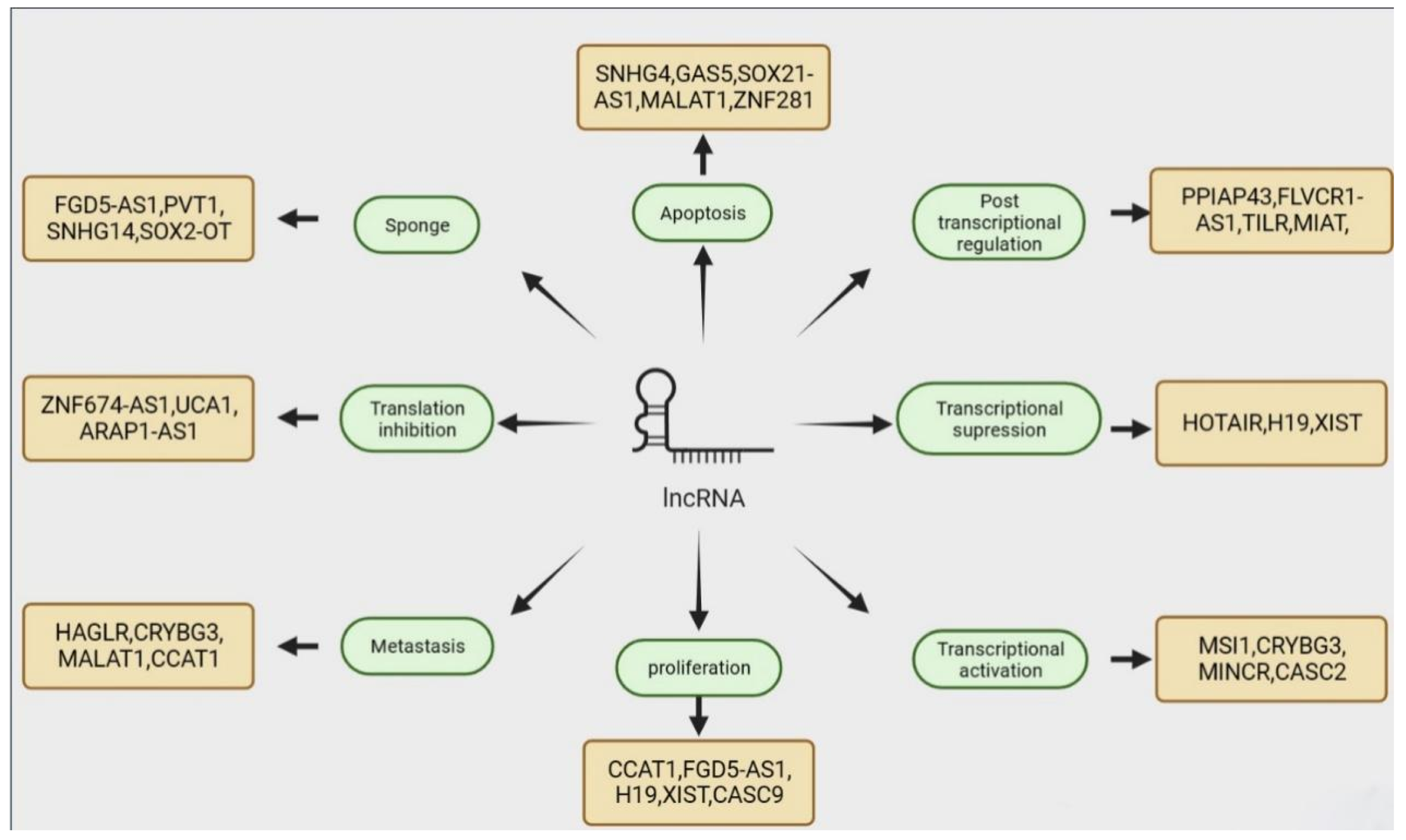
2. Mechanisms and Functions of LncRNAs
3. Applications of LncRNAs in Lung Cancer Diagnosis and as Biomarkers
3.1. LncRNAs as Biomarkers for Lung Cancer Detection
3.2. Applications of LncRNAs in Lung Cancer Diagnosis
4. LncRNAs Associated with Lung Cancer Development and Metastasis
4.1. Regulatory Mechanisms of LncRNAs in Lung Cancer Development and Metastasis
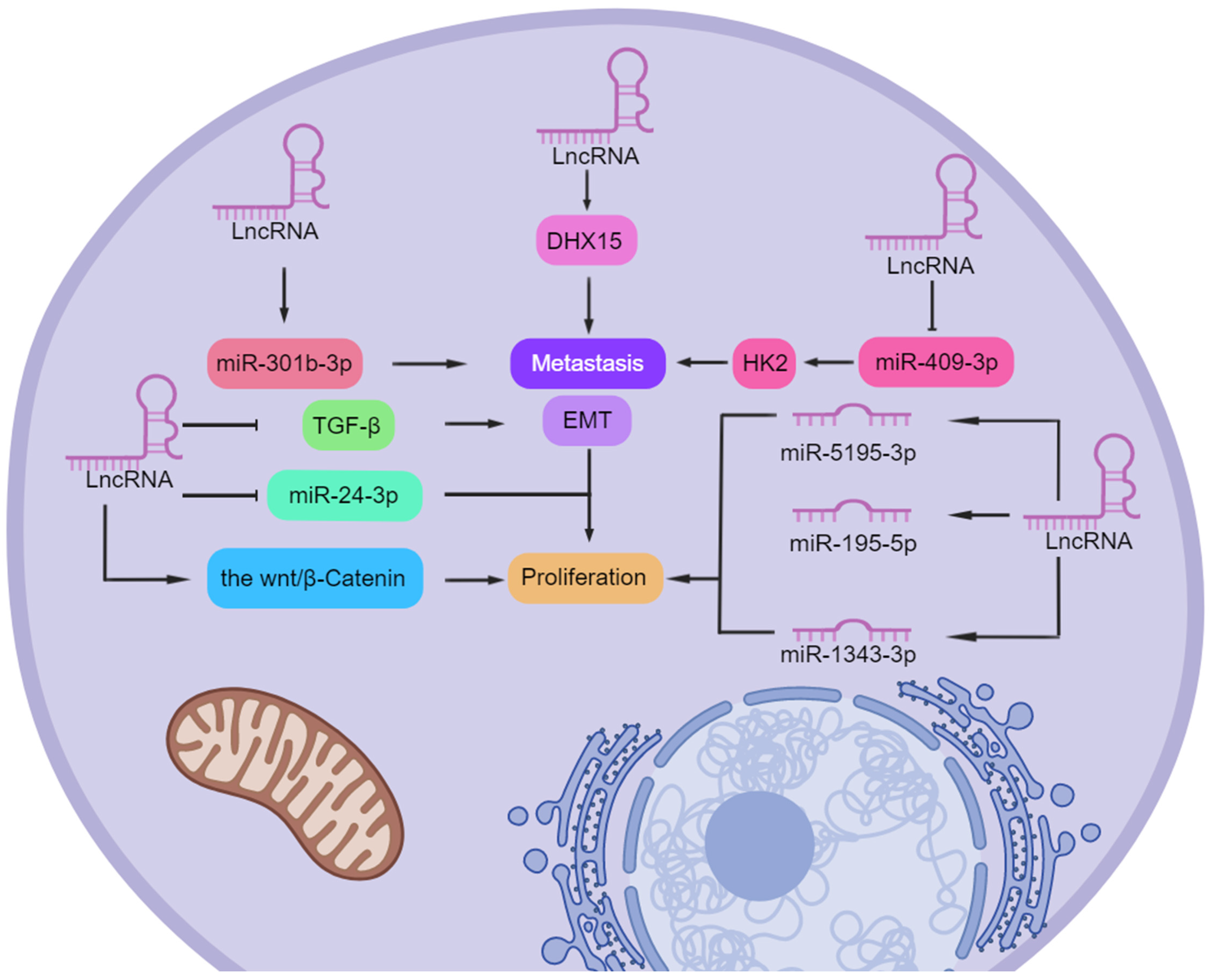
4.2. Molecular Pathways of lncRNAs Associated with Metastasis in Lung Cancer
4.3. Key Recurring Mechanisms and Prioritized LncRNAs
5. LncRNA-Mediated Response to Treatment and Chemoresistance in Lung Cancer
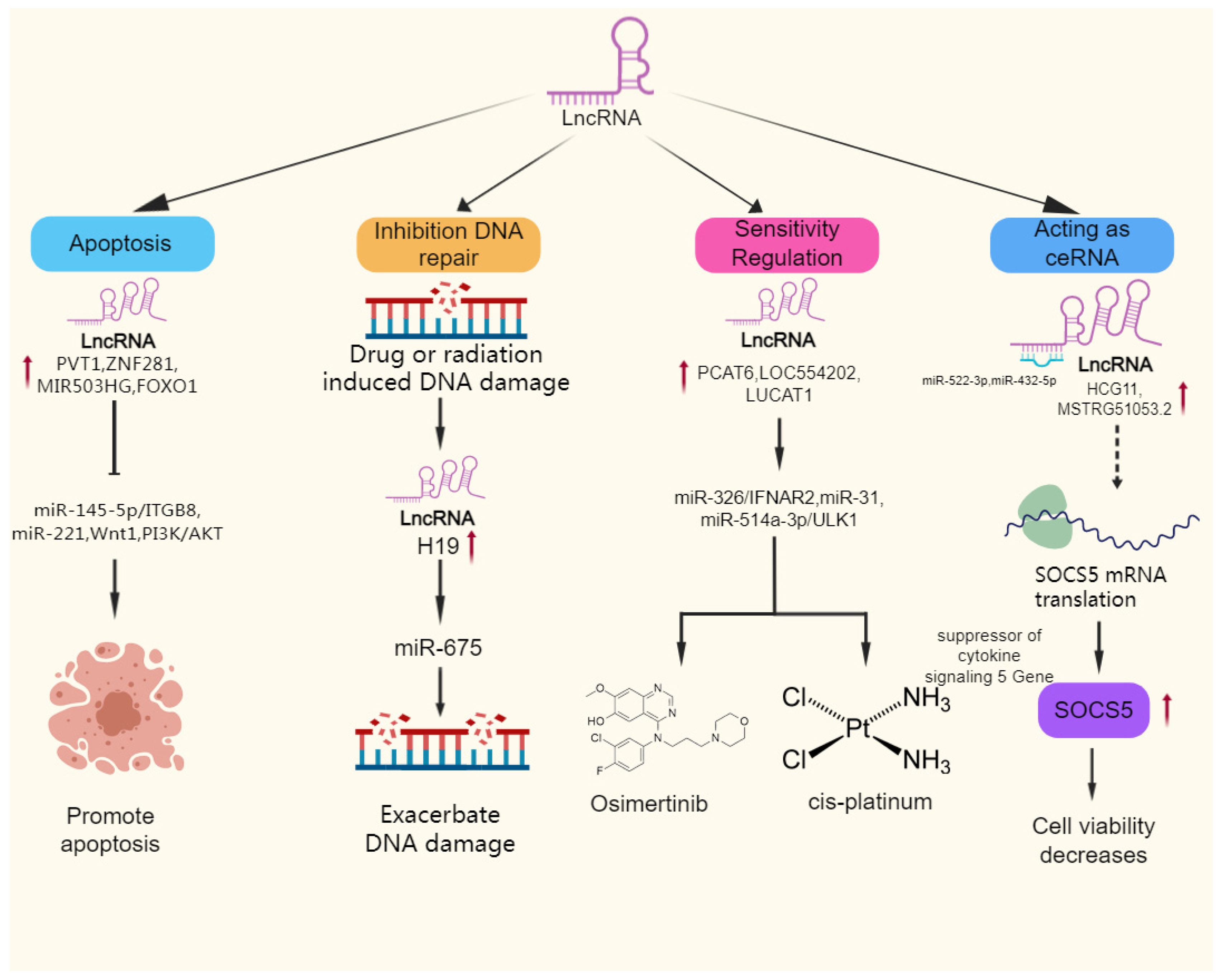
5.1. The Mechanisms of LncRNA Mediating the Response to Lung Cancer Treatment
5.2. Application of LncRNAs in Lung Cancer Treatment
5.3. Association and Regulation of LncRNAs with Lung Cancer-Related Drug Resistance
6. Conclusions and Future Prospects
Author Contributions
Funding
Institutional Review Board Statement
Informed Consent Statement
Data Availability Statement
Conflicts of Interest
References
- Sung, H.; Ferlay, J.; Siegel, R.L.; Laversanne, M.; Soerjomataram, I.; Jemal, A.; Bray, F. Global Cancer Statistics 2020: GLOBOCAN Estimates of Incidence and Mortality Worldwide for 36 Cancers in 185 Countries. CA Cancer J. Clin. 2021, 71, 209–249. [Google Scholar] [CrossRef]
- Leiter, A.; Veluswamy, R.R.; Wisnivesky, J.P. The global burden of lung cancer: Current status and future trends. Nat. Rev. Clin. Oncol. 2023, 20, 624–639. [Google Scholar] [CrossRef] [PubMed]
- Mollazadeh, S.; Abdolahzadeh, N.; Moghbeli, M.; Arab, F.; Saburi, E. The crosstalk between non-coding RNA polymorphisms and resistance to lung cancer therapies. Heliyon 2023, 9, e20652. [Google Scholar] [CrossRef] [PubMed]
- Ishola, A.A.; La’ah, A.S.; Le, H.D.; Nguyen, V.Q.; Yang, Y.-P.; Chou, S.-J.; Tai, H.-Y.; Chien, C.-S.; Wang, M.-L. Non-coding RNA and lung cancer progression. J. Chin. Med. Assoc. 2020, 83, 8–14. [Google Scholar] [CrossRef] [PubMed]
- Cabili, M.N.; Trapnell, C.; Goff, L.; Koziol, M.; Tazon-Vega, B.; Regev, A.; Rinn, J.L. Integrative annotation of human large intergenic noncoding RNAs reveals global properties and specific subclasses. Genes Dev. 2011, 25, 1915–1927. [Google Scholar] [CrossRef]
- Ghafouri-Fard, S.; Shoorei, H.; Branicki, W.; Taheri, M. Non-coding RNA profile in lung cancer. Exp. Mol. Pathol. 2020, 114, 104411. [Google Scholar] [CrossRef]
- Luo, X.; Qiu, Y.; Jiang, Y.; Chen, F.; Jiang, L.; Zhou, Y.; Dan, H.; Zeng, X.; Lei, Y.L.; Chen, Q. Long non-coding RNA implicated in the invasion and metastasis of head and neck cancer: Possible function and mechanisms. Mol. Cancer 2018, 17, 14. [Google Scholar] [CrossRef]
- Liu, X.; Li, Y.; Jiang, X.; Deng, Y.; Ma, C.; Yu, Q.; Gao, D. Long non-coding RNA: Multiple effects on the differentiation, maturity and cell function of dendritic cells. Clin. Immunol. 2022, 245, 109167. [Google Scholar] [CrossRef]
- Quinn, J.J.; Chang, H.Y. Unique features of long non-coding RNA biogenesis and function. Nat. Rev. Genet. 2016, 17, 47–62. [Google Scholar] [CrossRef]
- Schor, I.E.; Bussotti, G.; Maleš, M.; Forneris, M.; Viales, R.R.; Enright, A.J.; Furlong, E.E.M. Non-coding RNA Expression, Function, and Variation during Drosophila Embryogenesis. Curr. Biol. 2018, 28, 3547–3561.e9. [Google Scholar] [CrossRef]
- Zhang, F.; Yang, Y.; Chen, X.; Liu, Y.; Hu, Q.; Huang, B.; Liu, Y.; Pan, Y.; Zhang, Y.; Liu, D.; et al. The long non-coding RNA βFaar regulates islet β-cell function and survival during obesity in mice. Nat. Commun. 2021, 12, 3997. [Google Scholar] [CrossRef]
- Yin, J.; Shen, Y.; Si, Y.; Zhang, Y.; Du, J.; Hu, X.; Cai, M.; Bao, H.; Xing, Y. Knockdown of long non-coding RNA SOX2OT downregulates SOX2 to improve hippocampal neurogenesis and cognitive function in a mouse model of sepsis-associated encephalopathy. J. Neuroinflamm. 2020, 17, 320. [Google Scholar] [CrossRef]
- Singh, D.; Assaraf, Y.G.; Gacche, R.N. Long non-coding RNA mediated drug resistance in breast cancer. Drug Resist. Updat. 2022, 63, 100851. [Google Scholar] [CrossRef] [PubMed]
- Chen, Z.; Lei, T.; Chen, X.; Gu, J.; Huang, J.; Lu, B.; Wang, Z. Long non-coding RNA in lung cancer. Clin. Chim. Acta 2020, 504, 190–200. [Google Scholar] [CrossRef] [PubMed]
- Wang, S.; Wang, Y.; Li, S.; Nian, S.; Xu, W.; Liang, F. Long non-coding RNA MIR22HG inhibits the proliferation and migration, and promotes apoptosis by targeting microRNA-9-3p/ SOCS1 axis in small cell lung cancer cells. Mol. Biol. Rep. 2023, 50, 7445–7456. [Google Scholar] [CrossRef] [PubMed]
- Shen, W.; Pu, J.; Gu, S.; Sun, J.; Wang, L.; Tan, B.; Chen, J.; Zuo, Y. LINC01635, a long non-coding RNA with a cancer/testis expression pattern, promotes lung cancer progression by sponging miR-455-5p. Oncol. Lett. 2022, 24, 438. [Google Scholar] [CrossRef]
- Han, P.; Zhao, J.; Gao, L. Increased serum exosomal long non-coding RNA SNHG15 expression predicts poor prognosis in non-small cell lung cancer. J. Clin. Lab. Anal. 2021, 35, e23979. [Google Scholar] [CrossRef]
- Zhang, X.; Guo, H.; Bao, Y.; Yu, H.; Xie, D.; Wang, X. Exosomal long non-coding RNA DLX6-AS1 as a potential diagnostic biomarker for non-small cell lung cancer. Oncol. Lett. 2019, 18, 5197–5204. [Google Scholar] [CrossRef]
- Rao, L.; Luo, L.; Luo, L.; Chen, S.; Ran, R.; Liu, X. Identification of plasma exosomes long non-coding RNA HAGLR and circulating tumor cells as potential prognosis biomarkers in non-small cell lung cancer. Transl. Cancer Res. 2019, 8, 2264–2273. [Google Scholar] [CrossRef]
- Liu, Z.; Ning, Z.; Lu, H.; Cao, T.; Zhou, F.; Ye, X.; Chen, C. Long non-coding RNA RFPL3S is a novel prognostic biomarker in lung cancer. Oncol. Lett. 2020, 20, 1270–1280. [Google Scholar] [CrossRef]
- Wang, S.; Yu, J. Long non-coding RNA transcribed from pseudogene PPIAP43 is associated with radiation sensitivity of small cell lung cancer cells. Oncol. Lett. 2019, 18, 4583–4592. [Google Scholar] [CrossRef]
- Li, Y.; Zhao, J.; Zhang, W.; Wang, A.; Jiao, M.; Cai, X.; Zhu, J.; Liu, Z.; Huang, J.A. LINC02535/miR-30a-5p/GALNT3 axis contributes to lung adenocarcinoma progression via the NF- κ B signaling pathway. Cell Cycle 2022, 21, 2455–2470. [Google Scholar] [CrossRef] [PubMed]
- Yuan, C.; Ding, Y.; Zhuang, Y.; Zhang, C.; Han, L.; Li, W.; Guo, R.; Zhang, E. Copy number amplification-activated long non-coding RNA LINC00662 epigenetically inhibits BIK by interacting with EZH2 to regulate tumorigenesis in non-small cell lung cancer. J. Cancer 2022, 13, 1640–1651. [Google Scholar] [CrossRef] [PubMed]
- Lv, X.; Lian, Y.; Liu, Z.; Xiao, J.; Zhang, D.; Yin, X. Exosomal long non-coding RNA LINC00662 promotes non-small cell lung cancer progression by miR-320d/E2F1 axis. Aging 2021, 13, 6010–6024. [Google Scholar] [CrossRef] [PubMed]
- Gong, W.; Su, Y.; Liu, Y.; Sun, P.; Wang, X. Long non-coding RNA Linc00662 promotes cell invasion and contributes to cancer stem cell-like phenotypes in lung cancer cells. J. Biochem. 2018, 164, 461–469. [Google Scholar] [CrossRef]
- Gupta, C.; Su, J.; Zhan, M.; Stass, S.A.; Jiang, F. Sputum long non-coding RNA biomarkers for diagnosis of lung cancer. Cancer Biomark. 2019, 26, 219–227. [Google Scholar] [CrossRef]
- Yi, W.W.; Guo, X.Q.; Xu, Y.; Liang, B.; Song, P. A prognostic model based on ferroptosis-related long non-coding RNA signatures and immunotherapy responses for non-small cell lung cancer. Eur. Rev. Med. Pharmacol. Sci. 2023, 27, 2591–2604. [Google Scholar] [CrossRef]
- Sweef, O.; Yang, C.; Wang, Z. The Oncogenic and Tumor Suppressive Long Non-Coding RNA–microRNA–Messenger RNA Regulatory Axes Identified by Analyzing Multiple Platform Omics Data from Cr(VI)-Transformed Cells and Their Implications in Lung Cancer. Biomedicines 2022, 10, 2334. [Google Scholar] [CrossRef]
- Li, Z.; Zhuo, Y.; Li, J.; Zhang, M.; Wang, R.; Lin, L. Long Non-Coding RNA SNHG4 Is a Potential Diagnostic and Prognostic Indicator in Non-Small Cell Lung Cancer. Ann. Clin. Lab. Sci. 2021, 51, 654–662. [Google Scholar]
- Li, A.; Yu, W.-H.; Hsu, C.-L.; Huang, H.-C.; Juan, H.-F. Modular signature of long non-coding RNA association networks as a prognostic biomarker in lung cancer. BMC Med. Genom. 2021, 14, 290. [Google Scholar] [CrossRef]
- Ke, C.; Feng, X.; Li, J.; Chen, S.; Hu, X. Association between long non-coding RNA HOTAIR polymorphism and lung cancer risk: A systematic review and meta-analysis. Exp. Ther. Med. 2022, 24, 540. [Google Scholar] [CrossRef]
- Han, W.; Du, X.; Liu, M.; Wang, J.; Sun, L.; Li, Y. Increased expression of long non-coding RNA SNHG16 correlates with tumor progression and poor prognosis in non-small cell lung cancer. Int. J. Biol. Macromol. 2019, 121, 270–278. [Google Scholar] [CrossRef] [PubMed]
- Al Mourgi, M.; El Askary, A.; Gharib, A.F.; Alzahrani, R.; Banjer, H.J.; Elsawy, W.H.; Al Ghamdi, A.E.; Raafat, N. Circulating Long Non-Coding RNA GAS5: A Non-Invasive Molecular Marker for Prognosis, Response to Treatment and Survival in Non-Small Cell Lung Cancer. Cancer Investig. 2021, 39, 505–513. [Google Scholar] [CrossRef] [PubMed]
- Zhang, C.; Gong, C.; Li, J.; Tang, J. Downregulation of long non-coding RNA LINC-PINT serves as a diagnostic and prognostic biomarker in patients with non-small cell lung cancer. Oncol. Lett. 2021, 21, 210. [Google Scholar] [CrossRef]
- Feng, J.; Li, J.; Qie, P.; Li, Z.; Xu, Y.; Tian, Z. Long non-coding RNA (lncRNA) PGM5P4-AS1 inhibits lung cancer progression by up-regulating leucine zipper tumor suppressor (LZTS3) through sponging microRNA miR-1275. Bioengineered 2021, 12, 196–207. [Google Scholar] [CrossRef]
- Sun, Y.; Ling, C. Analysis of the long non-coding RNA LINC01614 in non-small cell lung cancer. Medicine 2019, 98, e16437. [Google Scholar] [CrossRef]
- Wan, L.; Cheng, Z.; Sun, Q.; Jiang, K. LncRNA HOXC-AS3 increases non-small cell lung cancer cell migration and invasion by sponging premature miR-96. Expert Rev. Respir. Med. 2022, 16, 587–593. [Google Scholar] [CrossRef]
- Li, N.; Hao, W.; Yang, J.; Guo, Y.; Guo, Y.; Du, Y. Long non-coding RNA colon cancer-associated transcript-1 regulates tumor cell proliferation and invasion of non-small-cell lung cancer through suppressing miR-152. Geriatr. Gerontol. Int. 2020, 20, 629–636. [Google Scholar] [CrossRef]
- Huang, L.; Liu, X.; Chen, Q.; Yang, J.; Zhang, D.; Zhao, Y.; Xu, L.; Li, Z.; Liu, X.; Shao, S.; et al. TGF-β-induced lncRNA TBUR1 promotes EMT and metastasis in lung adenocarcinoma via hnRNPC-mediated GRB2 mRNA stabilization. Cancer Lett. 2024, 600, 217153. [Google Scholar] [CrossRef]
- Fang, F.; Zhao, M.; Meng, J.; He, J.; Yang, C.; Wang, C.; Wang, J.; Xie, S.; Jin, X.; Shi, W. Upregulation of TTYH3 by lncRNA LUCAT1 through interacting with ALYREF facilitates the metastasis in non-small cell lung cancer. Cancer Biol. Ther. 2025, 26, 2464966. [Google Scholar] [CrossRef]
- Pan, Y.; Liu, L.; Cheng, Y.; Yu, J.; Feng, Y. Amplified LncRNA PVT1 promotes lung cancer proliferation and metastasis by facilitating VEGFC expression. Biochem. Cell Biol. 2020, 98, 676–682. [Google Scholar] [CrossRef]
- Zhu, H.; Zhou, Y.; Wang, Q.; Yang, X.; Ding, C.; Xiong, Y. Long non-coding RNA LALTOP promotes non-small cell lung cancer progression by stabilizing topoisomerase IIα mRNA. Biochem. Biophys. Res. Commun. 2021, 574, 56–62. [Google Scholar] [CrossRef]
- Su, H.; Fan, G.; Huang, J.; Qiu, X. LncRNA HOXC-AS3 promotes non-small-cell lung cancer growth and metastasis through upregulation of YBX1. Cell Death Dis. 2022, 13, 307. [Google Scholar] [CrossRef]
- Yao, G.; Chen, K.; Qin, Y.; Niu, Y.; Zhang, X.; Xu, S.; Zhang, C.; Feng, M.; Wang, K. Long Non-coding RNA JHDM1D-AS1 Interacts with DHX15 Protein to Enhance Non-Small-Cell Lung Cancer Growth and Metastasis. Mol. Ther.-Nucleic Acids 2019, 18, 831–840. [Google Scholar] [CrossRef] [PubMed]
- Liao, S.; Yu, C.; Liu, H.; Zhang, C.; Li, Y.; Zhong, X. Long non-coding RNA H19 promotes the proliferation and invasion of lung cancer cells and regulates the expression of E-cadherin, N-cadherin, and vimentin. OncoTargets Ther. 2019, 12, 4099–4107. [Google Scholar] [CrossRef] [PubMed]
- Jin, Y.; Xie, H.; Duan, L.; Zhao, D.; Ding, J.; Jiang, G. Long Non-Coding RNA CASC9 And HIF-1α Form A Positive Feedback Loop To Facilitate Cell Proliferation And Metastasis In Lung Cancer. OncoTargets Ther. 2019, 12, 9017–9027. [Google Scholar] [CrossRef] [PubMed]
- Huang, J.; Wang, B.; Wu, Q.; Wang, L.; Guan, C. LncRNA EGFR-AS1 promotes lung cancer cell proliferation, invasion and metastasis via regulation of miR-449a/HDAC1. Exp. Ther. Med. 2024, 29, 27. [Google Scholar] [CrossRef]
- Wu, D.; Yang, B.; Chen, J.; Xiong, H.; Li, Y.; Pan, Z.; Cao, Y.; Chen, J.; Li, T.; Zhou, S.; et al. Upregulation of long non-coding RNA RAB1A-2 induces FGF1 expression worsening lung cancer prognosis. Cancer Lett. 2018, 438, 116–125. [Google Scholar] [CrossRef]
- Gao, X.; Zhao, S.; Yang, X.; Zang, S.; Yuan, X. Long non-coding RNA FLVCR1-AS1 contributes to the proliferation and invasion of lung cancer by sponging miR-573 to upregulate the expression of E2F transcription factor 3. Biochem. Biophys. Res. Commun. 2018, 505, 931–938. [Google Scholar] [CrossRef]
- Sun, S.; Zou, Y.; Xu, N.; Wang, K.; Rong, S.; Lv, J.; Hu, B.; Mai, Y.; Zhu, D.; Ding, L. Long non-coding RNA ATB expedites non-small cell lung cancer progression by the miR-200b/fibronectin 1 axis. J. Clin. Lab. Anal. 2023, 37, e24822. [Google Scholar] [CrossRef]
- Wang, Y.; Jiang, X.-Y.; Qu, M.-Y.; Liang, J.; Yang, J.-S.; Sun, R.-L. LncRNA KCNQ1OT1/miR-496/HMGB1 Signaling Axis Promotes Invasion and Migration of Non-small Cell Lung Cancer Cells. Biochem. Genet. 2024, 62, 1994–2009. [Google Scholar] [CrossRef] [PubMed]
- Zhang, J.; Wang, M.; Wang, J.; Wang, W. JMJD2C-mediated long non-coding RNA MALAT1/microRNA-503-5p/SEPT2 axis worsens non-small cell lung cancer. Cell Death Dis. 2022, 13, 65. [Google Scholar] [CrossRef] [PubMed]
- Tan, Y.; Xu, F.; Xu, L.; Cui, J. Long non-coding RNA LINC01748 exerts carcinogenic effects in non-small cell lung cancer cell lines by regulating the microRNA-520a-5p/HMGA1 axis. Int. J. Mol. Med. 2022, 49, 22. [Google Scholar] [CrossRef] [PubMed]
- Qiao, X.; Zhao, F. Long non-coding RNA Opa interacting protein 5-antisense RNA 1 binds to micorRNA-34a to upregulate oncogenic PD-L1 in non-small cell lung cancer. Bioengineered 2022, 13, 9264–9273. [Google Scholar] [CrossRef]
- Qi, J.-Z.; Zhao, T.-T.; Qi, S.-S. Functions of long non-coding RNA LNC11649 in non-small cell lung cancer cells as a reprocessed form of MALAT1. Neoplasma 2022, 69, 1322–1337. [Google Scholar] [CrossRef]
- Chen, X.; Wang, K. lncRNA ZEB2-AS1 Aggravates Progression of Non-Small Cell Lung Carcinoma via Suppressing PTEN Level. Med Sci Monit. 2019, 25, 8363–8370. [Google Scholar] [CrossRef]
- Wu, A.; Tang, J.; Guo, Z.; Dai, Y.; Nie, J.; Hu, W.; Liu, N.; Ye, C.; Li, S.; Pei, H.; et al. Long Non-Coding RNA CRYBG3 Promotes Lung Cancer Metastasis via Activating the eEF1A1/MDM2/MTBP Axis. Int. J. Mol. Sci. 2021, 22, 3211. [Google Scholar] [CrossRef]
- Wang, J.; Sun, N.; Han, W.; Tong, L.; Xu, T.; Li, G. Long non-coding RNA CCAT1 sponges miR-490 to enhance cell proliferation and migration of non-small cell lung cancer. Thorac. Cancer 2021, 12, 364–371. [Google Scholar] [CrossRef]
- Pan, J.; Fang, S.; Tian, H.; Zhou, C.; Zhao, X.; Tian, H.; He, J.; Shen, W.; Meng, X.; Jin, X.; et al. lncRNA JPX/miR-33a-5p/Twist1 axis regulates tumorigenesis and metastasis of lung cancer by activating Wnt/β-catenin signaling. Mol. Cancer 2020, 19, 9. [Google Scholar] [CrossRef]
- Wang, F.; Gu, T.; Chen, Y.; Chen, Y.; Xiong, D.; Zhu, Y. Long non-coding RNA SOX21-AS1 modulates lung cancer progress upon microRNA miR-24-3p/PIM2 axis. Bioengineered 2021, 12, 6724–6737. [Google Scholar] [CrossRef]
- Shen, D.; Li, J.; Tao, K.; Jiang, Y. Long non-coding RNA MCM3AP antisense RNA 1 promotes non-small cell lung cancer progression through targeting microRNA-195-5p. Bioengineered 2021, 12, 3525–3538. [Google Scholar] [CrossRef]
- Jiang, M.; Ye, X.; Shi, D.; Lin, Q.; Huang, F.; Li, Y. LncRNA-LINC00472 suppresses the malignant progression of non-small cell lung cancer via modulation of the miRNA-1275/Homeobox A2 axis. Adv. Clin. Exp. Med. 2024, 33, 283–297. [Google Scholar] [CrossRef]
- Zhang, Z.; Lin, W.; Lin, Y.; Kang, M.; Zhu, J.; Tong, Z.; Wu, L.; Sun, J.; Lin, J. Long intergenic non-coding RNA Linc00485 promotes lung cancer progression by modulating miR-298/c-Myc axis. J. Cell. Mol. Med. 2021, 25, 309–322. [Google Scholar] [CrossRef] [PubMed]
- Li, L.; Li, Z.; Qu, J.; Wei, X.; Suo, F.; Xu, J.; Liu, X.; Chen, C.; Zheng, S. Novel long non-coding RNA CYB561-5 promotes aerobic glycolysis and tumorigenesis by interacting with basigin in non-small cell lung cancer. J. Cell. Mol. Med. 2022, 26, 1402–1412. [Google Scholar] [CrossRef] [PubMed]
- Yin, D.; Hua, L.; Wang, J.; Liu, Y.; Li, X. Long Non-Coding RNA DUXAP8 Facilitates Cell Viability, Migration, and Glycolysis in Non-Small-Cell Lung Cancer via Regulating HK2 and LDHA by Inhibition of miR-409-3p. OncoTargets Ther. 2020, 13, 7111–7123. [Google Scholar] [CrossRef] [PubMed]
- Lei, T.; Lv, Z.-Y.; Fu, J.-F.; Wang, Z.; Fan, Z.; Wang, Y. LncRNA NBAT-1 is down-regulated in lung cancer and influences cell proliferation, apoptosis and cell cycle. Eur. Rev. Med. Pharmacol. Sci. 2018, 22, 1958–1962. [Google Scholar]
- Zhong, Y.; Yang, L.; Xiong, F.; He, Y.; Tang, Y.; Shi, L.; Fan, S.; Li, Z.; Zhang, S.; Gong, Z.; et al. Long non-coding RNA AFAP1-AS1 accelerates lung cancer cells migration and invasion by interacting with SNIP1 to upregulate c-Myc. Signal Transduct. Target. Ther. 2021, 6, 240. [Google Scholar] [CrossRef]
- Wang, F.; Quan, Q. The long non-coding RNA SNHG4/microRNA-let-7e/KDM3A/p21 pathway is involved in the development of non-small cell lung cancer. Mol. Ther.-Oncolytics 2020, 20, 634–645. [Google Scholar] [CrossRef]
- Qian, X.; Yang, J.; Qiu, Q.; Li, X.; Jiang, C.; Li, J.; Dong, L.; Ying, K.; Lu, B.; Chen, E.; et al. LCAT3, a novel m6A-regulated long non-coding RNA, plays an oncogenic role in lung cancer via binding with FUBP1 to activate c-MYC. J. Hematol. Oncol. 2021, 17, 112. [Google Scholar] [CrossRef]
- Jiao, P.-F.; Tang, P.-J.; Chu, D.; Li, Y.-M.; Xu, W.-H.; Ren, G.-F. Long Non-Coding RNA THOR Depletion Inhibits Human Non-Small Cell Lung Cancer Cell Growth. Front. Oncol. 2021, 11, 756148. [Google Scholar] [CrossRef]
- Ameli Mojarad, M.; Ameli Mojarad, M.; Pourmahdian, A. Long Non-coding RNA snaR Promotes Proliferation in EGFR Wild Type Non-Small Cell Lung Cancer Cells. Int. J. Mol. Cell. Med. 2021, 10, 258–264. [Google Scholar]
- Luo, S.; Shen, M.; Chen, H.; Li, W.; Chen, C. Long non-coding RNA TP73-AS1 accelerates the progression and cisplatin resistance of non-small cell lung cancer by upregulating the expression of TRIM29 via competitively targeting microRNA-34a-5p. Mol. Med. Rep. 2020, 22, 3822–3832. [Google Scholar] [CrossRef] [PubMed]
- Xiao, S.; Sun, L.; Ruan, B.; Li, J.; Chen, J.; Xiong, J.; Jiang, Y.; Song, Z. Long non-coding RNA LINC01224 promotes progression and cisplatin resistance in non-small lung cancer by sponging miR-2467. Pulm. Pharmacol. Ther. 2021, 70, 102070. [Google Scholar] [CrossRef]
- Zhao, L.; Wang, L.; Wang, Y.; Ma, P. Long non-coding RNA CCAT1 enhances human non-small cell lung cancer growth through downregulation of microRNA-218. Oncol. Rep. 2020, 43, 1045–1052. [Google Scholar] [CrossRef] [PubMed]
- Zeng, F.; Yu, N.; Han, Y.; Ainiwaer, J. The long non-coding RNA MIAT/miR-139-5p/MMP2 axis regulates cell migration and invasion in non-small-cell lung cancer. J. Biosci. 2020, 45, 51. [Google Scholar] [CrossRef] [PubMed]
- Shen, J.; Ma, J.; Li, J.; Wang, X.; Wang, Y.; Ma, J. A long non-coding RNA LNBC3 facilitates non-small cell lung cancer progression by stabilizing BCL6. J. Clin. Lab. Anal. 2020, 34, e23122. [Google Scholar] [CrossRef]
- Qin, L.; Zhong, M.; Adah, D.; Qin, L.; Chen, X.; Ma, C.; Fu, Q.; Zhu, X.; Li, Z.; Wang, N.; et al. A novel tumour suppressor lncRNA F630028O10Rik inhibits lung cancer angiogenesis by regulating miR-223-3p. J. Cell. Mol. Med. 2020, 24, 3549–3559. [Google Scholar] [CrossRef]
- Iwai, M.; Kajino, T.; Nakatochi, M.; Yanagisawa, K.; Hosono, Y.; Isomura, H.; Shimada, Y.; Suzuki, M.; Taguchi, A.; Takahashi, T. Long non-coding RNA TILR constitutively represses TP53 and apoptosis in lung cancer. Oncogene 2023, 42, 364–373. [Google Scholar] [CrossRef]
- Yan, A.; Song, X.; Liu, B.; Zhu, K. IGF2BP3 Worsens Lung Cancer through Modifying Long Non-coding RNA CERS6-AS1/microRNA-1202 Axis. Curr. Med. Chem. 2023, 30, 878–891. [Google Scholar] [CrossRef]
- He, J.; Wu, K.; Guo, C.; Zhou, J.-K.; Pu, W.; Deng, Y.; Zuo, Y.; Zhao, Y.; Liu, L.; Wei, Y.-Q.; et al. Long non-coding RNA AFAP1-AS1 plays an oncogenic role in promoting cell migration in non-small cell lung cancer. Cell. Mol. Life Sci. 2018, 75, 4667–4681. [Google Scholar] [CrossRef]
- Xu, W.; Xu, Q.; Kuang, D.; Wang, Z.; Lu, Q.; Lin, Q.; Wu, H.; Chen, L. Long non-coding RNA SLNCR1 regulates non-small cell lung cancer migration, invasion and stemness through interactions with secretory phospholipase A2. Mol. Med. Rep. 2019, 20, 2591–2596. [Google Scholar] [CrossRef]
- Chen, Y.; Wang, F.; Li, J.; Wang, W.; Ge, L.; Ge, L. Long non-coding RNA TCL6 induced by SCRT1 promotes proliferation and metastasis of non-small cell lung cancer through PDK1/AKT signaling. Pathol.-Res. Pract. 2023, 246, 154491. [Google Scholar] [CrossRef] [PubMed]
- Fan, Y.; Li, H.; Yu, Z.; Dong, W.; Cui, X.; Ma, J.; Li, S. Long non-coding RNA FGD5-AS1 promotes non-small cell lung cancer cell proliferation through sponging hsa-miR-107 to up-regulate FGFRL1. Biosci. Rep. 2020, 40, BSR20193309. [Google Scholar] [CrossRef]
- Li, H.; Chen, Y.-K.; Wan, Q.; Shi, A.-Q.; Wang, M.; He, P.; Tang, L.-X. Long Non-coding RNA LINC00847 Induced by E2F1 Accelerates Non-small Cell Lung Cancer Progression Through Targeting miR-147a/IFITM1 Axis. Front. Med. 2021, 8, 663558. [Google Scholar] [CrossRef]
- Jin, M.; Ren, J.; Luo, M.; You, Z.; Fang, Y.; Han, Y.; Li, G.; Liu, H. Long non-coding RNA JPX correlates with poor prognosis and tumor progression in non-small-cell lung cancer by interacting with miR-145-5p and CCND2. Carcinogenesis 2020, 41, 634–645. [Google Scholar] [CrossRef]
- Huang, Y.-F.; Zhang, Y.; Fu, X. Long non-coding RNA DANCR promoted non-small cell lung cancer cells metastasis via modulating of miR-1225-3p/ErbB2 signal. Eur. Rev. Med. Pharmacol. Sci. 2021, 25, 758–769. [Google Scholar] [CrossRef]
- Ling, X.; Qi, C.; Cao, K.; Lu, M.; Yang, Y.; Zhang, J.; Zhang, L.; Zhu, J.; Ma, J. METTL3-mediated deficiency of lncRNA HAR1A drives non-small cell lung cancer growth and metastasis by promoting ANXA2 stabilization. Cell Death Discov. 2024, 10, 203. [Google Scholar] [CrossRef]
- Cheng, Y.; Wang, S.; Mu, X. Long non-coding RNA LINC00511 promotes proliferation, invasion, and migration of non-small cell lung cancer cells by targeting miR-625-5p/GSPT1. Transl. Cancer Res. 2021, 10, 5159–5173. [Google Scholar] [CrossRef]
- Sun, Y.; Zhen, F.; Wang, H.; Liang, X.; Wang, Y.; Wang, F.; Hu, J. Exosomal long non-coding RNA-LINC00839 promotes lung adenocarcinoma progression by activating NF-κB signaling pathway. Ann. Med. 2024, 56, 2430029. [Google Scholar] [CrossRef]
- Wang, Z.; Zhang, Q.; Sun, Y.; Shao, F. Long Non-Coding RNA PVT1 Regulates BAMBI To Promote Tumor Progression In Non-Small Cell Lung Cancer By Sponging miR-17-5p. OncoTargets Ther. 2020, 13, 131–142. [Google Scholar] [CrossRef]
- Qi, G.; Li, L. Long non-coding RNA PVT1 contributes to cell growth and metastasis in non-small-cell lung cancer by regulating miR-361-3p/SOX9 axis and activating Wnt/β-catenin signaling pathway. Biomed. Pharmacother. 2020, 126, 110100. [Google Scholar] [CrossRef] [PubMed]
- Wang, L.; Lin, C.; Sun, N.; Wang, Q.; Ding, X.; Sun, Y. Long non-coding RNA CASC19 facilitates non-small cell lung cancer cell proliferation and metastasis by targeting the miR-301b-3p/LDLR axis. J. Gene Med. 2020, 22, e3254. [Google Scholar] [CrossRef] [PubMed]
- Song, J.; Su, Z.-Z.; Shen, Q.-M. Long non-coding RNA MALAT1 regulates proliferation, apoptosis, migration and invasion via miR-374b-5p/SRSF7 axis in non-small cell lung cancer. Eur. Rev. Med. Pharmacol. Sci. 2020, 24, 1853–1862. [Google Scholar] [CrossRef] [PubMed]
- Song, H.; Li, H.; Ding, X.; Li, M.; Shen, H.; Li, Y.; Zhang, X.; Xing, L. Long non-coding RNA FEZF1-AS1 facilitates non-small cell lung cancer progression via the ITGA11/miR-516b-5p axis. Int. J. Oncol. 2020, 57, 1333–1347. [Google Scholar] [CrossRef]
- Lu, G.; Zhang, Y. Long non-coding RNA ATB promotes human non-small cell lung cancer proliferation and metastasis by suppressing miR-141-3p. PLoS ONE 2020, 15, e0229118. [Google Scholar] [CrossRef]
- Lin, J.-H.; Chen, F.-N.; Wu, C.-X.; Hu, S.-Q.; Ma, J. Long non-coding RNA B4GALT1-Antisense RNA 1/microRNA-30e/SRY-box transcription factor 9 signaling axis contributes to non-small cell lung cancer cell growth. Oncol. Lett. 2020, 20, 284. [Google Scholar] [CrossRef]
- Li, Q.; Jiang, B.; Qi, Y.; Zhang, H.; Ma, H. Long non-coding RNA SLCO4A1-AS1 drives the progression of non-small-cell lung cancer by modulating miR-223-3p/IKKα/NF-κB signaling. Cancer Biol. Ther. 2020, 21, 806–814. [Google Scholar] [CrossRef]
- Li, K.; Jiang, Y.; Xiang, X.; Gong, Q.; Zhou, C.; Zhang, L.; Ma, Q.; Zhuang, L. Long non-coding RNA SNHG6 promotes the growth and invasion of non-small cell lung cancer by downregulating miR-101-3p. Thorac. Cancer 2020, 11, 1180–1190. [Google Scholar] [CrossRef]
- Li, H.; Cui, Z.; Lv, X.; Li, J.; Gao, M.; Yang, Z.; Bi, Y.; Zhang, Z.; Wang, S.; Li, S.; et al. Long Non-coding RNA HOTAIR Function as a Competing Endogenous RNA for miR-149-5p to Promote the Cell Growth, Migration, and Invasion in Non-small Cell Lung Cancer. Front. Oncol. 2020, 10, 528520. [Google Scholar] [CrossRef]
- Li, F.; Li, H.; Li, S.; Lv, B.; Shi, J.; Yan, H.; Zhang, H.; He, Y. Long Non-coding RNA MIAT Mediates Non-small Cell Lung Cancer Development Through Regulating the miR-128-3p/PELI3 Axis. Biochem. Genet. 2020, 58, 867–882. [Google Scholar] [CrossRef]
- Zhang, Y.; Zhang, Y.; Zeng, Q.; Li, C.; Zhou, H.; Liu, J.; Shi, Z.; Ma, L. IL-1β-Triggered Long Non-coding RNA CHRF Induces Non-Small Cell Lung Cancer by Modulating the microRNA-489/Myd88 Axis. J. Cancer 2022, 13, 2620–2630. [Google Scholar] [CrossRef] [PubMed]
- Jiang, Q.; Xing, W.; Cheng, J.; Yu, Y. Long Non-Coding RNA TP73-AS1 Promotes the Development of Lung Cancer by Targeting the miR-27b-3p/LAPTM4B Axis. OncoTargets Ther. 2020, 13, 7019–7031. [Google Scholar] [CrossRef] [PubMed]
- Feng, X.; Yang, S.; Zhou, S.; Deng, S.; Xie, Y. Long non-coding RNA DDX11-AS1 promotes non-small cell lung cancer development via regulating PI3K/AKT signalling. Clin. Exp. Pharmacol. Physiol. 2020, 47, 1622–1631. [Google Scholar] [CrossRef] [PubMed]
- Zou, Y.; Zhang, B.; Mao, Y.; Zhang, H.; Hong, W. Long non-coding RNA OECC promotes cell proliferation and metastasis through the PI3K/Akt/mTOR signaling pathway in human lung cancer. Oncol. Lett. 2019, 18, 3017–3024. [Google Scholar] [CrossRef]
- Fan, Q.; Bao, X.; Zhao, H.; Li, S. LncRNA MRPL39 inhibits cell proliferation and migration by regulating miR-130/TSC1 axis in non-small cell lung cancer. 3 Biotech 2024, 14, 125. [Google Scholar] [CrossRef]
- Wang, X.; Guo, S.; Zhao, R.; Liu, Y.; Yang, G. STAT3-Activated Long Non-Coding RNA Lung Cancer Associated Transcript 1 Drives Cell Proliferation, Migration, and Invasion in Hepatoblastoma Through Regulation of the miR-301b/STAT3 Axis. Hum. Gene Ther. 2019, 30, 702–713. [Google Scholar] [CrossRef]
- Gao, W.; Weng, T.; Wang, L.; Shi, B.; Meng, W.; Wang, X.; Wu, Y.; Jin, L.; Fei, L. Long non-coding RNA NORAD promotes cell proliferation and glycolysis in non-small cell lung cancer by acting as a sponge for miR-136-5p. Mol. Med. Rep. 2019, 19, 5397–5405. [Google Scholar] [CrossRef]
- Bai, Y.; Lang, L.; Zhao, W.; Niu, R. Long Non-Coding RNA HOXA11-AS Promotes Non-Small Cell Lung Cancer Tumorigenesis Through microRNA-148a-3p/DNMT1 Regulatory Axis. OncoTargets Ther. 2019, 12, 11195–11206. [Google Scholar] [CrossRef]
- Li, H.; Guo, X.; Li, Q.; Ran, P.; Xiang, X.; Yuan, Y.; Dong, T.; Zhu, B.; Wang, L.; Li, F.; et al. Long non-coding RNA 1308 promotes cell invasion by regulating the miR-124/ADAM 15 axis in non-small-cell lung cancer cells. Cancer Manag. Res. 2018, 10, 6599–6609. [Google Scholar] [CrossRef]
- Pan, X.; Chen, S.; Ye, L.; Xu, S.; Wang, L.; Sun, Y. Long non-coding RNA DLGAP1-AS1 modulates the development of non-small-cell lung cancer via the microRNA-193a-5p/DTL axis. Lab. Investig. 2022, 102, 1182–1191. [Google Scholar] [CrossRef]
- Fan, Y.; Zhou, Y.; Li, X.; Lou, M.; Gao, Z.; Tong, J.; Yuan, K. Long Non-Coding RNA AL513318.2 as ceRNA Binding to hsa-miR-26a-5p Upregulates SLC6A8 Expression and Predicts Poor Prognosis in Non-Small Lung Cancer. Front. Oncol. 2022, 12, 781903. [Google Scholar] [CrossRef]
- Chen, Y.; Shi, H.; Dong, Y.; Cui, W. LncRNA MSTO2P affects the proliferation, invasion and migration of non-small cell lung cancer by regulating the Wnt/β-catenin pathway. Discov. Oncol. 2025, 16, 150. [Google Scholar] [CrossRef] [PubMed]
- Li, S.; Liu, Y.; Qiu, G.; Luo, Y.; Luan, L.; Xu, T.; Wang, Y.; Xia, S. Long Non-Coding RNA CAR10 Facilitates Non-Small Cell Lung Cancer Cell Migration and Invasion by Modulating the miR-892a/GJB2 Pathway. Cancer Manag. Res. 2021, 13, 1967–1979. [Google Scholar] [CrossRef] [PubMed]
- Tang, L.-X.; Su, S.-F.; Wan, Q.; He, P.; Xhang, Y.; Cheng, X.-M. Novel long non-coding RNA LBX2-AS1 indicates poor prognosis and promotes cell proliferation and metastasis through Notch signaling in non-small cell lung cancer. Eur. Rev. Med. Pharmacol. Sci. 2019, 23, 7419–7429. [Google Scholar] [CrossRef]
- Jun, T.; Zheng, F.-S.; Ren, K.-M.; Zhang, H.-Y.; Zhao, J.-G.; Zhao, J.-Z. Long non-coding RNA UCA1 regulates the proliferation, migration and invasion of human lung cancer cells by modulating the expression of microRNA-143. Eur. Rev. Med. Pharmacol. Sci. 2018, 22, 8343–8352. [Google Scholar] [PubMed]
- Li, J.; Wu, X.; Cao, W.; Zhao, J. Long non-coding RNA NCK1-AS1 promotes the proliferation, migration and invasion of non-small cell lung cancer cells by acting as a ceRNA of miR-137. Am. J. Transl. Res. 2020, 12, 6908–6920. [Google Scholar]
- Cui, D.; Feng, Y.; Shi, K.; Zhang, H.; Qian, R. Long non-coding RNA TRPM2-AS sponges microRNA-138-5p to activate epidermal growth factor receptor and PI3K/AKT signaling in non-small cell lung cancer. Ann. Transl. Med. 2020, 8, 1313. [Google Scholar] [CrossRef]
- Chen, X.; Song, P.; Yao, Y.; Yang, Y. Long Non-Coding RNA SNHG14 Regulates SPIN1 Expression to Accelerate Tumor Progression in Non-Small Cell Lung Cancer by Sponging miR-382-5p. Cancer Manag. Res. 2020, 12, 9113–9123. [Google Scholar] [CrossRef]
- Chen, Z.; Hu, Z.; Sui, Q.; Huang, Y.; Zhao, M.; Li, M.; Liang, J.; Lu, T.; Zhan, C.; Lin, Z.; et al. LncRNA FAM83A-AS1 facilitates tumor proliferation and the migration via the HIF-1α/ glycolysis axis in lung adenocarcinoma. Int. J. Biol. Sci. 2022, 18, 522–535. [Google Scholar] [CrossRef]
- Zhao, Y.; Feng, C.; Li, Y.; Ma, Y.; Cai, R. LncRNA H19 promotes lung cancer proliferation and metastasis by inhibiting miR-200a function. Mol. Cell. Biochem. 2019, 460, 1–8. [Google Scholar] [CrossRef]
- Tang, L.; Wang, T.; Zhang, Y.; Zhang, J.; Zhao, H.; Wang, H.; Wu, Y.; Liu, K. Long Non-Coding RNA AWPPH Promotes Postoperative Distant Recurrence in Resected Non-Small Cell Lung Cancer by Upregulating Transforming Growth Factor beta 1 (TGF-β1). Med. Sci. Monit. 2019, 25, 2535–2541. [Google Scholar] [CrossRef]
- Ma, X.-R.; Xu, Y.-L.; Qian, J.; Wang, Y. Long non-coding RNA SNHG15 accelerates the progression of non-small cell lung cancer by absorbing miR-211-3p. Eur. Rev. Med. Pharmacol. Sci. 2019, 23, 1536–1544. [Google Scholar] [CrossRef] [PubMed]
- Guo, L.; Gu, J.; Hou, S.; Liu, D.; Zhou, M.; Hua, T.; Zhang, J.; Ge, Z.; Xu, J. Long non-coding RNA DANCR promotes the progression of non-small-cell lung cancer by inhibiting p21 expression. OncoTargets Ther. 2018, 12, 135–146. [Google Scholar] [CrossRef] [PubMed]
- Bian, C.; Yuan, L.; Gai, H. A long non-coding RNA LINC01288 facilitates non-small cell lung cancer progression through stabilizing IL-6 mRNA. Biochem. Biophys. Res. Commun. 2019, 514, 443–449. [Google Scholar] [CrossRef] [PubMed]
- Xu, Z.-Y.; Peng, J.; Shi, Z.-Z.; Chen, X.-L.; Cheng, H.-Z.; Wang, H.; Wang, Y.; Wang, G.-P.; Jiang, W.; Peng, H. Silencing linc00662 inhibits cell proliferation and colony formation of lung cancer cells via regulating the miR-145-5p–PAFAH1B2 axis. Biochem. Cell Biol. 2021, 99, 330–338. [Google Scholar] [CrossRef]
- Lu, Y.; Cheng, J.; Mao, Q.; Wang, Z.; Wei, Q. Long non-coding RNA TDRG1 aggravates lung cancer stemness by binding to Sox2 mRNA. Environ. Toxicol. 2023, 38, 645–653. [Google Scholar] [CrossRef]
- Zhang, F.; Sang, Y.; Chen, D.; Wu, X.; Wang, X.; Yang, W.; Chen, Y. M2 macrophage-derived exosomal long non-coding RNA AGAP2-AS1 enhances radiotherapy immunity in lung cancer by reducing microRNA-296 and elevating NOTCH2. Cell Death Dis. 2021, 12, 467. [Google Scholar] [CrossRef]
- Shi, J.; Wang, H.; Feng, W.; Huang, S.; An, J.; Qiu, Y.; Wu, K. Long non-coding RNA HOTTIP promotes hypoxia-induced glycolysis through targeting miR-615-3p/HMGB3 axis in non-small cell lung cancer cells. Eur. J. Pharmacol. 2019, 862, 172615. [Google Scholar] [CrossRef]
- Hua, Q.; Jin, M.; Mi, B.; Xu, F.; Li, T.; Zhao, L.; Liu, J.; Huang, G. LINC01123, a c-Myc-activated long non-coding RNA, promotes proliferation and aerobic glycolysis of non-small cell lung cancer through miR-199a-5p/c-Myc axis. J. Hematol. Oncol. 2019, 12, 91. [Google Scholar] [CrossRef]
- Li, Z.; Zhu, T.; Yao, F.; Shen, X.; Xu, M.; Fu, L.; Wu, Y.; Ding, J.; Zhang, J.; Zhao, J.; et al. LINC00665 promotes glycolysis in lung adenocarcinoma cells via the let-7c-5p/HMMR axis. J. Bioenerg. Biomembr. 2024, 56, 181–191. [Google Scholar] [CrossRef]
- Feng, X.; Yang, S. Long non-coding RNA LINC00243 promotes proliferation and glycolysis in non-small cell lung cancer cells by positively regulating PDK4 through sponging miR-507. Mol. Cell. Biochem. 2020, 463, 127–136. [Google Scholar] [CrossRef]
- Zhang, S.; Guan, Y.; Liu, X.; Ju, M.; Zhang, Q. Long non-coding RNA DLEU1 exerts an oncogenic function in non-small cell lung cancer. Biomed. Pharmacother. 2019, 109, 985–990. [Google Scholar] [CrossRef]
- Lou, B.; Wei, D.; Zhou, X.; Chen, H. Long non-coding RNA KDM5B anti-sense RNA 1 enhances tumor progression in non-small cell lung cancer. J. Clin. Lab. Anal. 2020, 34, e22897. [Google Scholar] [CrossRef] [PubMed]
- Chu, D.; Zong, H.; Duan, Y.; Jing, P. LNC511 inhibits lung cancer progression by modulating the miR-625/LOXL4/Wnt/β-catenin pathway. Cell. Signal. 2026, 138, 112207. [Google Scholar] [CrossRef] [PubMed]
- Abdellatif, A.A.H.; Scagnetti, G.; Younis, M.A.; Bouazzaoui, A.; Tawfeek, H.M.; Aldosari, B.N.; Almurshedi, A.S.; Alsharidah, M.; Rugaie, O.A.; Davies, M.P.A.; et al. Non-coding RNA-directed therapeutics in lung cancer: Delivery technologies and clinical applications. Colloids Surf. B Biointerfaces 2023, 229, 113466. [Google Scholar] [CrossRef] [PubMed]
- Zhu, X.; Wan, J.; You, X.; Yang, W.; Zhao, L. Circular non-coding RNA circ_0072088 serves as a ceRNA, targeting the miR-1225-5p/WT1 axis to regulate non-small cell lung cancer cell malignant behavior. Thorac. Cancer 2023, 14, 1969–1979. [Google Scholar] [CrossRef]
- Liu, T.; Ma, J.; Hou, D.; Wang, W.; Cao, H. Haplotype-GGGT in long non-coding RNA MALAT1 inhibits brain metastatic lung cancer and lymph nodes of lung cancer via the MALAT1/miR-328/KATNB1. Aging 2023, 15, 1918–1930. [Google Scholar] [CrossRef]
- Wang, S.; Xia, L.; Zhang, B.; Zhang, H.; Lan, F. Downregulated long intergenic non-coding RNA 00,174 represses malignant biological behaviors of lung cancer cells by regulating microRNA-584-3p/ribosomal protein S24 axis. Funct. Integr. Genom. 2022, 22, 643–653. [Google Scholar] [CrossRef]
- Lv, D.; Bi, Q.; Li, Y.; Deng, J.; Wu, N.; Hao, S.; Zhao, M. Long non-coding RNA MEG3 inhibits cell migration and invasion of non-small cell lung cancer cells by regulating the miR-21-5p/PTEN axis. Mol. Med. Rep. 2021, 23, 11830. [Google Scholar] [CrossRef]
- Wei, C.M.; Zhao, X.F.; Qiu, H.B.; Ming, Z.; Liu, K.; Yan, J. The long non-coding RNA PVT1/miR-145-5p/ITGB8 axis regulates cell proliferation, apoptosis, migration and invasion in non-small cell lung cancer cells. Neoplasma 2020, 67, 802–812. [Google Scholar] [CrossRef]
- Wang, J.; Liu, S.; Pan, T.; Wang, M.; Li, L.; Weng, X.; Jia, P.; Li, Q.; Zhou, X. Long non-coding RNA ZNF674-AS1 regulates miR-23a/E-cadherin axis to suppress the migration and invasion of non-small cell lung cancer cells. Transl. Cancer Res. 2021, 10, 4116–4124. [Google Scholar] [CrossRef]
- Gong, W.; Li, Y.; Xian, J.; Yang, L.; Wang, Y.; Zhang, X.; Zhou, Y.; Wang, X.; Qiao, G.; Chen, C.; et al. Long non-coding RNA LSAMP-1 is down-regulated in non-small cell lung cancer and predicts a poor prognosis. Cancer Cell Int. 2022, 22, 181. [Google Scholar] [CrossRef] [PubMed]
- Xie, W.; Wang, Y.; Zhang, Y.; Xiang, Y.; Wu, N.; Wu, L.; Li, C.; Cai, T.; Ma, X.; Yu, Z.; et al. Single-nucleotide polymorphism rs4142441 and MYC co-modulated long non-coding RNA OSER1-AS1 suppresses non-small cell lung cancer by sequestering ELAVL1. Cancer Sci. 2021, 112, 2272–2286. [Google Scholar] [CrossRef]
- Zang, Q.; Xu, L.; Li, J.; Jia, H. GATA6 activated long non-coding RNA PCAT1 maintains stemness of non-small cell lung cancer by mediating FRK. J. BUON 2020, 25, 2371–2381. [Google Scholar] [PubMed]
- Lu, X.; Yin, B.; Wang, X.; Wang, F.; Li, Y.; Wang, N.; Yang, X.; Jiang, W. Long non-coding RNA-ZNF281 upregulates PTEN expression via downregulation of microRNA-221 in non-small cell lung cancer. Oncol. Lett. 2020, 20, 2962–2968. [Google Scholar] [CrossRef]
- Lin, H.; Li, P.; Zhang, N.; Cao, L.; Gao, Y.-F.; Ping, F. Long non-coding RNA MIR503HG serves as a tumor suppressor in non-small cell lung cancer mediated by wnt1. Eur. Rev. Med. Pharmacol. Sci. 2019, 23, 10818–10826. [Google Scholar] [CrossRef] [PubMed]
- Jun, T.; Zheng, F.-S.; Ren, K.-M.; Zhang, H.-Y.; Zhao, J.-G.; Zhao, J.-Z. Suppression of long non-coding RNA UCA1 inhibits proliferation and invasion and induces apoptosis in human lung cancer cells. Eur. Rev. Med. Pharmacol. Sci. 2018, 22, 7274–7281. [Google Scholar] [CrossRef]
- Chen, M.; Shen, Y. Oridonin represses lung cancer cell proliferation and migration by modulating AFAP1-AS1/IGF2BP1. Cell. Mol. Biol. 2024, 70, 108–113. [Google Scholar] [CrossRef]
- Wang, Y.; Bai, W.; Wang, M.; Yu, T.; Zhang, W. Long Non-Coding RNA Brain Cytoplasmic RNA 1 Acts as an Oncogene and Regulates Cell Proliferation and Metastasis in Non-Small Cell Lung Cancer. J. Nanosci. Nanotechnol. 2019, 19, 1978–1985. [Google Scholar] [CrossRef]
- Yu, X.W.; Zhou, J.Z.; Xu, E.W.; Liu, J.Y.; Li, M.C.; Wu, J.J.; Yang, Q.Y. Expression and regulatory role of ultraconserved long non-coding RNA uc.77 in lung cancer. Zhonghua Zhong Liu Za Zhi 2022, 44, 1102–1111. (In Chinese) [Google Scholar]
- Zhu, Y.; Ma, K.; Ye, Y.; Tang, J.; Zhu, J. Long non-coding RNA LINRIS is upregulated in non-small cell lung cancer and its silencing inhibits cell proliferation by suppressing microRNA-10a maturation. Bioengineered 2022, 13, 4340–4346. [Google Scholar] [CrossRef] [PubMed]
- Tao, X.; Zhang, Y.; Li, J.; Ni, Z.; Tao, Z.; You, Q.; He, Z.; Huang, D.; Zheng, S. Low expression of long non-coding RNA ARAP1-AS1 can inhibit lung cancer proliferation by inducing G0/G1 cell cycle organization. J. Thorac. Dis. 2020, 12, 7326–7336. [Google Scholar] [CrossRef] [PubMed]
- Zhou, H.; Chen, A.; Shen, J.; Zhang, X.; Hou, M.; Li, J.; Chen, J.; Zou, H.; Zhang, Y.; Deng, Q.; et al. Long non-coding RNA LOC285194 functions as a tumor suppressor by targeting p53 in non-small cell lung cancer. Oncol. Rep. 2019, 41, 15–26. [Google Scholar] [CrossRef] [PubMed]
- Zhang, L.; Gao, L.; Shao, M.; Sun, G.Y. A MYC target long non-coding RNA GATA2-AS1 regulates non-small cell lung cancer growth. Neoplasma 2019, 66, 954–962. [Google Scholar] [CrossRef]
- Yang, S.-J.; Weng, J.-L.; Wei, B.; Du, X.-K. Long Non-coding RNA DUXAP8 Regulates the Cell Proliferation and Invasion of Non-small-cell Lung Cancer. Open Life Sci. 2019, 14, 201–207. [Google Scholar] [CrossRef]
- Chang, L.; Xu, W.; Zhang, Y.; Gong, F. Long non-coding RNA-NEF targets glucose transportation to inhibit the proliferation of non-small-cell lung cancer cells. Oncol. Lett. 2019, 17, 2795–2801. [Google Scholar] [CrossRef]
- Gao, X.; Wang, N.; Wu, S.; Cui, H.; An, X.; Yang, Y. Long non-coding RNA FER1L4 inhibits cell proliferation and metastasis through regulation of the PI3K/AKT signaling pathway in lung cancer cells. Mol. Med. Rep. 2019, 20, 182–190. [Google Scholar] [CrossRef]
- Zhang, M.; Wu, J.; Zhong, W.; Zhao, Z.; Liu, Z. Long non-coding RNA BRE-AS1 represses non-small cell lung cancer cell growth and survival via up-regulating NR4A3. Arch. Biochem. Biophys. 2018, 660, 53–63. [Google Scholar] [CrossRef]
- Lin, Y.; Holden, V.; Dhilipkannah, P.; Deepak, J.; Todd, N.W.; Jiang, F. A Non-Coding RNA Landscape of Bronchial Epitheliums of Lung Cancer Patients. Biomedicines 2020, 8, 88. [Google Scholar] [CrossRef]
- Su, Z.; Chen, M.; Ding, R.; Shui, L.; Zhao, Q.; Luo, W. Long non-coding RNA HCG11 suppresses the malignant phenotype of non-small cell lung cancer cells by targeting a miR-875/SATB2 axis. Mol. Med. Rep. 2021, 24, 552. [Google Scholar] [CrossRef]
- Pang, L.; Zhang, Q.; Wu, Y.; Yang, Q.; Zhang, J.; Liu, Y.; Li, R. Long non-coding RNA CCAT1 promotes non-small cell lung cancer progression by regulating the miR-216a-5p/RAP2B axis. Exp. Biol. Med. 2021, 246, 142–152. [Google Scholar] [CrossRef]
- Du, D.; Shen, X.; Zhang, Y.; Yin, L.; Pu, Y.; Liang, G. Expression of long non-coding RNA SFTA1P and its function in non-small cell lung cancer. Pathol.-Res. Pract. 2020, 216, 153049. [Google Scholar] [CrossRef]
- Wu, C.; Lin, W.; Fu, F. Long non-coding RNA DLX6-AS1 knockdown suppresses the tumorigenesis and progression of non-small cell lung cancer through microRNA-16-5p/BMI1 axis. Transl. Cancer Res. 2021, 10, 3772–3787. [Google Scholar] [CrossRef] [PubMed]
- Xu, X.; Zhang, Y.; Wang, M.; Zhang, X.; Jiang, W.; Wu, S.; Ti, X. A Peptide Encoded by a Long Non-Coding RNA DLX6-AS1 Facilitates Cell Proliferation, Migration, and Invasion by Activating the wnt/β-Catenin Signaling Pathway in Non-Small-Cell Lung Cancer Cell. Crit. Rev. Eukaryot. Gene Expr. 2022, 32, 43–53. [Google Scholar] [CrossRef] [PubMed]
- Chen, L.; Li, X.; Lu, C.; Zhao, Y.; Zhu, J.; Yang, L. The long non-coding RNA CASC7 inhibits growth and invasion of non-small cell lung cancer cells through phosphatase and tensin homolog upregulation via sequestration of miR-92a. Int. J. Oncol. 2020, 57, 466–477. [Google Scholar] [CrossRef] [PubMed]
- Ouyang, L.; Yang, M.; Wang, X.; Fan, J.; Liu, X.; Zhang, Y.; Shu, Y. Long non-coding RNA FER1L4 inhibits cell proliferation and promotes cell apoptosis via the PTEN/AKT/p53 signaling pathway in lung cancer. Oncol. Rep. 2021, 45, 359–367. [Google Scholar] [CrossRef]
- Ma, J.; Yan, H.; Zhang, J.; Tan, Y.; Gu, W. Long-Chain Non-Coding RNA (lncRNA) MT1JP Suppresses Biological Activities of Lung Cancer by Regulating miRNA-423-3p/Bim Axis. Med. Sci. Monit. 2019, 25, 5114–5126. [Google Scholar] [CrossRef]
- Ding, X.; Wang, Q.; Tong, L.; Si, X.; Sun, Y. Long non-coding RNA FOXO1 inhibits lung cancer cell growth through down-regulating PI3K/AKT signaling pathway. Iran. J. Basic Med. Sci. 2019, 22, 491–498. [Google Scholar] [CrossRef]
- Chen, S.; Gu, T.; Lu, Z.; Qiu, L.; Xiao, G.; Zhu, X.; Li, F.; Yu, H.; Li, G.; Liu, H. Roles of MYC-targeting long non-coding RNA MINCR in cell cycle regulation and apoptosis in non-small cell lung Cancer. Respir. Res. 2019, 20, 202. [Google Scholar] [CrossRef]
- Wang, Z.; Pan, L.; Yang, L.; Lv, P.; Mai, S.; Wang, Y. Long Non-Coding RNA GATA6-AS1 Sponges miR-324-5p to Inhibit Lung Cancer Cell Proliferation and Invasion. OncoTargets Ther. 2020, 13, 9741–9751. [Google Scholar] [CrossRef]
- Fan, G.; Jiao, J.; Shen, F.; Ren, Q.; Wang, Q.; Chu, F. Long non-coding RNA HCG11 sponging miR-522-3p inhibits the tumorigenesis of non-small cell lung cancer by upregulating SOCS5. Thorac. Cancer 2020, 11, 2877–2886. [Google Scholar] [CrossRef]
- Xiao, S.H.; Li, G.X.; Quan, L. Long non-coding RNA BX357664 inhibits cell proliferation and metastasis in human lung cancer. Oncol. Lett. 2019, 17, 2607–2614. [Google Scholar] [CrossRef]
- Wang, Z.B.; Zhang, H.Y.; Lu, J.B. Expression and Effects of Long Non-Coding RNA, LINC01124, in Non-Small Cell Lung Cancer. OncoTargets Ther. 2019, 12, 11729–11736. [Google Scholar] [CrossRef]
- Liu, D.; Shi, X. Long non-coding RNA NKILA inhibits proliferation and migration of lung cancer via IL-11/STAT3 signaling. Int. J. Clin. Exp. Pathol. 2019, 12, 2595–2603. [Google Scholar]
- Hao, X.; Zhang, M.; Gu, M.; Wang, Z.; Zhou, S.; Li, W.; Xu, S. Long non-coding RNA BZRAP1-AS1 functions in malignancy and prognosis for non-small-cell lung cancer. PeerJ 2022, 10, e13871. [Google Scholar] [CrossRef] [PubMed]
- Zhao, Y.; Zhu, Z.; Shi, S.; Wang, J.; Li, N. Long non-coding RNA MEG3 regulates migration and invasion of lung cancer stem cells via miR-650/SLC34A2 axis. Biomed. Pharmacother. 2019, 120, 109457. [Google Scholar] [CrossRef] [PubMed]
- Chen, G.; Zheng, Z.; Li, J.; Zhang, P.; Wang, Z.; Guo, S.; Ma, J.; Shen, J.; Li, H.; Yang, X. Long non-coding RNA PITPNA-AS1 silencing suppresses proliferation, metastasis and epithelial-mesenchymal transition in non-small cell lung cancer cells by targeting microRNA-32-5p. Mol. Med. Rep. 2021, 23, 212. [Google Scholar] [CrossRef] [PubMed]
- Guo, L.; Sun, C.; Xu, S.; Xu, Y.; Dong, Q.; Zhang, L.; Li, W.; Wang, X.; Ying, G.; Guo, F. Knockdown of long non-coding RNA linc-ITGB1 inhibits cancer stemness and epithelial-mesenchymal transition by reducing the expression of Snail in non-small cell lung cancer. Thorac. Cancer 2019, 10, 128–136. [Google Scholar] [CrossRef]
- Freedman, S.; Wickramasekera, I.E., 2nd. Review of the international hypnosis literature. Am. J. Clin. Hypn. 2019, 62, 159–165. [Google Scholar] [CrossRef]
- Xu, L.; Liu, W.; Li, T.; Hu, Y.; Wang, Y.; Huang, L.; Wang, Y.; Shao, S.; Liu, X.; Zhan, Q. Long non-coding RNA SMASR inhibits the EMT by negatively regulating TGF-β/Smad signaling pathway in lung cancer. Oncogene 2021, 40, 3578–3592. [Google Scholar] [CrossRef]
- Guo, R.; Hu, T.; Liu, Y.; He, Y.; Cao, Y. Long non-coding RNA PRNCR1 modulates non-small cell lung cancer cell proliferation, apoptosis, migration, invasion, and EMT through PRNCR1/miR-126-5p/MTDH axis. Biosci. Rep. 2020, 40, BSR20193153. [Google Scholar] [CrossRef]
- Li, Y.; Zhao, L.; Zhao, P.; Liu, Z. Long non-coding RNA LINC00641 suppresses non-small-cell lung cancer by sponging miR-424-5p to upregulate PLSCR4. Cancer Biomark. 2019, 26, 79–91. [Google Scholar] [CrossRef]
- Zhou, Z.; Lai, Y.; Cao, S.; Zhuo, Q.; Tang, H. Long non-coding RNA HHIP-AS1 inhibits lung cancer epithelial-mesenchymal transition and stemness by regulating PCDHGA9. Mol. Med. Rep. 2021, 24, 845. [Google Scholar] [CrossRef] [PubMed]
- Qiu, H.-B.; Yang, K.; Yu, H.-Y.; Liu, M. Downregulation of long non-coding RNA XIST inhibits cell proliferation, migration, invasion and EMT by regulating miR-212-3p/CBLL1 axis in non-small cell lung cancer cells. Eur. Rev. Med. Pharmacol. Sci. 2019, 23, 8391–8402. [Google Scholar] [CrossRef] [PubMed]
- Ji, X.; Tao, R.; Sun, L.-Y.; Xu, X.-L.; Ling, W. Down-regulation of long non-coding RNA DUXAP8 suppresses proliferation, metastasis and EMT by modulating miR-498 through TRIM44-mediated AKT/mTOR pathway in non-small-cell lung cancer. Eur. Rev. Med. Pharmacol. Sci. 2020, 24, 3152–3165. [Google Scholar] [CrossRef] [PubMed]
- Dai, N.; Ma, H.; Feng, Y. Silencing of long non-coding RNA SDCBP2-AS1/microRNA-656-3p/CRIM1 axis promotes ferroptosis of lung cancer cells. Cell. Mol. Biol. 2023, 69, 189–194. [Google Scholar] [CrossRef]
- Liu, L.; Su, S.; Ye, D.; Yu, Z.; Lu, W.; Li, X. Long non-coding RNA OGFRP1 regulates cell proliferation and ferroptosis by miR-299-3p/SLC38A1 axis in lung cancer. Anti-Cancer Drugs 2022, 33, 826–839. [Google Scholar] [CrossRef]
- Wu, H.; Liu, A. Long non-coding RNA NEAT1 regulates ferroptosis sensitivity in non-small-cell lung cancer. J. Int. Med. Res. 2021, 49, 300060521996183. [Google Scholar] [CrossRef]
- Yu, P.; He, X.; Lu, F.; Li, L.; Song, H.; Bian, X. Research progress regarding long-chain non-coding RNA in lung cancer: A narrative review. J. Thorac. Dis. 2022, 14, 3016–3029. [Google Scholar] [CrossRef]
- Nakano, Y.; Isobe, K.; Yoshizawa, T.; Urabe, N.; Homma, S.; Kishi, K. Upregulation of long non-coding RNA LINC00460 in EGFR-mutant lung cancer indicates a poor prognosis in patients treated with osimertinib. Oncol. Lett. 2023, 26, 13966. [Google Scholar] [CrossRef]
- Deng, Q.; Fang, Q.; Xie, B.; Sun, H.; Bao, Y.; Zhou, S. Exosomal long non-coding RNA MSTRG.292666.16 is associated with osimertinib (AZD9291) resistance in non-small cell lung cancer. Aging 2020, 12, 8001–8015. [Google Scholar] [CrossRef] [PubMed]
- Zheng, Y.; Guo, Z.; Li, Y. Long non-coding RNA prostate cancer-associated transcript 6 inhibited gefitinib sensitivity of non-small cell lung cancer by serving as a competing endogenous RNA of miR-326 to up-regulate interferon-alpha receptor 2. Bioengineered 2022, 13, 3785–3796. [Google Scholar] [CrossRef] [PubMed]
- Shan, K.Z.; Yang, S.F.; Deng, Y.J.; Yue, P.Y.; Du, Z.Q. E2F1-induced long non-coding RNA MCF2L-AS1 modulates Cyclin D1 mRNA stability through ELAVL1 to induce Gefitinib resistance in non-small cell lung cancer. Acta Biochim. Pol. 2022, 69, 789–798. [Google Scholar] [CrossRef]
- Wang, S.; Liu, C.; Lei, Q.; Wu, Z.; Miao, X.; Zhu, D.; Yang, X.; Li, N.; Tang, M.; Chen, Y.; et al. Relationship between long non-coding RNA PCAT-1 expression and gefitinib resistance in non-small-cell lung cancer cells. Respir. Res. 2021, 22, 146. [Google Scholar] [CrossRef]
- He, J.; Jin, S.; Zhang, W.; Wu, D.; Li, J.; Xu, J.; Gao, W. Long non-coding RNA LOC554202 promotes acquired gefitinib resistance in non-small cell lung cancer through upregulating miR-31 expression. J. Cancer 2019, 10, 6003–6013. [Google Scholar] [CrossRef]
- Sun, R.; Wang, R.; Chang, S.; Li, K.; Sun, R.; Wang, M.; Li, Z. Long Non-Coding RNA in Drug Resistance of Non-Small Cell Lung Cancer: A Mini Review. Front. Pharmacol. 2019, 10, 1457. [Google Scholar] [CrossRef]
- Zhang, J.; Xu, C.; Gao, Y.; Wang, Y.; Ding, Z.; Zhang, Y.; Shen, W.; Zheng, Y.; Wan, Y. A Novel Long Non-coding RNA, MSTRG.51053.2 Regulates Cisplatin Resistance by Sponging the miR-432-5p in Non-small Cell Lung Cancer Cells. Front. Oncol. 2020, 10, 215. [Google Scholar] [CrossRef]
- Xiao, X.-H.; He, S.-Y. ELF1 activated long non-coding RNA CASC2 inhibits cisplatin resistance of non-small cell lung cancer via the miR-18a/IRF-2 signaling pathway. Eur. Rev. Med. Pharmacol. Sci. 2020, 24, 3130–3142. [Google Scholar] [CrossRef]
- Wang, H.; Guo, M.; Ding, D.; Yang, F.; Chen, Z. Long Non-Coding RNA NNT-AS1 Contributes to Cisplatin Resistance via miR-1236-3p/ATG7 Axis in Lung Cancer Cells. OncoTargets Ther. 2020, 13, 3641–3652. [Google Scholar] [CrossRef]
- Shi, S.L.; Zhang, Z.H. Long non-coding RNA SNHG1 contributes to cisplatin resistance in non-small cell lung cancer by regulating miR-140-5p/Wnt/β-catenin pathway. Neoplasma 2019, 66, 756–765. [Google Scholar] [CrossRef]
- Shen, Q.; Xu, Z.; Xu, S. Long non-coding RNA LUCAT1 contributes to cisplatin resistance by regulating the miR-514a-3p/ULK1 axis in human non-small cell lung cancer. Int. J. Oncol. 2020, 57, 967–979. [Google Scholar] [CrossRef]
- Xu, L.; Zhang, Y.; Xing, L.; Zhou, Y.; Chang, N.; Xi, H.; Xu, X.; Zhang, J. LINC01559 drives osimertinib resistance in NSCLC through a ceRNA network regulating miR-320a/IGF2BP3 axis. Front. Pharmacol. 2025, 16, 1592846. [Google Scholar] [CrossRef]
- Zhang, H.; Luo, Y.; Xu, W.; Li, K.; Liao, C. Silencing long intergenic non-coding RNA 00707 enhances cisplatin sensitivity in cisplatin-resistant non-small-cell lung cancer cells by sponging miR-145. Oncol. Lett. 2019, 18, 6261–6268. [Google Scholar] [CrossRef] [PubMed]
- Tong, L.; Wu, W. Effects of long non-coding RNA (lncRNA) cancer susceptibility candidate 2c (CASC2c) on proliferation, metastasis and drug resistance of non-small cell lung cancer (NSCLC) cells through ERK1/2 and β-catenin signaling pathways. Pathol.-Res. Pract. 2019, 215, 152522. [Google Scholar] [CrossRef]
- Yang, K.; Zhang, W.; Zhong, L.; Xiao, Y.; Sahoo, S.; Fassan, M.; Zeng, K.; Magee, P.; Garofalo, M.; Shi, L. Long non-coding RNA HIF1A-As2 and MYC form a double-positive feedback loop to promote cell proliferation and metastasis in KRAS-driven non-small cell lung cancer. Cell Death Differ. 2023, 30, 1533–1549. [Google Scholar] [CrossRef] [PubMed]
- Jing, C.; Wang, Z.; Lou, R.; Wu, J.; Shi, C.; Chen, D.; Ma, R.; Liu, S.; Cao, H.; Feng, J. Nedaplatin reduces multidrug resistance of non-small cell lung cancer by downregulating the expression of long non-coding RNA MVIH. J. Cancer 2020, 11, 559–569. [Google Scholar] [CrossRef]
- Wang, D.; Sun, Y.; Lin, L.; Sang, Y.; Yang, F.; Zhang, J.; Jia, L.; Xu, Z.; Zhang, W. Long non-coding RNA H19 and the underlying epigenetic function in response to DNA damage of lung cancer cells. Am. J. Transl. Res. 2021, 13, 5835–5850. [Google Scholar]
- Liu, R.; Wang, J.; Zhang, L.; Wang, S.; Li, X.; Liu, Y.; Yu, H. GLIDR-mediated regulation of tumor malignancy and cisplatin resistance in non-small cell lung cancer via the miR-342-5p/PPARGC1A axis. BMC Cancer 2024, 24, 1126. [Google Scholar] [CrossRef]
- Takahashi, S.; Noro, R.; Seike, M.; Zeng, C.; Matsumoto, M.; Yoshikawa, A.; Nakamichi, S.; Sugano, T.; Hirao, M.; Matsuda, K.; et al. Long Non-Coding RNA CRNDE Is Involved in Resistance to EGFR Tyrosine Kinase Inhibitor in EGFR-Mutant Lung Cancer via eIF4A3/MUC1/EGFR Signaling. Int. J. Mol. Sci. 2021, 22, 4005. [Google Scholar] [CrossRef]
- Chen, Y.; Liu, J.; Lu, T.; Tang, J.; Li, L.; Liu, F. Effect of long non-coding RNA long stress-induced noncoding transcript 5 on erlotinib resistance to lung cancer cells and the underlying mechanisms. Zhong Nan Da Xue Xue Bao Yi Xue Ban 2020, 45, 886–891. (In Chinese) [Google Scholar]
- Li, P.; Xing, W.; Xu, J.; Yuan, D.; Liang, G.; Liu, B.; Ma, H. microRNA-301b-3p downregulation underlies a novel inhibitory role of long non-coding RNA MBNL1-AS1 in non-small cell lung cancer. Stem Cell Res. Ther. 2019, 10, 1539–1546. [Google Scholar] [CrossRef]
- Xu, R.; Han, Y. Long non-coding RNA FOXF1 adjacent non-coding developmental regulatory RNA inhibits growth and chemotherapy resistance in non-small cell lung cancer. Arch. Med. Sci. 2019, 15, 1539–1546. [Google Scholar] [CrossRef]



| Function | LncRNA Name | Signaling Pathways/Axis | Potential Targets | References |
|---|---|---|---|---|
| Promoted proliferation and migration of lung cancer cells | ||||
| AFAP1-AS1 | Not reported | AFAP1 protein | [80] | |
| SLNCR1 | Not reported | secretory phospholipase A2 | [81] | |
| TCL6 | PDK1/AKT signaling | PDK1 | [82] | |
| FGD5-AS1 | hsa-miR-107 | FGFRL1 | [83] | |
| LINC00662 | miR-320d/E2F1 | E2F1 | ||
| LINC00847 | miR-147a/IFITM1 | IFITM1 | [84] | |
| JPX | Not reported | miR-145-5p | [85] | |
| DNACR | miR-1225-3p/ErbB2 | ErbB2 | [86] | |
| HAR1A | ANXA2/p65 | ANXA2 | [87] | |
| LINC00511 | miR-625-5p/GSPT1 | GSPT1 | [88] | |
| LINC00839 | miR-17-5p/NF-κB | NF-κB | [89] | |
| PVT1 | miR-17-5p, miR-361-3p/SOX9 Wnt/β-catenin | BAMBI, SOX9 | [90,91] | |
| CASC19 | miR-301b-3p/LDLR | LDLR | [92] | |
| MALAT1 | miR-374b-5p/SRSF7 | SRSF7 | [93] | |
| FEZF1-AS1 | ITGA11/miR-516b-5p | miR-516b-5p | [94] | |
| ATB | Not reported | miR-141-3p | [95] | |
| B4GALT1-AS1 | miR-30e/SOX9 | SOX9 | [96] | |
| SLCO4A1-AS1 | Not reported | IKKα | [97] | |
| SNHG6 | Not reported | miR-101-3p | [98] | |
| HOTAIR | Not reported | HNRNPA1 | [99] | |
| MIAT | miR-128-3p/PELI3 | PELI3, | [100] | |
| CHRF | microRNA-489/Myd88 | Myd88 | [101] | |
| TP73-AS1 | miR-27b-3p/LAPTM4B | LAPTM4B | [102] | |
| DDX11-AS1 | PI3K/AKT | AKT | [103] | |
| OECC | PI3K/Akt/mTOR | mTOR | [104] | |
| MRPL39 | miR-130/TSC1 | TSC1 | [105] | |
| LUCAT1 | miR-301b/STAT3 | STAT3 | [106] | |
| NORAD | Not reported | miR-136-5p | [107] | |
| HOXA11-AS | RNA-148a-3p/DNMT1 | DNMT1 | [108] | |
| 1308 | miR-124/ADAM 15 | ADAM 15 | [109] | |
| DLGAP1-AS1 | miR-193a-5p/DTL | DTL | [110] | |
| AL513318.2 | Not reported | SLC6A8 | [111] | |
| TRG-AS1 | miR-224-5p/SMAD4 | SMAD4 | [112] | |
| CAR10 | miR-892a/GJB2 | GJB2 | [113] | |
| LBX2-AS1 | Notch signaling | Notch1, p21, Hes1 | [114] | |
| UCA1 | Not reported | MAPK1 | [115] | |
| NCK1-AS1 | Not reported | miR-137 | [116] | |
| TRPM2-AS | Not reported | EGFR | [117] | |
| SNHG14 | miR-382-5p | SPIN1, miR-340 | [118] | |
| FAM83A-AS1 | Not reported | HIF-1α | [119] | |
| DUXAP8 | Not reported | A549 cell | [120] | |
| AWPPH | Not reported | TGF-ß1 | [121] | |
| SNHG15 | miR-211-3p | ZNF217 | [122] | |
| DANCR | Not reported | p21 | [123] | |
| LINC01288 | Not reported | IL-6 | [124] | |
| Contributes to cancer stem cell-like phenotypes | ||||
| Linc00662 | Not reported | Lin28 | [125] | |
| TDRG1 | Not reported | Sox2 mRNA | [126] | |
| Enhances radiotherapy immunity in lung cancer | ||||
| AGAP2-AS1 | Not reported | microRNA-296, NOTCH2 | [127] | |
| Promote glycolysis of lung cancer cells. | ||||
| HOTTIP | miR-615-3p/HMGB3 | HMGB3 | [128] | |
| LINC01123 | miR-199a-5p/c-Myc | c-Myc | [129] | |
| LINC00665 | let-7c-5p/HMMR | HMMR | [130] | |
| LINC00243 | Not reported | PDK4 | [131] | |
| Inhibition of lung cancer cell apoptosis | ||||
| DLEU1 | Not reported | CDK1, SRC, P70 (S6K), MMP2, E-cadherin | [132] | |
| KDM5BAS1 | Not reported | H1838,H1299 cell | [133] | |
| LNC511 | miR-625/LOXL4 | LOXL4 | [134] |
| Function | LncRNA Name | Dysregulation-On | Signaling Pathways/Axis | Potential Targets | References |
|---|---|---|---|---|---|
| Inhibition of lung cancer cell proliferation | |||||
| UC.77 | ↓ | Not reported | p21 | [150] | |
| LINRIS | ↓ | Not reported | MiR-10a | [151] | |
| ARAP1-AS1 | ↓ | Not reported | Cyclin D1 | [152] | |
| LOC285194 | ↓ | KRAS/BRAF/SMEK | p53 | [153] | |
| GATA2-AS1 | ↑ | Not reported | GATA2 | [154] | |
| DUXAP8 | ↓ | Not reported | EZH2, LSD1 | [155] | |
| NEF | ↑ | Not reported | GLUT1 | [156] | |
| FER1L4 | ↑ | PI3K/Akt | Akt | [157] | |
| BRE-AS1 | ↑ | Not reported | NR4A3 | [158] | |
| SNHG9 | ↓ | Not reported | YAP | [159] | |
| Effects on the cell cycle | |||||
| HCG11 | ↑ | miR-875/SATB2 | MiR-875 | [160] | |
| CCAT1 | ↓ | miR-216a-5p/RAP2B | RAP2B | [161] | |
| ARAP1-AS1 | ↓ | Not reported | Cyclin D1 | [152] | |
| SFTA1P | ↑ | PI3K-AKT | AKT | [162] | |
| DLX6-AS1 | ↓ | miR-16-5p/BMI1 | BMI1 | [163,164] | |
| Promote cell apoptosis | |||||
| CASC7 | ↑ | Not reported | miR-92a | [165] | |
| FER1L4 | ↑ | PTEN/AKT/p53 | p53 | [166] | |
| MT1JP | ↑ | miRNA-423-3p/Bim | Bim | [167] | |
| FOXO1 | ↑ | PI3K/AKT | AKT | [168] | |
| MINCR | ↓ | Not reported | c-Myc | [169] | |
| Inhibition of lung cancer cell invasion | |||||
| GATA6-AS1 | ↑ | Not reported | miR-324-5p | [170] | |
| HCG11 | ↑ | Not reported | SOCS5 | [171] | |
| BX357664 | ↑ | Not reported | N/A | [172] | |
| LINC01124 | ↑ | Not reported | N/A | [173] | |
| NKILA | ↑ | IL-11/STAT3 | IL-11 | [174] | |
| BZRAP1-AS1 | ↑ | Not reported | N/A | [175] | |
| MEG3 | ↑ | miR-650/SLC34A2 | SLC34A2 | [176] | |
| PITPNA-AS1 | ↓ | Not reported | MiR-32-5p | [177] | |
| Promoting apoptosis or inhibiting EMT in lung cancer cells | |||||
| linc-ITGB1 | ↓ | Not reported | Snail | [178] | |
| FENDRR | ↑ | HuR/MDR1 | MDR1 | [179] | |
| SMASR | ↑ | TGF-β/Smad | [180] | ||
| PRNCR1 | ↓ | PRNCR1/miR-126-5p/MTDH | MTDH | [181] | |
| LINC00641 | ↑ | miR-424-5p/PLSCR4 | PLSCR4 | [182] | |
| HHIP-AS1 | ↑ | miR-153-3p/PCDHGA9 | PCDHGA9 | [183] | |
| XIST | ↓ | miR-212-3p/CBLL1 | CBLL1 | [184] | |
| DUXAP8 | ↓ | AKT/mTOR | miR-498 | [185] | |
| Promotes ferroptosis of lung cancer cells | |||||
| SDCBP2-AS1 | ↓ | SDCBP2-AS1/microRNA-656-3p/CRIM1 | CRIM1 | [186] | |
| OGFRP1 | ↑ | miR-299-3p/SLC38A1 | SLC38A1 | [187] | |
| NEAT1 | ↑ | Not reported | ACSL4 | [188] |
| Anti-Lung Cancer Drugs | LncRNA Name | Dysregulation-On | Effect on Resistance | Potential Targets | Reference |
|---|---|---|---|---|---|
| Osimertinib | |||||
| LINC00460 | ↑ | promoting | N/A | [190] | |
| MSTRG.292666.16 | ↓ | inhibition | c-Kit | [191] | |
| Gefitinib | |||||
| PCAT6 | ↑ | promoting | miR-326/IFNAR2 | [192] | |
| MCF2L-AS1 | ↑ | promoting | ELAVL1 | [193] | |
| PCAT-1 | ↓ | inhibition | AKT, GSK3 | [194] | |
| LOC554202 | ↑ | promoting | miR-31 | [195] | |
| Cisplatin | |||||
| MSTRG51053.2 | ↑ | promoting | miR-432-5p | [197] | |
| CASC2 | ↑ | inhibition | miR-18a/IRF-2 | [198] | |
| NNT-AS1 | ↓ | inhibition | miR-1236-3p/ATG7 | [199] | |
| SNHG1 | ↓ | inhibition | miR-140-5p/Wnt/β-catenin | [200] | |
| LUCAT1 | ↑ | promoting | miR-514a-3p/ULK1 | [201] | |
| ACTA2-AS1 | ↑ | inhibition | TSC2 | [202] | |
| 00707 | ↑ | inhibition | miR-145 | [203] | |
| CASC2c | ↑ | inhibition | p-ERK1/2, β-catenin | [204] | |
| HIF1A-As2 | ↑ | promoting | DHX9 | [205] | |
| MVIH | ↓ | inhibition | E-cadherin | [206] | |
| Tarceva | |||||
| LSINCT5 | ↑ | promoting | Akt | [210] |
Disclaimer/Publisher’s Note: The statements, opinions and data contained in all publications are solely those of the individual author(s) and contributor(s) and not of MDPI and/or the editor(s). MDPI and/or the editor(s) disclaim responsibility for any injury to people or property resulting from any ideas, methods, instructions or products referred to in the content. |
© 2026 by the authors. Licensee MDPI, Basel, Switzerland. This article is an open access article distributed under the terms and conditions of the Creative Commons Attribution (CC BY) license.
Share and Cite
Lai, T.; Zhu, X. Advances in Research on the Role of Long Non-Coding RNAs in Lung Cancer Diagnosis, Treatment, and Drug Resistance. Appl. Sci. 2026, 16, 3816. https://doi.org/10.3390/app16083816
Lai T, Zhu X. Advances in Research on the Role of Long Non-Coding RNAs in Lung Cancer Diagnosis, Treatment, and Drug Resistance. Applied Sciences. 2026; 16(8):3816. https://doi.org/10.3390/app16083816
Chicago/Turabian StyleLai, Tianqi, and Xing Zhu. 2026. "Advances in Research on the Role of Long Non-Coding RNAs in Lung Cancer Diagnosis, Treatment, and Drug Resistance" Applied Sciences 16, no. 8: 3816. https://doi.org/10.3390/app16083816
APA StyleLai, T., & Zhu, X. (2026). Advances in Research on the Role of Long Non-Coding RNAs in Lung Cancer Diagnosis, Treatment, and Drug Resistance. Applied Sciences, 16(8), 3816. https://doi.org/10.3390/app16083816