1. Introduction
Sports nutrition has expanded considerably in recent decades, driven both by the professionalization of sport and by the growing number of recreational athletes. In this context, ergogenic supplements such as isotonic beverages, sports drinks, and energy gels have become widely consumed to maintain performance during endurance activities. These products typically contain rapidly absorbable carbohydrates, electrolytes, and, in some formulations, stimulants such as caffeine, allowing athletes to replenish energy substrates, maintain hydration, and delay fatigue during prolonged exercise [
1,
2,
3].
Despite their performance-related benefits, the increasing use of sports supplements has raised concerns regarding their potential effects on oral health. Recent clinical and review-based evidence has linked the frequent intake of acidic sports products with a higher prevalence of dental erosion and caries among athletes [
1,
2,
4]. These effects are mainly explained by repeated exposure of dental tissues to low-pH environments capable of initiating enamel demineralization.
Saliva plays a fundamental role in maintaining oral homeostasis. Beyond its lubricating function, saliva acts as a biological buffer capable of neutralizing acids introduced through diet or generated by bacterial metabolism [
4,
5,
6,
7,
8]. Under physiological conditions, salivary pH usually ranges between 6.2 and 7.6, thereby supporting enamel remineralization and mineral equilibrium [
5,
8]. Saliva is also increasingly recognized as a useful diagnostic fluid for assessing oral and systemic conditions, highlighting its relevance not only in physiology but also in preventive and translational research [
9].
However, salivary protection is not constant and may be significantly reduced under specific physiological or pathological conditions. Altered salivary pH, reduced buffering capacity, and decreased salivary flow have been described in individuals with systemic disorders such as diabetes and in patients with xerostomia, indicating that even moderate acidic challenges may become more harmful when salivary defenses are compromised [
10,
11]. Similarly, intense physical exercise may reduce salivary flow and modify its composition through sympathetic activation and dehydration, thereby diminishing buffering capacity and increasing susceptibility to acid-induced enamel damage [
6,
7,
12]. Changes in salivary flow rate and electrolyte composition during prolonged physical activity have been widely documented, suggesting that the natural dilution and buffering capacity of saliva may be temporarily reduced during exercise [
12]. Consequently, acidic sports supplements consumed under these conditions may remain more concentrated in the oral cavity and exert a stronger acidic challenge to dental tissues. Evaluating different dilution conditions with artificial saliva may therefore help simulate potential intraoral scenarios ranging from limited salivary dilution immediately after gel ingestion to more physiological buffering conditions.
Energy gels represent a particular concern in this context. Unlike sports beverages, these products possess a viscous and adhesive consistency that may prolong their contact with dental surfaces and delay salivary clearance [
3]. In addition, their formulations frequently include acidifying agents such as citric or malic acid, which improve flavor stability but contribute to markedly reduced pH values [
3,
13]. When repeatedly consumed during endurance events, these gels may expose dental tissues to sustained acidic challenges capable of exceeding the buffering capacity of saliva.
Beyond their intrinsic acidity, energy gels also contain fermentable carbohydrates that may influence the oral microbiome. High sugar availability favors the growth of acidogenic and aciduric bacteria capable of producing organic acids through carbohydrate metabolism, thereby perpetuating a low-pH environment within dental biofilm and contributing to the progression of caries and other oral pathologies [
8].
Given these potential risks, preventive strategies capable of reducing the acidic impact of sports supplements are of particular interest. One promising approach involves the use of casein phosphopeptide–amorphous calcium phosphate (CPP-ACP), a bioactive complex that may help stabilize calcium and phosphate ions and support remineralization under acidic conditions [
14]. Although the protective role of CPP-ACP has been widely discussed in preventive dentistry, limited evidence exists regarding its interaction with modern energy gel formulations, particularly under dilution conditions that may mimic real consumption scenarios during exercise.
Therefore, the aim of the present study was to evaluate the pH of four commercial energy gels at different dilutions with artificial saliva and to assess the potential neutralizing effect of CPP-ACP. Understanding how dilution and protective agents influence the acidity of these supplements may contribute to the development of practical strategies to reduce their potential impact on dental health among athletes.
2. Materials and Methods
2.1. Study Design
An in vitro experimental study was conducted to evaluate the acidity of commercially available energy gels and to assess potential strategies to reduce their acidic impact under simulated oral conditions. The experimental design consisted of measuring the pH of four commercial energy gels both in their undiluted form and after serial dilution with artificial saliva. Measurements were performed under standardized laboratory conditions at controlled temperature in order to simulate the intraoral environment and ensure reproducibility between experimental conditions. In addition, the potential buffering effect of CPP-ACP was evaluated under the most concentrated dilution conditions.
This study focused on pH measurement as a practical indicator of initial acidity under different dilution conditions, allowing for comparative evaluation across products and experimental scenarios.
2.2. Ethical Considerations
This study was conducted exclusively under in vitro laboratory conditions using commercially available products and artificial saliva. No human participants, biological samples, or animal subjects were involved in the experimental procedures.
2.3. Materials
Four commercially available energy gels were included in the analysis: FullGas Hydrogel (FullGas Sport S.L., Guipuzkoa, Spain) (Gel A), ENA Enargy Gel (ENA Nutritionals, Buenos Aires, Argentina) (Gel B), UltraTech Gel (UltraTech Nutrition, Córdoba, Argentina) (Gel C), and Maverick Race Gel (Mervick Lab, Buenos Aires, Argentina) (Gel D). The main nutritional characteristics of the evaluated energy gels are summarized in
Table 1. Artificial saliva was used as the diluent and reference medium (Bucaltac Dental Care, Biobalance, Buenos Aires, Argentina; declared pH 7.0 ± 0.2). The remineralizing agent used to evaluate the buffering potential was MI Paste Plus (GC Corporation, Tokyo, Japan), which contains CPP-ACP.
pH measurements were performed using commercial colorimetric indicator strips (Insight, pH range 1–14, resolution ±0.5 pH units). Laboratory equipment included calibrated automatic pipettes (10–1000 μL), precision micropipettes, sterile polypropylene test tubes, Eppendorf tubes, sterile spatulas, a digital chronometer, a thermostatic water bath with temperature control (±0.5 °C), and a vortex mixer (Velp Scientifica ZX3, Usmate, Italy) operating at 2500 rpm.
2.4. Experimental Procedure
2.4.1. Preparation of Dilutions
Each energy gel was analyzed in its undiluted form and after serial dilution with artificial saliva in order to simulate different potential exposure conditions in the oral cavity. For this purpose, mixtures were prepared by combining the gel with artificial saliva at predefined ratios corresponding to dilution levels of 1:2, 1:5, 1:7, and 1:10. In the 1:2 dilution, 1 mL of gel was mixed with 1 mL of artificial saliva, while the 1:5, 1:7, and 1:10 dilutions were obtained by mixing 1 mL of gel with 4 mL, 6 mL, and 9 mL of artificial saliva, respectively. Samples were prepared following a standardized protocol for each experimental run. After preparation, the mixtures were homogenized for 30 s using a vortex mixer to ensure uniform distribution of the components. The samples were then maintained in a thermostatic bath at 37 °C for 20 min prior to pH measurement in order to simulate physiological oral temperature conditions.
The selected dilution ratios were intended to represent a range of potential intraoral conditions following gel ingestion, from minimal salivary dilution immediately after consumption to progressively higher dilution levels that may occur as saliva and fluid intake contribute to buffering and clearance of acidic substances in the oral cavity.
2.4.2. Evaluation of CPP-ACP
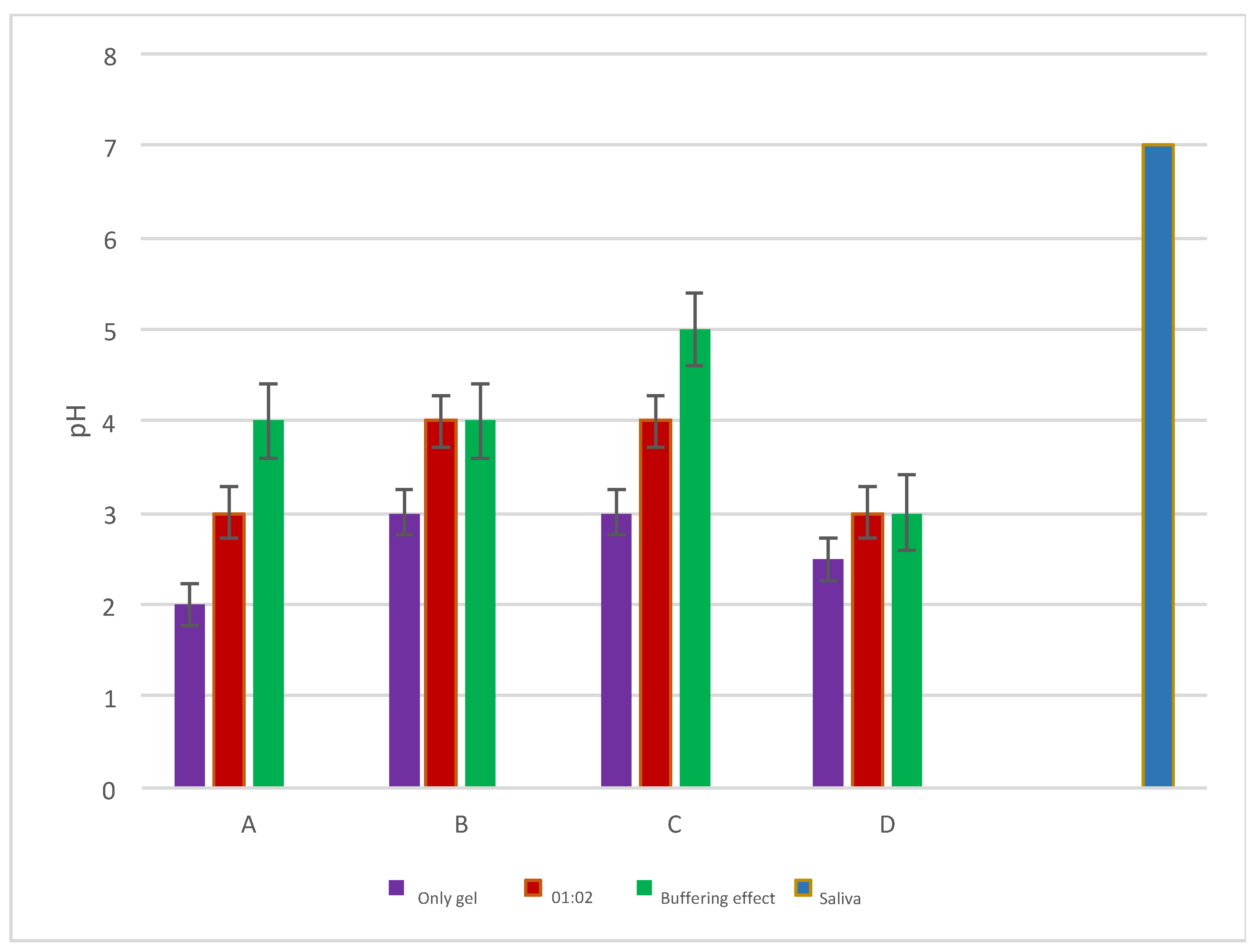
To evaluate the potential neutralizing effect of CPP-ACP, an additional experimental condition was prepared for each energy gel using the most concentrated dilution (1:2). This dilution was selected because it represents the highest acidic exposure scenario likely to occur immediately after gel intake, before significant salivary dilution takes place. Evaluating CPP-ACP under these conditions allows for assessment of its potential buffering capacity under maximal acid challenge, which is the condition most relevant for early enamel demineralization processes [
15]. More diluted conditions (1:5–1:10) already approached neutral pH values and were therefore not considered suitable to detect an additional buffering effect. Accordingly, the CPP-ACP analysis was designed as an exploratory proof-of-concept under a single high-challenge condition rather than as a dose–response comparison.
In this condition, 1.5 mL of gel was mixed with 1.5 mL of artificial saliva, followed by the addition of 0.5 mL of MI Paste Plus containing CPP-ACP, resulting in a final mixture volume of 3.5 mL. These samples were subjected to the same homogenization and temperature conditions as the other experimental groups.
2.4.3. pH Measurement
pH measurements were performed using colorimetric indicator strips according to the manufacturer’s instructions. For each sample, a strip was immersed in the mixture for approximately 5 s, after which the resulting color was compared with the reference scale to determine the corresponding pH value. Measurements were recorded at three predefined time points: immediately after preparation (0 min), 15 min after preparation, and 30 min after preparation. Two independent determinations were obtained for each experimental condition.
Although colorimetric strips provide lower precision than potentiometric pH meters, they were selected to allow for rapid and consistent comparative measurements across multiple experimental conditions.
2.4.4. Control Conditions
Control measurements were performed to establish reference values for the experimental system. The pH of artificial saliva without dilution was measured to confirm the baseline pH of the medium, while the pH of each undiluted energy gel was measured to determine the intrinsic acidity of the products prior to dilution. During the experimental procedure, the pH of the artificial saliva was periodically verified to ensure stability within the manufacturer’s declared range of 7.0 ± 0.2.
2.5. Sample Size Considerations
The number of measurements was determined based on analytical replication principles commonly used in in vitro physicochemical studies. Rather than aiming to estimate population parameters, the study design focused on ensuring consistency and reproducibility of pH measurements across experimental conditions.
Each experimental condition was prepared in duplicate and measured at multiple time points, allowing for assessment of intra-condition variability and stability of the measurements. This approach is consistent with previous in vitro studies evaluating physicochemical properties under controlled conditions, where independent replicates are used to ensure reproducibility [
16,
17].
2.6. Statistical Analysis
Statistical analyses were performed using R software (version 4.3.0). The distribution of the data was assessed using the Shapiro–Wilk test for normality, and homogeneity of variances was evaluated using Levene’s test. After confirming that these assumptions were met, one-way analysis of variance (ANOVA) was applied to compare pH values among the different experimental conditions and dilution levels.
When statistically significant differences were detected, post hoc pairwise comparisons were performed using Tukey’s honestly significant difference (HSD) test. Temporal variations in pH measurements (0, 15, and 30 min) were analyzed using repeated-measures ANOVA.
All statistical tests were two-tailed. The results are presented as mean ± standard deviation (SD). A significance level of p < 0.05 was considered statistically significant.
4. Discussion
The present in vitro study evaluated the acidity profile of four commercially available energy gels and analyzed how dilution with artificial saliva and the incorporation of CPP-ACP modify their pH behavior. The results demonstrated that all tested gels exhibited highly acidic values in their undiluted state (pH 2–3), well below the critical threshold for enamel demineralization (pH ≈ 5.5). Importantly, enamel dissolution is not determined solely by reaching the critical pH threshold, but also by the duration and frequency of acid exposure. Repeated drops in pH below 5.5, particularly in conditions of reduced salivary flow, may lead to cumulative mineral loss through prolonged periods of under-saturation with respect to hydroxyapatite. These findings indicate that energy gels may represent a source of acidic exposure potentially relevant for dental tissues under in vitro conditions, although their direct impact on enamel demineralization or erosion cannot be inferred from pH measurements alone.
The acidity levels observed in this study are consistent with previous reports linking salivary pH changes to cariogenic risk and with studies showing that acidic beverages can markedly reduce oral pH after consumption [
18,
19]. In the specific context of sports nutrition, acidic beverages have been shown to depress salivary pH and challenge the oral buffering system, particularly under repeated exposure [
13]. Our findings extend these observations to commercial energy gels, which may generate similar or greater acidic exposure due to their more viscous formulation and potential for prolonged retention on dental surfaces, although their direct impact on enamel demineralization or erosion can-not be inferred from pH measurements alone.
Saliva plays a central protective role in this process. Its neutralizing capacity, mineral content, and clearance function are essential for limiting demineralization after acid exposure [
4,
5,
6,
7,
8]. However, this protective capacity is not fixed. Salivary gland dysfunction, reduced salivary flow, and changes in salivary composition have been described under several conditions, including medication-related xerostomia and systemic disorders, both of which may reduce resilience to acidic challenges [
10,
11,
20]. In athletes, exercise-induced dehydration and sympathetic activation may create a comparable situation of transient salivary vulnerability, thereby potentially amplifying the effects of acidic exposure from such products. These physiological alterations during physical activity may temporarily reduce the natural dilution and buffering capacity of saliva, potentially increasing the local acidic challenge associated with sports supplements consumed during endurance exercise, although the clinical impact of these conditions cannot be directly inferred from the present in vitro findings [
12].
An additional aspect relevant to the present findings is the physical behavior of the products tested. Artificial saliva substitutes have shown different rheological properties depending on their composition, and such characteristics may influence surface retention and clearance patterns in the oral cavity [
21]. In the case of energy gels, their semisolid nature may prolong contact time with enamel and may increase local acidic exposure due to low pH, even if total exposure time is short.
The present results also support the concept that biological effects are not explained solely by pH, but also by the ecological consequences of repeated exposure. The frequent availability of fermentable carbohydrates may modify dental plaque ecology, favoring acidogenic and aciduric bacterial communities [
19]. Recent microbiological and metabolomic studies further suggest that saliva composition, oral metabolites, and microbial shifts are closely linked to oral disease status [
8,
22,
23,
24]. In addition, salivary biomarkers such as alpha-amylase, inflammatory mediators, and other host-response indicators may provide complementary information on how the oral environment reacts to recurrent acidic and carbohydrate-rich challenges [
25,
26,
27,
28], but these outcomes cannot be inferred from pH measurements alone and were beyond the scope of the present investigation.
The particularly low pH observed in Gel A may be related to formulation factors rather than to carbohydrate concentration. Although citric acid was listed as an acidity regulator in most of the evaluated gels, the exact concentration of this acid is not disclosed by manufacturers, and differences in acid content may substantially influence the final pH of the product. Citric acid is a commonly used acidulant in sports nutrition products because it improves flavor and product stability, but it can markedly reduce pH and contribute to an acidic environment potentially associated with enamel demineralization, although its erosive potential cannot be determined from pH measurements alone [
29]. In addition, this is the only gel in this study containing caffeine, and some caffeinated sports formulations include additional acidifying components to improve stability and taste, which may further influence the acidity profile. Therefore, the higher acidity observed in this product likely reflects differences in formulation and acidulant concentration rather than differences in carbohydrate content alone.
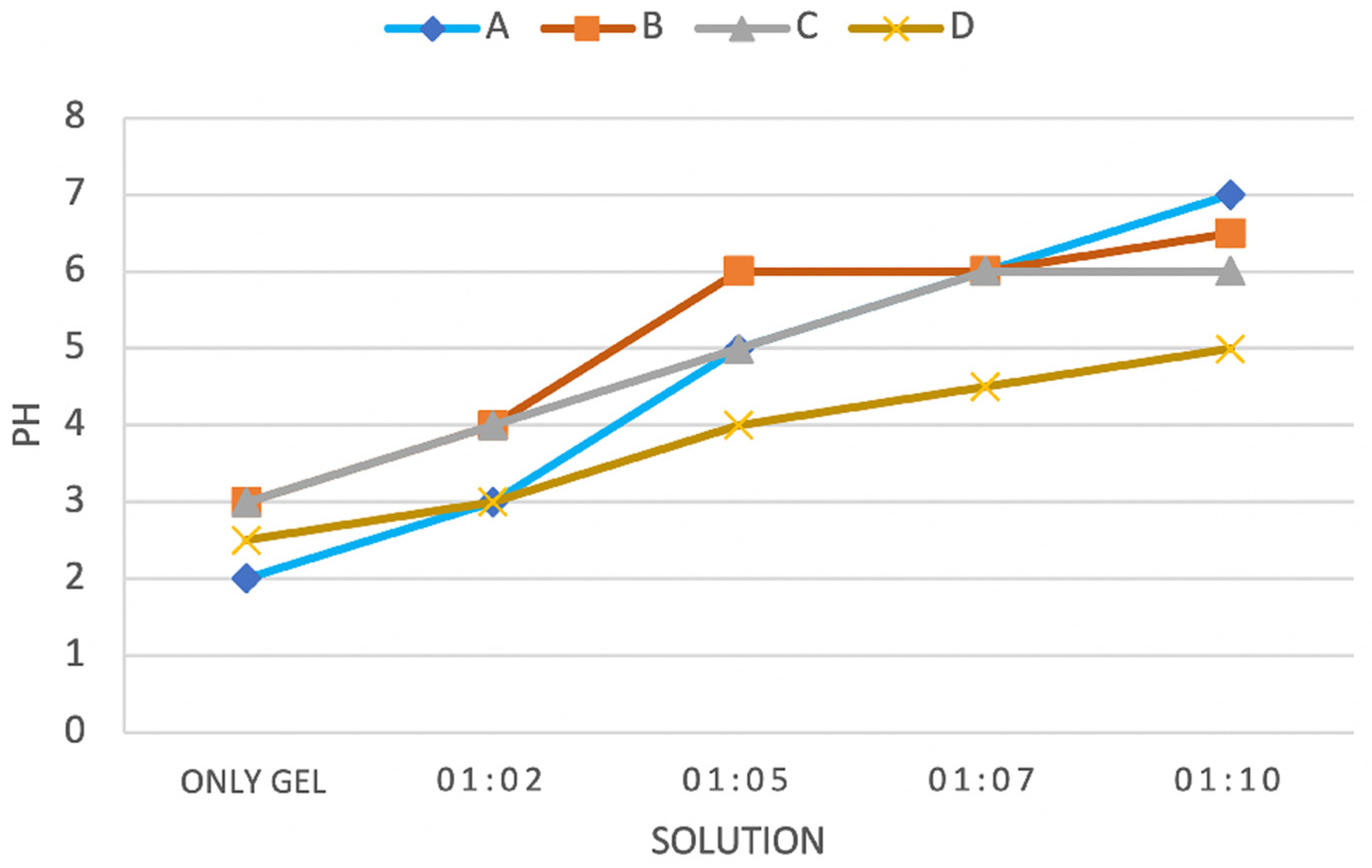
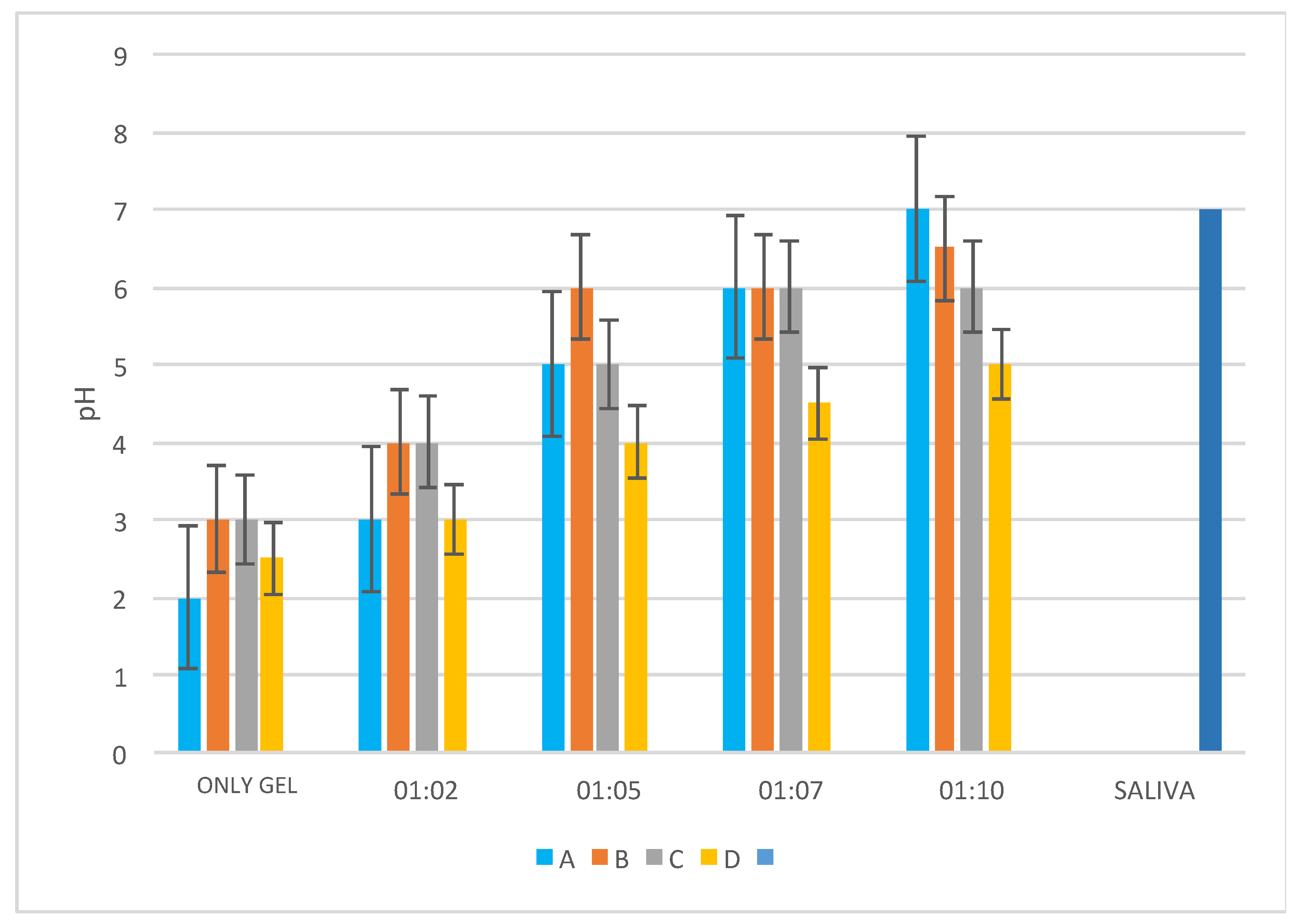
One of the most relevant findings under the experimental conditions of this study was the effect of dilution. Progressive dilution with artificial saliva produced a significant increase in pH values for all gels analyzed. Dilutions of 1:2 and 1:5 remained below the critical demineralization threshold, whereas dilutions equal to or greater than 1:7 approached physiological salivary pH values. These results suggest that dilution is a key factor in reducing acidity under the experimental conditions, although its effect on erosive potential cannot be determined from pH measurements alone. Comparable in vitro evidence has shown that the buffering capacity of saliva may be partially restored when acidic beverages are sufficiently diluted or neutralized within the oral environment [
13,
21].
This observation has important potential practical implications within the experimental context. Consuming energy gels together with sufficient amounts of water may reduce the acidity of the mixture under in vitro conditions, and therefore may represent a potential mitigating approach for acidic exposure in the oral cavity, although its effectiveness in reducing dental erosion cannot be directly inferred from the present findings. Such recommendations are consistent with hydration practices in endurance sports and may add a potential oral-health perspective to established nutritional advice.
The incorporation of CPP-ACP produced a measurable increase in pH values in the most concentrated dilution condition (1:2). However, because CPP-ACP was evaluated only under this single high-exposure condition, the present findings should be interpreted as exploratory. Although CPP-ACP has been shown to exert buffering and remineralizing effects under acidic conditions [
15], the current results do not allow for conclusions regarding its efficacy across different dilution levels or its overall protective capacity in more physiological scenarios, and any potential protective effect cannot be inferred from pH measurements alone.
Despite the relevance of these findings, several methodological limitations must be acknowledged. First, the experimental model was conducted under in vitro conditions using artificial saliva. Although this approach provides standardized and reproducible conditions, it does not fully reproduce the biological complexity of the oral environment, where proteins, enzymes, microbiota, and host factors interact continuously and where salivary flow and composition may dynamically change during physical exercise [
12,
17,
21]. In particular, this model does not account for the dynamic variations in salivary flow rate and buffering capacity that occur during physical activity, which may influence the dilution and neutralization of acidic substances in vivo [
12,
21]. Therefore, the results should be interpreted as an initial experimental approximation rather than a direct representation of intraoral conditions during athletic activity. Second, this study focused on pH behavior and not on direct enamel loss or mineral dissolution; so, the clinical effect should be interpreted cautiously. Importantly, titratable acidity was not assessed, which represents a major limitation of this study. While pH reflects the initial acidity of a solution, titratable acidity provides a more comprehensive estimation of the total acid challenge and buffering requirements, which are critical determinants of erosive potential. Therefore, the present findings cannot be used to directly infer the erosive capacity of the tested products. While potentiometric pH meters provide higher analytical precision, colorimetric strips allow for rapid and consistent comparative assessment across multiple experimental conditions and are commonly used in preliminary laboratory screening studies. In addition, the number of commercially available energy gels analyzed was limited.
Although these products represent commonly used formulations in sports nutrition, the limited number of gels analyzed may not fully capture the variability in commercially available products, and future studies including a broader range of commercial products would provide a more comprehensive overview of the acidity profiles present in the market.
Future studies should therefore explore the effects of energy gel consumption under in vivo conditions, particularly during physical exercise when salivary flow and composition are altered. Continuous intraoral pH monitoring, microbiological assessment, and salivary biomarker analysis may provide valuable information regarding potential impact of these products on the oral environment and may help identify athletes potentially ex-posed to increased acidic challenges associated with erosion or caries processes [
20,
21,
22,
23,
24,
25].
Overall, the results of this study highlight the importance of considering oral health in the evaluation of sports nutrition products. The high acidity of energy gels, combined with physiological conditions frequently present during intense exercise, may increase exposure to acidic conditions relevant to dental tissues, although their direct role in dental erosion cannot be inferred from the present findings. Strategies such as adequate dilution with water and the potential use of protective agents such as CPP-ACP may reduce acidity under experimental conditions and represent potential mitigating approaches, although their clinical effectiveness requires confirmation under in vivo conditions.
5. Conclusions
This study demonstrates that the evaluated commercial energy gels exhibit highly acidic pH values (2–3), well below the critical threshold for enamel demineralization. These findings suggest that frequent consumption of these products may represent a source of acidic exposure potentially relevant for dental tissues under in vitro conditions, particularly under conditions where salivary buffering capacity is reduced, such as during intense physical activity, although their direct impact on enamel demineralization or erosion cannot be inferred from pH measurements alone.
Dilution with saliva or water significantly increased pH values, with dilutions ≥1:7 approaching physiological salivary pH levels. This indicates that adequate hydration during gel consumption may reduce acidity under the experimental conditions and represent a potential mitigating approach, although its clinical effectiveness requires confirmation under in vivo conditions.
The incorporation of CPP-ACP produced a measurable increase in pH in concentrated conditions, indicating a limited buffering effect under highly acidic conditions rather than a clinically established protective effect. Moreover, pH increase alone should not be interpreted as direct evidence of reduced enamel demineralization, as remineralization processes depend on additional factors such as ion availability, biofilm dynamics, and exposure time. This effect appears to be partial and should be considered complementary to dilution strategies, with findings limited to the specific experimental condition evaluated, and any potential protective effect cannot be inferred from pH measurements alone.
Overall, these findings highlight the importance of considering oral health in sports nutrition practices. However, the results should be interpreted as an indirect estimation of acidic exposure, rather than as direct evidence of enamel demineralization. Further in vivo studies incorporating direct measurements of enamel changes and titratable acidity are needed to confirm the clinical implications of these findings.




 ,
,