Article

Dynamic Characteristics and Feedforward Control Methods of Magnetic Bearing Flywheels Under Moving Base Conditions


1
School of Engineering and Design, Hunan Normal University, Changsha 410081, China
2
School of Aeronautics and Astronautics, Sun Yat-sen University, Shenzhen 518107, China
*
Authors to whom correspondence should be addressed.
Appl. Sci. 2026, 16(8), 3789; https://doi.org/10.3390/app16083789
Submission received: 13 March 2026 / Revised: 6 April 2026 / Accepted: 10 April 2026 / Published: 13 April 2026
(This article belongs to the Special Issue Advanced Design and Control Methods for Magnetic Levitation Systems)

Abstract

Magnetic bearing flywheels, characterized by frictionless operation and long service life, are increasingly recognized as promising actuators for spacecraft attitude control. Understanding their dynamic behavior under moving-base conditions is therefore essential. In this study, the Lagrange method is employed to derive the dynamic equations of a magnetic-bearing flywheel subject to base motion. By incorporating the dynamics of electromagnetic bearings, a unified electromechanical-dynamic control model is established. Simulations are conducted to examine the system’s response during rapid maneuvers, with a focus on the effects of base moment of inertia, rotor speed, and maneuver angular rate on flywheel performance. Based on the analysis, a feedforward compensation strategy utilizing the angular acceleration of the moving base is proposed to suppress the influence of base motion. Simulation results validate the effectiveness of the proposed method, offering technical support for the future application of magnetically levitated flywheels in ultra-stable, fast-maneuvering satellites.

1. Introduction

The most significant difference between magnetic bearing flywheels and conventional flywheels lies in the adoption of magnetic bearings for support. By completely eliminating mechanical contact, magnetic bearings enable friction-free, wear-free, and lubrication-free operation, making them particularly suitable for vacuum and ultra-clean environments. Moreover, magnetic bearing flywheels are capable of operating at extremely high rotational speeds, which significantly reduces energy consumption and maintenance costs while offering a long service life [1]. In addition, magnetic bearings feature actively controllable stiffness and damping, allowing effective vibration suppression through an optimized control algorithm [2,3,4,5]. Spacecraft, in particular, demand long-life, lubrication-free, and ultra-clean technologies, making magnetic-bearing flywheels a promising choice for attitude control and energy storage. Consequently, ensuring their stable operation has become a prominent research focus [6,7,8].
Current research on magnetic-bearing flywheels primarily addresses vibration sources internal to the system, with significant attention devoted to vibrations induced by rotor imbalance and sensor runout. Studies on imbalance-induced vibrations have examined the underlying principles and identification methods for mass imbalance [9], derived corresponding unbalanced dynamic equations, and proposed Least Mean Squares (LMS)-based active vibration control strategies and feedback control laws, which have proven effective [10,11]. The introduction of cross-feedback control has further enhanced gyroscopic effect rejection, thereby improving stability margins [12].
The notch filter approach has been widely adopted to control imbalance-induced vibrations, with continuous refinements improving vibration suppression accuracy [13,14,15,16,17,18]. To further enhance performance, harmonic vibrations caused by sensor runout have been incorporated into control designs [19]. A generalized notch filter was proposed [20], achieving effective suppression through parallel or series configurations of multiple notch filters for harmonic current attenuation [21,22].
To address the complexity of tuning parameters in these methods, repetitive control has been applied to vibration suppression in magnetically bearing flywheels. Variants such as high-order repetitive control [23], composite repetitive control [24], odd-harmonic repetitive control [25,26], and fractional-order repetitive control [27] have demonstrated effective suppression of both mass-imbalance-induced and control-system-originated harmonic vibrations.
However, prior research has primarily focused on vibration suppression within the flywheel system itself. In practice, the influence of external loads on magnetic bearings is critical. Reference [28] studied a 2-degree-of-freedom (2-DOF) magnetic-bearing flywheel mounted on a mobile platform, analyzing the effects of base motion and proposing a sliding-mode control (SMC) method for stable operation under such conditions. Reference [29] examined a rotor system model on a rotating platform, assessing the impact of external loads on rotor-stator clearance. Additionally, research on magnetically bearing flywheels in marine vessels explored how pitch angle variations affect system stability [30]. Collectively, these studies demonstrate that base motion significantly impacts the performance of magnetic-bearing flywheels.
In the context of spacecraft, rapid maneuvers represent a form of external load. Such maneuvers may degrade control performance, induce rotor vibrations, or even reduce rotor-stator clearance to a level that risks instability. Therefore, understanding the dynamic characteristics of magnetic-bearing flywheels under moving-base conditions is essential for their reliable use in rapidly maneuvering spacecraft.
To address this, the present study models rapid spacecraft maneuvers as a moving-base problem and investigates the coupled dynamics of the base–flywheel system. The main contributions are as follows:
  • Contextualized Modeling: Using rapid spacecraft maneuvers as the operational background, the Lagrange method is applied to develop a moving-base dynamic model of a magnetic-bearing flywheel. Electromagnetic bearing forces are incorporated, resulting in a unified electromechanical–dynamic model.
  • Control Model and Parameter Analysis: Based on the integrated model, a control framework for the magnetic-bearing flywheel is established. The effects of various moving-base parameters on the performance of the levitation controller are systematically analyzed.
  • Novel Vibration Suppression Strategy: A feedforward vibration suppression controller, utilizing moving-base angular deceleration measurements, is proposed. Its effectiveness is verified through simulation studies.
The remainder of this paper is organized as follows: Section 2 develops the dynamic model of the magnetic-bearing flywheel under moving-base conditions. Section 3 presents the integrated electromechanical–dynamic model incorporating base excitations. Section 4 analyzes dynamic responses through simulations, highlighting the relationships between spacecraft maneuver parameters and electromagnetic control variables. Section 5 proposes and validates a suppression method for moving-base effects. Finally, Section 6 summarizes the findings and conclusions.

2. Dynamic Model of the Magnetic Bearing Flywheel Considering Moving Base Excitations

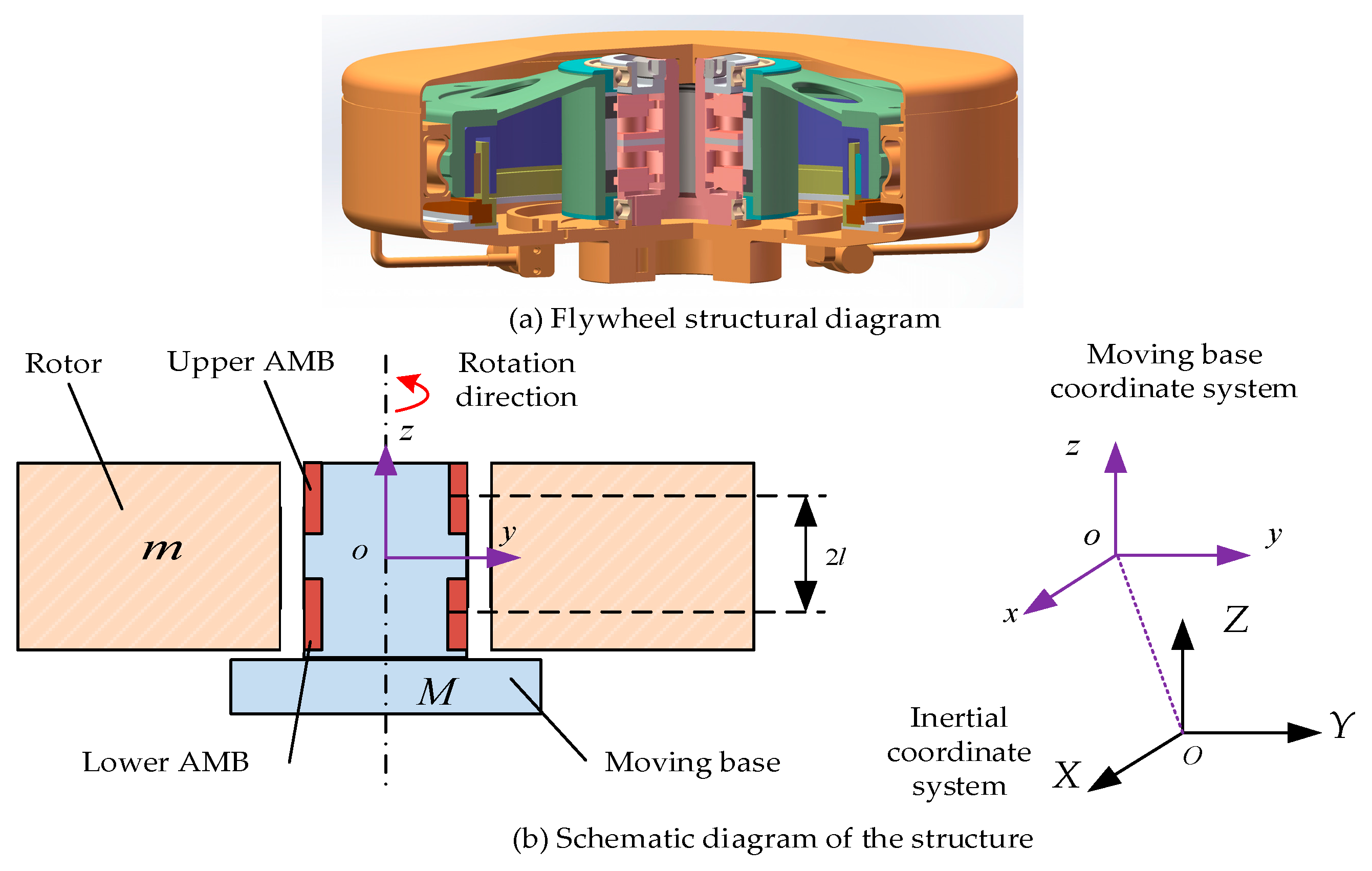
The four-degree-of-freedom (4-DOF) magnetic bearing flywheel model examined in this study is illustrated in Figure 1. It comprises a rotor, stator, base, and upper and lower magnetic bearings. Radial translation and rotation of the rotor are actively controlled by the magnetic bearings, while rotation about the central axis is driven by the motor. Since the magnetic-bearing flywheel will be evacuated after manufacturing, and this study primarily targets space applications, the effects of air friction and gravity are neglected in the present model.
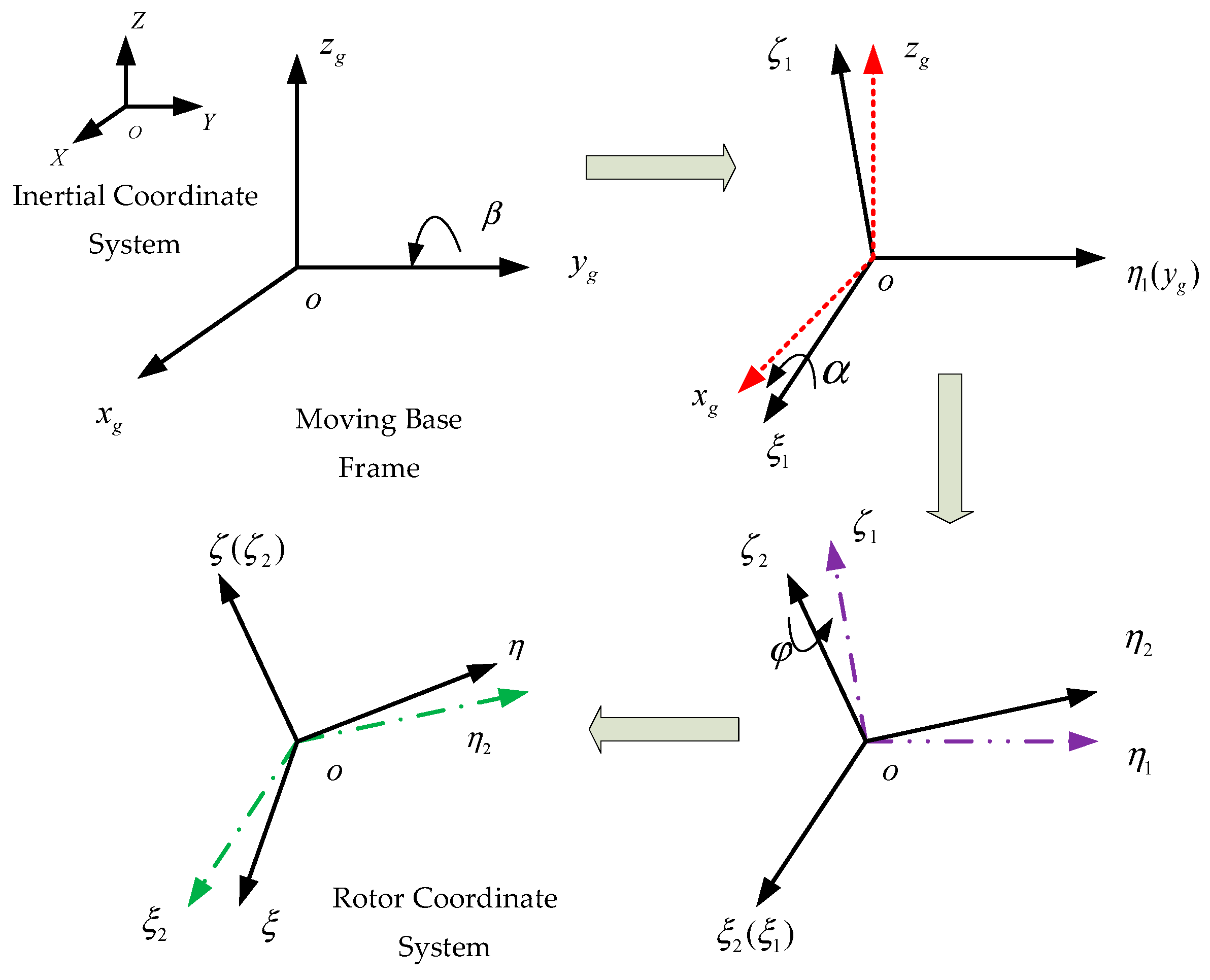
For modeling purposes, the stator–base connection is assumed to be rigid. The spacecraft’s maneuver pivot is defined at the rotor center, and the analysis focuses on the effects of maneuver-induced rotational motion about this axis on the magnetically levitated rotor. Three reference frames were established, as shown in Figure 2: the inertial coordinate frame OXYZ, moving base frame o x g y g z g , and rotor coordinate system o ξ η ζ .
The transformation relationships between coordinate systems are defined as follows:
(1)
Inertial Coordinate System: OXYZ fixed in space.
(2)
Moving Base Frame: o x g y g z g ; the moving base and stator are treated as rigid bodies M. For convenience of modeling, the center of this rigid body is positioned at the stator center. This frame underwent rotational motion about the X-, Y-, and Z-axes relative to the inertial coordinate system, with coincident origins in the initial state.
(3)
Rotor Coordinate System: o ξ η ζ , fixed to the rotor; o ζ rotates with the rotor about its center of mass and aligns with the rotor’s principal axes of inertia. In the initial state, their origins coincide. The transformation from the moving base frame to the rotor frame is illustrated in Figure 2: First, a rotation by angle β about the yg axis yields the o ξ 1 η 1 ζ 1 frame. Next, a rotation by angle α about the ξ 1 intermediate axis gives the o ξ 2 η 2 ζ 2 frame. Finally, a rotation by angle φ about the ζ 2 axis results in the rotor coordinate system o ξ η ζ .

2.1. Rotor Angular Velocity

Based on the defined coordinate systems, the angular velocities of the magnetic-bearing flywheel components are described as follows.
(1)
For the moving base frame oxyz, its angular velocity components relative to the inertial coordinate system, projected onto the inertial frame axes, are denoted as θ ˙ x , θ ˙ y , and θ ˙ z .
(2)
For the o ξ 1 η 1 ζ 1 coordinate system, the angular velocity relative to the inertial space, with components projected onto its own axes, is expressed as
ω ξ 1 ω η 1 ω ζ 1 = cos β 0 sin β 0 1 0 sin β 0 cos β θ ˙ x θ ˙ y θ ˙ z + 0 β ˙ 0 = θ ˙ x cos β θ ˙ z sin β θ ˙ y + β ˙ θ ˙ x sin β + θ ˙ z cos β
(3)
For the o ξ 2 η 2 ζ 2 coordinate system, the components of its angular velocity relative to the inertial space, resolved along its own axes, are expressed as
ω ξ 2 ω η 2 ω ζ 2 = 1 0 0 0 cos α sin α 0 sin α g cos α g ω ξ 1 ω η 1 ω ζ 1 + α ˙ 0 0 = ω ξ 1 + α ˙ g ω η 1 cos α + ω ζ 1 sin α ω η 1 sin α + ω ζ 1 cos α
(4)
For the o ξ η ζ coordinate system, the components of its angular velocity relative to the inertial space, resolved along its own axes, are expressed as
ω ξ ω η ω ζ = cos φ sin φ 0 sin φ cos φ 0 0 0 1 ω ξ 2 ω η 2 ω ζ 2 + 0 0 φ ˙ = ω ξ 2 cos φ + ω η 2 sin φ ω ξ 2 sin φ + ω η 2 cos φ ω ζ 2 + φ ˙
Substituting Equation (2) into Equation (3) yields the expression for the angular velocity of the rotor relative to the inertial space, which is resolved in the inertial coordinate system as follows:
ω ξ 2 = α ˙ + cos β θ ˙ x sin β θ ˙ z ω η 2 = cos α β ˙ + sin α sin β θ ˙ x + cos α θ ˙ y + cos β sin α θ ˙ z ω ζ 2 = sin α β ˙ + cos α sin β θ ˙ x sin α θ ˙ y + cos α cos β θ ˙ z
Typically, the rotor deflection angles are significantly smaller than the maneuver angles. Therefore, sin α α , cos α 1 , sin β β , and cos β 1 ; by neglecting the higher-order term sin α sin β θ ˙ x , Equation (4) can be approximated and simplified as
ω ξ 2 = α ˙ + θ ˙ x β θ ˙ z ω η 2 = β ˙ + θ ˙ y + α θ ˙ z ω ζ 2 = α β ˙ + β θ ˙ x α θ ˙ y + θ ˙ z

2.2. Equations of Motion for the Magnetic-Bearing Flywheel

The kinetic energy of the rotor can be expressed as T R = T r 1 + T r 2 + T r 3 , where
T r 1 = 1 2 J d ω ξ 2 2 T r 2 = 1 2 J d ω η 2 2 T r 3 = 1 2 J p ( ω ζ 2 + Ω ) 2
where T r 1 and T r 2 represent the rotational kinetic energies of the equatorial axes; T r 3 denotes the rotational kinetic energy about the polar axis; J d is the equatorial moment of inertia; J p is the polar moment of inertia of the rotor. Substituting Equation (5) into Equation (6) yields
T r 1 = 1 2 J d ω ξ 2 2 = 1 2 J d ( α ˙ 2 + θ ˙ x 2 + 2 α ˙ θ ˙ x + 2 α ˙ θ ˙ z β + 2 θ ˙ x θ ˙ z β + θ ˙ z 2 β 2 ) T r 2 = 1 2 J d ω η 2 2 = 1 2 J d ( β ˙ 2 + θ ˙ y 2 + 2 β ˙ θ ˙ z + 2 β ˙ θ ˙ z α + 2 θ ˙ y θ ˙ z α + θ ˙ z 2 α 2 ) T r 3 = 1 2 J p ( ω ζ 2 + Ω ) 2 = 1 2 J p ( Ω 2 + θ ˙ z 2 + 2 Ω θ ˙ z 2 Ω β ˙ α 2 Ω α θ ˙ y + 2 Ω β θ ˙ x 2 β ˙ θ ˙ z α 2 θ ˙ y θ ˙ z α + 2 θ ˙ x θ ˙ z β )
Neglecting the fourth-order terms and the relatively small third-order terms in (7), the expression can be simplified as follows:
T r 1 = 1 2 J d ω ξ 2 2 = 1 2 J d ( α ˙ 2 + θ ˙ x 2 + 2 α ˙ θ ˙ x ) T r 2 = 1 2 J d ω η 2 2 = 1 2 J d ( β ˙ 2 + θ ˙ y 2 + 2 β ˙ θ ˙ y ) T r 3 = 1 2 J p ( ω ζ 2 + Ω ) 2 = 1 2 J p ( Ω 2 + θ ˙ z 2 + 2 Ω θ ˙ z 2 Ω β ˙ α 2 Ω α θ ˙ y + 2 Ω β θ ˙ x )
The kinetic energy of the rotor can be expressed as
T R = 1 2 J d ( α ˙ 2 + θ ˙ x 2 + 2 α ˙ θ ˙ x + β ˙ 2 + θ ˙ y 2 + 2 β ˙ θ ˙ z )   + 1 2 J p ( Ω 2 + θ ˙ z 2 + 2 Ω θ ˙ z 2 Ω β ˙ α 2 Ω α θ ˙ y + 2 Ω β θ ˙ x )
and the translational kinetic energy is
T P = 1 2 m ( x ˙ 2 + y ˙ 2 )
where x ˙ and y ˙ denote the velocity components of the center of mass of the rotor along the x and y axes, respectively, and m denotes the mass of the rotor.
Since this study focuses on the effects of base rotational maneuvers on the magnetic-bearing flywheel while neglecting translational base motion, the kinetic energy of the moving base can be expressed as
T D = 1 2 J D ( θ ˙ x 2 + θ ˙ y 2 + θ ˙ z 2 )
where JD represents the moments of inertia of the stator–base assembly about the x-, y-, and z-axes.
The total kinetic energy of the system is then the sum of the rotor’s rotational energy, the rotor’s translational energy, and the base’s rotational energy:
T = T R + T P + T D
That is,
T = 1 2 J d ( α ˙ 2 + θ ˙ x 2 + 2 α ˙ θ ˙ x + β ˙ 2 + θ ˙ y 2 + 2 β ˙ θ ˙ z ) + 1 2 J p ( Ω 2 + θ ˙ z 2 + 2 Ω θ ˙ z 2 Ω β ˙ α 2 Ω α θ ˙ y + 2 Ω β θ ˙ x ) + 1 2 m ( x ˙ 2 + y ˙ 2 ) + J D ( θ ˙ x 2 + θ ˙ y 2 + θ ˙ z 2 )
In magnetic-bearing control systems, gravitational effects encountered during ground-based testing can be compensated by applying a bias current; however, such effects are absent in aerospace applications. Therefore, gravitational influence is neglected in this study, and the system’s potential energy is treated as constant.
U = 0
The generalized coordinates of the system are defined as
q 1 = x ,   q 2 = β ,   q 3 = y ,   q 4 = α ,   q 5 = θ x ,   q 6 = θ y ,   q 7 = θ z
The generalized forces are defined as
Q 1 = F x u + F x d Q 2 = F x u l m u F x d l m d Q 3 = F y u + F y d Q 4 = F y d l m d F y u l m u Q 5 = 0 ,   Q 6 = 0 ,   Q 7 = 0
where F x u and F y u represent the electromagnetic forces in the x and y directions, respectively, generated by the upper bearing (located in the positive z-axis direction). F x d and F y d represent the electromagnetic forces in the x- and y-directions generated by the lower bearing, respectively, whereas l m u and l m d define the axial separations from the upper and lower bearing centers to the rotor center, respectively.
The equations of motion are derived using Lagrange’s equation, expressed as
d d t T q ˙ i T q i + U q i = Q i ( i = 1 , 2 , 3 , )
By substituting the expressions for kinetic energy, potential energy, generalized coordinates, and generalized forces into Lagrange’s Equation (16), the following equations of motion are obtained:
m x ¨ = F x u + F x d J d β ¨ + J d θ ¨ y J p Ω α ˙ J p Ω θ ˙ x = F x u l m u F x d l m d m y ¨ = F y u + F y d J d α ¨ + J d θ ¨ x + J p Ω β ˙ + J p Ω θ ˙ y = F y d l m d F y u l m u J d θ ¨ x + J d α ¨ + J p Ω β ˙ + J D θ ¨ x = 0 J d θ ¨ y + J d β ¨ J p Ω α ˙ + J D θ ¨ y = 0 J p θ ¨ z + J D θ ¨ z + J p Ω ˙ = 0 F x u
By subtracting the fifth equation from the fourth equation in Equation (17), we obtain θ ¨ x ; through the second and sixth equations, we derive θ ¨ y , that is,
θ ¨ x = J p Ω J D θ ˙ y J D ( F x u l m u F x d l m d ) θ ¨ y = J p Ω J D θ ˙ x J D ( F y d l m d F y u l m u )
Substituting Equation (18) into Equation (17) and simplifying it yields
m x ¨ = F x u + F x d J d β ¨ J p Ω α ˙ ( J p + J d J p J D ) Ω θ ˙ x = ( 1 + J d J D ) ( F x u l m u F x d l m d ) m y ¨ = F y u + F y d J d α ¨ + J p Ω β ˙ + ( J p + J d J p J D ) Ω θ ˙ y = ( 1 + J d J D ) ( F y d l m d F y u l m u ) J D θ ¨ x J p Ω θ ˙ y = ( F y d l m d F y u l m u ) J D θ ¨ y + J p Ω θ ˙ x = ( F x u l m u F x d l m d ) ( J p + J D ) θ ¨ z + J p Ω ˙ = 0
From the equations of motion for the magnetic-bearing flywheel under base rotation about the x- and y-axes, the base motion can be regarded as an external disturbance when analyzing the dynamic response of the moving base. This disturbance can be expressed as
W D 2 = J p Ω + J d J p Ω J D θ ˙ x ,   W D 4 = J p Ω + J d J p Ω J D θ ˙ y

3. Electromechanical-Dynamic Model Under Moving Base Conditions

From the dynamic equations of the magnetic-bearing flywheel, it is evident that control primarily targets the axial and radial degrees of freedom. Accordingly, response control is considered mainly within the radial plane. The governing dynamic equation is given by
m x ¨ = F x u + F x d J d β ¨ J p Ω α ˙ = ( 1 + J d J D ) ( F x u l m u F x d l m d ) + ( J p + J d J p J D ) Ω θ ˙ x m y ¨ = F y u + F y d J d α ¨ + J p Ω β ˙ = ( 1 + J d J D ) ( F y d l m d F y u l m u ) ( J p + J d J p J D ) Ω θ ˙ y
From the first and third equations of (21), it can be seen that the rotation of the moving base has no effect on the translation of the rotor but mainly affects the radial rotation of the rotor. From the second and fourth formulas, it can be seen that owing to the movement of the base, two additional torque terms, ( J p + J d J p / J D ) Ω θ ˙ x and ( J p + J d J p / J D ) Ω θ ˙ x , are generated, which in turn affect the rotation of the y-axis and the x-axis, respectively.
Equation (21) is rewritten into matrix form as follows:
M ^ q ¨ + G ^ q ˙ = H ^ F + W ^
where
M ^ = m 0 0 0 0 J d 0 0 0 0 m 0 0 0 0 J d ,   G ^ = J p Ω 0 0 0 0 0 0 0 1 0 0 0 0 0 1 0 0
T m = 1 l m u 0 0 1 l m d 0 0 0 0 1 l m d 0 0 1 l m d ,   H ^ = 1 1 0 0 l m u l m u 0 0 0 0 1 1 0 0 l m d l m d
W ^ = 0 ( J p + J d J p J D ) Ω θ ˙ x 0 ( J p + J d J p J D ) Ω θ ˙ y ,   q = x β y α ,   F = F x u F x d F y u F y d
Perform Laplace transformation on Equation (22) to obtain
m s 2 x ( s ) = F x u ( s ) + F x d ( s ) J d s 2 β ( s ) J p Ω s α ( s ) = ( 1 + J d J D ) ( F x u ( s ) l m u F x d ( s ) l m d ) + ( J p + J d J p J D ) Ω θ ˙ x m s 2 y ( s ) = F y u ( s ) + F y d ( s ) J d s 2 α ( s ) + J p Ω s β ( s ) = ( 1 + J d J D ) ( F y d ( s ) l m d F y u ( s ) l m u ) ( J p + J d J p J D ) Ω θ ˙ y
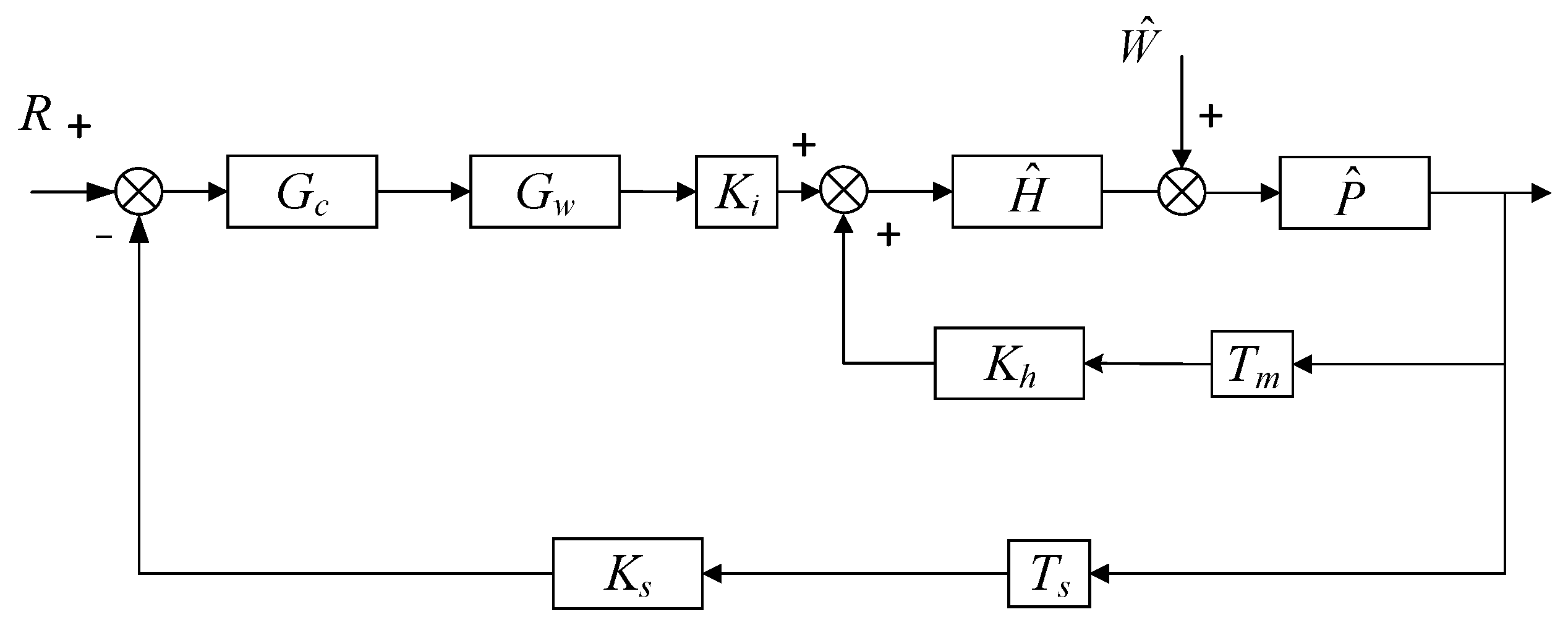
Note P ^ = M ^ s 2 + G ^ s 1 . By adding a power amplifier Gw, controller Gc, current coefficient Ki and displacement coefficient Ks and then following the method of reference [31], the above dynamic equations are converted into a control system block diagram, as shown in Figure 3.
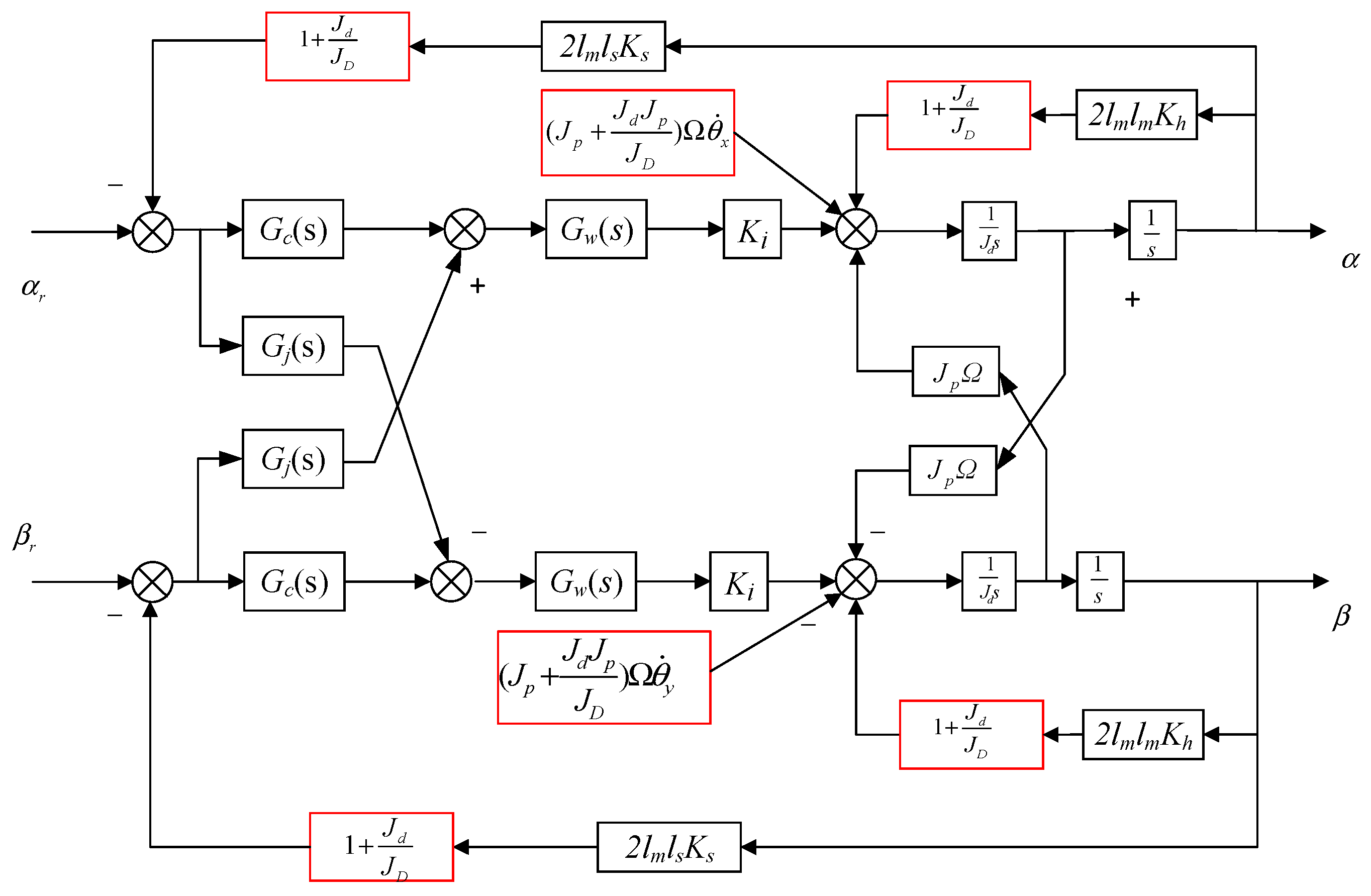
When translational motion of the moving base is neglected and the magnetic-bearing flywheel is assumed to have a symmetric structure, the geometric parameters of the upper and lower bearing displacement sensors are identical; that is, lmu = lmd = lm, lsu = lsu = ls. The rotation control system for the x- and y-axes is illustrated in Figure 4, where the red box highlights additional terms introduced by the moving-base conditions. It can be seen that base motion alters the control system’s characteristics and generates an interference torque.

4. Dynamic Response Simulation Analysis of Magnetic Flywheel

4.1. Simulation Parameter Settings

This section presents the simulation of the moving base using a laboratory-designed space flywheel. The simulation parameters are listed in Table 1. As shown in Figure 4, in addition to the intrinsic parameters of the magnetic-bearing flywheel, the primary factors influencing the moving-base response include the base’s angular rate ( θ ˙ x , θ ˙ y ), the rotor’s rotational speed (Ω), and the base’s rotational inertia (JD). The effects of these parameters on the dynamic characteristics of the magnetic-bearing flywheel were investigated through simulation.
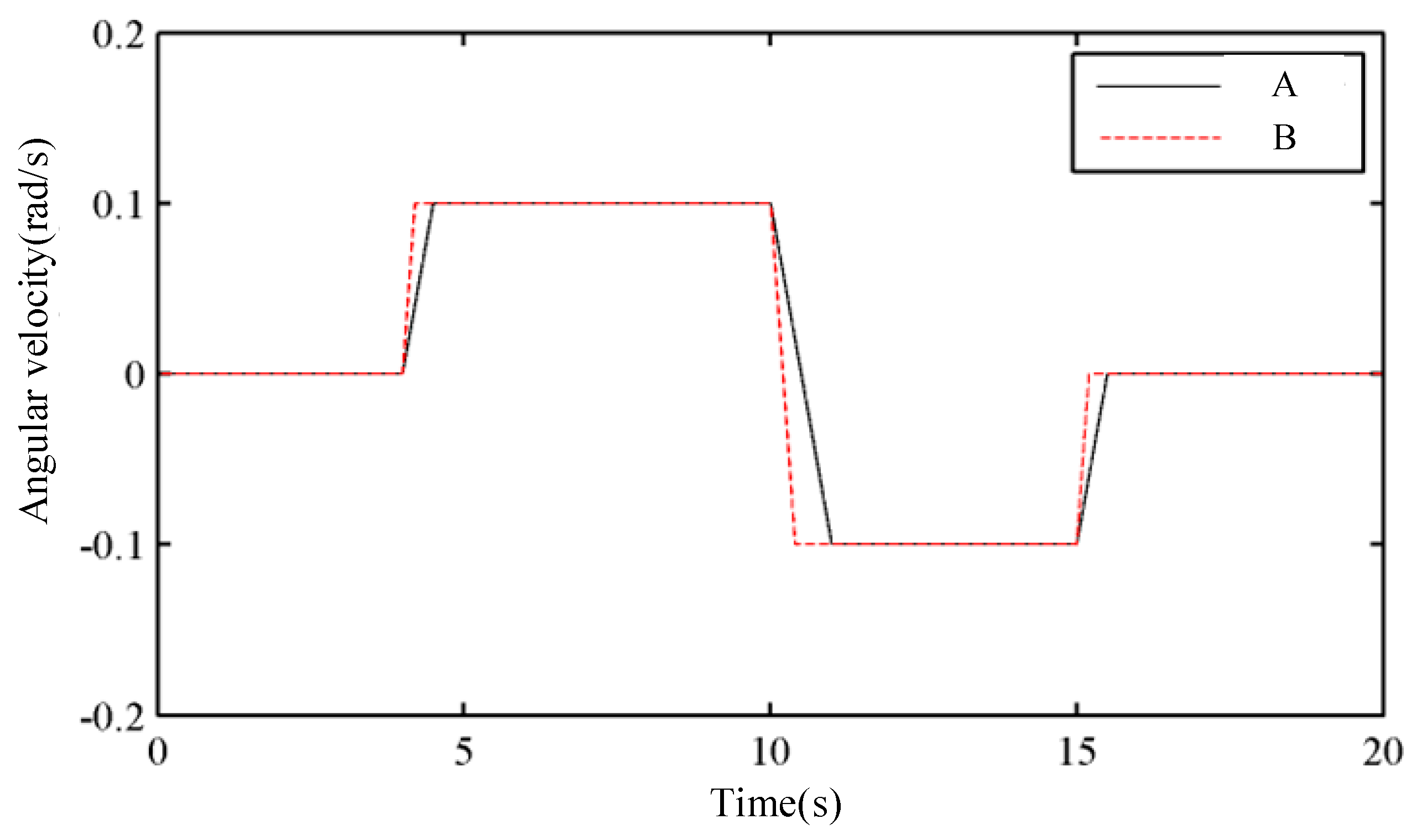
Two maneuver profiles, instructions A and B, as shown in Figure 5, were used in the simulation. Instruction A applies an angular acceleration of 0.1 rad/s2 starting at 4 s, maintaining this acceleration until the angular rate reaches 0.1 rad/s. At 10 s, the maneuver reverses direction with the same magnitude of angular acceleration until the angular rate reaches −0.1 rad/s. After stabilizing, steering continues until the angular position returns to 0°. Instruction B follows a similar pattern, whereas it has a larger acceleration of 0.2 rad/s2 than Instruction A. Consequently, Instruction B requires less time to accelerate to the same angular velocity, indicating a more agile maneuver.

4.2. Coupling Effects Between Maneuver Angular Rates θ ˙ x and θ ˙ y

For simplicity, the base and inertial coordinate systems were initially aligned so that the relative angle between them was zero. In practical scenarios, however, the stator and base usually have some initial angular offset relative to the inertial frame, resulting in components along both the x- and y-axes. This study examines the effect of rotating the two control channels when the maneuver occurs along only one axis. Using Instruction A, with the maneuver directed along the x-axis and the rotor speed set to 3000 rpm, simulation results are presented in Figure 6 and Figure 7.
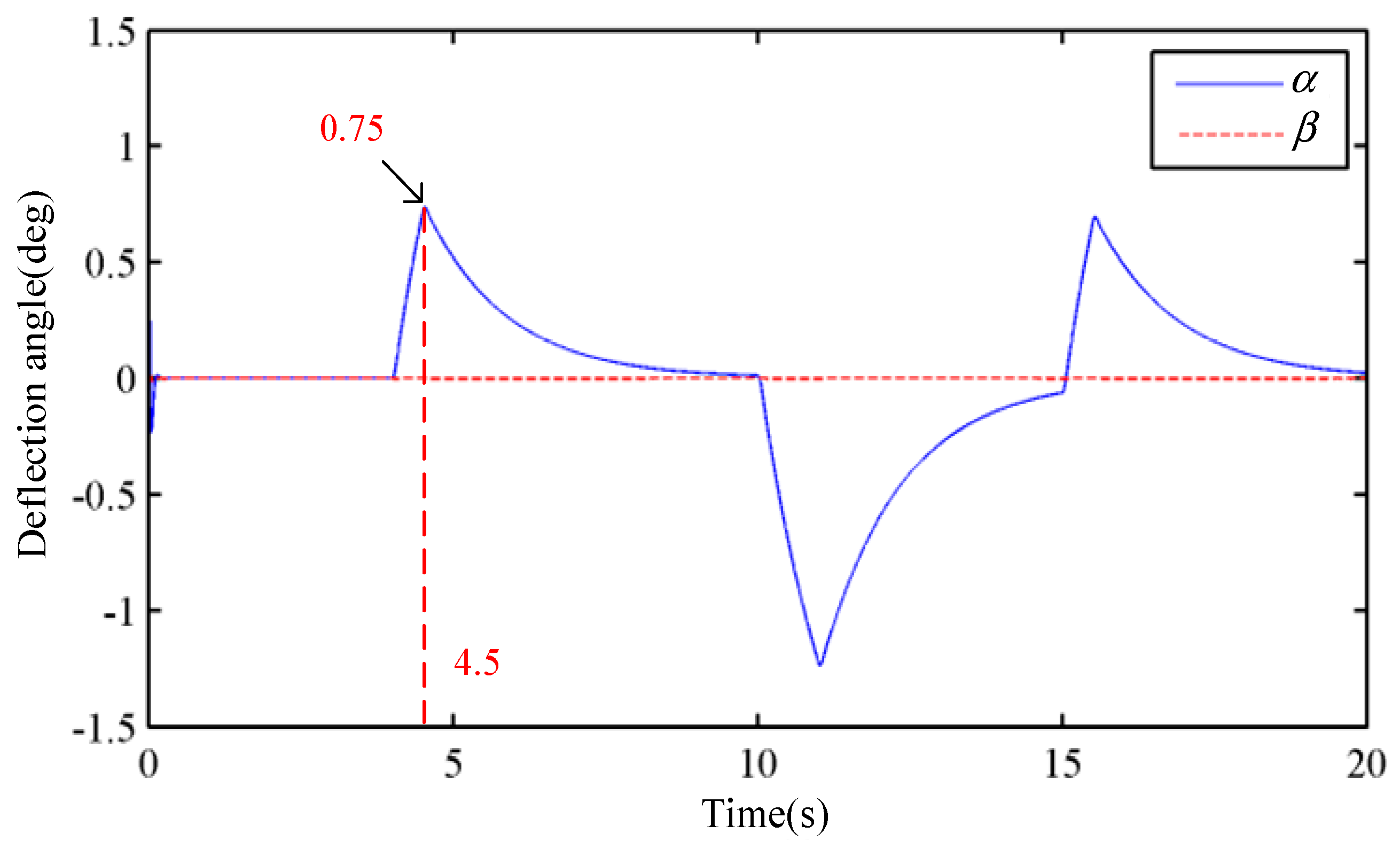
As shown in Figure 6, following disturbance from the maneuver, the deflection angle in the x-direction peaks at approximately 0.75° around 4.5 s. During this period, the angular rate command remains constant, and the deflection gradually decreases, returning to the center position after roughly 10 s. Thus, the flywheel rotor experiences deflection during maneuvering, but once the acceleration ceases, the rotor restores its original position within 5.5 s. This deflection induces changes in angular momentum, representing the moving base effect. When maneuvering exclusively along the x-axis, deflections and fluctuations in the y-direction are negligible.
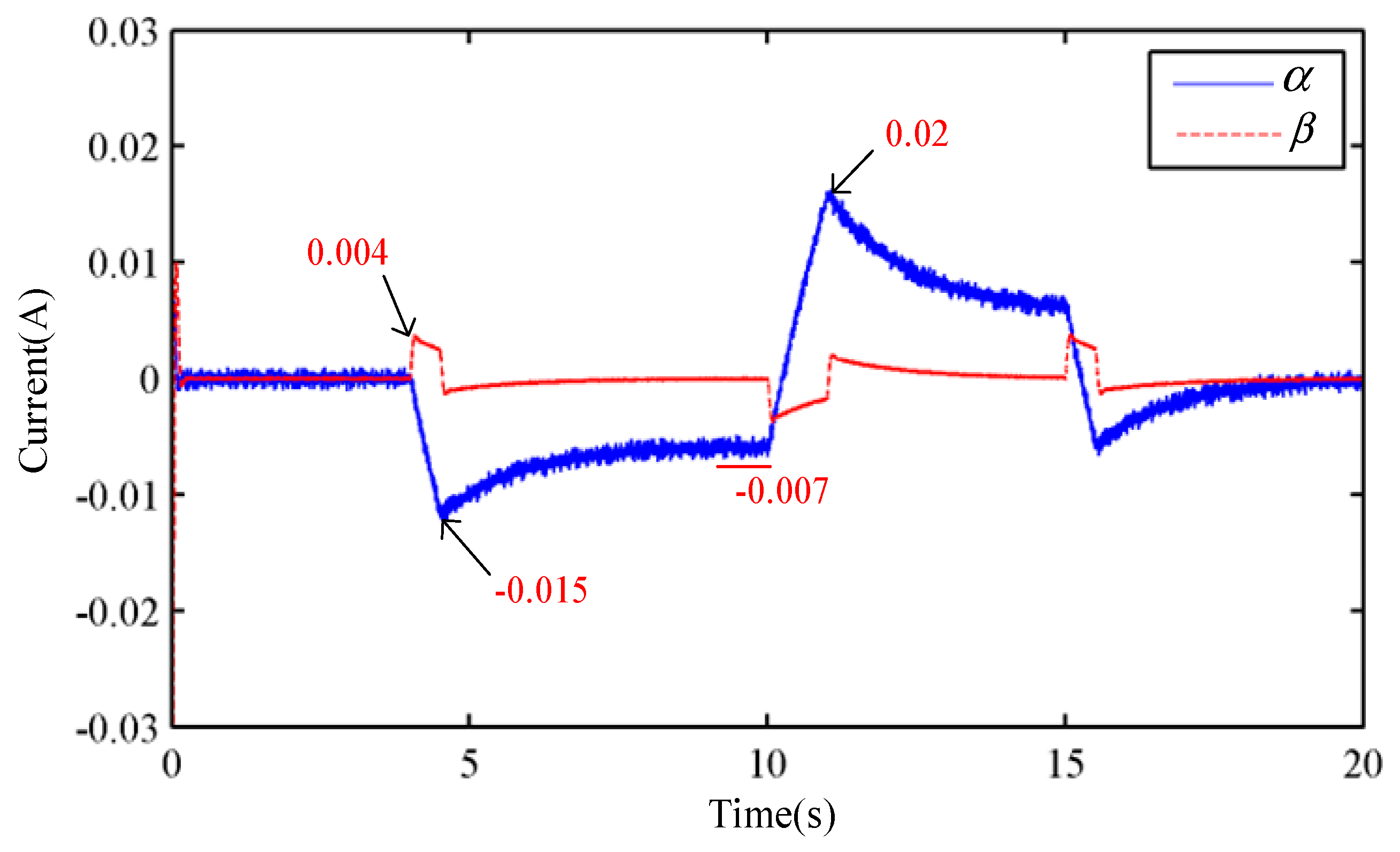
Figure 7 illustrates the control current variations in the magnetic bearing flywheel’s deflection channels during the x-axis maneuver. The control current in the x-channel peaks at 0.015 A at 4.5 s before gradually declining to 0.007 A. Although the y-deflection channel experiences no direct external disturbance, its control current rises rapidly to 0.004 A due to coupling effects and then diminishes to zero. This indicates notable coupling between control channels, where current variations in one channel influence the other. Nevertheless, the controller promptly compensates for these changes, limiting the rotor’s deflection. Consequently, the overall impact of the deflection angle on system performance can be considered negligible.

4.3. The Influence of Maneuvering Angular Acceleration

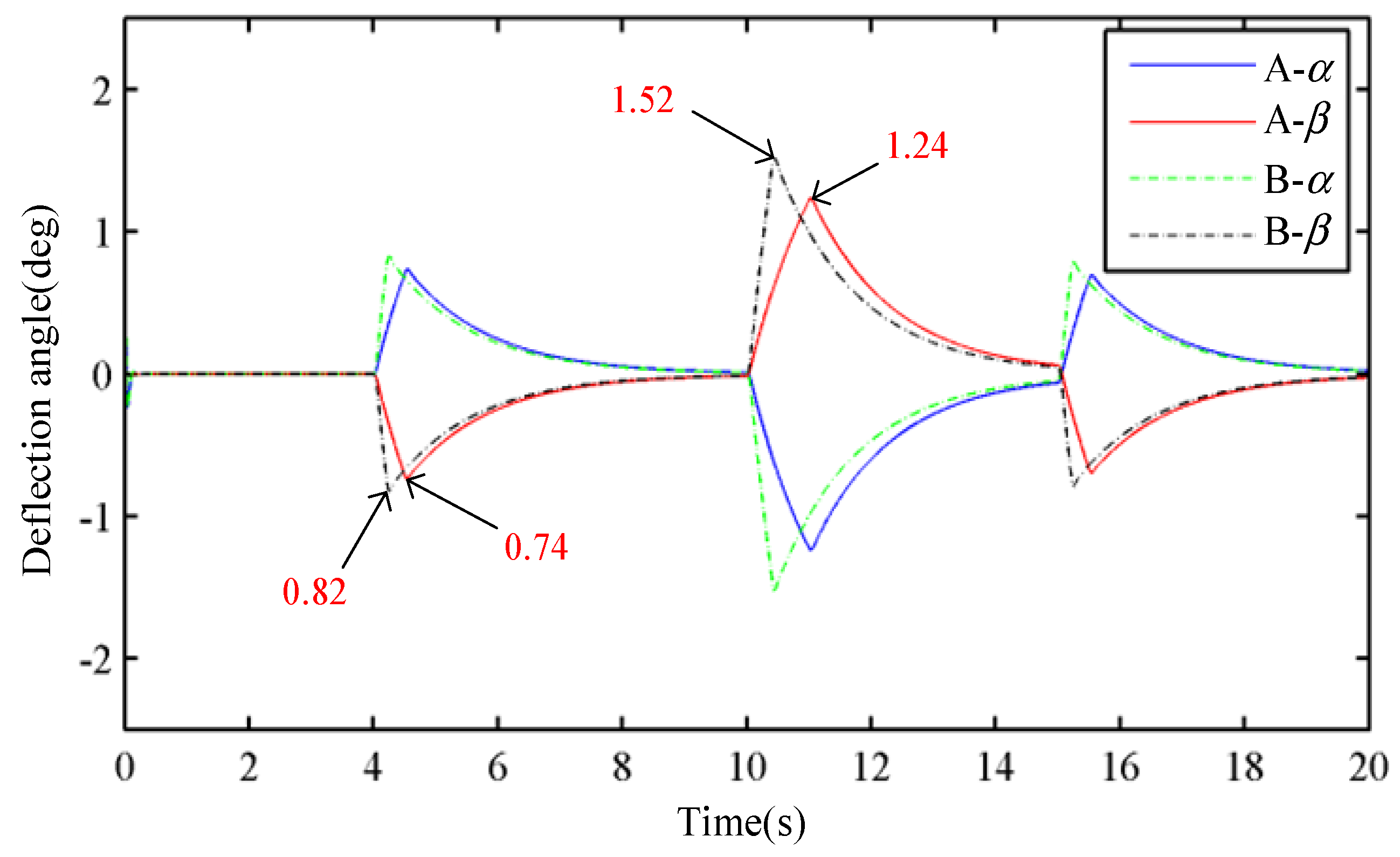
To investigate the effect of angular acceleration, the rotor speed was fixed at 3000 rpm, and simulations were conducted using maneuver commands A and B, applied to the x- and y-deflection channels. Figure 8 compares the deflection angles induced by these two commands. Higher angular acceleration resulted in greater deflection angles. Specifically, Command A produced a peak deflection of 1.24° at 11.04 s, while Command B reached a higher peak of 1.52°, exceeding Command A by 0.28°. During the initial maneuver phase, starting at 4 s, Command A caused a smaller peak deflection of 0.74° at 4.54 s, whereas Command B induced a larger peak of 0.82° at 4.25 s.
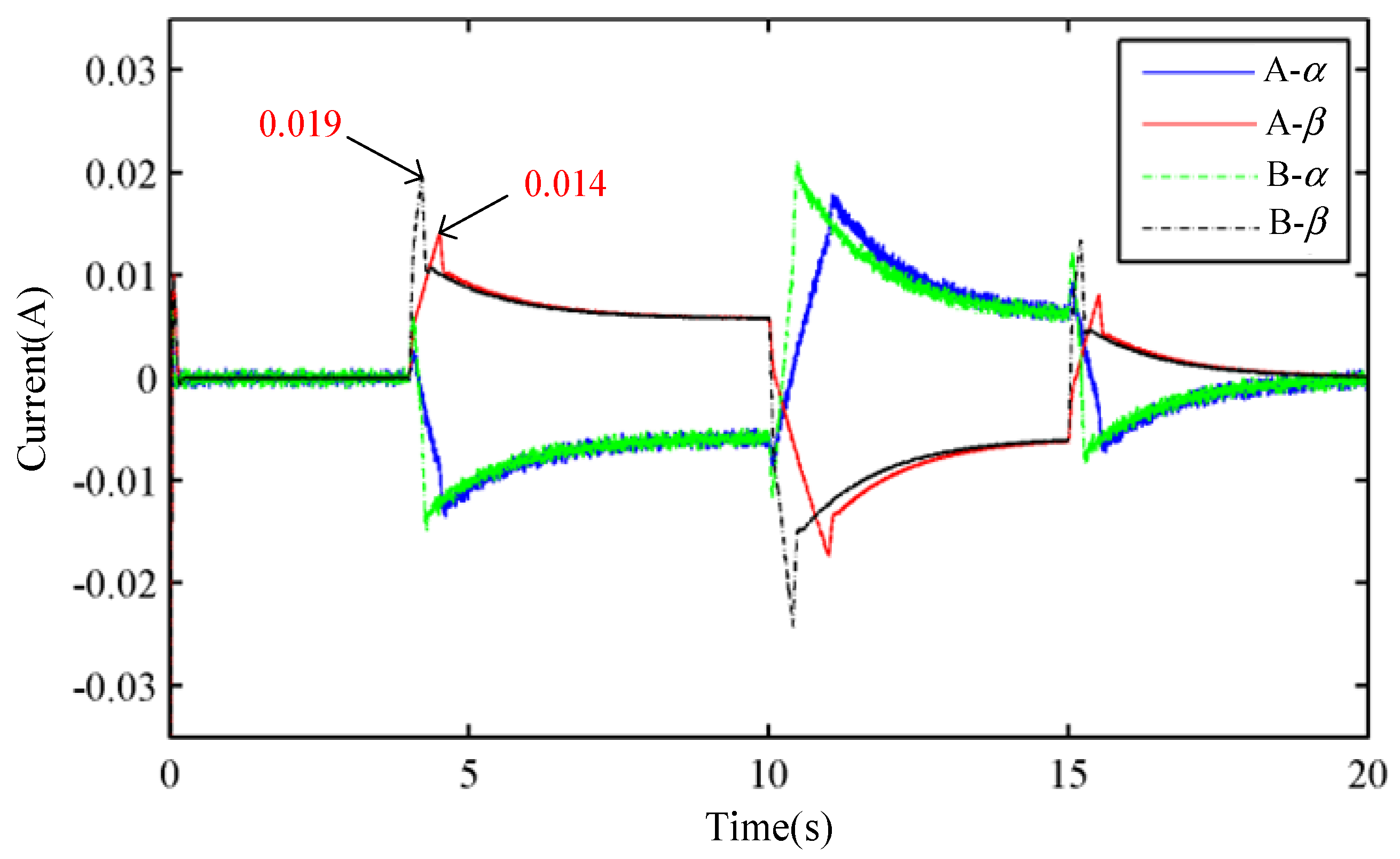
As shown in Figure 8 and Figure 9, under the higher acceleration command B, the control current exhibits more pronounced oscillations, reaching peaks of 0.014 A and 0.019 A. Despite this, the current stabilizes to similar steady-state values once the maneuver is complete. The results indicate that greater angular acceleration leads to larger rotor deflection angles relative to the base. However, after acceleration ends, the current required to maintain a constant angular velocity remains essentially unchanged. Therefore, faster maneuvers induce greater rotor deflections in the magnetic-bearing flywheel.

4.4. The Influence of Rotor Speed

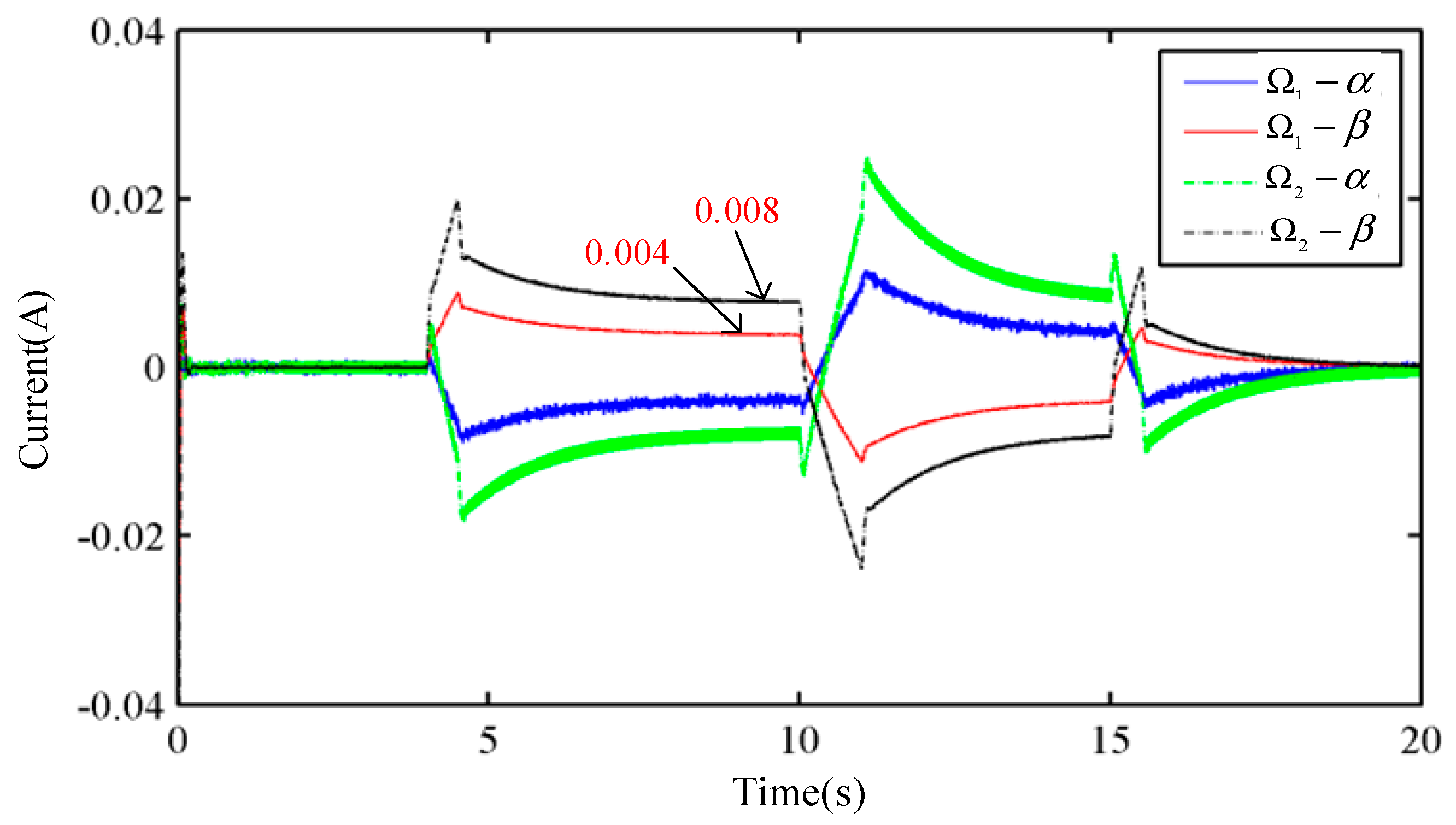
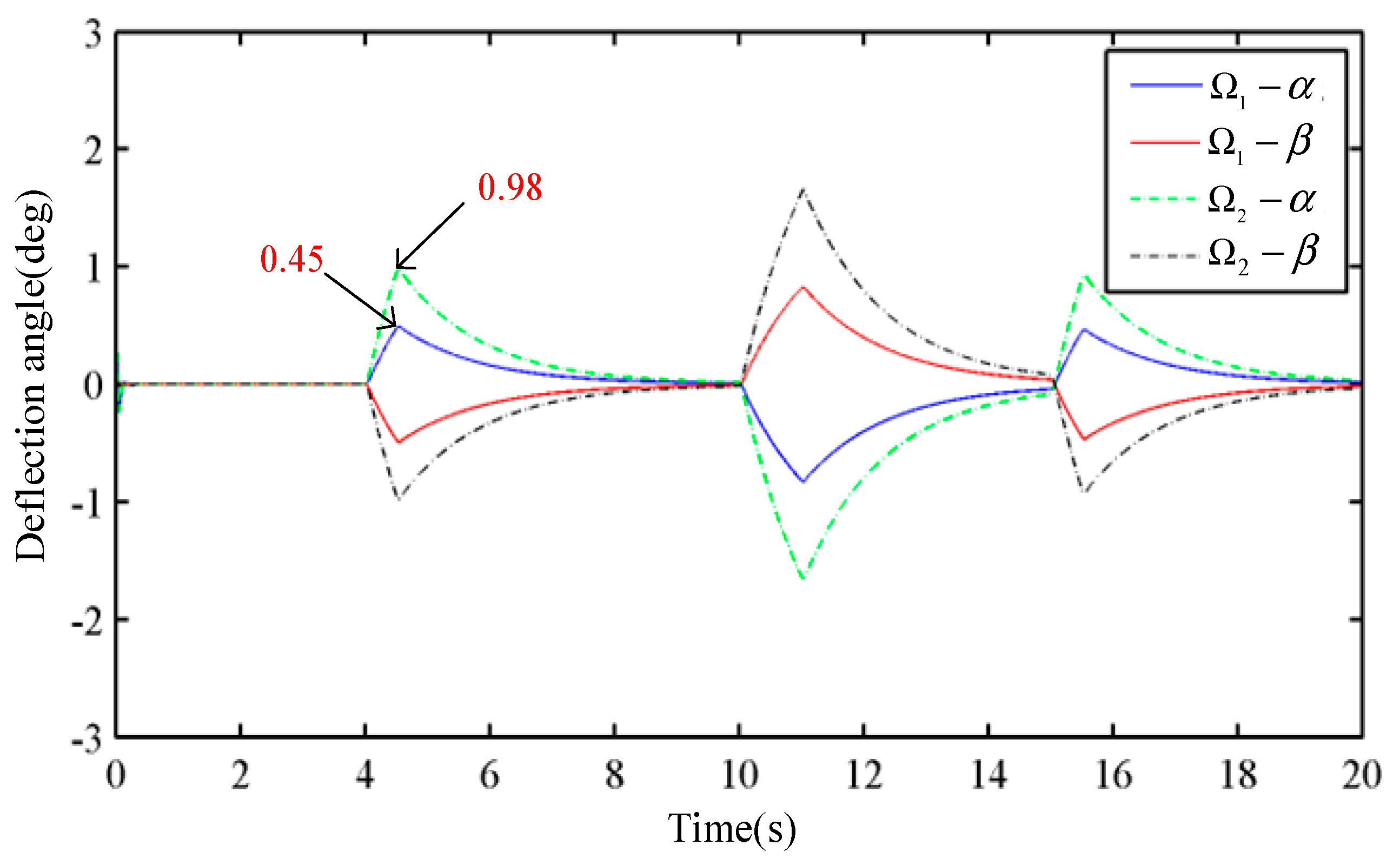
Using command A, the dynamic response of the magnetic-bearing flywheel was simulated at rotor speeds of 2000 rpm and 4000 rpm. Figure 10 shows the rotor deflection angle over time. During the acceleration phase, the deflection angles reached 0.45° at 2000 rpm (Ω1) and 0.98° at 4000 rpm (Ω2), representing a 77.36% increase as the speed doubled. This demonstrates that rotor deflection becomes more pronounced at higher speeds. Correspondingly, Figure 11 illustrates that the control current increases with speed, stabilizing at 0.004 A for Ω1 and 0.008 A for Ω2. Thus, higher speeds result in larger deflections and greater steady-state control currents.

4.5. Influence of Moment of Inertia of Moving Base JD

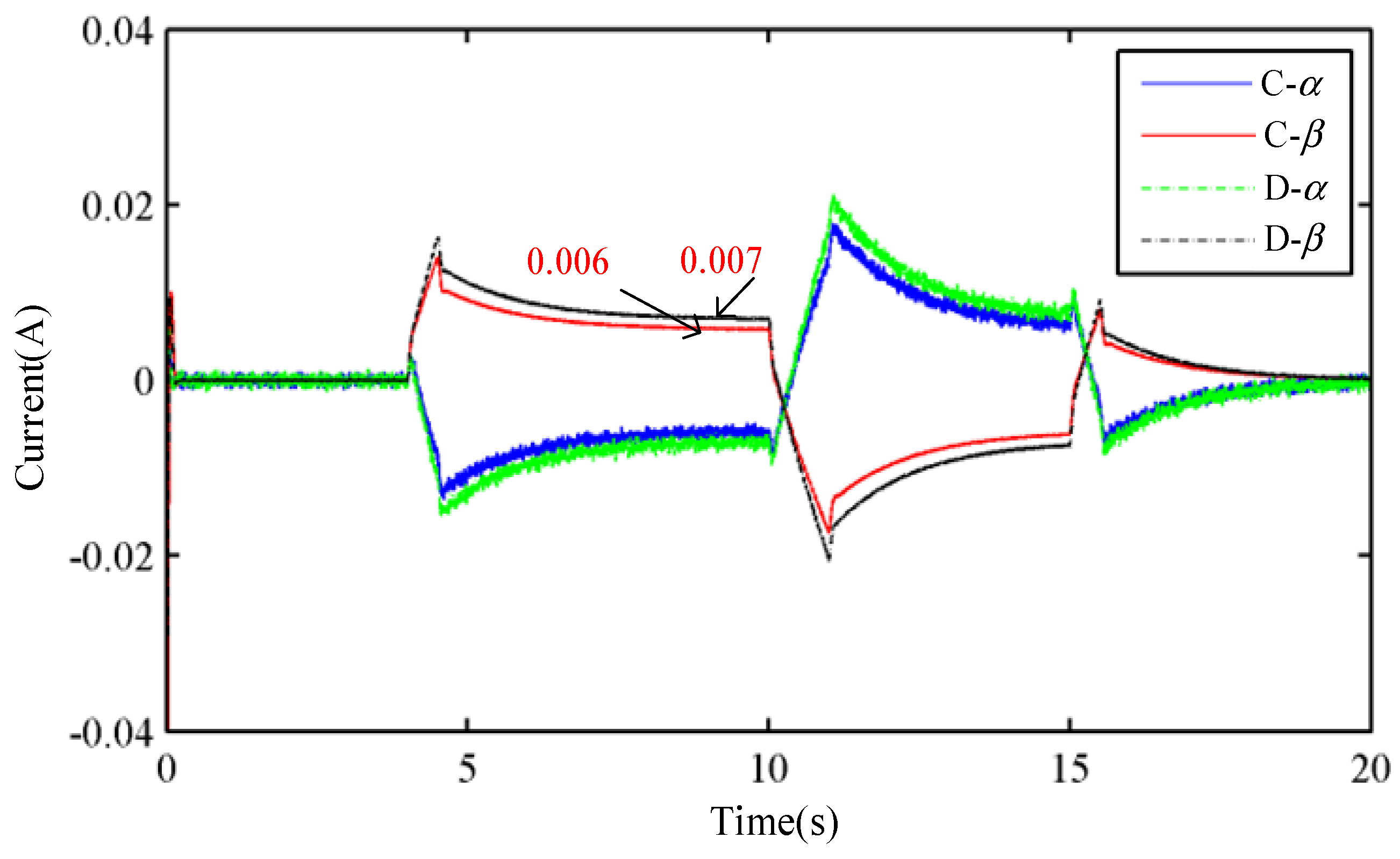
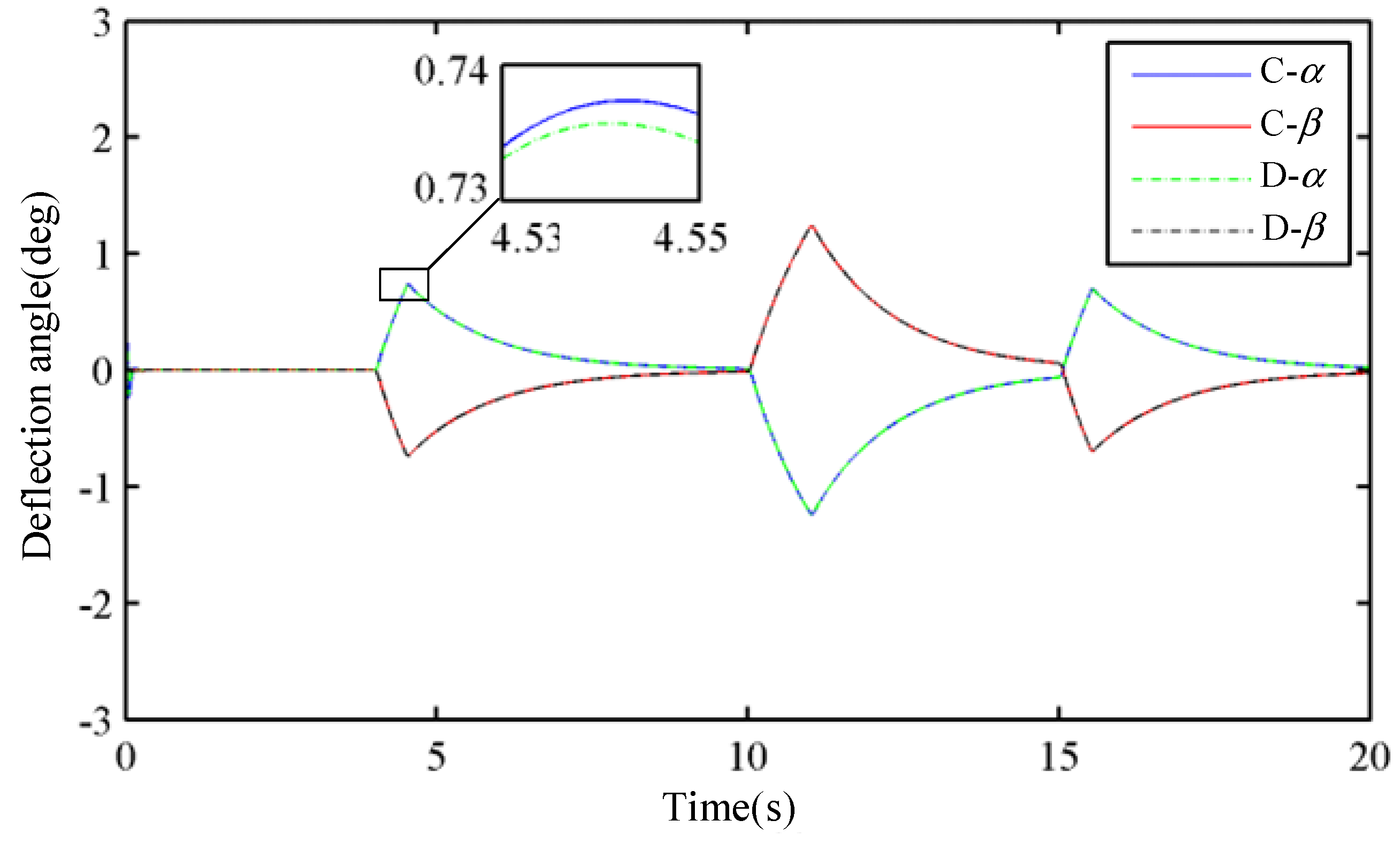
According to its dynamic equation and control block diagram, the rotational inertia of the base primarily affects the characteristics of the system through ( 1 + J d / J D ) . In J D J d and ( 1 + J d / J D ) 1 , the influence of the rotational inertia of the base was not considered, this situation is recorded as C. For the convenience of comparison, another ideal extreme value J d / J D = 0.2 is taken, that is, ( 1 + J d / J D ) = 1.2 is recorded as D. The rotor speed was fixed at 3000 rpm, and simulations were conducted under command A. The results, shown in Figure 12 and Figure 13, indicate that the deflection angles at points C and D are 0.735° and 0.737°, respectively, with both reaching approximately 1.24° near 11 s. These findings suggest that, when the moving base acceleration is constant, the rotor deflection angle is minimally affected by variations in rotational inertia.
Figure 13 shows that when the base’s moment of inertia is significantly larger than that of the flywheel rotor, the stabilized control current is approximately 0.006 A. Conversely, when the base’s moment of inertia is very small, the steady-state current rises to 0.007 A, an increase of 0.001 A. As the base’s moment of inertia decreases, the control current correspondingly increases by a factor of 1.26 relative to the original inertia. This indicates that the base’s moment of inertia influences the system’s control current: a smaller ratio of base inertia to rotor inertia results in higher stabilization currents. However, this effect has a negligible impact on rotor deflection.

5. Method for Suppressing the Effect of Moving Base

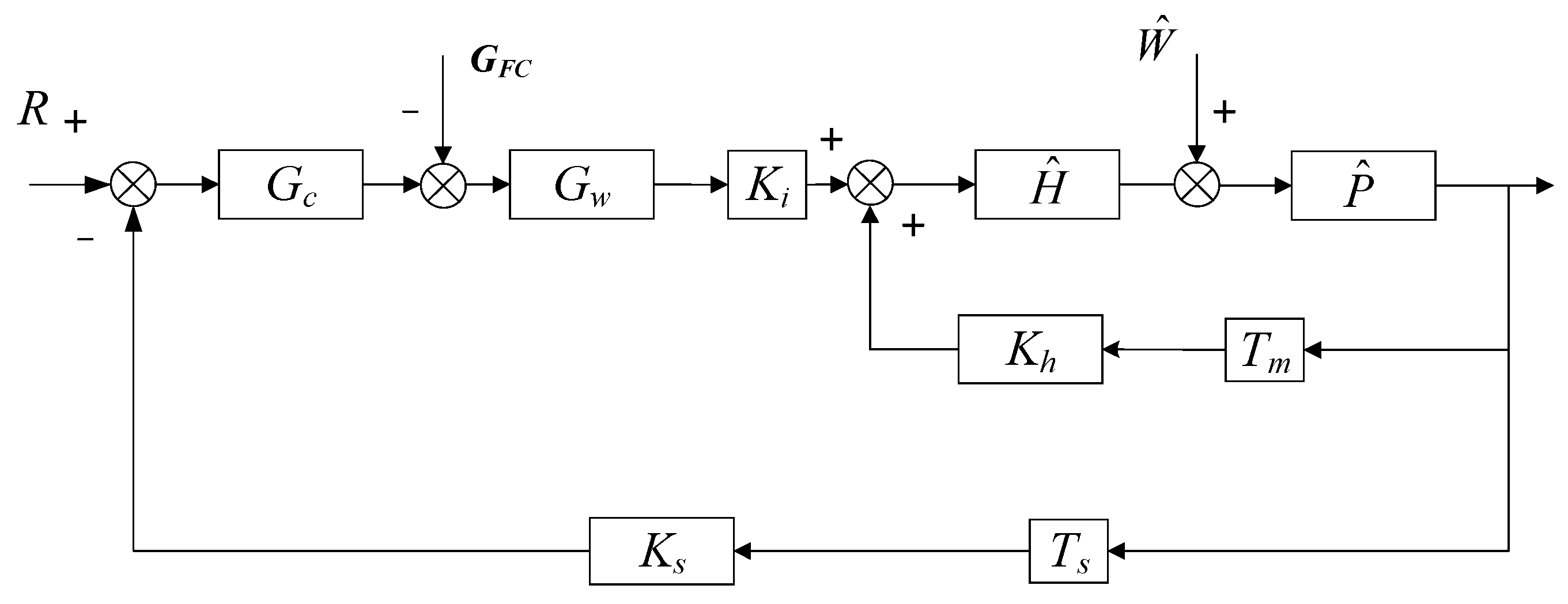
The motion of the moving base primarily arises from external disturbances. To mitigate these base-induced effects, this study employs a feedforward compensation strategy. The control block diagram illustrating this suppression method is presented in Figure 14. Initially, the base’s angular velocity is measured, and the resulting data are fed into the control system for compensation. For complete compensation, the compensation function G F C must satisfy the following form:
H ^ K i G W G F C = W ^
That is,
G F C = H ^ K i G W 1 W ^
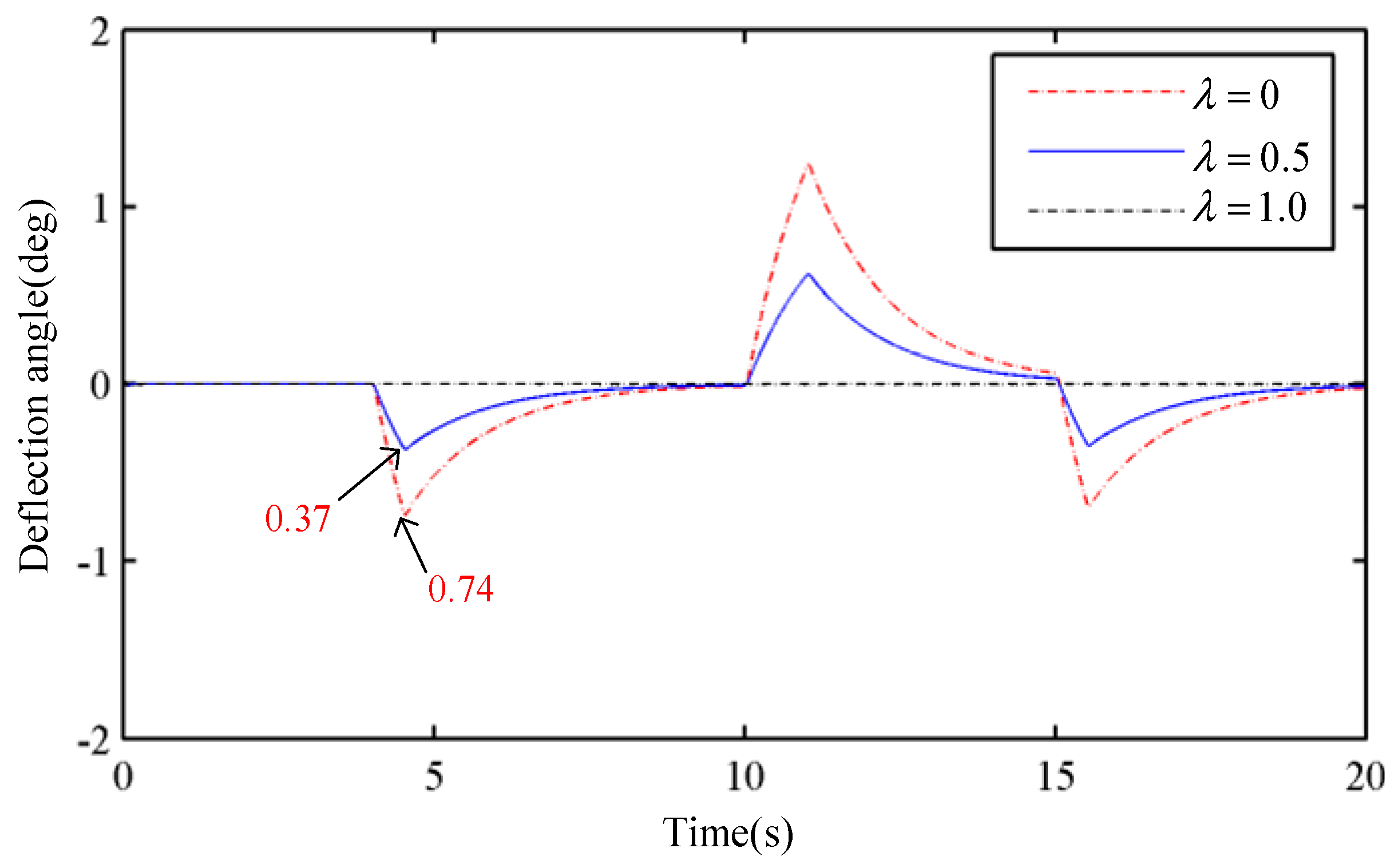
Due to the inability to directly measure angular acceleration and precisely determine model parameters, the base angular rate feedback suppression method requires the introduction of a compensation factor to account for model uncertainties. At a rotor speed of 3000 rpm under Command A, compensation factors λ of 0, 0.5, and 1 were tested to evaluate their effectiveness, as shown in Figure 15. A compensation factor of 1 achieves full suppression, resulting in no rotor deflection during maneuver execution. With a compensation factor of 0.5, the deflection angle was reduced to 0.37° during the initial maneuver, compared to 0.74° without compensation.
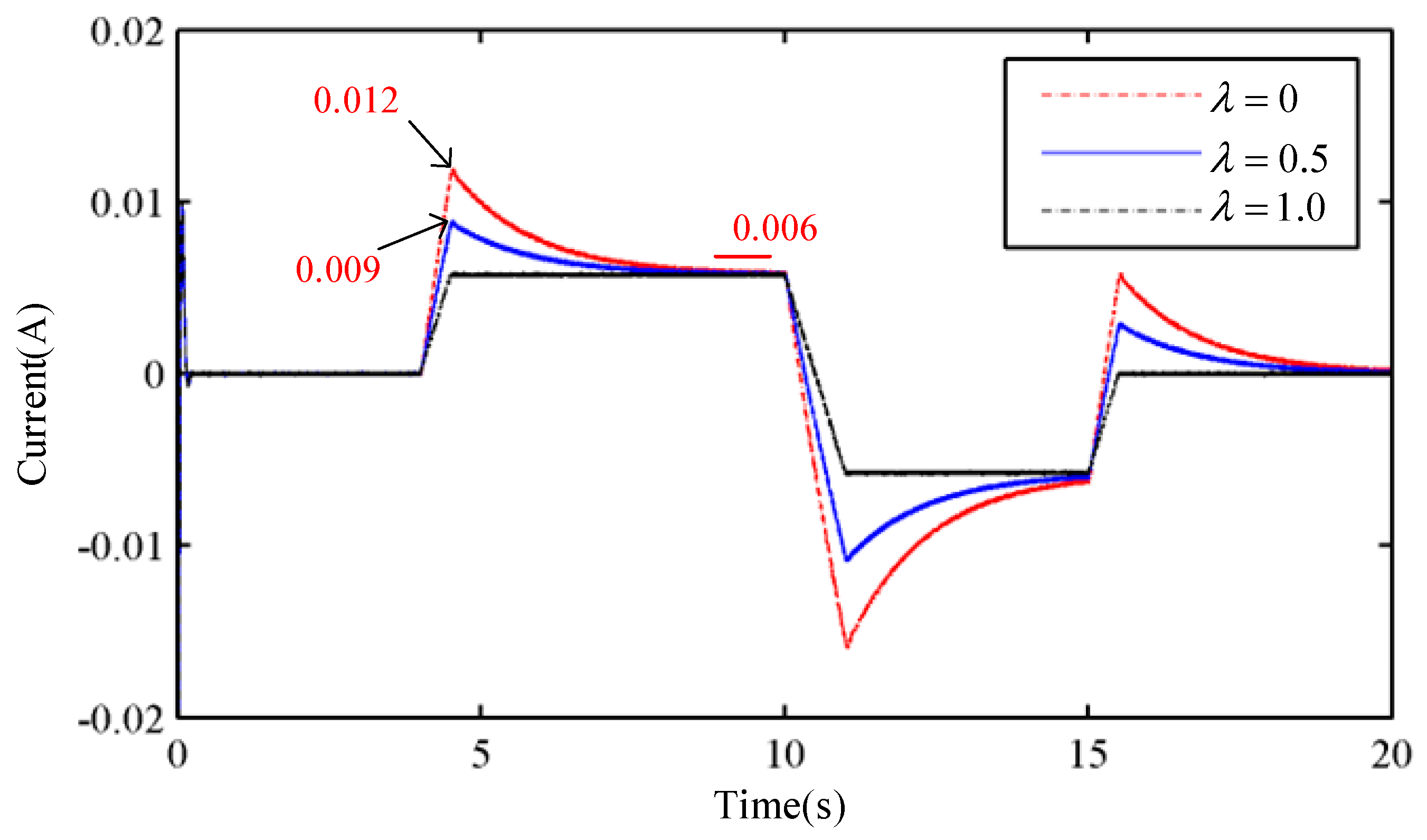
Figure 16 illustrates that the peak control current during the first maneuver dropped from 0.012 A without feedforward compensation to 0.009 A with a compensation factor of 0.5. Full compensation eliminated current fluctuations entirely. During acceleration, the control current gradually increased; once acceleration ceased, the current stabilized. The interference torque current required to counteract the maneuvering angular rate was approximately 0.006 A. Complete compensation aligns the control current closely with the command signal, effectively suppressing interference caused by base motion, maintaining zero rotor deflection throughout maneuvers, and ensuring accurate flywheel output torque.
In practical engineering applications, the optimal compensation factor λ can be identified through iterative tuning to minimize the effects of moving base disturbances.

6. Conclusions

In this study, the dynamic equations under moving base conditions were first derived using the Lagrangian formulation. An integrated electromagnetic-dynamic model was subsequently developed by incorporating the characteristics of the magnetic bearings, leading to a comprehensive control block diagram of the system. Simulations were performed to investigate the effects of spacecraft maneuver angular acceleration, flywheel speed, and base moment of inertia on the rotational dynamics and control performance of the magnetic-bearing flywheel.
The results show that increasing the flywheel speed intensifies the moving base effect, while higher angular acceleration results in larger rotor deflection angles and peak control currents. In contrast, the base moment of inertia has a relatively minor influence on rotor deflection, although it affects the control current to a certain extent; specifically, a higher base-to-rotor inertia ratio reduces the impact on the control current.
Furthermore, a feedforward compensation method based on the angular velocity of the moving base was proposed to suppress rotor vibrations. Simulation results demonstrate that this approach effectively mitigates deflection vibrations of the magnetic-bearing flywheel rotor during spacecraft maneuvers. These studies have laid a technical foundation for the application of magnetically levitated flywheels in space. Further research will be conducted to advance experimental validation under representative space environment conditions.

Author Contributions

Conceptualization, Y.Z.; methodology, Y.Z.; software, Y.Z.; validation, Y.Z. and P.X.; formal analysis, Y.Z. and J.W.; data curation, Y.Z.; writing—original draft preparation, Y.Z.; writing—review and editing, P.X. and J.W.; supervision, J.W.; project administration, Y.Z.; funding acquisition, Y.Z. All authors have read and agreed to the published version of the manuscript.

Funding

This research was funded by Hunan Provincial Natural Science Foundation of China (Grant No. 2026JJ81620).

Institutional Review Board Statement

Not applicable.

Informed Consent Statement

Not applicable.

Data Availability Statement

The data used to support the findings of this study are included within the article.

Conflicts of Interest

The authors declare no conflicts of interest.

References

  1. Schweitzer, G.; Maslen, E.H. Magnetic Bearings Theory, Design, and Application to Rotating Machinery; Springer: Berlin/Heidelberg, Germany, 2012. [Google Scholar]
  2. Xu, X.; Fang, J.; Li, H.; Cui, P. Active suppression of imbalance vibration in the magnetically suspended control moment gyro. J. Vib. Control 2013, 21, 989–1003. [Google Scholar] [CrossRef]
  3. Xia, C.; Cai, Y.; Ren, Y. Stability analysis for a rotor system in a magnetically suspended control and sensitive gyroscope with the Lorentz force magnetic bearing rotation. Proc. Inst. Mech. Eng. Part I J. Syst. Control Eng. 2018, 233, 548–557. [Google Scholar] [CrossRef]
  4. Xu, Y.; Zhou, J.; Jin, C.; Guo, Q. Identification of the dynamic parameters of active magnetic bearings based on the transfer matrix model updating method. J. Mech. Sci. Technol. 2016, 30, 2971–2979. [Google Scholar] [CrossRef]
  5. Hu, H.; Wei, J.; Wang, H.; Xiao, P.; Zeng, Y.; Liu, K. Analysis of the Notch Filter Insertion Position for Natural Frequency Vibration Suppression in a Magnetic Suspended Flywheel Energy Storage System. Actuators 2023, 12, 22. [Google Scholar] [CrossRef]
  6. Yang, K.; Hu, Y.; Wu, H.; Zhou, J.; Xiao, W.; Wang, N. Harmonic vibration suppression of maglev rotor system under variable rotational speed without speed measurement. Mechatronics 2023, 91, 102956. [Google Scholar] [CrossRef]
  7. Zhang, H.; Liu, J.; Zhu, R.; Chen, H.; Yuan, H. Nonlinear Adaptive Harmonics Vibration Control for Active Magnetic Bearing System With Rotor Unbalance and Sensor Runout. IEEE Sens. J. 2021, 21, 12245–12254. [Google Scholar] [CrossRef]
  8. Cui, P.L.; Du, L.; Zhou, X.; Li, J.; Li, Y.; Wu, Y. Harmonic vibration moment suppression using hybrid repetitive control for active magnetic bearing system. J. Vib. Control 2022, 28, 2421–2434. [Google Scholar] [CrossRef]
  9. Cui, P.L.; He, J.X.; Fang, J.C. Static mass imbalance identification and vibration control for rotor of magnetically suspended control moment gyro with active-passive magnetic bearings. J. Vib. Control 2016, 22, 2313–2324. [Google Scholar] [CrossRef]
  10. Gao, H.; Long-Xiang, X.U. Real-time vibration compensation for active magnetic bearing systems based on LMS algorithm. J. Vib. Eng. 2009, 22, 583–588. [Google Scholar]
  11. Park, J.; Palazzolo, A.B. Magnetically Suspended VSCMGs for Simultaneous Attitude Control and Power Transfer IPAC Service. J. Dyn. Syst. Meas. Control.-Trans. Asme 2010, 132, 051001. [Google Scholar] [CrossRef]
  12. Ren, Y.; Chen, X.; Cai, Y.; Wang, W. Rotation Modes Stability Analysis and Phase Compensation for Magnetically Suspended Flywheel Systems with Cross Feedback Controller and Time Delay. Math. Probl. Eng. 2016, 2016, 3783740. [Google Scholar] [CrossRef]
  13. Peng, C.; Sun, J.; Miao, C.; Fang, J. A Novel Cross-Feedback Notch Filter for Synchronous Vibration Suppression of an MSFW With Significant Gyroscopic Effects. IEEE Trans. Ind. Electron. 2017, 64, 7181–7190. [Google Scholar] [CrossRef]
  14. Pu, P.C.; Yu, J.P.; Zhao, L. Analysis of Stiffness and Damping Properties of Active Magnetic Bearing Using Cross Feedback Control. In Proceedings of the 3rd Annual International Conference on Mechanics and Mechanical Engineering (Mme 2016); Springer Nature: Berlin/Heidelberg, Germany, 2017; Volume 105, pp. 327–337. [Google Scholar]
  15. Peng, C.; Zhu, M.; Ren, X.; Zhen, Z. Synchronous vibration control for a class of cross-coupled antisymmetric MSR systems. IET Electr. Power Appl. 2019, 13, 1071–1078. [Google Scholar] [CrossRef]
  16. Peng, C.; Zheng, S.; Huang, Z.; Zhou, X. Complete Synchronous Vibration Suppression for a Variable-Speed Magnetically Suspended Flywheel Using Phase Lead Compensation. IEEE Trans. Ind. Electron. 2018, 65, 5837–5846. [Google Scholar] [CrossRef]
  17. Chen, Q.; Liu, G.; Han, B. Unbalance vibration suppression for AMBs system using adaptive notch filter. Mech. Syst. Signal Process. 2017, 93, 136–150. [Google Scholar] [CrossRef]
  18. He, J.; Deng, Z.; Peng, C.; Li, K. Reduction of the High-Speed Magnetically Suspended Centrifugal Compressor Harmonic Vibration Using Cascaded Phase-Shifted Notch Filters. IEEE Sens. J. 2021, 21, 1315–1323. [Google Scholar] [CrossRef]
  19. Xu, X.B.; Fang, J.C.; Liu, G.; Zhang, H.J. Model development and harmonic current reduction in active magnetic bearing systems with rotor imbalance and sensor runout. J. Vib. Control 2015, 21, 2520–2535. [Google Scholar] [CrossRef]
  20. Borque Gallego, G.; Rossini, L.; Achtnich, T.; Araujo, D.M.; Perriard, Y. Novel Generalized Notch Filter for Harmonic Vibration Suppression in Magnetic Bearing Systems. IEEE Trans. Ind. Appl. 2021, 57, 6977–6987. [Google Scholar] [CrossRef]
  21. Zheng, S.; Chen, Q.; Ren, H. Active Balancing Control of AMB-Rotor Systems Using a Phase-Shift Notch Filter Connected in Parallel Mode. IEEE Trans. Ind. Electron. 2016, 63, 3777–3785. [Google Scholar] [CrossRef]
  22. Cui, P.L.; Li, S.; Wang, Q.R.; Gao, Q.; Cui, J.; Zhang, H.J. Harmonic Current Suppression of an AMB Rotor System at Variable Rotation Speed Based on Multiple Phase-Shift Notch Filters. IEEE Trans. Ind. Electron. 2016, 63, 6962–6969. [Google Scholar] [CrossRef]
  23. Li, J.; Liu, G.; Cui, P.; Zheng, S.; Chen, X. 3/2-Order Dual-Mode Fractional Repetitive Control for Harmonic Vibration Suppression in Magnetically Suspended Rotor. IEEE Sens. J. 2020, 20, 14713–14721. [Google Scholar] [CrossRef]
  24. Zeng, Y.; Liu, K.; Wei, J.; Zhang, Z. Vibration Force Suppression of Magnetically Suspended Flywheel Based on Compound Repetitive Control. Symmetry 2022, 14, 949. [Google Scholar] [CrossRef]
  25. Cui, P.L.; Han, D.; Zhang, G.X.; Liu, Z.Y.; Han, B.C. Robust Odd Repetitive Controller for Magnetically Suspended Rotor System. IEEE Trans. Ind. Electron. 2019, 66, 2025–2033. [Google Scholar] [CrossRef]
  26. Cai, K.; Deng, Z.; Peng, C.; Li, K. Suppression of Harmonic Vibration in Magnetically Suspended Centrifugal Compressor Using Zero-Phase Odd-Harmonic Repetitive Controller. IEEE Trans. Ind. Electron. 2020, 67, 7789–7797. [Google Scholar] [CrossRef]
  27. Cui, P.L.; Wang, Q.R.; Zhang, G.X.; Gao, Q. Hybrid Fractional Repetitive Control for Magnetically Suspended Rotor Systems. IEEE Trans. Ind. Electron. 2018, 65, 3491–3498. [Google Scholar] [CrossRef]
  28. Kang, M.S.; Lyou, J.; Lee, J.K. Sliding mode control for an active magnetic bearing system subject to base motion. Mechatronics 2010, 20, 171–178. [Google Scholar] [CrossRef]
  29. Xu, Y.; Shen, Q.; Zhang, Y.; Zhou, J.; Jin, C. Dynamic Modeling of the Active Magnetic Bearing System Operating in Base Motion Condition. IEEE Access 2020, 8, 166003–166013. [Google Scholar] [CrossRef]
  30. Zhang, X.; Wu, H.; Wang, W.; Yang, T. Dynamic analysis and vibration control of a rotor-Active magnetic bearings system with base motion. Bearing 2025, 8, 1–6. [Google Scholar]
  31. Fang, J.C.; Zhang, H.J.; Liu, H. Vibration mechanism analysis and dynamic model development of magnetically suspended rigid rotor system. Control Theory Appl. 2014, 31, 1707–1713. [Google Scholar]
Figure 1. Schematic of the moving base.
Applsci 16 03789 g001
Figure 2. Coordinate transformations between inertial, moving base, and rotor reference frames.
Applsci 16 03789 g002
Figure 3. Structural Block Diagram of the Magnetic Float Flywheel System.
Applsci 16 03789 g003
Figure 4. Control block diagram of the moving base interference system.
Applsci 16 03789 g004
Figure 5. Mobile instructions A and B.
Applsci 16 03789 g005
Figure 6. Diagram of the rotation angle of the motorized rotor in the x-direction alone.
Applsci 16 03789 g006
Figure 7. Control current by the single x-directional maneuverable deflection channel.
Applsci 16 03789 g007
Figure 8. Comparison of deflection angles in α and β directions under A and B instructions.
Applsci 16 03789 g008
Figure 9. Comparison of currents in α and β directions under A and B instructions.
Applsci 16 03789 g009
Figure 10. Comparison of deflection angles in α and β directions under rotational speeds Ω1 and Ω2.
Applsci 16 03789 g010
Figure 11. Comparison of currents in α and β directions under rotational speeds Ω1 and Ω2.
Applsci 16 03789 g011
Figure 12. Comparison of deflection angles in the α and β directions under moments of inertia C and D.
Applsci 16 03789 g012
Figure 13. Comparison of currents in the α and β directions under moments of inertia C and D.
Applsci 16 03789 g013
Figure 14. Feedforward suppression method control block diagram.
Applsci 16 03789 g014
Figure 15. Comparison of declining angles for different compensation factors.
Applsci 16 03789 g015
Figure 16. Comparison of currents of different compensation factors.
Applsci 16 03789 g016
Table 1. Simulation analysis system parameters.
ParameterSymbolUnitValueParameterSymbolUnitValue
Rotor equatorial moment of inertiaJpkg·m20.0458Controller parameterskP/15
Rotor extreme moment of inertiaJdkg·m20.0237Controller parameterskI/0.5
Maximum of inertia of the baseJDkg·m2125Controller parameterskD/0.02
Current stiffness coefficientKiN·A−1125Incomplete differential parametersN/10,000
Displacement stiffness coefficientKhN·m−150,000Distance of magnetic bearing from centroidlmm0.020
Amplifier gainKwA·V−10.000037Distance from sensor to centroidlsm0.024
Amplifier time constantτw/0.000071Unbalanced torque phaseφddeg0
Sensor sensitivityksV·rad−18000Unbalanced torque massmdkg0.028
Sampling GainKadV−13276.8Unbalanced torque slewing radiusmrm0.05
Disclaimer/Publisher’s Note: The statements, opinions and data contained in all publications are solely those of the individual author(s) and contributor(s) and not of MDPI and/or the editor(s). MDPI and/or the editor(s) disclaim responsibility for any injury to people or property resulting from any ideas, methods, instructions or products referred to in the content.