Observability and Information Bounds in UUV Relative Navigation from Range-Rate


Abstract
1. Introduction
- (Q1) How does motion geometry affect finite-horizon informativeness and theoretical accuracy bounds in Doppler-only relative navigation?
- (Q2) Can motion strategies that explicitly preserve informative geometry improve leader–follower task performance relative to geometry-agnostic formation control?
2. Contributions of This Work
- We identify the key geometry-induced limitations of Doppler-only (range-rate) measurements in leader–follower relative navigation, including degeneracy under predominantly radial motion, matched-motion episodes, insufficient directional diversity, and information decay with increasing separation.
- We formulate sliding-window information measures based on the FIM/CRLB as a quantitative notion of finite-horizon informativeness (or “observability over time”) and use them to detect episodes in which the recent trajectory is not informative enough to meaningfully reduce uncertainty.
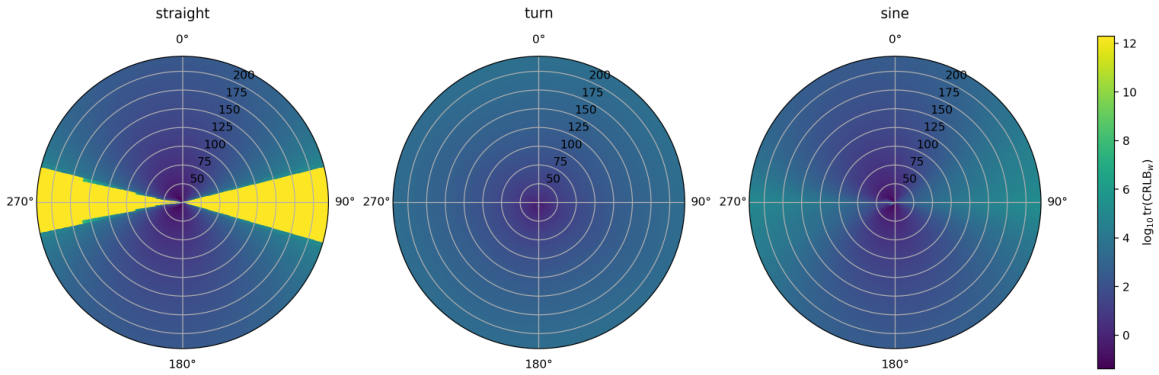
- We construct information maps for representative maneuvers and use them as an offline diagnostic and design-support tool to compare motion scenarios in terms of their achievable estimation accuracy in the Doppler-only regime.
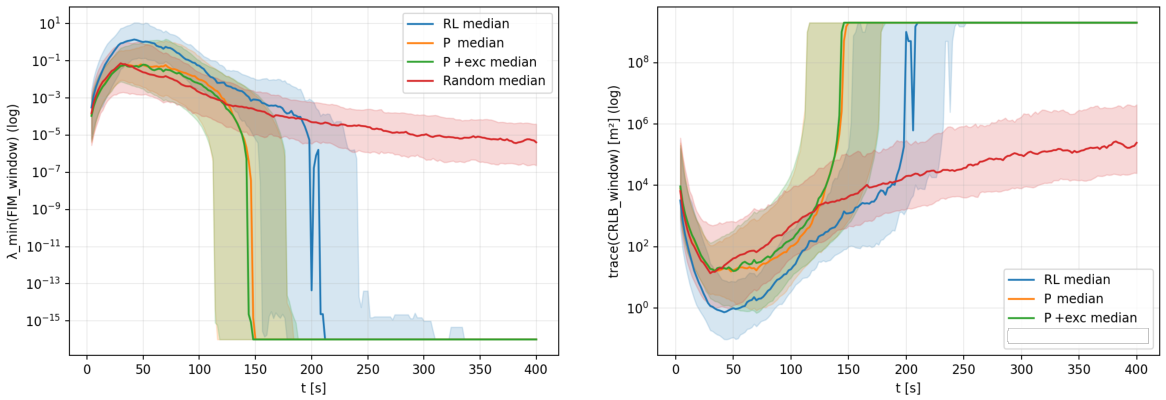
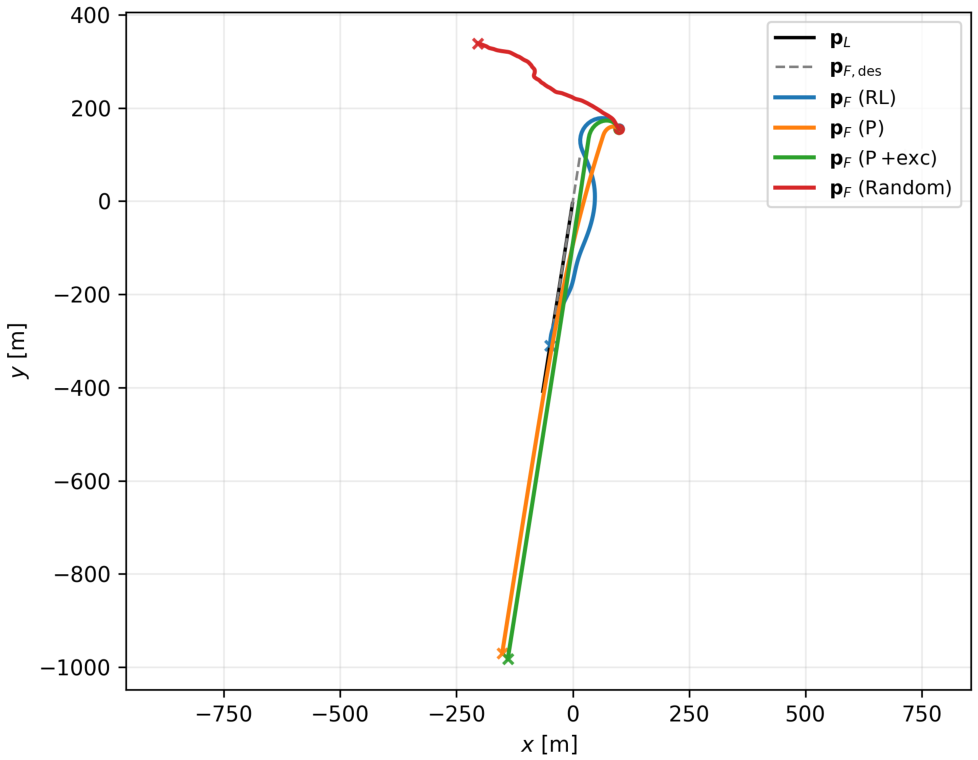
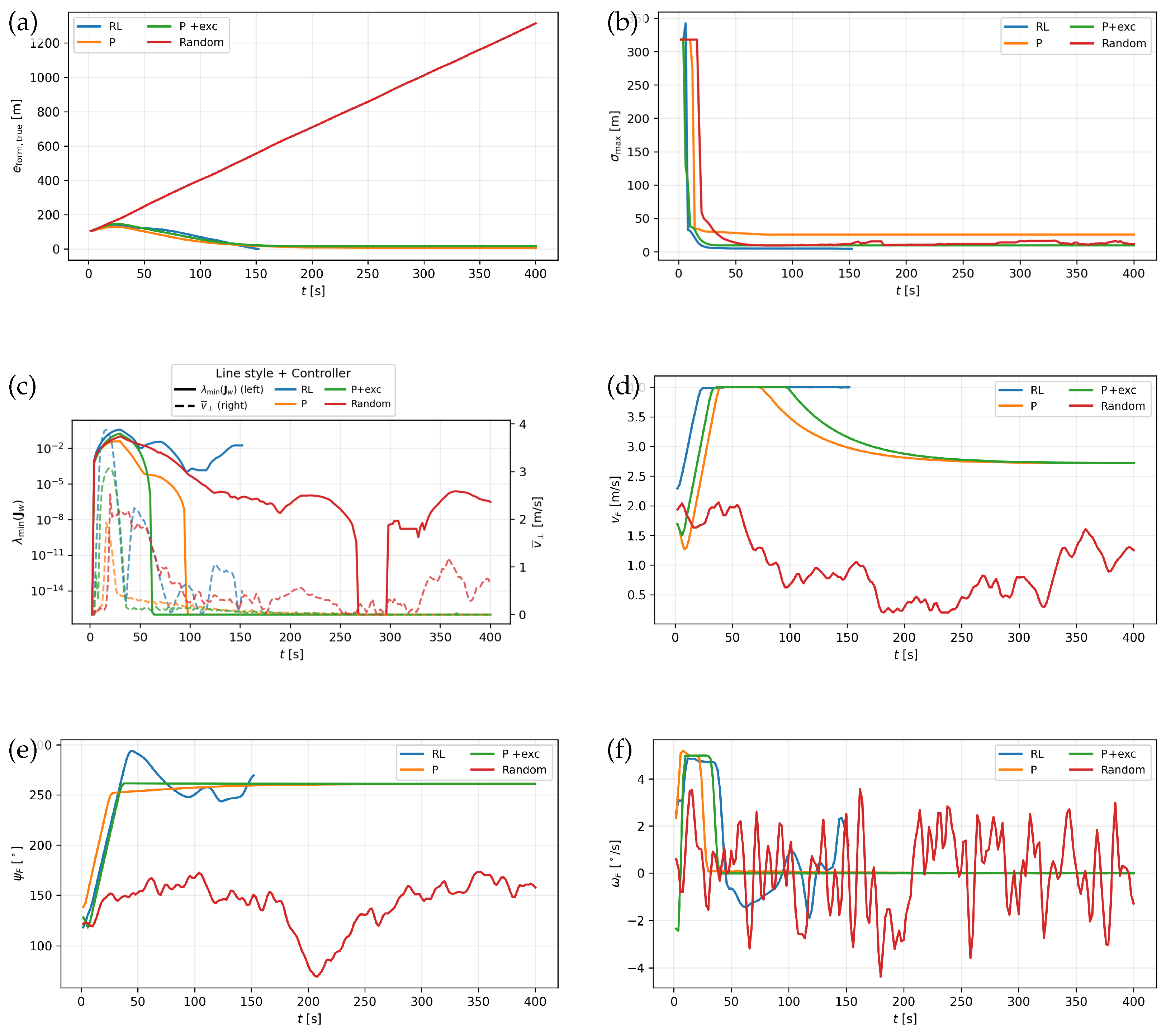
- We validate these findings in paired Monte Carlo simulations by combining information metrics with task-level performance measures and by comparing motion strategies (baseline, baseline with explicit excitation, and an RL-trained policy) in the trade-off between formation keeping and estimator-informative excitation.
3. Problem Formulation
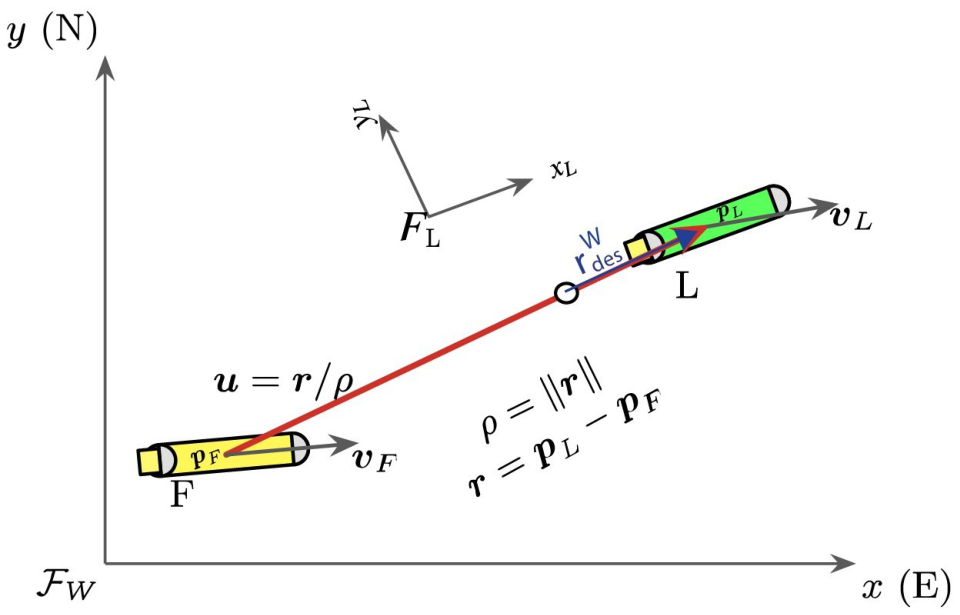
3.1. Geometry, Reference Frames, and Basic Definitions
3.2. Relative Kinematics (Discrete-Time Model)
3.3. Doppler Measurement Model (Range-Rate)
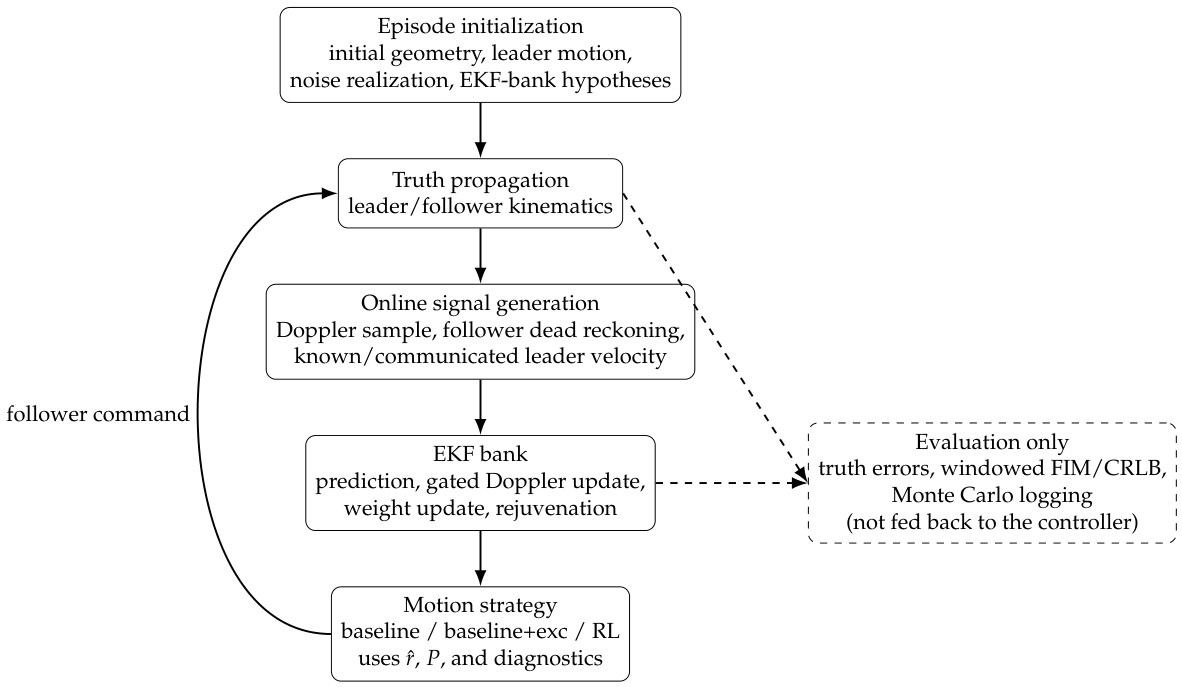
3.4. Assumptions and Separation Between “Ground Truth” and Online-Available Information
3.5. Jacobian and Geometry “Sensitivity”
4. Observability: Conditions and Degeneracies
4.1. Instantaneous Observability: 1D Measurement and Rank-1 Information
4.2. Observability over Time: Geometric Variability and Persistent Excitation
4.3. Typical Doppler-Only Degeneracies and Their Symptoms
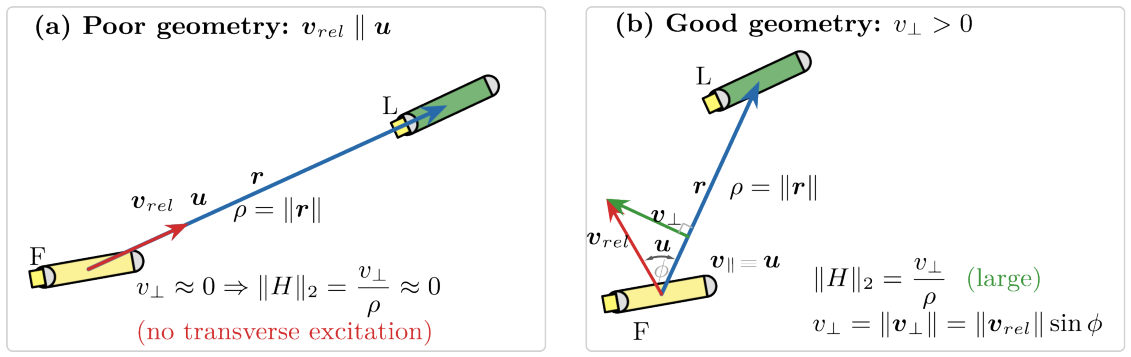
- Purely radial motion (): the Jacobian vanishes, and individual samples carry no information about .
- Matched motion in formation (): the Doppler signal is close to zero, and the information is weak regardless of direction.
- Lack of variability in the excitation direction: is nearly collinear throughout the window, so remains ill-conditioned (in practice: it has a very small minimum eigenvalue), and the uncertainty in the “worst” direction cannot be effectively reduced.
4.4. Observability Maps vs. Information Maps
- Identify initial configurations with unfavorable information properties in the Doppler-only regime;
- Compare maneuvers in terms of their “information capability” over a finite horizon;
- Explain why certain control strategies (e.g., maintaining a stable formation without excitation) lead to a loss of informativeness.
5. Fisher Information and CRLB Bounds
5.1. FIM for Doppler-Only (Range-Rate)
5.2. Information Accumulation over Time and the Sliding-Window Variant
5.3. CRLB and Scalar Information Measures
- —information in the worst direction (a practical degeneracy measure; when , the problem is ill-conditioned).
- —the sum of lower bounds on variances; for an unbiased estimator:which interprets as a lower bound on the mean-squared error (MSE) in .
- (equivalently )—a D-optimality-type measure, useful for assessing the “volume” of the error ellipse.
- Optionally, the condition number is used as an indicator of susceptibility to numerical and geometric degeneracies.
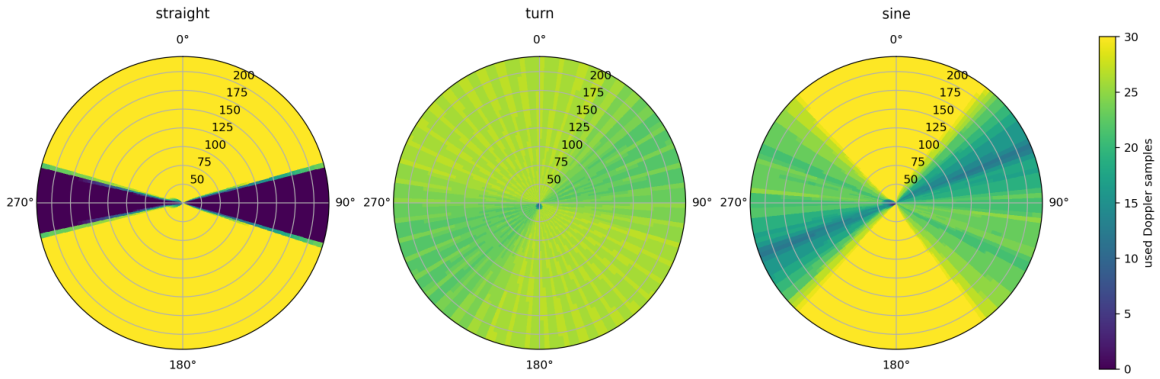
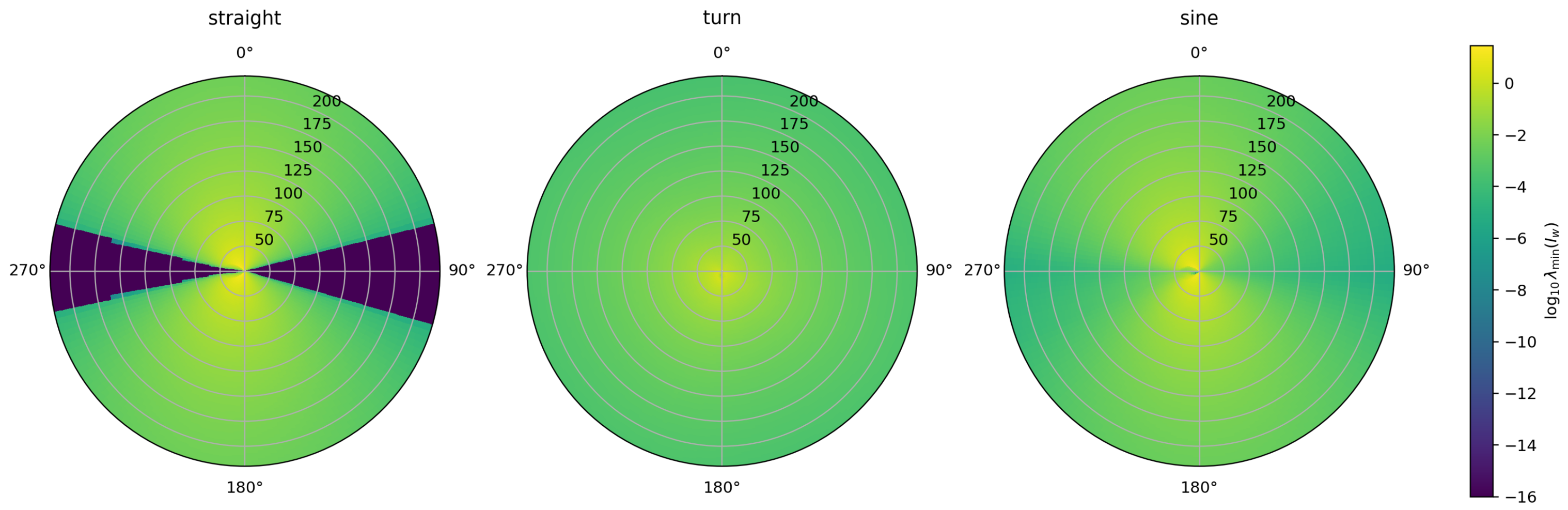
5.4. Information Maps as a Function of the Initial Geometry
6. Estimator and Simulation Implementation
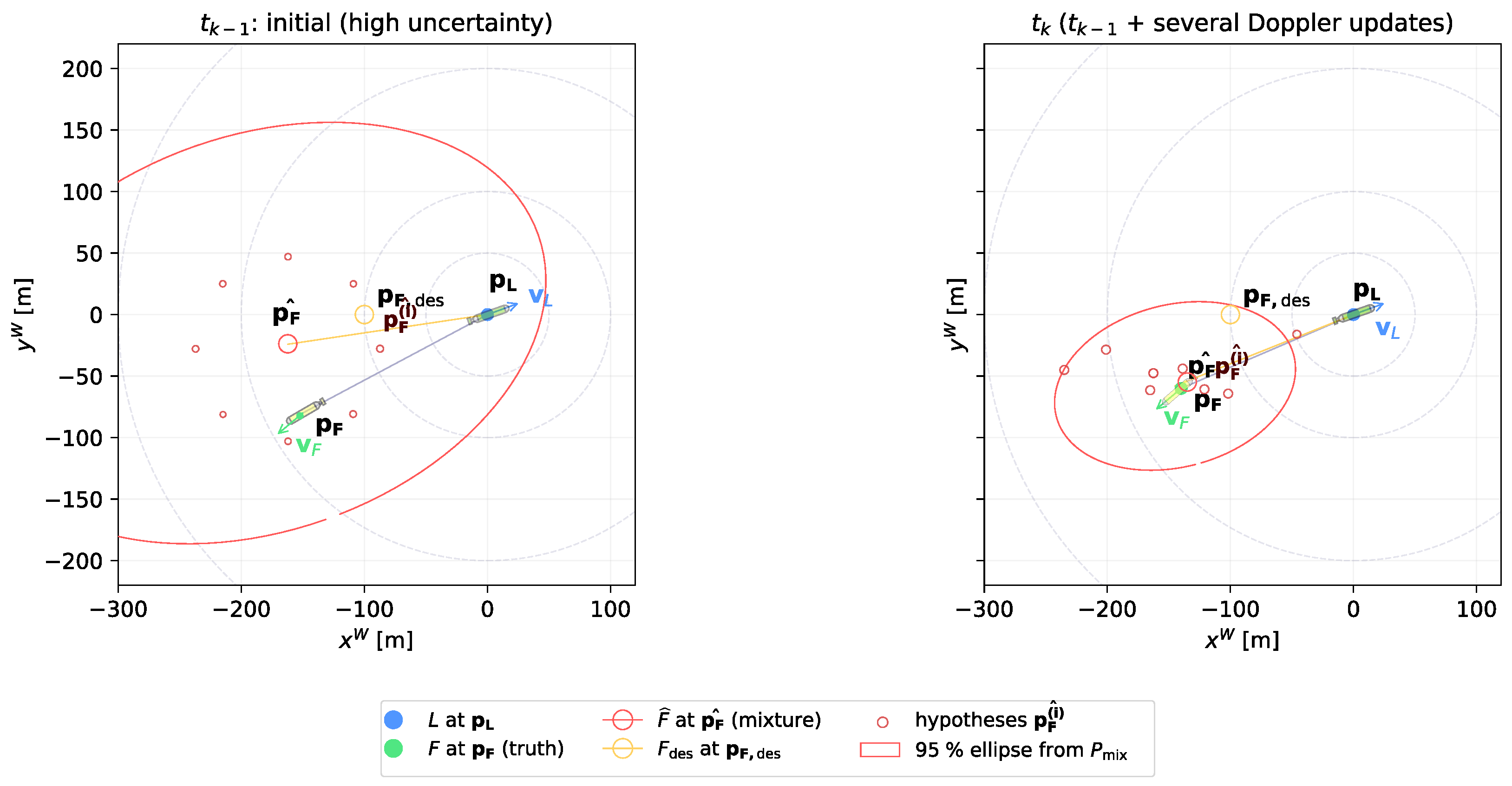
6.1. EKF Bank (Multi-Hypothesis) and Mixture
6.2. Diagnostic Metrics: NIS and
7. Motion Strategies: Baseline and Policy as a Trajectory Generator
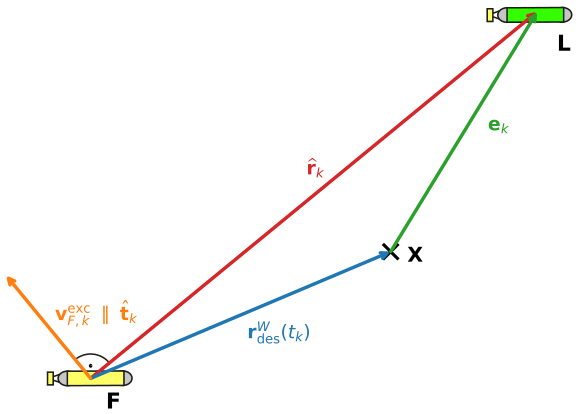
7.1. Baseline: Formation Keeping + Transverse Excitation
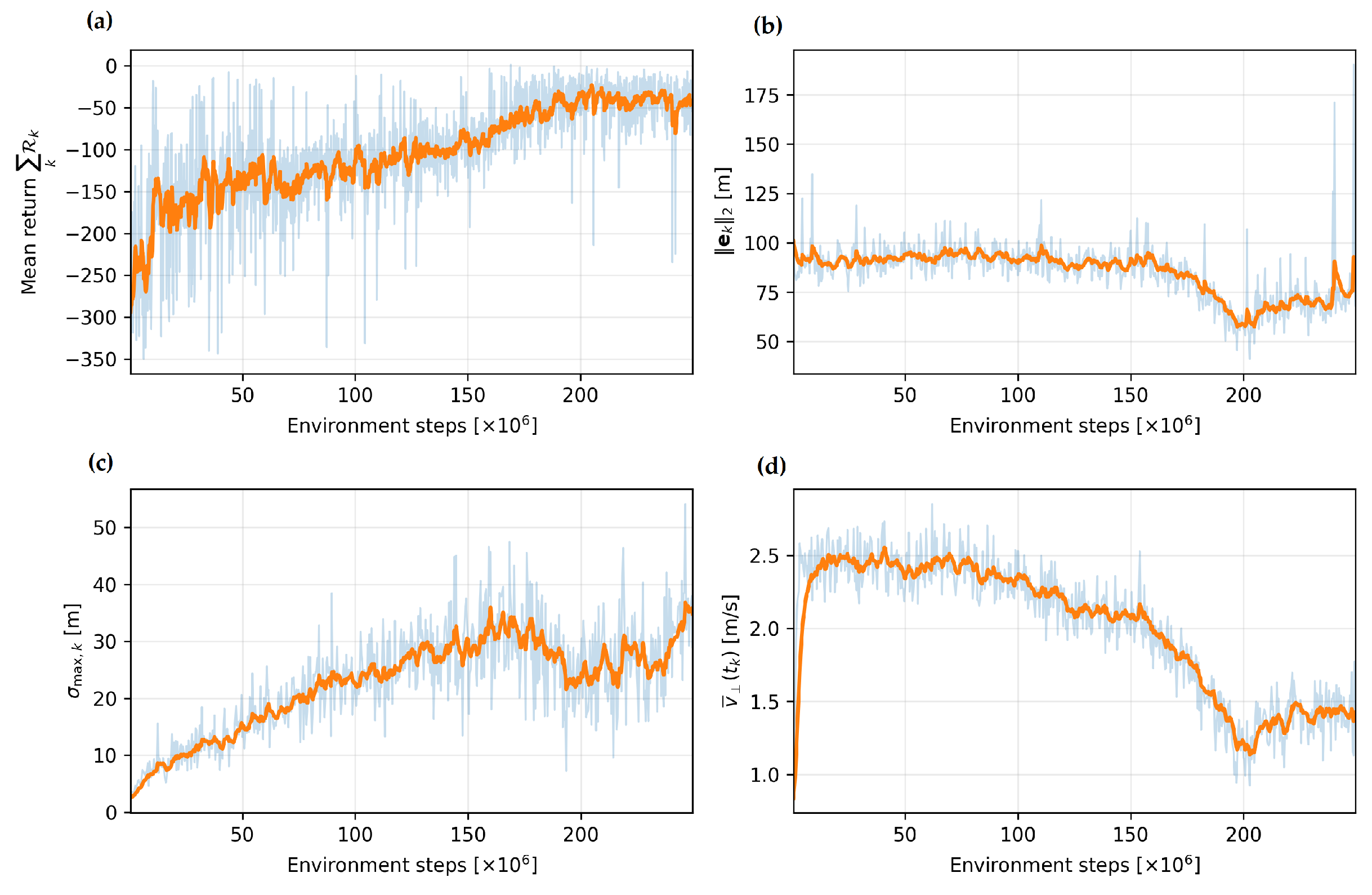
7.2. Learned Policy (RL) as an Excitation Strategy
8. Experimental Protocol (Simulations)
8.1. Environment and Time Discretization
- Integration/prediction step (motion simulation and EKF-bank prediction);
- Control step (action update in baseline or RL);
- Doppler sampling period (measurement updates).
8.2. Scenario Sampling and Difficulty Level
- Initial range ;
- Initial bearing and set according to (39);
- Leader speed and leader heading .
8.3. Compared Control Strategies
8.4. Paired Monte Carlo Evaluation
8.5. Definition of Success and Episode Termination Criteria
8.6. Metrics and Plots Reported in This Paper
Episode-Level Metrics
- success—a success indicator (online condition satisfied);
- time-to-success (only for successful episodes);
- final true formation error ;
- true estimation error (for diagnostics).
9. Results
9.1. Q1: Geometry, Information Maps, and Finite-Horizon Informativeness
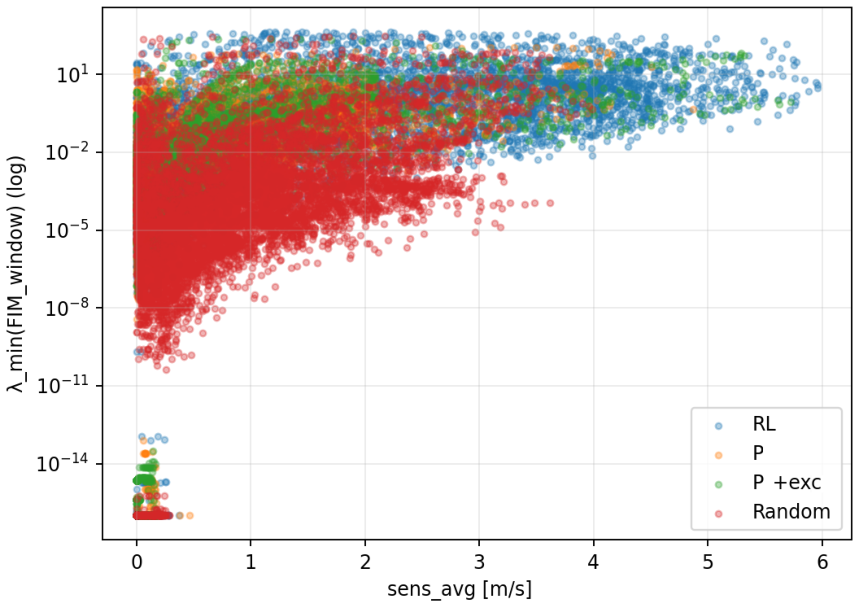
9.2. Q1 (Continued): Correlation of Transverse Excitation with FIM/CRLB
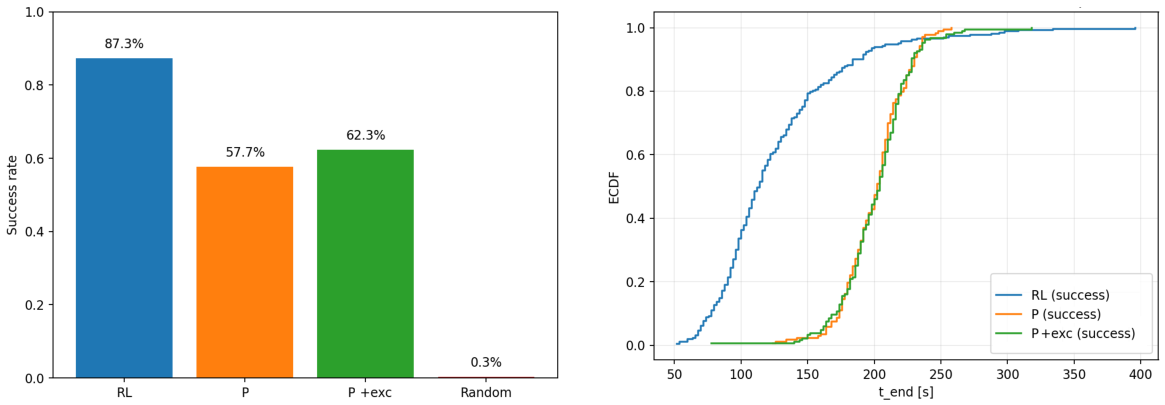
9.3. Q2: Strategy Comparison in Paired Monte Carlo Evaluation
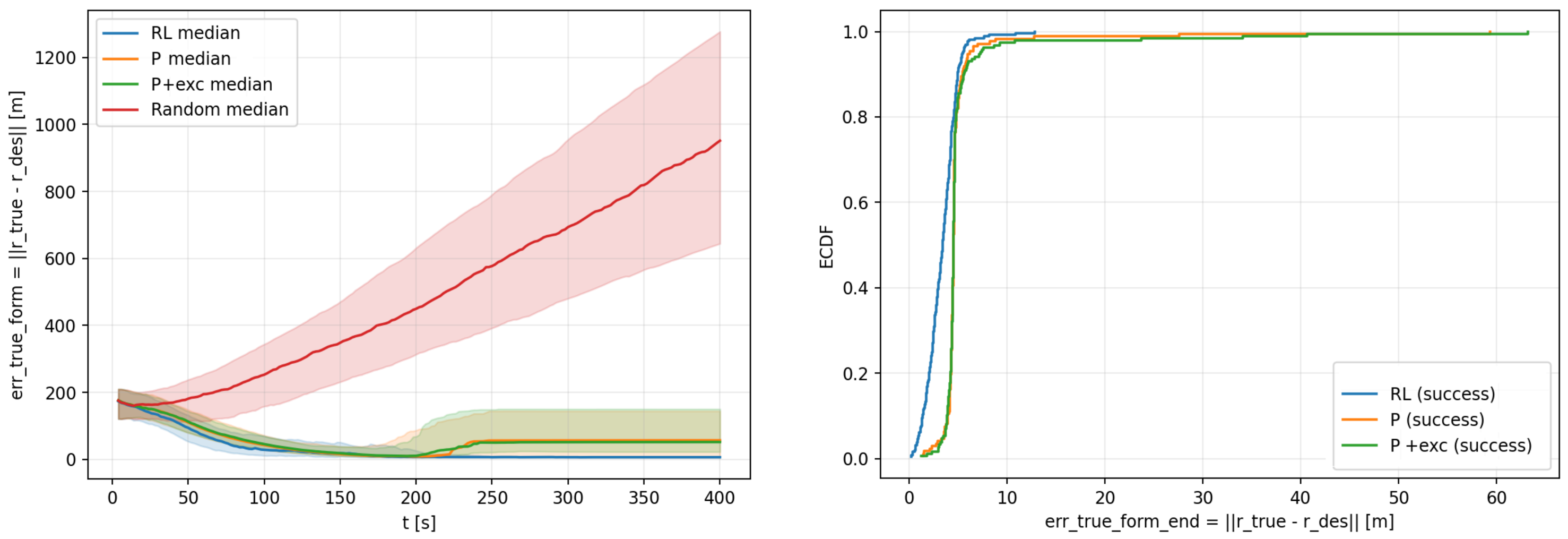
9.4. Case Study
10. Discussion
11. Conclusions
Funding
Institutional Review Board Statement
Informed Consent Statement
Data Availability Statement
Conflicts of Interest
References
- Naus, K.; Marchel, L.; Szymak, P.; Nowak, A. Assessment of the Accuracy of Determining the Angular Position of the Unmanned Bathymetric Surveying Vehicle Based on the Sea Horizon Image. Sensors 2019, 19, 4644. [Google Scholar] [CrossRef] [PubMed]
- Kinsey, J.C.; Eustice, R.M.; Whitcomb, L.L. A Survey of Underwater Vehicle Navigation: Recent Advances and New Challenges. In Proceedings of the IFAC Conference of Manoeuvring and Control of Marine Craft, Lisbon, Portugal, 20–22 September 2006. [Google Scholar]
- Tan, H.; Diamant, R.; Seah, W.K.G.; Waldmeyer, M. A survey of techniques and challenges in underwater localization. Ocean Eng. 2011, 38, 1663–1676. [Google Scholar] [CrossRef]
- Paull, L.; Saeedi, S.; Seto, M.; Li, H. AUV Navigation and Localization: A Review. IEEE J. Ocean. Eng. 2014, 39, 131–149. [Google Scholar] [CrossRef]
- Chen, L.; Wang, S.; McDonald-Maier, K.; Hu, H. Towards autonomous localization and mapping of AUVs: A survey. Int. J. Intell. Unmanned Syst. 2013, 1, 97–120. [Google Scholar] [CrossRef]
- Bahr, A.; Leonard, J.J.; Fallon, M.F. Cooperative localization for autonomous underwater vehicles. Int. J. Robot. Res. 2009, 28, 714–728. [Google Scholar] [CrossRef]
- Papadopoulos, G.; Fallon, M.F.; Leonard, J.J.; Patrikalakis, N.M. Cooperative Localization of Marine Vehicles using Nonlinear State Estimation. In Proceedings of the 2010 IEEE/RSJ International Conference on Intelligent Robots and Systems; IEEE: New York, NY, USA, 2010. [Google Scholar] [CrossRef]
- Fallon, M.F.; Papadopoulos, G.; Leonard, J.J.; Patrikalakis, N.M. Cooperative AUV navigation using a single maneuvering surface craft. Int. J. Robot. Res. 2010, 29, 1461–1474. [Google Scholar] [CrossRef]
- Allotta, B.; Costanzi, R.; Meli, E.; Pugi, L.; Ridolfi, A.; Vettori, G. Cooperative localization of a team of AUVs by a tetrahedral configuration. Robot. Auton. Syst. 2014, 62, 1228–1237. [Google Scholar] [CrossRef]
- Wang, S.; Chen, L.; Gu, D.; Hu, H. Cooperative Localization of AUVs Using Moving Horizon Estimation. IEEE/CAA J. Autom. Sin. 2014, 1, 68–76. [Google Scholar] [CrossRef]
- Gadre, A.S.; Stilwell, D.J. A Complete Solution to Underwater Navigation in the Presence of Unknown Currents Based on Range Measurements from a Single Location. In Proceedings of the 2005 IEEE/RSJ International Conference on Intelligent Robots and Systems; IEEE: New York, NY, USA, 2005; pp. 1420–1425. [Google Scholar] [CrossRef]
- Olson, E.; Leonard, J.J.; Teller, S. Robust Range-Only Beacon Localization. IEEE J. Ocean. Eng. 2006, 31, 949–958. [Google Scholar] [CrossRef]
- McPhail, S.D.; Pebody, M. Range-Only Positioning of a Deep-Diving Autonomous Underwater Vehicle From a Surface Ship. IEEE J. Ocean. Eng. 2009, 34, 669–677. [Google Scholar] [CrossRef]
- Hegrenæs, Ø.; Gade, K.; Hagen, O.K.; Hagen, P.E. Underwater transponder positioning and navigation of autonomous underwater vehicles. In Proceedings of the IEEE OCEANS Conference, Biloxi, MS, USA, 26–29 October 2009. [Google Scholar]
- Lee, P.M.; Jun, B.H. Pseudo long base line navigation algorithm for underwater vehicles with inertial sensors and two acoustic range measurements. Ocean Eng. 2007, 34, 416–425. [Google Scholar] [CrossRef]
- Webster, S.E.; Eustice, R.M.; Singh, H.; Whitcomb, L.L. Preliminary Deep Water Results in Single-Beacon One-Way-Travel-Time Acoustic Navigation for Underwater Vehicles. In Proceedings of the 2009 IEEE/RSJ International Conference on Intelligent Robots and Systems; IEEE: New York, NY, USA, 2009; pp. 2053–2060. [Google Scholar] [CrossRef]
- Eustice, R.M.; Singh, H.; Whitcomb, L.L. Synchronous-Clock, One-Way-Travel-Time Acoustic Navigation for Underwater Vehicles. J. Field Robot. 2011, 28, 121–136. [Google Scholar] [CrossRef]
- Webster, S.E.; Eustice, R.M.; Singh, H.; Whitcomb, L.L. Advances in single-beacon one-way-travel-time acoustic navigation for underwater vehicles. Int. J. Robot. Res. 2012, 31, 935–950. [Google Scholar] [CrossRef]
- Antonelli, G.; Arrichiello, F.; Chiaverini, S.; Sukhatme, G.S. Observability Analysis of Relative Localization for AUVs Based on Ranging and Depth Measurements. In Proceedings of the 2010 IEEE International Conference on Robotics and Automation; IEEE: New York, NY, USA, 2010; pp. 4276–4281. [Google Scholar] [CrossRef]
- Bayat, M.; Aguiar, A.P. Observability Analysis for AUV Range-only Localization and Mapping Measures of Unobservability and Experimental Results. IFAC Proc. Vol. 2012, 45, 325–330. [Google Scholar] [CrossRef]
- Crasta, N.; Bayat, M.; Aguiar, A.P.; Pascoal, A. Observability analysis of 2D single-beacon navigation in the presence of constant currents for two classes of maneuvers. IFAC Proc. Vol. 2013, 46, 227–232. [Google Scholar] [CrossRef]
- Quenzer, B.; Morgansen, K. Observability based control in range-only underwater vehicle localization. In 2014 American Control Conference; IEEE: New York, NY, USA, 2014; pp. 4702–4707. [Google Scholar] [CrossRef]
- Hinson, B.; Binder, B.; Morgansen, K. Path planning to optimize observability in a planar uniform flow field. In 2013 American Control Conference; IEEE: New York, NY, USA, 2013; pp. 1392–1399. [Google Scholar] [CrossRef]
- Arrichiello, F.; Antonelli, G.; Aguiar, A.P.; Pascoal, A. An Observability Metric for Underwater Vehicle Localization Using Range Measurements. Sensors 2013, 13, 16191–16215. [Google Scholar] [CrossRef]
- Parlangeli, G.; Indiveri, G. Single range observability for cooperative underactuated underwater vehicles. Annu. Rev. Control 2015, 40, 129–141. [Google Scholar] [CrossRef]
- Rúa, S.; Vásquez, R.E.; Crasta, N.; Betancur, M.J.; Pascoal, A. Observability analysis for a cooperative range-based navigation system that uses a rotating single beacon. Ocean Eng. 2022, 248, 110697. [Google Scholar] [CrossRef]
- Gong, Z.; Li, C.; Jiang, F. AUV-Aided Joint Localization and Time Synchronization for Underwater Acoustic Sensor Networks. IEEE Signal Process. Lett. 2018, 25, 477–481. [Google Scholar] [CrossRef]
- Gong, Z.; Li, C.; Su, R. Fundamental Limits of Doppler Shift-Based, ToA-Based, and TDoA-Based Underwater Localization. IEEE/CAA J. Autom. Sin. 2023, 10, 1637–1639. [Google Scholar] [CrossRef]
- Gong, Z.; Li, C.; Jiang, F.; Zheng, J. AUV-Aided Localization of Underwater Acoustic Devices Based on Doppler Shift Measurements. IEEE Trans. Wirel. Commun. 2020, 19, 2226–2239. [Google Scholar] [CrossRef]
- Carroll, P.; Domrese, K.; Zhou, H.; Zhou, S.; Willett, P. Doppler-aided localization of mobile nodes in an underwater distributed antenna system. Phys. Commun. 2016, 18, 49–59. [Google Scholar] [CrossRef]
- Su, R.; Gong, Z.; Li, C.; Han, S. High Accuracy AUV-Aided Underwater Localization: Far-Field Information Fusion Perspective. IEEE Trans. Signal Process. 2024, 72, 1877–1891. [Google Scholar] [CrossRef]
- Harris, Z.J.; Whitcomb, L.L. Cooperative acoustic navigation of underwater vehicles without a DVL utilizing a dynamic process model: Theory and field evaluation. J. Field Robot. 2021, 38, 700–726. [Google Scholar] [CrossRef]
- Li, Y.; Wang, Y.; Yu, W.; Guan, X. Multiple Autonomous Underwater Vehicle Cooperative Localization in Anchor-Free Environments. IEEE J. Ocean. Eng. 2019, 44, 895–911. [Google Scholar] [CrossRef]
- Li, Y.; Yu, W.; Guan, X. Current-Aided Multiple-AUV Cooperative Localization and Target Tracking in Anchor-Free Environments. IEEE/CAA J. Autom. Sin. 2023, 10, 792–806. [Google Scholar] [CrossRef]
- Kay, S.M. Fundamentals of Statistical Signal Processing, Volume I: Estimation Theory; Prentice Hall: Upper Saddle River, NJ, USA, 1993. [Google Scholar]
- Van Trees, H.L.; Bell, K.L. Detection, Estimation, and Modulation Theory, Part I: Detection, Estimation, and Linear Modulation Theory, 2nd ed.; Wiley: Hoboken, NJ, USA, 2001. [Google Scholar]
- Tan, Y.T.; Gao, T.; Chitre, M. Cooperative Path Planning for Range-Only Localization Using a Single Moving Beacon. IEEE J. Ocean. Eng. 2014, 39, 371–385. [Google Scholar] [CrossRef]
- Masmitja, I.; Gomariz, S.; Del-Rio, J.; Kieft, B.; O’Reilly, T.; Bouvet, P.; Aguzzi, J. Optimal path shape for range-only underwater target localization using a wave glider. Int. J. Robot. Res. 2018, 37, 1447–1462. [Google Scholar] [CrossRef]
- Haarnoja, T.; Zhou, A.; Abbeel, P.; Levine, S. Soft Actor-Critic: Off-Policy Maximum Entropy Deep Reinforcement Learning with a Stochastic Actor. In Proceedings of Machine Learning Research, Proceedings of the 35th International Conference on Machine Learning (ICML), Stockholm, Sweden, 10–15 July 2018; ML Research Press: Cambridge, MA, USA, 2018; Volume 80, pp. 1861–1870. [Google Scholar]
- Marchel, Ł.; Kot, R.; Szymak, P.; Piskur, P. Model-Based AUV Path Planning Using Curriculum Learning and Deep Reinforcement Learning on a Simplified Electronic Navigation Chart. Appl. Sci. 2025, 15, 6081. [Google Scholar] [CrossRef]
- Kober, J.; Bagnell, J.A.; Peters, J. Reinforcement Learning in Robotics: A Survey. Int. J. Robot. Res. 2013, 32, 1238–1274. [Google Scholar] [CrossRef]
- Placed, J.; Castellanos, J.A. A Survey on Active SLAM. Appl. Sci. 2020, 10, 8386. [Google Scholar] [CrossRef]
- Raffin, A.; Hill, A.; Gleave, A.; Kanervisto, A.; Ernestus, M.; Dormann, N. Stable-Baselines3: Reliable Reinforcement Learning Implementations. J. Mach. Learn. Res. 2021, 22, 1–8. [Google Scholar]
- Zhu, R.; Li, W.; Boukerche, A.; Yang, Q. Energy-Aware DRL-Based Dual-Perception Fountain Codes for Resource-Constrained UASNs. IEEE Trans. Sustain. Comput. 2026, 11, 111–122. [Google Scholar] [CrossRef]



| Research Line | Representative References | Main Observable(s) | Main Emphasis and Relation to the Present Paper |
|---|---|---|---|
| General underwater navigation and localization surveys | [2,3,4,5] | INS/DVL, acoustic aids, SLAM | Provide broad background on underwater navigation architectures and trade-offs, but do not analyze Doppler-only leader–follower information limitations. |
| Cooperative underwater localization with maneuvering reference vehicles | [6,7,8] | Inter-vehicle acoustic aiding, mainly range-based cooperation | Demonstrate the value of cooperative relative localization with limited acoustic links, including maneuvering aiding platforms, but do not focus on the Doppler-only finite-horizon geometry problem studied here. |
| Alternative cooperative configurations and estimators | [9,10] | Cooperative range-based measurements | Explore structured multi-AUV geometries and moving-horizon estimation, showing that estimator architecture matters; however, they do not isolate Doppler-only range-rate limitations. |
| Infrastructure-reduced single-beacon/ range-based navigation | [11,12,13,14,15,16,17,18] | Range, OWTT/TWTT, single-beacon measurements | Reduce external infrastructure requirements, yet still rely on direct range or travel-time observables that provide stronger geometric constraints than Doppler-only range-rate. |
| Observability-aware relative/range-only localization | [19,20,21,22,23,24,25,26] | Range-only, single-range, range + depth | Closest conceptual line of work: identifies geometry-induced degeneracies and motivates excitation-aware motion design; however, the measurement model differs fundamentally from Doppler-only sensing. |
| Doppler-based underwater localization and information limits | [27,28,29,30,31] | Doppler, Doppler-aided localization, ToA/TDoA comparisons | Closest sensing-modality line. These works establish the usefulness and limits of Doppler-based localization, but do not explicitly study the leader–follower Doppler-only formation problem with sliding-window FIM/CRLB maps and controller interpretation. |
| Recent cooperative/ anchor-free/current-aided underwater navigation | [32,33,34] | Dynamic-process models, cooperative ranging, current information | Show recent extensions of cooperative underwater navigation without full sensor suites or in anchor-free/current-aided settings; however, they rely on additional references or auxiliary information beyond isolated Doppler-only range-rate. |
| This work | — | Doppler-only range-rate | Studies leader–follower relative navigation without direct range, quantifies finite-horizon informativeness via sliding-window FIM/CRLB and information maps, and evaluates motion strategies that trade off formation keeping against estimator-informative excitation. |
| Symbol | Description | Unit |
|---|---|---|
| Inertial/world frame (ENU) | – | |
| Leader-fixed frame aligned with the leader heading | – | |
| Leader/follower position in | m | |
| Relative position vector (leader w.r.t. follower) | m | |
| Relative position estimate | m | |
| Desired relative offset expressed in | m | |
| Desired relative offset expressed in | m | |
| Inter-vehicle range (distance) | m | |
| LOS unit vector | – | |
| Leader/follower velocities | m s−1 | |
| Relative velocity | m s−1 | |
| Noisy follower-velocity reconstruction from dead reckoning | m s−1 | |
| Reconstructed relative velocity used by the estimator, | m s−1 | |
| Leader/follower headings | rad | |
| Range-rate | m s−1 | |
| Effective time-averaged range-rate over the integration window around | m s−1 | |
| Doppler measurement (closing speed convention) at time | m s−1 | |
| Effective Doppler measurement over the integration window | m s−1 | |
| Standard deviation of Doppler measurement noise | m s−1 | |
| Doppler measurement-noise standard deviation assumed by the filter | m s−1 | |
| Process/model disturbance in the discrete relative-motion model | m | |
| Process-noise covariance in the discrete relative-motion model | m2 | |
| q | Process-noise intensity parameter, | m s−1/2 |
| Additive Doppler measurement noise at time | m s−1 | |
| Effective measurement error absorbing receiver/channel nonidealities | m s−1 | |
| Doppler measurement function | m s−1 | |
| Jacobian of the Doppler measurement w.r.t. r | s−1 | |
| Jacobian H evaluated at measurement time | s−1 | |
| Transverse component of w.r.t. the LOS u | m s−1 | |
| Magnitude of the transverse component | m s−1 | |
| Single-sample Fisher information increment | m−2 | |
| Sliding-window Fisher information matrix (FIM) | m−2 | |
| CRLB bound, | m2 | |
| 2D rotation matrix | – | |
| identity matrix | – | |
| Integration/discretization step | s | |
| Doppler sampling period | s | |
| Doppler receiver integration-window duration | s | |
| Sliding-window horizon | s | |
| Doppler measurement instant, | s | |
| Time window used in the sliding-window analysis | s | |
| CRLB regularization parameter | – |
| Direction | (0° = E, CCW) | (0° = N, CW) |
|---|---|---|
| North () | 90° | 0° |
| East () | 0° | 90° |
| South () | −90° (or 270°) | 180° |
| West () | 180° (or −180°) | 270° |
| Item | Definition | Value/Threshold |
|---|---|---|
| Transverse component | – | |
| Jacobian H | – | |
| Sample-usage indicator | if gating conditions are met; otherwise | – |
| Gating: minimum range | ||
| Gating: minimum relative speed | ||
| Gating: minimum transverse excitation | ||
| Number of used samples |
| Parameter | Value | Notes |
|---|---|---|
| Window/horizon | 30 | Window for |
| Sampling period | samples | |
| Doppler noise | −1 | Variance |
| at | −1 | (East at ) |
| turn: turn rate | 8 ° −1 | |
| Sine: amplitude A | 35° | |
| Sine: frequency f | ||
| Initial range grid | 25 to 220 | |
| Angular grid (computations) | [−180°, 180°] | , step 2° |
| Angular grid (presentation) | Effectively (no duplicated endpoint) | |
| Regularization | Stabilizes inversion of |
| Parameter | Value |
|---|---|
| N | 8 |
| 1.5 | |
| 0.002 | |
| 0.55 | |
| 0.90 | |
| 6 | |
| 10 |
| Parameter | Value |
|---|---|
| Control step | 2 |
| Integration step | |
| Doppler measurement period | 1 |
| Episode time limit | 400 (200 control steps) |
| Doppler noise (truth) | m s −1 |
| Follower heading error (dead-reckoning) | 0.5° |
| Follower speed error (dead-reckoning) | m s −1 |
| Desired relative offset in : | |
| Initial range (hard) | 80 to 220 |
| Number of EKF-bank hypotheses N | 8 |
| Strategy | Online Inputs | Excitation Mechanism | Role in the Study |
|---|---|---|---|
| Baseline (P) | , P, and leader velocity | None | Geometry-agnostic formation-control reference |
| Baseline+exc | , P, and leader velocity | Explicit tangential excitation when uncertainty increases | Hand-designed excitation-aware baseline |
| RL (SAC) | , P, diagnostics, and leader velocity | Learned from reward trade-off | Learned excitation-aware policy |
| Random | None beyond action bounds | Stochastic | Non-intelligent reference |
| Strategy | Succ [%] | [s] | [m] | [m/s] | med () | med () | |
|---|---|---|---|---|---|---|---|
| RL (SAC) | 87.3 | 114 | 3.44 | 1.26 | −1.73 | 1.73 | 0.20 |
| Baseline (P) | 57.7 | 202 | 4.55 | 0.34 | −15.93 | 9.30 | 0.52 |
| Baseline+exc | 62.3 | 204 | 4.53 | 0.37 | −14.65 | 9.00 | 0.51 |
Disclaimer/Publisher’s Note: The statements, opinions and data contained in all publications are solely those of the individual author(s) and contributor(s) and not of MDPI and/or the editor(s). MDPI and/or the editor(s) disclaim responsibility for any injury to people or property resulting from any ideas, methods, instructions or products referred to in the content. |
© 2026 by the author. Licensee MDPI, Basel, Switzerland. This article is an open access article distributed under the terms and conditions of the Creative Commons Attribution (CC BY) license.
Share and Cite
Marchel, Ł. Observability and Information Bounds in UUV Relative Navigation from Range-Rate. Appl. Sci. 2026, 16, 3758. https://doi.org/10.3390/app16083758
Marchel Ł. Observability and Information Bounds in UUV Relative Navigation from Range-Rate. Applied Sciences. 2026; 16(8):3758. https://doi.org/10.3390/app16083758
Chicago/Turabian StyleMarchel, Łukasz. 2026. "Observability and Information Bounds in UUV Relative Navigation from Range-Rate" Applied Sciences 16, no. 8: 3758. https://doi.org/10.3390/app16083758
APA StyleMarchel, Ł. (2026). Observability and Information Bounds in UUV Relative Navigation from Range-Rate. Applied Sciences, 16(8), 3758. https://doi.org/10.3390/app16083758