1. Introduction
With the rapid advancement of Industry 4.0 and the global surge in e-commerce, AS/RS have become indispensable components of modern intelligent manufacturing and logistics hubs [
1]. Compared to traditional manual warehousing, AS/RS offers substantial advantages in space utilization, labor cost reduction, and operational throughput. However, as the scale of warehouses expands and task complexity increases, the operational efficiency of stacker cranes and forklifts faces unprecedented challenges, particularly in balancing multi-objective constraints and real-time responsiveness. In the context of Industry 4.0, an AS/RS is no longer a passive storage unit but a core component of a Cyber-Physical System (CPS). To achieve the self-optimization and autonomy required for smart manufacturing, the algorithmic control layers must be deeply interconnected with the physical hardware.
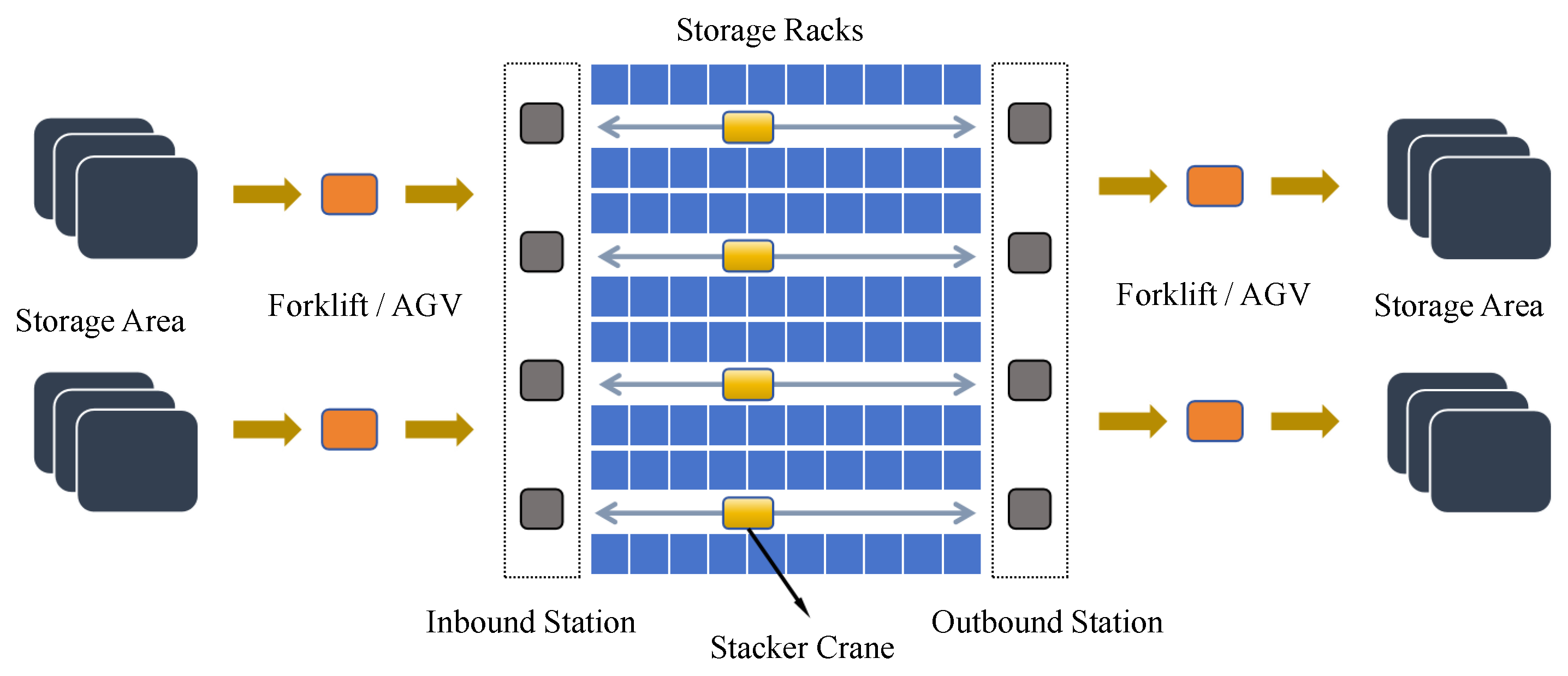
The industrial necessity for integrated optimization is illustrated in
Figure 1, which depicts the structural complexity of a modern high-density AS/RS. In this context, the efficiency of the entire supply chain is not merely dependent on the speed of the hardware, but on the seamless synchronization of three distinct operational layers: storage allocation, collaborative scheduling, and path planning.
The overall efficiency of an AS/RS is primarily determined by three highly coupled processes: storage location allocation (SLA), equipment scheduling, and path planning [
2]. Storage allocation defines the initial distribution of goods, directly influencing the center of gravity stability of racks and the travel distance of equipment. Based on this allocation, collaborative scheduling coordinates multiple types of equipment (such as stacker cranes and forklifts) to minimize total execution time. Finally, path planning optimizes the specific trajectory of each machine to avoid collisions and reduce energy consumption. Traditionally, these three components have been studied as isolated optimization problems. However, recent industrial trends suggest that treating them as an integrated system can lead to more robust globally optimal solutions.
Regarding storage location allocation, various meta-heuristic algorithms, such as Genetic Algorithms and Particle Swarm Optimization, have been widely applied. Despite their effectiveness, these methods often suffer from premature convergence when dealing with high-dimensional discrete search spaces. For collaborative scheduling, researchers have explored Artificial Hummingbird Algorithms (AHA) and Ant Colony Optimization (ACO) to coordinate multiple machines [
3]. Yet, the challenge remains in maintaining a balance between exploration and exploitation in dynamic warehouse environments. Besides, path planning for stacker cranes, often modeled as a constrained Traveling Salesman Problem (TSP), requires high precision to minimize empty runs and mechanical wear [
4].
To bridge these gaps, this paper proposes a comprehensive optimization framework that integrates these three critical stages using novel hybrid meta-heuristic algorithms. The main contributions of this study are summarized as follows:
A Tabu Variable Neighborhood Search (TVNS) algorithm is developed for storage location allocation. By incorporating the short-term memory mechanism of Tabu Search into the Variable Neighborhood Search structure, the algorithm effectively escapes local optima and achieves higher storage stability and efficiency.
A Pheromone-guided Artificial Hummingbird Algorithm (PT-AHA) is introduced for the collaborative scheduling of stacker cranes and forklifts. The integration of pheromone feedback enhances the algorithm’s global search capability, appreciably reducing task completion time.
A Hybrid Simulated Annealing-Whale Optimization Algorithm (SA-WOA) is designed for precise path planning, utilizing nonlinear convergence factors to ensure rapid and high-quality trajectory generation.
System Integration and Validation: An Intelligent Warehouse Management System was developed to implement the proposed algorithms. Extensive simulations and practical validations demonstrate that the integrated framework substantially improves system throughput and operational stability compared to traditional standalone optimization methods.
Beyond theoretical optimization, this research directly addresses the industrial need for resilient logistics under the volatile demand patterns of modern e-commerce. By integrating storage, scheduling, and planning, the framework reduces the frequency of deadlocks and equipment idle time, which are primary drivers of operational cost in high-density automated warehouses.
2. Related Works
2.1. Strategic and Sustainable Warehouse Management
The evolution of AS/RS is increasingly driven by strategic retail insights and sustainability goals. Kembro and Norrman [
1] emphasized a strategic perspective on automated systems, highlighting how case studies inform long-term logistics resilience. Such systems are central to Industry 4.0, where researchers like Antonio et al. [
3] have evaluated the sustainability impact of automation on energy and operational costs. Foundational travel time models, such as those developed by Lerher et al. [
4], provide the mathematical basis for calculating AS/RS efficiency, while modern decision-support frameworks by Schäfer et al. [
2] assist in selecting cost-efficient order-picking solutions. However, a major disadvantage of these high-level strategic models is their lack of granular control over real-time operational variables. While they provide a roadmap for implementation, they often fail to account for the minute-by-minute fluctuations in task priority. Our work improves upon these frameworks by coupling strategic design with a TVNS that translates high-level goals into specific, optimized storage and retrieval actions.
2.2. Storage Location Allocation (SLA) Optimization
Optimizing where items are placed is critical for minimizing crane travel. Zhang et al. [
5] utilized the firework algorithm for non-traditional layouts, and Liang et al. [
6] developed multi-objective models for emergency reserve warehouses. Mathematical programming has also been applied by Bolaños Zuniga et al. [
7] to bridge the gap between SLA and picker routing. More recently, Li et al. [
8] introduced a dynamic vortex search algorithm for large-scale systems, and Kabak et al. [
9] proposed optimization approaches to minimize total material movements. Design-centric models for deep-lane multisatellite systems [
10] and automated layout generation via artificial intelligence [
11] further expand the field. Despite these contributions, many SLA algorithms suffer from “dimension explosion” in large-scale warehouses, leading to slow convergence or sub-optimal placement under stress. Our research addresses this by introducing a multi-structure exploration mechanism within our TVNS, which significantly reduces the search space without sacrificing solution quality, specifically for high-density environments.
2.3. Collaborative Scheduling and Real-Time Decision Making
Effective scheduling requires the synchronization of multiple agents. Davydov et al. [
12] have explored hybrid variable neighborhood search for automated scheduling, while Yin et al. [
13] and Lu et al. [
14] investigated twin crane assignments and integrated scheduling in hybrid flowshops. Energy consumption remains a primary constraint, as noted by Hsu et al. [
15] in double-deep systems. The rise of real-time analytics, such as the machine learning forecasting systems by Aloini et al. [
16], allows for better cycle time prediction. Additionally, Pohl and Tutam [
17] provided performance analyses for dual-crane architectures, and Barbato et al. [
18] developed polynomial-time algorithms for picking problems. A common disadvantage in these scheduling models is the simplified treatment of multi-agent interference, which often leads to “deadlocks” or idle times in physical operations. This paper improves these outcomes through the PT-AHA, which uses pheromone feedback to coordinate cranes and forklifts dynamically, ensuring smooth task transitions.
2.4. Path Planning, Conflict Resolution, and Advanced Meta-Heuristics
The final layer of optimization involves safe and efficient routing. Zhang et al. [
19] applied shortest-time Q-learning for multi-AGV route planning, and Li et al. [
20] utilized cost matrices and greedy algorithms for pathfinding. Hu et al. [
21] proposed frameworks for conflict resolution in high-density systems, while Zhang et al. [
22] optimized task scheduling and path planning collaboratively. Innovative collision avoidance methods, including point-cloud-based [
23] and monocular visual attention models [
24], have set new standards for hardware safety. Furthermore, trajectory optimization regarding energy recuperation [
25] and decarbonization [
26] highlights the move toward green logistics. Advanced meta-heuristics, such as the quantum-behaved particle swarm [
27], shuttle-based performance calculations [
28], and bidirectional flow-rack optimization [
29], continue to extend the scope of current approaches. Recent developments in meta-heuristics, including the Binary Artificial Hummingbird Algorithm (BAHA) [
30], new Whale Optimization Algorithm (WOA) variants [
31], and hybrid WOA-KDE frameworks [
32], provide effective methods for complex terrain and assessment. However, many current path planning models remain computationally expensive or ignore the mechanical dynamics of energy recovery. Our work proposes an integrated trajectory framework that incorporates energy recuperation data and uses advanced meta-heuristics to achieve highly efficient path recalculation.
While the literature offers a wealth of individual solutions for SLA [
33], scheduling, and routing, there is a persistent lack of an integrated framework that couples these three domains simultaneously. Most existing works optimize one aspect while keeping others constant, which leads to system-wide sub-optimization. This study bridges this gap by proposing a holistic framework where the TVNS (for allocation), PT-AHA (for scheduling), and an energy-aware trajectory model (for planning) operate in a feedback loop, substantially enhancing the overall throughput and sustainability of modern AS/RS operations.
To provide a structured overview of the current research landscape,
Table 1 summarizes ten noteworthy studies published between 2022 and 2025. This comparison highlights the primary gaps in the existing literature—specifically the lack of a unified optimization logic for coupled operations—which the framework proposed in this study aims to address.
3. Methodology
The proposed integrated optimization framework is structured to sequentially address three coupled decision-making processes: storage location allocation, collaborative equipment scheduling, and trajectory planning. Finally, the system architecture for deploying these algorithms is described.
3.1. Storage Location Allocation via TVNS
3.1.1. Multi-Objective Mathematical Model
The storage location allocation problem is modeled as a high-dimensional discrete combinatorial optimization task. The objective is to map a set of incoming items to specific coordinates —representing the row, column, and shelf number—within the warehouse grid. To ensure practical applicability, we establish a multi-objective fitness function that simultaneously optimizes efficiency, stability, correlation, and uniformity.
To ensure the mathematical tractability of the multi-objective model, the following hypotheses are established: (1) each storage cell is uniform in size and can hold exactly one unit of cargo; (2) the stacker crane moves simultaneously in horizontal and vertical directions, with travel time determined by the maximum of the Manhattan–Chebyshev hybrid movement; (3) item turnover rates are known and follow a stable distribution over the planning horizon; (4) the system operates under a dual-cycle command structure where possible to minimize empty travel.
The first sub-objective, Efficiency (
), aims to minimize the total travel time required for storage and retrieval. Based on the ABC classification analysis, high-turnover items are prioritized for storage slots closer to the I/O station.
The travel time
for item
i is calculated using the Chebyshev distance metric,
, reflecting the simultaneous horizontal and vertical movements of the stacker crane. The original formulation is corrected to use the maximum operator, as the total movement time is dictated by the longest axis of travel:
where
and
are the horizontal and vertical velocities, respectively.
The second sub-objective, Stability (
), addresses the structural safety of the racking system. To prevent tipping and reduce mechanical stress, the model seeks to lower the overall center of gravity by assigning heavier items to lower tiers. This is quantified by minimizing the potential energy of the loaded racks:
where
represents the mass of item
i, and
denotes its height (row index).
The third sub-objective, Correlation (), focuses on clustering items that frequently appear in the same order. By minimizing the spatial distance between highly correlated items, the system facilitates combined retrieval tasks, thereby reducing the number of crane cycles. Finally, Uniformity () ensures that goods are distributed evenly across different aisles.
To prevent scale bias when aggregating these four heterogeneous sub-objectives, a Min-Max normalization strategy is applied to each objective function
(where
):
The global fitness function
aggregates the normalized objectives using a weighted sum method:
The weight vector
is set to
to reflect practical industrial priorities. Correlation (
) and Efficiency (
) are heavily weighted to maximize throughput by clustering frequently co-ordered items near the I/O station. Stability (
) ensures physical safety by favoring lower centers of gravity, while Uniformity (
) acts as a soft constraint to balance rack utilization. Rather than relying on arbitrary selection, these comprehensive weights were validated through a sensitivity analysis across extreme single-objective scenarios (Efficiency-only, Stability-only, etc.), as detailed in
Section 4.2.3. The [0.3, 0.2, 0.5, 0.1] configuration was empirically selected as it provided the most balanced performance across 30% and 70% load capacities.
3.1.2. TVNS Algorithm Design
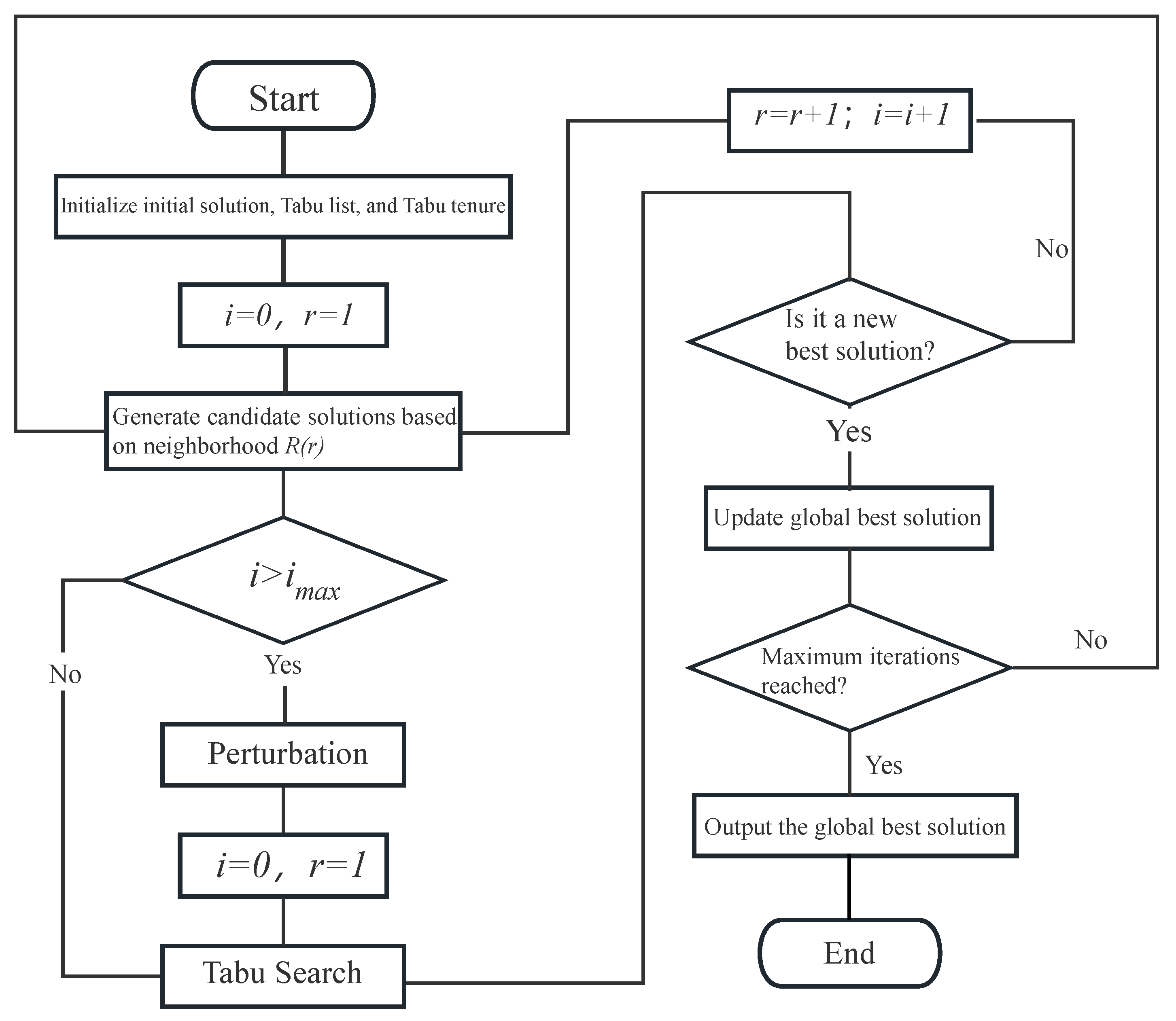
Solving the proposed model is computationally challenging due to the NP-hard nature of the allocation problem. TVNS algorithms rely on systematic changes of neighborhood structures to escape local optima but often suffer from stagnation in later search stages. Conversely, Tabu Search effectively prevents cycling through its short-term memory mechanism but may lack the structural diversity required for global exploration. To overcome these limitations, we propose a hybrid TVNS algorithm. This approach embeds the memory mechanism of TS into the local search phase of VNS and employs an adaptive shaking strategy to enhance global exploration. The overall execution flow of the TVNS algorithm is visually illustrated in
Figure 2.
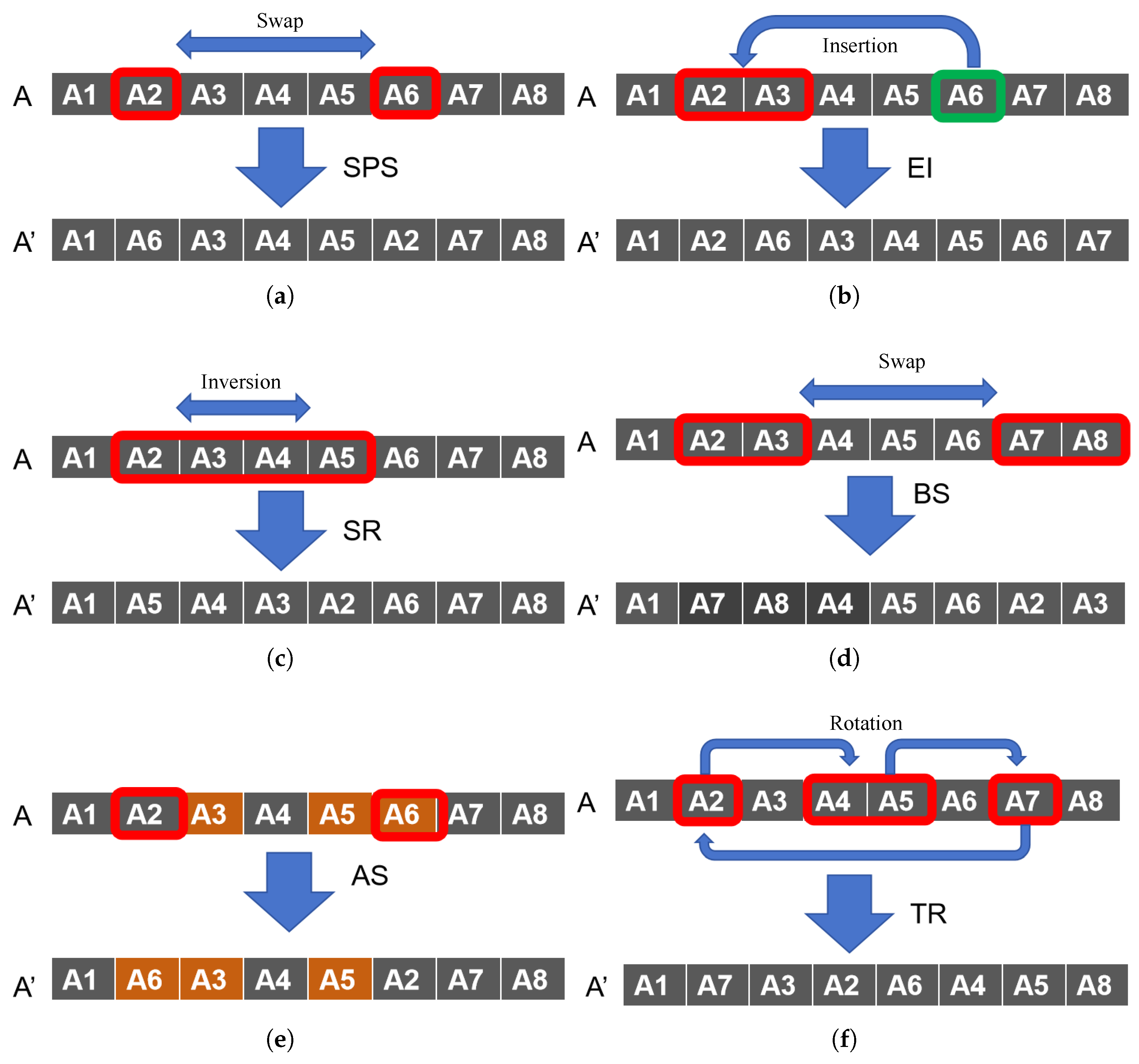
The core of the TVNS algorithm lies in its diverse set of neighborhood structures, designed to balance local exploitation with global exploration. We developed six specific operators tailored to the matrix structure of the storage grid, as depicted in
Figure 3. For fine-grained local adjustments, the Single Position Swap operator randomly exchanges the positions of two distinct items, while the Element Insertion operator moves a selected item to a new empty slot, effectively altering the local density distribution. To disrupt local order dependencies and escape shallow local optima, the Segment Reversal operator inverts the sequence of a contiguous segment of goods. On a macro level, the Block Swap operator exchanges two disjoint blocks of items (e.g., swapping the contents of entire shelf sections), facilitating large-scale structural reconfigurations. Furthermore, to address the efficiency objective, the Attribute-based Swap identifies high-turnover items currently placed in suboptimal locations and swaps them with low-turnover items occupying prime slots. Finally, the Three-position Rotation operator performs a cyclic shift of three items
, introducing complex structural permutations that simple pairwise swaps cannot achieve. If the local search in neighborhood
k fails to improve the solution for a defined threshold
, the algorithm triggers a perturbation:
where
is the perturbation intensity factor. This forces the solution out of deep local optima.
During the search process, the algorithm systematically iterates through these neighborhoods. Within each neighborhood, a local search is governed by a Tabu List, which records the most recent moves (e.g., swapped pairs) to prevent the algorithm from returning to recently visited solutions, thereby avoiding cycling. A move is forbidden if it appears in the Tabu List unless it satisfies the Aspiration Criterion—that is, the move produces a solution superior to the current global best. If the local search fails to improve the solution after a predefined number of iterations (threshold ), an adaptive Shaking mechanism is triggered. This mechanism applies a sequence of random moves proportional to the problem scale, forcing the solution out of deep local valleys and restarting the search in a new promising region.
The integration of the Tabu list provides a short-term memory mechanism that prevents the search from revisiting recently explored configurations, while the neighborhood structures
through
ensure a comprehensive exploration of the discrete solution space. The systematic execution flow of the TVNS is detailed in Algorithm 1.
| Algorithm 1 Tabu Variable Neighborhood Search (TVNS) |
- 1:
Input: Initial solution , Max iterations , Tabu tenure L, Neighborhoods - 2:
Output: Optimal storage allocation - 3:
, , - 4:
, - 5:
while do - 6:
while do - 7:
Generate candidate from - 8:
if or then ▷ Aspiration Criterion - 9:
if then - 10:
, - 11:
▷ Reset to first neighborhood structure - 12:
else - 13:
▷ Switch to next neighborhood structure - 14:
end if - 15:
Update with (maintain length L) - 16:
else - 17:
- 18:
end if - 19:
end while - 20:
if Stagnation detected then - 21:
▷ Perturbation to escape local optima - 22:
end if - 23:
- 24:
end while - 25:
return
|
The time complexity of TVNS depends on the number of items N, the maximum iterations , and the local search depth . Evaluating the multi-objective fitness function takes time. In the worst-case scenario for a single iteration, the algorithm explores the neighborhood and updates the Tabu list, taking . Thus, the overall computational complexity is . This linear scaling relative to the number of items makes it highly efficient for high-dimensional rack matrices.
3.2. Collaborative Scheduling via Pheromone-Guided AHA (PT-AHA)
3.2.1. Collaborative Scheduling Model
The efficiency of an AS/RS depends not only on storage allocation but also on the coordinated operation of its equipment. The scheduling module addresses the collaboration between
N stacker cranes and
M forklifts (or AGVs). The primary objective is to minimize the makespan (
F), defined as the maximum completion time among all
N stacker cranes (
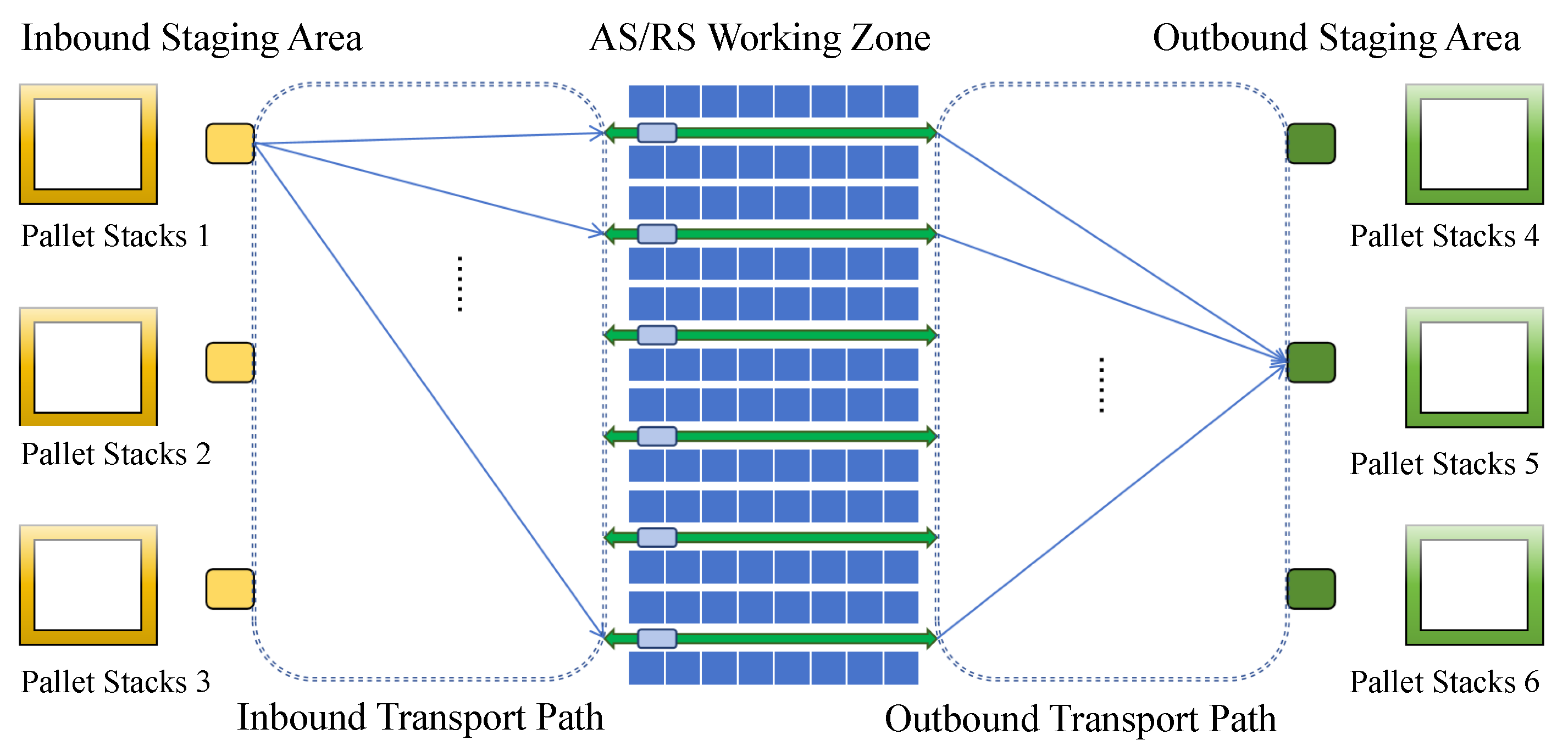
). The complexity of this model arises from the synchronization constraints between the inbound flow (from forklift to the I/O stand) and the outbound flow (from the I/O stand to the forklift), as illustrated in
Figure 4.
To rigorously define the resource constraints and forklift-crane synchronization logic, let be a binary decision variable where if task k is transported by forklift i to stacker crane j, and 0 otherwise.
1. Task Uniqueness Constraint: Each task must be handled by exactly one forklift and one crane:
2. Synchronization and Sequence Constraint: The start time
for a task
k assigned to crane
j is strictly bounded by the arrival time of the forklift (
) and the readiness of the crane from its previous task
.
where
is the forklift delivery time,
is the completion time of the previous task, and
is the empty travel time of the crane moving from the location of task
to task
k.
3. Collision/Interference Constraint: To avoid physical deadlock, no two cranes can occupy the same working coordinate
within aisle
A at any continuous time
t. Let
be an indicator function equal to 1 if crane
j occupies aisle
A at time
t.
In the simulation, collision avoidance is not evaluated through continuous time-stepping. Instead, the framework utilizes an event-driven logic based on discrete task milestones (start times and finish times ). The indicator function checks for spatial overlap only at these discrete state-transition events.
3.2.2. PT-AHA Algorithm Design
To solve this complex scheduling problem, we introduce the PT-AHA. The standard AHA mimics the foraging strategies of hummingbirds but utilizes random visitation patterns, which can lead to slow convergence in discrete scheduling spaces. The proposed PT-AHA hybridizes AHA with the pheromone feedback mechanism of ACO to guide the search process more effectively. The algorithm constructs a Pheromone Matrix () to represent the desirability of assigning task i to crane j or sequencing task j immediately after task i.
Unlike the random selection in standard AHA, the “hummingbirds” (solution agents) in PT-AHA select their next destination using a probabilistic transition rule derived from ACO.
Here, and control the weight of historical experience (pheromone) versus greedy heuristics (processing time). This guides the “hummingbirds” toward promising sequences.
This probability is calculated by combining the historical experience stored in the pheromone matrix with heuristic information
, which is defined as the inverse of the execution time increment. This hybrid mechanism ensures that the search is biased towards historically successful task sequences while maintaining sensitivity to local cost factors. To accelerate convergence and filter out noise from poor-quality solutions, an Elite Pheromone Update strategy is employed. To accelerate convergence, pheromones are updated using an Elite Strategy. Only the global best solution (
) and the iteration best solution (
) deposit pheromones:
where
is the evaporation rate. This prevents the algorithm from being misled by poor-quality random solutions found during early exploration.
Only the global best solution and the iteration-best solution are permitted to deposit pheromones, reinforcing the most promising paths. The pheromone levels also undergo evaporation over time to prevent the algorithm from converging too early to suboptimal solutions. The foraging behaviors of the hummingbirds—Guided Foraging (moving towards a target food source), Territorial Foraging (local search around the current position), and Migration Foraging (random reset when food is scarce)—are retained but modulated by the pheromone landscape. This dynamic balance allows the algorithm to effectively explore new scheduling possibilities (Migration) while exploiting known good sequences (Guided and Territorial).
The procedural logic for PT-AHA, including the transition between pheromone-guided construction and hummingbird foraging, is presented in Algorithm 2.
| Algorithm 2 Pheromone-guided Artificial Hummingbird Algorithm (PT-AHA) |
- 1:
Input: Max iterations , Population size N, Pheromone parameters - 2:
Output: Optimal scheduling sequence - 3:
Initialize population P and Pheromone Matrix - 4:
while do - 5:
for each hummingbird do - 6:
Generate - 7:
if then ▷ Pheromone-guided construction phase - 8:
Construct sequence using - 9:
else ▷ AHA foraging phase - 10:
Perform Guided, Territorial, or Migration foraging per AHA rules - 11:
end if - 12:
end for - 13:
Evaluate fitness for all and identify top elite solutions - 14:
Update - 15:
▷ Pheromone evaporation - 16:
Update using ▷ Elite-led pheromone deposition - 17:
- 18:
end while - 19:
return
|
The PT-AHA algorithm computes the makespan for P individuals over iterations. Sorting and assigning K tasks across multiple cranes takes using efficient sequencing. The ACO-guided probability selection and elite pheromone update require scanning the task matrix, scaling at . Therefore, the total time complexity is . By restricting pheromone updates strictly to the top 20% elite solutions, the algorithm drastically reduces redundant matrix operations compared to standard ACO.
3.3. Path Planning via Hybrid SA-WOA
3.3.1. Constrained TSP Model
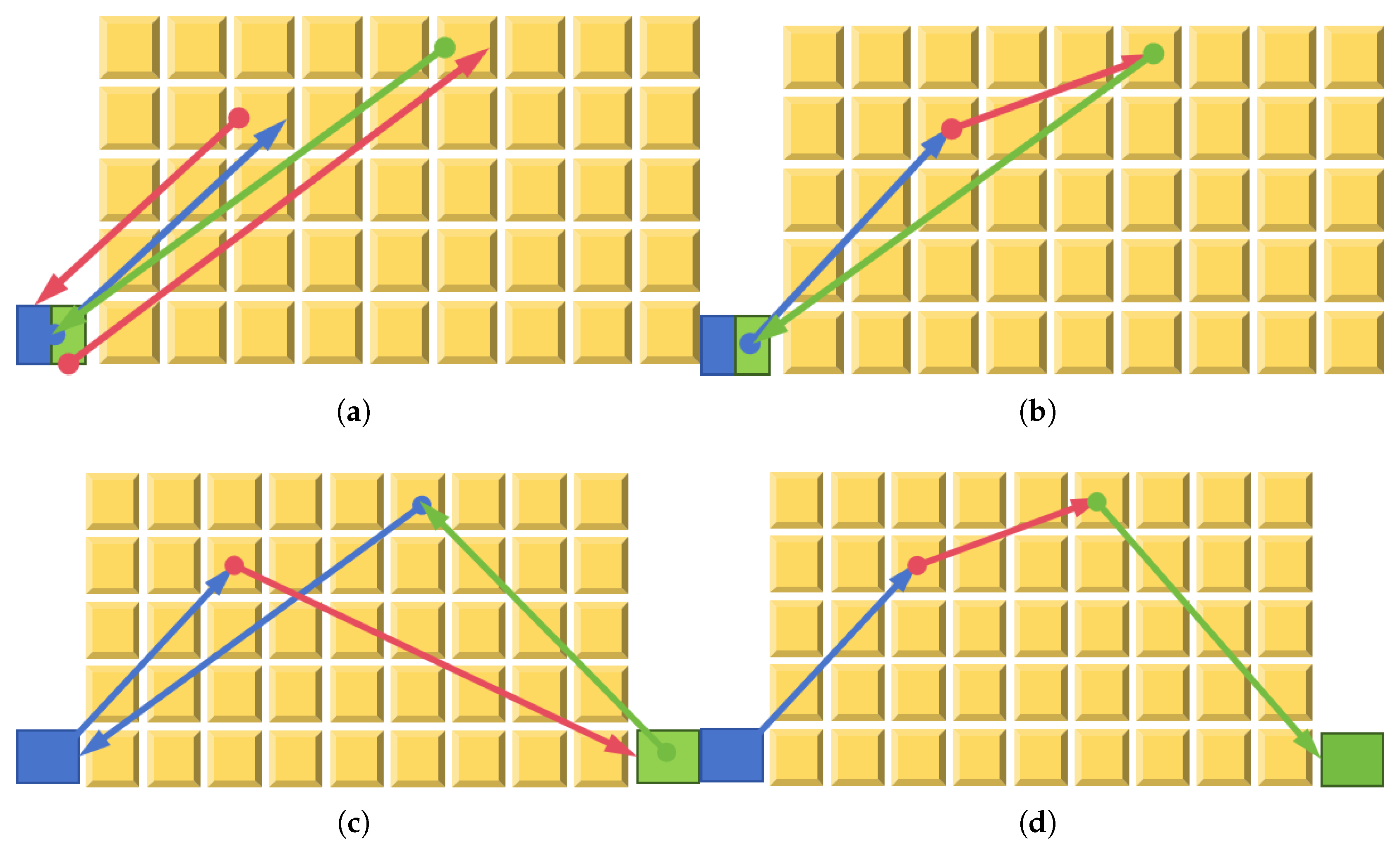
Once the storage locations are assigned and the task sequence is determined, the final step is to optimize the movement trajectory of the stacker crane. This is modeled as a constrained TSP, where the crane executes composite tasks (storage followed immediately by retrieval) to minimize the total travel distance, particularly the empty travel segments. The difference between single-command and dual-command cycles is depicted in
Figure 5.
This path planning is modeled as a constrained TSP, where the crane executes composite tasks (storage followed immediately by retrieval). Let
be a binary decision variable that equals 1 if the crane travels directly from node
a to node
b, and 0 otherwise. The objective is to minimize total travel time:
This is subject to the following standard TSP routing constraints to ensure a continuous, closed-loop cycle without subtours:
1. Degree Constraints: The crane must arrive at and depart from each task node exactly once:
2. Subtour Elimination:
where
S is a subset of the total task nodes
C.
3. Dual-Command Constraint: To model the specific operational dynamics of the AS/RS, an additional constraint is imposed: if an inbound task is paired with an outbound task as a composite cycle, the path must sequentially link them () before returning to the I/O station.
3.3.2. SA-WOA Algorithm Design
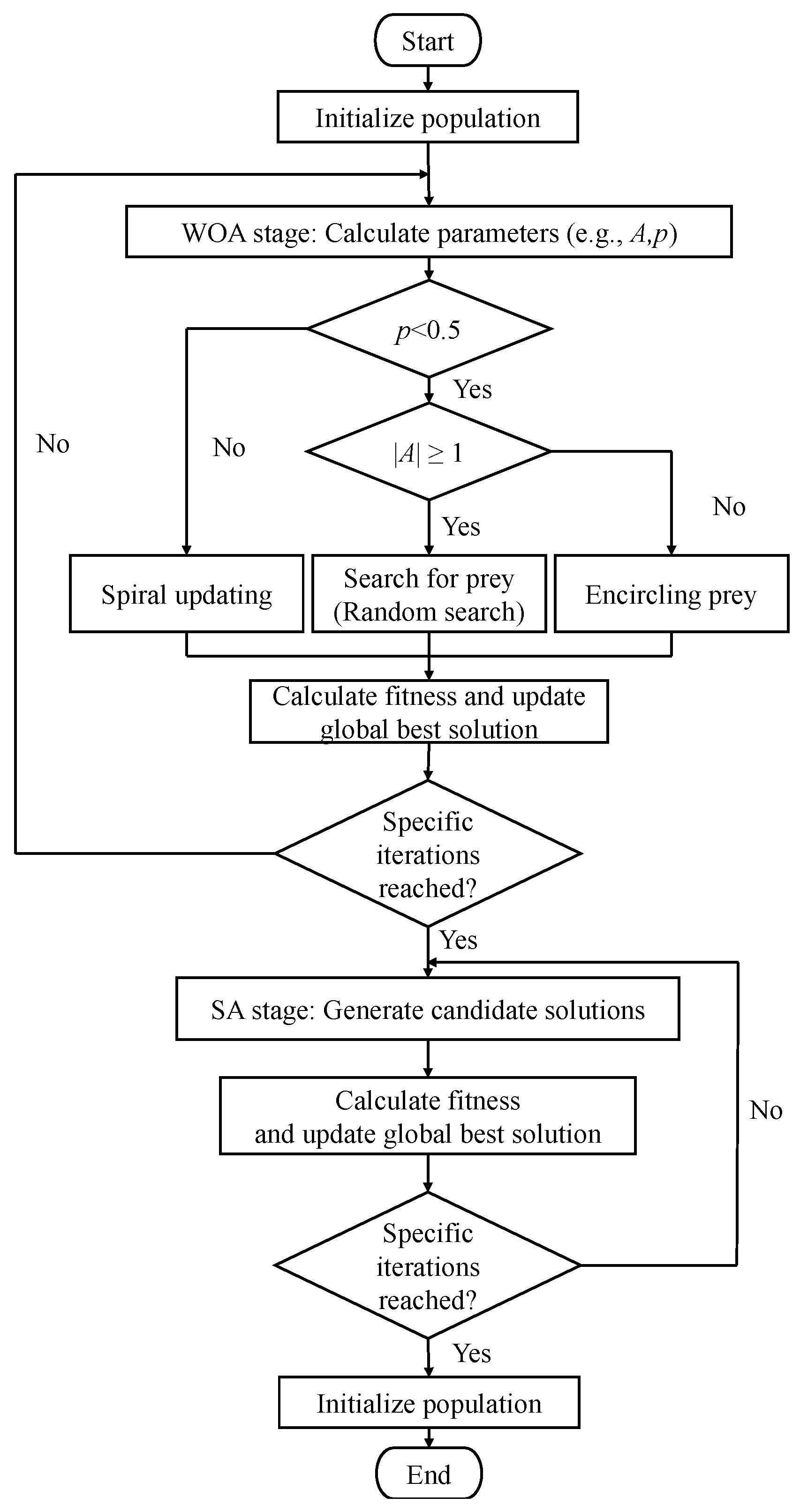
To generate high-quality trajectories, we propose a Hybrid SA-WOA. The standard WOA is designed for continuous optimization and often struggles with the discrete permutations of TSP, additionally being prone to local optima entrapment. The SA-WOA addresses these issues by integrating discrete genetic operators and the probabilistic acceptance mechanism of Simulated Annealing. The complete logic of the SA-WOA is presented in
Figure 6.
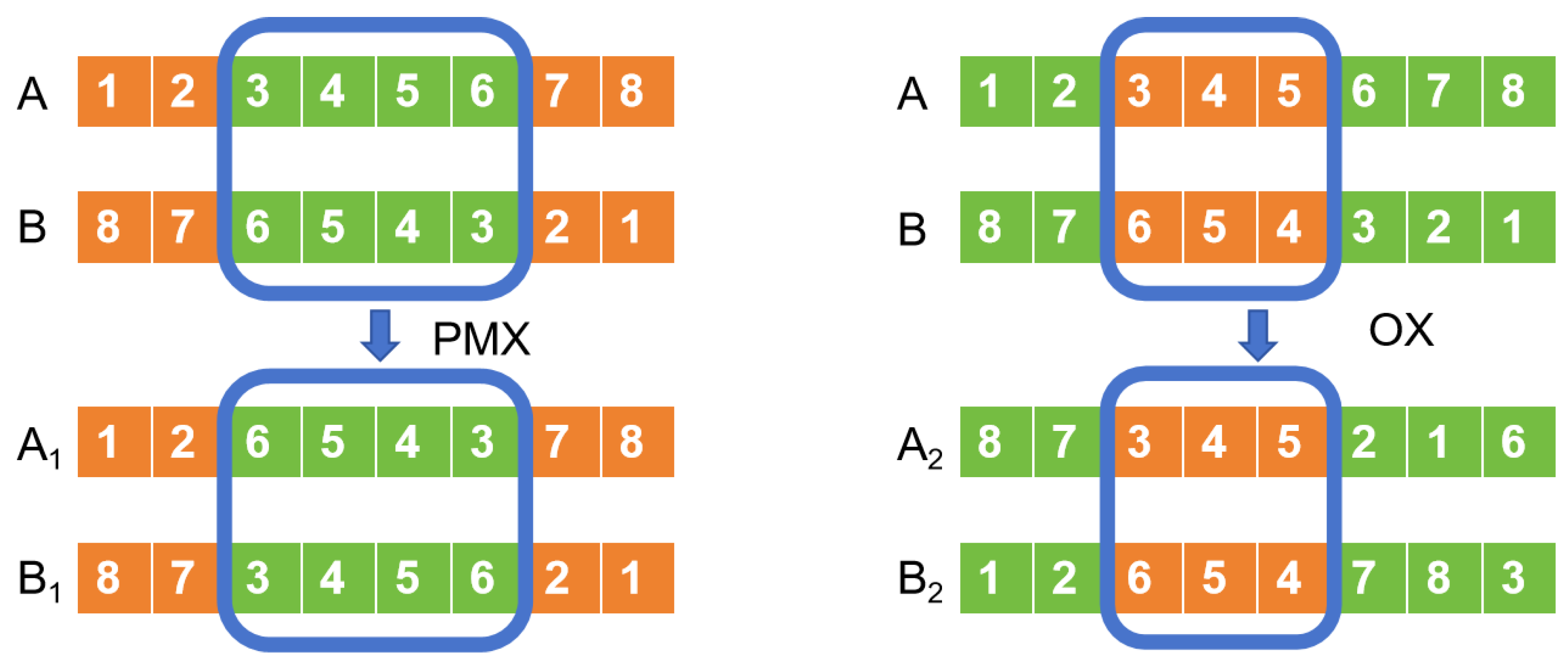
First, to adapt the continuous position updates of WOA to the discrete TSP domain, we map the algorithm’s behaviors to specific genetic operators. The Encircling Prey behavior is implemented using Order Crossover, which preserves the relative order of task sequences from the best solution found so far. The Bubble-net Attacking phase utilizes PMX Crossover (Partially Mapped Crossover) to combine features of the current solution and the global best during the exploitation phase (See
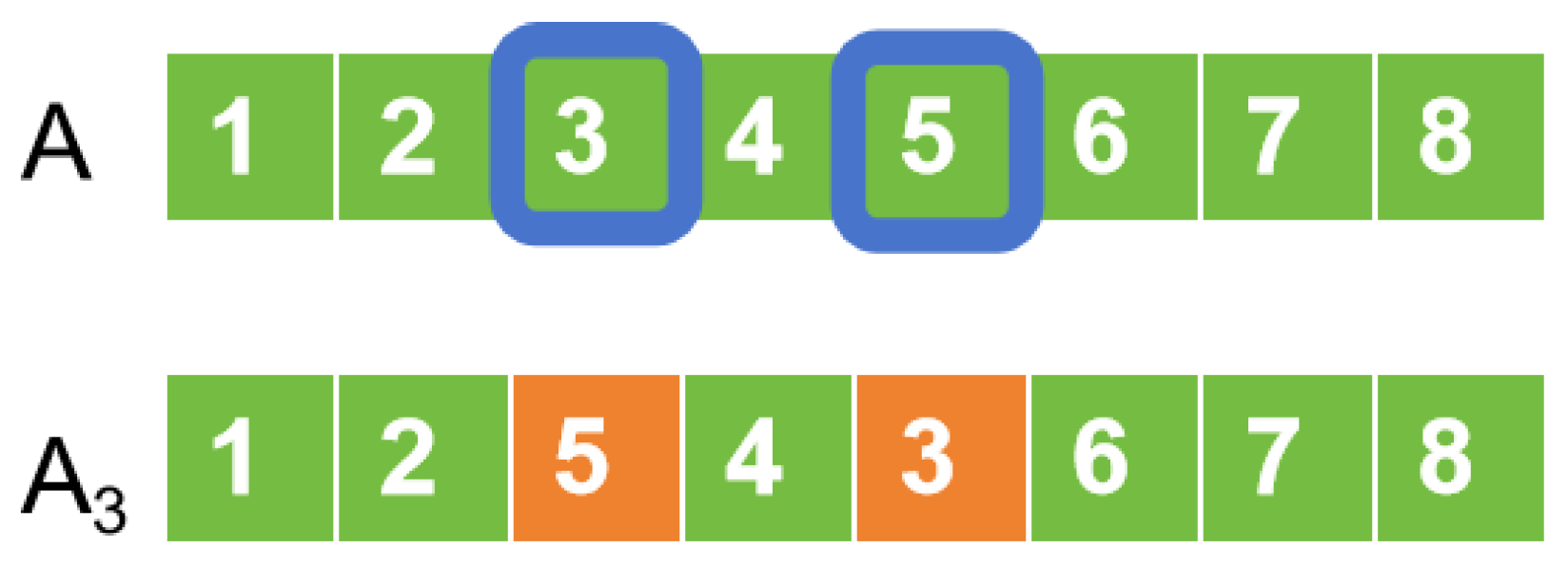
Figure 7). For the Search for Prey phase, which emphasizes exploration, Swap Mutation is employed to randomly exchange two tasks in the sequence, mimicking random searching behavior (see
Figure 8).
We establish a strict rule-based mapping between continuous variables (probability p and coefficient vector A) and discrete genetic operators. The transition logic is formally defined as follows:
1. Search for Prey (Exploration Phase): If and , the algorithm executes a global random search. In the discrete domain, this is implemented by applying Partially Mapped Crossover (PMX) between the current solution and a randomly selected individual from the population, followed by a Swap Mutation to maximize sequence diversity.
2. Encircling Prey (Local Exploitation): If and , the whale converges on the target. This maps to applying Order Crossover (OX) between the current solution and the global best solution (), preserving the relative sequence of the optimal path, followed by a Swap Mutation.
3. Bubble-net Attacking (Spiral Update): If , the algorithm simulates the spiral approach. This is discretely mapped to structural permutations using Segment Reversal (Inversion) and Element Insertion on the current solution, forcefully bringing its topology closer to .
Moreover, to enhance the balance between exploration and exploitation, a Nonlinear Convergence Factor (
a) is introduced. To balance global exploration and local exploitation better than the standard linear decay, we introduce a sinusoidal nonlinear convergence factor:
This maintains a higher value for a longer duration in the early phase to encourage exploration, and decays rapidly in the final phase for precise convergence. A dynamic weight is applied to the position update to control the influence of the best solution:
This prevents oscillation around the optimal solution in later iterations.
Finally, to prevent premature convergence to local optima, the Metropolis Criterion from Simulated Annealing is applied.
where
is the change in path length and
T is the current temperature.
Instead of greedily accepting only improved solutions, the algorithm accepts worse solutions with a probability dependent on the current “temperature.” This mechanism allows the algorithm to occasionally accept uphill moves, enabling it to jump out of local valleys in the fitness landscape and search for the global optimum. The complete step-by-step logic, illustrating the transition between the exploration and exploitation phases, is formalized in Algorithm 3.
| Algorithm 3 Hybrid SA-WOA Algorithm |
- 1:
Input: Task sequence K, Max iterations , Population size P - 2:
Output: Optimal path sequence - 3:
Initialize discrete population and - 4:
while do - 5:
Calculate and w - 6:
for each individual in P do - 7:
Generate random p and A - 8:
if then - 9:
if then - 10:
- 11:
else - 12:
- 13:
end if - 14:
else - 15:
- 16:
end if - 17:
- 18:
if or then - 19:
- 20:
end if - 21:
end for - 22:
▷ Cooling schedule - 23:
- 24:
end while - 25:
return
|
The SA-WOA operates over iterations with a population of P. In each iteration, the application of discrete crossover operators (PMX, OX) and mutations requires time, where K is the length of the TSP sequence. The calculation of the path distance objective function also runs in . The simulated annealing acceptance check is an operation. Consequently, the total time complexity is bounded by , proving its computational feasibility for real-time trajectory recalculations in high-density warehouse environments.
3.4. System Implementation Framework
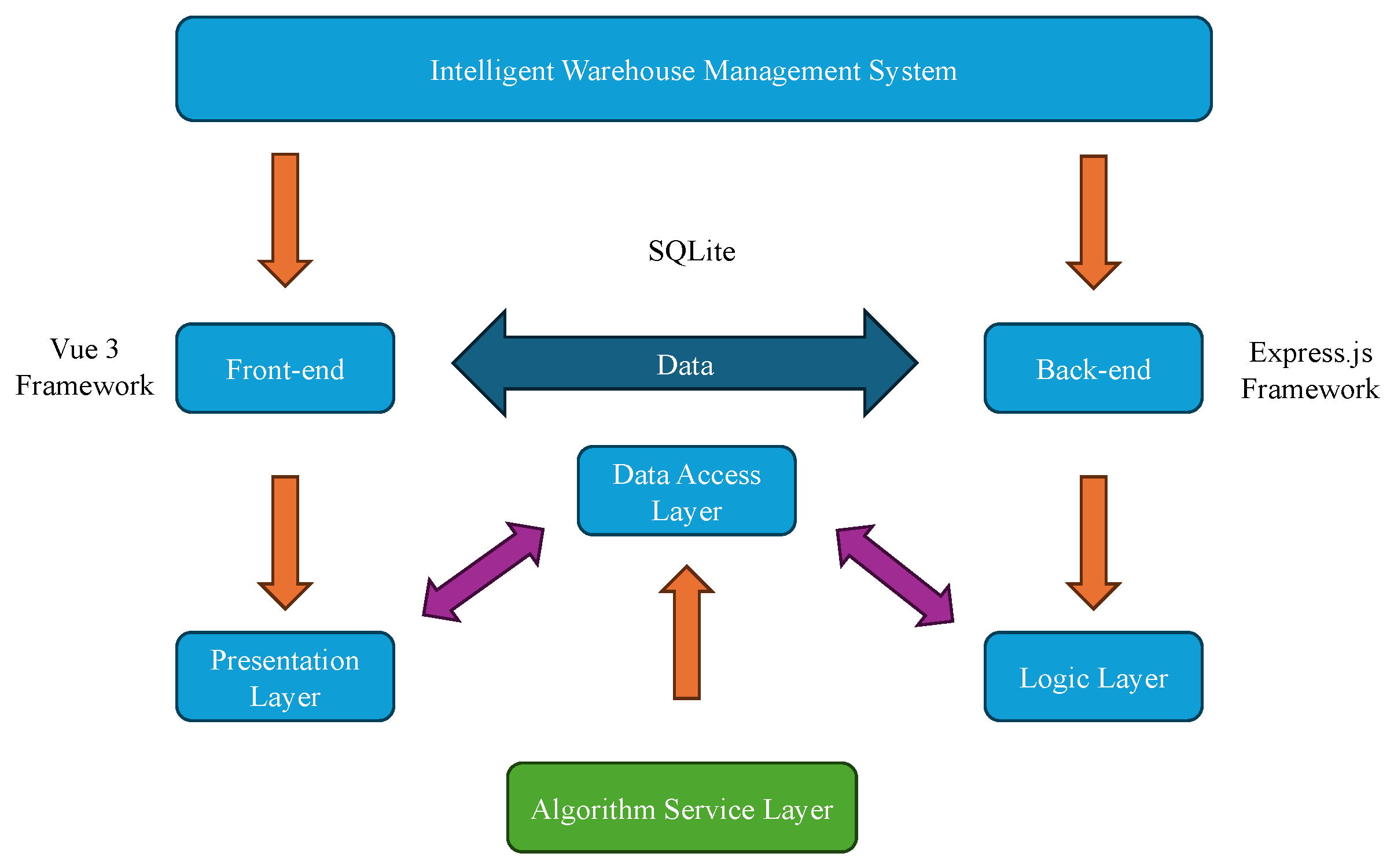
To validate the proposed algorithms and facilitate their practical application, an Intelligent Warehouse Management System was developed. The system architecture adopts a microservice design pattern to decouple the frontend display, backend logic, and algorithm services, ensuring scalability and maintainability. From a practical implementation standpoint, the choice of a microservice architecture is a deliberate industrial design decision. It aligns closely with Industry 4.0 standards by allowing the optimization algorithms to be deployed as modular, ’plug-and-play’ components. These can be seamlessly integrated into existing Enterprise Resource Planning (ERP) or Manufacturing Execution Systems (MES) without requiring a complete system overhaul, ensuring the framework scales alongside a facility’s physical expansion. Furthermore, to bridge the algorithmic models with the physical equipment, the framework utilizes standard industrial communication protocols (e.g., OPC-UA) to exchange real-time state and position data with the machines’ Programmable Logic Controllers (PLCs). This transforms the Intelligent WMS into a functional digital twin of the warehouse. The overall system architecture is shown in
Figure 9.
The system is composed of three primary layers. The Presentation Layer provides a user-friendly interface for warehouse operators to monitor inventory and manage orders. The Logic Layer handles business rules, data processing, and communication between modules. The core Algorithm Service Layer hosts the TVNS, PT-AHA, and SA-WOA algorithms as independent services. Real-time order data flows from the WMS to the algorithm layer, where the TVNS module first determines optimal storage coordinates. Subsequently, the PT-AHA module generates synchronized schedules for cranes and forklifts, and finally, the SA-WOA module computes the precise movement trajectories. This hierarchical integration ensures that the theoretical optimization results are effectively translated into executable instructions for the warehouse equipment.
4. Evaluation Results
To validate the effectiveness and robustness of the proposed integrated optimization framework, extensive simulation experiments were conducted. This chapter details the experimental setup and presents a comparative analysis of the algorithms designed for storage location allocation, collaborative scheduling, and path planning. Quantitative comparisons against benchmark methods demonstrate the superiority of the proposed approaches in terms of solution quality, convergence speed, and operational efficiency.
4.1. Experimental Environment and Parameter Settings
The simulation platform was developed using MATLAB 2024a (The MathWorks, Inc., Natick, MA, USA) on a high-performance workstation equipped with an Intel Core i7 processor @2.90 GHz (Intel Corporation, Santa Clara, CA, USA) and 16 GB of RAM. The virtual warehouse environment was modeled based on a standard AS/RS layout comprising 12 racks, each with 10 columns and 5 tiers, totaling 600 storage locations per aisle unit. The stacker crane dynamics were set to a maximum horizontal velocity of
m/min and a maximum vertical velocity of
m/min. The key parameters for the proposed TVNS were configured as follows: maximum iterations
, number of neighborhood structures
, perturbation intensity
, and a Tabu tenure
. For the PT-AHA, the population size was set to 60, with maximum iterations
. The Hybrid SA-WOA utilized a population size of 200 and set the maximum iterations to 500, with an initial temperature of 2000 and a cooling rate of 0.95. To ensure statistical reliability, each experiment was repeated 30 times, and average values were recorded for analysis. The specific parameter configurations for all algorithms are documented in
Table 2 to substantiate the fair comparison claims.
To simulate a realistic high-throughput environment, we generated static task batches based on specific product turnover distributions (39%, 32%, 22%, and 14% for Types A, B, C, and D, respectively) to ensure experimental reproducibility. We defined item correlations based on product family groupings to simulate frequently co-ordered items. In addition, to ensure a fair algorithmic assessment, all benchmark methods (GA, TS, VNS, AHA, and WOA) were calibrated under an identical computational budget. The maximum iteration count () and population size (P) were kept consistent across algorithms, ensuring that any observed performance gains are strictly due to algorithmic logic rather than excessive search time. We determined the key parameters through empirical iterative testing during the simulation design phase to ensure stability across varying task scales.
4.2. Performance Analysis of Storage Location Allocation (TVNS)
The storage location allocation problem requires balancing multiple conflicting objectives. The performance of the proposed TVNS algorithm was evaluated against three benchmark methods: Genetic Algorithm (GA), standard Tabu Search (TS), and Variable Neighborhood Search (VNS). Experiments were conducted under different optimization priorities—Efficiency, Stability, Correlation, and Uniformity—with varying inventory loads (30% and 70% capacity).
4.2.1. Convergence Analysis
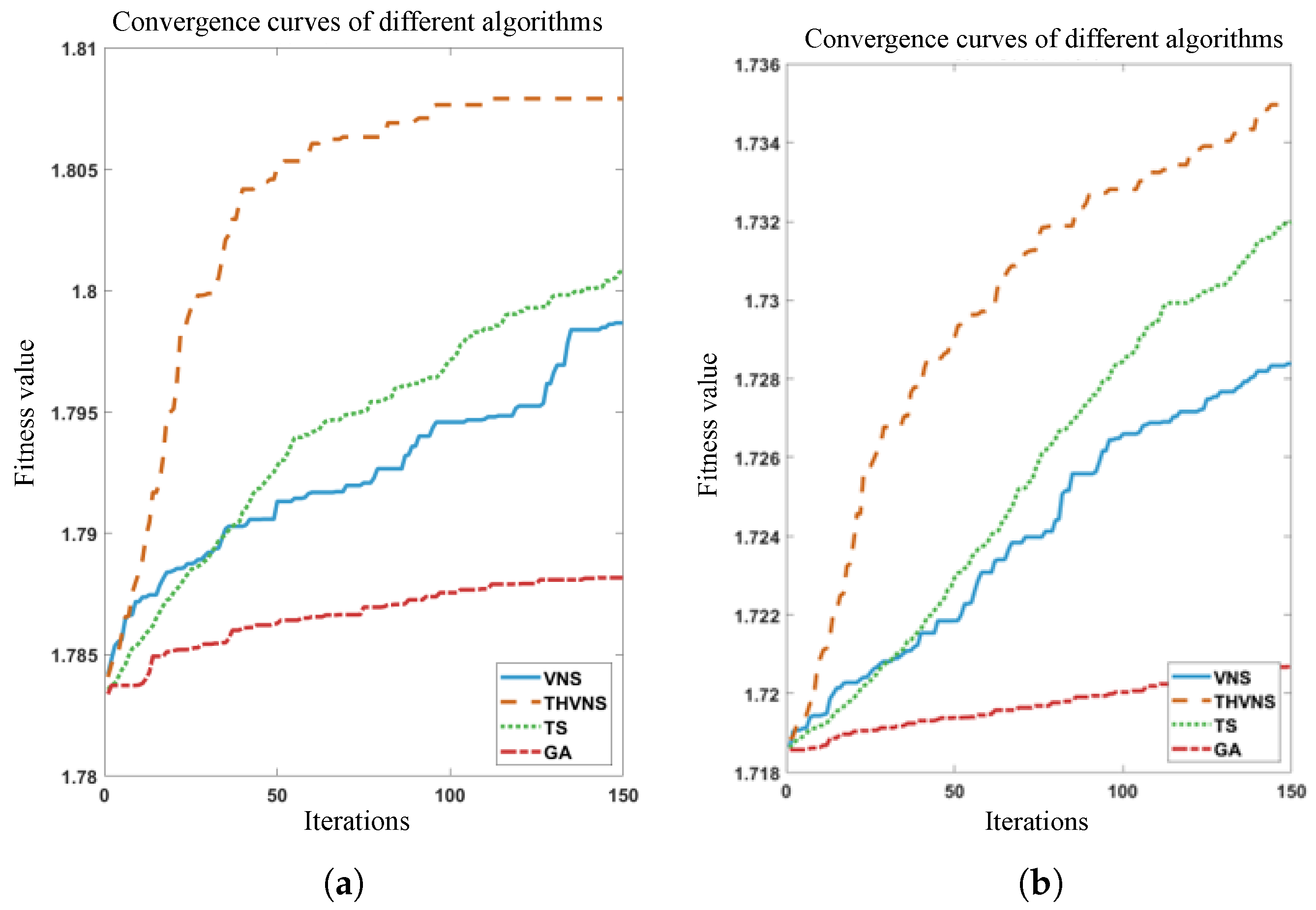
The convergence behavior of an algorithm reflects its ability to locate the global optimum efficiently. In our experiments, traditional evolutionary algorithms like GA often exhibited premature convergence, stagnating around the 80th iteration due to a lack of diversity in the late search stages. Similarly, TS showed rapid initial improvement but struggled to escape deep local optima once the tabu list was saturated. In contrast, the TVNS algorithm demonstrated a superior search trajectory. By integrating the short-term memory of TS with the multi-structure exploration of VNS, TVNS maintained a continuous descent in fitness values. The adaptive shaking mechanism proved particularly effective; when the search stagnated, the algorithm triggered a perturbation that dislodged the solution from local valleys, allowing for sustained improvement even in the final iterations. This behavior is visually confirmed in the iterative convergence curves presented in
Figure 10.
4.2.2. Optimization Quality and 3D Visualization
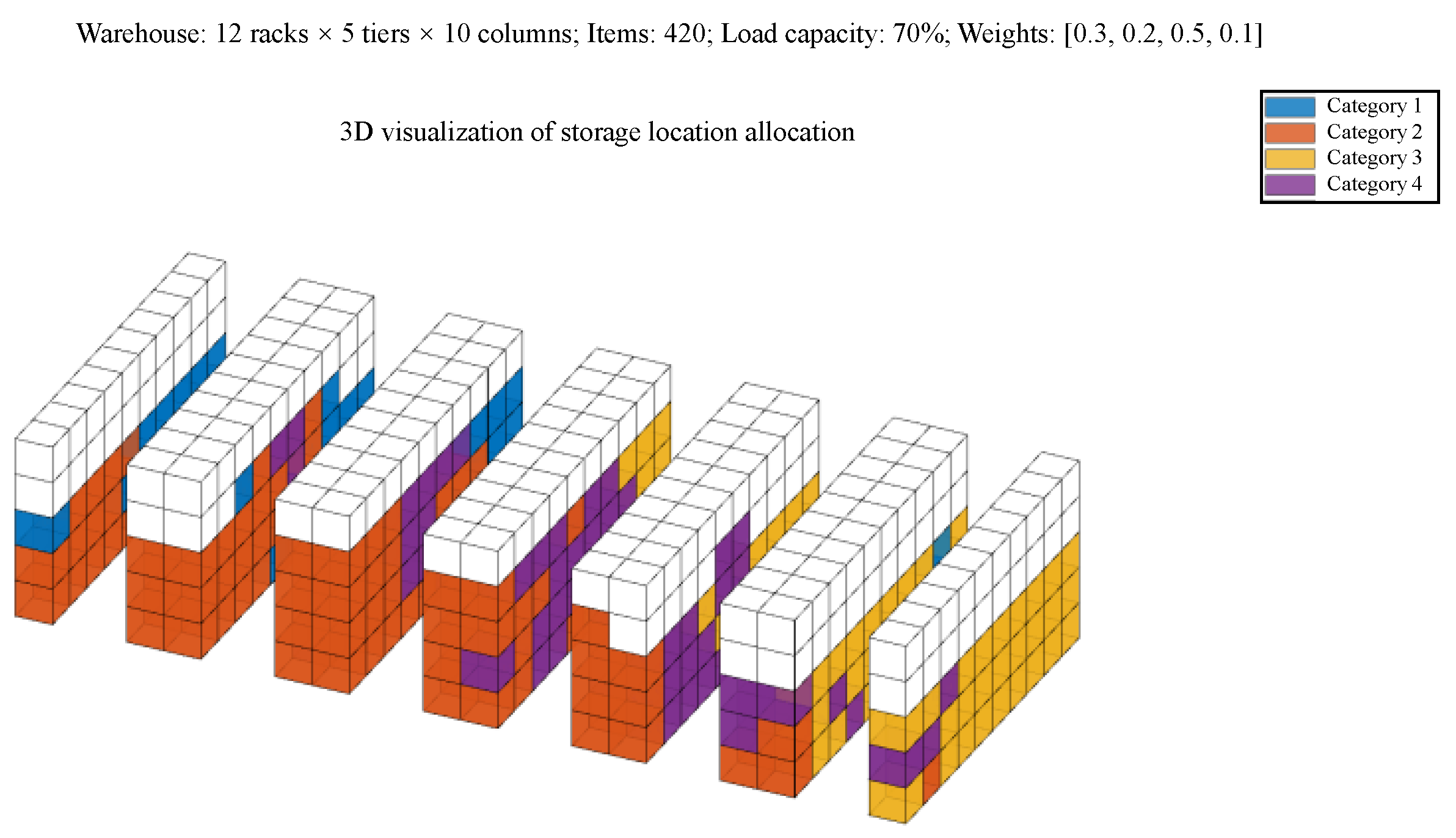
To intuitively evaluate the quality of the allocation solutions, we visualized the final storage distribution of the warehouse. The primary goal was to place high-turnover items (Category 1) in the most accessible locations while ensuring heavier items were placed in lower tiers to maintain rack stability. As shown in
Figure 11, the 3D visualization results show that the TVNS algorithm successfully generated a “U-shaped” distribution pattern for high-frequency goods, clustering them near the I/O points to minimize crane travel time. Simultaneously, the vertical distribution indicates that heavier items are predominantly located in the bottom two tiers, significantly lowering the center of gravity of the rack system compared to the random distributions produced by initialization or less effective heuristics. This structured arrangement validates the algorithm’s capability to satisfy complex multi-objective constraints.
4.2.3. Quantitative Comparison
To quantify these improvements,
Table 3 summarizes the optimal fitness values obtained under “Efficiency Priority” and “Stability Priority” scenarios. A higher fitness value indicates a solution that better satisfies the objective function. The data reveals that TVNS consistently achieves superior fitness scores across all load capacities. Specifically, in the 30% load efficiency scenario, TVNS reached a fitness of 1.808, outperforming the standard GA (1.788) by approximately 1.1%. While this numerical difference may appear small, in a high-throughput warehouse operating 24/7, this efficiency gain translates to a significant reduction in cumulative cycle time and energy consumption. Furthermore, in the “Comprehensive” scenario where all objectives are weighted, TVNS maintained its lead, proving its robustness in handling trade-offs between conflicting goals.
4.3. Evaluation of Collaborative Scheduling (PT-AHA)
The scheduling module focuses on the coordinated operation of N stacker cranes and M forklifts to minimize the total makespan. The proposed PT-AHA was compared against the Genetic Algorithm (GA), standard Artificial Hummingbird Algorithm (AHA), and Ant Colony Optimization (ACO).
4.3.1. Makespan Reduction
The total completion time (Makespan) is the critical metric for warehouse throughput. We tested the algorithms across varying task scales, ranging from small batches (30 orders) to large-scale operations (300 orders). As shown in
Table 4, the proposed PT-AHA consistently requires the least time to complete tasks across all tested scales. For smaller batches (30 tasks), PT-AHA achieved a remarkable 21.9% reduction in completion time compared to the initial First-Come-First-Served (FCFS) strategy and outperformed GA by roughly 22%. As the problem scale increased to 300 tasks, the advantage of PT-AHA remained significant, reducing the total time by approximately 3.6% compared to ACO and 1.0% compared to GA. This indicates that the pheromone feedback mechanism successfully guides the hummingbird agents to promising regions of the scheduling space, preventing the algorithm from getting lost in the vast combinatorial possibilities of large-scale problems.
4.3.2. Equipment Utilization and Scheduling Visualization
To deeply analyze why PT-AHA achieves better time efficiency, we examined the specific utilization metrics of the equipment.
Table 5 details the operational status of a representative stacker crane (Crane #1) during a 30-task cycle. The data shows that PT-AHA markedly reduces the “Idle Rate” to 38.5% and the “Empty Travel Rate” (moving without goods) is optimized to support continuous operation. Consequently, the effective “Working Rate” increased to 34.0%, the highest among all compared methods. This improvement implies that the algorithm effectively synchronizes the arrival of forklifts with the availability of cranes, minimizing the “waiting for resources” downtime that plagues traditional scheduling methods.
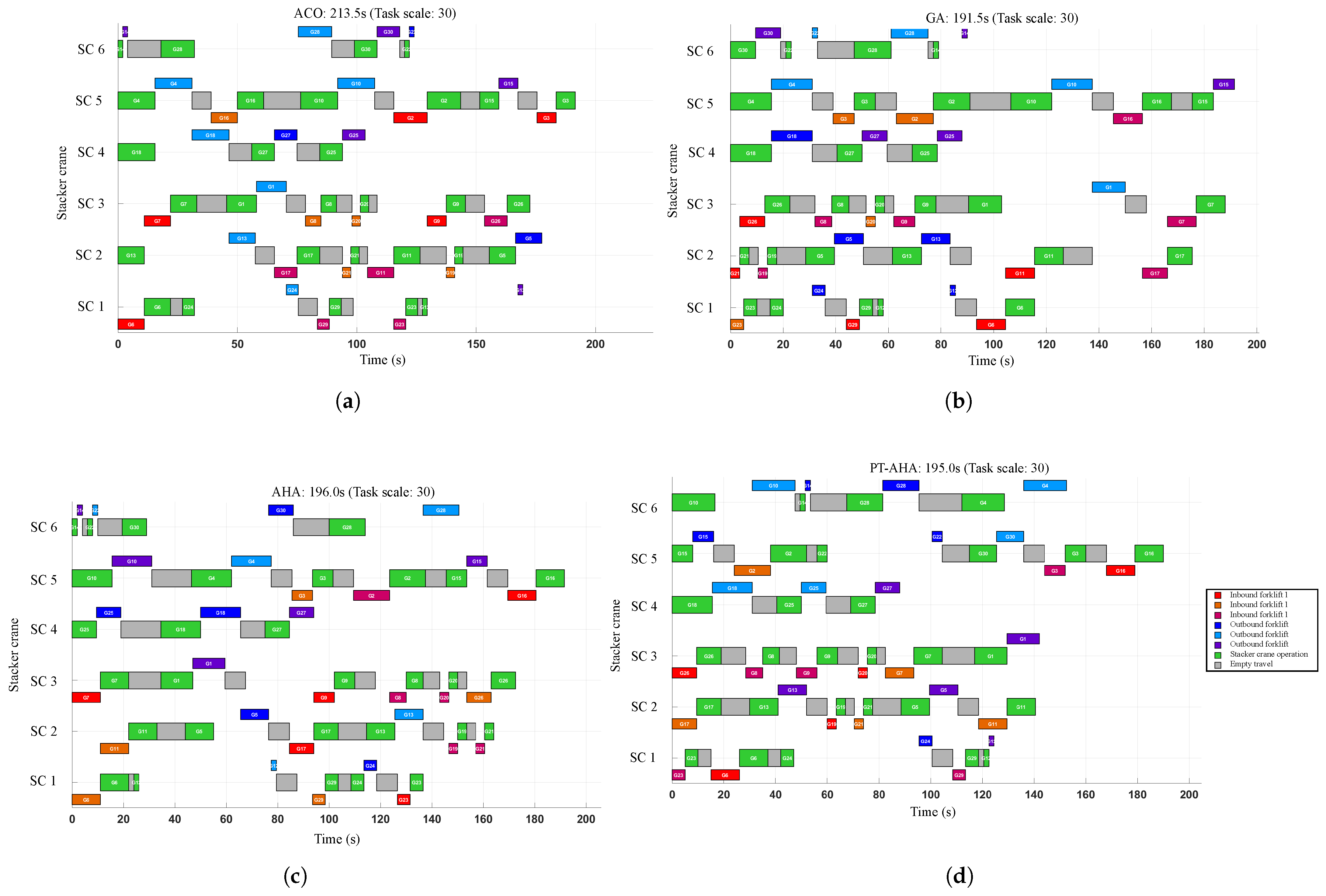
The Gantt chart in
Figure 12 visually confirms this tight coordination. The chart displays a dense arrangement of task blocks with minimal gaps between operations. The synchronization between the blue blocks (Forklift tasks) and green blocks (Stacker Crane tasks) is highly efficient, demonstrating that the PT-AHA successfully resolves the coupling constraints between different equipment types.
4.4. Verification of Path Planning Trajectories (SA-WOA)
The SA-WOA was applied to optimize the movement trajectory of stacker cranes under dual-command cycles (storage followed by retrieval). Performance was benchmarked against standard Whale Optimization Algorithm (WOA), Simulated Annealing (SA), and GA.
4.4.1. Trajectory Efficiency
The primary metric for path planning is the total travel distance. A shorter path directly corresponds to lower energy consumption and faster cycle times.
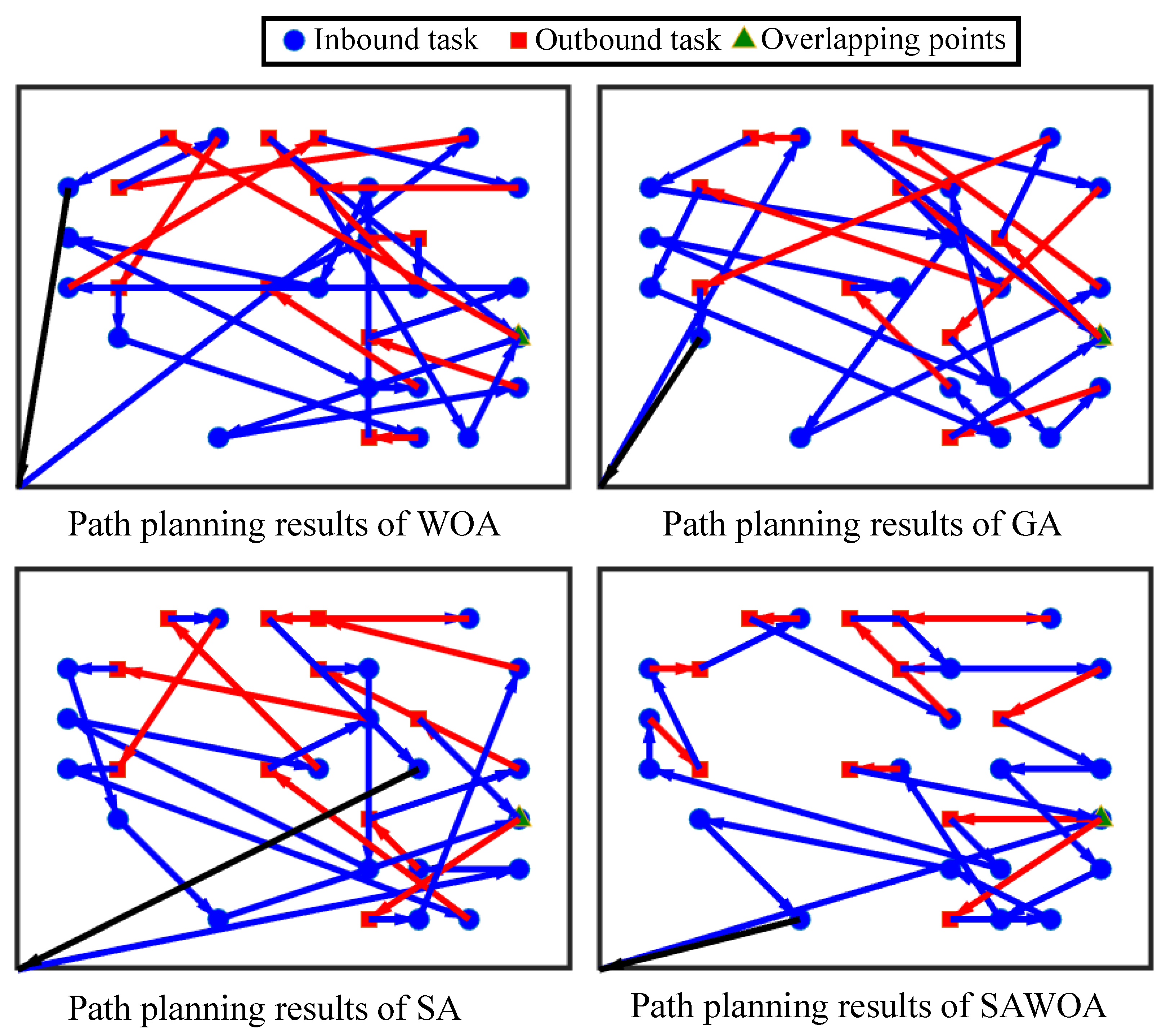
Table 6 compares the optimized path lengths for various combinations of inbound and outbound tasks. The results demonstrate a significant improvement: in the heavy-load scenario with 50 inbound and 50 outbound tasks, the SA-WOA algorithm reduced the total travel distance to 267 m. In stark contrast, the standard WOA produced a path of 710 m, and GA produced 582 m. This substantial reduction indicates that the standard WOA often gets trapped in local optima, resulting in zig-zagging or redundant movements. The SA-WOA, by incorporating the Metropolis acceptance criterion from Simulated Annealing, effectively “jumps out” of these suboptimal paths, smoothing the trajectory and linking tasks in a logically superior sequence.
The visual comparison of the paths in
Figure 13 further illustrates this point. The path generated by SA-WOA is characterized by fewer turning points and a more direct flow between storage locations, whereas benchmark algorithms exhibit more chaotic movement patterns.
4.4.2. Statistical Stability and Robustness
Reliability is as important as efficiency in industrial applications. To assess robustness, we performed statistical analysis over 100 independent runs.
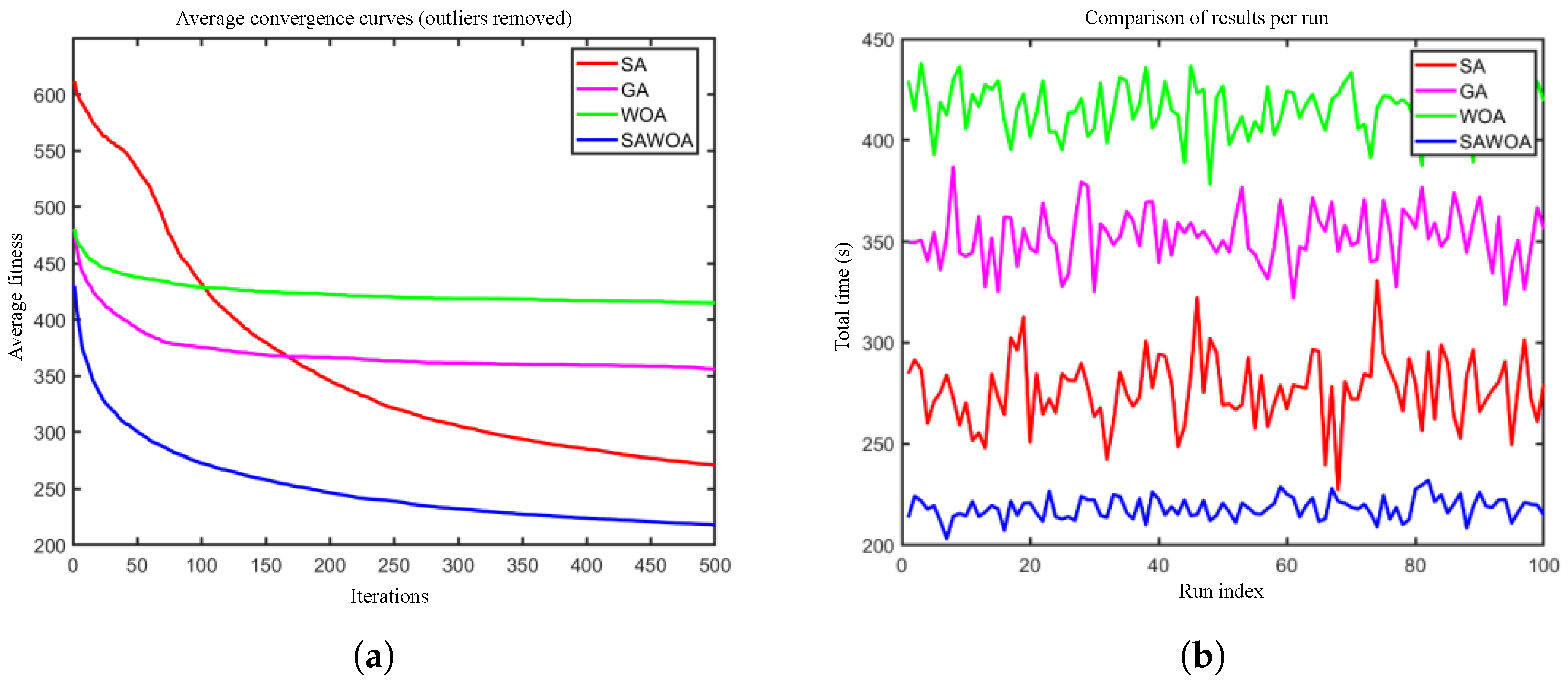
Figure 14 displays the box plot of path lengths obtained by each algorithm. The SA-WOA exhibits the smallest interquartile range (IQR) and the lowest median value, indicating high stability; it consistently produces high-quality solutions regardless of the random initialization. Beyond this, we simulated a dynamic environment by inserting emergency orders into an existing schedule. As detailed in the experiment logs, SA-WOA maintained the smallest increase in total path length compared to other algorithms when accommodating these disruptions, validating its adaptability to real-time changes in warehouse operations.
To verify the statistical stability of the SA-WOA algorithm, the simulation was executed for 100 independent trials. As shown in the results, the SA-WOA achieved a standard deviation of 5.41, which is substantially lower than that of standard WOA (12.03), SA (13.63), and GA (17.07). This confirms that the hybrid mechanism effectively improves algorithmic consistency and stability.
To evaluate real-time dynamic handling, we simulated the arrival of urgent orders (emergency insertions) during active operations. Upon the insertion of an urgent task, the SA-WOA rapidly recalculated the remaining trajectory. The algorithm limited the path length increase to (from 182 m to 282 m), significantly outperforming the standard WOA, which suffered a steeper degradation. Regarding scalability, the computational overhead of the SA-WOA scales linearly at . Because the complexity is bounded by the sequence length K, the algorithm successfully maintains sub-second recalculation times even when warehouse operations scale up to 300 simultaneous orders, proving its viability for enterprise-level deployments.
4.5. System Implementation Validation
The proposed algorithms were encapsulated into the backend of the Intelligent WMS. While the detailed user interface is not the focus of this section, the system’s backend performance logs provided crucial validation data.
In a full-system simulation run processing 500 orders, the 21.9% reduction in total makespan translates to the ability to process approximately one-fifth more orders daily using the same hardware infrastructure. In a typical industrial setting, this level of efficiency gain can delay the need for multi-million dollar capital investments in additional stacker cranes or warehouse expansion. Furthermore, the 3.2-second fault recovery time is critical for maintaining high availability in fully automated facilities, where manual intervention is costly and slow. This rapid fault recovery redistributes tasks, minimizing system downtime. These engineering validation results confirm that the theoretical gains observed in standalone simulations effectively translate into tangible operational improvements in a realistic warehouse management environment.
5. Conclusions
This study proposed an integrated optimization framework for AS/RS to systematically address the coupling challenges of storage allocation, equipment scheduling, and path planning. By integrating theoretical algorithm design with practical engineering constraints, the research successfully established a robust control strategy for modern intelligent logistics. Initially, to tackle the high-dimensional discrete nature of storage location allocation, a multi-objective mathematical model was formulated, balancing efficiency, stability, and correlation. A TVNS algorithm was developed to solve this model. By embedding the short-term memory mechanism of Tabu Search into the Variable Neighborhood Search structure, the algorithm effectively prevented premature convergence. Simulation results under varying inventory loads demonstrated that TVNS achieved an efficiency fitness gain of 1.1% over standard Genetic Algorithms under high-load scenarios, achieving a more stable rack center of gravity and higher turnover efficiency.
Building upon the optimized storage layout, the study addressed the dynamic operational challenges through advanced collaborative scheduling and trajectory planning. For the coordination of stacker cranes and forklifts, a PT-AHA was introduced. This novel approach integrated pheromone feedback mechanisms to enhance the global search capability of the standard AHA, effectively reducing task completion time (Makespan) by 21.9% for small-scale batches and decreasing equipment idle rates to 38.5% in multi-device collaborative scenarios. Complementing this, a Hybrid SA-WOA was proposed for the precise trajectory planning of stacker cranes. By incorporating nonlinear convergence factors and simulated annealing strategies, the SA-WOA overcame the local optima entrapment often seen in standard WOA. Tests in dual-command cycles and dynamic obstacle environments confirmed that the hybrid algorithm generates smoother trajectories with considerably shorter travel distances compared to Particle Swarm Optimization and standard WOA.
To validate the engineering applicability of the proposed algorithms, an Intelligent WMS based on a microservice architecture was designed and implemented. This system successfully integrated the optimization modules for real-time decision-making, transforming the AS/RS into a highly responsive Cyber–Physical System (CPS). This practical implementation directly addresses the Industry 4.0 demand for interoperable, self-optimizing logistics networks. Practical validation indicated that the integrated framework achieves a 21.9% reduction in task completion time (Makespan) and demonstrates high industrial resilience by triggering fault alarms and initiating recovery within 3.2 s during equipment failures.
The study provides a practical framework for automated warehouse management. The integrated feedback loop between the TVNS and PT-AHA algorithms ensures that the warehouse maintains self-optimizing operation even as inventory turnover rates fluctuate, making it a robust solution for Industry 4.0 logistics hubs. Future research will focus on extending the current models to account for stochastic factors, such as equipment breakdowns or urgent order insertions, potentially through robust optimization or stochastic programming. Additionally, the exploration of Deep Reinforcement Learning offers a promising avenue for enabling self-adaptive decision-making in highly dynamic environments, further advancing the intelligence of supply chain logistics.
Author Contributions
Conceptualization, D.W. and D.Z.; methodology, B.L. and D.Z.; software, B.L.; validation, B.L. and D.Z.; formal analysis, B.L. and D.Z.; investigation, B.L.; resources, D.W.; data curation, E.Y.; writing—original draft preparation, D.Z.; writing—review and editing, D.W. and D.Z.; visualization, B.L. and E.Y.; supervision, D.W. and D.Z.; project administration, D.W.; funding acquisition, D.W. All authors have read and agreed to the published version of the manuscript.
Funding
This work was supported by the 2024 Research Support Fund for High-Level Talents of Shenyang Ligong University (Grant No. 6030105518).
Institutional Review Board Statement
Not applicable.
Informed Consent Statement
Not applicable.
Data Availability Statement
The data and simulation code that support the findings of this study are available from the corresponding author upon reasonable request. These materials are not publicly available due to intellectual property restrictions related to the optimization framework and the specific industrial warehouse configurations used in the simulations.
Conflicts of Interest
The authors declare no conflicts of interest.
Correction Statement
This article has been republished with a minor correction to the Funding statement. This change does not affect the scientific content of the article.
References
- Kembro, J.H.; Norrman, A. A strategic perspective on automated warehouse systems in retail: Insights from a multiple case study. Int. J. Phys. Distrib. Logist. Manag. 2025, 55, 57–91. [Google Scholar] [CrossRef] [Scilit]
- Schäfer, F.; Lorson, F.; Hübner, A. Finding the right one: Decision support for selecting cost-efficient order picking solutions. IISE Trans. 2025, 57, 75–89. [Google Scholar] [CrossRef] [Scilit]
- Antonio, M.I.G.; Zangara, G.; Silvestri, L.; Filice, L. Sustainability Impact of Automated Warehouses in Industry 4.0 scenario. Procedia Comput. Sci. 2025, 253, 3196–3205. [Google Scholar] [CrossRef] [Scilit]
- Lerher, T.; Potrč, I.; Šraml, M.; Tollazzi, T. Travel time models for automated warehouses with aisle transferring storage and retrieval machine. Eur. J. Oper. Res. 2010, 205, 571–583. [Google Scholar] [CrossRef] [Scilit]
- Zhang, X.; Mo, T.; Zhang, Y. Optimization of storage location assignment for non-traditional layout warehouses based on the firework algorithm. Sustainability 2023, 15, 10242. [Google Scholar] [CrossRef] [Scilit]
- Liang, C.; Cui, T.; Wei, Y.; Zhao, K.; Yue, X.; Wang, C. Storage location assignment in emergency reserve warehouses: A multi-objective optimization algorithm. Mathematics 2025, 13, 1636. [Google Scholar] [CrossRef] [Scilit]
- Bolanos Zuniga, J.; Saucedo Martinez, J.A.; Salais Fierro, T.E.; Marmolejo Saucedo, J.A. Optimization of the storage location assignment and the picker-routing problem by using mathematical programming. Appl. Sci. 2020, 10, 534. [Google Scholar] [CrossRef] [Scilit]
- Li, H.R.; Liu, J.S.; Hu, P.; Zhou, H. Solving the storage location assignment of large-scale automated warehouse based on dynamic vortex search algorithm. Swarm Evol. Comput. 2024, 91, 101412. [Google Scholar] [CrossRef] [Scilit]
- Kabak, R.; Koch, T.; Dugundji, E.R. An Optimization Approach to Minimize Material Movements in a Fully Automated Warehouse. Procedia Comput. Sci. 2024, 238, 45–52. [Google Scholar] [CrossRef] [Scilit]
- Battarra, I.; Accorsi, R.; Manzini, R.; Rubini, S. Hybrid model for the design of a deep-lane multisatellite AVS/RS. Int. J. Adv. Manuf. Technol. 2022, 121, 1145–1158. [Google Scholar] [CrossRef] [Scilit]
- Shahroudnejad, A.; Mousavi, P.; Perepelytsia, O.; Sahir; Staszak, D.; Taylor, M.E.; Bawel, B. A novel framework for automated warehouse layout generation. Front. Artif. Intell. 2024, 7, 134211. [Google Scholar] [CrossRef] [Scilit]
- Davydov, I.; Kochetov, Y.; Tolstykh, D.; Tong, X.; Liu, J. Hybrid variable neighborhood search for automated warehouse scheduling. Optim. Lett. 2022, 17, 2185–2199. [Google Scholar] [CrossRef] [Scilit]
- Yin, Y.-Q.; Zhong, M.; Ge, Y.-E. Scheduling twin automated stacking cranes for job assignment at automated container terminals. Comput. Ind. Eng. 2025, 17, 111344. [Google Scholar] [CrossRef] [Scilit]
- Lu, J.; Xu, L.; Jin, J.; Shao, Y. A mixed algorithm for integrated scheduling optimization in AS/RS and hybrid flowshop. Energies 2022, 15, 7558. [Google Scholar] [CrossRef] [Scilit]
- Hsu, H.P.; Wang, C.N.; Dang, T.T. Simulation-based optimization approaches for dealing with dual-command crane scheduling problem in unit-load double-deep AS/RS considering energy consumption. Mathematics 2022, 10, 4018. [Google Scholar] [CrossRef] [Scilit]
- Aloini, D.; Benevento, E.; Dulmin, R.; Guerrazzi, E.; Mininno, V. Unlocking Real-Time Decision-Making in Warehouses: A machine learning-based forecasting and alerting system for cycle time prediction. Transp. Res. Part E 2025, 194, 103933. [Google Scholar] [CrossRef] [Scilit]
- Pohl, L.M.; Tutam, M. Performance analysis for a dual-crane automated storage and retrieval system. Eur. J. Ind. Eng. 2025, 19, 1–24. [Google Scholar] [CrossRef] [Scilit]
- Barbato, M.; Ceselli, A.; Righini, G. A polynomial-time dynamic programming algorithm for an optimal picking problem in automated warehouses. J. Sched. 2024, 27, 412–425. [Google Scholar] [CrossRef] [Scilit]
- Zhang, Z.H.; Chen, J.; Zhao, W.B. Multi-AGV route planning in automated warehouse system based on shortest-time Q-learning algorithm. Asian J. Control 2023, 26, 512–525. [Google Scholar] [CrossRef] [Scilit]
- Li, D.; Wang, L.; Geng, S.; Jiang, B. Path planning of AS/RS based on cost matrix and improved greedy algorithm. Symmetry 2021, 13, 1483. [Google Scholar] [CrossRef] [Scilit]
- Hu, Y.; Liu, X.; An, K.; Ji, Y.; Qian, X.; Peng, Y.; Chen, G.; Cao, Y.; Wu, F.; Cheng, Y. Optimizing path planning and conflict resolution in high-density AS/RS with a multi-shuttle cooperative scheduling framework. IEEE Trans. Instrum. Meas. 2025, 74, 3547423. [Google Scholar] [CrossRef] [Scilit]
- Zhang, H.; Wu, Y.; Hu, J.; Wang, Y. Collaborative optimization of task scheduling and multi-agent path planning in automated warehouses. Complex Intell. Syst. 2023, 9, 5121–5135. [Google Scholar] [CrossRef] [Scilit]
- Yan, D.K.; Chen, C.H.J.; Niu, Y.C.H.; Yin, H.N.; Huang, B.Q. Point cloud-based intelligent collision avoidance for stacker cranes in stereoscopic warehouses. Eng. Appl. Artif. Intell. 2025, 159, 109211. [Google Scholar] [CrossRef] [Scilit]
- Jiang, Y.; Lu, K.; Yang, Z.; Zhang, H.; Zhang, X. Monocular visual anti-collision method based on residual mixed attention for storage and retrieval machines. Expert Syst. Appl. 2024, 255, 124567. [Google Scholar] [CrossRef] [Scilit]
- Zöllner, R.; Jannasch, E.; Schmidt, T. Variational approach to trajectory optimization wrt energy recuperation for stacker cranes. Logist. J.: Proc. 2024, 20, 1–7. [Google Scholar]
- Li, H.L.; Wang, S.; Zhen, L.; Wang, X.F. Data-driven optimization for automated warehouse operations decarbonization. Ann. Oper. Res. 2022, 343, 231–254. [Google Scholar] [CrossRef] [Scilit]
- Yuan, Y.Y.; Zhen, L.; Wu, J.W.; Wang, X.F. Quantum behaved particle swarm optimization of inbound process in an automated warehouse. J. Oper. Res. Soc. 2023, 74, 2145–2158. [Google Scholar] [CrossRef] [Scilit]
- Eder, M. An analytical approach for a performance calculation of shuttle-based storage and retrieval systems with multiple-deep and class-based storage. Prod. Manuf. Res. 2022, 10, 124–145. [Google Scholar] [CrossRef] [Scilit]
- Hamzaoui, M.A.; Sari, Z.; Belghoul, L. Dual cycle time modelling and design optimisation for the bidirectional flow-rack AS/RS. Int. J. Prod. Res. 2024, 62, 4512–4528. [Google Scholar]
- Hamdipour, A.; Basiri, A.; Zaare, M.; Mirjalili, S. BAHA: Binary artificial hummingbird algorithm for feature selection. J. Comput. Sci. 2025, 90, 102511. [Google Scholar] [CrossRef] [Scilit]
- Inan, O.; Servi, S. New WOA Variants for Superior Meta-heuristic Optimization with Multiple Hunter Whale Leading. Arab. J. Sci. Eng. 2025, 50, 20317–20342. [Google Scholar] [CrossRef] [Scilit]
- Wang, W.J.; Chen, F.B.; Li, Y.; Weng, L.X. A hybrid WOA-KDE and mixed copula framework for directional wind assessment in complex terrain. Sustain. Energy Technol. Assess. 2025, 68, 103822. [Google Scholar] [CrossRef] [Scilit]
- Ekren, B.Y. A multi-objective optimisation study for the design of an AVS/RS warehouse. Int. J. Prod. Res. 2021, 59, 1056–1074. [Google Scholar]
Figure 1.
Industrial context of the integrated AS/RS optimization framework. The storage racks represent the spatial domain for the allocation decision variables (r, c, s).
Figure 1.
Industrial context of the integrated AS/RS optimization framework. The storage racks represent the spatial domain for the allocation decision variables (r, c, s).
Figure 2.
Flowchart of the TVNS algorithm.
Figure 2.
Flowchart of the TVNS algorithm.
Figure 3.
Schematic diagram of the six neighborhood operations: (a) Single Position Swap. (b) Element Insertion. (c) Segment Reversal. (d) Block Swap. (e) Attribute-based Swap. (f) Three-position Rotation.
Figure 3.
Schematic diagram of the six neighborhood operations: (a) Single Position Swap. (b) Element Insertion. (c) Segment Reversal. (d) Block Swap. (e) Attribute-based Swap. (f) Three-position Rotation.
Figure 4.
Schematic diagram of the collaborative scheduling scheme.
Figure 4.
Schematic diagram of the collaborative scheduling scheme.
Figure 5.
Stacker crane picking operation modes: (a) Single-command inbound cycle. (b) Single-command outbound cycle. (c) Dual-command cycle, combining one storage and one retrieval task. (d) Consecutive dual-command cycles. The blue square represents the inbound station, and the green square represents the outbound station. The blue arrows indicate loaded inbound travel, the green arrows indicate loaded outbound travel, and the red arrows represent empty travel.
Figure 5.
Stacker crane picking operation modes: (a) Single-command inbound cycle. (b) Single-command outbound cycle. (c) Dual-command cycle, combining one storage and one retrieval task. (d) Consecutive dual-command cycles. The blue square represents the inbound station, and the green square represents the outbound station. The blue arrows indicate loaded inbound travel, the green arrows indicate loaded outbound travel, and the red arrows represent empty travel.
Figure 6.
Flowchart of the Hybrid SA-WOA algorithm.
Figure 6.
Flowchart of the Hybrid SA-WOA algorithm.
Figure 7.
Schematic of PMX and OX crossover operations.
Figure 7.
Schematic of PMX and OX crossover operations.
Figure 8.
Schematic of mutation operations.
Figure 8.
Schematic of mutation operations.
Figure 9.
System Architecture Diagram.
Figure 9.
System Architecture Diagram.
Figure 10.
Iterative convergence curve comparison of storage allocation algorithms: (a) 30% load. (b) 70% load.
Figure 10.
Iterative convergence curve comparison of storage allocation algorithms: (a) 30% load. (b) 70% load.
Figure 11.
3D visualization of storage location allocation after optimization.
Figure 11.
3D visualization of storage location allocation after optimization.
Figure 12.
Gantt chart of equipment collaborative scheduling across different algorithms: (a) Ant Colony Optimization (ACO); (b) Pheromone-guided Artificial Hummingbird Algorithm (PT-AHA); (c) Genetic Algorithm (GA); (d) standard Artificial Hummingbird Algorithm (AHA). The alphanumeric labels within the activity blocks (e.g., “G1”, “G14”) represent the specific task or “Goods” identifier being processed by the equipment during that time window.
Figure 12.
Gantt chart of equipment collaborative scheduling across different algorithms: (a) Ant Colony Optimization (ACO); (b) Pheromone-guided Artificial Hummingbird Algorithm (PT-AHA); (c) Genetic Algorithm (GA); (d) standard Artificial Hummingbird Algorithm (AHA). The alphanumeric labels within the activity blocks (e.g., “G1”, “G14”) represent the specific task or “Goods” identifier being processed by the equipment during that time window.
Figure 13.
Comparison of optimal paths generated by different algorithms.
Figure 13.
Comparison of optimal paths generated by different algorithms.
Figure 14.
Box plot analysis of path length distribution over 100 independent runs: (a) Path length distribution under static task conditions, assessing algorithmic stability and consistency. (b) Path length distribution under dynamic task conditions with the arrival of emergency orders, assessing adaptability to real-time disruptions.
Figure 14.
Box plot analysis of path length distribution over 100 independent runs: (a) Path length distribution under static task conditions, assessing algorithmic stability and consistency. (b) Path length distribution under dynamic task conditions with the arrival of emergency orders, assessing adaptability to real-time disruptions.
Table 1.
Summary of recent related works (2022–2025).
Table 1.
Summary of recent related works (2022–2025).
| Reference | Year | Focus Area | Methodology/Algorithm | Key Limitation Addressed in Our Study |
|---|
| Li et al. [8] | 2024 | Storage Allocation | Dynamic Vortex Search | Lacks integration with dynamic crane scheduling. |
| Shahroudnejad et al. [11] | 2024 | Warehouse Layout | AI constraint-based search | Focuses on static design, not real-time allocation. |
| Kabak et al. [9] | 2024 | Material Movement | Mathematical Optimization | Does not account for dynamic multi-objective weighting. |
| Davydov et al. [12] | 2022 | Task Scheduling | Hybrid VNS | Susceptible to premature convergence in high-density grids. |
| Aloini et al. [16] | 2025 | Cycle Time Prediction | Machine Learning | Predictive only; lacks proactive path optimization. |
| Zhang et al. [22] | 2023 | Collab. Scheduling | Multi-agent path planning | Computationally heavy for real-time task scaling. |
| Yan et al. [23] | 2025 | Collision Avoidance | Point-cloud AI | Solves physical safety but ignores operational throughput. |
| Jiang et al. [24] | 2024 | Anti-collision | Monocular visual attention | Hardware-focused; decoupled from WMS logic. |
| Hamdipour et al. [30] | 2025 | Meta-heuristics | Binary AHA | Unadapted for complex continuous-discrete warehouse routing. |
| Inan et al. [31] | 2025 | Meta-heuristics | WOA variants | Standard WOA struggles with discrete TSP permutations. |
Table 2.
Parameter configurations for algorithms.
Table 2.
Parameter configurations for algorithms.
| Algorithm | Parameter Configurations |
|---|
| GA | Population Size = 200, Max Iterations = 500, Crossover Rate = 0.8, Mutation Rate = 0.1, Elite Selection = 2 |
| ACO | Information Heuristic () = 1.2, Expectation Heuristic () = 2.5, Evaporation Rate () = 0.15, Enhancement Constant (Q) = 150 |
| TVNS | Max Iterations = 150, Neighborhoods (K) = 6, Perturbation Threshold () = 20, Local Search Depth () = 10, Tabu Tenure () = 5 |
| SA | Initial Temperature = 2000, Cooling Rate = 0.9, Max Iterations = 500 |
Table 3.
Comparison of optimal fitness values under different optimization objectives.
Table 3.
Comparison of optimal fitness values under different optimization objectives.
| Optimization Scenario | Load Capacity | GA
| VNS | TS | TVNS (Proposed) |
|---|
| Efficiency Priority | 30% | 1.788 | 1.799 | 1.801 | 1.808 |
| 70% | 1.721 | 1.728 | 1.732 | 1.735 |
| Stability Priority | 30% | 1.735 | 1.743 | 1.742 | 1.744 |
| 70% | 1.626 | 1.632 | 1.628 | 1.632 |
| Comprehensive | 30% | 0.721 | 0.729 | 0.730 | 0.729 |
| 70% | 0.672 | 0.672 | 0.673 | 0.673 |
Table 4.
Comparison of total task completion time (seconds) under different task scales.
Table 4.
Comparison of total task completion time (seconds) under different task scales.
| Task Scale (Orders) | Initial Solution | GA
| AHA | ACO | PT-AHA (Proposed) |
|---|
| 30 | 198.7 | 192.1 | 192.2 | 191.9 | 149.8 |
| 60 | 360.0 | 349.5 | 341.9 | 347.8 | 309.3 |
| 100 | 617.3 | 520.8 | 532.7 | 543.2 | 500.6 |
| 200 | 1142.1 | 1023.4 | 1053.7 | 1048.5 | 991.3 |
| 300 | 1886.8 | 1637.8 | 1658.5 | 1681.3 | 1621.4 |
Table 5.
Comparison of Stacker Crane #1 utilization metrics (30 tasks).
Table 5.
Comparison of Stacker Crane #1 utilization metrics (30 tasks).
| Algorithm | Idle Rate (%) | Empty Travel (%) | Working Rate (%) |
|---|
| Initial State | 48.1 | 23.2 | 28.7 |
| GA | 44.4 | 23.2 | 32.5 |
| ACO | 54.5 | 18.5 | 27.0 |
| PT-AHA (Proposed) | 38.5 | 27.4 | 34.0 |
Table 6.
Comparison of total travel distance (meters) under different task distributions.
Table 6.
Comparison of total travel distance (meters) under different task distributions.
| Task Distribution (in, out)
| GA | SA | WOA | SA-WOA (Proposed) |
|---|
| (50, 50) | 582 | 518 | 710 | 267 |
| (30, 30) | 334 | 247 | 352 | 150 |
| (20, 20) | 182 | 118 | 236 | 109 |
| (10, 10) | 74 | 61 | 90 | 46 |
| Disclaimer/Publisher’s Note: The statements, opinions and data contained in all publications are solely those of the individual author(s) and contributor(s) and not of MDPI and/or the editor(s). MDPI and/or the editor(s) disclaim responsibility for any injury to people or property resulting from any ideas, methods, instructions or products referred to in the content. |