Article

Observability and Information Bounds in UUV Relative Navigation from Range-Rate

Faculty of Navigation and Naval Weapon, Polish Naval Academy, 81-127 Gdynia, Poland
Appl. Sci. 2026, 16(8), 3758; https://doi.org/10.3390/app16083758
Submission received: 29 January 2026 / Revised: 9 April 2026 / Accepted: 9 April 2026 / Published: 11 April 2026

Abstract

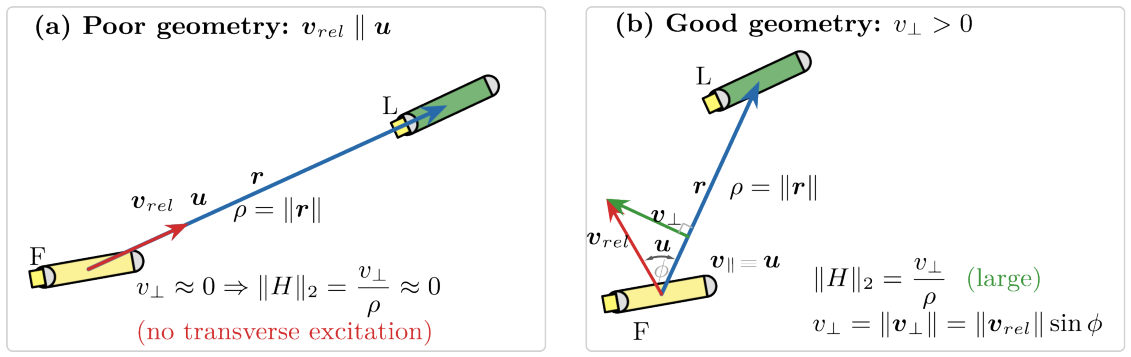
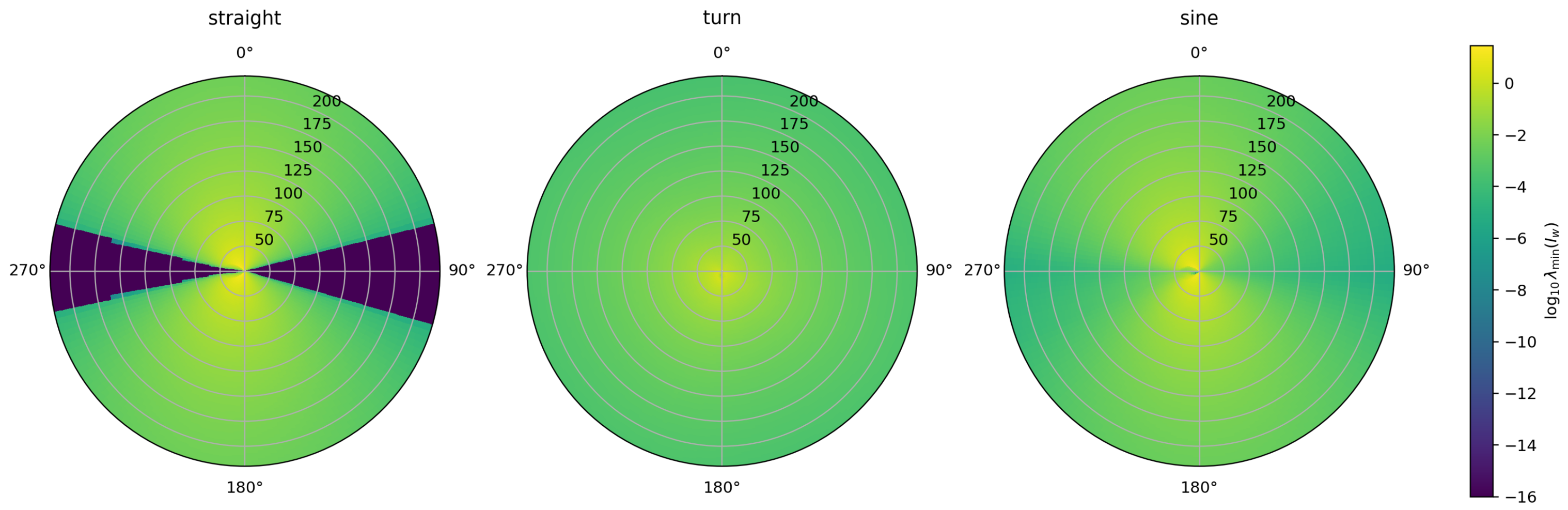
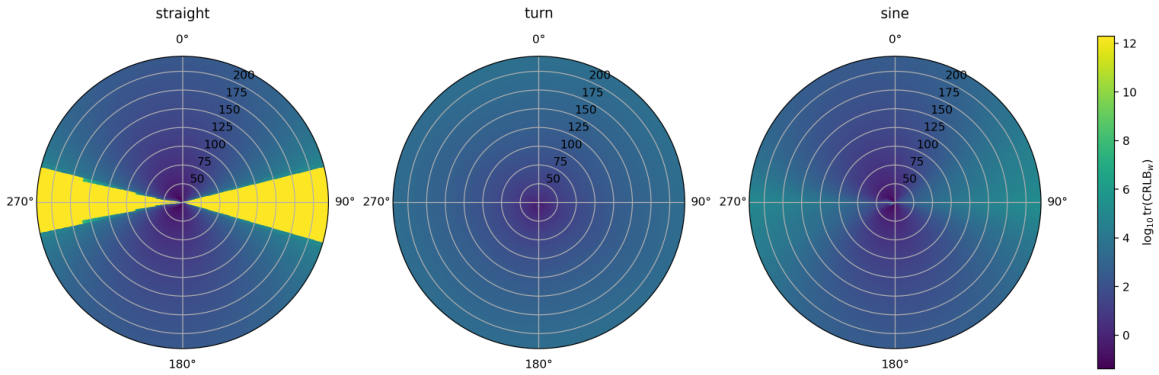
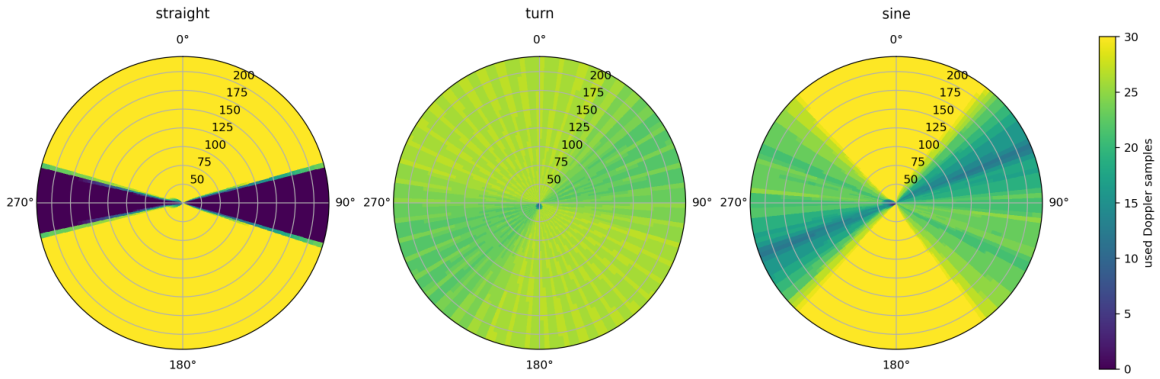
In this paper, we investigate the relative navigation of two underwater vehicles in a leader–follower configuration when the only available inter-vehicle acoustic measurement is Doppler-derived range-rate, i.e., the rate of change in range, with no direct range measurement. We show that, in this setting, estimation performance depends critically on motion geometry: under unfavorable configurations and overly “radial” relative motion, some uncertainty components cannot be effectively reduced, and the available information decays rapidly as the separation increases. We propose a practical, quantitative approach to assessing these effects over time, based on information measures computed in a sliding time window and the corresponding theoretical accuracy bounds. Building on this, we construct information maps for representative maneuvers that highlight regions of “good” and “poor” geometry and explain when and why the estimator loses stability. We complement Monte Carlo simulation results with a reinforcement learning experiment in which a control policy learns to both maintain the formation and generate maneuvers that improve estimation conditions in the Doppler-only regime. The results demonstrate that motion control explicitly accounting for trajectory informativeness can significantly increase task success compared with control strategies that ignore these limitations.
Keywords: Doppler-only; range-rate; UUV; relative navigation; observability; Fisher information; CRLB; active localization Doppler-only; range-rate; UUV; relative navigation; observability; Fisher information; CRLB; active localization