1. Introduction
Vitamin D is a fat-soluble vitamin that can accumulate in adipose tissue, which may influence its systemic bioavailability [
1]. Vitamin D plays a fundamental role in bone metabolism and skeletal homeostasis through the regulation of calcium–phosphate balance and osteoblast activity [
2]. Despite its importance for musculoskeletal health, vitamin D deficiency remains a widespread global health problem, with serum 25-hydroxyvitamin D concentrations below 20 ng/mL reported in approximately 24–49% of the global population. In addition to its classical role in bone metabolism, vitamin D exerts pleiotropic biological effects through activation of vitamin D receptors (VDR), which regulate the expression of genes involved in immune regulation, inflammatory responses, and tissue repair [
3,
4]. Consistent with these observations, large population-based analyses and randomized clinical trials have demonstrated that vitamin D status may influence susceptibility to various diseases and clinical outcomes [
5,
6].
In the context of skeletal injuries, several studies have demonstrated that low serum 25-hydroxyvitamin D levels are associated with increased fracture risk and poorer postoperative recovery. Notably, vitamin D deficiency has been reported in up to 46–92% of patients presenting with hip fractures, suggesting that vitamin D status may influence bone healing and functional recovery after surgical procedures [
6,
7]. Importantly, vitamin D deficiency also appears to be highly prevalent among patients undergoing dental treatment. In a prospective screening study, Krawiec and Dominiak reported decreased serum vitamin D levels in more than 88% of dental patients, indicating that vitamin D deficiency may represent a common systemic factor potentially affecting oral health and treatment outcomes [
8]. In addition, vitamin D has been shown to influence alveolar bone remodeling by regulating osteoblast and osteoclast activity through molecular pathways such as the RANK–RANKL–OPG signaling axis, which plays a central role in bone resorption and formation within the dentoalveolar complex [
9,
10]. Emerging evidence suggests that vitamin D deficiency may also influence craniofacial development [
11]. Clinical studies have demonstrated an association between low serum vitamin D levels and structural alterations of the maxilla, including increased risk of narrow upper arch, crowding, and crossbite [
11]. Following tooth extraction, alveolar socket healing involves inflammatory, proliferative, and bone remodeling phases, leading to gradual replacement of the blood clot with newly formed bone and soft tissue closure [
12,
13,
14,
15].
Mandibular third molar extraction is one of the most frequently performed procedures in oral surgery and is commonly associated with postoperative pain, swelling, trismus, and delayed soft tissue healing. Although numerous local and systemic factors influencing postoperative recovery have been investigated, the potential role of baseline vitamin D status in postoperative healing after third molar surgery remains unclear.
Given its involvement in bone metabolism and inflammatory processes, vitamin D may affect both early healing and bone regeneration after extraction. However, current evidence is limited and inconsistent, and it is still uncertain whether preoperative vitamin D levels have a meaningful impact on postoperative outcomes in otherwise healthy patients.
Therefore, the aim of the present study was to explore the association between preoperative serum vitamin D levels and postoperative recovery following mandibular third molar extraction in a secondary exploratory analysis of a randomized clinical trial dataset. The analysis included postoperative pain, swelling, trismus, soft tissue healing, and bone regeneration within the extraction socket.
2. Materials and Methods
2.1. Study Design
This study represents a secondary exploratory analysis of data obtained from a previously conducted randomized clinical trial investigating the effects of autologous platelet concentrates and photobiomodulation on postoperative healing following mandibular third molar extraction. The original study was designed as a prospective randomized clinical trial, and its primary results have been previously published by Selahi et al. [
16].
Ethical approval for the original trial was obtained from the Bioethics Committee of Wroclaw Medical University (approval no. KB-705/2019), and the study was registered at ClinicalTrials.gov (NCT07324213). The study was conducted at the clinical facilities of MCIW—Medical Center for Innovation in Wroclaw, which serves as the clinical base of the Department of Dental Surgery, Wroclaw Medical University.
The present study involves analysis of the existing dataset generated within that randomized clinical trial and did not include any additional patient recruitment, new interventions, or modifications to the original study protocol. Importantly, serum vitamin D levels were not part of the original randomization or intervention design and were analyzed as an observational exposure variable. This secondary analysis aimed to evaluate the potential association between baseline serum vitamin D levels and postoperative recovery following mandibular third molar extraction.
All surgical procedures were performed by the same experienced operator (D.S.), minimizing inter-operator variability. Procedures were performed according to a standardized surgical protocol.
2.2. Participants
Participants included generally healthy adult patients aged 18–40 years who required surgical extraction of an impacted mandibular third molar. Eligibility was determined based on clinical examination and radiological assessment using orthopantomographic radiographs and, when necessary, cone-beam computed tomography (CBCT).
A total of 135 patients were initially enrolled in the randomized clinical trial. Of these, 122 participants completed the follow-up period and were included in the final clinical analysis. For the present secondary analysis, only patients with complete datasets, including both preoperative serum vitamin D measurements and CBCT imaging suitable for fractal dimension analysis, were included (n = 98).
Detailed inclusion and exclusion criteria, as well as the recruitment process, have been previously described in the original randomized clinical trial. Briefly, patients with systemic diseases, metabolic disorders, pregnancy, smoking habits, recent antibiotic therapy, poor oral hygiene, or exceptionally difficult impactions were excluded from the study. Baseline characteristics of the study population are presented in
Section 3.
2.3. Assessment of Serum Vitamin D Levels
Serum vitamin D levels were assessed preoperatively as part of the clinical evaluation performed before mandibular third molar extraction. Patients were required to present a laboratory test result for serum vitamin D concentration that was not older than 14 days at the time of the surgical procedure. All laboratory measurements were performed in a single certified commercial laboratory. The obtained values were recorded in the study database and used for further analysis.
For the present secondary analysis, serum vitamin D concentration was considered a baseline host-related variable that may influence postoperative healing. Patients were categorized using two thresholds: (1) <25 ng/mL vs. ≥25 ng/mL, corresponding to commonly used clinical definitions of vitamin D deficiency, and (2) <35 ng/mL vs. ≥35 ng/mL.
The 35 ng/mL threshold was additionally used as an exploratory, data-driven (post hoc) cutoff, approximately corresponding to the upper quartile of the vitamin D distribution in the study population, to explore potential effects at higher vitamin D levels.
These thresholds were used to evaluate possible relationships between baseline vitamin D levels and postoperative recovery outcomes following mandibular third molar extraction. Information on vitamin D supplementation and seasonal variation was not systematically recorded or controlled in the study.
2.4. Outcome Measures
Postoperative recovery was evaluated using clinical parameters recorded during follow-up visits conducted on postoperative days 1, 3, and 7, as well as at 4 months after surgery. Detailed descriptions of outcome assessment procedures have been previously reported in the original randomized clinical trial by Selahi et al. [
16] and are briefly summarized below for clarity.
2.4.1. Pain Intensity Assessment
Postoperative pain intensity was assessed using an 11-point numeric rating scale (NRS; 0–10), where 0 indicated no pain, and 10 indicated the worst pain imaginable [
17].
2.4.2. Postoperative Swelling Assessment
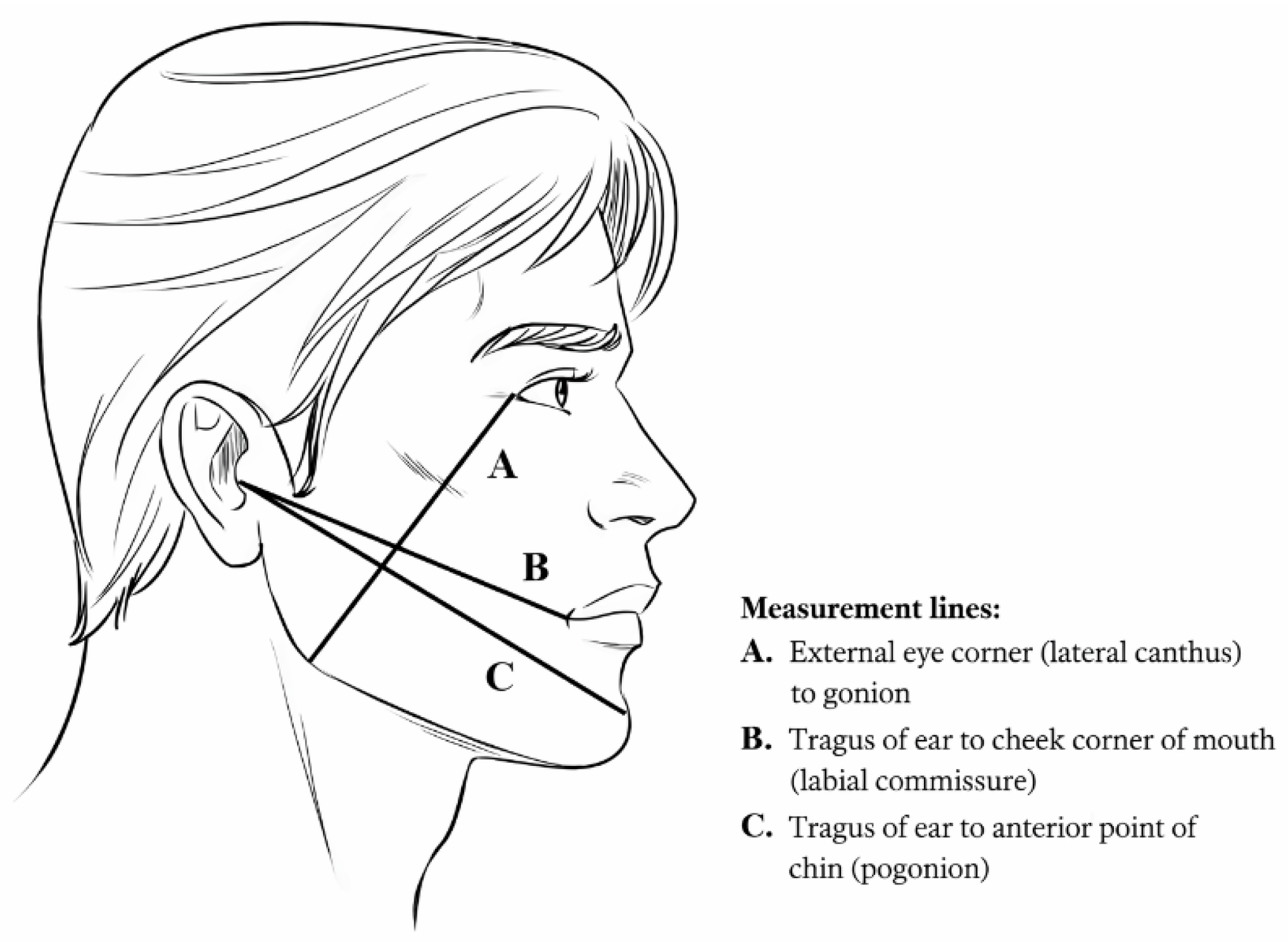
Postoperative swelling was evaluated using standardized linear facial measurements between predefined anatomical landmarks. Three measurement lines were recorded: line A (lateral canthus to gonion), line B (tragus to labial commissure), and line C (tragus to pogonion). Measurements were performed using a flexible measuring tape before surgery (baseline) and during follow-up visits on postoperative days 1, 3, and 7, as well as at 4 months after surgery.
For each measurement line, a swelling index was calculated as the difference between the postoperative measurement and the corresponding preoperative baseline value. To assess overall facial edema, a composite swelling index was calculated as the mean value of the three measurement lines (A, B, and C) for each postoperative time point. Measurement lines are presented in
Figure 1. This method provides an approximate clinical assessment of facial swelling and linear facial measurements.
2.4.3. Postoperative Trismus Assessment
Trismus was assessed by measuring maximal interincisal mouth opening before surgery and during postoperative follow-up visits on days 1, 3, and 7, as well as at 4 months after surgery. Mouth opening was measured as the distance (in millimeters) between the incisal edge of the maxillary central incisor (incision superius, Is) and the incisal edge of the mandibular central incisor (incision inferius, Ii) during maximal mouth opening.
Measurements were performed using a metal ruler with a millimeter scale. Baseline values were recorded before surgery, and postoperative measurements were obtained during each follow-up visit.
The degree of postoperative trismus was calculated as the difference between the preoperative maximal mouth opening and the corresponding postoperative measurement for each follow-up time point.
2.4.4. Soft Tissue Healing Assessment
Soft tissue healing was evaluated clinically during postoperative follow-up visits by assessing wound closure and the condition of the surgical site. Early healing was assessed on postoperative day 7 using the Wachtel Early Healing Index (EHI), a five-point clinical scale commonly used for the evaluation of early wound healing following oral surgical procedures [
18].
According to this scale, grade 1 represented complete wound closure; grade 2 indicated complete wound closure with a thin fibrin line; grade 3 corresponded to complete flap closure with evident fibrin formation; grade 4 represented incomplete flap closure with pronounced fibrin deposition; and grade 5 indicated an open wound with visible soft tissue necrosis. All clinical assessments were performed by the same calibrated examiner to ensure consistency of measurements.
2.4.5. Evaluation of Bone Regeneration
Bone regeneration within the extraction socket was evaluated four months after surgery using cone-beam computed tomography (CBCT) and fractal dimension analysis to assess the structural characteristics of the newly formed bone. Fractal dimension (FD) analysis was used to assess trabecular bone microarchitecture within the extraction socket. Fractal dimension represents an indirect measure of bone microarchitecture and should be interpreted accordingly. The analysis was performed using ImageJ software (National Institutes of Health, Bethesda, MD, USA) with the FracLac plugin (version v. 2.5). The FD was calculated using the intensity difference box-counting algorithm, which allows the quantitative assessment of structural complexity in grayscale images. Regions of interest (ROIs) were standardized and placed within the extraction socket area to represent newly formed trabecular bone. This method has been applied for the evaluation of bone structure and biomaterial surfaces in dental research and has been described in detail in previous studies [
19,
20]. All measurements were performed by a single experienced examiner (K.J.), blinded to group allocation.
2.5. Statistical Analysis
Statistical analysis was performed using methods appropriate for the distribution of the analyzed variables. Given the exploratory nature of this secondary analysis, primarily univariate methods were applied. Continuous variables were summarized using descriptive statistics (mean, median, and standard deviation), and normality of distribution was assessed using the Shapiro–Wilk test.
For the purposes of the present analysis, patients were categorized according to predefined clinical thresholds of serum vitamin D levels (<25 ng/mL vs. ≥25 ng/mL and <35 ng/mL vs. ≥35 ng/mL). Between-group comparisons were performed using the Mann–Whitney U test.
Associations between serum vitamin D levels and postoperative clinical parameters were assessed using Spearman’s rank correlation coefficient.
To explore the potential impact of confounding, an additional analysis adjusting for age, sex, surgery duration, bone removal, and treatment allocation was performed.
The level of statistical significance was set at p < 0.05. No formal correction for multiple comparisons was applied, and the results should therefore be interpreted with caution. Effect size was additionally estimated using eta-squared (η2) to indicate the magnitude of observed differences. All tests were two-tailed.
Statistical analyses were performed using Statistica v12 (StatSoft Inc., Tulsa, OK, USA).
Given the exploratory nature of this secondary analysis, all results should be interpreted as hypothesis-generating rather than confirmatory.
3. Results
3.1. Study Population
A total of 135 patients were initially enrolled in the randomized clinical trial, of whom 122 completed the follow-up period. For this secondary exploratory analysis, 98 patients with complete datasets, including both preoperative serum vitamin D measurements and CBCT imaging suitable for fractal dimension analysis, were included.
The mean age of the participants was 28.9 ± 3.5 years (range: 21–40 years). The cohort included 23 males and 75 females. The mean serum vitamin D concentration in the study population was 25.6 ng/mL. When categorized according to predefined thresholds, 59 patients had serum vitamin D levels < 25 ng/mL, and 39 patients had levels > 25 ng/mL. Using the higher threshold, 74 patients had levels < 35 ng/mL, and 24 patients had levels ≥ 35 ng/mL. The serum vitamin D distribution is presented in
Table 1.
The distribution of vitamin D levels in the study population showed that most patients presented concentrations below 30 ng/mL, with the 35 ng/mL threshold approximately corresponding to the upper quartile of the distribution. A comparison of baseline characteristics between vitamin D groups is presented in
Table 2Values are presented as mean ± standard deviation or number (percentage). aPRF—advanced platelet-rich fibrin; CGF—concentrated growth factors. RCT group refers to treatment allocation in the original randomized clinical trial by Selahi et al. [
16].
3.2. Postoperative Pain
No statistically significant differences in postoperative pain intensity were observed between patients with lower and higher serum vitamin D levels. When patients were divided according to the <25 ng/mL and ≥25 ng/mL thresholds, pain scores measured on postoperative days 1, 3, and 7 did not differ significantly between groups.
Similarly, analysis using the higher vitamin D threshold (<35 ng/mL vs. ≥35 ng/mL) did not demonstrate a significant association between serum vitamin D levels and postoperative pain intensity
Table 3.
3.3. Postoperative Swelling
Analysis of postoperative swelling did not demonstrate consistent statistically significant associations between serum vitamin D levels and the magnitude of early postoperative edema.
A weak correlation was observed between serum vitamin D levels and swelling along the tragus–pogonion measurement line (line C) on postoperative day 1 (Spearman ρ = −0.21, p = 0.035). This finding should be interpreted with caution due to the risk of type I error associated with multiple testing.
No statistically significant correlations between serum vitamin D levels and the composite swelling index or other measurement lines were observed at later postoperative time points (days 3 and 7) or at the 4-month follow-up (
Table 4).
To address potential confounding, an additional analysis adjusting for age, sex, surgery duration, bone removal, and treatment allocation was performed. The association between serum vitamin D levels and swelling along the tragus–pogonion line on postoperative day 1 remained significant (β = −0.44 mm per 10 ng/mL, 95% CI −0.80 to −0.07, p = 0.020).
3.4. Postoperative Trismus
No statistically significant association was observed between preoperative serum vitamin D levels and postoperative trismus following mandibular third molar extraction. Measurements of maximal mouth opening recorded during follow-up visits on postoperative days 1, 3, and 7 did not differ significantly between patients with lower and higher serum vitamin D levels.
Consistent results were observed when patients were categorized using the higher vitamin D threshold (<35 ng/mL vs. ≥35 ng/mL), with no significant differences in postoperative trismus between groups.
3.5. Bone Regeneration
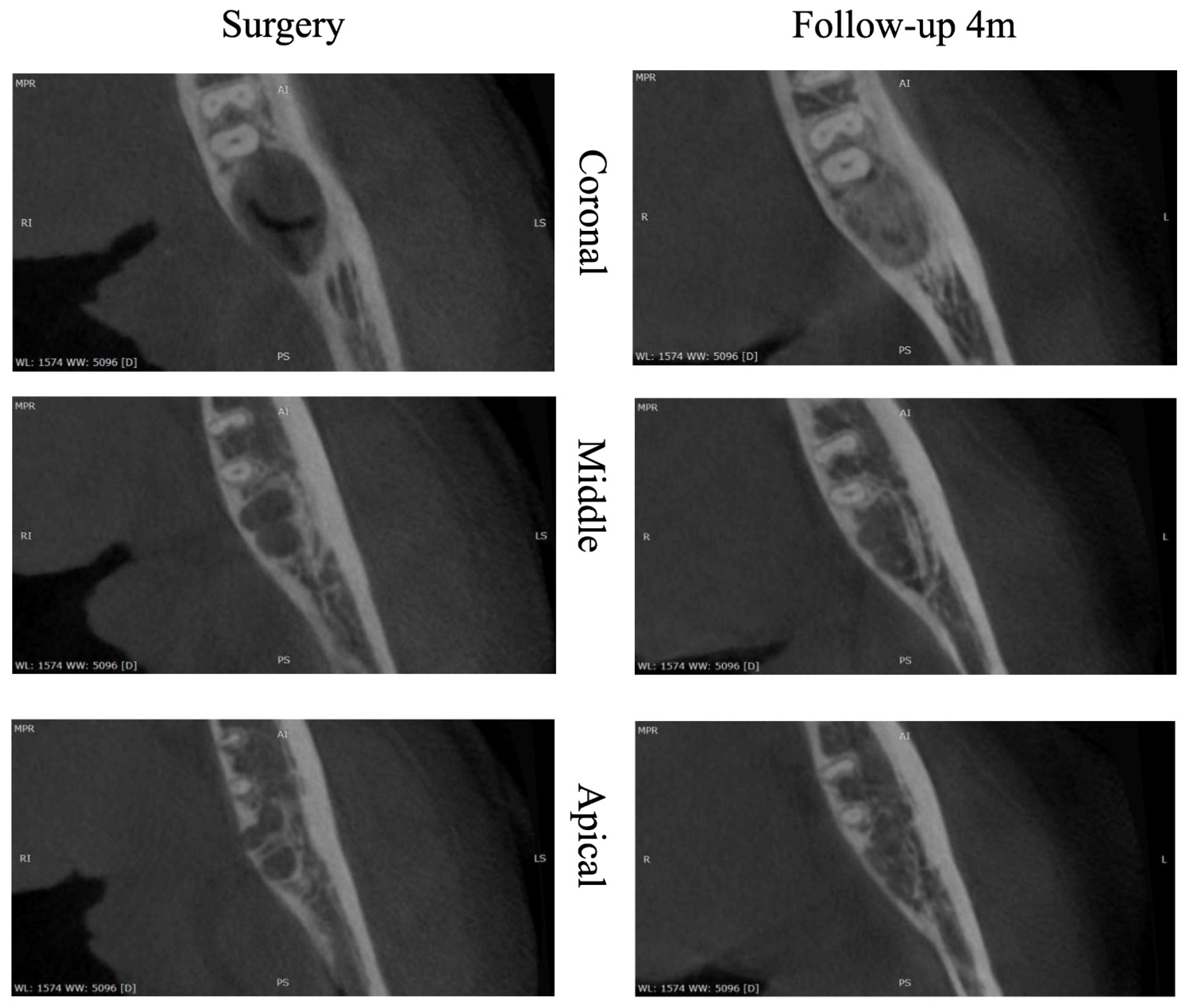
Radiological assessment of bone regeneration performed four months after surgery using CBCT-based fractal dimension (FD) analysis was used to evaluate the microarchitecture of trabecular bone within the healing extraction sockets. The reference FD value for native bone was 1.46.
Figure 2.
Comparison of patients with serum vitamin D levels below and above 25 ng/mL did not demonstrate statistically significant differences in FD values. For the apical region of the socket, the mean difference between the FD of newly formed bone and the reference bone was 0.02 ± 0.11 in patients with vitamin D levels < 25 ng/mL (n = 59) and −0.02 ± 0.10 in those with levels ≥ 25 ng/mL (n = 39) (p = 0.100).
In the middle region of the socket, the corresponding values were 0.01 ± 0.09 and 0.01 ± 0.10, respectively (p = 0.540). For the socket entrance, the mean differences were 0.08 ± 0.10 for patients with vitamin D levels < 25 ng/mL and 0.05 ± 0.09 for those with levels ≥ 25 ng/mL (p = 0.134).
Exploratory analysis using the higher vitamin D threshold (<35 ng/mL vs. ≥35 ng/mL) did not demonstrate statistically significant differences in FD values between groups, although values in the higher vitamin D group were numerically closer to those of reference bone (
Table 5).
3.6. Soft Tissue Healing
Analysis of soft tissue healing evaluated using the Early Healing Index (EHI) at 7 days after mandibular third molar extraction demonstrated no significant association between preoperative serum vitamin D levels and the degree of wound closure.
Complete wound closure was not achieved in the majority of patients regardless of their serum vitamin D concentration. Comparable distributions of EHI scores were observed in patients with vitamin D levels below and above 25 ng/mL, indicating no statistically significant differences in early soft tissue healing outcomes.
Similar findings were obtained when patients were categorized according to the higher vitamin D threshold (<35 ng/mL vs. ≥35 ng/mL), with no statistically significant differences in the rate of wound closure between the groups.
4. Discussion
The present study evaluated the potential influence of perioperative serum vitamin D levels on postoperative outcomes following mandibular third molar extraction, including pain, swelling, trismus, and bone healing. The results indicate that vitamin D status shows limited and inconsistent associations with certain aspects of postoperative recovery, with a weak association observed for early postoperative swelling, while no significant associations were observed for pain, trismus, or bone regeneration.
Postoperative pain remains one of the most common complications after surgical removal of impacted mandibular third molars and is influenced by multiple factors, including surgical trauma, duration of the procedure, and individual inflammatory response. Previous studies have shown that longer surgical procedures are associated with increased postoperative pain and slower recovery.
In our present study, however, postoperative pain did not show a significant association with perioperative serum vitamin D levels. Similar findings have been reported in the literature. Mameledzija et al., in a study involving patients undergoing mandibular third molar extraction, did not observe a relationship between serum vitamin D levels and postoperative pain intensity assessed during follow-up visits [
21]. Likewise, Oteri et al. reported that administration of a high preoperative bolus dose of vitamin D3 (300,000 IU) did not significantly reduce postoperative pain compared with placebo, although a reduction in inflammatory cytokines such as IL-1β, IL-6, and TNF-α was observed [
22]. The lack of a clear association may be partly explained by the subjective nature of pain perception, which varies substantially between individuals and may obscure subtle biological relationships [
23].
In contrast to pain, the present study showed a weak, single-time-point but statistically significant association between serum vitamin D levels and postoperative swelling along the tragus–pogonion measurement line (line C) on postoperative day 1, which corresponds to a small effect size according to recent field-specific thresholds proposed for dentistry [
24]. Lower vitamin D concentrations were associated with increased swelling in this region on postoperative day 1. However, no significant correlations were observed for the composite swelling index or for other measurement lines during later postoperative stages.
Given the significant imbalance in sex distribution between the analyzed vitamin D groups, residual confounding cannot be excluded. However, considering the relatively homogeneous population of healthy young adults, its impact on the observed outcomes is likely to be limited.
To further address potential confounding, an additional analysis was performed that adjusted for age, sex, surgery duration, bone removal, and treatment allocation. The association remained significant after adjustment, suggesting that it was not solely explained by these factors. Nevertheless, given the exploratory nature of the analysis and the small effect size, this finding should be interpreted with caution.
The available literature presents inconsistent findings regarding the relationship between vitamin D status and postoperative swelling after third molar surgery. Mameledzija et al. reported no statistically significant association between serum vitamin D concentration and postoperative swelling following mandibular third molar extraction [
21]. In contrast, Oteri et al. demonstrated that administration of a single high dose of vitamin D3 four days before surgery resulted in reduced postoperative swelling on postoperative day 6 compared with the placebo group [
22]. This effect was accompanied by a significant reduction in pro-inflammatory cytokines, suggesting that vitamin D may modulate the inflammatory response following surgical trauma.
The discrepancies between studies may partly be explained by differences in baseline vitamin D concentrations among study populations. Adequate vitamin D levels, typically considered to be approximately 36–40 ng/mL or higher, have been associated with improved periodontal tissue health, reduced inflammatory activity, and enhanced healing following oral surgical procedures [
25,
26,
27]. The average vitamin D level observed in the present cohort was lower than this range, which may explain the relatively weak association observed between vitamin D concentration and postoperative swelling.
Postoperative trismus represents another common complication after mandibular third molar extraction, typically resulting from inflammatory processes affecting the masticatory muscles. In the present study, no statistically significant association was observed between perioperative vitamin D levels and postoperative trismus measured during follow-up visits on postoperative days 1, 3, and 7. Similar observations have been reported by Mameledzija et al., who found no relationship between serum vitamin D concentration and postoperative mouth opening after third molar surgery [
21]. Likewise, Oteri et al. did not observe a statistically significant difference in postoperative mouth opening between patients receiving preoperative vitamin D supplementation and those receiving placebos [
22]. These findings suggest that although vitamin D may influence inflammatory pathways, its impact on functional postoperative outcomes, such as trismus, appears limited.
In addition to early postoperative complications, the present study evaluated bone regeneration in the extraction socket using fractal dimension analysis of CBCT images obtained 4 months after surgery. Fractal analysis is considered a reliable method for evaluating bone microarchitecture, with higher fractal dimension values indicating more complex trabecular patterns and greater bone mineral density [
28,
29]. The results of the present study showed that patients with serum vitamin D levels exceeding 35 ng/mL tended to show fractal dimension values of newly formed bone closer to those of the reference bone structure. However, these differences were not statistically significant.
These findings are in line with previous research suggesting a relationship between vitamin D status and bone microarchitecture. Korkmaz et al., using fractal analysis of panoramic radiographs, demonstrated that patients with severe vitamin D deficiency exhibited lower fractal dimension values, indicating reduced bone mineral density and increased bone porosity compared with individuals with higher vitamin D levels [
30]. Vitamin D plays a crucial role in bone metabolism by regulating calcium-phosphate homeostasis, promoting osteoblast differentiation, and influencing bone remodeling processes [
10,
31,
32]. Moreover, adequate vitamin D levels contribute to improved bone mineralization and reduced bone resorption, which may facilitate more favorable bone healing following surgical procedures [
33].
Experimental studies further support the role of vitamin D in bone regeneration. Animal studies by Hong et al. have demonstrated that vitamin D supplementation combined with calcium intake enhances bone formation and improves mineral density in extraction sockets, as confirmed by histological analyses [
34,
35]. These experimental findings suggest that maintaining sufficient vitamin D levels may support postoperative bone healing following oral surgical procedures.
Overall, the results of the present study indicate that while perioperative vitamin D levels do not appear to significantly influence postoperative pain or trismus after mandibular third molar extraction, they may contribute to certain aspects of the healing process. A weak association was observed between lower vitamin D concentrations and increased early postoperative swelling, whereas a non-significant trend toward more favorable bone microarchitecture was observed in patients with higher vitamin D levels. These findings may suggest a potential modulatory role of vitamin D in postoperative inflammation and bone regeneration. However, given the small effect size and inconsistency across outcomes, this observation should be interpreted with caution and is unlikely to reflect a clinically meaningful effect.
From a clinical perspective, these findings suggest that systemic factors, such as vitamin D status, may influence aspects of postoperative recovery and bone remodeling following oral surgical procedures. Given the high prevalence of vitamin D deficiency in the general population, assessment of vitamin D levels may represent a useful component of preoperative evaluation in patients undergoing oral surgery. Although the present results do not indicate a strong association between vitamin D levels and short-term postoperative symptoms, maintaining adequate vitamin D status may potentially support optimal bone healing and regenerative processes.
5. Limitations
Several limitations should be acknowledged. This study represents a secondary exploratory analysis of a randomized clinical trial not originally designed to assess vitamin D status; therefore, causal inference is not possible. Although an adjusted analysis was performed to account for potential confounding, residual confounding cannot be ruled out, particularly given the lack of a formal assessment of extraction difficulty using a standardized classification system.
Multiple comparisons were performed without formal correction, increasing the risk of type I error. Therefore, the observed statistically significant findings should be interpreted with caution. Only patients with complete datasets were included, potentially introducing selection bias.
Serum vitamin D levels were assessed only preoperatively, and factors such as supplementation and seasonal variation were not controlled for, which may have introduced bias. Finally, some outcome measures, including linear facial measurements and fractal dimension analysis, have inherent methodological limitations and should be interpreted with caution.







 and
and