Review

Dynamic Virtual Power Plants: Resource Coordination for Measured Inertia and Fast Frequency Services

1
School of Electrical and Data Engineering, University of Technology Sydney, Sydney, NSW 2007, Australia
2
APAC Power & Renewables Research, Wood Mackenzie, Singapore 018989, Singapore
3
School of Electrical and Computer Engineering, The University of Sydney, Sydney, NSW 2006, Australia
*
Author to whom correspondence should be addressed.
Appl. Sci. 2026, 16(8), 3731; https://doi.org/10.3390/app16083731
Submission received: 12 March 2026 / Revised: 5 April 2026 / Accepted: 8 April 2026 / Published: 10 April 2026
(This article belongs to the Section Electrical, Electronics and Communications Engineering)

Abstract

This paper reviews recent work on dynamic virtual power plants (DVPPs) using an Energy–Information–Market framework. It addresses the important problem of how DVPPs can support low-inertia power system operation and feeder-level stability under high renewable penetration. First, system-level studies on low-inertia operation and frequency control are used to frame quantitative requirements on rate of change of frequency, nadir, and quasi-steady-state limits. Second, energy-layer models are surveyed, including participation-factor-based DVPP controllers, grid-forming architectures, model-free frequency regulation, and robust frequency-constrained scheduling for allocating virtual inertia and fast frequency response (FFR) across distributed energy resource fleets. Third, information-layer and market-layer models are reviewed, covering stochastic and robust bidding, distribution locational marginal price-based clearing, peer-to-peer and community markets, privacy-preserving coordination, and emerging governance and cybersecurity schemes for DVPP participation. Across these strands, much of the literature remains centred on steady-state active and reactive power dispatch, with dynamic security enforced as constraints rather than formulated as verifiable and tradable services. This review identifies gaps in dynamic metrics and benchmarks, forecasting of available inertia and FFR capacity, market-physics co-design, multi-aggregator interaction, and experimentally validated DVPP implementations. These findings suggest that DVPPs can “sell stability” at the feeder level only through co-designed control, information, and market mechanisms and outline a research roadmap for this purpose.

1. Introduction

1.1. From VPPs to DVPPs

Over the past two decades, the share of renewable energy in the energy market has increased significantly, driven by environmental policies and global demand for clean energy [1]. However, traditional renewable energy sources often require power plants that occupy considerable areas. These renewable energy power plants, with large land requirements, exhibit low sustainability in the actual investment process, and excessive capital investment reduces the rate of return. Rather than relying solely on large, land-intensive plants, many systems now aggregate distributed energy resources (DERs) into virtual power plants (VPPs) to optimise network and market operations by coordinating generation, storage, and flexible demand at scale [1,2].
Typically, VPPs use advanced digital technologies, such as the Internet of Things, big data, and artificial intelligence (AI) or machine learning, to integrate various energy consumers, prosumers, generators, and renewable energy storage systems. Using this flexible, intelligent, distributed energy regulation method, VPPs can meet the steady state load demand and provide ancillary services to dynamically regulate the grid voltage and frequency fluctuations as well as the grid stability through optimal control of resources [3,4].
The high penetration of inverter-based renewable resources is eroding synchronous inertia and making frequency security a binding constraint in modern power systems [5]. Conventional VPPs mainly coordinate DERs for economic scheduling and static ancillary services, but they do not explicitly treat inertia and FFR as measurable, auditable products. DVPPs extend this paradigm by aggregating heterogeneous DERs into controllable grid assets that can provide inertia-like and fast frequency services at the feeder level [6,7].Compared with traditional VPPs, which mainly focus on economic dispatch, market participation, and steady-state coordination, DVPPs extend aggregation to dynamic response, multi-timescale control, and stability-oriented operation [2]. This distinction is especially important in low-inertia, high-renewable systems, where feeder-level performance depends not only on energy balancing but also on the timely delivery of virtual inertia and fast frequency response.
Recent work at the intersection of DVPP control and local transactive energy markets shows that DVPPs can coordinate inverter-based resources for fast frequency services without relying on detailed system models, directly addressing stability and real-time operability gaps in model-based and reinforcement learning (RL) methods [6,8]. In parallel, distribution-level markets and peer-to-peer (P2P) trading are evolving towards decentralised coordination with VPPs, constrained by network conditions and carbon considerations, while equity and participation are shaped by market design (e.g., shareholding mechanisms) [9].
Uncertainty remains central, primarily variability in renewable output, imperfect forecasts, and demand fluctuations, yet the key challenge for DVPPs in high renewable energy source (RES) feeders is low inertia, which accelerates frequency deviations following disturbances [4]. The first one is the uncertainty of renewable energy. As the range of renewable energy sources that can be connected to the virtual grid expands, their stochastic and periodic power outputs will introduce a certain degree of perturbation to the power grid, and there remains substantial room for improvement in day-ahead (DA) forecasting technology. The second one is the fluctuations in electricity prices. Most renewable energy sources are susceptible to external environmental factors and exhibit significant price fluctuations. Effective price forecasting can reduce losses for VPP participants. The third factor is the instability of electricity demand (load). In addition to seasonal influences, the impact of random events is significant, including major climate changes and even celebrity concerts. The close relationship with consumers exacerbates the instability of meeting demand.
Given the aforementioned issues, achieving the secure and economically efficient operation of DVPPs has become crucial [10]. While ensuring normal operation, minimising operating costs, improving efficiency, and achieving acceptable profit remain key objectives for VPPs, low-inertia distribution grids cause rapid frequency deviations after contingencies. This necessitates specifying the required levels of virtual inertia (VI) and FFR at the feeder level and how these services should be allocated across DVPP portfolios. Recent contributions propose unified frequency–security formulations that combine the rate of change of frequency (RoCoF), nadir, and quasi-steady-state constraints and connect them to online feeder-level inertia estimation [11].
Building on this strand, the present review argues that stability services (inertia/FFR) should become measurable, auditable, and tradable at the distribution level. If achieved, DVPPs will not only sell energy but also sell delivered stability, reducing curtailment and frequency control ancillary service (FCAS) uplift while aligning payments with measured RoCoF/nadir/QSS compliance.
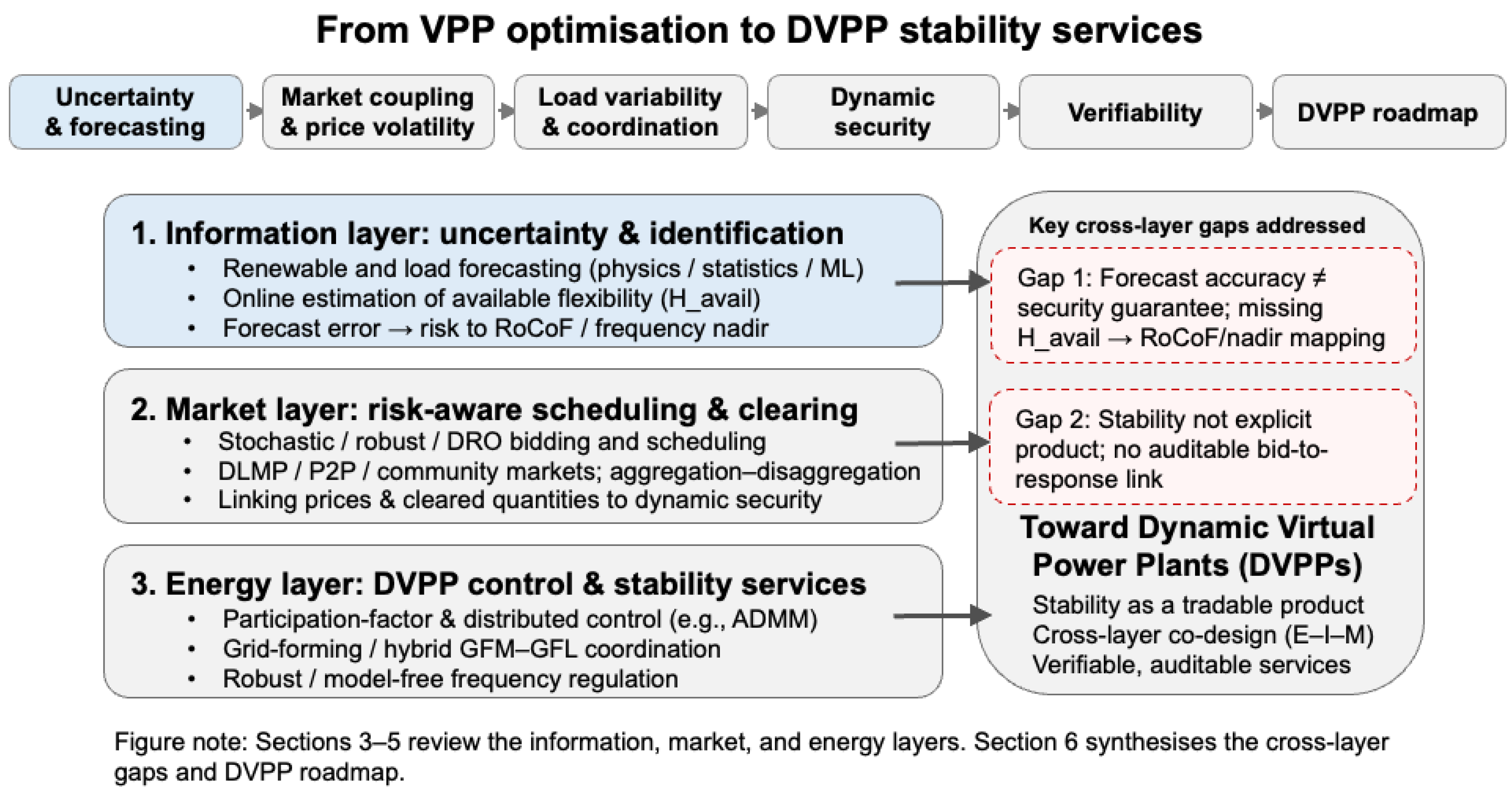
Figure 1 outlines a problem-driven roadmap linking the information, market, and energy/control layers and highlights two cross-layer gaps that motivate stability-oriented DVPP design. As shown in Figure 1, these gaps are as follows: (i) the missing link between estimated available flexibility/inertia and measurable security outcomes (RoCoF/nadir) and (ii) the absence of explicit, auditable market products that ensure bid-to-response traceability for delivered stability. These gaps motivate a DVPP roadmap in which stability is a measurable, verifiable, and tradable service enabled by cross-layer co-design. This leads to the central question of this review: How can local, behaviour-aware transactive market and coordination mechanisms be co-designed with DVPP control so that distribution-level frequency–security needs (e.g., inertia/FFR) are met while ensuring equity, privacy, and practical deployability?

1.2. Brief Statistics of Related Publications

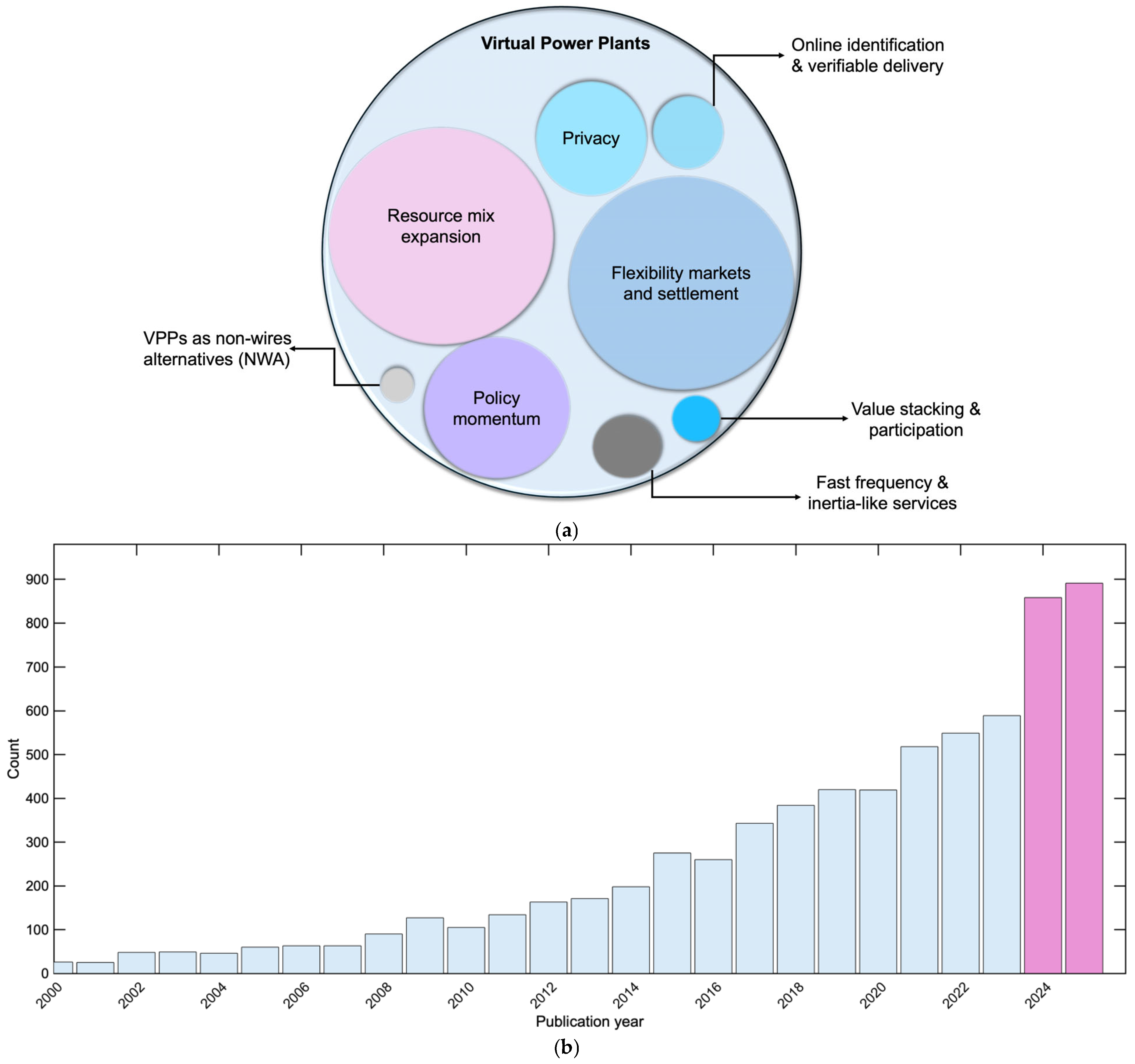
Figure 2 provides a snapshot of this review’s bibliometric scope and the drivers that motivate the structure of this paper. Specifically, Figure 2a summarises the main drivers shaping the VPP/DVPP research landscape (e.g., resource-mix expansion, flexibility markets and settlement, policy momentum, and privacy/governance), while Figure 2b reports the annual number of VPP-related publications returned by our search (2000–2025), highlighting the sharp increase in recent years.
This review spans 2015–2025 and targets four thematic areas: (i) control and stability under high IBR penetration, (ii) market participation and bidding, (iii) coordination and governance with Distribution System Operators (DSOs)/aggregators/communities, and (iv) dynamic organisation of flexible resources (aggregation/disaggregation, dynamic participation).
Various information sources were explored using the following search strategy. Records were retrieved from Scopus, Web of Science, IEEE Xplore, ACM Digital Library, arXiv, selected publisher portals (Elsevier, Springer, IET, MDPI), and grey literature sources, including AEMO, ENA, NREL, Ofgem, and university white papers (e.g., University of Melbourne grid-needs studies).
Figure 2 illustrates research drivers and publication trends in VPP and flexibility-market studies. The upper panel presents a conceptual “bubble map” of the VPP/DVPP research space, where the size of each bubble qualitatively reflects the prominence of key drivers such as resource-mix expansion, flexibility markets and settlement, privacy, and policy momentum within the overall virtual power plant domain. The lower panel shows the annual number of publications returned by our bibliometric search from 2000 to 2025; the light bars indicate earlier work, while the highlighted bars for 2023–2025 emphasise the recent surge of interest in VPPs and flexibility-oriented market design.

1.3. Paper Organization

This paper reviews recent developments in DVPP-oriented Energy-Information-Market (E-I-M) design. Section 2 describes this three-layer framework, information-layer forecasting, and online identification. Section 3 reviews the price volatility and bidding strategies under uncertainty. Section 4 investigates the operational coordination for VPPs and DVPPs under load variability. Section 5 reviews the energy-layer control and scheduling for virtual inertia (VI) and FFR. Building on this review, Section 6 synthesises the results into a structured gap map. In addition to organising the literature by Energy–Information-Market layers, this review compares representative approaches to forecasting, coordination, and control, highlighting their limitations, applicability, and practical trade-offs. The literature indicates shortfalls in the following:
  • validated market-physics closed loops that link bidding strategies to grid-forming (GFM) and DVPP dynamics under grid-code constraints;
  • scalable, privacy-preserving coordination across multiple aggregators;
  • incentive-compatible dynamic participation and resource selection mechanisms that respect network limits;
  • resilience and cybersecurity for large fleets of controllable devices; and
  • power hardware-in-the-loop (PHIL) and field pilots in which DVPPs deliver FCAS/FFR products in realistic networks.
The concluding section summarises these gaps and outlines a research agenda for feeder-level DVPPs that “sell stability” in future distribution markets.
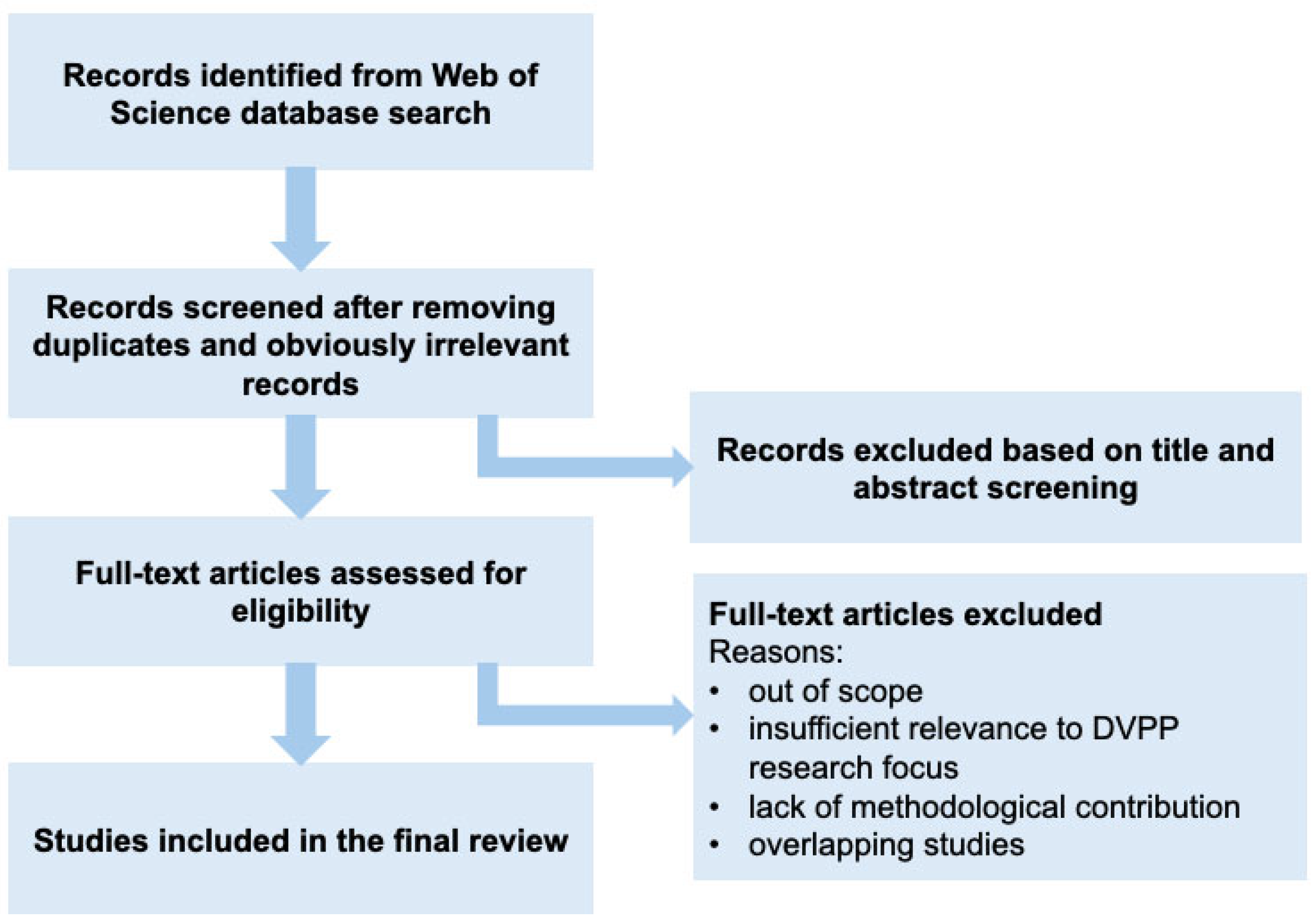
To improve the transparency of the review methodology, Figure 3 presents a simplified version of the literature identification and screening process adopted in this work. Relevant studies were identified through database search and tracing of related sources, followed by title/abstract screening and full-text assessment. Final inclusion was based on thematic relevance to DVPP coordination, control, and market-oriented operation.

2. The E-I-M Framework of DVPPs

2.1. The E-I-M Framework

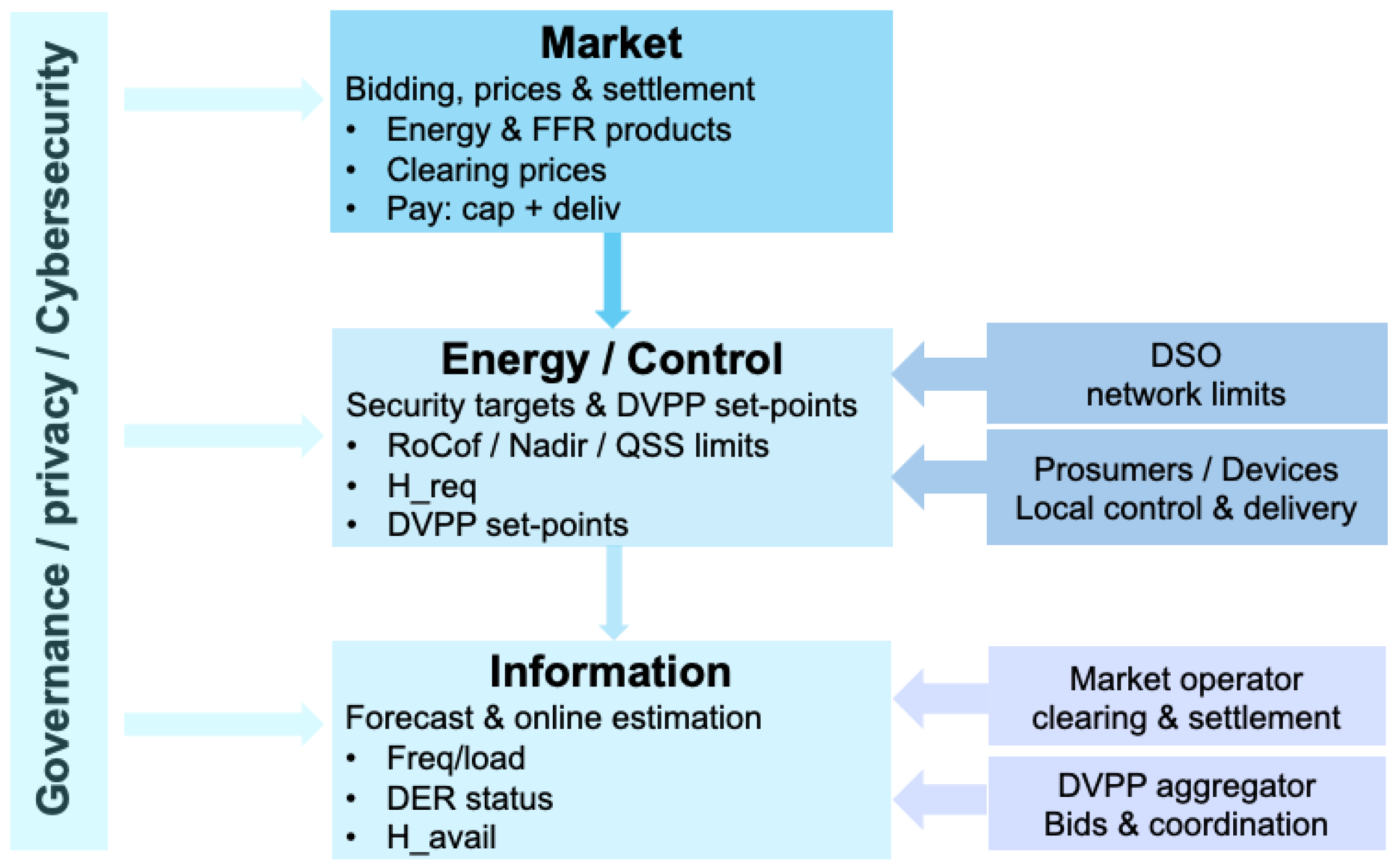
This review adopts an E-I-M lens to frame VPPs as cyber-physical-market systems, where physical-layer scheduling and control interact with communication/data governance and strategic coordination [3]. Building on this E-I-M lens, Section 2 is organised into five thematic blocks, covering renewable uncertainty, price volatility, demand variability and coordination, DVPP-based inertia/FFR, and device-fleet cybersecurity and governance. Across these themes, we discuss the key trade-offs among robustness, economic efficiency, scalability, and privacy. As shown in Figure 4, the proposed E-I-M framework positions online identification of available inertia in the information layer, linking inertia requirements to DVPP set-points and market settlement.
Figure 4 illustrates the E-I-M framework for feeder-level DVPP inertia and FFR. The diagram organises DVPP operation into three vertically coupled layers. At the information layer, forecasts and online measurements of frequency, load, and DER status are used to estimate the available inertia and fast-frequency capacity. These estimates are then passed to the energy/control layer, which translates system-level security requirements for RoCoF, nadir, and quasi-steady-state deviations into required inertia envelopes, inertia requirements, and DVPP set-points for aggregated devices. The resulting capabilities and response targets are further communicated to the market layer, where energy and FFR products are cleared, prices are determined, and payments are settled based on contracted capacity and delivered response. DSOs, prosumers/devices, market operators, and DVPP aggregators interact with the three layers through network limits, local control actions, and bidding/settlement processes. Governance, privacy, and cybersecurity act as cross-layer constraints on data exchange, control actions, and market transactions, while the feedback loop from market outcomes to the information layer updates future forecasts and DVPP scheduling.
From an implementation perspective, this interaction operates as a rolling pathway: the information layer first updates forecasts, measurements, and available inertia/FFR capability; the energy/control layer then converts these estimates into device-level set-points and security-constrained response targets; and the market layer finally clears products and settles payments based on contracted and delivered services. This sequence is repeated across multiple timescales, so that updated measurements, realised response, and market outcomes continuously reshape subsequent estimation, control, and coordination decisions.

2.2. Information Layer: Forecasts and Online Identification of Available Inertia

The high penetration of weather-driven renewables makes information quality as critical as physical flexibility. For DVPPs, forecast errors directly translate into mis-scheduled inertia and fast frequency reserves: underestimation of ramps leads to RoCoF and nadir violations, while conservative forecasting inflates reserve costs and erodes DER profits. Existing work on renewable forecasting can be grouped into four method families: physical, statistical, data-driven, and hybrid models [9,12,13,14,15,16,17,18,19], but most studies optimise RMSE or MAE rather than their impact on dynamic security margins.
Physical models are mostly based on numerical weather prediction (NWP), sometimes combined with error-factor or ensemble post-processing to improve multi-step wind forecasts [13,14]. These pipelines are well-suited for day-ahead or multi-hour horizons. Yet, their computational burden and sensitivity to input uncertainty make real-time DVPP redispatch challenging in weak distribution grids.
Statistical models treat renewable generation as a stochastic time series and infer dependencies from historical data. Typical approaches include Kalman filtering for post-processing NWP forecasts [14], sparse Bayesian functional regression for wind [15], and linear/nonlinear autoregressive models for short-term wind speed prediction [16]. Variational Bayesian adaptive multi-kernel regression extends this line of work by providing both deterministic and probabilistic wind power forecasts and explicitly modelling forecast errors [9,19]. These methods are cheap to update online and effective for short-term horizons, but they rely on relatively simple structures. They may struggle with non-stationarities and regime shifts in high-RES feeders.
Data-driven and hybrid models exploit recent advances in deep learning and feature selection. A comprehensive review in [12] shows that convolutional, recurrent, and attention-based networks consistently outperform classical baselines on a range of renewable forecasting tasks. For photovoltaics, generative adversarial networks combined with CNN-based weather classification improve day-ahead PV forecasts [17]. Hybrid approaches further combine optimisation, signal processing, and deep learning, as illustrated by feature-selection and LSTM-based frameworks for short-term wind speed prediction [18]. As summarised in Table 1, such models deliver higher accuracy and better feature extraction at the cost of heavy data requirements, training complexity, and limited interpretability.
Table 1. DVPP forecasting method families and risk implications.
MethodAdvantages DisadvantagesMapping to Estimation ErrorsMapping to Dynamic Security Risk
Physical methodsSuitable for predicting within the regular operating rangeLimited short-term accuracy under rapidly changing conditionsSensitive to model mismatch and parameter uncertaintyMay reduce responsiveness under abrupt disturbances
Statistical modelsWide applicability, easy to obtain, capable of processing data trends, and avoiding overfittingNot applicable to nonlinear structures, it is difficult to determine the optimal solutionMay show bias under transient or nonlinear operating changesMay affect the security-margin assessment in fast events
Machine learning methodsGood adaptability and suitable for nonlinear mappingDepends on feature quality and training-data coverageCan reduce error, but may suffer from generalisation biasMay improve risk awareness, but unstable under unseen conditions
Deep learning methodsStrong representation ability for complex patternsData-hungry and less interpretableOften has lower error in complex conditions, but is sensitive to data distribution shiftIt can support faster pattern recognition, but poor robustness may affect security assessment
Hybrid
methods
Effectively make up for the deficiency of a single modelHigh complexity and requires extensive programming and data trainingCan improve robustness and reduce estimation biasBetter supports security-oriented decisions, though integration uncertainty remains

3. Price Volatility and VPP/DVPP Bidding Under Uncertainty

3.1. Uncertainty Exposure and Risk in VPP/DVPP Bidding

For DVPP operation, the forecasting families summarised in Table 1 imply different risk profiles, because their error characteristics and update capability determine how inertia and fast reserves are scheduled and delivered. NWP-based pipelines enable look-ahead scheduling of virtual inertia and FFR capacities but must be buffered by risk-aware reserves to mitigate the effects of model misspecification. Purely statistical models are attractive for feeder-level rolling updates but require explicit mechanisms such as probabilistic forecasts or CVaR-based reserve sizing to avoid systematic under or overestimation of available inertia. Machine learning methods can improve the nonlinear mapping from operating conditions to available support capability, though their performance depends on feature quality and the coverage of the training data. Deep learning and hybrid schemes are promising for fusing meteorological, SCADA, and market data [12,17,18], but their black-box nature complicates the mapping from forecast confidence to secure frequency bands. Very few works close this loop from forecast error to dynamic requirements, i.e., translating distributional information about RES and load into explicit bounds on RoCoF, nadir, and steady-state deviations. Filling this gap is essential for DVPPs that aim to sell verifiable inertia and fast frequency products rather than raw energy alone.
Forecast errors, especially when correlated across RES output and load, translate directly into market risk by widening the distribution of imbalance costs and reserve shortfalls. Risk-aware scheduling frameworks demonstrate how such correlations can be embedded into tractable formulations that co-optimise energy and reserves, reducing operational risk without excessive over-provisioning; for DVPPs, the key implication is that correlated forecast uncertainty should map to explicit bidding constraints rather than being treated as a post-clearing adjustment [20]. Under high RES penetration, reduced synchronous inertia further amplifies the frequency consequences of forecast-driven imbalances, strengthening the case for DVPP bids to be backed by fast, verifiable flexibility. Demand-side power-electronic resources such as hydrogen electrolysers have been discussed as candidates for such flexibility, but their effectiveness is bound by process delays and thermal limits, reinforcing that “risk buffers” in bidding must reflect physically deliverable response, not just contracted intent [21].

3.2. Hedging Mechanisms: Demand Response (DR), P2P, and Shared Storage

To mitigate price volatility and forecast uncertainty, demand-side hedging is increasingly framed as making flexibility both tradable and operationally feasible through P2P/DR exchanges, shared storage incentives, robust bidding with internal coordination, portfolio-aware aggregation, and explicit flexibility budgeting.
P2P designs combined with demand–response coordination show how forecast errors from PV and wind generation can be absorbed on the demand side. Kang Wang et al. (2024) embedded P2P transactions within a demand–response exchange so independent load aggregators can trade flexible demand in near real time; an electricity–gas cross-price elasticity matrix converted RES uncertainty into controllable load shifts, while consensus-based alternating direction method of multipliers (ADMM) clearing preserved privacy and reduced reliance on point forecasts [22]. Shared energy storage provided a complementary hedge by pooling flexibility, aligning incentives, and improving regulation accuracy. Zhang et al. (2023) [23] coupled joint energy–regulation bidding with a two-part shared energy storage (SES) leasing mechanism, combining a day-ahead leasing/bidding component with real-time RES–SES coordination. They allocated cooperative gains using ISV-MDA (Shapley value with minimum-deviation adjustment), accounting for forecasting accuracy as well as each participant’s marginal contribution and irreplaceability [23].
Robust bidding frameworks further emphasise that hedging must remain feasible under uncertainty and internal strategic interaction. Wanying Li et al. (2025) propose a Wasserstein-based distributionally robust model in which upper-level bids to day-ahead spot and peaking ancillary-service markets are backed by a lower-level leader–follower game among dispatchable distributed generators, flexible loads, and storage; sensitivities identify wind uncertainty as the dominant driver of profit volatility, a storage-cost threshold around 200–300 CNY/MWh, and asymmetric profit responses to ±15% price swings (≈+29%/−39%) [24]. Hedging can also start upstream via portfolio-aware aggregation. Choi, Seo, and Kim (2025) treat planning as a portfolio-variance problem and show that heterogeneous mixes (e.g., wind+PV+storage) reduce aggregate variability and raise revenues by ~8% under independent system operator imbalance settlement [25].
Finally, flexibility-oriented multi-carrier scheduling under deep uncertainty explicitly prices and constrains flexibility. Dorahaki (2025) combines probabilistic scenarios with information-gap decision theory and ε-constraint optimisation, enabling the community to sell upward/downward regulation; higher flexibility prices cut the operating cost (≈3% at low needs and up to ≈30% at high needs), with P2G-H2 coordination critical to savings [26]. This motivates Section 3.3, which shifts from hedging mechanisms to robust, data-driven, and network-constrained tools for producing executable bids.

3.3. From Risk Models to Market-Clearing: Robust and Network-Constrained Bidding

In electricity markets, VPP integration provides a practical way to aggregate dispersed DERs and make their participation compatible with unit commitment and start-up/shut-down-driven scheduling. To handle uncertainty and market exposure, the literature commonly adopts stochastic or probabilistic formulations, often paired with steady-state network models, to produce implementable day-ahead schedules with real-time adjustments [27]. A representative direction is two-stage stochastic energy management, which co-optimises multi-objective DER operation while balancing expected profit against operational burdens such as excessive cycling or redispatch [28]. Building on this, risk-constrained stochastic bidding frameworks extend the decision space to coupled markets (day-ahead, real-time, and reserves), explicitly accounting for backup capacity from both supply and demand sides to improve profit robustness under uncertainty [29].
Beyond uncertainty, another recurring barrier is the difficulty of coordinating load without strong behavioural assumptions. Demand-response schemes that avoid explicit price elasticity and heavy demand forecasting offer an engineering-friendly alternative: they rank candidate load profiles by consumer preference and implement DR through ordered selection, while incorporating fair billing and performance tracking to improve participation and accountability [30].
In parallel, deployability depends critically on information asymmetry and privacy. Interface-based aggregation-disaggregation architectures address this by allowing the network operator to share only representative, non-topology-revealing grid information, while the VPP iteratively learns a correctable aggregate flexibility cost function in a day-ahead/real-time loop. In this way, network constraints such as voltages and line flows can be respected implicitly without full topology disclosure, reducing communication and computational burden compared with centralised bilevel coordination [31].
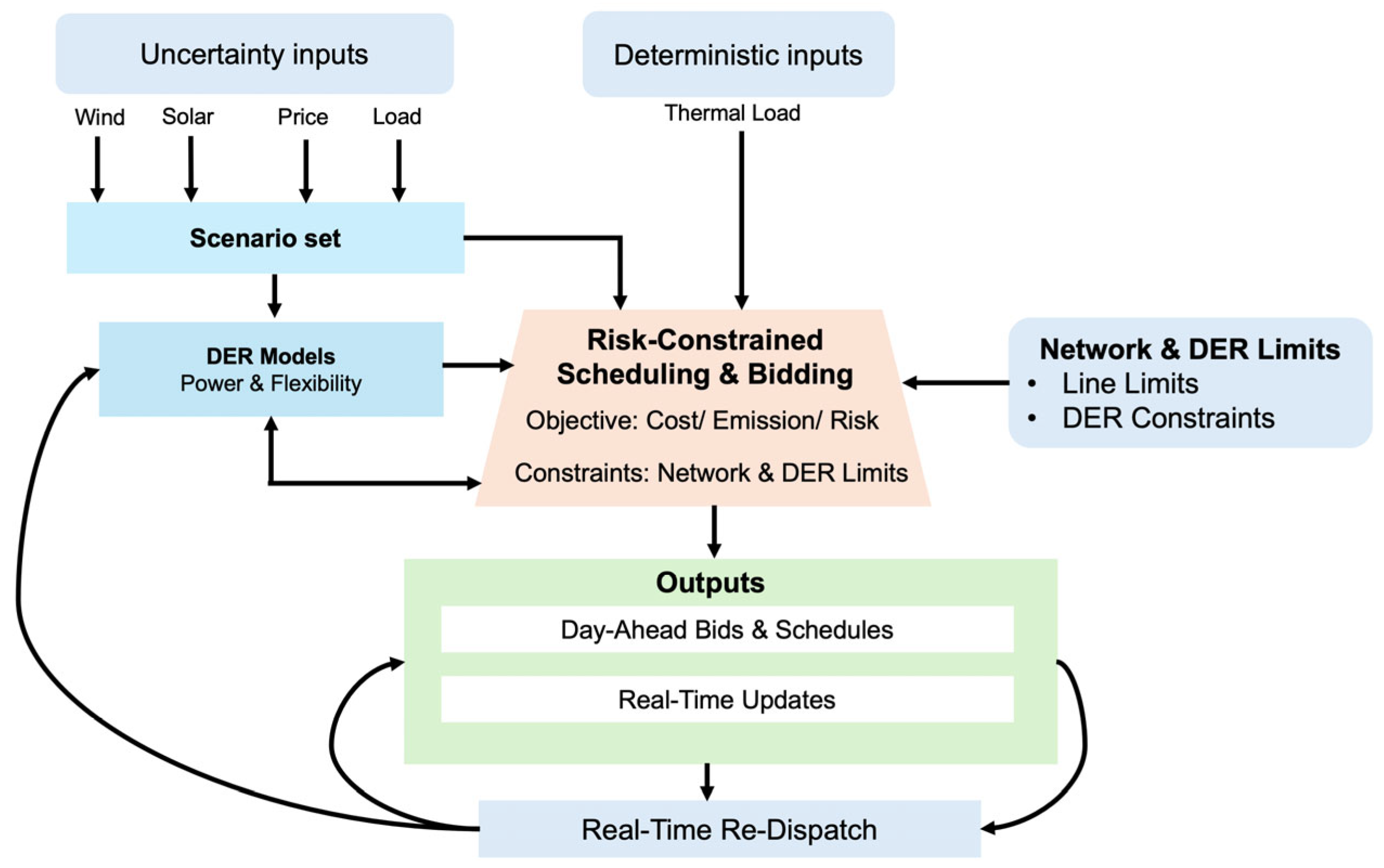
To make the above stochastic and risk-constrained formulations implementable, many studies follow an end-to-end workflow that links uncertainty modelling, network-constrained feasibility, and market decision layers. Figure 5 provides a representative abstraction of this workflow, illustrating how probabilistic inputs and operational constraints are integrated to generate day-ahead bids and schedules with real-time corrections [28].
Regarding model-free VPP aggregation via an input-convex neural network (ICNN), Lin et al. (2025) replaced geometry-based feasible-set models with an ICNN surrogate trained on historical net load, dispatch, and feasibility labels [32]. The convex surrogate can be embedded in transmission-level scheduling as a linear program via epigraph relaxation, reducing reliance on binary variables and cutting-plane solves, and it is validated on IEEE 33-bus and 136-bus distribution feeders. Although promising, the current ICNN formulation is essentially deterministic, and its out-of-sample reliability depends on the coverage and representativeness of the training data. It also abstracts away three-phase or unbalanced distribution-network physics and does not yet incorporate dynamic security requirements such as voltage dynamics, inertia, or fast frequency response. As a result, the learned feasibility boundary may not directly translate into deliverable stability services. For DVPP studies, the ICNN surrogate can nevertheless serve as a data-driven feasibility layer at the market-network interface: upstream it constrains bidding and scheduling decisions, while downstream it can be coupled with stability-oriented modules to map feasible operating points to VI/FFR sizing and allocation [7].
Price volatility and uncertainty are increasingly treated as joint drivers of DVPP scheduling and bidding design, pushing the literature towards robust, data-driven risk internalisation. Robust multi-carrier community models show that bounding upstream electricity prices and co-optimising coupled carriers (electricity-heat-gas-water) can preserve feasibility under adverse price scenarios while still pursuing self-sufficiency and environmental targets, offering a reusable template for DVPPs to hedge market swings via conservative yet feasible flexibility bids rather than point-forecast arbitrage [33]. Complementing this worst-case lens, interval-robust and data-driven bidding frameworks learn correlated price uncertainty sets from historical data and embed them into two-stage bidding and recourse models, improving cost stability and reducing volatility through tunable robustness budgets; this line provides a practical bridge from price uncertainty to deployable market bids under correlated PV/EV uncertainties [34].
In parallel, network constraints and privacy considerations are being embedded more explicitly into transactive coordination, shifting attention from price-only coordination to feasibility-aware market signals. Cooperative multi-VPP designs that integrate transactive energy or distribution locational marginal pricing (DLMP) signals with decentralised execution demonstrate that market incentives can be aligned with voltage security when learning-based or distributed controllers internalise grid constraints, improving revenue while maintaining voltage compliance across test feeders [35]. Related bilevel DSO-prosumer market designs price the marginal network stress of each trade, for example via a risk price, while allowing prosumers to clear transactions privately, enabling decentralised yet controlled clearing that internalises congestion and voltage risk without full data disclosure [36]. At a broader system level, ADN-style coordination frameworks connect multiple network-constrained VPPs with P2P energy, and sometimes carbon trading, using privacy-preserving clearing mechanisms such as price–quota curves and MILP reformulations to jointly price services while respecting distribution limits, moving towards scalable and market-compatible coordination beyond DSO-only dispatch [37].
Taken together, these works suggest a coherent design direction: volatility-aware DVPP operation needs (i) tractable risk internalisation in scheduling and bidding through robust or data-driven uncertainty sets and (ii) transactive coordination mechanisms whose price signals remain grid-feasible and privacy-compatible, so that commitments made under price uncertainty translate into deliverable actions under distribution constraints [33,34,35,36,37].

4. Operational Coordination for DVPPs Under Load Variability

Operational coordination for DVPPs under load variability requires aligning device-level flexibility with network limits and market timing. In practice, operators must co-schedule energy and services while coping with uncertain demand and incomplete information across DSO-aggregator-market interfaces. To make the design space explicit, we compare representative coordination schemes across network treatment, uncertainty handling, information exchange, timescale, and expected outcomes.

4.1. Coordination Schemes and Network-Aware Market Interfaces

Table 2 summarises representative coordination schemes for VPP and DVPP operation under load variability, focusing on how network constraints, uncertainty, and information exchange are handled across DSO-aggregator-market interfaces. The listed approaches span centralised DLMP-based clearing, P2P-embedded distribution operation, platform-based market designs, and decentralised coordination schemes, thereby highlighting trade-offs between feasibility guarantees, communication burden, and scalability.
Overall, most existing coordination models focus on economic efficiency and steady-state feasibility, while dynamic security services are rarely treated explicitly. This gap motivates the DVPP perspective presented later in this paper, in which coordination must be extended to support verifiable inertia and fast frequency services.
For day-ahead operation, probabilistic and stochastic scheduling models have become a common way to represent demand uncertainty and support VPP bidding and self-scheduling. Baringo et al. (2019) [38] formulated VPP self-scheduling as a profit- and reserve-maximisation problem under uncertainty, using stochastic adaptive robust optimisation together with scenario-based and adaptive steady-state scheduling. This method effectively incorporates reserve trading in the electricity market into the VPP self-scheduling process [38].
Zou and Xu (2024) [39] proposed a multi-timescale market framework that enables inverter-based DERs to provide reactive-power ancillary services (voltage support) in distribution networks alongside P2P energy trading. In the day-ahead stage, a two-stage robust optimisation procures reactive-power (Var) reserves under demand and market uncertainties. In the hour-ahead stage, bilateral Var-support transactions are cleared through a non-cooperative game between the DSO and DER owners, solved as a generalised Nash equilibrium via ADMM. The model includes realistic inverter costs (efficiency loss, additional losses, and lifetime degradation) and explicitly addresses market-power mitigation by locking resources through forward contracts. Case studies show improved voltage security, fairer compensation for DER providers, and higher overall market efficiency [39].
Table 2. Coordination schemes for DVPP operations in the distribution network.
Scheme (One-Liner)Network TreatmentUncertaintyInfo Exchange
(DSO–Agg–MO)
TimescaleTypical OutcomeAuthors (Year) [#]
DLMP-based centralised clearing (DSO runs OPF a; aggregators bid)DLMP with T&D b coordination; interpretable price componentsRobust/uncertainty-aware at DSO/TSO cDLMPs published; aggregators submit capability/price bids5–15 minFeasible dispatch; location-aware pricesZhao et al. (2022) [40]
P2P embedded in distribution ops (coordinated DSO-prosumer)Physical power flow + P2P; DSO-cooperated schedulingDeterministic short horizon (extendable)Aggregated trades; privacy-preserving coordination15–60 minLower system cost; feasible P2P under constraintsSheng et al. (2022) [41]
Bilevel market with demand elasticityTwo-layer game: upper pricing, lower agentsPrice/load elasticity scenariosPrices broadcast; agents best respond15–60 minSmooths volatility; captures strategic behaviourWu et al. (2024) [42]
Co-participation: community P2P + system AS (MEVPP mediator)Community trades + AS clearing; device constraints respectedDeterministic DA (extendable to robust/rolling)Mediator coordinates offers; market rules enforcedDay-aheadLower prosumer cost; viable operator profitLi et al. (2025) [43]
Distributed platform microstructures (DA/CDA/PCDA on DLT)Linearised feeder constraints; smart-contract settlementEconomic stress tests (clearing freq/gas fees)Smart-contract auctions; variable clearing frequency5–60 minPCDA best cost-performance; trade-offs vs CDA/DAGalici et al. (2025) [44]
Platform pricing and deployment for P2P-VPPsMarket-interface design (two-part tariffs)Sensitivity to adoption/imbalanceOperator sets tariffs; prosumers choose platformsWeeks-monthsHigher adoption/profit with a two-part tariffZeng et al. (2023) [45]
Non-iterative decentralised coordination (single-shot clear)Linearised distribution limits; network reductionReplaces iterative ADMM with model substitutionOne-shot clear using pre-computed responses5–15 minBig comm/compute savings; feasible dispatchXia et al. (2023) [46]
a—OPF, optimal power flow; b—T&D, transmission and distribution; c—TSO, transmission system operator; [#] indicates the reference number in the bibliography.

4.2. Dynamic Aggregation, Incentive-Compatible Coordination, and Flexible Resources

The literature increasingly treats market coordination under volatile demand as a capability-to-commitment alignment problem. The key is to translate a large, heterogeneous flexibility pool into executable dispatch that remains feasible under uncertainty and strategic behaviour. Along the aggregation-to-execution axis, task-aware selection and provable coordination provide a clear engineering route. In particular, submodular resource selection followed by constrained coordination can scale to very large fleets while retaining performance guarantees, thereby reducing peak-time mismatches, congestion, and imbalance exposure in local markets [47]. In parallel, operational evidence from controllable demand aggregation (e.g., base-station loads coupled with BESS) shows that incentive-compatible cooperation can jointly improve system-level cost and participant profit, stabilising dispatch outcomes under RES/load uncertainty [48]. Together, these studies support a pragmatic design principle: market signals should be grounded in verifiable, dispatchable capability—not only in bids or forecasts [47,48].
A complementary line of work focuses on competition, admission, and risk as core coordination variables. Rather than assuming a fixed coalition, stochastic bilevel formulations explicitly co-optimise bidding, coalition formation, and operation while managing tail-risk (e.g., CVaR), offering a structured way to align competitive behaviour with coordinated dispatch and to mitigate imbalance penalties and congestion when load/RES volatility and price swings interact [49]. This perspective also suggests that coalition admission can be treated as a practical extension of internal priority rules in DVPP coordination [49].
A third strand expands coordination beyond “energy-only” decisions by incorporating social/behavioural objectives and asset sustainability into the market layer. KPI-driven value-creation frameworks provide a mechanism to convert preference uncertainty, information asymmetry, and fairness concerns into operationally meaningful targets (e.g., DR triggering thresholds, priority rules, compensation), improving predictability and participation stability through feedback loops [50]. Meanwhile, lifecycle-aware bilevel coordination that internalises battery degradation costs into pricing and dispatch argues that durable participation requires economically fair incentives consistent with physical wear constraints, rather than ex-post penalties that distort bidding under volatility [43]. In light of this evidence, this review argues that equity, participation, and degradation must be integrated into coordination design from the outset to support deployable mechanisms, rather than being appended later [43,50].
Finally, the flexibility portfolio itself is being broadened to include multi-service and spatially adaptive resources. Routing-aware scheduling of mobile energy storage (MES) illustrates how mobility can turn local congestion and demand instability into tradable, location-specific services co-cleared with energy and regulation, improving curtailment outcomes and grid-support capability relative to energy-only baselines [51]. This complements the above coordination mechanisms by enlarging the set of controllable degrees of freedom available to local markets.
From a design perspective, the literature suggests that deployable DVPP coordination under volatility must combine feasibility-guaranteed aggregation, stable incentive alignment under strategic interaction, and multi-objective pricing/dispatch that embeds behavioural and lifecycle considerations; mobile storage further strengthens controllability by providing spatially adaptive flexibility [43,47,48,49,50,51].

4.3. Learning-Based, Game-Theoretic, and P2P-Embedded DVPP Coordination

Recent DVPP coordination research is moving beyond energy-only scheduling towards market–control co-design. This shift aims to handle network constraints, strategic behaviour, and privacy/governance. A recurring observation is that market coordination alone is insufficient to guarantee distribution-feeder feasibility in the presence of rapid DER fluctuations and local trading. This limitation makes learning-enabled operational controllers a practical complement. By embedding feeder topology into control policies, graph-based RL for Volt-Var control can improve robustness to missing measurements and topology errors and can scale more naturally from small feeders to larger systems, thereby helping maintain voltage feasibility as market interactions evolve [52].
Parallel efforts emphasise that “coordination quality” should be judged against both welfare and security, rather than cost alone. Multi-objective scheduling tools for customer-side BESS show that purely economic operation can increase voltage variance if left uncoordinated, while Pareto-based coordination and network validation are needed to balance user benefit and grid performance [53]. Bilevel DSO-VPP designs with nodal pricing further suggest that co-optimising active and reactive services, especially with EV/V2G participation, can reduce operating costs while improving voltage/flow security, implying that reactive support should be incentivised and scheduled rather than treated as an after-the-fact technical add-on [54].
For P2P-embedded coordination, practical deployability depends heavily on market microstructure and platform overheads. Comparative studies of auction-based designs implemented on distributed platforms indicate that no single clearing mechanism dominates; more frequent clearing can improve efficiency but may be limited by transaction overheads, scalability, and privacy constraints [44]. Platform pricing and adoption models also show that tariff structure can materially affect participation and operator incentives, which in turn shape whether a P2P-VPP model can scale beyond pilot deployments [45]. To further reduce communication and computational burden, non-iterative clearing approaches aim to replace iterative exchanges with single-shot solutions while retaining network feasibility, highlighting a broader trend towards coordination designs that are implementable at scale rather than purely optimal in theory [46].
A representative example of learning-based decentralised coordination is provided by Qiu et al. (2022) [55], who propose a mean-field multi-agent RL scheme (S2DDPG) for P2P multi-energy trading formulated as a Dec-POMDP. Agents learn bids solely from public market signals, thereby preserving privacy and avoiding the need for full-system models. Mean-field approximation and parameter sharing stabilise training and keep computational complexity near linear in the number of prosumers. In a 100-prosumer case, the policy reduces energy costs (≈20–25% vs. ZIP) and outperforms MADDPG/MAAC under partial observability. For DVPPs, this offers a non-iterative, model-free market layer that coordinates heterogeneous DERs without heavy data exchange, complementing robust pricing and uncertainty handling [55].
Another relevant direction is P2P-AS coordination via an MEVPP mediator. Li et al. (2025) [56] propose a day-ahead scheduling framework in which a multi-energy VPP (MEVPP) mediates between P2P trades within a community and ancillary services at the system level. A Nash game is set up between prosumers and the MEVPP. The model integrates detailed device constraints and market rules and shows lower prosumer costs (by up to 35–40%) and positive MEVPP profits, indicating a workable balance between local welfare and system services. Compared with energy-only P2P, the co-participation design improves utilisation of storage/CHP and increases overall efficiency. For DVPP contexts, the mechanism is a market-layer coordinator that aligns local trades with system-service obligations without centralising private data. Limitations include a deterministic day-ahead focus and limited treatment of uncertainty/fairness, which can be addressed by adding robust/rolling optimisation and equity-aware settlement [56]. These coordination schemes also make clear that future DVPP operation must address how multiple DVPPs or aggregators can coexist, compete, and collaborate within the same feeder or local market. Most current coordination models implicitly assume a single aggregator or mediator, whereas practical deployments are more likely to involve multiple DVPPs competing for local flexibility, price opportunities, and limited network headroom [37,42]. In such settings, coordination is no longer only a question of prosumer-level bidding or internal scheduling, but also of inter-DVPP coexistence, competition, and possible collaboration [35]. This points to a need for multi-DVPP coordination mechanisms based on game-theoretic equilibria, platform-mediated clearing, coalition formation, or distributed optimsation with privacy-preserving information exchange, so that multiple DVPPs can remain simultaneously market-feasible, feeder-feasible, and incentive-compatible [41,44,46].
Uncertainty and behaviour are increasingly treated as decision-coupled problems rather than standalone forecasting tasks. Probabilistic demand forecasting pipelines can quantify distributional uncertainty and support risk-aware coordination during extreme events [51], but their value is realised only when linked to scheduling and adjustment mechanisms, such as two-stage or rolling frameworks, that respond to intraday deviations [57]. Game-theoretic models provide another route to internalise behavioural responses by treating demand instability as a price–behaviour interaction, enabling coordination that adapts through market signals rather than relying solely on centralised dispatch [42].
Figure 6 provides a schematic summary of a learning-based probabilistic forecasting workflow used in uncertainty-aware DVPP coordination.
The workflow consists of data collection, feature processing, probabilistic modelling, and performance evaluation. Similar workflows are widely used in uncertainty-aware demand forecasting and data-driven energy studies, where probabilistic models such as Gaussian process regression and nonparametric density estimation are used to characterise predictive distributions rather than point forecasts [4,12,58].
Finally, recent contributions make equity, privacy, and governance explicit design constraints. Shareholding-style participation mechanisms allow non-device owners to benefit from local trading, offering a structured way to represent equity-aware participation weights that can later be mapped into dispatch priorities and settlement rules [59]. Coordinated DSO-prosumer frameworks that integrate P2P trading into distribution operations, often via bargaining and privacy-preserving decomposition, suggest that local trades and system-secure scheduling can coexist without requiring full information disclosure [41]. Complementary pricing-based approaches such as uncertainty-aware DLMP and T&D coordination further support decentralised clearing with interpretable price components and limited information exchange, reinforcing the view that scalable DVPP coordination requires verifiable settlements and governance-compatible information flows [40]. Techno-social optimisation studies also indicate that community behaviour and governance choices can materially affect adoption and long-term viability, not just short-term economic efficiency [60].
Overall, the literature increasingly converges on an integrated DVPP coordination view, in which feeder-feasibility enforcement, transactive market design, and governance/verification are jointly considered to ensure that local trades remain both technically secure and practically deployable [40,41,44,45,46,52,53,54,57,58,59,60].

4.4. Synthesis of Market and Coordination Models for DVPPs

The works reviewed in Section 3 and the coordination-focused sections of Section 4 illustrate a rich landscape of market and operational models for VPPs and DVPPs. On the one hand, a large body of contributions focuses on uncertainty in renewables, load, and prices and builds two-stage stochastic or robust self-scheduling models for aggregators [28,29,33,34,38]. These formulations co-optimise day-ahead and real-time energy and reserves, explicitly balancing expected profit with imbalance risk. On the other hand, several studies adopt long-term portfolio or shared-storage perspectives, optimising the composition of DER fleets and the design of two-part tariffs and profit-sharing rules for storage and demand response [23,25,61]. Together, these models provide the economic backbone that enables VPPs and DVPPs to participate in energy and reserve markets with a reasonably well-characterised risk profile.
A second line of work shifts attention from how much profit and risk VPPs face to where and how flexibility is coordinated in the power system. Aggregation-disaggregation schemes and DLMP-based market clearing embed distribution-network constraints into aggregated flexibility offers [31,40]. P2P-embedded operation and community ancillary service frameworks co-optimise local trades with distribution constraints and system-level ancillary services, often via bilevel or multi-level formulations involving DSOs, aggregators, and prosumers [36,37,41,43]. More recently, platform microstructures on distributed ledgers, non-iterative coordination schemes, and multi-agent reinforcement learning have been explored to reduce communication and computation overheads, to shape participation via platform fees, and to learn decentralised bidding or dispatch policies under DLMP or transactive-energy signals [35,44,45,46].
To clarify the connections across the literature, Table 3 groups pricing, bidding, and coordination studies into model families based on their underlying optimisation paradigms and primary market roles for VPPs and DVPPs. Rather than listing individual papers in isolation, the table highlights a small number of recurring ideas, including uncertainty-aware self-scheduling through stochastic and robust optimisation, portfolio-based and shared-storage models for structuring long-term risk and incentives, network-aware aggregation and DLMP-based clearing to internalise distribution constraints, and P2P-embedded or platform-based designs to decentralise coordination and enhance prosumer participation. These model families differ not only in design logic but also in their limitations, applicability, and practical trade-offs. Uncertainty-aware scheduling models are useful for formalising profit–risk trade-offs, but their computational burden can grow quickly with richer uncertainty and network constraints [27,28,29]. Network-aware clearing improves physical feasibility and locational transparency, yet it depends on stronger information exchange and coordination infrastructure [37]. By contrast, P2P, platform, and learning-based approaches are often more scalable and decentralisation-friendly, but they may provide weaker guarantees of global optimality and be harder to verify [35,44]. Accordingly, the preferred coordination paradigm depends on the intended timescale, network visibility, and the required balance between scalability, transparency, and real-time feasibility.
From a DVPP perspective, Table 3 also exposes a clear limitation of the existing market-oriented literature. While most models focus on expected profit, risk management, and network feasibility, dynamic security considerations are typically treated as implicit constraints rather than explicit market products. In particular, inertia, RoCoF, and fast frequency response are rarely represented in measurable performance attributes or in dedicated pricing and settlement mechanisms. This observation motivates the DVPP perspective developed later in this paper, which seeks to extend market coordination beyond energy and generic reserves towards the procurement of verifiable stability services.
Table 3. Model classifications for pricing, bidding, and coordination in VPP/DVPP.
ModelMain Focus and DVPP/VPP RoleRepresentative References *
Uncertainty-Aware Scheduling and BiddingDA/RT scheduling and bidding under RES/price uncertainty[24,26,27,28,29,33,34,38,40]
Market-Based Pricing and Incentive MechanismsStorage sharing, DR billing, tariffs, and profit allocation[22,23,44,45,61]
Network-Aware Aggregation and Market ClearingFeasible aggregation and DLMP-based clearing[31,40]
P2P and Community-Based Coordination ModelsP2P trading and community ancillary services[36,37,41,43]
Decentralised Coordination with Limited CommunicationFast approximate dispatch without iterative exchange[46]
Learning-Based Market Coordination (MARL)Data-driven decentralised bidding and dispatch[35]
Portfolio-Based DER PlanningLong-term DER mix optimisation[25]
* Representative references only; not an exhaustive list.
Table 3 shows that, while existing models significantly improve economic efficiency and operational feasibility, only a limited number of studies explicitly represent stability-related capabilities as market products with measurable performance attributes. This observation motivates the DVPP-oriented perspective adopted in the subsequent sections, which treats dynamic services as integral elements of coordination and market design rather than implicit side constraints.

5. Energy Layer: DVPP Control for Delivering and Allocating Inertia/FFR

DVPPs extend conventional VPPs from energy-only aggregation to dynamic service providers capable of delivering fast frequency support and other grid services. The “New Paradigm” work in [7] formalised this view and argued that DVPPs should be designed as controllable grid assets that provide inertia-like and fast frequency response services, rather than merely as passive aggregators. In that framework, heterogeneous inverter-based resources, storage units, and flexible loads are coordinated so that, from the grid perspective, the DVPP behaves as a single large unit with prescribed dynamic characteristics. Building on this conceptual foundation, the present subsection focuses on quantitative control designs that implement DVPP-based inertia and FFR at the feeder level, including participation-factor and adaptive-matrix schemes, grid-forming DVPP architectures, model-free frequency controllers, and robust, dynamics-constrained scheduling. The aim is not only to reproduce synchronous-machine-like behaviour, but also to highlight how these energy-layer models can be connected to the information and market layers discussed in Section 2, Section 3 and Section 4, so that DVPPs can ultimately provide verifiable, tradable stability services rather than merely satisfying implicit dynamic constraints.

5.1. DVPP Control Architectures for Delivering Inertia and FFR

Recent DVPP frequency-security research is converging on a produce–allocate–repurpose paradigm: inverter-based assets and flexible loads provide inertia/FFR capability, DVPP controllers allocate it across heterogeneous devices under operational and grid constraints, and the allocation is reconfigured as grid conditions and operating mode changes. This direction is motivated by the Australian NEM experience, where declining synchronous inertia and rising IBR penetration increase RoCoF and deepen frequency nadirs, exposing a gap between market constructs and physically delivered dynamics; it therefore motivates DVPP architectures that can commit, deliver, and verify inertia/FFR as measurable services rather than treating dynamics as exogenous constraints [5].
A common architectural choice is to use participation factors/matrices as the control currency linking system-level frequency targets to device-level actuation: divide-and-conquer mappings generate feasible set-points that respect device limits and are tracked by local controllers. Experimental evidence shows that dynamic allocation can outperform static droop sharing (e.g., reduced overshoot and improved multi-timescale coordination) with industrial-grade deployability [62]. The same concept extends to frequency-band allocation, where fast resources deliver rapid FFR while slower units provide sustained support with reduced communication reliance [6], and to MIMO frequency–voltage settings via adaptive participation matrices that enable online re-allocation under changing conditions [11].
Work on weak-grid practicality further integrates GFM/grid-following(GFL) hybrid fleets and spatially distributed coordination, using participation-factor decomposition to share fast support across dispersed devices under high R/X conditions with modest communication overhead [63]. Complementary “perceive-and-optimise” approaches improve robustness by identifying the local grid equivalent at the point of connection and updating control parameters online to meet RoCoF/nadir/voltage requirements while respecting stability margins and device constraints [64].
To make inertia/FFR schedulable and auditable, several studies embed participation-factor allocation within EMS or secondary-control layers across grid-connected and islanded/transition modes [65] and couple allocations with resource availability while enforcing compliance through pre-validated controller parameter sets [66]. In parallel, reserve-scheduling formulations increasingly map measurable security metrics (e.g., RoCoF, nadir) into explicit virtual inertia/damping requirements and allocate them across heterogeneous IBRs, tightening the link between economic commitments and dynamic needs [67].
The actuator portfolio and enabling layers are also expanding: flexible industrial loads such as hydrogen electrolysers have been modelled as inertia/FFR-capable resources under power-electronic control [21], while plug-and-play reconfiguration and online, model-free allocation frameworks aim to support scalable operation under time-varying participation and limited system models [8,68].
Across these strands, the architectural message is consistent: DVPPs can deliver inertia/FFR credibly only when allocation is treated as a first-class control-and-operations interface (participation factors), when GFM/GFL heterogeneity and grid-strength variation are explicitly handled, and when scheduling and verification are tied to measurable security outcomes rather than proxy quantities [5,6,11,62,63,64,65,66,67]. Broader actuator portfolios and fast reconfiguration are increasingly recognised as enabling layers for practical DVPP operation [8,21,68].
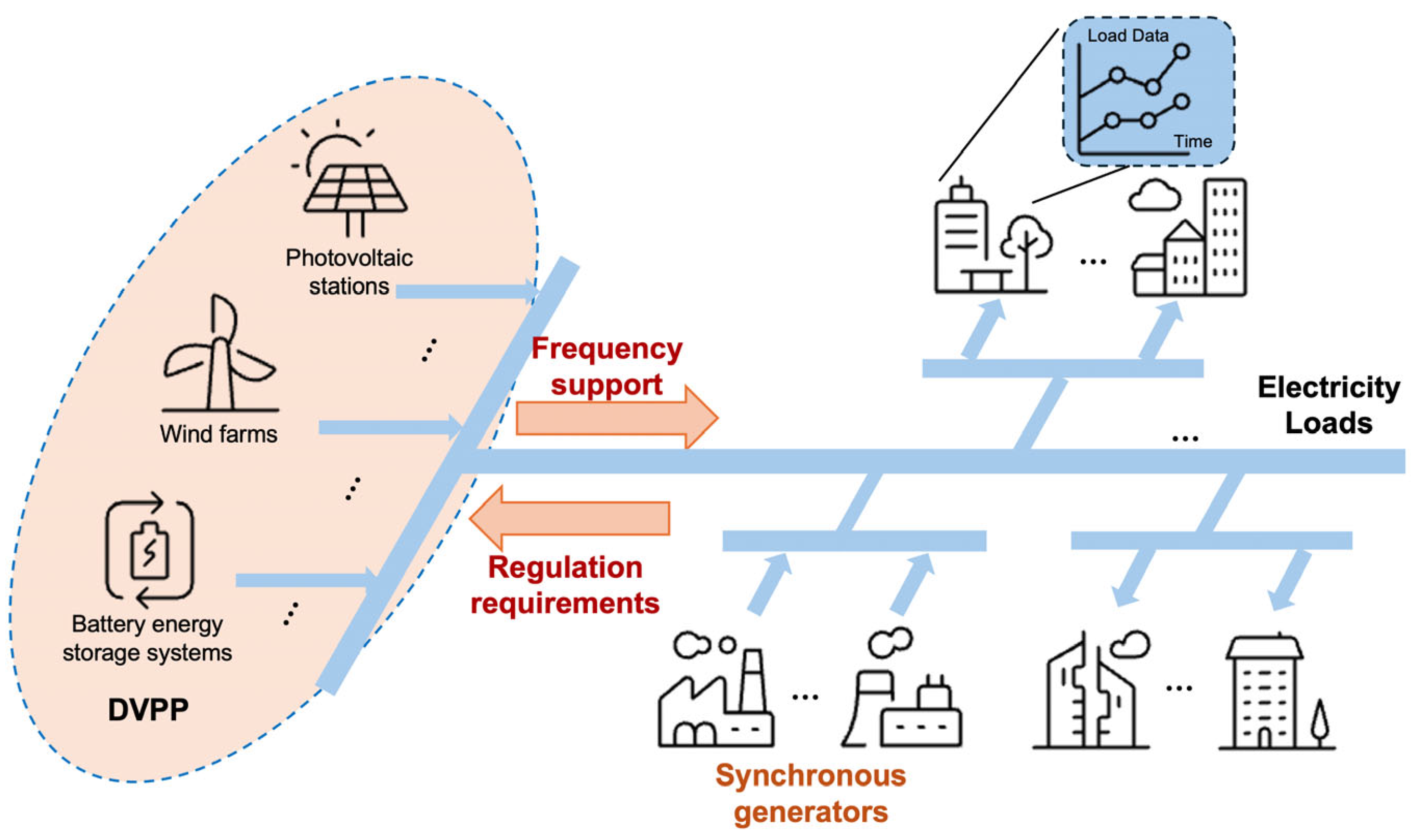
As shown in Figure 7, this work builds a DVPP that interacts with the power grid. It provides sufficient frequency response to meet the power grid’s regulatory requirements.
Under volatile RES conditions in grid-connected operation, Macir Tozak et al. (2024) [69] analysed the stability of a GFM-based VPP by comparing dVOC, droop, and hybrid control within a unified VPP framework, using real wind/PV hourly data as active-power set-points to assess frequency/voltage support, reference tracking, and disturbance rejection. The study shows that dVOC offers faster dynamics and tracking than droop, while the hybrid strategy balances speed and robustness and maintains stable frequency/voltage during coordination of heterogeneous DERs. These findings underpin Section 5 on providing, allocating, and repurposing inertia: the GFM control family is a practical actuation layer for inertia injection, and PFR/SFR and hybridisation improve robustness and code compliance under reserve and disturbance constraints. Future extensions include GFM + GFL coordination, eigenvalue-based stability margins, and HIL validation to delineate feasible operating regions [69].
In a supplementary study, Li et al. (2023) [70] proposed a dynamic constrained distributed frequency regulation method for low-inertia systems. By tuning converter control parameters to imitate synchronous-generator responses, it formulates an intraday optimisation that guarantees RoCoF, nadir, and steady-state bounds and then uses a distributed MPC to restore frequency economically [70]. This supports our DVPP pathway by showing how device-level tuning under explicit dynamic constraints can operationalise plant-level inertia/FFR targets across many IBRs.

5.2. Comparative Models and Validation of DVPP-Based Stability Services

Table 4 summarises the main model families used for DVPP-based inertia and fast frequency services at the energy layer. The comparison highlights how different approaches conceptualise the DVPP role (e.g., system diagnosis, allocation, actuation, or scheduling), the dominant service timescales, and the underlying assumptions about grid representation and information availability.
Table 4. Model families for DVPP inertia and frequency services.
ModelConcept and DVPP RoleMain Service and TimescaleAssumptions (Grid and Information)Representative References *
System-level frequency security and FCAS diagnosisSystem-wide inertia/FFR assessment; DVPP targetsRoCoF, nadir, QSS; system-level FCAS/FFR; s–minTransmission grid with aggregated inertia; DVPP/DER abstracted; mostly deterministic[5]
DPF-based DVPP controllersDynamic participation factors; allocate response to DERsFFR and primary control; sub-second to ~10 sReduced-order frequency model; PCC measurements; limited explicit uncertainty[6,62]
ADPM + LPV-H∞ local control Adaptive participation matrix; robust local f-V control Coupled frequency–voltage performance; fast dynamicsLPV grid model for synthesis; local H∞ controllers; operating-point uncertainty only[11]
Grid-forming DVPP and spatial coordinationGrid-forming DVPP; spatial sharing of inertia/FFRInertia-like and voltage support; faults, weak grids; sub-second to sRMS/EMT converter and feeder models; explicit topology; simplified comms/uncertainty[63,64,65,66,69]
Robust analytic frequency-response schedulingAnalytic RoCoF/nadir; robust sizing of inertia/FFRPre-fault scheduling; contingency response; s–minSimplified analytic FR model; robust sets for disturbances/uncertainty; no full EMT grid[67,70]
Model-free online DVPP frequency regulationModel-free DVPP controller; online imbalance regulationFast frequency regulation; adaptive; sub-second to sNo explicit grid model; uses measured imbalance; weak integration of forecasts/markets[8]
Hydrogen-electrolyser-based virtual inertiaElectrolysers as controllable loads; DVPP inertia sourceInertia-like and FFR support from load; s rangeAggregated system-frequency + electrolyser dynamics; scenario-based uncertainty; coarse grid[21]
* Representative references only; not an exhaustive list.
Building on the methodological families in Table 4, Table 5 provides a side-by-side comparison of representative DVPP implementations for inertia and fast frequency response. The focus is on control methods, coordination architectures, validation settings, and the dynamic performance indicators reported in the literature.
Taken together, Table 4 and Table 5 show that a wide range of energy-layer control and coordination mechanisms can synthesise inertia-like and fast frequency support from heterogeneous DER fleets, including participation-factor-based designs, grid-forming DVPP architectures, and robust or model-free controllers. Most implementations expose tunable device-level parameters that can be adjusted to meet RoCoF and nadir requirements. However, they remain largely limited to simulations or controlled experiments, and the link to auditable market products, settlement rules, and large-scale feeder diversity remains weak—thereby motivating the need for cross-layer co-design discussed later in this review. From a comparative perspective, these approaches differ in both applicability and implementation burden. Participation-factor-based and reduced-order designs are interpretable and lightweight, but often rely on simplified system models [6,11,62]. Grid-forming and spatially coordinated schemes are more suitable for weak-grid and fast-dynamics conditions, yet they require richer measurement, communication, and validation support [63,65,66,69]. Robust and dynamics-constrained scheduling improves security under uncertainty, but usually at a higher modelling and computational cost [67,70]. Model-free or adaptive methods offer greater flexibility when detailed models are unavailable, although their verification and real-time market compatibility remain less mature [8,21].
A cross-study view also shows that the most commonly reported performance indicators are RoCoF-related improvement, frequency nadir support, and response or activation time [11,67]. However, quantitative synthesis remains limited because disturbance sizes, system scales, controller settings, and validation environments differ substantially across studies. In the current literature, KPI reporting is therefore stronger in directional terms, such as RoCoF reduction, nadir improvement, faster response, or fewer violations, than in directly comparable numerical ranges [63,66]. This highlights the need for more standardised reporting of DVPP-based stability service performance in future studies.
To complement these model- and experiment-based studies, it is also useful to examine real-world pilots that have tested aggregated DER coordination under practical market and network conditions. Representative examples are summarised in Table 6. Even where pilot evidence is available, the path from experimental validation to routine DVPP deployment remains constrained by several practical challenges [63]. Communication delays and packet loss can affect the timely delivery of fast frequency support, especially when control actions depend on distributed measurements and coordinated inverter responses. Interoperability is another major issue, since real DVPP fleets typically combine heterogeneous devices, vendors, communication protocols, and control platforms [5]. In addition, regulatory constraints and compatibility with existing grid-code requirements can limit how inverter-based resources are aggregated, dispatched, and verified in practice [71]. These issues suggest that future validation should move beyond demonstrating technical feasibility alone and place greater emphasis on communication-aware control, standards-compatible integration, and market/regulatory readiness under realistic operating conditions.
Table 5. Side-by-side DVPP approaches to inertia and fast frequency response.
Study (Author, Year [#])Method (≤1 Line)ArchitectureValidationKPI (≤2)
Andrejewski et al., 2023 [62]DPF maps system response → device set-pointsCentral + device local loopsPHIL benchNadir ↑; overshoot ↓
Björk et al., 2022 [6]Frequency-banded DPF (wind FFR + hydro FCR)DecentralizedCase/replayNadir ↑; avoid 2nd dip
Häberle et al., 2021 [11]ADPM + LPV-H∞ local control (keep V while giving FR)HierarchicalSimulationRoCoF/nadir ✓
Häberle et al., 2024 [63]Grid-forming DVPP with spatial coordinationDistributed GFM + commsSimulationWeak-grid stability ↑
Häberle et al., 2025 [64]Local ID of (G(s)) → match desired (Tdes(s, α))Perceive-and-optimiseSimulationCompliance rate ↑
Comden & Wang, 2024 [65]EMS coordinates multiple GFMsEMS-centricCase/demoStability margin ↑
Ríos-Peñaloza et al., 2024 [66]Coordinated inertial response by the GFM fleetDVPP of GFMsConf. demoRoCoF ↓
Golpîra & Marinescu, 2024 [8]Online enhanced frequency regulation for DVPPDVPP integrationJournal studyNadir ↑
Zhu et al., 2025 [67]Robust frequency-regulation capability for DVPPRobust control (central)Journal studyViolations ↓
Li et al., 2023 [70]Dynamics-constrained distributed FRDistributed agentsJournal studyStability margins ↑
[#] indicates the reference number in the bibliography; ✓ indicates the presence of the corresponding feature; ↑ and ↓ indicate increase and decrease, respectively.
Publicly reported evidence is currently stronger for market participation, FCAS delivery, and local-network orchestration than for fully specified feeder-level DVPP stability products tied explicitly to RoCoF, nadir, or inertia settlement. For example, the AEMO NEM VPP Demonstrations reported VPP participation in FCAS, price response, and local network services [72], while the FEVER project demonstrated flexibility activation and trading in real DSO settings [73]. EdgeFLEX further shows that European pilots are moving towards VPP-enabled fast and slow dynamic control services, although public quantitative validation remains more limited for explicit feeder-level stability products [74].
Table 6. Representative pilot projects and field-validation insights relevant to DVPP/VPP stability services.
Pilot ProjectRegionPublicly Reported EvidenceRelevance to DVPP Stability ServicesMain Limitation
AEMO NEM VPP Demonstrations [72]Australia8 VPP portfolios, 31 MW registered capacity, ~7150 customers; FCAS, price response, and local network services observedStrong field evidence for FCAS delivery and market/network orchestrationNo explicit feeder-level inertia product
Project Symphony [75]AustraliaDER orchestration pilot linking market and network coordinationPractical evidence for multi-actor coordinationLimited public evidence for explicit stability products
FEVER [73]Europe~3.2 MWh flexibility activated over 3.5 months in SpainStrong field evidence for DSO-side flexibility trading and orchestrationFocuses more on flexibility than explicit inertia/FFR
EdgeFLEX [74]EuropeThe pilot objective includes fast and slow dynamic control, including frequency/inertial responsesClosest to DVPP-style dynamic/stability servicesPublic numerical validation is still limited
Overall, the energy-layer literature shows that DVPP-style coordination can indeed synthesise inertia and fast frequency support from heterogeneous DER fleets. Participation-factor-based designs provide a flexible way to map system-level frequency requirements to device set-points [6,11,62,63], while grid-forming DVPP architectures and spatial coordination schemes demonstrate that converter-dominated feeders can emulate synchronous-like behaviour even in weak grids [65,66,69]. Model-free frequency controllers and robust, dynamics-constrained scheduling models further highlight that secure inertia and FFR allocation are possible under significant uncertainty and limited system knowledge [8,21,67,70].

5.3. From Control to Product: Stability as a DVPP Service

Most of the DVPP and VPP literature we reviewed is still rooted in a traditional P–Q mindset: controllable devices are scheduled via active and reactive power set-points, and stability is viewed as a collection of constraints that these trajectories must satisfy [3,7]. From a practical product-design perspective, however, this is only a starting point. The physical basis of grid services is indeed P and Q, but the “product” that a DVPP could sell is not just a static MW or MVAr quantity. It also has dynamic attributes (inertia, RoCoF shaping, ramp rates, FFR activation time, and sustain time), emergency attributes (whether the service is delivered under normal or stressed conditions), and economic attributes (scarcity, time-of-delivery, multi-layer tariffs across timescales). In other words, future DVPP products are more naturally described in the three-dimensional space “(P, Q) × dynamic behaviour × time/emergency context” rather than by a single number on the active-power axis [7].
Under this interpretation, “sell stability” requires that these dynamic and emergency attributes be translated into measurable technical indicators, tradable service definitions, and settlement rules. At the feeder level, the relevant indicators may include RoCoF containment, frequency nadir support, quasi-steady-state frequency deviation, response activation time, and sustain duration [5,70]. These indicators can then be mapped to product forms such as contracted virtual inertia, FFR availability, or performance-linked frequency-security support [6,7,8]. In this sense, DVPPs do not merely bid scheduled power, but commit to verifiable dynamic capability, with settlement linked not only to reserved capacity but also to delivered response and compliance with predefined security targets [3,43,44,45,46].
This issue becomes more important when multiple DVPPs coexist within the same feeder or local market [37]. Stability provision is then no longer only a question of internal control and product design, but also of system-level coordination among multiple aggregators competing for local flexibility, network headroom, and market opportunities [49]. From a scalability perspective, this points to a need for platform-mediated clearing, game-theoretic interaction, coalition-based coordination, or privacy-preserving distributed optimisation to support feasible multi-DVPP operation [41].
Seen through this lens, several gaps in the current DVPP-oriented literature become clearer. On the product and market side, existing work rarely specifies how a TSO or DSO would define and procure DVPP “stability products”: dynamic participation factors, virtual inertia, and complex droop are proposed as control designs, but they are not tied to explicit FFR products, RoCoF, and nadir metrics or contract structures for inertia and fast reserves [4,7]. On the information side, there is almost no explicit treatment of how to forecast and quantify available inertia and FFR capacity, nor of how forecast errors translate into dynamic-security risk, despite the extensive forecasting and flexibility literature surveyed in Section 2.2 [9,12,13,14,15,16,17,18,21,26,76]. On the validation side, most DVPP case studies rely on small test systems or PHIL setups with simplified grids, idealised communications, and no explicit market layer [6,8,11,62,65,66,67,70]. Finally, almost all models treat the DVPP as a single aggregated player: interactions between multiple aggregators, multiple DVPPs, and multiple local communities across Energy–Information–Market layers remain largely unexplored, even though coordination and platform studies already hint at such multi-actor structures [35,37,40,41,42,43,44,45,46].
Moreover, the interaction between energy-layer control, information-layer forecasting, and market-layer bidding is rarely analysed in a unified framework [3,24,25,26] [7,33,34,37,40,43,44,45,46]. For DVPPs that aim to sell stability at the feeder level, these gaps indicate a need for genuine cross-layer co-design. Specifically, energy-layer control schemes should be developed jointly with information-layer models that quantify available inertia and with market mechanisms that transparently price and settle delivered stability.
For our review, these observations suggest that future DVPP research should move beyond “simulating a synchronous machine with power electronics” and treat stability itself as a rich product space. Energy-layer control designs such as dynamic participation factors, complex droop, and robust frequency-constrained scheduling are important building blocks [6,7,8,11,62,65,66,67,69,70], but they need to be embedded in information mechanisms that quantify the available inertia and FFR capacity under uncertainty and in market mechanisms that price and settle dynamic services across multiple timescales, emergency levels, and aggregators [24,25,26,33,34,37,40,43,44,45,46]. In the longer term, DVPP implementations may need to aim beyond simply matching today’s grid-code requirements for synchronous units and exploit the additional flexibility of power-electronic resources to support new classes of dynamic and emergency services [7].

5.4. Governance and Cybersecurity for DVPP Participation

Dayaratne et al. (2025) [77] proposed a firmware-provenance framework for smart inverters in VPPs using verifiable credentials (VCs). By recording and validating each update in a “trust cycle”, the scheme improves auditability, operator–device interactions, and transparency and is assessed against IEEE 2030.5-2018 and CSIP requirements [78]. The focus is governance and security (who updated what, when, and with what evidence) rather than control performance [77].
At the platform–institution boundary, the core challenge is to coordinate dispatch and settlement without violating DSO/TSO–aggregator data-sharing limits. Privacy-preserving, decomposed coordination architectures can exchange only aggregated interfaces while keeping device-level telemetry local, thereby reducing exposure of commercially sensitive data and shrinking the cyber-attack surface while still producing market-coherent outcomes. The same architecture supports accountability: contracts can encode ROI and security constraints, while independent measurement-and-verification (M&V) streams provide auditable reports to system operators. This requirement pushes DVPP deployments towards standard APIs, role-based access control, tamper-evident logging, periodic stress tests, optimisation across boundaries, local verification, and minimal disclosure [79].
In practice, the privacy-protection technologies most relevant to DVPP participation include differential privacy, aggregation/anonymisation of device-level telemetry, and distributed or federated coordination schemes that avoid centralising raw prosumer data [80,81]. On the security side, representative measures include secure communication interfaces, role-based authentication and access control, tamper-evident logging, periodic stress testing, and firmware/software update integrity with traceable provenance for smart inverters and DER controllers [77,79]. Together, these measures make governance more operational by linking market participation and control coordination to verifiable data handling, trusted device behaviour, and auditable service delivery.
A complementary line of work addresses privacy inside transactive coordination. Differential privacy (DP) can make P2P+DR mechanisms viable without exposing raw user data, with privacy budgets (ε) acting as tunable governance knobs that trade off welfare, fairness, and disclosure risk [80]. Extensions to more heterogeneous prosumer portfolios and multi-period operation similarly indicate that carefully calibrated noise plus aggregation can preserve privacy without materially degrading clearing efficiency or eroding economic benefits [81].
Finally, resilience-oriented perspectives argue that governance must co-evolve with architecture. Under high IBR penetration and large DER fleets, centralised VPP coordination faces scalability, latency/outage, and cyber-risk limits; multi-agent and fault-tolerant coordination, backed by interface standards and data-minimisation principles, is therefore positioned as a practical path towards security-aware DVPP operation and market participation [71].

6. Discussion and Future Work

6.1. Key Gaps and Barriers

A key barrier to the stability-oriented deployment of DVPP is the lack of well-defined interfaces between the energy, information, and market layers. In much of the existing literature, forecasting and identification results are not consistently linked to frequency-security outcomes such as RoCoF, nadir, settling behaviour, or violation risk, especially under weak-grid and high-IBR conditions. This is compounded by inconsistent evaluation practices: disturbance sets and dynamic performance metrics vary across studies, making it difficult to verify whether a DVPP implementation truly closes the E-I-M loop and delivers auditable inertia and fast frequency response.
Further barriers arise in market-layer design under volatility and correlation. Price volatility and correlated RES load–price uncertainty can yield schedules that remain economically attractive yet dynamically fragile when uncertainty is not integrated into bidding, clearing, and settlement. Multi-actor settings intensify this gap because strategic interactions can amplify deviations and imbalance exposures, while privacy constraints limit observability and coordination.
Operational coordination under load variability presents an additional barrier because DVPP actions span multiple timescales and heterogeneous devices. Sub-second frequency support must coexist with market-driven dispatch over minutes and hours, and coordination must remain feasible under communication delays, privacy constraints, and forecast deviations. Lifecycle effects such as converter degradation, battery ageing, and thermal limits further couple control performance with incentives, yet realistic benchmark datasets and test feeders that capture these multi-actor, multi-timescale interactions remain limited, slowing reproducible evaluation across competing DVPP designs.

6.2. Future Work/Research Directions

Building on the gaps identified in this review, several research directions emerge for future DVPP design and implementation. Rather than isolated topics, they form four interlinked research streams.
(1)
Intelligent internal feedback loops and risk-aware operation.
A first priority is to develop DVPPs as self-updating systems rather than static aggregators. This includes online identification of available inertia and FFR capacity from streaming measurements and event-driven tests, together with adaptive tuning of participation factors and frequency bands (e.g., DPF/ADPM) based on observed RoCoF, nadir, and settling behaviour. Model-matching and adaptive partitioning methods with provable stability are needed for heterogeneous, geographically dispersed GFM/GFL fleets, so that dynamic bands can be allocated that respect local network and device limits. Coupled uncertainties in wind/solar output, prices, and load should be treated within unified risk frameworks (CVaR, DRO, and robust hybrids), and degradation–reliability co-optimisation should internalise battery health and thermal limits into band allocation and pricing. Taken together, these elements would enable an intelligent internal loop of self-diagnosis, self-scheduling, and self-correction, gradually improving DVPP performance without relying on a perfectly known grid model.
(2)
Co-design of dynamic products, economics, and planning.
Future DVPP research should combine control design with explicit definitions of products and tariffs. Inertia and FFR envelopes should be translated into market products with measurable dynamic KPIs (RoCoF, nadir, sustain time, violation rates) that are embedded into clearing algorithms and settlement rules, closing the market-physics loop. Multi-layer tariffs are required to capture scarcity, temporal layering from sub-second to hourly scales, and the distinction between normal and emergency operation. Degradation, start-up, and ramping costs must be integrated into DVPP bids so that lifecycle economics align with the stability provision, and planning–operation integration should align long-term resource portfolios with the dynamic band allocation strategies used in operation. At the same time, multi-aggregator and P2P mechanisms compatible with DSO coordination are needed to manage competition and cooperation between several DVPPs and local communities in shared networks. Collaboration with energy-economics and mechanism-design research will be essential to ensure that these market arrangements remain technically meaningful and incentive-compatible.
(3)
Cross-layer architectures, privacy, governance, and resilience.
The E-I-M framework proposed in this paper underscores the need for DVPP architectures that jointly design forecasting, control, data exchange, and bidding. Cross-layer optimisation schemes should solve uncertainty models, estimate inertia requirements and availability, and clear market bids in a coherent formulation, while respecting network and current limits, topology changes, and weak-grid conditions. Privacy-preserving and governance-aware information structures—such as minimal interfaces, differential privacy, or federated schemes—and secure, auditable logging are required to guarantee verifiable minimal data exchange. Network and cybersecurity resilience must be explicitly addressed, covering communication failures, cyberattacks, and coordinated disruptions. Scalable protocols for multi-DVPP and multi-aggregator interaction, compatible with DSO operational procedures, will be critical to ensure that dynamic services remain reliable when many actors share the same infrastructure.
(4)
Benchmarks, digital twins, and experimental validation.
To move beyond small IEEE test systems and purely numerical case studies, the community needs shared benchmarks and experimental evidence. This calls for dynamic metrics and benchmark suites for DVPPs—including RoCoF, nadir, settling times, and violation rates—together with standardised disturbance sets and scenario libraries. Feeder-level benchmark networks and digital-twin models should be developed to assess inertia and FFR provision under realistic operating conditions, current limits, and topology changes. PHIL/HIL platforms can be used to test DVPP coordination, communication delays, and cyber-threat scenarios using open-source control and market stacks. Finally, field pilots in which DVPP portfolios are contracted for FCAS/FFR services and audited against agreed dynamic KPIs would provide the empirical basis needed to turn DVPP concepts into deployable stability products.

7. Conclusions

Over the past two decades, VPPs have matured as a practical way to aggregate distributed energy resources, flexible demand, and storage for coordinated market participation. With rising inverter-based penetration and declining inertia, however, conventional VPP formulations are increasingly stretched beyond steady-state scheduling, motivating DVPPs that target verifiable stability services. This review surveyed the VPP-to-DVPP transition through an Energy–Information–Market lens, covering uncertainty modelling, price volatility and bidding, load–market coordination, and privacy, governance, and DSO–market interactions.
Across these strands, steady-state and economic objectives still dominate, while sub-second security outcomes such as RoCoF, nadir, and voltage limits are often treated as external constraints or overlooked. Consequently, the auditable chain from bids to control set-points and delivered dynamic services remains weak, especially under weak-grid and high-IBR conditions. Feeder-level verification and settlement of inertia-like and fast frequency response also remain immature, with limited power-hardware-in-the-loop or field evidence linking market actions to measured dynamics.
These gaps motivate the emerging DVPP paradigm, which reframes aggregation as an observable, verifiable dynamic service platform rather than merely an economic scheduler. A key next step is cross-layer co-design: energy-layer control, information-layer identification of available inertia/FFR, and market-layer pricing and settlement must be developed together so stability requirements can be mapped into device-level constraints and verified as a measurable delivery. In practical terms, this implies that future feeder-level DVPP deployment will require not only improved control design but also market-compatible validation, settlement, and governance mechanisms that can provide actionable pathways for aggregators, DSOs, and market operators under real network and communication constraints. This co-designed loop is essential if DVPPs are to credibly “sell stability” in low-inertia power systems.

Author Contributions

Conceptualization, J.Z. and G.L.; methodology, G.L. and Y.H. and J.Z.; formal analysis, Y.H.; investigation, Y.W.; writing—original draft preparation, Y.W.; writing—review and editing, J.Z. and G.L. and A.W.; supervision, J.Z. and G.L. and A.W.; project administration, G.L.; funding acquisition, G.L. All authors have read and agreed to the published version of the manuscript.

Funding

This research received no external funding.

Institutional Review Board Statement

Not applicable.

Informed Consent Statement

Not applicable.

Data Availability Statement

No new data were created or analyzed in this study. Data sharing is not applicable to this article.

Conflicts of Interest

Author Allen Wang was employed by the company Wood Mackenzie. The remaining authors declare that the research was conducted in the absence of any commercial or financial relationships that could be construed as a potential conflict of interest.

References

  1. International Renewable Energy Agency. Renewable Capacity Statistics 2024; International Renewable Energy Agency: Abu Dhabi, United Arab Emirates, 2024. [Google Scholar]
  2. Ullah, Z.; Mokryani, G.; Campean, F.; Hu, Y.F. Comprehensive review of VPPs planning, operation and scheduling considering the uncertainties related to renewable energy sources. IET Energy Syst. Integr. 2019, 1, 147–157. [Google Scholar] [CrossRef] [Scilit]
  3. Gao, H.; Jin, T.; Feng, C.; Li, C.; Chen, Q.; Kang, C. Review of virtual power plant operations: Resource coordination and multidimensional interaction. Appl. Energy 2024, 357, 122284. [Google Scholar] [CrossRef] [Scilit]
  4. Ruan, G.; Qiu, D.; Sivaranjani, S.; Awad, A.S.; Strbac, G. Data-driven energy management of virtual power plants: A review. Adv. Appl. Energy 2024, 14, 100170. [Google Scholar] [CrossRef] [Scilit]
  5. Alhelou, H.H.; Bahrani, B.; Ma, J.; Hill, D.J. Australia’s power system frequency: Current situation, industrial challenges, efforts, and future research directions. IEEE Trans. Power Syst. 2023, 39, 5204–5218. [Google Scholar] [CrossRef] [Scilit]
  6. Björk, J.; Johansson, K.H.; Dörfler, F. Dynamic virtual power plant design for fast frequency reserves: Coordinating hydro and wind. IEEE Trans. Control Netw. Syst. 2022, 10, 1266–1278. [Google Scholar] [CrossRef] [Scilit]
  7. Marinescu, B.; Dörfler, F.; Milano, F. Dynamic Virtual Power Plants: A New Paradigm for Grid Services and Control. IEEE Power Energy Mag. 2025, 23, 81–96. [Google Scholar] [CrossRef] [Scilit]
  8. Golpîra, H.; Marinescu, B. Enhanced frequency regulation scheme: An online paradigm for dynamic virtual power plant integration. IEEE Trans. Power Syst. 2024, 39, 7227–7239. [Google Scholar] [CrossRef] [Scilit]
  9. Wang, Y.; Hu, Q.; Meng, D.; Zhu, P. Deterministic and probabilistic wind power forecasting using a variational Bayesian-based adaptive robust multi-kernel regression model. Appl. Energy 2017, 208, 1097–1112. [Google Scholar] [CrossRef] [Scilit]
  10. Kasaei, M.J.; Gandomkar, M.; Nikoukar, J. Optimal management of renewable energy sources by virtual power plant. Renew. Energy 2017, 114, 1180–1188. [Google Scholar] [CrossRef] [Scilit]
  11. Häberle, V.; Fisher, M.W.; Prieto-Araujo, E.; Dörfler, F. Control design of dynamic virtual power plants: An adaptive divide-and-conquer approach. IEEE Trans. Power Syst. 2021, 37, 4040–4053. [Google Scholar] [CrossRef] [Scilit]
  12. Wang, H.; Lei, Z.; Zhang, X.; Zhou, B.; Peng, J. A review of deep learning for renewable energy forecasting. Energy Convers. Manag. 2019, 198, 111799. [Google Scholar] [CrossRef] [Scilit]
  13. Hao, Y.; Tian, C. A novel two-stage forecasting model based on error factor and ensemble method for multi-step wind power forecasting. Appl. Energy 2019, 238, 368–383. [Google Scholar] [CrossRef] [Scilit]
  14. Yang, D. On post-processing day-ahead NWP forecasts using Kalman filtering. Sol. Energy 2019, 182, 179–181. [Google Scholar] [CrossRef] [Scilit]
  15. Wang, Y.; Wang, H.; Srinivasan, D.; Hu, Q. Robust functional regression for wind speed forecasting based on Sparse Bayesian learning. Renew. Energy 2019, 132, 43–60. [Google Scholar] [CrossRef] [Scilit]
  16. Lydia, M.; Kumar, S.S.; Selvakumar, A.I.; Kumar, G.E.P. Linear and non-linear autoregressive models for short-term wind speed forecasting. Energy Convers. Manag. 2016, 112, 115–124. [Google Scholar] [CrossRef] [Scilit]
  17. Wang, F.; Zhang, Z.; Liu, C.; Yu, Y.; Pang, S.; Duić, N.; Shafie-Khah, M.; Catalao, J.P. Generative adversarial networks and convolutional neural networks based weather classification model for day ahead short-term photovoltaic power forecasting. Energy Convers. Manag. 2019, 181, 443–462. [Google Scholar] [CrossRef] [Scilit]
  18. Memarzadeh, G.; Keynia, F. A new short-term wind speed forecasting method based on fine-tuned LSTM neural network and optimal input sets. Energy Convers. Manag. 2020, 213, 112824. [Google Scholar] [CrossRef] [Scilit]
  19. Arslan Tuncar, E.; Sağlam, Ş.; Oral, B. A review of short-term wind power generation forecasting methods in recent technological trends. Energy Rep. 2024, 12, 197–209. [Google Scholar] [CrossRef] [Scilit]
  20. Ghorani, R.; Pourahmadi, F.; Moeini-Aghtaie, M.; Fotuhi-Firuzabad, M.; Shahidehpour, M. Risk-based networked-constrained unit commitment considering correlated power system uncertainties. IEEE Trans. Smart Grid 2019, 11, 1781–1791. [Google Scholar] [CrossRef] [Scilit]
  21. Dozein, M.G.; De Corato, A.M.; Mancarella, P. Virtual inertia response and frequency control ancillary services from hydrogen electrolyzers. IEEE Trans. Power Syst. 2022, 38, 2447–2459. [Google Scholar] [CrossRef] [Scilit]
  22. Wang, K.; Wang, C.; Yao, W.; Zhang, Z.; Liu, C.; Dong, X.; Yang, M.; Wang, Y. Embedding P2P transaction into demand response exchange: A cooperative demand response management framework for IES. Appl. Energy 2024, 367, 123319. [Google Scholar] [CrossRef] [Scilit]
  23. Zhang, T.; Qiu, W.; Zhang, Z.; Lin, Z.; Ding, Y.; Wang, Y.; Wang, L.; Yang, L. Optimal bidding strategy and profit allocation method for shared energy storage-assisted VPP in joint energy and regulation markets. Appl. Energy 2023, 329, 120158. [Google Scholar] [CrossRef] [Scilit]
  24. Li, W.; Dong, F.; Ji, Z.; Wang, P. Internal and external coordinated distributionally robust bidding strategy of virtual power plant operator participating in day-ahead electricity spot and peaking ancillary services markets. Appl. Energy 2025, 386, 125514. [Google Scholar] [CrossRef] [Scilit]
  25. Choi, E.J.; Seo, G.-S.; Kim, S.W. Are better combinations of DERs more profitable? Combinatorial optimization for aggregation of DERs in wholesale electricity markets. Appl. Energy 2025, 396, 126264. [Google Scholar] [CrossRef] [Scilit]
  26. Dorahaki, S.; MollahassaniPour, M.; Rashidinejad, M.; Siano, P.; Shafie-khah, M. A flexibility-oriented model for a sustainable local multi-carrier energy community: A hybrid multi-objective probabilistic-IGDT optimization approach. Appl. Energy 2025, 377, 124678. [Google Scholar] [CrossRef] [Scilit]
  27. Nosratabadi, S.M.; Hooshmand, R.-A.; Gholipour, E. A comprehensive review on microgrid and virtual power plant concepts employed for distributed energy resources scheduling in power systems. Renew. Sustain. Energy Rev. 2017, 67, 341–363. [Google Scholar] [CrossRef] [Scilit]
  28. Hadayeghparast, S.; Farsangi, A.S.; Shayanfar, H. Day-ahead stochastic multi-objective economic/emission operational scheduling of a large scale virtual power plant. Energy 2019, 172, 630–646. [Google Scholar] [CrossRef] [Scilit]
  29. Vahedipour-Dahraie, M.; Rashidizadeh-Kermani, H.; Shafie-Khah, M.; Catalão, J.P. Risk-averse optimal energy and reserve scheduling for virtual power plants incorporating demand response programs. IEEE Trans. Smart Grid 2020, 12, 1405–1415. [Google Scholar] [CrossRef] [Scilit]
  30. Liu, X.; Niu, Z.; Li, Y.; Hu, L.; Tang, J.; Cai, Y.; Zeng, S. Optimal demand response for a virtual power plant with a hierarchical operation framework. Sustain. Energy Grids Netw. 2024, 39, 101443. [Google Scholar] [CrossRef] [Scilit]
  31. Liu, X.; Lin, X.; Qiu, H.; Li, Y.; Huang, T. Optimal aggregation and disaggregation for coordinated operation of virtual power plant with distribution network operator. Appl. Energy 2024, 376, 124142. [Google Scholar] [CrossRef] [Scilit]
  32. Lin, W.; Wang, Y.; Wu, J.; Feng, F. Model-Free Aggregation for Virtual Power Plants Using Input Convex Neural Networks. IEEE Trans. Smart Grid 2025, 16, 2404–2415. [Google Scholar] [CrossRef] [Scilit]
  33. Dorahaki, S.; MollahassaniPour, M.; Rashidinejad, M.; Muyeen, S.; Siano, P.; Shafie-Khah, M. A robust optimization approach for enabling flexibility, self-sufficiency, and environmental sustainability in a local multi-carrier energy community. Appl. Energy 2025, 392, 125997. [Google Scholar] [CrossRef] [Scilit]
  34. Ma, Y.; Li, Z.; Liu, R.; Liu, B.; Yu, S.S.; Liao, X.; Shi, P. Data-Driven interval robust optimization method of VPP Bidding strategy in spot market under multiple uncertainties. Appl. Energy 2025, 384, 125366. [Google Scholar] [CrossRef] [Scilit]
  35. Wang, S.; Sheng, W.; Shang, Y.; Liu, K. Distribution network voltage control considering virtual power plants cooperative optimization with transactive energy. Appl. Energy 2024, 371, 123680. [Google Scholar] [CrossRef] [Scilit]
  36. Dong, L.; Zhang, S.; Zhang, T.; Wang, Z.; Qiao, J.; Pu, T. DSO-prosumers dual-layer game optimization based on risk price guidance in a P2P energy market environment. Appl. Energy 2024, 361, 122893. [Google Scholar] [CrossRef] [Scilit]
  37. Ge, C.; Lin, S.; Li, F.; Wang, P.; Yang, F.; Li, D. Optimal coordination method for an adn with multiple network-constrained vpps. IEEE Trans. Power Syst. 2024, 40, 394–407. [Google Scholar] [CrossRef] [Scilit]
  38. Baringo, A.; Baringo, L.; Arroyo, J.M. Day-Ahead Self-Scheduling of a Virtual Power Plant in Energy and Reserve Electricity Markets Under Uncertainty. IEEE Trans. Power Syst. 2019, 34, 1881–1894. [Google Scholar] [CrossRef] [Scilit]
  39. Zou, Y.; Xu, Y. DER-inverter based reactive power ancillary service for supporting peer-to-peer transactive energy trading in distribution networks. IEEE Trans. Power Syst. 2024, 40, 753–764. [Google Scholar] [CrossRef] [Scilit]
  40. Zhao, Z.; Liu, Y.; Guo, L.; Bai, L.; Wang, Z.; Wang, C. Distribution locational marginal pricing under uncertainty considering coordination of distribution and wholesale markets. IEEE Trans. Smart Grid 2022, 14, 1590–1606. [Google Scholar] [CrossRef] [Scilit]
  41. Sheng, H.; Wang, C.; Dong, X.; Meng, K.; Dong, Z. Incorporating P2P trading into DSO’s decision-making: A DSO-prosumers cooperated scheduling framework for transactive distribution system. IEEE Trans. Power Syst. 2023, 38, 2362–2375. [Google Scholar] [CrossRef] [Scilit]
  42. Wu, J.-K.; Liu, Z.-W.; Li, C.; Zhao, Y.; Chi, M. Coordinated operation strategy of virtual power plant based on two-layer game approach. IEEE Trans. Smart Grid 2024, 16, 554–567. [Google Scholar] [CrossRef] [Scilit]
  43. Li, Q.; Dong, F.; Zhou, G.; Mu, C.; Wang, Z.; Liu, J.; Yan, P.; Yu, D. Co-optimization of virtual power plants and distribution grids: Emphasizing flexible resource aggregation and battery capacity degradation. Appl. Energy 2025, 377, 124519. [Google Scholar] [CrossRef] [Scilit]
  44. Galici, M.; Troncia, M.; Nour, M.; Chaves-Ávila, J.P.; Pilo, F. Comparative techno-economic analysis of market models for peer-to-peer energy trading on a distributed platform. Appl. Energy 2025, 380, 125005. [Google Scholar] [CrossRef] [Scilit]
  45. Zeng, Y.; Wei, X.; Yao, Y.; Xu, Y.; Sun, H.; Chan, W.K.V.; Feng, W. Determining the pricing and deployment strategy for virtual power plants of peer-to-peer prosumers: A game-theoretic approach. Appl. Energy 2023, 345, 121349. [Google Scholar] [CrossRef] [Scilit]
  46. Xia, Y.; Xu, Q.; Fang, J.; Li, F. Non-iterative decentralized peer-to-peer market clearing in multi-microgrid systems via model substitution and network reduction. IEEE Trans. Power Syst. 2023, 39, 2922–2935. [Google Scholar] [CrossRef] [Scilit]
  47. Ding, Z.; Li, Y.; Zhang, K.; Peng, J.C.-H. Two-stage dynamic aggregation involving flexible resource composition and coordination based on submodular optimization. Appl. Energy 2024, 360, 122829. [Google Scholar] [CrossRef] [Scilit]
  48. Bao, P.; Xu, Q.; Yang, Y.; Zhao, X. Cooperative game-based solution for power system dynamic economic dispatch considering uncertainties: A case study of large-scale 5G base stations as virtual power plant. Appl. Energy 2024, 368, 123463. [Google Scholar] [CrossRef] [Scilit]
  49. Maiz, S.; Baringo, L.; García-Bertrand, R. Dynamic expansion planning of a commercial virtual power plant through coalition with distributed energy resources considering rival competitors. Appl. Energy 2025, 377, 124665. [Google Scholar] [CrossRef] [Scilit]
  50. Sirviö, K.; Motta, S.; Rauma, K.; Evens, C. Multi-level functional analysis of developing prosumers and energy communities with value creation framework. Appl. Energy 2024, 368, 123496. [Google Scholar] [CrossRef] [Scilit]
  51. Yan, X.; Gao, C.; Francois, B. Multi-objective optimization of a virtual power plant with mobile energy storage for a multi-stakeholders energy community. Appl. Energy 2025, 386, 125553. [Google Scholar] [CrossRef] [Scilit]
  52. Lee, X.Y.; Sarkar, S.; Wang, Y. A graph policy network approach for volt-var control in power distribution systems. Appl. Energy 2022, 323, 119530. [Google Scholar] [CrossRef] [Scilit]
  53. Song, H.; Gu, M.; Liu, C.; Amani, A.M.; Jalili, M.; Meegahapola, L.; Yu, X.; Dickeson, G. Multi-objective battery energy storage optimization for virtual power plant applications. Appl. Energy 2023, 352, 121860. [Google Scholar] [CrossRef] [Scilit]
  54. Ebrahimi, M.; Ebrahimi, M.; Shafie-khah, M.; Laaksonen, H. EV-observing distribution system management considering strategic VPPs and active & reactive power markets. Appl. Energy 2024, 364, 123152. [Google Scholar] [CrossRef] [Scilit]
  55. Qiu, D.; Wang, J.; Dong, Z.; Wang, Y.; Strbac, G. Mean-field multi-agent reinforcement learning for peer-to-peer multi-energy trading. IEEE Trans. Power Syst. 2022, 38, 4853–4866. [Google Scholar] [CrossRef] [Scilit]
  56. Li, L.; Fan, S.; Xiao, J.; Zhang, Y.; Huang, R.; He, G. Energy management strategy for community prosumers aggregated VPP participation in the ancillary services market based on P2P trading. Appl. Energy 2025, 384, 125472. [Google Scholar] [CrossRef] [Scilit]
  57. Li, Q.; Wei, F.; Zhou, Y.; Li, J.; Zhou, G.; Wang, Z.; Liu, J.; Yan, P.; Yu, D. A scheduling framework for VPP considering multiple uncertainties and flexible resources. Energy 2023, 282, 128385. [Google Scholar] [CrossRef] [Scilit]
  58. Fatema, I.; Lei, G.; Kong, X. Probabilistic Forecasting of Electricity Demand Incorporating Mobility Data. Appl. Sci. 2023, 13, 6520. [Google Scholar] [CrossRef] [Scilit]
  59. Lei, J.; Gao, S.; Wei, X.; Shi, J.; Huang, T.; Hatziargyriou, N.D.; Chung, C. A shareholding-based resource sharing mechanism for promoting energy equity in peer-to-peer energy trading. IEEE Trans. Power Syst. 2022, 38, 5113–5127. [Google Scholar] [CrossRef] [Scilit]
  60. Eklund, M.; Voinov, A.; Hossain, M.; Khalilpour, K. Evaluating the interplay of community behaviour and microgrid design through optimisation modelling in local energy markets. Renew. Sustain. Energy Rev. 2025, 210, 115271. [Google Scholar] [CrossRef] [Scilit]
  61. Mnatsakanyan, A.; Kennedy, S.W. A novel demand response model with an application for a virtual power plant. IEEE Trans. Smart Grid 2015, 6, 230–237. [Google Scholar] [CrossRef] [Scilit]
  62. Andrejewski, M.; Häberle, V.; Goldschmidt, N.; Dörfler, F.; Schulte, H. Experimental validation of a dynamic virtual power plant control concept based on a multi-converter power hardware-in-the-loop test bench. IET Conf. Proc. CP847 2023, 2023, 697–704. [Google Scholar] [CrossRef] [Scilit]
  63. Häberle, V.; Tayyebi, A.; He, X.; Prieto-Araujo, E.; Dörfler, F. Grid-forming and spatially distributed control design of dynamic virtual power plants. IEEE Trans. Smart Grid 2024, 15, 1761–1777. [Google Scholar] [CrossRef] [Scilit]
  64. Häberle, V.; He, X.; Huang, L.; Prieto-Araujo, E.; Dörfler, F. Optimal dynamic ancillary services provision based on local power grid perception. IEEE Trans. Power Syst. 2025, 40, 1816–1831. [Google Scholar] [CrossRef] [Scilit]
  65. Comden, J.; Wang, J. An Innovative Energy Management System for Microgrids with Multiple Grid-Forming Inverters. In Proceedings of the 2024 IEEE Power & Energy Society General Meeting (PESGM), Seattle, WA, USA, 21–25 July 2024; IEEE: New York, NY, USA, 2024; pp. 1–5. [Google Scholar] [CrossRef] [Scilit]
  66. Rios-Peñaloza, J.D.; Roldán-Pérez, J.; Prodanović, M. Coordinated Inertial Response Service Provided by Virtual Power Plants Based on Grid-Forming Converters. In Proceedings of the 2024 IEEE PES Innovative Smart Grid Technologies Europe (ISGT EUROPE), Dubrovnik, Croatia, 14–17 October 2024; IEEE: New York, NY, USA, 2024; pp. 1–5. [Google Scholar] [CrossRef] [Scilit]
  67. Zhu, X.; Geng, H.; Qing, H.; Ruan, G.; He, X. Dynamic Virtual Power Plants with Robust Frequency Regulation Capability. IEEE Trans. Ind. Appl. 2025, 377, 124519. [Google Scholar] [CrossRef] [Scilit]
  68. Wu, H.; Qiu, D.; Zhang, L.; Sun, M. Adaptive multi-agent reinforcement learning for flexible resource management in a virtual power plant with dynamic participating multi-energy buildings. Appl. Energy 2024, 374, 123998. [Google Scholar] [CrossRef] [Scilit]
  69. Tozak, M.; Taskin, S.; Sengor, I.; Hayes, B.P. Stability Analysis of Virtual Power Plant with Grid Forming Converters. In Proceedings of the 2024 International Conference on Smart Energy Systems and Technologies (SEST), Torino, Italy, 10–12 September 2024; IEEE: New York, NY, USA, 2024; pp. 1–6. [Google Scholar] [CrossRef] [Scilit]
  70. Li, Z.; Yang, L.; Xu, Y. A dynamics-constrained method for distributed frequency regulation in low-inertia power systems. Appl. Energy 2023, 344, 121256. [Google Scholar] [CrossRef] [Scilit]
  71. Xie, Y.; Zhang, Y.; Lee, W.-J.; Lin, Z.; Shamash, Y.A. Virtual power plants for grid resilience: A concise overview of research and applications. IEEE/CAA J. Autom. Sin. 2024, 11, 329–343. [Google Scholar] [CrossRef] [Scilit]
  72. Australian Energy Market Operator. AEMO NEM Virtual Power Plant Demonstrations; Knowledge Sharing Report #4; Australian Energy Market Operator: Melbourne, VIC, Australia, 2021. [Google Scholar]
  73. European Commission. Virtual Power Plants and Flexibility Markets Orchestrate the Shift to Grid-Aware Production, Demand and Storage Management. Available online: https://fever-h2020.eu/Demos/Simulationhttps://cordis.europa.eu/project/id/864537 (accessed on 26 March 2026).
  74. EdgeFLEX. Providing Flexibility to the Grid by Enabling VPPs to Offer Both Fast and Slow Dynamics Control Services. Available online: https://www.edgeflex-h2020.eu/ (accessed on 26 March 2026).
  75. Palassis, J.; Schulte, P.A.; Geraci, C.L. A new American management systems standard in occupational safety and health–ANSI Z10. J. Chem. Health Saf. 2006, 13, 20–23. [Google Scholar] [CrossRef] [Scilit]
  76. Tascikaraoglu, A.; Uzunoglu, M. A review of combined approaches for prediction of short-term wind speed and power. Renew. Sustain. Energy Rev. 2014, 34, 243–254. [Google Scholar] [CrossRef] [Scilit]
  77. Dayaratne, T.; Rudolph, C.; Shirley, T.; Levi, S.; Shirley, D. Fostering trust in smart inverters: A framework for firmware update management and tracking in VPP context. IEEE Trans. Smart Grid 2025, 16, 1872–1884. [Google Scholar] [CrossRef] [Scilit]
  78. IEEE 2030.5-2018; IEEE Standard for Smart Energy Profile Application Protocol. IEEE Standards Association: Piscataway, NJ, USA, 2018.
  79. Steriotis, K.; Makris, P.; Tsaousoglou, G.; Efthymiopoulos, N.; Varvarigos, E. Co-optimization of distributed renewable energy and storage investment decisions in a TSO-DSO coordination framework. IEEE Trans. Power Syst. 2022, 38, 4515–4529. [Google Scholar] [CrossRef] [Scilit]
  80. Ahmed, S.A.; Huang, Q.; Zhang, Z.; Li, J.; Amin, W.; Afzal, M.; Hussain, J.; Hussain, F. Optimization of social welfare and mitigating privacy risks in P2P energy trading: Differential privacy for secure data reporting. Appl. Energy 2024, 356, 122403. [Google Scholar] [CrossRef] [Scilit]
  81. Jin, T.; Bai, L.; Yan, M.; Chen, X. Unlocking Spatio-Temporal Flexibility of Data Centers in Multiple Regional Peer-to-Peer Energy Transaction Markets. IEEE Trans. Power Syst. 2025, 40, 3914–3927. [Google Scholar] [CrossRef] [Scilit]
Figure 1. Problem-driven roadmap from VPP optimisation to DVPP stability services.
Applsci 16 03731 g001
Figure 2. Statistics of VPP-related publications (2000–2025). (a) Key drivers shaping the VPP/DVPP research landscape. (b) Annual number of VPP-related publications. For interpretation of the references to colour in this figure legend, please refer to the web version of this article.
Applsci 16 03731 g002
Figure 3. A simplified version of the literature identification and screening process for this review.
Applsci 16 03731 g003
Figure 4. Energy–Information–Market framework for DVPP inertia/FFR at the feeder level.
Applsci 16 03731 g004
Figure 5. End-to-end framework for market-oriented VPP optimisation with uncertain inputs.
Applsci 16 03731 g005
Figure 6. Learning-based probabilistic forecasting workflow for DVPP coordination.
Applsci 16 03731 g006
Figure 7. A DVPP interacting with the grid to deliver inertia-like and fast frequency support.
Applsci 16 03731 g007
Disclaimer/Publisher’s Note: The statements, opinions and data contained in all publications are solely those of the individual author(s) and contributor(s) and not of MDPI and/or the editor(s). MDPI and/or the editor(s) disclaim responsibility for any injury to people or property resulting from any ideas, methods, instructions or products referred to in the content.