Article

Dynamic Inversion of Hydraulic Fracture Swarms Using Offset Well LF-DAS Data and Adaptive Particle Swarm Optimization

1
State Key Laboratory of Petroleum Resources and Engineering, China University of Petroleum (Beijing), Beijing 102249, China
2
Key Laboratory of Petroleum Engineering, China University of Petroleum (Beijing), Beijing 102249, China
3
SINOPEC Petroleum E&P Research Institute, Beijing 102206, China
4
CNPC Engineering Technology R&D Company Limited, Beijing 102206, China
*
Author to whom correspondence should be addressed.
Appl. Sci. 2026, 16(8), 3732; https://doi.org/10.3390/app16083732
Submission received: 18 March 2026 / Revised: 7 April 2026 / Accepted: 9 April 2026 / Published: 10 April 2026

Featured Application

The proposed LF-DAS-driven dynamic inversion framework can be applied to real-time quantitative interpretation of fracture swarm propagation during hydraulic fracturing in unconventional reservoirs. By converting offset-well fiber-optic monitoring data into estimates of fracture number, arrival time, spacing, and growth history, the method provides practical support for evaluating stimulation effectiveness, optimizing well spacing and cluster spacing, and managing interwell interference in field operations.

Abstract

Quantitatively characterizing the dynamic evolution of fracture swarms under offset well low-frequency distributed acoustic sensing (LF-DAS) monitoring remains a significant challenge. This study proposes a physics-data dual-driven closed-loop inversion framework to address this problem. The framework consists of three core modules: (1) a fluid–solid coupled semi-analytical forward model applicable to variable-rate injection and shut-in conditions; (2) an automatic key feature identification method based on multi-scale scanning and physical polarity constraints; and (3) a dynamic inversion model for fracture swarms based on adaptive particle swarm optimization (APSO). Validation against the classical PKN model confirms that the proposed forward model accurately reproduces the fundamental fracture propagation behavior, with good agreement in fracture half-length and net pressure evolution. In synthetic inversion cases, the method successfully recovers the number of fractures, the dynamic flow rate allocation history, fracture length evolution, and the spatiotemporal strain rate response. A field application further demonstrates that three dominant fractures were generated during stimulation, reaching the vicinity of the monitoring well at 18, 27, and 46 min with corresponding spacings of approximately 21 m and 16 m. The proposed framework provides a new route for advancing LF-DAS monitoring from qualitative interpretation to quantitative dynamic inversion.

1. Introduction

Distributed acoustic sensing (DAS) transforms an optical fiber into a dense axial strain/energy sensing array through coherent demodulation of Rayleigh backscattering, thereby enabling continuous spatiotemporal observations along the wellbore during hydraulic fracturing [1,2]. Since its first downhole deployment for hydraulic fracturing monitoring and diagnostics, DAS has developed into an important monitoring technique for unconventional reservoir stimulation [3,4]. Subsequent studies have further expanded its engineering value in near-wellbore fracture diagnosis and treatment evaluation, including integrated low-frequency distributed acoustic sensing (LF-DAS) and distributed temperature sensing (DTS) analysis, as well as quantitative assessment of fluid and proppant distribution during multistage treatments [5,6]. In parallel, improvements in fiber configuration and acquisition architecture have enhanced the applicability of DAS systems under extended monitoring ranges and different cable conditions [7,8]. Among the recorded responses, the low-frequency component measured in an offset or monitoring well, namely LF-DAS, is particularly sensitive to quasi-static formation deformation and stress perturbation. Consequently, LF-DAS has shown strong potential for identifying fracture approach, Frac Hit, and fracture-induced interference during multistage hydraulic fracturing, thereby providing direct information for well spacing, cluster spacing, and interwell interference management [9,10]. However, despite these advances, converting the morphological features observed on LF-DAS waterfall plots into reproducible, physically interpretable, and dynamically consistent inversion results for fracture swarms remains a key bottleneck in current engineering applications.
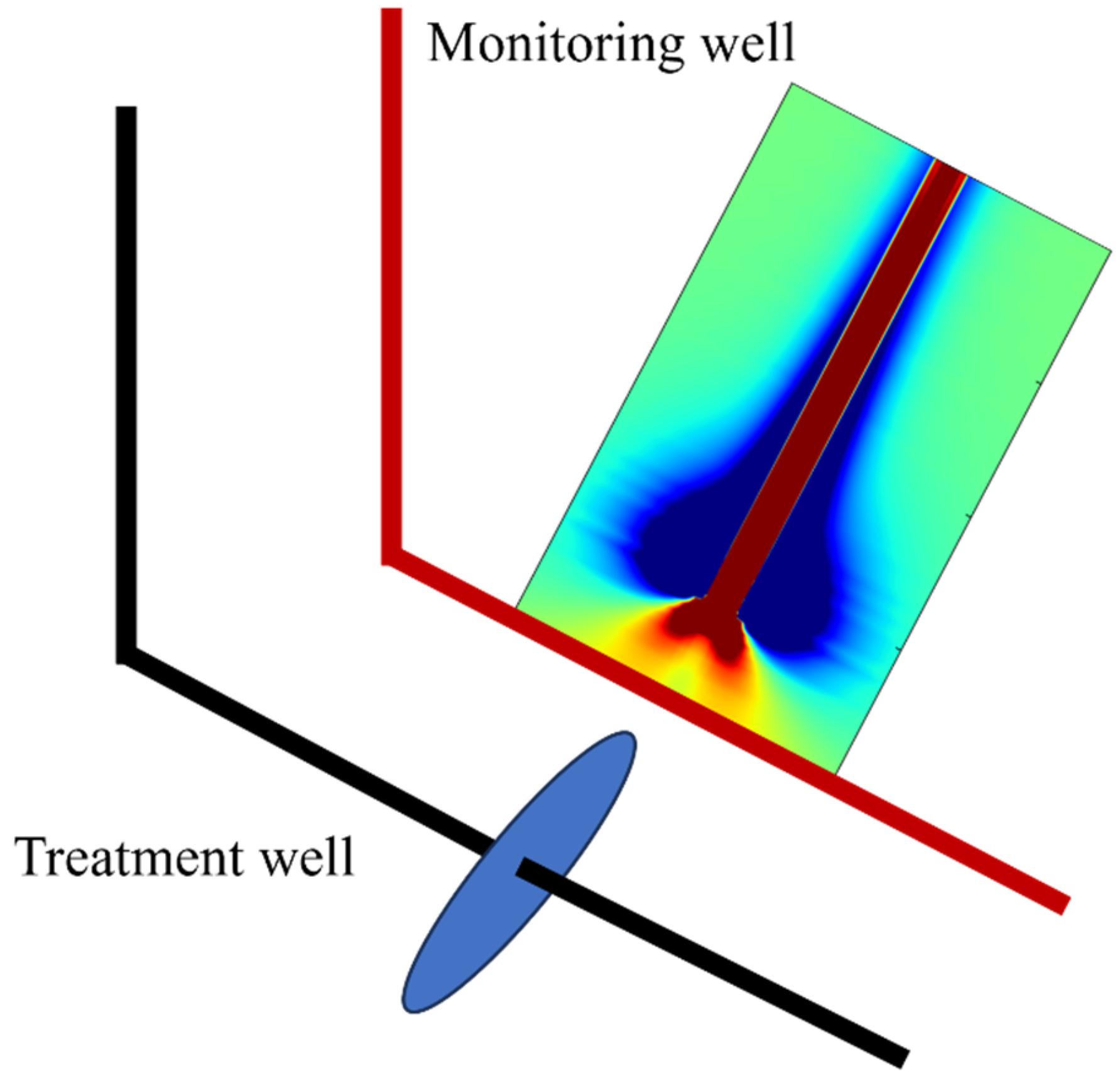
From the perspective of monitoring mechanisms and signal characterization, previous studies have shown that DAS can capture acoustic, microseismic, temperature, and deformation-related responses during hydraulic fracturing treatments [3,4]. Nevertheless, interpretation of DAS and LF-DAS data remains nontrivial because the measurements are influenced by axial single-component sensitivity, fiber–formation coupling conditions, gauge length, and instrument response characteristics [9,11]. In current engineering practice, geometric interpretation of LF-DAS commonly relies on recurring spatiotemporal patterns, such as heart-shaped precursors before Frac Hit and post-hit bands or stress-shadow signatures (Figure 1). On this basis, Jin and Roy demonstrated that low-frequency DAS signals can be used to constrain hydraulic fracture geometry [10], whereas Ugueto et al. interpreted DAS strain fronts as indicators of fracture propagation extent [12]. Liu et al. further clarified the deformation and strain rate mechanisms underlying LF-DAS responses during hydraulic fracturing [11], and subsequently established a Green’s-function-based inversion framework for hydraulic-fracture-width estimation from LF-DAS strain data [13]. More recently, Li et al. quantified the relationship between the spatial scale of the heart-shaped pattern and the distance to the approaching fracture tip [14]. Collectively, these studies have substantially improved the physical understanding of LF-DAS responses; however, they also indicate that translating such characteristic patterns into quantitative and reproducible dynamic inversions of interacting fracture swarms remains an unresolved challenge.
In forward modeling, classical PKN-type fracture propagation models remain an important foundation for efficient algorithms and engineering approximations [15]. To relate fracture net pressure and aperture to offset well strain response, DDM, BEM, Green’s functions, and semi-infinite-body analytical solutions have been widely used for far-field calculations and template-based interpretation [13,16]. More recently, Mao et al. proposed a semi-analytical forward framework based on the Boussinesq half-space solution, emphasizing improved efficiency and detailed matching capability for arbitrary fracture geometries and apertures [16].
In inversion and parameter estimation, Liu et al. established a Green’s-function-based inversion method for LF-DAS fracture width and presented a sensitivity analysis [13]; Tu et al. explicitly incorporated time-varying geometry and trajectories into an optimization model and demonstrated visual interpretation on cases such as HFTS2 [17]; and Chen Ming et al. discussed parameter interpretability and regularized solutions after a fracture reaches the fiber from the perspective of ill-posed inversion and implemented iterative inversion of fracture width and height [18]. Meanwhile, more engineering studies still focus on “diagnostic integration” rather than dynamic inversion, for example by combining FBE and LF-DAS for stage and cluster-scale diagnosis and anomaly identification [19].
Although previous studies have established the observational and inversion basis for LF-DAS-based fracture monitoring [12,13], history matching of the dynamic evolution of fracture swarms still faces four common challenges. First, multi-fracture competition combined with time-varying flow rate allocation causes the parameter space to expand with time, making the inverse problem strongly nonlinear and nonconvex. This, in turn, increases the likelihood of local minima, near-equivalent solutions, and unstable global convergence [13,20]. Such difficulties are well recognized in continuous high-dimensional search problems and remain challenging even for population-based heuristic optimizers [20,21,22]. Second, field LF-DAS data have limited signal-to-noise ratio, and the spatial resolution is constrained by gauge length and instrument response, so feature picking and error propagation can markedly affect inversion stability [8,12]. Third, iterative optimization relies on fast forward surrogates, but systematic bias between the surrogate and the full model (surrogate mismatch) may lead to feature fitting with physical distortion. Fourth, fracture parameter identifiability is spatially selective, with greater sensitivity near hit locations, and ill-posedness together with interpretability bounds must therefore be handled explicitly in the inversion framework [13].
To address the above issues, this study proposes an LF-DAS-driven framework for the dynamic inversion of fracture swarms. The framework consists of four main components. First, an efficient fluid–solid coupled forward surrogate is developed for variable-rate injection and shut-in conditions to support high-frequency iterative inversion. Second, multi-scale key features, including fracture-arrival and propagation-reversal signatures, are extracted from the two-dimensional strain rate tensor and incorporated as physics-informed prior constraints. Third, an inversion model based on adaptive particle swarm optimization (APSO) is established to jointly estimate the number of effective fractures and their time-varying flow rate allocation functions in a continuous parameter space. Finally, the inverted results are validated through full-model forward substitution to reduce the influence of surrogate bias, and the framework is further examined using both synthetic cases and a field application from an oilfield in the Ordos Basin.

2. Methods

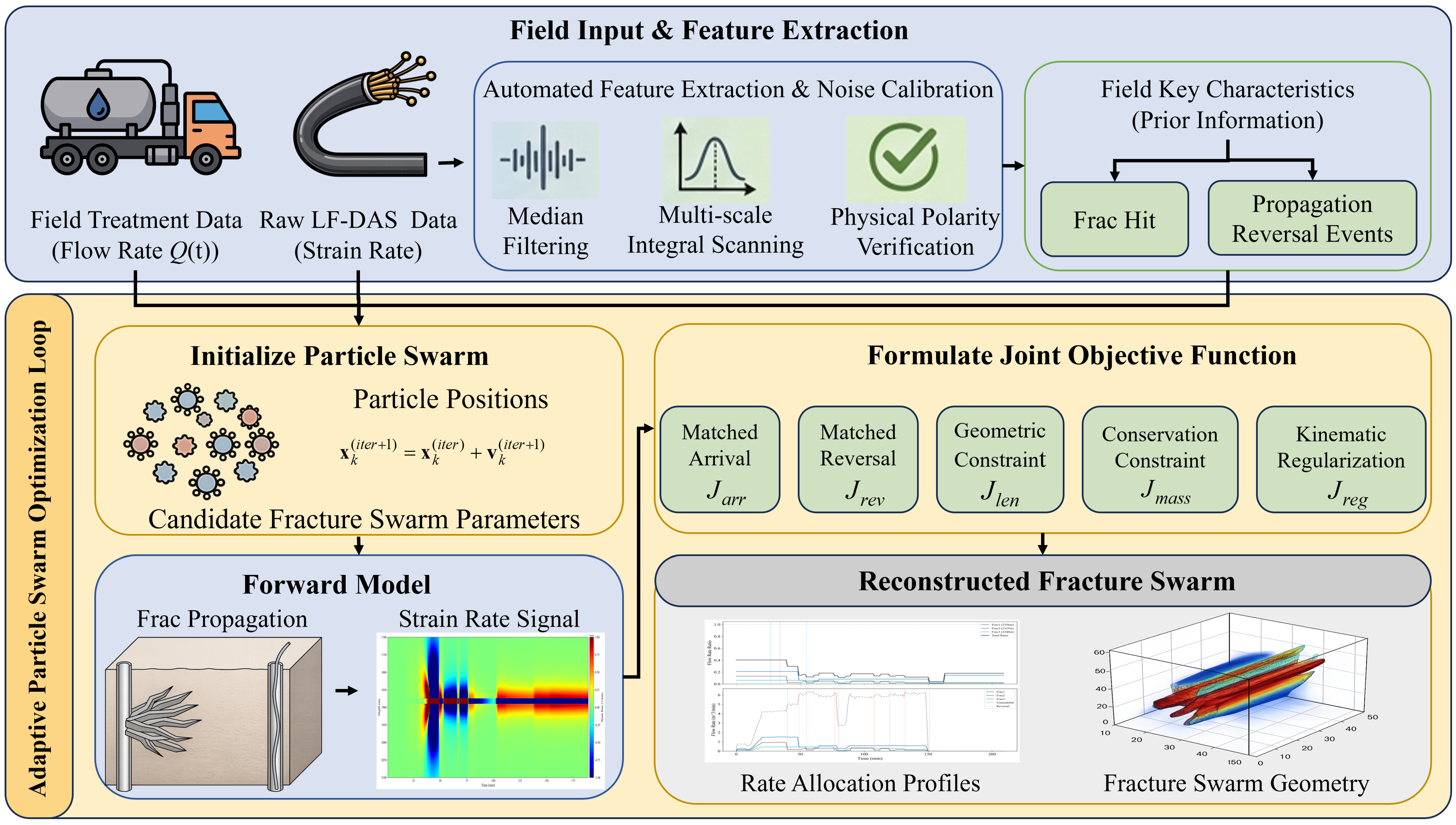
A physics-data dual-driven closed-loop inversion framework is proposed in this study (Figure 2) to address the high-dimensional and nonconvex optimization problem involved in history matching of fracture swarm evolution. The framework consists of three core modules: (1) a fluid–solid coupled semi-analytical forward model that accommodates variable-rate injection and shut-in conditions and establishes a direct mapping from wellhead flow rate to far-field fiber-optic strain rate response; (2) an automatic extraction algorithm for fiber-optic key features based on physical polarity constraints, which provides physics-based prior constraints for inversion; and (3) a joint inversion model based on adaptive particle swarm optimization (APSO), which simultaneously optimizes the spatial distribution of fracture swarms and the transient flow rate allocation function in a continuous phase space. Through coordinated operation of these modules, the high-dimensional nonconvex history-matching problem of fracture swarms is transformed into an efficient and robust global optimization problem.

2.1. Forward Model

To provide an efficient mapping of far-field fiber-optic strain response during inversion iterations, a fluid–solid coupled forward model is developed to describe variable-rate injection and the fracture-closure effect induced by the abrupt pressure drop during shut-in. The model is established on the basis of the following key mechanical assumptions.
Formation properties: The reservoir rock is treated as a homogeneous, isotropic, linear elastic continuum, and matrix body forces together with heterogeneity of the in situ stress field are neglected.
Fiber coupling: The formation and the fiber-optic monitoring well are assumed to be fully coupled without relative slip, and both displacement and strain are taken as zero at the initial time.
Fracture geometry: Fracture propagation follows the plane-strain assumption; fracture height h is fully confined and remains constant, and propagation occurs only in the horizontal direction x .
Fluid constitutive behavior and leakoff: The fracturing fluid is treated as an incompressible Newtonian fluid, and one-dimensional wall leakoff into the matrix follows the Carter leakoff law.
Mechanical closure boundary: When a sudden rate drop leads to insufficient driving force for fracture propagation, fracture length ceases to grow, and subsequent volume shrinkage is accommodated only by elastic reduction in fracture width together with continued leakoff.
The fiber-optic monitoring well in the present framework is located at a considerable distance from the fracturing well (e.g., 250 m in the field case presented in Section 3.3). At such far-field distances, the strain perturbations induced by the propagating fractures are on the order of microstrain (~10−6), which is far below the typical elastic limit strain of reservoir rocks (~10−3). The formation response at the monitoring well is therefore well within the linear elastic regime. Near-tip plasticity, micro-cracking, and process zone development are concentrated in the near-field region around the fracture tip and along the fracture walls, occupying a very small volume relative to the overall formation. While these inelastic phenomena could introduce a systematic but small bias in the predicted strain amplitude, the inversion framework primarily relies on temporal features (arrival times and propagation-state reversal times) rather than absolute strain amplitudes, thereby limiting the impact of this simplification on the inversion results. Extending the forward model to incorporate elasto-plastic or damage mechanics constitutive behavior near the fracture zone is identified as an important direction for future work.

2.1.1. Governing Equations for Fracture Propagation and Closure

By combining one-dimensional Poiseuille flow with the Carter leakoff effect, the global mass-conservation equation can be discretized as follows:
V f r a c ( t ) = 0 t Q ( τ ) d τ 2 π h c 0 i = 1 n Δ L i t t c , i
where V f r a c ( t ) is the net fluid volume of the fracture at time t (unit: m3); Q ( t ) is the total wellhead injection rate (unit: m3/s); Δ L i is the length of the newly opened incremental segment generated by the i-th tip advance (unit: m); and t c , i corresponds to the opening time of that incremental segment.
Fracture aperture and net fluid pressure inside the fracture satisfy the singular integral relation for a plane-strain fracture. The aperture distribution can be expressed as:
w ( x , t ) = 4 ( 1 ν 2 ) E 0 L ( t ) p n ( ξ , t ) K ( x , ξ ; L ) d ξ
where p n ( ξ , t ) (unit: Pa) is the effective net fluid pressure at the spatial integration position ξ (unit: m); and K ( x , ξ ; L ) is the geometric singular integral kernel. Under the assumption of uniform pressure distribution along fracture height, the macroscopic linear elastic constitutive relation of the system can be reduced to V f r a c ( t ) = C e l P ( t ) L ( t ) , where C e l = π 3 h 2 1 ν 2 E (unit m2/Pa).
Three pressure concepts are relevant to hydraulic fracturing but play different roles in the present model. The breakdown pressure is the wellbore pressure at which fracture initiation occurs; it is not explicitly modeled here because the forward model begins with an assumed initial fracture that is already open and propagating. The net pressure is defined as the difference between the fluid pressure inside the fracture and the minimum in situ stress perpendicular to the fracture plane; it is the driving force for fracture opening and is directly related to the fracture aperture through Equation (2) and the macroscopic elastic compliance relation presented above. The bottomhole treating pressure is the total fluid pressure measured at the wellbore entry, which equals the net pressure plus the minimum in situ stress plus frictional pressure losses along the fracture. In the present framework, only the net pressure is directly solved. During the quasi-steady propagation stage, the net pressure is positive and adjusts dynamically as fracture length grows, governed by the balance among fluid injection, elastic opening, Poiseuille flow resistance, and Carter leakoff. During the rate-drop closure stage, the net pressure decreases due to continued leakoff and volume contraction, as described by the closure criterion below.
To address the complex conditions of variable-rate injection and shut-in, a dynamic criterion is introduced in the model:
Quasi-steady propagation stage: When d V f r a c d t > 0 , the current propagation half-length L ( t ) is updated dynamically by implicitly solving the volume balance and the net-pressure evolution.
Rate-drop closure stage: When a sharp rate Q ( t ) drop causes volume contraction, fracture length ceases to extend, and the entire volume contraction is accommodated by aperture reduction; the net pressure P ( t ) inside the fracture is then expressed in terms of fracture volume P ( t ) = V f r a c ( t ) C e l L ( t ) .

2.1.2. Mapping of Far-Field LF-DAS Strain Rate Spatiotemporal Response

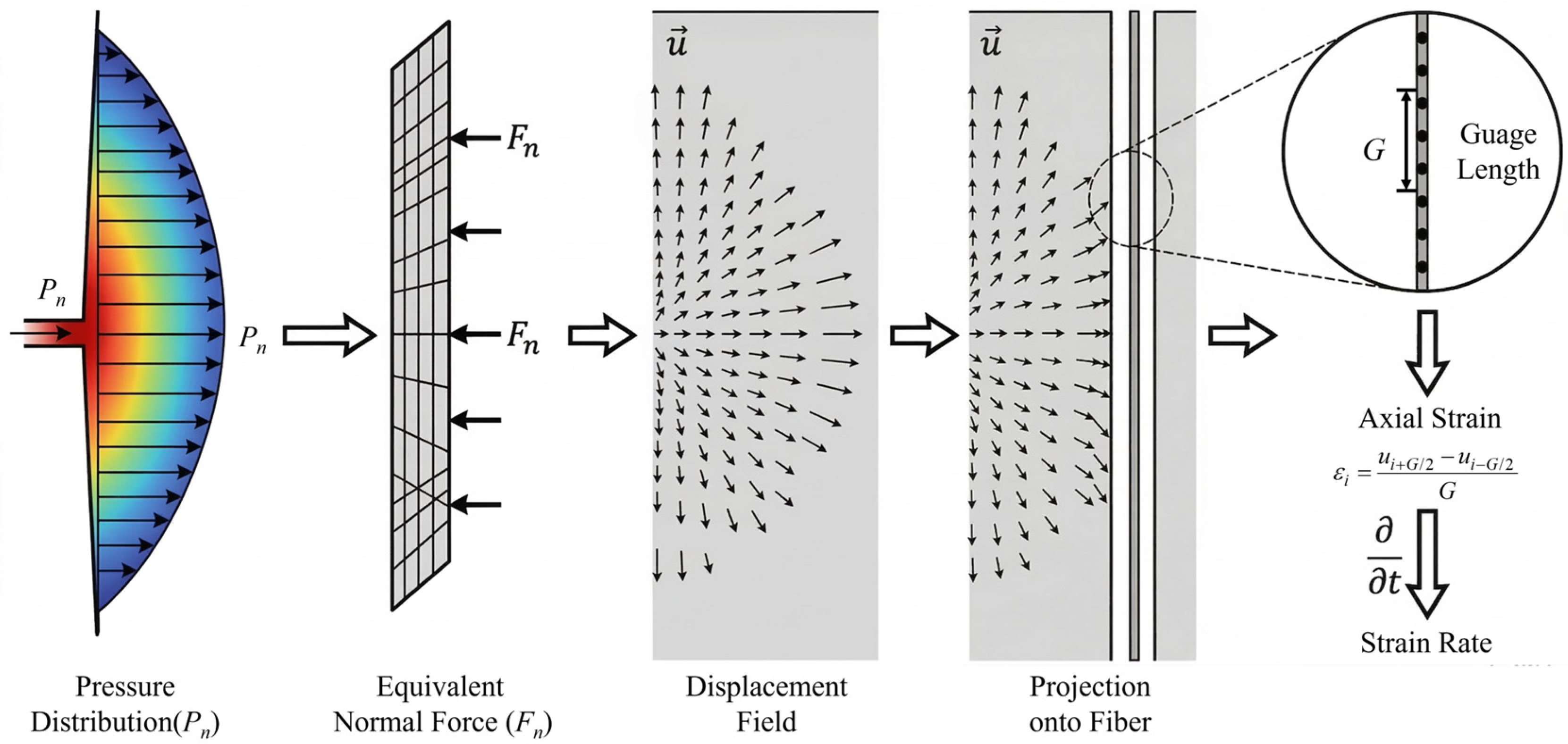
To avoid the substantial computational cost caused by meshing complex fracture networks, the semi-analytical method proposed by MAO et al. [16] is introduced to efficiently solve far-field fiber-optic strain. In this method, the net fluid pressure on the fracture surfaces is converted into discrete normal concentrated forces, and the local total displacement vector u at any spatial point is obtained by superposition based on the Boussinesq half-space solution with boundary effects removed through continuity conditions. To remain consistent with the measurement principle of field LF-DAS, axial fiber strain ε is calculated by central differencing of the displacement u projected onto the fiber direction over the physical gauge length G (unit: m):
ε i = u i + G / 2 u i G / 2 G
Time differentiation yields the strain rate ε ˙ (unit: s−1) evolution at the fiber observation points:
ε ˙ = ε t + Δ t ε t Δ t
Through this forward model, the dynamic geometric and mechanical evolution characteristics of variable-rate fractures can be efficiently mapped to far-field LF-DAS strain rate (Figure 3).

2.2. Automatic Identification of Key Features in Field LF-DAS Data

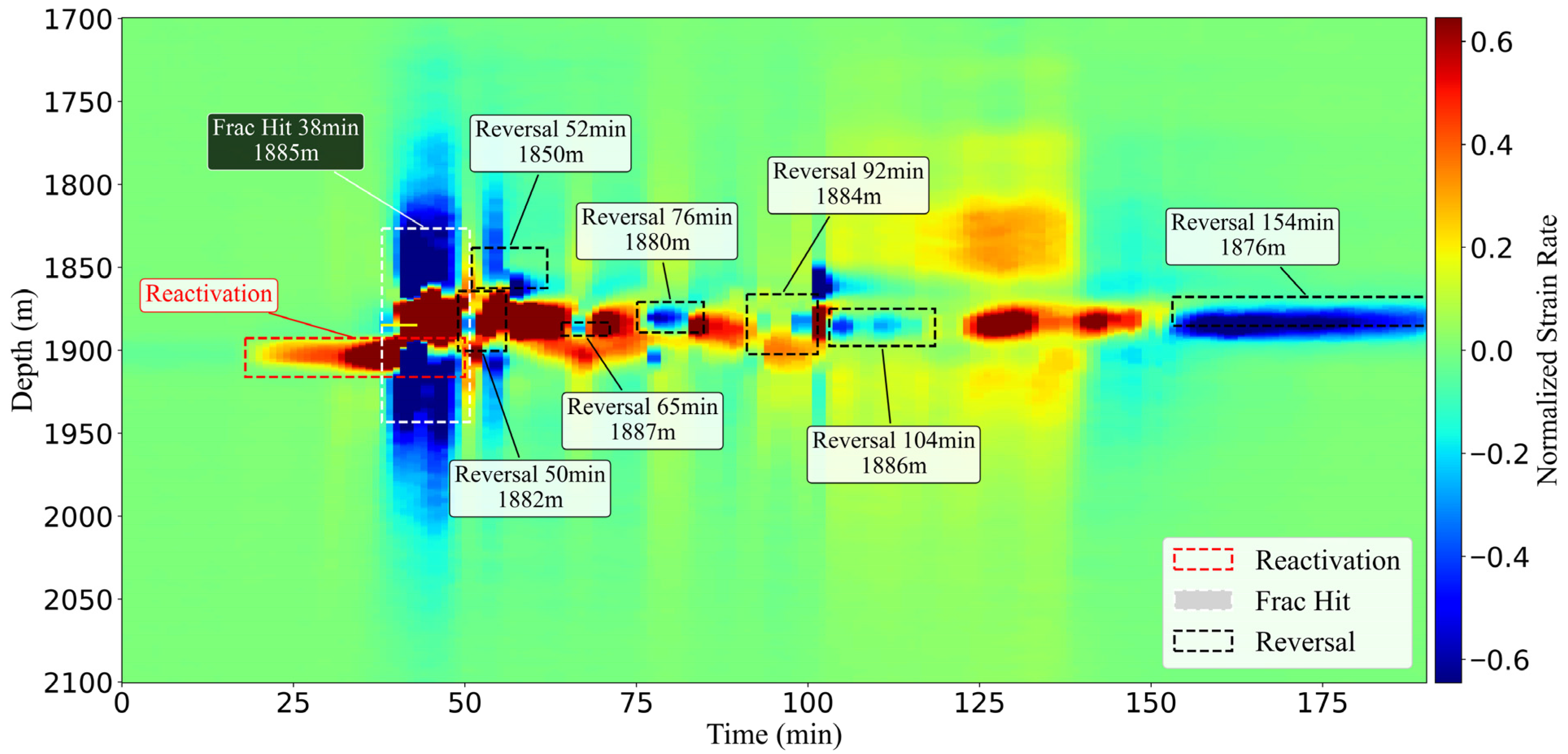
The raw LF-DAS monitoring data are represented by a two-dimensional spatiotemporal strain rate tensor, whose elements characterize the measured strain rate ε ˙ at a given spatial depth z and time t . In this study, the normalized spatiotemporal tensor is subjected to multi-scale feature extraction through calibration of the global background-noise baseline, thereby isolating three major features, namely pre-stage fracture response, Frac Hit, and propagation-state reversal (Figure 4).

2.2.1. Identification of Pre-Stage Fracture Response

Although pre-stage fracture response is not directly used as a physical constraint in the subsequent inversion objective function, its accurate identification is a necessary prerequisite for filtering historical cascading interference and ensuring that the extracted strain rate features are attributed only to the current fracturing stage. Active depth-connected domains with peak amplitudes exceeding the significance threshold λ d e t e c t σ n o i s e are first identified during the startup stage of fracturing. For any candidate depth interval, physically signed segmentation analysis is then performed on its smoothed time-series signal. When a significant tensile (positive strain rate) signal lasting longer than the characteristic time scale Δ t c h a r is detected and is followed by an obvious compressive (negative strain rate) reversal as fractures from the current stage arrive, the event is identified as a valid pre-stage response. The validity of this feature is jointly constrained by a dynamic signal-to-noise ratio (SNR) threshold and a minimum depth-span condition to remove point-like random disturbances.

2.2.2. Identification of Frac Hit

The approach and intersection of fractures from the offset well generate strong transient strain disturbances on the monitoring fiber, typically manifested as a heart-shaped energy concentration center followed by a sustained tensile band in the spatiotemporal section. Automatic identification of this feature is formulated as a local-extrema detection and density-clustering problem constrained by physical morphology. Within the primary strain-active zone, local maxima ε ˙ p e a k * are searched at each time step along the depth direction. A true Frac Hit requires not only that the peak intensity satisfy a high-confidence threshold, but also that the energy show sharp attenuation on both spatial sides of the peak. An adaptive density-based clustering algorithm constrained by geological depth tolerance and characteristic event time is employed to aggregate discrete high-energy pulse points into continuous Frac Hit clusters, and the energy centroid of each cluster is extracted as the hit coordinate.

2.2.3. Identification of Reversal

The reversal signal from local fracture opening to closure caused by shut-in or swarm competition is extremely narrow and readily obscured. A joint identification algorithm based on physical mechanisms is proposed, including two steps: multi-resolution asymmetric integration scanning and flank-polarity verification:
Multi-Resolution Asymmetric Integration Scanning: A set of asymmetric forward-backward integration window pairs ( t l b k , t f w k ) covering different time scales is defined. For any spatial location L , a point is marked as a candidate reversal point if and only if there exists at least one resolution scale k for which the local strain rate integrals before and after the zero-crossing strictly satisfy the tensile-compressive polarity-reversal threshold calibrated by the baseline noise σ n o i s e :
1 t l b k t t l b k t ε ˙ * ( L , τ ) d τ > f t e n s i l e ( σ n o i s e )   and   1 t f w k t t + t f w k ε ˙ * ( L , τ ) d τ < f c o m p ( σ n o i s e )
where f t e n s i l e and f c o m p are adaptive significance decision functions.
Kinematic Flank Polarity Verification: To eliminate interference from local nonphysical noise, the stress-shadowing principle in continuum mechanics is introduced as a polarity-validation criterion. Only when compensatory net tensile strain rate ε ˙ ¯ f l a n k * > 0 is detected in the flank observation zone is the reversal event in the core zone considered valid.

2.3. Inversion Model

During hydraulic fracturing, the combined effects of reservoir heterogeneity, natural weak planes, and evolution of the induced stress field commonly lead to a fracture swarm system in which multiple branches within the same cluster propagate simultaneously or alternately. This process is essentially manifested as nonlinear competitive allocation of high-pressure fluid among different fractures. To this end, an adaptive particle swarm optimization inversion framework fully driven by LF-DAS field monitoring features is established to simultaneously solve the dynamic activation distribution of fracture swarms and the nonuniform flow rate allocation over their full life cycle in a unified continuous parameter space.

2.3.1. Parameterization and Dimensionality Reduction in Dynamic Flow Rate for Fracture Swarms

Flow competition within the swarm system involves both discrete topological changes (activation/stagnation) and continuous variable evolution. To enable the use of continuous heuristic optimization algorithms, a “maximum-potential-space mapping” and a weight-truncation strategy are introduced for mathematical dimensionality reduction.
Let the maximum number N m a x of potential branches initiated within the swarm system be, and let the transient time series of the total single-sided wellhead injection rate be Q t o t a l ( t ) (unit: m3/s), where t is time (unit: min). The initial flow rate allocation weight of the i-th potential branch fracture is defined as r i n i t , i ( 0 , 1 ) . By introducing a critical activation threshold ε a c t i v e , the number of effectively activated fractures N f r a c within the swarm is implicitly determined by the system state:
N f r a c = i = 1 N m a x I ( r i n i t , i > ε a c t i v e )
where I ( ) is the indicator function. When r i n i t , i ε a c t i v e , the corresponding potential branch is judged to close at a very early stage owing to disadvantageous flow competition or strong stress shadowing and is excluded from the effective propagation system.
To describe the dynamic reallocation of flow rate among different branch fractures during the late stage of swarm competition, N r e v feature-state adjustment variables are defined for the reversal events extracted from LF-DAS that represent fluid redistribution and abrupt stress-state changes, namely the dimensionless drop amplitude Δ d r o p , j and the dimensionless recovery coefficient k r e c , j . A high-dimensional optimization parameter vector x D is then constructed, with dimension D = N m a x + 2 N r e v . To ensure strict enforcement of physical bounds during nonlinear optimization, a continuous nonlinear mapping function (Sigmoid Mapping) is used to map the unbounded real-valued search space x onto the physically feasible domain [ p a r a m m i n , p a r a m m a x ] :
f ( x ) = 1 1 + e x , p a r a m = p a r a m m i n + f ( x ) ( p a r a m m a x p a r a m m i n )
Through the above mapping, the transient flow rate allocation-ratio function r i ( t ; x ) of the i-th effective branch fracture over the entire swarm-competition cycle is accurately reconstructed and used as the transient boundary condition of the fluid–solid coupled forward model, thereby driving the coordinated evolution of the half-length L i ( t ; x ) of each branch fracture (unit: m).

2.3.2. Construction of Joint Objective Function for Swarm Features

The essence of inversion is to seek the optimal state vector x * such that the far-field mechanical response predicted by the forward model approaches the multi-source features observed by LF-DAS. Accordingly, a joint functional J ( x ) including spatiotemporal evolution matching and physical-boundary constraints is constructed:
J ( x ) = λ 1 J a r r + λ 2 J r e v + λ 3 J l e n + λ 4 J m a s s + λ 5 J r e g
where λ 1 , , λ 5 is the dimensionless regularization penalty weight used to balance the scale and gradient dominance of different multiphysics objectives. The physical meanings and mathematical definitions of the sub-functionals are as follows:
Swarm arrival-time fitting term J a r r : This term evaluates the deviation between the theoretical arrival times t a r r , s i m ( i ) predicted when each fracture propagates to the fiber-monitoring distance d f i b e r (unit: m) and the LF-DAS observed arrival times t a r r , o b s ( i ) :
J a r r = i = 1 N f r a c t a r r , s i m ( i ) ( x ) t a r r , o b s ( i ) 2
Reversal fitting term J r e v : This term characterizes the opening-to-closure reversal behavior of fracture swarms. It computes the mean squared error between the strain rate reversal times t r e v , s i m ( j ) predicted by the forward surrogate model and the observed reversal points t r e v , o b s ( j ) :
J r e v = j = 1 N r e v t r e v , s i m ( j ) ( x ) t r e v , o b s ( j ) 2
Geological-boundary constraint term J l e n : A one-sided nonlinear penalty operator is introduced to prevent nonphysical parameter oscillations from generating anomalous fracture lengths L m a x (unit: m) beyond geological limits:
J l e n = i = 1 N f r a c max L i ( t e n d ; x ) L m a x , 0 2
Swarm mass-conservation constraint term J m a s s : Based on the continuity principle, the sum of the flow rate allocation ratios of all activated branches at any time must satisfy the global mass-conservation boundary:
J m a s s = t ( i = 1 N f r a c r i ( t ; x ) 1 ) 2
Dynamic regularization term J r e g : To suppress ill-posedness in the inversion process, a smoothness regularization penalty is imposed on the second derivative of the flow rate allocation function:
J r e g = i = 1 N f r a c d 2 r i ( t ) d t 2 2 d t

2.3.3. Global Synergistic Optimization Mechanism via Adaptive PSO

Because the joint objective functional J ( x ) for fracture swarms exhibits highly nonconvex, multimodal, and gradient-discontinuous topological features, conventional Jacobian-based gradient descent faces severe local-convergence difficulties. Therefore, adaptive particle swarm optimization (APSO) is used to perform heuristic global optimization in the D-dimensional phase space.
Let the population size be N p . In the phase space, the position and velocity vectors of the k-th particle at the i t e r -th evolutionary step are x k ( i t e r ) and v k ( i t e r ) , respectively. Based on the Cognitive Learning and Social Learning mechanisms, the phase-space trajectory dynamics of the particles are defined as:
v k ( i t e r + 1 ) = ω ( i t e r ) v k ( i t e r ) + c 1 ξ 1 p b e s t k x k ( i t e r ) + c 2 ξ 2 g b e s t x k ( i t e r )
x k ( i t e r + 1 ) = x k ( i t e r ) + v k ( i t e r + 1 )
where p b e s t k is the local historical optimum memorized by an individual particle; g b e s t is the system optimum determined through global population collaboration; c 1 , c 2 is the social cognitive acceleration coefficient; and ξ 1 , ξ 2 ~ U ( 0 , 1 ) is a uniformly distributed variable providing isotropic random perturbations to the system.
To overcome the search bottleneck of the heuristic algorithm, the inertia weigh, which is the key parameter controlling the exploration depth of the manifold, ω ( i t e r ) is adaptively decayed using a monotonically decreasing function dependent on the evolutionary progress:
ω ( i t e r ) = ω u b ( ω u b ω l b ) i t e r i t e r m a x
Once the convergence criterion is satisfied, the output global optimal parameter vector is inversely mapped to recover the fracture swarm distribution, the number of effective branches, and the transient flow rate evolution history of each branch, all with explicit engineering meaning. In this manner, quantitative inversion of the dynamic evolution of fracture swarms under the combined effects of fluid–solid coupling and competitive propagation is achieved.

3. Verification and Application

3.1. Verification of the Variable-Rate Fluid–Solid Coupled Forward Model

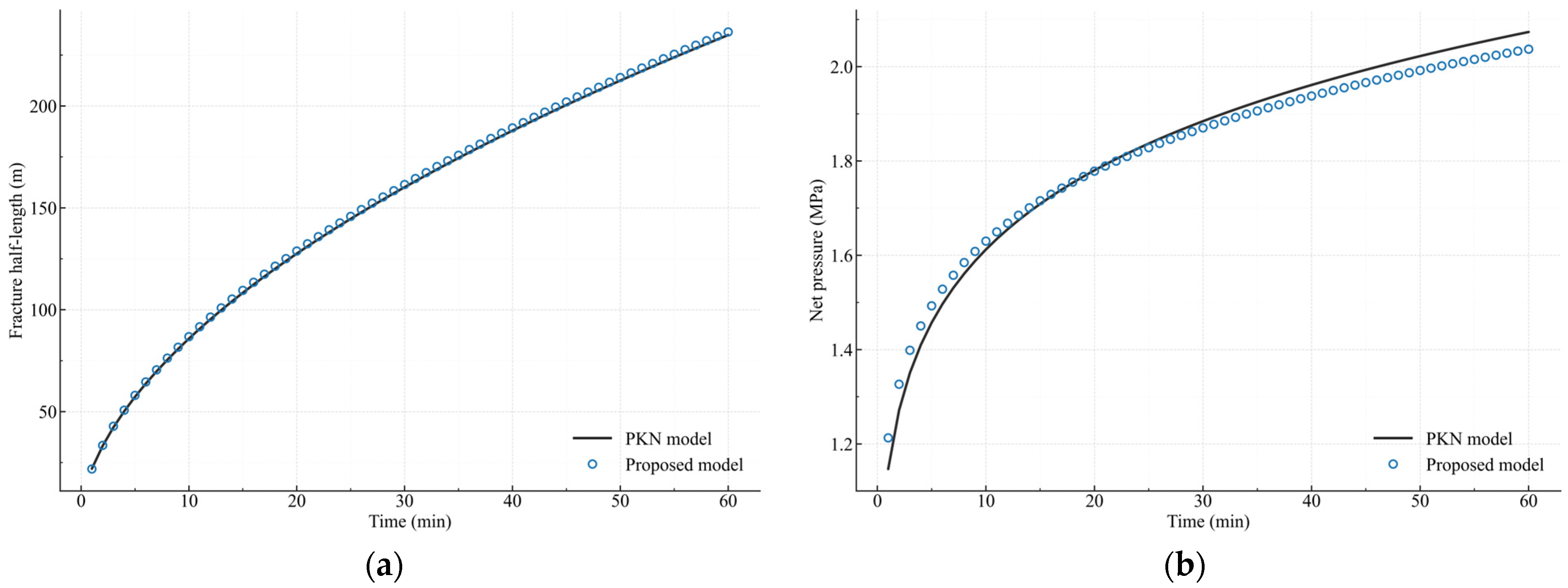
To ensure the reliability of the physical engine underlying the inversion framework, the proposed variable-rate fracture propagation forward model is first subjected to basic verification. The model predictions are benchmarked against the classical analytical PKN solution under identical geomechanical and treatment parameters. The test parameters are set as follows: Young’s modulus 21.4 GPa, Poisson’s ratio 0.26, fracturing-fluid viscosity 5 cp, composite leakoff coefficient 0.00009 m/s0.5, constant fracture height 21 m, and constant-rate injection at 3.18 m3/min for 60 min.
As shown in Figure 5, the predicted evolution of fracture half-length and net pressure from the proposed model is in close agreement with the analytical PKN solution. This preliminary verification demonstrates the high fidelity of the model in handling fluid–solid coupled volume conservation and net-pressure evolution. Compared with traditional analytical solutions, the proposed model is more capable of addressing complex variable-rate conditions and the dynamic closure boundary induced by shut-in, thereby providing the basis for the forward surrogate under more complicated operating conditions.
It is important to note that the above PKN comparison is intended as a baseline verification of the forward model’s physical fidelity under constant-rate conditions, rather than as a demonstration of the framework’s full capability. The classical PKN model, by design, addresses single-fracture constant-rate injection under idealized boundary conditions. In contrast, the proposed framework is designed to handle variable-rate injection, shut-in-induced closure, multi-fracture competitive propagation, and inversion-oriented far-field LF-DAS response mapping—capabilities that lie beyond the intended scope of the classical PKN benchmark. The additional complexity of the forward surrogate is therefore necessitated by the inversion problem itself, which requires rapid evaluation of arbitrary fracture configurations and variable-rate histories within the APSO loop.

3.2. Joint Inversion Validation of Fracture Swarms Based on Synthetic Data

To rigorously evaluate the extremum-search capability and convergence robustness of the APSO-based joint inversion framework under ideal conditions without measurement noise, a double-blind test based on synthetic LF-DAS data is constructed in this section.

3.2.1. Physical Configuration of the Synthetic Case and Automatic Feature Extraction

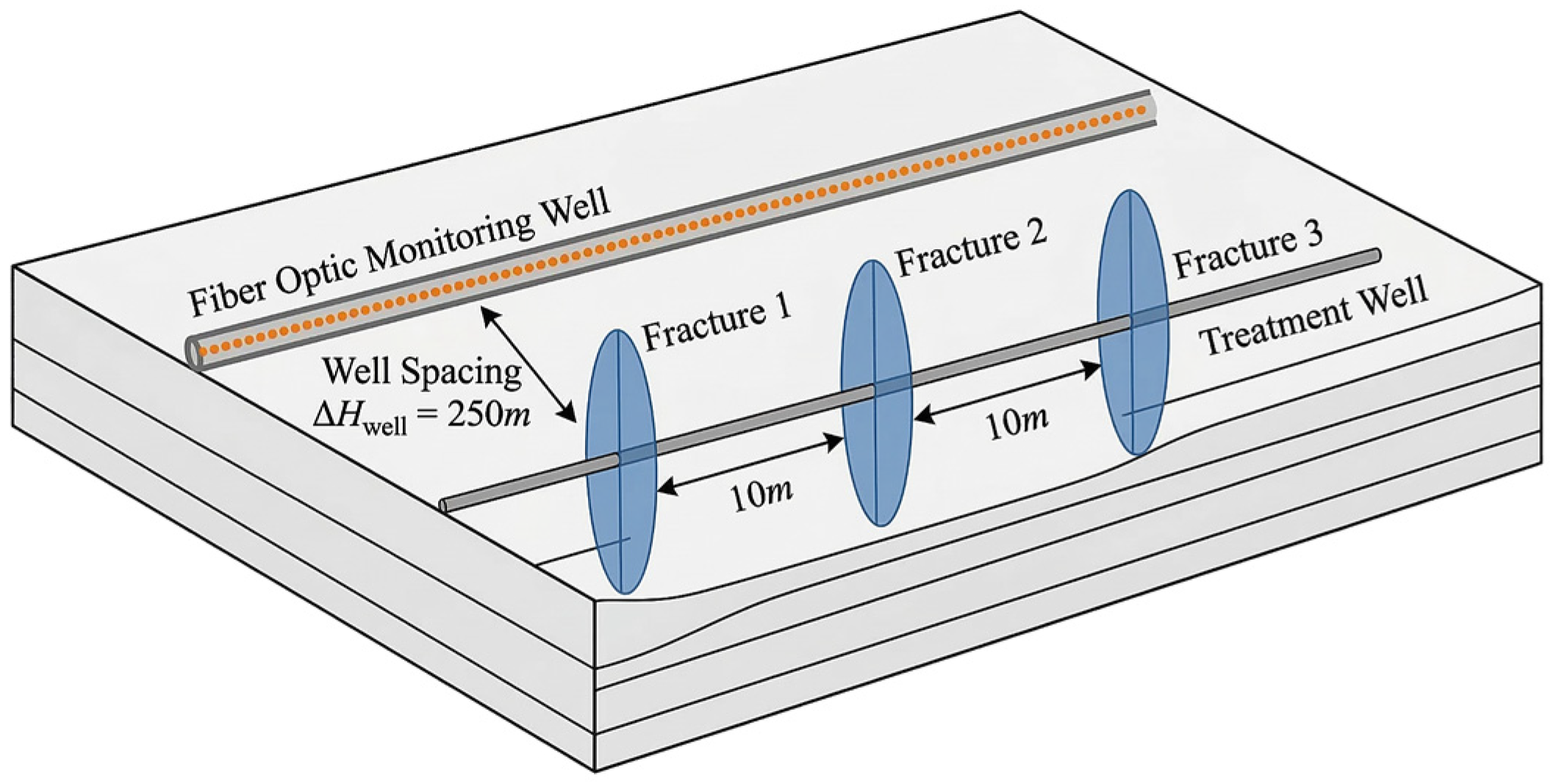
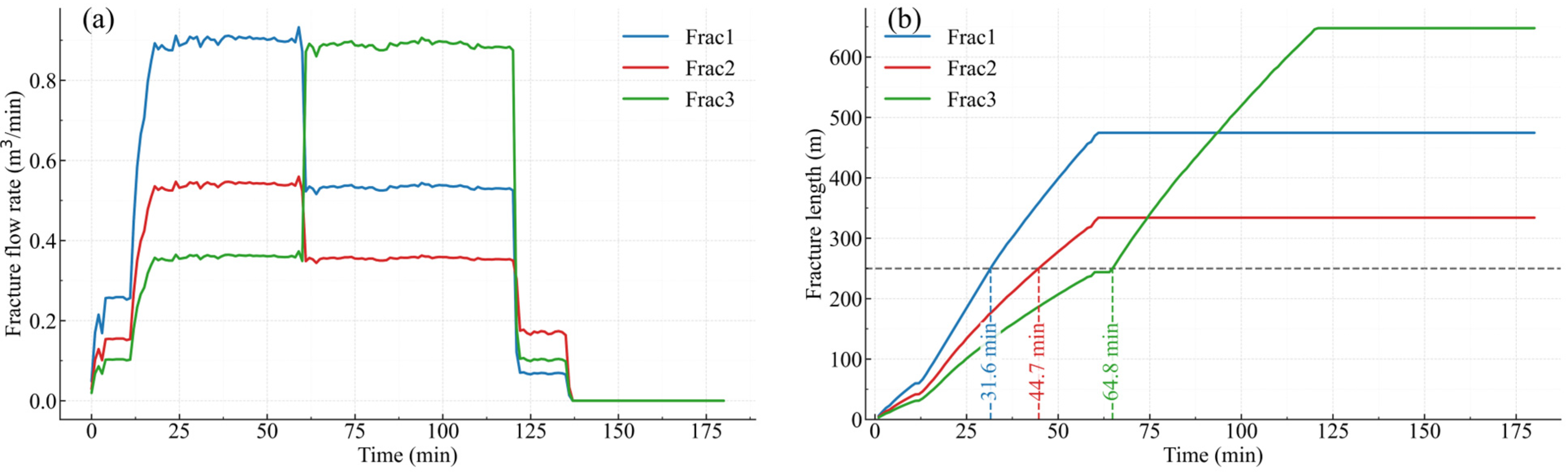
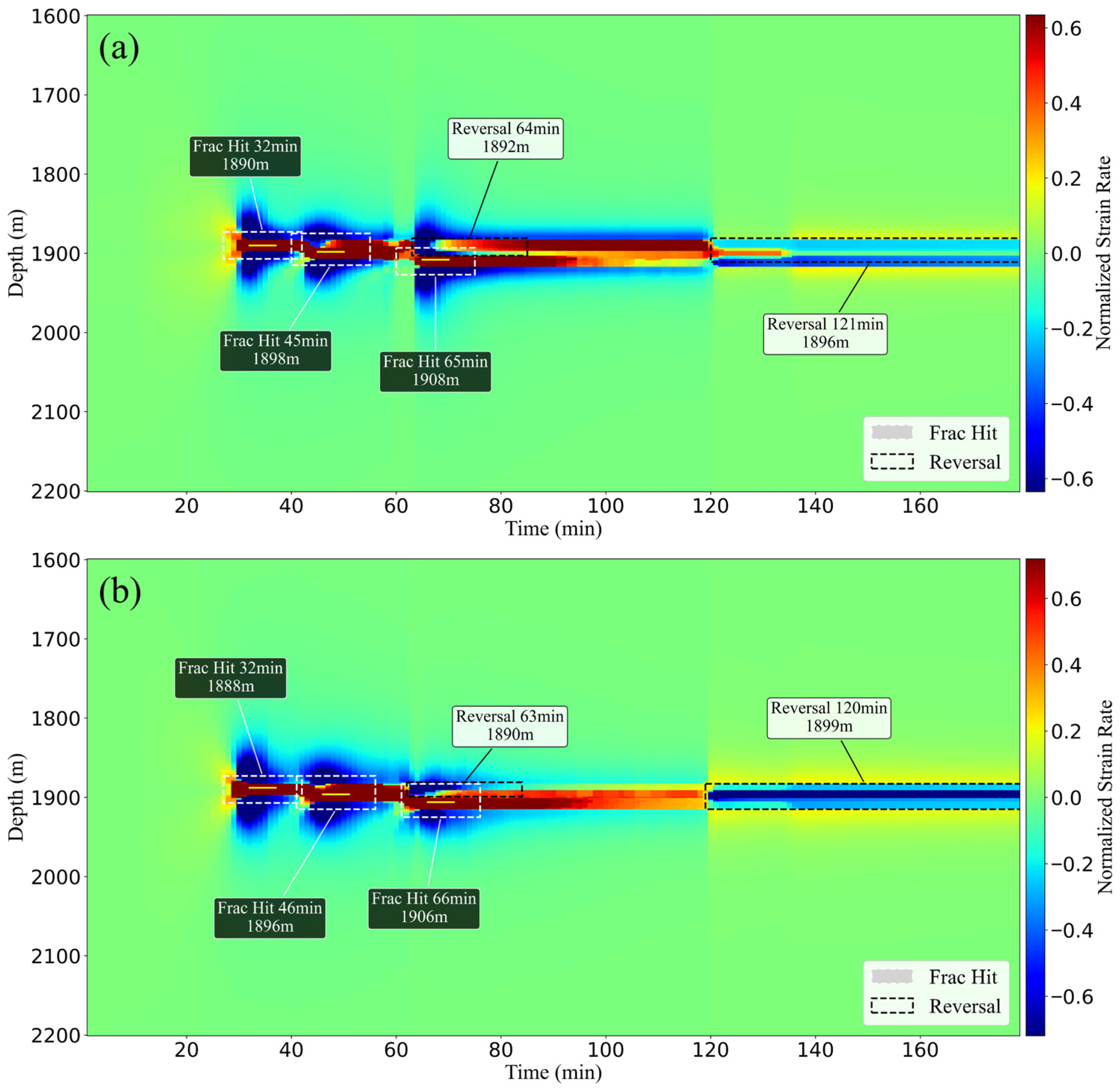
The model considers a horizontal spacing of 250 m between the fracturing well and the fiber-optic monitoring well. Three fractures with an interval of 10 m are driven to undergo nonlinear competitive propagation over a total injection time of 180 min (Figure 6). The rock-mechanical parameters are set as follows: Young’s modulus 30 GPa, Poisson’s ratio 0.22, fracture height 40 m, and leakoff coefficient 0.0000045 m/s0.5. To simulate stress shadowing and fluid competition, nonuniform transient flow rate allocation is assigned to the three fractures, resulting in differentiated fracture length evolution histories (Figure 7).
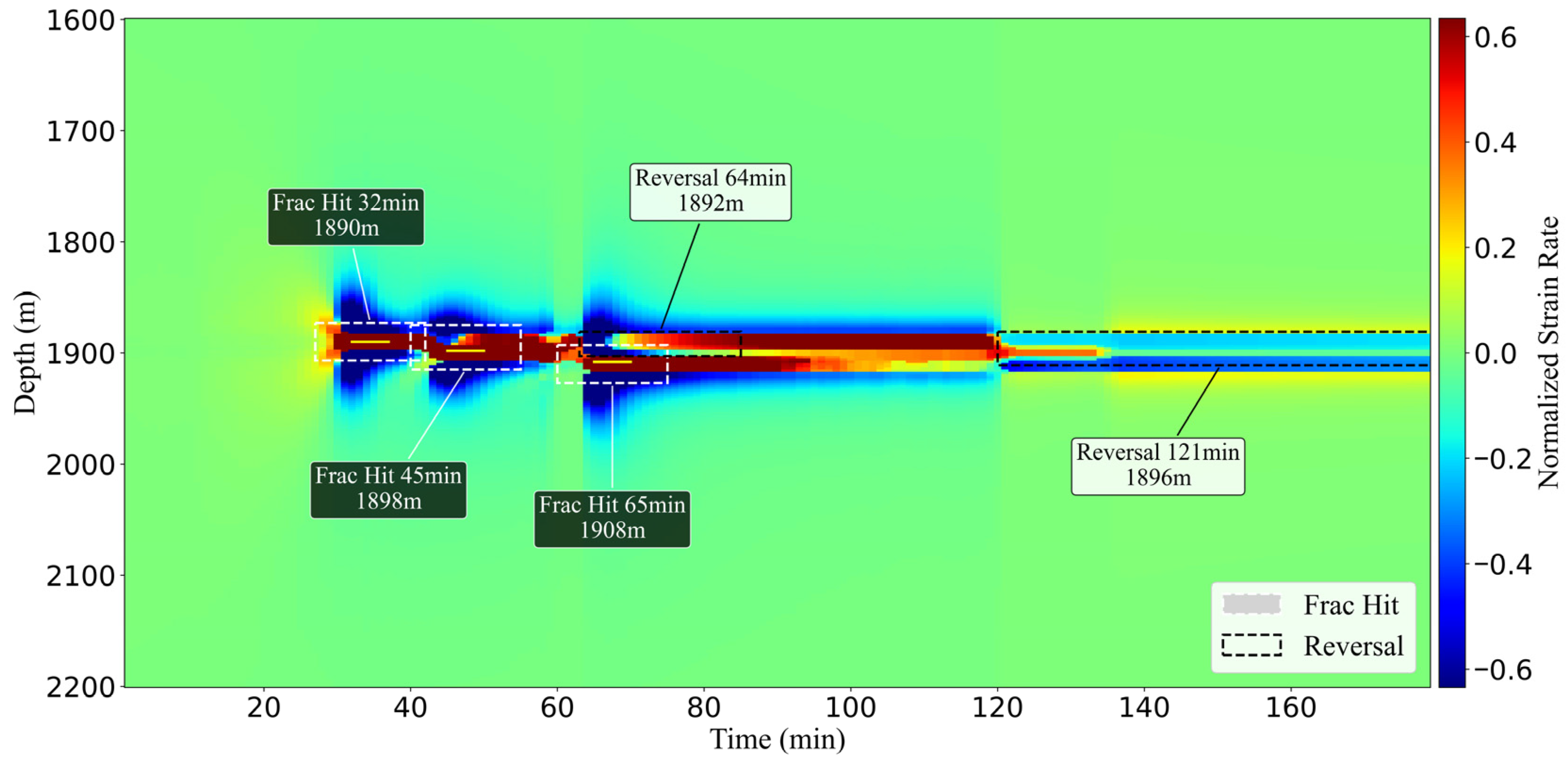
Based on the above forward results, the theoretical fiber-optic strain rate response at the target monitoring well is generated. The automatic feature-identification algorithm is then applied to scan the tensor (Figure 8). The results show that the algorithm successfully captures and labels three Frac Hit events and multiple reversal events caused by local competition. The identified Frac Hit times are highly consistent with the forward records, and the extracted fracture spacing distribution is 8 m and 10 m. Considering the spatial-resolution limit imposed by the 15 m physical gauge length used in this case, the identified 8 m spacing (relative to the true value of 10 m) remains within a controllable and reasonable engineering error range.

3.2.2. Evaluation of Inversion Reconstruction

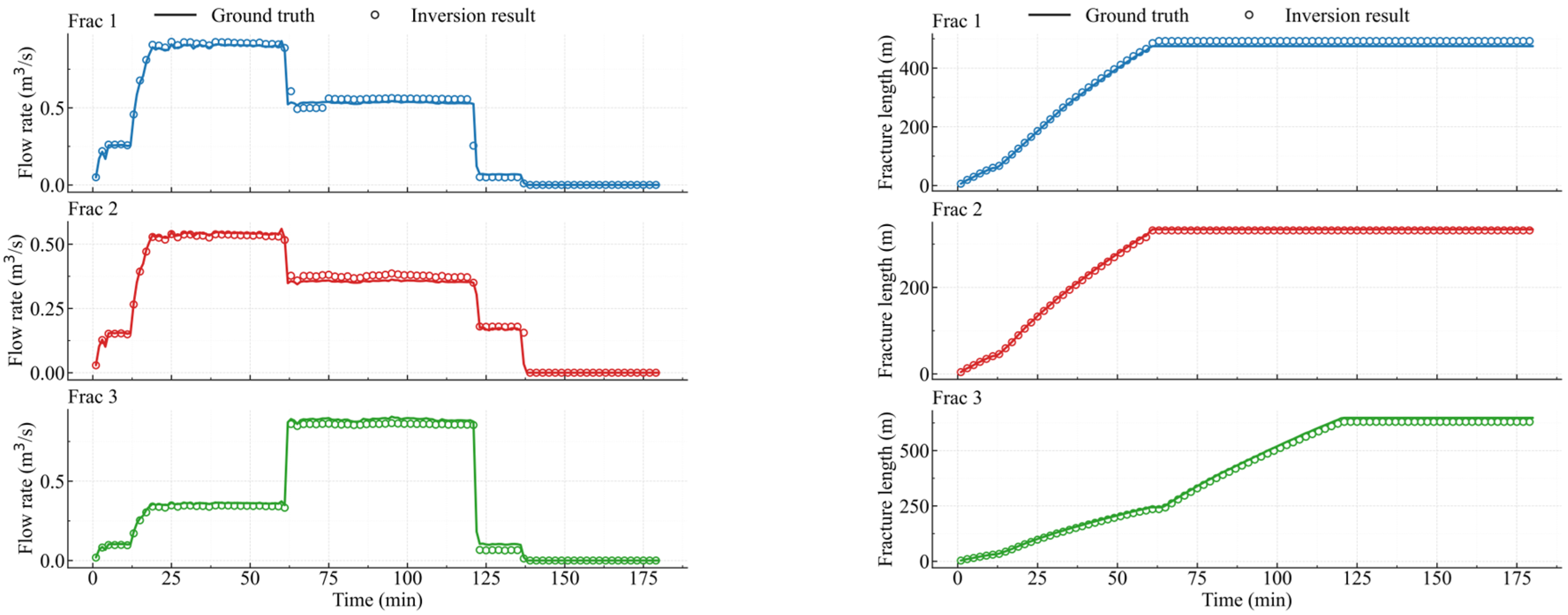
The automatically extracted multi-source key features are introduced into the APSO inversion objective function for constrained optimization. As shown in Figure 9, after sufficient population iterations, the algorithm successfully reconstructs the propagation process of fracture swarms in the continuous phase space. The full-cycle flow rate allocation curves and dynamic fracture length evolution of the three main fractures obtained from inversion are very close to the hidden forward ground truth.
When the optimal parameter sequence obtained from inversion is re-input into the forward surrogate model, the reconstructed strain rate waterfall plot (Figure 10) shows very high fidelity to the original synthetic data in terms of the heart-shaped energy concentration (arrival feature) and the distribution of spatiotemporal reversal bands. This supports the stable convergence under the tested conditions of the physics-data dual-driven framework in the inversion of highly nonlinear and high-dimensional fracture swarms.

3.3. Dynamic Inversion Application Driven by Field LF-DAS Data

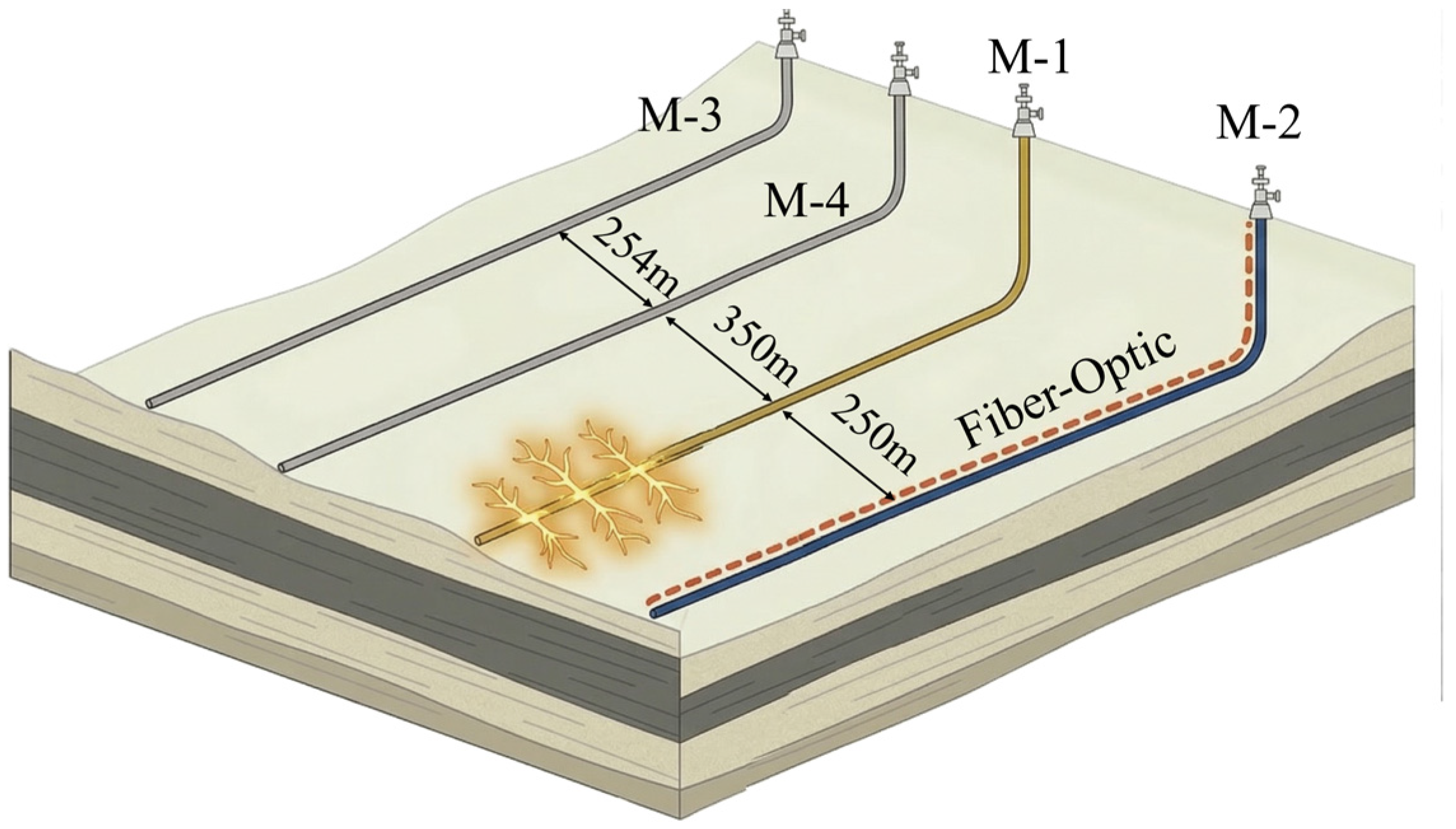
After verifying the theoretical basis of the algorithm, the proposed method is applied to interpret real field data from a field trial in an oilfield in the Ordos Basin [23], and the well layout of the test site is shown in Figure 11. The target interval selected is the designated fracturing stage of Well M-1 (treatment well), and the corresponding fiber-optic monitoring well is Well M-2, located 250 m away horizontally.
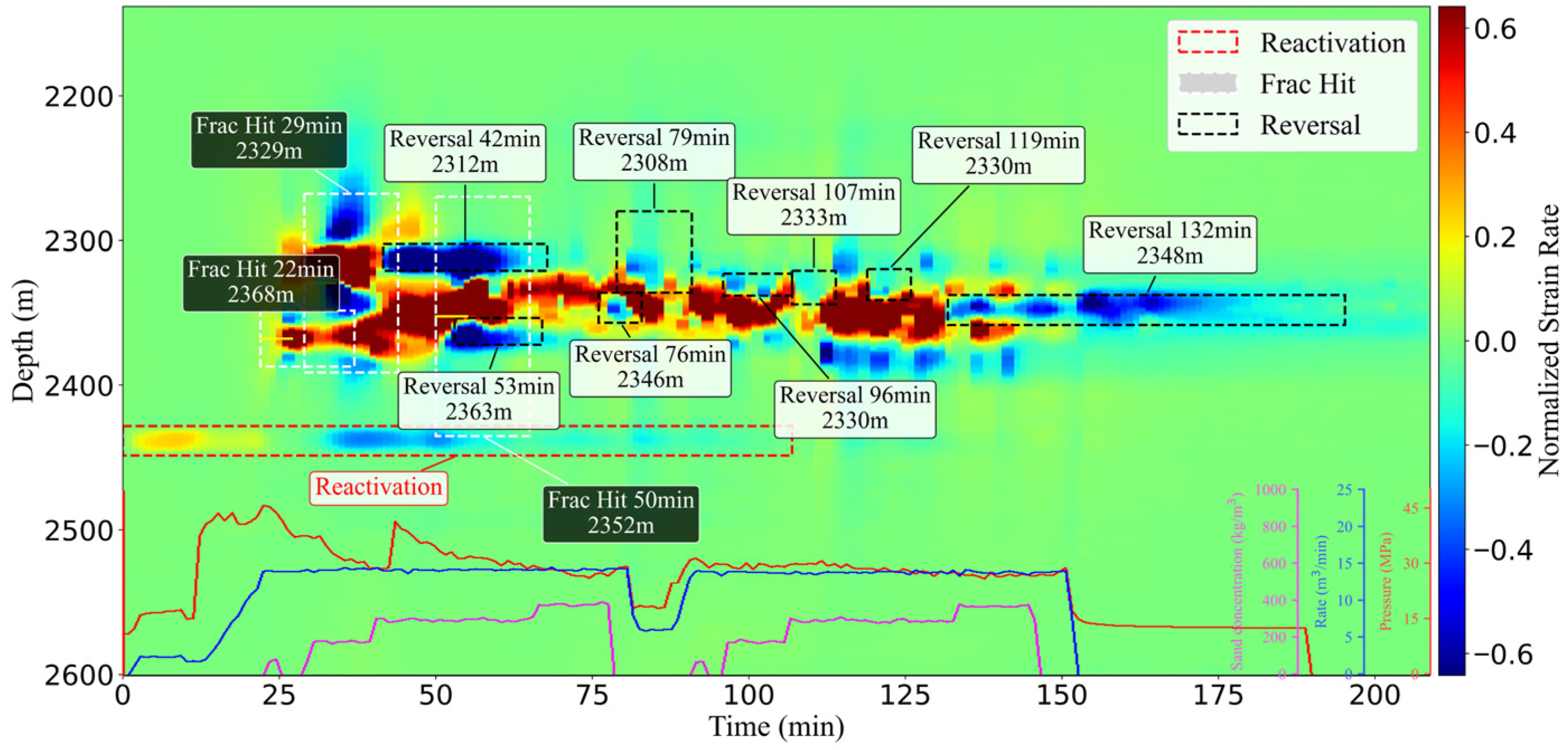
The actual field treatment involves a variety of complex factors, resulting in complicated deformation responses embedded in the raw LF-DAS monitoring data (Figure 12). Under strong background noise, the algorithm automatically extracted three major Frac-Hit events and eight reversal events.
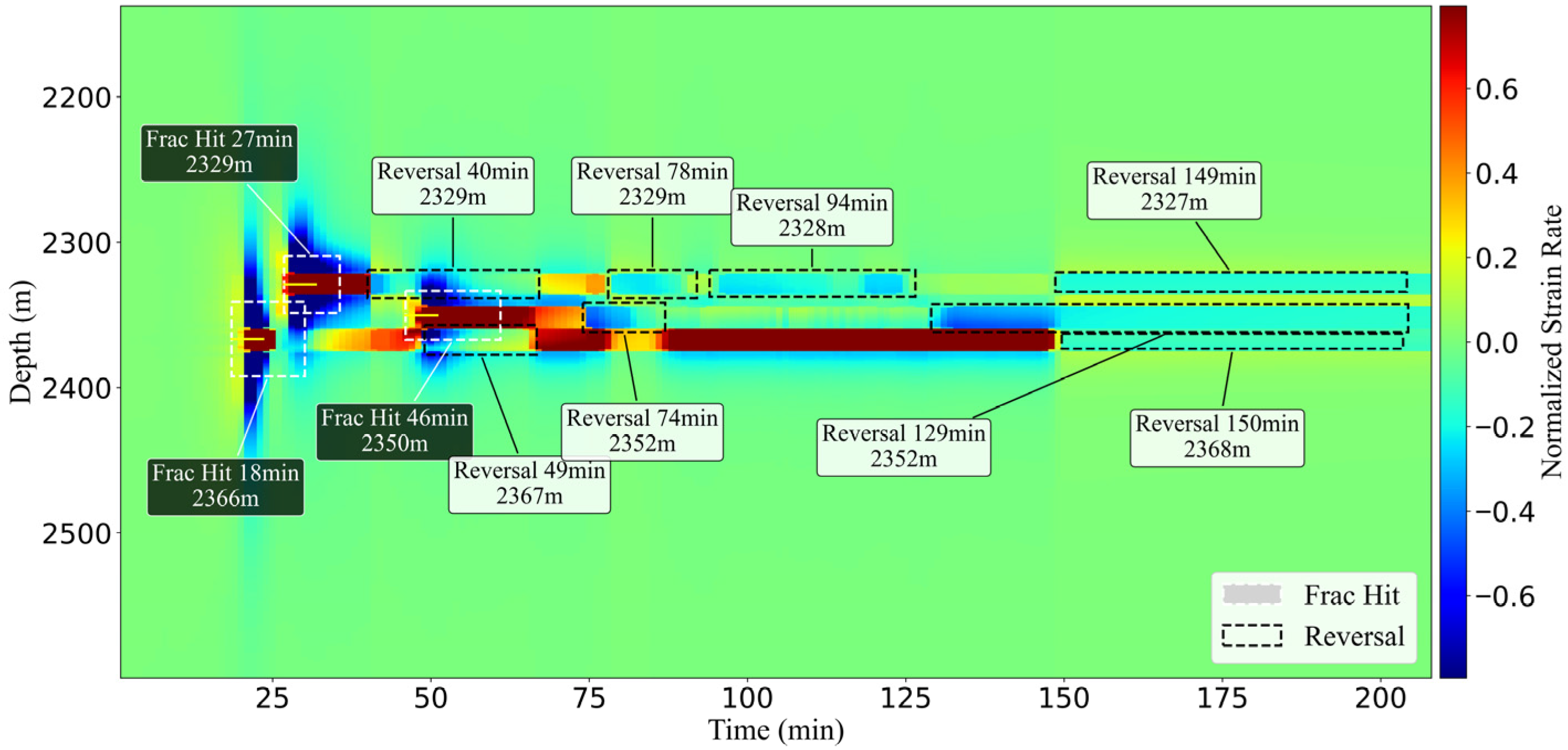
The above field-derived prior features, together with reservoir and fracture parameters including Young’s modulus 30 GPa, Poisson’s ratio 0.22, fracturing-fluid viscosity 5 cp, leakoff coefficient 0.0000045 m/s0.5, and fracture height 40 m, are input into the inversion framework for matching. The final reconstructed field-scale fiber-optic strain rate waterfall plot (Figure 13) achieves morphological alignment with the measured data in both the energy centers and the reversal flanks.
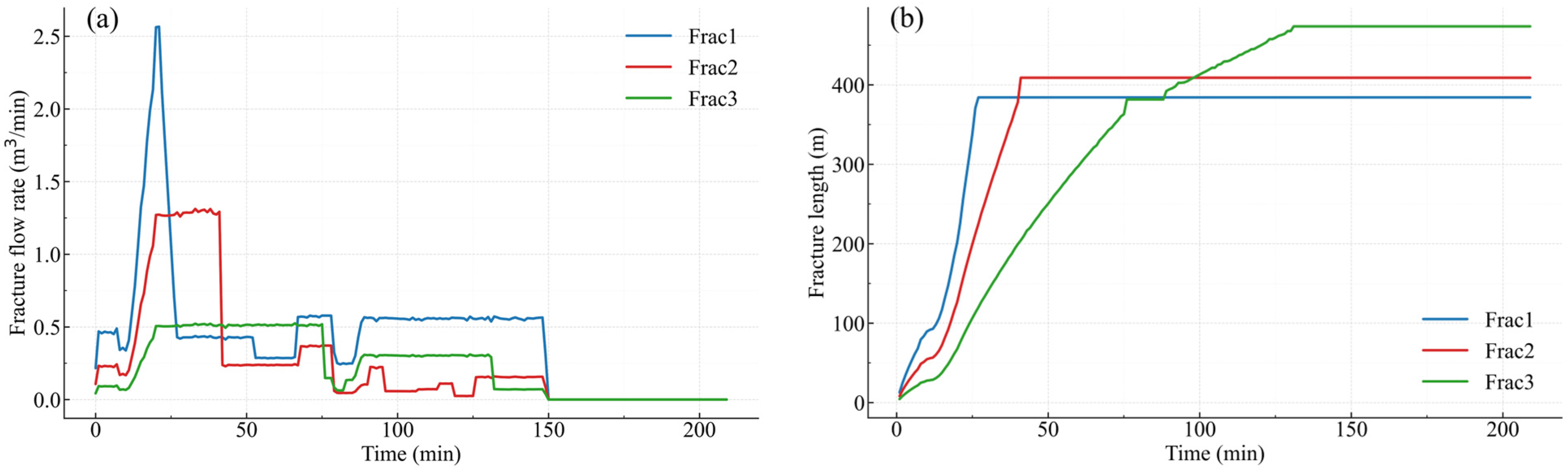
The quantitative interpretation results (Figure 14) reveal the extremely complex subsurface dynamics of this stage: three dominant fractures were generated in this stage and successfully propagated across the 250 m well spacing to reach the vicinity of the monitoring well, with arrival times at 18, 27, and 46 min, respectively. The inverted spacings of these three penetrating fractures at the monitoring well are 21 m and 16 m, and the inverted lengths of the three dominant fractures are around 400 m, which is consistent with the field microseismic interpretation. This result enables a transition from qualitative interpretation to quantitative inversion of morphological distribution and provides highly valuable physical information for evaluating fracturing effectiveness and optimizing well-pattern infill strategies.

4. Discussion

The preceding sections have demonstrated the capability of the proposed closed-loop inversion framework through both synthetic validation and field application. In this section, the sensitivities and limitations of the framework are discussed in depth to guide practical application and identify directions for future improvement.

4.1. Parameter Sensitivity and Model-Form Limitations

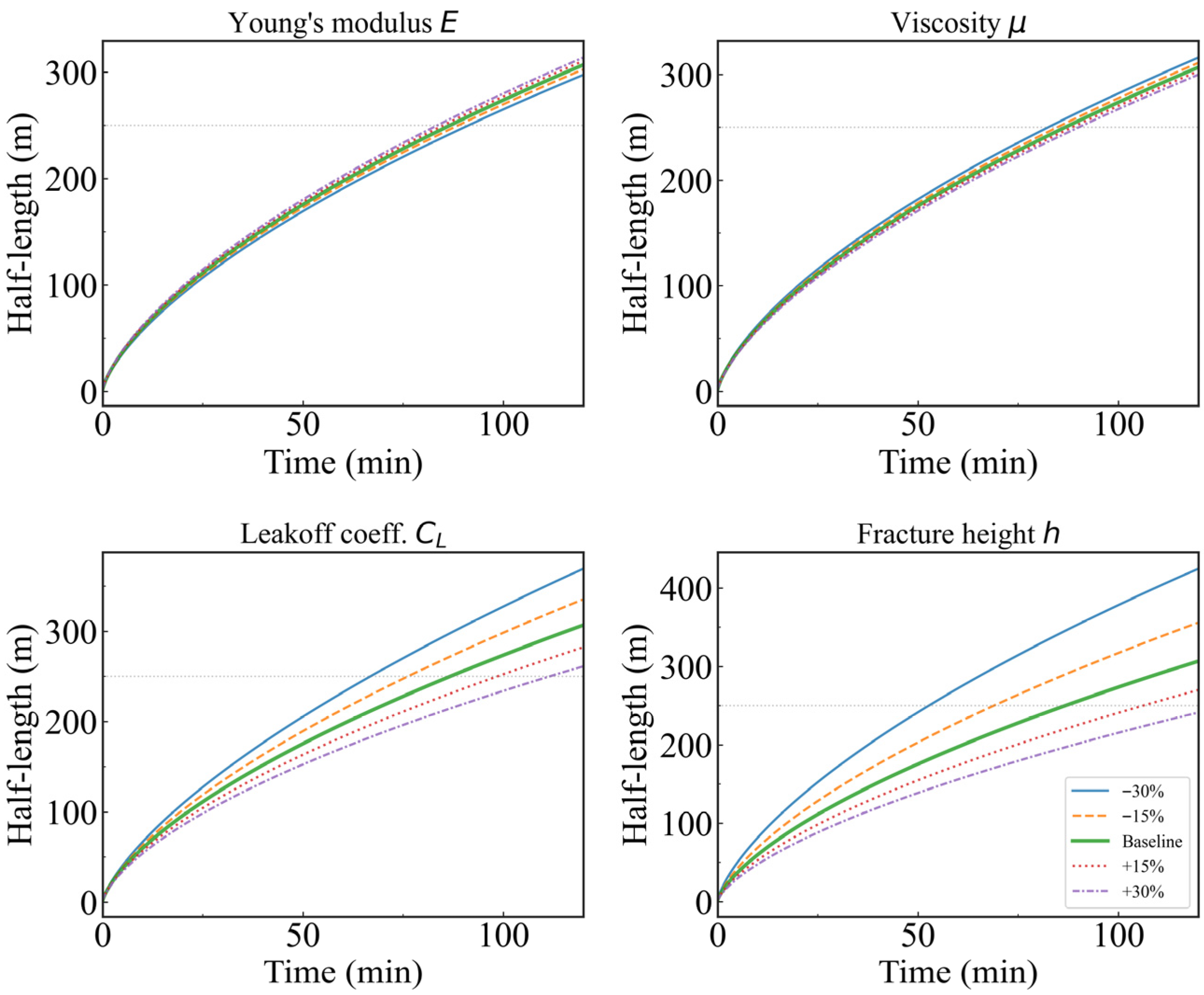
To assess the influence of key geomechanical and fluid parameters on the forward model predictions, a first-order one-at-a-time sensitivity analysis was conducted under a simplified single-fracture configuration. Four parameters were independently varied over a range of ±30% from their baseline values: Young’s modulus E = 30   GPa , fluid viscosity μ = 0.005   Pa s , Carter leakoff coefficient C L = 4.52 × 10 6   m / s 0.5 , and fracture height h = 40   m . Poisson’s ratio was excluded because preliminary tests showed negligible influence on fracture propagation (sensitivity index < 0.03). The injection rate was held constant at 0.005   m 3 / s over a 120 min simulation period, and the fracture arrival time at the monitoring well (250 m from the fracturing well) was recorded for each parameter configuration. Figure 15 shows the fracture half-length evolution trajectories under each parameter perturbation. The gray dashed line marks the monitoring-well distance (250 m). Fracture height and the leakoff coefficient produce the most pronounced spreading of the trajectories, while Young’s modulus and viscosity yield comparatively narrow bands.
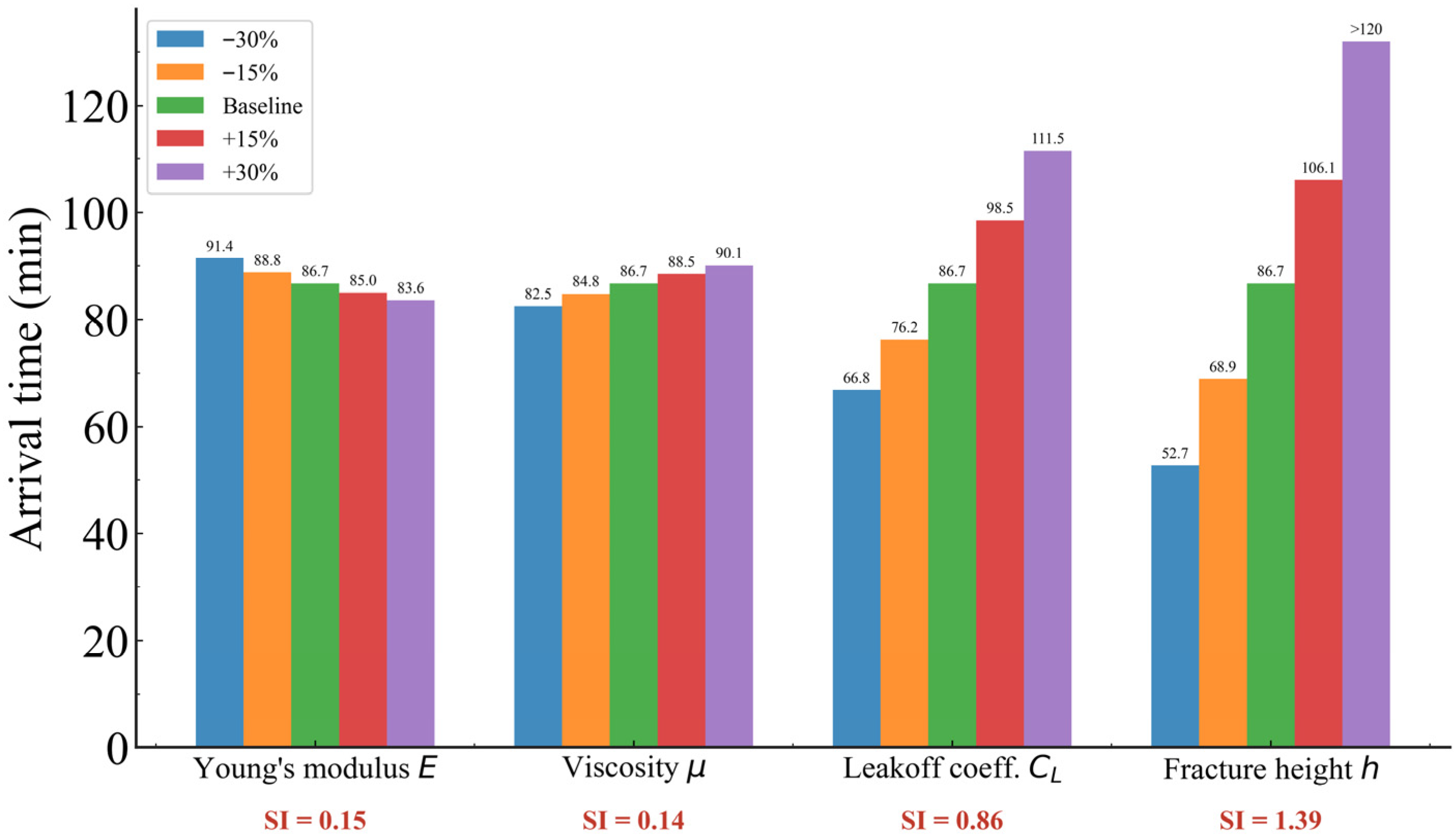
The quantitative sensitivity results are presented in Figure 16. Fracture height h exhibits the highest sensitivity index 1.39, followed by the Carter leakoff coefficient 0.86, while Young’s modulus 0.15 and fluid viscosity 0.14 show moderate and comparable sensitivities. These findings are physically consistent: fracture height governs the elastic compliance C e l and the volume storage capacity of the fracture, while the leakoff coefficient controls the rate of fluid loss to the formation. Both parameters directly enter the volume-balance equation (Equation (1)) that determines fracture half-length growth. A ±30% variation in h or C L can shift the predicted arrival time by more than 25 min relative to the baseline, whereas the same variation in E or μ produces shifts of less than 8 min. For field applications, accurate characterization of fracture height (e.g., from microseismic mapping or diagnostic fracture injection tests) and leakoff behavior (e.g., from minifrac analysis) is therefore the most critical prerequisite for reliable inversion results. The relatively low sensitivity to E and μ suggests that moderate uncertainties in these parameters will not substantially compromise inversion accuracy.
Beyond parameter sensitivity, the model is subject to several model-form limitations that merit discussion.
Rock heterogeneity. In a heterogeneous formation, local variations in Young’s modulus, Poisson’s ratio, and in situ stress would cause asymmetric fracture propagation and spatially nonuniform strain rate responses. The current homogeneous-medium model would interpret these asymmetries as differences in flow rate allocation among branches, potentially introducing bias in the reconstructed flow rate history. However, the arrival-time and propagation-state reversal features used as primary inversion constraints depend predominantly on the cumulative fracture growth along the propagation direction rather than on local stress details, and are therefore relatively robust to moderate levels of heterogeneity.
Variable fracture height. If fracture height varies along the propagation direction (e.g., due to stress barriers or layered formations), the actual fracture volume and strain amplitude would deviate from the constant-height prediction. This would primarily affect the absolute magnitude of the predicted strain rate rather than its temporal pattern, because the arrival time is governed by the volume-balance-driven tip advance rather than by the local height.
Natural fractures and pre-existing weakness planes. Complex fracture networks would produce distributed strain signals that differ substantially from the idealized planar-fracture response. In such scenarios, the automatic feature identification algorithm may still capture the dominant Frac Hit arrivals, but the detailed reconstruction of individual branch behaviors would become less reliable. Incorporating natural fracture interactions into the forward model and developing robust feature extraction methods for complex fracture geometries represent important directions for future work.
A comprehensive quantitative uncertainty analysis that systematically accounts for these model-form effects is identified as a priority for future investigation.

4.2. Solution Identifiability and Non-Uniqueness

Solution non-uniqueness is a fundamental challenge in geophysical inversion problems, and the present framework is no exception. The joint objective function J ( x ) (Equation (8)) is designed to mitigate this risk through a multi-source constraint architecture: by simultaneously fitting fracture arrival times J a r r , propagation-state reversal events J r e v , geological-boundary constraints J l e n , mass-conservation conditions J m a s s , and smoothness regularization J r e g , the feasible parameter space is significantly narrowed compared to single-metric fitting approaches.
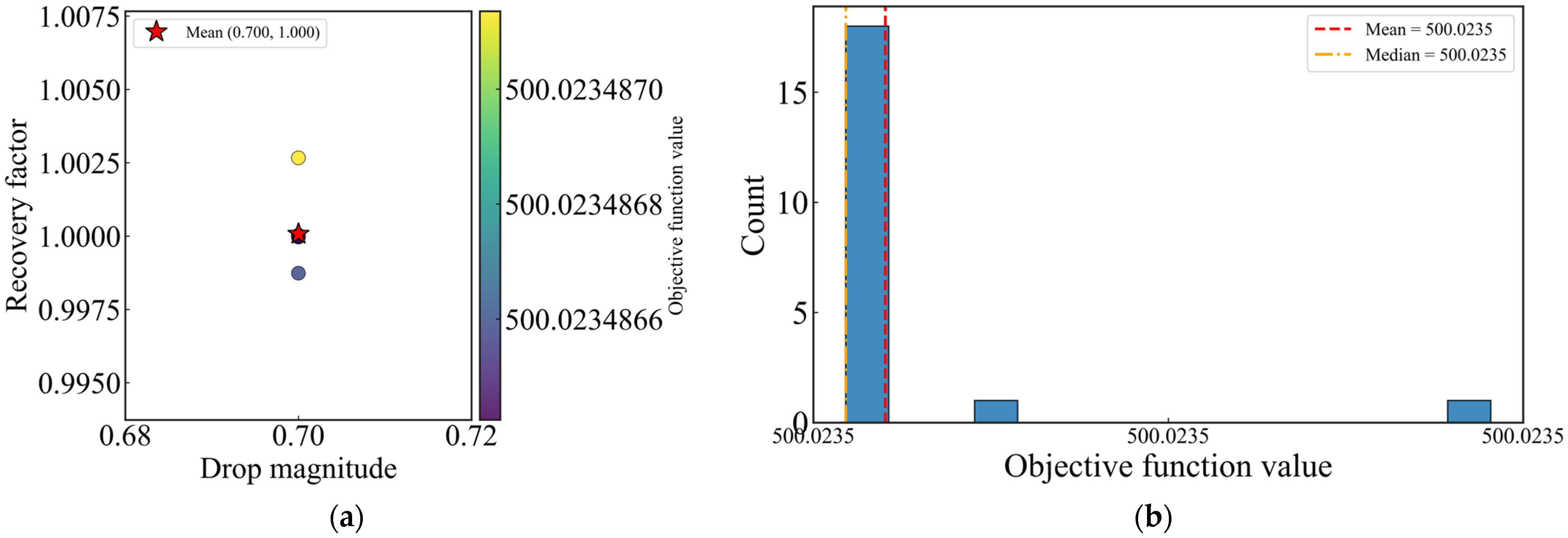
To assess the consistency of the optimization, the APSO optimizer was executed 20 times with independent random initializations on a simplified single-fracture test case specifying a fracture arrival at 30 min and a propagation-state reversal at 50 min. Two reversal parameters (drop magnitude and recovery factor) were optimized simultaneously. The results show that the reconstructed parameters exhibit high consistency across all runs, with coefficients of variation below 0.1% for both parameters. The objective-function values are tightly clustered, suggesting that the multi-source constraints effectively guide the optimizer toward a consistent solution region under the tested conditions (Figure 17).
It is important to emphasize that convergence consistency of the optimizer does not strictly guarantee solution uniqueness in the mathematical sense. The above analysis is conducted on a simplified two-parameter single-fracture problem, which does not capture the full complexity of the high-dimensional fracture swarm inversion. For fractures located far from the monitoring well or contributing only weakly to the strain rate signal, the inversion sensitivity is inherently reduced, and multiple fracture swarm configurations could yield similar objective-function values. This limitation is inherent to the single offset well LF-DAS monitoring geometry employed in this study. A comprehensive investigation of the solution landscape, including multi-modal analysis, posterior uncertainty quantification, and identifiability analysis under more complex fracture swarm configurations, remains an important direction for future work.

4.3. Robustness of Feature Extraction and Surrogate Mismatch

4.3.1. Feature Extraction Robustness

The automatic feature extraction module (Section 2.2) relies on several configurable parameters, including the signal-to-noise ratio (SNR) threshold, the characteristic time scale Δ t c h a r for pre-stage response filtering, the minimum depth-span condition, and the density-based clustering tolerances. Although a formal quantitative parametric sweep was not conducted in this study, the structural robustness of the extracted features can be assessed from both the synthetic and field applications.
The dominant Frac Hit and propagation-state reversal events detected in the synthetic validation (Section 3.2) and the field application (Section 3.3) correspond to sustained, high-amplitude strain rate anomalies that substantially exceed the background noise level. These events are inherently distinct from transient noise in both temporal persistence (lasting several to tens of minutes) and spatial coherence (spanning multiple gauge-length intervals). Consequently, the same set of primary features is consistently identified under moderate changes in the extraction criteria. Only marginal events, those with amplitudes close to the noise floor, may appear or disappear with threshold variations, which would affect the number of constraint points in the inversion objective function but would not alter the reconstruction of the dominant fractures.
For the density-based clustering parameters, the cluster centroids, which serve as the primary constraint coordinates for the inversion, are determined by the energy-weighted center of mass. For well-separated dominant events, moderate variations in the clustering tolerance (depth and time windows) shift the centroid by amounts smaller than the gauge-length spatial resolution (~15 m) and the temporal discretization (~1 min), and therefore do not meaningfully alter the inversion input. A systematic sensitivity analysis of these extraction parameters, quantifying how the detected feature set and subsequent inversion results change across a grid of threshold combinations, would further strengthen confidence in the framework, and is identified as a valuable direction for future work, particularly for low-SNR field datasets where the margin between signal and noise is narrow.

4.3.2. Surrogate Mismatch

The semi-analytical forward surrogate employed during the APSO iterations introduces systematic simplifications relative to a full variable-rate expansion model, including an algebraic equilibrium-length solver (in contrast to the iterative Brent’s method used in the full model) and an approximate leakoff accumulation scheme. To characterize the resulting surrogate mismatch, a supplementary comparison was conducted across representative injection scenarios spanning different flow rates and rock stiffness values. The comparison reveals a non-negligible but structured bias in predicted fracture arrival times: the surrogate tends to predict later arrivals than the reference model, with the discrepancy varying by injection rate and Young’s modulus. This systematic bias is attributable to the modeling simplifications mentioned above rather than to random statistical fitting errors.
Because the APSO inversion framework primarily relies on temporal feature matching (arrival times and propagation-state reversal times) rather than on absolute strain amplitudes, and because the systematic bias preserves the relative ranking and spacing of arrival events, the influence of this mismatch on the identification of the dominant fracture configuration is mitigated in practice. Furthermore, the full-model forward substitution step (Figure 2) serves as a post hoc verification: after APSO convergence, the optimal parameters are re-evaluated using the complete forward model to confirm that the surrogate-based optimum remains physically consistent with the measured LF-DAS data.
Nevertheless, a formal quantitative threshold for the surrogate-error level at which the objective-function optimum ranking would be altered has not yet been established. Determining such a threshold, potentially through a systematic comparison of surrogate-based and full-model-based inversions across a range of synthetic scenarios, represents an important open question for future investigation.

4.4. Universality and Transferability

The proposed framework is modular in design and accepts user-defined rock-mechanical parameters (Young’s modulus, Poisson’s ratio), fluid properties (viscosity, leakoff coefficient), fracture geometry (height, spacing), and treatment schedules (variable-rate injection profiles). It can therefore be adapted to reservoirs with different physical and operational parameters after recalibration of site-specific geological and treatment conditions. The framework is not restricted to a particular well layout: it can accommodate different interwell spacings, fiber orientations, and gauge lengths, provided the monitoring well is within the strain-influence radius of the propagating fractures.
At the same time, the current model assumes a homogeneous, isotropic, linear elastic formation with constant fracture height, plane-strain propagation, incompressible Newtonian fracturing fluid, and perfect fiber–formation coupling. These assumptions are reasonable for many tight sandstone and shale reservoirs where offset well LF-DAS monitoring is commonly deployed. However, for formations exhibiting significant heterogeneity (e.g., interbedded sand-shale sequences), pervasive natural fracture networks, pronounced layered stress contrasts, or non-Newtonian fluid rheology, the model accuracy may be reduced. Extending the framework to heterogeneous or layered media, complex fracture geometries, and non-Newtonian fluids would require modifications to the mechanical model and the feature extraction algorithm, and represents a primary direction for future development.

5. Conclusions

To address the difficulty of quantitatively characterizing the dynamic evolution of fracture swarms under offset well LF-DAS monitoring, a physics-data dual-driven closed-loop framework consisting of a variable-rate fluid–solid coupled forward model, an automatic fiber-optic key feature identification algorithm, and an APSO-based joint inversion model is developed to recover the dynamic activation pattern of fracture swarms and their transient flow rate allocation history. The results indicate that the proposed method enables quantitative inversion of the dynamic behavior of fracture swarms while preserving physical interpretability. The main conclusions are as follows:
(1)
An efficient fluid–solid coupled forward surrogate model adaptable to complex operating conditions is developed. The model can describe fracture propagation and local closure under variable-rate injection and shut-in conditions and map the dynamic fracture evolution to far-field LF-DAS strain rate responses. Comparison with the classical PKN model shows good agreement in fracture half-length and net-pressure predictions, verifying its reliability as the physical engine for swarm inversion.
(2)
In view of the strong noise and low signal-to-noise ratio of field LF-DAS data, an automatic key feature identification method based on multi-scale scanning and physical polarity constraints is proposed. The method can stably isolate Frac Hit and propagation-state reversal events from the two-dimensional spatiotemporal strain rate tensor, thereby providing more physically meaningful constraint information for dynamic inversion of fracture swarms.
(3)
By introducing adaptive particle swarm optimization (APSO), a semi-analytical inversion method for the dynamic behavior of fracture swarms under physical constraints from fiber-optic features is established, enabling synchronous quantitative optimization of the number of fractures, spatial distribution, and transient flow rate allocation history of fracture swarms in a continuous phase space.
(4)
The field application in an oilfield in the Ordos Basin shows that the proposed method can reconstruct the dynamic propagation process of fracture swarms from measured offset well LF-DAS data under complex treatment schedules and strong interference background. The results indicate that three dominant fractures were generated during the target fracturing stage of Well M-1 and successfully propagated to the vicinity of the monitoring well, with arrival times of 18, 27, and 46 min and approach spacings of approximately 21 m and 16 m at the monitoring well. The inverted dominant fracture lengths are generally consistent with field microseismic observations, validating the feasibility of using the proposed inversion framework for real-time quantitative interpretation of field fiber-optic data.
(5)
Despite these encouraging results, several limitations of the current framework should be acknowledged. First, the forward model assumes a homogeneous, isotropic, linear elastic formation with constant fracture height and Newtonian fracturing fluid, which may reduce accuracy in geologically complex settings. Second, the semi-analytical forward surrogate introduces a structured bias relative to the full model, requiring post hoc verification through full-model forward substitution. Third, for fractures far from the monitoring well or contributing weakly to the strain rate signal, the inversion sensitivity is reduced and solution non-uniqueness may persist. Fourth, a systematic field validation across diverse geological environments has not yet been conducted. Addressing these limitations through heterogeneity-aware mechanical models, formal surrogate-error thresholds, multi-well monitoring configurations, and broader field applications constitutes the primary direction for future work.

Author Contributions

Writing—original draft preparation, Y.M.; writing—review and editing, Y.M., M.C., W.S., K.Z., Z.F. and W.M.; formal analysis, Y.M.; investigation, Y.M.; methodology, Y.M.; validation, Y.M.; visualization, Y.M.; supervision, M.C. and W.S. All authors have read and agreed to the published version of the manuscript.

Funding

This research was funded by the National Natural Science Foundation of China (NSFC) under the Key Program “Key mechanical issues in improving hydraulic fracturing efficiency of ultra-deep highly deviated wells” (Grant NO. 52334001).

Institutional Review Board Statement

Not applicable.

Informed Consent Statement

Not applicable.

Data Availability Statement

The data presented in this study are available on request from the corresponding author. The data are not publicly available due to privacy.

Conflicts of Interest

Author Kunpeng Zhang is employed by the Research Institute of Petroleum Exploration and Development, and Zheng Fang is employed by the China National Petroleum Corporation. The remaining authors declare that the research was conducted in the absence of any commercial or financial relationships that could be construed as a potential conflict of interest.

References

  1. Masoudi, A.; Newson, T.P. Contributed Review: Distributed Optical Fibre Dynamic Strain Sensing. Rev. Sci. Instrum. 2016, 87, 011501. [Google Scholar] [CrossRef] [PubMed]
  2. Hartog, A.H. An Introduction to Distributed Optical Fibre Sensors; CRC Press: Boca Raton, FL, USA, 2017; ISBN 978-1-315-11901-4. [Google Scholar]
  3. Molenaar, M.M.; Hill, D.J.; Webster, P.; Fidan, E.; Birch, B. First Downhole Application of Distributed Acoustic Sensing for Hydraulic-Fracturing Monitoring and Diagnostics. SPE Drill. Complet. 2012, 27, 32–38. [Google Scholar] [CrossRef]
  4. Karrenbach, M.; Cole, S.; Ridge, A.; Boone, K.; Kahn, D.; Rich, J.; Silver, K.; Langton, D. Fiber-Optic Distributed Acoustic Sensing of Microseismicity, Strain and Temperature during Hydraulic Fracturing. Geophysics 2018, 84, D11–D23. [Google Scholar] [CrossRef]
  5. Song, J.; Sui, W.; Guo, H.; Li, J. Near-Wellbore Fracture Diagnosis via Strain Decoupling from Integrated In-Well LF-DAS and DTS Data. Sensors 2026, 26, 1813. [Google Scholar] [CrossRef] [PubMed]
  6. Liu, W.; Li, B.; Zhao, Z.; Wen, R.; Bai, Y.; Guo, H.; Tang, J.; Wang, C. An Enhanced Workflow for Quantitative Evaluation of Fluid and Proppant Distribution in Multistage Fracture Treatment with Distributed Acoustic Sensing. Processes 2025, 13, 3738. [Google Scholar] [CrossRef]
  7. Rafi, M.; Mohd Noh, K.A.; Abdul Latiff, A.H.; Otchere, D.A.; Tackie-Otoo, B.N.; Putra, A.D.; Riyadi, Z.A.; Asfha, D.T. Application of Distributed Acoustic Sensing in Geophysics Exploration: Comparative Review of Single-Mode and Multi-Mode Fiber Optic Cables. Appl. Sci. 2024, 14, 5560. [Google Scholar] [CrossRef]
  8. He, X.; Cao, Z.; Zhang, M.; Lu, H. Binary-Tree Structure for Extended Range-Distributed Acoustic Sensing. Appl. Sci. 2025, 15, 11748. [Google Scholar] [CrossRef]
  9. Lindsey, N.J.; Rademacher, H.; Ajo-Franklin, J.B. On the Broadband Instrument Response of Fiber-Optic DAS Arrays. J. Geophys. Res. Solid Earth 2020, 125, e2019JB018145. [Google Scholar] [CrossRef]
  10. Jin, G.; Roy, B. Hydraulic-Fracture Geometry Characterization Using Low-Frequency DAS Signal. Lead. Edge 2017, 36, 975–980. [Google Scholar] [CrossRef]
  11. Liu, Y.; Wu, K.; Jin, G.; Moridis, G. Rock Deformation and Strain-Rate Characterization during Hydraulic Fracturing Treatments: Insights for Interpretation of Low-Frequency Distributed Acoustic-Sensing Signals. SPE J. 2020, 25, 2251–2264. [Google Scholar] [CrossRef]
  12. Ugueto, G.A.; Todea, F.; Daredia, T.; Wojtaszek, M.; Huckabee, P.T.; Reynolds, A.; Laing, C.; Chavarria, J.A. Can You Feel the Strain? DAS Strain Fronts for Fracture Geometry in the BC Montney, Groundbirch. In Proceedings of the SPE Annual Technical Conference and Exhibition, Calgary, AB, Canada, 30 September–2 October 2019; p. D021S029R005. [Google Scholar]
  13. Liu, Y.; Jin, G.; Wu, K.; Moridis, G. Hydraulic-Fracture-Width Inversion Using Low-Frequency Distributed-Acoustic-Sensing Strain Data—Part I: Algorithm and Sensitivity Analysis. SPE J. 2021, 26, 359–371. [Google Scholar] [CrossRef]
  14. Li, P.; Jin, G.; Hammack, R.; Kohnke, C.; Wu, K. Heart Shape to Fracture Distance: Characterizing Hydraulic Fracture Propagation before Hits. SPE J. 2024, 29, 7122–7133. [Google Scholar] [CrossRef]
  15. Nguyen, H.T.; Lee, J.H.; Elraies, K.A. A Review of PKN-Type Modeling of Hydraulic Fractures. J. Pet. Sci. Eng. 2020, 195, 107607. [Google Scholar] [CrossRef]
  16. Mao, Y.; Chen, M.; Sui, W.B.; He, L.; Zhu, J.H. Semi-analytical forward model for hydraulic fracture propagation monitoring using distributed fiber optics in adjacent wells. Pet. Sci. Bull. 2025, 10, 778–790. [Google Scholar] [CrossRef]
  17. Tu, Z.; Hu, X.; Bai, J.; Zhang, T.; Lai, W.; Zhou, F. Characterize Fracture Geometry and Propagation with Low Frequency Distributed Acoustic Sensing Strain Data. Eng. Fract. Mech. 2024, 298, 109947. [Google Scholar] [CrossRef]
  18. Chen, M.; Wang, Z.; Guo, T.; Liu, Y.; Chen, Z. An iterative regularized inversion method of fracture width and height using cross-well optical fiber strain. Pet. Explor. Dev. 2026, 53, 201–212. [Google Scholar] [CrossRef]
  19. Zhu, H.; Liu, W.; Zhao, Z.; Li, B.; Tang, J.; Li, L. Diagnosing Multistage Fracture Treatments of Horizontal Tight Oil Wells with Distributed Acoustic Sensing. Processes 2025, 13, 3925. [Google Scholar] [CrossRef]
  20. Zhan, Z.-H.; Zhang, J.; Li, Y.; Chung, H.S.-H. Adaptive Particle Swarm Optimization. IEEE Trans. Syst. Man Cybern. Part B Cybern. 2009, 39, 1362–1381. [Google Scholar] [CrossRef] [PubMed]
  21. Kennedy, J.; Eberhart, R. Particle Swarm Optimization. In Proceedings of the ICNN’95—International Conference on Neural Networks, Perth, WA, Australia, 27 November–1 December 1995; Volume 4, pp. 1942–1948. [Google Scholar]
  22. Storn, R.; Price, K. Differential Evolution—A Simple and Efficient Heuristic for Global Optimization over Continuous Spaces. J. Glob. Optim. 1997, 11, 341–359. [Google Scholar] [CrossRef]
  23. Qi, Y.; Zhang, T.; Chen, Q.; Ma, B.; Bai, J.; Ye, K.; Tang, J. What Low Frequency Distributed Acoustic Sensing Revealed of the Hydraulic Fracturing in Tight Oil Reservoir: Ordos Case Study. In Proceedings of the International Petroleum Technology Conference, Dhahran, Saudi Arabia, 12 February 2024; p. D021S057R002. [Google Scholar] [CrossRef]
Figure 1. Heart-shaped feature pattern in offset well LF-DAS monitoring.
Applsci 16 03732 g001
Figure 2. Flowchart of the physics-constrained particle-swarm inversion framework.
Applsci 16 03732 g002
Figure 3. Schematic of forward modeling of fiber-optic strain rate.
Applsci 16 03732 g003
Figure 4. Schematic of feature identification in field LF-DAS data.
Applsci 16 03732 g004
Figure 5. Comparison of fracture length (a) and net-pressure (b) evolution between the variable-rate forward model and the PKN model.
Applsci 16 03732 g005
Figure 6. Schematic of the interwell geometry for the synthetic inversion case of competitive fracture propagation.
Applsci 16 03732 g006
Figure 7. True flow rate allocation (a) and half-length evolution (b) of the three fractures in the synthetic case.
Applsci 16 03732 g007
Figure 8. Offset well LF-DAS strain rate response in the synthetic case and the automatic identification results of key features.
Applsci 16 03732 g008
Figure 9. Comparison between the APSO-reconstructed flow rate allocation and fracture length evolution and the true model.
Applsci 16 03732 g009
Figure 10. Comparison of the strain rate waterfall plots of the original synthetic response (a) and the inversion reconstruction (b).
Applsci 16 03732 g010
Figure 11. Schematic of the well layout for the field trial in the Ordos Basin.
Applsci 16 03732 g011
Figure 12. Treatment curve of the target fracturing stage in Well M-1, offset well LF-DAS response of Well M-2, and the identified key features.
Applsci 16 03732 g012
Figure 13. Inverted fiber-optic strain rate waterfall plot for the target fracturing stage of Well M-1.
Applsci 16 03732 g013
Figure 14. Inverted dynamic flow rate allocation and half-length evolution of fracture swarms for the target fracturing stage of Well M-1.
Applsci 16 03732 g014
Figure 15. Fracture half-length evolution under ±30% perturbations of Young’s modulus, viscosity, Carter leakoff coefficient, and fracture height.
Applsci 16 03732 g015
Figure 16. Sensitivity of fracture arrival time to key forward-model parameters.
Applsci 16 03732 g016
Figure 17. Results of 20 independent APSO runs on a single-fracture test case. (a) Scatter plot of optimal parameters colored by objective-function value; (b) histogram of objective-function values.
Applsci 16 03732 g017
Disclaimer/Publisher’s Note: The statements, opinions and data contained in all publications are solely those of the individual author(s) and contributor(s) and not of MDPI and/or the editor(s). MDPI and/or the editor(s) disclaim responsibility for any injury to people or property resulting from any ideas, methods, instructions or products referred to in the content.