Association Between Oral Hypofunction and Physical Frailty Among Korean Older Adults with Preserved Cognitive and Functional Status

Abstract
1. Introduction
2. Materials and Methods
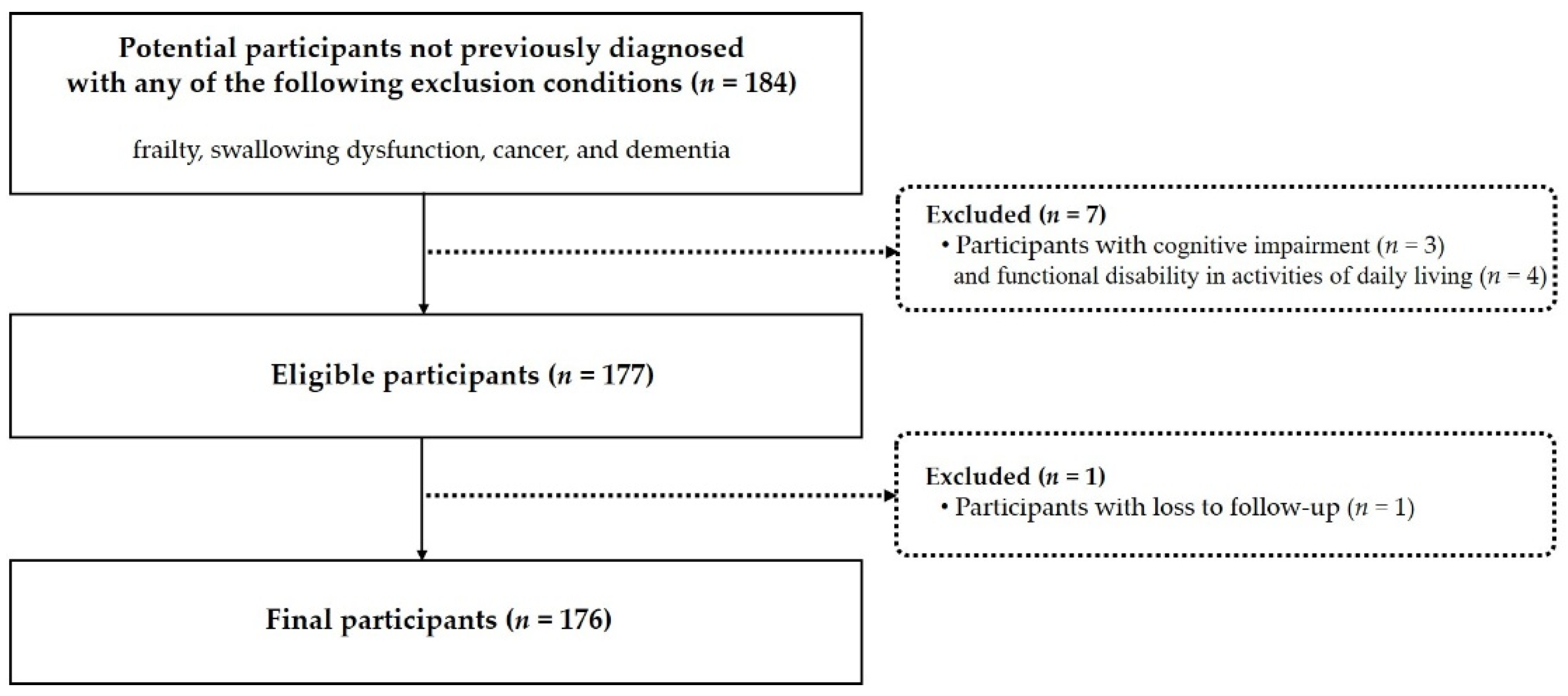
2.1. Participants
2.2. Measurements
2.2.1. Health and Oral Health Related Factors
2.2.2. Oral Functional Status
2.2.3. Frailty Status
2.3. Statistical Analysis
3. Results
3.1. Sociodemographic Characteristics and Physical Frailty Scores
3.2. Health-Related Characteristics and Physical Frailty Scores
3.3. Oral Health-Related Characteristics and Physical Frailty Scores
3.4. Oral Hypofunction and Physical Frailty Scores
3.5. Strength of Association Between Oral Hypofunction and Physical Frailty
4. Discussion
5. Conclusions
Author Contributions
Funding
Institutional Review Board Statement
Informed Consent Statement
Data Availability Statement
Acknowledgments
Conflicts of Interest
Abbreviations
| IOPI | Iowa Oral Performance Instrument |
| K-FRAIL | Korean version of the Fried Frailty Phenotype |
| SD | standard deviation |
| KRW | Korean won |
| CI | confidence interval |
| OR | odds ratio |
References
- Cao, X.; Hou, Y.; Zhang, X.; Xu, C.; Jia, P.; Sun, X.; Sun, L.; Gao, Y.; Yang, H.; Cui, Z.; et al. A comparative, correlate analysis and projection of global and regional life expectancy, healthy life expectancy, and their GAP: 1995–2025. J. Glob. Health 2020, 11, 020407. [Google Scholar] [CrossRef]
- United Nations, Department of Economic and Social Affairs. World Social Report 2023: Leaving No One Behind in an Aging World; United Nations: New York, NY, USA, 2023. [Google Scholar]
- Deng, Y.; Zhang, K.; Zhu, J.; Hu, X.; Liao, R. Healthy aging, early screening, and interventions for frailty in the elderly. Biosci. Trends 2023, 17, 252–261. [Google Scholar] [CrossRef]
- Morley, J.E.; Vellas, B.; van Kan, G.A.; Anker, S.D.; Bauer, J.M.; Bernabei, R.; Cesari, M.; Chumlea, W.C.; Doehner, W.; Evans, J.; et al. Frailty consensus: A call to action. J. Am. Med. Dir. Assoc. 2013, 14, 392–397. [Google Scholar] [CrossRef]
- Won, C.W. Up-to-date knowledge of frailty. J. Korean Med. Assoc. 2022, 65, 108–114. [Google Scholar] [CrossRef]
- Oishi, R.; Segi, N.; Okazaki, M.; Ito, S.; Ouchida, J.; Yamauchi, I.; Seki, T.; Takegami, Y.; Ishizuka, S.; Hashizume, A.; et al. Longitudinal transitions in frailty and health-related quality of life investigated by a 5-year community study. Sci. Rep. 2025, 30, 15162. [Google Scholar] [CrossRef]
- Wang, X.; Hu, J.; Wu, D. Risk factors for frailty in older adults. Medicine 2022, 26, e30169. [Google Scholar] [CrossRef]
- Boucham, M.; Salhi, A.; El Hajji, N.; Gbenonsi, G.Y.; Belyamani, L.; Khalis, M. Factors associated with frailty in older people: An umbrella review. BMC Geriatr. 2024, 24, 737. [Google Scholar] [CrossRef] [PubMed]
- Hakeem, F.F.; Bernabé, E.; Sabbah, W. Association between oral health and frailty: A systematic review of longitudinal studies. Gerodontology 2019, 36, 205–215. [Google Scholar] [CrossRef] [PubMed]
- Velázquez-Olmedo, L.B.; Borges-Yáñez, S.A.; Andrade Palos, P.; García-Peña, C.; Gutiérrez-Robledo, L.M.; Sánchez-García, S. Oral health condition and development of frailty over a 12-month period in community-dwelling older adults. BMC Oral Health 2021, 21, 355. [Google Scholar] [CrossRef]
- Castrejón-Pérez, R.C.; Jiménez-Corona, A.; Bernabé, E.; Villa-Romero, A.R.; Arrivé, E.; Dartigues, J.F.; Gutiérrez-Robledo, L.M.; Borges-Yáñez, S.A. Oral disease and 3-year incidence of frailty in Mexican older adults. J. Gerontol. A Biol. Sci. Med. Sci. 2017, 72, 951–957. [Google Scholar] [CrossRef] [PubMed]
- Saito, M.; Shimazaki, Y.; Nonoyam, T.; Inamoto, Y. Oral health status, oral health behavior, and frailty: A cross-sectional study. Arch. Gerontol. Geriatr. Plus 2024, 1, 100039. [Google Scholar] [CrossRef]
- Hasegawa, Y.; Sakuramoto, A.; Sugita, H.; Hasegawa, K.; Horii, N.; Sawada, T.; Shinmura, K.; Kishimoto, H. Relationship between oral environment and frailty among older adults dwelling in a rural Japanese community: A cross-sectional observational study. BMC Oral Health 2019, 19, 23. [Google Scholar] [CrossRef] [PubMed]
- Cho, B.L. Physical performance measures in the elderly. Korean J. Fam. Med. 2003, 24, 689–695. [Google Scholar]
- Cho, E.J.; Park, S.J.; Lee, J.E.; Lee, J.S.; Kim, M.Y.; Yoon, J.L. Results of ‘Short-Form Comprehensive Geriatric Assessment’ application to elderly outpatients. J. Korean Geriatr. Soc. 2007, 11, 1–8. [Google Scholar]
- Minakuchi, S.; Tsuga, K.; Ikebe, K.; Ueda, T.; Tamura, F.; Nagao, K.; Furuya, J.; Matsuo, K.; Yamamoto, K.; Kanazawa, M.; et al. Oral hypofunction in the older population: Position paper of the Japanese Society of Gerodontology in 2016. Gerodontology 2018, 35, 317–324. [Google Scholar] [CrossRef]
- Ministry of Health and Welfare; Korea Institute for Health and Social Affairs. National Survey of Older Koreans; Ministry of Health and Welfare; Korea Institute for Health and Social Affairs: Sejong, Republic of Korea, 2014; pp. 337–342, 694–695.
- Jeon, Y.; Yun, K.; Kim, Y. Validation of KDSQ-P as selecting elderly for KDSQ-C. Korean J. Health Promot. 2010, 10, 45–52. [Google Scholar]
- Shimazaki, Y.; Nonoyama, T.; Tsushita, K.; Arai, H.; Matsushita, K.; Uchibori, N. Oral hypofunction and its association with frailty in community-dwelling older people. Geriatr. Gerontol. Int. 2020, 20, 917–926. [Google Scholar] [CrossRef] [PubMed]
- To, T.L.; Doan, T.N.; Ho, W.C.; Liao, W.C. Prevalence of frailty among community-dwelling older adults in Asian countries: A systematic review and meta-analysis. Healthcare 2022, 10, 895. [Google Scholar] [CrossRef]
- Shin, J.H.; Kim, H.C.; Jung, C.H.; Kim, J.B.; Jung, S.W.; Cho, H.J.; Jung, S.H. The Standardization of the Korean Version of the Patient Health Questionnaire-2. J. Korean Neuropsychiatr. Assoc. 2013, 52, 115–121. [Google Scholar] [CrossRef]
- Ng, S.K.; Leung, W.K. Oral health-related quality of life and periodontal status. Community Dent. Oral Epidemiol. 2006, 34, 114–122. [Google Scholar] [CrossRef]
- Airila-Månsson, S.; Bjurshammar, N.; Yakob, M.; Söder, B. Self-reported oral problems, compared with clinical assessment in an epidemiological study. Int. J. Dent. Hyg. 2007, 5, 82–86. [Google Scholar] [CrossRef] [PubMed]
- Shimizu, T.; Ueda, T.; Sakurai, K. New method for evaluation of tongue-coating status. J. Oral Rehabil. 2007, 34, 442–447. [Google Scholar] [CrossRef]
- Kugimiya, Y.; Watanabe, Y.; Ueda, T.; Motokawa, K.; Shirobe, M.; Igarashi, K.; Hoshino, D.; Takano, T.; Sakurai, K.; Taniguchi, Y.; et al. Rate of oral frailty and oral hypofunction in rural community-dwelling older Japanese individuals. Gerodontology 2020, 37, 342–352. [Google Scholar] [CrossRef]
- Chung, P.C.; Chan, T.C. Digital oral health biomarkers for early detection of cognitive decline. BMC Public Health 2023, 23, 1952. [Google Scholar] [CrossRef]
- Yamada, A.; Kanazawa, M.; Komagamine, Y.; Minakuchi, S. Association between tongue and lip functions and masticatory performance in young dentate adults. J. Oral Rehabil. 2015, 42, 833–839. [Google Scholar] [CrossRef]
- Park, J.S.; Oh, D.H.; Chang, M.Y. Effect of expiratory muscle strength training on swallowing-related muscle strength in community-dwelling elderly individuals: A randomized controlled trial. Gerodontology 2017, 34, 121–128. [Google Scholar] [CrossRef]
- IOPI Medical. Normal Values. Available online: https://iopimedical.com/normal-values/#normref (accessed on 1 January 2025).
- Kosaka, T.; Ono, T.; Kida, M.; Kikui, M.; Yamamoto, M.; Yasui, S.; Nokubi, T.; Maeda, Y.; Kokubo, Y.; Watanabe, M.; et al. A multifactorial model of masticatory performance: The Suita study. J. Oral Rehabil. 2016, 43, 340–347. [Google Scholar] [CrossRef] [PubMed]
- Gonçalves, T.M.S.V.; Schimmel, M.; van der Bilt, A.; Chen, J.; van der Glas, H.W.; Kohyama, K.; Hennequin, M.; Peyron, M.A.; Woda, A.; Leles, C.R.; et al. Consensus on the terminologies and methodologies for masticatory assessment. J. Oral Rehabil. 2021, 48, 745–761. [Google Scholar] [CrossRef]
- Belafsky, P.C.; Mouadeb, D.A.; Rees, C.J.; Pryor, J.C.; Postma, G.N.; Allen, J.; Leonard, R.J. Validity and reliability of the Eating Assessment Tool (EAT-10). Ann. Otol. Rhinol. Laryngol. 2008, 117, 919–924. [Google Scholar] [CrossRef]
- Fried, L.P.; Tangen, C.M.; Walston, J.; Newman, A.B.; Hirsch, C.; Gottdiener, J.; Seeman, T.; Tracy, R.; Kop, W.J.; Burke, G.; et al. Frailty in older adults: Evidence for a phenotype. J. Gerontol. A Biol. Sci. Med. Sci. 2001, 56, M146–M157. [Google Scholar] [CrossRef] [PubMed]
- Kim, S.; Kim, M.; Jung, H.W.; Won, C.W. Development of a frailty phenotype questionnaire for use in screening community-dwelling older adults. J. Am. Med. Dir. Assoc. 2020, 21, 660–664. [Google Scholar] [CrossRef]
- Kim, K.J.; Shin, J.; Choi, J.; Won, C.W. Discrepancies in the prevalence of known frailty scales: Korean Frailty and Aging Cohort Study. Ann. Geriatr. Med. Res. 2018, 22, 137. [Google Scholar] [CrossRef] [PubMed]
- Yoshida, M.; Hiraoka, A.; Takeda, C.; Mori, T.; Maruyama, M.; Yoshikawa, M.; Tsuga, K. Oral hypofunction and its relation to frailty and sarcopenia in community-dwelling older people. Gerodontology 2022, 39, 26–32. [Google Scholar] [CrossRef] [PubMed]
- Tanaka, T.; Takahashi, K.; Hirano, H.; Kikutani, T.; Watanabe, Y.; Ohara, Y.; Furuya, H.; Tetsuo, T.; Akishita, M.; Iijima, K. Oral frailty as a risk factor for physical frailty and mortality in community-dwelling elderly. J. Gerontol. A Biol. Sci. Med. Sci. 2018, 73, 1661–1667. [Google Scholar] [CrossRef]
- Bahat, G.; Yilmaz, O.; Durmazoglu, S.; Kilic, C.; Tascioglu, C.; Karan, M.A. Association between Dysphagia and Frailty in Community Dwelling Older Adults. J. Nutr. Health Aging 2019, 23, 571–577. [Google Scholar] [CrossRef]
- Iwai, K.; Azuma, T.; Yonenaga, T.; Nomura, T.; Sugiura, I.; Inagawa, Y.; Matsumoto, Y.; Nakashima, S.; Abe, Y.; Tomofuji, T. Relationship between oral function and support/care-need certification in Japanese older people aged ≥ 75 years: A Three-Year Cohort Study. Int. J. Environ. Res. Public Health 2022, 19, 16959. [Google Scholar] [CrossRef] [PubMed]
- Nagano, A.; Ueshima, J.; Tsutsumiuchi, K.; Inoue, T.; Shimizu, A.; Mori, N.; Maeda, K. Effect of tongue strength on clinical outcomes of patients: A systematic review. Arch. Gerontol. Geriatr. 2022, 102, 104749. [Google Scholar] [CrossRef]
- Felton, S.M.; Gaige, T.A.; Reese, T.G.; Wedeen, V.J.; Gilbert, R.J. Mechanical basis for lingual deformation during the propulsive phase of swallowing as determined by phase-contrast magnetic resonance imaging. J. Appl. Physiol. 2007, 103, 255–265. [Google Scholar] [CrossRef]
- Li, X.; Zhang, J.; Liu, Y.; Yang, C.; Tan, L.; Yang, Y. Impact of masticatory training on masticatory function: A systematic review and meta-analysis. J. Prosthet. Dent. 2025, 134, 2193. [Google Scholar] [CrossRef]
- Kang, M.G.; Jung, H.W. Association between oral health and frailty in older Korean population: A cross-sectional study. Clin. Interv. Aging 2022, 21, 1863–1872. [Google Scholar] [CrossRef]
- Smit, M.J.; Nijholt, W.; Bakker, M.H.; Visser, A. The predictive value of masticatory function for adverse health outcomes in older adults: A systematic review. J. Nutr. Health Aging 2024, 28, 100210. [Google Scholar] [CrossRef] [PubMed]
- Petersen, P.E.; Yamamoto, T. Improving the oral health of older people: The approach of the WHO Global Oral Health Programme. Community Dent. Oral Epidemiol. 2005, 33, 81–92. [Google Scholar] [CrossRef] [PubMed]
- Kaurani, P.; Kakodkar, P.; Bhowmick, A.; Samra, R.K.; Bansal, V. Association of tooth loss and nutritional status in adults: An overview of systematic reviews. BMC Oral Health 2024, 24, 838. [Google Scholar] [CrossRef] [PubMed]
- Nishio, K.; Arai, Y.; Abe, Y.; Takayama, M.; Fukasawa, M.; Oikawa, D.; Ito, T.; Takatsu, M.; Iinuma, T. Relation between number of teeth, malnutrition, and 3-year mortality in elderly individuals ≥ 85 years. Oral Dis. 2023, 29, 827–835. [Google Scholar] [CrossRef]
- Tamura, B.K.; Bell, C.L.; Masaki, K.H.; Amella, E.J. Factors associated with weight loss, low BMI, and malnutrition among nursing home patients: A systematic review of the literature. J. Am. Med. Dir. Assoc. 2013, 14, 649–655. [Google Scholar] [CrossRef]
- Okuyama, N.; Yamaga, T.; Yoshihara, A.; Nohno, K.; Yoshitake, Y.; Kimura, Y.; Shimada, M.; Nakagawa, N.; Nishimuta, M.; Ohashi, M.; et al. Influence of dental occlusion on physical fitness decline in a healthy Japanese elderly population. Arch. Gerontol. Geriatr. 2011, 52, 172–176. [Google Scholar] [CrossRef]
- Dibello, V.; Zupo, R.; Sardone, R.; Lozupone, M.; Castellana, F.; Dibello, A.; Daniele, A.; De Pergola, G.; Bortone, I.; Lampignano, L.; et al. Oral frailty and its determinants in older age: A systematic review. Lancet Healthy Longev. 2021, 2, e507–e520. [Google Scholar] [CrossRef]
- Zhang, X.M.; Cao, S.; Teng, L.; Xie, X.; Wu, X. The association between the number of teeth and frailty among older adults: A systematic review and meta-analysis. Aging Clin. Exp. Res. 2025, 37, 156. [Google Scholar] [CrossRef]
- Komiyama, T.; Gallagher, J.E.; Hattori, Y. Relationship between tooth loss and progression of frailty: Findings from the English longitudinal study of aging. Arch. Gerontol. Geriatr. 2024, 127, 105572. [Google Scholar] [CrossRef]
- Clark, D.; Kotronia, E.; Ramsay, S.E. Frailty, aging, and periodontal disease: Basic biologic considerations. Periodontology 2000 2001, 87, 143–156. [Google Scholar] [CrossRef]
- Sekundo, C.; Frese, C.; Alich, N.; Langowski, E.; Awounvo, S.; Wolff, D.; Zenthöfer, A. Very old age impacts masticatory performance: A study among sexagenarians to centenarians. Clin. Oral Investig. 2024, 28, 349. [Google Scholar] [CrossRef]
- Nakamura, M.; Hamada, T.; Tanaka, A.; Nishi, K.; Kume, K.; Goto, Y.; Beppu, M.; Hijioka, H.; Higashi, Y.; Tabata, H.; et al. Association of oral hypofunction with frailty, sarcopenia, and mild cognitive impairment: A cross-sectional study of community-dwelling Japanese older adults. J. Clin. Med. 2021, 10, 1626. [Google Scholar] [CrossRef] [PubMed]
- Mosaico, G.; Pinna, M.; Grassi, R.; Orrù, G.; Scribante, A.; Maiorani, C.; Casu, C.; Nardi, G.M.; Butera, A. Oral health and Caries Prevention: How Tongue Hygiene helps maintain balance of microbiota and overall health in Pediatric patients. Children 2024, 11, 816. [Google Scholar] [CrossRef]
- Scannapieco, F.A.; Bush, R.B.; Paju, S. Associations between periodontal disease and risk for nosocomial bacterial pneumonia and chronic obstructive pulmonary disease. A systematic review. Ann. Periodontol. 2003, 8, 54–69. [Google Scholar] [CrossRef]
- de Amorim, J.S.C.; da Silva, S.L.A.; Ude Viana, J.; Trelha, C.S. Factors associated with the prevalence of sarcopenia and frailty syndrome in elderly university workers. Arch. Gerontol. Geriatr. 2019, 82, 172–178. [Google Scholar] [CrossRef]
- Cho, B.L.; Shim, H.Y. Diagnosis management of frailty. J. Korean Med. Assoc. 2024, 67, 442–448. [Google Scholar] [CrossRef]
- Adams, V.; Mathisen, B.; Baines, S.; Lazarus, C.; Callister, R. Reliability of measurements of tongue and hand strength and endurance using the Iowa Oral Performance Instrument with healthy adults. Dysphagia 2014, 29, 83–95. [Google Scholar] [CrossRef] [PubMed]
- Byeon, H. Effect of orofacial myofunctional exercise on the improvement of dysphagia patients’orofacial muscle strength and diadochokinetic rate. J. Phys. Ther. Sci. 2016, 28, 2611–2614. [Google Scholar] [CrossRef]
- Konishi, M. Can oral diadochokinesis be used as an assessment tool of oral function in older adults requiring care in nursing home? J. Oral Rehabil. 2024, 51, 328–333. [Google Scholar] [CrossRef]

| Variables | n | Frailty Score | Statistic | p | |
|---|---|---|---|---|---|
| Sex | Male | 39 | 1.49 ± 0.99 | t = −4.056 | <0.001 |
| Female | 137 | 2.28 ± 1.34 | |||
| Age (years) | 65–79 | 48 | 1.48 ± 1.16 a | F = 8.856 | <0.001 |
| 80–89 | 103 | 2.28 ± 1.33 b | |||
| ≥90 | 25 | 2.60 ± 1.11 b | |||
| Education level | No education | 54 | 2.46 ± 1.22 a | F = 9.416 | <0.001 |
| Primary school | 77 | 2.26 ± 1.41 a | |||
| ≥Middle school | 45 | 1.42 ± 0.96 b | |||
| Income level | ≤290,000 | 120 | 2.08 ± 1.31 | t = −0.363 | 0.717 |
| (monthly KRW) | ≥300,000 | 56 | 2.16 ± 1.33 | ||
| Cohabitation | Living alone | 82 | 2.38 ± 1.32 a | F = 4.828 | 0.009 |
| Living with spouse | 50 | 1.66 ± 1.33 b | |||
| Living with child(ren) | 44 | 2.11 ± 1.12 ab | |||
| Variables | n | Frailty Score | Statistic | p | |
|---|---|---|---|---|---|
| Smoking status | Non-smoker | 151 | 2.15 ± 1.33 | t = 1.357 | 0.351 |
| Former and current | 25 | 1.88 ± 1.16 | |||
| Alcohol consumption | Yes | 34 | 1.79 ± 1.27 | t = 1.565 | 0.122 |
| No | 142 | 2.18 ± 1.13 | |||
| Systemic disease + | Yes | 12 | 2.83 ± 1.03 | Z = −2.091 | 0.037 |
| (stroke) | No | 164 | 2.05 ± 1.32 | ||
| Systemic disease + | Yes | 51 | 2.39 ± 1.34 | Z = −1.958 | 0.050 |
| (osteoarthritis) | No | 125 | 1.99 ± 1.29 | ||
| No. of systemic | 0–2 | 82 | 1.95 ± 1.30 a | x2 = 8.225 | 0.042 |
| diseases | 3–4 | 61 | 2.13 ± 1.33 ab | ||
| 5–6 | 29 | 2.28 ± 1.25 ab | |||
| ≥7 | 4 | 3.75 ± 0.50 b | |||
| Risk of depression | Normal (≤2) | 150 | 1.99 ± 1.25 | t = −2.831 | 0.005 |
| (score) | High risk (≥3) | 26 | 2.77 ± 1.50 | ||
| No. of meals | ≤2 | 26 | 2.27 ± 1.28 | t = 0.676 | 0.500 |
| (day) | ≥3 | 150 | 2.08 ± 1.32 | ||
| Body mass index | Underweight (<18.5) | 6 | 1.17 ± 1.16 | x2 = 3.124 | 0.210 |
| (kg/m2) | Normal weight (18.5–22.9) | 35 | 2.17 ± 1.56 | ||
| Overweight or obesity (≥23) | 135 | 2.13 ± 1.24 | |||
| Variables | n | Frailty Score | Statistic | p | |
|---|---|---|---|---|---|
| Self-perceived oral | Good | 33 | 1.85 ± 1.06 | F = 0.857 | 0.426 |
| health status | Normal | 94 | 2.14 ± 1.36 | ||
| Poor | 49 | 2.22 ± 1.37 | |||
| No. of oral disease | 0–3 | 131 | 1.98 ± 1.28 | t = −2.278 | 0.024 |
| symptoms | 4–8 | 45 | 2.49 ± 1.35 | ||
| Daily toothbrushing | 0–1 | 23 | 1.74 ± 1.21 | F = 2.595 | 0.078 |
| frequency | 2 | 93 | 2.31 ± 1.27 | ||
| ≥3 | 60 | 1.93 ± 1.37 | |||
| Tongue cleaning | Never | 29 | 2.34 ± 1.47 | t = 1.061 | 0.290 |
| Sometimes and always | 147 | 2.06 ± 1.28 | |||
| Use of interdental | Never | 114 | 2.28 ± 1.34 | t = 3.304 | 0.001 |
| cleaning devices | Sometimes and always | 49 | 1.55 ± 1.17 | ||
| Regular dental check-up | Yes | 124 | 1.44 ± 1.22 | t = 4.589 | <0.001 |
| No | 52 | 2.39 ± 1.30 | |||
| Regular dental scaling | Yes | 50 | 1.76 ± 1.34 | t = 1.938 | 0.054 |
| No | 113 | 2.19 ± 1.30 |
| Parameters | Variable | n | Frailty Score | t | p |
|---|---|---|---|---|---|
| Oral hygiene | Poor | 92 | 2.14 ± 1.28 | 0.351 | 0.726 |
| Normal | 84 | 2.07 ± 1.16 | |||
| Oral mucosal moisture | Dry | 54 | 2.43 ± 1.31 | −2.190 | 0.030 |
| Normal | 121 | 1.96 ± 1.28 | |||
| Occlusal force | Reduced | 81 | 2.35 ± 1.27 | −2.239 | 0.026 |
| Normal | 95 | 1.91 ± 1.32 | |||
| Tongue–lip motor function | Decreased | 84 | 2.33 ± 1.40 | −2.195 | 0.031 |
| Normal | 92 | 1.90 ± 1.20 | |||
| Tongue pressure | Decreased | 56 | 2.48 ± 1.36 | −2.657 | 0.009 |
| Normal | 119 | 1.92 ± 1.26 | |||
| Masticatory function | Decreased | 39 | 2.56 ± 1.29 | −2.482 | 0.014 |
| Normal | 135 | 1.98 ± 1.30 | |||
| Swallowing function | Deteriorated | 63 | 2.63 ± 1.33 | −4.147 | <0.001 |
| Normal | 113 | 1.81 ± 1.21 | |||
| Overall oral functions | ≥3 (Oral hypofunction) | 85 | 2.47 ± 1.35 | −3.657 | <0.001 |
| (score) | ≤2 (Normal) | 91 | 1.77 ± 1.18 |
| Variables | Model 1 | Model 2 | ||||
|---|---|---|---|---|---|---|
| Adjusted OR | 95% CI | p * | Adjusted OR | 95% CI | p * | |
| Regular dental scaling, yes (ref.no) | 2.302 | 0.810–6.542 | 0.118 | 1.943 | 0.574–6.573 | 0.285 |
| Regular dental check-up, yes (ref.no) | 0.205 | 0.071–0.588 | 0.003 | 0.305 | 0.089–1.043 | 0.058 |
| Interdental cleaning devices, yes (ref.no) | 0.288 | 0.114–0.724 | 0.008 | 0.230 | 0.081–0.654 | 0.006 |
| No. of oral disease symptoms | 1.308 | 1.050–1.630 | 0.017 | 1.287 | 1.021–1.624 | 0.033 |
| Oral hypofunction score | 1.468 | 1.121–1.923 | 0.005 | 1.382 | 1.017–1.876 | 0.038 |
| Sex, female (ref. male) | 4.900 | 1.317–18.221 | 0.018 | |||
| Age | 1.044 | 0.960–1.135 | 0.317 | |||
| Education level, no education (ref. ≥ middle) | 1.446 | 0.357–5.853 | 0.605 | |||
| Education level, primary school (ref. ≥ middle) | 2.040 | 0.576–7.227 | 0.269 | |||
| Living alone (ref. with child) | 1.954 | 0.750–5.090 | 0.170 | |||
| Living with spouse (ref. with child) | 1.881 | 0.554–6.380 | 0.311 | |||
| Stroke | 2.265 | 0.434–11.834 | 0.332 | |||
| Osteoarthritis | 1.702 | 0.704–4.118 | 0.238 | |||
| No. of systemic diseases (excluding stroke and osteoarthritis) | 1.110 | 0.852–1.447 | 0.438 | |||
| High risk of depression | 1.472 | 0.494–4.390 | 0.488 | |||
Disclaimer/Publisher’s Note: The statements, opinions and data contained in all publications are solely those of the individual author(s) and contributor(s) and not of MDPI and/or the editor(s). MDPI and/or the editor(s) disclaim responsibility for any injury to people or property resulting from any ideas, methods, instructions or products referred to in the content. |
© 2026 by the authors. Licensee MDPI, Basel, Switzerland. This article is an open access article distributed under the terms and conditions of the Creative Commons Attribution (CC BY) license.
Share and Cite
Kim, H.-Y.; Kim, J.; Choi, J.-S. Association Between Oral Hypofunction and Physical Frailty Among Korean Older Adults with Preserved Cognitive and Functional Status. Appl. Sci. 2026, 16, 3695. https://doi.org/10.3390/app16083695
Kim H-Y, Kim J, Choi J-S. Association Between Oral Hypofunction and Physical Frailty Among Korean Older Adults with Preserved Cognitive and Functional Status. Applied Sciences. 2026; 16(8):3695. https://doi.org/10.3390/app16083695
Chicago/Turabian StyleKim, Ha-Yeoung, Jiyoun Kim, and Jun-Seon Choi. 2026. "Association Between Oral Hypofunction and Physical Frailty Among Korean Older Adults with Preserved Cognitive and Functional Status" Applied Sciences 16, no. 8: 3695. https://doi.org/10.3390/app16083695
APA StyleKim, H.-Y., Kim, J., & Choi, J.-S. (2026). Association Between Oral Hypofunction and Physical Frailty Among Korean Older Adults with Preserved Cognitive and Functional Status. Applied Sciences, 16(8), 3695. https://doi.org/10.3390/app16083695