Article

Associations Between Different Types of Malocclusion, Functional Disturbances, and Temporomandibular Disorders: A Case–Control Study


1
Department of Orthodontics, Faculty of Dentistry, Cyprus Health and Social Sciences University, KKTC, 99750 Mersin, Turkey
2
Department of Orthodontics, Faculty of Dentistry, Gazi University, 06490 Ankara, Turkey
*
Author to whom correspondence should be addressed.
Appl. Sci. 2026, 16(8), 3613; https://doi.org/10.3390/app16083613
Submission received: 7 March 2026 / Revised: 28 March 2026 / Accepted: 31 March 2026 / Published: 8 April 2026
(This article belongs to the Section Applied Dentistry and Oral Sciences)

Abstract

Background: Temporomandibular disorders (TMDs) are multifactorial conditions frequently encountered in orthodontic practice, and the independent associations of occlusal and structural variables remain unclear. This case–control study constructed a multivariable model integrating clinical, cephalometric, panoramic, and functional variables to examine their associations with TMD, diagnosed according to the DC/TMD Axis I protocol. Fifty patients with TMD and 50 non-TMD controls were consecutively recruited between October 2024 and December 2025. Occlusal characteristics, lateral cephalometric measurements, and Kjellberg panoramic symmetry indices (SI1/SI2) were assessed using standardized protocols. Candidate variables were initially explored using univariable analyses with false discovery rate adjustment, followed by multivariable Firth penalized logistic regression to reduce small-sample bias and separation. Mandibular deflection (OR = 3.57, 95% CI 1.54–9.09) and deviation (OR = 4.35, 95% CI 1.69–12.50) demonstrated the strongest independent associations with TMD, while SI1 asymmetry (<90%) became significant after multivariable adjustment (OR = 3.57, 95% CI 1.08–14.29). The final model showed apparent discrimination within the study sample (AUC = 0.822; 95% CI: 0.742–0.902). However, this value was calculated using the same dataset and should not be interpreted as validated model performance or compared to other studies. The observed SI1 effect should be interpreted cautiously, as it may reflect model instability due to the relatively small sample size. Within the limitations of this case–control design, functional disturbances showed stronger associations with TMD than static structural variables; however, external validation is required before clinical application.

1. Introduction

Temporomandibular disorders (TMDs) comprise a heterogeneous group of musculoskeletal and neuromuscular conditions affecting the temporomandibular joints, masticatory muscles, and associated structures, and are recognized as one of the most common causes of non-dental orofacial pain [1,2,3]. Epidemiological evidence indicates that the global prevalence of TMD in adults is approximately 31%, highlighting its considerable public health impact [4]. This high prevalence, together with its functional and psychosocial consequences, underscores the importance of investigating factors associated with TMD in orthodontic patients. Beyond pain, TMD is frequently associated with functional limitations, impaired mastication, and reduced quality of life [5,6,7]. The etiology of TMD is explained by a multifactorial biopsychosocial model in which biological, structural, functional, and psychosocial factors interact [5,6,7,8,9,10,11,12,13]. Historically, occlusal characteristics were considered a primary etiological factor; however, contemporary systematic reviews have demonstrated weak and inconsistent associations between malocclusion and TMD, suggesting that occlusion alone cannot account for the development of the disorder [14,15,16,17,18]. Craniofacial morphology assessed using lateral cephalometric analysis provides a static representation of skeletal and dentoalveolar relationships and has been extensively investigated in relation to TMD. Nevertheless, the available evidence remains controversial, and several studies have reported that these associations disappear after controlling for confounding variables [19,20,21]. Similarly, condylar asymmetry evaluated using panoramic asymmetry indices has been proposed as a structural marker of temporomandibular joint alterations, but conflicting findings have been reported regarding its diagnostic value [22,23,24]. Altuğ et al. [25] evaluated the distribution of mandibular asymmetry in orthodontic patients and reported that asymmetry is a common finding that varies according to skeletal pattern, highlighting the need for standardized assessment methods in TMD research. In contrast, functional disturbances such as mandibular deviation and deflection during mouth opening represent dynamic clinical signs that may reflect intra-articular disorders or neuromuscular imbalance and are directly incorporated into the DC/TMD protocol, which is considered the current gold standard for TMD diagnosis [1,26,27,28,29]. Previous studies have reported inconsistent associations between static occlusal factors and TMD, controversial findings regarding cephalometric measurements, and limited evidence supporting panoramic asymmetry as a reliable structural marker. Moreover, most studies have evaluated these factors separately, with limited integration of dynamic functional assessments and static structural variables within a single analytical framework. Therefore, the present case–control study aimed to simultaneously evaluate occlusal characteristics, cephalometric variables, condylar asymmetry indices, and functional disturbances within a multivariable model based on DC/TMD diagnosis [30,31]. To our knowledge, few studies have evaluated occlusal, cephalometric, panoramic, and functional variables simultaneously within a single multivariable framework, focusing on statistical associations rather than predictive or causal relationships.

2. Materials and Methods

2.1. Study Design and Ethical Considerations

This unmatched case–control study was conducted at the Department of Orthodontics clinic. Participants were consecutively recruited between October 2024 and December 2025 in accordance with the Strengthening the Reporting of Observational Studies in Epidemiology (STROBE) guidelines [32]. Ethical approval was obtained from the Scientific Research Ethics Committee of Cyprus Health and Social Sciences University (approval No. KSTU/2024/313; 19 April 2024). The study was performed in accordance with the Declaration of Helsinki, and written informed consent was obtained from all participants or their legal guardians prior to inclusion.

2.2. Sample Size Justification

The sample size was determined for a case–control design with a statistical power of 80% and a two-sided significance level of 0.05 [15]. The calculation was based on an expected proportion of 0.57 in the control group and an assumed odds ratio of 4, resulting in a minimum required sample size of 41 participants per group (total n = 82). The justification was based on previous TMD case–control studies using multivariable logistic regression models to evaluate occlusal risk indicators, in which several morphological and functional variables such as anterior open bite, posterior crossbite, and mandibular asymmetry, demonstrated large effect sizes, with odds ratios up to and exceeding 4 [16,17]. Therefore, the inclusion of 50 cases and 50 controls was considered sufficient to detect clinically relevant associations. However, given the number of candidate predictors included in the multivariable analysis, the potential risk of overfitting should be considered when interpreting the results.

2.3. Study Sample

The study sample comprised 100 subjects divided into a TMD group (n = 50) and a non-TMD control group (n = 50). Pain-related temporomandibular disorders were diagnosed according to the Diagnostic Criteria for Temporomandibular Disorders (DC/TMD) Axis I protocol [1]. Control subjects were screened using the DC/TMD symptom questionnaire and clinical examination to exclude any TMD. Subgroup analyses based on specific TMD subtypes were not performed, as this was beyond the scope of the present study.

2.4. Radiographic Analysis

All radiographic records were obtained using a KaVo OP 3D device (Palodex Group Oy, Tuusula, Finland). The KaVo OP 3D device was operated with tube settings of 60–95 kV and 2–165 mA. Lateral cephalometric images were acquired under standardized conditions with the Frankfort horizontal plane parallel to the floor, the midsagittal plane perpendicular to the floor, and the teeth in maximum intercuspation. All patients were positioned by a single trained operator according to the manufacturer’s instructions to ensure reproducibility. Cephalometric tracings were performed using VistaDent OC™ software (Version 4.2, Dentsply Sirona Orthodontics Inc., York, PA, USA). The following skeletal and dentoalveolar variables were analyzed: SN–GoGn, IMPA, U1–NA (°), U1–NA (mm), L1–NB (°), and L1–NB (mm). Skeletal classification was determined based on the ANB angle according to standard orthodontic criteria, where Class I was defined as ANB between 0° and 4°, Class II as ANB > 4°, and Class III as ANB < 0°. Ramal inclination was defined as the angle between the mandibular ramus (Ar–Go) and the cranial base (SN line) (Figure 1).
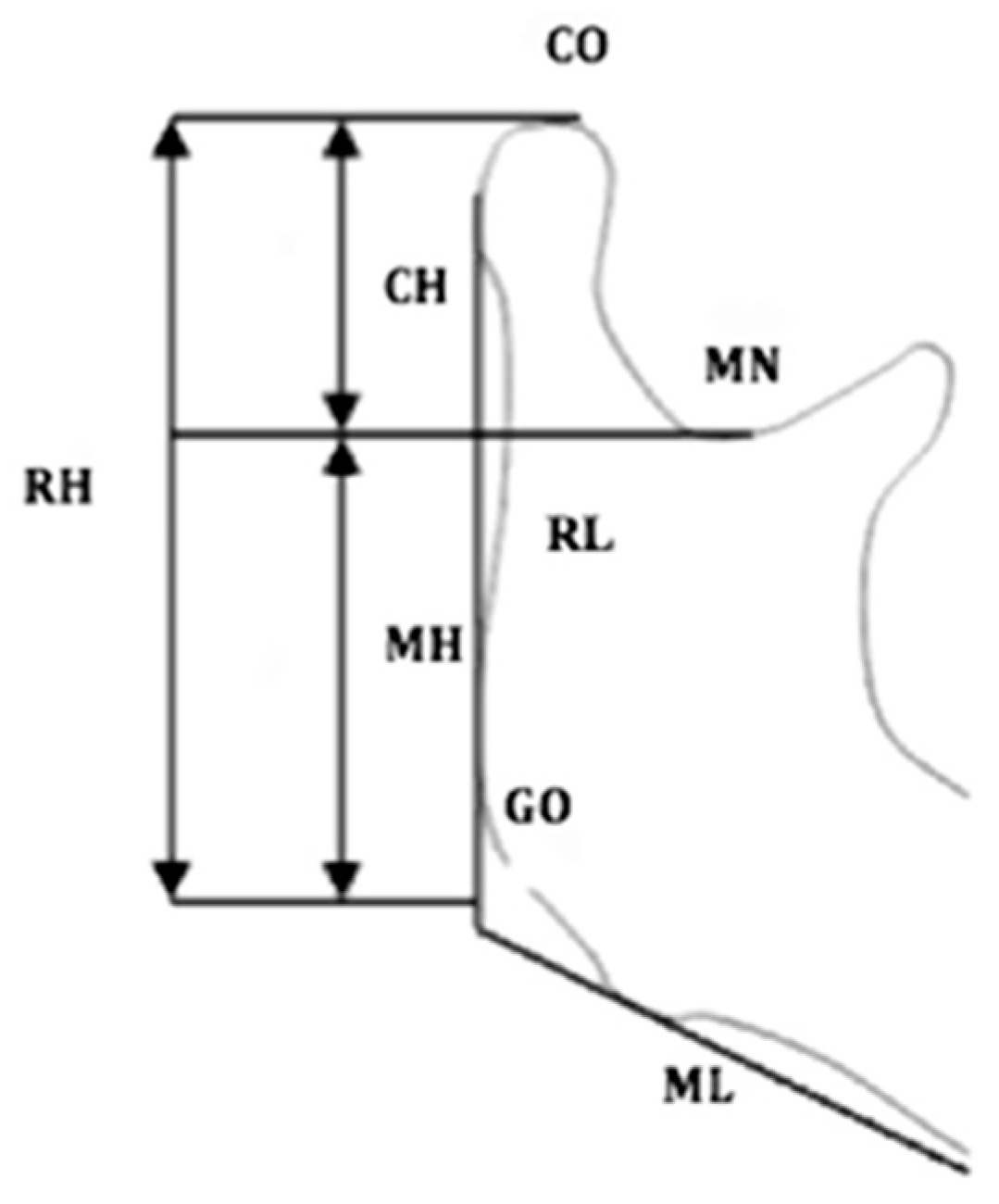
Panoramic radiographs were obtained with the Frankfort horizontal plane parallel to the floor and the midsagittal plane centered and perpendicular to the floor. The anterior teeth were positioned in the bite block to achieve the correct anteroposterior position within the focal trough. Patients were instructed to keep their lips closed, the tongue in contact with the palate, and to remain motionless during exposure. The images were analyzed using 3D Slicer software (version 5.8.1, Brigham and Women’s Hospital, Boston, MA, USA). Mandibular asymmetry was assessed using the Kjellberg symmetry index (Figure 2), and SI1 and SI2 values were calculated [22,23,24].

2.5. Functional Examination

Functional assessment was performed according to the DC/TMD protocol. Mandibular deviation was defined as a shift in the mandibular midline during mouth opening that returned to the midline at maximum opening, whereas mandibular deflection was defined as a progressive lateral displacement that did not return to the midline.

2.6. Occlusal Examination

Occlusal examination was performed in maximum intercuspation and included Angle classification, overjet, overbite, posterior crossbite, and anterior open bite. Overjet and overbite were categorized as normal or abnormal according to standard orthodontic criteria.

2.7. Classification of Study Variables

For analytical purposes, the study variables were categorized into four main groups: occlusal variables, cephalometric variables (skeletal and dental), panoramic structural variables, and functional variables. Occlusal variables included Angle classification, overjet, overbite, posterior crossbite, and anterior open bite. Cephalometric variables included skeletal and dentoalveolar measurements obtained from lateral cephalograms. Panoramic structural variables included mandibular asymmetry indices derived from panoramic radiographs (SI1 and SI2), and functional variables included mandibular deviation and deflection assessed during clinical examination. Overjet and overbite were classified as occlusal variables because they represent clinically assessed dental relationships, although they can also be measured cephalometrically. The classification of variables is presented in Table 1.

2.8. Intra-Examiner Reliability

Fourteen radiographs were randomly selected and re-measured after a two-week interval to assess intra-examiner reliability on a subset of the sample (~10–20%). This approach follows Houston (1983) [33] on replication of measurements to control random errors. Reliability was evaluated using a two-way mixed-effects intraclass correlation coefficient (ICC) for absolute agreement, with values ranging from 0.834 to 0.989, reflecting good to excellent consistency of repeated measurements by the same examiner [28].

2.9. Statistical Analysis

All analyses were performed using R software (version 4.5.2; R Foundation for Statistical Computing, Vienna, Austria) and RStudio (version 2026.01.0+392; Posit Software, PBC, Boston, MA, USA). Continuous variables were expressed as mean ± standard deviation. Normality was assessed using the Shapiro–Wilk test. For normally distributed variables, comparisons between groups were performed using the independent t-test, while the Mann–Whitney U test was applied for non-normally distributed variables [28]. Categorical variables were presented as frequencies and percentages and compared using the chi-square test or Fisher’s exact test, as appropriate. Univariable logistic regression analysis was performed to estimate crude odds ratios (ORs) with 95% confidence intervals (CIs) for all candidate variables. Variables with p < 0.05 in univariate analysis were considered for inclusion in the multivariable model. Given the exploratory nature of this study, the False Discovery Rate (FDR) method was applied to adjust for multiple comparisons [29]. To minimize small-sample bias and address potential separation issues, Firth’s penalized logistic regression was applied for multivariable modeling [30,31]. The final multivariable model was selected based on a combination of statistical significance (p < 0.05 after FDR correction) and model parsimony [34]. The final model retained deflection, deviation, and SI1 asymmetry as variables for association analysis; the observed SI1 effect should be interpreted cautiously, as it may reflect model instability due to the relatively small sample size. Multicollinearity was assessed using the variance inflation factor (VIF), with values < 5 considered acceptable [35]. The linearity assumption for continuous predictors was evaluated using the Box–Tidwell test [36]. Potential interactions between predictors were tested by including product terms in the model [37]. Model performance was evaluated using the area under the receiver operating characteristic curve (AUC) with 95% confidence intervals [38]; however, this value should not be interpreted as validated model performance or compared to other studies. Model fit was further assessed using the likelihood ratio test [39]. A sensitivity analysis comparing standard logistic regression and Firth penalized likelihood was performed to confirm model stability [31]. Statistical significance was set at p < 0.05 (two-tailed).

3. Results

3.1. Baseline Characteristics

Table 2 presents the baseline characteristics of the study population. The TMD group was significantly older than the control group (25.23 ± 4.64 years vs. 23.16 ± 4.83 years, p = 0.003). This age difference is consistent with previous epidemiological studies reporting higher TMD prevalence in young adults [4,15]. No significant between-group differences were observed in sex distribution (p = 0.548), Angle classification (p = 0.251), or skeletal classification (p = 1.000). The comparable distribution of skeletal patterns between groups aligns with findings from Thilander et al. [19], who reported that skeletal classification alone does not differentiate TMD patients from asymptomatic individuals.

3.2. Occlusal and Functional Variables

Table 3 summarizes the comparison of occlusal and functional variables between groups. Traditional occlusal parameters showed no significant differences:
  • Overjet: 2.81 ± 1.82 mm vs. 2.74 ± 1.50 mm (p = 0.997).
  • Overbite: 3.00 ± 1.71 mm vs. 2.94 ± 1.76 mm (p = 0.676).
  • Open bite: 26.0% vs. 18.0% (p = 0.469).
  • Posterior crossbite was assessed as part of the occlusal examination; however, no cases were observed in the study sample.
  • These findings are consistent with systematic reviews by Manfredini et al. [5] and Pullinger and Seligman [18], who concluded that static occlusal features have limited predictive value for TMD, with most odds ratios falling below 2.0.
In contrast, functional parameters revealed striking differences:
  • Deflection was present in 68.0% of TMD patients compared to only 40.0% of controls (p = 0.009).
  • Deviation was observed in 44.0% of TMD patients versus 16.0% of controls (p = 0.005).
The strong association between mandibular functional disturbances and TMD aligns with the DC/TMD framework [1] and studies by Michelotti and Iodice [8], who emphasized that dynamic function plays a more critical role than static anatomy in TMD pathogenesis.

3.3. Cephalometric Measurements

Table 4 presents the comparison of cephalometric measurements between groups. Two variables showed statistically significant differences:
  • SN–GoGn angle was significantly lower in the TMD group (29.76° ± 5.78° vs. 32.37° ± 6.65°, p = 0.034), indicating a more horizontal growth pattern among TMD patients. This finding is consistent with Thilander et al. [19] and Henrikson et al. [20], who reported increased TMD prevalence in individuals with horizontal growth tendencies.
  • U1–NA angle was significantly higher in the TMD group (24.75° ± 9.09° vs. 21.44° ± 6.34°, p = 0.038), suggesting greater upper incisor protrusion. Similar associations between incisor position and TMD have been reported by De Stefano et al. [21].
Other cephalometric variables—including FMA (p = 0.411), Jarabak ratio (p = 0.058), ramal inclination (p = 0.076), IMPA (p = 0.850), U1–NA (mm) (p = 0.201), L1–NB (°) (p = 0.735), L1–NB (mm) (p = 0.685), and ANB (p = 0.609)—showed no statistically significant differences. The lack of association for these measures is consistent with the controversial evidence reviewed by Larheim and Svanaes [26].

3.4. Panoramic Asymmetry Indices

Table 5 displays the panoramic mandibular asymmetry indices measured according to the Kjellberg technique [24]. When analyzed as continuous variables:
  • SI1 showed lower mean values in the TMD group (90.9% ± 6.0% vs. 92.9% ± 4.3%), but this difference did not reach statistical significance (p = 0.155).
  • SI2 also showed lower values in the TMD group (87.1% ± 8.5% vs. 89.7% ± 6.2%), with p = 0.180.
Using the clinical threshold of <90% to define significant asymmetry as proposed by Kjellberg et al. [24]:
  • SI1 asymmetry was present in 40.0% of TMD patients compared to 24.0% of controls (p = 0.134).
  • SI2 asymmetry was observed in 54.0% of both groups (p = 1.000).
The high prevalence of SI2 asymmetry in both groups (54%) suggests limited discriminatory value for this index, consistent with the methodological concerns raised by Larheim and Svanaes [26] regarding the reproducibility of panoramic measurements for condylar assessment.

3.5. Multivariable Regression Analysis

Table 6 presents the results of the multivariable logistic regression analysis using Firth’s penalized likelihood to minimize small-sample bias [30,31]. After adjustment, three variables remained independently associated with the presence of TMD:
  • Deflection (Yes vs. No): OR = 3.57 (95% CI: 1.54–9.09), p = 0.003.
  • Deviation (Yes vs. No): OR = 4.35 (95% CI: 1.69–12.50), p = 0.002.
  • SI1 asymmetry (<90%): OR = 3.57 (95% CI: 1.08–14.29), p = 0.037.
Sensitivity analysis using Firth’s penalized logistic regression confirmed the stability of the findings. The emergence of SI1 asymmetry as a significant variable only after adjustment for functional parameters is noteworthy. Although not significant in univariate analysis (p = 0.155), its inclusion in the multivariable model revealed a significant independent association. This statistical phenomenon, known as a suppression effect, occurs when a variable’s association with the outcome is masked by its correlation with other variables [34,37,40,41]. Similar suppression effects have been described in the methodological literature by MacKinnon et al. [37] and Conger [40]. The final model, which included deflection, deviation, and SI1 asymmetry, demonstrated apparent discrimination with an area under the receiver operating characteristic curve (AUC) of 0.822 (95% CI: 0.742–0.902). Because age differed significantly between the study groups, an additional age-adjusted logistic regression analysis was performed. After adjustment for age, the odds ratios for deflection, deviation, and SI1 asymmetry remained largely unchanged, indicating that age did not materially confound the associations observed in the multivariable model. Because the AUC was calculated using the same dataset used to build the model, it represents apparent discrimination and may be optimistic. Therefore, the AUC value should not be directly compared with those reported in other studies. The parsimonious model including three variables was retained as the final model based on model stability, clinical relevance, and the principle of parsimony in multivariable modeling, as recommended by Babyak [34].

4. Discussion

This study provides three main contributions to the current understanding of TMD risk indicators. First, functional mandibular parameters—deflection and deviation—emerged as the strongest independent variables associated with TMD, with odds ratios of 3.57 and 4.35, respectively. These effect sizes are substantially higher than those reported for static occlusal variables in previous systematic reviews, in which most associations showed odds ratios below 2.0 and were considered to have limited clinical relevance [5,14,18]. The absence of posterior crossbite in the present sample may explain why this variable was not included in the analysis. This finding quantitatively reinforces the contemporary concept that dynamic functional assessment provides greater discriminatory value than static morphological characteristics. Second, a suppression effect was identified for panoramic asymmetry. SI1 asymmetry was not significant in univariate analysis but became a significant independent predictor after adjustment for functional parameters. As described by MacKinnon et al. [37], suppression occurs when the relationship between a predictor and an outcome becomes evident only after controlling for a correlated variable. In the present data, the association between SI1 and TMD appeared to be masked by its correlation with functional disturbances and became evident only after their inclusion in the model. This finding may partly explain the conflicting results in previous studies that evaluated panoramic asymmetry in isolation without accounting for functional status [22,23,24,26]. These results indicate the presence of potential suppression effects and interactions among variables. Given the complex interrelationships among craniofacial structures, similar effects may exist across different variable categories. The use of a multivariable approach may therefore help disentangle these relationships and identify independent predictors. Third, the multivariable model, developed using variables derived from routine orthodontic records, showed apparent discrimination within the study sample (AUC = 0.822). This level of discrimination is considered acceptable and indicates good discriminatory performance within the present dataset and is comparable to previously reported multidimensional TMD multivariable model that require substantially more complex diagnostic protocols [3,9]. The strong association between mandibular deflection/deviation and TMD is biomechanically plausible. Coordinated mandibular opening requires symmetrical condylar translation under precise neuromuscular control; disturbances in this mechanism may reflect disc displacement, muscular incoordination, or asymmetric joint loading [3,8,9]. While the importance of functional factors has been previously emphasized [8], the present study quantifies the strength of their association and demonstrates that their effect size clearly exceeds that of static occlusal or cephalometric variables. These findings are consistent with the biopsychosocial model of TMD, in which structural characteristics play a secondary role compared with functional and neuromuscular factors [3,9]. The present results indicate that panoramic asymmetry should not be interpreted as an isolated structural marker. Its contribution becomes clinically meaningful only when functional disturbances are simultaneously considered. This interaction between structural and functional domains supports a more integrated concept of TMD pathophysiology and provides a possible explanation for inconsistencies in earlier investigations of condylar asymmetry [22,23,24,26]. The prevalence of mandibular asymmetry in our TMD group (40%) is consistent with the findings of Altuğ et al. [25], who reported asymmetry rates ranging from 30% to 50% in orthodontic populations, with variations depending on skeletal pattern and measurement method. This concordance supports the external validity of our observations and reinforces that panoramic asymmetry is a common finding that requires contextual interpretation. From a clinical perspective, mandibular deflection and deviation may represent simple clinical signs associated with TMD. These observations can be recorded quickly during routine orthodontic examination and may provide additional clinical information beyond traditional occlusal assessment. Patients exhibiting mandibular deflection or deviation can be identified chairside without specialized equipment. However, due to the observational design of the present study, these findings should be interpreted as associations rather than clinical recommendations, and further prospective studies are needed to determine their clinical applicability. This approach may support a simple and practical clinical strategy, potentially enabling earlier identification of patients who may require closer monitoring. Panoramic asymmetry gains clinical relevance when interpreted in conjunction with functional findings. Patients presenting with both functional disturbances and SI1 asymmetry may represent a subgroup that requires closer monitoring. Importantly, the model showed apparent discrimination using only routinely obtained orthodontic records. This finding supports a conservative imaging approach consistent with the ALARA principle, in which advanced imaging modalities such as CBCT or MRI are reserved for specific diagnostic indications rather than for screening purposes [42,43,44,45,46]. The mention of CBCT and MRI was intended to highlight alternative imaging modalities; however, the present study relied exclusively on conventional radiographic methods. Because the study sample consisted of orthodontic patients, the findings are primarily generalizable to individuals undergoing orthodontic assessment. However, this enhances the direct clinical applicability of the model in everyday orthodontic practice.
This study has several limitations. The TMD group was older than controls, with an absolute difference of approximately 2 years. Age was evaluated as a potential confounder, and age-adjusted models showed minimal change in the associations of the main predictors with TMD; therefore, age was not retained in the final multivariable model. Nevertheless, age may still act as a potential confounder, and the case–control design inherently precludes causal inference and only allows identification of associations (Mésidor et al., 2025) [47]. External validation of the multivariable model was not performed, underscoring the need for assessment of how findings generalize beyond the derivation sample. Additionally, important factors such as psychosocial variables and parafunctional habits (e.g., bruxism) were not included and may have influenced the findings, potentially limiting the comprehensiveness of the model. The suppression effect observed for SI1 asymmetry suggests that some structural variables may only show significant associations after adjustment for related functional and skeletal variables. Finally, generalizability and transportability to broader populations remain uncertain and require evaluation in independent samples and external validity frameworks [48].

5. Conclusions

In conclusion, functional mandibular parameters, particularly mandibular deflection and deviation, demonstrated the strongest independent associations with TMD and provided substantially greater discriminatory value than static occlusal or cephalometric variables. Panoramic asymmetry contributed to the multivariable model primarily when interpreted in conjunction with functional findings, rather than as an isolated structural marker. The results indicate that clinically relevant discrimination can be achieved using routine orthodontic records, supporting a function-oriented and radiation-conscious approach to TMD assessment. However, the findings should be interpreted as associations rather than causal or predictive relationships. Further studies with external validation are required before clinical implementation.

Author Contributions

Conceptualization, N.Y.S. and R.L.T.; methodology, N.Y.S.; software, N.Y.S.; validation, N.Y.S., R.L.T. and O.Ö.; formal analysis, N.Y.S.; investigation, N.Y.S.; resources, R.L.T. and O.Ö.; data curation, N.Y.S.; writing—original draft preparation, N.Y.S.; writing—review and editing, R.L.T. and O.Ö.; visualization, N.Y.S.; supervision, R.L.T. and O.Ö.; project administration, N.Y.S. All authors have read and agreed to the published version of the manuscript.

Funding

This research received no external funding.

Institutional Review Board Statement

The study was conducted in accordance with the Declaration of Helsinki and approved by the Scientific Research Ethics Committee of Cyprus Health and Social Sciences University (protocol code KSTU/2024/313, approved on 19 April 2024).

Informed Consent Statement

Informed consent was obtained from all subjects involved in the study.

Data Availability Statement

The datasets generated and analyzed during the current study are available from the corresponding author upon reasonable request.

Acknowledgments

We would like to thank the staff of the Department of Orthodontics at Cyprus Health and Social Sciences University for their assistance in data collection and clinical support.

Conflicts of Interest

The authors declare no conflicts of interest.

Abbreviations

The following abbreviations are used in this manuscript:
AbbreviationMeaning
TMDTemporomandibular Disorders
DC/TMDDiagnostic Criteria for Temporomandibular Disorders
OROdds Ratio
CIConfidence Interval
AUCArea Under the Curve
ICCIntraclass Correlation Coefficient
FDRFalse Discovery Rate

References

  1. Schiffman, E.; Ohrbach, R.; Truelove, E.; Look, J.; Anderson, G.; Goulet, J.-P.; List, T.; Svensson, P.; Gonzalez, Y.; Lobbezoo, F.; et al. Diagnostic Criteria for Temporomandibular Disorders (DC/TMD) for Clinical and Research Applications: Recommendations of the International RDC/TMD Consortium Network* and Orofacial Pain Special Interest Group†. J. Oral Facial Pain Headache 2014, 28, 6–27. [Google Scholar] [CrossRef]
  2. Abbass, M.M.S.; Rady, D.; El Moshy, S.; Ahmed Radwan, I.; Wadan, A.-H.S.; Dörfer, C.E.; El-Sayed, K.M.F. The Temporomandibular Joint and the Human Body: A New Perspective on Cross Talk. Dent. J. 2024, 12, 357. [Google Scholar] [CrossRef]
  3. Slade, G.D.; Ohrbach, R.; Greenspan, J.D.; Fillingim, R.B.; Bair, E.; Sanders, A.E.; Dubner, R.; Diatchenko, L.; Meloto, C.B.; Smith, S.; et al. Painful Temporomandibular Disorder. J. Dent. Res. 2016, 95, 1084–1092. [Google Scholar] [CrossRef]
  4. Zieliński, G.; Pająk-Zielińska, B.; Ginszt, M. A Meta-Analysis of the Global Prevalence of Temporomandibular Disorders. J. Clin. Med. 2024, 13, 1365. [Google Scholar] [CrossRef]
  5. Manfredini, D.; Lombardo, L.; Siciliani, G. Temporomandibular Disorders and Dental Occlusion. A Systematic Review of Association Studies: End of an Era? J. Oral Rehabil. 2017, 44, 908–923. [Google Scholar] [CrossRef]
  6. Al-Ani, Z. Occlusion and Temporomandibular Disorders: A Long-Standing Controversy in Dentistry. Prim. Dent. J. 2020, 9, 43–48. [Google Scholar] [CrossRef]
  7. Pascu, L.; Haiduc, R.-S.; Almășan, O.; Leucuța, D.-C. Occlusion and Temporomandibular Disorders: A Scoping Review. Medicina 2025, 61, 791. [Google Scholar] [CrossRef]
  8. Michelotti, A.; Iodice, G. The Role of Orthodontics in Temporomandibular Disorders. J. Oral Rehabil. 2010, 37, 411–429. [Google Scholar] [CrossRef]
  9. Greenspan, J.; Slade, G.; Rathnayaka, N.; Fillingim, R.; Ohrbach, R.; Maixner, W. Experimental Pain Sensitivity in Subjects with Temporomandibular Disorders and Multiple Other Chronic Pain Conditions: The OPPERA Prospective Cohort Study. J. Oral Facial Pain Headache 2020, 34, s43–s56. [Google Scholar] [CrossRef]
  10. Minervini, G.; Marrapodi, M.M.; Siurkel, Y.; Cicciù, M.; Ronsivalle, V. Accuracy of Temporomandibular Disorders Diagnosis Evaluated through the Diagnostic Criteria for Temporomandibular Disorder (DC/TDM) Axis II Compared to the Axis I Evaluations: A Systematic Review and Meta-Analysis. BMC Oral Health 2024, 24, 299. [Google Scholar] [CrossRef]
  11. Rongo, R.; Ekberg, E.C.; Nilsson, I.M.; Al-Khotani, A.; Alstergren, P.; Conti, P.C.R.; Durham, J.; Goulet, J.P.; Hirsch, C.; Kalaykova, S.I.; et al. Diagnostic Criteria for Temporomandibular Disorders (DC/TMD) for Children and Adolescents: An International Delphi Study—Part 1-Development of Axis I. J. Oral Rehabil. 2021, 48, 836–845. [Google Scholar] [CrossRef]
  12. Ekberg, E.C.; Nilsson, I.M.; Michelotti, A.; Al-Khotani, A.; Alstergren, P.; Rodrigues Conti, P.C.; Durham, J.; Goulet, J.P.; Hirsch, C.; Kalaykova, S.; et al. Diagnostic Criteria for Temporomandibular Disorders—INfORM Recommendations: Comprehensive and Short-Form Adaptations for Adolescents. J. Oral Rehabil. 2023, 50, 1167–1180. [Google Scholar] [CrossRef]
  13. Manfredini, D.; De Laat, A.; Winocur, E.; Ahlberg, J. Why Not Stop Looking at Bruxism as a Black/White Condition? Aetiology Could Be Unrelated to Clinical Consequences. J. Oral Rehabil. 2016, 43, 799–801. [Google Scholar] [CrossRef]
  14. Lekaviciute, R.; Kriauciunas, A. Relationship Between Occlusal Factors and Temporomandibular Disorders: A Systematic Literature Review. Cureus 2024, 16, e54130. [Google Scholar] [CrossRef]
  15. Huang, L.; Xu, Y.; Xiao, Z.; Liu, Y.; Luo, F. Temporomandibular Disorder Prevalence in Malocclusion Patients: A Meta-Analysis. Head Face Med. 2025, 21, 13. [Google Scholar] [CrossRef]
  16. Jeong, S.; Jih, M.-K.; Ryu, J.-W.; Ahn, J.-M.; Park, H.-J. The Relationship Between Adolescent Orthodontic Treatment and Temporomandibular Disorders: A Systematic Review with Meta-Analysis. Appl. Sci. 2024, 14, 11430. [Google Scholar] [CrossRef]
  17. Luther, F. TMD and Occlusion Part II. Damned If We Don’t? Functional Occlusal Problems: TMD Epidemiology in a Wider Context. Br. Dent. J. 2007, 202, E3. [Google Scholar] [CrossRef]
  18. Pullinger, A.G.; Seligman, D.A. Quantification and Validation of Predictive Values of Occlusal Variables in Temporomandibular Disorders Using a Multifactorial Analysis. J. Prosthet. Dent. 2000, 83, 66–75. [Google Scholar] [CrossRef]
  19. Thilander, B.; Dr, O.; Rubio, G.; Pena, L.; De Mayorga, C. Prevalence of Temporomandibular Dysfunction and Its Association With Malocclusion in Children and Adolescents: An Epidemiologic Study Related to Specified Stages of Dental Development. Angle Orthod. 2002, 72, 146–154. [Google Scholar]
  20. Henrikson, T.; Ekberg, E.C.; Nilner, M. Symptoms and Signs of Temporomandibular Disorders in Girls with Normal Occlusion and Class II Malocclusion. Acta Odontol. Scand. 1997, 55, 229–235. [Google Scholar] [CrossRef] [PubMed]
  21. De Stefano, A.A.; Guercio-Monaco, E.; Hernández-Andara, A.; Galluccio, G. Association between Temporomandibular Joint Disc Position Evaluated by Magnetic Resonance Imaging and Mandibular Condyle Inclination Evaluated by Computed Tomography. J. Oral Rehabil. 2020, 47, 743–749. [Google Scholar] [CrossRef]
  22. Habets, L.L.M.H.; Bezuur, J.N.; Naeiji, M.; Hansson, T.L. The Orthopantomogram®, an Aid in Diagnosis of Temporomandibular Joint Problems. J. Oral Rehabil. 1988, 15, 465–471. [Google Scholar] [CrossRef]
  23. Habets, L.L.M.H.; Bezuur, J.N.; Van Ooij, C.P.; Hansson, T.L. The Orthopantomogram, an Aid in Diagnosis of Temporomandibular Joint Problems. I. The Factor of Vertical Magnification. J. Oral Rehabil. 1987, 14, 475–480. [Google Scholar] [CrossRef]
  24. Kjellberg, H.; Ekestubbe, A.; Kiliaridis, S.; Thilander, B. Condylar Height on Panoramic Radiographs: A Methodologic Study with a Clinical Application. Acta Odontol. Scand. 1994, 52, 43–50. [Google Scholar] [CrossRef]
  25. Altuğ, B.; Özdiler, O.; Özdiler, E. Mandibuler Asimetri Dağiliminin Değerlendirilmesi Evaluation of Distribution of Mandibular Asymmetry. Ank. Üniversitesi Diş Hekim. Fakültesi Derg. 2019, 46, 17–24. [Google Scholar]
  26. Larheim, T.A.; Svanaes, D.B. Reproducibility of Rotational Panoramic Radiography: Mandibular Linear Dimensions and Angles. Am. J. Orthod. Dentofac. Orthop. 1986, 90, 45–51. [Google Scholar] [CrossRef]
  27. Solow, B.; Tallgren, A. Natural Head Position in Standing Subjects. Acta Odontol. Scand. 1971, 29, 591–607. [Google Scholar] [CrossRef]
  28. Koo, T.K.; Li, M.Y. A Guideline of Selecting and Reporting Intraclass Correlation Coefficients for Reliability Research. J. Chiropr. Med. 2016, 15, 155–163. [Google Scholar] [CrossRef]
  29. Benjamini, Y.; Hochberg, Y. Controlling the False Discovery Rate: A Practical and Powerful Approach to Multiple Testing. J. R. Stat. Soc. Series B Stat. Methodol. 1995, 57, 289–300. [Google Scholar] [CrossRef]
  30. Firth, D. Bias Reduction of Maximum Likelihood Estimates. Biometrika 1993, 80, 27–38. [Google Scholar] [CrossRef]
  31. Heinze, G.; Schemper, M. A Solution to the Problem of Separation in Logistic Regression. Stat. Med. 2002, 21, 2409–2419. [Google Scholar] [CrossRef]
  32. von Elm, E.; Altman, D.G.; Egger, M.; Pocock, S.J.; Gøtzsche, P.C.; Vandenbroucke, J.P. The Strengthening the Reporting of Observational Studies in Epidemiology (STROBE) Statement: Guidelines for Reporting Observational Studies. J. Clin. Epidemiol. 2008, 61, 344–349. [Google Scholar] [CrossRef]
  33. Houston, W.J.B. The Analysis of Errors in Orthodontic Measurements. Am. J. Orthod. 1983, 83, 382–390. [Google Scholar] [CrossRef]
  34. Babyak, M.A. What You See May Not Be What You Get: A Brief, Nontechnical Introduction to Overfitting in Regression-Type Models. Psychosom. Med. 2004, 66, 411–421. [Google Scholar] [CrossRef]
  35. Hair, J.F.; Black, W.C.; Babin, B.J.; Anderson, R.E. Multivariate Data Analysis, 8th ed.; Cengage Learning: Belmont, CA, USA, 2019. [Google Scholar]
  36. Box, G.E.P.; Tidwell, P.W. Transformation of the Independent Variables. Technometrics 1962, 4, 531–550. [Google Scholar] [CrossRef]
  37. MacKinnon, D.P.; Krull, J.L.; Lockwood, C.M. Equivalence of the Mediation, Confounding and Suppression Effect. Prev. Sci. 2000, 1, 173–181. [Google Scholar] [CrossRef]
  38. Hanley, J.A.; McNeil, B.J. The Meaning and Use of the Area under a Receiver Operating Characteristic (ROC) Curve. Radiology 1982, 143, 29–36. [Google Scholar] [CrossRef]
  39. Hosmer, D.W.; Lemeshow, S.; Sturdivant, R.X. Applied Logistic Regression; Wiley: New York, NY, USA, 2013. [Google Scholar]
  40. Conger, A.J. A Revised Definition for Suppressor Variables: A Guide To Their Identification and Interpretation. Educ. Psychol. Meas. 1974, 34, 35–46. [Google Scholar] [CrossRef]
  41. Friedman, L.; Wall, M. Graphical Views of Suppression and Multicollinearity in Multiple Linear Regression. Am. Stat. 2005, 59, 127–136. [Google Scholar] [CrossRef]
  42. 42. International Commission on Radiological Protection (ICRP). The 2007 Recommendations of the International Commission on Radiological Protection. ICRP Publication 103. Ann. ICRP 2007, 37, 9–34. [CrossRef] [PubMed]
  43. Ludlow, J.B.; Davies-Ludlow, L.E.; Brooks, S.L. Dosimetry of Two Extraoral Direct Digital Imaging Devices: NewTom Cone Beam CT and Orthophos Plus DS Panoramic Unit. Dentomaxillofacial Radiol. 2003, 32, 229–234. [Google Scholar] [CrossRef]
  44. Ludlow, J.B.; Ivanovic, M. Comparative Dosimetry of Dental CBCT Devices and 64-Slice CT for Oral and Maxillofacial Radiology. Oral Surg. Oral Med. Oral Pathol. Oral Radiol. Endodontol. 2008, 106, 106–114. [Google Scholar] [CrossRef]
  45. Scarfe, W.C.; Farman, A.G. What Is Cone-Beam CT and How Does It Work? Dent. Clin. N. Am. 2008, 52, 707–730. [Google Scholar] [CrossRef]
  46. Ahmad, M.; Schiffman, E.L. Temporomandibular Joint Disorders and Orofacial Pain. Dent. Clin. N. Am. 2016, 60, 105–124. [Google Scholar] [CrossRef]
  47. Mésidor, M.; Xu, M.; Diop, A.; Fantodji, C.; Parent, M.-É.; Keil, A. Use of Causal Inference Methods in Case–Control Studies: A Methodology Review. Am. J. Epidemiol. 2025, 194, kwaf182. [Google Scholar] [CrossRef] [PubMed]
  48. Degtiar, I.; Rose, S. A Review of Generalizability and Transportability. Annu. Rev. Stat. Its Appl. 2023, 10, 501–524. [Google Scholar] [CrossRef]
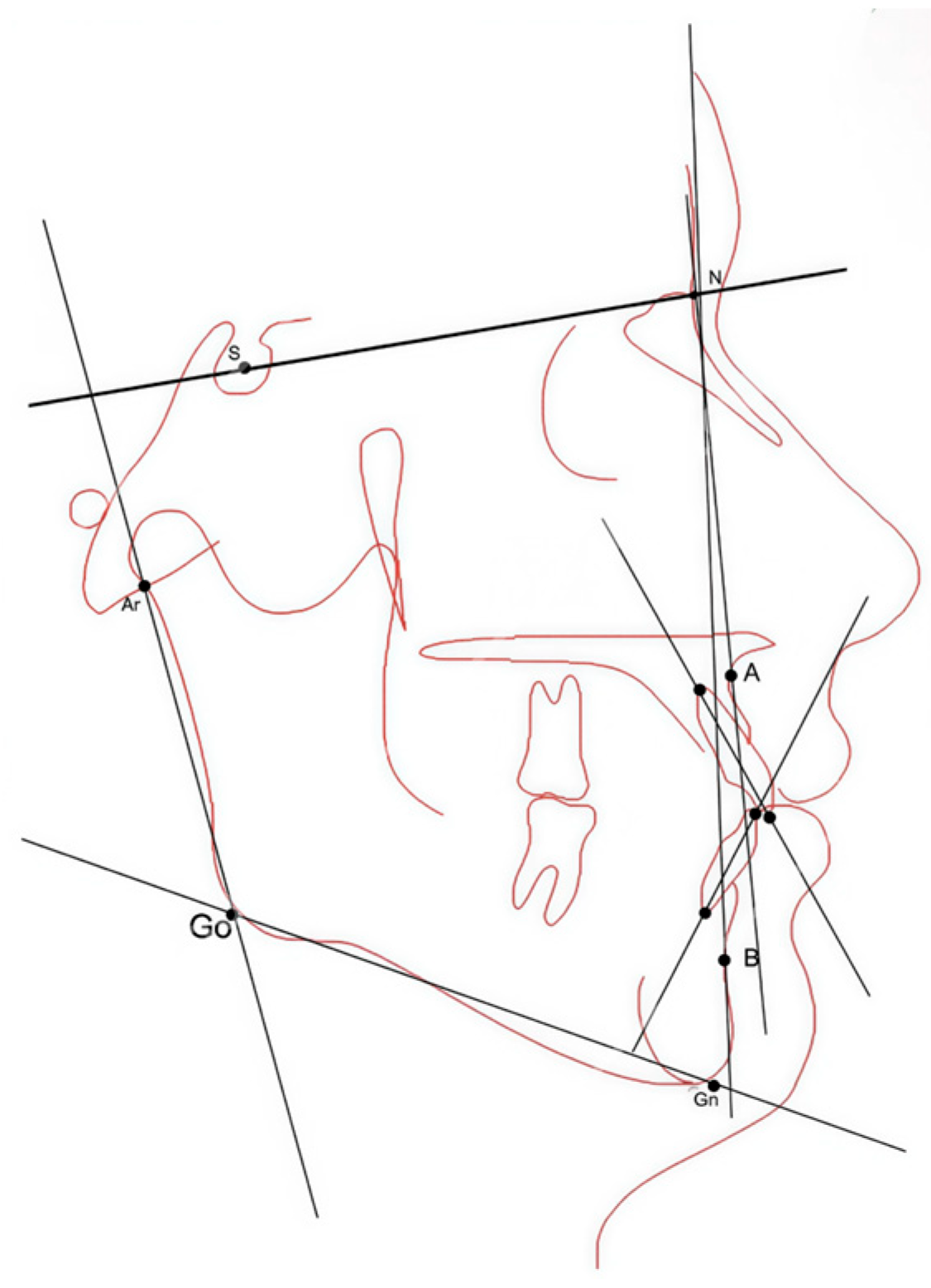
Figure 1. Lateral cephalometric tracing illustrating the skeletal and dentoalveolar measurements performed in the study: SN–GoGn, IMPA, U1–NA, L1–NB, and the ramal inclination defined as the angle between Ar–Go and the SN plane.
Applsci 16 03613 g001
Figure 2. Panoramic measurements for the calculation of the Kjellberg symmetry index based on condylar height (CH), ramus height (RH), and mandibular height (MH) using the ramus line (RL) and mandibular line (ML) as reference planes. (CO) condylion, (GO) gonion, (MN) menton are anatomical landmarks.
Applsci 16 03613 g002
Table 1. Classification of Study Variables.
CategoryVariables
Occlusal variablesAngle classification, overjet, overbite, posterior crossbite anterior open bite
Cephalometric variablesSN–GoGn, IMPA, U1–NA (°), U1–NA (mm), L1–NB (°), L1–NB (mm), Skeletal classification (ANB), ramal inclination
Panoramic structural variablesSI1 asymmetry, SI2 asymmetry
Functional variablesMandibular deviation, mandibular deflection
Variables were grouped according to the method of assessment into occlusal, cephalometric, panoramic structural, and functional categories.
Table 2. Baseline characteristics of the study groups.
CharacteristicTMD Group (n = 50)Control Group (n = 50)p-Value
Age (years), mean ± SD25.23 ± 4.6423.16 ± 4.83** 0.003 **
Gender, n (%) 0.548
Female28 (56.0)24 (48.0)
Male22 (44.0)26 (52.0)
Angle classification, n (%) 0.251
Class I18 (36.0)26 (52.0)
Class II21 (42.0)17 (34.0)
Class III11 (22.0)7 (14.0)
Skeletal classification, n (%) 1.000
Class I25 (50.0)25 (50.0)
Class II21 (42.0)21 (42.0)
Class III4 (8.0)4 (8.0)
Data are presented as mean ± SD or n (%). ** Bold ** indicates statistical significance (p < 0.05).
Table 3. Comparison of occlusal and functional variables between TMD and control groups.
VariableTMD Group (n = 50)Control Group (n = 50)p-Value
Overjet (mm), mean ± SD2.81 ± 1.822.74 ± 1.500.997
Overbite (mm), mean ± SD3.00 ± 1.712.94 ± 1.760.676
Open bite, n (%)
    Yes13 (26.0)9 (18.0)0.469
    No37 (74.0)41 (82.0)
Deflection, n (%)
    Yes34 (68.0)20 (40.0)** 0.009 **
    No16 (32.0)30 (60.0)
Deviation, n (%)
    Yes22 (44.0)8 (16.0)** 0.005 **
    No28 (56.0)42 (84.0)
Data are presented as mean ± SD or n (%). ** Bold ** indicates statistical significance (p < 0.05).
Table 4. Comparison of cephalometric measurements between groups.
VariableTMD Group (n = 50)Control Group (n = 50)p-Value
SN-GoGn (°)29.76 ± 5.7832.37 ± 6.65** 0.034 **
FMA (°)22.86 ± 5.8123.80 ± 5.550.411
Jarabak (%)67.54 ± 5.3365.46 ± 5.520.058
Ramal inclination (°)87.10 ± 6.5088.77 ± 5.820.076
IMPA (°)97.52 ± 6.5397.24 ± 8.070.850
U1-NA (°)24.75 ± 9.0921.44 ± 6.34** 0.038 **
U1-NA (mm)6.00 ± 3.035.26 ± 2.360.201
L1-NB (°)28.82 ± 6.9929.33 ± 7.990.735
L1-NB (mm)5.88 ± 1.966.06 ± 2.440.685
ANB (°)3.17 ± 2.733.45 ± 2.860.609
Data are presented as mean ± SD. ** Bold ** indicates statistical significance (p < 0.05).
Table 5. Panoramic mandibular asymmetry indices (Kjellberg technique).
IndexTMD (n = 50)Control (n = 50)p-Value AsymmetryAsymmetry in TMDAsymmetry in Controlp-Value (Asymmetry)
SI1 (%)90.9 ± 6.092.9 ± 4.30.155<90%20 (40.0%)12 (24.0%)0.134
SI2 (%)87.1 ± 8.589.7 ± 6.20.180<90%27 (54.0%)27 (54.0%)1.000
Data are presented as mean ± SD or n (%). Asymmetry defined as index < 90%. SI1: Condylar height/Ramus height ratio; ** SI2 **: Comprehensive asymmetry index.
Table 6. Multivariable logistic regression analysis for variables associated with TMD.
VariableTMD (n = 50)Control (n = 50)Adjusted OR95% CIp-Value
Deflection (Yes vs. No)34 (68%)20 (40%)** 3.57 **1.54–9.09** 0.003 **
Deviation (Yes vs. No)22 (44%)8 (16%)** 4.35 **1.69–12.50** 0.002 **
SI1 asymmetry (<90%)20 (40%)12 (24%)** 3.57 **1.08–14.29** 0.037 **
Firth penalized logistic regression was used. OR: Odds Ratio; CI: Confidence Interval. Model AUC = 0.822 (95% CI: 0.742–0.902). ** Bold ** indicates statistical significance (p < 0.05).
Disclaimer/Publisher’s Note: The statements, opinions and data contained in all publications are solely those of the individual author(s) and contributor(s) and not of MDPI and/or the editor(s). MDPI and/or the editor(s) disclaim responsibility for any injury to people or property resulting from any ideas, methods, instructions or products referred to in the content.