Article

Hydro-Mechanical Coupling Behavior of Cemented Silty Sand in Zones with Fluctuating Water Levels: An Empirical Damage Model

1
Institute of Hydrogeology and Environmental Geology, Chinese Academy of Geological Sciences, Shijiazhuang 050061, China
2
China University of Geosciences (Beijing), Beijing 100083, China
*
Author to whom correspondence should be addressed.
Appl. Sci. 2026, 16(8), 3614; https://doi.org/10.3390/app16083614
Submission received: 28 February 2026 / Revised: 2 April 2026 / Accepted: 5 April 2026 / Published: 8 April 2026

Featured Application

The dual-path water-sensitive constitutive framework developed in this study provides a highly accurate and generalizable theoretical tool for evaluating the long-term foundation stability of infrastructure (e.g., highways, railways, and underground structures) in the Yellow River Floodplain. Furthermore, the quantified water-sensitivity mechanism offers critical guidance for shifting regional engineering practices from conventional shallow compaction to stringent deep-waterproofing and dynamic drainage designs.

Abstract

Land subsidence in the Yellow River Floodplain, approaching 60 mm/year, is severely exacerbated by annual groundwater oscillations of 3 to 8 m. Conventional hydro-mechanical models, which primarily rely on effective stress principles, often struggle to fully capture the moisture-induced structural degradation of calcareous cemented soils under such hydraulic disturbances. To address this theoretical gap, we conducted a multifactor orthogonal triaxial experiment to quantitatively decouple the macroscopic factors governing the hydro-mechanical degradation. The results reveal that moisture content acts as the absolute dominant driver, accounting for 81.65% of the variance in macroscopic shear strength variance and completely overwhelming the mechanical advantages provided by initial compaction. A generalized dual-path water-sensitive damage model was explicitly derived, mathematically uncovering a fundamental asynchronous degradation mechanism. Cohesion exhibits an inward-concave, brittle fracture trajectory, which is macroscopically inferred to be associated with the water-induced softening of calcareous bonds (phase-transition parameter 0.81, maximum allocation 75.1%). Conversely, the internal friction angle demonstrates an outward-convex, hysteretic decline (parameter 1.59), maintaining structural interlocking until severe water-film lubrication occurs. By decoupling highly state-dependent initial strength parameters from invariant degradation operators, the modified Mohr–Coulomb model achieved exceptional forward blind-prediction accuracy. Validations across distinct initial skeletal structures constrained relative prediction errors strictly between −19.3% and +13.7% without any subjective parameter recalibration. The quantified extreme vulnerability theoretically proves that minor water infiltration can instantly eradicate over 75% of cohesive strength, necessitating a paradigm shift from shallow mechanical compaction to stringent waterproofing in regional engineering practices.

1. Introduction

Soil deformation is the fundamental driver of land subsidence—a progressive and potentially catastrophic geohazard that undermines urban infrastructure and sustainable development [1,2,3,4,5,6,7]. This process is primarily governed by the intricate interplay between surface loading and groundwater fluctuations [8,9,10]. To accurately predict and mitigate such hazards, it is crucial to quantify the mechanical response of soil frameworks under coupled hydro-mechanical (HM) stressors. Historically, the theoretical foundation for this understanding was established by Terzaghi’s effective stress principle, which provided a mathematical nexus of pore fluid pressure and skeletal stress [11,12]. Subsequent advancements have extended these classical consolidation theories into sophisticated multi-dimensional, fluid–solid coupled models, enabling the simulation of complex aquifer systems under dynamic boundary conditions [13,14,15].
Despite these theoretical strides, the predictive capacity of conventional HM models remains limited when applied to the unique geological environment of the Yellow River Floodplain. The geological uniqueness of this region stems from the extensive presence of calcareous cemented sands. Unlike typical cohesionless sands or well-defined clays, these soils exhibit a metastable structure marked by high permeability and chemical cementation [16,17,18,19]. A quintessential example is found in the Zhengzhou Airport Economic Zone, an archetypal floodplain setting where the shallow groundwater table undergoes periodic oscillations of 3–8 m annually, driven by the “water-level and sediment regulation” operations of the upstream Xiaolangdi Reservoir. Such high-frequency fluctuations create a perennially active “water level fluctuation zone” where the calcareous cementation is subjected to cyclic hydraulic–mechanical disturbances. Field observations indicate that this specific coupling effect has accelerated local subsidence to 60 mm/year, resulting in pervasive structural failures such as foundation cracking [20,21].
While conventional HM models provide a robust baseline, they primarily ascribe strength degradation to the macroscopic increase in pore water pressure, often treating shear strength parameters—cohesion (c) and internal friction angle (φ)—as constants or stress-dependent variables [22,23,24,25,26,27]. To more accurately capture the intrinsic chemo-physical deterioration of the soil skeleton under water infiltration, recent research has increasingly adopted meso-damage mechanics and binary-medium theories. For instance, Xu et al. [28] investigated the physicochemical bond dissolution in saline loess using specific damage variables. Similarly, Zhao et al. [29] explored moisture-induced damage evolution in red sandstone, and Qin et al. [30] advanced binary-medium models for calcareous materials, conceptualizing the soil as a mixture of bonded elements and frictional blocks. Collectively, these works demonstrate a vital evolution in modeling structural softening—transitioning from phenomenological additive or multiplicative damage variables to more mechanistic binary-medium partitioning, where the deterioration of bonded and frictional elements is explicitly decoupled [31].
However, existing bond-damage models often homogenize the degradation process. For the calcareous cemented soils of the Yellow River Floodplain, water infiltration triggers a more complex, asynchronous attenuation mechanism: beyond the physical reduction in effective stress, it induces rapid hydration reactions that abruptly dissolve cementation bonds, a highly brittle degradation feature recently highlighted by Jiang et al. [32] in treated calcareous sands, while frictional interlocking degrades at a different, more hysteretic rate. Neglecting this asynchronous nature by using a unified damage variable can lead to deviations in assessing subsidence risks in dynamically fluctuating hydraulic environments.
To bridge this gap, this study systematically investigates the evolution of strength parameters and deformation mechanisms under coupled stressors, explicitly positioning a novel dual-path framework as the next logical step beyond conventional homogenized damage models. Utilizing a multi-factor orthogonal experimental design, we isolate the synergistic impacts of moisture content, grain size distribution (sand content), density, and stress states. The specific objectives are as follows: (1) quantify the sensitivity of shear strength to moisture-induced weakening relative to mechanical factors; (2) elucidate the bifurcated failure mechanisms of cohesion-dominated and friction-dominated soil fractions; (3) construct a modified constitutive model incorporating a water-sensitive damage variable (Dω) to better reflect the structural degradation of the soil matrix. This work provides a refined theoretical basis for stability assessment and infrastructure planning in regions characterized by high-frequency groundwater fluctuations.

2. Materials and Methods

2.1. Study Area and Stratigraphic Characterization

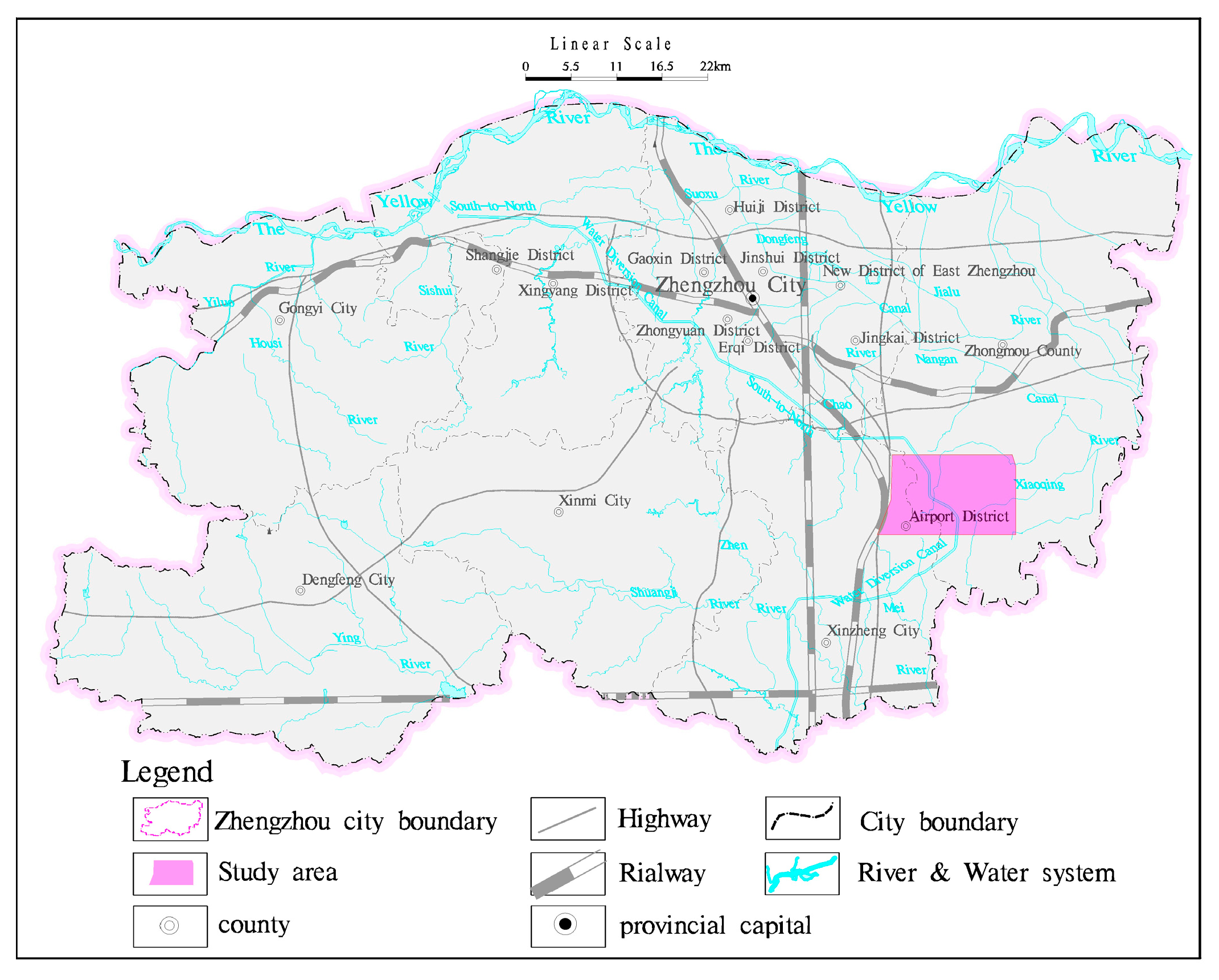
The research was conducted in the Zhengzhou Airport Economic Zone, a region quintessentially representative of the lower Yellow River alluvial plain (Figure 1). The geological framework of this region is governed by the historical sedimentary rhythms of the Yellow River, resulting in a complex stratification of calcareous cemented soils. The regional hydrogeological regime is modulated by the upstream Xiaolangdi Reservoir, which imposes a rhythmic forcing on the groundwater table, inducing annual oscillations of 3–8 m. These high-frequency fluctuations define a perennially active “water level fluctuation zone” extending from depths of 2 to 20 m. Within this geologically sensitive setting—shaped by calcareous cementation, rhythmic water table oscillations, and escalating urban surface loads—notable geo-hazards have emerged. Monitoring records from Zhengzhou indicate maximum annual subsidence rates approaching 60 mm, alongside uneven foundation settlements and structural cracking. These conditions not only pose serious challenges to urban safety but also render the region an ideal natural laboratory for exploring the strength evolution and failure mechanisms of cemented fine sands subjected to hydro-mechanical coupling.

2.2. Soil Sampling and Baseline Characterization

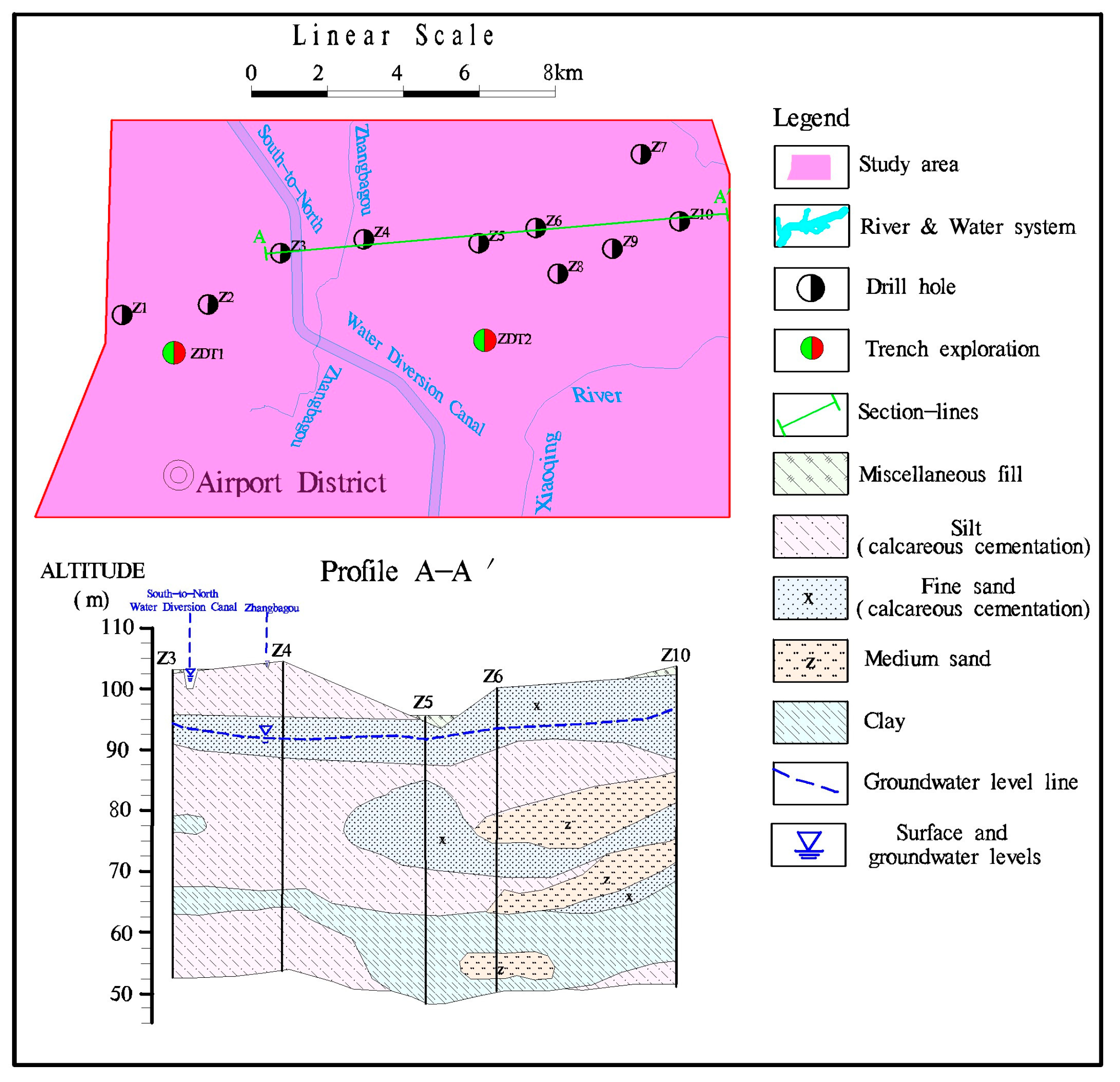
To investigate the synergistic effects of structural degradation and hydraulic forcing, soil sampling was strategically focused on the active fluctuation zone identified in Section 2.1. A total of 10 boreholes and 2 excavation trenches were completed, as illustrated in the spatial layout and representative geological cross-section in Figure 2.
A total of 29 sets of high-quality undisturbed specimens were retrieved using static pressure sampling to preserve the delicate calcareous cementation. Sampling locations were selected based on three criteria: stratigraphic continuity, representativeness of groundwater dynamics, and proximity to subsidence-sensitive infrastructure. Following extraction, all specimens were wax-sealed and transported in vibration-damped containers within 24 h to maintain in situ moisture and the metastable soil fabric.
Upon retrieval, a comprehensive suite of baseline geotechnical tests was conducted in accordance with GB/T 50123-2019 [33]: Physical indices were systematically assessed, including the natural water content (ω), measured via the oven-drying method; density (ρ), determined via the ring-knife method; and specific gravity of soil particles (Gs), measured utilizing a pycnometer. The particle size distribution was determined by combining sieve analysis and hydrometer analysis, and the sand content (Sc), which represents the percentage of particles with a diameter greater than 0.075 mm, was calculated. Compressibility characteristics were evaluated through standard oedometer tests, yielding compression coefficient (av) and compression modulus (Es) values. Shear strength parameters, including cohesion (c) and the internal friction angle (φ), were derived from direct shear tests (rapid shear) and unconsolidated undrained (UU) triaxial tests. It should be noted that the direct shear and UU triaxial tests were conducted strictly for the preliminary baseline characterization of the 29 undisturbed samples. These results provided the empirical foundation for the subsequent Pearson correlation analysis and factor screening (Section 2.3), and were not used for the final constitutive model calibration.
The synthesized physical and mechanical properties of the 29 sets of undisturbed specimens are presented in Table 1. These baseline data characterize the stochastic nature of the soil fabric and provide the empirical pool for subsequent factor sensitivity analysis.

2.3. Statistical Methods

Prior to the controlled multifactorial laboratory testing, a statistical evaluation procedure was implemented to establish a data-driven basis for experimental design. Utilizing the comprehensive baseline dataset acquired from the 29 undisturbed specimens (Section 2.2), a Pearson correlation analysis was performed using the IBM SPSS Statistics 26.0 software package. The analytical objective was to quantify the linear associations between four independent state predictors—sampling depth (h), natural moisture content (ω), density (ρ), and sand content (Sc)—and the fundamental mechanical responses, namely cohesion (c), internal friction angle (φ), compression coefficient (av), and compression modulus (Es).
In this statistical framework, a correlation coefficient threshold of |r| ≥ 0.6 was established a priori to denote a strong statistical dependency between the variables. Predictors meeting or exceeding this criterion were designated for inclusion in the subsequent orthogonal experimental matrix. This mathematical procedure was explicitly applied to reduce the dimensionality of the complex multiphase soil system and to isolate the primary controlling variables without subjective bias. Furthermore, depth (h) was incorporated into the analysis not merely as a spatial coordinate, but as a defined physical proxy for in situ confining pressure, ensuring that the environmental boundary conditions of the fluctuation zone were parametrically represented.
Consequently, moisture content (ω), sand content (Sc), density (ρ), and confining pressure (represented by sampling depth h) were robustly identified as the four primary driving variables governing structural degradation. These factors form the explicit basis for the parameter selection in the subsequent multifactor coupled orthogonal experiment (Section 2.4).

2.4. Multifactor Coupled Orthogonal Experiment Design

Building upon the statistical screening in Section 2.3, a multifactor orthogonal experimental framework was formulated to systematically evaluate the independent and interactive effects of the four primary variables: moisture content (ω), sand content (Sc), density (ρ), and confining pressure. The specific level settings for each factor are summarized in Table 2. The ω was set at 15%, 20%, and 25%, reflecting both the typical range of shallow groundwater fluctuations in the study area and the mechanically sensitive interval for structural degradation. Density (ρ) levels of 1.4, 1.5, and 1.6 g/cm3 were selected to span the structural compaction states from loose to relatively dense, reflecting sub-stable states encountered under repeated wetting–drying cycles. Confining pressures were defined at 100, 200, and 300 kPa, precisely representing the shallow in situ stress regimes at depths of 2 to 20 m.
A critical methodological consideration was the selection of sand content (Sc) levels, which were established at 15%, 30%, and 45%. While natural silty fine sands in the study area frequently exhibit sand contents exceeding 75%, attempting to remold specimens with Sc > 45% resulted in the failure to form stable cylindrical samples due to the lack of intact natural cementation. Consequently, 45% represents the upper physical threshold for preparing stable, remolded structural specimens suitable for controlled triaxial testing. Scientifically, this 15–45% interval is highly significant: it captures the critical transitional boundary where the composite soil fabric shifts from a fine-grained, cohesion-dominated matrix (silt) to a friction-dominated grain skeleton (sand). This transitional phase effectively represents the materials most intensely sensitive to hydro-mechanical coupling, allowing for the precise observation of structural degradation mechanisms.
To optimize experimental efficiency and identify the primary controlling variables, a foundational four-factor, three-level orthogonal array (L9(34)) was implemented (see Table 3). While an L9 array is relatively concise, it effectively captures the macroscopic variance trends necessary for initial variable screening in this study.
To ensure methodological consistency and represent the long-term drained conditions of the fluctuation zone, triaxial shear tests for the orthogonal experiment were executed exclusively under consolidated drained (CD) conditions. All subsequent quantitative factor decoupling and constitutive model formulations in this study are derived solely from these standardized CD test results. The peak deviatoric stress (qf) was adopted as the primary evaluation metric for macroscopic shear strength.
q f = σ 1 σ 3
where σ 1 is the axial stress, and σ 3 is the confining pressure.
To ensure data reliability, each test configuration was performed in duplicate. The resultant empirical data were subsequently subjected to range analysis and Analysis of Variance (ANOVA) to isolate and quantify the percentage contribution of each independent factor to the overall strength degradation.

2.5. Framework of Water-Sensitive Damage Model

While the multifactor orthogonal experiment provides a robust empirical basis for quantifying strength degradation, interpreting these macroscopic variations requires a structurally sound theoretical framework. Historically, classical hydro-mechanical theories, primarily grounded in Terzaghi’s effective stress principle:
σ 1 = σ 3 tan 2 45 ° + φ 2 + 2 c tan 45 ° + φ 2
where classical models traditionally treat c and φ as relatively stable parameters.
However, calcareous cemented soils in the Yellow River Floodplain experience a more complex dual-attenuation mechanism. Beyond the physical pore pressure effects, water infiltration triggers physicochemical hydration that intrinsically degrades the calcareous cementation bonds. Classical models fundamentally fail to capture this phenomenon, as they traditionally treat c and φ as stable or purely stress-dependent parameters, blatantly ignoring the moisture-induced structural deterioration of the soil matrix itself.
To bridge this critical theoretical gap, this study proposes a modified constitutive framework by introducing a water-sensitive damage variable (Dω). Rather than a static phenomenological parameter, Dω is conceptualized as a moisture-dependent degradation function (Dω = f (ω)) that quantitatively represents the degree of chemo-physical softening. By embedding Dω into the Mohr–Coulomb criterion, the inherent shear strength parameters are redefined as damage-coupled variables (c(Dω) and φ(Dω)). This innovative framework explicitly couples the physical lubrication (effective stress reduction) with the water-induced structural softening (structural damage), establishing a mechanistic foundation. The precise mathematical formulation of Dω will be directly formulated and calibrated using the empirical data derived from the orthogonal experiments, as detailed in Section 3.

3. Results and Analysis

3.1. Statistical Identification of Dominant Variables and Conceptual Framework

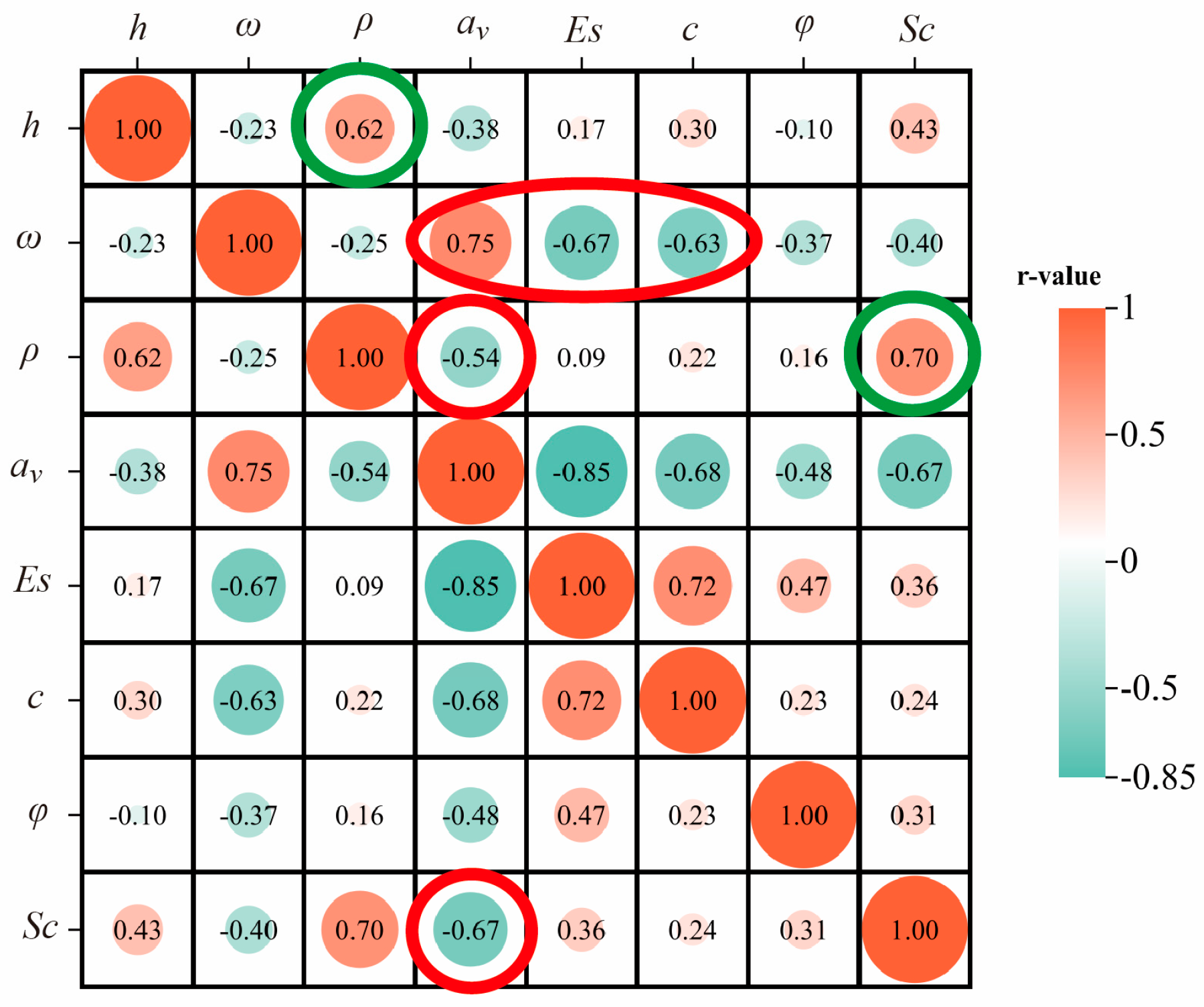
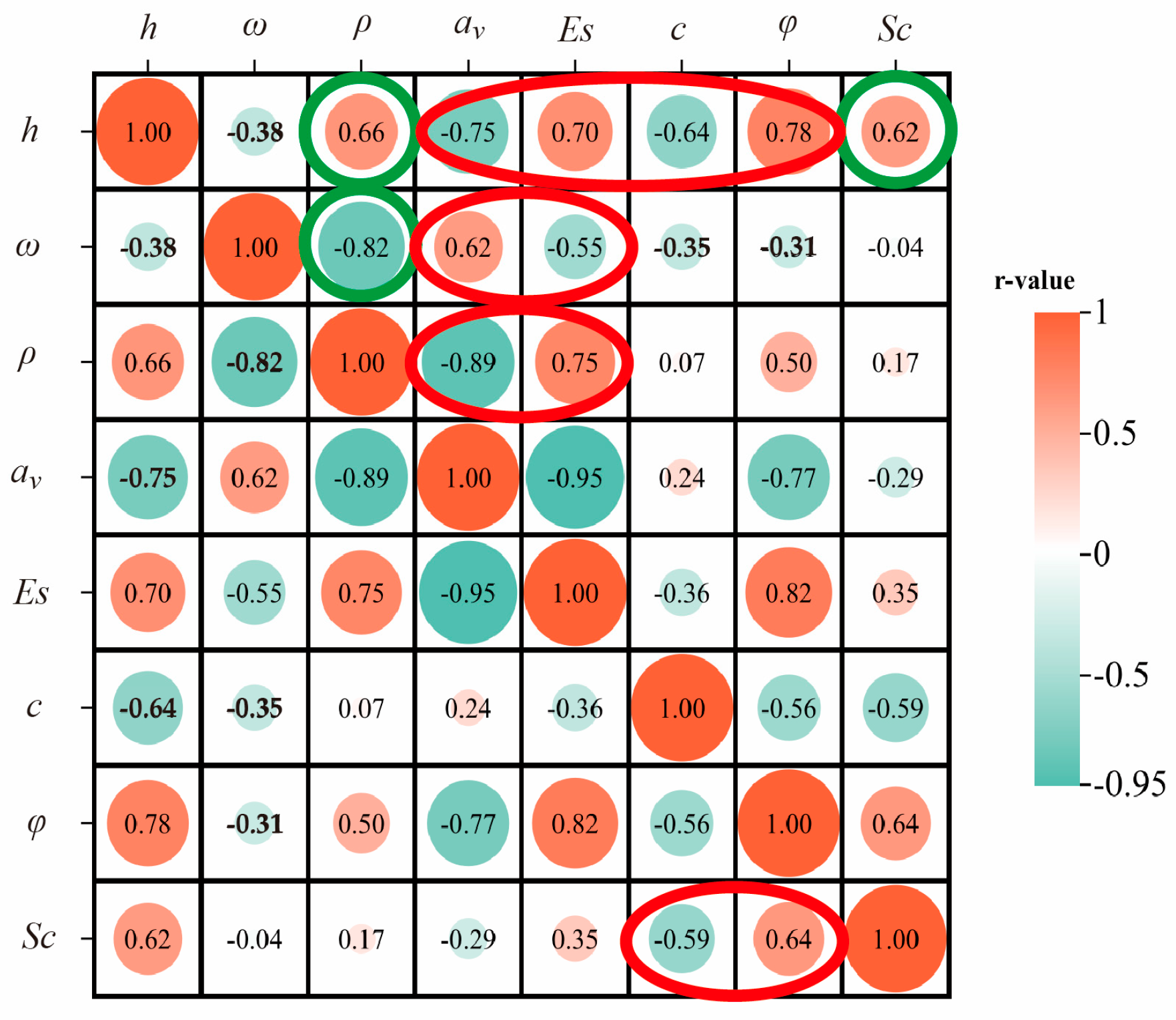
Following the statistical screening protocol established in Section 2.3, Pearson correlation analysis was executed on the baseline dataset (Table 1) to evaluate the interdependencies among state predictors and mechanical responses. The correlation matrices, visualized as heatmaps (Figure 3 and Figure 4), validate the prior hypotheses regarding the soil-type-dependent dual-attenuation mechanism in the Yellow River Floodplain.
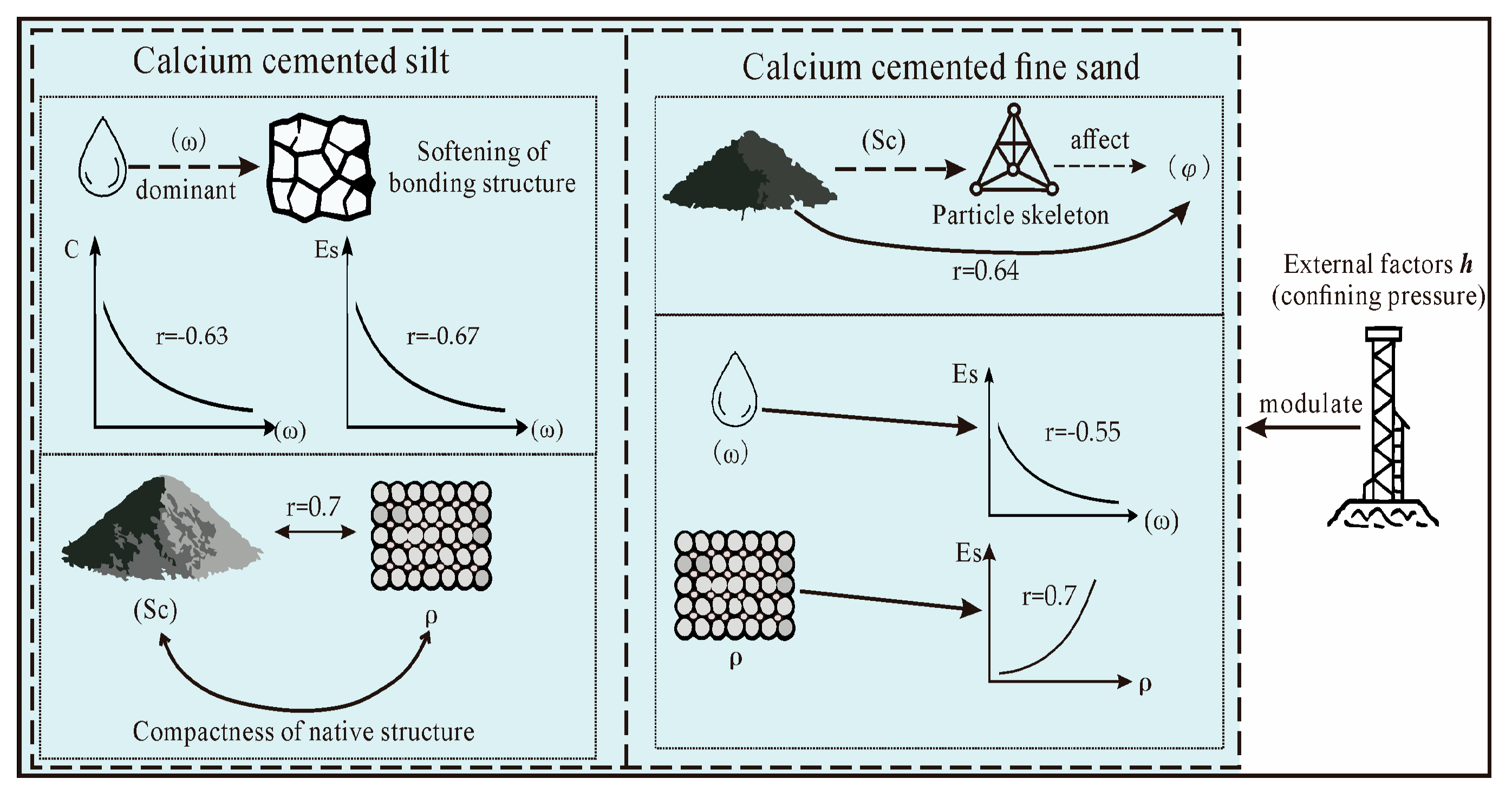
For the calcareous cemented silt (Figure 3), moisture content ω exhibits a profound negative correlation with both cohesion c (r = −0.63) and compression modulus Es (r = −0.67). This statistical consistency reveals a “dual-damage effect” of water on the soil’s structural integrity. Beyond simple physical lubrication, moisture infiltration triggers is macroscopically inferred to trigger the structural softening and potential degradation of the calcareous cementation bonds—the primary source of structural cohesion in these specific deposits. As ω increases, the brittle inter-particle bridges succumb to hydration stress concentrations and rupture, inducing a rapid transition from a structured, cemented state to a remolded, fluid-like state. Additionally, sand content Sc shows a strong positive correlation with density ρ (r = 0.703), suggesting that these two variables jointly define the initial compaction state and baseline structural integrity of the soil matrix.
In contrast, the calcareous cemented fine sand (Figure 4) exhibits a mechanical regime governed by a “force-chain framework”. The strong positive correlation between Sc and the internal friction angle φ (r = 0.64) suggests that increasing Sc facilitates the formation of an interlocking skeleton composed of coarse grains. In this fabric, frictional resistance between grains supplants the weakened cementation as the primary strength component. However, the compressibility remains critically sensitive to the synergistic influence of ω and density ρ (|r| > 0.55). This indicates that while the sandy framework maintains macro-shear stability, the grain-to-grain contact points are vulnerable to localized crushing or rearrangement under high-moisture states, leading to volumetric instability despite the skeletal support. Furthermore, sampling depth h correlates significantly with multiple mechanical indicators; while not a direct mechanical variable, it effectively acts as a physical proxy for the in situ confining stress, which serves as a crucial external boundary condition.
To synthesize these statistical interdependencies and their underlying physics, a conceptual framework of the key factors influencing soil strength is proposed (Figure 5). The framework categorizes the influencing factors into three intrinsic state variables (ω, Sc, and ρ) that dictate the internal fabric behavior, and one extrinsic mechanical constraint (confining pressure) that modulates the effective stress field. By aligning these dominant drivers, the framework bridges the gap between microstructural cementation loss and macroscopic strength decay, effectively defining the precise parameter space for the subsequent quantitative decoupling experiment.

3.2. Quantitative Decoupling of Hydro-Mechanical Factors

In Section 3.1, the correlation analysis revealed possible influence pathways among hydro-soil-mechanical variables. However, since these statistical patterns are derived from natural conditions where multiple variables coexist, they cannot distinguish the independent effects of each factor. To isolate and quantify the individual contributions of the key variables, a laboratory-based orthogonal experiment was designed. This controlled experimental setup enables a direct assessment of two fundamental questions: Which factors play the dominant role in strength variation? What are their respective contribution weights? The results, analyzed using both range analysis and ANOVA, provide a quantitative basis for identifying the principal mechanisms controlling soil strength. Detailed outcomes of the orthogonal tests are presented in Table 4.
Range and variance analyses were conducted based on the orthogonal test results (Table 4), and the corresponding statistical outcomes are summarized in Table 5.
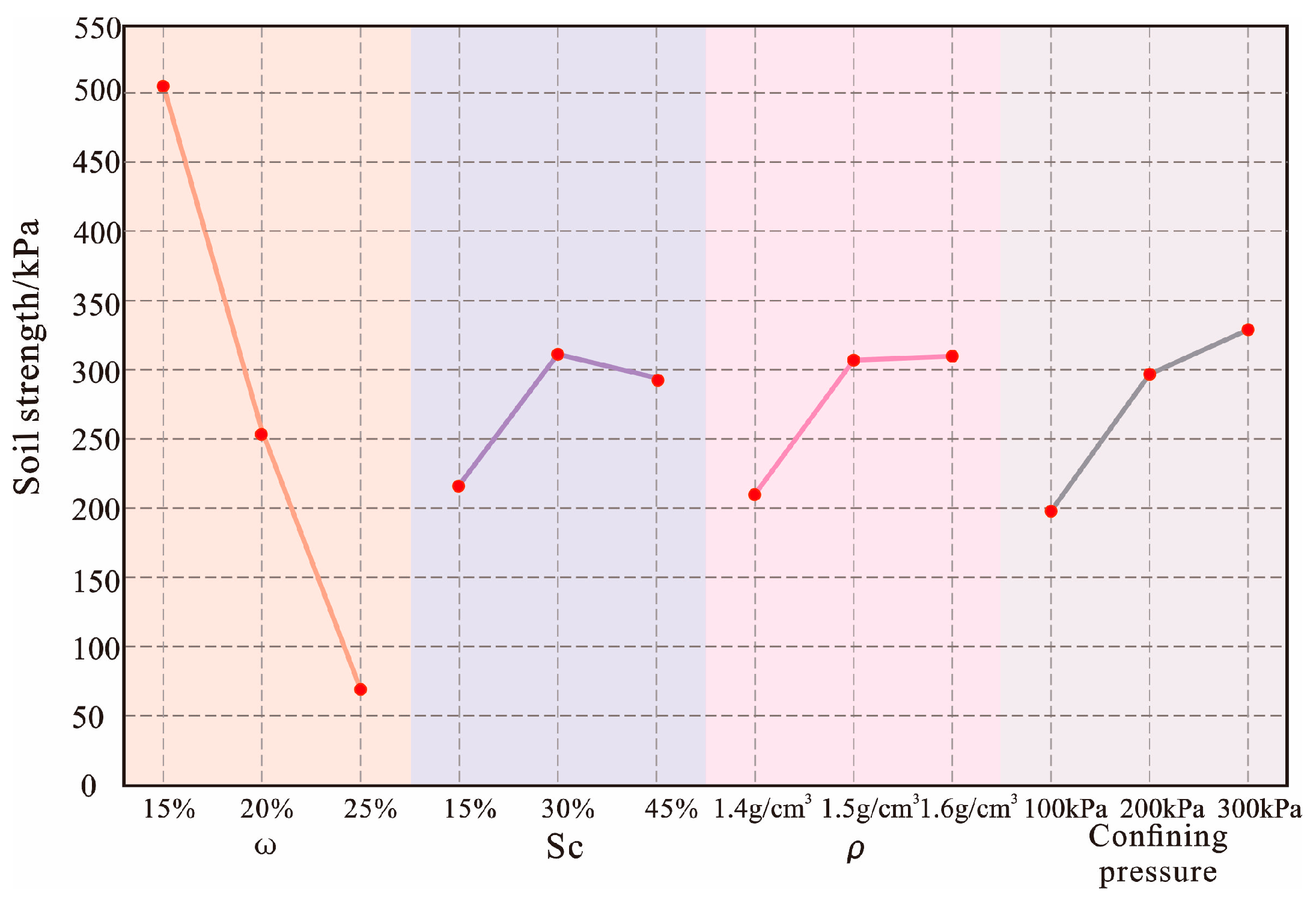
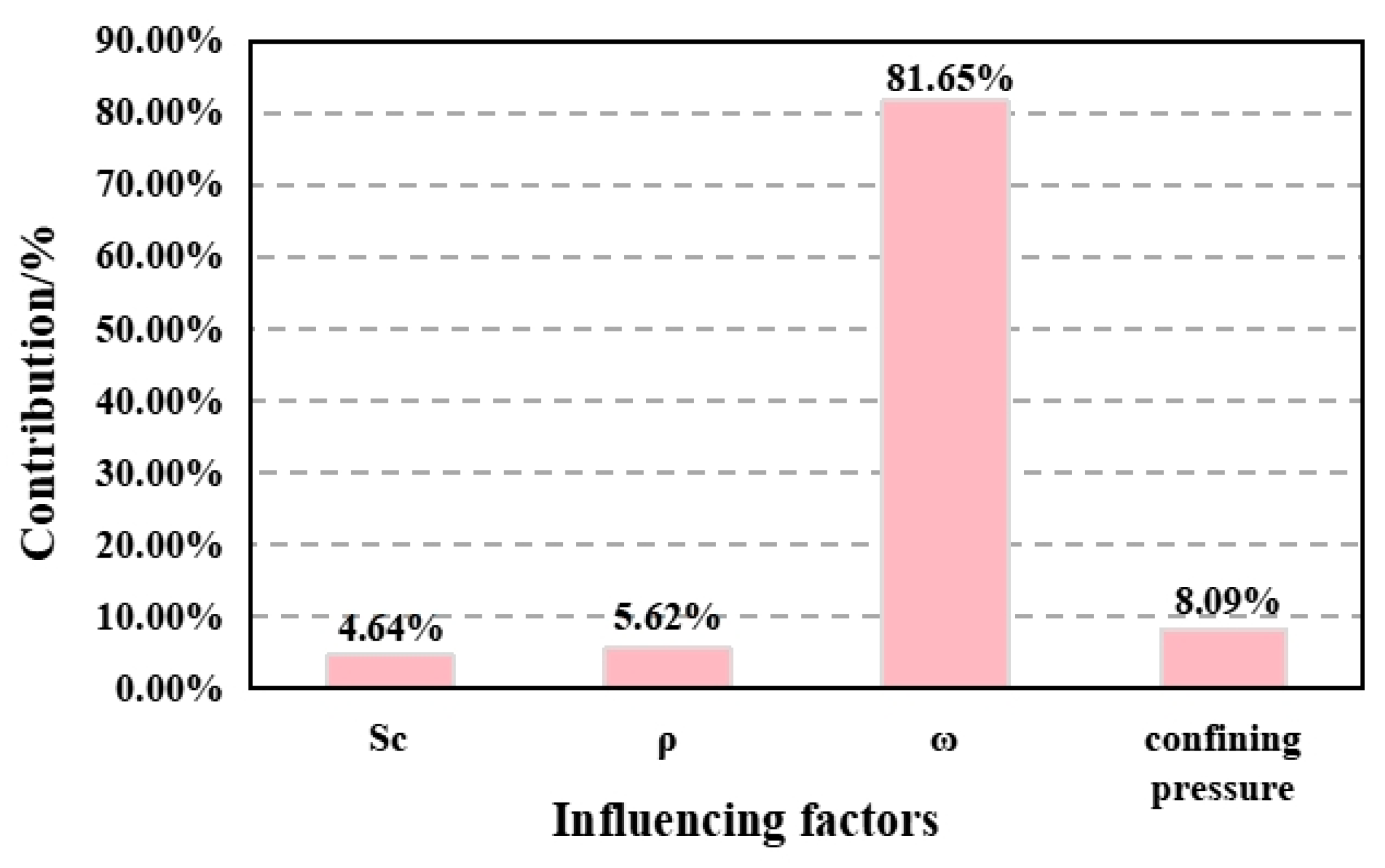
Table 5 presents the analysis results, while the corresponding variation trends in soil strength across different levels of each factor are illustrated in Figure 6. Figure 7 shows the relative contribution values of each influencing factor to soil strength.
The macroscopic soil strength exhibits a highly significant non-linear response to the four controlling variables (Figure 6). As the moisture content (ω) increases from 15% to 25%, the soil strength decreases by a factor of 7.25, and the rate of strength degradation is notably higher when ω increases from 15% to 20% compared to the transition from 20% to 25%. With an increase in sand content (Sc), the soil strength initially rises, peaking at 30%, but begins to decline once Sc exceeds this threshold. Furthermore, while the soil strength increases with greater density and confining pressure, the rate of this enhancement gradually decelerates.
Figure 7 summarizes the sensitivity ranking of shear strength with respect to each variable. The dominant influence comes from ω (81.65%), followed by the confining pressure (8.09%), ρ (5.62%), and Sc (4.64%).
The underlying mechanisms for these effects can be explained as follows:
The moisture content (ω) exerts an absolute dominant control over the deterioration of soil strength, with a variance contribution rate of 81.65%. As ω increases from 15% to 25%, the strength experiences a severe non-linear attenuation, plummeting from 504.12 kPa to 69.49 kPa. Crucially, the rate of strength decline is higher during the initial wetting stage (from 15% to 20%) than in the subsequent stage (from 20% to 25%). Mechanistically, this reflects the unique “dual physical–chemical damage effect” of calcareous cemented soils: water infiltration not only increases pore water pressure and reduces effective stress but also triggers intense chemical hydration, rapidly dissolving and softening the calcareous cementation bonds between particles. The brittle rupture of the native cementation network leads to a rapid decrease in initial strength. Macroscopically, this extreme weakening effect generates a profound “structural masking effect”—the destructive force of moisture completely overwhelms any mechanical advantages inherently provided by initial compaction and particle gradation.
Beneath the moisture-dominated destruction, the reconstruction of the internal physical skeleton still exhibits complex phase transition characteristics. Although sand content (Sc) contributes only 4.64% to the strength variance, its evolutionary curve unveils a critical synergistic bearing mechanism within the “skeleton-matrix” system of the calcareous soil. Soil strength does not increase monotonically with Sc; instead, it reaches a peak at 30% before beginning to decline. Mechanically, this “strength inflection point” marks the formation and subsequent disintegration of a continuous force-chain network. When Sc reaches 30%, an optimal interlocking skeleton forms among coarse particles, while the fine-grained matrix ideally fills the pores and provides cementation constraints, achieving a perfect coupling of particle friction and matrix cohesion. However, once Sc exceeds this threshold, the limited cementing agents cannot effectively envelop the excessive sand particles, destroying the structural continuity and inevitably causing the overall shear strength to decay.
As representations of the soil’s compaction state and external mechanical boundaries, density (ρ) and confining pressure contribute 5.62% and 8.09% to the strength variance, respectively. Although increasing density shortens inter-particle distances and enhances interlocking, and higher confining pressure effectively restricts lateral slip while bolstering mechanical constraints, Figure 6 demonstrates that such strengthening effects—reliant purely on physical compaction or external stress—exhibit a clear marginal diminishing return. Once the internal calcareous cementation is thoroughly disintegrated by moisture, relying solely on external mechanical constraints cannot fundamentally compensate for the catastrophic loss of native structural integrity.
In summary, in the hydro-mechanical coupling environment of the Yellow River Floodplain, the physical–chemical damage induced by moisture is the core driving force behind structural failure. Traditional models that over-rely on initial physical compaction indicators fail to accurately predict such dynamic evolutionary processes. This theoretically necessitates the introduction of a dynamic variable capable of quantifying moisture-induced damage evolution into classical model.

3.3. Formulation and Validation of the Dual-Path Damage Model

As analyzed in Section 3.2, the increase in moisture content (ω) during the hydro-mechanical coupling process leads to a severe non-linear attenuation of soil strength by a factor of up to 7.25. This extreme magnitude of weakening significantly transcends the theoretical bounds of strength reduction attributed solely to elevated pore water pressure in Terzaghi’s classical effective stress principle. Fundamentally, water infiltration not only alters pore water pressure but also triggers the physicochemical softening of calcareous cementation bonds and the subsequent disintegration of the soil skeleton. However, the conventional Mohr–Coulomb model predominantly treats cohesion (c) and the internal friction angle (φ) as constants or purely stress-dependent variables, thereby failing to capture the moisture-driven structural deterioration within the soil matrix. To address this theoretical limitation, this section introduces a water-sensitive damage variable (Dω) to modify the classical Mohr–Coulomb model, which is subsequently validated using the orthogonal experimental data.

3.3.1. Derivation of Water-Sensitive Damage Equation Based on Experimental Data

ANOVA confirms that moisture content (ω) governs 81.65% of the strength variance. Aligning with the characteristics of the water-level fluctuation zone, the minimum moisture content of the orthogonal test, ω0 = 15%, is defined as the initial baseline state. The macroscopic damage variable Dω is formulated based on the Weibull statistical distribution:
D ω = 1 e k ω ω 0 ω c n ;   ω 15 %
where ω is the current moisture content, and ω0 is the reference threshold for damage initiation, which corresponds to the macroscopic plastic limit of the regional soil. When the moisture content falls below this threshold, pore water predominantly exists as strongly bound water, causing negligible structural damage (i.e., Dω = 0). Based on the fundamental physical properties (Table 1), ω0 is established as 15%. The parameter ωc serves as the characteristic moisture scaling parameter, delineating the active moisture fluctuation interval from the plastic limit to a near-saturated state. As experimentally determined, the saturation moisture content of the regional soil is approximately 25%, and the plastic limit is 15% (Table 1); thus, ωc is 10%.
The variable n is the shape parameter that reflects the rate of damage acceleration, and k is the damage accumulation coefficient that characterizes the cumulative rate of structural damage within a unit characteristic span. Calculate the values of n and k using the range analysis results (Table 5):
At ω = 15%, D15% = 0;
At ω = 20%, D20% = 1 − (255.32/504.12) = 0.4935;
At ω = 25%, D25% = 1 − (69.49/504.12) = 0.8622.
Applying a double-logarithmic transformation to Equation (3) yields the following linear relationship:
ln l n 1 D ω = n l n ω 15 % 10 % + l n k
By substituting the empirical damage values into this transformed Equation (4), the parameters are analytically derived as k = 1.98 and n = 1.54.
The shape parameter n > 1 indicates that the strength failure of calcareous cemented soil has significant nonlinear acceleration characteristics. The cumulative damage coefficient k = 1.98 characterizes the strong water sensitivity of calcareous cemented soil in the Yellow River Floodplain.
Equation (3) is thus transformed into:
D ω = 1 e 1.98 ω 15 % 10 % 1.54 ;   ω 15 %

3.3.2. Dual-Path Non-Linear Water-Sensitive Degradation Model for Strength Parameters

The macroscopic weakening behaviors induced by water infiltration on soil mechanical parameters exhibit fundamental differences: the sharp decline in cohesion is hypothesized to be associated with the moisture-induced structural softening of cementing agents, while the thickening of water films mitigates particle interlocking. To rigorously quantify these distinct degradation mechanisms, we propose a “residual-damage non-linear attenuation model” for both cohesion (c) and internal friction angle (φ). The unified governing equations are expressed as follows:
c D ω = c 0 1 α D ω m = c 0 c 0 c r D ω m φ D ω = φ 0 1 β D ω η = φ 0 φ 0 φ r D ω η
The physical significance of each parameter in the proposed model is defined as follows: c0 and φ0 represent the initial cohesion and internal friction angle, respectively, of the soil in a structurally intact state without water-sensitive damage (i.e., ω = 15%). Crucially, c0 and φ0 are not absolute global constants; rather, they are strongly state-dependent variables dictated by the initial skeleton structure (i.e., specific density and sand content).
The terms α, β, m, and η serve as the invariant water-sensitive degradation operators. The terms α and β are the damage allocation coefficients for cohesion and internal friction angle, respectively. Specifically, α denotes the proportion of initial cohesion that can be completely destroyed by moisture (α = (c0cr)/c0), while β represents the maximum fractional loss of the initial internal friction angle caused by moisture deterioration upon complete structural failure (β = (φ0φr)/φ0). Furthermore, cr and φr denote the absolute residual cohesion and residual internal friction angle, respectively. cr characterizes the ultimate lower-bound cohesion provided by physical particle friction and bound water films after the calcareous cementation experiences severe macroscopic structural yield; similarly, φr defines the ultimate lower physical bound of frictional resistance provided solely by the water-film-mediated flow-plastic sliding of free particles after the soil undergoes extreme hydration and completely loses its structural cementation and mechanical interlocking. Finally, m and η are the phase-transition parameters controlling the non-linear evolutionary trajectories of cohesion and internal friction angle with macroscopic volumetric damage, respectively.
To circumvent the mathematical non-uniqueness and physical distortion typically induced by empirical assumptions in traditional model parameter calibration, this study resolves the parameters based entirely on authentic experimental data. Taking the baseline condition with a sand content of 30% and a density of 1.5 g/cm3 as the benchmark, soil samples were prepared at three distinct moisture states: 15%, 20%, and 25%. These specific discrete points were strategically selected to represent the critical physical boundaries of the regional calcareous soil: the plastic limit baseline (15%), an intermediate active hydration state (20%), and the near-saturated threshold (25%). Supplementary conventional triaxial shear tests were subsequently performed to accurately determine the cohesion (c) and internal friction angle (φ) under these specific moisture conditions. By employing these three sets of empirically measured strength parameters as known boundary conditions, a non-linear system of equations was constructed to rigorously solve for the parameters within the water-sensitive degradation model.
  • Initial Baseline Parameters (c0 and φ0).
When the moisture content is 15%, the macroscopic damage degree is Dω = 0. According to the supplementary experiments, the initial parameters were obtained as c0 = 21.4 kPa and φ0 = 17.9°.
2.
Joint Analytical Resolution of Phase-transition Parameters (m, η) and Absolute Residuals (cr, φr).
Based on the supplementary tests, when ω = 20% (D20% = 0.4935), the measured parameters are c20% = 12.32 kPa and φ20% = 15.6°. When ω = 25% (D25% = 0.8622), the parameters decay to c25% = 7.14 kPa and φ25% = 12.3°. By substituting these empirical boundary conditions into the governing equations, a non-linear system containing the unknown evolution indices and absolute residual values (the lower limits when Dω = 1) is established.
Consequently, substituting these empirical conditions into the cohesion evolution equation c(Dω) yields:
21.4 12.32 = 21.4 c r × 0.4935 m 21.4 7.14 = 21.4 c r × 0.8622 m
Solving this system of equations yields m = 0.81 and cr = 5.32 kPa.
Similarly, for the internal friction angle evolution equation φ(Dω), the non-linear system is established as:
17.9 15.6 = 17.9 φ r × 0.4935 η 17.9 12.3 = 17.9 φ r × 0.8622 η
Solving this system of equations yields η = 1.59 and φr = 10.8°.
3.
Establishment of the Dual-path Non-linear Evolution Equations.
Integrating Equations (6)–(8), the dual-path water-sensitive non-linear degradation model for soil strength is finally explicitly established as follows:
c D ω = c 0 1 α D ω m = c 0 × 1 0.751 D ω 0.81 φ D ω = φ 0 1 β D ω η = φ 0 × 1 0.397 D ω 1.59
The phase-transition parameter for cohesion is m = 0.81 < 1, indicating an inward-concave, sharp-decline trajectory. This demonstrates that in the lower moisture content regime (e.g., 15–20%), even minimal water infiltration induces the brittle fracture and dissolution of the calcareous cementation within the soil skeleton, resulting in early cohesion attenuation. Conversely, the phase-transition parameter for the internal friction angle is η = 1.59 > 1, which dictates an outward-convex, accelerated-decline trajectory. This reveals a hysteretic behavior in the loss of inter-particle frictional interlocking: during the low-moisture stage, infiltrating water primarily fills the macro-pores, exerting a relatively gradual impact on particle surface contacts; however, as moisture approaches the highly saturated range (e.g., 20–25%), the significant thickening of bound and free water films triggers the accelerated collapse of the particle interlocking effect.

3.3.3. Establishment and Validation of the Modified Mohr–Coulomb Model

By incorporating the explicitly derived dual-path water-sensitive degradation laws into the classical Mohr–Coulomb failure criterion, a generalized predictive model for the deviatoric stress at failure (qf(cal)) is established. Substituting the water-sensitive damage variable Dω Equations (1), (5) and (9), into Equation (2) yields the following analytical expression:
q f c a l = σ 3 t a n 2 45 ° + φ 0 1 0.397 D ω 1.59 2 1 + 2 c 0 ( 1 0.751 D ω 0.81 ) t a n [ 45 ° + φ 0 1 0.397 D ω 1.59 2 ]
where σ3 is the applied confining pressure, and c0 and φ0 represent the initial cohesion and internal friction angle of the soil in its structurally intact state (ω = 15%), respectively.
To objectively evaluate the predictive accuracy and generalizability of the proposed model, a forward validation strategy was employed using independent triaxial shear test data. The validation encompasses two distinct initial skeletal states to verify the model’s state-dependency:
  • State I (Sc = 30%, ρ = 1.5 g/cm3).
The measured initial intact parameters are c0 = 21.4 kPa and φ0 = 17.9°. Theoretical deviatoric stresses at progressive hydration states of ω = 17%, 20%, and 25% under a confining pressure of 100 kPa were calculated and compared with experimental data.
2.
State II (Sc = 20%, ρ = 1.6 g/cm3).
A supplementary test at the initial intact state (ω = 15%) yielded newly measured initial parameters of c0 = 20.3 kPa and φ0 = 16.6°. Using these specific baseline parameters, theoretical predictions were executed for hydration states of ω = 18%, 21%, and 24% under a confining pressure of 100 kPa. This specific confining pressure (100 kPa) was strategically selected for validation as it accurately represents the shallow in situ stress regime (approximately 5–10 m depth) where the most severe hydration-induced structural damage and macroscopic foundation subsidence occur in the actual water level fluctuation zone.
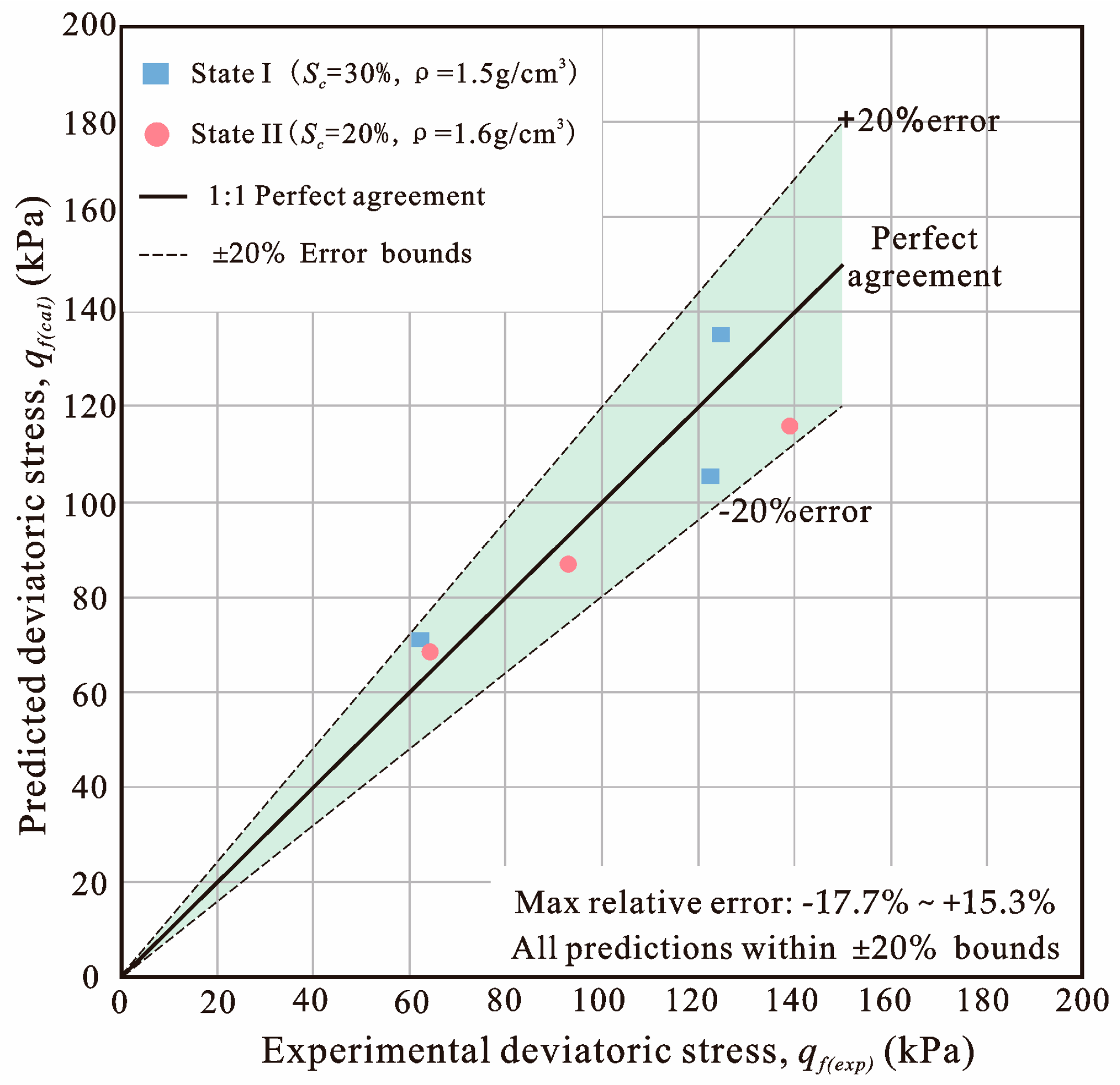
A comparison between theoretical prediction (qf(cal)) and experimental measurement (qf(cal)) results is detailed in Table 6 and visually evaluated via a 1:1 scatter plot in Figure 8.
As demonstrated in Table 6, the theoretical predictions exhibit satisfactory agreement with the experimental measurements across varying initial skeletal structures and moisture contents. The relative errors for all validation groups are constrained within the narrow range of −17.7% to +15.3%.
This predictive robustness is further corroborated by the visual alignment in Figure 8. All validation data points—representing two distinctly different skeletal states—cluster closely around the 1:1 perfect agreement line and are strictly confined within the ±20% relative error bands. Notably, the model exhibits no systemic directional bias (overestimation or underestimation). In the context of geotechnical engineering, considering the inherent physical variability of geomaterials under hydraulic disturbance, achieving this margin of error through pure forward prediction is highly acceptable. Crucially, the model attains this accuracy solely based on the corresponding initial intact parameters (c0 and φ0), without the need to recalibrate the invariant degradation operators (m, n, α, β). This confirms that the explicitly derived degradation laws successfully decouple the fundamental physical mechanism of water-induced softening, demonstrating the robustness and practical applicability of the proposed constitutive framework.

4. Discussion

4.1. Micro-Physical Mechanisms of Asynchronous Strength Degradation

A pivotal scientific finding of this study is the explicit mathematical revelation of the asynchronous degradation trajectories between cohesion and the internal friction angle. This mathematical asymmetry is not a statistical coincidence, but a macroscopic manifestation of the fundamental micro-physical interactions within calcareous cemented soils under hydraulic disturbance.
The phase-transition parameter for cohesion (m = 0.81 < 1) dictates an inward-concave, sharp-decline trajectory. Microscopically, the inter-particle calcareous cementation exhibits extreme chemical water sensitivity. Even in the initial stage of water infiltration, meniscus water rapidly dissolves the surface bonding bonds at the particle contact points, leading to brittle fracture and collapse of the viscous network. Conversely, the internal friction angle exhibits an outward-convex, accelerated-decline trajectory (η = 1.59 > 1). This demonstrates a hysteretic slip mechanism. In the low-moisture stage, infiltrating water primarily fills the macro-pores, exerting a relatively gradual impact on particle surface contacts. The basic frictional resistance, inherently provided by the mechanical interlocking of the insoluble siliceous or calcareous sand skeleton, remains temporarily stable. Only when the soil approaches a highly saturated state do the bound and free water films thicken sufficiently to provide severe lubrication, triggering the delayed collapse of the particle interlocking effect.
These quantified asynchronous trajectories offer a distinct physical departure from the homogenized degradation patterns frequently reported in the literature. Traditional continuum damage models often employ unified exponential decay or logistic functions to describe macroscopic strength reduction, which inherently mathematicalizes cohesion and friction to deteriorate synchronously. Similarly, while advanced hypoplastic frameworks capture state-dependent softening, they typically govern structural degradation through a single generalized scalar multiplier or void-ratio-dependent fabric tensor. In contrast, our dual-parameter formulation explicitly decouples the deterioration into two distinct micro-mechanical mechanisms. The inward-concave trajectory of cohesion strictly follows a bond-controlled path, governed by the immediate physicochemical dissolution of calcareous cements. Conversely, the outward-convex trajectory of the internal friction angle follows a fabric-controlled path, where the mechanical rearrangement and interlocking of the granular skeleton provide hysteretic resistance until severe lubrication initiates macroscopic slip. This explicit mathematical decoupling of the bond- and fabric-controlled paths avoids the oversimplification of synchronous damage, providing a more rigorous and physically consistent representation of the complex hydro-mechanical softening observed in metastable cemented soils.

4.2. State-Dependency and Universality of the Constitutive Framework

Traditional empirical degradation models often suffer from structural rigidity, typically treating all strength parameters as fixed phenomenological constants. Consequently, when encountering soils with different initial densities or sand contents, these models require massive and subjective recalibration.
The proposed dual-path non-linear model elegantly resolves this dilemma by mathematically decoupling the absolute initial state from the relative degradation process. As emphasized in Section 3.3.2, the initial baselines (c0 and φ0) are strictly treated as state-dependent variables controlled by the initial compaction and gradation. However, the explicitly derived degradation operators (m, η, α, β) characterize the intrinsic physicochemical deterioration rules of the calcareous cementation, remaining universally applicable. This decoupling theoretically proves that while the “starting baseline” of the soil is highly variable, its “pathway to failure” under hydraulic disturbance is strictly governed by the universal Weibull damage evolution of its calcareous bonds. This physical self-consistency provides a highly robust and generalizable theoretical framework for geomechanical modeling in similar environments.

4.3. Engineering Implications for the Yellow River Floodplain

The extreme hydro-mechanical vulnerability quantified in this study serves as a critical geohazard warning for infrastructure development in the Zhengzhou Airport Economic Zone. The regional hydrogeological regime is modulated by the upstream Xiaolangdi Reservoir, inducing annual groundwater oscillations of 3–8 m. These high-frequency fluctuations define a perennially active “water level fluctuation zone”.
Our orthogonal tests revealed that moisture content governs 81.65% of the strength variance, significantly overwhelming the mechanical advantages provided by initial compaction. Relying on the high initial strength of dry or semi-dry calcareous soils for foundation design in this region is therefore highly perilous. As mathematically governed by the cohesive damage allocation coefficient (α = 0.751) and the sharp-decline phase-transition parameter (m = 0.81 < 1), the model theoretically proves that even minor moisture increments beyond the plastic limit can rapidly compromise over 75% of the cohesive structural network. This profound loss of fundamental skeletal support provides a critical theoretical micro-mechanical basis for understanding the macroscopic phenomenon of local maximum annual subsidence rates approaching 60 mm, although actual field-scale subsidence is concurrently governed by complex 3D boundary conditions and multi-layer aquifer interactions. To mitigate pervasive structural failures, engineering practices in the Yellow River Floodplain must prioritize stringent waterproofing, dynamic groundwater monitoring, and deep-drainage protocols over conventional shallow mechanical compaction.

4.4. Limitations and Future Perspectives

Despite the robust predictive capability demonstrated by the modified Mohr–Coulomb framework, this study has certain limitations. Firstly, regarding the experimental methodology, while the L9 orthogonal array efficiently screened the main effects of the hydro-mechanical factors, its fractional factorial nature inherently limits the full resolution of complex, higher-order interaction effects between the variables. Secondly, the current model captures the static hydro-mechanical coupling behavior under consolidated drained (CD) triaxial conditions. In realistic fluctuating environments, calcareous foundations are often subjected to dynamic cyclic loading (e.g., traffic loads, seismic events) concurrently with water infiltration. Thirdly, while the micro-physical mechanisms of asynchronous degradation (Section 4.1) were rigorously inferred from macroscopic mathematical models, this study currently lacks direct micro-structural observational evidence. Advanced microscopic techniques, such as Scanning Electron Microscopy (SEM) and X-ray Computed Tomography (Micro-CT), were not employed to visually or quantitatively capture the spatial evolution of pore structures and the physical fracture of calcareous bonds during hydration. Furthermore, the time-dependent chemical dissolution kinetics of calcareous cementation were homogenized into a macroscopic scalar damage variable D(ω). Additionally, as a consequence of optimizing experimental efficiency, the calibration of the non-linear degradation operators (m, η) was conducted using only three critical moisture boundary points. While these points are sufficient to mathematically resolve and capture the fundamental asynchronous phase-transition trajectories, this limited data density is admittedly insufficient for high-resolution, continuous parameter fitting. Future studies should incorporate higher-density moisture gradient tests to further refine the continuous evolution trajectory of the strength parameters.
Future research should focus on employing full-factorial experimental designs or higher-order response surface methodologies to uncouple secondary variable interactions. Additionally, integrating direct micro-structural imaging techniques alongside cyclic dynamic testing to explicitly establish a rigorous “micro–macro coupling” framework, ultimately achieving a more comprehensive multiscale geomaterial model.

5. Conclusions

This study systematically investigated the hydro-mechanical coupling failure mechanism of calcareous cemented soils in the water level fluctuation zones of the Yellow River Floodplain. Through a multi-factor orthogonal experimental design and explicitly derived analytical modeling, a dual-path water-sensitive non-linear constitutive framework was established. The main conclusions are drawn as follows:
  • Dominance of Moisture-Induced Damage
Moisture content (ω) acts as the primary driver of structural degradation, accounting for 81.65% of the macroscopic shear strength variance. This intense moisture-induced softening significantly outweighs the mechanical advantages inherently provided by initial physical compaction (density) and particle gradation (sand content).
2.
Asynchronous Degradation Mechanisms
The water-induced strength degradation exhibits a fundamental asynchronous nature. Cohesion exhibits extreme brittleness and fragility, characterized by an inward concave decay trajectory driven by rapid dissolution of calcium bonds (m = 0.81 < 1). Conversely, the internal friction angle exhibits a hysteretic, outward-convex degradation trajectory (η = 1.59 > 1), maintaining structural interlocking until severe water-film lubrication occurs at high saturation levels.
3.
State-dependency and Robust Generalizability
A generalized modified Mohr–Coulomb failure criterion was successfully formulated by embedding a Weibull-based damage variable (Dω). The framework decouples the highly state-dependent initial strength parameters (c0 and φ0) from the invariant degradation operators (m, η, α, β). Pure forward predictions across fundamentally different initial skeleton structures constrained the relative prediction errors strictly within −17.7% to +15.3%, proving the model’s applicability within the tested geomechanical boundaries without the need for subjective parameter recalibration.
4.
Socio-Environmental Risks and Policy Implications
Geographically, the water level fluctuation zones of the Yellow River Floodplain intersect heavily with ecologically fragile areas and densely populated agricultural hubs. The quantified rapid attenuation of cohesive strength implies that even minor water infiltration during flood seasons or reservoir operations can trigger abrupt geotechnical failures, posing profound socio-environmental risks to critical infrastructure, local livelihoods, and riverine ecological stability. Consequently, this hydro-mechanical vulnerability necessitates a paradigm shift in regional disaster mitigation policies. Authorities responsible for land-use planning and infrastructure granting must transcend conventional shallow mechanical compaction standards. To effectively reduce environmental and economic impacts, decision-makers are advised to enforce policies mandating stringent waterproofing, dynamic drainage protocols, and real-time moisture monitoring, while integrating these geographically specific, moisture-driven failure mechanisms into regional geohazard early-warning systems.

Author Contributions

Conceptualization, J.B. and S.W.; methodology, J.B. and S.W.; software, J.W.; validation J.B.; formal analysis, W.S.; investigation, S.W. and J.W.; resources, W.S.; data curation, W.S. and J.B.; writing—original draft preparation, J.B., W.S. and S.W.; writing—review and editing, S.W. and J.W.; project administration, J.W. and S.W.; funding acquisition, J.B. and S.W. All authors have read and agreed to the published version of the manuscript.

Funding

This research was supported by National Geological Safety Monitoring and Early Warning Network Operation and Maintenance (Institute of Hydrogeology and Environmental Geology, Chinese Academy of Geological Sciences) (DD20251300208), Research on the Stability of Loess Slopes Based on Vegetation Hydrological Effects (SK202106), and Geological Environmental Risk Assessment and Demonstration of Valley type Cities in the Qinghai–Tibet Plateau (2023-KJ-13).

Informed Consent Statement

Not applicable.

Data Availability Statement

The original contributions presented in this study are included in the Article, further inquiries can be directed to the corresponding author.

Acknowledgments

The authors would like to express their sincere gratitude to Engineer Youjing Yuan from Qinghai 906 Engineering Survey and Design Institute Co., Ltd., and Engineer Chao Du from the Geological Survey Academy of Inner Mongolia Autonomous Region for their invaluable support during the preparation of this manuscript.

Conflicts of Interest

The authors declare no conflicts of interest.

References

  1. Xie, D.; Yao, Y.; Dang, F. Advanced Soil Mechanics; Higher Education Press: Beijing, China, 2008. [Google Scholar]
  2. Xie, H.; Zheng, J. Present Status of Land Subsidence Research. Geol. Surv. Res. 2009, 33, 236–240. [Google Scholar]
  3. Wang, L.; Wang, S.; Li, G.; Wang, L. Numerical analysis on deformation of reservoir landslides considering coupling effect of seepage and creep. Adv. Eng. Sci. 2020, 52, 66–74. [Google Scholar]
  4. Cui, Z.; Tang, Y. Domestic and International Recent Situation and Research of Land Subsidence Disasters. Northwestern Seismol. J. 2007, 29, 275–278. [Google Scholar]
  5. Khairy, H.; Sarfi, M. Land subsidence in Iran: An omnipresent geohazard. Geol. Today 2024, 40, 187–196. [Google Scholar] [CrossRef]
  6. Ministry of Land and Resources of the People’s Republic of China. China Land and Resources Statistical Yearbook; Ministry of Land and Resources of the People’s Republic of China: Beijing, China, 2020. [Google Scholar]
  7. Qin, M.; Yang, J.; Bai, Y.; Bai, Y. The subsidence–distance relationship for land subsidence induced by groundwater abstraction. Hydrogeol. J. 2024, 33, 205–217. [Google Scholar] [CrossRef]
  8. Erkens, G.; Bucx, T.; Dam, R.; de Lange, G.; Lambert, J. Sinking coastal cities. Proc. Int. Assoc. Hydrol. Sci. 2015, 372, 189–198. [Google Scholar] [CrossRef]
  9. Wu, H.; Du, J.; Luo, Z.; Zhang, Y. Coupling effect of building load and groundwater extraction on ground settlement. J. Jiangsu Univ. 2023, 44, 599–605. [Google Scholar]
  10. Chen, H.; Xue, Y.; Qiu, D. Numerical simulation of the land subsidence induced by groundwater mining. Cluster Comput. 2023, 26, 3647–3656. [Google Scholar] [CrossRef]
  11. Terzaghi, K.T. Theoretical Soil Mechanics; John Wiley & Sons, Inc.: New York, NY, USA, 1943. [Google Scholar]
  12. Terzaghi, K.T.; Peck, R.B.; Mesri, G. Soil Mechanics in Engineering Practice. Soil Sci. 1996, 68, 149–150. [Google Scholar]
  13. Biot, M.A. General Theory of Three-Dimensional Consolidation. J. Appl. Phys. 1941, 12, 155–164. [Google Scholar] [CrossRef]
  14. Wang, J.; Wang, X. A Dynamic Boundary Theory for Porous Medium with Fluid-Solid Coupling. Eng. Mech. 2002, 19, 97–102. [Google Scholar]
  15. Xu, J.; Yang, W.; Chen, Z.; Wang, S.W. One-dimensional Viscoelastic Consolidation Analysis of Aquifer–Aquitard Due to Drawdown of Water Level. Adv. Eng. Sci. 2021, 53, 89–97. [Google Scholar]
  16. Jiang, Z.; He, Y.; Zhao, G.; Li, Z.; Yuan, Q.; Liu, L. Quantitative Evaluation of the Spatial Variation of Surface Soil Properties in a Typical Alluvial Plain of the Lower Yellow River Using Classical Statistics, Geostatistics and Single Fractal and Multifractal Methods. Appl. Sci. 2020, 10, 5796. [Google Scholar] [CrossRef]
  17. Kuang, H. Strength and Particle Breakage Behavior of Calcareous Sands. Ph.D. Thesis, University of Chinese Academy of Sciences, Beijing, China, 2016. [Google Scholar]
  18. Lv, Y.; Ding, S.; Li, X.; Su, Y.; Wang, Y.; Zuo, D. Cyclic shear characteristics and shear strength weakening mechanism of calcareous sand. Chin. J. Rock Mech. Eng. 2024, 43, 2811–2822. [Google Scholar]
  19. Zhang, X.; Guo, J.; Chen, Y.; Han, Y.; Yi, R.; Gao, H.; Liu, L.; Liu, H.; Shen, Z. Mechanical Properties and Engineering Applications of Special Soils—Dynamic Shear Modulus and Damping of MICP-Treated Calcareous Sand at Low Strains. Appl. Sci. 2022, 12, 12175. [Google Scholar] [CrossRef]
  20. Ye, Y.; Yan, C.; Luo, X.; Zhang, R.; Yuan, G. Analysis of ground subsidence along Zhengzhou metro based on time series InSAR. Natl. Remote Sens. Bull. 2022, 26, 1342–1353. [Google Scholar]
  21. Wang, B.; Zhu, L.; Pan, D.; Guo, L.; Peng, P. Research on temporal and spatial evolution law of land subsidence in Zhengzhou. Remote Sens. Land Resour. 2020, 32, 143–148. [Google Scholar]
  22. Sui, Q.; Chen, W.; Wang, L. Investigation of Nonlinear Flow in Discrete Fracture Networks Using an Improved Hydro-Mechanical Coupling Model. Appl. Sci. 2022, 12, 3027. [Google Scholar] [CrossRef]
  23. Tran, V.T.; Huynh, V.T.M.; Avtar, R.; Kumar, P.; Huynh, V.H.; Kurasaki, M. Spatiotemporal variations in groundwater levels and the impact on land subsidence in CanTho, Vietnam. Groundw. Sustain. Dev. 2021, 15, 100680. [Google Scholar] [CrossRef]
  24. Shi, F.; Tang, Z.; Chen, Y.; Zhu, F.; Ye, S. Spatial-temporal Evolution Characteristics and Causes of Land Subsidence in Typical Area of Eastern Guangdong Province. Saf. Environ. Eng. 2019, 26, 8–16. [Google Scholar] [CrossRef]
  25. Alidaryan, M.; Khosravi, M.H.; Bahaaddini, M.; Moosavi, M.; Roshan, H. Mobilization of Cohesion and Friction Angle of Intact Rocks in the Shearing Process. Rock Mech. Rock Eng. 2023, 56, 8221–8233. [Google Scholar] [CrossRef]
  26. Li, H.; Pel, L.; You, Z.; Smeulders, D. Stress-dependent instantaneous cohesion and friction angle for the Mohr–Coulomb criterion. Int. J. Mech. Sci. 2024, 283, 109652. [Google Scholar] [CrossRef]
  27. Abdulhadi, N.O.; Germaine, J.T.; Whittle, A.J. Stress-Dependent Behavior of Saturated Clay. Can. Geotech. J. 2012, 49, 907–916. [Google Scholar] [CrossRef]
  28. Xu, J.; Li, Y.; Ren, C.; Lan, W. Damage of saline intact loess after dry-wet and its interpretation based on SEM and NMR. Soils Found. 2020, 60, 911–928. [Google Scholar] [CrossRef]
  29. Fan, B.J.; Zhao, F.J.; Zhang, Z.T.; Liu, Y.H. Experimental Study on the Disintegration Properties of Red Sandstone. Geotech. Geol. Eng. 2021, 40, 2077–2089. [Google Scholar] [CrossRef]
  30. Qin, Z.; Fu, H.; Chen, X. A study on altered granite meso-damage mechanisms due to water invasion-water loss cycles. Environ. Earth Sci. 2019, 78, 428. [Google Scholar] [CrossRef]
  31. Yu, Z.; Lun, Z.; Zhang, Z.; Zhang, W.; Wang, S.; Zhao, L.; Liu, S. Water-induced damage mechanism and dual-radius grouting control of weakly cemented argillaceous roadways in Western China. Sci. Rep. 2025, 15, 45325. [Google Scholar] [CrossRef]
  32. Jiang, Q.; Huang, M.; Xu, K.; Cui, M. Statistical damage constitutive model of MICP-treated calcareous sand. J. Eng. Geol. 2024, 32, 1526–1535. [Google Scholar]
  33. GB/T50123-2019; Standard for Soil Test Methods. Ministry of Housing and Urban Rural Development of the People’s Republic of China: Beijing, China, 2019.
Figure 1. Geographical location and spatial layout of study area.
Applsci 16 03614 g001
Figure 2. Borehole distribution and geological cross-section of study area.
Applsci 16 03614 g002
Figure 3. Parameter correlation heatmap for silt soils.
Applsci 16 03614 g003
Figure 4. Parameter correlation heatmap for fine sand.
Applsci 16 03614 g004
Figure 5. Conceptual framework of hydro-mechanical coupling mechanisms and influencing factors.
Applsci 16 03614 g005
Figure 6. Influence of factor levels on soil strength variation.
Applsci 16 03614 g006
Figure 7. Contribution of each factor on soil strength.
Applsci 16 03614 g007
Figure 8. Comparison of the predicted and measured deviatoric stresses at failure for different initial skeletal states.
Applsci 16 03614 g008
Table 1. Fundamental physical and mechanical properties of undisturbed soil samples from water level fluctuation zone in Yellow River Floodplain.
No.Borehole
Number
h
(m)
ω
(%)
ρ
(g/cm3)
Gs (g/cm3)avEs
(MPa)
c (kPa)φ
(°)
Sc
(%)
Liquid Limit (%)Soil
Type
1Z7-23.315.91.512.70.05828.712221.526.115.2Silt
2Z7-3617.61.672.70.11514.0918232915.4Silt
3Z7-61421.51.622.70.16610.571117.531.615.3Silt
4Z7-71718.61.672.70.13612.0216152915.4Silt
5Z3-11.822.81.602.70.1789.511117.520.315.5Silt
6Z3-715.820.71.642.70.15510.621420.520.815.8Silt
7Z4-23.120.11.542.70.2158.15122019.515.3Silt
8Z4-34.919.81.442.70.2457.631116.51415.1Silt
9Z4-715.4191.662.70.14211.49171925.615.1Silt
10Z4-817.417.51.652.70.05330.51212226.314.8Silt
11Z4-1320.318.31.662.70.12113.4172028.115.0Silt
12Z5-59.8241.572.70.2157.99191517.715.8Silt
13Z6-310.418.21.672.70.12313.17172227.815.4Silt
14Z6-413.420.61.642.70.14911.0311192515.2Silt
15Z8-23.825.41.542.70.2228.05921.52417.3Silt
16Z8-35.819.61.632.70.14711.271220.525.315.5Silt
17Z9-57.8201.642.70.1411.75111825.915.3Silt
18Z9-69.819.41.662.70.12812.72161827.215.3Silt
19Z9-711.821.61.622.70.14611.411219.525.515.1Silt
20Z10-1116.825.41.562.720.1412.4342398.5/Fine Sand
21Z1-610181.672.70.15710.391996.2/Fine Sand
22Z1-91719.21.662.70.15410.55618.592.9/Fine Sand
23Z2-11.824.51.542.70.1958.9891786.2/Fine Sand
24Z2-23.830.91.442.70.2477.6161693.8/Fine Sand
25Z2-47.818.81.662.70.12413.13122190.5/Fine Sand
26Z2-59.817.21.662.70.11713.8772092.9/Fine Sand
27ZDT1-1222.61.442.70.2637.1561992.7/Fine Sand
28ZDT1-2321.21.622.70.14311.6291989/Fine Sand
29ZDT2-25.524.71.572.70.15311.23111876.6/Fine Sand
Table 2. Factor level settings of experimental design.
LevelScρωConfining Pressure
115%1.4 g/cm315%100 kPa
230%1.5 g/cm320%200 kPa
345%1.6 g/cm325%300 kPa
Table 3. Orthogonal experimental design matrix with 4 factors at 3 Levels.
No.Experimental Factors and Level Design
ScρωConfining Pressure
115%1.4 g/cm315%100 kPa
215%1.5 g/cm320%200 kPa
315%1.6 g/cm325%300 kPa
430%1.4 g/cm320%300kPa
530%1.5 g/cm325%100kPa
630%1.6 g/cm315%200kPa
745%1.4 g/cm325%200 kPa
845%1.5 g/cm315%300 kPa
945%1.6 g/cm320%100 kPa
Table 4. Orthogonal experiment results.
No.Experimental Factors and Level Designqf
ScρωConfining Pressure
115%1.4 g/cm315%100 kPa301.63 kPa
215%1.5 g/cm320%200 kPa251.14 kPa
315%1.6 g/cm325%300 kPa97.95 kPa
430%1.4 g/cm320%300 kPa280.92 kPa
530%1.5 g/cm325%100 kPa62.38 kPa
630%1.6 g/cm315%200 kPa596.63 kPa
745%1.4 g/cm325%200 kPa48.14 kPa
845%1.5 g/cm315%300 kPa614.09 kPa
945%1.6 g/cm320%100 kPa233.91 kPa
Table 5. Range and variance analysis of the orthogonal experiment.
ScρωConfining Pressure
Level 1mean216.91210.23504.12199.31
Level 2mean313.31309.20255.32298.64
Level 3mean298.71309.5069.49330.99
Range96.4099.27434.63131.68
Variance contribution rate (%)4.645.6281.658.09
Table 6. Comparison between theoretical predictions and experimental results for model validation.
Validation GroupInitial State (Sc, ρ)Initial
Parameters
(c0, φ0)
Test Condition (ω, σ3)Experimental qf(exp)Predicted
qf(cal)
Relative Error
Group 1 (State I)30%,
1.5 g/cm3
c0 = 21.4 kPa,
φ0 = 17.9°
17%,
100 kPa
124.70 kPa135.12 kPa8.36%
Group 2 (State I)30%,
1.5 g/cm3
c0 = 21.4 kPa,
φ0 = 17.9°
20%,
100 kPa
122.56 kPa105.98 kPa−13.53%
Group 3 (State I)30%,
1.5 g/cm3
c0 = 21.4 kPa,
φ0 = 17.9°
25%,
100 kPa
62.38 kPa71.88 kPa15.23%
Group 4 (State II)20%,
1.6 g/cm3
c0 = 20.3 kPa,
φ0 = 16.6°
18%,
100 kPa
139.28 kPa114.68 kPa−17.66%
Group 5 (State II)20%,
1.6 g/cm3
c0 = 20.3 kPa,
φ0 = 16.6°
21%,
100 kPa
95.32 kPa88.46 kPa−7.20%
Group 6 (State II)20%,
1.6 g/cm3
c0 = 20.3 kPa,
φ0 = 16.6°
24%,
100 kPa
64.17 kPa69.91 kPa8.95%
Disclaimer/Publisher’s Note: The statements, opinions and data contained in all publications are solely those of the individual author(s) and contributor(s) and not of MDPI and/or the editor(s). MDPI and/or the editor(s) disclaim responsibility for any injury to people or property resulting from any ideas, methods, instructions or products referred to in the content.