1. Introduction
The expansion of digital dentistry has increased interest in additive manufacturing (AM) as an alternative to subtractive fabrication for indirect restorations [
1,
2,
3]. Subtractive methods, especially computer-aided design/computer-aided manufacturing (CAD/CAM) milling, remain the reference workflow for precision and material reliability [
4]. However, AM offers important advantages, including greater geometric freedom, lower material waste, and the ability to produce structures that are difficult to achieve by milling [
5]. These advantages have encouraged investigation of AM across multiple dental applications where material efficiency, restoration design flexibility, and workflow customization are increasingly important [
6,
7]. Nevertheless, the direct translation of AM to high-performance dental ceramics remains technically demanding and depends on careful control of material properties, processing parameters, and post-processing steps [
8].
AM, commonly referred to as 3D printing, includes several process families that build objects layer by layer from a digital design [
9,
10,
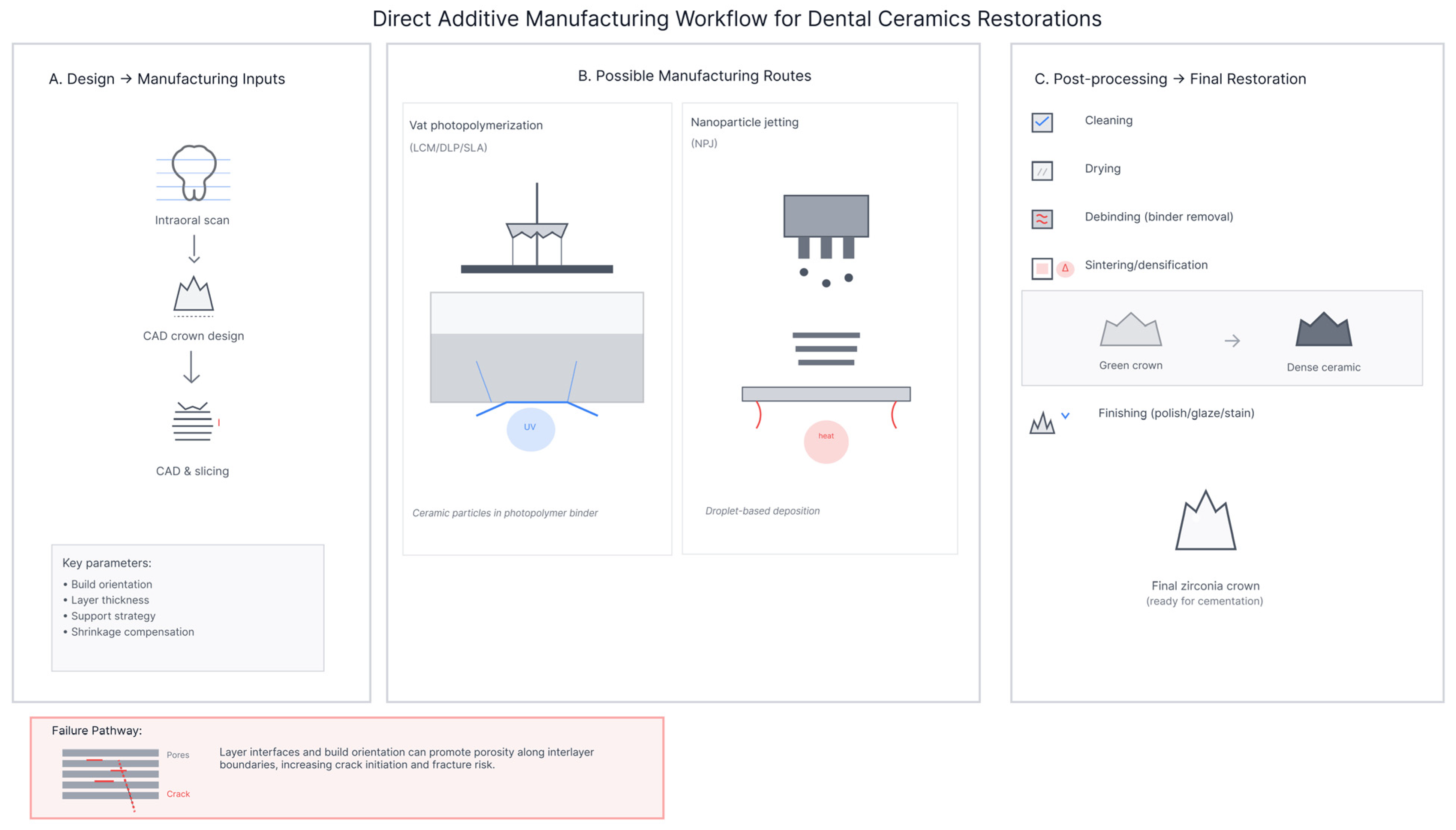
11]. It can be applied to metals, polymers, and ceramics, and is often associated with design flexibility, surface detail, mass customization, and reduced material waste compared with subtractive fabrication. In ceramic AM, the printed output is typically a ceramic-loaded green body that requires debinding and sintering, and in some glass-ceramic systems additional crystallization, before clinically relevant density and mechanical performance can be achieved [
2,
12] (
Figure 1). As a result, final restoration quality depends not only on printer resolution, but also on slurry characteristics, particle packing, shrinkage control, thermal processing, and defect formation [
13,
14]. These factors directly affect fit, reliability, and fracture behavior, all of which are critical for brittle restorative materials [
15].
Hence, direct AM of ceramic and glass-ceramic definitive restorations (rather than printed polymer patterns intended for subsequent pressing or casting) poses additional manufacturing constraints that directly affect fit, densification, defect formation, and brittle mechanical behavior [
10,
16]. For this reason, direct ceramic AM requires evaluation beyond isolated proof-of-concept demonstrations before routine clinical use can be considered [
8,
17].
The interest in directly additively manufactured ceramics is driven partly by the limitations of subtractive milling, including material waste, bur-access restrictions, and the geometric constraints imposed by prefabricated blanks [
18]. Subtractive processes are further constrained by the dimensions of prefabricated blanks, the introduction of microcracks from cutting tools, and the inability to fabricate controlled gradient porosities or geometries that are achievable through layer-by-layer deposition [
1,
19,
20]. Furthermore, AM may in principle enable graded internal architectures and localized optical or material variation; however, in definitive dental ceramics, these possibilities remain largely experimental and are not yet broadly established in routine clinical workflows [
6,
19].
Contemporary prosthodontics relies heavily on all-ceramic materials, such as zirconia, to satisfy the increasing esthetic demands and functional requirements for crowns, veneers, and partial-coverage restorations [
20,
21]. For implant-supported indications, restoration performance should also be interpreted within a broader biomechanical context, because masticatory load transfer at the implant–abutment complex remains relevant to long-term restorative behavior [
22]. However, the integration of AM for definitive ceramic restorations remains at an early stage. Much of the available literature still focuses on in vitro evaluation of fit, trueness, fracture-related outcomes, or material behavior, whereas clinically relevant translation depends on a broader understanding of evidence maturity across indications, manufacturing routes, and post-processing pathways [
10,
23].
The primary aim of this scoping review is to map the published evidence on directly additively manufactured ceramic and glass-ceramic restorations for crowns, veneers, and partial-coverage restorations. Specifically, the review sought to characterize the available evidence by indication, material class, and AM route and to organize that evidence using a predefined five-tier clinical readiness framework (R1–R5); and to identify translational gaps between preclinical evaluation and clinical use. In line with the scoping review approach, the purpose was to describe the extent of the evidence base rather than to make pooled comparative effectiveness claims.
2. Materials and Methods
2.1. Protocol and Reporting Framework
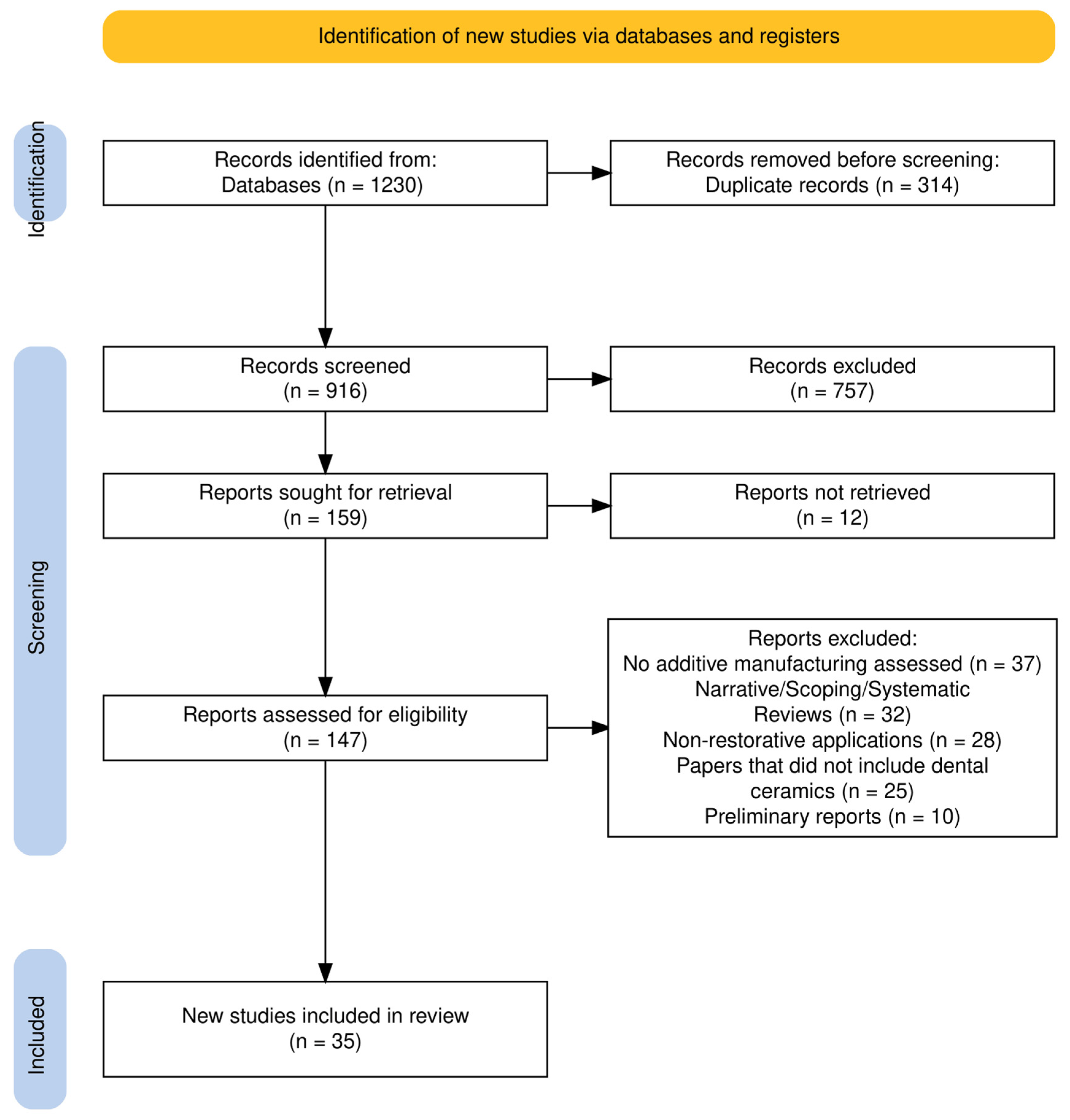
This review was conducted as a scoping review in accordance with Joanna Briggs Institute (JBI) guidance for scoping reviews and is reported following the PRISMA Extension for Scoping Reviews (PRISMA-ScR) checklist [
24,
25] (see
Supplementary File S1). A prespecified protocol guided eligibility criteria, searching, study selection, data charting, and evidence mapping. No formal critical appraisal or risk-of-bias assessment was undertaken, as the purpose of this review was to map the extent, characteristics, and clinical readiness of the available evidence rather than to estimate certainty of effect. The PICO question was the following: In patients receiving tooth- or implant-supported single-unit definitive restorations (crowns, veneers, and partial-coverage restorations), and in laboratory models simulating these restorations, does direct AM of ceramic/glass-ceramic definitive restorations, compared with conventional fabrication workflows (e.g., CAD/CAM milling or other conventional ceramic routes as defined by study authors), achieve comparable clinical performance/complications and restoration-relevant laboratory outcomes (including fit/trueness/adaptation, fracture/fatigue behavior, aging/wear performance, and related evaluation metrics)?
P (Population/Problem): Patients receiving tooth- or implant-supported single-unit definitive restorations (crowns, veneers, partial-coverage restorations), and laboratory models simulating these restorations (extracted teeth/typodonts/dies/models).
I (Intervention): Definitive restorations directly fabricated by ceramic AM (printed ceramic/glass-ceramic green body followed by debinding/sintering ± crystallization), including NPJ/material jetting and vat photopolymerization slurry printing (LCM/DLP/SLA) and other eligible ceramic AM routes.
C (Comparator): Conventional fabrication workflows for the same indications (e.g., CAD/CAM milling and/or other conventional ceramic manufacturing routes as defined by study authors), or no comparator where designs are single-arm.
O (Outcomes): Clinical performance and complications (when available), and restoration-relevant laboratory outcomes including fit/trueness/adaptation, mechanical performance (fracture/fatigue), aging/wear behavior, and other evaluation metrics reported for eligible indications.
2.2. Eligibility Criteria
This review includes clinical studies of human participants receiving tooth- or implant-supported, single-unit definitive ceramic restorations and laboratory studies using extracted teeth, typodonts, dies, or models. Eligible interventions were definitive restorations directly produced via ceramic AM within prosthodontic/restorative workflows or laboratory simulations of those workflows. Indications included crowns, veneers (including ultrathin/partial-prep), and partial-coverage restorations (inlays, onlays, overlays, occlusal veneers). Eligible materials comprised zirconia and dental glass-ceramics (including lithium disilicate and lithium-silicate-derived variants), and eligible AM routes included nanoparticle/material jetting and vat photopolymerization of ceramic slurries (e.g., LCM/DLP/SLA slurry printing), as well as other ceramic AM processes when the final restoration was ceramic. Included study designs spanned clinical interventional and observational studies (including case series/reports) and laboratory comparative, validation, fatigue/fracture/wear/aging, and fit/trueness studies; secondary reviews were used for background only. The review was limited to peer-reviewed English-language studies published up to 1 February 2026, and excluded indirect workflows (printed patterns for pressing/casting), non-ceramic “permanent crown” polymers/composites, non-restorative applications, and coupon/disk-only studies lacking explicit restoration relevance. The inclusion criteria are presented in
Table 1.
2.3. Search Strategy
The following databases were searched: MEDLINE (PubMed), Scopus, Web of Science Core Collection, Dentistry & Oral Sciences Source, and ClinicalTrials.gov. Backward and forward citation tracking of included studies and key reviews was performed to identify additional eligible records. A comprehensive search strategy combined terms for (1) AM/3D printing routes, (2) ceramic material classes, and (3) prosthodontic indications. Controlled vocabulary (e.g., MeSH) and free-text terms were used as appropriate and adapted for each database. Full search strategies for all databases are provided in
Table 2.
In addition, a supplementary search was conducted in Elicit Pro (Ought, Oakland, CA, USA) using the same core concept blocks (AM/3D printing routes, ceramic material classes, and prosthodontic indications); candidate records returned by the tool (including citation recommendations) were exported, de-duplicated against database records, and screened using the same eligibility criteria as all other records (
Table 3).
2.4. Study Selection
Records were imported into ENDNOTE X9 (Clarivate, Philadelphia, PA, USA) for de-duplication. Four independent reviewers screened titles/abstracts against the eligibility criteria. Full texts were retrieved for potentially eligible records and independently assessed by four reviewers. Disagreements were resolved by discussion; a fifth reviewer adjudicated when required.
2.5. Data Charting
A standardized data charting form was developed and piloted on an initial subset of included studies and refined iteratively. Data charting was performed by reviewers using Elicit Pro (Ought, Oakland, CA, USA) with any automatically pre-populated fields verified against the full text to ensure accuracy. Specifically, all AI-assisted outputs were independently checked by two human reviewers against the source PDFs and extraction sheets; no eligibility decision, study characteristic, numerical value, or citation was accepted without manual confirmation.
Core charting items included:
Bibliometrics (publication year; country/region; setting; funding and conflicts of interest as reported);
Indication (crown; veneer; partial-coverage subtype);
Material class and details (e.g., zirconia grade as reported; glass-ceramic type; translucency/shade system when provided);
AM route and key parameters (e.g., build orientation; layer thickness; support strategy; green body handling), as reported;
Post-processing (debinding/sintering/crystallization schedules; shrinkage compensation approach, when described);
Finishing/surface treatment (polishing/glazing; internal surface conditioning; cementation protocol, if applicable);
Comparator(s) (e.g., milled/pressed ceramics; alternative manufacturing routes);
Outcome domains (fit/adaptation; trueness/precision; mechanical outcomes including fracture/fatigue; aging protocols; wear/antagonist wear; and clinical outcomes);
Defect signatures/characterization (e.g., porosity/density via micro-CT; microcracks via SEM; phase composition via XRD; surface roughness/topography);
Failure modes and failure analysis (e.g., fracture/chipping location; debonding; marginal breakdown; fractography when reported);
Assigned clinical readiness level (R1–R5).
2.6. Clinical Readiness Framework (R1–R5)
Each included source was assigned a clinical readiness level based on the most clinically proximal evidence presented, using a five-tier framework ranging from foundational restoration-relevant material evidence (R1) to longer-term or pragmatic clinical evidence (R5):
R1: Foundational material evidence (coupons/disks) with explicit restoration-relevant linkage;
R2: Restoration in vitro (crowns/veneers/onlays tested on dies/teeth/models);
R3: Human feasibility (case report/series; short follow-up);
R4: Comparative clinical evidence (controlled studies or randomized trials);
R5: Longer-term, pragmatic or multi-center clinical evidence.
2.7. Synthesis and Presentation of Results
Results are presented using: (i) a PRISMA-ScR flow diagram and descriptive summary of included sources; (ii) an evidence map structured as material class × AM route × indication, annotated by readiness level and volume of evidence; (iii) a narrative synthesis by indication (crowns, veneers, partial-coverage) highlighting readiness drivers and limitations; (iv) a process–defect–failure table linking manufacturing and post-processing features to defect signatures and reported failure modes; and (v) a gap analysis leading to a prioritized research agenda (e.g., reporting standardization for post-processing, clinically meaningful aging/fatigue protocols, longer follow-up, and comparator selection). Quantitative synthesis (meta-analysis) was not planned due to expected heterogeneity. ChatGPT 5.2 (OpenAI) and Elicit (Ought) were used to draft standardized, non-decisional prose, to generate schematic or illustrative figures, and to structure extraction templates; they were not used to make eligibility determinations, populate data fields, derive numerical values, or finalize study characteristics without human verification. A predefined validation protocol governed every AI-assisted artifact and required line-by-line human editing by two reviewers, cross-checking of all statements, attributes, and numbers against the extraction sheets and the source PDFs, rejection of any suggested citation not retrievable from the registered search sources, and archiving of prompts and outputs with timestamps; final acceptance of AI-assisted text or graphics required explicit agreement by at least two human reviewers.
4. Discussion
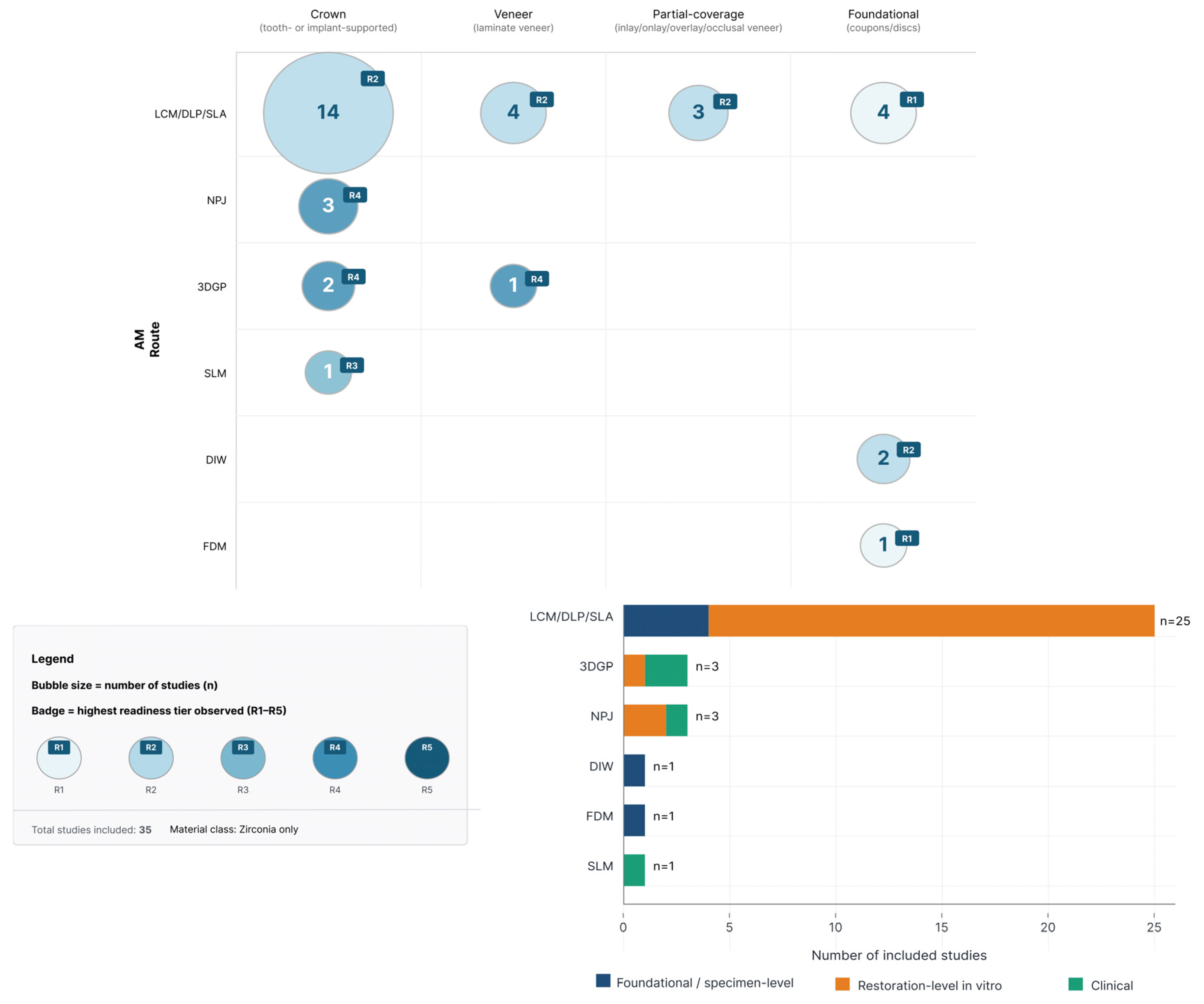
This scoping review mapped a zirconia-dominant and largely preclinical evidence base for directly additively manufactured dental ceramics used in single-unit restorations. Most included studies were laboratory investigations, and most evidence clustered in the R1 and R2 readiness tiers, indicating that the field has progressed beyond isolated material screening but remains concentrated at the level of restoration-relevant in vitro evaluation rather than mature clinical translation. Crowns were the most extensively studied indication, whereas veneers and especially partial-coverage restorations were supported by a smaller and less clinically advanced body of evidence. Although several studies benchmarked AM zirconia against CAD/CAM-milled comparators for fit, accuracy, and mechanical performance, no R5 evidence was identified, underscoring that the current literature supports technical feasibility more strongly than routine clinical adoption [
26,
36,
37].
By indication, crowns form the largest cluster and include the highest-readiness evidence [
29,
33]. Crown studies most often reported marginal/internal adaptation and manufacturing accuracy (trueness/precision), frequently alongside fracture resistance or fatigue outcomes and commonly benchmarked against CAD/CAM-milled zirconia [
30,
31,
45,
60]. Fit/adaptation was assessed with diverse methods (e.g., silicone replica, digital superimposition, micro-CT), limiting direct comparison of absolute values across studies and AM systems [
32,
35,
40]. Aging protocols varied from no aging to thermocycling and extended mechanical cycling, which further constrains synthesis of durability [
31,
47]. The highest readiness tier for crowns was R4, supported by a randomized trial of nanoparticle jetting zirconia crowns and a self-controlled clinical trial of gel-deposited zirconia crowns, with an additional short-term feasibility pilot using selective laser melting [
26,
27,
29]. Therefore, the current crown literature suggests increasing technical maturity, but not yet broad clinical equivalence across AM routes.
For veneers, the mapped evidence was smaller and was dominated by in vitro laminate/ultrathin veneer studies, with one retrospective comparative clinical study providing the highest-readiness evidence (R4) [
28,
52,
53,
55]. Veneer outcomes centered on marginal adaptation/fit, fatigue or fracture resistance under simulated aging, and surface- or aging-related vulnerability relevant to thin ceramic sections [
52,
53,
55,
61]. The clinical veneer evidence compared gel-deposited self-glazed zirconia veneers with lithium disilicate veneers over multi-year follow-up, offering the most clinically proximal information in this indication [
28].
For partial-coverage restorations, evidence was concentrated in occlusal tabletop and partial-crown scenarios evaluated in vitro (R2) [
34,
37,
38,
44]. These studies emphasized marginal/internal adaptation and load-bearing behavior under static or fatigue loading, often contextualized against milled zirconia and/or heat-pressed lithium disilicate [
34,
37,
38]. No clinical feasibility or comparative trials were identified for additively manufactured zirconia partial-coverage restorations in the mapped evidence, leaving a translational gap for minimally invasive indications.
From a clinical perspective, the mapped evidence suggests that directly additively manufactured zirconia restorations should still be interpreted relative to the established CAD/CAM benchmark rather than as a fully equivalent replacement workflow. Existing studies indicate that AM zirconia crowns can achieve restoration-level outcomes that are increasingly relevant to practice, particularly for fit/adaptation, manufacturing accuracy, and fracture-related testing. However, the evidence remains heterogeneous with respect to printers, materials, build orientation, post-processing, finishing, and aging design. For clinicians and laboratories, this means that geometry alone is not an adequate basis for judging clinical readiness; reproducibility, reliability, and reporting transparency remain central to translation.
Route-specific patterns help explain where the evidence accumulates and where it dwindles. Nanoparticle jetting (NPJ) contributed both clinical crown data and restoration-level in vitro work focusing on accuracy and margin quality [
26,
33,
35]. Vat photopolymerization of zirconia slurries (LCM/DLP/SLA) accounted for the largest share of restoration-level studies across indications, with repeated attention to fit, trueness, and fracture behavior relative to milling [
36,
45,
57,
60]. In this route, several studies directly tested build direction and/or system effects on adaptation and accuracy, highlighting orientation as a recurrent determinant [
43,
57]. Furthermore, slurry-based ceramic printing introduces a densification step with substantial shrinkage, and defect control during debinding/sintering has been highlighted as a central constraint on dimensional fidelity and strength in zirconia AM [
13,
14]. Consistent with this, formulation and solids-loading effects have been shown to influence microstructure and physical properties after additive processing and sintering [
14,
62]. Gel/deposition-based approaches provide the available R4 evidence for both crowns and veneers and therefore represent an important clinical translation pathway in the current map [
27,
28,
50]. Other AM approaches (e.g., direct ink writing/robocasting and filament-based methods) were mainly represented at foundational tiers, contributing coupon/disk mechanical and microstructural characterization rather than restoration-level validation [
41,
42,
56].
The evidence map also highlights other underreported factors beyond laboratory performance. Few included studies described workflow efficiency, operator burden, cost implications, or standardization across printing and post-processing stages in sufficient detail to inform real-world implementation. In addition, the rapid evolution of commercial hardware, ceramic formulations, and software ecosystems means that published evidence may lag behind current technical capabilities. This reinforces the need for clearer reporting standards and clinically oriented comparative studies that evaluate not only restoration outcomes, but also the practical conditions under which AM ceramic workflows can be integrated into routine prosthodontic care.
The failure pathway synthesis suggests that reported failures in restoration-level studies most often manifest as fracture under static or cyclic loading, while the underlying defect signatures are not consistently characterized [
19,
23,
30]. Where microstructural and phase analyses were performed, studies reported features consistent with brittle-flaw control, including porosity/density variation, microstructural heterogeneity, and surface topography related to printing and finishing [
12,
28,
40,
41,
50,
53]. Porosity and volumetric change have been examined in printed zirconia, supporting porosity as a possible mediator of both dimensional outcomes and mechanical variability [
40]. Orientation-dependent surface roughness and strength differences also support a pathway in which surface flaw populations and anisotropy influence load-bearing behavior, particularly for thin restorations [
1,
18]. Mean strength by itself may not reflect the likelihood of clinical failure, because two materials with similar averages can differ greatly in variability and reliability; accordingly, Weibull analyses are often used to compare how AM affects both characteristic strength and the spread of strength values [
63,
64].
When situated within prior literature, the mapped evidence aligns with zirconia-focused syntheses that emphasize fit/trueness, flexural strength, and the influence of orientation, layer thickness, and post-processing variables [
1,
13,
16,
17,
23]. The additional contribution of the present scoping approach is the explicit linkage of evidence volume to indication and readiness tier, which clarifies that clinical evidence is limited relative to laboratory validation. Within the mapped primary studies, lithium disilicate and other glass-ceramics appeared chiefly as conventionally manufactured comparators rather than as directly printed definitive restorations, consistent with the zirconia-centric focus of contemporary AM dental ceramics reviews [
34,
37,
43].
From a clinical-readiness perspective, the concentration of evidence in R1 and R2 indicates that many AM ceramic workflows have advanced through foundational and restoration-level laboratory validation, but have not yet been tested extensively in clinical settings [
32,
33,
65]. The available R3 and R4 studies provide encouraging feasibility and comparative signals, but follow-up remains short- to medium-term and is insufficient to characterize longer-term complications, consistency across operators, and performance across routine care settings [
26,
27,
28,
29]. Progress toward higher readiness will likely depend on better harmonization of metrology endpoints, aging and fatigue protocols, and more complete reporting of processing variables such as orientation, layer thickness, debinding and sintering schedules, shrinkage compensation, and finishing [
1,
13,
14].
Several limitations should be considered when interpreting this evidence map. First, as a scoping review, this study was designed to map the extent, nature, and maturity of the available evidence rather than to generate pooled effect estimates or definitive equivalence claims across AM routes. Second, heterogeneity in fit and trueness metrics, mechanical testing configurations, aging protocols, and reporting practices limited cross-study comparability. Third, no formal critical appraisal was undertaken, so the mapped patterns should be interpreted primarily as indicators of evidence maturity rather than certainty of effect. Finally, despite comprehensive searching, relevant studies may still have been missed because of database coverage limits, English-language restriction, indexing delays, evolving terminology, and the practical limits of supplementary AI-assisted retrieval. Rapid iteration in printers, ceramic formulations, and software may also mean that the published evidence lags behind current commercial capabilities.
A focused research agenda for improving clarity and accelerating translation includes consistent reporting of AM route and printer/system parameters (orientation, layer thickness, support strategy); feedstock/slurry characteristics (solids loading and binder system where available); debinding and sintering schedules and shrinkage compensation; surface finishing and internal conditioning; cementation protocols for bonded restorations; defect characterization (e.g., micro-CT porosity, SEM microcracks, XRD phase); and parameterized aging regimens with clinically meaningful endpoints in clinical studies [
13,
53,
59]. Furthermore, the reporting of reliability metrics alongside mean outcomes (e.g., Weibull modulus with flexural strength) may better reflect readiness for thin restorations and minimally invasive indications [
63,
66].
Directly additively manufactured zirconia restorations now have expanding restoration-level in vitro evidence base across NPJ, vat photopolymerization slurry printing, and gel/deposition routes, but clinical evidence remains limited and short-term. Crowns currently represent the most advanced indication in readiness terms, whereas veneers and partial-coverage restorations remain supported by a smaller and less clinically mature body of evidence. Taken together, the mapped literature suggests progressive technical development, but not yet broad clinical maturity.



 ,
,