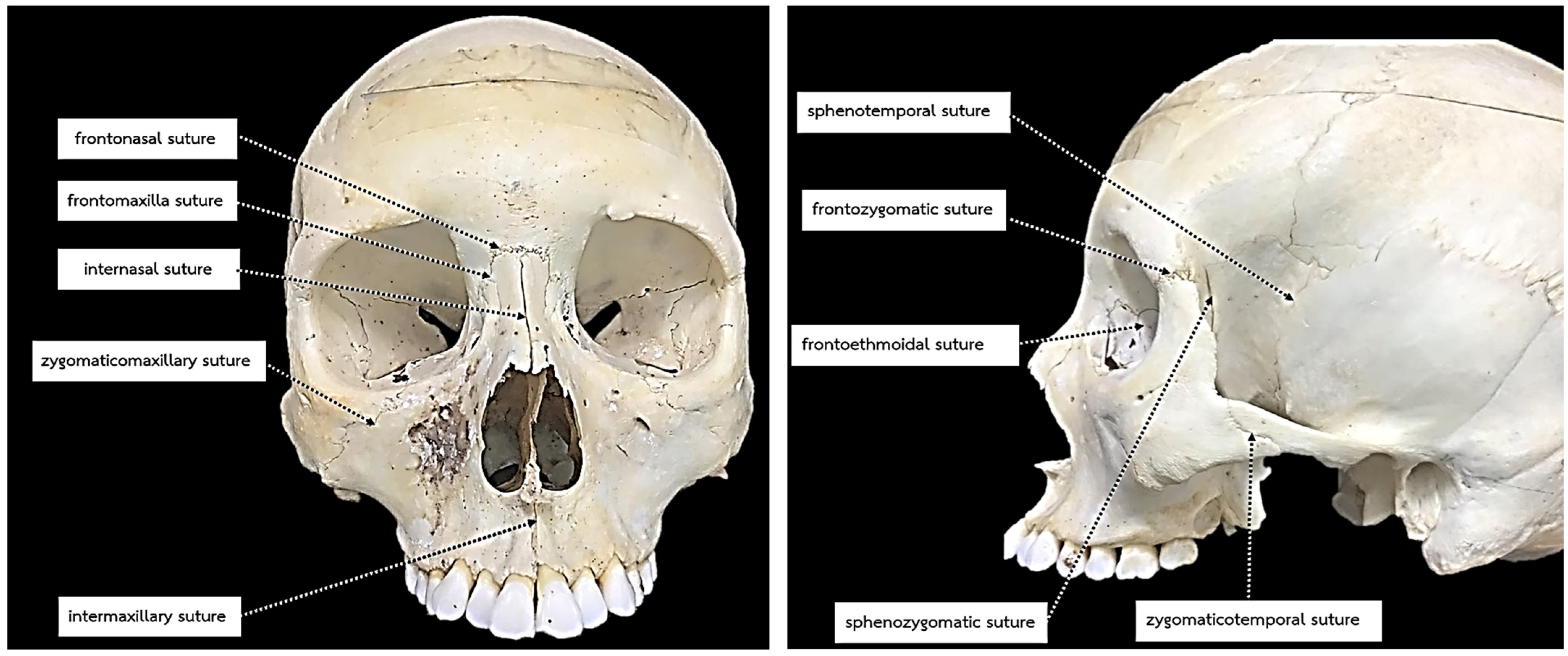
Novel Quantitative Approach for Age Estimation Using Facial Suture Closure and Modified Scoring Systems


Abstract
1. Introduction
2. Materials and Methods
2.1. Sample Collection and Preparation
2.2. Morphological Classification
- (1)
- Acsádi and Nemeskéri Scoring System.
- (2)
- Meindl and Lovejoy Scoring System.
- (3)
- Frédéric Rating Scale.
2.3. Statistics Analysis
- n = Sample size.
- z = The number of standard deviations that a certain value for the selected alpha level at 0.05.
- p = The estimate possibility of corrected percentage of age estimation (received from pilot study; p = 0.8531).
- d = Acceptance margin of error of proportion (5%).
3. Results
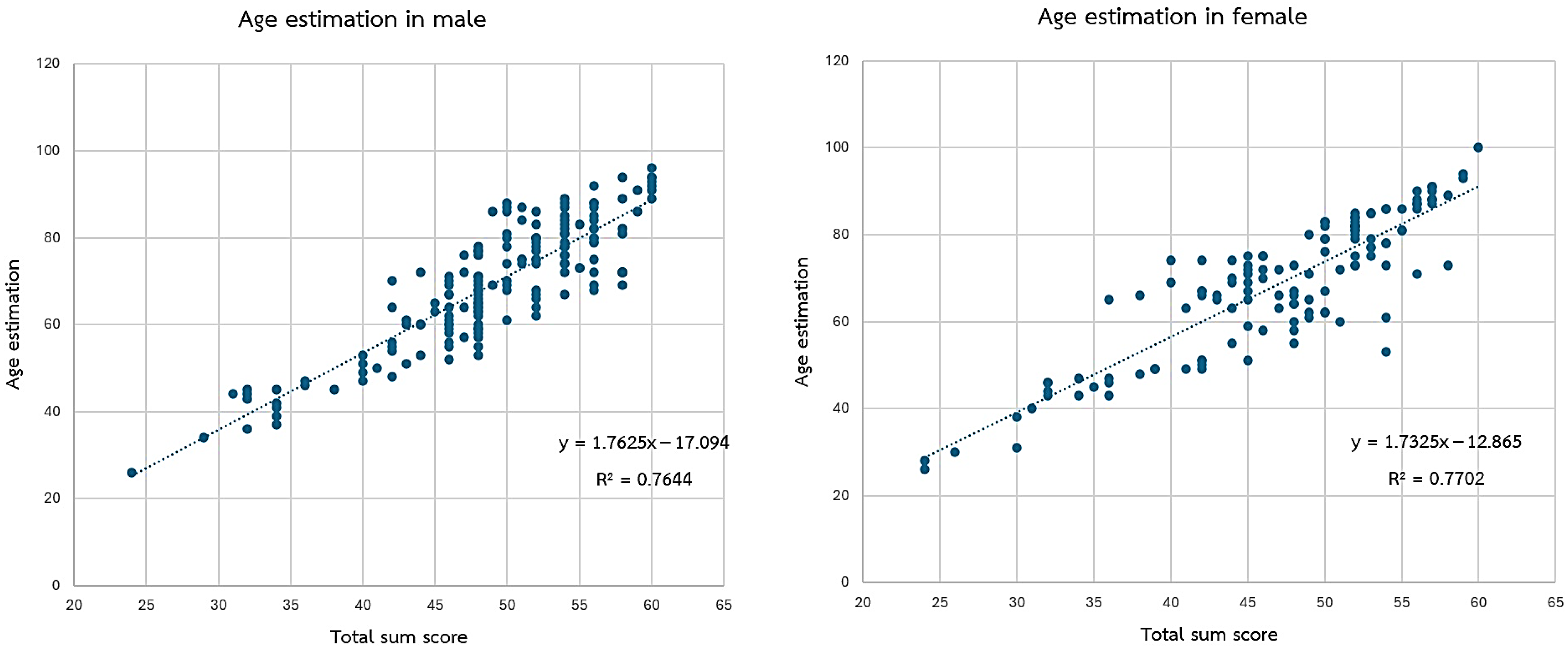
Age-at-death in females = 1.7325(TSS) − 12.865; R2 = 0.7702, RMSE 7.5010.
4. Discussion
5. Conclusions
Author Contributions
Funding
Institutional Review Board Statement
Informed Consent Statement
Data Availability Statement
Acknowledgments
Conflicts of Interest
Abbreviations
| TSS | Total sum score |
| CT | Computed tomography |
References
- Ruengdit, S.; Case, D.T.; Mahakkanukrauh, P. Cranial suture closure as an age indicator: A review. Forensic Sci. Int. 2020, 307, 110111. [Google Scholar] [CrossRef]
- Spradley, M.K. Metric methods for the biological profile in forensic anthropology: Sex, ancestry, and stature. Acad. Forensic Pathol. 2016, 6, 391–399. [Google Scholar] [CrossRef]
- Kampan, N.; Sinthubua, A.; Mahakkanukrauh, P. A new method for age estimation from ectocranial suture closure in a Thai population. Siriraj Med. J. 2014, 66, 61–65. [Google Scholar]
- Wang, M.M.; Haveles, C.S.; Zukotynski, B.K.; Reid, R.R.; Lee, J.C. The 27 facial sutures: Timing and clinical consequences of closure. Plast. Reconstr. Surg. 2022, 149, 701–720. [Google Scholar] [CrossRef]
- Nikolova, S.; Toneva, D.; Georgiev, I.; Lazarov, N. Sagittal suture maturation: Morphological reorganization, relation to aging, and reliability as an age-at-death indicator. Am. J. Phys. Anthropol. 2019, 169, 78–92. [Google Scholar] [CrossRef] [PubMed]
- Harth, S.; Obert, M.; Ramsthaler, F.; Reuss, C.; Traupe, H.; Verhoff, M.A. Estimating age by assessing the ossification degree of cranial sutures with the aid of flat-panel CT. Leg. Med. 2009, 11, S186–S189. [Google Scholar] [CrossRef] [PubMed]
- Barszcz, M.; Woźniak, K. Complete sagittal suture closure evaluation based on post mortem computed tomography. Leg. Med. 2021, 52, 101907. [Google Scholar] [CrossRef] [PubMed]
- Ruengdit, S.; Prasitwattanaseree, S.; Mekjaidee, K.; Sinthubua, A.; Mahakkanukrauh, P. Age estimation approaches using cranial suture closure: A validation study on a Thai population. J. Forensic Leg. Med. 2018, 53, 79–86. [Google Scholar] [CrossRef]
- Fan, F.; Tu, M.; Li, R.; Dai, X.; Zhang, K.; Chen, H.; Huang, F.; Deng, Z. Age estimation by multidetector computed tomography of cranial sutures in Chinese male adults. Am. J. Phys. Anthropol. 2020, 171, 550–558. [Google Scholar] [CrossRef]
- Dorandeu, A.; Coulibaly, B.; Piercecchi-Marti, M.D.; Bartoli, C.; Gaudart, J.; Baccino, E.; Leonetti, G. Age-at-death estimation based on the study of frontosphenoidal sutures. Forensic Sci. Int. 2008, 177, 47–51. [Google Scholar] [CrossRef]
- White, H.E.; Goswami, A.; Tucker, A.S. The intertwined evolution and development of sutures and cranial morphology. Front. Cell Dev. Biol. 2021, 9, 653579. [Google Scholar] [CrossRef]
- Todd, T.W.; Lyon, D.W. Endocranial suture closure, its progress and age relationship. Part I: Adult males of white stock. Am. J. Phys. Anthropol. 1924, 7, 325–384. [Google Scholar] [CrossRef]
- Parsons, F.G.; Box, C.R. The relation of the cranial sutures to age. J. Anthropol. Inst. Great Br. Irel. 1905, 35, 30–38. [Google Scholar] [CrossRef][Green Version]
- Verhulst, J.; Onghena, P. Cranial suture closing in Homo sapiens: Evidence for circaseptennian periodicity. Ann. Hum. Biol. 1997, 24, 141–156. [Google Scholar] [CrossRef]
- Acsádi, G.; Nemeskéri, J. History of human life span and mortality. Am. J. Phys. Anthropol. 1970, 36, 300–302. [Google Scholar]
- Chawla, H.; Shankar, S.; Tyagi, A.; Panchal, J. Cranial vault suture obliteration in relation to age: An autopsy-based observational study. Cureus 2023, 15, e39759. [Google Scholar] [CrossRef]
- Nemeskéri, J.; Harsányi, L.; Acsádi, G. Methoden zur Diagnose des Lebensalters von Skelettfunden. Anthropol. Anz. 1960, 24, 70–95. [Google Scholar]
- Meindl, R.S.; Lovejoy, C.O. Ectocranial suture closure: A revised method for the determination of skeletal age at death based on the lateral-anterior sutures. Am. J. Phys. Anthropol. 1985, 68, 57–66. [Google Scholar] [CrossRef] [PubMed]
- Chandra, S.; Dwivedy, S.; Sah, K.; Sinha, S. Application of modified reverse panoramic radiograph on lambdoid suture for age estimation. Quant. Imaging Med. Surg. 2015, 5, 519–523. [Google Scholar] [PubMed]
- Alhadi, A.; Issrani, R.; Prabhu, N.; Alhadi, M. Observation on the closure of lambdoid suture in relation to age, sex and population variations using a novel radiographic technique. Acta Odontol. Scand. 2019, 77, 61–65. [Google Scholar] [CrossRef]
- Opperman, L.A.; Sweeney, T.M.; Redmon, J.; Persing, J.A.; Ogle, R.C. Tissue interactions with underlying dura mater inhibit osseous obliteration of developing cranial sutures. Dev. Dyn. 1993, 198, 312–322. [Google Scholar] [CrossRef]
- Li, B.; Wang, Y.; Fan, Y.; Ouchi, T.; Zhao, Z.; Li, L. Cranial suture mesenchymal stem cells: Insights and advances. Biomolecules 2021, 11, 1129. [Google Scholar] [CrossRef]
- Rice, D.P. Developmental anatomy of craniofacial sutures. Front. Oral Biol. 2008, 12, 1–21. [Google Scholar]
- Katsianou, M.A.; Adamopoulos, C.; Vastardis, H.; Basdra, E.K. Signaling mechanisms implicated in cranial sutures pathophysiology: Craniosynostosis. BBA Clin. 2016, 6, 165–176. [Google Scholar] [CrossRef]
- Opperman, L.A. Cranial sutures as intramembranous bone growth sites. Dev. Dyn. 2000, 219, 472–485. [Google Scholar] [CrossRef]
- Shibazaki-Yorozuya, R.; Wang, Q.; Dechow, P.C.; Maki, K.; Opperman, L.A. Changes in biomechanical strain and morphology of rat calvarial sutures after TGF-β3 inhibition. Anat. Rec. 2012, 295, 928–938. [Google Scholar] [CrossRef][Green Version]
- Khonsari, R.H.; Olivier, J.; Vigneaux, P.; Sanchez, S.; Tafforeau, P.; Ahlberg, P.E.; Di Rocco, F.; Bresch, D.; Corre, P.; Ohazama, A.; et al. A mathematical model for mechanotransduction at the early steps of suture formation. Proc. Biol. Sci. 2013, 280, 20122670. [Google Scholar] [CrossRef]
- Tiberio, F.; Parolini, O.; Lattanzi, W. Ciliary signalling and mechanotransduction in the pathophysiology of craniosynostosis. Genes 2021, 12, 1073. [Google Scholar] [CrossRef] [PubMed]
- Wagemans, P.A.; van de Velde, J.P.; Kuijpers-Jagtman, A.M. Sutures and forces: A review. Am. J. Orthod. Dentofac. Orthop. 1988, 94, 129–141. [Google Scholar] [CrossRef] [PubMed]
- Bell, R.A. A review of maxillary expansion in relation to rate of expansion and patient’s age. Am. J. Orthod. 1982, 81, 32–37. [Google Scholar] [CrossRef]
- Mann, R.W.; Jantz, R.L.; Bass, W.M.; Willey, P.S. Maxillary suture obliteration: A visual method for estimating skeletal age. J. Forensic Sci. 1991, 36, 781–791. [Google Scholar] [CrossRef] [PubMed]
- Sivakumaran, R. Critical Analysis of the Factors Affecting the “Cranial Suture Aging Method” Using the Hamann-Todd Collection. Master’s Thesis, University of Alberta, Edmonton, AB, Canada, 2014. [Google Scholar]
- Sittiporn, R.; Nuttaya, P.; Sukon, P.; Pasuk, M. Age estimation from computed tomography of cranial suture closure in a Thai population. Med. Health 2020, 15, 276–289. [Google Scholar]
- Alesbury, H.S.; Ubelaker, D.H.; Bernstein, R. Utility of the frontonasal suture for estimating age at death in human skeletal remains. J. Forensic Sci. 2013, 58, 104–108. [Google Scholar] [CrossRef]
- Pattamapaspong, N.; Chumsaengsri, S.; Ruengdit, S.; Madla, C.; Mekjaidee, K.; Prasitwattanaseree, S.; Mahakkanukrauh, P. Preliminary evaluation of three-dimensional cinematic rendering CT images of frontonasal sutures in personal identification. Forensic Imaging 2021, 26, 200472. [Google Scholar] [CrossRef]
- Sakaue, K. A Bayesian approach to age estimation from cranial suture closure in Japanese people. Bull. Natl. Mus. Nat. Sci. 2015, 41, 1–11. [Google Scholar]
- Todd, T.W.; Lyon, D.W. Endocranial suture closure, its progress and age relationship. Part II: Ectocranial closure in adult males of white stock. Am. J. Phys. Anthropol. 1924, 8, 23–45. [Google Scholar] [CrossRef]
- Beauthier, J.P.; Lefèvre, P.; Beauthier, F. Estimating adult age: Cranial suture closure. Anthropol. Præhistorica 2018, 129, 127–139. [Google Scholar]
- Angelieri, F.; Franchi, L.; Cevidanes, L.H.S.; Hino, C.T.; Nguyen, T.; McNamara, J.A., Jr. Zygomaticomaxillary suture maturation: A predictor of maxillary protraction? Part I-A classification method. Orthod. Craniofac. Res. 2017, 20, 85–94. [Google Scholar] [CrossRef]
- Latham, R.A.; Burston, W.R. The postnatal pattern of growth at the sutures of the human skull. Dent. Pract. Dent. Rec. 1966, 17, 61–67. [Google Scholar]
- Kokich, V.G. Age changes in the human frontozygomatic suture from 20 to 95 years. Am. J. Orthod. 1976, 69, 411–430. [Google Scholar] [CrossRef] [PubMed]
- Sarnat, B. Postnatal growth of the upper face: Some experimental considerations. Angle Orthod. 1963, 33, 139–161. [Google Scholar]
- Damascena, N.P.; Machado, C.E.P.; Silva, M.C.; Santiago, B.M.; Martins-Filho, P.R. Is facial geometric morphometrics a useful method for age estimation in children and adolescents? Limited evidence and lack of studies leave us with an uncertain answer. Morphologie 2023, 107, 100599. [Google Scholar] [CrossRef] [PubMed]
- Akbar, N.J.M.; Shekhawat, R.S.; Kanchan, T.; Yadav, T.; Meshram, V.P.; Shedge, R.; Vempalli, S.R.; Setia, P. Computed tomographic evaluation of cranial suture obliteration for age estimation in an Indian population. Cureus 2023, 15, e36160. [Google Scholar] [CrossRef] [PubMed]



| Score | Description |
|---|---|
| 0 | Open suture. Distinct separation between adjoining bone edges. |
| 1 | Incipient suture. Continuous, visible zigzag line; no physical gap remains. |
| 2 | Progressing suture. Thinning line with reduced serration and partial interruptions. |
| 3 | Advanced closure. Near-total fusion; location marked only by surface pits. |
| 4 | Closed or obliterated suture. No visible trace of the suture remains. |
| Score | Description |
|---|---|
| 0 | Open: The suture remains entirely open, with no morphological evidence of fusion at the specified site. |
| 1 | Minimal closure: Initiation of the closure process is evident, ranging from slight to moderate degrees of osseous bridging along the suture line. |
| 2 | Significant closure: The site exhibits a marked degree of closure; however, the fusion remains incomplete, with visible remnants of the suture line still present. |
| 3 | The suture has undergone total fusion, resulting in the complete disappearance of the joint line and total osseous continuity. |
| Score | Amount of Suture Closure |
|---|---|
| 0 | The suture remains entirely open. |
| 1 | Partial Fusion < 50%; initiation of the closure process is evident, but less than half of the total suture length. |
| 2 | Advanced Fusion > 50%; a significant portion of the suture is closed, with more than 50% of the length demonstrating osseous bridging. |
| 3 | Total fusion has occurred, resulting in the complete disappearance of the suture line and total osseous continuity across the site. |
| Facial Suture with Different Classification | Male | Female | |||
|---|---|---|---|---|---|
| Sensitivity Using the Highest Level Only | Sensitivity Using the Highest Level and Subordinate Level | Sensitivity Using the Highest Level Only | Sensitivity Using the Highest Level and Subordinate Level | ||
| Intermaxillary suture (Proper age range: 18–20 years) | >Acsádi and Nemeskéri Scoring | >74.1% | >98.8% | >45.5% | >91.1% |
| >Meindl and Lovejoy Scoring | >80.3% | >99.4% | >53.7% | >92.7% | |
| Frédéric Rating Scale | 62.4% | 96.3% | 34.2% | 85.4% | |
| Internasal suture (Proper age range: 20–30 years) | >Acsádi and Nemeskéri Scoring | >73.5% | >96.3% | >57.7% | >90.2% |
| >Meindl and Lovejoy Scoring | >80.3% | >99.4% | >66.7% | >93.5% | |
| Frédéric Rating Scale | 61.7% | 95.1% | 44.7% | 91.9% | |
| Frontonasal suture (Proper age range: 50–60 years) | >Acsádi and Nemeskéri Scoring | >55.2% | >97.9% | >37.3% | >94.1% |
| >Meindl and Lovejoy Scoring | >60.1% | >98.6% | >44.1% | >96.1% | |
| Frédéric Rating Scale | 39.9% | 94.4% | 26.5% | 89.2% | |
| Sphenozygomatic suture (Proper age range: 50–60 years) | >Acsádi and Nemeskéri Scoring | >81.8% | >98.6% | >60.8% | >94.1% |
| >Meindl and Lovejoy Scoring | >83.2% | >98.6% | >64.7% | >96.1% | |
| Frédéric Rating Scale | 65.7% | 97.9% | 50.0% | 91.2% | |
| Frontoethmoidal sutures (Proper age range: 50–60 years) | >Acsádi and Nemeskéri Scoring | >85.3% | >98.6% | >59.8% | >92.2% |
| >Meindl and Lovejoy Scoring | >85.3% | >98.6% | >63.7% | >94.1% | |
| Frédéric Rating Scale | 66.4% | 97.9% | 47.1% | 87.3% | |
| Sphenotemporal suture (Proper age range: 50–60 years) | >Acsádi and Nemeskéri Scoring | >53.9% | >89.5% | >22.6% | >70.6% |
| >Meindl and Lovejoy Scoring | >57.3% | >90.9% | >22.6% | >75.5% | |
| Frédéric Rating Scale | 42.7% | 78.3% | 13.7% | 59.8% | |
| Frontomaxillary suture (Proper age range: 70–100 years) | >Acsádi and Nemeskéri Scoring | >62.2% | >97.6% | >45.3% | >81.3% |
| >Meindl and Lovejoy Scoring | >64.6% | >98.8% | >50.0% | >84.4% | |
| Frédéric Rating Scale | 37.8% | 90.2% | 26.6% | 75.0% | |
| Zygomaticomaxillary suture (Proper age range: more than 70 years) | >Acsádi and Nemeskéri Scoring | >74.4% | >97.6% | >50.0% | >92.2% |
| >Meindl and Lovejoy Scoring | >76.8% | >100% | >54.7% | >93.8% | |
| Frédéric Rating Scale | 64.6% | 95.1% | 29.7% | 82.8% | |
| Zygomaticotemporal suture (Proper age range: more than 70 years) | >Acsádi and Nemeskéri Scoring | >81.7% | >98.8% | >60.9% | >89.1% |
| >Meindl and Lovejoy Scoring | >81.7% | >98.8% | >64.1% | >93.8% | |
| Frédéric Rating Scale | 74.4% | 96.3% | 43.8% | 81.3% | |
| Frontozygomatic suture (Proper age range: 80–100 years) | >Acsádi and Nemeskéri Scoring | >36.8% | >94.7% | >36.4% | >81.8% |
| >Meindl and Lovejoy Scoring | >55.3% | >94.7% | >42.4% | >84.9% | |
| Frédéric Rating Scale | 18.4% | 79.0% | 18.2% | 63.6% | |
Disclaimer/Publisher’s Note: The statements, opinions and data contained in all publications are solely those of the individual author(s) and contributor(s) and not of MDPI and/or the editor(s). MDPI and/or the editor(s) disclaim responsibility for any injury to people or property resulting from any ideas, methods, instructions or products referred to in the content. |
© 2026 by the authors. Licensee MDPI, Basel, Switzerland. This article is an open access article distributed under the terms and conditions of the Creative Commons Attribution (CC BY) license.
Share and Cite
Thunyacharoen, S.; Inchai, C.; Mahakkanukrauh, P. Novel Quantitative Approach for Age Estimation Using Facial Suture Closure and Modified Scoring Systems. Appl. Sci. 2026, 16, 3591. https://doi.org/10.3390/app16073591
Thunyacharoen S, Inchai C, Mahakkanukrauh P. Novel Quantitative Approach for Age Estimation Using Facial Suture Closure and Modified Scoring Systems. Applied Sciences. 2026; 16(7):3591. https://doi.org/10.3390/app16073591
Chicago/Turabian StyleThunyacharoen, Siriwat, Chirapat Inchai, and Pasuk Mahakkanukrauh. 2026. "Novel Quantitative Approach for Age Estimation Using Facial Suture Closure and Modified Scoring Systems" Applied Sciences 16, no. 7: 3591. https://doi.org/10.3390/app16073591
APA StyleThunyacharoen, S., Inchai, C., & Mahakkanukrauh, P. (2026). Novel Quantitative Approach for Age Estimation Using Facial Suture Closure and Modified Scoring Systems. Applied Sciences, 16(7), 3591. https://doi.org/10.3390/app16073591