


Abstract
This research reveals the coupling mechanism between structural deformation and hydrocarbon accumulation. The Dibei area in the Kuqa Depression represents a key hydrocarbon exploration domain within the northern Tarim foreland basin. Although extensive studies on stratigraphy, sedimentology, and accumulation mechanisms have been conducted, the control of segmented deformation on traps remains poorly understood. Furthermore, the synergistic regulation mechanism involving paleo-uplifts, salt thickness, synsedimentation, and erosion is still ambiguous. Based on high-quality 2D and 3D seismic data, this study integrates tectonic evolution balanced restoration with physical modeling. We conducted two sets of 3D sandbox experiments: “differential paleo-uplift and salt thickness” and “synsedimentation-erosion.” This approach systematically investigates the control of tectonic evolution on trap formation. Results show a strong correspondence between the “subsalt–salt–supra-salt” structural deformation and trap types. The supra-salt layer is dominated by detachment fold traps, whereas the subsalt layer features thrust-fold anticline traps. The basement paleo-uplift governs structural segmentation and trap distribution. Salt thickness modulates strain partitioning and trap stability. Synsedimentation optimizes trap conditions via tectono-sedimentary coupling. Erosional unconformities serve dual functions as both migration pathways and seal beds. These four factors work synergistically throughout the entire petroleum system, from “trap formation–migration–accumulation–preservation.” It enriches the genetic theory of salt-related structures in foreland basins. The findings provide a reference for predicting favorable exploration zones, evaluating trap characteristics, and assessing resource potential in the Kuqa Depression.
1. Introduction
Detachment folds represent a fundamental structural style in compressional foreland basins and are recognized globally as primary targets for hydrocarbon exploration [1]. These structures not only create high-quality trap spaces through tectonic uplift but also regulate fluid migration via fracture networks developed in fold cores and limbs [2,3,4]. While the geometric classification of detachment folds is well-established, recent debates focus on kinematic evolution under specific boundary conditions, such as mechanical stratigraphy and basement involvement [5,6]. Unlike the classic, symmetric detachment folds observed in the Zagros or Jura Mountains, folds in deep, high-stress environments often exhibit complex asymmetry and fault-propagation characteristics, necessitating a more nuanced understanding of their formation mechanisms [7,8,9,10].
In central and western China, intense Cenozoic compression has generated complex structural frameworks. The Kuqa Depression in the Tarim Basin serves as a prime example of a salt-influenced foreland system, where world-class gas fields (e.g., Dina 2 and Kela 2) highlight the economic significance of subsalt detachment structures [5,11,12,13]. Previous studies have extensively documented the general structural styles of the Kuqa Depression, particularly the role of Paleogene evaporites in decoupling deformation [14,15]. However, a critical gap remains in understanding why structural styles vary significantly along strike—specifically, why the eastern Dina area is dominated by large-scale fault-bend folds while other segments exhibit imbricate thrusts or pop-up structures [2,16].
This gap in understanding limits predictive capabilities for exploration. Although Yang et al. [3] and Jin et al. [13] identified the Dina area as a structurally distinct zone, the quantitative controls of differential basement uplift and variable salt thickness on the nucleation and amplification of these specific fault-bend folds remain poorly constrained. Furthermore, while comparative analysis with other salt basins suggests lateral variations in décollement rheology are critical [17,18], this factor has not been rigorously tested in the context of the Dina area’s specific tectonic setting.
To address these limitations, this study focuses on the tectonic deformation, trap differences, and evolutionary processes in the Dina area. Employing an integrated research approach of “geological analysis–experimental simulation–mechanistic investigation,” this paper focuses on “differential paleo-uplifts–differential salt thickness” and “syn-sedimentary–denudation effects.” It thoroughly investigates the control of these factors on structural deformation and trap differentiation, as well as their correlation with hydrocarbon accumulation elements. The research outcomes not only enrich the hydrocarbon accumulation theory in salt-related structural zones of foreland basins and advance the research methodologies for multi-factor cooperative evolution of fault-bend folds and trap differentiation but also provide a theoretical basis for exploration guidance and resource assessment in the Dina area.
2. Geological Background of the Dina Area, Kuqa Depression
2.1. Regional Geotectonic Background
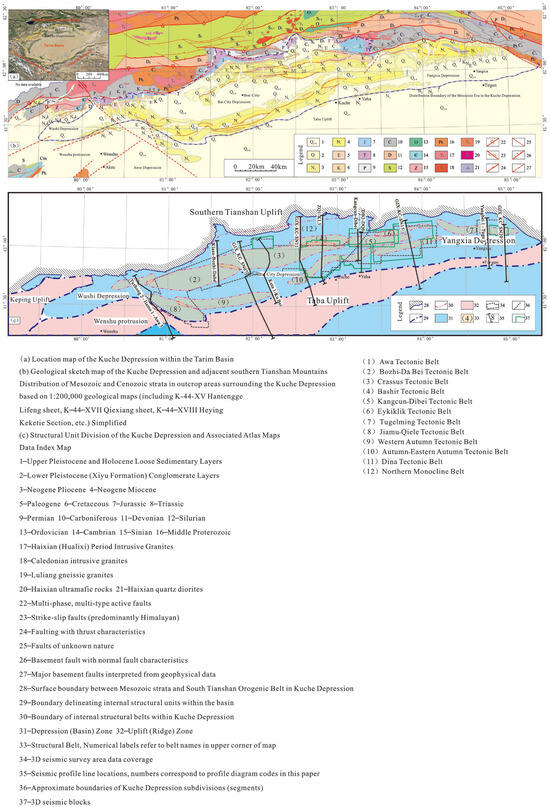
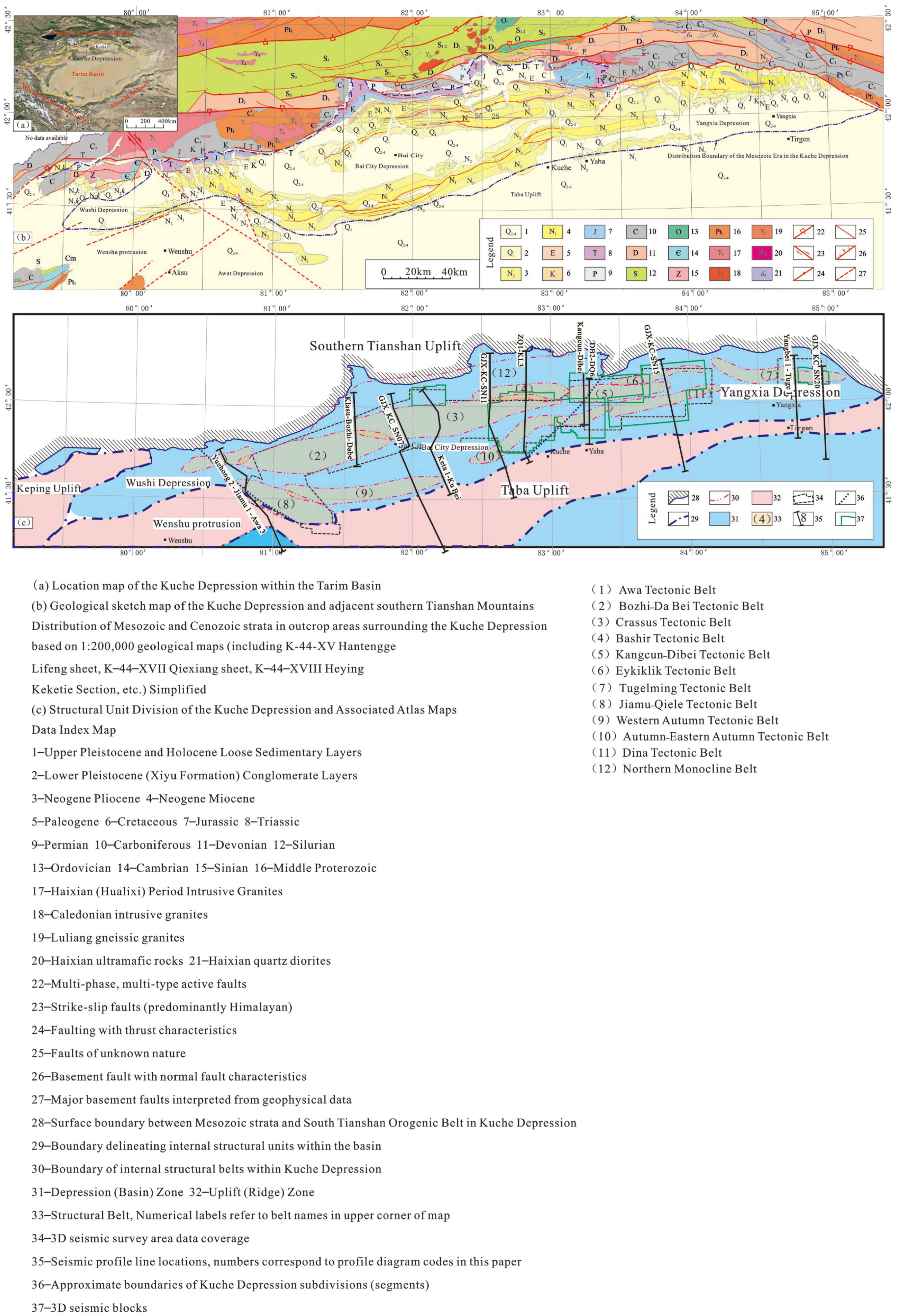
The Kuqa Depression is situated within the basin-range transition zone between the Cenozoic southern Tianshan orogen and the Tarim Basin. As a Cenozoic retro-arc foreland basin [14], it represents a first-order tectonic unit of the Tarim Basin and a key component of the southern Tianshan’s regenerated foreland system, which hosts abundant hydrocarbon resources [15]. With a Paleozoic-fold basement, the depression has evolved through multiple tectonic stages, resulting in five major Mesozoic–Cenozoic structural belts: the Tuogeluming Uplift Belt, the Northern Slope Belt, the Dibei Slope Belt, the Yiqikelike Tectonic Belt, and the Bashen Tectonic Belt (Figure 1) [16]. The Dina area is located within the Kuqa Depression. Specifically, the Dina 2 gas field resides in the eastern Qiulitage Tectonic Belt, whereas the Dibei reservoir is positioned in the eastern segment of the northern tectonic zone (corresponding to the first-row thrust structure of the Kuqa foreland thrust belt) [19]. Bounding the depression to the north is the Tianshan fold-thrust belt, while to the south lies the Tabei Uplift. This confinement by the two major peripheral units has established the present-day macro-tectonic framework of the Dina area.
Figure 1.
Tectonic division map of the Kuqa Depression.
The Kuqa Depression constitutes the Kuqa regenerated foreland basin and represents a key tectonic unit at the junction of the northern Tarim Basin and the Tianshan orogenic belt. The Dina area exhibits typical characteristics of a foreland thrust belt, such as step-like thrust faults and fault-related folds. Three major faults dominate the Dina area: the Dibei Fault, the Dinan Fault, and the Dongqiulitage Fault. The northern margin of the Tarim plate has experienced multiphase tectonic superposition since the Neoproterozoic-Cambrian, including the south Tianshan oceanic subduction during the Silurian–Devonian and the plate collision in the Late Devonian–Early Permian, laying the early groundwork for the tectonic framework of the Dina area [20].
2.2. Stratigraphic Development Characteristics
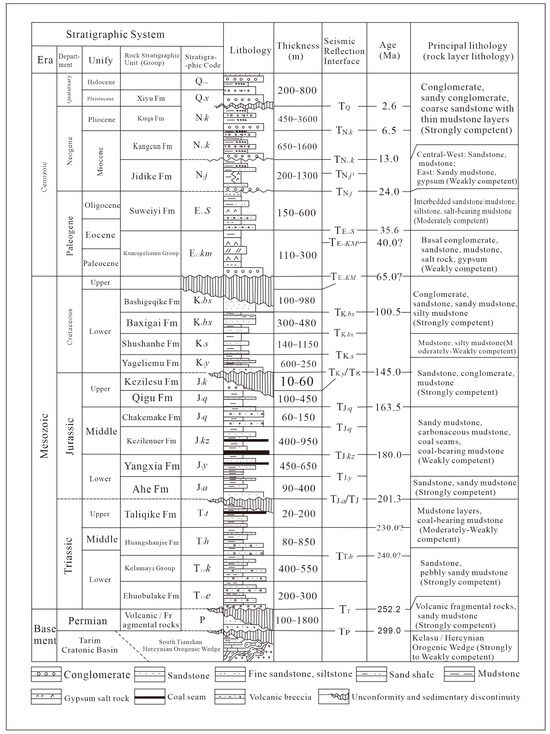
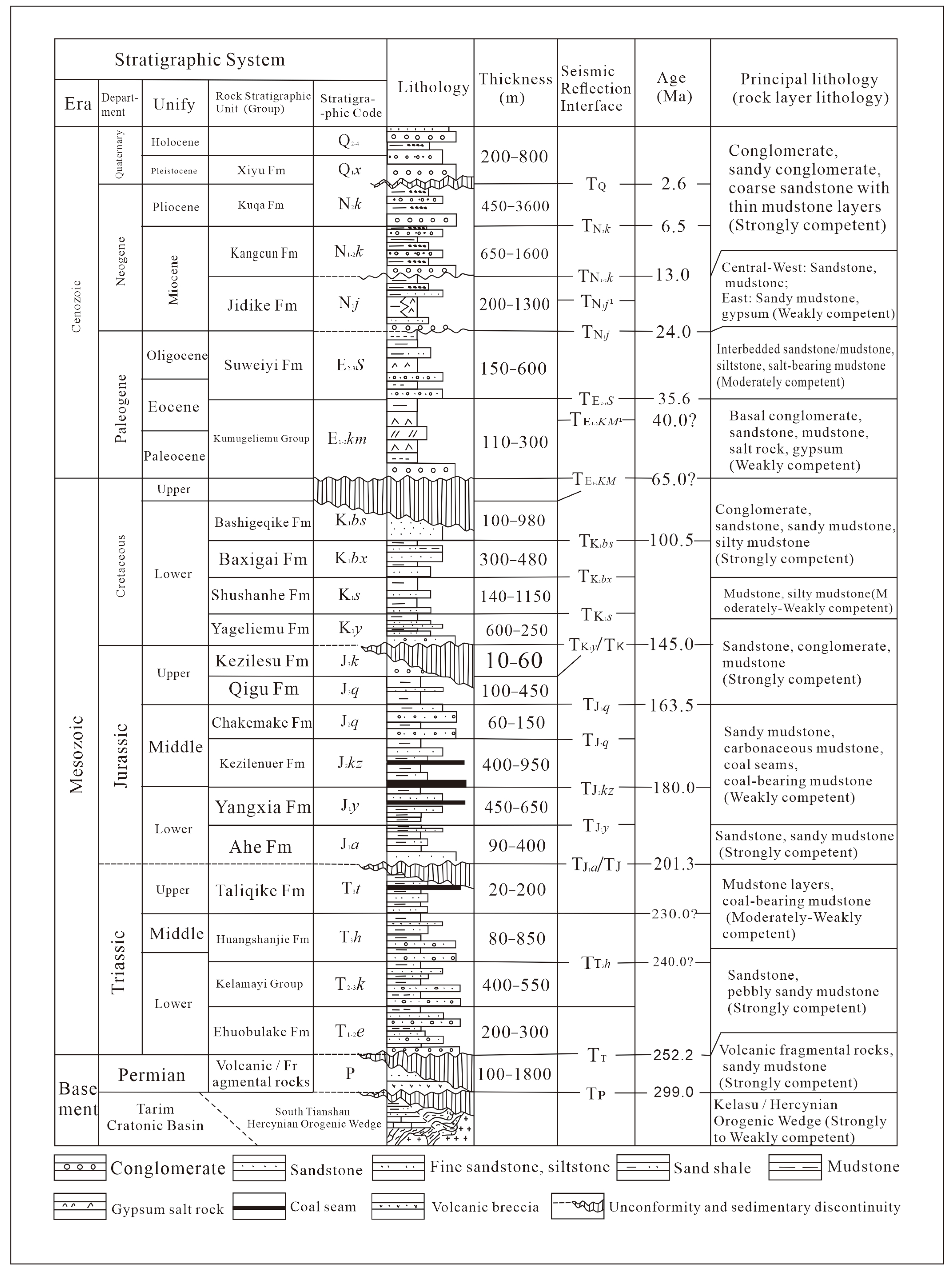
The stratigraphic distribution in the Dina area is highly regular, characterized by a complete sequence from the Cretaceous (K) to the overlying Paleogene (E), Neogene (N), and Quaternary (Q). This sedimentary cover represents the fill of the foreland basin and was deposited on the eroded surface of the aforementioned Paleozoic basement, marking a significant tectonic transition. Specifically, the Neogene includes, from bottom to top, the Jidike Formation (N1j), the Kangcun Formation (N1-2k), and the Kuche Formation(N2k). The Paleogene comprises the Kumugeliemu Group (E1-2km) and the Suweiyi Formation(E2-3s), which are superposed in ascending order. The Cretaceous is represented by the Bashijiqike Formation (K1bs). Notably, the contact between the Paleogene and the underlying Cretaceous is characterized by an angular unconformity. The Mesozoic strata in the Kuqa Depression generally thicken northward, reflecting deposition on a passive northern margin, whereas the Cenozoic strata exhibit a southward thickening trend due to the development of an active foreland basin above the southern Tianshan thrust system. Influenced by this depositional pattern, the Dina area-located in the eastern part of the depression-displays heterogeneous stratigraphic thicknesses (Figure 2).
Figure 2.
Stratigraphic column of the Kuqa Depression. Modified after reference [21].
The Dina area of the Kuqa Depression exhibits a complex lithologic association. This setting provided favorable conditions for trap formation during tectonic evolution. Specifically, the mudstone, gypsum-salt, and gypsum-mudstone intervals of the Neogene Jidike Formation act as a regional seal with excellent sealing capacity. The sandstone intervals of the Paleogene Suweiyi Formation and Kumugeliemu Group serve as the primary hydrocarbon reservoirs. This configuration constitutes a high-quality reservoir–seal association in the study area. Well Dina 1 has verified that the main gas-bearing strata are located within the Paleogene Suweiyi Formation (Table 1).
Table 1.
Simplified stratigraphic table of the Dina 1 gas reservoir.
2.3. Overview of Regional Petroleum Geological Conditions
The Dina area is located in the core hydrocarbon accumulation zone of the Kuqa foreland basin, Tarim Basin. This foreland basin develops a typical dual-overpressure system, wherein the formation of the deep overpressure system is closely related to the rapid and large-scale gas generation process of source rocks. This specific accumulation background not only provides dynamic assurance for hydrocarbon enrichment but also determines the water-dissolved gas occurrence characteristics of natural gas generated from Mesozoic source rocks, establishing a superior regional petroleum geological foundation [22].
The Dina area is situated at the eastern tip of the Neogene Qiulitage structural belt, where the superimposed effects of multi-phase compressional forces from the southern Tianshan orogenic belt and the gypsum-salt detachment layer result in pronounced structural decoupling between the supra-salt and subsalt structural sequences. The Dina 2 structure, in particular, is dually controlled by two north–south trending thrust faults [19]. The supra-salt sequence is dominated by large-scale thrust-detachment structures, exhibiting a synclinal geometry. In contrast, the subsalt sequence, primarily comprising Mesozoic and Paleogene–Neogene strata, develops a buried thrust anticline, which is a typical manifestation of fault-bend folding under the Neogene compressive setting of the foreland basin. As the primary structural style for regional hydrocarbon accumulation, this subsalt fault-bend fold is formed through the close coupling of thrust fault activity intensity and the ductile flow rate of the gypsum-salt detachment layer. It not only governs the morphological integrity and closure magnitude of the trap but also enhances reservoir permeability through the development of structural fractures in the core and limbs during the Late Neogene to Quaternary compressional stage.
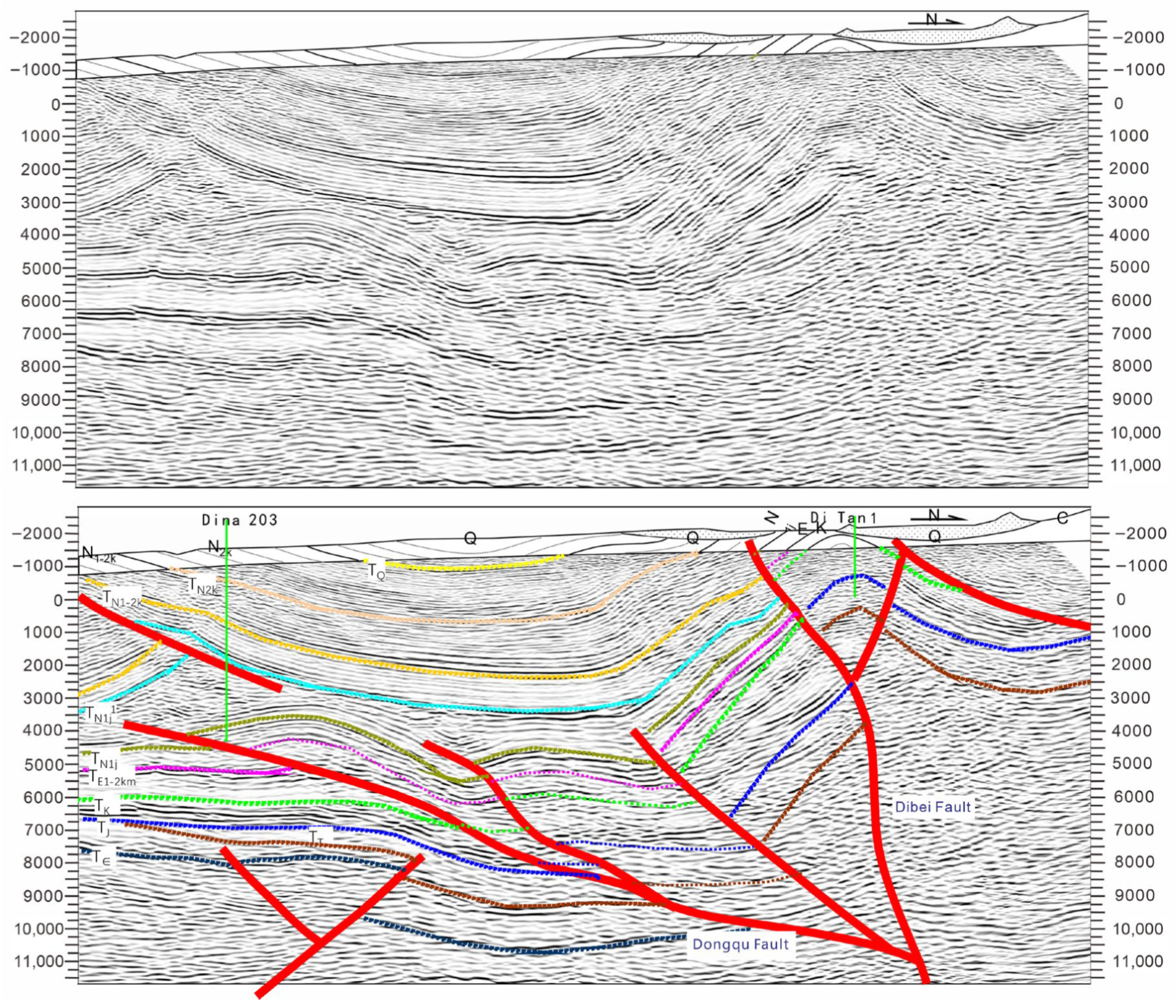
This accumulation zone exhibits a distinct “source–reservoir–caprock” configuration vertically controlled by the “salt-governed” structural framework [23]. Specifically, the accumulation zone is characterized by a “triple-layer” architecture [24]: (1) The deep sequence functions as a hydrocarbon kitchen, where the coal measures of the Lower Jurassic Ahe Formation (J1a) and Middle Jurassic Yangxia Formation (J2y) serve as the primary source rocks, providing an abundant gas supply; (2) The middle sequence acts as the primary target for hydrocarbon accumulation, where the subsalt Paleogene–Neogene clastic reservoirs have developed large-scale fault-bend fold traps, serving as the main reservoir intervals; and (3) The upper sequence serves as a structural detachment and regulatory layer, where the Paleogene gypsum-salt sequence functions not only as a regional detachment horizon but also as a superior seal, effectively decoupling the structural deformation between the underlying and overlying strata [25]. Furthermore, the lateral sealing of the trap is enhanced by the “pop-up” structure on the northern flank [26] and the fault-plane smearing along the bounding faults [4], creating a favorable condition for high-efficiency entrapment [1,2] (Figure 3).
Figure 3.
GJX_KC18 Depth-Migrated Seismic Section.
This subsalt fault-bend fold is constrained between the Dongqilitage Fault and the Dibei fault, with a pop-up structure present on its northern flank. The two principal compressional thrust faults—the East Qiulitage Fault and the Diba Fault (Figure 3), which developed during the Late Neogene tectonic inversion—serve a dual function: facilitating both hydrocarbon source communication and vertical migration. Consequently, they form the preferential pathways for hydrocarbons to migrate from deep source rocks into the subsalt fault-bend fold traps [27,28]. However, systematic studies on the precise development patterns, formation chronology, and the coupling mechanisms between structure and reservoir formation for this fault-bend fold remain lacking. The controlling mechanisms on trap effectiveness and the laws of hydrocarbon enrichment therefore require in-depth analysis, representing the core scientific issues of this study.
3. Analysis of Tectonic Deformation Characteristics in the Dina Area, Kuqa Depression
The fold morphology and distribution patterns in the Dina area of the Kuqa Depression are controlled by multi-phase tectonic movements since the Neogene and the salt detachment layer, exhibiting significant stratification, segmentation, and spatial variability. The structural deformation is relatively simplified, characterized by a large-scale fault-bend anticline. The northern basin-range transition zone, formed during the Late Cenozoic basin subsidence, is dominated by synclines featuring high-angle reverse faults.
3.1. Tectonic Deformation Characteristics
3.1.1. Planar Distribution Features
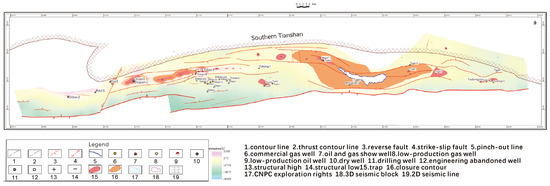
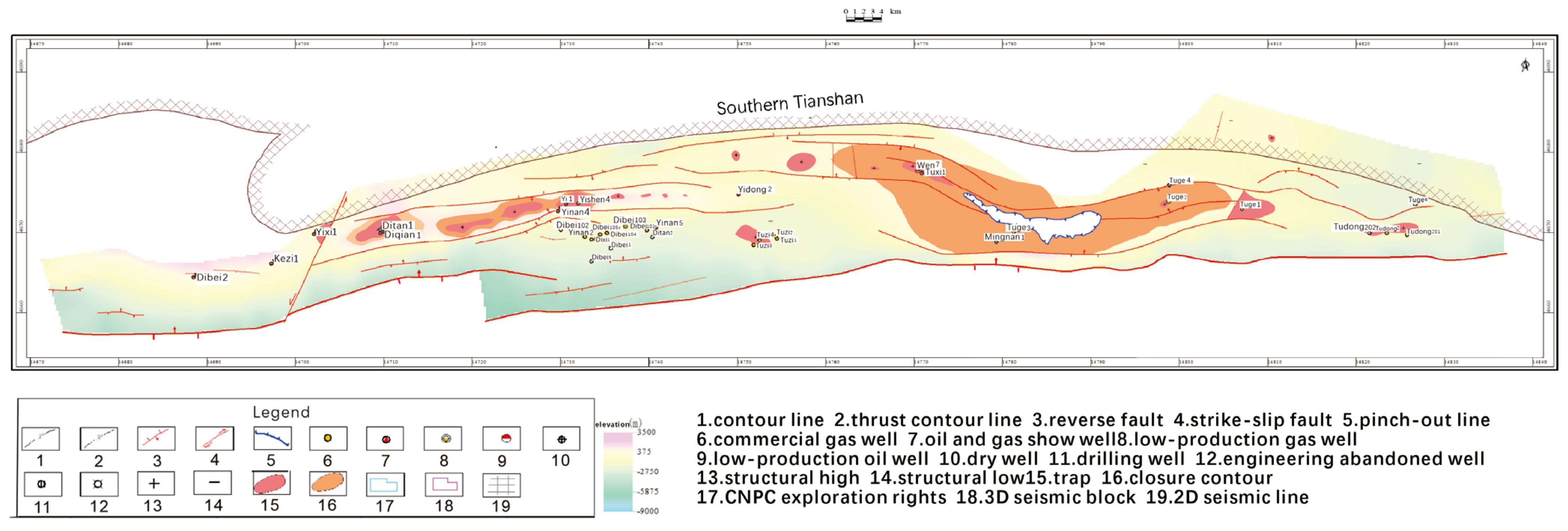
The Dina area straddles the eastern segment of the Qilitag tectonic belt and the eastern part of the northern structural belt of the Kuqa Depression, both of which were primarily shaped by the Himalayan orogeny during the Neogene to Quaternary, lying directly within the compressive stress regime south of the Tianshan orogenic belt. The structural trends, established primarily during the Late Neogene to Quaternary, are generally parallel to the strike of the southern Tianshan orogenic belt. Controlled by the regional tectonic framework and principal faults activated in the Cenozoic, the planform geometry and distribution patterns exhibit significant regularity, characterized by a continuous east–west trend. The overall tectonic deformation displays a macroscopic pattern of “zonal extension in the east–west direction and block-wise constriction in the north–south direction,” consistent with the general tectonic architecture of the Kuqa Depression, which is defined by “east–west differentiation and north–south zonation” formed during the Plio–Quaternary tectonic inversion (Figure 4).
Figure 4.
Plan view of Tectonic Characteristics in the Dina-Tudong Area.
3.1.2. Cross-Sectional Structural Characteristics
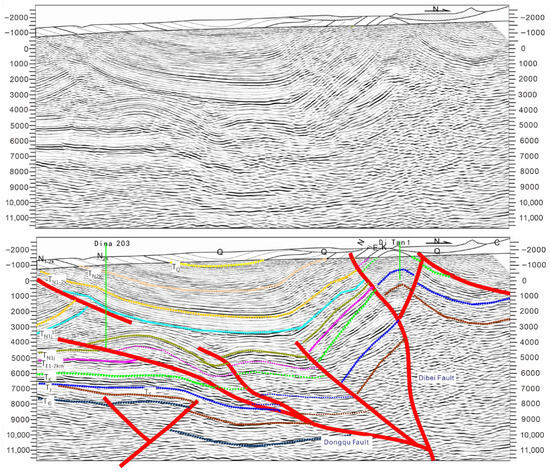
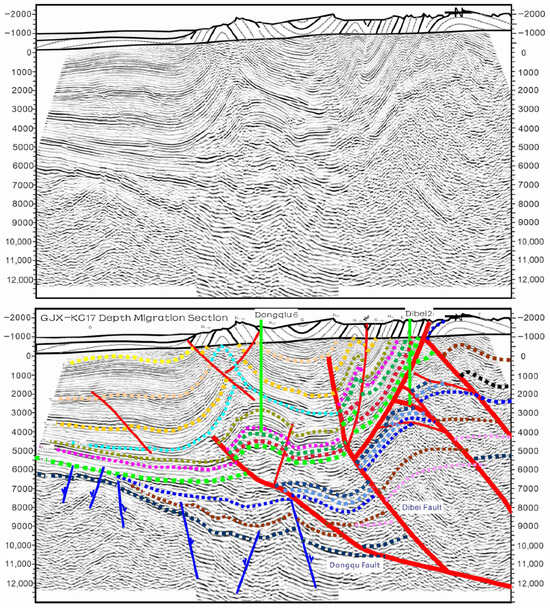
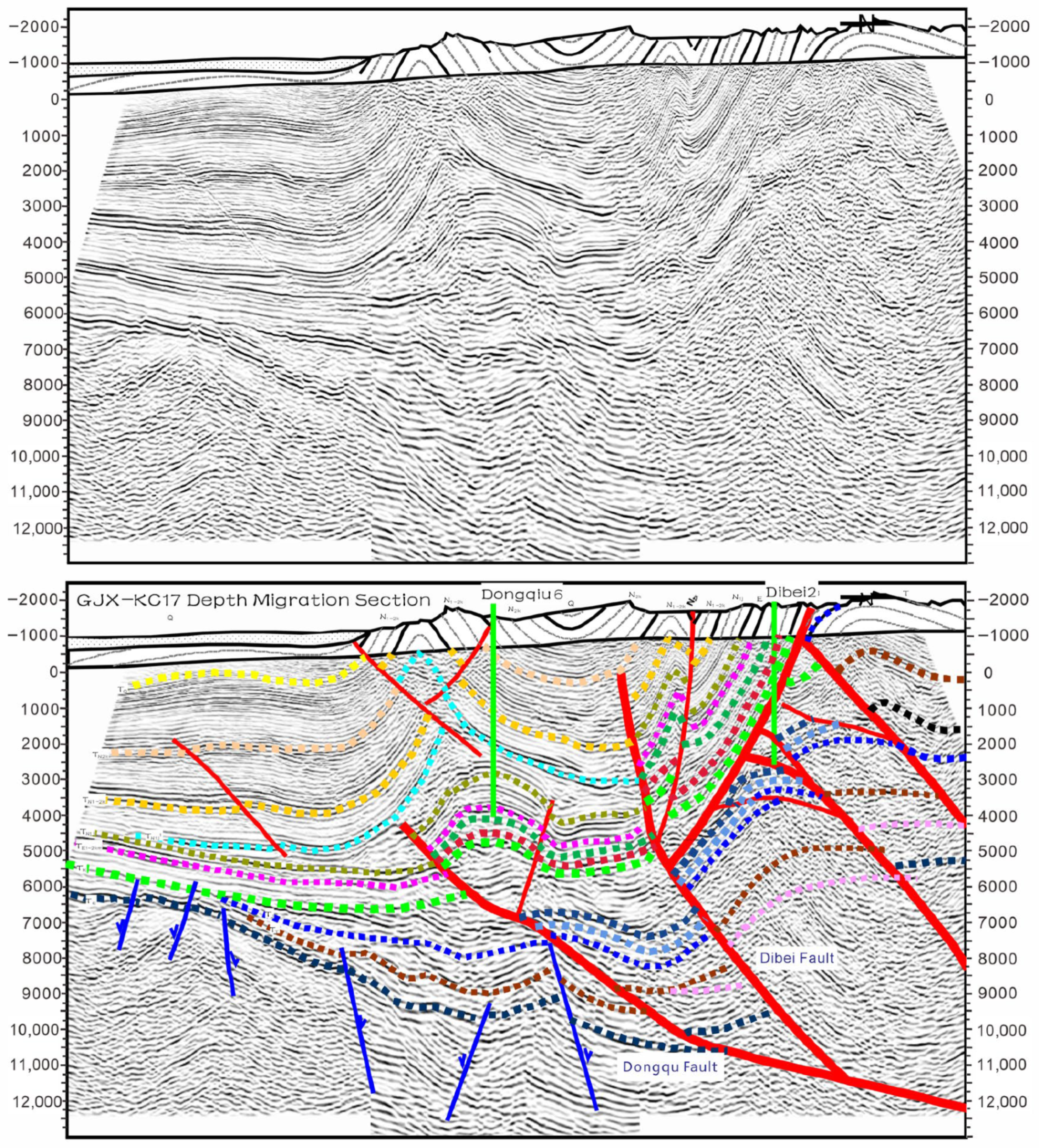
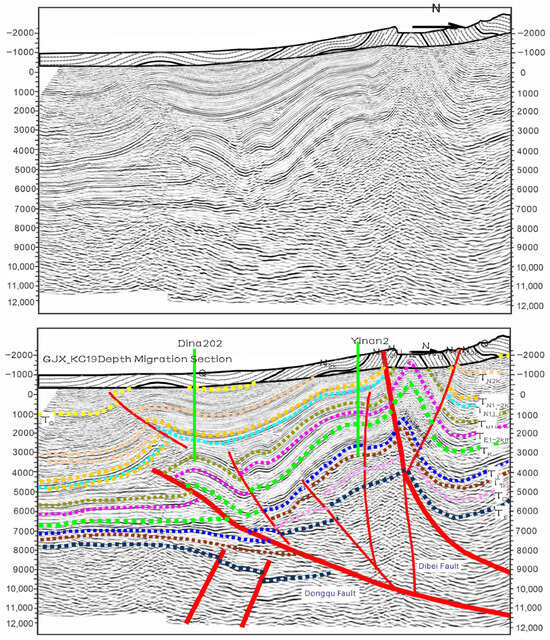
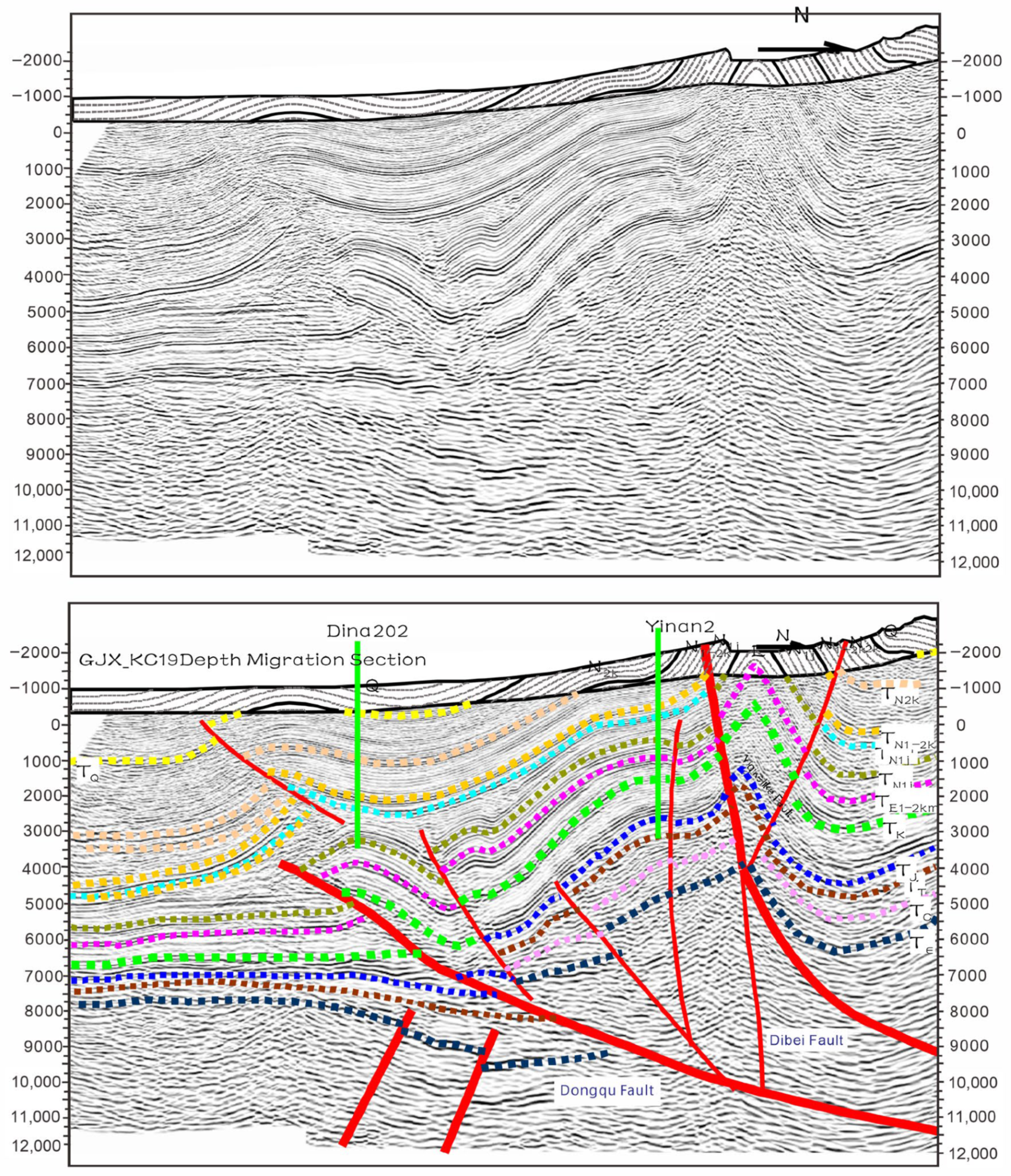
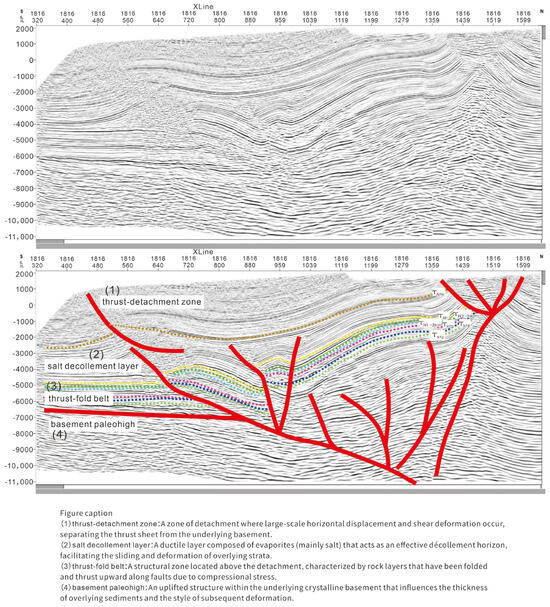
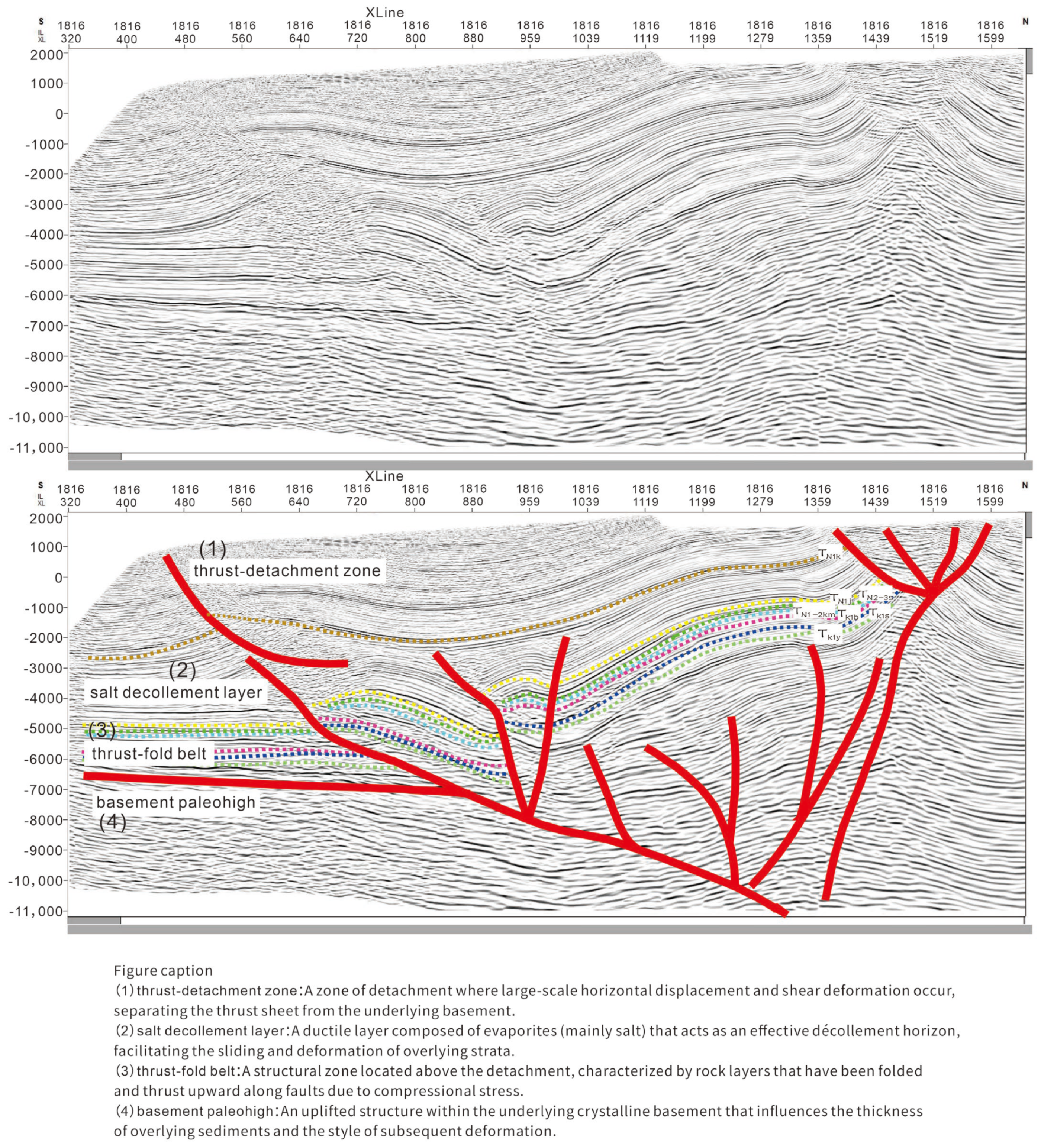
The cross-section reveals a three-tier deformation structure of “supra-salt–salt layer–subsalt”, formed during the Pliocene–Quaternary tectonic inversion, with pronounced mechanical decoupling between layers (Figure 5 and Figure 6). The supra-salt structural sequence is dominated by thrust-detachment folds, developed in the Late Neogene, characterized by tightly compressed strata in the axial zone and relatively gentle limbs. In some areas, imbricate reverse faults develop, with steep fault plane dips ranging from approximately 30° to 60°; some of these faults terminate at the top surface of the salt layer without downward propagation.
Figure 5.
GJX_KC17 Depth-Migrated Seismic Section.
Figure 6.
GJX_KC19 Depth-Migrated Seismic Section.
The salt layer (Paleogene Kumuxi Group and Neogene Jidike Formation evaporites) acts as a ductile detachment horizon. With uniform thickness and continuous banded distribution in the cross-section, it serves as a stress-decoupling interface, leading to distinct divergence in the structural deformation styles between the supra-salt and subsalt domains.
The subsalt structural sequence is centered on a thrust-fold anticline, which initiated in the late Miocene and experienced rapid growth during the Pliocene–Quaternary. The core of this anticline is composed of competent strata from the Cretaceous Bashijiqike Formation, while the limbs are sealed by north-dipping reverse faults, forming a closed “two-faults-enclosing-an-anticline” architecture. The anticline exhibits gentle and complete geometry with limb angles of approximately 15–55° and significant closure depth. Additionally, some cross-sections locally display alternating pop-up structures and broad synclines, with evident subsurface traces of a buried paleo-uplift.
4. Tectonic Physical Modeling Experiments in the Dina Area, Kuqa Depression
4.1. Principle of Modeling Similarity
In tectonic physical modeling research, ensuring the similarity between the laboratory model and the real geological body is the fundamental prerequisite for conducting effective simulations and analyzing practical geological problems. This principle of similarity primarily encompasses three core dimensions: geometric, kinematic, and dynamic similarity. Specifically, geometric similarity requires that the model maintains a fixed proportional relationship with the geological prototype in terms of spatial scales, such as length, thickness, and angles; kinematic similarity focuses on the model’s requirement to accurately reflect the time-scale characteristics of the geological body during its evolution; whereas dynamic similarity emphasizes the consistency of forces between the model and the prototype, meaning that the scaling ratios of various forces—including gravity, inertia, viscosity, elasticity, and friction—must remain consistent.
4.2. Experimental Design
The physical modeling experiments are designed to reproduce the tectonic evolution of the Dina area during the Late Himalayan period (Pliocene to Quaternary, ca. 5.3–0 Ma). This period corresponds to the primary phase of structural deformation and trap formation in the study area [19,22]. Specifically, the experiments focus on the critical time window when the South Tianshan orogenic belt exerted intense compression on the foreland basin, driving the ductile flow of the gypsum-salt detachment layer and the formation of fault-bend folds. Based on the analysis of tectonic characteristics and evolutionary history of the Dina area, and drawing on comparisons with related literature and experimental conclusions, the formation of the current structural configuration is preliminarily attributed to four primary controlling factors: “paleo-uplifts,” “syn-sedimentary activity,” “salt layer thickness,” and “erosion” [29,30,31,32,33,34,35]. Accordingly, two physical simulation experiments were designed: a “model comparing paleo-uplift differences and salt thickness” and a “model investigating syn-sedimentary activity and erosion.” Unlike many previous experiments, this study incorporates multiple factors rather than being limited to a single factor, better reflecting the complex tectonic environment during the actual geological evolution, and is more conducive to the reconstruction of the tectonic evolution in this region [29,30,31,32,33,35].
4.2.1. Experiment 1: Physical Simulation of the Effects of Paleo-Uplift Relief and Salt Layer Thickness Variations on Tectonic Evolution
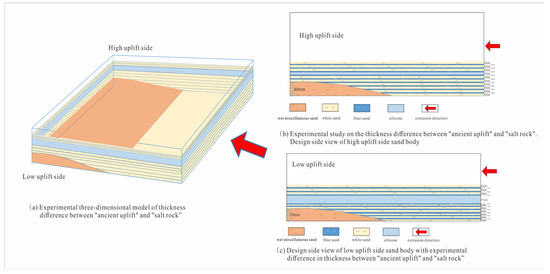
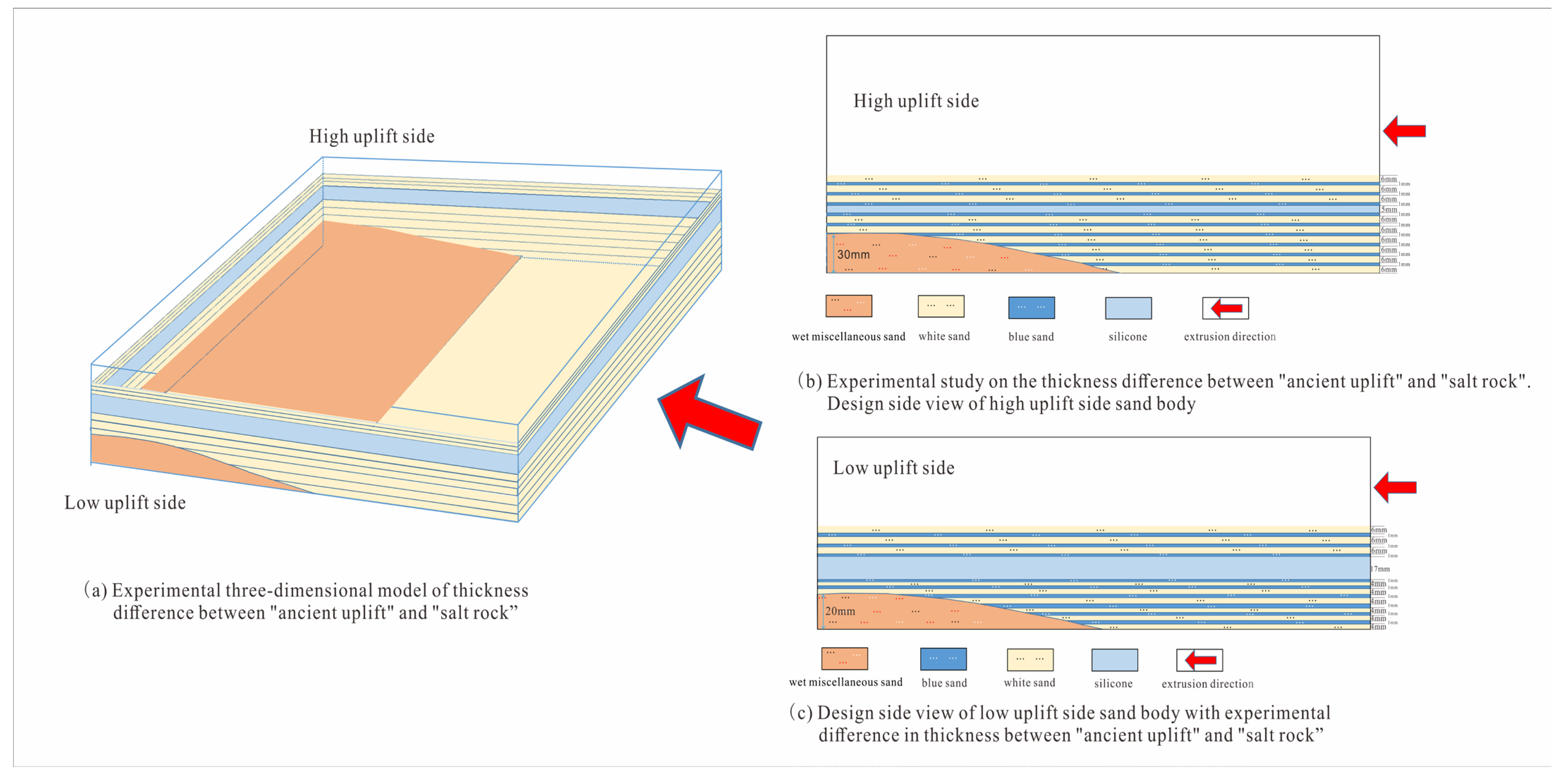
The initial structural model contrasting paleo-uplift relief and salt layer thickness is illustrated in the figure below (Figure 7). The model design parameters and the similarity ratio parameters of the experimental materials are shown in Table 2 and Table 3, respectively. The sandbox apparatus was configured to dimensions of 600 mm in length, 600 mm in width, and 200 mm in height, featuring a fixed baffle on one side and a compressive baffle on the opposite side. Compression was applied via a motor-driven movable baffle at a rate of 0.03 mm/s. This model was designed to analyze the influence of paleo-uplift conditions and salt detachment layer thickness on the tectonic evolution of the Dina area by incorporating variations in the height of the paleo-uplift basement and the thickness of the silicone salt layer.
Figure 7.
Schematic diagram of the experimental design for the physical modeling of the controlling effects of paleo-uplift and salt layer thickness variations.
Table 2.
Model design parameters for Experiment 1.
Table 3.
Model material parameters and similarity ratios for Experiment 1.
The experimental materials were selected as follows: moist quartz sand was used to construct the basement, forming two paleo-uplift highs with different elevations (20 mm and 30 mm) but a consistent dip angle of approximately 10°; this structure was left to set overnight. Over this basement, six layers of white sand, alternating between 4 mm and 6 mm in thickness, were laid to simulate the stratigraphic sequences. Subsequently, a silicone layer was laid to represent the ductile salt layer, leveled to a uniform height. Above the salt layer, three additional layers of 6 mm white sand were laid, with 1 mm thick layers of blue sand interspersed between strata to serve as marker horizons for monitoring structural deformation.
The experimental procedure was conducted as follows: the piston was first compressed by 80 mm with a 6 mm syn-tectonic layer deposited simultaneously; the piston was then further compressed by 80 mm with the same operation repeated; finally, the piston was compressed by another 80 mm before the experiment was terminated. During the experiment, high-definition cameras and PIV particle monitoring devices were used to capture images at regular intervals; the cross-section and planform of the experimental model were photographed and recorded every thirty seconds to observe and document the characteristics of tectonic deformation.
4.2.2. Experiment 2: Physical Simulation of the Effects of Synsedimentary and Erosional Processes on Tectonic Evolution
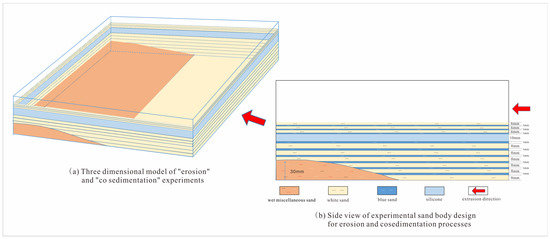
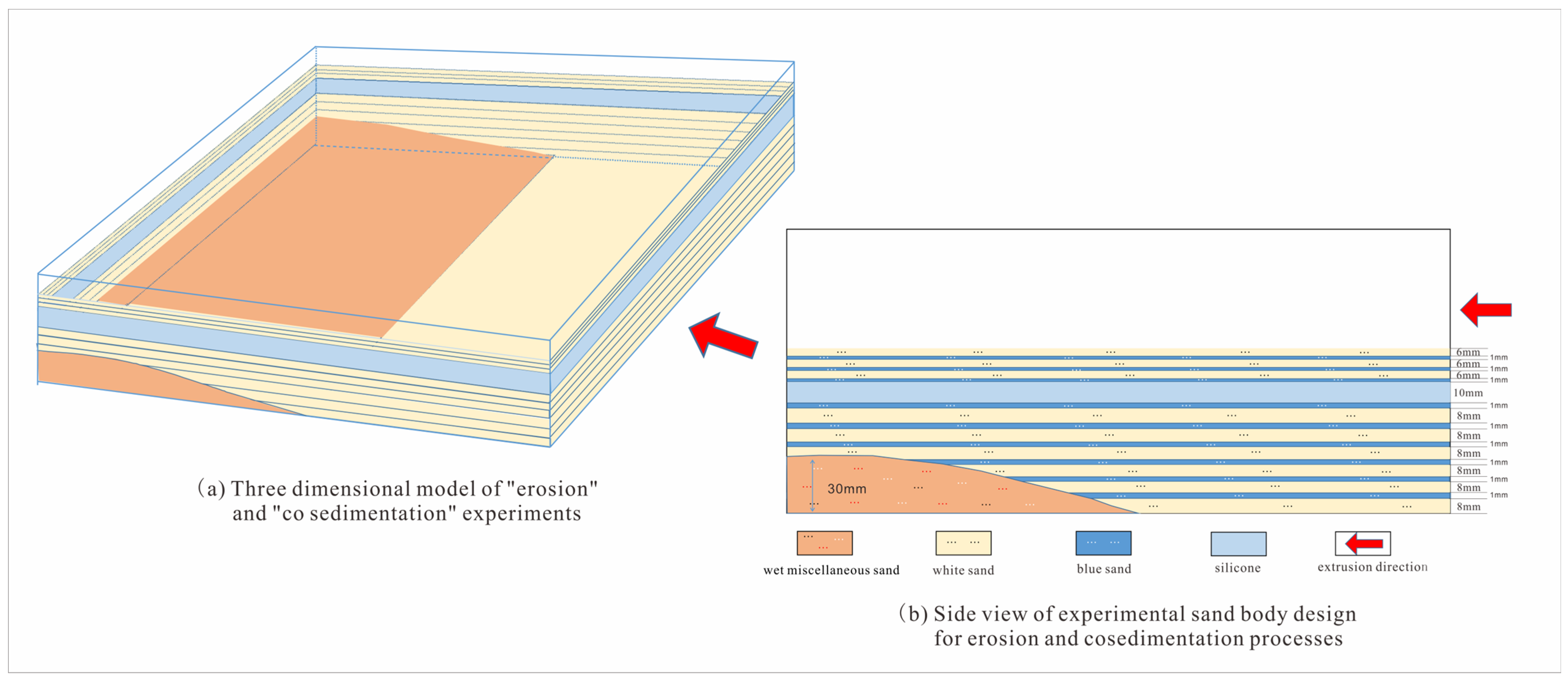
The initial structural model for the simulation of synsedimentary and erosional effects is illustrated in the figure below (Figure 8). The model design parameters and the similarity ratio parameters of the experimental materials are shown in Table 4 and Table 5, respectively. The sandbox apparatus was set to dimensions of 600 mm (length), 600 mm (width), and 200 mm (height), featuring a fixed baffle on one side and a compressive baffle on the opposite side. Compression was applied via a motor-driven movable baffle at a rate of 0.03 mm/s. This experiment was designed to investigate the impact of synsedimentary processes in non-uplifted regions and erosional processes in uplifted regions during topographic evolution on the structural morphology of the Dina area.
Figure 8.
Schematic diagram of the experimental design for the physical simulation of synsedimentary and erosional processes.
Table 4.
Model design parameters for Experiment 2.
Table 5.
Model material parameters and similarity ratios for Experiment 2.
The experimental materials were selected as follows: moist quartz sand was prepared and laid to construct a 30 mm high paleo-uplift with a dip angle of approximately 10°, which was left to set overnight. Subsequently, six layers of white sand, each 8 mm thick, were laid to simulate geological strata. A 10 mm layer of silicone (representing the salt detachment layer) was then laid, followed by three layers of 6 mm thick white sand. Uniform 1 mm thick layers of blue sand were interspersed between the strata as marker beds to facilitate the differentiation of layers.
The experimental procedure was conducted as follows: upon reaching 150 mm of compression in the first phase, the compression was halted. A vacuum cleaner was used to erode the uplifted area on the piston side into a slope of approximately 10°, simulating the erosion of the uplifted anticline highland by tectonic evolution [30]. Concurrently, 6 mm of white sand was laid from the anticline flank (away from the orogenic belt) to the sag center to simulate the synsedimentary phenomenon. The piston was then advanced by an additional 50 mm, and the aforementioned operations of erosion and synsedimentation were repeated, maintaining the same sedimentation thickness. Finally, a further 26 mm of compression was applied to complete the entire experiment. Throughout the experiment, high-definition cameras and PIV particle monitoring devices were employed for timed photography, recording the cross-section and planform of the experimental model every minute to observe and document the characteristics of tectonic deformation.
4.3. Experimental Results
4.3.1. Results of Experiment 1
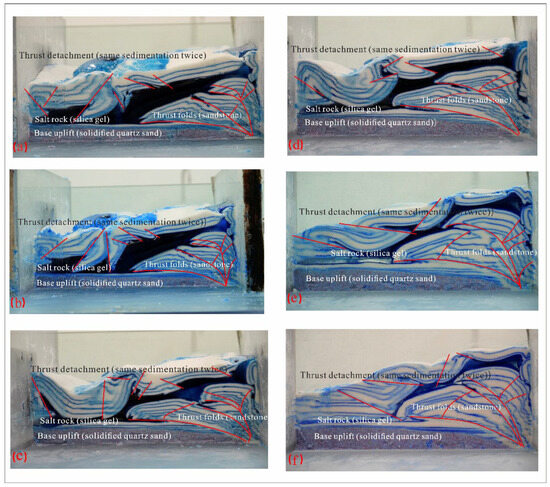
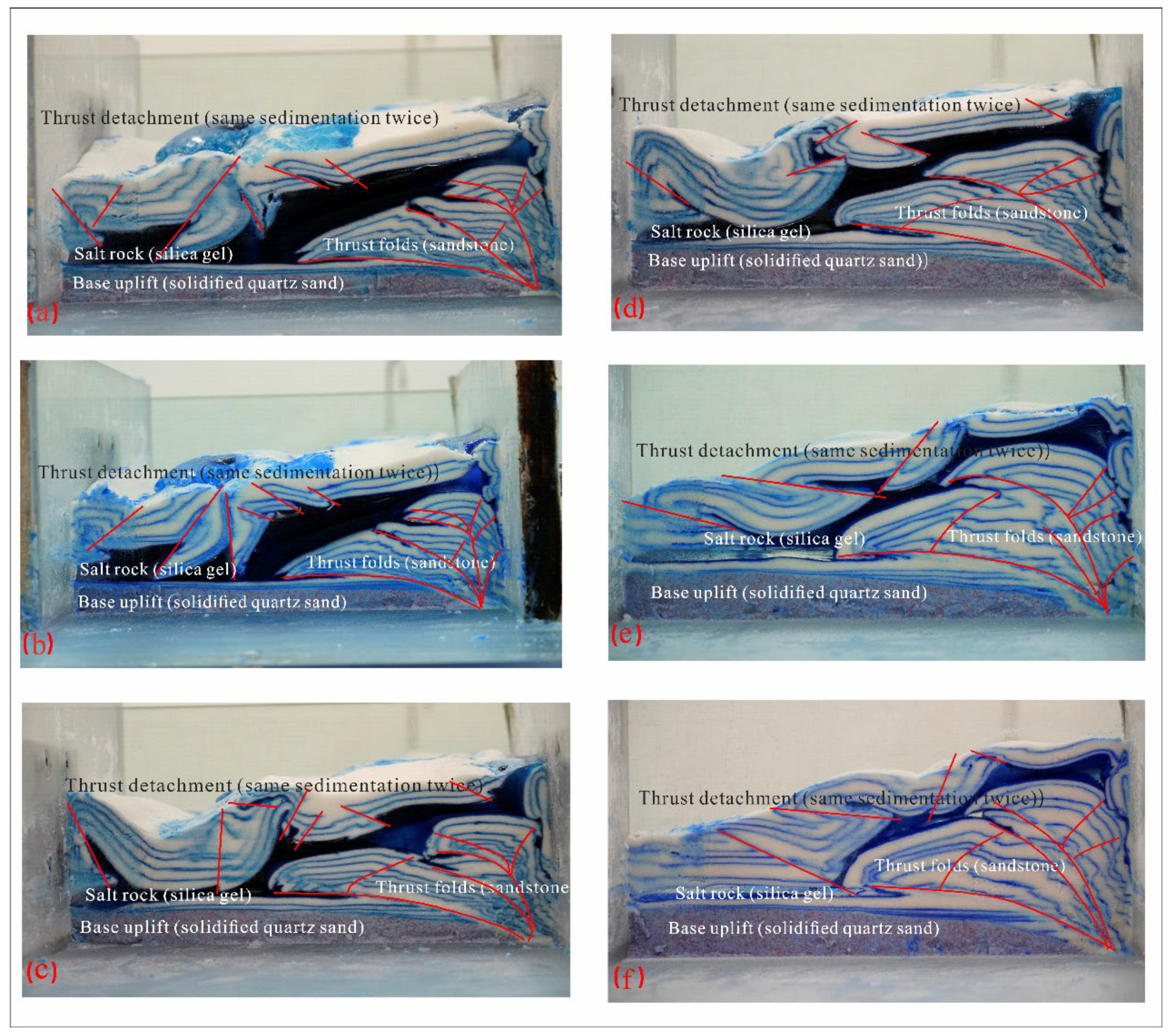
Experiment 1, centered on the core variables of “differential paleo-uplift heights (20 mm and 30 mm) and their corresponding salt layer thicknesses (17 mm and 5 mm),” underwent a three-phase progressive compression totaling 240 mm (80 mm per phase). Real-time tracking via high-definition cameras and PIV particle monitoring devices yielded quantitative deformation data under varying tectonic parameters. These results show a precise correspondence to the actual seismic profile of the Dina area. By comparing the physical modeling results with the actual seismic profile across slices transitioning gradually from a 20 mm uplift to a 30 mm uplift (Figure 9), structural differences in deformation patterns under various tectonic parameters were revealed.
Figure 9.
Cross-sectional results of the physical modeling experiment showing the respective controls of the basement paleo-uplift geometry and salt layer thickness variations (a–f).
The height of the basement paleo-uplift is a key factor controlling the intensity of structural deformation in the overlying strata. A relatively low uplift magnitude (20 mm paleo-uplift) generates small tectonic stress, which, under the regulation of a thick salt layer, results in deformation dominated by continuous, progressive folding and thrusting. The footwall ramp angle of the subsalt thrust anticline is approximately 15–20°, and three phases of decollement-style folding have developed in the supra-salt strata, characterized by gentle structures without imbricate stacking. The throw of supra-salt thrust faults ranges mostly from 3 mm to 10 mm, with dip angles of 30–60°, indicating overall weak tectonic deformation. A higher uplift magnitude (30 mm paleo-uplift) leads to greater accumulation of tectonic stress. When this stress exceeds the plastic strain limit of the salt layer, it triggers more intense fault-related folding and thrust nappe structures. Under conditions of strong stress concentration, the buffering effect weakens, resulting in multi-layer fracturing and obvious fault offsets in both supra-salt and subsalt strata. The local thickness after compression reduces to 3 mm, and the supra-salt strata develop dense imbricate thrust faults. The subsalt strata show strong coupled deformation with the basement paleo-uplift, where the top of the paleo-uplift is compressed and modified, with the original dip angle increasing from approximately 10°to 15°. The footwall ramp angle of the subsalt thrust anticline ranges from 45° to 55°, and the supra-salt fault-related folds exhibit tight stacking with truncation at the crests. Several imbricate thrust faults develop in the supra-salt strata, with individual fault throws mostly between 5 mm and 18 mm and fault plane dip angles mostly between 15°and 30°, indicating strong overall compressive deformation. It is thus inferred that there is a positive correlation between paleo-uplift height and structural deformation intensity.
The thickness of the salt decollement layer plays a crucial role in the distribution and transmission of tectonic stress. A thicker salt decollement layer (17 mm decollement) flows over long distances throughout the compression process, exhibiting significant variation in layer thickness and maintaining a good plastic buffering effect. This provides ample space for plastic flow, effectively buffering and transmitting horizontal stress, allowing tectonic deformation to propagate over long distances along the decollement surface, forming dispersed, multi-phase thrust structures. A thinner salt decollement layer (5 mm decollement) limits its plastic strain capacity, resulting in short flow distances, small thickness variations, and a significantly weakened plastic buffering function. This leads to stress concentration, causing intense deformation in the overlying strata and facilitating vertical stress transmission that affects both the subsalt strata and the basement.
In this set of experiments, the structural deformation is primarily characterized by a combination of multi-level thrust decollement in the supra-salt strata and subsalt thrust folding. The thicker salt decollement acts as a highly efficient stress-decoupling interface, decoupling the supra-salt deformation from the basement uplift under the regime of regional horizontal compression.” This causes the deformation to concentrate predominantly within the supra-salt sedimentary cover, while the subsalt strata and the morphology of the basement paleo-uplift remain relatively intact. When the amplitude of the paleo-uplift increases and the thickness of the decollement layer decreases, the intensity of structural deformation increases significantly. The overlying strata develop large-scale imbricate thrust nappe structures, exhibiting a distinct “hard-linkage” deformation characteristic. Due to the limited plastic strain capacity of the decollement, a portion of the tectonic stress is transmitted downward, resulting in noticeable deformation of the subsalt strata and modification of the basement paleo-uplift morphology. The actual geological cross-section shows a high degree of consistency with the deformation pattern observed in Experiment 1. Seismic data reveal a clear salt decollement and an overlying thrust-fold belt, with the deep basement paleo-uplift maintaining an intact morphology and minimal deformation in the subsalt strata, which mutually corroborates the results of the physical simulation.
4.3.2. Results of Experiment 2
In this experiment, structural deformation was primarily characterized by two phases of syndepositional thrust decollement above the paleo-uplift, alongside differential evolution observed due to erosion at the distal end of the paleo-uplift.
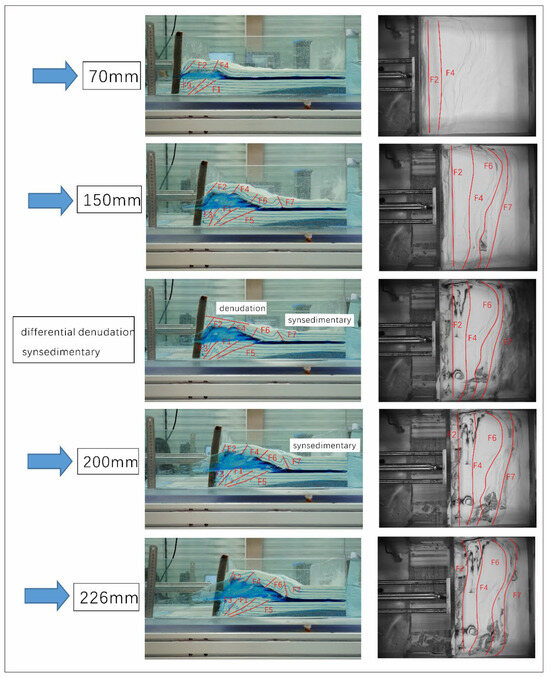
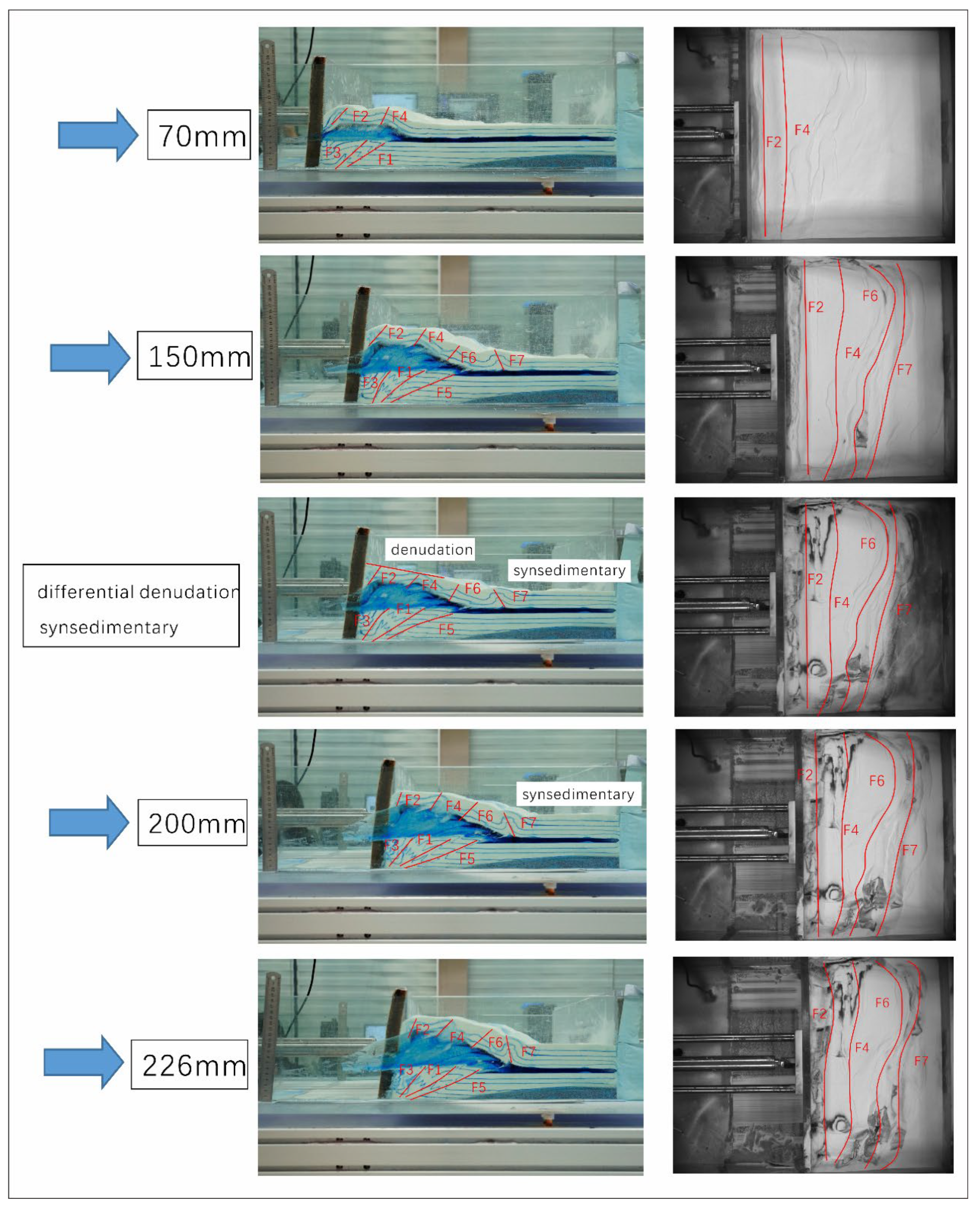
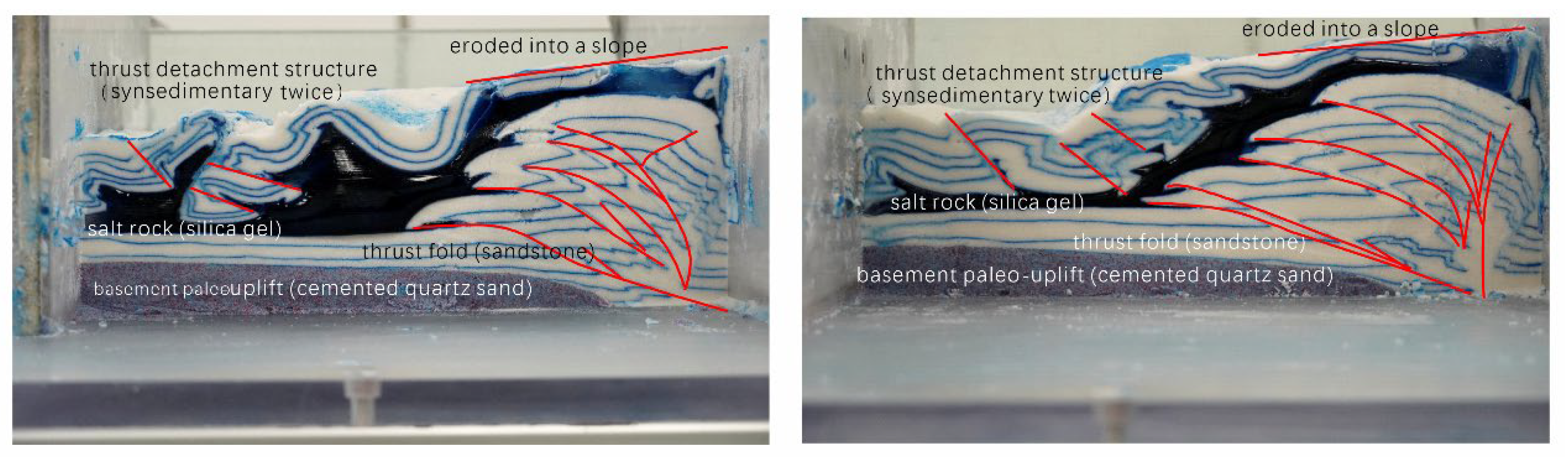
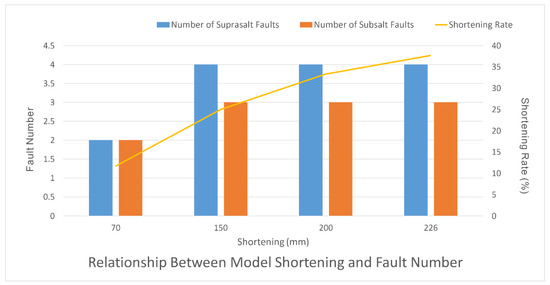
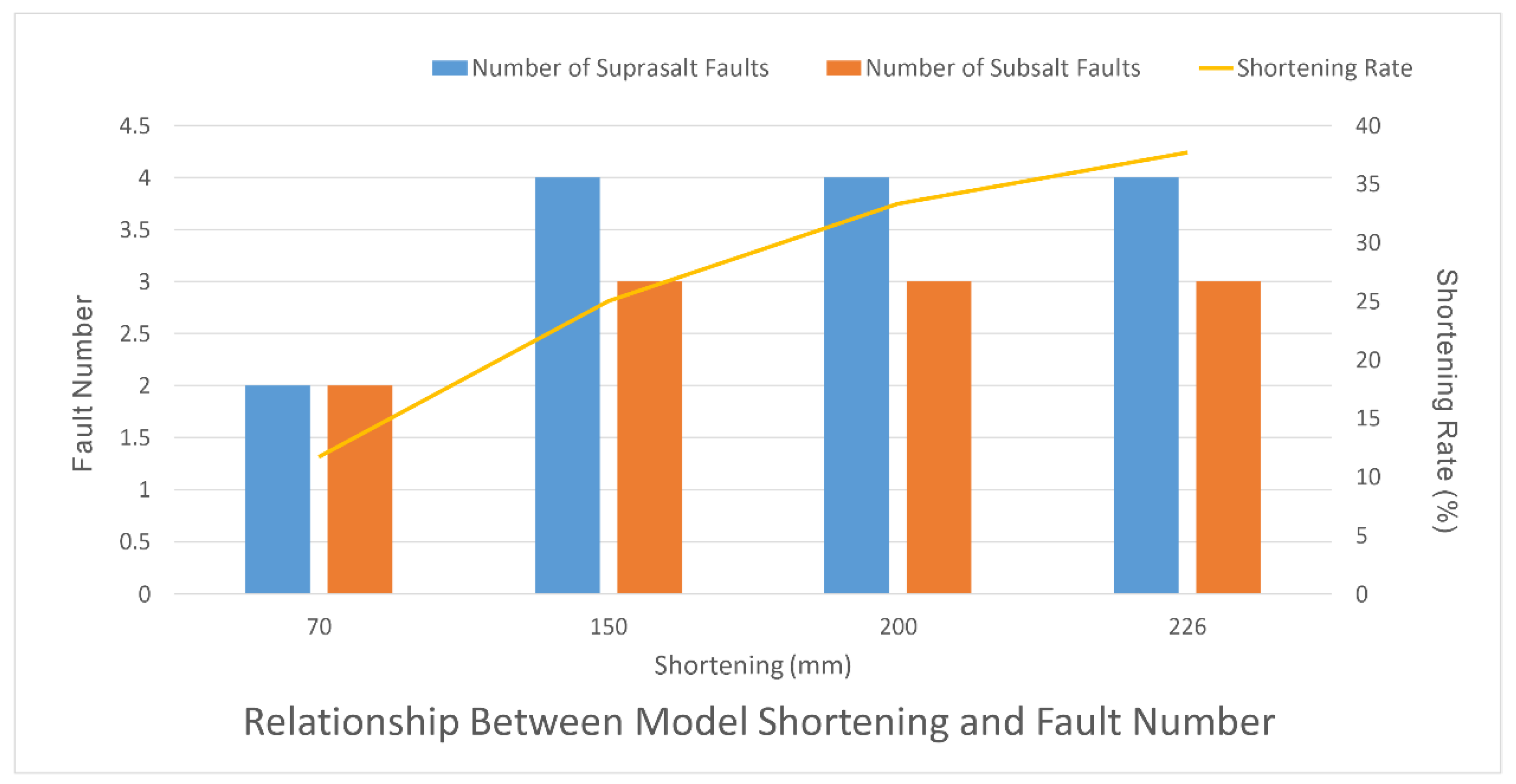
Based on the evolutionary sequence observed in the lateral and plan-view images of the model (Figure 10), during the first phase of tectonic compression (70 mm shortening), two thrust faults (F1, F3) developed beneath the silicone layer, accompanied by two thrust faults (F2, F3) above the silicone layer. At 150 mm of shortening, strata adjacent to the pushing plate were progressively uplifted, causing pre-existing faults to lengthen. Simultaneously, new thrust faults (F5, F6, F7) formed both above and below the silicone layer. At this stage (200 mm shortening), the crest of the uplifted anticlinal structure near the pushing plate was eroded. White sand was subsequently emplaced (simulating syndeposition) along the limb of the anticline distal to the uplift and into the synclinal trough before compression continued. Under continued compression, deformation intensified significantly; fault dip angles increased, and sedimentation (syndeposition) was maintained within the basin. When the total shortening reached 226 mm, compression ceased. Under the combined influence of compressive stress and thick syndepositional strata, deformation propagated inward toward the basin. At this final stage, multiple thrust faults developed below the silicone layer were distinctly visible, and thrust decollement above the silicone layer was exacerbated. However, both differential erosion and syndepositional loading acted to reduce surface slopes. Consequently, the basin interior absorbed relatively less deformation compared to the uplifted anticlinal region.
Figure 10.
Corresponding evolutionary process of the physical modeling experiment showing syndeposition and erosion: lateral view and plan view.
The experiment demonstrates that the distal flank of the paleo-uplift experienced intense compressive shortening, resulting in a series of tight thrust-fold belts influenced by erosional unloading. Following the initial 150 mm of shortening, the uppermost strata underwent erosion, forming a gentle slope with a dip angle of approximately 10°, truncating the fold crests. Subsequent shortening of 50 mm and 26 mm further amplified the fold amplitude and thrust displacement. Erosion at the apex of the thrust-fold belt on the right removed overburden load, inducing stress relaxation at the fold crests. This facilitated the concentration of subsequent deformation along the fold limbs, forming gently dipping erosional slopes, while unloading promoted salt flow and further modified the deep structural architecture.
During the experiment, syndeposition was simulated by depositing 6 mm of sand following each thrusting event, ensuring synchroneity between sedimentation and ongoing deformation. On the left, syndepositional sands continuously covered the active thrust sheets in the decollement zone. Through the coupling of “loading and deformation,” the thrust system evolved into a piggyback geometry, reducing the dip angle of the thrust sheets and enhancing structural stability. Continuous deposition of syndepositional strata increased the overburden load above the decollement, promoting ductile salt flow. This facilitated a more uniform distribution of horizontal shortening across the decollement zone, thereby reducing localized stress concentration (Figure 11).
Figure 11.
Cross-sectional results of the physical modeling experiments illustrating syndeposition and erosion.
5. Discussion on the Influence of Structural Deformation and Evolution on Hydrocarbon Accumulation
5.1. Key Controlling Factors of Structural Deformation in the Dina Area, Eastern Kuqa Depression
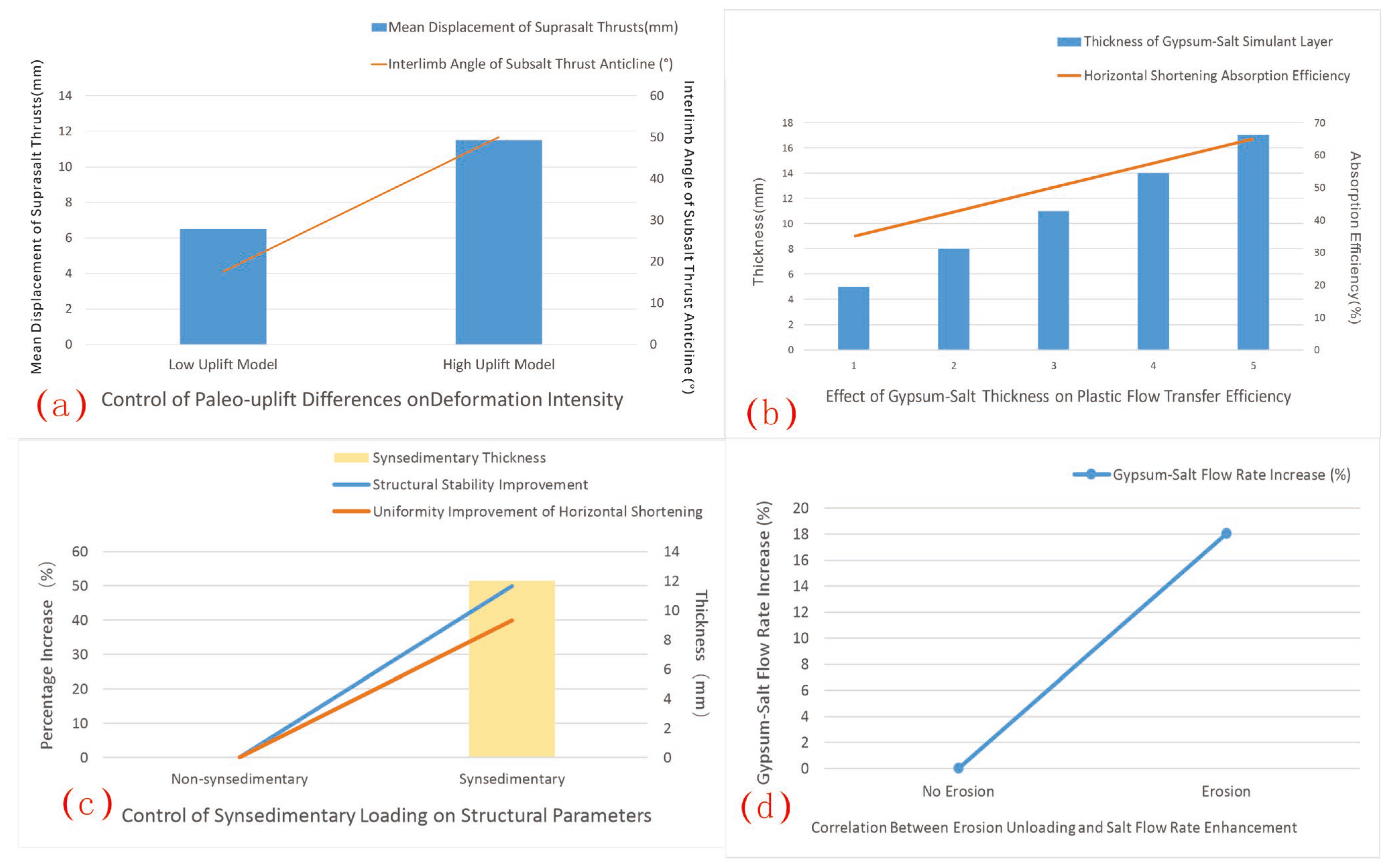
The experimental results reveal a coupled system characterized by “paleo-uplift, gypsum-salt decollement, and imbricate thrusting,” which shows a high degree of consistency with the actual tectonic evolution observed in the Dina area. Integrating 2D Move balanced restoration, 3D seismic interpretation, and regional literature, we identify four primary controlling factors: basement paleo-uplift, gypsum-salt thickness, syndeposition, and erosion (Figure 12 and Figure 13). The quantitative control effects and deformation mechanisms are as follows:
Figure 12.
Quantitative analysis of the four key controlling factors of structural deformation in the Dina area (a–d).
Figure 13.
Relationship between tectonic compression and the number of faults formed.
- (1)
- Boundary Control of Rigid Basement Paleo-uplift on Deformation Zonation
The experiment simulated models with basement heights transitioning from 20 mm (low uplift) to 30 mm (high uplift). After three phases of cumulative compression totaling 240 mm, the results showed that: in the low uplift area, the subsalt thrust anticline had a limb dip of only 15–20°, with thrust fault offsets ranging from 3 mm to 10 mm. In the high uplift area, the limb dip increased sharply to 45–55°, and the fault offset expanded to 5–18 mm, confirming a positive correlation between paleo-uplift height and deformation intensity. The rigid basement paleo-uplift directly controls the deformation partitioning of the overlying strata. In the Dina area, a basement paleo-uplift with a dip angle of approximately 10° is developed. Its rigid support restricts the lateral flow range of the Paleogene Kumugeliemu Group gypsum-salt rock. Stress is laterally transferred along the salt decollement layer, facilitating the development of a two-phase thrust decollement system. Stress concentration and release at the distal end of the paleo-uplift form a strong thrust-fold belt. This phenomenon indicates that the basement paleo-uplift not only separates the spatial distribution of the thrust decollement belt and the thrust-fold belt but also limits the lateral flow range of salt rock through rigid support, resulting in a deformation intensity pattern where “deformation is weak near the uplift and strong away from it.” The multi-phase activity of the Tuoguerming paleo-uplift (Late Permian, Late Cretaceous) further intensified this differentiation. After Late Cretaceous erosion, the strata at the core of the uplift were removed, increasing the rigidity contrast of the basement and indirectly aggravating the deformation zonation.
- (2)
- Thickness-Dependent Regulation of Strain Partitioning by Gypsum-Salt as a Detachment Layer
As a detachment layer, the plastic flow of gypsum-salt directly influences the efficiency of deformation transfer. In the experiment, silicone rubber with thicknesses of 17 mm (thick-salt) and 5 mm (thin-salt) was used to simulate salt rock. In the thick-salt group, horizontal shortening was uniformly distributed, forming a broad thrust belt. Conversely, when the salt thickness decreased, strain transfer in the thin-salt group was impeded, leading to the localized development of high-angle folds with some limb dips exceeding 60° [13]. In the Dina area, the cumulative thickness of the Paleogene Kumugeliemu Group and Neogene Jidike Group gypsum-salt layers ranges from 800 m to 1200 m, which is 1.2 to 1.5 times the average thickness in the Kuqa Depression [16]. This significant thickness results in high-efficiency plastic flow, enabling the absorption of 60–70% of the horizontal shortening and thereby weakening subsalt deformation [16,19]. In contrast, in the western segment of the depression, where the gypsum-salt layer is only 400–600 m thick, strain transfer efficiency drops to 30–40%. This results in the development of 3–4 subsalt imbricate thrust faults, compared to only 1–2 in the Dina area, with a fault offset difference of 200–300 m [36]. This demonstrates that salt thickness is a key medium regulating strain partitioning, and its lateral variation controls the intensity and style of structural deformation in the Dina area.
- (3)
- Control Mechanism of the “Loading–Coupling” Relationship on Strain Buffering under Syndepositional Conditions
Syndeposition exerts a significant influence on tectonic evolution. The continuous deposition of syndepositional strata increases the overburden load, promoting ductile salt flow. This facilitates a more uniform distribution of horizontal shortening across the entire decollement zone, thereby reducing localized stress concentration. In the experiment, following each thrusting event, the deposition of 6 mm of quartz sand (simulating syndepositional strata) progressively reduced the thrust sheet dip from an initial 30–60° to 15–30°, enhancing structural stability by 50% and improving the uniformity of horizontal shortening distribution by 40% [13]. In the Dina area, the thick Neogene Kangcun and Kuche Formation syndepositional strata promoted the ductile flow of the underlying gypsum-salt layer through “loading–deformation” coupling. The flow rate in this area was 20–25% higher than in areas without syndeposition, ensuring a uniform distribution of horizontal shortening across the decollement zone [37]. In the Dina 2 gas field, the coupling between the Kangcun syndepositional strata and the thrust structures formed “piggyback” traps, which exhibited a closure height 50–100 m greater than those in areas lacking syndeposition [37].
- (4)
- Crustal Unloading and Surface Morphological Adjustment Induced by Erosion
In the experiment, erosion following the initial 150 mm shortening removed the overburden load from the crest of the thrust-fold belt on the right, forming a 10° gentle slope on the uplifted area. This unloading caused stress relaxation at the fold crests, leading to subsequent deformation concentrating on the fold limbs. Simultaneously, the erosion truncated the early high-angle folds, resulting in stratal loss and masking the geometric characteristics of the initial deformation. In the Dina area, a regional erosion event during the Late Cretaceous formed an 8–12° gentle slope, with eroded strata in the uplifted area measuring 100–150 m in thickness. This unloading increased the flow rate of the underlying gypsum-salt by 15–20%, resulting in a deep anticlinal core offset of less than 5 km [36,38]. Erosion not only modified the surface structural morphology but also promoted salt flow through unloading, thereby further adjusting the deep structural architecture.
5.2. Reconstruction of the Tectonic Evolution in the Dina Area, Kuqa Depression
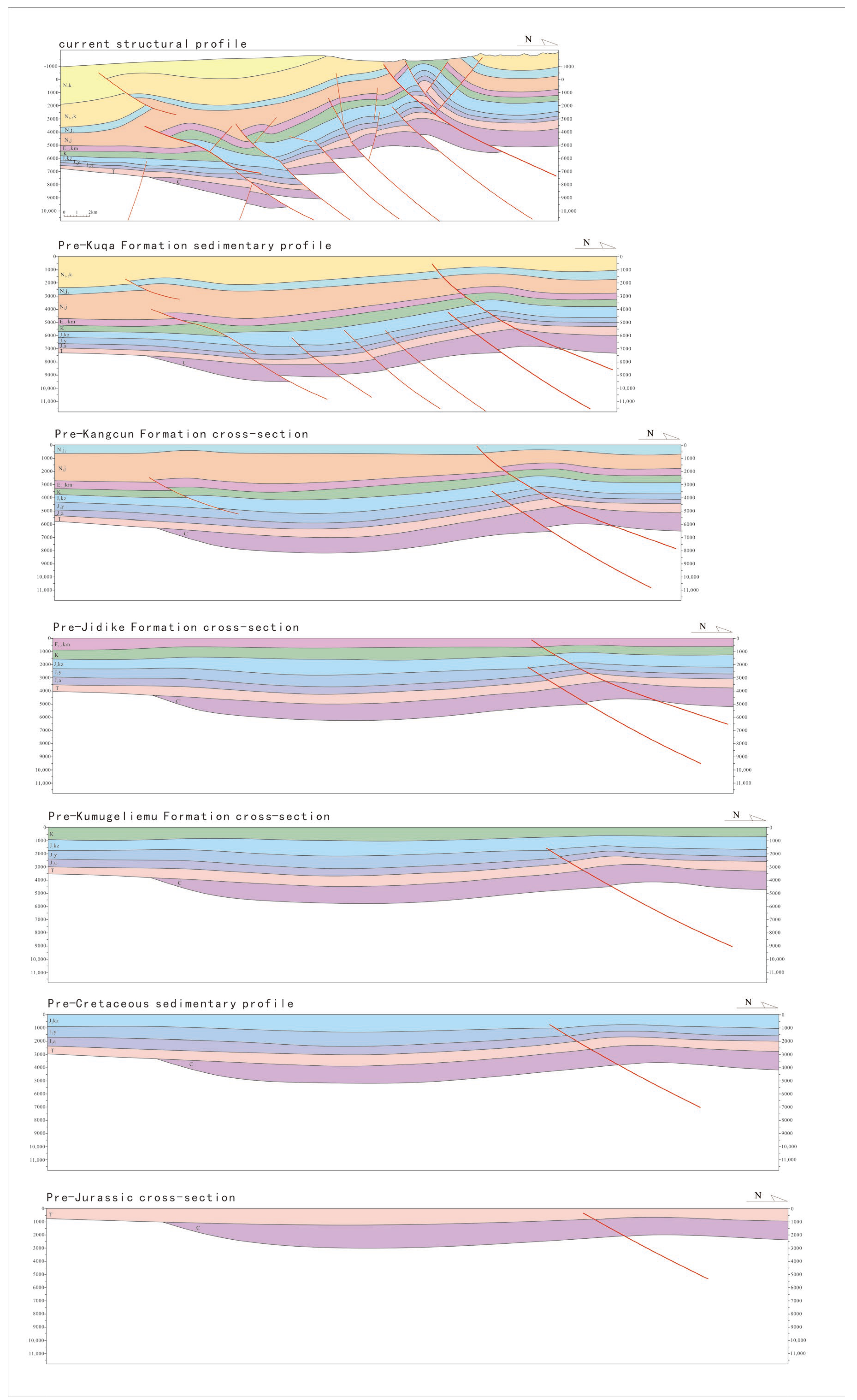
The tectonic evolution of the Dina area is closely related to the development of the Kuqa Depression, the Neo-Tethys Ocean, and regional plate movements. Overall, it can be divided into two major stages: the formation of the Mesozoic basement tectonic framework and the Cenozoic cover reformation and final structural shaping, encompassing seven major deformation events. Integrating stratigraphic development, fault activity, and salt tectonic evolution with regional tectonics [39], the analysis reveals a temporal evolution pattern of Mesozoic–Paleogene–Neogene–Quaternary–present. Spatially, the area exhibits distinct “east–west zonation and north–south segmentation”: in the eastern segment, where the Jidike Formation salt layer predominates, salt structures are small-scale and deformation is weak; in the central–western segment, dominated by the Kumugeliemu Group salt layer, salt structures are spectacular and deformation is intense. In the north–south direction, the area is segmented by major thrust faults such as the Dibei and Dongqiulitage faults, forming multiple tectonic blocks that constitute the unique spatial tectonic framework of the region (Figure 14).
Figure 14.
Seismic profile of the Dina area.
The tectonic evolution of the Dina area is characterized by a large-scale, first-order fault-controlled fault-bend anticline that initiated in the late Miocene and experienced rapid growth during the Pliocene–Quaternary. The frontal zone developed imbricate anticlines, while the central region is marked by a monocline. Late-stage transpressional tectonics, accompanied by strike-slip movements, formed drag structures. The basin-range transition zone constitutes a large fold belt where anticlines manifest as pop-up structural closures, and compression formed large synclines and a northern monocline.
The tectonic evolution of the Dina area in the Kuqa Depression is controlled by multi-phase Cenozoic compression (particularly the Late Miocene to Quaternary Himalayan compression) from the South Tianshan orogenic belt and multiple detachment layers [40,41,42]. Integrating regional tectonic activities with local stratigraphic and structural characteristics allows for the reconstruction of its evolutionary process and the identification of key tectonic stages.
The first stage, spanning the Late Paleozoic to Early Mesozoic (ca. 300–200 Ma), represents the basement fault foundation phase. Regional tectonic activities during this phase led to the coeval formation of basement-involved imbricate thrust systems [15]. Under the control of these early faults, the Dina area established a basement structural framework. This not only defined the fundamental spatial limits for subsequent sedimentation and tectonic deformation but also indirectly governed the initial distribution patterns of hydrocarbon source rocks and reservoir facies.
The second stage (Late Mesozoic) corresponds to the Yanshanian period, representing the phase of sedimentary infill and paleo-structural shaping.”. During this stage, the Dina area underwent fill-to-spill style sedimentation over the pre-existing paleo-thrust structures, effectively leveling the tectonic paleo-topography formed during the Late Hercynian to Indosinian periods [38]. The deposition of the Upper Triassic to Paleogene strata was strictly controlled by this paleo-structure. Notably, the Jurassic coal-measure strata underwent continuous deposition and gradual thickening. This lithological sequence, rich in mudstone and coal seams, later played a crucial role as a “brittle detachment layer” during tectonic deformation [43]. Its presence provided the necessary material conditions for decoupled deformation between the deep and middle structural systems in the Kuqa Depression, allowing overlying strata to slide and fold independently of the basement. This mechanical stratification serves as the prerequisite for the formation of composite petroleum accumulation zones [2].
The third stage corresponds to the Cenozoic era (Paleogene to Neogene, ca. 66–2.6 Ma), which represents the phase of stable sedimentation and detachment layer formation. During this stage, tectonic activity was relatively gentle, resulting in the deposition of regional Paleogene and Neogene gypsum-salt rocks in the Dina area. These evaporites, together with the previously formed Jurassic coal-measure mudstones, constitute the three core regional detachment layers in this region [3]. From a petroleum system perspective, this stage not only formed an excellent regional seal that effectively prevented the vertical escape of underlying hydrocarbons, but also provided the physical foundation for the formation of complex salt-related structural traps under subsequent compressive regimes, thereby achieving a synergetic evolution of “seal formation” and “structural style” [44].
The fourth stage corresponds to the Late Cenozoic (particularly since the Late Miocene, ca. 10–0 Ma), which represents the phase of tectonic deformation and final shaping. This period marks the primary formation phase of the Dina area structures. Under the intense compression from the South Tianshan, the gypsum-salt and coal-measure mudstone detachment layers underwent ductile flow, driving the regional stratified deformation patterns of “above-salt/below-salt” and “above-coal/below-coal.” Furthermore, the tectonic compression during the Late Himalayan period generated critical structural fractures, such as shear fractures, which are essential for hydrocarbon reservoirs [45]. These fractures greatly improved reservoir permeability and established preferential pathways for vertical hydrocarbon migration. During this stage, the timing of structural trap formation achieved precise “temporal-spatial coupling” with the massive hydrocarbon generation and expulsion from deep source rocks, representing the critical moment for efficient hydrocarbon charging and accumulation [22].
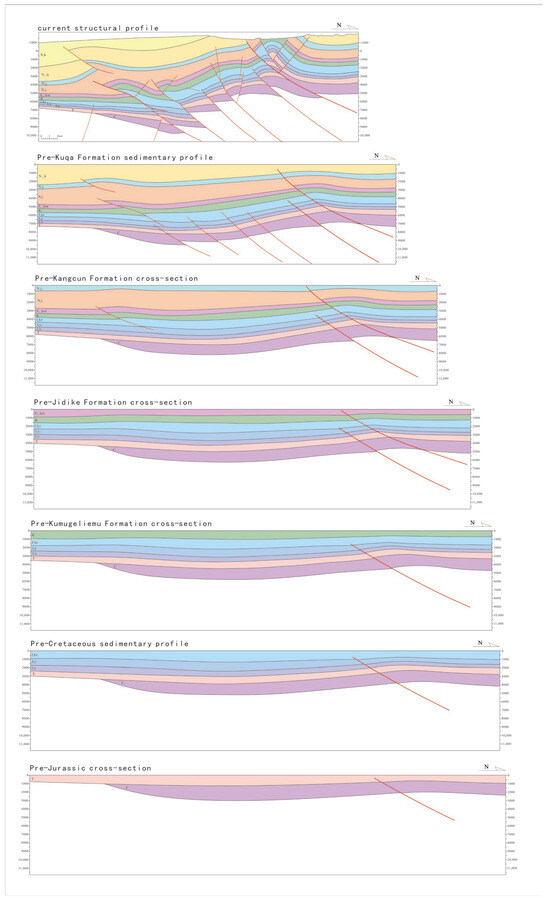
Subsequently, from the Quaternary to the present, the area has entered a stage of tectonic stability and minor adjustment. The overall tectonic framework of the Dina area has been established, without significant new faulting or nascent salt tectonics. Tectonic activity is mainly manifested by minor fault movements and slow stratal subsidence, receiving Quaternary unconsolidated sediments. Regionally, the continuous uplift of the Tianshan Mountains maintains stable compressive stress on the Dina area, preserving the overpressured gas reservoir environment. The structural morphology and stratigraphic architecture have not undergone major adjustments, ultimately forming the current complex tectonic framework controlled by two major thrust faults and developed salt structures (Figure 15).
Figure 15.
Balanced cross-section illustrating the tectonic evolution of the Dina area.
5.3. Control of Tectonic Deformation on Hydrocarbon Trap Formation
Based on the aforementioned experimental results and analysis of relevant literature, tectonic deformation acts as the core driving force for hydrocarbon trap formation in foreland basins. In the Dina area, this manifests as a trinity synergistic control effect of “folding–faulting–salt detachment,” which establishes the fundamental geological conditions for hydrocarbon accumulation through structural style differentiation, spatial trap shaping, and effectiveness modification.
5.3.1. Correspondence Between Fold Structures and Trap Development
The fold structures in the Dina area are jointly influenced by multi-phase compression from the foreland thrust belt and salt detachment layers, exhibiting significant layered deformation characteristics above and below the salt. This forms two types of traps with different genetic mechanisms. The supra-salt structural layer is dominated by large-scale thrust-detachment structures. Affected by the ductile flow of gypsum-salt in the Jidike Formation, steep fault-related folds develop where the fold axial strata are tight and the limbs are gentle, forming typical thrust-detachment fold traps. These traps are characterized by short vertical extension and extensive lateral distribution; the Suweiyi Formation gas-bearing series of the Dina 1 gas reservoir are located within this type of trap. Controlled by the regional compressive setting, the subsalt structural layer is primarily characterized by thrust anticlines, such as the subsalt thrust anticline of the Dina 2 structure, which is constrained between the Dongqiulitage and Dibei faults [3]. This structure features a complete anticlinal morphology with a large closure area. The core comprises competent strata of the Cretaceous Bashijiqike Formation, with the limbs sealed by thrust faults, forming a basement-controlled anticlinal trap that serves as the primary site for deep hydrocarbon accumulation.
5.3.2. Influence of Fault Structures on Trap Integrity
The fault structures in the Dina area are predominantly north-dipping thrust and nappe faults, controlling trap effectiveness in three aspects: boundary definition, migration pathway construction, and reservoir property enhancement. The Dongqiulitage and Dibei faults constitute the regional structural boundaries, forming a “two-faults-enclosing-an-anticline” trap configuration. The thrusting of these faults uplifted the hanging wall strata and deeply buried the footwall strata, where the lateral sealing of the anticline core strata by the faults collectively defines the trap boundaries. The multi-phase activity of the faults created a “cyclic opening and closing” pathway effect. During the intense faulting stage of the Late Himalayan period, the faults became more permeable, serving as preferential vertical migration pathways connecting the deep Mesozoic source rocks with the shallow reservoirs. In contrast, during tectonically stable periods, reduced fault activity and the filling of fault planes with mudstone and gypsum-salt rocks formed effective seals, ensuring trap preservation. Hydrocarbons in the Dina 2 gas field migrated vertically through the Dongqiulitage and Dibei faults from deep Mesozoic source rocks into the subsalt buried anticline traps. Shear and extensional fractures induced by tectonic compression effectively improved the permeability of the Paleogene Suweiyi and Kumugeliemu sandstone reservoirs. The fracture networks not only expanded the storage space but also constructed microscopic pathways for lateral hydrocarbon migration, transforming originally low-porosity and low-permeability sandstone reservoirs into effective reservoirs and enhancing trap hydrocarbon saturation.
5.3.3. Transformation Effects of Salt Detachment and Structural Layering on Traps
The Dina area features three regional detachment layers, among which the ductile flow of the salt detachment layer significantly modifies trap morphology and effectiveness. The layered deformation above and below the salt further leads to vertical differentiation of trap types. The supra-salt sequence is dominated by thrust-detachment traps, whose effectiveness is controlled by the intensity of salt flow and often forms “piggyback” thrust traps. In contrast, the subsalt sequence, supported by the rigid basement paleo-high, forms thrust anticline traps with greater stability. The effectiveness of these subsalt traps is dually controlled by basement morphology and fault sealing capacity. The sealing integrity of subsalt traps in the Dina area is generally superior to that of supra-salt traps, a phenomenon closely related to the “stress decoupling” effect of the salt detachment layer. Specifically, the ductile flow of salt effectively impedes the transmission of shallow tectonic stress to deeper levels, thereby ensuring the integrity of subsalt traps.
5.4. Coupling Relationship Between Tectonic Factors and Hydrocarbon Enrichment
Tectonic evolution is one of the essential factors for hydrocarbon enrichment in the Dina area, dominating the spatial and temporal distribution of hydrocarbons through a “time-space” coupling mechanism.
5.4.1. Analysis of the Matching Between Tectonically Favorable Areas and Hydrocarbon Reservoir Distribution
The four-stage tectonic evolution model of the Dina area achieves a precise chronological match with the critical moments of hydrocarbon accumulation. During the basement fault foundation stage of the Late Hercynian to Indosinian periods, the initial distribution framework of Permian source rocks, dark mudstones and coal-measure source rocks of the Triassic Huangshanjie and Taliqike formations, and reservoir facies belts was established, providing the material basis for subsequent accumulation. In the Yanshanian sedimentary filling stage, the continuous deposition and thickening of Jurassic coal-measure source rocks, coupled with the formation of a regional brittle detachment layer, created conditions for hydrocarbon generation and tectonic deformation. The stable sedimentation stage of the Early Himalayan period saw the formation of gypsum-salt detachment layers, which established high-quality reservoir–seal associations and ensured the sealing potential of traps. During the tectonic shaping stage of the Late Himalayan period, intense compression from the South Tianshan led to intensified structural deformation, frequent fault activity, and the development of fracture systems. Coincidentally, source rocks entered the mature to highly mature stages, and overpressure systems formed and drove hydrocarbon migration. This achieved a synchronous coupling of “structure-accumulation,” becoming the critical moment for hydrocarbon accumulation. From the Quaternary to the present, the tectonic stable stage, characterized by minor fault activity and slow stratal subsidence, has maintained the overpressured gas reservoir environment, ensuring reservoir preservation and preventing the escape of accumulated hydrocarbons, thus keeping the Dina 2 gas field and Dibei gas reservoirs in a state of high-efficiency enrichment. Multiple studies have confirmed that the accumulation age of the Dina 2 gas field is highly consistent with the tectonic shaping period of the Late Himalayan, verifying the coupling effect between tectonic evolution timing and critical accumulation moments [19,39,43].
5.4.2. Spatio-Temporal Coupling of Tectonic Evolution and Critical Accumulation Moments
The tectonic evolution of the Dina area achieves a precise spatio-temporal coupling with critical moments of hydrocarbon accumulation, where temporal and spatial linkage controls efficient hydrocarbon enrichment. Temporally, integrating previous studies and regional tectonic mechanisms [16,19,39,46], the Late Hercynian–Indosinian basement paleo-uplift established the initial material framework for accumulation. The Yanshanian deposition of Jurassic source rocks and formation of brittle detachment layers provided prerequisites for accumulation. The Early Himalayan construction of gypsum-salt detachment layers established high-quality reservoir–seal associations [16]. In the late stage, intense compression from the South Tianshan drove synchronous tectonic shaping, source rock maturation (mature to highly mature stages), and overpressure-driven migration, which was the key to accumulation. The preservation of the gas reservoir is maintained by Quaternary stable tectonics. The accumulation period of the Dina 2 gas field is highly consistent with the structural finalization period [19,39,46], highlighting the dominant control of tectonic evolution on hydrocarbon accumulation [47]. Spatially, reservoirs follow a pattern of “structural belt controlling traps, fault zones guiding migration, and salt-related structures enriching accumulation.” Trap size and effectiveness are regulated by multiple factors with a clear hierarchy: the basement paleo-uplift is the primary controlling factor, governing the distribution and scale of subsalt anticlinal traps and determining the macro pattern of enrichment zones [46]; gypsum-salt thickness and distribution are secondary factors, where ductile flow modulates strain partitioning and ensures trap sealing [46];thrust faults are auxiliary factors, controlling migration pathways and lateral trap sealing. The synergistic action of these factors makes the eastern Qiulitage tectonic belt and the eastern segment of the northern Kuqa Depression the core enrichment areas. The thrust-detachment belt and subsalt anticlines are the preferred targets. Erosional unconformities revealed by experiments further optimize accumulation conditions, achieving efficient hydrocarbon enrichment under spatio-temporal coupling.
6. Conclusions
Taking the Dina area in the Cenozoic Kuqa Depression as a geological prototype, this study evaluates the influence of surface factors—such as paleo-uplifts, salt thickness, erosion, and syndeposition—on tectonic deformation styles under multi-phase deformation dominated by Late Himalayan (Pliocene–Quaternary) compression through tectonic physical modeling experiments. Combined with a review of relevant literature, the following conclusions are drawn:
- (1)
- The control of tectonic deformation on hydrocarbon trap formation in the Dina area exhibits significant stratification and segmentation. The supra-salt structural layer is dominated by thrust-detachment fold traps, whereas the subsalt structural layer is characterized by basement-controlled anticlinal traps. Fault structures define trap boundaries and establish migration pathways, while the salt detachment layer regulates trap morphology and effectiveness through strain partitioning. These elements collectively constitute a “diverse trap system.”
- (2)
- The basement paleo-uplift, salt thickness, syndeposition, and erosion are the four core factors controlling tectonic deformation and hydrocarbon accumulation in the Dina area. The basement paleo-uplift determines structural differentiation and the spatial distribution of traps. Salt thickness modulates strain partitioning and trap stability. Syndeposition optimizes trap conditions through tectonic–sedimentary coupling. Erosional unconformities serve dual functions as migration pathways and trap seals. These four factors act synergistically to regulate the entire process of “trap formation–migration pathway–enrichment and preservation” through tectonic deformation.
- (3)
- Hydrocarbon exploration in the Dina area should prioritize the “subsalt thrust anticline belts” and the “syndepositional growth strata development areas within the thrust-detachment belts.” These regions represent the optimal coupling zones of tectonic deformation and accumulation conditions, possessing the trinity advantages of high-quality traps, efficient migration pathways, and favorable preservation conditions, thus serving as the key targets for future hydrocarbon exploration.
Author Contributions
Writing and experiments, Z.W.; manuscript design and conceptualization, J.Z.; writing—review and editing and experimental design, Y.M.; experiments and figure drawing, Y.W.; experiments and figure drawing, H.L.; experiments, J.S.; data curation, K.X.; literature investigation, Y.S. All authors have read and agreed to the published version of the manuscript.
Funding
This research was funded by the National Science and Technology Major Project of China for New Oil and Gas Exploration and Development, Special Subject “Fine Description and Evaluation Technology of Deep and Ultra-deep Clastic Reservoir Traps” (No.: 2025ZD1402401), and the Key Research and Development Program of Xinjiang Uygur Autonomous Region (2024B01015).
Institutional Review Board Statement
Not applicable.
Informed Consent Statement
Not applicable.
Data Availability Statement
The raw data supporting the conclusions of this article will be made available by the authors on request.
Acknowledgments
This research was supported by the National Science and Technology Major Project of China for New Oil and Gas Exploration and Development, Special Subject “Fine Description and Evaluation Technology of Deep and Ultra-deep Clastic Reservoir Traps” (2025ZD1402401), and the Key Research and Development Program of Xinjiang Uygur Autonomous Region (2024B01015). The authors gratefully acknowledge financial support of the above-mentioned agencies.
Conflicts of Interest
The authors declare no conflicts of interest.
References
- Magoon, L.B.; Dow, W.G. The Petroleum System from Source to Trap. Aapg Mem. 1991, 14, 627. [Google Scholar] [CrossRef] [Scilit]
- Suppe, J. Geometry and kinematics of fault-bend folding. Am. J. Sci. 1983, 283, 684–721. [Google Scholar] [CrossRef] [Scilit]
- Yang, M.H.; Jin, Z.J.; Lü, X.X.; Tan, C.T.; Guo, Z.B.; Zhang, X. Displacement transfer structure and its evolution in the Dongqiulitage fold-thrust belt, Kuqa Depression: With a discussion on the formation of lateral ramp-related anticlinal traps. Acta Geol. Sin. 2006, 80, 321–329. [Google Scholar] [CrossRef]
- Jia, C.Z. Tectonic characteristics and natural gas enrichment rules of foreland thrust belts in central and western China. Pet. Explor. Dev. 2005, 32, 9–15. [Google Scholar]
- Wang, S.; Dai, J.S.; Wang, K.; Fu, X.; Xu, K. Control of Tectonic Forces on Fracture Development Based on Numerical Simulation Analysis. Spec. Oil Gas Reserv. 2016, 23, 70–74. [Google Scholar] [CrossRef]
- Neng, Y.; Li, Y.; Xu, L.L.; Zhou, P.; Wang, B.; Shang, J.W.; Cao, S.J. Patterns of Fracture Zone in the Deep Subsalt Layer of Kelasu Structural Belt and Prospecting Method. Geotecton. Metallog. 2017, 41, 61–68. [Google Scholar] [CrossRef]
- Tavakoli-Shirazi, S.; Dominique, F.D.L.; Wrobel-Daveau, J.C.; Ringenbach, J.-C. Pre-Permian uplift and diffuse extensional deformation in the High Zagros Belt (Iran): Integration in the geodynamic evolution of the Arabian plate. Arab. J. Geosci. 2013, 6, 2329–2342. [Google Scholar] [CrossRef] [Scilit]
- Molinaro, M.; Leturmy, P.; Guezou, J.; de Lamotte, D.F.; Eshraghi, S.A. The structure and kinematics of the southeastern Zagros fold-thrust belt, Iran: From thin-skinned to thick-skinned tectonics. Tectonics 2005, 24, TC3007. [Google Scholar] [CrossRef] [Scilit]
- Molliex, S.; Bellier, O.; Terrier, M.; Lamarche, J.; Martelet, G.; Espurt, N. Tectonic and sedimentary inheritance on the structural framework of Provence (SE France): Importance of the Salon-Cavaillon fault. Tectonophysics 2011, 501, 1–16. [Google Scholar] [CrossRef] [Scilit]
- Hughes, A.N.; Benesh, N.P.; Shaw, J.H. Factors that control the development of fault-bend versus fault-propagation folds: Insights from mechanical models based on the discrete element method (DEM). J. Struct. Geol. 2014, 68, 121–141. [Google Scholar] [CrossRef] [Scilit]
- Liu, J.; Zhang, J.; Ma, F.; Wang, M.; Sun, Y. Estimation of Seismic Velocities and Gas Hydrate Concentrations: A Case Study from the Shenhu Area, Northern South China Sea. Mar. Pet. Geol. 2017, 88, 225–234. [Google Scholar] [CrossRef] [Scilit]
- Mitra, S. Geometry and kinematic evolution of inversion structures. AAPG Bull. 1993, 77, 219–239. [Google Scholar] [CrossRef] [Scilit]
- Jin, Z.; Yang, M.; Lu, X.; Sun, D.; Tang, X.; Peng, G.; Lei, G. The tectonics and petroleum system of the Qiulitagh fold and thrust belt, northern Tarim basin, NW China. Mar. Pet. Geol. 2008, 25, 767–777. [Google Scholar] [CrossRef] [Scilit]
- Yang, K.J.; Qi, J.F.; Ma, B.J.; Li, J.; Zhang, B.; Wang, Z. Analysis of differences and controlling factors of supra-salt and sub-salt tectonic deformation in the Kelasu tectonic belt, Kuqa Depression. Geotecton. Metallog. 2018, 42, 211–224. [Google Scholar] [CrossRef]
- Wang, K.; Xiao, A.C.; Cao, T.; Zhang, L.; Li, J.; Wang, J. Geological structure and petroleum exploration domains of the northern tectonic belt in the Kuqa Depression, Tarim Basin. Acta Geol. Sin. 2022, 96, 368–386. [Google Scholar] [CrossRef]
- Duan, Y.J.; Huang, S.Y.; Luo, C.M.; Zhang, B.; Li, J.; Zhang, X. Balanced restoration of salt-related structures and discussion on related issues in the Kuqa Depression, Tarim Basin. Nat. Gas Geosci. 2023, 34, 789–802. [Google Scholar] [CrossRef]
- Luo, Y.; Li, J.H.; Yang, M.L. Comparison of tectonic and sedimentary evolution of the West African margin basins in the South Atlantic. Geol. China 2021, 48, 120–128. [Google Scholar] [CrossRef]
- Bahroudi, A.; Koyi, H. Effect of spatial distribution of Hormuz salt on deformation style in the Zagros fold and thrust belt: An analogue modelling approach. J. Geol. Soc. 2003, 160, 719–733. [Google Scholar] [CrossRef] [Scilit]
- Ma, Y.J.; Xie, H.W.; Cai, Z.Z.; Zhang, L.; Li, J.; Wang, Z. Geological characteristics of the Dina 2 gas field in the Kuqa Depression. Nat. Gas Geosci. 2003, 14, 371–374. [Google Scholar] [CrossRef]
- Yang, H.J.; Sun, X.W.; Pan, Y.Y.; Zhang, B.; Li, J.; Zhang, X. Tectonic deformation patterns and petroleum exploration directions in the western Kelasu tectonic belt, Tarim Basin. Nat. Gas Ind. 2020, 40, 31–37. [Google Scholar] [CrossRef]
- Yuan, H.; Ju, W.; Zhang, H.; Xu, K.; Ning, W. Differential structural styles and their influence on in-situ stress distribution in Kelasu tectonic belt, Kuqa Depression, Tarim Basin. Pet. Geol. Exp. 2025, 47, 1255–1267. [Google Scholar] [CrossRef]
- Sun, D.S.; Jin, Z.J.; Lü, X.X.; Zhang, Y.; Li, J.; Wang, Z. Accumulation mechanism and timing of the Dina 2 gas field in the Kuqa Depression. Oil Gas Geol. 2004, 25, 559–564. [Google Scholar] [CrossRef]
- Yu, Y. Salt-Related Structures and Their Formation Mechanism in the Qiulitage Structural Belt, Kuqa Depression; China University of Petroleum: Beijing, China, 2006; Available online: https://kns.cnki.net/kcms2/article/abstract?v=D7za5G2w26x1AVTy8j18SJV6xTKy2zIJZTwDCkb-XLLWkeqvOz7yNbjVSho8-n8z2E7c5zbLo6Z_WrxTJbwHF9-gR5-ZtQW3SnNGXXWltyCAc04FxpF7rWcfWOJZ9yuff-tcGlff1dIwxfG2TF-vFPo-ofyJ8x_rnKJnHRIxYWPfpbTYEuH4bbP2AqIVwddC&uniplatform=NZKPT&language=CHS (accessed on 5 March 2026).
- Tang, L.J.; Jia, C.Z.; Jin, Z.J.; Chen, S.-P.; Pi, X.-J.; Xie, H.-W. Salt tectonic evolution and hydrocarbon accumulation of Kuqa foreland fold belt, Tarim Basin, NW China. J. Pet. Sci. Eng. 2004, 41, 97–108. [Google Scholar] [CrossRef] [Scilit]
- Ma, W.T. Study on the basic characteristics of petroleum geology in Tarim Basin. China Pet. Chem. Stand. Qual. 2017, 37, 55–56+58. [Google Scholar]
- Harding, P.T. Petroleum traps associated with wrench faults. AAPG Bull. 1974, 58, 1290–1304. [Google Scholar] [CrossRef] [Scilit]
- Duan, Y.J.; Luo, H.Y.; Xie, H.W.; Zhang, L.; Li, J.; Wang, J. Salt-related structural characteristics and deformation mechanism of the Zhongqiu-Dongqiu section of the Qiulitag structural belt, Tarim Basin. Nat. Gas Geosci. 2021, 32, 993–1008. [Google Scholar] [CrossRef]
- Zhang, W.; Xu, Z.P.; Zhao, F.Q.; Li, J.; Zhang, B.; Wang, Z. Tectonic deformation patterns and evolutionary characteristics in the eastern Kuqa Depression. Xinjiang Pet. Geol. 2019, 40, 48–53. [Google Scholar] [CrossRef]
- Chen, W.L.; Mo, T.; Hu, C.L.; Zhang, L.; Li, J.; Wang, J. Analogue modeling of sub-salt tectonic deformation controlled by paleo-uplifts in foreland basins: A case study of the Bozi-Dabei area in the Kuqa Depression. Pet. Sci. 2023, 20, 1885–1898. [Google Scholar]
- Hong, C.; Zhang, L.; Lin, X.B.; Sun, D.; Chen, H.L.; Chen, C.; Cheng, X.G.; Zhang, F.Q. Tectonic Physical Simulation of Deformation in Southwest Tarim Basin: Implications for Erosion and Synsedimentary Effects on Fold-and-Thrust Belt Deformation. Quat. Sci. 2022, 42, 692–703. [Google Scholar] [CrossRef]
- Yang, X.L. Physical Simulation of Deformation and Evolution of Compressive Salt Structures in the Western Kuqa Depression; East China University of Technology: Fuzhou, China, 2023. [Google Scholar] [CrossRef]
- Dou, F.P.; Li, J.H.; Peng, M. Tectonic deformation mechanism of the fault zone in the northwest margin of Junggar Basin: Based on physical experimental simulation. Geol. Bull. China 2024, 43, 527–535. [Google Scholar]
- Long, Y. Physical Simulation of the Control of Detachment Layers, Paleo-Uplifts, and Syndepositional Tectonics on the Deformation of Fold-Thrust Belts; Zhejiang University: Hangzhou, China, 2023. [Google Scholar] [CrossRef]
- Gao, Z.; Yin, H.; Wu, C.; Chen, W.; Zhao, J.; He, W.; Wang, W. Growth of thrust-faults in fold-and-thrust belts: An example from the Kelasu structural belt of the Kuqa depression, Tarim Basin, NW China. J. Asian Earth Sci. 2026, 295, 106870. [Google Scholar] [CrossRef] [Scilit]
- Muñoz, A.J.; Ferrer, O.; Gratacós, O.; Roca, E. The influence of the geometry of salt detachments on thrust salient development: An analogue modelling approach based on the South-Central Pyrenean thrust salient. J. Struct. Geol. 2024, 180, 105078. [Google Scholar] [CrossRef] [Scilit]
- Luo, H.Y.; Zhang, L.; Li, J.; Wang, J.; Zhang, B.; Li, Z. Segmented differential deformation and its main controlling factors in the northern tectonic belt of the Kuqa Depression. Chin. J. Geol. 2025, 60, 619–634. [Google Scholar] [CrossRef]
- He, X.; Yu, P.; Eijsink, A.; Marone, C.; Shokouhi, P.; Rivière, J.; Liu, S.; Elsworth, D. Co-Evolution of Specific Stiffness and Permeability of Rock Fractures Offset in Shear. J. Geophys. Res. Solid Earth 2025, 130, e2024JB030633. [Google Scholar] [CrossRef] [Scilit]
- Zhang, Z.H.; Lü, X.X.; Li, J.J.; Zhang, B.; Wang, Z.; Li, J. Simulation experiment on hydrocarbon migration and accumulation in the Dina 2 structure, Kuqa Depression. Earth Sci. 2004, 29, 500–504. [Google Scholar] [CrossRef]
- Zhu, G.Z.; Yang, H.J.; Zhang, B.; Wang, J.; Li, J.; Zhang, X. Geological characteristics and accumulation mechanisms of the large-scale Dina 2 condensate gas field in the Tarim Basin. Acta Pet. Sin. 2012, 28, 2479–2492. [Google Scholar]
- Li, Y.J.; Wu, G.Y.; Meng, Q.L.; Yang, H.; Han, J.; Li, X.; Dong, L. Fault systems in the central Tarim Basin: Geometry, kinematics and dynamic setting. Chin. J. Geol. 2008, 43, 37. [Google Scholar] [CrossRef]
- Wu, C.; Xu, W.Q.; Mo, T.; Wang, W.; Dong, R.; He, W.; Hu, C.; Gao, Z.; Gu, C.; Yin, H. Deformation of multi-detachment structures beneath salt in the eastern segment of the Kelasu tectonic belt, Kuqa Depression: Insights from numerical simulation. Geol. J. China Univ. 2025, 31, 405–417. [Google Scholar] [CrossRef]
- Wang, B. Study on the Evolution of Formation Pressure in Tectonically Compressed Basins; China University of Petroleum (Beijing): Beijing, China, 2023. [Google Scholar] [CrossRef]
- Li, W.B.; Li, J.H. Deformation Mechanism of Salt Structures in Kuqa Depression: Based on Discrete Element Numerical Simulation. In Abstracts of the 8th Chinese Conference on Petroleum Systems and Reservoirs, Proceedings of the 8th Chinese Conference on Petroleum Systems and Reservoirs, China, 2015; Research Center of Petroleum and Natural Gas, Peking University, Ed.; Ministry of Education Key Laboratory of Orogenic Belt and Crustal Evolution, School of Earth and Space Sciences, Peking University: Beijing, China, 2015; pp. 494–495. Available online: https://kns.cnki.net/kcms2/article/abstract?v=tC3tAMdiXNean8BmYhr1T9bcwx-WVh3dYupxvGIJQj8UBk8etlucDUu0MzATxmpC0Zwb6M5dbrtjdlktDZ511fbtnUIaeO-xP-ymVeo3ax8OVk4yUSQkFu7ICSAec58-urJDiy6lbv6PKB2NdDB_Gcru5bVF7_EsY956Z8-wSZLYjRNL-IMmKodv7aODIfAM&uniplatform=NZKPT&language=CHS (accessed on 5 March 2026).
- Jia, C.Z.; Chen, Z.X.; Lei, Y.L.; Wang, L.; Ren, R.; Su, N.; Yang, G. Tectonic Deformation Mechanisms and Structural Models of Fold-and-Thrust Belts in Central and Western China. Earth Sci. Front. 2022, 29, 156–174. [Google Scholar] [CrossRef]
- Wang, Q.H.; Yang, H.J.; Yang, W.; Zhang, B.; Li, J.; Zhang, X. New advances in ultra-deep clastic rock petroleum geology and future exploration directions in the Kuqa Depression. Pet. Explor. Dev. 2025, 52, 70–83. [Google Scholar] [CrossRef] [Scilit]
- Xue, N.; Zhu, G.Z.; Lü, X.X.; Zhang, L.; Li, J.; Wang, J. Advances in hydrocarbon accumulation chronology. Nat. Gas Geosci. 2020, 31, 1733–1748. [Google Scholar] [CrossRef]
- Zhou, G.; Zhang, Z.; Yan, Z. Ultra-Deep Oil and Gas Geological Characteristics and Exploration Potential in the Sichuan Basin. Appl. Sci. 2025, 15, 11380. [Google Scholar] [CrossRef] [Scilit]

Disclaimer/Publisher’s Note: The statements, opinions and data contained in all publications are solely those of the individual author(s) and contributor(s) and not of MDPI and/or the editor(s). MDPI and/or the editor(s) disclaim responsibility for any injury to people or property resulting from any ideas, methods, instructions or products referred to in the content. |
© 2026 by the authors. Licensee MDPI, Basel, Switzerland. This article is an open access article distributed under the terms and conditions of the Creative Commons Attribution (CC BY) license.