1. Introduction
Interactive systems are increasingly shifting from discrete command-based interfaces toward environments that operate through continuous perceptual feedback. Such interactive installations often introduce new challenges in integrating material systems, interaction design, and user engagement [
1,
2,
3]. In such systems, human bodily activity is not merely interpreted as symbolic input but becomes part of an ongoing interaction loop in which perception and action mutually influence one another. Rather than issuing explicit commands, participants continuously adjust their movements in response to changes in the perceptual environment generated by the system. This shift foregrounds perception as a central mechanism through which interaction unfolds and stabilizes over time, a perspective that aligns with studies showing how interaction can shape perception through embodied engagement [
4].
This perspective has been explored in the fields of human–computer interaction and interactive systems design through the concept of embodied interaction, which emphasizes the role of the human body in shaping computational interaction processes [
5]. Research in multimodal interaction has further demonstrated how bodily movement can be translated into audiovisual feedback, allowing participants to perceive and refine their actions in real time [
6,
7]. Such transformations from signals to perceptual meaning have also been conceptualized in models of multimodal learning and interpretation [
8]. Within these approaches, interaction emerges not as a sequence of discrete commands but as a dynamic feedback relationship between bodily activity, computational interpretation, and perceptual response.
In parallel, interactive installations and public interactive systems have increasingly explored shared perceptual environments in which multiple participants interact simultaneously [
6,
9,
10,
11]. In such contexts, system output reflects the combined activity of participants, enabling indirect coordination through a common perceptual field. These environments suggest that interaction may involve not only individual adaptation but also collective behavioral dynamics emerging through perceptual mediation.
Despite this growing body of work, less attention has been paid to how continuous perceptual feedback shapes the gradual adaptation of bodily behavior over time and how shared computational environments may contribute to the emergence of collective interaction dynamics. Existing research has often focused on interface design, mapping strategies, or multimodal signal interpretation, while the relationship between embodied energy input, perceptual feedback, and collective behavioral alignment remains comparatively underexplored.
This paper addresses this gap by proposing a human-system coupling framework for understanding interactive environments in which embodied human activity is computationally interpreted and returned to participants through perceptual feedback. The framework conceptualizes interaction as a dynamic loop linking four primary components: embodied action, computational interpretation, perceptual environment, and collective interaction. Rather than treating computational systems as discrete input–output interfaces, the framework interprets them as perceptual mediation systems that continuously translate bodily activity into perceptual conditions that influence subsequent action.
To illustrate this framework, the paper draws on EchoCycle, an interactive installation that translates mechanical energy generated by cycling into real-time audiovisual feedback. In this installation, participants generate embodied energy through pedaling motion, which is captured through rotational sensing and computationally mapped to sound and light parameters. The resulting audiovisual environment reflects the collective activity of participants and forms a shared perceptual field. The installation is used here not as a controlled experimental setup but as a practice-based case that allows observation of how bodily action, computational interpretation, and perceptual feedback interact within a responsive environment.
Through observational analysis of interaction patterns, together with signal-based examination of the recorded activity data, the study explores how participant behavior evolves over time within this feedback-driven system. Particular attention is given to the transition from exploratory interaction toward relatively more stable behavioral patterns and to the emergence of cross-participant alignment within the shared perceptual environment.
This practice-based orientation is consistent with research approaches that frame creative works as sites of inquiry and knowledge production [
12]. Therefore, the primary contribution of this paper is conceptual. It introduces a human–system coupling framework that integrates embodied action, computational interpretation, and perceptual feedback into a unified explanatory model for interactive environments. By framing interactive systems as perceptual mediation processes rather than command-based interfaces, the proposed framework offers a perspective that may inform the design of responsive interactive installations, participatory media systems, and perceptually driven computational environments.
The remainder of this paper is organized as follows.
Section 2 reviews prior research on embodied interaction, multimodal feedback systems, and collective coordination in interactive environments.
Section 3 introduces the EchoCycle installation, including its interaction setting, signal acquisition process, and observational scope.
Section 4 presents the proposed human–system coupling framework and specifies its core components and interaction dynamics.
Section 5 illustrates the framework through observations from the EchoCycle installation.
Section 6 discusses the conceptual and design implications of the framework, and
Section 7 concludes the paper.
2. Related Work
2.1. Embodied Interaction and Continuous Feedback
Human-computer interaction research has increasingly emphasized the role of the human body as an integral component of interaction rather than merely a source of input commands. The concept of embodied interaction highlights how bodily action, perception, and system response are dynamically intertwined in computational environments [
5]. Within this perspective, interaction unfolds as a continuous perception–action loop in which users interpret system responses and adapt their movements accordingly.
Design research has explored how interactive systems can be structured around continuous bodily feedback rather than symbolic command execution. Similarly, studies of embodied sound interaction have examined how bodily movement can be translated into sonic feedback, enabling participants to perceive and refine their actions through real-time sensory responses [
13].
Continuous feedback plays a critical role in shaping this interaction process. In multimodal interactive systems, bodily activity can be mapped to audiovisual outputs, allowing participants to perceive the consequences of their actions in real time and adjust their movements accordingly [
6,
7]. From this perspective, interactive systems function not merely as tools for executing commands but as responsive environments that mediate the relationship between bodily action and perceptual experience.
2.2. Perceptual Adaptation in Interactive Systems
When interactive systems provide continuous feedback, participant behavior often evolves over time as users gradually develop an understanding of the relationship between bodily action and system response. Early interaction frequently involves exploratory behavior as participants experiment with different movements to understand the mapping between input and output. Through repeated interaction, users can develop more stable and predictable patterns of activity.
This adaptive process has been documented in studies of embodied musical interaction and interactive performance systems. Similarly, research on multimodal movement analysis demonstrates how computational systems can interpret human activity signals and translate them into perceptual feedback that participants use to refine their actions.
These studies suggest that interaction in feedback-driven environments often involves perceptual learning, in which participants implicitly develop an understanding of system behavior through repeated action–feedback cycles. As a result, behavioral variability may decrease over time as participants adapt their bodily movements to produce more stable and predictable responses from the system.
2.3. Collective Interaction in Shared Perceptual Environments
In interactive environments involving multiple participants, interaction extends beyond individual adaptation to include collective behavioral dynamics. When system output reflects the combined activity of several participants, individuals are able to perceive the presence and actions of others indirectly through the shared perceptual environment.
Interactive installations frequently operate under these conditions, translating participant activity into shared audiovisual feedback that forms a common perceptual field [
6]. Research on public interactive installations has shown that such environments can facilitate engagement and coordinated activity among participants even when direct communication is absent.
Studies of movement synchronization further suggest that shared perceptual cues can lead to temporal alignment among participants. When individuals respond to the same environmental feedback signals, their actions may gradually converge toward similar rhythms or patterns of activity. These processes can be understood as forms of emergent coordination, in which collective interaction arises through perceptual mediation rather than explicit collaboration or instruction. Related perspectives can also be found in studies of interpersonal entrainment and participatory sense-making, which suggest that coordination among individuals may emerge through shared perceptual environments and mutual responsiveness.
2.4. Research Gap and Contribution
Previous research has established several important foundations for understanding interactive systems. Studies of embodied interaction have emphasized the importance of bodily movement and perception in shaping interaction processes [
5,
14]. For example, prior studies have examined how bodily engagement influences interaction design and user experience, often focusing on interface techniques and interaction paradigms.
Research on multimodal interaction has explored how computational systems translate human activity into audiovisual feedback [
7,
8,
15,
16]. These studies typically investigate signal processing, mapping strategies, and real-time system responsiveness, emphasizing how sensor data can be interpreted and transformed into perceptual outputs.
In addition, work on interactive installations has demonstrated how shared environments can support participation and engagement among multiple users [
6,
17,
18]. For instance, interactive artworks and installations often focus on audience participation, immersion, and experiential engagement within spatial environments.
However, these research directions are often examined separately. Studies of embodied interaction typically focus on interaction techniques or interface design, while research on multimodal mapping emphasizes signal interpretation and system responsiveness. Investigations of interactive installations, meanwhile, often emphasize participation and engagement without closely examining how continuous perceptual feedback shapes the gradual adaptation of bodily behavior or contributes to the emergence of collective interaction patterns over time.
As a result, the relationship between embodied energy input, computational interpretation, perceptual feedback, and collective interaction dynamics remains insufficiently articulated as an integrated conceptual model. Although some studies approach aspects of this integration, a comprehensive framework that explicitly connects these components within a unified explanatory structure remains limited.
This paper addresses this gap by proposing a human–system coupling framework that conceptualizes interactive environments as perceptual mediation systems. The framework integrates embodied action, computational interpretation, and perceptual feedback into a single explanatory structure for understanding how interaction unfolds within responsive computational environments. The framework is illustrated through the EchoCycle installation, which serves as a practice-based case for examining how bodily activity, system response, and shared perceptual feedback interact within a dynamic feedback loop.
3. EchoCycle Installation and Interaction Setting
3.1. Installation Overview
To illustrate the proposed human–system coupling framework, this study draws on EchoCycle, an interactive installation that translates human-generated mechanical energy into a shared audiovisual environment. The installation was designed to explore how bodily activity, computational interpretation, and perceptual feedback interact within a continuous perception–action loop.
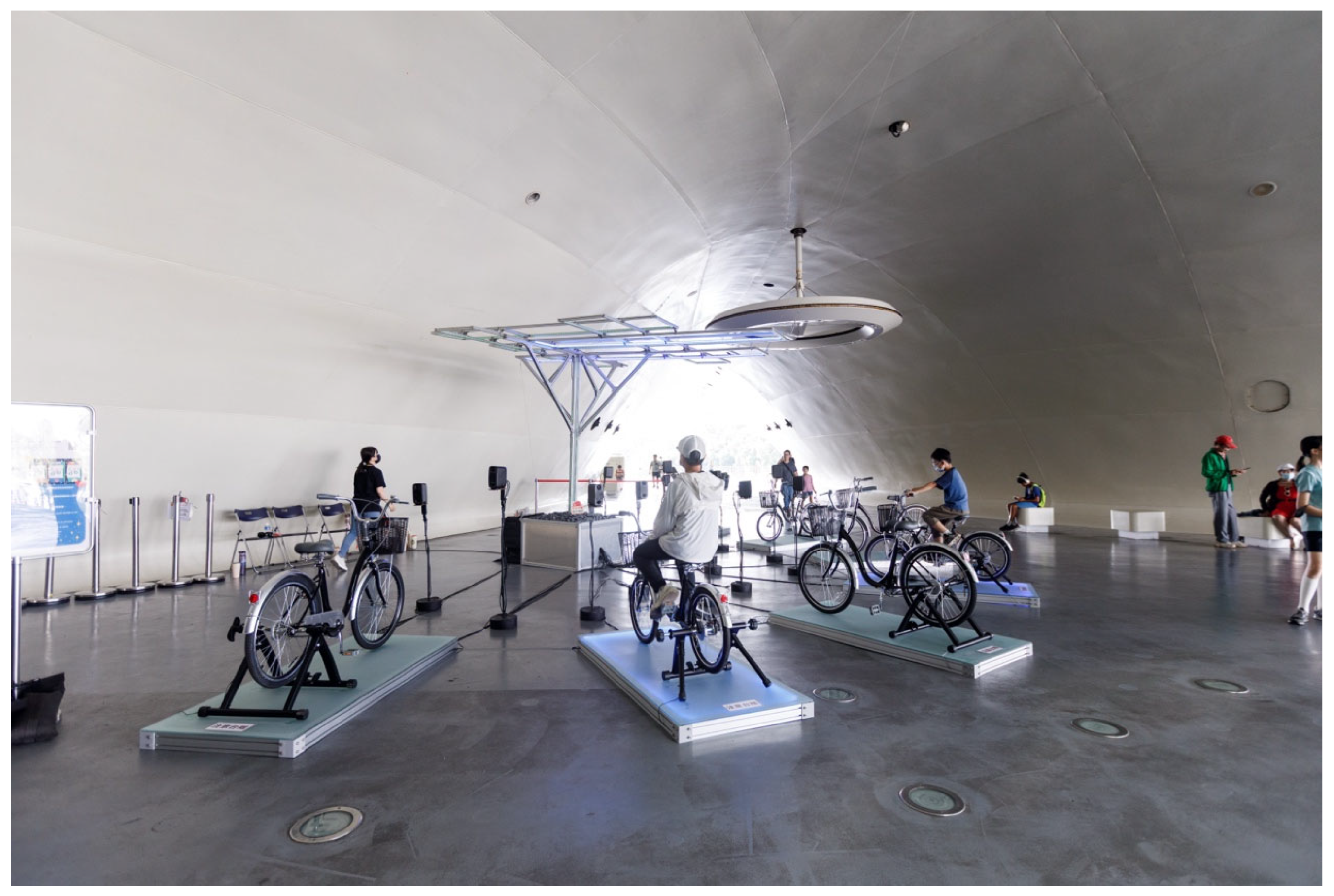
The installation consists of seven stationary bicycles arranged within a shared interactive space. Participants generate mechanical energy through pedaling motion, which is captured through rotational sensing attached to each bicycle. The sensed signals are transmitted to a computational system that continuously translates the detected activity into audiovisual feedback. As participants pedal, their bodily energy is transformed into dynamic sound and light responses that are experienced collectively within the installation environment.
The spatial arrangement of the installation and the multi-user interaction environment are shown in
Figure 1.
Unlike conventional command-based interfaces, the interaction does not involve explicit tasks or symbolic input. Instead, participants influence the audiovisual environment through the continuous modulation of bodily energy, creating a responsive perceptual field that evolves according to the collective activity of all participants present in the installation.
This configuration enables participants to experience the relationship between their own bodily movement, the computational system, and the shared perceptual environment generated by the installation.
3.2. Signal Acquisition and Computational Interpretation
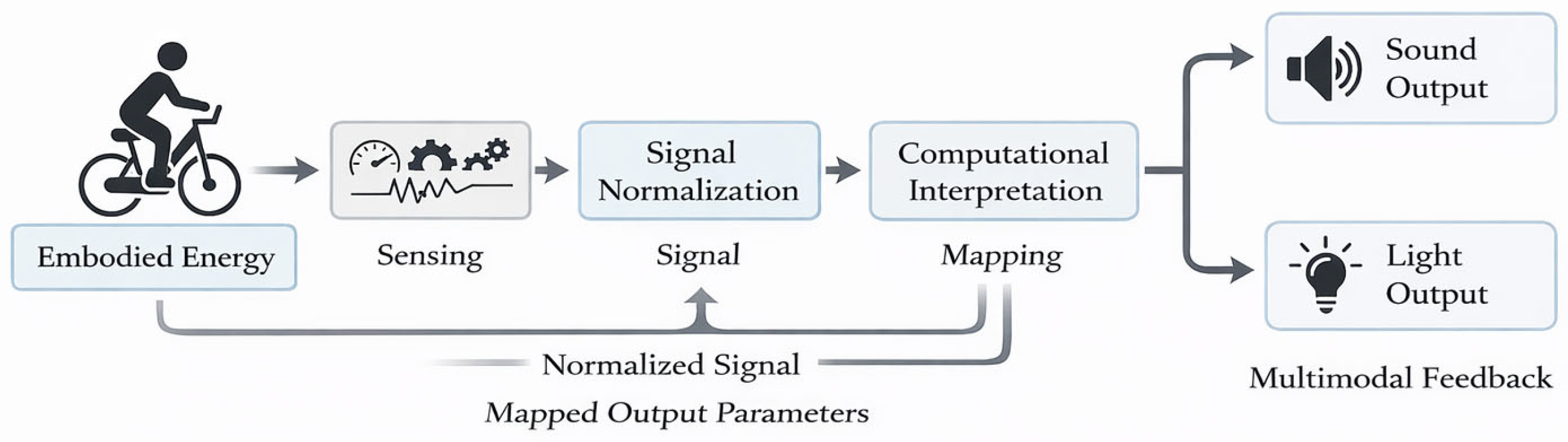
Embodied energy generated through cycling motion serves as the primary input to the interactive system. Each bicycle is equipped with a Hall-effect rotational sensor (Phidgets Inc., Calgary, AB, Canada) mounted on the rear wheel assembly. The sensor detects magnetic pulses corresponding to wheel rotation, enabling real-time measurement of rotational frequency.
Sensor signals are acquired through a Phidgets VINT Hub (HUB0001, Phidgets Inc., Calgary, AB, Canada) and transmitted to the computational system via USB connection. Data acquisition is performed at a sampling rate of 100 Hz, providing sufficient temporal resolution to capture fluctuations in pedaling activity.
Signal processing and audiovisual mapping are implemented using TouchDesigner (version 2023.1, Derivative Inc., Toronto, ON, Canada) running on a Mac mini (Apple Inc., Cupertino, CA, USA). Sensor data are transmitted using the Open Sound Control (OSC) protocol within a local network environment. Measurements indicate an OSC transmission latency of approximately 8–15 ms, which is below the perceptual threshold for audiovisual synchronization in interactive environments.
To reduce noise and irregular fluctuations in pedaling behavior, a temporal smoothing process is applied using an exponential moving average filter:
where x
t represents the raw sensor input, S
t the smoothed signal, and α is set to 0.15; this exponential moving average filter reduces short-term fluctuations while preserving the overall temporal trend of pedaling activity.
The signal processing and computational mapping pipeline used in the installation is illustrated in
Figure 2.
The normalized signals are mapped to several audiovisual parameters within the installation environment, including:
Through this mapping process, participants’ bodily activity directly influences the perceptual characteristics of the environment, enabling continuous feedback between human action and system response.
3.3. Interaction Scenario and Observational Scope
EchoCycle was presented as a public interactive installation in which visitors could voluntarily participate by pedaling one of the stationary bicycles. Participants were not given a predefined task or explicit instructions regarding synchronization or coordination. Instead, they were invited to explore the installation freely and experience how their bodily activity influenced the audiovisual environment.
When multiple participants pedaled simultaneously, the audiovisual output reflected the combined activity of all bicycles, forming a shared perceptual environment. As a result, participants could indirectly perceive the presence and activity of others through changes in sound and light dynamics generated by the system.
The present study adopts a practice-based observational approach rather than a controlled laboratory experiment. The installation therefore serves as an exploratory case through which interaction dynamics in perceptually mediated environments can be examined. Interaction patterns were examined through system logs that recorded pedaling activity signals during installation sessions. These logs provide time-series data representing the rotational activity detected from each bicycle.
Observational analysis focuses on how participant activity evolves over time within this feedback-driven environment. In particular, the analysis examines:
fluctuations in pedaling activity during early interaction phases,
gradual stabilization of activity patterns over time, and
alignment of activity rhythms among multiple participants within the shared perceptual environment.
This observational perspective allows the installation to function as a case through which the proposed human–system coupling framework can be examined in a real interactive context.
4. Human–System Coupling Framework
4.1. Conceptual Overview
The observations from the EchoCycle installation suggest that interaction within responsive environments can be understood as a dynamic coupling process between human participants and computational systems. Rather than functioning as discrete input–output interfaces, such systems operate through continuous feedback loops in which bodily activity, computational interpretation, and perceptual feedback mutually influence one another.
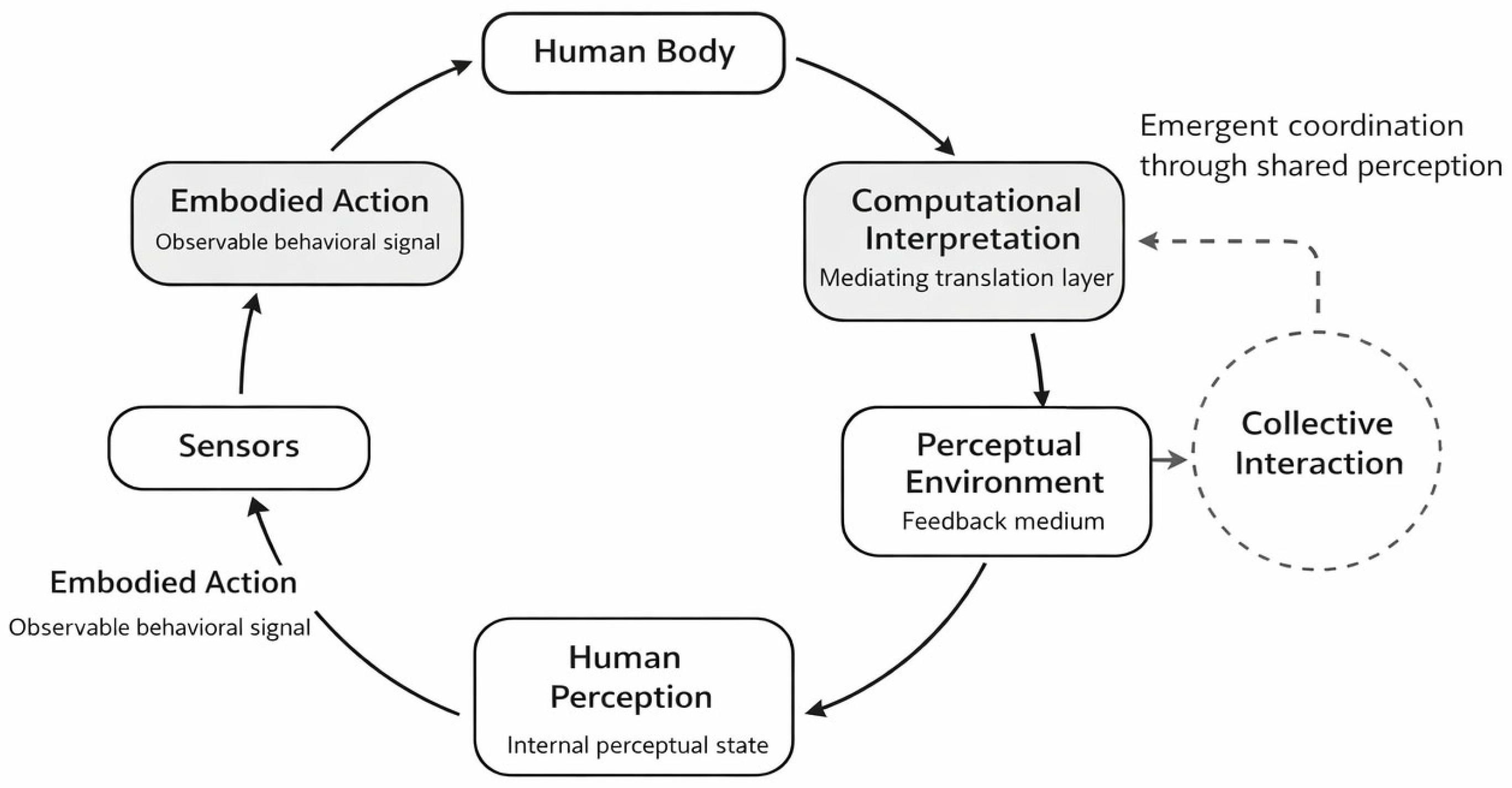
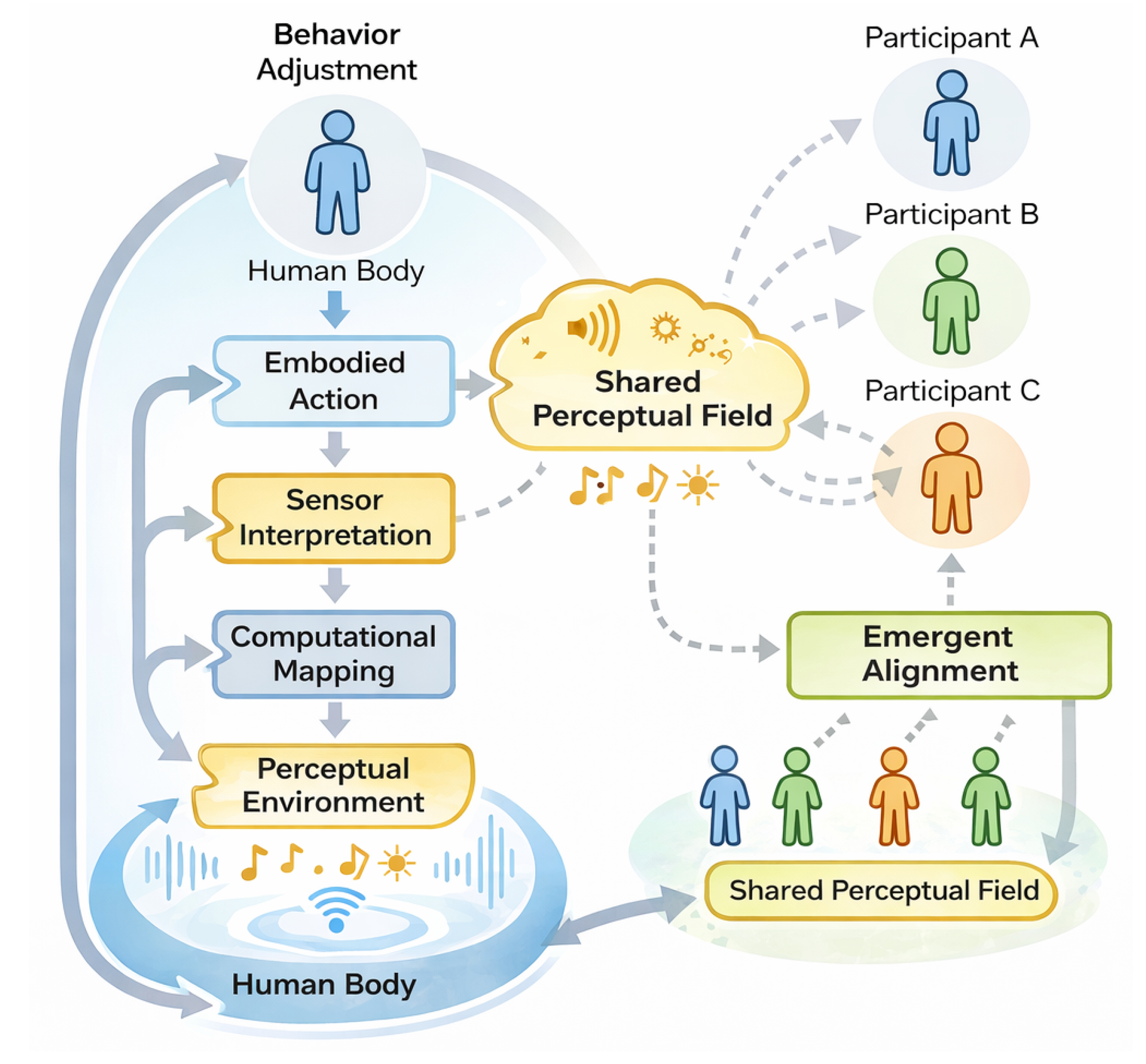
Figure 3 illustrates the conceptual structure of the proposed human–system coupling framework.
Based on this perspective, this paper proposes a human-system coupling framework that conceptualizes interactive environments as perceptual mediation systems. Within this framework, interaction is not defined as a sequence of commands issued by a user to a system. Instead, interaction emerges through ongoing adjustments between bodily action and perceptual feedback generated by the computational environment.
The framework emphasizes the role of perception as a mediating mechanism that links human behavior and system response. Participants generate embodied activity, which is sensed and interpreted computationally. The resulting perceptual output alters the environment experienced by participants, which in turn influences subsequent bodily action. Over time, this continuous perception–action cycle may lead to behavioral adaptation and, in multi-user contexts, collective interaction dynamics.
4.2. Core Components of the Framework
The human–system coupling framework can be described through several core components and their roles within the interaction loop, as summarized in
Table 1. Together, these components form a continuous perception–action cycle linking embodied human activity, computational interpretation, and perceptual feedback within the interactive environment, establishing a dynamic coupling relationship between participants and the computational system, as illustrated in
Figure 4.
These components describe how embodied human activity is captured, interpreted, and returned to participants through a shared perceptual environment, enabling adaptive interaction dynamics and the potential emergence of collective coordination.
In this framework, the human body generates embodied energy through physical movement. These actions produce measurable signals that are captured through sensing systems. The signals are then processed by the computational interpretation layer, which translates them into perceptual parameters such as sound, light, or spatial motion.
The resulting audiovisual output forms the perceptual environment, which participants experience directly. This environment acts as a feedback medium through which participants perceive the consequences of their actions.
In interactive environments involving multiple users, this perceptual field becomes a shared space in which participants indirectly perceive the activity of others. Under such conditions, interaction extends beyond individual feedback loops to include collective interaction dynamics.
4.3. Interaction Loop Dynamics
The components of the framework form a continuous interaction loop that links human behavior and computational response. The loop can be described as a sequence of interacting processes:
Embodied action generates physical signals through bodily movement.
Sensors capture these signals, translating physical activity into digital data.
Computational interpretation maps the signals to perceptual parameters within the interactive system.
Perceptual feedback is returned to participants through audiovisual changes in the environment.
Participants perceive these changes and adjust their movements, influencing the next cycle of interaction.
Through repeated iterations of this loop, interaction evolves over time as participants adapt their behavior in response to perceptual feedback.
In multi-user environments, the perceptual environment reflects the combined activity of multiple participants. As a result, individuals may indirectly perceive the actions of others through the shared audiovisual environment. This condition creates the possibility for emergent collective coordination, in which participants gradually align aspects of their behavior through perceptual mediation rather than explicit communication.
Importantly, the framework does not assume that synchronization or coordination will always occur. Instead, it provides a conceptual structure for interpreting how feedback-driven environments may enable such dynamics under certain interaction conditions.
4.4. Framework Implications for Interactive Systems
The human–system coupling framework suggests a shift in how interactive systems can be conceptualized and designed.
First, it emphasizes that computational systems can function as perceptual mediation environments rather than command-based tools. In such systems, interaction is shaped not by discrete input events but by continuous relationships between bodily action and perceptual response.
Second, the framework highlights the importance of feedback sensitivity in shaping user behavior. When perceptual feedback responds clearly and continuously to bodily activity, participants may gradually adapt their movements to stabilize interaction with the system.
Third, the framework suggests that shared perceptual environments can support emergent collective dynamics. When multiple participants influence the same perceptual field, individual actions become perceptible within a collective feedback environment, potentially enabling alignment or coordination of activity.
From a design perspective, these insights suggest that interactive environments can be structured to support adaptive and socially mediated interaction by carefully designing the relationships between sensing, computational interpretation, and perceptual feedback.
Rather than treating interaction as a sequence of commands and responses, the human–system coupling framework proposes understanding interactive systems as dynamic perceptual loops in which human behavior and computational processes continuously influence one another.
5. Framework Illustration Through EchoCycle
5.1. Exploration Phase
At the beginning of interaction, participants typically engaged with the installation in an exploratory manner. When users first began pedaling, the audiovisual feedback generated by the system changed rapidly in response to variations in cycling speed and intensity. During this phase, participants appeared to experiment with different pedaling patterns in order to understand how their bodily activity influenced the perceptual environment.
This exploratory behavior was reflected in the sensor logs, which showed relatively high variability in pedaling signals during early interaction periods. Fluctuations in rotational speed produced corresponding variations in sound amplitude and visual motion, resulting in dynamic and irregular audiovisual output.
From the perspective of the human–system coupling framework, this phase can be interpreted as a period in which participants were establishing an initial perception-action relationship with the interactive system. Participants had not yet developed an implicit understanding of the mapping between bodily activity and system response, and therefore explored different forms of movement within the perceptual environment.
5.2. Behavioral Stabilization
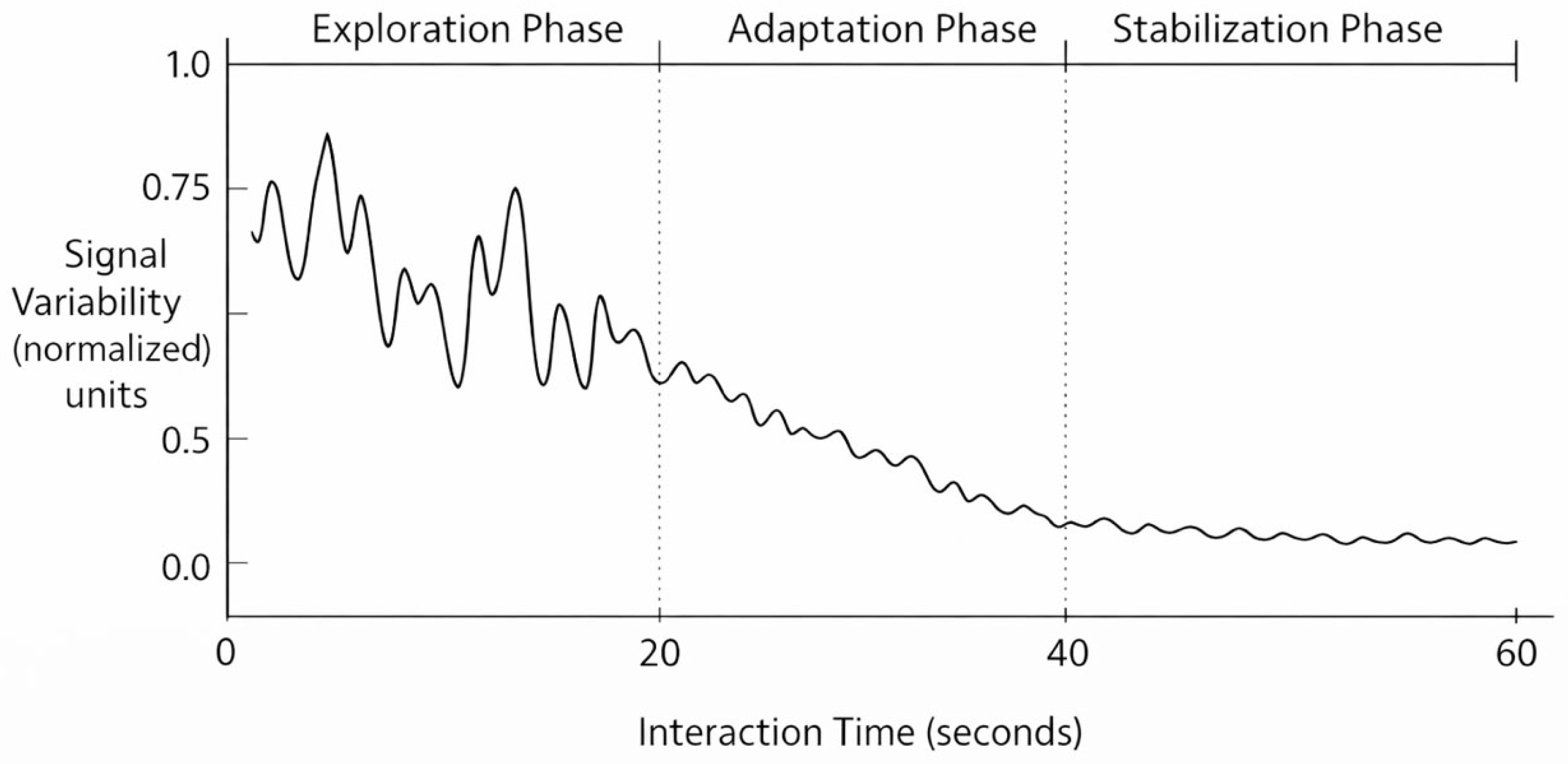
As interaction continued, the variability of pedaling signals gradually decreased. Participants appeared to develop more stable pedaling rhythms, which resulted in smoother audiovisual output within the installation environment. This transition from irregular fluctuations to more stable patterns was visible in the temporal profiles of the recorded sensor signals.
This stabilization can be interpreted as a form of perceptual adaptation. Through repeated exposure to system feedback, participants gradually adjusted their bodily activity to produce more predictable responses from the interactive environment. Rather than consciously controlling the system, participants appeared to develop an implicit understanding of how their movements influenced the audiovisual feedback.
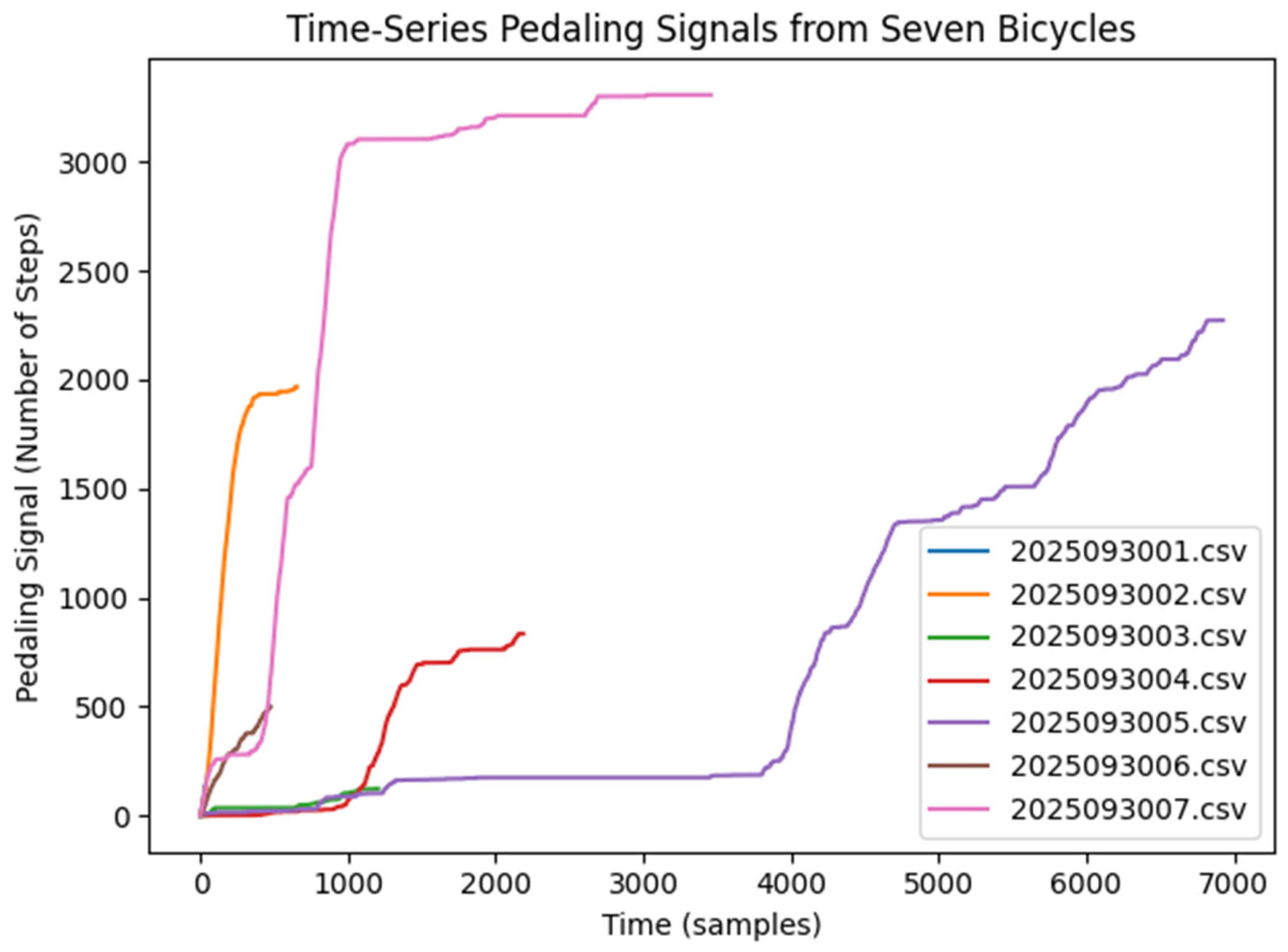
Within the proposed framework, this phase reflects the strengthening of the coupling loop between embodied action and perceptual feedback. As participants perceive the consequences of their movements, they adjust their actions accordingly, leading to a gradual stabilization of the interaction dynamics. The reduction in signal variability over time is illustrated in
Figure 5, which shows the transition from exploratory interaction toward more stable activity patterns.
5.3. Collective Interaction in a Shared Perceptual Environment
When multiple participants interacted with the installation simultaneously, the audiovisual environment reflected the combined activity of all bicycles. As a result, the perceptual feedback experienced by each participant incorporated the influence of others within the interactive space.
Under these conditions, participants were able to indirectly perceive the presence and activity of other users through changes in the shared audiovisual environment. For example, increases in collective pedaling activity produced stronger sound output and more dynamic visual motion. Participants often responded to these changes by adjusting their own pedaling intensity or rhythm.
Such interactions illustrate how the perceptual environment can function as a mediating layer between participants, enabling indirect coordination without explicit communication. Rather than interacting directly with each other, participants influence and respond to a common perceptual field generated by the computational system.
5.4. Signal Correlation Across Participants
To further examine the interaction patterns observed during installation sessions, a correlation analysis was conducted using the pedaling signals recorded from the seven bicycles. The system logs contain time-series data representing the rotational activity detected from each bicycle during interaction.
Pearson correlation coefficients were computed using standard statistical analysis to examine temporal relationships between pedaling signals recorded from different bicycles. The analysis revealed relatively high correlations among several bicycle pairs, with correlation values ranging approximately between 0.92 and 0.99 in multiple comparisons. These correlations indicate that pedaling rhythms recorded from different bicycles often evolved toward similar temporal patterns during shared interaction periods. This quantitative observation complements the qualitative interaction patterns observed in the installation environment (see
Figure 6).
While this analysis does not establish causal synchronization in a strict experimental sense, the observed signal alignment suggests that participant activity was not entirely independent. Instead, the shared perceptual environment generated by the installation may have contributed to a gradual alignment of behavioral rhythms among participants.
From the perspective of the human–system coupling framework, this pattern can be interpreted as an instance of emergent collective alignment mediated through perceptual feedback.
5.5. Interpreting the Installation Through the Framework
The EchoCycle installation illustrates how the components of the proposed human–system coupling framework interact within a real interactive environment.
Participants generate embodied energy through cycling motion, which is captured through sensing systems and translated into digital signals. These signals are processed through computational interpretation, which maps activity patterns to audiovisual parameters. The resulting perceptual environment is experienced by participants as dynamic sound and light feedback that responds to their movements.
Through continuous interaction with this feedback environment, participants adjust their bodily behavior, forming a perception–action loop that links human activity and system response. When multiple participants interact simultaneously, the perceptual environment reflects the combined activity of the group, enabling collective interaction dynamics to emerge.
The installation therefore provides an illustrative case through which the proposed framework can be used to interpret how embodied action, computational mediation, and perceptual feedback interact within responsive interactive systems.
6. Discussion
The observations from the EchoCycle installation provide an opportunity to interpret interactive behavior through the proposed human–system coupling framework. Rather than viewing interaction as a sequence of discrete commands issued by users, the installation environment reveals how interaction may evolve through continuous feedback relationships linking bodily activity, computational interpretation, and perceptual response.
One of the most notable patterns observed in the installation is the gradual stabilization of participant activity over time. Early interaction phases were characterized by relatively irregular pedaling patterns as participants explored how their bodily movements influenced the audiovisual feedback generated by the system. As interaction continued, these fluctuations often decreased and more stable activity rhythms emerged. From the perspective of the proposed framework, this transition can be interpreted as a process of perceptual adaptation, in which participants implicitly develop an understanding of the relationship between their bodily actions and the perceptual consequences produced by the interactive environment. Rather than consciously controlling the system, participants gradually adjust their movements in response to the feedback they perceive.
A second observation concerns the interaction dynamics that arise when multiple participants engage with the installation simultaneously. Because the audiovisual output reflects the combined activity of all bicycles, the perceptual environment effectively functions as a shared feedback medium. Participants do not interact directly with one another, yet their actions become perceptible within the shared audiovisual field generated by the system. Under these conditions, the activity patterns of different participants sometimes evolve toward similar temporal rhythms. The correlation analysis of the recorded pedaling signals suggests that behavioral alignment may emerge within this shared perceptual environment. While such alignment should not be interpreted as strict synchronization in a controlled experimental sense, it illustrates how perceptual feedback may mediate forms of emergent collective coordination.
These observations highlight the mediating role of computation within interactive environments. In the EchoCycle installation, computational processes translate embodied energy into perceptual signals that shape the conditions under which participants act. The system does not simply execute user commands; rather, it transforms bodily activity into perceptual feedback that influences subsequent behavior. In this sense, computation functions as a perceptual mediation layer linking human action and environmental response.
From a design perspective, this interpretation suggests that interactive systems can be understood not only as tools but also as environments that shape behavioral dynamics through feedback relationships. When perceptual feedback is continuous and responsive to bodily activity, participants may gradually adapt their movements to stabilize interaction with the system. In shared environments, such feedback loops may also enable forms of collective interaction to emerge without explicit coordination mechanisms.
At the same time, several limitations should be acknowledged. The observations presented in this study are based on interaction within a public installation context rather than a controlled experimental setting. Participants engaged with the installation voluntarily and for varying durations, and demographic characteristics of participants were not systematically recorded. As a result, the findings should not be interpreted as generalizable behavioral evidence but rather as practice-based observations that illustrate interaction patterns within a specific interactive environment.
In addition, while correlation analysis of pedaling signals suggests alignment of activity rhythms among participants, the present study does not attempt to establish causal synchronization through rigorous experimental methods. Future research could employ controlled experimental designs, larger participant samples, and more advanced analytical techniques such as cross-recurrence analysis or phase synchronization metrics to examine collective interaction dynamics more precisely.
Despite these limitations, the EchoCycle installation provides a valuable case through which the human–system coupling framework can be explored in a real interactive context. By examining how embodied activity, computational interpretation, and perceptual feedback interact within a continuous loop, the study highlights the potential of perceptually mediated interactive systems to support adaptive and socially responsive forms of interaction. Designers of interactive systems may therefore benefit from considering perceptual feedback not only as a response mechanism but as a structuring element that shapes behavioral dynamics within interactive environments. From a theoretical perspective, this interpretation also suggests that computational systems can be understood as mediating structures that shape collective perception and action within interactive environments. Such an approach may open possibilities for designing environments that facilitate adaptive participation and emergent collective behavior.
7. Conclusions
This paper proposes a human-system coupling framework for understanding interactive environments in which embodied human activity is continuously translated into perceptual feedback through computational systems. Rather than conceptualizing interaction as a sequence of discrete commands, the proposed framework interprets interactive systems as perceptual mediation environments in which bodily action, computational interpretation, and perceptual feedback form a continuous perception–action loop.
The framework was illustrated through the EchoCycle installation, an interactive system that translates mechanical energy generated by cycling into multimodal audiovisual feedback. Observations from the installation suggest that participants initially engage with the system in an exploratory manner and gradually develop more stable activity patterns as they adapt to the perceptual feedback generated by the system. When multiple participants interact simultaneously, the shared audiovisual environment reflects collective activity, creating conditions under which behavioral alignment among participants may emerge. The findings presented in this study should be understood as a practice-based illustration of the proposed framework rather than as controlled empirical validation. While the observed interaction patterns suggest tendencies toward behavioral stabilization and alignment, further studies employing controlled experimental methods and quantitative measures would be necessary to systematically validate these processes.
Through this illustrative case, the study highlights how interactive systems can support adaptive interaction dynamics by translating embodied activity into perceptual conditions that shape subsequent behavior. In this sense, computation does not simply function as a tool for executing user commands but acts as a mediating layer that transforms bodily energy into perceptually meaningful feedback within an interactive environment.
The proposed framework contributes to ongoing discussions in human-computer interaction, interactive systems design, and practice-based research in computational art by providing an integrated conceptual model linking embodied action, computational interpretation, and perceptual environments. By emphasizing the role of perceptual feedback in shaping interaction dynamics, the framework offers a perspective for interpreting how responsive environments may support both individual behavioral adaptation and emergent collective interaction.
Several limitations should be acknowledged. The observations presented in this study are based on a public installation context rather than a controlled experimental setting, and participant behavior was examined through observational analysis rather than systematic experimental measurement. Consequently, the findings should be understood as practice-based insights rather than generalizable empirical results.
Future research may further investigate the dynamics of human–system coupling through controlled experimental studies, larger datasets, and advanced analytical techniques for examining synchronization and coordination in interactive environments. Such studies may help clarify how different forms of computational interpretation and feedback design influence the emergence of collective interaction patterns.
By framing interactive systems as perceptual mediation environments, the proposed framework offers a conceptual foundation for designing interactive systems that support adaptive, embodied, and socially responsive forms of human–system interaction in future interactive environments.