A Hybrid Decision Support Framework Integrating Combined Probabilistic Spatial Modeling with Large Language Models for Post-Earthquake Search and Rescue


Abstract
1. Introduction
- A combined probabilistic spatial modeling approach for SAR prioritization.
- An LLM-assisted decision support layer, where a locally deployed large language model generates operational recommendations.
- A hybrid decision support framework for disaster response.
2. Materials and Methods
2.1. Earthquake Scenario Using Synthetic Dataset
2.2. Probabilistic Spatial Models
2.2.1. Truncated Negative Exponential Model
2.2.2. Lognormal Decay Model
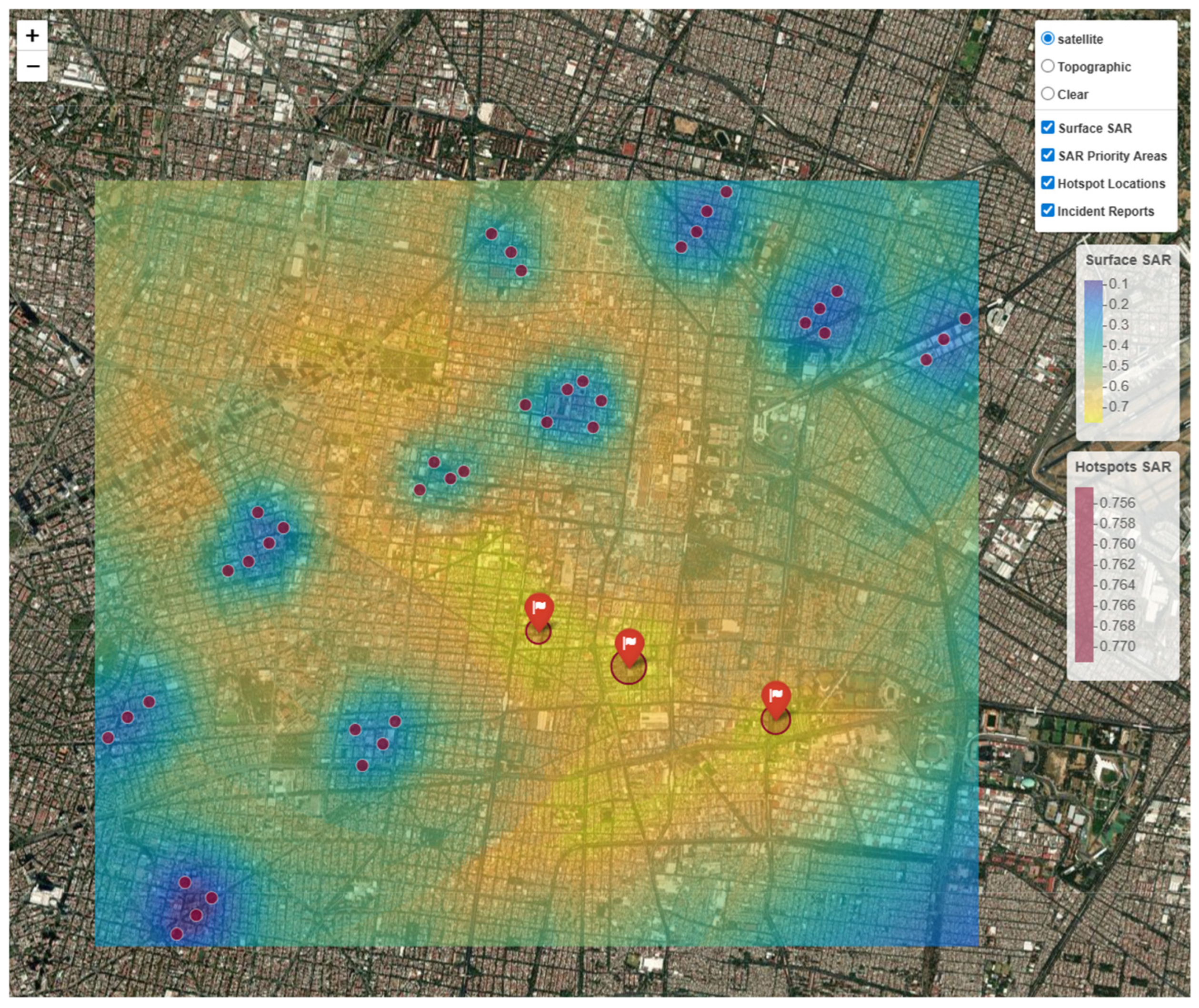
2.2.3. Combined Probabilistic Spatial Model
2.3. LLM-Assisted Decision Support Layer
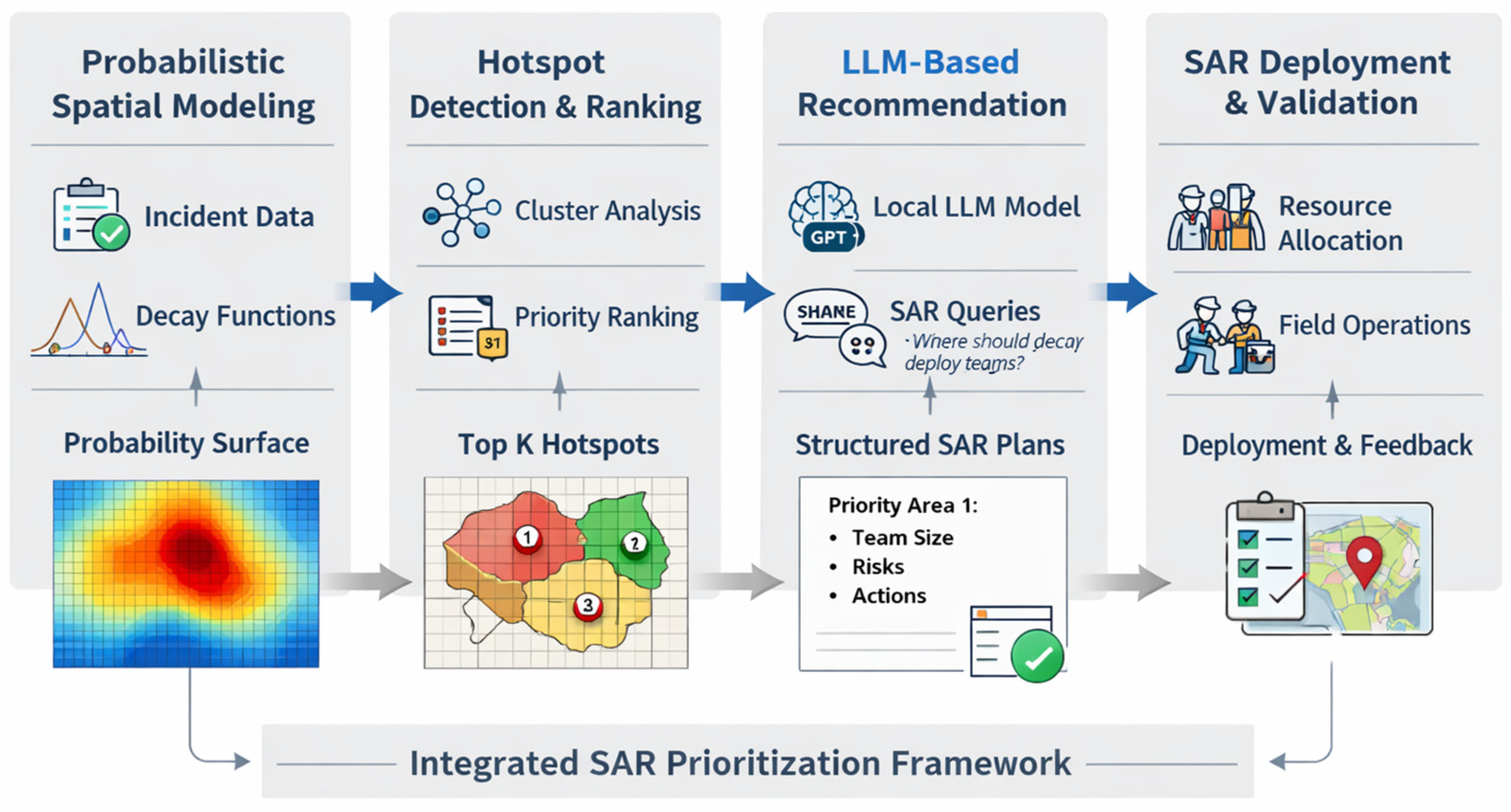
| Algorithm 1 Combined Probabilistic SAR Prioritization | |
| Input: Incident dataset | |
| Output: Ranked hotspot regions Rk with LLM recommendations | |
| 1: | Load geolocated incident dataset |
| 2: | Generate spatial grid over study area |
| 3: | Compute TNE surface using truncated exponential decay |
| 4: | Compute LN surface using lognormal decay |
| 5: | Normalize both surfaces to [0, 1] |
| 6: | Compute combined surface: PSAR = α·TNE + β·LN |
| 7: | Determine threshold τ using upper quantile |
| 8: | Create binary mask where PSAR ≥ τ |
| 9: | Identify connected regions (clustering) |
| 10: | for each region Rk do |
| 11: | Compute maximum score Sk |
| 12: | Compute area Ak |
| 13: | Compute centroid ck |
| 14: | end for |
| 15: | Rank regions by Sk |
| 16: | Select Top-K regions |
| 17: | Generate structured LLM recommendations for each selected hotspot |
| 18: | Return ranked regions and recommendations |
3. Results
Hotspot Stability Under Alpha Variation
4. Discussion
5. Conclusions
Funding
Institutional Review Board Statement
Informed Consent Statement
Data Availability Statement
Conflicts of Interest
Appendix A. Synthetic Earthquake Incident Dataset

| Date | Time | Report | Building | Damage | People | Lon | Lat |
|---|---|---|---|---|---|---|---|
| 19 September 2025 | 13:14 | Trapped persons | Residential | Severe | 3 | −99.1339 | 19.4326 |
| 19 September 2025 | 13:16 | Collapsed building | Residential | Severe | 6 | −99.1321 | 19.4312 |
| 19 September 2025 | 13:18 | Injured persons | Commercial | Moderate | 2 | −99.1304 | 19.4338 |
| 19 September 2025 | 13:20 | Trapped persons | Residential | Severe | 4 | −99.1291 | 19.4345 |
| 19 September 2025 | 13:22 | Collapsed building | Residential | Critical | 9 | −99.1276 | 19.4329 |
| 19 September 2025 | 13:24 | Structural damage | Office | Moderate | 0 | −99.1283 | 19.4308 |
| 19 September 2025 | 13:26 | Trapped persons | Residential | Severe | 5 | −99.1554 | 19.4217 |
| 19 September 2025 | 13:28 | Collapsed building | Residential | Severe | 7 | −99.1571 | 19.4202 |
| 19 September 2025 | 13:30 | Injured persons | School | Moderate | 3 | −99.1542 | 19.4229 |
| 19 September 2025 | 13:32 | Trapped persons | Residential | Severe | 4 | −99.1563 | 19.4241 |
| 19 September 2025 | 13:34 | Collapsed building | Residential | Critical | 10 | −99.1588 | 19.4195 |
| 19 September 2025 | 13:36 | Trapped persons | Residential | Severe | 6 | −99.1459 | 19.4058 |
| 19 September 2025 | 13:38 | Collapsed building | Residential | Critical | 11 | −99.1476 | 19.4041 |
| 19 September 2025 | 13:40 | Injured persons | Hospital | Severe | 5 | −99.1482 | 19.4069 |
| 19 September 2025 | 13:42 | Structural damage | Market | Moderate | 1 | −99.1448 | 19.4076 |
| 19 September 2025 | 13:44 | Trapped persons | Residential | Severe | 4 | −99.1615 | 19.3923 |
| 19 September 2025 | 13:46 | Collapsed building | Residential | Severe | 8 | −99.1631 | 19.3908 |
| 19 September 2025 | 13:48 | Injured persons | Commercial | Moderate | 2 | −99.1602 | 19.3937 |
| 19 September 2025 | 13:50 | Trapped persons | Residential | Severe | 5 | −99.1624 | 19.3949 |
| 19 September 2025 | 13:52 | Collapsed building | Residential | Critical | 12 | −99.1402 | 19.4268 |
| 19 September 2025 | 13:54 | Trapped persons | Residential | Severe | 6 | −99.1416 | 19.4281 |
| 19 September 2025 | 13:56 | Injured persons | Office | Moderate | 3 | −99.1391 | 19.4273 |
| 19 September 2025 | 13:58 | Structural damage | School | Moderate | 0 | −99.1428 | 19.4259 |
| 19 September 2025 | 14:00 | Trapped persons | Residential | Severe | 7 | −99.1093 | 19.4402 |
| 19 September 2025 | 14:02 | Collapsed building | Residential | Critical | 13 | −99.1078 | 19.4416 |
| 19 September 2025 | 14:04 | Injured persons | Market | Moderate | 4 | −99.1105 | 19.4391 |
| 19 September 2025 | 14:06 | Trapped persons | Residential | Severe | 5 | −99.1089 | 19.4383 |
| 19 September 2025 | 14:08 | Collapsed building | Residential | Severe | 9 | −99.0989 | 19.4378 |
| 19 September 2025 | 14:10 | Trapped persons | Residential | Severe | 6 | −99.1004 | 19.4362 |
| 19 September 2025 | 14:12 | Injured persons | Commercial | Moderate | 3 | −99.0971 | 19.4394 |
| 19 September 2025 | 14:14 | Structural damage | Office | Moderate | 0 | −99.1672 | 19.4079 |
| 19 September 2025 | 14:16 | Trapped persons | Residential | Severe | 4 | −99.1654 | 19.4091 |
| 19 September 2025 | 14:18 | Collapsed building | Residential | Severe | 7 | −99.1689 | 19.4063 |
| 19 September 2025 | 14:20 | Trapped persons | Hospital | Critical | 9 | −99.1351 | 19.4447 |
| 19 September 2025 | 14:22 | Injured persons | Hospital | Severe | 6 | −99.1368 | 19.4461 |
| 19 September 2025 | 14:24 | Structural damage | Hospital | Moderate | 2 | −99.1343 | 19.4432 |
| 19 September 2025 | 14:26 | Trapped persons | Residential | Severe | 5 | −99.1187 | 19.4479 |
| 19 September 2025 | 14:28 | Collapsed building | Residential | Severe | 8 | −99.1171 | 19.4494 |
| 19 September 2025 | 14:30 | Injured persons | Commercial | Moderate | 3 | −99.1196 | 19.4463 |
| 19 September 2025 | 14:32 | Trapped persons | Residential | Severe | 6 | −99.1209 | 19.4451 |
References
- Nasar, W.; Da Silva Torres, R.; Gundersen, O.E.; Karlsen, A.T. The Use of Decision Support in Search and Rescue: A Systematic Literature Review. ISPRS Int. J. Geoinf. 2023, 12, 182. [Google Scholar] [CrossRef] [Scilit]
- Kratzke, T.M.; Stone, L.D. Search and Rescue Optimal Planning System. In Proceedings of the 2010 13th International Conference on Information Fusion, Edinburgh, UK, 26–29 July 2010. [Google Scholar]
- Xu, F.; Ma, J.; Li, N.; Cheng, J.C.P. Large Language Model Applications in Disaster Management: An Interdisciplinary Review; Elsevier Ltd.: Amsterdam, The Netherlands, 2025. [Google Scholar] [CrossRef] [Scilit]
- Zhao, W.X.; Zhou, K.; Li, J.; Tang, T.; Wang, X.; Hou, Y.; Min, Y.; Zhang, B.; Zhang, J.; Dong, Z.; et al. A Survey of Large Language Models. Available online: http://arxiv.org/abs/2303.18223 (accessed on 1 February 2026).
- De Angeli, S.; Malamud, B.D.; Rossi, L.; Taylor, F.E.; Trasforini, E.; Rudari, R. A multi-hazard framework for spatial-temporal impact analysis. Int. J. Disaster Risk Reduct. 2022, 73, 102829. [Google Scholar] [CrossRef] [Scilit]
- Mayoral, J.M.; Hutchinson, T.C.; Franke, K.W. Geotechnical Extreme Events Reconnaissance Association PUEBLA-MEXICO CITY EARTHQUAKE Version 1.0. 2017. Available online: https://geerassociation.org/components/com_geer_reports/geerfiles/GEO%20RECONNAISSANCE%20OF%2019%20SEPT%202017%20Mw%207.1%20EQ-v1.pdf (accessed on 1 February 2026).
- Pilarczyk, J.E.; Sawai, Y.; Namegaya, Y.; Tamura, T.; Tanigawa, K.; Matsumoto, D.; Shinozaki, T.; Fujiwara, O.; Shishikura, M.; Shimada, Y.; et al. A further source of Tokyo earthquakes and Pacific Ocean tsunamis. Nat. Geosci. 2021, 14, 796–800. [Google Scholar] [CrossRef] [Scilit]
- Chu, J.; Zhang, Q.; Wang, A.; Yu, H. A Hybrid Intelligent Model for Urban Seismic Risk Assessment from the Perspective of Possibility and Vulnerability Based on Particle Swarm Optimization. Sci. Program. 2021, 2021, 1–16. [Google Scholar] [CrossRef] [Scilit]
- Tena-Colunga, A.; Sánchez-Ballinas, D. The collapse of Álvaro Obregón 286 building in Mexico City during the September 19, 2017 earthquake. A case study. J. Build. Eng. 2022, 49, 104060. [Google Scholar] [CrossRef] [Scilit]
- Mayoral, J.M.; Franke, K.W.; Hutchinson, T. The September 19, 2017 Mw 7.1 Puebla-Mexico city earthquake: Important findings from the field—Overview of Special Edition. Soil Dyn. Earthq. Eng. 2019, 123, 520–524. [Google Scholar] [CrossRef] [Scilit]
- Iqbal, W.; Yang, T.; Ashraf, S. Optimizing Earthquake Response with Fermatean Probabilistic Hesitant Fuzzy Sets: A Decision Support Framework. J. Oper. Strateg. Anal. 2023, 1, 190–197. [Google Scholar] [CrossRef] [Scilit]
- Papić, V.; Gudelj, A.Š.; Milan, A.; Miličević, M. Person Mobility Algorithm and Geographic Information System for Search and Rescue Missions Planning. Remote Sens. 2024, 16, 670. [Google Scholar] [CrossRef] [Scilit]
- Lozano, J.M.; Nichols, E.; Frost, J.D.; Tien, I. Spatial and temporal evolution of post-disaster data for damage assessment of civil infrastructure systems. Geomat. Nat. Hazards Risk 2023, 14, 2250531. [Google Scholar] [CrossRef] [Scilit]
- Rahimi, F.; Sadeghi-Niaraki, A.; Ghodousi, M.; Choi, S.-M. Spatial-temporal modeling of urban resilience and risk to earthquakes. Sci. Rep. 2025, 15, 8321. [Google Scholar] [CrossRef] [Scilit]
- Saad, O.M.; Chen, Y.; Savvaidis, A.; Fomel, S.; Chen, Y. Real-Time Earthquake Detection and Magnitude Estimation Using Vision Transformer. J. Geophys. Res. Solid Earth 2022, 127, e2021JB023657. [Google Scholar] [CrossRef] [Scilit]
- Al Shafian, S.; Hu, D. Integrating Machine Learning and Remote Sensing in Disaster Management: A Decadal Review of Post-Disaster Building Damage Assessment. Buildings 2024, 14, 2344. [Google Scholar] [CrossRef] [Scilit]
- Alcántara, T.; García-Vázquez, O.; Calvo, H.; Torres-León, J.A. Disaster Tweets: Analysis from the Metaphor Perspective and Classification Using LLM’s. In Advances in Soft Computing; Springer: Cham, Switzerland, 2024; pp. 106–117. [Google Scholar] [CrossRef] [Scilit]
- Piña-García, C.A. In-context learning for propaganda detection on Twitter Mexico using large language model meta AI. Telemat. Inform. Rep. 2025, 19, 100232. [Google Scholar] [CrossRef] [Scilit]
- Tounsi, A.; Temimi, M. A systematic review of natural language processing applications for hydrometeorological hazards assessment. Nat. Hazards 2023, 116, 2819–2870. [Google Scholar] [CrossRef] [Scilit]
- Han, R.; An, L.; Zhou, W.; Li, G. A benchmark for evaluating crisis information generation capabilities in LLMs. Inf. Res. Int. Electron. J. 2025, 30, 240–248. [Google Scholar] [CrossRef] [Scilit]
- Asad, R.; Saleem, M.Q.; Habib, M.S.; Mufti, N.A.; Mayo, S.M. Seismic risk assessment and hotspots prioritization: A developing country perspective. Nat. Hazards 2023, 117, 2863–2901. [Google Scholar] [CrossRef] [Scilit]
- OpenAI gpt-oss-20b. Available online: https://huggingface.co/openai/gpt-oss-20b (accessed on 5 February 2026).
- Grøntved, K.A.R.; Jarabo-Peñas, A.; Reid, S.; Rolland, E.G.A.; Watson, M.; Richards, A.; Bullock, S.; Christensen, A.L. SAREnv: An Open-Source Dataset and Benchmark Tool for Informed Wilderness Search and Rescue Using UAVs. Drones 2025, 9, 628. [Google Scholar] [CrossRef] [Scilit]
- Ewers, J.-H.; Anderson, D.; Thomson, D. GIS Data Driven Probability Map Generation for Search and Rescue Using Agents. IFAC-PapersOnLine 2023, 56, 1466–1471. [Google Scholar] [CrossRef] [Scilit]
- Yu, M.; Yang, C.; Li, Y. Big Data in Natural Disaster Management: A Review. Geosciences 2018, 8, 165. [Google Scholar] [CrossRef] [Scilit]
- Correia, R.M.; Guerreiro, R.; Brandão, F. Data-Driven Spatial Analysis of Urban Renewal. Network Kernel Density Estimation of Building Renovation. In Formal Methods in Architecture; Springer: Cham, Switzerland, 2021; pp. 185–195. [Google Scholar] [CrossRef] [Scilit]
- Trautwein, I.; Eris, M.; Ravlija, D.; Sonntag, M. Comparison of approaches for tessellating a business area using Voronoi diagrams. J. Electr. Syst. Inf. Technol. 2025, 12, 79. [Google Scholar] [CrossRef] [Scilit]
- Cosentino, P.; Ficarra, V.; Luzio, D. Truncated exponential frequency-magnitude relationship in earthquake statistics. Bull. Seismol. Soc. Am. 1977, 67, 1615–1623. [Google Scholar] [CrossRef] [Scilit]
- Adamaki, A.; Papadimitriou, E.E.; Tsaklidis, G.M.; Karakostas, V. Statistical properties of aftershock rate decay: Implications for the assessment of continuing activity. Acta Geophys. 2011, 59, 748–769. [Google Scholar] [CrossRef] [Scilit]
- Rossmo, D.K. Geographic Profiling; Routledge: Oxfordshire, UK, 1999. [Google Scholar] [CrossRef] [Scilit]
- Chainey, S.; Ratcliffe, J. GIS and Crime Mapping; Wiley: Hoboken, NJ, USA, 2005. [Google Scholar] [CrossRef] [Scilit]
- LM Studio. 2025. Available online: https://lmstudio.ai/ (accessed on 5 February 2025).
- The R Project for Statistical Computing. Available online: https://www.r-project.org/ (accessed on 14 February 2026).
- rgeoprofile: Geographic Profiling Methods for Serial Crime Analysis. Available online: https://github.com/JSSpaulding/rgeoprofile/tree/master (accessed on 14 February 2026).
- Hong, B.; Bonczak, B.J.; Gupta, A.; Kontokosta, C.E. Measuring inequality in community resilience to natural disasters using large-scale mobility data. Nat. Commun. 2021, 12, 1870. [Google Scholar] [CrossRef] [Scilit]
- Solberg, C.; Rossetto, T.; Joffe, H. The social psychology of seismic hazard adjustment: Re-evaluating the international literature. Nat. Hazards Earth Syst. Sci. 2010, 10, 1663–1677. [Google Scholar] [CrossRef] [Scilit]
- Dobre, D.; Armaș, I.; Albulescu, A.-C. Examining the Risk Perception-Disaster Preparedness Behavior Nexus in the Seismic Context of Bucharest. Int. J. Disaster Risk Sci. 2025, 16, 724–741. [Google Scholar] [CrossRef] [Scilit]
- Shapira, S.; Aharonson-Daniel, L.; Bar-Dayan, Y. Anticipated behavioral response patterns to an earthquake: The role of personal and household characteristics, risk perception, previous experience and preparedness. Int. J. Disaster Risk Reduct. 2018, 31, 1–8. [Google Scholar] [CrossRef] [Scilit]




| α | Hotspot (Score) | Radius (Meters) | LLM Recommendation |
|---|---|---|---|
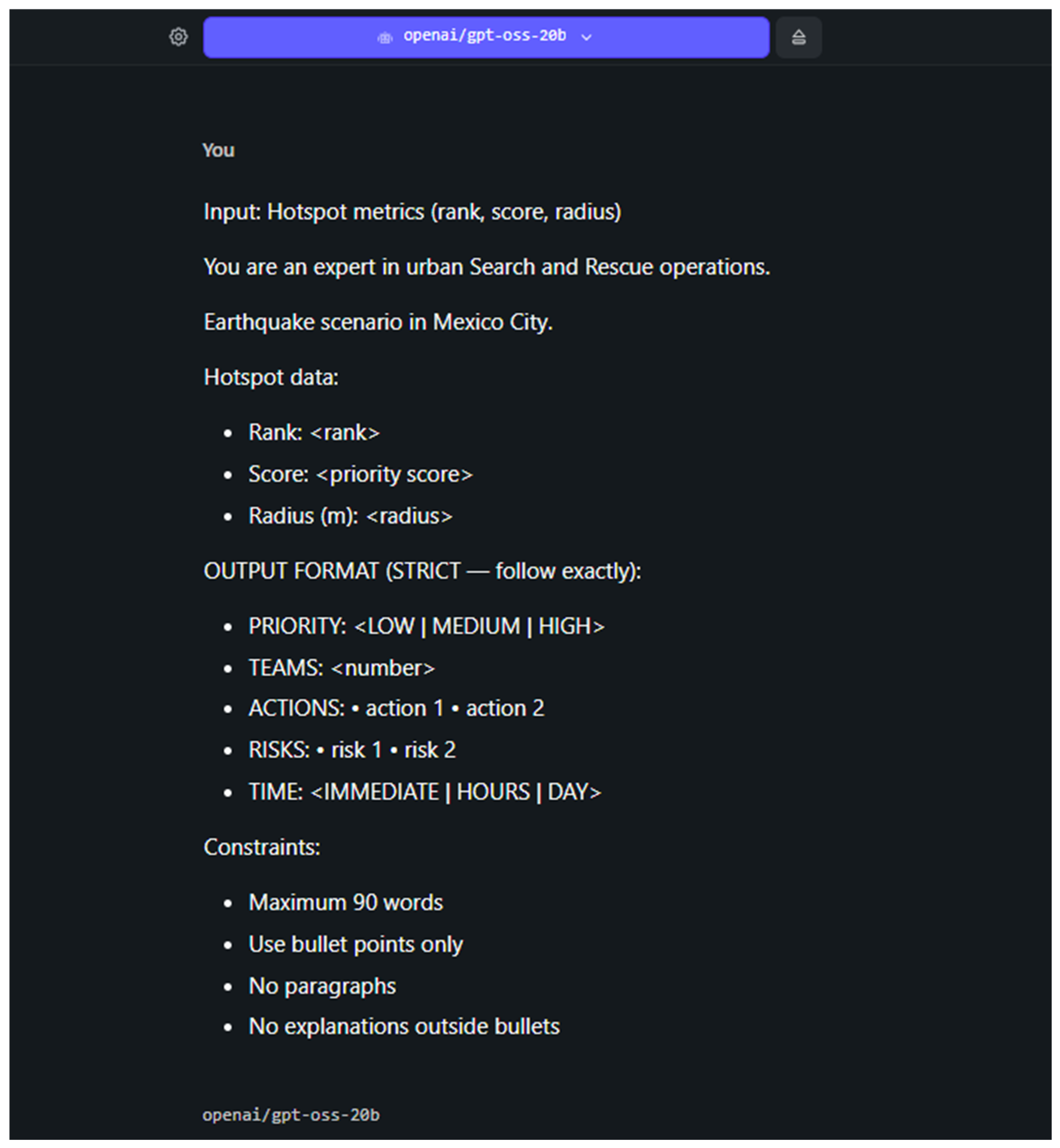
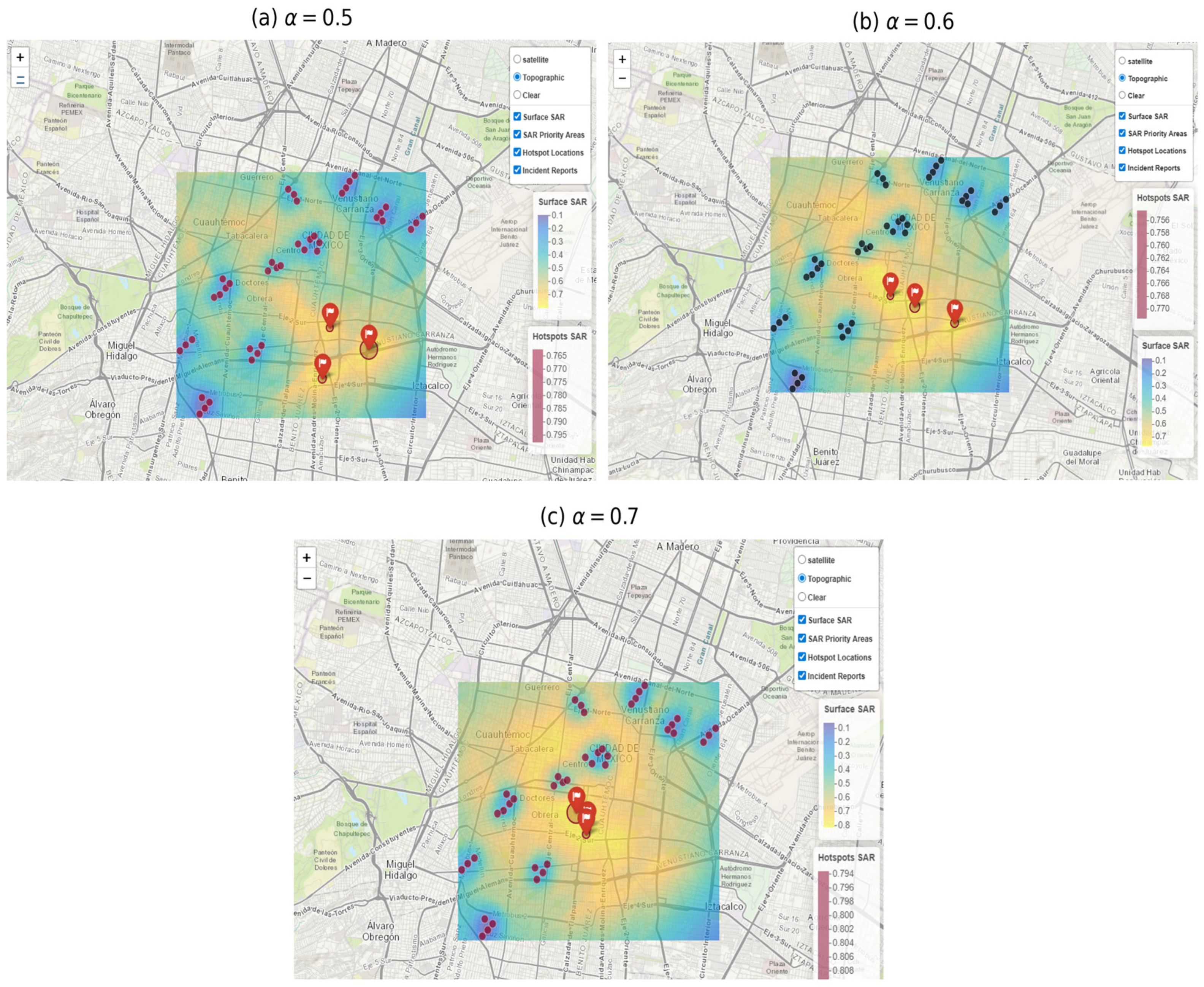
| 0.5 | HS1 (0.798) | 261 | PRIORITY: HIGH; TEAMS: 3; ACTIONS: deploy rapid response teams, conduct ground search with dogs and manual tools, use drones; RISKS: secondary collapse, aftershocks, unstable debris; TIME: HOURS |
| 0.5 | HS2 (0.772) | 133 | PRIORITY: HIGH; TEAMS: 4; ACTIONS: perimeter deployment, canine and thermal search, drone debris mapping, secure access routes; RISKS: aftershock destabilization, wall collapse, low visibility; TIME: HOURS |
| 0.5 | HS3 (0.763) | 100 | PRIORITY: HIGH; TEAMS: 2; ACTIONS: deploy units, establish triage within 100 m; RISKS: aftershocks, debris and traffic congestion; TIME: HOURS |
| 0.6 | HS1 (0.771) | 157 | PRIORITY: HIGH; TEAMS: 4; ACTIONS: rapid response, structural stability assessment, establish triage station; RISKS: further collapse, hazardous debris; TIME: IMMEDIATE |
| 0.6 | HS2 (0.762) | 128 | PRIORITY: HIGH; TEAMS: 3; ACTIONS: deploy ground teams, secure perimeter, establish communication hub; RISKS: secondary collapse, structural instability; TIME: HOURS |
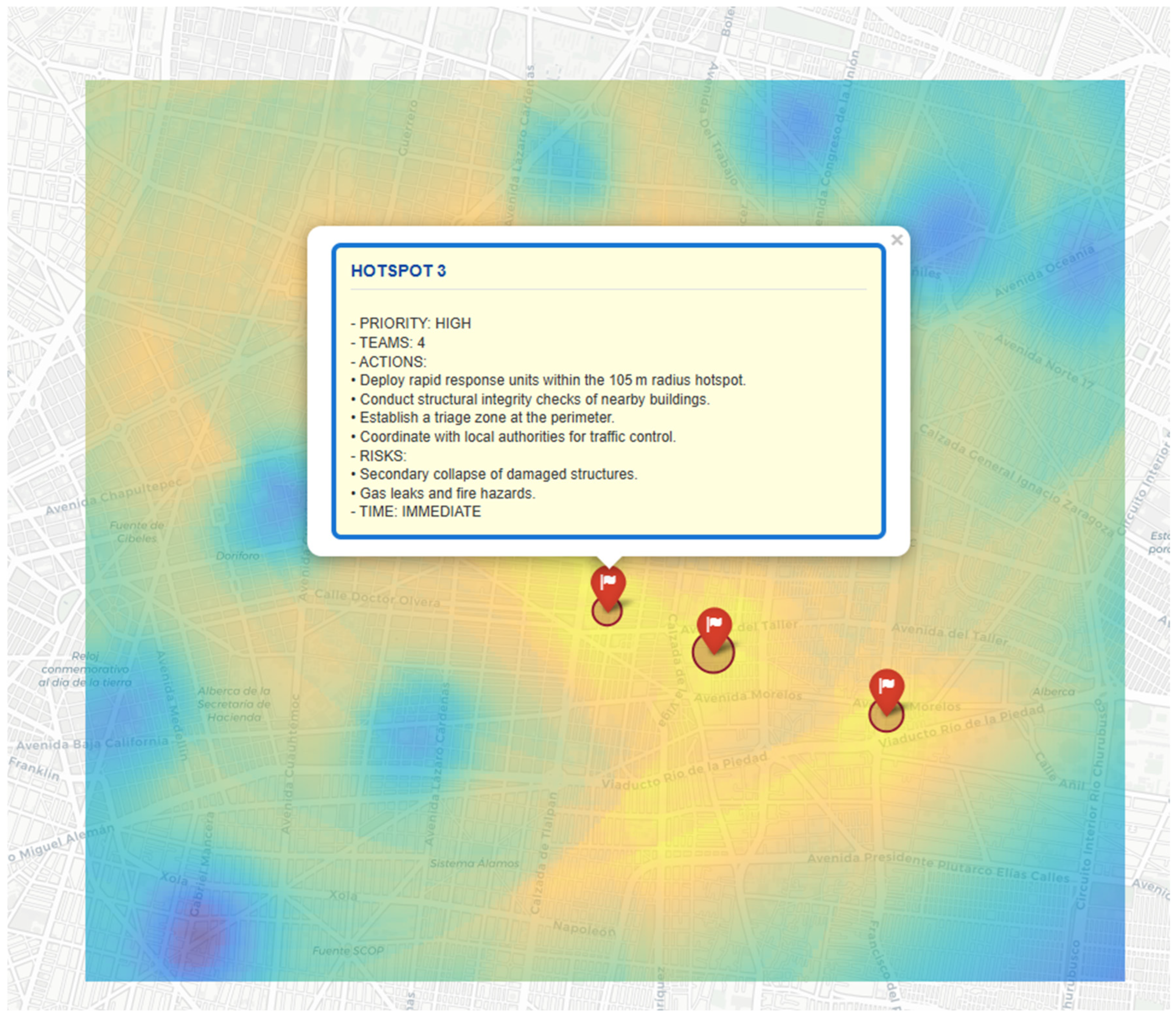
| 0.6 | HS3 (0.754) | 105 | PRIORITY: HIGH; TEAMS: 3; ACTIONS: deploy units, triage perimeter, secure against aftershocks; RISKS: immediate aftershock damage, structural collapse; TIME: IMMEDIATE |
| 0.7 | HS1 (0.810) | 274 | PRIORITY: MEDIUM; TEAMS: 2; ACTIONS: rapid assessment team, systematic grid search; RISKS: aftershocks, instability; TIME: HOURS |
| 0.7 | HS2 (0.797) | 100 | PRIORITY: HIGH; TEAMS: 3; ACTIONS: rapid assessment, secure area, ground penetrating radar search; RISKS: aftershocks, gas leaks; TIME: IMMEDIATE |
| 0.7 | HS3 (0.794) | 100 | PRIORITY: HIGH; TEAMS: 4; ACTIONS: rapid search, establish medical stations, coordinate authorities; RISKS: structural collapse, hazardous material release; TIME: HOURS |
Disclaimer/Publisher’s Note: The statements, opinions and data contained in all publications are solely those of the individual author(s) and contributor(s) and not of MDPI and/or the editor(s). MDPI and/or the editor(s) disclaim responsibility for any injury to people or property resulting from any ideas, methods, instructions or products referred to in the content. |
© 2026 by the author. Licensee MDPI, Basel, Switzerland. This article is an open access article distributed under the terms and conditions of the Creative Commons Attribution (CC BY) license.
Share and Cite
Piña-García, C.A. A Hybrid Decision Support Framework Integrating Combined Probabilistic Spatial Modeling with Large Language Models for Post-Earthquake Search and Rescue. Appl. Sci. 2026, 16, 3414. https://doi.org/10.3390/app16073414
Piña-García CA. A Hybrid Decision Support Framework Integrating Combined Probabilistic Spatial Modeling with Large Language Models for Post-Earthquake Search and Rescue. Applied Sciences. 2026; 16(7):3414. https://doi.org/10.3390/app16073414
Chicago/Turabian StylePiña-García, Carlos Adolfo. 2026. "A Hybrid Decision Support Framework Integrating Combined Probabilistic Spatial Modeling with Large Language Models for Post-Earthquake Search and Rescue" Applied Sciences 16, no. 7: 3414. https://doi.org/10.3390/app16073414
APA StylePiña-García, C. A. (2026). A Hybrid Decision Support Framework Integrating Combined Probabilistic Spatial Modeling with Large Language Models for Post-Earthquake Search and Rescue. Applied Sciences, 16(7), 3414. https://doi.org/10.3390/app16073414