



Post-Exercise Recovery in Paralympic Athletes: A Narrative Review of Physiological Considerations and Practical Applications

 ,
,  ,
,  ,
,  ,
,  ,
,  and
and 
Abstract
1. Introduction
2. Methods
3. Thermoregulatory Management
4. Sleep for Systemic Recovery
5. Neuromuscular and Metabolic Restoration
6. Psychological and Environmental Modulators of Recovery
7. Practical Applications
8. Future Research Directions
9. Limitations
10. Conclusions
Author Contributions
Funding
Institutional Review Board Statement
Informed Consent Statement
Data Availability Statement
Acknowledgments
Conflicts of Interest
Abbreviations
| CWI | Cold water immersion |
| HRV | Heart rate variability |
| PSQI | Pittsburgh sleep quality index |
| RFD | Rate of force development |
| SCI | Spinal cord injury |
References
- Martin, J.J. Determinants of Elite Disability Sport Performance. Kinesiol. Rev. 2015, 4, 91–98. [Google Scholar] [CrossRef]
- Rodríguez Macías, M.; Giménez Fuentes-Guerra, F.J.; Abad Robles, M.T. The Sport Training Process of Para-Athletes: A Systematic Review. Int. J. Environ. Res. Public Health 2022, 19, 7242. [Google Scholar] [CrossRef]
- Dehghansai, N.; Pinder, R.A.; Baker, J.; Renshaw, I. Challenges and stresses experienced by athletes and coaches leading up to the Paralympic Games. PLoS ONE 2021, 16, e0251171. [Google Scholar] [CrossRef]
- Goosey-Tolfrey, V.L.; Leicht, C.A. Field-based physiological testing of wheelchair athletes. Sports Med. 2013, 43, 77–91. [Google Scholar] [CrossRef] [PubMed]
- Liu, J.; Yu, H.; Cheung, W.C.; Bleakney, A.; Jan, Y.K. A systematic review of pathophysiological and psychosocial measures in adaptive sports and their implications for coaching practice. Heliyon 2025, 11, e42081. [Google Scholar] [CrossRef]
- Busch, A.; Kubosch, E.J.; Leonhart, R.; Meidl, V.; Bretthauer, B.; Dallmann, P.; Steffen, K.; Hirschmueller, A. Health problems in elite Para athletes—A prospective cohort study of 53,739 athlete days. J. Sci. Med. Sport 2025, 28, 521–527. [Google Scholar] [CrossRef] [PubMed]
- Silva, A.; Pinto Pinheiro, L.S.; Silva, S.; Andrade, H.; Pereira, A.G.; Rodrigues da Silva, F.; Guerreiro, R.; Barreto, B.; Resende, R.; Túlio de Mello, M. Sleep in Paralympic athletes and its relationship with injuries and illnesses. Phys. Ther. Sport 2022, 56, 24–31. [Google Scholar] [CrossRef] [PubMed]
- Luijten, S.C.M.; Te Loo, L.M.; Nauta, J.; Janssen, T.W.J.; Holla, J.F.M.; Otten, R.H.J.; Vriend, I.; Verhagen, E. Sports-Related Health Problems in Para-Sports: A Systematic Review With Quality Assessment. Sports Health 2024, 16, 551–564. [Google Scholar] [CrossRef]
- Li, S.; Kempe, M.; Brink, M.; Lemmink, K. Effectiveness of Recovery Strategies After Training and Competition in Endurance Athletes: An Umbrella Review. Sports Med. Open 2024, 10, 55. [Google Scholar] [CrossRef]
- Kellmann, M.; Bertollo, M.; Bosquet, L.; Brink, M.; Coutts, A.J.; Duffield, R.; Erlacher, D.; Halson, S.L.; Hecksteden, A.; Heidari, J.; et al. Recovery and Performance in Sport: Consensus Statement. Int. J. Sports Physiol. Perform. 2018, 13, 240–245. [Google Scholar] [CrossRef]
- Jaeken, D. Classification in the Paralympics: The relationship between impairment and participation. Dev. Med. Child Neurol. 2020, 62, 769. [Google Scholar] [CrossRef]
- Price, M.J. Thermoregulation during exercise in individuals with spinal cord injuries. Sports Med. 2006, 36, 863–879. [Google Scholar] [CrossRef]
- Krassioukov, A.; West, C. The role of autonomic function on sport performance in athletes with spinal cord injury. PM&R 2014, 6, S58–S65. [Google Scholar] [CrossRef]
- Sellami, M.; Puce, L.; Bragazzi, N.L. Immunological Response to Exercise in Athletes with Disabilities: A Narrative Review of the Literature. Healthcare 2023, 11, 1692. [Google Scholar] [CrossRef]
- Gee, C.M.; Lacroix, M.A.; Stellingwerff, T.; Gavel, E.H.; Logan-Sprenger, H.M.; West, C.R. Physiological Considerations to Support Podium Performance in Para-Athletes. Front. Rehabil. Sci. 2021, 2, 732342. [Google Scholar] [CrossRef] [PubMed]
- Murphy, C.J.; Mason, B.S.; Goosey-Tolfrey, V.L. Exercise Recovery Practices of Wheelchair Court Sports Athletes. J. Strength. Cond. Res. 2021, 35, 366–372. [Google Scholar] [CrossRef]
- IntHout, J.; Ioannidis, J.P.; Borm, G.F.; Goeman, J.J. Small studies are more heterogeneous than large ones: A meta-meta-analysis. J. Clin. Epidemiol. 2015, 68, 860–869. [Google Scholar] [CrossRef]
- Sukhera, J. Narrative Reviews: Flexible, Rigorous, and Practical. J. Grad. Med. Educ. 2022, 14, 414–417. [Google Scholar] [CrossRef] [PubMed]
- Robotham, D.; King, M.; Canagasabey, A.; Inchley-Mort, S.; Hassiotis, A. Social validity of randomised controlled trials in health services research and intellectual disabilities: A qualitative exploration of stakeholder views. Trials 2011, 12, 144. [Google Scholar] [CrossRef] [PubMed]
- Alkemade, P.; Daanen, H.A.M.; Janssen, T.W.J.; Broad, E.; Goosey-Tolfrey, V.L.; Ibusuki, T.; Kneepkens, H.; Périard, J.D.; Eijsvogels, T.M.H. Heat preparedness and exertional heat illness in Paralympic athletes: A Tokyo 2020 survey. Temperature 2023, 10, 264–275. [Google Scholar] [CrossRef]
- Griggs, K.E.; Stephenson, B.T.; Price, M.J.; Goosey-Tolfrey, V.L. Heat-related issues and practical applications for Paralympic athletes at Tokyo 2020. Temperature 2020, 7, 37–57. [Google Scholar] [CrossRef]
- Stephenson, B.T.; Hoekstra, S.P.; Tolfrey, K.; Goosey-Tolfrey, V.L. High Thermoregulatory Strain During Competitive Paratriathlon Racing in the Heat. Int. J. Sports Physiol. Perform. 2020, 15, 231–237. [Google Scholar] [CrossRef]
- Trbovich, M.B.; Handrakis, J.P.; Kumar, N.S.; Price, M.J. Impact of passive heat stress on persons with spinal cord injury: Implications for Olympic spectators. Temperature 2019, 7, 114–128. [Google Scholar] [CrossRef] [PubMed]
- Girard, O. Thermoregulation in wheelchair tennis-How to manage heat stress? Front. Physiol. 2015, 6, 175. [Google Scholar] [CrossRef]
- de Korte, J.Q.; Bongers, C.; Hopman, M.T.E.; Eijsvogels, T.M.H. Exercise Performance and Thermoregulatory Responses of Elite Athletes Exercising in the Heat: Outcomes of the Thermo Tokyo Study. Sports Med. 2021, 51, 2423–2436. [Google Scholar] [CrossRef]
- Dutton, R.A. Medical and Musculoskeletal Concerns for the Wheelchair Athlete: A Review of Preventative Strategies. Curr. Sports Med. Rep. 2019, 18, 9–16. [Google Scholar] [CrossRef]
- Castle, P.C.; Kularatne, B.P.; Brewer, J.; Mauger, A.R.; Austen, R.A.; Tuttle, J.A.; Sculthorpe, N.; Mackenzie, R.W.; Maxwell, N.S.; Webborn, A.D. Partial heat acclimation of athletes with spinal cord lesion. Eur. J. Appl. Physiol. 2013, 113, 109–115. [Google Scholar] [CrossRef]
- Gavel, E.H.; Lacroix, M.A.; Goosey-Tolfrey, V.L.; Logan-Sprenger, H.M. Characterizing the Thermal Demands and Mobility Performance During International Wheelchair Rugby Competition. Front. Rehabil. Sci. 2022, 3, 856904. [Google Scholar] [CrossRef]
- Bongers, C.C.; Hopman, M.T.; Eijsvogels, T.M. Cooling interventions for athletes: An overview of effectiveness, physiological mechanisms, and practical considerations. Temperature 2017, 4, 60–78. [Google Scholar] [CrossRef] [PubMed]
- Marino, F.E. Methods, advantages, and limitations of body cooling for exercise performance. Br. J. Sports Med. 2002, 36, 89–94. [Google Scholar] [CrossRef] [PubMed]
- Goosey-Tolfrey, V.; Swainson, M.; Boyd, C.; Atkinson, G.; Tolfrey, K. The effectiveness of hand cooling at reducing exercise-induced hyperthermia and improving distance-race performance in wheelchair and able-bodied athletes. J. Appl. Physiol. 2008, 105, 37–43. [Google Scholar] [CrossRef][Green Version]
- Silva, S.; Castilho, M.; Stieler, E.; Lôbo, I.L.B.; de Mello, M.T.; Silva, A. The effects of cooling vests on thermoregulatory responses and exercise performance in individuals with spinal cord injury: A systematic review. Technol. Disabil. 2022, 34, 223–232. [Google Scholar] [CrossRef]
- Goosey-Tolfrey, V.L.; Diaper, N.J.; Crosland, J.; Tolfrey, K. Fluid intake during wheelchair exercise in the heat: Effects of localized cooling garments. Int. J. Sports Physiol. Perform. 2008, 3, 145–156. [Google Scholar] [CrossRef] [PubMed]
- Iwahashi, M.; Chaen, Y.; Yanaoka, T.; Kurokawa, Y.; Hasegawa, H. Cold water immersion of the hand and forearm during half-time improves intermittent exercise performance in the heat. Front. Physiol. 2023, 14, 1143447. [Google Scholar] [CrossRef] [PubMed]
- de Korte, J.Q.; Bongers, C.C.W.G.; Hopman, M.T.E.; Teunissen, L.P.J.; Jansen, K.M.B.; Kingma, B.R.M.; Ballak, S.B.; Maase, K.; Moen, M.H.; van Dijk, J.-W.; et al. Performance and thermoregulation of Dutch Olympic and Paralympic athletes exercising in the heat: Rationale and design of the Thermo Tokyo study: The journal Temperature toolbox. Temperature 2021, 8, 209–222. [Google Scholar] [CrossRef]
- Alkemade, P.; Eijsvogels, T.M.H.; Janssen, T.W.J.; Jansen, K.M.B.; Kingma, B.R.M.; Daanen, H.A.M. Upper-Body versus Lower-Body Cooling in Individuals with Paraplegia during Arm-Crank Exercise in the Heat. Med. Sci. Sports Exerc. 2023, 55, 2014–2024. [Google Scholar] [CrossRef]
- Lackner, M.; Grossmann, F.; Perret, C.; Flueck, J.L.; Hertig-Godeschalk, A. Chasing Gold: Heat Acclimation in Elite Handcyclists with Spinal Cord Injury. Int. J. Sports Med. 2024, 45, 733–738. [Google Scholar] [CrossRef]
- Griggs, K.E.; Price, M.J.; Goosey-Tolfrey, V.L. Cooling athletes with a spinal cord injury. Sports Med. 2015, 45, 9–21. [Google Scholar] [CrossRef]
- Stephenson, B.T.; Tolfrey, K.; Goosey-Tolfrey, V.L. Mixed Active and Passive, Heart Rate-Controlled Heat Acclimation Is Effective for Paralympic and Able-Bodied Triathletes. Front. Physiol. 2019, 10, 1214. [Google Scholar] [CrossRef]
- Grobler, L.; Derman, W.; Racinais, S.; Ngai, A.S.H.; van de Vliet, P. Illness at a Para Athletics Track and Field World Championships under Hot and Humid Ambient Conditions. PM&R 2019, 11, 919–925. [Google Scholar] [CrossRef]
- Esh, C.J.; Carter, S.; Galan-Lopez, N.; Garrandes, F.; Bermon, S.; Adami, P.E.; Racinais, S.; James, L.; Stellingwerff, T.; Adams, W.M.; et al. A Review of Elite Athlete Evidence-Based Knowledge and Preparation for Competing in the Heat. J. Sci. Sport. Exerc. 2024, 6, 218–237. [Google Scholar] [CrossRef]
- Irwin, M.R. Why sleep is important for health: A psychoneuroimmunology perspective. Annu. Rev. Psychol. 2015, 66, 143–172. [Google Scholar] [CrossRef] [PubMed]
- Worley, S.L. The Extraordinary Importance of Sleep: The Detrimental Effects of Inadequate Sleep on Health and Public Safety Drive an Explosion of Sleep Research. Pharm. Ther. 2018, 43, 758–763. [Google Scholar]
- Fogelberg, D.J.; Hughes, A.J.; Vitiello, M.V.; Hoffman, J.M.; Amtmann, D. Comparison of Sleep Problems in Individuals with Spinal Cord Injury and Multiple Sclerosis. J. Clin. Sleep. Med. 2016, 12, 695–701. [Google Scholar] [CrossRef]
- Urbański, P.K.; Brewer, B.W.; Starczewski, M.; Ng, K.; Tasiemski, T.; Tomczak, M. Sleep and stress in athletes with disabilities around the 2021 Tokyo Paralympic games during the pandemic. Sci. Rep. 2025, 15, 6822. [Google Scholar] [CrossRef]
- Murphy, C.J.; Hartescu, I.; Roberts, I.E.; Leicht, C.A.; Goosey-Tolfrey, V.L. Sleep Characteristics of Highly Trained Wheelchair Rugby Athletes With and Without a Cervical Spinal Cord Injury During the Competitive Season. Front. Sports Act. Living 2021, 3, 643233. [Google Scholar] [CrossRef]
- Anderson, T.; Galan-Lopez, N.; Taylor, L.; Post, E.G.; Finnoff, J.T.; Adams, W.M. Sleep Quality in Team USA Olympic and Paralympic Athletes. Int. J. Sports Physiol. Perform. 2024, 19, 383–392. [Google Scholar] [CrossRef]
- Araujo, A.P.; de Moura Simim, M.A.; Lourenço, T.F.; Martins, F.S.; Silva, A.S.; de Mello, M.T.; Esteves, A.M.; Silva, A.; Figueiredo, G.A.; Claudino, J.G. Sleep Quality and Specific Characteristics of Different Types of Impairments in Paralympic Athletes: An Updated Systematic Review. Curr. Sleep. Med. Rep. 2025, 11, 36. [Google Scholar] [CrossRef]
- Sanz-Quinto, S.; Brizuela, G.; López-Grueso, R.; Flatt, A.A.; Aracil-Marco, A.; Reina, R.; Moya-Ramón, M. Monitoring Heart Rate Variability Before and After a Marathon in an Elite Wheelchair Athlete: A Case Study. J. Sports Sci. Med. 2018, 17, 557–562. [Google Scholar] [PubMed]
- Viaene, A.M.; Roggeman, S.; Vanhaute, O.A.; Raes, A.; Colman, R.; Everaert, K. Nocturnal bladder emptying and Quality of Life in patients with spinal cord injury. Eur. J. Phys. Rehabil. Med. 2022, 58, 397–404. [Google Scholar] [CrossRef]
- Chen, Y.C.; Ou, Y.C.; Hu, J.C.; Yang, M.H.; Lin, W.Y.; Huang, S.W.; Lin, W.Y.; Lin, C.C.; Lin, V.C.; Chuang, Y.C.; et al. Bladder Management Strategies for Urological Complications in Patients with Chronic Spinal Cord Injury. J. Clin. Med. 2022, 11, 6850. [Google Scholar] [CrossRef]
- Haack, M.; Simpson, N.; Sethna, N.; Kaur, S.; Mullington, J. Sleep deficiency and chronic pain: Potential underlying mechanisms and clinical implications. Neuropsychopharmacology 2020, 45, 205–216. [Google Scholar] [CrossRef]
- Ho, A.; Drew, V.J.; Kim, T. What Links Sleep and Neuropathic Pain?: A Literature Review on the Neural Circuits for Sleep and Pain Control. Nat. Sci. Sleep 2025, 17, 813–838. [Google Scholar] [CrossRef]
- AlMakadma, Y.; Eirale, C.; Chamari, K. Neuropathic pain in athletes: Basics of diagnosis and monitoring of a hidden threat. Biol. Sport 2022, 39, 943–949. [Google Scholar] [CrossRef]
- Anderson, T.; Adams, W.M.; Burns, G.T.; Post, E.G.; Baumann, S.; Clark, E.; Cogan, K.; Finnoff, J.T. Addressing Circadian Disruptions in Visually Impaired Paralympic Athletes. Int. J. Sports Physiol. Perform. 2024, 19, 212–218. [Google Scholar] [CrossRef] [PubMed]
- Lockley, S.W.; Arendt, J.; Skene, D.J. Visual impairment and circadian rhythm disorders. Dialogues Clin. Neurosci. 2007, 9, 301–314. [Google Scholar] [CrossRef]
- Aubin, S.; Kupers, R.; Ptito, M.; Jennum, P. Melatonin and cortisol profiles in the absence of light perception. Behav. Brain Res. 2017, 317, 515–521. [Google Scholar] [CrossRef] [PubMed]
- Li, C.; Wu, Y.; Wang, X.; Tang, M.; Suppiah, H.T. Sleep characteristics of elite blind soccer players in China. Biol. Rhythm. Res. 2017, 48, 57–64. [Google Scholar] [CrossRef]
- Belluco, K.; Breda, F.L.; Lourenço, T.F.; Cirino, C.; Papoti, M.; Gobatto, C.A.; Manchado-Gobatto, F.B. Case Report: Nutrition profile, body mass, sleep quality, and acute mountain sickness symptoms during altitude training in a Paralympic record-breaking athlete and his two guides. Front. Nutr. 2025, 12, 1706179. [Google Scholar] [CrossRef]
- Bachar, D.; Koseff, D.; Douer, F.O. Sleep habits, quality and chronotype of Paralympic athletes. Eur. J. Adapt. Phys. Act. 2022, 15, 3. [Google Scholar] [CrossRef]
- Pethick, J.; Tallent, J. The Neuromuscular Fatigue-Induced Loss of Muscle Force Control. Sports 2022, 10, 184. [Google Scholar] [CrossRef] [PubMed]
- D’Emanuele, S.; Maffiuletti, N.A.; Tarperi, C.; Rainoldi, A.; Schena, F.; Boccia, G. Rate of Force Development as an Indicator of Neuromuscular Fatigue: A Scoping Review. Front. Hum. Neurosci. 2021, 15, 701916. [Google Scholar] [CrossRef] [PubMed]
- Lomborg, S.D.; Dalgas, U.; Hvid, L.G. The importance of neuromuscular rate of force development for physical function in aging and common neurodegenerative disorders—A systematic review. J. Musculoskelet. Neuronal Interact. 2022, 22, 562–586. [Google Scholar] [PubMed]
- Boccia, G.; Brustio, P.R.; Beratto, L.; Peluso, I.; Ferrara, R.; Munzi, D.; Toti, E.; Raguzzini, A.; Sciarra, T.; Rainoldi, A. Upper-Limb Muscle Fatigability in Para-Athletes Quantified as the Rate of Force Development in Rapid Contractions of Submaximal Amplitude. J. Funct. Morphol. Kinesiol. 2024, 9, 108. [Google Scholar] [CrossRef]
- Pimenta, R.; Pimenta, A. πForce—Repeatability and Reliability of Peak Force and Rate of Force Development in a Portable Multi-Exercise Device. Muscles 2025, 4, 36. [Google Scholar] [CrossRef]
- Aidar, F.J.; Santos, W.; Machado, S.D.C.; Nunes-Silva, A.; Vieira, É.L.M.; Valenzuela Pérez, D.I.; Aedo-Muñoz, E.; Brito, C.J.; Nikolaidis, P.T. Enhancing Post-Training Muscle Recovery and Strength in Paralympic Powerlifting Athletes with Cold-Water Immersion, a Cross-Sectional Study. Int. J. Environ. Res. Public Health 2025, 22, 122. [Google Scholar] [CrossRef]
- Pereira, G.S.; Paulino, G.E.; de Almeida, T.; Siqueira, C.M.R.; Torres da Silva, J.R.; da Silva, M.L.; Alves Ferrera, L.M. Effectiveness of cold-water immersion vs. massage in reducing delayed-onset muscle soreness and enhancing recovery following CrossFit® Murph Workout: Randomized rial. PLoS ONE 2025, 20, e0329892. [Google Scholar] [CrossRef]
- Fonseca, L.B.; Brito, C.J.; Silva, R.J.; Silva-Grigoletto, M.E.; da Silva, W.M.J.; Franchini, E. Use of Cold-Water Immersion to Reduce Muscle Damage and Delayed-Onset Muscle Soreness and Preserve Muscle Power in Jiu-Jitsu Athletes. J. Athl. Train. 2016, 51, 540–549. [Google Scholar] [CrossRef]
- Xiao, F.; Kabachkova, A.V.; Jiao, L.; Zhao, H.; Kapilevich, L.V. Effects of cold water immersion after exercise on fatigue recovery and exercise performance--meta analysis. Front. Physiol. 2023, 14, 1006512. [Google Scholar] [CrossRef]
- Bleakley, C.M.; Costello, J.T.; Glasgow, P.D. Should athletes return to sport after applying ice? A systematic review of the effect of local cooling on functional performance. Sports Med. 2012, 42, 69–87. [Google Scholar] [CrossRef]
- Petersen, A.C.; Fyfe, J.J. Post-exercise Cold Water Immersion Effects on Physiological Adaptations to Resistance Training and the Underlying Mechanisms in Skeletal Muscle: A Narrative Review. Front. Sports Act. Living 2021, 3, 660291. [Google Scholar] [CrossRef]
- Zhao, R.; Li, J.; Du, F.; Gao, R.; Zhao, S.; Wang, J. Effects of Long-Term Moderate-Intensity Exercise on Autonomic Nervous System Dysfunction Induced by Cardiac Neurovascular Interface Deterioration. Rev. Cardiovasc. Med. 2025, 26, 40714. [Google Scholar] [CrossRef] [PubMed]
- Fischer, G.; Antunes, D.; Volpato, A.; Delevatti, R.S. Metabolic Cost and Performance of Athletes With Lower Limb Amputation and Nonamputee Matched Controls During Running: A Systematic Review. Am. J. Phys. Med. Rehabil. 2022, 101, 584–589. [Google Scholar] [CrossRef] [PubMed]
- Rahnama, L.; Soulis, K.; Geil, M.D. A review of evidence on mechanical properties of running specific prostheses and their relationship with running performance. Front. Rehabil. Sci. 2024, 5, 1402114. [Google Scholar] [CrossRef]
- Beck, O.N.; Taboga, P.; Grabowski, A.M. Reduced prosthetic stiffness lowers the metabolic cost of running for athletes with bilateral transtibial amputations. J. Appl. Physiol. 2017, 122, 976–984. [Google Scholar] [CrossRef]
- Sharif, H.; Hou, S. Autonomic dysreflexia: A cardiovascular disorder following spinal cord injury. Neural Regen. Res. 2017, 12, 1390–1400. [Google Scholar] [CrossRef]
- Furrer, R.; Hawley, J.A.; Handschin, C. The molecular athlete: Exercise physiology from mechanisms to medals. Physiol. Rev. 2023, 103, 1693–1787. [Google Scholar] [CrossRef]
- Thorpe, R.T. Post-exercise Recovery: Cooling and Heating, a Periodized Approach. Front. Sports Act. Living 2021, 3, 707503. [Google Scholar] [CrossRef]
- Kennedy, A.B.; Patil, N.; Trilk, J.L. ‘Recover quicker, train harder, and increase flexibility’: Massage therapy for elite paracyclists, a mixed-methods study. BMJ Open Sport. Exerc. Med. 2018, 4, e000319. [Google Scholar] [CrossRef]
- Crawford, C.; Boyd, C.; Paat, C.F.; Price, A.; Xenakis, L.; Yang, E.; Zhang, W. The Impact of Massage Therapy on Function in Pain Populations-A Systematic Review and Meta-Analysis of Randomized Controlled Trials: Part I, Patients Experiencing Pain in the General Population. Pain Med. 2016, 17, 1353–1375. [Google Scholar] [CrossRef]
- Nunes, G.S.; Bender, P.U.; de Menezes, F.S.; Yamashitafuji, I.; Vargas, V.Z.; Wageck, B. Massage therapy decreases pain and perceived fatigue after long-distance Ironman triathlon: A randomised trial. J. Physiother. 2016, 62, 83–87. [Google Scholar] [CrossRef]
- Roberts, I.E.; Murphy, C.J.; Goosey-Tolfrey, V.L. Sleep disruption considerations for Paralympic athletes competing at Tokyo 2020. J. Sports Med. Phys. Fit. 2021, 61, 1159–1172. [Google Scholar] [CrossRef]
- Kalsina, V. Effect Of Restorative Massage On Regional Blood Flow In Paralympic Athletes. Russ. Open Med. J. 2022, 11, e0215. [Google Scholar] [CrossRef]
- Ayaş, S.; Leblebici, B.; Sözay, S.; Bayramoğlu, M.; Niron, E.A. The effect of abdominal massage on bowel function in patients with spinal cord injury. Am. J. Phys. Med. Rehabil. 2006, 85, 951–955. [Google Scholar] [CrossRef]
- Kennedy, A.B.; Trilk, J.L. A Standardized, Evidence-Based Massage Therapy Program for Decentralized Elite Paracyclists: Creating the Model. Int. J. Ther. Massage Bodyw. 2015, 8, 3–9. [Google Scholar] [CrossRef]
- Hody, S.; Croisier, J.L.; Bury, T.; Rogister, B.; Leprince, P. Eccentric Muscle Contractions: Risks and Benefits. Front. Physiol. 2019, 10, 536. [Google Scholar] [CrossRef] [PubMed]
- Kim, H.G.; Cheon, E.J.; Bai, D.S.; Lee, Y.H.; Koo, B.H. Stress and Heart Rate Variability: A Meta-Analysis and Review of the Literature. Psychiatry Investig. 2018, 15, 235–245. [Google Scholar] [CrossRef] [PubMed]
- Rosa, J.P.P.; Silva, A.; Rodrigues, D.F.; Menslin, R.; Araújo, L.T.; Vital, R.; Tufik, S.; Stieler, E.; de Mello, M.T. Association Between Hormonal Status, Stress, Recovery, and Motivation of Paralympic Swimmers. Res. Q. Exerc. Sport 2020, 91, 652–661. [Google Scholar] [CrossRef]
- Herman, J.L. Recovery from psychological trauma. Psychiatry Clin. Neurosci. 1998, 52, S98–S103. [Google Scholar] [CrossRef]
- Nicolas, M.; Vacher, P.; Martinent, G.; Mourot, L. Monitoring stress and recovery states: Structural and external stages of the short version of the RESTQ sport in elite swimmers before championships. J. Sport Health Sci. 2019, 8, 77–88. [Google Scholar] [CrossRef]
- Towett, G.; Snead, R.S.; Grigoryan, K.; Marczika, J. Geographical and practical challenges in the implementation of digital health passports for cross-border COVID-19 pandemic management: A narrative review and framework for solutions. Glob. Health 2023, 19, 98. [Google Scholar] [CrossRef]
- Urbański, P.K.; Rogoza, R.; Brewer, B.; Tasiemski, T. Coping with the COVID-19 pandemic by Paralympic athletes preparing for elite sport events: A longitudinal study. Scand. J. Med. Sci. Sports 2023, 33, 512–520. [Google Scholar] [CrossRef]
- Dithurbide, L.; Boudreault, V.; Durand-Bush, N.; MacLeod, L.; Gauthier, V. The impact of the COVID-19 pandemic on Canadian national team athletes’ mental performance and mental health: The perspectives of mental performance consultants and mental health practitioners. Front. Psychol. 2022, 13, 937962. [Google Scholar] [CrossRef]
- Szabo, S.W.; Kennedy, M.D. Practitioner perspectives of athlete recovery in paralympic sport. Int. J. Sports Sci. Coach. 2022, 17, 274–284. [Google Scholar] [CrossRef]
- Ashadi, K.; Handayani, O.W.K.; Setijono, H.; Rustiadi, T.; Sugiharto; Soegiyanto. Experienced vs Inexperienced Disabled Swimmers: Training Load and Recovery in Preparation Period. Phys. Educ. Theory Methodol. 2023, 23, 162–169. [Google Scholar] [CrossRef]
- Gee, C.M.; West, C.R.; Krassioukov, A.V. Boosting in Elite Athletes with Spinal Cord Injury: A Critical Review of Physiology and Testing Procedures. Sports Med. 2015, 45, 1133–1142. [Google Scholar] [CrossRef]
- Cruz, S.; Blauwet, C.A. Implications of altered autonomic control on sports performance in athletes with spinal cord injury. Auton. Neurosci. 2018, 209, 100–104. [Google Scholar] [CrossRef] [PubMed]
- Mazzeo, F.; Santamaria, S.; Iavarone, A. “Boosting” in Paralympic athletes with spinal cord injury: Doping without drugs. Funct. Neurol. 2015, 30, 91–98. [Google Scholar] [CrossRef] [PubMed]
- Partida, E.; Mironets, E.; Hou, S.; Tom, V.J. Cardiovascular dysfunction following spinal cord injury. Neural Regen. Res. 2016, 11, 189–194. [Google Scholar] [CrossRef]
- Badenhorst, M.; Brown, J.; Runciman, P.; Fliess-Douer, O.; Derman, W. Promotion of Para Athlete Well-being (PROPEL II): A Cross-sectional Study of Sleep in Para Athletes Across Two Nations. Am. J. Phys. Med. Rehabil. 2024, 103, 261–270. [Google Scholar] [CrossRef]
- Medeiros, V.; Lima, K.; Magalhães, A.; Borges, L.; Santos, K.; Neto, L.; Lopes, H.; Araujo, J.; Netto, D.; Dall’orto, B.; et al. Major clinical outcomes of nutrology management and the endocannabinoid system in the performance of paralympic athletes: A systematic review. Int. J. Nutrol. 2024, 17, 1–36. [Google Scholar] [CrossRef]
- Rojas-Valverde, D. Potential Role of Cannabidiol on Sports Recovery: A Narrative Review. Front. Physiol. 2021, 12, 722550. [Google Scholar] [CrossRef]
- Powell, A.J.; Myers, T.D. Developing Mental Toughness: Lessons from Paralympians. Front. Psychol. 2017, 8, 1270. [Google Scholar] [CrossRef]

| Domain | Impairment Group | Physiological Challenge | Recommended Strategy | Key Monitoring Marker |
|---|---|---|---|---|
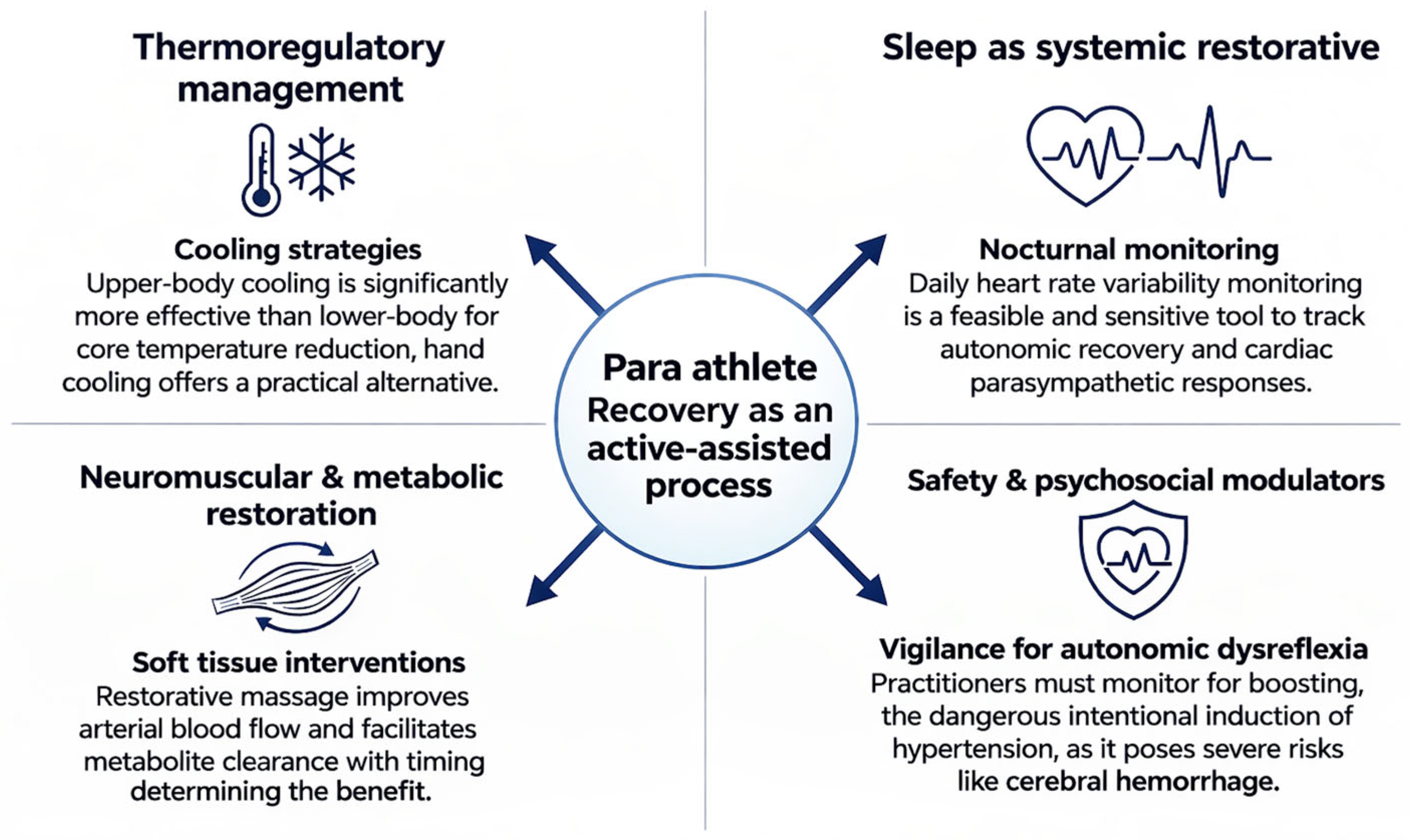
| Thermoregulation | SCI (T6 or above) | Impaired autonomic control of heat dissipation due to loss of vasomotor and sudomotor function | Upper-body cooling (vests/pads) is more effective than lower-body for core temp reduction | Objective monitoring of playing minutes; subjective thermal perception is unreliable |
| Sleep | SCI | Sleep fragmentation due to nocturia, spasticity, and neuropathic pain | Individualized hygiene and abdominal massage for neurogenic bowel dysfunction | Subjective PSQI and objective HRV monitoring |
| Sleep | Visual Impairment | Circadian desynchrony (Non-24-Hour Sleep–Wake Disorder) in those with no light perception | Progressive training load management and strict nutritional/melatonin tracking | Nocturnal HRV; individuals with total light perception loss show elevated cardiac-parasympathetic demand |
| Cardiovascular | SCI (T6 or above) | Impaired venous return and stroke volume due to loss of vasomotor control below the lesion; post-exercise hypotension | Post-exercise abdominal binding to increase intra-abdominal pressure and improve venous return; upper-body cooling to support hemodynamic stabilization | Heart rate recovery; blood pressure monitoring; orthostatic tolerance |
| Cardiovascular | Lower-limb amputees/athletes with prostheses | Increased metabolic cost of locomotion due to mechanical inefficiencies of prosthetic devices; disproportionate cardiovascular strain | Extended recovery periods to allow full restoration of heart rate and metabolic homeostasis; individualized monitoring of training load | Heart rate recovery; perceived exertion; session RPE |
| Neuromuscular | Wheelchair athletes/SCI | Reduction in motor unit recruitment and firing frequency in explosive movements | Massage therapy to restore vascular homeostasis and CWI for perceived soreness | Early-phase RFD (≤50 ms); more sensitive than peak strength for detecting neural fatigue |
| Systemic Safety | SCI (High-level) | Pathological sympathetic surge (Boosting) to artificially enhance performance | Post-exercise abdominal binding and cooling to support hemodynamic stabilization | Blood pressure screening; systolic values > 180 mmHg requires immediate withdrawal |
| Contextual Modulators | All Paralympic athletes | Physiological resource consumption due to environmental barriers and psychological stress | Ensuring accessibility in facilities to minimize unnecessary physical energy expenditure | Perceived readiness and psychological resilience (perceptual maturity) |
Disclaimer/Publisher’s Note: The statements, opinions and data contained in all publications are solely those of the individual author(s) and contributor(s) and not of MDPI and/or the editor(s). MDPI and/or the editor(s) disclaim responsibility for any injury to people or property resulting from any ideas, methods, instructions or products referred to in the content. |
© 2026 by the authors. Licensee MDPI, Basel, Switzerland. This article is an open access article distributed under the terms and conditions of the Creative Commons Attribution (CC BY) license.
Share and Cite
Garcia-Carrillo, E.; Guzmán-Muñoz, E.; Montalva-Valenzuela, F.; Castillo-Paredes, A.; Concha-Cisternas, Y.; Narrea Vargas, J.J.; Sazo-Rodríguez, S.; Cid-Calfucura, I.; López-Gil, J.F. Post-Exercise Recovery in Paralympic Athletes: A Narrative Review of Physiological Considerations and Practical Applications. Appl. Sci. 2026, 16, 3290. https://doi.org/10.3390/app16073290
Garcia-Carrillo E, Guzmán-Muñoz E, Montalva-Valenzuela F, Castillo-Paredes A, Concha-Cisternas Y, Narrea Vargas JJ, Sazo-Rodríguez S, Cid-Calfucura I, López-Gil JF. Post-Exercise Recovery in Paralympic Athletes: A Narrative Review of Physiological Considerations and Practical Applications. Applied Sciences. 2026; 16(7):3290. https://doi.org/10.3390/app16073290
Chicago/Turabian StyleGarcia-Carrillo, Exal, Eduardo Guzmán-Muñoz, Felipe Montalva-Valenzuela, Antonio Castillo-Paredes, Yeny Concha-Cisternas, Jose Jairo Narrea Vargas, Sergio Sazo-Rodríguez, Izham Cid-Calfucura, and José Francisco López-Gil. 2026. "Post-Exercise Recovery in Paralympic Athletes: A Narrative Review of Physiological Considerations and Practical Applications" Applied Sciences 16, no. 7: 3290. https://doi.org/10.3390/app16073290
APA StyleGarcia-Carrillo, E., Guzmán-Muñoz, E., Montalva-Valenzuela, F., Castillo-Paredes, A., Concha-Cisternas, Y., Narrea Vargas, J. J., Sazo-Rodríguez, S., Cid-Calfucura, I., & López-Gil, J. F. (2026). Post-Exercise Recovery in Paralympic Athletes: A Narrative Review of Physiological Considerations and Practical Applications. Applied Sciences, 16(7), 3290. https://doi.org/10.3390/app16073290

