1. Introduction
In vehicle-to-infrastructure environments, Vehicular Ad Hoc Networks (VANET) [
1,
2,
3] are core enabling technologies, providing essential communication and coordination capabilities for Intelligent Transportation Systems (ITSs) [
4,
5,
6] and autonomous driving applications. As a decentralized vehicle-to-everything (V2X) network, VANET support real-time exchange of status and event information, including position, speed, intent, and hazard warnings, through low-latency broadcasting and multi-hop forwarding. This capability enables proactive safety risk mitigation, such as collision avoidance, and supports cooperative driving. Because VANET nodes are physical vehicles naturally distributed across the road network, the system can be deployed with low marginal cost, mainly by using onboard communication units with limited dependence on roadside infrastructure, and the network scale can expand naturally with traffic flow. At the same time, VANET form self-organizing networks by treating vehicles as network nodes. This architecture enables flexible deployment and reduces infrastructure investment. The node population grows naturally with traffic flow. As a result, VANET are well suited to road environments where roadside unit (RSU) deployment is sparse or coverage is intermittent. Direct communication and information exchange among vehicles enable vehicle applications that support key functions such as collision warning and cooperative lane changes. These applications support cooperative perception and route guidance. These capabilities improve traffic safety, transport efficiency, and operational manageability. In the present study, the main focus is placed on vehicular nodes, inter-vehicle communication, and the associated simulation overhead, while the road–network environment mainly provides the traffic and mobility background. More detailed roadside facilities and broader deployment-side supporting infrastructure are not the primary focus of this work.
In theory, VANET can substantially improve traffic operations. However, validating them in complex urban environments still faces major technical and practical barriers. In this study, the traffic environment of interest is an urban road network within a city. Real-world testing in such urban environments is often prohibitively expensive and limited in coverage. In addition, boundary conditions are difficult to control in a strict and repeatable manner because urban traffic is shaped by factors such as intersections, local traffic interactions, and heterogeneous operating states. Such efforts are also constrained by regulatory requirements, equipment availability, and traffic management conditions. As a result, controlled experimentation at representative urban scale remains a major challenge. In addition, many cooperative mechanisms, such as roadside-assisted decision making, inter-vehicle information sharing, and dynamic reconfiguration, often struggle to reproduce consistent experimental conditions on real urban roads. For this reason, traffic–network co-simulation has become an important engineering tool for evaluating V2X protocols and cooperative ITS applications before field deployment, especially when researchers need to test performance under controllable and repeatable urban traffic conditions.
With this background, simulation experiments are a critical pillar for the design, verification, and comparative assessment of cooperative mechanisms. Simulations can reproduce complex traffic flows and wireless channel environments under controlled conditions. In addition, they support large-scale parameter sweeps and ablation analysis. As a result, these capabilities turn theoretical feasibility into evidence that can be verified through engineering practice. In terms of implementation, the evaluation of vehicular network systems has evolved from sequential asynchronous simulation to synchronous co-simulation. Early approaches typically followed a pipeline with two stages that ran traffic simulation first and network simulation second. Traffic simulators such as Simulation of Urban MObility (SUMO) and Verkehr In Städten-SIMulationsmodell (VISSIM) [
7] generated microscopic vehicle motion and interaction behaviors and exported them as trajectory files. These trajectories were then imported into network simulators such as Network Simulator 3 (NS-3) and Objective Modular Network Testbed in C++ (OMNeT++) to emulate communication processes, including link setup, neighbor maintenance, channel contention, and packet forwarding. This decoupled workflow is easy to implement and allows trajectory data to be reused. However, it breaks the feedback loop between traffic and communication. As a result, it is hard to capture how communication latency, congestion, and packet loss affect cooperative decision making. In addition, this approach can introduce bias in time-step alignment, event scheduling, and state updates. To improve cross-domain consistency and closed loop interpretability, researchers have developed co-simulation frameworks. Traffic and network modules interact online and run with synchronous scheduling through a unified simulation clock and interface. As a result, vehicle mobility, communication events, and upper layer mechanisms can evolve jointly on the same timeline. Compared with sequential workflows, co-simulation more faithfully captures how traffic communication coupling affects overall system performance. This makes co-simulation not only a technical simulation framework, but also a practical evaluation basis for broader urban ITS studies in which traffic safety, transportation efficiency, and communication performance need to be jointly assessed.
Although this workflow is closer to real-world system logic, it greatly increases engineering implementation complexity. The strong coupling between traffic and communication causes frequent state updates and mutual feedback. This interdependence creates substantial overhead in cross-platform synchronization and event scheduling. As the simulation scale grows, message load concentration, synchronization blocking, and performance degradation can occur. As a result, it becomes increasingly difficult to run large-scale, long-duration, and reproducible controlled experiments. Beyond longer cross-layer chains, the difficulty of co-simulation also comes from the wide range of tunable settings. These settings cover several aspects, including traffic demand and driving rules, communication links and protocol stack options, and data collection and logging choices. Because these aspects are tightly connected, changing one parameter can trigger ripple effects and simultaneously increase traffic interaction intensity and communication load. For instance, adjusting vehicle density influences both traffic interaction intensity and the size of each communication neighborhood, which then reshapes channel contention and packet forwarding load. Likewise, a finer sampling granularity can reveal more detailed dynamics, yet it also raises the overall system burden and lengthens the experimental cycle. Finally, the simulation horizon and the number of repetitions govern statistical reliability, but they can drive the total cost up in a roughly linear manner, and in some cases even superlinearly. Because of cross-layer coupling and non-linear amplification, researchers often find it hard to balance fidelity, statistical validity, and total cost in experimental practice. Too few samples can produce unstable findings and overly wide confidence intervals. In contrast, overly cautious settings may trigger many redundant runs. As a result, large-scale comparisons across parameter schemes often become impractical due to both time and computing costs.
Currently, co-simulation practices largely rely on empirical parameter tuning. Specifically, researchers frequently adjust key configurations such as simulation duration, sampling settings, and communication loads to mitigate performance bottlenecks or result fluctuations. This strategy driven by experience carries two common risks. First, statistical insufficiency arises when statistical targets are not explicitly specified and enforced, leaving conclusions sensitive to randomness and scenario disturbances and weakening comparability across configurations and studies. Second, unnecessary increases in simulation overhead can occur when robustness is pursued without restraint, so researchers may extend the simulation horizon, raise the sampling rate, or increase the number of repetitions, which can sharply inflate the overall time and computational burden of the experiments. These issues obstruct the development of a stable, reproducible, and comparable experimental paradigm for large-scale co-simulation. As a result, they restrict systematic evaluation and engineering validation of V2X collaborative mechanisms.
Against this backdrop, this paper revisits the parameter configuration problem in VANET traffic–network co-simulation. The objective is not to replace experience-based configuration, but to complement it with a more explicit, structured, and reproducible methodological basis when experiments become larger in scale, more repetitive, and more resource-intensive. In addition, the proposed framework helps abstract effective practical experience into reusable methodological guidance, so that subsequent experiments can be designed more efficiently, repeated trial-and-error effort can be reduced, and sustained research output can be accelerated to some extent. To this end, we first perform a structured decomposition of end-to-end resource consumption in co-simulation to derive cost components that are measurable and interpretable. Furthermore, we explicitly model experimental design requirements, such as statistical validity, as hard constraints in parameter configuration. In this way, configuration selection can move beyond a mainly experience-based trial-and-error process toward a more systematic basis under cost and validity constraints.
The contributions of this paper can be summarized as follows:
Structured cost modeling for traffic–network co-simulation. This paper develops a structured decomposition of end-to-end resource consumption in traffic–network co-simulation, so that the overhead of large-scale experiments is represented by measurable and interpretable components. Unified observation metrics and statistical aggregation rules are further introduced to support consistent cost comparison across different scenarios and parameter settings.
Statistically constrained configuration optimization. This paper incorporates statistical validity requirements, including effective sample size and statistical power, directly into the simulation-configuration process. In this way, key parameters such as simulation horizon, repetition count, and sampling settings are no longer determined mainly by empirical experience, but by explicit and verifiable criteria, enabling a more controlled tradeoff among result credibility, simulation fidelity, and overall overhead.
A structured workflow for simulation-experiment configuration. This paper proposes a structured workflow that organizes simulation-experiment configuration into a clear sequence of executable steps. By formalizing configuration formulation, calibration, and parameter optimization within one unified process, the workflow enables large-scale VANET co-simulation studies to proceed along a clearer configuration path across different scenarios.
The remainder of this paper is organized as follows.
Section 2 reviews related work on VANET co-simulation, experimental overhead analysis, and simulation configuration optimization.
Section 3 presents the materials and methods, including the problem definition, overhead modeling, validity analysis, the minimum-cost configuration model, and the simulation setup and evaluation protocol.
Section 4 provides the simulation-based evaluation and results. The final section,
Section 5, concludes the paper and discusses future work.
2. Related Work
In recent years, simulation has become a key tool for quantitatively evaluating routing protocols and control algorithms in VANET. This section reviews representative progress in related research and groups it into three areas: (i) simulation theory and techniques, (ii) synchronized traffic–network co-simulation, and (iii) lightweight deployment with runtime optimization.
In research on simulation theories and techniques, Ormándi and Varga [
8] conducted an in-depth comparison of intersection control algorithms by introducing higher fidelity communication simulation. They showed that if the authenticity of the communication layer, such as latency, packet loss, and link fluctuations, is ignored, the judgment of algorithm superiority or inferiority may exhibit systematic bias, thereby emphasizing the strong coupling between detailed simulation and the credibility of control conclusions. Veins, OMNeT++, NS-3, SUMO, and VISSIM are among the most widely used simulation tools in VANET research, providing essential support for modeling wireless communication protocols, vehicle mobility, and microscopic traffic dynamics [
9,
10,
11]. Raviglione et al. [
12] developed the MS-VAN3T co-simulation platform, based on NS-3 and SUMO, and implemented a complete ETSI ITS G5 protocol stack, thereby supporting end-to-end virtual validation of V2X communications and applications. Ormándi et al. [
13] proposed a mesoscopic V2X co-simulation method based on SUMO and OMNeT++, which aggregates far-field vehicle communications to accelerate simulation while preserving key accuracy. Weber et al. [
14] provided an updated survey of VANET simulators, systematically examining their support for emerging technologies such as 5G and edge computing as well as security and privacy features, and pointed out that building more realistic and comprehensive VANET simulation tools still faces several open challenges.
In synchronized traffic–network co-simulation, Araujo et al. [
15] built an integrated configurable simulation environment for vehicular named data networking (NDN), and further proposed the NDN4IVC co-simulation framework that integrates NS-3 and SUMO, achieving realistic modeling of vehicular NDN through bidirectional coupling between the network and traffic simulators. Wang et al. [
16] developed a bidirectionally coupled co-simulation platform linking SUMO and NS-3, enabling more realistic evaluation of connected vehicle traffic management and edge computing-based Intelligent Transportation System solutions in smart city settings. Shi et al. [
17] emphasized that simulation-based testing is essential for the development and optimization of connected and automated vehicles (CAVs), and proposed a co-simulation framework that combines traffic simulation with vehicle dynamics to support more realistic CAV evaluation. Alupoaei and Caruntu [
18] conducted V2X simulation studies on the Eclipse MOSAIC platform, illustrating a research pathway that uses integrated traffic and communication platforms to evaluate cooperative optimization strategies for efficiency and safety. Tomás et al. (2023) [
19] proposed an agent-based multi layer co-simulation platform for scenario-oriented integrated simulation, which integrates communication and behavior decision mechanisms so that vehicles can autonomously choose routes based on received traffic information. OpenCDA (Xu et al., 2023) [
20] wraps SUMO, CARLA, and NS-3 and provides a scenario generator and a library of cooperative driving algorithms, greatly reducing orchestration cost and enabling researchers to quickly perform benchmark evaluations for tasks such as platooning, cooperative perception, and edge offloading. Meanwhile, Jia et al. (2021) [
21] interconnected SUMO, OMNeT++, and Webots within a network and physical closed loop with network congestion feedback, enabling a more realistic evaluation of an eco driving controller. Wang et al. (2025) [
22] proposed a hardware-in-the-loop (HIL) V2X test platform, where scaled vehicles equipped with onboard sensors exchange packets with an online network simulator, offloading part of the computation to real hardware and providing visual feedback in real-time. Liang et al. (2025) [
23] proposed the DTTF Sim digital twin framework, which replays real sensor trajectories into a virtual model, enabling continuous regression testing that covers safety critical boundary cases without rerunning full Monte Carlo batches. Schrab et al. (2023) [
24] proposed the Eclipse MOSAIC multi-domain simulation framework, which can couple advanced simulators across traffic, application, and communication domains and supports integration with external models and local codebases, thereby improving extensibility and flexibility. From a broader cyber-physical systems (CPSs) simulation perspective, Tampouratzis et al. [
25] presented the APOLLON framework, a fully distributed integrated simulator that holistically models processors, peripherals, networks, and physical processes within a synchronized CPS environment. This work is oriented toward general CPS simulation and further highlights the importance of accurate cross-domain synchronization and holistic subsystem integration in complex co-simulation studies.
In lightweight deployment and runtime optimization strategies, Stepanyants et al. [
26] proposed a parallel multi-level simulation framework that performs cooperative computation across models at different levels to improve the feasibility of fine-grained large-scale ITS modeling. Tangirala et al. [
27] studied data flow simulation for ultra large-scale ITS and investigated how to efficiently simulate large-scale data movement and processing within a discrete event framework, enabling experimental evaluation at larger scales and over longer time horizons. Häfner et al. (2022) [
28] added merging control and platoon control modules on top of the open VENTOS core and supported hardware-in-the-loop (HIL), showing that under high density traffic, stress testing of adaptive gap creation logic can be completed in minutes rather than hours. Regragui et al. [
29] proposed a simplified microscopic mobility modeling method based on cellular automata (CA) for large-scale urban traffic simulation, where the grid-based framework includes three motion models and is used to analyze how different mobility designs affect VANET connectivity dynamics. Keramidi et al. (2022) [
30] proposed VANET performance evaluation methods based on M/M/c and M/N/M/c queueing models. Hu et al. (2022) [
31] developed a semi Markov process (SMP) model for DSRC safety message broadcasting, enabling analytical computation of collision probability and network throughput. Yeferny and Ben Yahia (2021) [
32] proposed a mathematical model of vehicle mobility on road networks and a fully distributed geographic broadcast protocol that can efficiently compute the zone of relevance (ZOR) for events. Badole and Thakare [
33] proposed a VANET routing framework combined with network digital twins, using a hybrid Honey Badger optimization model and data synchronization in real-time to significantly improve multi-hop routing performance.
Overall, existing studies have developed a substantial set of tools and methods for co-simulation framework construction, platform reuse, and runtime acceleration. Yet a major gap still remains in configuration methodology. Existing studies mainly aim to improve realism or scalability, but they lack an interpretable decomposition of resource consumption and unified measurement metrics. This makes it hard to perform quantifiable cost comparisons across different configurations. Lightweight and acceleration strategies usually target lower overhead in a single run, but they often do not treat statistical validity as a hard constraint in experimental design to systematically set the simulation horizon and repetition count. As a result, simulation studies may still face either too little statistical support or unnecessary execution. At the same time, existing platforms often stress ease of use and functional coverage, but they offer limited support for turning parameter configuration from trial and error guided by experience into a verifiable and reproducible systematic workflow. More importantly, they rarely provide actionable, cost-reducing parameter recommendations and deployable configuration schemes tailored to concrete experimental goals and resource budgets. To close these gaps, this paper uses calibrated modeling of resource consumption as the starting point and builds a minimum-cost configuration optimization framework guided by statistical reliability.
3. Materials and Methods
3.1. Problem Definition and Basic Assumptions
Based on an urban VANET traffic–network co-simulation environment, this paper conducts a comprehensive and systematic analysis of the overall resource overhead of simulation experiments and summarizes the roles and impacts of the constituent components. Building on this analysis, we establish an overall overhead modeling framework for configuration design and further formulate a corresponding optimization model.
To achieve the research objectives, this paper adopts the following assumptions. First, traffic flow is approximated by a Poisson distribution at the aggregate level. Second, the evaluation focuses on an urban road–network VANET scenario within a city, rather than on highway tolling conditions, and does not consider complex hybrid environments that involve cellular networks, UAVs, and RSUs. Third, this paper focuses on a parameter configuration methodology rather than drawing definitive conclusions about the performance of specific protocol mechanisms. Researchers can use the simulation optimization mechanisms proposed here for further secondary optimization. The key parameters involved in this paper are listed in
Table 1.
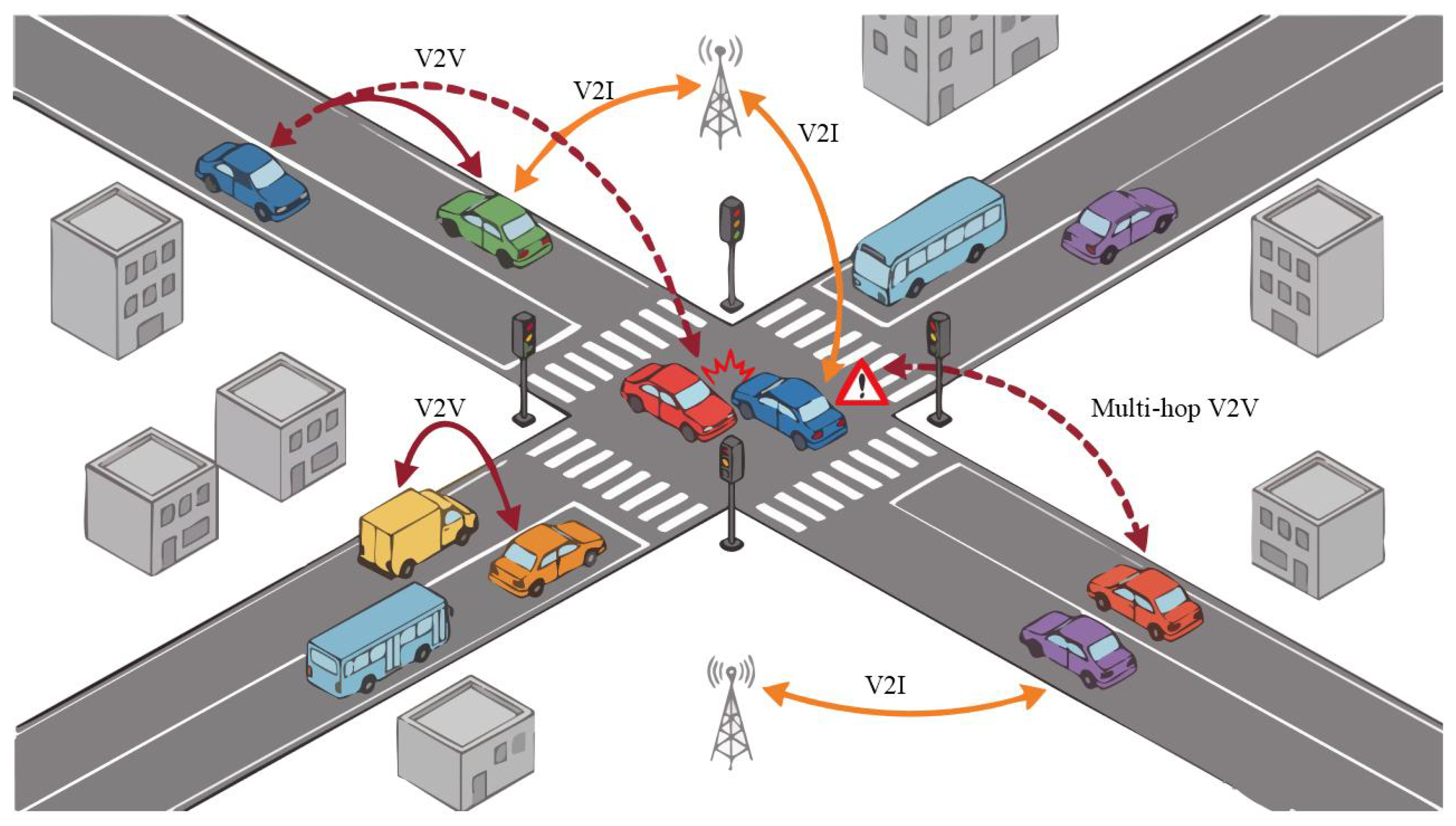
As illustrated in
Figure 1, vehicles exchange safety and status information via broadcast, unicast, and multi-hop forwarding in an urban VANET deployment, which motivates our subsequent overhead decomposition and configuration-oriented modeling.
3.2. Overhead Analysis and Modeling for VANET Simulation Experiments
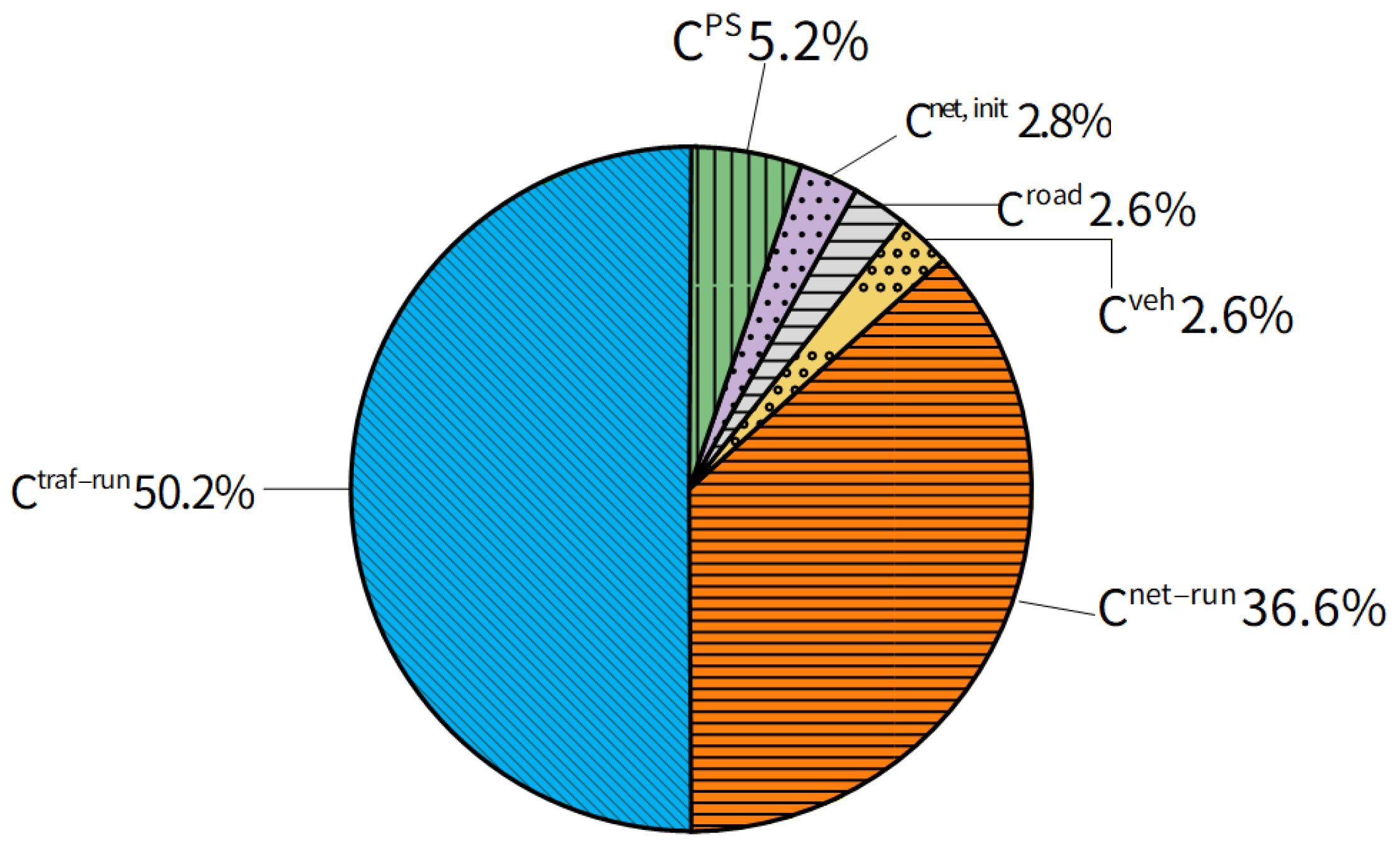
3.2.1. Simulation Experiments Overhead Decomposition
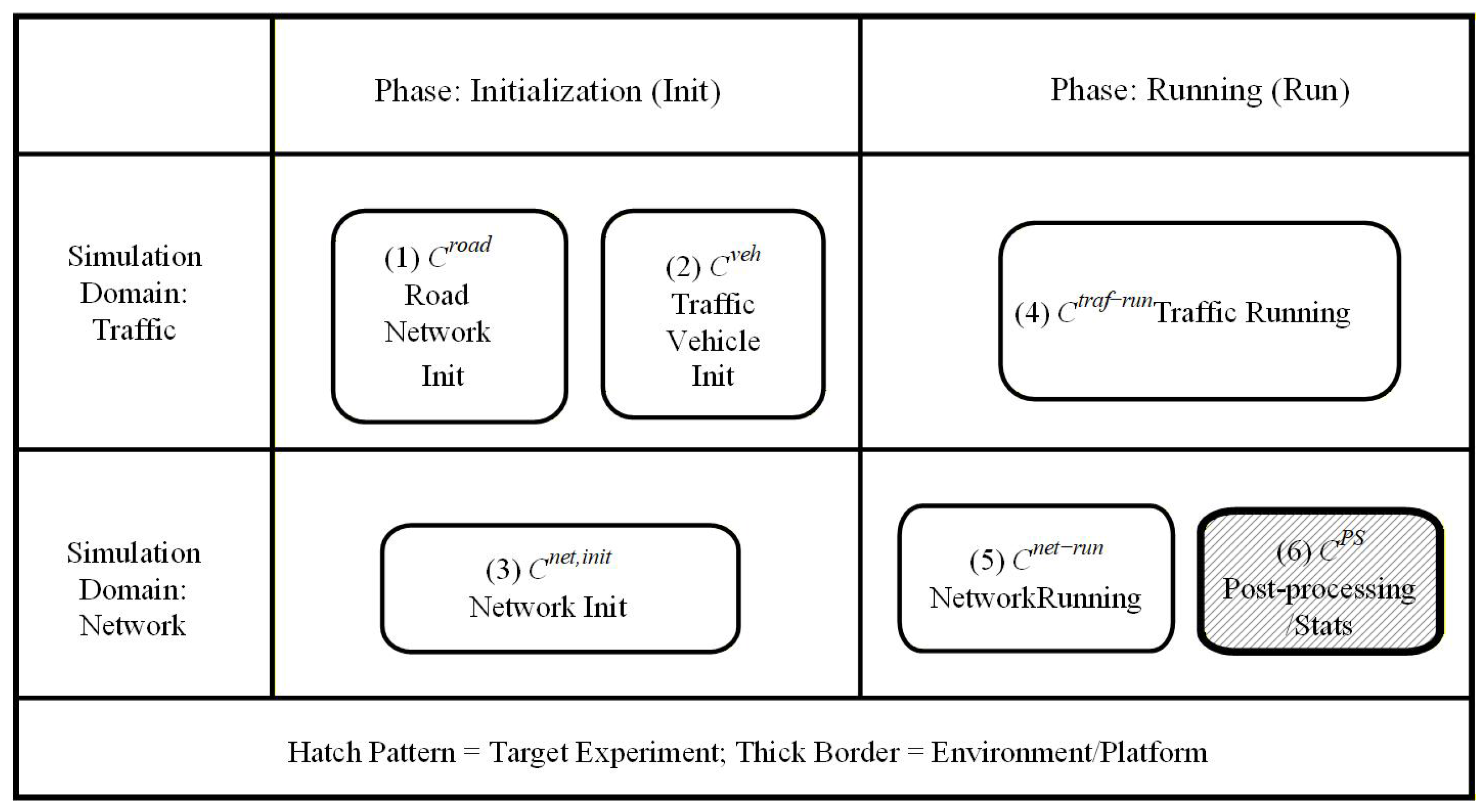
The overall experimental overhead can be decomposed into two broad categories, comprising six components. For clarity, we summarize their taxonomy using a two-dimensional layout where the horizontal axis indicates the phase (Init/Run), the vertical axis indicates the simulation domain (Traffic/Network), and the hatch/border style indicates the scope (General Platform vs. Target Experiment), as shown in
Figure 2.
(1) Road Network Initialization Overhead : This component parses raw road network data, such as OSM and NET files, into computable topology and indexing structures. It covers road and lane graph construction, adjacency generation between nodes and edges, spatial index building, such as grid- or tree-based indices, and loading of traffic light logic. It is a one-time preparation cost that mainly grows with road network scale, including the number of road segments and nodes.
(2) Vehicle Initialization Overhead : This component generates and injects vehicle entities and completes initial route and queue configuration and state initialization. It includes origin destination pair allocation, route loading, inserting vehicles into lane queues, and establishing the initial traffic state. This cost usually grows with vehicle count and is also affected by lane organization and initialization strategy.
(3) Network Initialization Overhead : This component creates network-side objects and initial structures for vehicles and infrastructure. It includes protocol stack and buffer queue initialization, setup of neighbor and link maintenance structures, registration of communication event schedulers, and binding of initialization related to the unified simulation clock. This cost grows with network node scale, and the initial neighborhood size is affected by parameters such as communication radius.
(4) Vehicle Runtime Simulation Overhead : This component represents the cumulative cost of step-by-step traffic-side updates during steady-state operation. It covers microscopic behavior computation such as car following, lane changing, conflict checking, traffic signal response, and necessary rerouting. This cost increases with both simulation horizon and vehicle scale, and it is the primary source of runtime overhead at the traffic layer.
(5) Network Routine Runtime Overhead : This component represents the cumulative cost of protocol processing and cross-layer synchronization progress on the network side during steady-state operation. It covers message transmission, reception, and forwarding, channel contention and queuing, neighbor table maintenance, and runtime synchronization overhead caused by traffic and communication state exchange and event scheduling in co-simulation. This cost is highly sensitive to packet injection intensity, node count, and neighborhood size, and it is the primary source of runtime overhead on the communication side.
(6) Performance Sampling Overhead : This component captures the overhead incurred by the sampling and measurement procedures required to produce experimental outcomes for performance evaluation. It includes observing system states and packet-level events at a chosen sampling rate, computing key performance indicators (e.g., delivery ratio, delay, throughput, and coverage) over time windows, and aggregating statistics across vehicles, flows, or grids. This cost typically grows approximately linearly with the sampling rate and simulation horizon, and it further increases with the monitored scale and the granularity and dimensionality of the collected metrics.
The six components above describe the one-time preparation overhead and the runtime overhead in co-simulation. In this paper, cost refers to the time and computational resource overhead required by simulation experiments, rather than monetary expenditure in any specific currency. For convenience in the following discussion, the wall clock time of a single simulation run is denoted by . The repetition count R is further introduced as an outer-level accumulation factor, which leads to the total simulation overhead.
3.2.2. Parameter–Cost Impact Relationship
To characterize the mechanism by which configuration factors act on the six cost components, this paper analyzes, based on the above six-part decomposition, the coupling relationships between commonly used factors and . The next section summarizes how each factor affects the corresponding overhead components, including the direction of influence and the dominant scaling terms. We categorize these factors into the following categories.
(1) Static Road Network Parameters
Total Road Network Length
L. The longer the road network and the larger the topology scale, the greater the workload for map parsing, graph construction, and index building. Therefore, the road network initialization overhead satisfies
Under a fixed communication radius and protocol settings, the neighborhood size can be approximately characterized by the linear density
and the average neighbor count
under the linear density approximation (defined in Equation (
34)). The neighborhood event-driven part of the network runtime overhead can be written as
where
is a baseline constant term and
is a calibrated coefficient capturing the per-neighbor event cost. Therefore, when this part dominates and
are fixed, we have
.
Number of Parallel Lanes
. Vehicle injection and lane changing require gap checking and queue maintenance on candidate lanes, and higher lane parallelism increases vehicle initialization and traffic runtime overhead. This implies
Maximum Speed Limit
. The parameter
mainly affects runtime overhead by changing the steady-state average speed
and the frequency of event triggers, such as rerouting. This influence can be summarized as
where
K is the expected number of route selection or rerouting triggers for a single vehicle over the horizon
T (see below).
(2) Dynamic Traffic Flow Parameters
Vehicle Count
V. Each additional vehicle typically adds a traffic control loop, a wireless node, and a sampling record stream. Therefore, except for road network initialization, the other five components depend monotonically on
V, which implies
In our experiments (with
fixed), the dominant scaling terms during runtime can be approximated as
Average Speed
. Higher vehicle speed leads to more road segment or intersection traversals per unit time and more frequent rerouting triggers. Here,
denotes the steady-state average speed of vehicles in the traffic simulation. Let
K be the expected number of rerouting triggers per vehicle over the horizon
T. Then
where
is a calibrated proportionality coefficient that maps the average speed to the expected rerouting trigger rate.
Rerouting Trigger Count
K. Higher rerouting intensity increases the event processing burden on the traffic side and the route update burden on the network side. The coupling terms can be written explicitly as
where
and
are baseline terms, and
and
are calibrated coefficients for rerouting-related processing. Therefore,
(3) Network Simulation Parameters
Communication Radius
r. The radius
r determines neighborhood size. Increasing
r increases potential links and contention intensity, thereby raising network initialization and runtime overhead. This implies
Bandwidth
B, Packet Size
, and Packet Generation Rate
. These three parameters jointly determine communication load intensity. Define the load factor
In the high load regime, increasing
or
amplifies network processing and queuing overhead, whereas increasing
B alleviates congestion. The directional relationships can be written as
where the effect is more pronounced for high-
regimes. The following communication feasibility constraint should also be satisfied:
Furthermore, let the expected total number of packets be
Then the network runtime overhead is often written as
where
is a calibrated coefficient representing the per-packet protocol processing cost. When logging is per-packet (or strongly correlated with per-packet events), larger packet size and higher packet injection intensity also increase I/O, which implies
(4) Simulation Control Parameters
Sampling Frequency
. The number of sampled records scales linearly with
, and the I/O overhead can be written as
where
is a baseline term and
is a calibrated coefficient for per-sample measurement and aggregation. If sampling triggers uploading or broadcasting (that is, sampling also produces network events), then we further have
Steady-State Simulation Horizon
T. The three runtime components scale with
T, which implies
Repetition Count
R. We do not treat repeated experiments as an independent cost component. Instead, the total overhead is written as an outer level summation:
3.2.3. Parameterized Cost Modeling
This subsection consolidates the parameterized representation of the six cost components and prepares the feature quantities and optional constraints used in the subsequent optimization model.
(1) Parameterized Summary of Component Costs. Based on the directional analysis above, and to support the subsequent calibration and model solving, this subsection further writes the six cost components in an explicit form of feature terms derived from parameter combinations plus coefficients to be calibrated. Let the configuration vector be
where
are scenario or protocol settings (fixed in our experiments),
V is the workload intensity, and
,
T, and
R are controllable simulation parameters used to balance statistical validity and total cost.
(2) Derived Feature Quantities. The auxiliary quantities are defined as
where
is linear density,
is the linear density approximation of the average neighborhood size, and
K is the expected number of rerouting or route selection triggers for a single vehicle over the horizon
T (which can be obtained from logs and treated as an observable feature in calibration).
(3) Parametric Expressions of the Six Cost Components. Summarizing the above, the six-part decomposition can be written as follows, where the coefficients
are to be calibrated:
If road network parsing can be reused, the total overhead of
R independent repetitions under different random seeds can be written as
(4) Optional Resource Capacity Constraints. When the platform is sensitive to memory or storage, monotonic surrogates can be constructed for peak memory and log volume and incorporated into the optimization as hard constraints or as a weighted objective, for example:
For instance, a weighted objective can be constructed as follows:
or budget constraints can be imposed as
3.3. Threats to Validity and Mitigation Strategies
The experimental guidance methodology proposed in this paper is built around a cost proxy model and statistical power constraints. It seeks to reduce overall experimental cost without changing conclusions about network performance (e.g., packet delivery ratio (PDR), throughput, and latency). To strengthen the credibility of these conclusions, this section identifies potential threats in three dimensions, internal validity, construct validity, and external validity, and presents actionable mitigation strategies.
3.3.1. Internal Validity
Synchronization Errors and Time Advancement Conventions. Inconsistencies in time advancement granularity and callback ordering between the traffic and communication layers can introduce event ordering bias, which can in turn degrade the accuracy of end-to-end latency and packet loss statistics. Mitigation: Use a unified simulation clock and deterministic coupling callback order. Log timestamps for critical events, and align time advancement granularity across configurations through regression testing.
Insufficient Warm Up and Non-Steady-State Bias. Transient effects before route convergence and traffic flow stabilization during the start-up phase can distort steady-state statistics. Mitigation: Set a warm-up duration and compute statistics over the steady-state interval . In addition, validate the adequacy of using convergence curves of key metrics.
3.3.2. Measurement Validity
Sampling Granularity Changes Metric Definitions. If reducing the sampling frequency causes missed detections of critical events, the statistical definitions of PDR, throughput, and latency may change, thereby affecting the assessment of conclusion consistency. Mitigation: The value of is not chosen arbitrarily. Instead, it is constrained by a lower bound derived from typical relative motion conditions (see), which ensures that the sampling resolution is sufficient to capture the shortest contact process. In addition, we recheck the consistency of the main conclusions in the results section using a reference configuration.
Correlation Can Overestimate the Effective Sample Size. Time window-based statistics exhibit temporal correlation. If they are naively treated as independent samples, the effective sample size may be overestimated, leading to overly optimistic power planning and an underestimated recommended .
Mitigation: Introduce an effective sample coefficient
and apply the following correction
where
is estimated from pilot experiments. When necessary, we further verify robustness using block-bootstrap.
3.3.3. External Validity
The surrogate model coefficients may vary with road topology, wireless propagation, protocol stack implementations, traffic pattern characteristics, and application-level behaviors. In particular, if the network becomes denser, the traffic pattern becomes more heterogeneous, or signalized intersections induce stronger vehicle platooning, the calibrated values of some traffic- and network-related cost components may change. Differences in protocol stack design may likewise change the communication pattern and the relative contribution of some network-side cost terms. Nevertheless, such differences do not alter the general applicability of the proposed workflow, whose methodological logic is formulated at the framework level rather than tied to one specific routing protocol. Mitigation: We perform sensitivity analyses across multiple traffic densities and key communication parameters, and retain the workflow structure of pilot runs, profiling, and power planning so that it can be transferred to other scenarios. Therefore, when traffic patterns exhibit stronger heterogeneity, denser interactions, or more complex protocol and application behaviors, the overall workflow remains applicable, while the corresponding surrogate model coefficients should be recalibrated through pilot runs for the target scenario.
These threats and the corresponding mitigation strategies are summarized in
Table 2.
3.4. Minimum-Cost Model and Structured Workflow
This section presents a structured workflow for solving the minimum-cost configuration model, aiming to minimize experimental overhead while ensuring statistical reliability and fair comparisons. We treat the workload level
V and the simulation-control variables
as adjustable, while scenario- and protocol-dependent parameters are fixed across configurations. Following the cost decomposition in
Section 3, we focus on four classes of factors: (i) sampling frequency
; (ii) simulation horizon
T and warm-up duration
; (iii) repetition count
R; and (iv) vehicle count
V.
Throughout, with , and V is treated as an experimental independent variable whose values are specified by the research objective or traffic demand. The remaining scenario and protocol parameters (e.g., ) are fixed in controlled experiments to ensure comparability; if any of them need to be tuned, they can be included as additional independent variables.
3.4.1. Minimum-Cost Configuration Model
Given the co-simulation platform and scenario settings
, we select simulation control parameters under workload level
V to minimize the total cost. As discussed in
Section 3, the total cost follows a six-part decomposition and admits a parametric surrogate form in Equations (
35)–(
41). We therefore optimize
for each given
V.
Given
and fixed protocol parameters, we optimize the configurable parameter vector
. The corresponding minimum-cost configuration is formulated as
The key constraints and their practical interpretations are summarized as follows.
(1) Sampling Frequency . The sampling frequency determines how many states and metrics are recorded per unit time. It therefore directly affects I/O and serialization overhead, and it may also amplify the network-side load indirectly through sampling-triggered reporting or broadcasting. An excessively high introduces redundancy and increases , whereas an overly low may miss short contacts or transient congestion and thus harm observability and the credibility of conclusions.
Let
denote the magnitude of the relative speed between two nodes. The approximate contact duration is
In the most adverse case (shortest contact), to guarantee at least
m samples, we recommend
Here
can be approximated by an upper bound on the relative speed of two vehicles traveling in opposite directions, and
m (e.g., 5–10) controls the desired time resolution. This rule provides a lower bound for
. Its upper bound is typically constrained by the platform I/O throughput and disk budget (or an upper bound on
).
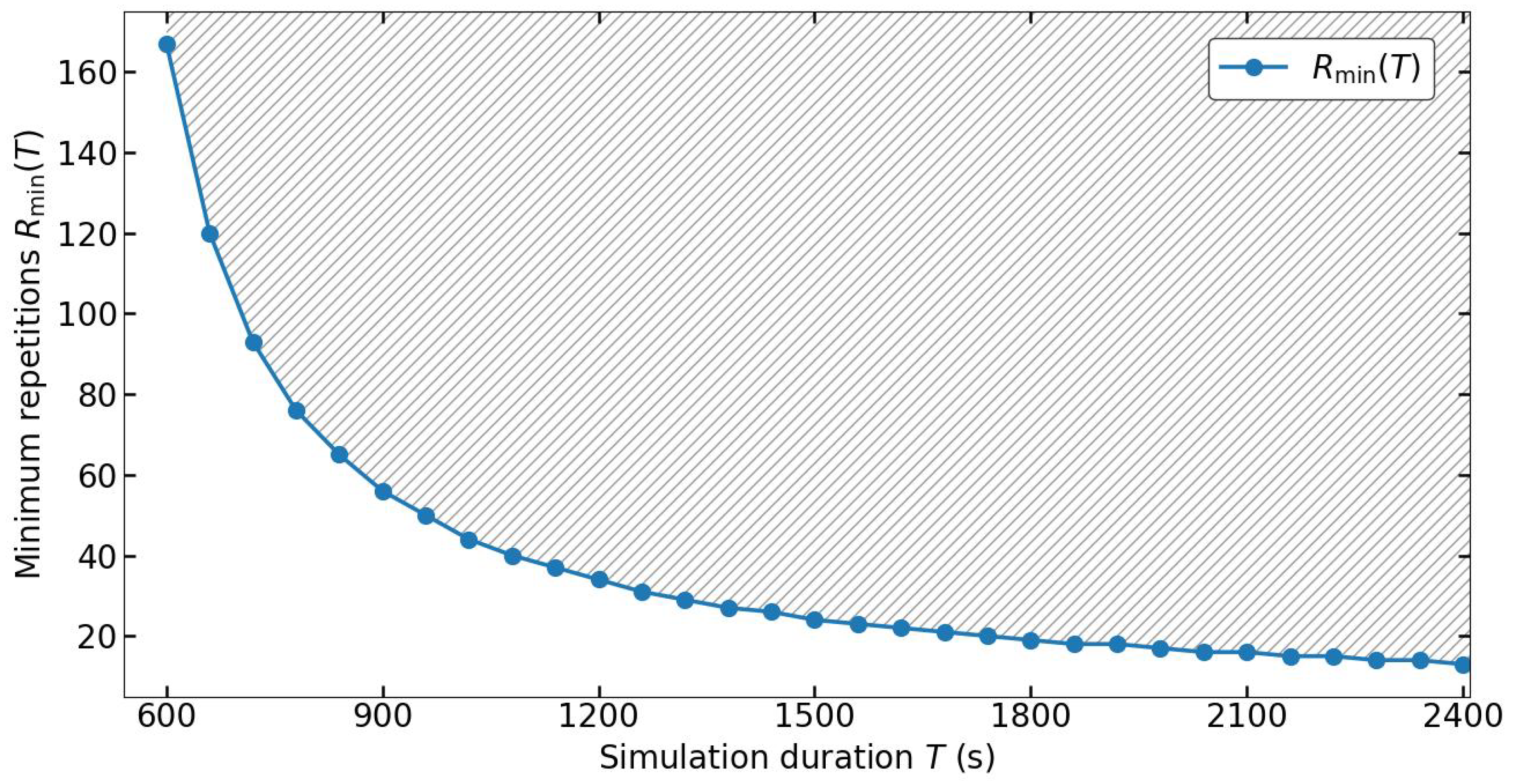
(2) Statistical Power and Minimum Sample Size. Setting
T and
R empirically can lead to either insufficient samples or overly conservative designs, which weakens reproducibility and increases cost. We adopt an approximate sample-size plan based on a two-sample mean-difference test. Let
be the standard deviation of the target metric (estimated from calibration runs),
be the minimum detectable effect,
be the significance level, and
be the statistical power. Then the minimum effective sample size is approximated by
When multiple metrics (e.g., PDR, throughput, and latency) must be satisfied simultaneously, we take
(3) Effective Sample Size and Horizon Constraint. Because time-series sampling typically exhibits correlation, counting raw sample points may overestimate the effective sample size. We compute windowed statistics over the steady-state interval
with window length
, and introduce an effective-sample coefficient
to correct for correlation, yielding
From
, we obtain the minimum simulation-horizon constraint
Equation (
55) explicitly characterizes the substitutability between
T and
R. With other conditions fixed, increasing
R linearly reduces the required steady-state duration
. Conversely, if
R cannot be increased due to limited parallel resources,
T must be extended to compensate for the effective sample size.
(4) Optional Feasibility Constraints. The communication feasibility constraint is ensured by fixing protocol parameters and checking the condition beforehand; if is also optimized, it can be incorporated directly as a constraint.
When platform resources are limited, the memory and storage budgets can further be incorporated using the surrogates in Equations (
42) and (
43), either as hard constraints (
and
) or as a weighted objective in Equation (
44).
3.4.2. Complexity and Solving Analysis
The core tension of the minimum-cost model in Equations (
48) and (
49) is that meeting the power requirement increases
by enlarging the steady-state duration
or the repetition count
R. However,
Section 3 shows that increasing
T,
R, or
monotonically increases
,
, and
, and thus raises the total cost
. With additional budgets (
and
), the feasible region further shrinks, making the cost–reliability tradeoff more explicit.
Decision version: Given a threshold
, determine whether there exists
such that constraints (
48) and (
49) hold and
.
Proposition 1 (Optimal repetition count attains the feasible lower bound)
. For given and fixed , if the total cost is nondecreasing in R (the form in Equation (41) used in this paper satisfies this property), then any optimal solution must take the minimum feasible repetition count Proof. For fixed
, constraint (
48) is equivalent to
, so the smallest feasible integer is given by Equation (
56). Because
is nondecreasing in
R, choosing a larger
R cannot reduce the objective value. Therefore the optimum must attain this lower bound. □
Proposition 2 (Polynomial-time solvability (thus not NP-hard))
. Under the experimental configuration in this paper, and T are chosen from explicit finite candidate sets and , respectively (e.g., T can be restricted to integer multiples of ). If each cost evaluation can be computed in polynomial time (and is for the surrogate model), then the model in Equations (48) and (49) can be solved exactly in time, so its decision version belongs to . Hence, under our setting, the model is not NP-hard
(under the standard assumption ). Proof. By Proposition 1, for any candidate pair , the optimal and feasible repetition count is uniquely determined as . Hence, it suffices to search over all , compute , evaluate , and optionally check and , and then select the minimum. This finite search involves evaluations, each in polynomial time, so the overall procedure runs in polynomial time. □
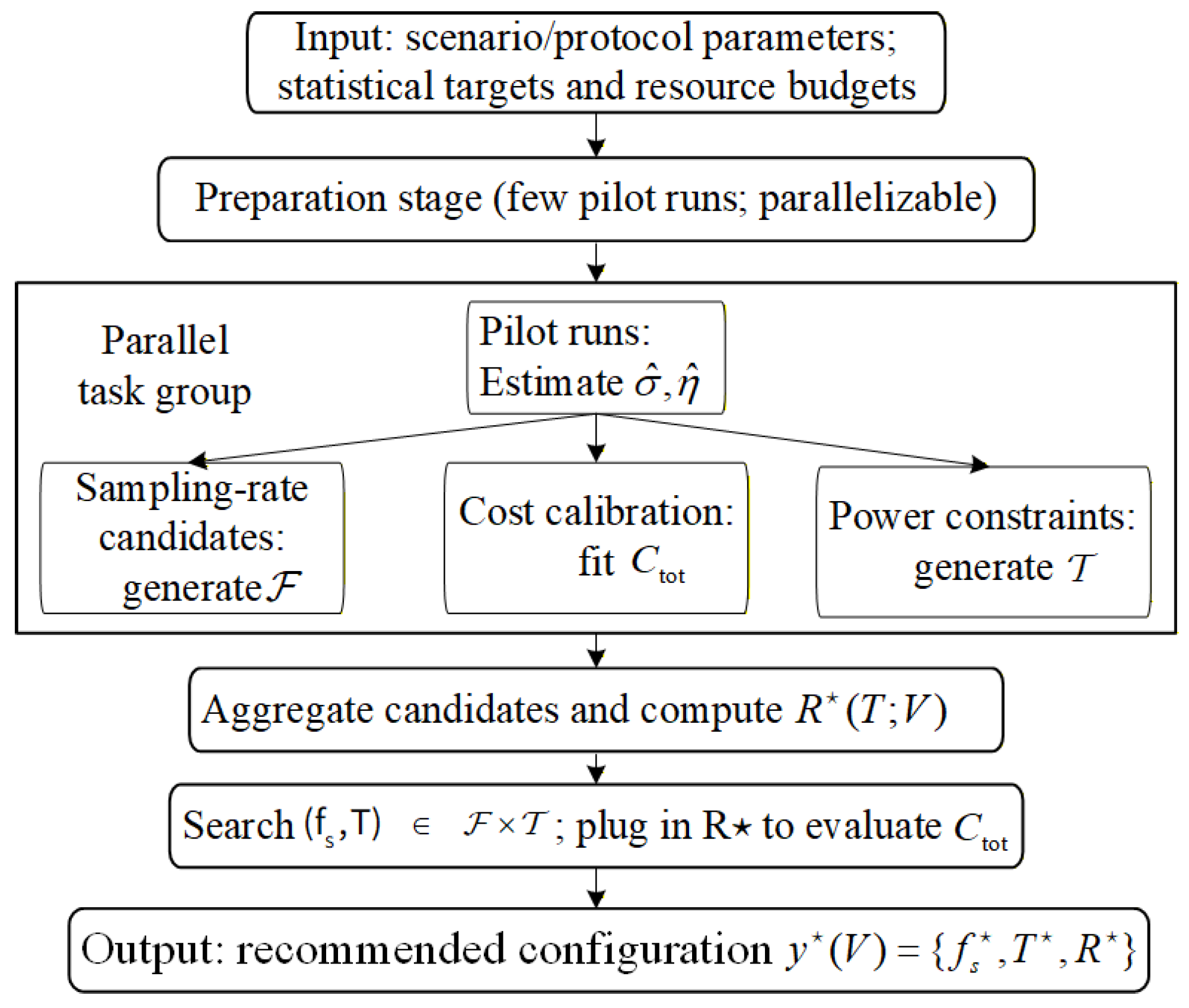
3.4.3. Model Solving
The model solving procedure and workflow are illustrated in
Figure 3.
(1) Profiling and Calibration Steps.
We recommend calibrating the surrogate model with a small number of calibration runs. Choose representative configuration points that cover the feasible range (constructed from combinations of
). For each run, record
and, when needed, the finer breakdown of traffic-side, network-side, and I/O overhead. Then fit the six overhead surrogates in Equations (
35)–(
40) and validate the fitting error, and estimate
and
from pilot runs for power planning.
(2) Solving Method and Complexity Analysis.
The overall configuration solving procedure is summarized in Algorithm 1.
| Algorithm 1 Minimum-cost configuration solving procedure (variable elimination + finite search) |
- Require:
Workload set ; candidate sets and ; calibration design ; statistical targets ; (optional) resource limits - Ensure:
For each , the recommended configuration - 1:
Run the calibration set , collect , and fit the overhead surrogates ( Section 3) - 2:
Estimate the metric variance and the effective-sample coefficient , and compute via - 3:
for alldo - 4:
- 5:
for all do - 6:
for all and do - 7:
Compute () - 8:
Evaluate the cost - 9:
if (optional budgets) and and then - 10:
, - 11:
return
|
Let , , and . If each cost evaluation is constant-time (algebraic operations plus surrogate calls), then the time complexity of the solving stage is . The space complexity is (or if storing all ). This complexity is decoupled from the cost of running simulations, enabling fast configuration screening before experiments.
Equation (
56) indicates that the statistical constraint is translated into a lower bound on the product of the repetition count
R and the steady-state duration
, and that the smallest feasible repetition count is determined accordingly. We therefore adopt a deterministic strategy of variable elimination plus finite search. For each workload point
V, we search
, compute
, evaluate
using the
Section 3 surrogate model, and, when needed, check the budgets on
and
. In this evaluation, the traffic runtime and the network runtime are dynamically recomputed under the current candidate setting together with the other cost terms, and the resulting total overhead is then used for candidate comparison and final selection. The candidate with the smallest cost is selected as the recommended configuration.
3.5. Simulation Setup and Evaluation Protocol
Table 3 summarizes the hardware and software stack used in the experiments.
We adopt the SUMO-Veins-OMNeT++ co-simulation stack to enable cross-layer consistent simulation. The traffic layer uses SUMO to generate microscopic vehicle mobility under road–network constraints. The network layer relies on OMNeT++ as a discrete-event simulation kernel to schedule wireless communication and protocol events. Veins couples the two simulators under a unified clock so that traffic states (e.g., position and speed) can drive the communication process in real-time, and network decisions can be fed back to traffic dynamics when needed. In the adopted co-simulation setting, the interaction between the traffic and communication layers is performed with fixed synchronization granularity. At each synchronization point, SUMO first advances by one configured simulation step and updates vehicle mobility states, after which the updated states are exchanged through the Veins/Traffic Control Interface (TraCI) and the corresponding network-side events are processed in OMNeT++ based on the synchronized traffic state.
For the network protocol, we use the classic ad hoc on-demand distance vector (AODV) routing protocol as a representative communication setting in the present experiments. Message delivery among vehicles and RSUs is realized via AODV multi-hop forwarding and route maintenance. Control overhead for route discovery and route maintenance (e.g., route request (RREQ), route reply (RREP), and route error (RERR)) is counted together with application messages to form the observations required by the subsequent cost modeling and minimum-cost configuration solving. Although AODV is adopted in the current evaluation, the proposed framework is not restricted to AODV itself. When other protocol stacks such as the European Telecommunications Standards Institute (ETSI) ITS G5 are considered, the overall workflow can still be retained, while the corresponding network-side cost terms and fitted coefficients should be recalibrated under the target protocol setting.
Table 4 lists the scenario settings, fixed parameters, and runtime configurations.
Based on
Table 4, we conduct comparative experiments over the traffic load
V, simulation horizon
T, and repetition count
R. The custom scripts used for cost-model fitting, configuration solving, and result post-processing are not publicly archived at this stage, but can be made available from the corresponding author upon reasonable request.
5. Conclusions
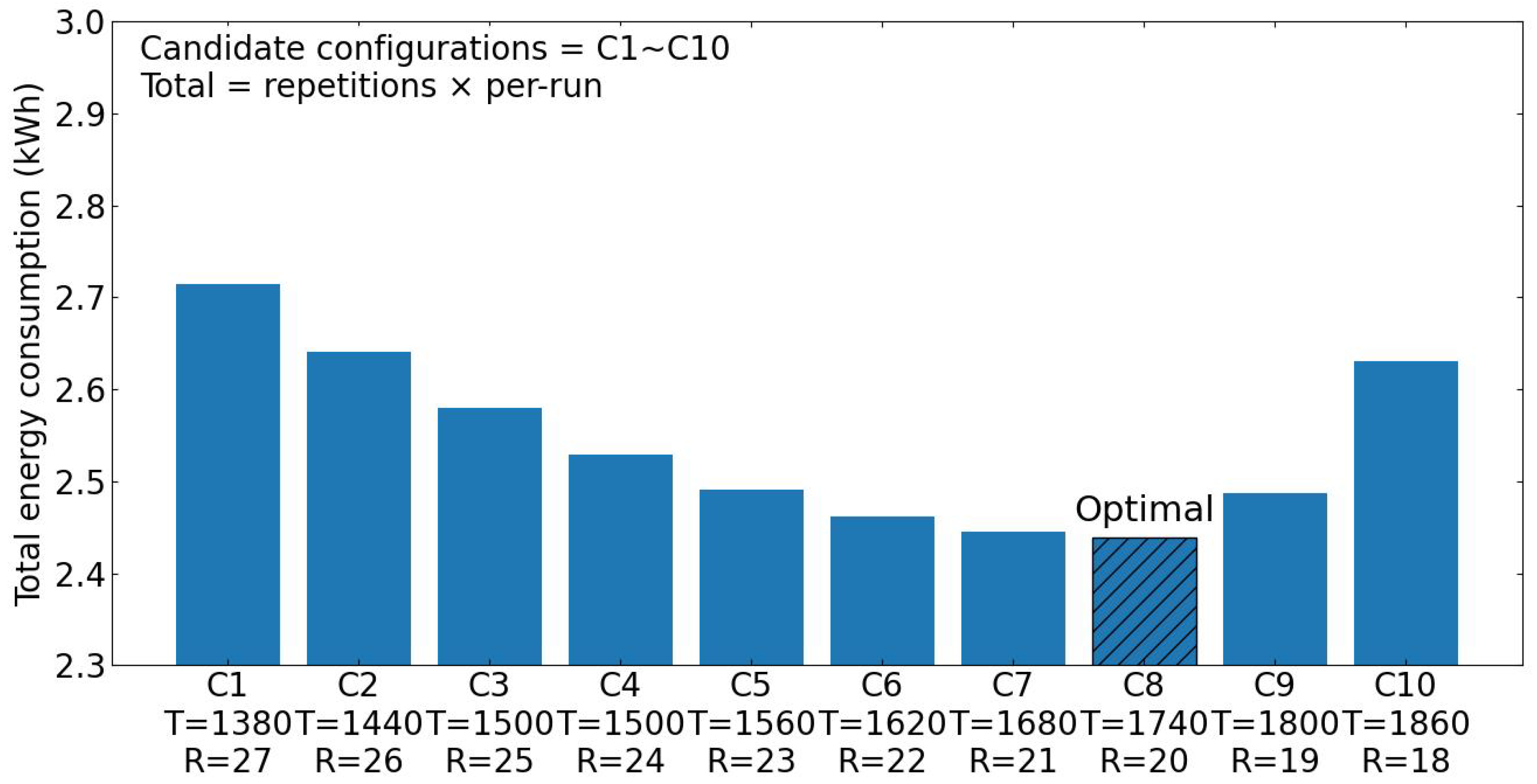
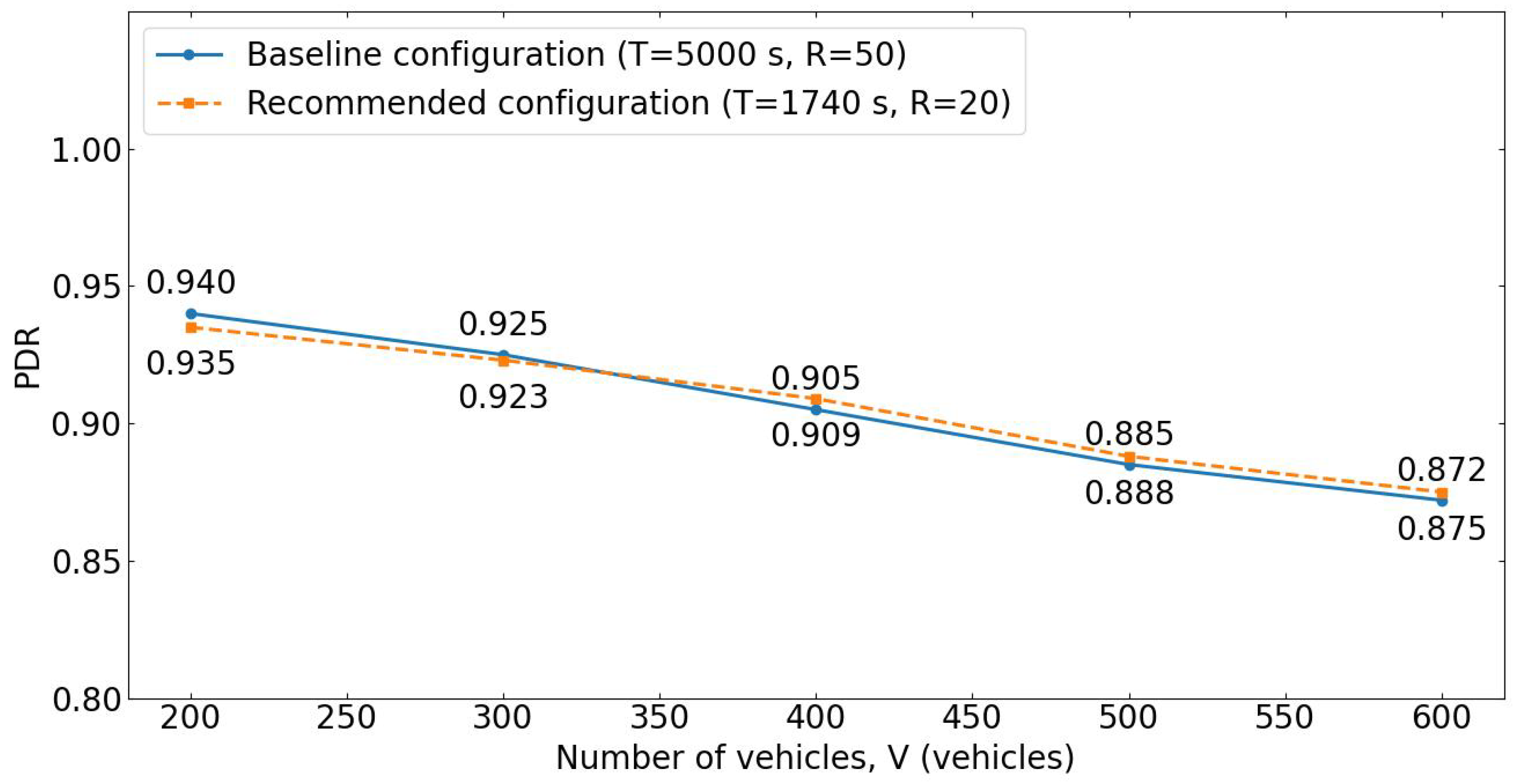
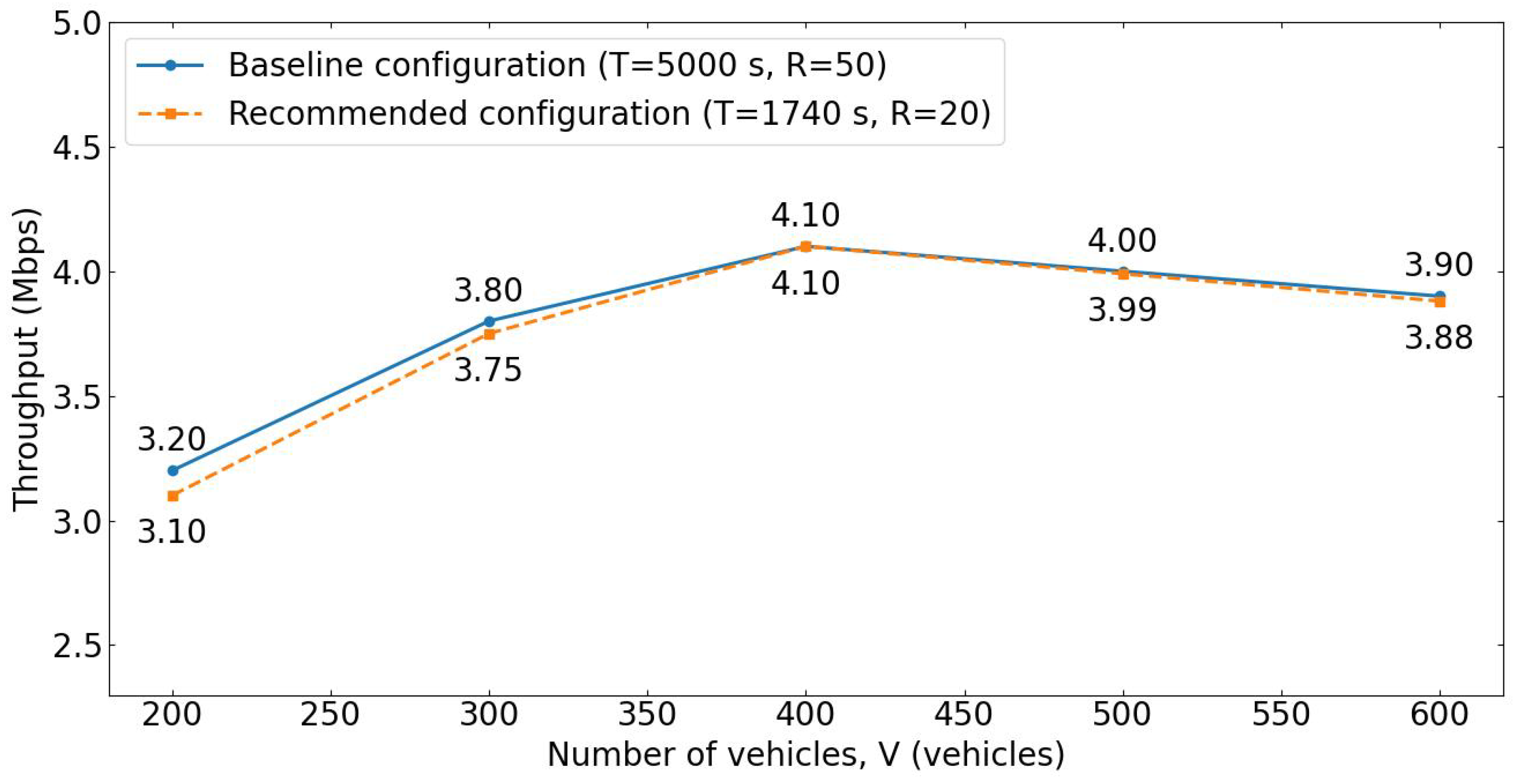
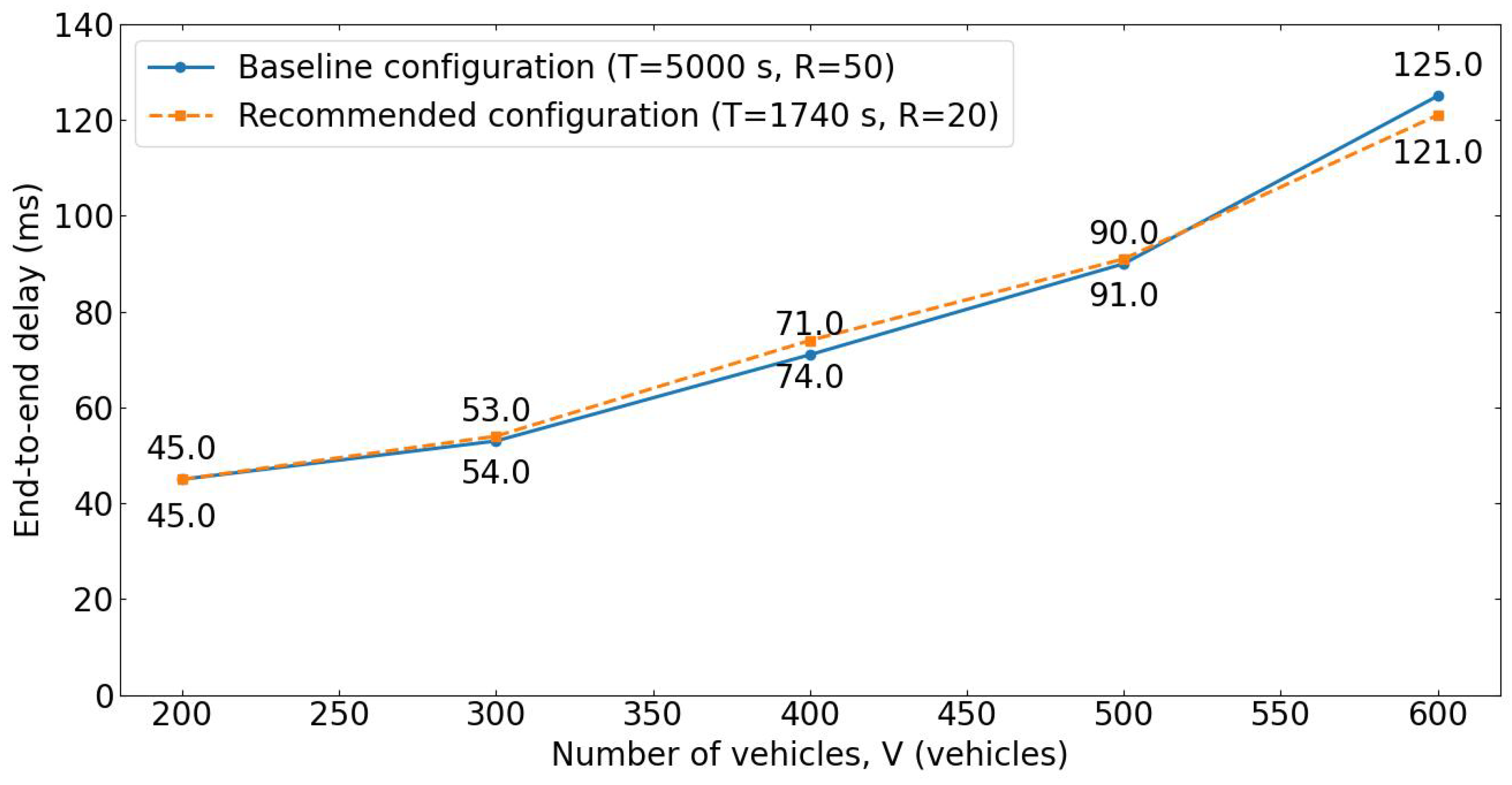
This paper investigated the problem of cost-aware parameter configuration in large-scale VANET traffic–network co-simulation. To address the limitations of conventional parameter setting methods that rely heavily on empirical trial-and-error and often struggle to balance overhead control, statistical validity, and configuration reproducibility, a structured configuration methodology was proposed. The method decomposes the overall experimental overhead, establishes a parameterized overhead model, and constructs a minimum-overhead configuration model under statistical reliability constraints, so that key parameters such as simulation horizon, repetition count, and sampling frequency can be selected according to explicit criteria. The proposed framework was validated in a representative urban road–network co-simulation scenario based on a SUMO-Veins-OMNeT++ workflow. Comparative experiments conducted under the baseline reference configuration and the recommended configuration showed that, while satisfying the statistical validity requirement, the recommended configuration reduced platform-side energy consumption from 2.71 kWh to 2.44 kWh. At the same time, the main performance conclusions remained consistent under both configurations: the PDR curves were largely overlapped across all tested traffic loads, and at the highest tested load of , the end-to-end delay was 125 ms and 121 ms, respectively. These results indicate that the proposed method can effectively reduce the overall time and computational resource overhead of simulation experiments while preserving result credibility and fairness of comparison.
This work provides a more efficient, reproducible, and statistically credible experimental basis for the engineering evaluation of V2X protocols and cooperative ITS applications before field deployment. It can also help relevant researchers and practitioners shorten the cycle of simulation experiments and performance evaluation, thereby improving the efficiency of research output. Future work will further validate the proposed method under more diverse road–network topologies, traffic-demand patterns, and communication settings, and extend it to support adaptive configuration across different protocol stacks and application-oriented workloads, so as to enhance its generality and applicability.