Dynamic Risk Evolution and Adaptive Synchronization Control for Human–Machine–Environment Coupled Nuclear Emergency System: Based on Comprehensive On-Site Emergency Drills of Nuclear Power Plants


Abstract
1. Introduction
1.1. Background and Motivation
1.2. Related Work
2. Materials and Methods
2.1. Risk Network Modeling
2.1.1. Risk Factor Exploration and Causal Network Construction
2.1.2. Constructing the Adjacency Matrix
2.1.3. Network Risk Value Calculation
- (1)
- Betweenness centrality
- (2)
- PageRank directed indicator
- (3)
- Normalization and aggregated risk score
2.2. Development of a Kinetic Model for Nuclear Emergency Risk Evolution
- (1)
- The amplified impact of equipment and environmental factors on humans
- (2)
- Evolution of device posture under human–environment interaction mechanisms
- (3)
- Human–machine interaction leads to secondary environmental consequences.
2.3. Justification of Chaotic Abstraction for Nuclear Emergency Risk Systems
2.4. Analysis of Dynamic Evolution and Chaotic Behavior in Networks
2.4.1. Definition of Lyapunov Exponents
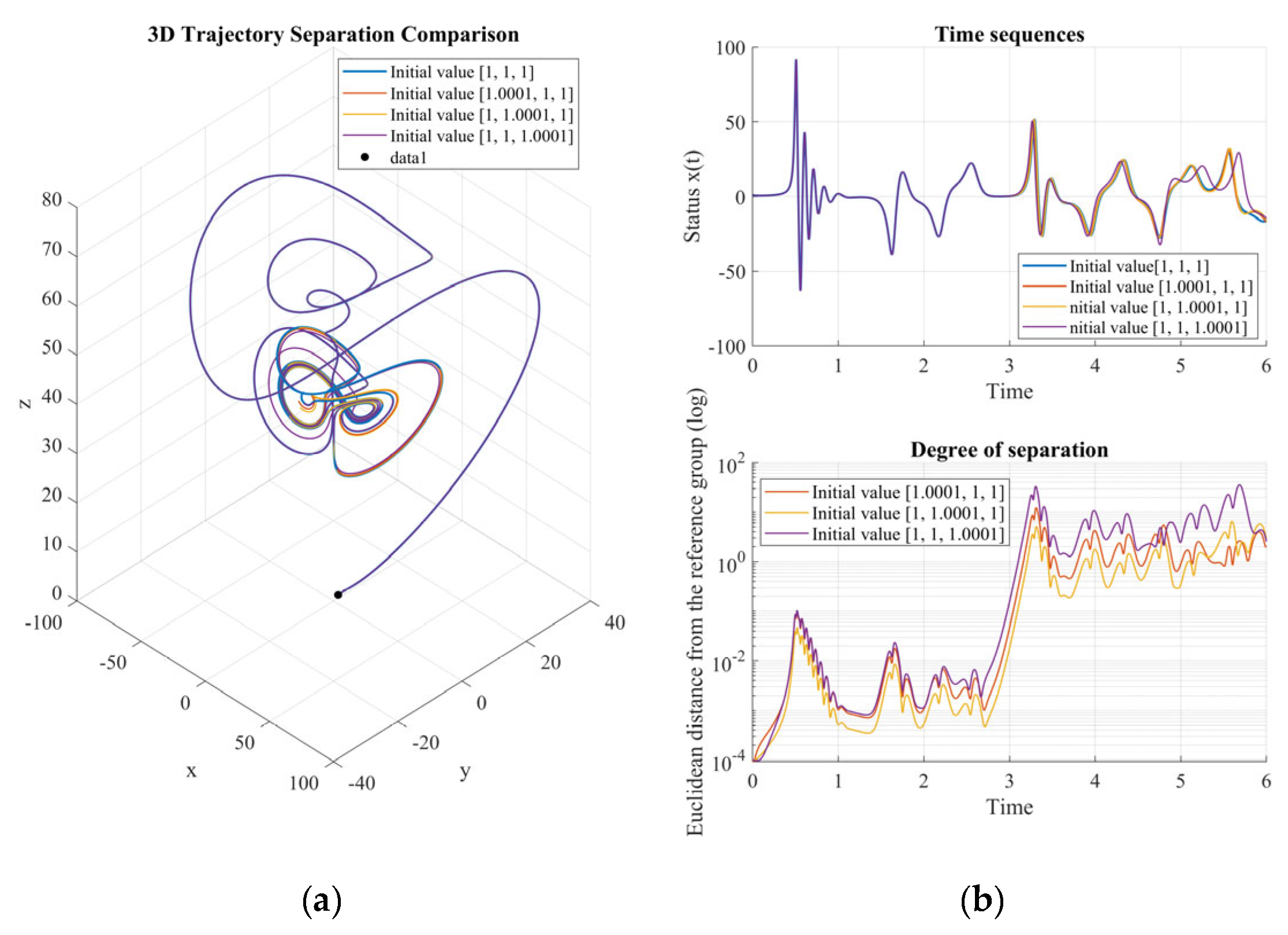
2.4.2. Chaotic Behavior and Dynamical Evolution Characteristics
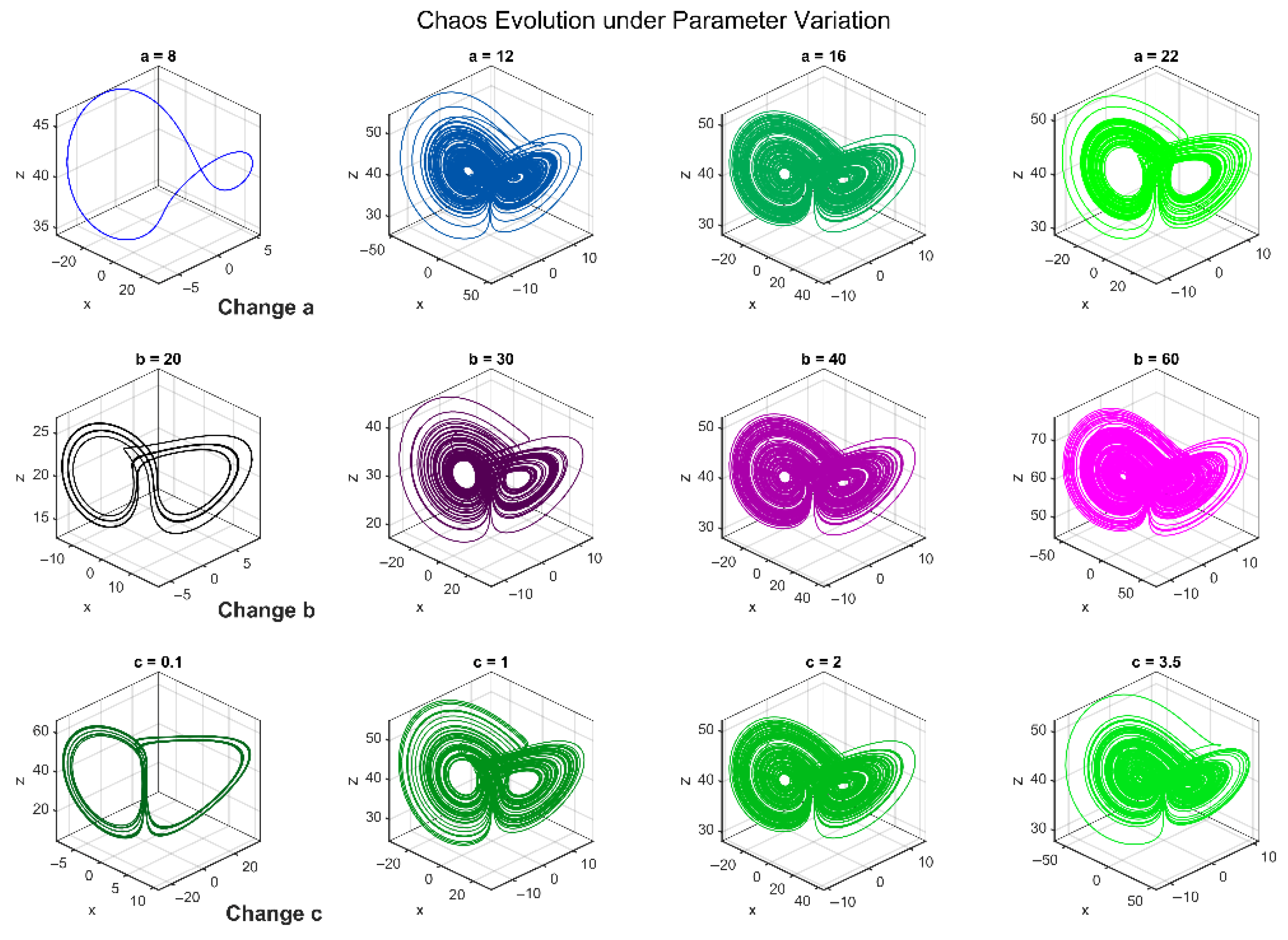
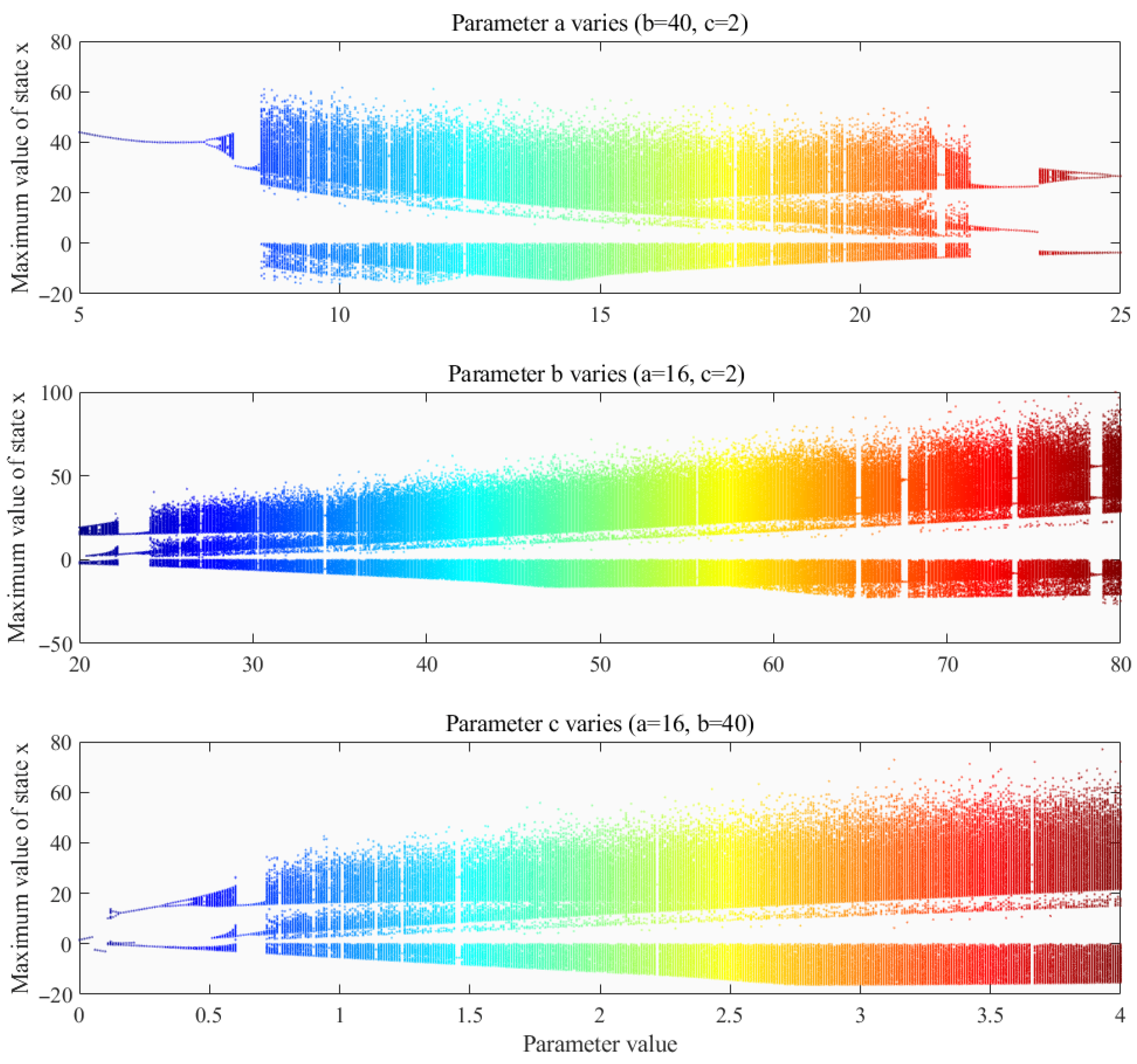
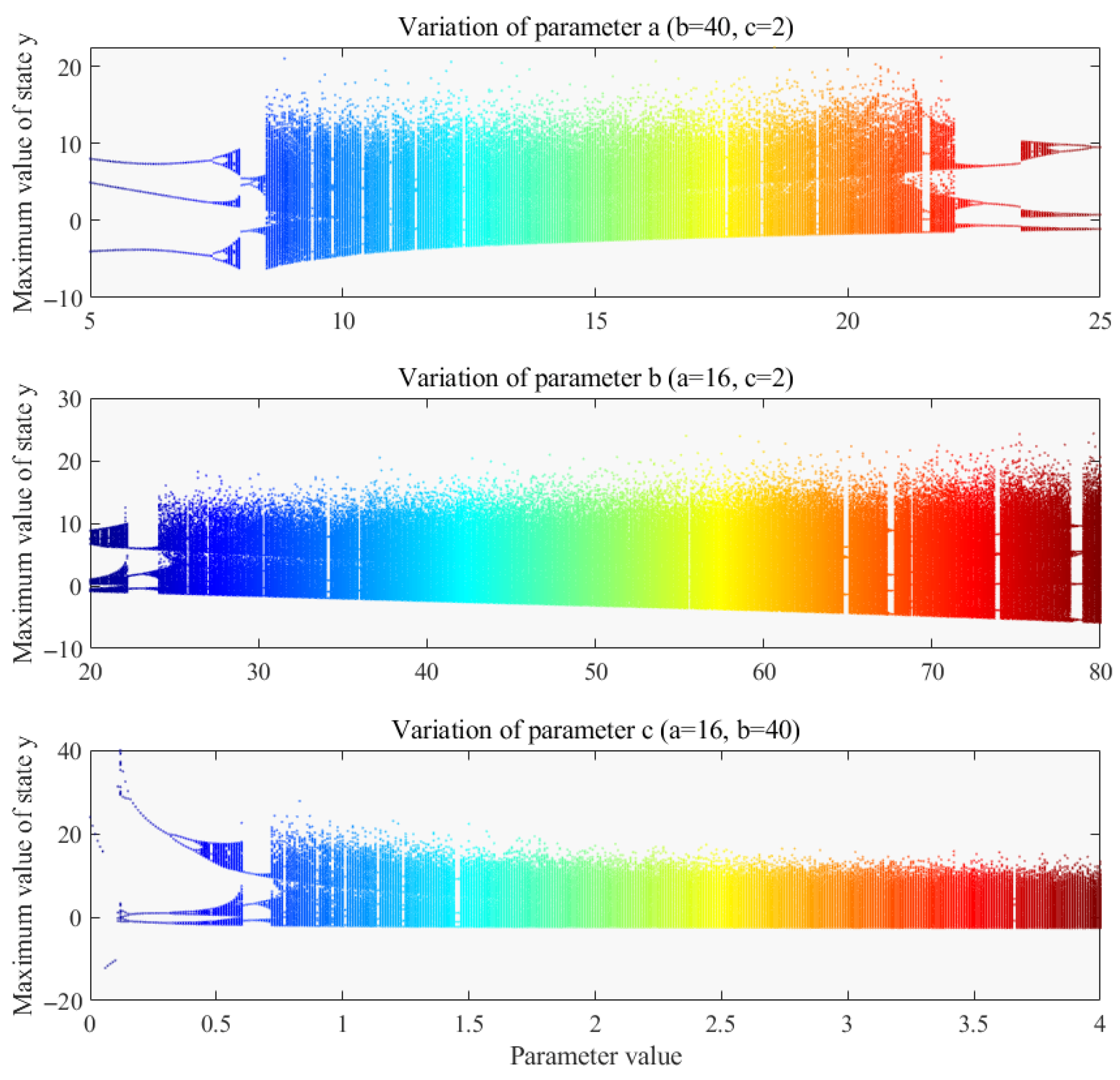
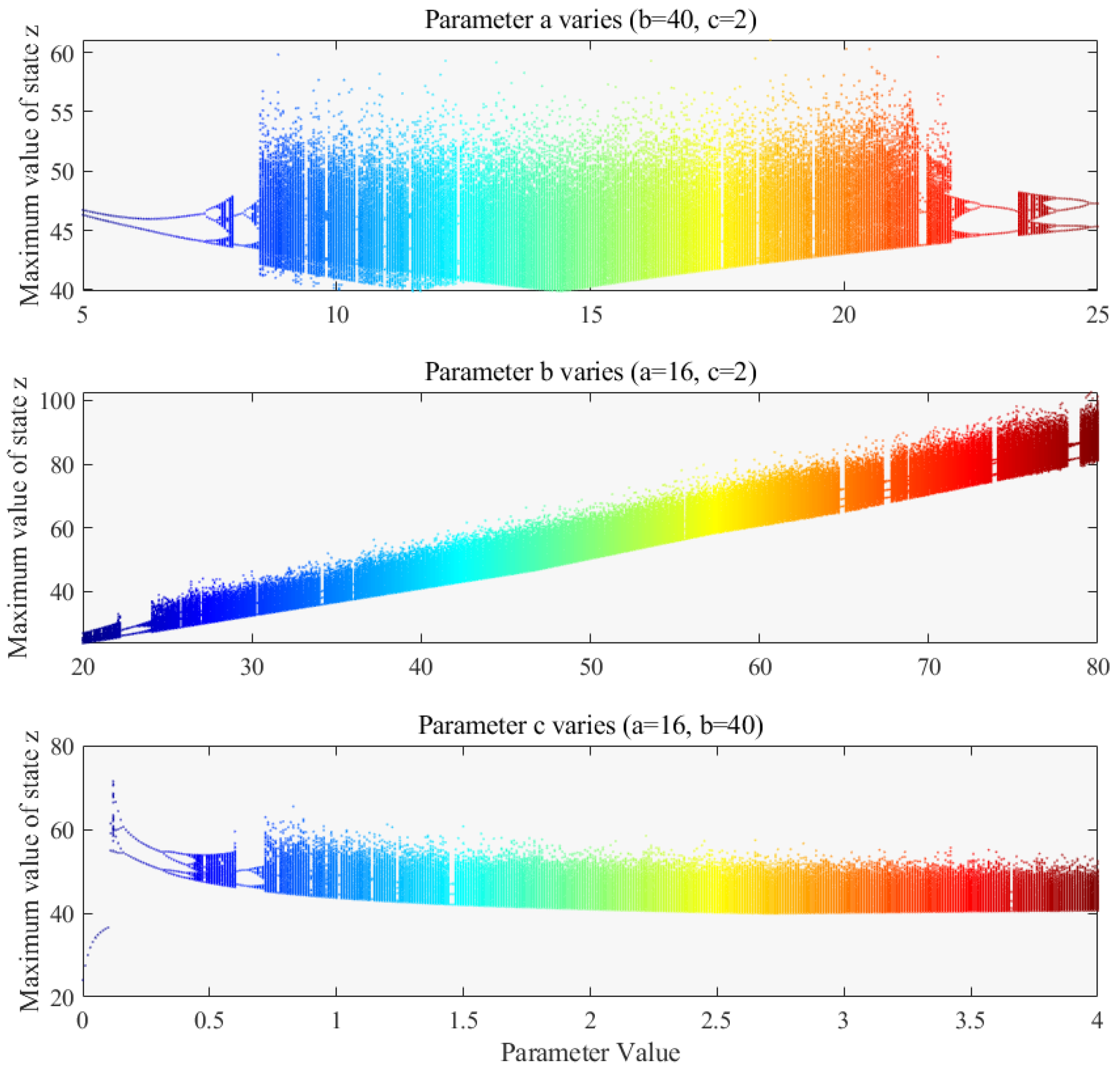
2.4.3. Parameter Thresholds and Bifurcation Analysis
2.5. Design of the Chaotic Synchronization Controller
2.5.1. Calculation of Risk System Network Coupling Strength
- (1)
- Topological structure coupling strength
- (2)
- Risk transmission coupling strength
- (3)
- Algebraic Connectivity Coupling Strength
- (4)
- Integrated coupling strength
2.5.2. Chaotic Synchronization Systems and Segmented Adaptive Controllers
- (1)
- Drive System
- (2)
- Response System
2.5.3. Synchronization Error System Structure and Control Objectives
2.5.4. Design of a Segmented Linear Adaptive Feedback Synchronization Controller
2.5.5. Lyapunov Stability Analysis
2.6. Control Scheme Evaluation
2.6.1. Definition of Original Performance Metrics
- (1)
- Synchronization time and synchronization speed metrics
- (2)
- Final error and control accuracy metrics
- (3)
- Overall control of energy and energy efficiency indicators
- (4)
- Cost–benefit indicators
2.6.2. Formula for Calculating the Comprehensive Score
3. Results
3.1. Structural Characteristics and Key Node Identification of Nuclear Emergency Risk Networks
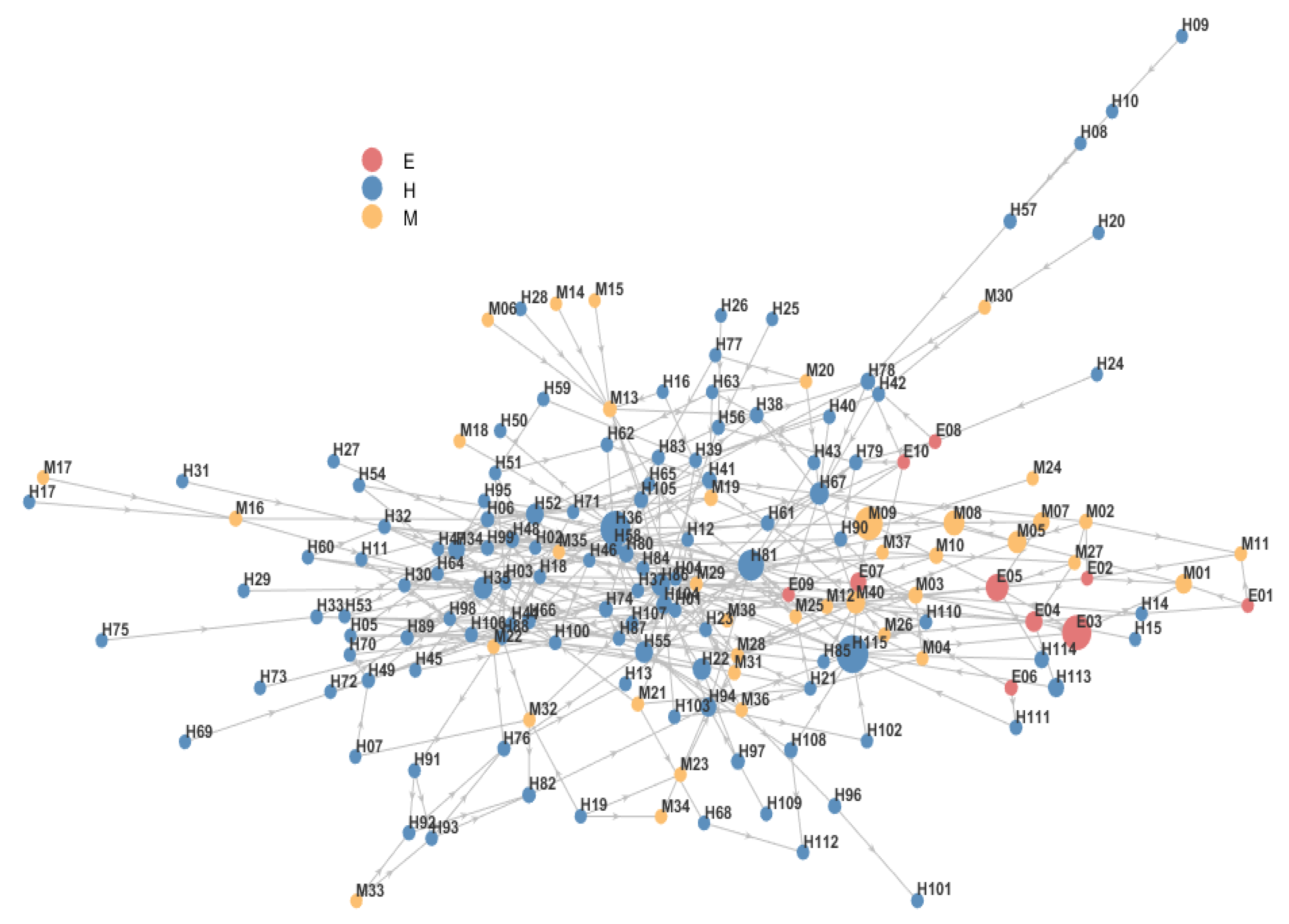
3.1.1. Risk Network Topology
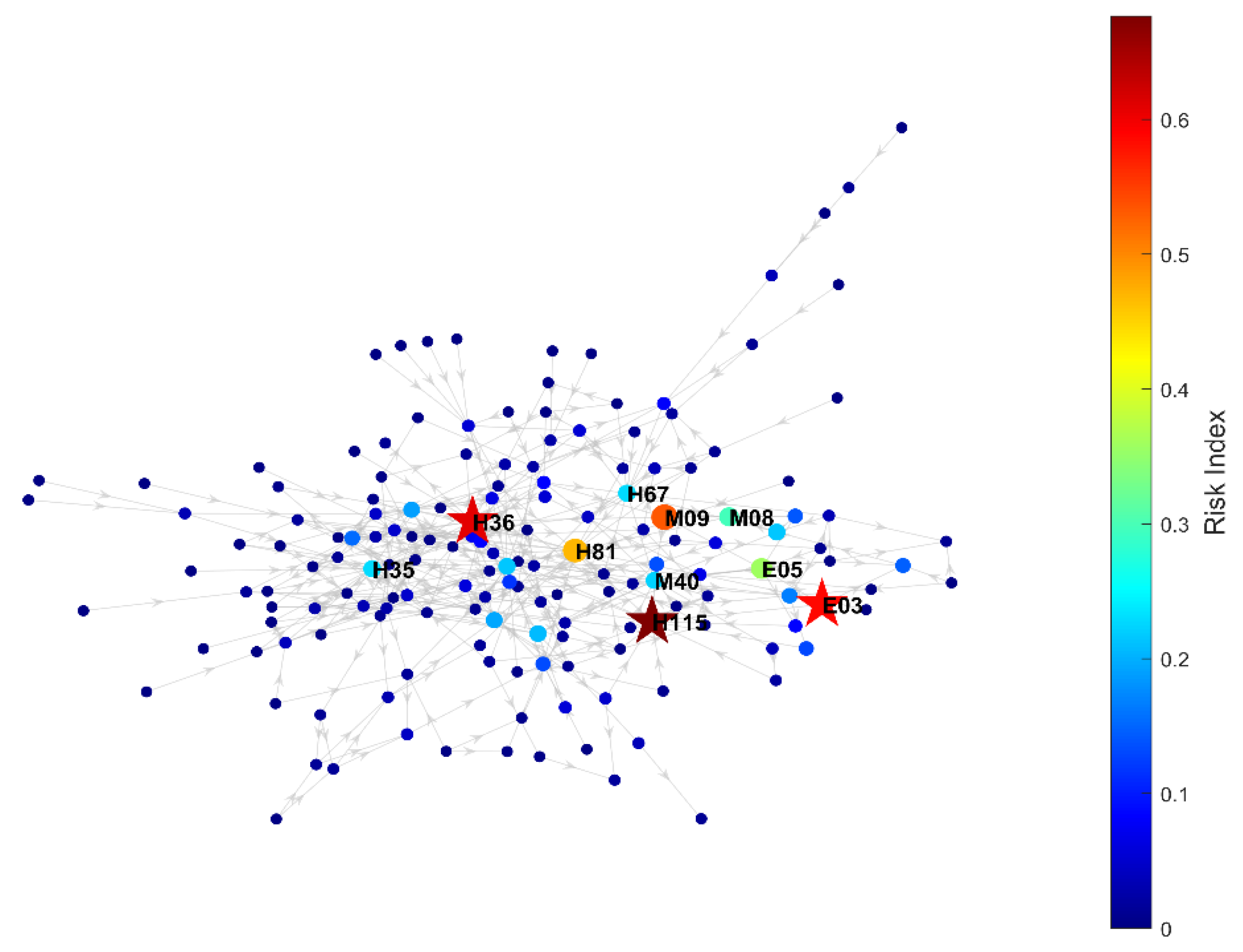
3.1.2. Node Risk Value Distribution and Critical Vulnerabilities
3.1.3. Outgoing and Incoming Distribution
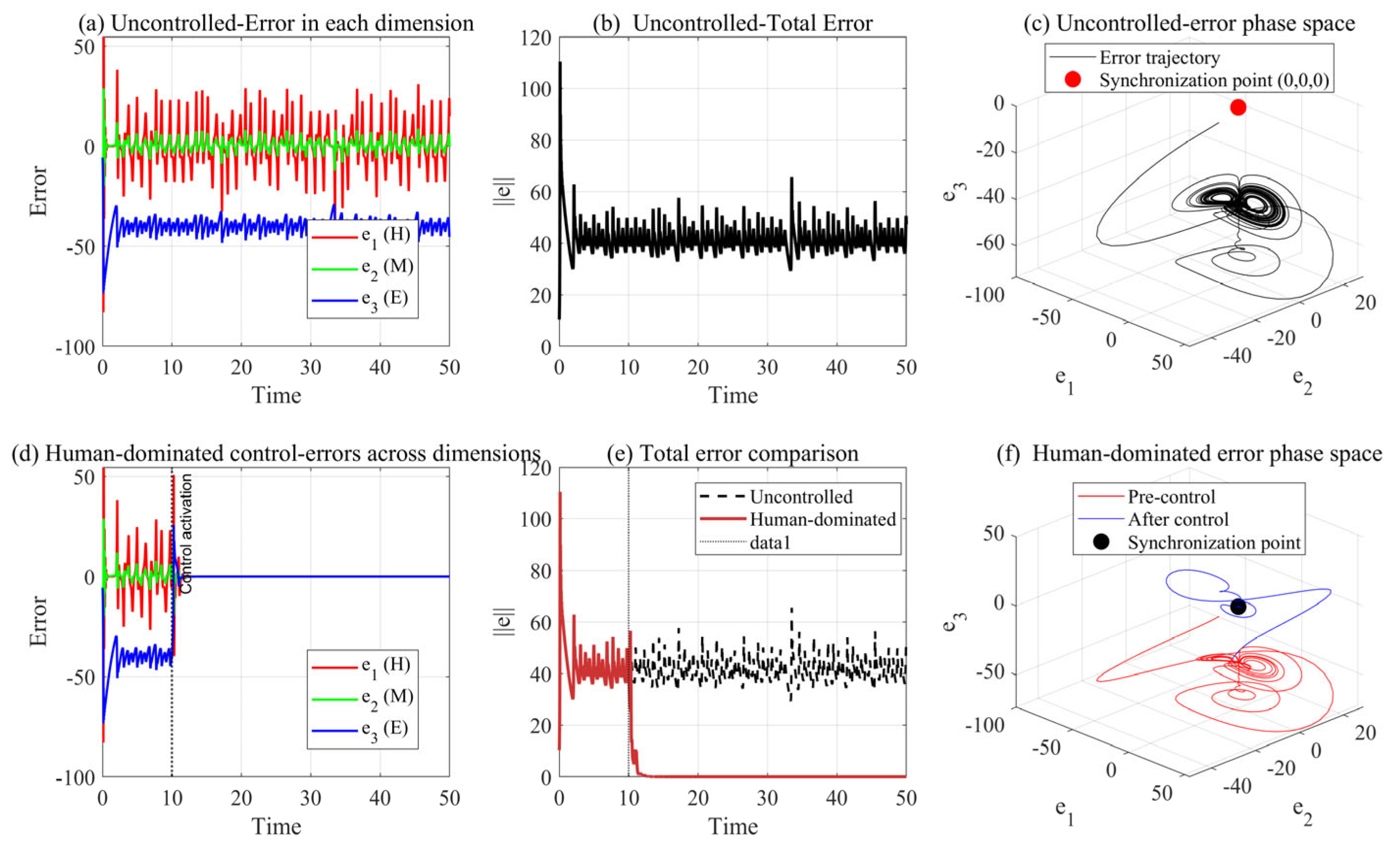
3.2. Synchronized Control Effects
3.3. Comparison and Comprehensive Evaluation of Control Schemes
3.3.1. Comparison of Error Convergence Processes
3.3.2. Quantitative Analysis of Key Performance Indicators
4. Conclusions
- (1)
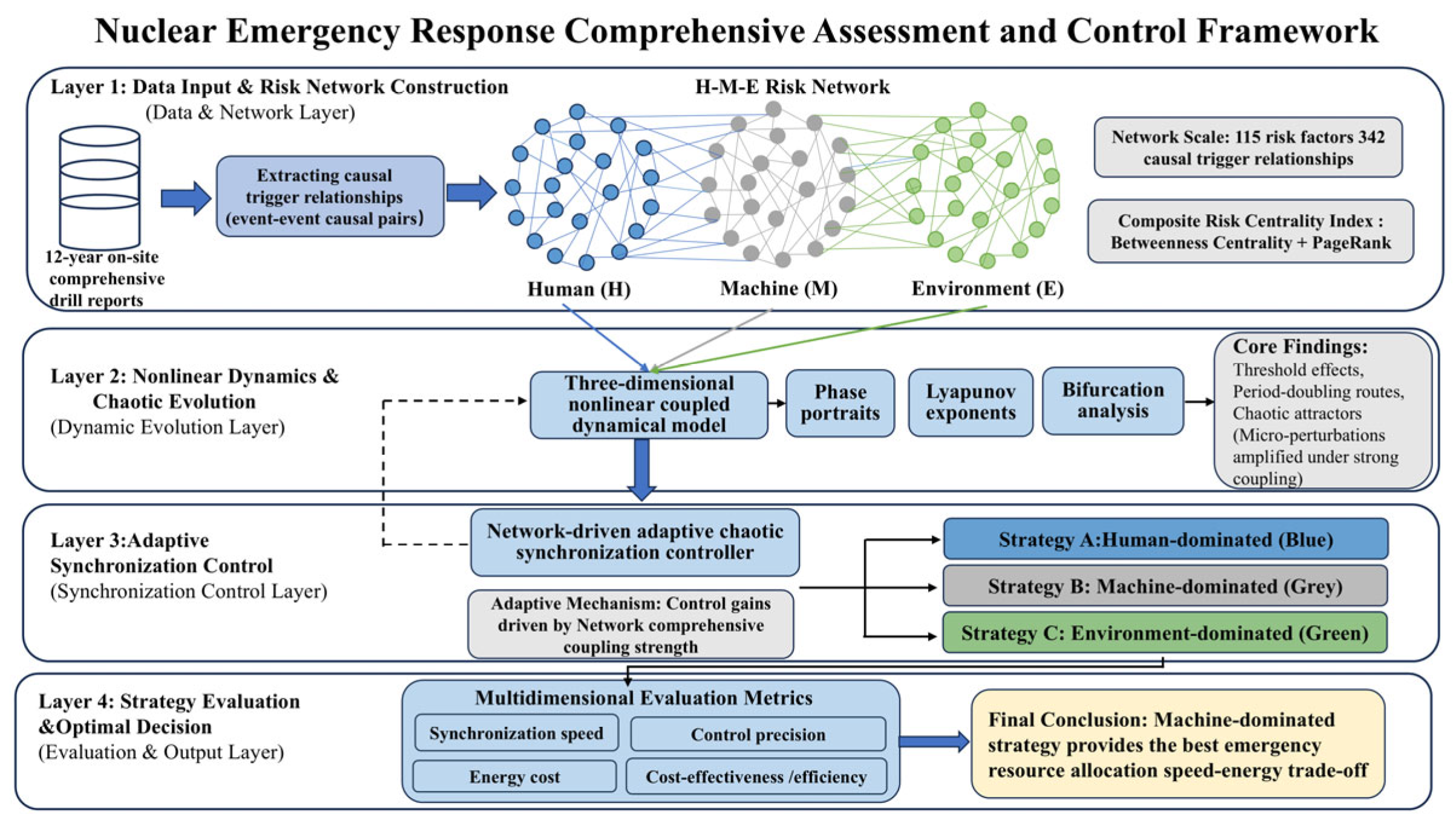
- A directed H–M–E nuclear emergency risk network was constructed, and key structural vulnerabilities were quantitatively identified. Based on drill records, incident reports, command scripts, and video materials, a directed risk network consisting of 165 risk-factor nodes and 389 causal trigger edges was established. Using the proposed risk centrality index, the network exhibits a clear heterogeneous and hub-dominated structure: a small number of nodes have high out-degree/in-degree and dominate the upstream triggering and downstream consequence aggregation. Quantitatively, the statistics of topological connectivity show that H44 and H03 act as major upstream dissemination hubs with out-degrees of 12 and 11, respectively, whereas H81 and H115 act as consequence convergence centers with in-degrees of 16 and 12, respectively. In addition, H35 simultaneously presents high out-degree and high in-degree, indicating a critical relay node that bridges multiple causal chains. These results demonstrate that nuclear emergency risk propagation is structurally centralized, implying that targeted interventions on hub and relay nodes can yield higher marginal returns than uniform resource allocation.
- (2)
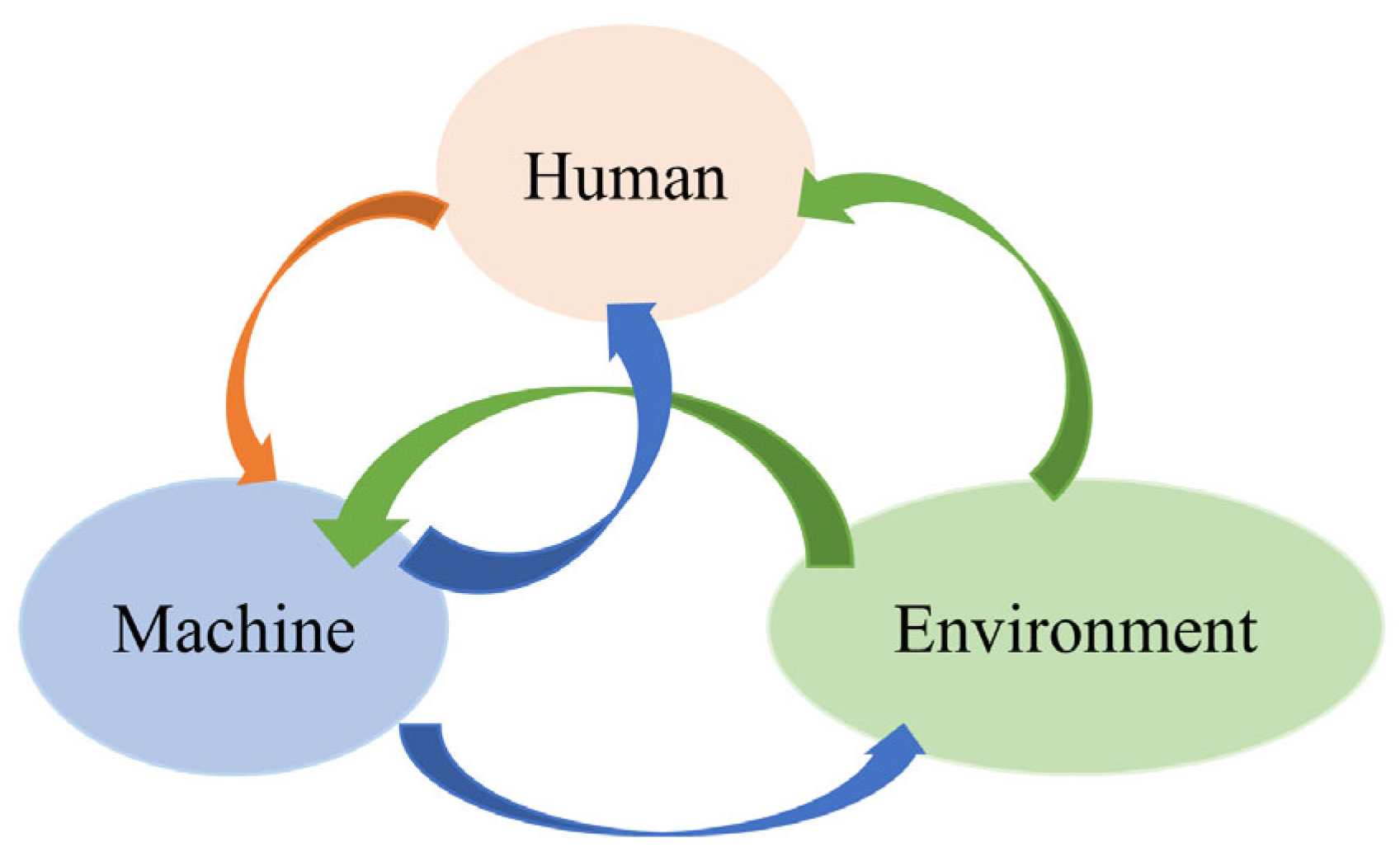
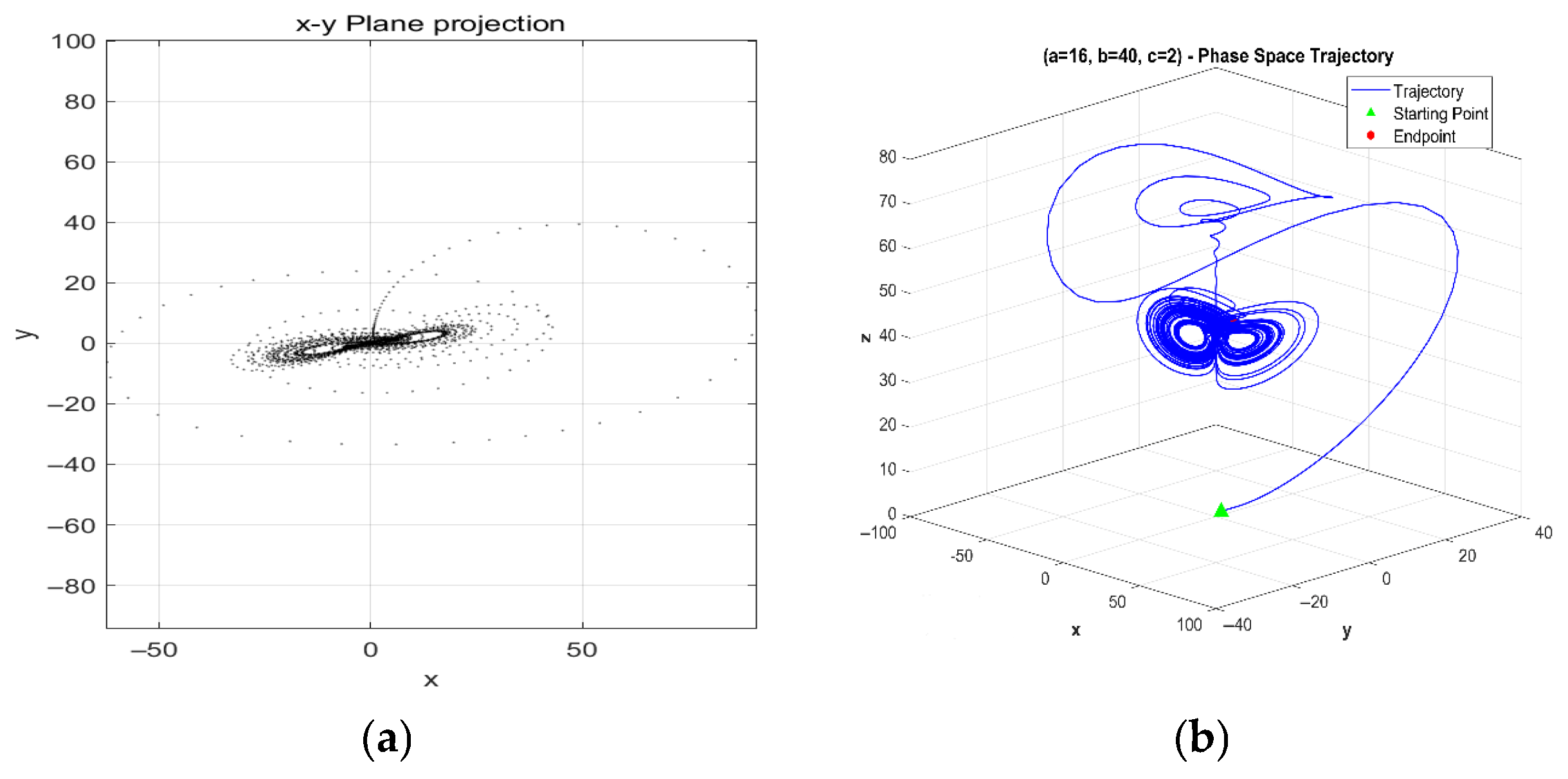
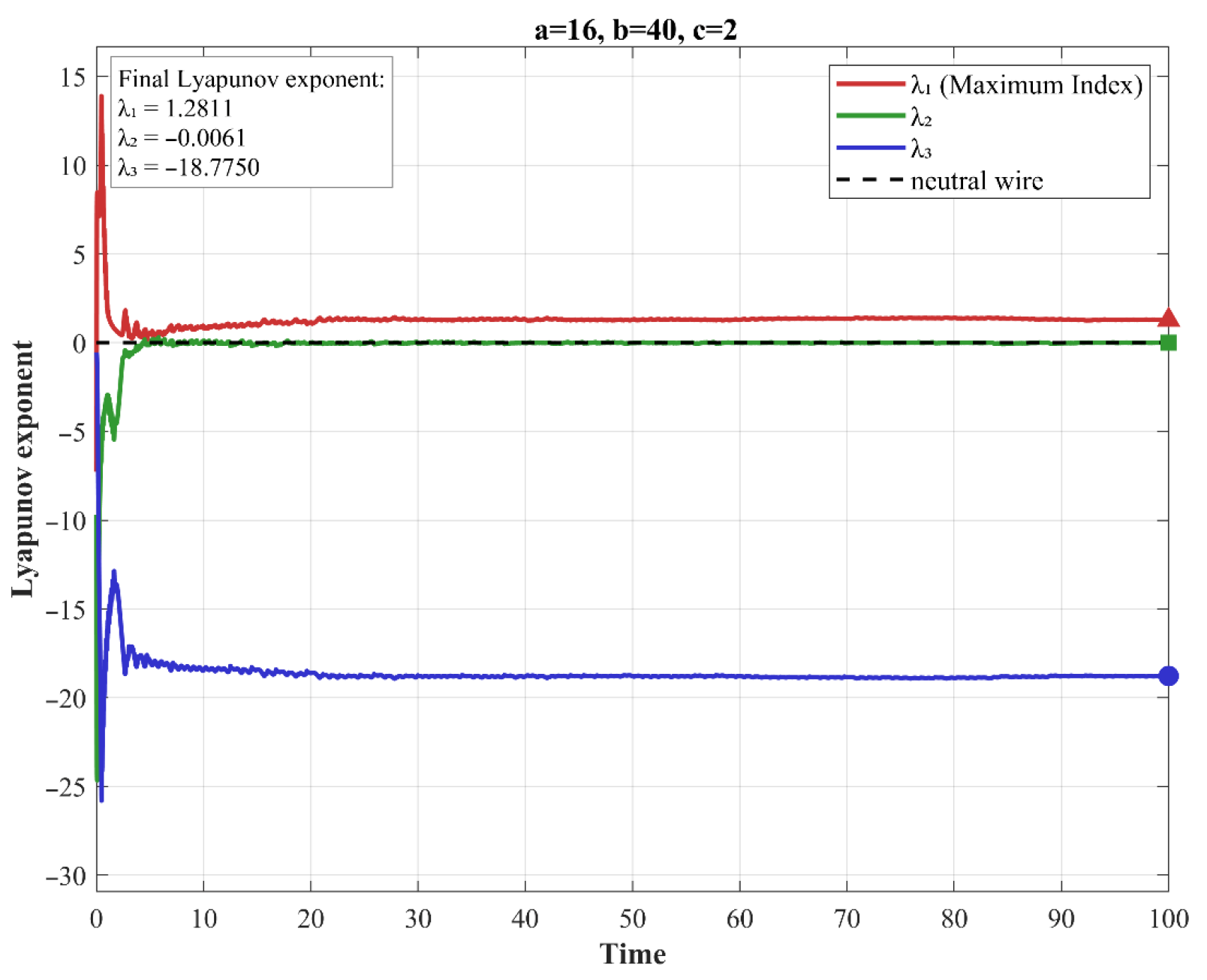
- A topology-consistent three-dimensional nonlinear coupled dynamical model revealed threshold effects, bifurcations, and deterministic chaos in nuclear emergency risk evolution. By aggregating the 165 micro-level risk factors into three macro state variables representing human (H), machine (M), and environment (E), a continuous-time nonlinear system was developed to capture cross-domain coupling and multiplicative amplification effects. Numerical analysis indicates that the system can enter a chaotic regime under certain coupling intensities. In particular, for the representative parameter set a = 16, b = 40, and c = 2, the phase portrait forms a typical chaotic attractor, and the maximum Lyapunov exponent satisfies λmax > 0, confirming sensitive dependence on initial conditions. Bifurcation analysis further shows that, as coupling parameters increase, state variables undergo the canonical route of equilibrium → period-doubling → multi-periodicity → chaos, with intermittent “window” regions of temporary stability, implying that nuclear emergency risk evolution is governed by critical thresholds and nonlinear state transitions rather than smooth linear escalation.
- (3)
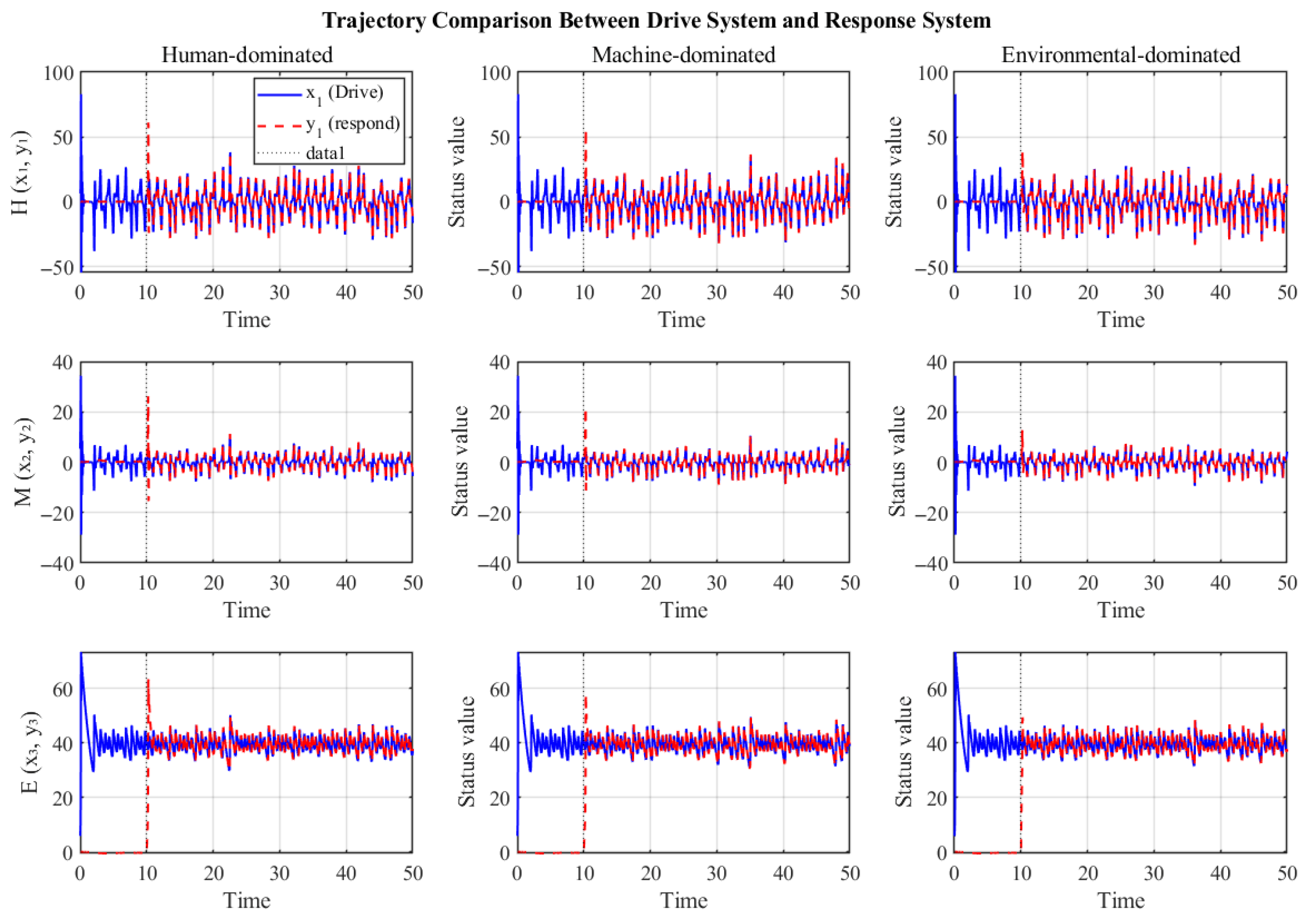
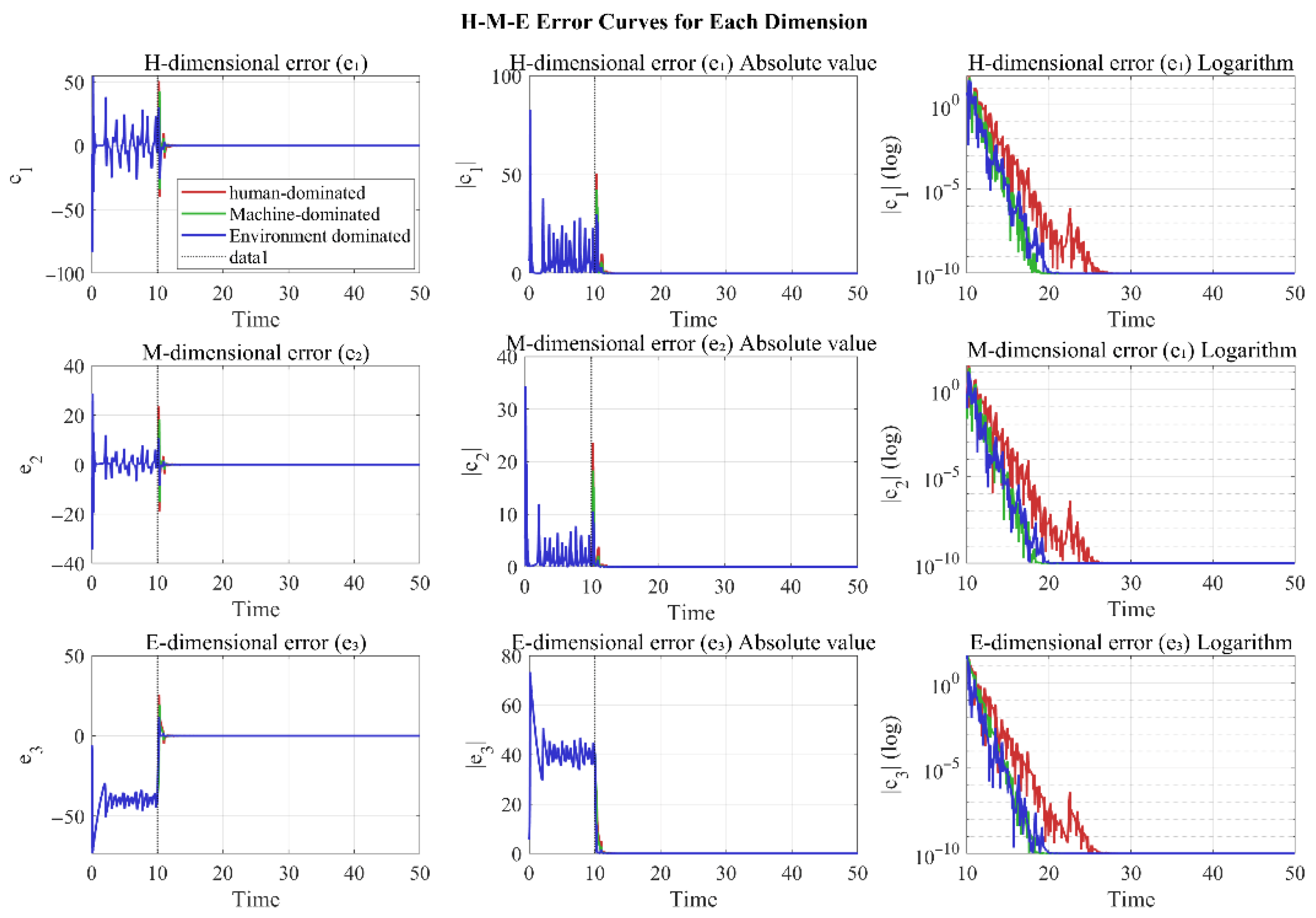
- The proposed segmented adaptive synchronization controller effectively suppressed chaotic divergence and achieved fast H–M–E posture alignment. A drive–response synchronization architecture with a segmented feedback controller was designed, where control gains are adaptively tuned by the integrated network coupling strength. Simulation results demonstrate that, after control activation at t0 = 10, the synchronization error norm changes from oscillatory divergence (uncontrolled case) to rapid monotonic decay and converges to a near-zero steady state within finite time. All three state dimensions (H, M, and E) achieve global asymptotic synchronization, verifying both the effectiveness of the controller structure and the validity of the Lyapunov stability condition used in the design.
- (4)
- Among three resource-allocation strategies, the machine-dominated control scheme achieved the best overall cost–performance, with explicit quantitative advantages.
Author Contributions
Funding
Institutional Review Board Statement
Informed Consent Statement
Data Availability Statement
Acknowledgments
Conflicts of Interest
Appendix A

| Risk ID | Risk Name |
|---|---|
| H01 | Deficiencies in nuclear emergency management systems, operational codes, technical standards, and irrational workflows |
| H02 | Inadequate coverage and vulnerabilities of the nuclear emergency training system |
| H03 | Inadequate nuclear emergency training and drills |
| H04 | Inadequate security supervision and routine patrol inspection |
| H05 | Deficiencies in evaluation and reward-disciplinary mechanisms |
| H06 | Failure of emergency post-event review, data traceability, and accident root-cause investigation |
| H07 | Accountability implementation deficiencies |
| H08 | Staffing allocation miscalculations |
| H09 | Emergency personnel staffing shortage |
| H10 | Single-person multiple-role assignment |
| H11 | Ambiguity in the division of responsibilities |
| H12 | Violation of relevant safety laws, regulations, standards, and codes |
| H13 | Increased frequency of job rotation and post-reassignment |
| H14 | Irrational load planning of the emergency power supply system |
| H15 | Vulnerabilities in the fault isolation mechanism of equipment and facilities |
| H16 | Inadequate maintenance and testing of the Nuclear Emergency Command Platform System (NECPS, hardware and software included) |
| H17 | Account O&M management oversights in the NECPS |
| H18 | Unregulated management and lack of closed-loop control of emergency equipment (e.g., emergency water supply mobile pumps) |
| H19 | Inadequacy of the emergency resource support mechanism |
| H20 | Absence of a long-term equipment upgrading mechanism |
| H21 | Inadequate routine maintenance and screening of equipment, facilities, and materials |
| H22 | Emergency resource dispatch imbalance |
| H23 | Non-compliant management of identification signs |
| H24 | Deficient scientificity and foresight in emergency workspace zoning |
| H25 | Inflexible command directives (lacking time ceilings and dynamic adjustment triggers) |
| H26 | Insufficient operational authority for on-site response |
| H27 | Incomplete coverage of standardized time control for emergency operations |
| H28 | Absence of management for the personnel’s basic information ledger |
| H29 | Absence of a communication atmosphere and culture |
| H30 | Inadequacy of the emergency information transmission mechanism (covering carriers, standardized procedures, error correction measures, and alternative communication channels, etc.) |
| H31 | Lack of standardized procedures and documentation requirements for control handover |
| H32 | Critical control handover procedures rely solely on oral communication, with no electronic or paper-based documentation available |
| H33 | The “three-stage” communication method (issuance—repetition—confirmation) is not followed in the delivery of instructions |
| H34 | Verbal slips or omission of key points occur when conveying information |
| H35 | Failure of key information transmission and sharing between organizations |
| H36 | Emergency decision-making suffers from a lack of basis, errors, or delays |
| H37 | Emergency decision-making exhibits coverage blind spots in addressing the disposal of accident-related reactor units |
| H38 | Misjudgment of the accident sequence |
| H39 | Misjudgment of the primary loop flow pattern |
| H40 | Misjudgment of the reactor core’s cooling capability |
| H41 | Misjudgment of the containment status |
| H42 | Misjudgment of the reactor unit status |
| H43 | Underestimation of the accident level |
| H44 | Inadequate awareness of safety responsibilities and regulatory compliance |
| H45 | Insufficient professional quality and disciplinary awareness |
| H46 | Unfamiliar with emergency plans, procedures, and technical standards |
| H47 | Unfamiliar with emergency muster points |
| H48 | Delayed personnel response and on-site arrival |
| H49 | Personnel violation of on-duty standby regulations by chatting and making/receiving calls |
| H50 | Directional deviation in emergency operations |
| H51 | Inadequate emergency response capacity |
| H52 | Inadequate emergency coordination capability |
| H53 | Inadequate on-site control capability |
| H54 | Misallocation of emergency forces |
| H55 | Local disorder in the on-site emergency order |
| H56 | Rigid emergency response capability with insufficient flexibility |
| H57 | On-site personnel task overburden |
| H58 | Incomplete recognition and insufficient anticipation of interrelated risks |
| H59 | Inadequate cognition of accident condition characteristics |
| H60 | Cognitive bias in the priority of emergency tasks |
| H61 | Failure to detect and identify problems or hazards in a timely manner |
| H62 | Failure to calculate environmental monitoring data in accordance with technical specifications |
| H63 | Failure to review core safety indicators (or data) |
| H64 | Unauthorized execution of emergency disposal plans and failure to perform emergency reporting duties |
| H65 | Technical implementation deviation |
| H66 | Non-compliant operations or actions |
| H67 | Misoperation |
| H68 | Misunderstanding of information or instructions (e.g., mishearing evacuation routes and misjudging hazard types) |
| H69 | Relaxation of vigilance |
| H70 | Broken Window Effect |
| H71 | Empirical approach |
| H72 | Fluke mentality |
| H73 | Perfunctory attitude |
| H74 | Panic mentality |
| H75 | Tension mentality |
| H76 | Impatient mentality |
| H77 | Hesitant mentality |
| H78 | Fatigue |
| H79 | Distraction |
| H80 | Breakage or failure of the emergency response/disposal process |
| H81 | Low emergency response/disposal efficiency |
| H82 | Failure in identifying high-radiation-risk operation links |
| H83 | Delayed activation of emergency protection |
| H84 | Delayed implementation of emergency rescue operations |
| H85 | Personnel exposure to ionizing radiation |
| H86 | Personnel exposure to nuclear radiation |
| H87 | Failure to carry personal radiation protection equipment |
| H88 | Non-standard donning, wearing, and usage of personal radiation protection and monitoring equipment (e.g., protective face shields, protective isolation suits, EPD, TLD) |
| H89 | Non-standard operation in the headcount work by the assembly point coordinator, who failed to use a loudspeaker and an assembly headcount meter, and failed to turn on the local radiation measurement instrument. |
| H90 | Operators improperly opened the protective suits and removed their gloves to answer and make phone calls. |
| H91 | Dose monitoring data collection distortion |
| H92 | Personal radiation exposure dose statistical error |
| H93 | Overall personnel radiation exposure dose statistical error |
| H94 | Failure in implementing nuclear radiation and occupational health protection measures |
| H95 | Improper first-aid equipment preparation |
| H96 | Potassium iodide tablet ingestion by non-target populations |
| H97 | Potassium iodide tablet unavailability for target populations |
| H98 | Personnel unawareness of radiation exposure |
| H99 | Unnecessary protective actions |
| H100 | Unauthorized potassium iodide tablet distribution without prior instruction |
| H101 | Excessive potassium iodide intake (health-damaging) |
| H102 | Failure to intervene for high-radiation exposure individuals |
| H103 | Emergency evacuation process disruption |
| H104 | Low efficiency of personnel evacuation and withdrawal |
| H105 | Low efficiency and accuracy of evacuated personnel headcount |
| H106 | Direct evacuation by drivers without picking up evacuated personnel |
| H107 | Stray entry into hazardous areas |
| H108 | Crowd stampede |
| H109 | Contact with flammable and explosive media |
| H110 | Electric shock |
| H111 | Contact with toxic hazardous chemicals |
| H112 | Failure to seize the optimal evacuation and relocation time |
| H113 | Personnel exposure to fire |
| H114 | Personnel exposure to an explosion |
| H115 | Casualties |
| M01 | External power supply interruption due to a power grid failure |
| M02 | Failure of mobile power supplies |
| M03 | UPS (Uninterruptible Power Supply) system failure |
| M04 | Emergency lighting battery failure |
| M05 | Cooling system failure |
| M06 | CET (Core Exit Thermocouple) system failure |
| M07 | Core heating and meltdown |
| M08 | Primary loop pipeline rupture |
| M09 | Containment rupture |
| M10 | Spent fuel assembly exposure |
| M11 | Reactor scram |
| M12 | Non-accident unit operational failure |
| M13 | Failure to input personnel information into the electronic roll call subsystem of the NECPS |
| M14 | Incorrect display of core unit safety indicators on the NECPS |
| M15 | Algorithmic logic defects in the data processing layer of the NECPS |
| M16 | Absence of the multi-parameter cross-validation mechanism in the NECPS |
| M17 | Restriction on inter-organizational information exchange of the NECPS |
| M18 | Lack of a dynamic permission adjustment function in the NECPS |
| M19 | Lack of redundant safeguards for information and data transmission technologies of the NECPS |
| M20 | Failure to preserve core safety data (or indicators) in the NECPS, resulting in data loss |
| M21 | Incomplete plant-wide coverage of the emergency communication system (audible alarm, wired broadcasting, and wireless communication), along with non-compliant clarity and loudness |
| M22 | Weak anti-interference function of the face recognition check-in device in crowded scenarios, easily leading to recognition failure and malfunctions |
| M23 | Lack of anti-seismic fixing tools and materials |
| M24 | Shortage or insufficient provision of communication equipment (landline telephones, satellite phones, etc.) |
| M25 | Insufficient provision of fire extinguishers |
| M26 | Abrasion and aging of the insulating layer of connecting cables for electrical equipment |
| M27 | Short circuit of electrical equipment |
| M28 | Non-implementation of anti-seismic fixing for key electronic devices, such as computer cases and UPS power supplies, in the emergency office area |
| M29 | Non-adoption of non-explosion-proof types for emergency lighting fixtures and switches in the UPS room and explosive environments |
| M30 | Excessively small monitoring screens and poor functional adaptability for unit status assessment |
| M31 | Absence of size labels on the storage cases for radiation protection suits |
| M32 | Insufficient provision of personal radiation protection and monitoring equipment |
| M33 | Damage and loss of personal radiation protection and monitoring equipment |
| M34 | Expiration and invalidation of personnel decontamination and sterilization supplies (e.g., special decontamination shower gel/liquid soap, and iodophor) |
| M35 | Non-calibration of the displayed time on the plant clocks, computers, and platform systems |
| M36 | Absence of distinct assembly and evacuation guidance signs at emergency evacuation points |
| M37 | Malfunction and continuous alarm of the electrostatic elimination device in the emergency diesel generator room caused by poor contact of the grounding wire |
| M38 | Defects of other equipment and facilities |
| M39 | Malfunctions of other equipment and facilities |
| M40 | Damage to other equipment and facilities |
| E01 | Extreme weather (typhoons, tornadoes, heavy rain, or ice disasters) |
| E02 | Geological disasters (earthquakes or tsunamis) |
| E03 | Malicious social incidents (terrorist attacks or mass incidents) |
| E04 | Fire |
| E05 | Explosion |
| E06 | Hazardous chemicals leakage |
| E07 | Radioactive leakage |
| E08 | Irrational space utilization in emergency office areas |
| E09 | Non-compliant emergency illumination in emergency areas |
| E10 | Noise |
References
- Xiao, X.; Liang, J.; Tong, J.; Wang, H. Emergency Decision Support Techniques for Nuclear Power Plants: Current State, Challenges, and Future Trends. Energies 2024, 17, 2439. [Google Scholar] [CrossRef]
- Fan, Y.; Zhu, X.; Yang, J.; Xie, H. A review on nuclear emergency preparedness and response management. Ann. Nucl. Energy 2025, 219, 111492. [Google Scholar] [CrossRef]
- Chen, W.; Zou, S.; Qiu, C.; Dai, J.; Zhang, M. Invulnerability analysis of nuclear accidents emergency response organization network based on complex network. Nucl. Eng. Technol. 2024, 56, 2923–2936. [Google Scholar] [CrossRef]
- Kim, J.; Lee, S.; Arigi, A.M.; Kim, J. Quantitative analysis of contributing factors to the resilience of emergency response organizations in nuclear power plants. Prog. Nucl. Energy 2024, 172, 105209. [Google Scholar] [CrossRef]
- Hawila, M.A.; Chirayath, S.S. Combined nuclear safety-security risk analysis methodology development and demonstration through a case study. Prog. Nucl. Energy 2018, 105, 153–159. [Google Scholar] [CrossRef]
- Williams, A.D. Systems Theory Principles and Complex Systems Engineering Concepts for Protection and Resilience in Critical Infrastructure: Lessons from the Nuclear Sector. INSIGHT 2025, 28, 47–53. [Google Scholar] [CrossRef]
- Ayoub, A.; Wainwright, H.M.; Sansavini, G.; Gauntt, R.; Saito, K. Resilient design in nuclear energy: Critical lessons from a cross-disciplinary analysis of the Fukushima Dai-ichi nuclear accident. iScience 2024, 27, 109485. [Google Scholar] [CrossRef]
- Sugawara, S.-e. Addressing “beyond control”: Nuclear safety goals in the age of risk governance. J. Risk Res. 2024, 28, 231–246. [Google Scholar] [CrossRef]
- Purba, J.H.; Sony Tjahyani, D.T.; Widodo, S.; Ekariansyah, A.S. Fuzzy probability based event tree analysis for calculating core damage frequency in nuclear power plant probabilistic safety assessment. Prog. Nucl. Energy 2020, 125, 103376. [Google Scholar] [CrossRef]
- Murata, A.; Karwowski, W. On the Root Causes of the Fukushima Daiichi Disaster from the Perspective of High Complexity and Tight Coupling in Large-Scale Systems. Symmetry 2021, 13, 414. [Google Scholar] [CrossRef]
- Cai, Y.; Golay, M.W. Formulation of A Risk Assessment Framework Capable of Analyzing Nuclear Power Multiunit Accident Scenarios. Reliab. Eng. Syst. Saf. 2020, 202, 107040. [Google Scholar] [CrossRef]
- Huang, T.; Yu, H.-L.; Nikolopoulos, E.; Langousis, A.; Zhu, J.; Dunn, S.; Yasunobu, M. Framework Development for Disaster Risk Dynamics and Resilience Analytics in Complex Socio-Technical Systems. In Proceedings of the EGU General Assembly 2020, Online, 4–8 May 2020. [Google Scholar] [CrossRef]
- Feng, J.R.; Zhao, M.; Yu, G.; Zhang, J.; Lu, S. Dynamic risk analysis of accidents chain and system protection strategy based on complex network and node structure importance. Reliab. Eng. Syst. Saf. 2023, 238, 109413. [Google Scholar] [CrossRef]
- Li, H.; Liu, T. Study on the 14th Five-Year Plan for Nuclear and Radiation Accident Emergency. IOP Conf. Ser. Earth Environ. Sci. 2021, 769, 22020. [Google Scholar] [CrossRef]
- Choi, H.A.; Park, C.; Lee, J.; Jeon, S.; Seo, J.T. Framework for evaluating cyber incident response capabilities of nuclear facility operators through operation-based exercises. Nucl. Eng. Technol. 2025, 57, 103772. [Google Scholar] [CrossRef]
- Galaitsi, S.; Kurth, M.; Fries, S.; Linkov, I. Mainstreaming resilience analytics: 10 years after the Fukushima disaster. Integr. Environ. Assess. Manag. 2022, 18, 1551–1554. [Google Scholar] [CrossRef] [PubMed]
- Singh, P.; Singh, L.K. Instrumentation and control systems design for nuclear power plant: An interview study with industry practitioners. Nucl. Eng. Technol. 2021, 53, 3694–3703. [Google Scholar] [CrossRef]
- Yamaguchi, S. A losses and hazards identification process (LHIP) when connecting an additional system. Prog. Nucl. Energy 2023, 164, 104890. [Google Scholar] [CrossRef]
- Ayoub, A.; Stankovski, A.; Kröger, W.; Sornette, D. Precursors and startling lessons: Statistical analysis of 1250 events with safety significance from the civil nuclear sector. Reliab. Eng. Syst. Saf. 2021, 214, 107820. [Google Scholar] [CrossRef]
- Hochrainer-Stigler, S.; Šakić Trogrlić, R.; Reiter, K.; Ward, P.J.; de Ruiter, M.C.; Duncan, M.J.; Torresan, S.; Ciurean, R.; Mysiak, J.; Stuparu, D.; et al. Toward a framework for systemic multi-hazard and multi-risk assessment and management. iScience 2023, 26, 106736. [Google Scholar] [CrossRef]
- Tomkiv, Y.; Perko, T.; Sala, R.; Zeleznik, N.; Maitre, M.; Schneider, T.; Oughton, D.H. Societal uncertainties recognised in recent nuclear and radiological emergencies. Radioprotection 2020, 55, S151–S155. [Google Scholar] [CrossRef]
- Arevalo, M.; Rozo, E.; Morales, J. Combining Risk Matrix and Network Theory to Improve Risk Analysis in Radiotherapy. Int. J. Radiat. Oncol. Biol. Phys. 2025, 123, e531–e532. [Google Scholar] [CrossRef]
- Jang, K.B.; Baek, C.H.; Woo, T.H. Analysis of cyber nuclear terrorism by DTrack consequences in the civilian nuclear power plant. J. Nucl. Sci. Technol. 2021, 59, 207–215. [Google Scholar] [CrossRef]
- Tian, J.; Dai, Y. Looking at resilience of socio-technical systems from the view of coordinated control. Cogn. Technol. Work 2020, 24, 147–160. [Google Scholar] [CrossRef]
- Petkov, G. Risk Contextualization for Nuclear Systems. J. Nucl. Eng. 2024, 6, 1. [Google Scholar] [CrossRef]
- Antonello, F.; Buongiorno, J.; Zio, E. A methodology to perform dynamic risk assessment using system theory and modeling and simulation: Application to nuclear batteries. Reliab. Eng. Syst. Saf. 2022, 228, 108769. [Google Scholar] [CrossRef]
- Hermanns, H. My O Is Bigger Than Yours (Invited Talk). In 36th IARCS Annual Conference on Foundations of Software Technology and Theoretical Computer Science (FSTTCS 2016); Schloss Dagstuhl–Leibniz-Zentrum für Informatik: Wadern, Germany, 2016. [Google Scholar]
- Argyris, N.; French, S. Nuclear emergency decision support: A behavioural OR perspective. Eur. J. Oper. Res. 2017, 262, 180–193. [Google Scholar] [CrossRef]
- Tang, L.Y.; Han, Y.; Zhou, S.Y.; Zalhaf, A.S.; Yang, P.; Wang, C.L.; Huang, T.; Lu, C. Identification and vulnerability assessment of critical components in distribution networks under high penetration rate conditions. Energy 2025, 318, 134864. [Google Scholar] [CrossRef]
- Huang, S.; Jin, C.; Chen, T.; Wang, Z.W.; Wang, J. Analysis of Major Road Traffic Accident Causes Using a Combined Method of Association Rule and Complex Network. J. Adv. Transp. 2025, 2025, 8714444. [Google Scholar] [CrossRef]
- Gong, J.H.; Liu, Y.; Li, T.; Ding, J.T.; Wang, Z.C.; Jin, D.P. STTF: A Spatiotemporal Transformer Framework for Multi-task Mobile Network Prediction. IEEE Trans. Mob. Comput. 2025, 24, 4072–4085. [Google Scholar] [CrossRef]
- Berahmand, K.; Bouyer, A.; Samadi, N. A new local and multidimensional ranking measure to detect spreaders in social networks. Computing 2019, 101, 1711–1733. [Google Scholar] [CrossRef]
- Lv, L.S.; Bardou, D.; Hu, P.; Liu, Y.Q.; Yu, G.H. Graph regularized nonnegative matrix factorization for link prediction in directed temporal networks using PageRank centrality. Chaos Solitons Fractals 2022, 159, 112107. [Google Scholar] [CrossRef]
- Zhang, P.P.; Wang, T.D.; Yan, J. PageRank centrality and algorithms for weighted, directed networks. Phys. A-Stat. Mech. Its Appl. 2022, 586, 126438. [Google Scholar] [CrossRef]
- Shi, J.H.; Liu, Z.J.; Feng, Y.W.; Wang, X.J.; Zhu, H.W.; Yang, Z.L.; Wang, J.; Wang, H.X. Evolutionary model and risk analysis of ship collision accidents based on complex networks and DEMATEL. Ocean Eng. 2024, 305, 117965. [Google Scholar] [CrossRef]
- Fu, C.Q.; Shi, Z.Y.; Zhang, P.T. Analysis of the coupled cascade failure model in complex networks with functional dependence. Phys. A-Stat. Mech. Its Appl. 2025, 669, 130605. [Google Scholar] [CrossRef]
- Wang, R.X.; Yan, H. Risk identification and propagation in apron operations based on directed complex networks. Alex. Eng. J. 2025, 119, 647–664. [Google Scholar] [CrossRef]
- Li, J.; Yang, Z.; He, H.; Guo, C.; Chen, Y.; Zhang, Y. Risk causation analysis and prevention strategy of working fluid systems based on accident data and complex network theory. Reliab. Eng. Syst. Saf. 2024, 252, 110445. [Google Scholar] [CrossRef]
- Feng, J.R.; Zhao, M.-k.; Lu, S.-x. Accident spread and risk propagation mechanism in complex industrial system network. Reliab. Eng. Syst. Saf. 2024, 244, 109940. [Google Scholar] [CrossRef]
- Guo, S.J.; Yu, Y.; Wei, W.; Zhang, S.; Liu, J.; Yu, X.L. Nuclear power plant accident risk assessment method research based on bayesian network. Reliab. Eng. Syst. Saf. 2026, 268, 112012. [Google Scholar] [CrossRef]
- Xie, M.L.; Chen, Y.Q.; Yu, L.; Wei, W.; Chen, B.Y.; Xie, Z.Q.; Hou, X.Y. Technical research on rapid source term calculation and prediction technology of nuclear accidents based on Bayesian network. J. Nucl. Sci. Technol. 2024, 61, 1061–1074. [Google Scholar] [CrossRef]
- Wang, H.; Wu, J.-P.; Sheng, X.-S.; Wang, X.; Zan, P. A new stability result for nonlinear cascade time-delay system and its application in chaos control. Nonlinear Dyn. 2015, 80, 221–226. [Google Scholar] [CrossRef]
- Wu, M.; Zhang, X.; Shan, W.; Liu, Y.; Jiang, Y. Coupled disaster mechanisms and theoretical framework in multi-hazard scenarios: Insights from non-coal mines. Reliab. Eng. Syst. Saf. 2026, 268, 112044. [Google Scholar] [CrossRef]
- Butusov, D.; Rybin, V.; Karimov, A. Fast time-reversible synchronization of chaotic systems. Phys. Rev. E 2025, 111, 014213. [Google Scholar] [CrossRef]
- Karimov, A.; Rybin, V.; Babkin, I.; Karimov, T.; Ponomareva, V.; Butusov, D. Time-Reversible Synchronization of Analog and Digital Chaotic Systems. Mathematics 2025, 13, 1437. [Google Scholar] [CrossRef]
- Gong, A.; Chen, Y.; Zhang, J.; Li, X. Possibilities of reinforcement learning for nuclear power plants: Evidence on current applications and beyond. Nucl. Eng. Technol. 2024, 56, 1959–1974. [Google Scholar] [CrossRef]
- Chen, W.; Zou, S.; Qiu, C.; Gan, M. Risk Identification and Chaotic Synchronization Control for Spent Fuel Road Transportation Based on Complex Network Evolution Models. Appl. Sci. 2026, 16, 994. [Google Scholar] [CrossRef]


| The Given Equation | Term | Physical/Management Interpretation | Mapping to Context | Theoretical Basis |
|---|---|---|---|---|
| The Evolution of Human Subsystems | Organizational Dissipation | Emergency organizations implement standardized procedures, regular training, and psychological interventions to ensure that initial human errors and psychological panic gradually subside over time. | Organizational Resilience | |
| Stress Transmission | Critical equipment failures (for M01) directly increase operational workload and decision-making pressure, thereby leading to Emergency decision-making suffering from a lack of basis, errors, or delays (H36) and operational errors. | Cognitive Load Theory | ||
| Nonlinear Amplification | When equipment failure () and environmental deterioration () occur simultaneously, they cause a nonlinear, dramatic increase in human error rates (e.g., communication disruption compounded by extreme weather leading to command paralysis). | Synergetics | ||
| The evolution of machine systems () | System Self-recovery | The device’s inherent redundancy design, automatic switching logic, or fault isolation measures enable the risk to revert to a stable state. | Reliability Engineering | |
| Intervention Gain | The effectiveness of command decisions directly influences the accuracy of operations. Positive human interventions, such as correct emergency repairs, can stabilize equipment status; conversely, non-compliant operations or actions (H66) tend to exacerbate equipment failures. | HFE | ||
| Environmental Inhibition | Harsh environments (such as high radiation, Noise E10) impair personnel’s ability to control equipment, resulting in diminished “positive human intervention on machinery”, and manifesting as negative feedback | Situation Awareness | ||
| Evolution of environmental subsystems () | Environmental Decay | The physical attenuation of the disaster itself (such as the fire burning out or the flood receding) and the environment’s inherent capacity for recovery | Environmental Risk Assessment | |
| Secondary disasters caused by human–machine mismatch | Typical secondary disaster mechanism: Equipment failure compounded by improper personnel response (), directly triggering severe environmental consequences such as radioactive release or explosion. | Cascading failure mode | ||
| The isolation effect of engineering barriers | The intact equipment condition (e.g., Containment rupture M09) provides physical shielding against environmental consequences, directly suppressing the spread of environmental risks. | Principle of defense in depth |
| H | M | E | |
|---|---|---|---|
| H | / | HM | / |
| M | MH | / | ME |
| E | EH | EM | / |
| Control Plan | Preset k Value | Resource Allocation Ratio (H:M:E) | Actual Gain K × γ |
|---|---|---|---|
| Human-dominated | [60, 25, 15] | 60%:25%:15% | [7.5, 33.13, 1.88] |
| Machine-dominated | [25, 60, 15] | 25%:60%:15% | [3.13, 7.5, 1.88] |
| Environment-dominated | [25, 15, 60] | 25%:15%:60% | [3.13, 1.88, 7.5] |
| Top 10 Outdegree | List of Connected Nodes |
|---|---|
| H44 | H100, H18, H87, H88, M28, M29, H106, H89, M35, H64, H49, H33 |
| H03 | H100, H87, H88, H32, H47, H51, M29, H106, H34, H37, H89 |
| H04 | H18, H88, M28, H39, M13, M26, M31, M32, M35, M37 |
| H58 | H55, H90, H32, M29, H37, H23, H48, H41, H62 |
| H01 | H61, H100, H18, H87, H88, H90, M21, M28 |
| H02 | H61, H88, H30, H32, H47, H51, H58, M29 |
| H36 | H81, H104, H80, H22, H52, H50, H83, H99 |
| H21 | M21, M28, M26, M31, M25, M04, M36 |
| H35 | H55, H67, H58, H105, H52, H36, H66 |
| H66 | M40, H87, H106, H89, H64, H49, H33 |
| Top 10 indegree | List of connected nodes |
| H81 | M03, M40, E08, E09, H55, H67, H80, H94, H52, M25, H13, H36, H48, H84, H43, H65 |
| H115 | H113, H114, H111, E07, H86, H81, H102, H107, H108, H94, H110, H84 |
| M40 | E02, M03, H67, H61, M28, M29, M26, H22, H110, H66, H85 |
| H86 | E07, H81, H104, H87, H88, H106, H107, H94, H56, H83, H98 |
| H67 | H78, H79, E09, H61, H35, H38, H40, H42, H41, M20 |
| H35 | M21, H30, H89, H49, M16, H29, H53, H45, H60, H70 |
| H55 | E09, H104, H58, H106, M31, H74, M36, H35, H76 |
| H88 | H01, H02, H03, H04, H05, H44, H70, H71, H72 |
| H52 | H34, M35, H64, H11, H36, H56, H35, H54 |
| H106 | H30, H03, H05, H11, H66, H44, H73 |
| Comparison Dimensions | Human-Dominated Solution | Machine-Dominated Solution | Environment-Dominated Solution | |
|---|---|---|---|---|
| Parameter Design | Preset k value | [60, 25, 15] | [25, 60, 15] | [25, 15, 60] |
| Actual gain k × γ | [7.50, 3.13, 1.88] | [3.13, 7.50, 1.88] | [3.13, 1.88, 7.50] | |
| Resource Allocation Ratio (Preset) | H:M:E = 60%:25%:15% | H:M:E = 25%:60%:15% | H:M:E = 25%:15%:60% | |
| Synchronization Performance | Synchronize per unit time | 12.98 | 11.95 | 11.32 |
| Post-control synchronization per unit time | 2.98 | 1.95 | 1.32 | |
| Final error | 0.0 | 0.0 | 0.0 | |
| Synchronization speed ranking | 3 | 2 | 1 | |
| Energy consumption and efficiency | Total control energy | 12,762.03 | 4203.06 | 7228.85 |
| Actual energy distribution | H:M:E = 88.5%:3.8%:7.7% | H:M:E = 34.7%:43.3%:22.0% | H:M:E = 18.3%:0.7%:81.0% | |
| Energy efficiency performance | Low | High | Moderate | |
| Comprehensive evaluation | 0.6642 | 0.9817 | 0.8875 | |
| Rank | 3 | 1 | 2 | |
| Features of the solution | Emphasizes human-centered adjustments, with high energy consumption but acceptable precision. | Balanced and fast, with optimal energy efficiency ratio | Fastest synchronization, but relatively high energy consumption |
Disclaimer/Publisher’s Note: The statements, opinions and data contained in all publications are solely those of the individual author(s) and contributor(s) and not of MDPI and/or the editor(s). MDPI and/or the editor(s) disclaim responsibility for any injury to people or property resulting from any ideas, methods, instructions or products referred to in the content. |
© 2026 by the authors. Licensee MDPI, Basel, Switzerland. This article is an open access article distributed under the terms and conditions of the Creative Commons Attribution (CC BY) license.
Share and Cite
Chen, W.; Zou, S.; Qiu, C.; Gan, M. Dynamic Risk Evolution and Adaptive Synchronization Control for Human–Machine–Environment Coupled Nuclear Emergency System: Based on Comprehensive On-Site Emergency Drills of Nuclear Power Plants. Appl. Sci. 2026, 16, 3265. https://doi.org/10.3390/app16073265
Chen W, Zou S, Qiu C, Gan M. Dynamic Risk Evolution and Adaptive Synchronization Control for Human–Machine–Environment Coupled Nuclear Emergency System: Based on Comprehensive On-Site Emergency Drills of Nuclear Power Plants. Applied Sciences. 2026; 16(7):3265. https://doi.org/10.3390/app16073265
Chicago/Turabian StyleChen, Wen, Shuliang Zou, Changjun Qiu, and Meiyan Gan. 2026. "Dynamic Risk Evolution and Adaptive Synchronization Control for Human–Machine–Environment Coupled Nuclear Emergency System: Based on Comprehensive On-Site Emergency Drills of Nuclear Power Plants" Applied Sciences 16, no. 7: 3265. https://doi.org/10.3390/app16073265
APA StyleChen, W., Zou, S., Qiu, C., & Gan, M. (2026). Dynamic Risk Evolution and Adaptive Synchronization Control for Human–Machine–Environment Coupled Nuclear Emergency System: Based on Comprehensive On-Site Emergency Drills of Nuclear Power Plants. Applied Sciences, 16(7), 3265. https://doi.org/10.3390/app16073265