Article

CFD-Based Steady-State Flow Force Compensation in Direct Drive Servo Valves


by
Krzysztof Warzocha
* and
Paweł Rzucidło
The Faculty of Mechanical Engineering and Aeronautics, Rzeszow University of Technology, Al. Powstańców Warszawy 8, 35-959 Rzeszow, Poland
*
Author to whom correspondence should be addressed.
Appl. Sci. 2026, 16(7), 3262; https://doi.org/10.3390/app16073262
Submission received: 5 February 2026 / Revised: 11 March 2026 / Accepted: 24 March 2026 / Published: 27 March 2026

Abstract

One of the key factors determining energy consumption and control stability in hydraulic servovalves with direct electric drive is the flow forces acting on the spool. These forces are complex in nature and consist of both steady-state and transient components, with the steady-state component exerting the dominant influence on the performance and dynamics of spool valves. In recent years, this issue has become the subject of intensive research aimed at reducing undesirable hydraulic loads while maintaining high nominal flow capacity, strong energy efficiency, and low manufacturing cost. In engineering practice, the most effective approach has proven to be the modification of the spool geometry in order to control the direction and jet angle of the outflow while keeping the valve sleeve design as simple as possible. This solution reduces the forces acting on the spool without the need to redesign the flow channels or increase production complexity. This study presents classical analytical methods used to calculate flow forces in typical spool valve designs, which serve as a reference point for subsequent investigations. Then, using CFD simulation tools, a method of flow force compensation is demonstrated for selected spool geometries, followed by a detailed comparative analysis of their effectiveness. The results may provide a foundation for developing more energy-efficient and dynamically stable direct-drive servovalve constructions.

1. Introduction

A servovalve is a precision control device that converts an electrical command signal into a proportional hydraulic response with high fidelity. It provides minimal signal distortion, high sensitivity, strong linearity, and very short response times, enabling its integration into closed-loop electrohydraulic motion control systems. Servovalves are employed wherever accurate, high-bandwidth control of hydraulic power is required, including aircraft actuation systems, missile guidance mechanisms, turbine control units, motion simulators, injection-moulding machines, metal-forming presses, and advanced robotic systems [1,2,3,4].
In operation, an electrical drive generates the force necessary to displace the spool within the valve body, either directly or through an intermediate hydraulic stage. Two principal design concepts are currently used: the Electrohydraulic Servovalve (EHSV), which relies on a pilot stage to actuate the main spool [5], and the Direct Drive Servovalve (DDSV), in which the spool is driven directly by an electromechanical actuator [6,7,8,9,10].
Each servo valve can simultaneously perform two functions: they can act as either a power amplifier and an electro-hydraulic transducer. In EHSV valves, the electrical input power is typically below 0.1 W. This power is then amplified in the first (pilot) stage to approximately 50 W of hydraulic power (depending on the valve size and dynamic performance), which actuates the main spool and enables flow between the control ports. The main spool can precisely distribute hydraulic output power on the order of 10 kW. As a result, the overall power amplification factor of the servovalve is approximately 10 5 [2].
DDV valves do not need any hydraulic pilot. The pilot stage is replaced by an electromechanical actuator that requires an external power supply, usually not exceeding 100 W. As a result, issues typically associated with pilot operation—such as high power losses, the complex and expensive design of pilot stages, susceptibility to contamination, and the dependence of valve dynamics on pilot pressure—are eliminated. The role of the electromechanical actuator is to convert electrical energy into mechanical energy with output parameters, such as force or position [11].
In electrohydraulic servovalves (EHSVs), the amplification provided by the main stage comes at the cost of energy losses caused by internal leakage. Depending on the operating conditions and the pressure drop across the pilot stage, a continuous quiescent flow occurs between ports P and T, generating hydraulic power losses [12,13] that may exceed 200 W. Consequently, the effective control efficiency may be significantly lower compared with direct-drive valves, where such losses do not occur. A detailed comparison of the performance and design features of EHSV and DDV valves is presented in Table 1.
Because the force capability of electromechanical actuators is inherently limited, direct actuation of hydraulic valves is feasible only for small nominal valve sizes (<NG10), where the axial flow forces generated by the fluid remain relatively low. In high-dynamic hydraulic systems with large flow rates, the available actuation force may be insufficient to directly position the spool, which can result in increased power demand, reduced dynamic performance, and potential instability. The most influential forces determining the required actuator power are the flow-induced forces that arise due to changes in the direction and/or velocity of the oil stream. To maintain the spool in equilibrium, external reaction forces must counteract the axial component of these flow forces; therefore, minimizing this component is essential for efficient valve control.
These limitations highlight the need for a detailed assessment of the disturbance forces acting inside the valve—i.e., forces that oppose the actuator output. Among these, flow-induced forces represent the dominant contribution and thus require comprehensive analysis.
This study presents an analysis of the flow forces acting on several spool design variants in a proprietary direct-drive valve (DDV) of nominal size NG6 equipped with a mechanical fail-safe mechanism. The valve employs a spool-in-sleeve configuration actuated through an axial-cam mechanism driven by an electric motor.

2. Flow-Induced Spool Forces in Direct-Drive Servo Valves

2.1. Steady-State Flow Force

Steady-state flow forces are generated by the fluid flowing inside the hydraulic valve under steady operating conditions. They represent one of the main factors influencing the energy consumption of the servovalve as well as its control performance.
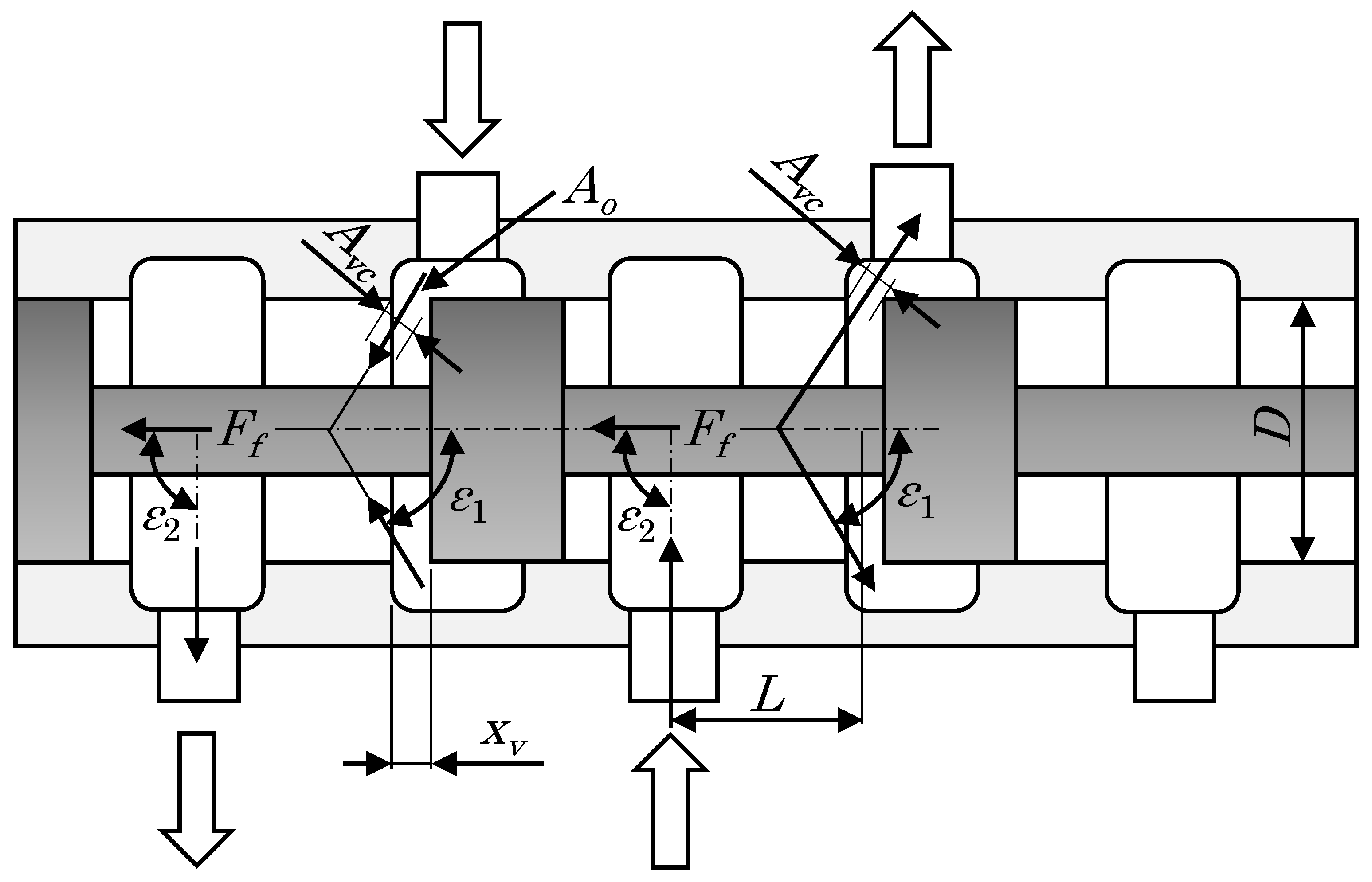
Flow forces are generally divided into axial and radial components. The axial steady-state flow force acts on the walls of the valve spool in the direction of its axis (Figure 1), and its basic calculation formula is [14]:
F f s = ρ · Q · ( ν 2 · cos ε 2 ν 1 · cos ε 1 ) .
The mean velocity v at the stream edge depends on the oil density and the pressure difference Δ p :
F f t = 2 ρ · Δ p .
Volumetric flow Q depends on the outlet coefficient α D , the opening cross-section A o and on the fluid flow velocity ν :
Q = α D · A o · ν ,
where A o = p · D · y and α D = A v c / A o , A o is opening cross-section, mm 2 , A v c is the fluid flow cross-section, mm 2 .
Due to the pressure differences occurring inside the valve, the fluid flows around the spool positioned within the valve sleeve. During valve opening, in order to limit pressure surges, the control ports are usually throttled by the spool edges relative to the supply and return ports [15]. On these throttling surfaces, changes in fluid momentum occur, leading to pressure differences that generate a resultant force acting in a direction that tends to restrict the flow—that is, to close the valve [16,17,18] (particularly in spools without flow force compensation, such as v1 and v1g geometries).
Radial flow forces present in servovalves are associated with the radial clearance between the spool and the sleeve. Although these forces are typically balanced, in spools with more complex geometries the loading conditions become more intricate, making the occurrence of radial flow force unavoidable. An uneven pressure distribution, especially along the circumference of the spool, induces a tendency toward eccentricity and tilting of the spool, which may ultimately lead to hydraulic jamming. In the analysed valve, this force is compensated by locating the sleeve ports symmetrically around the spool.

2.2. Transient Flow Force

In the traditional approach to studying flow forces, transient components are often neglected because they are generally much smaller than the steady-state flow forces. If the fluid located in the chamber bounded by the spool lands is accelerated, an axial force is generated that acts on the spool surfaces. The direction of this force can be determined by analyzing the acceleration of a small fluid element in the direction of flow [19,20,21,22,23]. When the fluid confined by the spool lands within the so-called chamber is subjected to acceleration, a pressure difference is created, which leads to forces acting on the spool in the valve-closing direction.
The transient component of the flow force, which represents the force required to accelerate the fluid mass in the sliding-spool chamber, can be calculated using the length L of the accelerated oil volume within the control volume of the spool chamber [14,24]:
F f t = ρ · l · d Q d t
In the work of [25], transient flow forces were taken into account using two-dimensional CFD simulations with a dynamic mesh. The results showed that once the excitation frequency exceeds approximately 100 Hz, sinusoidal pressure fluctuations begin to influence the total flow force acting on the valve, and at frequencies above 1000 Hz the transient effects become dominant [26].
To examine the influence of pressure variations experimentally, ref. [27] used a test rig at the University of Missouri capable of generating controlled pressure transients. His results demonstrated that flow forces induced by pressure-rate effects can reach magnitudes comparable to steady-state flow forces, suggesting that the traditional practice of neglecting these effects may not always be justified.
More recent studies confirm that both the spool motion speed and the pressure variation significantly affect the magnitude of transient hydraulic forces. In the design of solenoid valves, the influence of transient flow forces is often ignored, which is one of the main reasons for their unstable operation under high-dynamic conditions [26,27].

3. Object of Analysis and Numerical Simulation

3.1. Overview of the Simulated Object

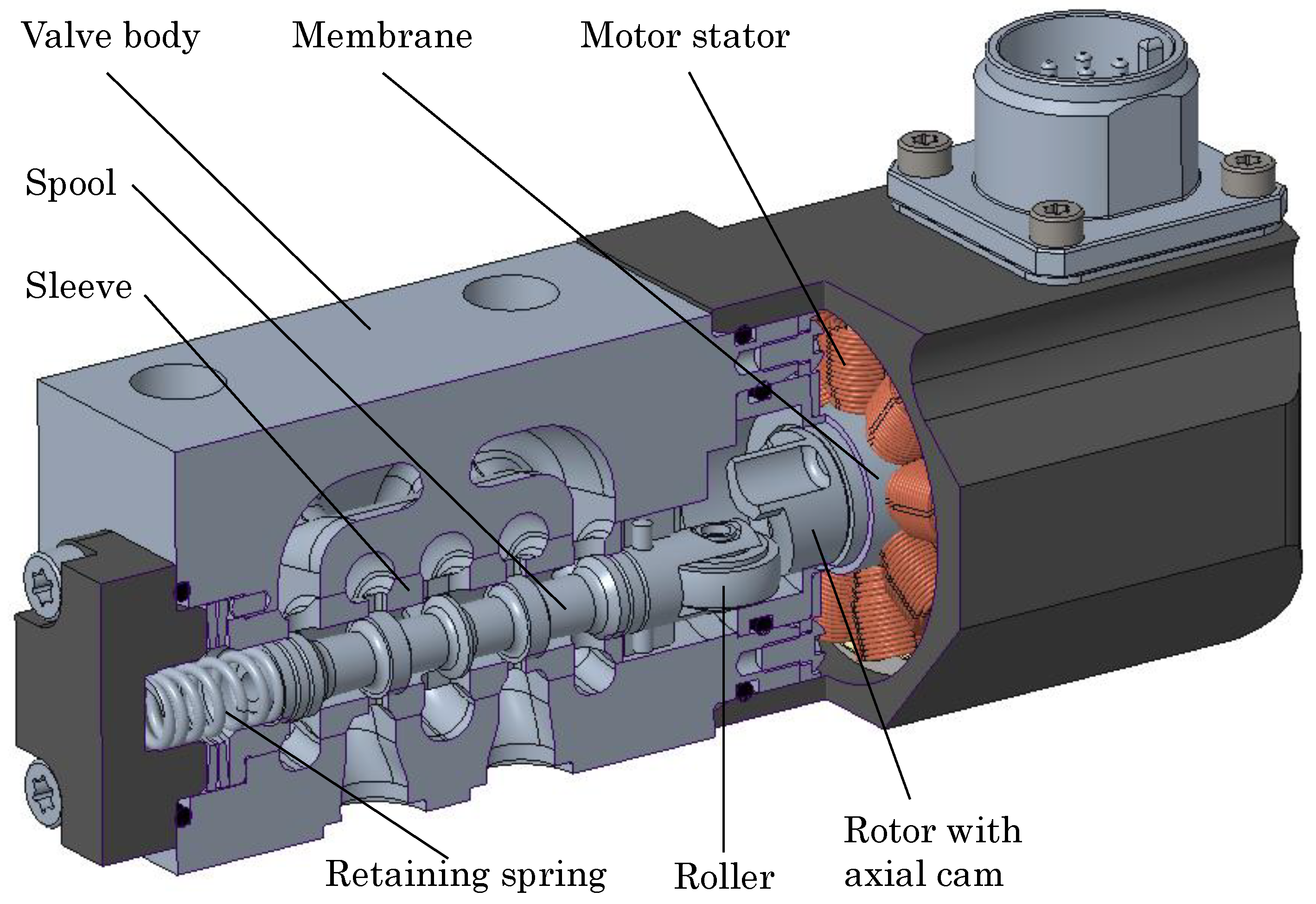
The simulation was carried out for a proprietary direct-drive valve (DDV) intended for advanced, precise, and reliable hydraulic control systems operating under harsh conditions, and designed to transition to a safe state in the event of a power failure by means of a spring-activated mechanical return mechanism. The valve is driven by a brushless permanent-magnet motor, in which the rotary motion of the motor rotor is converted into the reciprocating motion of the spool through an axial-cam mechanism equipped with end-position stops in both directions of actuation. A sectional model of the valve is shown in Figure 2. The valve features integrated control electronics and a cost-effective measurement system designed to monitor spool displacement within the sleeve. For an in-depth analysis of low-cost sensing techniques and the application of autoencoders in this context, see [28,29]. The valve corresponds to size NG6 according to ISO 4401-03 [30], with a nominal flow rate of approximately 40 L/min (at dp = 7 MPa) and a maximum operating pressure of 35 MPa.

3.2. Development of the Computational Model

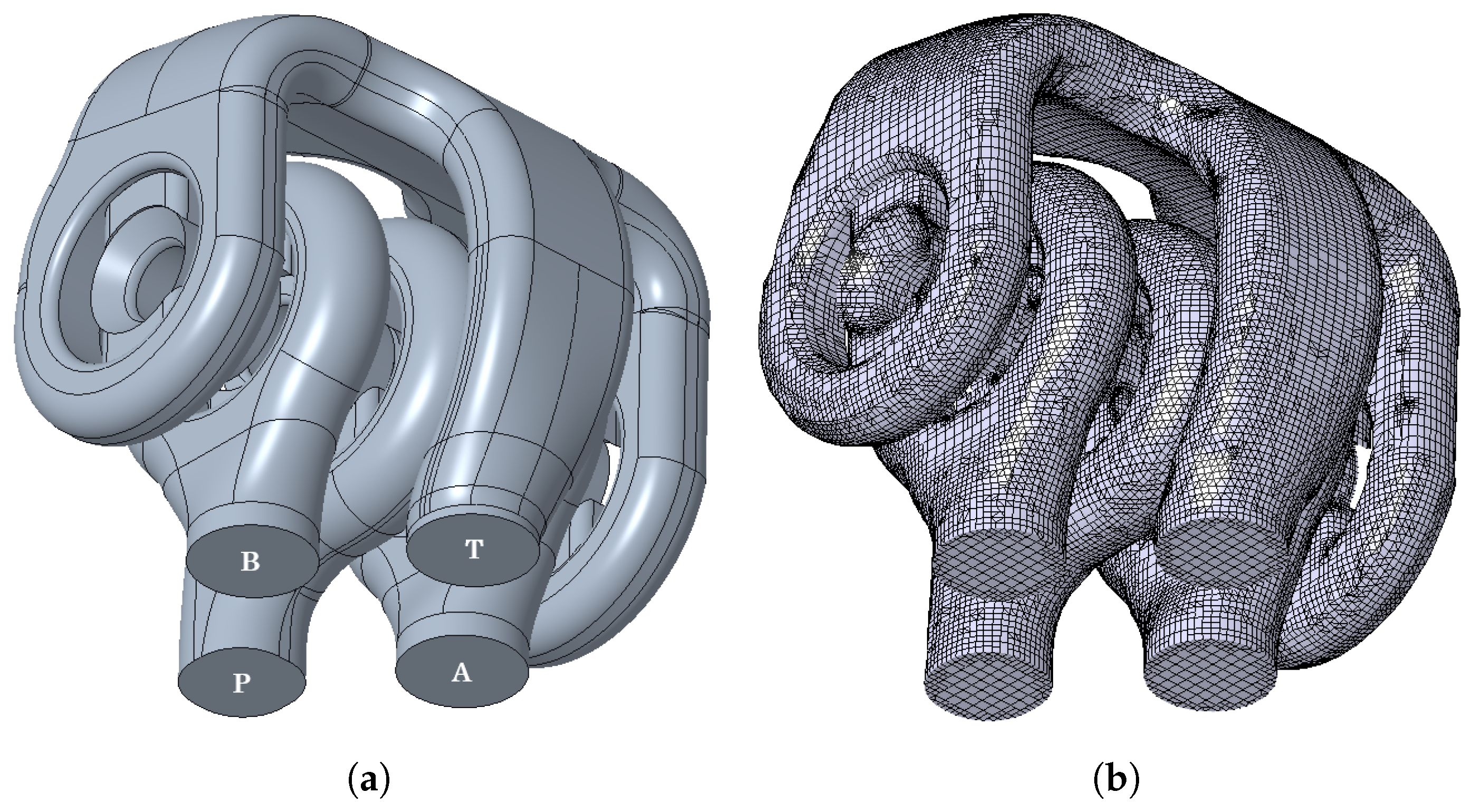
The 3D CAD model of the servovalve shown in Figure 2 was prepared using CREO Parametric 7.0. For the purposes of the analysis, a 3D CAD model of the fluid domain filling the internal channels of the valve was also created, including all volumes surrounding the spool, the sleeve, and the internal passages of the valve body. The discrete model is presented in Figure 3.
The CFD analysis of the direct-drive servovalve was carried out using CREO Parametric 7.0 and its integrated Flow Analysis module. Integrating the CFD environment directly within the CAD software enabled rapid and efficient modification of the model, which was automatically updated in the computational environment while preserving all previously defined simulation parameters (Table 2).
The Flow module solves for conservation of mass and momentum, using the transient Navier-Stokes Equations [31]. For the purposes of this study, several simplifying assumptions were adopted, including a stationary computational domain, steady-state flow conditions, and isothermal behaviour. Under these assumptions, certain terms in the governing equations presented below are neglected by the solver during the simulation.
  • Continuity:
    t Ω ( t ) ρ d Ω + σ ρ ( υ ¯ υ ¯ σ ) · n d σ = 0
  • Momentum:
    t Ω ( t ) ρ d Ω + σ ρ ( ( υ υ σ ) · n ) υ d σ = σ τ ˜ . n d σ σ p n ¯ d σ + Ω f d Ω
  • Stress tensor:
    τ i j = ( μ + μ t ) d u i d x j + d u j d x i 2 3 d u k d x k δ i j
    where Ω ( t ) is the control volume as a function of time, ρ —static pressure, υ —fluid velocity, υ σ —mesh velocity, σ —surface control volume, f—body force, μ —dynamic viscosity, μ t —turbulent dynamic viscosity, δ i j —Kronecker delta (=1 for i = j, =0 for i ≠ j).
At small valve openings and low pressure differentials, the flow within the valve gap is predominantly viscous. However, as the pressure differential increases and the valve opening becomes larger, the Reynolds number in the gap increases rapidly and the flow may reach turbulent conditions. Due to the throttling effect at the valve port, significant velocity gradients develop in the valve chamber, resulting in regions of high Reynolds number flow (Re > 6000) in the core of the jet and lower Reynolds number flow near the walls.
In hydraulic servo valves, even at relatively small openings, turbulence models are often employed in numerical simulations to better capture jet separation, shear layer development, and mixing downstream of sharp control edges, which strongly influence the flow structure and pressure losses. According to [32], the turbulence model performs well in hydraulic flow fields and has been successfully applied in numerous studies of steady flow forces acting on valve spools, including [33,34,35].
The integrated simulation environment CREO Flow Analysis provides two turbulence models: the Standard k ε model and the Renormalization Group (RNG) k ε model. For the flow through the servovalve, the standard k ε model offers sufficient accuracy in describing the phenomenon, which follows from the lack of regions with laminar character inside the valve. Therefore, the k ε turbulence model was employed in the simulations, in which the turbulent kinetic energy k is defined by the following equation [31]:
t Ω ( t ) ρ k d Ω + σ ρ ( ( υ υ σ ) · n ) k d σ = σ μ + μ t σ k ( k . n ) d σ + Ω ( G t ρ ε ) d Ω
and formulation for the turbulent dissipation rate ε is:
t Ω ( t ) ρ ε d Ω + σ ρ ( ( υ υ σ ) · n ) ε d σ = σ μ + μ t σ z ( ε . n ) d σ + Ω c 1 G t ε k c 2 ρ ε 2 k d Ω
turbulent viscosity is calculated as follows:
μ t = ρ C μ k 2 ε
where G t is the turbulence generation term, σ k = 1 is the turbulence kinetic energy Prandtl number, σ z = 1 is the turbulence dissipation rate Prandtl number and constants c 1 = 1.44 and c 2 = 1.92. Further details on the adopted constants can be found in [18,32,36,37].
For the analyses, the P A B T flow configuration was adopted, referred to as the full flow through two metering edges simultaneously [38,39]. Here, P denotes the inlet (supply) pressure and T the outlet (tank) pressure, while ports A and B were hydraulically connected. The volumetric flow rate driven by the pressure differential, as a function of valve opening, was measured at port T. In addition to the above parameters, the outer surface of the spool was defined in the boundary conditions to enable evaluation of the pressure-induced forces.
The finite-element mesh was generated automatically, with local refinement in the vicinity of the metering edges. Internal leakages resulting from the radial clearance between the spool and sleeve, as well as between the sleeve and the valve body, were neglected in the model.
Most cells are cubic, representing an optimal cell type in terms of orthogonality, aspect ratio, and skewness. This geometric regularity minimizes numerical errors and enhances both the stability and efficiency of the computations. Furthermore, the automation of the mesh generation process significantly reduces the model set-up time, improving the overall efficiency of the simulation work-flow.
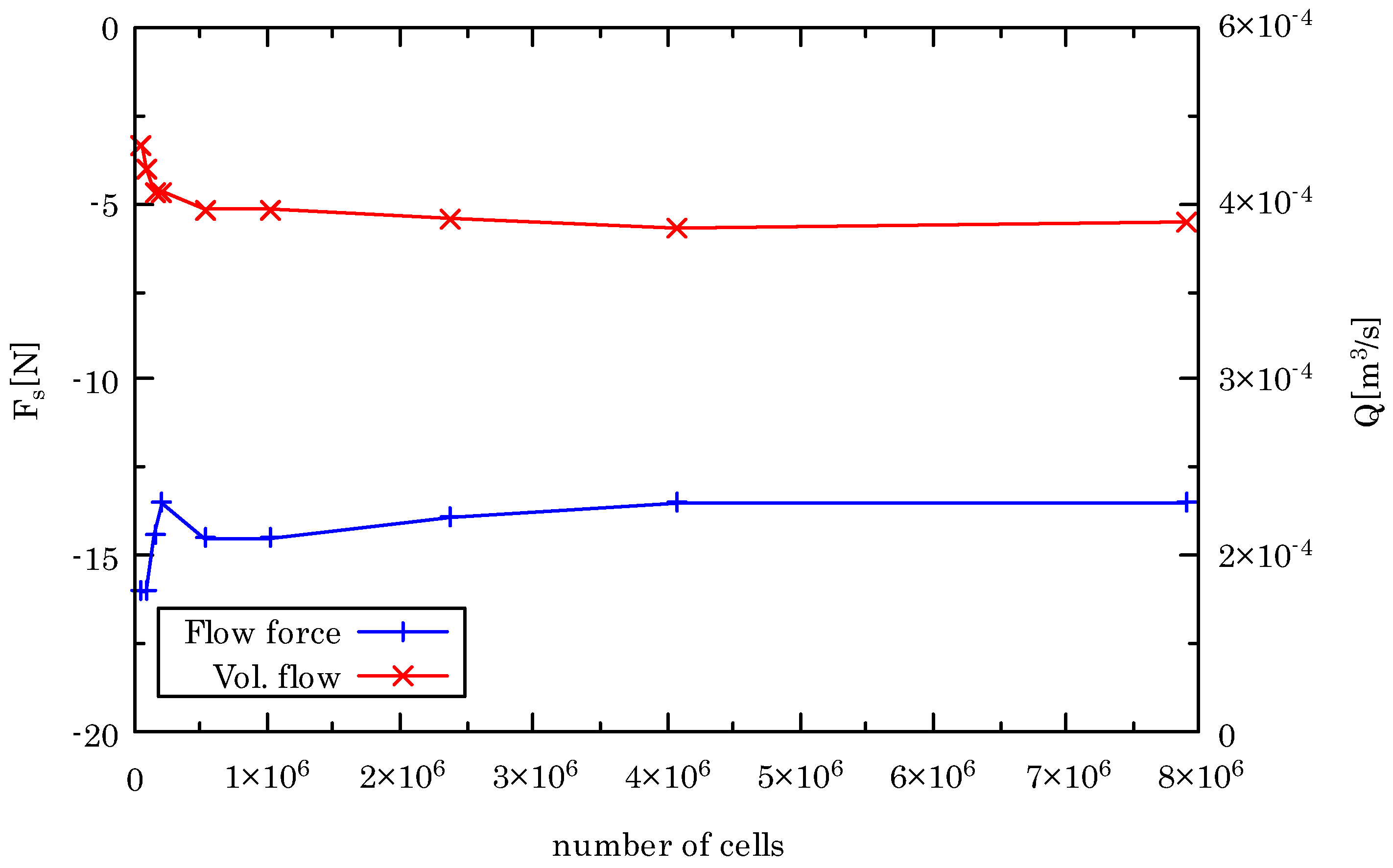
For the purpose of verifying the quality of the model discretization, a mesh independence study was performed under operating conditions corresponding to a valve opening of 0.4 mm and a pressure drop of 7 MPa. The CAD model representing the internal flow domain of the valve was discretized using cells with different mesh densities. The coarse mesh consisted of 63,858 cells, whereas the most refined mesh contained 7,900,524 cells. The mesh independence criterion was established based on both the simulated flow-induced force and the volumetric flow rate. The results presented in Figure 4 indicate that when the number cells exceeds more then 500,000, the calculated flow-induced force and volumetric flow rate remain stable, with deviations below 2% for both quantities. This confirms that the obtained results are almost independent of further mesh refinement.

3.3. Description of the Spool Design Variants and Their Associated Flow Force Compensation Techniques

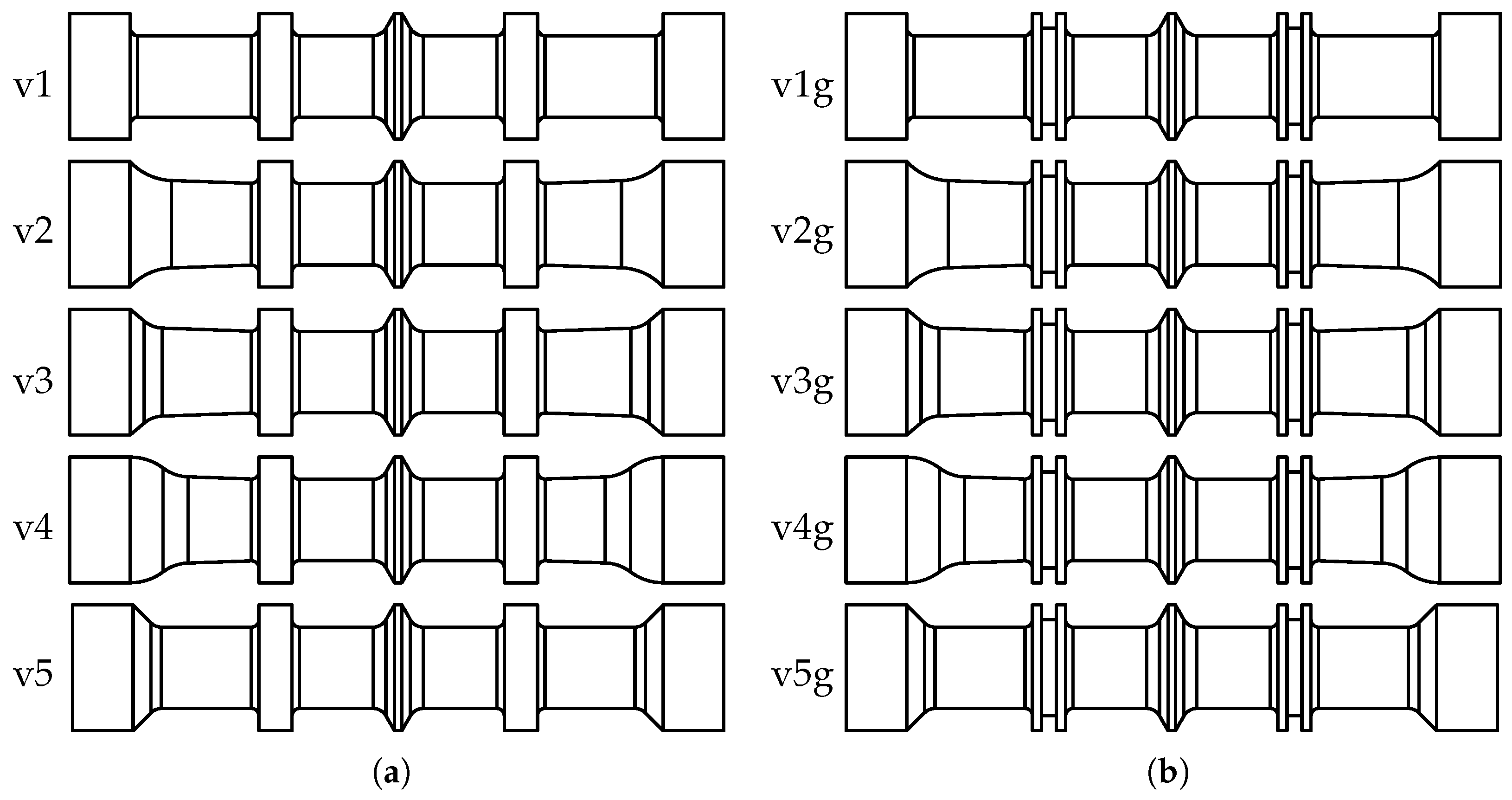
The simulation study was carried out for five spool variants without circumferential pressure-compensation grooves and for five variants incorporating such grooves. More detailed information on pressure compensation grooves can be found in [40]. The outline of the spool geometries is shown in Figure 5. The outer diameter of the spools is 8.5 mm, whereas the circumferential grooves are 1 mm in width and 1 mm in depth. Variant 1 is a spool with a simple geometry, without any flow force compensation at the outflow edge toward the return port. A tapering shape toward the outflow edge can be used to reduce flow-induced forces [33,41]. Variant 2 features a 2° conical taper and a rounded outflow edge with a 4 mm radius. Variant 3, similarly to Variant 2, has a 2° conical taper and a chamfered outflow edge of 1 mm × 40°. Variant 4 also incorporates a 2° conical taper and a convex outflow edge with a 4 mm radius. Variant 5 includes a chamfer at the outflow edge of 2 mm × 45° and a constant inner diameter.

4. Results and Discussion

The CFD analysis was conducted for spool positions enabling flow from port P through ports A and B (hydraulically connected) to port T. Owing to the symmetry of the internal geometry, analysis of the reverse flow direction (i.e., P B A T ) was not required. As a result of the study, complete flow characteristics were obtained, along with steady-state force values acting on the directional valve spool for five spool variants. In addition, the paper presents flow-velocity distributions in cross-sectional views of the entire valve, as well as flow streamlines for both compensated and uncompensated designs.
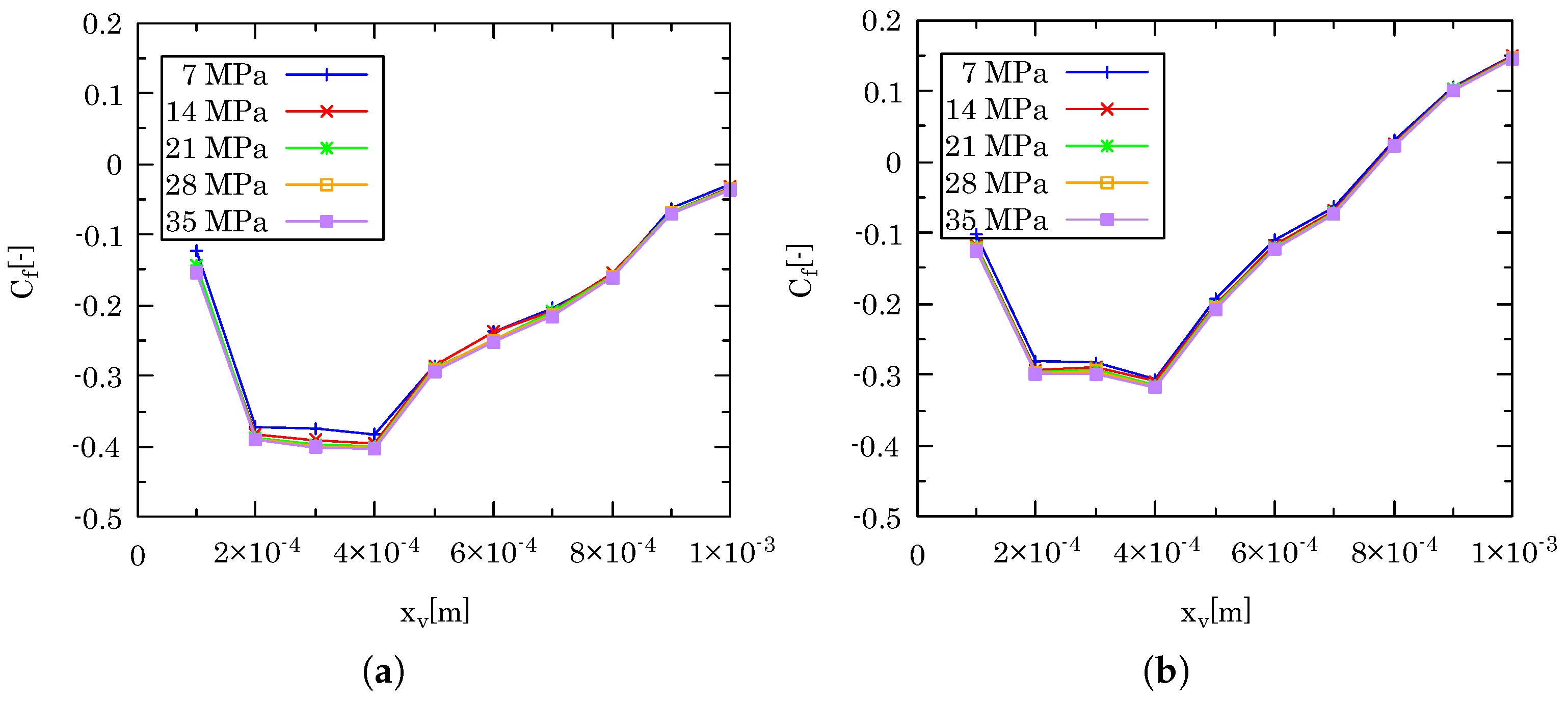
To evaluate the robustness of the numerical model and the consistency of the physical system, a non-dimensional analysis was performed. In the Figure 6 the force coefficient, defined as C f = F / ( Δ P · A ) , was plotted against the valve opening x v . The results for all pressure levels (70–350 bar) collapse into almost a single characteristic curve. The nonlinear character of the C f ( x v ) curve is physically consistent with the theory of flow forces in hydraulic spool valves. As the displacement x v increases, the jet angle and the local pressure distribution on the spool lands undergo significant changes. This trend demonstrates that the hydraulic load scales linearly with the pressure gradient, confirming that the k- ϵ model effectively captures the self-similar nature of the turbulent flow within the investigated Reynolds number range.
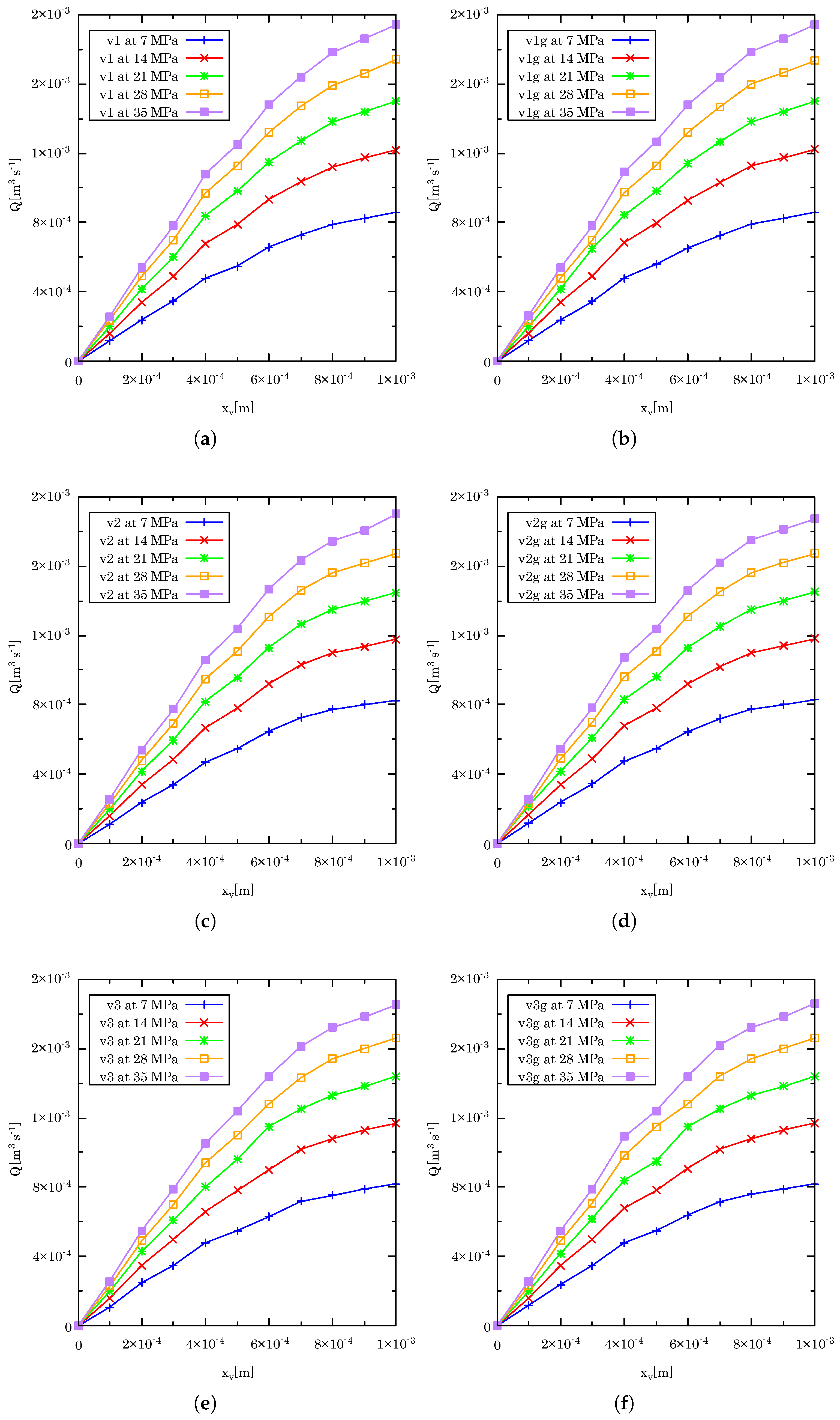
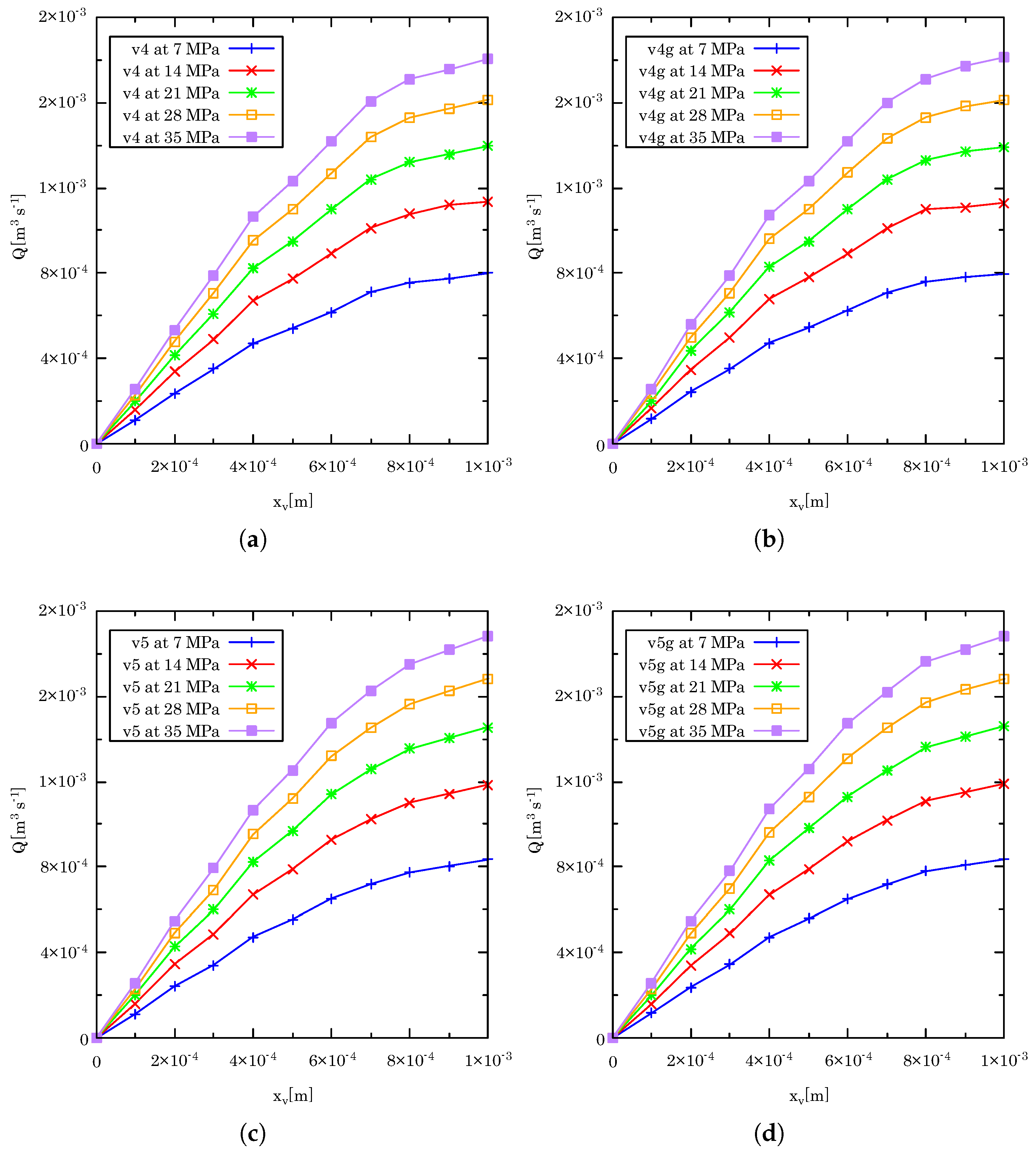
Figure 7 and Figure 8 show the complete flow characteristics for all analyzed spool variants under different pressure conditions. The uncompensated variant exhibited the highest nominal flow rate (at Δ P = 7 MPa), reaching 86 × 10−5 m3/s, which corresponds to 51.6 lpm, whereas the lowest nominal flow was obtained for variant no. 4, which was approximately 7% lower. The pressure-compensation groove introduced on the spools had a negligible influence on the flow rate.
The maximum flow rate was observed at a pressure differential of 35 MPa and reached 194 × 10−5 m3/s (116.4 lpm) for variant no. 1, while variant no. 4 again showed the lowest value, approximately 7% lower at full opening. The flow characteristics of all variants can be approximated as linear up to approximately 60% of the spool travel, which is particularly important for critical zero-lap operation in single-stage valves [42]. At larger openings, nonlinear behavior becomes evident, with a clear tendency toward a reduced flow gradient. Methodologies aimed at reducing flow-induced forces while minimizing the associated reduction in flow rate have also been investigated in [43,44,45,46,47].
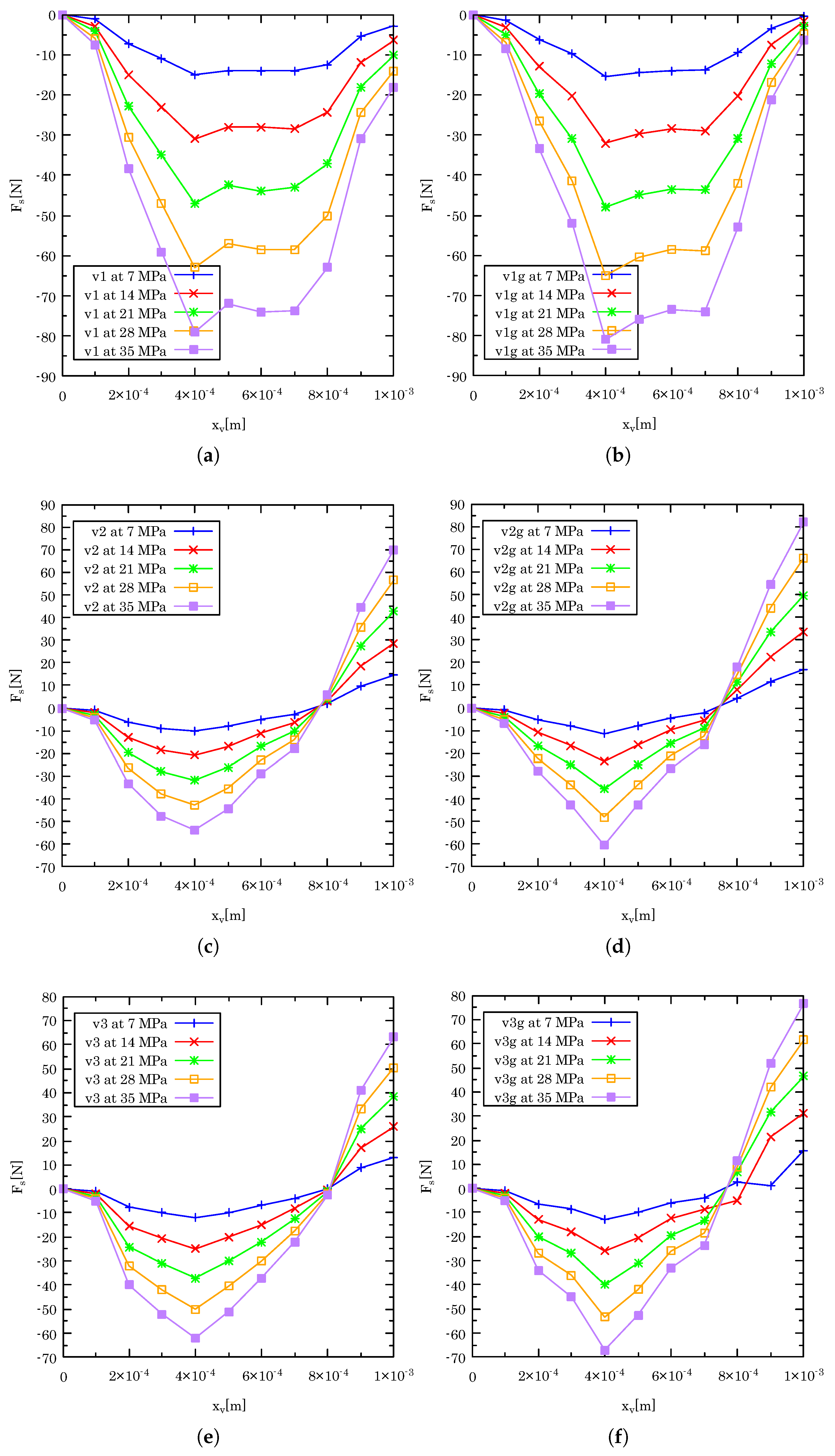
Figure 9 and Figure 10 present the results of the calculated flow forces for the individual spool variants shown in Figure 5. In the case of spool variant no. 1, without flow force compensation (Figure 9a,b, the flow-induced force reaches a maximum value of 79 N (at Δ P = 35 MPa) acting in the direction opposite to the spool displacement during valve opening. This maximum force occurs at a valve opening of approximately 0.4 mm and remains nearly constant up to an opening of 0.7 mm. Beyond this point, the force decreases rapidly, reaching approximately 18 N at full valve opening.
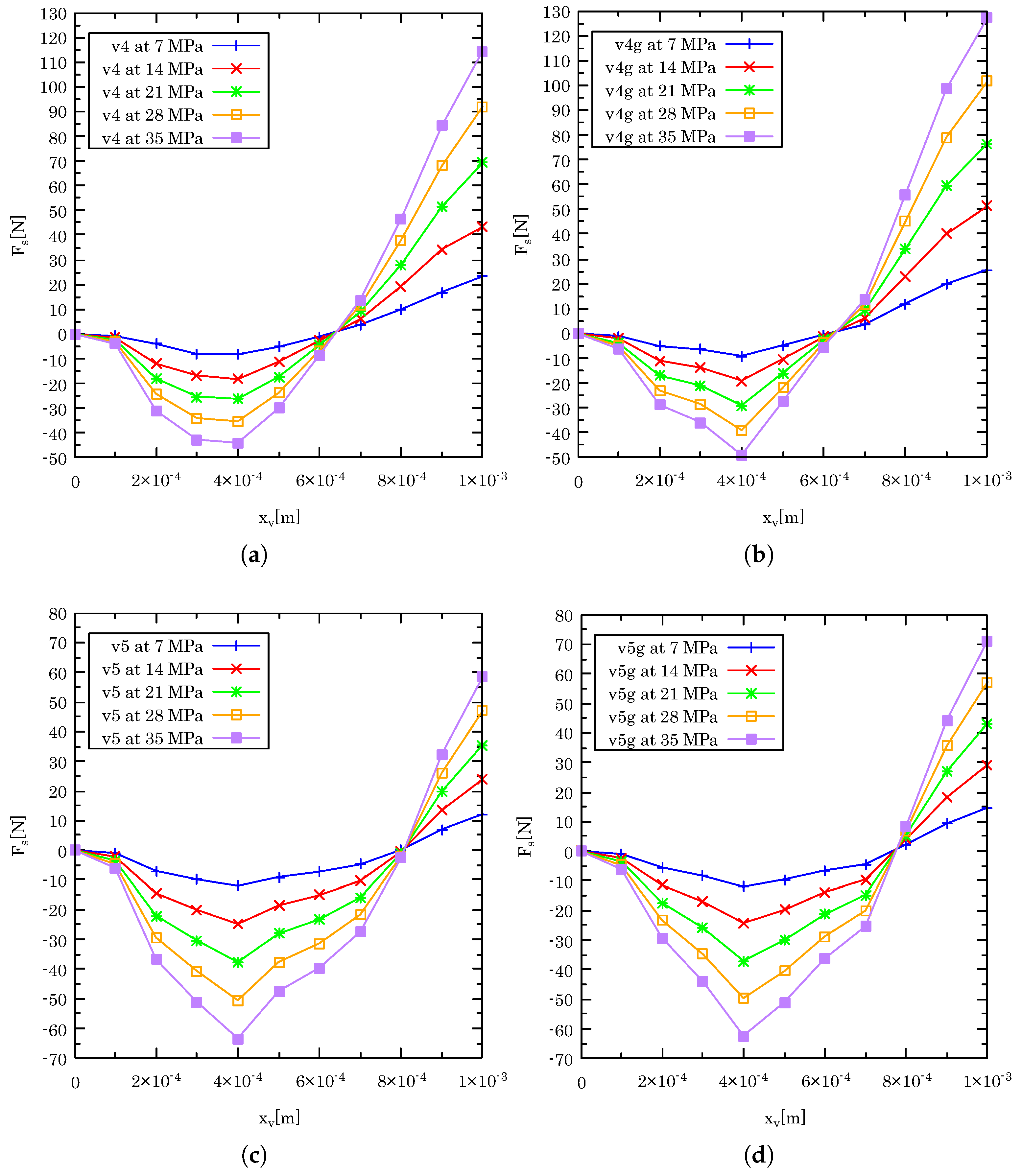
The application of flow force compensation resulted in a significant modification of the flow-induced force characteristics over the investigated range of spool displacement. The maximum force acting in the direction opposite to the spool motion occurs at a displacement of approximately 0.4 mm and subsequently decreases, reaching an almost zero value for displacements in the range of 0.63–0.81 mm. Similar conclusions were also reported in [48,49], where the flow force initially decreased and then increased At full valve opening, the force acts in the direction consistent with valve opening and, for variants 2, 3 and 4, reaches its maximum value at this position. A summary of the calculated forces for the different spool variants is presented in Table 3 and Table 4.
The application of a pressure compensation grooves slightly reduces the flow-induced forces; however, in the operating range close to full valve opening, it leads to an increase in these forces, reaching up to 20% in the case of variant no. 5 at 35 MPa pressure drop.
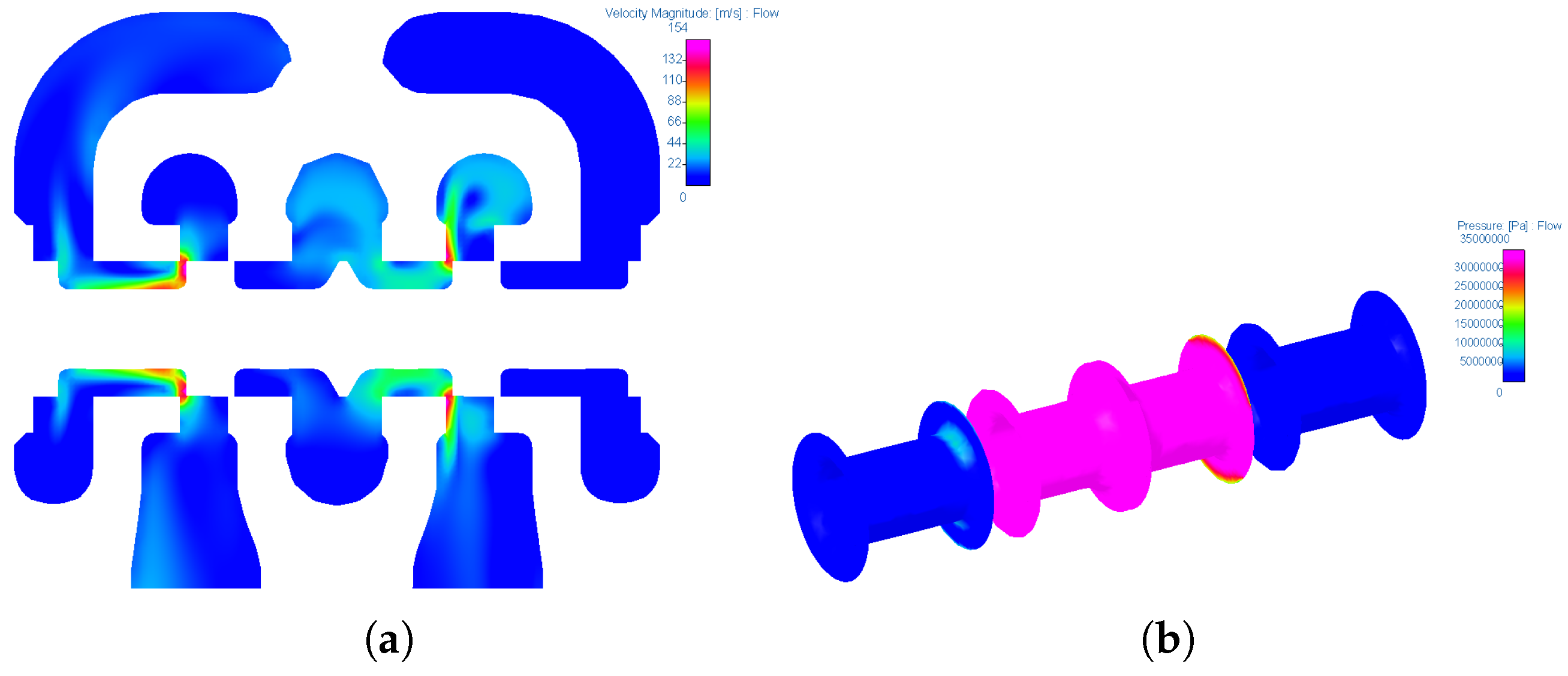
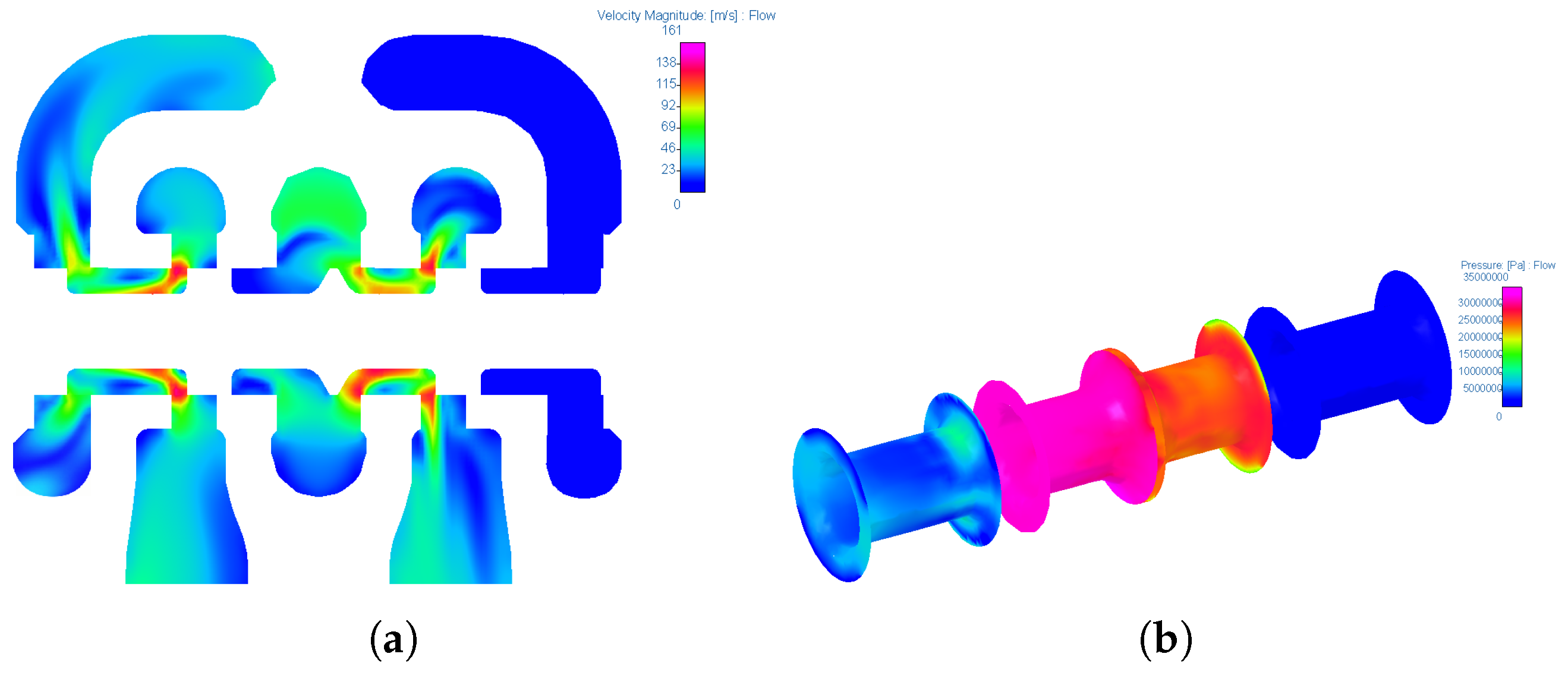
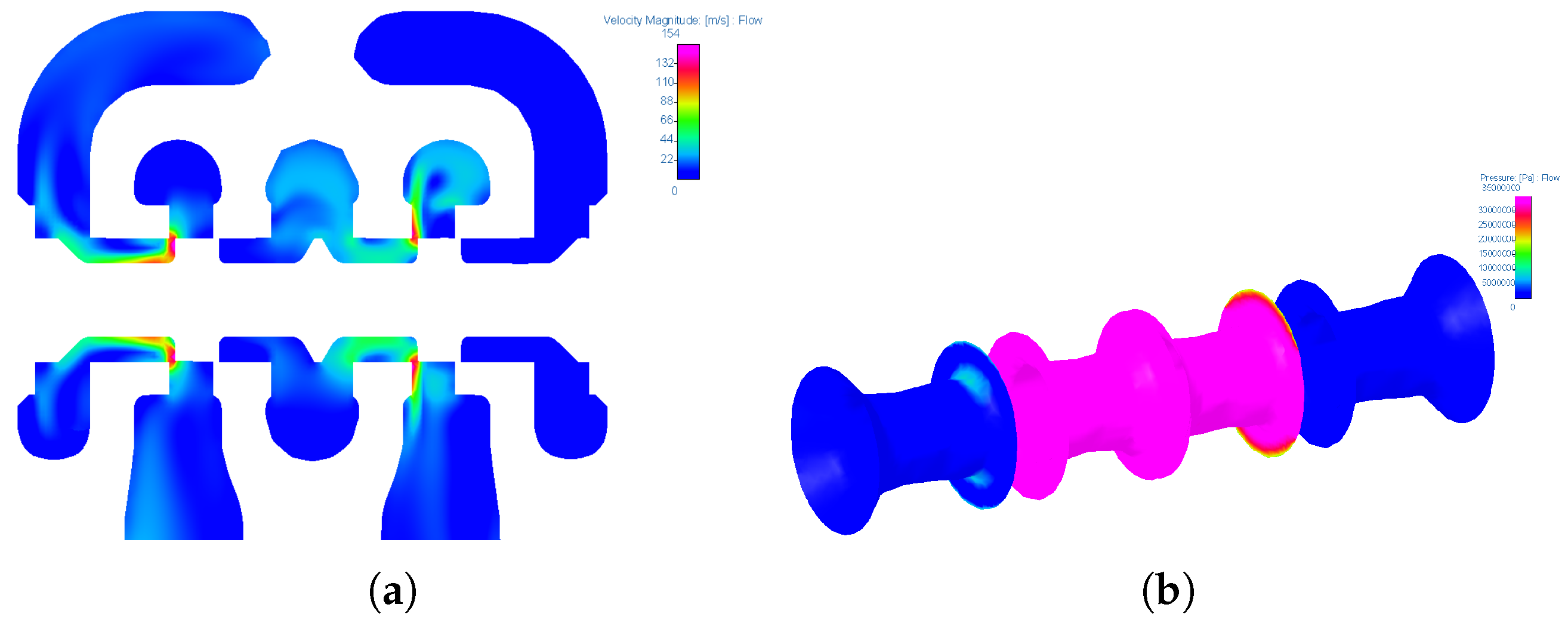
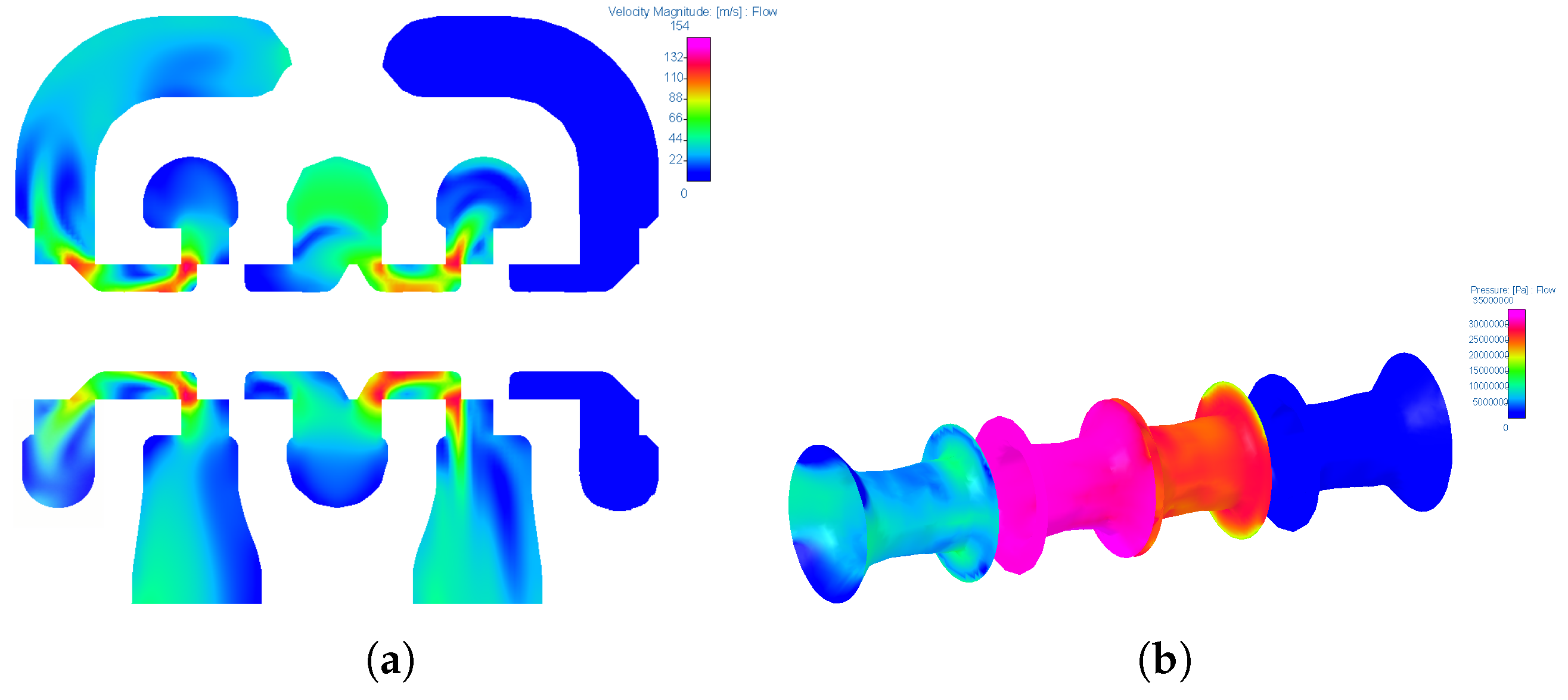
The velocity distribution of the flowing medium for the uncompensated spool variant is shown in Figure 11, Figure 12, Figure 13 and Figure 14. As indicated by the results, the maximum local velocity does not exceed 154 m/s at a spool opening of 0.4 mm. At full valve opening, the local fluid velocity near the control edges decreases to approximately 140 m/s. During flow in the P A B T configuration, the fluid flows around the spool from both sides. As can be seen from the pressure distribution shown in Figure 11b and Figure 12b, higher pressure occurs on the right-hand sides of the control edges on the spool, which leads to the generation of a resultant axial force acting opposite to the force produced by the spool actuation mechanism. For the V5 spool at full opening, the resulting force acts in accordance with the force produced by the actuation mechanism, Figure 14b.
Based on the numerical results, it is suggested that further optimization should focus on the spool edge geometry. Specifically, implementing a compensatory chamfer with an optimal angle (typically between 40 ° 50 ° ) could further redirect the jet momentum and reduce the axial flow force without significantly affecting the volumetric flow rate. Additionally, increasing the pressure compensation groove depth could alleviate local pressure concentrations observed at high-pressure levels (350 bar).

5. Conclusions

In this study, integrated CAD/CFD software was used to simulate five variants of hydraulic spools with different geometric structures in order to reduce flow-induced forces.
The reduction of flow-induced forces in hydraulic spool valves is essential for improving their operational performance. The steady-state flow force, also referred to as the Bernoulli force, is a reaction force resulting from the change in the flow direction of the fluid entering the valve chamber and exiting toward the spool. In the absence of compensation, the direction of this force is consistent with the spool-closing direction. As a result, it affects the operating characteristics and control performance of the valve and, in the case of direct-drive valves (DDVs), contributes to increased energy consumption.
The analysis of hydrodynamic forces acting on the spool as a function of its opening F ( x ) shows a clear relationship with the pressure gradient across the valve. For the maximum Δ P = 350 bar, the calculated axial force for the uncompensated spool reaches approximately 79 N, which represents an important constraint for the actuator design. The increase in force with the spool opening results from the growing pressure difference acting on the effective spool area. The obtained results indicate that the applied k ε turbulence model provides a reasonable prediction of the mean pressure distribution on the spool surfaces under the considered operating conditions.
With respect to the dominant axial steady-state flow force, two main approaches are commonly reported in the literature. The first approach involves modifications to the internal structure of the spool valve, such as adding convex platforms on the spool, introducing flow channels in the valve body, or increasing the radius of edge rounding on the spool lands. Although these modifications can significantly reduce the axial flow force, they may negatively affect the mechanical strength and stability of the spool or valve body, increase uncertainties in spool-to-sleeve clearances, complicate manufacturing and assembly processes, and increase production costs. The second approach focuses on reducing flow-induced forces solely through changes in selected design parameters.
The spool and the valve sleeve are typically manufactured from hardened steel to ensure high hardness, wear resistance, and corrosion resistance. Owing to the technological challenges associated with machining such materials, compensation of flow-induced forces is more economically achieved by modifying the external geometry of the spool rather than by introducing complex inclined flow passages in the valve sleeve or valve body.
The study compared the influence of five different shapes of the outflow edge oriented toward the return port, as well as the effect of so-called circumferential pressure grooves, on axial flow-induced forces and flow characteristics. The simulation results indicate that the variants with a chamfer oriented in the direction of flow toward the return port provide the best performance in terms of reducing flow-induced forces, while simultaneously causing the smallest pressure losses, which directly translates into a lower reduction of the flow rate.
The occurrence of flow-induced forces is unavoidable over a wide range of flow rates. Based on flow forces obtained from CFD analysis, appropriate actuator and return spring forces can be selected. Similar conclusions were also reported in [20], where the importance of accounting for return-spring stiffness was emphasized, as excessively low or high stiffness may significantly affect the flow rate under system pressure. Consequently, the operating parameter range ensuring correct valve operation can be defined. For the V5 variant, limiting the maximum valve opening from 1.0 mm to 0.9 mm results in an approximately 6% reduction in flow rate and leads to a significant reduction in flow-induced forces of up to 20%. The key challenges for future research involve the experimental verification of flow forces under extreme pressure conditions, where decoupling mechanical friction from purely hydrodynamic loads remains a significant metrological difficulty. Furthermore, practical application must account for the impact of fluid temperature rise on viscosity, as well as potential edge erosion, which may alter the valve’s control characteristics over prolonged operation. The application of CFD in the design process of compensation schemes allows empirical investigations to be limited primarily to validation stages, which often require specialized hydraulic and measurement equipment.
Studies on flow-induced forces in spool valves are consistent with current trends toward high precision and high stability in hydraulic systems and provide guidance for the development of advanced spool valve designs.

Author Contributions

Conceptualization, K.W. and P.R.; methodology, K.W.; software, K.W.; validation, P.R.; formal analysis, P.R.; investigation, K.W.; resources, K.W. and P.R.; data curation, K.W.; writing—original draft preparation, K.W. and P.R.; writing—review and editing, P.R.; visualization, K.W.; supervision, P.R.; project administration, P.R.; funding acquisition, P.R. All authors have read and agreed to the published version of the manuscript.

Funding

This research received no external funding.

Institutional Review Board Statement

Not applicable.

Informed Consent Statement

Not applicable.

Data Availability Statement

The raw data supporting the conclusions of this article will be made available by the authors on request.

Conflicts of Interest

The authors declare no conflicts of interest.

Abbreviations

The following abbreviations are used in this manuscript:
DDSVDirect Drive Servo Valve
DDVDirect Drive Valve
EHSVElectro Hydraulic Servo Valve
NGNenngrösse (Nominal Size)
CFDComputational Fluid Dynamics
CADComputer Aided Design
RNGRenormalization Group
F f s Axial steady-state flow force
QVolumetric flow
ε 1 , ε 2 Entry angles
ν 1 , ν 2 Fluid flow velocities
Δ p Pressure drop
α D Outlet coefficient
A o Opening cross section
A v c Fluid flow cross-section
kTurbulent kinetic energy
ε Turbulent energy dissipation rate
ρ Fluid density
μ Kinematic viscosity
Ω Control volume
σ Surface of control volume
υ Fluid velocity
υ σ Velocity of the control surface
nOutward unit of normal vector
σ k Turbulence kinetic energy Prandtl number
G t Turbulence generation term
μ t Turbulent viscosity
υ z Turbulence dissipation rate Prandtl number
c 1 , c 2 , C μ Coefficients in approximated turbulent transport equations

References

  1. Electro-Hydraulic-Valves. A Technical Look. Available online: https://www.moog.com/content/dam/moog/literature/ICD/Moog-ServoValves-Techn_Look-Overview-en.pdf (accessed on 3 February 2026).
  2. Plummer, A. Electrohydraulic servovalves—Past, present and future. In Proceedings of the 10th International Fluid Power Conference, IFK2016, Dresden, Germany, 8–10 March 2016. [Google Scholar]
  3. Mi, J.; Yu, J.; Huang, G. Direct-Drive Electro-Hydraulic Servo Valve Performance Characteristics Prediction Based on Big Data and Neural Networks. Sensors 2023, 23, 7211. [Google Scholar] [CrossRef]
  4. Mi, J.; Huang, G. Dynamic Prediction of Performance Degradation Characteristics of Direct-Drive Electro-Hydraulic Servo Valves. Appl. Sci. 2023, 13, 7231. [Google Scholar] [CrossRef]
  5. Zhang, Y.; Wang, S.; Shi, J.; Wang, X. Evaluation of thermal effects on temperature-sensitive operating force of flow servo valve for fuel metering unit. Chin. J. Aeronaut. 2019, 33, 1812–1823. [Google Scholar] [CrossRef]
  6. Servo-Proportional Valves. Direct Operated with Integrated Electronics. Available online: https://test.nordfluid.it/wp-content/uploads/2021/05/Catalog_ServoPropValvesD936_print.pdf (accessed on 3 February 2026).
  7. Direct Drive Servo Valves with Integrated Electronics for Analog Signals. Available online: https://www.moog.com/content/dam/moog/literature/products/servovalves/industrial/flow-control/analog/Moog-ServoValves-%20D633-D634-Catalog-en.pdf (accessed on 3 February 2026).
  8. Huang, G.; Mi, J.; Yang, C.; Yu, J. CFD-Based Physical Failure Modeling of Direct-Drive Electro-Hydraulic Servo Valve Spool and Sleeve. Sensors 2022, 22, 7559. [Google Scholar] [CrossRef]
  9. Liu, G.; He, Z.; Bai, G.; Zheng, J.; Zhou, J.; Chang, M. Modeling and Experimental Study of Double-Row Bow-Type Micro-Displacement Amplifier for Direct-Drive Servo Valves. Micromachines 2020, 11, 312. [Google Scholar] [CrossRef]
  10. Zhang, C. PD Plus Dynamic Pressure Feedback Control for a Direct Drive Stewart Manipulator. Energies 2020, 13, 1125. [Google Scholar] [CrossRef]
  11. Beackon, T.E. Hydrodynamic Forces on Hydraulic Piston Valves. Engineering 1957, 184, 629–633. [Google Scholar]
  12. Type 30 Nozzle-Flapper Flow Control Valves. Catalog. Available online: https://www.moog.com/content/dam/moog/literature/sdg/defense/Moog-Type30-Servo-Valve-Catalog.pdf (accessed on 3 February 2026).
  13. Electrohydraulic Motion Control. Proportional Directional & Pressure Control Valves, Servovalves, Electronics, Accessories. Available online: https://www.anythingflows.com/en/wp-content/uploads/2016/05/Parker-MSG14-2550-Electrohydraulics.pdf (accessed on 3 February 2026).
  14. Herakovic, N. Flow-Force Analysis in a Hydraulic Sliding-Spool Valve. Stroj. časopis Teor. Praksu Stroj. 2009, 51, 555–564. [Google Scholar]
  15. Shimizu, F.; Tanaka, K. Generation Mechanism of Flow Force Acting on Spool Valve. JFPS Int. J. Fluid Power Syst. 2022, 15, 71–77. Available online: https://www.jstage.jst.go.jp/article/jfpsij/15/2/15_71/_article (accessed on 1 February 2026). [CrossRef]
  16. Ledvon, M.; Hruzik, L.; Burecek, A.; Polasek, T.; Dyrr, F.; Kolar, D. Experimental and Numerical Analysis of Flow Force Acting on the Spool of Proportional Directional Valve. Processes 2023, 11, 3415. [Google Scholar] [CrossRef]
  17. Lugowski, J. Steady-State Flow-Force Compensation in a Hydraulic Spool Valve. 2013. Available online: https://www.researchgate.net/publication/259106434 (accessed on 1 February 2026).
  18. Domagala, M.; Fabis-Domagala, J. A Review of the CFD Method in the Modeling of Flow Forces. Energies 2023, 16, 6059. [Google Scholar] [CrossRef]
  19. Merrit, H.E. Hydraulic Control Systems; Wiley: New York, NY, USA, 1967. [Google Scholar]
  20. Lisowski, E.; Czyżewski, W.; Rajda, J. Three dimensional CFD analysis and experimental test of flow force acting on the spool of solenoid operated directional control valve. Energy Convers. Manag. 2013, 70, 220–229. [Google Scholar] [CrossRef]
  21. Olivetti, M.; Monterosso, F.G.; Marinaro, G.; Frosina, E.; Mazzei, P. Valve Geometry and Flow Optimization Through an Automated DOE Approach. Fluids 2020, 5, 17. [Google Scholar] [CrossRef]
  22. Chen, X.; Zhu, Y.; Qin, C.; Li, Y. Characteristics investigation of high speed solenoid valve based on multi-physics co-simulation model. Nonlinear Dyn. 2025, 113, 24383–24404. [Google Scholar] [CrossRef]
  23. Hua, H.; Zhang, J.; Zhao, C.; Wu, Z.; Song, J.; Liao, Z. Prediction-based rapid force control of a single-acting pneumatic cylinder under hysteresis nonlinearity. ISA Trans. 2025, 158, 686–696. [Google Scholar] [CrossRef]
  24. Hucko, S.; Krampe, H.; Schmitz, K. Evaluation of a Soft Sensor Concept for Indirect Flow Rate Estimation in Solenoid-Operated Spool Valves. Actuators 2023, 12, 148. [Google Scholar] [CrossRef]
  25. Vescovo, D.G.; Lippolis, A. A review analysis of unsteady forces in hydraulic valves. Int. J. Fluid Power 2006, 7, 29–39. [Google Scholar] [CrossRef]
  26. Li, R.; Sun, Y.; Wu, X.; Zhang, P.; Li, D.; Lin, J.; Xia, Y.; Sun, Q. Review of the Research on and Optimization of the Flow Force of Hydraulic Spool Valves. Processes 2023, 11, 2183. [Google Scholar] [CrossRef]
  27. Manring, N.D.; Zhang, S. Pressure Transient Flow Forces for Hydraulic Spool Valves. J. Dyn. Syst. Meas. Control 2012, 134, 034501. [Google Scholar] [CrossRef]
  28. Sun, Z.; Yao, Q.; Jin, H.; Xu, Y.; Hang, W.; Chen, H.; Li, K.; Shi, L.; Gu, J.; Zhang, Q.; et al. A novel in-situ sensor calibration method for building thermal systems based on virtual samples and autoencoder. Energy 2024, 297, 131314. [Google Scholar] [CrossRef]
  29. Sun, Z.; Yao, Q.; Shi, L.; Jin, H.; Xu, Y.; Yang, P.; Xiao, H.; Chen, D.; Zhao, P.; Shen, X. Virtual sample diffusion generation method guided by large language model-generated knowledge for enhancing information completeness and zero-shot fault diagnosis in building thermal systems. J. Zhejiang Univ. Sci. A 2025, 26, 895–916. [Google Scholar] [CrossRef]
  30. ISO 4401:2005(E); Hydraulic Fluid Power—Four-Port Directional Control Valves—MOUNTING Surfaces. International Organization for Standardization: Geneva, Switzerland, 2005.
  31. Creo Parametric 7.0.12.0 Online Help. Available online: https://support.ptc.com/help/creo/creo_pma/r7.0/usascii/#page/simulate/cfd/Turbulence/TurbulenceModels.html# (accessed on 3 February 2026).
  32. Mao, Q.; Jia, X.; Liu, Z.; Li, G.; Cao, Y.; Yang, Q. Study on Steady Flow Force of a Bidirectional Throttling Slide Valve and Its Compensation Optimization. Appl. Sci. 2024, 14, 11037. [Google Scholar] [CrossRef]
  33. Lisowski, E.; Rajda, J. CFD Analysis of Flow Forces Acting on the Spool of Directional Control Valve Type WE10J. Czas. Tech. 2015, 7, 133–140. [Google Scholar]
  34. Lisowski, E.; Filo, G.; Rajda, J. Adjustment of Proportional Control Valve Characteristics via Pressure Compensation Using Flow Forces. Energies 2024, 17, 1546. [Google Scholar] [CrossRef]
  35. Pan, X.; Wang, G.; Lu, Z. Flow field simulation and a flow model of servo-valve spool valve orifice. Energy Convers. Manag. 2011, 52, 3249–3259. [Google Scholar] [CrossRef]
  36. Launder, B.E.; Spalding, D.B. The numerical computation of turbulent flows. Comput. Methods Appl. Mech. Eng. 1974, 3, 269–289. [Google Scholar] [CrossRef]
  37. Yakhot, V.; Orszag, S.A.; Thangam, S.; Gatski, T.B.; Speziale, C.G. Development of turbulence models for shear flows by a double expansion technique. Phys. Fluids A 1992, 4, 1510–1520. [Google Scholar] [CrossRef]
  38. ISO 10770-1:2009; International Standard. Hydraulic Fluid Power—Electrically Modulated Hydraulic Control Valves—Part 1: Test Methods for Four-Port Directional Flow-Control Valves. International Organization for Standardization: Geneva, Switzerland, 2009.
  39. Li, S.; Du, J.; Shi, Z.; Xu, K.; Shi, W. Characteristics Analysis of the Pilot-Operated Proportional Directional Valve by Experimental and Numerical Investigation. Energies 2022, 15, 9418. [Google Scholar] [CrossRef]
  40. Hong, S.H. Numerical Analysis of the Trapping Effect of Grooves with Various Cross-Sectional Shapes and Reynolds Numbers. Lubricants 2024, 12, 432. [Google Scholar] [CrossRef]
  41. Bai, J.; Zhao, B.; Hao, Y.X.; Wang, B.; Liu, H. Hydrodynamic compensation method of proportional valve based on valve spool structure optimization. J. Mech. Electr. Eng. 2021, 38, 1444–1450. [Google Scholar]
  42. Wang, B.; Liu, H.; Hao, Y.; Quan, L.; Li, Y.; Zhao, B. Design and Analysis of a Flow-Control Valve With Controllable Pressure Compensation Capability for Mobile Machinery. IEEE Access 2021, 9, 98361–98368. [Google Scholar] [CrossRef]
  43. Amirante, R.; Catalano, L.A.; Poloni, C.; Tamburrano, P. Fluid-dynamic design optimization of hydraulic proportional directional valves. Eng. Optim. 2014, 46, 1295–1314. [Google Scholar] [CrossRef]
  44. Ma, A.; Xiao, H.; Hao, Y.; Yan, X.; Zhao, S. Multi-objective optimization design of low-power-driven, large-flux, and fast-response three-stage valve. Sci. Rep. 2024, 14, 21575. [Google Scholar]
  45. Liu, Q.; Wang, Z.; Zhang, J.; Liu, N.; Chen, R.; Luo, P. Multi-objective optimization of pressure in self-pressurized irrigation networks based on meta-heuristic algorithm with valve openings. Comput. Electron. Agric. 2025, 237, 110542. [Google Scholar] [CrossRef]
  46. Li, R.; Wang, Z.; Xu, J.; Yuan, W.; Wang, D.; Ji, H.; Chen, S. Design and optimization of hydraulic slide valve spool structure based on steady state flow force. Flow Meas. Instrum. 2024, 96, 102568. [Google Scholar] [CrossRef]
  47. Yang, M.; Zhang, Y.; Ai, C.; Yan, G.; Jiang, W. Multi-objective optimisation of K-shape notch multi-way spool valve using CFD analysis, discharge area parameter model, and NSGA-II algorithm. Eng. Appl. Comput. Fluid Mech. 2023, 17, 2242721. [Google Scholar] [CrossRef]
  48. Li, R.; Ding, X.; Lin, J.; Chi, F.; Xu, J.; Cheng, Y.; Liu, J.; Liu, Q. Study on the Influence of Triangular Groove Structure on Steady-State Flow Force Compensation Characteristics. Appl. Sci. 2021, 11, 11354. [Google Scholar] [CrossRef]
  49. Amirante, R.; Moscatelli, P.G.; Catalano, L.A. Evaluation of the flow forces on a direct (single stage) proportional valve by means of a computational fluid dynamic analysis. Energy Convers. Manag. 2007, 48, 942–953. [Google Scholar] [CrossRef]
Figure 1. Flow forces acting on the spool.
Applsci 16 03262 g001
Figure 2. NG6 servo valve with axial cam drive.
Applsci 16 03262 g002
Figure 3. Internal geometry of the valve: (a) 3D CAD model of the fluid filling the interior of the valve. (b) Computational domain discretization; A, B—service ports, P—pressure, T—tank.
Applsci 16 03262 g003
Figure 4. Variation of the solution with respect to the number of cells.
Applsci 16 03262 g004
Figure 5. Geometry of spools under investigation: (a) Spools without grooves. (b) Spools with grooves.
Applsci 16 03262 g005
Figure 6. Variation of the force coefficient C f with respect to the spool displacement: (a) C f for the v1 spool. (b) C f for the v5 spool.
Applsci 16 03262 g006
Figure 7. Flow characteristics of the analyzed spool variants: (a) Flow rate versus spool displacement for the V1 variant. (b) Flow rate versus spool displacement for the V1 variant with a circulating groove. (c) Flow rate versus spool displacement for the V2 variant. (d) Flow rate versus spool displacement for the V2 variant with a circulating groove. (e) Flow rate versus spool displacement for the V3 variant. (f) Flow rate versus spool displacement for the V3 variant with a circulating groove.
Applsci 16 03262 g007
Figure 8. Flow characteristics of the analyzed spool variants: (a) Flow rate versus spool displacement for the V4 variant. (b) Flow rate versus spool displacement for the V4 variant with a circulating groove. (c) Flow rate versus spool displacement for the V5 variant. (d) Flow rate versus spool displacement for the V5 variant with a circulating groove.
Applsci 16 03262 g008
Figure 9. Flow forces of the analyzed spool variants: (a) Axial force versus spool displacement for the V1 variant. (b) Axial force versus spool displacement for the V1 variant with a circulating groove. (c) Axial force versus spool displacement for the V2 variant. (d) Axial force versus spool displacement for the V2 variant with a circulating groove. (e) Axial force versus spool displacement for the V3 variant. (f) Axial force versus spool displacement for the V3 variant with a circulating groove.
Applsci 16 03262 g009
Figure 10. Flow forces of the analyzed spool variants: (a) Axial force versus spool displacement for the V4 variant. (b) Axial force versus spool displacement for the V4 variant with a circulating groove. (c) Axial force versus spool displacement for the V5 variant. (d) Axial force versus spool displacement for the V5 variant with a circulating groove.
Applsci 16 03262 g010
Figure 11. Visualization of fluid flow along the V1 spool for a 0.40 mm opening under a 35 MPa pressure drop: (a) Cross sectional view. (b) Pressure distribution on the spool.
Applsci 16 03262 g011
Figure 12. Visualization of fluid flow along the V1 spool for a 1.0 mm opening under a 35 MPa pressure drop: (a) Cross sectional view. (b) Pressure distribution on the spool.
Applsci 16 03262 g012
Figure 13. Visualization of fluid flow along the V5 spool for a 0.40 mm opening under a 35 MPa pressure drop: (a) Cross sectional view. (b) Pressure distribution on the spool.
Applsci 16 03262 g013
Figure 14. Visualization of fluid flow along the V5 spool for a 1.0 mm opening under a 35 MPa pressure drop: (a) Cross sectional view. (b) Pressure distribution on the spool.
Applsci 16 03262 g014
Table 1. Comparison of Direct Drive Valves (DDSV) and Electro-Hydraulic Servo Valves (EHSV).
DDSVEHSV
Number of stages1 (direct drive)2 (pilot + main stage)
Spool actuationProportional solenoid/voice coil/torque motorHydraulic pilot
Spool feedbackElectricalMechanical/Electrical
Hydraulic gainLowerHigh
Internal leakageLowHigh
Static accuracyHigherLower
Dynamic responseVery highHigh
Electrical power consumptionHigherVery low
Table 2. The CFD settings.
Mesh531,828 cells
Fluid parameter ρ = 890 kg/m3, μ = 0.035 kg/m·s
Boundary conditionsTotal pressure inlet from 7 MPa to 35 MPa, Total pressure outlet 0 MPa
Simulation typeSteady state
Turbulence modelTurbulent model k ε
Table 3. Calculated maximum flow forces at 0.4 mm valve opening.
SpoolForce [N]
70 MPa 140 MPa 210 MPa 280 MPa 350 MPa
v1−15−31−47−63−79
v1g−15.5−32−48−65−81
v2−10.1−20.8−31.8−42.7−53.7
v2g−11.5−23.6−35.8−48−60.5
v3−12−25−37−50−62
v3g−13−26−40−53.4−67
v4−8.2−18.3−26.2−35.3−44
v4g−9.1−19−29−39−49
v5−12−24.8−37.6−50.5−63.3
v5g−12−24.2−37−49.6−62.3
Table 4. Calculated maximum flow forces at full valve opening.
SpoolForce [N]
70 MPa 140 MPa 210 MPa 280 MPa 350 MPa
v1−2.8−6.5−10.2−14−18
v1g0.4−1.7−3−4.7−6.3
v214.528.742.656.570
v2g1733.749.766.282
v313.125.838.550.563
v3g15.831.246.461.576
v423.343.369.292114.5
v4g25.751.276.5101.5127
v512.1723.935.546.958.4
v5g14.729.243.257.271.2
Disclaimer/Publisher’s Note: The statements, opinions and data contained in all publications are solely those of the individual author(s) and contributor(s) and not of MDPI and/or the editor(s). MDPI and/or the editor(s) disclaim responsibility for any injury to people or property resulting from any ideas, methods, instructions or products referred to in the content.