Article

Numerical Investigation of Flow Division at Lateral Diversions

Department of Civil Engineering, Faculty of Engineering, Dicle University, 21280 Diyarbakir, Turkey
Appl. Sci. 2026, 16(7), 3239; https://doi.org/10.3390/app16073239
Submission received: 6 March 2026 / Revised: 23 March 2026 / Accepted: 26 March 2026 / Published: 27 March 2026
(This article belongs to the Topic Hydraulic Engineering and Modelling)

Abstract

This study numerically investigates the flow division at lateral diversions, focusing on the influence of the diversion angle and the ratio of channel widths on flow characteristics and discharge distribution. A total of 68 simulations were performed using FLOW-3D HYDRO 2022R1 software with a Large Eddy Simulation turbulence model. The investigation covered diversion angles of 30°, 45°, 60°, and 90°, combined with width ratios of 0.25, 0.50, and 1.00, under a wide range of upstream and downstream flow parameters. The flow fields were analyzed using cross-sections in both channels; the change in flow depths and velocity fields were evaluated together with organized flow structures. Streamline analyses were performed and three new empirical equations were proposed to predict the width of the divided flow and the discharge distribution in the bifurcation. Finally, the performance of existing equations previously proposed in the literature were assessed against the simulation results.

1. Introduction

Background and Objectives

Since the earliest studies on flow division at open-channel bifurcations [1,2,3], dating back over a century, the topic has maintained significant research interest. A recent review by Gumgum [4] offers an extensive examination of the theory and fundamentals of flow division, the resulting flow structures, and the effects of flow division on flow characteristics and discharge distribution in downstream branches. The reader is referred to this review on this matter, and, therefore, only a brief overview of the theory and key studies is provided here, while critical information is highlighted. Additionally, it should be noted that this paper is only interested in subcritical flows in rigid-bed channels.
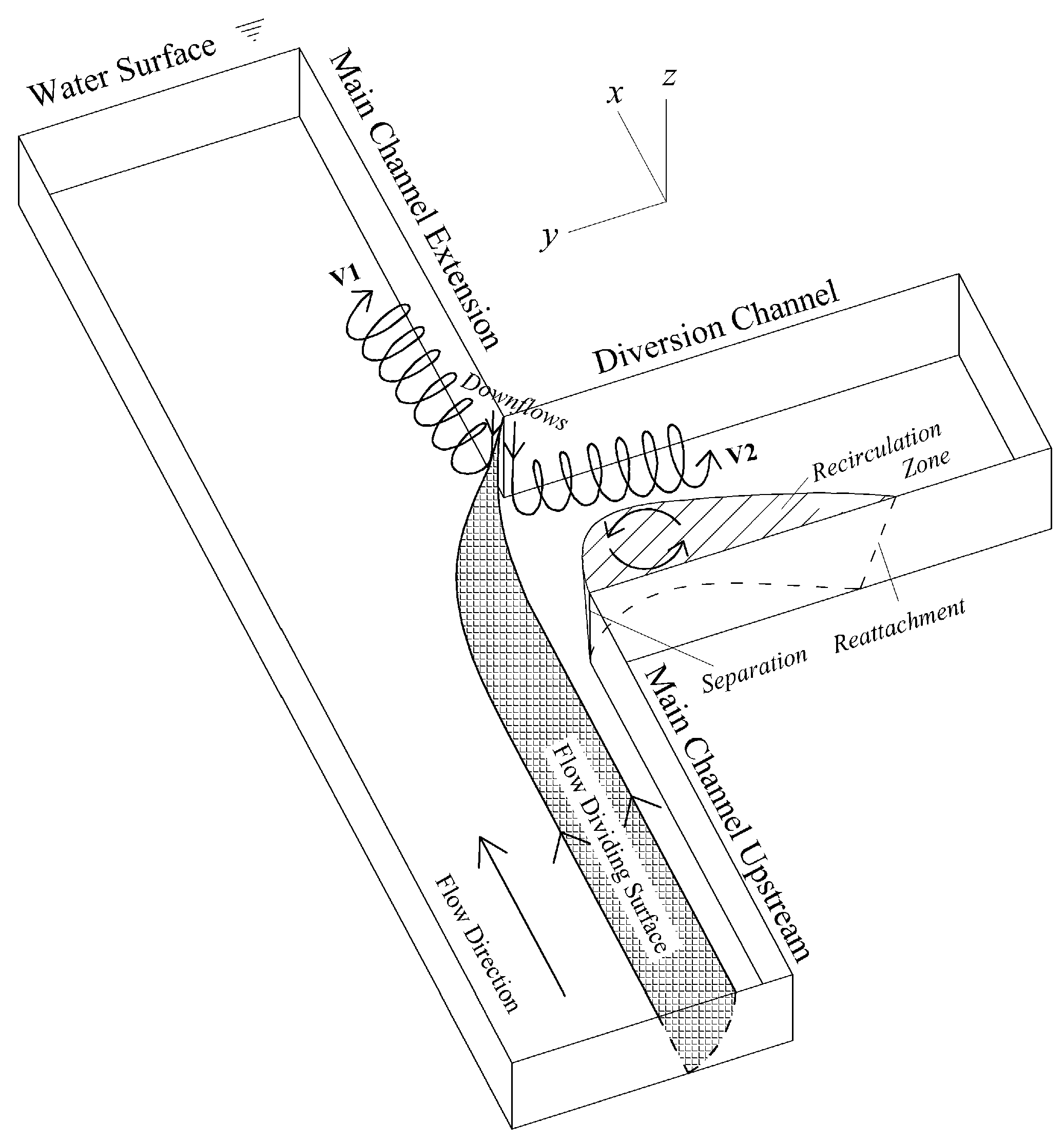
Flow division at open channel bifurcations refers to the process by which the incoming flow splits into two distinct flows; a complex three-dimensional phenomenon which produces substantial changes in the flow [5,6]. In the case of lateral diversions, a portion of the incoming flow turns into the diversion channel (also referred to as the bifurcating channel or lateral branch), known as the ‘divided flow’, while the remaining flow continues along the main channel extension (or the main channel downstream). The momentum of the incoming flow in the main channel (hereafter referred to as MC) direction forces the divided flow to separate from the channel boundary at the upstream corner of the diversion channel (hereafter referred to as DC). The divided flow constricts the DC until its momentum component in the x-direction cancels and then reattaches to its inner wall, forming a recirculating region (Figure 1). This region is often referred to as the recirculation zone, and is characterized by low velocities, distinct vortices, and multiple eddies [2,6,7,8]. The divided flow is bounded by the dividing streamlines, which form a flow-dividing surface that is wider near the bed and narrower near the surface, reflecting the vertical velocity profile of the flow. Consequently, the flow near the surface turns sharply into the DC and spans a greater width compared to the flow near the bed. This results in the recirculation zone being wider near the surface and narrowing towards the bed. The maximum width of the recirculation zone coincides with the maximum contraction of the DC, often referred to as the ‘throat’.
Depending on the flow conditions and channel geometry, the dividing streamlines may not always end at the downstream corner of the DC, and may extend slightly further along the inner wall of the MC extension before impacting it, subsequently being drawn into the DC [6,9,10]. Similarly to those that occur at the leading edge of bridge piers, velocities approach zero and local pressure elevates at this corner, resulting in a stagnation zone. Strong downflows are generated at the adjacent walls that lead to a two-leg vortex system (V1 and V2, Figure 1) [8]. In contrast, these vortex legs cannot join downstream and form a horseshoe. In the MC extension, continuing flow expands towards its inner wall, causing a local increase in velocities in this region but a decrease along the outer wall, which even becomes negative in certain cases.
One of the major challenges of flow division is the accurate prediction of discharge distribution in the downstream branches. In the case of supercritical flow in the diversion channel, upstream control in this channel reduces the complexity of the problem, and the empirical equation proposed by Rao and Sridharan [11] can accurately predict the discharge distribution for the diversion channels with varying Br (ratio of the diversion channel width, b, to the main channel width, B) and diversion angles, θ [12]. However, for fully submerged flows, downstream uncertainties in both channels increase the complexity and renders it difficult to derive a simple solution. Theoretical models for submerged flows [13,14,15], among others, rely on several assumptions, for the sake of simplicity, and are typically limited by factors such as channel widths, flow characteristics, and diversion angles [4]. The empirical models developed by Rao et al. [5] and Ibrahim et al. [12] are applicable to channel systems with unequal widths. However, these models were obtained for θ = 90° and their performance for different diversion angles remains unknown. In addition, studies evaluating the effects of flow division on flow characteristics such as flow depth, velocity fields, organized flow structures often utilize T-linked channels [5,13,16,17], among others, and the effects of θ and Br have not been fully explored.
To summarize, previous studies on the subject are focused on T-linked bifurcations, and the effects of θ and Br on flow characteristics and discharge distribution are yet to be fully understood. This study aims to numerically investigate the influence of the parameters θ and Br on discharge distribution and flow characteristics. A total of 68 simulations were performed, six of which were used for model validation using Flow-3D HYDRO 2022R1 software for θ = {30°, 45°, 60°, 90°} and Br = {0.25, 0.50, 1.00} under varying discharges. The flow depth, velocity fields, and organized flow structures were analyzed in detail across different regions of the channels. Additionally, a new set of empirical equations is proposed to predict discharge distribution at the bifurcation, and the performance of previously proposed equations was also assessed.

2. Numerical Approach

2.1. Computational Domain and Boundary Conditions

The numerical analyses were performed on FLOW-3D HYDRO 2022R1 software. The reference numerical model was based on the experimental device of Momplot et al. [18], and was subsequently validated using their corresponding experimental data. The original T-linked rectangular channel system consisted of a 2 m long MC upstream followed by a 2.6 m long MC extension and the DC. The channel widths were B = b = 0.3 m, and 0.098 m high bed sills were placed at downstream ends of both channels. Following the model validation, the lengths of the MC extension and the DC were extended to 2.9 m and 3.6 m, respectively, for the subsequent simulations to ensure uniform flow downstream, especially for relatively higher Froude numbers. These simulations were performed for Br = {0.25, 0.50, 1.00} and θ = {30°, 45°, 60°, 90°} under discharges ranging from 2 L/s to 10 L/s, and various bed sill heights to obtain a wide spectrum of flow parameters.
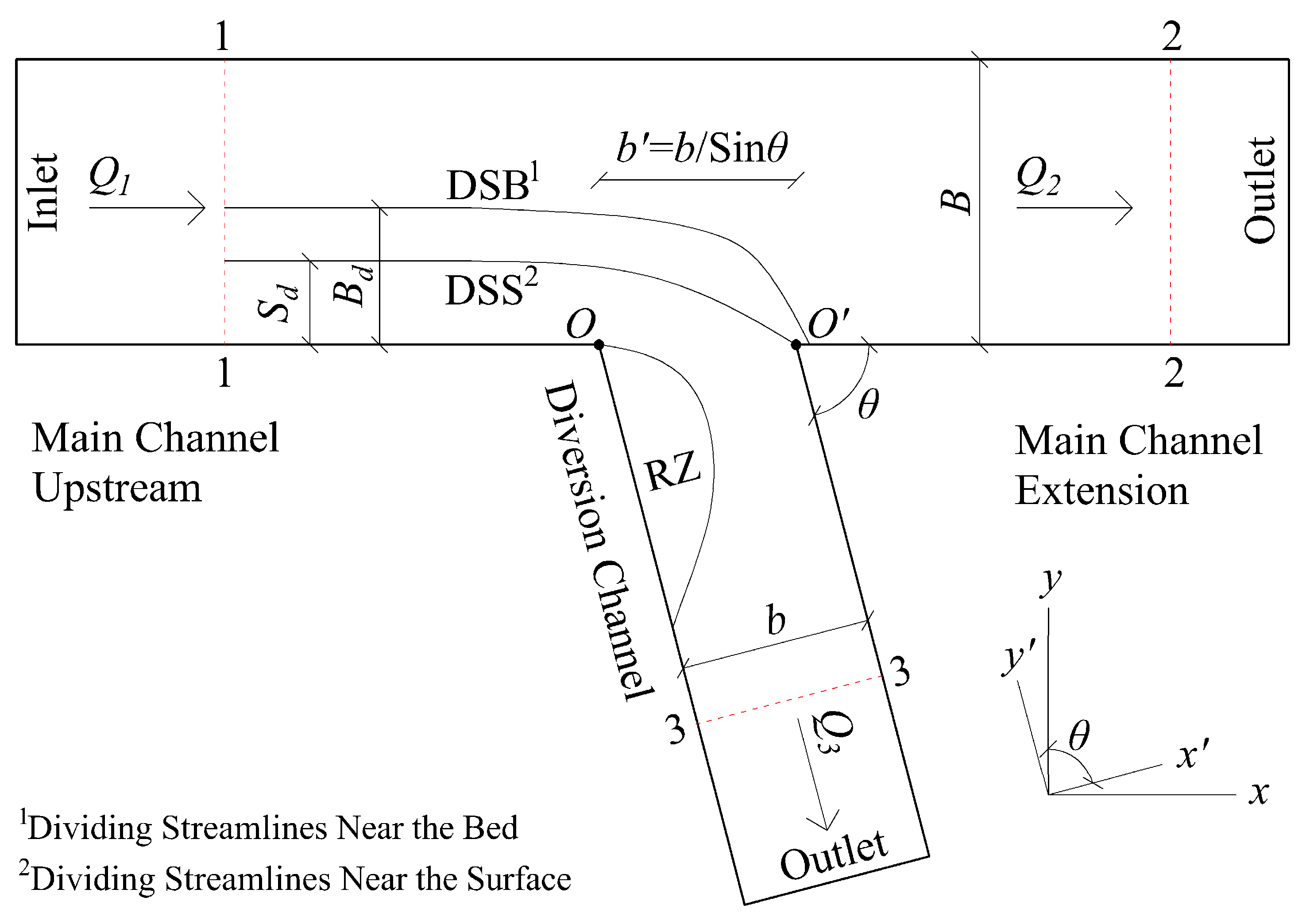
Figure 2 illustrates the plan view of the model (not to scale) and introduces the control sections, relevant parameters, and the coordinate systems. In the figure, Sd and Bd are the widths of the divided flow near the surface and near the bed; O is the origin of the global coordinate system, where (x, y) = (0, 0), and O′ is the origin of the local coordinate system for the DC, where (x′, y′) = (0, 0); and b′ is the width of the DC entrance. Three control sections, namely 1-1, 2-2, and 3-3, were defined to assess the uniform flow parameters in the MC upstream, MC extension and DC, respectively. Section 1-1 is located 3B upstream of the DC’s upstream corner, while sections 2-2 and 3-3 are at 2B and 2b upstream of the MC and DC bed sills, respectively. The flow parameters corresponding to these sections are indicated by the first digit of the section in subscript form, e.g., F1 denotes Froude number at section 1-1.
The geometry was captured using the structured Cartesian grid approach of Flow-3D HYDRO. While this approach offers advantages in terms of stability and computational cost, it creates challenges when meshing non-orthogonal geometries, particularly for the DCs in this study where θ ≠ 90°. To address these challenges, a high-resolution grid was maintained throughout the DC. The MC was defined using a separate mesh block, with refinement concentrated in the bifurcation zone and its immediate upstream and downstream reaches, while a coarser mesh was used elsewhere. This meshing strategy was applied to all models, resulting in ≈2,500,000 cells for the reference model. For comparison, Momplot et al. [18] tested their model using meshes of 700,000 and 1,000,000 cells and concluded that the results became independent of the mesh size.
To accurately represent the hydraulics of the system, specific boundary conditions were assigned to the MC and DC mesh blocks. For the MC block, the upstream boundary was defined as a volume flow rate to introduce the predefined discharge, while the downstream and top boundaries were set as pressure outflows to allow for natural fluid exit and atmospheric interaction at the free surface. Laterally, the outer and bottom boundaries were treated as a no-slip wall, whereas the inner boundary utilized a symmetry condition to facilitate flow transition into the diversion. Consistency was maintained in the DC block, where the upstream boundary was also defined by a symmetry condition, directly overlapping the MC’s inner boundary to ensure numerical continuity. The DC’s downstream and top boundaries mirrored the MC’s pressure outflow settings, while the bottom, inner, and outer lateral boundaries were modeled as no-slip walls.

2.2. Numerical Method

FLOW-3D HYDRO solves the mass continuity and momentum equations using the finite volume method on a structured Cartesian grid, with free-surface dynamics captured by the volume of fluid (VOF) approach [19]. The momentum equations were discretized using a second-order upwind scheme. Near-wall momentum flux was computed using an immersed boundary method [19,20], utilizing a generalized wall function to account for near-wall effects. In this framework, y+ (the dimensionless wall distance) is a resultant parameter calculated by the solver based on local friction velocity rather than a direct input. In the present study, the typical y+ values across the domain ranged between 1.30 and 50.
Turbulence was modeled using Large Eddy Simulation (LES) with the Smagorinsky subgrid-scale model to resolve the three-dimensional flow structures more accurately. LES offers a greater accuracy in predicting both mean and fluctuating quantities compared to Reynolds-Averaged Navier–Stokes (RANS) models [21,22], albeit at a higher computational cost. In LES, the flow is decomposed by a filter width (or length scale), Δ: the motions larger than Δ are directly resolved, capturing the large energy-containing eddies, while smaller subgrid-scale (residual) motions, below Δ, are modeled [23]. The effect of these unresolved motions is represented by an eddy viscosity (or turbulent viscosity), ν T   =   C S Δ 2 S ij S ij , where CS is the Smagorinsky coefficient and Sij is the strain rate tensor. A critical consideration in the LES setup is the selection of the Smagorinsky coefficient, CS, as no universal optimal value exists. Lilly [24] initially estimated CS = 0.176 for isotropic homogeneous turbulence. However, Deardorff [25,26] suggested that this value is too dissipative for wall-bounded flows and recommended CS = 0.10 for such cases. Indeed, numerous studies [21,27,28], among others, adopted CS = 0.10, usually incorporated with a wall-damping function. Piomelli et al. [29] also used CS = 0.10, but adjusted the scaling by a factor, arguing that CS = 0.10 was too dissipative. A similar conclusion was reached by Moin and Kim [30]. They used CS = 0.065 for different grid sizes, and stated that higher values of CS were too dissipative while lower values of CS resulted in excessive turbulent energy. For a comparative phenomenon such as backward-facing step flow, where a recirculation region occurs, some studies employed relatively higher values of CS. For instance, CS = 0.15 performed better than CS = 0.10 in the work of Kobayashi and Morinishi [31], and CS = 0.20 was used in a shear improved Smagorinsky model of Toschi et al. [32]. As detailed in the model validation section, CS = 0.05 was adopted in the present study.
The simulations were performed on a high-performance HP workstation (HP Inc., Palo Alto, CA, USA) featuring an Intel Xeon Silver 4214 CPU. Although the hardware supports 48 logical processors, the simulations were executed using 12 parallel cores, as per the software license configuration, supported by 32 GB of RAM. Depending on the specific geometry and inlet conditions, the time required to reach a statistically steady state varied between 3 h (for θ = 90°) and 1 day (for θ ≠ 90°). Once this state was achieved, the simulations were restarted and continued for an additional 120 s of flow time to ensure sufficient data for turbulence statistics. This data collection phase required between 6 h (for θ = 90°) and 2 days (for θ ≠ 90°) of additional computational time per case.

2.3. Validation of the Model

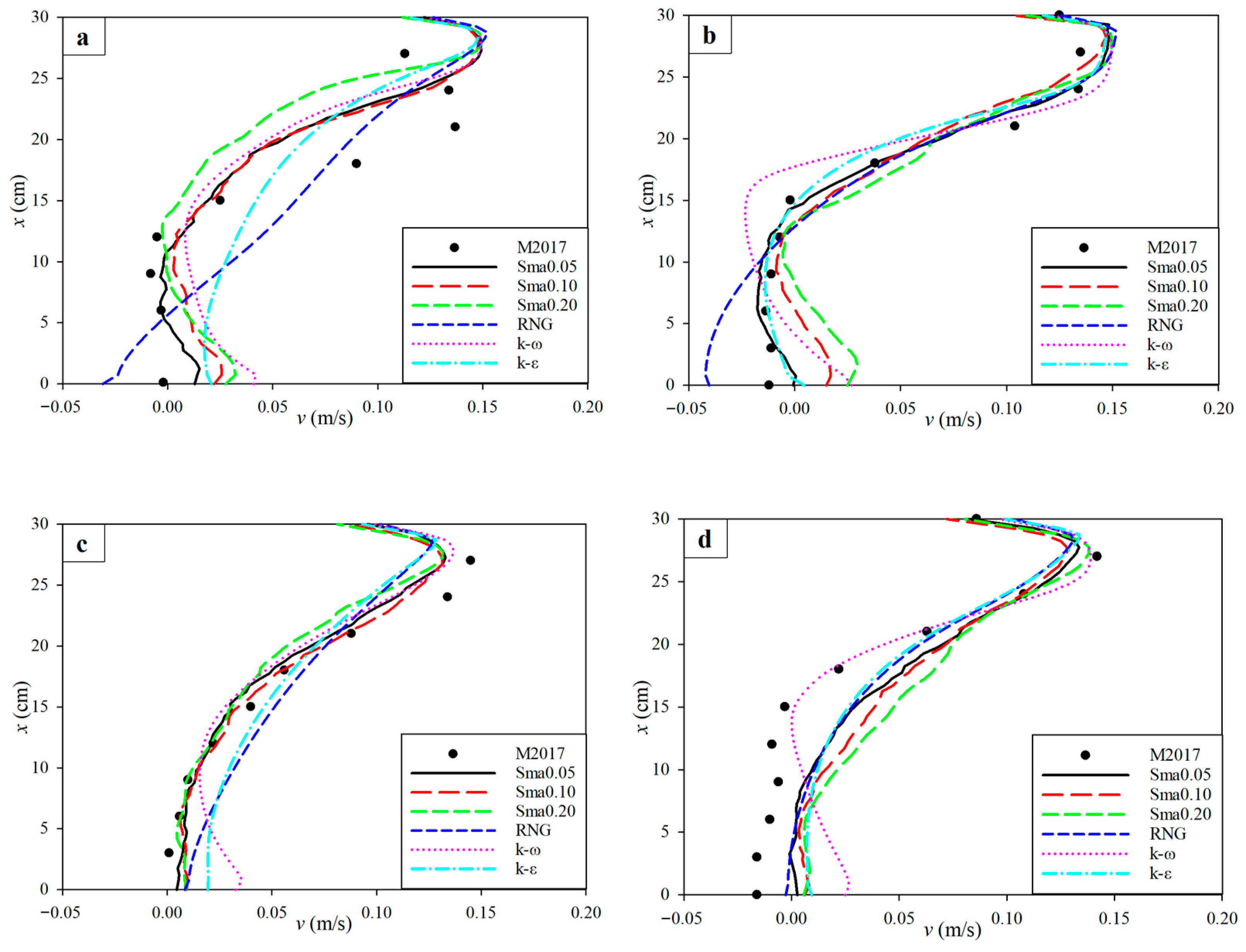
The reference model, namely ‘Case F0’ of Momplot et al. [18], was tested using the LES, Renormalized Group (RNG), k-ω and k-ε turbulence models. To assess the sensitivity of the Smagorinsky coefficient within the range suggested in the literature, three variations of the LES models were tested with CS = {0.05, 0.10, 0.20}, denoted as Sma0.05, Sma0.10, and Sma0.20, respectively. The outputs from these models were time-averaged. The computed data were compared to the measurements of Momplot et al. [18], which included: (i) the velocity component in the y-direction, v (m/s), in the DC (Figure 3), and (ii) the upstream Froude number, F1, upstream flow aspect ratio, A1 = B/d1, and diverted discharge, Q3.
To aid interpretation of Figure 3, the mean absolute errors (MAEs) between the computed and measured values of v are also summarized in Table 1 for each turbulence model. The best overall agreement was achieved with the Sma0.05 model, which yielded an MAE of 0.013 m/s. This model predicted F1 = 0.10, A1 = 2.4, and Q3 = 1.95 L/s. These values align closely with the experimental data from Momplot et al. [18], who reported F1 = 0.10, A1 = 2.5, and Q3 = 1.96 L/s. Based on these findings, the LES turbulence model with CS = 0.05 was adopted for all subsequent simulations, utilizing the same modeling strategy.
The accuracy of the models varied spatially. It was highest at y = −45 cm, z = 9 cm (Figure 3b) and y = −75 cm, z = 4 cm (Figure 3c), and the lowest at y = −45 cm, z = 4 cm (Figure 3a). Along the outer wall of the DC, where velocities and turbulence intensities were higher, the Sma0.05 and Sma0.10 models performed comparable. However, the higher dissipation in the Sma0.10 model resulted in a weaker backflow and led to overprediction along the inner wall. This behavior was even more pronounced in the Sma0.20 model, where excessive dissipation caused both underprediction near the outer wall and overprediction along the inner wall. Overall, the LES models provided more accurate predictions v than the RANS models, with the exception of the overly dissipative Sma0.20 case.
Among the RANS models, the RNG model provided slightly better overall performance. The k-ω model performed marginally better in the outer half of the DC, while the k-ε model was more accurate in the inner half, a region dominated by the recirculation zone. In Figure 3a–c, more or less, all models tended to underpredict v along the outer half of the DC, except for the data point at x = 27 cm. Conversely, overprediction of v was prevalent along the inner half, a trend that extended to the data shown in Figure 3d.

3. Results

3.1. Flow Features and Time-Averaged Velocity Fields

The flow features were analyzed at numerous cross-sections for each simulation. A simulation group with Q1 = 10 L/s for given bed sill heights was selected as the representative case for flow visualizations in this section, while the differences from other cases are highlighted. In the representative case, F1 and F3 ranged from 0.39 to 0.57 and from 0.29 to 0.38, respectively, whereas in the entire set of simulations, F1 ranged from 0.21 to 0.63 and F3 from 0.12 to 0.41.

3.1.1. Main Channel Upstream (x ≤ 0 m)

This section presents and analyzes the time-averaged flow features in the MC upstream. It is important to note here that the flow features in this region are dependent on the downstream conditions of both channels.
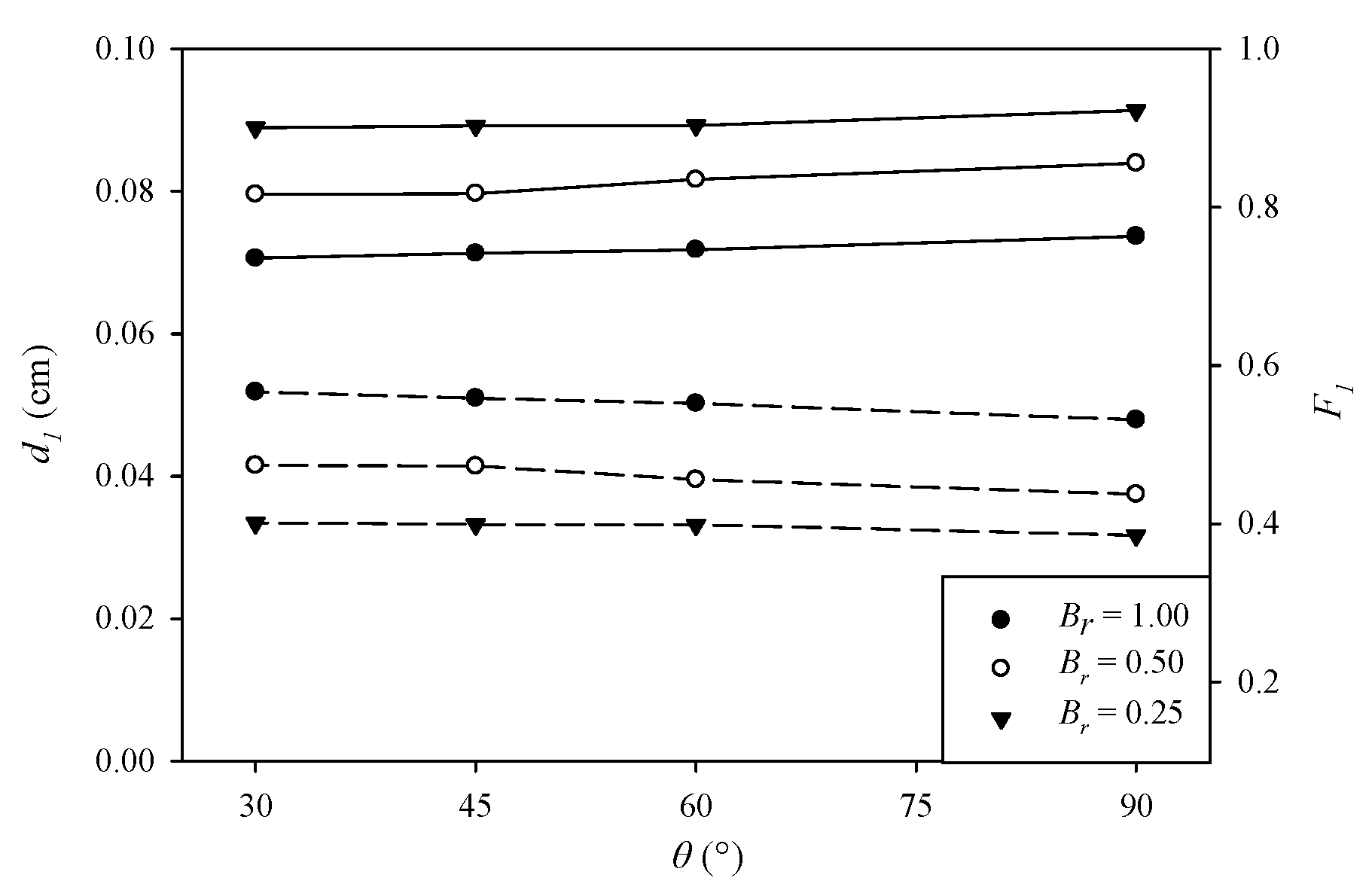
At control section 1-1, the influence of θ and Br on the approaching flow depth, d1, and F1 exhibited consistent trends for all simulations. Overall, the influence of θ was relatively minor: compared to the θ = 90° baseline, reducing the diversion angle to 60°, 45°, and 30° resulted in an average increase in d1 of 1.9%, 2.8%, and 3.7%, respectively, while F1 increased by an average of 2.9%, 4.4%, and 5.9% across the entire numerical range. However, the effect of Br was more noticeable. Reducing Br from 1.00 to 0.50 resulted in an average increase in d1 of 10.7%, with a peak of 13.9%, while F1 decreased by an average of 14.0%, with a peak of 20.3%. When Br was further reduced from 1.00 to 0.25, the average increase in d1 rose to 20.5%, with a peak of 29.5%, and the average decrease in F1 reached 24.1%, with a peak of 32.2%. It is worth noting here that the variations in Qr resulting from changes in θ and Br were similar, which will be evaluated in the subsequent section. The greatest changes in d1 were observed at higher values of F1 for both θ and Br. The variations in d1 and F1 with θ and Br for Q1 = 10 L/s are presented in Figure 4, illustrating the trends discussed above.
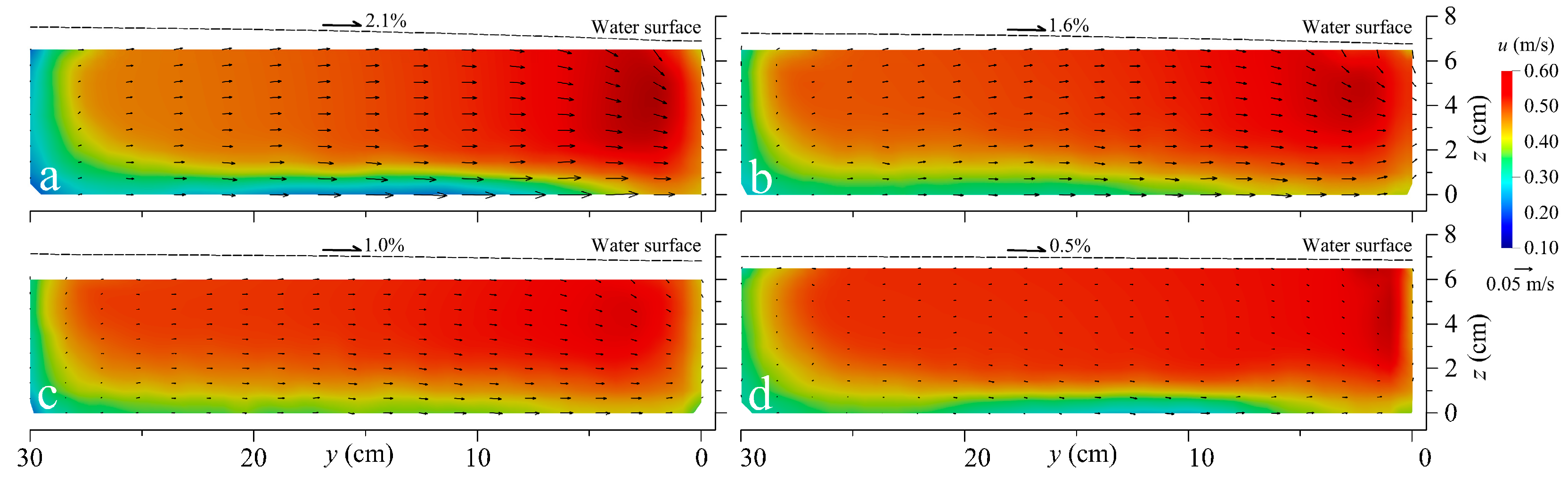
For Q1 = 10 L/s and Br = 1, the velocity fields just upstream of the bifurcation at x = −0.01 m are presented in Figure 5a–d for θ = 90°, 60°, 45°, and 30°. As the flow approached the bifurcation zone, the water level began to drop along the inner half of the MC while rising along the outer half, consistent with previous observations [16,17]. This created a transverse slope that became steeper with increasing values of F1 and θ.
At control section 1-1, the velocity distribution was uniform in all simulations. Depending on Qr and θ, the flow began to deflect toward the MC inner wall at a certain distance upstream. As illustrated in Figure 5, the favorable pressure gradient induced by diversion accelerated the flow toward the MC inner wall. Consequently, the streamwise velocity component, u, attained higher values near the inner wall and lower values toward the outer wall. This transverse variation in u became more distinct as the θ increased. The transverse velocity component, v, was higher near the bed than near the surface, indicating that a greater portion of the diverted water originated from the near-bed region. The magnitude of v also increased with θ, which can be explained by two main factors: (i) the reduction in the effective diversion width, b′, with increasing θ, which narrows the flow cross-section and, consequently, enhances velocity; and (ii) the increased diversion angle, which aligns the flow direction closer to the transverse axis, thereby increasing the magnitude of the v component. Physically, the former is a result of tangential acceleration, while the latter is driven by centripetal acceleration. Additionally, a slight increase in w near the surface along the outer half of the MC reflects the local rise in water level in this region, while a decrease near the surface corresponds to the local reduction in water level described previously.
For Q1 = 10 L/s and θ = 90°, the velocity fields at x = −0.01 m are shown in Figure 6a,b for Br = 0.50 and 0.25, respectively. Together with Figure 5a (where Br = 1.00), it is observed that decreasing Br caused a notable increase in flow depth and a proportional reduction in u. The magnitudes of v and w appeared to be negligibly affected near the inner half of the MC, but decreased toward the outer wall as Br decreased. The transverse slope in water surface extended across the entire MC width when Br = 1.00, but became progressively restricted toward the inner wall as Br decreased. For Br = 0.50, the sloping region covered most of the cross-section, whereas for Br = 0.25, it was confined to the inner half, leaving the remaining surface nearly flat. Although the overall transverse slope slightly decreased with Br, the confined sloping region had relatively higher local gradients compared to the average slope observed when Br = 1.00.

3.1.2. Bifurcation Zone and Main Channel Extension (x > 0 m)

This section presents and analyzes the time-averaged flow features in the bifurcation zone and MC extension.
Along the outer wall of the MC, the flow depth exhibited a gradual increase throughout the bifurcation zone, a trend that extended into the upstream reach of the MC extension, consistent with the previous findings [16,17]. Concurrently, at the entrance of the DC, the flow depth initially decreased, reaching a minimum that corresponded to the maximum transverse slope at water surface. Subsequently, the flow depth increased toward the MC extension, resulting in a local surge where the flow impinged upon the downstream corner of the DC and developing a stagnation region. In all of the simulations conducted, the maximum flow depth within the entire channel system occurred in this stagnation region. Ramamurthy et al. [17] reported that the maximum flow depth within the recirculation zone formed in the MC extension in cases where such a zone developed. This finding contrasts with the present observations. This discrepancy is likely attributable to the substantially higher discharge ratio (Qr = 0.838) employed in their study; a magnitude not attained in the current study.
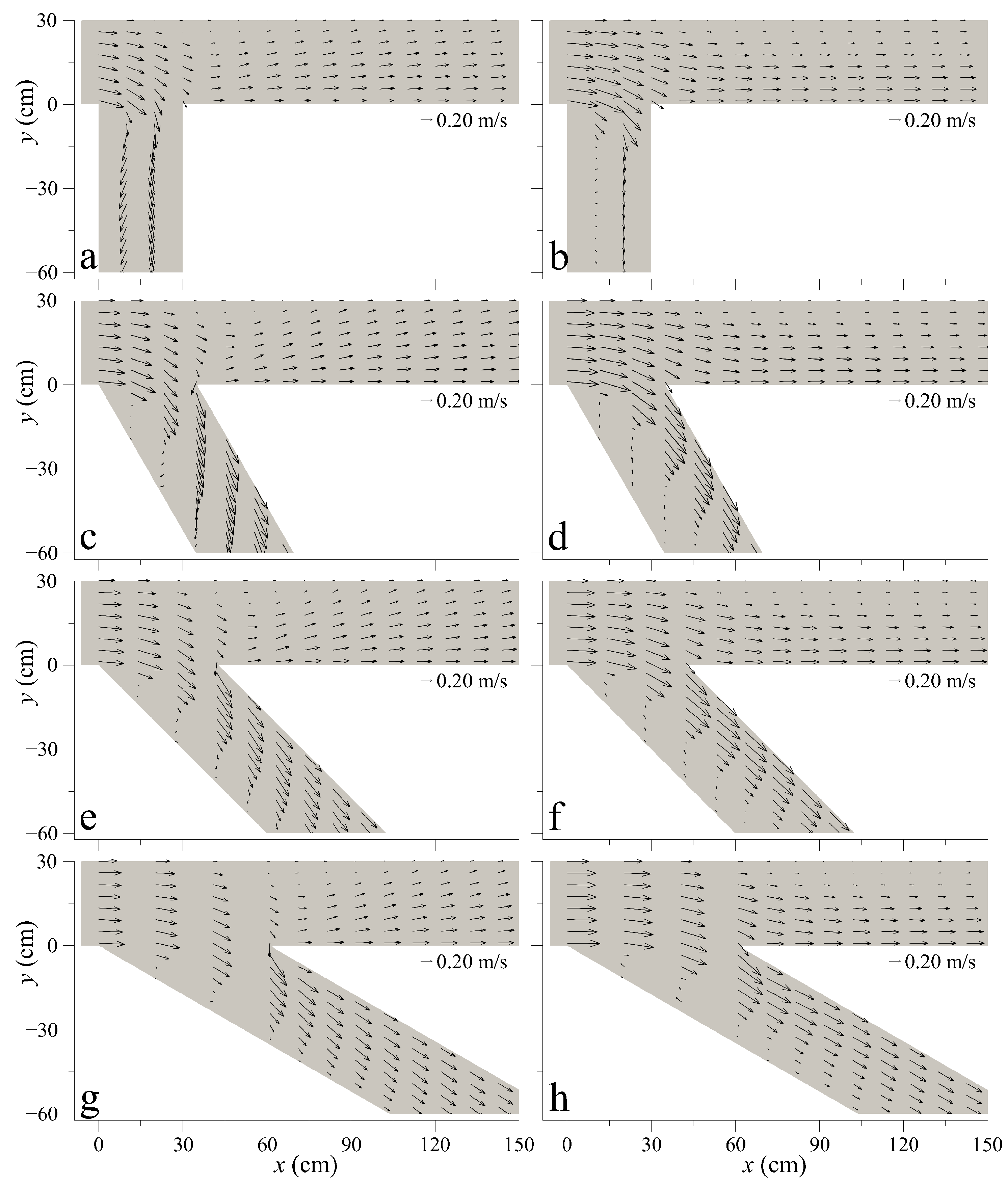
The (u, v) velocity fields for the bifurcation zone, MC extension, and DC are shown in Figure 7a,c,e,g for the near-bed region (z = 1 cm) and in Figure 7b,d,f,h for the near-surface region (z = 5 cm), corresponding to the diversion angles θ = 90°, 60°, 45°, and 30°, respectively. At the bifurcation zone (0 < x < b′), velocity fields were presented at b′/3, 2b′/3 and b′ to render them comparable. Along the DC entrance, u peaked near b′/3 at z = 5 cm but prior to b′/3 at z = 1 cm. Beyond these peaks, velocity decreased toward the stagnation zone at both depths, aligning with the changes in flow depths. The outer wall of the MC was characterized by an adverse pressure gradient, where u continued to decrease and eventually became negative. This deceleration resulted in a flow separation and the formation of a recirculation zone within the MC. This type of recirculation zone was previously reported by some researchers [7,13,17], is a consequence of flow expansion, and is associated with the discharge ratio and the flow aspect ratio. Unlike the recirculation zone in the DC, this recirculation zone was wider near the bed and narrowed toward the water surface, a feature also observed in the present study. The recirculation zone in the MC was not observed in all simulations. Since the extent of flow expansion is governed by the width of the divided flow, this recirculation zone only formed near the bed and did not reach the water surface when Sd/B exceeded 0.38 or Qr exceeded 0.46. Such a ‘half’ recirculation zone was also noted by Barkdoll et al. [33]. When Sd/B exceeded 0.44 or Qr exceeded 0.50, the recirculation zone in the MC typically extended to the water surface. It should be noted here that Sd/B and Qr related through continuity, and this relationship will be detailed in the following section. The recirculation zone never occurred in the MC when Br = {0.25, 0.50}, and its dimensions increased as θ decreased.
Similar to those at x = −0.01 m, the influence of θ on u was relatively minor in the bifurcation zone, but was notably higher on v. Near the bed, v reached higher magnitudes, indicating a greater deflection towards the DC entrance compared to near surface flow, with the magnitude of v increasing with θ.
In the upstream reach of the MC extension, a distinct portion of the (u, v) field at z = 1 cm was directed markedly toward the outer wall of MC (Figure 7a,c,e,f), whereas near the inner wall, the flow remained mostly aligned with the channel axis. Much like the formation of the recirculation zone in the MC, these flow behaviors are governed by the width of the divided flow and Qr. Near the water surface, the (u, v) field was rather oriented with the MC following the flow expansion. The magnitude of u significantly decreased near the outer wall, approaching zero, although reverse flow did not occur. Expectedly, decreasing Br resulted in increased flow depths and enhanced flow uniformity in this region.
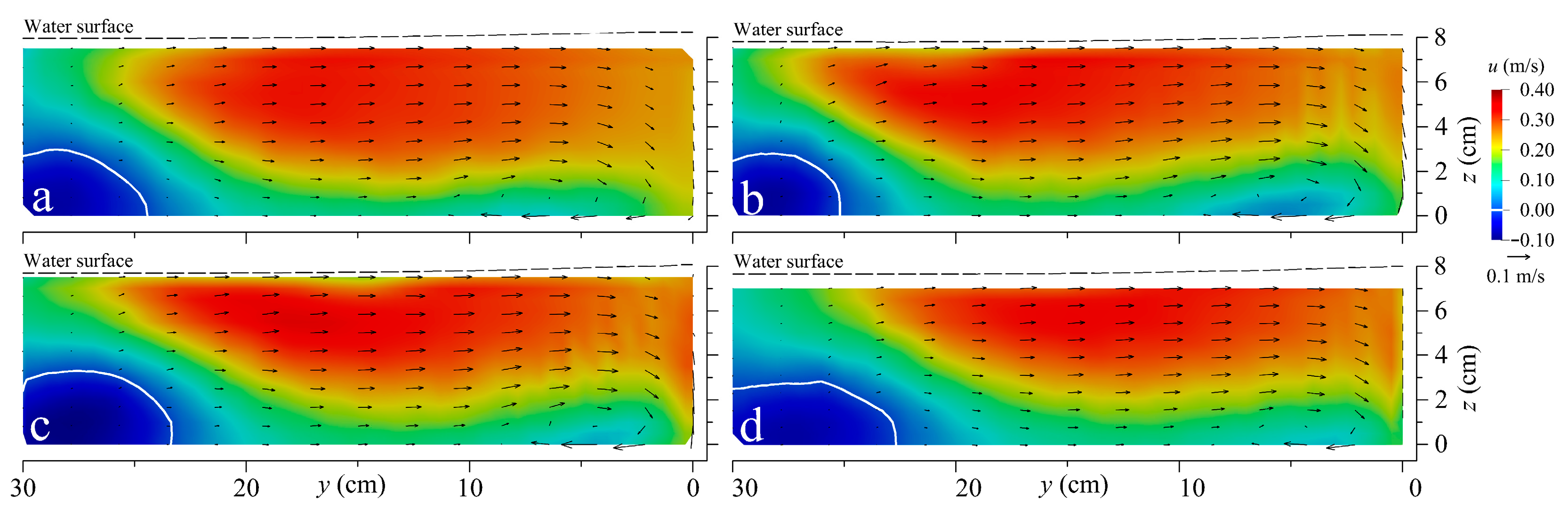
For Q1 = 10 L/s and Br = 1, the velocity fields at x = b′ + 0.05 m are presented in Figure 8a–d for θ = 90°, 60°, 45°, and 30°. In contrast to the upstream conditions (x = −0.01 m), flow depth was higher along the MC inner wall. As described in Section 1, flow impacting the adjacent walls of the downstream corner of the DC led to strong downflows, initiating in a coherent two-leg vortex system. The downflow and the MC-leg of the vortex (V1) are clearly visible in the figures. As V1 propagated downstream, its width increased and it deviated toward the MC outer wall (See Figure 1). In mobile-bed environments, these vortex legs are known to generate significant scouring at the toe of these walls, namely scour trenches, as previously documented by several researchers [8,34,35,36].
The streamwise velocity component, u, was reduced in the vortex core, while the other velocity components increased, as expected. u also significantly reduced at the toe of the MC outer wall, eventually becoming negative and indicating flow separation. This reverse flow zone, delineated by a white curve, is where the streamwise velocities are negative, and it does not correspond to the recirculation zone, which also includes the positive values of u and is larger in size. For the reference case, the recirculation zone in the MC extended to the water surface only when θ = 45° and 30°, although it occupied a relatively small area. Finally, u reached its highest magnitudes around the channel center.
The transverse velocity component, v, was higher near the channel center and the water surface, decreasing toward the bed. The vertical velocity component, w, was naturally negative in the downflow region, but remained negligible across the rest of the cross-section. As Br decreased, the flow depth in MC extension increased, causing a proportional decrease in flow velocity. Strength of V1 reduced, it expanded downstream with a smaller deflection and dissipated over a shorter distance.
Overall, the MC extension was characterized by the highest flow depths and the lowest velocities. The influence of θ and Br on d2 and F2 followed the same qualitative trends observed at control section 1-1, although the magnitude of this influence was relatively smaller. The ratio d2/d1 is often considered in theoretical approaches, and is sometimes neglected for low Froude numbers. In this study, d2/d1 was ≈1.0 when F1 < 0.25 for Br = 1.00 and 0.50 and when F1 < 0.35 for Br = 0.25, and can be negligible in this range. However, the ratio becomes pronounced at higher Froude numbers, reaching a peak of d2/d1 = 1.11 for F1 = 0.63 and Br = 1.00. Finally, the Froude number ratio F2/F1 ranged from 0.36 to 0.83, and it was found to increase with θ but decrease as Br decreased.

3.1.3. Diversion Channel (y < 0 m)

This section presents and analyzes the time-averaged flow features in the DC. However, to fully elucidate the flow behaviors in this channel, it is essential to first examine the dividing streamlines before analyzing the water surface and velocity fields.
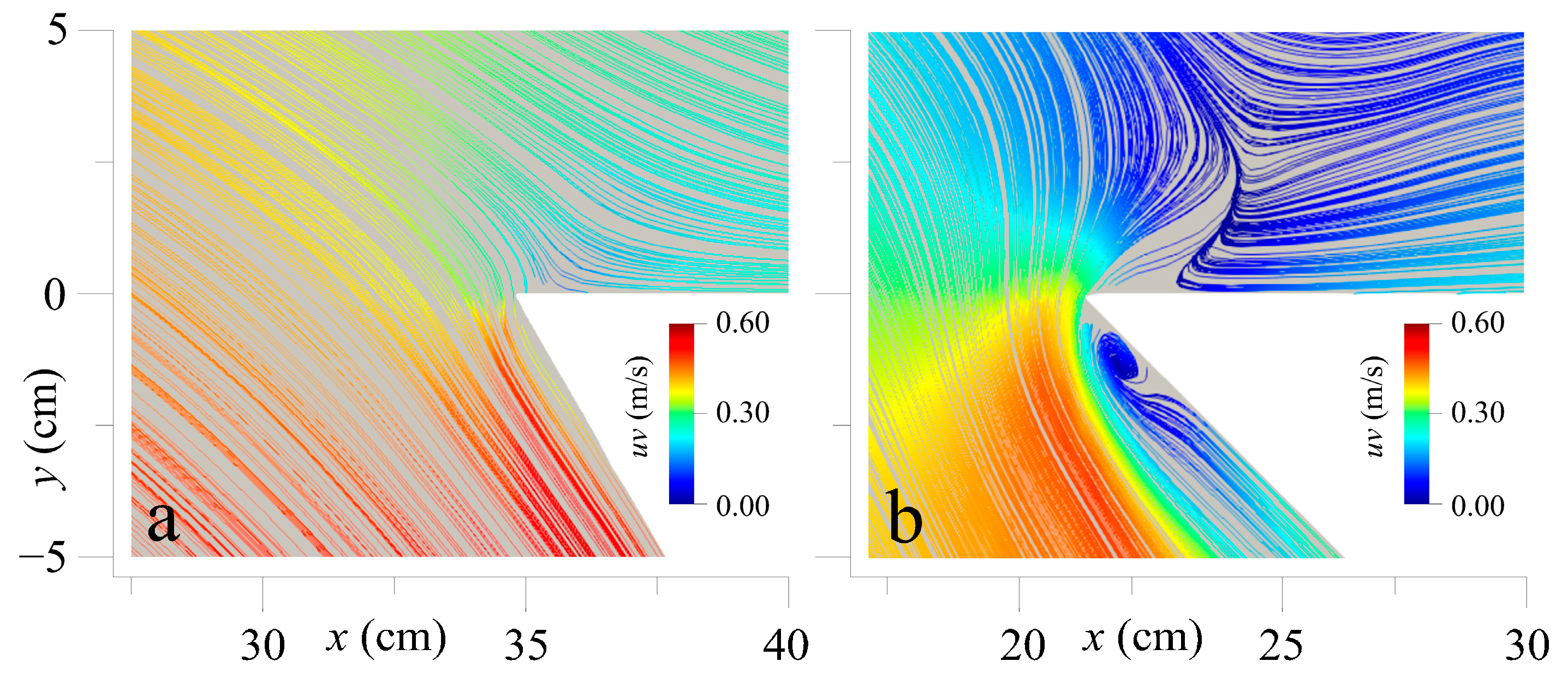
The dividing streamlines near the surface always ended at the downstream corner of the DC when θ = 90°, regardless of Br and Qr. However, near the bed, the streamlines ‘overshot’ the corner, continuing slightly downstream in the MC extension before turning sharply back into the DC. When θ ≤ 60°, the dividing streamlines never ended at this corner, neither near the surface nor near the bed. The extent of overshoot was relatively minor near the surface when θ = 60° and Br = 1.00, but it increased as θ and Br decreased and F1 increased, particularly near the bed. This behavior must depend on a balance between the inertial forces, which act to resist deflection and maintain the flow’s direction in the MC, and the centripetal forces induced by the transverse pressure gradient, which act to redirect the flow into the diversion channel. A decrease in θ reduces the centripetal force required to redirect the flow, allowing for it to travel further along the main channel before being diverted, while an increase in F1 enhances inertial forces, thereby increasing the overshoot. When Br decreased, F1 also decreased; however, the narrowed entrance width likely led to an increased overshoot.
Consequently, the returning flow into the DC separated from the channel boundary at the downstream corner of the DC and reattached to its outer wall further downstream, creating in a very small recirculation zone. Such recirculation zones were also reported by Lama et al. [37] for θ = 30°. The near-surface streamlines and the near-bed streamlines around the downstream corner of the DC are presented in Figure 9a for F1 = 0.55, θ = 60°, and Br = 1.00 and Figure 9b for F1 = 0.42, θ = 45°, and Br = 0.25, respectively, as two illustrative examples of mild and excessive overshoots. In these figures, streamlines break where the velocities approach zero.
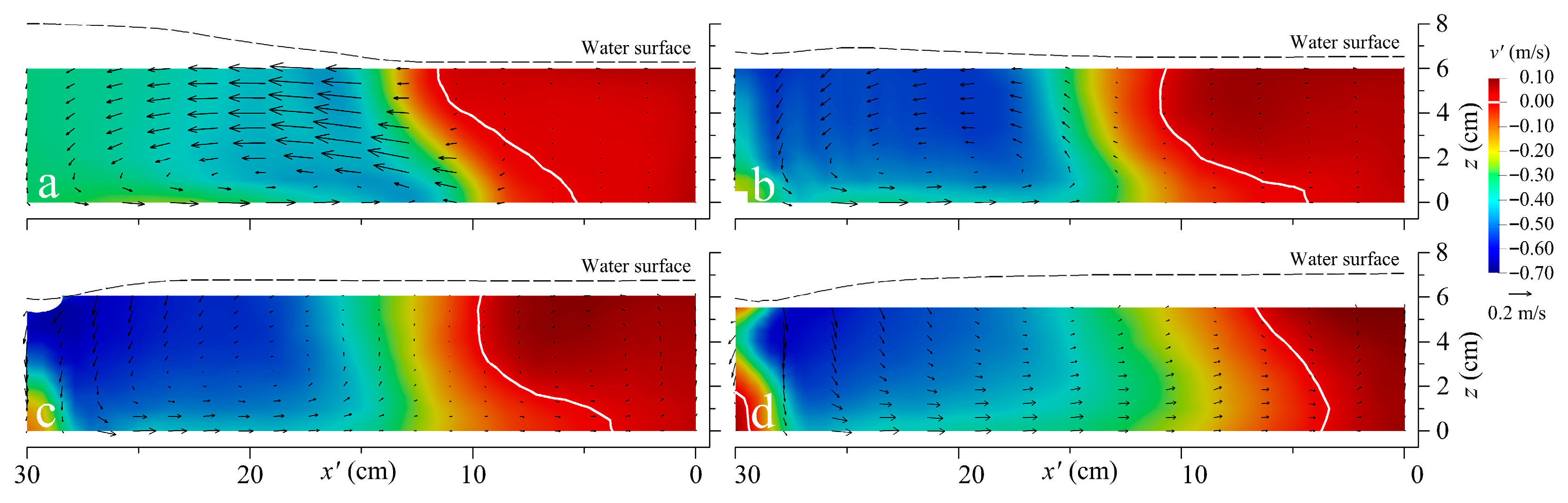
To obtain the perpendicular velocity components in the cross-sections, a local coordinate system was established with its origin, O′(x′, y′), located at the downstream corner of the DC. In this rotated frame, x′ and y′ represent the local transverse and streamwise axes, respectively, where x′ = x·sinθ + y·cosθ and y′ = −x·cosθ + y·sinθ (See Figure 2). Accordingly, the transverse and the streamwise velocity components in these directions are u′ = u·sinθ + v·cosθ and v′ = −u·cosθ + v·sinθ, respectively. For θ = 90°, u′ = u and v′ = v. Still, the asymmetric geometry of the DC when θ ≠ 90° creates challenges for cross-section analyses. For any given cross-section, as θ decreases, the inner wall boundary of the cross-section shifts further downstream in the DC. For instance, in a cross-section at y′ = 0, the inner wall boundary corresponds to the upstream corner of the DC when θ = 90°, whereas it corresponds to a point b′·cos30 downstream when θ = 30°. These geometric discrepancies were considered when analyzing the cross-sections, and, therefore, the analyses were often performed on a case-by-case basis. For Q1 = 10 L/s and Br = 1, the velocity fields at y′ = −0.05 m are presented in Figure 10a–d for θ = 90°, 60°, 45°, and 30°, representing the entrance region of the DC.
When θ = 90°, a distinct local surge in water level occurred as the diverted flow hit the outer wall of the DC, a characteristic feature well-documented in the literature [7,16,17]. As θ decreased to 60°, this surge diminished, and the water level at the inner wall began to decrease further when θ ≤ 45°. This decrease in the water level can be attributed to the flow separation at the downstream corner of the DC, which, though small when θ = 60°, enhances significantly as θ decreases. It should be noted that these surges and drops in water levels, which were followed by standing wave formations, were observed at high Froude numbers and were weaker or negligible when F1 was relatively low.
In the local coordinate system, negative values of the streamwise component, v′, indicate the flow direction, while its positive values indicate reverse flow. The highest magnitudes of v′ and the lowest magnitudes of the transverse velocity component, u′, were observed when θ = 30°, suggesting that the diversion was most efficient at this angle. As θ increased, v′ progressively diminished while u′ rose, resulting in lower flow velocity and greater flow non-uniformity. Likewise, in Figure 8, the white lines delineate the reverse flow zones (regions where v′ > 0). In these regions, velocity components are very small, and the flow recirculates around the white line, constituting the well-documented recirculation zone in the literature (See Figure 1). The maximum normalized width of this recirculation zone increased with θ, whereas its maximum normalized length decreased, aligning with the experimental findings of Gumgum and Cardoso [8]. However, reducing Br decreased both the width and the length of the recirculation zone.
In Figure 10d, a small reverse flow region is visible at the bottom-left corner, incorporated by a small recirculation resulting from the flow separation at this corner, a consequence of the streamline overshoot discussed above. Figure 10b,c shows that v′ also decreased at this corner due to the same separation mechanism, but the deceleration was not sufficient to create a reverse flow.
Flow impinging on the outer wall of the DC induced a strong downflow, matching the flow generated on the adjacent wall in the MC extension. Surprisingly, the downward velocity component, w, in this region was the lowest at θ = 90° and increased as θ decreased. This behavior was unexpected, as the flow impacts the wall with the maximum angle of incidence at θ = 90°, which would typically be expected to generate the strongest vertical deflection. However, extensive data analysis revealed that this behavior only occurred when F3 exceeded 0.26. In contrast, when F3 < 0.26, the vertical component always followed the expected pattern, increasing with θ. This is likely caused by the strong flow separation at this corner, which led to a sudden drop in flow depth, and which was more pronounced at higher Froude numbers. To the author’s best knowledge, no prior experimental or numerical study provides comparable velocity field data for varying diversion angles.
The interaction between the downflow and the streamwise flow generated the DC leg of the vortex system (V2 in Figure 1), pointing out the DC inner wall. This vortex was strongest when θ = 90° and weakened as θ decreased (Figure 10). This behavior aligns with the mobile-bed experiments of Gumgum and Cardoso [8] and Alomari et al. [35], who reported that the scouring capacity of this vortex reduces as θ decreased.
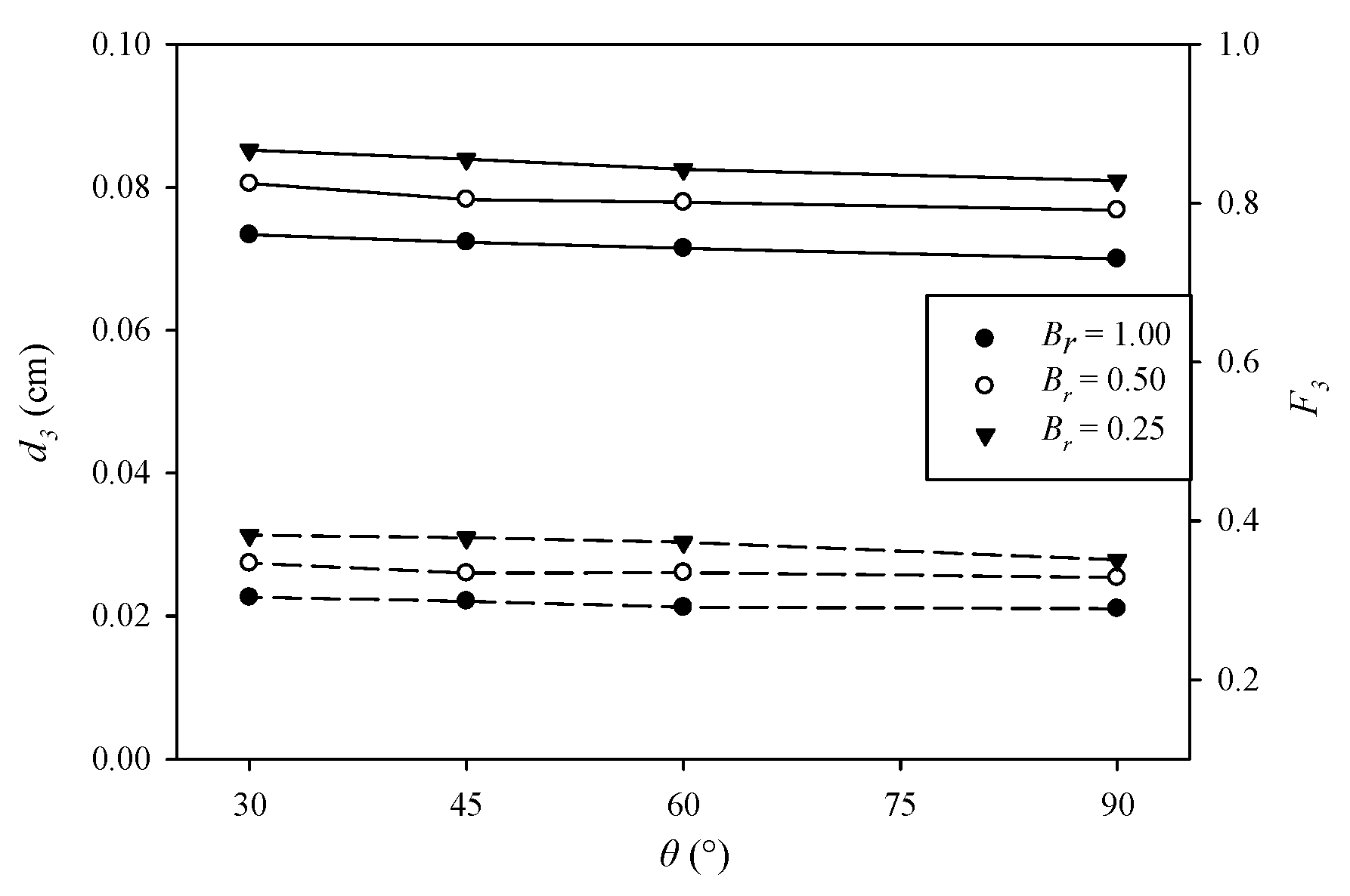
At cross-section 3-3, in contrast to the behavior in the MC, both d3 and F3 increased as θ and Br decreased across the entire numerical range, although the effect of θ was relatively minor. Compared to the θ = 90° baseline, reducing the diversion angle to 60°, 45°, and 30° resulted in an average increase in d3 of 1.3%, 2.2%, and 3.9%, and in F3, of 2.7%, 3.9%, and 6.4%, respectively. Once again, the impact of Br was more pronounced; reducing Br from 1.00 to 0.50 resulted in average increases of 8.6% in d3 and 13.7% and, in F3, with peak increases of 11.7% and 18.5%, respectively. Further reducing Br from 1.00 to 0.25 led to average increases of 14.7% in d3 and 25.0% in F3, with peaks of 19.1% and 29.5%, respectively. Regarding the relationship with the approach flow depth, d3 was always lower than d1 when θ = 60° and 90° across the entire dataset, coinciding with the findings of Ramamurthy et al. [17] for θ = 90°. However, the continuous increase in d3 with decreasing Br and θ eventually caused d3 to exceed d1 when θ = 30° for Br = {0.50, 1.00}. The variations in d3 and F3 with θ and Br for Q1 = 10 L/s are presented in Figure 11, illustrating the trends discussed above.
A series of simulations was conducted to investigate the critical transition in the DC. For θ = 90°, Br = 1.00, and a given Q1, the height of the downstream bed sill gradually decreased until the flow at the throat became critical. It was observed that the flow approached critical conditions at the throat when F3 reached 0.34, aligning with the findings of Ramamurthy and Satish [38]. These authors also stated that the flow became upstream-controlled beyond this point. Conversely, Riviére et al. [39] proposed that the downstream control can persist in the DC, despite the presence of a critical section at the throat, until F3 reaches 0.65. This disagreement is discussed in detail by Gumgum [4]; resolving it was outside of the scope of the present work. However, the same Q1 and bed sill configurations were tested for varying values of θ and Br.
A distinct shift in the location of the maximum Froude number, Fm, was observed depending on the diversion angle. For θ = 90° and 60°, Fm was registered at the throat, whereas for θ = 45° and 30°, Fm shifted to the region of the water level dip, as shown in Figure 10c,d. When Br = 1, Fm was close to unity across all values of θ, although F3 increased to 0.36 when θ = 30°. However, Fm decreased significantly as Br decreased, for instance, by ≈20%, when Br reduced from 1.0 to 0.5, even as F3 increased by ≈10%. The critical transition at the throat primarily depends on Q3, as well as the degree of contraction at the throat, which, in turn, is governed by Q1 and the downstream conditions in both channels. For a given Q1, influence of θ on these global flow parameters was relatively minor. However, reducing Br led to a significant decrease in Q3 and a reduction in the relative width of the recirculation zone. Concurrently, both d3 and F3 increased. Remarkably, the reduction in Fm at the throat implies that the narrower DC can sustain higher downstream Froude numbers without choking, thereby allowing for a greater range of F3 for subcritical flow.

3.2. Dividing Streamlines and Discharge Distribution

The dividing streamlines near the surface (at z ≈ 0.8d1) and near the bed (at z ≈ 0.2d1) were analyzed and their distances to the main channel inner wall, Sd and Bd, respectively, were determined. Sd and Bd notably increased with Br, indicating an increment in the amount of the diverted water. The influence of θ on these parameters was found to be relatively minor. Sd and Bd slightly decreased with θ; however, the latter displayed occasional exceptions. These exceptions lacked a consistent trend and are likely attributable to the high-velocity gradients distinct to the near-bed region.
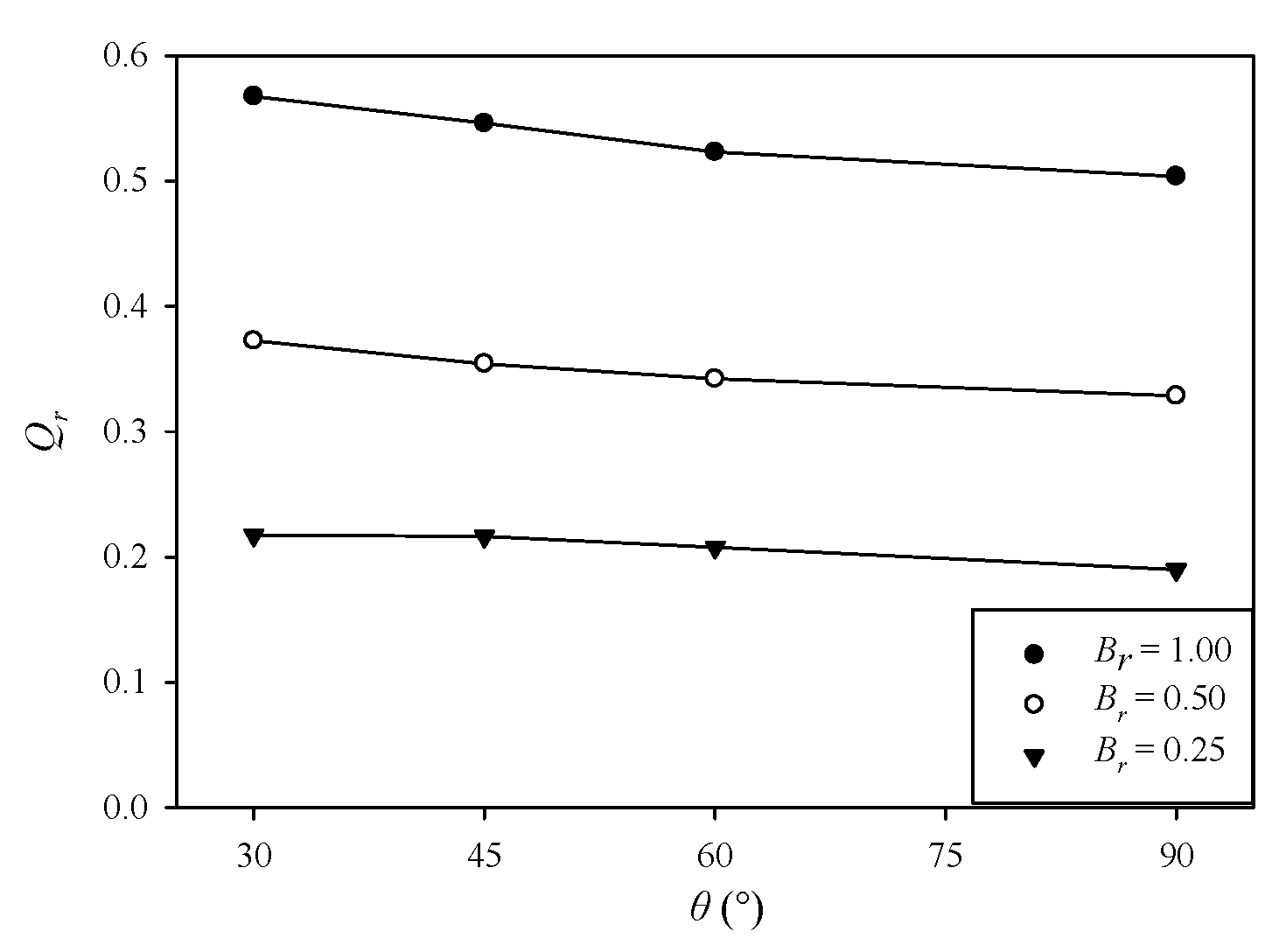
Compared to the θ = 90° baseline, reducing the diversion angle to 60°, 45°, and 30° resulted in an average increase in Qr of 4.7%, 7.5%, and 12.2%, respectively, with peaks reaching 9.7%, 16.1%, and 17.1% across the entire numerical range. The peak values were registered with the higher values of F1 combined with Br = 0.25. In other words, the influence of θ on Qr becomes more pronounced as the flow inertia increases (F1 rises) and the DC narrows (Br decreases). Conversely, the influence of Br on Qr showed less dependence on Froude numbers and θ. Reducing Br from 1.00 to 0.50 led to a reduction in Qr, ranging from 33.4% to 39.0%, with an average decrease of 35.6%. Further reducing Br from 1.00 to 0.25 resulted in a reduction in Qr, ranging from 60.1% to 63.6%, with an average decrease of 61.7%. The variation in Qr with θ and Br for Q1 = 10 L/s is presented in Figure 12, illustrating the trends discussed above.
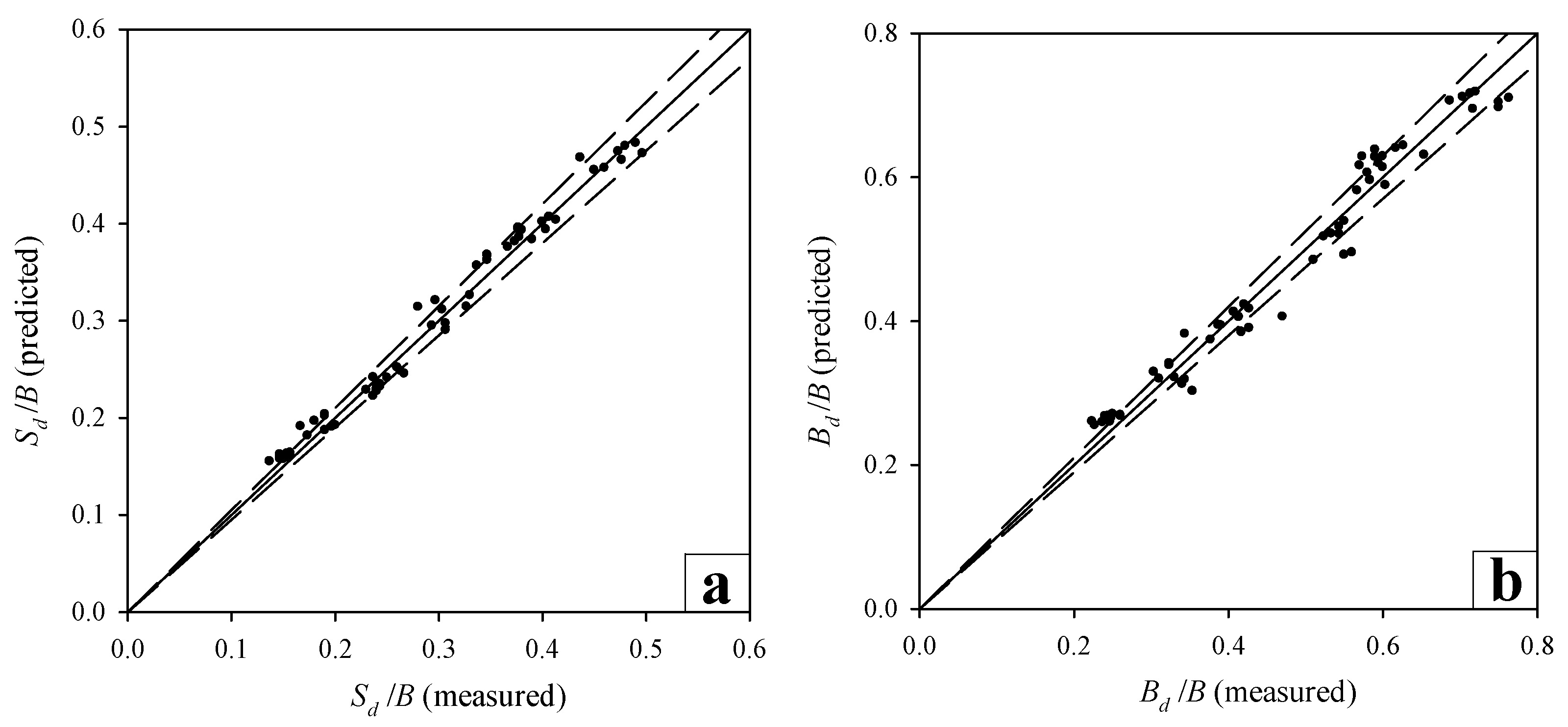
Sd and Bd were non-dimensionalized by the main channel width, B, and evaluated using various regression methods. The resulting equations, Equations (1) and (2), yield coefficient of determination R2 values of 0.99 and 0.97, respectively:
S D / B   =   0.50 1 + e 2.90 F Br 0.49
B D / B = 0.73 1 + e 3.44 F Br 0.39
where FBr = Br × F3/F2. This dimensionless parameter, previously employed by Ibrahim et al. [12] for predicting Qr, demonstrates a strong correlation with the flow distribution due to its relationship with continuity. The numerators of the derived equations define the upper limits of the predicted parameters, also reflecting the numerical boundaries of the present study. Notably, θ was not included as an explicit variable in the final equations, as its hydraulic influence is implicitly captured through variations in the Froude numbers, rendering a separate angular term redundant. Equation (2) shows slightly lower accuracy than Equation (1), a discrepancy likely attributable to the significant variation in the vertical velocity profile near the bed, as aforementioned. The computed and predicted values of Sd/B and Bd/B from Equations (1) and (2), respectively, are presented in Figure 13a,b. All the overpredictions above the +5% deviation line in Figure 13a belong to the simulation group specifically designed to investigate the critical section at the throat. In these scenarios, the extent of overshoot was excessive, rendering it difficult to accurately determine the dividing streamlines. Therefore, to preserve the robustness of the regression model, this specific simulation group was excluded from the regression analysis.
Sd/Bd was found to range between 0.49 and 0.70, with an average of 0.61. This result is in coherence with the findings of Neary and Odgaard [6] for smooth-bed experiments. These parameters have physical significance as they delineate the geometric boundary of the diverted water, i.e., the normalized average width of the dividing stream surface is, by continuity, directly proportional to Qr. Given the higher measurement accuracy with the surface streamlines compared to the highly variable near-bed flow, Sd/B readings were compared with Qr, and a linear relationship was established, resulting in Equation (3), with R2 = 0.99:
Q r   =   1.17 S d / B
Consequently, Equations (1)–(3) apply to fully submerged flows in rectangular branches with a rigid bed, provided that the parameters fall within the ranges 30° ≤ θ ≤ 90°, 0.25 ≤ Br ≤ 1.00, 0.21 ≤ F1 ≤ 0.63, and 0.12 ≤ F3 ≤ 0.43. To the best of the author’s knowledge, two existing equations in the literature are formulated to predict Qr for channels with unequal width under fully submerged flow conditions, namely, Equation (4), proposed by Ibrahim et al. [12], and Equation (5), an adjustment presented by Hager [40] based on the measurements of Rao et al. [5]:
Q r = a   ×   ln c × e 1 / a 1 × F Br e 1 / a 1 + c × F Br   +   1
Q r = 1 tan h 5 A F 3 F 2 0.5
In Equation (4), the empirical coefficients are specified as a = 1.012 and c = 0.941. Regarding Equation (5), the parameter A was originally proposed as 0.56 for Br = 0.5 and later approximated as A = 0.468∙Br −0.306 by Ibrahim et al. [12] from their experimental data for other values of Br. Additionally, the theoretical model derived by Ramamurthy et al. [14], presented in Equation (6), was also evaluated with the present data. Although this equation was originally developed based on the assumption of equal channel widths and a 90° diversion angle, its performance was tested here to assess its potential applicability to the present configurations.
F 2 4 / 3 1 + 2 F 2 2 = F 1 4 / 3 1 Q r 4 / 3 1 + 2 F 1 2 1 6 + 5 6 1 Q r + F 1 2 40 Q r
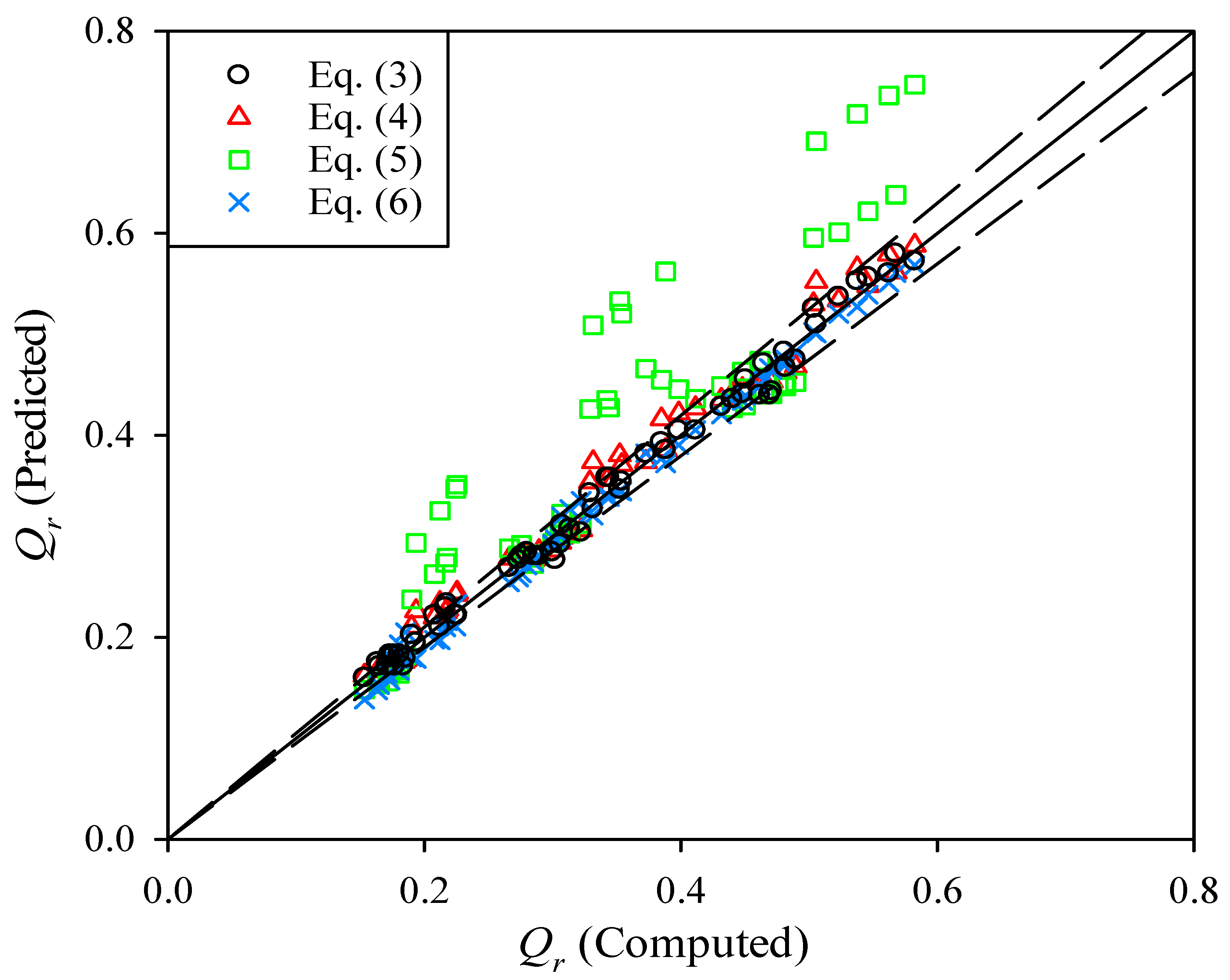
The performance of Equations (3)–(6) is presented in Figure 14.
As illustrated in Figure 14, the best overall agreement with the present data is achieved by Equation (6), yielding R2 ≈ 1.00. This result is particularly notable given that this equation was originally developed for Br = 1 and θ = 90°. The predictions obtained from Equations (3) and (4) also agree well with the present data, with R2 = 0.99, although they exhibit slightly greater dispersion compared to Equation (6). Equation (4), despite being developed for θ = 90°, appears to remain applicable for other diversion angles. In contrast, the predictions of Equation (5) align with the present data only for relatively low values of F3, showing significant deviations as F3 increased. Consequently, Equations (3), (4), and (6), with Equation (1) incorporated into Equation (3), can accurately predict the discharge distribution of submerged flow at an open channel bifurcation within the ranges 30° ≤ θ ≤ 90° and 0.25 ≤ Br ≤ 1.00, provided that stage–discharge curves are known. Further evaluation and testing of these models across broader parameter ranges would enhance our understanding of their applicability and contribute to the existing literature.

4. Conclusions

The present study numerically investigates the influence of diversion angle and the ratio of the channel widths on the discharge distribution and flow characteristics in open-channel bifurcations. A performance evaluation of various turbulence models, including LES, k-ε, k-ω, and RNG, was carried out, and the best overall agreement with the experimental data was achieved using the LES model with CS = 0.05.
The analyses of flow fields across various cross-sections revealed distinct hydraulic behaviors. In the MC, the flow depths decreased, and the Froude numbers increased as θ decreased or Br increased. In the DC, both flow depth and Froude number increased when θ or Br decreased. The flows depths always followed the order d3 < d1 < d2 when θ = 60° and 90°. However, as θ and Br reduced, the increase in d3 and the decrease in d1 led to d3 exceeding d1 in certain cases. For instance, when θ = 30° and Br = 0.50 and 1.00, the above inequality became d1 < d3 < d2. Overall, the impact of θ was minor compared to Br.
The velocity distribution in both channels and the influence of θ and Br are discussed in detail. A recirculation zone was observed in the MC in certain cases, consistent with the previous research. The extent of this zone increased as θ decreased, and it was absent when Br = 0.25 and 0.50. A dependence was identified regarding the formation and extent of this recirculation zone and the width of the dividing streamlines and the diverted discharge ratio.
Streamlines analyses revealed that the dividing streamlines near the surface always ended at the downstream corner of the DC when θ = 90°. Acute angles caused the dividing streamlines to overshoot this corner into the MC extension before redirecting into the DC. The extent of overshoot increased as θ and Br decreased or as F1 increased, leading to severe flow separation originating at the downstream corner of the DC. This separation was accompanied by a localized drop in flow depth immediately downstream of that corner.
Flow impacting the walls adjacent to the downstream corner of the DC generated significant downflows, leading to the development of a two-leg vortex system at this corner. One leg of the vortex was extended into the MC extension, and while the other propagated into the DC, both oriented outward. A notable exception was observed in the downflow at the outer wall of the DC. While the steepest angle of incidence at θ = 90° would typically be expected to cause the strongest downflow, the magnitude of the vertical velocity component actually increased as θ decreased when F3 > 0.26. This behavior is attributed to the flow separation at the downstream corner of the DC and the resultant drop in flow depth, both of which intensified as θ decreased.
Three distinct recirculation zones were identified. The well-documented recirculation zone always occurred along the inner wall of the DC (see Figure 1). Its maximum normalized width increased with θ, whereas its maximum normalized length decreased. Reducing Br led to a reduction in both of these normalized dimensions. In addition to this primary feature, two other recirculation zones were observed along the outer walls of the MC and the DC. Unlike the inner-wall zone, these recirculation zones were manifested in specific cases.
Finally, the study established three empirical equations: Equation (1) and (2) for determining the width of the divided flow near the surface and near the bed, respectively, and Equation (3), which predicts the discharge distribution together with Equation (1). Predictions from Equation (3), along with Equations (4)–(6) from previous studies, were compared with the computed values of Qr. The best agreement was achieved with Equation (6), yielding R2 close to 1, followed by Equations (3) and (4), which yielded R2 values of 0.99. Although Equation (4) was not initially proposed for varying diversion angles, and Equation (6) excludes both this condition and unequally wide channels, both equations performed very well within the numerical range of the study.
This study is limited to rigid-bed channels and submerged flow within ranges of 30° ≤ θ ≤ 90° and 0.25 ≤ Br ≤ 1.00. While the numerical results are validated, the complex 3D vortex structures and overshoot effects require further physical experimental verification. Future research should incorporate mobile-bed and supercritical flow across wider geometric parameters to better understand the underlying hydraulic mechanisms and enhance the predictive models.

Funding

This research was funded by DÜBAP (Dicle University Scientific Research Projects Coordination), grant number MÜHENDİSLİK.21.005.

Institutional Review Board Statement

Not applicable.

Informed Consent Statement

Not applicable.

Data Availability Statement

The raw data supporting the conclusions of this article will be made available by the author on request.

Conflicts of Interest

The author declares no conflicts of interest.

References

  1. Thoma, H. Modellversuche über die Zweckmäßige Gestaltung Einzelner Bauwerke; Report; Veroffentlichung der Mittleren Isar A. G. München Rom: Charlottenburg, Germany, 1923. (In German) [Google Scholar]
  2. Bulle, H. Untersuchungen über die Geschiebeableitung bei der Spaltung von Wasserläufen: Modellversuche aus dem Flussbaulaboratorium der Technischen Hochschule zu Karlsruhe; VDI: Karlsruhe, Germany, 1926. (In German) [Google Scholar]
  3. Rehbock, H. Modellversuche über die Zweckmäßige Gestaltung Einzelner Bauwerke; Report; Veroffentlichung der Mittleren Isar A. G. München Rom: Charlottenburg, Germany, 1926. (In German) [Google Scholar]
  4. Gumgum, F. Division of flow at open channel bifurcations. Phys. Fluids 2025, 37, 021301. [Google Scholar] [CrossRef]
  5. Rao, N.S.L.; Sridharan, K.; Baig, M.Y.A. Experimental study of the flow division in an open channel. In Proceedings of the Conference on Hydraulics Fluid Mechanics; Institution of Engineers: Sydney, Australia, 1968. [Google Scholar]
  6. Neary, V.S.; Odgaard, A.J. Three-dimensional flow structure at open-channel diversions. J. Hydraul. Eng. 1993, 119, 1223–1230. [Google Scholar] [CrossRef]
  7. Neary, V.S.; Sotiropoulos, F.; Odgaard, A.J. Three-dimensional numerical model of lateral-intake inflows. J. Hydraul. Eng. 1999, 125, 126–140. [Google Scholar] [CrossRef]
  8. Gumgum, F.; Cardoso, A.H. Effect of diversion angle and vanes’ skew angle on the hydro-morpho-dynamics of mobile-bed open-channel bifurcations controlled by submerged vane-fields. Phys. Fluids 2024, 36, 073318. [Google Scholar] [CrossRef]
  9. Barkdoll, B.D.; Ettema, R.; Odgaard, A.J. Sediment control at lateral diversions: Limits and enhancements to vane use. J. Hydraul. Eng. 1999, 125, 862–870. [Google Scholar] [CrossRef]
  10. Alomari, N.K.; Yusuf, B.; Mohammad, T.A.; Ghazali, A.H. Influence of diversion angle on water and sediment flow into diversion channel. Int. J. Sediment Res. 2020, 35, 600–608. [Google Scholar] [CrossRef]
  11. Rao, N.S.L.; Sridharan, K. Flow division in open channels. Water Energy Int. 1967, 24, 393–407. [Google Scholar]
  12. Ibrahim, I.; Riviere, N.; Lebouteiller, I.; Mignot, E. Discharge distribution in open-channel T-shape bifurcations: Effect of a reduced side branch width. J. Hydraul. Eng. 2022, 148, 04022015. [Google Scholar] [CrossRef]
  13. Law, S.W.; Reynolds, A.J. Dividing flow in an open channel. J. Hydraul. Div. 1966, 92, 207–231. [Google Scholar] [CrossRef]
  14. Ramamurthy, A.S.; Minh Tran, D.; Carballada, L.B. Dividing flow in open channels. J. Hydraul. Eng. 1990, 116, 449–455. [Google Scholar] [CrossRef]
  15. Hsu, C.C.; Tang, C.J.; Lee, W.J.; Shieh, M.Y. Subcritical 90° equal-width open-channel dividing flow. J. Hydraul. Eng. 2002, 128, 716–720. [Google Scholar] [CrossRef]
  16. Shettar, A.S.; Murthy, K.K. A numerical study of flow division in open channels. J. Hydraul. Res. 1996, 34, 651–675. [Google Scholar] [CrossRef]
  17. Ramamurthy, A.S.; Qu, J.; Vo, D. Numerical and experimental study of dividing open-channel flows. J. Hydraul. Eng. 2007, 133, 1135–1144. [Google Scholar] [CrossRef]
  18. Momplot, A.; Lipeme Kouyi, G.; Mignot, E.; Rivière, N.; Bertrand-Krajewski, J.L. Typology of the flow structures in dividing open channel flows. J. Hydraul. Res. 2017, 55, 63–71. [Google Scholar] [CrossRef]
  19. Flow Science, Inc. FLOW 3D HYDRO User’s Manual; Flow Science, Inc.: Santa Fe, NM, USA, 2023. [Google Scholar]
  20. Mittal, R.; Dong, H.; Bozkurttas, M.; Najjar, F.M.; Vargas, A.; Von Loebbecke, A. A versatile sharp interface immersed boundary method for incompressible flows with complex boundaries. J. Comput. Phys. 2008, 227, 4825–4852. [Google Scholar] [CrossRef]
  21. Rodi, W. Comparison of LES and RANS calculations of the flow around bluff bodies. J. Wind Eng. Ind. Aerodyn. 1997, 69, 55–75. [Google Scholar] [CrossRef]
  22. Booij, R. Large eddy simulation of flows in some curved flumes. In Engineering Turbulence Modeling Experiments 5; Rodi, W., Fueyo, N., Eds.; Elsevier Science Ltd.: Amsterdam, The Netherlands, 2002; pp. 347–356. [Google Scholar]
  23. Pope, S.B. Turbulent Flows; Cambridge University Press: Cambridge, UK, 2000. [Google Scholar]
  24. Lilly, D. The Representation of Small-Scale Turbulence in Numerical Simulation Experiments; NCAR Report; National Center for Atmospheric Research: Boulder, CO, USA, 1966. [Google Scholar]
  25. Deardorff, J.W. A numerical study of three-dimensional turbulent channel flow at large Reynolds numbers. J. Fluid Mech. 1970, 41, 453–480. [Google Scholar] [CrossRef]
  26. Deardorff, J.W. On the magnitude of the subgrid scale eddy coefficient. J. Comput. Phys. 1971, 7, 120–133. [Google Scholar] [CrossRef]
  27. Kobayashi, H. Large eddy simulation of magnetohydrodynamic turbulent channel flows with local subgrid-scale model based on coherent structures. Phys. Fluids 2006, 18, 045107. [Google Scholar] [CrossRef]
  28. Van Balen, W.; Uijttewaal, W.S.J.; Blanckaert, K. Large-eddy simulation of a mildly curved open-channel flow. J. Fluid Mech. 2009, 630, 413–442. [Google Scholar] [CrossRef]
  29. Piomelli, U.; Zang, T.A.; Speziale, C.G.; Hussaini, M.Y. On the large-eddy simulation of transitional wall-bounded flows. Phys. Fluids A 1990, 2, 257–265. [Google Scholar] [CrossRef]
  30. Moin, P.; Kim, J. Numerical investigation of turbulent channel flow. J. Fluid Mech. 1982, 118, 341–377. [Google Scholar] [CrossRef]
  31. Kobayashi, T.; Morinishi, Y.; Oh, K.J. Large eddy simulation of backward-facing step flow. Commun. Appl. Num. Meth. 1992, 8, 431–441. [Google Scholar] [CrossRef]
  32. Toschi, F.; Kobayashi, H.; Piomelli, U.; Iaccarino, G. Backward-facing step calculations using the shear improved Smagorinsky model. In Proceedings of the Summer Program 2006; Center of Turbulent Research, Stanford University: Stanford, CA, USA, 2006; pp. 87–97. [Google Scholar]
  33. Barkdoll, B.D.; Hagen, B.L.; Odgaard, A.J. Experimental comparison of dividing open-channel with duct flow in T-junction. J. Hydraul. Eng. 1998, 124, 92–95. [Google Scholar] [CrossRef]
  34. Herrero, A.; Bateman, A.; Medina, V. Water flow and sediment transport in a 90° channel diversion: An experimental study. J. Hydraul. Res. 2015, 53, 253–263. [Google Scholar] [CrossRef]
  35. Alomari, N.K.; Yusuf, B.; Mohammad, T.A.; Ghazali, A.H. Experimental investigation of scour at channel junctions of different diversion angles and bed width ratios. Catena 2018, 166, 10–20. [Google Scholar] [CrossRef]
  36. Baltazar, J.; Alves, E.; Bombar, G.; Cardoso, A.H. Effect of a submerged vane-field on the flow pattern of a movable bed channel with a 90° lateral diversion. Water 2021, 13, 828. [Google Scholar] [CrossRef]
  37. Lama, S.K.; Kudoh, K.; Kuroki, M. Study of flow characteristics of junction flow with free flow condition at branch channel. Proc. Hydraul. Eng. 2003, 47, 601–606. [Google Scholar] [CrossRef]
  38. Ramamurthy, A.S.; Satish, M.G. Flow division in short open channel branches. J. Hydraul. Eng. 1988, 114, 428–438. [Google Scholar] [CrossRef]
  39. Rivière, N.; Travin, G.; Perkins, R.J. Transcritical flows in three and four branch open-channel intersections. J. Hydraul. Eng. 2014, 140, 04014003. [Google Scholar] [CrossRef]
  40. Hager, W.H. Wastewater Hydraulics: Theory and Practice; Springer Science & Business Media: Berlin/Heidelberg, Germany, 2010. [Google Scholar]
Figure 1. General features of flow division at lateral diversions.
Applsci 16 03239 g001
Figure 2. Plan view of the model (not to scale).
Applsci 16 03239 g002
Figure 3. Measured (M2017, Momplot et al. [18]) and computed values of v (m/s) at (a) y = −45 cm and z = 4 cm, (b) y = −45 cm and z = 9 cm, (c) y = −75 cm and z = 4 cm, and (d) y = −75 cm and z = 9 cm.
Applsci 16 03239 g003
Figure 4. Variations in d1 (solid lines) and F1 (dashed lines) with θ and Br for Q1 = 10 L/s.
Applsci 16 03239 g004
Figure 5. Velocity fields for Q1 = 10 L/s and Br = 1 at x = −0.01 m for (a) θ = 90°, (b) θ = 60°, (c) θ = 45°, and (d) θ = 30° (looking from the MC upstream).
Applsci 16 03239 g005
Figure 6. Velocity fields for Q1 = 10 L/s and θ = 90° at x = −0.01 m for (a) Br = 0.50 and (b) Br = 0.25 (looking from the MC upstream).
Applsci 16 03239 g006
Figure 7. Velocity fields for Q1 = 10 L/s and Br = 1.00 at z = 0.01 m for (a) θ = 90°, (c) θ = 60°, (e) θ = 45°, and (g) θ = 30°, and at z = 0.05 m for (b) θ = 90°, (d) θ = 60°, (f) θ = 45°, and (h) θ = 30°.
Applsci 16 03239 g007
Figure 8. Velocity fields for Q1 = 10 L/s and Br = 1 at x = b′ + 0.05 m for (a) θ = 90°, (b) θ = 60°, (c) θ = 45°, and (d) θ = 30° (looking from the MC upstream).
Applsci 16 03239 g008
Figure 9. (a) Near-surface streamlines for F1 = 0.55, θ = 60°, and Br = 1.00 m; (b) near-bed streamlines for F1 = 0.42, θ = 45°, and Br = 0.25.
Applsci 16 03239 g009
Figure 10. Velocity fields for Q1 = 10 L/s and Br = 1 at y′ = −0.05 m for (a) θ = 90°, (b) θ = 60°, (c) θ = 45°, and (d) θ = 30° (looking from the DC upstream).
Applsci 16 03239 g010
Figure 11. Variations in d3 (solid lines) and F3 (dashed lines) with θ and Br for Q1 = 10 L/s.
Applsci 16 03239 g011
Figure 12. Variation in Qr with θ and Br for Q1 = 10 L/s.
Applsci 16 03239 g012
Figure 13. The computed and predicted values of (a) Sd/B from Equation (1), (b) Bd/B from Equation (2), and the ±5% dashed lines.
Applsci 16 03239 g013
Figure 14. The computed and predicted values Qr from Equations (3)–(6), and the ±5% dashed lines.
Applsci 16 03239 g014
Table 1. Performance of the turbulence models and their difference with respect to Sma0.05.
ModelMAE (m/s)
y = −45 cmy = −75 cmOverallDifference (%)
z = 4 cmz = 9 cmz = 4 cmz = 9 cm
Sma0.050.0240.0070.0070.0150.013-
Sma0.100.0250.0140.0060.0200.01624
RNG0.0270.0140.0170.0170.01839
k-ε0.0320.0100.0170.0180.01945
k-ω0.0330.0170.0130.0140.01945
Sma0.200.0370.0190.0120.0230.02370
Disclaimer/Publisher’s Note: The statements, opinions and data contained in all publications are solely those of the individual author(s) and contributor(s) and not of MDPI and/or the editor(s). MDPI and/or the editor(s) disclaim responsibility for any injury to people or property resulting from any ideas, methods, instructions or products referred to in the content.