1. Introduction
Water contamination by pesticides represents a persistent environmental challenge due to their extensive use in agriculture, industry, and urban environments [
1,
2,
3]. These compounds enter aquatic systems through runoff, leaching, atmospheric deposition, and wastewater discharges [
4]. Once released, their environmental fate depends on physicochemical properties such as polarity, hydrophobicity, sorption behavior, and chemical stability [
5,
6]. Consequently, residues of several pesticide classes, including herbicides, insecticides, and fungicides, are frequently detected in surface waters, groundwater, reservoirs, and even treated drinking water at concentrations of environmental concern [
7,
8,
9].
Many pesticides fall within the broader category of emerging contaminants, i.e., substances that may not yet be systematically monitored but can exert toxicological effects even at trace levels [
10,
11,
12]. Their determination in complex aqueous matrices requires analytical methods combining high sensitivity, resolution, and throughput, capable of discriminating structurally diverse analytes that often co-occur at low concentrations and exhibit similar physicochemical properties [
13].
The present study focuses on methodological optimization rather than application to real environmental samples, aiming to establish a statistically robust chromatographic framework transferable to routine analytical workflows. Ultra-high-performance liquid chromatography is widely used in environmental analysis due to its high separation efficiency, fast analysis times, and increased peak capacity compared with conventional HPLC [
14,
15]. Nevertheless, the chromatographic behavior of multiresidue pesticide mixtures remains strongly dependent on operating parameters such as flow rate, gradient slope, and mobile phase composition [
16,
17]. The nonlinear and interactive nature of these effects limits the effectiveness of empirical trial-and-error optimization and calls for a systematic and quantitative strategy [
18,
19,
20].
Chemometric methodologies, particularly Design of Experiments, response surface modeling, and desirability-based multicriteria optimization, provide a foundational paradigm for modern chromatographic science [
21,
22,
23,
24]. By enabling the simultaneous evaluation of multiple experimental factors and their interactions, these tools permit a mechanistic and statistically defensible interpretation of how operational parameters govern separation efficiency, selectivity, peak capacity, and robustness [
25,
26,
27,
28]. Predictive response surface models map the multidimensional chromatographic landscape and identify stable operating regions, while desirability functions consolidate multiple performance criteria into a single optimized objective, thereby transforming complex multiresponse problems into tractable decision frameworks [
19,
29,
30]. Their combined application is now widely regarded as essential for advanced chromatographic method development, particularly in water quality analytics where reproducibility, interlaboratory transferability, and regulatory compliance are critical [
31,
32,
33]. Despite their widespread adoption, chemometric optimization strategies in chromatography frequently rely on a limited number of selected resolutions or on averaged performance metrics that may mask local separation failures within complex multiresidue chromatograms. In such cases, highly resolved regions can compensate mathematically for poorly resolved or coeluting analyte pairs, leading to operating conditions that are statistically optimal but analytically suboptimal. Consequently, defining a global optimization criterion capable of explicitly accounting for consecutive peak separations remains an open methodological challenge in multiresidue UHPLC method development [
19,
34]. Recent studies have reported UHPLC-based multiresidue methods for pesticide determination in environmental and food matrices [
35,
36]. In contrast, the present study focuses on the chemometric optimization of chromatographic separation conditions to improve peak-pair resolution in complex pesticide mixtures.
The novelty of the present work lies in the application of response surface methodology combined with desirability-based multi-response optimization to simultaneously improve chromatographic resolution for multiple pesticide classes in a complex multiresidue mixture. This approach allows the identification of chromatographic conditions that balance several separation criteria in a systematic and statistically supported manner.
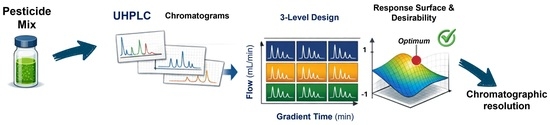
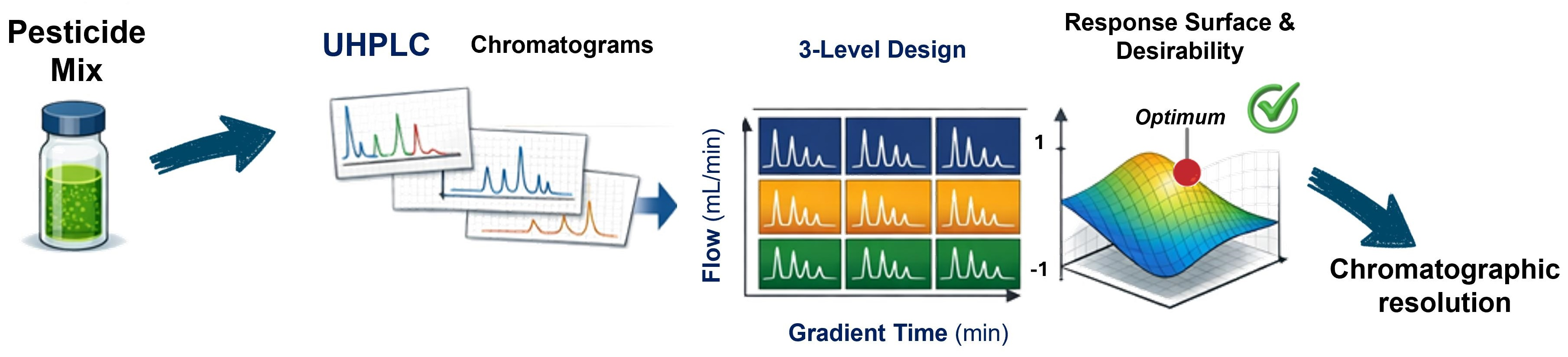
We applied an integrated chemometric workflow to optimize UHPLC separation of 27 environmentally relevant pesticides—representative of mixtures found in surface water, groundwater, and drinking water monitoring. By systematically evaluating the combined effects of flow rate and gradient duration across a statistically designed experimental domain, we elucidated how these variables control chromatographic performance and identified robust conditions that maximize global resolution.
2. Materials and Methods
2.1. Chemicals and Standards
All pesticide reference standards PESTANAL
® from Sigma-Aldrich (St. Louis, MO, USA, certified purity ≥ 99%) were selected on the basis of their documented occurrence in water quality monitoring programs and their recognized relevance for environmental exposure and risk assessment. Individual stock solutions were prepared at a concentration of 1 mg/mL in UHPLC-grade acetonitrile Chromasolv
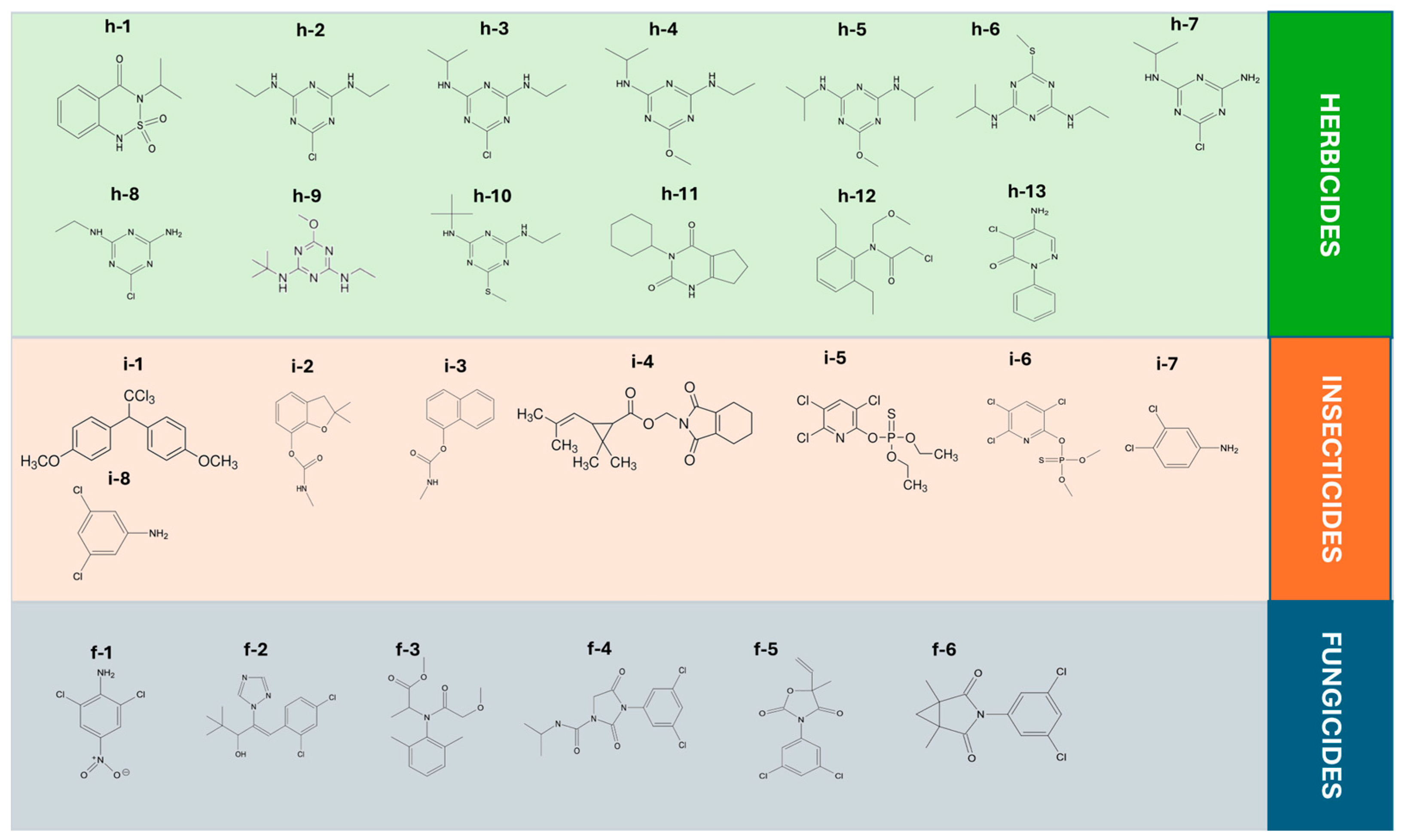
® (Sigma-Aldrich, St. Louis, MO, USA) and stored at 4 °C to ensure chemical stability over time. Working solutions were then prepared by appropriate dilution to environmentally relevant concentrations (100 µg/mL). From these working solutions, three multiresidue mixtures (A, B, and C), each at a final concentration of 5 µg/mL, were formulated to reproduce realistic contamination scenarios characterized by wide polarity distribution and heterogeneous chromatographic behavior. The complete list of investigated pesticides is reported in
Figure 1. The pesticides included in this study were selected to represent different chemical classes commonly encountered in environmental monitoring programs, including herbicides, insecticides, and fungicides. The selected compounds were chosen to cover a range of physicochemical properties and structural features, providing a challenging multiresidue chromatographic separation scenario. This diversity allows evaluation of the proposed chemometric optimization strategy under conditions representative of complex pesticide mixtures frequently encountered in environmental analysis. Subdividing the analytes into distinct mixtures enabled unequivocal compound identification via comparison of UV absorption spectra. It also allowed accurate determination of retention times and peak characteristics, as detailed in
Table S1. This approach substantially reduced peak crowding compared to a single-run analysis of all 27 pesticides, enhancing chromatographic interpretability while maintaining the representativeness of multiresidue environmental samples.
2.2. UHPLC Instrumentation
Chromatographic analyses were performed using a WATERS ACQUITY UHPLC (Waters, Milford, MA, USA) system comprising an ACQUITY UPLC I-Class Binary Solvent Manager, a Sample Manager FTN autosampler, and an ACQUITY UPLC PDA eλ detector enabling full spectral acquisition over the 200–400 nm range. Separations were achieved on a Kinetex 100 Å C18 column (Phenomenex, Torrance, CA, USA, 100 × 4.6 mm, 2.6 µm particle size, core–shell technology), preceded by a Phenomenex SecurityGuard ULTRA UHPLC guard cartridge (2.1–4.6 mm). Instrument control, data acquisition, and processing were carried out using Empower 1 software (Waters, Milford, MA, USA). The column compartment was thermostated at 30 °C, while the autosampler tray was maintained at 10 °C to ensure sample stability. Under the investigated operating conditions, system backpressure was approximately 7400 psi. A fixed injection volume of 3 µL was used for all UHPLC analyses to ensure optimal peak shape and reproducibility.
2.3. Mobile Phase and Gradient Program
The mobile phase consisted of UHPLC-grade water (solvent A) and acetonitrile (solvent B). Chromatographic separations were carried out using a segmented gradient elution program specifically designed to accommodate the wide polarity range of the investigated pesticides while enabling systematic modulation of key operational variables within the Design of Experiments.
At the start of each run (t = 0 min), the mobile phase composition was set to 60% solvent A and 40% solvent B. The gradient profile comprised two linear segments: an initial decrease in solvent A from 60% to 10%, followed by a return to higher aqueous content to re-equilibrate the column. The time required to reach the minimum aqueous composition (10% solvent A, 90% solvent B) was defined as the gradient duration and was varied according to the experimental design. Specifically, gradient durations of 6, 8, and 10 min were investigated, after which the mobile phase composition was adjusted back to 60% solvent A to ensure adequate column re-equilibration prior to subsequent injections.
Within this gradient scheme, the flow rate was maintained constant during each individual chromatographic run and systematically varied across the experimental domain at 0.3, 0.4, and 0.5 mL/min, as defined by the two-factor, three-level factorial design described in
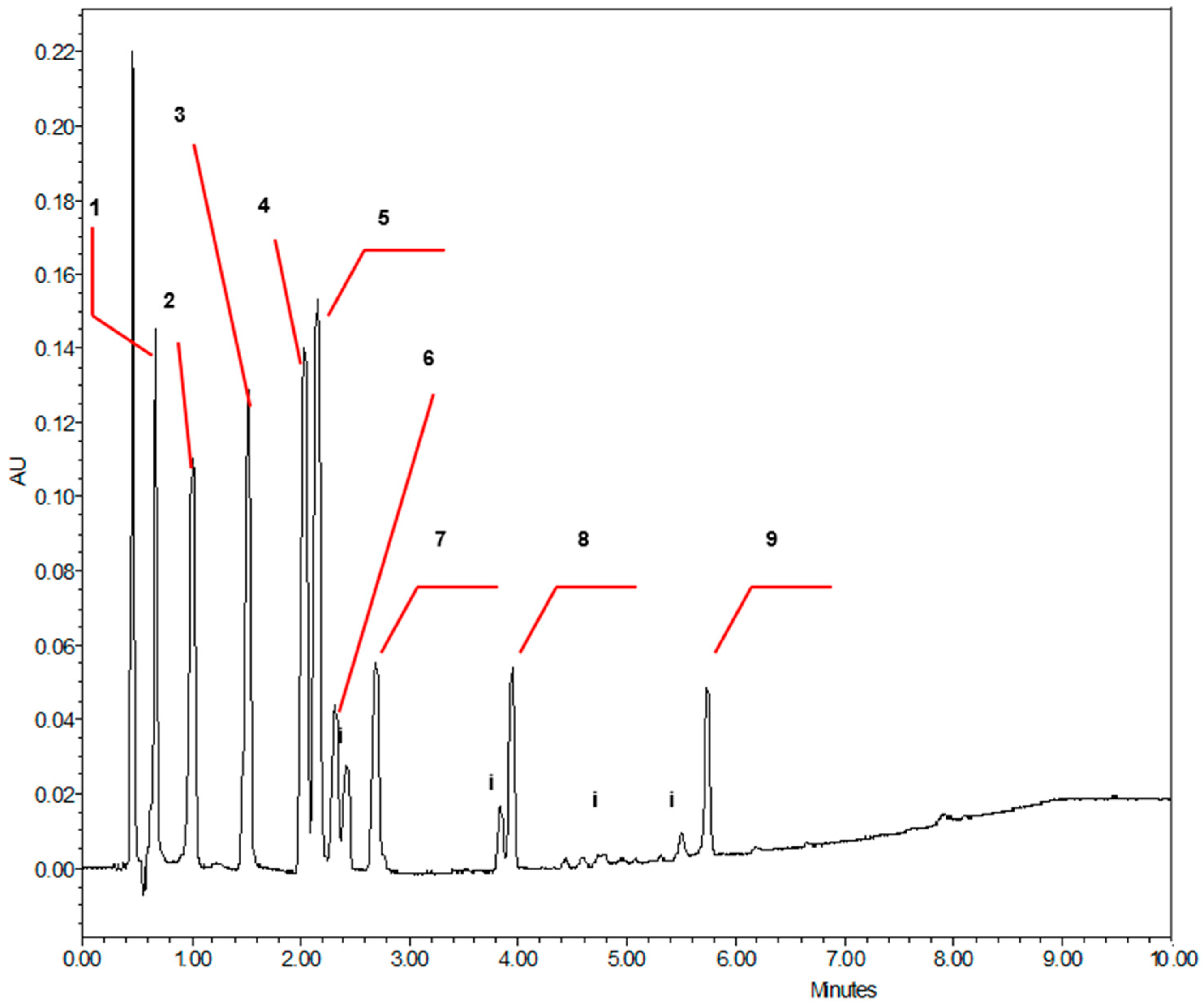
Section 2.4. Jointly varying flow rate and gradient duration enabled a statistically structured exploration of chromatographic behavior. This allowed quantitative assessment of their individual and interactive effects—under conditions relevant to multiresidue method development—as shown for mixture A in
Figure 2. For completeness, chromatograms of mixtures B and C are provided in
Figures S1 and S2.
Chromatographic detection was performed at 220 nm, a compromise wavelength providing broad sensitivity across the different pesticide classes investigated. For each experimental condition, chromatographic resolution was calculated for all pairs of consecutive peaks based on retention times and peak widths. These resolution values constituted the primary responses used for desirability transformation and subsequent chemometric optimization.
2.4. Experimental Design and Global Desirability
The experimental design used to investigate the influence of chromatographic conditions on separation performance was a three-level, two-factor factorial design. The two investigated factors were flow rate (X
1) and gradient duration (X
2). Each factor was explored at three levels (low, central, and high, as reported in
Section 2.3), generating a set of experimental runs used to construct the response surface models. The selected experimental domain was defined based on preliminary chromatographic tests in order to cover the range of conditions compatible with adequate separation and a reasonable analysis time. Within the three-level, two-factor factorial design, chromatographic performance at each experimental condition x was quantified by the total desirability response D(x), computed from the resolution values R
s,i(x) of the 26 consecutive peak pairs detected across the three pesticide mixtures after application of the desirability function with lower and upper bounds fixed at 0.35 and 1.00, respectively, as reported in
Figure S3. The lower bound was set at R
s = 0.35 in order to identify clearly insufficient separations characterized by significant peak overlap. Within the desirability framework, values below this threshold were considered analytically unacceptable and were therefore strongly penalized in the global optimization procedure. The complete set of chromatographic resolution values calculated for all consecutive analyte pairs across the three mixtures and the nine experimental conditions is reported in
Table S2. This response definition ensures that optimization is driven by the weakest analytically useful separations, which ultimately limit method selectivity, peak capacity, and fitness for multiresidue water analysis.
The experimental domain was intentionally restricted to flow rate and gradient duration, as preliminary screening experiments indicated that these variables exerted the dominant influence on global chromatographic selectivity under the selected stationary phase and mobile phase composition. Other parameters, including column temperature and initial mobile phase composition, were maintained constant to reduce model dimensionality and ensure reliable estimation of curvature and interaction effects within a limited number of experimental runs. This choice allowed the factorial design to focus on the most influential operational factors while preserving the statistical robustness of the response surface model. To enable rigorous multiresponse optimization, each resolution response was transformed into a dimensionless desirability value d
i(y
i) according to the Derringer formalism for response maximization. For each peak pair i, lower and upper bounds L
i and U
i were defined, where L
i represents an unacceptable level of separation, and U
i represents the target level corresponding to baseline resolution. The desirability transformation was applied as
where s is a shape parameter controlling the curvature of the scaling function within the acceptance interval. A linear transformation s = 1 was adopted to preserve proportionality between improvements in chromatographic resolution and the corresponding desirability gain, thereby avoiding artificial weighting of marginal improvements close to either bound.
The set of individual desirabilities was then combined into a global desirability function D using the geometric mean
with m = 26. The geometric mean is particularly appropriate for chromatographic optimization because it penalizes low-performing responses, ensuring that a single poorly resolved peak pair substantially degrades the overall objective. In the present study, all peak-pair resolutions were treated with equal importance in the global desirability calculation. No differential weighting scheme was applied, as the objective of the optimization was to ensure adequate separation across the entire multiresidue chromatogram rather than prioritizing specific analytes. This approach avoids introducing subjective weighting factors and ensures that poorly resolved peak pairs cannot be compensated for by highly resolved regions of the chromatogram. To further reflect the extent of baseline separation achieved under each condition, D(x) was subsequently corrected by the fraction of responses attaining di = 1, yielding a corrected global metric that accounts for the prevalence of fully resolved peak pairs. Consequently, the corrected D(x) provides a stringent and analytically meaningful measure of overall separation quality across the full pesticide profile. This ensures that conditions are rewarded only when many analyte pairs are fully resolved, and the remaining ones are not severely overlapped, directly linking the factorial experimental design to a statistically consistent and environmentally relevant optimization criterion.
Table 1 presents the experimental design matrix, including coded factor levels, corresponding real chromatographic conditions, and corrected global desirability values. The experimental plan consisted of a three-level, two-factor design, including replicated runs used to estimate experimental error. The replicated experiments were performed under the same instrumental conditions and were included to improve the reliability of the fitted response surface models.
2.5. Response Surface Modeling and Desirability Optimization
Second-order polynomial regression models were fitted to the global desirability D(x) as a function of the coded experimental variables X1 (flow rate) and X2 (gradient duration), providing a statistically rigorous linkage between the Design of Experiments and the multicriteria desirability framework derived from the scaled resolution responses. This modeling approach, consistent with response surface methodology used in desirability-driven optimization, allows simultaneous quantification of main effects, curvature, and interaction terms on the global chromatographic performance metric. The general model formula was reported in Equation (S1).
Model parameters were estimated by ordinary least squares. Model adequacy was assessed by analysis of variance to test the overall regression and the significance of individual terms, lack-of-fit analysis to verify the suitability of the quadratic approximation over the experimental domain, and examination of standardized residuals. Predictive stability was further evaluated by internal leave-one-out cross-validation. Contour and three-dimensional response surface plots were then used to visualize the desirability landscape and to delineate regions of maximal global chromatographic performance relevant to environmental separations.
Optimization was performed by maximizing the fitted global desirability function D over the experimental domain. Because D is constructed as a geometric mean of individual resolution desirabilities, this criterion ensures that all peak pairs contribute to the objective and that poorly resolved regions strongly penalize the overall score. The desirability function allowed the identification of chromatographic conditions providing the best compromise among the investigated responses.
3. Results
3.1. Desirability of Peak-Pair Resolutions
Applying the desirability transformation from
Section 2.4 to the 26 consecutive peak-pair resolutions for each DOE condition yielded a corrected global desirability value. This provided a bounded, comparable measure of chromatographic performance across the experimental space. The mapping minimizes the influence of extreme Rs values, ensuring optimization focuses on separations critical for multiresidue identification and quantification. A key chromatographic outcome evidenced by the DOE is that changes in experimental conditions induce selectivity shifts, including inversion of retention order for specific analyte pairs. Under such regimes, raw Rs values may become negative and/or collapse below the practical threshold of 0.35. Within the desirability framework, these events are captured as di = 0, reflecting the fact that inversions and coelutions introduce local analytical failure points that cannot be compensated by highly resolved regions elsewhere in the chromatogram.
Across the nine DOE conditions, the corrected desirability values demonstrated a clear dependence on experimental settings. The highest response was obtained at X1 = −1 and X2 = 0, corresponding to a flow rate of 0.3 mL/min and a gradient duration of 8 min, with D = 0.237493. The remaining conditions yielded progressively lower responses, reaching the minimum at X1 = +1 and X2 = +1 (0.5 mL/min, 10 min), with D = 0.091590. This response ranking shows that enhancing global chromatographic quality demands not only maximizing intermediate desirability values but also increasing the proportion of fully resolved peak pairs.
3.2. Response Surface Modeling and Global Desirability Optimization
The final regression model for corrected global desirability was derived by reducing the full quadratic design using hierarchical significance criteria, with explicit accounting for replicated points.
Table 2 summarizes the retained terms, regression statistics, ANOVA results, and lack-of-fit evaluation.
Only statistically and physically meaningful effects were preserved, yielding a parsimonious yet descriptive response surface.
The intercept term represents the mean level of corrected global desirability across the experimental domain and was found to be statistically significant, indicating a well-defined baseline chromatographic performance. The linear effect associated with gradient duration (X2) was statistically significant and negative, demonstrating that increasing gradient time leads to a systematic decrease in the global desirability when considered independently. In contrast, the linear effect of flow rate (X1) was not statistically significant within the explored range, indicating the absence of a simple monotonic relationship with the global separation metric.
Despite its lack of individual statistical significance, the linear flow-rate term was retained in the final model in accordance with hierarchical modeling principles, as it represents the lower-order component required to support the statistically significant quadratic dependence on flow rate. The presence of a significant quadratic term for X1 indicates a curved response, revealing the existence of an optimum at intermediate flow values rather than at the boundaries of the investigated domain. This behavior is consistent with gradient UHPLC theory, where increasing linear velocity reduces longitudinal diffusion but simultaneously limits mass transfer equilibration between the stationary and mobile phases. Under high-flow conditions, incomplete equilibration particularly affects late-eluting and structurally similar pesticides, leading to peak compression and loss of selectivity rather than uniform resolution improvement. Conversely, the quadratic term associated with gradient duration (X22) was not statistically significant and was therefore excluded from the final model, indicating that the effect of gradient duration can be adequately described by a linear dependence within the experimental range explored.
From a chromatographic standpoint, these results indicate that global separation performance is governed by a balance between mass transfer efficiency and analyte distribution along the gradient. Excessively high flow rates promote peak overlap and reduce separation robustness, while extending the gradient beyond intermediate durations does not yield proportional improvements in analytically useful separations. The fitted response surface consequently predicts an optimum characterized by low-to-intermediate flow rates combined with intermediate gradient durations, in agreement with the experimentally observed maximum desirability.
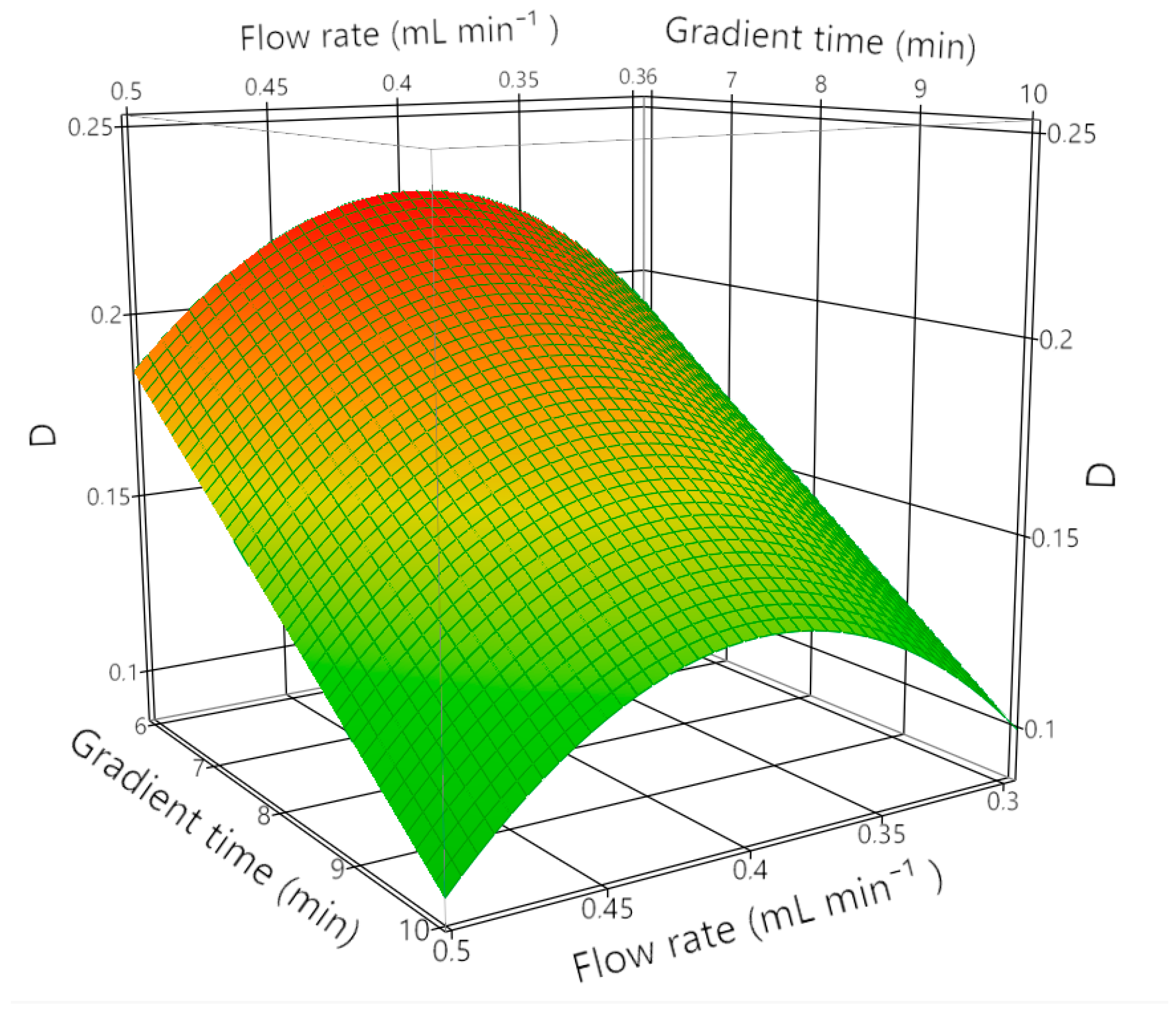
Figure 3 shows three-dimensional response surface representations, and it confirms that the predicted optimum coincides with the experimental condition corresponding to a flow rate of 0.3 mL/min and a gradient duration of 8 min.
The close agreement between the model prediction and replicated experimental observations further supports the adequacy of the model, as summarized in
Table 2.
3.3. Model Validation
The adequacy and predictive capability of the stepwise regression model were evaluated using replicated observations and analysis of variance. The model explains a large fraction of the total variability in the corrected global desirability, with a coefficient of determination R2 = 0.890 and an adjusted R2 = 0.868, indicating that the retained terms provide a robust description of the experimental data.
Analysis of variance revealed a highly significant regression (F = 40.4478, p < 0.0001), confirming that the model accounts for a statistically meaningful portion of the observed variability relative to experimental noise. Importantly, the lack-of-fit test was not significant (p = 0.1273), demonstrating that the quadratic approximation is adequate over the investigated experimental domain and that no systematic structure remains unexplained by the model.
The root mean square error (0.0164) is small relative to the mean response value (0.154), further supporting the precision of the fitted surface. Collectively, the high explanatory power, non-significant lack of fit, and consistency across replicated runs support the DOE-based model as a reliable tool for identifying optimal UHPLC operating conditions for global multiresidue pesticide separation.
4. Discussion
In chromatographic separations, the capacity factor (k′) is a relevant descriptor of analyte retention relative to the column dead time. Adequate k′ values are generally desirable to ensure sufficient retention and satisfactory robustness of the separation. Under the optimized conditions identified in this study, the earliest eluting compound appears relatively close to the void time. This proximity may represent a potential limitation when analyzing complex environmental matrices due to the possible co-elution with unretained or weakly retained components.
To evaluate this aspect, the chromatographic conditions were tested on a spiked drinking water sample as reported in
Figure S4. The resulting chromatogram indicates that early-eluting analytes remain distinguishable from matrix-related signals under these conditions, suggesting that acceptable selectivity can be achieved in relatively simple aqueous matrices.
Nevertheless, for more complex environmental samples, additional strategies such as sample preparation, matrix cleanup, or slight modification of chromatographic conditions may be required to ensure adequate robustness and selectivity.
Although the proximity to the void time may reduce robustness with respect to small variations in mobile phase composition, the compound remains sufficiently resolved from adjacent peaks and therefore does not compromise the overall separation quality within the investigated experimental domain. Chromatographic parameters such as theoretical plate number (N), peak asymmetry, and capacity factor (k′) are commonly used to assess column performance. However, the primary objective of the present study was the multivariate optimization of chromatographic resolution across multiple consecutive pesticide peak pairs. For this reason, peak-pair resolution was selected as the main response variable in the chemometric workflow, as it directly reflects separation performance in a complex multiresidue system. The desirability-based optimization framework enables an integrated interpretation of chromatographic performance that cannot be obtained by examining individual resolution values in isolation. By condensing the full set of consecutive peak-pair separations into a single corrected global metric, the analysis reflects the practical requirement that all analytes in a multiresidue method must be adequately resolved to ensure reliable identification and quantification. While traditional approaches to chromatographic method development often relied on sequential parameter adjustments, modern strategies increasingly adopt multivariate methodologies and analytical quality by design frameworks to achieve systematic optimization.
Within this framework, the identified optimum corresponds to operating conditions that balance separation efficiency and robustness. The curvature observed with respect to flow rate highlights the role of mass transfer limitations and peak overlap at elevated linear velocities, whereas the linear dependence on gradient duration indicates that excessive gradient extension does not proportionally enhance the overall quality of separation. In gradient separations of multiresidue mixtures, extending the gradient primarily increases retention spacing for strongly retained compounds while producing limited selectivity changes among early and mid-eluting analytes. Consequently, longer gradients redistribute peak positions without uniformly improving critical pair separations, explaining why global desirability decreases despite locally improved resolutions. These combined effects lead to an optimal region characterized by moderate gradient duration and low-to-intermediate flow rates.
The resulting response surface exhibits a relatively broad region of elevated desirability, indicating that the optimized conditions are inherently tolerant to small variations in instrumental settings. Such robustness is a critical requirement in analytical laboratories dealing with multiresidue chromatographic methods, where minor fluctuations in operating conditions are unavoidable. In this context, the chemometric strategy adopted here provides not only a single optimum but also a stable operating window suitable for reliable multiresidue pesticide analysis.
The experimental domain investigated in this study was intentionally limited to key chromatographic variables (flow rate and gradient duration) in order to ensure a statistically robust and interpretable chemometric model within a feasible number of experimental runs, without aiming to exhaustively explore all factors affecting chromatographic performance. Within this framework, the proposed approach establishes a systematic strategy for the simultaneous optimization of multiple peak-pair resolutions in a multiresidue system, and its added value lies in the integration of response surface modeling with a global desirability function for multi-objective optimization. Accordingly, the present work should be regarded as a methodological framework for chromatographic optimization rather than a fully validated analytical method, with further validation and extension to more complex matrices representing a logical next step.
5. Conclusions
This work demonstrates that the integration of Design of Experiments with replicated experimental points and desirability-based response surface modeling provides a statistically sound framework for the development of UHPLC methods targeting multiresidue pesticide separation. By modeling the combined effects of flow rate and gradient duration on a corrected global resolution metric derived from consecutive peak-pair separations, the proposed approach captures key factors governing chromatographic performance without unnecessary model complexity. The novelty of this work lies in the integration of a two-factor, three-level experimental design, quadratic response surface modeling, and a global desirability function to simultaneously optimize multiple peak-pair resolutions within complex pesticide mixtures. This chemometric framework enables systematic and statistically supported optimization of chromatographic separation conditions.
The work focuses on the chemometric optimization of chromatographic separation parameters, rather than on the full validation of an analytical method for routine environmental monitoring. Comprehensive validation, including the determination of limits of detection and quantification, recovery, matrix effects, and precision under real-sample conditions, will be addressed in future studies aimed at extending the applicability of the optimized chromatographic conditions to environmental matrices.
The final reduced regression model indicates that global separation quality is primarily influenced by a linear dependence on gradient duration and a nonlinear dependence on flow rate, while higher-order curvature in gradient duration is not supported within the investigated experimental domain. The proposed approach enables the identification of chromatographic conditions that maximize separation efficiency within the investigated experimental space.
From an environmental analytical perspective, the proposed chemometric strategy represents a transferable and robust approach for UHPLC method development applied to pesticides of environmental interest. The framework can be readily extended to additional classes of contaminants and supports the rational design of chromatographic methods where multiresidue capability and robustness are essential. Future work will address the transferability of the proposed optimization framework to real environmental matrices, where matrix effects and sample complexity may further challenge chromatographic performance.
Supplementary Materials
The following supporting information can be downloaded at:
https://www.mdpi.com/article/10.3390/app16073184/s1, Table S1 Composition of the three multiresidue pesticide mixtures (Mixtures A, B, and C) investigated in this study. The analytes were distributed among separate mixtures to limit peak crowding and facilitate unambiguous identification of consecutive peak pairs during UHPLC analysis, while preserving a broad range of chemical classes and chromatographic behaviors representative of environmentally relevant pesticides. Figure S1. Representative UHPLC chromatogram obtained with flow rate 0.3 mL min
−1 and gradient duration 8 min for pesticide mixture B. Peak identification: (1) Desisopropylatrazine, (2) Atraton, (3) Carbofuran, (4) Metalaxyl, (5) Lenacil, (6) Ametryn, (7) Alachlor, (8) Iprodione, (9) Vinclozolin, and (10) Tetramethrin. Peaks labelled
i correspond to minor impurities or background signals. Figure S2. Representative UHPLC chromatogram obtained with flow rate 0.3 mL min
−1 and gradient duration 8 min for pesticide mixture C. Peak identification: (1) Chloridazon, (2) Carbaryl, (3) Terbumeton, (4) 3,5-dichloroaniline (3,5-DCA), (5) Terbutryn, (6) Procymidone, (7) Chlorpyrifos, and (8) Chlorpyrifos-methyl. Figure S3. Schematic illustration of chromatographic resolution (Rs) calculation for consecutive peak pairs. Retention times and peak widths of two adjacent analytes are shown together with representative examples of unresolved (Rs < 0.35), partially resolved (0.35 < Rs < 1), and baseline-resolved (Rs ≥ 1) peak pairs, consistent with the desirability-based scaling applied in this study. Table S2 Chromatographic resolution (Rs) values for all consecutive analyte pairs in Mixtures A, B, and C obtained under the nine chromatographic conditions investigated in the experimental design. These data represent the raw responses used for desirability scaling and global optimization. Figure S4. Representative UHPLC chromatogram obtained under the optimized chromatographic conditions for a drinking water sample spiked with pesticide mixture B at 1 µg mL
−1. Peak identification: (1) Desisopropylatrazine, (2) Atraton, (3) Carbofuran, (4) Metalaxyl, (5) Lenacil, (6) Ametryn, (7) Alachlor, (8) Iprodione, (9) Vinclozolin, and (10) Tetramethrin.
Author Contributions
Conceptualization, F.R.; methodology, F.R., F.C. and M.A.; software, F.R., M.A.M., M.F. and A.B.; validation, F.R., F.C., M.A., M.F. and M.A.M.; formal analysis, F.R., M.A.M. and A.B.; investigation, F.C. and M.A.; resources, F.R.; data curation, F.R., F.C., M.A., M.F. and M.A.M.; writing—original draft preparation, F.R. and M.A.M.; writing—review and editing, F.R.; visualization, F.R., F.C. and M.A.; supervision, F.R.; project administration, F.R.; funding acquisition, F.R. All authors have read and agreed to the published version of the manuscript.
Funding
This research received no external funding.
Institutional Review Board Statement
Not applicable.
Informed Consent Statement
Not applicable.
Data Availability Statement
Conflicts of Interest
The authors declare no conflicts of interest.
Abbreviations
The following abbreviations are used in this manuscript:
| DoE | Design of Experiments |
| UHPLC | Ultra-High-Performance Liquid Chromatography |
| HPLC | High-Performance Liquid Chromatography |
| PDA | Photodiode Array Detector |
| Rs | Chromatographic Resolution |
| RSM | Response Surface Methodology |
| ANOVA | Analysis of Variance |
| RMSE | Root Mean Square Error |
| Li | Lower Desirability Limit |
| Ui | Upper Desirability Limit |
| di | Individual Desirability |
| D | Global Desirability |
References
- El-Nahhal, I.; El-Nahhal, Y. Pesticide Residues in Drinking Water, Their Potential Risk to Human Health and Removal Options. J. Environ. Manag. 2021, 299, 113611. [Google Scholar] [CrossRef] [PubMed]
- (EC), 2000/60/EC Commission Regulation Regulation (EC) No 1107/2009 of the European Parliament and of the Council of 21 October 2009 Concerning the Placing of Plant Protection Products on the Market and Repealing Council Directives 79/117/EEC and 91/414/EEC, O.J. L309/1. 2009; pp. 1–50. Available online: https://www.legislation.gov.uk/eur/2009/1107 (accessed on 1 January 2026).
- Directive, C. On the Quality of Water Intended for Human Consumption. Off. J. Eur. Communities 1998, 330, 32–54. [Google Scholar]
- Sjerps, R.M.A.; Kooij, P.J.F.; van Loon, A.; Van Wezel, A.P. Occurrence of Pesticides in Dutch Drinking Water Sources. Chemosphere 2019, 235, 510–518. [Google Scholar] [CrossRef]
- Kaushal, J.; Khatri, M.; Arya, S.K. A Treatise on Organophosphate Pesticide Pollution: Current Strategies and Advancements in Their Environmental Degradation and Elimination. Ecotoxicol. Environ. Saf. 2021, 207, 111483. [Google Scholar] [CrossRef] [PubMed]
- Mali, H.; Shah, C.; Raghunandan, B.H.; Prajapati, A.S.; Patel, D.H.; Trivedi, U.; Subramanian, R.B. Organophosphate Pesticides an Emerging Environmental Contaminant: Pollution, Toxicity, Bioremediation Progress, and Remaining Challenges. J. Environ. Sci. 2023, 127, 234–250. [Google Scholar] [CrossRef]
- Bansal, O.P. Health Impacts of the Carbamate and Dithiocarbamate Pesticides: A Review. Int. J. Sci. Res. Publ. 2022, 12, 366. [Google Scholar] [CrossRef]
- Swartjes, F.A.; Van der Aa, M. Measures to Reduce Pesticides Leaching into Groundwater-Based Drinking Water Resources: An Appeal to National and Local Governments, Water Boards and Farmers. Sci. Total Environ. 2020, 699, 134186. [Google Scholar] [CrossRef]
- Koçyiğit, H.; Sinanoğlu, F. Method Validation for the Analysis of Pesticide Residue in Aqueous Environment. Environ. Monit. Assess. 2020, 192, 567. [Google Scholar] [CrossRef]
- Harmon O’Driscoll, J.; Siggins, A.; Healy, M.G.; McGinley, J.; Mellander, P.E.; Morrison, L.; Ryan, P.C. A Risk Ranking of Pesticides in Irish Drinking Water Considering Chronic Health Effects. Sci. Total Environ. 2022, 829, 154532. [Google Scholar] [CrossRef]
- Shekhar, C.; Khosya, R.; Thakur, K.; Mahajan, D.; Kumar, R.; Kumar, S.; Sharma, A.K. A Systematic Review of Pesticide Exposure, Associated Risks, and Long-Term Human Health Impacts. Toxicol. Rep. 2024, 13, 101840. [Google Scholar] [CrossRef]
- Ramezani, S.; Mahdavi, V.; Gordan, H.; Rezadoost, H.; Oliver Conti, G.; Mousavi Khaneghah, A. Determination of Multi-Class Pesticides Residues of Cow and Human Milk Samples from Iran Using UHPLC-MS/MS and GC-ECD: A Probabilistic Health Risk Assessment. Environ. Res. 2022, 208, 112730. [Google Scholar] [CrossRef]
- Mdeni, N.L.; Adeniji, A.O.; Okoh, A.I.; Okoh, O.O. Analytical Evaluation of Carbamate and Organophosphate Pesticides in Human and Environmental Matrices: A Review. Molecules 2022, 27, 618. [Google Scholar] [CrossRef] [PubMed]
- Drimaropoulou, G.; Christophoridis, C.; Zacharis, C.K.; Fytianos, K. Chemometric Optimization of SPE for the Determination of Multiclass Pesticides in Portable Water Samples by UHPLC-MS/MS. Bull. Environ. Contam. Toxicol. 2024, 112, 48. [Google Scholar] [CrossRef]
- Fekete, S.; Schappler, J.; Veuthey, J.L.; Guillarme, D. Current and Future Trends in UHPLC. TrAC—Trends Anal. Chem. 2014, 63, 2–13. [Google Scholar] [CrossRef]
- Robards, K.; Ryan, D. Principles and Practice of Modern Chromatographic Methods; Elsevier: Amsterdam, The Netherlands, 2021. [Google Scholar]
- Cserháti, T. Multivariate Methods in Chromatography: A Practical Guide; John Wiley & Son: Hoboken, NJ, USA, 2008. [Google Scholar]
- Leardi, R. Experimental Design in Chemistry: A Tutorial. Anal. Chim. Acta 2009, 652, 161–172. [Google Scholar] [CrossRef]
- Bezerra, M.A.; Santelli, R.E.; Oliveira, E.P.; Villar, L.S.; Escaleira, L.A. Response Surface Methodology (RSM) as a Tool for Optimization in Analytical Chemistry. Talanta 2008, 76, 965–977. [Google Scholar] [CrossRef]
- Passeport, E.; Guenne, A.; Culhaoglu, T.; Moreau, S.; Bouyé, J.M.; Tournebize, J. Design of Experiments and Detailed Uncertainty Analysis to Develop and Validate a Solid-Phase Microextraction/Gas Chromatography-Mass Spectrometry Method for the Simultaneous Analysis of 16 Pesticides in Water. J. Chromatogr. A 2010, 1217, 5317–5327. [Google Scholar] [CrossRef]
- Singh, M.; Rahate, S.P.; Verma, A.K.; Tiwari, N.; Shanker, K. DoE-Based HPLC-PDA Method Development and Validation for Diverse Nature Multi-Components in Plants: AQbD Approach for Authentication and Adulteration Check of Sida Species with Uncertainty Budget. Talanta 2026, 296, 128426. [Google Scholar] [CrossRef] [PubMed]
- Ferreira, S.L.C.; Lemos, V.A.; de Carvalho, V.S.; da Silva, E.G.P.; Queiroz, A.F.S.; Felix, C.S.A.; da Silva, D.L.F.; Dourado, G.B.; Oliveira, R.V. Multivariate Optimization Techniques in Analytical Chemistry—An Overview. Microchem. J. 2018, 140, 176–182. [Google Scholar] [CrossRef]
- Vera Candioti, L.; De Zan, M.M.; Cámara, M.S.; Goicoechea, H.C. Experimental Design and Multiple Response Optimization. Using the Desirability Function in Analytical Methods Development. Talanta 2014, 124, 123–138. [Google Scholar] [CrossRef] [PubMed]
- Derringer, G.C.; Suich, R.C. Simultaneous Optimization of Several Response Variables. J. Qual. Technol. 1980, 12, 214–219. [Google Scholar] [CrossRef]
- Edrees, F.H.; Saad, A.S.; Alsaadi, M.T.; Amin, N.H.; Abdelwahab, N.S. Experimentally Designed Chromatographic Method for the Simultaneous Analysis of Dimenhydrinate, Cinnarizine and Their Toxic Impurities. RSC Adv. 2021, 11, 1450–1460. [Google Scholar] [CrossRef] [PubMed]
- Ayyildiz, H.F.; Memon, F.N.; Mangi, I.A.; Kara, H. Separation and Identification of Different Therapeutic Pharmaceutical Drugs on Humic Acid-Based HPLC Column: Method Optimization Using Central Composite Design. J. Sep. Sci. 2023, 46, 2200914. [Google Scholar] [CrossRef] [PubMed]
- D’Archivio, A.A.; Maggi, M.A.; Marinelli, C.; Ruggieri, F.; Stecca, F. Optimisation of Temperature-Programmed Gas Chromatographic Separation of Organochloride Pesticides by Response Surface Methodology. J. Chromatogr. A 2015, 1423, 149–157. [Google Scholar] [CrossRef]
- Narenderan, S.T.; Meyyanathan, S.N.; Karri, V.V.S.R. Experimental Design in Pesticide Extraction Methods: A Review. Food Chem. 2019, 289, 384–395. [Google Scholar] [CrossRef]
- Ruggieri, F.; D’Archivio, A.A.; Foschi, M.; Maggi, M.A. Multivariate Optimization of an Analytical Method for the Analysis of Abruzzo White Wines by ICP OES. Anal. Methods 2020, 12, 2772–2778. [Google Scholar] [CrossRef]
- Assoumani, A.; Margoum, C.; Guillemain, C.; Coquery, M. Use of Experimental Designs for the Optimization of Stir Bar Sorptive Extraction Coupled to GC-MS/MS and Comprehensive Validation for the Quantification of Pesticides in Freshwaters. Anal. Bioanal. Chem. 2014, 406, 2559–2570. [Google Scholar] [CrossRef]
- da Silva, B.; Valdomiro Gonzaga, L.; Fett, R.; Oliveira Costa, A.C. Simplex-Centroid Design and Derringer’s Desirability Function Approach for Simultaneous Separation of Phenolic Compounds from Mimosa Scabrella Bentham Honeydew Honeys by HPLC/DAD. J. Chromatogr. A 2019, 1585, 182–191. [Google Scholar] [CrossRef] [PubMed]
- Akvan, N.; Parastar, H. Second-Order Calibration for Simultaneous Determination of Pharmaceuticals in Water Samples by Solid-Phase Extraction and Fast High-Performance Liquid Chromatography with Diode Array Detector. Chemom. Intell. Lab. Syst. 2014, 137, 146–154. [Google Scholar] [CrossRef]
- Ruggieri, F.; Biancolillo, A.; D’Archivio, A.A.; Di Donato, F.; Foschi, M.; Maggi, M.A.; Quattrociocchi, C. Quantitative Structure–Retention Relationship Analysis of Polycyclic Aromatic Compounds in Ultra-High Performance Chromatography. Molecules 2023, 28, 3218. [Google Scholar] [CrossRef]
- Sivakumar, T.; Manavalan, R.; Muralidharan, C.; Valliappan, K. Multi-Criteria Decision Making Approach and Experimental Design as Chemometric Tools to Optimize HPLC Separation of Domperidone and Pantoprazole. J. Pharm. Biomed. Anal. 2007, 43, 1842–1848. [Google Scholar] [CrossRef] [PubMed]
- Wen, G.; Wang, T.; Zhao, L.; Si, W.; Tang, H.; Dong, M.; Zhao, Y.; Wang, W. A Modified Sample Preparation Strategy Combined with UHPLC-MS/MS for Simultaneous Determination of 147 Pesticides and Related Compounds in Vegetables and Fruits. Food Chem. X 2026, 33, 103506. [Google Scholar] [CrossRef] [PubMed]
- Babgapi, A.; Mahdavi, V.; Bayanati, M.; Khanniri, E.; Alemi, M.; Kia, A.S.; Zarei, R.; Mahboubi-Rabbani, M. Evaluation of Pesticide Residues in Raw Vegetables Using UHPLC-MS/MS: A Risk Assessment Study. J. Food Compos. Anal. 2025, 148, 108611. [Google Scholar] [CrossRef]
Figure 1.
Chemical structures of the 27 pesticides investigated in this study, grouped according to functional class: herbicides (h), insecticides (i), and fungicides (f). Herbicides: Bentazone (h-1), Simazine (h-2), Atrazine (h-3), Atraton (h-4), Prometon (h-5), Ametryn (h-6), Desethylatrazine (h-7), Desisopropylatrazine (h-8), Terbumeton (h-9), Terbutryn (h-10), Lenacil (h-11), Alachlor (h-12), and Chloridazon (h-13). Insecticides: Methoxychlor (i-1), Carbofuran (i-2), Carbaryl (i-3), Tetramethrin (i-4), Chlorpyrifos (i-5), Chlorpyrifos-methyl (i-6), 3,4-DCA (i-7), and 3,5-DCA (i-8). Fungicides: Dichloran (f-1), Diniconazole (f-2), Metalaxyl (f-3), Iprodione (f-4), Vinclozolin (f-5), and Procymidone (f-6). The classification highlights the structural diversity of the analyte set used for chemometric optimization of UHPLC separation. The “–” symbol on the oxygen atom indicates a formal negative charge (O−). This corresponds to a resonance form of the nitro group (–NO2), in which the negative charge is delocalized between the two oxygen atoms and balanced by a positive charge on the nitrogen atom.
Figure 1.
Chemical structures of the 27 pesticides investigated in this study, grouped according to functional class: herbicides (h), insecticides (i), and fungicides (f). Herbicides: Bentazone (h-1), Simazine (h-2), Atrazine (h-3), Atraton (h-4), Prometon (h-5), Ametryn (h-6), Desethylatrazine (h-7), Desisopropylatrazine (h-8), Terbumeton (h-9), Terbutryn (h-10), Lenacil (h-11), Alachlor (h-12), and Chloridazon (h-13). Insecticides: Methoxychlor (i-1), Carbofuran (i-2), Carbaryl (i-3), Tetramethrin (i-4), Chlorpyrifos (i-5), Chlorpyrifos-methyl (i-6), 3,4-DCA (i-7), and 3,5-DCA (i-8). Fungicides: Dichloran (f-1), Diniconazole (f-2), Metalaxyl (f-3), Iprodione (f-4), Vinclozolin (f-5), and Procymidone (f-6). The classification highlights the structural diversity of the analyte set used for chemometric optimization of UHPLC separation. The “–” symbol on the oxygen atom indicates a formal negative charge (O−). This corresponds to a resonance form of the nitro group (–NO2), in which the negative charge is delocalized between the two oxygen atoms and balanced by a positive charge on the nitrogen atom.

Figure 2.
UHPLC chromatogram of Mixture A recorded at 220 nm under the selected operating conditions (flow rate 0.3 mL/min; gradient duration 8 min). Peak identification: (1) Bentazone; (2) Atrazine desethyl; (3) Simazine; (4) Atrazine; (5) Prometon; (6) 3,4-DCA; (7) Dichloran; (8) Diniconazole; (9) Methoxychlor. Peaks labeled i correspond to minor impurities or background signals.
Figure 2.
UHPLC chromatogram of Mixture A recorded at 220 nm under the selected operating conditions (flow rate 0.3 mL/min; gradient duration 8 min). Peak identification: (1) Bentazone; (2) Atrazine desethyl; (3) Simazine; (4) Atrazine; (5) Prometon; (6) 3,4-DCA; (7) Dichloran; (8) Diniconazole; (9) Methoxychlor. Peaks labeled i correspond to minor impurities or background signals.
Figure 3.
Response surface plot showing the effect of flow rate (mL/min) and gradient time (min) on the global desirability function (D) obtained from the multi-response optimization of chromatographic resolutions between consecutive pesticide peak pairs. The color gradient represents the magnitude of the response variable, with green corresponding to lower values of D and red corresponding to higher values of D, highlighting the region of optimal chromatographic conditions.
Figure 3.
Response surface plot showing the effect of flow rate (mL/min) and gradient time (min) on the global desirability function (D) obtained from the multi-response optimization of chromatographic resolutions between consecutive pesticide peak pairs. The color gradient represents the magnitude of the response variable, with green corresponding to lower values of D and red corresponding to higher values of D, highlighting the region of optimal chromatographic conditions.
Table 1.
DoE experimental matrix reporting coded (X1, X2) and corresponding real chromatographic conditions (flow rate and gradient duration), together with the corrected global desirability (D) obtained for each run. Asterisks (*) indicate replicated measurements used for estimation of experimental error and model validation.
Table 1.
DoE experimental matrix reporting coded (X1, X2) and corresponding real chromatographic conditions (flow rate and gradient duration), together with the corrected global desirability (D) obtained for each run. Asterisks (*) indicate replicated measurements used for estimation of experimental error and model validation.
| Run | Flow Rate (mL/min) | Gradient Duration (min) | X1 | X2 | D |
|---|
| 1 | 0.3 | 6 | −1 | −1 | 0.189585 |
| 2 * | 0.3 | 6 | −1 | −1 | 0.20021 |
| 3 * | 0.3 | 6 | −1 | −1 | 0.16011 |
| 4 | 0.4 | 6 | 0 | −1 | 0.237493 |
| 5 | 0.5 | 6 | 1 | −1 | 0.181238 |
| 6 * | 0.5 | 6 | 1 | −1 | 0.17102 |
| 7 * | 0.5 | 6 | 1 | −1 | 0.19218 |
| 8 | 0.3 | 8 | −1 | 0 | 0.153283 |
| 9 | 0.4 | 8 | 0 | 0 | 0.199198 |
| 10 * | 0.4 | 8 | 0 | 0 | 0.18778 |
| 11 * | 0.4 | 8 | 0 | 0 | 0.17985 |
| 12 | 0.5 | 8 | 1 | 0 | 0.16295 |
| 13 | 0.3 | 10 | −1 | 1 | 0.10816 |
| 14 * | 0.3 | 10 | −1 | 1 | 0.1282 |
| 15 * | 0.3 | 10 | −1 | 1 | 0.0986 |
| 16 | 0.4 | 10 | 0 | 1 | 0.109334 |
| 17 | 0.5 | 10 | 1 | 1 | 0.09159 |
| 18 * | 0.5 | 10 | 1 | 1 | 0.082 |
| 19 * | 0.5 | 10 | 1 | 1 | 0.09987 |
Table 2.
Regression coefficients (value ± SD) and statistical parameters of the DoE model, including goodness of fit (R2, adjusted R2), predictive ability (Q2), and ANOVA results. The analysis confirms model significance and the absence of a significant lack of fit.
Table 2.
Regression coefficients (value ± SD) and statistical parameters of the DoE model, including goodness of fit (R2, adjusted R2), predictive ability (Q2), and ANOVA results. The analysis confirms model significance and the absence of a significant lack of fit.
| Parameters | Value ± SD | R2 | Adj-R2 | Q2 | |
| intercept | 0.37 ± 0.03 | | | | |
| X1 | −0.04 ± 0.04 | | | | |
| X2 | −0.022 ± 0.002 | 0.890 | 0.868 | 0.7985 | |
| X12 | −3.8 ± 0.8 | | | | |
| Variation Source | Sum of Squares | Degrees of Freedom | Mean Square | F-Value | p-Value |
| lack of fit | 0.002142 | 5 | 0.000428 | 2.2630 | 0.1273 |
| pure error | 0.001893 | 10 | 0.000189 | | |
| model | 0.032636 | 3 | 0.010879 | 40.4478 | <0.0001 |
| residual | 0.004034 | 15 | 0.000269 | | |
| Disclaimer/Publisher’s Note: The statements, opinions and data contained in all publications are solely those of the individual author(s) and contributor(s) and not of MDPI and/or the editor(s). MDPI and/or the editor(s) disclaim responsibility for any injury to people or property resulting from any ideas, methods, instructions or products referred to in the content. |




 ,
,