Multi-Class Weed Quantification Based on U-Net Convolutional Neural Networks Using UAV Imagery

 , , , and
Abstract
1. Introduction
1.1. Problem Statement
1.2. Engineering Contributions and Technical Highlights
- Construction of an extended UAV-based dataset with six semantic classes, including native weed species that are not present in existing public datasets. The number of annotated samples increases significantly and incorporates additional fields, growth stages, and weed instances.
- Patch-based training strategy designed to mitigate class imbalance and preserve spatial details in UAV imagery.
- Comparative evaluation of five U-Net variants under identical conditions, enabling a fair engineering assessment of architectural trade-offs.
- Integration of semantic segmentation metrics with statistical validation (Student’s t-test and correlation analysis) to assess the practical reliability of weed quantification.
- Release of a reproducible and transferable workflow for precision agriculture applications.
1.3. Related Work and Research Gaps
1.3.1. Ground-Based Weed Segmentation Approaches
1.3.2. UAV-Based Weed Segmentation Using CNN and U-Net Variants
1.3.3. Transformer and Hybrid Architectures for Weed Segmentation
1.3.4. Public Datasets and Limitations for Potato Weed Segmentation
1.3.5. Identified Research Gaps
- Most UAV-based weed segmentation studies focus on binary or low-class problems, neglecting multi-species weed discrimination.
- There is a lack of studies targeting potato crops, which present unique structural and visual challenges due to ridge formation, leaf overlap, and high intra-class variability.
- Public datasets do not include native weed species relevant to many agricultural regions, limiting model transferability across regions.
- Few works combine robust semantic segmentation metrics with statistical validation methods to assess practical reliability for weed quantification.
2. Materials and Methods
- KDD Methodology
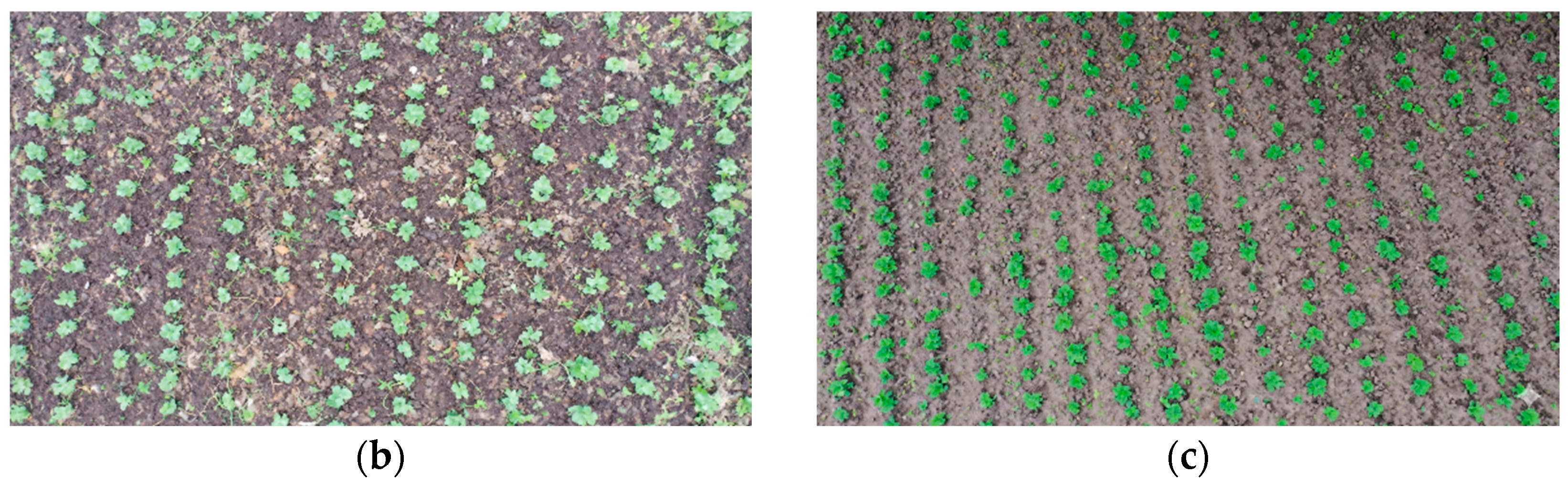
2.1. Data Collection
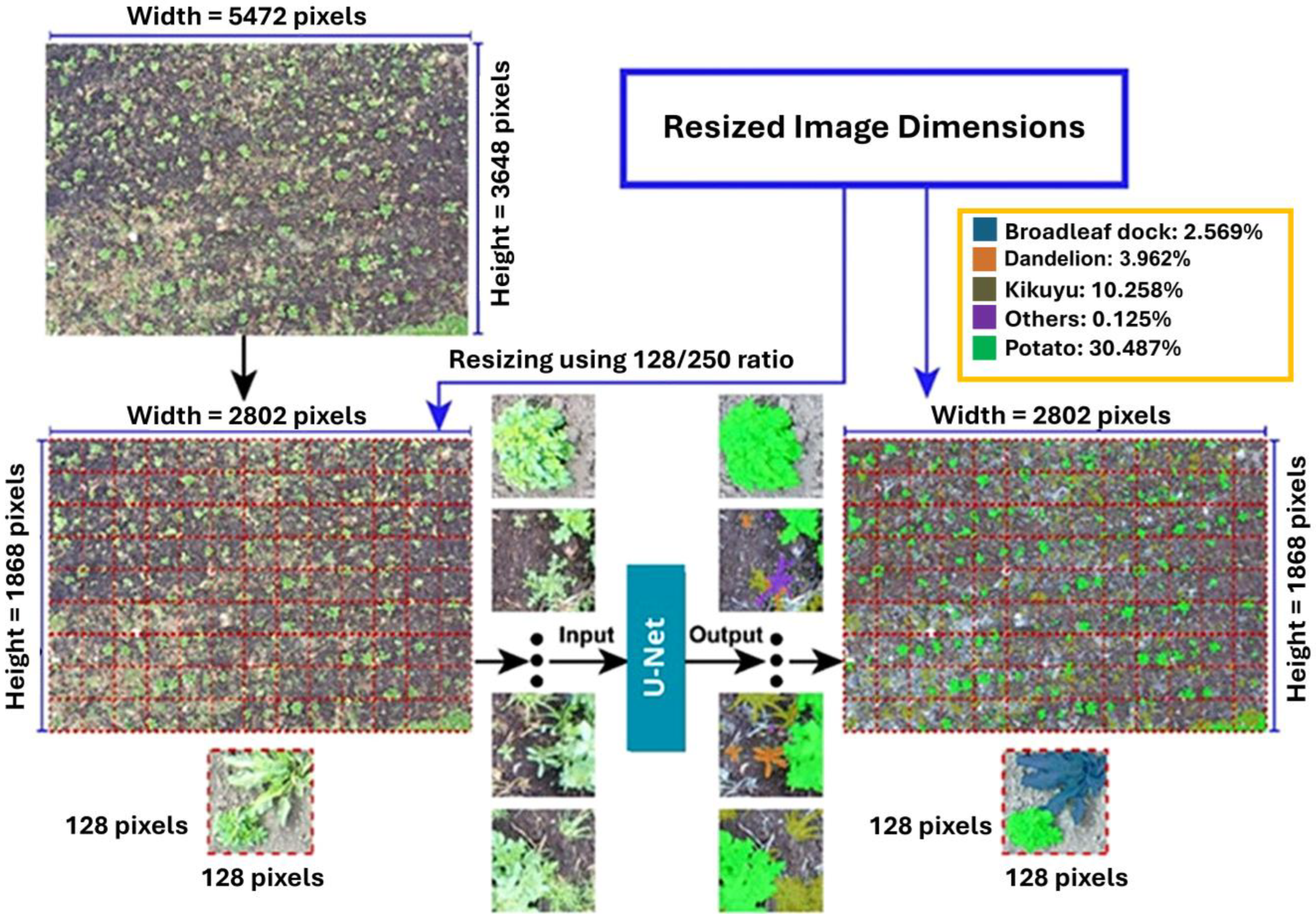
2.2. Data Selection, Preprocessing, and Transformation
2.3. Data Mining
2.3.1. The Deep Learning Algorithm (U-Net)
2.3.2. Training the U-Net Model
- Original U-Net [23]: The classic U-Net model was compiled with the Adam optimizer and the sparse categorical cross_entropy loss function, suitable for multi-class segmentation. EarlyStopping callback is implemented to stop training when validation loss has not improved for 10 consecutive epochs, and ReduceLROnPlateau callback to reduce the learning rate when validation accuracy stagnates. Training was performed for a maximum of 100 epochs with a batch size of 32, using the validation data to evaluate the model’s performance.
- Residual U-Net [71]: This variation incorporates residual blocks instead of plain convolutional blocks, which help mitigate the gradient degradation problem in deep networks. In residual blocks, the input is directly added to the output of the intermediate layers, which facilitates learning and improves prediction accuracy. The Residual U-Net model maintains the basic architecture of the U-Net but with skip connections in multiple layers. The total trained parameters were nearly 135 M, with a size of 515 MB.
- Double U-Net [72]: This variation combines two U-Net architectures stacked on top of each other, using a conventional U-Net with a Residual U-Net in a hybrid setup. The output of the U-Net is used as input for the Residual U-Net, which improves the propagation of semantic information across layers and enables more accurate segmentation. The total trained parameters were just over 116 M, with a size of 443 MB.
- Modified U-Net (MU-Net) [33]: This improved network introduces residual block (Resblock) and residual path (Respath) concepts into the U-Net. Resblocks are useful to overcome gradient disappearance and explosion problems, whereas Respaths improve the transformation of corresponding feature information between the contraction and expansion paths. Both are combined to increase the network depth, improving the network’s expression ability in complex image segmentation, such as that of diseased crop leaves. This architecture adapts the U-Net to work with 128 × 128 images, maintaining the integrity of spatial information through skip connections. The total number of trained parameters was just over 14 M, and the size was 54 MB.
- U-Net with attention modules and residual blocks (AU-Net): This custom variation, following the idea of [26,48], combines attention modules with Residual blocks, trying to achieve a more precise and efficient segmentation for detecting weeds in uncontrolled settings using UAV images. This architecture, like the original U-Net, is composed of two main parts: an encoder and a decoder, each with specific functions that enhance the learning capacity of the model. Attention modules (Attention Gate) allow the network to focus on the most relevant areas, such as weeds, and suppress irrelevant information, intending to improve segmentation and reduce false positives. Four Attention Gate (AG) modules are strategically placed in the decoder, in the skip connections, before merging them with the upstream layer, as shown in Appendix A. The AG1 module (16, 16, 512) works on an intermediate image representation with 16 × 16 pixels and 512 feature channels. Similarly, there are AG2 (32, 32, 256), AG3 (64, 64, 128), and AG4 (128, 128, 64). These attention modules are applied in the first, second, third, and fourth reconstruction layers (Conv2DTranspose → AttentionGate → Concatenate → ResidualBlock). Multiple AG modules with different spatial resolutions aim to improve segmentation by refining feature selection at various image scales.
2.4. Evaluation and Interpretation
3. Results
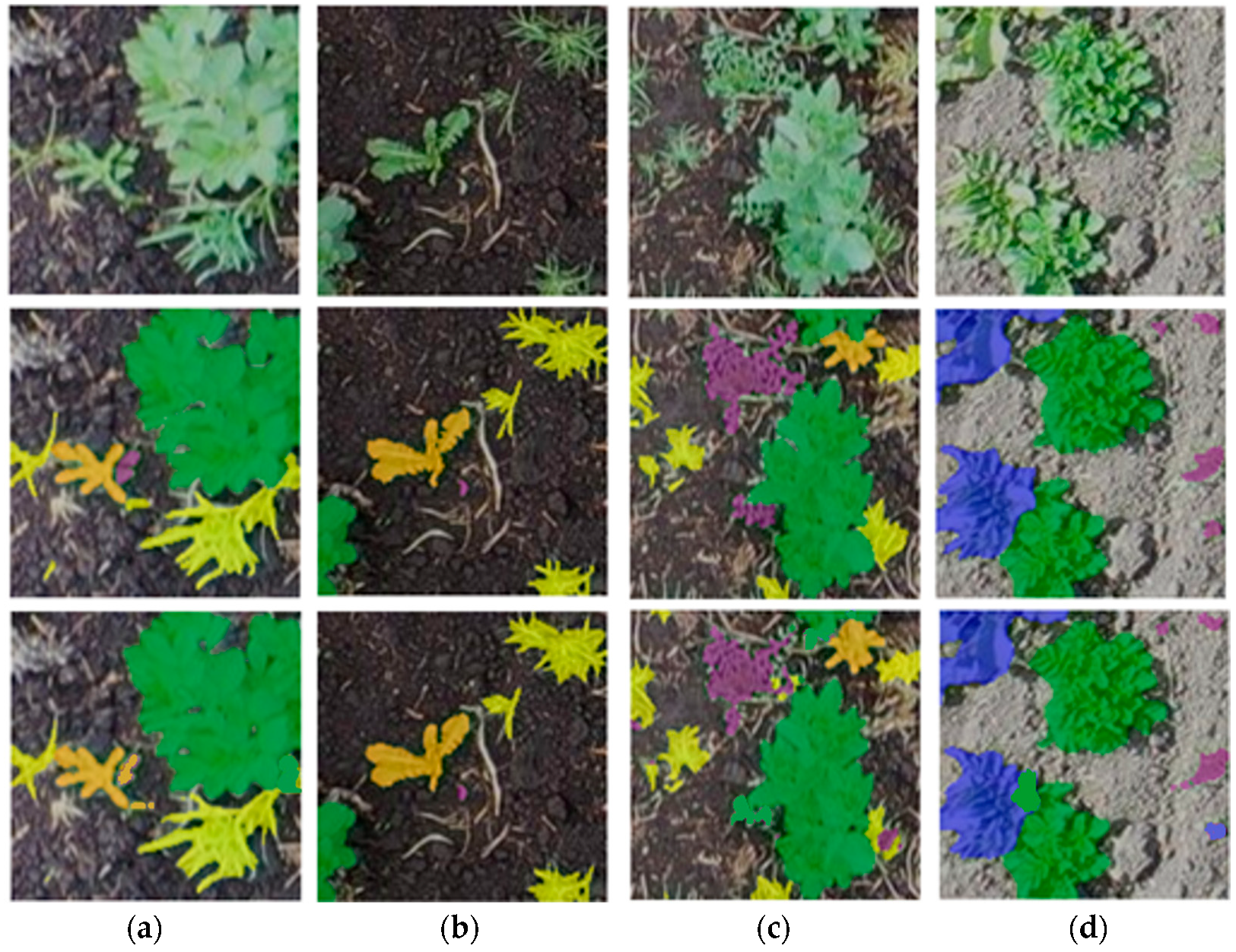
3.1. U-Net Performance Metrics
3.2. Statistical Validation of Model Predictions
4. Discussion
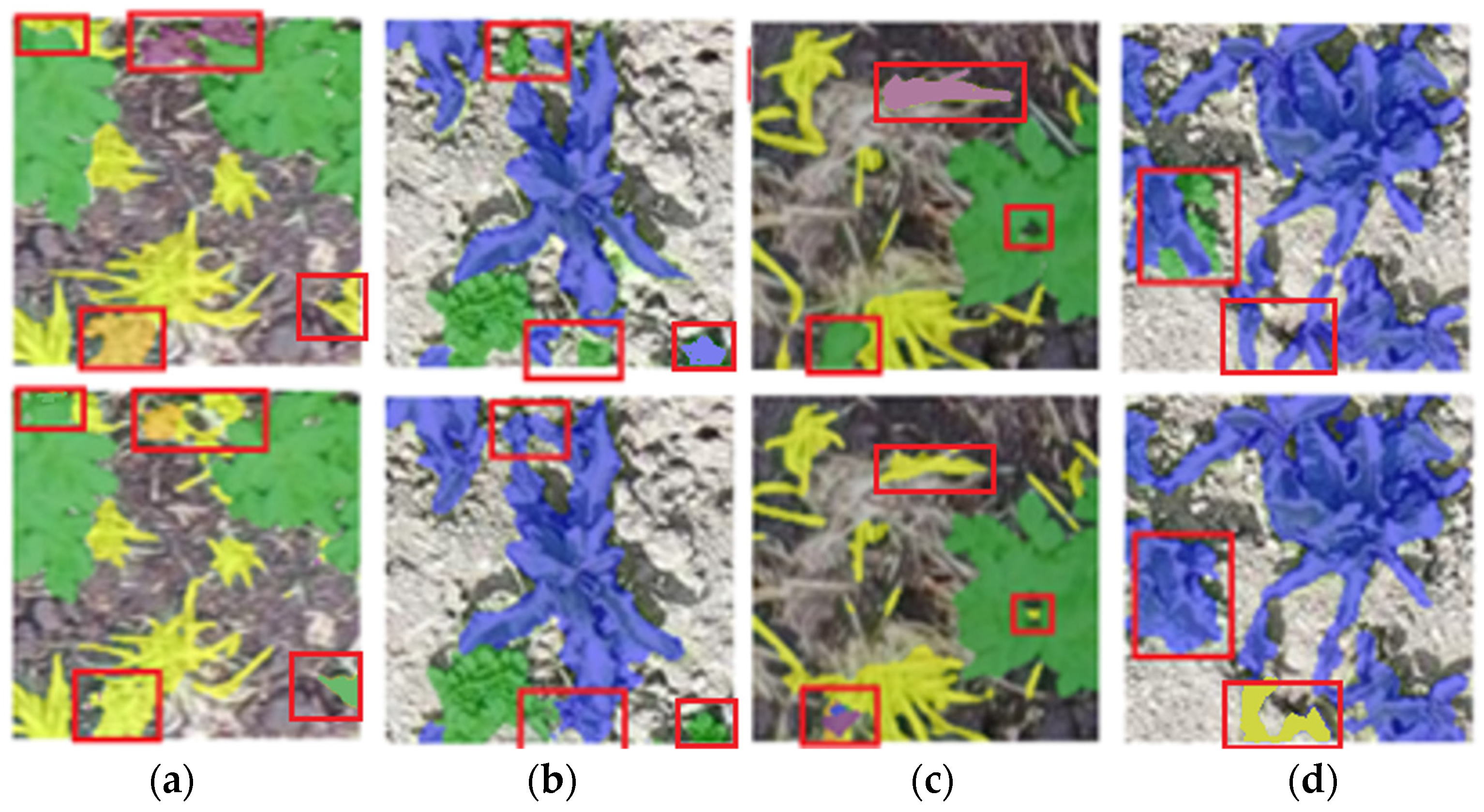
4.1. Segmentation Performance and Model Comparison
4.2. Generalization, Practical Implications, and Limitations
5. Conclusions
Author Contributions
Funding
Institutional Review Board Statement
Informed Consent Statement
Data Availability Statement
Acknowledgments
Conflicts of Interest
Appendix A

References
- FAO. Recommendations for Improved Weed Management; FAO: Rome, Italy, 2006; pp. 1–56. Available online: https://www.fao.org/4/a0884e/a0884e.pdf (accessed on 8 December 2025).
- Singh, S.; Rawal, S.; Dua, V.; Roy, S.; Sadaworthy, M.; Charkrabarti, S.; Sadawarti, M. Weed management in conventional and organic potato production. Int. J. Chem. Stud. 2018, 2, 24–38. [Google Scholar]
- Craine, J.M.; Dybzinski, R. Mechanisms of plant competition for nutrients, water and light. Funct. Ecol. 2013, 27, 833–840. [Google Scholar] [CrossRef]
- Pusdá-Chulde, M.R.; Salazar-Fierro, F.A.; Sandoval-Pillajo, L.; Herrera-Granda, E.P.; García-Santillán, I.D.; De Giusti, A. Image Analysis Based on Heterogeneous Architectures for Precision Agriculture: A Systematic Literature Review. Adv. Appl. Comput. Sci. Electron. Ind. Eng. 2020, 1078, 51–70. [Google Scholar] [CrossRef]
- Zimdahl, R.L. Weed Reproduction and Dispersal. In Fundamentals of Weed Science, 5th ed.; Academic Press: Cambridge, MA, USA, 2018; pp. 83–121. [Google Scholar] [CrossRef]
- Gao, J.; Liao, W.; Nuyttens, D.; Lootens, P.; Xue, W.; Alexandersson, E.; Pieters, J. Cross-domain transfer learning for weed segmentation and mapping in precision farming using ground and UAV images. Expert Syst. Appl. 2024, 246, 122980. [Google Scholar] [CrossRef]
- Jabed, M.A.; Azmi Murad, M.A. Crop yield prediction in agriculture: A comprehensive review of machine learning and deep learning approaches, with insights for future research and sustainability. Heliyon 2024, 10, e40836. [Google Scholar] [CrossRef]
- Coulibaly, S.; Kamsu-Foguem, B.; Kamissoko, D.; Traore, D. Deep Convolution Neural Network sharing for the multi-label images classification. Mach. Learn. Appl. 2022, 10, 100422. [Google Scholar] [CrossRef]
- Cevallos, M.; Sandoval-Pillajo, L.; Caranqui-Sánchez, V.; Ortega-Bustamante, C.; Pusdá-Chulde, M.; García-Santillán, I. Morphological Defects Classification in Coffee Beans Based on Convolutional Neural Networks. In Communications in Computer and Information Science; Springer: Cham, Switzerland, 2025; pp. 3–15. [Google Scholar] [CrossRef]
- Chacua, B.; Garcia, I.; Rosero, P.; Suarez, L.; Ramirez, I.; Simbana, Z.; Pusdá-Chulde, M. People Identification through Facial Recognition using Deep Learning. In Proceedings of the 2019 IEEE Latin American Conference on Computational Intelligence (LA-CCI), Guayaquil, Ecuador, 11–15 November 2019; IEEE: New York, NY, USA, 2019; pp. 1–6. [Google Scholar]
- Montenegro, S.; Pusdá-Chulde, M.; Caranqui-Sánchez, V.; Herrera-Tapia, J.; Ortega-Bustamante, C.; García-Santillán, I. Android Mobile Application for Cattle Body Condition Score Using Convolutional Neural Networks. In Communications in Computer and Information Science; Springer: Cham, Switzerland, 2023; pp. 91–105. [Google Scholar] [CrossRef]
- Salazar-Fierro, F.; Cumbal, C.; Trejo-España, D.; León-Fernández, C.; Pusdá-Chulde, M.; García-Santillán, I. Detection of Scoliosis in X-Ray Images Using a Convolutional Neural Network. In Communications in Computer and Information Science; Springer: Cham, Switzerland, 2025; pp. 167–183. [Google Scholar] [CrossRef]
- Ulloa, F.; Sandoval-Pillajo, L.; Landeta-López, P.; Granda-Peñafiel, N.; Pusdá-Chulde, M.; García-Santillán, I. Identification of Diabetic Retinopathy from Retinography Images Using a Convolutional Neural Network. In Communications in Computer and Information Science; Springer: Cham, Switzerland, 2025; pp. 121–136. [Google Scholar] [CrossRef]
- Guaichico, E.; Pusdá-Chulde, M.; Ortega-Bustamante, M.; Granda, P.; García-Santillán, I. Mobile app for real-time academic attendance registration based on MobileFaceNet Convolutional neural network. Data Metadata 2025, 4, 193. [Google Scholar] [CrossRef]
- Chamorro-Pinchao, A.; Pusdá-Chulde, M.; Trejo-España, D.; Caranqui-Sánchez, V.; García-Santillán, I. Binary classification of defects in multiple coffee beans using lightweight convolutional neural networks for embedded systems. Data Metadata 2025, 4, 840. [Google Scholar] [CrossRef]
- Valizadeh, M.; Wolff, S.J. Convolutional Neural Network applications in additive manufacturing: A review. Adv. Ind. Manuf. Eng. 2022, 4, 100072. [Google Scholar] [CrossRef]
- Espejo-Garcia, B.; Mylonas, N.; Athanasakos, L.; Fountas, S.; Vasilakoglou, I. Towards weeds identification assistance through transfer learning. Comput. Electron. Agric. 2020, 171, 105306. [Google Scholar] [CrossRef]
- McCool, C.; Perez, T.; Upcroft, B. Mixtures of Lightweight Deep Convolutional Neural Networks: Applied to Agricultural Robotics. IEEE Robot. Autom. Lett. 2017, 2, 1344–1351. [Google Scholar] [CrossRef]
- Vinueza, K.; Sandoval-Pillajo, L.; Giret-Boggino, A.; Trejo-España, D.; Pusdá-Chulde, M.; García-Santillán, I. Automatic weed quantification in potato crops based on a modified convolutional neural network using drone images. Data Metadata 2025, 4, 194. [Google Scholar] [CrossRef]
- Zhang, Y.; Cai, H.; Ye, J.; Pan, F.; Wu, S.; Zhang, B.; Qi, L.; Ma, R. Exploiting adversarial style for generalized and robust weed segmentation in rice paddy field. Front. Plant Sci. 2025, 16, 1703811. [Google Scholar] [CrossRef] [PubMed]
- Garibaldi-Márquez, F.; Flores, G.; Valentín-Coronado, L.M. Leveraging deep semantic segmentation for assisted weed detection. J. Agric. Eng. 2025, 56, 1741. [Google Scholar] [CrossRef]
- García-Santillán, I.D.; Pajares, G. On-line crop/weed discrimination through the Mahalanobis distance from images in maize fields. Biosyst. Eng. 2018, 166, 28–43. [Google Scholar] [CrossRef]
- Ronneberger, O.; Fischer, P.; Brox, T. U-Net: Convolutional Networks for Biomedical Image Segmentation. arXiv 2015. [Google Scholar] [CrossRef]
- Darbyshire, M.; Coutts, S.; Bosilj, P.; Sklar, E.; Parsons, S. Review of weed recognition: A global agriculture perspective. Comput. Electron. Agric. 2024, 227, 109499. [Google Scholar] [CrossRef]
- Rai, N.; Sun, X. WeedVision: A single-stage deep learning architecture to perform weed detection and segmentation using drone-acquired images. Comput. Electron. Agric. 2024, 219, 108792. [Google Scholar] [CrossRef]
- Amarasingam, N.; Kelly, J.E.; Sandino, J.; Hamilton, M.; Gonzalez, F.; Dehaan, R.L.; Zheng, L.; Cherry, H. Bitou bush detection and mapping using UAV-based multispectral and hyperspectral imagery and artificial intelligence. Remote Sens. Appl. Soc. Environ. 2024, 34, 101151. [Google Scholar] [CrossRef]
- Sandoval-Pillajo, L.; García-Santillán, I.; Pusdá-Chulde, M.; Giret, A. Weed detection based on deep learning from UAV imagery: A review. Smart Agric. Technol. 2025, 12, 101147. [Google Scholar] [CrossRef]
- Yuan, J.; Wang, L.; Wang, T.; Bashir, A.K.; Al Dabel, M.M.; Wang, J.; Feng, H.; Fang, K.; Wang, W. YOLOv8-RD: High-Robust Pine Wilt Disease Detection Method Based on Residual Fuzzy YOLOv8. IEEE J. Sel. Top. Appl. Earth Obs. Remote Sens. 2025, 18, 385–397. [Google Scholar] [CrossRef]
- Deng, B.; Lu, Y.; Xu, J. Weed database development: An updated survey of public weed datasets and cross-season weed detection adaptation. Ecol. Inform. 2024, 81, 102546. [Google Scholar] [CrossRef]
- Goyal, R.; Nath, A. Utkarsh Niranjan IndianPotatoWeeds: A Novel Dataset and its Role in Weed Detection and Management for Potato Crops. SN Comput. Sci. 2025, 6, 466. [Google Scholar] [CrossRef]
- Fayyad, U.; Piatetsky-Shapiro, G.; Smyth, P. From Data Mining to Knowledge Discovery in Databases. AI Mag. 1996, 17, 37. [Google Scholar] [CrossRef]
- Cui, J.; Tan, F.; Bai, N.; Fu, Y. Improving U-net network for semantic segmentation of corns and weeds during corn seedling stage in field. Front. Plant Sci. 2024, 15, 1344958. [Google Scholar] [CrossRef]
- Zhang, S.; Zhang, C. Modified U-Net for plant diseased leaf image segmentation. Comput. Electron. Agric. 2023, 204, 107511. [Google Scholar] [CrossRef]
- Zuo, Y.; Li, W. An Improved UNet Lightweight Network for Semantic Segmentation of Weed Images in Corn Fields. Comput. Mater. Contin. 2024, 79, 4413–4431. [Google Scholar] [CrossRef]
- Thiagarajan, S.; Vijayalakshmi, A.; Grace, G.H. Weed detection in precision agriculture: Leveraging encoder-decoder models for semantic segmentation. J. Ambient Intell. Humaniz. Comput. 2024, 15, 3547–3561. [Google Scholar] [CrossRef]
- Liao, J.; Chen, M.; Zhang, K.; Zhou, H.; Zou, Y.; Xiong, W.; Zhang, S.; Kuang, F.; Zhu, D. SC-Net: A new strip convolutional network model for rice seedling and weed segmentation in paddy field. Comput. Electron. Agric. 2024, 220, 108862. [Google Scholar] [CrossRef]
- Asuka, S.; Nakamura, T.; Shimizu, I.; Ookawa, T.; Nakajo, H. Ensemble Learning-Based Weed Detection from a Duck’s Perspective Using an Aquatic Drone in Rice Paddies. Appl. Sci. 2025, 15, 7440. [Google Scholar] [CrossRef]
- Li, Z.; Yan, Y.; Wei, M.; Ge, B.; Su, N. FGOD-YOLOv8: Fine-Grained Object Detection for Crops and Weeds. IEEE Signal Process. Lett. 2025, 32, 791–795. [Google Scholar] [CrossRef]
- Garibaldi-Márquez, F.; Flores, G.; Valentín-Coronado, L.M. Corn/Weed Plants Detection Under Authentic Fields based on Patching Segmentation and Classification Networks. Comput. Sist. 2024, 28, 271–282. [Google Scholar] [CrossRef]
- Garibaldi-Márquez, F.; Martínez-Barba, D.A.; Montañez-Franco, L.E.; Flores, G.; Valentín-Coronado, L.M. Enhancing site-specific weed detection using deep learning transformer architectures. Crop Prot. 2025, 190, 107075. [Google Scholar] [CrossRef]
- Ma, Z.; Wang, G.; Yao, J.; Huang, D.; Tan, H.; Jia, H.; Zou, Z. An Improved U-Net Model Based on Multi-Scale Input and Attention Mechanism: Application for Recognition of Chinese Cabbage and Weed. Sustain. Switz. 2023, 15., 5764. [Google Scholar] [CrossRef]
- Bretas, I.L.; Dubeux, J.C.B.; Zhao, C.; Queiroz, L.M.D.; Flynn, S.; Ingram, S.; Oduor, K.T.; Cruz, P.J.R.; Ruiz-Moreno, M.; Loures, D.R.S.; et al. Detection and mapping of Amaranthus spinosus L. in bermudagrass pastures using drone imagery and deep learning for a site-specific weed management. Agron. J. 2024, 116, 990–1002. [Google Scholar] [CrossRef]
- Kong, X.; Liu, T.; Chen, X.; Jin, X.; Li, A.; Yu, J. Efficient crop segmentation net and novel weed detection method. Eur. J. Agron. 2024, 161, 127367. [Google Scholar] [CrossRef]
- Machidon, A.L.; Krašovec, A.; Pejović, V.; Machidon, O.M. SqueezeSlimU-Net: An Adaptive and Efficient Segmentation Architecture for Real-Time UAV Weed Detection. IEEE J. Sel. Top. Appl. Earth Obs. Remote Sens. 2025, 18, 5749–5764. [Google Scholar] [CrossRef]
- Mei, X.; Li, C.; Jiao, Y.; Zhang, G.; Zhou, L.; Wu, X.; Cai, T. SSMR-Net and Across Feature Mapping Attention are jointly applied to the UAV imagery semantic segmentation task of weeds in early-stage wheat fields. Smart Agric. Technol. 2025, 12, 101077. [Google Scholar] [CrossRef]
- Jiang, H.; Chen, Q.; Wang, R.; Du, J.; Chen, T. SWFormer: A scale-wise hybrid CNN-Transformer network for multi-classes weed segmentation. J. King Saud Univ.—Comput. Inf. Sci. 2024, 36, 102144. [Google Scholar] [CrossRef]
- Guo, Z.; Cai, D.; Jin, Z.; Xu, T.; Yu, F. Research on unmanned aerial vehicle (UAV) rice field weed sensing image segmentation method based on CNN-transformer. Comput. Electron. Agric. 2025, 229, 109719. [Google Scholar] [CrossRef]
- Sulaiman, A.; Anand, V.; Gupta, S.; Rajab, A.; Alshahrani, H.; Al Reshan, M.S.; Shaikh, A.; Hamdi, M. Attention based UNet model for breast cancer segmentation using BUSI dataset. Sci. Rep. 2024, 14, 22422. [Google Scholar] [CrossRef]
- Kamilaris, A.; Prenafeta-Boldú, F.X. Deep learning in agriculture: A survey. Comput. Electron. Agric. 2018, 147, 70–90. [Google Scholar] [CrossRef]
- Valente, J.; Kooistra, L. Dataset on UAV High-Resolution Images from Grassland with Broad-Leaved Dock (Rumex Obtusifolius). [Data Set]. Zenodo. 2021. Available online: https://zenodo.org/records/5119205 (accessed on 25 February 2026).
- Dos Santos Ferreira, A. Data for: Weed Detection in Soybean Crops Using ConvNets. Comput. Electron. Agric. 2017, 143, 314–324. [Google Scholar] [CrossRef]
- Danilevicz, M.; Rocha, R.L.; Batley, J.; Bayer, P.E.; Bennamoun, M.; Edwards, D.; Ashworth, M. Segmentation of sandplain lupin weeds from morphologically similar narrow-leafed lupins in the field. Remote Sens. 2023, 15, 1817. [Google Scholar] [CrossRef]
- Imran Moazzam. Tobacco Aerial Dataset. [Data Set]. Mendeley Data. 2023. Available online: https://data.mendeley.com/datasets/5dpc5gbgpz/1 (accessed on 25 February 2026).
- Sa, I.; Popović, M.; Khanna, R.; Chen, Z.; Lottes, P.; Liebisch, F.; Nieto, J.; Stachniss, C.; Walter, A.; Siegwart, R. WeedMap: A Large-Scale Semantic Weed Mapping Framework Using Aerial Multispectral Imaging and Deep Neural Network for Precision Farming. Remote Sens. 2018, 10, 1423. [Google Scholar] [CrossRef]
- Koshelev, I.; Savinov, M.; Menshchikov, A.; Somov, A. Drone-Aided Detection of Weeds: Transfer Learning for Embedded Image Processing. IEEE J. Sel. Top. Appl. Earth Obs. Remote Sens. 2023, 16, 102–111. [Google Scholar] [CrossRef]
- Genze, N.; Ajekwe, R.; Güreli, Z.; Haselbeck, F.; Grieb, M.; Grimm, D.G. Deep learning-based early weed segmentation using motion blurred UAV images of sorghum fields. Comput. Electron. Agric. 2022, 202, 107388. [Google Scholar] [CrossRef]
- Huang, H.; Deng, J.; Lan, Y.; Yang, A.; Deng, X.; Zhang, L. A Fully Convolutional Network for weed mapping of Unmanned Aerial Vehicle (UAV) Imagery. PLoS ONE 2018, 13, e0196302. [Google Scholar] [CrossRef]
- Krestenitis, M.; Raptis, E.K.; Kapoutsis, A.C.; Ioannidis, K.; Kosmatopoulos, E.B.; Vrochidis, S.; Kompatsiaris, I. CoFly-WeedDB: A UAV image dataset for weed detection and species identification. Data Brief 2022, 45, 108575. [Google Scholar] [CrossRef]
- Rai, N.; Villamil Mahecha, M.; Christensen, A.; Quanbeck, J.; Howatt, K.; Ostlie, M.; Zhang, Y.; Sun, X. ImageWeeds: An Image Dataset Consisting of Weeds in Multiple Formats to Advance Computer Vision Algorithms for Real-Time Weed Identification and Spot Spraying Application. 2023. Available online: https://data.mendeley.com/datasets/8kjcztbjz2/2 (accessed on 25 February 2026).
- Yang, M.-D.; Tseng, H.-H.; Hsu, Y.-C.; Yang, C.-Y.; Lai, M.-H.; Wu, D.-H. A UAV Open Dataset of Rice Paddies for Deep Learning Practice. Remote Sens. 2021, 13, 1358. [Google Scholar] [CrossRef]
- Machidon, O.M.; Krašovec, A.; Machidon, A.L.; Pejović, V.; Latini, D.; Sasidharan, S.T.; Del Frate, F. AgriAdapt: Towards Resource-Efficient UAV Weed Detection using Adaptable Deep Learning. In Proceedings of the 2nd Workshop on Networked Sensing Systems for a Sustainable Society, Madrid, Spain, 6 October 2023; ACM: New York, NY, USA, 2023; pp. 193–200. [Google Scholar]
- Tian, F.; Ransom, C.J.; Zhou, J.; Wilson, B.; Sudduth, K.A. Assessing the impact of soil and field conditions on cotton crop emergence using UAV-based imagery. Comput. Electron. Agric. 2024, 218, 108738. [Google Scholar] [CrossRef]
- Anderegg, J.; Tschurr, F.; Kirchgessner, N.; Treier, S.; Schmucki, M.; Streit, B.; Walter, A. On-farm evaluation of UAV-based aerial imagery for season-long weed monitoring under contrasting management and pedoclimatic conditions in wheat. Comput. Electron. Agric. 2023, 204, 107558. [Google Scholar] [CrossRef]
- Wang, Q.; Cheng, M.; Xiao, X.; Yuan, H.; Zhu, J.; Fan, C.; Zhang, J. An image segmentation method based on deep learning for damage assessment of the invasive weed Solanum rostratum Dunal. Comput. Electron. Agric. 2021, 188, 106320. [Google Scholar] [CrossRef]
- Pertuz, S.; Puig, D.; Garcia, M.A. Analysis of focus measure operators for shape-from-focus. Pattern Recognit. 2013, 46, 1415–1432. [Google Scholar] [CrossRef]
- Sarvini, T.; Sneha, T.; Sukanya Gowthami, G.; Sushmitha, S.; Kumaraswamy, R. Performance Comparison of Weed Detection Algorithms. In Proceedings of the 2019 International Conference on Communication and Signal Processing (ICCSP), Chennai, India, 4–6 April 2019; IEEE: New York, NY, USA, 2019; pp. 0843–0847. [Google Scholar]
- Roboflow Docs Create a Project|Roboflow Docs. Available online: https://docs.roboflow.com/datasets/create-a-project (accessed on 28 January 2024).
- Wang, J.; Hadjikakou, M.; Hewitt, R.J.; Bryan, B.A. Simulating large-scale urban land-use patterns and dynamics using the U-Net deep learning architecture. Comput. Environ. Urban Syst. 2022, 97, 101855. [Google Scholar] [CrossRef]
- Çiçek, Ö.; Abdulkadir, A.; Lienkamp, S.S.; Brox, T.; Ronneberger, O. 3D U-Net: Learning Dense Volumetric Segmentation from Sparse Annotation. arXiv 2016. [Google Scholar] [CrossRef]
- Tene-Hurtado, D.; Almeida-Galárraga, D.A.; Villalba-Meneses, G.; Alvarado-Cando, O.; Cadena-Morejón, C.; Salazar, V.H. Brain Tumor Segmentation Based on 2D U-Net Using MRI Multi-modalities Brain Images. In Smart Technologies, Systems and Applications (SmartTech-IC 2021); Narváez, F.R., Proaño, J., Morillo, P., Vallejo, D., González Montoya, D., Díaz, G.M., Eds.; Springer International Publishing: Cham, Switzerland, 2022; pp. 345–359. [Google Scholar]
- Zhang, Z.; Liu, Q.; Wang, Y. Road Extraction by Deep Residual U-Net. IEEE Geosci. Remote Sens. Lett. 2018, 15, 749–753. [Google Scholar] [CrossRef]
- Jha, D.; Riegler, M.A.; Johansen, D.; Halvorsen, P.; Johansen, H.D. DoubleU-Net: A Deep Convolutional Neural Network for Medical Image Segmentation. In Proceedings of the 2020 IEEE 33rd International Symposium on Computer-Based Medical Systems (CBMS), Rochester, MN, USA, 28–30 July 2020; IEEE: New York, NY, USA, 2020; pp. 558–564. [Google Scholar]
- Celikkan, E.; Saberioon, M.; Herold, M.; Klein, N. Semantic Segmentation of Crops and Weeds with Probabilistic Modeling and Uncertainty Quantification. In Proceedings of the 2023 IEEE/CVF International Conference on Computer Vision Workshops (ICCVW), Paris, France, 2–6 October 2023; IEEE: New York, NY, USA, 2023; pp. 582–592. [Google Scholar]
- Ullah, H.S.; Asad, M.H.; Bais, A. End to End Segmentation of Canola Field Images Using Dilated U-Net. IEEE Access 2021, 9, 59741–59753. [Google Scholar] [CrossRef]
- Garcia, V.; De Jesus Ochoa Dominguez, H.; Mederos, B. Analysis of Discrepancy Metrics Used in Medical Image Segmentation. IEEE Lat. Am. Trans. 2015, 13, 235–240. [Google Scholar] [CrossRef]
- Müller, D.; Soto-Rey, I.; Kramer, F. Towards a guideline for evaluation metrics in medical image segmentation. BMC Res. Notes 2022, 15, 210. [Google Scholar] [CrossRef]
- Zou, K.; Chen, X.; Zhang, F.; Zhou, H.; Zhang, C. A Field Weed Density Evaluation Method Based on UAV Imaging and Modified U-Net. Remote Sens. 2021, 13, 310. [Google Scholar] [CrossRef]
- Lind, D.A.; Marchal, W.G.; Wathen, S.A. Basic Statistics in Business and Economics, 10th ed.; McGraw Hill: New York, NY, USA, 2022. [Google Scholar]
- Juma, A.; Rodríguez, J.; Caraguay, J.; Naranjo, M.; Quiña-Mera, A.; García-Santillán, I. Integration and Evaluation of Social Networks in Virtual Learning Environments: A Case Study. In Communications in Computer and Information Science; Springer: Cham, Switzerland, 2019; pp. 245–258. [Google Scholar] [CrossRef]
- Krizhevsky, A.; Sutskever, I.; Hinton, G.E. ImageNet Classification with Deep Convolutional Neural Networks. In Advances in Neural Information Processing Systems 25 (NIPS 2012): 26th Annual Conference on Neural Information Processing Systems 2012; Morgan Kaufmann Publishers, Inc.: Burlington, MA, USA, 2012. [Google Scholar]
- Cai, Y.; Zeng, F.; Xiao, J.; Ai, W.; Kang, G.; Lin, Y.; Cai, Z.; Shi, H.; Zhong, S.; Yue, X. Attention-aided semantic segmentation network for weed identification in pineapple field. Comput. Electron. Agric. 2023, 210, 107881. [Google Scholar] [CrossRef]
- Nong, C.; Fan, X.; Wang, J. Semi-supervised Learning for Weed and Crop Segmentation Using UAV Imagery. Front. Plant Sci. 2022, 13, 927368. [Google Scholar] [CrossRef]
- Shahi, T.B.; Dahal, S.; Sitaula, C.; Neupane, A.; Guo, W. Deep Learning-Based Weed Detection Using UAV Images: A Comparative Study. Drones 2023, 7, 624. [Google Scholar] [CrossRef]
- Sapkota, R.; Stenger, J.; Ostlie, M.; Flores, P. Towards reducing chemical usage for weed control in agriculture using UAS imagery analysis and computer vision techniques. Sci. Rep. 2023, 13, 6548. [Google Scholar] [CrossRef]
- Garcia-Garcia, A.; Orts-Escolano, S.; Oprea, S.; Villena-Martinez, V.; Garcia-Rodriguez, J. A Review on Deep Learning Techniques Applied to Semantic Segmentation. arXiv 2017. [Google Scholar] [CrossRef]




| Type of Plant | Number of Plants | % |
|---|---|---|
| Broadleaf dock | 1334 | 16.44% |
| Dandelion | 1448 | 17.84% |
| Kikuyu | 1838 | 22.63% |
| Other weeds | 1661 | 20.46% |
| Potato (crop) | 1838 | 22.63% |
| TOTAL | 8119 | 100% |
| Hiperparameter | Original U-Net | Residual U-Net | Double U-Net | Modified U-Net | AU-Net |
|---|---|---|---|---|---|
| Input size | 128 × 128 × 3 | 128 × 128 × 3 | 128 × 128 × 3 | 128 × 128 × 3 | 128 × 128 × 3 |
| Optimizer | Adam (learning rate = 0.001) | Adam (learning rate = 0.001) | Adam (learning rate = 0.001) | Adam (learning rate = 0.001) | Adam (learning rate = 0.001) |
| Loss function | Sparse Categorical Cross-entropy | Sparse Categorical Cross-entropy | Sparse Categorical Cross-entropy | Sparse Categorical Cross-entropy | Sparse Categorical Cross-entropy |
| Batch size | 32 | 16 | 32 | 32 | 32 |
| Epochs | 100 | 100 | 100 | 100 | 100 |
| Callback | EarlyStopping ReduceLROnPlateau | EarlyStopping ReduceLROnPlateau | EarlyStopping ReduceLROnPlateau | ReduceLROnPlateau | ReduceLROnPlateau |
| Model | Dice Loss | Mean Dice Coefficient | Mean IoU |
|---|---|---|---|
| Original U-Net | 0.2424 | 0.7576 | 0.6542 |
| Double U-Net | 0.2470 | 0.7529 | 0.6488 |
| MU-Net | 0.2235 | 0.7764 | 0.6790 |
| AU-Net | 0.3352 | 0.6647 | 0.6150 |
| Residual U-Net (unbalanced original dataset) | 0.1765 | 0.8235 | 0.7755 |
| Residual U-Net (balanced extended dataset) | 0.1236 | 0.8763 | 0.8053 |
| Model | Background IoU | Broadleaf Dock IoU | Dandelion IoU | Kikuyu IoU | Other Weeds IoU | Potato IoU | Mean IoU |
|---|---|---|---|---|---|---|---|
| Residual U-Net | 0.9721 | 0.7984 | 0.7409 | 0.7730 | 0.5907 | 0.9376 | 0.8021 |
| Class | p-Value | Significance |
|---|---|---|
| Broadleaf dock | 0.053 | No |
| Dandelion | 0.392 | No |
| Kikuyu | 0.004 | Yes |
| Other weeds | 0.363 | No |
| Potato crops | 0.970 | No |
| Background | 0.001 | Yes |
| Authors | Year | Model Architecture | Crop | Weed Species | Number of Classes | Mean IoU | Overall ACC (%) |
|---|---|---|---|---|---|---|---|
| Amarasingam et al. [26] | 2023 | U-Net | - | Bitou bush | 3 | 0.7320 | 92 |
| Kong et al. [43] | 2024 | ECSNet | Corn | Generic weeds | 2 | 0.909 | 90.2 |
| Bretas et al. [42] | 2024 | U-Net | Grass pastures | Amaranthus spinosus L. | 2 | - | 94 |
| Gao et al. [6] | 2024 | Similar to U-Net | Maize | Generic weeds | 3 | 0.617 | 73.4 |
| Vinueza et al. [19] | 2025 | Modified ResNeXt50 | Potato | Broadleaf dock, Dandelion, Kikuyu, other weeds | 6 | 0.7350 | 75.5 |
| Machidon et al. [44] | 2025 | SSU-Net | Lettuce and Tobacco | Generic weeds | 3 | 0.5828 | 90.47 |
| Asuka et al. [37] | 2025 | U-Net++ | Rice | Generic weeds | 2 | 0.7060 | 97.1 |
| Mei et al. [45] | 2025 | SSMR-Net | Wheat | Generic weeds | 3 | 0.865 | - |
| Guo et al. [47] | 2025 | CTFFNet | Rice | Barnyard grass, Sagittaria trifolia | 3 | 0.728 | - |
| Our work | 2026 | Residual U-Net | Potato | Broadleaf dock, Dandelion, Kikuyu, other weeds | 6 | 0.8021 | 82.4 |
Disclaimer/Publisher’s Note: The statements, opinions and data contained in all publications are solely those of the individual author(s) and contributor(s) and not of MDPI and/or the editor(s). MDPI and/or the editor(s) disclaim responsibility for any injury to people or property resulting from any ideas, methods, instructions or products referred to in the content. |
© 2026 by the authors. Licensee MDPI, Basel, Switzerland. This article is an open access article distributed under the terms and conditions of the Creative Commons Attribution (CC BY) license.
Share and Cite
Sandoval-Pillajo, L.; Pusdá-Chulde, M.; Pazos-Morillo, J.; Granda-Gudiño, P.; García-Santillán, I. Multi-Class Weed Quantification Based on U-Net Convolutional Neural Networks Using UAV Imagery. Appl. Sci. 2026, 16, 3149. https://doi.org/10.3390/app16073149
Sandoval-Pillajo L, Pusdá-Chulde M, Pazos-Morillo J, Granda-Gudiño P, García-Santillán I. Multi-Class Weed Quantification Based on U-Net Convolutional Neural Networks Using UAV Imagery. Applied Sciences. 2026; 16(7):3149. https://doi.org/10.3390/app16073149
Chicago/Turabian StyleSandoval-Pillajo, Lucía, Marco Pusdá-Chulde, Jorge Pazos-Morillo, Pedro Granda-Gudiño, and Iván García-Santillán. 2026. "Multi-Class Weed Quantification Based on U-Net Convolutional Neural Networks Using UAV Imagery" Applied Sciences 16, no. 7: 3149. https://doi.org/10.3390/app16073149
APA StyleSandoval-Pillajo, L., Pusdá-Chulde, M., Pazos-Morillo, J., Granda-Gudiño, P., & García-Santillán, I. (2026). Multi-Class Weed Quantification Based on U-Net Convolutional Neural Networks Using UAV Imagery. Applied Sciences, 16(7), 3149. https://doi.org/10.3390/app16073149