Article

Multi-Class Weed Quantification Based on U-Net Convolutional Neural Networks Using UAV Imagery

by
Lucía Sandoval-Pillajo
1,2,
Marco Pusdá-Chulde
2,
Jorge Pazos-Morillo
2,
Pedro Granda-Gudiño
2 and
Iván García-Santillán
2,*
1
Departamento de Sistemas Informáticos y Computación, Universitat Politècnica de València, 46022 Valencia, Spain
2
Universidad Técnica del Norte, Ibarra 100150, Ecuador
*
Author to whom correspondence should be addressed.
Appl. Sci. 2026, 16(7), 3149; https://doi.org/10.3390/app16073149
Submission received: 12 December 2025 / Revised: 25 February 2026 / Accepted: 27 February 2026 / Published: 25 March 2026
(This article belongs to the Collection Agriculture 4.0: From Precision Agriculture to Smart Agriculture)

Abstract

Weed identification and quantification are processes that are usually manual, subjective, and error-prone. Weeds compete with crops for nutrients, minerals, physical space, sunlight, and water. Thus, weed identification is a crucial component of precision agriculture for autonomous removal and site-specific treatments, efficient weed control, and sustainability. Convolutional Neural Networks (CNNs) are very common in weed identification. This work implemented CNN models for semantic segmentation based on the U-Net architecture for automatically segmenting and quantifying weeds in potato crops using RGB images acquired by a drone at 9–10 m height, flying at 1 m/s. Remote sensing images are affected by factors that degrade image quality and the model’s accuracy. Five U-Net variants were evaluated: the original U-Net, Residual U-Net, Double U-Net, Modified U-Net, and AU-Net. The models were trained using the TensorFlow/Keras frameworks on Google Colab Pro+, following the Knowledge Discovery in Databases (KDD) methodology for image analysis. Each model was trained using a diverse custom dataset in uncontrolled environments, considering six classes: background, Broadleaf dock (Rumex obtusifolius), Dandelion (Taraxacum officinale), Kikuyu grass (Cenchrus clandestinum), other weed species, and the crop potato (Solanum tuberosum L.). The models’ segmentation was widely assessed using Mean Dice Coefficient, Mean IoU, and Dice Loss metrics. The results showed that the Residual U-Net model performed the best in multi-class segmentation, achieving a Mean IoU of 0.8021, a performance comparable to or superior to that reported by other authors. Additionally, a Student’s t-test was applied to complement the data analysis, suggesting that the model is reliable for weed quantification.

1. Introduction

1.1. Problem Statement

According to the Food and Agriculture Organization of the United Nations (FAO), unwanted plants, also known as weeds, represent one of the greatest challenges to agricultural production worldwide because they cause economic and social damage to farmers. The damage caused can range from 5% to 10% of production in developed countries and up to 30% in developing countries [1].
Weed identification is a crucial component of precision agriculture for autonomous removal, site-specific treatments, and efficient weed control. Accurate segmentation and mapping of weed spatial distribution are critical for successful farming, efficient agricultural resource management, and contributing to agricultural sustainability. The presence of weeds significantly threatens crop yield and harvest quality [2], as weeds compete for soil resources such as nutrients and water, affecting the normal growth and development of desired plants [3,4]. This problem in crops ranges from low production to economic losses and environmental deterioration of the land.
It is estimated that manual weed identification can lead to significant errors in quantification, resulting in ineffective and untimely decisions in weed control and herbicide use. Visual inspection can be subjective and subject to human error, resulting in inaccurate quantification of weed infestation [5]. Furthermore, this approach can be laborious, inefficient, and error-prone. It consumes a great deal of time and labor and incurs additional costs for farmers since it requires a thorough inspection of the fields by these agricultural experts.
Precision agriculture (PA) uses technological tools to improve methods of combating weeds [6]. One approach used for weed identification is deep learning [7], which has emerged as a promising candidate, as its algorithms allow the automatic extraction of features from large amounts of data [8]. Before the adoption of deep learning, early approaches to weed detection relied on classical image processing techniques, such as edge detection, color thresholding, texture analysis, and vegetation indices (e.g., NDVI), to distinguish crops from weeds. These methods represented a first step toward automated weed identification and provided valuable insights into spectral and spatial characteristics of vegetation, paving the way for the development of learning-based approaches such as Convolutional Neural Networks (CNNs).
CNNs have become increasingly popular in recent years across various application contexts [9,10,11,12,13,14,15], thanks to current hardware that enables the efficient implementation of these algorithms [8,16]. CNNs have proven to offer good results concerning semantic segmentation and weed identification [4,17,18,19,20]. Semantic segmentation aims to categorize each pixel in an image into a specific class (e.g., crop, weeds, soil), producing a segmentation map of the plant within the input image [21]. The identification task is challenging since the plants (crops and weeds) share similar physical characteristics, the plants overlap, and certain outdoor environmental conditions influence them [22]. Detecting multiple specific weed types instead of a single generic class is crucial for precision agricultural management. Different weeds require differentiated control strategies and efficient treatments, avoiding excessive herbicide application and collateral damage to soil biodiversity and human health.
The aim is to adopt the U-net CNN [23] for multi-class semantic segmentation to identify and quantify four categories of weeds: Broadleaf dock (Rumex obtusifolius), Dandelion (Taraxacum officinale), Kikuyu grass (Cenchrus clandestinum), and other unidentified plant classes in potato crop fields (Solanum tuberosum L.). Potato cultivation was selected because it is an icon in the northern area of Ecuador, where this research is carried out. Additionally, there are very few studies on this crop’s weed recognition, i.e., it is under-researched [24]. The categories of weeds treated are the most prevalent ones observed in the region. Five versions of the U-Net algorithm are tested, with modifications to the architecture, trying to make it more specialized and robust for weed image segmentation. The model variations were Original U-Net, Residual U-Net, Double U-Net, Modified U-Net, and AU-Net with attention module and residual blocks (a custom proposal), which have been widely used in medicine and are detailed below. The U-Net algorithm was selected for experimentation because it is one of the most preferred architectures for weed segmentation tasks, mostly on drone-acquired images, with high accuracy [25]. Likewise, it is important to note that the U-Net model and the results presented in existing studies cannot be broadly applied to other sites with similar results [26]; therefore, it is necessary to evaluate it in our region and context.
This adoption and experimentation of network variants to the quantification task of weed types (multi-class problem) in uncontrolled environments (lighting, weather, camera movements, plant morphology, etc.) using a custom annotated dataset represents an important contribution to the field of study in our agricultural region for precise weed control in changing field conditions. Potato ridges introduce strong three-dimensional structure, severe leaf overlap, variable soil exposure, and frequent occlusions, all of which create heterogeneous backgrounds and complex weed–crop boundaries. Such visual complexity, structural variability, and occlusion significantly reduce class separability [27]. Uncontrolled environments pose major challenges for deep learning, as models must be robust, adaptable, and able to generalize to unpredictable conditions without manual tuning, unlike in more controlled environments, such as medicine, where images generally come from standardized equipment.
UAV-based imagery for weed detection is affected by multiple sources of variability that degrade image quality and segmentation accuracy, including illumination changes, atmospheric effects, camera motion, and crop structure [28]. In addition, the lack of representative public datasets for certain crops, such as potato [29], and the limited availability of annotated data for native weed species restrict model generalization and reproducibility [30]. Furthermore, structured methodological frameworks are required to manage the entire data analysis process, from acquisition to validation, ensuring consistency and reliability in real agricultural scenarios [31]. These challenges highlight the need for robust segmentation approaches capable of handling real field variability rather than controlled experimental settings.
To support reproducibility and future research, this study releases a publicly available UAV-based dataset for multi-class weed segmentation in potato crops, including annotated masks for native weed species. The dataset is accessible through a public GitHub repository, enabling comparative evaluation and reuse by the research community. This contribution addresses the current lack of open datasets for potato crops and underrepresented weed species in UAV-based precision agriculture studies.
The remaining structure of the manuscript is as follows. Section 1.2 presents engineering contributions and technical highlights. Section 1.3 analyses related work and literature gaps. Section 2 indicates the methodology, dataset, and software used in developing this study for quantifying weeds. Section 3 shows the main results and statistical tests obtained in this proposal. Section 4 considers a discussion with other related studies, and finally, the conclusions and future work are presented in Section 5.

1.2. Engineering Contributions and Technical Highlights

This work presents an engineering-oriented contribution focused on the adaptation, evaluation, and validation of deep learning models for multi-class weed quantification in potato crops using UAV imagery under uncontrolled field conditions. Unlike studies that propose novel architectures, the contribution lies in the systematic design of the experimental pipeline, including dataset construction, model adaptation, training strategy, and validation protocol.
The technical highlights of this study are summarized as follows:
  • Construction of an extended UAV-based dataset with six semantic classes, including native weed species that are not present in existing public datasets. The number of annotated samples increases significantly and incorporates additional fields, growth stages, and weed instances.
  • Patch-based training strategy designed to mitigate class imbalance and preserve spatial details in UAV imagery.
  • Comparative evaluation of five U-Net variants under identical conditions, enabling a fair engineering assessment of architectural trade-offs.
  • Integration of semantic segmentation metrics with statistical validation (Student’s t-test and correlation analysis) to assess the practical reliability of weed quantification.
  • Release of a reproducible and transferable workflow for precision agriculture applications.

1.3. Related Work and Research Gaps

Below, we summarize some relevant studies classified into thematic subsections that served as a theoretical basis and for comparison purposes. For each category, we added a comparative and critical discussion highlighting methodological limitations, dataset constraints, and gaps in current approaches.

1.3.1. Ground-Based Weed Segmentation Approaches

Early studies on weed identification and segmentation primarily relied on ground-based image acquisition systems, using handheld cameras, mobile devices, or fixed platforms mounted close to the soil surface. These approaches provide high-resolution imagery and controlled viewpoints but suffer from limited scalability and operational efficiency in real agricultural scenarios.
Several works have successfully applied U-Net and encoder–decoder architectures to ground-level images for weed segmentation. For instance, Cui et al. [32], Zhang and Zhang [33], Zuo and Li [34], and Thiagarajan et al. [35] demonstrated high segmentation accuracy in maize and bean crops using CNN-based models. Liao et al. [36] and Asuka et al. [37] segmented rice weeds and seedlings, whereas Li and Yan [38] dealt with small objects in different crops and weeds. Similarly, Garibaldi et al. [21,39,40] and Ma et al. [41] evaluated both CNN and Transformer architectures for weed–crop segmentation under natural corn field conditions. Despite their strong performance, these approaches require close-range data acquisition, which is time-consuming, labor-intensive, and impractical for large-scale monitoring.
Moreover, ground-based systems are highly sensitive to viewpoint changes, occlusions, and variations in plant morphology, which limits their generalization to heterogeneous field conditions. These limitations have motivated the adoption of UAV platforms for weed detection, enabling rapid and large-area crop monitoring.

1.3.2. UAV-Based Weed Segmentation Using CNN and U-Net Variants

UAV imagery has become a key enabler of precision agriculture, allowing large-scale weed mapping with high spatial resolution. Several studies have applied CNN-based models, particularly U-Net and its variants, to UAV-acquired images for semantic segmentation.
Gao et al. [6], Bretas et al. [42], and Amarasingam et al. [26] demonstrated the feasibility of U-Net-based models for weed detection using RGB and multispectral UAV images. Kong et al. [43] optimized a model based on the YOLOv5s architecture for weed segmentation in corn fields. More recent works, such as Machidon et al. [44] and Mei et al. [45], proposed lightweight and efficient U-Net variants optimized for real-time or resource-constrained UAV applications. These models achieved promising results while reducing computational cost and energy consumption.
However, most UAV-based studies address binary segmentation problems (weed vs. background) or at most three classes (crop, weed, soil). Only a limited number of works consider multiple weed species, and even fewer address complex crop structures such as potato ridges, which introduce severe occlusions, background heterogeneity, and overlapping vegetation. Additionally, many models are trained and evaluated on relatively small or homogeneous datasets, limiting their robustness in uncontrolled field conditions.

1.3.3. Transformer and Hybrid Architectures for Weed Segmentation

Recently, Transformer-based and hybrid CNN–Transformer models have been explored to capture global contextual relationships in complex agricultural scenes. Jiang et al. [46] introduced SWFormer, a hybrid architecture combining CNNs and Transformers for multi-class weed segmentation, while Guo et al. [47] proposed CTFFNet for rice fields using UAV imagery. In another context, Sumailan et al. [48] identified breast cancer in ultrasound images using an Attention-driven U-Net model. These models demonstrated improved feature representation and robustness to complex backgrounds.
Nevertheless, Transformer-based models typically involve high computational complexity, large memory requirements, and longer inference times, which hinder their practical deployment in UAV-based agricultural systems. Moreover, most Transformer-based studies rely on ground-based imagery or limited UAV datasets and do not address multi-species weed segmentation in crops with high structural variability, such as potato fields. Various approaches are widely observed using CNNs and, rarely, Transformers to segment weeds in agricultural fields [49].

1.3.4. Public Datasets and Limitations for Potato Weed Segmentation

The availability of public datasets is a critical factor for reproducibility and model comparison. Several UAV-based datasets have been published for crops such as soybean, maize, rice, wheat, lettuce, and sugar beet [48,50,51,52,53,54,55,56,57,58,59,60,61]. However, no publicly available dataset currently focuses on potato crops acquired by UAVs under real field conditions.
Furthermore, existing datasets rarely include native weed species such as Broadleaf dock, Dandelion, and Kikuyu, which are prevalent in Andean agricultural regions. This lack of representative data significantly limits model generalization across geographical regions, seasons, and crop types. Distributional shifts caused by differences in lighting, soil conditions, plant morphology, and growth stages further exacerbate this problem [6,42].

1.3.5. Identified Research Gaps

From the literature analysis, several gaps remain unaddressed:
  • Most UAV-based weed segmentation studies focus on binary or low-class problems, neglecting multi-species weed discrimination.
  • There is a lack of studies targeting potato crops, which present unique structural and visual challenges due to ridge formation, leaf overlap, and high intra-class variability.
  • Public datasets do not include native weed species relevant to many agricultural regions, limiting model transferability across regions.
  • Few works combine robust semantic segmentation metrics with statistical validation methods to assess practical reliability for weed quantification.
To address these gaps, this study evaluates multiple U-Net variants for multi-class weed quantification in potato crops using UAV imagery acquired under uncontrolled field conditions. Additionally, an extended dataset is publicly released, which is explicitly designed to represent native weed species and real agricultural variability. A combined evaluation strategy based on IoU metrics and statistical testing is applied to validate the model’s practical reliability.

2. Materials and Methods

  • KDD Methodology
The Knowledge Discovery in Databases (KDD) methodology [31] was used for data management and image analysis. The KDD comprises five phases, detailed below.

2.1. Data Collection

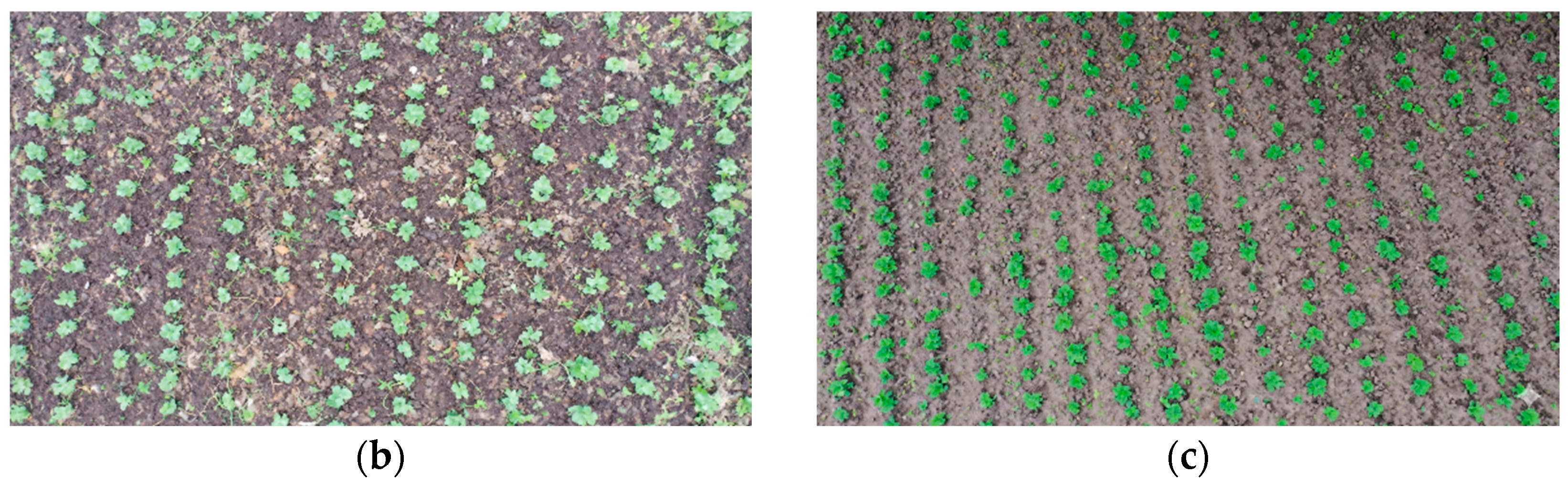
RGB images (5472 × 3648) were collected from 8 different potato crop fields in Carchi and Imbabura (Ecuador) to incorporate diverse climatic conditions, land, and plant variability. At different growth stages, these eight fields were sampled at crop ages of approximately 15–40 days. Thus, 3810 images were acquired from May 2023 to April 2024, significantly extending the basic original dataset (unbalanced) proposed in our previous work [19] by about 56%, contributing to this study. The DJI Mavic 2 Pro UAV was used with the Android DroneDeploy application v5.7 to configure all the flight parameters: flight height 9–10 m, flight speed 1 m/s, and cm/pixel ratio 0.25 (GSD). The distance between the camera and the ground is not strictly fixed to create more image variations. The flight height was selected because the best results were observed on images acquired at 10 m [62], representing a compromise between GSD and ground coverage [63]. It allows for capturing a larger area; hence, the efficiency of the UAV flying is much higher [64]. Likewise, flight speed must be substantially reduced at relatively low flight altitudes to avoid motion blur [63]. Figure 1 shows the study area in northern Ecuador, showing the location of the provinces of Carchi and Imbabura. The eight plots of land are in the cantons of San Gabriel (2), Bolívar (2), El Ángel (2), Ibarra (1), and Cotacachi (1).

2.2. Data Selection, Preprocessing, and Transformation

This step consisted of the initial review and filtering of the captured images, in which the sharpness of the objects of interest (crops and weeds) was considered. Images not suitable for the research were discarded according to the following criteria: (i) images that do not contain weeds, (ii) images with an exaggerated density of weeds, (iii) adjacent images, and (iv) blurred images. In our workflow, only frames exhibiting severe motion blur—typically caused by abrupt UAV acceleration or sudden wind gusts—were removed. Blurriness was assessed using a simple quantitative threshold based on the variance of the Laplacian operator, a widely used focus metric in computer vision [65]. Images with variance values below 30 were excluded because they lacked sufficient spatial detail for reliable annotation. The threshold was determined empirically based on the characteristics of our UAV imagery. Mild or moderate blur was intentionally retained to avoid overestimating model robustness, ensuring that the training set still reflected realistic in-field conditions. Thus, this phase ensured that the dataset contained high-quality images, thereby facilitating accurate weed detection.
Subsequently, following the suggestion made in our previous work [19], the classes of the original dataset were balanced, with nearly the same amount of data per class, incorporating new images from other croplands not previously considered. The classes initially least represented were the Dandelion, Broadleaf dock, and other weed species, while the most represented were the Kikuyu and potato.
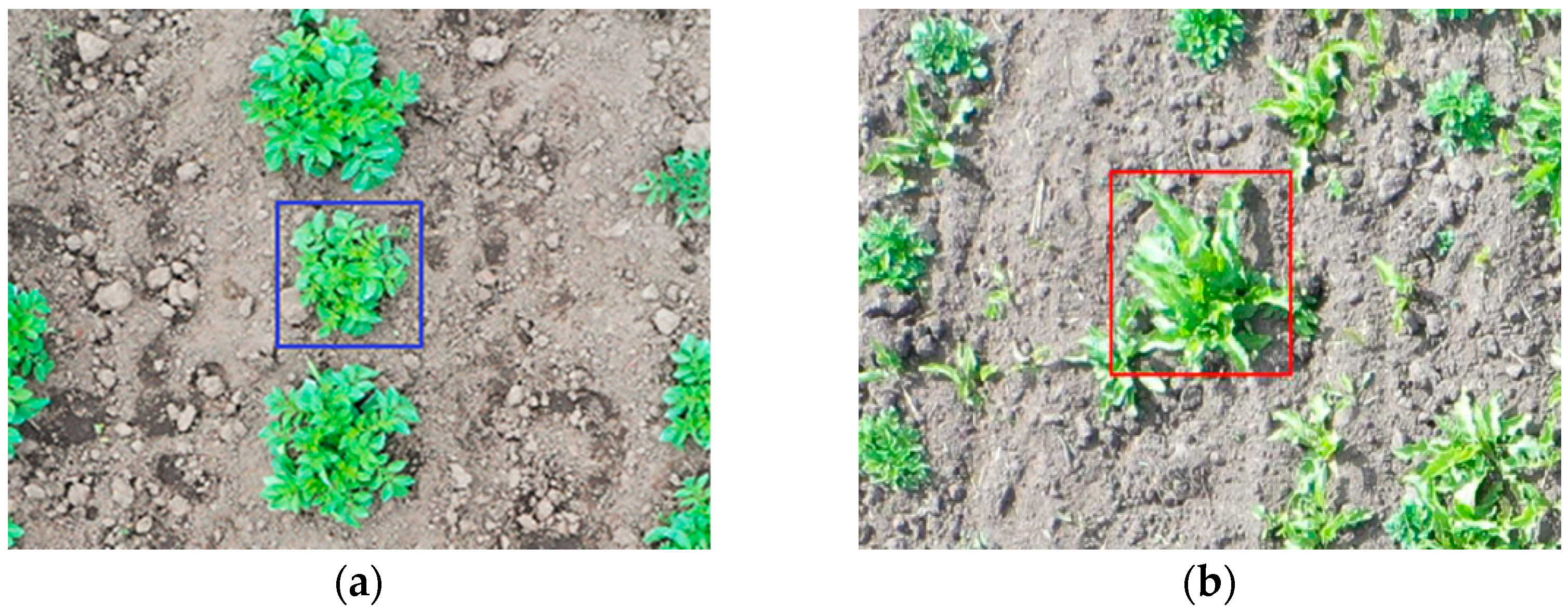
The images were then processed and transformed to prepare them properly for the U-Net architecture. Based on the idea of [66], 250 × 250 sub-image extraction from the images is used for manual image annotation. This choice was made because this resolution almost completely covers most large plants in the original images. Additionally, better results are achieved when the image is divided into patches instead of resizing the entire image [39]. Adobe Photoshop 2020 was used to delimit and extract the sub-images, as indicated in Figure 2.
Each was categorized during the extraction of the 250 × 250 sub-images, considering the most significant type of plant present in each sub-image, which may contain various plants. Weeds with the greatest coverage in the eight crop fields visited were chosen, mainly Broadleaf dock, Dandelion, and Kikuyu. In addition, a category called “other weeds” was used for plants that were difficult to identify visually (unknown or small plants) and those with a low presence in the fields visited. This category also represents a heterogeneous class of weed species that are rare, unidentified, or visually ambiguous, such as wounded heart (Polygonum nepalense), turnip (Brassica rapa), radish (Raphanus raphanistrum), and nettle (Urtica urens). These species were not sufficiently represented across the dataset to define separate classes. This generic class is because there will always be plants that have not been considered in the training dataset in crop fields.
A total of 2100 correctly classified 250 × 250 sub-images were obtained. Each extracted sub-image was then resized to a resolution of 128 × 128 for image annotation for semantic segmentation and to be compatible with the input of the U-net CNN architecture detailed below. Semantic image segmentation is the labeling of each pixel in an image with its corresponding class. Thus, we selected an input resolution of 128 × 128 as a compromise between preserving sufficient spatial context and ensuring efficient and stable training. The UAV images captured (GSD of 0.25 cm/pixel) provide the level of detail necessary to represent small weeds. Each image was initially divided into 250 × 250-pixel patches, corresponding to 62.5 cm × 62.5 cm on the ground; these patches were subsequently resized to 128 × 128 pixels to ensure compatibility with the U-Net without altering the physical area represented. This downscaling significantly reduces the model’s computational load, particularly relevant in scenarios with limited computational resources and moderate-sized datasets. This approach has been employed in patch-based training to control memory consumption and improve efficiency in some encoder–decoder architectures [39]. In the agricultural domain, it has also been shown that weed segmentation using convolutional networks remains feasible with reduced resolutions and patch-based strategies without compromising the model’s discriminative capability [27]. Additionally, the U-Net’s effective receptive field remains sufficiently large to integrate meaningful visual context around each segmented pixel, enabling discrimination of small weeds within their local surroundings.
The online platform used for image annotation was Roboflow [67], which offers functionality to determine the number of individuals (plants) in the entire dataset. The classes were labelled: 0—background, 1—Broadleaf dock, 2—Dandelion, 3—Kikuyu, 4—other weeds, and 5—Potato. The extended dataset has a greater variety of weeds (size, lighting, region, etc.) and a more balanced distribution of classes than the original dataset (unbalanced), as indicated in Table 1.
In short, a total of 3810 raw UAV images were acquired during multiple flights over the eight potato fields at different crop development stages. These images were preprocessed and divided into overlapping patches to facilitate training and improve class balance, resulting in 2100 subimages used for model training and evaluation. The selected subimages include samples from all locations and growth stages to preserve spatial and temporal variability. In total, 8119 individual plant instances were annotated across all segmentation masks, which explains why the number of plants does not correspond directly to the number of images or subimages.
Manual annotation on the 2100 128 × 128 sub-images (containing 8119 plants) required 210 work hours and took approximately 6 min for each sub-image. The annotated dataset was split into training, validation, and testing sets in the ratio of 80% (1680 sub-images), 10% (210 sub-images), and 10% (210 sub-images), respectively, using a stratified sampling strategy to preserve the distribution of weed classes, locations, and crop development stages. The split was applied at the subimage level, and each subset contains samples from all eight fields, ensuring representative spatial and temporal coverage and preventing dataset bias. The dataset split was performed with grouping at the raw image level to avoid spatial data leakage. All patches generated from the same original UAV frame and spatial region were assigned to a single dataset partition. This ensured that overlapping or neighboring patches did not appear in different splits, thereby preserving spatial independence between the training, validation, and test data.
The 80/10/10 split is a good balance in general, where one wants to maximize data usage for model training without sacrificing adequate validation (hyperparameter tuning) or testing of the model’s generalization ability on unseen data.
We computed the pixel distribution across the training set. As expected in UAV imagery, the background class is dominant (83.35% of all pixels); however, the crop and weed classes collectively account for 16.65% of the dataset, with individual proportions of 3.47% (Broadleaf dock), 4.39% (Dandelion), 2.95% (Kikuyu), 1.24% (other weed species), and 4.60% (Potato). This pixel distribution is consistent with previous UAV-based weed segmentation studies, in which the background typically accounts for 70–90% of pixels due to soil exposure and crop structure [27]. Furthermore, using 128 × 128 patches increases the relative proportion of foreground pixels per batch, thereby mitigating the imbalance present in the full-resolution images.
Additionally, data augmentation was performed to increase the dataset size and improve model training. The operations applied to the sub-images were a 25% increase and decrease in brightness, a Gaussian blur with a 5 × 5 kernel, and rotations at angles of 90, 180, and 270°. Seven types of data augmentation were applied, obtaining 11,760 sub-images for the model training set.
In brief, the dataset was first split into training, validation, and test sets using stratified sampling (80/10/10). Data augmentation was applied only to the training subset to increase the number of training samples and improve model robustness. The validation and testing sets were kept unchanged to ensure an unbiased evaluation of model performance. This procedure follows standard practice in deep learning experiments to prevent information leakage between training and evaluation sets.

2.3. Data Mining

This phase consists of two main parts: the choice of the deep learning algorithm and its training.

2.3.1. The Deep Learning Algorithm (U-Net)

The well-known U-Net architecture was selected as justified above for its effectiveness in semantic segmentation, which is widely used in medical images [23] and, more recently, in weed segmentation tasks [25]. The U-Net offers a favorable trade-off between segmentation accuracy, training stability with limited datasets, computational efficiency, and suitability for deployment in precision agriculture workflows. The U-Net is known for its ability to capture both low-level features (edges, textures, simple patterns, colors, and gradients) and high-level features (complex patterns, semantic contexts, and spatial relationships between different regions of the image) [68,69,70]. Its architecture is an encoder–decoder-based approach, which is characterized by having a “U” shape composed of two main parts: the encoder (contraction) and the decoder (expansion). The encoder extracts features through convolutions and pooling operations, progressively reducing the image’s resolution. Low-level features are extracted in the first layers of the encoder, while high-level features are captured in the deeper layers. On the other hand, the decoder restores the dimensionality to its original size by fusing low- and high-resolution features through transposed convolution (deconvolution), upsampling (interpolation), and concatenation. The encoder performs feature extraction from the image, while the decoder is responsible for reconstruction and semantic segmentation for the six classes mentioned. To achieve this, a two-dimensional convolution layer (Conv2D) was added at the end of the architecture with many filters equal to the number of classes of the problem (six in this case) and a filter size of 3 × 3. Choosing this setting allows the model to generate pixel-wise probability maps for each class. The 3 × 3 filter size in this layer, as opposed to the more common 1 × 1, allows the model to consider a slightly broader context in the final features, which can improve the ability to capture more complex patterns in the data. Using a 2D convolution layer instead of a dense layer is crucial to maintain the spatial structure of the image and generate outputs with the same dimensions as the input. The activation function used is Softmax, which is suitable for multi-category semantic segmentation tasks.
In addition to the standard implementation of U-Net [23], some variations were adapted to improve the accuracy and efficiency of weed segmentation in potato crops, inspired by recent approaches in computer vision. The implemented variations include the Residual U-Net [71], Double U-Net [72], MU-Net [33], and AU-Net. The last variant is custom here and detailed below, along with the rest. Adapting these U-Net variants to the weed detection task in uncontrolled environments using our custom dataset constitutes a contribution to this study.

2.3.2. Training the U-Net Model

The U-Net model and its variants were trained on Google Colab Pro+ using TensorFlow/Keras 2.8.0 and the Nvidia A100 GPU 40 GB VRAM, with 83.5 GB RAM and 201.2 GB of disk space. The trained models are summarized below.
  • Original U-Net [23]: The classic U-Net model was compiled with the Adam optimizer and the sparse categorical cross_entropy loss function, suitable for multi-class segmentation. EarlyStopping callback is implemented to stop training when validation loss has not improved for 10 consecutive epochs, and ReduceLROnPlateau callback to reduce the learning rate when validation accuracy stagnates. Training was performed for a maximum of 100 epochs with a batch size of 32, using the validation data to evaluate the model’s performance.
  • Residual U-Net [71]: This variation incorporates residual blocks instead of plain convolutional blocks, which help mitigate the gradient degradation problem in deep networks. In residual blocks, the input is directly added to the output of the intermediate layers, which facilitates learning and improves prediction accuracy. The Residual U-Net model maintains the basic architecture of the U-Net but with skip connections in multiple layers. The total trained parameters were nearly 135 M, with a size of 515 MB.
  • Double U-Net [72]: This variation combines two U-Net architectures stacked on top of each other, using a conventional U-Net with a Residual U-Net in a hybrid setup. The output of the U-Net is used as input for the Residual U-Net, which improves the propagation of semantic information across layers and enables more accurate segmentation. The total trained parameters were just over 116 M, with a size of 443 MB.
  • Modified U-Net (MU-Net) [33]: This improved network introduces residual block (Resblock) and residual path (Respath) concepts into the U-Net. Resblocks are useful to overcome gradient disappearance and explosion problems, whereas Respaths improve the transformation of corresponding feature information between the contraction and expansion paths. Both are combined to increase the network depth, improving the network’s expression ability in complex image segmentation, such as that of diseased crop leaves. This architecture adapts the U-Net to work with 128 × 128 images, maintaining the integrity of spatial information through skip connections. The total number of trained parameters was just over 14 M, and the size was 54 MB.
  • U-Net with attention modules and residual blocks (AU-Net): This custom variation, following the idea of [26,48], combines attention modules with Residual blocks, trying to achieve a more precise and efficient segmentation for detecting weeds in uncontrolled settings using UAV images. This architecture, like the original U-Net, is composed of two main parts: an encoder and a decoder, each with specific functions that enhance the learning capacity of the model. Attention modules (Attention Gate) allow the network to focus on the most relevant areas, such as weeds, and suppress irrelevant information, intending to improve segmentation and reduce false positives. Four Attention Gate (AG) modules are strategically placed in the decoder, in the skip connections, before merging them with the upstream layer, as shown in Appendix A. The AG1 module (16, 16, 512) works on an intermediate image representation with 16 × 16 pixels and 512 feature channels. Similarly, there are AG2 (32, 32, 256), AG3 (64, 64, 128), and AG4 (128, 128, 64). These attention modules are applied in the first, second, third, and fourth reconstruction layers (Conv2DTranspose → AttentionGate → Concatenate → ResidualBlock). Multiple AG modules with different spatial resolutions aim to improve segmentation by refining feature selection at various image scales.
As mentioned, residual blocks mitigate vanishing gradient problems and information loss in deep neural networks by optimizing model learning by introducing skip connections. These residual blocks replace the standard convolutional layers of the U-Net and are placed in the encoder, where they are used at each convolution level before max pooling. This helps improve feature extraction while maintaining key information. They are also placed in the decoder and used in upsampling layers to refine details without losing information. This improves segmentation reconstruction and avoids loss of details. The main difference with the literature mentioned is the combination of Attention Gates with other blocks (ResBlocks in this case). This model has just over 93 M trainable parameters and is 355 MB in size.
Table 2 summarizes the parameters and hyperparameters used during training for each described model based on the U-Net. We adopted Sparse Categorical Cross-Entropy (SCCE) because, although the background class naturally dominates in UAV-based weed segmentation, the weed classes were not severely imbalanced relative to each other (Table 1), and SCCE provided stable training behavior. In our experiments, SCCE showed consistent convergence without bias toward the majority class, likely due to the use of small 128 × 128 patches, which effectively increased the proportion of foreground pixels seen during training and reduced extreme class imbalance. Additionally, SCCE is computationally efficient and compatible with sparse label encoding, reducing memory usage during training—an advantage for encoder–decoder architectures such as U-Net.

2.4. Evaluation and Interpretation

Three common metrics in semantic segmentation, dice loss, mean dice coefficient, and mean intersection over union (IoU), were used to evaluate the performance of the versions of U-Net and its variants [43].
Dice loss is a function used, especially when imbalanced classes exist. It measures the match between the ground truth masks and the ones predicted by the model at the shape and overlap level. Its range is between [0, 1], with 0 indicating a perfect match between the segmentation masks [73].
Mean Dice Coefficient is a metric used to evaluate the accuracy of models that segment or classify pixels into different classes. Its value range is between [0, 1], with 1 indicating a perfect match between segmentation masks [74].
Mean IoU is another widely used metric to evaluate the accuracy of semantic segmentation models. It provides a clear and balanced view of the model’s performance across all classes and is robust in class imbalance situations. Its value range is between (0, 1), where values close to 1 indicate that the model has excellent segmentation performance and high accuracy in class prediction.
Other metrics, such as overall accuracy (OA), have not been fully considered for evaluation and comparison because IoU is more robust than pixel accuracy in evaluating semantic segmentation, especially when unbalanced classes exist. In this case, OA could give high values even if small classes are poorly segmented [75,76].
Regarding the practical interpretation of the model, the purpose is to give meaning to the predictions made by the model, providing information that is understandable and useful for decision-making. Equation (1) is useful for calculating weed coverage [77]:
W e e d   c o v e r a g e = W e e d   a r e a T o t a l   a r e a   ×   100 %
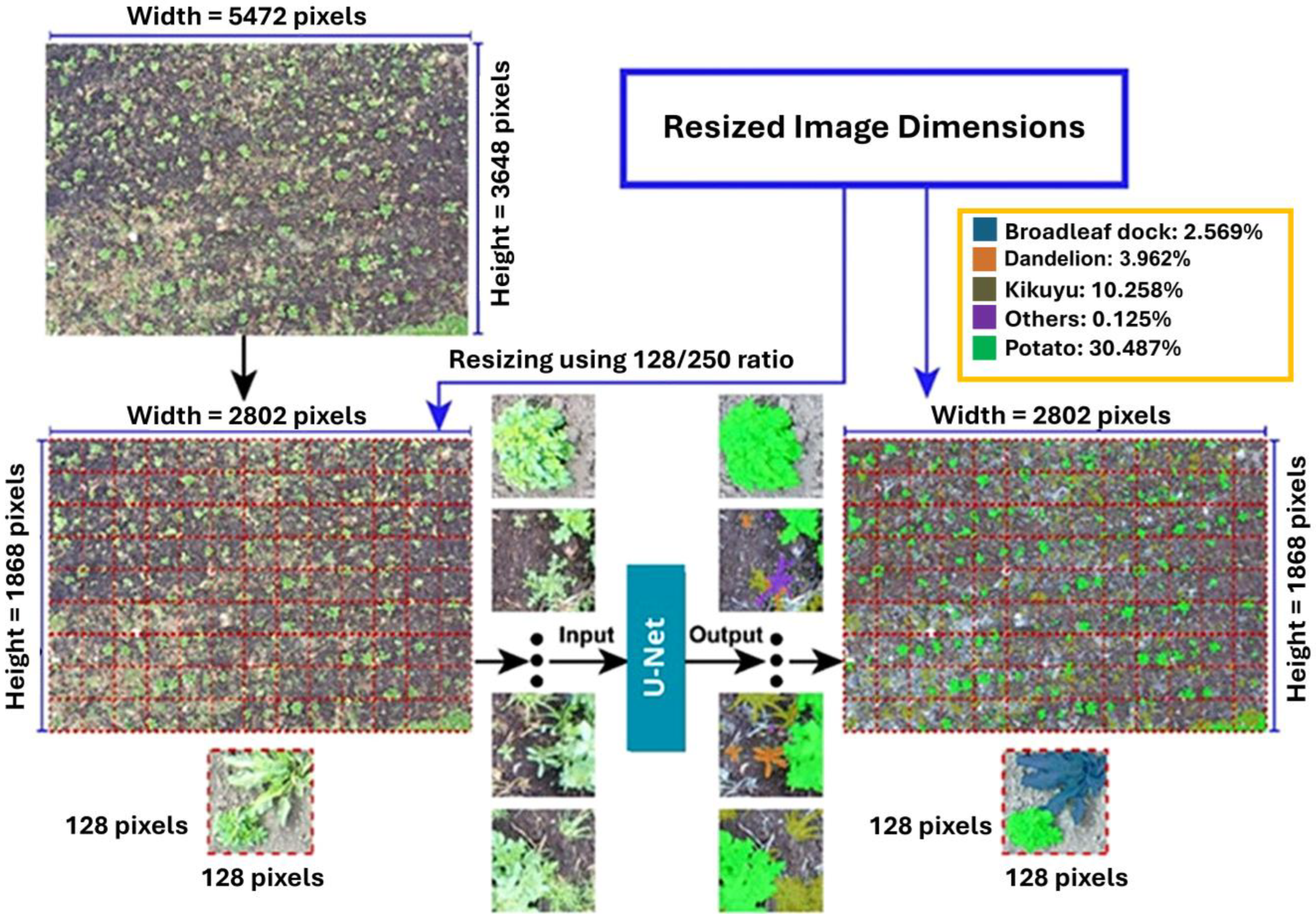
The weed area is the number of pixels belonging to each category (Broadleaf dock, Dandelion, Kikuyu, other weeds) provided by the model’s semantic segmentation mask. The total area is the number of pixels in the whole image. Figure 3 shows the entire process for weed quantification, from the image acquired by the UAV, the division into sub-images of 128 × 128 pixels, the semantic segmentation of weeds, the visualization, and the calculation of weed coverage.
As the 2802 × 1868 images are post-processed, the pixels belonging to each category of plant found are counted, and then weed coverage (Equation (1)) is applied for each type of plant.
Finally, to complement the data analysis and to contrast the weed coverages calculated from the model’s predictions (U-Net) and the ground truth, the Student’s t-test and Pearson correlation coefficient (r) statistical tests were used to verify whether there are statistically significant differences and a linear association between both measurements [78,79], respectively.
The Student’s t-test is a parametric statistical test to determine whether there is a significant difference in the weed coverage means (Equation (1)) between the ground truth and the values predicted by the best model. This allows us to complement the data analysis and to determine whether the Residual U-Net’s predictions are objectively reliable. In this case, they are considered dependent samples in the test since the manual assessments (ground truth) and those predicted by the model are carried out on the same set of images [78]. The null hypothesis H0 and alternative hypothesis H1 are established as follows:
H0: d = 0 (There is no significant difference in the weed coverage means of both groups)
H1: d ≠ 0
The decision rule is: If p-value ≤ 0.05, reject H0.
Statistical evaluation was applied on the test set (10%) containing 210 images of 128 × 128 using the IBM SPSS v26 software. The paired t-test assumes the differences between paired observations (ground truth and model) follow a normal distribution. The sample is large enough (n ≥ 30) so that, according to the Central Limit Theorem, the differences approximate a normal distribution [78]. This makes the t-test valid and robust, even without explicit verification of the normality of the differences.
Generally, the IoU-based metric is used to validate the segmentation quality directly. It is complemented by the Student’s t-test to verify that there are no systematic biases in the full coverage. The IoU will be the key metric because it directly assesses the segmentation quality. However, the Student’s t-test is an essential complement to detect biases or inconsistencies in the full coverage, which could go unnoticed with the IoU. Combining both evaluation criteria offers a comprehensive approach to validating the model in practical applications.

3. Results

3.1. U-Net Performance Metrics

Table 3 summarizes the values obtained in the validation stage of the five versions of U-Net using the three evaluation metrics on the original dataset (unbalanced): Dice Loss, Mean Dice Coefficient, and mean IoU [80]. Only the best-performing model was also trained on the extended (balanced) dataset, which is approximately 56% larger, as noted.
The U-Net Residual model performed best in all evaluation metrics using the original dataset (unbalanced), reaching a mean IoU = 0.7755. Thus, only this model was also trained on the extended dataset (balanced), achieving better performance with a Dice Loss of 0.1236, a mean Dice Coefficient of 0.8763, and a mean IoU of 0.8053, reflecting a high accuracy in weed segmentation. The positive impact on the model’s performance (Residual U-Net) is evident due to balancing the classes in the dataset, with a 3.8% higher mean IoU.
AU-Net (mean IoU = 0.6150) using this traditional attention gate mechanism (AG) had the worst performance on this dataset. It is limited in identifying weed species on our custom dataset and may not be adaptable to different crops, although it is lighter than other variants. This lower performance may be due to limitations in using Attention Gates in UAV images, where weeds can be sparse and camouflaged, making it difficult to focus attention correctly. In contrast, in medical images with more homogeneous and controlled data, attention can be focused on well-defined lesions with high contrast. Additional factors include greater variability and complexity of the environment in agriculture (lighting, highly variable background, different object scales), spatial resolution, and noise in the image, dataset (imbalance in classes), and labeling (less accurate).
Table 4 details the IoU obtained in each class of the dataset using the best Residual U-Net model on the test set (10%, 210 images), that is, on data not seen during training.
Overall, the Residual U-Net model performs well on the test set with a mean IoU = 0.8021, indicating that, on average, the model segments all six classes well. The performances of the model on the validation (Table 3) and test (Table 4) sets are comparable (mean IoU of 0.8053 and 0.8021, respectively), i.e., the difference in this evaluation metric is very small (≤0.4%), indicating that both datasets are representative. The model generalizes well to unseen data.
Specifically, the class with the highest IoU = 0.9721 is the background, which agrees with results obtained by other researchers [81,82,83] due to its significant presence in all the images in the dataset. The second class with the highest IoU = 0.9376 is Potato, which is in the same situation and probably due to its more distinctive and consistent visual characteristics. The class with the lowest IoU = 0.5907 is “other weeds” because this class has a limited size and encompasses the different types of weeds with heterogeneous visual characteristics (textures and patterns) that could not be visually identified as a specific category. This makes it difficult for the CNN to find and learn unique patterns of the plants in this category, significantly harming the mean IoU of the model. The rest of the weed classes present an acceptable and similar segmentation between them (IoU > 0.7) but still present challenges, possibly due to the visual and morphological variability of the plants present in the different growth stages, and conditions of the terrain, region, weather (seasons), and lighting.
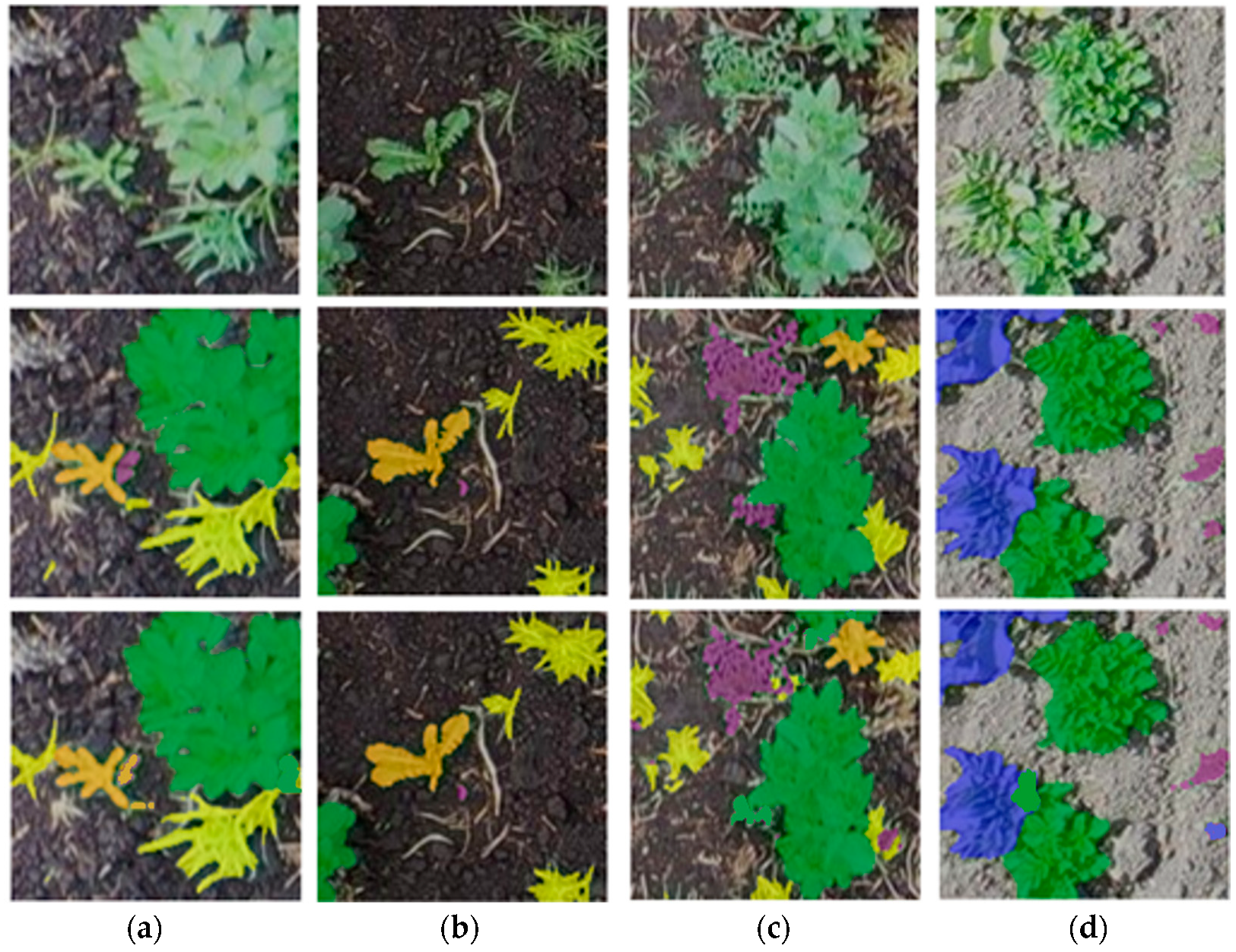
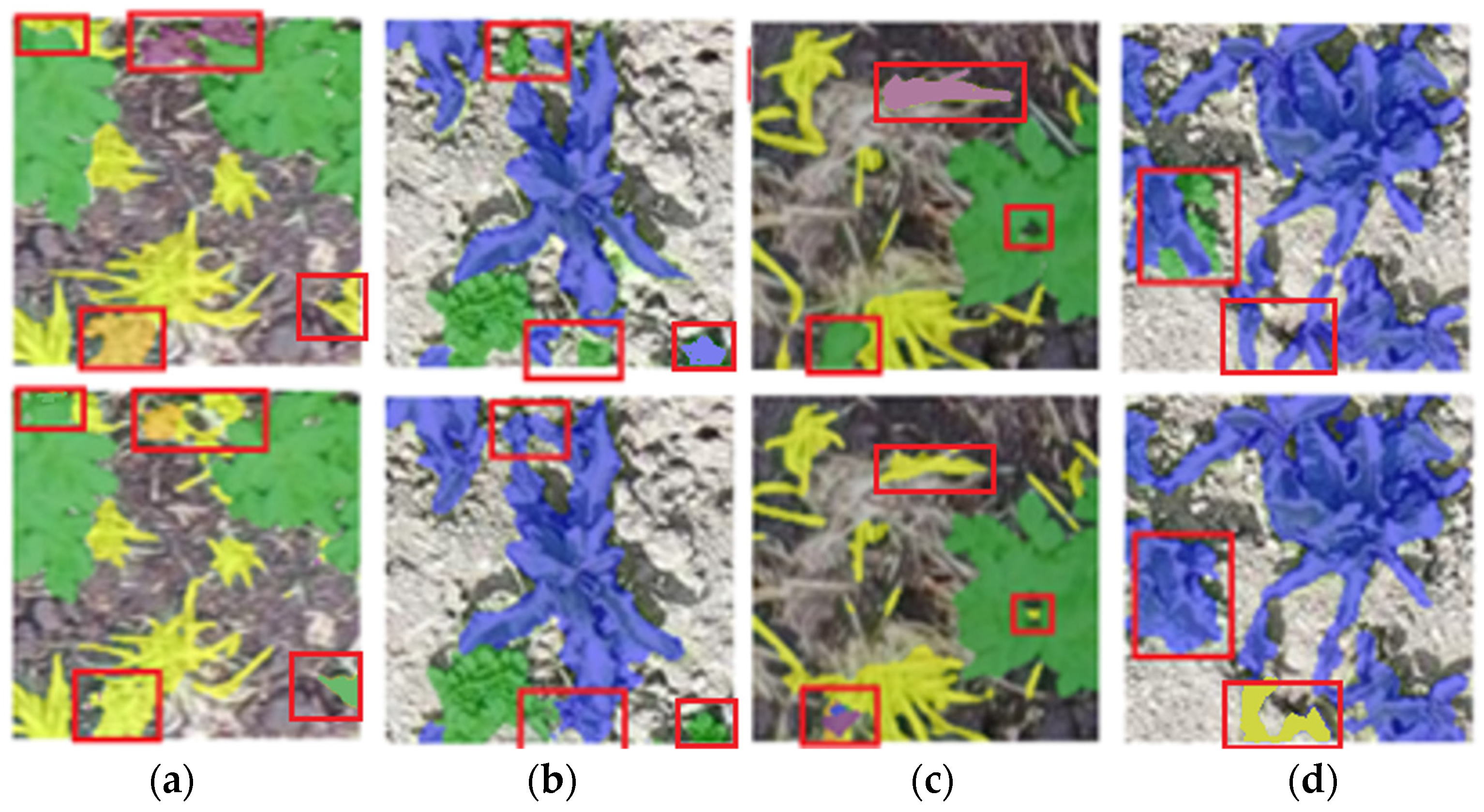
Figure 4 shows the RGB images, ground truth masks, and predictions of the best version of Residual U-Net on four example sub-images of 128 × 128. The predicted segmentation mask matches the ground truth, especially in image (c), which is more evident due to several weeds.

3.2. Statistical Validation of Model Predictions

The following are the results of the Student’s t-test for all classes in the dataset. Applying the Student’s t-test on the coverage of the Broadleaf dock weed, a p-value = 0.053 was obtained. Therefore, according to the decision rule, H0 is not rejected, indicating no significant difference between coverage measurements. This result could suggest that the model has been able to accurately predict the coverage of this weed without large deviations from the ground truth. The degree of agreement could be associated with visual characteristics of the plant that the model accurately captures, such as variability in the shape or size of this weed. The Pearson correlation coefficient r = 0.999 (p < 0.05) indicates a very high linear association between both measurements.
Using the t-test on the coverage of the Dandelion, a p-value = 0.392 was reached, indicating no significant difference between the two coverage measurements. This suggests that the model has also been able to predict the coverage of this weed consistently and accurately. This may be due to a greater consistency in the visual characteristics of the plants in this group, which facilitates more accurate segmentation by the model. The Pearson correlation coefficient r = 0.784 (p < 0.05) indicates a high linear association between both measurements.
Utilizing the t-test on the coverage of the Kikuyu, a p-value = 0.004 was achieved, indicating a significant difference between the two coverage measurements. The model could have certain difficulties in accurately segmenting this class, possibly due to the plant’s particular characteristics or the variability in the images, such as the size or color of the weed in different growth stages. This discrepancy highlights the need to improve the model’s segmentation capacity for this class, probably by adjusting its parameters or including more representative data during training. The Pearson correlation coefficient r = 0.996 (p < 0.05) indicates a very high linear association between both measurements.
Continuing with the t-test on “other weeds” coverage, a p-value = 0.363 was obtained, indicating no significant difference between the two measurements. This result suggests that the model is more reliable in predicting this category. The Pearson correlation coefficient r = 0.873 (p < 0.05) indicates a high linear association between both measurements.
The t-test on the coverage of potato crops reached a p-value of 0.970, indicating no significant difference between the two coverage measurements. This suggests that the model handles potato crop segmentation well, with no major differences between actual and predictions. The Pearson correlation coefficient r = 0.999 (p < 0.05) indicates a very high linear association between both measurements.
Lastly, the t-test on the coverage of background reached a p-value of 0.001, indicating a significant difference between the two coverage measurements. This result may suggest that the model has some challenges in correctly distinguishing background areas. Background segmentation can be particularly complex due to noise, foreign objects, or insufficient representation of background features in the training data, leading to significant discrepancies in certain images. The Pearson correlation coefficient r = 0.999 (p < 0.05) indicates a very high linear association between both measurements.
Table 5 summarizes the statistical validation, providing a clearer and more concise presentation of the Student’s t-test.
It was concluded that the Residual U-Net model has a high concordance concerning the predictions of the three specific classes (Potato, Broadleaf dock, Dandelion, and Other weeds). However, this level of agreement is reduced for detecting pixels belonging to the Kikuyu and Background categories according to the t-test. This could be due to several factors related to unusual characteristics of the plants (size, shape, density), variability in outdoor lighting conditions, capture angles, presence of shadows, overlapping plants, abrupt changes in the texture, presence of species not adequately represented in the training data, noise in the images (mislabeled, blurry examples) and foreign objects (stones, sticks, branches).
Focusing on the Kikuyu class, a moderate IoU of 0.7730 is maintained (Table 4). Still, contradictorily, there are significant differences between the actual and predicted measurements according to the Student’s t-test. This means that, although the model predicts this class well, on average, there are certain atypical images where the coverage prediction is substantially different from the actual coverage (ground truth). This was evidenced by moderate and extreme outliers identified using a box plot regarding the significant difference in coverage between the ground truth and the model. Figure 5 shows some example images with significant coverage differences in the test set due to some unusual factors of the plants and the dataset mentioned above.
This phenomenon regarding the discrepancy between the IoU metric and the t-student’s test in certain classes (Kikuyu and background) may be common in semantic segmentation problems. In the specific case where a low IoU is obtained for a certain class of weeds (Dandelion and other weeds), but the Student’s t-test indicates that there are no significant differences between the predicted weed coverage and the ground truth, it may be due to the following factors related to the nature of the metrics, the data, and the model. The IoU is a local metric that assesses the precise overlap between the predicted and ground truth regions, penalizing differences in shape, position, or edge. In contrast, the Student’s t-test is based on a global metric (coverage percentage), which smooths out the effects of local errors, provided that the predicted area of the class is similar to the ground truth. Also, weed edges are areas where models often struggle more due to transitions with the background or between plant classes. Small errors at the edges can significantly reduce the IoU, but the impact on the coverage percentage may be minimal. This test is less sensitive to local mistakes, such as small inconsistencies at the edges.
The opposite case, where a high IoU is obtained for the Background class, but the Student’s t-test indicates significant differences in coverage, may be due to the following factors. The Student’s t-test may be more sensitive to small accumulated differences in percentage coverage, i.e., systematic differences in area prediction. In contrast, the IoU reflects an average of overlaps that does not penalize accumulated excesses or deficits as much if the local overlap is good. A high IoU can be obtained if the main areas of the weed are correctly segmented, but the model adds additional pixels (false positives) or excludes peripheral areas (false negatives) that alter the overall percentage coverage that can be detected as significant differences by the Student’s t-test.
Discrepancies between IoU and Student’s t-test results often arise from differences between how the metrics capture local (IoU) and global (Student’s t-test) errors. The IoU metric accurately assesses the overlap between predicted areas and ground truth and is useful in cases where weeds’ shapes and exact locations are critical. The coverage-based Student’s t-test captures overall differences in the percentage of area covered by weeds. It is most relevant in applications where the total amount of weeds is of interest rather than their exact shape or location (e.g., estimating the amount of weeds in a plot for agricultural planning). The combination of both metrics or evaluation criteria offers a comprehensive approach to validate our model in practical applications.
On the other hand, the Residual U-Net model was trained on Google Colab Pro+ on a GPU Nvidia A100 for 100 epochs in 2.5 h, with a relatively fast inference time of 58.5 ms (17 fps) per 128 × 128 image patch (model input size), occupying 515 MB of storage. In real-world deployment, full-resolution UAV images would be processed using a sliding-window tiling strategy, where large images are divided into overlapping patches, processed individually, and reassembled to produce the final segmentation map of the entire field.
The evaluated models present different trade-offs between accuracy and computational complexity. Large architectures such as Residual U-Net and Double U-Net achieve higher segmentation performance but involve a large number of parameters, making them more suitable for offline or ground-based processing. In contrast, lighter models offer faster inference and lower memory requirements, which are critical for real-time or onboard UAV deployment. A detailed evaluation of inference time and energy consumption was beyond the scope of this study and could be addressed in future work if necessary.

4. Discussion

4.1. Segmentation Performance and Model Comparison

This research explores five versions of the U-Net convolutional neural network [23], adapting them for the semantic segmentation of weeds in potato crops using UAV imagery, following the line of research of our previous work [19]. It aims to make the upsampling masks (decoder) better fit the silhouettes and fine details of the plants, which turns out to be a very challenging task with UAV images [84]. Throughout the implementation of the different architectures, experiments were carried out with varying hyperparameters of training to find the optimal model for this task [85]. The models have been trained on a medium and diverse dataset, allowing them to learn robust and discriminative features. This adoption and experimentation of the U-Net network variants using a custom dataset represents an important impact on the field of study in our region (Ecuador), considering native weeds.
The present study makes a distinct contribution for two key reasons relative to our prior work. First, the dataset used here is 56% larger, incorporating additional field conditions that enable a more robust and comprehensive evaluation. Second, this study introduces a different segmentation architecture (Residual U-Net), which substantially changes the modeling approach, the receptive-field characteristics, and the nature of the learned spatial representations, leading to significant performance improvements over our previous approach. Thus, according to Table 3, the Residual U-Net is the best model on our dataset, with a mean IoU of 0.8053. The AU-Net version is the worst model, with a mean IoU of 0.6150.
Table 6 compares the results of this work against different U-Net CNN model variants used in binary and multi-class semantic weed segmentation, utilizing only UAV images (for a fair comparison) on the test set, using mainly the mIoU metric, which is critical for practical applications [43] and more robust than overall accuracy (OA) [75,76] as mentioned before. As far as we know, a limited number of models focused on both U-Net architectures and UAV images.
Regarding works with multi-class segmentation (>2 classes) using UAV images, the best model is SSMR-Net [45], obtaining a mean IoU (mIoU) of 0.865, followed by our study using the Residual U-Net model, with a mIoU of 0.8021, the modified ResNeXt50 architecture [19] with 0.7350, U-Net [26] with 0.7320, the CTFFNet [47] with 0.728, the work similar to the U-Net model [6] with 0.617, and SSU-Net [44] with 0.58. Considering the number of classes, our work identifies six classes, greater than the rest, with three and two classes, representing an important contribution to the field of study and agricultural sustainability. Contrasting this work with our previous ResNeXt50-based [19], both identifying six classes, the Residual U-Net model significantly improves 9.1% with a mean IoU = 0.8021 versus 0.7350. This may be due to the model’s training with an extended dataset of about 56%, the balancing of the classes (crop and weeds), and the variant of the architecture (Residual U-Net) that better captures complex discriminant features of plants for the semantic segmentation task.
Regarding the works based on binary segmentation (crop and weed) using UAV images, the highest mIoU of 0.909 is reported in [43], followed by our model using Residual U-Net with 0.8021 and U-Net++ [37] with 0.7060. This metric is not reported in [42], although they achieve an overall accuracy (OA) of 94%. This confirms that the lower the number of classes addressed, the higher the performance metric is. However, as mentioned, our proposal considers six classes (including background), allowing a more detailed and specific segmentation, adapted to real agricultural scenarios with multiple weed species (Broadleaf dock, Dandelion, Kikuyu, other weeds) and crops (potato), which are very representative in the provinces of Imbabura and Carchi (Ecuador) where this study is carried out.

4.2. Generalization, Practical Implications, and Limitations

In general, the Residual U-Net model presents an adequate performance comparable to or superior to those found in the existing literature, but in our case, considering a larger set of classes (six), mostly from UAV images. This model’s good performance agrees with the results obtained by [21]. However, the “other weeds” class still penalizes the model’s overall performance. The “other weeds” class intentionally groups heterogeneous plant species with low frequency or ambiguous visual characteristics. While this reduces class separability and leads to lower IoU values, it reflects realistic agricultural conditions where unknown or rare weeds are present. This design enables the model to maintain robustness when encountering unseen species, at the cost of reduced interpretability for this specific class.
According to the literature on weed segmentation using UAV images [27], a mIoU > 0.70 is considered adequate for practical applications, while values above 0.80 (as in our work) indicate high performance even in challenging and complex scene conditions (similar species, high density, occlusion, variable illumination, UAV height, movement, etc.). It is important to note that IoU and Dice metrics directly evaluate pixel-level segmentation quality, while the Student’s t-test is used to assess the reliability of aggregated weed coverage estimates from a practical decision-making perspective. Although confusion matrices and per-class precision/recall could provide additional insight into misclassification patterns, these analyses are complementary and will be explored in future work.
From a practical perspective, accurate semantic segmentation directly enables reliable weed coverage estimation, which is a key input for agricultural decision-making. Coverage thresholds can be defined to trigger site-specific treatments, such as localized herbicide application or mechanical weed control, reducing chemical use and operational costs. Therefore, improvements in IoU and Dice metrics translate into more accurate treatment maps, enabling precision agriculture strategies based on objective and spatially explicit information.
Although this study focuses on U-Net-based architectures, recent CNN–Transformer and hybrid models have shown promising results for weed segmentation. Evaluating these models under the same experimental conditions represents an important direction for upcoming work. However, such models typically require larger datasets and higher computational resources, which were beyond the scope of this study.
Regarding this study’s limitations, the dataset’s number of classes is still restricted to the six main categories mentioned, which limits the model’s ability to generalize in more complex agricultural scenarios. Additionally, the dataset is limited to a certain crop growth stage (15 to 40 days), which could reduce the model’s applicability across different seasons or other growth stages. Although the dataset includes images acquired from different fields, provinces, and crop growth stages, this study does not perform a strict cross-season or cross-region validation. UAV imagery is highly sensitive to environmental variability, including illumination changes, soil moisture, and plant phenology, which can affect model performance. Evaluating model robustness under these conditions remains an important challenge and will be addressed in future work through longitudinal data collection and domain adaptation strategies. Another restriction is the exclusive use of U-Net architectures focused on semantic segmentation, leaving aside other current deep architectures (including Transformers) or a combination of them (CNN + Transformer), which could limit the model’s ability to capture global features. The attention mechanism used on the AU-Net is limited to the Attention Gate (AG), without considering other mechanisms [38]. Furthermore, most integrated devices would consider our model large (515 MB) for UAV-based scouting. Although the inference time remained fast, achieving 58.5 ms per 128 × 128 patch (≈17 fps) on the Colab platform, it could be compatible with near real-time processing. These results indicate that, despite the model size, the inference latency can be sufficiently low for practical deployment in post-flight analysis workflows. Nevertheless, we acknowledge that future work could explore lightweight model compression strategies—such as pruning, quantization, or knowledge distillation—to reduce storage requirements further and enable on-device inference on embedded hardware. Finally, our work uses a low-cost UAV to capture RGB images, mainly because they are popular and affordable, offering a cost-efficient solution [77].

5. Conclusions

In the present study, five versions of the U-Net architecture are tested for the semantic segmentation of several kinds of native weeds in uncontrolled environments, successfully processing six categories: background, potato, Broadleaf dock, Dandelion, Kikuyu, and other weeds. The network architectures are original U-Net, Residual U-Net, Double U-Net, Modified U-Net, and AU-Net. Based on our previous work, the dataset for the model’s training is extended and balanced to achieve better results. The Residual U-Net is the best model for adjusting the resulting multi-class segmentation to the silhouettes of the native plants under study, with a mean IoU of 0.8021. This model obtains results comparable to or superior to those in the literature dealing with fewer categories (Table 6), taking a relatively fast inference time of 58.5 ms (17 fps) for a 128×128 image, occupying a storage size of 515 MB.
Future work should increase the variability of images and weed classes in the dataset by incorporating greater variation in shape, size, and environment, and prioritize class balancing. It would also be advisable to experiment with a combination of modern deep neural networks based on CNNs and/or Transformers (to capture global relationships among image elements), as well as other attention mechanisms—beyond the Attention Gate module, such as self-attention, multi-head attention, or lightweight transformer blocks—to address small objects and plants of varying sizes. Further research will explore hybrid architectures to assess potential accuracy gains while maintaining feasibility for UAV-based agricultural deployment. Lighter models optimized for real-time implementation on embedded devices, applying techniques such as quantization, pruning, or knowledge distillation, are also recommended. Additionally, alternative loss functions can be explored that explicitly address the observed pixel-wise class imbalance, such as focal loss, class-balanced cross-entropy, or hybrid combinations of Dice and cross-entropy, to improve the segmentation of minority weed classes. Evaluating model robustness under strict cross-season or cross-region conditions through longitudinal data collection and domain adaptation strategies is suggested. Finally, following this research line, weed mapping is necessary to create georeferenced maps that indicate the spatial distribution and density of weeds within a field.

Author Contributions

L.S.-P.: Conceptualization, Formal Analysis, Investigation, Methodology, Validation, Writing—Original Draft. M.P.-C.: Data curation, Methodology, Visualization, Writing—Original Draft. J.P.-M.: Software, Data Curation, Formal Analysis, Writing—Original Draft. P.G.-G.: Conceptualization, Writing—Review and Editing, Supervision. I.G.-S.: Formal Analysis, Funding acquisition, Resources, Validation, Writing—Review and Editing. All authors have read and agreed to the published version of the manuscript.

Funding

This research was mostly funded by the Universidad Técnica del Norte, Ibarra, Ecuador, under Grant Number: InvestigaUTN-2025-1516.

Institutional Review Board Statement

Not applicable.

Informed Consent Statement

Not applicable.

Data Availability Statement

Datasets used in this study were made publicly available for comparison purposes and can be found at the following link: https://github.com/JorgePazos-git/Dataset-of-weeds-in-potato-crops-in-the-province-of-Carchi-and-Imbabura-in- (last accessed 8 December 2025).

Acknowledgments

This research is supported by the Software Engineering and Artificial Intelligence research group from the Universidad Técnica del Norte (Ecuador) and the GTI-IA research group from Universitat Politècnica de València (Spain).

Conflicts of Interest

The authors declare no conflict of interest.

Appendix A

Proposed AU-Net with four attention gate modules and residual blocks (rectangles in red), following [26,48] about the use of attention mechanisms.
Applsci 16 03149 i0a1

References

  1. FAO. Recommendations for Improved Weed Management; FAO: Rome, Italy, 2006; pp. 1–56. Available online: https://www.fao.org/4/a0884e/a0884e.pdf (accessed on 8 December 2025).
  2. Singh, S.; Rawal, S.; Dua, V.; Roy, S.; Sadaworthy, M.; Charkrabarti, S.; Sadawarti, M. Weed management in conventional and organic potato production. Int. J. Chem. Stud. 2018, 2, 24–38. [Google Scholar]
  3. Craine, J.M.; Dybzinski, R. Mechanisms of plant competition for nutrients, water and light. Funct. Ecol. 2013, 27, 833–840. [Google Scholar] [CrossRef]
  4. Pusdá-Chulde, M.R.; Salazar-Fierro, F.A.; Sandoval-Pillajo, L.; Herrera-Granda, E.P.; García-Santillán, I.D.; De Giusti, A. Image Analysis Based on Heterogeneous Architectures for Precision Agriculture: A Systematic Literature Review. Adv. Appl. Comput. Sci. Electron. Ind. Eng. 2020, 1078, 51–70. [Google Scholar] [CrossRef]
  5. Zimdahl, R.L. Weed Reproduction and Dispersal. In Fundamentals of Weed Science, 5th ed.; Academic Press: Cambridge, MA, USA, 2018; pp. 83–121. [Google Scholar] [CrossRef]
  6. Gao, J.; Liao, W.; Nuyttens, D.; Lootens, P.; Xue, W.; Alexandersson, E.; Pieters, J. Cross-domain transfer learning for weed segmentation and mapping in precision farming using ground and UAV images. Expert Syst. Appl. 2024, 246, 122980. [Google Scholar] [CrossRef]
  7. Jabed, M.A.; Azmi Murad, M.A. Crop yield prediction in agriculture: A comprehensive review of machine learning and deep learning approaches, with insights for future research and sustainability. Heliyon 2024, 10, e40836. [Google Scholar] [CrossRef]
  8. Coulibaly, S.; Kamsu-Foguem, B.; Kamissoko, D.; Traore, D. Deep Convolution Neural Network sharing for the multi-label images classification. Mach. Learn. Appl. 2022, 10, 100422. [Google Scholar] [CrossRef]
  9. Cevallos, M.; Sandoval-Pillajo, L.; Caranqui-Sánchez, V.; Ortega-Bustamante, C.; Pusdá-Chulde, M.; García-Santillán, I. Morphological Defects Classification in Coffee Beans Based on Convolutional Neural Networks. In Communications in Computer and Information Science; Springer: Cham, Switzerland, 2025; pp. 3–15. [Google Scholar] [CrossRef]
  10. Chacua, B.; Garcia, I.; Rosero, P.; Suarez, L.; Ramirez, I.; Simbana, Z.; Pusdá-Chulde, M. People Identification through Facial Recognition using Deep Learning. In Proceedings of the 2019 IEEE Latin American Conference on Computational Intelligence (LA-CCI), Guayaquil, Ecuador, 11–15 November 2019; IEEE: New York, NY, USA, 2019; pp. 1–6. [Google Scholar]
  11. Montenegro, S.; Pusdá-Chulde, M.; Caranqui-Sánchez, V.; Herrera-Tapia, J.; Ortega-Bustamante, C.; García-Santillán, I. Android Mobile Application for Cattle Body Condition Score Using Convolutional Neural Networks. In Communications in Computer and Information Science; Springer: Cham, Switzerland, 2023; pp. 91–105. [Google Scholar] [CrossRef]
  12. Salazar-Fierro, F.; Cumbal, C.; Trejo-España, D.; León-Fernández, C.; Pusdá-Chulde, M.; García-Santillán, I. Detection of Scoliosis in X-Ray Images Using a Convolutional Neural Network. In Communications in Computer and Information Science; Springer: Cham, Switzerland, 2025; pp. 167–183. [Google Scholar] [CrossRef]
  13. Ulloa, F.; Sandoval-Pillajo, L.; Landeta-López, P.; Granda-Peñafiel, N.; Pusdá-Chulde, M.; García-Santillán, I. Identification of Diabetic Retinopathy from Retinography Images Using a Convolutional Neural Network. In Communications in Computer and Information Science; Springer: Cham, Switzerland, 2025; pp. 121–136. [Google Scholar] [CrossRef]
  14. Guaichico, E.; Pusdá-Chulde, M.; Ortega-Bustamante, M.; Granda, P.; García-Santillán, I. Mobile app for real-time academic attendance registration based on MobileFaceNet Convolutional neural network. Data Metadata 2025, 4, 193. [Google Scholar] [CrossRef]
  15. Chamorro-Pinchao, A.; Pusdá-Chulde, M.; Trejo-España, D.; Caranqui-Sánchez, V.; García-Santillán, I. Binary classification of defects in multiple coffee beans using lightweight convolutional neural networks for embedded systems. Data Metadata 2025, 4, 840. [Google Scholar] [CrossRef]
  16. Valizadeh, M.; Wolff, S.J. Convolutional Neural Network applications in additive manufacturing: A review. Adv. Ind. Manuf. Eng. 2022, 4, 100072. [Google Scholar] [CrossRef]
  17. Espejo-Garcia, B.; Mylonas, N.; Athanasakos, L.; Fountas, S.; Vasilakoglou, I. Towards weeds identification assistance through transfer learning. Comput. Electron. Agric. 2020, 171, 105306. [Google Scholar] [CrossRef]
  18. McCool, C.; Perez, T.; Upcroft, B. Mixtures of Lightweight Deep Convolutional Neural Networks: Applied to Agricultural Robotics. IEEE Robot. Autom. Lett. 2017, 2, 1344–1351. [Google Scholar] [CrossRef]
  19. Vinueza, K.; Sandoval-Pillajo, L.; Giret-Boggino, A.; Trejo-España, D.; Pusdá-Chulde, M.; García-Santillán, I. Automatic weed quantification in potato crops based on a modified convolutional neural network using drone images. Data Metadata 2025, 4, 194. [Google Scholar] [CrossRef]
  20. Zhang, Y.; Cai, H.; Ye, J.; Pan, F.; Wu, S.; Zhang, B.; Qi, L.; Ma, R. Exploiting adversarial style for generalized and robust weed segmentation in rice paddy field. Front. Plant Sci. 2025, 16, 1703811. [Google Scholar] [CrossRef] [PubMed]
  21. Garibaldi-Márquez, F.; Flores, G.; Valentín-Coronado, L.M. Leveraging deep semantic segmentation for assisted weed detection. J. Agric. Eng. 2025, 56, 1741. [Google Scholar] [CrossRef]
  22. García-Santillán, I.D.; Pajares, G. On-line crop/weed discrimination through the Mahalanobis distance from images in maize fields. Biosyst. Eng. 2018, 166, 28–43. [Google Scholar] [CrossRef]
  23. Ronneberger, O.; Fischer, P.; Brox, T. U-Net: Convolutional Networks for Biomedical Image Segmentation. arXiv 2015. [Google Scholar] [CrossRef]
  24. Darbyshire, M.; Coutts, S.; Bosilj, P.; Sklar, E.; Parsons, S. Review of weed recognition: A global agriculture perspective. Comput. Electron. Agric. 2024, 227, 109499. [Google Scholar] [CrossRef]
  25. Rai, N.; Sun, X. WeedVision: A single-stage deep learning architecture to perform weed detection and segmentation using drone-acquired images. Comput. Electron. Agric. 2024, 219, 108792. [Google Scholar] [CrossRef]
  26. Amarasingam, N.; Kelly, J.E.; Sandino, J.; Hamilton, M.; Gonzalez, F.; Dehaan, R.L.; Zheng, L.; Cherry, H. Bitou bush detection and mapping using UAV-based multispectral and hyperspectral imagery and artificial intelligence. Remote Sens. Appl. Soc. Environ. 2024, 34, 101151. [Google Scholar] [CrossRef]
  27. Sandoval-Pillajo, L.; García-Santillán, I.; Pusdá-Chulde, M.; Giret, A. Weed detection based on deep learning from UAV imagery: A review. Smart Agric. Technol. 2025, 12, 101147. [Google Scholar] [CrossRef]
  28. Yuan, J.; Wang, L.; Wang, T.; Bashir, A.K.; Al Dabel, M.M.; Wang, J.; Feng, H.; Fang, K.; Wang, W. YOLOv8-RD: High-Robust Pine Wilt Disease Detection Method Based on Residual Fuzzy YOLOv8. IEEE J. Sel. Top. Appl. Earth Obs. Remote Sens. 2025, 18, 385–397. [Google Scholar] [CrossRef]
  29. Deng, B.; Lu, Y.; Xu, J. Weed database development: An updated survey of public weed datasets and cross-season weed detection adaptation. Ecol. Inform. 2024, 81, 102546. [Google Scholar] [CrossRef]
  30. Goyal, R.; Nath, A. Utkarsh Niranjan IndianPotatoWeeds: A Novel Dataset and its Role in Weed Detection and Management for Potato Crops. SN Comput. Sci. 2025, 6, 466. [Google Scholar] [CrossRef]
  31. Fayyad, U.; Piatetsky-Shapiro, G.; Smyth, P. From Data Mining to Knowledge Discovery in Databases. AI Mag. 1996, 17, 37. [Google Scholar] [CrossRef]
  32. Cui, J.; Tan, F.; Bai, N.; Fu, Y. Improving U-net network for semantic segmentation of corns and weeds during corn seedling stage in field. Front. Plant Sci. 2024, 15, 1344958. [Google Scholar] [CrossRef]
  33. Zhang, S.; Zhang, C. Modified U-Net for plant diseased leaf image segmentation. Comput. Electron. Agric. 2023, 204, 107511. [Google Scholar] [CrossRef]
  34. Zuo, Y.; Li, W. An Improved UNet Lightweight Network for Semantic Segmentation of Weed Images in Corn Fields. Comput. Mater. Contin. 2024, 79, 4413–4431. [Google Scholar] [CrossRef]
  35. Thiagarajan, S.; Vijayalakshmi, A.; Grace, G.H. Weed detection in precision agriculture: Leveraging encoder-decoder models for semantic segmentation. J. Ambient Intell. Humaniz. Comput. 2024, 15, 3547–3561. [Google Scholar] [CrossRef]
  36. Liao, J.; Chen, M.; Zhang, K.; Zhou, H.; Zou, Y.; Xiong, W.; Zhang, S.; Kuang, F.; Zhu, D. SC-Net: A new strip convolutional network model for rice seedling and weed segmentation in paddy field. Comput. Electron. Agric. 2024, 220, 108862. [Google Scholar] [CrossRef]
  37. Asuka, S.; Nakamura, T.; Shimizu, I.; Ookawa, T.; Nakajo, H. Ensemble Learning-Based Weed Detection from a Duck’s Perspective Using an Aquatic Drone in Rice Paddies. Appl. Sci. 2025, 15, 7440. [Google Scholar] [CrossRef]
  38. Li, Z.; Yan, Y.; Wei, M.; Ge, B.; Su, N. FGOD-YOLOv8: Fine-Grained Object Detection for Crops and Weeds. IEEE Signal Process. Lett. 2025, 32, 791–795. [Google Scholar] [CrossRef]
  39. Garibaldi-Márquez, F.; Flores, G.; Valentín-Coronado, L.M. Corn/Weed Plants Detection Under Authentic Fields based on Patching Segmentation and Classification Networks. Comput. Sist. 2024, 28, 271–282. [Google Scholar] [CrossRef]
  40. Garibaldi-Márquez, F.; Martínez-Barba, D.A.; Montañez-Franco, L.E.; Flores, G.; Valentín-Coronado, L.M. Enhancing site-specific weed detection using deep learning transformer architectures. Crop Prot. 2025, 190, 107075. [Google Scholar] [CrossRef]
  41. Ma, Z.; Wang, G.; Yao, J.; Huang, D.; Tan, H.; Jia, H.; Zou, Z. An Improved U-Net Model Based on Multi-Scale Input and Attention Mechanism: Application for Recognition of Chinese Cabbage and Weed. Sustain. Switz. 2023, 15., 5764. [Google Scholar] [CrossRef]
  42. Bretas, I.L.; Dubeux, J.C.B.; Zhao, C.; Queiroz, L.M.D.; Flynn, S.; Ingram, S.; Oduor, K.T.; Cruz, P.J.R.; Ruiz-Moreno, M.; Loures, D.R.S.; et al. Detection and mapping of Amaranthus spinosus L. in bermudagrass pastures using drone imagery and deep learning for a site-specific weed management. Agron. J. 2024, 116, 990–1002. [Google Scholar] [CrossRef]
  43. Kong, X.; Liu, T.; Chen, X.; Jin, X.; Li, A.; Yu, J. Efficient crop segmentation net and novel weed detection method. Eur. J. Agron. 2024, 161, 127367. [Google Scholar] [CrossRef]
  44. Machidon, A.L.; Krašovec, A.; Pejović, V.; Machidon, O.M. SqueezeSlimU-Net: An Adaptive and Efficient Segmentation Architecture for Real-Time UAV Weed Detection. IEEE J. Sel. Top. Appl. Earth Obs. Remote Sens. 2025, 18, 5749–5764. [Google Scholar] [CrossRef]
  45. Mei, X.; Li, C.; Jiao, Y.; Zhang, G.; Zhou, L.; Wu, X.; Cai, T. SSMR-Net and Across Feature Mapping Attention are jointly applied to the UAV imagery semantic segmentation task of weeds in early-stage wheat fields. Smart Agric. Technol. 2025, 12, 101077. [Google Scholar] [CrossRef]
  46. Jiang, H.; Chen, Q.; Wang, R.; Du, J.; Chen, T. SWFormer: A scale-wise hybrid CNN-Transformer network for multi-classes weed segmentation. J. King Saud Univ.—Comput. Inf. Sci. 2024, 36, 102144. [Google Scholar] [CrossRef]
  47. Guo, Z.; Cai, D.; Jin, Z.; Xu, T.; Yu, F. Research on unmanned aerial vehicle (UAV) rice field weed sensing image segmentation method based on CNN-transformer. Comput. Electron. Agric. 2025, 229, 109719. [Google Scholar] [CrossRef]
  48. Sulaiman, A.; Anand, V.; Gupta, S.; Rajab, A.; Alshahrani, H.; Al Reshan, M.S.; Shaikh, A.; Hamdi, M. Attention based UNet model for breast cancer segmentation using BUSI dataset. Sci. Rep. 2024, 14, 22422. [Google Scholar] [CrossRef]
  49. Kamilaris, A.; Prenafeta-Boldú, F.X. Deep learning in agriculture: A survey. Comput. Electron. Agric. 2018, 147, 70–90. [Google Scholar] [CrossRef]
  50. Valente, J.; Kooistra, L. Dataset on UAV High-Resolution Images from Grassland with Broad-Leaved Dock (Rumex Obtusifolius). [Data Set]. Zenodo. 2021. Available online: https://zenodo.org/records/5119205 (accessed on 25 February 2026).
  51. Dos Santos Ferreira, A. Data for: Weed Detection in Soybean Crops Using ConvNets. Comput. Electron. Agric. 2017, 143, 314–324. [Google Scholar] [CrossRef]
  52. Danilevicz, M.; Rocha, R.L.; Batley, J.; Bayer, P.E.; Bennamoun, M.; Edwards, D.; Ashworth, M. Segmentation of sandplain lupin weeds from morphologically similar narrow-leafed lupins in the field. Remote Sens. 2023, 15, 1817. [Google Scholar] [CrossRef]
  53. Imran Moazzam. Tobacco Aerial Dataset. [Data Set]. Mendeley Data. 2023. Available online: https://data.mendeley.com/datasets/5dpc5gbgpz/1 (accessed on 25 February 2026).
  54. Sa, I.; Popović, M.; Khanna, R.; Chen, Z.; Lottes, P.; Liebisch, F.; Nieto, J.; Stachniss, C.; Walter, A.; Siegwart, R. WeedMap: A Large-Scale Semantic Weed Mapping Framework Using Aerial Multispectral Imaging and Deep Neural Network for Precision Farming. Remote Sens. 2018, 10, 1423. [Google Scholar] [CrossRef]
  55. Koshelev, I.; Savinov, M.; Menshchikov, A.; Somov, A. Drone-Aided Detection of Weeds: Transfer Learning for Embedded Image Processing. IEEE J. Sel. Top. Appl. Earth Obs. Remote Sens. 2023, 16, 102–111. [Google Scholar] [CrossRef]
  56. Genze, N.; Ajekwe, R.; Güreli, Z.; Haselbeck, F.; Grieb, M.; Grimm, D.G. Deep learning-based early weed segmentation using motion blurred UAV images of sorghum fields. Comput. Electron. Agric. 2022, 202, 107388. [Google Scholar] [CrossRef]
  57. Huang, H.; Deng, J.; Lan, Y.; Yang, A.; Deng, X.; Zhang, L. A Fully Convolutional Network for weed mapping of Unmanned Aerial Vehicle (UAV) Imagery. PLoS ONE 2018, 13, e0196302. [Google Scholar] [CrossRef]
  58. Krestenitis, M.; Raptis, E.K.; Kapoutsis, A.C.; Ioannidis, K.; Kosmatopoulos, E.B.; Vrochidis, S.; Kompatsiaris, I. CoFly-WeedDB: A UAV image dataset for weed detection and species identification. Data Brief 2022, 45, 108575. [Google Scholar] [CrossRef]
  59. Rai, N.; Villamil Mahecha, M.; Christensen, A.; Quanbeck, J.; Howatt, K.; Ostlie, M.; Zhang, Y.; Sun, X. ImageWeeds: An Image Dataset Consisting of Weeds in Multiple Formats to Advance Computer Vision Algorithms for Real-Time Weed Identification and Spot Spraying Application. 2023. Available online: https://data.mendeley.com/datasets/8kjcztbjz2/2 (accessed on 25 February 2026).
  60. Yang, M.-D.; Tseng, H.-H.; Hsu, Y.-C.; Yang, C.-Y.; Lai, M.-H.; Wu, D.-H. A UAV Open Dataset of Rice Paddies for Deep Learning Practice. Remote Sens. 2021, 13, 1358. [Google Scholar] [CrossRef]
  61. Machidon, O.M.; Krašovec, A.; Machidon, A.L.; Pejović, V.; Latini, D.; Sasidharan, S.T.; Del Frate, F. AgriAdapt: Towards Resource-Efficient UAV Weed Detection using Adaptable Deep Learning. In Proceedings of the 2nd Workshop on Networked Sensing Systems for a Sustainable Society, Madrid, Spain, 6 October 2023; ACM: New York, NY, USA, 2023; pp. 193–200. [Google Scholar]
  62. Tian, F.; Ransom, C.J.; Zhou, J.; Wilson, B.; Sudduth, K.A. Assessing the impact of soil and field conditions on cotton crop emergence using UAV-based imagery. Comput. Electron. Agric. 2024, 218, 108738. [Google Scholar] [CrossRef]
  63. Anderegg, J.; Tschurr, F.; Kirchgessner, N.; Treier, S.; Schmucki, M.; Streit, B.; Walter, A. On-farm evaluation of UAV-based aerial imagery for season-long weed monitoring under contrasting management and pedoclimatic conditions in wheat. Comput. Electron. Agric. 2023, 204, 107558. [Google Scholar] [CrossRef]
  64. Wang, Q.; Cheng, M.; Xiao, X.; Yuan, H.; Zhu, J.; Fan, C.; Zhang, J. An image segmentation method based on deep learning for damage assessment of the invasive weed Solanum rostratum Dunal. Comput. Electron. Agric. 2021, 188, 106320. [Google Scholar] [CrossRef]
  65. Pertuz, S.; Puig, D.; Garcia, M.A. Analysis of focus measure operators for shape-from-focus. Pattern Recognit. 2013, 46, 1415–1432. [Google Scholar] [CrossRef]
  66. Sarvini, T.; Sneha, T.; Sukanya Gowthami, G.; Sushmitha, S.; Kumaraswamy, R. Performance Comparison of Weed Detection Algorithms. In Proceedings of the 2019 International Conference on Communication and Signal Processing (ICCSP), Chennai, India, 4–6 April 2019; IEEE: New York, NY, USA, 2019; pp. 0843–0847. [Google Scholar]
  67. Roboflow Docs Create a Project|Roboflow Docs. Available online: https://docs.roboflow.com/datasets/create-a-project (accessed on 28 January 2024).
  68. Wang, J.; Hadjikakou, M.; Hewitt, R.J.; Bryan, B.A. Simulating large-scale urban land-use patterns and dynamics using the U-Net deep learning architecture. Comput. Environ. Urban Syst. 2022, 97, 101855. [Google Scholar] [CrossRef]
  69. Çiçek, Ö.; Abdulkadir, A.; Lienkamp, S.S.; Brox, T.; Ronneberger, O. 3D U-Net: Learning Dense Volumetric Segmentation from Sparse Annotation. arXiv 2016. [Google Scholar] [CrossRef]
  70. Tene-Hurtado, D.; Almeida-Galárraga, D.A.; Villalba-Meneses, G.; Alvarado-Cando, O.; Cadena-Morejón, C.; Salazar, V.H. Brain Tumor Segmentation Based on 2D U-Net Using MRI Multi-modalities Brain Images. In Smart Technologies, Systems and Applications (SmartTech-IC 2021); Narváez, F.R., Proaño, J., Morillo, P., Vallejo, D., González Montoya, D., Díaz, G.M., Eds.; Springer International Publishing: Cham, Switzerland, 2022; pp. 345–359. [Google Scholar]
  71. Zhang, Z.; Liu, Q.; Wang, Y. Road Extraction by Deep Residual U-Net. IEEE Geosci. Remote Sens. Lett. 2018, 15, 749–753. [Google Scholar] [CrossRef]
  72. Jha, D.; Riegler, M.A.; Johansen, D.; Halvorsen, P.; Johansen, H.D. DoubleU-Net: A Deep Convolutional Neural Network for Medical Image Segmentation. In Proceedings of the 2020 IEEE 33rd International Symposium on Computer-Based Medical Systems (CBMS), Rochester, MN, USA, 28–30 July 2020; IEEE: New York, NY, USA, 2020; pp. 558–564. [Google Scholar]
  73. Celikkan, E.; Saberioon, M.; Herold, M.; Klein, N. Semantic Segmentation of Crops and Weeds with Probabilistic Modeling and Uncertainty Quantification. In Proceedings of the 2023 IEEE/CVF International Conference on Computer Vision Workshops (ICCVW), Paris, France, 2–6 October 2023; IEEE: New York, NY, USA, 2023; pp. 582–592. [Google Scholar]
  74. Ullah, H.S.; Asad, M.H.; Bais, A. End to End Segmentation of Canola Field Images Using Dilated U-Net. IEEE Access 2021, 9, 59741–59753. [Google Scholar] [CrossRef]
  75. Garcia, V.; De Jesus Ochoa Dominguez, H.; Mederos, B. Analysis of Discrepancy Metrics Used in Medical Image Segmentation. IEEE Lat. Am. Trans. 2015, 13, 235–240. [Google Scholar] [CrossRef]
  76. Müller, D.; Soto-Rey, I.; Kramer, F. Towards a guideline for evaluation metrics in medical image segmentation. BMC Res. Notes 2022, 15, 210. [Google Scholar] [CrossRef]
  77. Zou, K.; Chen, X.; Zhang, F.; Zhou, H.; Zhang, C. A Field Weed Density Evaluation Method Based on UAV Imaging and Modified U-Net. Remote Sens. 2021, 13, 310. [Google Scholar] [CrossRef]
  78. Lind, D.A.; Marchal, W.G.; Wathen, S.A. Basic Statistics in Business and Economics, 10th ed.; McGraw Hill: New York, NY, USA, 2022. [Google Scholar]
  79. Juma, A.; Rodríguez, J.; Caraguay, J.; Naranjo, M.; Quiña-Mera, A.; García-Santillán, I. Integration and Evaluation of Social Networks in Virtual Learning Environments: A Case Study. In Communications in Computer and Information Science; Springer: Cham, Switzerland, 2019; pp. 245–258. [Google Scholar] [CrossRef]
  80. Krizhevsky, A.; Sutskever, I.; Hinton, G.E. ImageNet Classification with Deep Convolutional Neural Networks. In Advances in Neural Information Processing Systems 25 (NIPS 2012): 26th Annual Conference on Neural Information Processing Systems 2012; Morgan Kaufmann Publishers, Inc.: Burlington, MA, USA, 2012. [Google Scholar]
  81. Cai, Y.; Zeng, F.; Xiao, J.; Ai, W.; Kang, G.; Lin, Y.; Cai, Z.; Shi, H.; Zhong, S.; Yue, X. Attention-aided semantic segmentation network for weed identification in pineapple field. Comput. Electron. Agric. 2023, 210, 107881. [Google Scholar] [CrossRef]
  82. Nong, C.; Fan, X.; Wang, J. Semi-supervised Learning for Weed and Crop Segmentation Using UAV Imagery. Front. Plant Sci. 2022, 13, 927368. [Google Scholar] [CrossRef]
  83. Shahi, T.B.; Dahal, S.; Sitaula, C.; Neupane, A.; Guo, W. Deep Learning-Based Weed Detection Using UAV Images: A Comparative Study. Drones 2023, 7, 624. [Google Scholar] [CrossRef]
  84. Sapkota, R.; Stenger, J.; Ostlie, M.; Flores, P. Towards reducing chemical usage for weed control in agriculture using UAS imagery analysis and computer vision techniques. Sci. Rep. 2023, 13, 6548. [Google Scholar] [CrossRef]
  85. Garcia-Garcia, A.; Orts-Escolano, S.; Oprea, S.; Villena-Martinez, V.; Garcia-Rodriguez, J. A Review on Deep Learning Techniques Applied to Semantic Segmentation. arXiv 2017. [Google Scholar] [CrossRef]
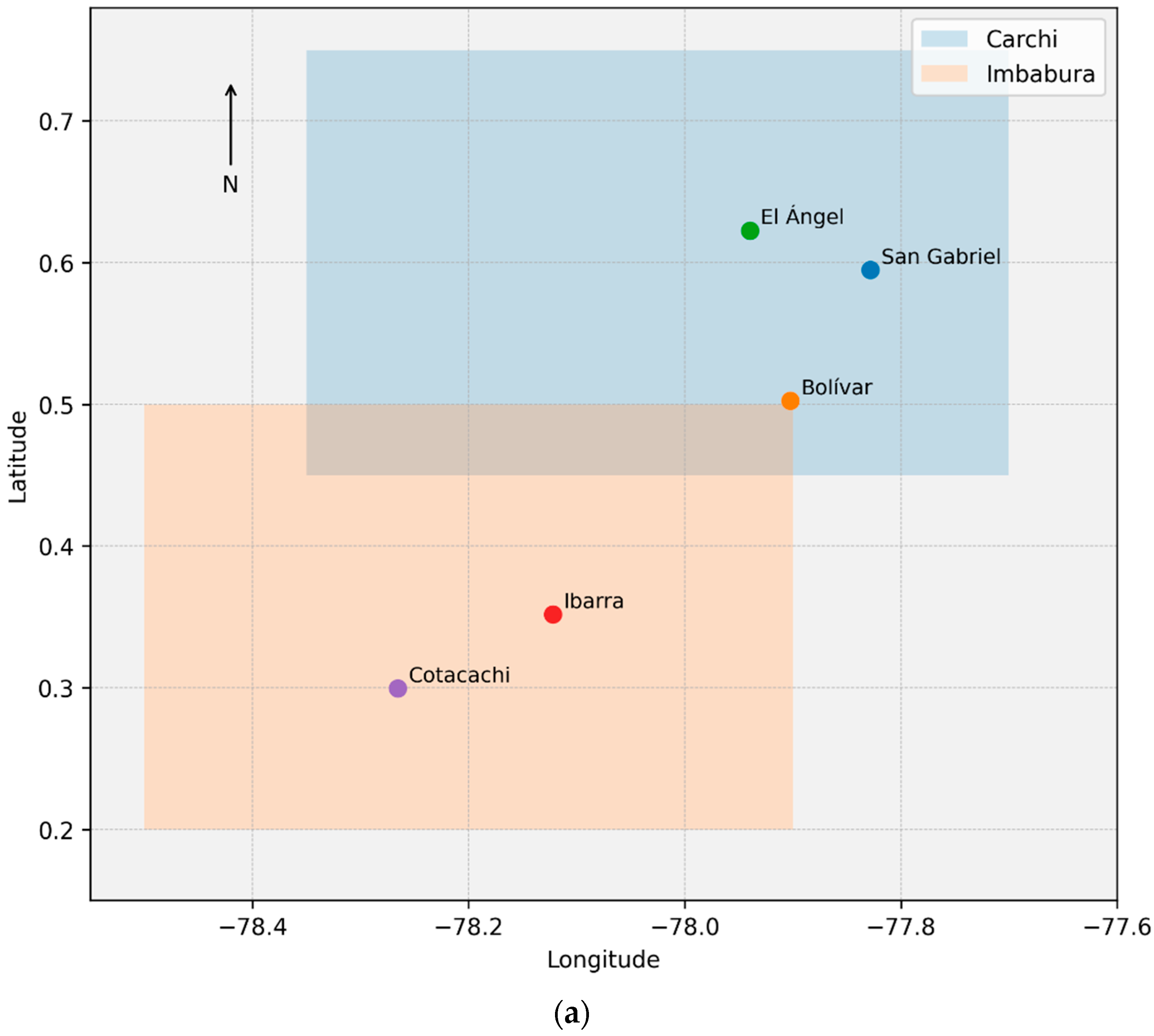
Figure 1. (a) Geographic location of the potato fields used for UAV data acquisition in Carchi and Imbabura provinces, Ecuador. In (b) and (c) are shown examples of RGB images (5472 × 3648) taken at 9–10 m height by the DJI Mavic 2 Pro UAV in potato fields in Carchi and Imbabura, respectively.
Applsci 16 03149 g001aApplsci 16 03149 g001b
Figure 2. Two examples of delimiting and extracting a 250 × 250 sub-image (62.5 cm × 62.5 cm on the ground) at different flight heights, showing crop in (a) and weeds in (b).
Applsci 16 03149 g002
Figure 3. The entire process for automatic weed quantification from UAV images using the best U-Net model, based on our previous work [19].
Applsci 16 03149 g003
Figure 4. Four examples of 128 × 128 sub-images (columns (a)–(d)) containing weeds and crop. RGB sub-images (first row), ground truth (second row), and Residual U-Net prediction (third row). Kikuyu weed appears in mustard yellow, Dandelion in orange, Broadleaf dock in blue, potato crop in green, and other weed species in purple.
Applsci 16 03149 g004
Figure 5. Four examples of 128 × 128 sub-images (columns (a)–(d)) containing weeds and crop. RGB sub-images (128 × 128) of the ground truth (first row) and predicted (second row) with the largest differences in plant coverage on the test set. Kikuyu weed appears in mustard yellow, Dandelion in orange, Broadleaf dock in blue, Potato crop in green, and other weeds in purple.
Applsci 16 03149 g005
Table 1. The number of plants in the extended dataset is more balanced than the original dataset (unbalanced).
Type of PlantNumber of Plants%
Broadleaf dock133416.44%
Dandelion144817.84%
Kikuyu183822.63%
Other weeds166120.46%
Potato (crop)183822.63%
TOTAL8119100%
Table 2. Training parameters and hyperparameters of the five U-Net-based models.
HiperparameterOriginal U-Net Residual U-Net Double U-NetModified U-NetAU-Net
Input size128 × 128 × 3128 × 128 × 3128 × 128 × 3128 × 128 × 3128 × 128 × 3
OptimizerAdam (learning rate = 0.001)Adam (learning rate = 0.001)Adam (learning rate = 0.001)Adam (learning rate = 0.001)Adam (learning rate = 0.001)
Loss functionSparse Categorical Cross-entropySparse Categorical Cross-entropySparse Categorical Cross-entropySparse Categorical Cross-entropySparse Categorical Cross-entropy
Batch size3216323232
Epochs100100100100100
CallbackEarlyStopping
ReduceLROnPlateau
EarlyStopping
ReduceLROnPlateau
EarlyStopping
ReduceLROnPlateau
ReduceLROnPlateauReduceLROnPlateau
Table 3. Evaluation metrics reached in the five versions of U-Net on the validation set (10%, 210 images) for 100 epochs.
ModelDice LossMean Dice CoefficientMean IoU
Original U-Net 0.24240.75760.6542
Double U-Net0.24700.75290.6488
MU-Net 0.22350.77640.6790
AU-Net0.33520.66470.6150
Residual U-Net
(unbalanced original dataset)
0.17650.82350.7755
Residual U-Net
(balanced extended dataset)
0.12360.87630.8053
Note: Top values are in bold.
Table 4. IoU results for each class of Residual U-Net (Balanced dataset) on the test set (10%, 210 images).
ModelBackground IoU Broadleaf Dock IoUDandelion IoUKikuyu IoUOther Weeds IoUPotato IoUMean IoU
Residual U-Net 0.97210.79840.74090.77300.59070.93760.8021
Table 5. A summary of the Student’s t-test applied to all classes in the dataset. Significance indicates whether the difference between the compared measurements is statistically significant (p < 0.05).
Classp-ValueSignificance
Broadleaf dock 0.053No
Dandelion0.392No
Kikuyu0.004Yes
Other weeds0.363No
Potato crops0.970No
Background 0.001Yes
Table 6. Comparison of U-Net CNN model variants used in binary and multi-class semantic weed segmentation, utilizing only UAV images for a fair comparison.
AuthorsYearModel ArchitectureCropWeed SpeciesNumber of ClassesMean IoUOverall ACC (%)
Amarasingam et al. [26]2023U-Net-Bitou bush30.732092
Kong et al. [43]2024ECSNetCornGeneric weeds20.90990.2
Bretas et al. [42]2024U-NetGrass pastures Amaranthus spinosus L.2-94
Gao et al. [6]2024Similar to U-NetMaizeGeneric weeds30.61773.4
Vinueza et al. [19]2025Modified ResNeXt50PotatoBroadleaf dock, Dandelion, Kikuyu, other weeds60.735075.5
Machidon et al. [44]2025SSU-NetLettuce and TobaccoGeneric weeds30.582890.47
Asuka et al. [37]2025U-Net++RiceGeneric weeds20.706097.1
Mei et al. [45]2025SSMR-NetWheatGeneric weeds30.865-
Guo et al. [47]2025CTFFNetRiceBarnyard grass, Sagittaria trifolia3 0.728-
Our work2026Residual U-Net PotatoBroadleaf dock, Dandelion, Kikuyu, other weeds60.802182.4
Note: Top values are in bold for binary and multi-class segmentation.
Disclaimer/Publisher’s Note: The statements, opinions and data contained in all publications are solely those of the individual author(s) and contributor(s) and not of MDPI and/or the editor(s). MDPI and/or the editor(s) disclaim responsibility for any injury to people or property resulting from any ideas, methods, instructions or products referred to in the content.